BOOK REVIEW: FIVE VIEWS ON BIBLICAL INERRANCY

IS THE BIBLE TRULY WITHOUT ERROR?
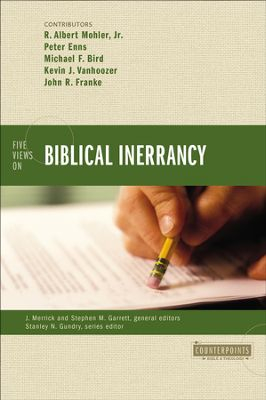
FIVE VIEWS ON BIBLICAL INERRANCY

Reviewed By David P. Craig

Four primary topics are treated in this multi-view book: (1) God and his relationship to his creatures, (2) the doctrine of inspiration, (3) the nature of Scripture, and (4) the nature of truth.

Instead of allowing the author’s to simply give a defense of their positions – each scholar tackles the same outline and passages from their own perspective with reference to the Chicago Statement of Biblical Inerrancy (ISBI). Therefore, specific scriptures are handled to demonstrate each view along the lines of three specific categories: (1) The factuality of Scripture, (2) canonical coherence, and (3) theological coherence.

The scholars therefore all interact with the following texts: Joshua 6, Acts 9:9 compared with Acts 22:9, and Deuteronomy 20 in relation to Matthew 5. Joshua 6 was chosen since current details of historical and archaeological evidence have called into question the accuracy of the text’s account of the destruction of of Jericho. The Acts passage which describes Paul’s conversion was chosen due to the apparent discrepancy between what the witnesses saw and heard during this event. For theological coherence the author’s grapple with the question “How is it that Deuteronomy 20 instructs Israel that the complete extermination of Yahweh’s enemies is a matter of Israel’s purity before and obedience to Yaweh, while Jesus subsequently says faithfulness to God requires nonretaliation and sacrificial love of enemeies (Matthew 5:38-48)?”

The scholars addressing these biblical, theological, and historical concerns are two biblical scholars (Michael Bird and Peter Enns), two systematic theologians (John Franke and Kevin Vanhoozer), and one historical theologian (Albert Mohler). Part one consists of Mohler’s and Enns’ essays in a section entitled “Perspectives on Inerrancy and the Past.” In part 2 Michael Bird (hailing from Australia) addresses “Inerrancy from an International Perspective.” In part 3 Kevin Vanhoozer and John Franke represent “Perspectives on Renewing and Recasting Inerrancy Today.” Each essay is then responded to by the other four scholars.

Albert Mohler’s essay was disappointing in that his argumentation was circular and sophomoric. Of all the essays in the book I was looking forward to his the most. It seems that he didn’t put the time into the essay that was necessary. He simply wholeheartedly agreed with ISBI and did a poor job with the biblical material. His historical study of inerrancy was limited to the mid-late 1900’s.  Mohler’s essay was answered in broad strokes and an a priori apologetic that was redundant and unconvincing. Mohler does a much better job in his essays of response – especially in his response to Enns. I wish that the editors would have chosen a biblical scholar in place of Mohler (with his same postion) – because his handling of the biblical material was particularly simplistic and weak. It just seemed like Mohler’s schedule was too busy to put the necessary scholarship into his essay. However, I wholeheartedly agree with Mohler’s assessment of biblical inerancy when he says, “I do not believe that evangelicalism can survive without the explicit and complete assertion of biblical inerrancy…The afirmation of biblical inerrancy means nothing more, and nothing less, than this: When the Bible speaks, God speaks.”

Peter Enns came across as just plain “ticked off” at the whole idea of biblical inerrancy. He gave a plethora of reasons why he doesn’t think ISBI is a fair or accurate document. He does not adhere to inerrancy (as defined by ISBI) and calls it “erroneous.” The closest he comes to arriving at any position on the Bible is when he writes: “Scripture is a collection of a variety of writings that necessarily and unashamedly reflects the worlds in which those writings were produced. The implication of this metaphor is that an understanding of those historical settings can and should affect interpretive conclusions.”

Enns handling of the biblical material was influenced primarily by liberal scholarship. He believes the Jericho episode didn’t happen due to the archaeological evidence. He believes Paul’s conversion reports are blatant contradictions. Lastly, he thinks that the God of the Old Testament as described in Deuteronomy is different than the God portrayed in the New Testament. He writes, “Israel’s depiction of God vis-a-vis the nations unmistakably, and understandably, reflects the ubiquitous tribal culture at the time.”

Mohler writes of Enns, “So, taking Peter Enns at his word the Bible contains numerous passages that not only fail the test of historical accuracy (even to the point of questioning whether the exodus took place), but also present a false and dangerous misrepresentation of God’s very character and will.” The overall response of the other essayists was similar to my own own response. I felt that Enns was overly critical of Scripture, and didn’t really give a constructive or positive view of Scripture at all. It felt like his whole essay was reactionary and destructive. There was really no positive argument given. It was a lot like reading the “new atheists” – a lot of attack and very little evidence or support for their own view.

Michael Bird’s essay was perhaps the most interesting of the five. If he ever loses his job as a theologian he could become a night club comic. He provides humor in his essay and in his responses to the other essayists (especially humorous is his response to Enns). Bird has the difficult task of reflecting the idea of inerrancy outside of the USA. He covers a lot of ground and shares where he agrees and disagrees with ISBI. He provides a very balanced essay in his response to ISBI, his historical reflections on inerrancy around the globe, and his biblical argumentation – brief but very cogent and clear. One of the highlights of Bird’s essay was this gem, “The goal of revelation is not knowing facts about God but also enjoying fellowship with God.” Overall Bird’s essay is very witty, theologically insightful, and interesting.

Kevin Vanhoozer’s essay argues for what he terms “A Well-versed inerrancy.” He basis his definition largely on the historic tradition of Augustine. Vanhoozer proposes this definition of inerrancy, “to say that the Scripture is inerrant is to confess faith that the authors speak the truth in all things they affirm (when they make affirmations), and will eventually be seen to have spoken truly (when right readers read rightly).” The bulk of Vanhoozer’s essay buttresses his definition of inerrancy with a particular interest in the terms “truth” and “language” and he ties these concepts to the writings and concepts developed by Augustine. His essay utilizes careful language and sophisticated theological and philosophical depth that one would expect of a top-notch systematic theologian. Vanhoozer handles the biblical passages with tremendous theological and exegetical skill.

Vanhoozer gives the practical importance of a well-versed inerrancy with these words: “Implicit in my definition of inerrancy is that we be not only literate readers who rightly see what proposition an author is proposing (the literal sense) and what kind of attention to this proposition is required (literary sensibility) but also right-minded and right-hearted readers who respond rightly to each and every communicative act of Scripture (Spirit-given literacy) Ultimately, a well-versed approach to inerrancy constitutes nothing less than a standing requirement that the community of Scripture’s interpreters become persons capable of understanding, loving, and participating in the truth.”

I love the conclusion to Vanhoozer’s essay where he quotes Augustine’s approach to the veracity of the Scriptures: “And if in these writings I am perplexed by anything which appears to me opposed to the truth, I do not hesitate to suppose that either the manuscript is faulty, or the translator has not caught the meaning of what was said, or I myself have failed to understand.” Of all the essays, I found Vanhoozer’s to be the most theologically profound and exegetically sound.

John Franke does not believe that the ICBI should serve as the standard-bearer for inerrancy. He offers an alternative model – what he calls a fallibilist perspective, “inerrancy functions only within the limits of language alone. It applies to Scripture only in the context of the original settings in which the texts that we have were constructed, and its affirmations and teachings cannot be abstracted from those contexts and offered as absolute truth, because only God knows and is Truth…this means that the ultimate truth and inerrancy of the Bible are finally contained not in the particular narratives and teachings of individual texts but rather in relation to its intended purpose and function in the economy of God…the Bible is that language the Spirit appropriates and employs to effect the social construction of the Christian community.”

Therefore, for Franke, the Bible is essentially fallible because it was written by fallible human beings. He expects that the Scriptures will contain errors and in his discussion of the biblical passages he is not troubled in the slightest by the historicity of the conquest of Jericho, nor the historic details of Paul’s Damascus Road vision. He seems more concerned about the big picture than the little details of the Bible. In doing so – he never quite tells us what inerrancy is. He never tells us what truth is. I found his essay to be confusing, fragmented, and unconvincing in regards to his theology, epistemology, and exegesis.

On the whole this is a fascinating multi-view book. The terrain covered is theologically rich, historically insightful, and exegetically helpful. The final chapter written by Stephen M. Garrett and J. Merrick was just what the doctor ordered. It helped bring synthesis, clarification, as well as a much needed explanation of the continuity and discontinuity on the spectrum of issues presented throughout the book. I highly recommend this book for everyone who loves God’s Word and is seeking to know, love, and live out His truth as revealed in the Scriptures.

JESUS, SCRIPTURE, AND ERROR: An Implication of Theistic Evolution

By Simon Turpin

Bible opened image

Abstract

Within the church, the creation vs. evolution debate is often looked upon as a side issue or as unimportant. However, nothing could be further from the truth. Because of the acceptance of evolutionary theory, many have chosen to re-interpret the Bible with regards to its teaching on creation, the history of Adam and the global catastrophic flood in Noah’s day. Consequently, the very teachings of Jesus are being attacked by those who state that, because of His human nature, there is error in some of His teaching regarding earthly things such as creation. While scholars admit that Jesus affirmed such things as Adam, Eve, Noah and the Flood, they believe that Jesus was wrong on these matters.

The problem with this theory is that it raises the question of Jesus’s reliability, not only as a prophet, but more importantly as our sinless Savior. These critics go too far when they say that because of Jesus’s human nature and cultural context, He taught and believed erroneous ideas.


Keywords: Jesus, deity, humanity, prophet, truth, teaching, creation, kenosis, error, accommodation.

IntroductionIn His humanity, Jesus was subject to everything that humans are subject to, such as tiredness, hunger, and temptation. But does this mean that like all humans He was subject to error? Much of the focus on the person of Jesus in the church today is on His divinity, to the point where, often, aspects of His humanity are overlooked, which can in turn lead to a lack of understanding of this critical part of His nature. For example, it is argued that in His humanity Jesus was not omniscient and that this limited knowledge would have made Him capable of error. It is also believed that Jesus accommodated Himself to the prejudices and erroneous views of the Jewish people of the first century AD, accepting some of the untrue traditions of that time. This, therefore, nullifies His authority on critical questions. For the same reasons, it is not only certain aspects of Jesus’s teaching, but also those of the apostles that are seen as erroneous. Writing for the theistic evolutionist organization Biologos, Kenton Sparks argues that because Jesus, as a human, operated within His finite human horizon, then He would have made errors:

If Jesus as a finite human being erred from time to time, there is no reason at all to suppose that Moses, Paul, John [sic] wrote Scripture without error. Rather, we are wise to assume that the biblical authors expressed themselves as human beings writing from the perspectives of their own finite, broken horizons. (Sparks 2010, p. 7)

To believe our Lord was able to err—and did err in the things He taught—is a severe accusation and needs to be taken seriously. In order to demonstrate that the claim that Jesus erred in His teaching is itself erroneous, it is necessary to evaluate different aspects of Jesus’s nature and ministry. First, this paper will look at the divine nature of Jesus and whether He emptied Himself of that nature, followed by the importance of Jesus’s ministry as a prophet and His claims of the teaching the truth. It will then consider whether Jesus erred in His human nature, and whether as a result of error in Scripture (since humans were involved in its writing) Christ erred in His view of the Old Testament. Finally, the paper will explore the implications of Jesus’s teaching allegedly being false.

The Divine Nature of Jesus—He Existed Before CreationGenesis 1:1 tells us thatIn the beginning God created the heavens and the earth. In John 1:1we read the same words,In the beginning . . . which follows the Septuagint, the Greek translation of the Old Testament. John informs us in John 1:1 that in the beginning was the Word (logos) and that the Word was not only with God but was God. This Word is the one who brought all things into being at creation (John 1:3). Several verses later, John writes that the Word who was with God in the beginning became flesh and dwelt among us (John 1:14). Notice that John does not say that the Word stopped being God. The verb “. . . ‘became’ [egeneto] here does not entail any change in the essence of the Son. His deity was not converted into our humanity. Rather, he assumed our human nature” (Horton 2011, p. 468). In fact, John uses a very particular term here, skenoo “dwelt”, which means he “pitched his tent” or “tabernacled” among us. This is a direct parallel to the Old Testament record of when God “dwelt” in the tabernacle that Moses told the Israelites to construct (Exodus 25:8–933:7). John is telling us that God “dwelt” or “pitched his tent” in the physical body of Jesus.

In the incarnation, it is important to understand that Jesus’s human nature did not replace His divine nature. Rather, His divine nature dwelt in a human body. This is affirmed by Paul in Colossians 1:15–20, especially in verse 19, For it pleased the Father that in Him all the fullness should dwell,” Jesus was fully God and fully man in one person.

The New Testament not only explicitly states that Jesus was fully God, it also recounts events that demonstrate Jesus’ divine nature. For example, while Jesus was on earth, He healed the sick (Matthew 8–9) and forgave sins (Mark 2). What is more, He accepted worship from people (Matthew 2:214:3328:9). One of the greatest examples of this comes from the lips of Thomas when he exclaims in worship before Jesus, My Lord and my God! (John 20:28). The confession of deity here is unmistakable, as worship is only meant to be given to God (Revelation 22:9); yet Jesus never rebuked Thomas, or others, for this. He also did many miraculous signs (John 2; 6; 11) and had the prerogative to judge people (John 5:27) because He is the Creator of the world (John 1:1–31 Corinthians 8:6Ephesians 3:9Colossians 1:16;Hebrews 1:2Revelation 4:11).

Furthermore, the reactions of those around Jesus demonstrated that He viewed Himself as divine and truly claimed to be divine. In John 8:58, Jesus said to the Jewish religious leaders, Most assuredly, I say to you, before Abraham was, I am”. This “I am” statement was Jesus’s clearest example of His proclamation “I am Yahweh,” from its background in the book of Isaiah (41:4; 43:10–13, 25; 48:12—see also Exodus 3:14). This divine self-disclosure of Jesus’s explicit identification of Himself with Yahweh of the Old Testament is what led the Jewish leaders to pick up stones to throw at Him. They understood what Jesus was saying, and that is why they wanted to stone Him for blasphemy. A similar incident takes place in John 10:31. The leaders again wanted to stone Jesus after He saidI and the Father are one, because they knew He was making Himself equal with God. Equality indicates His deity, for who can be equal to God? Isaiah 46:9 says: Remember the former things of old, For I am God, and there is no other; I am God, and there is none like Me. If there is no one like God and yet Jesus is equal to God (Philippians 2:6), what does this say of Him, except that He must be God? The only thing that is equal to God is God.

In the Incarnation Did Jesus Empty Himself of His Divine Nature?Kenotic Theology—(Philippians 2:5–8)

A question that needs to be asked is whether Jesus emptied Himself of His divine nature in His incarnation. In the seventeenth century, German scholars debated the issue of Christ’s divine attributes while He was on earth. They argued that because there is no reference in the gospels to Christ making use of all of His divine attributes (such as omniscience) that He abandoned the attributes of His divinity in His incarnation (McGrath 2011, p. 293). Gottfried Thomasius (1802–1875) was one of the main proponents of this view who explained the incarnation as “the self-limitation of the Son of God” (Thomasius, Dorner, and Biedermann 1965, p. 46). He reasoned that the Son could not have maintained His full divinity during the incarnation (Thomasius, Dorner, and Biedermann 1965, pp. 46–47). Thomasius believed that the only way for a true incarnation to take place was if the Son “‘gave himself over into the form of human limitation.”’ (Thomasius, Dorner, and Biedermann 1965, pp. 47–48). He found his support for this in Philippians 2:7, defining the kenosis as:

[T]he exchange of the one form of existence for the other; Christ emptied of the one and assumed the other. It is thus an act of free self-denial, which has as its two moments the renunciation of the divine condition of glory, due him as God, and the assumption of the humanly limited and conditioned pattern of life. (Thomasius, Dorner, and Biedermann 1965, p. 53)

Thomasius separated the moral attributes of God: truth, love, and holiness, from the metaphysical attributes: omnipotence, omnipresence, and omniscience. Thomasius not only believed that Christ gave up the use of these attributes, (omnipotence, omnipresence, omniscience) but that He did not even possess them during the incarnation (Thomasius, Dorner, and Biedermann 1965, pp. 70–71). Because of Christ’s self-emptying in Philippians 2:7, it was believed that Jesus was limited essentially by the opinions of His time. Robert Culver comments on the belief of Thomasius and other scholars who held to a kenotic theology:

Jesus’ testimony to the inerrant authority of the Old Testament . . . is negated. He simply had given up divine omniscience and omnipotence and hence didn’t know any better. Some of these scholars earnestly desired a way to remain orthodox and to go with the flow of what was deemed to be scientific truth about nature and about the Bible as an inspired book not necessarily true in every respect. (Culver 2006, p. 510)

It is critical, therefore, to ask what Paul means when he says that Jesus emptied Himself. Philippians 2:5–8 says:

In your relationships with one another, have the same mindset as Christ Jesus: Who, being in very nature God, did not consider equality with God something to be used to his own advantage; rather, he made himself nothing by taking the very nature of a servant, being made in human likeness. And being found in appearance as a man, he humbled himself by becoming obedient to death—even death on a cross!

There are two key words in these verses that help in understanding the nature of Jesus. The first key word is the Greek morphē (form). Morphē

covers a broad range of meanings and therefore we are heavily dependent on the immediate context to discover its specific nuance. (Silva 2005, p. 101)

In Philippians 2:6 we are helped by two factors to discover the meaning of morphē.

In the first place, we have the correspondence of morphē theou with isa theō. . . . “in the form of God” is equivalent to being “equal with God.” . . . In the second place, and most important, morphē theou is set in antithetical parallelism to μορφην δουλου (morphēn doulou, form of a servant), an expression further defined by the phrase εν ομοιωματι ανθρωπων (en homoiōmati anthrōpōn, in the likeness of men). (Silva 2005, p. 101)

The parallel phrases show that morphē refers to outward appearance. In Greek literature the term morphē has to do with “external appearance” (Behm 1967, pp. 742–743) which is visible to human observation. “Similarly, the word form in the Greek OT (LXX) refers to something that can be seen [Judges 8:18Job 4:16Isaiah 44:13]” (Hansen 2009, p. 135). Christ did not cease to be in the form of God in the incarnation, but taking on the form of a servant He became the God-man.

The second key word is ekenosen from which we get the kenosis doctrine. Modern English Bibles translate verse 7 differently:

New International Version/Today’s New International Version: rather, he made himself nothing by taking the very nature of a servant being made in human likeness.

English Standard Version: but emptied himself, by taking the form of a servant, being born in the likeness of men.

New American Standard Bible: but emptied Himself, taking the form of a bond-servant, and being made in the likeness of men.

New King James Version: but made Himself of no reputation, taking the form of a bondservant, and coming in the likeness of men.

New Living Translation: Instead, he gave up his divine privileges; he took the humble position of a slave and was born as a human being. When he appeared in human form.”

It is debatable from a lexical standpoint whether “emptied himself,” “made Himself of no reputation,” or “gave up his divine privileges” are even the best translations. The New International Version/Today’s New International Version translation “made himself nothing” is probably more supportable (Hansen 2009, p. 149; Silva 2005, p. 105; Ware 2013). Philippians 2:7, however, does not say that Jesus emptied Himself of anything in particular; all it says is that he emptied Himself. New Testament scholar George Ladd comments:

The text does not say that he emptied himself of the morphē theou [form of God] or of equality with God . . . All that the text states is that “he emptied himself by taking something else to himself, namely, the manner of being, the nature or form of a servant or slave.” By becoming human, by entering on a path of humiliation that led to death, the divine Son of God emptied himself. (Ladd 1994, p. 460)

It is pure conjecture to argue from this verse that Jesus gave up any or all of His divine nature. He may have given up or suspended the use of some of His divine privileges, perhaps, for example, His omnipresence or the glory that He had with the Father in heaven (John 17:5), but not His divine power or knowledge. “The humiliation,” of Jesus is not therefore seen in His becoming man (anthropos) or a man (aner) but that “as man” (hos anthropos) “‘he humbled himself by becoming obedient to the point of death, even death on a cross (Philippians 2:8)” (Culver 2006, p. 514).

The fact that Jesus did not give up His divine nature can be seen when He was on the Mount of Transfiguration and the disciples saw His glory (Luke 9:28–35) since here there is an association with the glory of God’s presence in Exodus 34:29–35. In the incarnation Jesus was not exchanging His deity for humanity but suspending the use of some of His divine powers and attributes (cf. 2 Corinthians 8:9). Jesus’s emptying of Himself was a refusal to cling to His advantages and privileges as God. We can also compare how Paul uses this same term, kenoo, which only appears four other times in the New Testament (Romans 4:141 Corinthians 1:17;9:152 Corinthians 9:3). In Romans 4:14 and 1 Corinthians 1:17, it means to make void, that is, deprive of force, render vain, useless, or of no effect. In 1 Corinthians 9:15 and 2 Corinthians 9:3it means to make void, that is, to cause a thing to be seen to be empty, hollow, false (Thayer 2007, p. 344). In these instances it is clear that Paul’s use of kenoo is used figuratively rather than literally (Berkhof 1958, p. 328; Fee 1995, p. 210; Silva 2005, p. 105). Additionally, in Philippians 2:7 “to press for a literal meaning of ‘emptying’ ignores the poetic context and nuance of the word” (Hansen 2009, p. 147). Therefore, in Philippians 2:7 it is perhaps more accurate to see “emptying” as Jesus pouring Himself out, in service, in an expression of divine self-denial (2 Corinthians 8:9). Jesus’s service is explained in Mark 10:45: “For even the Son of Man did not come to be served, but to serve, and to give His life a ransom for many.” In practise, this meant in the incarnation that Jesus:

  1. Took the form of a servant

  2. Was made in the likeness of men

  3. Humbled himself becoming obedient to death on the cross.

In His incarnation Jesus did not cease to be God, or cease in any way to have the authority and knowledge of God.

Jesus as a ProphetIn His state of humiliation, part of Jesus’s ministry was to speak God’s message to the people. Jesus referred to Himself as a prophet (Matthew 13:57Mark 6:4Luke 13:33) and was declared to have done a prophet’s work (Matthew 13:57Luke 13:33John 6:14). Even those who did not understand that Jesus was God accepted Him as a prophet, (Luke 7:15–17Luke 24:19John 4:196:147:409:17). Furthermore, Jesus introduced many of His sayings by “amen” or “truly” (Matthew 6:2516). I. Howard Marshall says of Jesus:

[Jesus] made no claim to prophetic inspiration; no “thus says the Lord” fell from his lips, but rather he spoke in terms of his own authority. He claimed the right to give the authoritative interpretation of the law, and he did so in a way that went beyond that of the prophets. He thus spoke as if he were God. (Marshall 1976, pp. 49–50)

In the Old Testament, Deuteronomy 13:1–5 and 18:21–22 provided the people of Israel with two tests to discern true prophets from false prophets.

First, a true prophet’s message had to be consistent with earlier revelation.

Second, a true prophet’s predictions always had to come true.

Deuteronomy 18:18–19 foretells of a prophet whom God would raise up from His own people after Moses died:I will raise up for them a Prophet like you from among their brethren, and will put My words in His mouth, and He shall speak to them all that I command Him (Deuteronomy 18:18). This is properly referred to in the New Testament as having been fulfilled in Jesus Christ (John 1:45Acts 3:22–237:37). Jesus’s teaching had no origin in human ideas but came entirely from God. In His role as prophet, Jesus had to speak God’s word to God’s people. Therefore He was subject to God’s rules concerning prophets. In the Old Testament, if a prophet was not correct in his predictions he would be stoned to death as a false prophet by order of God (Deuteronomy 13:1–518:20). For a prophet to have credibility with the people, his message must be true, as he has no message of his own but can only report what God has given him. This is because prophecy had its origin in God and not man (Habakkuk 2:2–32 Peter 1:21).

In His prophetic role, Christ represents God the Father to mankind. He came as a light to the world (John 1:98:12) to show us God and bring us out of darkness (John 14:9–10). In John 8:28–29 Jesus also showed evidence of being a true prophet—that of living in close relation with His Father, passing on His teaching (cf. Jeremiah 23:21–23):

When you lift up the Son of Man, then you will know that I am He, and that I do nothing of Myself; but as My Father taught Me, I speak these things. And He who sent Me is with Me. The Father has not left Me alone, for I always do those things that please Him.

Jesus had the absolute knowledge that everything He did was from God. What He said and did is absolute truth because His Father is “truthful” (John 8:26). Jesus only spoke that which His Father told Him to say (John 12:49–50), so it had to be correct in every way. If Jesus as a prophet was wrong in the things He said, then why would we acclaim Him as the Son of God? If Jesus is a true prophet, then His teaching regarding Scripture must be taken seriously as absolute truth.

Jesus’s Teaching and Truth

Since God himself is the measure of all truth and Jesus was co-equal with God, he himself was the yardstick by which truth was to be measured and understood. (Letham 1993, p. 92)

In John 14:6 we are told that Jesus not only told the truth but that He was, and is, truth. Scripture portrays Jesus as the truth incarnate (John 1:17). Therefore, if He is the truth, He must always tell the truth and it would have been impossible for Him to speak or think falsehood. Much of Jesus’s teaching began with the phrase “Truly, truly I say . . .” If Jesus taught anything in error, even if it was from ignorance (for example, the Mosaic authorship of the Pentateuch), He would not be the truth.

To err may be human for us. Falsehood, however, is rooted in the nature of the devil (John 8:44), not the nature of Jesus who speaks the truth (John 8:45–46). The Father is the only true God (John 7:288:2617:3) and Jesus taught only what the Father had given to Him (John 3:32–338:4018:37). Jesus testifies about the Father, who in turn testifies concerning the Son (John 8:18–191 John 5:10–11), and they are one (John 10:30). The gospel of John shows emphatically that Jesus’s teaching and words are the teaching and words of God. Three clear examples of this are:

And the Jews marveled, saying, “How does this Man know letters, having never studied?” Jesus answered them and said, “My doctrine is not Mine, but His who sent Me. If anyone wills to do His will, he shall know concerning the doctrine, whether it is from God or whether I speak on My own authority. (John 7:15–17)

I know that you are Abraham’s descendants, but you seek to kill Me, because My word has no place in you. I speak what I have seen with My Father, and you do what you have seen with your father. . . . But now you seek to kill Me, a Man who has told you the truth which I heard from God. Abraham did not do this. (John 8:37–3840)

For I have not spoken on My own authority; but the Father who sent Me gave Me a command, what I should say and what I should speak. And I know that His command is everlasting life. Therefore, whatever I speak, just as the Father has told Me, so I speak.(John 12:49–50)

In John 12:49–50 “Not only is what Jesus says just what the Father has told him to say, but he himself is the Word of God, God’s self-expression (1:1)” (Carson 1991, p. 453). The authority behind Jesus’s words are the commands that are given to Him by the Father (and Jesus always obeyed the Father’s commands; John 14:31). Jesus’s teaching did not originate in human ideas but came from God the Father, which is why it is authoritative. His very own words were spoken in full authorization from the Father who sent Him. The authority of Jesus’s teaching then rests upon the unity between Himself and the Father. Jesus is the embodiment, revelation, and messenger of truth to mankind; and it is the Holy Spirit who conveys truth about Jesus to the unbelieving world through believers (John 15:26–2716:8–11). Again, the point is that if there was error in Jesus’s teaching, then He is a false and unreliable teacher. However, Jesus was God incarnate, and God and falsehood can never be reconciled with each other (Titus 1:2;Hebrews 6:18).

Jesus’s Human NatureIt is important to understand that in the incarnation, not only did Jesus retain His divine nature, He also took on a human nature. With respect to His divine nature, Jesus was omniscient (John 1:47–514:16–1929), having all the attributes of God, yet in His human nature He had all the limitations of being human, which included limitations in knowing. The true humanity of Jesus is expressed throughout the gospels, which tell us that Jesus was wrapped in ordinary infant clothing (Luke 2:7), grew in wisdom as a child (Luke 2:4052), and was weary (John 4:6), was hungry (Matthew 4:4), was thirsty (John 19:28), was tempted by the devil (Mark 4:38), and was sorrowful (Matthew 26:38a). The incarnation should be viewed as an act of addition and not as an act of subtraction of Jesus’s nature:

When we think about the Incarnation, we don’t want to get the two natures mixed up and think that Jesus had a deified human nature or a humanized divine nature. We can distinguish them, but we can’t tear them apart because they exist in perfect unity. (Sproul 1996)

For example, in Mark 13:32 where Jesus is talking about His return, He says, But of that day and hour no one knows, not even the angels in heaven, nor the Son, but only the Father.” Does this mean that Jesus was somehow limited? How should we handle this statement by Jesus? The text seems straightforward in saying there was something Jesus did not know. Jesus’s teaching shows that what He knew or did not know was a conscious self-limitation. The God-man possessed divine attributes, or He would have ceased to be God, but He chose not always to employ them. The fact that Jesus told His disciples that He did not know something is an indication that He did not teach untruths and this is confirmed by His statement, if it were not so, I would have told you (John 14:2). Furthermore, ignorance of the future is not the same as making an erroneous statement. If Jesus had predicted something that did not take place, then that would be an error.

The question that now needs to be asked is this: Was Jesus in His humanity capable of error in the things he taught? Does our human capacity to err apply to the teaching of Jesus? Because of His human nature, questions are raised about Jesus’s beliefs concerning certain events in Scripture. The Chicago Statement on Biblical Hermeneutics (1982) states: “We deny that the humble, human form of Scripture entails errancy any more than the humanity of Christ, even in His humiliation, entails sin.” Arguing against the position, Kenton Sparks, Professor of Biblical Studies at Eastern University, in his book God’s Word in Human Words, states:

First, the Christological argument fails because, though Jesus was indeed sinless, he was also human and finite. He would have erred in the usual way that other people err because of their finite perspectives. He misremembered this event or that, and mistook this person for someone else, and thought—like everyone else—that the sun was literally rising. To err in these ways simply goes with the human territory. (Sparks 2008, pp. 252–253)

First of all, it should be noted that nowhere in the gospels is there any evidence that Jesus either misremembered any event or mistook any person for another, nor does Sparks provide evidence for this. Secondly, the language used in Scripture to describe the sun’s rising (for example, Psalm 104:22) and movement of the earth are literal only in a phenomenological sense as it is described from the viewpoint of the observer. Moreover, this is still done today in weather reports when the reporter uses terminology such as “sunrise tomorrow will be at 5 a.m.”

Because of the impact evolutionary ideology has had in the scientific realm as well as in theology, it is reasoned that Jesus’s teaching on things such as creation and the Mosaic authorship of the Pentateuch was simply wrong. Jesus would have been unaware of evolution as it relates to the critical approach to the authorship of the Old Testament, the Documentary Hypothesis. It is reasoned that in His humanity He was limited by the opinions of His time. Therefore, He could not be held accountable for holding to a view of Scripture that was prevalent in the culture. It is argued that Jesus erred in what He taught because He was accommodating the erroneous Jewish traditions of His time. For example, Peter Enns objects to idea that Jesus’s belief in the Mosaic authorship of the Pentateuch is valid, since He simply accepted the cultural tradition of His day:

Jesus seems to attribute authorship of the Pentateuch to Moses (e.g., John 5:46–47). I do not think, however, that this presents a clear counterpoint, mainly because even the most ardent defenders of Mosaic authorship today acknowledge that some of the Pentateuch reflects updating, but taken at face value this is not a position that Jesus seems to leave room for. But more important, I do not think that Jesus’s status as the incarnate Son of God requires that statements such as John 5:46–47 be understood as binding historical judgments of authorship. Rather, Jesus here reflects the tradition that he himself inherited as a first-century Jew and that his hearers assumed to be the case. (Enns 2012, p. 153)

Like Enns, Sparks also uses the accommodation theory to argue for human errors in Scripture (Sparks 2008, pp. 242–259). He believes that the Christological argument cannot serve as an objection to the implications of accommodation (Sparks 2008, p. 253) and that God does not err in the Bible when He accommodates the errant views of Scripture’s human audience (Sparks 2008, p. 256).

In his objection to the validity of Jesus’s belief in the Mosaic authorship of the Pentateuch, Enns is too quick in downplaying the divine status of Jesus in relation to His knowledge of the authorship of the Pentateuch. This overlooks whether the divinity of Christ meant anything in terms of an epistemological relevance to His humanity, and raises the question of how the divine nature relates to the human nature in the one person. We are told on several occasions, for example, that Jesus knew what people were thinking (Matthew 9:412:25) which is a clear reference to His divine attributes. A. H. Strong gives a good explanation as to how the personality of Jesus’s human nature existed in union with His divine nature:

[T]he Logos did not take into union with himself an already developed human person, such as James, Peter, or John, but human nature before it had become personal or was capable of receiving a name. It reached its personality only in union with his own divine nature. Therefore we see in Christ not two persons—a human person and a divine person—but one person, and that person possessed of a human nature as well as a divine. (Strong 1907, p. 679)

There is a personal union between the divine and human nature with each nature entirely preserved in its distinctness, yet in and as one person. Although, some appeal to Jesus’s divinity in order to affirm Mosaic authorship of the Pentateuch (Packer 1958, pp. 58–59), it is not necessary to do so, since:

There is no mention in the Gospels of Jesus’ divinity overwhelming his humanity. Nor do the Gospels refer his miracles to his divinity and refer his temptation or sorrow to his humanity, as if he switched back and forth from operating according to one nature to operating according to another. Rather, the Gospels routinely refer Christ’s miracles to the Father and the Spirit . . . [Jesus] spoke what he heard from the Father and as he was empowered by the Spirit. (Horton 2011, p. 469)

The context of John 5:45–47 is important in understanding the conclusions we draw concerning the truthfulness of what Jesus taught. In John 5:19 we are told that Jesus can do nothing of Himself. In other words, He does not act independently of the Father, but He only does what He sees the Father doing. Jesus has been sent into the world by God to reveal truth (John 5:3036) and it is this revelation from the Father that enabled Him to do “greater works.” Elsewhere in John we are told that the Father teaches the Son (John 3:32–337:15–178:2837–3812:49–50). Jesus is not only one with the Father but is also dependent upon Him. Since the Father cannot be in error or lie (Numbers 23:19Titus 1:2), and because Jesus and the Father are one (John 10:30), to accuse Jesus of error or falsehood in what He knew or taught is to accuse God of the same thing.

Jesus went on to acknowledge that the Old Testament required a minimum of two or three witnesses to establish the truthfulness of one’s claim (Deuteronomy 17:619:15). Jesus produces several witnesses corroborating His claim of equality with God:

Jesus told the Jewish leaders that it is Moses, one of the witnesses, who will hold them accountable for their unbelief in what he wrote concerning Him, and that it is he who will be their accuser before God. New Testament scholar Craig Keener comments:

In Palestinian Judaism, “accusers” were witnesses against the defendant rather than official prosecutors (cf. 18:29), an image which would be consistent with other images used in the gospel tradition (Matt 12:41–42Luke 11:31–32). The irony of being accused by a person or document in which one trusted for vindication would not be lost on an ancient audience. (Keener 2003, pp. 661–662)

In order for the accusation to hold up, however, the document or witnesses need to be reliable (Deuteronomy 19:16–19) and if Moses did not write the Pentateuch, how then can the Jews be held accountable by him and his writings? It was Moses who brought the people of Israel out of Egypt (Acts 7:40), gave them the Law (John 7:19), and brought them to the Promised Land (Acts 7:45). It was Moses who wrote about the coming prophet that God would send Israel to whom they should listen (Deuteronomy 18:15Acts 7:37). What is more, it is God who puts the words into the mouth of this prophet (Deuteronomy 18:18). Moreover, Jesus

opposed the pseudo-authority of untrue Jewish traditions . . . . [and] disagrees with a pseudo-oral source [Mark 7:1–13], the false attribution of Jewish oral tradition to Moses. (Beale 2008, p. 145)

The basis for the truthfulness and inerrancy of what Jesus taught does not have to be resolved by appealing to His divine knowledge (although it can be), but can be understood from His humanity through His unity with the Father, which is why His teaching is true.

Furthermore, the New Testament strongly favors the Mosaic authorship of the Pentateuch (Matthew 8:423:2Luke 16:29–31John 1:1745Acts 15:1Romans 9:1510:5). However, because of their belief in the “overwhelming evidence” for the documentary hypothesis, scholars (for example, Sparks 2008, p. 165) seem to come to the New Testament believing that the evidence of the Mosaic authorship of the Pentateuch must be explained away in order to be consistent with their conclusions. The simple fact is that scholars who reject the Mosaic authorship of the Pentateuch, and embrace an accommodation approach to the evidence of the New Testament, are as unwilling as the Jewish leaders (John 5:40) in not wanting to listen to the words of Jesus on this subject.

The accommodation approach to the teaching of Jesus also raises the issue of whether He was mistaken on other such issues, as Gleason Archer explains:

Such an error as this, in matters of historical fact that can be verified, raises a serious question as to whether any of the theological teaching, dealing with metaphysical matters beyond our powers of verification, can be received as either trustworthy or authoritative. (Archer 1982, p. 46)

The accommodation approach also leaves us with a Christological problem. Since Jesus clearly understood that Moses wrote about Him, this creates a serious moral problem for Christians, as we are told to follow the example set by Christ (John 13:151 Peter 2:21) and have his attitude (Philippians 2:5). Yet, if Christ is shown to be approving falsehood in some areas of His teaching, it opens a door for us to affirm falsehood in some areas as well. The belief that Jesus accommodated His teaching to the beliefs of his first century hearers does not square with the facts. New Testament scholar John Wenham in his book Christ and the Bible comments on the idea that Jesus accommodated His teaching to the beliefs of His first century hearers:

He is not slow to repudiate nationalist conceptions of Messiahship; He is prepared to face the cross for defying current misconceptions . . . Surely He would have been prepared to explain clearly the mingling of divine truth and human error in the Bible, if He had known such to exist. (Wenham 1994, p. 27)

For those who hold to an accommodation position, this overlooks the fact that Jesus never hesitated to correct erroneous views common in the culture (Matthew 7:6–1329). Jesus was never constrained by the culture of his day if it went against God’s Word. He opposed those who claimed to be experts on the Law of God, if they were teaching error. His numerous disputes with the Pharisees are testament to this (Matthew 15:1–923:13–36). The truth of Christ’s teaching is not culturally bound, but transcends all cultures and remains unaltered by cultural beliefs (Matthew 24:351 Peter 1:24–25). Those who claim that Jesus in His humanity was susceptible to error and therefore merely repeated the ignorant beliefs of His culture are claiming to have more authority, and to be wiser and more truthful than Jesus.

Much of Christian teaching focuses, rightly, on the death of Jesus. However, in focusing on the death of Christ we often neglect the teaching that Jesus lived a life of perfect obedience to the Father. Jesus not only died for us; He also lived for us. If all Jesus had to do was to die for us, then He could have descended from heaven on Good Friday, gone straight to the cross, risen from the dead and ascended back into heaven. Jesus did not live for 33 years for no reason. Whilst on earth Christ did the Father’s will (John 5:30), taking specific actions, teaching, miracle-working, obeying the Law in order to fulfill all righteousness” (Matthew 3:15). Jesus, the last Adam (1 Corinthians 15:45), came to succeed where the first Adam had failed in keeping the law of God. Jesus had to do what Adam failed to do in order to fulfill the required sinless life of perfection. Jesus did this so that His righteousness could be transferred to those who put their faith in Him for the forgiveness of sins (2 Corinthians 5:21Philippians 3:9).

We must remember that in His humanity, Jesus, was not superman but a real man. The humanity of Jesus and the deity of Jesus do not mix directly with one another. If they did, then that would mean that the humanity of Jesus would actually become super-humanity. And if it is super-humanity, it is not our humanity. And if it is not our humanity, then He cannot be our substitute since He must be like us (Hebrews 2:14–17). Although the genuine humanity of Jesus did involve tiredness and hunger, it did not prevent Him from doing what pleased His Father (John 8:29) and speaking the truth He heard from God (John 8:40). Jesus did nothing on His own authority (John 5:19306:387:16288:16). He had the absolute knowledge that everything He did was from God, including speaking what He had heard and had been taught by the Father. In John 8:28 Jesus said:“I do nothing of Myself; but as My Father taught Me, I speak these things.” New Testament scholar Andreas Kostenberger notes that,

Jesus as the sent Son, again affirms his dependence on the Father, in keeping with the Jewish maxim that “a man’s agent [šālîah] is like the man himself.” (Kostenberger 2004, p. 260)

Just as God speaks the truth and no error can be found in Him, so it was with His sent Son. Jesus was not self-taught; rather His message came directly from God and, therefore, it was ultimately truth (John 7:16–17).

Scripture and Human ErrorIt has long been recognized that both Jesus and the apostles accepted Scripture as the flawless Word of the living God (John 10:3517:17Matthew 5:182 Timothy 3:162 Peter 1:21). Unfortunately, this view of Scripture is attacked by many today, mainly because critics assume that since humans were involved in the process of writing Scripture, their capacity to err would result in the presence of errors in Scripture. The question that needs to be asked is whether the Bible contains error because it was written by human authors.

Many people are familiar with the Latin adage errare humanum est—to err is human. For instance, what person would ever claim to be without error? For this reason, the Swiss, neo-orthodox, theologian Karl Barth (1886–1968), whose view of Scripture is still influential in certain circles within the evangelical community, believed that: “we must dare to face the humanity of the biblical texts and therefore their fallibility . . .” (Barth 1963, p. 533). Barth believed that Scripture contained error because human nature was involved in the process:

As truly as Jesus died on the cross, as Lazarus died in Jn. 11, as the lame were lame, as the blind were blind . . . so, too, the prophets and apostles as such, even in their office, even in their function as witnesses, even in the act of writing down their witness, were real, historical men as we are, and therefore sinful in their action, and capable and actually guilty of error in their spoken and written word. (Barth 1963, p. 529)

Barth’s ideas, as well as the end results of higher criticism, are still making an impression today, as can be seen in Kenton Sparks’s work (Sparks 2008, p. 205). Sparks believes that although God is inerrant, because he spoke through human authors their “finitude and fallenness” resulted in a flawed biblical text (Sparks 2008, pp. 243–244).

In classic postmodern language Sparks states:

Orthodoxy demands that God does not err, and this implies, of course, that God does not err in Scripture. But it is one thing to argue that God does not err in Scripture; it is quite another thing that the human authors of Scripture did not err. Perhaps what we need is a way of understanding Scripture that paradoxically affirms inerrancy while admitting the human errors in Scripture. (Sparks 2008, p. 139)

Sparks’s claim of an inerrant Scripture that is errant is founded

in contemporary postmodern hermeneutical theories which emphasize the roll [sic] of the reader in the interpretive process and human fallibility as agents and receptors of communication. (Baugh 2008)

Sparks attributes the “errors” in Scripture to the fact that humans err: the Bible is written by humans, therefore its statements often reflect “human limitations and foibles” (Sparks 2008, p. 226). For both Barth and Sparks, an inerrant Bible is worthy of the charge of docetism (Barth 1963, pp. 509–510; Sparks 2008, p. 373).

Barth’s view of inspiration seems to be influencing many today in how they understand Scripture. Barth believed that God’s revelation takes place through His actions and activity in history; revelation then for Barth is seen as an “‘event”’ rather than coming through propositions (a proposition is a statement describing some reality that is either true or false; Beale 2008, p. 20). For Barth, the Bible is a witness to revelation but is not revelation itself (Barth 1963, p. 507) and, although there are propositional statements in Scripture, they are fallible human pointers to revelation-in-encounter. Michael Horton explains Barth’s idea of revelation:

For Barth, the Word of God (i.e., the event of God’s self-revelation) is always a new work, a free decision of God that cannot be bound to a creaturely form of mediation, including Scripture. This Word never belongs to history but is always an eternal event that confronts us in our contemporary existence. (Horton 2011, p. 128)

In his book Encountering Scripture: A Scientist Explores the Bible, one of the leading theistic evolutionists of today, John Polkinghorne, explains his view of Scripture:

I believe that the nature of divine revelation is not the mysterious transmission of infallible propositions . . . but the record of persons and events through which the divine will and nature have been most transparently made known . . . The Word of God uttered to humanity is not a written text but a life lived . . . Scripture contains witness to the incarnate Word, but it is not the Word himself. (Polkinghorne 2010, pp. 1, 3)

Like Sparks, Polkinghorne seems to be following Barth in his view of the inspiration of Scripture (misrepresenting the orthodox view in the process), which is opposed to the idea of revelation to divinely accredited messengers (the prophets and apostles). Therefore, in his view the Bible is not God’s Word but is only a witness to it with revelation seen as an event rather than the written Word of God (propositional truth statements). In other words, the Bible is a flawed record of God’s revelation to human beings, but it is not revelation itself. This view is not based on anything within the Bible, but is based upon extra-biblical, philosophical, critical grounds with which Polkinghorne is comfortable. Unfortunately, Polkinghorne offers a straw-man argument regarding the inspiration of Scripture as being “divinely dictated” (Polkinghorne 2010, p. 1). For him, the idea of the Bible being inerrant is “inappropriately idolatrous” (Polkinghorne 2010, p. 9), and so he believes he has a right to judge Scripture with his own autonomous intellect.

However, contra Barth and Polkinghorne, the Bible is not merely a record of events, but also gives us God’s interpretation of the meaning and significance of the events. We do not only have the gospel, but we also have the epistles which interpret the significance of the events of the gospel for us propositionally. This can be seen, for example, in the event of the crucifixion of Christ. At the time of Jesus’s ministry, the high priest Caiaphas saw the event of the death of Jesus as a historical expedient in that it was necessary for the good of the nation for one man to die (John 18:14). Meanwhile the Roman centurion standing underneath the cross came to believe that Jesus was truly was the Son of God (Mark 15:39). Yet, Caiaphas and the Centurion could not have known apart from divine revelation that the death of Christ was ultimately an atoning sacrifice made to satisfy the demands of God’s justice (Romans 3:25). We need more than an event in the Bible, we must also have the revelation of the meaning of the event or the meaning simply becomes subjective. God has given us the meaning and significance of these events through His chosen medium of the prophets and the apostles.

Furthermore, the charge of biblical docetism (that it denies the true humanity of Scripture), moves too quickly in presuming genuine humanity necessitates error:

Given an understanding of the Spirit’s work that superintends the production of the text without bypassing the human author’s personality, mind or will, and given that truth can be expressed perspectivally—that is, we do not need to know everything or to speak from a position of absolute objectivity or neutrality in order to speak truly—what exactly would be doecetic about an infallible text should we be given one? (Thompson 2008, p. 195)

What is more, the adage “to err is human” is simply assumed to be true. It may be true that humans err but it is not true that it is intrinsic for humanity to necessarily always err. There are many things we can do as humans and not err (examinations for example) and we must remember God created humanity at the beginning of creation as sinless and therefore with the capacity not to err. Also, the incarnation of Jesus Christ shows sin, and therefore error, not to be normal. Jesus

who is impeccable was made in the likeness of sinful flesh, but being in “fashion as a man” still “holy harmless and undefiled.” To err is human is a false statement. (Culver 2006, p. 500)

One could argue that both Barth’s and Sparks’s view of Scripture is in fact “Arian” (denial of the true deity of Christ). What is more, Sparks’s contention that God is inerrant but accommodates Himself through human authors (which is where the errors in Scripture come from), fails to see that if what he says is true, then it is also possible that the biblical authors were in error in stating that God is inerrant. How in their erroneous humanity then would they know God is inerrant unless He revealed it to them?

Furthermore, orthodox Christianity does not deny the true humanity of Scripture; rather it properly recognizes that to be human does not necessarily entail error, and that the Holy Spirit kept the biblical writers from making errors they might otherwise have made. The assertion of a mechanical view of inspiration (God dictates the words to human authors) is simply a canard. Rather, orthodox Christianity embraces a theory of organic inspiration. “That is, God sanctifies the natural gifts, personalities, histories, languages, and cultural inheritance of the biblical writers” (Horton 2011, p. 163). The orthodox view of the inspiration of Scripture, as opposed to the neoorthodox view, is that revelation comes from God in and through words. In 2 Peter 1:21we are told that: “for prophecy never came by the will of man, but holy men of God spoke as they were moved by the Holy Spirit.” Prophecy was not motivated by man’s will in that it did not come from human impulse. Peter tells us how the prophets were able to speak from God by the fact that they were being continually “moved” (pheromenoi, present passive participle) by the Holy Spirit as they spoke or wrote. The Holy Spirit moved the human authors of Scripture in such a way that they were moved not by their own “will” but by the Holy Spirit. This does not mean that human authors of Scripture were automatons; they were active rather than passive in the process of writing Scripture, as can be seen in their style of writing and the vocabulary they used. The role of the Holy Spirit was to teach the authors of Scripture (John 14:2616:12–15). In the New Testament it was the apostles or those closely associated with them whom the Spirit led to write truth and overcome their human tendency to err. The apostles shared Jesus’s view of Scripture, presenting their message as God’s Word (1 Thessalonians 2:13) and proclaiming that it was not in words which man’s wisdom teaches but which the Holy Spirit teaches (1 Corinthians 2:13). Revelation then did not come about within the apostle or prophet, but it has its source in the Triune God (2 Peter 1:21). The relationship between the inspiration of the biblical text through the Holy Spirit and human authorship is too intimate to allow for errors in the text, as New Testament scholar S. M. Baugh demonstrates from the book of Hebrews:

God speaks to us directly and personally (Heb. 1:1–2) in promises (12:26) and comfort (13:5) with divine testimony (10:15) to and through the great “cloud of witnesses” of OT revelation . . . In Scripture, the Father speaks to the Son (1:5–6; 5:5), the Son to the Father (2:11–12; 10:5) and the Holy Spirit to us (3:7; 10:15–16). This speaking of God in the words of Scripture has the character of testimony which has been legally validated (2:1–4; so Greek bebaios in v. 2) which one ignores to his peril (4:12–13; 12:25). This immediate identification of the biblical text with God’s speech (cf. Gal. 3:822) is hard to jibe with the reputed feebleness of the biblical authors. (Baugh 2008)

In the same way Jesus can assume our full humanity without sin so it is that God can speak through the fully human words of prophets and apostles without error. The major problem with seeing Scripture as erroneous is summed up by Robert Reymond:

We must not forget that the only reliable source of knowledge that we have of Christ is the Holy Scripture. If the Scripture is erroneous anywhere, then we have no assurance that it is inerrantly truthful in what it teaches about him. And if we have no reliable information about him, then it is precarious indeed to worship the Christ of Scripture, since we may be entertaining an erroneous representation of Christ and thus may be committing idolatry. (Reymond 1996, p. 72)

Jesus’s View of ScriptureIf Jesus’s acceptance and teaching of the reliability and truthfulness of Scripture were false, then this would mean that He was a false teacher and not to be trusted in the things He taught. Jesus clearly believed, however, that Scripture was God’s Word and therefore truth (John 17:17). In John 17:17, notice that Jesus says: Sanctify them by Your truth. Your word is truth.” He did not say that “your word is true” (adjective), rather He says “your word is truth” (noun). The implication is that Scripture does not just happen to be true; rather the very nature of Scripture is truth, and it is the very standard of truth to which everything else must be tested and compared. Similarly, in John 10:35 Jesus declared that Scripture cannot be broken the “term ‘broken’ . . . means that Scripture cannot be emptied of its force by being shown to be erroneous” (Morris 1995, p. 468). Jesus was telling the Jewish leaders that the authority of Scripture could not be denied. Jesus’s own view of the Scripture was that of verbal inspiration, which can be seen from His statement in Matthew 5:18:

For assuredly, I say to you, till heaven and earth pass away, one jot or one tittle will by no means pass from the law till all is fulfilled.

For Jesus, Scripture is not merely inspired in its general ideas or its broad claims or in its general meaning, but is inspired down to its very words. Jesus settled many theological disputes with His contemporaries by a single word. In Luke 20:37–38 Jesus “exploits an absent verb in the Old Testament passage” (Bock 1994, p. 327) to argue that God continues to be the God of Abraham. His argument presupposes the reliability of the words recorded in the book of Exodus (3:2–6). Furthermore, in Matthew 4, Jesus’s response to being tempted by Satan was to quote sections of Scripture from Deuteronomy (8:3; 6:13, 16) demonstrating His belief in the final authority of the Old Testament. Jesus overcame Satan’s temptations by quoting Scripture to him “It is written . . .” which has the force of or is equivalent to “that settles it”; and Jesus understood that the Word of God was sufficient for this.

Jesus’s use of Scripture was authoritative and infallible (Matthew 5:17–20John 10:34–35) as He spoke with the authority of God the Father (John 5:308:28). Jesus taught that the Scriptures testify about Him (John 5:39), and He showed their fulfilment in the sight of the people of Israel (Luke 4:17–21). He even declared to His disciples that what is written in the prophets about the Son of Man will be fulfilled (Luke 18:31). Furthermore, He placed the importance of the fulfillment of the prophetic Scriptures over escaping His own death (Matthew 26:53–56). After His death and resurrection He told His disciples that everything that was written about Him in Moses, the Prophets, and the Psalms must be fulfilled (Luke 24:44–47), and rebuked them for not believing all that the prophets have spoken concerning Him (Luke 24:25–27). The question then is how could Jesus fulfill all that the Old Testament spoke about Him if it is filled with error?

Jesus also regarded the Old Testament’s historicity as impeccable, accurate, and reliable. He often chose for illustrations in his teaching the very persons and events that are the least acceptable today to critical scholars. This can be seen from his reference to: Adam (Matthew 19:4–5), Abel (Matthew 23:35), Noah (Matthew 24:37–39), Abraham (John 8:39–4156–58), Lot and Sodom and Gomorrah (Luke 17:28–32). If Sodom and Gomorrah were fictional accounts, then how could they serve as a warning for future judgement? This also applies to Jesus’s understanding of Jonah (Matthew 12:39–41). Jesus did not see Jonah as a myth or legend; the meaning of the passage would lose its force, if it was. How could Jesus’s death and resurrection serve as a sign, if the events of Jonah did not take place? Furthermore, Jesus says that the men of Nineveh will stand at the last judgement because they repented at the preaching of Jonah, but if the account of Jonah is a myth or symbolic, then how can the men of Nineveh stand at the last judgement?

Jesus and the Age of the UniverseFig. 1. Jesus’s view of the creation of man at the beginning of creation is directly opposed to the evolutionary timeline of the age of the earth.

Moreover, there are multiple passages in the New Testament where Jesus quotes from the early chapters of Genesis in a straightforward, historical manner. Matthew 19:4–6 is especially significant as Jesus quotes from both Genesis 1:27 and Genesis 2:24. Jesus’s use of Scripture here is authoritative in settling a dispute over the question of divorce, as it is grounded in the creation of the first marriage and the purpose thereof (Malachi 2:14–15). The passage is also striking in understanding Jesus’s use of Scripture as He attributes the words spoken as coming from the Creator (Matthew 19:4). More importantly, there is no indication in the passage that He understood it figuratively or as an allegory. If Christ were mistaken about the account of creation and its importance to marriage, then why should He be trusted when it comes to other aspects of His teaching? Furthermore, in a parallel passage in Mark 10:6 Jesus said, ‘But from the beginning of creation, God ‘made them male and female’.” The statement “from the beginning of creation” (‘άπό άρχñς κτíσεως;’—see John 8:441 John 3:8, where “from the beginning” refers to the beginning of creation) is a reference to the beginning of creation and not simply to the beginning of the human race (Mortenson 2009, pp. 318–325). Jesus was saying that Adam and Eve were there at the beginning of creation, on Day Six, not billions of years after the beginning (fig. 1).

In Luke 11:49–51 Jesus states:

Therefore the wisdom of God also said, “I will send them prophets and apostles, and some of them they will kill and persecute,” that the blood of all the prophets which was shed from the foundation of the world may be required of this generation, from the blood of Abel to the blood of Zechariah who perished between the altar and the temple. Yes, I say to you, it shall be required of this generation.

The phrase “from the foundation of the world” is also used in Hebrews 4:3, where it tells us God’s creation works were finished from the foundation of the world. However, verse 4 says that “God rested on the seventh day from all His works.” Mortenson points out:

The two statements are clearly synonymous: God finished and rested at the same time. This implies that the seventh day (when God finished creating, Gen. 2:1–3) was the end of the foundation period. So, the foundation does not refer simply to the first moment or first day of creation week, but the whole week. (Mortenson 2009, p. 323)

Jesus clearly understood that Abel lived at the foundation of the world. This means that as the parents of Abel, Adam and Eve, must also have been historical. Jesus also spoke of the devil as being a murderer “from the beginning” (John 8:44). It is clear that Jesus accepted the book of Genesis as historical and reliable. Jesus also made a strong connection between Moses’s teaching and his own (John 5:45–47) and Moses made some very astounding claims about six-day creation in the Ten Commandments, which He says were penned by God’s own hand (Exodus 20:9–11 and Exodus 31:18).

To question the basic historical authenticity and integrity of Genesis 1–11 is to assault the integrity of Christ’s own teaching. (Reymond 1996, p. 118)

Moreover, if Jesus was wrong about Genesis, then He could be wrong about anything, and none of His teaching would have any authority. The importance of all this is summed up by Jesus in declaring that if someone did not believe in Moses and the prophets (the Old Testament) then they would not believe God on the basis of a miraculous resurrection (Luke 16:31). Those who make the charge that the Scriptures contain error find themselves in the same position as the Sadducees who were rebuked by Jesus in Matthew 22:29: Jesus answered and said to them, ‘You are mistaken, not knowing the Scriptures nor the power of God’.” The implication by Jesus here is that the Scriptures themselves do not err, as they speak accurately concerning history and theology (in context the Patriarchs and the resurrection).

The apostle Paul issued a warning to the Corinthian Church:

But I fear, lest somehow, as the serpent deceived Eve by his craftiness, so your minds may be corrupted from the simplicity that is in Christ. (2 Corinthians 11:3).

Satan’s method of deception with Eve was to get her to question God’s Word (Genesis 3:1). Unfortunately, many scholars and Christian lay people today are falling for this deception and are questioning the authority of God’s Word. We must remember, however, that Paul exhorts us that we are to have “the mind” (1 Corinthians 2:16) and “attitude” of Christ (Philippians 2:5). Therefore, as Christians, whatever Jesus’s belief was concerning the truthfulness of Scripture should be what we believe; and He clearly believed that Scripture was the perfect Word of God and, therefore, truth (Matthew 5:18John 10:3517:17).

Jesus as Saviour and the Implications of His Teaching being FalseThe fatal flaw in the idea that Jesus’s teaching contained error is that, if Jesus in His humanity claimed to know more or less than He actually did, then such a claim would have profound ethical and theological implications (Sproul 2003, p. 185) concerning Jesus’s claims of being the truth (John 14:6), speaking the truth (John 8:45), and bearing witness to the truth (John 18:37). The critical point in all of this is that Jesus did not have to be omniscient to save us from our sins, but He certainly had to be sinless, which includes never telling a falsehood.

Scripture is clear is that Jesus was sinless in the life he lived, keeping God’s law perfectly (Luke 4:13John 8:2915:102 Corinthians 5:21Hebrews 4:151 Peter 2:221 John 3:5). Jesus was confident in His challenge to His opponents to convict Him of sin (John 8:46), but His opponents were unable to answer His challenge; and even Pilate found no guilt in him (John 18:38). The belief that Jesus was truly human and yet sinless has been a universal conviction of the Christian church (Osterhaven 2001, p. 1109). However, did Christ’s true humanity require sinfulness?

The answer to that must be no. Just as Adam, when created, was fully human and yet sinless, so the second Adam who took Adam’s place not only started his life without sin but continued to do so. (Letham 1993, p. 114)

Whereas Adam failed in his temptation by the Devil (Genesis 3), Christ succeeded in His temptation, fulfilling what Adam had failed to do (Matthew 4: 1–10). Strictly speaking, the question of whether Christ was able to sin or not (impeccability)

means not merely that Christ could avoid sinning, and did actually avoid it, but also that is was impossible for Him to sin because of the essential bond between the human and the divine natures. (Berkhof 1959, p. 318)

If Jesus in his teaching had pretended or proclaimed to have more knowledge than he actually had, then this would have been sinful. The Bible tells us that “we who teach will be judged more strictly” (James 3:1). Scripture also says that it would be better for a person to have a millstone hung around his neck and to be drowned than to lead someone astray (Matthew 18:6). Jesus made statements such as “I do not speak on my own authority. Rather, it is the Father, living in me” (John 14:10) and “I am . . . the truth” (John 14:6). Now if Jesus claimed to teach these things and then taught erroneous information (for example, regarding Creation, the Flood, or the age of the earth), then His claims would be falsified, He would be sinning, and this would disqualify Him from being our Saviour. The falsehood He would be teaching is that He knows something that He actually does not know. Once Jesus makes the astonishing claim to be speaking the truth, He had better not be teaching mistakes. In His human nature, because Jesus was sinless, and as such the “fullness of the Deity” dwelt in Him (Colossians 2:9), then everything Jesus taught was true; and one of the things that Jesus taught was that the Old Testament Scripture was God’s Word (truth) and, therefore, so was His teaching on creation.

When it comes to Jesus’s view on creation, if we claim Him to be Lord, then what He believed should be extremely important to us. How can we have a different view than the one who is our Saviour as well as our Creator! If Jesus was wrong concerning His views on creation, then we can argue that maybe He was wrong in other areas too—which is what is being argued by scholars such as Peter Enns and Kenton Sparks.

ConclusionOne of the reasons today for believing that Jesus erred in His teaching is driven by a desire to syncretize evolutionary thinking with the Bible. In our own day, it has become customary for theistic evolutionists to reinterpret the Bible in light of modern scientific theory. However, this always ends in disaster because syncretism is based on a type of synthesis—blending together the theory of naturalism with historic Christianity, which is antithetical to naturalism.

The issue for Christians is what one has to concede theologically in order to hold to a belief in evolution. Many theistic evolutionists inconsistently reject the supernatural creation of the world, yet nevertheless accept the reality of the virgin birth, the miracles of Christ, the resurrection of Christ, and the divine inspiration of Scripture. However, these are all equally at odds with secular interpretations of science. Theistic evolutionists have to tie themselves up in knots in order to ignore the obvious implications of what they believe. The term “blessed inconsistency” should be applied here, as many Christians who believe in evolution do not take it to its logical conclusions. However, some do, as can be seen from those that affirm Christ and the authors of Scripture erred in matters of what they taught and wrote.

People say, “they do not accept the Bible’s account of origins in Genesis when it speaks of God creating supernaturally in six consecutive days and destroying the world in a global catastrophic flood.” This cannot be said, however, without overlooking the clear teaching of our Lord Jesus on the matter (Mark 10:6Matthew 24:37–39) and the clear testimony of Scripture (Genesis 1:1–2;3:6–9Exodus 20:112 Peter 3:3–6), which He affirmed as truth (Matthew 5:17–18John 10:25;17:17). Jesus said to His own disciples that those “who receives you (accepting the apostles’ teaching) receives me” (Matthew 10:40). If we confess Jesus is our Lord, we must be willing to submit to Him as the teacher of the Church.

ABOUT THE AUTHOR: Simon Turpin has a B.A in Theology and Inter-cultural Studies from All Nations Bible College UK (2010) and works full-time for an Evangelical Church in St. Albans. Previous to his studies Simon spent a year as part of a missions team working in North America, India and Germany sharing the gospel. Through his time in the church in England and overseas he saw the increasing need to use the creation message to share not only the truth of the Bible, but the full story of the message of redemption through our Creator and Saviour Jesus.Acknowledgment

The author is grateful for the helpful comments from AiG Research Assistant Lee Anderson, Jr., which were used to improve this paper.

References

Archer, G. L. 1982. New international encyclopedia of Bible difficulties. Grand Rapids, Michigan: Zondervan.

Barth, K. 1963. Church dogmatics: The doctrine of the Word of God. Vol. 1. Part 2. Edinburgh, Scotland: T&T Clark.

Baugh. S. M. 2008. Book review: God’s Word in human words. Retrieved from http://www.reformation21.org/shelf-life/review-gods-word-in-human-words.php on July 12, 2013.

Beale, G. K. 2008. The erosion of inerrancy in evangelicalism: Responding to new challenges to biblical authority. Wheaton, Illinois: Crossway.

Behm, J 1967. μορφή. In Theological dictionary of the New Testament, ed. G. Kittel. Vol. 4. Grand Rapids, Michigan: W. B. Eerdmans Publishing Company.

Berkhof, L. 1958. Systematic theology. Edinburgh: Scotland: Banner of Truth.

Bock, D. L. 1994. Luke: The IVP New Testament commentary series. Downers Grove, Illinois: InterVarsity Press.

Carson, D. A. 1991. The Gospel according to John. (The Pillar New Testament Commentary). Grand Rapids, Michigan: W. B. Eerdmans Publishing Company.

Culver, R. D. 2006. Systematic theology: Biblical and historical. Fearn, Ross-Shire: Christian Focus Publications Ltd.

Enns, P. 2012. The evolution of Adam: What the Bible does and doesn’t say about human origins. Grand Rapids, Michigan: Brazos Press.

Fee, G. D. 1995. Paul’s letter to the Philippians: The New International Commentary on the New Testament. Grand Rapids, Michigan: W. B. Eerdmans Publishing.

Hansen, G. W. 2009. The letter to the Philippians: The pillar New Testament commentary. Grand Rapids, Michigan: W. B. Eerdmans Publishing.

Horton, M. 2011. The Christian faith: A systematic theology for pilgrims on the way. Grand Rapids, Michigan: Zondervan.

Keener, C. S. 2003. The gospel of John: A commentary. Vol. 1. Peabody, Massachusetts: Hendrickson Publishers.

Kostenberger, A. J. 2004. John: Baker exegetical commentary on the New Testament. Grand Rapids, Michigan: Baker.

Ladd, G. E. 1994. A theology of the New Testament. Rev. D. A. Hagner. Cambridge, United Kingdom: The Lutterworth Press.

Letham, R. 1993. The work of Christ: Contours of Christian theology. Downers Grove, Illinois: InterVarsity Press.

Marshall, I. H. 1976. The origins of the New Testament christology. Downers Grove: Illinois: InterVarsity Press.

McGrath, A. E. 2011. Christian theology: An introduction. 5th ed. Oxford, United Kingdom: Blackwell Publishing Limited.

Morris, L. 1995. The gospel according to John: The new international commentary on the New Testament. Rev. ed. Grand Rapids, Michigan: Eerdmans.

Mortenson, T. 2009. Jesus’ view of the age of the earth. In Coming to grips with Genesis: Biblical authority and the age of the earth, ed. T Mortenson and T. H. Ury. Green Forest, Arkansas: Master Books.

Osterhaven, M. E. 2001. Sinlessness of Christ. In Evangelical dictionary of theology, ed. W. Elwell. 2nd ed. Grand Rapids, Michigan: Baker Academic.

Packer, J. I. 1958. “Fundamentalism” and the Word of God. Grand Rapids, Michigan: W. B. Eerdmans Publishing.

Polkinghorne, J. 2010. Encountering Scripture: A scientist explores the Bible. London, England: SPCK.

Reymond, R. L. 1998. A new systematic theology of the Christian faith. 2nd ed. Nashville, Tennessee: Thomas Nelson.

Silva, M. 2005. Philippians: Baker exegetical commentary on the New Testament. 2nd ed. Grand Rapids, Michigan: Baker Academics.

Sparks, K. L. 2008. God’s Word in human words: An evangelical appropriation of critical biblical scholarship. Grand Rapids, Michigan: Baker Academic.

Sparks, K. 2010. After inerrancy, evangelicals and the Bible in the postmodern age. Part 4. Retrieved from http://biologos.org/uploads/static-content/sparks_scholarly_essay.pdf on October 10, 2012.

Sproul, R. C. 1996. How can a person have a divine nature and a human nature at the same time in the way that we believe Jesus Christ did? Retrieved from http://www.ligonier.org/learn/qas/how-can-person-have-divine-nature-and-humannature on August 10, 2012.

Sproul, R. C. 2003. Defending your faith: An introduction to apologetics. Wheaton, Illinois: Crossway Books.

Strong, A. H. 1907. Systematic theology: The doctrine of man. Vol. 2. Valley Forge, Pennsylvania: Judson Press.

Thayer, J. H. 2007. Thayer’s Greek-English lexicon of the New Testament. 8th ed. Peabody, Massachusetts: Hendrickson Publishers.

Thomasius, G., I. A. Dorner, and A. E. Biedermann. 1965. God and incarnation in mid-nineteenth century German theology (A library of protestant thought). Trans. and ed. C. Welch. New York, New York: Oxford University Press.

Thompson, M. D. 2008. Witness to the Word: On Barth’s doctrine of Scripture. In Engaging with Barth: Contemporary evangelical critiques, ed. D. Gibson and D. Strange. Nottingham, United Kingdom: Apollos.

Ware, B. 2013. The humanity of Jesus Christ. Retrieved from http://www.biblicaltraining.org/library/humanity-jesuschrist/systematic-theology-ii/bruce-ware on June 12, 2013.

Wenham, J. 1994. Christ and the Bible. 3rd ed. Eugene, Oregon: Wipf and Stock Publishers.

SOURCE: (OCTOBER 30, 2013) http://www.answersingenesis.org/articles/arj/v6/n1/jesus-scripture-and-error

ISSN: 1937-9056 Copyright © 2013 Answers in Genesis. All rights reserved. Consent is given to unlimited copying, downloading, quoting from, and distribution of this article for non-commercial, non-sale purposes only, provided the following conditions are met: the author of the article is clearly identified; Answers in Genesis is acknowledged as the copyright owner; Answers Research Journal and its website, http://www.answersresearchjournal.org, are acknowledged as the publication source; and the integrity of the work is not compromised in any way. For more information write to: Answers in Genesis, PO Box 510, Hebron, KY 41048, Attn: Editor, Answers Research Journal. The views expressed are those of the writer(s) and not necessarily those of the Answers Research Journal Editor or of Answers in Genesis.

Ben Stein’s Thoughts on God in America

Ben Stein

Apparently the White House referred to Christmas Trees as Holiday Trees for the first time this year which prompted CBS presenter, Ben Stein, to present this piece which I would like to share with you. I think it applies just as much to many countries as it does to America…

The following was written by Ben Stein and recited by him on CBS Sunday Morning Commentary:

My Confession: I am a Jew, and every single one of my ancestors was Jewish. And it does not bother me even a little bit when people call those beautiful lit up, bejeweled trees, Christmas trees. I don’t feel threatened. I don’t feel discriminated against. That’s what they are, Christmas trees.

It doesn’t bother me a bit when people say, ‘Merry Christmas’ to me. I don’t think they are slighting me or getting ready to put me in a ghetto. In fact, I kind of like it. It shows that we are all brothers and sisters celebrating this happy time of year. It doesn’t bother me at all that there is a manger scene on display at a key intersection near my beach house in Malibu. If people want a creche, it’s just as fine with me as is the Menorah a few hundred yards away.

I don’t like getting pushed around for being a Jew, and I don’t think Christians like getting pushed around for being Christians. I think people who believe in God are sick and tired of getting pushed around, period. I have no idea where the concept came from, that America is an explicit atheist country. I can’t find it in the Constitution and I don’t like it being shoved down my throat.

Or maybe I can put it another way: where did the idea come from that we should worship celebrities and we aren’t allowed to worship God? I guess that’s a sign that I’m getting old, too. But there a lot of us who are wondering where these celebrities came from and where the America we knew went to.

In light of the many jokes we send to one another for a laugh, this is a little different: This is intended to be a joke; it’s not funny, it’s intended to get you thinking.

Billy Graham’s daughter was interviewed on the Early Show and Jane Clayson asked her “How could God let something like this happen?” (Regarding Hurricane Katrina)… Anne Graham gave an extremely profound and insightful response. She said, “I believe God is deeply saddened by this, just as we are., but for years we have been telling God to get out of our schools, to get out of our government and to get out of our lives. And being the gentleman that He is, I believe He has calmly backed out. How can we expect God to give us His blessing and His protection if we demand He leave us alone?”

In light of recent events…terrorists attacks, school shootings, etc. I thin it started when Madeleine Murray O’Hare (she was murdered, her body found a few years ago) complained she didn’t want prayer in our schools, and we said OK. Then someone said you better not read the Bible in school. The Bible says thou shalt not kill; thou shalt not steal, and love your neighbor as yourself. And we said OK. Then Dr. Benjamin Spock said we shouldn’t spank our children when they misbehave, because their little personalities would be warped and we might damage their self-esteem (Dr. Spock’s son committed suicide). We said an expert should know what he’s talking about. And we said okay.

Now we’re asking ourselves why our children have no conscience, why they don’t know right from wrong, and why it doesn’t bother them to kill strangers, their classmates, and themselves.

Probably, if we think about it long and hard enough, we can figure it out. I think it has a great deal to do with ‘WE REAP WHAT WE SOW.’

Funny how simple it is for people to trash God and wonder why the world’s going to hell. Funny how we believe what the newspapers say, but question what the Bible says. Funny how you can send ‘jokes’ through e-mail and they spread like wildfire, but when you send messages regarding the Lord, people think twice about sharing. Funny how lewd, crude, vulgar and obscene articles pass freely through cyberspace, but public discussion of God is suppressed in the school and workplace. Are you laughing yet?

Funny how when you forward this message, you will not send it to many on your address list because you’re not sure what they believe, or what they will think of you for sending it. Funny how we can be more worried about what other people think of us than what God thinks of us.

Pass it on if you think it has merit. If not, then just discard it…no one will know you did. But if you discard this thought process, don’t sit back and complain about what bad shape the world is in.

My Best Regards, Honestly and respectfully,

Ben Stein

BOOK REVIEW: Erwin Lutzer’s “Where Do We Go From Here?”

HOPE AND DIRECTION IN OUR PRESENT CRISIS

WDWGFH? Lutzer

Book Review by David P. Craig

Anyone who has lived their lives in the United States as a Christian for the past 20-50 years has witnessed a radical change in five major areas: (1) Our economy; (2) Our morality; (3) Our education; (4) Our Legal Rulings; and (5) The gaining privileged position of Islam and the decline and vilification of Christianity.

Lutzer gives ample illustrations to demonstrate the decline of the Judeo-Christian worldview and values that many of us grew up with, but doesn’t stop there. Going back to the Bible and history he gives us examples of how these types of changes and hardships for Christians have always been the norm. Hardship and suffering are certainties in the life of a Christian, but Lutzer reminds the reader “the consistent lesson of 2,000 years of church history is that the church does not need freedom to be faithful…If there is any truly good news in America, it will not be announced in Washington but will be heard through the lips and lives of believers who share the good news of the Gospel wherever God has planted them. Our task, quite simply, is to witness to the truth of the Gospel in a nation that is under judgment.”

Erwin Lutzer writes compellingly about the calling of the Christian as aliens in this world. He doesn’t minimize the hardships or sufferings that lie ahead. However, he uses examples from the Scriptures to demonstrate that our sufferings are purposeful and that we ultimately will win in the end. We have amazing resources and promises from God by which we are to live in the world and make a difference until Jesus returns. Lutzer’s book is more encouraging than depressing, because he reminds us of the sovereignty of God and how we are a part of His plans that cannot be thwarted no matter how bad things look now. Ultimately everything we do for Jesus matters and lasts for eternity.

I highly recommend this book because it offers numerous constructive things to focus our attention on until the return of Christ. It offers biblical thinking, principles to live by, and actions to take that really do make a difference in our society and for the sake of eternity. It offers hope for the present and for the future. You will be encouraged that you can stop being part of the problem, and how you can be part of God’s solution in our culture.

STRANGE FIRE = STRANGE CHRISTIANITY

A PLEA FOR EVANGELICALS TO MAJOR ON THE MAJOR’S

yea nea

By David P. Craig

The recent John MacArthur “Strange Fire” Conference compelled me to write this article. I don’t want to address Cessationism vs. Non-Cessationism so much, as to wrestle with why major on issues of disagreement in the Body of Christ when we have larger fish to fry? What would happen if evangelicals were known more for our love, cooperation, and unity than for our disagreements? What would happen if we worked more on understanding one another than attacking each other? What would be the results of a Church that is known by our love rather than our animosity towards those who believe differently than we do? What if we were characterized by civility and humility rather than pride and arrogance?

It’s been awhile since I’ve read C.S. Lewis’ classic Mere Christianity – but its basic thesis is something I long for in the Evangelical Community around the globe today. Lewis was trying to get at the core or essence of Christianity. To this day perhaps few thinkers or writers have built as many bridges as Lewis in pointing people to Christ for both believers and non-believers.

In my own journey I have been a follower and lover of Jesus Christ since I was six years old. I have three degrees in theology and have been involved in church ministry since I was seventeen: in Brethren Churches, Baptist Churches, Evangelical Free Churches, Reformed Churches, Charismatic Churches, and various non-denominational churches. I have wrestled mightily, agonizingly, emotionally, subjectively, and objectively with issues of theology and methodology. Here are some of the positions I’ve wrestled with over the years:

Theology Proper – Process Theology? Open Theism? Augustinian-Calvinist? Modified Calvinist? Simple-Foreknowledge? Classical Free Will? Middle-Knowledge? Molinism?

Creation – 7 Literal Days? Young Earth? Old Earth? Day-Age View? Theistic Evolution? Framework Hypothesis? Gap Theory? Restoration View?

Bibliology – Infallibilist? Inerrantist?

Anthropology – Monism? Dichotomy? Trichotomy?

Soteriolgy – Pelagianism? Semi-Pelagianism? Augustinianism? Arminianism? Calvinism?

Predestination and Free Will – God Limits His Power? God Limits His Knowledge? God Ordains All Things? God Knows All Things?

Atonement – Christus Victor? Moral Government? Penal Substitution? Healing? Kaleidoscopic?

Justification – Deification? Traditional Reformed? Progressive Reformed? New Perspective?

Eternal Security – Classical Calvinist? Moderate Calvinist? Reformed Arminian? Wesleyan Arminian?

Sanctification – Wesleyan? Reformed? Pentecostal? Keswick? Augustinian-Dispensational?

Christology – Classical View? Kenotic View?

Eschatology – Amillennialism? Postmillennialism? Dispensational Premilillennialsm? Historic Premillennialism?

Hell – Annihilationism? Purgatory? Metaphorical? Conditional? Literal?

Pneumatology – Reformed? Dimensional Charismatic? Wesleyan? Catholic? Pentecostal?

Baptism – Symbol of Christ’s Saving Work? Sacrament of the Covenant? God’s Baptismal Act as Regenerative? Believer’s Baptism as the Biblical Occasion of Salvation?

Lord’s Supper – Christ’s True, Real, and Substantial Presence? Spiritual Presence of Christ? Christ’s Presence as Memorial?

Apologetics – Classical? Evidential? Cumulative Case? Presuppositional? Reformed Epistemology?

Law and Gospel – Non-Theonomic? Theonomic Reformed? God’s Gracious Guidance? Dispensational? Modified Lutheran?

Biblical Theology – Principalizing? Redemptive-Historical? Drama of Redemption? Redemptive-Movement?

Systematic Theology – Charismatic? Pentecostal? Dispensational? Progressive Dispensationalism? Covenant? Epangelical?

Destiny of the Unevangelized – Pluralism? Inclusivism? Particularism?

Women in Ministry – Egalitarian? Complementarian? Plural Ministry? Male Leadership?

Church Government – Episcopalianism? Presbyterianism? Single-Elder Congregationalism? Plural-Elder Congregationalism?

Counseling – Levels of Explanation? Integration? Christian Psychology? Transformational Psychology? Biblical?

Charismatic Gifts – Cessationism? Open but Cautious? Charismatic? Pentecostal? Third Wave?

I actually have 75 books in my library that have 2-5 views held by professing Christians on these and many more issues. What troubles me about the Strange Fire Conference and forthcoming book by John MacArthur is the time and effort into issues that divide rather than unite the body of Christ. This is a time for bridge building among Christians, not blowing them up! With the onslaught of immorality, relativism, and persecution on Christians around the world it’s more important than perhaps any other time in history that Christians unite and major on the majors and learn to minor on the minors.

The reality is no two theologians will agree on everything. I have a Jewish friend that jokingly says, “If you get three Rabbi’s in a room to debate an issue there will be four opinions.” I think the same can be said among any three random Protestant Pastors. The reality is that when we all get to Heaven we will find out we erred in many of our views. It doesn’t mean that we shouldn’t seek the truth and give up on finding the truth, but it does mean that we should humbly pursue truth and be patient with those who disagree with us. It’s a good thing the thief on the cross didn’t have to pass a theological exam to get into Heaven. He simply acknowledged that he was a sinner, deserved to be punished for his sin, and believed on the Lord Jesus Christ to save him – and we’ll see that guy in Heaven one day!

We need to rally around “Mere Christianity” and work towards being united with those who love Christ, His Word, and pursue His truth in humble and prayerful discussion together. Let’s not shoot our own wounded, but take care of one another’s wounds. Let’s patiently and lovingly pursue the truth together and agree to disagree on minor issues. Let’s unite on the greatness of God, and the glorious gospel, and the return of His Son. Let’s be more concerned about our own sins than the sins of others. Let’s become grace bound, grace oriented, and err on the side of grace. Let’s exalt Jesus and make Him our King, Lord, Savior, and find our satisfaction, joy, and delight in Him.

There’s only one man who had it all down perfectly and that was Jesus. He is and ever will be the lone perfect theologian who has perfect theology. Until He returns or takes us home we need to learn to submit to Him, point others to Him, seek Him, pursue His truth, and learn to get along by majoring on the majors and minoring on the minors. Let’s pursue the big ideas and big doctrines in the Bible and unite around those. There’s too much against us in the world for us to turn on one another.

As a Dodger fan, when I go to the baseball games I don’t focus on the guys political shirt next to me – I don’t argue with him over our differences. There’s simply one goal – cheer for our team to win. When Puig hits a home run – I high-five the guy next to me and we are full of joy because we are focused on what we agree on. Let’s stop arguing about what we’re wearing, how we’re worshipping, what style of music we’re listening to, and work together to win! We have one great commission; one great Book; one great Savior; one great King; one powerful Spirit; one powerful message; and one calling to bring glory to God; and as Paul said, “This one thing I do!” Let’s get out there and do it…together!

The strangest thing about the Strange Fire conference is that it represents a strange Christianity. Christians according to Jesus Himself are to be known by their love, not by burning each other down, but by building each other up. I am grateful for the fellowship, friendships, and learning that I have received from continuationists and non-continuationists. I know that we can’t all be right about everything, but I do know that we can do more together for the sake of Christ and His glory than we can apart. I also know that the fruit of the Spirit never burns but soothes – He is love, joy, peace, longsuffering, gentleness, goodness, faith, meekness, and temperance. As believers, let’s build each other up, not burn each other, let’s be controlled by the Spirit not grieve the Spirit, and let’s proclaim the glory of Christ by the power of the Spirit for our own good and God’s glory. Ironically the closer we get to the Son – the less likely we are to get burned, or burn others.

Dr. Bryan Chapell on “Biblical Principles for Christian Bloggers”

What biblical principles should guide Christian bloggers? I am increasingly thinking about this question because maintaining the mission and reputation of the institution I lead increasingly requires me to respond quickly and frequently to questions, assertions, and criticisms from the unjuried world of the blogosphere.

I do not think I have always responded well. Defending truth may well require correction and rebuke (2 Tim. 4:2). Still, I confess discomfort with the ready sarcasm and flip accusations that seem so prevalent in the world of blogs and but so foreign to the biblical ethic of esteeming others more highly than ourselves (Phil. 2:3-4).

Listening to the “ouch” from others about things I have written, and feeling the “ouch” from what others have written, have convicted me of the need to think more seriously about the biblical benefits and boundaries of such words—a task also urged by leaders with similar concerns at a recent meeting of The Gospel Coalition’s Council.

I am particularly concerned about two issues: What general principles should guide Christians in distributed communication, and what special principles should guide Christians when they address issues about and to the church in such communication?

Some may shrug off the question of what is proper Christian communication on the internet, saying it is hardly likely that all internet dialogue will honor the rule of Christ. Even Christians may argue that internet sites and social media create something of a digital lunchroom where participants not only expect the conversation to be free flowing but also less accountable to the standards of traditional media.

Of course, the context and genre of communication properly influence our judgment of what Christians can or should say. We do not expect a stage play to sound like a Sunday sermon, or a website to be as careful as a catechism. But if Christians are to be salt and light in every sphere of life, then they must also consider what should characterize internet communication that honors Christ.

The present era is not the first in which Christians have considered whether the Bible’s standards apply to new forms of communication. Gutenberg, Marconi, Coughlin, Hearst, Limbaugh, Drudge, Huffington, and Zuckerberg represent waves of new communication approaches that have changed the shoreline of expectations regarding what utterances can or should be distributed. Still, we limit our God if we presume that he cannot establish transcendent standards of truth and love that supersede changing communication expectations.

As a Christian who believes in the lordship of Christ over the whole of life, I know that I have a responsibility to discern what the Bible requires of me in all aspects of life—even those of the web. [1] I also know that I cannot here address all possible issues (such as those faced by bloggers in lands of persecution). Still, I hope the following discussion of biblical principles will make all of us who engage in internet communication more conscious of applicable biblical principles—and also a bit more reflective before hitting the “post” button.

I. Christian Communication Must Be True

Christian communication that purports to be true, should be. That’s obvious, but some additional specificity may be helpful—and challenging. The third commandment (which requires care for God’s name, particularly in taking oaths and vows in support of the truth) and the ninth commandment (which is more narrowly concerned with malicious slander) plainly forbid spreading falsehoods in either personal or public communication. [2]

The Bible repeats the requirement of guarding the truth many times and in many ways in both the Old and New Testaments (e.g.,Ex 23:1Lv 19:11-1635-36Ps 82:2-3Prv 23:1031:8-9Rom 12:9-102 Cor 12:20Eph 4:252 Tm 3:3; Jas 3:171 Jn 4:20). The judgment of charity binds us not only to tell the truth but also to seek to interpret other’s statements and actions in the best light (Mt 7:121 Cor 13:6-7). We are also obligated to protect the reputations of others against slander, innuendo, false implication, and even the damage to truth caused by inappropriate silence (Zech 8:16Prv 17:151 Tm 6:4; 2 Tm 4:16).

These standards of truth are high, but they merely form the ground floor of the biblical architecture for communication that honors God. Simply telling the truth is not enough.

II. Christian Communication Must Be Provable

The Bible does not allow us to publish what we think is true if we cannot prove it. Before we disseminate favorable or unfavorable information we are required to ensure and evidence its accuracy.

Dependable Sources

This means first that we must have dependable sources. Where facts are not plain, we may not receive or act upon accusations without the confirmation of multiple witnesses (e.g., Nm 35:302 Cor 13:11 Tm 5:19). Unproven suspicions, idle speculation, quarrelsome suppositions, and malicious rumors have no place in Christian communication (Prv 16:2826:201 Tm 6:20; 2 Tm 2:16, 23, 24; Ti 3:9). The Bible admonishes us not to accept reports from foolish, undependable, or malicious sources (e.g. Prv 10:1426:24-528:26Eccl 10:3)—an important standard for the readers, as well as the writers, of blogs.

Righteous judgment also requires getting the perspective of the accused (Dt 1:16-1717:2-1325:1Matt 18:15-17). The Bible will not allow us to act as though we have the whole story, when we have heard only from one side of a dispute (Prv 18:17).

Biblical mandates to assess the reliability of sources and perspectives ordinarily make it wrong to receive or distribute anonymous accusations. Allowing “unidentified sources” to make controversial claims not only denies readers the ability to judge the reliability of the source, but may also jeopardize the biblical right of those being accused not to have their reputations stolen or unfairly damaged (1 Pet 2:1).

Verifiable Claims

The biblical requirements of dependable sources and provable information mean that some matters will always be unpublishable for Christians. For example, if we cannot prove the motive for an action, then we cannot publish speculations or assertions about motive without being guilty of spreading unsubstantiated gossip.

In faith-related publications and blogs the attribution of motive where it cannot be confirmed is, sadly, one of the most common breaches of biblical principle. With regularity I read reports that individuals or institution are doing something that a blog or publication disapproves because:

  1. “They desire to lead the church to the right” (or “to the left”).

  2. “They just want the approval of their friends.”

  3. “They fear the reaction of their supporters.”

The Bible says only God “knows the secrets of the heart” (Ps 44:21; cf. 1 Sm 16:71 Cor 4:5Jas 4:11). Impugning motives without proof violates the ethics of biblical communication.

Years ago a report claimed that in the face of declining attendance, mainline Protestant church leaders “seem reluctant to talk boldly about justice issues for fear of making members uncomfortable.” While non-mainline church leaders may find such statements credible and may even take delight in them, without further substantiation this statement fails to meet the standards of biblical communication. This report claims that thousands of ministers in numerous denominations are cowards who willingly compromise their ethics in order to gain approval. Even if the writer believes this story is true, such sweeping and disparaging claims about motives should never be published without corroborating evidence or credible testimony.

Any medium that exhibits a pattern of unproven accusation becomes a threat to all groups who would be jeopardized by falling into public disapproval—including religious groups. While Christians may be sorely tempted to assign motives they suspect are true, what cannot be proven should not be published.

Responsible Allegations

Christian bloggers (and other publishers) sometimes adopt secular practices to justify attributions of motive or to make accusations without proof. For example, a blog may not name a person being disparaged, but may provide not-so-subtle hints of the accused’s identity.

Another way of sidestepping responsibility for attributing motives involves using some form of the word “allege”—as in, “He did this awful thing because he wants to promote a gay, feminist, liberal, fundamentalist, postmodern, secular, humanist, evolutionist agenda—allegedly.”

In secular journalism, the word allegedly may be used to shield those legally accused from conclusions about their guilt. However, the word can also protect publications from libel suits where accusations are being made without adequate proof. The publication can always protest, “We did not actually accuse the person of wrongdoing, we only alleged it.” Such a defense, however, while being within legal fences, transgresses the biblical commands against spreading gossip and against stealing another’s reputation. Christian bloggers may not escape scriptural injunctions against impugning motives by padding accusations with “allegedly” language.

It may, of course, be newsworthy to report that a significant individual or group has impugned the motives of another person. When well-known Pastor Jacobs says that well-known Pastor Wells began this ministry in order to “line his own pocket,” then the fact that one of such stature has made such an accusation becomes a story in itself. But a journalist or blogger who relates such information must also hold Pastor Jacobs accountable to prove that what he has said is true. Further, if the one making the accusation does not have stature, nor significant proof that the claim is credible, then biblical mandates against the spread of gossip forbid repeating the allegation (Ex 23:1Prv 10:181 Cor 6:102 Cor 12:202 Tm 3:3; Eph 4:31).

So if we honor the biblical requirements to distribute only what is true and only what is provable, then have we fulfilled all of the obligations of Christian communication? The answer is still no. We cannot distribute information or commentary simply because we believe it is true. And even if we can prove what we are reporting is true, that is still not enough. What else could possibly be required of Christians before they distribute news about others?

III. Christian Communication Must Be Edifying

The further biblical obligations of Christian communicators may initially be grasped by considering a secular journalism distinction. In the minds of most non-journalists “libel” and “slander” are synonymous, relating to the spread of false information that damages someone’s reputation. But there is a legal distinction between the two terms. Slander spreads falsehood; libel occurs when a person is “held up to public ridicule or contempt,” even if what is said is true.

In a classic example of libel, a story may reveal that a homemaker with four children in a sleepy suburb was a drug addict 15 years ago. Without a compelling public interest (and special rules of law apply to public figures and issues of public interest) the law will not allow journalists to publish such facts—even if they are true.

Edifying Motives

Secular law will not allow the distributing information (even if it can be proven true) that damages without purpose—and neither will Scripture. Christians are biblically obligated only to say what will edify (i.e., build up; see Eph. 4:1216). This means that, in addition to being careful about judging the motives of others, Christians must also consider their own motives when assessing the appropriateness of news they distribute or characterizations they make.

Journalists are trained to consider whether there is “a compelling public interest” for their story. Christians (whether writers, bloggers, broadcasters, or good neighbors) are under the further obligation to consider how their words fulfill their calling to “give grace to those who hear” and to redeem all things for the glory of the Savior (Eph. 4:291 Cor. 10:31).

I recognize that, for some people, saying blogs should be edifying is a little like advocating a polite hockey game. When our society’s web tastes are accustomed to bruising rhetoric, we do not relish commentary unless it bashes somebody. Christian bloggers face the dilemma of knowing the Bible requires edifying speech, but also realizing that a blog that does not rip or ridicule may not attract the traffic that justifies its existence.

Edifying Purposes

By identifying this dilemma, I do not want to suggest that there is never biblical cause to criticize or challenge. We edify not only by saying encouraging things, but by identifying injustice, dishonesty, irresponsibility, and evil that threaten a church, community, or orthodoxy. We do not further Christ’s purposes by ignoring wrongs that perpetuate heresy, corruption, or oppression. To edify we may need to “reprove, rebuke, and exhort, with complete patience and teaching” (2 Tm 4:2).

Biblical edification may also include declining to report what damages others for no purpose honoring to God or furthering his priorities (Prv 11:1317:9Jas 1:261 Pt 4:8). Thus, when I met with an organizational committee designing the mission statement for a web magazine, we recognized that it was not enough to say the publication would engage in “accurate reporting.” A commitment only to accuracy may simply allow a publication to gather facts that, while true, result in cynical, destructive, and self-absorbed journalism.

Truthful and accurate reporting remains essential, but without a higher, spiritual purpose the facts alone will not keep our reports edifying and biblical. As a consequence, our web magazine added to its mission statement a clause committing us to engage in accurate reporting “for the welfare of the church.”

If criticism must be leveled, Christians must understand that their reporting and commentary cannot simply be driven by pageviews, the satisfaction of embarrassing opponents, or leverage in the latest church power struggle.

If Christians do not recognize the need for a higher standard than bare truth, then we may not see anything wrong with reporting the true and provable positions of U.S. troops in a time of war (as a well-known television reporter did years ago), or vilifying a brother or sister in Christ simply because we have the facts and find it fun to do so.

Without the higher goal of edification, truth can be employed for evil as effectively as can lies. Thus, in addition to being true and provable, edifying communication must also be respectful, fair, and responsible.

Respectful

Communication guided by Scripture advocates priorities that promote the kingdom of God on earth. At times, this mission will require us to expose and counter unbiblical influences and worldviews to which peers may be blind (e.g., materialism, consumerism, escapism, authoritarianism, secularism, humanism, racism, and cynicism). Advancing Christ’s purposes also requires holding the church, its members, and its leaders accountable to kingdom priorities of compassion, integrity, purity, humility, and sacrifice. But in order for such communication to contribute faithfully to Christ’s purposes, it must also be respectful.

Respectful communication is driven by the awareness that our comments and critiques are always directed toward those made in the image of God (Gn 1:26-27Jas 3:9). We are stewards of his glory even amid the “glorious ruins” of humanity, to borrow from Francis Schaeffer. The golden rule applies not because others always deserve such regard, but because the divine image in them—marred as it may be—requires our regard. Those guilty of gross misconduct are, yet, to be treated as a believer would wish to be treated (Lk 6:31).

The Christian responsibility to address wrongdoing accurately and vigorously does not annul the law of love toward neighbors or enemies (Lv 19:17-18Mt 5:44Lk 10:36-37Rom 12:9-10Jas 2:81 Jn 4:20-21). We do not approve of evil, but we speak of evildoers with prayer that the exposure of their sin will lead to their correction and repentance. We never cease to be responsible to communicate in a manner best for others’ eternal good. Thus, we must regard all, always, with “proper respect” (1 Pt 2:17).

If such respect is demanded for persons in general, then it is even more necessary for the leaders of God’s appointment in both the secular and church realms (2 Sm 1:14-16Rom 13:1Heb 13:17). Sadly these two classes of individuals often receive the most disrespectful commentary in “Christian” publications and web posts. Christians who write critically of leaders are never excluded from the apostles’ commands to pray for those in authority and to treat them with respect (Rom 13:71 Tm 2:1-4; and 1 Pt 2:13-14,17). Yet, despite these clear scriptural imperatives, the demeaning of leaders is blood sport made frequent on religious blogs, especially in their feedback comments. There the most provocative seem convinced that the righteousness of their perspective permits them to ignore Scripture about honoring leaders.

Proper respect for secular authorities established by God may actually be less difficult for us than respect for fellow believers. We often save our worst slurs for those we consider enemies within the camp. Critique of, and disagreement with, church leaders can create ethical challenges for believers that secular commentators do not face. For example, how do we deal with leaders among the covenant people whom an apostle would label as dried up springs or muddy pigs (2 Pt 2:1722)?

Before we would attach such labels, we must be very sure that we can also speak with an apostle’s certainty about the character of those we are describing. Additionally, if we are not sure that we are describing unbelievers, then we also have an obligation to remember that we are speaking of those united to Christ and indwelt by his Spirit (Gal 2:20).

Such persons are as precious to God as Jesus himself and are to be honored by us (Rom. 12:10). They are his covenant people, his treasured possession, and citizens of heaven with all of its rights, privileges, and protections (Eph 2:19). With such persons we are required to keep the unity of the Spirit and the bond of peace as much as we are able (Eph 4:2-3Rom 12:18).

Finally, we are biblically required to treat fellow believers—especially leaders—as members of our eternal family (Gal 6:101 Tim. 5:17-20Heb. 13:17).

Some time ago, a blog posted an article implying that a professor at our seminary had taken a position contrary to principles he has defended all of his life. I phoned the author to say that, while he had written nothing factually untrue, his insinuation breached biblical obligations. “The Bible says that you are to ‘treat older men as fathers’ (1 Tm 5:1),” I said, “and, until you have proof of his error, you are bound to defend the reputation of this man as though he were your own father.” The writer simply replied that he did not feel that these principles applied in this situation. But he had no basis for excusing himself from his family obligations to a father in the faith.

The compartmentalization of life that excuses living by differing ethics in differing spheres is a betrayal of Scripture. Christ is Lord over the whole of life (Phil 2:9-11). As the psalmist writes, “The earth is the Lord’s and everything in it” (Ps 24:1).

The principles that govern how we treat fellow believers in the church and in our homes do not disappear simply because we are alone, posting a blog comment late at night. We are always obligated to speak the truth in love (Eph 4:15), honor others as we would wish to be honored (Phil 2:3-41 Pet 2:17), and defend the reputations of fellow believers from false, unproven, or uncharitable characterizations (cf. Prv 31:8-92 Tim 4:16).

Fair

So how do we deal with a fellow believer whom we believe is wrong and whose misdeeds need to be brought to light? We must deal with such a person fairly.

Fair Representation

We do not show partiality simply because one is weak or powerful, unlovely or attractive, wealthy or destitute (Lv 19:15Rom 12:7;1 Tm 5:21; Jas 2:1-9). We represent others’ thoughts, ideas, and explanations as accurately and credibly as possible.

As a rule of thumb, our arguments should represent our opponents in a way they would approve or make their case even better than they could. Straw man caricatures of others’ positions are not fair, because incomplete representations of others’ ideas do not reveal the full truth of another believer’s convictions. In other words, straw man arguments are a form of lying about a person, because they misrepresent what that person actually believes.

In order to represent other persons fully and fairly, Christian are obligated to obtain their views directly from them (not relying on hearsay or gossip). Especially if the report contains an accusation, it is important to allow them to interact with what will be reported. In essence, the principles of Matthew 18, giving a person direct opportunity to respond to personal accusation, do not disappear from our Christian obligations simply because we are engaged in internet chatter.

If someone has intentionally said or published a matter available for public scrutiny, then the initial obligations of Matthew 18 are already met for critics. Scripture intends for accusations to be proven by witnesses so that false claims or misunderstanding do not become the basis of judgment. But if someone has made views or actions available to others (in publications, internet, or other media outlets), then he or she self-attests to the concerns that others may wish to critique. In other words, we are not obligated personally to contact an author or speaker about published views before critiquing those views.

Fair Critique

When critiquing published views, the obligations of truthfulness, charity, and respect remain. If the potential for misunderstanding is significant, critics must make a reasonable effort to clarify the original author or speaker’s intentions before distributing judgments that could needlessly distort, create conflict, or damage reputations. Often this can be done by giving the original author or speaker a preview of the article, entry, or comment that a critic has prepared to publish. The instant postings that internet readers may expect from a blogger do not remove the Christian’s obligation fairly to represent others’ views or actions.

When clarification from the original source is not feasible, and the intentions of that source are unclear, we may not assume the worst possible reading to be the only possible meaning. In such a situation, a critic is obligated to provide an alternative interpretation to readers in addition to the critique—even if the alternative interpretation could blunt the critique. The rule of charity requires us not to make a malicious reading of another’s words the only interpretation we consider.

Fair Judgment

A Christian blogger is also biblically bound to judge whether those making critique or comment have the expertise and character to make fair comment. To give platform to what is uninformed or ungodly, unfairly exposes the body of Christ and its members to wrong impressions and consequent damage.

I recognize that the ethics of the internet favor the democratization and equalization of all commentary. A wiki-mindset assumes that the larger the universe of opinion, the greater the likelihood that truth will bubble up. But the Bible does not judge truth by consensus or establish morality by popularity.

We are called to make our evaluations with righteous judgment, requiring adequate knowledge and applying biblical principles (Deut 16:18Ps 87:2-3Prv 3:30Jn 7:24). In order to enable readers to maintain these priorities, we should at least require commenters claiming special knowledge or expertise to identify their relevant credentials, qualifications, or associations.

In addition, we are commanded to keep our tongues from expressions of malice, slander, and obscene talk (Col 3:8) and to ensure our “speech always be gracious” (Col 4:6). Giving platform to those who will not follow these standards makes us complicit in their sin.

Responsibilities for Bloggers

A blogger may contend that he or she is not responsible for what others say in such open forums. But this defense can be compromised by the blogger’s self-interests. At sites known for their edginess, shutting down or refereeing incendiary comments may damage the popularity of the blog.

The “cock-fight fascination” that draws visitors to religious controversy creates ethical pressures for Christian bloggers who believe they best fulfill their mission by garnering more attention for their point of view. The Bible calls them to seek peace, but they have to multiply controversy (or allow commenters to do so) in order to keep their blog visitable and viable (Rom 12:18Heb 12:14-15).

We will not have means to navigate these issues unless we again agree that the Bible applies in the blogosphere (Ps 24:1). With that agreement, we can examine biblical responsibilities that we personally assume when we post on the internet.

The biblical ethic that primarily should bind us is not maximizing pageviews but faithfulness. If faithfulness should require our failure to succeed in worldly terms, then loyalty to heaven’s priorities demands that we fail rather than disregard Scripture.

As a consequence, principles of Christian speech stated previously in this article regulate believers’ internet communication:

  • Christians are not permitted to voice idle speculation or echo damaging rumors.

  • Our speech (spoken, printed or digitized) must be gracious, respectful, free of malice, and without obscenity.

  • Our judgments must be fair, impartial, and based on adequate information.

  • We may not demean for personal gratification or gain.

  • We may not slander.

Still, the question remains regarding what bloggers should allow others to say in comment forums. Here is the key principle: A publisher (site, blog, or other media outlet) that has the ability to referee others’ comments has the responsibility for the righteousness, if not the rightness, of what others say in that forum.

In other words, a blogger may well provide for expression of a variety of views without expecting that they all be correct or agreeable. But the variety of views should all be expressed righteously; i.e., without transgression of biblical standards of godly and ethical speech.

When making determinations about what blog comments to allow, we should remember that the Bible says it is as wrong to pass unsubstantiated reports, unfair statements, and gossip as it is to originate them (Ex. 23:1Prov. 10:1817:420:19Rom 1:29-32;2 Cor. 12:20Eph. 4:315:11). As stated previously, the Bible also prohibits receiving unproven accusations or publishing reports from foolish, undependable, or malicious sources.

Responsibilities for Readers

Note this principle about ungodly reports not only means that bloggers should reject unbiblical comments; it also means that believers should avoid reading them. By keeping the pageviews high, readers imbibe evil and contribute to the viability of sites promoting ungodliness.

Much ungodliness in the Christian blogosphere would disappear if responsible Christians steered clear of the scandal sites and watchblogs. All believers are obligated to promote only what builds up the body of Christ (Eph. 4:1216). Thus, we cannot excuse ourselves from responsibility for what others say, if we have provided, or supported, their platform.

Responsibility for Comments

But what if the blogger cannot monitor the comments of others for practical reasons (e.g., posts are too numerous or time is too short), or principled convictions (e.g., the purpose of the forum is to provide uncensored expression of opinion)? Is it ever right to provide platform to unrestricted commentary, knowing that ungodly or unethical speech will result?

The answer to these questions must be a qualified yes. The need for free expression may on occasion and for a time outweigh the need to guard Christian expression. In times of crisis, repression, or breaking news, it may be more important to allow comments to fountain than to impose monitoring that may restrict information or create distrust of open access to the site. If it is apparent that everyone can say anything, then readers will hopefully adopt a caveat emptor (“buyer beware!”) mindset regarding all comments—and hopefully more principled standards will guide the site when the crisis has passed.

Still, open channel commentary of an unbiblical nature should not be the practice of Christian bloggers on sites representing themselves as dependable sources of information and Christian dialogue. Giving platform to comments that demean or defame disregards too much Scripture. Captivating, funny, or titillating as it may be to read a clever put-down or an impassioned rant, ungodly communication should not be promoted by God’s people.

Though seminary students are busy, every now and then a student newspaper or webzine gets started on our campus. I always encourage it—on two conditions.

The first condition is that all characterizations of persons or positions must be respectful. The second condition is that, before anything critical is published, the writer of the article must make sure the person or group being criticized has been allowed to comment whether the piece is accurate and fair—particularly if it involves citing private matters or could have been misunderstood.

Not surprisingly the requirements to be respectful, fair, and responsible often kill the incentive of those interested in the publication. The internet has made students today so accustomed to a person or idea being flamed for fun that they see no reason for a publication unless it allows them similar pleasure.

A student said to me, “But we want controversy.” I had to ask, “At whose expense and to what end?” The answer was only that controversy would boost readership. That is certainly true. Controversy and insult will get attention just as surely as a fight behind the gym will gather a crowd. But the apostle Paul wrote, “So I tell you this, and insist on it in the Lord, that you must no longer live as the pagans do. . . . Let no corrupting talk come out of your mouths, but only such as is good for building up, as fits the occasion, that it may give grace to those who hear” (Eph 4:1729). Those whose faith differs from that of the world must have communication principles that differ from the world.

IV.  Christian Communication Must Be Redemptive

No set of words—such as respectful, fair, and responsible—will ultimately provide all the criteria active bloggers need for the complex and quick decisions needed for their frequent posts. I do not anticipate that any blogger (or I) will remember all of the Bible verses that apply to each day’s writing or comment editing.

Redemptive Instincts

Like so many other aspects of the Christian life, we develop habits and instincts that guide us through most of life’s ethical issues. As a consequence of how biblical instincts develop and control those in whom the Spirit dwells, I write now with great hope for Christians active in the blogosphere. For though Bible memory and text application may fail us, there remains an overriding ethic that will guide committed Christians: we are stewards of Christ’s name on earth.

Fundamental to our Christian calling is the joy that we each participate in the redemption of creation for the glory of our Savior. The splendid gift of Christian communication, in whatever media or form it takes, is that Christ can use our thoughts, words, and images to further his purposes on earth and for eternity.

Redemptive Purposes

Our communication is not simply about staying within the bounds of biblical propriety—it is about being champions of truth, beauty, justice, and mercy. The heart and mind set upon such things are not consumed by petty arguments, not enthralled with personal banter, and not distracted by personal acclaim.

Those led by the Spirit know deep down at the soul level what speech and attitudes are redemptive, and these become the guiding passions of each day’s campaign for the glory of Christ. These passions are not simply about vanilla smiles and sweet sentiment. They are the wellspring of instincts that can identify the most subtle evil; they are the lifeblood of the will to endure lifelong battles; and they are the backbone of the character to stand alone if need be to speak for Christ.

We are advocates for the advance of the kingdom of God. Such advocacy under the banner of our Savior is truly noble and will be full of enough controversy for anyone willing to fight on his terms. You will find, however, that even fellow believers will often resist fighting on Christ’s terms because of the discipline and charity such redemptive battles require. They always obligate us to consider the heart and soul of those we are fighting, as well as those we are defending. Our most rigorous critiques still require us to desire the good of those we are correcting and, if they are believers, to engage them in such a way that the Spirit will lead them to repentance and reconciliation in the church (Rom 12:2115:2Eph 4:29321 Thes 5:152 Tm 2:25; 1 Pt 2:1).

Our published words should seek to safeguard the opportunity for unity that is the church’s unique testimony and power. Name calling, the desire to shame, and the demand to take scalps for the camp we represent will not redeem. Our communication must honor Christ in manner as well as in message until the whole body is united under its Head for his worldwide purposes (Eph. 1:21-114:15-16).

The Bible forbids any action motivated by malice (Lv 19:17Eph 4:31Col 3:8Jas 1:20). Yet, because the lust for victory and retaliation is so strong—even in the church—respectful, fair, and responsible communication will cause its champions to suffer attack and abuse. But such suffering for the sake of the kingdom is the redemptive pattern that the Master left us to follow and will produce the fruit he desires (Jn 15:51 Pt 2:21).

Redemptive Responsibilities

Even those who are not called to write blogs or publish other forms of Christian communication have responsibilities. First, we should use Christian principles to evaluate the communication that pervades our internet browsing. Consistently imbibing contemporary media without biblical discretion tempts us to consider what is pervasive as being acceptable and imitable.

The reason some of today’s advocacy journalism and web commentary are so dangerous to Christians is not because we are blind to their biases. Rather, the danger lies in our tendency to think that, since we agree with the viewpoints of certain commentators, therefore their digs at, and disrespect of, opponents are acceptable among us.

Blocs of Christians grow to appreciate certain commentators because they seem willing to say what we would like to say but our biblical instincts have made us hesitant to express. At first, we chortle at the sarcasm and scorn with guilty pleasure that our enemies have been made to squirm. But, over time, we no longer feel guilty, and then the real damage is done. Christ’s testimony erodes when his people grow so accustomed to verbal disdain that we begin to believe such speech is permissible for us. When the church fills with people holding so little regard for her spoken witness, then her redemptive purposes are far removed from her daily priorities.

We must determine whether our web tastes have been cultivated by the world or by its Creator. Returning evil for evil is not a Christian option. When the speech habits of the world become the unexamined practices of the redeemed, then it is time for correction and repentance. We correct by letting those in our own camps know when their commentary has moved beyond the bounds of biblical ethics and Christian love. We repent by, first, confessing that we are as wrong to receive gossip and slander as to spread it, and, second, by refusing to consume or visit the publications and sites that claim to be Christian and do not honor Christ’s commands.

Redemptive Calling

Words have power to defend the helpless, repulse evil, inspire beauty, promote mercy, and further justice. Words also have the power to counter each of these kingdom goals. The believer’s calling, whether on the internet or in neighborhood conversation, is to communicate in ways that extend Christ’s rule over all. When we provide and support communication that is true, substantiated, edifying, and redemptive, then Christians will simultaneously counter and transform our culture. This generation’s communication trajectories have clearly been claimed by the internet; this generation’s calling is now to claim the internet for Christ.


[1] A few years ago, I gathered many of these thoughts for a journalism essay [published as “A Christian Journalism,” in Speaking the Truth, ed. Kimberly Collins (New York: World Journalism Institute, 2008)], but new challenges have led to some fresh edits and adds that will hopefully advance this conversation.

[2] See expositions of these commandments in Westminster Larger Catechism 111-113, 145; Westminster Shorter Catechism 76-78, 53-55). The answer to Question 145 of the Westminster Larger Catechism is particularly instructive: The sins forbidden in the ninth commandment are, all prejudicing the truth, and the good name of our neighbours, as well as our own, especially in public judicature; giving false evidence, suborning false witnesses, wittingly appearing and pleading for an evil cause, outfacing and overbearing the truth; passing unjust sentence, calling evil good, and good evil; rewarding the wicked according to the work of the righteous, and the righteous according to the work of the wicked; forgery, concealing the truth, undue silence in a just cause, and holding our peace when iniquity calleth for either a reproof from ourselves, or complaint to others; speaking the truth unseasonably, or maliciously to a wrong end, or perverting it to a wrong meaning, or in doubtful and equivocal expressions, to the prejudice of truth or justice; speaking untruth, lying, slandering, backbiting, detracting, tale bearing, whispering, scoffing, reviling, rash, harsh, and partial censuring; misconstructing intentions, words, and actions; flattering, vain-glorious boasting; thinking or speaking too highly or too meanly of ourselves or others; denying the gifts and graces of God; aggravating smaller faults; hiding, excusing, or extenuating of sins, when called to a free confession; unnecessary discovering of infirmities; raising false rumors, receiving and countenancing evil reports, and stopping our ears against just defense; evil suspicion; envying or grieving at the deserved credit of any, endeavoring or desiring to impair it, rejoicing in their disgrace and infamy; scornful contempt, fond [i.e., infatuated or doting] admiration; breach of lawful promises; neglecting such things as are of good report, and practicing, or not avoiding ourselves, or not hindering what we can in others, such things as procure an ill name.

*Article origin: http://thegospelcoalition.org/resources/entry/the_bible_for_bloggers August 27, 2012

ABOUT THE AUTHOR:

Dr. Chapell has served as President of Covenant Seminary since 1994. He began teaching at Covenant Seminary in 1984 after ten years in pastoral ministry. Before becoming President, he served for six years as Vice President for Academics and Dean of Faculty. He is much sought after as a speaker in churches and conferences around the country. Christ-Centered Preaching has established him as one of the nation’s most recognized teachers of homiletics. Dr. Chapell teaches the introductory homiletics courses and several practicums, giving every MDiv student the opportunity to study under him.

Book Review: Are Miraculous Gifts For Today? 4 Views

How Does God the Holy Spirit Work Through His Church Today?

Book Review By David P. Craig

AMGFT? 4 Views

This will be one of the longest book reviews I’ve ever written. I’m writing it as much for me (to sort through what I read) as anyone else. I want to give an overview of the positions in the book, their presenters, and the pros and cons of each position as represented by the presenters. Then I would like to close this review with the strengths and weaknesses of the arguments that were presented  and whether or not there was any resolution.

The essential issues addressed in this book by four presenters and one facilitator is related to these important questions: “How is the Holy Spirit working in churches today? Is he really giving miraculous healings and prophecies in tongues? Is he giving Christians new power for ministry when they experience a ‘baptism in the Holy Spirit’ after conversion? Is he driving out demons when Christians command them? Or are these events confined to a distant past, to the time when the New Testament was being written and living apostles taught and governed–and worked miracles–in the churches? There are many Pentecostals who say that Christians should seek to be baptized in the Holy Spirit after conversion, and that this experience will result in a new spiritual power for ministry. But other evangelicals respond that they already have been baptized in the Holy Spirit, because it happened the moment they became Christians, Who is right? What are the arguments on each side?”

In addition to these questions there are many differences over what spiritual gifts are currently in operation today. “Can people have a gift of prophecy today, so that God actually reveals things to them and they can tell these revelations to others? Or was that gift confined to the time when the New Testament was still unfinished, in the first century A.D.? And what about healing? Should Christians expect that God will often heal in miracles when we pray today? Can some people still have the gift of healing? Or should our prayer emphasis be that God will work to heal through ordinary means, such as doctors and medicine? Or again, should we mostly encourage people to see the sanctifying value of sickness and pray that they will have grace to endure it?

Lastly, questions related to what is speaking in tongues? How should they be practiced in the church (if at all)? And should evangelism and ministry be accompanied by demonstrations of God’s miraculous power? These and many more questions and issues are addressed by the presenters.

The presenters consist of two Theologians that would lean toward the cessasionist category. Some well-known schools that have traditionally represented cessationism include: Westminster Theological Seminary, Dallas Theological Seminary, and The Master’s Seminary. Cessationists argue “that there are no miraculous gifts of the Holy Spirit today. Gifts such as prophecy, tongues, and healing were confined to the first century, and were used at the time the apostles were establishing the churches and the New Testament was not yet complete.”

Representing the Cessationist position is Dr. Richard B. Gaffin. He has been a long time Professor of Systematic Theology at Westminster Theological Seminary in Philadelphia. Dr. Gaffin has written a book defending this position entitled Perspectives on Pentecost: Studies in New Testament Teaching on the Gifts of the Holy Spirit (Phillipsburg, N.J.: P&R, 1979). Gaffin has degrees from Calvin College (A.B.), and Westminster Seminary (B.D., Th.M., Th.D.), and is also a minister in the Orthodox Presbyterian Church.

The next position discussed in the book is called the “open but cautious” position. The open but cautious position is described this way by the editor: “These people have not been convinced by the cessationist arguments that relegate certain gifts to the first century, but they are not really convinced by the doctrine or practice of those who emphasize such gifts today either. They are open to the possibility of miraculous gifts today, but they are concerned about the possibility of abuses that they have seen in groups that practice these gifts. They do not think speaking in tongues is ruled out by Scripture, but they see many modern examples as not conforming to scriptural guidelines; some also are concerned that it often leads to divisiveness and negative results in churches today. They think churches should emphasize evangelism, Bible study, and faithful obedience as keys to personal and church growth, rather than miraculous gifts. Yet they appreciate some of the benefits that Pentecostal, Charismatic, and Third Wave churches have brought to the evangelical world, especially a refreshing contemporary tone in worship and a challenge to renewal in faith.”

Representing the “Open but cautious” view is the Distinguished Professor of Systematic Theology from Talbot School of Theology, Dr. Robert L. Saucy. Dr. Saucy has taught for more than 40 years at Talbot and is the author of numerous books related to eschatology and the church including: Unleashing God’s Power in You (with Neil T. Anderson; Bridgetree, 2012); The Case for Progressive Dispensationalism: The Interface Between Dispensational and Non-Dispensational Theology (Grand Rapids: Zondervan, 2010); Scripture: Its Power, Authority and Relevance (Nashville: Word, 2001); and The Church in God’s Program (Chicago: Moody Press, 1974). Dr. Saucy earned his degrees at Westmont College (A.B.), and Dallas Theological Seminary (Th.M., and Th.D.). He is a member of a Conservative Baptist Church.

The third view presented is called the “Third Wave” view. It is a  continuationist view of the miraculous gifts. Wayne Grudem explains this position as follows: “Third Wave people encourage the equipping of all believers to use the New Testament spiritual gifts today and say that the proclamation of the gospel should ordinarily be accompanied by ‘signs, wonders, and miracles,’ according the the New Testament pattern. They teach however, that baptism in the Holy Spirit happens to all Christians at conversion and that subsequent experiences are better called ‘fillings’ or ’empowerings’ with the Holy Spirit. Though they believe the gift of tongues exist today, they do not emphasize it to the extent that Pentecostals and Charismatics do.”

The presenter of the “Third Wave” view is Dr. C. Samuel Storms. He is currently the pastor of Bridgeway Church in Oklahoma City, Oklahoma. In the past he has been an associate of Dr. S. Lewis Johnson’s at Believer’s Chapel in Dallas, Texas; a pastor at Christ Community Church in Ardmore, Oklahoma; and an associate pastor with Mike Bickle in Kansas City, Missouri at the Metro Christian Fellowship. He is the founder of Enjoying God Ministries and has also been a professor of theology at Wheaton College. Dr. Storms has earned his degrees from The University of Oklahoma (B.A.); Dallas Theological Seminary (Th.M.); and The University of Texas (Ph.D.). Dr. Storms has authored numerous books including: The Beginner’s Guide to Spiritual Gifts. Ventura: Regal, 2013; Chosen for Life: The Case for Divine Election. Wheaton: Crossway, 2007; and Convergence: Spiritual Journeys of a Charismatic Calvinist. Enjoying God Ministries, 2005.

The term “Third Wave”  was coined in the 1980’s by the Fuller Seminary professor of missions – Dr. C. Peter Wagner. Dr. Wagner has designated the first wave of the renewal of the Holy Spirit – The Pentecostal renewal  (Which began in 1901). The charismatic renewal followed on the heels of the Pentecostal renewal in the 1960-70’s. Perhaps the best-known proponent of the “Third Wave” position was John Wimber the leader of the Association of Vineyard Churches and the pastor of the Vineyard Christian Fellowship in Anaheim, California.

The Pentecostal and Charismatic views are very similar but have some differences. Wayne Grudem explains, “Pentecostal refers to any denomination or group that traces its historical origin back to the Pentecostal revival that began in the United States in 1901, and that holds the following doctrines: (1) All the gifts of the Holy Spirit mentioned in the New Testament are intended for today; (2) baptism in the Holy Spirit is an empowering experience subsequent to conversion and should be sought by Christians today; and (3) when baptism in the Holy Spirit occurs, people will speak in tongues as a ‘sign’ that they have received this experience. Pentecostal groups usually have their own distinct denominational structures, among which are the Assemblies of God, the Church of God in Christ, and many others.”

Charasmatic, on the other hand, refers to any groups (or people) that trace their historical origin to the charismatic renewal movement of the 1960’s and 1970’s and seek to practice all the spiritual gifts mentioned in the New Testament (including prophecy, healing, miracles, tongues, interpretation, and distinguishing between spirits). Among charismatics there are differing viewpoints on whether baptism in the Holy Spirit is subsequent to conversion and whether speaking in tongues is a sign of baptism in the Spirit. Charismatics by and large have refrained from forming their own denominations, but view themselves as a force of renewal within existing Protestant and Roman Catholic churches. There is no representative charismatic denomination in the United States today, but the most prominent charismatic spokesman is probably Pat Robertson with his Christian Broadcasting Network, the television program “The 700 Club,” and Regent University.

Representing the Pentecostal position is Dr. Douglas A. Oss. He also demonstrates where the Pentecostal and Charismatic positions differ. Dr. Oss is currently Professor of Biblical Theology and New Testament Interpretation at the Assemblies of God Theological Seminary in Springfield, Missouri. Dr. Oss has earned degrees from Western Washington University (B.A), Assemblies of God Theological Seminary (M.Div.) and Westminster Theological Seminary (Ph.D.). He has published articles in the Journal of the Evangelical Theological Society; Bulletin for Biblical Research; Grace Theological Journal; Westminster Theological Journal; and Enrichment Journal. He also translated 1 and 2 Corinthians for the New Living Translation and served on the Translation Advisory Committee for the English Standard Version.

The general editor and author of the introduction and conclusion of the book is Dr. Wayne Grudem. Dr. Grudem is Research Professor of Theology and Biblical Studies at Phoenix Seminary in Phoenix, Arizona. He received a B.A. from Harvard University, an M.Div. and a D.D. from Westminster Seminary, Philadelphia, and a Ph.D (in New Testament) from the University of Cambridge, England. He has published over twenty books, including his newest book, The Poverty of Nations: A Sustainable Solution, which was published in August 2013 and his magnum opus: Systematic Theology: An Introduction to Biblical Doctrine (Zondervan, 2009). He has also written a layman’s version of his doctoral thesis entitled The Gift of Prophecy in the New Testament and Today (Crossway, 1988). He was also the General Editor for the 2.1 million-word ESV Study Bible (Evangelical Christian Publishers Association Book of the Year and World Magazine book of the year, 2009).

In each essay the four authors address from their own view the following five topics: (1) baptism in the Holy Spirit and the question of postconversion experiences; (2) the question of whether some gifts have ceased; (3) a discussion of specific gifts, especially prophecy, healing, and tongues; (4) practical implications for church life; (5) dangers of one’s own position and that of the others. After each essay the three other presenters respond with an eight-page response. At the end of the book Dr. Grudem evaluates each position citing the pro’s and con’s of each, and then brings out the areas of agreement and disagreement. He also offers some guidelines for continued dialogue and solutions leading toward consensus.

In an interesting point Grudem says, “People have asked me why these four men who all believe the same Bible and all have deep love for our Lord could not reach agreement on these things. I tell them that it took the early church until A.D. 381 (at Constantinople) to finally settle the doctrine of the Trinity, and until A.D. 451 (at Chalcedon) to settle disputes over the deity and humanity of Christ in one person. We should not be surprised if these complex questions about the work of the Holy Spirit could not be resolved in two days!” Point well taken.

In reading the book one gets an immediate sense of the complexities related to miraculous gifts. Ultimately it all comes down to interpreting the biblical data. The author’s all leave no stones unturned in their theological and exegetical presentations. They all present well written essay’s with good arguments. Obviously, they all can’t be right. However, the spirit with which they write is right. They articulate their arguments cogently and compellingly and yet all recognize that their own view has deficiencies and weaknesses. However, each scholar makes an excellent case for his view.

As for the areas of disagreement there were many. The big idea conveyed by Gaffin and Saucy is that Jesus and the Apostles miracles were unique in relationship to God’s Redemptive Historical Plan (Gaffin) and God’s working in the new covenant program of God (Saucy). Gaffin came at his view through the lens of the Redemptive Historical method of interpretation (He is a Covenant Theologian). Whereas Saucy as a Progressive Dispensationalist had a little different take on the uniqueness of the miraculous events that took place during this period of history. Both Gaffin and Saucy believe that we no longer have Apostles and that the fact that we no longer have Apostles and a ‘closed canon” matters significantly in why the miraculous gifts operated differently in the New Testament, then they do today (if at all). Thus for Gaffin and Saucy there is definitely a distinction drawn between then and now with reference to the expectation of miracles. They argue extensively both theologically and exegetically to demonstrate the significance of the new covenant, the openness and closing of the canon, and how the Apostles’ and Christ’s ministry were needed and specific to that time of Redemptive History (New Covenant) – and therefore, no longer necessary today.

On the other hand both Storms and Oss make solid exegetical and theological cases for why the miraculous gifts should continue today. They argue from Joel and Acts specifically – that these are indeed the last days, and that there is no particularly good reason (biblically or theologically) why we don’t need the miraculous gifts any less now, than they did in the New Testament. They make the case that the cessation of gifts is simply not taught at all in the New Testament. I think the biggest problem they have is in regards to “Apostles” and where do they fit in today?

The primary weaknesses of Saucy and Gaffin’s arguments are with reference to “Why” miraculous gifts have ceased. They also do an inadequate job of explaining the myriad of these miraculous realities today – with virtually no comments about the plethora of miracles taking place in the 10/40 window for instance.

As for Storms and Oss they do an inadequate job of dealing with Saucy and Gaffin’s arguments with reference to consistency in their interpretation with reference to the gift/office of “apostleship”. If there are no longer apostles than how are the other miraculous gifts substantiated?

All the author’s were particularly weak in bringing out specific examples of the miraculous gifts today – both examples, and their practice or function in their own churches. Of course this wasn’t so much an issue for Gaffin as a cessationist, and for Saucy as a ‘non-expectant-continuationist’. However, I would have liked to seen more interaction with the miraculous experiences and claims of those representing the continuationist perspective. Sam Storms provided some examples, but Oss provided precious little in this regard.

Each author gave a huge amount of weight and space in their writing to the theological/exegetical basis for their views and very little to the experiential/practical basis for their positions. I would have liked to have seen more balance here. Especially because the title of the book was “Are Miraculous Gifts For Today?” I think the book would have been longer, but more balanced and really dealt more with the ‘today’ aspect of miraculous gifts rather than just the “then” aspect.

The areas of disagreement highlighted by Grudem fall under various categories:

“(1) Expectation. Because of differences in understanding the way in which the Holy Spirit ordinarily works during the church age, the authors differed significantly in their expectations of how we should expect the Holy Spirit to work in a miraculous way to heal, to guide, to work miracles, to give unusual empowering for ministry, and to bring things to mind (or reveal things to us).

(2) Encouragement. Because of differences in understanding what we should expect the Holy Spirit to do today, the authors also differed in how much they think we should encourage Christians to seek and pray for miraculous works of the Holy Spirit today.”

(3) There was disagreement on what to call ‘prophecy’ today and whether or not it should be considered ‘inspired’ of God. According to Dr. Saucy, God can bring things to mind today, but this should usually be called personal guidance not prophecy. Dr. Gaffin beleives that the gift of prophecy was restricted to the giving of Scripture and ended when the New Testament canon was completed.

(4) “Although all the authors agreed that God can still work miracles (including healing), Storms and Oss maintain that people today can have that gift, Gaffin limits it to the apostolic age, and Saucy, while open to the gift today, would examine claims to miracles with great care and caution (he felt that, historically speaking, miracles seem to be especially prominent in church-planting situations).”

(5) “Regarding the gift of speaking in tongues plus interpretation, according to Gaffin and Saucy these two gifts, when put together, constitute Scripture-quality revelation from the Holy Spirit. Gaffin believes that these gifts only functioned during the ‘open canon’ situation when the New Testament was incomplete. When asked what is happening in the lives of Christians who claim to speak in tongues today, Gaffin is not sure but believes this activity is probably just an ability to speak in nonsense syllables. He is also open to being shown from Scripture that this activity is helpful to certain people in their prayer lives, though he would still not call it the gift of speaking in tongues. To Saucy, while Scripture does not rule out tongues today, many modern expressions do not conform to the scriptural practice or purpose of tongues…

Storms and Oss, on the other hand, hold that speaking in tongues is not a revelation from God but a form of human prayer and praise–it is the Christian’s own human spirit praying to God through syllables that the speaker does not understand. Storms and Oss believe this gift continues today. Oss adds that tongues is prompted by the Holy Spirit, can also be used by God to convey a message to the church, though not a Scripture-quality word. Both Storms and Oss also hold that the gift of interpretation is simply the ability to understand what the tongue-speaker is saying in those words of prayer and praise.”

(6) “Regarding any empowering work of the Holy Spirit after conversion, Oss calls this ‘baptism in the Holy Spirit’ the first time it happens; the other authors use different terms such as empowering or filling or anointing by the Holy Spirit.”

(7) “Though all the authors agreed that there may be several purposes for miracles, both Gaffin and Saucy see the initial authentication of the gospel message in the first century as the primary purpose of miracles, while Storms and Oss believe that other purposes, such as bearing witness to the gospel message in all ages, ministering to the needs of God’s people, and brining glory to God even in the present day, should receive equal emphasis.

(8) The empowering work of the Holy Spirit after conversion. “While Oss sees a pattern in the book of Acts whereby Christians experienced a single empowering work of the Holy Spirit (or baptism in the Holy Spirit) distinct from conversion, and sees speaking in tongues as the sign that signifies this, the other authors do not see such a pattern or encourage Christians to seek such a single experience distinct from their conversion and distinct from experiences of empowering that may occur multiple times throughout the Christian life.”

(9) The greatest area of disagreement was to what degree we should see the New Testament as a pattern for church life today by way of imitation. “Storms and Oss, throughout our converstaions, continued to emphasize that in all areas of life (such as evangelism, moral conduct, doctrine, church government and ministry, etc.), we should seem to take patterns of the New Testament as patterns we should imitate in our lives today. They challenged Gaffin and Saucy to explain why it was only in the area of miraculous works of the Holy Spirit that they were unwilling to take the New Testament as God’s pattern for us today.”

(10) Church life. “Churches holding to the views advocated by Storms and Oss include much more teaching and encouragement of people to pray for, seek, and exercise miraculous gifts (healing, prophecy, tongues and interpretation, miracles, distinguishing between spirits, and perhaps some others). But churches holding to views expressed by Gaffin, and to some extent by Saucy, do not encourage people to seek or pray for these gifts and do not ordinarily provide ‘space’ for them to occur either in large assemblies or in smaller home fellowship groups in the life of the church.”

In my opinion there were pro’s and con’s in each position presented. The value of this book is that each position is presented within a theological framework (whether Redemptive-Historical or Dispensational), exegetically based, historically nuanced, and given its modern significance. I think the presenters gave the most attention to the theological and exegetical elements. They gave lesser attention to the historical and current or practical ramifications of the issues. I was a little disappointed that they didn’t spend more time showing how their views actually function in their own ministries.

However, anyone can learn a lot from the presentations and the presenters. I appreciated the irenic spirit that was displayed throughout the writing. The positions were attacked non-ad hominem. The ideas and interpretations were attacked – not the men themselves. There was a spirit of gentleness and respect maintained throughout. All five authors spent two days in Philadelphia together in discussion and prayer after they had written and responded to one another’s essays.

I began my journey reading this book holding to an “open but cautious” position. I don’t think my position changed that much. However, I actually learned to appreciate each position more than I did before reading the book. I think I developed a greater understanding of each position, as well as a greater respect for each view. Grudem even comments at the end of the book that he believes that all five of them felt like they could all be elders in the same church – that would be very interesting indeed!

Though the authors clearly disagreed strongly on the continuation vs. non-continuation of the miraculous gifts for today, there was a consensus of affirmation on many things: (1) Agreement that God does heal and work miracles today; (2) An affirmation that God the Holy Spirit empowers Christians for various kinds of ministry, “and this empowering is an activity that can be distinguished from the inner-transforming work of the Holy Spirit by which he enables us to grow in sanctification and in obedience to God”; (3) Agreement that God the Holy Spirit guides us (but more study is needed in how the Holy Spirit uses our impressions and feelings); (4) Unity on the fact that God in his sovereignty can bring to our mind specific things, “not only (i) by occasionally bringing to mind specific words of Scripture that meet the need of the moment, but also (ii) by giving us sudden insight into the application of Scripture to a specific situation, (iii) by influencing our feelings and emotions, and (iv) by giving us specific information about real life situations that we did not acquire through ordinary means (though Dr. Gaffin holds this last category is so highly exceptional that it is neither to be expected nor sought; he prefers a term other than ‘revelation’ to describe these four elements). On this specific point there was the least agreement among the four authors.”

I highly recommend that Christians read this book for the following five reasons: (1) You will learn much about Christian history – in particular about the Redemptive Historical Method of biblical Interpretation from both a continuationist (Oss) and non-continuationist perspective (Gaffin). (2) You will learn how to argue for a position without using ad hominem arguments. Oftentimes when Christians debate on these issues it all comes down to attacking experiences or one’s sanctification status. All the author’s do a wonderful job treating one another as brother’s in Christ and speak the truth in love with gentleness and respect. (3) You will appreciate the strengths and weaknesses of each argument. You will see that these issues are more complex than you think. They involve weighty matters of hermeneutics, historical theology, biblical theology, systematic theology, exegesis, and real life application. (4) You will appreciate both the intellectual and emotional realities of your relationship with and understanding of the Holy Spirit. (5) You will appreciate the diversity and unity that we can have as Christians even when we agree to disagree. I think the presenter’s were all wise, thoughtful, thorough, clear, articulate, and humble. No one came across as having arrived. As they discussed the Holy Spirit I believe they were also manifesting the fruit of the Spirit. This book is a great example of the way Christians should approach differences – with dialogue, in humility, and pursuing the truth in community.

Book Review on Richard D. Phillips’ “Can We Know Truth?”

Truth Starts With God Himself: Review by David P. Craig
CWKTT Phillips

There is a crisis of truth in our postmodern times. However, as Phillips points out, “our society dogmatically rejects truth in theory but cannot live that way in practice…The crisis of the postmodern position is that it cannot believe or live out its own claims. Postmodernity has nothing to believe, including its own unbelief, despite the aching need of humans to know and believe.”

Phillips proceeds to give several practical examples of how modernism defined and developed its own epistemology (theory of knowledge), and how postmoderns struggled with modernistic thought and what has resulted from that is a full-blown relativism where “we can’t know truth.” Instead of downright playing down the postmodern critique of truth, Phillips argues that Christians can apply some of the strengths of postmodernism in four ways:

First, Christians should acknowledge the role that context plays in anyone’s understanding and belief. “Truth” is always held by actual persons, and those persons are deeply shaped by culture, language, heritage, and community.

Second, we should share postmodernity’s concern that truth may become more an object of power than a mans for enlightenment.

Third, if postmodern critiques cause Christians (among others) to challenge doctrines and views that have become traditional, we can be thankful for the opportunity to reconsider, reformulate, and restate teachings that may have become stale in our practice.

Fourth, Christians may be cobelligerent with postmodernity’s assaults against modernism.

The problems with both modernism and postmodernism essentially boils down to the same thing: they both deny the existence of God – Who is truth, reveals the truth, and is the way to truth through Jesus Christ (John 14:6).

Phillips writes, “Evangelical Christians, in particular, believe that truth derives from and is revealed by God. Thus, truth is authoritative. Here is where postmodernity parts company with historic Christianity, for the postmodern view rejects the reality of truth, positing an implicit (and in some cases, explicit) relativism in which nothing is really and finally true.” The author gives several examples of how this theory does not work in actual practice. Here is one example from the book:

“One professor made this point after his college class had united against him in insisting that nothing is ultimately true or morally wrong in an objective sense. The next day the professor informed the students that regardless of their performance on the exam they were all going to receive an F. The students objected in unison, ‘But that’s wrong!’ and the professor’s point against relativism was made. No one can live it, and therefore no one really believes it.”

The author articulates and expands on a third way of understanding truth based on what God has revealed to us in the Bible that is consistent with our experience – i.e., it corresponds to reality. He writes, “Christianity presents a legitimate third way over against the modern and the postmodern. With the moderns we believe that truth exists and is accessible, though we steadfastly reject that we can exhaustively know truth by our unaided reason. With the postmoderns we are skeptical that finite, fallible humans are the agents of truth, though we insist that truth is real and that we can know it. A successful Christian epistemology, then, not only responds to evangelical Christian belief but also enables us to communicate our doctrine of knowing to a world that both doubts and greatly desires to know truth.”

In this essay Phillips has brilliantly and cogently argued for the reality of truth, how one can know the truth, defend truth, and live by and for the truth. You will find many examples of how modernism and postmodernism fall short in their theories of epistemology, and how a Christian epistemology is simply the most logical way of discovering the truth – because our belief and practice emanates from the Way, the Truth, and the Life – the Lord Jesus Christ. The salient point is made by Phillips, “Love divorced from truth is not love, and truth divorced from love is not truth.” As Jesus perfectly modeled, spoke, and loved in truth, so must we. We are called to “speak the truth in love” just as we have heard it and experienced it in the person and work of Jesus Christ.

The Goodness of God and the Reality of Evil by Dr. Albert Mohler

lightning striking 7 times

Every thoughtful person must deal with the problem of evil. Evil acts and tragic events come to us all in this vale of tears known as human life. The problem of evil and suffering is undoubtedly the greatest theological challenge we face.

Most persons face this issue only in a time of crisis. A senseless accident, a wasting disease, or an awful crime demands some explanation. Yesterday, evil showed its face again as a giant tornado brought death and destruction to Moore, Oklahoma.

For the atheist, this is no great problem. Life is a cosmic accident, morality is an arbitrary game by which we order our lives, and meaning is non-existent. As Oxford University’s Professor Richard Dawkins explains, human life is nothing more than a way for selfish genes to multiply and reproduce. There is no meaning or dignity to humanity.

For the Christian Scientist, the material world and the experience of suffering and death are illusory. In other religions suffering is part of a great circle of life or recurring incarnations of spirit.

Some Christians simply explain suffering as the consequence of sins, known or unknown. Some suffering can be directly traced to sin. What we sow, so shall we reap, and multiple millions of persons can testify to this reality. Some persons suffer innocently by the sinful acts of others.

But Jesus rejected this as a blanket explanation for suffering, instructing His disciples in John 9 and Luke 13 that they could not always trace suffering back to sin. We should note that the problem of evil and suffering, the theological issue of theodicy, is customarily divided into evil of two kinds, moral and natural. Both are included in these passages. In Luke 13, the murder of the Galileans is clearly moral evil, a premeditated crime–just like the terrorist acts in New York and Washington. In John 9, a man is blind from birth, and Jesus tells the Twelve that this blindness cannot be traced back to this man’s sin, or that of his parents.

Natural evil comes without a moral agent. A tower falls, an earthquake shakes, a tornado destroys, a hurricane ravages, a spider bites, a disease debilitates and kills. The world is filled with wonders mixed with dangers. Gravity can save you or gravity can kill you. When a tower falls, it kills.

People all over the world are demanding an answer to the question of evil. It comes only to those who claim that God is mighty and that God is good. How could a good God allow these things to happen? How can a God of love allow killers to kill, terrorists to terrorize, and the wicked to escape without a trace?

No superficial answer will do. Our quandary is well known, and the atheists think they have our number. As a character in Archibald MacLeish’s play, J.B. asserts, “If God is God He is not good, if God is good He is not God; take the even, take the odd . . . .” As he sees it, God can be good, or He can be powerful, but He cannot be both.

We will either take our stand with God’s self-revelation in the Bible, or we are left to invent a deity of our own imagination. The Bible quickly excludes two false understandings.

First, the Bible reveals that God is omnipotent and omniscient. These are unconditional and categorical attributes. The sovereignty of God is the bedrock affirmation of biblical theism. The Creator rules over all creation. Not even a sparrow falls without His knowledge. He knows the number of hairs upon our heads. God rules and reigns over all nations and principalities. Not one atom or molecule of the universe is outside His active rule.

The sovereignty of God was affirmed by King Nebuchadnezzar, who confessed that God “does according to His will in the host of heaven and among the inhabitants of the earth; and no one can ward off His hand or say to Him, ‘What have You done?’” [Daniel 4:36]. Process theologians have attempted to cut God’s power down to size, rendering the Creator as one power among others. The evangelical revisionists pushing open theism have attempted to cut God’s omniscience down to size, rendering Him as one mind among others.

Rabbi Harold Kushner argues that God is doing the best He can under the circumstances, but He lacks the power to either kill or cure. The openness theists argue that God is always ready with Plan B when Plan A fails. He is infinitely resourceful, they stress, just not really sovereign.

These are roads we dare not take, for the God of the Bible causes the rising and falling of nations and empires, and His rule is active and universal. Limited sovereignty is no sovereignty at all.

The second great error is to ascribe evil to God. But the Bible does not allow this argument. God is absolute righteousness, love, goodness, and justice. Most errors related to this issue occur because of our human tendency to impose an external standard–a human construction of goodness–upon God. But good does not so much define God as God defines good.

How then do we speak of God’s rule and reconcile this with the reality of evil? Between these two errors the Bible points us to the radical affirmation of God’s sovereignty as the ground of our salvation and the assurance of our own good. We cannot explain why God has allowed sin, but we understand that God’s glory is more perfectly demonstrated through the victory of Christ over sin. We cannot understand why God would allow sickness and suffering, but we must affirm that even these realities are rooted in sin and its cosmic effects.

How does God exercise His rule? Does He order all events by decree, or does He allow some evil acts by His mere permission? This much we know–we cannot speak of God’s decree in a way that would imply Him to be the author of evil, and we cannot fall back to speak of His mere permission, as if this allows a denial of His sovereignty and active will.

A venerable confession of faith states it rightly: “God from eternity, decrees or permits all things that come to pass, and perpetually upholds, directs, and governs all creatures and all events; yet so as not in any way to be the author or approver of sin nor to destroy the free will and responsibility of intelligent creatures.”

God is God, and God is good. As Paul affirms for the church, God’s sovereignty is the ground of our hope, the assurance of God’s justice as the last word, and God’s loving rule in the very events of our lives: “And we know that God causes all things to work together for good to those who love God, who are the called according to His purpose.” [Romans 8:28]

We dare not speak on God’s behalf to explain why He allowed these particular acts of evil to happen at this time to these persons and in this manner. Yet, at the same time, we dare not be silent when we should testify to the God of righteousness and love and justice who rules over all in omnipotence. Humility requires that we affirm all that the Bible teaches, and go no further. There is much we do not understand. As Charles Spurgeon explained, when we cannot trace God’s hand, we must simply trust His heart.

And so, we weep with those who weep, and we reach out with acts of care and compassion. We pray for those who are grieving and have experienced such loss. We cry for the children lost in this storm, even as we are so thankful for brave people who did their best to save lives as the winds raged. And, we pray: Even so, Lord come quickly.

Article originally appeared on August 20, 2005 and reposted again @ http://www.albertmohler.com/2013/05/21/the-goodness-of-god-and-the-reality-of-evil-4/

About Dr. Albert Mohler:

R Albert Mohler

Dr. R. Albert Mohler Jr. serves as president of The Southern Baptist Theological Seminary – the flagship school of the Southern Baptist Convention and one of the largest seminaries in the world.

Dr. Mohler has been recognized by such influential publications as Time and Christianity Today as a leader among American evangelicals. In fact, Time.com called him the “reigning intellectual of the evangelical movement in the U.S.”

In addition to his presidential duties, Dr. Mohler hosts two programs: “The Briefing,” a daily analysis of news and events from a Christian worldview; and “Thinking in Public,” a series of conversations with the day’s leading thinkers. He also writes a popular blog and a regular commentary on moral, cultural and theological issues. All of these can be accessed through Dr. Mohler’s website, http://www.AlbertMohler.com. Called “an articulate voice for conservative Christianity at large” by The Chicago Tribune, Dr. Mohler’s mission is to address contemporary issues from a consistent and explicit Christian worldview.

Widely sought as a columnist and commentator, Dr. Mohler has been quoted in the nation’s leading newspapers, including The New York Times, The Wall Street Journal, USA Today, The Washington Post, The Atlanta Journal/Constitution and The Dallas Morning News. He has also appeared on such national news programs as CNN’s “Larry King Live,” NBC’s “Today Show” and “Dateline NBC,” ABC’s “Good Morning America,” “The NewsHour with Jim Lehrer” on PBS, MSNBC’s “Scarborough Country” and Fox’s “The O’Reilly Factor.”

Dr. Mohler is a theologian and an ordained minister, having served as pastor and staff minister of several Southern Baptist churches. He came to the presidency of Southern Seminary from service as editor of The Christian Index, the oldest of the state papers serving the Southern Baptist Convention.

A native of Lakeland, Fla., Dr. Mohler was a Faculty Scholar at Florida Atlantic University before receiving his Bachelor of Arts degree from Samford University in Birmingham, Ala. He holds a master of divinity degree and the doctor of philosophy (in systematic and historical theology) from Southern Seminary. He has pursued additional study at the St. Meinrad School of Theology and has done research at University of Oxford (England).

Dr. Mohler also serves as the Joseph Emerson Brown Professor of Christian Theology at Southern Seminary. His writings have been published throughout the United States and Europe. In addition to contributing to a number of collected volumes, he is the author of several books, including Culture Shift: Engaging Current Issues with Timeless Truth (Multnomah); Desire & Deceit: The Real Cost of the New Sexual Tolerance (Multnomah); Atheism Remix: A Christian Confronts the New Atheists (Crossway); He Is Not Silent: Preaching in a Postmodern World (Moody); The Disappearance of God: Dangerous Beliefs in the New Spiritual Openness (Multnomah); and Words From the Fire: Hearing the Voice of God in the Ten Commandments (Moody). From 1985 to 1993, he served as associate editor of Preaching, a journal for evangelical preachers, and is currently editor-in-chief of The Southern Baptist Journal of Theology.

A leader within the Southern Baptist Convention, Dr. Mohler has served in several offices including a term as Chairman of the SBC Committee on Resolutions, which is responsible for the denomination’s official statements on moral and doctrinal issues. He also served on the seven-person Program and Structure Study Committee, which recommended the 1995 restructuring of the nation’s largest Protestant denomination. In 2000, Dr. Mohler served on a blue-ribbon panel that made recommendations to the Southern Baptist Convention for revisions to the Baptist Faith and Message, the statement of faith most widely held among Southern Baptists. Most recently, he served on the Great Commission Task Force, a denominational committee that studied the effectiveness of SBC efforts to fulfill the Great Commission. He currently serves as chairman of the Southern Baptist Convention’s Council of Seminary Presidents.

Dr. Mohler has presented lectures or addresses at institutions including Columbia University, the University of Virginia, Wheaton College, Samford University, Trinity Evangelical Divinity School, the University of Richmond, Mercer University, Cedarville University, Beeson Divinity School, Reformed Theological Seminary, The Master’s Seminary, Geneva College, Biola University, Covenant Theological Seminary, The Cumberland School of Law, The Regent University School of Law, Grove City College, Vanderbilt University and the historic Chautauqua Institution, among many others.

Dr. Mohler is listed in Who’s Who in America and other biographical reference works and serves on the boards of several organizations including Focus on the Family. He is a member of the Council for Biblical Manhood and Womanhood and serves as a council member for The Gospel Coalition.

He is married to Mary, and they have two children, Katie and Christopher.

John MacArthur on Being Above Reproach

MacArthur John image


A small item I read in the news twenty years ago has stuck in my mind ever since. The Rockdale County High School Bulldogs basketball team of Conyers, Georgia, won their first-ever state championship in March of 1987, rolling over all their opponents. After eighteen years of coaching the team without a championship, coach Cleveland Stroud was ecstatic.

But a few weeks after the championship game, Coach Stroud was doing a routine review of his players’ grades when he discovered that one of his third‑string players had failed some courses, rendering the player academically ineligible for the basketball team.

The struggling student was by no means a factor in the team’s victory. He was an underclassman who suited up for games but hadn’t actually seen any playing time all season. During one of the semifinal matches, however, with the team leading by more than 20 points, Coach Stroud wanted to give every player an opportunity to participate. He had put that player in the game for less than 45 seconds. The ineligible man had scored no points. His participation had in no way affected the outcome of the game. But it was, technically, a violation of state eligibility standards.

Coach Stroud was in a distressing predicament. If he revealed the infraction, his team would be disqualified and stripped of their championship. If he kept quiet, it was highly unlikely anyone outside the school would ever discover the offense.

Yet the coach realized that at the very least, the player involved was aware of the breach of rules. It was also possible that other students on the team knew and thought their coach had purposely ignored the eligibility guidelines. But more important still, Coach Stroud himself knew, and if he deliberately tried to keep the facts from coming to light, his greatest coaching victory would be forever tainted with an ugly secret.

Coach Stroud said from the moment he discovered the violation, he knew what he had to do. He never even pondered any alternatives. His priorities had been set long before this. He realized that his team’s championship was not as important as their character. “People forget the scores of basketball games,” he said. “They don’t ever forget what you’re made of.”

He reported the infraction and forfeited the only state championship his team had ever won.

But both coach and team won a far more important kind of honor than they forfeited. They kept their integrity intact and gained an immeasurable amount of trust and respect. The coach was recognized with numerous teacher-of-the-year, coach-of-the-year, and citizen-of-the-year awards, as well as a formal commendation from the Georgia State Legislature. A few years later he was elected to Conyers City council, where he still serves. He was right. People who would have long ago forgotten about the Bulldogs’ victory in the state championship have never forgotten about this coach’s integrity.

Ethical integrity is one of the indispensable attributes of Christlike character. As vital as it is to be sound in doctrine and faithful in teaching the truth of Scripture, it is by no means less crucial for Christians to be upright in heart and consistent in our obedience to the moral and ethical principles of God’s law.

That is no simple duty, by the way. The moral standard God’s people are supposed to live by far surpasses even the highest principles of normal human ethics.

This was one of the main points of Jesus’ Sermon on the Mount: “I tell you, unless your righteousness exceeds that of the scribes and Pharisees, you will never enter the kingdom of heaven” (Matt. 5:20). The whole sermon was an exposition of the Law’s moral meaning. The heart of Jesus’ message was an extended discourse against the notion that the Law’s moral principles apply only to behavior that others can see.

Jesus taught, for example, that the sixth commandment forbids not only acts of killing, but a murderous heart as well (vv. 21–22). The seventh commandment, which forbids adultery, also implicitly condemns even adulterous desires (vv. 27–28). And the command to love our neighbors applies even to those who are our enemies (vv. 43–44).

How high is the moral and ethical standard set by God’s law? Unimaginably high. Jesus equates it with God’s own perfection: “You therefore must be perfect, as your heavenly Father is perfect” (v. 48).

That sets an unattainable standard, of course. But it is our duty to pursue integrity relentlessly nonetheless. Perfect ethical consistency is a vital aspect of that consummate goal — absolute Christlikeness — toward which every Christian should continually be striving (Phil. 3:12–14). No believer, therefore, should ever knowingly sacrifice his or her ethical integrity.

Here are three powerful reasons why:

First, for the sake of our reputation. Of course, Christians should not be concerned with issues like status, class, caste, or economic prestige. In that sense, we need to be like Christ, who made Himself of no reputation and took on the form of a servant (Phil. 2:7).

There is a true sense, however, in which we do need to be concerned about maintaining a good reputation — and that is especially true in the matter of ethical integrity. One of the basic requirements for an elder is this: “He must have a good reputation with those outside the church, so that he will not fall into reproach and the snare of the devil” (1 Tim. 3:7 nasb).

Nothing will ruin a good reputation faster or more permanently than a deliberate breach of ethical integrity. People will forgive practically any other kind of error, negligence, or failure — but ethical bankruptcy carries a stigma that is almost impossible to rise above.

Several years ago, a parishioner told me something no pastor ever wants to hear. He had invited a business acquaintance to our church. The man replied, “You go to that church? I wouldn’t go to that church. The most corrupt lawyer in town goes to that church.”

I didn’t — and still don’t — have any idea whom he was talking about. There are dozens of attorneys in our church. My hope is that it was a case of mistaken identity and that the person he had in mind was not a member of our church. But the following Sunday I recounted the incident from the pulpit and said, “If the lawyer that man described is here this morning, please take a lesson from Zaccheus: repent and do whatever you can to restore your reputation in the community. In the meantime, stop representing yourself as a Christian. You’re destroying the whole church’s reputation.”

According to Proverbs 22:1, “A good name is to be chosen rather than great riches, and favor is better than silver or gold.” You don’t have a good name at all unless your ethical integrity is intact and above reproach.

Second, for the sake of our character. More important still is the issue of personal character. There’s a good reason why Jesus’ exposition of the moral law in Matthew 5 focused so much on uprightness of heart as opposed to external behavior. That’s because the real barometer of who we are is reflected in what we do when no one else is looking, how we think in the privacy of our own thoughts, and how we respond to the promptings of our own consciences. Those things are the true measure of your moral and ethical fiber.

As important as it is to keep a good reputation in the community, it is a thousand times more important to safeguard our own personal character. That is why Jesus dealt with the issues of morality and ethics beginning with the innermost thoughts of our hearts. “For out of the heart come evil thoughts, murder, adultery, sexual immorality, theft, false witness, slander” (Matt. 15:19).

It’s probably not overstating the case at all to say that the single most important battlefield in the struggle for integrity is your own mind. That’s where everything will actually be won or lost. And if you lose there, you have already ruined your character. A corrupt character inevitably spoils the reputation, too, because a bad tree can’t bring forth good fruit (Matt. 7:18).

That brings to mind a third reason why it is so vital to guard our moral and ethical integrity: for the sake of our testimony. Your reputation reflects what people say about you. Your testimony is what your character, your behavior, and your words say about God.

Consider what is being communicated when a Christian lacks ethical integrity. That person is saying he doesn’t truly believe what Scripture plainly says is true of God: That “to do righteousness and justice is more acceptable to the Lord than sacrifice” (Prov. 21:3). That “the sacrifice of the wicked is an abomination to the Lord, but the prayer of the upright is acceptable to him” (15:8). And that God “delight[s] in truth in the inward being” 
(Ps. 51:6).

In other words, the person who neglects ethical integrity is telling a lie about God with his life and his attitude. If he calls himself a Christian and professes to be a child of God, he is in fact taking God’s name in vain at the most fundamental level. That puts the issue of ethical integrity in perspective, doesn’t it?

That’s what we need to call to mind whenever we are tempted to adapt our ethical principles for convenience’ sake. It isn’t worth the high cost to our reputation, our character, or our testimony.

About the Author:

Dr. John MacArthur is pastor-teacher of Grace Community Church in Sun Valley, California, and president of The Master’s College and Seminary. He is also the featured teacher for the Grace to You media ministry.


Article from September 1, 2007 © Tabletalk magazine 
Permissions: You are permitted and encouraged to reproduce and distribute this material in any format provided that you do not alter the wording in any way, you do not charge a fee beyond the cost of reproduction, and you do not make more than 500 physical copies. For web posting, a link to this document on our website is preferred (where applicable). If no such link exists, simply link to http://www.ligonier.org/tabletalk. Any exceptions to the above must be formally approved by Tabletalk.

Please include the following statement on any distributed copy: From Ligonier Ministries and R.C. Sproul. © Tabletalk magazine. Website: http://www.ligonier.org/tabletalk. Email: tabletalk@ligonier.org. Toll free: 1-800-435-4343