
Category: Exegetical Studies

What Did Jesus Say About Divorce?
“Jesus’ Teaching on Divorce” in Matthew 5:31-32
(This excellent sermon has been excerpted from Chapter 14 in R. Kent Hughes excellent book of sermons [pictured below] from Matthew 5-7 entitled: The Sermon On The Mount: The Message of the KIngdom. Wheaton: Crossway Books, 2001.
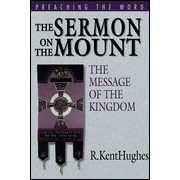
A Sermon From R. Kent Hughes
“It was also said, ‘Whoever divorces his wife, let him give her a certificate of divorce.’ But I say to you that everyone who divorces his wife, except on the ground of sexual immorality, makes her commit adultery, and whoever marries a divorced woman commits adultery.” – Matthew 5:31–32
The February 1973 issue of McCall’s magazine carried an article entitled, “Is Anyone Faithful Anymore?” in which the author included the following story. A young wife was at lunch with eleven of her friends, who had been meeting together regularly to study French since their children had been in nursery school. As they conversed, one of the women, the group’s leader, asked, “How many of you have been faithful throughout your marriage?” Only one woman at the table raised her hand. That evening when the young wife told her husband about the conversation, she revealed that she was not the one who had raised her hand. He was shocked and devastated. “But I have been faithful,” she added. “Then why didn’t you raise your hand?” She replied, “I was ashamed.”
Times have changed, have they not? It used to be that most people would go to extremes to hide their infidelity, but today many people are ashamed of their fidelity. We live in a day when some experts speak of “healthy adultery” and the married faithful are less vocal than the unfaithful in promoting their ways.
I think no one would disagree that our contemporary culture is not intrinsically receptive to Biblical teaching regarding sexual relationships, marriage, and divorce. Because of this hostility, some preachers seem reluctant to speak out on these issues. Other ministers hesitate to address these topics because there is major disagreement about divorce in the church. Because there are numerous opinions as to what the Bible means, because the subject is complex, and because contemporary marital relationships are often incredibly tangled mazes, the subject becomes overwhelming. Sadly, we sometimes find it easier to just leave it unaddressed.
Some surveys indicate that eight of ten people are either directly or indirectly affected by divorce. The mere mention of the word divorce is painful to some. Many have been deeply wounded by broken marriages, and a discussion of the subject brings up memories and feelings they would like to forget. For these reasons preachers find little joy in preaching on the subject. But since Jesus brought it up right in the middle of the Sermon on the Mount, the greatest sermon ever preached, he obviously thinks it is an important subject, one we dare not ignore. To see this matter through Jesus’ eyes is good for us as individuals, good for the church, and good for society.
What is to be the Christian’s attitude regarding divorce? Is divorce always forbidden? Or is it sometimes allowable? What is the Christian position amidst the marital tragedy that surrounds us? As we answer these questions, I will try to be sensitive to those who are hurting. But at the same time I will do my best to be Biblical. The bottom line in all of this is, what does God’s Word say?
To understand our Lord’s statements on divorce, we must know something of the controversial social and theological context in which he made them. The controversy centered over the interpretation of a phrase in Deuteronomy 24:1, the stated ground of divorce: “If a man marries a woman who becomes displeasing to him because he finds something indecent about her, and he writes her a certificate of divorce …”
That verse taught that a husband could divorce his wife if he found “something indecent” in her, and that is where the controversy lay. The burning question in Jesus’ day was, what does “something indecent” mean?” Those in the very liberal rabbinical school of Hillel interpreted “indecent” in the widest manner possible. They said a man could divorce his wife if she spoiled his dinner! They also extended “indecent” to mean a wife’s walking around with her hair down, speaking to men in the streets, or speaking disrespectfully of her husband’s parents in his presence. A wrong word about a mother-in-law and a woman could be out on the street! Rabbi Akiba, who was of this school of thought, went even further, saying that the phrase “becomes displeasing to him” (“she find no favor in his eyes,” kjv) meant that a man could divorce his wife if he found a woman who was more beautiful. Such husbands were bigoted and arrogant.
Fortunately, they were opposed by the school of Shammai, which limited “indecent” to offenses of marital impropriety short of adultery. “Indecent” did not refer to adultery, which was punished by execution, but rather suggested other types of sexual misconduct such as shameful exposure.
This conservative-liberal controversy over the meaning of “indecent” as a grounds for divorce was the backdrop of the Pharisees’ coming to Jesus about this matter. Matthew 19:3 describes the situation: “Some Pharisees came to test him. They asked, ‘Is it lawful for a man to divorce his wife for any and every reason?’ ” They were obviously trying to draw Jesus into the long-standing debate and then exploit his response for their own ends. Some even think they were hoping to use Jesus’ answer to get him in trouble with Herod because a negative answer would publicly align him with the point of view that caused John the Baptist to be beheaded. Significantly, Jesus did not begin by directly answering their question but took the conversation back to God’s creation design, giving us the most extensive teaching on divorce in the New Testament.
Jesus’ Teaching on Divorce (Matthew 19:4–12)
Jesus began by stating the ideal:
“Haven’t you read,” he replied, “that at the beginning the Creator ‘made them male and female,’ and said, ‘For this reason a man will leave his father and mother and be united to his wife, and the two will become one flesh’?” (vv. 4, 5)
In the beginning divorce was inconceivable—and impossible. Jesus quoted lines from Genesis 2:23, 24 to emphasize two things. First, the intimacy of the marriage relationship. He says “the two will become one flesh.” There is no other intimacy like it. It is deeper than one’s relationship to one’s own children. When my children were born, there was an amazing bonding that took place when I saw those babies. In the ensuing months and years the bonding increased, and my wife and I are close to our children, interwoven with them. But we are not one flesh with them. The Scripture says that a man becomes “one flesh” with his wife. Marriage is the deepest human relationship.
After intimacy, the emphasis is on permanence. There was no thought of divorce—ever! God’s ideal was, and is, monogamous, intimate, enduring marriage. This is what he approves of. Anything less is a departure from the divine model. And the Fall did not change that ideal. We all know that some things possible before the Fall were not possible afterward. But regarding divorce, God’s standard did not change. We not only see this in the very first book of the Old Testament but also in the very last one:
“Why has God abandoned us?” you cry. I’ll tell you why; it is because the Lord has seen your treachery in divorcing your wives who have been faithful to you through the years, the companions you promised to care for and keep. You were united to your wife by the Lord. In God’s wise plan, when you married, the two of you became one person in his sight. And what does he want? Godly children from your union. Therefore guard your passions! Keep faith with the wife of your youth. For the Lord, the God of Israel, says he hates divorce.… (Malachi 2:14–16, tlb)
God hates divorce! Whenever divorce occurs, it is an aberration. It is something that was not meant to be. All of this talk about “creative divorce” is pseudoscientific and pseudo-liberated baloney. Those who become tired of their marriage because it is solid, predictable, and not very exciting should cast away their fantasies. Besides, there is nothing more boring than evil and its fruit.
The conversation between the Pharisees and Jesus is most enlightening. The Pharisees have alluded to the controversy in Deuteronomy 24, asking if a man may divorce his wife for any reason at all. Jesus has responded by saying divorce is not God’s ideal. Now the Pharisees respond with another reference to Deuteronomy 24: “ ‘Why then,’ they asked, ‘did Moses command that a man give his wife a certificate of divorce and send her away?’ ” (Matthew 19:7). The idea is this: “Moses made provision for divorce in Deuteronomy 24:1. How then can you say it is not part of the ideal?” Note Jesus’ answer in verse 8: “Jesus replied, ‘Moses permitted you to divorce your wives because your hearts were hard. But it was not this way from the beginning.’ ”
Jesus’ answer corrects the Pharisees, for Moses only permitted divorce—he didn’t command it as the Pharisees asserted. What Moses did command was the granting of a divorce certificate for the woman’s protection. Without a certificate she could be subject to exploitation, even recrimination. The certificate also prevented the man from marrying her again. Thus she could not be treated like chattel. Marriage was not something one could walk in and out of. The reason God allowed divorce was the hardness of heart to which the men of Israel had succumbed. It was a divine concession to human weakness—reluctant permission at best!
Understanding this, we come to the very center of Christ’s teaching and the heart of our study—Jesus’ explanation as to when and why divorce is permitted: “And I say to you, whoever divorces his wife, except for immorality, and marries another woman commits adultery” (Matthew 19:9, nasb, emphasis mine).
Here everything rests upon the correct interpretation of the phrase “except for immorality”—and especially the single word, “immorality.” The Greek word here is porneia, from which we derive the English word pornography. The Greek dictionaries tell us that porneia means unchastity, fornication, prostitution, or other kinds of unlawful intercourse. When porneia is applied to married persons, it means marital unfaithfulness, illicit intercourse that may involve adultery, homosexuality, bestiality, and the like. We should note (and this is very important!) that all these offenses were originally punished by death under Mosaic Law. These sins terminated marriage not by divorce but by death. However, by Jesus’ time the Roman occupation of the country and its legal system had made the death sentence very difficult to obtain. Jewish practice had therefore substituted divorce for death. Thus the rabbinical schools of Hillel and Shammai were not discussing whether divorce was permissible for adultery. That was taken for granted by everyone. The point is, Jesus was far stricter than Hillel and Shammai because he superseded the teaching of Deuteronomy 24 and said that the only ground for which one may divorce his or her spouse is marital unfaithfulness. This is the simple, plain meaning of Jesus’ words in verse 9: “And I say to you, whoever divorces his wife, except for immorality, and marries another woman commits adultery.” That is, divorce is allowed if your mate is guilty of marital unfaithfulness. But if you divorce for any other reason and remarry, it is you who commits adultery. This is likewise the meaning of Jesus’ similar statement in the Sermon on the Mount:
“But I tell you that anyone who divorces his wife, except for marital unfaithfulness, causes her to become an adulteress [if she remarries], and anyone who marries the divorced woman [a woman who has been divorced for something short of unchastity] commits adultery.” (Matthew 5:32)
Jesus’ teaching is clear. Some of the interpretations of these texts are unbelievably convoluted, but we must hold to the plain, unadorned sense of the text. Jesus meant what he said!
Some object that these exception clauses don’t jibe with Jesus’ teaching in two other Gospel passages, Mark 10:11, 12 and Luke 16:18, which contain no exception clauses. For instance, Mark records:
He answered, “Anyone who divorces his wife and marries another woman commits adultery against her. And if she divorces her husband and marries another man, she commits adultery.”
No exception clauses! Because of this, some have argued that Mark represents the earlier and pure teaching of Jesus, but Matthew contains a scribal addition of the exception clause and is thus unauthentic. However, we must hold that it is authentic because none of the ancient manuscripts omit it—all of them have it. Why the difference between the Gospels of Matthew and Mark then? John Stott gives the answer:
It seems far more likely that its [the exception clause’s] absence from Mark and Luke is due not to their ignorance of it but to their acceptance of it as something taken for granted. After all, under the Mosaic Law adultery was punishable by death (although the death penalty for this offense seems to have fallen into disuse by the time of Jesus); so nobody would have questioned that marital unfaithfulness was a just ground for divorce.
The Lord Jesus Christ permitted divorce and remarriage on one ground and one ground only—marital unfaithfulness.
But notice that he permitted it—he did not command it. If you learn that your mate has been having an adulterous affair, it does not follow that you have license to seek a divorce. Too often men and women eagerly pounce on the infidelity of their mates as the opportunity to get out of a relationship they wanted to end anyway. It is so easy to minimize one’s own behavior and to maximize the sins of the other party. Many look for a way out instead of a way through the problems. I want to be careful not to minimize the sin of adultery like the man who said to his wife, “I don’t understand why you’re so disturbed. All I did was have an affair.” Yet I believe (this is my personal opinion) that we should not regard a one-time affair in the same way as a mate who persists in his or her adulterous ways and refuses to repent. Jesus’ exception clauses should be viewed like this: No matter how rough things are, regardless of the stress and strain, whatever is said about compatibility and temperament, nothing allows for divorce except unfaithfulness—and even then it is not to be used as an excuse to get out of the relationship.
The Radicalness of Jesus’ Teaching (Matthew 19:10–12)
Jesus’ teaching was radical. He had done away completely with the Mosaic divorce provision (Deuteronomy 24:1). This was revolutionary. The disciples’ response indicates just how radical Jesus’ teaching was: “The disciples said to him, ‘If this is the situation between a husband and wife, it is better not to marry.’ ” They were blown away. If the only ground for divorce was unfaithfulness, if none of the exceptions suggested by Hillel and Shammai were valid, it was better to stay single! The radicalness of what Jesus taught is further underlined in Matthew 5 by its being one of the six statements that begin with variations of “You have heard it said, but I tell you,” demonstrating the superior righteousness of Christ. The point of these statements is: This is the way a righteous person lives! Thus his or her marital relationship is supremely sacred. Nothing can sever it but unrepentant unfaithfulness—and then it is not an excuse for ending the marriage but is the sorrowful ground of divorce.
Such teaching is radical today. It is out of sync with our culture. Today even Christian counselors are recommending divorce and remarriage on grounds that are in opposition to the clear teachings of Christ. The sanctity of marriage has been corrupted by Christ’s own church and his authority flouted. Marriage has been trivialized into a provisional sexual union that dissolves when our puny love gives out. But this is not the way the righteous person approaches marriage. According to Christ, marriage demands total commitment that only death or the most flagrant, ongoing sexual infidelity can bring to an end.
Having seen Christ’s teaching, the question now is, does the Bible say anything else about divorce? The answer is yes.
Jesus’ Teaching and Paul’s (1 Corinthians 7:8–16)
In 1 Corinthians 7:8–16 the Apostle Paul gives consecutive advice, first to the unmarried (vv. 8, 9), then to married believers (vv. 10, 11), and finally to those who have mixed marriages—when one’s spouse is not a believer (vv. 12–16). It is on this final category that we will focus.
Paul begins his teaching by saying in verse 12, “To the rest I say this (I, not the Lord) …” which has been misunderstood by some as meaning that Paul is saying that his teaching is not as authoritative as Christ’s. What he really means, however, is that what he is going to say was not said by Jesus in his earthly ministry but is now being said by Paul as part of his apostolic teaching. “He is saying in effect, ‘I am now going to deal with cases on which the Lord Himself did not give a verdict.’ ” Paul speaks with full apostolic authority. Notice what he says:
To the rest I say this (I, not the Lord): If any brother has a wife who is not a believer and she is willing to live with him, he must not divorce her. And if a woman has a husband who is not a believer and he is willing to live with her, she must not divorce him. (vv. 12, 13)
Paul knew that in Corinth there were many marriages in which either the husband or wife had become a Christian after marriage, thus producing a spiritually mixed marriage. His advice was that the Christian must not leave his or her pagan spouse—it was not permitted. Then in verse 14 he gives the reason:
For the unbelieving husband has been sanctified through his wife, and the unbelieving wife has been sanctified through her believing husband. Otherwise your children would be unclean, but as it is, they are holy.
The reason for staying together is that the unbeliever and the children will be influenced toward Christ by the life of the believer. I find this fascinating because we often think of the believer being corrupted by the unbeliever, and indeed sometimes this happens. But Paul lays down that it is generally otherwise! If you are in an unequal union, take heart! The general thrust is that you and your faith will prevail—though, sadly, not always.
Then in verse 15 we have Paul’s new teaching: “But if the unbeliever leaves, let him do so. A believing man or woman is not bound in such circumstances; God has called us to live in peace.”
The sense is, if the unbeliever deserts and is determined not to come back, let him or her go. The Christian is “not bound in such circumstances,” which means that the believer is free from the marriage because the unbeliever has broken the marriage bond. The result is that the believer is free to divorce and remarry. The consistent use of the word “bound” in this passage and others means “is not bound in marriage.” There is no need to seek some other interpretation. This is the plain sense—this is what it means.
A Summation of Biblical Teaching
So we see that the Bible allows divorce for two reasons—marital unfaithfulness such as adultery and homosexuality, and the desertion of a believer by an unbelieving spouse.
As to the question of remarriage, the Scriptures allow it in three instances.
First, if one’s mate is guilty of sexual immorality and is unwilling to repent and live faithfully with the marriage partner, divorce and remarriage are permissible.
Second, when a believer is deserted by an unbelieving spouse, divorce and remarriage are again permitted.
And third, as an extension of the allowance for divorce and remarriage when deserted by an unbeliever, I personally believe that when someone has been married and divorced before coming to Christ, remarriage is allowed. Second Corinthians 5:17 says, “Therefore, if anyone is in Christ, he is a new creation; the old has gone, the new has come!” “New” here (kainos) means new in quality. “New” means what it says—really new, as contrasted to the old. The same word is used of the “new man” in Ephesians 2:15 and the “new self” in Ephesians 4:24. Not only are believers really new, but Paul says that “the old has gone, the new has come.” A new believer is completely forgiven. I believe that among the old things that have passed away are all sins, including divorce prior to salvation. If it were otherwise, divorce would be the only sin for which Christ did not atone, and that would be inconceivable.
I hope no one misunderstands me, for divorce is not the ideal. It is a divine concession to human weakness. God hates divorce! We must realize that divorce (and remarriage) according to the Biblical guidelines is not sin—though it is due to sin. We must mourn every divorce!
How foreign to the Biblical mind are phrases like “creative divorce” or “the magic of divorce” or the ad that appeared on the back of a TV Guide: “Order your DIVORCE RING BAND today.… Now is the time to celebrate your new beginning.”
We have discussed the issues primarily with the non-offending party in view. What advice is there for the offending party? Here I can do no better than quote the concluding words of Dr. Martyn Lloyd-Jones:
“Have you nothing to say about others?” asks someone. All I would say about them is this, and I say it carefully and advisedly, and almost in fear lest I give even a semblance of a suggestion that I am saying anything that may encourage anyone to sin. But on the basis of the gospel and in the interest of truth I am compelled to say this: Even adultery is not the unforgivable sin. It is a terrible sin, but God forbid that there should be anyone who feels that he or she has sinned himself or herself outside the love of God or outside His kingdom because of adultery. No; if you truly repent and realize the enormity of your sin and cast yourself upon the boundless love and mercy and grace of God, you can be forgiven and I assure you of pardon. But hear the words of our blessed Lord: “Go and sin no more.”
Finally, what do we say to the church, to ourselves?
First, we must resist the permissiveness of our culture and solidly take our stand against divorce or remarriage on any grounds other than those taught in God’s Word.
Next, we must refrain from self-righteous judgmentalism. All of us are adulterers in heart. We must exercise our dealings with those who have fallen, realizing that we are ourselves under Christ’s omniscient dictum: “But I tell you that anyone who looks at a woman lustfully has already committed adultery with her in his heart” (Matthew 5:28).
Finally, toward those who have fallen to or suffered divorce, we must be forgiving, like our Lord. We must not call unclean that which he has called clean (Acts 10:15). We must endeavor to share the suffering of those ravaged by divorce. And lastly, the church should make provision for the remarriage of those who have Biblically divorced.
About The Preacher: Dr. Kent Hughes |
|
 Dr. Hughes’s thirty-five years of ministry divides evenly into ten years as a youth pastor, five years as a church planter, and twenty years as senior pastor of College Church in Wheaton, IL. He is the author of more than twenty-five books, among which are Disciplines of a Godly Man and Liberating Ministry From the Success Syndrome. He is in the midst of a life-long project of completing the Preaching the Word commentary series of the entire New Testament, and is the editor of the Old Testament for the same series. College Church is noted for its world-wide missions outreach, because half of its total budget goes to world missions. The Hughes are the parents of four children and fourteen grandchildren. Dr. Hughes’s thirty-five years of ministry divides evenly into ten years as a youth pastor, five years as a church planter, and twenty years as senior pastor of College Church in Wheaton, IL. He is the author of more than twenty-five books, among which are Disciplines of a Godly Man and Liberating Ministry From the Success Syndrome. He is in the midst of a life-long project of completing the Preaching the Word commentary series of the entire New Testament, and is the editor of the Old Testament for the same series. College Church is noted for its world-wide missions outreach, because half of its total budget goes to world missions. The Hughes are the parents of four children and fourteen grandchildren.
Education
Professional Experience
In addition to regular pastoral, administrative and preaching duties at College Church, Pastor Hughes ministers to several outside conferences each year. He is a Staley lecturer, and in addition speaks at spiritual emphasis weeks for many Christian colleges and universities. Pastor and Mrs. Hughes speak regularly at pastors’ conferences. Pastor Hughes has served on the Board of Americans United for Life (the legal arm of the pro-life movement), the Board of Trustees of World Radio Missionary Fellowship (HCJB), and the board of Operation Mobilization. Presently he is a member of the Board of Crossway Books. Dr. Hughes is also a Former senior editor of Christianity Today. Books Published
Preaching the Word Series, Crossway Books
|
|
Dr. R.C. Sproul Answers The Question: “Why Don’t We Know God?”
WHY WE DO NOT KNOW GOD

In order to speak to the question, “Why don’t we know God?” we must first grant that we do, in a sense, know God. So we can hardly speak to the question, “Why don’t we?” without making the kind of distinction that Dr. Packer makes. Dr. Packer distinguishes between the different ways in which we may know God. He speaks of the distinction between notitia and cognitio, that is, the difference between an intellectual awareness or mental apprehension of something and a more profound or deep relational knowledge of someone or something.
Obviously, the Bible uses the verb “to know” in at least these two ways and perhaps even more widely. There are different levels, degrees, or ways in which we can know things and persons. That is why the Scriptures say on some occasions that men do not know God, that men are in darkness concerning God, yet on other occasions that men do know God. Unless the Bible is speaking with a forked tongue, or unless we violate radically the Reformed principle of the coherency of Scripture, we have to conclude that the Bible is speaking from different perspectives about different kinds of knowledge. Perhaps we can circumvent the dilemma by making these distinctions. But one thing is certain: no one knows God at the depth to which it is possible to know God. And that is the question with which we must wrestle: Why do we not know God as intimately, deeply, personally and comprehensively as it is possible for us to know him?
Willful Ignorance
The answer to that question does not require an extended dissertation. The reason that we do not know God as intimately, deeply, personally, and comprehensively as we possibly could is because we do not want to know God intimately, deeply and comprehensively. Moreover, even though we may be redeemed, even though we may be “the elite of the elect,” there still remains within us the residual elements of our fallenness. Our natures have been regenerated, but the sin that dwells within us has not been eradicated and will not be, this side of glory. So as long as there remains any disposition within us to sin there is a propensity toward ignorance of the things of God. I would like to focus our attention on a detailed analysis of why men do not know God to the degree that it is possible to know him. The basis for this analysis is the first chapter of Romans, beginning at verse 18.
In the part of the prologue that is found in verses 16, 17 and 18, Paul maintains that he is not ashamed of the gospel, for it is the power of God for salvation to everyone who has faith. Then we find the thematic statement of the Epistle: “For therein [that is, ‘in the gospel’] is the righteousness of God revealed from faith to faith: as it is written, The just shall live by faith.” This is the topic sentence for the whole Epistle: the righteousness of God is revealed through faith. So, in a word, Paul is concerned with revelation. But notice, he begins in verse 18, not with the revelation of God’s mercy, grace, or justification, but with the revelation of God’s wrath: “For the wrath of God is revealed from heaven against all ungodliness and unrighteousness of men.”
What we find here, as always in Scripture, is that God’s wrath is never arbitrary, capricious, irrational or demonic, but that it is always a response to something evil. God’s wrath is revealed against unrighteousness and ungodliness. It is not a wrath revealed against righteousness, godliness or piety, but against unrighteousness and ungodliness. Unrighteousness and ungodliness are general terms—wide-sweeping, wide-encompassing descriptive terms. But we must not stop here, for Paul moves from the general to the particular. He does not leave us to wonder about what particular form of unrighteousness, what specific kind of ungodliness is provoking the wrath of God. Rather, Paul names the child. He mentions it in the second clause of the sentence: “For the wrath of God is revealed from heaven against all ungodliness and unrighteousness of men, who hold [that is, ‘suppress’] the truth in unrighteousness.” The specific provocation of God’s wrath is human suppression of truth.
If you go to different translations of the Bible, you will find a wide variety of English phrases used to translate the last part of verse 18. The old King James Version says, “who hold the truth in unrighteousness.” Some translations say, “hindering the truth.” One translator has preferred to say “repress the truth.”
Let us go back to the old King James Version: “holding the truth in unrighteousness.” That whole phrase seems a bit archaic, does it not? How does one hold truth? Truth is an abstract thing; truth is not quantitative. How can we use tactile, empirical terms to describe truth? We do not hold truth; we hold a wristwatch, or we hold onto something. But there are different ways to hold things. If I hold a wristwatch, that is one kind of holding. If I hold onto a lectern, that is another kind of holding. If I hold my wife, hopefully that is an altogether different kind of holding. What kind of holding does the apostle have in mind here? Well, notice that we can hold something up, or we can hold something down. The verb used here literally means “to hold down, to incarcerate, to hold back,” and it suggests the notion that one must use force to repress a counterforce. The way I like to think of “holding down” is of a giant spring compressed to its point of highest tension. In order to hold that spring in place, one must exert all kinds of counterpressure to keep it compressed; otherwise it will spring up by its own tension and perhaps even injure the one who is seeking to hold it back.
So why is Paul using this verb with respect to truth? He is talking about the human effort that brings the wrath of God upon man. It is man’s active, positive resistance to God’s truth.
Sufficient Revelation
The reason that God is angry is further elucidated in verse 19, where Paul says, “Because that which may be known of God is manifest in them; for God has shown it unto them.” If Paul had merely said, “What could have been known about God was available to man,” that would have been reason enough for God to reveal his wrath against those who did not avail themselves of a divinely given opportunity to know him. That in itself would have been a serious sin against our Creator. But Paul is not simply saying: God has made knowledge of himself available to men and men have never made use of this opportunity. No, he is saying that the knowledge of God which he has revealed to all men has been made plain, not obscure, and that mankind has rejected it.
Let me comment on that with an illustration from the academic world. There are different ways in which you can bring students to a state of knowledge. You can say to them, “Look, we have a course in the Doctrine of God. I am the professor in this course, but I am not going to teach you anything; I am simply going to moderate the course. Each student is responsible to lecture. If you want to know about the Doctrine of God, just go to the library and find those books that have something to say about the Doctrine of God and then come in and give your paper.” That is one way I could do it. Or I could say, “Look, I want you to do heavy research about the Doctrine of God. So I am going to take all the books in the library that deal with the Doctrine of God and put them together in one place on the reserve shelf. I am going to make it easy for you to discover this information.” In other words, I would be facilitating the student’s efforts to learn something about the Doctrine of God. Or, finally, I could go even further. I could put those books on the reserve shelf, and then I could take the student by the hand, march him over to the library, show him where the reserve shelf is, take each book off the shelf, open it up to the first page, and say to him, “Listen to this,” and start to read it.
I think that Paul is getting at something like this last illustration. God does not just make the knowledge available. He shows himself to us, as the apostle says. How thoroughly that knowledge has been received remains a question. But one thing is certain: God has revealed himself to all men with sufficient clarity and with sufficient content as to render men inexcusable. He has presented himself with enough clarity, with enough revelation, to remove the cry of ignorance as a justifying reason for a person’s rejection of him.
Assured Results
Paul goes onto say that when men refuse to honor God and refuse to acknowledge him even though they know he is there, their thinking becomes “foolish” and their minds “darkened.” Have you ever read the works of David Hume? Have you ever read the works of Jean-Paul Sartre? These men are great thinkers. David Hume, I think, is one of the most formidable opponents that the Christian faith has ever had to wrestle with. How can men who have clearly and blatantly denied the existence of God be so scholarly, so knowledgeable, and manifest such high gifts of intelligence? The answer is in this text. Once a man refuses to acknowledge what he knows to be true he can go on to construct magnificent systems of philosophy. He can manifest gifts of intellectual acumen and brilliance. But if he is consistent, if his starting point in the procedure involves an obstinate rejection of what he knows to be true, his system can end only in futility. Imagine the scientist who starts his scientific endeavor by denying what he knows to be the basic facts. The only way such a scientist can arrive at any kind of truth is by a happy inconsistency, by compounding his errors to such a degree that possibly he will be fortunate enough to stumble onto some truth.
The pagan adds insult to injury, Paul continues, for not only does he begin his systematic approach by refusing to acknowledge what he knows to be true and thereby working continuously with a darkened mind but, having done this, he tells the world that he is wise. Paul says, “ … professing themselves to be wise, they became fools.” Sinful man, after he repudiates what he knows to be true, then has the audacity to say to God and to the world, “I am a wise man.” But God says that the wisdom of sinful man is foolishness!
In the Scriptures the designation “fool” is not primarily an intellectual evaluation. When God says that a man is a fool, he is not saying that he is dull-witted. He is not saying that he has a low I.Q. or that he is a poor student. The term “fool” is a judgment of man’s character. It is more of a moral evaluation than an intellectual one. It is the fool who says in his heart, “There is no God.”
Foolishness is in many of the catalogues of serious sins in the New Testament, along with adultery and murder and things like that. Foolishness is a moral refusal to deal honestly with truth.
Undefined Anxiety
We notice next that men’s foolishness of compounded. Claiming to be wise, they became fools, and exchanged “the glory of the incorruptible God” for images resembling mortal man, birds, animals or reptiles. Therefore, “God also gave them up to uncleanness through the lusts of their own hearts, to dishonor their own bodies between themselves, who exchanged the truth of God for a lie, and worshiped and served the creature more than the Creator, who is blessed forever.”
What happens after the truth is held down, after the truth is repressed? Is there a vacuum? No! Immediately an exchange takes place. Substitution occurs.
It is valuable to talk about this in contemporary psychological terms. Johannes Spavink, the Dutch scholar, finds in this text a statement about man’s psychological prejudice. Spavink asks: Why do men repress or suppress things? He says that knowledge which is most likely to be suppressed is knowledge which comes to us in the framework of the traumatic. We try to push down knowledge that frightens us or is unpleasant. We have a kind of psychocybernetic system with which we screen from our conscious mind those things which are unpleasant. But the question I ask you in modern psychological terms is this: Is the memory of a threatening or traumatic experience destroyed by our repression? I do not know of any psychologist or biochemist who would say that those memory notions or images are destroyed. Rather, we bury them or push them down.
So, our present state of consciousness is dark, but the knowledge has not been destroyed. For example, let us say that I have repressed negative feelings about my mother. I am not even conscious of these feelings. But I begin to have undefined anxiety. I begin to worry, and I do not know why I am worried. When I begin to experience restlessness I go to a psychologist to help me work through my anxiety state.
The doctor says, “What’s the matter?”
I say, “I have anxiety.”
“Why do you have anxiety?”
“I don’t know. That’s why I came to see you. I’m worried, and I don’t know why I’m worried. Help me to find out.”
The doctor begins to probe my inner man to see where the injury is and how I can be brought again to health and wholeness. As he goes through my medical history he does not pay attention simply to the words I say. He is also carefully observant of my mannerisms, my gestures, and every kind of symbolic activity with which I am communicating my deepest feelings. Eventually in our discussions he notices that every time he asks me about my mother, or every time I say something about my mother, I twitch my shoulder. So he thinks, “Every time Sproul says something about his mother he has this awful twitch.” He asks, “Do you have any kind of bad feelings about your mother?”
“My mother?” (Twitch) I ask in astonishment. “I don’t feel anything bad about my mother!” (Twitch)
But he knows that somewhere in the past I have had a bad experience with my mother, and he knows that this knowledge has not been destroyed but that it is only exchanged for the gesture. In this way it is (perhaps) still a problem but not quite as threatening as the original experience. In the same way, most people do not say simply, “There is no God”; rather they create a new God, one who is less threatening, less terrifying, less of a problem.
Let me illustrate this. A few years ago I was watching the David Frost show, and he was interviewing Madalyn Murray O’Hair. They began discussing whether or not there is a God, and David Frost suddenly became a great champion of the Christian faith, defending it against O’Hair. The discussion got so out of hand that Frost became angry and decided to determine the controversy by a show of hands. He turned to the studio audience and asked, “How many of you believe in some kind of supreme being, some kind of higher power, something greater than yourselves?” Almost everybody in the audience raised his hand.
I waited breathlessly to see what Madalyn Murray O’Hair would say to that kind of response. She said, “Well, what do you expect from the masses who come to this studio? What do they know? Give them time to catch up with modern knowledge, and this myth will disappear.” That is the tack she took. I thought that if she had been clever she would have said, “Just a minute, Mr. Frost. Let me pose the question.” Then, turning to the audience, she would say something like this. “I know that some of you believe in something higher than yourself, some higher power, some faceless, nameless, contextless, unknown god who makes no claims on your existence, who never stands in judgment over your morality, who does not demand the sacrifice of your life. Anybody can believe in that kind of god. But do you believe in Yahweh, the Lord God of Israel, who thunders from Sinai, ‘You will have no other gods before me’? Do you believe in a god who demands obedience to his perfect law and who calls men to repentance? How many of you believe in a god who makes absolute demands upon your life?” What do you suppose the vote would have been like?
The “Supreme Being,” the “Ground of Being,” “Ultimate Concern”—all these titles are nonthreatening. They have no substance. They represent our most sophisticated efforts at idolatry, in which we exchange the truth of God for a lie, a nonthreatening lie. They speak of a God who never judges us, who never calls us to repentance, a cosmic grandfather who says, “Boys will be boys.” That is the kind of God we have, not only in the secular world but in our churches.
The Immutable God
When I was writing the book Psychology of Atheism, I worked through three great attributes of God: holiness, sovereignty, and omniscience. But then I remembered a sermon I had read years before by Jonathan Edwards entitled, “Man Naturally God’s Enemy.” I wondered what Edwards had to say about why men hate God. So I went back to read that sermon. At the beginning Edwards said, “There are four things about God that make men hate him.” I thought, “Four things? What did I miss?” And I wondered if Edwards had found the same things I had found.
He said, “The first thing that terrifies man is God’s holiness.”
I said, “Aha! I got one right!”
Then he said, “The second thing man hates about God is his omniscience.” By this time my opinion of Edwards as a scholar was rising.
He went on, “The third thing that men hate about God is his sovereignty.” I could hardly believe that I had put my finger on the same things. But what was the fourth one? What had I missed?
I turned the page and read, “Perhaps you are wondering what the fourth one is?” Edwards had stolen the words right out of my mouth. Then I read: “The fourth thing about God that men hate is his immutability.” Immutability? Why would that be so threatening? Why should that bother us? Edwards explained. “Man faces this dilemma: Not only does he know and know clearly that God is holy and omniscient and sovereign, but he knows that God will always be holy, he will always be omniscient, he will always be sovereign. And there is nothing we can possibly do to make him less holy, less omniscient, or less sovereign. These attributes are not open to negotiation. We cannot find God involved in a process of change whereby he can enter into certain mutations to compromise with us.”
From age to age, the hound of heaven brings his light into a world of darkness; but men love the darkness rather than the light because their deeds are evil.
About the Author: Dr. R.C. Sproul is the founder and chairman of Ligonier Ministries, an international Christian education ministry located near Orlando, Florida. His teaching can be heard on the program Renewing Your Mind, which is broadcast on hundreds of radio outlets in the United States and in 40 countries worldwide. He is the executive editor of Tabletalk magazine and general editor of The Reformation Study Bible, and the author of  more than seventy books (including some of my all time favorites: The Holiness of God; Chosen By God; Reason to Believe; Essential Truths Of The Christian Faith; Knowing Scripture; Willing to Believe; Intimate Marriage; Pleasing God; If There’s A God, Why Are There Atheists?, and Defending The Faith) and scores of articles for national evangelical publications. Dr. Sproul also serves as president of Ligonier Academy of Biblical and Theological Studies and Reformation Bible College. He currently serves as Senior Minister of preaching and teaching at Saint Andrew’s in Sanford, FL. The article above was adapted from the chapter entitled “Why We Do Not Know God” from the book: Our Sovereign God: Addresses Presented to the Philadelphia Conference on Reformed Theology, 1974-1976. James M. Boice, ed. Grand Rapids: Baker, 1977.
What Does “God Gave Them Over” Mean? A Study in Divine Retribution by Dr. S. Lewis Johnson
An Exegetical Study of Romans 1:18-32

Preaching to his Sunday congregation in Bern, Switzerland, at the Münster on Romans 1:18–32, Walter Lüthi said, “In the words that we have just read we are told the whole truth about our condition. There may well be people among us who cannot bear to hear the truth, and would like to creep quietly away out of this church. Let them do so if they wish” (Walter Lüthi, The Letter to the Romans: An Exposition, trans. by Kurt Schoenenberger. Richmond, Va, 1961, p. 19). There is much justification for Lüthi’s words, for Paul’s canvas upon which he has painted his picture—dark, foreboding, threatening, flashing with lightning and crashing with thunder—is crammed with forms and figures, fights and shadows, of sin, wrath, and judgment. And the revelation of wrath is total and complete, encompassing all and rendering all without excuse and under condemnation, both individually and collectively.
Isaiah has spoken of judgment as God’s “strange work” and His “strange act” (cf. Isa 28:21 – There is nothing unusual about the Hebrew adjectives, translated “strange” in the AV, except perhaps their emphatic position. That is their meaning. The NASB has “unusual” and “extraordinary.”), and the idea that it is strange because contrary to His goodness and grace, while a popular contemporary misunderstanding of his words, is not only out of harmony with the context of Isaiah 28:21, but it also does not agree with the total picture of the being and attributes of God in Scripture. His retributive justice is one of His essential properties, and in this passage in Romans it comes to the center of the stage. In the threefold paredōken (AV, “gave up”; vv. 24, 26, 28) the problem is plainly before the reader. It is the purpose of this article to analyze and, if possible, clarify the meaning of the term, setting it within the context of the theology of the being and attributes of God. But, first, a word regarding the flow of the Pauline thought in this section of the letter.
After having introduced this message to the Romans (cf. 1:1–7) and stated his theme, the gospel (1:16–17), the apostle skillfully and in detail develops the case-history of human sin and condemnation (1:18–3:20). The section moves from the declaration of Gentile sin (1:18–32 – Martin prefers to define the subjects as “the Greek religious type, man without special revelation,” but the sense is the same. Cf. James P. Martin, “The Kerygma of Romans,” Interpretation, XXV, July, 1971, 311) through Jewish sin (2:1—3:8) to the climax of the apostolic diagnosis that “all the world” is guilty, with every mouth stopped, speechless in the terror of condemnation before a holy and righteous God (3:9–20).
In the immediate context Paul, in his endeavor to prove that the only righteousness available to man is that obtained by faith, declared that God’s displeasure toward sin has been revealed from heaven (1:18). It follows, of course, that all who are charged with ungodliness or unrighteousness stand under His wrath and cannot obtain acceptance before God by their character or conduct. That the Gentiles are guilty and, therefore, inexcusable is evident, because they have enjoyed a revelation of God’s eternal power and deity and yet have rejected it (1:19–20 – Notitia and assensus, two of the basic elements of faith, may be present as a result of God’s revelation of Himself in nature, but the vital element of faith, fiducia, is never given through natural revelation. In its place is the rebellion of suppression. Cf. John Calvin, Institutes of the Christian Religion, ed. by John T. McNeill and trans. by Ford Lewis Battles, in The Library of Christian Classics, Vol. XX, 2 vols.; Philadelphia, 1960; T. H. L. Parker, Calvin’s Doctrine of the Knowledge of God. Grand Rapids, 1959; Edward A. Dowey, Jr., The Knowledge of God in Calvin’s Theology. New York and London, 1965. A recent article of some worth by Gerald J. Postema is “Calvin’s Alleged Rejection of Natural Revelation,” Scottish Journal of Theology, XXIV, November, 1971, 423–34.). And not only have they rejected the light of this truth, they have given themselves up to idolatry (1:21–23). The Pauline picture of the religious history of mankind is one of retrogression, not progression, of devolution, not evolution, downward, not upward. In unbelief man has passed from light to futility to folly. Thus, the divine wrath has found its justification in human rejection of “the truth of God” (1:18, 25).
There remains, therefore, only one alternative for God and man, divine retribution, and it is this that the apostle so solemnly, and yet vigorously (Godet thinks there is more than vigor here; there is a feeling of indignation. He writes, “The verses have something of that παροξυσμός, that exasperation of heart, of which the author of the Acts speaks xvii.16 when describing Paul’s impressions during his stay at Athens” F. Godet, Commentary on the Epistle to the Romans, trans. by A. Cusin [2 vols.; Edinburgh, 1881], I, 177), proclaims in the final section of chapter one (1:24–32). The dio (AV, “wherefore”) makes the connection. In the light of the rebellion just described the inference of vindicatory justice is drawn. Sin justly brings judgment (The Byzantine text and some of the leading representatives of the Western text have a καί, AV, “also” following διό. If this were genuine, it would suggest the harmony of the nature of the punishment and the offence. Godet has put it well, “They sinned, wherefore God punished them; they sinned by degrading God, wherefore also God degraded them,” I, 177. Zahn appears to incline towards its genuineness, too. Cf. Theodor Zahn, Der Brief des Paulus an die Römer. Leipzig, 1910, p. 96.), a judgment expressed most clearly in the following three verses of this final section of chapter one.
The Biblical Revelation
Verse 24 – Wherefore God gave them over (Gr., paredōken) in the lusts of their hearts to impurity, that their bodies might be dishonored among them.
Verse 26 – For this reason God gave them over (Gr., paredōken) to degrading passions; for their women exchanged the natural function for the unnatural.
Verse 28 And just as they did not see fit to retain the full knowledge of God, God gave them over (Gr., paredōken) to a depraved mind, to do the things which are not proper (Rom 1:24, 26, 28).
The Interpretation of the Revelation
The essence, the heart, the Leit Motif of the passage and the divine judgment is expressed in the threefold paredōken (AV, “gave up,” vv. 24, 26; “gave over,” v. 28), repeated as a terrifying refrain (Cf. M.J. Lagrange, Saint Paul Épître aux Romains (4th ed.; Paris, 1930, p. 28. He remarks that the term’s threefold occurrence is not climactic, but is a kind of refrain.). It is a term over which there has raged considerable debate, and it is to the elucidation of it that this article is addressed. Generally speaking, there are three contending viewpoints.
First, perhaps the favorite interpretation of the term is that has prevailed since the time of Origen and Chrysostom, in which the paredōken is taken in the permissive sense. According to this view God passively permitted men to fall into the retributive consequences of their infidelity and apostasy. The active force of paredōken is surely contrary to this view. It is not that God permitted rebellious men to fall into uncleanness and bodily dishonor; He actively, although justly in view of their sin, consigned them to the consequences of their acts. It is His divine arrangement that men by their apostasy should fall into moral impurity, sin being punished by further sin, and He himself maintains the moral connection between apostasy and impurity by carrying out the judgment Himself (Cf. Heinrich August Wilhelm Meyer, Critical and Exegetical Handbook to the Epistle to the Romans, trans. by John C. Moore from 5th German ed. 2 vols.; Edinburgh, 1881, I, 86).
Second, another popular view, which became current after the time of Augustine, takes the paredōken in the privative sense. According to this interpretation God deprived man of an aspect of His work of common grace. He withdrew His hand that had restrained men from evil. Godet has expressed and illustrated this interpretation about as well as it can be set forth. “Wherein did His action consist?” he asks. And the answer follows, “He positively withdrew His hand; He ceased to hold the boat as it was dragged by the current of the river. This is the meaning of the term used by the apostle, Acts xiv.16 : ‘He suffered the Gentiles to walk in their own ways,’ by not doing for them what He never ceased to do for His own people. It is not a case of simple abstention, it is the positive withdrawal of a force” (Godet, I).
At bottom this view is the practical equivalent of the permissive view. This is evident from the fact that Godet uses Acts 14:16 as illustrative of the sense. However, in that passage the verb used is eiasen (AV, “suffered”), which normally means simply to permit. As Meyer pointed out a long time ago, “Therefore Chrysostom not only explains it by εἴασεν, but illustrates the matter by the instance of a general who leaves his soldiers in the battle, and thus deprives them of his aid, and abandons them to the enemy. Theodoret explains it: τῆς οἰκείας προμηδείαςἐγύμνωσε (The clause may be translated, he stripped [them] of his own), and employs the comparison of an abandoned vessel. Theophylact illustrates the παρέδωκεν by the example of a physician who gives up a refractory patient (παραδίδωσιν αὐτὸν τῷ ἐπὶ πλέον νοσεῖν – The words may be rendered, he delivers him over for further suffering” – Meyer, I). These illustrations express quite well the privative view, but the Pauline language is stronger than this. The expression, “God gave them up to uncleanness,” describes a judicial act, (John Murray, The Epistle to the Romans 2 vols.; Grand Rapids, 1959), a “judicial abandonment” (Charles Hodge, Commentary on the Epistle to the Romans. Philadelphia, 1886, p. 40). The active force of paredōken must not be glossed over (Cf. Otto Michel, Der Brief an die Römer. 11th ed.; Göttingen 1957, p. 58; Zahn, pp. 96-97. Both point out that Paul’s expression must not be weakened, but neither develops the question theologically).
Therefore, finally, it becomes clear that the term must be given a judicial sense (Schlatter points out that παρέδωκεν is the usual word for the sentence of a judge. Cf. A. Schlatter, Gottes Gerechtigkeit. Stuttgart, 1959, p. 66). The meaning is not simply that God withdrew from the wicked the restraining force of His providence and common grace, although that privative sense is included in the judicial sense, but that He positively gave men over to the judgment of “more intensified and aggravated cultivation of the lusts of their own hearts with the result that they reap for themselves a correspondingly greater toll of retributive vengeance” (Murray). The usage of the word in both this epistle (4:25; 6:17; 8:32) and in the other Pauline Epistles (cf. 1 Cor 5:5; 1 Tim 1:20) supports this force (See Friedrich Büchsel, “δίδωμι et al.,” Theological Dictionary of the New Testament, ed. by Gerhard Kittel, trans. and ed. by Geoffrey W. Bromiley, II Grand Rapids, 1964, 170. The positive force is present in each occurrence). The interpretation is also in harmony with the occurrence of the precisely identical form in Acts 7:42, where, in speaking of Israel’s apostasy in the days of Moses, Stephen says, “Then God turned, and gave them up (Gr., paredōken) to worship the host of heaven.” Both the Romans and the Acts passages describe the act of God as a penal infliction of retribution, the expression of an essential attribute of God’s nature and being, and it is thoroughly consistent with His holiness.
There is another striking occurrence of the identical form of the verb in Ephesians 4:19, and that passage serves to remind the interpreter that the infliction of punitive justice does not compromise the free agency and responsibility of man. In that passage Paul, speaking of the sin of the Gentiles, writes, “Who being past feeling have given themselves over (Gr., paredōken) unto lasciviousness, to work all uncleanness with greediness.” In the midst of the retributive action of God there is no coercion of man. God does not entice or compel to evil. Man remains responsible and can even be said to be giving himself over to uncleanness while God gives him up to the judgment of his sin.
Concluding Questions
There is hardly any passage in the Bible that says plainer than this one that moral depravity is the result of the judgment of God. And this raises an interesting question that concerns the present moral condition of the nations of the world, and particularly of the United States of America. The question is this: What is the real significance of the spread of immorality, crime, and violence in western civilization? To compound the problem, the newspapers are filled with stories of clergymen encouraging sexual license. Many Christian ministers, contrary to the Apostle Paul’s teaching, no longer regard homosexuality and other sexual aberrations as a sin. It is rather a sickness, or a weakness. In an article in one of the national news magazines a few years ago homosexuality was referred to by the author as “an undesirable handicap” (“Homosexuality,” Time, October 24, 1969, p. 82). To many today it is nothing more than a deviation from the customary sexual patterns, a third sex. Occasionally, in what must seem to the Christian the ultimate evil, homosexuality is traced to God Himself, for, it is said, He made men and women what they are (Of course, the truth of the matter is that homosexuality is a perversion of the created order. Cf. C. K. Barrett, A Commentary on the Epistle to the Romans. New York, 1957, p. 39).
Some thirty years ago the famous Harvard sociologist, Pitirim Sorokin, in his book The Crisis of Our Age, warned that increases in crime, suicides, mental breakdowns, revolutions, and war have been symptoms of civilizations in the midst of death pangs. In another article on homosexuals in Time magazine the author wrote, “At their fullest flowering, the Persian, Greek, Roman and Moslem civilizations permitted a measure of homosexuality; as they decayed, it became more prevalent” (“The Homosexual: Newly Visible, Newly Understood,” Time, October 31, 1969, p. 65). Later Sorokin in his The American Sex Revolution pointed out that sex anarchy leads to mental breakdowns, rather than the other way around, as the Freudian psychologists have taught (Cf. I. E. Howard, “The Fever Chart of a Sick Society,” Christian Economics, April 6, 1965, p. 4. Howard’s brief article is very suggestive, and the writer is deeply indebted to it). Further, he pointed out that increasing sexual license leads to decreasing creativity and productivity in the intellectual, artistic, and economic spheres of life. What, then, are the sources of the problems of the present age? As Howard indicates, “Spengler had a biological answer: civilizations grow old and die like any other living thing. Toynbee has a religious answer: civilizations fail to respond to the higher challenges of the Spirit and therefore fossilize. In his Civilization and Ethics, Albert Schweitzer tried to find an ethical answer. St. Paul had still a different answer” (ibid).
The Pauline answer is plain, and Romans 1:24 expresses it most impressively and succinctly. When man rebelled and sinned, God “gave them up” to uncleanness in the lusts of their hearts that by their own activities their bodies might be dishonored. In other words, sexual rebellion, license, and anarchy is the retributive judgment of God. The civilization of the western world, including the particular civilization of the United States of America, is not a civilization in danger of contracting a fatal disease. That civilization has already contracted a malignant and fatal cancer through its unbelief of the message of God in Christ. It is now hurrying on with increasing speed to final climactic destruction. Civilizations do not die because of violence, crime, immorality, and anarchy. These things are the evidences that death already is at work, a death brought on by disobedience to the revelation of God. Charles Hodge was referring to these principles when he said, almost one hundred years ago in reference to the Christian body of truth, “Religion is the only true foundation, and the only effectual safeguard for morality. Those who abandon God, He abandons. Irreligion and immorality. therefore, have ever been found inseparably connected” (Hodge).
It should be carefully noted that the apostle is not speaking of eternal punishment in these three verses. What he has specifically in mind is a judgment that pertains to this life, not to the life to come. But, on the other hand, it is also plain that Paul’s words lead on to the doctrine of everlasting torment (cf. v. 32 – Cf. Barrett, p. 38. He writes, “God’s judgment has already broken forth; only he has consigned sinners not to hell but to sin—if indeed these be alternatives.”). The vindicatory judgment inflicted by God is continued in the life to come in a more terrible and permanent form if the escape through the gospel of the cross is neglected. The doctrine of eternal punishment has never been popular, and it is less so now. Even evangelical seminaries seem embarrassed by it.27 There is an old story about Boswell and Dr. Samuel Johnson that contains solemn truth. When the latter once appeared over fearful as to his future, Boswell said, “Think of the mercy of your Savior.” “Sir,” replied Johnson. “my Savior has said that He will place some on his right hand, and some on his left.”
It is doubtful that there is a doctrine in the Bible easier to prove than that of eternal punishment (cf. Matt 25:46 – The twofold use of the adjective aiōnion AV, “everlasting” and “eternal” with kolasin, AV, “punishment” and zōēn, AV, “life” indicates that the punishment for sin is just as long as the life that God gives the faithful. Both are eternal. Many other passages express the same truth), a fact that reminds one of an incident involving Henry Ward Beecher and William G. T. Shedd, both eminent leaders of their day. The North American Review engaged the two men for articles on the subject of eternal punishment, knowing the views of the two men. Beecher had once commented, “I believe that punishment exists, both here and hereafter; but it will not continue after it ceases to do good. With a God who could give pain for pain’s sake, this world would go out like a candle.” Shedd was asked to write an article supporting the doctrine, and Beecher was asked to answer it. When the proof sheets of Shedd’s article were sent to Beecher he telegraphed from Denver to the magazine’s editors, “Cancel engagement. Shedd is too much for me. I half believe in eternal punishment now myself. Get somebody else.” The reply was never written by anyone. Shedd remained unanswered (Cf. Augustus Hopkins Strong, Systematic Theology. rev. ed.; 3 vols.; Philadelphia, 1907, III, 1052–53). There is no answer, biblically, logically, or philosophically to the doctrine of eternal punishment.
There is a final question that one might ask regarding Romans 1:24 and its declaration of divine retribution. When did the retribution occur? When did God “give up” the nations? Is the apostle referring to a specific event or time in the past, or is he simply interpreting broadly man’s history? In the collective sense the rebellion of men against God had its inception at Babylon, and it has been surmised that Paul may have had in mind the construction of the tower of Babylon and its destruction, with man’s scattering, by God (cf. Gen 11:1–9). It is doubtful that Paul had this in mind. On the other hand, there are two things that point to the fall of man in the Garden of Eden as the event the apostle was thinking about. In the first place, the fact that Paul traces the entrance of sin into the human race specifically to Eden in Romans 5:12 suggests that 1:24 is to be understood in the light of that important event. It was there that man rebelled against light, the light of both natural and special revelation, and turned to darkness. And it was there that judgment was inflicted on account of his sin, a judgment that consisted of wrath and death, accompanied by consequent immorality and wickedness, as history indicates.
In the second place, the terminology of verse 22–23 points fairly clearly to the Genesis account. For example, the phrases “to birds, and fourfooted beasts, and creeping things” (v. 23) is surely reminiscent of “the fowl of the air, and over the cattle, and over all the earth, and over every creeping thing that creepeth upon the earth” (Gen 1:26; cf. vv. 20–25). And, further, the phrases “the glory of the uncorruptible God into an image (lit., the likeness of an image) made like to corruptible man” appear to come from the Genesis account’s “Let us make man in our image, after our likeness” (1:26). It thus seems that Paul was thinking of the Genesis record in the Romans passage, and this would support the view that he regarded God’s giving up of man to uncleanness as occurring at the time of the fall, recorded in the early part of that same Genesis record. There, then, man fell into sin, judgment, and condemnation, with their inevitable companion, the retributive justice of immorality, crime, and all manner of evil.
In conclusion, one must conclude from Romans 1:24, 26 and 28 that retributive justice is an attribute of the living God and a necessary feature of His actions toward unbelieving man. To the question, “Can God really give man up to judgment?,” this passage provides a resounding “yes” answer. But, in fact, it is not the final and convincing answer to the question. That comes from the cross of Jesus Christ, which in the cry it elicits from our Lord, “My God, my God, why hast thou forsaken me?” unmistakably affirms the fact that God can give man up to judgment. It was there that the sinless Man bore the judgment of God upon sin, and it forever proclaims the true nature of sin—it is worthy of the penalty of spiritual and physical death—and God’s hatred of it with His necessary condemnation of it.
One might say, “Does God, then, really care?” The answer to this question also is obvious, and it, too, comes from the cross. It was God who gave the Son as the vicarious sacrifice; it was He who initiated the work that produced the remedy for sin and condemnation. And it was the Son who voluntarily bore in agony the depths of the vindicatory judgment for sinners. And if that is not sufficient evidence of God’s love and concern, reflect further upon the fact that it is also He who has revealed to men their lost condition and the significance of the atoning death, inscribed its interpretation in the written Word of God and preserved that Word for countless millions to read and ponder. Isaiah was right. Although righteous and necessary, judgment is His “strange work” and His “strange act.”
Article above by Dr. S. Lewis Johnson adapted from Vol. 129: Bibliotheca Sacra Volume 129. 1972 (514) (123). Dallas, TX: Dallas Theological Seminary.
More About Dr. S. Lewis Johnson – A Tribute to Dr. S. Lewis Johnson by Fred G. Zaspel – January 30, 2004:
On January 28, 2004, Dr. S. Lewis Johnson passed away at age eighty-eight. He was a Biblical scholar and theologian of rare abilities and of international renown, and he was a beloved friend. His influence on my own ministry would be difficult to measure. The hundreds of tapes of his preaching and teaching have gone free of charge to thousands of people all over the world, and it was by means of these tapes that I first became acquainted with him. When he first came to preach for me I asked the congregation if any had previously heard him. No one had, but I was quick to assure them all that they had indeed heard him often! Over the years he came to speak at our church and at our pastors’ conference many times, and even in his latest years it was challenging and blessed to hear him expound the Word of God with such precision and clarity.
Dr. Johnson was born in Birmingham, AL and grew up in Charleston, SC. He was always quick to assure everyone that his smooth, dignified, and pleasant southern accent was actually “English in its pure form.” He graduated from the College of Charleston with an B.A. degree in 1937 and was converted through the teaching of Dr. Donald Grey Barnhouse while in the insurance business in Birmingham. He left the insurance business in 1943 to enter Dallas Theological Seminary, from which he received the Th.M (1946) and Th.D. (1949) degrees. He completed further graduate work at the University of Edinburgh, Southern Methodist University, and in the University of Basel. Remaining at Dallas Seminary Dr. Johnson was Professor of New Testament from 1950 to 1972 and Professor of Systematic Theology from 1972 to 1977. He later served as Professor of Biblical and Systematic Theology at Trinity Evangelical Divinity School in Deerfield, IL, and as Visiting Professor of Systematic Theology at Tyndale Theological Seminary, Amsterdam, Netherlands. Dr. Johnson preached and lectured in many places, large and small, taught countless home Bible studies, and was involved in starting several churches. In 1963 he and others planted Believers’ Chapel in Dallas, and it is from the Chapel that so many thousands of his tapes have gone to the benefit of countless people.
He was in so many ways a man to emulate. He was a true gentleman. He was always personable and a great delight in conversation. His humor was always good, and his wit was always quick. He was a careful student of the Scriptures with unusually superior abilities as an exegete and theologian. His abilities with the original languages were clearly superior, and when discussion began he would always lead from his Greek and Hebrew text. He was a man of conviction, willing to step down from a noted career rather than surrender his beliefs. He was passionate for the gospel, and his heart was always hot for Christ. He was a humble and godly man. I have said many times that if God would allow me to grow old as gracefully and as saintly as Dr. Johnson I would become proud and ruin it. He was a model scholar, a model teacher, a model preacher, a model friend, and a model Christian. He was that rare combination of so many abilities and virtues. I thank God for him and feel much the poorer without him.
Among his greatest passions was the faithful expounding of the nature of Christ’s atoning work. He clearly cherished any and every opportunity to demonstrate from the Scriptures the success and effectiveness of Christ’s death as a substitute for His people. And when it was his turn to listen, elderly though he was, he would sit right up front with his Greek and Hebrew Bible in hand. And though virtually every speaker he would hear would necessarily be a man of comparatively inferior abilities, he seemed always just to delight in hearing the Word of God preached. And afterwards he was always eager to fellowship with younger preachers and laymen alike and discuss the things of Christ and examine the Word of God together.
The last time I spoke with Dr. Johnson, about a month or so ago, it was evident that he was growing tired and frail. He fell ill earlier this month, but his illness was brief before the Lord took him home to glory. He leaves behind him his wonderful wife Martha whom we love dearly also, and our prayers are now for her. By his tape ministry I came to love Dr. S. Lewis Johnson before I ever knew him, and I count it a great blessing to have known him. Probably no one outside my own father has taught me more, and few could ever be more beloved. I praise the Lord for him.
“A Kingdom Which Cannot Be Shaken” A Sermon on Hebrews 12:27-29 by Dr. D.M. Lloyd-Jones
[This sermon was preached by Dr. Martyn Lloyd-Jones on 24th May 1978 in Rhymney, Wales, at the induction services of David Norman Jones who now is a minister in Tasmania – It’s hard to believe this sermon was given on this day in May 34 years ago! When you read this sermon you will see that aside from some of the archaic language – Lloyd-Jones spoke ahead of his time, and that his message is just as appropriate and relevant today – well into the 21st century – the Bible contains a timeless message that will be relevant for eternity]

In order that we may remind one another of the ultimate object and purpose of these two gatherings today and the coming together of these two churches under the ministry of our dear friend and brother, I would call your attention to the last three verses in the portion of Scripture that has been read to us.
“And this word, Yet once more, signifies the removing of those things that are shaken, as of things that are made that those things which cannot be shaken may remain. Wherefore we receiving a kingdom which cannot be moved, let us have grace, whereby we may serve God acceptably with reverence and godly fear: For our God is a consuming fire” [Hebrews 12:27-29].
A time of grave and terrible crisis
I need not tell you that we are meeting together tonight in a time of great confusion, a time of grave and terrible crisis. Everybody is aware of this; you cannot read a paper, you cannot listen to a news bulletin without hearing of some added crisis, some new problem, some fresh tragedy. The world is in an alarming state and condition. We are truly in an age of exceptional crisis. But I want to put to you that we are not only in a time and age of crisis, we are living in a time when all of us are being tested, all of us have been sifted and examined and proved. What I mean by that is this, that the state of the world tonight is testing the outlook, the point of view, of every one of us who is in this congregation. indeed of everybody that is in the world. Everybody has got some view of life, even the most thoughtless people, people who scarcely ever think at all, they have got a kind of philosophy and their philosophy is not to think. What is the use of thinking?’ they say. So they have got their point of view, their point of view is ‘Let us eat drink and be merry, for tomorrow we die’. So I am saying that everybody’s point of view, everybody’s attitude towards life, is on trial at the moment.
Questions requiring an answer
Let me show you what I mean. Take this first question: Are you surprised that the world is as it is at this moment?
Are you surprised that we have had two world wars already in this century? Are you surprised at the piling of these horrible armaments? Are you surprised at the confusion, the collapse, of so many institutions at this present time? Does it surprise you? Does it surprise you that in this sophisticated age of ours, in 1978, that the world is in such terrible trouble? I ask my question because there are many people who are very surprised at this; they are amazed at it-and for this reason, that their view of life was that the world is getting better and better. And therefore finding things getting worse and worse, they are confounded, they are surprised, they are amazed and they do not understand it.
So I put that as my first question: Are you surprised at the fact that the world is as it is at this very moment? Or, let me phrase that in a slightly different way: Are you disappointed that the world is as it is? Not only surprised but disappointed, because again there are many people in the world who are grievously disappointed at the present state of affairs. And they are disappointed for this reason, that having adopted the kind of idealistic philosophy, or view of life, which was very popular in the last century – you know that idea that believed in evolution, or progress and development, the view which said that as the result of popular education which came in 1870 and all the marvellous scientific advances and discoveries, more travel, ability to mix with other nations – they were very confident that the twentieth century was going to be the golden century, the crowning century of all the centuries!
Did not Tennyson write about the coming of the parliament of men and the federation of the world, of the days when men would beat their swords into ploughshares and war would be no more? War, we were told – and they taught this, not only the poets but the philosophers and the politicians – war, they said, was due to the fact that people did not know one another. But the moment when they got to know one another as the result of the invention of the steam engine and travel and still more by the coming of the aeroplane, the moment when people got to know one another, they would never fight again, they would realise that we were all brothers. They had forgotten, you see, that Cain and Abel were brothers. They had forgotten all about that, but they were quite sure that as the result of travel and the increase of knowledge and so on and so forth, that the world was going to be paradise-and with William Blake they talked about building the new Jerusalem in England’s green and pleasant land. It was all going to be done by the advance of knowledge and culture, by passing Acts of Parliament and by all the ameliorations that were taking place and were going to take place in social conditions.
Christians who were shaken
Well these men were confident about this. So you see when the First World War came, they were shaken, they were surprised. It was not according to the theory-but they still held on to it. Then when the Second World War came, well they were not only surprised and disappointed, they were aghast. They could not understand it and they were utterly confounded. I can illustrate what I am saying by one man. No man believed so firmly in this idea of development and of progress than the late Mr. H. G. Wells, the popular novelist. He was a great scientific humanist and he really believed that as the result of the advance of knowledge and of culture and of science in particular, that the world really was going to be paradise. So when the Second World War came, he wrote his last book and he gave it a very significant title, Mind At the End of Its Tether. He could not understand it. How was it possible with all our advances and developments that there should be a Second World War in this one century, before the half of the century had passed? So I ask my question to you my friend tonight, Are you disappointed that the world is as it is? Are you astonished and are you amazed at it? Or does it fit in with your philosophy and your outlook and your point of view?
Why Is The World As It is Today?
But let me ask a third question, Do you understand why the world is as it is tonight? Can you explain it? The Christian, the true Christian, is not surprised that the world is as it is and he can understand why it is as it is. Can you? This is a very vital question. You see the trouble is that people refuse to think. They just wring their hands, they say, ‘Is it not terrible!’ But they must explain it, why is it that things are as they are in spite of all our amazing advances and developments in so many realms and spheres. Can you understand it? Can you explain it? If not, there is something wrong with your point of view.
And let me put my last question, Have you any hope at all with regard to the future? Do you see any light anywhere? Is there any message of deliverance? Now I put it to you that if we claim to be thinkers at all, we are bound to face these crucial questions. Here we are in this world with these things happening. Does it tally with what we have always believed, that on which we have pinned our faith?
Now those are the questions I want to consider with you and I want to do so in the light of these verses that I have just read to you. This man was writing to a number of people who were known as Hebrew Christians; that means that they had been brought up as Jews but having heard the Christian Gospel they had left their old religion and the Temple and the ceremonial and the priesthood and they had espoused this new teaching, this new doctrine; they had become Christians. And for a while they were very happy. But then difficulties arose; they were persecuted; they were molested; they were tried grievously in many ways; and the result was that the faith of some of them was being shaken and they were beginning to look back with longing eyes to the old religion of their fathers. And this man writes to them because of that. He says, you are not going back to that! That was only the type, that was only the preliminary, that has been shaken, that has been removed, that was only temporary. Do not go back to the temporary which can be shaken-hold on to the final, the ultimate, that which can never be moved and never be shaken.
A world which will be shaken
But he goes beyond that and he reminds them, and through them he reminds us, that a day is coming when everything in this world that can be shaken is going to be shaken and that we all of us belong either to some kind of kingdom that can be shaken and removed, or we are citizens of a kingdom which cannot be shaken and which can never be moved. And in putting it like that, of course, this man is really giving us a summary of the message of the whole of the Bible from beginning to end. The Bible is a book which calls upon us all to make a decision. It tells us that there are two ways before us in this life and in this world. We can either build upon foundations which can be shaken and removed or else we can build on a foundation which can never be moved. Or its alternative is we can belong to kingdoms that can be shaken and moved or else we can be citizens of this kingdom which can never be moved. Now this is the great message of the Bible and it puts it like this, that all the trouble in the long story of the human race is due to the fact that mankind in its blindness and its folly is misled by the powers of evil, is always making the wrong choice, is holding on to things that can be shaken and rejecting the one thing that can never be shaken and never be moved. And it goes on putting this before us. It says it either has to be God or mammon. You either enter by a strait gate onto a narrow way or you go with the crowd through the wide gate and the broad way that leadeth to destruction. And right the way through it puts the two possibilities before us, shows us the folly of the wrong choice and pleads with us to accept the true, the only way that leads to peace here in this world and a hope of glory for all eternity.
Well now let me put this to you. This is the business of my friend who is going to minister here in Rhymney as well as in Crickhowell. This is the business of all of us worthy of the name of Christian ministers at all – we are here to address people in this age of collapse, this age of confusion, this age in which so many things have been shaken before our eyes, this climactic period through which we are passing. And I want to put it in terms of this biblical message. Man’s ultimate fallacy, as I have said, is that he always chooses to belong to kingdoms that can be shaken and removed. Man is very fond of building kingdoms. The history of mankind, if you like, is a history of men building kingdoms for themselves-refusing the kingdom of God and setting up their own kingdoms, which they think are going to be durable and everlasting and they have done this in many different ways.
The kingdoms of men – in all their variety – come and go
The old way, and it is still true, you find it in the Bible, you find it in secular history, the commonest of all the ways has been that man has tried is to set up military kingdoms, great military kingdoms. You have a number of them described here in the Bible. Think of a great kingdom like the kingdom of Babylon. That was an amazing kingdom, great wealth, great power, great armies and they conquered practically every country and at the head of this great kingdom of Babylon there was a man called Nebuchadnezzar. And he was such a conqueror, such a military genius, that he began to think that he was almost a god. And the people agreed with him. And he set up a great image to himself and commanded his people to bow down and worship. He really believed he was a semi-god if not a god. He had built this great kingdom, you see. But according to the Bible – and this is sheer history – it was not a kingdom that was going to last for ever, as he thought. It began to shake and we are given an account of this mighty dictator in a field one day and his nails had grown into talons and his hair was as long as the hairs of an animal and he was eating grass in a field-humbled by God. This man who had inflated himself to heaven-humbled, his kingdom shaken.
And quite soon it was conquered by another mighty kingdom that came along, called the Medo-Persian kingdom. Now this is biblical and secular history. The Medo-Persian kingdom came along and this again was a mighty kingdom, conquered Babylon, conquered others and it seemed to be invincible and everlasting and people were beginning to worship it.
It did not last very long. Another kingdom came along, the kingdom of Greece and this was an amazing kingdom. The head of this kingdom was a man whom we still know as Alexander the Great and he was of course one of the greatest military geniuses that the world has ever known. He conquered everywhere, conquered Egypt, built Alexandria, named after him; he conquered all the then known and civilised world and he set up this kingdom that really did seem to be indestructible and invincible, great in every respect. But do you know what happened? While he was yet in the thirties, he died and his kingdom was destroyed and divided up. I will never forget reading a book during the last war by a Swiss theologian, on the book of the prophet Daniel. All I remember of the book was this phrase, I have never forgotten it; it was so true, so striking. He said the man whom the world knows as Alexander the Great is known in the Bible as a he-goat. That is the biblical view of him. ‘Great’, says the world: ‘he-goat’ says God, says the Bible. And you and I now read books on the Glory that was Greece and we go and visit the ruins, the kingdom has vanished and has disappeared.
Why? Well another kingdom came up, the kingdom of Rome, the Roman Empire. And again this was one of the most astonishing phenomena that the world has ever seen. You remember how Rome again conquered all the then civilised world; but it was not only great in a military sense but in a legal sense and in every other sense. They came and conquered this country, as they conquered most other countries. Here at last there did seem to be a kingdom that could never be shaken and never removed. And the capital of course was the city of Rome. What did they call Rome? Is it not interesting, they called Rome ‘the Eternal City’? The Eternal City – not for a time – Eternal City. But you remember the story; in a few centuries barbarians, Goths and Vandals from northern Europe came down in hordes; they sacked the Eternal City and they conquered and brought to an end the great Roman Empire.
And so you see it has continued throughout ancient history. Kingdom after kingdom has come up and men have claimed for it that it is everlasting and eternal – suddenly it vanishes and disappears. But, you say, that is ancient history. All right, let us come up to modern times. I am not going to keep you in describing to you great kingdoms in Egypt, the mighty empire that was once governed by Spain and many other mighty kingdoms, mighty empires. Come nearer to our own time. Most of you can still remember a man whose name was Adolf Hitler. He came into power in 1933; what was he going to do? Well, he told us so often – heard him saying it many a time on the wireless – he said he was going to set up the Third Reich which was going to last a thousand years. The Third Reich – and Hitler dominated the world like some Colossus, striding the world like a Colossus. And when we heard he was going to speak on the wireless, we began to tremble – the word of a Hitler, this mighty man with a mighty empire to last a thousand years. How long did it last? Twelve years and Hitler and his empire vanished and disappeared.
But let us be honest, my friends, I suppose most people would say that the greatest empire the world has ever known was the British Empire and this was the empire of which our fathers boasted-that it was the empire on which the sun never set, owning a quarter of the globe. What an empire, the British Empire, on which the sun never sets! Durable, lasting, eternal! Where is it tonight, my friends? There is no such thing as the British Empire. We try to talk feebly about some British Commonwealth of nations but the empire is gone and the man who believed in it most of all, who said that he had not been appointed by destiny to preside over the dissolution of the British Empire, had to do so. The great British Empire has collapsed and vanished before our very eyes. You see the biblical message is being verified. All these kingdoms that men have erected and built up, they have all been shaken and they will all be removed. But that is only one example. This is so important I am going to give you many examples, my friend that we may see the truth of this message.
Take another empire that man has been very fond of building. What is that? Well the empire of the mind, what is called philosophy. What is philosophy? Well it is the love of wisdom – yes, but its idea is this – that what matters most of all is reason. Now you know a hundred years ago the chapels in this town and other towns were full. But then people began to say, Oh, well religion it is sob stuff. It is emotionalism! They meet together, they pull down the blinds, they do not read, they do not think, they are not aware of what is happening in the world. This is all emotionalism, folklore, fairy tale, fantasy. What we need, they said, was reason. They reject revelation, they do not believe in God-reason! We are going to govern the world by reason. And that became very popular towards the middle of the last century. It came over from Germany and it came into this country. Reason, the kingdom of reason. What has happened to this?
Now let us face the facts – one of the greatest dangers in this world at this moment is irrationality, which means men and women refusing to think. Do you know where this irrationality has come from? It is most interesting. It started in one of the greatest universities in the United States of America – Harvard University. There was a professor there of the name of Timothy Leary. And Timothy Leary and others began to say the mistake that we have been making is that we have lived too much in the realm of reason and understanding and of mind. We have neglected sensation, we have neglected feel mg and that is where we have been fools and we have brought our world into trouble. He said, we must reason less and less, what we need is experience. How are we to get experience? Well, he said, the quickest way to get experience is take certain drugs and this present wave of drug addiction was started by Professor Timothy Leary in Harvard University in America. There is a revolt against reason. There are students in large numbers saying we must go back to the land, back to a primitive kind of life. Novelists like D H Lawrence thought exactly the same thing. There is a revolt against reason and people are out for sensation. That is why they drink and drug themselves with alcohol and other drugs. That is why they shout and dance in a rhythmical manner with their music. They stop thinking and they have a pleasant feeling. It is one of the major problems in the world at this moment. The kingdom of reason has been shaken.
Let me give you another, it comes under the same category as reason-the kingdom of science. Now I suppose that most people today who are not Christians would give as their reasons for not being Christians that they adopt the scientific attitude and the scientific point of view. They say science says so-and-so, science proves so-and-so-science, the kingdom of science. Men have been very busy erecting this now for two centuries and they were absolutely confident concerning it. You are not going to believe these stories – you must have scientific facts, something that you can really depend upon and live upon. And they were so sure about this that they used the term laws. Now when I was a student, some sixty years ago, we were taught about Newton’s laws, not Newton’s theories but Newton’s laws. Cause and effect, laws of motion, they were absolutes, they were certainties. You cannot name a single great scientist in the world tonight who believes in Newton’s laws. A man called Einstein came along and what did he introduce? Not laws, but a theory of relativity – possibility, probability. Everything is in a state of uncertainty. You see, Newton believed that matter was solid; we know by today that is not; it is energy. It is all energy, it is in constant movement. So you believe now not in certainty and in laws but in possibility and probability. And so these great kingdoms have crashed one after another.
Let me tell you another law that I used to be taught when I was a boy and a young student. We were taught what was called Dalton’s law. What was Dalton’s law? Well, Dalton’s law taught this, that the smallest particle of matter is an atom and that an atom is indivisible. Dalton’s law not his theory – it was a fact, not like this stuff that is in the Bible! No, no, Dalton’s law – smallest particle of matter, the atom and an atom is indivisible. Would to God that Dalton had been right and that the atom was indivisible! You and I have been in the world when they divided the atom, hence the atomic and the hydrogen bombs, hence the possibility of a third World War that will put an end to civilisation and perhaps to the world itself. But they were taught as laws, absolutes, certainties, kingdoms which cannot be moved. They have all been shaken in our own age and generation.
And there are many other kingdoms that I could mention. Another was of course democracy. We were told that the ultimate form of government was democracy. We had got rid of oligarchies, we must get rid of monarchies and so on-and one is in great sympathy with most of these teachings and most of these ideas. Those terrible days of tyranny, of monarchs, of Lords in this country, people with power, money – power, landowners and others. Now, they said, we must get rid of all that. What we need is democracy, government of the people and by the people. This is the ultimate in government, democracy. But somebody said, well what if people do not agree? If you give power to the people what if people do not agree, what happens then? Ah, they said, everybody will respect the rule of law; that is an absolute. Of course if they do not respect the rule of law well then there is going to be a collapse. But everybody, they said, will respect the rule of law – so democracy is going to be the ultimate in society and it is coming in the twentieth century. What of this kingdom? Do you not read constantly of these dictatorships in various parts of the world, some of them on the right, some of them on the left? Democracy is in jeopardy at this very moment, we are in danger of dictatorships in most countries of the world. Democracy as such seems to be breaking down before our eyes.
I must mention one other because it was so popular in this country, the kingdom of industry. The proud boast was not only that the British Empire was a great military empire and kingdom, its greatness really depended upon its industry and its industrial power. The first industrial nation, the great trading nation of the world, the empire of the industry and this was something on which you could bank and on which you could build. This was not the precarious life of the farmer, the agricultural man – industry, it is solid, and we built up our great industry. And we were so sure of it that if we wanted in ordinary conversation to say that something was absolutely safe and sure and certain, what we said was ‘It is as safe as the Bank of England!’ Nothing can be safer. Safe as the Bank of England, safe as the pound sterling. An empire built on the pound sterling and the Bank of England. The pound sterling, what is happening to it? Well, I gather that it is floating at the present time and that the Bank of England has had to borrow money from some sheikhs in the Middle East. Your kingdom which could never be moved, pound sterling, Bank of England, they are shaking they are collapsing-and so it is with every other kingdom.
Even the earth
Wait a minute, says some one, what about the earth round and about us? What about the Beacons, the great mountains and the valleys and the rivers, surely these are durable and certain? Are they? Let off your hydrogen bombs and they will soon have vanished. As the Bible has prophesied centuries ago, ‘the elements shall melt with a fervent heat’ (2 Peter 3:10). Even creation is not durable; everything is being shaken. Man himself who has been worshipping himself, what is he? According to scientists he is nothing but chemistry and physics, he is nothing but a bundle of sensations. All our kingdoms are collapsing before our eyes. They can all be hurt, they can all be moved and yet men bank on them. They laugh at religion, they ignore the Bible, they do not believe in God. These are the kingdoms they believe in and yet they are collapsing before our very eyes. That is the message of the Bible.
But why do they collapse? Sinfulness, finitude and judgment
But why do they collapse? Why is all that I have been saying been so true? And this man tells us. The certainty you see with all these kingdoms is that they are made. ‘And this word, Yet once more, signifieth the removing of those things that are shaken, as of things that are made,’ These are man-made kingdoms and the tragedy of man is that he is too small to be a kingdom builder. Man is finite, he is limited, he is small. This is the final folly of man, that he thinks he knows everything. He thinks he can encompass the whole cosmos with his little mind. How small he is, he is finite, he is limited, he lacks the capacity to see things as a whole. He only sees little sectors of reality. Things that are made-man!
Yes, but even worse than that, according to the Bible, man is not only finite, man is also sinful-and this is what bedevils all his great efforts. Every one of us is sinful. What does that mean? It means that we are selfish. it means that we are self-centred. It means that we are subjects of jealousy and envy and malice and spite and hatred. We want things for ourselves – let the other man get on with it. This is in the heart of man, everything he touches, everything he makes therefore has got the seed of decay in it. That is why our Lord said: ‘Lay not up for yourselves treasures upon earth, where moth and rust doth corrupt, and where thieves break through and steal: But lay up for yourselves treasures in heaven, where neither moth nor rust doth corrupt, and where thieves do not break through nor steal’ [Matthew 6:19-20]. But man keeps on doing this and everything collapses. Why? Moth and rust, this element of evil. You cannot trust anybody. You may think that you have got a man who will fight with you to the end-he will desert you at the very moment that you need him most of all. He is a false friend, he lets you down. You see it in the political parties and everywhere else, they all seem to be carrying a dagger in their hip pockets and they are attacking one another. No man trusts anybody, why? We are all sinners, we are all selfish, we are in no condition to build empires.
But the Bible gives a third and a crowning reason for all this failure and it is this: that God blows upon it. We are living in a universe that we have not made; it is made by God. And God will not give His glory to another. He said so throughout the centuries. And when men rise up and establish their great kingdoms God allows them to go so far and then He suddenly strikes them as He did Nebuchadnezzar and down they go. ‘The wrath of God is revealed from heaven against all ungodliness and unrighteousness of men, who hold down the truth in unrighteousness’ [Romans 1:18]. It is the law and history proves it. Whatever man may do, whatever he may strive to do – it all is shaken and it collapses and disappears. And of course not only is it the Bible that says this, the really great thinkers of every century have seen this and seen it quite clearly.
Take a man like Shakespeare; I do not think Shakespeare was a Christian but he was a great man and he was a deep thinker and he saw this truth that I am putting to you about the fact that all these kingdoms can be shaken. And he put it in those immortal words that he put into the mouth of Prospero, in The Tempest. Here they are-they had been having some kind of revels, some kind of pageantry:
‘Our revels now are ended. And like the baseless fabric of this vision, The cloud-capped towers, the gorgeous palaces, The solemn temples, the great globe itself Yea, all which it shall inherit, shall dissolve; And like this insubstantial pageant faded Leave not a rack behind. We are such stuff As dreams are made of and our little life Is rounded with a sleep.’
That is Shakespeare; he had seen it, ‘the cloud capped towers, the gorgeous palaces, the solemn temples, the great globe itself, yea, all which it shall inherit, shall dissolve’ – and we are witnessing it. And he is absolutely right there. He is right until the last statement: ‘We are such stuff as dreams are made of and our little life is rounded with a sleep.’ He thought that death was the end and that is where he is wrong. It is not the end, it is appointed as this man says in chapter nine: ‘it is appointed unto men once to die, but after this the judgment’ [Hebrews 9:27] – God!
Another kingdom based on another word
Very well, there is the great negative message of the Bible, that man will never succeed in building a durable and a lasting and a solid kingdom. These things can all be shaken as we are witnessing it and worse is going to happen. There is one kingdom that cannot be moved, that cannot be shaken. ‘Wherefore we receiving a kingdom which cannot be shaken, let us have grace’. What is this? Here we are now in our proper world. We know not what tomorrow may bring forth. What are we to do? Is there any message? Is there anything that comes anywhere to give me some understanding and a word of hope? There is. What is it, what can I bank on tonight? What should I listen to and hold on to when everything is collapsing round and about me?
This man says, it is a word, ‘this word. Yet once more, He has already said: ‘See that ye refuse not him that speaketh’ [Hebrews 12:25]. This man’s message is this, that amidst the babel of voices in our world, there is another word-and the essence of wisdom is to listen to this word. It is the word that was spoken by Jesus Christ and which made him say: ‘Heaven and earth shall pass away, but my words shall not pass away’ [Matthew 24:35]. Or which the Apostle Peter quoted in these words, it is the same thing but in the graphic manner of the Apostle Peter. He tells these Christians that they have become Christians ‘by the word of God, which liveth and abideth forever’ [I Peter 1:23]. Then listen: ‘For all flesh is as grass, and all the glory of man’ – British Empire and every other glory - ‘all the glory of man as the flower of grass. The grass withereth, and the flower thereof falleth away: But the word of the Lord endureth for ever. And this is the word which by the gospel is preached unto you’ [I Peter 1:24,25]. It is the word I am preaching to you now, it is the word my friend is going to preach, the word, this word.
What is it? Why is this word durable? Why is this word better than the word of the philosophers, the scientists, the politicians, the sociologists, the educationalist? Why is this the only word I should listen to? The answer is, it is the word of the Lord; it is the word of God. My dear friends, are you not tired of the words of men? We have been bombarded with them throughout this century. The promises they have dangled before us, what has happened to them? Are we happy? Are we all at ease? Are we looking forward to a glorious future? The words of men – are you not tired of them? Our business is to invite men and women to listen to the word of God. Why? Well, because God is not a man. We are finite, we are limited, we can put up theories and suppositions and hypotheses and they are falsified and we have nothing-but God, God is from everlasting to everlasting, the great I AM. I am that I am; I am that I shall be; without beginning, without end. The God who at the beginning said, ‘Let there be light and there was light.’ The God who brought these great old mountains and everything into existence and who sustains it by the word of His power. GOD.
Frail as summer ‘s flowers we flourish, Blows the wind and it is gone, But while mortals rise and perish, God endures unchanging on. We blossom and flourish Like leaves on the tree; And wither and perish But nought changeth Thee.
I have heard some great orators in this present century and we half worshipped them in our folly. And one of them promised us that the First World War was the war to end wars and he was going to give us a land fit for heroes to live in. And the second one said very much the same thing, about some broad uplands on which humanity was going to look for some promised land. The words of men-we have forgotten them, have we not; we have forgotten their words and we are forgetting the men. Like leaves on the tree, they come, they cut a great feather, but they vanish and they go - but God endures. Unchanging God, the God who spoke to your grandfathers and great-great-grandfathers here in Rhymney, the last century and the one before it. The God of the ages, the God whose history runs through this book and who has been guiding it ever since and who erupts into it, at every moment of crisis saving the possibilities for mankind. It is the Word of God. I am not preaching my own theories, I am submitting myself to this Word. I am expounding this Word, I have not put a single theory of my own before you; it is my business and that of every preacher, not to give you some of my ideas – but to preach this Word until men want what God says about our life – and what does He say?
God the Creator
Well, this Book tells you, this is the word of God. He tells us about God, Himself. As I told you He is the creator, He is the sustainer of everything. Yes, and He made man. Man is not an accident, you know, it is an insult to say that man is a creature that has evolved from the animal. It is not true. The Bible tells me that man has a dignity that makes him the lord of creation. Why? He has been created in the image and the likeness of God. We have an animal part but God has put something of Himself into us. When He came to make man He said, ‘Let us make man in our own image and likeness.’ He gave us reason, understanding, certain faculties and propensities that none of the animals have. And man is able to look on at himself and evaluate himself. Man! Yes and he is a responsible being to God. The popular theory is, as I say, that when a man dies that is the end. He is finished with. No! No! says the Bible. Man is bigger than the universe, he has these qualities and potentialities in him. God has put them there and God holds man responsible and He is going to ask man at the end, ‘What have you done with the soul that I gave you? You may have made a lot of money, you may have garnered a lot of knowledge-what have you done with the soul that part of you that was meant to commune with Me and to be my companion? What have you done with it?’ God is going to ask us-that is the judgment.
God the rule giver
But not only that and we can be certain of this-God not only tells us that He has made us in His own image and likeness and that we are responsible beings, He has told us how to live. Here is the great problem, ‘Why is the world as it is? Why the drunkenness and the immorality and the vice and the dishonesty and the chicanery and the battling? What is the matter, what is the cause of it all? There is a simple answer according to the Bible – that man instead of living according to God’s laws, is living according to His own ideas. But God has told us how to live. Where does He tell us? In what are called the Ten Commandments – if only everybody in the world lived according to the Ten Commandments tonight, our world would be paradise! What are they? Well, we are told that we must start by all submitting to God. We are not gods, that is the trouble in the world, there are too many gods in it. Everyman is a god, everyman sets himself up; he is the authority, he is the god. ‘This is what I say’, he says and he is insubordinate. That is the folly, there is only one God and He has told us that we must live to His glory. ‘And thou shalt love the Lord thy God with all thy heart, and with all thy soul, and with all thy mind, and with all thy strength …. And Thou shalt love thy neighbour as thyself’ [Mark 12:30-31]. And you will never love your neighbour as yourself until you have submitted yourself to God. Then you will see yourself as you are and you will see your neighbour as he is and you will see that you are both failures and you are both helpless and you are both hopeless – and you will love him for the first time, as you love yourself.
But then God goes on and these are the particulars-thou shalt not kill, thou shalt not commit adultery, thou shalt not steal, thou shalt not bear false witness against thy neighbour, thou shalt not covet thy neighbour’s ox, or his ass, or his manservant or his maidservant or his wife (Exodus 20:13-17); Those are the ten commandments – if only everybody lived according to God’s commandments! There would be no infidelity, there would be no promiscuity, there would be no separations, no divorces, no little children breaking their hearts because father and mother have gone their own selfish ways, leaving their little hearts to suffer. There would be an end to that. There would be no theft and dishonesty, there would be no drunkenness, there would be no drug addiction, there would be no atomic bombs, there would be no need of all these conferences to try and produce some precarious peace. There would be peace if only everybody in the world lived as God has told us to live. This Word is still true tonight, that is the way to live.
The Penalties which come with a Broken Law
Then He goes on to say this, that if we do not live according to His commandments – and this is an absolute certainty-if we do not live according to His commandments we shall suffer. ‘The way of transgressors is hard’ [Proverbs 13:15]. ‘There is no peace, saith my God, to the wicked’ [Isaiah 57:21]. And it does not matter how wealthy this wicked man is, how learned he may be – as long as he is wicked he will never know peace. Some of the most miserable restless people in the world tonight are multi-millionaires; these wretched people you read about them in the popular newspapers who get married five, six, seven times – do they know peace, is that the life of the film-star, the pop-star, or your multimillionaire? Oh, the tragedy of these miserable people who think you can buy peace and tranquillity and happiness with money. No, No, God has said that it cannot be done. There is not peace, saith my God, to the wicked. And while the people of this world are wicked there will be wars and rumours of wars. Nations are but individuals writ large and if a man cannot live with his neighbour why do you expect a country to live with its neighbour? God has told us this. These are absolutes, my friends, you cannot get away from them. The world is proving the truth of them tonight. This is God’s Word and there is not peace, saith my God, to the wicked.
God the Judge
Then he goes on, as I have told you already, to say that everyone of us will have to stand before Him in judgment and give an account of the deeds done in the body. ‘That is terrible!’ you say. I say it is a great compliment that God thinks I am such a being that He holds me responsible and accountable and I have to stand before Him – and every one of you will have to stand before Him. And believe me your television will not help you on your deathbed, and your drugs will not help you then, and your drink will not help you then, and your money will not help you then. Your soul will be naked. ‘Naked came I out of my mother’s womb and naked shall I return thither’ [Job 1:21]. We stand stripped before God and He will ask us, ‘What have you done with that precious thing I gave you – the soul?’ There is to be a final judgment upon the whole world of men.
God’s Unshakeable Kingdom
What else does this word tell us? Well thank God it does not leave us at that. If it had left us at that every one of us would be doomed and damned to all eternity. There would be no hope for any one of us – ‘For we have all sinned, and come short of the glory of God’. ‘There is none righteous, no, not one’ [Romans 3:23,10]. Thank God I have a light here, I have a hope here. What is it? Well, it is this that while men in their folly have been vainly trying to build their durable kingdoms and empires, God has been bringing in His kingdom: ‘Wherefore we receiving a kingdom which cannot be moved’, God’s kingdom. This is the way to understand history-forget all about kings and princes and queens and births and marriages and deaths and pomp and ceremony and all the ritual – forget it all! Concentrate on this what God has been doing – God has been bringing in His kingdom. Even when man failed at the beginning in the Garden of Eden, Cod came down and He gave him a promise of a kingdom. He said that there is going to be strife between the seed of the woman and the seed of the serpent – but the seed of the woman shall bruise the serpent’s head. God is going to bring order into the disorder, He is going to undo the misery and the folly of man. He is setting up a kingdom.
The Old Testament account is just of God, as this man says in his first chapter, in diverse parts and portions. bits and pieces, bringing in His kingdom to pass. He took hold of a man whose name was Abraham, he was a pagan living in Ur of the Chaldees, and he said, Come out, lam going to turn you into a nation. And from you and your seed all the nations of the world are going to be blessed. That was the origin of the Jews; they are God’s people; while the rest of the world were living in darkness and paganism, these people were given this revelation of the only true and living God. And God said, I am going to make a people of you and I am going to add to it. And He said I am going to send the King of the kingdom into the world amongst men. ‘But when the fulness of the time was come, God sent forth his Son, made of a woman, made under the law, To redeem them that were under the law’ [Galatians 4:4-5]. A babe was born in a stable, not in a king’s palace, in a stable in a place called Bethlehem.
Why was He born in a stable? Because there was no room for them in the inn. Everybody booked their rooms in the hostelries, in the inns and though a poor pregnant woman comes along on the verge of giving birth to a baby, nobody would vacate the room. They would not do it then, they would not do it now! They said, ‘She should have booked her room earlier! Why should I go out!’ The selfishness of mankind. So the babe was born amidst the straw in a stable and the little child was put into a manger because there was no crib. Who is this? This is God’s eternal Son. They called Him Jesus, but He is very God of very God. God has visited and redeemed His people! ‘God so loved the world’ that had rebelled against Him and spat in His face as it were. ‘God so loved the world, that he gave his only begotten Son. that whosoever believeth in him should not perish, but have everlasting life’ [John 3:16]. He is the King of the kingdom and He says so. He heals in the name of the kingdom, He invites people to come into His kingdom. ‘Come unto me’, He says, ‘all ye that labour and are heavy laden, and I will give you rest’ [Matthew 11:28]. And He has and He does and He alone can do so and the whole story of true Christianity is of this kingdom being extended. Men and women in every age and generation being added unto it. The kingdom of God is going on.
There are times like the present when it almost seems to be invisible-but it is still there and when men begin to deliver their obituary orations over the death of the Christian church, God revives her again and on she goes and thousands are added and the kingdom is going on and on and on-and it will go on until it is finally completed and the kingdoms of this world shall have become the kingdoms of our Lord, and of his Christ. (Revelation 11:15). Thank God in spite of all that is happening in this world tonight, and it is black and it is dark, but as certainly as we are here God’s purposes are ever sure and Christ is going to reign over the whole world from shore to shore and pole to pole-and nothing will be able to resist Him. It is an absolute.
I must give you another absolute – there is only one way into this kingdom of God. It is the whole message of this epistle. Only one way. What is it? It is through believing that Jesus of Nazareth is the Son of God. It is by believing that He has taken our sins upon Himself and borne our punishment and thereby reconciled us to God and opened to us the gate of the kingdom, the kingdom of God and the kingdom of heaven. There is no other way. This man says, you foolish people, are you going back to your burnt offerings and sacrifices? Are you still going to believe that the blood of bulls and of goats and the ashes of an heifer can cleanse the conscience from dead works? It is impossible! There is only one, the blood of Jesus Christ His Son. There is only one way, he says in chapter 10, into the holiest of all, it is by the blood of Jesus (v.19). No church can save you. No priest can save you, the virgin Mary cannot save you, no ceremonial can save you. No, No! There is only one way of salvation, only one way to know God and to spend your eternity with Him – it is this – to believe the message concerning His Son, that the babe of Bethlehem is the eternal Son of God and that He died on the cross, not the death of a pacifist, He is the Lamb of God that taketh away the sin of the world. God hath laid on Him the iniquity of us all. He has punished Him instead of us and gives us His righteousness and we are clothed in it and we are children of God and heirs of eternal bliss.
The Only Way
My friends, there is no other way; this is an incomparable gospel. Hinduism will not get you into the kingdom, Confucianism will not, Buddhism will not. These things are coming into this country; none of them will bring you into the kingdom of God. There is only one way. Christ said, I am the light of the world. I am the way, the truth and the life. No man cometh unto the Father but by me. There is none other name under heaven given amongst men whereby we must be saved. It is exclusive, it is God’s own Son. So the world religions are of no value. This and this alone does what it promises to do.
But I must not keep you. This man tells us that if we believe this message and become citizens of the kingdom of God, we will be surrounded by the promises of God. He tells us that God, in order to comfort Abraham, swore an oath. He swore twice over, so that by two immutable things, he might have this certain hope. And we have it, God promises to bless us because we are His children. He won’t until we are; while we rebel against Him He will not bless us. And I describe the state of the world today as being entirely due to the fact that God’s wrath is upon us. In its folly mankind began to say one hundred years ago that we could make a perfect world without God. I believe that what God is saying in this century is this, ‘You say that you can make a perfect world without me! Get on with it! Get on with it!’ and He is withdrawing His restraining influences and He has allowed us to get on with it. And what have we done? Two world wars, atomic bombs, collapse of society at the present time. Oh, my dear friends, until we believe in simplicity this message, we have no right to expect God to bless us. But you become a citizen of His kingdom and you will be surrounded with exceeding great and precious promises. He says in the next chapter, I will never leave thee nor forsake thee-and in the light of that I can say, the Lord is my helper and I will not fear what men shall do unto me. He will be with me in life, He will be with me in death, He will be with me to all eternity.
Very well, what do I do about it all? This man tells us: ‘Wherefore we receiving a kingdom which cannot be moved, let us have grace’, which means this, let us thank Him. Let us thank God that He has not abandoned the world. Why He has not I do not know – I do, it is because His Name is love! I would have abandoned this world long ago, so would you but God is love and it is His world and He has not abandoned it. He sent His only Son into it to teach us, to die for us, to rise for our justification and to lead us on by His Spirit within us. Let us thank Him; let us have grace, which means let us thank Him-and let us serve God acceptably with reverence and godly fear, remembering that our God is a consuming fire.
One or the other – which?
My dear friend you are in some kingdom or other at this moment. Are you in the kingdom of God? If not, you are in one or other of the kingdoms of men. They are already collapsing before your eyes and when you come to die-and we have all got to, every one of us – the National Health Service cannot cure death; we have all got to die. My dear friends, I have got to die. I am older than most of you and I will have to die probably before you but I have got to die and give an account. Those kingdoms of men will have nothing to give you then. H G Wells, as I have quoted, admitted it. Many others have admitted it still more recently. They are getting old and they are failing and their faculties are failing. They no longer have got their good looks, their friends are dying and they are bereft and solitary and hopeless – and they have nothing.
What must I do?
Do you belong to one of those kingdoms? See the unutterable folly of doing so. The whole of history condemns it. Look at this other kingdom, all you have to do is to acknowledge your failure, to acknowledge your desperate need and just as you are without understanding it at first, just to say, ‘I believe, help Thou my unbelief’. Ask God to have mercy upon you and to give you enlightenment and understanding. Ask Him to have pity upon you and He will do so. It is a gospel for anybody-whosoever believeth, it does not postulate any great brain or great wealth or great learning or anything else. The common people heard Him gladly, I read about Jesus Christ. Why? Because He understood them, He sympathized with them, He loved them. He had come into the world, laying aside the insignia of His eternal glory, in order that He might redeem them. This is all He asks of us-and the moment you enter into this kingdom, you will be amazed at the change. Are you ready to say with me tonight:
My hope is built on nothing less,
Than Jesus’ blood and righteousness;
I dare not trust the sweetest frame,
But wholly lean on Jesus’ Name.
On Christ, the solid Rock, I stand,
All other ground is sinking sand.
When darkness seems to hide His face,
I rest on His unchanging grace;
In every high and stormy gale,
My anchor holds within the veil.
His oath, His cov’nant, and His blood,
Support me in the whelming flood; When all around my soul gives way,
He only is my hope and stay.
On Christ, the solid Rock, I stand;
All other ground is sinking sand.
Do you know how I look out at life tonight, it is this: ‘Change and decay in all around I see’. I have preached in chapels in Rhymney that are no longer here, the people I knew here when I first came nearly fifty years ago, they have gone. ‘Change and decay in all around I see: Oh Thou who changest not, abide with me.’ And He will, He will be with me in life, in death and He will present me before the presence of God’s glory, with exceeding joy and I look forward to a day that is coming when out of this world and beyond it I shall see Him as He is and be made like unto Him. And I shall dwell with Him in that new heavens and new earth wherein dwelleth righteousness. Make certain my dear friend that you belong to the kingdom of God, which cannot be shaken, which cannot be moved.
Amen
About the Preacher: Dr. David Martyn Lloyd-Jones (1899-1981)[hereafter – DMLJ] was a British evangelical born and brought up within Welsh Calvinistic Methodism, he is most noted for his pastorate and expository preaching career at Westminster Chapel in London.
In addition to his work at Westminster Chapel, he published books and spoke at conferences and, at one point, presided over the Inter-Varsity Fellowship of Students (now known as UCCF). Lloyd-Jones was strongly opposed to the liberal theology that had become a part of many Christian denominations in Wales and England.
DMLJ’s most popular writings are collections of his sermons edited for publication, as typified by his multi-volume series’ on Acts, Romans, Ephesians, 1 John, and Philippians. My favorite writings are his expositions on the Sermon on the Mount; Revival; Joy Unspeakable; Spiritual Depression; and his recently revised 40th Anniversary edition of Preaching and Preachers.
Born in Wales, Lloyd-Jones was schooled in London. He then entered medical training at Saint Bartholomew’s Hospital, better known simply as Bart’s. Bart’s carried the same prestige in the medical community that Oxford did in the intellectual community. Martyn’s career was medicine. He succeeded in his exams so young that he had to wait to take his MD, by which time he was already chief clinical assistant to Sir Thomas Horder, one of the best and most famous doctors of the day. By the age of 26 he also had his MRCP (Member of the Royal College of Physicians).
Although he had considered himself a Christian, the young doctor was soundly converted in 1926. He gave up his medical career in 1927 and returned to Wales to preach and pastor his first church in Sandfields, Aberavon.
In 1935, Lloyd-Jones preached to an assembly at Albert Hall. One of the listeners was 72-year-old Dr. Campbell Morgan, pastor of Westminster Chapel in London. When he heard Martyn Lloyd-Jones, he wanted to have him as his colleague and successor in 1938. But it was not so easy, for there was also a proposal that he be appointed Principal of the Theological College at Bala; and the call of Wales and of training a new generation of ministers for Wales was strong. In the end, however, the call from Westminster Chapel prevailed and the Lloyd-Jones family finally committed to London in April 1939.
After the war, under Lloyd-Jones preaching, the congregation at Westminster Chapel grew quickly. In 1947 the balconies were opened and from 1948 until 1968 when he retired, the congregation averaged perhaps 1500 on Sunday mornings and 2000 on Sunday nights.
In his 68th year, he underwent a major medical operation. Although he fully recovered, he decided to retire from Westminster Chapel. Even in retirement, however, Lloyd-Jones worked as a pastor of pastors an itinerant speaker and evangelist. “The Doctor”, as he became known, was one of the major figureheads of British evangelicalism and his books and published sermons continue to be appreciated by many within the United Kingdom and beyond. DMLJ believed that the greatest need of the church was revival.
 LifeCoach4God