Extraordinary Help For Gospel Productivity

Extraordinary Help for Gospel Productivity

By Jon Bloom

Does God care about how productive we are? He does. Deeply. Consider:

  • Our fruitfulness reflects on Jesus: “By this my Father is glorified, that you bear much fruit and so prove to be my disciples” (John 15:8).

  • We are to live purposefully and manage our time: “Look carefully then how you walk, not as unwise but as wise, making the best use of the time, because the days are evil” (Ephesians 5:15–16).

  • We are not to let the less important tasks crowd out the more important: “Martha, Martha, you are anxious and troubled about many things, but one thing is necessary” (Luke 10:41–42).

  • Our productivity can be an indicator of our faithfulness: “Well done, good and faithful servant. You have been faithful over a little. . . . You wicked and slothful servant!” (Matthew 25:21, 26).

Being productive doesn’t just come naturally. Just like any other area of the Christian life, we have to learn it. The Bible gives little instruction on how to do this because the Bible was written for many kinds of people in many cultures living in many eras of technological diversity. So we are called to do the hard work of thinking biblically and experimenting faithfully in our own day.

How Desiring God Became a Web Ministry

But thank God he provides resources so we don’t all have to keep re-inventing the wheels. And Matt Perman is such a resource. His new book titled What’s Best Next is, as John Piper describes it, “simply extraordinary.”

I have known Matt for 16 years. And for 13 of those years, we labored together in the mission of Desiring God. Matt’s contributions to our outreach were many. But there is one particular thing that Matt accomplished that will continue to bear fruit for years to come: the Desiring God website.

In 2004, we delegated the oversight of the site to Matt. He jumped in with both feet and poured countless hours into understanding the principles of how websites worked. And then, with his team, he built a new site from the ground up. When we launched that site in 2006, we had, for the first time, all of John Piper’s recorded and written sermons and articles available online, free of charge, and organized in a way that was easy to use. The day that new site launched, Desiring God really became a web ministry. And Matt Perman is the original architect of this remarkable resource.

Make the Best Use of Time

But an amazing and wonderful thing is that the book What’s Best Next also had its genesis in those intense, often grueling days. As Matt learned how to design websites, he also felt the need to learn how to “make the best use of the time” (Ephesians 5:16). So now there’s another lasting legacy.

What makes this book extraordinary is that Matt 1) synthesizes and modifies the best common-grace productivity practices out there (I know of no one as widely read or reflective in the discipline of productivity), and 2) grounds it all in a gospel-saturated theology. I don’t know how to adequately describe it. It’s sort of like Jonathan Edwards meets Peter Drucker meets David Allen, written in a clear, accessible style.

The book is full of helps. It provides us with the biblical “why’s” for productivity and lots of practical “how’s.” If you like Matt’s system, he will walk you through it from start to finish.

Doing Good and Advancing the Gospel

But most importantly, Matt helps us understand that ultimately, a gospel-driven pursuit of productivity is an act of love towards God and others. It is a way of counting others more significant than ourselves (Philippians 2:3). Repeatedly Matt drives home this point: “Good planning and productivity practices exist to make us more effective in doing good and advancing the gospel” (83).

And so, I commend this book to you as a way to help you live out Ephesians 5:15–16. It was forged partly in the foundry of Matt’s hard work at Desiring God. And as it releases, we share the prayer John Piper expresses at the end of his foreword:

May God give this book wings for the glory of Christ and for the good of the world, and may it bring a blessing back on Matt Perman’s head with wholeness and joy in every corner of his life. (12)


Amen.


SOURCE: http://www.desiringgod.org/MARCH 17, 2014. For more about What’s Best Next, see the helpful reviews by Tim Challies and Fred Sanders, and read the entirety of John Piper’s foreword in the post by Justin Taylor.

Jon Bloom (@Bloom_Jon) is the author of Not by Sight: A Fresh Look at Old Stories of Walking by Faith and serves as the President of Desiring God, which he and John Piper launched together in 1994. He lives in the Twin Cities with his wife, Pam, their five children, and one naughty dog.

Book Review on R.C. Sproul’s: Everyone’s A Theologian

A PRIMER ON THE MAJOR DOCTRINES OF THE BIBLE

Everyone's a Theologian Sproul

Book Review by David P. Craig 

This book is almost a word for word account of R.C. Sproul’s DVD teaching series entitled “Foundations: An Overview of Systematic Theology.” Having watched this video series in the past I immediately recognized the content. I’m glad this series has now been made available in book form.

R.C. is a master teacher and in this book he covers the subject of Theology in its broadest sense. Theology not only refers to the study of God, but to everything that God has revealed to us in the Bible. In sixty short, but jam-packed chapters R.C. unveils with depth and clarity a summary of what the Bible has to say about its most important themes: Theology Proper – The study of God; Anthropology and Creation – The study of man; Christology – The study of Jesus; Pneumatology – The study of the Holy Spirit; Soteriology- The study of salvation; Ecclesiology – The study of the Church; and lastly (no pun intended) – Eschatology – The study of last things.

This book is an excellent introduction to all of these subjects and the sub topics they address. As R.C. Sproul says, “Everyone, is a theologian, but either a good or bad one.” You will come away from reading this book having learned a ton of important truths that will help you become a better theologian. With profound depth, clarity, historical, and practical wisdom Sproul will delight and intrigue you in helping you grow in your journey and intimacy with God – using your head, heart, and hands for His glory and your good.

Dr. David Jeremiah: What Is Sanctification?

PRECARIOUS ROCK CLIMBER

Sanctification means “to be set apart, to be made holy.” It is the process by which believers yield to the Holy Spirit and allow Him to do His work in their lives, changing them from the inside out. Theologians have pointed to three phases of the one process of sanctification: the initial act of setting apart at salvation (positional); the ongoing process of becoming more and more set apart and Christlike (progressive); and the final setting apart from sin when believers are made perfect at the coming of Christ (perfected). First Thessalonians 3 and 4 include these three aspects:

(1) Positional Sanctification: I was sanctified— “For God did not call us to uncleanness, but in holiness” (4:7).

(2) Progressive Sanctification: I am being sanctified— “For this is the will of God, your sanctification” (4:3).

(3) Perfected Sanctification: I will be sanctified— “So that He may establish your hearts blameless in holiness before our God and Father at the coming of our Lord Jesus Christ with all the saints” (3:13).

*SOURCE: David Jeremiah Study Bible. Nashville, TN.: Worthy, 2013, p. 1687.

THE FIVE GOSSIPS YOU WILL MEET – BY TIM CHALLIES AND MATTHEW MITCHELL

RESISTING GOSSIP

Gossip is a serious problem. It is a problem in the home, in the workplace, in the local church and in broader evangelicalism. It is a problem in the blogosphere, in social media, and beyond. In his book Resisting Gossip, Matthew Mitchell defines gossip as “bearing bad news behind someone’s back out of a bad heart” and shows that when the book of Proverbs uses the word “gossip,” it does so in the noun form, not the verb form. In other words, the Bible is concerned less with the words that are spoken and more with the heart and mouth that generate such destruction. Words matter, but they are simply the overflow of the heart. As always, the heart is the heart of the matter.

 Here, drawn from Mitchell’s book, is a gallery of gossips, five different gossiping people you will meet in life.

GOSSIP #1: THE SPY

The first kind of gossip, and I know you’ve run across this person before, is The Spy. Solomon describes him in Proverbs 11:13: “A gossip betrays a confidence, but a trustworthy man keeps a secret.” The Spy is an informer, a person who gathers secrets so he can use them to his personal advantage. This is the person who is always listening for rumors and who always seems to know everyone else’s business. His ear is always to the ground. The Spy’s main motivation is power. It may be the thrill of knowing something before everyone else, or it may be the power that comes when threatening others by revealing their secrets. He uses information to elevate himself and to destroy others.

GOSSIP #2: THE GRUMBLER

The second gossip is The Grumbler and we find him in Proverbs 16:28: “A perverse man stirs up dissension, and a gossip separates close friends.” The Grumbler complains and criticizes. She criticizes other people and complains about them behind their backs. She spreads all their secrets, describes exactly how she feels about them, and then excuses it all by saying, “I just needed to vent for a while.” Because she is miserable, and because misery loves company, she drags other people into her grumbling. Her motive is often jealously or envy. She wants what another person has and grumbles because she does not have it herself.

GOSSIP #3: THE BACKSTABBER

We all know The Backstabber, don’t we? The Backstabber is a complainer, but he is more than that. He is also angry and malicious and is out destroy others. He may bring full-out lies in order to bring down another person, or he may engage in a smear campaign. He looks for something, anything, everything wrong with his enemies and makes sure everyone knows about those things; if he can’t find them, he makes them up. The Backstabber is often motivated by revenge for some deep offense, some opportunity lost, or some hardship gained. This offense or perceived offense has led to bitterness which has taken root and motivated this desire for revenge. Today, many of these people begin web sites and do their work as loudly and publicly as possible.

 GOSSIP #4: THE CHAMELEON

The Chameleon is the person who uses gossip to fit in with the crowd at work or school or church or even in the family. She is desperate to blend in and to be accepted. Since everyone else gossips, she gossips too, so that she can join in the conversation. Since respect comes through sharing juicy facts about others, she finds and then shares that kind of information. Her motivation is fear—the fear of man. She is afraid of what others will think of her, and especially afraid of being excluded from the crowd. Prov 29:25 describes her well: “Fear of man will prove to be a snare, but whoever trusts in the LORD is kept safe.”

GOSSIP #5: THE BUSYBODY

The final kind of gossip is The Busybody. The Busybody is the person who is idle, and his idleness leads to meddling and gossip. Proverbs 26:17 speaks to him: “Like one who seizes a dog by the ears is a passer-by who meddles in a quarrel not his own.” We meet The Busybody man in both of Paul’s letters to the Thessalonians and we meet The Busybody woman in his first letter to Timothy. The Busybody loves the titillation that comes through gossip and loves living vicariously through other people’s stories. The Busybody loves to be online where he can troll celebrity gossip sites in the name of amusement and Christian celebrity gossip sites in the name of discernment.

Most of us have met these people. Most of us have been these people. Each of us is in desperate need of God’s forgiveness and God’s sanctifying grace.

*SOURCE: December 5, 2013 @ http://www.challies.com/christian-living/the-5-gossips-you-will-meet.

HIGHLY RECOMMENDED BOOK: Matthew G. Mitchell. Resisting Gossip: Winning the War of the Wagging Tongue. CLC, 2013.

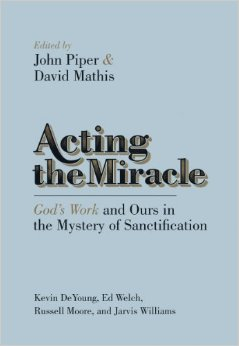
BOOK REVIEW: “Acting the Miracle” Edited by Dr. John Piper and David Mathis

GOD’S WORK AND OURS IN THE MYSTERY OF SANCTIFICATION

ATM Piper

Book Review by David P. Craig

There are various aspects to the biblical doctrine of sanctification – essentially becoming more like Jesus “conformed to the image of Christ” (Romans 8:29). Theologians often talk about two aspects of our becoming like Christ: Definitive sanctification and Progressive sanctification. Definitive sanctification is our legal status with God whereby we become righteous in God’s sight upon our conversion and justification in Christ Jesus. This book focuses on the Progressive sanctification aspect. It addresses the issue of how we actually progress in actual holiness as we live by faith in Jesus.

There are seven helpful chapters in this book by some excellent scholar/pastors:

(1) David Mathis gives the introduction which focuses on the complexities of sanctification and how it relates to our justification and union with Christ.

(2) John Piper defines sanctification by grounding its reality in the holiness of God and the sinfulness of humanity. He provides a wonderful  exegetical study of Romans 8:28-30 and answers the question: “What is the Place of Sanctification in the Process of Salvation?”

(3) Kevin DeYoung examines what should motivate our sanctification. He gives a very practical explanation from Colossians 3 that seeks to balance the element of justification, duty, and gratitude in the context of grace as we seek to be more like Jesus. He points out that our greatest incentives in the pursuit of holiness are theologically based on our identity in Christ. Sanctification is diverse and there is a multiplicity of reasons for this diversity, but it all stems from our union with Christ as we grow in our understanding of and application of His grace.

(3) Ed Welch (a well-known biblical counselor) tackles three specific issues: (a) Attention-Deficit/Hyperactivity Disorder; (b) Depression; (c) and Panic Attacks. He gives examples of how to care for individuals who manifest these symptoms, there causes, and how people who struggle with these battles can grow in Christ-likeness. Welch shows how Scripture can be used to help men and women with existing sin by addressing their souls and minds with the gospel.

(4) Jarvis Williams gives an articulate biblical theology of how we can pursue a practical maturity in the gospel by (a) Understanding God’s action for us in and through Christ is the foundation underneath our sanctification; (b) By four distinct means of grace – the Word of God; preaching to yourself and meditation; fervent prayer; and suffering; (c) Understanding how God’s action for us and in us through Christ leads to the miracle of our sanctification.

(5) Russell Moore gives a wonderful explanation of the many ways that the Church – participation in the Local Body of Christ – providing the communal context necessary for our maturity in Christ. He gives a solid case for the corporate aspect of our sanctification from First Corinthians 4-6.

(6) John Piper answers many question with relationship to our present and future glorification. Among the questions he addresses are these: How do we go about ‘pursuing the holiness without which no one will see the Lord’? How do we strive to enter through the narrow door? How do we dethrone and kill canceled sin? His goal in this chapter is to demonstrate “how this grand process of sanctification is leading to the predestined glory where the beauty of holiness fills the earth.”

(7) The appendix consists of transcript of a conversation with all the contributors addressing how they each go about pursuing personal devotional and prayer time from the September 29, 2012 Desiring God National Conference in Minneapolis, Minnesota.

I highly recommend this book for all Christians who are concerned about the goal of the Christian life – conforming to the image of Christ – and the practical ramifications of this conformation as we transform into His likeness and bring Him glory for the salvation and joyous sanctification of a multitude of people throughout the Earth.

Do You Have Assurance of Your Salvation? 5 Indicators from Hebrews 6

“How To KNOW that You KNOW HIM” By Steve W. Brown

The nature of the God of the universe is not to bring you to a saving knowledge of Jesus Christ, then to make you wonder for the rest of your life whether or not you have a saving knowledge of Jesus Christ. God does not say, “Trust me,” then for the rest of your life make you wonder if you really trust him. It is his business and desire for us to have assurance of salvation. How do you know that you know him?

Check out five indicators from the writer of Hebrews 6:

(1) The direction in which your life is going.

(2) The love your life is showing.

(3) The service your life is sharing.

(4) The concern for godliness you are feeling.

(5) The longing in your desire for fellowshiping.

First, if you are looking for assurance check out your life. The writer of Hebrews casts sobering words at those who inhabit the fringes of faith, desiring to taste but never receiving God’s mercy and producing weeds instead of fruits in their lives. The believer’s life, however, holds a far more positive promise:

Even though we speak like this, dear friends, we are confident of better things in your case—things that accompany salvation. God is not unjust; he will not forget your work and the love you have shown him as you have helped his people and continue to help them. We want each of you to show this same diligence to the very end in order to make your hope sure. We do not want you to become lazy, but to imitate those who through faith and patience inherit what has been promised [Heb. 6:9–12].

Most people think that God looks at where you are along the road of life. We do that, but God doesn’t. God asks only two things:

First, he wants to know from where you have come; second he wants to know the direction in which you are going. In other words, I might be a lot more terrible than you, but the point is that we are moving in the same direction. You are just further down the road than I am. God’s pleasure and our assurance come from moving in that right direction. That is how the writer of Hebrews could look at his hearers and be “confident of better things in your case—things that accompany salvation” (vs. 9b).

If you were to wake up tomorrow morning to discover that God does not exist, what difference would it make in your life? I would be devastated. A lot that is happening in my life would be wiped out. If you do not have an answer to that question, aside from the fact that you would not attend church once a week, then you need to read 6:4–8 once again. According to this passage you may have a serious problem.

One time a pastor friend of mine was talking to a girl in New England who had recently become a Christian. She was very angry and bitter. She asked, “Why do I have to go through all this hurt? Why is there all this pain in the world? Why do I have all these problems?” My friend asked a classic question: “Would you rather not have known him?”

She understood. As she thought about her answer to that question she found assurance of her relationship with Jesus Christ.

Second, in looking for assurance you should check out your love. Look again at verse 10: “God is not unjust; he will not forget your work and the love you have shown him as you have helped his people and continue to help them.”

The writer of Hebrews is not just talking about a tingle up your spine or a wonderful love song. He is talking about love in action, the kind of love you show to the saints for his sake. Love is not a noun; it is a verb. What do you do to show love for someone else? When you give a cup of cold water in the name of Christ, regardless of how you feel about that person, the giving is in love. When you reach out to a brother or sister who is in need, no matter how you feel about them, that is love, too. The writer of Hebrews is saying that you, as a Christian, have a love that you have shown, not that you have felt. This is a sign of your relationship with Christ, for that is an indication of your relationship with Christ in your Christlikeness:

Greater love has no one than this, that he lay down his life for his friends [John 15:13].

You see, at just the right time, when we were still powerless, Christ died for the ungodly [Rom. 5:6].

Love is action! Are you acting in obedience to him, showing love to your brothers and sisters? If you are you are on the road to assurance.

Third, make sure to check out your level—the level of a servant. We spent a lot of years in Massachusetts. At least at that time they believed that having a driver’s license is not a right; it is a privilege. So, if the head of the Department of Motor Vehicles decides you are guilty of some offense, whether you are guilty or not, the director can take your license away from you, and you don’t have any recourse.

When you and I became Christians, at that point we gave up every right. We are servants. As a Christian you have privileges, but you should not presume on those privileges. If your Christian faith is used to manipulate other people it is not the real thing. If your Christian faith is a vehicle for being a master it is not the real thing. Jesus said, “Whoever wants to become great among you must be your servant” (Matt. 20:26). When you see yourself willing to be a servant, willing not to take the credit, willing to just stand behind someone else and make them great, then you are on the road to assurance.

Fourth, if you are looking for assurance of your salvation, check out your liveliness. Hebrews 6:11 speaks of the author’s desire for “each of you to show this same diligence to the very end in order to make your hope sure.” We might call this diligence earnestness to realize full assurance. When people asked Charles Spurgeon how they could know if they were of the elect he would answer: “If you are worried about it, then you are.”

Now, if you have been struggling with assurance, plagued with the constant thought that “I may not really belong to God,” the very fact that you are earnestly concerned is a good sign that you may belong to him, when that earnestness stands alongside other evidence of the fruits of the Spirit.

You may remember the demonstration of Solomon’s wisdom in 1 Kings 3:16–28. Two women were brought to him, both claiming to be the mother of one baby. Each of the mothers had had a baby. One of the babies was dead. One mother said to Solomon, “Her baby died, and at night she switched her dead baby for my live one.” The second mother made the same accusation. So they came to Solomon, asking him to determine to whom the baby really belonged. Solomon had one of his servants take a sword and hold the baby up. Then Solomon said, “Cut the living child in two and give half to one and half to the other.” While one of the mothers agreed that his idea sounded reasonable, the other said, “No! Don’t do that. Give the baby to her.” Solomon at that point exercised a principle built into the very nature of things, so that he knew who was the real mother.

The principle was this: Concern is manifested in direct proportion to how much you care.

The same principle works to help you know about your relationship with God. If you are concerned about your relationship with Christ, if you are earnest about it or diligent, that is an indication that you are in Christ. You are on the road to assurance.

Fifth, if you are looking for assurance, check out your longing. The writer of Hebrews is saying: “I desire that you come to the point at which you know that you know that you know that you know.” There are those who say you can never know. They say the only way you can get assurance is to die and find out whether your feet are cold.

If you have heard and believed that, you have believed a lie. It is God’s desire that his people come into a relationship with the Father that is so close we know and feel secure with him.

I have a friend who adopted a teenager who had been shifted from foster home to foster home. When I first visited them I noticed that this boy was jumping to do everything possible to please his new parents. He made up his bed. He wanted to dry dishes and to vacuum the rug. Whenever a teenager gets that good I get uncomfortable. Something is wrong. I didn’t understand it at first, but then I thought about what that boy had been through. He had been kicked out of so many homes, and he was going to hang onto this one by being good.

A year later I visited the home and saw the teenager again. He was the most secure young man I have ever seen. He was relaxed and normal. He had to be nudged to do the things he was supposed to do. What happened? He had achieved assurance, assurance that this mom and dad were not going to kick him out.

We are like that. Maybe right now you are working very hard at being obedient because you don’t have assurance. Maybe right now you are scared that you are not really a Christian. What should you do about that in order to have assurance? My advice is to persevere and “keep on truckin’.” One day you will be so tired of obedience, so tired of holding on with a grip that makes your knuckles turn white. Then you will let go. At that moment you will make a wonderful discovery: He was holding you all along. You will know that you know him. And that is called “assurance.”

About the Author: Steve Brown is a radio broadcaster, seminary professor and author. He previously served as a pastor for over twenty-five years and now devotes much of his time to the radio broadcast, Key Life.

With such varied experience and unique perspective on life, Steve is an original. He refuses to be a “guru,” doesn’t want to be anyone’s mother and gives, in his teaching, the freedom to think. Overall, Steve has become known for his refreshing and practical Biblical applications.

Steve serves as Professor Emeritus of Preaching and Pastoral Ministry at Reformed Theological Seminary. He sits on the board of the National Religious Broadcasters and Harvest USA. Traveling extensively, Steve is a much-in-demand speaker.

Steve is the author of numerous books including A Scandalous Freedom, Approaching God, When Being God Isn’t Good Enough, What Was I Thinking? and Three Free Sins. His articles appear in such magazines and journals as Leadership, Decision, Plain Truth and Today’s Christian Woman. The article above has been adapted from Chapter 11 in the excellent book edited by R.C. Sproul entitled Doubt & Assurance. Grand Rapids, Baker, 2000.