SUNDAY OT SERMON: “Views of Creation: Theistic Evolution” by Dr. James Montgomery Boice

Genesis 1-11 vol 1 Boice

SERIES: GENESIS – PART 6

In the beginning God created the heavens and the earth. Now the earth was formless and empty, darkness was over the surface of the deep, and the Spirit of God was hovering over the waters. – Genesis 1:1-2

Atheistic evolution is no possible view of creation for Christians. It is ruled out simply because it is atheistic. But this does not mean that an evolutionary model must in itself be ruled out. Some who would retain belief in evolution while nevertheless identifying themselves as Christians are the theistic evolutionists.

Theistic evolution is the view of those who are committed to the theory of evolution and who retain it in full except at those few points where, as it seems to them, it is not entirely compatible with Christianity. They are theists because they believe in the Christian God. They believe that he has revealed himself in Scripture. But they are also evolutionists because they think that evolution is right. That is, they believe that everything has evolved through long periods of time from primitive to more complex forms. They believe that life has evolved from nonlife. They believe that man has evolved from the lower animals. Generally they accept the scientific data urged in support of evolution. The main difference between the theistic evolutionists and the atheistic evolutionists is that the former believe that God, specifically the God of the Bible, is providentially guiding the evolutionary process, while the latter attribute the identical developments to chance.

Another way of putting it would be to say that the God of theistic evolution is the God of the gaps. In the last message we pointed out four major problems with atheistic evolution: it cannot explain the origin of matter, the form of matter, the emergence of life, or the appearance of personality or God-consciousness in man. The theistic evolutionist would bring in God at these points. God creates matter and life. But aside from that the theistic evolutionist would view things as having happened precisely as his nonbelieving counterpart views them.

A Possibility

What are we to say to this view? The first thing we must say is that it is at least a possibility. We may put it like this. There is no reason for the Christian to deny that one form of fish may have evolved from another form or even that one form of land animal may have evolved from a sea creature. We may not believe that this has actually happened, for the reasons set forth in our last message. But in itself this view of creation is not biblically impossible.

The Hebrew word translated by our word “let,” which occurs throughout the creation account, allows for this. It does not specify a method by which God caused most things to come into being. However, there are three points at which even the Genesis narrative seems to require something different. These are the points at which the powerful Hebrew word baraʾ, rendered “created,” rather than the word “let” occurs. Baraʾ means to create out of nothing. It is used in verse 1, which speaks of the creation of the original substance of the universe out of nothing; verse 21, which speaks of the creation of conscious life (that is, of animals as opposed to plants); and verse 27, which speaks of the creation of man in God’s image. At these points there is an obvious introduction into creation of something strikingly new, something that did not and could not have evolved from things in existence previously. So long as the evolutionist speaks of the Christian God as the one who has introduced these new elements and has guided the evolutionary development at other points also (so that the result is not the mere product of chance but rather the unfolding of God’s own wise and perfect will), most Christians would say that, thus far at least, the approach of the theistic evolutionist is possible.

Some important Christian thinkers have said exactly this. No less weighty a scholar than B. B. Warfield, in an essay, “On the Antiquity and the Unity of the Human Race,” said that although evolution “cannot act as a substitute for creation,” it can supply “a theory of the method of the divine providence” (B.B. Warfield, Biblical and Theological Studies, P&R, 1968, 238).

Another example is the great Scottish divine of the last century, James Orr. In the years 1890–91, Orr gave the well-known Kerr lectures on the subject “The Christian View of God and the World,” in the course of which he defended evolution. “In reality, the facts of evolution do not weaken the proof from design, but rather immensely enlarge it by showing all things to be bound together in a vaster, grander plan than had been formerly conceived. … On the general hypothesis of evolution, as applied to the organic world, I have nothing to say, except that, within certain limits, it seems to me extremely probable, and supported by a large body of evidence” (James Orr, The Christian View of God and the World as Centering in the Incarnation. Grand Rapids: Baker, 1960, 90).

 Even more significant is the essay published by Orr in that collection of conservative writings that appeared at the beginning of this century, The Fundamentals, from which the term “fundamentalist” came. In it Orr defends theistic evolution as propounded by R. Otto in Naturalism and Religion. He says at one point, “ ‘Evolution,’ in short, is coming to be recognized as but a new name for ‘creation,’ only that the creative power now works within, instead of, as in the old conception, in an external, plastic fashion” (Orr, “Science and Christian Faith,” The Fundamentals, vol. 1, ed. R.A. Torrey, A.C. Dixon, and others. Grand Rapids: Baker, 1972, 346. Original edition 1917).

Neither of these men was himself a theistic evolutionist, though Orr comes very close to endorsing the position. The point is simply that in the judgment of these cautious and eminently biblical spokesmen, theistic evolution is a possible theory and therefore should not be rejected out of hand by Christian people.

Points in Favor

Possibility is not certainty, however, and it is only fair to say that for what they consider to be very good reasons other Christians reject this approach entirely. One of them is Davis A. Young, whose own position is progressive creationism. (To be discussed in a future sermon – Genesis – Part 9) He writes against theistic evolution saying that it “leads logically and ultimately to the death of genuinely biblical religion.” In the heading of the chapter in which theistic evolution is specifically studied he calls this view “a house built upon sand” (Davis A. Young, Creation and the Flood: An Alternative to Flood Geology and Theistic Evolution. Grand Rapids: Baker, 1977, 18, 23ff.).

What are we to think of theistic evolution? Positively, we may say that it has two important points in its favor. First, truth is truth wherever it is found. So if evolution is true, as evolutionists certainly believe, and if the Bible is also true, then something like the view of the theistic evolutionists must be reality. Again, this does not mean that evolution is true. But it does mean that we must at least ask whether it is true or not, and if it is true, we must learn from it. We must remember at this point that many theories of science were once declared to be anti-Christian but are now held by Christians and non-Christians alike with no apparent ill effects to Christianity.

One example is Copernican astronomy. Copernicus discovered that the earth was not the physical center of the universe. This was immediately assailed by those who felt that the Bible taught differently. Today we recognize that biblical language that was thought to imply a central earth is merely phenomenal. That is, it describes things as they appear to an earthbound observer (for whom indeed the Bible is written) and not as things actually are from a scientific standpoint. But in Copernicus’s day this was not seen, and Galileo, who held to the Copernican astronomy, was eventually compelled by irate churchmen to recant. Similarly, in the past there have been Christians who have opposed most advances in medicine—pain killers, anesthetics, operations—feeling that these wrongly oppose God’s decrees. Others have opposed such scientific devices as lightning rods, arguing that lightning was from God and that if God chose to strike a building it was sinful on our part to oppose it. In all these cases the terrible warnings made in support of the “Christian” position did not materialize and truth prevailed.

The second argument in favor of theistic evolution is that God seems to work according to this pattern in other areas. Theistic evolution posits a universe that operates according to fixed, universal laws into which, however, God sometimes intrudes, as in the creation of life from nonlife or the implanting of God-consciousness in man. “Isn’t this exactly what we see in life generally or, for that matter, in the history recorded for us in the Bible?” the theistic evolutionist might say. “For the most part the history of Israel and the church flows along naturally. Leaders arise, do their thing, and then die giving place to other rulers. It is only occasionally that God intervenes miraculously. To see this pattern at work in evolution is biblical. It is what we should expect on the basis of what we know of Christian history.”

A House on Sand

Then Christians should all be theistic evolutionists? Not necessarily! There are also important weaknesses in this view to which none should be blind.

First, there is a problem with the supposed truthfulness of evolution itself. The theistic evolutionist believes in evolution, as we have seen. But evolution is not necessarily true, as we have also seen. Indeed, there are important reasons for discounting it. One main reason for rejecting evolution is the lack of fossil evidence. To be sure, the evolutionist reads the fossil record differently, seeing in it a sketchy but adequate history of the development of higher forms of life from lower forms. But the record is at best incomplete and may, as creationists hold, actually provide better evidence for the creationist’s view than for the evolutionist’s. As we said in the last message, it is not merely a question of a few missing links. There are hundreds of missing links. It is questionable whether there is any evidence for the development of one species from a lower species. What the fossil evidence actually shows—even granting the alleged antiquity of the earth and the accepted sequence of fossils and rock strata—is the sudden appearance of major groups of species. If evolution is true, we should expect to find a finely graded and continuous development. Since we do not, we can honestly object to the theistic evolutionist’s first argument in support of his theory, namely, that evolution is true and that the Christian should not be afraid to acknowledge it.

Again, we must emphasize the fact that certain forms of evolutionary development may be true. But the creationist may well ask the theistic evolutionist whether he does not hold his position, not so much because of the scientific evidence for it, but only because it is the accepted (and only acceptable) theory in his field of work.

The second objection corresponds to the theist’s second argument, just as the creationist’s first objection corresponds to his first. The theistic evolutionist might appeal to the Bible as suggesting a pattern of God’s dealings with the human race, which he also sees in evolution—general development according to fixed laws with only an occasional supernatural intervention. But we must ask whether this is really the biblical picture. According to evolution, the development of life on earth has proceeded over a period of several billion years with at best two or three divine interventions. Is this the pattern we find in Scripture? It is true that in biblical history miracles are not everyday occurrences, but they are not all that infrequent either. Hundreds of supernatural interventions by God are recorded. And as for the development of the rest of history along the lines of natural law, would it not be more accurate to say that all history is in God’s hand and that it is being directed by him in intricate detail according to his own perfect plans?

The theistic evolutionist would say that in his view God has directed evolution just as he has directed the history of Israel. But if God has directed evolution according to that pattern, it is not quite the kind of evolution real evolutionists talk about. According to them, evolution is a long, slow, wasteful, crude, inefficient, and mistake-ridden process. The God of the Bible hardly fits those categories. If evolution is made to conform to his nature—efficient, wise, good, and error-free—it is hardly evolution, and the theistic evolutionist who is really a biblical theist has become a creationist though he does not actually describe himself by that word.

Third, we may ask whether the method of creation viewed by the theistic evolutionist does justice to the biblical record. Since the method of God’s creating the animals, birds, and fish is not given in Genesis 1, it may be that God effected this segment of his creation according to an evolutionary model. But in the case of man there does seem to be something of a method, at least in Genesis 2: “And the Lord God formed man from the dust of the ground and breathed into his nostrils the breath of life, and the man became a living being” (v. 7). This suggests that in the creation of man God began, as it were, de novo. That is, he started with inorganic matter into which he then breathed life. It does not suggest that man developed from the lesser animals.

We could always say that man is made of dust even though the actual steps of his creation involved a lengthy development through lesser species. But we run into further difficulties when we get to the case of Eve, for Eve is said to have been created from Adam. This does not correspond to any evolutionary theory.

Again, there is the problem of the singularity of Adam. In Romans 5:12–21 and 1 Corinthians 15:22–23 and 45, comparisons are made between Adam and the Lord Jesus Christ. It is basic to this comparison that Adam was an individual whose act affected his progeny. Does this fit in with evolutionary theory? In evolution the basic unit is population, not an individual. At what point did Adam appear? Or did he appear? If God chose one individual from a population of prehuman but manlike beings and made him man, what happened to the rest? Questions like these make questionable whether the theistic evolutionist can defend his position on biblical grounds.

Death of Biblical Religion

This leads us to our last criticism, the one Davis Young alludes to when he says that theistic evolution leads “logically and ultimately to the death of biblical religion.” There is an unbiblical view of the Bible that Young feels to be characteristic of these men.

Pierre Teilhard de Chardin is perhaps the best known and best read of the theistic evolutionists. He is French and is a Roman Catholic priest, which should speak well for his Christian commitment. He has a concern for the immaterial or spiritual as well as the material. He can even chide science: “Has science ever troubled to look at the world other than from without?” (Pierre Teilhard de Chardin, The Phenomenon of Man. New York: Harper & Row, 1959, 52). But he is also an evolutionist of the most convinced stripe, and this determines his theology in the final analysis.

For de Chardin there is no question that evolution on the grandest scale has taken place. Therefore, if our understanding of Scripture seems to be in conflict with evolutionary views, it is our views of Scripture or even Scripture itself that must give way before science. He writes: “It may be said that the problem of transformism no longer exists. The question is settled once and for all. To shake our belief now in the reality of biogenesis, it would be necessary to uproot the tree of life and undermine the entire structure of the world. … One might well become impatient or lose heart at the sight of so many minds (and not mediocre ones either) remaining today still closed to the idea of evolution, if the whole of history were not there to pledge to us that a truth once seen, even by a single mind, always ends up by imposing itself on the totality of human consciousness. … Is evolution a theory, a system or a hypothesis? It is much more: it is a general condition to which all theories, all hypotheses, all systems must bow and which they must satisfy henceforward if they are to be thinkable and true. Evolution is a light illuminating all facts, a curve that all lines must follow.”

His thought is his own, of course. We do not suggest that all theistic evolutionists share it. Yet it is evident from these quotations why Young calls this view ultimately destructive. Biblical religion must by its very definition start with the Bible and make all other theories subordinate to that. In de Chardin’s case, everything has become subject to evolution, and an ability to hear the reforming, correcting Word of God in Scripture has been lost. We must ask whether such a tendency is not present in all theistic evolution.

What should the Christian’s proper position be? An openness to all truth certainly, but not the kind of openness that allows scientific theory or any other theory to sit in judgment on the truthfulness of God’s written Word. Actually, the Christian’s task is the opposite: to bring every thought into subjection to the written Word. Paul knew this. He wrote to those of his day, “The weapons we fight with are not the weapons of the world. On the contrary, they have divine power to demolish strongholds. We demolish arguments and every pretension that sets itself up against the knowledge of God, and we take captive every thought to make it obedient to Christ” (2 Cor. 10:4–5). We may not know the truth in any given area. But we must know that our ultimate standard for truth—whatever it is—is the written Word of God.

About the Preacher

Boice JM in pulpit

James Montgomery Boice, Th.D., (July 7, 1938 – June 15, 2000) was a Reformed theologian, Bible teacher, and pastor of Tenth Presbyterian Church in Philadelphia from 1968 until his death. He is heard on The Bible Study Hour radio broadcast and was a well-known author and speaker in evangelical and Reformed circles. He also served as Chairman of the International Council on Biblical Inerrancy for over ten years and was a founding member of the Alliance of Confessing Evangelicals. James Boice was one of my favorite Bible teachers. Thankfully – many of his books and expositions of Scripture are still in print and more are becoming available. The sermon above was adapted from Chapter 6 in Genesis 1-11: An Expositional Commentaryvol. 1: Creation and Fall. Grand Rapids: Baker, 2006.

Under Dr. Boice’s leadership, Tenth Presbyterian Church became a model for ministry in America’s northeastern inner cities. When he assumed the pastorate of Tenth Church there were 350 people in regular attendance. At his death the church had grown to a regular Sunday attendance in three services of more than 1,200 persons, a total membership of 1,150 persons. Under his leadership, the church established a pre-school for children ages 3-5 (now defunct), a high school known as City Center Academy, a full range of adult fellowship groups and classes, and specialized outreach ministries to international students, women with crisis pregnancies, homosexual and HIV-positive clients, and the homeless. Many of these ministries are now free-standing from the church.

Dr. Boice gave leadership to groups beyond his own organization. For ten years he served as Chairman of the International Council on Biblical Inerrancy, from its founding in 1977 until the completion of its work in 1988. ICBI produced three classic, creedal documents: “The Chicago Statement on Biblical Inerrancy,” “The Chicago Statement on Biblical Hermeneutics” and “The Chicago Statement on the Application of the Bible to Contemporary Issues.” The organization published many books, held regional “Authority of Scripture” seminars across the country, and sponsored the large lay “Congress on the Bible I,” which met in Washington, D.C., in September 1987. He also served on the Board of Bible Study Fellowship.

He founded the Alliance of Confessing Evangelicals (Alliance) in 1994, initially a group of pastors and theologians who were focused on bringing the 20th and now 21st century church to a new reformation. In 1996 this group met and wrote the Cambridge Declaration. Following the Cambridge meetings, the Alliance assumed leadership of the programs and publications formerly under Evangelical Ministries, Inc. (Dr. Boice) and Christians United for Reformation (Horton) in late 1996.

Dr. Boice was a prodigious world traveler. He journeyed to more than thirty countries in most of the world’s continents, and he taught the Bible in such countries as England, France, Canada, Japan, Australia, Guatemala, Korea and Saudi Arabia. He lived in Switzerland for three years while pursuing his doctoral studies.

Dr. Boice held degrees from Harvard University (A.B.), Princeton Theological Seminary (B.D.), the University of Basel, Switzerland (D. Theol.) and the Theological Seminary of the Reformed Episcopal Church (D.D., honorary).

A prolific author, Dr. Boice had contributed nearly forty books on a wide variety of Bible related themes. Most are in the form of expositional commentaries, growing out of his preaching: Psalms (1 volume), Romans (4 volumes), Genesis (3 volumes), Daniel, The Minor Prophets (2 volumes), The Sermon on the Mount, John (5 volumes, reissued in one), Ephesians, Phillippians and The Epistles of John. Many more popular volumes: Hearing God When You Hurt, Mind Renewal in a Mindless Christian Life, Standing on the Rock, The Parables of Jesus, The Christ of Christmas, The Christ of the Open Tomb and Christ’s Call to Discipleship. He also authored Foundations of the Christian Faith a 740-page book of theology for laypersons. Many of these books have been translated into other languages, such as: French, Spanish, German, Japanese, Chinese and Korean.

He was married to Linda Ann Boice (born McNamara), who continues to teach at the high school they co-founded.

Sources: Taken directly from the Aliance of Confessing Evangelicals’ Website

Boice’s Books:

from the Tenth Presbyterian Church website
Books
1970 Witness and Revelation in the Gospel of John (Zondervan)
1971 Philippians: An Expositional Commentary (Zondervan)
1972 The Sermon on the Mount (Zondervan)
1973 How to Live the Christian Life (Moody; originally, How to Live It Up,
Zondervan)
1974 Ordinary Men Called by God (Victor; originally, How God Can Use
Nobodies)
1974 The Last and Future World (Zondervan)
1975-79 The Gospel of John: An Expositional Commentary (5 volumes,
Zondervan; issued in one volume, 1985; 5 volumes, Baker 1999)
1976 “Galatians” in the Expositor’s Bible Commentary (Zondervan)
1977 Can You Run Away from God? (Victor)
1977 Does Inerrancy Matter? (Tyndale)
1977 Our Sovereign God, editor (Baker)
1978 The Foundation of Biblical Authority, editor (Zondervan)
1979 The Epistles of John: An Expositional Commentary (Zondervan)
1979 Making God’s Word Plain, editor (Tenth Presbyterian Church)
1980 Our Savior God: Studies on Man, Christ and the Atonement, editor (Baker)
1982-87 Genesis: An Expositional Commentary (3 volumes, Zondervan)
1983 The Parables of Jesus (Moody)
1983 The Christ of Christmas (Moody)
1983-86 The Minor Prophets: An Expositional Commentary (2 volumes,
Zondervan)
1984 Standing on the Rock (Tyndale). Reissued 1994 (Baker)
1985 The Christ of the Open Tomb (Moody)
1986 Foundations of the Christian Faith (4 volumes in one, InterVarsity
Press; original volumes issued, 1978-81)
1986 Christ’s Call to Discipleship (Moody)
1988 Transforming Our World: A Call to Action, editor (Multnomah)
1988, 98 Ephesians: An Expositional Commentary (Baker)
1989 Daniel: An Expositional Commentary (Zondervan)
1989 Joshua: We Will Serve the Lord (Revell)
1990 Nehemiah: Learning to Lead (Revell)
1992-94 Romans (4 volumes, Baker)
1992 The King Has Come (Christian Focus Publications)
1993 Amazing Grace (Tyndale)
1993 Mind Renewal in a Mindless Age (Baker)
1994-98 Psalms (3 volumes, Baker)
1994 Sure I Believe, So What! (Christian Focus Publications)
1995 Hearing God When You Hurt (Baker)
1996 Two Cities, Two Loves (InterVarsity)
1996 Here We Stand: A Call from Confessing Evangelicals, editor with
Benjamin E. Sasse (Baker)
1997 Living By the Book (Baker)
1997 Acts: An Expositional Commentary (Baker)
1999 The Heart of the Cross, with Philip Graham Ryken (Crossway)
1999 What Makes a Church Evangelical?
2000 Hymns for a Modern Reformation, with Paul S. Jones
2001 Matthew: An Expositional Commentary (2 volumes, Baker)
2001 Whatever Happened to the Gospel of Grace? (Crossway)
2002 The Doctrines of Grace, with Philip Graham Ryken (Crossway)
2002 Jesus on Trial, with Philip Graham Ryken (Crossway)

Chapters

1985 “The Future of Reformed Theology” in David F. Wells, editor,
Reformed Theology in America: A History of Its Modern Development
(Eerdmans)
1986 “The Preacher and Scholarship” in Samuel T. Logan, editor, The
Preacher and Preaching: Reviving the Art in the Twentieth Century
(Presbyterian and Reformed)
1992 “A Better Way: The Power of Word and Spirit” in Michael Scott
Horton, editor, Power Religion: The Selling Out of the Evangelical Church?
(Moody)
1994 “The Sovereignty of God” in John D. Carson and David W. Hall,
editors, To Glorify and Enjoy God: A Commemoration of the 350th
Anniversary of the Westminster Assembly (Banner of Truth Trust)

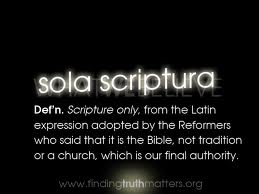
Why Sola Scriptura is Crucial to Evangelicalism by Dr. R.C. Sproul

“The only source and norm of all Christian knowledge is the Holy Scripture.” This thematic statement introduces De Scriptura Sacra of Heinrich Heppe’s classic work in Reformed dogmatics and provides a succinct expression of the Reformation slogan: Sola Scriptura (Scripture Alone). The two key words that are used to crystallize the sola character of Scripture are source and norm.

The Reformation principle of Sola Scriptura was given the status of the formal cause of the Reformation by Melanchthon and his Lutheran followers. The formal cause was distinguished from the material cause of Sola Fide (by faith alone). Though the chief theological issue of the Reformation was the question of the matter of justification, the controversy touched heavily on the underlying question of authority. As is usually the case in theological controversy, the issue of ultimate authority lurked in the background (though it was by no means hidden or obscure) of Luther’s struggle with Rome over justification. The question of the source of Luther’s doctrine and the normative authority by which it was to be judged was vital to his cause.

Sola Scriptura and Inerrancy

A brief historical recapitulation of the steps that led to Luther’s Sola Scriptura dictum may be helpful. After Luther posted his Ninety-Five Theses in 1517, a series of debates, correspondence, charges, and countercharges ensued, culminating in Luther’s dramatic stand at Worms in April 1521. The two most significant transitional points between the theses of 1517 and the Diet of Worms of 1521 were the debates at Augsburg and Leipzig.

In October 1518 Luther met with Cardinal Cajetan of the Dominicans. Cajetan was acknowledged to be the most learned theologian of the Roman Curia. In the course of their discussions Cajetan was able to elicit from Luther his views on the infallibility of the pope. Luther asserted that the pope could err and claimed that Pope Clement VI’s bull Unigenitus (1343) was contrary to Scripture.

In the summer of 1519 the dramatic encounter between Luther and Johannes von Eck took place at Leipzig. In this exchange Eck elicited from Luther the admission of his belief that not only could the pope err but church councils could and did err as well. It was at Leipzig that Luther made clear his assertion: Scripture alone is the ultimate, divine authority in all matters pertaining to religion.

Gordon Rupp gives the following account:

Luther affirmed that “among the articles of John Huss and the Hussites which were condemned, are many which are truly Christian and evangelical, and which the church universal cannot condemn!” This was sensational! There was a moment of shocked silence, and then an uproar above which could be heard Duke George’s disgusted, “Gad, Sir, that’s the Plague!… ” Eck pressed his advantage home, and Luther, trapped, admitted that since their decrees are also of human law, Councils may err.

So by the time Luther stood before the Diet of Worms, the principle of Sola Scriptura was already well established in his mind and work. Only the Scripture carries absolute normative authority. Why? For Luther the sola of Sola Scriptura was inseparably related to the Scriptures’ unique inerrancy. It was because popes could and did err and because councils could and did err that Luther came to realize the supremacy of Scripture. Luther did not despise church authority nor did he repudiate church councils as having no value. His praise of the Council of Nicea is noteworthy. Luther and the Reformers did not mean by Sola Scriptura that the Bible is the only authority in the church. Rather, they meant that the Bible is the only infallible authority in the church.

Paul Althaus summarizes the train of Luther’s thought by saying:

We may trust unconditionally only in the Word of God and not in the teaching of the fathers; for the teachers of the Church can err and have erred. Scripture never errs. Therefore it alone has unconditional authority. The authority of the theologians of the Church is relative and conditional. Without the authority of the words of Scripture, no one can establish hard and fast statements in the Church.

Thus Althaus sees Luther’s principle of Sola Scriptura arising as a corollary of the inerrancy of Scripture. To be sure, the fact that Scripture is elevated to be the sole authority of the church does not carry with it the necessary inference that it is inerrant. It could be asserted that councils, popes, and the Bible all err and still postulate a theory of Sola Scriptura. Scripture could be considered on a primus inter pares (“first among equals”) basis with ecclesiastical authority, giving it a kind of primacy among errant sources. Or Scripture could be regarded as carrying unique authority solely on the basis of its being the primary historical source of the gospel. But the Reformers’ view of Sola Scriptura was higher than this. The Reformation principle of Sola Scriptura involved inerrancy.

Sola Scriptura, ascribing to the Scriptures a unique authority, must be understood in a normative sense. Not descriptive, but rather normative authority is meant by the formula. The normative character of the Sola Scriptura principle may be seen by a brief survey of sixteenth-century Reformed confessions.

The Theses of Berne (1528): The Church of Christ makes no laws or commandments without God’s Word. Hence all human traditions, which are called ecclesiastical commandments, are binding upon us only in so far as they are based on and commanded by God’s Word (Sec. II).

The Geneva Confession (1536): First we affirm that we desire to follow Scripture alone as a rule of faith and religion, without mixing with it any other things which might be devised by the opinion of men apart from the Word of God, and without wishing to accept for our spiritual government any other doctrine than what is conveyed to us by the same Word without addition or diminution, according to the command of our Lord (Sec. I).

The French Confession of Faith (1559): We believe that the Word contained in these books has proceeded from God, and receives its authority from him alone, and not from men. And inasmuch as it is the rule of all truth, containing all that is necessary for the service of God and for our salvation, it is not lawful for men, nor even for angels, to add to it, to take away from it, or to change it. Whence it follows that no authority, whether of antiquity, or custom, or numbers, or human wisdom, or judgments, or proclamations, or edicts, or decrees, or councils, or visions, or miracles, should be opposed to these Holy Scriptures, but on the contrary, all things should be examined, regulated, and reformed according to them (Art. V).

The Belgic Confession (1561): We receive all these books, and these only, as holy and confirmation of our faith; believing, without any doubt, all things contained in them, not so much because the church receives and approves them as such, but more especially because the Holy Ghost witnessed in our hearts that they are from God, whereof they carry the evidence in themselves (Art. V). Therefore we reject with all our hearts whatsoever doth not agree with this infallible rule (Art. VII).

Second Helvetic Confession (1566): Therefore, we do not admit any other judge than Christ himself, who proclaims by the Holy Scriptures what is true, what is false, what is to be followed, or what is to be avoided (Chap. II).

Uniformly the sixteenth-century confessions elevate the authority of Scripture over any other conceivable authority. Thus, even the testimony of angels is to be judged by the Scriptures. Why? Because, as Luther believed, the Scriptures alone are inerrant. Sola Scriptura as the supreme norm of ecclesiastical authority rests ultimately on the premise of the infallibility of the Word of God.

Extent of the Norm

To what extent does the Sola Scriptura principle of authority apply? We hear statements that declare Scripture to be the “only infallible rule of faith and practice.” Does this limit the scope of biblical infallibility? Among advocates of limited inerrancy we hear the popular notion that the Bible is inerrant or infallible only when it speaks of matters of faith and practice. Matters of history or cosmology may contain error but not matters of faith and practice. Here we see a subtle shift from the Reformation principle. Note the difference in the following propositions:

A. The Bible is the only infallible rule of faith and practice.

B. The Bible is infallible only when it speaks of faith and practice.

In premise A, “faith and practice” are generic terms that describe the Bible. In premise B, “faith and practice” presumably describe only a particular part of the Bible. Premise A affirms that there is but one infallible authority for the church. The proposition sets no content limit on the infallibility of the Scriptures. Premise B gives a reduced canon of that which is infallible; that is, the Bible is infallible only when it speaks of faith and practice. This second premise represents a clear and decisive departure from the Reformation view.

Premise A does not say that the Bible provides information about every area of life, such as mathematics or physics. But it affirms that what he Bible teaches, it teaches infallibly.

The Source of Authority

Heppe’s sola indicates that the Bible is not only the unique and final authority of the church but is also the “only source of all Christian knowledge.” At first glance this statement may seem to suggest that the only source of revelation open to man is that found in Scripture. But that is not the intent of Heppe’s statement, nor is it the intent of the Reformation principle of Sola Scriptura.

Uniformly the Reformers acknowledged general revelation as a source of knowledge of God. The question of whether or not that general revelation yields a bona fide natural theology was and is widely disputed, but there is no serious doubt that the Reformers affirmed a revelation present in nature. Thus the sola does not exclude general revelation but points beyond it to the sufficiency of Scripture as the unique source of written special revelation.

The context of the Sola Scriptura schema with respect to source was the issue (raised over against Rome) regarding the relationship of Scripture and Tradition. Central to the debate was the Council of Trent’s declaration regarding Scripture and Tradition. (Trent was part of the Roman counteroffensive to the Reformation, and Sola Scriptura was not passed over lightly in this counter-offensive.)

In the Fourth Session of the Council of Trent the following decree was formulated: This (Gospel), of old promised through the Prophets in the Holy Scriptures, our Lord Jesus Christ, the Son of God, promulgated first with His own mouth, and then commanded it to be preached by His Apostles to every creature as the source at once of all saving truth and rules of conduct. It also clearly perceives that these truths and rules are contained in the written books and in the unwritten traditions, which, received by the Apostles from the mouth of Christ Himself, or from the Apostles themselves, the Holy Ghost dictating, have come down to us, transmitted as it were from hand to hand. Following then, the examples of the Orthodox fathers, it receives and venerates with a feeling of piety and reverence all the books both of the Old and New Testaments, since one God is the author of both; also the traditions, whether they relate to faith or to morals, as having been dictated either orally by Christ or by the Holy Ghost, and preserved in the Catholic church in unbroken succession.

In this decree the Roman Catholic church apparently affirmed two sources of special revelation—Scripture and the Tradition of the church—although in recent years this “dual source” theory has come into question within the Roman church.

G. C. Berkouwer’s work on Vatican Council II provides a lengthy discussion of current interpretations of the Tridentine formula on Scripture and Tradition. Some scholars argue that Tradition adds no new content to Scripture but merely serves either as a depository in the life of the church or as a formal interpretive tool of the church. A technical point of historical research concerning Trent sheds some interesting light on the matter. In the original draft of the fourth session of Trent the decree read that “the truths … are contained partly [partim] in Scripture and partly [partim] in the unwritten traditions.” But at a decisive point in the Council’s deliberations two priests, Nacchianti and Bonnucio rose in protest against the partim … partim formula. These men protested on the grounds that this view would destroy the uniqueness and sufficiency of Scripture. All we know from that point on is that the words partly … partly were removed from the text and replaced by the word and (et). Did this mean that the Council responded to the protest and perhaps left the relationship between Scripture and Tradition purposely ambiguous? Was the change stylistic, meaning that the Council still maintained two distinct sources of revelation? These questions are the focus of the current debate among Roman theologians.

One thing is certain. The Roman church has interpreted Trent as affirming two sources of special revelation since the sixteenth century. Vatican I spoke of two sources. The papal encyclical Humani Generis spoke of “sources of revelation.” Even Pope John XXIII spoke of Scripture and Tradition in Ad Petri Cathedram.

Not only has the dual-source theory been confirmed both by ecumenical councils and papal encyclicals, but tradition has been appealed to on countless occasions to validate doctrinal formulations that divide Rome and Protestantism. This is particularly true regarding decisions in the area of Mariology.

Over against this dual-source theory stands the sola of Sola Scriptura. Again, the Reformers did not despise the treasury of church tradition. The great councils of Nicea, Ephesus, Chalcedon, and Constantinople receive much honor in Protestant tradition. The Reformers themselves gave tribute to the insights of the church fathers. Calvin’s love for Augustine is apparent throughout the Institutes. Luther’s expertise in the area of Patristics was evident in his debates with Cajetan and Eck. He frequently quotes the fathers as highly respected ecclesiastical authorities. But the difference is this: For the Reformers no church council, synod, classical theologian, or early church father is regarded as infallible. All are open to correction and critique. We have no Doctor Irrefragabilis of Protestantism.

Protestant churches have tended to be confessional in character. Subscription to confessions and creeds has been mandatory for the clergy and parish of many denominations. Confessions have been used as a test of orthodoxy and conformity to the faith and practice of the church. But the confessions are all regarded as reformable. They are considered reformable because they are considered fallible. But the Sola Scriptura principles in its classic application regards the Scripture as irreformable because of its infallibility. Thus the two primary thrusts of Sola Scriptura point to:

1) Scripture’s uniqueness as normative authority and

2) its uniqueness as the source of special revelation. Norm and source are the twin implicates of the Sola Scriptura principle.

Is Sola Scriptura the Essence of Christianity?

In a recent publication on questions of Scripture, Bernard Ramm wrote an essay entitled, “Is ‘Scripture Alone’ the Essence of Christianity?” Using the nineteenth-century German penchant for the quest of the “Wesen” of Christianity as a jumping-off point, Ramm gives a brief history of the liberal-conservative controversy concerning the role of Scripture in the Christian faith. Defining Wesen as “the essence of something, the real spirit or burden of a treatise, the heart of the matter,” he concludes that Scripture is not the Wesen of Christianity. He provides a historical survey to indicate that neither the Reformers nor the strong advocates of inerrancy, A. A. Hodge and B. B. Warfield, believed that Sola Scriptura was the essence of Christianity. Ramm cites numerous quotations from Hodge and Warfield that speak of the Scriptures as being “absolutely infallible,” and “without error of facts or doctrines.” Yet these men affirmed that “Christianity was true independently of any theory of inspiration, and its great doctrines were believable within themselves.”

Ramm goes on to express grave concern about the present debate among evangelicals concerning inerrancy. Here his concern focuses not on the teaching of Hodge and Warfield but on the attitudes of their contemporary disciples who, in Ramm’s opinion, go beyond their forefathers in asserting a particular view of Scripture as being Christianity’s essence. Ramm writes:

From the other writings of Warfield in particular, it would be impossible to say that he identified the Wesen of Christianity with his view of Holy Scripture. He was enough of a historian of theology to avoid saying that. The “inspiration” article was an essay in strategy. However, among current followers of the so-called Warfield position there have been certain shifts away from the original strategic stance of the essay. One’s doctrine of Scripture has become now the first and most important doctrine, one’s theory of the wesen of Christianity, so that all other doctrines have validity now only as they are part of the inerrant Scripture. Thus evangelical teachers, or evangelical schools or evangelical movements, can be judged as to whether or not they are true to the wesen of Christianity by their theory of inspiration. It can be stated even more directly: an evangelical has made a theory of inspiration the wesen of Christianity if he assumes that the most important doctrine in a man’s theology, and most revelatory of the entire range of his theological thought, is his theology of inspiration.

It appears from this statement that the “essence” of Ramm’s concern for the present state of evangelicalism is that one’s doctrine of Scripture is viewed as the essence or wesen of Christianity. This writer can only join hands with Ramm in total agreement with his concern. To make one’s view of Scripture in general or of inspiration in particular the essence of Christianity would be to commit an error of the most severe magnitude. To subordinate the importance of the gospel itself to the importance of our historical source book of it would be to obscure the centrality of Christ. To subordinate Sola Fide to Sola Scriptura would be to misunderstand radically the wesen of the Reformation. Clearly Ramm is correct in taking his stand on this point with Hodge, Warfield, and the Reformers. Who can object to that?

One may be troubled, however, by a portion of Ramm’s stated concern. Who are these “current followers” of Warfield who in fact do maintain that Sola Scriptura is the heart or essence of Christianity? What disciple of Warfield’s has ever maintained that Sola Scriptura is essential to salvation? Ramm provides us with no names or documentary evidence to demonstrate that his deep concern is warranted.

To be sure, strong statements have been made by followers of the Warfield school of the crucial importance of Sola Scriptura and the centrality of biblical authority to all theological disputes. Perhaps these statements have contained some “overkill” in the passion of debate, which is always regrettable. We must be very cautious in our zeal to defend a high view of Scripture not to give the impression that we are talking about an article on which our salvation depends.

We can cite the following statements by advocates of the Warfield school that could be construed as a possible basis for Ramm’s concern. In God’s Inerrant Word, J. I. Packer makes the following assertion:

What Luther thus voiced at Worms shows the essential motivation and concern, theological and religious, of the entire Reformation movement: namely that the Word of God alone must rule, and no Christian man dare do other than allow it to enthrone itself in his conscience and heart.

Here Packer calls the notion of Sola Scriptura “the essential motivation and concern” of the Reformation. In itself this quote certainly suggests that Packer views Sola Scriptura as the essence of the Reformation.

However, in defense of Packer it must be noted that to say Sola Scriptura was the essential motivation of the Reformation movement is not to say that Sola Scriptura is the essence of Christianity. He is speaking here of a historical controversy. That Sola Scriptura was at the heart of the controversy and central to the debate cannot be doubted. To say that Sola Scriptura was an essential motif or concern of the Reformation cannot be doubted. That is was the essential concern may be brought into question; this may be regraded as an overstatement. But again, in fairness to Packer, it must be noted that earlier in his essay he had already indicated that Justification by Faith Alone was the material principle. So he had already maintained that Sola Scriptura was subordinate to Sola Fide in the controversy. In any case, though the word essential is used, there is no hint here that Packer maintains that Sola Scriptura is the essence of Christianity.

In a recent unpublished essay, Richard Lovelace of Gordon-Conwell Theological Seminary cites both Harold Lindsell and Francis Schaeffer as men who have sounded urgent warnings concerning the relationship between inerrancy and evangelicalism. Lovelace cites the following statements of Schaeffer:

There is not use of evangelicalism seeming to get larger and larger, if at the same time appreciable parts … are getting soft at that which is the central core, namely the Scriptures.… We must say most lovingly but clearly: evangelicalism is not consistently evangelical unless there is a line drawn between those who take a full view of Scripture and those who do not.

Again Schaeffer is cited: “Holding to a strong view of Scripture or not holding to it is the watershed of the evangelical world.” In these statements Francis Schaeffer maintains that the Scriptures are:

1) the “central core” of evangelicalism,

2) a mark of “consistent evangelicalism,” and

3) the “watershed of the evangelical world.”

These are strong assertions about the role of Sola Scriptura, but they are made with reference to evangelicalism, not Christianity (though I am sure Schaeffer believes evangelicalism is the purest expression of Christianity to be found). Evangelicalism refers to a historical position or movement. When he speaks of “watersheds,” he is speaking of crucial historical turning points. When he speaks of “consistent” evangelicalism, he implies there may be such a thing as inconsistent evangelicalism.

The troublesome quote of Schaeffer is that one in which he says the Scriptures are “the central core” of evangelicalism. Here “core” is in the singular with the definite article giving it a sola character. Does Schaeffer mean that the Bible is the core of evangelicalism and the gospel is the husk? Is Sola Scriptura the center and Sola Fide at the periphery of evangelicalism? It is hard to think that Schaeffer would make such an assertion. Indeed, one may question if Schaeffer means what he in fact does say here. Had he said, “Scripture is at the core of evangelicalism,” there would be no dispute. But to say it is the core appears an overstatement. Perhaps we have here a slip of the pen, which any of us can and frequently do make.

In similar fashion Harold Lindsell may be quoted: “Is the term ‘evangelical’ broad enough in its meaning to include within it believers in inerrancy and believers in an inerrancy limited to matters of faith and practice?” Lindsell raises the question of whether or not inerrancy of the entire Bible is essential to the term evangelical. The question raised is: If Sola Scriptura in its fullest sense is of the Wesen of evangelicalism, can one who espouses limited inerrancy be genuinely called evangelical? The issue is the meaning of the term evangelical. Does it carry with it the automatic assumption of full inerrancy? Again we must point out the difference between the historical label “evangelical” and what is essential to Christianity.

None of the scholars mentioned have said that adherence to inerrancy or Sola Scriptura is essential to salvation. None have Sola Scriptura as the Wesen of Christianity.

It could be said that the argument of the writer of this chapter is constructed on straw men who “come close” to asserting that Sola Scriptura is the essence of Christianity but who, in the final analysis, shrink for such an assertion. But it is not my purpose to create straw men. It is simply to find some basis for Ramm’s assertion about modern followers of Warfield. Since I have not been able to find any followers of Warfield who assert Sola Scriptura as the Wesen of Christianity, the best I can do is to cite examples of statements that could possibly be misconstrued to assert that. It is probably charity that restrained Ramm from naming those he had in mind. But unfortunately, the absence of names casts a shadow of suspicion over all modern followers of Warfield who hold to full inerrancy.

Though advocates of inerrancy in the full sense of Sola Scriptura do not regard it as being essential to salvation, they do maintain that the principle is crucial to Christianity and to consistent evangelicalism. That in Scripture we have divine revelation is no small matter. That the gospel rests not on human conjecture or relational speculation is of vital importance. But there is no quarrel with Ramm on these points. He summarizes his own position by saying:

1. There is no questioning of the Sola Scriptura in theology. Scripture is the supreme and final authority in theological decision-making.

2. One’s views of revelation, inspiration, and interpretation are important. They do implicate each other. Our discussion rather has been whether a certain view of inspiration could stand as the wesen of Christianity. We have in no manner suggested that matters of revelation, inspiration, and interpretation are unimportant in theology.

Here we delight in agreement with this strong affirmation of the crucial importance of Sola Scriptura.

Strangely, however, Ramm continues his summary by saying, “If the integrity of other evangelicals, evangelical schools, or evangelical movements are assessed by their view of inspiration, then, for them, inspiration has become the wesen of Christianity.” The inference Ramm draws at this point is at once puzzling and astonishing, and perhaps we meet here merely another case of overstatement or a slip of the pen. How would it follow from an assessment of others’ evangelicalism as being consistent or inconsistent according to their view of Scripture that inspiration has become the wesen of Christianity? This inference involves a quantum leap of logic.

If the first two points of Ramm’s summary are correct—that Sola Scriptura is important and that it implicates views of interpretation and theological decision making—why should not a school’s or movement’s integrity (a fully integrated stance) be assessed by this principle? Though Sola Scriptura is not the wesen of Christianity, it is still of crucial importance. If a school or movement softens its view of Scripture, that does not mean it has repudiated the essence of Christianity. But it does mean that a crucial point of doctrine and classical evangelical unity has been compromised. If, as Ramm suggests, one’s view of Scripture is so important, then a weakening of that view should concern us.

The issue of full or limited inerrancy is a serious one among those within the framework of historic evangelicalism. In the past a healthy and energetic spirit of cooperation has existed among evangelicals from various and diverse theological persuasions and ecclesiastical affiliations. Lutherans and Baptists, Calvinists and Arminians, and believers of all sorts have united in evangelical activity. What has been the cohesive force of that unity? In the first instance, there has been a consensus of catholic articles of faith, such as the deity of Christ. In the second instance, a strong point of unity has been the cardinal doctrine of the Protestant Reformation: justification by faith alone. In the last instance, there has been the unifying factor of Sola Scriptura in the sense of full inerrancy. The only “creed” that has bound the Evangelical Theological Society together, for example, has been the affirmation of inerrancy. Now that point of unity is in jeopardy. The essence of Christianity is not the issue. But a vital point of consistent evangelicalism is.

Sola Scriptura and Limited Inerrancy

Is Sola Scriptura compatible with a view of Scripture that limits inerrancy to matters of faith and practice? Theoretically it would seem to be possible if “faith and practice” could be separated from any part of Scripture. So long as biblical teaching regarding faith and practice were held to be normative for the Christian community, there would appear to be no threat to the essence of Christianity. However, certain problems exist with such a view of Scripture that do seriously threaten the essence of Christianity.

The first major problem we encounter with limited inerrancy is the problem of canon reduction. The canon or “norm” of Scripture is reduced de facto to that content relating to faith and practice. This immediately raises the hermeneutical question concerning what parts of Scripture deal with faith. As evangelicals wrestle among themselves in intramural debates, they must keep one eye focused on the liberal world of biblical scholarship, for the principle of the reduction of canon to matters of “faith” is precisely the chief operative in Bultmann’s hermeneutic. Bultmann thinks we must clear away the prescientific and faulty historical “husk” of Scripture to get to the viable kernel of “faith.” Thus, although Bultmann has no inerrant kernel or kerygma to fall back on, his problem of canon reduction remains substantially the same as that of those who limit inerrancy to faith and practice.

Before someone cries foul or cites the informal fallacy of argumentum ad hominem (abusive) or the “guilt by association” fallacy, let this concern be clarified. I am not saying that advocates of limited inerrancy are cryptic or even incipient Bultmannians, but that there is one very significant point of similarity between the two schools: canon reductionism. Evangelical advocates of limited inerrancy are not expected to embrace Bultmann’s mythical view of New Testament supernaturalism. But their method has no inherent safeguard from an arbitrary delimitation of the scope of the biblical canon.

The second serious problem, closely related to the first, is the problem of the relationship of faith and history, perhaps the most serious question of contemporary New Testament scholarship. If we limit the notion of inerrancy to matters of faith and practice, what becomes of biblical history? Is the historical substratum of the gospel negotiable? Are only those portions of the biblical narrative that have a clear bearing on faith inerrant? How do we escape dehistoricizing the gospel and relegating it to a level of supratemporal existential “decision”? We know that the Bible is not an ordinary history book but a book of redemptive history. But is it not also a book of redemptive history? If we exclude the realm of history from the category of inspiration or inerrancy either in whole or in part, do we not inevitably lose the gospel?

The third problem we face with limiting inerrancy to matters of faith and practice is an apologetic one. To those critics outside the fellowship of evangelicals, the notion of “limited inerrancy” appears artificial and contrived. Limited inerrancy gets us off the apologetical hook by making us immune to religious-historical criticism. We can eat our cake and have it too. The gospel is preserved; and our faith and practice remains intact while we admit errors in matters of history and cosmology. We cannot believe the Bible concerning earthly things, but we stake our lives on what it says concerning heavenly things. That approach was totally abrogated by our Lord (John 3:12).

How do we explain and defend the idea that the Bible is divinely superintended in part of its content but not all of it? Which part is inspired? Why only the faith and practice parts? Again, which are the faith and practice parts? Can we not justly be accused of “weaseling” if we adopt such a view? We remove our faith from the arena of historical verification nor falsification. This is a fatal blow for apologetics as the reasoned defense of Christianity.

Finally, we face the problem of the domino theory. Frequently this concern is dismissed out of hand as being so much alarmism. But our doctrine of Scripture is not a child’s game of dominoes. We know instances in which men have abandoned belief in full inerrancy but have remained substantially orthodox in the rest of their theology. We are also aware of the sad instances in which full inerrancy is affirmed yet the substance of theology is corrupt. Inerrancy is no guarantee of biblical orthodoxy. Yet even a cursory view of church history has shown some pattern of correlation between a weakening of biblical authority and serious defection regarding the Wesen of Christianity. The wesen of nineteenth-century liberalism is hardly the gospel evangelicals embrace.

We have already seen, within evangelical circles, a move from limited inerrancy to challenges of matters of faith and practice. When the apostle Paul is depicted as espousing two mutually contradictory views of the role of women in the church, we see a critique of apostolic teaching that does touch directly on the practice of the church. In the hotly disputed issue of homosexuality we see denominational commissions not only supplementing biblical authority with corroborative evidence drawn from modern sources of medical psychological study but also “correcting” the biblical view by such secular authority.The direction of these movements of thought is a matter of grave concern for advocates of full inerrancy.

We face a crisis of authority in the church. It is precisely our faith and our practice that is in question. It is for faith and practice that we defend a fully infallible rule—a total view of Sola Scriptura.

We know some confusion has existed (much unnecessarily) about the meaning of full inerrancy. But with all the problems of definition that plague the concept, we do not think it has died the death of a thousand qualifications.

We are concerned about Sola Scriptura for many reasons. But we affirm it in the final analysis not because it was the view of the Reformers, not because we slavishly revere Hodge and Warfield, not even because we are afraid of dominoes or a difficult apologetic. We defend it and express our deep concern about it because we believe it is the truth. It is a truth we do not want to negotiate. We earnestly desire dialogue with our evangelical brothers and colaborers who differ from us. We want to heal the wounds that controversy so frequently brings. We know our own views are by no means inerrant. But we believe inerrancy is true and is of vital importance to our common cause of the gospel.

Further dialogue within the evangelical world should at least help us clarify what real differences there are among us. Such clarification is important if there is to be any hope of resolving those differences. We do not intend to communicate that a person’s Christian faith stands or falls with his view of Scripture. We do not question the Christian commitment of advocates of limited inerrancy. What we do question is the correctness of their doctrine of Scripture, as the question ours. But we consider this debate, as serious as it is, a debate between members of the household of God. May our Father bring us to unity here as he has in many glorious affirmations of his gospel.

Article above written by Dr. R.C. Sproul. “Sola Scriptura: Crucial to Evangelicalism.” The Foundations of Biblical Authority. James M. Boice, ed. Grand Rapids: Zondervan, 1980.

About the Author: Dr. R.C. Sproul is the founder and chairman of Ligonier Ministries, an international Christian education ministry located near Orlando, Florida. His teaching can be heard on the program Renewing Your Mind, which is broadcast on hundreds of radio outlets in the United States and in 40 countries worldwide. He is the executive editor of Tabletalk Magazine and general editor of The Reformation Study Bible, and the author of more than seventy books (including some of my all time favorites: THE HOLINESS OF GOD; CHOSEN BY GOD; KNOWING SCRIPTURE; WILLING TO BELIEVE; REASON TO BELIEVE; and PLEASING GOD) and scores of articles for national evangelical publications. Dr. Sproul also serves as president of Ligonier Academy of Biblical and Theological Studies and Reformation Bible College. He currently serves as Senior Minister of preaching and teaching at Saint Andrew’s in Sanford, FL

How Was The New Testament Canon Formed?

The Formation of the Canon of the New Testament By *B.B. Warfield

Published in 1892, by the American Sunday School Union, Philadelphia, Pa.

In order to obtain a correct understanding of what is called the formation of the Canon of the New Testament, it is necessary to begin by fixing very firmly in our minds one fact which is obvious enough when attention is once called to it. That is, that the Christian church did not require to form for itself the idea of a “canon” — or, as we should more commonly call it, of a “Bible” — that is, of a collection of books given of God to be the authoritative rule of faith and practice. It inherited this idea from the Jewish church, along with the thing itself, the Jewish Scriptures, or the “Canon of the Old Testament.” The church did not grow up by natural law: it was founded. And the authoritative teachers sent forth by Christ to found His church, carried with them, as their most precious possession, a body of divine Scriptures, which they imposed on the church that they founded as its code of law. No reader of the New Testament can need proof of this; on every page of that book is spread the evidence that from the very beginning the Old Testament was as cordially recognized as law by the Christian as by the Jew. The Christian church thus was never without a “Bible” or a “canon.”

But the Old Testament books were not the only ones which the apostles (by Christ’s own appointment the authoritative founders of the church) imposed upon the infant churches, as their authoritative rule of faith and practice. No more authority dwelt in the prophets of the old covenant than in themselves, the apostles, who had been “made sufficient as ministers of a new covenant” [2 Cor. 3:6]; for (as one of themselves argued) “if that which passeth away was with glory, much more that which remaineth is in glory.” [2 Cor. 3:11] Accordingly not only was the gospel they delivered, in their own estimation, itself a divine revelation, but it was also preached “in the Holy Ghost” (I Pet. i. 12); not merely the matter of it, but the very words in which it was clothed were “of the Holy Spirit” (I Cor. ii. 13). Their own commands were, therefore, of divine authority (I Thess. iv. 2), and their writings were the depository of these commands (II Thess. ii. 15). “If any man obeyeth not our word by this epistle,” says Paul to one church (II Thess. iii. 14), “note that man, that ye have no company with him.” To another he makes it the test of a Spirit-led man to recognize that what he was writing to them was “the commandments of the Lord” (I Cor. xiv. 37). Inevitably, such writings, making so awful a claim on their acceptance, were received by the infant churches as of a quality equal to that of the old “Bible”; placed alongside of its older books as an additional part of the one law of God; and read as such in their meetings for worship — a practice which moreover was required by the apostles (I Thess. v. 27; Col. iv. 16; Rev. i. 3). In the apprehension, therefore, of the earliest churches, the “Scriptures” were not a closed but an increasing “canon.” Such they had been from the beginning, as they gradually grew in number from Moses to Malachi; and such they were to continue as long as there should remain among the churches “men of God who spake as they were moved by the Holy Ghost.”

We say that this immediate placing of the new books — given the church under the seal of apostolic authority — among the Scriptures already established as such, was inevitable. It is also historically evinced from the very beginning. Thus the apostle Peter, writing in A.D. 68, speaks of Paul’s numerous letters not in contrast with the Scriptures, but as among the Scriptures and in contrast with “the other Scriptures” (II Pet. iii.16) — that is, of course, those of the Old Testament. In like manner the apostle Paul combines, as if it were the most natural thing in the world, the book of Deuteronomy and the Gospel of Luke under the common head of “Scripture” (I Tim. v.18): “For the Scripture saith, Thou shalt not muzzle the ox when he treadeth out the corn” [Deut. xxv. 4]; and, “The laborer is worthy of his hire” (Luke x. 7). The line of such quotations is never broken in Christian literature. Polycarp in A.D. 115 unites the Psalms and Ephesians in exactly similar manner: “In the sacred books … as it is said in these Scriptures, ‘Be ye angry and sin not,’ and ‘Let not the sun go down upon your wrath.'” So, a few years later, the so-called second letter of Clement, after quoting Isaiah, adds (ii. 4): “And another Scripture, however, says, ‘I came not to call the righteous, but sinners'” — quoting from Matthew — a book which Barnabas (circa 97-106 A.D.) had already adduced as Scripture. After this such quotations are common.

What needs emphasis at present about these facts is that they obviously are not evidences of a gradually-heightening estimate of the New Testament books, originally received on a lower level and just beginning to be tentatively accounted Scripture; they are conclusive evidences rather of the estimation of the New Testament books from the very beginning as Scripture, and of their attachment as Scripture to the other Scriptures already in hand. The early Christians did not, then, first form a rival “canon” of “new books” which came only gradually to be accounted as of equal divinity and authority with the “old books”; they received new book after new book from the apostolical circle, as equally “Scripture” with the old books, and added them one by one to the collection of old books as additional Scriptures, until at length the new books thus added were numerous enough to be looked upon as another section of the Scriptures.

The earliest name given to this new section of Scripture was framed on the model of the name by which what we know as the Old Testament was then known. Just as it was called “The Law and the Prophets and the Psalms” (or “the Hagiographa”), or more briefly “The Law and the Prophets,” or even more briefly still “The Law”; so the enlarged Bible was called “The Law and the Prophets, with the Gospels and the Apostles” (so Clement of Alexandria, Strom. vi. 11, 88; Tertullian, De Prms. Men 36), or most briefly “The Law and the Gospel” (so Claudius Apolinaris, Irenaeus); while the new books apart were called “The Gospel and the Apostles,” or most briefly of all “The Gospel.” This earliest name for the new Bible, with all that it involves as to its relation to the old and briefer Bible, is traceable as far back as Ignatius (A.D. 115), who makes use of it repeatedly (e.g., ad Philad. 5; ad Smyrn. 7). In one passage he gives us a hint of the controversies which the enlarged Bible of the Christians aroused among the Judaizers (ad Philad. 6). “When I heard some saying,” he writes, “‘Unless I find it in the Old [Books] I will not believe the Gospel’ on my saying, ‘It is written.’ they answered, ‘That is the question.’ To me, however, Jesus Christ is the Old [Books]; his cross and death and resurrection and the faith which is by him, the undefiled Old [Books] — by which I wish, by your prayers, to be justified. The priests indeed are good, but the High Priest better,” etc. Here Ignatius appeals to the “Gospel” as Scripture, and the Judaizers object, receiving from him the answer in effect which Augustine afterward formulated in the well known saying that the New Testament lies hidden in the Old and the Old Testament is first made clear in the New. What we need now to observe, however, is that to Ignatius the New Testament was not a different book from the Old Testament, but part of the one body of Scripture with it; an accretion, so to speak, which had grown upon it.

This is the testimony of all the early witnesses — even those which speak for the distinctively Jewish-Christian church. For example, that curious Jewish-Christian writing, “The Testaments of the XII. Patriarchs” (Beni. 11), tells us, under the cover of an ex post facto prophecy, that the “work and word” of Paul, i.e., confessedly the book of Acts and Paul’s Epistles, “shall be written in the Holy Books,” i.e., as is understood by all, made a part of the existent Bible. So even in the Talmud, in a scene intended to ridicule a “bishop” of the first century, he is represented as finding Galatians by “sinking himself deeper” into the same “Book” which contained the Law of Moses (Babl. Shabbath, 116 a and b). The details cannot be entered into here. Let it suffice to say that, from the evidence of the fragments which alone have been preserved to us of the Christian writings of that very early time, it appears that from the beginning of the second century (and that is from the end of the apostolic age) a collection (Ignatius, II Clement) of “New Books” (Ignatius), called the “Gospel and Apostles” (Ignatius, Marcion), was already a part of the “Oracles” of God (Polycarp, Papias, II Clement), or “Scriptures” (I Tim., II Pet., Barn., Polycarp, II Clement), or the “Holy Books” or “Bible” (Testt. XII. Patt.).

The number of books included-in this added body of New Books, at the opening of the second century, cannot be satisfactorily determined by the evidence of these fragments alone. The section of it called the “Gospel” included Gospels written by “the apostles and their companions” (Justin), which beyond legitimate question were our four Gospels now received. The section called “the Apostles” contained the book of Acts (The Testt. XII. Patt.) and epistles of Paul, John, Peter and James. The evidence from various quarters is indeed enough to show that the collection in general use contained all the books which we at present receive, with the possible exceptions of Jude, II and III John and Philemon. And it is more natural to suppose that failure of very early evidence for these brief booklets is due to their insignificant size rather than to their nonacceptance.

It is to be borne in mind, however, that the extent of the collection may have — and indeed is historically shown actually to have varied in different localities. The Bible was circulated only in handcopies, slowly and painfully made; and an incomplete copy, obtained say at Ephesus in A.D. 68, would be likely to remain for many years the Bible of the church to which it was conveyed; and might indeed become the parent of other copies, incomplete like itself, and thus the means of providing a whole district with incomplete Bibles. Thus, when we inquire after the history of the New Testament Canon we need to distinguish such questions as these: (1) When was the New Testament Canon completed? (2) When did any one church acquire a completed canon? (3) When did the completed canon — the complete Bible — obtain universal circulation and acceptance? (4) On what ground and evidence did the churches with incomplete Bibles accept the remaining books when they were made known to them?

The Canon of the New Testament was completed when the last authoritative book was given to any church by the apostles, and that was when John wrote the Apocalypse, about A.D. 98. Whether the church of Ephesus, however, had a completed Canon when it received the Apocalypse, or not, would depend on whether there was any epistle, say that of Jude, which had not yet reached it with authenticating proof of its apostolicity. There is room for historical investigation here. Certainly the whole Canon was not universally received by the churches till somewhat later. The Latin church of the second and third centuries did not quite know what to do with the Epistle to the Hebrews. The Syrian churches for some centuries may have lacked the lesser of the Catholic Epistles and Revelation. But from the time of Ireanaeus down, the church at large had the whole Canon as we now possess it. And though a section of the church may not yet have been satisfied of the apostolicity of a certain book or of certain books; and though afterwards doubts may have arisen in sections of the church as to the apostolicity of certain books (as e.g. of Revelation): yet in no case was it more than a respectable minority of the church which was slow in receiving, or which came afterward to doubt, the credentials of any of the books that then as now constituted the Canon of the New Testament accepted by the church at large. And in every case the principle on which a book was accepted, or doubts against it laid aside, was the historical tradition of apostolicity.

Let it, however, be clearly understood that it was not exactly apostolic authorship which in the estimation of the earliest churches, constituted a book a portion of the “canon.” Apostolic authorship was, indeed, early confounded with canonicity. It was doubt as to the apostolic authorship of Hebrews, in the West, and of James and Jude, apparently, which underlay the slowness of the inclusion of these books in the “canon” of certain churches. But from the beginning it was not so. The principle of canonicity was not apostolic authorship, but imposition by the apostles as “law.” Hence Tertullian’s name for the “canon” is “instrumentum”; and he speaks of the Old and New Instrument as we would of the Old and New Testament. That the apostles so imposed the Old Testament on the churches which they founded — as their “Instrument,” or “Law,” or “Canon” — can be denied by none. And in imposing new books on the same churches, by the same apostolical authority, they did not confine themselves to books of their own composition. It is the Gospel according to Luke, a man who was not an apostle, which Paul parallels in I Tim. v. 18 with Deuteronomy as equally “Scripture” with it, in the first extant quotation of a New Testament book as Scripture. The Gospels which constituted the first division of the New Books, — of “The Gospel and the Apostles,” — Justin tells us were “written by the apostles and their companions.” The authority of the apostles, as by divine appointment founders of the church, was embodied in whatever books they imposed on the church as law, not merely in those they themselves had written.

The early churches, in short, received, as we receive, into the New Testament all the books historically evinced to them as given by the apostles to the churches as their code of law; and we must not mistake the historical evidences of the slow circulation and authentication of these books over the widely-extended church, evidence of slowness of the “canonization” of these books by the authority or taste of the church itself.

*Dr. Benjamin B Warfield graduated from the College of New Jersey, now Princeton University, in 1871 and after a period of study abroad at Edinburgh and Heidelberg entered Princeton Theological Seminary and was graduated with the class of 1876. Following a year’s study at Leipzig, Germany, and a short pastorate in Baltimore he was appointed instructor in New Testament Language and Literature in Western Theological Seminary in Pittsburgh and a year later elected professor. In 1886 he was called to succeed Archibald Alexander Hodge as professor of Systematic Theology in Princeton Theological Seminary — a position which he occupied with great distinction until his death in 1921.

Dr. Warfield won early recognition as a scholar, teacher and author. He received the degree of Doctor of Divinity from the college of New Jersey in 1880; that of Doctor of Laws from both the College of New Jersey and Davidson college in 1892; that of Doctor of Letters from Lafayette College in 1911; and that of Sacrae Theologiae Doctor from the University of Utrecht in 1913. He was editor of the Presbyterian and Reformed Review from 1890-1903 and until the time of his death, the chief contributor to the Princeton Theological Review.

A Remembrance of Warfield by J. Gresham Machen

“When I returned from Germany in 1906, I entered, as instructor in the New Testament department, into the teaching staff of Princeton Theological Seminary….Warfield was Professor of Systematic Theology (or “Professor of Didactic and Polemic Theology,” as the chair was then more sonorously and vigorously called). And what a wonderful man he was! His learning was prodigious. No adequate notion of its breadth can be obtained even from his voluminous collected works. Consult him on the most out-of-the-way subjects, and you would find him with the “literature” of each subject at his tongue’s end and able to give you just the guidance of which you had need. Now and then, in wonderfully generous fashion, he would go out of his way to give a word of encouragement to a younger man. The old Princeton was an environment in which a man felt encouraged to do his very best”.