S. Lewis Johnson, Jr. on Preaching the Grace of the Spirit’s Calling

Lecture #3 Delivered at Toronto Baptist Seminary and Bible College — March 1988

JOHNSON S Lewis imageIntroduction. One of the memorable things uttered by Abraham Booth (1734-1806) in his useful book, The Reign of Grace, is this one, “The indelible motto inscribed by the hand of Jehovah on all the blessings of the unchangeable covenant, is, to the praise of the glory of His grace.”1 The question that is before us in this lecture is, “Preaching the Grace of the Spirit’s Calling,” and it, too, has the indelible motto of to the praise of the glory of His grace inscribed upon it. It has its origin in the absolutely free favour of God.

In simple terms the question is, “How and why do we come to Christ?” There are two sides to the matter, but in this lecture we are concerned only with one. From the human side it is plain to evangelical readers of God’s Word that we come to the Son of God by the instrumentality of faith (cf. Rom. 3:21–26; Eph. 2:8–10).

From the divine side of the matter many and different answers have been given. Pelagians have said, “I came by myself,” denying grace altogether. Semi-Pelagians have said, “I wanted to come, and God helped me,” denying prevenient grace, but admitting cooperative grace, if man first chooses to come. Arminians of evangelical stripe have said, “God gave me sufficient grace to come, because Christ died, and I cooperated, admitting total inability, but claiming sufficient grace becomes efficient when we cooperate.” Lutherans have answered, “God brought me, and I did not resist,” reserving for man only the power of resisting grace. Calvinists, those who believe in sovereign grace, have answered simply, “God brought me to Christ” (cf. Gal. 4:9, “are known”).

It is difficult to understand why the Arminians are attracted to sufficient grace. Sufficient grace of itself enables a sinner, not to believe, but to be morally responsible to believe. Without sufficient grace Arminians believe the sinner, dead in sins, is not responsible for a condition in which he does not have the ability to extricate himself. To free man from his natural inability of will and make him responsible is the reason for the invention of the doctrine. It is, of course, not taught by any text of the Bible.

However, since it does not have the power to save without the exercise of man’s free will, how does this help matters? The individual with sufficient grace is now responsible by the Arminian doctrine, but in himself he is still without the power to turn to God, for evangelical Arminians believe in man’s total inability as Wesley did. If, however, the man who was totally unable to turn to God is not responsible without sufficient grace, but now with sufficient is responsible, although still totally unable of Himself to turn to God, how is this bestowal of sufficient grace an act of divine grace? Would it not be better to not have sufficient grace, for then men would not be responsible and, thus, assured to God’s salvation? God, to be most gracious, ought to give no grace! To illustrate, let us suppose a convicted murderer awaiting execution in jail contracts tuberculosis. His constant coughing convinces his prison doctor that he will cough himself to death before the day of his execution. The doctor comes to him and says, “I am pained that you are suffering so. I am giving you some medicine to take. It will not cure you, but it will strengthen you and keep you alive until you can be hanged”! Sufficient grace is similar. It gives men strength of will sufficient to make them responsible and thus to justify God in sending them to perdition. I fail to see the grace that the doctrine conveys. In fact, it seems clearly to underline the fact that by this system man is only saved by his own free will act. In other words, God can do nothing for a man until that man does something for himself. The ground of God’s salvation is shared by man with God. Is that New Testament teaching?

The teaching of both John and Paul makes distinct contributions to the debate over calling (cf. John 6:37, 43–45, 65; Rom. 8:30; I Cor. 12:3; 2 Thess. 2:13–15), and we turn now to the Scriptures.

I. THE THEOLOGICAL BACKGROUND OF EFFICACIOUS GRACE

External calling and internal calling. External calling, also called General Calling, is the declaration of the plan of salvation, with its command to repent, its appeal to motivations (such as fear, hope, gratitude), and its promise of acceptance through faith.

Internal calling is the effectual work of the Spirit, by which men are savingly influenced to salvation. Grace is the initiation of the work; calling is the result of the action of grace. The calling comes from the Spirit, as distinguished from the Word (cf. John 3:27; 6:37, 45, 64–65; I Thess. 1:5–6)). The Bible teaches the two calls. Of the objects of the one it is said, “Many are called, but few are chosen,” but of the other it is said, “whom he called, them he also justified “ (cf. Prov. 1:24 [1st]; John 6:45 [2nd]; Rom. 8:29–30).

The description of efficacious grace. Efficacious grace, which secures the saving internal call, is a divine influence on the human spirit. The Apostle Peter refers to efficacious grace when he writes of the scattered saints, describing them as “chosen according to the foreknowledge of God the Father, by the sanctifying work of the Spirit, that you may obey Jesus Christ and be sprinkled with His blood” (I Pet. 1:1–2). The sanctifying work of the Spirit that precedes the obedience and sprinkling of the blood, as the order of the words indicates, is the work of the Spirit that sets apart the elect to faith and salvation. Our Lord speaks of this work as the drawing of the Father, who does the work through the Spirit (cf. John 6:44).

The term “draw” in John 6:44 is a key-word in the doctrine, being, in fact, the biblical word for the work of efficacious grace. Bernard’s comments are excellent. “elknein is used in the LXX of Jer. 31:3 of the Divine attraction: ‘With lovingkindness have I drawn thee.’ It is used of the attractive power of Christ Crucified in Jn. 12:32, occurring elsewhere in the N. T. only at Jn. 18:10 (of drawing a sword), Jn. 21:6, 11 (of dragging a net ashore), and Acts 16:19 (of dragging Paul and Silas to the magistrates). It seems generally to connote a certain resistance on the part of that which is ‘dragged’ or ‘drawn,’ and this may be involved in its use in the present verse (but cf. Cant. 1:4).”2 Astoundingly, William Barclay, after giving all of this data from Bernard, comments, “Always there is this idea of resistance. God can and does draw men, but man’s resistance can defeat the pull of God.”3 Not one of the uses of the verb suggests this.4 Calvin’s comment is clarifying, “As far as the manner of the hearing goes, it is not violent so as to compel men by an external force; but yet it is an effectual movement of the Holy Spirit, turning men from being unwilling and reluctant into willing.”5

As Donald Grey Barnhouse used to say, “If you have made a decision of the will that is according to God’s will, it is because God has first jiggled your willer! “

The words, “the Father who sent me,” in verse forty-four should be noted. “The correlation between the subject: He who sent me, and the verb draw should be observed,” Godet says, “the same God who sends Jesus for souls, draws each soul to Jesus.”6 Should He have waited until asked to come? The final clause, “and I will raise him up on the last day,” refers to the consummation of the process that the Father’s drawing began. Between the two events lies the growth and development of the believer’s spiritual experience.

Efficacious grace operates immediately upon the human spirit, although usually in the context of the consideration of the Word of God (cf. I Cor. 2:12–15). It is supernatural, an overcoming of man’s deadness, blindness, deafness, and hardness of heart.

Some years ago when I was giving a series of lectures in Believers Chapel in Dallas, Texas, on soteriology, one of the members of the class, a young woman, came to me after the meeting and asked a number of questions that indicated that she did not understand very well the lesson that evening, which happened to be on efficacious grace. She spoke of “a very good man” she knew, a Roman Catholic, who “had everything going for him.” She went on to tell me how difficult she was finding it to reach him for the Lord. And then she said, “The only thing that will move him is a bolt from the blue.” I replied, “Kris, that is efficacious grace!” I tried to encourage her to wait for God’s necessary “jiggling” of his will.7

The infallibility of efficacious grace. The elect is subject to moral and mediate influences upon the will, common to him and to the unconverted, which he may and does resist because of sin. He is also subject to a special influence from the Spirit within the will, which is neither resistible nor irresistible, according to Hodge, because it acts from within and carries the will spontaneously with it. For this reason Hodge prefers the term, “effectual grace.8

II THE NEW TESTAMENT TEACHING ON EFFICACIOUS GRACE

The Johannine teaching. One of the important sources of the Johannine teaching, to which we have already made reference in discussing the use of the word draw, is found in John six. The Jews were murmuring over the great revelation concerning the Bread of Life who had come down from heaven (cf. John 6:38, 42). The Lord does not answer their objection, based upon His known parentage, but goes right to the heart of the matter. They must be “taught of God” to respond to His teaching on His heavenly origin.9 Whispering will not help; teaching from God will.

The forty-fifth verse spells it all out, it is repeated in verse sixty-five. “Here is a fundamental doctrine of the Fourth Gospel,” Bernard points out, “viz. that the approach of the soul to God or Christ is not initiated by the man himself, but by a movement of Divine grace.”10 The truth is adumbrated in 4:23, where the Father is said to seek His true worshippers (cf. 12:39: the dark side of predestination). The impossibility of anyone coming to Christ without the Father’s drawing was implied in the statement of verse thirty-seven, but it is stated in the forty-fourth verse. We will not go over again the plain statement of the necessity of the Father’s drawing for salvation, except to reiterate that the drawing is an effectual drawing in which the Father turns men from unwillingness to willingness.

The significance of the forty-fifth verse is sometimes overlooked. There a citation from Isaiah 54:13 is found, and it serves to explain that the drawing is scriptural teaching. In context the text refers to the messianic covenant community of Israel, the recipients of the covenantal blessings. They who belong to the Messiah need no instruction from men; they carry within themselves the effects of the divine instruction. The “all” must be understood in the context of the prophet. It is the “all” of the messianic community. The following “everyone who has heard” simply individualizes the specific “all.” Our Lord, then, makes an application of a timeless principle in the divine dealing with men. To be taught of God is to be drawn by God (cf. I Cor. 2:13; Phil. 3:15).

The Father’s drawing involves three steps, the next sentence affirms: (a) hearing; (2) learning; (3) coming. The Father takes the initiative and teaches. Everyone who listens and learns will come. The hymn, “0 Happy Day,” has at least one stanza that I like,

“Tis done: the great transactions’s done, I am my Lord’s, and He is mine; He drew me, and I followed on, Charmed to confess the voice divine”

It is Calvin’s contention that verse forty-five overthrows free will, for he comments, “The whole faculty of free will which the Papists (and Arminians, we might add) dream about is utterly overthrown by these two clauses. For if we begin to come to Christ only when the Father has drawn us, neither the beginning of faith, nor any preparation for it, lies in us. On the other hand, if all come whom the Father has taught, He gives them not only the freedom to believe but faith itself. When therefore we willingly obey the Spirit’s guiding, it is a part, as it were, sealing, of grace. For God would not draw us if He only stretched out His hand and left our will in a state of suspense. But He is properly said to draw us when He extends the power of His Spirit to the full completing of faith. They are said to hear God who willingly submit to God when He speaks within them, because the Spirit reigns in their hearts.”11

The Pauline teaching. In Romans 8:30 two points may be made that apply to the matter in hand. First of all, in the order of the steps in the divine continuing providential purpose it is important to notice that calling is given a place before justification, effectively indicating its place in time as a pre-salvation work.

And second, it should be remembered that the root, kaleo, meaning to call, in the epistles of Paul always refers to an effectual call (cf. I Cor. 1:1, 2, 26; Gal. 1:16; 2 Tim. 1:9–10). The aorist tenses look at the actions as complete and, thus certain, without reference to time.

An important passage for the subject of efficacious grace is 2 Thessalonians 2:13–14, concerning which James Denney has said, “The thirteenth and fourteenth verses of this chapter are a system of theology in miniature.”12 In the main that is correct. The thanksgiving is meant to encourage the Thessalonians, especially those agitated by the reports mentioned in 2:1–2.13 The verb heilato (NASB, “has chosen“) is used nowhere else in the New Testament of the doctrine of election, although it is so used in the Old Testament (cf. Deut. 6:18; 7:6–7; 10:15; cf. Phil. 1:22). Normally in its New Testament uses it refers to man’s choosing, not God’s (cf. Phil. 1:22; Heb. 11:25). If the reading ap’arches is genuine (NASB, “from the beginning”), then it refers clearly to eternal election here.14 The tense and voice of the verb lay stress on the choice as an event (in the past here) in which God has a personal interest. He chose us for Himself.15

The choice is from eternity, not from the time the gospel was preached in Thessalonica, as some would have it. Cf. I John 2:13; Matt. 19:4; Eph. 1:4.

The soterian, the purpose of the choice, is in this context final salvation, inclusive, of course, of the initial salvation from the penalty of sin. The method of accomplishment is important for the subject of efficacious grace, or effectual calling, and here Paul says that the salvation is “through (lit., in) sanctification by the Spirit and faith in the truth” (NASB). The sanctification is pre-salvation sanctification, or effectual calling, as the order of words suggests. The same order we have seen in I Peter 1:2. The “Spirit” is the Holy Spirit. Paul, then, as John insists on a pre-salvation gracious work of the Spirit before salvation. One does not come to our Lord or to salvation apart from it.

Two passages from I Corinthians complete our brief survey of Pauline teaching. The first is I Corinthians 8:3, where we read, “But if any one loves God, he is known by Him.” The construction of the original text is such that God’s knowing of the one who loves Him precedes the believer’s love of Him.16

The second passage is I Corinthians 12:3, and the important clause for our purposes is the final one, “except by the Holy Spirit.” Lenski comments, “Whoever confesses Jesus as ‘Lord’ has the Holy Spirit in his heart.”17 Calvin follows along the same line, saying that all things pertaining to the knowledge of God are gifts of the Holy Spirit, and then, “Hence, too we perceive how great our weakness is, as we cannot so much as move our tongue for the celebration of God’s praise, unless it be governed by his Spirit.”18 Unless He opens our mouths, we are not fit to be the heralds of His praise (cf. Isa. 6:5, “man of unclean lips”). Cf. Jer. 20:7.

Commenting on John 6:45, Berkouwer says, “This absoluteness of giving, drawing, and learning we meet not only in John, but also in the radical and exclusive testimony of Paul when he says, for instance, that ‘no man can say, Jesus is Lord, but in the Holy Spirit’” (I Cor. 12:3). The message of Scripture repeatedly accentuates that human inability. The impotence of man is not something pessimism has discovered; it is most literally described in Scripture (cf. John 3:27, I Cor. 2:14, Rom. 8:5, 6, 7, 8.”19

There are many illustrations in Scripture of the working of efficacious grace, but two stand out, one in the Gospel of Luke (14:16–23) and the other in the Acts of the Apostles (16:11–15), the latter incident in which the Lord “opened” Lydia’s heart to the things spoken by Paul being an almost perfect illustration of the truth. We do not have space in this paper to expound the texts.

III THE PRACTICAL EFFECTS OF EFFICACIOUS GRACE

The magnification of the divine purpose. Salvation is the work of God. It, therefore, is not hurried along, or effectuated, by stronger appeals, mightier arguments, more sparkling personalities, more telling illustrations, longer invitations, keener psychological insight, better eye-catching pedagogical helps or methods, and we must not forget it. On the other hand, we do not contend that it is helped by insipid thinking, windowless sermons, shunning of aids in teaching that the Spirit lays before our eyes. Salvation is the work of God, and His purpose shall be accomplished in His time (cf. John 6:39–40).

The senselessness of discouragement. The sense of discouragement, so frequently felt when the response is slight, is often a form of self-centeredness ultimately. Our need is faithfulness in our faith in His Word. May the Lord enable us to persevere in it.

Endnotes

  1. Abraham Booth, The Reign of Grace (Grand Rapids: Wm. B. Eerdmans Publishing Company, 1949 [reprint of 16th London ed.]), pp. 47–48. H. Bernard, A Critical and Exegetical Commentary on the Gospel According to St.John, ed. by A. H. McNeile (Edinburgh: T. & T. Clark,1928), I, 204.

  2. William Barclay, The Gospel of John (Edinburgh: The Saint Andrew Press, 1955), I, 226.

  3. Leon Morris, The Gospel According to John (Grand Rapids: Wm. B. Eerdmans Publishing Co., 1971), p. 371.

  4. John Calvin, The Gospel According to St John: 1-10, ed. by David W. Torrance and Thomas F. Torrance, trans. by T. H. L. Parker (Grand Rapids: Wm. B. Eerdmans Publishing Company, 1959), I, 164.

  5. Godet, Commentary on the Gospel of St. John, trans. by M. D. Cusin and S. Taylor (3rd. ed; Edinburgh: T. & T. Clark, 1887), II 238. Believers Chapel, Dallas, Texas, March 24, 1970. A. Hodge, Outlines of Theology (Grand Rapids: Zondervan Publishing House, 1972 [orig. enlarged ed., 1879]), pp. 449–53. Bernard, I, 203.

  6. Ibid., I, 204.

  7. Calvin, I, 165.

  8. James Denney, “The Epistles to the Thessalonians,” The Expositor’s Bible, p. 342.

  9. James Everett Frame, A Critical and Exegetical Commentary on the Epistles of St. Paul to the Thessalonians (Edinburgh: T. & T. Clark, 1912), p. 276.

  10. George Milligan, St Paul’s Epistle to the Thessalonians (London: Macmillan and Co., Limited, 1908), p. 106. Other recent commentators, such as Marshall and Morris favor “from the beginning,” arguing that, in spite of several things that may be said for “as a firstfruits,” it is difficult to make good sense of it here. The ap_arxhs is probably the correct reading (AV; NASB, “from the beginning”), since Paul never uses it elsewhere, and it has good manuscript support. WH accepts it, but the Aland text has aparxhn, largely because ap_ arxhs occurs nowhere else in the Pauline corpus and, when arxh does, it usually has a different sense, and aparxh occurs six other times in Paul. Cf. Bruce M. Metzger, A Textual Commentary on the Greek New Testament (London: United Bible Societies, 1971), p–p. 636–67. The decision in this instance is not an easy one.

  11. One would expect the middle voice of the verb to be prominent from the verbal idea of election itself. Cf. Eph. 1:4 (also a verb in the middle voice).

  12. The tense of the verb “loves” is a present tense, while that of the verb “is known” is a perfect passive, clearly showing that the knowing by God precedes our loving of Him. “The sense rather is, If a man loves God, this is a sign that God has taken the initiative,” Barrett says (C. K. Barrett, A Commentary on the First Epistle to the Corinthians [New York and Evanston: Harper & Row, Publishers, 1968], p. 190).

  13. C. H. Lenski, The Interpretation of St. Paul’s First and Second Epistles to the Corinthians (Columbus: Wartburg Press, 1946), p. 494.

  14. John Calvin, The First Epistle to the Corinthians (Grand Rapids: Wm. B. Eerdmans Publishing Co., 1960), p. Cf. Gordon D. Fee, The First Epistle to the Corinthians (Grand Rapids: William B. Eerdmans Publishing Company, 1987), “As in 2:10–13, only one who has the Spirit can truly make such a confession because only the Spirit can reveal its reality” (p. 582).

  15. C. Berkouwer, Divine Election, trans. by Hugo Bekker (Grand Rapids: Wm. B. Eerdmans Publishing Company, 1960), p. 49.

More About Dr. S. Lewis Johnson – A Tribute to Dr. S. Lewis Johnson

by Fred G. Zaspel
 – January 30, 2004:

On January 28, 2004, Dr. S. Lewis Johnson passed away at age eighty-eight. He was a Biblical scholar and theologian of rare abilities and of international renown, and he was a beloved friend. His influence on my own ministry would be difficult to measure. The hundreds of tapes of his preaching and teaching have gone free of charge to thousands of people all over the world, and it was by means of these tapes that I first became acquainted with him. When he first came to preach for me I asked the congregation if any had previously heard him. No one had, but I was quick to assure them all that they had indeed heard him often! Over the years he came to speak at our church and at our pastors’ conference many times, and even in his latest years it was challenging and blessed to hear him expound the Word of God with such precision and clarity.

Dr. Johnson was born in Birmingham, AL and grew up in Charleston, SC. He was always quick to assure everyone that his smooth, dignified, and pleasant southern accent was actually “English in its pure form.” He graduated from the College of Charleston with an B.A. degree in 1937 and was converted through the teaching of Dr. Donald Grey Barnhouse while in the insurance business in Birmingham. He left the insurance business in 1943 to enter Dallas Theological Seminary, from which he received the Th.M (1946) and Th.D. (1949) degrees. He completed further graduate work at the University of Edinburgh, Southern Methodist University, and in the University of Basel. Remaining at Dallas Seminary Dr. Johnson was Professor of New Testament from 1950 to 1972 and Professor of Systematic Theology from 1972 to 1977. He later served as Professor of Biblical and Systematic Theology at Trinity Evangelical Divinity School in Deerfield, IL, and as Visiting Professor of Systematic Theology at Tyndale Theological Seminary, Amsterdam, Netherlands. Dr. Johnson preached and lectured in many places, large and small, taught countless home Bible studies, and was involved in starting several churches. In 1963 he and others planted Believers’ Chapel in Dallas, and it is from the Chapel that so many thousands of his tapes have gone to the benefit of countless people.

He was in so many ways a man to emulate. He was a true gentleman. He was always personable and a great delight in conversation. His humor was always good, and his wit was always quick. He was a careful student of the Scriptures with unusually superior abilities as an exegete and theologian. His abilities with the original languages were clearly superior, and when discussion began he would always lead from his Greek and Hebrew text. He was a man of conviction, willing to step down from a noted career rather than surrender his beliefs. He was passionate for the gospel, and his heart was always hot for Christ. He was a humble and godly man. I have said many times that if God would allow me to grow old as gracefully and as saintly as Dr. Johnson I would become proud and ruin it. He was a model scholar, a model teacher, a model preacher, a model friend, and a model Christian. He was that rare combination of so many abilities and virtues. I thank God for him and feel much the poorer without him.

Among his greatest passions was the faithful expounding of the nature of Christ’s atoning work. He clearly cherished any and every opportunity to demonstrate from the Scriptures the success and effectiveness of Christ’s death as a substitute for His people. And when it was his turn to listen, elderly though he was, he would sit right up front with his Greek and Hebrew Bible in hand. And though virtually every speaker he would hear would necessarily be a man of comparatively inferior abilities, he seemed always just to delight in hearing the Word of God preached. And afterwards he was always eager to fellowship with younger preachers and laymen alike and discuss the things of Christ and examine the Word of God together.

The last time I spoke with Dr. Johnson, about a month or so ago, it was evident that he was growing tired and frail. He fell ill earlier this month, but his illness was brief before the Lord took him home to glory. He leaves behind him his wonderful wife Martha whom we love dearly also, and our prayers are now for her. By his tape ministry I came to love Dr. S. Lewis Johnson before I ever knew him, and I count it a great blessing to have known him. Probably no one outside my own father has taught me more, and few could ever be more beloved. I praise the Lord for him.

April 30th In Christian History – Galerius & Two Brave Missionary Nurses

Series: On This Day In Christian History

 Significant Events on This Day:

418: Pelagians were banished from Rome by imperial edict as great threat to peace, apparently for teaching that men can save themselves.
1532: James Bainham, a Lollard (a follower of the teachings of John Wycliffe) barrister (lawyer), was burned at the stake in Smithfield. He had been tied to a tree and whipped by Sir Thomas More, recanted his faith, was fined and then withdrew his recantation.

1658: Marguerite Bourgeoys established the first uncloistered Catholic missionary community in the new world at Ville Marie, Canada.

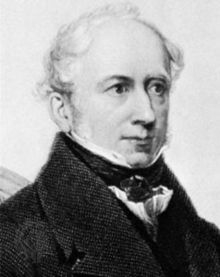
1854: James Montgomery (pictured left), who for many years was Scotland’s sole Moravian pastor, died on this day. Twice he went to prison for expressing his social views too freely in his newspaper, the Sheffield Iris. He was the author of many hymns, and he helped win acceptance for hymn singing in the Anglican Church. His best-known hymn was the Christmas carol “Angels from the Realms of Glory.”


“Galerius Issues a Toleration Edict as He Dies”

Sometimes when a person stares into the face of eternity, he becomes more religious or makes moral changes, perhaps hoping to influence his future beyond the grave. This may have been the case with Roman Emperor Galerius when he issued an Edict of Toleration on this day, April 30, in 311.

Galerius, the son of a Greek shepherd who became a Roman soldier, rose in power and authority to become a junior ruler under Diocletian. It was Galerius who instigated Emperor Diocletian’s persecution of Christians in 303 by convincing Diocletian that Christians were dangerous enemies of the empire.

Galerius himself issued an edict in 304 requiring everyone in the empire to sacrifice to the gods of the empire on pain of death or forced labor. Leading churchman were imprisoned, precious Bible manuscripts were destroyed and hundreds of Christians were executed as a result of his edict.

When Diocletian abdicated, Galerius became senior emperor in 305. He continued his cruel persecution, which was so widespread and intense that it became known as the Great Persecution. However, Christianity simply would not go away. Even Galerius recognized the impossibility of snuffing out the illegal religion.

Then he became ill. A Christian writer named Lactantius said that Galerius’s body rotted and was eaten by maggots while he writhed in agony. Evidently Galerius’s conscience connected his persecution of Christians with his miserable condition. He apparently saw his illness as judgment from the Christian God, for from his sickbed he issued an edict of Toleration that mentioned only Christians.

The edict began by justifying the murders that had been committed under his original edict:

Amongst our other measures for the advantage of the Empire, we have hitherto endeavored to bring all things into conformity with the ancient laws and public order of the Romans. We have been especially anxious that even the Christians, who have abandoned the religion of their ancestors, should return to reason.

Nothing that some Christians had betrayed their faith out of fear while others endured torture, Galerius decided illogically that:

We, with our wonted clemency, have judged it wise and permit a pardon even to these men and permit them once more to become Christians and reestablish their places of meeting.
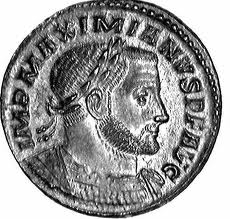
Galerius (his image on an ancient Roman coin at left) added:

It should be the duty of the Christians, in view of our clemency [mercy], to pray to their god for our welfare, for that of the Empire, and for their own, so that the Empire may remain intact in all its parts, and that they themselves may live safely in their habitations.

Prayer seems to be the point of the proclamation. Galerius wanted Christian prayers. Did he hope for a miracle? Is so, he was disappointed. He died a week after issuing the edict.

His successor, Emperor Maximinus, tried to counteract the edict but did not succeed to any great extent during his short reign. The Great Persecution of Christians had ended.

Author’s of the Above Article: A. Kenneth Curtis and Daniel Gravesedited This Day In Christian History. Camp Hill, PA: Christian Publications Inc., 2005. The article above was adapted from the entry for April 30th.

A Kenneth Curtis, Ph.D, is president of the Christian History Institute and the founding editor of Christian History magazine. He has written and produced several award winning historical films for Gateway Films/Vision Video’s Church history collection. He is also coauthor of 100 Most Important Dates in Christian History and From Christ to Constantine: The Trial and Testimony of the Early Church. He and his wife, Dorothy, reside in eastern Pennsylvania.

Daniel Graves is the Webmaster for the Christian History Institute and holds a master’s degree in library science from Western Michigan University. He is the author of Doctors Who Followed Christ and Scientists of Faith. Dan and wife, Pala reside in Jackson, Michigan.


“The Tempest”

During its first three centuries, the Church met persecution in sporadic intervals around the empire. But nothing compared with the tempest that befell it during the days of Roman emperor Diocletian. Diocletian, seizing power in a coup, appointed fellow-soldier Maximian as co-emperor and two other men as assistants, Constantius and Galerius. The four ruled the empire, east and west, conservatively and with a philosophy of “traditional values.”

“Traditional values” for ancient Rome excluded Christianity. Though Diocletian himself seemed tolerant at first of Christians (his wife and daughter were believers), Galerius was strongly anti-Christian. His military prowess and battlefield victories gave him increasing influence. Slowly and methodically he painted Christians as enemies. He pushed through a series of persecutions against Christians, beginning with the destruction of a church in Nicomedia on February 23, 303. In rapid fire, several edicts were issued against the Church, the last and worst being published on April 30, 304.

No one can describe the carnage. Christians were dismissed from their positions, their civil rights suspended. Church buildings were set afire. Copies of the Scriptures were burned in the marketplaces. Pastors and church leaders were caught and executed, many by lions in the Coliseum. In Phrygia one whole community was wiped out. Other Christians were thrown into squalid prisons or sent to dreaded mines. All former persecutions were forgotten in the horror of this last and greatest storm.

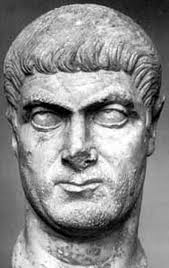
But the empire gradually grew sick of the killing. Executioners were exhausted, and even the lions, it is said, grew tired of Christian flesh. Galerius, meanwhile, found he was dying of a disease commonly known as “being eaten with worms.” On April 30, 311, anniversary of the earlier edict, he issued another in which he suspended persecution against Christians if they would pray for his recovery. From a thousand prisons, mines, and labor camps, the scarred warriors of Christ streamed home (ancient statue of Gelerius pictured left).

Many of them no doubt prayed for Galerius, but he didn’t recover. Some five days after he signed the edict the worms finished their work.

Herod … sat down on his throne and made a speech. The people shouted, “You speak more like a god than a man!” At once an angel from the Lord struck him down because he took the honor that belonged to God. Later, Herod was eaten by worms and died. God’s message kept spreading. – Acts 12:21b-24

About the Author: Robert J. Morgan, is the pastor of Donelson Fellowship in Nashville, Tennessee and the author of the best-selling Then Sings My Soul, From This Verse, Red Sea Rules, and On This Day – this article was adapted from the April 30th entry in this excellent book. He conducts Bible conferences, parenting and marriage retreats, and leadership seminars across the country.


“Minka and Margaret: They Were Political Casualties”

Thailand was a difficult place to be a missionary in 1974. The Vietnam War had spilled over into Laos, Cambodia, and northern Thailand. In southern Thailand there was ongoing conflict between the military and Muslim liberation groups that wanted independent for Thailand’s predominantly Muslim provinces. Malaysia, having a majority Muslim population, was supporting the Muslim rebels. The tense religious and political climate made missionary work difficult and dangerous.

Minka Hanscamp, a six-foot-tall Dutch woman who had grown up in Java as the daughter of missionaries, and Margaret Morgan, a nurse from a Welsh mining village, were missionary nurses with Overseas Missionary Fellowship (OMF). They had worked tirelessly in southern Thailand for sixteen and nine years respectively. They both had a special burden for those with leprosy. Their ministry involved cutting away rotten flesh, treating ulcerated sores that emitted a horrible stench, and washing many leprous feet (Margaret and Minka pictured left c. 1970).

Every two weeks the women held a leprosy clinic in the town of Pujud. On April 20, 1974, Minka’s sixteenth anniversary at OMF, she and Margaret were lured away from Pujud by strangers who insisted they come with them to the mountains to treat some sick patients needing help.

On April 30, 1974, Ian Murray, the OMF representative for Thailand, received two devastating letters. One was a letter from Minka and Margaret suggesting they had been kidnapped by “jungle people” but were well and “still praising.” The second letter was from their captors. It demanded a half-million-dollar ransom. The kidnappers also demanded that an official letter be sent from OMF to the nation of Israel in support of Palestinian rights. OMF’s policies did not allow them to comply with either demand. If they paid a ransom, every missionary would become more susceptible to abduction. It was also against OMF policy to become involved in political issues.

Instead Ian Murray met with Thai officials and representatives of the kidnappers, attempting to secure the release of Minka and Margaret. The meeting was unsuccessful. Violence in the area escalated over the next few days between Muslim separatists and the military. The Muslim gang that held the women issued a statement saying that they were not against OMF but against American and British support of Israel. The women would not be released unless the “Christian world stop and support to Israel against the Palestinian people.”

The crisis received international attention and prayer, but the letters from the women soon stopped. Rumors of their executions spread but were not confirmed.

Finally in March 1975 a Malaysian man confessed that he had shot both missionaries in the head. The chief of the Muslim gang had decided that the women had to be killed in order to keep the respect of his underlings in the rebel movement. The man said that the nurses were calm when they were told they were going to die, saying only, “Give us a little time to read and pray.” Although the Christian world hoped the story wasn’t true, it was confirmed when two skeletons that physically matched the women were found in the jungle. They had been shot in the head five or six months earlier.

On May 15 hundreds attended their funeral, not only Christians but Buddhists and Muslims as well. Many were shocked and saddened by the violent murders of the women who had come to help them. One man testified at the funeral that he had been a former bandit killer but had become a Christian after Minka had tenderly placed his ulcerated foot on her lap as she treated it. Following the funeral, native pastors and missionaries received more inquiries about the Christian faith than ever before. 

Reflection

 Can you imagine yourself ministering to lepers as Minka and Margaret did?

Are there areas of Christian ministry that you suspect you should participate in but are outside your comfort zone?

“Heal the sick, raise the dead, cure those with leprosy, and cast out demons, Give as freely as you have received.” – Matthew 10:8


Author’s of the Article Above: Mike and Sharon Rusten are not only marriage and business partners; they also share a love for history. Mike studied at Princeton (B.A.), the University of Minnesota (M.A.), Westminster Theological Seminary (M.Div.), Trinity Evangelical Divinity School (Th.M.), and New York University (Ph.D.). Sharon studied at Beaver College, Lake Forest College, and the University of Minnesota (B.A.), and together with Mike has attended the American Institute of Holy Land Studies (now Jerusalem University College). The Rustens have two grown children and live in Minnetonka, Minnesota. This article was adapted from the April 30th entry in their wonderful book The One Year Book of Christian History, Carol Stream, IL: Tyndale, 2003.