From Mecca to Calvary: The Testimony of Thabiti Anyabwile

Interview with Thabiti Anyabwile – on his book “The Gospel for Muslims”

 By Matt Svoboda

From the Bible belt, to Islam, to following Jesus, to going into the ministry, and now he has a nationwide stage. Thabiti Anyabwile is a gospel-centered pastor who has preached at the last several Together for the Gospel conferences.  He served under Mark Dever at Capitol Hill Baptist Church in Washington DC before becoming the Senior Pastor at First Baptist Church in Grand Cayman in the Cayman Islands.  I can’t forget to mention that he doesn’t even like the beach!  He has written a few other books, all of which I have read, and I have been greatly blessed by his preaching and writing ministry.

Thabiti Anyabwile has written a book that I have not read, but have ordered it and am very much looking forward to reading. The Gospel for Muslims appears to be a great book for helping Christians to share Christ with confidence to Muslims. I am grateful that Thabiti agreed to do this interview.  Admittedly, I have not really studied Islam or how to share the gospel with Muslims.  This interview and book will be as beneficial for me as anyone. Enjoy the interview below and you can buy the book at the link above:

1) Could you summarize your testimony of how you converted from Islam to Christianity? What were a couple of “milestones” in your process of conversion?

I grew up in small town North Carolina, smack in the middle of the Bible belt.  My family was nominally Christian, attending church at Easter, Christmas, and few times during the year.  The first turning point came for me when I was arrested after my sophomore year in high school.  I’d never been in trouble before; so I did what my big brothers sometimes did when they got in trouble—I went to church.  But sadly, I didn’t have ears to hear the gospel, and I don’t think the gospel was always preached clearly.

So, I went off to college an angry young man.  There, I began friendships with a number of Muslim men.  By my sophomore year in college, I became a practicing Muslim, zealous for Islam.  I practiced Islam through the rest of undergraduate school and a short time after.  The next turning point came near the end of undergraduate school.  During Ramadan, the Muslim month of prayer and fasting, while reading the Qur’an, I was suddenly aware that the Qur’an admitted too much about Jesus on the one hand (virgin birth, miracles, prophet, gospels are signs from God, etc.) but denied too much on the other hand (not the Son of God, not crucified, etc.).  After a year of trying to find satisfactory answers, I finally concluded that the inconsistencies couldn’t be explained.  Islam was false.

About the same time, a casual conversation with co-workers exposed a nagging problem I’d had all along.  We were discussing various people from world history who we respected.  And a co-worker look at the group and said she couldn’t think of anyone more righteous than me.  After my protests, she continued to insist and to list off the reasons why she thought that.  In that conversation I could see that the righteousness she described was all external behaviors.  But inside, I knew my heart was corrupt and sinful, full of unrighteousness.  I knew I didn’t have the kind of righteousness that would satisfy a holy God.

Rather than turn to Christ, I went further in despair.  Around that time, my wife and I found out we were pregnant with what would have been our first child.  We lost the child three months into the pregnancy.  The Lord dealt us a kind blow.  He humbled us.  And in that period of humbling, we heard the preaching of the gospel with faith for the first time.  The preacher, expounding Exodus 32, explained the sinfulness of sin, and I was deeply convicted.  And the preacher held out Jesus Christ, the only Savior, who not only took God’s wrath against sin but also supplied the perfect righteousness we need to satisfy a holy God.  In God’s amazing kindness, my wife and I both came to faith in the Lord that morning.

2) What is the main reason that you wanted to write this book “The Gospel for Muslims?”

I’m often asked by people who know my testimony, “How can we share the gospel with Muslims?”  When they ask this, they’re really asking, “Is there any special knowledge I need or technique that will be effective in evangelizing Muslims?”  But when you think about it, that’s the wrong question.  The question suggests that we lack confidence in the gospel itself to change the hardest hearts or to save our Muslim neighbors.  So, I wrote the book to remind Christians that “the gospel is the power of God unto salvation for everyone who believes, to the Jew first but also to the Gentile,” including the Muslim.  What we need is fresh confidence in Christ and the news of His salvation through His death, burial, resurrection, and coming.  If we know the gospel, we know everything we need to know to see our Muslim friends, coworkers, and neighbors saved from the coming wrath of God, and saved to love and enjoy the Savior forever.

3) What are some common misconceptions that Christians have about Muslims?

There are many.  We sometimes think that every Muslim is a terrorist.  Television images and our own fear have a lot to do with that.  But the chances are overwhelming that our Muslim friend or neighbor is not a terrorist.  They’re people with the same concerns, ambitions, and needs as our non-Muslim neighbors.

Also, many people tend to think that every Muslim has memorized the Qur’an by three years old and is able to give extended and sophisticated explanations of their faith.  But in reality, most Muslims don’t know the Qur’an very well at all.  And Islam itself is not one thing all over the world.  Arab Islam differs significantly from Islam in Indonesia (the largest Muslim country in the world) and North Africa and North America.  You’re more likely to meet a nominal Muslim, much like my nominal Christian family back in NC, than you are to meet a Muslim with the entire Qur’an committed to memory.

But perhaps the biggest myth is that Muslims do not convert.  That simply is not true.  Many, many Muslims are saved by God’s sovereign grace through faith in Christ all the time!  They pay significant costs—losing family, friends and sometimes jobs.  But this is exactly what Jesus tells His followers to expect, and it’s worth it.  As those who already believe, we should expect that the same gospel that saved us will save our Muslim friends.  And we should be ready to help them pay the costs of following our Lord.

4) What are the key passages in Scripture that you use when sharing the gospel with Muslims?  Is there a certain “method” that you use?

I don’t use a certain method in evangelism.  Rather, I concentrate on explaining the gospel clearly, making distinctions in terms so that things like “repentance” and “faith” are seen to be distinct from those things in Islam.  Also, I want to make sure that distinctively Christian realities—like the Trinity, the crucifixion and resurrection, the necessity of turning from sin, abandoning our righteousness, and trusting Jesus alone to save us—are driven home.  I want to make sure my Muslim friend knows that these are personal issues, not just abstract theological issues.  His sin is real.  He has personally offended the holy God of all creation.  His rejection of Jesus means He is abiding in His sin and in God’s wrath.  And unless he repents and trusts Christ, he will suffer eternal judgment.

In my experience, most Muslims are eager to either hear what we think about Jesus, or to try and disprove the gospel.  To do that, they often turn to the gospels themselves.  That puts us on home turf, familiar ground.  Normally, I start where they start and I make sure to read the five verses before and after the verse they usually misquote.  It’s amazing how often the gospel is right there in the context!  So, simply modeling good Bible reading and explaining what’s there tends to “work” as an evangelistic approach.  The Spirit blesses the word.

5) Along with reading your book, how can Christians get trained in order to better share the gospel with Muslims?

There are many good books out there on evangelism.  Continue to read books that encourage in a biblical approach to evangelism.  I’d recommend Mark Dever’s The Gospel and Personal Evangelism and Mack Stiles’ Marks of the Messenger and Speaking of Jesus (which has a video training resource as well).  Those would be wonderful works to study.  Also, reading good books on the gospel itself, including: Greg Gilbert’s What is the Gospel?, and John Murray’s Redemption Accomplished and Applied.

But there’s really no training like actually sharing your faith.  Don’t worry about “having all the answers.”  In the process of sharing and being questioned, God gives us grace and teaches us things we won’t likely learn any other way.  Consider Philemon 6: “I pray that you may be active in sharing your faith, so that you will have a full understanding of every good thing we have in Christ.”  Isn’t it awesome of God to tie our evangelism together with granting us “a full understanding of every good thing we have in Christ”?  The Lord simultaneously reaches the sinner and rewards the evangelist!

6) Are there any “pitfalls” that Christians often fall into when sharing the gospel with Muslims?

There are several, most of them connected with the misconceptions we have of Muslims.  We sometimes give in to the fear of man.  We sometimes find ourselves playing Bible “ping pong,” lobbing verses back and forth in an effort to win an argument.  Sometimes we try to make unpleasant aspects of the gospel more appealing by leaving them out or softening them.  Or, we’re lured into accepting the claims and premises of Islam as though they were true.  All of these can be pitfalls.

7) What are some “things to avoid” when sharing the gospel with Muslims?

I don’t think it’s helpful to get into discussions of politics, to attack the Qur’an or Prophet Muhammad, or to be disrespectful.  When we’re fearful, feeling under-prepared, and lose sight of the fact that we’re trying to win people to the truth that is in Christ, our flesh exerts enormous control and we tend to do things we’d probably be better off avoiding.

Also, it’s important to avoid serving pork products (or having them in your home) if you’re inviting a Muslim friend or neighbor over.  Avoid immodest clothing and cross-gender conversations.  Many Muslims associate Christianity with the decadence and moral decay of the West.  We want to avoid those associations.

Try your best to avoid assumptions, like: they’d never be interested in attending my church.  Actually, your Muslim neighbor or friend may find themselves with freedoms and interests that they couldn’t pursue in other countries.  Don’t assume they’re not interested in the faith and the church.

8) What are some good ways Christians can lovingly engage Muslims in their community?

Love Muslims the way you’d love anyone.  They’re people made in God’s image, and they experience the same burdens, needs, ambitions, and cares as everyone else.  So, in general, simply move toward them in intentional love.  As we pay attention to them, opportunities for specific acts of kindness and love will emerge.

But some general things also come to mind.  Volunteer in an English-as-Second-Language class or group.  Invite them to your home for a meal or to watch a game.  Most internationals will live in the United States without ever entering an American home.  Practice hospitality.  Also, if you both have children, ask them how they and the kids are adjusting to the culture and ways of the U.S.  Invite your Muslim neighbor and their children to participate in a ball game or some other activity you share with your children.  Be something of a cultural broker, empathizing with their struggles and helping them negotiate life in your community.

9) Any final thoughts or advice that you would like to share with Christians who would like to better engage Muslims with the gospel?

Let the gospel do the work!  Be confident in the power of God encased in the gospel.  Get out there are share the good news and trust the Spirit to use you for the glory of Christ!

More About Thabiti Anyabwile: He is the Senior Pastor of First Baptist Church of Grand Cayman in the Grand Cayman Islands and a Council member with The Gospel Coalition. In his own words, “I love the Lord because He first loved me. I love His people because He has given me a new heart. I have received God’s favor in the form of my wife, Kristie. And together we know His blessing through three children. I was once a Muslim, and by God’s grace I have been saved through faith in Jesus Christ. By God’s unfathomable grace I am a preacher of the Gospel of Jesus Christ, in which I hope to serve Him until He returns or calls me home!”

He earned his B. A. and M. S. degrees in psychology from North Carolina State University in Raleigh, NC. Before moving to minister in the Caribbean, he served with Dr. Mark Dever at Capitol Hill Baptist Church in Washington, D.C. He is married to Kristie and they have three children: Afiya, Eden, and Titus. As a native of Lexington, North Carolina, he has an affinity for Western-NC-BBQ. Thabiti writes regularly at Pure Church as part of The Gospel Coalition blog crew. He has also authored several books, The Gospel for Muslims: An Encouragement to Share Christ with Confidence (Thabiti converted to Christianity from Islam); Finding Faithful Elders and Deacons; Ephesians: God’s Big Plan for Christ’s New People; May We Meet in the Heavenly World: The Piety of Lemuel Haynes; What Is A Healthy Church Member?; The Decline of African American Theology: From Biblical Faith to Cultural Captivity; The Faithful Preacher: Recapturing the Vision of Three Pioneering African American Pastors. He has also contributing chapters to the following books: For the Fame of God’s Name: Essays in Honor of John Piper; Holy, Holy, Holy: Proclaiming the Perfections of God; Proclaiming a Cross-Centered Theology; Glory Road: The Journeys of 10 African-Americans into Reformed Christianity; and John Calvin: A Heart for Devotion, Doctrine & Doxology.

The Interview above took place on About the Author: Thabiti Anyabwile is the Senior Pastor of First Baptist Church of Grand Cayman in the Grand Cayman Islands and a Council member with The Gospel Coalition. In his own words, “I love the Lord because He first loved me. I love His people because He has given me a new heart. I have received God’s favor in the form of my wife, Kristie. And together we know His blessing through three children. I was once a Muslim, and by God’s grace I have been saved through faith in Jesus Christ. By God’s unfathomable grace I am a preacher of the Gospel of Jesus Christ, in which I hope to serve Him until He returns or calls me home!”

He earned his B. A. and M. S. degrees in psychology from North Carolina State University in Raleigh, NC. Before moving to minister in the Caribbean, he served with Dr. Mark Dever at Capitol Hill Baptist Church in Washington, D.C. He is married to Kristie and they have three children: Afiya, Eden, and Titus. As a native of Lexington, North Carolina, he has an affinity for Western-NC-BBQ. Thabiti writes regularly at Pure Church as part of The Gospel Coalition blog crew. He has also authored several books, The Gospel for Muslims: An Encouragement to Share Christ with Confidence (Thabiti converted to Christianity from Islam); Finding Faithful Elders and Deacons; Ephesians: God’s Big Plan for Christ’s New People; May We Meet in the Heavenly World: The Piety of Lemuel Haynes; What Is A Healthy Church Member?; The Decline of African American Theology: From Biblical Faith to Cultural Captivity; The Faithful Preacher: Recapturing the Vision of Three Pioneering African American Pastors. He has also contributing chapters to the following books: For the Fame of God’s Name: Essays in Honor of John Piper; Holy, Holy, Holy: Proclaiming the Perfections of God; Proclaiming a Cross-Centered Theology; Glory Road: The Journeys of 10 African-Americans into Reformed Christianity; and John Calvin: A Heart for Devotion, Doctrine & Doxology.

The interview above took place on May 7, 2010 and can be found on SBC Voices: http://sbcvoices.com/interview-thabiti-anyabwile-the-gospel-for-muslims/

Thabiti Anyabwile on Winning Souls With C.H. Spurgeon

At the conclusion of T4G, a dear brother approached me to give me a copy of Spurgeon’s classic, The Soul Winner: Advice on Effective Evangelism.  Perhaps he felt sorry for me because I didn’t have any Spurgeon quotes for my sermon.  But I suspect, having gotten to know him and his wife a little, it was one of those loving gestures that so often occur in the brief exchanges God blesses us with at our churches and at conferences.  Praise the Lord.

I’ve been reading the book slowly, enjoying Spurgeon’s unique gift and praying the Lord would make me a better evangelist.  In God’s grace, I’m feeling fresh stirring and I’m praying the Lord would not stop until He gives me real fire.

From time to time, I’m hoping to reflect a little on The Soul Winner and I hope you’ll join me.  We begin today with chapter 1, “What Is It to Win a Soul?”

That’s a foundational question, isn’t it?  We have to be clear about the “it” before we can do “it.”  And it’s important that we maintain a sense of the priority of evangelism.  Spurgeon writes, “Soul-winning is the chief business of the Christian minister; indeed, it should be the main pursuit of every true believer” (p. 5).  Amen.  But what is soul winning?

What Soul-Winning Is Not

Spurgeon identifies three things soul-winning is not:

(1) “We do not regard it to be soul-sinning to steal members out of churches already established, and train them to utter our peculiar Shibboleth: we aim rather at bringing souls to Christ than at making converts to our synagogue.”  

He continues, “We count it utter meanness to build up our own house with the ruins of our neighbors’ mansions” (p. 5).  How often do we hear boasts of swelling numbers added to the ranks of the converted (or more often baptism and church membership) at the expense of neighboring fellowships?  I agree with Mr. Spurgeon; that’s not soul-winning as much as its plain ol’ competition.  I love Spurgeon’s charge:

There is such a thing as selfishness in our eagerness for the aggrandizement of our own party; and from this evil spirit may grace deliver us!  The increase of the kingdom is more to be desired than the growth of a clan.  We would do a great deal to make a Paedo-baptist brother into a Baptist, for we value our Lord’s ordinances; we should labor earnestly to raise a believer in salvation by free-will into a believer in salvation by grace, for we long to see all religious teaching built upon the solid rock of truth, and not upon the sand of imagination; but, at the same time, our grand object is not the revision of opinions, but the regeneration of our natures.  We would bring men to Christ and not to our own peculiar views of Christianity.  Our first care must be that the sheep should be gathered to the great Shepherd; there will be time enough afterwards to secure them for our various folds.  To make proselytes is a suitable labor for Pharisees: to beget men unto God is the honorable aim of ministers of Christ. (p. 6)

(2) “We do not consider soul-winning to be accomplished by hurriedly inscribing more names upon our church-roll, in order to show a good increase at the end of the year (p. 6).  Here!  Here!

(3) “Nor is it soul-winning, dear friends, merely to create excitement” (p. 9).

What Soul-Winning Is

Having dispelled the imitation acts, Spurgeon then turns to positively defining “soul-winning” as he sees it.  He brings his students’ attention to three positive aspects of evangelism:

(1) ”I take it that one of its main operations consists in instructing a man that he may know the truth of God (p. 10).

To try to win a soul for Christ by keeping that soul in ignorance of any truth, is contrary to the mind of the Spirit; and to endeavor to save men by mere claptrap, or excitement, or oratorical display, is as foolish as to hope to hold an angel with a bird-lime, or lure a star with music.  The best attraction is the gospel in its purity. The weapon with which the Lord conquers men is the truth as it is in Jesus. The gospel will be found equal to every emergency; an arrow, which can pierce the hardest heart, a balm which can heal the deadliest wound.  Preach it, and preach nothing else.  Rely implicitly upon the old, old gospel.  You need no other nets when you fish for men; those your Master has given you are strong enough for the great fishes, and have meshes fine enough to hold the little ones.  Spread these nets and no others, and you need not fear the fulfillment of His Word, “I will make you fishers of men.” (p. 13)

(2) “Secondly, to win a soul, it is necessary, not only to instruct our hearer, and make him know the truth, but to impress him so that he may feel it (p. 13).

A sinner has a heart as well as a head; a sinner has emotions as well as thoughts; and we must appeal to both.  A sinner will never be converted until his emotions are stirred.  Unless he feels sorrow for sin, and unless he has some measure of joy in the reception of the Word, you cannot have much hope of him.  The Word must be like a strong wind sweeping through the whole heart, and swaying the whole man, even as a field of ripening corn waves in the summer breeze.  Religion without emotion is religion without life. (p. 14)

You and I must continue to drive at men’s hearts till they are broken; and then we must keep on preaching Christ crucified till their hearts are bound up; and when this is accomplished, we must continue to proclaim the gospel till their whole nature is brought into subjection to the gospel of Christ.  Even in these preliminaries you will be made to feel the need of the Holy Ghost to work with you, and by you; but this need will be still more evident when we advance a step further, and speak of the new birth itself in which the Holy Spirit works in a style and manner most divine. (p. 16)

(3) “Of all whom we would fain win for Jesus it is true, ‘Except a man be born again, he cannot see the kingdom of God.’  The Holy Spirit must work regeneration in the objects of our love, or they never can become possessors of eternal happiness” (p. 16).

According to Spurgeon, regeneration will be shown in:

(1) conviction of sin,

(2) the exhibition of a simple faith in Jesus Christ,

(3) unfeigned repentance of sin,

(4) a real change of life,

(5) true prayer, and

(6) a willingness to obey the Lord in all His commandments.  

It’s funny, but many today would regard anything more than “a simple faith in Jesus Christ” as a telltale sign of legalism.  But Mr. Spurgeon was no legalist.  It’s more likely that our own day has so low a view of conversion–equating it only with “a public profession of faith”–that we’ve grown squeamish and downright afraid of insisting that regeneration must entail newness of life, a radical change, a friendly disposition toward God rather than a stubborn refusal (enmity).  If we have any hesitancy at affirming the bulk of this list, might we be unaware of our slippery grip on the magnificence of the new birth?  Might we be in danger of rushing to affirm “professions” while overlooking the fruit of conversion?

It hardly seems necessary to say that the problems Spurgeon identified are with us today, and were with the church during the apostolic era.  The evidence of false converts–biblical, historical, and contemporary–is plentiful.  And one could become discouraged, judgmental, contentious, or indifferent.  But when the Lord of the harvest commands we pray the Lord of the harvest to send laborers, we’re meant to understand that the Lord of the harvest plans on reaping and there’s no need for fainting!  We should be encouraged because the problem of false converts simply means the unsaved have been brought near!  We should be encouraged that the cotton has grown so high that by God’s grace we may pick without stooping!  Brother, be encouraged to win souls!

So much more could be said, but Mr. Spurgeon should have the final word of exhortation:

You may say to yourself, at the close of a service, “Here is a splendid haul of fish!”  Wait a bit.  Remember our Savior’s words, “The kingdom of heaven is like unto a net, that was cast into the sea, and gathered of every kind; which, when it was fully, they drew to shore, and sat down, and gathered the good into vessels, but cast the bad away.”  Do not number your fishes before they are broiled; not count your converts before you have tested and tried them.  This process may make your work somehow slow; but then, brethren, it will be sure.

Do your work steadily and well, so that those who come after you may not have to say that it was far more trouble to them to clear the church of those who ought never to have been admitted than it was to you to admit them.  If God enables you to build three thousand bricks into His spiritual temple in one day, you may do it; but Peter has been the only bricklayer who has accomplished that feat up to the present.

“Do not go and paint the wooden wall as if it were solid stone; but let all you building be real, substantial, and true, for only this kind of work is worth the doing.  Let all your building for God be like that of the apostle Paul According to the grace of God given to me, like a skilled master builder I laid a foundation, and someone else is building upon it. Let each one take care how he builds upon it. For no one can lay a foundation other than that which is laid, which is Jesus Christ. Now if anyone builds on the foundation with gold, silver, precious stones, wood, hay, straw—each one’s work will become manifest, for the Day will disclose it, because it will be revealed by fire, and the fire will test what sort of work each one has done. If the work that anyone has built on the foundation survives, he will receive a reward. If anyone’s work is burned up, he will suffer loss, though he himself will be saved, but only as through fire” (1 Corinthians 3:10-15; pp. 27-28).

Preach, Mr. Spurgeon! Preach!

About the Author: Thabiti Anyabwile is the Senior Pastor of First Baptist Church of Grand Cayman in the Grand Cayman Islands and a Council member with The Gospel Coalition. In his own words, “I love the Lord because He first loved me. I love His people because He has given me a new heart. I have received God’s favor in the form of my wife, Kristie. And together we know His blessing through three children. I was once a Muslim, and by God’s grace I have been saved through faith in Jesus Christ. By God’s unfathomable grace I am a preacher of the Gospel of Jesus Christ, in which I hope to serve Him until He returns or calls me home!”

He earned his B. A. and M. S. degrees in psychology from North Carolina State University in Raleigh, NC. Before moving to minister in the Caribbean, he served with Dr. Mark Dever at Capitol Hill Baptist Church in Washington, D.C. He is married to Kristie and they have three children: Afiya, Eden, and Titus. As a native of Lexington, North Carolina, he has an affinity for Western-NC-BBQ. Thabiti writes regularly at Pure Church as part of The Gospel Coalition blog crew. He has also authored several books, The Gospel for Muslims: An Encouragement to Share Christ with Confidence (Thabiti converted to Christianity from Islam); Finding Faithful Elders and Deacons; Ephesians: God’s Big Plan for Christ’s New People; May We Meet in the Heavenly World: The Piety of Lemuel Haynes; What Is A Healthy Church Member?; The Decline of African American Theology: From Biblical Faith to Cultural Captivity; The Faithful Preacher: Recapturing the Vision of Three Pioneering African American Pastors. He has also contributing chapters to the following books: For the Fame of God’s Name: Essays in Honor of John Piper; Holy, Holy, Holy: Proclaiming the Perfections of God; Proclaiming a Cross-Centered Theology; Glory Road: The Journeys of 10 African-Americans into Reformed Christianity; and John Calvin: A Heart for Devotion, Doctrine & Doxology.

The article above is adapted from http://thegospelcoalition.org/blogs/thabitianyabwile/2012/05/03/winning-souls-with-charles-spurgeon

Dr. D.A. Carson on How To Do Evangelism in a Post Modern Culture

*Athens Revisited (An Exegetical Study of Acts 17) by D.A. Carson

I would like to think that most of us have become convinced of the primacy of what might generically be called worldview evangelism. In the recent past, at least in North America and Europe, evangelism consisted of a fairly aggressive presentation of one small part of the Bible’s story line. Most non-Christians to whom we presented the gospel shared enough common language and outlook with us that we did not find it necessary to unpack the entire plot line of the Bible.

A mere quarter of a century ago, if we were dealing with an atheist, he or she was not a generic atheist but a Christian atheist-that is, the God he or she did not believe in was more or less a god of discernibly Judeo-Christian provenance. The atheist was not particularly denying the existence of Hindu gods — Krishna, perhaps — but the God of the Bible. But that meant that the categories were still ours. The domain of discourse was ours.

When I was a child, if I had said, “Veiled in flesh the Godhead see,” 80 percent of the kids in my school could have responded, “Hail the incarnate deity.” That was because Christmas carols like “Hark, the Herald Angels Sing” were sung in home, church, school, and street. These kids may not have understood all-the words, but this domain of Christian discourse was still theirs. Young people at university doubtless imbibed massive doses of naturalism, but in most English departments it was still assumed you could not plumb the vast heritage of English poetry if you possessed no knowledge of the language, metaphors, themes, and categories of the Bible.

In those days, then, evangelism presupposed that most unbelievers, whether they were atheists or agnostics or deists or theists, nevertheless knew that the Bible begins with God, that this God is both personal and transcendent, that he made the universe and made it good, and that the Fall introduced sin and attracted the curse. Virtually everyone knew that the Bible has two Testaments. History moves in a straight line. There is a difference between good and evil, right and wrong, truth and error, fact and fiction. They knew that Christians believe there is a heaven to be gained and a hell to be feared. Christmas is bound up with Jesus’ birth; Good Friday and Easter, with Jesus’ death and resurrection. Those were the givens.

So what we pushed in evangelism was the seriousness of sin, the freedom of grace, who Jesus really is, what his death is about, and the urgency of repentance and faith. That was evangelism. Of course, we tilted things in certain ways depending on the people we were addressing; the focus was different when evangelizing in different subcultural settings— in the Bible Belt, for instance, or in an Italian-Catholic section of New York, or in an Ivy League university. But for most of us, evangelism was connected with articulating and pressing home a very small part of the Bible’s plot line.

In many seminaries like Trinity, of course, we recognized that missionaries being trained to communicate the gospel in radically different cultures needed something more. A missionary to Japan or Thailand or north India would have to learn not only another language or two but also another culture. No less important, they would have to begin their evangelism farther back, because many of their hearers would have no knowledge of the Bible at all and would tenaciously hold to some worldview structures that were fundamentally at odds with the Bible. The best schools gave such training to their missionary candidates. But pastors and campus workers were rarely trained along such lines. After all, they were doing nothing more than evangelizing people who shared their own cultural assumptions, or at least people located in the same domain of discourse, weren’t they?

We were naive, of course. We were right, a quarter of a century ago, when we sang, “The times they are a-changin’.” Of course, there were many places in America where you could evangelize churchy people who still retained substantial elements of a Judeo-Christian worldview. There are still places like that today: the over-fifties in the Midwest, parts of the Bible Belt. But in the New England states, in the Pacific Northwest, in universities almost anywhere in the country, in pockets of the population such as media people, and in many parts of the entire Western world, the degree of biblical illiteracy cannot be overestimated. One of my students commented a week ago that he was walking in Chicago with his girlfriend, who had a wooden cross hanging from a chain around her neck. A lad stopped her on the sidewalk and asked why she had a plus sign for a necklace. The people whom we evangelize on university campuses usually do not know that the Bible has two Testaments. As Phillip Jensen says, you have to explain to them the purpose of the big numbers and little numbers. They have never heard of Abraham, David, Solomon, Paul — let alone Haggai or Zechariah. They may have heard of Moses, but only so as to confuse him with Charlton Heston.

But this analysis is still superficial. My point is not so much that these people are ignorant of biblical data (though that is true) as that, having lost touch with the Judeo-Christian heritage that in one form or another (sometimes bowdlerized) long nourished the West, they are not clean slates waiting for us to write on them. They are not empty hard drives waiting for us to download our Christian files onto them. Rather, they have inevitably developed an array of alternative worldviews. They are hard drives full of many other files that collectively constitute various non-Christian frames of reference.

The implications for evangelism are immense. I shall summarize four.

First, the people we wish to evangelize hold some fundamental positions that they are going to have to abandon to become Christians. To continue my computer analogy, they retain numerous files that are going to have to be erased or revised, because as presently written, those files are going to clash formidably with Christian files. At one level, of course, that is always so. That is why the gospel demands repentance and faith; indeed, it demands the regenerating, transforming work of the Spirit of God. But the less there is of a common, shared worldview between “evangelizer” and “evangelizee,” between the biblically informed Christian and the biblically illiterate postmodern, the more traumatic the transition, the more decisive the change, the more stuff has to be unlearned.

Second, under these conditions evangelism means starting farther back. The good news of Jesus Christ — who he is and what he accomplished by his death, resurrection, and exaltation — is simply incoherent unless certain structures are already in place. You cannot make heads or tails of the real Jesus unless you have categories for the personal/transcendent God of the Bible; the nature of human beings made in the image of God; the sheer odium of rebellion against him; the curse that our rebellion has attracted; the spiritual, personal, familial, and social effects of our transgression; the nature of salvation; the holiness and wrath and love of God. One cannot make sense of the Bible’s plot line without such basic ingredients; one cannot make sense of the Bible’s portrayal of Jesus without such blocks in place. We cannot possibly agree on the solution that Jesus provides if we cannot agree on the problem he confronts. That is why our evangelism must be “worldview” evangelism. I shall flesh out what this means in a few moments.

Third, not for a moment am I suggesting that worldview evangelism is a restrictively propositional exercise. It is certainly not less than propositional; the Bible not only presents us with many propositions, but it insists in some cases that unless one believes those propositions one is lost. The point can easily be confirmed by a close reading of the gospel of John. For all its complementary perspectives, it repeatedly makes statements like “Unless you believe that . . .” One really ought not be forced to choose between propositions and relational faith any more than one should be forced to choose between the left wing of an airplane and the right. At its core, worldview evangelism is as encompassing as the Bible. We are called not only to certain propositional confession but also to loyal faith in Jesus Christ, the truth incarnate; to repentance from dead works to serve the living God; to life transformed by the Holy Spirit, given to us in anticipation of the consummated life to come; to a new community that lives and loves and behaves in joyful and principled submission to the Word of the King, our Maker and Redeemer. This massive worldview touches everything, embraces everything. It can be simply put, for it has a center; it can be endlessly expounded and lived out, for in its scope it has no restrictive perimeter.

Fourth, the evangelist must find ways into the values, heart, thought patterns — in short, the worldview — of those who are being evangelized but must not let that non-Christian worldview domesticate the biblical message. The evangelist must find bridges into the other’s frame of reference, or no communication is possible; the evangelist will remain ghettoized. Nevertheless, faithful worldview evangelism under these circumstances will sooner or later find the evangelist trying to modify or destroy some of the alien worldview an d to present another entire structure of thought and conduct that is unimaginably more glorious, coherent, consistent, and finally true.

All of this, of course, the apostle Paul well understood. In particular, by his own example he teaches us the difference between evangelizing those who largely share your biblical worldview and evangelizing those who are biblically illiterate. In Acts 13:16-41, we read Paul’s evangelistic address in a synagogue in Pisidian Antioch. The setting, a synagogue, ensures that his hearers are Jews, Gentile proselytes to Judaism, and Godfearers — in every case, people thoroughly informed by the Bible (what we would today call the Old Testament). In this context, Paul selectively narrates Old Testament history in order to prove that Jesus of Nazareth is the promised Messiah. He quotes biblical texts, reasons his way through them, and argues that the resurrection of Jesus is the fulfillment of biblical prophecies about the Holy One in David’s line not seeing decay From Jesus’ resurrection, Paul argues back to Jesus’ death and its significance — ultimately, the forgiveness of sins and justification before God (vv. 38-39). Paul ends with a biblical passage warning of fearful judgment against skepticism and unbelief. Here, then, is the apostolic equivalent to evangelism among churchy folk, biblically literate folk-the kind of people who already, at a certain level, know their Bibles.

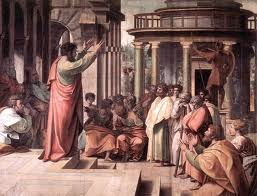
In Acts 17:16-34, however, one finds the apostle Paul evangelizing intelligent Athenians who are utterly biblically illiterate. Here his approach is remarkably different, and has much to teach us as we attempt to evangelize a new generation of biblical illiterates.

Now while Paul was waiting for them at Athens, his spirit was provoked within him as he saw that the city was full of idols. So he reasoned in the synagogue with the Jews and the devout persons, and in the marketplace every day with those who happened to be there. Some of the Epicurean and Stoic philosophers also conversed with him. And some said, “What does this babbler wish to say?” Others said, “He seems to be a preacher of foreign divinities”—because he was preaching Jesus and the resurrection. And they took hold of him and brought him to the Areopagus, saying, “May we know what this new teaching is that you are presenting? For you bring some strange things to our ears. We wish to know therefore what these things mean.” Now all the Athenians and the foreigners who lived there would spend their time in nothing except telling or hearing something new. So Paul, standing in the midst of the Areopagus, said: “Men of Athens, I perceive that in every way you are very religious. For as I passed along and observed the objects of your worship, I found also an altar with this inscription, ‘To the unknown god.’ What therefore you worship as unknown, this I proclaim to you. The God who made the world and everything in it, being Lord of heaven and earth, does not live in temples made by man, nor is he served by human hands, as though he needed anything, since he himself gives to all mankind life and breath and everything. And he made from one man every nation of mankind to live on all the face of the earth, having determined allotted periods and the boundaries of their dwelling place, that they should seek God, in the hope that they might feel their way toward him and find him.

Yet he is actually not far from each one of us, for ‘In him we live and move and have our being’; as even some of your own poets have said, ‘For we are indeed his offspring.’ Being then God’s offspring, we ought not to think that the divine being is like gold or silver or stone, an image formed by the art and imagination of man. The times of ignorance God overlooked, but now he commands all people everywhere to repent, because he has fixed a day on which he will judge the world in righteousness by a man whom he has appointed; and of this he has given assurance to all by raising him from the dead.”

Now when they heard of the resurrection of the dead, some mocked. But others said, “We will hear you again about this.” So Paul went out from their midst. But some men joined him and believed, among whom also were Dionysius the Areopagite and a woman named Damaris and others with them.

I have organized the rest of what I have to say under four topics: the realities Paul faces, the priorities he adopts, the framework he establishes, and the nonnegotiable gospel he preaches.

(1) THE REALITIES PAUL FACES

Apart from their obvious biblical illiteracy — these Athenian intellectuals had never heard of Moses, never cracked a Bible — three features of this culture are striking.

First, the Roman Empire was characterized not only by large-scale empirical pluralism but also by government-sponsored religious pluralism. The Romans knew that a captive people were more likely to rebel if they could align religion, land, and people. Partly to break up this threefold cord, the Romans insisted on adopting into their own pantheon some of the gods of any newly subjugated people, and they insisted equally strongly that the newly subjugated people adopt some of the Roman gods. In any potential civil war, therefore, it would be quite unclear which side the gods were helping — and this policy of god-swaps strengthened the likelihood of imperial peace. It also meant that religious pluralism was not only endemic to the Empire but was buttressed by the force of law After all, it was a capital offense to desecrate a temple — any temple. But let no temple and no God challenge Washington — I mean Rome.

Second, like us, Paul was dealing not with people who were biblically illiterate and therefore had no worldview, but with people who vociferously argued for various competing and powerful worldviews.

Two are mentioned in the text: Epicurean and Stoic (v. 18). In the first century, philosophy did not have the fairly esoteric and abstract connotations it has today, connected with minor departments in large universities. It referred to an entire way of life, based on a rigorous and self-consistent intellectual system — close to what we mean by worldview The ideal of Epicurean philosophy, Epicurean worldview, was an undisturbed life — a life of tranquility, untroubled by undue involvement in human affairs.

The gods themselves are composed of atoms so fine they live in calmness in the spaces between the worlds. As the gods are nicely removed from the hurly-burly of life, so human beings should seek the same ideal. But over against this vision, as we shall see, Paul presents a God who is actively involved in this world as its Creator, providential Ruler, Judge, and self-disclosing Savior.

Stoic philosophy thought of god as all-pervasive, more or less in a pantheistic sense, so that the human ideal was to live life in line with what is ultimately real, to conduct life in line with this god/principle of reason, which must rule over emotion and passion. Stoicism, as someone has commented, was “marked by great moral earnestness and a high sense of duty.” Against such a vision, the God that Paul presents, far from being pantheistic, is personal, distinct from the creation, and is our final judge. Instead of focusing on “universal reason tapped into by human reasoning,” Paul contrasts divine will and sovereignty with human dependence and need. In short, there is a massive clash of worldviews.

Of course, there were other Greek and Latin worldviews. There is no mention here of the sophists or of the atheistic philosophical materialists such as Lucretius. What is clear is that Paul here finds himself evangelizing men and women deeply committed to one fundamentally alien worldview or another.

Third, no less striking is the sneering tone of condescension they display in verse 18: What is this babbler trying to say? — this “seed picker,” this little bird fluttering around picking up disconnected scraps of incoherent information, this second-class mind? Others remarked, He seems to be advocating foreign gods. Of course, as it turns out, some of these people become genuinely interested in the gospel. The tenor of condescension is unmistakable, however, when an alien worldview feels secure in its thoughtless majority.

These, then, are the realities Paul faces.

(2) THE PRIORITIES PAUL ADOPTS

The most immediate and striking response of the apostle Paul to all that he witnesses in Athens is an intuitively biblical analysis: he is greatly distressed to see that the city was full of idols (v. 16). Paul might have been overwhelmed by Athens’ reputation as the Oxford or Cambridge or Harvard of the ancient world (though universities per se did not then exist). He might have admired the architecture, gaping at the Parthenon. But Paul is neither intimidated nor snookered by Athens; he sees the idolatry. How we need Christians in our universities and high places who are neither impressed nor intimidated by reputation and accomplishment if it is nothing more than idolatry!

The apostle sets out, then, to evangelize. He aims at two quite different groups. As usual, he attaches a certain priority to evangelizing Jews and Godfearing Gentiles, the churchy folk, the biblically literate people; he reasons in the synagogue with the Jews and the God-fearing Greeks (v. 17a). He has a theological reason for this priority that we cannot examine here, but in any case we must never forget to evangelize such people. Second, he evangelizes the ordinary pagans who have no connection with the Bible: he evangelizes day by day in the market place, targeting anyone who happens to be there, most of whom would have been biblically illiterate (v. 17b). He does not wait for an invitation to the Areopagus. He simply gets on with his evangelism, and the invitation to the Areopagus is the result (v. 18).

These, then, are his priorities: God-centered cultural analysis, and persistent evangelism of both biblical literates and biblical illiterates.

Perhaps I should add that there is at least one fundamental difference between Paul’s situation and ours. When Paul evangelizes biblical illiterates, he is dealing with people whose heritage has not in recent centuries had anything to do with biblical religion. So when they react negatively to him, they do so solely because, from their perspective, his frame of reference is so alien to their own. They are not rejecting him in part because they are still running away from their own heritage. That is the additional problem we sometimes face. We sometimes deal with men and women who have adopted a worldview that is not only at several points profoundly antithetical to a biblical worldview but also self-consciously chosen over against that biblical worldview. That opens up some opportunities for us, but it raises some additional barriers as well. However, we cannot probe these opportunities and barriers here. It is enough to observe the priorities that Paul adopts.

(3) THE FRAMEWORK PAUL ESTABLISHES

Here it will be helpful to run through Paul’s argument from 17:22 to 17:31. Before I do so, however, I want to make three preliminary observations.

First, it takes you about two minutes to read this record of Paul’s address. But speeches before the Areopagus were not known for their brevity. In other words, we must remember that this is a condensed report of a much longer speech. Doubtless every sentence, in some cases every clause, constituted a point that Paul expanded upon at length.

Second, if you want to know a little more closely just how he would have expanded each point, it is easier to discover than some people think. For there are many points of comparison between these sermon notes and, for instance, Romans. I’ll draw attention to one or two of the parallels as we move on.

Third, there is a fascinating choice of vocabulary. It has often been shown that many of the expressions in this address, especially in the early parts, are the sorts of things one would have found in Stoic circles. Yet in every case, Paul tweaks them so that in his context they convey the peculiar emphases he wants to assign to them. In other words, the vocabulary is linguistically appropriate to his hearers, but at the level of the sentence and the paragraph, Paul in this report is saying just what he wants to say; he is establishing a biblical worldview.

Now let us scan the framework Paul establishes.

First, he establishes that God is the creator of the world and everything in it (17:24). How much he enlarged on this point we cannot be certain, but we know from his other writings how his mind ran. The creation establishes that God is other than the created order; pantheism is ruled out. It also establishes human accountability; we owe our Creator everything, and to defy him and set ourselves up as the center of the universe is the heart of all sin. Worse, to cherish and worship created things instead of the Creator is the essence of idolatry.

Second, Paul insists that God is the Lord of heaven and earth and does not live in temples built by hands (v. 24). The sovereignty of God over the whole universe stands over against views that assign this god or that goddess a particular domain — perhaps the sea (Neptune), or tribal gods with merely regional or ethnic interests. The God of the Bible is sovereign over everything. This teaching grounds the doctrine of providence. Because of the universality of his reign, God cannot be domesticated — not even by temples (v. 24). Paul is not denying the historical importance of the temple in

Jerusalem, still less that God uniquely disclosed himself there. Rather, he denies that God is limited to temples, and that he can be domesticated or squeezed or tapped into by the cultus of any temple (which of course threatens popular pagan practice). He is so much bigger than that.

Third, God is the God of aseity: he is not served by human hands, as if he needed anything (17:25). Aseity is a word now largely fallen into disuse, though it was common in Puritan times. Etymologically it comes from the Latin a se — “from himself.” God is so utterly “from himself” that he does not need us; he is not only self-existent (a term we often deploy with respect to God’s origins — the existence of everything else is God-dependent, but God himself is self-existent), but he is utterly independent of his created order so far as his own well-being or contentment or existence are concerned. God does not need us — a very different perspective from that of polytheism, where human beings and gods interact in all kinds of ways bound up with the finiteness and needs of the gods. The God of the Bible would not come to us if, rather whimsically, he wanted a McDonald’s hamburger; the cattle on a thousand hills are already his.

Fourth, the truth of the matter is the converse: we are utterly dependent on him — he himself gives all men life and breath and everything else (v. 25b). This strips us of our vaunted independence; it is the human correlative of the doctrines of creation and providence.

Fifth, from theology proper, Paul turns to anthropology. He insists that all nations descended from one man (v. 26). This contradicts not a few ancient notions of human descent, which conjectured that different ethnic groups came into being in quite different ways. But Paul has a universal gospel that is based on a universal problem (cf. Rom. 5; 1 Cor. 15). If sin and death were introduced into the one human race by one man such that the decisive act of another man is required to reverse them, then it is important for Paul to get the anthropology right so that the soteriology is right. We cannot agree on the solution if we cannot agree on the problem. But Paul’s stance has yet wider implications; there is no trace of racism here. Moreover, however much he holds that God has enjoyed a peculiar covenant relationship with Israel, because he is a monotheist, Paul holds that God must be sovereign over all the nations. Did he, perhaps, develop some of the lines of argument one finds in Isaiah 40ff.? If there is but one God, that God must in some sense be the God of all, whether his being and status are recognized by all or not.

Sixth, for the first time one finds an explicit reference to something wrong in this universe that God created. His providential rule over all was with the purpose that some would reach out for him and find him (v. 27). In short order Paul will say much more about sin (without actually using the word). Here he is preparing the way. The assumption is that the race as a whole does not know the God who made them. Something has gone profoundly wrong.

Seventh, although it has been important for him to establish God’s transcendence, Paul does not want such an emphasis to drift toward what would later be called deism. The God he has in mind is not far from each one of us (v. 27). He is immanent. Paul will not allow any suspicion that God is careless or indifferent about people; he is never far from us. Moreover, the apostle recognizes that some of this truth is acknowledged in some pagan religions. When Greek thought (or much of it) spoke of one “God” as opposed to many gods, very often the assumption was more or less pantheistic. That structure of thought Paul has already ruled out. Still, some of its emphases were not wrong if put within a better framework. We live and move and have our being in this God, and we are his offspring (17:28) — not, for Paul, in some pantheistic sense, but as an expression of God’s personal and immediate concern for our well-being.

Eighth, the entailment of this theology and this anthropology is to clarify what sin is and to make idolatry utterly reprehensible (v. 29). Doubtless Paul enlarged this point very much in terms of, say, Isaiah 44-45 and Romans 1. For he cannot rightly introduce Jesus and his role as Savior until he establishes what the problem is; he cannot make the good news clear until he elucidates the bad news from which the good news rescues us.

Ninth, Paul also introduces what might be called a philosophy of history — or better, perhaps, a certain view of time. Many Greeks in the ancient world thought that time went round and round in circles. Paul establishes a linear framework: creation at a fixed point; a long period that is past with respect to Paul’s present in which God acted in a certain way (In the past God over-looked such ignorance); a now that is pregnant with massive changes; and a future (v. 31) that is the final termination of this world order, a time of final judgment. The massive changes of Paul’s dramatic now are bound up with the coming of Jesus and the dawning of the gospel. Paul has set the stage so as to introduce Jesus.

So here is the framework Paul establishes. He has, in fact, constructed a biblical worldview. But he has not done so simply for the pleasure of creating a worldview. In this context he has done so in order to provide a framework in which Jesus himself, not least his death and resurrection, makes sense. Otherwise nothing that Paul wants to say about Jesus will make sense.

This is the framework Paul establishes.

(4) THE NONNEGOTIABLE GOSPEL PAUL PREACHES

We read again verse 31: For [God] has set a day when he will judge the world with justice by the man he has appointed. He has given proof of this to all men by raising him from the dead.

Here, at last, Jesus is introduced.

I want to emphasize two things. First, it is extraordinarily important to see that Paul has established the framework of the biblical metanarrative before he introduces Jesus. If metaphysics is a sort of big physics that explains all the other branches of physics, similarly metanarrative is the big story that explains all the other stories. By and large, postmodernists love stories, especially ambiguous or symbol-laden narratives. But they hate the metanarrative, the big story that makes all the little stories coherent. But what Paul provides is the biblical metanarrative. This is the big story in the Bible that frames and explains all the little stories. Without this big story, the accounts of Jesus will not make any sense — and Paul knows it.

For instance, if in a vague, New Age, postmodern context, we affirm something like “God loves you,” this short expression may carry a very different set of associations than we who are Christians might think. We already assume that men and women are guilty and that the clearest and deepest expression of God’s love is in the cross, where God’s own Son dealt with our sin at the expense of his own life. But if people know nothing of this story line, then the same words, “God loves you,” may be an adequate summary of the stance adopted by Jodie Foster in her recent film, Contact. The alien power is beneficent, wise, good, and interested in our well-being. There is nothing whatever to do with moral accountability, sin, guilt, and how God takes action to remove our sin by the death of his Son. The one vision nestles into the framework of biblical Christianity; the other nestles comfortably into the worldview of New Age optimism. In short, without the big story, without the metanarrative, the little story or the little expression becomes either incoherent or positively misleading. Paul understands the point.

Second, what is striking is that Paul does not flinch from affirming the resurrection of Jesus from the dead. And that is what causes so much offense that Paul is cut off, and the Areopagus address comes to an end. Paul was thoroughly aware, of course, that most Greeks adopted some form of dualism. Matter is bad, or at least relatively bad; spirit is good. To imagine someone coming back from the dead in bodily form was not saying anything desirable, still less believable. Bodily resurrection from the dead was irrational; it was an oxymoron, like intelligent slug or boiled ice. So some of Paul’s hearers have had enough, and they openly sneer and end the meeting (v. 32). If Paul had spoken instead of Jesus’ immortality, his eternal spiritual longevity quite apart from any body, he would have caused no umbrage. But Paul does not flinch. Elsewhere he argues that if Christ has not been raised from the dead, then the apostles are liars, and we are still dead in our trespasses and sins (I Cor. 15). He remains faithful to that vision here. Paul does not trim the gospel to make it acceptable to the worldview of his listeners.

For Paul, then, there is some irreducible and nonnegotiable content to the gospel, content that must not be abandoned, no matter how unacceptable it is to some other worldview. It follows that especially when we are trying hard to connect wisely with some worldview other than our own, we must give no less careful attention to the nonnegotiables of the gospel, lest in our efforts to communicate wisely and with relevance, we unwittingly sacrifice what we mean to communicate.

But suddenly we overhear the muttered objection of the critic. Can it not be argued that Paul here makes a fundamental mistake? Elsewhere in Acts he frequently preaches with much greater fruitfulness, and in those cases he does not stoop to all this worldview stuff. He just preaches Jesus and his cross and resurrection, and men and women get converted. Here, a piddling number believe (v. 34). In fact, Paul’s next stop in Greece after Athens is Corinth. Reflecting later on his experiences there, Paul writes to the Corinthians and reminds them For I resolved to know nothing while I was with you except Jesus Christ and him crucified (I Cor. 2:2) — doubtless because he was reflecting with some sour-faced chagrin on his flawed approach in Athens. So let us be frank, the critics charge, and admit that Paul made a huge mistake in Athens and stop holding up Acts 17 as if it were a model of anything except what not to do. The man goofed: he appealed to natural theology; he tried to construct redemptive history; he attempted to form a worldview when he should have stuck to his last and preached Jesus and the cross.

I sometimes wish this reading were correct, but it is profoundly mistaken for a number of reasons.

(1) It is not the natural reading of Acts. As Luke works through his book, he does not at this point in his narrative send up a red flag and warn us that at this point Paul makes a ghastly mistake. The false reading is utterly dependent on taking I Corinthians in a certain way (a mistaken way, as we shall see), and then reading it into Acts 17.

(2) What Paul expresses, according to Luke’s report of the Areopagus address, is very much in line with Paul’s own theology, not least his theology in the opening chapters of Romans.

(3) Strictly speaking, Paul does not say that only a “few” men believed. He says tines de andres, “certain people,” along with heteroi, “others.” These are in line with other descriptions. The numbers could scarcely have been large, because the numbers in the Areopagus could not have been very large in the first place.

(4) Transparently, Paul was cut off when he got to the resurrection of Jesus (vv. 31-32). But judging from all we know of him — both from a book like Romans and from the descriptions of him in Acts — we know where he would have gone from here.

(5) That is entirely in line with the fact that what Paul had already been preaching in the marketplace to the biblically illiterate pagans was the cc gospel” (v. 18).

(6) At this point in his life Paul was not a rookie. Far from being fresh out of seminary and still trying to establish the precise pattern of his ministry, on any chronology he had already been through twenty years of thrilling and brutal ministry. Nor is this Paul’s first time among biblically illiterate pagans or among intellectuals.

(7) In any case, I Corinthians 2 does not cast Paul’s resolve to preach Christ crucified against the background of what had happened to him in Athens. He does not say, in effect, “Owing to my serious mistakes in Athens, when I arrived in Corinth I resolved to preach only Christ and him crucified.” Rather, in 1 Corinthians Paul’s resolve to preach Christ crucified is cast against the background of what Christians in Corinth were attracted to — namely, to a form of triumphalism that espoused an ostensible wisdom that Paul detests. It is a wisdom full of pride and rhetoric and showmanship. Against this background, Paul takes a very different course. Knowing that believers must boast only in the Lord and follow quite a different wisdom (I Cor. 1), he resolves to preach Christ and him crucified.

(8) In any case, it would be wrong to think that Paul has no interest in worldviews. Writing after I Corinthians 2, Paul can say, We demolish arguments and every pretension that sets itself up against the knowledge of God, and we take captive every thought to make it obedient to Christ (2 Cor. 10:45). The context shows that Paul is not here interested so much in disciplining the individual’s private thought life (though that certainly concerns him elsewhere) as in bringing into obedience to Christ every thought structure, every worldview, that presents opposition to his beloved Master. In other words, Paul thought “worldviewishly” (if that is not too monstrous a neologism). That is clear in many of his writings; it is clear in both 2 Corinthians 10 and in Acts 17.

(9) Finally, the first line of Acts 17:34 is sometimes misconstrued: “A few men became followers of Paul and believed.” Many have assumed Luke means that a few people became Christians on the spot and followers of Paul. But that reverses what is said. Moreover, Paul has not yet given much gospel — in precisely what sense would they have become Christians? It is better to follow the text exactly Following Paul’s address, no one became a Christian on the spot. But some did become followers of Paul. In consequence, in due course they grasped the gospel and believed; they became Christians. This is entirely in line with the experience of many evangelists working in a university environment today.

A couple of years ago I spoke evangelistically at a large meeting in Oxford. So far as I know, no one became a Christian at that meeting. But sixteen students signed up for a six-week “Discovering Christianity” Bible study. A few weeks after the meeting, the curate, Vaughan Roberts, wrote me a note to tell me that eleven of the sixteen had clearly become Christians already, and he was praying for the remaining five. In other words, as a result of that meeting, some became “followers of Jesus,” and in due course believed. That is often the pattern when part of the evangelistic strategy is to establish a worldview, a frame of reference, to make the meaning of Jesus and the gospel unmistakably plain.

In short, however sensitive Paul is to the needs and outlook of the people he is evangelizing, and however flexible he is in shaping the gospel to address them directly, we must see that there remains for him irreducible content to the gospel. That content is nonnegotiable, even if it is remarkably offensive to our hearers. If it is offensive, we may have to decide whether it is offensive because of the intrinsic message or because we have still not done an adequate job of establishing the frame of reference in which it alone makes sense. But the gospel itself must never be compromised.

SOME CONCLUDING REFLECTIONS

I offer three concluding reflections. First, the challenge of worldview evangelism is not to make simple things complicated but to make clear to others some fairly complicated things that we simply assume. This can be done in fifteen minutes with the sort of presentation Phillip Jensen and Tony Payne have constructed (in Chapter 6 of Telling the Truth – “Two Ways To Live”). It might be done in seven consecutive expositions running right through the first eight chapters of Romans. It might be done with the six months of Bible teaching, beginning with Genesis, that many New Tribes Mission personnel now use before they get to Jesus. But it must be done.

Second, the challenge of worldview evangelism is not primarily to think in philosophical categories, but it is to make it clear that closing with Jesus has content (it is connected with a real, historical Jesus about whom certain things must be said and believed) and is all-embracing (it affects conduct, relationships, values, priorities). It is not reducible to a preferential religious option among many, designed primarily to make me feel good about myself.

Third, the challenge of worldview evangelism is not primarily a matter of how to get back into the discussion with biblically illiterate people whose perspectives may be very dissimilar to our own. Rather, worldview evangelism focuses primarily on where the discussion goes. There are many ways of getting into discussion; the crucial question is whether the Christian witness has a clear, relatively simple, straightforward grasp of what the Bible’s story line is, how it must give form to a worldview, and how the wonderful news of the gospel fits powerfully into this true story — all told in such a way that men and women can see its relevance, power, truthfulness, and life-changing capacity.

*”Athens Revisited” was originally a lecture at a conference on the topic of Evangelism in a Post Modern Culture held on May 13-15, 1998 at Trinity Evangelical Divinity School in Deerfield, Illinois & sponsored by the Bannockburn Institute (www.biccc.org). All the lectures from this conference were published in the book: Telling The Truth: Evangelizing Postmoderns, Grand Rapids: Zondervan, 2000; of which D.A. Carson was the general editor and the contributor of Chapter 28 from which this article is adapted.

About the Author: D. A. Carson (Ph.D., University of Cambridge) is research professor of New Testament at Trinity Evangelical Divinity School in Deerfield, Illinois. His theology is similar to that of Wayne Grudem except on charismatic issues, where his view may be described as “open but cautious.” Carson’s tendency is to strive for balance and amicability in disputes but is uncompromising on the essentials of the faith. He is a complementarian but supports gender-neutral Bible translations. Carson also helped produce the NLT. He is the author or coauthor of over 50 books. Some of the plethora of outstanding books he has written includes: The Intolerance of Tolerance, The God Who Is There, ScandalousHow Long O Lord, A Call to Spiritual Reformation; The Cross and Christian Ministry; The Difficult Doctrine of the Love of God; Divine Sovereignty and Human Responsibility; Exegetical Fallacies; For the Love of God; The Gagging of God; The Inclusive Language Debate; Introduction to the New Testament; New Testament Commentary Survey; Scripture and Truth (Ed. with John Woodbridge); Worship by the Book; Pillar Commentaries on Matthew and John and a contributor to Who Will be Saved. He also edits the New Studies in Biblical Theology book series.

Carson’s areas of expertise include biblical theology, the historical Jesus, postmodernism, pluralism, Greek grammar, Johannine theology, Pauline theology, and questions of suffering and evil. He has written books on free will and predestination from a generally compatibilist and Calvinist perspective. He is a member of the Tyndale Fellowship for Biblical Research, the Society of Biblical Literature, the Evangelical Theological Society, the Canadian Society of Biblical Studies, and the Institute for Biblical Research.

Dr. Carson and his wife, Joy, reside in Libertyville, Illinois. They have two children. In his spare time, Dr. Carson enjoys reading, hiking, and woodworking.

How Do We Get The Gospel Across In a Postmodern World? by Tim Keller

“The Gospel and the Supremacy of Christ in a Postmodern World” by *Tim Keller

 A Crisis for Evangelism

Our current cultural situation poses a crisis for the way evangelicals have been doing evangelism for the past 150 years—causing us to raise crucial questions like: How do we do evangelism today? How do we get the gospel across to a postmodern world?

In 1959 Martyn Lloyd-Jones gave a series of messages on revival. One of these expositions was on Mark 9, where Jesus comes off the mountain of transfiguration and discovers his disciples trying unsuccessfully to exorcise a demon from a boy. After he rids the youth of the demonic presence, the disciples ask him, “Why could we not cast it out?” Jesus answers, “This kind cannot be driven out by anything but prayer” (Mark 9:28-29). Jesus was teaching his disciples that their ordinary methods did not work for “this kind.” Lloyd-Jones went on to apply this to the church:

“Here, in this boy, I see the modern world, and the disciples I see the Church of God…I see a very great difference between today and two hundred years ago, or indeed even one hundred years ago. The difficulty in those earlier times was that men and women were in a state of apathy. They were more or less asleep…There was no general denial of Christian truth. It was just that people did not trouble to practise it…All you had to do then was to awaken them to rouse them…

But the question is whether that is still the position…What is ‘this kind’?…The kind of problem facing us is altogether deeper ad more desperate…The very belief in God has virtually gone…The average man today believes that all this belief about God and religion and salvation…is an incubus on human nature all through the centuries…

It is no longer merely a question of immorality. This has become an amoral or a non-moral society. The very category of morality is not recognized…

The power that the disciples had was a good power, and it was able to do good work in casting out the feeble devils, but it was no value in the case of that boy (D. Martyn Lloyd-Jones, Revival (Wheaton, IL: Crossway Books, 1987, pp. 9, 13-15).

Put simply, Jesus is saying, the demon is in too deep for your ordinary way of doing ministry. It is intriguing that Lloyd-Jones said this some time before Lesslie Newbigin began to propound the thesis that Western society was a mission field again (See Lesslie Newbigin, Foolishness to the Greeks, Grand Rapids, MI: Eerdmans, 1986 and The Gospel in a Pluralistic Society, Grand Rapids, MI: Eerdmans, 1989).

Indeed it was perhaps the most challenging mission field yet, because no one had ever had to evangelize on a large scale a society that used to be Christian. Certainly there have been many times in the past when the church was in serious decline, and revival revitalized the faith and society. But in those times society was still nominally Christian. There hadn’t been a wholesale erosion of the very concepts of God and truth and of the basic reliability and wisdom of the Bible. Things are different now.

Inoculation introduces a mild form of a disease into a body, thereby stimulating the growth of antibodies and rendering the person immune to getting a full-blown version of the sickness. In the same way, post-Christian society contains unique resistance and “antibodies” against full-blown Christianity. For example, the memory of sustained injustices that flourished under more Christianized Western societies has become an antibody against the gospel. Christianity was big back when blacks had to sit on the back of the bus and when men without consequences beat up women. We’ve tried out a Christian society and it wasn’t so hot. Been there. Done that. In a society like ours, most people only know of either a very mild, nominal Christianity or a separatist, legalistic Christianity. Neither of these is, may we say, “the real thing.” But exposure to them creates spiritual antibodies, as it were, making the listener extremely resistant to the gospel. These antibodies are now everywhere in our society.

During the rest of his sermon on Mark 9, Lloyd-Jones concludes that the evangelism and church-growth methods of the past couple of centuries, while perfectly good for their time (he was careful to say that), would no longer work. What was needed now was something far more comprehensive and far-reaching than a new set of evangelistic programs.

I believe that Lloyd-Jones’s diagnosis is completely on target. Richard Fletcher’s The Barbarian Conversion traces the way in which Christians evangelized in a pagan context from A.D. 500-1500 (Richard Fletcher, The Barbarian Conversion: From Paganism to Christianity, Berkley: University of California Press, 1999). During that time major swaths of Europe (especially the countryside rather than the cities) remained pre-Christian pagan. They lacked the basic “worldview furniture” of the Christian mind. They did not have a Christian understanding of God, truth, or sin, or of peculiar Christian ethical practices. Evangelism and Christian instruction were a very long and comprehensive process.

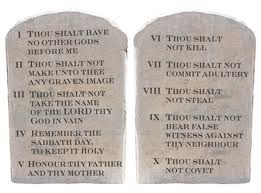
But eventually nearly everyone in Europe (and in North America) was born into a world that was (at least intellectually) Christian. People were educated into a basic Christian-thought-framework—a Christian view of God, of soul and body, of heaven and hell, of rewards and punishments, of the Ten Commandments and the Sermon on the Mount. And that is why the church could make evangelism into both a simpler and a more subjective process than that practiced by previous generations. The people believed in sin, but they hadn’t come to a profound conviction that they were helpless sinners. They believed in Jesus as the Son of God who died for sin, but they hadn’t come to cling to him personally and wholly for their own salvation and life. They needed to come to a deep personal conviction of sin and to an experience of God’s grace through Christ. They had a Christian mind and conscience, but they didn’t have a Christian heart. The need, then, was for some kind of campaign or program that roused and shook people—taking what they already basically believed and making it vivid and personal for them, seeking an individual response of repentance and faith.

Since the end of the “Barbarian Conversion,” then, evangelism has shrunk into a program with most of the emphasis being on individual experience. The programs have ranged from preaching-and-music revival seasons, to one-on-one witnessing, to small-group processes. I agree with Lloyd-Jones that there was nothing wrong with these methods as far as they went and in their day. But now this kind won’t be effectively addressed by that older approach.

Some might respond that Lloyd-Jones has not been proven right. Isn’t evangelical Christianity growing—at least in North America? Look at all the mega churches spouting up! But we must remember that the new situation Lloyd-Jones was describing has spread in stages. It was in Europe before North America. It was in cities before if was in the rest of the society. In the United States it has strengthened in the Northeast and the West Coast first. In many places, especially in the South and Midwest, there is still a residue of more conservative society where people maintain traditional values. Many of these people are therefore still reachable with the fairly superficial, older evangelism programs of the past. And if we are honest, we should admit that many churches are growing large without any evangelism at all. If a church can present unusually good preaching and family ministries and programming, it can easily attract the remaining traditional people and siphon off Christians from all the other churches in a thirty-mile radius. This is easier now than ever because people are very mobile, less tied into their local communities, and less loyal to institutions that don’t meet their immediate needs. But despite the growth of mega churches through these dynamics, there is no evidence that the number of churchgoers in the United States is significantly increasing (see for example, http://www.theamericanchurch.org/facts/1.htm.).

What is clear is that the number of secular people professing “no religious preference” is growing rapidly. Michael Wolff, writing in New York Magazine, captures the growing divide:

There is a fundamental schism in American cultural, political, and economic life. There’s the quicker-growing, economically vibrant…morally relativist, urban-oriented, culturally adventuresome, sexually polymorphous, and ethnically diverse nation…And there’s the small-town, nuclear-family, religiously oriented, white-centric other America…with its diminishing cultural and economic force…Two countries (Michael Wolff, “The Party Line,” New York Magazine (Feb. 26, 2001): 19. Online at http://nymag.com/nymetro/news/media/columns/medialife/4407/index1.html.).

So Lloyd-Jones is right that the demon is in too deep for your ordinary way of doing ministry—especially in more secular, pluralistic Europe and in the parts of the United States that are similar. In the Christ-haunted places of the West you can still get a crowd without evangelism or with the older approaches. But the traditional pockets of Western society simply are not growing.

I will put my neck on the line and go so far as to say that in my almost thirty-five years in full-time ministry I’ve seen nearly all the older evangelism programs fade away as they have proved less and less effective. Dwight Moody pioneered the mass-preaching crusade in the late nineteenth century, and Billy Graham brought it to its state of greatest efficiency and success, but few are looking in that direction for reaching our society with the gospel.

In the latter part of the twentieth century there were a number of highly effective, short, memorizable, bullet-pointed gospel presentations written for individual lay Christians to use in personal evangelism. Programs were developed for training lay people to use the presentations door-to-door, or in “contact” evangelism in public places, or with visitors to church, or in personal relationships. These have all been extremely helpful but the churches I know that have used the same program in the same place for decades have seen steadily diminishing fruit.

The next wave of evangelism programming was the “seeker service” model developed by many churches, especially large ones. It is far too early to say that this methodology is finished, and yet younger ministers and church leaders are wont to say that it is too geared to people with a traditional, bourgeoisie, still-Christ-haunted mindset to operate. In many parts of society that kind of person is disappearing.

Today the main programmatic “hope” for churches seeking to be evangelistic is the “Alpha” method which comes out of Holy Trinity Anglican Church in London (See www.alpha.org.) There are good reasons why this more communal, process-oriented approach has been so fruitful, but I believe that the same principle will hold true, even for Alpha. There is no “magic bullet.” You can’t simply graft a program (like Alpha or its counterparts) onto your existing church-as-usual. You can’t just whip up a new gospel presentation, design a program, hire the staff, and try to get people in the door. The whole church and everything it does is going to have to change. The demon’s in too deep for the older ways.

In fact, things are more difficult than they were in Lloyd-Jones’s lifetime. He was facing what has been called a “modern” culture, and we face a “postmodern” one—making evangelism methods even more obsolete. It is not my job t look at the “modern vs. postmodern” distinction in any detail, but I think most would agree that the postmodern mindset is associated with at least three problems. First, there’s a truth problem. All claims of truth are seen not as that which corresponds to reality but primarily as constraints aimed to siphon power off toward the claimer. Second, there’s the guilt problem. Though guilt was mainly seen as a neurosis in the modern era (with the reign of Freud), it was still considered a problem. Almost all the older gospel presentations assume an easily accessed sense of guilt and moral shortcoming in the listener. But today that is increasingly absent. Third, there is now a meaning problem. Today there’s enormous skepticism that texts and words can accurately convey meaning. If we say, “Here is a biblical text and this is what it says,” the response will be, “Who are you to say this is the right interpretation? Textual meanings are unstable.”

So how do we get the gospel across in a postmodern world? The gospel and the fact that we are now a church on a mission field will dictate that almost everything the church does will have to be changed. But that is too broad a statement to be of any help, so I will lay out six ways in which the church will have to change. Each of these factors has parallels in the account of Jonah and his mission to the great pagan metropolis of Nineveh (I will ground the six factors in the Jonah text, but the following should not be seen as an effort to carefully or thoroughly expound the book of Jonah).

 Gospel Theologizing

Jonah 1:1-2: “The word of the LORD came to Jonah…saying, ‘Go to…Nineveh and preach’” (NIV). For a long time I understood the “gospel” as being just elementary truths, the doctrinal minimum for entering faith. “Theology,” I thought, was the advanced, meatier, deeper, biblical stuff. How wrong I was! All theology must be an exposition of the gospel, especially in the postmodern age.

A good example of this is found in Mark Thompson’s book, A Clear and Present Word (Mark D. Thompson, A Clear and Present Word: The Clarity of Scripture, New Studies in Biblical Theology, ed. D. A. Carson, Downers Grove, IL: InterVarsity Press, 2006). Thompson first describes our cultural context in which people believe all meanings are unstable and all texts are indeterminate. He then develops a Christian theology of language. This is certainly not elementary stuff. He begins by looking at the Trinity. Each person—Father, Son, and Holy Spirit—seeks not his own glory but only to give glory and honor to the others. Each one is pouring love and joy into the heart of the other. Why would a God like this create a universe? As Jonathan Edwards so famously reasoned it couldn’t be in order to get love and adoration, since as a triune God he already had that himself (See the singular “The Dissertation Concerning the End for Which God Created the World,” in The Works of Jonathan Edwards, vol. 8, Ethical Writings, ed. Paul Ramsey, New Haven, CT: Yale University Press, 1989). Rather, he created a universe to spread the glory and joy he already had. He created other beings to communicate it back to him, so they (we!) could step into the great Dance, the circle of love and glory and joy that he already had.

Words and language, then, are ingredients in the self-giving of the divine persons to each other and therefore to us. In creation and redemption God gives us life and being through his Word. We can’t live without words, and we can’t be saved without the Word, Jesus Christ. Human language, then, isn’t an insufficient human construct but an imperfectly utilized gift from God. Thompson concludes:

The [gospel is that the] right and proper judgment of God against our rebellion has not been overturned; it has been exhausted, embraced in full by the eternal Son of God himself…

God uses words in the service of his intention to rescue men and women, drawing them into fellowship with him and preparing a new creation as an appropriate venue for the enjoyment of that fellowship. In other words, the knowledge of God that is the goal of God’s speaking ought never be separated from the centerpiece of Christian theology; namely, the salvation of sinners (Thompson, A Clear and Present Word, 56, 65).

This is certainly not elementary theologizing, but a grounding of even the very philosophy and understanding of human language in the gospel. The Word of the Lord (as we see in Jonah 1:1) is never abstract theologizing, but is a life-changing message about the severity and mercy of God.

Why is this so important? First, in a time in which there is so much ignorance of the basic Christian worldview, we have to get to the core of things, the gospel, every time we speak. Second, the gospel of salvation doesn’t really relate to theology like the first steps relate to the rest of the stairway but more like the hub relates through the spokes to the rest of the wheel. The gospel of a glorious, other-oriented triune God giving himself in love to his people in creation and redemption and recreation is the core of every doctrine—of the Bible, of God, of humanity, of salvation, of ecclesiology, of eschatology. However, third, we must recognize that in a postmodern society where everyone is against abstract speculation, we will be ignored unless we ground all we say in the gospel. Why? The postmodern era has produced in its citizens a hunger for beauty and justice. This is not an abstract culture, but a culture of story and image. The gospel is not less than a set of revealed propositions (God, sin, Christ, faith), but is more. It is also a narrative (creation, fall, redemption, restoration). Unfortunately, there are people under the influence of postmodernism who are so obsessed with narrative rather than propositions that they are rejecting inerrancy, are moving toward open theism, and so on. But to some extent they are reacting to abstract theologizing that was not grounded in the gospel and real history. They want to put more emphasis on the actual history of salvation, on the coming of the kingdom, on the importance of community, and on the renewal of the material creation.

But we must not pit systematic theology and biblical theology against each other, nor the substitutionary atonement against the kingdom of God. Look again at the above quote from Mark Thompson and you will see a skillful blending of both individual salvation from God’s wrath and the creation of a new community and material world. This world is reborn along with us—cleansed, beautified, perfected, and purified of all death, disease, brokenness, injustice, poverty, and deformity. It is not just tacked on as a chapter in abstract “eschatology,” but is the only appropriate venue for enjoyment of that fellowship with God brought to us by grace through our union with Christ.

In general, I don’t think we’ve done a good job at developing ways of communicating the gospel that include both salvation from wrath by propitiation and the restoration of all things. Today, writing accessible presentations of the gospel should not be the work of marketers but the work of our best theologians.

Gospel Realizing

When God called Jonah to go to Nineveh the first time, Jonah ran in the other direction. Why? The reader assumes it was just fear, but chapter 4 reveals that there was also a lot of hostility in Jonah toward the Assyrians and Ninevites. I believe the reason he did not have pity on them was that he did not sufficiently realize that he was nothing but a sinner saved by sheer grace. So he ran away from God—and you know the rest of the story. He was cast into the deep and saved by God from drowning by being swallowed by a great fish. In the second chapter we see Jonah praying, and his prayer ends with the phrase “Salvation is the LORD!” (Jonah 2:9). My teacher Ed Clowney used to say that this was the central verse of the Bible. It is an expression of the gospel. Salvation is from and of the Lord and no one else. Period.

But as a prophet, doesn’t Jonah know this? He knows it—and yet he doesn’t know it. For eighteen years I lived I lived in apartment buildings with vending machines. Very often you put the coins in but nothing comes out. You have to shake or hit the machine on the side till the coins finally drop down and then out comes the soda. My wife, Kathy, believes this is a basic parable for all ministry. Martin Luther said that the purpose of ministry was not only to make the gospel clear, but to beat it into your people’s heads (and your own!) continually (“This is the truth of the gospel. It is also the principle article of all Christian doctrine, whereby the knowledge of all goodness consisteth. Most necessary it is therefore, that we should know this article well, teach it to others and beat it into their heads continually” – Martin Luther).

You might be able to get an A on your justification-by-faith test, but if there is not radical, concrete growth in humble love toward everyone (even your enemies), you don’t really know you are a sinner saved by grace. What must you do if you lack the humility, love, joy, and confidence you need to face the life issues before you? You should not try to move on past the gospel to “more advanced” principles. Rather, you should shake yourself until more of the gospel “coins” drop and more of the fruit of the Spirit comes out. Until you do that, despite your sound doctrine you will be as selfish, sacred, oversensitive, insensitive, and undisciplined as everyone else. Those were the attributes characterizing Jonah. If he had known the gospel as deeply as he should have, he wouldn’t have reacted with such hostility and superiority toward Nineveh. But the experience in the storm and in the fish brings him back to the foundations, and he rediscovers the wonder of the gospel. When he says, “Salvation is really from the Lord!” he wasn’t learning something brand new but was rediscovering and realizing more deeply the truth and wonder of the gospel.

If you think you really understand the gospel—you don’t. If you think you haven’t even begun to truly understand the gospel—you do. As important as our “gospel theologizing” is it alone will not reach our world. People today are incredibly sensitive to inconsistency and phoniness. They hear what the gospel teaches and then look at our lives and see the gap. Why should they believe? We have to recognize that the gospel is a transforming thing, and we simply are not very transformed by it. It’s not enough to say to postmodern people: “You don’t like absolute truth? Well, then, we’re going to give you even more of it!” But people who balk so much at absolute truth will need to see greater holiness of life, practical grace, gospel character, and virtue, if they are going to believe.

Traditionally, this process of “gospel-realizing,” especially when done corporately, is called “revival.” Religion operates on the principle: I obey; therefore I am accepted (by God). The gospel operates on the principle: I am accepted through the costly grace of God; therefore I obey. Two people operating on these two principles can sit beside each other in church on Sunday trying to do many of the same things—read the Bible, obey the Ten Commandments, be active in church, and pray—but out of two entirely different motivations. Religion moves you to do what you do out of fear, insecurity, and self-righteousness, but the gospel moves you to do what you do more and more out of grateful joy in who God is in himself. Times of revival are reasons in which many nominal and spiritually sleepy Christians, operating out of the semi-Pharisaism of religion, wake up to the wonder and ramifications of the gospel. Revivals are massive eruptions of new spiritual power in the church through a recovery of the gospel. In his sermon on Mark 9 Lloyd-Jones was calling the church to revival as its only hope. This is not a new program or something you can implement through a series of steps. It is a matter of wonder. Peter says that the angels always long to look into the gospel; they never tire of it (1 Peter 1:12). The gospel is amazing love. Amazing grace.

Gospel Urbanizing

 Three times Jonah is called to go to Nineveh, which God keeps calling “the great city” (1:1; 3:2; 4:11). God puts in front of Jonah the size of it. In Jonah 4:11 he says, “Should not I pity Nineveh, that great city, in which there are more than 120,000 persons who do not know their right hand from their left…?” God’s reasoning is pretty transparent. Big cities are huge stockpiles of spiritually lost people. How can you not find yourself drawn to them? I had a friend once who used this ironclad theological argument on me: “The cities are places where there are more people than plants, and the countryside is the place where there are more plants than people. Since God loves people far more than plants, he must love the city more than the countryside.” That’s exactly the kind of logic God is using on Jonah here.

Christians and churches, of course, need to be wherever there are people! And there is not a Bible verse that says Christians must live in the cities. But, in general, the cities are disproportionately important with respect to culture. That is where the new immigrants come before moving out into society. That is where the poor often congregate. That is where students, artists, and young creatives cluster. As the cities go, so goes society. Yet Christians are under-represented in cities for all sorts of reasons.

Many Christians today ask, “What do we do about a coarsening culture?” Some have turned to politics. Others are reacting against this, saying that “the church simply must be the church” as a witness to the culture, and let the chips fall where they may. James Boice, in his book Two Cities, Two Loves, asserts that until Christians are willing to simply live and work in major cities in at least the same proportions as other groups we should stop complaining that we are “losing the culture” (James Montgmery Boice, Two Cities, Two Loves: Christian Responsibility in a Crumbling Culture, Downers Grove, IL: InterVarsity Press, 1996, 165ff.).

While the small town was ideal for premodern people, and the suburb was the ideal for modern people, the big city is loved by postmodern people with all its diversity, creativity, and unmanageability. We will never reach the postmodern world with the gospel if we don’t urbanize the gospel and create urban versions of gospel communities as strong and as well known as the suburban (i.e., the mega church). What would those urban communities look like? David Brooks has written about “Bobos” who combined the crass materialism of the bourgeoisie with the moral relativism of the bohemians (David Brooks, Bobos in Paradise: The New Upper Class and How They Got There, New York: Simon & Schuster, 2001). I’d propose that urban Christians would be “reverse Bobos,” combining not the worst aspects but the best aspects of these two groups. By practicing the biblical gospel in the city they could combine the creativity, love of diversity, and passion for justice (of the old bohemians) with the moral seriousness and family orientation of the bourgeoisie.

Gospel Communication

 As I mentioned above, evangelism in a postmodern context must be much more thorough, progressive, and process-oriented. There are many stages to bring people through who know nothing at all about the gospel and Christianity. Again, we see something of this in the book of Jonah. In Jonah 3:4 we read, “Jonah began to go into the city, going a day’s journey. And he called out, ‘Yet forty days, and Nineveh shall be overthrown!’” Notice how little is in that message. Jonah is establishing the reality of divine justice and judgment, of human sin and responsibility. But that’s all he speaks of. Later, when the Ninevites repent, the king says: “Who knows? God may turn and relent and turn from his fierce anger, so that we may not perish” (Jonah 3:9). The king isn’t even sure if God offers grace and forgiveness. It is clear that the Ninevites have very little spiritual understanding here. And though some expositions like to talk about the “revival” in Nineveh in response to Jonah’s preaching, it seems obvious that they are not yet in any covenant relationship with God. They have not yet been converted. And yet God responds to that: “When God saw what they did, how they turned from their evil way, God relented of the disaster that he had said he would do to them, and he did not do it” (3:10). He doesn’t say to them “You are my people: I am your God.” There’s no saving relationship here—but there is progress! They have one or two very important planks in a biblical worldview, and to God that makes a difference.

At the risk of over-simplification, I’ll lay out four stages that people have to go through to come from complete ignorance of the gospel and Christianity to full embrace. I’ll call them (1) intelligibility, (2) credibility, (3) plausibility, and (4) intimacy. By “intimacy” I mean leading someone to a personal commitment. The problem with virtually all modern evangelism programs is that they assume listeners come from a Christianized background, and so they very lightly summarize the gospel (often jumping through stages one to three minutes) and go right to stage “intimacy.” But this is no longer sufficient.

“Intelligibility” means to perceive clearly, and I use this word to refer to what Don Carson calls “world-view evangelism.” In his essay in Telling the Truth Don analyzes Paul’s discourse at Athens in Acts 17 (D.A. Carson, “Athens Revisited,” in Telling the Truth, ed. D.A. Carson, Grand Rapids, MI: Zondervan, 2002, 384-98). Paul spends nearly the whole time on God and his sovereignty, a God-centered philosophy of history, and other basic planks in a biblical view of reality. He mentions Jesus only briefly and then only speaks of his resurrection. Many people consider this a failure to preach the gospel. They believe that every time you preach you must tell people that they are sinners going to hell, that Jesus died on the cross for them, and that they need to repent and believe in him. The problem with this is that until people’s minds and worldviews have been prepared, they hear you say “sin” and “grace” and even “God” in terms of their own categories. By going too quickly to this overview you guarantee that they will misunderstand what you are saying.

In the early days of Redeemer Presbyterian Church I saw a number of people make decisions for Christ, but in a couple of years, when some desirable sexual partners came along, they simply bailed out of the faith. I was stunned. Then I realized that in our Manhattan culture people believe the truth is simply “what works for me.” There is no concept of a Truth (outside the empirical realm) that is real and there no matter what I feel or thin. When I taught them that Jesus was the Truth, they understood it through their own categories. There hadn’t really been a power-encounter at the worldview level. They hadn’t really changed their worldview furniture. When Jesus didn’t “work” for them, he was no longer their Truth.

“Credibility” is the area of “defeaters.” A defeater is a widely held belief that most people consider common sense but which contradicts some basic Christian teaching (You can read more on this subject of “defeaters” in this blog under the article titled: “How to Lead Secular People to Christ” by Tim Keller, as well as in his book – The Reason for God). A defeater is a certain belief (belief A), that, since it is true, means another belief (belief B) just can’t be true on the face of it. An example of a defeater belief now is: “I just can’t believe there is only one true religion, one way to God.” Notice that is not an argument—it’s just an assertion. There is almost no evidence you can muster for the statement. It is really an emotional expression, but it is so widely held and deeply felt that for many—even most people—it automatically mans orthodox Christianity can’t be true. Now in the older Western culture there were very few defeater beliefs out there. The great majority of people believed the Bible, believed in God and heaven and hell, and so on. In the old “Evangelism Explosion” training, I remember there was an appendix of “Objections,” but you were directed not to bring these up unless the person you were talking to brought them up first. You were to focus on getting through the presentation.

But today you must have a good list of ten to twenty basic defeaters out there and must speak to them constantly in all your communication and preaching. You have to go after them and show people that all their doubts about Christianity are really alternate faith-assertions. You have to show them what they are and ask them for as much warrant and support for their assertions as they are asking for yours. For example, you must show someone who says, “I think all religions are equally valid; no one’s view of spirituality is superior to anyone else’s,” that statement is itself a faith assertion (it can’t be proven) and is itself a view on spiritual reality that he or she thinks is superior to the orthodox Christian view. So the speaker is doing the very thing he is forbidding to others. That’s not fair! That sort of approach is called “presuppositional apologetics (For an introduction, see John Frame’s Apologetics to the Glory of God, Phillipsburg, NJ: P&R, 1994). It uncovers the faith assumptions that skeptics smuggle in to their doubts. It will make them begin to think. If you don’t do this, people’s eyes will just glaze over as you speak. They will tune you out. Nothing you say will sound plausible to them. You can tell them. You can tell them they are sinners and say “the Bible says,” but the defeater belief may be deeply embedded in your listeners that the Bible was written by the winners of a power battle wit the Gnostic gospel writers, with the result that all your assertions are incredible.

In “Intelligibility” and “Credibility” you are showing listeners the nonnegotiables and angularities of the faith, the truth claims they have to deal with. But in “Plausibility” you enter deeply into their own hopes, beliefs, aspirations, and longing, and you try to connect with them. This is “contextualization,” which makes people very nervous in many circles. To some, it sounds like giving people what they want to hear. But contextualization is showing people how the lines of their own lives, the hopes of their own hearts, and the struggles of their own cultures will be resolved in Jesus Christ. David Wells says that contextualization requires

Not merely a practical application of biblical doctrine but a translation of that doctrine into a conceptuality that meshes with the reality of the social structures and patterns of life dominant in our contemporary life…

Where is the line between involvement and disengagement, acceptance and denial, continuity and discontinuity, being “in” the world and not “of” the world?

Contextualization is the process through which we find answers to these questions. The Word of God must be related to our own context…The preservation of its identity [= intelligibility] is necessary for Christian belief; its contemporary relevance [= plausibility] is required if Christians are to be believable (David F. Wells, “An American Evangelical Theology: The Painful Transition from Theoria to Praxis,” in Evangelicalism and Modern America, ed. George M. Marsden, Grand Rapids, MI: Eerdmans, 1984, 90,93).

Here is an example. When I talk to someone who insists that on one’s view on spiritual reality (faith) is superior to others, I always respond that that is a view of spiritual reality and a claim that the world would be a better place if others adopted it. Everyone unavoidably has “exclusive” views. To insist no one should make a truth claim is a truth claim. So the real question is not Do you think you have the truth? (Everybody does.) The real question is: Which set of exclusive truth claims will lead to a humble, peaceful, non-superior attitude toward people with whom you deeply differ? At the center of the Christian truth claim is a man on a cross, dying for his enemies, praying for their forgiveness. Anyone who thinks out the implications of that will be led to love and respect even their opponents.

What am I doing in the above paragraph? I’m taking a major theme of my secular culture—namely, that we live in a pluralistic society of conflict and diversity, and we need resources for living at peace with one another—and I’m arguing that the claim of religious relativism is not a solution, because it is an exclusive claim to superiority masking itself as something else. Instead I am pointing out that Jesus’ dying on the cross best fulfills the yearning of our pluralistic culture for peace and respect among people of different faiths. This is contextualizing—showing the plausibility of the gospel in terms my culture can understand. We have to do this today.

Of course there is always a danger of over-contextualizing, but (as David Wells indicates in the quote above) there is an equal danger of under- contextualization. If you over-adapt, you may buy into the idols of the new culture. But if you under-adapt, you may be buying into the idols of the older culture. If you are afraid to adapt somewhat to an over-experiential culture, you may be too attached to an overly rational culture. So you have to think it out! To stand pat is no way to stay safe and doctrinally sound. You have to think it out.

Gospel Humiliation

I know this heading sounds pretty strong, but I want to get your attention. In Jonah 3:1-2 we read, “Then the word of the LORD came to Jonah the second time, saying, ‘Arise, go to Nineveh, that great city, and call out against it the message that I tell you.’” In Sinclair Ferguson’s little book on Jonah he comments on the broken, humbled prophet who hears the second call to Nineveh and answers it. He says:

God intends to bring life out of death. We may well think of this as the principle behind all evangelism. Indeed we may even call it the Jonah principle, as Jesus seems to have done…It is out of Christ’s weakness that the sufficiency of his saving power will be born…So fruitful evangelism is a result of this death-producing principle. It is when we come to share spiritually—and occasions physically—in Christ’s death (cf. Phil. 3:10) that his power is demonstrated in our weakness and others are drawn to him. This is exactly what was happening to Jonah (Sinclair B. Ferguson, Man Overboard, Wheaton, IL: Tyndale, 1981, 70-71).

What does this mean? A man recently shared with me how he was trying to talk about his faith with his neighbors, to little avail. But then some major difficulties came into his life, and he began to let his neighbors know how Christ was helping him face them. They were quite interested and moved by this. It was the Jonah principle! As we experience weakness, as we are brought low, Christ’s power is more evident in us.

Lloyd-Jones once gave a sermon on Jacob’s wrestling with God. In the talk he told the story of a time when he was living in Wales. He was in a gathering of older ministers who were discussing a young minister with remarkable preaching gifts. This man was being acclaimed, and there was a real hope that God could use him to renew and revive his church. The ministers were hopeful. But then one of them said to the others: “Well, all well and good, but you know, I don’t think he’s been humbled yet.” And the other ministers looked very grave. And it hit Lloyd-Jones hard (and it hit me hard) that unless something comes into your life that breaks you of your self-righteousness and pride, you may say you believe the gospel of grace but, as we said above, the penny hasn’t dropped. You aren’t a sign of the gospel yourself. You don’t have the Jonah principle working in you. You aren’t a strength-out-of-weakness person. God will have to bring you low if he is going to use you in evangelism.

At the end of the book of Jonah, God gives Jonah a “gourd” (KJV) that grows a vine and gives him shade, but then a desert wind blasts the vine and ruins it. Jonah becomes disconsolate. John Newton wrote a hymn largely based on this incident.

I asked the Lord that I might grow

In faith, and love, and every grace;

Might more of His salvation know,

And seek, more earnestly, His face.

I hoped that in some favored hour,

At once He’d answer my request;

And by His Love’s constraining pow’r,

Subdue my sins, and give me rest.

Instead of this, He made me feel

The hidden evils of my heart;

And let the angry pow’rs of hell

Assault my soul in every part.

Yea more, with His own hand

He seemed intent to aggravate my woe;

Crossed all the fair designs I schemed,

Blasted my gourds, and laid me low.

“Lord why this,” I trembling cried,

“Wilt thou pursue thy worm to death?”

“’Tis in this way,” the Lord replied,

“I answer prayer for grace and faith.”

“These inward trials I employ,

From self and pride to set them free

And break thy schemes of earthly joy,

That thou may’st find thy all in Me.” (John Newton, “I Asked the Lord That I Might Grow”, 1779).

Gospel Incarnation

I believe Jonah is a setup for the amazing letter from God to the exiles of Babylon in Jeremiah 29. The Jews had been living in their nation-state in which everyone was a believer, but when they arrive in Babylon God tells them to move into that pagan city, filled with unbelievers and uncleanness, and work for its peace and prosperity—its shalom. He challenges them to use their resources to make the city a great place for everyone—believers and unbelievers—to live. This is not just supposed to be a calculated thing or a thing of mere duty. He calls them to pray for it, which is to love it. This was the city that had destroyed their homeland! Yet that is the call. God outlines a relationship to pagan culture. His people are neither to withdraw from it nor assimilate to it. They are to remain distinct but enraged. They are to be different, but out of that difference they are to sacrificially serve and love the city where they are exiles. And if their city prospers, then they too will prosper.

This is really astonishing, but the book of Jonah gets us ready for all this. Jonah is called to go to a pagan city to help it avoid destruction, but he is too hostile toward them to want to go. He runs away, but God puts him on a boat filled with pagans anyway. There Jonah is asleep in the boat during the storm. He is awakened by the sailors, who tell him to call on his God to ask him to keep the boat from sinking. They ask him to use his relationship to God to benefit the public good. The Scottish writer Hugh Martin wrote a commentary on this text and called the chapter “The World Rebuking the Church” (Hugh Martin, The Prophet Jonah, 1866 reprint, Edinburgh: Banner of Truth, 1978). Eventually Jonah goes to Nineveh—but when God turns away from destroying them, Jonah is furious. This time God rebukes him for not caring about the whole city and its welfare. Jonah 4:10-11: “You pity the plant…Should not I pity Nineveh, that great city, in which there are more than 120,000 persons who do not know their right hand from their left, and also much cattle?”

This is a picture of the church’s problem in a postmodern world. We simply don’t like the unwashed pagans. Jonah went to the city but didn’t love the city. Likewise, we don’t love the postmodern world in the way we should. We disdain these people who don’t believe in Truth. We create our subculture and we invite people to join us inside, but we don’t take our time, gifts, and money and pour ourselves out in deeds f love and service to our city. Does the world recognize our love for them? Are we the kind of church of which the world says: We don’t share a lot of their beliefs, but I shudder to think of this city without them. They are such an important part of this community. They give so much! If they left we’d have to raise taxes because others won’t give of themselves like those people do. “Though they accuse you…they…see your good deeds and glorify God” (1 Peter 2:12; cf. Matt. 5:16).

Where do you get the courage and power to live like that? Well, here. Centuries after Jonah, there was another sleeper in a storm—Jesus Christ (Mark 4). And he was surrounded by his disciples who, like the sailors, were terrified. And in exactly the same way they woke him up and said, “Don’t you care? Do something or we will drown!” So Jesus waved his hand, calmed the sea, and everyone was saved. So for all the similarities, the stories of Jonah and Jesus are very different at the end. Whereas Jonah was sacrificed and thrown into the storm of wrath so the sailors could be saved, Jesus wasn’t sacrificed. But wait. On the cross, Jesus was thrown into the real storm, the ultimate storm. He went under the wrath of God and was drowned in order that we could be saved.

Do you see that? If you do, then you have both the strength and the weakness, the power and the pattern, to pour yourself out for your city. Ultimately, the gospel is not a set of principles but is Jesus Christ himself. See the supremacy of Christ in the gospel. Look at him, and if you see him bowing his head into that ultimate storm, for us, then we can be what we should be.

Conclusion

 Since we began looking at Mark 9 we should not forget that “this kind” of demon “only comes out through prayer.” Lloyd-Jones applies this to the church today by insisting that it needs a comprehensive spiritual transformation if we are going to evangelize our world with the gospel. There’s a (probably apocryphal) story about Alexander the Great, who had a general whose daughter was getting married. Alexander valued this soldier greatly and offered to pay for the wedding. When the general gave Alexander’s steward the bill, it was absolutely enormous. The steward came to Alexander and named the sum. To his surprise Alexander smiled and said, “Pay it! Don’t you see—by asking me for such an enormous sum he does me great honor. He shows that he believes I am both rich and generous.”

Are we insulting God by our small ambitions and low expectations for evangelism today?

Thou art coming to a King,

Large petitions with thee bring;

For His grace and power are such,

None can ever ask too much. (John Newton, “Come, My Soul, Thy Suit Prepare”, 1779).

*TIMOTHY KELLER was born and raised in Pennsylvania, and educated at Bucknell University, Gordon-Conwell Theological Seminary, and Westminster Theological Seminary. He was first a pastor in Hopewell, Virginia. In 1989 he started Redeemer Presbyterian Church in Manhattan with his wife, Kathy, and their three sons. Today, Redeemer has more than five thousand regular attendees at five services, a host of daughter churches, and is planting churches in large cities throughout the world. He is the author of KING’S CROSS, COUNTERFEIT GODS, THE PRODIGAL GOD, MINISTER’S OF MERCY, THE MEANING OF MARRIAGE and the New York Times bestseller THE REASON FOR GOD & the forthcoming CENTER CHURCH (August 2012). This article was first a lecture and can be heard for free on Desiringgod.org, and was also published as Chapter 5 in The Supremacy of Christ in a Postmodern World, Crossway Books, 2007.

How Do the Law and Gospel Relate? An Excellent Sermon by Ray Comfort

“Hell’s Best Kept Secret” by Ray Comfort

In the late seventies, God very graciously opened an itinerant ministry to me. As I began to travel, I found that I had access to church growth records, and found to my horror that something like 80 to 90% of those making a decision for Christ were falling away from the faith. That is, modern evangelism with its methods is creating something like 80 to 90 of what we commonly call backsliders for every hundred decisions for Christ.

Let me make it more real for you. In 1991, in the first year of the decade of harvest, a major denomination in the U.S. was able to obtain 294,000 decisions for Christ. That is, in one year, this major denomination of 11,500 churches was able to obtain 294,000 decisions for Christ. Unfortunately, they could only find 14,000 in fellowship, which means they couldn’t account for 280,000 of their decisions, and this is normal, modern evangelical results, and something I discovered way back in the late seventies; it greatly concerned me. I began to study the book of Romans intently and, specifically, the gospel proclamation of men like Spurgeon, Wesley, Moody, Finney, Whitfield, Luther, and others that God used down through the ages, and I found they used a principle which is almost entirely neglected by modern evangelical methods. I began teaching that principle; I was eventually invited to base our ministry in southern California, the city of Bellflower, specifically to bring this teaching to the church of the U.S.

Things were quiet for the first three years, until I received a call from Bill Gothard, who had seen the teaching on video. He flew me to San Jose in northern California; I shared it with a thousand pastors. Then in 1992 he screened that video to 30,000 pastors. The same year David Wilkerson called from New York. He called from his car. (He had been listening to the teaching in his car and called me on his car phone.) Immediately, he flew me 3,000 miles from L.A. to New York to share the one-hour teaching with his church; he considered it to be that important. And recently I heard of a pastor who had listened to the audio tape 250 times. I’d be happy if you’d listen just once to this teaching which is called “Hell’s Best Kept Secret.”

The Bible says in Psalm 19, verse 7, “The law of the Lord is perfect converting the soul.” What is it that the Bible says is perfect and actually converts the soul? Why scripture makes it very clear: “The law of the Lord is perfect converting the soul.” Now to illustrate the function of God’s law, let’s just look for a moment at civil law. Imagine if I said to you, “I’ve got some good news for you: someone has just paid a $25,000 speeding fine on your behalf.”

You’d probably react by saying, “What are you talking about? That’s not good news: it doesn’t make sense. I don’t have a $25,000 speeding fine.” My good news wouldn’t be good news to you: it would seem foolishness. But more than that, it would be offensive to you, because I’m insinuating you’ve broken the law when you don’t think you have. However, if I put it this way, it may make more sense: “On the way to this meeting, the law clocked you at going 55 miles an hour through an area set aside for a blind children’s convention. There were ten clear warning signs stating that fifteen miles an hour was the maximum speed, but you went straight through at 55 miles an hour. What you did was extremely dangerous; there’s a $25,000 fine. The law was about to take its course, when someone you don’t even know stepped in and paid the fine for you. You are very fortunate.”

Can you see that telling you precisely what you’ve done wrong first actually makes the good news make sense. If I don’t clearly bring instruction and understanding that you’ve violated the law, then the good news will seem foolishness; it will seem offensive. But once you understand that you’ve broken the law, then that good news will become good news indeed.

Now in the same way, if I approach an impenitent sinner and say, “Jesus Christ died on the cross for your sins,” it will be foolishness and offensive to him. Foolishness because it won’t make sense. The Bible says that: “The preaching of the cross is to them that perish foolishness” (1Cor. 1:18). And offensive because I’m insinuating he’s a sinner when he doesn’t think he is. As far as he’s concerned, there are a lot of people far worse than him.

But if I take the time to follow in the footsteps of Jesus, it may make more sense. If I take the time to open up the divine law, the ten commandments, and show the sinner precisely what he’s done wrong, that he has offended God by violating His law, then when he becomes, as James says, “convinced of the law as a transgressor” (Jam. 2:9), the good news of the fine being paid for will not be foolishness, it will not be offensive, it will be “the power of God unto salvation” (Rom. 1:16).

Now, with those few thoughts in mind by way of introduction, let’s now look at Romans 3, verse 19. We’ll look at some of the functions of God’s law for humanity. Romans 3, verse 19: “Now we know that whatsoever things the law says, it says to them who are under the law that every mouth may be stopped and all the world may become guilty before God.” So one function of God’s law is to stop the mouth. To stop sinners justifying themselves and saying, “There’s plenty of people worse than me. I’m not a bad person. Really.” No, the law stops the mouth of justification and leaves the whole world, not just the Jews, but the whole world guilty before God. Romans 3, verse 20: “Therefore by the deeds of the law there shall no flesh be justified in his sight: for by the law is the knowledge of sin.” So God’s law tells us what sin is. 1 John 3:4 says, “Sin is transgression of the law.”

Romans 7, verse 7: “What shall we say then?” says Paul. “Is the law sin? God forbid! No, I had not known sin but by the law.” Paul says, “I didn’t know what sin was until the law told me.” In Galatians 3:24, “Wherefore, the law was our schoolmaster to bring us to Christ that we might be justified by faith.” God’s law acts as a schoolmaster to bring us to Jesus Christ that we might be justified through faith in His blood. The law doesn’t help us; it just leaves us helpless. It doesn’t justify us; it just leaves us guilty before the judgment bar of a holy God.

And the tragedy of modern evangelism is because around the turn of the century when it forsook the law in its capacity to convert the soul, to drive sinners to Christ, modern evangelism had to, therefore, find another reason for sinners to respond to the gospel. And the issue that modern evangelism chose to attract sinners was the issue of “life enhancement”. The gospel degenerated into “Jesus Christ will give you peace, joy, love, fulfillment, and lasting happiness.” Now to illustrate the unscriptural nature of this very popular teaching, I’d like you to listen very carefully to this following anecdote, because the essence of what I’m saying pivots on this particular illustration; so please listen carefully.

Two men are seated in a plane. The first is given a parachute and told to put it on as it would improve his flight. He’s a little skeptical at first because he can’t see how wearing a parachute in a plane could possibly improve the flight. After a time he decides to experiment and see if the claim is true. As he puts it on he notices the weight of

it upon his shoulders and he finds that he has difficulty in sitting upright. However, he consoles himself with the fact that he was told the parachute would improve the flight. So, he decides to give the thing a little time. As he waits he notices that some of the other passengers are laughing at him, because he’s wearing a parachute in a plane. He

begins to feel somewhat humiliated. As they begin to point and laugh at him and he can stand it no longer, he slinks in his seat, unstraps the parachute, and throws it to the floor. Disillusionment and bitterness fill his heart, because, as far as he was concerned, he was told an outright lie. The second man is given a parachute, but listen to what he’s told. He’s told to put it on because at any moment he’d be jumping 25,000 feet out of the plane. He gratefully puts the parachute on; he doesn’t notice the weight of it upon his shoulders, nor that he can’t sit upright. His mind is consumed with the thought of what would happen to him if he jumped without that parachute.

Let’s analyze the motive and the result of each passenger’s experience. The first man’s motive for putting the parachute on was solely to improve his flight. The result of his experience was that he was humiliated by the passengers; he was disillusioned and somewhat embittered against those who gave him the parachute. As far as he’s concerned it’ll be a long time before anyone gets one of those things on his back again. The second man put the parachute on solely to escape the jump to come, and because of his knowledge of what would happen to him without it, he has a deep-rooted joy and peace in his heart knowing that he’s saved from sure death. This knowledge gives him the ability to withstand the mockery of the other passengers. His attitude towards those who gave him the parachute is one of heart-felt gratitude.

Now listen to what the modern gospel says. It says, “Put on the Lord Jesus Christ. He’ll give you love, joy, peace, fulfillment, and lasting happiness.” In other words, “Jesus will improve your flight.” So the sinner responds, and in an experimental fashion, puts on the Savior to see if the claims are true. And what does he get? The promised temptation, tribulation, and persecution. The other passengers mock him. So what does he do? He takes off the Lord Jesus Christ, he’s offended for the word’s sake (Mark 4:17), he’s disillusioned and somewhat embittered, and quite rightly so. He was promised peace, joy, love, fulfillment, and lasting happiness, and all he got were trials and humiliation. His bitterness is directed toward those who gave him the so-called “good news”. His latter end becomes worse than the first: another inoculated and bitter backslider.

Saints, instead of preaching that Jesus improves the flight, we should be warning the passengers they’re going to have to jump out of the plane. That it’s “appointed unto man once to die, but after this the judgment” (Heb. 9:27). And when a sinner understands the horrific consequences of breaking God’s law, then he will flee to the Savior solely to escape the wrath that’s to come. And if we’re true and faithful witnesses, that’s what we’ll be preaching. That there is wrath to come; that God “commands all men everywhere to repent” (Acts 17:30). Why? “Because He has appointed a day, in which He will judge the world in righteousness” (vs. 31). You see, the issue isn’t one of happiness, but one of righteousness. It doesn’t matter how happy a sinner is, how much he’s enjoying “the pleasures of sin for a season” (Heb. 11:25). Without the righteousness of Christ, he’ll perish on the day of wrath. “Riches profit not on the day of wrath, but righteousness delivers from death” (Prov. 11:4).

Peace and joy are legitimate fruits of salvation, but it’s not legitimate to use these fruits as a draw card for salvation. If we continue to do so, sinners will respond with an impure motive lacking repentance. Now, can you remember why the second passenger had joy and peace in his heart? It was because he knew that parachute was going to save him from sure death. And as a believer, I have, as Paul says, “joy and peace in believing” (Rom. 15:13), because I know that the righteousness of Christ is going to deliver me from the wrath that’s to come.

Now with that thought in mind, let’s take a close look at an incident on board the plane. We have a brand new stewardess. She’s carrying a tray of boiling hot coffee. It’s her first day; she wants to leave an impression on the passengers, and she certainly does. Because as she’s walking down the aisle, she trips over someone’s foot and slops that boiling hot coffee all over the lap of our second passenger. Now what’s his reaction as that boiling liquid hits his tender flesh? Does he go, “Ssssfffff! Man that hurt”? Mmm-hhh. He feels the pain. But then does he rip the parachute from his shoulders, throw it to the floor and say, “The stupid parachute!”? No. Why should he? He didn’t put the parachute on for a better flight. He put it on to save him from the jump to come. If anything, the hot coffee incident causes him to cling tighter to the parachute and even look forward to the jump.

Now if you and I have put on the Lord Jesus Christ for the right motive, to flee from the wrath that’s to come, when tribulation strikes, when the flight gets bumpy, we won’t get angry at God; we won’t lose our joy and peace. Why should we? We didn’t come to Jesus for a happy lifestyle: we came to flee from the wrath that’s to come. And if anything, tribulation drives the true believer closer to the Savior. And sadly we have literally multitudes of professing Christians who lose their joy and peace when the flight gets bumpy. Why? They’re the product of a man-centered gospel. They came lacking repentance, without which you can’t be saved.

I was in Australia recently ministering; Australia is a small island off the coast of New Zealand. And I preached sin, law, righteousness, holiness, judgment, repentance, and hell, and I wasn’t exactly crushed by the amount of people wanting to “give their hearts to Jesus.” In fact, the air went very tense. After the meeting, they said, “There’s a young guy down in the back who wants to give his life to Christ.” I went down the back and found a teenage lad who could not pray the sinner’s prayer because he was weeping so profusely.

Now, for me it was so refreshing, because for many years I suffered from the disease of “evangelical frustration”. I so wanted sinners to respond to the gospel I unwittingly preached a man-centered message. The essence of which was this: “You’ll never find true peace without Jesus Christ; you’ve a God-shaped vacuum in your heart that only God can fill.” I’d preach Christ crucified; I’d preach repentance. A sinner would respond to the alter; I’d open an eye and say, “Oh no. This guy wants to give his heart to Jesus and there’s an 80% chance he’s going to backslide. And I am tired of creating backsliders. So I’d better make sure this guy really means it. He’d better be sincere!” So I’d approach the poor guy in a Gestapo spirit. I’d walk up and say, “Vhat do you vant?” He’d say, “I’m here to become a Christian.” I’d say, “Do you mean it?” He’d say, “Yeah.” I’d say, “Do you REALLY MEAN IT!?” He’d say, “Yeah, I reckon.” “Okay, I’ll pray with you, but you’d better mean it from your heart.” He said, “Okay, okay.” “Now you repeat this prayer sincerely after me and mean it from your heart sincerely and really mean it from your heart sincerely and make sure you mean it. ‘Oh, God, I’m a sinner.’ ” He’d say, “Uh…oh, God, I’m a sinner.” And I’d think, “Man, why isn’t there a visible sign of contrition. There’s no outward evidence the guy is inwardly sorry for his sins.” Now, if I could have seen his motive, I would have seen he was 100% sincere. He really did mean his decision with all his heart. He sincerely wanted to give this Jesus thing a go to see if he could get a buzz out of it. He had tried sex, drugs, materialism, alcohol. “Why not give this Christian bit a go and see if it’s as good as all these Christians say it is: peace, joy, love, fulfillment, lasting happiness.”

He wasn’t fleeing from the wrath that was to come, because I hadn’t told him there was wrath to come. There was this glaring omission from my message. He wasn’t broken in contrition, because the poor guy didn’t know what sin was. Remember Romans 7, verse 7? Paul said, “I had not known sin but by the law.” How can a man repent if he doesn’t know what sin is? Any so-called “repentance” would be merely what I call “horizontal repentance”. He’s coming because he’s lied to men, he’s stolen from men.

But when David sinned with Bathsheba and broke all ten of the ten commandments (when he coveted his neighbor’s wife, lived a lie, stole his neighbor’s wife, committed adultery, committed murder, dishonored his parents, and thus dishonored God), he didn’t say “I’ve sinned against man.” He said, “Against you, and you only, have I sinned, and done this evil in your sight” (Ps. 51:4). When Joseph was tempted sexually, he said, “How can I do this thing and sin against God?” (Gen. 39:9). The prodigal son said, “I’ve sinned against heaven” (Luke 15:21). Paul preached “repentance toward God” (Acts 20:21). And the Bible says, “Godly sorrow works repentance” (2Cor. 7:10). And when a man doesn’t understand that his sin is primarily vertical, he’ll merely come and exercise superficial, experimental, and horizontal repentance, and fall away when tribulation, temptation, and persecution come.

A.B. Earl said, “I have found by long experience that the severest threatenings of the law of God have a prominent place in leading men to Christ. They must see themselves lost before they will cry for mercy; they’ll not escape danger until they see it.” Now I’d like you to do something a little unusual. I’ll not embarrass you; I give you my word. But I would like to ask, how many of you were thinking of something else when I was reading that quote from A.B. Earl? Now, I want to admit something to you. I was thinking of something else when I was reading that quote from A.B. Earl: I was thinking, “Nobody’s listening to me; they’re thinking of something else.” So, to make a very important point, I’d like you to be really honest. If you were thinking of something else and you haven’t got a clue what A.B. Earl said, could you raise your hand up nice and high…up nice and high.

It’s usually half to two- thirds and we’ve got that here tonight. Let’s try again….God bless you, Pastor, for your honesty. A.B. Earl was a famous evangelist of the last century who had 150,000 converts to substantiate his claims. Satan doesn’t want you to get a grip of this, so listen very closely. A.B. Earl said, “I have found by long experience [that’s the true test] that the severest threatenings of the law of God have a prominent place in leading men to Christ. They must see themselves lost before they will cry for mercy; they’ll not escape danger until they see it.”

You see, you try and save a man from drowning when the man doesn’t believe he’s drowning, he’ll not be too happy with you. You see him swimming out in the lake; you think, “I think he’s drowning. Yes, I believe he is.” You dive in, pull him to the shore, without telling him anything. He’s not going to be very happy with you. He won’t want to get saved until he sees that he’s in danger. They’ll not escape danger until they see it. You see, if you came to me and said, “Hey, Ray,” and I said, “Yeah.” You said, “This is a cure to Groaninzin’s disease; I sold my house to raise the money to get this cure. I’m giving it to you as a free gift.” I’d probably react something like this: “What? Cure to what? Groaninzin’s disease? You sold your house to raise the money to get this cure? You’re giving it to me as a free gift? Why, thanks a lot. Bye….That guy’s a nut.” I mean, that’s probably how I’d react if you sold your house to raise the money to get a cure for a disease I’d never heard of and your giving it to me as free gift, I’d think you’re rather strange.

But instead, if you came to me and said, “Ray, you’ve got Groaninzin’s disease. I can see ten clear symptoms on your flesh. You’re going to be dead in two weeks.” And I became convinced I had the disease (the symptoms were so evident), and said, “Oh! What shall I do?” And then you said, “Don’t worry. This is a cure to Groaninzin’s disease. I sold my house to raise the money to get this cure. I’m giving it to you as a free gift.” I’m not going to despise your sacrifice; I’m going to appreciate it and I’m going to appropriate it. Why? Because I’ve seen the disease that I might appreciate the cure.

And sadly, what’s happened in the U.S. and the Western world as follow is that we have preached the cure without first convincing of the disease. We have preached a gospel of grace without first convincing men of the law, that they’re transgressors; and, consequently, almost everyone I try and witness to in southern California or around the Bible belt has been born-again six or seven times. You say, “You need to give your life to Jesus Christ.” “Uh, I did that when I was seven, eleven, seventeen, twenty-three, twenty-five, twenty-eight, thirty-two…” You know the guy’s not a Christian. He’s a fornicator. He’s a blasphemer, but he thinks he’s saved because he’s been “born-again”. What’s happening? He’s using the grace of our God for an occasion of the flesh. He doesn’t esteem the sacrifice. For him it’s not a bad thing to trample the blood of Christ underfoot (Heb. 10:29). Why? Because he’s never been convinced of the disease that he might appreciate the cure.

Biblical evangelism is always, without exception, law to the proud and grace to the humble. Never will you see Jesus giving the gospel, the good news, the cross, the grace of our God, to a proud, arrogant, self-righteous person. No, no. With the law he breaks the hard heart and with the gospel he heals the broken heart. Why? Because He always did those things that please the Father. God resists the proud and gives grace to the humble (Jam. 4:6; 1Pet. 5:5). “Everyone who is proud of heart,” scripture says, “is an abomination to the Lord” (Prov. 16:5).

Jesus told us whom the gospel is for. He said, “The spirit of the Lord is upon me because he has anointed me to preach the gospel to the poor, the broken-hearted, the captives and the blind” (Luke 4:18). Now, they are spiritual statements. The poor in spirit (Mat. 5:3). The broken hearted are the contrite ones (Is. 57:15). The captives are those of whom Satan has taken captive to do his will (2Tim. 2:26); and the blind are those of whom the god of this world has blinded lest the light of the gospel should shine on them (2Cor. 4:4). Only the sick need a physician (Mark 2:17), and only those who are convinced of the disease will appreciate and appropriate a cure. So we’re going to now very briefly look at examples of law to the proud and grace to the humble. Luke 10:24…Luke 10:24. And when I give you a reference from the pulpit I’ll give it twice, because I know that men are present, and men need to be told things twice….Men need to be told things twice. This can be backed up biblically.

When God speaks to men in the Bible he uses their name twice. “Abraham, Abraham…Saul, Saul…Moses, Moses…Samuel, Samuel…” Because men need to be told things twice. Women once. I don’t know how many times I’ve sat in a pew, preacher said, “Ah, Luke 10:25.” I turn to my wife and say, “What’d he say?” She says, “Luke 10:25.” I say, “Thank you, dear.” HELP-MATE. That’s why God created women, because men could not handle it on their own. The whole thing is: men lose things, women find things. “Where’s the keys love?” “Hangin’ on your nose, Dear.” I mean, I don’t know how many times I’ve opened the cupboard, “[Burp] There’s no honey here, Honey!” She says, “Here is here, Dear.” Where would man be without women? Mm? Still in the Garden of Eden. Eve found the tree. Adam didn’t really know what was going on. In fact, if you look at the creation of woman, to create woman the Bible says God put man into a deep sleep. And Scripture doesn’t say he ever came out of it.

In Luke 10:25 we see a certain lawyer stood up and tempted Jesus. This is not an attorney, but a professing expert on God’s law. He stood up and he said to Jesus, “How can I get everlasting life?” Now, what did Jesus do? He gave him law. Why? Because he was proud, arrogant, self-righteous. Here we have a professing expert on God’s law tempting the Son of God. And the spirit of his question was, “And what do you think we’ve got to do to get everlasting life?” So Jesus gave him law. He said, “What is written in the law? What is your reading of it?” He says, “Ah, you should love the Lord your God with all your heart, mind, soul, and strength; love your neighbor as yourself.” And Jesus said, “This do and you shall live.”

And then the Scripture says, “But He, willing to justify Himself, said to Jesus, ‘Who’s my neighbor?’ ” The Living Bible brings out more clearly the effect of the law on the man. It said, “The man wanted to justify his lack of love for some kinds of people; so he asked, ‘Which neighbors?’ ” See, he didn’t mind Jews, but he didn’t like Samaritans. So Jesus then told him the story of what we call the “good Samaritan” who was not “good” at all. In loving his neighbor as much as he loved himself, he merely obeyed the basic requirements of God’s law. And the effect of the essence of the law, the spirituality of the law (of what the law demands in truth), was that that man’s mouth was stopped. See, he didn’t love his neighbor to that degree. The law was given to stop every mouth and leave the whole world guilty before God.

Similarly, in Luke 18, verse 18, the rich, young ruler came to Jesus. He said, “How can I get everlasting life?” I mean, how would most of us react if someone came up and said, “How can I get everlasting life?” We’d say, “Oh…quickly say this prayer before you change your mind.” But what did Jesus do with His potential convert? He pointed Him to the law. He gave him five horizontal commandments, commandments to do with his fellow men. And when he said, “Ah, I’ve kept those from my youth,” Jesus said, “One thing you lack.” And he used the essence of the first of the ten commandments: “I am the Lord your God…You shall have no other Gods before me” (Ex. 20:2– 3). He showed this man that His god was His money, and “you cannot serve God and mammon” (Mt. 6:24). Law to the proud.

Then we see grace being given to the humble in the case of Nicodemus (John 3). Nicodemus was a leader of the Jews. He was a teacher in Israel. Therefore, he was thoroughly versed in God’s law. He was humble of heart, because he came to Jesus and acknowledged the Deity of the Son of God. A leader in Israel? “We know that you’ve come from God for no man can do these miracles that you do unless God is with Him.”

So Jesus gave the sincere seeker of truth, who had a humble heart and a knowledge of sin by the law, the good news of the fine being paid for and “For God so loved the world that He gave his only begotten Son.” And it was not foolishness to Nicodemus but the “power of God to salvation.” Similarly, in the case of Nathaniel (John 1:43–51). Nathaniel was an Israelite brought up under the law in deed, not just in word, in whom there was no guile; there was no deceit in his heart. Obviously the law was a schoolmaster to bring this godly Jew to Christ.

Similarly with the Jews on the day of Pentecost (Acts 2). They were devout Jews, godly Jews, who, therefore, ate, drank, and slept God’s law. Matthew Henry, the Bible commentator, said the reason they were gathered together on the day of Pentecost was to celebrate the giving of God’s law on Mt. Sinai. So when Peter stood up to preach to these godly Jews, he didn’t preach wrath. No, the law works wrath; they knew that. He didn’t preach righteousness or judgment. No, no. He just told them the good news of the fine being paid for, and they were pricked in their hearts and cried, “Men and brethren, what shall we do?” (vs. 37).

The law was a schoolmaster to bring them to Christ that they might be justified through faith in His blood. And the hymn-writer said, “By God’s word at last my sin I learned; then I trembled at the law I’d spurned, till my guilty soul imploring turned to Calvary.”

1 Timothy, chapter 1, verse 8, says, “But we know that the law is good if it used lawfully for the purpose for which it was designed.” God’s law is good if it’s used lawfully for the purpose for which it was designed. Well, what was the law “designed” for? The following verse tells us: “The law was not made for a righteous man but for sinners.” It even lists the sinners: homosexuals, fornicators. If you want to bring a homosexual to Christ, don’t get into an argument with him over his perversion; he’s ready for you with his boxing gloves on. No, no. Give him the ten commandments.

The law was made for homosexuals. Show him that he is damned despite his perversion. If you want to bring a Jew to Christ, lay the weight of the law upon him; let it prepare his heart for grace as happened on the day of Pentecost. If you want to bring a Moslem to Christ, give him the law of Moses; they accept Moses as a prophet. Well, give them the law of Moses and strip them of their self-righteousness and bring them to the foot of a blood-stained cross. I heard of a Moslem reading our book Hell’s Best Kept Secret, and God soundly saved him purely through reading the book. Why? Because the law of the Lord is perfect converting the soul.

Think of the woman caught in the act of adultery (John 8:1–11). Violation of the seventh commandment. The law called for her blood (Lev. 20:10). She found herself in between a rock and a hard place. She had no avenue but to fling herself at the feet of the Son of God for mercy; and that is the function of God’s law. Paul spoke of being shut up under the law (Gal. 3:23). It condemns. You say, “You can’t condemn sinners.” Saints, they’re already condemned. John 3, verse 18: “He that believes not is condemned already.” All the law does is show him himself in his true state.

Ladies, you might recognize this. Your table needs dusting in your living room. So you dust it clean; all the dust is gone. Then you draw back the curtains and let in the early morning sunlight. What do you see on the table? Dust. What do you see in the air? Dust. Did the light create the dust? No, the light merely exposed the dust. And when you and I take the time to draw back the curtains of the holy of holies and let the light of God’s law shine upon the sinner’s heart, all that happens, is that he sees himself in truth. “The commandment is a lamp and the law is light” (Prov. 6:23). That’s why Paul said, “By the law is the knowledge of sin” (Rom. 3:20). That’s why he said, “By the commandment sin became exceedingly sinful” (Rom. 7:13). In other words, the law showed him sin in its true light.

Now, normally at this stage of this teaching I go through the ten commandments one by one, but what I’ll do is share with you how I witness personally because I think it would be more beneficial. Now, I’m a strong believer in following in the footsteps of Jesus. Never, ever, would I approach someone and say, “Jesus loves you.” Totally unbiblical; there’s no precedent for that in Scripture. Neither would I go up to someone and say, “I’d like to talk to you about Jesus Christ.” Why? Because if I wanted to awaken you from a deep sleep, I wouldn’t use a flashlight in your eyes. That will offend you. I’d turn on the light dimmer very gently.

First, the natural, then the spiritual. Why? Because “the natural man receives not the things of the spirit of God; neither can he know them. They are foolishness to him because they are spiritually understood” (1Cor. 2:14). The precedent in Scripture is given in John 4 for personal witness. You can see Jesus’ example with the woman at the well. He started in the natural realm, swung to the spiritual, brought conviction using the seventh commandment, and then revealed Himself as the Messiah. So, when I meet someone, I’ll talk about the weather, I’ll talk about sport: let them feel a little bit of sanity. Get to know them; maybe joke here and there and then deliberately swing from the natural to the spiritual. Now, the way I do this is that I use gospel tracts. We have something like 24, 25 different tracts; we’re a ministry to the body of Christ. We’ve printed millions and millions of tracts and our tracts are unusual. If you get a hold of them, what you’ll have to do is have a stack on you because people chase you and ask for more. Let me give you an example. This is our optical illusion tract. Which looks bigger, if you can see? Does the pink look bigger? Can you see that? For those listening by tape…They’re the same size; it’s an optical illusion. I say, “It’s actually a gospel tract; instructions are on the back…how to get saved, actually.” I say, “You can keep that.” He says, “Hey…thanks a lot! This is neat…Whoa!” “Got another gift for you.” And out of my pocket I get a pressed penny with the ten commandments on it.

We have a machine that does this. We buy the pennies new from the bank; nice golden-looking pennies and we feed them into this machine and it presses them, or it will do your thumbnail if you want to hold still. But it presses them with the ten commandments. It’s legal to do this: this is considered art. It’s not defacing a penny. So I say, “Here’s a gift.” He says, “Oh…what is it?” I say, “It’s a penny with the ten commandments on it; I did it with my teeth….I do the i’s with my eye teeth but the e’s are really difficult.”

Now, what I’m doing is putting out a feeler to see if he’s open to spiritual things. If he negatively says, “Ten commandments? Thanks a lot,” he’s not open. But the usual reaction is, “Ten commandments…Hey, thanks! I appreciate this.” I say, “Ah, do you think you’ve kept the ten commandments?” He says, “Ah, yeah…pretty much.” I say, “Let’s go through them. Ever told a lie?” He says, “Ah, yeah…yeah, one or two.” I say, “What does that make you?” He says, “A sinner.” I say, “No, no. Specifically, what does it make you?” He says, “Well, man, I’m not a liar.” I say, “How many lies, then, do you have to tell to be a liar? Ten and a bell rings and ‘ppppbbbbtttt’ across your forehead? Isn’t it true if you tell one lie, it makes you a liar?” He says, “Yeah…I guess you’re right.”

I say, “Have you ever stolen something?” He says, “No.” I say, “Come on; you’ve just admitted to me you’re a liar.” I say, “Ever stolen something, even if its small?” and he says, “Yeah.” I say, “What does that make you?” He says, “A thief.” I say, “Jesus said, ‘If you look at a woman and lust after her, you commit adultery with her in your heart’ (Mat. 5:28). Ever done that?” He says, “Yeah, plenty of times.” “Then from your own admission, you’re a lying, thieving, adulterer at heart, and you have to face God on judgment day; and we’ve only looked at three of the ten commandments. There’s another seven with their cannons pointed at you. Have you used God’s name in vain?”

“Yeah…I’ve been trying to stop.” “You know what you’re doing? Instead of using a four-letter filth word beginning with ‘s’ to express disgust, you’re using God’s name in its place. That’s called blasphemy; and the Bible says, ‘Every idle word a man speaks he’ll give account thereof on the day of judgment’ (Mat. 12:36). ‘The Lord will not hold him guiltless who takes his name in vain’ (Ex. 20:7).

The Bible says if you hate someone, you are a murderer (1 John 3:15).” Now the wonderful thing about God’s law is that God has taken the time to write it upon our heart. Romans 2, verse 15: “…which show the work of the law written in their hearts, their conscience bearing witness…” Now, conscience means “with knowledge.” Con is “with,” science is “knowledge.” Conscience. So when he lies, lusts, fornicates, blasphemes, commits adultery, he does it with knowledge that it’s wrong.

God has given light to every man. The Holy Spirit convicts them of sin, righteousness, and judgment (John 16:8). Sin which is transgression of the law (1 John 3:4); righteousness which is of the law (Rom. 10:5; Philip. 3:9); judgment which is by the law. His conscience accuses him—the work of the law written on his heart (Rom. 2:15)—and the law condemns him. So I say, “So if God judges you by this standard on the day of judgment, are you going to be innocent or guilty?” He says, “Guilty.” I say, “Well, do you think you’ll go to heaven or hell?” And the usual answer is, “Heaven.”

A product of the modern gospel. I say, “Why do you feel like that? Is it because you think God is good and he’ll overlook your sins?” He says, “Yeah, that’s it. He’ll overlook my sins.” “Yeah, well, try that in a court of law. You’ve committed rape, murder, drug pushing—very serious crimes. The judge says, ‘You’re guilty. All the evidence is here. Have you anything to say before I pass sentence?’ And you say, ‘Yes, Judge. I’d like to say I believe you’re a good man and you’ll overlook my crimes.’ The judge would probably say, ‘You’re right about one thing. I am a good man, and because of my goodness, I’m going to see that justice is done. Because of my goodness, I’m going to see that you’re punished.’ ”

And the very thing sinners are hoping will save them on the day of judgment, the goodness of God, will be the very thing that will condemn them. Because if God is good, He must by nature punish murderers, rapists, thieves, liars, fornicators, and blasphemers. God is going to punish sin wherever it’s found. So with this knowledge, he’s now able to understand. He now has light that his sin is primarily vertical: that he has “sinned against heaven” (Luke 15:21). That he has violated God’s law and that He has angered God and the wrath of God abides upon Him (John 3:36). He can now see that He is “weighed in the balance” of eternal justice and “found wanting” (Dan. 5:27). He now understands the need for a sacrifice. “Christ redeemed from the curse of the law being made a curse for us” (Gal. 3:13). “God commended His love toward us in that while we were yet sinners Christ died for us” (Rom. 5:8). We broke the law; he paid the fine. It’s as simple as that. And if a man will repent, if a woman will repent and put their faith in Jesus, God will remit their sins so that on the day of judgment, when their court case comes up, God can say, “Your case is dismissed through lack of evidence.” “Christ redeemed from the curse of the law being made a curse for us.” And, therefore, exercise repentance towards God, faith toward our Lord Jesus Christ (Acts 20:21), put his hand to the plough and not look back because he’s fit for the kingdom (Luke 9:62). That word fit means “ready for use”. The soil of his heart has been turned that he might receive the engrafted word which is able to save his soul (Jam. 1:21).

Now, I haven’t got time to share these quotes with you, but their in our literature. I’m sure you’ll recognize these names. John Wycliffe, the Bible translator. He said, “The highest service to which a man may obtain on earth is to preach the law of God.” Why? Because it will drive sinners to faith in the Savior, to everlasting life. Martin Luther said, “The first duty of the gospel preacher is to declare God’s law and to show the nature of sin.” In fact, as we read these quotes, these men have so much conviction you can feel their teeth grit. They say things like, “If you do not use the law in gospel proclamation, you will fill the church with false converts.” Stony ground hearers who will receive the word with joy and gladness. Listen to what Martin Luther said. He said, “Satan, the god of all dissension stirs up daily new sects. And last of all which of all others I should never have foreseen or once suspected, he has raised up a sect such as teach that men should not be terrified by the law, but gently exhorted by the preaching of the grace of Christ.” So what’s Luther saying? He saying, “Listen, guys. There’s a demonic, Satanic sect that’s just risen up. Man, I never, ever would have believed this could happen. He’s raised up a sect such as teach that men should not be terrified by the law, but gently exhorted by the preaching of the grace of Christ,” which perfectly sums up most of our evangelism.

John Wesley said to a friend, in writing to a young evangelist, “Preach 90 percent law and 10 percent grace.” And you say, “90 percent law and 10 percent grace? Pretty heavy. Couldn’t it be 50-50.” Think of it like this. I’m a doctor; you’re a patient. You have a terminal disease. I have a cure, but it’s absolutely essential that you are totally committed to this cure; if you’re not 100 percent committed, it will not work. How am I going to handle it? Probably like this. “Come in here. Sit down. I’ve some very serious news for you: you have a terminal disease.” I see you begin to shake. I think to myself, “Good. He’s beginning to see the seriousness of this situation.” I bring out charts; I bring out x-rays. I show you the poison seeping through your system. I speak to you for ten whole minutes about this terrible disease. How long, then, do you think I’m going to have to talk about the cure? Not long at all. When you’re sitting there trembling after ten minutes, I say, “By the way, here’s the cure.” You grab it and gulp it down.

Your knowledge of the disease and its horrific consequence has made you desire the cure. You see, before I was a Christian, I had as much desire for righteousness as a four-year-old boy has for the word “bath.” What’s the point? See, Jesus said, “Blessed are those who hunger and thirst for righteousness.” How many non-Christians do you know who are hungering and thirsting after righteousness? The Bible says, “There is none who seek after God” (Rom. 3:11). It says they love the darkness, they hate the light; neither will they come to the light least there deeds be exposed (John 3:19–20). The only thing they drink in is iniquity like water (Job 15:16). But the night I was confronted with the spiritual nature of God’s law and understood that God requires truth in the inward parts (Ps. 51:6), that He saw my thought-life and considered lust to be the same as adultery, hatred the same as murder, I began to say, “I can see I’m condemned. What must I do to be made right?” I began to thirst for righteousness. The law put salt on my tongue. It was a schoolmaster to bring me to Christ. Charles Spurgeon said, “They will never accept grace until they tremble before a just and holy law.” D.L. Moody, John Bunyan, John Newton, who wrote “Amazing Grace” (and if anyone had a grip on grace it was Newton), he said that “the correct understanding of the harmony between law and grace is to preserve oneself from being entangled by errors on the right hand and on the left.” And Charles Finney said, “Evermore the law must prepare the way for the gospel.” He said, “To overlook this in instructing souls is almost certain to result in false hope, the introduction of a false standard of Christian experience, and to fill the church with false converts.”

Saints, the first thing David Wilkerson said to me when he called me on his car phone was, “I thought I was the only one who didn’t believe in follow-up.” Now, I believe in feeding a new convert; I believe in nurturing him. I believe in discipling him—biblical and most necessary. But I don’t believe in following him. I can’t find it in Scripture.

The Ethiopian eunuch was left without follow-up. How could he survive? All he had was God and the Scriptures. You see, follow-up…now let me explain follow-up for those of you who don’t know. Follow-up is when we get decisions, either through crusades or local church, and we take laborers from the harvest field, who are few as it is, and give them this disheartening task of running after these decisions to make sure they’re going on with God.

What it is, is a sad admission of the amount of confidence we have in the power of our message and in the keeping power of God. If God has saved them, God will keep them. If they’re born of God, they’ll never die. If He’s begun a good work in them, He’ll complete it to that day (Philip. 1:6); if He’s the author of their faith, He’ll be the finisher of their faith (Heb. 12:2). He’s able to save to the uttermost them that come to God by Him (Heb. 7:25). He’s able to keep them from falling and present them faultless before the presence and glory with exceeding joy (Jude 24). Jesus said, “No one will pluck you from my father’s hand” (John 10:29).

You see, saints, the problem is that Lazarus is four days dead (John 11). We can run in the tomb, we can pull him out, we can prop him up, we can open his eyes, but “he stinketh” (vs. 39). He needs to hear the voice of the Son of God. And the sinner is four days dead in his sins. We can run up and say, “Say this prayer.” Still, he needs to hear the voice of the Son of God, or there is no life in him; and the thing that primes the sinner’s ear to hear the voice of the Son of God is the law. It’s a schoolmaster to bring him to Christ that he might be justified through faith (Gal. 3:24). Saints, the law works; it converts the soul (Ps. 19:7). It makes the person a new creature in Christ. That old things pass away; behold, all things are become new (2Cor. 5:17). So find yourself a sinner, and experiment on him. But as you do so, remember this one anecdote.

You’re sitting on a plane, sipping you’re coffee, biting a cookie, and watching a movie. It’s a good flight, very pleasurable, when suddenly you hear, “This is your captain speaking. I have an announcement to make. As the tail section has just fallen off of this plane, we’re about to crash. There’s a 25,000 foot drop. There’s a parachute under your seat; we’d appreciate it if you’d put it on. Thank you for your attention, and thank you for flying with this airline.” You say, “What!? 25,000 feet!? Man, am I glad to be wearing this parachute!” You look next to you; the guy next to you is biting his cookie, sipping his coffee, and watching the movie. You say, “Excuse me, did you hear the captain? Put the parachute on.” He turns to you and says, “Oh, I really don’t think the captain means it. Besides, I’m quite happy as I am, thanks.” Don’t turn to him in sincere zeal and say, “Oh, please, put the parachute on. It will be better than the movie.” Now, that doesn’t make sense. If you tell him that somehow the parachute will improve his flight, he’s going to put it on for a wrong motive. If you want him to put it on and keep it on, tell him about the jump. You say, “Excuse me, ignore the captain if you wish. Jump without a parachute…SPLAT!” He says, “I’m sorry; I beg your pardon.” “I said, if you jump without a parachute, law of gravity. ‘Ppppbbbbtttt’ on the ground.” “Ah! Goodness me! I see what you’re saying! Thank you very much!”

And as long as that man has knowledge he has to pass through the door and face the consequences of breaking the law of gravity, there’s no way you’re going to get that parachute off his back, because his very life depends on it. Now, if you look around you, you’ll find there are plenty of passengers enjoying the flight. They’re enjoying the pleasures of sin for a season. Go up and say, “Excuse me. Did you hear the command from our Captain about salvation, ‘Put on the Lord Jesus Christ.’ ” He turns to you and says, “Oh, I really don’t think God means it. God is love. Besides, I’m quite happy as I am, thanks.” Don’t turn to him in sincere zeal without knowledge and say, “Please, put on the Lord Jesus Christ. He’ll give you love, joy, peace, fulfillment, and lasting happiness. You’ve got a God-shaped vacuum in your heart only God can fill. If you have a marriage problem, drug problem, alcohol problem, just give your heart to Jesus.” No. You’ll give him the wrong motive for his commitment.

Instead say, “Oh, God, give me courage!” and tell him about the jump. Just say, “Hey, it’s appointed to man once to die. If you die in your sins, God will be forced to give you justice, and His judgment is going to be so thorough. Every idle word a man speaks he’ll give account thereof on the day of judgment; if you’ve lusted, you’ve committed adultery. If you’ve hated someone, you’ve committed murder. And Jesus warned that justice will be so thorough, the fist of eternal wrath will come upon you and [SMACK] grind you to powder. God bless.”

Now saints, I’m not talking about hell-fire preaching. Hell-fire preaching will produce fear-filled converts. Using God’s law will produce tear-filled converts. This one comes because why? He wants to escape the fires of hell. But in his heart, he thinks God is harsh and unjust, because the law hasn’t been used to show him the exceeding sinful nature of sin. He doesn’t see hell as being his just desert, that he deserves hell.

Therefore, he doesn’t understand mercy or grace; and, therefore, he lacks gratitude to God for His mercy. And gratitude is the prime motivation for evangelism. There’ll be no zeal in the heart of a false convert to evangelize. But this one comes knowing he has sinned against heaven. That God’s eye is in every place beholding the evil and the good and God has seen darkness, as though it were pure light. He’s seen his thought life. If God in His holiness on the day of wrath made manifest all the secret sins of his heart, all the deeds done in darkness, if he made manifest all the evidence of his guilt, God could pick him up as an unclean thing and cast him into hell and do that which is just. But instead of giving him justice, he’s given him mercy. He’s commended his love toward him in that while he’s yet a sinner Christ died for him. He falls on his knees before that blood-stained cross, and he says, “Oh, God, if You do that for me, I’ll do anything for You. I delight to do Your will, oh, my God. Your law is written upon my heart.” And like the man who knew he had to pass through the door and face the consequences of breaking the law of gravity and would never take his parachute off because his very life depended on it, so he who comes to the Savior, knowing he has to face a holy God on the day of wrath, would never forsake the righteousness of God in Christ because His very life depends on it.

Let me see if I can coagulate this teaching as we draw it to a close. I was in a store some time ago, and the owner of the store was serving a customer and using God’s name in blasphemy. Now, if somebody used my wife’s name in blasphemy, I would be extremely offended if they used her name as a curse word in that sense. But this guy was using God’s name as a curse word, when God had given him life, his eyes, the ability to think, his children, his food; every pleasure he’s ever had was given to him by the goodness of God, and he’s using God’s name as a curse word. Indignantly, between him and his customer, I leaned and said, “Excuse me. Is this a religious meeting?” The guy says, “What? H-E-L-L no!” “Yes it is, because now you’re talking about hell. Let me get you one of my books.”

So I went out to my car and got a book that I’ve written called God Doesn’t Believe in Atheists: Proof the Atheist Doesn’t Exist. And it’s a book which uses logic, humor, reason, and rationalism to prove the existence of God, which you can do in two minutes without the use of faith. It’s a very simple thing to conclusively, absolutely prove God’s existence; and it proves also that the atheist doesn’t exist. In fact, let me show you our bumper sticker. “National Atheist’s Day: April 1.” So I gave him this book, and two months later I went in and gave him another book I’ve written called My Friends Are Dying! A book which is a true and gripping story about the ministering of the gospel in the most murderous portion of Los Angeles; a book which also uses humor in its presentation. I gave him those books and he called me and told me what had happened. He told me his wife kept giving him filthy looks, because there he was reading a book called My Friends Are Dying! and laughing every two minutes. But he was cleaning out his room and he picked up God Doesn’t Believe in Atheists. He said, “Ah,” and he opened it up and read the first page and then he read the whole book, 260 pages. He said, “It was weird because I hate reading.”

Then he read My Friends Are Dying!, gave his life to Christ, bought himself a Bible, came around to say, “Hi,” and told me after two days of being a Christian, in his Bible he was already up to what he called the book of “Lev-ih-tie- kus.” And I guess he was going to read “Palms” and then John. But up until his commitment, the man was a practicing witch. “The law of the Lord is perfect, converting the soul.” And it’s as though God looked down upon me, as for many years I open-air preached, and as I fought off the enemy with the feather duster of modern evangelism, it’s as though God said, “What are you doing? My weapons are not carnal but mighty through God to the pulling down of strongholds (2Cor. 10:4). Here are ten great cannons.” And as I lined up the ten cannons of God’s law, no longer did sinners scoff and mock. No, their faces went pale; they lifted their hands and said, “I surrender all! All to Jesus I freely give!” They came across to the winning side never to become deserters.

Such converts become soul winners, not pew warmers, laborers, not layabouts, assets, not liabilities for the local church. And now saints, with every head raised and every eye open, and no music playing, let me challenge you as to the validity of your salvation. Modern evangelism says, “Never question your salvation.” The Bible says the exact opposite. It says, “Examine yourself and see if you’re in the faith” (2Cor. 13:5). Better now than on the day of judgment. The Bible says “make your calling and election sure” (2Pet. 1:10), and some of you know that something is radically wrong in your Christian walk. You lose your peace and joy when the flight gets bumpy. There is a lack of zeal to evangelize. You never fell on your face before Almighty God and said, “I’ve sinned against You, oh God! Have mercy upon me!” You’ve never fled to Jesus Christ and His blood for cleansing, in desperation crying out, “God be merciful to me a sinner!” And there’s a lack of gratitude; there’s not a burning zeal for the lost. You can’t say you’re on fire for God; in fact, you’re in danger of being one of the ones that are called “lukewarm” and will be spewed out of the mouth of Christ on the day of judgment (Rev. 3:16) when multitudes will cry out to Jesus, “Lord, Lord.” And he’ll say, “Depart form me you worker of iniquitylawlessness: I never knew you” (Mat. 7:22–23). No regard to the divine law.

The Bible says, “Let everyone who names the name of Christ depart from iniquity”—lawlessness (2Tim. 2:19). So today you need to readjust the motive for your commitment. Friend, don’t let your pride stop you. I would like to pray for you: I’ll remain up here, you remain in your seat. And if you’d like to be included in this prayer, I’d like for you to slip up your hand, but remember this. If you say, “Well, I should put my hand up but what will people think?” that’s pride. You prefer the praises of men to the praises of God (John 12:43). Everyone who is proud of heart is an abomination to the Lord (Prov. 16:5). God resists the proud but gives grace to the humble. So humble yourself before the mighty hand of God; He’ll exalt you in due time (1Pet. 5:5–6). Call it a recommittal; call it a committal. But whatever you call it, make your calling and election sure.

*This message was first preached in August 1982.  “Hell’s Best Kept Secret” is non-copyrighted, duplication is encouraged.  http://www.LivingWaters.com – Living Waters Publications, P.O. Box 1172, Bellflower, CA  90706 – Order line: 1-800-437-1893

Ray Comfort is the best-selling author of more than 70 books, including The Evidence Bible (2002 Gold Medallion Book Awards finalist). He is the co-host of an award-winning television program (with actor Kirk Cameron), blogs daily to hundreds of atheists at “Atheist Central” (http://raycomfortfood.blogspot.com), has debated atheistic evolution on ABC’s Nightline and on the BBC. His “Atheist Test” booklet has sold more than one million copies. He lives with his wife, Sue, in Southern California where they have three grown children.


How To Lead Secular People To Christ by *Tim Keller

The Implausibility Structure of a Culture

Defeater beliefs – Every culture hostile to Christianity holds to a set of ‘common-sense’ consensus beliefs that automatically make Christianity seem implausible to people. These are what philosophers call “defeater beliefs”. A defeater belief is a Belief-A that, if true, means Belief-B can’t be true.

Christianity is disbelieved in one culture for totally opposite reasons it is disbelieved in another. So for example, in the West it is widely assumed that Christianity can’t be true because of the cultural belief there can’t be just one “true” religion. That doesn’t seem implausible at all. Rather there it is widely assumed that Christianity can’t be true because of the cultural belief that American culture, based on Christianity, is unjust and corrupt. (Skeptics ought to realize, then, that the objections they have to the Christian faith are culturally relative!) So each culture has its own set of culturally based doubt-generators which people call ‘objections’ or ‘problems’ with Christianity.

When a culture develops a combination of many, widely held defeater beliefs it becomes a cultural ‘implausibility-structure.’ In these societies, most people don’t feel they have to give Christianity a good hearing – they don’t feel that kind of energy is warranted. They know it just can’t be true. That is what makes evangelism in hostile cultures so much more difficult and complex than it was under ‘Christendom.’ In our Western culture (and in place like Japan, India, and Muslim countries) the reigning implausibility-structure against Christianity is very strong. Christianity simply looks ludicrous. In places like Africa, Latin America, and China, however, the implausibility structures are eroding fast. The widely held assumptions in the culture make Christianity look credible there.

Dealing With the Implausibility Structure Today

Many books on reaching post-moderns today give the impression that people now need virtually no arguments at all. The ‘apologetic’ is a loving community, or the embodiment of social concern. I couldn’t agree more that post-modern people come to Christ through process, through relationships, through mini-decisions, through ‘trying Christianity on.’ They are pragmatic rather than abstract in their reasoning, etc. But the books that are against any arguments at all seem to miss the fact that the extreme pragmatism of non-Christians today is part of a non-Christian world-view. Our post-enlightenment culture believes what has been called expressive individualism. That is – ‘it is true if it works for me.’ This obviously is based on the view that truth and right-or-wrong is something I discover within my own self and consciousness.

What then of the claim that “post-modern people don’t want arguments – they just want to see if it works for them”? All right – as with any form of contextualization, let us as evangelists enter – adapt partially – to the culture of expressive individualism. Let us show them the reality of changed lives. Let us use narratives rather than long strings of logic. But at some point, the idea that “it is true if and only if it works for me” must be challenged. We have to say: “Ultimately that is correct – in the very, very long run, obeying the truth will ‘work’ and bring you to glory and disobeying the truth might lead to ostracism, persecution, or other suffering.

There have been many times in New York City that I have seen people make professions of faith that seemed quite heart-felt, but when faced with serious consequences if they maintained their identification with Christ (e.g. missing the opportunity for a new sexual partner or some major professional setback) they bailed on their Christian commitment. The probable reason was that they had not undergone deeper ‘world-view change’. They had fitted Christ to their individualistic world-view rather than fitting their world-view to Christ. They professed faith simply because Christianity worked for them, and not because they grasped it as true whether it is ‘working’ for them this year or not! They had not experienced a “power-encounter’ between the gospel and their individualistic world-view. I think apologetics does need to be ‘post-modern.’ It does need to adapt to post-modern sensibilities. But it must challenge those sensibilities too. There do need to be ‘arguments.’ Christianity must be perceived to be true, even though less rationalistic cultures will not demand watertight proofs like the older high-modern society did.

A ‘Sandwich’ Approach to Sharing the Gospel

 There are two parts to sharing the gospel. What this means now is that there are two parts to sharing the gospel in a particular culture – a more ‘negative’ and a more ‘positive’ aspect.

The more negative aspect has to do with ‘apologetics’ – it consists in deconstructing the culture’s implausibility structure. In short, this means you have to show on the cultures terms (that is, by its own definitions of justice, rationality, meaning) that its objections to Christianity don’t hold up.

The more positive aspect of sharing the gospel is to connect the story of Jesus to the base-line cultural narratives. In short, you have to show in line with culture’s own (best) aspirations, hopes, and convictions that its own cultural story won’t be resolved or have ‘a happy ending’ outside of Christ.

A sandwich of three layers — I think the overall best way to ‘present the gospel’ is a kind of ‘sandwich’ approach to these two parts. The following assumes there is a process and a series of conversations between you and the person who doesn’t believe.

Brief gospel summary. First, the gospel must be presented briefly but so vividly and attractively (and so hooked into the culture’s base-line narratives) that the listener is virtually compelled to say “It would be wonderful if that was true, but it can’t be!” Until he or she comes to that position, you can’t work on the implausibility structure! The listener must have motivation to hear you out. That is what defeaters do – they make people super-impatient with any case for Christianity. Unless they find a presentation of Christ surprisingly attractive and compelling (and stereo-type breaking) their eyes will simply glaze over when you try to talk to them.

Dismantle plausibility structure. Alvin Plantinga wisely asserts that people avoid Christianity not because they have really examined its teachings and found them wanting, but because their culture gives huge plausibility (by the media, through art, through the expertise and impressive credentials of is spokespersons) to believe a series of defeater beliefs that they know are true, and since they are true, Christianity can’t be. The leading defeaters must be dealt with clearly and quickly but convincingly. Defeaters are dealt with when the person feels you have presented the objection to Christianity in a clearer and stronger way than they could have done it.

Longer explanation of the person and work of Christ. Now, if people find you have at least undermined the defeaters in a listener’s mind, you can now return to talking at greater length about creation, fall, redemption, and restoration. If you try to do apologetics before you pull off a quick, attractive presentation of Christ, people’s eyes will glaze over and they will become bored. But if you try to do a very lengthy explanation of the meaning of Christ’s cross and resurrection before you convincingly deal with the defeaters, they won’t listen to you either.

Summary of the approach:

The attractive gospel – Brief gospel connected to baseline narratives

Why Christianity can be true – Dismantling doubts and defeaters

The Biblical story of the gospel – A more thorough telling

The Process:

The gospel connected to baseline cultural narratives

The doctrines of creation, sin, grace, and faith must be presented in connection with ‘baseline cultural narratives’ – Jesus must be the answer to the questions the culture is asking. Don’t forget – every gospel presentation presents Jesus as the answer to some set of human-cultural questions, like ‘how can I be forgiven?’ (Western moral individualism) or ‘how can I be free?’ (Post-modern expressive individualism) or ‘how can we over come evil forces in the world?’ (Contemporary Africans) etc. Every gospel presentation has to be culturally incarnated, it must assume some over-riding cultural concern, so we may as well be engaged with the ones that we face! Christianity must be presented as answers to the main questions and aspirations of our culture. Two of the over-riding concerns are:

Cultural concerns. First, a concern for personal freedom and identity. Contemporary people ask: Who am I? I’m not completely sure – but I do know I have to be free to create my own identity and sense of self. Whatever spirituality I have, it must leave me free to experiment and seek and not be a ‘one size fits all.’

Second, a concern for unity in diversity. Contemporary people ask: How can we get past exclusion and exclusivism? How can we live at peace in a pluralistic world? How can we share power rather than using power to dominate one another? How can we embrace the ‘Other’ – the person of a sharply different viewpoint and culture?

Gospel resources. Gospel resources for personal freedom. Kierkegaard depicts sin in The Sickness unto Death – as ‘building your identity on anything but God’ which leads to internal slavery and narrowness of spirit. This is a gospel presentation that connects well today. (Kierkegaard, like Nietzsche and other great thinkers, was a good century ‘ahead of his time.’) Kierkegaard also deconstructed mere religion and moralism and contrasted them with the gospel. (See his Three ways of life: the aesthetic, the ethical, and the spiritual.) Building your identity on any finite created thing besides God leads to the idolization of that factor and the demonization of anyone who lacks it.

Gospel resources for living at peace. If you build your identity mainly on your class, or race, or culture, or performance you will necessarily vilify and disdain anyone who lacks what you consider the cornerstone of your own significance. Therefore, building your identity on God leads to hatred of the other, to social conflict and oppression. Jonathan Edwards (again, a man ahead of his time) recognized that if your highest love is based on your nation, your family, your career, even your religious performance, then you will disdain other nations, families, classes of people, and other religions. If anything but God is our “highest good” (i.e. if make anything an idol) then we have to demonize or at least exclude some part of creation. But if God is our ultimate good, then we are free to develop deep love for (what Edwards calls) “Being in general.” If we truly made the Lord our ultimate beauty and Savior and good – we would have an equal love and joy equally in all creation, all individuals, all people groups, even in all nature and created things.

In any case, there is no religion with a more powerful ground-motif for accepting enemies and the ‘Other’ than Christianity. We are the only faith that has at its heart a man dying for his enemies, forgiving them rather than destroying them. This must be presented to our culture as an unparalleled resource for living in peace in a pluralistic society.

Summary

As we said above, people’s eyes will ‘glaze over’ if you start your presentation with ‘reasons Christianity is true’. Christianity must be attractive to people before they will sit still for a presentation of intellectual credibility. A person must come to the point where he or she says, “that would be great if it were true – but is it?” Then and only then will they sit still for a discussion on why Christianity is true. So Christianity has to first be presented attractively and compellingly. We must show post-modern western culture – with its aspirations for personal freedom and unity in diversity – that its ‘Story’ can have a ‘happy ending’ in Jesus Christ. Then we can deal with the main objections (the ‘defeaters’) in our cultures that make it hard it hard to believe that Christianity is true.

Here is an example of a brief gospel presentation:

Why we are here. The one God is community – a Trinity of three persons who each perfectly know and defer to one another and love one another and therefore have infinite joy and glory and peace. God made a good, beautiful world filled with beings who share in this life of joy and peace by knowing, serving, and loving God and one another.

What went wrong. Instead, we chose to center our lives on ourselves and on the pursuit of things rather than on God and others. This has led to the disintegration of creation and the loss of peace – within ourselves, between ourselves, and in the nature itself. War, hunger, poverty, injustice, racism, bitterness, meaninglessness, despair, sickness, and death all are symptoms.

What puts the world right. But though God lost us he determined to win us back. He entered history in the person of Jesus in order to deal with all the causes and results of our broken relationship with him. By his sacrificial life and death he both exemplifies the life we must live and rescues us from the life we have lived. By his resurrection he proved who he was and showed us the future – new bodies and a completely renewed and restored new heavens and new earth in which the world is restored to full joy, justice, peace, and glory.

How we can be part of putting the world right. Between his first coming to win us and his last coming to restore us we live by faith in him. When we believe and rely on Jesus’ work and record (rather than ours) for our relationship to God, his healing kingdom power comes upon us and begins to work through us. Christ gives us a radically new identity, freeing us from both self-righteousness and self-condemnation. This liberates us to accept people we once excluded, and to break the bondage of things (even good things) that once drove us. He puts us into a new community of people which gives a partial, but real, foretaste of the healing of the world that God will accomplish when Jesus returns.

Deconstructing the Implausibility Structure

What are the dominant defeaters in contemporary Western civilization? These are the dominant defeaters discovered in a recent survey I did of young under 25 year olds NYC who are not Christian. Below six ‘defeaters’ are stated and answered in a nutshell. Why Christianity can’t be true because of:

The other religions. Christians seem to greatly over-play the difference between their faith and all the other ones. Though millions of people in other religions say they have encountered God, have built marvelous civilizations and cultures, and have had their lives and characters changed by their experience and of faith, Christian insist that only they go to heaven – that their religion is the only one that is ‘right’ and true. The exclusivity of this is breath taking. It also appears to many to be a threat to international peace.

Brief response: Inclusivism is really covert exclusivism. It is common to hear people say: “No one should insist their view of God is better than all the rest. Every religion is equally valid.” But what you just said could only be true if: First, there is no God at all, or second, God is an impersonal force that doesn’t care what your doctrinal beliefs about him are. So as you speak you are assuming (by faith!) a very particular view of God and you are pushing it as better than the rest! That is at best inconsistent and at worst hypocritical, since you are doing the very thing you are forbidding. To say “all religions are equally valid” is itself a very white, Western view based in the European enlightenment’s idea of knowledge and values. Why should that view be privileged over anyone else’s?

Evil and suffering. Christianity teaches the existence of an all-powerful, all-good and loving God. But how can that belief be reconciled with the horrors that occur daily? If there is a God, he must be either all-powerful but not good enough to want an end to evil and suffering, or he’s all-good but not powerful enough to bring an end to evil and suffering. Either way the God of the Bible couldn’t exist. For many people, this is not only an intellectual conundrum but also an intensely personal problem. Their own lives are marred by tragedy, abuse, and injustice.

Brief response: If God himself has suffered our suffering isn’t senseless. First, if you have a God great and transcendent enough to be mad at because he hasn’t stopped evil and suffering in the world, then you have to (at the same moment) have a God great and transcendent enough to have good reasons for allowing it to continue that you can’t know. (You can’t have it both ways.) Second, though we don’t know the reasons why he allows it to continue, he can’t be indifferent or un-caring, because the Christian God (unlike the gods of all the other religions) takes our misery and suffering so seriously that he is willing to get involved with it himself. On the cross, Jesus suffered with us.

The ethical strait jacket. In Christianity the Bible and the church dictate everything that a Christian must believe, feel, and do. Christians are not encouraged to make their own moral decisions, or to think out their beliefs or patterns of life for themselves. In a fiercely pluralistic society there are too many options, too many cultures, too many personality differences for this approach. We must be free to choose for ourselves how to live – this is the only truly authentic life. We should only feel guilty if we are not being true to ourselves – to our own chosen beliefs and practices and values and vision for life.

Brief response. Individual creation of truth removes the right to moral outrage. First, aren’t there any people in the world who are doing things you believe are wrong that they should stop doing no matter what they believe inside about right and wrong? Then you do believe that there is some kind of moral obligation that people should abide by and which stands in judgment over their internal choices and convictions. So what is wrong with Christians doing that? Second, no one is really free anyway. We all have to live for something, and whatever our ultimate meaning in life is (whether approval, achievement, a love relationship, our work) it is basically our ‘lord’ and master. Everyone is ultimately in a spiritual straightjacket. Even the most independent people are dependent on their independence and so can’t commit. Christianity gives you a lord and master who forgives and dies for you.

The record of Christians. Every religion will have its hypocrites of course. But it seems that the most fervent Christians are the most condemning, exclusive, and intolerant. The church has a history of supporting injustices, of destroying culture, or oppression. And there are so many people who are not Christian (or not religious at all) who appear to be much more kind, caring, and indeed moral than so many Christians. If Christianity is the true religion – then why can this be? Why would so much oppression have been carried out over the centuries in the name of Christ and with the support of the church?

Brief response. The solution to injustices is not less but deeper Christianity. First, there have been terrible abuses. Second, in the prophets and the gospels we are given tools for a devastating critique of moralistic religion. Scholars have shown that Marx and Nietzsche’s critique of religion relied on the ideas of the prophets. So despite its abuses, Christianity provides perhaps greater tools than the other religions do for its own critique. Third, when Martin Luther King Jr. confronted terrible abuses by the white church he did not call them to loosen their Christian commitments. He used the Bible’s provision for church self-critique and called them to truer, firmer, deeper Christianity.

The angry God. Christianity seems to be built around the concept of a condemning, judgmental deity. For example, there’s the cross – the teaching that the murder of one man (Jesus) leads to the forgiveness of others. But why can’t God just forgive us? The God of Christianity seems a leftover from primitive religions where peevish gods demanded blood in order to assuage their wrath.

Brief response. On the cross God does not demand our blood but offers his own. First, all forgiveness of any deep wrong and injustice entails suffering on the forgiver’s part. If someone truly wrongs you, because of our deep sense of justice, we can’t just shrug it off. We sense there’s a ‘debt.’ We can either (a) make the perpetrator pay down the debt you feel (as you take it out of his hide in vengeance!) in which case evil spreads into us and hardens us or (b) you can forgive – but that is enormously difficult. But that is the only way to stop evil from hardening as well. Second, if we can’t forgive without suffering (because of our sense of justice) its not surprising to learn that God couldn’t forgive us without suffering – coming in the person of Christ and dying on the cross.

The unreliable Bible. It seems impossible any longer to take the Bible as completely authoritative in the light of modern science, history, and culture. Also we can’t be sure what in the Bible’s accounts of events is legendary and what really happened. Finally, much of the Bible’s social teaching (for example, about women) is socially regressive. So how can we trust it scientifically, historically, and socially?

Brief response: The gospels’ form precludes their being legends. The Biblical gospels are not legends but historically reliable accounts about Jesus’ life. Why? First, their timing is far too early for them to be legends. The gospels, however, were written 30-60 years after Jesus’ death – and Paul’s letters, which support all the accounts, came just 20 years after the events. Second, their content is far too counter-productive to be legends. The accounts of Jesus crying out that God had abandoned him, or the resurrection where all the witnesses were women – did not help Christianity in the eyes of first century readers. The only historically plausible reason that these incidents are recorded is that they happened. The ‘offensiveness’ of the Bible is culturally relative. Texts you find difficult and offensive are ‘common sense’ to people in other cultures. And many of the things you find offensive because of your beliefs and convictions, many will seem silly to your grandchildren just as many of your grandparents’ beliefs offend you. Therefore, to simply reject any Scripture is to assume your culture (and worse yet, your time in history) is superior to all others. It is narrow-minded in the extreme.

Two Final Notes on Dealing with ‘Doubts’ and ‘Defeaters’

First, it is critical to state these defeaters in the strongest possible way. If a non-Christian hears you express them and says, “that’s better than I could have put it” then they feel that they are being respected and will take your answer more seriously. You will need to have good answers to these defeaters woven in redundantly to everything you say and teach in the church.

Second, our purpose with these defeaters and doubts is not to ‘answer’ them or ‘refute’ them but to deconstruct them. That is, to “show that they are not as solid or as natural as they appear” (Kevin Vanhoozer). It is important to show that all doubts and objections to Christianity are really alternate beliefs and faith-acts about the world. (If you say, “I just can’t believe that there is only one true religion” – that is a faith-act. You can’t prove that.) And when you see your doubts are really beliefs, and when you require the same amount of evidence for them that you are asking of Christian beliefs, then it becomes evident many of them are very weak and largely adopted because of cultural pressure.

Steps Into Faith

What about the positive? If you are ready to move toward the exploration of faith in Christianity, you must be:

Deconstructing doubt. Your doubts are really beliefs, and you can’t avoid betting your life and destiny on some kind of belief in God and the universe. Non-commitment is impossible. Faith-acts are inevitable.

Knowing there’s God. You actually already believe in God at the deep level, whatever you tell yourself intellectually. Our outrage against injustice despite how natural it is  (in a world based on natural selection) shows that we already do believe in God means the world is not the product of violence or random disorder (as in both the ancient and modern accounts of creation) but was created by a Triune God to be a place of peace and community. So at the root of all reality is not power and individual self-assertion (as in the pagan and post-modern view of things) but love and sacrificial service for the common good.

Recognizing your biggest problem. You aren’t spiritually free. No one is. Everyone is spiritually enthralled to something. ‘Sin’ is not simply breaking rules but is building your identity on things other than God, which leads internally to emptiness, craving, and spiritual slavery and externally to exclusion, conflict, and social injustice.

Discerning the difference between religion and the gospel. There is a radical difference between religion – in which we believe our morality secures for us a place of favor in God and in the world – and gospel Christianity – in which our standing with God is strictly a gift of grace. These two different core understandings produce very different communities and character. The former produces both superiority and inferiority complexes, self-righteousness, religiously warranted strife, wars, and violence. The latter creates a mixture of humility and enormous inner confidence, a respect for ‘the other’, and a new freedom to defer our needs for the common good.

Understanding the Cross. All forgiveness entails suffering and that the only way for God to forgive us and restore justice in the world without destroying us was to come into history and give himself and suffer and die on the Cross in the person of Jesus Christ. Both the results of the Cross (freedom from shame and guilt; awareness of our significance and value) and the pattern of the Cross (power through service, wealth through giving, joy through suffering) radically changes the way we relate to God, the world, and ourselves.

Embracing the resurrection. Because there is no historically possible alternative of the rise of the Christian church than the bodily resurrection of Jesus Christ. And if Jesus was raised from the dead as a forerunner of the renewal of all the material and physical world, then this gives Christians both incentive to work to restore creation (fighting poverty, hunger, and injustice) as well as infinite hope that our labors will not be in vain. And finally, it eliminates the fear of death.

*TIMOTHY KELLER was born and raised in Pennsylvania, and educated at Bucknell University, Gordon-Conwell Theological Seminary, and Westminster Theological Seminary. He was first a pastor in Hopewell, Virginia. In 1989 he started Redeemer Presbyterian Church in Manhattan with his wife, Kathy, and their three sons. Today, Redeemer has more than five thousand regular attendees at five services, a host of daughter churches, and is planting churches in large cities throughout the world. He is the author of KING’S CROSS, COUNTERFEIT GODS, THE PRODIGAL GOD, and the New York Times bestseller THE REASON FOR GOD & the forthcoming CENTER CHURCH (August 2012).

The Gospel in 60 Seconds or Less by Mark Dever

*The Biblical Gospel (Good News) in a Nutshell

 “In our church in Washington, I always ask our prospective members to tell me the gospel in one minute or less. How would you do that? What would you say the message is?

 Here’s what I understand the good news to be: the good news is that the one and only God, who is holy, made us in his image to know him. But we sinned and cut ourselves off from him. In his great love, God became a man in Jesus, lived a perfect life, and died on the cross, thus fulfilling the law himself and taking on himself the punishment for the sins of all those who would ever turn and trust in him. He rose again from the dead, showing that God accepted Christ’s sacrifice and that God’s wrath against us had been exhausted. He now calls us to repent of our sins and to trust in Christ alone for our forgiveness. If we repent of our sins and trust in Christ, we are born again into a new life, an eternal life with God.”

*Adapted from Mark Dever’s book The Gospel and Personal Evangelism published by Crossway Books, p. 42.


Mark Dever (PhD, Cambridge), author of several books and articles, serves as the senior pastor of Capitol Hill Baptist Church in Washington DC. Along with his pastoral responsibilities, Dever is also the president of 9Marks. He is coauthor, with J. I. Packer, of In My Place Condemned He Stood: Celebrating the Glory of the Atonement.

Book Review: Reason to Believe by R. C. Sproul

This excellent apologetics and faith building resource was formerly titled “Objections Answered.” It is my understanding that eminent theologian, Dr. R.C. Sproul was asked by D. James Kennedy (then pastor of Coral Ridge Presbyterian Church in Ft. Lauderdale) to answer the 10 biggest objections that non-believers had in the late 1970’s and early 1980’s to the Christian faith. This book is the result of R. C. Sproul answering the questions submitted to him by Dr. Kennedy. Even though we find ourselves with increasing skepticism, and postmodernism in the 21st Century – I still believe this is one of the finest primer’s available for Christian’s to answer these objections in today’s climate.

Here are the ten objections Sproul tackles in this book (according to Evangelism Explosion – these were the 10 most popular objections to the Christian Faith in the early 1980’s):

1)    “The Bible Contradicts itself. It’s Just a Fairy Tale.”

2)    “All Religions are Good. It doesn’t matter what you Believe.”

3)    “What About the Poor Native Who Never Heard of Christ?”

4)    “Christianity is a Crutch for Weak People.”

5)    “The Church is Full of Hypocrites.”

6)    “I Don’t Need Religion.”

7)    “There is No God.”

8)    “If There is a God Why Is There So Much Evil in the World?”

9)    “Why Does God Allow Suffering?”

10) “When You’re Dead You’re Dead! There Is No More!”

Dr. Sproul handles these ten questions by beginning with his own personal testimony of how he came to have a personal relationship with Christ, and then proceeds to handle these objections with great skills in logic, Biblical exegesis, an understanding of popular culture, helpful illustrations, and concludes each chapter with a helpful summary of how to handle each objection. I highly recommend this book as educational, encouraging, and helpful in equipping Christians to share their faith with confidence because we have excellent reasons for why we believe what we do about the Christian faith.

Book Review of Tim Keller’s “The Prodigal God”

Tim Keller (Pastor of Redeemer Presbyterian in Manhattan, N.Y.) is a very gifted thinker and communicator. His book “The Prodigal God” is one I have read 3 times in the last year. The book is based on perhaps the most famous story that Jesus told in the New Testament (Luke 15) – often referred to as the the parable of the “prodigal son.”I have been a Christian for 39 years now (24 of those years in the pastorate), and I have never read a better presentation of the gospel than he presents in this book. Dr. Keller helped me to fall in love with the God of the gospel again. He helped me to realize that the gospel isn’t just about forgiveness for what I’ve done in the past, or for the promise of Christ’s return and the hope of Heaven for the future, but that the gospel is essential for living today. God’s grace through a relationship with Christ is what we need to be reminded of every day in order to basque in the pleasure, peace, and presence of a wonderful God – who loves us despite our tendencies to rebel, or revel in our own righteousness – either way – our sins of thinking we are too bad, or too good keep us at a distance from knowing God the Father through His perfect Son – Our Lord and Savior – Jesus Christ.

I can’t recommend this book highly enough. Out of 5 stars – I would give it a 10. The principles in this book are invaluable and I sum up what I learned from this book here:

1) I am a bigger sinner than I thought I was – I have a tendency to be like the “older brother” in Luke 15 – who sees himself as more righteous than he really is.

2) God is more gracious than I thought He was – He provides forgiveness for both the rebel (the younger brother) and the older brother – who is lost because it is his supposed righteousness that keeps him from having a relationship with his father – he is an idolater becasue he loves his father’s “things” more than the father himself.

3) It has helped me to understand the gospel and explain it better. Religions have a tendency to lead to idolatry – we think we are good – because we follow rules, or do “good works,” but these good works are self serving and make us look down on others.

4) Ultimately, I owe my salvation solely and totally to the goodness, patience, mercy, grace, and provision of God through Christ. He sought me while yet a sinner. He gave me His righteousness in exchange for my sin. He forgave me despite my rebellion and pride, and revealed His love for me in that He sent His one and only sin to die for me on the cross – Romans 5:8.

5) The Prodigal God wants me to go after all people with the good news that He has made provision for their salvation – no matter what separates them from Him. What a mighty and wonderful God we serve!