Category: Apologetics
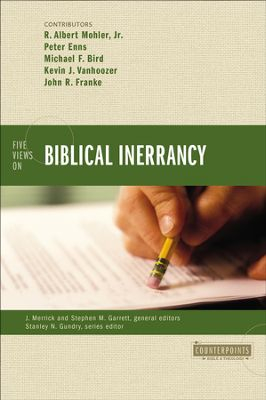
BOOK REVIEW: FIVE VIEWS ON BIBLICAL INERRANCY
IS THE BIBLE TRULY WITHOUT ERROR?
Reviewed By David P. Craig
Four primary topics are treated in this multi-view book: (1) God and his relationship to his creatures, (2) the doctrine of inspiration, (3) the nature of Scripture, and (4) the nature of truth.
Instead of allowing the author’s to simply give a defense of their positions – each scholar tackles the same outline and passages from their own perspective with reference to the Chicago Statement of Biblical Inerrancy (ISBI). Therefore, specific scriptures are handled to demonstrate each view along the lines of three specific categories: (1) The factuality of Scripture, (2) canonical coherence, and (3) theological coherence.
The scholars therefore all interact with the following texts: Joshua 6, Acts 9:9 compared with Acts 22:9, and Deuteronomy 20 in relation to Matthew 5. Joshua 6 was chosen since current details of historical and archaeological evidence have called into question the accuracy of the text’s account of the destruction of of Jericho. The Acts passage which describes Paul’s conversion was chosen due to the apparent discrepancy between what the witnesses saw and heard during this event. For theological coherence the author’s grapple with the question “How is it that Deuteronomy 20 instructs Israel that the complete extermination of Yahweh’s enemies is a matter of Israel’s purity before and obedience to Yaweh, while Jesus subsequently says faithfulness to God requires nonretaliation and sacrificial love of enemeies (Matthew 5:38-48)?”
The scholars addressing these biblical, theological, and historical concerns are two biblical scholars (Michael Bird and Peter Enns), two systematic theologians (John Franke and Kevin Vanhoozer), and one historical theologian (Albert Mohler). Part one consists of Mohler’s and Enns’ essays in a section entitled “Perspectives on Inerrancy and the Past.” In part 2 Michael Bird (hailing from Australia) addresses “Inerrancy from an International Perspective.” In part 3 Kevin Vanhoozer and John Franke represent “Perspectives on Renewing and Recasting Inerrancy Today.” Each essay is then responded to by the other four scholars.
Albert Mohler’s essay was disappointing in that his argumentation was circular and sophomoric. Of all the essays in the book I was looking forward to his the most. It seems that he didn’t put the time into the essay that was necessary. He simply wholeheartedly agreed with ISBI and did a poor job with the biblical material. His historical study of inerrancy was limited to the mid-late 1900’s. Mohler’s essay was answered in broad strokes and an a priori apologetic that was redundant and unconvincing. Mohler does a much better job in his essays of response – especially in his response to Enns. I wish that the editors would have chosen a biblical scholar in place of Mohler (with his same postion) – because his handling of the biblical material was particularly simplistic and weak. It just seemed like Mohler’s schedule was too busy to put the necessary scholarship into his essay. However, I wholeheartedly agree with Mohler’s assessment of biblical inerancy when he says, “I do not believe that evangelicalism can survive without the explicit and complete assertion of biblical inerrancy…The afirmation of biblical inerrancy means nothing more, and nothing less, than this: When the Bible speaks, God speaks.”
Peter Enns came across as just plain “ticked off” at the whole idea of biblical inerrancy. He gave a plethora of reasons why he doesn’t think ISBI is a fair or accurate document. He does not adhere to inerrancy (as defined by ISBI) and calls it “erroneous.” The closest he comes to arriving at any position on the Bible is when he writes: “Scripture is a collection of a variety of writings that necessarily and unashamedly reflects the worlds in which those writings were produced. The implication of this metaphor is that an understanding of those historical settings can and should affect interpretive conclusions.”
Enns handling of the biblical material was influenced primarily by liberal scholarship. He believes the Jericho episode didn’t happen due to the archaeological evidence. He believes Paul’s conversion reports are blatant contradictions. Lastly, he thinks that the God of the Old Testament as described in Deuteronomy is different than the God portrayed in the New Testament. He writes, “Israel’s depiction of God vis-a-vis the nations unmistakably, and understandably, reflects the ubiquitous tribal culture at the time.”
Mohler writes of Enns, “So, taking Peter Enns at his word the Bible contains numerous passages that not only fail the test of historical accuracy (even to the point of questioning whether the exodus took place), but also present a false and dangerous misrepresentation of God’s very character and will.” The overall response of the other essayists was similar to my own own response. I felt that Enns was overly critical of Scripture, and didn’t really give a constructive or positive view of Scripture at all. It felt like his whole essay was reactionary and destructive. There was really no positive argument given. It was a lot like reading the “new atheists” – a lot of attack and very little evidence or support for their own view.
Michael Bird’s essay was perhaps the most interesting of the five. If he ever loses his job as a theologian he could become a night club comic. He provides humor in his essay and in his responses to the other essayists (especially humorous is his response to Enns). Bird has the difficult task of reflecting the idea of inerrancy outside of the USA. He covers a lot of ground and shares where he agrees and disagrees with ISBI. He provides a very balanced essay in his response to ISBI, his historical reflections on inerrancy around the globe, and his biblical argumentation – brief but very cogent and clear. One of the highlights of Bird’s essay was this gem, “The goal of revelation is not knowing facts about God but also enjoying fellowship with God.” Overall Bird’s essay is very witty, theologically insightful, and interesting.
Kevin Vanhoozer’s essay argues for what he terms “A Well-versed inerrancy.” He basis his definition largely on the historic tradition of Augustine. Vanhoozer proposes this definition of inerrancy, “to say that the Scripture is inerrant is to confess faith that the authors speak the truth in all things they affirm (when they make affirmations), and will eventually be seen to have spoken truly (when right readers read rightly).” The bulk of Vanhoozer’s essay buttresses his definition of inerrancy with a particular interest in the terms “truth” and “language” and he ties these concepts to the writings and concepts developed by Augustine. His essay utilizes careful language and sophisticated theological and philosophical depth that one would expect of a top-notch systematic theologian. Vanhoozer handles the biblical passages with tremendous theological and exegetical skill.
Vanhoozer gives the practical importance of a well-versed inerrancy with these words: “Implicit in my definition of inerrancy is that we be not only literate readers who rightly see what proposition an author is proposing (the literal sense) and what kind of attention to this proposition is required (literary sensibility) but also right-minded and right-hearted readers who respond rightly to each and every communicative act of Scripture (Spirit-given literacy) Ultimately, a well-versed approach to inerrancy constitutes nothing less than a standing requirement that the community of Scripture’s interpreters become persons capable of understanding, loving, and participating in the truth.”
I love the conclusion to Vanhoozer’s essay where he quotes Augustine’s approach to the veracity of the Scriptures: “And if in these writings I am perplexed by anything which appears to me opposed to the truth, I do not hesitate to suppose that either the manuscript is faulty, or the translator has not caught the meaning of what was said, or I myself have failed to understand.” Of all the essays, I found Vanhoozer’s to be the most theologically profound and exegetically sound.
John Franke does not believe that the ICBI should serve as the standard-bearer for inerrancy. He offers an alternative model – what he calls a fallibilist perspective, “inerrancy functions only within the limits of language alone. It applies to Scripture only in the context of the original settings in which the texts that we have were constructed, and its affirmations and teachings cannot be abstracted from those contexts and offered as absolute truth, because only God knows and is Truth…this means that the ultimate truth and inerrancy of the Bible are finally contained not in the particular narratives and teachings of individual texts but rather in relation to its intended purpose and function in the economy of God…the Bible is that language the Spirit appropriates and employs to effect the social construction of the Christian community.”
Therefore, for Franke, the Bible is essentially fallible because it was written by fallible human beings. He expects that the Scriptures will contain errors and in his discussion of the biblical passages he is not troubled in the slightest by the historicity of the conquest of Jericho, nor the historic details of Paul’s Damascus Road vision. He seems more concerned about the big picture than the little details of the Bible. In doing so – he never quite tells us what inerrancy is. He never tells us what truth is. I found his essay to be confusing, fragmented, and unconvincing in regards to his theology, epistemology, and exegesis.
On the whole this is a fascinating multi-view book. The terrain covered is theologically rich, historically insightful, and exegetically helpful. The final chapter written by Stephen M. Garrett and J. Merrick was just what the doctor ordered. It helped bring synthesis, clarification, as well as a much needed explanation of the continuity and discontinuity on the spectrum of issues presented throughout the book. I highly recommend this book for everyone who loves God’s Word and is seeking to know, love, and live out His truth as revealed in the Scriptures.
JESUS, SCRIPTURE, AND ERROR: An Implication of Theistic Evolution
By Simon Turpin
Abstract
Within the church, the creation vs. evolution debate is often looked upon as a side issue or as unimportant. However, nothing could be further from the truth. Because of the acceptance of evolutionary theory, many have chosen to re-interpret the Bible with regards to its teaching on creation, the history of Adam and the global catastrophic flood in Noah’s day. Consequently, the very teachings of Jesus are being attacked by those who state that, because of His human nature, there is error in some of His teaching regarding earthly things such as creation. While scholars admit that Jesus affirmed such things as Adam, Eve, Noah and the Flood, they believe that Jesus was wrong on these matters.
The problem with this theory is that it raises the question of Jesus’s reliability, not only as a prophet, but more importantly as our sinless Savior. These critics go too far when they say that because of Jesus’s human nature and cultural context, He taught and believed erroneous ideas.
Keywords: Jesus, deity, humanity, prophet, truth, teaching, creation, kenosis, error, accommodation.
IntroductionIn His humanity, Jesus was subject to everything that humans are subject to, such as tiredness, hunger, and temptation. But does this mean that like all humans He was subject to error? Much of the focus on the person of Jesus in the church today is on His divinity, to the point where, often, aspects of His humanity are overlooked, which can in turn lead to a lack of understanding of this critical part of His nature. For example, it is argued that in His humanity Jesus was not omniscient and that this limited knowledge would have made Him capable of error. It is also believed that Jesus accommodated Himself to the prejudices and erroneous views of the Jewish people of the first century AD, accepting some of the untrue traditions of that time. This, therefore, nullifies His authority on critical questions. For the same reasons, it is not only certain aspects of Jesus’s teaching, but also those of the apostles that are seen as erroneous. Writing for the theistic evolutionist organization Biologos, Kenton Sparks argues that because Jesus, as a human, operated within His finite human horizon, then He would have made errors:
If Jesus as a finite human being erred from time to time, there is no reason at all to suppose that Moses, Paul, John [sic] wrote Scripture without error. Rather, we are wise to assume that the biblical authors expressed themselves as human beings writing from the perspectives of their own finite, broken horizons. (Sparks 2010, p. 7)
To believe our Lord was able to err—and did err in the things He taught—is a severe accusation and needs to be taken seriously. In order to demonstrate that the claim that Jesus erred in His teaching is itself erroneous, it is necessary to evaluate different aspects of Jesus’s nature and ministry. First, this paper will look at the divine nature of Jesus and whether He emptied Himself of that nature, followed by the importance of Jesus’s ministry as a prophet and His claims of the teaching the truth. It will then consider whether Jesus erred in His human nature, and whether as a result of error in Scripture (since humans were involved in its writing) Christ erred in His view of the Old Testament. Finally, the paper will explore the implications of Jesus’s teaching allegedly being false.
The Divine Nature of Jesus—He Existed Before CreationGenesis 1:1 tells us that “In the beginning God created the heavens and the earth.
” In John 1:1we read the same words, “In the beginning . . .
” which follows the Septuagint, the Greek translation of the Old Testament. John informs us in John 1:1 that in the beginning was the Word (logos) and that the Word was not only with God but was God. This Word is the one who brought all things into being at creation (John 1:3). Several verses later, John writes that the Word who was with God in the beginning “became flesh and dwelt among us
” (John 1:14). Notice that John does not say that the Word stopped being God. The verb “. . . ‘became’ [egeneto] here does not entail any change in the essence of the Son. His deity was not converted into our humanity. Rather, he assumed our human nature” (Horton 2011, p. 468). In fact, John uses a very particular term here, skenoo “dwelt”, which means he “pitched his tent” or “tabernacled” among us. This is a direct parallel to the Old Testament record of when God “dwelt” in the tabernacle that Moses told the Israelites to construct (Exodus 25:8–9; 33:7). John is telling us that God “dwelt” or “pitched his tent” in the physical body of Jesus.
In the incarnation, it is important to understand that Jesus’s human nature did not replace His divine nature. Rather, His divine nature dwelt in a human body. This is affirmed by Paul in Colossians 1:15–20, especially in verse 19, “For it pleased the Father that in Him all the fullness should dwell
,” Jesus was fully God and fully man in one person.
The New Testament not only explicitly states that Jesus was fully God, it also recounts events that demonstrate Jesus’ divine nature. For example, while Jesus was on earth, He healed the sick (Matthew 8–9) and forgave sins (Mark 2). What is more, He accepted worship from people (Matthew 2:2; 14:33; 28:9). One of the greatest examples of this comes from the lips of Thomas when he exclaims in worship before Jesus, “My Lord and my God!
” (John 20:28). The confession of deity here is unmistakable, as worship is only meant to be given to God (Revelation 22:9); yet Jesus never rebuked Thomas, or others, for this. He also did many miraculous signs (John 2; 6; 11) and had the prerogative to judge people (John 5:27) because He is the Creator of the world (John 1:1–3; 1 Corinthians 8:6; Ephesians 3:9; Colossians 1:16;Hebrews 1:2; Revelation 4:11).
Furthermore, the reactions of those around Jesus demonstrated that He viewed Himself as divine and truly claimed to be divine. In John 8:58, Jesus said to the Jewish religious leaders, “Most assuredly, I say to you, before Abraham was, I am
”. This “I am” statement was Jesus’s clearest example of His proclamation “I am Yahweh,” from its background in the book of Isaiah (41:4; 43:10–13, 25; 48:12—see also Exodus 3:14). This divine self-disclosure of Jesus’s explicit identification of Himself with Yahweh of the Old Testament is what led the Jewish leaders to pick up stones to throw at Him. They understood what Jesus was saying, and that is why they wanted to stone Him for blasphemy. A similar incident takes place in John 10:31. The leaders again wanted to stone Jesus after He said “I and the Father are one,
” because they knew He was making Himself equal with God. Equality indicates His deity, for who can be equal to God? Isaiah 46:9 says: “Remember the former things of old, For I am God, and there is no other; I am God, and there is none like Me.
” If there is no one like God and yet Jesus is equal to God (Philippians 2:6), what does this say of Him, except that He must be God? The only thing that is equal to God is God.
In the Incarnation Did Jesus Empty Himself of His Divine Nature?Kenotic Theology—(Philippians 2:5–8)
A question that needs to be asked is whether Jesus emptied Himself of His divine nature in His incarnation. In the seventeenth century, German scholars debated the issue of Christ’s divine attributes while He was on earth. They argued that because there is no reference in the gospels to Christ making use of all of His divine attributes (such as omniscience) that He abandoned the attributes of His divinity in His incarnation (McGrath 2011, p. 293). Gottfried Thomasius (1802–1875) was one of the main proponents of this view who explained the incarnation as “the self-limitation of the Son of God” (Thomasius, Dorner, and Biedermann 1965, p. 46). He reasoned that the Son could not have maintained His full divinity during the incarnation (Thomasius, Dorner, and Biedermann 1965, pp. 46–47). Thomasius believed that the only way for a true incarnation to take place was if the Son “‘gave himself over into the form of human limitation.”’ (Thomasius, Dorner, and Biedermann 1965, pp. 47–48). He found his support for this in Philippians 2:7, defining the kenosis as:
[T]he exchange of the one form of existence for the other; Christ emptied of the one and assumed the other. It is thus an act of free self-denial, which has as its two moments the renunciation of the divine condition of glory, due him as God, and the assumption of the humanly limited and conditioned pattern of life. (Thomasius, Dorner, and Biedermann 1965, p. 53)
Thomasius separated the moral attributes of God: truth, love, and holiness, from the metaphysical attributes: omnipotence, omnipresence, and omniscience. Thomasius not only believed that Christ gave up the use of these attributes, (omnipotence, omnipresence, omniscience) but that He did not even possess them during the incarnation (Thomasius, Dorner, and Biedermann 1965, pp. 70–71). Because of Christ’s self-emptying in Philippians 2:7, it was believed that Jesus was limited essentially by the opinions of His time. Robert Culver comments on the belief of Thomasius and other scholars who held to a kenotic theology:
Jesus’ testimony to the inerrant authority of the Old Testament . . . is negated. He simply had given up divine omniscience and omnipotence and hence didn’t know any better. Some of these scholars earnestly desired a way to remain orthodox and to go with the flow of what was deemed to be scientific truth about nature and about the Bible as an inspired book not necessarily true in every respect. (Culver 2006, p. 510)
It is critical, therefore, to ask what Paul means when he says that Jesus emptied Himself. Philippians 2:5–8 says:
In your relationships with one another, have the same mindset as Christ Jesus: Who, being in very nature God, did not consider equality with God something to be used to his own advantage; rather, he made himself nothing by taking the very nature of a servant, being made in human likeness. And being found in appearance as a man, he humbled himself by becoming obedient to death—even death on a cross!
There are two key words in these verses that help in understanding the nature of Jesus. The first key word is the Greek morphē (form). Morphē
covers a broad range of meanings and therefore we are heavily dependent on the immediate context to discover its specific nuance. (Silva 2005, p. 101)
In Philippians 2:6 we are helped by two factors to discover the meaning of morphē.
In the first place, we have the correspondence of morphē theou with isa theō. . . . “in the form of God” is equivalent to being “equal with God.” . . . In the second place, and most important, morphē theou is set in antithetical parallelism to μορφην δουλου (morphēn doulou, form of a servant), an expression further defined by the phrase εν ομοιωματι ανθρωπων (en homoiōmati anthrōpōn, in the likeness of men). (Silva 2005, p. 101)
The parallel phrases show that morphē refers to outward appearance. In Greek literature the term morphē has to do with “external appearance” (Behm 1967, pp. 742–743) which is visible to human observation. “Similarly, the word form in the Greek OT (LXX) refers to something that can be seen [Judges 8:18; Job 4:16; Isaiah 44:13]” (Hansen 2009, p. 135). Christ did not cease to be in the form of God in the incarnation, but taking on the form of a servant He became the God-man.
The second key word is ekenosen from which we get the kenosis doctrine. Modern English Bibles translate verse 7 differently:
New International Version/Today’s New International Version: “rather, he made himself nothing by taking the very nature of a servant being made in human likeness.
”
English Standard Version: “but emptied himself, by taking the form of a servant, being born in the likeness of men.
”
New American Standard Bible: “but emptied Himself, taking the form of a bond-servant, and being made in the likeness of men.
”
New King James Version: “but made Himself of no reputation, taking the form of a bondservant, and coming in the likeness of men.
”
New Living Translation: “Instead, he gave up his divine privileges; he took the humble position of a slave and was born as a human being. When he appeared in human form.”
It is debatable from a lexical standpoint whether “emptied himself,” “made Himself of no reputation,” or “gave up his divine privileges” are even the best translations. The New International Version/Today’s New International Version translation “made himself nothing” is probably more supportable (Hansen 2009, p. 149; Silva 2005, p. 105; Ware 2013). Philippians 2:7, however, does not say that Jesus emptied Himself of anything in particular; all it says is that he emptied Himself. New Testament scholar George Ladd comments:
The text does not say that he emptied himself of the morphē theou [form of God] or of equality with God . . . All that the text states is that “he emptied himself by taking something else to himself, namely, the manner of being, the nature or form of a servant or slave.” By becoming human, by entering on a path of humiliation that led to death, the divine Son of God emptied himself. (Ladd 1994, p. 460)
It is pure conjecture to argue from this verse that Jesus gave up any or all of His divine nature. He may have given up or suspended the use of some of His divine privileges, perhaps, for example, His omnipresence or the glory that He had with the Father in heaven (John 17:5), but not His divine power or knowledge. “The humiliation,” of Jesus is not therefore seen in His becoming man (anthropos) or a man (aner) but that “as man” (hos anthropos) “‘he humbled himself by becoming obedient to the point of death, even death on a cross
’ (Philippians 2:8)” (Culver 2006, p. 514).
The fact that Jesus did not give up His divine nature can be seen when He was on the Mount of Transfiguration and the disciples saw His glory (Luke 9:28–35) since here there is an association with the glory of God’s presence in Exodus 34:29–35. In the incarnation Jesus was not exchanging His deity for humanity but suspending the use of some of His divine powers and attributes (cf. 2 Corinthians 8:9). Jesus’s emptying of Himself was a refusal to cling to His advantages and privileges as God. We can also compare how Paul uses this same term, kenoo, which only appears four other times in the New Testament (Romans 4:14; 1 Corinthians 1:17;9:15; 2 Corinthians 9:3). In Romans 4:14 and 1 Corinthians 1:17, it means to make void, that is, deprive of force, render vain, useless, or of no effect. In 1 Corinthians 9:15 and 2 Corinthians 9:3it means to make void, that is, to cause a thing to be seen to be empty, hollow, false (Thayer 2007, p. 344). In these instances it is clear that Paul’s use of kenoo is used figuratively rather than literally (Berkhof 1958, p. 328; Fee 1995, p. 210; Silva 2005, p. 105). Additionally, in Philippians 2:7 “to press for a literal meaning of ‘emptying’ ignores the poetic context and nuance of the word” (Hansen 2009, p. 147). Therefore, in Philippians 2:7 it is perhaps more accurate to see “emptying” as Jesus pouring Himself out, in service, in an expression of divine self-denial (2 Corinthians 8:9). Jesus’s service is explained in Mark 10:45: “For even the Son of Man did not come to be served, but to serve, and to give His life a ransom for many.” In practise, this meant in the incarnation that Jesus:
-
Took the form of a servant
-
Was made in the likeness of men
-
Humbled himself becoming obedient to death on the cross.
In His incarnation Jesus did not cease to be God, or cease in any way to have the authority and knowledge of God.
Jesus as a ProphetIn His state of humiliation, part of Jesus’s ministry was to speak God’s message to the people. Jesus referred to Himself as a prophet (Matthew 13:57; Mark 6:4; Luke 13:33) and was declared to have done a prophet’s work (Matthew 13:57; Luke 13:33; John 6:14). Even those who did not understand that Jesus was God accepted Him as a prophet, (Luke 7:15–17, Luke 24:19, John 4:19; 6:14; 7:40; 9:17). Furthermore, Jesus introduced many of His sayings by “amen” or “truly” (Matthew 6:2, 5, 16). I. Howard Marshall says of Jesus:
[Jesus] made no claim to prophetic inspiration; no “thus says the Lord” fell from his lips, but rather he spoke in terms of his own authority. He claimed the right to give the authoritative interpretation of the law, and he did so in a way that went beyond that of the prophets. He thus spoke as if he were God. (Marshall 1976, pp. 49–50)
In the Old Testament, Deuteronomy 13:1–5 and 18:21–22 provided the people of Israel with two tests to discern true prophets from false prophets.
First, a true prophet’s message had to be consistent with earlier revelation.
Second, a true prophet’s predictions always had to come true.
Deuteronomy 18:18–19 foretells of a prophet whom God would raise up from His own people after Moses died: “I will raise up for them a Prophet like you from among their brethren, and will put My words in His mouth, and He shall speak to them all that I command Him
” (Deuteronomy 18:18). This is properly referred to in the New Testament as having been fulfilled in Jesus Christ (John 1:45; Acts 3:22–23; 7:37). Jesus’s teaching had no origin in human ideas but came entirely from God. In His role as prophet, Jesus had to speak God’s word to God’s people. Therefore He was subject to God’s rules concerning prophets. In the Old Testament, if a prophet was not correct in his predictions he would be stoned to death as a false prophet by order of God (Deuteronomy 13:1–5; 18:20). For a prophet to have credibility with the people, his message must be true, as he has no message of his own but can only report what God has given him. This is because prophecy had its origin in God and not man (Habakkuk 2:2–3; 2 Peter 1:21).
In His prophetic role, Christ represents God the Father to mankind. He came as a light to the world (John 1:9; 8:12) to show us God and bring us out of darkness (John 14:9–10). In John 8:28–29 Jesus also showed evidence of being a true prophet—that of living in close relation with His Father, passing on His teaching (cf. Jeremiah 23:21–23):
When you lift up the Son of Man, then you will know that I am He, and that I do nothing of Myself; but as My Father taught Me, I speak these things. And He who sent Me is with Me. The Father has not left Me alone, for I always do those things that please Him.
Jesus had the absolute knowledge that everything He did was from God. What He said and did is absolute truth because His Father is “truthful” (John 8:26). Jesus only spoke that which His Father told Him to say (John 12:49–50), so it had to be correct in every way. If Jesus as a prophet was wrong in the things He said, then why would we acclaim Him as the Son of God? If Jesus is a true prophet, then His teaching regarding Scripture must be taken seriously as absolute truth.
Jesus’s Teaching and Truth
Since God himself is the measure of all truth and Jesus was co-equal with God, he himself was the yardstick by which truth was to be measured and understood. (Letham 1993, p. 92)
In John 14:6 we are told that Jesus not only told the truth but that He was, and is, truth. Scripture portrays Jesus as the truth incarnate (John 1:17). Therefore, if He is the truth, He must always tell the truth and it would have been impossible for Him to speak or think falsehood. Much of Jesus’s teaching began with the phrase “Truly, truly I say . . .” If Jesus taught anything in error, even if it was from ignorance (for example, the Mosaic authorship of the Pentateuch), He would not be the truth.
To err may be human for us. Falsehood, however, is rooted in the nature of the devil (John 8:44), not the nature of Jesus who speaks the truth (John 8:45–46). The Father is the only true God (John 7:28; 8:26; 17:3) and Jesus taught only what the Father had given to Him (John 3:32–33; 8:40; 18:37). Jesus testifies about the Father, who in turn testifies concerning the Son (John 8:18–19; 1 John 5:10–11), and they are one (John 10:30). The gospel of John shows emphatically that Jesus’s teaching and words are the teaching and words of God. Three clear examples of this are:
And the Jews marveled, saying, “How does this Man know letters, having never studied?” Jesus answered them and said, “My doctrine is not Mine, but His who sent Me. If anyone wills to do His will, he shall know concerning the doctrine, whether it is from God or whether I speak on My own authority.”
(John 7:15–17)
I know that you are Abraham’s descendants, but you seek to kill Me, because My word has no place in you. I speak what I have seen with My Father, and you do what you have seen with your father. . . . But now you seek to kill Me, a Man who has told you the truth which I heard from God. Abraham did not do this.
(John 8:37–38, 40)
For I have not spoken on My own authority; but the Father who sent Me gave Me a command, what I should say and what I should speak. And I know that His command is everlasting life. Therefore, whatever I speak, just as the Father has told Me, so I speak.
(John 12:49–50)
In John 12:49–50 “Not only is what Jesus says just what the Father has told him to say, but he himself is the Word of God, God’s self-expression (1:1)” (Carson 1991, p. 453). The authority behind Jesus’s words are the commands that are given to Him by the Father (and Jesus always obeyed the Father’s commands; John 14:31). Jesus’s teaching did not originate in human ideas but came from God the Father, which is why it is authoritative. His very own words were spoken in full authorization from the Father who sent Him. The authority of Jesus’s teaching then rests upon the unity between Himself and the Father. Jesus is the embodiment, revelation, and messenger of truth to mankind; and it is the Holy Spirit who conveys truth about Jesus to the unbelieving world through believers (John 15:26–27; 16:8–11). Again, the point is that if there was error in Jesus’s teaching, then He is a false and unreliable teacher. However, Jesus was God incarnate, and God and falsehood can never be reconciled with each other (Titus 1:2;Hebrews 6:18).
Jesus’s Human NatureIt is important to understand that in the incarnation, not only did Jesus retain His divine nature, He also took on a human nature. With respect to His divine nature, Jesus was omniscient (John 1:47–51; 4:16–19, 29), having all the attributes of God, yet in His human nature He had all the limitations of being human, which included limitations in knowing. The true humanity of Jesus is expressed throughout the gospels, which tell us that Jesus was wrapped in ordinary infant clothing (Luke 2:7), grew in wisdom as a child (Luke 2:40, 52), and was weary (John 4:6), was hungry (Matthew 4:4), was thirsty (John 19:28), was tempted by the devil (Mark 4:38), and was sorrowful (Matthew 26:38a). The incarnation should be viewed as an act of addition and not as an act of subtraction of Jesus’s nature:
When we think about the Incarnation, we don’t want to get the two natures mixed up and think that Jesus had a deified human nature or a humanized divine nature. We can distinguish them, but we can’t tear them apart because they exist in perfect unity. (Sproul 1996)
For example, in Mark 13:32 where Jesus is talking about His return, He says, “But of that day and hour no one knows, not even the angels in heaven, nor the Son, but only the Father.
” Does this mean that Jesus was somehow limited? How should we handle this statement by Jesus? The text seems straightforward in saying there was something Jesus did not know. Jesus’s teaching shows that what He knew or did not know was a conscious self-limitation. The God-man possessed divine attributes, or He would have ceased to be God, but He chose not always to employ them. The fact that Jesus told His disciples that He did not know something is an indication that He did not teach untruths and this is confirmed by His statement, “if it were not so, I would have told you
” (John 14:2). Furthermore, ignorance of the future is not the same as making an erroneous statement. If Jesus had predicted something that did not take place, then that would be an error.
The question that now needs to be asked is this: Was Jesus in His humanity capable of error in the things he taught? Does our human capacity to err apply to the teaching of Jesus? Because of His human nature, questions are raised about Jesus’s beliefs concerning certain events in Scripture. The Chicago Statement on Biblical Hermeneutics (1982) states: “We deny that the humble, human form of Scripture entails errancy any more than the humanity of Christ, even in His humiliation, entails sin.” Arguing against the position, Kenton Sparks, Professor of Biblical Studies at Eastern University, in his book God’s Word in Human Words, states:
First, the Christological argument fails because, though Jesus was indeed sinless, he was also human and finite. He would have erred in the usual way that other people err because of their finite perspectives. He misremembered this event or that, and mistook this person for someone else, and thought—like everyone else—that the sun was literally rising. To err in these ways simply goes with the human territory. (Sparks 2008, pp. 252–253)
First of all, it should be noted that nowhere in the gospels is there any evidence that Jesus either misremembered any event or mistook any person for another, nor does Sparks provide evidence for this. Secondly, the language used in Scripture to describe the sun’s rising (for example, Psalm 104:22) and movement of the earth are literal only in a phenomenological sense as it is described from the viewpoint of the observer. Moreover, this is still done today in weather reports when the reporter uses terminology such as “sunrise tomorrow will be at 5 a.m.”
Because of the impact evolutionary ideology has had in the scientific realm as well as in theology, it is reasoned that Jesus’s teaching on things such as creation and the Mosaic authorship of the Pentateuch was simply wrong. Jesus would have been unaware of evolution as it relates to the critical approach to the authorship of the Old Testament, the Documentary Hypothesis. It is reasoned that in His humanity He was limited by the opinions of His time. Therefore, He could not be held accountable for holding to a view of Scripture that was prevalent in the culture. It is argued that Jesus erred in what He taught because He was accommodating the erroneous Jewish traditions of His time. For example, Peter Enns objects to idea that Jesus’s belief in the Mosaic authorship of the Pentateuch is valid, since He simply accepted the cultural tradition of His day:
Jesus seems to attribute authorship of the Pentateuch to Moses (e.g., John 5:46–47). I do not think, however, that this presents a clear counterpoint, mainly because even the most ardent defenders of Mosaic authorship today acknowledge that some of the Pentateuch reflects updating, but taken at face value this is not a position that Jesus seems to leave room for. But more important, I do not think that Jesus’s status as the incarnate Son of God requires that statements such as John 5:46–47 be understood as binding historical judgments of authorship. Rather, Jesus here reflects the tradition that he himself inherited as a first-century Jew and that his hearers assumed to be the case. (Enns 2012, p. 153)
Like Enns, Sparks also uses the accommodation theory to argue for human errors in Scripture (Sparks 2008, pp. 242–259). He believes that the Christological argument cannot serve as an objection to the implications of accommodation (Sparks 2008, p. 253) and that God does not err in the Bible when He accommodates the errant views of Scripture’s human audience (Sparks 2008, p. 256).
In his objection to the validity of Jesus’s belief in the Mosaic authorship of the Pentateuch, Enns is too quick in downplaying the divine status of Jesus in relation to His knowledge of the authorship of the Pentateuch. This overlooks whether the divinity of Christ meant anything in terms of an epistemological relevance to His humanity, and raises the question of how the divine nature relates to the human nature in the one person. We are told on several occasions, for example, that Jesus knew what people were thinking (Matthew 9:4; 12:25) which is a clear reference to His divine attributes. A. H. Strong gives a good explanation as to how the personality of Jesus’s human nature existed in union with His divine nature:
[T]he Logos did not take into union with himself an already developed human person, such as James, Peter, or John, but human nature before it had become personal or was capable of receiving a name. It reached its personality only in union with his own divine nature. Therefore we see in Christ not two persons—a human person and a divine person—but one person, and that person possessed of a human nature as well as a divine. (Strong 1907, p. 679)
There is a personal union between the divine and human nature with each nature entirely preserved in its distinctness, yet in and as one person. Although, some appeal to Jesus’s divinity in order to affirm Mosaic authorship of the Pentateuch (Packer 1958, pp. 58–59), it is not necessary to do so, since:
There is no mention in the Gospels of Jesus’ divinity overwhelming his humanity. Nor do the Gospels refer his miracles to his divinity and refer his temptation or sorrow to his humanity, as if he switched back and forth from operating according to one nature to operating according to another. Rather, the Gospels routinely refer Christ’s miracles to the Father and the Spirit . . . [Jesus] spoke what he heard from the Father and as he was empowered by the Spirit. (Horton 2011, p. 469)
The context of John 5:45–47 is important in understanding the conclusions we draw concerning the truthfulness of what Jesus taught. In John 5:19 we are told that Jesus can do nothing of Himself. In other words, He does not act independently of the Father, but He only does what He sees the Father doing. Jesus has been sent into the world by God to reveal truth (John 5:30, 36) and it is this revelation from the Father that enabled Him to do “greater works.” Elsewhere in John we are told that the Father teaches the Son (John 3:32–33; 7:15–17; 8:28, 37–38; 12:49–50). Jesus is not only one with the Father but is also dependent upon Him. Since the Father cannot be in error or lie (Numbers 23:19; Titus 1:2), and because Jesus and the Father are one (John 10:30), to accuse Jesus of error or falsehood in what He knew or taught is to accuse God of the same thing.
Jesus went on to acknowledge that the Old Testament required a minimum of two or three witnesses to establish the truthfulness of one’s claim (Deuteronomy 17:6; 19:15). Jesus produces several witnesses corroborating His claim of equality with God:
-
John the Baptist (John 5:33–35)
-
Jesus’s works (John 5:36)
-
God the Father (John 5:37)
-
The Scriptures (John 5:39)
-
Moses (John 5:46)
Jesus told the Jewish leaders that it is Moses, one of the witnesses, who will hold them accountable for their unbelief in what he wrote concerning Him, and that it is he who will be their accuser before God. New Testament scholar Craig Keener comments:
In Palestinian Judaism, “accusers” were witnesses against the defendant rather than official prosecutors (cf. 18:29), an image which would be consistent with other images used in the gospel tradition (Matt 12:41–42; Luke 11:31–32). The irony of being accused by a person or document in which one trusted for vindication would not be lost on an ancient audience. (Keener 2003, pp. 661–662)
In order for the accusation to hold up, however, the document or witnesses need to be reliable (Deuteronomy 19:16–19) and if Moses did not write the Pentateuch, how then can the Jews be held accountable by him and his writings? It was Moses who brought the people of Israel out of Egypt (Acts 7:40), gave them the Law (John 7:19), and brought them to the Promised Land (Acts 7:45). It was Moses who wrote about the coming prophet that God would send Israel to whom they should listen (Deuteronomy 18:15; Acts 7:37). What is more, it is God who puts the words into the mouth of this prophet (Deuteronomy 18:18). Moreover, Jesus
opposed the pseudo-authority of untrue Jewish traditions . . . . [and] disagrees with a pseudo-oral source [Mark 7:1–13], the false attribution of Jewish oral tradition to Moses. (Beale 2008, p. 145)
The basis for the truthfulness and inerrancy of what Jesus taught does not have to be resolved by appealing to His divine knowledge (although it can be), but can be understood from His humanity through His unity with the Father, which is why His teaching is true.
Furthermore, the New Testament strongly favors the Mosaic authorship of the Pentateuch (Matthew 8:4; 23:2; Luke 16:29–31; John 1:17, 45; Acts 15:1; Romans 9:15; 10:5). However, because of their belief in the “overwhelming evidence” for the documentary hypothesis, scholars (for example, Sparks 2008, p. 165) seem to come to the New Testament believing that the evidence of the Mosaic authorship of the Pentateuch must be explained away in order to be consistent with their conclusions. The simple fact is that scholars who reject the Mosaic authorship of the Pentateuch, and embrace an accommodation approach to the evidence of the New Testament, are as unwilling as the Jewish leaders (John 5:40) in not wanting to listen to the words of Jesus on this subject.
The accommodation approach to the teaching of Jesus also raises the issue of whether He was mistaken on other such issues, as Gleason Archer explains:
Such an error as this, in matters of historical fact that can be verified, raises a serious question as to whether any of the theological teaching, dealing with metaphysical matters beyond our powers of verification, can be received as either trustworthy or authoritative. (Archer 1982, p. 46)
The accommodation approach also leaves us with a Christological problem. Since Jesus clearly understood that Moses wrote about Him, this creates a serious moral problem for Christians, as we are told to follow the example set by Christ (John 13:15; 1 Peter 2:21) and have his attitude (Philippians 2:5). Yet, if Christ is shown to be approving falsehood in some areas of His teaching, it opens a door for us to affirm falsehood in some areas as well. The belief that Jesus accommodated His teaching to the beliefs of his first century hearers does not square with the facts. New Testament scholar John Wenham in his book Christ and the Bible comments on the idea that Jesus accommodated His teaching to the beliefs of His first century hearers:
He is not slow to repudiate nationalist conceptions of Messiahship; He is prepared to face the cross for defying current misconceptions . . . Surely He would have been prepared to explain clearly the mingling of divine truth and human error in the Bible, if He had known such to exist. (Wenham 1994, p. 27)
For those who hold to an accommodation position, this overlooks the fact that Jesus never hesitated to correct erroneous views common in the culture (Matthew 7:6–13, 29). Jesus was never constrained by the culture of his day if it went against God’s Word. He opposed those who claimed to be experts on the Law of God, if they were teaching error. His numerous disputes with the Pharisees are testament to this (Matthew 15:1–9; 23:13–36). The truth of Christ’s teaching is not culturally bound, but transcends all cultures and remains unaltered by cultural beliefs (Matthew 24:35; 1 Peter 1:24–25). Those who claim that Jesus in His humanity was susceptible to error and therefore merely repeated the ignorant beliefs of His culture are claiming to have more authority, and to be wiser and more truthful than Jesus.
Much of Christian teaching focuses, rightly, on the death of Jesus. However, in focusing on the death of Christ we often neglect the teaching that Jesus lived a life of perfect obedience to the Father. Jesus not only died for us; He also lived for us. If all Jesus had to do was to die for us, then He could have descended from heaven on Good Friday, gone straight to the cross, risen from the dead and ascended back into heaven. Jesus did not live for 33 years for no reason. Whilst on earth Christ did the Father’s will (John 5:30), taking specific actions, teaching, miracle-working, obeying the Law in order to “fulfill all righteousness
” (Matthew 3:15). Jesus, the last Adam (1 Corinthians 15:45), came to succeed where the first Adam had failed in keeping the law of God. Jesus had to do what Adam failed to do in order to fulfill the required sinless life of perfection. Jesus did this so that His righteousness could be transferred to those who put their faith in Him for the forgiveness of sins (2 Corinthians 5:21; Philippians 3:9).
We must remember that in His humanity, Jesus, was not superman but a real man. The humanity of Jesus and the deity of Jesus do not mix directly with one another. If they did, then that would mean that the humanity of Jesus would actually become super-humanity. And if it is super-humanity, it is not our humanity. And if it is not our humanity, then He cannot be our substitute since He must be like us (Hebrews 2:14–17). Although the genuine humanity of Jesus did involve tiredness and hunger, it did not prevent Him from doing what pleased His Father (John 8:29) and speaking the truth He heard from God (John 8:40). Jesus did nothing on His own authority (John 5:19, 30; 6:38; 7:16, 28; 8:16). He had the absolute knowledge that everything He did was from God, including speaking what He had heard and had been taught by the Father. In John 8:28 Jesus said: ““I do nothing of Myself; but as My Father taught Me, I speak these things.
” New Testament scholar Andreas Kostenberger notes that,
Jesus as the sent Son, again affirms his dependence on the Father, in keeping with the Jewish maxim that “a man’s agent [šālîah] is like the man himself.” (Kostenberger 2004, p. 260)
Just as God speaks the truth and no error can be found in Him, so it was with His sent Son. Jesus was not self-taught; rather His message came directly from God and, therefore, it was ultimately truth (John 7:16–17).
Scripture and Human ErrorIt has long been recognized that both Jesus and the apostles accepted Scripture as the flawless Word of the living God (John 10:35; 17:17; Matthew 5:18; 2 Timothy 3:16; 2 Peter 1:21). Unfortunately, this view of Scripture is attacked by many today, mainly because critics assume that since humans were involved in the process of writing Scripture, their capacity to err would result in the presence of errors in Scripture. The question that needs to be asked is whether the Bible contains error because it was written by human authors.
Many people are familiar with the Latin adage errare humanum est—to err is human. For instance, what person would ever claim to be without error? For this reason, the Swiss, neo-orthodox, theologian Karl Barth (1886–1968), whose view of Scripture is still influential in certain circles within the evangelical community, believed that: “we must dare to face the humanity of the biblical texts and therefore their fallibility . . .” (Barth 1963, p. 533). Barth believed that Scripture contained error because human nature was involved in the process:
As truly as Jesus died on the cross, as Lazarus died in Jn. 11, as the lame were lame, as the blind were blind . . . so, too, the prophets and apostles as such, even in their office, even in their function as witnesses, even in the act of writing down their witness, were real, historical men as we are, and therefore sinful in their action, and capable and actually guilty of error in their spoken and written word. (Barth 1963, p. 529)
Barth’s ideas, as well as the end results of higher criticism, are still making an impression today, as can be seen in Kenton Sparks’s work (Sparks 2008, p. 205). Sparks believes that although God is inerrant, because he spoke through human authors their “finitude and fallenness” resulted in a flawed biblical text (Sparks 2008, pp. 243–244).
In classic postmodern language Sparks states:
Orthodoxy demands that God does not err, and this implies, of course, that God does not err in Scripture. But it is one thing to argue that God does not err in Scripture; it is quite another thing that the human authors of Scripture did not err. Perhaps what we need is a way of understanding Scripture that paradoxically affirms inerrancy while admitting the human errors in Scripture. (Sparks 2008, p. 139)
Sparks’s claim of an inerrant Scripture that is errant is founded
in contemporary postmodern hermeneutical theories which emphasize the roll [sic] of the reader in the interpretive process and human fallibility as agents and receptors of communication. (Baugh 2008)
Sparks attributes the “errors” in Scripture to the fact that humans err: the Bible is written by humans, therefore its statements often reflect “human limitations and foibles” (Sparks 2008, p. 226). For both Barth and Sparks, an inerrant Bible is worthy of the charge of docetism (Barth 1963, pp. 509–510; Sparks 2008, p. 373).
Barth’s view of inspiration seems to be influencing many today in how they understand Scripture. Barth believed that God’s revelation takes place through His actions and activity in history; revelation then for Barth is seen as an “‘event”’ rather than coming through propositions (a proposition is a statement describing some reality that is either true or false; Beale 2008, p. 20). For Barth, the Bible is a witness to revelation but is not revelation itself (Barth 1963, p. 507) and, although there are propositional statements in Scripture, they are fallible human pointers to revelation-in-encounter. Michael Horton explains Barth’s idea of revelation:
For Barth, the Word of God (i.e., the event of God’s self-revelation) is always a new work, a free decision of God that cannot be bound to a creaturely form of mediation, including Scripture. This Word never belongs to history but is always an eternal event that confronts us in our contemporary existence. (Horton 2011, p. 128)
In his book Encountering Scripture: A Scientist Explores the Bible, one of the leading theistic evolutionists of today, John Polkinghorne, explains his view of Scripture:
I believe that the nature of divine revelation is not the mysterious transmission of infallible propositions . . . but the record of persons and events through which the divine will and nature have been most transparently made known . . . The Word of God uttered to humanity is not a written text but a life lived . . . Scripture contains witness to the incarnate Word, but it is not the Word himself. (Polkinghorne 2010, pp. 1, 3)
Like Sparks, Polkinghorne seems to be following Barth in his view of the inspiration of Scripture (misrepresenting the orthodox view in the process), which is opposed to the idea of revelation to divinely accredited messengers (the prophets and apostles). Therefore, in his view the Bible is not God’s Word but is only a witness to it with revelation seen as an event rather than the written Word of God (propositional truth statements). In other words, the Bible is a flawed record of God’s revelation to human beings, but it is not revelation itself. This view is not based on anything within the Bible, but is based upon extra-biblical, philosophical, critical grounds with which Polkinghorne is comfortable. Unfortunately, Polkinghorne offers a straw-man argument regarding the inspiration of Scripture as being “divinely dictated” (Polkinghorne 2010, p. 1). For him, the idea of the Bible being inerrant is “inappropriately idolatrous” (Polkinghorne 2010, p. 9), and so he believes he has a right to judge Scripture with his own autonomous intellect.
However, contra Barth and Polkinghorne, the Bible is not merely a record of events, but also gives us God’s interpretation of the meaning and significance of the events. We do not only have the gospel, but we also have the epistles which interpret the significance of the events of the gospel for us propositionally. This can be seen, for example, in the event of the crucifixion of Christ. At the time of Jesus’s ministry, the high priest Caiaphas saw the event of the death of Jesus as a historical expedient in that it was necessary for the good of the nation for one man to die (John 18:14). Meanwhile the Roman centurion standing underneath the cross came to believe that Jesus was “truly was the Son of God
” (Mark 15:39). Yet, Caiaphas and the Centurion could not have known apart from divine revelation that the death of Christ was ultimately an atoning sacrifice made to satisfy the demands of God’s justice (Romans 3:25). We need more than an event in the Bible, we must also have the revelation of the meaning of the event or the meaning simply becomes subjective. God has given us the meaning and significance of these events through His chosen medium of the prophets and the apostles.
Furthermore, the charge of biblical docetism (that it denies the true humanity of Scripture), moves too quickly in presuming genuine humanity necessitates error:
Given an understanding of the Spirit’s work that superintends the production of the text without bypassing the human author’s personality, mind or will, and given that truth can be expressed perspectivally—that is, we do not need to know everything or to speak from a position of absolute objectivity or neutrality in order to speak truly—what exactly would be doecetic about an infallible text should we be given one? (Thompson 2008, p. 195)
What is more, the adage “to err is human” is simply assumed to be true. It may be true that humans err but it is not true that it is intrinsic for humanity to necessarily always err. There are many things we can do as humans and not err (examinations for example) and we must remember God created humanity at the beginning of creation as sinless and therefore with the capacity not to err. Also, the incarnation of Jesus Christ shows sin, and therefore error, not to be normal. Jesus
who is impeccable was made in the likeness of sinful flesh, but being in “fashion as a man” still “holy harmless and undefiled.” To err is human is a false statement. (Culver 2006, p. 500)
One could argue that both Barth’s and Sparks’s view of Scripture is in fact “Arian” (denial of the true deity of Christ). What is more, Sparks’s contention that God is inerrant but accommodates Himself through human authors (which is where the errors in Scripture come from), fails to see that if what he says is true, then it is also possible that the biblical authors were in error in stating that God is inerrant. How in their erroneous humanity then would they know God is inerrant unless He revealed it to them?
Furthermore, orthodox Christianity does not deny the true humanity of Scripture; rather it properly recognizes that to be human does not necessarily entail error, and that the Holy Spirit kept the biblical writers from making errors they might otherwise have made. The assertion of a mechanical view of inspiration (God dictates the words to human authors) is simply a canard. Rather, orthodox Christianity embraces a theory of organic inspiration. “That is, God sanctifies the natural gifts, personalities, histories, languages, and cultural inheritance of the biblical writers” (Horton 2011, p. 163). The orthodox view of the inspiration of Scripture, as opposed to the neoorthodox view, is that revelation comes from God in and through words. In 2 Peter 1:21we are told that: “for prophecy never came by the will of man, but holy men of God spoke as they were moved by the Holy Spirit.
” Prophecy was not motivated by man’s will in that it did not come from human impulse. Peter tells us how the prophets were able to speak from God by the fact that they were being continually “moved” (pheromenoi, present passive participle) by the Holy Spirit as they spoke or wrote. The Holy Spirit moved the human authors of Scripture in such a way that they were moved not by their own “will” but by the Holy Spirit. This does not mean that human authors of Scripture were automatons; they were active rather than passive in the process of writing Scripture, as can be seen in their style of writing and the vocabulary they used. The role of the Holy Spirit was to teach the authors of Scripture (John 14:26; 16:12–15). In the New Testament it was the apostles or those closely associated with them whom the Spirit led to write truth and overcome their human tendency to err. The apostles shared Jesus’s view of Scripture, presenting their message as God’s Word (1 Thessalonians 2:13) and proclaiming that it was “not in words which man’s wisdom teaches but which the Holy Spirit teaches
” (1 Corinthians 2:13). Revelation then did not come about within the apostle or prophet, but it has its source in the Triune God (2 Peter 1:21). The relationship between the inspiration of the biblical text through the Holy Spirit and human authorship is too intimate to allow for errors in the text, as New Testament scholar S. M. Baugh demonstrates from the book of Hebrews:
God speaks to us directly and personally (Heb. 1:1–2) in promises (12:26) and comfort (13:5) with divine testimony (10:15) to and through the great “cloud of witnesses” of OT revelation . . . In Scripture, the Father speaks to the Son (1:5–6; 5:5), the Son to the Father (2:11–12; 10:5) and the Holy Spirit to us (3:7; 10:15–16). This speaking of God in the words of Scripture has the character of testimony which has been legally validated (2:1–4; so Greek bebaios in v. 2) which one ignores to his peril (4:12–13; 12:25). This immediate identification of the biblical text with God’s speech (cf. Gal. 3:8, 22) is hard to jibe with the reputed feebleness of the biblical authors. (Baugh 2008)
In the same way Jesus can assume our full humanity without sin so it is that God can speak through the fully human words of prophets and apostles without error. The major problem with seeing Scripture as erroneous is summed up by Robert Reymond:
We must not forget that the only reliable source of knowledge that we have of Christ is the Holy Scripture. If the Scripture is erroneous anywhere, then we have no assurance that it is inerrantly truthful in what it teaches about him. And if we have no reliable information about him, then it is precarious indeed to worship the Christ of Scripture, since we may be entertaining an erroneous representation of Christ and thus may be committing idolatry. (Reymond 1996, p. 72)
Jesus’s View of ScriptureIf Jesus’s acceptance and teaching of the reliability and truthfulness of Scripture were false, then this would mean that He was a false teacher and not to be trusted in the things He taught. Jesus clearly believed, however, that Scripture was God’s Word and therefore truth (John 17:17). In John 17:17, notice that Jesus says: “Sanctify them by Your truth. Your word is truth
.” He did not say that “your word is true” (adjective), rather He says “your word is truth” (noun). The implication is that Scripture does not just happen to be true; rather the very nature of Scripture is truth, and it is the very standard of truth to which everything else must be tested and compared. Similarly, in John 10:35 Jesus declared that “Scripture cannot be broken
” the “term ‘broken’ . . . means that Scripture cannot be emptied of its force by being shown to be erroneous” (Morris 1995, p. 468). Jesus was telling the Jewish leaders that the authority of Scripture could not be denied. Jesus’s own view of the Scripture was that of verbal inspiration, which can be seen from His statement in Matthew 5:18:
For assuredly, I say to you, till heaven and earth pass away, one jot or one tittle will by no means pass from the law till all is fulfilled.
For Jesus, Scripture is not merely inspired in its general ideas or its broad claims or in its general meaning, but is inspired down to its very words. Jesus settled many theological disputes with His contemporaries by a single word. In Luke 20:37–38 Jesus “exploits an absent verb in the Old Testament passage” (Bock 1994, p. 327) to argue that God continues to be the God of Abraham. His argument presupposes the reliability of the words recorded in the book of Exodus (3:2–6). Furthermore, in Matthew 4, Jesus’s response to being tempted by Satan was to quote sections of Scripture from Deuteronomy (8:3; 6:13, 16) demonstrating His belief in the final authority of the Old Testament. Jesus overcame Satan’s temptations by quoting Scripture to him “It is written . . .” which has the force of or is equivalent to “that settles it”; and Jesus understood that the Word of God was sufficient for this.
Jesus’s use of Scripture was authoritative and infallible (Matthew 5:17–20; John 10:34–35) as He spoke with the authority of God the Father (John 5:30; 8:28). Jesus taught that the Scriptures testify about Him (John 5:39), and He showed their fulfilment in the sight of the people of Israel (Luke 4:17–21). He even declared to His disciples that what is written in the prophets about the Son of Man will be fulfilled (Luke 18:31). Furthermore, He placed the importance of the fulfillment of the prophetic Scriptures over escaping His own death (Matthew 26:53–56). After His death and resurrection He told His disciples that everything that was written about Him in Moses, the Prophets, and the Psalms must be fulfilled (Luke 24:44–47), and rebuked them for not believing all that the prophets have spoken concerning Him (Luke 24:25–27). The question then is how could Jesus fulfill all that the Old Testament spoke about Him if it is filled with error?
Jesus also regarded the Old Testament’s historicity as impeccable, accurate, and reliable. He often chose for illustrations in his teaching the very persons and events that are the least acceptable today to critical scholars. This can be seen from his reference to: Adam (Matthew 19:4–5), Abel (Matthew 23:35), Noah (Matthew 24:37–39), Abraham (John 8:39–41, 56–58), Lot and Sodom and Gomorrah (Luke 17:28–32). If Sodom and Gomorrah were fictional accounts, then how could they serve as a warning for future judgement? This also applies to Jesus’s understanding of Jonah (Matthew 12:39–41). Jesus did not see Jonah as a myth or legend; the meaning of the passage would lose its force, if it was. How could Jesus’s death and resurrection serve as a sign, if the events of Jonah did not take place? Furthermore, Jesus says that the men of Nineveh will stand at the last judgement because they repented at the preaching of Jonah, but if the account of Jonah is a myth or symbolic, then how can the men of Nineveh stand at the last judgement?
Fig. 1. Jesus’s view of the creation of man at the beginning of creation is directly opposed to the evolutionary timeline of the age of the earth.
Moreover, there are multiple passages in the New Testament where Jesus quotes from the early chapters of Genesis in a straightforward, historical manner. Matthew 19:4–6 is especially significant as Jesus quotes from both Genesis 1:27 and Genesis 2:24. Jesus’s use of Scripture here is authoritative in settling a dispute over the question of divorce, as it is grounded in the creation of the first marriage and the purpose thereof (Malachi 2:14–15). The passage is also striking in understanding Jesus’s use of Scripture as He attributes the words spoken as coming from the Creator (Matthew 19:4). More importantly, there is no indication in the passage that He understood it figuratively or as an allegory. If Christ were mistaken about the account of creation and its importance to marriage, then why should He be trusted when it comes to other aspects of His teaching? Furthermore, in a parallel passage in Mark 10:6 Jesus said, “‘But from the beginning of creation, God ‘made them male and female’.
” The statement “from the beginning of creation” (‘άπό άρχñς κτíσεως;’—see John 8:44; 1 John 3:8, where “from the beginning” refers to the beginning of creation) is a reference to the beginning of creation and not simply to the beginning of the human race (Mortenson 2009, pp. 318–325). Jesus was saying that Adam and Eve were there at the beginning of creation, on Day Six, not billions of years after the beginning (fig. 1).
In Luke 11:49–51 Jesus states:
Therefore the wisdom of God also said, “I will send them prophets and apostles, and some of them they will kill and persecute,” that the blood of all the prophets which was shed from the foundation of the world may be required of this generation, from the blood of Abel to the blood of Zechariah who perished between the altar and the temple. Yes, I say to you, it shall be required of this generation.
The phrase “from the foundation of the world
” is also used in Hebrews 4:3, where it tells us God’s creation “works were finished from the foundation of the world.
” However, verse 4 says that “God rested on the seventh day from all His works.
” Mortenson points out:
The two statements are clearly synonymous: God finished and rested at the same time. This implies that the seventh day (when God finished creating, Gen. 2:1–3) was the end of the foundation period. So, the foundation does not refer simply to the first moment or first day of creation week, but the whole week. (Mortenson 2009, p. 323)
Jesus clearly understood that Abel lived at the foundation of the world. This means that as the parents of Abel, Adam and Eve, must also have been historical. Jesus also spoke of the devil as being a murderer “from the beginning” (John 8:44). It is clear that Jesus accepted the book of Genesis as historical and reliable. Jesus also made a strong connection between Moses’s teaching and his own (John 5:45–47) and Moses made some very astounding claims about six-day creation in the Ten Commandments, which He says were penned by God’s own hand (Exodus 20:9–11 and Exodus 31:18).
To question the basic historical authenticity and integrity of Genesis 1–11 is to assault the integrity of Christ’s own teaching. (Reymond 1996, p. 118)
Moreover, if Jesus was wrong about Genesis, then He could be wrong about anything, and none of His teaching would have any authority. The importance of all this is summed up by Jesus in declaring that if someone did not believe in Moses and the prophets (the Old Testament) then they would not believe God on the basis of a miraculous resurrection (Luke 16:31). Those who make the charge that the Scriptures contain error find themselves in the same position as the Sadducees who were rebuked by Jesus in Matthew 22:29: “Jesus answered and said to them, ‘You are mistaken, not knowing the Scriptures nor the power of God’.
” The implication by Jesus here is that the Scriptures themselves do not err, as they speak accurately concerning history and theology (in context the Patriarchs and the resurrection).
The apostle Paul issued a warning to the Corinthian Church:
But I fear, lest somehow, as the serpent deceived Eve by his craftiness, so your minds may be corrupted from the simplicity that is in Christ.(2 Corinthians 11:3).
Satan’s method of deception with Eve was to get her to question God’s Word (Genesis 3:1). Unfortunately, many scholars and Christian lay people today are falling for this deception and are questioning the authority of God’s Word. We must remember, however, that Paul exhorts us that we are to have “the mind” (1 Corinthians 2:16) and “attitude” of Christ (Philippians 2:5). Therefore, as Christians, whatever Jesus’s belief was concerning the truthfulness of Scripture should be what we believe; and He clearly believed that Scripture was the perfect Word of God and, therefore, truth (Matthew 5:18; John 10:35; 17:17).
Jesus as Saviour and the Implications of His Teaching being FalseThe fatal flaw in the idea that Jesus’s teaching contained error is that, if Jesus in His humanity claimed to know more or less than He actually did, then such a claim would have profound ethical and theological implications (Sproul 2003, p. 185) concerning Jesus’s claims of being the truth (John 14:6), speaking the truth (John 8:45), and bearing witness to the truth (John 18:37). The critical point in all of this is that Jesus did not have to be omniscient to save us from our sins, but He certainly had to be sinless, which includes never telling a falsehood.
Scripture is clear is that Jesus was sinless in the life he lived, keeping God’s law perfectly (Luke 4:13; John 8:29; 15:10; 2 Corinthians 5:21; Hebrews 4:15; 1 Peter 2:22; 1 John 3:5). Jesus was confident in His challenge to His opponents to convict Him of sin (John 8:46), but His opponents were unable to answer His challenge; and even Pilate found no guilt in him (John 18:38). The belief that Jesus was truly human and yet sinless has been a universal conviction of the Christian church (Osterhaven 2001, p. 1109). However, did Christ’s true humanity require sinfulness?
The answer to that must be no. Just as Adam, when created, was fully human and yet sinless, so the second Adam who took Adam’s place not only started his life without sin but continued to do so. (Letham 1993, p. 114)
Whereas Adam failed in his temptation by the Devil (Genesis 3), Christ succeeded in His temptation, fulfilling what Adam had failed to do (Matthew 4: 1–10). Strictly speaking, the question of whether Christ was able to sin or not (impeccability)
means not merely that Christ could avoid sinning, and did actually avoid it, but also that is was impossible for Him to sin because of the essential bond between the human and the divine natures. (Berkhof 1959, p. 318)
If Jesus in his teaching had pretended or proclaimed to have more knowledge than he actually had, then this would have been sinful. The Bible tells us that “we who teach will be judged more strictly
” (James 3:1). Scripture also says that it would be better for a person to have a millstone hung around his neck and to be drowned than to lead someone astray (Matthew 18:6). Jesus made statements such as “I do not speak on my own authority. Rather, it is the Father, living in me
” (John 14:10) and “I am . . . the truth
” (John 14:6). Now if Jesus claimed to teach these things and then taught erroneous information (for example, regarding Creation, the Flood, or the age of the earth), then His claims would be falsified, He would be sinning, and this would disqualify Him from being our Saviour. The falsehood He would be teaching is that He knows something that He actually does not know. Once Jesus makes the astonishing claim to be speaking the truth, He had better not be teaching mistakes. In His human nature, because Jesus was sinless, and as such the “fullness of the Deity
” dwelt in Him (Colossians 2:9), then everything Jesus taught was true; and one of the things that Jesus taught was that the Old Testament Scripture was God’s Word (truth) and, therefore, so was His teaching on creation.
When it comes to Jesus’s view on creation, if we claim Him to be Lord, then what He believed should be extremely important to us. How can we have a different view than the one who is our Saviour as well as our Creator! If Jesus was wrong concerning His views on creation, then we can argue that maybe He was wrong in other areas too—which is what is being argued by scholars such as Peter Enns and Kenton Sparks.
ConclusionOne of the reasons today for believing that Jesus erred in His teaching is driven by a desire to syncretize evolutionary thinking with the Bible. In our own day, it has become customary for theistic evolutionists to reinterpret the Bible in light of modern scientific theory. However, this always ends in disaster because syncretism is based on a type of synthesis—blending together the theory of naturalism with historic Christianity, which is antithetical to naturalism.
The issue for Christians is what one has to concede theologically in order to hold to a belief in evolution. Many theistic evolutionists inconsistently reject the supernatural creation of the world, yet nevertheless accept the reality of the virgin birth, the miracles of Christ, the resurrection of Christ, and the divine inspiration of Scripture. However, these are all equally at odds with secular interpretations of science. Theistic evolutionists have to tie themselves up in knots in order to ignore the obvious implications of what they believe. The term “blessed inconsistency” should be applied here, as many Christians who believe in evolution do not take it to its logical conclusions. However, some do, as can be seen from those that affirm Christ and the authors of Scripture erred in matters of what they taught and wrote.
People say, “they do not accept the Bible’s account of origins in Genesis when it speaks of God creating supernaturally in six consecutive days and destroying the world in a global catastrophic flood.” This cannot be said, however, without overlooking the clear teaching of our Lord Jesus on the matter (Mark 10:6; Matthew 24:37–39) and the clear testimony of Scripture (Genesis 1:1–2;3:6–9; Exodus 20:11; 2 Peter 3:3–6), which He affirmed as truth (Matthew 5:17–18; John 10:25;17:17). Jesus said to His own disciples that those “who receives you (accepting the apostles’ teaching) receives me
” (Matthew 10:40). If we confess Jesus is our Lord, we must be willing to submit to Him as the teacher of the Church.
ABOUT THE AUTHOR: Simon Turpin has a B.A in Theology and Inter-cultural Studies from All Nations Bible College UK (2010) and works full-time for an Evangelical Church in St. Albans. Previous to his studies Simon spent a year as part of a missions team working in North America, India and Germany sharing the gospel. Through his time in the church in England and overseas he saw the increasing need to use the creation message to share not only the truth of the Bible, but the full story of the message of redemption through our Creator and Saviour Jesus.Acknowledgment
The author is grateful for the helpful comments from AiG Research Assistant Lee Anderson, Jr., which were used to improve this paper.
References
Archer, G. L. 1982. New international encyclopedia of Bible difficulties. Grand Rapids, Michigan: Zondervan.
Barth, K. 1963. Church dogmatics: The doctrine of the Word of God. Vol. 1. Part 2. Edinburgh, Scotland: T&T Clark.
Baugh. S. M. 2008. Book review: God’s Word in human words. Retrieved from http://www.reformation21.org/shelf-life/review-gods-word-in-human-words.php on July 12, 2013.
Beale, G. K. 2008. The erosion of inerrancy in evangelicalism: Responding to new challenges to biblical authority. Wheaton, Illinois: Crossway.
Behm, J 1967. μορφή. In Theological dictionary of the New Testament, ed. G. Kittel. Vol. 4. Grand Rapids, Michigan: W. B. Eerdmans Publishing Company.
Berkhof, L. 1958. Systematic theology. Edinburgh: Scotland: Banner of Truth.
Bock, D. L. 1994. Luke: The IVP New Testament commentary series. Downers Grove, Illinois: InterVarsity Press.
Carson, D. A. 1991. The Gospel according to John. (The Pillar New Testament Commentary). Grand Rapids, Michigan: W. B. Eerdmans Publishing Company.
Culver, R. D. 2006. Systematic theology: Biblical and historical. Fearn, Ross-Shire: Christian Focus Publications Ltd.
Enns, P. 2012. The evolution of Adam: What the Bible does and doesn’t say about human origins. Grand Rapids, Michigan: Brazos Press.
Fee, G. D. 1995. Paul’s letter to the Philippians: The New International Commentary on the New Testament. Grand Rapids, Michigan: W. B. Eerdmans Publishing.
Hansen, G. W. 2009. The letter to the Philippians: The pillar New Testament commentary. Grand Rapids, Michigan: W. B. Eerdmans Publishing.
Horton, M. 2011. The Christian faith: A systematic theology for pilgrims on the way. Grand Rapids, Michigan: Zondervan.
Keener, C. S. 2003. The gospel of John: A commentary. Vol. 1. Peabody, Massachusetts: Hendrickson Publishers.
Kostenberger, A. J. 2004. John: Baker exegetical commentary on the New Testament. Grand Rapids, Michigan: Baker.
Ladd, G. E. 1994. A theology of the New Testament. Rev. D. A. Hagner. Cambridge, United Kingdom: The Lutterworth Press.
Letham, R. 1993. The work of Christ: Contours of Christian theology. Downers Grove, Illinois: InterVarsity Press.
Marshall, I. H. 1976. The origins of the New Testament christology. Downers Grove: Illinois: InterVarsity Press.
McGrath, A. E. 2011. Christian theology: An introduction. 5th ed. Oxford, United Kingdom: Blackwell Publishing Limited.
Morris, L. 1995. The gospel according to John: The new international commentary on the New Testament. Rev. ed. Grand Rapids, Michigan: Eerdmans.
Mortenson, T. 2009. Jesus’ view of the age of the earth. In Coming to grips with Genesis: Biblical authority and the age of the earth, ed. T Mortenson and T. H. Ury. Green Forest, Arkansas: Master Books.
Osterhaven, M. E. 2001. Sinlessness of Christ. In Evangelical dictionary of theology, ed. W. Elwell. 2nd ed. Grand Rapids, Michigan: Baker Academic.
Packer, J. I. 1958. “Fundamentalism” and the Word of God. Grand Rapids, Michigan: W. B. Eerdmans Publishing.
Polkinghorne, J. 2010. Encountering Scripture: A scientist explores the Bible. London, England: SPCK.
Reymond, R. L. 1998. A new systematic theology of the Christian faith. 2nd ed. Nashville, Tennessee: Thomas Nelson.
Silva, M. 2005. Philippians: Baker exegetical commentary on the New Testament. 2nd ed. Grand Rapids, Michigan: Baker Academics.
Sparks, K. L. 2008. God’s Word in human words: An evangelical appropriation of critical biblical scholarship. Grand Rapids, Michigan: Baker Academic.
Sparks, K. 2010. After inerrancy, evangelicals and the Bible in the postmodern age. Part 4. Retrieved from http://biologos.org/uploads/static-content/sparks_scholarly_essay.pdf on October 10, 2012.
Sproul, R. C. 1996. How can a person have a divine nature and a human nature at the same time in the way that we believe Jesus Christ did? Retrieved from http://www.ligonier.org/learn/qas/how-can-person-have-divine-nature-and-humannature on August 10, 2012.
Sproul, R. C. 2003. Defending your faith: An introduction to apologetics. Wheaton, Illinois: Crossway Books.
Strong, A. H. 1907. Systematic theology: The doctrine of man. Vol. 2. Valley Forge, Pennsylvania: Judson Press.
Thayer, J. H. 2007. Thayer’s Greek-English lexicon of the New Testament. 8th ed. Peabody, Massachusetts: Hendrickson Publishers.
Thomasius, G., I. A. Dorner, and A. E. Biedermann. 1965. God and incarnation in mid-nineteenth century German theology (A library of protestant thought). Trans. and ed. C. Welch. New York, New York: Oxford University Press.
Thompson, M. D. 2008. Witness to the Word: On Barth’s doctrine of Scripture. In Engaging with Barth: Contemporary evangelical critiques, ed. D. Gibson and D. Strange. Nottingham, United Kingdom: Apollos.
Ware, B. 2013. The humanity of Jesus Christ. Retrieved from http://www.biblicaltraining.org/library/humanity-jesuschrist/systematic-theology-ii/bruce-ware on June 12, 2013.
Wenham, J. 1994. Christ and the Bible. 3rd ed. Eugene, Oregon: Wipf and Stock Publishers.
SOURCE: (OCTOBER 30, 2013) http://www.answersingenesis.org/articles/arj/v6/n1/jesus-scripture-and-error
ISSN: 1937-9056 Copyright © 2013 Answers in Genesis. All rights reserved. Consent is given to unlimited copying, downloading, quoting from, and distribution of this article for non-commercial, non-sale purposes only, provided the following conditions are met: the author of the article is clearly identified; Answers in Genesis is acknowledged as the copyright owner; Answers Research Journal and its website, http://www.answersresearchjournal.org, are acknowledged as the publication source; and the integrity of the work is not compromised in any way. For more information write to: Answers in Genesis, PO Box 510, Hebron, KY 41048, Attn: Editor, Answers Research Journal. The views expressed are those of the writer(s) and not necessarily those of the Answers Research Journal Editor or of Answers in Genesis.
THE DEBT I OWE C.S. LEWIS by Dr. Holly Ordway
I owe more to C.S. Lewis than I can ever express. On this day, Nov. 22, 2013, the fiftieth anniversary of his death and the day that he is honored with a memorial in Poets’ Corner of Westminster Abbey, I wish more than anything to say ‘thank you’ to this great man.
And so I decided to share a glimpse of how Lewis helped change my life. In my memoir Not God’s Type, I’d alluded to Lewis’s significance in my conversion to Christianity, but not gone into detail. In the revision, significantly expanded and revised, which will be published in 2014 by Ignatius Press (and tentatively retitled The Sword and the Cross) I write a great deal more about the role of Lewis’s Narnia Chronicles in my journey.
The following is an excerpt from Chapter 12 of my forthcoming book.
At this point in my journey of faith, I had accepted the arguments for the existence of God; I had become a theist. But what about the idea of a personal God? And in particular, what about Jesus? I found myself struggling, resistant, terrified . . . and so we jump in as I wrestle with the meaning of the Incarnation:

I had rejected the idea of ‘talking to God’ in prayer – not from intellectual disagreement, but from a visceral reaction of fear and anger, and although the cause was new, the feeling of baffled rage was all too familiar. I had felt it when I was eight or nine years old, weeping over my long-division homework (and refusing to do it); in high school, my stomach in a knot as I stared at geometry proofs that meant nothing to me; as a college freshman, sick with frustration as I struggled with my chemistry problem sets. I knew that there was some meaning locked up in these figures, these equations and problems, but I was unable to see what the teacher (and the other students!) seemed to find so obvious, and my inability easily to understand made me both angry at myself and, eventually, dismissive of the subject.
The idea of a personal God was almost impossible for me to grasp to begin with, let alone the Christian claim that the Creator become a human person, flesh and blood like me, yet also fully God. The ‘watchful dragons’ (as Lewis calls them) of my rebellious self spoke up loud and clear, insisting, “It can’t possibly be true that the Creator of the universe would respond to you, or even be aware of your existence. Who do you think you are, anyway? And these Christians are obviously talking nonsense. How could it be that the First Cause of the universe would somehow become a man, an actual human being walking around, getting his hands dirty, getting killed. Ridiculous. Who can believe that?”
I had nothing to say.
These new philosophical ideas about God made rational sense of the world as I saw it, but they did not show me that the God of the philosophers would have anything to do with me as an individual – much less that His concern for human beings would extend to becoming incarnate, as the Christians said that He had. God’s morality might apply to me, yes, but like gravity, indiscriminately to all people; or like a law code, written down and handed over, with its authority coming from the Law-Giver, but at a distance. Surely He could not, would not, take notice of me: I was too small; He was too big. Surely He would not enter into His creation; it was grubby and messy and material, and He was spiritual and orderly and infinite.
I could understand the definition of the word ‘Incarnation’ but not grasp its meaning. It seemed unimaginable that God would come close enough to be touched, would become man.
Or was it? I began to recall glimpses of something I’d been intrigued by, yet had been unable to name, from an earlier, deeper vision.
What if the idea of the Incarnation did not have to be solved like a math problem . . . what if I could get hold of its meaning in a different way?
I picked up The Lion, the Witch and the Wardrobe: this time, not to analyze it for my dissertation, but to enter Narnia like a little girl again.
And I encountered Aslan.
First just as a name, a glimpse of hope – “Aslan is on the move” – and then as a hope fulfilled, the great Lion really present in Narnia, bringing an end to a hundred years of winter. Aslan was a force to be reckoned with: he led the Narnians into battle, and killed the White Witch himself; when he roared, “they saw all the trees in front of him bend before the blast of his roaring as grass bends in a meadow before the wind.” No tame lion, indeed.
And yet he was touchable, playful, personal. If I could have stepped through the wardrobe door and seen this character for myself, I don’t know if I’d have first run up and buried my hands and face in his shaggy mane, or fallen down before his great velveted paws with their terrible claws, afraid to look at him, but love and awe would have been mingled in both.
In Narnia, I found that the Incarnation was not a bizarre idea, out of place in the world. It infused the very atmosphere; I breathed it in and was strengthened by it. That God would join His creatures by becoming part of creation Himself seemed, here in Narnia, as fitting as the fact that winter’s end brought crocuses peeking brightly through half-melted snow; as right as the fact that sunlight warms chilled limbs and water quenches thirst.
In Narnia . . . but here, in real life? It might not be true that God was involved with His world; it might not be likely that Jesus was God incarnate . . . but it was no longer unimaginable.
From The Sword and the Cross – forthcoming, Ignatius Press, 2014
Deo gratias.
*ARTICLE ADAPTED FROM: http://www.hieropraxis.com/2013/11/my-debt-to-c-s-lewis/
ABOUT THE AUTHOR
Dr. Holly Ordway is a poet, academic, and Christian apologist. She is the chair of the Department of Apologetics and director of the MA in Cultural Apologetics at Houston Baptist University, and the author of Not God’s Type (2010; revised and expanded 2nd ed. forthcoming as The Sword and the Cross, 2014, Ignatius Press). Her work focuses on imaginative and literary apologetics, with special attention to C.S. Lewis and Charles Williams.
Dr. Roger Nicole on The Apologetics of C.S. Lewis
God in the Dock: The Apologetics of C. S. Lewis
In modern English the words apology and apologize indicate regret because some statement or action was offensive and wrong. This is not the case for “apologetics” in theology, for that discipline is intended to manifest “a point of view is right.” It is intended for those who differ in order to win them over, or for those who agree in order to confirm them in the truth for which the apologist testifies.
It is in this sense that C.S. Lewis is recognized as an “apologist,” for a number of his works are intended to manifest the adequacy of the Christian outlook over against a “naturalist” position, which asserts that the universe is simply a great material mass functioning in terms of its own mechanism or laws without any possible intervention from the outside and specifically without a creative or governing power of a mind. C.S. Lewis was very well prepared for this task because until late in his twenties he was a devotee of atheism without any reference to Jesus Christ and was twenty-nine years old before being converted and embracing a Christian world-and-life view. Thus, he was more knowledgeable than many Christian apologists who know the views that they dispute only from the outside. He also experienced personally the gravity of the problems that the atheist has to face and the way in which such problems may force a person of integrity to look beyond atheism for a suitable philosophical and religious outlook. C.S. Lewis wrote about his own experience in 1933 in an autobiographical volume entitled The Pilgrim’s Regress, in the manner of John Bunyan, and again in Surprised by Joy (1955).
His first contribution to apologetics was entitled The Problem of Pain, published in October 1940 as part of The Christian Challenge Series (it was reprinted ten times by 1943). He dealt there forthrightly with the question: “If God is almighty and supremely loving, why does He permit pain in this universe?” He showed how pain is inevitable for real persons wherever sin exists. Who could imagine what a frightful world it should be if sin could grow without restraint? C.S. Lewis proceeds in his analysis in an orderly and lucid manner, dealing with this difficult subject in a way that a lay person can readily understand. From time to time, he has striking comments that remain unforgettable, like the following: “A man can no more diminish God’s glory by refusing to worship Him than a lunatic can put out the sun by scribbling the word “darkness” on the walls of his cell” (p. 41). From 1941–44, he delivered a series of thirty-three broadcast talks whose titles describe well their contents:
1941: Right and Wrong as a Clue to the Meaning of the Universe (5 talks)
1942: What Christians Believe (5 talks)
1943: Christian Behaviors (12 talks)
1944: Beyond Personality; or, First Steps in the Doctrine of the Trinity (11 talks)
First published separately in three volumes, these lectures were gathered together under the titleMere Christianity and often republished. The term mere in this title means “pure,” as it did in old English. The emphasis is to deal with major views largely common to all denominations in Christendom.
In 1943, The Screwtape Letters appeared, and this is probably C.S. Lewis’ most popular writing. Here we have a course by correspondence in which a master demon, Screwtape, instructs Wormwood, a novice in the art of tempting human beings and preventing on their part a true allegiance to God and the Gospel. This gives an opportunity to look on the Christian claims from below, so to speak, not with some artificial adornments provided by self-deceitfulness or charity in considering others, but with a kind of cynical realism that penetrates into the actual motives that people ordinarily attempt to hide. C.S. Lewis can cast a critical evaluation of many moves and motives that are flourishing under the umbrella of genuine Christianity. With sharp discernment and superb control of language, gained perhaps in his scholarly studies in early English literature, his wit and discernment surface on every page as some
of the following quotations evidence:
“We have won many a soul through pleasure. All the same, it is [God’s] invention, not ours. He made the pleasure: all our research so far has not enabled us to produce one” (p. 41).
“A moderate religion is as good for us as no religion at all — and more amusing” (p. 43).
“It does not matter how small the sins are, provided that their cumulative effect is to edge the man away from the Light and into the Nothing. Murder is no better than cards if cards can do the trick. Indeed, the safest road to Hell is the gradual one” (p. 56).
“A good many Christian political writers think that Christianity began going wrong and departing from the doctrine of its Founder, at a very early stage. Now, this idea must be used by us to encourage again the conception of a historical Jesus to be found by clearing away later ‘accretions and perversions’ and then be contrasted with the whole Christian tradition. In the last generation we promoted the construction of such a ‘historical Jesus’ on liberal and ‘humanitarian’ lines; we are now putting forward a new ‘historical Jesus’ on Marxian, catastrophic, and revolutionary lines. The advantage of these constructions, which we intend to change every thirty years or so, are manifest. In the first place they all tend to direct man’s devotion to something which does not exist, for each ‘historical Jesus’ is unhistorical” (p. 106).
If these few quotations arouse your appetite, get the book and you will find much more than this sample.
The volume entitled Miracles: A Preliminary Study appeared in 1947, very shortly after Dr. E.W.Barnes, Bishop of Birmingham, published The Rise of Christianity, in which he denied the factuality of all miracles recorded in the New Testament, including those concerning the life and ministry of Jesus Christ. The word preliminary in the title should not be mistaken for elementary, for it is a rather technical vindication of supernaturalism versus naturalism defined as a view that nothing exists except nature, that is, the gigantic interlocking of all particles of matter existing from times immemorial. Nature cannot explain the origin of rational thought, and even less provide a basis for morality and conscience.
We are led, therefore, to recognize a powerful and purposive reality beyond the material world, who is the creator and sustainer of all that exists. With this in view, it is not strange that there would be occasions in which interaction between this power and His world might occur where the laws that govern matter might not function as they ordinarily do.
C.S. Lewis then devotes an essential chapter to the “Grand Miracle” of the incarnation of the second person of the Trinity. Then he discusses miracles of the old creation with “the Divine Man focusing for us what the God of Nature has already done on a larger scale” (p. 169). The miracles of the new creation are those in which a “reversal” is manifest, principally the resurrection, which is fundamental for the whole of Christianity.
A brief epilogue and two appendices conclude the book. Throughout we can appreciate the great qualities of C.S. Lewis, his earnestness, his meticulous care not to leave any gaps in his reasoning, his thorough commitment to Holy Scripture, and his marvelous style. Dealing with objections to the virgin birth of Christ, he says that some opponents of it “think they see in this miracle a slur upon sexual intercourse (though they might just as well see in the feeding of the five thousand an insult to bakers)” (p. 115).
That parenthesis is worth the price of the book!
Article Originally appeared @ http://www.ligonier.org/learn/articles/god-dock/
About the Author
Dr. Roger Nicole was professor emeritus of theology at Reformed Theological Seminary in Orlando, Fla., and author of Standing Forth. A notable theologian of the twentieth century, he was very influential in the shaping of evangelical theology in America.
Gene Edward Veith on The Key to C.S. Lewis
C.S. Lewis was not only a Christian apologist and lay theologian. He was also an unusually imaginative and creative novelist. And in his day job at Oxford and then Cambridge he was an astonishingly perceptive and influential literary scholar.
At a time when the modernist literary establishment was obsessed with depressingly bleak realistic fiction, Lewis sent readers’ imaginations soaring in his Chronicles of Narnia. While the modernists were looking down their noses at popular genre fiction, Lewis was writing the provocative
science fiction of his Space Trilogy.
In his apologetic and theological writing, Lewis was surprising both non-believers and emotional pietists in applying lucid, logical thinking to argue that Christianity is actually true. In his fiction, though, Lewis opposed the dull rationalism of his age to provoke in his readers feelings of wonder, mystery, and longing.
In his literary scholarship, Lewis taught modern readers, inhibited by the blinders of their own narrow little time, how to respond to allegory (The Allegory of Love), how to understand Milton (Preface to Paradise Lost), how to appreciate ancient cosmology (The Discarded Image), and how to read for pleasure (An Experiment in Criticism).
In his breath-takingly comprehensive volume in The Oxford History of English Literature, with the daunting title English Literature in the Sixteenth Century (Excluding Drama), Lewis not only discusses apparently every work written in that century, he develops the notion that there are two styles of poetry: the golden and the drab. Golden verse employs beautiful language to evoke the transcendent. Spenser, Shakespeare, and Milton are golden. Drab verse employs colloquial, unadorned language to evoke the cynical and down-to-earth. Donne and most poets currently in vogue are drab. In other writings, Lewis defends Shelley (the atheist) for his golden verse, while critiquing John Donne and T.S. Eliot (his fellow Anglican Christians) for their drabness.
The point here is that Lewis was a complex thinker with a wide-ranging sensibility. He was both logical and wildly imaginative, conservative and a non-conformist, a devout Christian whose faith was never stodgy or limiting, but stimulating and liberating. And I think I have found the key to understanding Lewis in all of his complexities and in all of his different kinds of writing.
Not long after he became a Christian, Lewis wrote about his conversion in an odd book entitled Pilgrim’s Regress. An allegory, like John Bunyan’s Pilgrim’s Progress, it depicts an everyman named John who reflects Lewis’ own spiritual journey. He leaves his childhood home, Puritania, rebelling against its rules and restrictions, just as Lewis left behind his protestant upbringing in Northern Ireland. Just as young Lewis did, John falls in with characters like Mr. Sensible and Mr. Humanist and faces the temptations of the spirit of the age (Freudianism, Marxism), as well as moral temptations (the Brown Girls, symbolizing lust, and the Clevers, symbolizing worldliness). All along, John has glimpses of a far-away island, which fills him with transcendent longing, just as Lewis describes in his memoir Surprised by Joy.
Eventually, through the mysterious leading of the “Man” (Christ), John comes to accept the Landlord (God) and is received by Mother Kirk (the church). But he still must travel a narrow path, avoiding both the the arid rocks on the North (symbolizing rationalism) and the fetid swamps on the South (symbolizing emotionalism). Eventually, he arrives at where he began, the faith of his childhood at Puritania, which he now recognizes was not about rules and restrictions at all, but grace and faith. He then, like Bunyan, crosses the waters into the everlasting life beyond.
Pilgrim’s Regress is an odd book for many people, but it has always been one of my favorites. Its deft portrayals of different philosophies and worldviews are insightful and illuminating. More than that, the book is an evocative fantasy — giants, dragons, and adventure — of the sort that Lewis later would develop so thoroughly in The Chronicles of Narnia. And everything that Lewis would write is summed up in the book’s subtitle: “An Allegorical Apology for Christianity, Reason, and Romanticism.”
The phrase seems strange. The words do not seem to go together. Are not reason and romanticism opposites? The Enlightenment’s Age of Reason was countered, at least for a while, with Romanticism’s Age of Emotion. And did not both movements oppose Christianity? And yet, it is true that all three need to be defended, since they are all three under attack. Today, even more than in Lewis’ time, our culture rejects not only reason but objective truth altogether. Romantic idealism has been replaced with cynicism and nihilism. True, both rationalism and romanticism, by themselves, lead to falsehoods and dead ends. But there is a legitimate use of reason and of emotion. And Christianity is the only world view big enough to account for them both.
Christianity offers not only a world view but a sensibility, a way to think and to feel. Lewis addresses both the head and the heart. He is an apologist for reason, romanticism, and — what holds them together — Christianity.
ARTICLE ORIGINALLY APPEARED ON JANUARY 1ST, 2008 IN TABLE TALK MAGAZINE: http://www.ligonier.org/learn/articles/key-cs-lewis/
ABOUT THE AUTHOR

Dr. Gene Edward Veith is academic dean of Patrick Henry College in Purcellville, Virginia, and director of the Cranach Institute at Concordia Theological Seminary in St. Louis, Missouri.
Ben Stein’s Thoughts on God in America
Apparently the White House referred to Christmas Trees as Holiday Trees for the first time this year which prompted CBS presenter, Ben Stein, to present this piece which I would like to share with you. I think it applies just as much to many countries as it does to America…
The following was written by Ben Stein and recited by him on CBS Sunday Morning Commentary:
My Confession: I am a Jew, and every single one of my ancestors was Jewish. And it does not bother me even a little bit when people call those beautiful lit up, bejeweled trees, Christmas trees. I don’t feel threatened. I don’t feel discriminated against. That’s what they are, Christmas trees.
It doesn’t bother me a bit when people say, ‘Merry Christmas’ to me. I don’t think they are slighting me or getting ready to put me in a ghetto. In fact, I kind of like it. It shows that we are all brothers and sisters celebrating this happy time of year. It doesn’t bother me at all that there is a manger scene on display at a key intersection near my beach house in Malibu. If people want a creche, it’s just as fine with me as is the Menorah a few hundred yards away.
I don’t like getting pushed around for being a Jew, and I don’t think Christians like getting pushed around for being Christians. I think people who believe in God are sick and tired of getting pushed around, period. I have no idea where the concept came from, that America is an explicit atheist country. I can’t find it in the Constitution and I don’t like it being shoved down my throat.
Or maybe I can put it another way: where did the idea come from that we should worship celebrities and we aren’t allowed to worship God? I guess that’s a sign that I’m getting old, too. But there a lot of us who are wondering where these celebrities came from and where the America we knew went to.
In light of the many jokes we send to one another for a laugh, this is a little different: This is intended to be a joke; it’s not funny, it’s intended to get you thinking.
Billy Graham’s daughter was interviewed on the Early Show and Jane Clayson asked her “How could God let something like this happen?” (Regarding Hurricane Katrina)… Anne Graham gave an extremely profound and insightful response. She said, “I believe God is deeply saddened by this, just as we are., but for years we have been telling God to get out of our schools, to get out of our government and to get out of our lives. And being the gentleman that He is, I believe He has calmly backed out. How can we expect God to give us His blessing and His protection if we demand He leave us alone?”
In light of recent events…terrorists attacks, school shootings, etc. I thin it started when Madeleine Murray O’Hare (she was murdered, her body found a few years ago) complained she didn’t want prayer in our schools, and we said OK. Then someone said you better not read the Bible in school. The Bible says thou shalt not kill; thou shalt not steal, and love your neighbor as yourself. And we said OK. Then Dr. Benjamin Spock said we shouldn’t spank our children when they misbehave, because their little personalities would be warped and we might damage their self-esteem (Dr. Spock’s son committed suicide). We said an expert should know what he’s talking about. And we said okay.
Now we’re asking ourselves why our children have no conscience, why they don’t know right from wrong, and why it doesn’t bother them to kill strangers, their classmates, and themselves.
Probably, if we think about it long and hard enough, we can figure it out. I think it has a great deal to do with ‘WE REAP WHAT WE SOW.’
Funny how simple it is for people to trash God and wonder why the world’s going to hell. Funny how we believe what the newspapers say, but question what the Bible says. Funny how you can send ‘jokes’ through e-mail and they spread like wildfire, but when you send messages regarding the Lord, people think twice about sharing. Funny how lewd, crude, vulgar and obscene articles pass freely through cyberspace, but public discussion of God is suppressed in the school and workplace. Are you laughing yet?
Funny how when you forward this message, you will not send it to many on your address list because you’re not sure what they believe, or what they will think of you for sending it. Funny how we can be more worried about what other people think of us than what God thinks of us.
Pass it on if you think it has merit. If not, then just discard it…no one will know you did. But if you discard this thought process, don’t sit back and complain about what bad shape the world is in.
My Best Regards, Honestly and respectfully,
Ben Stein
BOOK REVIEW: Erwin Lutzer’s “Where Do We Go From Here?”
HOPE AND DIRECTION IN OUR PRESENT CRISIS
Book Review by David P. Craig
Anyone who has lived their lives in the United States as a Christian for the past 20-50 years has witnessed a radical change in five major areas: (1) Our economy; (2) Our morality; (3) Our education; (4) Our Legal Rulings; and (5) The gaining privileged position of Islam and the decline and vilification of Christianity.
Lutzer gives ample illustrations to demonstrate the decline of the Judeo-Christian worldview and values that many of us grew up with, but doesn’t stop there. Going back to the Bible and history he gives us examples of how these types of changes and hardships for Christians have always been the norm. Hardship and suffering are certainties in the life of a Christian, but Lutzer reminds the reader “the consistent lesson of 2,000 years of church history is that the church does not need freedom to be faithful…If there is any truly good news in America, it will not be announced in Washington but will be heard through the lips and lives of believers who share the good news of the Gospel wherever God has planted them. Our task, quite simply, is to witness to the truth of the Gospel in a nation that is under judgment.”
Erwin Lutzer writes compellingly about the calling of the Christian as aliens in this world. He doesn’t minimize the hardships or sufferings that lie ahead. However, he uses examples from the Scriptures to demonstrate that our sufferings are purposeful and that we ultimately will win in the end. We have amazing resources and promises from God by which we are to live in the world and make a difference until Jesus returns. Lutzer’s book is more encouraging than depressing, because he reminds us of the sovereignty of God and how we are a part of His plans that cannot be thwarted no matter how bad things look now. Ultimately everything we do for Jesus matters and lasts for eternity.
I highly recommend this book because it offers numerous constructive things to focus our attention on until the return of Christ. It offers biblical thinking, principles to live by, and actions to take that really do make a difference in our society and for the sake of eternity. It offers hope for the present and for the future. You will be encouraged that you can stop being part of the problem, and how you can be part of God’s solution in our culture.
R.C. SPROUL’S TESTIMONY: INTERVIEW CONDUCTED BY DICK STAUB
How did you first become a Christian?
I had actually gone to a church-related college, but I went on a football scholarship, not because of any interest in the church. And at the end my first week, which had been spent in freshman orientation, my roommate and I decided to head out to town to hit some of the bars across the border. We come to the parking lot and I realized that I was out of cigarettes. So I went back in the dorm and went to the cigarette machine. I can still remember it was 25 cents for a pack of Luckys. And I got my Luckys and turned around and saw the captain of the football team sitting at a table. And he spoke to me and to my roommate and invited us to come over and chat. And we did. And this was the first person I ever met in my life that talked about Christ as a reality.
I’d never heard anything like it. And I was just absorbed, sat there for two or three hours, and he was talking. He didn’t give a traditional evangelism talk to me, he just kept talking to me about the-the wisdom of the word of God. And he quoted Ecclesiastes 11:3: “Whether a tree falls to the south or to the north, in the place where it falls, there will it lie.” I just feel certain I’m the only person in church history that was converted by that verse. God just took that verse and struck my soul with it. I saw myself as a log that was rotting in the woods. And I was going nowhere.
When I left that guy’s table I went up to my room. And into my room by myself, in the dark, and got on my knees and cried out to God to forgive me.
What was it that made you head down this highfalutin, rigorous academic preparation for your life?
To tell the truth, I hated school from first grade all the way through high school. The last thing I wanted to do was even go to college. But because it was a church-related college I had to take a course in the introduction to the Old Testament, first semester, and second semester an introduction to the New Testament. I’ll tell you, I just absolutely devoured the scripture. I just read it all day. At the end of the first semester I had an A in gym because I was on an athletic scholarship, an A in Bible, and all the rest Ds.
At the beginning of my sophomore year I had almost like a second conversion. And it was a strange thing. I had a required course in introduction to philosophy. The first assignment was on David Hume. I just thought this was so much nonsense, and I was so bored. I sat in the back of the class and I had Billy Graham sermons stuffed in behind my notebook. And while the professor was droning on about this stuff, I was getting edified by the Reverend Billy Graham sermons.
And then this one day he started to lecture on Augustine’s view of creation. And he got my attention. And I sat there, and I had an experience that was almost as powerful as my conversion where all of a sudden my understanding of the nature of God just had exploded. I went downstairs and changed my major to philosophy just so that I could learn a more in-depth understanding of God.
After I graduated from college then I went to seminary for three years, and then I went and did doctoral studies at the University of Amsterdam.
What was it that made you decide that you were called specifically to try to fill this gap, as you say, “between Sunday school and seminary” for everyday Christians?
Well, actually, when I went to graduate school my life’s ambition was to teach at seminary. And that came to pass when I was still in my 20s. I got an appointment at a seminary, and it was fun, but I was also involved in the local church. The pastor of the church asked me to teach an adult course on the person and work of Christ to the laypeople. I had doctors and lawyers and housewives and farmers and all kinds of adults in that class. And what I discovered was they were more interested in these things than my seminary students.
When our seminary left town, I had an opportunity to go with the seminary or I had an opportunity to teach laymen in a large church situation. And I took that route. And I always wanted to keep my hand in the academic world, but I always felt like if we were ever going to make a difference, we had to get to the people.
Tell me about the inspiration behind Five Things Every Christian Needs to Grow. You’ve written 50 books, some of them very scholarly, And now we get to this little volume that really is back to the basics.
We have a lady that works at Ligonier Ministries, who is our chief financial officer. And really she’s a genius. I’ve never seen anybody so bright in her field. Yet she has a simple faith. And she said to me at a meeting a couple of years ago, “I like to hear you teach, but your books are too heavy for me. Can’t you write something for people that are just starting their Christian walk?”
I thought about the basic means of grace that God gives us, the ways in which he has provided for his people to grow from infancy, spiritual infancy, in the maturity and in the conformity to Jesus. And so I tried to make a very basic, practical, tool. Not just a teaching tool, but one for training.
You’ve recently started to learn the violin?
One of my dreams for heaven was to learn how to play the violin. And we started this church a few years ago. And we have a string quartet, and they’re so beautiful. I listen to violin music all the time. And I said, why wait? Why not get started now?
My teacher is this world-class performer from Russia. And she trained with some of the best teachers in Russia, so she tries to impose the same rigid Russian strictness on me that she went through. And so when I’m doing it wrong she smacks my hand and says, nyet, nyet, nyet. I’m learning more Russian than I am violin from this woman, but I am having an absolute ball. And when I have the opportunity, I’ll practice three hours a day. I just love it. It is so hard. And I screech so much. But it is so beautiful and worth it when you do get it right, you know?
It is a discipline, and we are called to be disciples. Millions of people start on piano lessons. They play one note with one finger and then they go to two fingers, and then two hands. There are different plateaus. And at each plateau another percentage of people get off the boat and give it up.
With people who start out in learning the Bible, it’s the same thing. I’ll frequently ask people if they have read the whole Bible cover to cover? Not just new Christians—we’re talking about people who have been Christians 20/30 years. And a very small minority say that they’ve read the whole Bible.
Almost everyone has read Genesis because it is narrative. People start off with good intentions to read the Bible through, but when they get into the technical dimensions of the Levitical purification codes and that sort of thing, it’s so foreign to the world they’re living that they’re confused, they get lost, they lose their interest, then they give up.
So what’s your advice to them?
What I do is I give them an outline in this book on how to get the skeletal overview of the Bible. You read Genesis and Exodus and then you skip over to Joshua. Stay with the history. And read Judges. It’s like a novel. Then 1 Samuel. I get them to get an historical overview of the whole of the Old Testament. And I’ll have them read one major prophet, one minor prophet, a few psalms, a few proverbs, just to get a taste of it. Because if they get that overview, that overall structure and then they can go back and fill in the gaps.
[In violin,] if you’re not trained yourself, you have to get under the discipline of somebody else. I have to see this teacher every week and put up with her smacking my hand and saying, nyet, nyet, nyet, because if I didn’t I’d never get anywhere. For people who start out in learning the Bible, it’s the same thing. If you have trouble being disciplined, get in a Bible study group.
*Source: http://www.christianitytoday.com/ct/2002/decemberweb-only/12-30-21.0.html

MORE ABOUT SPROUL AND STAUB
Dr. R.C. Sproul was born in 1939 in Pittsburgh Pennsylvania. He is president of Ligonier Academy of Biblical and Theological Studies and the founder and chairman of the ministry that began in 1971 as the Ligonier Valley Study Center in Ligonier, Pennsylvania. In an effort to respond more effectively to the growing demand for Dr. Sproul’s teachings and the ministry’s othereducational resources, the general offices were moved to Orlando, Florida, in 1984, and the ministry was renamed “Ligonier Ministries.”
Ligonier Ministries is an international multimedia ministry located near Orlando, Florida. Dr. Sproul’s teaching can be heard on the programRenewing Your Mind with Dr. R. C. Sproul which is broadcast onhundreds of radio outlets in the United States and in more than 40 countries worldwide. He is executive editor of Tabletalk magazine and general editor ofThe Reformation Study Bible, also known as The New Geneva Study Bible. Dr. Sproul currently serves as the director of Serve International and senior minister of preaching and teaching at Saint Andrew’s in Sanford, FL.He is ordained as a teaching elder in the Presbyterian Church in America. He is the author of more than eighty books and scores of articles for national evangelical publications.
Dr. Sproul has produced more than 300 lecture seriesand has recorded more than 80 video series on subjects such as the history of philosophy, theology, Bible study, apologetics, and Christian living. He signed the 1978 Chicago Statement on Biblical Inerrancy, which affirms the traditional view of biblical inerrancy, and he wrote a commentary on that document titled Explaining Inerrancy.
Dr. Sproul holds degrees from Westminster College, Pittsburgh Theological Seminary, and the Free University of Amsterdam, and he has had a distinguished academic teaching career at various colleges and seminaries, including Reformed Theological Seminary in Orlando, Florida, and Jackson, Mississippi.
Dick Staub was host of a eponymous daily radio show on Seattle’s KGNW and is the author of Too Christian, Too Pagan and The Culturally Savvy Christian. He currently runs The Kindlings, an effort to rekindle the creative, intellectual, and spiritual legacy of Christians in culture. His interviews appeared weekly on our site (CHRISTIANITY TODAY) from 2002 to 2004.
STRANGE FIRE = STRANGE CHRISTIANITY
A PLEA FOR EVANGELICALS TO MAJOR ON THE MAJOR’S
By David P. Craig
The recent John MacArthur “Strange Fire” Conference compelled me to write this article. I don’t want to address Cessationism vs. Non-Cessationism so much, as to wrestle with why major on issues of disagreement in the Body of Christ when we have larger fish to fry? What would happen if evangelicals were known more for our love, cooperation, and unity than for our disagreements? What would happen if we worked more on understanding one another than attacking each other? What would be the results of a Church that is known by our love rather than our animosity towards those who believe differently than we do? What if we were characterized by civility and humility rather than pride and arrogance?
It’s been awhile since I’ve read C.S. Lewis’ classic Mere Christianity – but its basic thesis is something I long for in the Evangelical Community around the globe today. Lewis was trying to get at the core or essence of Christianity. To this day perhaps few thinkers or writers have built as many bridges as Lewis in pointing people to Christ for both believers and non-believers.