Dr. D.A. Carson on How To Do Evangelism in a Post Modern Culture

*Athens Revisited (An Exegetical Study of Acts 17) by D.A. Carson

I would like to think that most of us have become convinced of the primacy of what might generically be called worldview evangelism. In the recent past, at least in North America and Europe, evangelism consisted of a fairly aggressive presentation of one small part of the Bible’s story line. Most non-Christians to whom we presented the gospel shared enough common language and outlook with us that we did not find it necessary to unpack the entire plot line of the Bible.

A mere quarter of a century ago, if we were dealing with an atheist, he or she was not a generic atheist but a Christian atheist-that is, the God he or she did not believe in was more or less a god of discernibly Judeo-Christian provenance. The atheist was not particularly denying the existence of Hindu gods — Krishna, perhaps — but the God of the Bible. But that meant that the categories were still ours. The domain of discourse was ours.

When I was a child, if I had said, “Veiled in flesh the Godhead see,” 80 percent of the kids in my school could have responded, “Hail the incarnate deity.” That was because Christmas carols like “Hark, the Herald Angels Sing” were sung in home, church, school, and street. These kids may not have understood all-the words, but this domain of Christian discourse was still theirs. Young people at university doubtless imbibed massive doses of naturalism, but in most English departments it was still assumed you could not plumb the vast heritage of English poetry if you possessed no knowledge of the language, metaphors, themes, and categories of the Bible.

In those days, then, evangelism presupposed that most unbelievers, whether they were atheists or agnostics or deists or theists, nevertheless knew that the Bible begins with God, that this God is both personal and transcendent, that he made the universe and made it good, and that the Fall introduced sin and attracted the curse. Virtually everyone knew that the Bible has two Testaments. History moves in a straight line. There is a difference between good and evil, right and wrong, truth and error, fact and fiction. They knew that Christians believe there is a heaven to be gained and a hell to be feared. Christmas is bound up with Jesus’ birth; Good Friday and Easter, with Jesus’ death and resurrection. Those were the givens.

So what we pushed in evangelism was the seriousness of sin, the freedom of grace, who Jesus really is, what his death is about, and the urgency of repentance and faith. That was evangelism. Of course, we tilted things in certain ways depending on the people we were addressing; the focus was different when evangelizing in different subcultural settings— in the Bible Belt, for instance, or in an Italian-Catholic section of New York, or in an Ivy League university. But for most of us, evangelism was connected with articulating and pressing home a very small part of the Bible’s plot line.

In many seminaries like Trinity, of course, we recognized that missionaries being trained to communicate the gospel in radically different cultures needed something more. A missionary to Japan or Thailand or north India would have to learn not only another language or two but also another culture. No less important, they would have to begin their evangelism farther back, because many of their hearers would have no knowledge of the Bible at all and would tenaciously hold to some worldview structures that were fundamentally at odds with the Bible. The best schools gave such training to their missionary candidates. But pastors and campus workers were rarely trained along such lines. After all, they were doing nothing more than evangelizing people who shared their own cultural assumptions, or at least people located in the same domain of discourse, weren’t they?

We were naive, of course. We were right, a quarter of a century ago, when we sang, “The times they are a-changin’.” Of course, there were many places in America where you could evangelize churchy people who still retained substantial elements of a Judeo-Christian worldview. There are still places like that today: the over-fifties in the Midwest, parts of the Bible Belt. But in the New England states, in the Pacific Northwest, in universities almost anywhere in the country, in pockets of the population such as media people, and in many parts of the entire Western world, the degree of biblical illiteracy cannot be overestimated. One of my students commented a week ago that he was walking in Chicago with his girlfriend, who had a wooden cross hanging from a chain around her neck. A lad stopped her on the sidewalk and asked why she had a plus sign for a necklace. The people whom we evangelize on university campuses usually do not know that the Bible has two Testaments. As Phillip Jensen says, you have to explain to them the purpose of the big numbers and little numbers. They have never heard of Abraham, David, Solomon, Paul — let alone Haggai or Zechariah. They may have heard of Moses, but only so as to confuse him with Charlton Heston.

But this analysis is still superficial. My point is not so much that these people are ignorant of biblical data (though that is true) as that, having lost touch with the Judeo-Christian heritage that in one form or another (sometimes bowdlerized) long nourished the West, they are not clean slates waiting for us to write on them. They are not empty hard drives waiting for us to download our Christian files onto them. Rather, they have inevitably developed an array of alternative worldviews. They are hard drives full of many other files that collectively constitute various non-Christian frames of reference.

The implications for evangelism are immense. I shall summarize four.

First, the people we wish to evangelize hold some fundamental positions that they are going to have to abandon to become Christians. To continue my computer analogy, they retain numerous files that are going to have to be erased or revised, because as presently written, those files are going to clash formidably with Christian files. At one level, of course, that is always so. That is why the gospel demands repentance and faith; indeed, it demands the regenerating, transforming work of the Spirit of God. But the less there is of a common, shared worldview between “evangelizer” and “evangelizee,” between the biblically informed Christian and the biblically illiterate postmodern, the more traumatic the transition, the more decisive the change, the more stuff has to be unlearned.

Second, under these conditions evangelism means starting farther back. The good news of Jesus Christ — who he is and what he accomplished by his death, resurrection, and exaltation — is simply incoherent unless certain structures are already in place. You cannot make heads or tails of the real Jesus unless you have categories for the personal/transcendent God of the Bible; the nature of human beings made in the image of God; the sheer odium of rebellion against him; the curse that our rebellion has attracted; the spiritual, personal, familial, and social effects of our transgression; the nature of salvation; the holiness and wrath and love of God. One cannot make sense of the Bible’s plot line without such basic ingredients; one cannot make sense of the Bible’s portrayal of Jesus without such blocks in place. We cannot possibly agree on the solution that Jesus provides if we cannot agree on the problem he confronts. That is why our evangelism must be “worldview” evangelism. I shall flesh out what this means in a few moments.

Third, not for a moment am I suggesting that worldview evangelism is a restrictively propositional exercise. It is certainly not less than propositional; the Bible not only presents us with many propositions, but it insists in some cases that unless one believes those propositions one is lost. The point can easily be confirmed by a close reading of the gospel of John. For all its complementary perspectives, it repeatedly makes statements like “Unless you believe that . . .” One really ought not be forced to choose between propositions and relational faith any more than one should be forced to choose between the left wing of an airplane and the right. At its core, worldview evangelism is as encompassing as the Bible. We are called not only to certain propositional confession but also to loyal faith in Jesus Christ, the truth incarnate; to repentance from dead works to serve the living God; to life transformed by the Holy Spirit, given to us in anticipation of the consummated life to come; to a new community that lives and loves and behaves in joyful and principled submission to the Word of the King, our Maker and Redeemer. This massive worldview touches everything, embraces everything. It can be simply put, for it has a center; it can be endlessly expounded and lived out, for in its scope it has no restrictive perimeter.

Fourth, the evangelist must find ways into the values, heart, thought patterns — in short, the worldview — of those who are being evangelized but must not let that non-Christian worldview domesticate the biblical message. The evangelist must find bridges into the other’s frame of reference, or no communication is possible; the evangelist will remain ghettoized. Nevertheless, faithful worldview evangelism under these circumstances will sooner or later find the evangelist trying to modify or destroy some of the alien worldview an d to present another entire structure of thought and conduct that is unimaginably more glorious, coherent, consistent, and finally true.

All of this, of course, the apostle Paul well understood. In particular, by his own example he teaches us the difference between evangelizing those who largely share your biblical worldview and evangelizing those who are biblically illiterate. In Acts 13:16-41, we read Paul’s evangelistic address in a synagogue in Pisidian Antioch. The setting, a synagogue, ensures that his hearers are Jews, Gentile proselytes to Judaism, and Godfearers — in every case, people thoroughly informed by the Bible (what we would today call the Old Testament). In this context, Paul selectively narrates Old Testament history in order to prove that Jesus of Nazareth is the promised Messiah. He quotes biblical texts, reasons his way through them, and argues that the resurrection of Jesus is the fulfillment of biblical prophecies about the Holy One in David’s line not seeing decay From Jesus’ resurrection, Paul argues back to Jesus’ death and its significance — ultimately, the forgiveness of sins and justification before God (vv. 38-39). Paul ends with a biblical passage warning of fearful judgment against skepticism and unbelief. Here, then, is the apostolic equivalent to evangelism among churchy folk, biblically literate folk-the kind of people who already, at a certain level, know their Bibles.

In Acts 17:16-34, however, one finds the apostle Paul evangelizing intelligent Athenians who are utterly biblically illiterate. Here his approach is remarkably different, and has much to teach us as we attempt to evangelize a new generation of biblical illiterates.

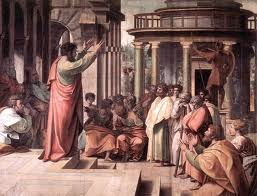
Now while Paul was waiting for them at Athens, his spirit was provoked within him as he saw that the city was full of idols. So he reasoned in the synagogue with the Jews and the devout persons, and in the marketplace every day with those who happened to be there. Some of the Epicurean and Stoic philosophers also conversed with him. And some said, “What does this babbler wish to say?” Others said, “He seems to be a preacher of foreign divinities”—because he was preaching Jesus and the resurrection. And they took hold of him and brought him to the Areopagus, saying, “May we know what this new teaching is that you are presenting? For you bring some strange things to our ears. We wish to know therefore what these things mean.” Now all the Athenians and the foreigners who lived there would spend their time in nothing except telling or hearing something new. So Paul, standing in the midst of the Areopagus, said: “Men of Athens, I perceive that in every way you are very religious. For as I passed along and observed the objects of your worship, I found also an altar with this inscription, ‘To the unknown god.’ What therefore you worship as unknown, this I proclaim to you. The God who made the world and everything in it, being Lord of heaven and earth, does not live in temples made by man, nor is he served by human hands, as though he needed anything, since he himself gives to all mankind life and breath and everything. And he made from one man every nation of mankind to live on all the face of the earth, having determined allotted periods and the boundaries of their dwelling place, that they should seek God, in the hope that they might feel their way toward him and find him.

Yet he is actually not far from each one of us, for ‘In him we live and move and have our being’; as even some of your own poets have said, ‘For we are indeed his offspring.’ Being then God’s offspring, we ought not to think that the divine being is like gold or silver or stone, an image formed by the art and imagination of man. The times of ignorance God overlooked, but now he commands all people everywhere to repent, because he has fixed a day on which he will judge the world in righteousness by a man whom he has appointed; and of this he has given assurance to all by raising him from the dead.”

Now when they heard of the resurrection of the dead, some mocked. But others said, “We will hear you again about this.” So Paul went out from their midst. But some men joined him and believed, among whom also were Dionysius the Areopagite and a woman named Damaris and others with them.

I have organized the rest of what I have to say under four topics: the realities Paul faces, the priorities he adopts, the framework he establishes, and the nonnegotiable gospel he preaches.

(1) THE REALITIES PAUL FACES

Apart from their obvious biblical illiteracy — these Athenian intellectuals had never heard of Moses, never cracked a Bible — three features of this culture are striking.

First, the Roman Empire was characterized not only by large-scale empirical pluralism but also by government-sponsored religious pluralism. The Romans knew that a captive people were more likely to rebel if they could align religion, land, and people. Partly to break up this threefold cord, the Romans insisted on adopting into their own pantheon some of the gods of any newly subjugated people, and they insisted equally strongly that the newly subjugated people adopt some of the Roman gods. In any potential civil war, therefore, it would be quite unclear which side the gods were helping — and this policy of god-swaps strengthened the likelihood of imperial peace. It also meant that religious pluralism was not only endemic to the Empire but was buttressed by the force of law After all, it was a capital offense to desecrate a temple — any temple. But let no temple and no God challenge Washington — I mean Rome.

Second, like us, Paul was dealing not with people who were biblically illiterate and therefore had no worldview, but with people who vociferously argued for various competing and powerful worldviews.

Two are mentioned in the text: Epicurean and Stoic (v. 18). In the first century, philosophy did not have the fairly esoteric and abstract connotations it has today, connected with minor departments in large universities. It referred to an entire way of life, based on a rigorous and self-consistent intellectual system — close to what we mean by worldview The ideal of Epicurean philosophy, Epicurean worldview, was an undisturbed life — a life of tranquility, untroubled by undue involvement in human affairs.

The gods themselves are composed of atoms so fine they live in calmness in the spaces between the worlds. As the gods are nicely removed from the hurly-burly of life, so human beings should seek the same ideal. But over against this vision, as we shall see, Paul presents a God who is actively involved in this world as its Creator, providential Ruler, Judge, and self-disclosing Savior.

Stoic philosophy thought of god as all-pervasive, more or less in a pantheistic sense, so that the human ideal was to live life in line with what is ultimately real, to conduct life in line with this god/principle of reason, which must rule over emotion and passion. Stoicism, as someone has commented, was “marked by great moral earnestness and a high sense of duty.” Against such a vision, the God that Paul presents, far from being pantheistic, is personal, distinct from the creation, and is our final judge. Instead of focusing on “universal reason tapped into by human reasoning,” Paul contrasts divine will and sovereignty with human dependence and need. In short, there is a massive clash of worldviews.

Of course, there were other Greek and Latin worldviews. There is no mention here of the sophists or of the atheistic philosophical materialists such as Lucretius. What is clear is that Paul here finds himself evangelizing men and women deeply committed to one fundamentally alien worldview or another.

Third, no less striking is the sneering tone of condescension they display in verse 18: What is this babbler trying to say? — this “seed picker,” this little bird fluttering around picking up disconnected scraps of incoherent information, this second-class mind? Others remarked, He seems to be advocating foreign gods. Of course, as it turns out, some of these people become genuinely interested in the gospel. The tenor of condescension is unmistakable, however, when an alien worldview feels secure in its thoughtless majority.

These, then, are the realities Paul faces.

(2) THE PRIORITIES PAUL ADOPTS

The most immediate and striking response of the apostle Paul to all that he witnesses in Athens is an intuitively biblical analysis: he is greatly distressed to see that the city was full of idols (v. 16). Paul might have been overwhelmed by Athens’ reputation as the Oxford or Cambridge or Harvard of the ancient world (though universities per se did not then exist). He might have admired the architecture, gaping at the Parthenon. But Paul is neither intimidated nor snookered by Athens; he sees the idolatry. How we need Christians in our universities and high places who are neither impressed nor intimidated by reputation and accomplishment if it is nothing more than idolatry!

The apostle sets out, then, to evangelize. He aims at two quite different groups. As usual, he attaches a certain priority to evangelizing Jews and Godfearing Gentiles, the churchy folk, the biblically literate people; he reasons in the synagogue with the Jews and the God-fearing Greeks (v. 17a). He has a theological reason for this priority that we cannot examine here, but in any case we must never forget to evangelize such people. Second, he evangelizes the ordinary pagans who have no connection with the Bible: he evangelizes day by day in the market place, targeting anyone who happens to be there, most of whom would have been biblically illiterate (v. 17b). He does not wait for an invitation to the Areopagus. He simply gets on with his evangelism, and the invitation to the Areopagus is the result (v. 18).

These, then, are his priorities: God-centered cultural analysis, and persistent evangelism of both biblical literates and biblical illiterates.

Perhaps I should add that there is at least one fundamental difference between Paul’s situation and ours. When Paul evangelizes biblical illiterates, he is dealing with people whose heritage has not in recent centuries had anything to do with biblical religion. So when they react negatively to him, they do so solely because, from their perspective, his frame of reference is so alien to their own. They are not rejecting him in part because they are still running away from their own heritage. That is the additional problem we sometimes face. We sometimes deal with men and women who have adopted a worldview that is not only at several points profoundly antithetical to a biblical worldview but also self-consciously chosen over against that biblical worldview. That opens up some opportunities for us, but it raises some additional barriers as well. However, we cannot probe these opportunities and barriers here. It is enough to observe the priorities that Paul adopts.

(3) THE FRAMEWORK PAUL ESTABLISHES

Here it will be helpful to run through Paul’s argument from 17:22 to 17:31. Before I do so, however, I want to make three preliminary observations.

First, it takes you about two minutes to read this record of Paul’s address. But speeches before the Areopagus were not known for their brevity. In other words, we must remember that this is a condensed report of a much longer speech. Doubtless every sentence, in some cases every clause, constituted a point that Paul expanded upon at length.

Second, if you want to know a little more closely just how he would have expanded each point, it is easier to discover than some people think. For there are many points of comparison between these sermon notes and, for instance, Romans. I’ll draw attention to one or two of the parallels as we move on.

Third, there is a fascinating choice of vocabulary. It has often been shown that many of the expressions in this address, especially in the early parts, are the sorts of things one would have found in Stoic circles. Yet in every case, Paul tweaks them so that in his context they convey the peculiar emphases he wants to assign to them. In other words, the vocabulary is linguistically appropriate to his hearers, but at the level of the sentence and the paragraph, Paul in this report is saying just what he wants to say; he is establishing a biblical worldview.

Now let us scan the framework Paul establishes.

First, he establishes that God is the creator of the world and everything in it (17:24). How much he enlarged on this point we cannot be certain, but we know from his other writings how his mind ran. The creation establishes that God is other than the created order; pantheism is ruled out. It also establishes human accountability; we owe our Creator everything, and to defy him and set ourselves up as the center of the universe is the heart of all sin. Worse, to cherish and worship created things instead of the Creator is the essence of idolatry.

Second, Paul insists that God is the Lord of heaven and earth and does not live in temples built by hands (v. 24). The sovereignty of God over the whole universe stands over against views that assign this god or that goddess a particular domain — perhaps the sea (Neptune), or tribal gods with merely regional or ethnic interests. The God of the Bible is sovereign over everything. This teaching grounds the doctrine of providence. Because of the universality of his reign, God cannot be domesticated — not even by temples (v. 24). Paul is not denying the historical importance of the temple in

Jerusalem, still less that God uniquely disclosed himself there. Rather, he denies that God is limited to temples, and that he can be domesticated or squeezed or tapped into by the cultus of any temple (which of course threatens popular pagan practice). He is so much bigger than that.

Third, God is the God of aseity: he is not served by human hands, as if he needed anything (17:25). Aseity is a word now largely fallen into disuse, though it was common in Puritan times. Etymologically it comes from the Latin a se — “from himself.” God is so utterly “from himself” that he does not need us; he is not only self-existent (a term we often deploy with respect to God’s origins — the existence of everything else is God-dependent, but God himself is self-existent), but he is utterly independent of his created order so far as his own well-being or contentment or existence are concerned. God does not need us — a very different perspective from that of polytheism, where human beings and gods interact in all kinds of ways bound up with the finiteness and needs of the gods. The God of the Bible would not come to us if, rather whimsically, he wanted a McDonald’s hamburger; the cattle on a thousand hills are already his.

Fourth, the truth of the matter is the converse: we are utterly dependent on him — he himself gives all men life and breath and everything else (v. 25b). This strips us of our vaunted independence; it is the human correlative of the doctrines of creation and providence.

Fifth, from theology proper, Paul turns to anthropology. He insists that all nations descended from one man (v. 26). This contradicts not a few ancient notions of human descent, which conjectured that different ethnic groups came into being in quite different ways. But Paul has a universal gospel that is based on a universal problem (cf. Rom. 5; 1 Cor. 15). If sin and death were introduced into the one human race by one man such that the decisive act of another man is required to reverse them, then it is important for Paul to get the anthropology right so that the soteriology is right. We cannot agree on the solution if we cannot agree on the problem. But Paul’s stance has yet wider implications; there is no trace of racism here. Moreover, however much he holds that God has enjoyed a peculiar covenant relationship with Israel, because he is a monotheist, Paul holds that God must be sovereign over all the nations. Did he, perhaps, develop some of the lines of argument one finds in Isaiah 40ff.? If there is but one God, that God must in some sense be the God of all, whether his being and status are recognized by all or not.

Sixth, for the first time one finds an explicit reference to something wrong in this universe that God created. His providential rule over all was with the purpose that some would reach out for him and find him (v. 27). In short order Paul will say much more about sin (without actually using the word). Here he is preparing the way. The assumption is that the race as a whole does not know the God who made them. Something has gone profoundly wrong.

Seventh, although it has been important for him to establish God’s transcendence, Paul does not want such an emphasis to drift toward what would later be called deism. The God he has in mind is not far from each one of us (v. 27). He is immanent. Paul will not allow any suspicion that God is careless or indifferent about people; he is never far from us. Moreover, the apostle recognizes that some of this truth is acknowledged in some pagan religions. When Greek thought (or much of it) spoke of one “God” as opposed to many gods, very often the assumption was more or less pantheistic. That structure of thought Paul has already ruled out. Still, some of its emphases were not wrong if put within a better framework. We live and move and have our being in this God, and we are his offspring (17:28) — not, for Paul, in some pantheistic sense, but as an expression of God’s personal and immediate concern for our well-being.

Eighth, the entailment of this theology and this anthropology is to clarify what sin is and to make idolatry utterly reprehensible (v. 29). Doubtless Paul enlarged this point very much in terms of, say, Isaiah 44-45 and Romans 1. For he cannot rightly introduce Jesus and his role as Savior until he establishes what the problem is; he cannot make the good news clear until he elucidates the bad news from which the good news rescues us.

Ninth, Paul also introduces what might be called a philosophy of history — or better, perhaps, a certain view of time. Many Greeks in the ancient world thought that time went round and round in circles. Paul establishes a linear framework: creation at a fixed point; a long period that is past with respect to Paul’s present in which God acted in a certain way (In the past God over-looked such ignorance); a now that is pregnant with massive changes; and a future (v. 31) that is the final termination of this world order, a time of final judgment. The massive changes of Paul’s dramatic now are bound up with the coming of Jesus and the dawning of the gospel. Paul has set the stage so as to introduce Jesus.

So here is the framework Paul establishes. He has, in fact, constructed a biblical worldview. But he has not done so simply for the pleasure of creating a worldview. In this context he has done so in order to provide a framework in which Jesus himself, not least his death and resurrection, makes sense. Otherwise nothing that Paul wants to say about Jesus will make sense.

This is the framework Paul establishes.

(4) THE NONNEGOTIABLE GOSPEL PAUL PREACHES

We read again verse 31: For [God] has set a day when he will judge the world with justice by the man he has appointed. He has given proof of this to all men by raising him from the dead.

Here, at last, Jesus is introduced.

I want to emphasize two things. First, it is extraordinarily important to see that Paul has established the framework of the biblical metanarrative before he introduces Jesus. If metaphysics is a sort of big physics that explains all the other branches of physics, similarly metanarrative is the big story that explains all the other stories. By and large, postmodernists love stories, especially ambiguous or symbol-laden narratives. But they hate the metanarrative, the big story that makes all the little stories coherent. But what Paul provides is the biblical metanarrative. This is the big story in the Bible that frames and explains all the little stories. Without this big story, the accounts of Jesus will not make any sense — and Paul knows it.

For instance, if in a vague, New Age, postmodern context, we affirm something like “God loves you,” this short expression may carry a very different set of associations than we who are Christians might think. We already assume that men and women are guilty and that the clearest and deepest expression of God’s love is in the cross, where God’s own Son dealt with our sin at the expense of his own life. But if people know nothing of this story line, then the same words, “God loves you,” may be an adequate summary of the stance adopted by Jodie Foster in her recent film, Contact. The alien power is beneficent, wise, good, and interested in our well-being. There is nothing whatever to do with moral accountability, sin, guilt, and how God takes action to remove our sin by the death of his Son. The one vision nestles into the framework of biblical Christianity; the other nestles comfortably into the worldview of New Age optimism. In short, without the big story, without the metanarrative, the little story or the little expression becomes either incoherent or positively misleading. Paul understands the point.

Second, what is striking is that Paul does not flinch from affirming the resurrection of Jesus from the dead. And that is what causes so much offense that Paul is cut off, and the Areopagus address comes to an end. Paul was thoroughly aware, of course, that most Greeks adopted some form of dualism. Matter is bad, or at least relatively bad; spirit is good. To imagine someone coming back from the dead in bodily form was not saying anything desirable, still less believable. Bodily resurrection from the dead was irrational; it was an oxymoron, like intelligent slug or boiled ice. So some of Paul’s hearers have had enough, and they openly sneer and end the meeting (v. 32). If Paul had spoken instead of Jesus’ immortality, his eternal spiritual longevity quite apart from any body, he would have caused no umbrage. But Paul does not flinch. Elsewhere he argues that if Christ has not been raised from the dead, then the apostles are liars, and we are still dead in our trespasses and sins (I Cor. 15). He remains faithful to that vision here. Paul does not trim the gospel to make it acceptable to the worldview of his listeners.

For Paul, then, there is some irreducible and nonnegotiable content to the gospel, content that must not be abandoned, no matter how unacceptable it is to some other worldview. It follows that especially when we are trying hard to connect wisely with some worldview other than our own, we must give no less careful attention to the nonnegotiables of the gospel, lest in our efforts to communicate wisely and with relevance, we unwittingly sacrifice what we mean to communicate.

But suddenly we overhear the muttered objection of the critic. Can it not be argued that Paul here makes a fundamental mistake? Elsewhere in Acts he frequently preaches with much greater fruitfulness, and in those cases he does not stoop to all this worldview stuff. He just preaches Jesus and his cross and resurrection, and men and women get converted. Here, a piddling number believe (v. 34). In fact, Paul’s next stop in Greece after Athens is Corinth. Reflecting later on his experiences there, Paul writes to the Corinthians and reminds them For I resolved to know nothing while I was with you except Jesus Christ and him crucified (I Cor. 2:2) — doubtless because he was reflecting with some sour-faced chagrin on his flawed approach in Athens. So let us be frank, the critics charge, and admit that Paul made a huge mistake in Athens and stop holding up Acts 17 as if it were a model of anything except what not to do. The man goofed: he appealed to natural theology; he tried to construct redemptive history; he attempted to form a worldview when he should have stuck to his last and preached Jesus and the cross.

I sometimes wish this reading were correct, but it is profoundly mistaken for a number of reasons.

(1) It is not the natural reading of Acts. As Luke works through his book, he does not at this point in his narrative send up a red flag and warn us that at this point Paul makes a ghastly mistake. The false reading is utterly dependent on taking I Corinthians in a certain way (a mistaken way, as we shall see), and then reading it into Acts 17.

(2) What Paul expresses, according to Luke’s report of the Areopagus address, is very much in line with Paul’s own theology, not least his theology in the opening chapters of Romans.

(3) Strictly speaking, Paul does not say that only a “few” men believed. He says tines de andres, “certain people,” along with heteroi, “others.” These are in line with other descriptions. The numbers could scarcely have been large, because the numbers in the Areopagus could not have been very large in the first place.

(4) Transparently, Paul was cut off when he got to the resurrection of Jesus (vv. 31-32). But judging from all we know of him — both from a book like Romans and from the descriptions of him in Acts — we know where he would have gone from here.

(5) That is entirely in line with the fact that what Paul had already been preaching in the marketplace to the biblically illiterate pagans was the cc gospel” (v. 18).

(6) At this point in his life Paul was not a rookie. Far from being fresh out of seminary and still trying to establish the precise pattern of his ministry, on any chronology he had already been through twenty years of thrilling and brutal ministry. Nor is this Paul’s first time among biblically illiterate pagans or among intellectuals.

(7) In any case, I Corinthians 2 does not cast Paul’s resolve to preach Christ crucified against the background of what had happened to him in Athens. He does not say, in effect, “Owing to my serious mistakes in Athens, when I arrived in Corinth I resolved to preach only Christ and him crucified.” Rather, in 1 Corinthians Paul’s resolve to preach Christ crucified is cast against the background of what Christians in Corinth were attracted to — namely, to a form of triumphalism that espoused an ostensible wisdom that Paul detests. It is a wisdom full of pride and rhetoric and showmanship. Against this background, Paul takes a very different course. Knowing that believers must boast only in the Lord and follow quite a different wisdom (I Cor. 1), he resolves to preach Christ and him crucified.

(8) In any case, it would be wrong to think that Paul has no interest in worldviews. Writing after I Corinthians 2, Paul can say, We demolish arguments and every pretension that sets itself up against the knowledge of God, and we take captive every thought to make it obedient to Christ (2 Cor. 10:45). The context shows that Paul is not here interested so much in disciplining the individual’s private thought life (though that certainly concerns him elsewhere) as in bringing into obedience to Christ every thought structure, every worldview, that presents opposition to his beloved Master. In other words, Paul thought “worldviewishly” (if that is not too monstrous a neologism). That is clear in many of his writings; it is clear in both 2 Corinthians 10 and in Acts 17.

(9) Finally, the first line of Acts 17:34 is sometimes misconstrued: “A few men became followers of Paul and believed.” Many have assumed Luke means that a few people became Christians on the spot and followers of Paul. But that reverses what is said. Moreover, Paul has not yet given much gospel — in precisely what sense would they have become Christians? It is better to follow the text exactly Following Paul’s address, no one became a Christian on the spot. But some did become followers of Paul. In consequence, in due course they grasped the gospel and believed; they became Christians. This is entirely in line with the experience of many evangelists working in a university environment today.

A couple of years ago I spoke evangelistically at a large meeting in Oxford. So far as I know, no one became a Christian at that meeting. But sixteen students signed up for a six-week “Discovering Christianity” Bible study. A few weeks after the meeting, the curate, Vaughan Roberts, wrote me a note to tell me that eleven of the sixteen had clearly become Christians already, and he was praying for the remaining five. In other words, as a result of that meeting, some became “followers of Jesus,” and in due course believed. That is often the pattern when part of the evangelistic strategy is to establish a worldview, a frame of reference, to make the meaning of Jesus and the gospel unmistakably plain.

In short, however sensitive Paul is to the needs and outlook of the people he is evangelizing, and however flexible he is in shaping the gospel to address them directly, we must see that there remains for him irreducible content to the gospel. That content is nonnegotiable, even if it is remarkably offensive to our hearers. If it is offensive, we may have to decide whether it is offensive because of the intrinsic message or because we have still not done an adequate job of establishing the frame of reference in which it alone makes sense. But the gospel itself must never be compromised.

SOME CONCLUDING REFLECTIONS

I offer three concluding reflections. First, the challenge of worldview evangelism is not to make simple things complicated but to make clear to others some fairly complicated things that we simply assume. This can be done in fifteen minutes with the sort of presentation Phillip Jensen and Tony Payne have constructed (in Chapter 6 of Telling the Truth – “Two Ways To Live”). It might be done in seven consecutive expositions running right through the first eight chapters of Romans. It might be done with the six months of Bible teaching, beginning with Genesis, that many New Tribes Mission personnel now use before they get to Jesus. But it must be done.

Second, the challenge of worldview evangelism is not primarily to think in philosophical categories, but it is to make it clear that closing with Jesus has content (it is connected with a real, historical Jesus about whom certain things must be said and believed) and is all-embracing (it affects conduct, relationships, values, priorities). It is not reducible to a preferential religious option among many, designed primarily to make me feel good about myself.

Third, the challenge of worldview evangelism is not primarily a matter of how to get back into the discussion with biblically illiterate people whose perspectives may be very dissimilar to our own. Rather, worldview evangelism focuses primarily on where the discussion goes. There are many ways of getting into discussion; the crucial question is whether the Christian witness has a clear, relatively simple, straightforward grasp of what the Bible’s story line is, how it must give form to a worldview, and how the wonderful news of the gospel fits powerfully into this true story — all told in such a way that men and women can see its relevance, power, truthfulness, and life-changing capacity.

*”Athens Revisited” was originally a lecture at a conference on the topic of Evangelism in a Post Modern Culture held on May 13-15, 1998 at Trinity Evangelical Divinity School in Deerfield, Illinois & sponsored by the Bannockburn Institute (www.biccc.org). All the lectures from this conference were published in the book: Telling The Truth: Evangelizing Postmoderns, Grand Rapids: Zondervan, 2000; of which D.A. Carson was the general editor and the contributor of Chapter 28 from which this article is adapted.

About the Author: D. A. Carson (Ph.D., University of Cambridge) is research professor of New Testament at Trinity Evangelical Divinity School in Deerfield, Illinois. His theology is similar to that of Wayne Grudem except on charismatic issues, where his view may be described as “open but cautious.” Carson’s tendency is to strive for balance and amicability in disputes but is uncompromising on the essentials of the faith. He is a complementarian but supports gender-neutral Bible translations. Carson also helped produce the NLT. He is the author or coauthor of over 50 books. Some of the plethora of outstanding books he has written includes: The Intolerance of Tolerance, The God Who Is There, ScandalousHow Long O Lord, A Call to Spiritual Reformation; The Cross and Christian Ministry; The Difficult Doctrine of the Love of God; Divine Sovereignty and Human Responsibility; Exegetical Fallacies; For the Love of God; The Gagging of God; The Inclusive Language Debate; Introduction to the New Testament; New Testament Commentary Survey; Scripture and Truth (Ed. with John Woodbridge); Worship by the Book; Pillar Commentaries on Matthew and John and a contributor to Who Will be Saved. He also edits the New Studies in Biblical Theology book series.

Carson’s areas of expertise include biblical theology, the historical Jesus, postmodernism, pluralism, Greek grammar, Johannine theology, Pauline theology, and questions of suffering and evil. He has written books on free will and predestination from a generally compatibilist and Calvinist perspective. He is a member of the Tyndale Fellowship for Biblical Research, the Society of Biblical Literature, the Evangelical Theological Society, the Canadian Society of Biblical Studies, and the Institute for Biblical Research.

Dr. Carson and his wife, Joy, reside in Libertyville, Illinois. They have two children. In his spare time, Dr. Carson enjoys reading, hiking, and woodworking.

7 Things You Can’t Do As A Moral Relativist by Greg Koukl

Moral relativism is the theory that denies that humans can posses any objective, universally meaningful knowledge, that there are ultimate and unchanging metaphysical realities or that there are any moral absolutes. Philosopher Peter Kreeft said that “No culture in history has ever embraced moral relativism and survived.”

If you don’t think objective moral values exist, Kreeft is an expert on that (see his website link on this blog). But what’s the problem with moral relativism? Greg Koukl of Stand to Reason (who along with Francis Beckwith wrote Relativism) wrote an excellent article in Salvo Magazine on that topic (he gives detailed reasons for each of these seven points in that article).

Here are the 7 things you can’t do as a moral relativist:

(1) Relativists Can’t Accuse Others of Wrong-Doing

(2) Relativists Can’t Complain About the Problem of Evil

(3) Relativists Can’t Place Blame or Accept Praise

(4) Relativists Can’t Claim Anything Is Unfair or Unjust

(5) Relativists Can’t Improve Their Morality

(6) Relativists Can’t Hold Meaningful Moral Discussions

(7) Relativists Can’t Promote the Obligation of Tolerance

*Greg Koukl is the founder and president of Stand to Reason (www.str.org). Greg started out thinking he was too smart to become a Christian and ended up giving his life for the defense of the Christian faith. A central theme of Greg’s speaking and writing is that Christianity can compete in the marketplace of ideas when it’s properly understood and properly articulated.

Greg’s teaching has been featured on Focus on the Family radio, he’s been interviewed for the BBC, and did a one-hour national television debate with Deepak Chopra on Lee Strobel’s “Faith Under Fire.” Greg has been quoted in U.S. News & World Report, The Philadelphia Inquirer, and the L.A. Times. An award-winning writer, Greg is the author of Tactics: A Gameplan to Discuss Your Christian Convictions, Relativism: Feet Firmly Planted in Mid-Air with Francis J. Beckwith, and Precious Unborn Human Persons. Greg has spoken on more than 50 university and college campuses both in the U.S. and abroad.

Greg received his Masters in Philosophy of Religion and Ethics at Talbot School of Theology, graduating with high honors, and his Masters in Christian Apologetics from Simon Greenleaf University. He is an adjunct professor in Christian apologetics at Biola University.

Faith, Reason & Rationality by Greg Koukl

“So let’s set the record straight. Faith is not the opposite of reason. The opposite of faith is unbelief. And reason is not the opposite of faith. The opposite of reason is irrationality. Do some Christians have irrational faith? Sure. Do some skeptics have unreasonable faith? You bet. It works both ways.” – Greg Koukl

– Quoted from the book edited by Sean McDowell & Jonathan Morrow, Is God Just a Human Invention? And Seventeen Other Questions Raised by the New Atheists, p. 30.

*Greg Koukl is the founder and president of Stand to Reason (www.str.org). Greg started out thinking he was too smart to become a Christian and ended up giving his life for the defense of the Christian faith. A central theme of Greg’s speaking and writing is that Christianity can compete in the marketplace of ideas when it’s properly understood and properly articulated.

Greg’s teaching has been featured on Focus on the Family radio, he’s been interviewed for the BBC, and did a one-hour national television debate with Deepak Chopra on Lee Strobel’s “Faith Under Fire.” Greg has been quoted in U.S. News & World Report, The Philadelphia Inquirer, and the L.A. Times. An award-winning writer, Greg is the author of Tactics: A Gameplan to Discuss Your Christian Convictions, Relativism: Feet Firmly Planted in Mid-Air with Francis J. Beckwith, and Precious Unborn Human Persons. Greg has spoken on more than 50 university and college campuses both in the U.S. and abroad.

Greg received his Masters in Philosophy of Religion and Ethics at Talbot School of Theology, graduating with high honors, and his Masters in Christian Apologetics from Simon Greenleaf University. He is an adjunct professor in Christian apologetics at Biola University.

He hosts Stand to Reason’s radio talk show advocating clear-thinking Christianity and defending the Christian worldview. Find more of Greg Koukl’s resources at http://www.str.org.

John Harper – The Unsung Hero of The Titanic – April 15, 1912

Series: On This Day in Christian History

 “John Harper’s Last Words as the Titanic Sank”

John Harper was born in Scotland in 1872 to a Christian family. When he was presented with the message of John 3:16 at the age of thirteen, he believed in Jesus and received everlasting life. When he was eighteen, he had a powerful vision of the cross of Christ. At that moment he committed his life to bringing the message of the cross to others. The very next day he began to preach in his village, urging all his hearers to be reconciled to God. He made every street corner his pulpit.

His desire to win souls to Christ was unmatched, becoming his all-consuming purpose. An evangelist friend, W.D. Dunn, recalled often seeing Harper lying on his face before God, pleading with him to “give me souls, or I die,” sobbing as if his heart would break.

At the age of thirty-two he had a near-drowning experience when he was caught on a leaky ship in the Mediterranean. He said of the experience, “The fear of death did not for one minute disturb me. I believed that sudden death would be sudden glory.”

In 1911 he spent three months preaching at Moody Memorial Church in Chicago during a revival and received an enthusiastic response. He was asked to return for three months of meetings beginning in April 1912. Originally scheduled to sail on the Lusitania, he sailed on the Titanic after a schedule change.

When he informed his church of intent to return to Chicago, a parishioner begged him not to go, saying that he had been praying and felt strongly that something ominous would happen if he went. He pleaded with Harper but to no avail. Harper felt there was a divine purpose for his trip, and Harper went ahead with his plans. The night before the ship sank, Harper was seen leading a man to Christ on the deck. Afterward, he looked to the west, and seeing a glint of red in the sunset he said, “It will be beautiful in the morning.”

The clear April night sky was filled with sparkling stars as the largest and finest steamship in the world sped through the calm waters of the icy North Atlantic. Many of the passengers had gone to bed, but some were still in the lounges, enjoying the Titanic’s many luxuries. No one was alarmed by the slight jar felt around 11:15 p.m., but many noticed when they no longer felt the vibration of the engines.

The crew of the Titanic had ignored iceberg warnings and had the ship steaming full speed ahead. Suddenly, the great vessel struck a large iceberg, which ripped the ship’s side open. Within fifteen minutes the captain realized the danger of the situation, and he had the wireless operator put out a call for assistance. Lifeboats were quickly made ready, and women and children were ordered to get to them first (Christian culture had stamped the ideas of chivalry into men, making them willing to give up their lives for women and children). There were twelve honeymooning couples aboard the ship. Though all of the new wives were saved, only one of the husbands survived.

The captain ordered the band to play to keep up the spirits of the passengers. It began playing a ragtime tune, but the musicians soon changed to playing hymns.

There were only twenty lifeboats on the huge ocean liner—barely enough for one-third of the passengers and crew. Not even all of them could be lowered. All eighty-five of the ship’s engineers continued to work to keep the ship afloat as long as possible. At the end, many people knelt together in prayer until the waters covered them.

Throughout the mournful evacuation, as loved ones were tearfully separated, the band continued to play. There is some dispute about what they played that night. Several people in the lifeboats heard “Nearer, My God, to Thee.”

One of the passengers traveling on the ship was evangelist John Harper. He put his six-year-old daughter into a lifeboat and then ran through the ship warning others of the danger and talking to them about the eternal destiny of their souls. When he was finally forced to jump into the icy water, he clung to a piece of wreckage and asked another man, “Are you saved?” When the man answered “no,” Harper said to him, “Believe on the Lord Jesus Christ and you will be saved” (quoting Acts 16:31). The man did not respond, and they lost sight of each other. Harper asked the same question again, urging the man to believe in Jesus, and received the same answer again. Harper then slipped beneath the water, never to resurface. The man did put his faith in Jesus Christ and was later rescued by a lifeboat. He testified that he was John Harper’s last convert.

When the Titanic sank early in the morning on this day in 1912, Harper was among the 1,522 people who died. The band went down with the ship. The last hymn they played was “Autumn,” which concludes with this prayer:

Hold me up in mighty waters

Keep my eyes on things above

Righteousness, divine Atonement,

Peace, and everlasting Love.

After the sinking of the ship, relatives and friends of the passengers gathered outside the White Star office in Liverpool, England. As news came in about the passengers, names were placed on one of two lists, “Known to Be Saved” or “Known to be Lost.” The voyage had begun with three classes of passengers, but now it was reduced to only two—saved or lost. John Harper’s name was placed on the list for those “Known to Be Lost,” but it was on the “Saved” list in heaven.

For Reflection:

John Harper faced death heroically and without fear because he never lost sight of his passionate purpose in life—to win souls for Christ. Imagine those last horrifying moments aboard the Titanic. If you had been there, what do you think you would have done?

“Perfect love expels all fear…” -1 John 4:18


*Significant Events on April 15th in Church History:

1729: Johann Sebastian Bach produced his St. Matthew Passion for its first and only performance during his lifetime (unless it was also performed in 1727 as some scholars think). The piece is considered his greatest work, possibly the pinnacle of Baroque music because it fused spirituality and art. Even Nietzche praised it for having the power to convey the gospel afresh to one who had forgotten it.

1950: Thirty-six leading members of religious orders in Hungary sent a protest letter to their government for abuses done to their orders.

1958: Dayuma, An Auca woman, was baptized. Her people had killed the missionaries who came to bring them the gospel.

1983: Corrie Ten Boom died on this day, her ninety-first. She protected Jews from the Nazis and was incarcerated in a concentration camp. After the war, she became an internationally known evangelist.

*Adapted from the April 15th entries in This Day In Christian History, edited by A Kenneth Curtis and Daniel Graves, Camp Hill, PA: Christian Publications. And Mike and Sharon Rusten, The One Year Book of Christian History, Carol Stream, IL: Tyndale, 2003.

How Would You Like to Have “A New Life?” By C. John Miller

(Presented by C. John Miller in A Faith Worth Sharing)

Have you ever felt there was something missing in your life? Something important but you didn’t know what? That may be the new life God wants you to have. A life of joy, peace, and fulfillment. A life…which you can receive today. Carefully consider these Five Important Facts…and find out how you can get that new life and become a brand-new person.

FACT 1 – A loving God sent His Son Jesus into the world to bring you a new and abundant life.

Jesus said, “If anyone thirsts, let him come to me and drink. Whoever believes in me, as the Scripture has said, ‘Out of his heart will flow rivers of living water” (John 7:37b-38).

Jesus also said concerning those He loves, “I came that they may have life and have it abundantly” (John 10:10b).

This new life brings you the fruit of the Spirit: “love, joy, peace, patience, kindness, goodness, faithfulness, gentleness, and self-control (Galatians 5:22).” It also gives POWER!

God’s Holy Spirit gives you the power to overcome…feelings of loneliness, stress, fear of people and the future (1 John 4:18).

And the power to break habits like…selfishness, depression, uncontrolled anger, prejudice, sexual lust, overeating, overdrinking, and drug abuse (1 Corinthians 6:9-11).

But Why Are So Many People Without This New Life?

FACT 2 – Because…people are self-centered, not God-centered.

This means that by nature you are spiritually dead and deceived (Ephesians 2:1a: “You were dead through your trespasses and sins.”

TO BE SPIRITUALLY DEAD AND DECEIVED is to be centered on yourself and not on your Creator, and to believe…

A BIG LIE

People show this, according to Romans 1:21-31 by being…unthankful to God, perverted, greedy, jealous, bitter, proud, mean, devious, and foolish.

Since man’s first sin. He has tried to be INDEPENDENT of God. Actually each human being is entirely DEPENDENT on God for breath, food, health, shelter, physical and mental abilities. THE BIG LIE: SELFISH INDEPENDENCE: self-trust, self-boasting, self-reliance, self-analysis, self-hating, self-seeking.

FACT 3 – Self-centered man is separated from a holy God by three barriers.

A Bad Record – Romans 3:23, “All have sinned and have fallen short of the glory of God.”

A Bad Heart – Mark 7:21, “From the heart of man come evil thoughts.”

A Bad Master – John 8:34, “everyone who commits sin is a slave to sin.”

The consequences of sin result in eternal separation from God. “The wages of sin is death (Romans 6:23a)…whoever does not obey the Son shall not see life, but the wrath of God remains on him (John 3:36b).”

NOW:

A dry, thirsty, unsatisfied life.

A guilty, accusing conscience (depression, fears, anxiety).

An aging body that must shortly die.

FUTURE:

Loss of friendship and earthly joys forever (Matthew 8:12).

Frightful pains of body and conscience forever (Mark 9:48).

Dreadful thirst of soul and body forever (Luke 16:19-31).

FACT 4 – God’s Solution! No barriers!

A Perfect Record – 1 Corinthians 1:30, “Christ…is made our righteousness.”

A New Heart – Ezekiel 36:25-26, “A new heart I will give you.”

A Good Master – Matthew 11:28-30, “Come to me, all who labor and are heavy laden, and I will give you rest. Take my yoke upon you, and learn from me, for I am gentle and lowly in heart, and you will find rest for your souls. For my yoke is easy and my burden is light.”

“The blood of Jesus, God’s Son, cleanses us from all sin” (1 John 1:7b).

The Benefit of Jesus’ Death…Love’s Biggest Gift

“The free gift of God is eternal life through Christ Jesus” (Romans 6:23b). Jesus, the God-man, is the biggest gift of the Father’s love. On the cross Jesus suffered all the torments of hell as a substitute for His people (John 3:16; 10:15). He was legally condemned by God as their representative, removing the barriers of a bad record, a bad heat, and a bad master. The Father’s love can do no more. Risen from the dead, Jesus now lives to give you a new record, a new heart, Himself as a new master—and the free gift of eternal life now!

You Need to Make Sure

God says you either have a NEW LIFE or you are a lawbreaker DEAD in your self-centeredness. Are you personally alive or dead? If you are still dead, you need to know…

FACT 5 – How to receive the Lord Jesus into your life…

  1. Turn…In sorrow from your sins: “Seek the LORD while he may be found; call upon Him while He is near; let the wicked forsake his way, and the unrighteousness man his thoughts; let him return to the LORD, that he may have compassion on him, and to our God for he will abundantly pardon” (Is. 55:6-7).
  1. Trust…in Jesus alone to save you:Believe in the Lord Jesus, and you will be saved (Acts 16:31a)…I am the way the truth and the life, no one comes to the Father except through me” (John 14:6).

Repentance is…not our suffering or our good works to earn our salvation, but a turning from our sins to the living God through Jesus Christ.

Trust in the Lord Jesus is…accepting, receiving, and resting on Him alone as the Savior from our sins.

Begin a NEW LIFE

Will you surrender your life to Christ by turning from your self-centered way and trust in Him alone? Here is a guideline to help you confess your sins and come to know God through taking the Lord Jesus Christ as your own personal Savior.

Make this Verbal Profession & Confession of Faith:

“Heavenly Father, I am really a selfish person. I have wanted my own way—not Yours. I have often been jealous, proud, and rebellious. You are my Creator, but I have acted as though I was lord of all. I have not been thankful to You. I have not listened to Your Word the Bible and have not loved Your Son. But now I see that all my sin is against You. I now repent of this evil attitude. I turn from all of my sins and trust that Jesus has shed His precious blood to cleanse me from all my guilt. I now receive Him as mu Savior and the Lord of my life.”

I, ______________, turn from my sins and take Christ as my Lord and Savior. By His help I promise to obey Him in every part of my life.

How Does This New Life Continue? The same way it began—in faith and prayer.

  1. Pray constantly. Prayer is talking to God. Keep doing it all the time. Include in it praise, thanksgiving, confession of sins, petitions for others’ salvation, and requests for help.
  1. Read your Bible. Study your Bible every day. It is the food for your new life and your sure guide. In it you meet Jesus and learn to claim His promises for your life.
  1. Worship with others. Meet with a church where the Bible is taught and obeyed and where Jesus Christ is Lord and Savior.
  1. Witness to others. Tell your friends what Christ has done for you—and wants to do for them. Be tactful and back up your words by improvement in manners and doing deeds of kindness.

World Harvest Mission – 100 West Ave. W960 – Jenkintown, PA 19046-2697

Dr. R.C. Sproul Answers the Question: “Can We Trust the Bible?”

Objection #1 Answered: “The Bible is Full of Myths and Contradictions. It’s just a Fairy Tale.”

(This is #1 in a series of book excerpts from Objections to Christianity derived from Chapter 1 in *Dr. R.C. Sproul’s fantastic book Reason To Believe, [originally entitled Objections Answered] Grand Rapids: Zondervan, 1982, pp.19-34)

Christians, to support their claim of revealed truth, appeal to a book that was written hundreds of years ago. This book—the Bible—has been a subject of an enormous amount of study and criticism which has left the integrity of its trustworthiness seriously in doubt. If the Bible were universally regarded as an authoritarian source book for religious truth, many of the questions we will deal with in Reason to Believe would be easily resolved. But the authority and trustworthiness of the Bible is presently the question.

It is well beyond the scope of this [article] to give a comprehensive defense of the integrity of Scripture. Such a comprehensive defense would involve so many complex matters that it deserves a separate treatment. A large number of such works have been published in recent years (e.g., F.F. Bruce, The Canon of Scripture, The Defense of the Gospel in the New Testament, The New Testament Documents: Are they Reliable?; and Walter Kaiser, The Old Testament Documents: Are They Reliable?). But, several common questions about the integrity of Scripture are dealt with briefly here.

Is the Bible Full of Myths?

That the Bible is a book of myths is a common charge leveled by its critics. Since myths have no counterpart in historical truth, they are considered to be worthless sources of truth. One dictionary of myth terms it as “any fictitious story.”

Why is it so often said that the Bible is full of myths? A chief reason is because of the numerous accounts of miracles that are found in its pages. Another reason is because of parallel accounts between such things as the biblical view of the flood and that found, for example, in Babylonian mythology.A third reason why the presence of myth is suspected is because there exist similarities between events surrounding Jesus and portraits of the gods found in Greek mythology. These three reasons serve as the substantial basis for attributing a mythological character to biblical literature.

A question of miracle is not merely a question of literary style but it involves important questions of history and philosophy. If a miracle is rejected as a myth then the issue becomes one of the philosophy of nature and history rather than one of literary analysis. Before miracles can be rejected out of hand as ipso facto impossible, the critic must first establish that we are living in a closed mechanistic universe in which there exists no possibility of divine or supernatural intrusion. On the other hand, if there is a God who is omnipotent, then miracles are possible and accounts of them cannot be gratuitously dismissed as myths.

If we allow that miracles are possible that does not mean that every claim to them is valid. It is one thing to say that miracles could have happened; it is quite another to say that miracles could have happened; it is quite another to say that they did happen. As we deal with the question of an alleged miracle we must deal with it not only on the grounds of the possibility, but on the evidence that is offered to support its claim.

One of the interesting elements of biblical miracles involves the sobriety of the accounts. Compare, for example, miracle narratives of the New Testament with those found in the Gnostic literature of the second century. The Gnostic “miracles” display a flavor and atmosphere of the bizarre and frivolous. New Testament miracles take place in a context of a sober view of history and redemption. Those who claim them are men of obvious profound ethical integrity and men who are willing to die for their veracity. When evaluating the claims of biblical miracles it is important to understand the total value system of those who are making the claims. The biblical writers, in the Judeo-Christian tradition, write with a constraint that involves a profound commitment to the sanctity of truth. Peter for example writes, “We do not declare unto you cleverly devised myths or fables but rather what we have seen with our eyes and heard with our ears” (1 Peter 1:16).

Because there are parallel accounts of ancient events found in the Bible as well as in ancient mythological literature, this is no justification for impugning the writers of Scripture on the basis of the fallacy of guilt by association. If we assume, for example, that there was a natural catastrophe such as the flood in the ancient world, it should not surprise us that the event is reflected on the writings of other ancient people. The Christian welcomes a close study of comparison between the biblical account of the flood and that found, for example, in the Gilgamesh Epic (The Babylonian account of the Flood that covered the earth). That the biblical account is already demythologized appears self-evident.

The charge that the New Testament surrounds the person of Christ with mythology is often inferred from similarities of dying and rising gods in Greek mythology such as fond in Ovid’s Metamorphoses. However, in a comparative examination of any object or event under analysis the scientific method demands that we note not only the similarities but the differences as well. Mythic creatures that are half man and half beast, for example, are noticeably absent from the Scriptures. Bizarre stories about the creation of the universe are also conspicuously absent. The world, for example, is nowhere described in Scriptures as an appendage of a god; nor do we see notions of the world coming into being as the result of sexual acts of procreation among the gods. Though Jesus is virgin born, He does not spring anew out of the head of Zeus.

At the heart of the difference between Greek mythology and biblical literature is a radically different view of the significance of history. For the Greek there is no overt attempt to ground myth within the framework of history. Indeed, for the gods to become actually incarnate in the realm of space and time is utterly repugnant to the Greek mind. On the other hand that which is non-historical is relegated to the level of falsehood by the Hebrew. This radical opposing view of history is essential to understanding the Jewish-Greek antithesis with respect to the question of myth.

Does the Bible Conflict with Science?

Perhaps nothing has contributed more to the loss of credibility of Scripture than the conflicts between religion and science that have come out in the scientific and technological revolution. We remember the condemnation of Galileo and the circus atmosphere of the Scopes “Monkey Trials.” Galileo was condemned for teaching that the sun was the center of our solar system (heliocentricity) over against the accepted view that the earth was the center (geocentricity). The bishops of the church in Galileo’s day refused to look into his telescope and examine the empirical evidence that the earth is not the center of our solar system. The church is still feeling the embarrassment of that episode.

Some argue that the Bible teaches a view of reality that is utterly in conflict with the assured results of modern scientific inquiry. Some allege that the Bible teaches a primitive, prescientific view of the universe which is no longer tenable to modern man. The Bible describes the universe as being “three-storied” with heaven above, the earth in the middle, and hell underneath the earth. It describes a world of demons and angels which is considered in conflict with modern theories of physics and biology.

How does the Christian respond to such allegations? In the first place, it must be acknowledged that the church indeed has made grievous errors in drawing scientific inferences from Scripture that are unwarranted. Nowhere does the Bible “teach” that the earth is the center of the universe. The Scripture describes nature from a phenomenological perspective. That is, the world of nature is described as it appears to the naked eye. The sun is described as moving across the heavens. The Bible speaks of sunrises and sunsets. And in popular speech modern scientists still speak in the same manner. One only needs to observe the daily weather forecast to see this taking place. The weather report, or “meteorological” survey, is couched in technical scientific jargon. We hear about high pressure systems, barometric pressure, precipitation probability quotients, and the like. Yet at the end of the forecast we are told that the sun will rise at a given time and will set at another time. We do not phone the news station and angrily demand that such antiquated notions of geocentricity be deleted from the weather forecast. We do not charge the scientists with being unscientific when the describe things phenomenologically. We shouldn’t do that with the biblical writers either.

That the Bible speaks of a demonic world is evident. The Bible does not, however, teach that diseases and other mysterious maladies are caused by demonic activity. The Scriptures recognize and endorse the practice of medicine. I might add that the notion of the existence of a demonic world conflicts with no known natural scientific law.

The Bible is not a textbook of science. It does not purport to instruct us in matters of calculus, physics, or chemistry. There are times, however, when serious conflicts do emerge between theories inferred from science and biblical teaching. If, for example, a scientist concludes that the origin of man is a cosmic accident, then the scientist holds a position that is antithetical to the teaching of Scripture. But the question of man’s origin can never be determined by the study of biology. The question of origin is a question of history. The biologist can describe how things could have happened, but can never tell us how they did happen.

Is the Bible Filled with Contradictions?

People accept without hesitation the charge that the Bible is full of contradictions. Yet the charge is completely inaccurate and misleading. Why, then, if the charge is so inaccurate, do we hear it so often repeated? Apart from the problem of prejudice, there are reasons why this misconception is propagated. There is a problem not only of ignorance of what the Bible says, but perhaps even more so, a problem of ignorance of the laws of logic. The word “contradiction” is used all too loosely with respect to biblical content. That there are divergences of biblical accounts, that biblical writers describe the same things from different perspectives, is not in dispute. Whether, those varied accounts are, in fact, contradictory is in dispute.

It would be a serious overstatement to say that all discrepancies within the biblical text have been easily and satisfactorily resolved. There are serious discrepancies that have not yielded full and satisfactory resolutions. But these problems are few and far between. To say that the Bible is full of contradictions is a radical exaggeration and reflects a misunderstanding of the law of contradiction. For example, critics have alleged repeatedly that the Gospel writers contradict each other with respect to the number of angels present at the tomb of Jesus. One writer mentions one angel and the other mentions two angels. However, the writer who mentions one angel does not say there was only one angel. He merely speaks of one angel. There is no contradiction in that. Now, if one writer said there was only one angel and the other writer said there were two, at the same time and in the same relationship, there would be a bonafide contradiction.

The problem of the loose use of the word contradiction came home to me in a discussion I had with a seminary student. He repeated the charge, “The Bible is full of contradictions.” I said to him, “The Bible is a large book. If it is full of contradictions you should have no problem finding 50 clear violations of the law of contradiction in the next 24 hours. Why don’t you go home and write down 50 contradictions and we’ll discuss them at the same time tomorrow.” He accepted the challenge.

The next day he returned bleary-eyed with a list of 30 contradictions. He admitted that he had work long into the night and could come up with only 30. But he presented me a list of the most blatant contradictions he could find. (He made use of critical books that listed such contradictions.) He went through his list, one at a time, applying the test of formal logic to each alleged contradiction. We used syllogisms, the laws of immediate inference, truth tables, and even Venn diagrams to test for logical inconsistency and contradictions. In every single incident we proved objectively, not only to my satisfaction, but to his, that not a single violation of the law of contradiction was made.

Not every biblical discrepancy has been resolved. But the direction of the evidence is very encouraging. As biblical scholarship increases and knowledge of language, text, and context increases, the problem of discrepancy becomes smaller and smaller. There is less reason today to believe that the Bible is full of contradictions than at any time in the history of the church. Prejudice and critical philosophical theories, however, die a very slow and hard death. 

Is The Bible Inaccurate Historically?

If any area of biblical scholarship has given us reason for optimism concerning the reliability of Scripture, it is the area of historical investigation. To be sure there are certain dimensions of biblical content that are difficult to either verify or falsify by means of historical research. For example, the existence of angels can hardly be verified through archaeological research. Unless we can dig up some petrified angel wings we must deal with these matters on other grounds. But where biblical material touches on areas where historical research is possible it has come out remarkably well.

Twentieth-century discoveries such as those at Ugarit, Qumran and Ebla have done much to enhance our understanding of antiquity. The Nuzi tablets and the Armana tablets have resolved a host of Old Testament problems. The work of Ramsey tracing the journeys of Paul recorded by Luke has so vindicated Luke’s accuracy as a historian, that modern historians have called him the finest historian of antiquity. The biblical historians have fared considerably better under close scrutiny and critique than have other ancient historians such as Josephus and Herodotus.

The Christian has nothing to fear from righteous historical research. Rather, we have everything to gain. To illustrate the weight of historical research let us note one of the last statements in print by the dean of archaeological scholarship in the twentieth century, Dr. William Foxwell Albright:

For much too long a time the course of New Testament scholarship has been dedicated to theological, quasitheological, and philosophical presupposition. In far too many cases commentaries on New Testament books have neglected such basic requirements as up-to-date historical and philological analysis of the text itself. In many ways this preoccupation with theological and metaphysical interpretation is the unacknowledged child of Hegelianism. To this should be added the continuing and baleful influence of Schleiermacher and his successors on the whole treatment of historical material. The result has often been steadfast refusal to take seriously the findings of archaeological and linguistic research. We believe that there is less and less excuse for the resulting confusion in this latter half of the twentieth century. Closely allied with these presuppositions is the ever-present fog of existentialism, casting ghostly shadows over an already confused landscape. Existentialism as a method of interpreting the New Testament is based upon a whole series of undemonstrable postulates of Platonic, Neo-Platonic, left-wing scholastic, and relativistic origins. So anti-historical is this approach that it fascinates speculative minds which prefer clichés to factual data, and shifting ideology to empirical research and logical demonstration (W.F. Albright and C.S. Mann, Matthew, Anchor Bible Series, New York, Doubleday, 1971, vol. 26, 5-6). 

Why Is Some of the Bible Offensive?

Apart from questions of mythology, contradiction, conflict with science, and historical inaccuracy, people have rejected the Bible because the content of it is considered offensive. In particular, biblical expressions of the wrath of God have been singled out for criticism. The Old Testament is criticized for portraying a God who is merciless and arbitrary in His judgment. It is frequently stated, “I have no problems with the loving God of the New Testament, it is the angry God of the Old Testament I reject.”

In such reactions to the Old Testament, we find serious misunderstandings of the wrath of God. Nowhere do we find God involved in capricious or arbitrary acts of judgment. His wrath is never directed against the innocent. His anger never flows without reason. It is always directed against human rebellion and sin.

It is ironic that the two Testaments are so often placed in contrast to each other. The irony may be seen in light of the cross. It is the cross of the New Testament that reveals the most violent and mysterious outpouring of the wrath of God that we find anywhere in the Scripture. Here an innocent man does suffer but only after he willingly takes upon Himself, by imputation, the sins of the world. Without this act of wrath there is no grace. But it is precisely through this act of wrath that grace is made available. The New Testament knows no disjunction between the God of Jesus and the God of Abraham. Jesus appeals to the God of the Old Testament fathers as the God He is serving and revealing.

The Old Testament, in spite of its manifestations of the wrath of God, remains a history of God’s grace and long-suffering with a rebellious people. There is wrath unparalleled in the New Testament and grace overwhelming in the Old Testament. A false dichotomy between the Testaments is foreign to the biblical writers themselves.

When we examine the law code of Israel, however, do we not see a legal ethic that is in fact bloodthirsty? Does not this list of over 35 crimes which require capital punishment reflect a barbarian ethic? Are not the punitive measures of the Old Testament manifestations of what we would regard as cruel and unusual punishment?

The law code of the Old Testament seems harsh to us in light of our present societal standards. But we live in an age where serious sin is not taken seriously. We live in an age where the holiness of God and the sanctity of human life have been sadly eclipsed. If we compare the law of the Old Testament with the law of creation, we see not the cruelty of God but the mercy of God. In creation all sin against God is regarded as a capital offense. In the slightest act of rebellion we commit cosmic treason. Any sin against a perfectly holy and righteous God may justly culminate in death. This the Old Testament law represents a massive reduction of capital crimes which reveals not the bloodthirsty vengeance of an angry God, but the long-suffering mercy of a holy and loving God.

It is precisely at the point of offense in Scripture that we meet a special opportunity for supernatural instruction. By studying the parts of Scripture that are offensive to us we have the opportunity to discover those values and concepts we hold that are out of harmony with the wisdom of God. If we are offended by the Bible perhaps the fault is not with God but our own corrupt and distorted sense of values. I wonder what would happen if we called a moratorium on our criticism of the Bible and allowed the Bible to criticize us!

Are Scriptures Infallible?

It is one thing to argue that the Bible is a basically reliable source of history and religious instruction; it is quite another thing to assert that the Bible is inspired, inerrant, and infallible. It is one thing to maintain that the Bible has great value as a treasury of human insight into religious truth; it is quite another to maintain that it provides us with divine revelation and can justly be called the Word of God.

Why do Christians go beyond asserting general reliability of the Bible to conviction that the Bible is the infallible Word of God? What follows is not an attempt to present an argument for the infallibility of Scripture, but rather an attempt to outline the procedure by which such a conclusion is reached. It is beyond the scope of this article to provide a defense of biblical infallibility. Rather the aim is to explain and clarify the process by which the conclusion is reached.

The case for the infallibility of Scripture proceeds along both deductive and inductive lines. It moves from the premise of general trustworthiness to the conclusion of infallibility. The reasoning process proceeds as follows:

Premise A – The Bible is a basically reliable and trustworthy document.

Premise B – On the basis of this reliable document we have sufficient evidence to believe confidently that Jesus Christ is the Son of God.

Premise C – Jesus Christ being the Son of God is an infallible authority.

Premise D – Jesus Christ teaches that the Bible is more than generally trustworthy; it is the very Word of God.

Premise E – The word, in that it comes from God, is utterly trustworthy because God is utterly trustworthy.

Conclusion – On the basis of the infallible authority of Jesus Christ, the church believes the Bible to be utterly trustworthy, i.e., infallible.

Note that this progression does not involve circular reasoning. Circular reasoning occurs when the conclusion is already present in the first presence. Rather this method follows the linear pattern of development. The argument itself is not infallible as each premise involves matters of inductive or deductive reasoning that is done by fallible human beings. But there is no subjective leap of faith found in the method. Rather the process involves careful historical, empirical investigation as well as logical inferences.

That the Bible claims to be the Word of God is not enough to authenticate the claim. Any book can make such a claim. But the fact that the claim is made is significant indeed. If the Bible is trustworthy then we must take seriously the claim that it is more than trustworthy. If we are persuaded that Christ is the sinless Son of God then we must take seriously His view of Holy Scripture. If the church submits to the authority of Christ then it must regard His view of Scripture as being authoritative. It is from the impetus of Christ Himself that the church is led to confess her faith in the divine authority and infallibility of Scripture.

In a symposium of biblical scholars and theologians that was held in the Ligonier Valley in Pennsylvania in the fall of 1973, a joint team of scholars issued a statement on Scripture that focuses on the authority of Christ as the ground-basis for biblical authority. This “Ligonier Statement” says:

We believe the Holy Scriptures of the Old and New Testaments to be the inspired and inerrant Word of God: We hold the Bible, as originally given through human agents of revelation, to be infallible and see this as a crucial article of faith with implications for the entire life and practice of all Christian people. With the great fathers of Christian history we declare our confidence in the total trustworthiness of Scriptures, urging that any view which imputes to them a lesser degree of inerrancy than total, is in conflict with the Bibles’ self-testimony in general and with the teaching of Jesus Christ in particular. Out of obedience to the Lord Jesus Christ we submit ourselves unreservedly to his authoritative view of Holy Writ.

 Key Points to Remember:

Why should you trust the Bible? You should trust the Bible because the Bible has been proven trustworthy.

(1) The Bible does not have a mythical literary style as compared with other ancient literature. The frequent charge that the Bible is “full of myths” is not warranted by the facts. People should be encouraged to read the biblical accounts of miracles, the flood, and other controversial areas and compare them with other ancient sources that do use mythology as a literary style.

(2) Jewish-Christian history differs from the Greek view. This significant difference is a crucial one to understand before we evaluate the historical credibility of the Bible.

(3) The Bible is not a science text but describes the world as it appears to the naked eye. Biblical “conflicts” with science must be understood in terms of common-sense approaches to the “phenomenal” world. The concept of phenomenological description is important to master to be able to deal with this question. We should learn from the church’s mistakes in the past—such as the case of Galileo.

(4) Variant accounts are not the same as contradictory accounts. The charge that the Bible is “full of contradictions” is unwarranted. An understanding of the Law of Contradiction is vital to this question. Close scrutiny of biblical texts will show a difference between variant accounts and contradictory accounts.

(5) Modern historical research adds to biblical credibility. Historical research and archaeology have done much to vindicate the historical reliability and accuracy of the Bible. Important discoveries at Qumran, Ebla, Amarna and elsewhere have exploded the “assured results” of negative nineteenth-century criticism.

(6) The church’s faith in the infallibility of Scripture is established on the basis of Christ’s view of Scripture. It involves a reasoning process which is linear, not circular. It moves from general reliability to a knowledge of Christ’s “infallible” view of Scripture.

*Dr. R.C. Sproul (1939-2017) was the founder and chairman of Ligonier Ministries, an international Christian education ministry located near Orlando, Florida. His teaching can be heard on the program Renewing Your Mind, which is broadcast on hundreds of radio outlets in the United States and in 40 countries worldwide. He is the executive editor of Tabletalk Magazine and general editor of The Reformation Study Bible, and the author of more than seventy books (including some of my all time favorites: THE HOLINESS OF GOD; CHOSEN BY GOD; KNOWING SCRIPTURE; WILLING TO BELIEVE; REASON TO BELIEVE; and PLEASING GOD) and scores of articles for national evangelical publications. Dr. Sproul also serves as president of Ligonier Academy of Biblical and Theological Studies and Reformation Bible College. He currently serves as Senior Minister of preaching and teaching at Saint Andrew’s in Sanford, FL

Book Review: The Explicit Gospel by Matt Chandler

The Antidote to Gospel Inoculation

When Saint Augustine was living a life of licentiousness many generations ago he was hearing some children playing near where he was seated, playing a game with the refrain “Take up and read, take up and read.” He picked up his Bible and opened it to the book of Romans and proceeded to read about his sin and his desperate need of the provision of Christ’s imputed righteousness by faith in his death, burial, and resurrection in exchange for his sin. He was convicted of his sin and powerfully drawn by the work of the Holy Spirit toward faith and repentance in the person and work of Christ.

Whether you are a rebel, or someone who has heard the gospel (or what may pass for the gospel today) – you are well advised to take up this book and read it. In the past men like Augustine, Luther, and Calvin understood with passion and clarity our need to comprehend the richness and depth of the gospel, and proclaim it with passionate urgency – because souls are hanging in the balance. In this book Chandler definitively understands and articulates the power of the gospel and the desperate need we all have to understand the depth of our sin before a Holy God, and the just requirements He has that we have failed to meet, and thus our desperate need for what Christ came to save us from and unto.

In three parts Chandler clearly articulates the gospel essentials (God, Man, Christ, and our response); the gospel’s theological underpinnings (Creation, Fall, Reconciliation, and Consummation); and lastly its implications and applications for all of the aspects of our lives. The author is to be commended for writing a book that is passionate about the gospel; clearly articulates the gospel; calls for a response to the gospel; and demonstrates how to communicate and live out the gospel.

I highly recommend this book especially for preachers who proclaim the word of God week in and week out. He will inspire you to NOT compromise the gospel and to rest in the work of the Holy Spirit in applying it’s power in the lives of your people. My hope and prayer is that in reading this book your passion will be stirred to unflinchingly proclaim the gospel powerfully in truth and love – resulting in the saving of many lives. I think that the Apostle Paul would wholeheartedly agree with all that Chandler articulates in this book and would add, “For I am not ashamed of the gospel (as conveyed in this book), for it is the power of God for salvation to everyone who believes, to the Jew first and also to the Greek” (Rom. 1:16).

Matt Chandler is the lead pastor of The Village Church, a multi-campus church in the Dallas metroplex of over 10,000 people. He has recently taken the post as President of the Acts 29 Church Planting Network. His sermons are among the top selling (free) podcasts on itunes and he speaks at conferences worldwide. Prior to accepting the pastorate at The Village, Matt had a vibrant itinerant ministry for over ten years where he spoke to hundreds of thousands of people in America and abroad about the glory of God and beauty of Jesus. He lives in Texas with his wife, Lauren, and their three children: Audrey, Reid and Norah.

From LSD to PH.D By Michael L. Brown

How A Rebellious, Heroin-Shooting, Rock-Drumming Jewish Teen Found Out That Jesus Was the Messiah – By *Dr. Michael L. Brown

 “I’m, burning in hell! I’m, burning in hell!”

 It was 1:30 in the morning, the first week of September 1971. I was only sixteen years old, but already I had earned the nicknames “Drug Bear” and “Iron Man.” I could do greater quantities of drugs than any of my friends — and live to brag about it! Whether I was shooting heroin or using hallucinogenics like LSD and mescaline, taking mega doses of drugs had become my lifestyle. But this time I went too far. I took enough mescaline for thirty people, and my friends put me on a bus alone, sending me home to fend for myself. They thought it was a big joke! Actually it was a matter of life and death.

I became delirious on the bus and got off too soon, more than a mile from my family’s home on Long Island, New York. As I walked slowly towards the house, I thought the journey would never end. I became disoriented and got lost just two blocks from home. I sat down on the ground in mental torment, feeling like I had entered a maze from which I could never get out. I thought I had died and gone to hell.

Then, at that late hour of the night, a friend of my parents came by, walking his dog. He looked at me with shock as I screamed, “I’m burning in hell!” I was shocked too. “Why is he walking his dog in hell?” I wondered.

As soon as he walked away, I made a decision: “I’m going to jump in front of the next car that comes by. I can’t take it any longer.” I was losing my mind.

Within minutes, a car came racing around the corner. I jumped into the road directly in front of the car and threw my hands in the air. The car came to screeching halt just inches from my body. It was my parents! The man with the dog had gone to my house and, deeply shaken, told them what he had seen. They came looking for me. They were ready to stop at that very corner. If it had been any other car I would have been killed.

But what was I doing there anyway, stoned out of my head? How did a nice Jewish boy like me get so messed up? And why was I thinking about hell? Let me tell you the story. I think you’ll be interested to hear what happened!

I was born in New York City in 1955. My father was the senior lawyer in the New York Supreme Court, and he and my mother were as happily married as any couple that I have ever known. My upbringing was typical of many New York, Conservative Jewish children. We moved to Long Island, I did well in school, I played lots of sports, and, like all my friends, and I basically stayed out of trouble. But something changed. It all began innocently enough . . .

When I was eight years old I started to play drums. There was no question that I had ability. In fact by the time I was fifteen I had played on a studio album. But my favorite music was rock, and after my Bar Mitzvah in 1968, I got interested in playing in a band. I wanted to be a rock drummer, and all my role models were known for their heavy drug use, rebellion, and flagrant immorality. I wanted to be like them!

In 1969, at the age of fourteen, when I was asked if I wanted to try smoking pot, I was only too happy to oblige. Soon I tried smoking hash too. But neither one had any effect on me. So I tried harder drugs until I started using ups, downs, and LSD. “But I’ll never do anything worse than that,” I thought. Yet I was deceived. Soon I starting using speed, then I started shooting speed. (Of course, I had been sure I would never put a needle in my arm!). Then, I got the opportunity to try heroin. I loved it! I was fifteen years old.

By the time I was sixteen, my grades began to go down in school, and drugs, rock music, and filthy living were my daily portion. For fun, my friends and I even broke into some homes and a doctor’s office. We experimented with the drugs we found and almost killed ourselves. But after all, we were cool! We were doing “our thing.” And one day we would be famous rock stars!

Less than one year later, I was living for God and telling people about Jesus, the Messiah and Lord of both Gentile and Jew. Today, I have traveled around the world preaching and teaching. I have had the privilege of speaking on university campuses (including Harvard and Yale), written books and articles that have been translated into more than a dozen languages, debated and dialogued with rabbis on radio and TV, and earned a Ph.D. in Near Eastern Languages and Literatures from New York University, lectured as a visiting professor at leading theological institutes, and served as president of two Bible colleges. The Creator of the universe is now my Father, Jesus the Messiah is my best and closest Friend, I live my life free of anxiety and fear, and the peace and joy of God renew me every day.

“Well,” you might say, “you were just messed up. You were looking for something. You needed to change.”

To be perfectly truthful, I was messed up, and I was looking for something — but it was not God! And I absolutely did not want to change. I had found my lifestyle, and I loved it! I enjoyed using drugs. I enjoyed my music. I enjoyed fulfilling the lusts of the flesh. What I was looking for was more sinful pleasure and more musical excellence, leading to more recognition as a rock drummer.

As for Jesus, he was no more important to me than Muhammad or any other foreign religious figure. After all, I was Jewish! And, I thought, if there really is a God, He knows that, deep down, I have a good heart. If there is a heaven, He’ll surely accept me. In spite of my lying, my drugs, my drinking, my pride, my rebellion, my stealing, my immorality, my filthy mouth and mind, I thought that I really was a pretty good person. Little did I know then that the Bible said: “All a man’s ways seem innocent to him, but it is the LORD who weighs the hearts.” And, “There is a way that seems right to a man, but in the end it leads to death.” Human nature always tries to justify itself!

During the spring of 1971, my two best friends (and members of my band) began attending a little gospel-preaching church. Why? Because they liked two girls who went there! And why did the girls go? Because their uncle was the pastor and their father was praying for them. Then, in August, I went to the church too. Why? Because I wanted to pull my friends out! They were beginning to change, and I didn’t like that. They weren’t partying the way they used to. I had to stop them before it was too late. You can guess what happened. I lost the fight! The love of the people began to break down my stubborn pride, and, totally unknown to me, their prayers began to have an impact. Something started to get under my skin! I actually began to feel guilty about the filthy things I was doing.

Amazingly enough, until that time, I had never experienced the slightest remorse for stealing money from my own father, or putting my parents through all kinds of grief because of my drug use, or double-crossing my best friends, or viciously cutting down anyone I didn’t like with my sharp, cruel sharp tongue. Now, something was happening. When I couldn’t sleep at night after pumping myself up with methadrine or swallowing several tabs of amphetamine-laced LSD, I started to feel uncomfortable with my lifestyle, seeing myself as more of a jerk than a cool teenager, and I began to dread those long night hours, alone with a feeling of being unclean, alone with my sin.

Of course, at that time, I had no idea that this was something called “conviction,” a wonderful process through which God shows us just how sick we really are – in order to make us whole. And I made no connection between this sudden change in my attitude and the prayers of these sincere Christians. Instead, I made a decision: I won’t use any drugs that keep me up at night! And I stayed away from the church for the next three months.

When I finally returned there in November, something completely unexpected happened to me. It was not what I was anticipating! For the first time in my life I believed that Jesus died for me (in other words, He paid the penalty that I deserved, He died in my place) and that He rose from the dead.

This did not strike me as especially good news! How can I say that? Simple. It was one thing for my friends to truly put their faith in Jesus. After all, one was Methodist and the other was Russian Orthodox. Even though they were only Christian in name, becoming a Christian in truth didn’t seem to me like such a big religious jump. I thought the different Christian religions were close enough!

But for me, a Jew (even a non-religious Jew), how could I believe in Jesus? (Please remember: At that time, I didn’t realize that his Hebrew name was Yeshua and that his mother’s Hebrew name was Miriam, or that “Christ” meant “Messiah,” or that he came into the world to save his Jewish people, or that he lived and died as a faithful Jew.) For me, Jesus was only for the Gentiles. (Again, you have to excuse my ignorance!)

But there was a much bigger problem I faced: Following Jesus and getting into a right relationship with God meant I had to turn away from my sins. I didn’t want to do that! There was too much pleasure in my sin. And how could I be a famous rock drummer and a good, clean churchgoer at the same time? Plus, I was too proud to admit that I could be wrong. (Some people would rather die than admit they are wrong.) I was as stubborn as they come. And how I loved to argue. (After all, I was the son of an excellent lawyer!) Yet somehow, God’s goodness and patience overcame my stubbornness, my pride, my sinful habits, and my religious misunderstandings. By the end of 1971 I was a new man! The heavenly Father intervened in my affairs, making me to know that I was guilty in his sight, exposing the corruption of my heart, and showing me a new and better way.

What does all this have to do with you? Let me explain. You see, I was not a sinner because I was shooting heroin. I was shooting heroin because I was a sinner. Sin takes on many forms. But in God’s sight, all of us are sinners. In other words, all of us stand guilty in the light of His standards and laws. And, deep down, most of recognize His laws are right. Yet we still break them. Why? Because by nature we are a fallen race. No one had to teach us to lie, to lust, to be selfish, to hate, to hold a grudge, to deceive, to cheat, to be greedy, to envy. These things came naturally to us — even to the best of us!

According to the Scriptures, the first and greatest commandment is, “Love the Lord your God with all your heart, all your soul, all your mind, and all your strength.” Instead, we find time for business, or pleasure, or family, or friends, or sports, or entertainment, or relaxation, or hobbies, or education, or whatever else is important to us. But God is not that important to us! He is certainly not the one around whom our lives revolve. If He were, we would find more time and energy for Him. He is supposed to come first.

What about the second commandment? Both Moses and Jesus taught that the next great commandment was, “Love your neighbor as yourself.” We have failed here too! Think of all the murderers, and rapists, and drug pushers, and child abusers, and warlords, and crime bosses, and thieves — the list goes on and on. It is clear that they have not loved their neighbors as themselves. But let’s not be so quick to condemn. You can get a speeding ticket for going 100 miles per hour in a 40 mph zone, or you can get a ticket for going 70 in that same zone. Either way, you’re guilty. And you can drown in 20 feet of water just as easily as you can drown in the ocean. Either way, you’re dead.

It’s the same with God’s laws. Maybe you haven’t killed someone. But have you hated them? Then you’re guilty of not loving your neighbor as yourself! Maybe you haven’t committed adultery with that good-looking spouse of your friend or boss. But if you’re burning with lust for them, then you’ve committed adultery in your heart. In the sight of God, you’re guilty! And the penalty for those guilty of breaking God’s laws is death.

“In that case,” you say, “we’re in trouble! Everyone is guilty.” Exactly. That’s why God sent His Son into the world. Although we didn’t deserve it, and although it is more than we could ever ask for or imagine, God did something incredible. The Bible says He loved this world so much — and that means He loved you — that He gave His one and only Son, that whoever believes in Him should not perish but have eternal life.

Jesus died for you! Instead of you and I having to pay for our sins (and it would be perfectly fair if God required us to pay up), Jesus paid for our sins. Instead of you and I having to suffer the death penalty, Jesus suffered it for us. That’s what He meant when He said, “Greater love has no one than this, that he lay down his life for his friends.” He also said, “I am the good shepherd. The good shepherd lays down His life for His sheep.”

And that’s what the Jewish prophet Isaiah meant when he wrote about the Messiah’s death hundreds of years in advance:

He was pierced because of our rebellious deeds, He was crushed for our sins; the punishment that brought us peace was upon Him, and at the cost of His wounds there is healing for us. All of us like sheep have gone astray, but the LORD has laid on Him (Jesus!) the sins of us all.

Is this making sense to you now? Do you understand why Jesus died on the cross? He carried your sins so that you don’t have to carry them any more!

Turn back to God and ask Him to forgive you. Acknowledge your guilt and say, “God, have mercy on me! I turn away from my sins.” Ask Him to cleanse you and wash you through the blood that Jesus shed. Put your faith in the Son of God. He died for you and rose from the dead. Believe in Him and submit to Him as your Lord. You will never be the same! And you will never have a regret.

What He did for me – in a unique and personal way – He can do for you. He died so you could live. He became guilty so you could go free. He came down to earth so that one day you could go to heaven. But if you refuse Him, the door will be shut. You will die in your guilt, without excuse. Almighty God will say to you, “Depart from Me into eternal fire!” Then it will be too late!

That’s why I took the time to tell you my story. It can become your story too! You can experience the greatest love the world has ever seen. Through Jesus, you can know the God who made you. Then you will truly live — in this world, and in the world to come. Serving God is worth it all!

*Michael L. Brown, (PhD, New York University) is president and professor of practical theology at Fellowship for International Revival and Evangelism School of Ministry. He has also served as adjunct professor of Old Testament at Trinity Evangelical Divinity School in Deerfield and adjunct professor of Jewish apologetics at Fuller Theological Seminary School of World Mission. He has contributed to the Oxford Dictionary of Jewish Religion, and the Theological Dictionary of the Old Testament. He has written scores of books – my favorites are his four volume series (soon to be five) on Answering Jewish Objections to Jesus (all published recently by Baker Books in Grand Rapids):

Volume 1: General and Historical Objections

Volume 2: Theological Objections

Volume 3: Messianic Prophecy Objections

Volume 4: New Testament Objections

Volume 5: Objections Raised By Traditional Judaism (forthcoming)

You can watch Dr. Brown share his testimony on Video at http://askdrbrown.org/about-dr-brown/personal-testimony

He also has an outstanding web site jam packed with terrific resources: www.realmessiah.org

A Fascinating Look At 112 Triads Illuminating the Trinity by John M. Frame

Adapted from Appendix 1 in the phenomenal book: The Doctrine of God by *John M. Frame, Phillipsburg, N.J.: P&R Publishing, 2002

I will present here a list of triads that have sometimes been thought to reflect or illumine the Trinity in some way. I will offer a few comments, but normally will present them without comment.

I have tried to weed out those that seem to me to be obviously arbitrary, contrived, or uninteresting, but readers should not assume my evaluation of any of these. I do not place any theological weight on these examples—nor do I urge readers to do so. All I would claim is that these triads are of some interest and that they may in some measure reflect, illumine, or provide for the evidence of the Trinity on any of these triads (except for the first one).

Some are taken from other sources, but I will not be able to provide adequate documentation in many cases. I have been building this list for many years, and I have lost track of many sources, for which I apologize to the authors (Nathan Wood, The Trinity in the Universe, Grand Rapids: Kregel, 1984 has an even longer list of vestigia). The chapter numbers refer to the chapters in The Doctrine of God.

Scripture and Christian Theology Triads

 (1) Texts anticipating, reflecting, or explicitly teaching the Trinity (chaps. 27-29).

(2) Divine act, covenant making, and period of application.

(3) History, law, and sanctions, as elements of the suzerainty treaty.

(4) God’s word as powerful, meaningful, and self-expressive (See John Frame, Perspectives on the Word of God, Eugene, OR.: Wipf and Stock, 1999, 9-16).

(5) Events, words, and persons as media of God’s word (See Perspectives, 17-35).

(6) Prophet, priest, king.

(7) Revelation, inspiration, and illumination (See Perspectives, 31-32).

(8) Revelation: general, special, and existential.

(9) Control, authority, and presence, as God’s lordship attributes (as discussed throughout The Doctrine of God).

(10) God’s oneness as unity, equality, and concord (Augustine).

(11) Goodness, knowledge, and power, as classifications of divine attributes (as in this volume). Omnipotence, omniscience, and omnipresence, as exemplifications of these.

(12) The theological account of God’s holiness as mysterium temendum et fascinans (mystery arousing fear and fascination – Rudolph Otto).

(13) The threefold repetition of “holy” in Isaiah 6:3.

(14) God as life (John 14:6), light (1 John 1:5), and love (1 John 4:8, 16).

(15) God’s righteousness as standards, actions, and moral excellence (chap. 21).

(16) God’s will as decree, precept, and wisdom (chap. 23).

(17) God’s spirituality as control, authority, and presence (chap. 25).

(18) God’s acts, attributes, and persons.

(19) Miracles as signs, wonders, and powers (chap. 13).

(20) Creation of heaven, earth, and sea (the three-layered universe).

(21) The sun, moon, and stars.

(22) Providence as government, revelation, and concurrence.

(23) God’s decrees, creation-providence, and redemption.

(24) Law, redemption accomplished, and redemption applied (chap. 13).

(25) Jesus as the Word, his acts in history, and his nature as God and man (chap. 13).

(26) Election, effectual calling, and individual soteriology (chap. 13).

(27) Biblical history: the old covenant period, from the incarnation to the Resurrection, Pentecost to the consummation.

(28) The three parts of the Old Testament in the Hebrew Bible: the Law, the Prophets, and the Writings.

(29) Many triads in Bible stories and laws: three stories in Noah’s ark, three sendings of birds after the Flood, three sons of Noah, three visitors to Abraham, three patriarchs, three divisions of the tabernacle, three feast periods, three offerings. The cleansing of a leper by blood, water, and oil on the ear, thumb, and toe (Leviticus 14:1-20). Three years in Jesus’ ministry, three temptations, and three crosses.

(30) Grain, wine, and oil as chief staples, elements of offerings, sacraments, and rites.

(31) Creation, redemption accomplished, and redemption applied.

(32) Man as image of God: in Meredith Kline’s view, the image consists of physical, judicial, and moral qualities (in my terms, situational, normative, and existential qualities (Meredith G. Kline, Images of the Spirit, Grand Rapids: Baker, 1980).

(33) Human responsibility as accountability, liability, and integrity (chap. 8).

(34) Justification, adoption, and regeneration-sanctification as the major benefits of redemption (chap. 13).

(35) The grounds of assurance of salvation: the promises of God, the fruit of salvation in one’s life, and the internal witness of the Spirit (normative, situational, and existential).

(36) Sanctification: definitive, progressive, and final (at the consummation).

Non-Christian Religion Triads

 (37) A.A. Hodge says that the doctrine of the Trinity captures and balances the truth of deism, pantheism, and mythology, by its teaching about the Father, Spirit, and Son respectively (See his interesting discussion in A.A. Hodge, Evangelical Theology, Edinburgh: Banner of Truth, 1976, 107-10).

(38) Triadic polytheisms: (a) Brahma, Vishnu, and Siva in Hinduism; (b) Osiris, Isis, and Horus in Egyptian religion; (c) Sin, Shamash, and Ishtar (Babylon); (d) Anu, Elish, and Ea (Sumer); (e) Uranos, Kronos, and Zeus (Greece); Odin, Thor, and Loki (Norse).

(39) Raimundo Panikkar: everyone has three aspects: divine, anthropic, and cosmic (normative, existential, and situational).

(40) In mysticism: cogitation, meditation, and contemplation.

(41) In mysticism: purification, illumination, and ecstasy.

Ontology

(42) Predicables, cases, and exemplifications, like wisdom, Socrates’ wisdom, and Socrates. I see these as normative, situational, and existential (See Nicholas Wolterstorff, On Universals, Chicago: University of Chicago Press, 1970, 133).

(43) Thales is said to have believed that every object has three dimensions: physical, living, and divine.

(44) Hegel’s being, nothing, and becoming, and other triads on patterns of thesis, antithesis, and synthesis.

(45) Many twofold distinctions can be construed as triads, for the two terms are related in an important way, producing a unity that brings them together similar to Hegel’s dialectic. Thus: subject/object, naïve/theoretical, free/determined, one/many, form/matter, and so forth (Thanks to my correspondent Daniel Davis – henceforth DCD for this observation).

(46) Instantiation, association, and classification (Vern Poythress, described in chap. 29; other threefold distinctions in his writings: particle, wave, field; expressive, informational, productive).

(47) Beginning, middle, end.

(48) Good, true, and beautiful, seen as convertible in scholastic philosophy. But being, unity, and particularity are also among the convertible “transcendentals.”

Epistemolgy

(49) Object, subject, and law (DKG).

(50) The situational, normative, and existential perspectives.

(51) In logic: major premise, minor premise, and conclusion.

(52) Dooyeweerd: the Archimedean point, by which we see the world rightly, must not be separated from our selfhood, divine law, or the totality of the meaning of the cosmos (I see these as existential, normative, and situational, respectively).

(53) Rationalist, empiricist, and subjectivist approaches of secular philosophy (DKG).

(54) Knowledge as justified, true belief (see chaps. 11 and 22).

Ethics

(55) Faith, hope, and love, as virtues that abide (1 Cor. 13:13)

(56) Three lusts (1 John 2:16).

(57) Teleological, deontological, and existential schools of secular ethics (DCD).

(58) Great commandments: love God, love yourself, and love your neighbor.

(59) The world, the flesh, and the devil.

(60) Goal (glory of God), motive (love, faith), and standard (Word of God).

(61) Good works seek the goal of God’s glory, on the basis of the cross of Christ, in the power of the Spirit.

Language

(62) Contrast, variation, and distribution (Poythress: see chap. 29).

(63) Expressive, informational, and productive (Poythress: see chap. 29).

(64) Locution, illocution, and perlocution: locution in a piece of language; illocution is what is done in the language (command, question, statement, etc.); perlocution is what is done through the languages (educate, mislead, annoy, amuse, etc.- See J.L. Austin, How to Do Things with Words, Cambridge, Mass.: Harvard University Press, 1975).

(65) Three grammatical persons: I, you, and he.

(66) Theories of meaning, locating meaning in the author’s intention, the hearer’s understanding, and the text itself.

Education

(67) Grammar, rhetoric, and dialectic—the classic trivium.

Mathematics

(68) Theories of mathematics: formalism (determined by inner consistency), constructivism (based on the structure of the human mind), and Platonism (mathematical objects and relations belong to the ontology of the world).

The Physical World

(69) Field, wave, and particle (see chap. 29).

(70) Red, green, and blue (the primary painters’ colors), from which other colors can be made. I have said (rather tongue-in-cheek) of the first triad that blue is the sky (normative), green is the earth (situational), and red is the interior of the body (existential).

(71) Yolk, white, and shell.

(72) Liquid, solid, and gas.

(73) Height, width, and length (Each constitutes all of space, yet they are distinct).

(74) Outside, inside, and above. (Also used as three viewpoints: “from outside,” etc.)

(75) Number, space, and time (yielding arithmetic, geometry, and calculus).

(76) Past. Present, and future.

(77) Matter, energy, and meaning. David Bohm, a disciple of Einstein, believed that each of these replicates the other two. Each is a basic manifestation of reality.

(78) The nine dimensions of some recent theories: a trinity of trinities.

(79) Root, trunk, and branches.

(80) The sun brings light, heat, and life.

The Human Body

(81) Circulation, respiration, and nervous system.

The Human Mind, Personality

(82) Mind, knowledge, and love.

(83) Memory, understanding, and will (Numbers 82-85 are important to Augustine’s discussion of the Trinity).

(84) Being, knowing, and willing.

(85) In self-knowledge: the self as subject, object, and knowledge.

(86) In self-love: the self as lover, beloved, and love.

(87) Thought, word, and deed.

(88) Intention, action, and response (especially within the same person).

(89) We form our selfhood in our relations to others.

(90) Unity and plurality in the human mind and in the human race (chap. 29).

(91) Some people are normativists, always seeking justice. Others are situationalists, wanting to be committed to a cause or activity beyond themselves. And some are existentialists, focused on their own feelings. In families, the oldest child is often normativist, and the other children sort out the other two roles. These are aspects of all or us, but we differ in focus.

Human Society, Culture

(92) Husband, wife, and child.

(93) Physician, pharmacist, and patient (Normative, situational, and existential, respectively, if you take this triad from the patient’s point of view – Taken from an ad for Women’s International Pharmacy, placing each term at one point on a triangle. Anything is fair game for theology!).

(94) Think, work, and serve (the motto of Tennessee State University – DCD).

(95)  Godel, Escher, and Bach (relatively normative, situational, and existential – See Douglas R. Hofstadter, Godel, Escher, Bach, New York: Random House Basic Books, 1980).

(96) Piety, doctrine, and social action, seen as varying emphases among (especially Reformed) Christians. In truth, each requires the others.

Art, Music, And Literature

(97) I, IV, and V, the three primary chords, defined by triads of tones.

(98) Root position and two inversions of triadic chords.

(99) Tonic, tierce, and quiet.

(100) Melody, harmony, and rhythm (the music as composed).

(101) Timbre, volume, and harmony (the music as presented).

(102) The threefold structure of the twelve-bar blues.

(103) The threefold structure of many classical forms: theme, development, and recapitulation; fast, slow, and fast movements in sonatas and concerti; the da capo aria.

(104) Themes with variations, in which the variations correspond one-to-one with the theme, but are widely different from each other.

(105) Composer’s conception, the score, and the performance (any of these can be called “the piece” – Thanks to Steve Hays for this suggestion).

(106) beauty as integrity, proportion, and splendor.

(107) Aesthetic theories: formal (locating beauty in qualities inherent in objects), emotional (locating it in the response of the perceiver), and relational (finding beauty in the capacity of objects to arouse responses). I see these as normative, existential, and situational, repectively (DCD).

(108) “Unity within monotony” as aesthetic criterion (DCD).

(109) Jesus’ parable of the talents (Matt. 25:14-30) describes three stewards: one increased the Lord’s investment, then a second did, but the third did not. As in many jokes, two people would seem to be too few, and four too many (I recall watching on TV a discussion among several comedians about “three guys” jokes [as, “An atheist, a priest, and a rabbi were going past a bar…”]. They agreed that there was something unique about the number three that was crucial to that form of humor).

The first sets up a pattern, the second establishes it as a continuing pattern, and the third consummates the pattern, driving home its significance. This is not essentially different from the work of the persons of the Trinity: initiation, accomplishment, and application (We should, of course, not see a rigid or unvarying pattern here. There are also important twofold distinctions in Scripture [e.g., Old and New Covenants, Creator and creature, double restitution for theft in the Mosaic law, law and gospel], as well as fourfold, sevenfold, tenfold, etc. But the threefold distinctions are strangely pervasive, and they hold special interest for our present discussion).

(110) The chiasm is a frequent literary device in Scripture, especially in the Pslams, but also in prophecy, prose narratives, etc. It is essentially an A-B-A form in which one idea, theme, image, or motif gives rise to another, then returns to the first with some level of enrichment. The chiasm can become more complicated, when the text includes chiasms within chiasms: so, A-B-A, B-C-B, C-D-C creates the total structure as A-B-C-DC-B-A. Often the central item (D in our example) receives the emphasis. But the overall structure can be understood as triadic: theme, additional theme, return.

(111) The chiasm exists implicitly in all literature. A story begins in a situation and encounters a problem that brings the situation to a different state: thesis, antithesis, and synthesis-consummation (as in the “quest” genre: a journey from comfort to ordeal to enlightement; stasis, katabasis, anabasis). In Scripture: Jesus’ preincarnate glory, his state of humiliation, and his resurrection and ascension to an even greater acknowledgement of his lordship; or creation, fall, redemption.

History

(112) Confrontation, consolidation, and continuation: stages of major cultural movements (reformation in the church and political change).

*John M. Frame is an American philosopher and a Calvinist theologian especially noted for his work in epistemology and presuppositional apologetics, systematic theology, and ethics. He is one of the foremost interpreters and critics of the thought of Cornelius Van Til (who he studied under while working on his B.D. at Westminster Theological Seminary). An outstanding theologian, John Frame distinguished himself during 31 years on the faculty of Westminster Theological Seminary, and was a founding faculty member of WTS California. He is best known for his prolific writings including: Apologetics to the Glory of God; No Other God; The Doctrine of the Knowledge of God; Salvation is of the Lord; The Doctrine of the Christian Life; The Doctrine of the Word of God, and several others. He is a regular contributor to many books and reference volumes, as well as scholarly articles and magazines.

Frame was born (1939) and raised in Pittsburgh, PA. He came to know Christ at around 13 or 14 years of age, through the ministry of Beverly Heights UP Church (in particular the youth and music ministries) and some Christian friends.

For his education, Frame received degrees from Princeton University (A.B.), Westminster Theological Seminary (B.D.), Yale University (A.M. and M.Phil., though he was working on a doctorate and admits his own failure to complete his dissertation), and Belhaven College (D.D.). He has served on the faculty of Westminster Theological Seminary and was a founding faculty member of their California campus. He currently (as of 2005) teaches Apologetics and The History of Philosophy and Christian thought at Reformed Theological Seminary in Orlando, FL. He is appreciated, by many of his students, for his charitable spirit and fairness to opposing arguments (although, he fairly demolishes them nonetheless).

Frame is also a classically trained musician (he plays the piano and organ) and a critic of film, music, and other media. He has been involved in the music/worship ministry of the church since he was a teenager, upon coming to faith in Christ. He is deeply committed to the work of ministry  and training pastors.

10 Essential Truths About the Resurrection of Jesus By Ken Samples

(Adapted from Chapter 10, Kindle Location 1512-1522 of the very helpful book by *Kenneth R. Samples, Without a Doubt: Answering the 20 Toughest Faith Questions, Grand Rapids, Baker, 2004,)

 Ten Essential Truths About the Resurrection of Jesus Christ

The following ten points convey essential theological information about the resurrection of Christ and reveal its Christological implications.

(1) The resurrection is the ultimate confirmation of Jesus’ identity as the divine Messiah, Savior, and Lord (Rom. 1:3-4; 14:9). It proves that Jesus is who he said he is. By raising Jesus from the dead, God the Father vindicated Jesus Christ’s redemptive mission and message (Matt. 16:21; 28:6). The resurrection confirms the truth of everything Jesus said.

(2) Because Jesus Christ rose from the dead as a man—with a physical body as a part of his human nature—he permanently identified with humanity and is the God-man forever. The resurrection was not a flight from the human condition but rather its glorious restoration and fulfillment.

(3) When God raised Jesus Christ from the dead (Acts 2:24; 3:15) all three members of the Trinity were involved: Father (Rom. 6:4; 1 Cor. 6:14; Gal. 1:1; Eph. 1:20), Son (John 10:17-18; 11:25; Heb. 7:16), and Holy Spirit (Rom. 8:11). The resurrection confirms God’s full involvement—as Father, Son, and Spirit—in salvation.

(4) The resurrection designates Jesus Christ as the forever-living head of the Christian church (Eph. 1:19-22). The historic Christian church therefore worships and takes direction from a living Savior.

(5) Christ’s resurrection power is active in, and ensures, the believer’s eternal salvation (Rom. 4:25; 10:9-10; Eph. 2:5-6; Phil. 3:10). The gospel message of salvation in Christ rests on the truth of the resurrection.

(6) Christ’s resurrection power is available to empower all believers as they seek to live in obedience and gratitude to God (Rom. 6:12-13). The debilitating power of sin over mankind has been broken by the resurrection.

(7) Christ’s resurrection is the pledge and paradigm for the future bodily resurrection of all believers (1 Cor. 6:14; 15:20; 2 Cor. 9:14; Phil. 3:21; Col. 1:18; 1 Thess. 4:14). Just as he rose, believers will also rise.

(8) Christ’s resurrection is the answer to mankind’s greatest existential predicament, being stalked by death. Here in death’s shadow, the resurrection provides hope, purpose, meaning, and confidence in the presence of death (John 11:25-26; Rom. 14:7-8).

(9) The resurrection of Jesus Christ is the major theme of the apostles’ original preaching and teaching (Acts 1:22; 2:31; 4:2, 33; 17:18), and the chief doctrinal tenet of the New Testament as a whole. “He is risen” is the confessional cry of the early church.

(10) The truth or falsity of the Christian gospel rests squarely upon the bodily resurrection of Jesus Christ (1 Cor. 15:14-18). Christianity’s truth-claims can be tested through examining the facts of Jesus’ historical resurrection from the dead.

*About Ken Samples In his own words: “Growing up, I wrestled with unsettling feelings of meaninglessness and boredom, driving me to seek answers to life’s big questions. An encounter with Christian philosophy in Mere Christianity by C. S. Lewis led me to examine the New Testament and finally believe that Jesus Christ is the divine Son of God, the Lord and Savior of the world. From then on, I pursued an intellectually satisfying faith.

I began studying Christian philosophy and theology voraciously. I earned an undergraduate degree in philosophy and social science from Concordia University and an MA in theological studies from Talbot School of Theology. For seven years, I worked as senior research consultant and correspondence editor at the Christian Research Institute (CRI) and regularly cohosted call-in radio program, The Bible Answer Man, with Dr. Walter Martin.

Today, as senior research scholar at science-faith think tank Reasons To Believe (RTB), I love using what I’ve learned to help others find the answers to life’s questions. My goal is to encourage believers to develop a logically defensible faith and to challenge skeptics to engage Christianity at a philosophical level.

I’ve written two books for RTB; a third is currently in the works. Without a Doubt provides clear, solid answers to tough questions encountered every day. Topics range from the deity of Christ to religious pluralism, from evolution to moral relativism.A World of Difference places the Christian worldview—as summarized in the Apostles’ Creed—under a microscope and then compares and contrasts it with four other major worldviews: naturalism, Islam, postmodernism, and the pantheistic monism of Eastern religions.

Both my books are available in the RTB web store and on Amazon.com. I’ve also coauthored Lights in the Sky and Little Green Men with RTB founder Dr. Hugh Ross and national security expert Dr. Mark Clark. My weekly podcast, Straight Thinking, is dedicated to encouraging Christians to utilize sound reasoning in their apologetics. Subscription to Straight Thinking is available for free through RTB’s web site, as well as iTunes. You can also hear me and my fellow RTB scholars offer unscripted answers to listener questions on the I Didn’t Know That! podcast.”