55 Reasons The Literal Bodily Resurrection of Jesus Christ Matters

55 Resurrection Theses for the Third Millennium

We (Ross Clifford and Philip Johnson in The Cross Is Not Enough – pictured above) have traversed a lot of material about the resurrection in this book. We began by alluding to Luther’s famous ninety-five theses, and although we do not presume to put ourselves on the same level as Luther, in the spirit of his call for church renewal and reform we conclude this book with our 55 “theses.”

(1)  The resurrection is the lynchpin of Christianity. No other dogma provides the glue that holds faith, life, and practice altogether.

(2)  The church must recover a balanced understanding of both the cross and the resurrection.

(3)  The resurrection does not exist just to validate the cross.

(4)  The resurrection defense is about the truth of the Easter event, but the traditional defense must extend into showing its relevance to all areas of life.

(5)  Without the resurrection of Christ there can be no future resurrection of the dead.

(6)  Christian hope without the resurrection of the dead is an everlasting pie-in-the-sky existence.

(7)  Resurrection is holistic and therefore more empowering than reincarnation.

(8)  To deny the resurrection of Jesus is to deny the resurrection of the dead and to deny hope.

(9)  The resurrection is not a New Testament “surprise.” It is found in the Law, Prophets, and Writings of the Old Testament.

(10) The risen Jesus gives confidence about the authenticity of the Bible; he affirms the Old Testament and the Spirit guiding the writers of the New Testament.

(11) The answer to the question, what does God look like? can be found in the resurrection of Jesus.

(12) The resurrection confirms the hope that Jesus is indeed coming again.

(13) The first Easter showed that the women were the most faithful followers of Jesus through his death, burial, and resurrection. They are rewarded with the first-day-of-the-week appearances.

(14) The resurrection brings divine meaning to the total agony and suffering of Christ on the cross.

(15) Without the resurrection the call to mission in Acts would be empty nonsense.

(16) Mission that focuses only on the death of Christ is not the good news.

(17) It is the resurrected Christ who empowers, guides, and gives strength to the church in mission.

(18) The resurrection is not hidden from humankind. We are without excuse. It is found in both special revelation and the modes of general revelation in nature, culture, and history.

(19) Those who proclaim the resurrection of Christ and the resurrection of the dead should expect to be mocked and rejected in parts of the church and by scoffers in the marketplace.

(20) The resurrection speaks to the post-Christendom seeker, the modernist follower, and those who are both/and in worldview.

(21) Jesus’s resurrection is the lynchpin and the glue of every authentic evangelistic utterance.

(22) Jesus’s resurrection is about evangelizing and ministering to whole people; it is not about rescuing disembodied souls to float on ethereal clouds in heaven.

(23) Jesus’s resurrection and the resurrection of the dead show that we must care for the whole person.

(24) When the resurrection is upheld as the lynchpin, the binary view of evangelism versus social justice evaporates.

(25) Looking for Aslan and Gandalf in myth and fairy tale can help point us toward the fulfillment of resurrection in Jesus.

(26) Preaching that does not at least make the cross and resurrection equal is counter to the true gospel.

(27) The resurrection brings us to our knees before the one who is both judge and king.

(28) The resurrection is countercultural because it goes against the grain and transforms our way of life. It overturns all idolatrous and disempowering paradigms.

(29) Jesus’s resurrection is the critical sign of the coming kingdom.

(30) Without the resurrection that brings divine judgment there will be no justice, leaving all the atrocities of history unanswered.

(31) Ethics needs the fulcrum of the resurrection: it validates the message and shows the cosmic dimension of God’s ethical concern for the world, for the environment, and for us.

(32) The resurrection of Jesus and the resurrection of the dead do not involve planet earth ending up in a cosmic dustbin. The resurrection, to the contrary, shows that there is to be both a new heaven and a new earth that are our eternal home.

(33) The resurrection of Jesus means that God loves all creation.

(34) The resurrection is radical discipleship as it claims to empower, equip, and strengthen us to love our neighbor as ourselves. It is about living by the Great Commandment and the Great Commission.

(35) Radical discipleship is taking up my cross and following the risen Christ.

(36) The way of Jesus is only complete by way of there being a resurrection.

(37) The resurrection asks: If you claim to be a resurrectionist would there be enough evidence to convict you?

(38) Anyone who believes in the resurrected Christ will, like doubting Thomas, confess of Jesus, “My Lord and my God.”

(39) The resurrection declares that God cares for the whole of me.

(40) The resurrection is as essential for the justification of the sinner as is the cross.

(41) Jesus’s resurrection is God’s divine yes: I am forgiven.

(42) When life falls apart and God seems utterly remote, the resurrection makes it clear that God is indeed with us.

(43) It is because of the resurrection of Jesus that we can truly have a powerful prayer life that connects us to the one who has already walked in our journey.

(44) In the resurrection of Christ I can become an effective self.

(45) The resurrection of Christ must lead to a transformed personality.

(46) The resurrection of Christ enables me to operate within a godly framework of a boundless self.

(47) The resurrection shows Jesus as the firstborn of a new community that commenced on the first day of the week.

(48) A dead, nonresurrected Messiah is as useful to the church as was Samson after his haircut.

(49) If the church truly believes in the resurrection, why then are there only Stations of the Cross? This anomaly is true of much of both the evangelical and Roman Catholic worlds.

(50) The resurrection declares there is neither Jew nor Greek and neither male or female, and there are no class distinctions.

(51) Jesus’s resurrection speaks against all nonperson abuse and, in particular, sexual abuse in the church.

(52) The resurrection of Christ calls the whole church to repent.

(53) In different eras the resurrection has been the heartbeat for the church’s theology and mission. To our great shame the resurrection’s importance and influence in church history has become a forgotten truth.

(54) Wholehearted worship is a passionate way of resurrection living.

(55) The resurrection is true and it works!

The “Theses for the Third Millennium” has been adapted from the Outstanding book by Aussies – Clifford, Ross; Johnson, Philip. The Cross Is Not Enough, The: Living as Witnesses to the Resurrection. Grand Rapids: Baker. Kindle Edition, 2011 (Kindle Locations 6561-6580).

An Interesting Overview of Dispensationalism by Dr. John F. Walvoord

Reflections on Dispensationalism

[Dr. John F. Walvoord served for many years as the President, Chancellor and as a Professor of Systematic Theology, Dallas Theological Seminary, Dallas, Texas. For many free resources by Dr. Walvoord check out: http://www.walvoord.com/%5D

One of the problems in theology today is that many people who refer to dispensationalism do not adequately understand its roots, and therefore they dismiss it without giving it due consideration.

To understand the long background of dispensationalism, I examined approximately one hundred books on systematic theology to seek to determine how they explain dispensationalism. Most of these theologies in the nineteenth century were postmillennial, and most of the ones in the twentieth century were amillennial. They represented almost every system of theology, including liberal and conservative, Calvinistic and Arminian. Relatively few were premillennial. About half of them, regardless of their theological background, recognized biblical dispensations. One of the most significant was that of Charles Hodge, outstanding Calvinistic theologian of the nineteenth century, who was postmillennial in his eschatology but who wrote that the Scriptures describe four dispensations: Adam to Abraham, Abraham to Moses, Moses to Christ, and the Gospel dispensation.[1] And Louis Berkhof, an amillenarian, wrote that the Bible has two dispensations.[2]

Dispensations Related to Progressive Revelation

In the theological works that do discuss dispensations it is evident that acknowledging the presence of dispensations is not limited to a single theological system. Instead, such acknowledgement is based on progressive revelation, the fact that God continued to reveal Himself to humankind through biblical history.

Dispensationalism is an approach to the Bible that recognizes differing moral responsibilities for people, in keeping with how much they knew about God and His ways. God’s revelation of Himself in different eras required moral responses on the part of humanity. In the Garden of Eden the only requirement for conduct was that Adam and Eve were to keep the Garden and not eat of the fruit of knowledge of good and evil. With the entrance of sin, human conscience came in as the guideline for conduct. It proved to be faulty, however, and people continued to sin. Following conscience there was the Flood and with it the introduction of the concept of government and the command that murderers be executed. This, however, also ended in failure at the Tower of Babel. The introduction of the Abrahamic Covenant in Genesis 12 and 15 presented a totally new perspective, as God revealed His special plan for Israel in the future. Then those dispensations or stages of progressive revelation were followed by the Mosaic Covenant.

The Mosaic Covenant, the most extensive code of conduct to be found in the Old Testament, was given only to Israel. The nations were not judged by it. None of the nations, for example, were punished for not keeping the Sabbath. Each dispensation superseded the previous one, continuing some of the revelation and conduct requirements of the past and introducing new requirements as well as eliminating some requirements of the previous dispensation. This situation was similar to raising a child who in his early years was subject to a number of limitations but for whom some limitations, as he grew, were lifted while new ones were added.

The New Testament introduces God’s plan and purpose for the church. The numerous requirements of the Mosaic Law do not apply to the present era because the present church age is a different dispensation. For instance, while the Law required executing a man for not keeping the Sabbath, no one would extend that requirement to the present day. In dealing with the legalism present in the Galatian church Paul stated that the Law was like a tutor to bring people to Christ. Just as an adult son no longer needs a tutor, so under grace believers no longer need the Law (Gal. 3:24-25; cf. 4:1-7 on the difference between the rules for children and the rules for adults).

Areas of Confusion in Definition

In the twentieth century many strides forward have been made in interpreting the doctrines of Scripture, especially eschatology and dispensationalism. In this area of theology The Scofield Reference Bible played a major part. Written originally by C. I. Scofield in 1909, he revised it in 1917. After World War I and after Scofield’s death in 1921 The Scofield Reference Bible became an unusually popular study Bible. The Bible conference movement became prominent in this country, and Bible teachers in those conferences often recommended The Scofield Reference Bible. As a result millions of copies were sold, and the views presented in that study Bible became the views of numerous Bible institutes and many evangelicals of the twentieth century.

This situation changed after the 1930s and in the decade that followed. Many seminaries that were formerly orthodox had turned liberal. Then as their graduates were called to churches that were traditionally orthodox, clashes occurred between pastors and their congregations. If a pastor opposed the doctrinal convictions of his congregants, he would have to challenge the doctrine of inspiration, the virgin birth, and similar issues, and this would immediately cause his people to raise questions about his own theology. A number of pastors discovered that most of the people who opposed them were carrying Scofield Reference Bibles, and one of the distinctive factors of the Scofield Bible is that it is dispensational. Therefore those pastors hit on the scheme of attacking dispensationalism as a heresy. Because most people did not have clearly in mind what dispensationalism involved theologically, this tactic helped protect those pastors from questions about their own theology and it put those in the pew on the defensive.

Conservative amillenarians saw an opportunity to further their cause, and they attacked dispensationalism as a departure from the Protestant Reformation. Their motto was “Back to the Reformation” as the cure for apostasy. The Reformation, however, did not deal with the subject of dispensationalism. So these theologians went back to Augustine and his amillennial eschatology.

In the ensuing controversy many liberals attacked dispensationalism. But what they were really attacking was fundamentalism, premillennialism, pretribulationism, and the inerrancy of the Bible. In the process, liberals wrongly identified “dispensationalism” with fundamentalism.

Characteristic of the attacks on dispensationalism is that its opponents say it is heretical. [3] Their approach is often characterized by prejudice and ignorance rather than careful study of the Scriptures and of the history of dispensational thought.

One example of this characterization occurred when a woman indicated to me that in a conversation with her pastor she inadvertently mentioned that her nephew was a student at Dallas Seminary. The pastor immediately replied, “That seminary is heretical.” When she asked him why he felt that way, he answered that it was dispensational. Then she asked, “What is wrong with dispensationalism?” He replied, “I don’t know, but it’s bad.”

When amillenarian ministers are asked, “What is wrong with dispensationalism?” many of them cannot give an acceptable answer.

The widespread prejudice and ignorance of the meaning of dispensationalism was illustrated when I was asked by a prominent Christian publication to write an article on dispensational premillennialism. In my manuscript I referred to The Divine Economy, written in 1687, in which the author, Pierre Poiret (1646-1719), discussed seven dispensations.4 The editor omitted this from the manuscript, and when I protested, he said, “That is impossible because John Nelson Darby invented dispensationalism.” It would be difficult to find a statement more ignorant and more prejudicial that that.

Another work on dispensations, written by John Edwards and published in 1699, was titled “A Complete History or Survey of all the Dispensations and Methods of Religion.” [5] Also Isaac Watts (1674-1748) wrote on dispensational distinctives. [6]

A most important contribution to the discussion of dispensationalism was written by Charles C. Ryrie in 1966. In his book Dispensationalism Today [7] he answered many objections to dispensationalism. He presented the subject in such a proper biblical and historical light that for some years afterward the attacks on dispensationalism were muted. After several years, however, those who objected to dispensationalism thought it possible to ignore this work. But in 1995 he issued a revised and expanded work entitled Dispensationalism. [8] This work will undoubtedly be unsurpassed by any work on the subject for years to come. Ryrie deals directly with the question of whether dispensationalism is a heresy, and he has a lengthy section on the origin of dispensationalism. He also discusses the hermeneutics of dispensationalism, the doctrine of salvation, the doctrine of the church, eschatology, progressive dispensationalism, covenant theology, and ultradispensationalism.

Ryrie says this about the scriptural basis for dispensationalism: “The various forms of the word dispensation appear in the New Testament twenty times. The verb oikonomeō is used once in Luke 16:2 where it is translated ‘to be a steward.’ The noun oikonomos appears ten times (Luke 12:42; 16:1, 3, 8; Romans 16:23; 1 Corinthians 4:1, 2; Galatians 4:2; Titus 1:7; 1 Peter 4:10) and is usually translated ‘steward’ or ‘manager’ (but ‘treasure’ in Romans 16:23). The noun oikonomia is used nine times (Luke 16:2, 3, 4; 1 Corinthians 9:17; Ephesians 1:10; 3:2, 9; Colossians 1:25; 1 Timothy 1:4). In these instances it is translated ‘stewardship,’ ‘dispensation,’ ‘administration,’ ‘job,’ ‘commission.’ ” [9]

As Ryrie points out, there are three major dispensations in the Scriptures. “At least three dispensations (as commonly understood in dispensational teaching) are mentioned by Paul. In Ephesians 1:10 he writes of ‘an administration [dispensation, KJV] suitable to the fullness of the times,’ which is a future period here. In Ephesians 3:2, he designates the ‘stewardship [dispensation, KJV] of God’s grace,’ which was the emphasis of the content of his preaching, at that time. In Colossians 1:25-26 it is implied that another dispensation precedes the present one in which the mystery of Christ in the believer is revealed. It is important to notice that … there can be no question that the Bible uses the word dispensation exactly the same way as the dispensationalist does.” [10]

The fact that the Bible uses the word “dispensation” as a theological term only a few times is no problem. Theologians use the words “atonement” and “Trinity” even though these words do not occur in the New Testament.

Ryrie defines a dispensation as “a stewardship, an administration, oversight, or management of others’ property… . This involves responsibility, accountability, and faithfulness on the part of the steward.” [11] Dispensationalism as a system in present-day discussions is most commonly associated with and stems from premillennialism because of the emphasis of premillenarians on normal, literal, grammatical interpretation, which points to a clear distinction between Israel and the church. [12]

Biblical Dispensations

As noted earlier, only three dispensations are discussed extensively in the Scriptures—the Law, grace (church), and the kingdom (the millennium)—though others are indicated in the Scriptures. For example The Scofield Reference Bible lists seven dispensations in the footnotes and then discusses each one subsequently in later footnotes.

The seven are “Innocence (Gen. 1:28); Conscience or Moral Responsibility (Gen. 3:7); Human Government (Gen. 8:15); Promise (Gen. 12:1); Law (Ex. 19:1); Church (Acts 2:1); Kingdom (Rev. 20:4).” [13]

Wilmington, on the other hand, lists nine dispensations.

1. The dispensation of innocence (from creation of man to the fall of man);

2. The dispensation of conscience (from the fall to the flood);

3. The dispensation of civil government (from the flood to the disbursement of Babel);

4. The dispensation of promise or patriarchal rule (from Babel to Mount Sinai);

5. The dispensation of the Mosaic Law (from Mount Sinai to the upper room);

6. The dispensation of the bride of the Lamb, the Church (from the upper room to the Rapture);

7. The dispensation of the wrath of the Lamb—the tribulation (from the Rapture to the Second Coming);

8. The dispensation of the rule of the Lamb—the Millennium (from the Second Coming to the Great White Throne Judgment);

9. The dispensation of the new creation of the land—the world without end (from the Great White Throne Judgment throughout all eternity). [14]

Each dispensation includes requirements for human conduct. Some Bible students wrongly seek to apply prophecies of the future millennium to the present age. The progressive character of dispensationalism, however, means that it is wrong to bring prophecies of yet-future events and relate them to an earlier era. Nor is it proper to take elements of human conduct and responsibility from passages about Christ’s reign on earth in the millennium and apply them to today. Also a number of writers refer to passages on the Great Tribulation and its terrible disasters as if they will occur in the present dispensation of the church age. However, in the rapture the church will be taken out of the world before these events happen.

A recent development in dispensational circles is called progressive dispensationalism. [15] Advocates of this view hold that Jesus Christ is now partially fulfilling the Davidic Covenant, seated in heaven on David’s throne and ruling over His kingdom as the Messiah and King. I believe, however, that Jesus’ present ministry in heaven involves His intercessory work for believers as their great High Priest, and that His messianic rule is not occurring now but will occur in the millennium. Progressive dispensationalists do affirm, however, their belief that Christ will reign over Israel in His thousand-year rule on the earth.

One of the best summaries of dispensations is found in the doctrinal statement of Dallas Theological Seminary. [16] This states that dispensationalism is a form of stewardship or responsibility of humanity to obey God and to honor Him. Each dispensation recorded in the Bible ends in failure, thus proving that no one under any arrangement can achieve perfection or salvation. Even in the millennial kingdom, with its near-perfect circumstances, humanity will still fail.

In every dispensation salvation is by grace through faith, made possible by the death of Christ. On the one hand the dispensations have diversity of requirements for human conduct, but on the other hand salvation is always by God’s grace. Salvation is the unifying factor in Scripture.

It is most unfortunate that many people misunderstand dispensationalism. Even many of those who are dispensationalists tend to avoid using the term “dispensationalism” because it is often misunderstood. Those who claim that they are not dispensationalists are actually rejecting the wrong view of dispensationalism. For everyone is a dispensationalist—to a degree—whether he or she recognizes it or not.

1 Charles Hodge, Systematic Theology (New York: Scribner’s Son, 1857), 2:373-77.

2 L. Berkhof, Systematic Theology (Grand Rapids: Eerdmans, 1953), 293-301. Also Anthony A. Hoekema, an amillenarian who argues against dispensationalism, speaks of the Old Testament as “the period of shadows and types” and of the New Testament as “the period of fulfillment,” thereby acknowledging at least two eras of human history (The Bible and the Future [Grand Rapids: Eerdmans, 1979], 195).

3 For example the General Assembly of the Presbyterian Church in the United States stated that dispensationalism is “evil and subversive” (A Digest of the Acts and Proceedings of the General Assembly of the Presbyterian Church in the United States 1861-1965 [Atlanta: Office of the General Assembly, 1966], 50; see also 45-49). While this accusation was made several decades ago, that general attitude still prevails among many covenant theologians.

4 Pierre Poiret, The Divine Economy, 7 vols. (1687; reprint, London: R. Bonwicke, 1713). The seven dispensations he taught are Creation to the Deluge, the Deluge to Moses, Moses to the Prophets, the Prophets to Christ, Manhood and Old Age, the Christian Era, and Renovation of All Things.

5 John Edwards, A Compleat History or Survey of All the Dispensations and Methods of Religion, 2 vols. (n. p.: Daniel Brown, 1699).

6 Isaac Watts, The Works of the Reverend and Learned Isaac Waats (Leeds, UK: Edward Bainer, 1800), 1:555-65; 2:626-60. Both Edwards and Watts discussed six dispensations: Innocency, Adamical, Noahical, Abrahamical, Mosaical, and Christian.

7 Charles C. Ryrie, Dispensationalism Today (Chicago: Moody, 1966).

8 Charles C. Ryrie, Dispensationalism (Chicago: Moody, 1995).

9 Ibid., 25.

10 Ibid., 27 (italics his).

11 Ibid., 28.

12 However, not all premillenarians accept dispensationalism as a system.

13 C. I. Scofield, ed., The New Scofield Reference Bible (New York: Oxford University Press, 1967), 3. See also Stanley D. Toussaint, “A Biblical Defense of Dispensationalism,” in Walvoord: A Tribute, ed. Donald K. Campbell (Chicago: Moody, 1982), 81-91; and Ryrie, Dispensationalism, 51-57.

14 H. L. Wilmington, Book of Bible Lists (Wheaton, IL: Tyndale, 1987).

15 Craig A. Blaising and Darrell L. Bock, eds., Dispensationalism, Israel and the Church (Grand Rapids: Zondervan, 1992); Craig A. Blaising and Darrell L. Bock, Progressive Dispensationalism (Wheaton, IL: Victor, 1993); and Robert L. Saucy, The Case for Progressive Dispensationalism (Grand Rapids: Zondervan, 1993).

16 We Believe: Doctrinal Statement of Dallas Theological Seminary (Dallas: Dallas Theological Seminary, n.d.), Article V.

An Excellent Overview of World Missions by Hampton Keathley IV

Missions Outline (adapted from hamptonk@bible.org)

Introduction

Over 7 billion people on earth

  • 60% in Asia
  • 15% in Europe
  • 12% in Africa
  • 8% in Latin America
  • 5% in America – but we (Americans) consume 60% of the world’s goods.

Missions is not an elective course—a tack on. It is the heartbeat of the church. If it weren’t for missions, God might as well come now. It is the main purpose of the church.

The Great Commandment 
(Matthew 22:34-40)

Matthew 22:34-40 But when the Pharisees heard that He had put the Sadducees to silence, they gathered themselves together. 35 And one of them, a lawyer, asked Him a question, testing Him, 36 “Teacher, which is the great commandment in the Law?” 37 And He said to him, “‘You shall love the Lord your God with all your heart, and with all your soul, and with all your mind.’ 38 “This is the great and foremost commandment. 39 “The second is like it, ‘You shall love your neighbor as yourself.’ 40 “On these two commandments depend the whole Law and the Prophets.” (NASB)

The Saducees were “sad you see” because they didn’t believe in the resurrection.

LOVE:

  • For God
  • 
For our Neigbor

Our society twists this. You need to love yourself or you can’t love your neighbor. Our society starts with self. We are supposed to start with God.

The Great Commission 
(Matthew 28:19-20)

Matthew 28:19-20 “Go therefore and make disciples of all the nations, baptizing them in the name of the Father and the Son and the Holy Spirit, 20 teaching them to observe all that I commanded you; and lo, I am with you always, even to the end of the age.”

  • Disciple Go is a command but the heart of the commission is to make disciples.
  • Baptizing – rooting and grounding them
  • Teaching – what? – to observe all things. The emphasis on observing.

Verse 20 ends with the fact that we will have help. Christ is with us.

Myths of Missions

1. Myth of the Closed door – there are no closed doors to God

2. Nationalism – This is true. Most of the world is independent. Prior to WWII 99.5% of the world was under Western Domination. By 1969 99.5% of the world was independent.

3. Indigenous churches are self-sufficient – No church should really be self-sufficient. The universal church should help take care of all its members.

4. The hungry heart – the heart is deceitful and loves its sin everywhere.

5. The specialist – you need to be a doctor or a pilot to go to missionfield

6. The unfulfilled life – people who go to the mission field couldn’t find anything better in the real world.

How Can We Be 
True World Christians?

1. We need information about the rest of the world

2. That should lead to intercession.

3. Intercession will lead to involvement.

4. That leads to more interest.

5. Then you will want more information.

Acts 2:42-45 And they were continually devoting themselves to the apostles’ teaching and to fellowship, to the breaking of bread and to prayer. 43 And everyone kept feeling a sense of awe; and many wonders and signs were taking place through the apostles. 44 And all those who had believed were together, and had all things in common; 45 and they began selling their property and possessions, and were sharing them with all, as anyone might have need. (NASB)

We have already seen that the church should love and disciple from Matt 22:34 and 28:19. Here we see a model that expands on these principles.

  • Worship
  • Instruction
  • Fellowship
  • Evangelism

The wife acronym is helpful for remembering what the church should be doing, but we can divide these four things into two areas

  • Love = Worship and Fellowship – Love for God and love for Neighbor
  • Discipleship = Evangelism and Instruction

Evangelism is essential. What if you went to a football game and the players never left the huddle. That’s what many churches are like. We are too comfortable and self-satisfied. We never hear the word “self-sacrifice.”

What is church planting?

Drawing together a group of believers into a corporate community for joint worship, mutual fellowship, continuing training and constant outreach.

Missions – the sending forth of authorized persons (those designed by God, empowered by the H.S. and sent by the church) beyond the borders of the church and the immediate gospel influence (this includes geographical and social or economic influence) to proclaim the gospel of J.C. to win converts and to establish functioning, multiplying local congregations. (Peters p. 11)

  • Purpose in Progress
  • God’s Concern = mission
  • God’s Communication = missions

Missions in the Old Testament 
5-12-5-5-12

Gen 11: 2 sins

  • Pride
  • Disobedience – “lest we be scattered over the face of the earth. Man has never wanted to go out into the unknown.

Gen 12:1-3

With context of 11: in mind we have Abraham’s call.

INDIVIDUAL

ASPECT

NATIONAL

ASPECT

INTERNATIONAL ASPECT

LAND

NATION

BLESSING

Gen 13

Gen 15

Gen 17

Palestinian

Davidic

New

Deut 30:3-5

2Sam 7:11-16

Jer 31:31-40

Poetry

  • Ps 2:
  • A Rebellious World – 1-3 — look around
  • A Righteous God 4-6 — look above
  • A Redeeming King 7-12 — look ahead

Retribution or refuge

  • vv. 1-5 = Praise = God’s Goodness to the earth
  • vv. 6-12 = Ponder = God’s Greatness over the eath
  • v. 13 = Pursue = God’s Guidance for the earth
  • A Prayer for God’s grace
, goodness & glory
  • With a Purpose for World redemption
World reverence
World rejoicing
  • Unto Praise for God’s person
, provision,
 & preeminence
  • Our Worship vv. 1-6 = Sing to the Lord because of:
  • who = all the earth
  • what = bless His name
  • when = from day to day
  • where = among the nations
  • why = for God is great
  • Our Witness vv. 7-10 = Ascribe to the Lord:
  • Say He reigns
  • among the nations
  • among the world
  • among the people
  • Our Wonder vv, 11-13
  • Say He rules:
  • the earth
  • the world
  • the peoples
 Prophets
  • Isaiah
  • Chapters 1-39 
= God’s Condemnation
  • Chapters 40-66
 = God’s Consolation
  • OT 
39 books
  • NT 
27 books

Our World 5:8-23

Woe – Materialism: possessions v 8-10

  • “Get all you can, can all you get , sit on the can”
 One beg reason we don’t want to go to missions is we don’t want to give up our stuff.

Woe – Hedonism: pleasure v 11-17

  • Philosophy that “pleasure is the chief end of man”

Woe – Humanism: presumption vs 18-19

  • Pulling ourselves up by our bootstraps – “I don’t need God. I’m doing fine without Him.”

Woe – Relativism: perversion v 20

  • No absolutes – who’s to say what’s right or wrong – “homosexuality is just an alternate lifestyle”

Woe – Intellectualism: pride v21

Woe – Imperialism: persecution v 22-23

  • What is the Solution to our world’s poblems?

Look up! In Isa 6:1 Isaiah looked up.

Our Worship 6:1-4

Our Witness 6:5-8

God’s preeminence v1 Conviction v5
God’s purity v2-3 Cleansing v6-7
God’s power v4 Commission v8

Verse 5: Isaiah had been saying woe is the world around him, but when he sees God, he says Woe is me!. I myself am awful.

  • Jonah

Chapter 1: Jonah Runs = God Chastens

Chapter 2: Jonah Prays = God Cleanses

Chapter 3: Jonah Preaches = God Converts

Chapter 4: Jonah Pouts = God Cares

1. We need to find our place in the world

2. We need to pray for the world

3. We need to proclaim to the world

4. We need to care for the world

Missions in the New Testament

History = 5 Gospels and Acts

Letters = 21 Letters

Prophecy = 1 Revelation

At the end of each gospel the writer gives us a homework assignment:

Emphasis is on scripture over experience – not like today. Beware of any movement that stresses experience over the Scriptures.

“You are witnesses” – good or bad, you are it.

THE SOURCE

THE CONTENT

THE AGENTS

God’s Word

Christ’s Work

Our Witness

God prophesied Salvation

Christ Procured Salvation

We Proclaim Salvation

Disciples had fear – Christ met needs – peace

Communion with Christ = Joy

He had the peace treaty in his hands – nail scars

They were sent but they had to have the Spirit before they could accomplish their mission. was this the filling of the HS. Probably not since He filled them in Acts 2: This was probably similar to Jn

Peace of Christ

Power of the Spirit

Pardon of God

v 19-21

v 22

v 23

We Rest in Him

We Rely on Him

We Reach Out for Him

GREAT COMMISSION PASSAGES

MATT

MARK

LUKE

JOHN

Make Disciples Preach the Gospel You are my Wtnesses So Send I You
All the Nations All the World All Nations The World Jn 3:16
Purpose Preaching People Process
We are Disciples Heralds Witnesses Ambassadors
Imperative Imperative Indicative Indicative

ACTS 
THE CHURCH

STARTS

SCATTERS

SENDS

1-7

8-12

13-28

  • Cross cultural expansion is emphasis in acts
  • Jerusalem, Judea, Samaria and uttermost part of the earth
  • Romans 10:14f

Four questions and the bottom line is that we need senders. Without senders, no one can go. There are plenty of people who are willing to go but raising support kills many endeavors.

(1) Can we reach the world in this generation? 2 Tim 2:1f is foundational. Vs 2 says faithfulness is only requirement.

Value of multiplication: 1 – 2 – 4 – 8 – 16 – 32 – 64 – 128 – 256 – 512 – 1024 – etc at end of 33 years we could have reached 9 billion

(2) Are the heathen lost?

See “Untold Billions: are they really lost.” Ron Blue, Bib Sac

Questions involved:

  • Is God Just?
  • Character of GodTheology Proper

(3) Is Christ the only way?

Sufficiency of Christ—Christology

(4) Did Christ have to die?

  • Necessity of the cross—Sotieriology
  • Is not evil relative? Judgment of sin—Amartiology
  • Is Man inherently sinful? Depravity of man—Anthropology
  • Is the church God’s unique witness? Role of the church—Ecclessiology
  • Is there a future reckoning?—Eschatology

God has revealed himself in creation and conscience.

What is man’s response to the Glory of God?

  • No praise. Notice: If you do nothing you will be moving.
    • No thanks—away from God
      • Vain thought:
        • Darkened heart—Dark in the heart – Dead in the head.
          • Pride
          • Foolish
          • Idolatry

Sacrificing chickens to a rock is not reaching out to God. It is the last stage in rejection of God.

Man has suppressed the truth. What does God do? He lets them go. He gives them over to their lusts and passions and depraved mind. These three areas correspond and are contrasted with the three areas we should love God with – our heart and soul and mind.

History of missions

  • Europe
  • Paul and Barnabas—Antioch
  • Patrick—Ireland
  • Augustine—England
  • Boniface—Germany
  • Asia
  • Francis Xavier—Japan
  • William Carey—India
  • Adoniram Judson—Burma
  • Hudson Taylor—China
  • Africa
  • Robert Moffat—South Africa
  • David Livingstone—Congo
  • Mary Slessor—Nigeria
  • C.T. Studd—Belgian Congo
  • Latin America
  • Bartolome De Las Casas
  • Cam Townsend—Guatemala – started Wycliffe Bible Translators
  • Jim Elliot—Equador (martyred)
  • Chet Bitterman—Columbia – martyred

Carey starts first sweep – Pioneer – coastal emphasis – 1800-1900

Taylor starts 2nd sweep – Inland emphasis – 1900’s

Townsend starts 3rd sweep – Hidden Peoples 1934 ->

Current Statistics about the Unfinished Task of World Evangelism

The following statistics represent some of the challenges facing the church in the unfinished task of world evangelism (Ronnie Floyd, Our Last Great Hope (Thomas Nelson, 2011):

As of April 2012, there were approximately 7 billion people on Earth. Approximately 750 million (or about 11 percent) of those are willing to claim Jesus as personal Lord and Savior.

At present, just over 50 percent of the world’s population (or 3.5 billion people) have not heard the gospel and most of them do not have a realistic opportunity to hear the gospel. Here’s another way to look at the challenge of world evangelism:

Of the 11,646 distinct people groups on the planet, 6,734 people groups (roughly 60 percent) contain between zero and two percent evangelical Christians. Many of these 6,734 people groups have no churches, no Bibles, no Christian literature, and no mission agencies who are seeking to share the gospel with them.

If evangelical missions worldwide were able to send one missionary to each group of 5000 people (of the 3.5 billion) we would need 700,000 additional missionaries!

Dr. Erwin W. Lutzer on the Great Need For Revival in America Today

“America’s Spiritual Crisis”

Despite its foundational Christian heritage, America is rapidly degenerating into a godless society. The church in America, although highly visible and active, appears powerless to redirect the rushing secular currents. Mired in a moral and spiritual crisis, America’s only hope is a national revival, like God has graciously bestowed in the past.

The Removal of God. From the beginning, Christian values ingrained America’s political and social fabric. Its democratic form of government was founded on faith in God. To this day United States currency bears the inscription, “In God We Trust.” America flourished while Christianity permeated all aspects of life, including the laws, education, and culture.

The powers in America today, however, have chosen a path of rejecting God and His ways. Federal courts have interpreted our constitution as requiring that the Bible, prayer and religious discussion be removed from classrooms, community buildings and places of public gatherings. Government officials and educators across the country are systematically eliminating any vestiges of God from society. Militant secularists will not be satisfied until God is expunged from every facet of American life.

American laws are being reinterpreted and rewritten to sanction what is abominable to a holy God. In 1973 the Supreme Court legalized abortion for any reason, and Congress subsequently passed a law providing government funds for such barbarous acts. Old laws making homosexual practices criminal are being repealed, and new legislation is being enacted requiring society to support such lifestyles. While religious discussion is gagged, pornography is permitted to saturate our culture.

Our society is fast becoming openly hostile to Christian values. The media trivializes and ridicules Christianity in the name of humanistic and pluralistic concerns. American culture is dominated by television and movies, whose profanity and lewdness tramp God’s honor into the mud, inculcating non -Christian values from infancy. Public schools teach our children how to practice various forms of immorality. One school curriculum in America teaches acceptance of homosexuality in the first grade and mutual masturbation in junior high.

America is reaping the dire consequences of rejecting God. Our society is morally bankrupt, and the problems seem resistant to government cures. William J. Bennet, in his Index of Leading Cultural Indicators, provides the following statistics for the past 30 years. Despite increased funding and stricter laws, violent crime has increased more than 500 percent. While sex education programs have proliferated, illegitimate births have increased over 400 percent, significantly among teenagers. The divorce rate has quadrupled, and single parent homes have become the majority. Our young people today exhibit a hopelessness, with a more than 200 percent increase in the teenage suicide rate. And America appears helpless before its great problems.

The Church’s Ineffectiveness. The church in America, despite its many activities and apparent successfulness, has had no measurable affect in reversing this downward spiral. We must candidly admit that no country has had more Christian organizations, more radio stations, more books, more seminars, and more churches with proportionately less impact on society. We are confounded with the pollsters who tell us that religion is up but morality is down.

Sadly, the influence has been in the wrong direction, as we see evidence that our culture has begun to permeate our churches. The church is seduced by the social agenda of wealth and pleasure, and has condoned sinful compromises. There is moral decay within the church, with highly publicized scandals involving ministers, and divorce statistics which are not much better than those outside the church. Think of all that we and our churches would have to repent of if a spirit of holiness began to captivate us. How can America be influenced by an inconsistent and hypocritical church?

If the strength of the church should be determined by its impact on its surrounding culture, we desperately need an injection of spiritual life. The present powerlessness of the church may be a sign that God has withdrawn His blessing that we might seek Him.

A National Revival Needed. There is reason to believe that only a national revival can pull us out of the ditch into which we have slid. I am convinced ‘ as all of us must be ‘ that every human resource is now inadequate and only the direct intervention of God can reverse our country’s spiritual decay. If America will really be given another chance, at least some kingdoms of darkness will have to fall like dominoes. That can only happen if God chooses to show us the mercy we most assuredly do not deserve.

America has experienced three great periods of revival in the previous two centuries, during which all of society was dramatically affected. There was a widespread restoration of the people of God, that resulted in tens of thousands of conversions greatly affecting the culture of the day. America returned to its Christian roots. Taverns were closed, families were reconciled, and young people became sober in their pursuit of God.

From our past, we learn the clear lesson that a genuine spiritual revival can do more to transform culture than all of our political/social activism. We need a renewal that can only be effected by widespread repentance before the Almighty whom we have so grievously offended. The forces of evil are so deeply entrenched that any cultural shifts will only be cosmetic unless they are accompanied by a spiritual awakening that affects large segments of our population.

When Ephesus experienced revival, the people brought their occult books and artifacts, and publicly burned them (Acts 19:18-19). What bonfires of pornography, rock music, artifacts, and books of occultism we would have if God’s presence was manifestly felt!

There is Hope. Revival is possible as long as God is God. Jonathan Edwards, a leader during the First Great Awakening in America, argued that God grants light when the darkness is the greatest, and it was in just such times that the glorious periods of revival occurred in America’s history. When there was disinterest in religion, gross immorality and rampant unbelief, God poured out His undeserved gracious blessing.

So let’s dream for a while: Catch the vision of crowded churches from coast to coast, shops closing during the noon hours for special prayer, and our legislators turning to God for wisdom in making decisions. Think of the nightly news telling the story of tens of thousands of believers making restitution for past wrongs, and reports of thousands of conversions to Christ.

Imagine a country where abortion would become rare, not just through legislation but because mothers valued their children and immorality was on the decline. Imagine a country in which homosexuals repented and sought God for help in overcoming their lifestyles rather than imposing their values on society. Imagine a country where the courts would reflect America’s Christian roots.

We must believe God for something more than our generation has seen. May our sights be raised and our faith increased, to fervently seek God for a national revival. What God has done in the past, He can do again!

About the Author: Since 1980, Erwin W. Lutzer has served as senior pastor of the world-famous Moody Church in Chicago, where he provides leadership to Chicago pastors. Dr. Lutzer earned his B.Th. from Winnipeg Bible College, a Th.M. from Dallas Theological Seminary, an M.A. in philosophy from Loyola University, an LL.D. from Simon Greenleaf School of Law, and a D.D. from Western Conservative Baptist Seminary.

Dr. Lutzer is a featured radio speaker on the Moody Broadcasting Network and the author of numerous books, including The Vanishing Power of Death, Cries from the Cross, the best-selling One Minute Before You Die and Hitler’s Cross, which received the Evangelical Christian Publishers Association (EPCA) Gold Medallion Book Award. He speaks both nationally and internationally at Bible conferences and tours and has led tours of the cities of the Protestant Reformation in Europe.

Dr. Lutzer and his wife, Rebecca, live in the Chicago area and are the parents of three grown children.The article above was adapted from: http://articles.ochristian.com/article3157.shtml. If you would like to read more on the theme of this article check out his short book Is God on America’s Side? The Surprising Answer and How It Affects Our Future.

4 Reasons Why Situational Ethics Doesn’t Work In The Case of Abortion

Would you consider abortion in any of the following four situations?

1. There’s a preacher and wife who are very, very poor. They already have fourteen children, and now she finds out she’s pregnant with the fifteenth. They’re living in tremendous poverty. Considering their poverty and the excessive world population, would you consider recommending an abortion?

2. The father is sick with a bad cold, the mother has tuberculosis (TB). They have four children. The first is blind, second is dead, third is deaf, fourth has TB. She finds that she’s pregnant again. Given their extreme situation, would you consider recommending an abortion?

3. A white man has raped a thirteen-year-old black girl, and she became pregnant. If you were her parents, would you consider recommending an abortion?

4. A teenage girl is pregnant. She’s not married. Her fiancé is not the father of the baby, and he’s concerned. Would you consider recommending an abortion?

If you said yes to the first case, you just killed John Wesley, one of the great evangelists in the nineteenth century. If you said yes to the second case, you killed Ludwig van Beethoven. If you said yes to the third case, you killed Ethel Waters, the great black gospel singer who thrilled audiences for many years at Billy Graham Crusades around the world. And, if you said yes to the fourth case, you killed Jesus Christ.

What Did Jesus Say About Divorce?

“Jesus’ Teaching on Divorce” in Matthew 5:31-32

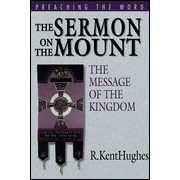
(This excellent sermon has been excerpted from Chapter 14 in R. Kent Hughes excellent book of sermons [pictured below] from  Matthew 5-7 entitled: The Sermon On The Mount: The Message of the KIngdom. Wheaton: Crossway Books, 2001.

A Sermon From R. Kent Hughes

“It was also said, ‘Whoever divorces his wife, let him give her a certificate of divorce.’ But I say to you that everyone who divorces his wife, except on the ground of sexual immorality, makes her commit adultery, and whoever marries a divorced woman commits adultery.” – Matthew 5:31–32

The February 1973 issue of McCall’s magazine carried an article entitled, “Is Anyone Faithful Anymore?” in which the author included the following story. A young wife was at lunch with eleven of her friends, who had been meeting together regularly to study French since their children had been in nursery school. As they conversed, one of the women, the group’s leader, asked, “How many of you have been faithful throughout your marriage?” Only one woman at the table raised her hand. That evening when the young wife told her husband about the conversation, she revealed that she was not the one who had raised her hand. He was shocked and devastated. “But I have been faithful,” she added. “Then why didn’t you raise your hand?” She replied, “I was ashamed.”

Times have changed, have they not? It used to be that most people would go to extremes to hide their infidelity, but today many people are ashamed of their fidelity. We live in a day when some experts speak of “healthy adultery” and the married faithful are less vocal than the unfaithful in promoting their ways.

I think no one would disagree that our contemporary culture is not intrinsically receptive to Biblical teaching regarding sexual relationships, marriage, and divorce. Because of this hostility, some preachers seem reluctant to speak out on these issues. Other ministers hesitate to address these topics because there is major disagreement about divorce in the church. Because there are numerous opinions as to what the Bible means, because the subject is complex, and because contemporary marital relationships are often incredibly tangled mazes, the subject becomes overwhelming. Sadly, we sometimes find it easier to just leave it unaddressed.

Some surveys indicate that eight of ten people are either directly or indirectly affected by divorce. The mere mention of the word divorce is painful to some. Many have been deeply wounded by broken marriages, and a discussion of the subject brings up memories and feelings they would like to forget. For these reasons preachers find little joy in preaching on the subject. But since Jesus brought it up right in the middle of the Sermon on the Mount, the greatest sermon ever preached, he obviously thinks it is an important subject, one we dare not ignore. To see this matter through Jesus’ eyes is good for us as individuals, good for the church, and good for society.

What is to be the Christian’s attitude regarding divorce? Is divorce always forbidden? Or is it sometimes allowable? What is the Christian position amidst the marital tragedy that surrounds us? As we answer these questions, I will try to be sensitive to those who are hurting. But at the same time I will do my best to be Biblical. The bottom line in all of this is, what does God’s Word say?

To understand our Lord’s statements on divorce, we must know something of the controversial social and theological context in which he made them. The controversy centered over the interpretation of a phrase in Deuteronomy 24:1, the stated ground of divorce: “If a man marries a woman who becomes displeasing to him because he finds something indecent about her, and he writes her a certificate of divorce …”

That verse taught that a husband could divorce his wife if he found “something indecent” in her, and that is where the controversy lay. The burning question in Jesus’ day was, what does “something indecent” mean?” Those in the very liberal rabbinical school of Hillel interpreted “indecent” in the widest manner possible. They said a man could divorce his wife if she spoiled his dinner! They also extended “indecent” to mean a wife’s walking around with her hair down, speaking to men in the streets, or speaking disrespectfully of her husband’s parents in his presence. A wrong word about a mother-in-law and a woman could be out on the street! Rabbi Akiba, who was of this school of thought, went even further, saying that the phrase “becomes displeasing to him” (“she find no favor in his eyes,” kjv) meant that a man could divorce his wife if he found a woman who was more beautiful. Such husbands were bigoted and arrogant.

Fortunately, they were opposed by the school of Shammai, which limited “indecent” to offenses of marital impropriety short of adultery. “Indecent” did not refer to adultery, which was punished by execution, but rather suggested other types of sexual misconduct such as shameful exposure.

This conservative-liberal controversy over the meaning of “indecent” as a grounds for divorce was the backdrop of the Pharisees’ coming to Jesus about this matter. Matthew 19:3 describes the situation: “Some Pharisees came to test him. They asked, ‘Is it lawful for a man to divorce his wife for any and every reason?’ ” They were obviously trying to draw Jesus into the long-standing debate and then exploit his response for their own ends. Some even think they were hoping to use Jesus’ answer to get him in trouble with Herod because a negative answer would publicly align him with the point of view that caused John the Baptist to be beheaded. Significantly, Jesus did not begin by directly answering their question but took the conversation back to God’s creation design, giving us the most extensive teaching on divorce in the New Testament.

Jesus’ Teaching on Divorce (Matthew 19:4–12)

Jesus began by stating the ideal:

“Haven’t you read,” he replied, “that at the beginning the Creator ‘made them male and female,’ and said, ‘For this reason a man will leave his father and mother and be united to his wife, and the two will become one flesh’?” (vv. 4, 5)

In the beginning divorce was inconceivable—and impossible. Jesus quoted lines from Genesis 2:23, 24 to emphasize two things. First, the intimacy of the marriage relationship. He says “the two will become one flesh.” There is no other intimacy like it. It is deeper than one’s relationship to one’s own children. When my children were born, there was an amazing bonding that took place when I saw those babies. In the ensuing months and years the bonding increased, and my wife and I are close to our children, interwoven with them. But we are not one flesh with them. The Scripture says that a man becomes “one flesh” with his wife. Marriage is the deepest human relationship.

After intimacy, the emphasis is on permanence. There was no thought of divorce—ever! God’s ideal was, and is, monogamous, intimate, enduring marriage. This is what he approves of. Anything less is a departure from the divine model. And the Fall did not change that ideal. We all know that some things possible before the Fall were not possible afterward. But regarding divorce, God’s standard did not change. We not only see this in the very first book of the Old Testament but also in the very last one:

“Why has God abandoned us?” you cry. I’ll tell you why; it is because the Lord has seen your treachery in divorcing your wives who have been faithful to you through the years, the companions you promised to care for and keep. You were united to your wife by the Lord. In God’s wise plan, when you married, the two of you became one person in his sight. And what does he want? Godly children from your union. Therefore guard your passions! Keep faith with the wife of your youth. For the Lord, the God of Israel, says he hates divorce.… (Malachi 2:14–16, tlb)

God hates divorce! Whenever divorce occurs, it is an aberration. It is something that was not meant to be. All of this talk about “creative divorce” is pseudoscientific and pseudo-liberated baloney. Those who become tired of their marriage because it is solid, predictable, and not very exciting should cast away their fantasies. Besides, there is nothing more boring than evil and its fruit.

The conversation between the Pharisees and Jesus is most enlightening. The Pharisees have alluded to the controversy in Deuteronomy 24, asking if a man may divorce his wife for any reason at all. Jesus has responded by saying divorce is not God’s ideal. Now the Pharisees respond with another reference to Deuteronomy 24: “ ‘Why then,’ they asked, ‘did Moses command that a man give his wife a certificate of divorce and send her away?’ ” (Matthew 19:7). The idea is this: “Moses made provision for divorce in Deuteronomy 24:1. How then can you say it is not part of the ideal?” Note Jesus’ answer in verse 8: “Jesus replied, ‘Moses permitted you to divorce your wives because your hearts were hard. But it was not this way from the beginning.’ ”

Jesus’ answer corrects the Pharisees, for Moses only permitted divorce—he didn’t command it as the Pharisees asserted. What Moses did command was the granting of a divorce certificate for the woman’s protection. Without a certificate she could be subject to exploitation, even recrimination. The certificate also prevented the man from marrying her again. Thus she could not be treated like chattel. Marriage was not something one could walk in and out of. The reason God allowed divorce was the hardness of heart to which the men of Israel had succumbed. It was a divine concession to human weakness—reluctant permission at best!

Understanding this, we come to the very center of Christ’s teaching and the heart of our study—Jesus’ explanation as to when and why divorce is permitted: “And I say to you, whoever divorces his wife, except for immorality, and marries another woman commits adultery” (Matthew 19:9, nasb, emphasis mine).

Here everything rests upon the correct interpretation of the phrase “except for immorality”—and especially the single word, “immorality.” The Greek word here is porneia, from which we derive the English word pornography. The Greek dictionaries tell us that porneia means unchastity, fornication, prostitution, or other kinds of unlawful intercourse. When porneia is applied to married persons, it means marital unfaithfulness, illicit intercourse that may involve adultery, homosexuality, bestiality, and the like. We should note (and this is very important!) that all these offenses were originally punished by death under Mosaic Law. These sins terminated marriage not by divorce but by death. However, by Jesus’ time the Roman occupation of the country and its legal system had made the death sentence very difficult to obtain. Jewish practice had therefore substituted divorce for death. Thus the rabbinical schools of Hillel and Shammai were not discussing whether divorce was permissible for adultery. That was taken for granted by everyone. The point is, Jesus was far stricter than Hillel and Shammai because he superseded the teaching of Deuteronomy 24 and said that the only ground for which one may divorce his or her spouse is marital unfaithfulness. This is the simple, plain meaning of Jesus’ words in verse 9: “And I say to you, whoever divorces his wife, except for immorality, and marries another woman commits adultery.” That is, divorce is allowed if your mate is guilty of marital unfaithfulness. But if you divorce for any other reason and remarry, it is you who commits adultery. This is likewise the meaning of Jesus’ similar statement in the Sermon on the Mount:

“But I tell you that anyone who divorces his wife, except for marital unfaithfulness, causes her to become an adulteress [if she remarries], and anyone who marries the divorced woman [a woman who has been divorced for something short of unchastity] commits adultery.” (Matthew 5:32)

Jesus’ teaching is clear. Some of the interpretations of these texts are unbelievably convoluted, but we must hold to the plain, unadorned sense of the text. Jesus meant what he said!

Some object that these exception clauses don’t jibe with Jesus’ teaching in two other Gospel passages, Mark 10:11, 12 and Luke 16:18, which contain no exception clauses. For instance, Mark records:

He answered, “Anyone who divorces his wife and marries another woman commits adultery against her. And if she divorces her husband and marries another man, she commits adultery.”

No exception clauses! Because of this, some have argued that Mark represents the earlier and pure teaching of Jesus, but Matthew contains a scribal addition of the exception clause and is thus unauthentic. However, we must hold that it is authentic because none of the ancient manuscripts omit it—all of them have it. Why the difference between the Gospels of Matthew and Mark then? John Stott gives the answer:

It seems far more likely that its [the exception clause’s] absence from Mark and Luke is due not to their ignorance of it but to their acceptance of it as something taken for granted. After all, under the Mosaic Law adultery was punishable by death (although the death penalty for this offense seems to have fallen into disuse by the time of Jesus); so nobody would have questioned that marital unfaithfulness was a just ground for divorce.

The Lord Jesus Christ permitted divorce and remarriage on one ground and one ground only—marital unfaithfulness.

But notice that he permitted it—he did not command it. If you learn that your mate has been having an adulterous affair, it does not follow that you have license to seek a divorce. Too often men and women eagerly pounce on the infidelity of their mates as the opportunity to get out of a relationship they wanted to end anyway. It is so easy to minimize one’s own behavior and to maximize the sins of the other party. Many look for a way out instead of a way through the problems. I want to be careful not to minimize the sin of adultery like the man who said to his wife, “I don’t understand why you’re so disturbed. All I did was have an affair.” Yet I believe (this is my personal opinion) that we should not regard a one-time affair in the same way as a mate who persists in his or her adulterous ways and refuses to repent. Jesus’ exception clauses should be viewed like this: No matter how rough things are, regardless of the stress and strain, whatever is said about compatibility and temperament, nothing allows for divorce except unfaithfulness—and even then it is not to be used as an excuse to get out of the relationship.

The Radicalness of Jesus’ Teaching (Matthew 19:10–12)

Jesus’ teaching was radical. He had done away completely with the Mosaic divorce provision (Deuteronomy 24:1). This was revolutionary. The disciples’ response indicates just how radical Jesus’ teaching was: “The disciples said to him, ‘If this is the situation between a husband and wife, it is better not to marry.’ ” They were blown away. If the only ground for divorce was unfaithfulness, if none of the exceptions suggested by Hillel and Shammai were valid, it was better to stay single! The radicalness of what Jesus taught is further underlined in Matthew 5 by its being one of the six statements that begin with variations of “You have heard it said, but I tell you,” demonstrating the superior righteousness of Christ. The point of these statements is: This is the way a righteous person lives! Thus his or her marital relationship is supremely sacred. Nothing can sever it but unrepentant unfaithfulness—and then it is not an excuse for ending the marriage but is the sorrowful ground of divorce.

Such teaching is radical today. It is out of sync with our culture. Today even Christian counselors are recommending divorce and remarriage on grounds that are in opposition to the clear teachings of Christ. The sanctity of marriage has been corrupted by Christ’s own church and his authority flouted. Marriage has been trivialized into a provisional sexual union that dissolves when our puny love gives out. But this is not the way the righteous person approaches marriage. According to Christ, marriage demands total commitment that only death or the most flagrant, ongoing sexual infidelity can bring to an end.

Having seen Christ’s teaching, the question now is, does the Bible say anything else about divorce? The answer is yes.

Jesus’ Teaching and Paul’s (1 Corinthians 7:8–16)

In 1 Corinthians 7:8–16 the Apostle Paul gives consecutive advice, first to the unmarried (vv. 8, 9), then to married believers (vv. 10, 11), and finally to those who have mixed marriages—when one’s spouse is not a believer (vv. 12–16). It is on this final category that we will focus.

Paul begins his teaching by saying in verse 12, “To the rest I say this (I, not the Lord) …” which has been misunderstood by some as meaning that Paul is saying that his teaching is not as authoritative as Christ’s. What he really means, however, is that what he is going to say was not said by Jesus in his earthly ministry but is now being said by Paul as part of his apostolic teaching. “He is saying in effect, ‘I am now going to deal with cases on which the Lord Himself did not give a verdict.’ ” Paul speaks with full apostolic authority. Notice what he says:

To the rest I say this (I, not the Lord): If any brother has a wife who is not a believer and she is willing to live with him, he must not divorce her. And if a woman has a husband who is not a believer and he is willing to live with her, she must not divorce him. (vv. 12, 13)

Paul knew that in Corinth there were many marriages in which either the husband or wife had become a Christian after marriage, thus producing a spiritually mixed marriage. His advice was that the Christian must not leave his or her pagan spouse—it was not permitted. Then in verse 14 he gives the reason:

For the unbelieving husband has been sanctified through his wife, and the unbelieving wife has been sanctified through her believing husband. Otherwise your children would be unclean, but as it is, they are holy.

The reason for staying together is that the unbeliever and the children will be influenced toward Christ by the life of the believer. I find this fascinating because we often think of the believer being corrupted by the unbeliever, and indeed sometimes this happens. But Paul lays down that it is generally otherwise! If you are in an unequal union, take heart! The general thrust is that you and your faith will prevail—though, sadly, not always.

Then in verse 15 we have Paul’s new teaching: “But if the unbeliever leaves, let him do so. A believing man or woman is not bound in such circumstances; God has called us to live in peace.”

The sense is, if the unbeliever deserts and is determined not to come back, let him or her go. The Christian is “not bound in such circumstances,” which means that the believer is free from the marriage because the unbeliever has broken the marriage bond. The result is that the believer is free to divorce and remarry. The consistent use of the word “bound” in this passage and others means “is not bound in marriage.” There is no need to seek some other interpretation. This is the plain sense—this is what it means.

A Summation of Biblical Teaching

So we see that the Bible allows divorce for two reasons—marital unfaithfulness such as adultery and homosexuality, and the desertion of a believer by an unbelieving spouse.

As to the question of remarriage, the Scriptures allow it in three instances.

First, if one’s mate is guilty of sexual immorality and is unwilling to repent and live faithfully with the marriage partner, divorce and remarriage are permissible.

Second, when a believer is deserted by an unbelieving spouse, divorce and remarriage are again permitted.

And third, as an extension of the allowance for divorce and remarriage when deserted by an unbeliever, I personally believe that when someone has been married and divorced before coming to Christ, remarriage is allowed. Second Corinthians 5:17 says, “Therefore, if anyone is in Christ, he is a new creation; the old has gone, the new has come!” “New” here (kainos) means new in quality. “New” means what it says—really new, as contrasted to the old. The same word is used of the “new man” in Ephesians 2:15 and the “new self” in Ephesians 4:24. Not only are believers really new, but Paul says that “the old has gone, the new has come.” A new believer is completely forgiven. I believe that among the old things that have passed away are all sins, including divorce prior to salvation. If it were otherwise, divorce would be the only sin for which Christ did not atone, and that would be inconceivable.

I hope no one misunderstands me, for divorce is not the ideal. It is a divine concession to human weakness. God hates divorce! We must realize that divorce (and remarriage) according to the Biblical guidelines is not sin—though it is due to sin. We must mourn every divorce!

How foreign to the Biblical mind are phrases like “creative divorce” or “the magic of divorce” or the ad that appeared on the back of a TV Guide: “Order your DIVORCE RING BAND today.… Now is the time to celebrate your new beginning.”

We have discussed the issues primarily with the non-offending party in view. What advice is there for the offending party? Here I can do no better than quote the concluding words of Dr. Martyn Lloyd-Jones:

“Have you nothing to say about others?” asks someone. All I would say about them is this, and I say it carefully and advisedly, and almost in fear lest I give even a semblance of a suggestion that I am saying anything that may encourage anyone to sin. But on the basis of the gospel and in the interest of truth I am compelled to say this: Even adultery is not the unforgivable sin. It is a terrible sin, but God forbid that there should be anyone who feels that he or she has sinned himself or herself outside the love of God or outside His kingdom because of adultery. No; if you truly repent and realize the enormity of your sin and cast yourself upon the boundless love and mercy and grace of God, you can be forgiven and I assure you of pardon. But hear the words of our blessed Lord: “Go and sin no more.”

Finally, what do we say to the church, to ourselves?

First, we must resist the permissiveness of our culture and solidly take our stand against divorce or remarriage on any grounds other than those taught in God’s Word.

Next, we must refrain from self-righteous judgmentalism. All of us are adulterers in heart. We must exercise our dealings with those who have fallen, realizing that we are ourselves under Christ’s omniscient dictum: “But I tell you that anyone who looks at a woman lustfully has already committed adultery with her in his heart” (Matthew 5:28).

Finally, toward those who have fallen to or suffered divorce, we must be forgiving, like our Lord. We must not call unclean that which he has called clean (Acts 10:15). We must endeavor to share the suffering of those ravaged by divorce. And lastly, the church should make provision for the remarriage of those who have Biblically divorced.

About The Preacher: Dr. Kent Hughes

Dr. Hughes’s thirty-five years of ministry divides evenly into ten years as a youth pastor, five years as a church planter, and twenty years as senior pastor of College Church in Wheaton, IL. He is the author of more than twenty-five books, among which are Disciplines of a Godly Man and Liberating Ministry From the Success Syndrome. He is in the midst of a life-long project of completing the Preaching the Word commentary series of the entire New Testament, and is the editor of the Old Testament for the same series. College Church is noted for its world-wide missions outreach, because half of its total budget goes to world missions. The Hughes are the parents of four children and fourteen grandchildren.

Education

  • D.D. 1991, Biola University, La Miradad, CA
  • D.Min. 1981, Trinity Evangelical Divinity School, Deerfield, IL
  • M.Div. 1972, Talbot Seminary, La Mirada, CA
  • B.A. 1964, Whittier College, Whittier, CA

Professional Experience

  • 1979 to present: served as Senior Pastor of College Church in Wheaton, noted for its missions program. Presently, the missions budget is approximately 1.6 million annually.
  • 1974-79 founded a new church in the Orange County area of Southern California, and served as an adjunct professor at Talbot Seminary, teaching Greek and homiletics.
  • 1963-74 ministered on the staff of Granada Heights Friends Church, serving for seven years as High School Pastor and three years as Associate pastor and Minster to Collegians.
  • 1960-61 served as Youth for Christ Club Director.

In addition to regular pastoral, administrative and preaching duties at College Church, Pastor Hughes ministers to several outside conferences each year. He is a Staley lecturer, and in addition speaks at spiritual emphasis weeks for many Christian colleges and universities. Pastor and Mrs. Hughes speak regularly at pastors’ conferences.

Pastor Hughes has served on the Board of Americans United for Life (the legal arm of the pro-life movement), the Board of Trustees of World Radio Missionary Fellowship (HCJB), and the board of Operation Mobilization. Presently he is a member of the Board of Crossway Books.

Dr. Hughes is also a Former senior editor of Christianity Today.

Books Published

  • Behold the Lamb, (Exposition of John 1-10), Victor Books, 1984.
  • Behold the Man, (Exposition of John 11-21), Victor Books, 1984.
  • The Christian Wedding Planner, Muzzy/Hughes, Tyndale House, 1984.
  • Blessed Are the Born Again, (The Beatitudes as a checklist for authentic Christianity), Victor Books, 1986.
  • Abba Father: The Lord’s Pattern for Prayer, Crossway Books, 1986.
  • Living on the Cutting Edge: Joshua and the Challenge of Spiritual Leadership, Crossway Books, 1987.
  • Liberating Ministry From the Success Syndrome, Tyndale House, 1988, co-authored with Mrs. Hughes
  • Mastering the Pastoral Role, Paul Cedar, R. Kent Hughes, Ben Patterson, Multnomah, 1991.
  • Disciplines of a Godly Man, Crossway Books, 1991.
  • Disciplines of Grace, Crossway Books, 1993.
  • The Gift, Crossway Books, 1994.
  • Are Evangelicals Born Again?, Crossway Books, 1995.
  • Common Sense Parenting, Tyndale House, 1995, co-authored with Mrs. Hughes.
  • The Saviour, Crossway Books, 1995.
  • 1001 Great Stories & “Quotes”, Tyndale House, 1998

Preaching the Word Series, Crossway Books

  • Colossians and Philemon, The Supremacy of Christ, 1989.
  • Mark, Jesus Servant and Savior, Vol. 1, 1989.
  • Mark, Jesus Servant and Savior, Vol. 2, 1989.
    Note: The Mark volumes were presented the E.C.P.A. Gold Medallion Book Award for the best commentary of 1990.
  • Ephesians, The Mystery of the Body of Christ, 1990.
  • Romans, Righteousness from God, 1991.
  • James, Faith that Works, 1991.
  • Hebrews, An Anchor for the Soul, Vol. 1, 1993.
  • Hebrews, An Anchor for the Soul, Vol. 2, 1993.
  • Acts, The Church Afire, 1996.
  • Luke, That You May Know the Truth, Vol. 1, 1998.
  • Luke, That You May Know the Truth, Vol. 2, 1998.
  • John, That You May Believe, 1999.
  • 1 and 2 Timothy and Titus, Guard the Deposit, with Bryan Chapell, 2000
  • The Sermon on the Mount, The Message of the Kingdom, 2001.

What Does “God Gave Them Over” Mean? A Study in Divine Retribution by Dr. S. Lewis Johnson

 An Exegetical Study of Romans 1:18-32

Preaching to his Sunday congregation in Bern, Switzerland, at the Münster on Romans 1:18–32, Walter Lüthi said, “In the words that we have just read we are told the whole truth about our condition. There may well be people among us who cannot bear to hear the truth, and would like to creep quietly away out of this church. Let them do so if they wish” (Walter Lüthi, The Letter to the Romans: An Exposition, trans. by Kurt Schoenenberger. Richmond, Va, 1961, p. 19). There is much justification for Lüthi’s words, for Paul’s canvas upon which he has painted his picture—dark, foreboding, threatening, flashing with lightning and crashing with thunder—is crammed with forms and figures, fights and shadows, of sin, wrath, and judgment. And the revelation of wrath is total and complete, encompassing all and rendering all without excuse and under condemnation, both individually and collectively.

Isaiah has spoken of judgment as God’s “strange work” and His “strange act”  (cf. Isa 28:21 – There is nothing unusual about the Hebrew adjectives, translated “strange” in the AV, except perhaps their emphatic position. That is their meaning. The NASB has “unusual” and “extraordinary.”), and the idea that it is strange because contrary to His goodness and grace, while a popular contemporary misunderstanding of his words, is not only out of harmony with the context of Isaiah 28:21, but it also does not agree with the total picture of the being and attributes of God in Scripture. His retributive justice is one of His essential properties, and in this passage in Romans it comes to the center of the stage. In the threefold paredōken (AV, “gave up”; vv. 24, 26, 28) the problem is plainly before the reader. It is the purpose of this article to analyze and, if possible, clarify the meaning of the term, setting it within the context of the theology of the being and attributes of God. But, first, a word regarding the flow of the Pauline thought in this section of the letter.

After having introduced this message to the Romans (cf. 1:1–7) and stated his theme, the gospel (1:16–17), the apostle skillfully and in detail develops the case-history of human sin and condemnation (1:18–3:20). The section moves from the declaration of Gentile sin (1:18–32 – Martin prefers to define the subjects as “the Greek religious type, man without special revelation,” but the sense is the same. Cf. James P. Martin, “The Kerygma of Romans,” Interpretation, XXV, July, 1971, 311) through Jewish sin (2:1—3:8) to the climax of the apostolic diagnosis that “all the world” is guilty, with every mouth stopped, speechless in the terror of condemnation before a holy and righteous God (3:9–20).

In the immediate context Paul, in his endeavor to prove that the only righteousness available to man is that obtained by faith, declared that God’s displeasure toward sin has been revealed from heaven (1:18). It follows, of course, that all who are charged with ungodliness or unrighteousness stand under His wrath and cannot obtain acceptance before God by their character or conduct. That the Gentiles are guilty and, therefore, inexcusable is evident, because they have enjoyed a revelation of God’s eternal power and deity and yet have rejected it (1:19–20 – Notitia and assensus, two of the basic elements of faith, may be present as a result of God’s revelation of Himself in nature, but the vital element of faith, fiducia, is never given through natural revelation. In its place is the rebellion of suppression. Cf. John Calvin, Institutes of the Christian Religion, ed. by John T. McNeill and trans. by Ford Lewis Battles, in The Library of Christian Classics, Vol. XX, 2 vols.; Philadelphia, 1960; T. H. L. Parker, Calvins Doctrine of the Knowledge of God. Grand Rapids, 1959; Edward A. Dowey, Jr., The Knowledge of God in Calvins Theology. New York and London, 1965. A recent article of some worth by Gerald J. Postema is “Calvin’s Alleged Rejection of Natural Revelation,” Scottish Journal of Theology, XXIV, November, 1971, 423–34.).  And not only have they rejected the light of this truth, they have given themselves up to idolatry (1:21–23). The Pauline picture of the religious history of mankind is one of retrogression, not progression, of devolution, not evolution, downward, not upward. In unbelief man has passed from light to futility to folly. Thus, the divine wrath has found its justification in human rejection of “the truth of God” (1:18, 25).

There remains, therefore, only one alternative for God and man, divine retribution, and it is this that the apostle so solemnly, and yet vigorously (Godet thinks there is more than vigor here; there is a feeling of indignation. He writes, “The verses have something of that παροξυσμός, that exasperation of heart, of which the author of the Acts speaks xvii.16 when describing Paul’s impressions during his stay at Athens” F. Godet, Commentary on the Epistle to the Romans, trans. by A. Cusin [2 vols.; Edinburgh, 1881], I, 177), proclaims in the final section of chapter one (1:24–32). The dio (AV, “wherefore”) makes the connection. In the light of the rebellion just described the inference of vindicatory justice is drawn. Sin justly brings judgment (The Byzantine text and some of the leading representatives of the Western text have a καί, AV, “also” following διό. If this were genuine, it would suggest the harmony of the nature of the punishment and the offence. Godet has put it well, “They sinned, wherefore God punished them; they sinned by degrading God, wherefore also God degraded them,” I, 177. Zahn appears to incline towards its genuineness, too. Cf. Theodor Zahn, Der Brief des Paulus an die Römer. Leipzig, 1910, p. 96.), a judgment expressed most clearly in the following three verses of this final section of chapter one.

The Biblical Revelation

Verse 24 – Wherefore God gave them over (Gr., paredōken) in the lusts of their hearts to impurity, that their bodies might be dishonored among them.

Verse 26 – For this reason God gave them over (Gr., paredōken) to degrading passions; for their women exchanged the natural function for the unnatural.

Verse 28 And just as they did not see fit to retain the full knowledge of God, God gave them over (Gr., paredōken) to a depraved mind, to do the things which are not proper (Rom 1:24, 26, 28).

The Interpretation of the Revelation

The essence, the heart, the Leit Motif of the passage and the divine judgment is expressed in the threefold paredōken (AV, “gave up,” vv. 24, 26; “gave over,” v. 28), repeated as a terrifying refrain (Cf. M.J. Lagrange, Saint Paul Épître aux Romains (4th ed.; Paris, 1930, p. 28. He remarks that the term’s threefold occurrence is not climactic, but is a kind of refrain.).  It is a term over which there has raged considerable debate, and it is to the elucidation of it that this article is addressed. Generally speaking, there are three contending viewpoints.

First, perhaps the favorite interpretation of the term is that has prevailed since the time of Origen and Chrysostom, in which the paredōken is taken in the permissive sense. According to this view God passively permitted men to fall into the retributive consequences of their infidelity and apostasy. The active force of paredōken is surely contrary to this view. It is not that God permitted rebellious men to fall into uncleanness and bodily dishonor; He actively, although justly in view of their sin, consigned them to the consequences of their acts. It is His divine arrangement that men by their apostasy should fall into moral impurity, sin being punished by further sin, and He himself maintains the moral connection between apostasy and impurity by carrying out the judgment Himself (Cf. Heinrich August Wilhelm Meyer, Critical and Exegetical Handbook to the Epistle to the Romans, trans. by John C. Moore from 5th German ed. 2 vols.; Edinburgh, 1881, I, 86).

Second, another popular view, which became current after the time of Augustine, takes the paredōken in the privative sense. According to this interpretation God deprived man of an aspect of His work of common grace. He withdrew His hand that had restrained men from evil. Godet has expressed and illustrated this interpretation about as well as it can be set forth. “Wherein did His action consist?” he asks. And the answer follows, “He positively withdrew His hand; He ceased to hold the boat as it was dragged by the current of the river. This is the meaning of the term used by the apostle, Acts xiv.16 : ‘He suffered the Gentiles to walk in their own ways,’ by not doing for them what He never ceased to do for His own people. It is not a case of simple abstention, it is the positive withdrawal of a force” (Godet, I).

At bottom this view is the practical equivalent of the permissive view. This is evident from the fact that Godet uses Acts 14:16 as illustrative of the sense. However, in that passage the verb used is eiasen (AV, “suffered”), which normally means simply to permit. As Meyer pointed out a long time ago, “Therefore Chrysostom not only explains it by εασεν, but illustrates the matter by the instance of a general who leaves his soldiers in the battle, and thus deprives them of his aid, and abandons them to the enemy. Theodoret explains it: τς οκείας προμηδείαςγύμνωσε  (The clause may be translated, he stripped [them] of his own), and employs the comparison of an abandoned vessel. Theophylact illustrates the παρέδωκεν by the example of a physician who gives up a refractory patient (παραδίδωσιν ατν τ π πλέον νοσεν – The words may be rendered, he delivers him over for further suffering” – Meyer, I). These illustrations express quite well the privative view, but the Pauline language is stronger than this. The expression, “God gave them up to uncleanness,” describes a judicial act, (John Murray, The Epistle to the Romans 2 vols.; Grand Rapids, 1959),  a “judicial abandonment” (Charles Hodge, Commentary on the Epistle to the Romans. Philadelphia, 1886, p. 40). The active force of paredōken must not be glossed over (Cf. Otto Michel, Der Brief an die Römer. 11th ed.; Göttingen 1957, p. 58; Zahn, pp. 96-97. Both point out that Paul’s expression must not be weakened, but neither develops the question theologically).

Therefore, finally, it becomes clear that the term must be given a judicial sense (Schlatter points out that παρέδωκεν is the usual word for the sentence of a judge. Cf. A. Schlatter, Gottes Gerechtigkeit. Stuttgart, 1959, p. 66).  The meaning is not simply that God withdrew from the wicked the restraining force of His providence and common grace, although that privative sense is included in the judicial sense, but that He positively gave men over to the judgment of “more intensified and aggravated cultivation of the lusts of their own hearts with the result that they reap for themselves a correspondingly greater toll of retributive vengeance” (Murray). The usage of the word in both this epistle (4:25; 6:17; 8:32) and in the other Pauline Epistles (cf. 1 Cor 5:5; 1 Tim 1:20) supports this force (See Friedrich Büchsel, “δίδωμι et al.,” Theological Dictionary of the New Testament, ed. by Gerhard Kittel, trans. and ed. by Geoffrey W. Bromiley, II Grand Rapids, 1964, 170. The positive force is present in each occurrence). The interpretation is also in harmony with the occurrence of the precisely identical form in Acts 7:42, where, in speaking of Israel’s apostasy in the days of Moses, Stephen says, “Then God turned, and gave them up (Gr., paredōken) to worship the host of heaven.” Both the Romans and the Acts passages describe the act of God as a penal infliction of retribution, the expression of an essential attribute of God’s nature and being, and it is thoroughly consistent with His holiness.

There is another striking occurrence of the identical form of the verb in Ephesians 4:19, and that passage serves to remind the interpreter that the infliction of punitive justice does not compromise the free agency and responsibility of man. In that passage Paul, speaking of the sin of the Gentiles, writes, “Who being past feeling have given themselves over (Gr., paredōken) unto lasciviousness, to work all uncleanness with greediness.” In the midst of the retributive action of God there is no coercion of man. God does not entice or compel to evil.  Man remains responsible and can even be said to be giving himself over to uncleanness while God gives him up to the judgment of his sin.

Concluding Questions

There is hardly any passage in the Bible that says plainer than this one that moral depravity is the result of the judgment of God. And this raises an interesting question that concerns the present moral condition of the nations of the world, and particularly of the United States of America. The question is this: What is the real significance of the spread of immorality, crime, and violence in western civilization? To compound the problem, the newspapers are filled with stories of clergymen encouraging sexual license. Many Christian ministers, contrary to the Apostle Paul’s teaching, no longer regard homosexuality and other sexual aberrations as a sin. It is rather a sickness, or a weakness. In an article in one of the national news magazines a few years ago homosexuality was referred to by the author as “an undesirable handicap” (“Homosexuality,” Time, October 24, 1969, p. 82). To many today it is nothing more than a deviation from the customary sexual patterns, a third sex. Occasionally, in what must seem to the Christian the ultimate evil, homosexuality is traced to God Himself, for, it is said, He made men and women what they are (Of course, the truth of the matter is that homosexuality is a perversion of the created order. Cf. C. K. Barrett, A Commentary on the Epistle to the Romans. New York, 1957, p. 39).

Some thirty years ago the famous Harvard sociologist, Pitirim Sorokin, in his book The Crisis of Our Age, warned that increases in crime, suicides, mental breakdowns, revolutions, and war have been symptoms of civilizations in the midst of death pangs. In another article on homosexuals in Time magazine the author wrote, “At their fullest flowering, the Persian, Greek, Roman and Moslem civilizations permitted a measure of homosexuality; as they decayed, it became more prevalent” (“The Homosexual: Newly Visible, Newly Understood,” Time, October 31, 1969, p. 65).  Later Sorokin in his The American Sex Revolution pointed out that sex anarchy leads to mental breakdowns, rather than the other way around, as the Freudian psychologists have taught (Cf. I. E. Howard, “The Fever Chart of a Sick Society,” Christian Economics, April 6, 1965, p. 4. Howard’s brief article is very suggestive, and the writer is deeply indebted to it).  Further, he pointed out that increasing sexual license leads to decreasing creativity and productivity in the intellectual, artistic, and economic spheres of life. What, then, are the sources of the problems of the present age? As Howard indicates, “Spengler had a biological answer: civilizations grow old and die like any other living thing. Toynbee has a religious answer: civilizations fail to respond to the higher challenges of the Spirit and therefore fossilize. In his Civilization and Ethics, Albert Schweitzer tried to find an ethical answer. St. Paul had still a different answer” (ibid).

The Pauline answer is plain, and Romans 1:24 expresses it most impressively and succinctly. When man rebelled and sinned, God “gave them up” to uncleanness in the lusts of their hearts that by their own activities their bodies might be dishonored. In other words, sexual rebellion, license, and anarchy is the retributive judgment of God. The civilization of the western world, including the particular civilization of the United States of America, is not a civilization in danger of contracting a fatal disease. That civilization has already contracted a malignant and fatal cancer through its unbelief of the message of God in Christ. It is now hurrying on with increasing speed to final climactic destruction. Civilizations do not die because of violence, crime, immorality, and anarchy. These things are the evidences that death already is at work, a death brought on by disobedience to the revelation of God. Charles Hodge was referring to these principles when he said, almost one hundred years ago in reference to the Christian body of truth, “Religion is the only true foundation, and the only effectual safeguard for morality. Those who abandon God, He abandons. Irreligion and immorality. therefore, have ever been found inseparably connected” (Hodge).

It should be carefully noted that the apostle is not speaking of eternal punishment in these three verses. What he has specifically in mind is a judgment that pertains to this life, not to the life to come. But, on the other hand, it is also plain that Paul’s words lead on to the doctrine of everlasting torment (cf. v. 32 – Cf. Barrett, p. 38. He writes, “God’s judgment has already broken forth; only he has consigned sinners not to hell but to sin—if indeed these be alternatives.”).  The vindicatory judgment inflicted by God is continued in the life to come in a more terrible and permanent form if the escape through the gospel of the cross is neglected. The doctrine of eternal punishment has never been popular, and it is less so now. Even evangelical seminaries seem embarrassed by it.27  There is an old story about Boswell and Dr. Samuel Johnson that contains solemn truth. When the latter once appeared over fearful as to his future, Boswell said, “Think of the mercy of your Savior.” “Sir,” replied Johnson. “my Savior has said that He will place some on his right hand, and some on his left.”

It is doubtful that there is a doctrine in the Bible easier to prove than that of eternal punishment (cf. Matt 25:46 – The twofold use of the adjective aiōnion AV, “everlasting” and “eternal” with kolasin, AV, “punishment” and zōēn, AV, “life” indicates that the punishment for sin is just as long as the life that God gives the faithful. Both are eternal. Many other passages express the same truth), a fact that reminds one of an incident involving Henry Ward Beecher and William G. T. Shedd, both eminent leaders of their day. The North American Review engaged the two men for articles on the subject of eternal punishment, knowing the views of the two men. Beecher had once commented, “I believe that punishment exists, both here and hereafter; but it will not continue after it ceases to do good. With a God who could give pain for pain’s sake, this world would go out like a candle.” Shedd was asked to write an article supporting the doctrine, and Beecher was asked to answer it. When the proof sheets of Shedd’s article were sent to Beecher he telegraphed from Denver to the magazine’s editors, “Cancel engagement. Shedd is too much for me. I half believe in eternal punishment now myself. Get somebody else.” The reply was never written by anyone. Shedd remained unanswered (Cf. Augustus Hopkins Strong, Systematic Theology. rev. ed.; 3 vols.; Philadelphia, 1907, III, 1052–53). There is no answer, biblically, logically, or philosophically to the doctrine of eternal punishment.

There is a final question that one might ask regarding Romans 1:24 and its declaration of divine retribution. When did the retribution occur? When did God “give up” the nations? Is the apostle referring to a specific event or time in the past, or is he simply interpreting broadly man’s history? In the collective sense the rebellion of men against God had its inception at Babylon, and it has been surmised that Paul may have had in mind the construction of the tower of Babylon and its destruction, with man’s scattering, by God (cf. Gen 11:1–9). It is doubtful that Paul had this in mind. On the other hand, there are two things that point to the fall of man in the Garden of Eden as the event the apostle was thinking about. In the first place, the fact that Paul traces the entrance of sin into the human race specifically to Eden in Romans 5:12 suggests that 1:24 is to be understood in the light of that important event. It was there that man rebelled against light, the light of both natural and special revelation, and turned to darkness. And it was there that judgment was inflicted on account of his sin, a judgment that consisted of wrath and death, accompanied by consequent immorality and wickedness, as history indicates.

In the second place, the terminology of verse 22–23 points fairly clearly to the Genesis account. For example, the phrases “to birds, and fourfooted beasts, and creeping things” (v. 23) is surely reminiscent of “the fowl of the air, and over the cattle, and over all the earth, and over every creeping thing that creepeth upon the earth” (Gen 1:26; cf. vv. 20–25). And, further, the phrases “the glory of the uncorruptible God into an image (lit., the likeness of an image) made like to corruptible man” appear to come from the Genesis account’s “Let us make man in our image, after our likeness” (1:26). It thus seems that Paul was thinking of the Genesis record in the Romans passage, and this would support the view that he regarded God’s giving up of man to uncleanness as occurring at the time of the fall, recorded in the early part of that same Genesis record.  There, then, man fell into sin, judgment, and condemnation, with their inevitable companion, the retributive justice of immorality, crime, and all manner of evil.

In conclusion, one must conclude from Romans 1:24, 26 and 28 that retributive justice is an attribute of the living God and a necessary feature of His actions toward unbelieving man. To the question, “Can God really give man up to judgment?,” this passage provides a resounding “yes” answer. But, in fact, it is not the final and convincing answer to the question. That comes from the cross of Jesus Christ, which in the cry it elicits from our Lord, “My God, my God, why hast thou forsaken me?” unmistakably affirms the fact that God can give man up to judgment. It was there that the sinless Man bore the judgment of God upon sin, and it forever proclaims the true nature of sin—it is worthy of the penalty of spiritual and physical death—and God’s hatred of it with His necessary condemnation of it.

One might say, “Does God, then, really care?” The answer to this question also is obvious, and it, too, comes from the cross. It was God who gave the Son as the vicarious sacrifice; it was He who initiated the work that produced the remedy for sin and condemnation. And it was the Son who voluntarily bore in agony the depths of the vindicatory judgment for sinners. And if that is not sufficient evidence of God’s love and concern, reflect further upon the fact that it is also He who has revealed to men their lost condition and the significance of the atoning death, inscribed its interpretation in the written Word of God and preserved that Word for countless millions to read and ponder. Isaiah was right. Although righteous and necessary, judgment is His “strange work” and His “strange act.”

Article above by Dr. S. Lewis Johnson adapted from Vol. 129: Bibliotheca Sacra Volume 129. 1972 (514) (123). Dallas, TX: Dallas Theological Seminary.

More About Dr. S. Lewis Johnson – A Tribute to Dr. S. Lewis Johnson
 by Fred G. Zaspel
 – January 30, 2004:

On January 28, 2004, Dr. S. Lewis Johnson passed away at age eighty-eight. He was a Biblical scholar and theologian of rare abilities and of international renown, and he was a beloved friend. His influence on my own ministry would be difficult to measure. The hundreds of tapes of his preaching and teaching have gone free of charge to thousands of people all over the world, and it was by means of these tapes that I first became acquainted with him. When he first came to preach for me I asked the congregation if any had previously heard him. No one had, but I was quick to assure them all that they had indeed heard him often! Over the years he came to speak at our church and at our pastors’ conference many times, and even in his latest years it was challenging and blessed to hear him expound the Word of God with such precision and clarity.

Dr. Johnson was born in Birmingham, AL and grew up in Charleston, SC. He was always quick to assure everyone that his smooth, dignified, and pleasant southern accent was actually “English in its pure form.” He graduated from the College of Charleston with an B.A. degree in 1937 and was converted through the teaching of Dr. Donald Grey Barnhouse while in the insurance business in Birmingham. He left the insurance business in 1943 to enter Dallas Theological Seminary, from which he received the Th.M (1946) and Th.D. (1949) degrees. He completed further graduate work at the University of Edinburgh, Southern Methodist University, and in the University of Basel. Remaining at Dallas Seminary Dr. Johnson was Professor of New Testament from 1950 to 1972 and Professor of Systematic Theology from 1972 to 1977. He later served as Professor of Biblical and Systematic Theology at Trinity Evangelical Divinity School in Deerfield, IL, and as Visiting Professor of Systematic Theology at Tyndale Theological Seminary, Amsterdam, Netherlands. Dr. Johnson preached and lectured in many places, large and small, taught countless home Bible studies, and was involved in starting several churches. In 1963 he and others planted Believers’ Chapel in Dallas, and it is from the Chapel that so many thousands of his tapes have gone to the benefit of countless people.

He was in so many ways a man to emulate. He was a true gentleman. He was always personable and a great delight in conversation. His humor was always good, and his wit was always quick. He was a careful student of the Scriptures with unusually superior abilities as an exegete and theologian. His abilities with the original languages were clearly superior, and when discussion began he would always lead from his Greek and Hebrew text. He was a man of conviction, willing to step down from a noted career rather than surrender his beliefs. He was passionate for the gospel, and his heart was always hot for Christ. He was a humble and godly man. I have said many times that if God would allow me to grow old as gracefully and as saintly as Dr. Johnson I would become proud and ruin it. He was a model scholar, a model teacher, a model preacher, a model friend, and a model Christian. He was that rare combination of so many abilities and virtues. I thank God for him and feel much the poorer without him.

Among his greatest passions was the faithful expounding of the nature of Christ’s atoning work. He clearly cherished any and every opportunity to demonstrate from the Scriptures the success and effectiveness of Christ’s death as a substitute for His people. And when it was his turn to listen, elderly though he was, he would sit right up front with his Greek and Hebrew Bible in hand. And though virtually every speaker he would hear would necessarily be a man of comparatively inferior abilities, he seemed always just to delight in hearing the Word of God preached. And afterwards he was always eager to fellowship with younger preachers and laymen alike and discuss the things of Christ and examine the Word of God together.

The last time I spoke with Dr. Johnson, about a month or so ago, it was evident that he was growing tired and frail. He fell ill earlier this month, but his illness was brief before the Lord took him home to glory. He leaves behind him his wonderful wife Martha whom we love dearly also, and our prayers are now for her. By his tape ministry I came to love Dr. S. Lewis Johnson before I ever knew him, and I count it a great blessing to have known him. Probably no one outside my own father has taught me more, and few could ever be more beloved. I praise the Lord for him.

Dr. Gleason L. Archer on Does The Bible Testify To It’s Own Inerrancy?

“The Witness of the Bible to its Own Inerrancy” by Dr. Gelason L. Archer

Does the Bible actually assert its own inerrancy as the revealed Word of God? Does it really lay claim to freedom from error in all that it affirms, whether in matters of theology, history, or science? Are proponents of this view truly justified in their insistence on this high degree of perfection in Scripture, or are they actually going beyond what it affirms concerning its own authority? These questions have been raised by those who advocate a lower concept of biblical authority, and it is important for us to settle them as we seek to come to terms with the Bible’s own witness.

Before we launch into an examination of specific passages in Scripture that bear upon this question, it would be well to define as clearly as possible the basic issues involved. Otherwise we may lose sight of the objectives of this type of investigation.

Preliminary Considerations

Inerrancy is attributed only to the original manuscripts of the various books of the Bible; it is not asserted of any specific copies of those books that have been preserved to us. Some early portions of the New Testament have been discovered by archaeology (such as the Rylands Papyrus 457 fragment of John 18, and the Magdalen fragment of Matthew 26), dating from the second century AD., within a century of the original composition of those Gospels. The earliest complete copy of an Old Testament book is still the Dead Sea Scroll of Isaiah (lQIsaa), dating from the mid-second century B.C. There are some Qumran fragments of the Pentateuch that are even earlier, coming from the third or fourth century. All these tend to support the received text of the Hebrew and Greek Scriptures as preserved in the standard scholarly editions (Nestle and Kittel). There is far more textual support for the text of Holy Scripture than there is for any other book handed down to us from ancient times, whether the works of Homer, the Attic tragedians, Plato, Cicero, or Caesar. Nevertheless, these are not the original manuscripts, and minor errors have crept into the text of even these earliest and best copies of the books of the Bible. There are occasional discrepancies in the spelling of names, in the numbers cited in the statistical records, and similar matters. It is the special task of textual criticism to analyze these errors and choose the best of the variant readings according to the standard rules (or “canons”) of this science.

Yet there is an important qualification to be made in regard to the range or degree of error that has crept into our received text of Scripture. That is to say, the extent of deviation from the exact wording of the original manuscripts of the Bible must somehow have been kept within definite limits, so as not to pervert the sense or the teaching of the passage in which it occurs. Otherwise it could not serve as a trustworthy record of God’s redeeming love for mankind or of his will for our salvation. Since the Bible repeatedly affirms that it sets forth the revealed Word of God (“Thus saith the Lord”), rather than the mere conjectures or traditions of men, it must have been preserved in a sufficiently accurate form to achieve its salvific purpose for the benefit of the human race. God is present in Scripture as the omnipotent Lord of history, and as such he could not have allowed his redemptive plan to be thwarted by a seriously defective transmission.

What confirmation do we have that God has in fact maintained that kind of control over the preservation of the manuscripts? The answer is in the critical apparatus appearing in the scholarly editions of the Old and New Testament. Many hundreds of ancient manuscripts have been carefully consulted in drawing up this apparatus, both in the original languages themselves and in the languages into which they were translated (from the third century B.C. to the fifth century AD.). Yet a meticulous examination of all the variant readings appearing in the apparatus shows that no decently attested variant would make the slightest difference in the doctrinal teaching of Scripture if it were substituted for the wording of the approved text. (By “decently attested variant” we, of course, exclude all merely conjectural emendations, with which the apparatus of Kittel’s Biblia Hebraica is needlessly encumbered. We refer only to deviations indicated by actual Hebrew, Greek, Latin, or Syriac manuscripts as over against the Masoretic Text of the Hebrew Bible, or the Nestle edition of the New Testament.)

The same finding can hardly be sustained for any other ancient document preserved to us in multiple copies, whether the Egyptian Book of the Dead, the Behistun Rock inscription of Darius I, or the Middle Kingdom novel known as The Tale of Sinuhe. These all present differences in wording that affect the actual message or teaching of the document. Only of the Bible is it true that such a degree of deviation is not found. How may this be accounted for? It is best accounted for by the supposition that God the Holy Spirit has exercised a restraining influence on the preservation of the original text, keeping it from serious or misleading error of any kind.

So far as the text of the New Testament is concerned, the testimony of Frederick Kenyon is quite conclusive:

Repeated mention of divergent manuscripts and families of texts may perhaps give the impression that the text of the New Testament is abnormally uncertain. Such an impression can best be corrected by an attempt to envisage the early history of the text and its present condition. So far from the New Testament text being in an abnormally unsatisfactory state, it is far better attested than that of any other work of ancient literature. Its problems and difficulties arise not from a deficiency of evidence but from an excess of it. In the case of no work of Greek or Latin literature do we possess manuscripts so plentiful in number or so near the date of composition. Apart from Virgil, of whom we have manuscripts written some three or four hundred years after the poet’s death, the normal position with regard to the great works of classical literature is that our knowledge of their text depends upon a few (or at most a few dozen) manuscripts, of which the earliest may be of the ninth or tenth or eleventh century, but most of the fifteenth. In these conditions it generally happens that scientific criticism has selected one manuscript (usually but not necessarily the oldest) as principal authority, and has based our printed texts on this, with some assistance from conjecture…. In the case of the New Testament … the vellum manuscripts are far earlier and far more numerous; the gap between the earliest of them and the date of composition of the books is smaller; and a larger number of papyri have (especially since the discovery of the Chester Beatty papyri) given us better means of bridging that gap. We are far better equipped to observe the early stages of textual history in the manuscript period in the case of the New Testament than of any other work of ancient literature (Frederick G. Kenyon, Recent Developments in the Textual Criticism of the Greek Bible. New York and London: Oxford University Press, 1933, pp. 74-76).

The Original Manuscripts

The question naturally arises in this connection: If we do not now possess the inerrant original manuscripts, what is the point of arguing that they must have been free from all error? Why do we not simply accept the fact that textual errors have crept into the wording of the Bible as we now have it and try to make the best of it in its imperfect form? Is it not enough for us to maintain that even in that form it can present us with an “infallible rule of faith and practice” (to use the standard phrase of the Westminster Confession of Faith)?

In answer to this, it should be pointed out, first of all, that there is a great difference between a document that was corrupted with error at the start and a document that was free from mistake at its original composition. If the original author was confused, mistaken, or deceitful, then there is little to be gained by employing textual critical methods to get back to an approximation of the original form. The errors and misinformation inhere in the archetype itself and serve only to the disadvantage and hurt of the reader. Only if the original was correct and trustworthy is any useful purpose served by elimination of copyists’ errors. The pursuit of textual criticism itself implies a trustworthy original, the original wording of which has decisive importance.

Second, it should be observed that the controlling influence of an inerrant model is part of our daily experience today, even though none of us has access to that model. In the Bureau of Standards in Washington, D.C., there is preserved a perfect pound, a perfect foot, a perfect quart – all the basic measures of weight, length, and volume, in relation to which all other pound-weights, rulers, quart bottles, and other measures are judged. Very few Americans have ever seen these standard models in Washington with their own eyes. Yet none would contend that we may completely disregard them on the ground that all we ever see are approximate measuring devices.

Third, if mistakes at any level characterized the original manuscripts of the Bible, the effort to discover in them a truly “infallible rule of faith and practice” becomes an exercise in futility. Most of the doctrinal teaching contained in Holy Scripture comes to us in a framework of history and science. For example, the opening statement of the Apostles’ Creed affirms that God the Father Almighty was the creator of the universe, and this certainly involves an unqualified rejection of the theory of mechanistic evolution, which so dominates the thinking of non-Christian scientists today. The subsequent affirmation of the virgin birth of our Lord and Savior Jesus Christ likewise has a definite bearing on scientific theory today, for it is commonly thought that no events can take place in nature that do not constantly recur so as to be subject to scientific observation and analysis. Again, the bodily resurrection of Christ is both a scientific and a historical event, along with its theological importance for the salvation of sinners. Christ’s sufferings and death on the cross under the authority of Pontius Pilate are likewise events in history. Therefore, if the Bible may have erred in its statements concerning history and science (interpreted, of course, in the way the original author intended them) the doctrinal or theological affirmations for which they form the framework must also be subject to error.

Authority of the Old Testament

The Old Testament shows no awareness whatever of any supposed line of distinction between theological doctrine and miraculous events. This is true of the accounts of Moses’ time, concerning both history and science. Psalm 105, composed four or five centuries after the Exodus, heartily reaffirms the historicity of the ten plagues on Egypt as recorded in Exodus 7-12, and renders thanks to the Lord for this display of his power in redeeming Israel from her bondage. Psalm 106 likewise exalts the name of Yahweh for the miraculous parting of the waters of the Red Sea and for the sudden destruction of Dathan and Abiram as they sought to set aside Moses and his revelation. These saving acts of God are referred to as factual episodes in the history of redemption. And so are the battle of Gibeon (which features the prolongation of the day and the destruction of the enemy by a catastrophic hailstorm) and the fall of the walls of Jericho at the sound of a trumpet blast (see Isa. 28:21; 1 Kings 16:34).

Ancient Israel was as sure of the reality of the Red Sea crossing as the apostolic church was of Christ’s death on Calvary. So no matter how rationalists and antisupernaturalists scoff at these episodes as fabulous and nonhistorical, the Hebrew Scriptures themselves affirm them without qualification as actually having taken place on the plane of history.

Much more could be said concerning the testimony of Holy Scripture to its own plenary inspiration. One of the best discussions concerning these matters is to be found in chapter 2 of L. Gaussen’s Theopneustia: The Bible, Its Divine Origin and Inspiration, (L. Gaussen, Theopneustia: The Bible, Its Divine Origin and Inspiration, trans. by David D. Scott. Cincinnati, Boston, and New York: Blanchard, 1859) where he points to innumerable passages in the Old Testament that assert unequivocally that the words of the prophets were the words of God. Not only in the Pentateuch (Exod. 4:30; Deut. 18:21, 22, and the numberless instances in Leviticus) but also throughout the prophets we meet with such affirmations as “The LORD has spoken [the following words],” “The mouth of the LORD has spoken,” “The word of the LORD came to saying” (Josh. 24:2; Isa. 8:11; Jer. 7:l; 11:1; 18:1; 21:1; 26:1;27:1; 30:1,4; 50:1; 51:12; Amos 3:1; passim).

Hosea begins, “The word of the Lord that came to Hosea….” This fullness of inspiration is asserted of the Psalms as well: “Sovereign Lord,… who by the mouth of our father David, thy servant, didst say…” (Acts 4:24-26, quoting Ps. 2:1, 2). So also Peter says of David in connection with Psalm 16:10: “Being therefore a prophet, and knowing that God had sworn with an oath to him that he would set one of his descendants upon his throne, he foresaw and spoke of the resurrection of the Christ, that He was not abandoned to Hades, nor did His flesh see corruption” (Acts. 2:30, 31). Very clearly, then, God is here said to have spoken by the mouth of David, even though the actual speech and inscripturation were done by David himself. Second Peter 1:20 speaks of the Old Testament in general as the “prophecy of Scripture” (prophteia graphs) and clearly affirms that it did not come by the will of man (as if invented or thought up by the human author on his own initiative) but only as the human author was moved by the Holy Spirit and thus produced in his own human words exactly what God intended him to say. These inspired writings were truly the words of God (even though conveyed through the human instrumentality of the prophet) and contained a full and complete magisterial authority.

This authority is constantly recognized by the Gospel writers, who often remarked: “All this took place to fulfill what the Lord had spoken by the Prophet” (Matt. 1:22; cf. 2:5, 15, 23; 13:35; 21:4; 27:9, passim). As Gaussen points out, “Nowhere shall we find a single passage that permits us to detach one single part of it as less divine that all the rest” ( Ibid, p. 67). That is, the distinction between the doctrinal-theological and the historical-scientific drawn by some modern writers on this subject is completely foreign to the attitude of the New Testament authors toward the Old.

Christ’s Unqualified Acceptance of the Old Testament

Jesus of Nazareth clearly assumed the errorlessness of the Old Testament in all its statements and affirmations, even in the realms of history and science. In Matthew 19:4, 5 he affirmed that God himself spoke the words of Genesis 2:24, with reference to the literal, historical Adam and Eve, as he established the ordinance of marriage. In Matthew 23:35 he put the historicity of Abel’s murder by Cain on the same plane of historical factuality as the murder of Zechariah the son of Barachiah. In Matthew 24:38, 39 Jesus clearly accepted the historicity of the universal flood and Noah’s ark: “For as in those days before the flood they were eating and drinking, marrying and giving in marriage, until the day when Noah entered the ark, and they did not know until the flood came and swept them all away….” This record, bearing upon both history and science, has been scornfully rejected by those who trust in the infallible accuracy of modern scientific empiricism.

The same is true of the account of the prophet Jonah’s preservation from drowning through the agency of a great fish that three days later spewed him forth on the shore. Yet Jesus put his crucifixion and resurrection on the same historical plane, saying, “For as Jonah was three days and three nights in the belly of the whale, so will the Son of man be three days and three nights in the heart of the earth” (Matt. 12:40). In the same way, Christ goes on in the very next verse to confirm that the heathen population of Nineveh really did repent at the preaching of Jonah, just as recorded in Jonah 3:7-9. Even though this account has been treated with skepticism by modern scholarship, the New Testament indicates that Jesus regarded it as sober fact.

In the light of these passages, it seems clear that Jesus regarded the Hebrew Bible as completely trustworthy and reliable in all that it affirms in matters of theology, history, and science.

This conclusion carries with it a corollary that renders indefensible the view that the inerrancy of Scripture extends only to its doctrinal teaching. The New Testament teaches that Jesus Christ is the incarnate God. For example, John 1:14 proclaims him the eternal Word who at the Incarnation became flesh and dwelt among men as Jesus of Nazareth. If, then, Jesus was mistaken in regarding the Old Testament as completely trustworthy, reliable, and inerrant in matters of doctrine, history, and science, it must follow that God himself was mistaken about the inerrancy of the Hebrew Scriptures. And the proposition that God was mistaken is surely a theological issue if there ever was one! It turns out, then, that errancy in matters of history and science leads inevitably to errancy in matters (and very important matters!) of theology as well. Once the dike has been breached, it is eventually washed away.

Some have suggested that Jesus was actually aware of the true authorship and date of composition of the various books of the Old Testament, and that he had personal knowledge of the historical and scientific mistakes embedded in the Hebrew Scriptures. Nevertheless, for the sake of more effective teaching in the area of theology or ethics he found it best to accommodate himself to the widely accepted views of his contemporaries. In other words, he pretended that Moses had personally written all the Pentateuch under inspiration, that Adam and Eve were actual historical persons, that Noah’s flood took place exactly as described in Genesis 6-9, that Jonah was swallowed by a great fish and later expelled by it on the shore of the sea – even though he knew these events were not actually true. In order to avoid unimportant “side-issues” of authenticity and accuracy on these secondary levels, he simply went along with public opinion while presenting his doctrinal teaching. This interpretation of Jesus and his treatment of higher critical issues finds special favor in certain liberal Roman Catholic circles.

Yet when subjected to logical scrutiny, it must be recognized that this view is impossible to reconcile with the truthfulness and holiness of God. If Jesus of Nazareth knew that the story of Jonah’s deliverance through the fish was altogether fictitious, he could never have used it as a historical type of the experience of burial and resurrection that he himself was shortly to undergo. This kind of accommodation would have bordered on the duplicity employed by unscrupulous politicians in the heat of an election campaign. But in contrast to this ,Jesus made plain to his hearers that “he who sent me is true, and I declare to the world what I have heard from him” (John 8:26). Again, “I speak of what! have seen with my Father” (John 8:38). The words of Jesus were the words of God, and the God who pronounced judgment on falsehood could not himself have resorted to falsehood in the proclamation of his saving truth.

There is a further serious objection to this theory of accommodation. The four Gospels make plain that Jesus refused to accommodate himself to certain mistaken views current in his own time. Take, for example, his repeated affirmation in the Sermon on the Mount: “You have heard that it was said to the men of old … But I say to you…” (Matt. 5). Or again, the remarkable statements in John 8:24 (“I told you that you would die in your sins,… you will die in your sins unless you believe that I am he”) and John 8:44 (“You are of your father the devil”). Nothing could be farther from accommodation to popular opinion than this. The same is true of his strict position concerning divorce (Matt. 19:9) and allegedly non-binding oaths (Matt. 23:16-22) and his downgrading of the importance of kosher restrictions concerning foods in favor of that which controls the motives and attitudes of the heart (Matt. 15:11-20). Jesus never stooped to accommodation in order to ingratiate himself with his public. As Peter affirmed of him, “He committed no sin; no guile was found on his lips” (1 Peter 2:22).

Inerrancy Essential For Biblical Authority

We are faced with a basic choice in the matter of biblical authority. Either we receive the Scripture as completely reliable and trustworthy in every matter it records, affirms, or teaches, or else it comes to us as a collection of religious writings containing both truth and error.

If it does contain mistakes in the original manuscripts, then it ceases to be unconditionally authoritative. It must be validated and endorsed by our own human judgment before we can accept it as true. It is not sufficient to establish that a matter has been affirmed or taught in Scripture; it may nevertheless be mistaken and at variance with the truth. So human judges must pass on each item of teaching or information contained in the Bible and determine whether it is actually to be received as true. Such judgment presupposes a superior wisdom and spiritual insight competent to correct the errors of the Bible, and if those who would thus judge the veracity of the Bible lack the necessary ingredient of personal inerrancy in judgment, they may come to a false and mistaken judgment – endorsing as true what is actually false, or else condemning as erroneous what is actually correct in Scripture. Thus the objective authority of the Bible is replaced by a subjective intuition or judicial faculty on the part of each believer, and it becomes a matter of mere personal preference how much of Scripture teaching he or she may adopt as binding.

In contrast to the view of the Bible as capable of error in matters of science, history, or doctrine (certainly such doctrine as is contained in a historical or scientific framework), we find that the attitude of Christ and the apostolic authors of the New Testament was one of unqualified acceptance. Christ may have illumined the basic intention of the Ten Commandments by setting forth their spiritual implications (“But I say to you…”), but never did he suggest that any affirmation or teaching in the Old Testament required validation by modern critical scholarship. He clearly presupposed that whatever the Old Testament taught was true because it was the infallible Word of God. It needed no further screening process by human wisdom in order to be verified. “For truly, I say to you,” said Jesus, “till heaven and earth pass away, not an iota, not a dot, will pass from the law [Old Testament] until all is accomplished” (Matt. 5:18). His statement in John 10:35, “The Scripture cannot be broken,” carries the same implication.

Those apostolic authors whom he taught or inspired proclaim the same full authority of all Scripture. Paul says in 2 Timothy 3:16: “All Scripture is inspired by God and profitable for teaching, for reproof, for correction, and for training in righteousness.” In Hebrews 1:1, 2 we read, “God spoke of old to our fathers by the prophets; but in these last days he has spoken to us by a Son.” This asserts the same infallibility for the writings of the Old Testament as for the words of Jesus himself. In 1 Peter 1:10, 11 the apostle states: “The prophets who prophesied of the grace that was to be yours searched and inquired about this salvation; they inquired what person or time was indicated by the Spirit of Christ within them when predicting the sufferings of Christ and the subsequent glory.” This clearly implies that the Holy Spirit was within the Old Testament authors as they composed the books of the Hebrew Scriptures and that he guided them into words of infallible truth sure of fulfillment, even though the human authors themselves may not have fully understood all that these words predicted. Especially instructive is 2 Peter 1:20, 21: “First of all you must understand this, that no prophecy of scripture is a matter of one’s own interpretation, because no prophecy ever came by the impulse of man, but men moved by the Holy Spirit spoke from God.” As they wrote down God’s revelation, the Old Testament authors were supernaturally borne along (like sailing vessels impelled by the wind, pheromenoi) to record God’s truth, which is not to be manipulated or perverted by one’s own personal interpretation or preference. Despite all the imperfections of the human writers of Scripture, the Lord was able to carry them along into his infallible truth without distortion or mistake.

Both Christ and the apostles affirm, then, that what the Bible says, God says. All these passages add up to this: that accuracy inheres in every part of the Bible, so that it is to be received as infallible as to truth and final as to authority. When the Scripture speaks, it speaks as the living, operative Word of God (Heb. 4:l2 – zn and energs), which penetrates to man’s innermost being and sits in judgment on all human philosophies and reasonings with an authority that is absolutely sovereign. This, then, is what the Scriptures teach concerning their own infallibility. Not only are they free from all error; they are also filled with all authority, and they sit in judgment on man and all his intentions and thoughts.

This objective authority of the Bible carries with it an important consequence as to its interpretation. Scripture must never be construed according to a man’s personal preference or bias just to suit his own purposes. It must be carefully and reverently studied with a view to ascertaining what the human biblical author (guided by the divine Author) intended by the words he used. This makes historico-grammatical exegesis an absolute necessity. We fall into misinterpretation when we err in understanding the Hebrew or Greek words that compose the original Scripture itself, supposing them to mean something the ancient writer never intended, simply because the English words of our Bible translations might be so construed. We grievously err in our interpretation when we interpret figurative language literally; we likewise err when we interpret literal language figuratively.

The authority of Scripture requires that in whatever the author meant to say by the words he used, he presents us with the truth of God, without any admixture of error. As such it is binding on our minds and consciences, and we can reject or evade its teaching only at the peril of our souls.

Old Testament Quotations In The New Testament

It has often been observed by careful students of the Bible that a certain number of the Old Testament passages quoted in the New are not quoted with literal exactness. Often this is accounted for by the fact that a completely literal translation of Hebrew does not make clear sense in Greek, and therefore some minor adjustments must be made for the sake of good communication. But there are a few instances where the rewording amounts to a sort of loose paraphrase. Particularly is this true in the case of quotations from the Septuagint (the translation into Greek of the entire Old Testament by Jewish scholars in Alexandria, Egypt, during the third and second centuries B.C.). For the most part, the Septuagint is quite faithful to the Hebrew wording in the Old Testament, but in a small number of instances there are noticeable deviations in the mode of expressing the thought, even though there may be no essential difference in the thought itself.

Some scholars have drawn the conclusion from such deviations that the New Testament authors could not have held to the theory of verbal inspiration; otherwise they would have gone back to the Hebrew text and done a meticulously exact translation of their own as they rendered that text into Greek. It has even been argued that the occasional use of an inexact Septuagint rendering in a New Testament quotation demonstrates a rejection of inerrancy on the part of the apostolic authors themselves. Their inclusion of the Septuagint quotations that contain elements of inexactitude would seem to indicate a cavalier attitude toward the whole matter of inerrancy. On the basis of inference from the phenomena of Scripture itself, it is therefore argued that the Bible makes no claim to inerrancy.

To this line of reasoning we make the following reply. The very reason for using the Septuagint was rooted in the missionary outreach of the evangelists and apostles of the early church. The Septuagint translation of the Old Testament had already found its way into every city of the Roman Empire to which the Jews of the Dispersion had gone. This was virtually the only form of the Old Testament in the hands of Jewish believers outside Palestine, and it was certainly the only form available for gentile converts to the Jewish faith or Christianity. The apostles were propagating a Gospel that presented Jesus Christ as the fulfillment of the messianic promises of the Old Testament. Their audiences through out the Near East and the Mediterranean world were told that they had only to consult the Old Testament to verify the truth of the apostolic claims that Jesus in his person and by his work had fulfilled the promises of God. Had the New Testament authors quoted these promises in any other form than the wording of the Septuagint, they would have engendered uncertainty and doubt in the minds of their hearers. For as they checked their Old Testament, the readers would have noticed the discrepancies at once – minor though they may have been – and they would with one voice have objected, “But that isn’t the way I read it in my Bible!” The apostles and their Jewish co-workers from Palestine may have been well-equipped to do their own original translation from the Hebrew original. But they would have been ill-advised to substitute their own more literal rendering for that form of the Old Testament that was already in the hands of their public. They really had little choice but to keep largely to the Septuagint in all their quotations of the Old Testament.

On the other hand, the special Hebrew-Christian audience to which the evangelist Matthew addressed himself – and even more notably the recipients of the Epistle to the Hebrews – did not require such a constant adherence to the Septuagint as was necessary for a gentile readership. Hence Matthew and Hebrews often quote from the Old Testament in a non-Septuagintal form, normally in a form somewhat closer to the wording of the Hebrew original. And it should also be observed that in some cases, at least, these Greek renderings (whether Septuagintal or not) point to a variant reading in the original form of the text that is better than the one that has come down to us in the standard Hebrew Bible. It should be carefully noted that none of this yields any evidence whatever of carelessness or disregard on the part of the apostles in respect to the exact wording of the original Hebrew. Far from it. In some instances Christ himself based his teaching on a careful exegesis of the exact reading in the Torah. For example, he pointed out in Matthew 22:32 the implications of Exodus 3:6 (“I am the God of Abraham, and the God of Isaac, and the God of Jacob”) on the basis of the present tense implied by the verbless clause in Hebrew. He declared that God would not have spoken of himself as the God of mere corpses moldering in the grave (“He is not God of the dead, but of the living”). Therefore Abraham, Isaac, and Jacob must have been alive and well in the life beyond at the time when God addressed Moses at the burning bush four or five centuries after they had died. Similarly his discussion with the Pharisees concerning the identity of the one referred to as “my lord” in Psalm 110:1 really turned upon the exact terms used in that clause or sentence. He therefore asked them, “If David thus calls him Lord, how is he his son?” (Matt. 22:45). In other words, the Messiah must not only be David’s lineal descendant, but he must also be his divine Lord (kyrios)!

Returning, then, to the apostolic use of the Septuagint, we find that this line of reasoning (that inexact quotations imply a low view of the Bible) is really without foundation. All of us employ standard translations of the Bible in our teaching and preaching, even those of us who are thoroughly conversant with the Greek and Hebrew originals of Scripture. But our use of any translation in English, French, or any other modern language by no means implies that we have abandoned a belief in Scriptural inerrancy, even though some errors of translation appear in every one of’ those modern versions. We use these standard translations in order to teach our readership in terms they can verify from the Bibles they have in their own homes. But most of us are careful to point out to them that the only final authority as to the meaning of Scripture is the wording of the original languages themselves. There is no infallible translation. But this involves no surrender of the conviction that the original manuscripts of Scripture were free from all error. We must therefore conclude that the New Testament use of the Septuagint implies nothing against verbal inspiration or Scriptural inerrancy.

In the light of the foregoing discussion, we are left with no defensible middle ground. No reasonable alternative is left but to reduce the Bible to the status of a mixture of truth and error requiring the validation of its truth by human reason or else to take our stand with Jesus Christ and the apostles in a full acceptance of the infallible, inerrant authority of the original autographs.

Article above adapted from Gleason L. Archer’s Chapter in James Mongomery Boice, ed., The Foundation of Biblical Authority. London & Glasgow: Pickering & Inglis, 1979. pp. 85-99.

About the author – Gleason L. Archer Jr. (1916-2004 – B.A., M.A., Ph.D., Harvard University; B.D., Princeton Theological Seminary; L.L.B., Suffolk Law School) was a biblical scholar, theologian, educator, and author. He served as an assistant pastor of Park Street Church in Boston from 1945 to 1948. He was a Professor at Fuller Theological Seminary for 16 years, teaching New Testament, Greek, Hebrew, and Arabic. From 1965 to 1986 he served as a Professor of Old Testament and Semitics at Trinity Evangelical Divinity School, Deerfield, Illinois. He became an emeritus faculty member in 1989. He also served for many years as a minister of the Evangelical Free Church of America. The remainder of his life was spent researching, writing, and lecturing.

Archer served as one of the 50 original translators of the NASB published in 1971. He also worked on the team which translated the NIV Bible published in 1978. I give this introduction, because many people are not familiar with Archer (unfortunately), but he was a brilliant Christian scholar who could have excelled as a lawyer (his father was the founder and president of Suffolk Law School), and chose to use his exceptional gifts to defend the inerrancy and integrity of the Scriptures over the span of his entire adult life. I would say that along with Bruce Waltke and Walter Kaiser Jr., he was one of the most influential Old Testament Evangelical Scholars at the end of the Twentieth Century. Legend has it, (I have not been able to verify whether this is 100% true or not) that he was so gifted in languages that for fun (and as a challenge) he would study the Bible in a different language every year to continue to grow and develop mentally.

Discipleship in Facebook World

Face-to-Face Discipleship in a Facebook World by John J. Bombaro

Three decades of data have revealed near systemic evangelical ignorance of the Scriptures, ignorance of theology, church history, Christian art, architecture, and iconography and, correspondingly, ignorance of Christian deportment, both social and practical (The abiding mass media and academic depiction of the average evangelical as an emotive, anti-intellectual fundamentalist given to cult of personality groupthink, in fact does have a basis in credible research. While we may sense misrepresentations on South Park and The Simpsons, data evidences that popular opinions about evangelicals may be more stereotype than unfair caricature. See, e.g., David F. Wells, No Place for Truth: Or Whatever Happened to Evangelical Theology? Grand Rapids: Eerdmans, 1993; Mark A. Noll, The Scandal of the Evangelical Mind. Grand Rapids: Eerdmans, 1994; and Michael S. Horton, Made in America: The Shaping of Modern American Evangelicalism. Grand Rapids: Baker, 1991).  Ignorance abounds with the information superhighway literally at our fingertips and Kindles glutted with books.

This ignorance, however, has little to do with intelligence or ability, and everything to do with literacy—the kind of literacy that results from catechesis, interpersonal catechesis. Our evangelical churches are illiterate because catechesis rarely takes place, and when it does it is usually unremarkable and undemanding, thanks to our seeker-sensitivity complex. And it is only interpersonal, challenging catechesis—face-to-face discipleship between the catechist and catechumen—that can dispel such illiteracy, so that the baptized may not only recognize the story in its various manifestations (the contents of the Bible, confessional articles, liturgical appointments and rites, and so forth), but also own it as their integrated worldview and lifestyle. It was this kind of discipling that Jesus expected from his ministerium (Matt. 28:19; John 21:15-18). Interpersonal discipleship fortifies the church against flaccid nominalism. Modern technologies, for all their usefulness and genius, have not and cannot fill the gap between Christian initiation and catechetical confirmation; only face-to-face discipleship can.

After decades of unbridled optimism, catechists were beginning to make a U-turn on the necessity of employing modern technologies as the principal means of discipling. To be sure, cautionary statements have been issued since the 1980s by the likes of Neil Postman, C. John Sommerville, D. G. Hart, and Neal Gabler, that modern technology was not all it was cracked up to be, particularly in connection with religious learning (See Postman’s Amusing Ourselves to Death: Public Discourse in an Age of Show Business. New York: Penguin Books, 1984; and Technopoly: The Surrender of Culture to Technology. New York: Vintage, 1993; Sommerville’s How the News Makes Us Dumb: The Death of Wisdom in an Information Society. Downers Grove: IVP, 1999; Bruce Kuklick and D. G. Hart, eds., Religious Advocacy and American History. Grand Rapids: Eerdmans, 1997; and Gabler’s Life the Movie: How Entertainment Conquered Reality-Starring Everyone. New York: Vintage, 2000).

Biblical literacy rates are down, learning is increasingly a passive activity, the line of demarcation between educating and entertaining has been blurred, and—for all the time spent in front of electronic media devices (averaging nine hours a day for high school students)—American pupils are scoring lower than their Eastern and Sub-Continent counterparts in the fields of mathematics, science, language acquisition and proficiency, to say nothing of catechetical retention (See Gary M. Burge, “The Greatest Story Never Read: Recovering Biblical Literacy in the Church,” Christianity Today 43, no.9 (1999): 45-49; E. Christian Kopff, The Devil Knows Latin: Why America Needs the Classical Tradition (Wilmington, DE: Intercollegiate Studies Institute, 1999); and Mark Bauerlein, The Dumbest Generation: How the Digital Age Stupefies Young Americans and Jeopardizes Our Future (New York: Tarcher/Penguin, 2008). As one Sudanese pastor said, “I’ll take any one of my catechumens over a dozen of yours in America.” This Anglican priest was making the point that discipleship is about quality, not quantity. It is baptism that gives us quantity. Face-to-face discipleship gives us quality. But then came Facebook as the latest Christian-consumer expectation within the church. Face-to-face discipleship now competes with Facebook discipleship.

Old School Discipling through Personal Presence

Biblical models of discipleship entail corporate settings (cf. Acts 2:42; Heb. 10:25) and more intimate contexts for mentoring (cf. Acts 8:26ff; 10:27-48; the Pastoral Epistles). Jesus’ ministry to the assembled masses and pedagogical retreats with his disciples provide paradigmatic case studies for intentional catechetical ministry that has been replicated by the apostles and succeeding generations within the church. Indeed, when Jesus commissioned his disciples as apostles (hoi apostoloi) in John 20:21-23, he intended a personal, intimate, and present ministry. The Father “sent” (apestalken) the Son in human flesh to “be with us” (John 1:14), to minister grace and truth. In the same way (kathos) the Son sends his personal representatives—the apostoloi—to minister the grace and truth of God. Anything otherwise would yield Docetism, impinging upon God’s incarnational purposes and presence (Docetism [from the Greek dokeo, “to seem”] refers to a heretical Gnostic doctrine in the early church that held that Jesus only appeared [seemed] to have a human body, and so his incarnate representation, suffering, and death on the cross were merely apparent [virtual], not real). Personal, present representation is therefore the essence of Christian ministry—the ministry of disciple-making through holy baptism and the formation of the disciple through catechetical instruction (Matt. 28:19-20).

Given this biblical precedence and two millennia of ecclesial emulation of the discipling process, is it possible to take a digital approach to, say, the Lenten form of Christian discipleship? I don’t think so. Cyber-social networks such as Facebook facilitate neither the corporate setting nor the context for mentoring as intended by the Father and the Son.

The tradition of Lent is the liturgical calendar season of forty weekdays before Easter, observed by many Reformation traditions and consisting of penitence and fasting. It stretches from Ash Wednesday to Holy Saturday. Despite attempts to spin the significance of the biblical number “40” into something wonderfully transformative (à la Rick Warren’s The Purpose-Driven Life), forty-day periods in the Bible always are associated with trials of temptation, affliction, fasting, repentance, and suffering while entreating God for grace. One thinks of Moses, Elijah, and Jesus himself fasting in the wilderness. One also thinks of global judgment for forty days in Noah’s lifetime, as well as the first generation of Hebrews that experienced the Exodus, who also spent forty years wandering and never entering the Promised Land. Lenten seasons, be it with Moses and the Hebrews, Elijah and the Israelites, or Jesus and his “last Adam” representation of humanity, were never exclusively about individual self-discovery. They have always been far more corporate in the disciplines of repentance and entreaty. These experiences necessitated challenging encounters with familial (head of household) and communal spiritual shepherds (prophets and priests).

Maintaining continuity with the Old Testament and holding Jesus’ wilderness trial as the paragon, the church enters the season of Lent. Since the third century, entire congregations have embraced and participated in the drama of Lent that reaches its apogee on Good Friday when the Messiah was crucified “for us and for our salvation,” only to give way to corporate relief on Easter morning. Lent was a church affair, and it was bound up with the formation of disciples by way of catechetical preaching, instructing baptismal candidates and confirmands, and shaping Christian character through the rigors of spiritual disciplines—praying, fasting, meditating, self-denying, serving, and studying. It was all very corporate, all quite interpersonal. We repented together, we mourned together, we celebrated together. Moreover, it was decidedly low tech: personal presence, Word, sacraments, brotherly consolation, encouragement. Christians touched and ate together in 3-D.

Today, Lent seems to have suffered from the encroachment of our Facebook society. I say this because, like so much else in American evangelicalism, even Lent seems to have been reduced to an exercise in isolation, militating against biblical categories of discipleship. What was once a parish exercise is now more frequently referred to as an individual experience enjoyed from the comforts of home or wherever one can WiFi a 4G network. Evidencing this trend are not only sparsely attended Lenten services (in the ever-shrinking sphere in which it remains), but the way we as evangelicals think about the world. A Facebook instant message (IM) exchange shared by a friend may be typical:

A: Doing lent?

B: You mean giving up something?

A: No u know the whole lent thing—church and all.

B: Not really. How about you?

A: Me neither tho I was thinking I’d renew my new years resolutions.

B: Cool. I’ll pray for you.

This exchange came from a West Coast evangelical church’s Facebook forum titled, “The Fellowship Wall.” For this and other churches, posting, texting, and blogging sometimes constitutes Christian fellowship and the substance of discipleship. Where once catechisms were employed and midweek Lenten services pocked calendars, now it is good enough simply to have connected electronically. Clip, paste, send. And we all say “Amen.”

New School Discipleship through Facebook

There can be no doubt that Facebook and social networks such as Myspace and Twitter are displacing interpersonal mediums of discipling. In a broader sense, they are filling a socialization vacuum about which Robert D. Putnam so ably wrote in his groundbreaking book, Bowling Alone (Robert D. Putnam, Bowling Alone: The Collapse and Revival of American Community (New York: Simon & Schuster, 2000). I thank Brian Thomas, vicar at Grace Lutheran Church, San Diego, for this insight and his conversation on much that follows. Putnam’s data showed how Americans have become increasingly disconnected from family, friends, neighbors, our democratic structures, and church. He concluded that radical individualism, narcissism, consumerism, moral relativism, and a profound sense of entitlement fragment communities and organizations that, by their very nature and existence, operate on a fundamentally different principle than autonomy. With the loss of this social capital through civil engagement new, more convenient, and personally defined civic forms have arisen, but have done so by accommodating an America that is radically individualistic, narcissistic, consumerist, morally relative, and entitled. Facebook is the most successful new civil forum, and it is finding a welcome home in the church—the very entity designed by God to provide a totally different solution to communal disengagement from docetic enterprises like Facebook.

The gravitation toward employing cyber-social networks for activities once understood to require personal presence is seen in every corner of evangelicalism. Church Facebook pages abound. A decade ago a common query was, “Does this church have a website?” Now the question is, “Is this church on Facebook?” That is because Facebook provides unique features, carries a certain status, and facilitates particular expectations for its nearly 650 million patrons. Facebook is an innovative cultural force shaping societal expectations about identity and a sense of belonging, which is why churches are enlisting its novel methodology. Per usual, evangelicalism is eager to give people what they want (convenience and low commitment) instead of what disciples need (challenging and engaging discipleship).

The contents on church Facebook pages range from posting intimations to sermon podcasting to forums for discipleship. Subscribers say that the need to employ Facebook-type interfaces is natural and fitting: It’s just another tool for marketing, conveniently connecting believers, evangelistic endeavors, and Christian education. After all, the church has a history of technological employments—the printing press, Christian radio, television, theater. Evangelicals expect that the utilization of technology will terminate in enriching humanity with the Word of God or, synonymously, increasing catechetical literacy. At the same time, we would do well to remember the observations of Marshall McLuhan: “We become what we behold. We shape our tools and thereafter our tools shape us” (Marshall McLuhan, Understanding Media: The Extensions of Man. New York: McGraw-Hill, 1964, xi.). If the ideas of McLuhan have any traction, and the medium of social networking is really a message about virtuosity or unreality (corresponding to McLuhan’s aphorism: “The medium is the message”), then church-via-Facebook will have the opposite effect upon discipleship and enriching Christian communities because it is not, by design, a conducive forum for the biblical discipleship of believers. It promotes tweets not tomes. It is not demanding but user friendly. It does not foster spiritual disciplines as there’s no accountability. How, then, can we expect a tool that truncates our sensory engagement with reality (limiting it to an LCD panel) to play a role in reversing catechetical illiteracy?

A related conversation emerged in my University of San Diego class, “Protestantism in the USA.” My students confirmed a suspicion I held. They believe that old “brick and mortar” churches are becoming increasingly redundant because evangelicalism is leading the way toward a fully personalized spirituality—done at home online. They reasoned, “You choose your friends online. Why not choose your church?” By this they did not mean utilizing a search engine to ascertain which church you would like to attend, but rather choosing whom you would like to have in your self-determined cyber-congregation, something quite different from the Body of Christ where those you might otherwise decline an invitation to view your page sit down next to you, hold your hand during the Lord’s Prayer, and may even share the chalice with you during Holy Communion. They were saying that there will be no need to attend church because there is even now the possibility of forming your own virtu-church in the same way one customizes an iTunes collection. And in good keeping with the evangelical accommodation of individualism through self-application Bibles and a flattened ecclesiological topography, virtu-church provides the ideal setting for self-feeding where, when, how, and with whom you like. It’s the next logical step in consumerist Christianity. They reported that this was not only a possibility, but a present reality: “I hardly ever go to church,” confessed one student, “I stay connected through Facebook and I can do it from anywhere.” The class nodded in universal agreement—assembling with believers is superfluous when Facebook is omnipresent. There was no perceived need to improve their catechetical literacy: they knew how to navigate the site.

Facebooked

After class, however, a student told me how her Emergent church went belly-up through Facebook, confirming another suspicion I held. This particular fellowship did all of its intimations, connecting, and correspondence through the online social network. Before long, the homilies and prayers were simply posted, and assembling took place online, with the discipling of new believers being facilitated by way of the IM tool. “It was so exciting,” she said. The Facebook app on your phone allowed you to carry the church in your pocket and contribute through PayPal.

Then, of course, the social networking within the church became more exclusive. Facebook is, after all, a gateway or filter. Consequently, undesirables were precluded or excluded. (So much for evangelism.) The IM walls became forums for gossip. (So much for fellowship.) Mentors and neophytes never actually met for discipleship because the gateway fixed a buffer between catechist and catechumen. The church emerged and disbanded within four years. Facebook’s exclusivity principle cut them off from the wider Christian world and, in fact, one another. The medium mangled the message. In the end, they were still “bowling alone.” Facebook changed their church dynamics because there was no need to leave the house for the lanes of corporate or catechetical discipleship. They were taught that it was enough that they were bowling on Wii.

The cyber-solution to civic engagement resulted, in this case, in greater exclusion and isolation, proving once again that disciples cannot be made or discipled online: there’s no water, no bread and wine, no living thing transmitted through 1s and 0s. It was never intended to be so in a church that requires its catechumens to “take, eat” (Matt. 26:26). Facebook’s methodology cannot establish a mentoring context where interpersonal engagement entails the entire person in the discipling process, addressing issues of character, disposition, emotions, and body language. This only happens when someone is there, really there. To give one’s time writing an e-mail is one thing, but to give of the self through personal presence sets discipleship on an entirely different and elevated plane. Personal presence is the essence of gift giving (John 3:16).

For all the “friendships” being made online, there are still no hugs, handshakes, or looking in the eye. And that’s the irony of online social networks. The medium of Facebook is the message of the unreal; Myspace is no place; “friends” are files; chat is voiceless; templates establish individuation. What is more, when the whole world is denying that God is real, for churches or catechists to resort to the domain of virtuosity sends the wrong theological message. If the sheep are suspended in the Ethernet, then what of the Shepherd?

The domain of virtuosity cannot convert ecclesial settings where catechist/catechumen relationships envelop the totality of our humanity—mind, will, emotions, and physicality. Discipleship therefore must take place face to face since the church curates the substance of Christian faith and practice through embodied transmission. Stated differently, authentic discipleship requires personal presence because the living medium remanates the living message to living recipients.

As an ordained minister, it is one thing for me to text, e-mail, or phone a parishioner, and another thing for me to be present. Pastoral visitations hold significantly different weight from electronic communications, and the effect they have is likewise dissimilar. That’s because disciples who have cut their teeth on old school catechesis expect their pastor to be there instead of stockpiling e-messages. The Son of God showed up to take away the sins of the world. In like manner, the pastor needs to show up to baptize, absolve, commune, commiserate, counsel, and catechize if Christ’s apostolic commissioning is to be accomplished. Being a disciple of Jesus (whether catechist or catechumen) means that loving others comes at the price of sacrifice. There is something real, urgent, and authenticating for our humanity about having to be there in person. The physics of voice and sound, the force of human emotion and passions, and indeed, touching are effective tools in the ministry of the Holy Spirit through earthen vessels. This is the high expectation of Christ and discipleship in the real world. Conversely, the expectations of Christians who live in a Facebook world are low. The pastor is a flat screen image, like a celebrity pastor whose multicampus sermon broadcasts are streamed to smartphones. You may never meet your pastor in person let alone receive catechesis or a hospital visit from him: hence, discipleship happens on your time, when you want to log in. The convenience of cyber-socializing in a risk-free domain devoid of self-giving love perpetuates evangelical ignorance precisely because one is not being a disciple, a learner of Christ, which takes place in the context of where two or more are gathered—really gathered.

Principles of Facebook

As far as discipleship is concerned, Facebook must be placed in the same category of brilliant technologies that, when misappropriated, “bite back.” Edward Tenner has convincingly argued in his well-documented Why Things Bite Back: New Technology and the Revenge Effect that technologies in fact do have their appropriate sphere of utility that, when transgressed, results in unforeseen and unintended consequences (Edward Tenner, Why Things Bite Back: New Technology and the Revenge Effect (London: Fourth Estate, 1996). Christian discipleship and fellowship are at least two planes that, when transected with Facebook, have the opposite effect; that’s because, as far as compatibility with Christian community building and discipleship is concerned, the fundamental premises upon which Facebook rests (viz., exclusivity, self-identification, and convenience) are antithetical to the kingdom Christ created. Just ask the Galatians to whom Paul wrote.

The fundamental premises behind Facebook are the concepts of adolescent clique, exclusivity, and reliving (in a virtual way) high school and college popularity and posturing. Individually and collectively, these principles are ill-suited for Christian discipleship.

“Clique” is antithetical to the building of Christian communities, expanding conversation, and communion in both its vertical and horizontal dimensions. Jesus, Paul explains, broke down walls of separation (Eph. 2:16), and so the revolutionary social network of the church was sexless, ageless, raceless, and without socioeconomic status (Gal. 3:28; Col. 3:11). The Facebook principle of clique erects walls of separation by way of “friendship” segregation. It dissolves fellowshipping into Facebooking among those we discriminate as worthy brethren. While biblical discipleship advances maturation, America’s prevailing social network promotes a return to adolescence—the period of life where our self-identity is most confused and unfounded, indeed, self-referential. No wonder we’re attracted to Facebook and Myspace: they facilitate opportunities to go back and remake ourselves in an ideally self-determined fashion. You can upload your independent spiritual profile by tweeting the new you. This attraction will persist so long as no event-oriented, identity-making fixtures such as holy baptism, Holy Communion, holy confirmation, and holy matrimony (the things of face-to-face discipleship) persevere with us. And since God-given means of disciple making and discipling cannot be experienced in the two-dimensional realm, then identity makers default to pop culture rites of passage such as driving age, drinking age, launching your Facebook profile, and sexual encounters. Don’t believe me? Ask a teen or collegian or, better yet, any “real housewife.”

British author A. S. Byatt, an avowed atheist who openly describes herself as “anti-Christian,” has seen this quite clearly (See http://www.guardian.co.uk/books/2009/apr/25/ as-byatt-interview). In a recent interview, Byatt laments the loss of the Christian metanarrative that once provided her Western culture with its existential orientation manifested through conversation, communities, and communion (See http://www.guardian.co.uk/books/video/2010/aug/25/as-byatt-facebook). Now, she says, with the grand biblical story effectively purged from public discourse, all we have are autobiographies, anonymity, and autonomy.

It was this Christian metanarrative—passed on through the catechetical process—she explains, that told us who we are, where we are going, and what it all means (Hence the definition of catecheo: “to sound again,” i.e., the catechumen repeats or reproduces the catechism. Cf. Bombaro, “A Catechetical Imitation of Christ,” Modern Reformation 18, no. 2 (March/April 2009): 31-35). Without that picture of reality, observes Byatt, we Facebook. Facebook is synonymous with “Selfbook” (my term) where living takes place before the cyber-mirror through which the virtual self legitimates the spatiotemporal self (if the spatiotemporal matters anymore). “It is a mirror,” she explains, “because there’s no picture.” By “picture” Byatt means an objective world about which we live and move and have our being, the external referent to the real. To sustain that picture requires work: storytelling, rituals, contextualizing, the discipline of self-sacrifice, and deference to the governing story. To sustain existence in a Facebook world, however, one must blog, upload, or tweet. I tweet, therefore I am. One’s identity is forged and altered and altered again to sustain self-actualization.

It doesn’t matter that no one is listening, because you are engaging a mirror—the projection of your ideal self, however conceived (regardless, none of it happens in real time in a real community anyway). This, I believe, is why Byatt says that Facebook and Twitter are gods. Life lived not only through but literally in front of the digital portal to the unreal world is life lived coram Deo, before the face of God or, which is to say the same thing, yourself. In this sense, Byatt intimates that we confirm McLuhan’s prophecy: “We become what we behold.”

Without a comprehensive picture of reality to either embrace or discuss in dispute, all we are left with is ourselves or, more accurately, the ideal of ourselves. It naturally follows that we are self-obsessed, but now it is an obsession not with our incarnational existence but a dehumanized virtual one. Plato would be proud. But that’s a scary prospect: detachment from reality to retreat into the pseudo-self, where one projects a hologram to those deemed worthy of “friendship.” No wonder Byatt worries about the loss of conversation, communities, and communion. Discipleship is impossible when the catechist and catechumen are the same person.

In the 1980s and 90s one was remade or, better, renamed by way of consumption of phenomenological goods, be it clothing, cars, or house. Matter mattered, even if it was too much. Personal presentation and personality were inseparable from you. Today, however, one need only tweet the new you—personal presentation and personality edited and “photoshopped” before posting. Before, Madonna was the paragon of change, but that took time, even if it was only two years between album releases. Facebook has retired her “material girl” paradigm for an immediate ethereal one. We don’t need her example of postmodern transformation that, one could argue, was tethered to her vocation, because one can be instantly born again by way of texting. Texting or blogging about yourself is the new revelation—a fresh word from you about you. Unlike God’s real-world elocution, in a Facebook world the word is ours. We are the sovereign speakers, and therein lies our evangelical ignorance: news about me is never the good news. It has to come from outside of me to save me from me. We need God’s Word to save us from the tools we’ve misappropriated that have us sinking deeper into ourselves. It is for the sake of the gospel that we need face-to-face discipleship in a Facebook world.

Self-Giving in Discipleship

Virtual living reflects negatively upon the incarnation and our own “enfleshment.” It must—just like the Roman Catholic Church’s “Confession App” (where there is no real person, no real voice, behind that “Confession App”; no one is present in persona Christi), (See http://www.csmonitor.com/Innovation/Latest-News-Wires/2011/0208/Confession-app-for-iPhone-approved-by-Catholic-Church). so too with the imago Dei: there need not be a real person behind my Facebook page. There is no image of God in us when what we are is a digitized self-projection, a two-dimensional facade. We’re right back to the First Commandment. It’s just about the image of me, the idea of you. It is fantasy living, a kind of voyeurism, because through this nonreality we project ideas of idyllic perfection. Perhaps it is a way to deal with sin, a form of self-justification. But I suspect that we know better because our expectations for friendship are low on Facebook, and that tells me our expectations of God and ourselves are equally low. With no living encounters there can be no accountability or responsibility for oneself, let alone another. It should come as no surprise that Facebook is now the preferred forum for posting suicide notes.

We have to get in touch with reality again. When banking can be done online, filling the tank happens at the pump, self-checkout eliminates human interaction, and social networking is two dimensional (like the image of ourselves), then perhaps now more than ever the church must reestablish face-to-face discipleship to recover our humanity.

Perhaps an unimpressed utilitarian approach toward this Internet tool might be the church’s best approach to the social networking phenomenon since, at least in this case, the adage, “We make the tools and then the tools make us,” seems to obtain.

Don’t get me wrong; I’m no Luddite. There’s some usefulness to Facebook. It’s just that I am still working on what that may be, since a good deal of my time is spent counseling couples whose marriages have been obliterated by affairs started on social networks. Still, when the premise of what is now a global institution divides, distorts, and dilutes, then at least within the church we have to recognize that this medium (in which the spatiotemporal self is suspended for the hologram life) is perfectly ill-suited for virtually everything that pertains to Christian life and faith, except for maybe the intimations.

The Facebook blog is no substitute for the fellowship hall, to say nothing of the Communion rail. For all of their admirable qualities, social network technologies simply cannot facilitate corporate repentance or the interpersonal bond between catechumen and catechist. Mind you, they were never intended to do so. Their genius has other applications; thank God for that. I never want to go back to the days without modern plumbing, dentistry, or computers. But given the way Christ built the church, we have to acknowledge that there is no “spiritual discipline” app.

The art of discipleship requires work with difficulty, which is why the church meets together. The catechist “sounds down” to where the catechumen is at so that in turn the catechumen may “sound again” the catechism. All of it presupposes being present with one another, having personal relationships in spatiotemporality. There is therefore no hiding or anonymity in biblical discipleship. It comes with risk—someone may see your secondhand couch, the dishes in the sink, or the pimple on your nose. But that is what God’s household is like: all are called out of the blogosphere to their Father’s table to break bread. We’re not supposed to stay in our rooms texting or tweeting or Facebooking. The church is a social network with real beings, real warmth, real self-giving, real challenges—challenges to love the “other,” the “different,” the not-your-demographic, and to do so as an expression of our baptismal identity. The ethos of baptism leads the disciple to Communion—the “with union” meal. Jesus made us “friends” in the church; and as members of the Body of Christ, our lives are intertwined. We need the mutual support and encouragement we offer to one another as we reflect on our sin and seek God’s mercy in Jesus the Son for relief, sounding again the catechism that dispels ignorance and liberates us from the bondage of contemporary Zeitgeists like dehumanizing social networks.

This article originally appeared in the “Word and Sacrament: Making Disciples of All Nations” July/August 2011 Vol. 20 No. 4 Page number(s): 17-23 edition of Modern Reformation.

About the Author: Rev. John J. Bombaro (Ph.D., King’s College, University of London) is the parish minister at Grace Lutheran Church in San Diego, California and a lecturer in theology and religious studies at the University of San Diego.