
Category: John Piper

How Old Is The Practice of Infant Baptism?

By Dr. John Piper
The earliest explicit mention of infant “baptism” in the history of the church is from the African church father, Tertullian, who lived from about A.D. 160 to about 220. He was born in Carthage, studied in Rome for a legal career and was converted to Christianity in about 195. He was the first Christian theologian to write in Latin and exerted significant influence through his apologetic works.
The work, de baptismo (Concerning Baptism) was written, evidently between 200 and 206. In it Tertullian questions the wisdom of giving baptism to infants. He says,
According to everyone’s condition and disposition, and also his age, the delaying of baptism is more profitable, especially in the case of little children. For why is it necessary—if [baptism itself] is not necessary—that the sponsors should be thrust into danger? For they may either fail of their promise by death, or they may be mistaken by a child’s proving of wicked disposition…. They that understand the weight of baptism will rather dread the receiving of it, than the delaying of it. An entire faith is secure of salvation! (de baptismo, ch. xviii)
What we see here is that the first explicit witness to infant baptism does not assume that it is a given. In other words, at the turn of the third century it is not taken for granted, as it is 200 years later when St. Augustine addresses the matter. Tertullian speaks the way one would if the practice were in dispute, possibly as a more recent development.
When we look at the New Testament, the closest thing to infant baptism that we find is the reference to three “households” being baptized. In 1 Corinthians 1:16, Paul says, “Now I did baptize also the household of Stephanas; beyond that, I do not know whether I baptized any other.” In Acts 16:15, Luke reports concerning the new convert, Lydia, “When she and her household had been baptized, she urged us, saying, ‘If you have judged me to be faithful to the Lord, come into my house and stay.’” And in Acts 16:33, Luke tells us that after the earthquake in the jail of Philippi, the jailer “took [Paul and Silas] that very hour of the night and washed their wounds, and immediately he was baptized, he and all his [household].”
It is significant that in regard to the family of the Philippian jailer Luke reports in Acts 16:32, just before mentioning the baptism of the jailer’s household, “[Paul and Silas] spoke the word of the Lord to him together with all who were in his house.” This seems to be Luke’s way of saying that hearing and believing the word is a prerequisite to baptism. The whole household heard the word and the whole household was baptized. In any case, there is no mention of infants in any of these three instances of household baptisms, and it is an argument from silence to say that there must have been small children. It would be like saying here at Bethlehem that a reference to Ross Anderson’s household or Don Brown’s or Dennis Smith’s or David Michael’s or David Livingston’s or dozens of others must include infants, which they don’t.
Yet from these texts, Joachim Jeremias, who wrote one of the most influential books in defense of infant baptism, concluded, “It is characteristic that Luke could report the matter thus. For by so doing he gives expression to the fact that ‘the solidarity of the family in baptism and not the individual decision of the single member’ was the decisive consideration” (Infant Baptism in the First Four Centuries, 1960, p. 23, quoting Oscar Cullman, Baptism in the New Testament, 1950, p. 45). I would rather say that the entire drift of the New Testament, and many particular sayings, is in the opposite direction: it is precisely the individual in his relation to Christ that is decisive in the New Testament, rather than solidarity in the flesh. “It is not the children of the flesh who are children of God, but the children of the promise are regarded as descendants” (Romans 9:8).
Source: http://www.hopeingod.org – Letter from John Piper to Bethlehem Baptist Church on May 6, 1997
John Piper on God’s Sovereign Work in Your Life
The Effect of Your Life in 1,400 Years

Do you think God has purposes for your life that will be realized in 1,400 years?
I do. Your life and mine.
Yes, the new heavens and the new earth may be here by then. I hope so. If so, there are things that are happening to you now that will have reverberations then for your good.
I say that because Paul says, “This light momentary affliction is preparing for us an eternal weight of glory beyond all comparison” (2 Corinthians 4:17). When Paul speaks of “light momentary affliction,” he is referring to all the painful experiences of our lives — the same thing he means by “the sufferings of this present time” in Romans 8:18. All of this present time.
And when he says that these life-long experiences are “preparing for us an eternal weight of glory,” he means that there is a correlation between those experiences now and our experiences of glory later. And that correlation is more than sequential, and more than evidence that we are going to glory.
It would be little comfort to Paul if I said the point was: “How I handle my backache and how you handle your beheading are evidence that we are both going to glory.” That’s true. But it’s not the point of the word “preparing” (katergazetai). His beheading will have a different effect on his glory than my backache will on mine. And I’ll be the happier for his reward.
Everything Relates to Everything
But what if, in 1,400 years Christ has not returned? Will your life make a difference in that world? I think so. In God’s governance of the world, everything relates to everything.
Consider this illustration.
When I was in Ethiopia last November, I was told of an Ethiopian missionary who went to Pakistan. He entered a town with a view to evangelizing and planting a church, even though Pakistan is not open to this kind of missionary work.
But when he went before the town leaders and they found out that he was from Ethiopia they said something to the effect: “You may do your work here. We owe you the gift of openness and hospitality, because your people gave asylum to Mohammed’s family 1,400 years ago.”
The Land of Justice
Since then I have tried to track down the history behind this amazing statement. In 2008 there was a symposium about this very tradition. Scholars from Princeton, Cornell, Rutgers, and the National Museum of Ethiopia met to discuss new historical findings.
In Islamic history and tradition, Ethiopia (Abyssinia) is known as the “Haven of the First Migration” of Muslims. During Mohammed’s lifetime (570 – 632) his followers were being persecuted in the surroundings of Mecca by pagan tribes.
Dr. Said Samatar, Professor of African History at Rutgers, explained “King Armah (Negash) and his decision to grant refuge to the family of the Prophet Mohammad, who arrived at Aksum while fleeing from their pagan persecutors.” King Armah was a Christian and had the reputation of treating people generously. Dr. Samatar described how “a Christian King refused bribes and granted sanctuary to the fleeing Muslims in Aksum.”
“Mohammad didn’t forget the generosity of the Negash,” he said, “and in the sayings (hadith) of the Prophet that have been recorded and passed on for generations, it is noted that ‘Abyssinia [Ethiopia] is a land of justice in which no one is oppressed.’”
Therefore, for many Muslims even today, 1,400 years later, “Ethiopia is synonymous with freedom from persecution and emancipation from fear.”
Consider Your Impact
Do you think that the Christians of Abysinnia, 1,400 years ago thought that what they were doing would have an effect for the glory of Christ and the good of the world fourteen centuries later, when a Pakistani mayor opened his city to a Christian Ethiopian missionary?
Therefore, I conclude that what we do in obedience to Christ in this life is never wasted. Our acts are like pebbles dropped in the pond of history. No matter how small our pebble, God rules the ripples. And he causes the design on the face of the waters to be exactly what he wills.
Your pebbles count. Drop them with daily faithfulness, and leave the ripples to God.
SOURCE: http://www.desiringgod.org/blog/posts/the-effect-of-your-life-in-1-400-years
John Piper (@JohnPiper) is founder and teacher of desiringGod.org and chancellor of Bethlehem College & Seminary. For 33 years, he served as pastor of Bethlehem Baptist Church, Minneapolis, Minnesota. He is author of more than 50 books.
JOHN PIPER ON “Thinking Deeply and Clearly”
Think over what I say, for the Lord will grant you understanding in everything.
Timothy: Wait a minute, Paul. You tell me to think, but isn’t the organ of our thinking fallen and unreliable?
Paul: Yes, your mind is fallen and fallible. Yes, it is prone to self-justifying errors. But Christ is in the business of “renewing the mind” (Romans 12:2; Ephesians 4:23). Do you think there is some unfallen part of you that you could substitute for your mind? We are fallen and depraved in every part. You can’t retreat from thinking into some other safe, untainted faculty of knowing. Take note, Timothy: even in raising the objection against thinking you are thinking! You can’t escape the necessity of thinking. God’s call is to do it well.
Timothy: But, Paul, I don’t want to become a cold, impersonal intellectual.
Paul: There is danger on both sides, Timothy. There is cold knowledge, and there is a red hot zeal that “is not according to knowledge” (Romans 10:2). But thinking does not have to cool your zeal. In fact, in my life the vigorous exercise of my mind in spiritual things causes me to boil inside, not to freeze. You are right not to want to become “impersonal.” That happens when thinking is emphasized to the exclusion of feeling about people; and reason is exalted above love. But note this, Timothy: the abandonment of thinking is the destruction of persons. Yes, there is more to personal relationships than thinking, but they are less human without it. God honored his image in us when he said, “Come, let us reason together” (Isaiah 1:18). Should we do less?
Timothy: But, Paul, shouldn’t I just take you at your word, and not ask so many questions? You’re an apostle, and speak for God.
Paul: Take what, Timothy?
Timothy: Your words, what you say in your letters.
Paul: Do you mean the black marks on the parchment?
Timothy: No. What they stand for. You know. What they mean.
Paul: How do you know what I mean, Timothy?
Timothy: I read what you write.
Paul: You mean you pass your eyes over the black marks on the parchment?
Timothy: No, I . . . I think about it. I ask how the words and sentences fit together. I look for what it means.
Paul: That’s right, Timothy. Thinking and asking questions is the only way you will ever understand what I want to communicate in my letters. And either you do it poorly, or you do it well. So “do not be a child in your thinking: be a babe in evil, but in thinking be mature” (1 Corinthians 14:20). As the Master said, “wise as serpents and innocent as doves” (Matthew 10:16).
Timothy: But, Paul, won’t I become arrogant and boastful if by using my mind I discover things on my own?
Paul: Timothy, you never have and never will discover anything “on your own.” And you would know this if you had thought more deeply about what I said. What I said was: “Think over what I say, for the Lord will grant you understanding in everything.” The Lord, Timothy, the Lord! “From him, through him, and to him are all things. To him be the glory!” (Romans 11:36) He is the ground and goal of all thought. So think, Timothy. Gird up your mind and think!
Praying Psalm 119:66 with you,
Pastor John
BOOK REVIEW: “HOW GREAT IS OUR GOD: Timeless Daily Readings on the Nature of God”
FOCUSING ON THE CHARACTER AND NATURE OF GOD FOR A YEAR

Book Review By David P. Craig
This book contains short devotional excerpts (one page a day) from the writings of Henry and Richard Blackaby’s “Experiencing God”; Jerry Bridges “Trusting God”; Chuck Colson’s “Loving God”; Sinclair Ferguson’s “Heart for God”; Andrew Murray’s “Waiting on God” and Working for God”; John Piper’s “Desiring God”; R.C. Sproul’s “Pleasing God”; A.W. Tozer’s “The Pursuit of God”; and Dallas Willard’s “Hearing God.”
The readings are arranged for each day of the week for Monday – Friday, and then a reading for the weekend. Each reading is based on a verse of Scripture and topic. The back of the devotional features both a subject and Scripture index. After an entire year of going through this devotional here are just a few of my favorite quotes from the book:
“Our greatest need is not freedom from adversity. No calamity in this life could in any way be compared with the absolute calamity of separation from God. In like manner, Jesus said no earthly joy could compare with the eternal joy of our names written in heaven.”
“If we want proof of God’s love for us, then we must look first at the Cross where God offered up His Son as a sacrifice for our sins. Calvary is the one objective, absolute, irrefutable proof of God’s love for us.”
“What God wants from His people is obedience, no matter the circumstances, no matter how unknown the outcome…Knowing how susceptible we are to success’s siren call, God does not allow us to see, and therefore glory in, what is done through us. The very nature of the obedience He demands is that it be given without regard to circumstances or results.”
“In order to trust God, we must view our adverse circumstances through the eyes of faith, not of sense.”
“This is real faith: believing and acting regardless of circumstances or contrary evidence.”
What stands out about this devotional are five positive elements: (1) This book is like reading wisdom from a wise godly grandfather – it is biblical, but lived out on the anvil of many years of godly Christian living; (2) It is saturated with Scripture – each author quotes an abundance of Scriptures in illustrating and applying each truth they present; (3) It is God drenched – all of the meditations elevate your view of God and help you to focus on His glory. (4) It is filled with practical applications. (5) It leads you time and time again to worship the Lord in prayer – particularly – gratitude, thanks, and adoration. For these reasons of balancing the head, heart, and hands for God’s glory I highly recommend this excellent devotional.
John Piper on “Thanksgiving Toward the Past, Faith Toward the Future”

A Parable: The Anvil
Isaiah 40:8, “The grass withers, the flower fades, but the word of our God will stand forever.”
Let’s begin with a parable today. Once upon a time in land before there were any cars or modern machines – a time when horses and carriages and wagons were common on the dirt roads – there was a blacksmith shop with a large, heavy, well-worn anvil. One day a little farm boy, who had never left the farm, came with his father to town for the first time. Everything was new and different. As he walked with his father down the unpaved main street, he heard a loud clang . . . clang . . . clang. He said to his father, “What’s that?” His father said, “Come, I’ll show you.” He took his son to the door of the blacksmith’s shop. And there the boy saw a huge man, a strong man, lifting a big, heavy hammer with a long handle and a large head on it high in the air, as if to chop down a tree, and then crashing it down on a glowing piece of metal on top of the anvil. He hit the anvil so hard that it made the boy wince with every blow. His father explained to him that this was a blacksmith who made all kinds of metal pieces for wagons and carriages and plows and tools and horseshoes.
But the little boy was fixed on one thing: the long, heavy hammer and the great metal anvil. They met each other with such a loud sound and with such a force that he thought surely this anvil could not last long. The big, strong blacksmith paused for a moment to catch his breath, and saw the boy standing in the doorway. “Aren’t you going to break that thing?” the boy asked, pointing at the anvil. But the blacksmith smiled and said, “This anvil is a hundred years old and has worn out many hammers.”
The Bible: Forged in the Furnace of Truth
Here’s the point of the parable. The Bible is an anvil that has worn out a thousand hammers. In every generation, new, huge, heavy hammers are forged against the truth of the Bible. And strong men lift the hammers and pound on the Scriptures. People with no historical perspective – like little boys who’ve never been to town – see it and say, “Surely the Bible will be destroyed.” But others who know their history a little better say, “This Bible was forged in the furnace of divine truth and has worn out many hammers.”
In the Old Testament, the prophet Isaiah said, “The grass withers, the flower fades, but the word of our God stands forever” (Isaiah 40:8). And Jesus said, “Heaven and earth will pass away, but My words will not pass away” (Matthew 24:35).
Why is this? Why has the Bible worn out a thousand hammers? Why does the Bible survive generation after generation as a living and powerful book in the lives of millions of people? The answer can be found in two observations: one is that God endures from generation to generation. And the other is that the Bible is the Word of God.
In Psalm 90:1-2 Moses says, “Lord, You have been our dwelling place in all generations. Before the mountains were born, or You gave birth to the earth and the world, even from everlasting to everlasting, You are God.” And in the New Testament, Hebrews 13:8 says, “Jesus Christ is the same yesterday and today and forever.” The reason the Bible has worn out a thousand hammers is because it is the Word of God who endures from everlasting to everlasting, and because its central character is Jesus Christ who is the same yesterday, today and forever.
Bubbles and Fads
There are two reasons why I point this out. One is that I want to build my life on something that lasts. And I think most of you would share this desire. I don’t want to build my life on sand. I don’t want to spend my life chasing bubbles that shimmer with beauty and pop as soon as you catch them. I want to build my life on something durable – something like an anvil that breaks a thousand hammers.
The other reason why I point out the indestructible toughness of the Bible is to contrast it with the incredibly short shelf-life of the ever-changing remedies and treatments and schemes of hope in our day. Schemes of hope that leave out of account God and Christ and sin and salvation and repentance and death and heaven and hell. They leave these great realities out of consideration as if they were non-realities or inconsequential, like unicorns and Cyclopses and flat-earth theories. These treatments and remedies and schemes of hope put themselves forward with great forcefulness. But how many people notice how short is the life of God-neglecting promises of hope?
Let me illustrate what I mean, and I give credit here to David Powlison in an article titled “Biological Psychiatry” (The Journal of Biblical Counseling, 17/3, Spring, 1999, pp. 2-8). I don’t know if you have noticed yet, but there has been a sea change in the world of mental health in the last five years or so. When was the last time you heard anybody talking about codependency? Just twelve years ago this was all the rage. Melody Beattie’s Codependent No More and John Bradshaw’s Homecoming were best-sellers. Wherever you turned, from books to talk shows to seminars, the diagnosis of our problems was the same: dysfunctional families of origin. Past emotional pain and emptiness were the primal causes of our present misery and misbehavior. And the remedy? Psychotherapy with sensitive non-judgmental counselors and support groups with those who felt your pain and understood your woundedness.
That was in its heyday of the eighties. But then something changed. Something always changes. Diagnoses and remedies that are not built on the full embrace of God’s Word must always fade. These things slip up on you. And you suddenly realize: hmm, those kinds of books aren’t being written any more. People don’t seem to be talking with the same confidence they used to about the dynamics of the wounded soul. What ever became of codependency?
What’s happened? Well, there’s a new excitement, a new scheme of hope. The new scheme is more biological and less psychological. In the place of the needy, hurting, wounded soul has now arisen the dysfunctional brain. It’s not the family of origin now that has center stage, but hormones and genes and chemicals and neurotransmitters. And what are the new books today? Harold Koplewicz’s It’s Nobody’s Fault, that explains the problems of human life in terms of neurotransmitter shortages; and Peter Kramer’s Listening to Prozac, that says we have entered an era of “cosmetic psychopharmacology.”
Here’s the way David Powlison describes the shift:
The world did change in the mid-90s. The action is now in your body. It’s what you got from Mom and Dad, not what they did to you. The excitement is about brain functions, not family dysfunctions. The cutting edge is in the hard science medical research and psychiatry, not squishy soft, philosophy-of-life, feel-your-pain psychologies.
Psychiatry’s back. . . . Biology is suddenly hot. Psychiatry has suddenly broken forth, a blitzkrieg sweeping away all opposition. The insurance companies love it because drugs seem more like “medicine,” seem to be cheaper than talk, and promise more predictable results. Psychotherapy professionals are on the defensive. (Powlison, “Biological Psychiatry,” p. 3)
The point is this: I want my life to be built on something more durable than a 15-year-long therapeutic fad. And make no mistake: the present craze with genes and hormones and neurotransmitters and the Human Genome Project and genomic mapping and chemical therapies – this excitement too will fade and we will move on to something else. And in its wake will be left vast disillusionment. No fulfilled life. No fountain of youth. No utopia. No comfort at death. And millions of people will be left with the question: is there a more durable hope to build my life on? Is there a diagnosis of my condition and a remedy for my flaws and a promise for the future that will not pass by like a fad in one generation, and leave me feeling like an out-of-date fool using leeches to cure my headache?
Or to ask it another way: When Ritalin has calmed you down and Prozac has cheered you up, then what? The promise of these things seems so big, when it fact the pay-off is so small. All the things that never change, all the things that last, all the really big things in life and eternity still wait to be addressed: God, Christ, sin, redemption, repentance, faith, forgiveness, death, heaven, hell, eternal life.
The Eternal Realities of the Bible
Which brings us back to where we started: there is a rugged, unchanging, solid anvil called the Bible. It has outlived all fads and broken a thousand hammers of criticism. It doesn’t sweat the small stuff very much; its message deals with the big things that never change from generation to generation. And what is the message?
The message of the Bible is this. It has to do with four great realities: God, sin, Christ, faith.
1. God
“In the beginning God . . .” – the first verse of the Bible: “In the beginning God created the heavens and the earth” (Genesis 1:1). There is a personal, infinite, eternal, just, loving, holy God who made this universe and everything in it to reflect his glory – his greatness and beauty and power and wisdom and justice and mercy. He had no beginning. He is absolute Reality. He depends on nothing. He says that his name is simply, “I am” (Exodus 3:14). This great, personal, eternal God made you to know him and to enjoy him and display him in the world. The prophet Isaiah said, “Bring My sons from afar and My daughters from the ends of the earth, everyone who is called by My name, and whom I have created for My glory, whom I have formed, even whom I have made” (Isaiah 43:7). The first great reality is God, who made us to enjoy and display his glory.
2. Sin
But the second great reality that the Bible teaches us about is sin. If the purpose of our existence is to know and enjoy and reflect the glory of God as our highest value, then sin is our failure to do that. The apostle Paul puts it like this in the greatest letter ever written, “All have sinned and fall short of the glory of God” (Romans 3:23). Notice two things: sin is about everybody and sin is about God. All of us have sinned. There is no exception. And sin mainly has to do with our relationship to God, not man. Sin hurts people. But that’s not the main reason it is evil. The main reason is that God is worthy of our trust and obedience and worship and our joy, but we treat him like a raincoat, leaving him in the closet forgotten until it rains hard enough outside. God is not a raincoat for bad days. He is the Giver of the sunlight and the Creator of the clouds and the Sustainer of every breath you take and the Judge of all the living and the dead.
Therefore, our neglect of God is a great evil and we are guilty of sin in his presence. The Bible says, “The wages of sin is death” (Romans 6:23). We are under the sentence of God’s eternal judgment. And we will perish unless God himself provides a Redeemer to save us from our sin and from his wrath.
3. Christ
Which brings us to the third great reality of the Scriptures: the central character of history, Jesus Christ. O for a thousand tongues to describe the greatness of the God-Man Christ Jesus! “In the beginning was the Word, and the Word was with God, and the Word was God. He was in the beginning with God; all things were made through him, and without him was not anything made that was made. . . . And the Word became flesh and dwelt among us, full of grace and truth; we have beheld his glory, glory as of the only Son from the Father” (John 1:1-3, 14).
Jesus Christ is the Son of God, eternal, without beginning, but with the Father from everlasting to everlasting, truly God. And yet, he was made flesh, that is, became human. Why? Because without a human nature he couldn’t die. But his aim in coming was to die. He lived to die. Why? Why would God send his Son to die? Because God’s heart toward us is not only wrath flowing from his justice, but also mercy flowing from his love. And to satisfy both justice and love, God substituted his Son to die in our place. Jesus said, “The Son of Man did not come to be served, but to serve, and to give His life a ransom for many” (Mark 10:45). He came to give his life as a ransom to rescue sinners from hell.
This is the center of Christianity. God sent his own Son to provide a substitute for all who would be saved from sin. A substitute life, and a substitute death. Jesus Christ lived a perfect life of faith and obedience to God. And he died a totally undeserved, horrific, and obedient death by crucifixion. Therefore, all of us who are saved by him from the wrath of God are saved because our sin is laid on him, and his righteousness is credited to us. “All we like sheep have gone astray; we have turned every one to his own way; and the LORD has laid on him the iniquity of us all” (Isaiah 53:6). “For our sake [God] made him to be sin who knew no sin, so that in him we might become the righteousness of God” (2 Corinthians 5:21).
This is the center and heart of Christianity. This is the deepest need of every human being that no medicine and no therapy will ever touch.
4. Faith
Which leaves one last great Biblical reality to mention. What must I do to be saved by Jesus Christ from my sin? How can I obtain forgiveness and acceptance with God? How can I prepare to die so that on the other side of this life I will have everlasting joy in the presence of God – and in that hope become the kind of risk-taking, humble, loving, sacrificial person that the world so desperately needs?
The answer of the Bible is: Trust Christ. “For God so loved the world that he gave his only Son, that whoever believes in him [that is, trusts in him] should not perish but have eternal life” (John 3:16). Trust him that everything he says he has done, he has done; and everything he says he will do, he will do; and everything he says he is, he is. Trust him, and you will be saved.
And you will live the rest of your life in the place of greatest healing. Where is that? It is the solid, durable, invincible, anvil-like place between thankfulness toward the past and faith toward the future. The aim of psychotherapy and the aim of medicine is to give us healing. But there is no place of greater, deeper, more lasting healing than to be in Christ with sins forgiven and heaven secured, living moment by moment looking back with thankfulness on all that God has done for us, and looking forward at all God promises to do for us because of Christ.
It’s a great place to live. I invite you, I urge you, trust Christ and take your eternal place between bygone grace and future grace where gratitude and faith, thankfulness and confidence fill the soul and make it well.
BOOK REVIEW: JOHN PIPER’S “DOES GOD DESIRE ALL TO BE SAVED?”
GOD’S GENUINE DESIRE AND OFFER FOR ALL TO BE SAVED
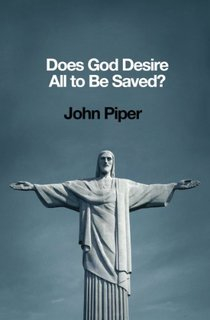
Book Review By David P. Craig
John Piper states his purpose for writing this book as follows, “My aim in this short book is to show from Scripture that the simultaneous existence of God’s will for all people to be saved and his will to choose some people for salvation unconditionally before creation is not a sign of divine schizophrenia or exegetical confusion. A corresponding aim is to show that unconditional election therefore does not contradict biblical expressions of God’s compassion for all people and does not rule out sincere offers of salvation to all who are lost among the peoples of the world.”
In Chapter One Piper acknowledges and addresses some of the more perplexing texts that are cited to show that God’s will is for all people to be saved: 1 Timothy 2:4; 2 Peter 3:9; Ezekiel 18:23; and Matthew 23:37. Piper concludes his examination of these passages by stating that the only conclusion we can arrive at is that the Scriptures show that God has two wills: “willing something in one sense that he disapproves in another sense.”
In Chapter Two Piper illustrates God’s “two wills” by examining five explicit examples of this from the Scriptures: (a) In the death of Christ (Acts 2:23); (b) In the war against the Son of God (Rev. 17:16-17); (c) In the hardening of Pharaoh’s heart (Exodus); (d) In the restraint of a King’s evil (Proverbs); (e) In not delighting in the punishment of the wicked (Ezekiel 18:23).
Chapter Three is an exposition of the Sovereign will of God. Piper’s thesis is that “behind the complex relationship of the two wills of God is the foundational biblical premise that God is sovereign in a way that makes him ruler of all actions.” Piper examines various passages of Scripture and concludes, “Terms such as ‘will of decree’ and ‘will of command,’ or ‘sovereign will’ and ‘moral will,’ is not an artificial distinction demanded by Reformed theology. The terms are an effort to describe the whole of biblical revelation. They are an effort to say yes to all of the Bible and not silence any of it. They are a way to say yes to the universal will of Ezekiel 18:23 and Matthew 23:37, and yes to the individual, unconditional election of Romans 9:6-23.”
In the final Chapter Piper ties his argument together by discussing how God does not sin in willing that sin takes place. He answers the question: “What keeps God from saving whom he desires to save? And he goes into a lengthy discussion of the question “What is free will?” In the process he comes back to 1 Timothy 2:4 and gives an exegetical and philosophical argument from some of the great theologians of the Church: John Calvin, Jonathan Edwards, Stephen Charnock, Robert L. Dabney and a wonderful illustration from the life of George Washington.
In the final analysis Piper arrives at 3 concluding statements about the universal love of God and the offer of Christ’s salvation to everyone in the world: “(1) Christ really is the all-powerful, all-wise, all-satisfying Son of God offered in the gospel; (2) by his death and resurrection, he has acted out God’s discriminating, definite electing, regenerating, faith-creating, every-promise-guaranteeing new-covenant love, and thus purchased and secured irreversibly for his elect everything needed to bring them from deadness in sin to everlasting, glorified life and joy in the presence of God; and (3) everyone without any exception, who receives Christ as supreme treasure–who believes in his name–will be united to Christ in the embrace of this electing love and enjoy him and his gifts forever.”
John Piper has done a beautiful job of explaining the mysteries of God’s sovereign will, the offer of salvation, and shown clearly that the Bible teaches that we believe in and practice both – that He is sovereign in His election of those He will save, and that we have a responsibility to declare the gospel to all of humanity because He desires their salvation. I recommend this book to help you understand the depths of God’s sovereign plan, love, and activity in carrying out His redemptive purposes until Christ returns again.
Dr. John Piper on Having a “Gratitude Ethic”
How Does Gratitude Motivate?
On May 29 [1983] in my message on Galatians 5:1-5, I opposed the “Gratitude Ethic” which says: “God has worked for me, now I will return the favor and work for him;” or: “God has given me more than I could ever pay back, but I will devote my life to trying.” But the question was raised by Steve Roy after the service whether there may be another way gratitude could motivate obedience that does not involve a debtor mentality. So I spent about six hours on Memorial Day trying to think that question through. Here is where I am.
Definition: gratitude is a species of joy which arises in our heart in response to the good will of someone who does (or tries to do) us a favor. We do not respond with gratitude to a person if they accidentally do us a favor. Nor do we respond with gratitude if they do us a favor with mercenary ulterior motives. On the other hand, we do respond with gratitude to a person who tries to do us a favor but is hindered by circumstances beyond his control—say, he sacrifices his life to bring us medicine in the jungle but it turns out not to heal. We still feel gratitude toward him. Therefore gratitude is not merely the response of joy to a benefit received. It has special reference to the good will of another person. A person whose joy centers only on a gift received with no sense of joy in the good will of the giver, we call an ingrate. So gratitude is a species of joy which arises in response to the good will of someone who does (or tries to do) us a favor.
This joy, like all joys, has in it an impulse to express or display the value of its cause. This is a crucial insight for understanding how gratitude motivates behavior. It is the nature of joy to demonstrate or express the value of its cause. When something gives us joy we feel an impulse to show the value of it by our words or actions.
The intensity of this joy and its expressive impulse is determined by three varying factors:
1) the importance to us of the gift offered (We are more thankful for a winter coat than for an ice-cream cone);
2) the sacrifice it cost someone to give the gift (We are more thankful if a person risks his life than if his gift is of no inconvenience);
3) our own sense of unworthiness to receive the gift (We are more thankful for free gifts than earned wages).
The question how gratitude can properly motivate good behavior is the question: how should we express or demonstrate the value of God’s good will toward us? Gratitude is the joy that arises in response to God’s good will toward us in all his gifts. This joy has an impulse to express the value of that good will. How should it do so?
Answer: It should express the value of God’s good will in a way that honors the nature andaim of that will and does not contradict it. (For example: I should not try to show my gratitude to someone who just paid my way through an alcohol treatment center by throwing him a beer party.)
Let’s take God’s good will expressed in sending his Son to die, for example. The nature of that act of love is that it was unconditional, undeserved, a gift of sheer grace. The aim of that act was to unleash a power of forgiveness and renewal that would transform people into reflectors of God’s glory. So the way gratitude for this act of God’s good will toward us should express itself is by saying and doing what honors the nature of it as free and theaim of it as God’s glory.
Certain attitudes are thus ruled out: any attempt to pay God back would contradict the nature of the act as free and gracious. Any attempt to turn and become God’s benefactors is ruled out as dishonoring to the nature and aim of the divine act. That was my point last Sunday. But there are some proper ways for the impulse of the joy of gratitude to find expression:
1) the admission that we don’t deserve Christ honors the gracious freeness of the gift.
2) Words of love, praise and thanks will pop out like fruit on the branch of gratitude.
3) Trust in the forgiveness and renewing power unleashed in the cross honors its aim.
4) Acts of self-denying love also show how free we are made by the all-sufficiency of the gift of love in the cross.
This is how I see gratitude motivating obedience to Christ. It does not prompt us to pay him back or to meet his needs. As a species of joy it has in it an impulse to show the value of God’s good will. What shows the value of God’s good will in its true nature and aim are words of praise, a heart of trust, and a life of love.
Thankful for you,
Pastor John
BOOK REVIEW: “Acting the Miracle” Edited by Dr. John Piper and David Mathis
GOD’S WORK AND OURS IN THE MYSTERY OF SANCTIFICATION
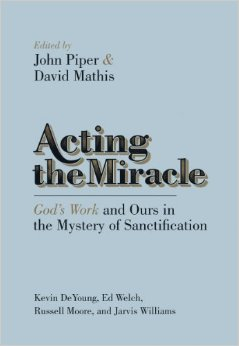
Book Review by David P. Craig
There are various aspects to the biblical doctrine of sanctification – essentially becoming more like Jesus “conformed to the image of Christ” (Romans 8:29). Theologians often talk about two aspects of our becoming like Christ: Definitive sanctification and Progressive sanctification. Definitive sanctification is our legal status with God whereby we become righteous in God’s sight upon our conversion and justification in Christ Jesus. This book focuses on the Progressive sanctification aspect. It addresses the issue of how we actually progress in actual holiness as we live by faith in Jesus.
There are seven helpful chapters in this book by some excellent scholar/pastors:
(1) David Mathis gives the introduction which focuses on the complexities of sanctification and how it relates to our justification and union with Christ.
(2) John Piper defines sanctification by grounding its reality in the holiness of God and the sinfulness of humanity. He provides a wonderful exegetical study of Romans 8:28-30 and answers the question: “What is the Place of Sanctification in the Process of Salvation?”
(3) Kevin DeYoung examines what should motivate our sanctification. He gives a very practical explanation from Colossians 3 that seeks to balance the element of justification, duty, and gratitude in the context of grace as we seek to be more like Jesus. He points out that our greatest incentives in the pursuit of holiness are theologically based on our identity in Christ. Sanctification is diverse and there is a multiplicity of reasons for this diversity, but it all stems from our union with Christ as we grow in our understanding of and application of His grace.
(3) Ed Welch (a well-known biblical counselor) tackles three specific issues: (a) Attention-Deficit/Hyperactivity Disorder; (b) Depression; (c) and Panic Attacks. He gives examples of how to care for individuals who manifest these symptoms, there causes, and how people who struggle with these battles can grow in Christ-likeness. Welch shows how Scripture can be used to help men and women with existing sin by addressing their souls and minds with the gospel.
(4) Jarvis Williams gives an articulate biblical theology of how we can pursue a practical maturity in the gospel by (a) Understanding God’s action for us in and through Christ is the foundation underneath our sanctification; (b) By four distinct means of grace – the Word of God; preaching to yourself and meditation; fervent prayer; and suffering; (c) Understanding how God’s action for us and in us through Christ leads to the miracle of our sanctification.
(5) Russell Moore gives a wonderful explanation of the many ways that the Church – participation in the Local Body of Christ – providing the communal context necessary for our maturity in Christ. He gives a solid case for the corporate aspect of our sanctification from First Corinthians 4-6.
(6) John Piper answers many question with relationship to our present and future glorification. Among the questions he addresses are these: How do we go about ‘pursuing the holiness without which no one will see the Lord’? How do we strive to enter through the narrow door? How do we dethrone and kill canceled sin? His goal in this chapter is to demonstrate “how this grand process of sanctification is leading to the predestined glory where the beauty of holiness fills the earth.”
(7) The appendix consists of transcript of a conversation with all the contributors addressing how they each go about pursuing personal devotional and prayer time from the September 29, 2012 Desiring God National Conference in Minneapolis, Minnesota.
I highly recommend this book for all Christians who are concerned about the goal of the Christian life – conforming to the image of Christ – and the practical ramifications of this conformation as we transform into His likeness and bring Him glory for the salvation and joyous sanctification of a multitude of people throughout the Earth.
The Gospel Made Simple: Our “Quest for Joy” by John Piper
Series: Presentations of the Gospel #2
THE QUEST FOR JOY by Dr. John Piper
Did you know that God commands us to be glad?
“Delight yourself in the Lord and he will give you the desires of your heart.” (Psalm 37:4)
1) God created us for his glory
“Bring my sons from afar and my daughters from the ends of the earth,… whom I created for my glory.” (Isaiah 43:6-7)
God made us to magnify his greatness – the way telescopes magnify stars. He created us to put his goodness and truth and beauty and wisdom and justice on display. The greatest display of God’s glory comes from deep delight in all that he is. This means that God gets the praise and we get the pleasure. God created us so that he is most glorified in us when we are most satisfied in him.
2) Every human should live for God’s glory
“So whether you eat or drink or whatever you do, do it all for the glory of God.” (1 Corinthians 10:31)
If God made us for his glory, it is clear that we should live for his glory. Our duty comes from his design. So our first obligation is to show God’s value by being satisfied with all that he is for us. This is the essence of loving God (Matthew 22:37) and trusting him (1 John 5:3-4) and being thankful to him (Psalm 100:2-4) It is the root of all true obedience, especially loving others (Colossians 1:4-5).
3) All of us have failed to glorify God as we should
“All have sinned and fall short of the glory of God.” (Romans 3:23)
What does it mean to “fall short of the glory of God?” It means that none of us has trusted and treasured God the way we should. We have not been satisfied with his greatness and walked in his ways. We have sought our satisfaction in other things, and treated them as more valuable than God, which is the essence of idolatry (Romans 1:21-23). Since sin came into the world we have all been deeply resistant to having God as our all-satisfying treasure (Ephesians 2:3). This is an appalling offense to the greatness of God (Jeremiah 2:12-13).
4) All of us are subject to God’s just condemnation
“The wages of sin is death…” (Romans 6:23)
We have all belittled the glory of God. How? By preferring other things above him. By our ingratitude, distrust and disobedience. So God is just in shutting us out from the enjoyment of his glory forever. “They will suffer the punishment of eternal destruction and exclusion from the presence of the Lord and from the glory of his might” (2 Thessalonians 1:9).
The word “hell” is used in the New Testament fourteen times—twelve times by Jesus himself. It is not a myth created by dismal and angry preachers. It is a solemn warning from the Son of God who died to deliver sinners from its curse. We ignore it at great risk.
If the Bible stopped here in its analysis of the human condition, we would be doomed to a hopeless future. However, this is not where it stops…
5) God sent his only son Jesus to provide eternal life and joy
“Here is a trustworthy saying that deserves full acceptance: Christ Jesus came into the world to save sinners…” (1 Timothy 1:15)
The good news is that Christ died for sinners like us. And he rose physically from the dead to validate the saving power of his death and to open the gates of eternal life and joy (1 Corinthians 15:20). This means God can acquit guilty sinners and still be just (Romans 3:25-26). “For Christ died for sins once for all, the righteous for the unrighteous, to bring us to God” (1 Peter 3:18). Coming home to God is where all deep and lasting satisfaction is found.
6) The benefits purchased by the death of Christ belong to those who repent and trust him
“Repent, then, and turn to God, so that your sins may be wiped out” (Acts 3:19). “Believe in the Lord Jesus and you will be saved” (Acts 16:31).
“Repent” means to turn from all the deceitful promises of sin. “Faith” means being satisfied with all that God promises to be for us in Jesus. “He who believes in me,” Jesus says, “shall never thirst” (John 6:35). We do not earn our salvation. We cannot merit it (Romans 4:4-5). It is by grace through faith (Ephesians 2:8-9). It is a free gift (Romans 3:24). We will have it if we cherish it above all things (Matthew 13:44). When we do that, God’s aim in creation is accomplished: He is glorified in us and we are satisfied in him – forever.
Does this make sense to you?
Do you desire the kind of gladness that comes from being satisfied with all that God is for you in Jesus? If so, then God is at work in your life.
What should you do?
Turn from the deceitful promises of sin. Call upon Jesus to save you from the guilt and punishment and bondage. “All who call upon the name of the Lord will be saved” (Romans 10:13). Start banking your hope on all that God is for you in Jesus. Break the power of sin’s promises by faith in the superior satisfaction of God’s promises. Begin reading the Bible to find his precious and very great promises, which can set you free (2 Peter 1:3-4). Find a Bible-believing church and begin to worship and grow together with other people who treasure Christ above all things (Philippians 3:7).
The best news in the world is that there is no necessary conflict between our happiness and God’s holiness. Being satisfied with all that God is for us in Jesus magnifies him as a great Treasure.
“You have made known to me the path of life; you will fill me with joy in your presence, with eternal pleasures at your right hand.” (Psalm 16:11)
*You are permitted and encouraged to reproduce and distribute this material in its entirety or in unaltered excerpts, as long as you do not charge a fee. For Internet posting, please use only unaltered excerpts (not the content in its entirety) and provide a hyperlink to this page. Any exceptions to the above must be approved by Desiring God.
Please include the following statement on any distributed copy: By John Piper. ©2013 Desiring God Foundation. Website: http://www.desiringgod.org/
About John Piper
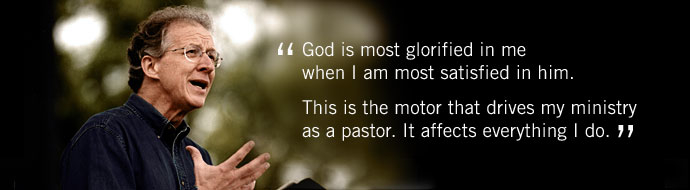
“The ministry of preaching is the central labor of my life. My prayer is that through that ministry and everything else I do, the great glory of our God and Savior Jesus Christ would be magnified as more and more people come to live out the obedience of faith more and more deeply.” – John Piper
Growing Up
John Stephen Piper was born January 11, 1946, in Chattanooga, Tennessee, to Bill and Ruth Piper. His father was a traveling evangelist, and the Pipers lived near Chattanooga to be near a Christian college for which Bill served on the board. When the school moved to Greenville, South Carolina, the Pipers moved as well, and it was in Greenville that John spent his growing-up years. John honored his father in a 2008 biographical message called “Evangelist Bill Piper: Fundamentalist Full of Grace and Joy” and in the 2013 ebook A Tribute to My Father. John also wrote a tribute to his mother, who died in 1974, in the book What’s the Difference, and commended her in his Mother’s Day sermon in 2005, “Honoring the Biblical Call of Motherhood: A Tribute to Ruth Piper.”
Schooling
John graduated from Wade Hampton High School in 1964, and he majored in Literature and minored in Philosophy at Wheaton College (1964–68). Studying Romantic Literature with Clyde Kilby stimulated the poetic side of his nature, and today he regularly writes poems to celebrate special family occasions and rich, biblical truths. At Wheaton, John also met Noël Henry whom he married in 1968.
Following college, he completed a Bachelor of Divinity degree at Fuller Theological Seminary in Pasadena, California (1968–71). While at Fuller, John discovered the writings of Jonathan Edwards.
John did his doctoral work in New Testament Studies at the University of Munich in Munich, Germany (1971–74). His dissertation, Love Your Enemies, is now available through Crossway Books. Upon completion of his doctorate, he went on to teach Biblical Studies at Bethel College in St. Paul, Minnesota for six years (1974–80).
Bethlehem Baptist Church
In 1980, sensing an irresistible call to preach, John became the senior pastor of Bethlehem Baptist Church in Minneapolis, Minnesota, where he ministered for 33 years, until Easter 2013. Together with his people, John was dedicated to spreading a passion for the supremacy of God in all things for the joy of all peoples through Jesus Christ — a mission he continues now for the wider church through the ministry of desiringGod.org.
Desiring God and Bethlehem College & Seminary
John is the author of over 50 books and now frequently travels to speak, and writes regularly, through Desiring God. He also became chancellor of Bethlehem College & Seminary at its founding in 2009 and continues to serve as both chancellor and professor.
Family
John and Noël have four sons, a daughter, and twelve grandchildren.
 LifeCoach4God