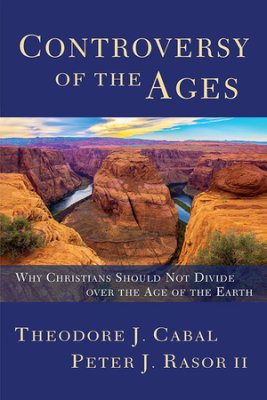
Book Review on Cabal’s and Rasor’s “Controversy Of The Ages”

337752.jpg

A Good Example of Civil Discussion on A Controversial Topic

Book Review by Dr. David P. Craig

As a pastor who tries to keep current with the latest discoveries and teachings in science and how they mesh with the Bible I found this book immensely helpful from a Christian perspective. The author’s do several things really well in this book:

(1) They give a good overview of the history of the interplay between science and biblical interpretation with a very interesting analysis of The Copernican Conflict; The Advent of Darwinian Evolution;  The Scopes Trial and its results; and the more recent controversy over the age of the earth.

(2) They present a consistent hermeneutic learned from Galileo that assumes biblical inerrancy, not inerrant interpretation and the objective truth that nature and and biblical revelation cannot be in conflict/disagree. There must be a striving for both theologians and scientists to pursue truth in special (biblical revelation) and nature (general revelation).

(3) They give a very interesting discussion of evolution and how it was received by both scientists and theologians within a short time following his completing his Origin of the Species. They discuss some of the main issues of conflict brought on by the acceptance of Darwin’s theory from its inauguration until modern times between theologians and scientists of note.

(4) They demonstrate that the resulting world view of Darwinian Evolution has resulted in many liberal theologians and scientists buying into “metaphysical naturalism, that everything interesting about the world reveals there is no God;” as well as how, “human experience rather than the Bible has become the ground of Christian knowledge.”

(5) Throughout the book the author’s give a helpful analysis of the three main views among Theologians and Scientists today as exemplified by Young Earth Creationists (as propounded by Henry Morris, Ken Ham, and Andrew Snelling) and their largest organization: Answers In Genesis; by Old Earth Creationists (as propounded in particular by Hugh Ross and those in his ilk), and its primary organization; Reasons To Believe; and lastly, the most recent organization that sings the praises of Evolution: BioLogos – with its influential proponents like C. Francis Collins.

(6) There is a fascinating discussion of flood theories, fossils, and dating mechanisms in dating the earth – pro and con for both old and young.

(7) One of the most helpful aspects of this book is its discussion of first, second, and third level doctrines that are essential to Christianity. The author’s refer to Albert Mohler’s “Theological Triage of three levels to ascertain theological urgencies.” For example, first level or essential doctrines to Christianity would include “doctrines such as the Trinity, the full deity and humanity of Jesus Christ, justification by faith, and the authority of Scripture.” Second order or level doctrines would include issues that often separate congregations and denominations like the mode and method of baptism and whether women can serve as pastors. Third level doctrines would include the eschatological unfolding of the plan of God (e.g. pre-millennialism, post-millennialism, a-millennialism) and issues like the one the authors are addressing. The authors apply the principle of theological triage to the three main views today with reference to science and theology. It is a very interesting and enlightening discussion of the relative unimportance of “age” with reference to the essentials related to the gospel and what makes one a Christian.

Cabal and Rasor have written a very civil book on the interplay of the various issues and views in regard to scientific and biblical interpretation. I think they have written a book that helps lay people like me understand the complexity of the issues and yet puts the “cookies on the shelf” so that one can see that though these issues are important – they are not essential to the gospel, but are nevertheless important and demand that extremists be balanced and listen to one another as everyone seeks to interpret all of God’s revelation (the written Word and the natural world) in a gracious manner that is always and ever in pursuit of God’s truth.


Book Review on Donald S. Whitney’s Praying The Bible

547843.jpg

A Simple Guide To Learning How To Pray The Scriptures

Reviewed By Dr. David P. Craig

I have completed several books by Donald Whitney over the years and always appreciate the fact that he is doctrinally sound and extremely practical. This little book is no exception. Whitney’s goal in this book is to help the reader overcome the “boring routine of saying the same old things about the same old things” by teaching the reader the variety, freshness, and excitement of praying through the Bible.

Perhaps the most helpful chapter in the book is the section on “Praying the Psalms.” He quotes Ben Patterson, “By praying the Psalms back to God, we learn to pray in tune with the Father, Son, and Holy Spirit.” In learning to pray through the Psalms it helps the one praying to be (a) Balanced in prayer – as the Psalms convey every doctrine in the Bible; (b) Emotionally healthy – as the Psalms deal with every human emotion: joy, anger, fear, anxiety, discouragement, loneliness, etc.; (c) God centered – usually we have a tendency to be self-absorbed – the Psalms get our focus back on God; (d) Accurate – Whitney writes, “God gave the Psalms to us so that we would give the Psalms back to God. No other book of the Bible was inspired for this express purpose.”

Whitney, also has a helpful guide to praying through the 150 Psalms in the back of the book. Praying through this plan insures direction and guidance for prayer as well as momentum for prayer. The author gives great examples of how to pray other Scriptures and various genres and even tackles some thorny questions related to prayer. I have been tremendously helped in my own prayer life by this terrific book and I’m convinced that it will help anyone grow in their excitement and communication with the Lord in prayer.


Book Review of Peter Scazzero’s “Emotionally Healthy Spirituality”

342465.jpg

The Missing Element Of Biblical Discipleship

By Dr. David P. Craig

The two ministry points that I’m most passionate about are biblical preaching and making multiplying disciples of Jesus Christ. I have been discipling men for over thirty years and I have found that the missing element in most discipleship curriculum and workbooks is the whole area of emotional health. Peter Scazzero’s books (he’s also written  The Emotionally Healthy Church and The Emotionally Healthy Leader) are like Biblical Discipleship 201, 301, and 401. It is essential to know how to study the Bible, pray, share one’s faith, etc. However, the emotional health of Christians is often ignored, neglected, and never addressed. Along with other discipleship oriented books – Emotionally Healthy Spirituality will help make a Christian disciple truly whole and holy.

As a pastor for the past thirty years In four different churches I have seen many elderly people who have been Christians for many years, but instead of being mature emotionally, many of these people have simply plateaued at the age of 10, 20, or 30 and have lived stuck in their immaturity emotionally for years. Instead of being Christians for sixty years it’s more like they have lived for sixty years as a ten-year-old Christian.

In this book Scazzero addresses the emotional make-up of people using a plethora of biblical and practical applications. He also draws on historical figures that have much to say about biblical emotions. He also addresses the ramifications of generational sin, familial dysfunctions, and cultural distractions that get between us and our walk with God.

The first seven chapters primarily deal with the problems associated with emotionally unhealthy spirituality and the last three chapters give hope through solutions. Using a variety of spiritual disciplines and personal examples Scazzero helps the Christian identify emotional unhealthiness and easy cures based on the Scriptures. For anyone who is passionate about transformation, liberation from bondage, and following in the steps of Christ this book is a must read. It’s extremely beneficial to read this book in a small group along with the workbook and DVD that are based on this book. I have taken five groups of men through this book and several of the men have described this book as “revolutionary,” “paradigm-shifting,” and “life-transforming.”

I highly recommend Scazzero’s books be read along with their workbooks in small groups (men with men; and women with women) for maximum transparency, accountability, and transformation into the likeness and image of Christ.

Book Review of Jonathan Dodson and Brad Watson’s “Raised? Finding Jesus by Doubting the Resurrection”

517351.jpg

Why the Death and Resurrection of Jesus is The Bull’s-Eye of The Gospel

By Dr. David P. Craig

Pastor’s Dodson and Watson write two chapters each in this short, yet powerful book, reflecting on what they call the “bull’s eye of the gospel.” They referring to Paul’s substantial treatment of the death and resurrection of Jesus Christ in 1 Corinthians 15. A big part of the focus on this book is that it is much easier to embrace the reality of the death and burial of Jesus Christ than it is his resurrection from the dead. They demonstrate that believing in the resurrection was just as difficult 2,000 years ago as it is today.

The author’s deal cogently and honestly with how both Jews and Gentiles struggled with the idea of a bodily resurrection when Jesus lived. During the time of Christ there were many doubters–Jesus’ friends, contemporary Greeks and Romans, and countless Jews. They go on to show why they doubted the resurrection and demonstrate that “if you doubt the resurrection, you are in good company. Jesus understands your doubts, and he welcomes them. To those who are skeptical and struggling with belief, Jesus remains ready to receive your questions. He will listen to your doubts.”

This book wrestles with the historical evidence of the resurrection, addresses the doubts related to the supernatural event of Christ’s bodily resurrection from the dead (both ancient and modern), and gives in clear and concise answers some of the best reasons to believe that the resurrection of Christ really happened historically. There are also some wonderful applications of this book about how to live the resurrected life in Christ. The resurrection changes everything and this book marvelously makes a case for the practical ramifications of the gospel.

I highly recommend this book to strengthen the faith of believers, and start the journey on the way to faith for non-believers and skeptics. This is a good introduction in answering why millions of people around the world continue to follow Jesus and are convinced in the historical realities and ramifications of his life, death, burial, and resurrection.

Book Review of Erwin Lutzer’s “Cries From The Cross”

413116.jpg

“Going Deep With Jesus On The Cross”

By Dr. David P. Craig

In this short book by Dr. Erwin Lutzer he does a wonderful job of taking the reader deep into the significance of what Jesus said in his last seven sayings on the cross. The work of Christ on the cross magnifies the holiness and  justice of God and the ugliness and heinous nature of sin. As Lutzer says, “The cross properly understood exalts no one whom it first does not humble; it gives life only to those whom it first ‘puts to death.’ The cross exposes the futility of our self-righteousness; it reminds us we are sinners, incapable of bringing about our own reconciliation with God. Before the cross we can stand with bowed heads and a broken spirit.”

As I devoured this book on Good Friday I was filled with sorrow and grief over my own sins and the sins of humanity; and yet I was also filled with joy over the reminder that Jesus could pronounce “It is finished.” A pronouncement that His life and death accomplished everything He set out to achieve. As the author of Hebrews testified, “But now he has appeared once for all at the end of the ages to do away with sin by the sacrifice of himself” (Hebrews 9:26). In the Old Testament, the priests offered sacrifices, but could never sit down. Their job was never finished. Jesus’ payment covered our indebtedness. He took our spiritual bankruptcy and covered it with the solvency of His perfect righteousness in exchange for our sin.

I love the way Lutzer expresses the truth of Christ as our substitutionary sacrifice: “This means that my sins are on Jesus, not on me. Yes, there is sin within me but not on me. My sinful nature keeps luring me toward sin, and even in my best moments my works are tainted with selfish motives. But legally, I am accepted on the basis of the merit of Jesus. Figuratively speaking, I have a new set of clothes and a clear record in heaven. The righteousness of Jesus has been successfully credited to my account. God’s justice has spent all its ammunition; there is nothing left to be hurled at us.”

Lutzer spends a chapter on each of the last sayings of Christ on the cross showing how they tie the Old Testament and New Testament together; fulfill prophecy; express the unity and purpose of the Trinity in accomplishing our redemption; and practical reflections and meditations that will help you understand and appreciate with greater depth the beauty of redemption. I highly recommend this book for anyone who wants to understand, and delight in the Savior who went to the cross in submission to the Father, to defeat Satan and death, and grant forgiveness of sins and eternal life to those who like the thief on the cross will repent of their sins and put their trust in Jesus as their Lord and Savior.

Book Review of J. Warner Wallace’s “Alive: A Cold-Case Approach To The Resurrection”

707444.jpg

Great Easter Give-Away

Reviewed by Dr. David P. Craig

J. Warner Wallace was once an Atheist and a Cold-Case Detective. He is now a prolific author and speaker on presenting evidences for the cogency of the Christian world-view. What sets Wallace apart from other modern apologists is that he really puts the “cookies on the shelf” for the general reader to be exposed to great evidence in an understandable and interesting manner.

In this short book – one designed to be cheap and as a giveaway for Easter – Wallace approaches the subject of Jesus’ death, burial, and resurrection the same way he would investigate a homicide. The minimal facts that Wallace investigates are the following: (1) Jesus died on the cross and was buried; (2) Jesus’ tomb was empty, and no one ever produced His body; (3) Jesus’ disciples believed that they saw Jesus resurrected from the dead; (4) Jesus’ disciples were transformed following their alleged resurrection observations.

Next, Wallace proceeds to tackle the skeptical explanations that deny the above facts: (1) The Disciples were wrong about Jesus’ death; (2) The Disciples lied about the resurrection; (3) The Disciples were delusional; (4) The Disciples were fooled by an imposter; (5) The Disciples were influenced by limited spiritual sightings; (6) The Disciples observations were distorted later – with each of these six skeptical views Wallace demonstrates how each of these views contains at least four to six inherent problems tied to the argument.

The most logical explanation requires a belief in the supernatural: a belief that Jesus had the supernatural power to rise from the dead and thus Wallace defends the position that The Disciples were accurately reporting the literal bodily resurrection of Jesus. Wallace concludes his examination of the evidence with a very important point: “Moving from the most reasonable inference to a decision of trust…It’s one thing to ‘believe that’ Jesus rose from the dead and is who He said he was, but it’s another to ‘believe in’ Him as Savior. Every one of us, at some point in our investigation of the claims of Christianity, has to move from ‘belief that’ to ‘belief in.'”

Wallace’s little book is a great way to get the essence of the Christian message in the hands of the curious and skeptics alike. This is a short book that deserves a wide reading and should be bought in bulk as a giveaway – especially during Easter as we celebrate the great hope of the world – the One who lived, died, was buried, and raised so that we might have salvation by Him and through Him – the Lord Jesus Christ.

BOOK REVIEW ON WILLIAM P FARLEY’S: “THE SECRET OF SPIRITUAL JOY”

51pvwTw64zL._AC_US320_QL65_.jpg

Pursuing The Path To Biblical Joy

Book Review By Dr. David P. Craig

I’m always looking for good resources to help me and others become more joyful in the Lord. Bill Farley has written an excellent little book that covers the topics of humility, thanksgiving, gratitude, God’s sovereignty, and the work of Christ on the cross and how these realities intersect to bring about deep joy in the follower of Jesus.

Using biblical stories and principles Farley demonstrates what we need to put off (e.g., grumbling, pride and self-pity) and that God ultimately motivates His followers by convincing us that the work of Jesus and all His commands are not burdensome, but for our own good and His ultimate glory.

As I finished this little book I was given practical ways to become more humble, trusting, content, and grateful. My joy significantly increased as I was exposed to the glory of God in His sovereign plans to bring about my salvation and sanctification.

I recommend this book for anyone who wants to deepen their joy in the Lord, or as a great book to give away to those who are battling discouragement, bitterness, or lack the joy of the Lord. In Farley’s book you will find that the secret to joy is found in the gospel and the blessings of living in the gospel realities of your every day life.

Book Review of Jammin Goggin & Kyle Strobel: “The Way of the Dragon or the Way of the Lamb”

022358.jpg

The Amazing Power of Weakness

Book Review By Dr. David P Craig

I can remember how discouraged I used to get when as a young pastor I would attend Pastor’s conferences and hear stories of pastor’s bragging about how “great” their ministries were. I would always come back from those conferences wondering if I was really “called” to ministry because I wasn’t experiencing the “greatness” these other pastors were experiencing. In my late twenties I took on a pastorate in a rural community that nobody (myself included) had ever heard of. About six months into my ministry I heard about a “rural pastors conference” and decided to see if this would help me in my new ministry. Before the first session, we had a “meet and greet” time and I remember everyone introducing themselves and trying to describe the area they were serving in – because nobody heard of each other, and nobody had what would be described as a “great” ministry.

There was such a liberating and freeing feeling being around pastors that knew they were weak, ministering in obscurity, and all recognized that if God didn’t show up – we were in big trouble. I love this book because all the examples in this book are encouraging. When you are around ego it deflates you, when you are around weakness it elates you! All of us pastors had nothing to prove, and nothing to brag about, but we all shared our need of the power of God to sustain and guide us in our respective ministries. Since that time I’ve primarily interacted with bi-vocational pastors and pastors of smaller churches because they are usually very real, humble, and focused on needing help from God – not on how they can help others be “great.”

It was at that conference that I realized that God calls most pastors to obscure places and average ordinary ministries. Most pastors will never make the cover of “Christianity Today” or write a book that makes a notable “best-seller” list. Honestly, I’m good with that. Enter Goggin and Strobel’s book. They aren’t down on mega churches (I don’t think they even use this word in their book). However, they give an excellent analysis of what makes for the ministry of the Lamb (ministering out of weakness – Kingdom ministry from above) versus ministry from the Dragon (ministering out of the flesh – from the Kingdom of Darkness and Satan).

I’ve experienced ministry out of the flesh driven by pride and ego; and I’ve experienced ministry that comes from weakness, brokenness, and of the Spirit. I think that once you experience the power of brokenness or ministering out of weakness you never want to go back to the “dark side.” I’ve been around pastors and churches where God doesn’t even have to show up and nothing would even have to be changed. The author’s do an excellent job of showing from the Bible how the way of power has infiltrated many churches today. It is not just dangerous – it’s demonic. This is a serious charge.

My favorite aspect of this book are the highlights from interviews that Goggin and Strobel share from several well respected faithful older Christians: J.I. Packer, Eugene Peterson, Jean Vanier, Dallas Willard, John Perkins, and Marva Dawn. Through the interviews and Scripture the author’s give a compelling case for why ministry in dependence on God rather than our own skills and resources are more powerful in the long haul of ministry. Power in ministry comes when the Holy Spirit is depended upon to show up because we are operating out of our relationship and satisfaction in Christ. Power is not about self, resources, skills, it’s evident from above when we humbly focus on exalting Jesus above all things.

I hope this book gets a wide reading. I think it is wise, biblical, and will encourage pastors and Christians who are serious about faithfully serving Christ in power out of weakness in dependence on Him for life-long ministry.

Book Review of Ron Rhodes’: The 10 Most Important Things You Can Say To A Catholic

512c5LD0vjL._AC_US320_QL65_.jpg

Explains Key Differences Between Catholicism and Protestantism 

Reviewed By Dr. David P. Craig

I have a deep love for those who have been raised in the Catholic Church. As a Protestant we share many cherished beliefs and values. However, we have some significant differences of belief as well. In this book Rhodes tackles nine of the major areas where Catholics and Protestants disagree.

Here are the nine areas of conflict addressed by Rhodes: (1) Catholics believe that the Apocryphal Books should be included in the biblical canon – Protestants do not; (2) Catholics believe that tradition is authoritative for belief and practice, whereas, Protestants believe the Bible alone is authoritative for faith and practice; (3) Catholics believe that Peter was the first Pope, Protestants on the other hand hold that he was a great apostle (among various apostles in the early church); (4) Catholics hold to the infallibility of the Pope, the Bishops, and the Magisterium of the Church; whereas Protestants hold to the Bible as being infallible, but not the human leaders of the Church; (5) Catholics venerate Mary as a co-redeemer and mediatrix, a perpetual virgin, and various other views that conflict with Protestant views. Protestants simply view Mary as simply the godly mother of Jesus and nothing more. (6) Catholics mix justification and sanctification – adding human merit/works to one’s salvation; whereas Protestants view salvation as solely and entirely by grace through faith in Jesus – justification is instantaneous and once and for all. (7) Catholics and Protestants have a very different view on “mass” or the “Lord’s Supper.” Catholics hold to transubstantiation whereas Protestants hold to consubstantiation or the memorial/symbolic view. (8) In Catholicism Penance must be done to absolve sins, in Protestantism Confession of sin is to be made to God, not a human priest. (9) Catholicism believes in Purgatory (second chance after death); Protestants hold to no second chances after death.

For each of these views Rhodes offers the Catholic argument first, followed by a Protestant rebuttal and defense. The chapters are short and only the most salient points are made. For each chapter Rhodes uses different icons to identify points made by Catholics and Protestants. Each chapter contains points to use with caution, helpful witnessing points, and supplementary and more detailed material that can be found in Rhodes’ larger book entitled “Reasoning from the Scriptures with Catholics.” As of this review Rhodes has written a few other short books of this ilk on Creation and Evolution; Mormonism, Jehovah’s Witnesses, Islam, and Masons.

I highly recommend this resource. It’s short and to the point, and yet delineates some key points to help Protestants share the good news with their Catholic friends.

Book Review of David Murray’s: The Happy Christian

022013.jpg

Applying This Book Will Make You Happier Indeed

Book Review By Dr. David P. Craig

I have always battled discouragement and depression as a Christian since I was a young boy. As a pastor for close to 30 years I still battle discouragement and depression to varying degrees. Therefore, I am always on the look out for anything that can help me in the process of becoming happier and more joyful. Even when I find myself being happy and full of joy I’m often around people in my church and the world that are struggling with depression and discouragement. Therefore, I am glad that David Murray – a pastor-theologian has written and given this wonderful resource for me personally to increase my own happiness, and to help others pursue happiness in a gloomy and dreary land.

Murray tackles ten specific areas that can increase our happiness in the chapters that make up this book. In a nutshell here’s what he tells the reader to focus on: The first thing we need to do is change the way we think. Oftentimes we can’t change our circumstances, but we can change what and how we think about them. Murray says that 40% of our happiness (he gives research evidence to back up this statistic) depends on how we think about things. Murray states, “Our hopes of living positive lives depend largely on getting our thoughts about the facts right. Most unhappy people are unhappy not because of their situation but because they let their feelings rule their thoughts, or they think about things in the wrong way.” Murray goes on to explain how the Psalmist changed his mood in Psalm 77 by honing in on proper facts, leading to right thoughts, resulting in positive feelings. He delineates the steps we can take in this process for any feeling or thought we encounter. I found chapter One to be immensely helpful. He gives four fundamentals for getting our thinking right: (1) Prioritize the facts; (2) Gather the facts; (3) Interpret the facts; and (4) Use the facts. “Ninety percent of your long term happiness is predicted not by your external world , but the way your brain processes the world.

In subsequent chapters Murray shares how to control your exposure to the media (which is largely negative); how are salvation is based on what Jesus has done for us (not on what we can do for Him); How Christ – not other believers should be our focus; how to focus more on the future than on our past; how to see grace everywhere; how to become more of a praiser than a criticizer; how giving increase happiness more than getting; and how both work and being around racial diversity lead to tremendous fulfillment.

I can’t recommend this book highly enough. It is chalk full of statistics, psychological studies, case studies, great quotes, illustrations, examples, and practical ways to be proactive in becoming a happier Christian. Murray defines Christian happiness as “a God-centered, God-glorifying, and God-given sense of God’s love that is produced by a right relationship to God in Christ and that produces loving service to God and others.” He demonstrates from Scripture and through a deep theological understanding that “Christianity doesn’t deny the difficult and painful reality of sin and suffering that runs through our lives, but with one vertical line from heaven to earth, with the incarnation, crucifixion, and resurrection of Jesus, Christianity promises to change the equation of our lives into a positive result.”

Murray’s book is wider, more theologically deep, and biblically accurate tun other books of this ilk – which tend to be shallow and thus unhelpful. Therefore, Murray has done a great service in writing a book that gives Christians foundational resources based on theological sound bedrock truths that can help one withstand the storms of life. I find myself at least 40% happier since I’ve read and applied some of the principles of this book. I believe that any Christian will be happier, and more useful in helping others be more like Jesus as a result of reading and applying the principles of this fantastic resource. Most importantly, God is glorified when we delight in Him and His creation – we were made to delight in the One who delights in us.