Interview with a Theological Giant: Dr. J.I. Packer

J.I. PACKER: THE LOST INTERVIEW

J.I. PACKER IN HIS VANCOUVER OFFICE 2009(J.I. Packer at his regent College Office in Vancouver, B.C., in 2009)

Q&A | From a recording that disappeared in transit five years ago, the octogenarian theologian shares how God shaped him first and foremost as a catechist.

Five years ago, WORLD founder Joel Belz suffered a journalistic disaster. He had traveled to Vancouver, British Columbia, to interview octogenarian J.I. Packer, author of many terrific books on theology. Joel recorded 90 minutes of conversation and placed the recording in the side pocket of his suitcase. Somewhere on his luggage’s journey back to North Carolina, someone or something ripped off that side pocket. Joel lost his Bible and the recording.

After a long search, Joel sadly concluded the interview was not meant to be—yet last year he received a package containing the lost items, without a senders name or return address. Joel had the interview transcribed but suspected it was dated. This past week he sent me the transcript and modestly (as always) suggested, “There might be some excerpts that could be useful. I read the interview and found all of it useful. Joel asked good questions and Packer, now 87, was both wise and charming. Please read and enjoy. —Marvin Olasky

(JB) = Joel Belz and (JIP) = J.I. Packer

(JB) If you don’t take it as an insult, I would like to ask you the question that I ask newcomers to my own congregation—because I think this is something that people don’t know about J.I. Packer. When somebody comes to our congregation and says, “I want to be a member of your church,” my fellow elders and I ask them these three questions. We say, “Tell us when you first believed, and tell us what you believed then, and tell us what you believe now.” You see the point? I don’t think a lot of people have ever heard how J.I. Packer came to faith in the first place. Do you mind sharing that?

(JIP) Not in the least. At my age I have nothing to hide. And, in fact, the story of my conversion is a perfectly straightforward one, as you will note here. At age 15 at school I was a member of the chess club, and I played chess regularly with the son of a Unitarian minister. He got me thinking what is true in Christianity because he tried to sell me the Unitarian bill of goods, and that was the first occasion in my life when I asked myself what is true in Christianity. Is he right?

I had been brought up an Anglican Church attendee, but in the Anglican Church where I was nurtured, if that’s the word to use, I was never taught anything. I thought of Christianity as on a pile with King Mun’s teeth, mainly something that you regularly did, but you didn’t think about it, not even when you were doing it. But anyway, he left me with the question that this can’t be true because it’s a position that only holds together by willpower. If you are going to deny the divinity of Christ, which is so central to the New Testament, you also deny all the rest of it. If you are going to affirm that the ethic of Jesus is the best thing since fried bread, well then you ought to take seriously what the New Testament says about who He is. That got me going.

I read some C.S. Lewis, I read a good deal of the Bible, and I read a number of books of all schools of thought relating to the Christian faith. Two years on after this started, a friend of mine who had gone to university a year before I was due to go, he got suddenly converted through the Intervarsity [IV] people, and when next we met, and thereafter, he took it on himself to try and explain to me that I didn’t have faith. By then I had got to the point where I was prepared to stand up for the creed in debate—we had a 12th grade atheist; most schools do—and we used to have fairly intense arguments. I argued for truth of the creed and I took for granted that since I believed the creed, that’s what it meant to have faith as this friend of mine naturally had. Came the day when I was due to go up to Oxford and he said very quickly before he went off to the university where he was studying, “I haven’t been able to explain it to you very well, but when you get to Oxford, link up with the Intervarsity people. They will be able to make it clearer than I have been able to do.”

At Oxford the Intervarsity people were out on the hunt and we met right at the beginning of my time. They organized a periodic evangelistic preaching service at the university. The first such preaching service that I attended the sermon lasted three-quarters of an hour and was preached by an elderly gentleman who within the first 20 minutes bored me. Then he started telling at length the story of his own conversion and suddenly everything became clear. I am not a person who gets much in the way of visions or visuals, but the concept called up a picture which was there in my mind was that here I am outside of the house and looking through the window and I understand what they are doing. I recognize the games they are playing. Clearly they are enjoying themselves, but I am outside. Why am I outside? Because I have been evading the Lord Jesus and His call.

Once that had become clear my defenses fell quite rapidly, and at the end of the service we sang “Just As I Am” and by the end of the hymn I was a believer. So out of church I went, but back with the Intervarsity people from then on to catch up with the nurture that I had been missing all through these years—really to make up for lost time. And that’s the main thing, far and away the biggest thing that I was doing outside my studies for the next four years.

(JB) And what were your studies?

(JIP) I was doing the Oxford liberal arts degree. It’s Greek or Latin philosophy, language and history, along with a good deal of modern philosophy and a good deal of modern ethics, too. It’s a fine looking education, as a matter of fact. Pretty demanding, but I look back to it with gratitude, though frankly I didn’t enjoy it at the time. I should add that I was brought up Anglican as I told you, but after my new life had started I found myself very angry with the Anglican Church for not having told me the gospel all those years. I didn’t want to worship in Anglican churches, but I spent a lot of my time worshiping with Christian brethren, and in many ways that was a very good experience. After four years I was an Anglican again and I remain an Anglican until this day. That’s another story. Have I told you what you wanted to know?

(JB) That helps me, except I would like to hear you say what changes God has produced in your thinking. What year was it when you went off to Oxford?

(JIP) 1944.

(JB) In the 64 years since then, what significant changes have been brought into your mind about the faith that excited you at the end of that service that night?

(JIP) What I brought to the service was Christianity according to C.S. Lewis, mere Christianity. Under the nurture of the Intervarsity people and with a touch of God, too, I had added to Lewis a strong belief in the inerrancy of the authority of Scriptures. Lewis didn’t believe in inerrancy. He didn’t go around denying it, but he didn’t affirm it either.

The touch of God which helped me along that road took place six weeks after I converted. The Intervarsity people ran a Saturday night Bible study, and at this particular Saturday night Bible study an elderly gentleman with some eccentric views about the book of Revelation was speaking. And if I remember rightly, he was speaking about Revelation 13, which is a chapter in which it’s easy to be eccentric—where there’s a dragon and the horsemen, etc.—but I can still remember the moment, coming out of the meeting. I had gone into the meeting assuming, without argument really, nobody had argued with me about it so far, but I was assuming that though the substance of the Scripture was certainly true and we believed, I had been having a wonderful time in personal Bible study since my conversion which seemed to confirm that, particularly in terms of the Christ about whom the New Testament spoke being the living Savior and Lord who had called me into what we all call a personal relationship. But I took it for granted that educated people nowadays don’t believe every jot and tittle of the Bible.

I think it was the reverence with which this curious old gentleman had handled Revelation 13. Not what he made of it, but it’s the way that he squared up to the text—squeezing wisdom out of individual verses and phrases and studying the texts in the context and flow of the argument. I think it was that, though honestly I’m not quite sure. Anyway, something had triggered in me unawares. The Bible makes an impact on me which assures me that it is the Word of God pure. And being so it is bound to be all true and all trustworthy because God is. I think that is the way to say it—it’s what Calvin called the witness of the Holy Spirit which I’d been enjoying for those six weeks but hadn’t got around to verbalizing. When I got to verbalizing, I realized this isn’t what I used to believe. It was a bit of a joke. I’ve stayed with that ever since and, as you know, stuck my neck out in all sorts of ways through pieces of writing to vindicate that position.

(JB) Which is probably why I’m here because you are my hero in that sense and I thank you for sticking your neck out at great cost to your own self. If you were to chart the progress of belief in inerrancy of Scripture during your lifetime would you say it was very much an undeveloped doctrine when you were young in broad evangelical circles? It certainly wasn’t popular in the U.K. when you were young.

(JIP) No, it wasn’t. If I remember rightly, it was more an assumption among the Intervarsity people than a matter for argument or debate, but it was their assumption. I have a linear sort of mind, a lawyer’s mind. When I believe something, I want to articulate it, so having become aware of it, I believed that the Bible is the Word of God. Yes, I have read some stuff that would help me to articulate it but I don’t remember that anyone around me was particularly concerned to do that. Although, of course, in Intervarsity we knew that the other forms of Christianity in the university didn’t involve trust in the Scriptures just like that, but in those days I didn’t argue with them. That came later.

Billy Graham and his wife Ruth arrive in London in May 1955.

Assocaited Press

Billy Graham and his wife Ruth arrive in London in May 1955.

(JB) And what triggered your willingness to take it on in a more argumentative way? What prompted you to say, “This is important?”

(JIP) As with so many things in my life, the human way of saying this was that I was pushed into it, pulled into it, and the logical way of saying it was that I was brought into the providence of God. In the year of grace 1955 I was asked to reply to several months of criticism in print from English church leaders who were denouncing Billy Graham and all that he stood for, and Intervarsity along with Billy Graham, and focusing on belief in the inerrancy of Scripture, which to some critics is a belief that makes it impossible for people to do Bible study of the kind that all the rest us do today. In other words, it was a belief that anchored one in obscurantism and darkness of mind. I was asked to reply to this and I was given the title, actually it was the senior people in Intervarsity who asked me to do this. The title they gave me was “narrow mind” or “narrow way.” It was nice. And my audience was members of what then was called the gracious fellowship of Intervarsity, so I was among friends. I had a line of argument which I deployed and they liked and I was asked to write it up.

Wm. B. Eerdmans Publishing Co.

 I imagine that what the IV publisher expected was something of pamphlet length, 6,000 words perhaps. But knowing that anything you write is going to be read by enemies as well as by friends, I realized there were a lot of presuppositions that had to be filled in and defended before the particular line of argument that I had used in my address could be deployed. Otherwise, the howl would be, “Look at how much you have taken for granted. You can’t take those things for granted.” So the IV publisher had to wait for a little over a year and then they landed on his desk—not 6,000 words, but 60,000. The book was called Fundamentalism and the Word of God and it’s still in print. From that day to this I thought that it’s a good response to critical biblical study and critical theology. I believe that I was able to do something pretty good. It’s a piece of controversial writing that does stand up.

(JB) The word fundamentalism meant something a little different then than it does now. You would probably put a different title on it, or not.

(JIP) Yes, I would. Fundamentalism in the original title was the word that the critics had been using as the label for that which they were denouncing. And what I wanted to argue was that label brings no clarity about anything. It does, in fact, mislead because it implies obscurantism and, in fact, behind evangelical belief there is intellectually taught class history. That’s one of the things that the book was concerned to do. It reaches back to Luther and Calvin and the whole Reformed tradition. I’d been reading [B.B.] Warfield. That was how I became a frontline man on the inerrancy question, and because I had become a frontline man by the providence of God I’ve been asked over and over again if I would do frontline things—write some more, speak some more.

(JB) You’re the frontline man. Are you satisfied the way that front has been held in the evangelical world, or have we retreated?

(JIP) No, I don’t think we’ve retreated. I think that on balance the front has been held well and strongly. I’m thinking now of some doings over the 10-year period of the International Council on Biblical Inerrancy in which I was quite prominent. I believe that God helped us do a very good job, actually. We produced a couple of excellent statements, I think. One explaining inerrancy. Perhaps I should reveal that I wrote it, and then there was a statement on interpretation. I didn’t write that, but I had something to do with it. Those draftings of mine gave satisfaction round and about. It seems to me that this is the way to look at what happened after that.

In any movement that is gaining strength and recruiting able people to its own and getting stronger on its own basics as I continue to think that the evangelical movement was doing, and I would argue that still. I am thinking of all those commentaries which assume the inerrancy of Scripture. But we had nothing like that while I was young. But we’ve got three or four series now, and I think they are an index of what is actually happening. Happening where? In the seminaries. There are more seminaries and far more theological students at them than was the case when I was converted in 1944. The bright professors in the seminaries went along with the Inerrancy Council. There was, of course, a spectrum as there always is when you’ve got a lot of bright people maintaining a position that is able to feel itself pretty strong. Under those circumstances there will always be left-wingers who are out on a limb themselves in regards to some of the details. I don’t think that they are carrying the constituency with them.

Carl Trueman (left) and Wayne Grudem
Westminster Theological Seminary (Trueman) and Phoenix Seminary (Grudem)

Carl Trueman (left) and Wayne Grudem

(JB) If you were to point to two or three people who are on that front about whom you say, “Atta boy, you’re doing now what I did 50 years ago.” Whom would you cheer?

(JIP) Carl Trueman isn’t yet the heavy of heaviest, but he’s very strong in his own sophisticated fundamentalist way. And so is Wayne Grudem—he’s a strong man.

(JB) I appreciate that, and I don’t want to push in that direction. And where would you say, besides the doctrine of inerrancy being important in and of itself, that it shows itself to be most crucial on what practical issues in our times?

(JIP) When you say practical issues, do you mean moral issues?

(JB) Perhaps … the life of the church.

(JIP) In the life of the church there has been much in recent years about a gay way of life, and I think evangelicals have shown themselves solid against it in way that was biblical. Good stuff is being produced on sex and the family. They are not compromising anymore. Willie Mackenzie [of Christian Focus Publications] is a dear sweet Christian man, and his wife is a dear sweet Christian lady, and they have a real ministry, a good ministry. And although a lot of the stuff they publish is heavy, there is a degree of unction—I think is what I want to say—an unction which is a reality that I believe in. Unction, that is the touch of the Holy Spirit that makes you realize that this is God’s truth and you’ve got to take it seriously. Unction will enable people to learn even from relatively dull or somber and monochrome books.

(JB) But having said that, how do you encourage somebody to connect himself to that unction? How do you encourage someone who writes to do it with vividness, with vim, with vigor? How do you encourage someone who preaches to do it with passion instead of that dullness that you refer to?

(JIP) First of all, I try to set an example. And second, I write—I’m fairly forthright in books and articles in pinpointing what I think are shortcomings in evangelical life and ministry. And here, perhaps, I’d better say something which I’ve been saying over and over for the last five years but didn’t say before because I didn’t see it before, but better late than never. God made me, shaped me as a catechist, an adult catechist. Catechists are people who teach the truth that Christians live by.

(JB) Could I interrupt you just a quick moment? Why your emphasis on catechizing?

(JIP) We’re getting there. … Let me preempt you. I am an adult catechist, and their advantage is to teach the truth that Christians live by and to teach how to live by them. In this guild where theological professions gather, they are doing a different job, and, frankly, I keep out of the guild because it bores me. Not because I don’t think that the growing edge studies in theology are a waste of time, but because that isn’t me. What’s on my heart is the work of the catechist. Getting out the truth that Christians live by and trying to show—talking, writing, living—trying to show what it means to live by them.

The answer to your question, why this emphasis, is first of all five years ago when I came to realize that this is the deep truth about me. I am an adult catechist: It was quite a discovery. You may or may not know that Alister McGrath wrote a theology biography of me up to the age of 75—or was it 70? When he finished the biography he didn’t know quite what to say about me. This man didn’t want to call me a theologian because I didn’t move around in the world of the guild like he does. He writes excellent textbooks and he also engages on some of the frontiers, which is what he in his own mind thinks of a theologian as doing. So he didn’t want to call me a theologian and he ended up calling me a “theologizer.” But it was after that that I realized I’m a catechist.

I said five years ago—it may have been a little more than that—one of the things that may have triggered this realization is that [Pope] John Paul II said, “We need a new catechesis.” He said it to [Cardinal Joseph] Ratzinger, and Ratzinger troops on to the composition of another catechism of the Catholic Church. You know that big book, 800 pages of stuff. Now that catechism is actually a resource book for the clergy. That’s how it’s intended to be used, whereas we Protestants are used to catechetical documents as being documents for the direct instruction of the laity either by question and answer or by something approaching that, little hunks of instruction and then questions. As I say, that may have made the difference. In the Catholic Church it varies very much, how much is being done, but they’ve made headway in adult catechesis that puts them way in front of where we are. We take it for granted that by the time our people get into their late teens they’ll know the basics of the faith.

(JB) And they don’t at all …

(JIP) No, they don’t. But nonetheless we go ahead with a style of preaching that assumes this basic knowledge. It isn’t catechetical preaching except in a very few discerning cases. It isn’t sufficiently debated.

(JB) Would you give me a kind of concise definition of what you mean by catechetical teaching?

(JIP) Going back to my formula that a catechist teaches the truth that Christians live by and also teaches how to live by those truths, I would say that the raw material of catechisms is the doctrines of the gospel. Now, I’ve been a professor of systematic theology for quite a lot of my life, and at the start of all my theology courses I say: First of all, you’ve got to realize that theology is a compound of 10 distinct disciplines: Exegesis, biblical theology, and historical theology are the first three. They are the resources out of which systematic theology builds its wisdom. And systematic theology is, in fact, biblical theology rethought in relation to the questions and debates of the day so that it’s material ready for use by catechists and preachers and teachers of all shapes and sizes. Also, from systematic theology using its raw material, the following six disciplines are resourced: apologetics, ethics, worship or liturgy, spirituality or Christian devotion, mythology, misology, and pastor theology or practical theology—all the know-how you are able to share with one another about ministering, ministering truth in light of truth.

(JB) Do I hear you saying that systematic theology comes from the prior three and gives birth to those six?

(JIP) Yes, that’s what I’m saying. Actually as I’m expounding it, I say you’ll meet systematic theology in books of systematic theology that have already been written. But if you examine those books you will find that the raw material that’s being deployed comes from these three sources, and it’s by exegesis and biblical theology in particular that what’s in the books has to be assessed. The Bible comes first. The Bible must have the last word as well as the first word. I give them that and I say, “Now keep that scheme in mind for the rest of your life and make sure that you don’t leave seminary without a working acquaintance with all 10 disciplines, because if you are going to honor God as a communicator of the Word, you will need to have all of these dimensions of theology in your mind.”

There’s more introductory stuff that I give them, but I end up telling them this: Learn to identify evangelical theology. You identify evangelical theology first by its method and second by its content. In terms of method, there are three methods, and one of them is evangelical. The evangelical method is to draw your truth and conclusions and wisdom from Scripture and allow Scripture to pass judgment on your attempts to express what Scripture is saying. The Bible has the first word; the Bible has the last word. And contrast methods two and three, which are to appeal—as Catholicism does—to what the church says, and as liberals do to the judgment of the individual theologian. Which means, of course, that among liberals, the debate goes on indefinitely and nothing can be regarded as quite certain.

As for content, here I’m thinking of the doctrinal basis of a lot of 20th century evangelical organizations. You have first of all the authority of Scripture affirmed. Secondly, the triunity of God affirmed. Third, the fallenness of the man who was created in the image of God affirmed. Fourth, the incarnation affirmed. Fifth, the atonement affirmed. Sixth, the new birth by the Spirit through faith affirmed. Seventh, justification through faith affirmed. I believe that theologically, in light of John 3, the new birth is a work of God the Spirit out of which faith comes, rather than saying with the Arminians that faith comes, and through faith the new birth takes place. In other words, the primacy of regeneration by the Holy Spirit. Eight, the church sustained by every member along with the ministry of official ministers—all animated by the Holy Spirit and all constituting Christ’s ministry to His people through His people. I wanted to say all that because you’re Presbyterian and I wanted to make sure that you hear it right. Presbyterianism actually hasn’t said anything like enough about the Holy Spirit in every member’s ministry. It’s tended to say altogether too much about the office of official ministries. There’s an imbalance there in the heritage.

(JB) I agree with you. I am impressed that both in your emphasis on catechizing and what you have just said here you are never content simply to be an academic. You are never content to be theologian.

(JIP) I’m a catechist …

(JB) … and a churchman.

(JIP) That’s right.

(JB) That is a vital part of your worldview. After your early disappointment in the Anglican Church that betrayed you by not giving the gospel to you, why do you still see the church as important? It was a parachurch organization that early nurtured you.

(JIP) But my faith comes from the Bible. In the New Testament the church is the center of the plan of redemption. We are units in the body of Christ. There is one spirit, one Lord, one faith, one baptism, one church. The church is at the center of God’s promise. I said eighth is the church. Ninth is the return of Christ. Tenth is the glory of God, and both are the final goal of everything that God is doing. Put together those 10 convictions and you’ve got evangelical theology. Lose out on any single one of them and you’ve got something less than evangelical theory or you’ve got evangelical theory mental: maimed, distorted, out of truth. I give them that in the fourth class of my series before ever I get down to particular doctrines. I tell them, “You’ve looked at the forest. Once you’ve looked at the forest, it’s safe to take you in among the trees.” We then move to doctrine of revelation of the Bible, the doctrine of God, etc. That is a catechist at the podium in a seminary or a seminary-type institution.

(JB) I got catechized at my breakfast table. My dad was a country preacher, and if we did not come to the breakfast table with our catechism literally learned, we did not eat breakfast. We got sent back to our room until we learned it.

(JIP) Your dad was a wise man. We don’t do it that way nowadays, but what a heritage.

(JB) What tools, besides these that we’ve just discussed and that you’ve put into such a neat package, do young men and women moving into the work of the church for the coming generation need? Where do you see them most needy, most deficient? Where are they barking up empty trees—and they should back off and get serious developing particular tools that you think are more important?

(JIP) My desire for everyone who’s in stated ministry in the church is to be, amongst the other things they are, a catechist. I think first of the need that they have of resources that will help them to be good catechists, and for that purpose I should start by urging them to have a very good systematic theology on their shelves. I shall tell them that they should find out by experimenting whether they get benefit from Calvin’s running way of expounding doctrine in the Institutes. If they don’t, I’m sorry that they don’t, but in that case Louis Berkhof is going to do them much more good. There are a number of systematic textbooks that have appeared since Louis Berkhof wrote, but nobody, it seems to me, matches Berkhof for his skill in saying much, very straightforwardly in a small space. He goes to the heart of every truth. He says it quickly. If you are going to work with [Millard J.] Erickson, for instance, Erickson takes far more time, fills far more space, and rarely achieves the same clarity. He gives you good stuff, but what Berkhof gives you is constantly, point after point, good stuff.

I would hope that the book that I wrote on a smaller scale called Concise Theology would help as a resource for catechists. It’s subdivided into 50 or 60 different chapters. I like to think that people are going to ask themselves, “Here are 60 matters which this man Packer thought was important. Do I think it is important?” I produced a catechism book of a different sort titled Growing in Christ, published by Crossway. Once it was called I Want to Be a Christian and was published by Tyndale, but Tyndale couldn’t sell it because the title—so they assured me—misled people about what sort of book it was. It’s actually a catechism book and gives 800 words on each clause of the Lord’s Prayer, the Apostles’ Creed, and each of the Ten Commandments, and general stuff about Christian obedience and on the baptismal covenant. I go over all the New Testament teachings on that standard. There are biblical passages to study and questions with which to work. It would be very straightforward for clergy to use it as a course for people who want to join the church.

(JB) And it’s still available?

(JIP) Yes, it’s still available from Crossway and it’s not sold very well, because this type of instruction doesn’t ring bells with the majority.

(JB) It’s work.

(JIP) Yes, it’s work and they’re not used to teaching the faith in this way. They assume that everyone over the age of 20 has a good general grasp of the faith so that they can hammer away a particular point and make them pictorial and vivid, but without actually bothering to go over their substance. I am just remembering it’s not so many years ago since I preached in a large evangelical congregation and I took Romans 3:24–26, Paul’s teaching on justification. I just analyzed it, and at the end of the sermon people were shaking hands with me and more than one said, “Thank you so much for that, I’ve never heard anything like that.” This was a respectable evangelical church.

(JB) What have we been doing?

(JIP) We’ve been making an assumption—the assumption is false, so there’s a disconnect. For the rest of my life this is what I shall be at, trying to promote the catechism.

(JB) May I be bold and ask this: Have you been teaching our friend Charles Colson this very thing? I talked with him last week and he used the word catechizing.

(JIP) I don’t think it is I who has given it to him, but he does read my stuff and he’s very complimentary about it.

(JB) He’s very high on the whole issue of catechizing.

(JIP) He’s been associated with me over these last few years. I’m not too surprised, because I talk about it.

(JB) And I think he’s been listening to you.

(JIP) He’s a great man, Chuck Colson.

(JB) I did my column about his new book The Faith in our current issue [Aug. 9, 2008].

(JIP) That’s a good book.

(JB) I like his chapter on truth. When half our evangelical young people aren’t sure there is any such thing as truth anymore, they need to be catechized.

(JIP) Yes they do. I don’t think there is deep-seated doubt in their minds, but it is clear that they’ve never been catechized. They have never been taught to take the truth question as the basic question of their lives. The basic question of my life was simply the cast of my own mind that led me to take it from age 15 on, and people sometimes think I’m an apologist. I’m not one really, but if anyone is going to affirm doubt about the availability of truth, I do have an arsenal which I can deploy.

(JB) Yes indeed. Even with my own children—I have five daughters and they’re all married now—I hear a tone—and I didn’t do as good a job catechizing them as my father did with me and I’m embarrassed by that—but I hear my daughters say, “Dad, I agree with what you said, but who am I to say?” That is an expression that really concerns me out of the next generation. They agree, in broad terms, but they don’t think they have the right to impose their belief on someone else. I think I use the wrong word when I say impose …

(JIP) I know what you mean. My comeback when I hear that sort of talk is to ask people straight away, “Now tell me, do you believe in a God who tells us things?” And if I get an affirmative answer, actually if I don’t, I have a supporting line question: “You don’t—who do you think Jesus Christ was?” The quick answer, of course, is God. “Did he tell us things?” You see, that should put them out of doubt. Then I say, “Then you believe in a God who tells us things?” I believe He’s telling us things all through the Bible. If God has told us things, don’t you think we’re entitled to tell other people what God has told us?

(JB) Good. I’m glad you said that. That’s what I need. That’s why we call it the gospel.

(JIP) Yes, it’s news—it’s good news—and it’s the gospel of God. He told us.

(JB) It’s gospel truth.

(JIP) That’s right.

*SOURCE: By Joel Belz – Posted on December 7, 2013 @ http://www.worldmag.com/2013/12/j_i_packer_the_lost_interview

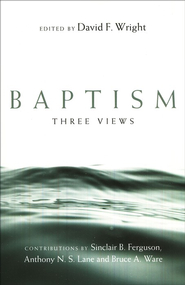
BOOK REVIEW: “BAPTISM THREE VIEWS”

HOW SHOULD WE PRACTICE BAPTISM IN THE CHURCH?

Baptism 3 Views

Book Review by David P. Craig

In this multi-view book we have three views presented: (1) Believer’s Baptism (credobaptism – “credo” being from the Latin for “I believe”) – presented by Dr. Bruce Ware, professor of Christian Theology at The Southern Baptist Seminary in Louisville, Kentucky; (2) Infant Baptism (paedobaptism – “paidos” from the Greek for “child”) – presented by Dr. Sinclair Ferguson, the Senior Minister at First Presbyterian Church in Columbia, South Carolina and professor of systematic theology at Redeemer Seminary in Dallas, Texas; and (3) The Dual-Practice Baptism View – presented by Dr. Anthony N. S. Lane, professor of historical theology at London School of Theology in Northwood, England. The book was edited by David F. Wright (1937-2008), professor of patristic and Reformation Christianity at New College, University of Edinburgh, Scotland – and after his death in 2008 by Daniel G. Reid, the senior editor for reference and academic books at IVP Academic.

The structure of the book is that each scholar gives his argument for his own position using biblical, theological, and historical support. After each presentation – the other two author’s counter, and the presenter responds to the two counter arguments. Such is the case for each presentation.

(1) Bruce Ware argues for credobaptism – “only those who have already become believers in Christ should be baptized and that this baptism should be by immersion in water.” In his biblical defense of believers’ baptism he gives an abundance of linguistic and contextual support for baptism by immersion from the New Testament (NT – from this point on). He then shows that every clear instance of baptism in the NT relates to the baptism of those who have repented of sin and come to faith in Christ. In this section he highlights and discusses eleven passages from the book of Acts where Luke presents a clear and unambiguous depiction of baptism as being performed only on believers. Next he shows the absence of non believers’ baptism in the NT. He then presents a case against infant baptism from its absence in the NT.

In the theological section of his essay he gives a thorough presentation of the meaning of the new covenant and what remains the same and what has changed from the OT to the NT. He writes, “If the NT writers genuinely saw a parallel between physical circumcision and infant baptism, it is utterly remarkable that they never said so in the NT….As I endeavor to explain, the fact that circumcision functioned at two levels, both for the ethnic and national people of Israel and for the spiritual reality of being separated unto God, indicates that the sign and seal of baptism simply is not meant to be seen as parallel to circumcision…That is not to deny any relation between circumcision and baptism. Where circumcision and baptism are parallel is exactly where Colossians 2:11-12 see them as parallel, namely, in the spiritual reality to which each of them points…In short, the parallel between circumcision and baptism in the new covenant is not between physical circumcision and infant baptism; rather, the parallel is between spiritual circumcision of the heart and baptism, which signifies regeneration, faith and union with Christ…So then, since only the actual spiritual reality is in view when one is baptized, the sign and seal of baptism relates only to those who have experienced this spiritual reality, that is, to believers in Jesus Christ. The new covenant encompasses only those who know the Lord, those who have been united with Christ, those in whom the Spirit has come to dwell through faith. As such, baptism, the sign and seal of this reality (i.e., not of the promise but of the reality itself), applies rightly only to believers in Jesus Christ.”

One of the most interesting quotes from the historical arguments in his essay comes from a passage in Justin’s Apology quoted in Stander and Louw on what was required by a person before he was accepted for baptism in the early church (100-165 A.D.), “firstly, the person had to believe in the truth of the Christian doctrine; secondly, he had to undertake to live accordingly; thirdly, the baptismal candidate had to undergo a period of devotion and fasting in which he had to request God to forgive all his past sins…Since only mature persons could satisfy these preconditions, it undoubtedly excludes the possibility that infants were involved in these activities.” Examples like this one show that infant baptism did not develop in any significant way until the fourth century.

Dr. Ware concludes his essay giving two practical ramifications that believers’ baptism provides for the health and well-being of the church: “First, the practice of credobaptism has the potential of providing a young Christian a wonderful and sacred opportunity to certify personally and testify publicly of his own identity, now, as a follower of Christ…Second, the practice of credobaptism grounds the regenerate membership of the church…If membership in the new covenant and hence in the church comes via infant baptism, yet salvation comes only by faith, then it follows that paedobaptist churches are necessarily afflicted with the problem of a potentially significant number of unregenerate church members.”

(2) Sinclair Ferguson argues for paedobaptism – “baptism is the sign and seal of the new covenant work of Christ and is analogous to circumcision, which was the sign of the old covenant of Israel. The biblical continuity between the covenants demands that infants of believers be baptized in addition to those who come to Christ at any age. The mode of baptism is not at issue.” Dr. Ferguson’s essay traces the evidence for infant baptism starting with the historical evidence from the post-apostolic period onward; then provides a biblical and theological perspective (redemptive-historical). Lastly, he draws some conclusions about the baptism of the infants of believers.

In the first part of his essay Ferguson draws upon a snapshot of instances where infant baptism is practiced by the early church: (a) records of mortality – some dating back to the turn of the third century; (b) works of theology – Origen, Tertullian, Cyprian of Carthage refer to infant baptism in their writings; (c) evidence from liturgy compiled by Hippolytus of Rome (d. ca. A.D. 236). It’s interesting that none of these practices give a theological reason for the practice of infant baptism.

Ferguson writes, “Was the title to baptism of these children grounded in either (1) the faith of their parents/sponsors?–which would be somewhat akin, as we shall see, to a covenantal approach to infant baptism–or (2) was the confession of the parents/sponsors viewed as an expression of the ‘faith’ of the infants themselves?–which would be in keeping with the wording of later inscriptions describing the deceased infant as being ‘made a believer’ at the point of baptism.”

In the second part of the essay Ferguson discusses the importance of covenant signs in the Bible: (a) Noahic covenant – the sign of the rainbow (Gen. 9:12-16); (b) Abrahamic covenant – the sign of circumcision (Gen. 17:11); and (c) Mosaic covenant – the Sabbath day (Ex. 31:16-17). Ferguson comments, “In their own context each of these covenant signs pointed forward to a fulfillment in the new covenant in Christ…This background shows that the physical signs of baptism and the Lord’s Supper which Jesus instituted belong to a larger pattern and should be interpreted in the light of this biblical-theological tradition. Baptism cannot be fully understood abstracted from this matrix.”

Ferguson gives the following definition of baptism from the Westminster Confession of Faith: “Baptism (and all the biblical sacraments) are holy signs and seals of the covenant of grace, immediately instituted by God, to represent Christ and his benefits; and to confirm our interest in Him: as also, to put visible difference between those that belong unto the Church and the rest of the world; and solemnly to engage them to the service of God in Christ, according to his Word.”

Then Ferguson explains how the sign of circumcision in the Old Covenant is transferred to baptism in the New Covenant: “Baptism functions in relationship to the new covenant in Christ in a manner analogous to the function of circumcision in the Abrahamic covenant. In a word, baptism has the same symbolic significance in relationship to fellowship with God as did circumcision…Baptism signifies all that is in Christ for us; it points us to all that he will do in us and all that we are to become in him…Baptism is not primarily a sign and seal of faith, but to faith.”

In Ferguson’s biblical-theological defense of infant baptism he grapples with the following issues: (a) how circumcision is fulfilled in Christ for the nations; (b) how union with Christ is expressed in baptism; (c) the baptism of Christ and what it means for us; (d) how baptism expresses the fellowship of God within the Trinity; (e) how baptism functions as a sign and seal; (f) divergent views of infant baptism – contrasting the catholic view and subjectivist view (Protestant); (g) How baptism signifies and seals the covenant of grace; (h) the covenant principle and practice of infant baptism; (i) the harmony of paedobaptism with the New Testament mindset; (j) the implications of baptism.

(3) Anthony Lane argues for the dual practice view – “affirms both adult, or convert, baptism and either paedobaptism or adult baptism as legitimate options for those born into a Christian home.”

He begins his essay by sharing his experiences (the only one of the author’s to share his personal baptism experience) of being baptized in the Anglican church at the age of three, as well as being a part of baptistic churches for the past thirty years. He writes, “At a later stage I read George Beasley-Murray’s Baptism in the New Testament. This Baptist author persuaded me that New Testament baptism was no so much believers’ baptism as converts’ baptism. Thinking about this made me realize that Baptist and paedobaptist practice are alike modifications of this. At the same time I was concerned about the fact that my children appeared to be believers but were not yet baptized, a situation I could not square with the New Testament. The suggestion that such children should take communion until they were old enough for baptism struck me as hopelessly confused. So Beasley-Murray (with help) moved me away from the Baptist position.”

In his biblical analysis of baptism he writes, “If we look at these passages (he sites 14 passages from the book of Acts) and ask what was expected to happen, we find four things that repeatedly occur: repentance, faith, baptism, and reception of the Holy Spirit.”

Lane’s essay hones in secondly on the historical development of what he calls “conversion” baptism (he gives the greatest amount of ink to this section). He takes what he calls a “seismological approach” from the 5th century and back tracks to the New Testament. He believes that there is enough evidence to advocate for both paedobaptism and believers baptism in the early history of the church.

The third part of Lane’s essay focuses on theological and practical considerations of performing dual-baptism. Lane explains, “It must always be remembered that for those raised in a Christian home, baptism, is not an isolated event but simply one stage in a lengthy process…The New Testament practice of baptism was converts’ baptism, the immediate baptism of those who come to faith as part of their initial response to the gospel. This needs to be modified for children born into a Christian home, either into infant baptism or into baptism at a later date. The New Testament evidence for how such children were treated is not unambiguous. Both approaches can be defended on biblical grounds. No grounds exist for insisting on one to the exclusion of the other. This policy of accepting diversity is the only policy for which the first four centuries of the church provide clear evidence.”

In the final analysis for Dr. Ware credobaptism is primarily “a sign of our faith and act of obedience and commitment to Christ.” For Dr. Ferguson paedobaptism is primarily “a sign of what we receive from Christ.” For Dr. Lane paedo or credo baptism (together with faith and in a subordinate role) is primarily “an instrument by which we embrace Christ and his salvation.”

Each essay tackles the issue of baptism quite differently. I would say that Dr. Ware (credobaptism) does the best job with the biblical evidence and with an exegesis of baptism. Dr. Ferguson gives a very articulate presentation of the theological reasoning behind paedobaptism. Dr. Lane (dual-view) does the best job of presenting an early history of baptism. In my opinion the one who does the most balanced job in handling the biblical, historical, and theological evidence for his position is Dr. Ware.

No matter where you stand on the issue of baptism you will definitely learn a lot from this book. The author’s have done their homework and have written with theological acumen and a cogent articulation of the pro’s and con’s of each view. The one thing I would have liked to have seen at the end of this book is a concluding essay from the editor, or perhaps theologians’ from the three different strands articulated in the book. Another helpful asset would have been a question and answer section from the editor to each author. However, for greater insight into the issues of baptism from three great communicators – one would be hard pressed to find a more balanced presentation on baptism than contained in this “Three Views” book. I recommend this book for pastors, students, and Christians on all sides of the equation. It will help clarify one’s position, perhaps change your position, or stir within you a desire to search the Scriptures, Theology, and Church History for further study. The author’s are firm on their presentations and yet charitable and balanced – which is a good model for those wrestling with this important biblical subject.

THE HOLE IN THE GOSPEL

THITG STEARNS

BY D.A. CARSON

John complains, “I simply cannot resolve this calculus problem.” Sarah offers a solution: “Let’s read some Shakespearean sonnets.”

I’ve got a problem with my car: it won’t start. But no problem: I know what to do. I’ll go and practice my guitar. That will fix it.

My cakes always used to fall when I took them out of the oven. But my friend showed me how to fix the problem. He showed me how to adjust the timing on my car engine.

Ridiculous, of course. But this is merely a farcical way of showing that solutions to problems must be closely tied to the problems themselves. You do not have a valid solution unless that solution resolves the problem comprehensively. A shoddy analysis of a problem may result in a solution that is useful for only a small part of the real problem. Equally failing, one can provide an excellent analysis of a problem yet respond with a limited and restricted solution.

So in the Bible, how are the “problem” of sin and the “solution” of the gospel rightly related to each other?

One of the major theses in Cornelius Plantinga’s stimulating book is that sin “is culpable vandalism of shalom.”1 That’s not bad, provided “shalom” is well-defined. Plantinga holds that shalom resides in a right relation of human beings to God, to other human beings, and to the creation. Perhaps the weakness of this approach is that shalom—rather than God—becomes the fundamental defining element in sin. Of course, God is comprehended within Plantinga’s definition: sin includes the rupture of the relationship between God and human beings. Yet this does not appear to make God quite as central as the Bible makes him. In Lev 19, for example, where God enjoins many laws that constrain and enrich human relationships, the fundamental and frequently repeated motive is “I am the LORD,” not “Do not breach shalom.” When David repents of his wretched sins of adultery, murder, and betrayal, even though he has damaged others, destroyed lives, betrayed his family, and corrupted the military, he dares say, truthfully, “Against you, you only, have I sinned and done what is evil in your sight” (Ps 51:4). The majority of the approximately six hundred OT passages that speak of the wrath of God connect it not to the destruction of shalom, but to idolatry—the de-godding of God.2 Human sin in Gen 3 certainly destroys human relationships and brings a curse on the creation, but treating this comprehensive odium as the vandalism of shalom makes it sound both too slight and too detached from God. After all, the fundamental act was disobeying God, and a central ingredient in the temptation of Eve was the incitement to become as God, knowing good and evil.

To put this another way, the tentacles of sin, the basic “problem” that the Bible’s storyline addresses, embrace guilt (genuine moral guilt, not just guilty feelings), shame, succumbing to the devil’s enticements, the destruction of shalom (and thus broken relationships with God, other human beings, and the created order), entailments in the enchaining power of evil, death (of several kinds),3 and hell itself. However many additional descriptors and entailments one might add (e.g., self-deception, transgression of law, folly over against wisdom, all the social ills from exploitation to cruelty to war, and so forth), the heart of the issue is that by our fallen nature, by our choice, and by God’s judicial decree, we are alienated from God Almighty.

For the Bible to be coherent, then, it follows that the gospel must resolve the problem of sin. What is the gospel? In recent years that question has been answered in numerous books, essays, and blogs. Like the word “sin,” the word “gospel” can be accurately but rather fuzzily defined in a few words, or it can be unpacked at many levels after one undertakes very careful exegetical study of εὐαγγέλιον4 and its cognates and adjacent themes.5 We could begin with a simple formulation such as “The gospel is the great news of what God has done in Jesus Christ.” Then one could adopt an obvious improvement: “The gospel is the great news of what God has done in Jesus Christ, especially in his death and resurrection” (cf. 1 Cor 15). Or we could take several quantum leaps forward, and try again:

The gospel is the great news of what God has graciously done in Jesus Christ, especially in his atoning death and vindicating resurrection, his ascension, session, and high priestly ministry, to reconcile sinful human beings to himself, justifying them by the penal substitute of his Son, and regenerating and sanctifying them by the powerful work of the Holy Spirit, who is given to them as the down payment of their ultimate inheritance. God will save them if they repent and trust in Jesus.

The proper response to this gospel, then, is that people repent, believe, and receive God’s grace by faith alone.

The entailment of this received gospel, that is, the inevitable result, is that those who believe experience forgiveness of sins, are joined together spiritually in the body of Christ, the church, being so transformed that, in measure as they become more Christ-like, they delight to learn obedience to King Jesus and joyfully proclaim the good news that has saved them, and they do good to all men, especially to the household of faith, eager to be good stewards of the grace of God in all the world, in anticipation of the culminating transformation that issues in resurrection existence in the new heaven and the new earth, to the glory of God and the good of his blood-bought people.

Once again, as in our brief treatment of sin, much more could be said to flesh out this potted summary. But observe three things:

1. The gospel is, first and foremost, news—great news, momentous news. That is why it must be announced, proclaimed—that’s what one does with news. Silent proclamation of the gospel is an oxymoron. Godly and generous behavior may bear a kind of witness to the transformed life, but if those who observe such a life hear nothing of the substance of the gospel, it may evoke admiration but cannot call forth faith because in the Bible faith demands faith’s true object, which remains unknown where there is no proclamation of the news.

2. The gospel is, first and foremost, news about what God has done in Christ. It is not law, an ethical system, or a list of human obligations; it is not a code of conduct telling us what we must do: it is news about what God has done in Christ.

3. On the other hand, the gospel has both purposes and entailments in human conduct. The entailments must be preached. But if you preach the entailments as if they were the gospel itself, pretty soon you lose sight of the reality of the gospel—that it is the good news of what God has done, not a description of what we ought to do in consequence. Pretty soon the gospel descends to mere moralism. One cannot too forcefully insist on the distinction between the gospel and its entailments.

So now I come to the fairly recent and certainly very moving book by Richard Stearns, The Hole in Our Gospel: What Does God Expect of Us?6 This frank and appealing book surveys worldwide poverty and argues that the American failure to take up God’s mandate to address poverty is “the hole in our gospel.” Without wanting to diminish the obligation Christians have to help the poor, and with nothing but admiration for Mr Stearns’s personal pilgrimage, his argument would have been far more helpful and compelling had he observed three things:

First, “what God expects of us” (his subtitle) is, by definition, not the gospel. This is not the great news of what God has done for us in Christ Jesus. Had Mr Stearns cast his treatment of poverty as one of the things to be addressed by the second greatest commandment, or as one of several entailments of the gospel, I could have recommended his book with much greater confidence. As it is, the book will contribute to declining clarity as to what the gospel is.

Second, even while acknowledging—indeed, insisting on the importance of highlighting—the genuine needs that Mr Stearns depicts in his book, it is disturbing not to hear similar anguish over human alienation from God. The focus of his book is so narrowly poverty that the sweep of what the gospel addresses is lost to view. Men and women stand under God’s judgment, and this God of love mandates that by the means of heralding the gospel they will be saved not only in this life but in the life to come. Where is the anguish that contemplates a Christ-less eternity, that cries, “Repent! Turn away from all your offenses. . . . Why will you die, people of Israel? For I take no pleasure in the death of anyone” (Ezek 18:30–32). The analysis of the problem is too small, and the gospel is correspondingly reduced.

Third, some studies have shown that Christians spend about five times more mission dollars on issues related to poverty than they do on evangelism and church planting. At one time, “holistic ministry” was an expression intended to move Christians beyond proclamation to include deeds of mercy. Increasingly, however, “holistic ministry” refers to deeds of mercy without any proclamation of the gospel—and that is not holistic. It is not even halfistic, since the deeds of mercy are not the gospel: they are entailments of the gospel. Although I know many Christians who happily combine fidelity to the gospel, evangelism, church planting, and energetic service to the needy, and although I know some who call themselves Christians who formally espouse the gospel but who live out few of its entailments, I also know Christians who, in the name of a “holistic” gospel, focus all their energy on presence, wells in the Sahel, fighting disease, and distributing food to the poor, but who never, or only very rarely, articulate the gospel, preach the gospel, announce the gospel, to anyone. Judging by the distribution of American mission dollars, the biggest hole in our gospel is the gospel itself.

* * * * * * *

SOURCE: THEMELIOS VOLUME 38 ISSUE 3 NOV. 2013 D.A. CARSON http://thegospelcoalition.org/themelios/article/the_hole_in_the_gospel

Charles Anderson began serving as managing editor of Themelios shortly after The Gospel Coalition began producing Themelios in 2008. We announce with regret that he is stepping down and acknowledge with gratitude his singular contribution.

Our new managing editor is Dr Brian Tabb, assistant professor of biblical studies and assistant dean at Bethlehem College and Seminary in Minneapolis. Some readers will recognize his name from the reviews he has already written for Themelios. Dr Tabb may be contacted at brian.tabb@thegospelcoalition.org.

[1] That was the expression he used in a 2011 address he delivered at Trinity Evangelical Divinity School. For analogous expressions, cf. Cornelius Plantinga Jr., Not the Way It’s Supposed to Be: A Breviary of Sin (Grand Rapids: Eerdmans, 1994): “sin is culpable shalom-breaking” (p. 14); “Sin is culpable disturbance of shalom” (p. 18). Cf. idem, Sin: Not the Way It’s Supposed to Be (ed. D. A. Carson; Christ on Campus Initiative; Deerfield, IL: Carl F. H. Henry Center for Theological Understanding, 2010). Cited 1 November 2013. Online: http://tgc-documents.s3.amazonaws.com/cci/Pantinga.pdf.

[2] Cf. D. A. Carson, “The Wrath of God,” in Engaging the Doctrine of God: Contemporary Protestant Perspectives (ed. Bruce L. McCormack; Grand Rapids: Baker, 2008), 37–63; idem, “God’s Love and God’s Wrath,” ch. 4 in The Difficult Doctrine of the Love of God (Wheaton: Crossway, 2000), 65–84, 88.

[3] As Augustine rightly observes in City of God XIII.xii.

[4] E.g., D. A. Carson, “The Biblical Gospel,” in For Such a Time as This: Perspectives on Evangelicalism, Past, Present and Future (ed. Steve Brady and Harold Rowdon; London: Evangelical Alliance, 1996), 75–85; idem, “What Is the Gospel?—Revisited,” in For the Fame of God’s Name: Essays in Honor of John Piper (ed. Sam Storms and Justin Taylor; Wheaton: Crossway, 2010), 147–70.

[5] E.g., the editorial for Themelios 38:2 briefly reflects on what “kingdom” means: D. A. Carson, “Kingdom, Ethics, and Individual Salvation,” Them 38 (2013): 197–201.

[6] Nashville: Nelson, 2009.

UNDER THE SHELTER OF GOD’S WINGS

ENCOURAGEMENT FOR DIFFICULT DAYS

TBAWYCO Wiersbe

By Warren W. Wiersbe

In 1892, after a year of intensive work in Great Britain, D. L. Moody sailed for home, eager to get back to his family and his work. The ship left Southampton amid many farewells. About three days out into the ocean, the ship ground to a halt with a broken shaft; and before long, it began to take water. Needless to say, the crew and passengers were desperate, because nobody was sure whether the vessel would sink or not, and nobody knew of any rescue ships in the area. After two days of anxiety, Moody asked for permission to hold a meeting, and to his surprise, nearly every passenger attended. He opened his Bible to Psalm 91 and, holding to a pillar to steady himself, he read: “He that dwelleth in the secret place of the most High shall abide under the shadow of the Almighty.”

Moody wrote later, “It was the darkest hour of my life … relief came in prayer. God heard my cry, and enabled me to say, from the depth of my soul, `Thy will be done.’ I went to bed and fell asleep almost immediately….” Well, God answered prayer and saved the ship and sent another vessel to tow it to port. Psalm 91 became a vibrant new Scripture to D. L. Moody, and he discovered, as you and I must also discover, that the safest place in the world is in the shadow of the Almighty, “under His wings.” “He that dwelleth in the secret place of the most High shall abide under the shadow of the Almighty… He shall cover thee with his feathers, and under his wings shalt thou trust.” So promises the Lord in Psalm 91:1, 4. What does God mean by “under His wings”? Of course, we know that this is symbolical language, because God does not have wings. Some think that this has reference to the way the mother hen shelters and protects her brood. You will remember that Jesus used a similar comparison when He said, “How oft would I have gathered you, as a hen gathers her chickens under her wings, and you would not.”

My own conviction is that Psalm 91 is talking about another kind of wings. Where is that secret place of the Most High? To every Old Testament Jew, there was only one secret place-the holy of holies in the tabernacle. You will recall that the tabernacle was divided into three parts: an outer court where the sacrifices were offered; a holy place where the priests burned the incense; and then the holy of holies where the ark of the covenant was kept. And you will remember that over the ark of the covenant, on the mercy seat, were two cherubim, and their wings overshadowed the ark. This, I believe, is what the psalmist was referring to: the “secret place” is the holy of holies, and “the shadow of the Almighty” is under the wings of the cherubim at the mercy seat.

In Old Testament days, no one was permitted to enter that holy of holies, except the high priest; and he could do it only once a year. If anyone tried to force his way in, he was killed. But today, all of God’s children, saved by faith in Jesus Christ, can enter the holy of holies, because Jesus Christ has opened the way for us. When Jesus died on the cross, the veil in the temple was torn in two and the way was opened into the very presence of God. You and I are privileged to dwell in the holy of holies-to live under the shadow of His wings. We don’t simply make occasional visits into God’s presence; we live there because of Jesus Christ!

Would you believe it if I told you that the safest place in the world is under a shadow? It is–provided that the shadow is the shadow of the Almighty! I would rather be overshadowed by Almighty God than protected by the mightiest army in the world.

As you read Psalm 91, you discover that God makes some marvelous promises to those who will live under His wings, in the holy of holies. For one thing, He promises divine protection. This doesn’t mean that we Christians never experience accidents or sickness, because you and I know that we do. God does not promise to protect us from trials, but to protect us in trials. The dangers of life may hurt us but they can never harm us. We can claim His promise that these things are working for us and not against us.

Listen to one of these promises: “He shall give his angels charge over thee, to keep thee in all thy ways. They shall bear thee up in their hands, lest thou dash thy foot against a stone” (Ps. 9:11-12). A modern scientific world laughs at the idea of angels, but not the child of God. Jesus taught that the angels of God watch over God’s children. The angels don’t run ahead of us and pick up the stones, because sometimes we need these stones in the path to teach us to depend more on the Lord. What the angels do is help us use the stones for stepping-stones, not stumbling blocks. I firmly believe that when we get to heaven, we will discover how many times God’s angels have watched over us and saved our lives. This is not an encouragement to be careless or to tempt God, but it is an encouragement to worry less.

Believers are immortal in the will of God, until their work is done. Out of the will of God there is danger, but in the will of God there is a divine protection that gives us peace in our hearts, no matter how trying life may be. “Under His wings,” abiding in Christ-this is where we are safest during the storms of life. We do not, however, run into the holy of holies to hide from life. I’m afraid too many people misinterpret the Scriptures and the hymns that talk about hiding in God and finding Him a refuge in the storm. We go in for strength and help, and then go back to life to do His will. God’s divine protection is not simply a luxury we enjoy; it is a necessity that we want to share with others. God’s protection is preparation for God’s service. We go in that we might go out. We worship that we might work; we rest that we might serve.

Are you living in the shadow of the Lord, under His wings? Have you trusted Christ as your Savior? Do you spend time daily in worship and prayer? I trust that you do, because the safest life and most satisfying life is under His wings.

The person who lives under His wings not only enjoys the safest life possible, but also the most satisfying life possible. Psalm 91 closes with this promise. “With long life I will satisfy him, and show him my salvation.” This doesn’t mean all Christians will live to be a hundred; the facts prove otherwise. Some of the choicest Christians died before age thirty. A long life refers to quality, not just quantity: it means a full and satisfying life. You can live for eighty years and only exist if you leave Christ out. On the other hand, if you yield to Christ, you can pour into forty years or four lifetimes of service and enjoyment. There is a heart satisfaction that comes only to those who live under His wings, in the the place of surrender and fellowship.

The place of satisfaction is the secret place of the Most High. When you yield to Jesus Christ and link your life with Him, then you find the kind of satisfaction that is worth living for and worth dying for–not the shallow masquerades of this world, but the deep abiding peace and joy that can come only from Jesus Christ.

Turn your back on sin and the cheap trinkets that this world offers, and let me invite you to enter the secret place of the Most High. Surrender to Christ; trust Him as your Savior; answer His gracious invitation. When you do this, you will enter into a new kind of life–a life under the shadow of God–a life in the secret place of safety and satisfaction.

*Source: Warren W. Wiersbe. The Bumps Are What You Climb On. “Under His Wings” – Chapter 10. Grand Rapids: Baker Books, 2006.

BOOK REVIEW: “HOW GREAT IS OUR GOD: Timeless Daily Readings on the Nature of God”

FOCUSING ON THE CHARACTER AND NATURE OF GOD FOR A YEAR

HGIOG

Book Review By David P. Craig

This book contains short devotional excerpts (one page a day) from the writings of Henry and Richard Blackaby’s “Experiencing God”; Jerry Bridges “Trusting God”; Chuck Colson’s “Loving God”; Sinclair Ferguson’s “Heart for God”; Andrew Murray’s “Waiting on God” and Working for God”; John Piper’s “Desiring God”; R.C. Sproul’s “Pleasing God”; A.W. Tozer’s “The Pursuit of God”; and Dallas Willard’s “Hearing God.”

The readings are arranged for each day of the week for Monday – Friday, and then a reading for the weekend. Each reading is based on a verse of Scripture and topic. The back of the devotional features both a subject and Scripture index. After an entire year of going through this devotional here are just a few of my favorite quotes from the book:

“Our greatest need is not freedom from adversity. No calamity in this life could in any way be compared with the absolute calamity of separation from God. In like manner, Jesus said no earthly joy could compare with the eternal joy of our names written in heaven.”

“If we want proof of God’s love for us, then we must look first at the Cross where God offered up His Son as a sacrifice for our sins. Calvary is the one objective, absolute, irrefutable proof of God’s love for us.”

“What God wants from His people is obedience, no matter the circumstances, no matter how unknown the outcome…Knowing how susceptible we are to success’s siren call, God does not allow us to see, and therefore glory in, what is done through us. The very nature of the obedience He demands is that it be given without regard to circumstances or results.”

“In order to trust God, we must view our adverse circumstances through the eyes of faith, not of sense.”

“This is real faith: believing and acting regardless of circumstances or contrary evidence.”

What stands out about this devotional are five positive elements: (1) This book is like reading wisdom from a wise godly grandfather – it is biblical, but lived out on the anvil of many years of godly Christian living; (2) It is saturated with Scripture – each author quotes an abundance of Scriptures in illustrating and applying each truth they present; (3) It is God drenched – all of the meditations elevate your view of God and help you to focus on His glory. (4) It is filled with practical applications. (5) It leads you time and time again to worship the Lord in prayer – particularly – gratitude, thanks, and adoration. For these reasons of balancing the head, heart, and hands for God’s glory I highly recommend this excellent devotional.

Is New York City on the Brink of a Great Awakening?

NY Skyline

By Joy Allmond 

20 years ago, Eric Metaxas knew practically every born again believer in Manhattan.

“It was like a spiritual ghost town,” the cultural commentator, thought leader and author recalled.

Yet, over the recent decades—particularly this last one—New York has seen a surge in evangelicalism. Some cultural experts believe the Big Apple to be on the brink of another ‘Great Awakening.’

Gregory Thornbury, president of The King’s College—the only free-standing Christian institution of higher learning in New York City—compares this rise in Christianity to the the great Wall Street revival of 1857.

“I would say there is a very special moment of spiritual renaissance happening in New York City right now,” he said.

The Roots of the Renaissance

While it may seem to onlookers that the spiritual renaissance in New York City has just started, it has roots that reach several decades deep.

In 1969, shortly before the Cymbalas came to lead The Brooklyn Tabernacle, B.J. and Sheila Weber sensed a need in the city for evangelical, like-minded businessmen to come together for encouragement and growth. So, they founded New York Fellowship. Incorporated in 1984, New York Fellowship grew beyond the meeting of businessmen and extended its reach into the city. Chaplaincy to New York City’s professional sports teams began, along with ministry to the homeless and inner city youth.

New York also had other evangelical pioneers like the late David Wilkerson, whose heart was pierced for the gang members and drug addicts of New York. He moved there in the 60’s and began Teen Challenge, a ministry that is still considered successful today.

These ministries, and others, gained momentum and flourished over the next two decades.

As the 80’s came to a close, a man considered by many to be one of the most influential pastors of our time answered a call to New York City to start a church: Tim Keller planted Redeemer Presbyterian, hailed as one of the most vital congregations in New York City.

By that time, the abortion rate in New York City had skyrocketed. Through the planting of Redeemer, a need for a crisis pregnancy center was identified. Subsequently, Midtown Pregnancy Support Center was founded. Other Redeemer members saw the need for a classical Christian school in New York City. So, the Geneva School was formed. That brought families into the city that wanted their children to attend that school.

As the year 2000 neared, New Yorkers saw more than the turn of a new century; they found ways to intellectually examine faith.

The King’s College opened its doors in a 34,000 square foot space the Empire State Building—after a short period of closure—in 1999 (the school is now located in the financial district). This placed the next generation of Christian thinkers in the hub of New York—and American—culture. Because of the placement of The King’s College, hundreds of young people are flooding the churches in the Big Apple.

In 2000, Metaxas started Socrates In the City, a monthly forum that facilitates discussion around “the bigger questions in life.” This event has seen growth over the 13 years in existence, and consistently attracts what Metaxas calls “The cultural elite.” Topics covered at these forums include: the existence of evil, the implications of science in faith, and the role of suffering.

In 2001, New Yorkers saw the terrorist attacks at the World Trade Center. “These events focused hearts on New York City,” said Metaxas. “This caused a lot of people to move to the city and start churches and other ministries.”

A post-September 11 New York City would see the emergence of many new churches, such as Journey in 2002, Trinity Grace in 2006, and Hillsong NYC in 2011—representing a wide variety of theological and worship styles. More parachurch organizations, like Q, have popped up. Founded by Gabe Lyons in 2007, Q exists to help church and cultural leaders engage the Gospel in public life.

“Now, there are so many churches in town, I don’t know the names of all of them. I know that the Lord is in all of this,” said Metaxas. “I am convinced we are on the verge of some kind of faith renaissance in New York City that will blow a lot of minds.”

The Gospel and Secularism in NYC

Thornbury believes that even amid the influx of different churches and ministries, the Church in New York City shows solidarity.

“Benjamin Franklin said at the second continental congress, ‘We must all hang together, or we must all hang separately.’ This can be applied to Christian solidarity,” said Thornbury. “This is what I think is happening now, among Christians in New York City. There’s this sense that we are all in this together.”

In a world where Christian sects are often divided, even in the modern American evangelical church, Thornbury and Metaxas agree that Christians in New York have no choice but to be unified in the secular setting.

“Being a Christian in New York City is tougher than being a Christian in most other cities in the U.S.,” explained Metaxas, of the social implications of discipleship. “It costs us more here, and so we dispense of the nonessentials (denominational traditions, religious language, etc.). “

Thornbury sees the challenge as an advantage: “Because we live in a more secular culture than most of the country, being a Christian ups the ante a bit for us. I think what a lot of people would perceive to be a downside of doing ministry in New York City is actually a positive.”

Evangelizing New York: Lessons From the Early Church

Perhaps it is easy to forget that the early church took root in a primarily secular culture. That is where Thornbury sees some parallels between the current day Church in New York City and the early Church, citing that Paul and the other apostles spent a majority of their time investing in the metropolitan areas.

“Colossae was a small, insignificant city. Paul wrote them a letter, but he never visited them. He spent his time in the leading centers: Ephesus and Corinth. And, he had an agenda to go to other big cities, like Rome and Jerusalem,” he explained.

“So, I think it is the playbook of the New Testament to focus on metropolitan areas, but I do think it is important to ‘stay in your lane’ and continue to be faithful where they are.”

The Rules of Engagement

To be an effective promoter of the gospel, Metaxas believes that cultural engagement is crucial—especially in New York City. Socrates In the City is one way he is working to achieve that.

“We, as Christians, need to earn intellectual respectability so that we can have a seat at the table during crucial conversations. At Socrates In the City, we’re not pushing anything, we are just there to talk about the big questions,” he explained.

“Jesus is truth, so we talk about truth. We’re just trusting that this will lead people to Him—whether it is a leap at the time, or a millimeter at a time. Most of the people who attend Socrates In the city—the cultural elites—are one of the unreached people groups.”

Thornbury believes that New York Christians should take their cultural engagement cues from Daniel. But, this will require a measure of grace, he said.

“Daniel was given a position of influence because of his overall posture toward the king. He was not seen as antagonistic toward his government, even though he may have disagreed with much of the king’s policy,” Thornbury explained. “He was was faithful, but he was also positive, upbeat and engaged.”

What’s Next for NYC?

While much has been accomplished spiritually in New York City, there is still much to be done. Even still, patience and prayer are required, according to Metaxas:

“New Yorkers have to see things from a long term point of view. This ‘renaissance’ isn’t happening overnight, so we have to continue to prepare the ground for friendship evangelism. And friendships take time.”

Since New York City is a center of influence in terms of media and entertainment, Metaxas also asserts that a spiritual change inside of New York would have a ripple effect outside of New York: “If we could see changes in places like New York and Los Angeles, we could see changes across the whole country.”

As someone shaping the next generation of believers, Thornbury is eager to see young Christians continuing the work in New York City: “I see the Church in New York City becoming a prophetic witness that seeks the welfare of the community. I also envision more young believers relocating here, doing a work in the city, and having a heart for metropolis.”

He continued, “Historians will be able to tell us a generation from now whether or not—technically speaking—this era in New York City fits what missiologists and sociologists would call a ‘revival.’ But, it’s clear that God is on the move here.”

Joy Allmond is a web writer for the Billy Graham Evangelistic Association, and a freelance writer. She lives in Charlotte, N.C., with her husband, two teenage stepsons and two dogs. Follow her on Twitter @joyallmond.

Publication date: November 19, 2013

Source: http://www.religiontoday.com/columnists/guest-commentary/is-new-york-city-on-the-brink-of-a-great-awakening.html

SUNDAY NT SERMON: “Peace of the King” by Tim Keller – Ephesians 2:19-22

Series: The King and the Kingdom – Part 5 

Tim Keller preaching image

Preached in Manhattan, NY on August 20, 1989

19 Consequently, you are no longer foreigners and aliens, but fellow citizens with God’s people and members of God’s household, 20 built on the foundation of the apostles and prophets, with Christ Jesus himself as the chief cornerstone. 21 In him the whole building is joined together and rises to become a holy temple in the Lord. 22 And in him you too are being built together to become a dwelling in which God lives by his Spirit. Ephesians 2:19–22

We’re looking at what this passage in Ephesians 2 tells us about the church of Jesus Christ. This week and next week we’re continuing to look at this passage. Tonight we’re going to look at what it means to be citizens of the kingdom.

More than a few years ago, the Baltimore Orioles had a third baseman named Brooks Robinson. The Baltimore Orioles are a baseball team in the major leagues. Robinson was an okay hitter, but he was an incredible fielder. He was incredible at third base. At one point when he was at the peak of his career, somebody made this comment about him. They said it was almost as if he came down from a higher league and was just tuning up and getting ready to go back. Except, of course, we know there is no higher league. So it was a tremendous compliment.

How would you like to do everything in your life … your work, your play, your relationships … in such a way that people looked at you and said, “This person looks like they’ve come down from a higher plane, a higher league, and they’re just tuning up to go back?” The Bible tells us that’s what should be true of Christians. That’s what can be true of Christians. It’s all because of this verse and this particular statement, this truth: “… you are no longer foreigners and aliens, but fellow citizens with God’s people …”

Philippians 3:20 says the same thing only in a slightly different way: “… our citizenship is in heaven.” The word citizenship here is a good little Greek word, politeuma, from which we get our word politics. Your politics are in heaven. Your way of living with people, your way of conducting yourself in the world should have the aroma of a higher league, a higher plane from heaven itself. That’s what it’s saying.

What difference would it make if that were true of a group of people? What difference does it make if a certain group of people are citizens of heaven? What difference does it make if that group of people live out their citizenship, grasp it and live it out? What difference does it make? All the difference in the world. It will mean the difference of whether or not there will be joy and stability in the private life and creativity and excellence in your public life, your professional life. I mean that.

To get the hang of it, imagine you’re in some totalitarian country. You’re there as a U.S. citizen. What condition are you in? On the one hand, you adapt. You learn the language of the country, right? You observe its customs. Of course you adapt. But at another level, at the most important level, you’re a U.S. citizen. The duties and the rights you enjoy are those of a U.S. citizen. That country and that government, as totalitarian as it is, though you have to give it respect and know it can harm you, you don’t belong to it. It really does not have the same rights over you it has over its own citizens.

The Bible says that is what it means to be a Christian in the world. The Bible says in Colossians 1:13 that the moment you receive Christ as Savior your citizenship is “transferred … into the Kingdom of his dear Son …” At that moment you have a whole new set of duties and rights, a whole new way of conducting yourself with other people, a whole new way of relating to the world. Your politics are completely changed. That’s what it says. A whole new way of dealing with the world.

Malcolm Muggeridge, who was a man who became a Christian later in life and was a pretty well known writer and critic in London, says after he became a Christian, “As Christians we know that here we have no continuing city, that crowns roll in the dust, and that every earthly kingdom must some time flounder. As Christians, too, we acknowledge a King men did not crown and cannot destroy, just as we are citizens of a city men did not build and cannot destroy.”

What if any group of Christians, what if any group of people lived as if this was true, reminded themselves of it every day, and worked out the implications in a consistent and diligent way in every area of their lives? What would we be like? We’d be the most compelling (that’s the word I like to use) community of all the many communities of humanity.

Now if we want to do that, let’s just try to understand a little bit more about what this is teaching. What does it mean to be citizens? What is this truth? Now this verse 19 gives us this truth both negatively and positively. First it tells us what we’re not anymore, and then it tells us what we are. It says, “… you are no longer …” What? “… foreigners and aliens, but fellow citizens with God’s people …”

Let’s look at it negatively first and then positively. “… you are no longer foreigners and aliens …” Now the word foreigners, xenoi, from which we get our word xenophobia, which means a hatred of refugees and people of other races, literally means a stranger. It means a person who doesn’t fit, a person who has sat down and his surroundings are completely unfamiliar. He doesn’t know the language. He doesn’t know the culture. He doesn’t know the customs. He is disoriented. Everything is unfamiliar. He feels cut off and isolated. He just doesn’t fit.

Now what is intriguing here is the Bible says if you’re not a Christian, that is your condition in the world. It doesn’t say you’re out there having a good time before you become a Christian. It says, “Consequently, you are no longer foreigners and aliens …” No longer. Colossians 1:13 says, “For he has rescued us from the kingdom of darkness and transferred us into the Kingdom of his dear Son …” Here we have Ephesians 2:19 saying, “You were in a state of alienation, of strangeness.”

The point is if you are not in touch with the Creator, if you are living a life of disobedience, if you are not living a life of faith in Jesus Christ, the condition you are in is one of fragmentation, of incoherence, of isolation, and of being in pieces versus being whole, coherent, unified, and free. Now the Bible teaches this everywhere. It’s not that before you become a Christian you’re in a great state and then you get into a kind of, “Let’s get down to business.” Before, you were having a lot of fun.

People over the years have said to me, “I’d love to become a Christian, but first I want to enjoy my life.” Of course, at that point what you have to say is, “Whatever you think it means to become a Christian, you are so far off the wall; you can’t do it when you want to.” Here’s a person who says to me, “I know what it means to become a Christian, but I want to have fun for a while. Then I’ll become a Christian. I can do it when I want to.” Anybody who believes that doesn’t know what Christianity is and couldn’t possibly do it.

No, the Bible says before you are a citizen of the kingdom you’re in a state of strangeness. You’re in pieces. For example, there is a word that comes up often in the New Testament. It’s the word anxiety. Jesus says, “Have no anxiety about anything, but consider …” Paul says, “Do not be anxious about anything …” The word anxiety in Greek (merimna) literally means the state of being in pieces.

Let me give you a definition of worry. Worry is being out of touch with the boss. I hope this is true for some of you. Imagine you work in a place where you have a boss over a department. If that boss is not only a wise person, but let’s just say he is also your best friend, your dearest friend, your closest confidante, you’re able to go about your job in a very relaxed way. Why? First of all, you’re not afraid of messing up. You’re not afraid of making one little mistake. You’re not going about it really worried or anxious.

Not only that, if something goes awry in the department, if something happens that is very strange and confusing, you don’t panic; you say, “Well I figure I’ll find out from him. I don’t have to worry. I know I’ll learn about it. I know I’ll get the inside scoop. I know I’ll be brought into it. I won’t be marginalized. I won’t be on the outside.” So you have this peace about your job. You’re in touch with the boss.

What does it mean to be a Christian? What does it mean to be a citizen of the kingdom? On the one hand it means you are in touch with the person who is in charge of all of history, all circumstances. If you are not on close speaking terms, if he and you are not in a position of being intimate, then you get worried about things. You don’t know what’s going on. You get scared. You get frightened because you’re not sure, and you’re in pieces. That’s what the words worry and anxiety mean.

I’ll put it another way. If you are living out of touch with God, if you’re living a disobedient life, then you’re a person who is not obeying your own owner’s manual. If you buy a machine and you get out the owner’s manual, the person who built the machine tells you how to maintain it. If you oil it with a certain kind of oil at certain intervals, the machine will hold together, stay coherent, and be in one piece. But if you fail to do the maintenance that the designer who built the thing knows it needs, it will very soon go to pieces. It will fall apart.

Essentially what it means to be a believer is you come and you submit to the owner’s manual, which is the Word of God, the person who built you. This isn’t busywork. This isn’t the sort of thing my seventh grade algebra teacher used to give people to keep you off the street. Busywork. It’s not what the Word of God is. A Christian is somebody who has come in under the Word of God, submits to it wholly, and as a result finds he or she fits into the world of this God. You feel like you fit because when you do these things, you’re doing things you were built for. When you don’t … fragmentation. You feel like you’re in pieces.

There was another Presbyterian minister, a man in my denomination, who had a relationship with a young French scientist named Philippe some years ago. Philippe, though he was friendly with this pastor, was an atheist. They had many talks, but he was never convinced. At one point Philippe fell in love with a woman named Francois, and they decided because of their careers the worst possible thing they could possibly do for their careers would be to get married. It was true. If they got married, it would definitely ruin somebody’s career, or both.

So they sat down and they reasoned it out. They said, “We don’t have to get married. Besides that, we don’t have to stay together. We have these hormonal needs, and we’re fulfilling each other right now. When we go to other places, we can find someone else to fill those hormonal needs. There is absolutely no reason why we should ruin our lives.” Two years of emptiness and unhappiness, and they finally got back together, and they got married.

Philippe wrote this pastor this letter, which I think is very revealing and quite intriguing. Remember, this man is not a believer at all. He says, “I don’t know why it’s so hard to live without a permanent commitment.” Now of course the Bible explains that, but he can’t figure it out. “My scientific understanding of man is that we are the result of chance happenings in the universe. Our desires are the results of genes and instincts and hormones, so love is actually an illusion. But I never realized my ideas had drained life of its joy. My lover, Francois, and I cannot live on the basis of these views even though we’re sure that they are correct. It’s almost as if we don’t understand who we are.”

He is a stranger in the world he believes in. He doesn’t fit. His own views are out of accord with who he really is. He is not following his owner’s manual. He experiences fragmentation. He is in pieces. The Bible says when you become Christians, when you receive Jesus Christ as Savior and Lord, “… you are no longer foreigners and aliens, but …” Let’s look at it positively “… fellow citizens with God’s people and members of God’s household.”

Now the reason I think Paul brought up this idea of citizenship was because in the Roman world individual cities were actually not just cities as we know them, but city-states. So a person who was a citizen in a particular city would be traveling around the Roman Empire and would continue to have the duties and the rights of a citizen of that city wherever he or she went.

So for example … Some of you might be familiar with this. Paul was a Roman citizen. When he was in Philippi, because he ran afoul of a bunch of people, they threw him into prison. Now most people could just be thrown into prison by the local authorities, but if you were a Roman citizen what was one of your rights? Yes, you couldn’t be thrown into prison without a trial. That was a right.

After he had spent a night in prison, Paul explained this to the Philippian supervisors. They were aghast. Why? Because he had rights. Though he was outside of Rome, he had rights that were still intact. That’s what Paul is thinking about here. A Christian is somebody, though he doesn’t live in heaven, who has the same rights and duties of a citizen of heaven. Now what are those rights and duties? Unfortunately there is an innumerable list, but I’m going to suggest just three of them tonight.

1. The right of appeal

Now by that I mean that a citizen has the right to go to the top if necessary. We already said Paul had the right not just for a trial, but Paul, as a Roman citizen, had a right to appeal to the emperor. Other people did not have that right. Can you imagine what a tremendous right that was, what a tremendous privilege it was to be a Roman citizen and have the right to go to the emperor if you weren’t happy with how some other authority or supervisor had treated you?

If you’re a Christian you have the same right, only it’s far greater than what Paul had. Take a look at Jesus. Again and again blind men approach him, children approach him. What do his followers say? The disciples are always saying, “Get back. Our boss is too important for such as the likes of you.” What happens there is Jesus always is turning around and saying, “Cut it out,” or to put it another way, “Suffer the little children to come unto me …” Jesus is the kind of emperor who, if you are his citizen, is always interested in your case.

We read a passage earlier in “Words of Encouragement.” Romans 8: “Therefore, there is now no condemnation for those who are in Christ Jesus …” What is that? That is the right of appeal. You had better not take that seriously. You had better not be like the German journalist whose name was Heinrich Heine. As he was dying someone said, “Do you believe God will forgive you?” Though he had lived a life of licentiousness and rebellion and unbelief, as he was dying his last words were, “God will forgive. That’s his job.” The answer to that is, “No, that’s not, any more than somebody from Zambia can appeal to George Bush for justice. It’s not George Bush’s job to give justice to everybody.”

The fact is that right of appeal is a right of access we talked about last week. Because of what Jesus Christ has done for you, you can go all the way into the central height for justice for your case. Because of what Jesus has done, he has opened the way right into the King. In the Old Testament, one of the best stories in the Old Testament, just a great story, is the history of Esther. At one point Esther has to go in to see the king of Persia, the emperor. She knows if she goes in she could be put to death to approach the emperor. If he puts forth his scepter, if he stretches his scepter out, that shows he has favor on her. She can approach.

If, on the other hand, he does not put his scepter out, she is put to death. What does she say? Now this is another sermon, and I’ll get back to it someday, I guarantee you. She says, “I’m going to do what I have to do, and if I perish, I perish.” Yeah. “I’m going to obey, and if I perish, I perish. I have to obey. I don’t have to live.” Now what happened is the scepter came out, and that’s a picture of what it means to be a Christian.

My dear friends, if you’re a citizen of the kingdom, if you’re a citizen of the King, the scepter is always out. Always out. I just want you to know, some of you in this room are afraid to go in because you say, “I know some things, and God knows what those things are. Why should he listen to me?” If you’re a citizen of the King, the scepter is always out.

That brings up a very important point at this spot. This concept of citizenship tells you an awful lot about what it means to be a Christian. Christianity, bottom line, is a status, a standing, a legal standing. I once heard a person talk to a pastor about people in his church. At one point the person was saying to the pastor, “Well there are some people in your church who are Christians and converted and some people who are not.”

The pastor went through the roof. The pastor said (and many, many pastors would say this), “Don’t you dare say that. These people out here are all trying their best. There are different degrees of Christians out there. Only Jesus Christ was a real Christian. Everybody else is on the way, so don’t be so judgmental.”

It makes sense, doesn’t it? No. It’s a complete repudiation of what this verse is saying. There are no degrees of citizenship. You either are a citizen or you’re not. If you’re not a citizen, you may be applying, and then you become one. It happens in a moment. Some of you might be in doubt about your approach to God for this very reason because you don’t understand the citizenship of the kingdom.

You say, “I know things I’ve done. Some days I feel like I’m doing pretty well at living according to God’s standards. Other days I’m doing lousy.” Another thing that really gets you kind of confused is you see people who are not believers at all, who repudiate Christianity, and who are living far more disciplined, well-controlled, moral lives than you are. You don’t even want to go near God. You say, “How could I do that?”

Friends, what makes a person an American? The color of his or her skin? The language he or she speaks? The fashion he or she is wearing? What makes a person an American? None of those things. What makes a person an American? Is it race? Citizenship is what makes you an American.

What makes you a Christian? The fact that today you’ve been better than yesterday? This is it. What makes you a Christian is … Have you applied for citizenship? Was there ever a time in which you said, “Lord, I know I’m an alien. I know I have no right to be accepted by you, but I no longer trust in my own efforts. I trust in what Jesus Christ has done for me. Accept me for that sake. Bring me into the kingdom?” You applied for citizenship, and anybody who applies for citizenship like that, who humbles himself or herself like that, gets citizenship. That’s a moment. That’s what it is. You cross over the line. Appeal.

Some of you will not approach God with your problems. Some of you don’t feel like you can go near him. Why? Because there is a little voice that says, “He hardly ever hears anyway when you ask him. Beside that, why should he? He hardly ever does anything when you ask him. Beside that, why should he?”

There is only one answer to that kind of voice. I don’t know what you’re saying. If you’re saying to it, “Well, I’ll try better tomorrow,” you yourself know maybe you will do better tomorrow, but then what about Tuesday? The only answer to that kind of voice is, “I’m a citizen.” The right of appeal.

2. The right of escort

Let me tell you about the War of Jenkins’ Ear. Have any of you heard of the War of Jenkins’ Ear? I hope not. In 1739 when Britain was at the height of its naval power, a particular … You’re laughing already. I haven’t even told you this story. This is true. Honest. It’s Sunday. I’m a preacher. We’re in church. I wouldn’t tell you a lie now, okay?

There was a lone British vessel that was attacked wrongfully by the Spaniards. In the battle the captain (his name was Captain Jenkins) had his ear cut off by a sword. He saved the ear, and he put it in a bottle of liquor to preserve it. He sailed back to England. He went into Parliament. He told everybody what happened, and he held up the ear.

By the way, visual aids are very helpful in speaking. I was trying to think of a good visual aid for tonight, and I just couldn’t come up with one. I’m sorry about that. This was a corker. He put up his ear. Parliament declared war on Spain, and it was called the War of Jenkins’ Ear. Now on the one hand, wouldn’t you say one particular human being is not worth going to war for? From one perspective, yes.

Captain Jenkins, as one particular human being … in fact, just his ear … is not a good enough reason to go to war. But Captain Jenkins, as a citizen of the British Empire, is enough reason to go to war. Why? Because each citizen represents the Crown, or better yet, an attack on a British citizen represented an attack on the Crown. All the might of the British Empire escorted that one citizen, Captain Jenkins, back to the scene of the crime.

Now friends, if you’re a citizen of the kingdom, you have all the power of the kingdom escorting you through your life. You do. The kingdom is power. That’s another sermon, too. Second Corinthians 10 says, “We fight with weapons that are not earthly weapons.” They’re not actual Uzis. They’re not actual swords, but they are spiritual weapons. Let me just give you a couple.

First of all, you have kingdom power against your own internal weaknesses, your sins. Don’t you know you have habits, fears, drives, and desires that have been ripping you up for years, that have been holding you back for years? What are you going to do about them? Are you going to give up? You have kingdom power. You have the Word of God, which is alive and active and which can deal with those things. You have the Spirit of God. If you don’t know that and if you’ve given up on yourself, you’re not thinking like a citizen; you’re thinking like a slave.

Let me give you an illustration that is worth repeating. I will, and draw it out even more later on. Imagine a person who had been a slave all of his life in the South of the United States up until the Civil War. Every day he used to come into a town. He would walk up and there would be men who would come and laugh at him, jeer at him, say, “Get me a drink of water,” and order him around. He had to because if he didn’t they could beat him within an inch of his life, and it was perfectly legal.

Then one day Abraham Lincoln signs the Emancipation Proclamation, and that person is now a citizen. The next day he walks into town, the same guys are there yelling and screaming and telling him to do all kinds of things, only this time he knows if he doesn’t do what they tell him to do, he is a citizen, and though they could still make trouble for him, he can make trouble for them. Now it’s not easy after 40 years of being a slave on one day when you’re told you’re now a citizen to suddenly start acting like a citizen. Probably what the guy will do is continue to act like a slave. That’s natural. He is still a citizen, but he is acting like a slave.

That’s what a lot of us in this room are like, because the moment you were transferred into the kingdom of God’s dear Son, the fears in your life, the pride in your life, and the sins in your life that were ordering you around because, before you got into the kingdom of God they were in your life with the full rights of citizens, your sins are now illegal aliens. They no longer have power over you. You do not have to do what they say. Are you going to act like a slave or like a citizen?

It’s not going to be easy, any easier than it would be for that man, but the only way you’ll ever overcome the things that are in your life is to recognize that truth. The only way that man would ever stop acting like a slave is to remind himself, to tell himself, and to begin to step out on the basis of what is true legally.

That was mighty, mighty hard to work into his personality after all those years. It’s hard for us too. But do you believe God’s power is escorting you through life? Do you believe you have God’s power in your life to deal with those things? Are you acting like a citizen or like a slave? Not only that, God is escorting you with his power through history.

The Bible does not say if God is your King you won’t have troubles, but the Bible does say, “… all things work together for good …” That means in a sense God is overwhelming and overpowering troubles that come into your life so they are the things you need to change you, to help you, and to grow you. Remember Joseph was sold into slavery by his brothers? In Genesis 50:20, he looks his brothers in the eye. Why isn’t there any bitterness?

Because Joseph was sold into slavery, he was able to rise up into great places of power in Egypt. He looked at his brothers and said, “… you meant evil against me, but God meant it for good.” God escorted me through history. With his overwhelming power he worked out for good even the troubles that came into my life.” That kind of power is in your life, too. God is your escort if you’re a citizen of the King.

3. The duty of representing your people

If you are a citizen you represent your people. If you’re a citizen you represent the king. Here we’re told if you’re a citizen that makes you a nation. If you’re a citizen you’re part of a nation. First Peter 2:9 comes right out and explicitly says, “You are … a holy nation …” Or right here in verse 15 of this same chapter it says, “God takes Jew and Gentile and makes them one new man. You’re a new humanity. You’re a new race. You’re a new nation.”

Now the word nation in 1 Peter 2:9 is the word ethnos, and the Bible says when you become a Christian you become a new ethnic. What is an ethnic? How do ethnics differ from each other? Well I’ll tell you. An ethnic group is something very different than an organization or a club, isn’t it? Two clubs differ from each other only in a couple of areas, like how do the Optimists differ from the Boy Scouts? Well they differ in age. They differ in activity.

How does a German differ from a Chinese person? In all kinds of ways, because your ethnicity, your culture tells you how to live in every way, doesn’t it? It tells you how men and women relate. It tells you how parents and children relate. It tells you how to dress. It tells you what is good art. It tells you what is good labor. It tells you good business practice. It even tells you what is humorous and what isn’t, right? Your culture tells you everything.

What does it mean when the Bible says, “You have become a new ethnic?” This is radical. It means if you’re a citizen and you know you’re a citizen, the church is not just a lecture hall, the church is not just a social club. It’s a counterculture. It’s a pilot plant of what humanity would be in every area under the lordship of Christ. It’s a counterculture.

We’re told in Deuteronomy 4, God says to the children of Israel, “Obey the laws I give you so the nations will see how wise and great you are and how wise and great I am.” That means our citizenship, it says here in verses 19–20, is built on the foundation of the apostles and the prophets. That’s the Word of God, the New and the Old Testament. As we submit every area of our lives to his lordship, we become a new ethnic.

When the world looks at us, it shouldn’t just see people who come and get kind of a high every so often or come and get a little enrichment. If you’re a citizen of the kingdom, that means Christianity cannot be another file in the crowded drawer of your life, another Weight Watchers program, another enrichment program. Instead, it should be the center of your life out of which every part of your life is controlled. Every part. To be a new ethnic.

If you don’t understand this, you can’t understand a lot of things in Scripture. For example, 1 Corinthians 6 says, “No two Christians should ever sue one another in court.” Did you know that? First Corinthians 6. You didn’t know that. Well what does that mean? Is that just busywork? How did God come up with that one?

It’s very simple. If we are to be the people of God, if we are to be a new ethnic, if we’re to be a pilot plant showing the world what a new humanity would be underneath the lordship of Christ, we need to show the world justice. If we can’t work out our own disputes, if we can’t show we know how to deal fairly with people, work out disputes, and work out justice within our own community, we’ve bought the ranch. We’ve blown the ball game. For two Christians to go to court means you’ve failed to be the people of God. You do not understand your citizenship at all. You don’t understand what it means to be an ethnic.

It also means the church is not a place to come just simply to get a little bit of inspiration for the week. It is a counterculture. You come here because you’re saying, “How in the world do I get my Christianity out in every area of my life, including my public life?” If you’re in fashions, for example, have you ever sat down and worked out what the Bible says about clothing? The Bible says a lot about clothing. God invented clothing, you know.

He invented clothing both to conceal certain things and to reveal certain things. Have you ever worked that out? Have pastors, Christian people in the fashion business, and other believers worked together to figure out what some of those principles are so we can work them into our public lives and hold each other accountable? A counterculture is a place where we give one another support to be citizens of the kingdom in every area of our lives.

It’s going to be very hard to get that off the ground because for the last 50 or 80 years, the churches have gotten no concept of citizenship. We see the church as simply a lecture hall or a social club, and we don’t give that kind of thing because we don’t have a concept of the kingdom. That is a duty: to represent, to exhibit the King. Now there is another part, but I won’t even deal with it. I’ll deal with it next week. That is being an embassy and spreading the kingdom, but we won’t get to that. I’m going to close up right now.

My dear friends, here is the bottom line. In this room my guess is there are some of you who are citizens who are living like aliens or strangers. There are some of you on the other hand who are aliens who are living like citizens. Let me explain. Some of you are believers. You received Jesus Christ as Lord. You’re citizens, but you’re not living like citizens. Are you living in fear that somehow God is not going to help you with your problems?

You’re not living like a citizen. You have the right of appeal. Are you living in anger because your life has been messed up? Angry at people for having done it? Angry at God? You’re not living as a citizen. You don’t see the escort God has for you. Some of you are living cowed before problems in your life, and you’ve given up on yourself. You’re living like slaves and not like citizens.

The main way some of you are not living like citizens is you’re just being mindless about your public life. In your private life you’re a Christian. That means on the weekends and the evenings and whenever you get off, but the rest of the time you don’t look any different. Nobody ever looks at you and says, “That person looks like they’ve come down from a higher league.”

There is a distinctiveness and a creativity about Christians who try to work out their citizenship because they know they’re a new ethnic and they’re going to do everything in their lives, including their public work, ethnically Christian. Are you a citizen but you’re living like a stranger, you’re living like an alien, you’re living like a slave? Are you? My friends, demand your rights but don’t demand them of God. He has been offering them. Demand them of yourself. Don’t demand them of God. He is the source of those rights. Look at yourself and say, “You idiot. Why are you living like this?”

Then there are some of you I would think who are living like citizens who are really aliens. Now what I mean is you expect God to take care of you. You expect God to bless you. You expect God to escort you. You expect God to listen to you. Yet you’ve never actually applied for citizenship. Well how do you know if you’ve done that? Very simple.

Number one, you have to admit you’re an alien. Let me tell you, nobody has ever come to the United States and tried to become a U.S. citizen without at least admitting they weren’t one. You have to admit you aren’t a citizen before they’ll ever let you be one. A lot of folks just won’t do that. “I’ve tried my best. I’ve lived a healthy, clean life.”

My friends, you can’t become a citizen until you admit, until you say, “Oh Lord Jesus Christ, I owe you everything because you invented me. You made me. I should be loving you with all my heart, soul, strength, and mind, but I don’t. I have no rights before you at all. I am an alien.” Then secondly, you turn around and you say, “Oh Lord, because of what Jesus Christ did, oh Father, because of what Jesus Christ did on the cross, he bought my citizenship for me.”

As you transfer your trust from yourself to Jesus Christ, he transfers your citizenship from darkness into light. When you do that, you’re in. You’re a citizen. Are you a citizen? Are you a citizen living like an alien? Are you an alien living like a citizen? Let’s apply this to our hearts in a moment of silent reflection. Take time. Think it through. Go to him, pray, and apply this truth to your own heart. With the Spirit’s help, let’s do that now.

 ABOUT THE PREACHER

In 1989 Dr. Timothy J. Keller, his wife and three young sons moved to New York City to begin Redeemer Presbyterian Church. In 20 years it has grown to meeting for five services at three sites with a weekly attendance of over 5,000. Redeemer is notable not only for winning skeptical New Yorkers to faith, but also for partnering with other churches to do both mercy ministry and church planting.  Redeemer City to City is working to help establish hundreds of new multi-ethnic congregations throughout the city and other global cities in the next decades.

Dr. Tim Keller is the author of several phenomenal Christo-centric books including:

Joy for the World: How Christianity Lost Its Cultural Influence and Can Begin Rebuilding It (co-authored with Greg Forster and Collin Hanson (February or March, 2014).

Encounters with Jesus:Unexpected Answers to Life’s Biggest Questions. New York, Dutton (November 2013).

Walking with God through Pain and Suffering. New York, Dutton (October 2013).

Judges For You (God’s Word For You Series). The Good Book Company (August 6, 2013).

Galatians For You (God’s Word For You Series). The Good Book Company (February 11, 2013).

Every Good Endeavor: Connecting Your Work to God’s Plan for the World. New York, Penguin Publishing, November, 2012.

Center ChurchDoing Balanced, Gospel-Centered Ministry in Your City. Grand Rapids: Zondervan, September, 2012.

The Freedom of Self Forgetfulness. New York: 10 Publishing, April 2012.

Generous Justice: How God’s Grace Makes Us Just. New York: Riverhead Trade, August, 2012.

The Gospel As Center: Renewing Our Faith and Reforming Our Ministry Practices (editor and contributor). Wheaton: Crossway, 2012.

The Meaning of Marriage: Facing the Complexities of Commitment with the Wisdom of God. New York, Dutton, 2011.

King’s Cross: The Story of the World in the Life of Jesus (Retitled: Jesus the KIng: Understanding the Life and Death of the Son of God). New York, Dutton, 2011.

Gospel in Life Study Guide: Grace Changes Everything. Grand Rapids, Zondervan, 2010.

The Reason For God: Belief in an Age of Skepticism. New York, Dutton, 2009.

Counterfeit Gods: The Empty Priorities of Money, Sex, and Power, and the Only Hope That Matters. New York, Riverhead Trade, 2009.

Heralds of the King: Christ Centered Sermons in the Tradition of Edmund P. Clowney (contributor). Wheaton: Crossway Books, 2009.

The Prodigal God. New York, Dutton, 2008.

Worship By The Book (contributor). Grand Rapids: Zondervan, 2002.

Ministries of Mercy: The Call of the Jericho Road. Phillipsburg: P&R Publishing, 1997.


SUNDAY OT SERMON: Views of Creation – Evolution – Genesis 1:1-2 by Dr. James M. Boice

Genesis 1-11 vol 1 Boice

SERIES: GENESIS – PART 5

In the beginning God created the heavens and the earth. Now the earth was formless and empty, darkness was over the surface of the deep, and the Spirit of God was hovering over the waters. – Genesis 1:1-2

When Charles Darwin published The Origin of Species in 1859, he received more abuse than perhaps any modern scientist. To be sure, even Einstein originally objected to Slipher’s discovery of an expanding universe. He wrote, “This circumstance irritates me” (Jastrow, God and the Astronomers, 28). Others also objected. But none of these heaped personal abuse on Slipher. Darwin, by contrast, was greeted with: “Rotten fabric of speculation. … Utterly false. … Deep in the mire of folly [and] … I laughed till my sides were sore” (Jastrow, Until the Sun Dies, 19). The remarkable thing, however, is that the theory that became the laughing stock and then eventually the battleground of the second half of the nineteenth century has now become widely accepted, not only by scientists but also by a wide variety of people from most walks of life.

This is not to say that evolution is the only theory going. It is merely the dominant view today and is therefore the one with which any discussion of the theory of origins should start. Actually, our discussion in this and the following sermons is going to take us over five competing theories: 1) atheistic evolution, 2) theistic evolution, 3) the so-called “gap theory” popularized by C. I. Scofield, 4) six-day creationism, and finally 5) progressive creationism. We are going to see what each of these theories has to commend it and then also explore its weaknesses.

Let us say at the beginning that a final answer as to how the universe came into being may not be attainable now. We may exclude some possibilities, both as Christians and as scientists. As Christians we may exclude even more. But this still falls short of a full answer to the “how.” Indeed, even taking the explanations of origins in the order proposed above does not necessarily imply that the latter positions are better than the earlier ones. They are taken in this order simply because they have appeared in this order historically.

The Evolutionary Theory

We begin by noting that in spite of the association of evolution with the name of Charles Darwin, evolution itself is nothing new. It existed among the ancient Greeks, for example. Thales, Anaximander, Anaximenes, Epicurus, and Lucretius were all evolutionists. So also was Aristotle (384–322 b.c.), who believed in a complete gradation in nature accompanied by a perfecting principle. This was imagined to have caused gradation from the imperfect to the perfect. Man, of course, stood at the highest point of the ascent.

Again, there were evolutionists in more modern times before Darwin. Some early precursors were Francis Bacon (1561–1626), René Descartes (1596–1650), and Immanuel Kant (1724–1804). The first biologist to make a contribution to evolutionary thought was George Louis Leclerc de Buffon (1707–1788), the French naturalist. Another was Erasmus Darwin (1731–1802), the grandfather of Charles Darwin. The first fairly complete theory of evolution was by Chevalier de Lamarck (1744–1829), who became a professor in zoology at the Museum of Natural History in Paris and later popularized his views in Philosophie Zoologique.

It was Charles Darwin, however, who rightly captured the world’s attention. His theory was developed to a degree that none of the others were and, perhaps even more importantly, it was supported by an impressive array of observations collected initially on the world-encircling tour of the HMS Beagle from 1831 to 1836. Darwin’s theory may be arranged in these postulates and conclusions.

Postulate number one: variation. There are variations within individuals of the same species.

Postulate number two: overproduction. In most cases, more individuals are born to a species than can possibly survive to maturity.

Conclusion number one: struggle for existence. In order to survive individuals must compete with other members of the same species.

Postulate number three: survival of the fittest. In a competitive environment only those individuals best fitted to survive will survive.

Postulate number four: inheritance of favorable characteristics. Fit individuals pass their “good” characteristics to their descendants.

Final conclusion: New species arise by the continued survival and reproduction of the individuals best suited to their particular environment (This summary of Darwin’s theory is taken from John W. Klotz, Genes, Genesis, and Evolution. St. Louis, Concordia, 1970, 34-35).

What has happened to this theory in the one hundred or so years since the publication of Darwin’s Origin? For the most part it is still held, though much work has been done in the one area that presents a flaw in the argument. As anyone can see, the chief mechanism of evolution according to Darwin’s theory is “natural selection,” the impersonal preference given to a certain variation in a species permitting one individual rather than another to survive. This is supposed to explain how the variety of forms we know came about. But this is precisely what it does not do. Natural selection may explain how certain individuals have more offspring than others and therefore survive, or survive and have offspring while other less favored individuals do not. But it does not tell us how there came to be the various organisms or “good” characteristics of organisms in the first place.

Thomas Bethell, editor of the Washington Monthly, has written of this problem in an article for Harper’s Magazine. He observes, “There is, then, no ‘selection’ by nature at all. Nor does nature ‘act’ as it so often is said to do in biology books. One organism may indeed be ‘fitter’ than another from an evolutionary point of view, but the only event that determines this fitness is death (or infertility). This, of course, is not something which helps create the organism, but is something that terminates it” (Harper’s Magazine, February 1976, 70-75).

To deal with this problem evolutionists have come to speak of mutations as the primary source of variations. This was proposed first by a Dutch botanist, Hugo de Vries, in a work entitled Species and Varieties: Their Origin by Mutation (1905). It has since been suggested that mutations are caused by cosmic radiations, the latter being perhaps far more intense than in modern times.

The Fossil Record

What are we to say of Darwin’s theory? We must begin by noting that there is no question on the part of any informed thinker or writer that there are varieties within a given species. This is simply to say that all individuals are not alike. Some are tall, some short. Some are strong, others weak, and so on. The question is whether these acknowledged variations are sufficient to account for the development of entirely different species and, second, whether such development has in fact occurred. (The possibility of the development of species in this manner does not prove that this is the way it happened.)

At this point we have to turn to the evidence for evolution, and when we do we must acknowledge that the only true historical evidence is the evidence of fossils. There are other things that might be seen as supporting evolution: the possibility of classifying organisms from the simple to the more complex, similarities of structure in “related” species, the existence of vestigial organs (that is, organs like the human appendix for which no present function is known), similar blood types between some species. But these are all circumstantial arguments, and in some cases they are also ambiguous (See Klotz, Genes, Genesis, and Evolution, 120-73). The only truly historical evidence—evidence that evolution has actually occurred—is fossils.

The fossil remains may be evidence of evolution, but what is not adequately said today is that they do not prove evolution and are in fact highly questionable when applied to evolutionary theory. Let us begin with positive statements. First, although very fragmentary, the fossils do lend themselves to a historical sequence in which the more simple forms of life may be dated earlier (because found in older rock) and more complex forms of life may be dated later. Thus, although the very ancient dates given may be wrong, it does seem that algae, protozoa, and sponges came first. After that are fish, reptiles, and amphibians, then the land animals, including the dinosaurs. Finally, there are the animals we know today, and then man. Another positive statement is that some species have become extinct, the dinosaurs being the most notable example. The combination of these two sets of observations suggests that new forms of life develop and that others become extinct—according to Darwin.

But it is not that simple. There are problems in fitting the fossil record into an evolutionary system. Moreover, these are so great as to bring the entire theory into question.

For example, if evolution is true, what we should expect to find in the fossil record is finely graded and generally continuous development from the simplest forms to the higher forms. Although this is often claimed for the fossil record, it is not what is in fact found when we study it closely. Certainly there are simpler forms in (presumably) earlier rocks. Higher forms (like man) come relatively late. But there are no gradual developments. On the contrary, the major groups appear suddenly, and there is little or no evidence of transition. Everett C. Olson, a well-known evolutionist, mentions this difficulty: “More important, however, are the data revealed by the fossil record. There are great spatial and temporal gaps, sudden appearances of new major groups, equally sudden appearances of old, including very rapid extinctions of groups that had flourished for long periods of time. There were mass extinctions marked by equally simultaneous death of several apparently little associated groups of organisms. At the time the record first is seen with any real clarity [in Cambrian rock strata], the differentiation of phyla is virtually complete. As far as major groups are concerned, we see little clear evidence of time succession in differentiation with the simpler first and the more complex later” (Everett C. Olson, “The Role of Paleontology in the Formation of Evolutionary Thought,” Bioscience 16, 1966: 39. Quoted by L. Duane Thuman, How to Think about Evolution & Other Bible-Science Controversies (Downers Grove, Ill.: InterVarsity Press, 1978, 103. Thuman discusses the problems raised by the fossil record at some length, as do also J. Kerby Anderson and Harold G. Coffin, Fossils in Focus. Grand Rapids: Zondervan, 1977).

It may be argued at this point—indeed, it is argued by evolutionists—that the fossil record is simply incomplete, that if fossils for every prior form of life existed, such gaps would be filled. But in a hundred years of study the tendency has not been this way, and it is hard to convince oneself today that this will yet happen. It is not just a question of several missing links. There are hundreds of missing links. Moreover, the grouping of major species in certain past periods of earth’s history works strongly against this argument. Christians can argue, even if they cannot fully prove, that special creation is a far better explanation.

A second major problem with the use of fossils to support evolution is the subjective nature of arranging fossil histories. It might be argued by one who has seen the difficulty just mentioned that there is nevertheless evidence for development within one of the ancient time periods, even if not from one to the other. The supposed development of the horse from the Eocene period to modern times is an oft-cited example. During 60 million or so years the horse is supposed to have increased in size, lengthened its limbs, reduced and then eventually discarded toes, and become a grazer. Many museums have skeletons or pictures that are supposed to represent this development. But the fossils do not prove this development. They may suggest it, and the development they suggest may in fact be right. But there is still no evidence that one supposed form of the horse gave place to another. In actuality the skeletons may have come from similar but otherwise unrelated animals. Moreover, even if the fossils of these horselike animals prove a development, it is still not an example of the development of new species but only of a change within a species.

Mutations

Another area of difficulty for evolution is the mechanism used to explain the emergence of significant variations in the species, chiefly mutations (sudden unexpected changes brought about by otherwise unexplained alterations in the organism’s genes). This was the solution to the problem of “newness” proposed by Hugo de Vries. De Vries did his work with the evening primrose, a weed that he found in a potato field. He bred this plant over a period of several generations in the course of which he noticed a number of abrupt changes that he called mutations. He concluded that these were developments of such magnitude that the process itself could explain the emergence of new species.

Unfortunately, the new “species” of de Vries were not new species but simply varieties within the same species. Moreover, they were not produced by mutations in the sense of that word today but rather by breeding out recessive characteristics. In other words, de Vries produced nothing that was not in the plant originally.

De Vries’s failure does not entirely discredit the theory, however, for mutations do occur and can be passed down from generation to generation. The question is whether these mutations are sufficient to account for new species. Are they? Many evolutionists would say yes at this point. But it is important to note that no one has as yet demonstrated this to be so. In fact, there is important evidence to the contrary. Walter Lammerts is a rose breeder from southern California and the author of the books Why Not Creation? and Scientific Studies in Creation. He tells of attempts to breed roses with more petals or less petals, using every imaginable technique including radiation. He acknowledges that it is possible to use radiation to create roses with a significant increase in petals. But here is the point: there is a limit beyond which the increase in petals apparently will not go. If a rose has forty-four petals, for example, it may be reduced to thirty-two or increased to fifty-six. But that is all. Moreover, if the hybrid rose is left to mix with others from that point on, it does not retain its new characteristics but soon loses them. In fact, all the hybrid roses we have would soon turn to wild roses if left to them-selves—because they are bred from the wild roses originally. And if that in itself is not enough to cast doubt on the theory, there is the fact that the “improved” roses did not attain their improved form naturally but rather through the concentrated and prolonged efforts of Lammerts and other breeders. In other words, even in so limited a matter as this there is need for a design and a designer, a planner and a plan (For a fuller discussion of mutations as a possible mechanism for evolution see Klotz, Genes, Genesis, and Evolution, 256–91).

The Crucial Areas

An essay such as this can only begin to suggest a few of the problems the theory of evolution poses. But even in such a short study, concentrating on the basic scientific evidence for and against evolution, we can hardly pass over the far greater and (from the point of view of the Christian) unsolvable problems that exist where the crucial points of evolution are concerned. There are four of them.

First, even were we to grant the truthfulness of the evolutionary system as currently put forth, we still have the problem of the origin of the matter from which the later forms sprang. Evolution implies matter by the very meaning of the word, for in order for something to evolve there must be something there in the first place to evolve, and that first something cannot evolve but rather must be either eternally present or created. Since the eternity of matter is today increasingly untenable, as we saw in a previous study, we must have God as Creator. And this obviously nudges us toward the Christian position, whatever our opinions of a greater or lesser degree of evolutionary development may be.

Second, there is the form of matter. We may speak of “mere” matter as if it were a simple irreducible entity, but we do not actually know of any such “simple” matter and cannot in fact even conceive of it. Everything we know, however simple, already has a form—generally a highly complex form. Even hydrogen, the basic building block of everything according to astrophysics, is not simple. It has a proton, neutron, and electron, all operating according to fixed laws. Where did this fixed form and laws come from? They did not evolve. They are in matter to start with.

Third, there is the emergence of life. This is a complex problem, and much has been done to develop laboratory models according to which life could have arisen on earth during the early ages of the planet. The most acceptable model is a three-stage process involving: 1) the origin of bio-organics (amino acids, sugars) from inorganic compounds (hydrogen, water, ammonia, carbon dioxide, methane); 2) the origin of biopolymers (large molecules such as proteins) from the bio-organics; and finally 3) the origin of primordial life (simple plant or algaelike cells) from the biopolymers. But this is an extremely complex process, even assuming that this is how life came about, and therefore has an extremely low level of probability. True, scientists have achieved the first two of these stages in carefully controlled laboratory experiments. But the crucial third stage is elusive. And even in the second stage, the polymers seem to deteriorate faster than they would normally be created in anything approaching a natural environment. Again, it is not a matter of a single event of low probability. It is a matter of a long series of events, each with a very small probability, so that, as one writer says, “for all practical purposes the probability of this series of events may safely be regarded as zero” (Donald England, A Christian View of Origins. Grand Rapids: Baker, 1972, 97).

Two scientists, who nevertheless believe in the spontaneous generation of life, write, “The macromolecule-to-cell transition is a jump of fantastic dimensions, which lies beyond the range of testable hypothesis. In this area, all is conjecture. The available facts do not provide a basis for postulating that cells arose on this planet” (D. E. Green and R. F. Goldberg, Molecular Insights into the Living Process. New York: Academic Press, 1967, 407. Quoted by England, Christian View, 94. England discusses the problems with a theory of the spontaneous generation of life on pp. 33–100).

The fourth of the truly great problems for an atheistic theory of evolution is the emergence of personality in man, or to be more specific, the emergence of the soul, spirit, or God-consciousness. What caused non-man to become man? One writer asks, “Where did the soul of man come from? Why is it that the highest and best animals are unable to pray? They are unable to communicate in a rational way. They are unable to do the things that man is able to do. The lowest type of man upon the face of the earth is far higher than the highest of the animals, because he has the capacity to worship God and can be brought to be a child of God, able to live in the glory of God through Jesus Christ, and that is true of none of the animals.” This writer concludes, “I am not ashamed to say that I believe in the first chapter of Genesis, but I should be ashamed to say that I held to any form of evolution” (E. J. Young, In the Beginning, 56–57).

Why Evolution?

I conclude with this question. Why is it, if the theory of evolution is as weak as it seems to be, that it has the popular appeal acknowledged at the beginning of this sermon? Why is it that evolution is today’s dominant view and not one of the other views mentioned? I think there are four answers, three of which I want to put in the form of statements and one of which I want to put in the form of a question.

The statements are these.

First, according to evolution, everything—absolutely everything—is knowable, and this has obvious appeal. Everything comes from something else, and we can trace the developments back. It is a closed system. There is no need for anything outside. Above all, there is no need for God who by the very definition of that word is One who is unknowable and who does not need to give an account of himself.

Second, according to evolution, there is one explanation for everything. Everything evolves: matter, life, ideas, even religion. We can project this framework from our own small world throughout the universe.

Third, and this is perhaps the chief reason, if creation of the world by God is eliminated (as many clearly wish to do), evolution is the only other option.

On the basis of those three statements I now ask my question: Is it not possible, then, that in the last analysis the appeal of evolution is in its elimination of God and its exaltation of man? In this system man does not merely become the highest point of creation, which Christians would themselves willingly affirm. He becomes the god of creation. Consequently, to challenge evolution is to blaspheme against man, and blasphemy against man is the sin for which there is now no pardon. Algernon Charles Swinburne gives expression to this spirit in his Hymn of Man.

But God, if a God there be, is the

Substance of men which is Man.

Thou art smitten, thou God, thou art smitten;

Thy death is upon thee, O Lord.

And the love-song of earth as thou diest

Resounds through the wind of her wings—

Glory to Man in the highest!

For Man is the master of things.

Is man the master? If he is, then he can go his way and devise any theory of origins he chooses. But if he is not—if there is a God—then he is the creation of this God and owes this God allegiance.

About the Preacher

Boice JM in pulpit

James Montgomery Boice, Th.D., (July 7, 1938 – June 15, 2000) was a Reformed theologian, Bible teacher, and pastor of Tenth Presbyterian Church in Philadelphia from 1968 until his death. He is heard on The Bible Study Hour radio broadcast and was a well-known author and speaker in evangelical and Reformed circles. He also served as Chairman of the International Council on Biblical Inerrancy for over ten years and was a founding member of the Alliance of Confessing Evangelicals. James Boice was one of my favorite Bible teachers. Thankfully – many of his books and expositions of Scripture are still in print and more are becoming available. The sermon above was adapted from Chapter 5 in Genesis 1-11: An Expositional Commentaryvol. 1: Creation and Fall. Grand Rapids: Baker, 2006.

Under Dr. Boice’s leadership, Tenth Presbyterian Church became a model for ministry in America’s northeastern inner cities. When he assumed the pastorate of Tenth Church there were 350 people in regular attendance. At his death the church had grown to a regular Sunday attendance in three services of more than 1,200 persons, a total membership of 1,150 persons. Under his leadership, the church established a pre-school for children ages 3-5 (now defunct), a high school known as City Center Academy, a full range of adult fellowship groups and classes, and specialized outreach ministries to international students, women with crisis pregnancies, homosexual and HIV-positive clients, and the homeless. Many of these ministries are now free-standing from the church.

Dr. Boice gave leadership to groups beyond his own organization. For ten years he served as Chairman of the International Council on Biblical Inerrancy, from its founding in 1977 until the completion of its work in 1988. ICBI produced three classic, creedal documents: “The Chicago Statement on Biblical Inerrancy,” “The Chicago Statement on Biblical Hermeneutics” and “The Chicago Statement on the Application of the Bible to Contemporary Issues.” The organization published many books, held regional “Authority of Scripture” seminars across the country, and sponsored the large lay “Congress on the Bible I,” which met in Washington, D.C., in September 1987. He also served on the Board of Bible Study Fellowship.

He founded the Alliance of Confessing Evangelicals (Alliance) in 1994, initially a group of pastors and theologians who were focused on bringing the 20th and now 21st century church to a new reformation. In 1996 this group met and wrote the Cambridge Declaration. Following the Cambridge meetings, the Alliance assumed leadership of the programs and publications formerly under Evangelical Ministries, Inc. (Dr. Boice) and Christians United for Reformation (Horton) in late 1996.

Dr. Boice was a prodigious world traveler. He journeyed to more than thirty countries in most of the world’s continents, and he taught the Bible in such countries as England, France, Canada, Japan, Australia, Guatemala, Korea and Saudi Arabia. He lived in Switzerland for three years while pursuing his doctoral studies.

Dr. Boice held degrees from Harvard University (A.B.), Princeton Theological Seminary (B.D.), the University of Basel, Switzerland (D. Theol.) and the Theological Seminary of the Reformed Episcopal Church (D.D., honorary).

A prolific author, Dr. Boice had contributed nearly forty books on a wide variety of Bible related themes. Most are in the form of expositional commentaries, growing out of his preaching: Psalms (1 volume), Romans (4 volumes), Genesis (3 volumes), Daniel, The Minor Prophets (2 volumes), The Sermon on the Mount, John (5 volumes, reissued in one), Ephesians, Phillippians and The Epistles of John. Many more popular volumes: Hearing God When You Hurt, Mind Renewal in a Mindless Christian Life, Standing on the Rock, The Parables of Jesus, The Christ of Christmas, The Christ of the Open Tomb and Christ’s Call to Discipleship. He also authored Foundations of the Christian Faith a 740-page book of theology for laypersons. Many of these books have been translated into other languages, such as: French, Spanish, German, Japanese, Chinese and Korean.

He was married to Linda Ann Boice (born McNamara), who continues to teach at the high school they co-founded.

Sources: Taken directly from the Aliance of Confessing Evangelicals’ Website

Boice’s Books:

from the Tenth Presbyterian Church website
Books
1970 Witness and Revelation in the Gospel of John (Zondervan)
1971 Philippians: An Expositional Commentary (Zondervan)
1972 The Sermon on the Mount (Zondervan)
1973 How to Live the Christian Life (Moody; originally, How to Live It Up,
Zondervan)
1974 Ordinary Men Called by God (Victor; originally, How God Can Use
Nobodies)
1974 The Last and Future World (Zondervan)
1975-79 The Gospel of John: An Expositional Commentary (5 volumes,
Zondervan; issued in one volume, 1985; 5 volumes, Baker 1999)
1976 “Galatians” in the Expositor’s Bible Commentary (Zondervan)
1977 Can You Run Away from God? (Victor)
1977 Does Inerrancy Matter? (Tyndale)
1977 Our Sovereign God, editor (Baker)
1978 The Foundation of Biblical Authority, editor (Zondervan)
1979 The Epistles of John: An Expositional Commentary (Zondervan)
1979 Making God’s Word Plain, editor (Tenth Presbyterian Church)
1980 Our Savior God: Studies on Man, Christ and the Atonement, editor (Baker)
1982-87 Genesis: An Expositional Commentary (3 volumes, Zondervan)
1983 The Parables of Jesus (Moody)
1983 The Christ of Christmas (Moody)
1983-86 The Minor Prophets: An Expositional Commentary (2 volumes,
Zondervan)
1984 Standing on the Rock (Tyndale). Reissued 1994 (Baker)
1985 The Christ of the Open Tomb (Moody)
1986 Foundations of the Christian Faith (4 volumes in one, InterVarsity
Press; original volumes issued, 1978-81)
1986 Christ’s Call to Discipleship (Moody)
1988 Transforming Our World: A Call to Action, editor (Multnomah)
1988, 98 Ephesians: An Expositional Commentary (Baker)
1989 Daniel: An Expositional Commentary (Zondervan)
1989 Joshua: We Will Serve the Lord (Revell)
1990 Nehemiah: Learning to Lead (Revell)
1992-94 Romans (4 volumes, Baker)
1992 The King Has Come (Christian Focus Publications)
1993 Amazing Grace (Tyndale)
1993 Mind Renewal in a Mindless Age (Baker)
1994-98 Psalms (3 volumes, Baker)
1994 Sure I Believe, So What! (Christian Focus Publications)
1995 Hearing God When You Hurt (Baker)
1996 Two Cities, Two Loves (InterVarsity)
1996 Here We Stand: A Call from Confessing Evangelicals, editor with
Benjamin E. Sasse (Baker)
1997 Living By the Book (Baker)
1997 Acts: An Expositional Commentary (Baker)
1999 The Heart of the Cross, with Philip Graham Ryken (Crossway)
1999 What Makes a Church Evangelical?
2000 Hymns for a Modern Reformation, with Paul S. Jones
2001 Matthew: An Expositional Commentary (2 volumes, Baker)
2001 Whatever Happened to the Gospel of Grace? (Crossway)
2002 The Doctrines of Grace, with Philip Graham Ryken (Crossway)
2002 Jesus on Trial, with Philip Graham Ryken (Crossway)

Chapters

1985 “The Future of Reformed Theology” in David F. Wells, editor,
Reformed Theology in America: A History of Its Modern Development
(Eerdmans)
1986 “The Preacher and Scholarship” in Samuel T. Logan, editor, The
Preacher and Preaching: Reviving the Art in the Twentieth Century
(Presbyterian and Reformed)
1992 “A Better Way: The Power of Word and Spirit” in Michael Scott
Horton, editor, Power Religion: The Selling Out of the Evangelical Church?
(Moody)
1994 “The Sovereignty of God” in John D. Carson and David W. Hall,
editors, To Glorify and Enjoy God: A Commemoration of the 350th
Anniversary of the Westminster Assembly (Banner of Truth Trust)

John Piper on “Thanksgiving Toward the Past, Faith Toward the Future”

Piper J famous quote

A Parable: The Anvil

Isaiah 40:8, “The grass withers, the flower fades, but the word of our God will stand forever.”

Let’s begin with a parable today. Once upon a time in land before there were any cars or modern machines – a time when horses and carriages and wagons were common on the dirt roads – there was a blacksmith shop with a large, heavy, well-worn anvil. One day a little farm boy, who had never left the farm, came with his father to town for the first time. Everything was new and different. As he walked with his father down the unpaved main street, he heard a loud clang . . . clang . . . clang. He said to his father, “What’s that?” His father said, “Come, I’ll show you.” He took his son to the door of the blacksmith’s shop. And there the boy saw a huge man, a strong man, lifting a big, heavy hammer with a long handle and a large head on it high in the air, as if to chop down a tree, and then crashing it down on a glowing piece of metal on top of the anvil. He hit the anvil so hard that it made the boy wince with every blow. His father explained to him that this was a blacksmith who made all kinds of metal pieces for wagons and carriages and plows and tools and horseshoes.

But the little boy was fixed on one thing: the long, heavy hammer and the great metal anvil. They met each other with such a loud sound and with such a force that he thought surely this anvil could not last long. The big, strong blacksmith paused for a moment to catch his breath, and saw the boy standing in the doorway. “Aren’t you going to break that thing?” the boy asked, pointing at the anvil. But the blacksmith smiled and said, “This anvil is a hundred years old and has worn out many hammers.”

The Bible: Forged in the Furnace of Truth

Here’s the point of the parable. The Bible is an anvil that has worn out a thousand hammers. In every generation, new, huge, heavy hammers are forged against the truth of the Bible. And strong men lift the hammers and pound on the Scriptures. People with no historical perspective – like little boys who’ve never been to town – see it and say, “Surely the Bible will be destroyed.” But others who know their history a little better say, “This Bible was forged in the furnace of divine truth and has worn out many hammers.”

In the Old Testament, the prophet Isaiah said, “The grass withers, the flower fades, but the word of our God stands forever” (Isaiah 40:8). And Jesus said, “Heaven and earth will pass away, but My words will not pass away” (Matthew 24:35).

Why is this? Why has the Bible worn out a thousand hammers? Why does the Bible survive generation after generation as a living and powerful book in the lives of millions of people? The answer can be found in two observations: one is that God endures from generation to generation. And the other is that the Bible is the Word of God.

In Psalm 90:1-2 Moses says, “Lord, You have been our dwelling place in all generations. Before the mountains were born, or You gave birth to the earth and the world, even from everlasting to everlasting, You are God.” And in the New Testament, Hebrews 13:8 says, “Jesus Christ is the same yesterday and today and forever.” The reason the Bible has worn out a thousand hammers is because it is the Word of God who endures from everlasting to everlasting, and because its central character is Jesus Christ who is the same yesterday, today and forever.

Bubbles and Fads

There are two reasons why I point this out. One is that I want to build my life on something that lasts. And I think most of you would share this desire. I don’t want to build my life on sand. I don’t want to spend my life chasing bubbles that shimmer with beauty and pop as soon as you catch them. I want to build my life on something durable – something like an anvil that breaks a thousand hammers.

The other reason why I point out the indestructible toughness of the Bible is to contrast it with the incredibly short shelf-life of the ever-changing remedies and treatments and schemes of hope in our day. Schemes of hope that leave out of account God and Christ and sin and salvation and repentance and death and heaven and hell. They leave these great realities out of consideration as if they were non-realities or inconsequential, like unicorns and Cyclopses and flat-earth theories. These treatments and remedies and schemes of hope put themselves forward with great forcefulness. But how many people notice how short is the life of God-neglecting promises of hope?

Let me illustrate what I mean, and I give credit here to David Powlison in an article titled “Biological Psychiatry” (The Journal of Biblical Counseling, 17/3, Spring, 1999, pp. 2-8). I don’t know if you have noticed yet, but there has been a sea change in the world of mental health in the last five years or so. When was the last time you heard anybody talking about codependency? Just twelve years ago this was all the rage. Melody Beattie’s Codependent No More and John Bradshaw’s Homecoming were best-sellers. Wherever you turned, from books to talk shows to seminars, the diagnosis of our problems was the same: dysfunctional families of origin. Past emotional pain and emptiness were the primal causes of our present misery and misbehavior. And the remedy? Psychotherapy with sensitive non-judgmental counselors and support groups with those who felt your pain and understood your woundedness.

That was in its heyday of the eighties. But then something changed. Something always changes. Diagnoses and remedies that are not built on the full embrace of God’s Word must always fade. These things slip up on you. And you suddenly realize: hmm, those kinds of books aren’t being written any more. People don’t seem to be talking with the same confidence they used to about the dynamics of the wounded soul. What ever became of codependency?

What’s happened? Well, there’s a new excitement, a new scheme of hope. The new scheme is more biological and less psychological. In the place of the needy, hurting, wounded soul has now arisen the dysfunctional brain. It’s not the family of origin now that has center stage, but hormones and genes and chemicals and neurotransmitters. And what are the new books today? Harold Koplewicz’s It’s Nobody’s Fault, that explains the problems of human life in terms of neurotransmitter shortages; and Peter Kramer’s Listening to Prozac, that says we have entered an era of “cosmetic psychopharmacology.”

Here’s the way David Powlison describes the shift:

The world did change in the mid-90s. The action is now in your body. It’s what you got from Mom and Dad, not what they did to you. The excitement is about brain functions, not family dysfunctions. The cutting edge is in the hard science medical research and psychiatry, not squishy soft, philosophy-of-life, feel-your-pain psychologies.

Psychiatry’s back. . . . Biology is suddenly hot. Psychiatry has suddenly broken forth, a blitzkrieg sweeping away all opposition. The insurance companies love it because drugs seem more like “medicine,” seem to be cheaper than talk, and promise more predictable results. Psychotherapy professionals are on the defensive. (Powlison, “Biological Psychiatry,” p. 3)

The point is this: I want my life to be built on something more durable than a 15-year-long therapeutic fad. And make no mistake: the present craze with genes and hormones and neurotransmitters and the Human Genome Project and genomic mapping and chemical therapies – this excitement too will fade and we will move on to something else. And in its wake will be left vast disillusionment. No fulfilled life. No fountain of youth. No utopia. No comfort at death. And millions of people will be left with the question: is there a more durable hope to build my life on? Is there a diagnosis of my condition and a remedy for my flaws and a promise for the future that will not pass by like a fad in one generation, and leave me feeling like an out-of-date fool using leeches to cure my headache?

Or to ask it another way: When Ritalin has calmed you down and Prozac has cheered you up, then what? The promise of these things seems so big, when it fact the pay-off is so small. All the things that never change, all the things that last, all the really big things in life and eternity still wait to be addressed: God, Christ, sin, redemption, repentance, faith, forgiveness, death, heaven, hell, eternal life.

The Eternal Realities of the Bible

Which brings us back to where we started: there is a rugged, unchanging, solid anvil called the Bible. It has outlived all fads and broken a thousand hammers of criticism. It doesn’t sweat the small stuff very much; its message deals with the big things that never change from generation to generation. And what is the message?

The message of the Bible is this. It has to do with four great realities: God, sin, Christ, faith.

1. God

“In the beginning God . . .” – the first verse of the Bible: “In the beginning God created the heavens and the earth” (Genesis 1:1). There is a personal, infinite, eternal, just, loving, holy God who made this universe and everything in it to reflect his glory – his greatness and beauty and power and wisdom and justice and mercy. He had no beginning. He is absolute Reality. He depends on nothing. He says that his name is simply, “I am” (Exodus 3:14). This great, personal, eternal God made you to know him and to enjoy him and display him in the world. The prophet Isaiah said, “Bring My sons from afar and My daughters from the ends of the earth, everyone who is called by My name, and whom I have created for My glory, whom I have formed, even whom I have made” (Isaiah 43:7). The first great reality is God, who made us to enjoy and display his glory.

2. Sin

But the second great reality that the Bible teaches us about is sin. If the purpose of our existence is to know and enjoy and reflect the glory of God as our highest value, then sin is our failure to do that. The apostle Paul puts it like this in the greatest letter ever written, “All have sinned and fall short of the glory of God” (Romans 3:23). Notice two things: sin is about everybody and sin is about God. All of us have sinned. There is no exception. And sin mainly has to do with our relationship to God, not man. Sin hurts people. But that’s not the main reason it is evil. The main reason is that God is worthy of our trust and obedience and worship and our joy, but we treat him like a raincoat, leaving him in the closet forgotten until it rains hard enough outside. God is not a raincoat for bad days. He is the Giver of the sunlight and the Creator of the clouds and the Sustainer of every breath you take and the Judge of all the living and the dead.

Therefore, our neglect of God is a great evil and we are guilty of sin in his presence. The Bible says, “The wages of sin is death” (Romans 6:23). We are under the sentence of God’s eternal judgment. And we will perish unless God himself provides a Redeemer to save us from our sin and from his wrath.

3. Christ

Which brings us to the third great reality of the Scriptures: the central character of history, Jesus Christ. O for a thousand tongues to describe the greatness of the God-Man Christ Jesus! “In the beginning was the Word, and the Word was with God, and the Word was God. He was in the beginning with God; all things were made through him, and without him was not anything made that was made. . . . And the Word became flesh and dwelt among us, full of grace and truth; we have beheld his glory, glory as of the only Son from the Father” (John 1:1-3, 14).

Jesus Christ is the Son of God, eternal, without beginning, but with the Father from everlasting to everlasting, truly God. And yet, he was made flesh, that is, became human. Why? Because without a human nature he couldn’t die. But his aim in coming was to die. He lived to die. Why? Why would God send his Son to die? Because God’s heart toward us is not only wrath flowing from his justice, but also mercy flowing from his love. And to satisfy both justice and love, God substituted his Son to die in our place. Jesus said, “The Son of Man did not come to be served, but to serve, and to give His life a ransom for many” (Mark 10:45). He came to give his life as a ransom to rescue sinners from hell.

This is the center of Christianity. God sent his own Son to provide a substitute for all who would be saved from sin. A substitute life, and a substitute death. Jesus Christ lived a perfect life of faith and obedience to God. And he died a totally undeserved, horrific, and obedient death by crucifixion. Therefore, all of us who are saved by him from the wrath of God are saved because our sin is laid on him, and his righteousness is credited to us. “All we like sheep have gone astray; we have turned every one to his own way; and the LORD has laid on him the iniquity of us all” (Isaiah 53:6). “For our sake [God] made him to be sin who knew no sin, so that in him we might become the righteousness of God” (2 Corinthians 5:21).

This is the center and heart of Christianity. This is the deepest need of every human being that no medicine and no therapy will ever touch.

4. Faith

Which leaves one last great Biblical reality to mention. What must I do to be saved by Jesus Christ from my sin? How can I obtain forgiveness and acceptance with God? How can I prepare to die so that on the other side of this life I will have everlasting joy in the presence of God – and in that hope become the kind of risk-taking, humble, loving, sacrificial person that the world so desperately needs?

The answer of the Bible is: Trust Christ. “For God so loved the world that he gave his only Son, that whoever believes in him [that is, trusts in him] should not perish but have eternal life” (John 3:16). Trust him that everything he says he has done, he has done; and everything he says he will do, he will do; and everything he says he is, he is. Trust him, and you will be saved.

And you will live the rest of your life in the place of greatest healing. Where is that? It is the solid, durable, invincible, anvil-like place between thankfulness toward the past and faith toward the future. The aim of psychotherapy and the aim of medicine is to give us healing. But there is no place of greater, deeper, more lasting healing than to be in Christ with sins forgiven and heaven secured, living moment by moment looking back with thankfulness on all that God has done for us, and looking forward at all God promises to do for us because of Christ.

It’s a great place to live. I invite you, I urge you, trust Christ and take your eternal place between bygone grace and future grace where gratitude and faith, thankfulness and confidence fill the soul and make it well.

©2013 Desiring God Foundation. Used by Permission. SERMON PREACHED ON NOVEMBER, 21, 1999

SOURCE: http://www.desiringgod.org/resource-library/sermons/thanksgiving-toward-the-past-faith-toward-the-future

Permissions: You are permitted and encouraged to reproduce and distribute this material in its entirety or in unaltered excerpts, as long as you do not charge a fee. For Internet posting, please use only unaltered excerpts (not the content in its entirety) and provide a hyperlink to this page. Any exceptions to the above must be approved by Desiring God.

Please include the following statement on any distributed copy: By John Piper. ©2013 Desiring God Foundation. Website: desiringGod.org

WHAT’S PROGRESSIVE DISPENSATIONALISM?

Progressive Dispensationalism

PG BLAISING AND BOCK

Introduction
In recent years there has been a rise in what has become known as Progressive Dispensationalism (PD) (Other labels for PD include “revised,” “reconstructed,” or “new” dispensationalism.). Adherents to PD see themselves as being in the line of normative or traditional dispensationalism, but at the same time, have made several changes and/or modifications to the traditional dispensational system. Thus, PD adherents view themselves as furthering the continual development of dispensational theology. It is also true that progressive dispensationalists seek a mediating position between traditional dispensationalism and nondispensational systems.

The meaning of progressive

According to Charles Ryrie, the adjective ‘progressive’ refers to a central tenet that the Abrahamic, Davidic, and new covenants are being progressively fulfilled today (as well as having fulfillments in the millennial kingdom). According to Craig Blaising, The name progressive dispensationalism is linked to the progressive relationship of the successive dispensations to one another.

Origin of PD

The public debut of PD was made on November 20, 1986, in the Dispensational Study Group in connection with the annual meeting of the Evangelical Theological Society in Atlanta, Georgia. . . . Actually, the label ‘progressive dispensationalism’ was introduced at the 1991 meeting, since ‘significant revisions’ in dispensationalism had taken place by that time. Some view Kenneth Barker’s presidential address at the 33rd annual meeting of the Evangelical Theological Society on December 29, 1981 as the precursor to some of the views of PD. His address was called, False Dichotomies Between the Testaments.

PD Proponents

Craig Blaising, Darrell Bock, Robert Saucy, Kenneth Barker, David Turner, John Martin. NOTE: It should not be thought that all who have associated themselves with PD in some way are agreed on all issues. Blaising and Bock have been the most prolific in promoting PD so it is their views that will mostly be examined.

Beliefs of PD

Jesus’ is currently reigning from David’s throne in heaven

According to traditional dispensationalism, Jesus is currently exalted at the right hand of the Father, but He is not sitting on David’s throne nor has His messianic kingdom reign begun yet. Progressive dispensationalism, however, teaches that the Lord Jesus is now reigning as David’s king in heaven at the right hand of the Father in an ‘already’ fulfillment aspect of the Davidic kingdom and that He will also reign on earth in the Millennium in the ‘not yet’ aspect. Thus, according to PD, the Davidic throne and the heavenly throne of Jesus at the right hand of the Father are one and the same. The use of Psalm 110 and 132 in Acts 2 are used to support this claim that Jesus is currently reigning as Davidic King.

HOWEVER, This view is suspect for a number of reasons:

  • Distinction in thrones. In Revelation 3:21, Jesus makes a distinction between His throne (the Davidic throne) and the Father’s throne (of which He is on now in heaven). Thus, the throne Jesus is currently on (the throne of deity) is different than the one He will assume when the millennium starts (Davidic throne). The writer of Hebrews also indicates that Jesus “sat down at the right hand of the throne of God” not the throne of David (12:2).

  • Matthew 25:31 places Christ’s seating on David’s throne at the time of the second coming: “But when the Son of Man comes in His glory, and all the angels with Him, then He will sit on His glorious throne.”

  • Acts 2 shows identity not function. In Acts 2, Peter argues that Jesus’ resurrection is proof that Jesus is the King. He does not state that Jesus is currently reigning as King. Acts 2, then, shows Jesus’ identity as King not a present function of His reigning as king. (It should be noted that David was anointed king before His actual reign began.) In fact, nowhere in the NT is Jesus said to be currently reigning as messianic king. His reign is associated with His second coming and Kingdom (see Matt. 25:31; Rev. 11:15; 20:6).

  • NOTE: PD proponents Blaising and Bock differ somewhat from Saucy on this issue. Blaising and Bock equate the “right hand of God” with “David’s throne” and see a current reign of Jesus as Davidic King. Saucy also equates the right hand of God with the throne of David but does not see Christ ruling from this throne. According to Saucy, being at the right hand of God, i.e. David’s throne affirms the present exaltation of Jesus but not a present function of ruling

  • Evaluation: There is not enough biblical evidence to show that David’s throne is the same as the right hand of God in heaven. It is best to understand David’s throne as an earthly throne that Christ will assume at His second coming.

The “already” aspect of the Kingdom arrived (and stayed) with the first coming of Christ

Thus, when Jesus said the kingdom of heaven is near this meant the kingdom had actually arrived. HOWEVER:

  • The kingdom was near in proximity not arrival Saucy, again disagreeing with Blaising and Bock, shows the improbability of this view: “Jesus said this kingdom was ‘at hand.’ Though some scholars have said the term eingiken[near] means that the kingdom had actually arrived, most see it as indicating only that the kingdom had drawn near or was imminent. Kummel says the term denotes ‘an event which is near, but has not yet taken place.’ According to Hill, ‘to declare that the kingdom is at hand means that the decisive establishment or manifestation of the divine sovereignty has drawn so near to men that they are now confronted with the possibility and ineluctable necessity of repentance and conversion.’ Thus in Jesus’ preaching the kingdom had drawn near, but its actual arrival had not yet occurred. The disciples could still be taught to pray for its coming (Matt. 6:10)”.

  • Kingdom is future. If the kingdom arrived with Jesus’ first coming why did the apostles see the kingdom as future in Acts 1:3-7?

  • The “already/not yet” unproven: PD sees the kingdom as already here but also awaiting a future fulfillment as well. This already/not yet construct, popularized by C.H. Dodd in 1926, though, is highly suspect. This is evident by the confusion shown by those who accept it. Amillennialists, Covenant premillennialists and PD’s all accept the idea but disagree on the outworking of what is already and what is not yet.

The church is not a distinct anthropological group:

As Blaising states, “One of the most striking differences between progressive and earlier dispensationalists, is that progressives do not view the church as an anthropological category in the same class as terms like Israel, Gentile Nations, Jews, and Gentile people. . . .The church is precisely redeemed humanity itself (both Jews and Gentiles) as it exists in this dispensation prior to the coming of Christ”

HOWEVER: It is hard to discern what Blaising means by this but this view seems to blur the distinctions between Israel and the church. One PD advocate, John Turner, for example, refers to the church as the “new Israel”. ALSO: Paul does treat the church as an anthropological entity distinct from Israel and the Gentiles when he writes, “Give no offense either to Jews, or to Greeks or to the church of God” (1 Cor. 10:32). If the church is kept distinct from Israel (even believing Israel) how can the church not be a distinct anthropological group?

NOTE: This appears to be another area where Saucy disagrees with Blaising and Bock. Saucy argues strongly for a clear distinction between Israel and the church. As he states, “The biblical teaching about the roles of Israel and the church in history reveals that although they have much in common, they remain distinctively different”. Saucy, however, does use confusing “one people of God” terminology. By this he means that Israel and the church are saved in the same way, which is correct. But if Israel and the church are “distinctively different,” why refer to them as “one people of God”? The one people of God concept can easily be interpreted in the covenant theology sense of no essential distinction between Israel and the church.

The mysteries of the NT have been revealed in some manner in the OT

Saucy writes, “Contrary to the former [traditional dispensationalists], the contents of both mysteries-i.e., the equal participation of Jew and Gentile in the body of Christ (Eph 3) and his indwelling in his people (Col 1)-are best understood as fulfillments of Old Testament prophecies”. While traditional dispensationalists have taken the NT mysteries to be truths now being revealed that were absolutely not found in the OT, PD’s take the mysteries of Eph. 3 and Col. 1 to be truths that were partially hidden in the OT that are now being fully revealed in the NT. The big difference is that PD’s see the NT mysteries as being found in some manner in the OT.

HOWEVER: though it is true that the ideas of Gentile salvation and Gentile participation in the covenants were found in the OT, the body concept including Jew and Gentiles and the “Christ in you” concept were not found in the OT.

The biblical covenants have been inaugurated and today we are experiencing a “partial” fulfillment of their promises

PD’s see a partial fulfillment of the spiritual promises of the covenants (Abrahamic, Davidic and New) but see a future fulfillment of the physical promises in the millennium.

ON THE OTHER HAND: Traditional dispensationalists do not see the Davidic covenant as being partially fulfilled in any sense in this age. They are also reluctant to say that the New covenant is fulfilled in any way in this age, though they do believe that some spiritual benefits of the New covenant are being applied to the church. As Homer Kent states, “There is one new covenant to be fulfilled eschatologically with Israel, but participated in soteriologically by the church today. This view recognizes that Christ’s death provided the basis for instituting the new covenant, and also accepts the unconditional character of Jeremiah’s prophecy which leaves no room for Israel’s forfeiture. At the same time it also notes that the New Testament passages definitely relate New Testament Christians to this covenant”.

Dispensations as successive arrangements

Progressive dispensationalists understand the dispensations not simply as different arrangements between God and humankind, but as successive arrangements in the progressive revelation and accomplishment of redemption. These dispensations “point to a future culmination in which God will both politically administer Israel and Gentile nations and indwell all of them equally (without ethnic distinctions) by the Holy Spirit”.

Holistic redemption in progressive revelation

God’s divine plan is holistic encompassing all peoples and every area of life: personal, cultural, societal and political.

Pre-tribulation rapture

PD’s, for the most part, accept the pre-tribulational view of the Rapture though most of their writings ignore the issue altogether.

Hermeneutics of PD

The foundational difference between PD and traditional dispensationalism is hermeneutical. With PD’s desire for cordial relations has come a hermeneutical shift away from literal interpretation, also called the grammatical-historical method, which has been one of the ongoing hallmarks of dispensationalism.

ELEMENTS OF PD HERMENEUTICS

Meaning of texts can change

Blaising and Bock believe the meaning of biblical texts can change. “Meaning of events in texts has a dynamic, not a static, quality.” “Once a text is produced, commentary on it can follow in subsequent texts. Connection to the original passage exists, but not in a way that is limited to the understanding of the original human author.” “Does the expansion of meaning entail a change of meaning? . . .The answer is both yes and no. On the one hand, to add to the revelation of a promise is to introduce ‘change’ to it through addition.”

Preunderstanding as part of the interpretive process

The PD emphasis on “preunderstanding” as part of the interpretive process is confusing. If all they mean by it is that the interpreter should be aware of one’s predetermined ideas so that he can suppress them and come up with the intended meaning of the text, it is a good thing. They do not say this, though. The implication of their writings is that we all have presuppositions and preunderstandings that influence our understanding of Scripture but they say nothing on how to deal with these. What are they getting at? Does this mean all our interpretations are the product of our preunderstandings? Is it not possible with the help of the Holy Spirit to lay aside our biases and come up with the intended meaning of the text? This is one area where PD advocates are too vague. What they say, in and of itself is not wrong, but it could lead to faulty conclusions.

The Complementary Hermeneutic:

According to this approach, the New Testament does introduce change and advance; it does not merely repeat Old Testament revelation. In making complementary additions, however, it does not jettison old promises. The enhancement is not at the expense of the original promise. For example, with PD, the Davidic throne is both earthly (as revealed in the OT) and heavenly (as supposedly revealed in the NT).

Evaluation of PD Hermeneutics

Part of the confusion over PD is that its adherents claim to hold to the grammatical-historical method of interpretation but by it they mean something different. Historically, the grammatical-historical method meant that biblical texts had only one meaning that could not change. This meaning was what the biblical author intended. This meaning could be found as the believer put aside his biases, with the help of the Holy Spirit, and sought the author’s meaning by looking at the grammar of the text and taking into account the historical situation facing the biblical author. PD advocates, though, say the meaning of texts can change and we cannot be sure of our findings because of our “preunderstandings.” This approach places PD outside the realm of dispensationalism.

THE FUTURE OF PD

Drift toward Covenant Theology

The hermeneutical doors that PD has opened make very possible the eventual shift to covenant theology. As a covenant theologian, Vern Poythress is appreciative of the moves PD’s have been making. But he also says, “However, their position is inherently unstable. I do not think that they will find it possible in the long run to create a safe haven theologically between classical dispensationalism and covenantal premillennialism. The forces that their own observations have set in motion will most likely lead to covenantal premillennialism after the pattern of George Ladd.” Walter A. Elwell: “the newer dispensationalism looks so much like nondispensationalist premillennialism that one struggles to see any real difference” Commenting on the one people of God concept of PD, Bruce Waltke states, “That position is closer to covenant theology than to dispensationalism”.

Further revisions and changes

“One expects that there will be further revisions and changes in progressive dispensationalism as time passes. Where it will all lead and whether or not it will be understood and received by those who have embraced normative dispensationalism, no one knows. But already progressive dispensationalism certainly appears to be more than a development with normative dispensational teaching. Some so-called developments are too radical not to be called changes” (Ryrie).

– Michael Vlach

Bibliography

C Ryrie, Dispensationalism; C Blaising and D Bock, Progressive Dispensationalism (1993); R L Saucy, The Case for Progressive Dispensationalism (1993); Dispensationalism, Israel and the Church (1992) edited by C Blaising and D Bock; R L Saucy, The Presence of the Kingdom in the Life of the Church; V Poythress, Understanding Dispensationalists; H Kent, The Epistle to the Hebrews; W A Elwell, “Dispensationalists of the Third Kind,” Christianity Today, 9/12, 1994, p. 28; R L Thomas, “A Critique of Progressive Dispensational Hermeneutics,” When the Trumpet Sounds, p. 415; E. Johnson, “Prophetic Fulfillment: The Already and Not Yet,” Issues in Dispensationalism; C Ryrie, “Update on Dispensationalism,” Issues in Dispensationalism; D Bock, “The Reign of the Lord Christ,” DIC, pp. 37-67; B Waltke, DIC, p. 348.