
Category: Authors
All of the author’s on this site have a few things in common – they are evangelical; have a High view of God; believe in the literal bodily resurrection and future return of the Lord Jesus Christ; adhere to the inerrancy, authority, and sufficiency of the Scriptures; hold to the vicarious and substitutionary atonement of Jesus Christ; hold to the solas of the reformation – sola gratia; sola fide; sola scriptura; solus Christus; and soli deo gloria; and love the Church for whom Christ died. Almost all of them adhere to the “Doctrines of Grace”


SUNDAY NT SERMON: “CHRIST OUR PROPHET” BY DR. TIMOTHY KELLER
SERIES: THE KING AND THE KINGDOM – PART 2 – ACTS 3:17-26

“And now, brothers, I know that you acted in ignorance, as did also your rulers. But what God foretold by the mouth of all the prophets, that his Christ would suffer, he thus fulfilled. Repent therefore, and turn back, that your sins may be blotted out, that times of refreshing may come from the presence of the Lord, and that he may send the Christ appointed for you, Jesus, whom heaven must receive until the time for restoring all the things about which God spoke by the mouth of his holy prophets long ago. Moses said, ‘The Lord God will raise up for you a prophet like me from your brothers. You shall listen to him in whatever he tells you. And it shall be that every soul who does not listen to that prophet shall be destroyed from the people.’ And all the prophets who have spoken, from Samuel and those who came after him, also proclaimed these days. You are the sons of the prophets and of the covenant that God made with your fathers, saying to Abraham, ‘ And in your offspring shall all the families of the earth be blessed.’ God, having raised up his servant, sent him to you first, to bless you by turning every one of you from your wickedness.” (ACTS 3:17-26 – ESV).
We have a famous resident of New York, Leonard Bernstein, who in the 1950s was the host for one of the most famous television specials in history. On that television show Leonard Bernstein said something about Beethoven’s Fifth. You can still see those great words often printed on the back of the album jackets of Bernstein’s rendition of Beethoven’s Fifth. In that special he said, “Beethoven … leaves us … with the feeling that something is right in the world, that something checks throughout, something that follows its own laws consistently, something we can trust, that will never let us down.”
Now if you asked Leonard Bernstein (I haven’t, but I know), “Do you believe there is a God who has spoken and given us a body of truth, God’s words are absolutely right, they are perfectly internally consistent, they check out throughout, they are completely trustworthy, and they cannot let us down?” If you asked Bernstein if he believed in a God like that or if he believed there was truth like that, I know he’d say, “No.” Yet the one area he knows the best, music, the one area he knows very well draws him inexorably to truth like that, something that checks throughout. Absolutely consistent. Absolutely trustworthy. It can never let us down. It’s the one area where he knows the best, he is drawn to it, and yet intellectually he denies it.
Why does Bernstein feel like that? Because all of us want a God who speaks. Not just a god, not just a George Lucas/Steven Spielberg god (“The Force”), but a God who can talk to you, a God to whom you can talk. But that’s not all. We also want a God who can talk back and a God who speaks. We really want this deeply.
If you think about it, it’s one of the deepest qualities or characteristics of the human species. We want to talk to other people besides us. Our literature has filled the world with talking animals and talking trees and people from outer space. We don’t want to believe we’re alone. We want to talk to someone else. There is somebody out there to talk to, but it’s not an animal, silly. It’s God.
The best and most plausible reason why Bernstein feels the way he does, why we all feel the way we do is because we were created by a God who speaks.
That’s what this text is about. It’s about the fact that God speaks, and he speaks fully through Jesus Christ. This is critical to understand because Christianity is quite different than most of the other religions you can see or you can hear about. Christianity is not just talking about union with God, some kind of God-consciousness, or some kind of mystical experience. Of course Christianity brings experience, but Christianity is a relationship between God and man based on communication, acceptance, reliance on, and feeding on truth.
As a result of that, the Bible is constantly talking to us about God’s talk. You can’t know Jesus in some general way without listening to what he says. That’s the reason why on the Mount of Transfiguration when some of the apostles were up there, they saw Jesus transfigured, and God spoke out of heaven, what did he say? He didn’t say, “This is my beloved son. Love him.” He said, “This is my beloved Son: hear him.” “Listen to him.”
There is that strange and scary place in Luke 6 where Jesus says, “Why do you call me, ‘Lord, Lord,’ and do not do what I say?” Jesus, in that statement, is remarking on the fact that there are plenty of people who are talking to him but who are not listening. “Why do you call me? Why are you talking to me? Why do you call me, ‘Lord, Lord,’ but you’re not listening to me?”
It is critical and crucial in the Christian view of things that you understand God has spoken. He is a God who speaks. He uses words that come especially through Jesus Christ. The only way to relate to God through Jesus Christ is by accepting, feeding on, taking into yourself, and relying and standing on truth.
We’re told a lot of things about Jesus Christ here, actually. I had to get up this morning and cut half the sermon out. I was tossing in bed in the morning, and I said, “This is too long. This sermon is too long.” I’m just giving you a little inside view of the torments of being a preacher. I got up and said, “The passage says five, six, or seven things about how Jesus brings us truth, but I only have time for three.” So I’m only going to talk to you about three. The passage tells you more.
The Bible tells us here first of all that Jesus brings the truth, secondly that Jesus is the truth, and thirdly that Jesus heals us with his truth. Did you get that? He brings the truth, he is the truth, and he heals us with the truth. Let’s go through one at a time.
1. Jesus Christ brings the truth
In verse 22 we’re told Jesus Christ is a prophet. “Moses said, ‘The Lord your God will raise up for you a prophet like me from among your own people; you must listen to everything he tells you.’ ” Jesus Christ is a prophet.
Now what is a prophet? Unfortunately the only thing the word prophecy means today to the average American is someone who foretells the future, but in the Bible foretelling the future is only peripheral to being a prophet. The word prophet is pretty simple. Two little words: pro and phemi. Prophecy. Pro. Phemi. It literally means to be for speak. It means to stand before (pro) and to speak for somebody else. Very simple.
In fact, it’s so simple you can see it in particular in Exodus 7 where God comes to Moses and says, “Moses, I want you to communicate to Pharaoh, but I want Aaron to communicate for you. Moses, I will make you as God to Pharaoh, and I will make Aaron as a prophet to you so whatever you speak Aaron will speak to the Pharaoh.”
Now that shows very clearly what the Bible means by the word prophecy. A prophet is someone who simply takes the words of someone else and brings them. In other words, what the prophet says, God says. If you wrote down what the prophet says, what you have on the page if it’s prophecy are God’s words. What the Scripture says (since it’s a word of prophecy), God says.
Now at this point I must contrast this view of truth with the views of truth that are prevalent in our culture today. Very important. Just take a moment. I don’t have time to go in and explain these two worldviews, but today in our society there are two worldviews, two ways of looking at life and understanding reality, two different ways that are vying for ascendancy. They are vying to be the main view of our society. I have no idea which one is going to win, but let me just outline them for you quickly.
One view is prevalent in the areas of science and technology. The view basically says, “There is no God, or if there is one, we can’t know him. The only thing that’s important, the only thing we really can know about, the only thing that really is is what you can taste, touch, hear, see, and smell. Therefore, there are scientific facts we can learn through science, but there is no truth. There is no such thing as truth that tells you your purpose in life, what’s right and wrong, your identity, or the essence of what the human critter is. There is no such thing as truth, just scientific facts. There is no truth.”
Now a great proponent of this particular worldview was a man named Bertrand Russell, the philosopher. He puts it, “Man is the product … of accidental collocations of atoms … all the noonday brightness of human genius [is] destined to extinction in the vast death of the solar system … Only within the scaffolding of these truths, only on the firm foundation of unyielding despair, can the soul’s habitation … be safely built.”
He says, “The only way you can really make it in life is if you start with these facts: You’re just an accident. You’re going to die. The whole universe is going to die. There is nothing to you but matter. There is nothing to you but what you can taste, touch, hear, see, and smell. There is no truth, just scientific facts. You have to start with that and make sure you build your life on those facts.”
Now there is another view, and this other view seems radically different. In many ways it is. This view doesn’t say, “There is no God. There is no truth.” The second view says, “We’re all God. All of us are God. God is everything, and here’s how you find truth. We have to get in touch with the fact that we are divinity, that we are radiance, that we are perfection, that we are part of everything, we are part of God, and we are God. Truth means going into yourself, knowing yourself, and coming to see through new states of consciousness that you’re part of this glorious reality. Truth is not something you can write on a piece of paper. It’s not something outside of you. It’s subjective experience.”
Here’s a lady who wrote like this. Now I could have chosen a lot of different people. I could have chosen Shirley MacLaine, who says that. I could have chosen Oprah Winfrey, who says that. Here’s a lady named Beverly Galyean. This isn’t particularly profound; this is just very typical of this view. She says, “Once we begin to see that we are all God, that we all have the attributes of God, then I think the whole purpose of human life is to reown the Godlikeness within us; the perfect love, the perfect wisdom, the perfect understanding … and when we do that, we create back to that old, that essential oneness which is consciousness.”
Now what Russell said there and what Beverly said there sound pretty blunt, but the fact is that both of these views are extremely prevalent. Virtually everything that is not based on the Bible and based on conscious Christian roots grows out of one view or the other. One says, “There is no truth.” The other says, “Truth is inside you.” They seem completely radically opposed to each other, but actually the bottom line is they’re the same. Do you know what they’re saying? They’re both saying, “When you get up tomorrow, there is nobody to obey. There is nobody to obey. There is no such thing as truth that is out here, outside of you, that you have to submit to.”
Both of these views completely get rid of the discipline of obedience, because obedience means submitting yourself to something, submitting yourself to truth. They get rid of it. Both of them are saying, “You are your own prophet. You are your own truth-bringer and truth-finder because there is no God, or there is no God who speaks to us words we have to obey. Because we don’t have a God who speaks or who we have to obey, you are your own prophet.” Do you see that?
This is utterly different than the view the Bible has of truth. It’s categorical. Look, verses 22 and 23. Maybe you don’t like to hear it, but here it is. “For Moses said, ‘The Lord your God will raise up for you a prophet …’ ” He is talking about Jesus. “ ‘… you must listen to everything he tells you. Anyone who does not listen to him will be completely cut off from among his people.’ ”
Don’t you see? We’re talking here about hard copy. The Bible’s understanding of truth is utterly different. When the prophets spoke in the Bible, they didn’t say, “Well here, let me throw a few ideas out for us to kick around.” They said, “Thus saith the Lord.” Jeremiah says, “There is a fire in my bones. I have something I have to tell you. It’s not my idea. I wish it wasn’t true, but it is.”
Paul says, “Here’s the truth. Here’s the gospel. If an angel from heaven appears, if an angel of light appears to you, you see that angel, his brightness and effulgence blast your senses, and he says something other than what I have given you as the truth …” What does Paul say to do? Does he say, “Ah, you’re obviously having a tremendous experience?” What he says is (I’m paraphrasing), “You take that angel by the seat of his effulgent pants, and you kick him out.” How could Paul say something like that? How did he know what altered state of consciousness a person might go through? Because of his understanding of truth.
Truth is hard copy. It’s outside of us. It’s something we have to submit to. It can be brought in and it can transform us, but it doesn’t begin in there. It comes from outside of us. It’s objective. It’s absolute. How else could it be what Bernstein deep down wants? How could you rely on something unless it was outside of you?
How could you rely on it if it was you? How can you lean on something if it is you? Have you ever heard about pulling yourself up from your bootstraps? Go stand in quicksand sometime and try to pull yourself up by your own bootstraps. You can’t do it, can you? How can you do it? There has to be something else you’re standing on beside you to pull yourself up.
The Bible talks about this kind of truth: not the truth of just scientific facts, but absolute truth. Not the truth of subjective experience, but absolute truth. The Bible tells us it comes through Jesus Christ. Jesus Christ has brought this truth with him. But it goes further. It doesn’t just say Jesus brings the truth.
2. Jesus Christ is the truth
This is very remarkable, and therefore, I’m going to remark on it. In verse 18 it says, “This is how God fulfilled what he had foretold through all the prophets …” That word all is very important. He is saying here that though there have been prophets for years and years and years, and they’ve been giving God’s words, they were all talking about one thing basically. Down further in verse 24 it says, “Indeed, all the prophets from Samuel on, as many as have spoken, have foretold these days. And you are heirs of the prophets and of the covenant …”
Which means everything the prophets talked about has come true in what? In Jesus. This is a remarkable statement. I’ll give you another remark. In the beginning of the book of Hebrews, in Hebrews 1:1–2, it says, “In the past God spoke to our forefathers through the prophets at many times and in various ways, but in these last days he has spoken to us by his Son …” It’s great because of two little Greek words. It says, “In many ways [polymerōs] and in many manners [polytropōs] …” “In many ways, in bits and pieces God has spoken to you, but now Jesus Christ is the prophet to end all prophets.”
Why? Why can’t there be any other prophets after Jesus? Because all of the prophets were talking about Jesus. Let’s put it into a statement. Jesus Christ doesn’t just bring us truth; he is the truth. Jesus Christ doesn’t just tell us how to live; he is the life. Jesus Christ doesn’t just give us God’s words; the Bible says he is the Word.
Now he does tell us how to live. He does tell you you should forgive your neighbor. He does tell you you should be generous to the poor. He does tell you many things about how to live, but this passage is telling us that beneath all of that it goes deeper. Jesus Christ doesn’t just tell us how to live; he is the life. He doesn’t just give us God’s words; he is the Word.
John 1:1: “In the beginning was the Word, and the Word was with God, and the Word was God.” The Greek word John uses there is logos. Jesus Christ is the logos. Now when John, the gospel writer, wrote that word he was using a term that was a loaded philosophical term. For centuries the Greek philosophers had been after the logos. Did you know that? The Greek philosophers had said, “There’s a truth, there’s a principle, that gives us the reason, the purpose, and the logic for everything. It would show us meaning in life.”
Basically the word logos meant, “What is the meaning of life? What is the one principle, the truth everything is going toward, that would make sense out of things, that would show us the logic of things?” For centuries the great philosophers had argued. Some said, “This is the logos.” Others said, “This is the logos.” By the time of Christ, they had given up looking. They had given up looking. Heraclitus said there is no unifying point, there is nothing absolute, everything is change, everything is relative, so live any way you want.
By the time of Jesus, the only Greek philosophy schools that were in existence anymore were the Stoics and the Epicureans. What were they? The Stoic says, “Hey, there is no truth, so you make up your own truth. Keep a stiff upper lip, just choose your standards, and do them. That’s how you find truth.” The Epicureans said, “Everything is relative, so live the way you want. Have as much fun as you possibly can. Just don’t overdo it.”
John comes along and drops a bombshell. The gospel writer says not just, “Hey fellas, there is a man who has come who has the truth, who found the logos, who can tell you all about it.” No, he goes further. He says, “There is someone who has brought the truth. No, beyond that he is the truth. That is, Jesus Christ, through his life and his death, because he suffered …” See it’s right there in verses 17, 18, and 19. “… can wipe away our sins and bring us the refreshment, the power, the life of God into our lives.
Because of that, yes, we need to know how to live, but we need to receive him personally. We need to live for him. We need to serve him. That’s how we find our purpose. That’s how we find our logos. That’s how we find our meaning. Jesus Christ doesn’t just give us truths we can order our lives according to. Don’t you see? He is the truth, and we have to live for him. Then all the truths find their places.”
Christianity, my dear friends, is not a philosophy. It’s true that it gives rise to a philosophy. You can talk about philosophy that rises out of Christian belief, but it’s not a philosophy; it’s a dynamic force that transforms every department of life, because it’s a person. Christianity is Christ. Because Jesus Christ comes and because through him and through him only can we find our logos, our meaning, we can say he is the truth. That’s what it’s talking about right here. Now Jesus Christ is not an abstract bit of truth; he is your Alpha and he is your Omega. He is the thing you were created by, and he is the thing you’re created for. That’s what gives you meaning.
I ought to say something right here. There have to be some people out there who are saying, “I think I’ve stepped into a time machine here. You must be joking. You’re talking about the Bible as if it’s a book of absolute, unquestioned truths when we know the Bible now is just one religious book among many.” You’re talking to me now inside. “You want to turn the clock back to that time of history where civilizations would just have blind faith in all of the religious dogmas and propositions of a particular religion. We just can’t live like that anymore.”
I say to you, “Okay. You have a right to that opinion, of course, but I wish you would own up to the real consequences of it. I wish you would see what it means to live consistently with that.” Some people turn it into black humor, and I like it. You have Woody Allen, who in the immortal words of Woody Allen said, “Not only is there no God, but try getting a plumber on weekends.” You can turn it into black humor, but I’d rather you looked at it seriously.
Here’s a man, Jacques Monod, who was a French molecular biologist and a Nobel Prize winner. He says, “The universe was not pregnant with life nor the biosphere with man. Our number came up in the Monte Carlo game. Is it any wonder if, like the person who has just made a million at the casino we feel a little strange and unreal?”
Let me put it this way. If there is no truth, if there is no logos, if there is no absolute truth outside of us, if there is no God or there is no God we can speak to who can tell us truth, then I want you to realize where that puts you. Because if God is not speaking to us, if that’s what you believe, you can’t speak to each other. We can’t speak to each other.
What do I mean? You may think the way for mankind to go is through love. Love. We need love. That will make the society better. Or you may have had an experience of God-consciousness, and you know love is the way to go. Here somebody else over here has another God experience, and he says, “I see the way for us to go. We need to kill 6 million Jews. We need to enslave blacks.” This person is talking like that.
You’re outraged, right? Why? On what basis are you outraged? You say, “That’s wrong.” Oh no, I’m sorry. You can say, “It doesn’t feel right to me,” but you have no basis on which to say it is wrong because the only way you can call something wrong is by pointing to an objective standard of right and wrong that exists outside of you and him. Don’t you see that? There is no other way to call a person wrong. You can’t do it.
You have nothing further to appeal to than your own mind. In fact, in a way you have nothing more to appeal to higher than your own feelings, your own digestive system. Here you are. You don’t know where you came from. You don’t know what you’re here for. You don’t know how to get rid of the guilt you feel. You don’t even know why in the world you would feel guilt if there isn’t any. Dear friends, live up to what is really the problem, and don’t forget there is no basis for heroism anymore. If you really want to say, “There is no truth and there is no way we can know any truth,” there is no heroism.
One of my great heroes was Athanasius of all people. Now those of you raised in Episcopal churches, for example, Romans Catholic churches may only know there is this thing that every so often you’d read in your Book of Prayer called the Athanasian Creed.
Let me tell you … Athanasius was a dwarf who lived some 1,300 or 1,400 years ago. He was a great Christian. He lived during a period in which there was a great controversy. A particular man named Arias decided something we have found today, and that is if you get enough followers behind you and you have enough personal charisma, religion is a great way to make a lot of money and gain a lot of power if you can just get some kind of rallying cry.
Arias decided Jesus Christ was not God, and he began to teach this. Because he was so charismatic, because he was so great, and because he was so persuasive, large numbers of the church began to follow him and began to completely remake historic Christian doctrine. The church was in danger of turning into something other than the church, because as we’ve seen, Jesus Christ doesn’t just bring the truth … he could do that if he was just a prophet … he is the truth. That radically changes Christianity.
Athanasius went to the mat for it. Athanasius says, “No, this is wrong. Our faith is at stake. This is one of the articles on which the church stands or falls.” Because he constantly spoke up for it, he was constantly getting persecuted. He was constantly getting exiled by this bishop and that bishop. He was exiled to that place, and then he would come back and he was exiled to that place. He was constantly penniless. He was constantly badgered. Eventually he won. He won. The Athanasian Creed was a creed that on the basis of his work the whole church affirmed. It affirmed who Jesus Christ really was.
When he died, on his grave they put (because they all spoke Latin back then), “Athanasius contra mundum.” Do you know what that means? Come on, somebody out there knows. “Athanasius against the world.” That’s our idea of a hero, isn’t it? Somebody who looks at the world, and the whole world is arrayed against them. A hero is somebody who spits in the eye of the world and says, “I don’t care what you say. I know what is right. I know what is true. I know what is just. I’m willing to die for it. I’m willing to stand up against you for it.” If there is no such thing as truth, you can forget heroism. It’s gone, and it was never there. It’s an illusion.
You could never call the majority wrong. If the majority of people say, “This is okay. It’s all right to enslave this group of people,” who are you to say it’s wrong? Where do you appeal? On the basis of either of the prevalent worldviews in this culture, there is no basis for heroism at all except through escapist fantasy. What’s very funny is all the movies that make money have heroes in them. Luckily, they’re just movies. This sort of thing can’t happen in real life because we can’t stand up for anything anymore; nothing is worth dying for. Friends, don’t you see the real problem?
By the way, the only alternative to not having a logos, the logos, the truth, is you create your own little one. New York is great for that. It’s unbelievable. You can find all kinds of little meanings in life, things that drive you, things you work for, things that give your life unification. What you have to do is you have to find a job or a career or something that gives your life meaning.
But look out. Dr. David Martyn Lloyd-Jones was a great Welsh preacher in London who is now dead. When he was first grappling with Christianity … He was a great surgeon, by the way. A great surgeon. He was a young man. He was still grappling with the claims of Christ over his life. One day he was in a hospital or some kind of place where the doctors lived, maybe even like a dormitory or even like a club. It was a great mansion for many of these renowned surgeons. One of the greatest surgeons in the world came walking in.
Lloyd-Jones saw him sit down in front of the fire, stare at that fire for two and a half hours, never budge, and never say a word to anybody. Lloyd-Jones found out later this man, with all of his worldly greatness, had fallen in love with a woman, and she had rejected him. Lloyd-Jones watched him and knew what was happening. He said, “At that minute I suddenly said to myself, ‘What in the world is worldly greatness anyway? What hope does this man have?’ ” This man had a logos which was finite. This man had a truth, something that gave meaning to his life, that crumbled. Everything crumbles but Jesus.
You can get, for a period of time, meaning or logos, you might say, out of your looks. You might be good enough looking for that, but you’ll wrinkle. You might get logos, you might get meaning, you might get truth out of relationships. There might be a couple of people in your life on whom you build your whole life, but you are going to be a bitter person because those are human beings. They are not the Word. They are going to disappoint you. You may build your life on financial security or financial independence. I don’t care what it is. You are destined for a long stare at the fire. You are.
Jesus Christ doesn’t just give us truths; he is the truth. Jesus Christ is the prophet to end all prophets. He gives us hard-copy words from God, truths on which we can build our lives, truths we have to submit to, truths we have to obey, and truths we have to build our lives on, but he himself is the truth. The core and the center of all the laws and all the regulations and all the words of God we have in the Word is, “… Jesus Christ, and him crucified.” Jesus Christ is Lord.
3. Jesus Christ heals us with the truth
Look at this verse 26, the last verse we read. “When God raised up his servant, he sent him first to you to bless you by turning each of you from your wicked ways.” To bless you. Now first of all that shows what we’ve already said. Christianity is not a philosophy because this prophet, this Jesus who has been raised up has come to turn you from your ways. That’s your life. That’s the way you live. That’s not just your thinking. He doesn’t come to give you a seminar, but rather he comes to change your ways.
Then it says, “… to bless you …” This word bless, as we’ve continually said and will say again, in the Bible it means utter fulfillment. Deep fulfillment and satisfaction. This statement, verse 26, is saying when you submit to the words of God, when you submit and obey what Jesus has told you, you don’t feel like a slave. You don’t feel trodden down. You don’t feel dehumanized. Instead, you find your true self.
Jesus has promised it somewhere else, John 8, where he says, “If you continue in my Word … you will know the truth and the truth will set you free.” An incredible claim, but absolutely at the heart of what the Bible says. In fact, there are some of you out there who know things the Bible teaches and you’re afraid to get underneath them. You’re afraid to bring yourself in underneath Jesus Christ because you’re afraid there are some things he will tell you to do, either stop doing or start doing, that will cramp your style. You do not know what you’re talking about. It can’t happen.
Think of freedom. Think of blessedness. Freedom. What is freedom? Look at how freedom exists out in the world anywhere. If you want to fly, look at how airplanes fly. How do airplanes fly? Because somebody obeyed the laws of aerodynamics. Somebody built the plane in just such a way and shaped it in such a way and the pilot flies it in such a way so the air pressure underneath it is heavier than the air pressure above.
I don’t understand how it works. It’s incredible every time I get on an airplane. I say, “This will never get off the ground. Tons and tons of metal. It’s ridiculous to think this will ever fly,” but it does because someone fastidiously obeyed certain laws.
What about sailing? I wish I could sail. How do you know the freedom of sailing? First of all somebody built the boat and obeyed the rules of the wind so the keel has to be at a certain ratio to the mast height. Then the sailor has to obey the laws of the wind. When you submit to the laws of the wind and submit to the laws of the design of the boat, when the sailor submits to the design of the boat, the power of the tide and the wind belong to the boat, right?
Now hear this. What is freedom? Freedom is doing what you were designed to do. It’s obeying your own design. “Well,” somebody says, “that makes no sense at all. As far as I know, freedom is doing what you want.” Let’s go with that definition for a while. Do you realize that’s okay to say? Freedom is doing what you want, but would you please admit how many conflicting wants you have?
I have two wants that are constantly butting heads against each other. I want ice cream. I want all the ice cream in the world. I want to be healthy and slender. Now which desire, which want is a liberating one? You tell me. Well the liberating one will be the desire that checks out with my physical nature.
Right now some of you know you ought to forgive somebody. You’re having a quarrel with somebody, and you ought to go and say, “I was wrong.” There is a desire in you to go make it straight. But every time you even get close to it, there is another desire that says, “Don’t you dare. Look what she has done to you. It’s true you started it, but she finished it. Let her come to you.” Which of those two desires should you obey? Which one will liberate you? Which one checks out with your nature?
My friends, it is true freedom is doing what you want, but the Bible says it’s not as simple as that. Freedom is when you fulfill your deepest longings. You were built, the Bible says, for Jesus. He is the Alpha and the Omega. You were built to serve him. Only the creator who built you and knows your body, knows your brain, knows your heart, and knows your relationships can tell you, can help you sort out which of those desires are liberating ones and which are not.
Do you know the liberty of obedience, friends? Do you know the freedom that comes from having Jesus Christ as your prophet? He brought you the words, and in the Spirit he comes to you and helps sort through (if you’re a Christian) which of your desires to ditch and which of your desires to hold on to. He sorts through these things, and he helps you to change. He refines you. You become who you are designed to be. That’s freedom.
Freedom is when you’re obeying your design, and only your designer, only the owner’s manual right here can tell you what you’re designed to do. Only the designer who can speak to you can sort out all those conflicting desires and tell you which ones are liberating one and which ones are enslaving. Yeah, freedom is doing what you want … what you really want, what you really at the deepest level long for.
All of our problems come ultimately from what? From refusing the truth, from refusing to take it into ourselves, and from refusing to listen to our prophet. Jesus says it himself. Do you know what it says in Matthew 6? He says, “… do not be anxious …” That’s easy for him to say, but he doesn’t stop there. Jesus would never be so insensitive as just say to somebody, “… do not be anxious …” He wouldn’t do that. He tells you how.
He says, “… do not be anxious … Consider the lilies of the field, how they grow: they neither toil nor spin, yet I tell you, even Solomon in all his glory was not arrayed like one of these.” He goes on and says, “God will take care of you. Look at the birds of the air. God takes care of them. How much more will he take care of you? You’re worth much more than a flower. You’re worth much more than a lily. You’re worth much more than a bird.”
What is he saying? He says, “The reason you have anxiety is you’re not thinking.” What did you think faith was? It was an absence of thinking? No, doubt is an absence of thinking. Jesus says, “Have no anxiety, but think about the truth, about what I told you about God, and about the nature of things.” It’s the same with depression. It’s the same with guilt. It’s the same all the way through. When you know the joy of obedience, when you know the blessedness of listening to the prophet.
Some of you are saying, “Well, I’ve started to obey, but it doesn’t feel all that free yet.” It takes time. It says in John 8, “If you continue in my Word … you will know the truth and the truth will set you free.” Larry Bird knew the freedom I will never know. I hope he comes back. I don’t know what you think, but I hope Larry Bird comes back. Here’s one of the greatest basketball players ever, and there’s a freedom to being a dominating player. There has to be a freedom to be able to go out there like this, go swish, and get three-pointers in like that. There has to be a freedom to know when he really wants to reach down deep he can just take over a game.
The freedom of outpacing the field, the freedom great athletes know … Where did that come from? Larry Bird spent thousands of hours throwing in tens and hundreds of thousands of shots in the gymnasium. There is the discipline of obedience before there is the freedom of obedience. I’d love to be able to sit down and play the way Maurice plays. I imagine if you’re happy or if you’re sad you can sit down and just play on that piano, but I never went through the incredible discipline of scales. I didn’t want to do that. Before there is the freedom of obedience, there is the discipline of obedience.
If you submit to the prophet, the joy of a bird flying through the air (which I wish I knew) or a boat sailing along (which I wish I knew) or an athlete outpacing the field (which I wish I knew) is nothing. It’s just a dim reflection compared to the freedom and the joy of obedience. “If you continue in my Word … you will know the truth and the truth will set you free.” I don’t know where you are, friends, with all regard to this, but let me just close with a remark to two kinds of people here.
There are some of you who really have never given your obedience to the Lord Jesus Christ. You’ve played around with Jesus. You’ve prayed to him in hard times. You took Religion 101 that got you totally confused. Every so often like a good New Yorker you read some book on religion or meaning or something like that. You know darn well you have never in your whole life said, “Lord Jesus Christ, you’re my truth. I submit myself to you totally. I put myself under your words. Whatever you say to me I will do.” Have you ever done that? Then of course you’re not going to know the freedom we’re talking about.
But let me say to you if you really want to obey Jesus, you have to obey the gospel, not just the Law. The Law says, “Don’t kill. Don’t lie. Don’t cheat. Don’t commit adultery.” You must obey that, but the gospel says, “Don’t you dare think by obeying you can be made right with God. You can disobey God by trying to obey in such a way as to hope that earns your acceptance with him.” Oh no. It says right here in verse 19, “Jesus suffered so your sins could be wiped out, so you could know the refreshing of God’s life in your life.” It doesn’t say, “You must try as hard as you possibly can so your sins can be wiped out, so you can know the refreshing of God in your life.” No way.
It could be the reason obediences always look like a drudgery to you. It could be the reason obediences always look like death to you. It’s because you haven’t grasped at the heart of the gospel: grace. Jesus Christ suffered that your sins might be wiped away. You have to receive him as Savior, and then obedience is no longer a drudgery; it’s just a life of grateful joy.
Now there is another group of you. There are those of you who, yes, have received Christ as Savior and Lord, but you got pretty uncomfortable (right?) when I started talking to you about all this great joy, of freedom, of knowing you’re changing, you’re becoming the person you were meant to be. You say, “Ugh.” I’m afraid if I ask the people who know you best and say, “Has this person really changed? Is this person less grumpy than they were last year? Less worried? Less anxious? More generous? More loving? More kind? More patient?” What would they say?
The answer is Colossians 3:16: “Let the Word of Christ dwell in you richly …” The Word here, friends, is not just something you read every so often when you need a pickup. Every day you take the Word of God, and you have to fight to get it back into your center, to get the truth of God into your center. Don’t be discouraged. It says right here, “When God raised up his servant, he is living again. His job is to come to you and bless you by helping you to obey.”
Look at Jesus Christ. Every time he was in trouble he used the Word of God. When he was tempted he used the Word. When he was suffering on the cross he used the Word. You’re wondering why you can’t handle your troubles and your suffering, and why I can’t.
*Sermon delivered by Dr. Timothy Keller at Redeemer Presbyterian Church in Manhattan, N.Y. on July 16, 1989.
ABOUT THE PREACHER
In 1989 Dr. Timothy J. Keller, his wife and three young sons moved to New York City to begin Redeemer Presbyterian Church. In 20 years it has grown to meeting for five services at three sites with a weekly attendance of over 5,000. Redeemer is notable not only for winning skeptical New Yorkers to faith, but also for partnering with other churches to do both mercy ministry and church planting. Redeemer City to City is working to help establish hundreds of new multi-ethnic congregations throughout the city and other global cities in the next decades.

Dr. Tim Keller is the author of several phenomenal Christo-centric books including:
Joy for the World: How Christianity Lost Its Cultural Influence and Can Begin Rebuilding It (co-authored with Greg Forster and Collin Hanson (February or March, 2014).
Encounters with Jesus:Unexpected Answers to Life’s Biggest Questions. New York, Dutton (November 2013).
Walking with God through Pain and Suffering. New York, Dutton (October 2013).
Judges For You (God’s Word For You Series). The Good Book Company (August 6, 2013).
Galatians For You (God’s Word For You Series). The Good Book Company (February 11, 2013).
Every Good Endeavor: Connecting Your Work to God’s Plan for the World. New York, Penguin Publishing, November, 2012.
Center Church: Doing Balanced, Gospel-Centered Ministry in Your City. Grand Rapids: Zondervan, September, 2012.
The Freedom of Self Forgetfulness. New York: 10 Publishing, April 2012.
Generous Justice: How God’s Grace Makes Us Just. New York: Riverhead Trade, August, 2012.
The Gospel As Center: Renewing Our Faith and Reforming Our Ministry Practices (editor and contributor). Wheaton: Crossway, 2012.
The Meaning of Marriage: Facing the Complexities of Commitment with the Wisdom of God. New York, Dutton, 2011.
King’s Cross: The Story of the World in the Life of Jesus (Retitled: Jesus the KIng: Understanding the Life and Death of the Son of God). New York, Dutton, 2011.
Gospel in Life Study Guide: Grace Changes Everything. Grand Rapids, Zondervan, 2010.
The Reason For God: Belief in an Age of Skepticism. New York, Dutton, 2009.
Counterfeit Gods: The Empty Priorities of Money, Sex, and Power, and the Only Hope That Matters. New York, Riverhead Trade, 2009.
Heralds of the King: Christ Centered Sermons in the Tradition of Edmund P. Clowney (contributor). Wheaton: Crossway Books, 2009.
The Prodigal God. New York, Dutton, 2008.
Worship By The Book (contributor). Grand Rapids: Zondervan, 2002.
Ministries of Mercy: The Call of the Jericho Road. Phillipsburg: P&R Publishing, 1997.
BOOK REVIEW: B. TYLER ELLIS’ “QUESTION EVERYTHING”
A GREAT WAY TO INTERACT WITH THE BIBLE

Book Review by David P. Craig
The Bible is without question the best selling book of all-time. However, it’s also perhaps the most un-read or neglected book of all time as well. J.H. Smith has said, “If all the Christians were to dust their Bibles at the same time, we would have the greatest dust storm in history.” In my opinion nothing is more important than daily intake and interaction with the Bible. As Vance Havner has stated, “If you see a Bible that is falling apart, it probably belongs to someone who isn’t!”
The problem for many people when coming to the Scriptures is they get bogged down with names they can’t pronounce, places they are unfamiliar with, and concepts that are sometimes obtuse and abstract. What Ellis has provided in this very helpful book is a question for every single verse in the New Testament. In other words, he has provided a way for the reader to interact and dialogue with God. He has provided a resource that keeps your mind, heart, and will focused because it is a means of studying the Scriptures relationally by asking great questions of the text.
Ellis has structured the book in several helpful ways:
(1) Each chapter has a question for each verse of the New Testament. For example for Matthew 1:1 the question asked is “Who is Jesus identified as?” There are either “What?”, “Why?”, “Whose?”, “When?”, “How?”, or “Where?” questions for each verse and for every chapter of the New Testament. There is ample room provided for you to write your answer down for each question in the space provided.
(2) The actual verses aren’t included so you can read from whatever translation you prefer and answer the questions accordingly.
(3) At the end of each chapter there is a place to write answers to the following 4 questions: (a) What does the chapter reveal to you about God? (b) What does the chapter reveal to you about yourself? (c) What does the chapter reveal to you about your relationship with others? (d) What difference does it make?
There are several great strengths to studying the Bible in this manner of asking questions:
(1) It is more like a dialogue than a monologue. You are actually interacting and connecting with God in your reading of the Scriptures. It is as though you are sitting across the table from Jesus Himself – listening, asking questions, in relationship with Him through the text.
(2) It helps your mind not to wander off. You are constantly thinking about what the text is saying – making observations; interpreting; and applying the text to your life.
(3) It’s a great way to read the Bible with your family, friends, or in a group Bible study. It allows you to discuss what the Bible is actually saying in the context of community, fellowship, and getting different perspectives on the questions being asked of the text.
(4) It teaches you how to ask good questions and how to become a more observant and obedient student of the Scriptures.
(5) It will bring to the forefront of your life the deepest and profoundest questions and answers of eternal importance: Why did God create humanity? Why am I here? How can I know God personally? And many others.
(6) Simply by learning to ask good questions you will become a better student in all the great subjects of life. It will help you to become a better reader so that your reading and comprehension will improve in whatever subject you take on.
(7) It will remind you daily of how relevant the Scriptures are to your own life and those you work, study, live, and recreate with.
(8) You will become more like Jesus in your thinking and speech – because one of the most brilliant things about Jesus was He was a master of asking great questions. The more you read this book the better you will become at wisely asking questions of Scripture, of others, and of life itself.
(9) My mentor Bobb Biehl has said, “If you ask shallow questions you get shallow answers, if you ask profound questions you get profound answers.” Therefore, this book does a great job of helping you ask profoundly great questions so that you will get profoundly great answers to your questions of the most profound book in the Universe.
(10) Perhaps the greatest aspect of this book is that it helps you to listen to what God has to say to you through the text. So many studies today focus on the question: “What does this mean to me?” rather than focusing on “What does God mean by saying this to me?” It helps us to listen to what God is actually saying, not what we want Him to say. I think that’s the most important aspect of this practical book.
I highly recommend this resource for students, teachers, pastors, and anyone who wants to have a deeper intimacy with God, understanding of His Word, and greater desire to obey Him in all aspects of life. Ellis has provided an outstanding resource that will only enhance and enrich your experience with God through His Word as revealed in the New Testament.
*B. Tyler Ellis is a College Minister in Newark, DE and you can follow him on Twitter @BTylerEllis and has a website: btylerellis.com/tyler-3/
BOOK REVIEW: “A Love Worth Finding” – The Life of Adrian Rogers And His Philosophy of Preaching by Joyce Rogers
ONE PASTOR’S UTOPIA
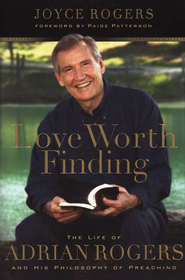
Book Review By David P. Craig
As a pastor I enjoy reading biographies and auto-biographies of other pastors. I especially can identify with the struggles that other pastors face. Unfortunately this book is written a lot like a Eulogy – even though it was written before Rogers passed away. It is full of Adrian Rogers’ accomplishments and highlights from a very gifted pastor’s life. It’s almost comparable to reading the life of Joseph in the Bible – without the hardships. Rogers almost comes across as a “perfect pastor” – which obviously doesn’t exist. A life full of nothing but successes, victories, grand tributes, and accolades. It reads a lot like a fairy tale – A Pastoral Utopia.
There is one major hardship that Joyce writes about early in the book – the loss of one of their children to SIDS. This was actually the one time in the book where I could identify with this couple. I could identify with their pain, loss, and suffering. But even this episode was glossed over. One almost gets the feeling that 99% of Adrian’s and Joyce’s life together was Camelot. I just don’t think this is reality.
In my own experience of the pastorate with real men and women life consists of hills and valleys – and there are usually more valleys to go through than hills – this book has one valley and the rest is about all the hills. This may be encouraging to some who read it. But I’m concerned for young pastors or young men and women who may read this book and think that ministry is all roses with no thorns.
I would have liked to have read a biography that was less on the surface of reality and went a little deeper into some of the basic daily realities and hardships of life. It wouldn’t even make a good movie, because there is simply not enough conflict and resolution. It is a book piled with grace on top of grace – and I just don’t think it’s transparent or authentic enough. Honestly, there was precious little to help the average pastor in this book. It read more like the highlights of the greatest pastor of the 20th Century. There were very few things that most pastors could actually relate to. It would be the equivalent of a struggling baseball player trying to figure out how to be a better baseball player and reading a biography of Babe Ruth which only highlighted and focused on all his home runs – without ever talking about any of his strike outs – and how he handled his hitting slumps.
The best part of the book for preachers starts with about 30% of the book left. It’s an extended interview with Adrian Rogers on his homiletical philosophy and sermon preparation. I think this section is very helpful and worth the price of the book. It’s very thorough and yet concise and has many helpful tips in answering some very important questions for sermon preparation like: What is the role of the Holy Spirit in preaching? What is the difference between preaching and unction? What is the nature and central place of preaching? Is Jesus Christ central to preaching? And many others.
I think this book will be especially interesting for pastors (or would-be pastors). It reminds me a lot of “A Man Called Peter” by Catherine Marshall. The difference is that Marshall’s book was more transparent and dealt with more of the tough issues that pastors face. This book may bring a lot of encouragement and inspire many young pastors, but in all honesty – 99% of the pastorates I know of are nothing like the one described in this book.
BOOK REVIEW: Max Lucado’s “GOD WILL USE THIS FOR GOOD”
TRUSTING GOD TO TRUMP EVIL
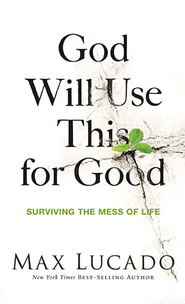 Book Review by David P. Craig
Oftentimes when we are going through tough times we need some short and quick reminders that everything is going to be okay. In this short treatment of the life of Joseph from the Old Testament Lucado reminds us: “”You’ll get through this. It won’t be painless. It won’t be quick. But God will use this mess for good. In the meantime don’t be foolish or naive. But don’t despair either. With God’s help you will get through this.”
In retelling the story of Joseph the author takes time to provide ample applications (contemporary and ancient) to bring forth the principles that help us as we wait for God to bring forth good out of the messes in our lives whether we made them, inherited them, or we were the object of someone’s evil plans. Ultimately nothing can thwart the plans that God has for us, and that means that all things will work out for our good and God’s glory. The main idea brought out by Lucado in this book is that “in God’s hands intended evil becomes eventual good.”
This short book would make a good gift or recommendation for Christians that are currently going through a rough time. Lucado’s story telling connects well with readers by continually making connections between the biblical subject and the relevant points to our own lives. Lucado has written a helpful manual for believers who need guidance in their pain by helping us trust in the God who always trumps evil for our own good.
BOOK REVIEW: R.C. Sproul’s “WHAT IS THE CHURCH?”
A GREAT PRIMER ON WHAT THE CHURCH IS ALL ABOUT

Book Review by David P. Craig
R.C. Sproul examines what the Church isn’t, and what it is. In breaking down four key words from the Council of Nicea about what the Church is, Sproul articulates what it means that the church is (1) one, (2) holy, (3) catholic [i.e., universal], and (4) apostolic. Some of the issues addressed in this helpful book are: Why are there so many denominations? What are the essential truths that unite all Christians? What is Liberalism? Why do doctrines divide and unite? What’s an Evangelical? What does it mean for the church to be holy? What is the foundation of the church? What does it mean to be “in Christ”? What is the Gospel? What are the Sacraments? and Why should the church practice discipline?
Sproul covers a lot of ground in this short book. It is full of historical and theological insights, wisdom, and biblically based. I would recommend this book especially for new Christians and as a cogent argument for so-called “Christians” who are not a part of a visible local church. It will help you appreciate what unites Christians throughout history, today, and forever.
SUNDAY OT SERMON: Dr. James Montgomery Boice on “IN THE BEGINNING” – Genesis 1:1
SERIES: GENESIS – PART 1
In the beginning God created the heavens and the earth.
These are exciting days in which to be studying Genesis. They are especially exciting for theologians and other students of the Bible, for much has recently been written on Genesis and there is new openness to looking at the book in the light of scientific data and theories as well as at science in the light of the Bible. They are also exciting from the viewpoint of recent developments in science, particularly those bearing on the origins of the universe.
Science has undergone what can almost be described as a revolution. For generations the prevailing view of the universe had been what is known as the steady state theory. That is, the universe has always been and will always be. It is ungenerated and indestructible. Such a view was materialistic and atheistic. It contained no place for God. In recent years this view has given way to the theory that the universe actually had an instant of creation. It came into being 15 to 20 billion years ago in a gigantic fireball explosion that sent suns and planets tumbling outward from this center into the form we observe them now. Moreover, they are still moving outward. In contrast to the steady state idea, this is called the big bang theory in reference to the instant of creation.
The change in scientific thinking goes back to 1913, when an astronomer at the Lowell Observatory in Flagstaff, Arizona, Vesto Melvin Slipher, discovered through his study of the shifting light spectrum of very distant stars that the galaxies in which these stars were found appeared to be receding from the earth at tremendous speeds—up to 2 million miles per hour. Six years later, in 1919, another American astronomer, Edwin Hubble, used Slipher’s findings to formulate a law for an expanding universe, which pointed to a moment of creation. Meanwhile, Albert Einstein’s theories of relativity were shaking Newtonian physics. And two Bell Telephone laboratory scientists, Arno Penzias and Robert Wilson, were using new and sophisticated electronic equipment to pick up background radiation from all parts of the universe, which they now identified as the leftover “noise” of that first great explosion.
To be sure, there are still many problems. Current scientific theory puts the origin of the universe at a point approaching 20 billion years ago, which some Christians find unacceptable. Again the big bang theory, even if true, tells us nothing about the thing or One who caused it. Nor does it throw light on why the universe has such astonishing complexity and order or how life originated or many other things. Yet this is still exciting if for no other reason than that “the Big Bang theory sounds very much like the story that the Old Testament has been telling all along,” as Time magazine wrote.
Robert Jastrow, Director of the National Aeronautics and Space Admin-istration’s Goddard Institute, puts it even more strongly. He is known for two very popular books, Red Giants and White Dwarfs and Until the Sun Dies. Now, in God and the Astronomers, he writes of the dismay of scientists who are brought by their own method back to a point beyond which they cannot go. “There is a kind of religion in science; it is the religion of a person who believes there is order and harmony in the Universe. Every event can be explained in a rational way as the product of some previous event. … This religious faith of the scientist is violated by the discovery that the world had a beginning under conditions in which the known laws of physics are not valid, and as a product of forces or circumstances we cannot discover. … At this moment it seems as though science will never be able to raise the curtain on the mystery of creation. For the scientist who has lived by his faith in the power of reason, the story ends like a bad dream. He has scaled the mountains of ignorance; he is about to conquer the highest peak; as he pulls himself over the final rock, he is greeted by a band of theologians who have been sitting there for centuries.”
None of this should make the theologians smug, however. They should remember that they have not been without difficulties in their attempts to understand Genesis and that the ancient Hebrews were not without wisdom when they forbade anyone under thirty to expound the first chapter to others.
Roots
The significance of Genesis is not in its proof or disproof of scientific theories, however, any more than the significance of science is in its proof or disproof of the Bible. It is important for its teaching about the origin of all things, which is what the word “Genesis” means. Genesis takes us back to the beginnings, and this is very important because our sense of worth as human beings depends in part on our origins.
In a smaller but very dramatic way, we have recently witnessed something like this in American pop culture. In early 1977 a serialized presentation of Alex Haley’s Roots, a book in which this distinguished black author traced the historical origins of his family back through their days of slavery in the old South to his African progenitors, was first aired on American television. This series was a success of such proportions that it astonished planners and producers alike. By the end of its seven-night run, Roots commanded 66 percent of the television audience—about 130 million people—and had become the most watched television program ever. It has been rebroadcast, both here and abroad, and has caused hundreds of colleges to provide Roots courses. In the aftermath of that historical week in January, thousands of Americans scrambled into libraries to search out their own family origins. The National Archives in Washington found itself flooded with requests for ancestral information. What caused this astonishing phenomenon? Some have suggested that it was Haley’s frank and wise handling of the racial issue. But Haley did not think this was the explanation, nor do many others.
The reason for the popularity of Roots is that it discovered a sense of present dignity and meaning for one black family by tracing its link to the past and thus also providing a direction for the future. In this it gave a sense of meaning to us all.
In an earlier age this would not have been so important, because many people at least still had a sense of history. They knew where they had come from and hence had an optimistic outlook on what the future would hold. But that has evaporated in current culture so that, as a number of writers have correctly pointed out, this has become the “now” generation in which any firm anchor to the past has been lost. We have been told that the past is meaningless. Everything is focused on the present. We are told by the advertisers that “we only go around once.” We should forget about the past and not worry about the future. It sounds like good philosophy. But the loneliness and anxiety of a philosophy like that is almost intolerable. Consequently, when Roots came along many identified with Haley’s search for the past and for dignity.
R. C. Sproul, founder of Ligonier Valley Study Center, has analyzed this in terms of secularism, which means “living within the bounds of this age” (from the Latin saeculum, meaning age). It is to live with our outlook confined to this period alone—without the past, without a future, above all without God, who is in both past and future and controls them. He writes of the secular man,
Man in the twentieth century has been busily engaged in a quest for dignity. It is a very earnest quest. The civil rights movement developed the cry, “We are human beings; we are creatures of dignity; we want to be treated as beings of dignity.” So also have others. But the existentialist tells us that our roots are in nothingness, that our future is in nothingness, and he asks, “Think, man, if your origins are in nothing and your destiny is in nothing, how can you possibly have any dignity now?” …
If our past history tells us that we have emerged from the slime, that we are only grown-up germs, what difference can it possibly make whether we are black germs or white germs, whether we are free germs or enslaved germs? Who cares? We can sing of the dignity of man, but unless that dignity is rooted substantially in that which has intrinsic value, all our songs of human rights and dignity are so much whistling in the dark. They are naïve, simplistic and credulous. And the existentialist understands that. He says, “You’re playing games when you call yourselves creatures of dignity. If all you have is the present, there is no dignity, only nothingness.”
This is what Alex Haley saw and what those many thousands of Americans saw who took their clue from Haley and began to search through libraries for their history. It is what makes Genesis important. Genesis is important because it gives us our origins—not merely the origins of one particular family but the origins of matter, life, values, evil, grace, the family, nations, and other things—in a way that unites us all.
Without the teachings of this book, life itself is meaningless. There are even parts of the Bible that are meaningless. Without this book, the Bible would be like the last acts of a play without the first act, or a meeting of a corporation’s trustees with no agenda. Henry M. Morris has written, “The books of the Old Testament, narrating God’s dealings with the people of Israel, would be provincial and bigoted, were they not set in the context of God’s developing purposes for all mankind, as laid down in the early chapters of Genesis. The New Testament, describing the execution and implementation of God’s plan for man’s redemption, is redundant and anachronistic, except in the light of man’s desperate need for salvation, as established in the record of man’s primeval history, recorded only in Genesis. … A believing understanding of the Book of Genesis is therefore prerequisite to an understanding of God and his meaning to man.”
All Things Wise and Wonderful
In our study of Genesis we are going to look at each of these matters in detail, but as we start we can cast our eyes ahead over a few of them. They are a part of those many things both “wise and wonderful” that confront us in the Word of God.
1. The first great matter of the Bible, the one related most directly to our origins, is God, who has no beginnings at all. He is the first subject mentioned: “In the beginning God created the heavens and the earth.”
This sentence is among the most profound statements ever written, which we shall see when we come to study it in greater detail. But even here we must see that these words already take us beyond the farthest point that can be viewed by science. Science can take us back to the big bang, to the moment of creation. But if that original, colossal explosion obliterated anything that came before it, as science suggests, then nothing before that point can be known scientifically, including the cause of the explosion. The Bible comes forward at this point to tell us simply, “In the beginning God. …” We may want to bring God down into our little microscope where we can examine him and subject him to the laws of matter, of cause and effect, which we can understand. But fret as we might, God does not conform to our desires. He confronts us as the One who was in existence before anything we can even imagine and who will be there after anything we can imagine. Ultimately it is he alone with whom we have to do.
2. The opening chapters of Genesis also tell us the origin of man, the matter we have been looking at most closely in this message. Without this revelation we may look to ourselves in this present moment and conclude, as did the French philosopher René Descartes, “I think; therefore I am.” But beyond that even the simplest philosophical question confounds us. Our son or daughter asks, “Daddy, where did I come from?” and we answer with an explanation of human reproduction. “Yes, but where did you and Mommy come from? … Where did Grandma come from?” The questions baffle us apart from the divine revelation.
John H. Gerstner, professor of church history at Pittsburgh Theological Seminary, tells a story concerning Arthur Schopenhauer, the famous nineteenth-century philosophical pessimist. Schopenhauer did not always dress like a product of Bond Street—he often dressed more like a bum—and he was sitting in a park in Berlin one day when his appearance aroused the suspicions of a policeman. The policeman asked who he thought he was. Schopenhauer replied, “I would to God I knew.” As Gerstner points out, the only way he could have learned who he was would have been to find out from God, who has revealed this to us in Genesis.
3. Genesis gives the origin of the human family that is—moderns especially must take note—not something that has been dreamed up by fallen men and women but something established by God even before the fall for our good. People have added to God’s provision, but not by way of improvement. They have added polygamy, prostitution, promiscuity, divorce, and homosexuality. But these are corruptions of God’s original order and bring frustration, misery, and eventual judgment on those who practice them. People are blessed only as they return to God’s original plan for the home, the ordering of the sexes, and the responsibilities within marriage of both husband and wife.
4. Genesis tells us of the origins of evil, at least so far as man is concerned. I give this qualification for two reasons. First, because the account of the fall involves temptation by the serpent and we are not told by Genesis where the serpent came from. (There are hints of it elsewhere.) Second, because there are philosophical questions about how evil could even come into a world created by a good and holy God.
This much is told us in Genesis: The evil that involves mankind is the product of our own choice, expressed as a rebellion against God, and it has affected us so totally that there is now nothing we can do to restore ourselves or regain that position of privilege and responsibility that we lost by rebellion. It is as if we had jumped into a pit. Before the jump we had the capacity for self-determination. We could use that capacity to remain on the edge of the pit or to jump in. But once we had exercised our freedom of choice in the matter by jumping, our choice was gone in that area and thereafter there was nothing we could do to restore our former state of blessedness. Moreover, because it was our choice and not that of another, we are guilty for what we have done and now quite rightly stand under the inevitable judgment of God.
5. We can do nothing. But God can—God can do anything—and the wonder of the gospel appears in the promise of One who would come to undo the results of Adam’s transgression. The origins of salvation are therefore also to be found in this book.
This is true in two senses. First, there are promises of a Savior to come, as I have indicated. When Adam and Eve sinned and God came to them in the garden, he first rebuked the sin. But then he spoke of hope in the person of One who should crush the head of Satan. Speaking to the serpent he said, “He will crush your head, and you will strike his heel” (Gen. 3:15). As the book goes on, this cryptic statement is elaborated and explained. God spoke to Abraham of a descendant who would be the source of divine blessing to all nations: “Your descendants will take possession of the cities of their enemies, and through your offspring [singular] all nations on earth will be blessed” (Gen. 22:17–18; cf. Gal. 3:8). Still later, Jacob spoke of him as a descendant of the tribe of Judah: “The scepter will not depart from Judah, nor the ruler’s staff from between his feet, until he comes to whom it belongs and the obedience of the nations is his” (Gen. 49:10).
The second way Genesis foreshadows the coming of Christ is by its record of the institution and performance of the sacrifices, which he alone fulfilled.
6. A sixth and very important origin in Genesis is the doctrine of justification by faith, clearly seen first in the experience of Abraham. We are told: “Abram believed the Lord, and he credited it to him as righteousness” (Gen. 15:6). If righteousness was “credited” to Abraham, then Abraham had none of his own. It was the gift of God. Moreover, it was credited to him not on the basis of his works, love, service, or obedience, but on the basis of his faith, that is, on the basis of his taking God’s word in the matter of salvation. In reference to this statement Paul later wrote, “The words ‘it was credited to him’ were written not for him alone, but also for us, to whom God will credit righteousness—for us who believe in him who raised Jesus our Lord from the dead. He was delivered over to death for our sins and was raised to life for our justification” (Rom. 4:23–25).
7. Genesis also contains the first teaching in the Bible of the sovereign election of God in salvation. When Adam and Eve sinned, they did not come to God. They hid from him. He took the initiative in seeking them out and in beginning to teach the means of salvation through the death of the Mediator. It was the same with Abraham. Abraham did not seek God. He did not even know who the true God was. But God called Abraham and made him the father of a favored nation through whom the Redeemer should come. God chose Isaac and not Ishmael. He chose Jacob and not Esau. In the New Testament Paul uses these examples to show that salvation does not “depend on man’s desire or effort, but on God’s mercy. … God has mercy on whom he wants to have mercy, and he hardens whom he wants to harden” (Rom. 9:16, 18).
8. Finally there are the origins of divine judgment. In the story of God’s encounter with fallen Eve and Adam, we see accountability and a certain degree of judgment, but for the most part judgment is set aside or postponed. This is not so in the judgment of the flood under Noah, through which all but Noah and his immediate family perished. This is brought forward in the New Testament as a reminder of the reality and inescapability of the final judgment (2 Peter 3:3–10).
Back and Forward
When the secularists came along in the middle of the last century and cut the society of their day off from any sense of history, the deed was greeted with cries of joyous appreciation and great glee. To be freed from the past, particularly from the biblical past with its God of moral standards and threats of judgment, seemed to be true liberation. Man was free! And if he was free, he could do as he pleased—which is what he had wanted to do all along—without fear of God or judgment! Unfortunately, secular man did not see at what price this ghost of liberty had been won. Free of the past? Yes! And of the future too! But now man was adrift on a great sea of nothingness, a bubble on the deep, having come from nothing and drifting to a meaningless shore. No wonder that contemporary man is empty, miserable, frustrated. He is on the verge of a monumental breakdown. He gained freedom (so-called) but at the loss of value, meaning, and true dignity. No wonder he is searching for his roots, as Haley’s video phenomenon reminds us.
Fortunately, men and women can go back … and forward too. But the past and future are not in Haley. They are in the Bible where we find ourselves as we truly are—made in the image of almighty God, hence, creatures of value; fallen tragically, yet redeemable by God through the power and grace displayed in Jesus Christ.
About the Preacher
James Montgomery Boice, Th.D., (July 7, 1938 – June 15, 2000) was a Reformed theologian, Bible teacher, and pastor of Tenth Presbyterian Church in Philadelphia from 1968 until his death. He is heard on The Bible Study Hour radio broadcast and was a well-known author and speaker in evangelical and Reformed circles. He also served as Chairman of the International Council on Biblical Inerrancy for over ten years and was a founding member of the Alliance of Confessing Evangelicals. James Boice was one of my favorite Bible teachers. Thankfully – many of his books and expositions of Scripture are still in print and more are becoming available. The sermon above was adapted from Chapter 1 in Genesis 1-11: An Expositional Commentary. vol. 1: Creation and Fall. Grand Rapids: Baker, 2006.
BOOK REVIEW: R.C. Sproul’s “INTO THE PRESENCE OF GOD”
GOD-CENTERED MEDITATIONS
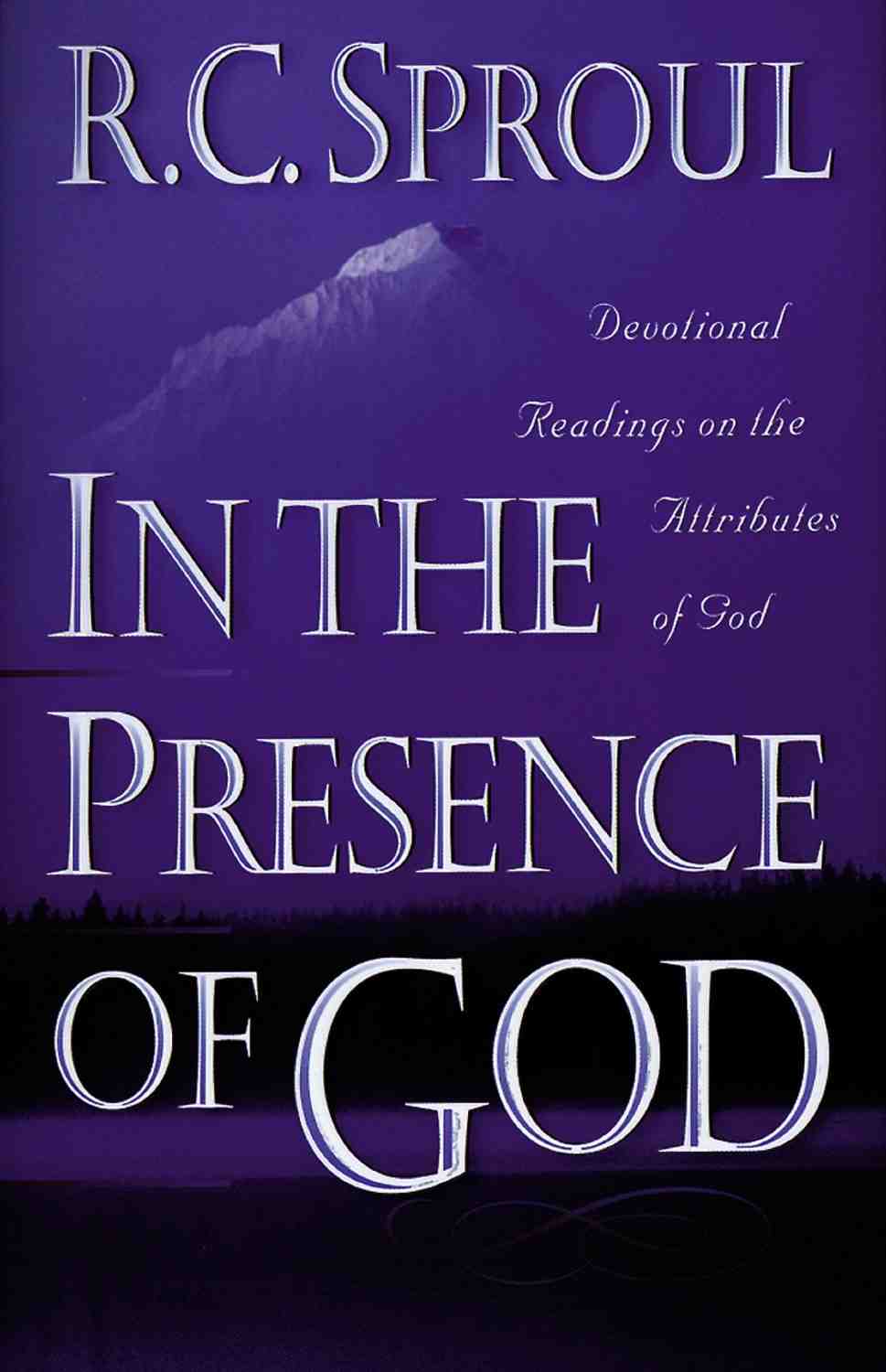
Book Review by David P. Craig
Over the past 30 years I’ve enjoyed the books, lectures, sermons, and writings of R.C. Sproul. This book gathers some of the best devotionals from Ligonier Ministries Magazine – Table Talk. Coram Deo–which means “in the presence of God” is the name of one of the feature columns written by R.C. Sproul. In The Presence of God takes some of the best devotionals from Coram Deo over the past several decades and makes the collection available here in this book.
The devotions selected are encouraging, inspiring, and always based on Scripture. According to R.C. Sproul all of life is to be lived out in the presence of God and for the glory of God. These devotionals remind us daily that God is sovereign, transcendent, and immanent. “To live Coram Deo is to live a life of integrity. It is a life of wholeness that finds unity and coherency in the majesty of God. A fragmented life is a life of disintegration. It is marked by inconsistency, disharmony, confusion, conflict, contradiction, and chaos.” On the other hand, a life of “integrity is found when men and women live their lives in a pattern of consistency. It is a pattern that functions the same way in church and out of church. It is a life in which all that is done is done unto the Lord. It is a life lived by principle, not expediency; by humility before God, not defiance. It is a life lived under the tutelage of a conscience that is held captive by the Word of God.”
There are approximately 150 devotions in this book. Each only a page in length with a short meditation by Sproul, and either a word of encouragement, an application, or a reflection based on each subject. There are 15 Sections in the book with each section containing between 5 and 18 chapters. Here are the subjects addressed by Sproul: (1) Knowing God; (2) Learning God’s Laws; (3) Facing Life’s Challenges with God; (4) Getting Acquainted with God’s Son; (5) Meeting with God; (6) Discerning God’s Will; (7) Understanding God’s Purpose; (8) Becoming Part of God’s Body; (9) Experiencing God’s Best; (10) Journeying with God; (11) Developing a Godly Lifestyle; (12) Using Your Time for God; (13) Confronting the Enemy in God’s Strength; (14) Doing God’s Work; and (15) Facing the Future with God.
You would be hardpressed to find a devotional that is more God-centered and will help you truly live a life that is well-pleasing to God than Sproul’s. I highly recommend this excellent collection as one that will increase your awareness of God, and help you become more intimate in your walk with Him for His glory whether you eat, drink, or whatever you do as you live in His presence.
CHUCK SWINDOLL ON “WHY DO WE SUFFER?”
WHY CHRISTIANS SUFFER – A MEDITATION ON 2 CORINTHIANS 1:3-11

2 Corinthians 1:3-11, “Blessed be the God and Father of our Lord Jesus Christ, the Father of mercies and God of all comfort, who comforts us in all our affliction, so that we may be able to comfort those who are in any affliction, with the comfort with which we ourselves are comforted by God. For as we share abundantly in Christ’s sufferings, so through Christ we share abundantly in comfort too. If we are afflicted, it is for your comfort and salvation; and if we are comforted, it is for your comfort, which you experience when you patiently endure the same sufferings that we suffer. Our hope for you is unshaken, for we know that as you share in our sufferings, you will also share in our comfort.
For we do not want you to be unaware, brothers, of the affliction we experienced in Asia. For we were so utterly burdened beyond our strength that we despaired of life itself. Indeed, we felt that we had received the sentence of death. But that was to make us rely not on ourselves but on God who raises the dead. He delivered us from such a deadly peril, and he will deliver us. On him we have set our hope that he will deliver us again. You also must help us by prayer, so that many will give thanks on our behalf for the blessing granted us through the prayers of many.
Of all the letters Paul wrote, Second Corinthians is the most autobiographical. In it the great apostle lifts the veil of his private life and allows us to catch a glimpse of his human frailties and needs. You need to read that letter in one sitting to capture the moving emotion that surged through his soul.
It is in this letter alone that he records the specifics of his anguish, tears, affliction, and satanic opposition. In this letter alone he spells out the details of his persecution, loneliness, imprisonments, beatings, feelings of despair, hunger, shipwrecks, sleepless nights, and that “thorn in the flesh”–his companion of pain. How close it makes us feel to him when we picture him as a man with real, honest-to-goodness problems…just like you and me!
It is not surprising, then, that he begins the letter with words of comfort–especially verses 3 through 11. Now, then, having read those nine verses, please observe his frequent use of the term comfort in verses 3-7. I count ten times in five verses that the same root word is employed by Paul. This word is para-kaleo, meaning literally, “to call alongside.” It involves more than a shallow “pat on the back” with the tired expression, “the Lord bless you…” No, this word involves genuine in-depth understanding…deep-down compassion and sympathy. This seems especially appropriate since it says that God, our Father, is the “God of all comfort” who “comforts us in all our affliction.” Our loving Father is never preoccupied or removed when we are enduring sadness and affliction! Read Hebrews 4:14-16 and Matthew 6:31-32 as further proof.
There is yet another observation worth noting in 2 Corinthians, chapter 1. No less than three reasons are given for suffering–each one introduced with the term “that” in verses 4, 9, and 11. Quietly and without a lot of fanfare, the Holy Spirit states the reasons we suffer:
(1) “That we may be able to comfort those who are in any affliction…” (v. 4). God allows suffering so that we might have the capacity to enter into others’ sorrow and affliction. Isn’t that true? If you have suffered a broken leg and been confined to crutches for weeks–you are in complete sympathy with someone else on crutches, even years after your affliction. The same is true for the loss of a child…emotional depression…an auto accident…undergoing unfair criticism…financial burdens. God gives His children the capacity to understand by bringing similar sufferings into our lives. Bruises attract one another.
(2) “That we should not trust in ourselves…” (v. 9). God also allows suffering so that we might learn what it means to depend on Him, not on our own strength and resources. Doesn’t suffering do that? It forces us to lean on Him totally, absolutely. Over and over He reminds us of the danger of pride…but it frequently takes suffering to make the lesson stick. Pride is smashed most effectively when the suffering comes suddenly, surprisingly. The express trains of heaven are seldom announced by a warning bell; they dash suddenly and abruptly into the station of the soul. Perhaps that has been your experience recently. Don’t resent the affliction as an intruder–welcome it as God’s message to stop trusting in your flesh…and start leaning on Him.
(3) “That thanks may be given…” (v. 11). Honestly–have you said, Thanks, Lord for this test”? Have you finally stopped struggling and expressed to Him how much you appreciate His loving sovereignty over your life? I submit that one of the reasons our suffering is prolonged is that we take so long saying “Thank you, Lord” with an attitude of genuine appreciation.
How unfinished and rebellious and proud and unconcerned we be without suffering! Here are two statements on suffering I heard years ago and shall never forget:
Pain plants the flag of reality in the fortress of a rebel heart.
When God wants to do an impossible task, He takes an impossible individual–and crushes him.
May these things encourage you the next time God heats up the furnace.
Source: Chuck Swindoll. Come Before Winter…And Share My Hope. Multnomah Press, Portland, OR.: 1985, pp. 202-203.
About the Author:
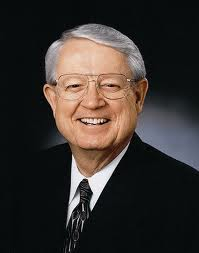
Dr. Charles R. Swindoll is senior pastor of Stonebriar Community Church, chancellor of Dallas Theological Seminary, and the Bible teacher on the internationally syndicated radio program Insight for Living.
Charles Swindoll’s Books:
-
You And Your Child, Thomas Nelson (1977)
-
Hand Me Another Brick, Thomas Nelson (1978)
-
Three Steps Forward, Two Steps Back: Persevering Through Pressure, Thomas Nelson (1980)
-
Strike The Original Match, Multnomah (1980)
-
Improving Your Serve: The Art Of Unselfish Living, Word (1981)
-
Strengthening Your Grip: Essentials In An Aimless World, Word (1982)
-
Growing Strong In The Seasons Of Life, Multnomah (1983)
-
Dropping Your Guard: The Value Of Open Relationships, Word (1983)
-
Come Before Winter – And Share My Hope, Multnomah (1985)
-
Living On The Ragged Edge: Coming To Terms With Reality, Word (1985)
-
Growing Deep In The Christian Life: Returning To Our Roots, Multnomah (1986)
-
The Quest For Character, Multnomah (1987)
-
Living Above The Level Of Mediocrity : A Commitment To Excellence, Word (1987)
-
Growing Wise In Family Life, Multnomah (1988)
-
Living Beyond The Daily Grind: Reflections On The Songs And Sayings In Scripture, Word (1988)
-
Rise & Shine: A Wake-Up Call, Multnomah (1989)
-
The Grace Awakening, Word (1990)
-
Sanctity Of Life: The Inescapable Issue, Word (1990)
-
Stress Fractures, Multnomah (1990)
-
Simple Faith, Word (1991)
-
Laugh Again, Word (1992)
-
Flying Closer To The Flame (Re-issued as Embraced by The Spirit: The Untold Blessings of Intimacy with God, Word in 1993 & Zondervan in 2010)
-
The Finishing Touch, Word (1994)
-
Paw Paw Chuck’s Big Ideas in the Bible, Word (1995)
-
Hope Again, Word (1996)
-
The Road To Armageddon (with John F Walvoord; J Dwight Pentecost), Word (1999)
-
Start Where You Are: Catch A Fresh Vision For Your Life, Word (1999)
-
The Mystery Of God’s Will: What Does He Want For Me?, Word (1999)
-
Perfect Trust: Ears To Hear, Hearts To Trust, And Minds To Rest In Him, J. Countryman (2000 & 2012)
-
The Darkness And The Dawn : Empowered By The Tragedy And Triumph Of The Cross, Word (2001)
-
Why, God?: Calming Words For Chaotic Times, Word (2001)
-
Wisdom For The Way: Wise Words For Busy People, J. Countryman (2001)
-
Understanding Christian Theology (with Roy B Zuck), Thomas Nelson (2003)
-
Behold—The Man!: The Pathway Of His Passion, Word (2004)
-
Getting Through the Tough Stuff: It’s Always Something! Thomas Nelson (2004)
-
So, You Want To Be Like Christ?: Eight Essentials To Get You There, Word (2005)
-
When God Is Silent (Choosing To Trust In Life’s Trials), J. Countryman (2005)
-
Great Attitudes For Graduates!: 10 Choices For Success In Life (with Terri A Gibbs), J. Countryman (2006)
-
Encouragement For Life: Words Of Hope And Inspiration, J. Countryman (2006)
-
The Strength Of Character: 7 Essential Traits Of A Remarkable Life (with Terri A Gibbs), J. Countryman (2007)
-
A Bethlehem Christmas: Celebrating The Joyful Season, Thomas Nelson (2007
-
The Owner’s Manual for Christians: The Essential Guide for a God-Honoring Life, Thomas Nelson (2009)
-
The Church Awakening: An Urgent Call for Renewal, FaithWords (2010 & 2012)
-
Meet Me In The Library: Readings From 8 Writers Who Shaped My Life, IFL (2011)
-
Saying It Well: Touching Others with Your Words, FaithWords (2012)
-
Living the Psalms: Encouragement for the Daily Grind, Worthy (2012)
-
Living the Proverbs: Living in the Daily Grind, Worthy (2013)
Swindoll’s New Testament Insights Commentary Series
-
Insights on Romans, Zondervan (2010)
-
Insights on John, Zondervan (2010)
-
Insights on James and 1 & 2 Peter, Zondervan (2010)
-
Insights on 1 & 2 Timothy and Titus, Zondervan (2011)
-
Insights on Revelation, Zondervan (2012)
-
Insights on Luke, Zondervan (2012)
-
Insights on Galatians & Ephesians, Zondervan (2013)
Profiles in Character series
-
David: A Man Of Passion & Destiny, Word (1997)
-
Esther: A Woman Of Strength & Dignity, Word (1997)
-
Joseph: A Man Of Integrity And Forgiveness, Word (1998)
-
Moses: A Man Of Selfless Dedication, Word (1999)
-
Elijah: A Man Of Heroism And Humility, Word (2000)
-
Paul: A Man Of Grace And Grit, Word (2002)
-
Job: A Man Of Heroic Endurance, Word (2004)
-
Fascinating Stories Of Forgotten Lives: Rediscovering Some Old Testament Characters, Word (2005)
-
Jesus: The Greatest Life Of All, Thomas Nelson (2008)
Honors and Awards
-
Harry A. Ironside Award for Expository Preaching – Dallas Theological Seminary, 1963
-
Christian Education Award – Dallas Theological Seminary, 1963
-
Faculty Award – Dallas Theological Seminary, 1963
-
Doctor of Divinity – Talbot School of Theology, 1977
-
Doctor of Human Letters – Taylor University, 1986
-
Clergyman of the Year – Religious Heritage of America, 1988
-
Doctor of Laws – Pepperdine University, 1990
-
Doctor of Literature – Dallas Baptist University, 1999
-
Lifetime Achievement Award – [Catalyst Conference], 2009

 LifeCoach4God