BOOK REVIEW: “COVERING YOUR LIFE IN PRAYER” BY ERWIN W. LUTZER

DISCOVER A LIFE-CHANGING CONVERSATION WITH GOD

CYLIP LUTZER

LEARNING HOW TO PRAY THE SCRIPTURES FOR YOUR LOVED ONES

Book Review By David P. Craig

Nothing has revolutionized my own prayer life more than learning how to pray the Scriptures. In this very practical book Lutzer was inspired to pray more intentionally and biblically for his 8 grandchildren. He decided to pray through the Scriptures for them, rather than just making a list of needs and praying these needs back to God in a ritual-like format day after day. He wanted to avoid the “meaningless repetition” of prayer that Jesus describes in Matthew 6:7.

Lutzer asks and answers these two important questions (1) What if I changed my perspective on prayer and began to pray Scripture? and (2) What if I echoed back to God that which I know is His will? – Wouldn’t that stimulate more faith and bring God more glory?

Praying the Scriptures has many advantages over “list” oriented prayer: Here are just a few: (1) It gives a freshness to your prayer life – because you don’t know exactly what you will be praying for on a daily basis; (2) It aligns your prayers with God’s will – it’s more difficult to pray errantly when you are speaking the truth from God’s Word back to the truth Giver; (3) It reminds you daily of requirements and promises of God; (4) It helps you to hear from and communicate  intimately with God as He reveals His heart to you from His very words. (5) It aligns you with the will and sovereign plans of God. (6) It brings God’s purposes and intentions to bear on your life each time you pray.

Lutzer divides the book up into 52 weeks or prayer sessions. In each session there is a passage of Scripture, a brief explanation of the passage, and a prayer to pray based on the passage. An individual can pray these prayers for a loved one, a friend, a child, a parent, co-worker, and so forth. The prayers are about two to three paragraphs in length and cover such passages and topics as: overcoming fear; hope; worshiping God in trials; identity in Christ; purity; resisting temptation; and resting confidently in God’s love. There are 52 subjects covered. Lutzer (and his wife) prays these Scriptures over his children and grandchildren (one each day, two on Saturday’s) seven days a week.

I have been praying these prayers for my spouse, children, and grandchildren and it has helped make my prayers more focused, spontaneous, and well-rounded. Since you are praying specific prayers instead of just praying “God bless so and so” it is more intimate, personal, and intentional. I find that it has helped my prayer life to be less wooden and ritualistic and much more exciting as I am learning to pray the whole counsel of God over my loved ones. Daily covering my loved ones with God’s promises, and purposes from the whole counsel of God is an exciting way to pray that benefits my loved ones immensely.

I sincerely believe that this book will help renew, refresh, and rekindle your prayer life, invigorate your walk with our Heavenly Father, and help you to pray balanced prayers for the good of your loved ones so that God’s will is done on “Earth as it is in Haven.”

SUNDAY SERMON: “HATH GOD SAID?” BY DR. R.C. SPROUL

One of the biggest issues of our day revolves around the trustworthiness and the authority of the Scriptures for all of life – private and public. This is a classic sermon by one of the most influential theologians living today. Though given in the late 70′s during the beginning stages of the development of the International Council of Biblical Inerrancy – it is just as pertinent, relevant, and needed today. R.C. teaches with absolute clarity and expositional and theological precision that the Scriptures are indeed authoritative and sufficient for all of life and practice privately and publicly. Enjoy this wonderful sermon by Dr. R.C. Sproul [DPC].

Now the serpent was more crafty than any other beast of the field that the LORD God had made. He said to the woman, “Did God actually say, (“hath God said” in KJV) ‘You shall not eat of any tree in the garden’?” – Genesis 3:1

Serpent and the fruit

“Hath God Said?” By Dr. R.C. Sproul

I think that we are all not only aware, but in many cases painfully aware, of the continued academic, technical, and intellectual difficulties that we face when we make an affirmation of the inerrancy of Holy Scripture. I trust that we have not been bathed in obscurantism to a degree that makes us ignorant of the avalanche of criticism that has been directed toward the church’s classic position over the last two hundred years. And I hope that we recognize that much of that criticism may not be lightly dismissed. To do so, of course, would not be wise.

I think we are aware that it is our duty and the urgent need of the Christian community of our day, not to rest merely on the splendid statements of our fathers in defense of the authority of Scripture. Surely our generation is called to face the new issues that have been raised in academic circles. What I am saying simply is this: that there exist problems of an academic and intellectual nature with respect to the confessions that we are so bold to make. But that’s not what I am concerned to focus our attention on this morning.

For in addition to these questions of an intellectual nature, which at times indeed may be excruciating, there are other facets to this question that must never be overlooked. There is an emotional dimension. There is a psychological dimension. There is a theological, or perhaps what we may call a religious dimension that touches the heart of this issue.

As you recall a few months ago, I had the privilege in behalf of the International Council on Biblical Inerrancy to be involved in dialogue with a group of very respected theologians and biblical scholars in this country. It was a behind-closed-door session of question and discussion, clarification of our position, vis-à-vis theirs. The discussions went for an intense period of seven hours. And at no time during that discussion did it become one of vituperative or vitriolic exchange. It was a sanguine atmosphere and the discussion was carried on in the spirit of cordiality. But it was intensely academic in nature, and I believe that we were all weary at the end of it. What I recall was that after the discussions were over and we were moving to the parking lot, one of the elder statesmen of the other group who has been a friend and colleague of mine for years came up to me, not in a paternalistic way, but in a genuine fatherly gesture. He put his arm around me and said, “R.C., why do you get so exercised over this question? Why are you devoting so much of your time to the question of biblical inerrancy? Why can’t we leave that aside and move on the real issues of reaching the fallen people of this generation?”

I’m sure that this man’s primary concern was precisely that we get on with the business of the work of the church and of Christ and not be paralyzed by internal disputes and debates about matters like these. He was expressing genuine concern over my particular career as a teacher. And he was almost weeping as he raised that question.

As I stepped out of the academic and intellectual atmosphere that had characterized the previous hours and looked at him, I answered his question as emotionally as he asked it. And I said, “I can’t help it. Scriptures are my life. I am not a second generation Christian. I came to Jesus Christ from the streets, and that’s what brought me into the kingdom of God, the words from this Book. I love it. The contents, the message broke through the recalcitrance of my pagan heart and brought me into the kingdom of God and showed me the loveliness and sweetness of Christ.”

And then in a statement of perhaps characteristic belligerence, I said to him, “No one will ever take this Book from me.” And I had to admit candidly that I am somewhat prejudiced and emotionally involved in this question. I raised this point with him. “I understand,” I said, “the difficulties that criticism has raised, and I know that many feel that as a matter of intellectual integrity they must set aside this doctrine, that they cannot cling to it merely for emotional or sentimental reasons. I must agree with the integrity of that.” But I said to him, “What I would like to see when that happens, is that our Christian brothers and scholars who have abandoned this point lay it down with tears. And I haven’t seen that.”

I would think that if we came to the conclusion that this point of the faith of our fathers indicates an error of our tradition, and that we must abandon inerrancy, that if we did, in fact, come to that conclusion, that we would do it with tears, rather than in the attitude or spirit we have seen in some circles. I don’t see this in evangelical circles, but in some circles there seems to be a certain delight and glee in finding difficulties in the text of Scripture. At that point it becomes religious, moral, and I think that we are facing the problem not only of the academic but the problem of enormous pressure to conform to contemporary drifts of opinion. Many have said quite candidly, “It is not expedient for us to take such a stand in this day and age.”

Again another candid and private conversation I had with a pastor for whom I have great respect and love. He said, “R.C., I am not a scholar. I am not an academician. I am not a trained and skilled apologist. I am a pastor and my concerns are pastoral in nature. Now, R.C., in my heart I believe in the inerrancy of Scripture, but I simply cannot defend it. I do not have the tools, the erudition necessary in this sophisticated era to make a good defense. And so I prefer not to stand for the doctrine.” It was only a few months later that this pastor was asked in a public situation, “Do you, sir, affirm the inerrancy of Scripture?” and his response publicly was, “I do not.”

Now it’s possible that the man changed his mind in the intervening months between our private conversation and his public statement. But I am also recognizing the real possibility that the intimidation that he was experiencing was more than he could bear in his humanity. And who of us has not had to face that kind of pressure? Who of us has not succumbed to it at one point or another in our lives? We have sinned and do sin, my brothers and sisters, and we must be careful in this concern that we not give the idea that we are the ones who maintain a pristine purity of Christian life and obedience, while others have easily and quickly capitulated and negotiated the faith of Jesus Christ. We all have participated at one time or another in such capitulation.

We are often put to the test, and the test of our faith is very infrequently couched in terms of strict theological affirmation such as, “Do you believe in God?” We all confess that we believe in God, but the point at which we negotiate is a different question. “Do you believe God?” That’s the issue. And that’s where the point of testing is focused in our day. Now the idea of a test at the point of believing God is nothing new. And it’s not an experience that we are facing as a first generation of the tested, but rather to God that is the test of fidelity.

Let me say it another way. The two greatest tests in the history of mankind focus the term of the test precisely on the point of whether or not the ones being tested believed God. I am referring, of course, to the test of our original parents in paradise and the test of our Redeemer in the wilderness. And I would like to direct your attention in the time that is remaining to an examination again of the terms and the circumstances and the outcome of those two critically important moments of test.

Let’s look at the third chapter of Genesis. It begins with three words that appear to be innocuous in the text, but which the late E. J. Young throws into bold relief in his commentary as having interesting and significant import. Those three words are, “Now the serpent … ” E. J. Young rhapsodizes on the significance of those three words as they introduce the third chapter of Genesis. Everything that has preceded those three words is a majestic statement of God’s acts of creation. Everything is so positive and so lovely and so good and so true about God and his created order, until that note of dissonance is introduced into biblical history.

“Now the serpent … ” It sort of suggests that something sinister and negative is about to be unfolded. And the words continue, “Now the serpent was more subtle than any of the other of the wild beasts of the field that God had created.” This draws attention to the subtlety or craftiness of the creature being introduced. We read that this subtle serpent comes and speaks to the woman and asks what appears to be at the outset a harmless question, a request for information.

“Did God say, ‘You shall not eat of any of the trees in the garden’?” The question again in the ancient version is, “Hath God said, ‘You shall not eat of any of the trees in the garden’?” It’s a very, very interesting question. You might wonder why the serpent raised the question in the first place. Was he just saying in “Columbo” fashion, “There’s just one thing that I’m not quite sure about; do you mind if I ask you a personal question? Let’s see if I have it right here. Did God say that you shall not eat of any of the trees of the garden? Is that what he said? Just wanted to get the record straight.” Perhaps Adam and Eve were to assume that the serpent was doing a job of recording the facts for posterity.

I don’t think that’s what it was about here. But before I suggest what it was about, let me indicate another alternative. Do you think that the serpent did not know what God had said? Do you think that the serpent was ignorant of the terms of the probationary test that God had put before his creatures? I think the serpent knew very well what God had said. But listen to the subtlety of the question. “Hath God said, ‘You shall not eat of any of the trees of the garden’?” What’s the suggestion there? Satan knew very well that was not the case. They say, “No. In fact, God said we could eat freely of all the trees of the garden, but one. And that one, of course, he said if we touched, we would surely die.”

Existentialist Jean Paul Sartre in the twentieth century has made it a matter of evangelistic zeal to maintain that unless man is utterly and completely autonomous, he is not, in fact, free. Sartre gives one of the most fascinating and clever arguments against the existence of God I have ever read. Traditionally we have argued, if there is man, and we have to explain and account for his creation, then there must be a God. Sartre turns that around; he says, “If man is, God cannot be. Because intrinsic to our notion of humanity is the concept of human subjectivity and freedom. And if there is a God to whom we are ultimately accountable and responsible, a God who has sovereignty over us, then we do not have autonomy. If we do not have autonomy, we do not have freedom. If we do not have freedom, we do not have subjectivity. If we do not have subjectivity, we do not have humanity.” Ergo. “Since we do have these things, there is no God.”

The point is very subtle; unless you are utterly and completely free you are not free at all, and Satan is raising that very point here. “Hath God said, ‘You shall not eat of any of the trees of the garden’?” Every one of us has encountered this question of freedom in our own lives, particularly those of us who are parents. My daughter comes and asks, “Daddy, can I go to this rock concert in Pittsburgh on Friday night?” I say, “I’m sorry, honey, I have to say, ‘No.’” And what do you suppose her response is? “You never let me do anything!” Put that one restriction there and the natural reaction is, “I’m not free at all.” Unless I can have total freedom, absolute autonomy, I’m not really free; and that’s the subtlety of the serpent that is being repeated again and again and again, even down to this very day.

But the test shifts from matters of subtlety to a direct contradiction and denial of what God in fact had said. Now the serpent leaves his “Columbo” methodology, becomes very straightforward, and says, “You shall not die, but you shall be as gods.” I say that because so frequently I have heard it said that the initial slogan of humanism was the famous statement from Protagoras: Homo neusura—Man, the measure. Man is the measure of all things. No, my friends, the irony of history is that humanism’s slogan does not begin with Protagoras; it begins with the serpent in Genesis who said, “You shall be as gods.” An irony of ironies: the father of humanism was not even human.

Now it becomes a test of whom to believe. God says, “You’ll die.” The serpent says, “You will not die.”Today some have said that’s all right; they contradict but contradiction is the hallmark of truth. We say contradiction is the hallmark of the lie. Imagine the theory that contradiction is the hallmark of truth in this situation. Adam and Eve are wrestling with the dialectic. “God says, ‘You will die,’ whatever that means. This one says “we will not die.”

“Now that’s a contradiction,” says Adam. “And contradiction’s a hallmark of truth, so this serpent must be the ambassador of the truth. And if God is the truth, then this must be God’s ambassador who is now abrogating and setting aside the earlier prohibition. So let’s go to the tree. It looks sweet; it’s delightful; let’s help ourselves.” The issue in the Fall was the issue of believing God’s Word.

Now let’s go to the New Testament to the new Adam, and to the work that he performs immediately following his baptism. We read, “Jesus, full of the Holy Spirit, returned from the Jordan and was driven (or led) by the Spirit into the wilderness.” Now, before we consider the content of the test of Jesus, let’s take a moment to examine the scenario in terms of the differences between the temptation of the second Adam and the conditions under which the first Adam received his test.

The first Adam was subjected to a test of righteousness and obedience in the midst of a lush garden, a garden that provided for him all of the resources and benefits that he required to sustain his bodily needs. In fact, if I understand the test correctly, he was in a gourmet’s paradise. Whatever he wanted to eat was there, readily available to him.

But the circumstance and the context of the test of Jesus was that of a fast. Not a three-day fast, but a forty-day fast during which Jesus ate nothing.

Jesus is not in paradise, but he was driven into the wilderness, outside the camp into the outer darkness into that desert place, which to be sure in one sense is the traditional meeting place between God and his people; yet at the same time, it symbolizes that threatening, ominous state of fear and solitude. Solitude is quite significant for our consideration, because the test that is given to Adam and Eve is given to them in the context of a supportive community, indeed the most supportive community that God has ever instituted, namely that of marriage. When Adam underwent a test, he had at least the support of a helpmate that was suitable for him, who stood next to him, shoulder to shoulder. And as the evil one came to seduce them, to cause them to negotiate and compromise their loyalty and devotion to God, they had each other for mutual consolation and support. But Jesus was alone.

Again I take you back to the original account of creation where in every aspect of creation, after God does his work, he pronounces a benediction: “That’s good.” And yet the first malediction of biblical history comes when God sees something that is not good.

It is not good that man should be alone. God understands the anguish that is involved with one who is sentenced to solitude. Kierkegaard is eloquent on this point when he discusses the problem of existential solitude, pointing out that one of the worst punitive measures we can enact against a criminal is to place him in a situation of solitary confinement. Yes, indeed, there are moments when we crave our privacy, and even Jesus at times sought the respite of solitude, but how many of us could stand it for day after day after day? And then have to face temptation when we are alone.

But when we as Christians come together and sing together and work together, I feel a sense of encouragement welling up, a challenge to stand firm where I might, if left to myself, be quite willing to compromise my faith. And most of the sins of which we are most deeply ashamed are done in secret, things we would keep from the scrutiny and the knowledge of the community. There is a sense in which solitude gives us a certain freedom to do things that we might not do publicly.

This is not the sense in which Jesus is saying, “OK. I’ve just come out of the Jordan River and here publicly John the Baptist has sung the Agnus Dei. He has declared me to be the Lamb of God who taketh away the sins of the world. He said such marvelous things: that he is not worthy to untie my shoe laces. And now I’m being put to the test in front of the public.” In that situation it would be difficult for Jesus to compromise. But now, it’s off in the wilderness, by himself, no wife, no support system, utterly alone, no one there to offer restraints in terms of public opinion, and along comes that same serpent. And the point is not so much the contrast, but the similarity.

But … the issue is precisely the same. I have heard sermons on this many, many times, and I hear the text frequently read like this, “If you are the Son of God, change these stones into bread.” The preacher focuses on the agony and anguish of Jesus’ hunger, which, indeed, must have been great, but I think the point is in the beginning of this thing. “If you are the Son of God, change the stones into bread.” Jesus is not confronted with the statement by Satan, “Jesus, since you are the Son of God, go ahead and change the stones into bread,” or “Because you are the Son of God, go ahead and change the stones into bread.” But he says, “If you are the Son of God.”

Ah, there’s that subtlety again. What were the last words, as far as we know from the biblical record, that Jesus had heard from the mouth of God? When he came up out of the Jordan River after his baptism, the heavens opened and the dove descended and a voice was heard saying, “This is my beloved Son.” God had declared it. He had made an utterance to the effect that Jesus of Nazareth was his son. Now I suspect that if God, in this day, in this room, opened up the heavens and spoke to us directly and immediately, not through the medium of human authorship of the Scriptures or anything like that, but directly and immediately, and said, “This Book is the inerrant Word of God,” the debates would be over.

But it wasn’t over with Christ, because Satan came and said, “If you are the Son of God.” I wonder. I don’t want to be a heretic here and maybe wander to the rim of heresy to even ask the question, but I wonder if during that ordeal that Jesus suffered, the thought may have come into his mind, “If I am the Son of God, why am I going through this hunger? I am happy to do it, Lord, I’ll hold out to the end, and I won’t play with the stones; I won’t eat; I won’t break the fast. I’ll do all those things, but this seems to be a very strange way for the Son of God to have to live.” But that’s the way Satan comes on. “If you are the Son of God.” He is suddenly suggesting that maybe what God said at Jesus’ baptism was not altogether true.

But Jesus responded quite differently from Adam and Eve. He said, “Satan, it is written.” (I think it has been demonstrated once and for all that this has the force of a technical formula, by which the biblical authors are referring to sacred Scripture.) “It is written, ‘Man shall not live by bread alone, but by every Word that proceedeth forth from the mouth of God.’ Satan, the Bible says that I am not to live merely by bread. Now I am hungry. I would love to have a piece of bread. There is nothing I would like better than a piece of bread. but I don’t live by bread alone, and you’ve forgotten that it is my duty to live by every word that proceeds from the mouth of God.”

Our doctrine of inspiration confesses that the words of Scripture proceed ultimately from the mouth of God. We grant the mediation of human authorship and all the qualifications that are made, but we are speaking in terms of inspiration of the origin of this Word, as having been breathed out by God. And it is my duty, says the Lord, to live by that Word. Now let’s look at Luke’s version of the temptation rather than Matthew’s—the progression is different. (It’s one of those problems we have to deal with.) “And the devil took him up, and showed him all the kingdoms of the world in a moment of time, and said to him, ‘To you I will give all this authority and their glory; for it has been delivered to me, and I give it to whom I will. If you, then, will worship me, it shall all be yours’” (Luke 4:5–7).

The devil is saying: “I know the Father has promised you a blessing, if you go through your humiliation. You probably have some idea that exultation is at the end of the road, that all glory and power and dominion will be yours. But you have to go the via dolorosa, and this would make it so much easier, so much more expedient for you, since the end is the same. What difference does it make what means we use to get there? I can give you the same thing that God can give you: the kingdom. I can give you a kingdom here and all you have to do is genuflect ever so slightly. Bow one knee, that’s all; we are out here in the wilderness and nobody’s going to see you. John the Baptist will never know it. The multitudes who are to hear your sermon on the mount will have no report of it. Just one slight action of homage and it’s yours.”

And Jesus said, “That sounds so easy. But there’s something you have overlooked. You’ll have to excuse me, Satan, if I tend to be a bit rigid on this point, but it is written, it is written. You see, Satan, it says here, ‘you shall worship the Lord your God and him only shall you serve.’”

And Satan says, “That’s all right, you can still serve him. I’m not asking you to quit serving God; I am just asking you momentarily to give me a little homage. Why can’t you serve us both? Oh, I guess I didn’t read that text right, did I? ‘Him only shall you serve.’”

“Satan, I can’t serve two masters, and what you’ve asked me to do is to choose this day whom I will serve, and the choice is clear. I go by what is written.”

Satan responds, “But that was written so long ago. Is it really relevant to this live situation in which you are finding yourself today? Come on, certainly, Jesus, you have been a victim of the errors of your day and you are restricted by your human knowledge and living on the basis of Midrashic tradition and the like; certainly we don’t have to enforce that ancient prohibition that wasn’t written by Moses in the first place.”

Now very shortly Satan began to get the idea that this tactic was not working, so his subtlety became even more intense. “And he took him to Jerusalem, and set him on the pinnacle of the temple” (v. 9). For you see, Satan perceived that Jesus was a very religious man. So he took him out of that isolated circumstance of the wilderness, out of the arena of profanity, and brought him into the temple’s dominion itself. Indeed, to the pinnacle of the temple. It was comfortable, his Father’s house. And then Satan says again, “If you are the Son of God, throw yourself down from here, for it is written … OK, Jesus, you have come after me all the time with this ‘It-is-written’ stuff, so let me give it back to you. I read the Bible too. I know what it says. Now look.” Now it becomes a question of hermeneutics. “It is written,” says Satan, “‘He will give his angels charge of you, to guard you,’ and ‘On their hands they will bear you up, lest you strike your foot against a stone’” (vv. 10, 11).

Jesus said, “I know what’s in that Book. But does it not also say, ‘You shall not tempt the Lord your God’? And, Satan, we must not set Scripture against Scripture.”

What’s Jesus saying here? He is saying that the Scripture prohibits us from putting God to a test of fidelity.“God has said as you have pointed out, Satan, that he will give his angels charge over me. Now at the present time I can look all around the temple and I can go back to the wilderness and look behind every bush, and I have to confess I haven’t seen an angel in the whole forty days I have been here. I know that God says that he will give his angels charge, and I haven’t seen any. So you want me really to see if God meant what he said. You want me to see if God’s Word is trustworthy for this particular life situation I am in. You want me to jump off the temple and see if the angels catch me in their arms. Well, you see, there is something that you don’t understand, Satan. What’s going on here is not a test of God, but God is testing me.”

Some have interpreted this text to suggest that Jesus is saying that Satan is inappropriate in testing Jesus, as touching his divine nature. And this is cryptically a confession of Jesus’ deity by Jesus himself, saying, “You should not tempt the Lord your God, and since you are here tempting, or testing me, you are doing something that is quite diabolical which is your nature, namely: to suggest that I as the Lord God incarnate, may be tempted.” I don’t think that is the point at all in the context. Remember that this test is being done to Christ as the second Adam. Jesus is representing man. I don’t want to divide the two natures obviously, but I think that we can safely distinguish them at times, and here Jesus is saying, “I have no right touching my humanity, as one undergoing a test, as the second Adam, to turn that test around and throw it in God’s lap. Why should God be put to the test? Has not the whole redemptive history demonstrated again and again that our God is a God of truth? Our God never violates his covenant. Our God never breaks his Word. The question of loyalty is not one that we can raise about God. The question that history raises is the loyalty of man. I am the one who is to be tested, not the Father. So go away, with your distorted applications of Scripture.”

And we read that, “Satan departed from him until he could find a more opportune or convenient moment.”

I want to conclude with one more contrast between them. Jesus believed God’s Word indicating that he was the Son of God. Jesus believed God that angels would be given charge over him. Now we read in the Scriptures in Matthew’s account that as soon as Satan departed, what happened? The angels appeared and embraced Jesus. They nourished his broken, mutilated physical body that had gone through this struggle and trial. I suggest that Jesus’ physical appearance by the end of that forty days must have resembled that of a Mahatma Gandhi after a hunger strike. He must have experienced the ravages of the lack of food on his frame, and the angels came and embraced him and nourished him and applauded his triumph.

What happened when the tempter left the original Adam? There we read that the serpent left, and “God came back into the garden.” Before, when our parents heard the voice, they walked in the cool of the evening. They were delighted and their souls were thrilled. They couldn’t wait to go up and speak and have direct and intimate fellowship with God, but after their test, God came into their presence, and they fled and hid. They were naked; they were aware of their nakedness. They were ashamed. They were embarrassed to be in the presence of God because they had denied God.

Do you remember Peter standing outside of the judgment hall where his test came? Even after he had been warned as to what was at hand and prepared for it, when the test came, not by the princes of the church or the accrediting educational institutions … but some washerwoman came up and said, “Do you know the man?”not only did Peter say, “I don’t know the man,” but he began to swear he didn’t know him.

And just as Jesus was being led from one of the places of judgment, as they were escorting him under arrest, the Scriptures tell us, “His eyes fell upon Peter.” He didn’t say anything. He just looked at him. That was the most painful moment of Peter’s life, when he looked into the eyes of Christ, who even at that moment was going to deliver himself to the forces of hell rather than betray his Father. And Jesus looked at him and knew that Peter had failed the test.

“Do you believe God?” This must never be seen as a purely academic question. This is a matter that touches our faith in Jesus Christ. Faith, not in the sense of assent, but faith in the sense of fidelity. Do we live, or do we not live by every word that proceeds forth from the mouth of God?

I am weak, and you are weak. We are all too susceptible to subtle pressures and temptations to compromise on this point. But it is a real test. And it requires in our lives nothing less than a dependence on the grace of God from moment to moment and a clear recognition that we understand that our feet are of clay and that our frames are of dust and that we must cling tenaciously to that grace that God has given us. If left to ourselves, there would be no perseverance. And not only do we need the grace of God, but part of that grace and its outworking in this world is the support of the Christian brotherhood, the fellowship of the church, the communion of the saints. We are told again and again in Scripture, “Encourage one another.” What we need in this hour is not simply knowledge and erudition, but I am convinced what we need is moral courage. And so I ask you to encourage me and to encourage each other and to encourage the church and even the world that God’s Word is true.

*Source: Sermon adapted from R.C. Sproul’s chapter entitled “Hath God Said? Genesis 3:1” in the book Can We Trust the Bible? Earl D. Radmacher, ed. Wheaton: Tyndale, 1979.

 About the Preacher:

RC Sproul teaching in red tie image

Dr. R.C. Sproul is the founder and chairman of Ligonier Ministries, an international Christian education ministry located near Orlando, Florida. His teaching can be heard on the programRenewing Your Mind, which is broadcast on hundreds of radio outlets in the United States and in 40 countries worldwide. He is the executive editor of Tabletalk Magazine and general editor of The Reformation Study Bible, and the author of more than seventy books (including some of my all time favorites: THE HOLINESS OF GOD; CHOSEN BY GOD; KNOWING SCRIPTURE; WILLING TO BELIEVE; REASON TO BELIEVE; andPLEASING GOD) and scores of articles for national evangelical publications. Dr. Sproul also serves as president of Ligonier Academy of Biblical and Theological Studies and Reformation Bible College. He currently serves as senior minister of preaching and teaching at Saint Andrew’s in Sanford, FL.T

BOOK REVIEW: “THE MAKING OF A LEADER” BY DR. J. ROBERT CLINTON

RECOGNIZING THE LESSONS AND STAGES OF LEADERSHIP DEVELOPMENT

TMOAL Clinton

A PRIMER ON THE PROCESS OF BECOMING A LEADER

Book Review By David P. Craig

Knowing where one is at is crucial in moving forward in life. Nothing is more helpful when one is lost than having a map of where one is, and how to get to where we need to go. Recently, I experienced going through a difficult bout with cancer. The treatment and side effects of the treatment were absolutely brutal. However, I had a guide along the way to help me get through it. He was a man who had the exact same cancer and treatment as me, but he was already “cancer free” and a year ahead of me in the process. He helped me in my journey in two ways: (1) He helped me realize that what I was going through was normal and miserable, but necessary for the cancer to be killed; (2) He gave me a “living hope” that I would be cancer free like him if I endured to the end of the treatment without giving up. The process was excruciating, but now that I look back a year later – like him – I want to help people in their journey with cancer.

In the same vein as my illustration above Dr. Clinton helps emerging leaders understand the process of becoming a mature leader by evaluating the lives of biblical and modern leaders journeys. He identifies six primary processes’ that all leaders must go through on the way to becoming a healthy and mature leader of leaders. Some of the examples used in this book are the Prophets Jeremiah and Daniel, the Apostles Paul and Barnabas, and modern examples: Dawson Trotman, Warren Wiersbe, A.W. Tozer, Watchman Nee, Amy Carmichael and several others.

In his study Clinton articulates six phases or stages of a leaders development:

(1) Phase One is called “Sovereign Foundations” – This is where a leader starts to become aware of his or her calling to leadership. It is a time where  character issues are developing, skills are developing, and one’s calling is being wrestled with. There is a deep sense of God’s calling and purpose and the building blocks for the emerging leader’s life are starting to lay the foundations for a life of leadership.

(2) Phase Two is called “Inner Life Growth” – This is a time where the leader is learning to hear and obey God’s leading. It is a time of deep spiritual growth and intimacy with God. The leader is often put through several major tests during this process – will he or she obey and submit wholeheartedly to God?

(3) Phase Three is called “Ministry Maturing” – In this stage the leader is reaching out to others and discovering and practicing ones spiritual gifts. Both positive and negative lessons are being learned during this phase. The leader is learning his or her own strengths and weaknesses in working with others. Oftentimes there is a strong desire to get more training during this time to minimize one’s weaknesses and enhance one’s strengths. In the first three phases God is primarily working “in” the leader not through him or her. In the next three phases God is working “through” the leader. As Clinton articulates “Many emerging leaders don’t recognize this, and become frustrated. They are constantly evaluating productivity and activities, while God is quietly evaluating their leadership potential. He wants to teach us that we minister out of what we are.”

(4) Phase Four is called “Life Maturing” – This is a time in the leaders life where the leader “is using his or her spiritual gifts in a ministry that is satisfying. He gains a sense of priorities concerning the best use of his gifts and understands that learning what not to do is as important as learning what to do. A mature fruitfulness is the result. Isolation, crisis, and conflict take on new meaning. The principle that ‘ministry flows out of being’ has new significance as the leader’s character mellows and matures.” Communion and intimacy with God becomes immensely more important than one’s ‘success’ in ministry.

(5) Phase Five is called “Convergence” – God takes the leader and matches him or her with a role that matches his or her gift-mix and experience so that ministry is maximized. Life maturing and ministry maturing peak together during this phase. Many leaders never get to experience this phase. Some leaders like Dawson Trotman and Jim Elliott were taken to Heaven before entering this phase. Some leaders don’t get to experience this phase because of their own sin, or other providential circumstances. For those who experience convergence it is a time of transitional leadership where the baton is passed down to other faithful leaders who will continue to develop the leaders’ vision for the church or organization they have developed.

(6) The final phase is called “Afterglow” or “Celebration” – Clinton describes this stage as “The fruit of a lifetime of ministry growth culminates in an era of recognition and indirect influence at broad levels. Leaders in Afterglow have built up a lifetime of contacts and continue to exert influence in these relationships. Others will seek them out because of their consistent track record of following God. Their storehouse of wisdom gathered over a lifetime of leadership will continue to bless and benefit many.”

Clinton defines leadership as “a dynamic process in which a man or woman with God-given capacity influences a specific group of God’s people toward His purposes for the group.” This book is written for leaders and potential leaders who are (a) wondering what God is doing in their lives – asking the question “Is God calling me into Christian ministry?”; (b) are beginning to discover ministry opportunities; (c) need a fresh challenge from God; (d) need to understand how to select and develop younger leaders; (e) are at a crossroads, facing a major decision; (f) want to know how God develops leaders; (g) want to know where you are at in the process of your leadership development – is what you are experiencing normal for a leader?

I think all emerging and veteran leaders will benefit immensely from reading this book. It is packed with useful examples, illustrations, charts, and principles to help you become a godly leader. Also, it is immensely helpful to help you understand the process’ of leadership and how to invest in other emerging leaders. If you believe God is calling you to leadership, or has already entrusted you with a leadership role, you will most definitely benefit from Clinton’s wisdom – from one leader to another.

BOOK REVIEW: JEFF IORG’S “SEASONS OF A LEADERS LIFE”

LEARNING, LEADING, AND LEAVING A LEGACY

SOALL Iorg

Leadership Lessons  from the Life of Peter the Apostle

Book Review by David P. Craig

Just as life has seasons, leaders also have stages or phases of leadership. In this practical book Jeff Iorg tackles the three seasons or phases of a leader’s life. Using the Apostle Peter as his thematic teaching point, Iorg highlights leadership lessons from the three seasons or phases of leadership: Phase One – learning about leadership; Phase Two – actively leading; and Phase Three – leaving a legacy.

In Part One – Lessons for Emerging Leaders – Iorg tackles 21 lessons for leaders to grapple with in the earliest phases of their leadership development. Some of the topics addressed include: a leader’s calling, identity, prayer life, how to forgive, and serve humbly. The first section of the book highlights leadership principles and lessons from the stories in the Gospels where the Apostle Peter is specifically singled out by Jesus.

Part Two – Priorities for Active Leaders – contains 13 priorities for leaders in their prime, including: calling people to Jesus, accessing God’s power, confronting sin, defending the faith, working with other leaders, and how to move on after making mistakes. In this section of the book Iorg gives emphasis to every story in Acts and the Epistles where Peter is involved in leadership and the lessons or insights we can glean from his example.

In Part Three – Convictions of Maturing Leaders – Iorg expounds upon 10 powerful convictions of a leader intent on leaving a lasting legacy, including: Jesus is enough, pursuing purity, building good relationships, trusting Jesus and His Word, and giving glory to Jesus. The last section of the book summarizes Peter’s legacy from the wisdom he gained, the disciples and leaders he influenced, and the convictions he held to and modeled for a generation of leaders to come.

Jeff Iorg has written a very insightful and practical book that helps leaders learn more about leadership, focus on what’s most important in leadership, and finish well in one’s calling by leading effectively and leaving a legacy for future leaders. Written with emerging leaders and veteran leaders in mind, this book is filled with great insights for leaders of all seasons, ages, and phases of life. Each short chapter includes helpful questions for reflection and discussion. The book would be an excellent resource for church leaders to use in a discipleship type setting over a period of several months. It could also be a very helpful book for older pastors to mentor younger pastors with. I highly recommend this book as a great resource to return to throughout the varied seasons of a leader’s life.

Book Review on “Growing Up” by Robby Gallaty

HOW TO BE A DISCIPLE WHO MAKES DISCIPLES

GU Gallaty

A Powerful Strategy For Discipleship Multiplication

Book Review By David P. Craig

In the twenty five years that I have been involved in ministry as a pastor I have oftentimes been frustrated with discipleship materials. I have found them to either be too simplistic, or too abstract and academic. I think Robby Gallaty has struck a good balance in “Growing Up” by providing disciples of Jesus with a balanced resource for beginning and advanced disciple-makers. The book is full of biblical principles, powerful illustrations, and practical insights to help disciples of Christ make multiplying disciples of Christ.

In the first four chapters Gallaty gives his own testimonial of how discipleship made a huge impact on his own journey with Christ and gives a passionate biblical argument for discipleship and why being a disciple and the making of more disciples should be at the forefront of a Christian’s life. The strategy of becoming and making disciples articulated in this book is the idea of D-Groups (Discipleship Groups). D-groups ideally consist of a group three to five  men or women (gender exclusive) who meet weekly and have three primary purposes: (1) growth in the knowledge and imitation of Christ; (2) growth in the ability to articulate and defend the Christian faith; and (3) and helping to guide others in the faith – sharing what you are learning with others along the discipleship journey.

The ultimate goal of being a disciple is to make more disciples. Gallaty makes a great case for the effectiveness in discipleship groups of 3-5 people. How are D-groups different from a regular small group? Here are some differences: (a) The D-Group is a closed group open by invitation only; (b) consists of believers who desire a deeper walk with Christ; and (c) has the dynamics of community rather than a teacher-pupil or mentor-mentee relationship. Herein lies the key to multiplication.

After twenty-five years of being involved in the process of making disciples I have found this to be true. I haven’t seen a lot of multiplication from one-on-one discipleship, but I’ve seen much more multiplying accomplished in groups of 3-5. I’ve never called them “D-groups” but the principles are the same no matter what you call them. One of the examples Gallaty gives is what if Jesus had discipled Judas one-on-one rather than John, Peter, and James? In other words the disciples knew how to be and build a community of disciples through discipleship. Jesus wasn’t just a teacher who taught pupils – He showed them how to live life with all that it entails.

This is so important because discipleship is more than just information, or just teaching. It is about a radical lifestyle that affects every aspect of life. When 3-5 disciples are growing together there is an organic aspect that takes place in communal growth which one-on-one simply doesn’t usually achieve. The spiritual climate that God uses to bring about growth in our lives involve people, circumstances, and the spiritual disciplines which are best nurtured in the context of communal commitment in a D-Group.

In the second half of the book Gallaty uses the acrostic C.L.O.S.E.R. to talk about six spiritual disciplines that need to be taught, nurtured, and developed in a D-Group. These six chapters focus on six disciplines that Jesus modeled and taught to His disciples: (1) Communicate – how to talk with God through prayer; (2) Learn – to understand and apply God’s Word in your life; (3) Obey – God’s commands; (4) Store – God’s Word in your heart through Scripture memory; (5) Evangelize – how to share Christ with others; (6) Renew – yourself spiritually every day.

Each chapter stands alone, and yet builds on the previous chapter – much like stones making a sturdy wall. All of the chapters have (a) questions to consider for discussion; (b) Points to ponder; and (c) A Scripture verse to memorize on the theme of the chapter. The book is designed to establish D-Groups and is for D-Groups. One of the great features of the Book is the Appendix Section in the back which consists of 11 helpful resources: (1) A Disciple-Making Covenant; (2) Spiritual Journey Inventory; (3) Sample H.E.A.R. Entry (He talks about this in the book – HEAR stands for what to “Highlight” from God’s Word, “Explain” from God’s Word, “Apply” from the passage to your life, and “Respond” to in your life; (4) A Bible Reading Plan Called E100 (from the http://e100challenge.com.; (5) A Prayer Log; (6) A Scripture Memory Card; (7) Accountability Questions; (8) 7 Different avenues for building relationships; (9) 12 Commonly asked questions about D-Groups (e.g., How do I choose disciples?, How many people should be in the group?, Where and how often should we meet? and so forth); (10) Suggested resources for D-groups; and (11) How to pray for lost friends.

I highly recommend this book for five primary reasons: (1) It will fire you up to be a disciple and make disciples in the context of community; (2) It will give you a strategy and plan for making disciples; (3) It will give you all the tools you need for making disciples; (4) It will convince you that discipleship for the Christian is not an option – it’s what it means to be a Christian!; (5) It will make you want to teach and apply the material in your own D-Group.

Robby Galatty’s “Growing Up” is based on Psalm 1:1-2. He plans on writing two more books in this series: “Firmly Planted” based on Psalm 1:3, followed by “Bearing Fruit” based on Psalm 1:3b. I am already looking forward to reading and applying these books with my own D-Group. Gallaty has written a book that is biblical, theologically rich, extremely logical and eminently practical. I predict that it may be one of the most used discipleship training workbooks to ever come along. I am grateful for this book and can’t wait to start a D-Group and apply it!

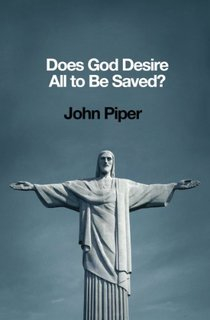
BOOK REVIEW: JOHN PIPER’S “DOES GOD DESIRE ALL TO BE SAVED?”

GOD’S GENUINE DESIRE AND OFFER FOR ALL TO BE SAVED

DGDATBS? Piper

Book Review By David P. Craig

John Piper states his purpose for writing this book as follows, “My aim in this short book is to show from Scripture that the simultaneous existence of God’s will for all people to be saved and his will to choose some people for salvation unconditionally before creation is not a sign of divine schizophrenia or exegetical confusion. A corresponding aim is to show that unconditional election therefore does not contradict biblical expressions of God’s compassion for all people and does not rule out sincere offers of salvation to all who are lost among the peoples of the world.”

In Chapter One Piper acknowledges and addresses some of the more perplexing texts that are cited to show that God’s will is for all people to be saved: 1 Timothy 2:4; 2 Peter 3:9; Ezekiel 18:23; and Matthew 23:37. Piper concludes his examination of these passages by stating that the only conclusion we can arrive at is that the Scriptures show that God has two wills: “willing something in one sense that he disapproves in another sense.”

In Chapter Two Piper illustrates God’s “two wills” by examining five explicit examples of this from the Scriptures: (a) In the death of Christ (Acts 2:23); (b) In the war against the Son of God (Rev. 17:16-17); (c) In the hardening of Pharaoh’s heart (Exodus); (d) In the restraint of a King’s evil (Proverbs); (e) In not delighting in the punishment of the wicked (Ezekiel 18:23).

Chapter Three is an exposition of the Sovereign will of God. Piper’s thesis is that “behind the complex relationship of the two wills of God is the foundational biblical premise that God is sovereign in a way that makes him ruler of all actions.” Piper examines various passages of Scripture and concludes, “Terms such as ‘will of decree’ and ‘will of command,’ or ‘sovereign will’ and ‘moral will,’ is not an artificial distinction demanded by Reformed theology. The terms are an effort to describe the whole of biblical revelation. They are an effort to say yes to all of the Bible and not silence any of it. They are a way to say yes to the universal will of Ezekiel 18:23 and Matthew 23:37, and yes to the individual, unconditional election of Romans 9:6-23.”

In the final Chapter Piper ties his argument together by discussing how God does not sin in willing that sin takes place. He answers the question: “What keeps God from saving whom he desires to save? And he goes into a lengthy discussion of the question “What is free will?” In the process he comes back to 1 Timothy 2:4 and gives an exegetical and philosophical argument from some of the great theologians of the Church: John Calvin, Jonathan Edwards, Stephen Charnock, Robert L. Dabney and a wonderful illustration from the life of George Washington.

In the final analysis Piper arrives at 3 concluding statements about the universal love of God and the offer of Christ’s salvation to everyone in the world: “(1) Christ really is the all-powerful, all-wise, all-satisfying Son of God offered in the gospel; (2) by his death and resurrection, he has acted out God’s discriminating, definite electing, regenerating, faith-creating, every-promise-guaranteeing new-covenant love, and thus purchased and secured irreversibly for his elect everything needed to bring them from deadness in sin to everlasting, glorified life and joy in the presence of God; and (3) everyone without any exception, who receives Christ as supreme treasure–who believes in his name–will be united to Christ in the embrace of this electing love and enjoy him and his gifts forever.”

John Piper has done a beautiful job of explaining the mysteries of God’s sovereign will, the offer of salvation, and shown clearly that the Bible teaches that we believe in and practice both – that He is sovereign in His election of those He will save, and that we have a responsibility to declare the gospel to all of humanity because He desires their salvation. I recommend this book to help you understand the depths of God’s sovereign plan, love, and activity in carrying out His redemptive purposes until Christ returns again.

Book Review: “Who’s Your Father?” by Robert Bernecker

RETURNING TO THE LOVE OF THE BIBLICAL GOD

WYF? Bernecker

Coming To Grips With God’s Amazing Love For You

Book Review By David P. Craig

One of the main things that has been lost in modern Christianity is the Main Thing – God Himself. The church invests millions of dollars in programming, high-tech equipment, buildings, and the like. However, what we need more than anything is to be drenched with the reality of the character, nature, and intimacy there is to be found in our relationship with God – especially as He has clearly revealed Himself in the Bible.

Robert Bernecker has written a God-drenched book. He has written a book that tackles subjects as vast as the sovereignty of God, His providence, and our responsibility and will with reference to salvation and sanctification. The author tackles the “tough” doctrines of predestination, election, perseverance, and foreknowledge with theological precision, solid exegesis, and insight from 2,000 years of historical theology.

Without getting bogged down in theological debate, Bernecker simply lets the chips fall where they may by giving a plethora of Scriptures on the deepest and profoundest issues of Theology Proper – the doctrine of God. However, not leaving the reader in the realm of the abstract but taking you into the intimate arms of our loving Father.

If you want to understand the mind and heart of God and His will and purposes for humanity I highly recommend this book. It will give you a wonderful biblical theology of how God thinks and works in time and history – past, present, and future. In reading this book you will develop a higher view of God, and of His amazing plan for humanity – and for you – the reader. I urge you to take up this book and read about our Awesome God as revealed in the Scriptures and take the plunge in the waters of being drenched and soaked in God’s glory. It’s what you and I need more than anything else!

BOOK REVIEW: TIM KELLER’S “WALKING WITH GOD THROUGH PAIN AND SUFFERING”

Into The Furnace and Out Like Gold

WWGTPAS Keller

Book Review By David P. Craig

As someone who has experienced a tremendous amount of loss, grief, pain, and suffering I was excited for Tim’s book on suffering to arrive. Tim Keller has also suffered much, and thus speaks with credibility as a fellow sufferer in the journey of life where there are many hills and valleys along the way.

Keller divides the book into three parts based on the biblical metaphor where suffering is described as a “fiery furnace.” Fire is an image used throughout the Bible as an image describing the torment and pain of suffering. The Bible speaks frequently of troubles and trials as “walking through the fire,” a “fiery ordeal”, and a “fiery furnace.”

Therefore, Keller builds his themes around this image. In Part One Keller considers the furnace from the outside of us. He tackles “the phenomenon of human suffering, as well as the various ways that different cultures, religions, and eras in history have sought to help people face and get through it [suffering].”

In part two Keller moves away from the theoretical realm and begins to hone in on the personal and character issues that are developed when we suffer. He seeks to demonstrate that the common ways we handle suffering via avoidance, denial, and despair are essentially to waste our suffering. On the other hand, the Bible presents a balanced view in how to handle suffering in a step by step fashion. Biblical truth is always balanced and faces hardships head-on because these are the fires that God uses in our lives to mold our character and make us more like Christ.

Part three is the most practical part of the book. Suffering is actually designed by God to “refine us, not destroy us.” Keller explains in this final section how we can can properly orient ourselves toward God in the midst of our suffering so that we walk as Jesus walked in His great suffering.

The best time to read a book on suffering is before you are in the midst of the furnace. Keller recommends that you read sections two and three if you are already in the midst of great suffering. However, the best time to prepare for suffering is before it occurs. Therefore, it would be wise to read this book in the calm before the storm. Christians need to be prepared and develop a theological foundation of suffering before we enter the hot furnaces of life.

Americans seem to suffer more due to the fact that they are even suffering – than because of the suffering in and of itself. Keller wisely shows that suffering is a normal part of living in a fallen world. Life is full of various kinds of sufferings and we will always find ourselves coming into, or coming out of the fires of the furnace. God’s promise is that when you “pass through the waters…when you walk through the fire…I will be with you.” Jesus faced the ultimate suffering and furnace [the cross] and came through unscathed on our behalf. He was victorious over all the fires that we faced so that we too can be victorious as we face the fires that will come in Him, and with Him by our side.

I highly recommend this book as a wonderful resource that takes seriously the problems and complexities of suffering without watering them down. It is a resource that takes a multidimensional approach to suffering – tackling the internal and external realities – and takes us deep theologically and practically. It is good spiritual food for the mind and soul. Keller also weaves many personal stories of men and women along the way in this journey of suffering that will help you connect to the truths that he is communicating – not just for information, but for transformation.

I believe that God will use this book to powerfully help Christians realize that God has a plan and purpose to bring good out of all of our suffering. Out of each furnace that we enter – though difficult and painful – we will be refined by the fire and come out like gold. We will come out shining like the Son if we learn to trust and depend on His grace before, during, and in the aftermath of our trials. As Keller writes, “In Jesus Christ we see that God actually experiences the pain of the fire as we do. He is truly God with us, in love and understanding, in our anguish. He plunged himself into our furnace so that, when we find ourselves in the fire, we can turn to him and know we will not be consumed but will be made into people great and beautiful.”

Do you REALLY CARE about the Lost?

A PARABLE OF SAVING LIVES

life preserver on water

By Charles R. Swindoll

On a dangerous seacoast notorious for shipwrecks, there was a crude little lifesaving station. Actually, the station was merely a hut with only one boat…but the few devoted members kept a constant watch over the turbulent sea. With little thought for themselves, they would go out day and night tirelessly searching for those in danger as well as the lost. Many, many lives were saved by this brave band of men who faithfully worked as a team in and out of the lifesaving station. By and by, it became a famous place.

Some of those who had been saved as well as others along the seacoast wanted to become associated with this little station. They were willing to give their time and energy and money in support of its objectives. New boats were purchased. New crews were trained. The station that was once obscure and crude and virtually insignificant began to grow. Some of its members were unhappy that the hut was so unattractive and poorly equipped. They felt a more comfortable place should be provided. Emergency cots were replaced with lovely funrniture. Rough, hand-made equipment was discarded and sophisticated, classy systems, and appointments. By its completion, the life-saving station had become a popular gathering place, and its objectives had begun to shift. It was now used as sort of a clubhouse, an attractive gathering place for public gatherings. Saving lives, feeding the hungry, strengthening the fearful, and calming the disturbed rarely occurred by now.

Fewer members were now interested in braving the sea on lifesaving missions, so they hired professional lifeboat crews to do this work. The original goal of the station wasn’t altogether forgotten, however. The lifesaving motifs still prevailed in the club’s decorations. In fact, there was a liturgical lifeboat preserved in the Room of Sweet Memories with soft, indirect lighting, which helped hide the layer of dust upon the once-used vessel.

About this time a large ship was wrecked off the coast and the boat crews brought in loads of cold, wet, half-drowned people. They were dirty, some terribly sick and lonely. Others were black and “different” from the majority of the club members. The beautiful new club suddenly became messy and cluttered. A special committee saw to it that a shower house was immediately built outside and away from the club so victims of shipwreck could be cleaned up before coming inside.

At the next meeting there were strong words and angry feelings, which resulted in a division among the members. Most of the people wanted to stop the club’s lifesaving activities and all involvements with shipwreck victims…(it’s too unpleasant, it’s a hindrance to our social life, it’s opening the door to folks who are not our kind“). As you’d expect, some still insisted on saving lives, that this was their primary objective–that their only reason for existence was ministering to anyone needing help regardless of their club’s beauty or size or decorations. They were voted down and told if they wanted to save the lives of various kinds of people who were shipwrecked in those waters, they could begin their own lifesaving station down the coast! They did.

As years passed, the new station experienced the same old changes. It evolved into another club…and yet another lifesaving station was begun. History continued to repeat itself…and if you visit that coast today you’ll find a large number of exclusive, impressive clubs along the shoreline owned and operated by slick professionals who have lost all involvement with the saving or lives. Shipwrecks still occur in those waters, but now,most of the victims are not saved. Every day they drown at sea, and so few seem to care…so very few.

Do you? 

Deepening Your Roots

Read: Colossians 4:2-6; Matthew 5:13-16; and Ephesians Chapter 5

Branching Out

(1) Take time today to pray for someone you know is shipwrecked.

(2) Look for someone in need this week and be his “salvation” by meeting his need.

(3) Keep your porch light on all week (day and night) to remind yourself that you and your home are to be a lighthouse for the world.

*Article adapted from Chuck Swindoll. Growing Strong In The Seasons of LIfe. Portland, OR.: Multnomah Press, 1983,  pp. 98-99. 

James Montgomery Boice on The Holy Spirit: The Counselor Who Is Just Like Jesus

“THAT OTHER COMFORTER”

JOHN 13-17  VOL 4 JAMES BOICE

A SERMON BY DR. JAMES MONTGOMERY BOICE

John 14:16–18

“And I will ask the Father, and he will give you another Counselor to be with you forever—the Spirit of truth. The world cannot accept him, because it neither sees him nor knows him. But you know him, for he lives with you and will be in you. I will not leave you as orphans; I will come to you.”

The Christian church reaffirms its faith in the Holy Spirit every time it recites the Apostles’ Creed: “I believe in the Holy Ghost.” But beyond this rather formal acknowledgment, in large sectors of the church one would be hard pressed to find a reference to the Third Person of the Trinity at all.

J. I. Packer has written of this ignorance: “Christian people are not in doubt as to the work that Christ did; they know that He redeemed men by His atoning death, even if they differ among themselves as to what exactly this involved. But the average Christian is in a complete fog as to what work the Holy Spirit does. Some talk of the Spirit of Christ in the way that one would talk of the Spirit of Christmas—as a vague cultural pressure making for bonhomie and religiosity. Some think of the Spirit as inspiring the moral convictions of unbelievers like Gandhi, or the theosophical mysticism of a Rudolf Steiner. But most, perhaps, do not think of the Holy Spirit at all, and have no positive ideas of any sort about what He does. They are for practical purposes in the same position as the disciples whom Paul met at Ephesus—‘We have not so much as heard whether there be any Holy Ghost’ (Acts 9:2).” (J.I. Packer. Knowing God. Downers Grove, IL.: IVP, 1973, 60).

Why is this? It is hard to say why. But one thing is certain: It is an abnormal situation. It is abnormal from the viewpoint of Christ’s teachings, for Christ clearly taught about the Holy Spirit. He did so in the verses we are studying in order to provide comfort to his disciples and to all who should follow them throughout the church age. Knowledge of the Holy Spirit and dependence upon the Holy Spirit are necessary conditions of doing those “greater things” that he mentions in verse 12. Ignorance of the Holy Spirit’s work is also abnormal from the viewpoint of the author of the fourth Gospel, for he has shown his interest by including many verses about the Holy Spirit in the last discourses.

Personality or Power?

The first point we must settle in our minds in regard to the Holy Spirit is whether the Holy Spirit is a real person, whose work it is to get hold of us and use us, or whether the Holy Spirit is merely some vague power we are to get hold of and use to our benefit. This is important as a mere matter of truth; for either the Holy Spirit is a real person, or he is not. But it is also important on a practical level. If we think of the Holy Spirit as a mysterious power, our thought will continually be, “How can I get more of the Holy Spirit?” If we think of the Holy Spirit as a person, our thought will be, “How can the Holy Spirit have more of me?” The first thought is entirely pagan. The second is New Testament Christianity.

Reuben A. Torrey, who has written an excellent book on the Holy Spirit, carefully spells this out: “The conception of the Holy Spirit as a Divine influence or power that we are somehow to get hold of and use, leads to self-exaltation and self-sufficiency. One who so thinks of the Holy Spirit and who at the same time imagines that he has received the Holy Spirit will almost inevitably be full of spiritual pride and strut about as if he belonged to some superior order of Christians. One frequently hears such persons say, ‘I am a Holy Ghost man,’ or ‘I am a Holy Ghost woman.’ But if we once grasp the thought that the Holy Spirit is a Divine Person of infinite majesty, glory and holiness and power, who in marvelous condescension has come into our hearts to make His abode there and take possession of our lives and make use of them, it will put us in the dust and keep us in the dust. I can think of no thought more humbling or more overwhelming than the thought that a person of Divine majesty and glory dwells in my heart and is ready to use even me” (R.A. Torrey, The Person and Work of the Holy Spirit. Grand Rapids: Zondervan, 1970, 8-9).

We see this difference illustrated in the pages of the New Testament, as we might expect. On the one hand, there is the case of Simon the magician, whose story is told in Acts 8:9–24. He apparently believed in Christ through the preaching of Philip at Samaria, for we are told that he “believed … and … was baptized” (v. 13). But he knew little about Christianity and therefore fell into the mistake of thinking that the Holy Spirit was a power to be purchased. He actually offered the disciples money in order to receive “it.” To this, Peter, who was also in Samaria at the time, responded, “May your money perish with you, because you thought you could buy the gift of God with money! You have no part or share in this ministry, because your heart is not right before God. Repent of this wickedness and pray to the Lord. Perhaps he will forgive you for having such a thought in your heart” (vv. 20–22).

The other example is from the beginning of the missionary movement involving Paul and Barnabas. Of this we are told that “while they were worshiping the Lord and fasting, the Holy Spirit said, ‘Set apart for me Barnabas and Saul for the work to which I have called them’ ” (Acts 13:2). In the one case, an individual wanted to get and use God, whom he imagined to be merely a power. In the second case, God got and used two individuals.

Words or Reality?

We must admit that when we begin to talk about the Holy Spirit as a person, we are attempting to put into words something that is actually larger than words. What we are saying is that the Holy Spirit is one member of the Trinity, equal in all ways to both the Father and the Son. But we are not saying that there are three gods, which the term “member” or even “person” seems to imply. There are three persons; but in a way which is beyond our understanding these three are also one. We also confess as the Old Testament does, “Hear, O Israel: The Lord our God, the Lord is one” (Deut. 6:4).

In these verses Jesus speaks of the Holy Spirit saying, “And I will ask the Father, and he will give you another Counselor to be with you forever—the Spirit of truth. The world cannot accept him, because it neither sees him nor knows him. But you know him, for he lives with you and will be in you.” This is a great promise, but it is great precisely because of the personality of the Spirit. If the Spirit were only a power, the promise would be in the nature of a compensation—“I am going to be taken from you, but I will give you something to make up for my departure.” This is not what this verse is talking about. It is not a thing that is being given, but rather another divine personality that is being sent. This one must have knowledge, for he will know of the disciples’ distress. He must have feelings, for he will identify with them in their distress and comfort them. He must have will, for he will determine to carry out this commission.

The personality of the Holy Spirit is evident from the Scriptures in other ways also. One commentator has summed up the evidence in the following six propositions:

1. The personal actions ascribed to the Holy Spirit prove his personality. An example is John 14:16–18, for there he is promised as a Counselor for Christians. One other example is 1 Corinthians 12:11, in which he is said to be at work in Christians, imparting those spiritual gifts necessary for the well-being of the church.

2. His distinction from the Father and Son and his mission from both prove his personality. Jesus indicates this relationship by saying, “When the Counselor comes, whom I will send to you from the Father, the Spirit of truth who goes out from the Father, he will testify about me” (John 15:26).

3. The coordinate rank and power that belong to the Holy Spirit equally with the Father and the Son prove it. All trinitarian benedictions make this point clearly. Thus, “Go and make disciples of all nations, baptizing them in the name of the Father and of the Son and of the Holy Spirit” (Matt. 28:19). Or again, “The grace of the Lord Jesus Christ, and the love of God, and the fellowship of the Holy Spirit be with you all.” (2 Cor. 13:14).

4. The appearance of the Holy Spirit under a visible form at the baptism of the Lord Jesus Christ and on the day of Pentecost proves it. Of the former event it is written, “And the Holy Spirit descended on him in bodily form like a dove. And a voice came from heaven: ‘You are my Son, whom I love; with you I am well pleased’ ” (Luke 3:22). Of the second instance it is written, “They saw what seemed to be tongues of fire that separated and came to rest on each of them” (Acts 2:3).

5. The sin against the Holy Spirit proves it, for this implies offense against a personality. It is mentioned in Matthew 12:31–32.

6. The way in which the Holy Spirit is distinguished from his gifts also proves that he is a person and not merely a spiritual force or power. Thus, in 1 Corinthians 12, after having enumerated the gifts of wisdom, knowledge, faith, healing, miracles, prophecy, the discerning of spirits, tongues, and the interpretation of tongues, Paul writes, “But all these are the work of one and the same Spirit, and he gives them to each one, just as he determines” (George Smeaton, The Doctrine of the Holy Spirit, original ed., 1882. Carlisle, PA.: Banner of Truth Trust, 1961, 109).

Here are six separate and conclusive lines of argument showing that the Holy Spirit is a person. But the problem we have is still probably not so much the doctrine itself as our attitude toward him. Theoretically we probably do believe that the Holy Spirit is a person, the third person of the Godhead. But do we actually think about him in this way? Perhaps we do what a woman did who had attended a series of messages on the Holy Spirit at a Bible conference years ago. She listened carefully and then came up to the speaker to thank him for his teaching. She said, “Before your messages I never thought of it as a person.” Apparently she was not thinking of him as a person even then.

Is He God?

The first point that the Lord Jesus makes in his teaching about the Holy Spirit is that he is a person, as we have seen. But what sort of a person is he? Is he an angel? Is he a being superior to an angel but inferior to both the Father and the Son? Or is he equal to the Father and the Son? Is he God? Actually, we have already begun to answer these questions in talking about the personality of the Spirit, but the answer is also taught in the verses that constitute our text.

Here the Lord speaks of the Holy Spirit as “another Counselor.” It is important in understanding Christ’s words to notice that there are two different words for “another” in the Greek New Testament. One word is allos, the word we have here; it means “another just like the first one.” The second word, heteros, means “totally different.” Since there are these two words with two meanings it is always important to know which one is used whenever the word “another” occurs in the English text. It is the first word, the word meaning “another exactly like the first one,” that is used when Jesus speaks of sending the disciples “another Counselor.”

Who is the first Counselor? It is obviously Jesus himself. Therefore, the second Counselor is to be just like him. That is, he is to be another divine being living with them and in them.

Once again, as in the matter of the personality of the Holy Spirit, other parts of Scripture reinforce this teaching. We may summarize the points thus:

1. Divine attributes are ascribed to the Spirit. The word “holy” is itself a divine attribute, at least in its most exalted sense. So also are the attributes of omniscience (1 Cor. 2:10–11; John 16:12–13), omnipotence (Luke 1:35), and omnipresence (Ps. 139:7–10).

2. Works that are exclusively the works of God are attributed to the Holy Spirit. Creation is one example. In the Book of Job we read, “By his breath the skies became fair” (26:13) and “The Spirit of God has made me” (33:4). The Holy Spirit is described as the One who imparts life, another divine work (John 3:6; Rom 8:11). He is the One responsible for the giving forth of the Word of God, the Bible. “For prophecy never had its origin in the will of man, but men spoke from God as they were carried along by the Holy Spirit” (2 Peter 1:21).

3. The Holy Spirit is ranked coordinate with God the Father and God the Son. The benedictions cited earlier are examples of this.

4. The name of God is indirectly given to him. The clearest example of this is in Acts 5:3–4, where Peter says to Ananias, “Ananias, how is it that Satan has so filled your heart that you have lied to the Holy Spirit? … Thou hast not lied unto men, but unto God.” 

Practical Theology

Does it really matter that we know and constantly recognize that the Holy Spirit is divine? Yes, it does, for if we know and constantly recognize his deity, we will recognize and rely on his work. If we do not, then we will foolishly rely on our own limited wisdom, love, strength and other resources, and forfeit that which he alone can provide.

In his writings on the Holy Spirit to which I referred at the start of this study, J. I. Packer asks these pertinent questions: “Do we honour the Holy Spirit by recognising and relying on His work? Or do we slight Him by ignoring it, and thereby dishonour, not merely the Spirit, but the Lord who sent Him? In our faith: do we acknowledge the authority of the Bible, the prophetic Old Testament and the apostolic New Testament which He inspired? Do we read and hear it with the reverence and receptiveness that are due to the Word of God? If not, we dishonour the Holy Spirit. In our life: do we apply the authority of the Bible, and live by the Bible, whatever men may say against it, recognising that God’s word cannot but be true, and that what God has said He certainly means, and will stand to? If not, we dishonour the Holy Spirit, who gave us the Bible. In our witness: do we remember that the Holy Spirit alone, by His witness, can authenticate our witness, and look to Him to do so, and trust Him to do so, and show the reality of our trust, as Paul did, by eschewing the gimmicks of human cleverness? If not, we dishonour the Holy Spirit” (Packer, Knowing God, 63).

The personality and deity of the Holy Spirit, as well as other truths about him, are practical teachings. What remains is that we take them down off the shelf of high theology and put them to work in our lives.

About the Author

Boice JM in pulpit

James Montgomery Boice, Th.D., (July 7, 1938 – June 15, 2000) was a Reformed theologian, Bible teacher, and pastor of Tenth Presbyterian Church in Philadelphia from 1968 until his death. He is heard on The Bible Study Hour radio broadcast and was a well-known author and speaker in evangelical and Reformed circles. He also served as Chairman of the International Council on Biblical Inerrancy for over ten years and was a founding member of the Alliance of Confessing Evangelicals. James Boice was one of my favorite Bible teachers. Thankfully – many of his books and expositions of Scripture are still in print and more are becoming available. The sermon above was adapted from Chapter 183 in John 13-17: An Expositional Commentary. vol. 4. Grand Rapids: Baker, 1997, 2006.