Dr. Tim Keller on How the Gospel Changes our Apologetics, Part 2

[Tim Keller’s Article Below Originally appeared on 7/24/2012 in the Redeemer City to City Blog: http://redeemercitytocity.com/blog/view.jsp?Blog_param=444%5D

In my last post [How the Gospel Changes our Apologetics, Part 1 – under the Category “Tim Keller”), I made an argument for why we still need apologetics. Believing has both a head and a heart aspect, so while some non-Christians will need more help with one than the other, we can’t ignore either one.

So what can we say when we are called upon to present the reasons why we believe?

First, I try to show that it takes faith to doubt Christianity, because any worldview (including secularism or skepticism) is based on assumptions. For example, the person who says, “I can only believe in something if it can be rationally or empirically proven” must realize that that in itself is a statement of faith. This “verification principle” cannot actually be proven rationally or empirically, making it an assertion or a claim, not an argument. Furthermore, there are all sorts of things you can’t prove rationally or empirically. You can’t prove to me that you’re not really a butterfly dreaming you’re a person. (Haven’t you seen The Matrix?) You can’t prove most of the things you believe, so at least recognize that you have faith.

I normally make this point by considering an objection to Christianity, to show that at the heart of it is some sort of faith assumption. Let’s take the example of suffering; someone will say, “I can’t believe in God, because how could a good God allow such suffering?”

Put another way, they are saying, “I know for a fact that there can’t be any good reason that a good God would allow this specific thing to happen.” Really? There could be all sorts of good reasons why God allowed something to happen that caused suffering, despite our inability to think of them. If you’ve got an infinite God big enough to be mad at for the suffering in the world, then you also have an infinite God big enough to have reasons for it that you can’t think of.

You have to show people that it takes faith to doubt Christianity. C. S. Lewis’ pre-conversion argument against God was that the universe seemed so cruel and unjust. But then he asked himself, “But how had I got this idea of just and unjust? What was I comparing this universe with when I called it unjust?  …Atheism turns out to be too simple” (Mere Christianity, Book 2, Part 1). In the natural world the strong eat the weak, and there’s nothing wrong with violence. Where do you get the standard that says the human world shouldn’t work like that, that says the natural world is wrong? You can only judge suffering as wrong if you’re using a standard higher than this world, a supernatural standard. If there’s no God, you have no reason to be upset at the suffering in this world. That’s just the way it is. It takes faith to get mad at this world.

You see, a gospel-shaped apologetic starts not with telling people what to believe, but by showing them their real problem. In this case we are showing secular people that they have less warrant for their faith assumptions than we do for ours. We need to show that it takes faith even to doubt.

British critic and former atheist A.N. Wilson wrote about losing his faith as a young man, influenced by British intellectual society, which had all but accepted that only stupid people actually believe in Christianity. “As a matter of fact however,” he argues, “it is materialist atheism that is not merely an arid creed but totally irrational. Materialist atheism says we are just a collection of chemicals, and it has no answer whatsoever to the question of how we should be capable of love, or heroism, or poetry if we are simply animated pieces of meat.”

A campus evangelist I once heard during the Vietnam protests pushed atheist students to recognize the clash between their moral relativism in regards to sex, and their moral absolutism with regards to international genocide. They had no answers.  If there’s no God, everything is permitted. Without God we’re left with no basis for all that is most important to our lives: human dignity, compassion, justice. We have a problem.

Which brings us to the final point, the solution to our problem. At some point you need tell the Christian story in a way that addresses the things that people most want for their own lives, the things that they are trying to find outside of Christianity, and show how Christianity can give it to them. Alasdair MacIntyre said this about narratival apologetics: “That narrative prevails over its rivals which is able to include its rivals within it, not only to retell their stories as episodes within its story, but to tell the story of the telling of their stories as such episodes.” Read that sentence again.

There is a way of telling the gospel that makes people say, “I don’t believe it’s true, but I wish it were.” You have to get to the beauty of it, and then go back to the reasons for it. Only then, when you show that it takes more faith to doubt it than to believe it; when the things you see out there in the world are better explained by the Christian account of things than the secular account of things; and when they experience a community in which they actually do see Christianity embodied, in healthy Christian lives and solid Christian community, that many will believe.

About the Author: In 1989 Dr. Timothy J. Keller, his wife and three young sons moved to New York City to begin Redeemer Presbyterian Church. In 20 years it has grown to meeting for five services at three sites with a weekly attendance of over 5,000. Redeemer is notable not only for winning skeptical New Yorkers to faith, but also for partnering with other churches to do both mercy ministry and church planting.  Redeemer City to City is working to help establish hundreds of new multi-ethnic congregations throughout the city and other global cities in the next decades.

Dr. Tim Keller is the author of several phenomenal books including:

  • Every Good Endeavor: Connecting Your Work to God’s Plan for the World. New York, Penguin Publishing, November, 2012.
  • Center Church: Doing Balanced, Gospel-Centered Ministry in Your City. Grand Rapids: Zondervan, September, 2012.
  • The Freedom of Self Forgetfulness. New York: 10 Publishing, April 2012.
  • Generous Justice: How God’s Grace Makes Us Just. New York: Riverhead Trade, August, 2012.
  • The Gospel As Center: Renewing Our Faith and Reforming Our Ministry Practices (editor and contributor). Wheaton: Crossway, 2012.
  • The Meaning of Marriage: Facing the Complexities of Commitment with the Wisdom of God. New York, Dutton, 2011.
  • The Prodigal God. New York, Dutton, 2011.
  • King’s Cross: The Story of the World in the Life of Jesus. New York, Dutton, 2011.
  • Counterfeit Gods: The Empty Priorities of Money, Sex, and Power, and the Only Hope That Matters. New York, Riverhead Trade, 2011.
  • The Reason For God: Belief in an Age of Skepticism. New York, Dutton, 2009.
  • Worship By The Book (contributor). Grand Rapids: Zondervan, 2002.
  • Ministries of Mercy: The Call of the Jericho Road. Phillipsburg: P&R Publishing, 1997.

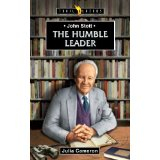
Book Review on John Stott: The Humble Leader by Julia Cameron

[The Humble Leader: John Stott was written by Julia Cameron. Published by Christian Focus Publications Ltd., Geanies House, Fearn, Ross-shire, Scotland & Great Britan. I was furnished with an I-Book copy for review free of charge for an honest review – I was not required to provide a positive review]


A Nostalgic Review – By Dr. David P. Craig

I first met John Stott somewhere between 1986-1987 after he had given a message at a Chapel service at what was then called Multnomah School of the Bible (now Multnomah University) in Portland, Oregon. After he spoke he stayed for lunch and ate in the cafeteria. I was privileged to sit with him and hear his wisdom for over an hour. I was impressed with his humility, knowledge of the Scriptures, and genuine concern for us students. Two years later I was returning from spending two months in Spain on a missions trip and met up with my parents in London for a few days. While there we worshiped at All Souls Church in London and worshiped and listened intently as John Stott delivered a wonderful Christo-centric sermon from Isaiah. Afterwards while waiting in a very long line to greet “Uncle John” he said to me without hesitation, “Hello David, how is your ministry at Multnomah going?” I couldn’t believe that he remembered my name, my ministry (with junior highers at the time), and where I was going to school! Needless to say, I was dumbfounded. I have always held Stott’s commentaries, books, and ministry in high regard – but what I loved most about Stott – was his genuine love for, and ability to shepherd like the Chief Shepherd – not just his local sheep, but around the world. I have taken random samples of tribute from Stott in this short article – many are from memorial services held for him around the globe, and some are from tributes in various venues. May John Stott’s tribe increase! We miss you Uncle John!

As I write this review it’s been one year since John Stott went to be with the Lord – July 27, 2011. A tremendous loss for the Church in the world – Heaven’s gain! I can’t recommend this book highly enough for would-be pastors; pastors; Bible scholars; missionaries; church leaders of all stripes; and world Christians across the globe. John Stott was absolutely brilliant; wholeheartedly dedicated to his flock as an under shepherd of Christ; a first rate Bible scholar; an expositor of the first order that was able to bridge the Biblical world with our own with total authority, sufficiency, and relevancy; and an unheralded disciple maker of leaders of all ethnic groups around the globe. He was a tireless worker with students, scholars, pastors, missionaries, and leaders for the furtherance of the gospel and the strengthening of the church around the globe. In my opinion – he was the model modern pastor – missional (he multiplied disciples, leaders, and multiplied movements for gospel multiplication) pastoral, loving, humble, scholarly, fully committed to the work and message of Christ.

I only hope that there will be more pastors like him until the return of Christ – pastors that don’t play politics; pastors that love and shepherd the flock whether they are rich or poor (he had a tremendous heart for the poor as recounted in this book); pastors who study hard to feed their flock the milk and meat of the Word; pastors who love and train young leaders; pastors who are humbled and submitted to the Lordship of Christ – and preaching nothing but the cross of Christ! I hope that many will read this book and be humbled and dedicated to the Chief Shepherd – as Stott was! I miss him terribly, and long for those of his ilk.

How C.H. Spurgeon Would Have Ended Up In A Lunatic Asylum!

The following excerpt is from “Men Bewitched,” a sermon preached at some indeterminate time in the Metropolitan Tabernacle in London.

hen I was about fifteen or sixteen years of age, I wanted a Savior, and I heard the gospel preached by a poor man, who said in the name of Jesus—”Look unto me and be ye saved, all the ends of the earth.” It was very plain English, and I understood it, and obeyed it and found rest.

I owe all my happiness since then to the same plain doctrine.

Now, suppose that I were to say, “I have read a great many books, and there are a great many people willing to hear me. I really could not preach such a commonplace gospel as I did at the first. I must put it in a sophisticated way, so that none but the elite can understand me.”

I should be—what should I be? I should be a fool, writ large.

I should be worse than that, I should be a traitor to my God; for if I was saved by a simple gospel, then I am bound to preach that same simple gospel till I die, so that others too may be saved by it.

When I cease to preach salvation by faith in Jesus put me into a lunatic asylum, for you may be sure that my mind is gone.

About Charles Haddon Spurgeon – one of the greatest Christian thinkers of all time and undoubtedly the most celebrated preacher of the 19th century, began his ministry as a country-boy with only a year of formal education. But even without much training, his brilliant mind and depth of spiritual insight quickly became legendary throughout the world. During his lifetime Spurgeon is estimated to have preached, in person, to over ten million people. He published over 3,500 sermons, totaling between 20 and 25 million words and more than 38,000 pages. Today, over a century after his death, his sermons and devotional texts continue to challenge and touch Christians and non-Christians alike. It is no wonder that this country-boy became known as the “Prince of Preachers.”

Born on June 19, 1834 in Kelvedon, England, Spurgeon wouldn’t become a Christian until the age of fifteen. It happened one Sunday morning when a snowstorm kept him from reaching the church he usually attended. He ducked down a side street and stumbled across a small building with a sign that read, “Artillery Street Primitive Methodist Chapel.” Regardless of his own misgivings, he entered the small church and while listening to a Methodist layman comment on Isaiah 45:22, he “Saw at once the way of salvation!” Spurgeon immediately committed his life to Christ and became a zealous servant of God.

Desiring to share his new faith, Spurgeon began preaching. He preached his first sermon in 1851, at the age of sixteen, to a group of farmers and wives gathered in the village of Teversham. His text was 1 Peter 2:7, “Unto you therefore which believe he is precious.” Audiences were held spellbound by the young Spurgeon’s speaking power, and he was offered his first pastorate at the Baptist Chapel in Waterbeach when he was only seventeen. The church, which had about ten members when he arrived, was soon bursting at its doors with over four hundred in the congregation. His inspiring style had caught the interest of many, and soon after his twentieth birthday, the country-preacher was called to be the new pastor of the prominent New Park Street Baptist Church in London. New Park Street was a church that had formerly been pastored by such spiritual giants as Benjamin Keach, John Gill, and John Rippon.

In a day when preaching was considered not only a source of spiritual nourishment, but also of entertainment and political commentary, Spurgeon’s powerful and stimulating sermons drew enormous crowds. On a single night in London, preaching at the Crystal Palace, he preached to a congregation of 23, 654 without the use of a microphone! His sermons were published weekly in the “Penny Pulpit,” from 1855 until 1917, twenty-four years after his death. He published many religious books, including Lectures to My Students and Treasury of David, a seven-volume devotional-commentary on the Psalms. He also founded and served as president of the Pastor’s College in London, established the Stockwell Orphanages for boys and girls, and oversaw dozens of evangelistic and charitable enterprises. Spurgeon preached his final sermon at the Metropolitan Tabernacle in June of 1891.

Spurgeon married Susannah Thompson in January of 1856 and late in the following year they had twin sons, Thomas and Charles. Unlike Spurgeon’s mother who had seventeen children, nine of whom died in childbirth, Charles and Susannah had only the two boys.

Charles Spurgeon died at the relatively young age of 57, in January of 1892. His funeral service was held a week later, on February ninth, at the Metropolitan Tabernacle. Over 60,000 people waited in line to file past his casket.

Dr. D.A. Carson on How To Destroy A Church

Some Intense Prophetic Words From D.A. Carson

“The ways of destroying the church are many and colorful. Raw factionalism will do it. Rank heresy will do it. Taking your eyes off the cross and letting other, more peripheral matters dominate the agenda will do it—admittedly more slowly than frank heresy, but just as effectively over the long haul. Building the church with superficial ‘conversions’ and wonderful programs that rarely bring people into a deepening knowledge of the living God will do it. Entertaining people to death but never fostering the beauty of holiness or the centrality of self-crucifying love will build an assembling of religious people, but it will destroy the church of the living God. Gossip, prayerlessness, bitterness, sustained biblical illiteracy, self-promotion, materialism—all of these things, and many more, can destroy a church. And to do so is dangerous: ‘If anyone destroys God’s temple, God will destroy him; for God’s temple is sacred, and you are that temple (1 Cor. 3:17).  It is a fearful thing to fall into the hands of the living God.” – D.A. Carson in The Cross and Christian Ministry

About the Author: D. A. Carson (Ph.D., University of Cambridge) is research professor of New Testament at Trinity Evangelical Divinity School in Deerfield, Illinois. He is the author or coauthor of over 45 books, including The Cross and Christian Ministry from which the quote above is derived; the Gold Medallion Award-winning book The Gagging of God and An Introduction to the New Testament, and is general editor of Telling the Truth: Evangelizing Postmoderns and Worship by the Book. He has served as a pastor and is an active guest lecturer in church and academic settings around the world.

F.F. Bruce on The Formation of the Canon of Scripture

F.F. Bruce on The Criteria of Canonicity of the Bible 

Tests in The Apostolic Age

The earliest Christians did not trouble themselves about criteria of canonicity; they would not have readily understood the expression. They accepted the Old Testament scriptures as they had received them: the authority of those scriptures was sufficiently ratified by the teaching and example of the Lord and his apostles. The teaching and example of the Lord and his apostles, whether conveyed by word of mouth or in writing, had axiomatic authority for them.

Criteria of a kind, however, were found to be desirable quite early. When prophets, for example, claimed to speak in the Lord’s name, it became necessary to ‘discern the spirits’ by which they spoke. Some members of the church were given ‘the ability to distinguish between spirits’ (1 Cor. 12: 10). According to Paul, the decisive criterion to apply to prophets is their testimony to Christ: ‘no one can say “Jesus is Lord” except by the Holy Spirit’ (1 Cor. 12:3). Somewhat later, John suggests a more specific test: ‘every spirit which confesses that Jesus Christ has come in the flesh is of God’ (1 Jn. 4:2). Such tests anticipated the later insistence on orthodoxy as a criterion of canonicity.

Again, when Paul suspected that letters were circulating in his name which were none of his, he gave his friends a simple criterion by which his genuine letters could be recognized: although he regularly dictated his letters to amanuenses, he took the pen himself to write the final greetings—sometimes, but not necessarily, accompanied by his actual signature (cf. 1 Cor. 16:21; Gal. 6:11; Col. 4:18; 2 Thess. 3: 17; also Philemon 19). Paul’s handwriting was evidently so distinctive that it could not be easily forged. This was, of course, a temporary criterion of authenticity. No document containing Paul’s handwriting has survived to our day, and even if one had survived, the handwriting would not be recognizable as his at this late date.

Apostolic Authority

Since Jesus himself left nothing in writing, the most authoritative writings available to the church were those which came from his apostles. Among his apostles none was more active in writing (as well as otherwise) than Paul. There were some in Paul’s own day, and a few in later generations, who questioned his right to be called an apostle, but throughout the churches of the Gentiles his apostleship was generally undoubted—inevitably so, because a number of those churches would not have existed except for his apostolic ministry (See Paul’s argument in 2 Cor. 3:1-3: the existence of the church was the only letter of accreditation he needed—at Corinth). The authority of his authentic letters continued to be acknowledged after his death, not only by the churches to which they were severally addressed but by the churches as a whole. It is not surprising that Paul’s letters were among the first, if not absolutely the first, of our New Testament documents to be gathered together and to circulate as a collection.

Letters in antiquity normally began with the writer’s name, and so did Paul’s letters. But many of the New Testament documents do not contain the writers’ names: they are strictly anonymous—to us, completely anonymous. The writer to Theophilus was well enough known to Theophilus (See Lk. 1:3; Acts 1:1), but his name has not been preserved either in the Third Gospel or in Acts; to us, therefore, these two works are anonymous. Traditionally they are ascribed to Luke, but if we wish to examine the validity of this tradition, we have to consider which Luke is meant, and what the probability is of their being the work of that Luke.

Similarly, the recipients of the letter to the Hebrews no doubt were well acquainted with its author (in that sense they would not have regarded it as an anonymous communication), but since it does not bear his name, his identity was forgotten after a generation or two, and has never been certainly recovered.

From the second century onward, two of the four Gospels were ascribed to apostles—to Matthew and John. Whether Marcion knew of this ascription or not we cannot say, but if he did, that in itself would have deprived them of all Christian authority in his eyes: these two men belonged to the group which, he believed, had corrupted the pure message of Jesus. An eccentric churchman like Gaius of Rome might ascribe the Fourth Gospel to Cerinthus, but the views of eccentric churchmen have never disturbed the general consensus.

It is remarkable, when one comes to think of it, that the four canonical Gospels are anonymous, whereas the ‘Gospels’ which proliferated in the late second century and afterwards claim to have been written by apostles and other eyewitnesses. Catholic churchmen found it necessary, therefore, to defend the apostolic authenticity of the Gospels which they accepted against the claims of those which they rejected. Hence come the accounts of the origin of the canonical four which appear in the Muratorian list, in the so-called anti-Marcionite prologues, and in Irenaeus. The apostolic authorship of Matthew and John was well established in tradition.

But what of Mark and Luke? Their authorship was also well established in tradition, but it was felt desirable to buttress the authority of tradition with arguments which gave those two Gospels a measure of apostolic validation. As early as Papias, Mark is said to have set down in writing Peter’s account of the sayings and doings of the Lord, and Peter’s apostolic authority was not in doubt. As for Luke’s Gospel, its author was early identified with the man whom Paul calls ‘Luke, the beloved physician’ (Col. 4:14). This meant that he was one of Paul’s associates, and something of Paul’s apostolic authority rubbed off on him. Some, identifying Luke with the unnamed ‘brother’ of 2 Corinthians 8:18 ‘whose praise is in the gospel’, went so far as to see in these words of Paul a reference to the Gospel of Luke, if they did not indeed go farther still and see a reference to it in Paul’s mention of ‘my gospel’ (Rom. 2:16; 16:25; 2 Tim. 2:8). Fortunately, the value of Luke’s Gospel can be vindicated with stronger arguments than these; but the fact that these were the arguments used in its defence in the second and third centuries shows how important some degree of apostolic authorization seemed to be for the books which the church accepted as uniquely authoritative.

The fortunes of the letter to the Hebrews provide a further example of the importance attached to apostolic authority (if not authorship). Those who (like the church of Alexandria) accepted this letter as the work of Paul recognized it without more ado as canonical. If someone with a critical faculty like Origen’s realized that, as it stood, this document was not Paul’s work, a way round this offered itself: the Greek text indeed was not Paul’s (perhaps it was Luke’s), but a Hebrew work of Paul lay behind it. (An even better developed critical faculty might have indicated that Hebrews was not written in translation-Greek.) Those who (like well-informed members of the Roman church) knew that the work was not Paul’s, esteemed it highly as an edifying document handed down from the early age of the church, but did not accept it as apostolic. When at last, in the fourth century, the church of Rome was persuaded to fall into line with the other churches and recognize Hebrews as canonical, a natural tendency followed to treat it as Pauline also—but Pauline with a qualification. ‘I am moved rather by the prestige of the eastern churches’, said Augustine, ‘to include this epistle too among the canonical writings’; but he had reservations about its authorship.

Like his older contemporary Jerome, he distinguished between canonicity and apostolic authorship. Even at an earlier period, apostolic authorship in the direct sense was not insisted on, if some form of apostolic authority could be established. Membership of the holy family apparently carried with it near-apostolic status: Paul indeed seems to include James the Lord’s brother among the apostles (Gal. 1:19)—but so far as James was concerned there was the further consideration that to him, as to Paul himself, the Lord had appeared in resurrection (1 Cor. 15:7). If therefore the James who names himself as author of the letter addressed ‘to the twelve tribes in the Dispersion’ was identified with the Lord’s brother, that was good enough reason for accepting the letter among the apostolic writings. And if ‘Jude, a servant of Jesus Christ and brother of James’ was indicated in those words to be another member of the holy family, that was sufficient to tip the balance in favour of accepting the short letter so superscribed, especially in view of the ‘words of heavenly grace’ of which (as Origen said) it was full. The early church knew several works claiming the authority of Peter’s name. Among these no difficulty was felt about 1 Peter; its attestation goes back to the first half of the second century, and it was handed down as one of the undisputed books.

There was considerable hesitation about 2 Peter, but by the time of Athanasius it was no longer a disputed book in the Alexandrian church or in western Christendom. Its explicit claim to be the work of the apostle Peter was probably felt to be supported by the fact that it contained nothing unworthy of him. Among the Johannine writings 1 John was always closely associated with the Fourth Gospel: if the Gospel was acknowledged to be apostolic and canonical, so was this epistle, although it was as anonymous as the Gospel. Those who doubted the apostolic authorship of 2 and 3 John and the Apocalypse tended to doubt their canonical status also. The disinclination to accept the Apocalypse was due not mainly to doubts about the identity of the John who wrote it with John the apostle; it was due much more to the antipathy which was widely felt in the Greek world to its millenarianism. Dionysius of Alexandria, who ascribed it on grounds of literary criticism to another John than the apostle and evangelist, acknowledged it to be a genuine work of prophecy. Two aspects of the apostolic criterion were themselves used as subsidiary criteria—antiquity and orthodoxy.

Antiquity

If a writing was the work of an apostle or of someone closely associated with an apostle, it must belong to the apostolic age. Writings of later date, whatever their merit, could not be included among the apostolic or canonical books. The compiler of the Muratorian list had a high regard for the Shepherd of Hermas; he recognized it evidently as a genuine work of prophecy. However, it had appeared too late to be included among the canonical prophets; and equally it had appeared too late to be included among the apostolic writings, for it was written only the day before yesterday, so to speak. This argument could have been employed more freely than it was in settling problems of authenticity, at a time when so many works were appearing which claimed to have been written by apostles and their associates. But perhaps most of the churchmen who concerned themselves with this problem lacked the information or the expertise to appeal confidently to the evidence for dating such documents: they preferred to judge them by their theology.

Orthodoxy

In other words, they had recourse to the criterion of orthodoxy. By ‘orthodoxy’ they meant the apostolic faith—the faith set forth in the undoubted apostolic writings and maintained in the churches which had been founded by apostles. This appeal to the testimony of the churches of apostolic foundation was developed specially by Irenaeus. Whatever differences of emphasis may be discerned by modern students within the corpus of New Testament writings, these are irrelevant to the issues which confronted churchmen of the second and third centuries. They had to defend the apostolic teaching, summed up in the rule of faith, against the docetic and gnostic presentations which were so attractive to many in the climate of opinion at that time. When previously unknown Gospels or Acts began to circulate under the authority of apostolic names, the most important question to ask about any one of them was: What does it teach about the person and work of Christ? Does it maintain the apostolic witness to him as the historical Jesus of Nazareth, crucified and raised from the dead, divinely exalted as Lord over all?

A good example of the application of this test is provided by the case of Bishop Serapion and the Gospel of Peter. When Serapion found that this document was being read in the church of Rhossus, he was not greatly disturbed; he certainly did not examine its style and vocabulary (as Dionysius of Alexandria might have done) to see if its claim to be the work of Peter or a product of the apostolic age was well founded or not. But when he discovered that its account of the Lord’s death was tinged with docetism (it implies that he did not really suffer), then he decided that he ought to pay the church of Rhossus a pastoral visit to make sure that it had not been led astray by this heterodox teaching. Other ‘Petrine’ literature circulating among the churches was equally unauthentic, but since it did not inculcate heresy, it caused no great concern. The Muratorian compiler, for example, seems to draw upon the Acts of Peter (which gave an account of the apostle’s Roman ministry and execution) and he expressly includes the Apocalypse of Peter in his list (although he concedes that some refused to let it be read in church).

But in due course the non-apostolic character of these works became sufficiently evident to ensure that they did not find a permanent place in the New Testament canon. It is doubtful if any book would have found a place in the canon if it had been known to be pseudonymous. The Acts of Paul, one of the earliest exercises in Christian novel-writing, dating from shortly after the middle of the second century, was orthodox enough, and indeed quite edifying (especially to those who believed that celibacy was a superior state of life to matrimony). It was not pseudonymous, for its author was known; but it was fictitious, and unworthy of the great apostle for love of whom it was said to have been written; the author was therefore deposed from his office as presbyter in one of the churches of Asia. Anyone who was known to have composed a work explicitly in the name of an apostle would have met with even greater disapproval.

Catholicity

A work which enjoyed only local recognition was not likely to be acknowledged as part of the canon of the catholic church. On the other hand, a work which was acknowledged by the greater part of the catholic church would probably receive universal recognition sooner or later. We have seen how the Roman church ultimately consented to receive Hebrews as canonical so as not to be out of step with the rest of orthodox Christendom. It might have been argued that the letters of Paul were too local and occasional in character to be accepted as universally and permanently authoritative. The issues to which he addressed himself in the letters to the Galatians and the Corinthians, for example, were of temporary urgency in the churches to which those letters were sent. How could their inclusion among the scriptures of the catholic church be justified? The earliest answer given to this question was one which was evidently found satisfactory at the time, although to us it seems curiously far-fetched. It was this: Paul wrote letters to seven churches, and in view of the symbolic significance of the number seven, that means that he wrote for the church universal.

The same conception of seven as the number of perfection was applied to the seven churches addressed in the Apocalypse. Indeed, the compiler of the Muratorian list preposterously regards John as setting the precedent in this regard which Paul followed: in both sets of letters, what was written to seven was spoken to all. Even Paul’s letters to individuals have an ecumenical reference, says the Muratorian compiler: ‘they have been hallowed for the honour of the catholic church in the regulation of ecclesiastical discipline.’ Each individual document that was ultimately acknowledged as canonical started off with local acceptance—the various epistles in the places to which they were sent, the Apocalypse in the seven churches of Asia, even the Gospels and Acts in the constituencies for which they were first designed. But their attainment of canonical status was the result of their gaining more widespread recognition than they initially enjoyed.

Traditional Use

Catholicity has been classically defined in the fifth-century ‘Vincentian canon’ as ‘what has been believed everywhere, always, by all’. What has always been believed (or practiced) is the most potent factor in the maintenance of tradition. Suggested innovations have regularly been resisted with the argument ‘But this is what we have always been taught’ or ‘what we have always done’. It was so in the early Christian centuries with the recognition of certain books as holy scripture, and it is still so (whether this is consciously realized or not). The reading of ‘memoirs of the apostles’ in church along with the Old Testament writings (to which Justin Martyr bears witness) became an established practice which made it easy to accord to those ‘memoirs’ the same formal status as that accorded from the church’s earliest days to the law and the prophets. If any church leader came along in the third or fourth century with a previously unknown book, recommending it as genuinely apostolic, he would have found great difficulty in gaining acceptance for it: his fellow-Christians would simply have said, ‘But no one has ever heard of it!’ (We may think, for example, of the widespread hesitation in accepting 2 Peter. Cf Eusebius, Hist. Eccl. 3.3. 1: ‘But the so-called second epistle [of Peter] we have not received as “intestamented”; nevertheless it has appeared useful to many, and has been studied with the other the other scriptures.”).

Or, even if the book had been known for some generations, but had never been treated as holy scripture, it would have been very difficult to win recognition for it as such. When William Whiston, in the eighteenth century, argued that the Apostolic Constitutions should be venerated among the New Testament writings, few if any took him seriously. For one thing, Whiston’s eccentricities were well known; for another thing, better judges than he had discerned its fourth-century date. But, even if Whiston had been a model of judicious sobriety, and even if strong reasons could have been adduced for dating the Apostolic Constitutions in the first century, there would have been no possibility of the work’s being added to the canon: the tradition of all the churches would have been too strong.

Inspiration

For many centuries inspiration and canonicity have been closely bound up together in Christian thinking: books were included in the canon, it is believed, because they were inspired; a book is known to be inspired because it is in the canon. How far was this so in the early church? One distinguished student of the early history of the canon has said that ‘apostolicity was the principal token of canonicicy for the west, inspiration for the east’—not indeed in a mutually exclusive sense, since ‘in the west apostolicity to a certain extent includes inspiration, while in the east apostolicity was an attendant feature of inspiration’. In Origen’s view, for example, ‘the’ crucial point … is not apostolicity but inspiration’. By inspiration in this sense is meant that operation of the Holy Spirit by which the prophets of Israel were enabled to utter the word of God. The vocabulary was theirs; the message was his. Only to certain individuals, and only occasionally to them, was this enablement granted. But in the New Testament age the situation was different.

On one occasion, when Moses was told that two men were prophesying who had not received any public commission to do so, he replied, ‘Would that all the Lord’s people were prophets, that the Lord would put his spirit upon them!’ (Num. 11:29). The New Testament records the answer to Moses’ prayer, telling how, on the first Christian Pentecost, God initiated the fulfilment of his promise to pour out his Spirit ‘on all flesh’ (Joel 2:28, quoted in Acts 2:17). All members of the new community of believers in Jesus received the Spirit: ‘any one who does not have the Spirit of Christ’, says Paul, ‘does not belong to him’ (Rom. 8:9). This did not mean that all of them received the specific gift of prophecy: the gift of prophecy—of declaring the mind of God in the power of the Spirit—was but one of several gifts of the Spirit distributed among members of the church.

Only one of the New Testament writers expressly bases the authority of what he says on prophetic inspiration. The Apocalypse is called ‘the book of this prophecy’ (e.g., Rev. 22:19); the author implies that his words are inspired by the same Spirit of prophecy as spoke through the prophets of earlier days: it is in their succession that he stands (Rev. 22:9). ‘The testimony of Jesus is the Spirit of prophecy’ (Rev. 19:10): the prophets of old bore witness to Jesus in advance, and the same witness is still borne, in the power of the same Spirit, not only by a prophet like John but by all the faithful confessors who overcome the enemy ‘by the blood of the Lamb and by the word of their testimony’ (Rev. 12:11). The readers of the seven letters at the outset of the book are expected to hear in them ‘what the Spirit says to the churches’ (Rev. 2:7, etc.). Whether the seer of Patmos was the son of Zebedee or not, his appeal throughout the Apocalypse is not to apostolic authority but to prophetic inspiration.

It was plain that at the beginning of the Christian era the inspiration of the prophetic oracles of the Old Testament was believed to extend to the Old Testament scriptures as a whole. The writer to the Hebrews sees the Holy Spirit as the primary author not only of the warning of Psalm 95:7—11, ‘Today, when you hear his voice…’ (Heb. 3:7—11), but also of the structure and ritual of the Mosaic tabernacle (Heb. 9:8). Timothy is reminded, with regard to the sacred writings which he has known from childhood, that ‘all scripture is inspired by God and profitable’ for a variety of purposes (2 Tim. 3:15—17). When the New Testament writings were later included with the Old Testament as part of ‘all scripture’, it was natural to conclude that they too were ‘inspired by God’. That they were (and are) so inspired is not to be denied, but most of the New Testament writers do not base their authority on divine inspiration. Paul, for example, claims to have ‘the mind of Christ’; his gospel preaching, he says, was attended by ‘demonstration of the Spirit’ (which was the secret of its effectiveness), and his instruction was imparted ‘in words not taught by human wisdom but taught by the Spirit’ (1 Cor. 2:14—16).

But when he needs to assert his authority—authority ‘for building up and not for tearing down’ (2 Cor. 13:10)—he rests it on the apostolic commission which he had received from the exalted Lord. In his exercise of this authority, he told the Corinthian Christians, they would find the proof which they demanded ‘that Christ is speaking in me’ (2 Cor. 13:3). John the evangelist implies, by his report of the Lord’s promises regarding the Paraclete in the upper-room discourses, that he himself in his witness experiences the Spirit’s guidance ‘into all the truth’ as he brings to the disciples’ remembrance what the Lord had said and makes its meaning plain (Jn 14:26; 16:12—15). Luke, for his part, claims no more than to give a reliable account in his twofold work, based on eyewitness testimony and on his own participation in the course of the events which he narrates (Lk. 1:1—4).

The patristic idea that his Gospel owes something to the apostolic authority of Paul is quite unfounded. As for Mark, the tradition that his record is based (in part at least) on the preaching of Peter may have a foundation in fact, but no appeal is made to Peter’s authority in the course of the record. Neither is any appeal made to divine inspiration. ‘If the writings of Mark and Luke are to be judged canonical’, said N. B. Stonehouse, ‘it must be because these evangelists were controlled by the Spirit of the Lord in such a manner that their writings, and not merely the apostolic message which they set forth, are divine. In other words, it is Mark’s inspiration (which, to be sure, is not to be isolated from his historical qualifications), and not Peter’s inspiration, which provides the finally indispensable ground for the acceptance of that work as canonical.’ On this be it said, again, that the divine inspiration of the Gospels of Mark and Luke is not to be denied,
but these works were accepted, first as authoritative and then as canonical scripture, because they were recognized to be trustworthy witnesses to the saving events. Clement of Rome acknowledges that Paul wrote ‘with true inspiration’.

But he makes similar claims for his own letter. ‘You will give us joy and gladness’, he tells the Corinthians as he draws to a conclusion, ‘if you are obedient to the things which we have written through the Holy Spirit.’ He is far from putting himself on a level with ‘the blessed Paul the apostle’, but he and Paul had received the same Spirit. The high authority which he recognizes in Paul is his apostolic authority. Similarly Ignatius claims to speak and write by the Spirit: he, indeed, had the gift of (occasional) prophecy. ‘It is not according to the flesh that I write to you’, he tells the Roman church, ‘but according to the mind of God.’ But, as bishop of another church, he has no thought of imposing his authority on the Romans, as he might have done on the Christians of Antioch. ‘I do not command you like Peter and Paul’, he says: ‘they were apostles; I am a convict.’ Peter and Paul were also convicts at the end of their time in Rome, it might have been said; but the point is that, even as convicts in the eyes of Roman law, they were apostles in the eyes of the Roman church, and as such entitled to exercise the authority which the Lord had entrusted to them. When the Muratorian list makes Paul follow the precedent of John in writing to seven churches, it may imply further that the precedent of John’s Apocalypse, as a prophetic writing, validated the acceptance of Paul’s letters as also prophetic. This has been argued in a well-known essay by Krister Stendahl.

To those who argued that the apostles and evangelists spoke before they possessed ‘perfect knowledge’ (so that their works required gnostic amplification and interpretation) Irenaeus replied that they wrote after Pentecost: the power of the Holy Spirit with which they were invested then imparted the ‘perfect knowledge’ necessary for the execution of their commission. The evangelists were the antitype of Ezekiel’s four living creatures, animated by the same Spirit. Irenaeus in some degree, and Origen to a much greater extent, show their belief in the divine inspiration of the New Testament (as well as of the Old Testament) by their allegorical treatment of it. According to R. P. C. Hanson, ‘Irenaeus is the first writer to allegorize the New Testament’, and he feels free to do so ‘because he is among the first writers to treat the New Testament unreservedly as inspired Scripture’. Origen allegorizes both Testaments alike as liberally as his fellow-Alexandrian Philo allegorized the Old Testament two centuries earlier. This means that, instead of reading out of the
inspired text what is actually there, he often reads into it what is not there. With Origen, as with Philo, this allegorizing treatment was based on the conviction that the text under consideration was inspired word for word: only such an inspired text had a deeper meaning of a kind that allegorization alone could bring out. But at this stage inspiration is no longer a criterion of canonicity: it is a corollary of canonicity. ‘It was not until the red ribbon of the self-evident had been tied around the twenty-seven books of the New Testament that “inspiration” could serve theologians as an answer to the question: Why are these books different from all other books?’

Other Issues

There were other, more practical, corollaries of canonicity. As we have seen, it was helpful for church officials in times of persecution to distinguish between those books which might, as a last resort, be handed over to the police and those which must be preserved, if need be, at the cost of life itself. Then there was the question of those books which might properly be read in church. Those which were recognizably vested with the authority of the Lord and the apostles were prescribed for public reading; but in some churches at least other works were read which, although they lacked apostolic authority, were orthodox and edifying. Dionysius, bishop of Corinth, wrote to the bishop of Rome about AD 170 to express the thanks of his church for a letter and a gift which had been received from the Roman church. ‘Today’, he says, ‘we observed the Lord’s holy day, and we read out your letter, which we shall keep and read from time to time for our admonition, as we do also with the letter formerly written to us through Clement.’ So, between seventy and eighty years after it was sent, 1 Clement continued to be read at services of the Corinthian church. Neither it nor the more recent letter from Rome carried anything like the authority of the letters which the Corinthian church had received from Paul; but they were helpful for the building up of Christian faith and life.

An issue of high importance for theologians in the church was the distinguishing of those books which might be used for settling doctrinal questions from those which were generally edifying. Only those books which carried apostolic authority (together with the Old Testament writings as interpreted in the New) were to be appealed to either for the establishing of truths to be ‘most surely believed’ in the church or for deciding disputed points in controversies with heretics. In such controversies it was naturally most satisfactory if appeal was made to those writings which both sides acknowledged in common. Tertullian in a legalistic mood might deny the right of heretics to appeal to the holy scriptures, but when he himself engaged in controversy with them, it was on those scriptures that he based his arguments (he could do no other) and he expected his opponents to follow his arguments and admit their force. If the heretics refused to acknowledge the books to which orthodox churchmen appealed, or if they appealed to writings of their own, their error in these respects too had to be exposed; but the unique authority of the canonical writings must be preserved inviolable.

About The Author: Frederick Fyvie Bruce was born in 1910 in Elgin, Scotland, the oldest of seven children. His father was an evangelist in the Open Brethren Church, and the son maintained membership in that church throughout his own life. He describes his growing-up years as times of “plain living and high thinking.” (In Retrospect: Remembrance of Things Past)

He graduated from the University of Aberdeen and Cambridge University with degrees in Classics, and then moved on to the University of Vienna, where he intended to present himself as a Ph.D. candidate. However, in the midst of that process, he was offered a position as an assistant teacher of Greek at Edinburgh University. Wishing both to achieve a foothold on the academic teaching ladder and, even more, to marry his fiancée, Betty Davidson, he accepted the offer. He observes, “Had I been an American, the non-completion of a Ph.D. course might have been a serious handicap in my future academic career. As it was, it made not the slightest difference.” (In Retrospect)

He remained at Edinburgh from 1935-38, moving on to Leeds University as lecturer in Greek from 1928-1947. During those years, his research and teaching began to move away from the classics and toward the Greek New Testament, Hebrew, and biblical studies. Influential in this change of academic focus was [another Brethren scholar] W.E. Vine who, in 1939, asked him to help in reading the proofs of Vine’s Expository Dictionary of New Testament Words. He was appointed to the new chair of biblical studies at Sheffield University (1947-1959) and later to that of biblical criticism and exegesis at Manchester (1959-1978).

F.F. Bruce served as president of both the Society for Old Testament Study and for New Testament Study. He edited The Evangelical Quarterly (1949-1980) and Palestine Exploration Quarterly (1957-1971). He was the general editor of The New International Commentary on the New Testament, contributed volumes on Acts and Hebrews, and co-authored volumes on Ephesians and Colossians. In addition to other commentaries on most of the New Testament, his works include Paul: Apostle of the Heart Set Free, Israel and the Nations, and The Spreading Flame. He loved books and writing, and describes the latter condition as cacoethes scribendi, loosely translated meaning “scribbler’s itch.” (Three full chapters of In Retrospect are devoted to books—those he owned, those he wished he owned, how much he paid for them, and descriptions of favorite book shops where he bought them.)

Before his death in 1990, Bruce and Betty traveled widely, combining teaching engagements with family visits to their son Iain and his family in Newfoundland, and to Uganda and later Australia to visit their daughter Sheila and her family. Included in these tours were frequent North American stays and an on-going close association with Regent College in Vancouver. His faith in Christ was warm and vital, and of supreme importance to him in his life and ministry, as scholar, husband, and father. The article above was adapted from F.F. Bruce. The Canon of Scripture. Downers Grove, IVP, 1988, Chapter 21.

Dr. Tim Keller on How To Fight Sin

(The following post has been transcribed and edited from Tim Keller’s sermon “Sin as Slavery,” which can be downloaded for free here.)

Every one of our sinful actions has a suicidal power on the faculties that put that action forth. When you sin with the mind, that sin shrivels the rationality. When you sin with the heart or the emotions, that sin shrivels the emotions. When you sin with the will, that sin destroys and dissolves your willpower and your self-control. Sin is the suicidal action of the self against itself. Sin destroys freedom because sin is an enslaving power.

In other words, sin has a powerful effect in which your own freedom, your freedom to want the good, to will the good, and to think or understand the good, is all being undermined. By sin, you are more and more losing your freedom. Sin undermines your mind, it undermines your emotions, and it undermines your will.

Sin Is Addiction

All sin is addiction. Whether it’s bitterness, whether it’s envy, whether it’s materialism, whether it’s laziness, whether it’s impurity — every sinful action becomes an addiction. And every sinful action brings into your life a power that operates exactly like addiction cycles and addiction dynamics begin to operate.

In other words, in the specific addictions of alcohol or drug addiction, or voyeurism, or exhibitionism, or sexual addictions, you actually have a microcosm of how sin works in general.

You know how addiction works. It starts like this: There’s some kind of disappointment or distress in your life. As a result you choose to deal with that distress with an agent; it might be sex, it might be drugs, it might be alcohol. The agent promises transcendence. The agent promises freedom, a sense of being in control, a sense of being above all this, a sense of being liberated, a sense of escape. And so you do it. But when you do it, when you take the addicting agent as a way of dealing with life, the trap is set.

The trap is set because three things begin to happen:

1. Tolerance. You get trapped into what the experts call the “tolerance effect.” In other words, the tolerance effect is that today this or that amount of alcohol or drugs, or this kind of sexual experience, will pale in comparison to your desires tomorrow. The same activity will not give you that same experience any more, and you will find you need more and more and more. What brought you joy yesterday will not be enough to give you joy tomorrow, because your emotions are shriveling and numbing. There’s a tolerance effect.

2. Denial. Addiction destroys because of denial. We all know part of addiction patterns is that your craving makes you rationalize and justify. It twists your thinking. You become selective in your reasoning, selective about your memory. You’ll do all sorts of tortured rationalizations, but you refuse to think clearly and objectively. You can’t.

3. Defeat. Addictions destroy willpower. You know you are an addict when you are trying to escape your distress with the very thing that brought you your distress. And when you are in that spiral, you are stuck forever — down and down and down and down.

Sin in general operates like that. When you think disobedience to God is going to bring freedom, the very act that promises freedom is taking the freedom. The very act that you think is putting you in the driver’s seat of your life is taking you out of the driver’s seat of your life.

Playing With Fire

The Bible defines sin as craving something more than God. Sin is making something more important than God. If you’re just religious occasionally, if God is on the outskirts of your life, that is the essence of sin, and that sin grows.

Jonathan Edwards says sin turns the heart into a fire. Just as there has never been a fire that said, “Enough fuel, I’m fine now,” so there has never been a sinful heart that said, “I have had enough success. I’ve had enough love. I’ve had enough approval. I’ve had enough comfort.” Oh, no. The more fuel you put into the fire, the hotter it burns, and the hotter it burns, the more it needs, the more oxygen it is sucking and the more fuel it requires.

And this is the heart of the fire. Next time you are crabby, or grumpy, or irritable, or scared to death, or in the pits, ask yourself: What am I telling myself would make me happy if only I had it? There is an if only at the bottom of this. Whatever is your if only, that becomes your slave master. It destroys your will.

This explains how lies necessitate other lies. Envy necessitates more envy. Racism necessitates more racist thoughts. Jealously necessitates more jealous thoughts. Bitterness necessitates more bitter thoughts. In the beginning when you first tell a lie you still have an appetite for the truth, but it won’t take long. Sin is a power. And the things you crave become your slave masters because in your heart those things burn with this idea: if only. Everything would be fine if only I had that. This creates a suction in your life. The more you throw in, the more it wants.

Winning the Firefight

If you are a Christian and you are dealing with enslaving habits, it’s not enough to say, “Bad Christian, stop it.” And it is not enough to beat yourself up or merely try harder and harder and harder.

The real reason that you’re having a problem with an enslaving habit is because you are not tasting God. I’m not talking about believing God or even obeying God, I’m saying tastingtasting God.

The secret to freedom from enslaving patterns of sin is worship. You need worship. You need great worship. You need weeping worship. You need glorious worship. You need to sense God’s greatness and to be moved by it — moved to tears and moved to laughter — moved by who God is and what he has done for you. And this needs to be happening all the time.

This type of worship is the only thing that can replace the little if only fire burning in your heart. We need a new fire that says, “If only I saw the Lord. If only he was close to my heart. If only I could feel him to be as great as I know him to be. If only I could taste his grace as sweet as I know it to be.”

And when that if only fire is burning in your heart, then you are free.

About the Author: Dr. Tim Keller is the founding pastor of Redeemer Presbyterian Church in Manhattan, New York, and the author of numerous books including The Reason for God: Belief in an age of Skepticism (In my opinion the best book to date on apologetics for a postmodern culture—I think this book will do for post moderns what Mere Christianity by C.S. Lewis did for moderns); and The Prodigal God (in my opinion the most clear presentation of the gospel for a post modern culture based on Luke 15). He is also one of the founders of The Gospel Coalition.

Dr. Erwin Lutzer on One of The Biggest Lies Moderns Believe About God

 LIE BELIEVED: “God Is More Tolerant Than He Used to Be”

“I’M GLAD NO ONE REALLY BELIEVES the Bible anymore, or they’d stone us.” Those were the words of a gay activist, replying to a Christian who was using the Bible to condemn homosexuality. The activist’s argument was clear: Since the penalty for homosexuality in the Old Testament was death, how can you say you believe the Bible? And if you don’t believe it, then don’t use it to argue against homosexuality!

How do we answer those who insist that God is more tolerant today than He was in the days of the Old Testament? Back then, the law dictated that homosexuals be stoned to death, along with adulterers, children who cursed their parents, witches, and blasphemers. I have discovered about a dozen different sins or transgressions that Jewish law considered capital crimes in Old Testament times.

Today everything has changed. Homosexuals are invited into our churches; parents are told to love their rebellious children unconditionally; adulterers are given extensive counseling. Yes, murder and incest are still crimes, but witches are allowed to get rich practicing sorcery in every city in America.

We hear no more stories of Nadab and Abihu, struck dead for offering “unauthorized fire.” We read no more documented accounts of people like Uzzah who touched the ark contrary to God’s instructions and was instantly killed (2 Sam. 6:6-7). Today people can be as irreverent or blasphemous as they wish and live to see old age. As R. C. Sproul has observed, if Old Testament penalties for blasphemy were in effect today, every television executive would have been executed long ago.

Is God more tolerant than He used to be?

We need to answer this question for two reasons. First, we want to know whether we are free to sin with a minimum of consequences. Can we now live as we please, with the assurance that God will treat us with compassion and not judgment? A young Christian woman confided to me that she chose a life of immorality in part because she was sure that “God would forgive her anyway.” She had no reason to fear His wrath, for Christ had borne it all for her. Her statement begs the question: can conduct that in the Old Testament received strong rebuke or even the death penalty now be chosen with the sure knowledge that God is forgiving, showering us with “unconditional love”?

At one time Christians in America might have been described as legalists, adhering to the letter of the law. No one would accuse us of that today. We are free—free to ski in Colorado and romp on the beach in Hawaii, but also free to watch risqué movies, gamble, free to be as greedy as the world in which we work—free to sin. Is it safer for us to sin in this age than it was in the days of the Old Testament?

There is a second reason we want an answer: we want to know whether it is safer for others to do wrong today. If you have been sinned against, you want to know whether you can depend on God to “even the score.” The girl who has been raped, the child who has been abused, the person who was chiseled out of his life’s savings by an unscrupulous salesman—all of these victims and a hundred like them want to know whether God is so loving that He will overlook these infractions. What is the chance that these perpetrators will face justice? We want God to judge us with tolerance; however, we hope that He will not extend the same patience to those who have wronged us. So we wonder: can we depend on God to be lenient or harsh, merciful or condemning?

Many people decry God’s apparent silence today in the face of outrageous and widespread sin. The question is, how shall we interpret this silence? Is God indifferent, or biding His time? Has he changed?

In a PBS program hosted by Bill Moyers, Genesis: A Living Conversation, the participants agreed that there was development in God. He sent the flood to the world, but then, like a child who builds a sandcastle only to destroy it in anger, God regretted what He had done, felt duly chastised, and so gave the rainbow with a promise to never do that again. Most of the panelists agreed that the Flood was evil; it had no redeemable value. Choose almost any human being at random, and he/she would have been more benevolent than God, they said.

The panel assumed, of course, that the Bible is only a record of what people throughout the centuries have thought about God. So as we evolved to become more tolerant, our conception of God became more tolerant. Thus the New Testament, with its emphasis on love, is a more mature, gracious representation of God. This surely would explain the apparent difference between the Old and New Testaments.

Other religious liberals believe that the Bible reveals two Gods: the wrathful God of the Old Testament and the more loving, inclusive God of the New. Again, this is based on the same premise: as humanity changes, so our ideas about God change. In primitive times men’s ideas of God were harsh and unrelenting; in more enlightened times, men’s conceptions are more tolerant and loving. This, as we have already learned, is building a concept of God beginning with man and reasoning upward.

There is another possibility. We can affirm that God has not changed, His standards are the same, but He has chosen to interact with people differently, at least for a time. In fact, in this chapter we will discover that the attributes of God revealed in the Old Testament are affirmed in the New. Even in the Old Testament we see the severity of God, but also His goodness; we see His strict judgments, but also His mercy.

The neat division sometimes made between the Old Testament with its wrath and the New Testament with its mercy is not a fair reading of the text. Yes, there were strict penalties in the Old Testament, but there also was grace; in fact, looked at carefully, God appears tolerant. Note David’s description of his “Old Testament God”:

The LORD is compassionate and gracious, slow to anger, abounding in love. He will not always accuse, nor will he harbor his anger forever; he does not treat us as our sins deserve or repay us according to our iniquities. For as high as the heavens are above the earth, so great is his love for those who fear him; as far as the east is from the west, so far has he removed our transgressions from us. (Ps. 103:8-12)

The fact is, the same balance of attributes is found in both Testaments. There are compelling reasons to believe that God has not changed a single opinion uttered in the Old Testament; the New Testament might emphasize grace more than law, but in the end God reveals Himself with amazing consistency. Properly understood, the penalties also have not changed. And thankfully, His mercy also remains immutable.

Join me on a journey that will probe the nature and works of God; we will see the magnificent unity between the Old Testament and the New. And when we are finished we will worship as perhaps never before.

 GOD UNCHANGING

Who made God? You’ve heard the question, probably from the lips of a child, or for that matter, from the lips of a skeptic who wanted to argue that believing the universe is eternal is just as rational as believing that God is eternal. If we don’t know where God came from, the argument goes, then we don’t have to know where the universe came from.

Of course there is a difference: the universe does not have within itself the cause of its own existence. The living God, and not the universe, has always existed, for He is, as theologians say, “the uncaused cause.” We can’t get our minds around the concept of an uncaused being, but both the Bible and logic teach that if there were no “uncaused being,” nothing would ever have existed, for out of nothing, nothing can arise.

Scripture tells us, “Before the mountains were born or you brought forth the earth and the world, from everlasting to everlasting you are God” (Ps. 90:2). From eternity past to eternity future, God exists, and as we shall see, He does not change.

 God’s Nature Does Not Change

God cannot grow older; he does not gain new powers nor lose ones He once had. He does not grow wiser, for He already knows all things. He does not become stronger; He already is omnipotent, powerful to an infinite degree. “He cannot change for the better,” wrote A. W. Pink, “for he is already perfect; and being perfect, he cannot change for the worse” (A.W. Pink quoted in J.I. Packer, Knowing God. Downers Grove, Ill.: InterVarsity Press, 1973, 63). “Every good and perfect gift is from above, coming down from the Father of the heavenly lights, who does not change like shifting shadows” (James 1:17).

God’s Truth Does Not Change

Sometimes we say things we do not mean, or we make promises we cannot keep. Unforeseen circumstances make our words worthless. Not so with God: “The grass withers and the flowers fall, but the word of our God stands forever” (Isa. 40:8). David agreed when he wrote, “Your word, O LORD, is eternal; it stands firm in the heavens…. Long ago I learned from your statutes that you established them to last forever” (Ps. 119:89, 152). God never has to revise His opinions or update His plans. He never has had to revamp His schedule. Yes, there are a few passages of Scripture that speak of God as regretting a decision and changing His mind (Gen. 6:6-7; 1 Sam. 15). In these passages Scripture shows God changing His response to people because of their behavior. But there is no reason to think that this reaction was either unforeseen or not a part of His eternal plan. As J. I. Packer put it, “No change in His eternal purpose is implied when He begins to deal with a man in a new way” (Packer, Knowing God, 72).

 God’s Standards Do Not Change

The Ten Commandments are not just an arbitrary list of rules; they are a reflection of the character of God and the world that He chose to create. We should not bear false witness because God is a God of truth; we should not commit adultery because the Creator established the integrity of the family. “Be holy, because I am holy” is a command in both Testaments (Lev. 11:44; 1 Pet. 1:16). God intended that the commandments hold His standard before us. “Love your enemies, do good to them, and lend to them without expecting to get anything back. Then your reward will be great, and you will be sons of the Most High, because he is kind to the ungrateful and wicked” (Luke 6:35).

The command to love the unlovable is rooted in the very character of God. God’s attributes are uniquely balanced. He combines compassion with a commitment to strict justice, describing Himself as “the LORD, the compassionate and gracious God, slow to anger, abounding in love and faithfulness, maintaining love to thousands, and forgiving wickedness, rebellion and sin. Yet he does not leave the guilty unpunished; he punishes the children and their children for the sin of the fathers to the third and fourth generation” (Exod. 34:6-7).

Though we die, nothing in God dies; He unites the past and the future. The God who called Abraham from Ur of the Chaldees called me into the ministry. The Christ who appeared to Paul en route to Damascus saved me. The Holy Spirit who visited the early church with great blessing and power indwells those of us who have received salvation from Christ. The Bible could not state it more clearly: God has not changed and will not change in the future. The prophet Malachi recorded it in six words: “I the LORD do not change” (Mal. 3:6).

Reverend Henry Lyte had to leave the pastorate in Devonshire, England, because of poor health. As he bade farewell to his beloved congregation, he shared these words, which many of us have often sung.

Abide with me: fast falls the eventide;

The darkness deepens; Lord, with me abide:

When other helpers fail, and comforts flee,

O Thou who changest not, abide with me. (Abide with Me)

At the Moody Church where I serve, there is a motto in the front of the sanctuary that reads, “Jesus Christ: the same yesterday, today and forever” (see Heb. 13:8). Yes, the One who changes not abides with us.

 GOD’S ADMINISTRATION HAS CHANGED

How then do we account for the difference between the consequences of disobedience in the Old and the New Testaments? If God cannot be more tolerant than He used to be, why are the Old Testament penalties not carried out? Why does it appear to be so safe to sin today? God’s judgments abide, but His method of managing them has changed. He relates to us differently without altering either His opinions or requiring less of us. He is neither more tolerant nor more accommodating to our weaknesses. Let me explain. When a four-year-old boy was caught stealing candy from a store, his father gave him a spanking. Let us suppose that the same lad were to steal candy at the age of twelve; the father might choose not to spank him but to give him some other form of punishment, such as a loss of privileges or a discipline regime. If the boy repeated the practice at age twenty, there might not be any immediate consequences pending a future date in court. My point is simply that the parents’ view of thievery does not change, but they would choose to deal with this infraction differently from one period of time to another. Rather than lessen the penalty as the child grows older and has more knowledge, his parents might exact a more serious penalty. Just so, we shall discover that God’s opinions have not changed; His penalties are yet severe. But there is a change in the timetable and method of punishment.

The more carefully we look at the Scriptures, the more we become aware of the unwavering consistency of God and His intention to punish sin. He hates it just as much today as ever. Thankfully, He offers us a remedy for it. In Hebrews 12:18-29 we see the unity of God reflected in both Mount Sinai and Mount Calvary. Here, like a diamond, the fuller range of God’s attributes are on display. We see that God has not lowered His standards; He will in the end prove that He has not mellowed with age. Those who are unprepared to meet Him face a future of unimaginable horror. No, He has not changed.

This change in management can be represented in three ways. Stay with me—the contrast between Sinai andCalvary will give us the answers we seek.

 The Earthly versus the Heavenly

The author of Hebrews gave a vivid description of the mount at Sinai when he reminded his readers: You have not come to a mountain that can be touched and that is burning with fire; to darkness, gloom and storm; to a trumpet blast or to such a voice speaking words that those who heard it begged that no further word be spoken to them, because they could not bear what was commanded: “If even an animal touches the mountain, it must be stoned.” The sight was so terrifying that Moses said, “I am trembling with fear” (Heb. 12:18-21).

On Mount Sinai God’s glory humbled Moses and Aaron into silence and worship. God called Moses to the top of the mountain to see the fire, lightning, and smoke. Moses then returned to tell the people that they would be struck down if they came too close to the mountain. The physical distance between the people and the mountain symbolized the moral distance between God and mankind. Not even Moses was able to see God directly, though he was given special privileges. The word to the people was, “Stay back or be killed!” Imagine the power needed to shake a mountain! Even today we see the power of God in tornadoes, hurricanes, and earthquakes. God accompanied this special revelation with a physical act that would remind the people of His power and judgment. They were to stand back because He is holy. There was also a vertical distance between God and man. God came down out of heaven as a reminder that we are from below, creatures of the earth. He is separated; He exceeds the limits. To quote Sproul, “When we meet the Infinite, we become acutely conscious that we are finite. When we meet the Eternal, we know we are temporal. To meet God is a study in contrasts” (R.C. Sproul. The Holiness of God. Wheaton: Tyndale. 1985, 63).

Imagine a New Ager standing at Mount Sinai, engulfed in bellows of fire and smoke, saying, “I will come to God on my own terms. We can all come in our own way!” Sinai was God’s presence without an atonement, without a mediator. It pictures sinful man standing within range of God’s holiness. Here was the unworthy creature in the presence of his most worthy Creator. Here was a revelation of the God who will not tolerate disobedience, the God who was to be feared above all gods. Now comes an important contrast. The writer of Hebrews affirms, “But you have come to Mount Zion, to the heavenly Jerusalem, the city of the living God” (Heb. 12:22). When David conquered Jerusalem and placed the ark on Mount Zion, this mountain was considered the earthly dwelling place of God and later the word Zion was applied to the entire city. Centuries passed and Christ came and died outside of its walls, fulfilling the prophecies that salvation would come from Zion.

Mount Zion represents the opening of heaven, and now we are invited to enjoy six privileges. Look at Hebrews 12:22-24.

First, we come to “the heavenly Jerusalem” (v. 22). As believers we are already citizens of heaven. As we have learned, we are invited into the “Most Holy Place” by the blood of Jesus.

Second, the writer says we come to the presence of hundreds of millions of angels “in joyful assembly” (v. 22). We come to celebrating angels whom we join in praising God. Don’t forget that angels were present at Sinai too (Gal. 3:19), but the people were not able to join them there; these heavenly beings were blowing the trumpets of judgment. Like God, they were unapproachable. But now we can join them, not for fellowship, but for rejoicing over God’s triumphs in the world. Whereas Sinai was terrifying, Zion is inviting and gracious. Sinai is closed to all, for no one can keep the demands of the law; Zion is open to everyone who is willing to take advantage of the sacrifice of Christ. In Jesus the unapproachable God becomes approachable.

Third, we come to the “church of the firstborn, whose names are written in heaven,” that is, the body of Christ (v. 23). Jesus said that the disciples should not rejoice because the angels were subject to them, but rather because their names were “written in heaven” (Luke 10:20). The names of all believers are found there in the Book of Life; all listed there are members of the church triumphant.

Fourth, we come to God, “the judge of all men” (v. 23), for the veil of the temple was torn in two and we can enter “the Most Holy Place by the blood of Jesus” (Heb. 10:19).

Fifth, we come to “the spirits of righteous men made perfect” (v. 23), which probably refers to the Old Testament saints who could only look forward to forgiveness, pardon, and full reconciliation with God. In Christ we receive in a moment what they could only anticipate. In a sense they had to wait for us (Heb. 11:40). The bottom line is that we will be united with Abraham and a host of other Old Testament saints. What a family!

Finally, and supremely, we come to “Jesus the mediator of a new covenant, and to the sprinkled blood that speaks a better word than the blood of Abel” (v. 24). God accepted Abel’s sacrifice, but his shed blood could not atone for his sin, much less for the sin of his brother. Jesus’ blood, however, is sufficient for us all. The contrast is clear. Sinai was covered with clouds; Zion is filled with light. Sinai is symbolic of judgment and death; Zion is symbolic of life and forgiveness. The message of Sinai was “Stand back!” The message of Zion is “Come near!” Look at a calendar and you will agree that Christ splits history in two—we have B.C. and A.D.—but He also splits salvation history in two, even as the veil of the temple was torn from top to bottom. Now that His blood is shed, we can come to God in confidence. Does this mean that God’s hatred for sin has been taken away? Has Christ’s coming made the Almighty more tolerant? It’s too early in our discussion to draw any conclusions. Let’s continue to study the passage, and our questions will be answered. There is a second way to describe this change of administration. The Old Covenant versus the New Covenant Jesus, we have learned, is the mediator of “a new covenant” (v. 24). What does this mean? If He gave us a new covenant, what was the old covenant?

In Old Testament times God made a covenant with the entire nation of Israel. He chose to rule directly through kings and prophets, revealing his will step by step, and expecting them to follow His instructions. The prophets could say, “The word of the Lord came to me” and tell the kings what God’s will was. There was no separation between religion and the state, as we know it; the state existed to implement the divine will of God. Obviously, there was no freedom of religion in the Old Testament era. Death was the punishment for idolatry. “You shall have no other gods before me” was the first of the Ten Commandments given to the nation Israel. If people did not obey, the penalties were immediate and, from our standpoint, severe. Jesus brought with Him a radical teaching, the idea that it would be possible for His followers to live acceptably under a pagan government. He did not come to overthrow the Roman occupation of Israel; indeed, His kingdom was not of this world. When faced with the question of whether taxes should be paid to the pagan Romans, Christ replied, “Give to Caesar what is Caesar‘s, and to God what is God’s” (Luke 20:25). Yes, believers could pay taxes to a corrupt government, and yes, they could fulfill their obligations to God as well. There are two major changes inherent in Jesus’ teaching.

First, God would no longer deal with one nation, but with individuals from all nations. He would now call out from among the nations a transnational group comprised of every tribe, tongue, and people, to form a new gathering called the church. These people would live, for the most part, in political regimes that were hostile to them. But we who are a part of this program are to continue as salt and light, representing Him wherever we find ourselves.

Second, in our era, we are to submit, as far as possible, to worldly authorities; we are to do their bidding unless such obligations conflict with our conscience. Indeed, Paul, writing from a jail cell in Rome, said that we must submit to the governing authorities (in his case, Nero) because they were established by God (see Rom. 13:1). Our agenda as a church is not to take over nations, politically speaking. Of course Christians should be involved in government as good citizens, but our primary message is the transformation of nations through the transformation of individuals.

The early disciples had all of our national woes and more, and yet without a political base, without a voting block in the Roman senate, they changed their world, turning it “upside down,” as Luke the historian put it (Acts 17:6, NLT). When Paul came to the immoral city of Corinth, he taught what surely must have appeared a novel idea, namely,that it was not the responsibility of the church to judge the unbelieving world with regard to their morals, but only to judge them in relation to the gospel, which is “the power of God” (1 Cor. 1:18).

To the church he wrote: “I have written you in my letter not to associate with sexually immoral people—not at all meaning the people of this world who are immoral, or the greedy and swindlers, or idolaters. In that case you would have to leave this world. But now I am writing you that you must not associate with anyone who calls himself a brother but is sexually immoral or greedy, an idolater or a slanderer, a drunkard or a swindler. With such a man do not even eat. What business is it of mine to judge those outside the church? Are you not to judge those inside? God will judge those outside. “Expel the wicked man from among you” (1 Cor. 5:9-12).

If you work in the unbelieving world and decide not to eat with those who are immoral, greedy, or idolaters, you just might have to eat your lunch alone! Of course we can eat with such people if they do not claim to be believers in Christ. But if a Christian lives this way and we have fellowship with him over a meal, or if we enjoy his company, we are in some sense approving of his sin. To help such see the error of their ways, Paul says don’t even eat with them.

Now we are ready to understand why we do not put people to death today as was done in the Old Testament. We have no authority to judge those who are outside the fellowship of believers; the state is to penalize those who commit certain crimes, and those laws must be upheld. But—and this is important—all the behaviors that merited the death penalty in the Old Testament are infractions for which we now discipline believers within the church.

We do not have the right to take a life, we do not have the right to inflict physical death, but we can announce spiritual death to those who persist in their sins. Paul instructed the Corinthian church to put the immoral man not to death but out of the congregation (1 Cor. 5:5). Such discipline is our duty. It is foolish for us to think that we can sin with impunity just because Christ has come. The purpose of redemption
was to make possible our holy lives. It is blessedly true, of course, that God does forgive, but our sin, particularly deliberate sin, always invites the discipline of God. We are to pursue holiness, for “without holiness no one will see the Lord” (Heb. 12:14).

God has not revised His list of offenses.

A woman said to her pastor, “I am living in sin, but it’s different because I am a Christian.” The pastor replied, “Yes, it is different. For a Christian, such sin is much more serious.” Indeed, God takes our disobedience so seriously that the Scriptures warn: “My son, do not make light of the Lord’s discipline, and do not lose heart when he rebukes you, because the Lord disciplines those he loves, and he punishes everyone he accepts as a son” (Heb. 12:5-6). There is a final and important way to describe the contrast between Sinai and Calvary, and at last we will specifically answer the question of whether God is more tolerant than He used to be. Immediate, Physical Judgment versus Future, Eternal Judgment Continue to read this breathtaking passage. See to it that you do not refuse him who speaks. If they did not escape when they refused him who warned them on earth, how much less will we, if we turn away from him who warns us from heaven? At that time his voice shook the earth, but now he has promised, “Once more I will shake not only the earth but also the heavens.” The words “once more” indicate the removing of what can be shaken—that is, created things—so that what cannot be shaken may remain. (Heb. 12:25-27)

We can’t miss it: if God judged the people for turning away from Him when He spoke at Sinai, just think of the greater judgment that will come to those who turn away from the voice that comes out of heaven, from Mount Zion! The Jews who heard God speak at Sinai did not get to enter the promised land but died in the wilderness. Their primary punishment was physical death, though for the rebellious there was eternal spiritual death as well. Today God does not usually judge people with immediate physical death, but the judgment of spiritual death remains, with even greater condemnation. If God judged the Jews, who had a limited understanding of redemption, think of what He will do to those who have heard about the coming of Christ, His death, and His resurrection!

If the first did not enter the promised land, those today who reject Christ will forfeit spiritual blessings in this life and will assuredly be severely judged by an eternal death. Imagine their fate! At Sinai God shook the earth. From Zion He is going to shake the whole universe. “Once more I will shake not only the earth but also the heavens” (v. 26). The phrase is borrowed from Haggai 2:6, where the prophet predicts that God will judge the earth (see Rev. 6:12-14). Everything that can be shaken, which denotes the whole physical order, will be destroyed and only eternal things will remain (see 2 Pet. 3:10). Don’t miss the first principle: the greater the grace, the greater the judgment for refusing it. The more God does for us, the greater our responsibility to accept it.

The judgment of the Old Testament was largely physical; in the New Testament it is eternal. If you, my friend, have never transferred your trust to Christ for salvation, the terrors of Calvary are much greater than the terrors of Sinai could ever be! Elsewhere, the author of Hebrews faces directly the question of whether God has relaxed His judgments as we move from the past to the present. If we keep in mind that the law at Sinai is spoken of as accompanied by angels, we will understand his argument, “For if the message spoken by angels was binding, and every violation and disobedience received its just punishment, how shall we escape if we ignore such a great salvation?” (2:2-3,). He argues from the lesser to the greater: if the law demanded exacting penalties, think of the more severe punishment for those who refuse grace!

In a sense we can say that the harsh penalties of the Old Testament demonstrated an overabundance of grace: by seeing these punishments immediately applied, the people had a visual demonstration of why they should fear God. In our day, these penalties are waived, and as a result people are free to misinterpret the patience of God as laxity or indifference. Today God allows sins to accumulate and delays their judgment. Paul, writing to those who had hardened their hearts against God, said, “Because of your stubbornness and your unrepentant heart, you are storing up wrath against yourself for the day of God’s wrath, when his righteous judgment will be revealed” (Rom. 2:5).

Retribution and justice have not escaped God’s attention. Grace gives the illusion of tolerance and, if not properly interpreted, can be construed as a license to sin. Indeed, the New Testament writer Jude warned that there “are godless men, who change the grace of our God into a license for immorality and deny Jesus Christ our only Sovereign and Lord” (Jude 4). They confuse the patience of God with the leniency of God. A second principle: we should never interpret the silence of God as the indifference or God. God’s long-suffering is not a sign of either weakness or indifference; it is intended to bring us to repentance. “The Lord is not slow in keeping his promise, as some understand slowness. He is patient with you, not wanting anyone to perish, but everyone to come to repentance” (2 Pet. 3:9). It would be a mistake to think that His “slowness” means that He is letting us skip our day of judgment.

Solomon in Ecclesiastes warned that a delay in applying punishment encourages wrongdoing: “When the sentence for a crime is not quickly carried out, the hearts of the people are filled with schemes to do wrong” (Eccles. 8:11). How easily we misinterpret divine patience as divine tolerance! In the end, all penalties will be exacted; retribution will be demanded; nothing will be overlooked.

At the Great White Throne judgment, the unbelievers of all ages will be called into account and meticulously judged. Those who see a difference between the severity of the Old Testament and the tolerance of the New should study this passage carefully: “The sea gave up the dead that were in it, and death and Hades gave up the dead that were in them, and each person was judged according to what he had done. Then death and Hades were thrown into the lake of fire. The lake of fire is the second death. If anyone’s name was not found written in the book of life, he was thrown into the lake of fire” (Rev. 20:13-15). Nothing that terrifying occurs in the Old Testament.

Is it safe to sin? In The Lion, the Witch, and the Wardrobe, C. S. Lewis tells the story of four children who encounter

a magical world through the back of an old attic wardrobe. In this land, Narnia, animals talk, and one especially glorious creature, a majestic lion, represents Christ. Some beavers describe the lion to Lucy, Susan, and Peter, who are newcomers to Narnia, and they fear meeting Asian. The children ask questions that reveal their apprehension. “Ooh!” said Susan, “I’d thought he was a man. Is he—quite safe? I shall feel rather nervous about meeting a lion.” “That you will, dearie, and no mistake,” said Mrs. Beaver, “if there’s anyone who can appear before Asian without their knees knocking, they’re either braver than most or else just silly.” “Then he isn’t safe?” said Lucy. “Safe?” said Mr. Beaver. “Don’t you hear what Mrs. Beaver tells you? Who said anything about safe? ‘Course he isn’t safe. But he’s good. He’s the King, I tell you” (C.S. Lewis. The Lion, the Witch, and the Wardrobe. New York: Macmillan, 1950, 75-76).

Is God safe? Of course not. “It is a dreadful thing to fall into the hands of the living God” (Heb. 10:31). But thankfully, He is good, and if we respond to Him through Christ, He will save us. If we still think that God is more tolerant of sin in the New Testament than in the Old, let us look at what His Son endured at Calvary; imagine Him as He languishes under the weight of our sin. There we learn that we must either personally bear the penalty for our sins, or else it must fall on the shoulders of Christ. In either case, the proper and exact penalties shall be demanded. And because we ourselves cannot pay for our sins, we shall have to live with them for all of eternity—unless we come under the shelter of Christ’s protection. Only Christ can turn away the wrath of God directed toward us.

Is it true that justice delayed is justice denied? For human courts this is so, for as time passes evidence is often lost and the offender is freed. But this does not apply to the Supreme Court of heaven; with God, no facts are lost, no circumstances are capable of misinterpretation. The whole earthly scenario can be re-created so that scrupulous justice can be satisfied. Judicial integrity will prevail, and we shall sing forever, “Salvation and glory and power belong to our God, for true and just are his judgments” (Rev. 19:1-2).

Is Jesus only, as the old rhyme goes, “meek and mild”? In the same C. S. Lewis story I quoted above, the children meet Aslan the Lion. Lucy observes that his paws are potentially very inviting or very terrible. They could be as soft as velvet with his claws drawn in, or as sharp as knives with his claws extended. Christ is both meek and lowly, but also fierce and just.

Read this description of Christ, and you will agree that the warnings of the New Testament are as terrifying as the Old: “With justice he judges and makes war. His eyes are like blazing fire, and on his head are many crowns. He has a name written on him that no one knows but he himself. He is dressed in a robe dipped in blood, and his name is the Word of God. The armies of heaven were following him, riding on white horses and dressed in fine linen, white and clean. Out of his mouth comes a sharp sword with which to strike down the nations. “He will rule them with an iron scepter.” He treads the wine-press of the fury of the wrath of God Almighty. On his robe and on his thigh he has this name written: KING OF KINGS AND LORD OF LORDS” (Rev. 19:1-6).

What follows in this passage is an unbelievable description of the carnage that takes place after Jesus executes His judgment. With sword in hand, He smites His enemies and leaves them dying on the battlefield. Even if we appropriately grant that the account is symbolic, it can mean nothing less than the revelation of the vengeance of God Almighty. The Lord God of Sinai is the Lord God of Zion. Finally, figuratively speaking, we must come to Sinai before we come to Zion.

We must see our sin before we can appreciate grace. In the allegory called Pilgrim’s Progress, a man named Christian travels with the weight of sin on his shoulders, but the burden proves too much for him. Thankfully, he comes to Calvary, and there his load is rolled onto the shoulders of the one Person who is able to carry it. To his delight the terrors of Sinai are borne by the Son at Calvary. What a tragedy to meet people who are comfortable with who they are, people who have not felt the terrors of God’s holy law. Since they do not see themselves as lost, they need not be redeemed; absorbed in themselves, they have lost the capacity to grieve over their sin. To those aware of their need, we say, “Come!” Come to Mount Zion to receive mercy and pardon. Stand at Mount Sinai to see your sin, then come to linger at Calvary to see your pardon. “Therefore, since we are receiving a kingdom that cannot be shaken, let us be thankful, and so worship God acceptably with reverence and awe, for our ‘God is a consuming fire’” (Heb. 12:28-29). There was fire at Sinai; there will also be fire at the final judgment. A consuming fire!

Donald McCullough writes: “Fire demands respect for its regal estate. It will not be touched, it will be approached with care, and it wields its scepter for ill or for good. With one spark it can condemn a forest to ashes and a home to a memory as ghostly as the smoke rising from the charred remains of the family album. Or with a single flame it can crown a candle with power to warm a romance and set to dancing a fireplace blaze that defends against the cold. Fire is dangerous to be sure, but we cannot live without it; fire destroys but it also sustains life” (McCullough, The Trivialization of God, 20).

There is a story that comes to us from the early days, when a man and his daughter spotted a prairie fire in the distance. Fearing being engulfed by the flames, the father suggested they build a fire right where they stood. They burned one patch of grass after another, in an ever-widening circle. Then when the distant fire came near, the father comforted his terrified daughter by telling her that flames would not come to the same patch of ground twice; the father and daughter would be safe if they stood where the fire had already been. When we come to Mount Zion, we come to where the fire of Sinai has already struck. We come to the only place of safety; we come to the place where we are welcome. There we are sheltered from terrifying judgment. God’s Son endured the fire that was headed in our direction. Only those who believe in Him are exempt from the flames.

A PERSONAL RESPONSE

There is a story about some members of a synagogue who complained to a rabbi that the liturgy did not express what they felt. Would he be willing to make it more relevant? The rabbi told them that the liturgy was not intended to express what they felt; it was their responsibility to learn to feel what the liturgy expressed.

There is a lesson here. In our day some have so emphasized “felt needs” in worship that they have forgotten that in a future day our most important “felt need” will be to stand before God covered by the righteousness of Christ. The real issue is not how we feel, but rather how God feels. Our responsibility is to “learn to feel” what God does. Let us worship at both of the mountains that are symbolic of the two covenants. We must first come to Mount Sinai as a reminder of our sinfulness; then we stand at Mount Calvary as a reminder of grace. On the morning of the third day there was thunder and lightning, with a thick cloud over the mountain, and a very loud trumpet blast. Everyone in the camp trembled. Then Moses led the people out of the camp to meet with God, and they stood at the foot of the mountain. Mount Sinai was covered with smoke, because the LORD descended on it in fire. The smoke billowed up from it like smoke from a furnace, the whole mountain trembled violently, and the sound of the trumpet grew louder and louder. Then Moses spoke and the voice of God answered him. The LORD descended to the top of Mount Sinai and called Moses to the top of the mountain.

So Moses went up and the LORD said to him, “Go down and warn the people so they do not force their way through to see the LORD and many of them perish.” (Exod. 19:16-21) And now we turn to Mount Calvary.

At the sixth hour darkness came over the whole land until the ninth hour. And at the ninth hour Jesus cried out in a loud voice,“Eloi, Eloi, lama sabachthani?”—which means, “My God, my God, why have you forsaken me?” When some of those standing near heard this, they said, “Listen, he’s calling Elijah.” One man ran, filled a sponge with wine vinegar, put it on a stick, and offered it to Jesus to drink. “Now leave him alone. Let’s see if Elijah comes to take him down,” he said. With a loud cry, Jesus breathed his last. The curtain of the temple was torn in two from top to bottom. And when the centurion, who stood there in front of Jesus, heard his cry and saw how he died, he said, “Surely this man was the Son of God!” (Mark 15:33-39)

Let us join with the centurion and say, “Surely He was the Son of God!”

About the Author:

Erwin Lutzer image

Since 1980, Erwin W. Lutzer has served as senior pastor of the world-famous Moody Church in Chicago, where he provides leadership to Chicago pastors. Dr. Lutzer earned his B.Th. from Winnipeg Bible College, a Th.M. from Dallas Theological Seminary, an M.A. in philosophy from Loyola University, an LL.D. from Simon Greenleaf School of Law, and a D.D. from Western Conservative Baptist Seminary.

Dr. Lutzer is a featured radio speaker on the Moody Broadcasting Network and the author of numerous books, including The Vanishing Power of Death, Cries from the Cross, the best-selling One Minute Before You Die and Hitler’s Cross, which received the Evangelical Christian Publishers Association (EPCA) Gold Medallion Book Award. He speaks both nationally and internationally at Bible conferences and tours and has led tours of the cities of the Protestant Reformation in Europe. The article above was adapted from Chapter 3 in the excellent book by Dr. Erwin Lutzer. 10 Lies About God: And the Truths That Shatter Deception. Grand Rapids: Kregel, 2009.

Tim Keller on Apologetics and the Gospel Part 1

How The Gospel Changes Our Apologetics

Apologetics is an answer to the “why” question after you’ve already given people an answer to the “what” question. The what question, of course, is “What is the gospel?” But when you call people to believe in the gospel and they ask, “Why should I believe that?” —then you need apologetics.

I’ve heard plenty of Christians try to answer the why question by going back to the what. “You have to believe because Jesus is the Son of God.” But that’s answering the why with more what. Increasingly we live in a time in which you can’t avoid the why question. Just giving the what (for example, a vivid gospel presentation) worked in the days when the cultural institutions created an environment in which Christianity just felt true or at least honorable. But in a post-Christendom society, in the marketplace of ideas, you have to explain why this is true, or people will just dismiss it.

There are plenty of Christians today who nevertheless say: “Don’t do apologetics, just expound the Word of God—preach and the power of the Word will strike people.” Others argue that “belonging comes before believing.” They say apologetics is a rational, Enlightenment approach, not a biblical one. People need to be brought into a community where they can see our love and our deeds, experience worship, have their imaginations captured, and faith will become credible to them.

There is a certain merit to these arguments. It would indeed be overly rationalistic to say that we can prove Christianity so that any rational person would have to believe it. In fact, it dishonors the sovereignty of God by bowing to our autonomous human reason. Community and worship areimportant, because people come to conviction through a combination of heart and mind, a sense of need, thinking things out intellectually, and seeing it in community.  But I have also seen many skeptics brought into a warm Christian community and yet still ask, “But why should I believe you and not an atheist or a Muslim?”

We need to be careful of saying “Just believe,” because what we’re really saying is, “Believe because I say so.” That sounds like a Nietzschean power play. That’s very different from Paul, who reasoned, argued, and proved in the book of Acts, and from Peter, who called us to give the reason for our hope in 2 Peter 3:15. If our response is, “Our beliefs may seem utterly irrational to you, but if you see how much we love one another then you’ll want to believe too,” then we’ll sound like a cult. So we do need to do apologetics and answer the why question.

However, the trouble with an exclusively rationalistic apologetic (“I’m going to prove to you that God exists, that Jesus is the Son of God, the Bible is true,” etc.) is that it does, in a sense, put God on trial before supposedly neutral, perfectly rational people sitting objectively on the throne of Reason. That doesn’t fit with what the Bible says about the reality of sin and the always prejudiced, distorted thinking produced by unbelief. On the other hand, an exclusively subjectivist apologetic (“Invite Jesus into your life and he’ll solve all your problems, but I can’t give you any good reasons, just trust with your heart”) also fails to bring conviction of real sin or of need.

There will be no joy in the Grace of Jesus unless the person sees they’re lost. Thus a gospel-shaped apologetic must not simply present Christianity, but it must also challenge the non-believer’s worldview and show where it, and they, have a real problem. This is what I usually try to do, and in my next post I’ll lay out what I would say if I had an hour to give the whole case for Christianity.

Article adapted from Redeemer City To City Blog. July 10, 2012.

About the Author: Dr. Tim Keller is the pastor of Redeemer Presbyterian Church in New York City. He is the author of numerous helpful books including: The Prodigal God; Counterfeit Gods; The Meaning of MarriageThe Reason for God & Center Church: Doing Balanced, Gospel-Centered Ministry in Your City.

An Interesting Overview of Dispensationalism by Dr. John F. Walvoord

Reflections on Dispensationalism

[Dr. John F. Walvoord served for many years as the President, Chancellor and as a Professor of Systematic Theology, Dallas Theological Seminary, Dallas, Texas. For many free resources by Dr. Walvoord check out: http://www.walvoord.com/%5D

One of the problems in theology today is that many people who refer to dispensationalism do not adequately understand its roots, and therefore they dismiss it without giving it due consideration.

To understand the long background of dispensationalism, I examined approximately one hundred books on systematic theology to seek to determine how they explain dispensationalism. Most of these theologies in the nineteenth century were postmillennial, and most of the ones in the twentieth century were amillennial. They represented almost every system of theology, including liberal and conservative, Calvinistic and Arminian. Relatively few were premillennial. About half of them, regardless of their theological background, recognized biblical dispensations. One of the most significant was that of Charles Hodge, outstanding Calvinistic theologian of the nineteenth century, who was postmillennial in his eschatology but who wrote that the Scriptures describe four dispensations: Adam to Abraham, Abraham to Moses, Moses to Christ, and the Gospel dispensation.[1] And Louis Berkhof, an amillenarian, wrote that the Bible has two dispensations.[2]

Dispensations Related to Progressive Revelation

In the theological works that do discuss dispensations it is evident that acknowledging the presence of dispensations is not limited to a single theological system. Instead, such acknowledgement is based on progressive revelation, the fact that God continued to reveal Himself to humankind through biblical history.

Dispensationalism is an approach to the Bible that recognizes differing moral responsibilities for people, in keeping with how much they knew about God and His ways. God’s revelation of Himself in different eras required moral responses on the part of humanity. In the Garden of Eden the only requirement for conduct was that Adam and Eve were to keep the Garden and not eat of the fruit of knowledge of good and evil. With the entrance of sin, human conscience came in as the guideline for conduct. It proved to be faulty, however, and people continued to sin. Following conscience there was the Flood and with it the introduction of the concept of government and the command that murderers be executed. This, however, also ended in failure at the Tower of Babel. The introduction of the Abrahamic Covenant in Genesis 12 and 15 presented a totally new perspective, as God revealed His special plan for Israel in the future. Then those dispensations or stages of progressive revelation were followed by the Mosaic Covenant.

The Mosaic Covenant, the most extensive code of conduct to be found in the Old Testament, was given only to Israel. The nations were not judged by it. None of the nations, for example, were punished for not keeping the Sabbath. Each dispensation superseded the previous one, continuing some of the revelation and conduct requirements of the past and introducing new requirements as well as eliminating some requirements of the previous dispensation. This situation was similar to raising a child who in his early years was subject to a number of limitations but for whom some limitations, as he grew, were lifted while new ones were added.

The New Testament introduces God’s plan and purpose for the church. The numerous requirements of the Mosaic Law do not apply to the present era because the present church age is a different dispensation. For instance, while the Law required executing a man for not keeping the Sabbath, no one would extend that requirement to the present day. In dealing with the legalism present in the Galatian church Paul stated that the Law was like a tutor to bring people to Christ. Just as an adult son no longer needs a tutor, so under grace believers no longer need the Law (Gal. 3:24-25; cf. 4:1-7 on the difference between the rules for children and the rules for adults).

Areas of Confusion in Definition

In the twentieth century many strides forward have been made in interpreting the doctrines of Scripture, especially eschatology and dispensationalism. In this area of theology The Scofield Reference Bible played a major part. Written originally by C. I. Scofield in 1909, he revised it in 1917. After World War I and after Scofield’s death in 1921 The Scofield Reference Bible became an unusually popular study Bible. The Bible conference movement became prominent in this country, and Bible teachers in those conferences often recommended The Scofield Reference Bible. As a result millions of copies were sold, and the views presented in that study Bible became the views of numerous Bible institutes and many evangelicals of the twentieth century.

This situation changed after the 1930s and in the decade that followed. Many seminaries that were formerly orthodox had turned liberal. Then as their graduates were called to churches that were traditionally orthodox, clashes occurred between pastors and their congregations. If a pastor opposed the doctrinal convictions of his congregants, he would have to challenge the doctrine of inspiration, the virgin birth, and similar issues, and this would immediately cause his people to raise questions about his own theology. A number of pastors discovered that most of the people who opposed them were carrying Scofield Reference Bibles, and one of the distinctive factors of the Scofield Bible is that it is dispensational. Therefore those pastors hit on the scheme of attacking dispensationalism as a heresy. Because most people did not have clearly in mind what dispensationalism involved theologically, this tactic helped protect those pastors from questions about their own theology and it put those in the pew on the defensive.

Conservative amillenarians saw an opportunity to further their cause, and they attacked dispensationalism as a departure from the Protestant Reformation. Their motto was “Back to the Reformation” as the cure for apostasy. The Reformation, however, did not deal with the subject of dispensationalism. So these theologians went back to Augustine and his amillennial eschatology.

In the ensuing controversy many liberals attacked dispensationalism. But what they were really attacking was fundamentalism, premillennialism, pretribulationism, and the inerrancy of the Bible. In the process, liberals wrongly identified “dispensationalism” with fundamentalism.

Characteristic of the attacks on dispensationalism is that its opponents say it is heretical. [3] Their approach is often characterized by prejudice and ignorance rather than careful study of the Scriptures and of the history of dispensational thought.

One example of this characterization occurred when a woman indicated to me that in a conversation with her pastor she inadvertently mentioned that her nephew was a student at Dallas Seminary. The pastor immediately replied, “That seminary is heretical.” When she asked him why he felt that way, he answered that it was dispensational. Then she asked, “What is wrong with dispensationalism?” He replied, “I don’t know, but it’s bad.”

When amillenarian ministers are asked, “What is wrong with dispensationalism?” many of them cannot give an acceptable answer.

The widespread prejudice and ignorance of the meaning of dispensationalism was illustrated when I was asked by a prominent Christian publication to write an article on dispensational premillennialism. In my manuscript I referred to The Divine Economy, written in 1687, in which the author, Pierre Poiret (1646-1719), discussed seven dispensations.4 The editor omitted this from the manuscript, and when I protested, he said, “That is impossible because John Nelson Darby invented dispensationalism.” It would be difficult to find a statement more ignorant and more prejudicial that that.

Another work on dispensations, written by John Edwards and published in 1699, was titled “A Complete History or Survey of all the Dispensations and Methods of Religion.” [5] Also Isaac Watts (1674-1748) wrote on dispensational distinctives. [6]

A most important contribution to the discussion of dispensationalism was written by Charles C. Ryrie in 1966. In his book Dispensationalism Today [7] he answered many objections to dispensationalism. He presented the subject in such a proper biblical and historical light that for some years afterward the attacks on dispensationalism were muted. After several years, however, those who objected to dispensationalism thought it possible to ignore this work. But in 1995 he issued a revised and expanded work entitled Dispensationalism. [8] This work will undoubtedly be unsurpassed by any work on the subject for years to come. Ryrie deals directly with the question of whether dispensationalism is a heresy, and he has a lengthy section on the origin of dispensationalism. He also discusses the hermeneutics of dispensationalism, the doctrine of salvation, the doctrine of the church, eschatology, progressive dispensationalism, covenant theology, and ultradispensationalism.

Ryrie says this about the scriptural basis for dispensationalism: “The various forms of the word dispensation appear in the New Testament twenty times. The verb oikonomeō is used once in Luke 16:2 where it is translated ‘to be a steward.’ The noun oikonomos appears ten times (Luke 12:42; 16:1, 3, 8; Romans 16:23; 1 Corinthians 4:1, 2; Galatians 4:2; Titus 1:7; 1 Peter 4:10) and is usually translated ‘steward’ or ‘manager’ (but ‘treasure’ in Romans 16:23). The noun oikonomia is used nine times (Luke 16:2, 3, 4; 1 Corinthians 9:17; Ephesians 1:10; 3:2, 9; Colossians 1:25; 1 Timothy 1:4). In these instances it is translated ‘stewardship,’ ‘dispensation,’ ‘administration,’ ‘job,’ ‘commission.’ ” [9]

As Ryrie points out, there are three major dispensations in the Scriptures. “At least three dispensations (as commonly understood in dispensational teaching) are mentioned by Paul. In Ephesians 1:10 he writes of ‘an administration [dispensation, KJV] suitable to the fullness of the times,’ which is a future period here. In Ephesians 3:2, he designates the ‘stewardship [dispensation, KJV] of God’s grace,’ which was the emphasis of the content of his preaching, at that time. In Colossians 1:25-26 it is implied that another dispensation precedes the present one in which the mystery of Christ in the believer is revealed. It is important to notice that … there can be no question that the Bible uses the word dispensation exactly the same way as the dispensationalist does.” [10]

The fact that the Bible uses the word “dispensation” as a theological term only a few times is no problem. Theologians use the words “atonement” and “Trinity” even though these words do not occur in the New Testament.

Ryrie defines a dispensation as “a stewardship, an administration, oversight, or management of others’ property… . This involves responsibility, accountability, and faithfulness on the part of the steward.” [11] Dispensationalism as a system in present-day discussions is most commonly associated with and stems from premillennialism because of the emphasis of premillenarians on normal, literal, grammatical interpretation, which points to a clear distinction between Israel and the church. [12]

Biblical Dispensations

As noted earlier, only three dispensations are discussed extensively in the Scriptures—the Law, grace (church), and the kingdom (the millennium)—though others are indicated in the Scriptures. For example The Scofield Reference Bible lists seven dispensations in the footnotes and then discusses each one subsequently in later footnotes.

The seven are “Innocence (Gen. 1:28); Conscience or Moral Responsibility (Gen. 3:7); Human Government (Gen. 8:15); Promise (Gen. 12:1); Law (Ex. 19:1); Church (Acts 2:1); Kingdom (Rev. 20:4).” [13]

Wilmington, on the other hand, lists nine dispensations.

1. The dispensation of innocence (from creation of man to the fall of man);

2. The dispensation of conscience (from the fall to the flood);

3. The dispensation of civil government (from the flood to the disbursement of Babel);

4. The dispensation of promise or patriarchal rule (from Babel to Mount Sinai);

5. The dispensation of the Mosaic Law (from Mount Sinai to the upper room);

6. The dispensation of the bride of the Lamb, the Church (from the upper room to the Rapture);

7. The dispensation of the wrath of the Lamb—the tribulation (from the Rapture to the Second Coming);

8. The dispensation of the rule of the Lamb—the Millennium (from the Second Coming to the Great White Throne Judgment);

9. The dispensation of the new creation of the land—the world without end (from the Great White Throne Judgment throughout all eternity). [14]

Each dispensation includes requirements for human conduct. Some Bible students wrongly seek to apply prophecies of the future millennium to the present age. The progressive character of dispensationalism, however, means that it is wrong to bring prophecies of yet-future events and relate them to an earlier era. Nor is it proper to take elements of human conduct and responsibility from passages about Christ’s reign on earth in the millennium and apply them to today. Also a number of writers refer to passages on the Great Tribulation and its terrible disasters as if they will occur in the present dispensation of the church age. However, in the rapture the church will be taken out of the world before these events happen.

A recent development in dispensational circles is called progressive dispensationalism. [15] Advocates of this view hold that Jesus Christ is now partially fulfilling the Davidic Covenant, seated in heaven on David’s throne and ruling over His kingdom as the Messiah and King. I believe, however, that Jesus’ present ministry in heaven involves His intercessory work for believers as their great High Priest, and that His messianic rule is not occurring now but will occur in the millennium. Progressive dispensationalists do affirm, however, their belief that Christ will reign over Israel in His thousand-year rule on the earth.

One of the best summaries of dispensations is found in the doctrinal statement of Dallas Theological Seminary. [16] This states that dispensationalism is a form of stewardship or responsibility of humanity to obey God and to honor Him. Each dispensation recorded in the Bible ends in failure, thus proving that no one under any arrangement can achieve perfection or salvation. Even in the millennial kingdom, with its near-perfect circumstances, humanity will still fail.

In every dispensation salvation is by grace through faith, made possible by the death of Christ. On the one hand the dispensations have diversity of requirements for human conduct, but on the other hand salvation is always by God’s grace. Salvation is the unifying factor in Scripture.

It is most unfortunate that many people misunderstand dispensationalism. Even many of those who are dispensationalists tend to avoid using the term “dispensationalism” because it is often misunderstood. Those who claim that they are not dispensationalists are actually rejecting the wrong view of dispensationalism. For everyone is a dispensationalist—to a degree—whether he or she recognizes it or not.

1 Charles Hodge, Systematic Theology (New York: Scribner’s Son, 1857), 2:373-77.

2 L. Berkhof, Systematic Theology (Grand Rapids: Eerdmans, 1953), 293-301. Also Anthony A. Hoekema, an amillenarian who argues against dispensationalism, speaks of the Old Testament as “the period of shadows and types” and of the New Testament as “the period of fulfillment,” thereby acknowledging at least two eras of human history (The Bible and the Future [Grand Rapids: Eerdmans, 1979], 195).

3 For example the General Assembly of the Presbyterian Church in the United States stated that dispensationalism is “evil and subversive” (A Digest of the Acts and Proceedings of the General Assembly of the Presbyterian Church in the United States 1861-1965 [Atlanta: Office of the General Assembly, 1966], 50; see also 45-49). While this accusation was made several decades ago, that general attitude still prevails among many covenant theologians.

4 Pierre Poiret, The Divine Economy, 7 vols. (1687; reprint, London: R. Bonwicke, 1713). The seven dispensations he taught are Creation to the Deluge, the Deluge to Moses, Moses to the Prophets, the Prophets to Christ, Manhood and Old Age, the Christian Era, and Renovation of All Things.

5 John Edwards, A Compleat History or Survey of All the Dispensations and Methods of Religion, 2 vols. (n. p.: Daniel Brown, 1699).

6 Isaac Watts, The Works of the Reverend and Learned Isaac Waats (Leeds, UK: Edward Bainer, 1800), 1:555-65; 2:626-60. Both Edwards and Watts discussed six dispensations: Innocency, Adamical, Noahical, Abrahamical, Mosaical, and Christian.

7 Charles C. Ryrie, Dispensationalism Today (Chicago: Moody, 1966).

8 Charles C. Ryrie, Dispensationalism (Chicago: Moody, 1995).

9 Ibid., 25.

10 Ibid., 27 (italics his).

11 Ibid., 28.

12 However, not all premillenarians accept dispensationalism as a system.

13 C. I. Scofield, ed., The New Scofield Reference Bible (New York: Oxford University Press, 1967), 3. See also Stanley D. Toussaint, “A Biblical Defense of Dispensationalism,” in Walvoord: A Tribute, ed. Donald K. Campbell (Chicago: Moody, 1982), 81-91; and Ryrie, Dispensationalism, 51-57.

14 H. L. Wilmington, Book of Bible Lists (Wheaton, IL: Tyndale, 1987).

15 Craig A. Blaising and Darrell L. Bock, eds., Dispensationalism, Israel and the Church (Grand Rapids: Zondervan, 1992); Craig A. Blaising and Darrell L. Bock, Progressive Dispensationalism (Wheaton, IL: Victor, 1993); and Robert L. Saucy, The Case for Progressive Dispensationalism (Grand Rapids: Zondervan, 1993).

16 We Believe: Doctrinal Statement of Dallas Theological Seminary (Dallas: Dallas Theological Seminary, n.d.), Article V.

Warren W. Wiersbe on the Joys of Reading

Warren Wiersbe gives three reasons why he enjoys reading:

First, there’s the joy of meeting people I’ve always wanted to meet. If it were announced that Hudson Taylor or Charles Spurgeon or Campbell Morgan was speaking at a particular church, Christians from all over the world would show up. But we forget that when we open up a book by Hudson Taylor, for example, that man is speaking to us.

Another joy is visiting great periods of history. I would like to have lived in London from 1835 to about 1895, the Victorian era.… I could have traveled from place to place, hearing some of the greatest people who ever walked the face of God’s earth—F. B. Meyer, D. L. Moody, Charles Haddon Spurgeon, Joseph Parker, Alexander Maclaren …

“A third joy I have in reading is grappling with great issues.… Everyone is a philosopher because everyone has some view of life.”

*Dr. Warren W. Wiersbe has been a pastor for many years, a teacher on the Back to the Bible Broadcast, and is best known as the author of over 100 practical books on the Christian life – most notably the “Be” Series of books covering the entire span of the Bible expositionally.