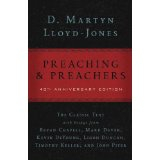
Book Review: Preaching and Preachers (40th Anniversary Edition) by *D. Martyn Lloyd-Jones

A Preaching Classic Just Got Even Better

 In order to introduce a new generation of preachers to “the Doctor” this book published in 1972 has been reissued. All the material from a series of lectures the Doctor gave in 1969 at Westminster Theological Seminary in Philadelphia – and is still very relevant to the times in which we are living in the 21st century. The Doctor was one who knew his cultural climate and ministered in a setting in London, that (especially in comparison with big cities in America) was ahead of its time in terms of a naturalistic worldview and skepticism toward religion and the gospel. However, he never backed down from the primacy and centrality of preaching the gospel of Jesus Christ from the Scriptures.

It’s doubtful that very many preachers will agree with everything Lloyd-Jones has to say in this book, but it’s also very probable that you will gain profound insight, wisdom, and be encouraged in your preaching. You will most certainly be convinced of the importance of preaching, the relevance of preaching, and become a better gospel empowered preacher as a result of reading this book.

What’s different about the 40th edition? Well, the 1972 version has been left in tact, but there are several very welcome features:

Several new essays by modern preachers who share what they have learned and applied from the Doctor – Ligon Duncan writes an essay entitled, “Some things to Look For and Wrestle With;” Tim Keller writes an essay called “A Tract for the Times;” John Piper writes on “Martyn Lloyd-Jones: The Preacher;” Kevin DeYoung writes an essay on “Preaching for Brand New and Tired Old Preachers;” Mark Dever writes on “What I’ve Learned about Preaching From Martyn Lloyd-Jones;” and lastly Bryan Chapell pens “Martyn Lloyd-Jones: An Uncommon Zeal.”

Another new feature is that each chapter contains several questions for study and discussion that can be useful for students, pastors, or church staffs to use in discussion or small group study. I am so glad that this new edition is finally here, and hope that it will inspire a new generation of preachers to proclaim the gospel from Genesis to Revelation with the unction of the Spirit, knowledge of the Scriptures, love for Christ, and passion of “the Doctor.”


*J.I. Packer first heard Dr. D. Martyn Lloyd-Jones preach when he was a 22-year-old student in London. Upon hearing Lloyd-Jones, Packer remarked that he had “never heard such preaching…[delivered] with the force of electric shock, bringing to at least one of his listeners more of a sense of God than any other man.” As Packer’s statement suggests, Lloyd-Jones’s life-long ministry had a profound impact not only on lay-people, but on the very leaders of the Christian church as well.

Although Lloyd-Jones was to become one of the great Christian thinkers of the twentieth century, his career began far removed from the Church. Born in Cardiff, Wales in 1899, Lloyd-Jones moved to London with his family at the age of 14. He was driven by a strong desire to be a doctor and attended medical school at St. Bartholomew’s Teaching Hospital in London. A remarkably bright student, Lloyd-Jones earned his M.D. at the age of 22 and immediately began working as the chief clinical assistant to Sir Thomas Horder, who referred to Lloyd-Jones as, “The most accurate thinker that I ever knew.”

However, at beginning his medical career, Lloyd-Jones began reading the Bible and was soon gripped by the logic of the Christian gospel. In his early twenties, he underwent a quiet but profound conversion to Christianity. Feeling propelled by a new desire to share his faith with others, Lloyd-Jones began to think that preaching would provide the best avenue for him to promote the gospel of Christ. But, at the same time, Lloyd-Jones had fallen in love with a young medical student named Bethan Phillips. He felt torn, knowing that if she were to marry him she would need to share his vision of abandoning medicine to pursue the ministry, and he prayed hard for God to work in her heart. Bethan did come to share Martyn’s vision for preaching and she married him in 1927. Together they shocked the press by making a dramatic move from the elite medical community of Harley Street to a small house in Lloyd-Jones’s native country. There, Dr. D. Martyn Lloyd Jones began his preaching career at the Bethlehem Forward Movement Mission Church in Aberavon, Wales.

In 1938, G. Campbell Morgan, the Minister of Westminster Chapel, heard Lloyd-Jones preach and decided that he wanted to have him as his successor in London. In the following year, Lloyd-Jones, his wife, and two daughters, Elizabeth and Ann, moved to London. Although Lloyd-Jones began his ministry at Westminster on a temporary basis, his stay there would be anything but temporary. His preaching drew in thousands of people and the congregation responded enthusiastically to his sharp, analytical presentation of the Christian faith. He remained at Westminster for thirty years, faithfully preaching through even the bomb raids of the World War II, and retired from there in 1968. While in London, Lloyd-Jones also had a formative influence on the InterVarsity Fellowship of Evangelical Unions by serving as its President for many years. Even today InterVarsity is a thriving world-wide ministry and it owes a large portion of its success to the influential work of Lloyd-Jones.

After leaving the church at the age of 69, Lloyd-Jones was unwilling to simply relax in retirement and he continued to work as hard as he had while he was at Westminster. He published some of his best work during that time and he continued to travel and preach at various engagements. Dr. D. Martyn Lloyd-Jones worked until in 1981, weakened by illness, he died quietly in his sleep at the age of 82.

Book Review – F.F. Bruce: A Life by Tim Grass

Possibly the Most Influential New Testament Scholar of the 20th Century

Shortly after being “called” to the ministry at the age of seventeen I remember talking with a Christian bookstore owner and asked him, “of all these books in the store – which authors would you recommend?” He answered quickly and without hesitation, “Anything by F.F. Bruce, you simply can’t go wrong with F.F. Bruce.” That short little conversation took place in 1985, just five years before Professor Bruce went home to be with the Lord. Since then, I’ve gone on to purchase 40 of Bruce’s 50 published books (25 are still in print as of this review).

In reading F.F. Bruce’s books I always found him to be clear, textually illuminating, and always helping me in understanding the context and cultural factors elucidating my interpretation of the text. In reading this book the author highlights three aspects of Bruce’s life: his influence on the worldwide Brethren movement, his academic achievements, and his overall influence in the evangelical movement – especially as a world class scholar who was respected by liberals and conservatives alike.

It is very likely that my forefathers on my paternal side came in contact or ran in similar circles with F.F. Bruce’s family who were very heavily involved in ministry and missions throughout Scotland. My grandfather was a Plymouth Brethren “faith missionary” who grew up in Scotland, immigrated to Belfast in Ireland, and then was a life long missionary in Argentina. I personally have never been involved in an “assembly” as they call their gatherings – but have had the opportunity to speak at their gatherings on several occasions in Argentina.

One of the things I am personally grateful for is the Brethren’s focus on reading, studying, memorizing, and teaching the Scriptures. I believe that Grass brings this out early in the book and it was Bruce’s knowledge of, and love for the Scriptures that made him such an outstanding Biblical scholar. One of the things I will be eternally grateful for is that the love for the Scriptures that the Brethren have passed down from generation to generation. Peter Bruce passed down to his son this advice that served him well for his entire life, “never accept anything offered in the way of the Christian faith unless you see it clearly for yourself in the Scriptures.”

Bruce was known not for being a theologian, but a classicist, linguist, and biblical scholar. He was a prolific author, editor, and reviewer of over 2,000 books – mostly technical. He was the doctoral advisor to some of the finest scholars of the 20th century on into the 21st century.

In reading this book there were three primary lessons I learned from F.F. Bruce.

He was what former student Ward Gasque (and great NT scholar in his own right) called an “unhyphenated evangelical.” Even though he was brought up, and involved in Brethren Assemblies he did not tow-the-line in any particular system or practice. He was leery of buying into any system of theology. He was more concerned with being “biblical” in getting at the sense of the author’s original and cultural intent. Tim Grass writes, “The issues which, for Bruce, were non-negotiable may be summarized as the reliability of the New Testament, the person and work of Christ, the Christian life as one of forgiveness and liberty as befits those who are being led by the Spirit, and the right and duty of every believer to use whatever gifts God has given them.”

F.F. Bruce was very charitable, gentle, and respected those he disagreed with, and those who disagreed with him. He seemed to be genuinely humble, teachable, and diplomatic (in a loving sense, not in a political sense). Therefore, as a result of reading about Bruce, in my own reviews, teaching, writing, I will seek to see the positive side more than the negative side of things. He was a bridge builder in his involvement in the Brethren church, among fellow professors, and in the academic arena.

I love what J.I. Packer had to say about Bruce, “No Christian was ever more free of narrow bigotry, prejudice and eccentricity in the views he held and the way he held them; no man ever did more to demonstrate how evangelical faith and total academic integrity may walk hand in hand.”

F.F. Bruce was passionate about the gospel and for people to read about, hear about, and discover Jesus and for them to have a personal relationship with him. He would spend countless hours answering questions, replying to letters, and speaking, writing, and teaching at every possible opportunity to talk about Jesus. Even though he spoke in a monotone, and often read his lectures and sermons, he had a deep passion to communicate the gospel. From Bruce, we learn to focus on what we can do, not what we can’t do for the sake of Christ. He was a tireless worker as an editor, writer, speaker, involved in the lives of his students, and in the academic world for the cause of Christ.

Lastly, as person, Laurel Gasque (a well respected cultural historian) described Bruce as “the most genuinely free person I have ever known.” I think this is what most stood out to me about F.F. Bruce in this biography. He was brilliant, prolific, and well respected. However, he saw himself as a common man and would do anything that was asked of him by others. He seemed to have had a tremendous amount of confidence in God’s sovereignty and that no little assignment or task was beneath his dignity for him to always do his best.

I am grateful for my heritage and for men like F.F. Bruce who have served the Lord well with his mind and soul. I hope that many young Bible scholars, pastors, and missionaries will be inspired by his life and work. Many consider his biography on the Apostle “Paul: The Heart of the Apostle Set Free” to be his Magnum Opus. He truly was like the Paul the Apostle in so many ways – tireless in his work and love for the churches, expounding on and writing for the cause of the gospel, and at home with students, academics, intellectuals, and lay people. And yet he did all this with great joy and with much freedom – unfettered by anything other than a desire to please his Lord and Savior.

I close this review/tribute with the words of Robert Mounce, who sums up why he believes Bruce was so influential:

“It is evident…that Bruce lays before us no new and innovative perspectives. Concern for historical accuracy coupled with a high view of the Biblical text inevitably restricts the role of the imagination, that prime mover in theological and higher critical ‘breakthroughs.’ Bruce’s lasting contribution to Pauline studies is his careful and informed treatment of the life and the letters of Paul in their historical, social, religious and cultural setting. The fact that his interpretations are traditional has no bearing on the question of their value for Biblical study. We are indebted to F.F. Bruce for his lifelong commitment to a balanced and biblical interpretation of the life and thought of the apostle Paul.”

I am indebted to Tim Grass for this labor of love on F.F. Bruce. I am grateful to have learned more about my own heritage as a beneficiary of the Brethren movement, as an evangelical, and as a lover of the Word, a teacher in the church, and an evangelist with a pastor’s heart for the sake of Christ.

Book Review: The Strategy of Satan by Warren Wiersbe

Understanding and Overcoming Satan’s Tactics Primer

Review by David P. Craig

 Warren Wiersbe can always be trusted to be biblical, concise, clear, and give ample practical illustrations and applications to modern life. In this short primer on Satan’s tactics and our responses to his tactics the book may be broken down in the following three ways:

First, the writer shows how Satan is the ultimate deceiver, destroyer, ruler, and accuser. In each of the first four chapters Wiersbe gives an Old Testament example in each of these four areas in order to demonstrate Satan’s target, weapon, purpose, and then tactical defenses we can use against his deceptions, evil plans, feeding our pride, and his accusations towards us.

Secondly, the middle of the book is about increasing our faith in God, and how not to give Satan a foothold in our life so as not to paralyze and immobilize us in God’s work on earth. He focuses on the positive ways we can overcome the Evil One’s tactics by trusting and obeying Christ.

Thirdly, Wiersbe gives a masterful exposition of all the armor we have been given in the battle against Satan and demons from Ephesians 6, and how Satan attacks the family, and churches as a key strategy in his arsenal of tactics.

Overall, this book is thorough, biblically sound, and very useful in its many practical applications. I highly recommend this book – especially if you have never read anything on the wiles of the Enemy and how to overcome our greatest Adversary.

*Distinguished Professor of Preaching at Grand Rapids Baptist Seminary, Warren Wiersbe is the author of more than 100 books. Billy Graham calls him “one of the greatest Bible expositors of our generation.” Interestingly, Warren’s earliest works had nothing to do with scriptural interpretation. His interest was in magic, and his first published title was Action with Cards (1944).

“It was sort of imbecilic for a fifteen-year-old amateur magician to have the audacity to write a book and send it to one of the nation’s leading magic houses,” Warren says. But having a total of three books published by the L.L. Ireland Magic Company—before the age of 20—gave him a surge of confidence. In later years, he applied his confidence and writing talent to the Youth for Christ (YFC) ministry.

Warren wrote many articles and guidebooks for YFC over a three-year period, but not all his manuscripts were seen by the public eye. One effort in particular, The Life I Now Live, based on Galations 2:20, was never published. The reason, Warren explains with his characteristic humor, is simple: it was “a terrible book…Whenever I want to aggravate my wife, all I have to say is, ‘I think I’ll get out that Galations 2:20 manuscript and work on it.’” Fortunately, Warren’s good manuscripts far outnumbered the “terrible” ones, and he was eventually hired by Moody Press to write three books.

The much-sought-after author then moved on to writing books for Calvary Baptist Church. It was during his ten years at Calvary that Expository Outlines on the New Testament and Expository Outlines on the Old Testament took shape. These two works later became the foundation of Warren’s widely popular Bible studies known as the Be series, featuring such titles as Be Loyal (a study on Matthew) and Be Delivered (a study on Exodus). Several of these books have been translated into Spanish.

His next avenue of ministry was Chicago’s Moody Memorial Church, where he served for seven years. He wrote nearly 20 books at Moody before moving to Lincoln, Nebraska, where he and his wife, Betty, now live. Prior to relocating, he had been the senior pastor of Moody Church, a teacher at Trinity Evangelical Divinity School, and a producer of the Back to the Bible radio program.

During all these years of ministry, Warren held many more posts and took part in other projects too numerous to mention. His accomplishments are extensive, and his catalog of biblical works is indeed impressive and far-reaching (many of his books have been translated into other languages). But Warren has no intention of slowing down any time soon, as he readily explains: “I don’t like it when people ask me how I’m enjoying my ‘retirement,’ because I’m still a very busy person who is not yet living on Social Security or a pension. Since my leaving Back to the Bible, at least a dozen books have been published, and the Lord willing, more are on the way.”

Wiersbe’s recent books include Your Next MiracleThe 20 Essential Qualities of a Child of GodThe Bumps are What You Climb OnClassic Sermons on the Fruit of the SpiritClassic Sermons on Jesus the ShepherdKey Words of the Christian LifeLonely PeopleA Gallery of GraceReal Peace: Freedom and Conscience in the Christian Life, and On Being a Leader for God.

Book Review: After You’ve Blown It by Erwin W. Lutzer

Helping You Reconcile With God and Others

In the opening chapter of this concise book (less than 100 pages) *Lutzer writes, “Strictly speaking, of course, not one of us deserves redemption. God owes us nothing, but He nevertheless offers His undeserved grace. Though we deserve damnation, He invites each of us to be redeemed. Worthy or not, we come to Him to receive forgiveness and the assurance that God still has a plan for our lives.”

Using Biblical stories and modern applications to those stories this is a book about how there is hope for anyone, no matter how bad they have blown it, by grace through faith in Jesus Christ. I highly recommend this book especially for the following types of people:

1)    Those who think they are too “bad” to be saved.

2)    Those who think they are “good” and don’t need to be saved.

3)    Those who are enmity with God and know it – and aren’t sure how to remedy it.

4)    Those who are at enmity with others – and aren’t sure how to remedy it.

5)    Those who need to be reminded that God has a plan for them, and that no matter how bad you’ve blown it – there is hope for you because of the Person and Work of the Lord Jesus Christ.

6)    Those of you who help others in counseling ministries.

It’s a fantastic little book – concise, full of Biblical wisdom, a clear gospel presentation, and leads and will encourage and give you hope. I also recommend it highly as a gift to give to those who are confused, discouraged, and broken over their sin.

*Since 1980, Erwin W. Lutzer has served as senior pastor of the world-famous Moody Church in Chicago, where he provide leadership to Chicago pastors. Dr. Lutzer earned his B.Th. from Winnipeg Bible College, a Th.M. from Dallas Theological Seminary, an M.A. in philosophy from Loyola University, an LL.D. from Simon Greenleaf School of Law, and a D.D. from Western Conservative Baptist Seminary.

Dr. Lutzer is a featured radio speaker on the Moody Broadcasting Network and the author of numerous books, including The Vanishing Power of DeathCries from the Cross, the best-selling One Minute Before You Die and Hitler’s Cross, which received the Evangelical Christian Publishers Association (EPCA) Gold Medallion Book Award. He speaks both nationally and internationally at Bible conferences and tours and has led tours of the cities of the Protestant Reformation in Europe.

Dr. Lutzer and his wife, Rebecca, live in the Chicago area and are the parents of three grown children. (Courtesy of Multnomah Publishers)

Book Review: Lost in the Middle by Paul David Tripp

Great Help For Applying God’s Grace To Your Life

 I want to write out the outset that this book (along with “The Holiness of God” by R. C. Sproul; “Heaven” by Peter Kreeft; “Emotionally Healthy Spirituality” by Pete Scazzero and “Prodigal God” by Tim Keller) has been one of the top paradigm shifting books I have read to help me change my thinking – radically. I also, have to write that I do not have the skill or ability to describe or recommend this book with the superlatives it deserves. I can only write that if you are struggling with “mid-life crisis” this book is absolute MUST reading and I’m confident that you will be much better off by reading it.

All that written – on with the review. I have personally battled depression my whole life. I am a perfectionist and have had to learn to “chill out” over the years, because I have found that things break, plans don’t work out the way you thought they would, and God is sovereign and I’m overwhelmingly NOT!

In this book Paul Tripp brilliantly exegetes reality and brokenness in this fallen world in which we live. He gives dozens of illustrations from the Bible, and men and women in the 21st century to point out the various manifestations of why so many people struggle with the mid-life years. I have read the book twice (and I’m certain – I will read it again) because so many of the stories are about my own struggles. He brings out in the open so many thoughts, and questions that many of us wrestle with and answers them with penetrating insight, theological depth, and practical life giving grace.

This book is not an easy read. I think the more you struggle with life (especially in your middle years) – the harder it will be to read. I found myself crying, and physically aching as I read some of the stories and analysis from Tripp’s pen. However, in the final analysis the book leads you to a fresh new start and brilliantly applies the gospel to your life. Brimming with hope – Tripp shows very practically how God’s purposes and plans for your life will be fulfilled, no matter what you have done, or how you feel at this stage of life.

I have been immensely helped in so many ways from reading this book. Let me list just five:

1)    It was just flat out helpful to have so many of the things I’ve thought and felt be identified and addressed so insightfully by the author – in other words – “I’m not crazy” – there are actually millions of people that have gone and are going through what I am during this stage of life – and they are still trucking!

2)    I learned to appreciate the realities of God’s design for humanity and how His plans will culminate – my story is a part of the fulfillment of the Great Story of the Bible. Tripp helps you to see that nothing in your life is wasted, and that Christ’s victory on the cross is also your ultimate victory as well. Your failure has been nullified by Christ’s Person and Work on your behalf. We have fallen, but He has picked us up. We have failed, but He has succeeded, and ultimately everything will be made new and perfect again – forever!

3)    I was so encouraged over and over again. Sometimes I feel like a major failure in every area of life: as a Christian, pastor, provider, husband, father, taking care of myself physically, and the list can go on and on. However, Tripp is able to bring out the positive realities that result from recognizing our weaknesses and how that makes God’s grace such a wonderful reality for us.

4)    I felt like I got to sit down with Jesus as I read this book. Perhaps one of the most helpful things he did in the book is show how much we are like the people in the Bible (even though we think we are not). The author has such a good grasp of theology, the Bible, and what God and people are like – that almost everything he writes is penetrating the deepest recesses of your soul. I think Paul Tripp is very wise, because he has a very intimate relationship with Jesus and brings that relationship to the reader in the book. It made me want to know God more intimately, the Bible more than I do, and to walk more closely with Jesus.

5)    It made me even more excited about Heaven and to live for that which will last forever. It made me want to live more simply, for others, and for those things that will please my Master – Jesus. Like many of the Psalms – I started reading the book in a discouraged and depressed state, and by the end of the book I was able to praise my Lord with a smile on my face, and with joy in my soul.

I feel like this review is rubbish compared to how GOOD this book actually is. I can only say that this book will help you to understand your sin, need of a Savior, and need for His grace more than you ever have before. Also, that His grace is MUCH greater than all your sin. One more thing – anyone at any life stage can benefit tremendously from this book – you don’t have to be struggling through mid-life to benefit from this book. Get this book, get copies to give away, and grow in His amazing grace. Thanks, Paul Tripp – and I hope that many more people will read and benefit from this book – I sure have!

Book Review: The Mystery of the Holy Spirit by R. C. Sproul

 How To Know The Holy Spirit Personally and Intimately

 Many times as a pastor I have heard Christians refer to the Holy Spirit as an “it,” or a “power/force,” or the like. I have also heard many times that the most abstract member of the trinity to many Christians is the Holy Spirit. It has been my own experience that I have had to work harder to understand and know the Holy Spirit more than any other Person in the Trinity. In this book Dr. Sproul writes with profound insight, biblical acumen, and exegetical precision and gradually peels away the mysteries surrounding the third Person in the Trinity.

There are ten good reasons to read this book and its because each chapter handles a distinct important aspect of the character or attributes of the Holy Spirit and Sproul then cogently and articulately explains the ramifications for us theologically and then practically.

In chapter one Dr. Sproul asks and answers the question “Who is the Holy Spirit?” by using various Scriptures demonstrating that the Holy Spirit is a “person;” that we are called to a have a “personal relationship with him;” and that he performs “personal tasks.”

In chapter two the author gives a plethora of Scriptures and some very good logical arguments like this one: “Were the Holy Spirit not God, it is extremely unlikely that blasphemy against Him would be regarded as unpardonable,” to show very clearly that the Bible teaches the deity of the Holy Spirit in both the Old and New Testaments.

In chapter three Dr. Sproul tackles and dismantles the most common objections raised against the Trinity and deals with them historically, biblically, and philosophically. He answers the following objections with great erudition, concise simplicity, and with immense sagacity:

Objection #1: The Word “Trinity” is not a biblical word and represents the invasion of foreign philosophy into biblical revelation.

Objection #2: The doctrine of the Trinity is contradictory and therefore irrational.

He demonstrates clearly in this chapter that the Trinitarian formula is neither contradictory nor irrational—rather it is biblical and logical.

Chapter four is vintage Sproul. Dr. Sproul is known for his outstanding vocabulary and for making things clear by explaining the meaning of words with reference to his subject of discussion. Dr. Sproul takes the time in this chapter to define the meanings and distinctions of the Holy Spirit as “essence” and “person.” He explains this by elaborating on three concepts: contradiction, paradox, and mystery with reference to our understanding of the Holy Spirit’s character and attributes.

Chapter five is a wonderful explanation of God the Holy Spirit’s work in physical and spiritual creation. He summarizes the chapter in this manner: “It is the Holy Spirit who supplies the dynamic for the created world. By His power the universe has life and motion…there is a parallel between the Spirit’s work in creation and redemption. As He is the generating power of biological life, so is He the source and generating power of spiritual life. His work in redemption mirrors and supplements His work in creation. He works both in creation and re-creation of a fallen world.”

In Chapter six Dr. Sproul gives a masterful presentation on what it means to be “born-again” or “regenerated” by the Holy Spirit. He demonstrates from John 3 and Ephesians 2 how we are “dead” spiritually and must be “made alive” by the Holy Spirit in order to be saved. He gives an outstanding presentation of why regeneration must precede faith and obliterates the much believed idea that faith + rebirth = justification.

Chapter seven is a wonderful articulation of the eternal security of those who are indeed regenerate. Sproul gives a very good presentation on the biblical distinctions of justification (monergistically – God alone working to save us); and sanctification (synergistically – the cooperation between the Holy Spirit and us).

I think chapter 8 on the Baptism of the Holy Spirit is perhaps the best in the book. The baptism of the Spirit may be one of the least understood issues in theology today. Dr. Sproul brings great clarity and synthesis to a better understanding of this doctrine and its immense importance. The thesis he defends is summed up at the end of the chapter in this manner:

“I am not saying that everyone who is a member of a Christian church has the Holy Spirit. Membership in the visible church no more guarantees the baptism of the Holy Spirit than it guarantees salvation. We know that there are unbelievers who are church members. No unbeliever has the baptism of the Holy Spirit, but every believer, every regenerate person, does have the baptism of the Holy Spirit. Every Christian from Pentecost to the present is both regenerate of the Spirit and baptized in the Spirit. That is the essence of the meaning of Pentecost. Anything less casts a shadow over the sacred importance of Pentecost in the history of redemption. Any person who is regenerate is also sealed by the Spirit, baptized in the Spirit, and has the earnest of the Spirit.”

In chapter nine we have a great exposition of Galatians 5 contrasting the works of the flesh and the work of the Spirit, and lastly in chapter ten Dr. Sproul shows how the Holy Spirit is Christ’s Vicar on earth to empower, comfort, and use us for the glory of Christ.

Honestly, I’m surprised this book has not been a BIG seller. As far as I’m concerned it is the best book bridging great scholarship in laymen’s terms on the Person and Work of the Holy Spirit in the English language. I have read over twenty books on the Holy Spirit – and this is my third time through Sproul’s work, and it is still the one I would recommend most if you are going to read one book on the Holy Spirit.

*Dr. R.C. Sproul is the founder, chairman and president of Ligonier Ministries, an international Christian education ministry located near Orlando, Florida. His teaching can be heard on the program Renewing Your Mind, which is broadcast on hundreds of radio outlets in the United States and in 40 countries worldwide. He is the executive editor of Tabletalk magazine and general editor of The Reformation Study Bible, and the author of more than seventy books and scores of articles for national evangelical publications. Dr. Sproul also serves as president of Ligonier Academy of Biblical and Theological Studies and Reformation Bible College. He currently serves as senior minister of preaching and teaching at Saint Andrew’s in Sanford, FL.

Book Review: The Meaning of Marriage by Tim Keller

A Compelling Vision of Christian Marriage

 Tim Keller is the pastor of Redeemer Presbyterian Church in Manhattan, New York since he planted it in 1989, and the church reflects the city’s demographics: approximately 80% of the people (in a church of several thousand) are single. So Keller has a lot of experience in teaching, counseling and shepherding singles in particular. This book had its roots in the early 1990’s when he did a series of sermons on marriage because of the skepticism, fear, and arguments that many of the singles in attendance had toward marriage in the beginning stages of the church – and still do today. He also wrote this book to share from his own experiences with his wife Kathy of 37 years and counting. However, most importantly he wrote this book to give a compelling vision of what marriage was designed to look like from the Bible from Genesis to Revelation – from the first marriage of Adam and Eve to the last marriage of Christ and the Church.

Keller states in the introduction, “its [the books] primary goal is to give both married and unmarried people a vision for what marriage is according to the Bible.” I believe that Keller succeeds in giving a very compelling case for marriage from the three stands above – from his experience, his realistic apologetic of building a case for the benefits and values of marriage, and then giving a compelling biblical vision throughout the book for the beauty of marriage when it reflects the glory of Christ at the center of it all. He does not minimize the difficulties, or the effort and hard work involved in a marriage, but is clear-headed, and cogently eloquent in presenting the “complexities of commitment with the wisdom of God.”

Here is a sample of an excellent example he gives for submitting to the Bible as God’s manual for marriage:

“Think of buying a car: If you purchase a vehicle, a machine well beyond your own ability to create, you will certainly take up the owner’s manual and abide by what the designer says the car needs by way of treatment and maintenance. To ignore it would be to court disaster…Plenty of people who do not acknowledge God or the Bible, yet who are experiencing happy marriages, are largely abiding by God’s intentions, whether they realize it or not. But it is far better if we are conscious of those intentions. And the place to discover them is in the writings of the Scripture.”

Some of the ambivalent views and objections to marriage Keller elaborates on and dispels in this book are as follows:

“Marriage is just a piece of paper that only serves to complicate love”

“Marriage was originally about property and is now in flux”

“Marriage crushes individual identity and has been oppressive for women”

“Marriage stifles passion and is ill-fitted to psychological reality”

The Outline of Keller’s book is as follows:

Chapter One – A rich and deep discussion of Genesis 2 and Ephesians 5 bringing Paul’s discussion into today’s context and demonstrating “why the gospel helps us to understand marriage and how marriage helps us to understand the gospel.”

Chapter Two – With great skill and penetrating insight Keller shows how the sin nature resulting in selfishness necessitates the supernatural work of the Holy Spirit in making the saving work of Christ operative in bringing two hearts to beat as one.

Chapter Three – He helpfully shows what biblical love is – and what covenantal commitment is all about.

Chapter Four – He elaborates on the whole question of what marriage is for: “It is a way for two spiritual friends to help each other on their journey to become the persons God designed them to be…there is a kind of deeper happiness that is found on the far side of holiness.”

Chapter Five – He talks about the power of truth; the power of love – via affection, friendship, and service all in the context of grace.

Chapter Six – An excellent discussion of the Trinitarian roles and how that translates into gender roles in a marriage.

Chapter Seven – On Singleness and Marriage. Here is a sample of some guidelines he gleans for singles in relationships before marriage:

“Recognize that there are seasons for not seeking marriage.”

“Understand the “gift of singleness.’”

“Get more serious about seeking marriage as you get older.”

“Do not allow yourself deep emotional involvement with a non-believing person.”

“Feel ‘attraction’ in the most comprehensive sense.”

“Don’t let things get too passionate too quickly.”

“…don’t become a faux spouse for someone who won’t commit to you.”

“Get and submit to lots of community input.”

Chapter Eight – A good discussion of sex – realities and misperceptions – and the glory of it when it is practiced the way God designed it.

The book closes with a short epilogue and a short, but very helpful discussion on decision-making and gender roles.

All the chapters are very well written, have depth and penetrating insight, are logical and clear, balanced in dealing with the “then” and “now” of how the Scriptures apply and always pointing to Jesus at the center of the meaning of life and marriage. Dr. Keller knows what he’s talking about and has done an outstanding job of building a great case for marriage in a culture that simply doesn’t understand it and hasn’t been consulting the Creator’s manual and applying it in our marriages. I now have a new favorite book on marriage to recommend whole-heartedly to singles and married couples alike!

*TIMOTHY KELLER was born and raised in Pennsylvania, and educated at Bucknell University, Gordon-Conwell Theological Seminary, and Westminster Theological Seminary. He was first a pastor in Hopewell, Virginia. In 1989 he started Redeemer Presbyterian Church in Manhattan with his wife, Kathy, and their three sons. Today, Redeemer has more than five thousand regular attendees at five services, a host of daughter churches, and is planting churches in large cities throughout the world. He is the author of KING’S CROSS, COUNTERFEIT GODS, THE PRODIGAL GOD, the New York Times bestseller THE REASON FOR GOD & the forthcoming CENTER CHURCH (August 2012).

Some Gems From Peter Kreeft’s Booklet “A Pocket Guide to the Meaning of Life”

Peter Kreeft is one of my favorite writers – He is a Catholic Professor of Philosophy at Boston College and teaches as well at the King’s College in New York. One of my top five favorite books of all time was written by him called “Heaven: The Heart’s Deepest Longing.” I have a Book Review – which comes nowhere near to doing the book justice on this site. I don’t agree with everything Kreeft writes in this little booklet, nor in most of his writings, but he always gives some great insights, makes one think, and always provides fantastic food for thought.

In this booklet he asks 67 questions related to the meaning of life. Here are a few of the profound insights he gives in answer to some of the questions he asks:

“You need only one thing besides knowing God: you need to know that you need nothing more.”

A GREAT quote from Saint Augustine, “One who has God, has everything; and one who has everything except God, has nothing; and one who has God plus everything else has no more than one who has God alone.”

In answer to how has God revealed Himself? He gives seven ways:

1)    In nature, His creation, as an artist is revealed in art.

2)    In human nature, especially in conscience, His inner prophet in your soul.

3)    In every truth we discover, every good we do, and every beauty we create.

4)    In history, by choosing a people (the Jews) to be His collective prophet to the world, making a covenant with them, giving them His law and His prophets, performing miracles for them (such as the Exodus), and inspiring their sacred Scriptures, which Christians call the “Old Testament.”

5)    Most completely of all, in sending His own divine Son, Jesus Christ.

6)    Through the Church of Christ established “upon the foundation of the apostles” (Ephesians 2:20).

7)    In the book the apostles authored and the Church authorized, the New Testament.

In answer to the question “What is hope?” Kreeft answers: “Hope is believing God’s promises. Hope is faith directed to the future. Like faith, hope is a response to God’s revelation, not a feeling we work up in ourselves. It is like an investment in God. Its opposite is despair, which is giving up on God.”

“Your heart was designed by God Himself to be completely filled by Him alone.” Saint Augustine, “You have made us for yourself, and our hearts are restless until they rest in you.” In every heart there is a God-sized hole that the whole universe is not great enough to fill.

What must I do to find the peace I seek? Jesus’ answers, “Come to me all you who labor and are heavy laden, and I will give you rest (Matt. 11:28).”

How can I come to Jesus if He lived 2000 years ago? Because He still lives today. “He is not here; for he has risen” (Matthew 28:6). Unlike every other man, His tomb is empty He promised His disciples, “I am with you always, to the close of the age.” (Matt. 28:20).

If I believe in Him and am baptized into His Body, what will happen to me? You will receive the very life of Christ: “I am the vine, you are the branches” (John 15:5). You will be filled with the Holy Spirit (Luke 3:16). Nothing will be able to separate you from God, in this world or in the next (Romans 8:31-39).

The Bottom Line is that Kreeft answers life’s most important questions because they involve your relationship with God, others, purpose and meaning in the here and now, and your eternity. The here and now is preparation for the future. There are more clear books on how to be saved than this one (e.g. Erwin Lutzer’s “One Minute After You Die”) – but Kreeft is always very helpful and insightful.

The one major concern I have with this book is how Kreeft muddies the waters in making any distinction between justification (how one is made right with God) and sanctification (how one grows in their likeness to Christ) – for much better treatments of the distinction between salvation and sanctification I would recommend the following works: Saved by Grace by Anthony Hoekema; Salvation belongs to the Lord by John Frame; Saved From What?; Chosen By God; and Justified By Faith Alone by R.C. Sproul; and Do I Know God? by Tullian Tchividjian to start with.


Book Review – Found: God’s Will by John MacArthur

Good Biblical Foundation For Understanding the Topic of God’s Will For Your Life

I am currently reading a handful of books on decision making. I figured I would start out with the shortest of them, and work my way to the longest (from the simple to the complex). John Macarthur’s greatest strength is that you can count on him staying close to what the Bible says and not giving any speculation as to what it doesn’t say. He doesn’t delve into the emotional or philosophical realm, but sticks like glue to what the Bible clearly articulates concerning what God’s will is for humanity.

In the first chapter John clearly spells out what he wants to do in this little booklet: “Let’s begin with a simple assumption. Since God has a will for us, He must want us to know it. If so, then we could expect Him to communicate it to us in the most obvious way. How would that be? Through the Bible, His revelation. Therefore, I believe that what one needs to know about the will of God is clearly revealed in the pages of the Word of God. God’s will is, in fact, very explicit in Scripture.”

Therefore, MacArthur proceeds to deal only with what the Bible states explicitly about the Word of God. He gleans six principles from six (actually more – but for the purposes of this review I will only give the key texts he uses) key passages of Scripture.

1)    The first thing about God’s will is that He wants all kinds of people (economic classes, high positions, low positions and all ethnicities) to be saved based on 1 Timothy 2:3,4 – “This is good, and it is pleasing in the sight of God our Savior, who desires all people to be saved and to come to a knowledge of the truth.” (Referencing verses1 & 2 where Paul says “First of all, then, I urge that supplications, prayers, intercessions, and thanksgivings be made for all people, for kings and all who are in high positions, that we may lead a peaceful and quiet life, godly and dignified in every way”).

2)    It is God’s will that we are Spirit-filled (numerous verses). The key verses used in the chapter is Ephesians 5:15-18 where the Apostle Paul says, “Look carefully how you walk, not as unwise but as wise, making the best use of the time, because the days are evil. Therefore, do not be foolish, but understand what the will of the Lord is. And do not get drunk with wine, for that is debauchery, but be filled with the Spirit.” According to MacArthur the Spirit-filled life is “being saturated with the things of Christ with His Word, His Person.”

3)    It is God’s will for us to be sanctified. The key verses here are in 1 Thessalonians 4:3-7, “For this is the will of God, your sanctification: that you abstain from sexual immorality; that each of you know how to control his own body in holiness and honor, not in passionate lust like the Gentiles who do not know God; that no one transgress and wrong his brother in this matter, because the Lord is an avenger in all these things, as we told you beforehand and solemnly warned you. For God has not called us for impurity, but in holiness.”

4)    It is God’s will that we be a submissive and obedient people. Colossians 3; Ephesians 5 & 6; and 1 Peter 2:3-15 all talk about the roles of submission that every believer has with ultimate submission to the Lordship of Jesus over our lives.

5)    It is God’s will that we mature in Christ through suffering. 1 Peter 4:19 & 5:10 specify, “Therefore let those who suffer according to God’s will entrust their souls to a faithful Creator while doing good…And after you have suffered a little while, the God of all grace who has called you to his eternal glory in Christ, will himself restore, confirm, strengthen, and establish you.”

6)    It is God’s will that in all things we give thanks and delight in Him. In Psalm 37:4 David reminds us to “delight yourself in the LORD, and he will give you the desires of your heart.” And the Apostle Paul tells us in 1 Thessalonians 5:16-18, “Rejoice always, pray without ceasing, give thanks in all circumstances; for this is the will of God in Christ Jesus for you.”

In the final analysis if you are saved through the righteousness of Christ imputed to your account in exchange for your sin, and thus Spirit-filled, seeking to be sanctified, are submissive to Christ’s leadership in your life, endure suffering, and are continually giving thanks in all things – then according to MacArthur, and I agree – it doesn’t matter what you do. The foundation for all your decisions has already been established, and now you have great freedom within the parameters of God’s protective boundaries delineated in the Bible.

This book is by no means exhaustive, but is recommended because it lays a solid foundation for what the Bible does say about “finding God’s will for your life.”

Book Review: Making the Best of a Bad Decision by Erwin Lutzer

 Encouragement and Hope For The Journey Ahead

Book Reviewed By David P. Craig

The subtitle of this book is “how to put your regrets behind you, embrace grace, and move toward a better life.” *Lutzer definitely does that, and much more in this very helpful book on how God’s sovereignty plays out in our lives, even when we sin, fail, make mistakes, and blow it every which way. The good news is that God works things out for our good even when we have messed things up pretty bad.

Using biblical examples like David, Moses, Paul, and numerous others, as well as numerous real life examples from his many years as a pastor, Lutzer shows time and time again that we can have a fresh start, a new hope, and be forgiven of our sins. Nothing we have done is too difficult for God to redeem through the shed blood of Christ, and in His sovereign plans.

Specifically, the author addresses bad decisions we have made in marriage, morally, financially, vocationally, and when we have hurt others. He gives biblical counsel for each of these poor decisions (most of us have and will make), and each chapter always has practical steps in how to deal with the past, the present, and gives much hope for the future. In the final two chapters he tackles how we can learn from our past and make wise decisions in the present and future. And lastly, he deals with the most important decision you can ever make – related to where you will spend your eternity.

The book also features a discussion guide for individual or group study. I highly recommend this book – especially for people who have ever said, or are saying things like: “My life is over;” I’ve sinned so much I could never be forgiven;” “I think I married the wrong person;” “I’m in debt up to my eyeballs, there is no way I can ever get out of this mess;” “I can never forgive ___________ for what they did to me;” “How can I ever repay ____________ back for how much I hurt them?” And any other question you have asked when you feel hopeless.

Lutzer’s book is easy to read, thorough, very applicable, and full of helpful biblical wisdom to help you get back on the right track – no matter where you got off! I believe that this book will help a lot of people recover, find redemption, and hope to help make the journey in the future a lot better than the past.

*Since 1980, Erwin W. Lutzer has served as senior pastor of the world-famous Moody Church in Chicago, where he provide leadership to Chicago pastors. Dr. Lutzer earned his B.Th. from Winnipeg Bible College, a Th.M. from Dallas Theological Seminary, an M.A. in philosophy from Loyola University, an LL.D. from Simon Greenleaf School of Law, and a D.D. from Western Conservative Baptist Seminary.

ABOUT DR. ERWIN LUTZER

Dr. Lutzer is a featured radio speaker on the Moody Broadcasting Network and the author of numerous books, including The Vanishing Power of DeathCries from the Cross, the best-selling One Minute Before You Die and Hitler’s Cross, which received the Evangelical Christian Publishers Association (EPCA) Gold Medallion Book Award. He speaks both nationally and internationally at Bible conferences and tours and has led tours of the cities of the Protestant Reformation in Europe.

Dr. Lutzer and his wife, Rebecca, live in the Chicago area and are the parents of three grown children. (Courtesy of Multnomah Publishers)