Chuck Swindoll on Memorizing Scripture: 7 Tips

7 Tips on Scripture Memorization

I know of no other single practice in the Christian life more rewarding, practically speaking than memorizing Scripture. That’s right. No other single discipline is more useful and rewarding than this. No other single exercise pays greater spiritual dividends! Your prayer life will be strengthened. Your witnessing will be sharper and more effective. Your counseling will be in demand. Your attitudes and outlook will begin to change. Your mind will become alert and observant. Your confidence and assurance will be enhanced. Your faith will be solidified.

God’s Word is filled with exhortations to implant His truth in our hearts. David says that a young man can keep his way pure by treasuring God’s Word in his heart.

Psalm 37:31, “The law of his God is in his heart; his steps do not slip.”

Psalm 119:9-11, “How can a young man keep his way pure? By guarding it according to your word. With my whole heart I seek you; let me not wander from your commandments! I have stored up your word in my heart, that I might not sin against you.”

Solomon refers to this in Proverbs 4:4, “Let your heart hold fast my words; keep my commandments, and live.”

The words “hold fast” come from a single Hebrew term, meaning “to grasp, seize, lay hold of.” Scripture memory gives you a firm grasp of the Word—and allows the Word to get a firm grasp of you! Solomon also mentions writing the Word “on the tablet of your heart” and having Scriptures kept within you so “they may be on your lips” (Proverbs 7:3 & 22:18).

Now, I know you’ve been challenged to do this before. But is it happening? Perhaps you have procrastinated because you have mental blocks against it. Maybe you tried, but you either did not see the value or could not get beyond the method that was demanded by some memory program—little cards, booklets, check-up techniques, hearers, etc. Perhaps that seemed elementary and insulted your intelligence, I understand.

Okay…forget the methods…but don’t throw the baby out with the bath water. Take your Bible, turn to a passage that’s been especially helpful…and commit that passage to memory—all on your own. Don’t learn just isolated verses here and there. Bite off whole chunks of Scripture. That way you can get the flow of thought God had in mind.

Here are seven things I have found helpful:

(1)  Choose a time when your mind is free from outside distractions…perhaps soon after getting up in the morning.

(2)  Learn the reference by repeating it every time you say the verse(s). Numbers are more difficult to remember than words.

(3)  Read each verse through several times—both whisper and aloud. Hearing yourself say the words help cement them into your mind.

(4)  Break the passage into its natural phrases. Learn the reference and then the first phrase. Then repeat the reference and first phrase as you go to the second phrase. Continue adding phrases one by one.

(5)  Learn a little bit perfectly rather than a great deal poorly. Do not go on to the next verse until you can say the previous one(s) perfectly, without a glance at your Bible.

(6)  Review the verse(s) immediately after you have gone through this process. Twenty to thirty minutes later, repeat what you’ve memorized. Before the day has ended has ended, firmly fix the verse(s) in your mind by going over it fifteen to twenty times. (You can do this as you drive or do your job.)

(7)  Use the verse(s) orally as soon as possible. After all, the purpose of Scripture memory is a practical one, not academic. Use the verses in conversation, in correspondence, in teaching, in counseling, in everyday opportunities. Relate what you’ve learned to your daily situation. You’ll be thrilled with the results.

Article above adapted from Charles R. Swindoll. Growing Strong In The Seasons of Life. Portland, OR.: Multnomah Books, 1983, pp. 53-54.

About The Author:

Charles R. Swindoll has devoted his life to the clear, practical teaching and application of God’s Word and His grace. A pastor at heart, Chuck has served as senior pastor to congregations in Texas, Massachusetts, and California. Since 1998, he has served as the senior pastor-teacher of Stonebriar Community Church in Frisco, Texas, but Chuck’s listening audience extends far beyond a local church body. As a leading program in Christian broadcasting since 1979, Insight for Living airs in major Christian radio markets around the world, reaching people groups in languages they can understand. Chuck’s extensive writing ministry has also served the body of Christ worldwide and his leadership as president and now chancellor of Dallas Theological Seminary has helped prepare and equip a new generation for ministry. Chuck and Cynthia, his partner in life and ministry, have four grown children and ten grandchildren.

Chuck’s prolific writing ministry has blessed the body of Christ for over thirty years. Beginning with You and Your Child in 1977, Chuck has contributed more than seventy titles to a worldwide reading audience. His most popular books in the Christian Bookseller’s Association include: Strengthening Your Grip, Improving Your Serve, Dropping Your Guard, Living on the Ragged Edge, Living Above the Level of Mediocrity, The Grace Awakening, Simple Faith, Laugh Again, The Finishing Touch, Intimacy with the Almighty, Suddenly One Morning, The Mystery of God’s Will, Wisdom for the Way, The Darkness and the Dawn, A Life Well Lived, and the Great Lives from God’s Word series, which includes Joseph, David, Esther, Moses, Elijah, Paul, Job, Jesus: The Greatest Life of All, and his most recent addition, The Church Awakening: An Urgent Call for Renewal. As a writer, Chuck has received the following awards: Gold Medallion Lifetime Achievement Award, Evangelical Press Association, 1997 and Twelve Gold Medallion Awards.

Why and How to Have a “Quiet Time”

How To Have A Daily Quiet Time

A daily quiet time is a private meeting each day between a disciple and the Lord Jesus Christ. It should not be impromptu. We can commune with the Lord on a spur-of-the-moment basis many times each day, but a quiet time is a period of time we set aside in advance for the sole purpose of a personal meeting with our Savior and Lord. A daily quiet time consists of at least three components.

(1) Reading the Bible with the intent not just to study but to meet Christ through the written Word.

(2) Meditating on what we have read so that biblical truth begins to saturate our minds, emotions and wills. “This Book of the Law shall not depart from your mouth, but you shall meditate on it day and night, so that you may be careful to do according to all that is written in it. For then you will make your way prosperous, and then you will have good success” (Joshua 1:8).

(3) Praying to (communing with) God: praising, thanking and adoring him as well as confessing our sins, asking him to supply our needs and interceding for others. 

WHY IS IT IMPORTANT?

Why should we have a daily quiet time? There are at least three reasons:

(1) It pleases the Lord. Even if there were no other consequences, this would be sufficient reason for private daily communion with God. Of all the Old Testament sacrifices there was only one that was daily-the continual burnt offering. What was its purpose? Not to atone for sin but to provide pleasure (a sweet-smelling aroma) to the Lord. The New Testament directs us to continually offer up a sacrifice of praise to God, “the fruit of lips that confess his name” (Hebrews 13:15). It may astonish us to realize that God is seeking people who will do just that: “They are the kind of worshipers the Father seeks” (John 4:23). One indicator of the depth of our relationship with the Lord is our willingness to spend time alone with him not primarily for what we get out of it but for what it means to him as well.

(2) We receive benefits. The psalmist had this in mind when he wrote, “As the deer pants for streams of water, so my soul pants for you, 0 God. My soul thirsts for God, for the living God” (Psalm 42:1-2).

(3) Jesus had a quiet time. “Very early in the morning, while it was still dark, Jesus got up, left the house and went off to a solitary place, where he prayed” (Mark 1:35). If our Lord found it necessary to meet privately with his Father, surely his example gives us a good reason to do likewise. The question is whether we will be mediocre Christians or growing Christians. A major factor in determining the answer is whether or not we develop the discipline of a daily quiet time.

 4 Benefits of a Quiet Time:

(1) Information. We learn about Christ and his truths when we spend time with him and his Word. Before we can obey him we need to know what he commands. Before we can understand what life is all about we need to know what he has taught.

(2) Encouragement. At times we get discouraged. There is no better source for inspiration than the Lord Jesus Christ.

(3) Power. Even when we know what we should be and do we lack the strength to be that kind of person and do those kinds of works. Christ is the source of power, and meeting with him is essential to our receiving it.

(4) Pleasure. Being alone with the person we love is enjoyable, and as we spend time with Christ we experience a joy unavailable anywhere else.

 HOW TO BEGIN A QUIET TIME

 Once you desire to begin a daily quiet time, what can you do to start? – 7 Steps:

(1) Remember the principle of self-discipline: do what you should do when you should, the way you should, where you should and for the correct reasons. In other words, self-discipline is the wise use of your personal resources (such as time and energy).

(2) Set aside time in advance for your quiet time. A daily quiet time should take place each day at the time when you are most alert. For some this will be in the morning, perhaps before breakfast; for others it will be another time of the day or evening. Though it is not a hard and fast rule, the morning is a preferable time since it begins before the rush of thoughts and activities of the day. An orchestra does not tune its instruments after the concert.

How much time should you spend? This will vary from person to person, but a good plan to follow is to start with ten minutes a day and build up to approximately thirty minutes. This regularly scheduled chunk of time can be a major factor in strengthening self-discipline. Here’s a suggestion: pause while reading this and make a decision-now-about when and for how long, beginning tomorrow, you will meet the Lord Jesus Christ for a daily quiet time.

(3) Plan ahead. Go to bed early enough so that you can awaken in a refreshed condition to meet Christ. The battle for the daily quiet time is often lost the night before. Staying up too late hampers our alertness, making us bleary-eyed and numb as we meet the Lord, or else we oversleep and skip the quiet time altogether.

(4) Make your quiet time truly a quiet time. Psalm 46:10 speaks to this: “Be still, and know that I am God.” Turn off your radio or television. Find as quiet a place as possible and make sure your location and position are conducive to alertness. Get out of bed. Sit erect. If you are stretched out in bed or reclining in a chair that is too comfortable you might be lulled into drowsiness.

(5) Pray as you start your time with God. Ask the Holy Spirit to control your investment of time and to guide your praising, confessing, thanking, adoring, interceding, petitioning and meditating, as well as to help you get into the Bible. Open your mind and heart to Scripture.

(6) Keep a notebook/journal handy. Write down ideas you want to remember and questions you can’t answer. Expression deepens impression-and writing is a good mode of expression.

(7) Share your plans and goals with a friend. Tell him or her you are trying to develop the discipline of a daily quiet time. Request his or her prayer that God will enable you to succeed with your objectives.

 COMMON PITFALLS YOU WILL ENCOUNTER

 Following are some common problems that are often encountered along the way:

I know I ought to have a daily quiet time, but I don’t want to.

Solution: Ask the Holy Spirit to plant within you the desire to have a daily quiet time. Nobody else can do this for you. You cannot generate the desire, and no other person can produce it for you.

I don’t feel like having a daily quiet time today.

Solution: Have your quiet time anyway and honestly admit to Christ that you don’t feel like meeting him but that you know he nevertheless is worth the investment of your time. Ask him to improve your feelings and try to figure out why you feel this way. Then work on the factors that produce such failings.

My mind wanders.

Solution: Ask the Holy Spirit to give you strength to set your mind on Christ and his Word. Use your self-discipline to direct your mind so that it wanders less and less. If you are in a quiet place, singing, praying and reading out loud will give a sense of dialogue. Your mind will wander less when you write things down, like making an outline for prayer or study notes while reading the Bible.

I miss too many quiet times.

Solution: Ask the Lord to strengthen your desire and to give you power to discipline your use of time. Share with another Christian friend your desire to have a daily quiet time and allow your friend to hold you accountable for it. Don’t let an overactive conscience or the accusations of the devil play on your guilt. Confess that you have failed to keep your appointment with Jesus, ask his forgiveness and renew your relationship.

My daily quiet time is a drag.

Solution: Pray that the joy of the Lord would be restored to your private meeting with Christ (Psalm 51:12). Put some variety into your approach. Sing a hymn for a change, or try a different form of Bible study.

There are two major reasons it is so difficult to develop the discipline of a daily quiet time.

First is the influence of the flesh. Keep in mind that your old nature is opposed to daily quiet time (and to every other discipline that would please Christ; see Galatians 5:16-17). Pray that the Holy Spirit will enable your new nature to overcome your old nature in this battle.

The second reason is resistance by Satan. The devil opposes your every effort to please Christ. His strategy is to rob you of daily quiet time joy, to complicate your time schedule by keeping you up late at night and making it hard for you to get up in the morning, to make you drowsy during your time with the Lord, to make your mind wander, and otherwise to disrupt your meeting with Christ. Ask the Holy Spirit to restrain the devil.

 DON’T WAIT: DO IT NOW!

Plan now for your daily quiet time tomorrow-and every tomorrow. If you miss a morning, do not quit. Deny the devil the pleasure of defeating you. Ask the Lord to forgive you for missing the meeting and to help you make it next time. You will doubtless miss several times, and it will take repeated beginnings before you succeed in developing this discipline. Indeed, it takes some people months to mature to the point where they develop the habit of a daily quiet time. For some it is a lifelong battle. In any case, don’t quit when you miss. With God’s help determine that you will grow to be a committed disciple who meets Christ regularly in meaningful daily quiet times.

*The article above is adapted from various sources: a pamphlet published in 1973 entitled “Lord of the Universe, Lord of My Life,” published by IVP: Downers Grove, Ill; Richard Foster’s acclaimed book: Celebration of Discipline; Robert Munger’s booklet: My Heart Christ’s Home; and Greg Ogden’s phenomenal workbook: Discipleship Essentials, C3.

Dr. R.C. Sproul on Why Study the Bible?

Compelling Reasons For Studying the Bible by Dr. R.C. Sproul

Why study the Bible? It may seem odd and foolish to raise this question since you probably would not be reading this book unless you were already convinced that Bible study is necessary. Our best intentions, however, are often weakened by our moods and caprice. Bible study often falls by the way. So, before we examine the practical guidelines for Bible study, let’s review some of the compelling reasons for studying the Bible at all.

TWO MYTHS

First, we will look at some of the reasons people give for not studying the Bible. These “reasons” often contain myths that are passed off as truisms through much repetition. The myth that claims first place in our hall of excuses is the idea that the Bible is too difficult for the ordinary person to understand.

Myth 1—The Bible is so difficult to understand that only highly skilled theologians with technical training can deal with the Scriptures.

This myth has been repeated many times by sincere people: “I know I can’t study the Bible, because every time I try to read it, I can’t understand it.” When some people say this, they may want to hear, “That’s all right. I understand. It’s really a difficult book, and unless you’ve had seminary training, maybe you shouldn’t try to tackle it.” Or perhaps they want to hear, “I know, it’s too heavy, too deep, too profound. I commend you for your tireless efforts, your strenuous labors in trying to solve the mystifying riddle of God’s Word. It is sad that God has chosen to speak to us in such obscure and esoteric language that only scholars can grasp it.” This, I am afraid, is what many of us want to hear. We feel guilty and want to quiet our consciences for neglecting our duty as Christians.

When we express this myth, we do it with astonishing ease. The myth is so often repeated that we do not expect it to be challenged. Yet we know that as mature, educated adults we can understand the basic message of the Bible. Indeed, the scholars who drafted and signed the Chicago Statement on Biblical Hermeneutics (1982) affirm “that a person is not dependent for understanding of Scripture on the expertise of biblical scholars.” If we can read the newspaper or blogs, we can read the Bible. In fact, I would venture to guess that more difficult words and concepts are expressed on the front page of a newspaper than on most pages of the Bible.

Myth 2—The Bible is boring.

If we press people for an explanation for what they mean when they express the first myth, usually they respond by saying, “Well, I guess I can understand it, but frankly the book bores me to death.” This statement reflects not so much an inability to understand what is read as a taste and preference for what we find interesting and exciting.

The preponderance of boredom that people experience with the Bible came home to me when I was hired to teach the Scriptures in required Bible courses at a Christian college. The president of the institution phoned me and said, “We need someone young and exciting, someone with a dynamic method who will be able to ‘make the Bible come alive.’ ” While I knew what the president was getting at, I nevertheless wanted to say, “You want me to make the Bible come alive? I didn’t know that it had died. In fact, I never even heard that it was ill. Who was the attending physician at the Bible’s demise?” No, I can’t make the Bible come alive for anyone. The Bible is already alive. It makes me come alive.

When people say the Bible is dull, it makes me wonder why. Biblical characters are full of life. There is a unique quality of passion about them. Their lives reveal drama, pathos, lust, crime, devotion and every conceivable aspect of human existence. There is rebuke, remorse, contrition, consolation, practical wisdom, philosophical reflection and, most of all, truth. Perhaps the dullness some experience is due to the antiquity and cultural distance of the material. How does the life of Abraham or of Timothy—lived so long ago and so far away—relate to us? But the characters of biblical history are real. Though their life settings are different from ours, their struggles and concerns are very much like ours.

THE CLARITY OF SCRIPTURE

In the sixteenth century the Reformers declared their total confidence in what they called the perspicuity of Scripture. What they meant by that technical term was the clarity of Scripture. They maintained that the Bible is basically clear and lucid. It is simple enough for any literate person to understand its basic message. This is not to say that all parts of the Bible are equally clear or that there are no difficult passages or sections to be found in it. Laypeople unskilled in the ancient languages and the fine points of exegesis may have difficulty with parts of Scripture, but the essential content is clear enough to be understood easily. Martin Luther, for example, was convinced that what was obscure and difficult in one part of Scripture was stated more clearly and simply in other parts of Scripture.

Some parts of the Bible are so clear and simple that they are offensive to those suffering from intellectual arrogance. I once was lecturing about how Christ’s death on the cross fulfilled the curse motif of the Old Testament. In the middle of my lecture a man in the audience interrupted me, saying loudly, “That’s primitive and obscene.” I asked him to repeat his comment so that everyone present could hear his complaint. When he repeated it, I said, “You are exactly right. I particularly like your choice of words, primitive and obscene.” The entire history of redemption is communicated in primitive terms, from the episode of the encounter of Adam and Eve with the serpent to the devastating destruction that God visits on the chariots of Egypt in the exodus to the crass and brutal murder of Jesus of Nazareth. The Bible reveals that God hears the groans of all of his people, from the peasant to the philosopher, from the dull-witted to the sophisticated scholar. His message is simple enough for the most simplistic of his fallen creatures to understand. What kind of a God would reveal his love and redemption in terms so technical and concepts so profound that only an elite corps of professional scholars could understand them?

God does speak in primitive terms because he is addressing himself to primitives. At the same time, there is enough profundity contained in Scripture to keep the most astute and erudite scholars busily engaged in their theological inquiries for a lifetime.

If primitive is an appropriate word to describe the content of Scripture, obscene is even more so. All of the obscenities of sin are recorded with clear and forthright language in the Scripture. And what is more obscene than the cross? Here we have obscenity on a cosmic scale. On the cross Christ takes upon himself human obscenities in order to redeem them.

If you have been one of those who have clung to the myths of dullness or difficulty, perhaps it is because you have attributed to the whole of Scripture what you have found in some of its parts. Maybe some passages have been peculiarly difficult and obscure. Other passages may have left you bewildered and baffled. Perhaps those should be left for the scholars to unravel. If you find certain portions of the Scripture difficult and complex, need you insist that the whole of Scripture is boring and dull?

Biblical Christianity is not an esoteric religion. Its content is not concealed in vague symbols that require some sort of special “insight” to grasp. There is no special intellectual prowess or spiritual gift that is necessary to under stand the basic message of Scripture. You may find that in Eastern religions where insight is limited to some guru who lives in a shanty high in the Himalayas. Maybe the guru has been thunderstruck by the gods with some profound mystery of the universe. You travel to inquire and he tells you in a hushed whisper that the meaning of life is the sound of “one hand clapping.” That’s esoteric. That’s so esoteric that even the guru does not understand it. He cannot understand it because it’s an absurdity. Absurdities often sound profound because they are incapable of being understood. When we hear things we do not understand, sometimes we think they are simply too deep or weighty for us to grasp when in fact they are merely unintelligible statements like “one hand clapping.” The Bible does not talk like that. The Bible speaks of God in meaningful patterns of speech. Some of those patterns may be more difficult than others, but they are not meant to be nonsense statements that only a guru can fathom.

 THE PROBLEM OF MOTIVATION

It is important to note that the theme of this book is not how to read the Bible but how to study the Bible. There is a great deal of difference between reading and studying. Reading is something we can do in a leisurely way, something that can be done strictly for entertainment in a casual manner. But study suggests labor, serious and diligent work.

Here then is the real problem of our negligence. We fail in our duty to study God’s Word not so much because it is difficult to understand, not so much because it is dull and boring, but because it is work. Our problem is not a lack of intelligence or a lack of passion. Our problem is that we are lazy.

Karl Barth (1886-1968), the famous Swiss theologian, once wrote that all human sin finds its roots in three basic human problems. He included pride (hubris), dishonesty and slothfulness in his list of rudimentary sins. None of these basic evils is instantly eradicated by spiritual regeneration. As Christians we must struggle against these problems through our entire pilgrimage. None of us is immune. If we are going to deal with the discipline of Bible study, we must recognize at the outset that we will need the grace of God to persevere.

The problem of slothfulness has been with us since the curse of the Fall. Our labor is now mixed with sweat. Weeds are easier to grow than grass. Newspapers are easier to read than the Bible is to study. The curse of labor is not magically removed simply because our task is the study of Scripture.

When I lecture to groups on the theme of studying the Bible, I often ask how many of the group members have been Christians for one year or more. Then I ask those people how many have read the entire Bible from cover to cover. In every instance, the overwhelming majority answer in the negative. I would venture to guess that among those who have been Christians for a year or more, at least 80 percent have never read the whole Bible. How is that possible? Only an appeal to the radical Fall of the human race could begin to answer that question. If you have read the whole Bible, you are in a small minority of Christian people.

If you have studied the Bible, you are in an even smaller minority. Isn’t it amazing that almost everyone living in the West has an opinion to offer about the Bible, and yet so few have really studied it? Sometimes it seems as though the only people who take the time to study it are those with the sharpest axes to grind against it. Many people study it to find possible loopholes so they can get out from under the weight of its authority.

Biblical ignorance is not limited to laypeople by any means. I have sat on church boards responsible for the examination of seminarians preparing for the pastoral ministry. The degree of biblical ignorance manifested by many of these students is appalling. Seminary curricula have not done much to alleviate the problem. Every year many churches ordain people who are virtually ignorant of the content of Scripture.

I was shocked when I took a test in biblical knowledge for entrance to the theological seminary from which I graduated. After I completed my exam, I was deeply embarrassed, ashamed to hand in my paper. I had taken several courses in college that I thought would prepare me for such a test, but when the test came I was not ready. I left question after question blank and was certain that I had failed. When the grades were posted, I discovered that I had received one of the highest grades in a group of seventy-five students. Even with the grades scaled, there were several students who scored less than 10 out of a possible grade of 100. My score was poor, yet it was one of the best of the bad.

Biblical illiteracy among the clergy has become so prevalent that I often find pastors getting annoyed and angry when their parishioners ask them to teach them the Bible. In many cases pastors live in mortal fear that their ignorance will be exposed by being thrust into a situation where they are expected to teach the Bible.

THE BIBLICAL BASIS FOR BIBLE STUDY

The Bible itself has much to say about the importance of studying the Bible. We will examine two passages, one from each Testament, in order to catch a glimpse of these mandates.

In Deuteronomy 6 we find a passage that was familiar to every Jew of the Old Testament. Its words were used to call the assembly together for worship. We read: “Hear, O Israel! The LORD is our God, the LORD is one! You shall love the LORD your God with all your heart and with all your soul and with all your might” (vv. 4-5). Most of us are familiar with these words. But what follows them immediately? Read on:

“These words, which I am commanding you today, shall be on your heart. You shall teach them diligently to your sons and shall talk of them when you sit in your house and when you walk by the way and when you lie down and when you rise up. You shall bind them as a sign upon your hand and they shall be as frontals on your forehead. You shall write them on the doorposts of your house and on your gates” (vv. 6-9).

Here God sovereignly commands that his Word be taught so diligently that it penetrates the heart. The content of that Word is not to be mentioned casually and infrequently. Repeated discussion is the order of the day, every day. The call to bind on the hand, the forehead, the doorpost and gate makes it clear that God is saying that the job must be done by whatever method it takes.

Looking at the New Testament we read Paul’s admonition to Timothy:

“You, however, continue in the things you have learned and become convinced of, knowing from whom you have learned them, and that from childhood you have known the sacred writings which are able to give you the wisdom that leads to salvation through faith which is in Christ Jesus. All Scripture is inspired by God and profitable for teaching, for reproof, for correction, for training in righteousness; so that the man of God may be adequate, equipped for every good work” (2 Tim 3:14-17).

This exhortation is so basic to our understanding of the importance of Bible study that it warrants a careful scrutiny.

“Continue in the things you have learned” (v. 14). This part of the admonition lays the accent on continuity. Our study of Scripture is not to be a once-for-all matter. There is no room for the proverbial once-over-lightly. Consistency is necessary for a sound basis of biblical studies.

“Sacred writings which are able to give you the wisdom that leads to salvation” (v. 15). Paul refers to the Scripture’s ability to give wisdom. When the Bible speaks of wisdom, it refers to a special kind of wisdom. The term is not used to connote an ability to be “worldly wise” or to have the cleverness necessary to write a Poor Richard’s Almanack.

In biblical terms, wisdom has to do with the practical matter of learning how to live a life that is pleasing to God. A cursory glance at the Wisdom Literature of the Old Testament makes this emphasis abundantly clear. Proverbs, for example, tells us that wisdom begins with the “fear of the LORD” (Prov 1:7; 9:10). That fear is not a servile fear but a posture of awe and reverence, which is necessary for authentic godliness. The Old Testament distinguishes between wisdom and knowledge. We are commanded to acquire knowledge, but more to acquire wisdom. Knowledge is necessary if wisdom is to be gained, but it is not identical with wisdom. A person can have knowledge without having wisdom, but he or she cannot have wisdom without having knowledge. A person without knowledge is ignorant. A person without wisdom is deemed a fool. In biblical terms foolishness is a moral matter and receives the judgment of God. Wisdom in the highest sense is being wise with respect to salvation. Thus wisdom is a theological matter. Paul is saying that through the Scriptures we can acquire that kind of wisdom that concerns our ultimate fulfillment and destiny as human beings.

“Knowing from whom you have learned them” (v. 14). Who is this “whom” Paul is talking about? Is he referring to Timothy’s grandmother? Or to Paul himself? These options are doubtful. Whom refers to the ultimate source of the knowledge Timothy has acquired, namely, God. This comes out more clearly in the statement “All Scripture is inspired by God.”

“Scripture is inspired by God” (v. 16). This passage has been the focal point of volumes of theological literature that describe and analyze theories of biblical inspiration. The crucial word in the passage is the Greek term theopneustos, which is often translated by the phrase “inspired by God.” The term more precisely means “God-breathed,” which refers not so much to God’s breathing something “in” as to his breathing something “out.” Rather than the term inspiration, we may be better advised to render the Greek by the English expiration. In that case we would see the significance of the passage not so much in providing us with a theory of inspiration—a theory of how God transmitted his Word through human authors—but rather a statement of the origin or source of Scripture. What Paul is saying to Timothy is that the Bible comes from God. He is its ultimate author. It is his word; it comes from him; it carries the weight of all that he is. Thus the injunction to remember “from whom you have learned them [these things].”

“Scripture is profitable for teaching” (v. 16). One of the most important priorities Paul mentions is the preeminent way in which the Bible profits us. The first and indeed foremost profit is the profit of teaching or instruction. We may pick up the Bible and be “inspired” or moved to tears or other poignant emotions. But our greatest profit is in being instructed. Again, our instruction is not in matters of how to build a house or how to multiply and divide or how to employ the science of differential equations; rather we are instructed in the things of God. This instruction is called “profitable” because God himself places an extremely high value on it. The instruction is assigned worth and significance.

Countless times I have heard Christians say, “Why do I need to study doctrine or theology when all I need to know is Jesus?” My immediate reply is, “Who is Jesus?” As soon as we begin to answer this question, we are involved in doctrine and theology. No Christian can avoid theology. Every Christian is a theologian. Perhaps not a theologian in the technical or professional sense, but a theologian nevertheless. The issue for Christians is not whether we are going to be theologians but whether we are going to be good theologians. A good theologian is one who is instructed by God.

“Scripture is profitable for reproof, correction, and training in righteousness” (v. 16). In these words Paul articulates the practical value of Bible study. As fallen creatures we sin, we err, and we are inherently out of shape with respect to righteousness. When we sin, we need to be reproved. When we err, we need to be corrected. When we are out of shape, we need to go into training. The Scriptures function as our chief reprover, our chief corrector and our chief trainer. The bookstores of this world are filled with books on training methods to acquire excellence in sports, to lose weight and get our physical figures into shape, and to acquire skills in all areas. Libraries have stacks of books written to teach us financial management and the nuances of wise investment policies. We can find many books that will teach us how to turn our losses into profits, our liabilities into assets. But where are the books that will train us in righteousness? The question still remains, “What will it profit a man if he gains the whole world and forfeits his soul?” (Mt 16:26).

“That the man of God may be adequate, equipped for every good work” (v. 17). The Christian who is not diligently involved in a serious study of Scripture is simply inadequate as a disciple of Christ. To be an adequate Christian and competent in the things of God we must do more than attend “sharing sessions” and “bless me parties.” We cannot learn competency by osmosis. Biblically illiterate Christians are not only inadequate but unequipped. In fact, they are inadequate because they are not equipped. An NFL star may be able to run barefoot, but when playing a league opponent he will be sure to wear cleats.

THE BIBLE AS REVELATION

One of the most important advantages the Bible gives us is that it provides information that is not available anywhere else. Our universities provide us with a wealth of knowledge acquired by human investigation of the natural world. We learn by observation, analysis and abstract speculation. We compare and contrast varied opinions from notable scholars. But with all the skills of knowledge that we have at our disposal in this world, there is no one who can speak to us from a transcendent perspective, no one who can reason with us, as the philosophers say, sub species aeternitatis (from the eternal perspective).

Only God can provide us with an eternal perspective and speak to us with absolute and final authority. The advantage of the equipment provided by Scripture is that knowledge is made available to us that can be learned from no other source. The Scripture does, of course, talk of matters that can be learned by other means. We are not utterly dependent on the New Testament to learn who Caesar Augustus was or how far it is from Jerusalem to Bethany. But the world’s best geographer cannot show us the way to God, and the world’s best psychiatrist cannot give us a final answer to the problem of our guilt. There are matters contained in Holy Writ that “unveil” for us that which is not exposed to the natural course of human investigation.

Though much can be learned about God from a study of nature, it is his self-revelation in Scripture that is most complete and most valuable for us. There is an analogy between how we get to know people in this world and how we become acquainted with God. If we want to learn something about a human being, let’s say Bill Monroe, there are many ways we can go about it. We could do a search on the Internet, perhaps first Googling his name. If we had the right connections, we might ask the FBI or the CIA for their files on him. We could send for his high school and college transcripts. Through such records we might discover his basic biographical history, medical record, academic and athletic achievement records. We could then interview his friends to get a more personal evaluation. But all these methods are indirect, and many of Bill’s intangible qualities will remain obscured to our scrutiny. All these methods are but secondary sources of information.

If we want more accurate knowledge of Bill Monroe, we should meet him personally, observe his outward appearance, see how he behaves, what mannerisms he employs. We may even be able to guess how he is feeling, what he is thinking, what he values and what displeases him. But if we want to gain intimate knowledge of him we have to engage in some kind of verbal communication with him. No one can express more clearly or more accurately what he believes, feels or thinks than Bill himself. Unless Bill chooses to reveal those things verbally, our knowledge will be limited to guesswork and speculation. Only words will enlighten us.

Likewise, when we speak about the concept of revelation, we are talking about the basic principle of self-disclosure. The Scriptures come to us as divine self-disclosure. Here the mind of God is laid bare on many matters. With a knowledge of Scripture we do not have to rely on secondhand information or bare speculation to learn who God is and what he values. In the Bible he reveals himself.

THEORY AND PRACTICE

Like the Christian who shuns theology, there are those who despise any kind of quest for theoretical knowledge of God, insisting instead on being “practical.” The spirit of America has been defined as the spirit of pragmatism. This spirit is manifested nowhere more clearly than in the arena of politics and in the public school system, which has been informed by the principles and methods of education set down by John Dewey.

Pragmatism may be defined simply as the approach to reality that defines truth as “that which works.” The pragmatist is concerned about results, and the results determine the truth. The problem with this kind of thinking, if left uninformed by the eternal perspective, is that the results tend to be judged in terms of short-range goals.

I experienced this dilemma when my daughter enrolled in kindergarten. She attended a very progressive public school outside of Boston. After a few weeks we received notification from the school that the principal was holding an open meeting for parents in order to explain the program and procedures employed in the kindergarten. At the meeting the principal carefully explained the daily schedule. He said, “Don’t be alarmed if your child comes home and tells you that he was playing with puzzles or modeling clay in school. I can assure you that everything in the daily routine is done with a purpose. From 9:00 to 9:17 a.m. the children play with puzzles that are carefully designed by orthopedic experts to develop the motor muscles of the last three fingers of the left hand.” He went on to explain how every minute of the child’s day was planned with skilled precision to insure that everything was done with a purpose. I was duly impressed.

At the end of his presentation the principal asked for questions. I raised my hand and said, “I am deeply impressed by the careful planning that has gone into this program. I can see that everything is done with a purpose in view. My question is, How do you decide which ‘purposes’ to employ? What final purpose do you use to decide the individual purposes? What is the overall purpose of your purposes? In other words, what kind of a child are you trying to produce?”

The man turned white and then scarlet, and in stumbling terms he replied, “I don’t know; no one ever asked me that question.” I appreciated the candor of his reply and the genuine humility it displayed, yet at the same time, his answer terrified me.

In Your Mind Matters John Stott writes: The modern world breeds pragmatists, whose first question about any idea is not “Is it true?” but “Does it work?” Young people tend to be activists, dedicated supporters of a cause, though without always inquiring too closely whether their cause is a good end to pursue or whether their action is the best means by which to pursue it.

How can we have purposes without purpose? Where can we go to discover the ultimate test for our pragmatism? Here is where transcendent revelation is most critical to our lives. Here is where the content of Scripture is most relevant for our practice. God alone can give us the final evaluation of wisdom and value of our practices.

People who despise theory and call themselves practical are not wise. Those who concern themselves only with short-term goals may have big trouble when it comes to the very long run of eternity. It must also be added that there is no practice without some underlying theory. We do what we do because we have a theory, even if only implicit, about the value of doing it. Nothing betrays our deepest theories more eloquently than our practice. We may never think seriously about our theories or subject them to rigorous critical analysis, but we all have them. As in the case of the Christian who wants Christ without theology, so the person who wants practice without theory will usually wind up with bad theories that lead to bad practice.

Because the theories found in Scripture proceed from God, the Bible is eminently practical. Nothing could be more practical than God’s Word because it proceeds from a theory that is established from the eternal perspective. The fatal weakness of pragmatism is overcome by revelation.

THE SENSUOUS CHRISTIAN

The last quarter of the twentieth century witnessed the public embrace of the “sensuous.” The Sensuous Woman, The Sensuous Man, The Sensuous Couple and The Sensuous Divorcee became bestsellers, and some remain in print decades later! One dictionary defines sensuous as, “pertaining to the senses or sensible objects: highly susceptible to influence through the senses.” In other words, sensuous people live by their feelings rather than through their understanding. Today on television we can see this sensuality prominently displayed. Famous TV talk-show hosts often encourage their guests to “vent,” exposing their private feelings and emotions to millions of viewers.

Sadly, this kind of sensuality has also wormed its way into the church. Many of us have become sensuous Christians, living by our feelings rather than through our understanding of the Word of God. Sensuous Christians cannot be moved to service, prayer or study unless they “feel like it.” Their Christian life is only as effective as the intensity of present feelings. When they experience spiritual euphoria, they are a whirlwind of godly activity; when they are depressed, they are a spiritual incompetent. They constantly seek new and fresh spiritual experiences, and use them to determine the Word of God. Their “inner feelings” become the ultimate test of truth.

Sensuous Christians don’t need to study the Word of God because they already know the will of God by their feelings. They don’t want to know God; they want to experience him. Sensuous Christians equate “childlike faith” with ignorance. They think that when the Bible calls us to childlike faith, it means a faith without content, a faith without understanding. They don’t know the Bible says, “In evil be infants, but in your thinking be mature” (1 Cor. 14:20). They don’t realize that Paul tells us again and again, “My beloved brethren, I would not have you ignorant” (Romans 11:25).

Sensuous Christians go their merry way until they encounter the pain of life that is not so merry—and they fold. They usually end up embracing a kind of “relational theology” (a curse on modern Christianity) where personal relationships and experience take precedence over the Word of God. If the Scripture calls us to action that may jeopardize a personal relationship, then the Scripture must be compromised. The highest law of sensuous Christians is that bad feelings must be avoided at all cost.

The Bible is addressed primarily, though not exclusively, to our understanding. That means the mind. This is difficult to communicate to modern Christians who are living in what may be the most anti-intellectual period of Western civilization. Notice, I did not say anti-academic or anti-technological or anti-scholarly. I said anti-intellectual. There is a strong current of antipathy to the function of the mind in the Christian life.

To be sure, there are historical reasons for this kind of reaction. Many laypeople have felt the result of what one theologian has called “the treason of the intellectual.” So much skepticism, cynicism and negative criticism have spewed forth from the intellectual world of theologians that laypeople have lost their trust in intellectual enterprises. In many cases there is the fear that faith will not hold up under intellectual scrutiny, so the defense becomes the denigration of the human mind. We turn to feelings rather than to our minds to establish and preserve our faith. This is a very serious problem we face in the twenty-first-century church.

Christianity is supremely intellectual though not intellectualistic. That is, Scripture is addressed to the intellect without at the same time embracing a spirit of intellectualism. The Christian life is not to be a life of bare conjecture or cold rationalism but one of vibrant passion. Strong feelings of joy, love and exaltation are called for again and again. But those passionate feelings are a response to what we understand with our minds to be true. When we red in Scripture, “Take courage; I have overcome the world” (Jn. 16:33), “ho hum” is not an appropriate response. We can be of good cheer because we understand that Christ has indeed overcome the world. That thrills our souls and sets our feet to dancing. What is more precious than to experience the sweetness of the presence of Christ or the nearness of the Holy Spirit?

God forbid that we should lose our passion or go through the Christian pilgrimage without any experience of Christ. But what happens when there is a conflict between what God says and what I feel? We must do what God says, like it or not. That is what Christianity is all about.

Reflect for a moment. What happens in your own life when you act according to what you feel like doing rather than what you know and understand God says you should do? Here we encounter the ruthless reality of the difference between happiness and pleasure. How easy it is to confuse the two! The pursuit of happiness is regarded as our “unalienable right.” But happiness and pleasure are not the same thing. Both of them feel good, but only one endures. Sin can bring pleasure, but never happiness. If sin were not so pleasurable, it would hardly represent a temptation. Yet, while sin often “feels good,” it does not produce happiness. If we do not know the difference or, worse yet, do not care about the difference, we have made great strides to becoming the ultimate sensuous Christian.

It is precisely at the point of discerning the difference between pleasure and happiness that knowledge of Scripture is so vital. There is a remarkable relationship between God’s will and human happiness. The fundamental deception of Satan is the lie that obedience can never bring happiness. From the primordial temptation of Adam and Eve to last night’s satanic seduction, the lie has been the same. “If you do what God says, you will not be happy. If you do what I say, you will be ‘liberated’ and know happiness.”

What would have to be true for Satan’s argument to be true? It would seem that God would have to be one of three things: ignorant, malevolent or deceptive. It could be that God’s Word will not work for us because it proceeds from his divine blunderings. God simply doesn’t know enough to tell us what we need to do to achieve happiness. Perhaps he desires our well-being, but simply does not know enough to instruct us properly. He would like to help us out, but the complexities of human life and human situations just boggle his mind.

Perhaps God is infinitely wise and knows what is good for us better than we do. Perhaps he does understand human complexities better than the philosophers, moralists, politicians, school teachers, pastors and psychiatrists, but he hates us. He knows the truth but leads us astray so he can remain the only happy being in the cosmos. Perhaps his law is an expression of his desire to take gleeful delight in our misery. Thus his malevolence toward us leads to the role of great Deceiver. Nonsense! If that were true, then the only conclusion we could come to is that God is the devil and devil is God, and Holy Scripture is really the manual of Satan.

Absurd? Unthinkable? I wish it were. In literally thousands of pastors’ studies, people are being counseled to act against Scripture because the pastor wants them to be happy. “Yes, Mrs. Jones, go ahead and divorce your husband (despite the fact that she is without biblical warrant), for I am sure you will never find happiness married to a man like that.”

If there is a secret, a carefully guarded secret, to human happiness, it is that one expressed in a seventeenth-century catechism that says, “Man’s chief end is to glorify God and to enjoy Him forever.” The secret to happiness is found in obedience to God. How can we be happy if we are not obedient? How can we be obedient if we do not know what it is we are to obey? Thus the top and the tail of it is that happiness cannot be fully discovered as long as we remain ignorant of God’s Word.

To be sure, knowledge of God’s Word does not guarantee that we will do what it says, but at least we will know what we are supposed to be doing in our quest for human fulfillment. The issue of faith is not so much whether we believe in God, but whether we believe the God we believe in.

A MATTER OF DUTY

Why should we study the Bible? I have mentioned briefly the practical value, the ethical importance and the way of happiness. We have looked at some of the myths that are given why people do not study the Bible. We have examined something of the spirit of pragmatism and the anti-intellectual climate of our day. There are many facets to the question and countless reasons why we ought to study the Bible.

I could plead with you to study the Bible for personal edification; I could try the art of persuasion to stimulate your quest for happiness. I could say that the study of the Bible would probably be the most fulfilling and rewarding educational experience of your life. I could cite numerous reasons why you would benefit from a serious study of Scripture. But ultimately the main reason why we should study the Bible is because it is our duty.

If the Bible were the most boring book in the world—dull, uninteresting and seemingly irrelevant—it would still be our duty to study it. If its literary style were awkward and confusing, the duty would remain. We live as human beings under an obligation by divine mandate to study diligently God’s Word. He is our Sovereign, it is his Word, and He commands that we study it. A duty is not an option. If you have not yet begun to respond to that duty, then you need to ask God to forgive you and to resolve to do your duty from this day forth.

About the Author: Dr. R.C. Sproul (Founder of Ligonier Ministries; Seminary Professor; and Teaching Pastor at Saint Andrews in Sanford, Florida) is an amazingly gifted communicator. Whether he is teaching, preaching, or writing – he has the ability to make the complex easy to understand. He has been used more than any other person in my life to deepen my walk with Christ and help me to be more God-centered than man-centered. His book the Holiness of God has been the most influential book in my life – outside of the Bible. The article above is adapted from Chapter One in another one of his excellent books: Knowing Scripture. Downers Grove: IVP, 2009. Knowing Scripture is an excellent introductory book on how to read, study, and interpret the Bible.

Dr. Sinclair Ferguson on 20 Resolutions on Speech that Glorifies God from the Book of James

(Scriptures are from the ESV) 

(1)  I resolve to ask God for wisdom to speak out of a single-minded devotion to Him – James 1:5, “If any of you lacks wisdom, let him ask God, who gives generously to all without reproach, and it will be given him.”

(2)  I resolve to boast only in the exultation I receive in Jesus Christ and also in the humiliation I receive for Jesus Christ – James 1:9-10, “Let the lowly brother boast in his exaltation, and the rich in his humiliation, because like a flower of the grass he will pass away.”

(3)  I resolve to set a watch over my mouth – James 1:13, “Let no one say when he is tempted, “I am being tempted by God,” for God cannot be tempted with evil, and he himself tempts no one.”

(4)  I resolve to be constantly quick to hear and slow to speak – James 1:19, “Know this, my beloved brothers: let every person be quick to hear, slow to speak, slow to anger.”

(5)  I resolve to learn the gospel way of speaking to both the rich and the poor – James 2:1-4, “My brothers, show no partiality as you hold the faith in our Lord Jesus Christ, the Lord of glory. For if a man wearing a gold ring and fine clothing comes into your assembly, and a poor man in shabby clothing also comes in, and if you pay attention to the one who wears the fine clothing and say, “You sit here in a good place,” while you say to the poor man, “You stand over there,” or, “Sit down at my feet,” have you not then made distinctions among yourselves and become judges with evil thoughts?”

(6)  I resolve to speak in the present consciousness of my final judgment – James 2:12, “So speak and so act as those who are to be judged under the law of liberty.”

(7)  I resolve never to stand in anyone’s face with the words I employ – James 2:16, and one of you says to them, “Go in peace, be warmed and filled,” without giving them the things needed for the body, what good is that?

(8)  I resolve never to claim as reality in my life what I do not truly experience – James 3:14, “But if you have bitter jealousy and selfish ambition in your hearts, do not boast and be false to the truth.”

(9)  I resolve to resist quarrelsome words as evidence of a bad heart that needs to be mortified – James 4:1, “What causes quarrels and what causes fights among you? Is it not this, that your passions are at war within you?”

(10) I resolve never to speak decided evil against another out of a heart of antagonism – James 4:11, “Do not speak evil against one another, brothers. The one who speaks against a brother or judges his brother, speaks evil against the law and judges the law. But if you judge the law, you are not a doer of the law but a judge.”

(11) I resolve never to boast in any thing but what I will accomplish – James 4:13, Come now, you who say, “Today or tomorrow we will go into such and such a town and spend a year there and trade and make a profit”

(12) I resolve to speak as one subject to the providences of God – James 4:15, “Instead you ought to say, “If the Lord wills, we will live and do this or that.”

(13) I resolve never to grumble. The judge is at the door – James 5:9, “Do not grumble against one another, brothers, so that you may not be judged; behold, the Judge is standing at the door.”

(14) I resolve never to allow anything but total integrity in everything I say – James 5:12, But above all, my brothers, do not swear, either by heaven or by earth or by any other oath, but let your “yes” be yes and your “no” be no, so that you may not fall under condemnation.

(15)  I resolve to speak to God in prayer whenever I suffer – James 5:13a, “Is anyone among you suffering? Let him pray.”

(16) I resolve to sing praises to God whenever I’m cheerful – James 5:14b, “Is anyone cheerful? Let him sing praise.

(17) I resolve to ask for the prayers of others when I’m in need – James 5:14, “Is anyone among you sick? Let him call for the elders of the church, and let them pray over him, anointing him with oil in the name of the Lord.

(18) I resolve to confess whenever I’ve failed – James 5:15-16, “And the prayer of faith will save the one who is sick, and the Lord will raise him up. And if he has committed sins, he will be forgiven. Therefore, confess your sins to one another and pray for one another, that you may be healed. The prayer of a righteous person has great power as it is working.”

(19) I resolve to pray with others for one another whenever I am together with them – James 5:15-16, “And the prayer of faith will save the one who is sick, and the Lord will raise him up. And if he has committed sins, he will be forgiven. Therefore, confess your sins to one another and pray for one another, that you may be healed. The prayer of a righteous person has great power as it is working.”

(20)  I resolve to speak words of restoration when I see another wander – James 5:19-20, “My brothers, if anyone among you wanders from the truth and someone brings him back, let him know that whoever brings back a sinner from his wandering will save his soul from death and will cover a multitude of sins.”

About the Author: Sinclair Ferguson (born 1948) is a Scottish theologian who earned his Ph.D. from the University of Aberdeen. He is known in Reformed Christian circles for his theologically rich and practical teaching, writing, and editorial work. He is currently a professor at Redeemer Seminary in Dallas, and the Senior Minister of the First Presbyterian Church in Columbia, South Carolina. He has written numerous books including: In Christ Alone; John Owen: The Man and His Theology; The Christian Life; Heart for God; Discovering God’s Will; Grow in Grace; The Holy Spirit; and The Big Book of Questions and Answers about Jesus.

Michael Goheen on How To Read The Bible As One Story

The Biblical Drama of Redemption

 Starting with the Gospel

In this paper I would like to address the issue of reading the Bible as one story. It would be tempting to begin with the idea of story and then argue that the Bible conforms to this idea. I think one could proceed this way, although it would run the risk of starting with a category alien to Scripture and then fitting the gospel to that category. Perhaps it would be better to begin where all our thinking should start, i.e. with the gospel.

Jesus announced good news: ‘The kingdom of God is breaking into history.’ This is not the kind of announcement that could be relegated to the religion page of a newspaper. This is world news—front page stuff! This is headline news on CNN. It was an announcement that God’s healing power was invading history in Jesus and by the Spirit to restore the whole creation to again live under the gracious rule of God.

His proclamation of good news stood as the climactic moment of a story of God’s redemptive work told in the Old Testament that stretched back to God’s promise to Adam and Eve. Jesus announced that the power of God to renew the entire creation was now present in Jesus by the Spirit. This liberating power was demonstrated in Jesus’ life and deeds, and explained by his words. At the cross he battled the power of evil and gained the decisive victory. In his resurrection he entered as the firstborn into the resurrection life of the new creation. Before his ascension he commissioned his followers to continue his mission of making the gospel known until he returned. He now reigns in power at the right hand of God over all creation and by His Spirit is making known his restoring and comprehensive rule through His people as they embody and proclaim the good news. One day every knee will bow and every tongue will confess that Jesus is Creator, Redeemer, and Lord. But until then the church has been taken up into the Spirit’s work of making the good news of the kingdom known.

From this brief summary of the gospel, the following observations are important for our subject.

First, the gospel is a redirecting power. It is not first of all doctrine or theology, nor is it worldview, but the renewing power of God unto salvation. The gospel is the instrument of God’s Spirit to restore all of creation.

Second, the gospel is restorative, that is, Jesus announces the restoration of the creation from sin. The most basic categories present in the gospel are creation, fall, and redemption. Jesus’ announcement declares a resounding ‘yes’ to his good creation and at the same time a definitive ‘no’ to the sin that has defiled it. The gospel is about the restoration and renewal of the creation from sin. In the history of the Western church redemption has often been misunderstood to be salvation from the creation rather than salvation of the creation. In the proclamation of the gospel Jesus announces that he is liberating the good creation from the power of sin.

Third, the gospel is comprehensive in its scope. The gospel Jesus announced was a gospel of the kingdom. Surprisingly even though this was the central category of Jesus’ proclamation and ministry it has often disappeared into obscurity. The result has been a greatly reduced scope of salvation, limited to humanity, even human souls. Scripturally, the kingdom is about God’s reign over his entire creation; the kingdom stresses the all- encompassing nature of the salvation Jesus embodied, announced, and accomplished. The gospel which forms the lens through which we look at the world is the power of God through which the exalted Christ, on the basis of his death and resurrection, restores all of life by His Spirit to again live under His authority and Word.

The fourth observation is central to our topic: Jesus and the good news that he announces is the fulfillment of a long story that unfolds in the Old Testament. Jesus’ arrival into history is into a Jewish community who was looking for the ending and climax of a long story of God’s redemptive acts. All Jews knew that this story was leading up to the grand culmination when God would act decisively and finally to redeem the world. They disagreed on who would do it, how it would be done, when it would happen, and how they were to live until it did. But they all recognized that the story of God’s redemptive acts was moving toward a consummation. Jesus announces that he is the goal of this redemptive story. So, on the one hand, if we are to understand the gospel of Jesus we must see Jesus in the context of the Old Testament story (cf. Luke 24:25-27). On the other hand, if we are to properly understand the Biblical story, we must see it through the lens of Jesus and the gospel (cf. John 5:36-57; Luke 24:44-45). But not only is Jesus the climactic moment in the story, he points forward to the end. The end has not yet come (Acts 1:6-7). Thus attending to Jesus points us back to a story told in the Old Testament, and forward to the end of the story.

There is a final observation: the church is essential to the gospel. That is, Jesus did not make provision for the communication of the good news through history and in every culture until the end of the story by writing a book as did Mohammed. Rather he formed a community to be the bearer of this good news. Their identity is bound up in their being sent by Jesus to make known the good news of the kingdom. The story of the Bible is their life.

 Human Life is Shaped by Some Story

All of human life is shaped by some story. Consider the following event: A fox compliments a crow and tells it that it has a lovely voice. He asks it to sing a song. What is the meaning of this event? It is not too difficult to see that the meaning of this event can only be understood in terms of some story. Perhaps the fox wants to eat the crow and this compliment is a ploy to get the crow to drop its guard. Perhaps the fox is a kind- hearted fox that simply wants to encourage the poor crow. Perhaps the fox is a tone-deaf choir director seeking to begin a choir among the forest animals. Clearly these three stories would give the event different meanings. In fact, this event is part of an Aesop’s fable. There is a famine in the forest and the crow sits perched in a tree with a piece of cheese in its mouth. The various animals try to get the cheese with different methods. The fox compliments the crow and the foolish bird opens its mouth to sing. The cheese falls out and the fox runs away with it. The moral of the story is don’t be deceived by flattery.

This little exercise illustrates that an event can only be understood in the context of a narrative framework. So it is with our lives. Lesslie Newbigin puts it this way: “The way we understand human life depends on what conception we have of the human story. What is the real story of which my life story is a part?” (Leslie Newbigin. The Gospel in a Pluralist Society. Grand Rapids: Eerdmans, 15). What Newbigin is referring to here is not a linguistically constructed narrative world that we choose to live in. Rather it is to speak of story as the essential shape of a worldview, as an interpretation of cosmic history that gives meaning to human life. Story provides the deepest structural framework in which human life is to be understood. There is no more fundamental way in which human beings interpret their lives than through a story. N. T. Wright says that “a story . . . is . . . the best way of talking about the way the world actually is” (N.T. Wright. The New Testament and the People of God. London: SPCK, 40. Italics added). It is because the world has been created by God in a temporal way that story can help us understand the way the world is. Brian Walsh says that ‘because the world is temporal, in process, a worldview always entails a story, a myth which provides its adherents with an understanding of their own role in the global history of good and evil. Such a story tells us who we are in history and why we are here’ (Walsh, Worldviews, Modernity, and the Task of Christian College Education, in Faculty Dialogue 18, Fall 1992, 6).

If one lives in a culture shaped by the Western story there are two stories that are on offer: the Biblical and the humanist. Newbigin points out that

In our contemporary culture . . . two quite different stories are told. One is the story of evolution, of the development of species through the survival of the strong, and the story of the rise of civilization, our type of civilization, and its success in giving humankind mastery of nature. The other story is the one embodied in the Bible, the story of creation and fall, of God’s election of a people to be the bearers of his purpose for humankind, and of the coming of the one in whom that purpose is to be fulfilled. These are two different and incompatible stories (Newbigin, Gospel in a Pluralist Society, 15-16).

There are a number of things that can be said about both of these stories.

(1) Both of these stories claim to tell the true story of the world. They are in the language of postmodernism ‘metanarratives’ or in the language of Hegel, claims to be ‘universal history.’

(2) Consequently both of these stories are comprehensive. That is, they claim the whole of our lives—social, cultural, political, and individual.

(3) Both of these stories are embodied by a community. They are not simply the fruit of individual experience and insight but stories that shape whole communities. The Western cultural community is shaped by the humanist story. The church is the new humankind that is shaped by the Biblical story.

(4) Both of these stories are religious; they are rooted in faith commitments or ultimate assumptions. Contrary to the claim that the humanist story is ‘neutral’ or ‘secular’ while the Biblical story is ‘religious’, both stories are rooted in ultimate commitments or beliefs.

(5) As both stories claim to tell the true story of the world, they issue an invitation to all hearers to come live in the story, and pursue its goals.

The humanist and Biblical stories are to some degree incompatible; they tell two different stories. It will be evident that if the church is faithful to its story there will be to some degree a clash of stories.

The Bible Tells One Story

The Bible tells one unfolding story of redemption against the backdrop of creation and humanity’s fall into sin. As N.T. Wright has put it, the divine drama told in Scripture ‘offers a story which is the story of the whole world. It is public truth’ (Wright, The New Testament and the People of God, 41-42).

When we speak of the biblical story as a narrative we are making an ontological claim. It is a claim that this is the way God created the world; the story of the Bible tells us the way the world really is. There is no more fundamental way to speak about the nature of God’s world than to speak of it in terms of a story. Nor is the biblical story to be understood simply as a local tale about a certain ethnic group or religion. It makes a comprehensive claim about the world: it is public truth. The biblical story encompasses all of reality—north, south, east, west, past, present, and future. It begins with the creation of all things and ends with the renewal of all things. In between it offers an interpretation of the meaning of cosmic history. It, therefore, makes a comprehensive claim; our stories, our reality must find a place in this story. As Loughlin has put it: The Biblical story is ‘omnivorous: it seeks to overcome our reality’ (Loughlin, G., Telling God’s Story: Bible, Church, and Narrative Theology. Cambridge: Cambridge University Press, 1996, 37).

Hans Frei makes the same point when he quotes Auerbach’s striking contrast between Homer’s Odyssey and the Old Testament story. Speaking of the Biblical story he says: ‘Far from seeking, like Homer, merely to make us forget our own reality for a few hours, it seeks to overcome our reality: we are to fit our own life into its world, feel ourselves to be elements in its structure of universal history . . . Everything else that happens in the world can only be conceived as an element in this sequence; into it everything that is known about the world . . . must be fitted as an ingredient of the divine plan’ (Frei, Hans. The Eclipse of Biblical Narrative. New Haven: Yale University Press, 1974, 3).

This insight has been gaining ground in various areas of philosophy and theology. In philosophical ethics Alasdaire MacIntyre states that I can only answer the question “What am I to do?” if I can answer the prior question “Of what story do I find myself a part?” (MacIntyre, Alasdaire. After Virtue. Notre Dame: Notre Dame University Press, 1981, 216) In practical theology, for example, C. V. Gerkin says ‘This sense in which practical theological thinking is grounded in narrative is, of course, rooted in the faith that the Bible provides us with an overarching narrative in which all other narratives of the world are nested. The Bible is the story of God. The story of the world is first and foremost the story of God’s activity in creating, sustaining, and redeeming the world to fulfill God’s purposes for it’ (Gerkin, C.V. 1986. Widening the Horizons: Pastoral Responses to a Fragmented Society, Philadelphia: Westminster Press, 49). In theological ethics Stanley Hauerwas contends that ‘the narrative character of Christian convictions is neither incidental nor accidental to Christian belief. There is no more fundamental way to talk of God than in a story. The fact that we come to know God through the recounting of the story of Israel and the life of Jesus is decisive for our truthful understanding of the kind of God we worship as well as the world in which we exist’ (Hauerwas, Stanley. 1983. The Peaceable Kingdom: A Primer in Christian Ethics. Notre Dame: University of Notre Dame Press, 1983, 25).

Sidney Greidanus believes it is important for preaching to hold that ‘Scripture teaches one universal kingdom history that encompasses all of created reality: past, present, and future. . . . its vision of history extends backward all the way to the beginning of time and forward all the way to the last day. . . . the biblical vision of history spans time from the first creation to the new creation, encompassing all of created reality’ (Sidney Greidanus.1988. The Modern Preacher and the Ancient Text. Grand Rapids: Eerdmans, 95). Newbigin states further the importance of story for preaching: ‘Preaching is the announcing of news, the telling of a narrative. In a society that has a different story to tell about itself, preaching has to be firmly and unapologetically rooted in the real story’ (In another place, Newbigin – A Word In Season, Grand Rapids: Eerdmans, 1994, 204-205 – speaks of his personal Bible reading, but his words could as easily be applied to his understanding of preaching: ‘I more and more find the precious part of each day to be the thirty or forty minutes I spend each morning before breakfast with the Bible. All the rest of the day I am bombarded with the stories that the world is telling about itself. I am more and more skeptical about these stories. As I take time to immerse myself in the story that the Bible tells, my vision is cleared and I see things in another way. I see the day that lies ahead in its place in God’s story.’).

And finally, in Biblical studies N. T. Wright wants to proceed with a method that joins ‘together the three enterprises of literary, historical and theological study of the New Testament and to do so in particular by the use of the category of “story”’ (Wright, The New Testament and the People of God, 139).

And yet it is the case that often Christians do not see the Bible as one story. A Hindu scholar of the world’s religions once said to Lesslie Newbigin:

I can’t understand why you missionaries present the Bible to us in India as a book of religion. It is not a book of religion–and anyway we have plenty of books of religion in India. We don’t need any more! I find in your Bible a unique interpretation of universal history, the history of the whole of creation and the history of the human race. And therefore a unique interpretation of the human person as a responsible actor in history. That is unique. There is nothing else in the whole religious literature of the world to put alongside it (Newbigin, 1999, A Walk Through the Bible, Louisville, KY: John Knox Westminster Press, 4. See also Lesslie Newbigin, 1989, The Gospel in a Pluralist Society, Grand Rapids: Eerdmans, 89).

We have fragmented the Bible into bits—moral bits, systematic-theological bits, devotional bits, historical-critical bits, narrative bits, and homiletical bits. When the Bible is broken up in this way there is no comprehensive grand narrative to withstand the power of the comprehensive humanist narrative that shapes our culture. The Bible bits are accommodated to the more comprehensive cultural story, and it becomes that story—i.e. the cultural story—that shapes our lives.

 The Bible as a Six Act Play

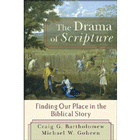
In The Drama of Scripture: Finding Our Place in the Story of the Bible we have attempted to tell the story of the Bible in six acts [Craig G. Bartholomew and Michael W. Goheen, The Drama of Scripture: Finding Our Place in the Story of the Bible, Grand Rapids: Baker, 2004. We are dependant on N. T. Wright for the metaphor of a drama. He explicates the Biblical story in five acts (‘How Can the Bible Be Authoritative?’, Vox Evangelica 21 (1991) 7-32; and The New Testament and the People of God. London: SPCK, 1992, 139- 143). Brian Walsh and Richard Middleton add a sixth act (Truth is Stranger Than It Used To Be: Biblical Faith in a Postmodern Age. Downers Grove: Intervarsity Press, 1995, 182). We follow Walsh and Middleton, and use the latter structure. See our website http://www.biblicaltheology.ca for resources on using the book including a seven page summary of the Biblical story].

In Act One God calls into being a marvellous creation. He creates human beings in his image to live in fellowship with him and to explore and care for the riches of his creation.

In Act Two humanity refuses to live under the Creator’s word, and chooses to seek life apart from Him. It results in disaster; the whole creation is brought into the train of human rebellion.

In Act Three God chooses a people, Israel, to embody his creational and redemptive purposes for the world. Israel is formed into a people and placed on the land to shine as a light. They fail in their calling. Yet God promises through the prophets that Israel’s failure will not derail His plan.

In Act Four God sends Jesus. Jesus carries out Israel’s calling is a faithful light to the world. But he does more: He defeats the power of sin at the cross, rises from the dead inaugurating the new creation, and pours out His Spirit that his people might taste of this coming salvation. Before he takes His position of authority over the creation he gathers his disciples together and tells them: ‘As the Father has sent me, I am sending you.’

Act Five tells us the story of the church’s mission from Jerusalem to Rome in the first hundred or so years. But the story ends on an incomplete note. The story is to continue; the church’s mission is to continue in all places until Jesus returns. We are invited into this story to witness to the comprehensive rule of God in Jesus coming at the goal of history.

Act Six is a yet future act. Jesus will return and complete his restoration work.

We might ask how this story might be authoritative for our lives. N. T. Wright believes that the authority of the biblical story is tied up with its overarching narrative form. He offers a rich metaphor to explicate this authority (Wright, ‘How Can the Bible Be Authoritative?’ and The New Testament and the People of God, 139- 143).

Imagine that a Shakespearian play is discovered for the first time but most of the fifth act is missing. The decision to stage the play is made. The first four acts and the remnant of the fifth act are given to well-trained and experienced Shakespearian actors who immerse themselves both in the first part of the play and in the culture and time of Shakespeare. They are told to work out the concluding fifth act for themselves.

This conclusion must be both consistent and innovative. It must be consistent with the first part of the play. The actors must immerse themselves in full sympathy in the unfinished drama. The first four acts would contain its own cumulative forward movement that would demand that the play be concluded in a way consistent and fitting with that impetus. Yet an appropriate conclusion would not mean a simple repetition or imitation of the earlier acts. The actors would carry forward the logic of the play in a creative improvisation. Such an improvisation would be an authentic conclusion if it were coherent with the earlier acts.

This metaphor provides a specific analogy for how the biblical story might function authoritatively to shape the life of the believing community. Wright sees the biblical story as consisting of four acts – creation, fall, Israel, Jesus – plus the first scene of the fifth act that narrates the beginning of the church’s mission. Furthermore this fifth act offers hints at how the play is to end. Thus the church’s life is lived out consistent with the forward impetus of the first acts and moving toward and anticipating the intended conclusion. The first scene of act five, the church’s story, begins to draw out and implement the significance of the first four acts, especially act four. The church continues today to do the same in fresh and creative ways in new cultural situations. This requires a patient examination and thorough immersion in what act four is all about, how act four is to be understood in light of acts one through three, and how the first scene of act five faithfully carries forward act four.

This view of the authority of the Biblical story assumes a clear understanding of our place in the story. It is important not only to understand that the Bible is one cosmic story of the world but also where we are at in the story. The Old Testament looked to a time when the kingdom of God would be ushered in in fullness. This was the goal of God’s redemptive work. When Jesus emerged he announced the arrival of the kingdom yet it did not come as expected. Examining the gospels and listening to Jesus we hear that the kingdom of God is already here but not yet arrived. What can this mean? If my wife tells me that our guests from out of town are already here but not yet arrived I would wonder what on earth she is saying. How can the kingdom be already here but not yet arrived? And what is the significance of the ‘already-not yet’ time period of the coming kingdom?

First we have been given a foretaste of the kingdom. The gospels often compare the kingdom to a feast, a banquet. When the end comes we will enjoy the full banquet of the kingdom. However, the church has been given a foretaste of that kingdom banquet. A foretaste of the kingdom constitutes us as witnesses. The reason we have been offered a foretaste of the salvation of the end is so that we can witness to that salvation. Let me offer another illustration. The people of God are like a movie preview or trailer. A movie trailer gives actual footage of the movie that is coming in the future so that people will want to watch it. The people of God are a kingdom preview. We embody the salvation of the kingdom which is coming in the future so that people will see it and want it. That is what the witness is all about. We are a sign that points to the coming of the fullness of the kingdom in the future. We witness to its presence and its future consummation. A biblical witness is a witness to the kingdom, to God’s rule over all of human life.

The worldview significance of our place in the story can be illustrated by N. T. Wright’s reflection on worldview. In their popular book on worldview, Richard Middleton and Brian Walsh argue that the Bible provides a worldview by answering foundational questions that shape our lives. Those questions are: Who are we? Where are we? What’s wrong? What’s the remedy? (Walsh and Middleton, The Transforming Vision: Shaping a Christian World View, Downers Grove: IVP, 1984, 35). Wright follows Walsh and Middleton in his masterly discussion of the importance of worldview for New Testament studies (Wright, N. T., The New Testament and the People of God, 29-144). Four years later in his second volume he writes that there is a fifth question that needs to be added to the other four, a question that is fundamental for human life. That question is ‘what time is it?’ He says: ‘Since writing The New Testament and the People of God I have realized that ‘what time is it?’ needs adding to the four questions I started with (though at what point in the order could be discussed further). Without it, the structure collapses into timelessness which characterizes some non-Judaeo-Christian worldviews.

Heading Off Misunderstandings

Saying that the Bible is one unfolding story could lead to misunderstandings. So it would be good to say a few words to head off some of those misconceptions. First by saying that the Bible is one unfolding story I am not saying that the Bible is a nice neat novel. It is not a single volume but a ‘sprawling, capacious narrative’ (Peterson, Eugene. ‘Living into God’s Story.’ This article originally appeared on the website ‘The Ooze: Conversation for a Journey’ (www.theooze.com). It can be accessed at http://www,churchcrossing.com/articles.cfm?fuseaction=articledetail&122).

In his discussion on the Bible as a metanarrative Richard Bauckham states that the ‘Bible does not have a carefully plotted single story-line, like, for example a conventional novel. It is a sprawling collection of narratives along with much non-narrative material that stands in a variety of relationships to the narratives’ (Bauckham, Richard. Bible and Mission: Christian Witness in a Postmodern World. Grand Rapids: Baker, 2003, 92).

He continues that major stretches of the main story are told more than once in divergent ways; there are a plurality of angles on the same subject matter (for example, the gospels). He points further to many ways in which there is a ‘profusion and sheer untidiness of the narrative materials’ (Ibid). He concludes that all this ‘makes any sort of finality in summarizing the biblical story inconceivable’ (Ibid, 93).

Secondly, the Bible is not only a narrative document. There are many other genres of literature in the Bible as well. Newbigin states that while the ‘Bible is essentially narrative in form’ that ‘it contains, indeed, much else: prayer, poetry, legislation, ethical teaching and so on.’ Yet, he maintains, ‘essentially it is a story’ (Lesslie Newbigin. The Open Secret: An Introduction to the Theology of Mission. Grand Rapids: Eerdmans, 1995, 81).

James Barr differs radically with Newbigin (and me, i.e., Michael Goheen) on what exactly story means. Yet he too sees the overall shape of Scripture as a narrative within which other genres of Scripture fit. Here is how he puts it:

. . . in my conception all of the Bible counts as ‘story.’ A people’s story is not necessarily purely narrative: materials of many kinds may be slotted into a narrative structure, and this is done in the Hebrew Bible. Thus legal materials are inserted and appear, almost entirely, as part of the Moses story. In this case they are incorporated into the narrative. Others are more loosely attached: songs and hymns of the temple and of individuals, mostly collected in the Book of Psalms but some slotted into the narratives as in Samuel, Kings and Chronicles. . . . Wisdom books: whether . . . they came from Solomon, or because they were general lore of Israel, they are part of the story also.

In the New Testament the letters of great leaders, and an apocalyptic book like Revelation, form part of the story, along with the more strictly narrative writings. Thus in general, although not all parts of the Bible are narrative, the narrative character of the story elements provides a better framework into which the non-narrative parts may be fitted than any framework based on the non-narrative parts into which the story elements could be fitted (James Barr. The Concept of Biblical Theology: An Old Testament Perspective. Minneapolis: Fortress Press, 1999, 356).

A third misunderstanding is tied up with the notion of story. In some approaches to narrative theology—in fact, in Barr’s understanding above—the notion of story enables the reader to ignore questions of historicity. Story may be only a linguistically constructed narrative by a religious community, and no more than that. Yet I use story to speak of an interpretation of history. It is important that these events really happened. The Bible requires ‘a reality that corresponds to it’ (Gabriel Fackre. Narrative Theology from an Evangelical Perspective, in Yandell, K.E., ed., Faith and Narrative, Oxford: Oxford University Press, 2001, 197). The historicity of the narrative matters: ‘. . .it is of the very essence of the matter that the events and places which you read in your Bible are part of the real world and the real history–the same world in which you live . . .’ (Newbigin, The Gospel in a Pluralist Society, 68).

 The Importance of Understanding the Bible as One Story

The importance of understanding the Bible as one story can be seen by noting Newbigin’s notion of a missionary encounter. A missionary encounter is the normal position the church assumes in its culture if it is faithful. It assumes two comprehensive yet incompatible stories. The Bible tells one story about the world and human life while another equally all-embracive story shapes out culture. Christian discipleship always takes cultural shape. So in the life of the Christian community there will be an encounter between two equally comprehensive stories. When the church really believes that its story is true and shapes their whole lives by it, the foundational idolatrous faith, assumed in the cultural story, will be challenged. As the church challenges that story it offers a credible alternative; it calls for conversion. It is an invitation to see and live in the world in the light of another story. Our place in the story is to embody the end and invite others into that true story.

If the church is to be faithful to its missionary calling, it must recover the Bible as one true story according to Newbigin: ‘I do not believe that we can speak effectively of the Gospel as a word addressed to our culture unless we recover a sense of the Scriptures as a canonical whole, as the story which provides the true context for our understanding of the meaning of our lives – both personal and public’ (Lesslie Newbigin. ‘Response to “Word of God?”’, John Coventry SJ, The Gospel and our Culture Newsletter 8, 1991, 2).

If the story of the Bible is fragmented into bits it can easily be absorbed into the reigning story of culture rather than challenging it. Newbigin’s recognition of this, and thus his passion for the importance of seeing the Bible as one story, comes from his missionary experience. In India he saw how easy it was for the Bible to be absorbed into a more comprehensive and alien worldview. The Bible as one comprehensive story in contrast to the comprehensive worldview of Hinduism was a matter of life and death in India. In the West it is equally serious. A fragmented Bible, then, can lead to a church that is unfaithful, syncretistically accommodated to the idolatry of its cultural story. Or to use the words of the Apostle Paul, a church without a comprehensive story to withstand the power of the cultural story will be ‘conformed to the world’ (Romans 12:1-2).

This article is essentially the substance of two keynote addresses given at the ‘Inhabiting the Biblical Story’ conference at the Victorian University of Wellington, Wellington, New Zealand, 16 July 2005.

About the Author: Dr. Michael W. Goheen teaches at Trinity Western University, Langley, B.C., Canada. He is the author of The Drama of Scripture: Finding Our Place in the Biblical Story; Living at the Crossroads: An Introduction to Christian Worldview; and A Light to the Nations: The Missional Church and the Biblical Story.

Jesus In Every Book of The Bible

Themes of Jesus in Each Book of The Bible

Genesis – Jesus is the Seed of the Woman

Exodus – Jesus is the Passover Lamb

Leviticus – Jesus is our High Priest

Numbers – Jesus is the Pillar of Cloud by day and the Pillar of Fire by night

Deuteronomy – Jesus is the Prophet like unto Moses

Joshua – Jesus is the Captain of our Salvation

Judges – Jesus is our Judge and Lawgiver

Ruth – Jesus is our Kinsman Redeemer

1 & 2 Samuel – Jesus is our Trusted Prophet

1 & 2 Kings and Chronicles – Jesus is our Reigning King

Ezra & Nehemiah – Jesus is the Rebuilder of the broken down walls of human life

Esther – Jesus is our Mordecai

Job – Jesus is our Ever Living Redeemer

Psalms – Jesus is our Shepherd

Proverbs & Ecclesiastes – Jesus is our Wisdom

Song of Solomon – Jesus is our Loving Bridegroom

Isaiah – Jesus is the Prince of Peace

Jeremiah – Jesus is our Righteous Branch

Lamentations – Jesus is our Weeping Prophet

Ezekiel – Jesus is the Wonderful Four-faced Man

Daniel – Jesus is the Fourth Man in the Fiery Furnace

Hosea – Jesus is the Faithful Husband forever married to the backslider

Joel – Jesus is Baptizer of the Holy Spirit and Fire

Amos – Jesus is our Burden-bearer

Obadiah – Jesus is Mighty to Save

Jonah – Jesus is our great foreign Missionary

Micah – Jesus is the Messenger of beautiful feet

Nahum – Jesus is the Avenger of God’s Way

Habakkuk – Jesus is God’s Evangelist crying, “Revive Thy works in the midst of the years”

Zephaniah – Jesus is our Savior

Haggai – Jesus is the Restorer of God’s lost heritage

Zechariah – Jesus is the Fountain of the House of David

Malachi – He is the Son of Righteousness with healing in his wings

Matthew – Jesus is the King of the Jews

Mark – Jesus is the Servant

Luke – Jesus is the Son of Man

John – Jesus is the Son of God

Acts – Jesus is the Savior of the World

Romans – Jesus is the Righteousness of God

1 Corinthians – Jesus is the Resurrected One

2 Corinthians – Jesus is the Triumphant One giving victory

Galatians – Jesus is our Liberty who sets us free

Ephesians – Jesus is the Head of the Church

Philippians – Jesus is our Joy

Colossians – Jesus is our Completeness

1 & 2 Thessalonians – Jesus is our Hope

1 Timothy – Jesus is our Faith

2 Timothy – Jesus is our Stability

Titus – Jesus is our Benefactor

Philemon – Jesus is Truth

Hebrews – Jesus is our Perfection

James – Jesus is the Power behind our Faith

1 Peter – Jesus is our Example

2 Peter – Jesus is our Purity

1 John – Jesus is our Life

2 John – Jesus is our Pattern

3 John – Jesus is our Motivation

Jude – Jesus is the Foundation of your Faith

Revelation – Jesus is our Coming King

Good Acronym for Life Applications from the Bible by Rick Warren

The “S.P.A.C.E.  P.E.T.S” Acronym

 WHEN STUDYING THE BIBLE ASK THE FOLLOWING 9 QUESTIONS: “Is There Any?”

Sin to confess? Do I need to make restitution with anyone?

Promise to claim? Is it a universal promise? Have I met the conditions of the promise?

Attitude to change? Am I willing to work on changing my attitude to a Christ-like one?

Command to obey? Am I willing to do it no matter how I feel?

Example to follow? Is there a positive example to copy or a negative one to avoid?

Prayer to pray? Is there anything I need to pray back to God?

Error to avoid? Is there any problem that I should be aware of, or alert to?

Truth to believe? What can I learn about the character or nature of God?

Something to praise God for? What can I be thankful or grateful for?

Christ-Centered Expositional Commentary Series Coming in the Spring of 2013!

Dr. Danny Akin Commenting on a New Exciting Biblical Commentary Series

At the SBC in Phoenix last year, David Platt, Tony Merida and I sat down with the great folks at Broadman & Holman to dream and brainstorm about the possibility of an expositor’s preaching commentary that would be both expositional and Christ-centered. In other words we talked about how faithful, verse by verse, exposition of the whole Bible could properly point to Christ as Jesus Himself taught us in text like John 5:39, Luke 24:25-27 and Luke 24:44-47. Well, that vision has come to fruition.

In the spring 2013 the 1st of a 40-volume preacher’s commentary entitled “Christ-Centered Exposition” will be published. David Platt, Tony Merida and I have the great honor of serving as the editors of the project as well as authoring together the first volume. The initial volume will be “Exalting Jesus in the Pastoral Epistles.” David will produce 1 Timothy, Tony will write 2 Timothy and I will pen Titus. The goal is for the entire series to be complete in 10 years! We certainly need your prayers for that goal to be met!!!

By God’s grace we have enlisted an incredible array of contributors for the series. We thought you might be encouraged and excited by the list of authors who are currently assigned to help us in this significant project, so I have listed them below. It will be apparent that the authors are all committed evangelicals, the majority are Southern Baptists, and most are on the younger side when it comes to age. That was by intention. Further, the Southern Baptists contributors represent the healthy diversity of theological perspectives that exist within our convention of churches within the parameters of the BF&M 2000. And, 6 of the contributors are African-Americans which is a real plus in my judgment.

Now, we recognize in a project of this magnitude there may be some adjustments along the way, but as of today those are the men who will participate and the book(s) they have been assigned.

Our goals in all of this are several. Above all we want to exalt and honor King Jesus. Second, we want to model faithful, biblical exposition. In this context we are excited to show the appropriate differences that exist within in this preaching model. Third, we want a strong missional thread running throughout the series. Building Christ’s Church and extending the gospel to all the nations will be a consistent focus of this series. Finally, for all who preach and teach the Bible, it is our hope and prayer you will be helped in your own ministry of the Word. These are exciting days for the Church of the Lord Jesus. The faithful preaching of His Word, as always, is essential to the health and vibrancy of His Body. May our Lord by His grace and for His glory, use this series for the fame of His Name and the great good of His people.

                                      The Old Testament

Genesis  Volume I Russ Moore
Genesis Volume II Russ Moore
Exodus Tony Merida
Leviticus Allan Moseley
Numbers David Prince
Deuteronomy Al Mohler
Joshua Robert Smith
Judges / Ruth Eric Redmond / David Platt
1 & 2 Samuel J. D. Greear / Heath Thomas
1 & 2 Kings Tony Merida / Jim Hamilton
1 & 2 Chronicles Danny Akin / Adam Dooley
Ezra / Nehemiah Tony Merida  / Jim Hamilton
Esther Jimmy Scroggins
Job Tullian Tchvidjian
Psalms  Volume I Danny Akin / Josh Smith
Psalms Volume II David Platt/ Jim Shaddix
Psalms Volume III Danny Akin / Tony Merida/ Johnny Hunt
Proverbs Jon Akin / Danny Akin
Ecclesiastes Darrin Patrick
Song of Solomon Danny Akin
Isaiah Andy Davis
Jeremiah / Lamentations Steven Smith
Ezekiel Landon Dowden
Daniel Danny Akin
Hosea / Joel Kevin Smith
Amos / Obadiah Greg Heisler
Jonah / Micah Eric Redmond / Bill Curtis
Nahum / Habakkuk Ken Fentress
Zephaniah / Haggai Micah Fries
Zechariah / Malachi Stephen Rummage / Robby Gallaty


The New Testament

Matthew David Platt
Sermon on the Mount Tony Merida
Mark Danny Akin
Luke Thabiti Anyabwile
John Matt Carter
Acts David Platt / Jimmy Scroggins
Romans David Platt
1 Corinthians James Merritt / Danny Akin
2 Corinthians Eric Mason
Galatians Tony Merida / David Platt
Ephesians Tony Merida
Philippians Tony Merida
Colossians / Philemon Matt Chandler / Danny Akin
1&2 Thessalonians Mark Howell
1&2 Timothy / Titus Tony Merida / David Platt / Danny Akin
Hebrews Al Mohler
James David Platt / Francis Chan
1 Peter Mark Dever
2 Peter / Jude Mark Dever / Danny Akin
1st, 2nd, 3rd John Danny Akin
Revelation Danny Akin

About Danny Akin: Daniel L. Akin [follow on Twitter] is the president of Southeastern Baptist Theological Seminary, where he teaches courses in theology, preaching, and hermeneutics. Danny was previously the senior vice president for academic administration and dean of the School of Theology at The Southern Baptist Theological Seminary. He is the author or editor of a number of books, including A Theology of the Church, God on Sex, and the volume dedicated to 1, 2, 3 John in the New American Commentary Series. He also contributed a chapter to The Great Commission Resurgence: Fulfilling God’s Mandate in Our Time. Danny is married to Charlotte, is the father of four boys, and is a proud grandfather of four. The Akins are members of Wake Cross Roads Baptist Church in Raleigh, North Carolina. Danny’s personal website can be found at DanielAkin.com. The article above is adapted from the June 12, 2012 edition of http://betweenthetimes.com/index.php/2012/06/12/excited-to-announce-the-launch-of-christ-centered-exposition-exalting-jesus-in-every-book-of-the-bible/

7 Reasons to Believe The Bible is God’s Word and Inerrant

7 REASONS FOR BELIEVING THE BIBLE IS THE WORD OF GOD AND TOTALLY TRUSTWORTHY

ACRONYM: “H.I.S. L.A.W.S” – Developed By Pastor Bob Sears

Harmony Though written over 1600 years by 40 plus authors in different locations and in 3 different languages about scores of controversial subjects, the Bible’s teachings are supernaturally harmonious from cover to cover.
Impact Countless millions of people from diverse cultures all over the world have had their personal lives changed forever for the good and found spiritual meaning in life from the message of the Bible.
Seers The Old and New Testament prophets (“seers”) spoke dozens of general and specific predictions which have been historically fulfilled. Among the most significant are Isaiah 53 (O.T) and Matthew 24 (N.T).
Longevity In spite of repeated attempts throughout history both to destroy and discredit the Bible, it still exists in virtually its original form and is still revered and circulated more widely than any other book on earth.
Accuracy The Bible’s detailed record of historical data has been repeatedly shown (by other writings and archeological discoveries) to be accurate to an exact degree. This testifies to its writers’ reliability.
Writers The biblical writers obviously meant their readers to accept their writings as a message from God (e.g.: O.T.: the repeated instances of “Thus says the LORD…” N.T.: 1 Th. 2:13; 2 Tim. 3:16; 2 Pet. 1:20-21).
Son of God Jesus, reported to be the authoritative Son of God by the biblical writers, plainly taught the full inspiration of both the Old and New Testaments (e.g.: O.T.: Matthew 5:17-18. N.T.: John 14:23-26, and 16:13).

Dr. D.A. Carson on 12 Principles of Biblical Interpretation

MUST I LEARN HOW TO INTERPRET THE BIBLE?

 by D. A. Carson

Hermeneutics is the art and science of interpretation; biblical hermeneutics is the art and science of interpreting the Bible. At the time of the Reformation, debates over interpretation played an enormously important role. These were debates over ―interpretation, not just over ―interpretations. In other words, the Reformers disagreed with their opponents not only over what this or that passage meant, but over the nature of interpretation, the locus of authority in interpretation, the role of the church and of the Spirit in interpretation, and much more.

During the last half century, so many developments have taken place in the realm of hermeneutics that it would take a very long article even to sketch them in lightly. Sad to say, nowadays many scholars are more interested in the challenges of the discipline of hermeneutics than in the interpretation of the Bible—the very Bible that hermeneutics should help us handle more responsibly. On the other hand, rather ironically there are still some people who think that there is something slightly sleazy about interpretation. Without being crass enough to say so, they secretly harbor the opinion that what others offer are interpretations, but what they themselves offer is just what the Bible says.

Carl F. H. Henry is fond of saying that there are two kinds of presuppositionalists: those who admit it and those who don‘t. We might adapt his analysis to our topic: There are two kinds of practitioners of hermeneutics: those who admit it and those who don‘t. For the fact of the matter is that every time we find something in the Bible (whether it is there or not!), we have interpreted the Bible. There are good interpretations and there are bad interpretations; there are faithful interpretations and there are unfaithful interpretations. But there is no escape from interpretation.

This is not the place to lay out foundational principles, or to wrestle with the ―new hermeneutic (now becoming long in the tooth) and with ―radical hermeneutics and ―postmodern hermeneutics. [For more information and bibliography on these topics, and especially their relation to postmodernism and how to respond to it, see my book The Gagging of God: Christianity Confronts Pluralism, esp. chaps. 2 and 3 (Grand Rapids: Zondervan, 1996 – in this article will be referred to as GOG).] I shall focus instead on one ―simple problem, one with which every serious Bible reader is occasionally confronted. The issue is this: What parts of the Bible are binding mandates for us, and what parts are not?

Consider some examples. “Greet one another with a holy kiss: the French do it, Arab believers do it, but by and large we do not. Are we therefore unbiblical? Jesus tells his disciples that they should wash one another‘s feet (John 13:14), yet most of us have never done so. Why do we “disobey” that plain injunction, yet obey his injunction regarding the Lord‘s Table (“This do, in remembrance of me)? If we find reasons to be flexible about the “holy kiss (GOG, 19), how flexible may we be in other domains? May we replace the bread and wine at the Lord‘s Supper with yams and goat‘s milk if we are in a village church in Papua New Guinea? If not, why not? And what about the broader questions circulating among theonomists regarding the continuing legal force of law set down under the Mosaic covenant? Should we as a nation, on the assumption that God graciously grants widespread revival and reformation, pass laws to execute adulterers by stoning? If not, why not? Is the injunction for women to keep silent in the church absolute (1 Cor. 14:33–36)? If not, why not? Jesus tells Nicodemus that he must be born again if he is to enter the kingdom; he tells the rich young man that he is to sell all that he has and give it to the poor. Why do we make the former demand absolute for all persons, and apparently fudge a little on the second?

Obviously I have raised enough questions for a dissertation or two. What follows in this article is not a comprehensive key to answering all difficult interpretive questions, but some preliminary guidelines to sorting such matters out. The apostolic number of points that follow are not put into any order of importance.

(1) As conscientiously as possible, seek the balance of Scripture, and avoid succumbing to historical and theological disjunctions.

Liberals have often provided us with nasty disjunctions: Jesus or Paul, the charismatic community or the ―early catholic‖ church, and so forth. Protestants sometimes drop a wedge between Paul‘s faith apart from works (Rom. 3:28) and James‘s faith and works (Jas. 2:4); others absolutize Gal. 3:28 as if it were the controlling passage on all matters to do with women, and spend countless hours explaining away 1 Tim. 2:12 (or the reverse!).

Historically, many Reformed Baptists in England between the middle of the eighteenth century and the middle of the twentieth so emphasized God‘s sovereign grace in election that they became uncomfortable with general declarations of the gospel. Unbelievers should not be told to repent and believe the gospel: how could that be, since they are dead in trespasses and sin, and may not in any case belong to the elect? They should rather be encouraged to examine themselves to see if they have within themselves any of the first signs of the Spirit‘s work, any conviction of sin, any stirrings of shame. On the face of it, this is a long way from the Bible, but a large number of churches thought it was the hallmark of faithfulness. What has gone wrong, of course, is that the balance of Scripture has been lost. One element of biblical truth has been elevated to a position where it is allowed to destroy or domesticate some other element of biblical truth.

In fact, the “balance of Scripture” is not an easy thing to maintain, in part because there are different kinds of balance in Scripture. For example, there is the balance of diverse responsibilities laid on us (e.g. praying, being reliable at work, being a biblically faithful spouse and parent, evangelizing a neighbor, taking an orphan or widow under our wing, and so forth): these amount to balancing priorities within the limits of time and energy. There is the balance of Scripture‘s emphases as established by observing their relation to the Bible‘s central plot-line (more on this in the 12th point); there is also the balance of truths which we cannot at this point ultimately reconcile, but which we can easily distort if do not listen carefully to the text (e.g. Jesus is both God and man; God is both the transcendent sovereign and yet personal; the elect alone are saved, and yet in some sense God loves horrible rebels so much that Jesus weeps over Jerusalem and God cries, “Turn, turn, why will you die? For the Lord has no pleasure in the death of the wicked). In each case, a slightly different kind of biblical balance comes into play, but there is no escaping the fact that biblical balance is what we need.

(2) Recognize that the antithetical nature of certain parts of the Bible, not least some of Jesus’ preaching, is a rhetorical device, not an absolute. The context must decide where this is the case.

Of course, there are absolute antitheses in Scripture that must not be watered down in any way. For example, the disjunctions between the curses and the blessings in Deut. 27–28 are not mutually delimiting: the conduct that calls down the curses of God and the conduct that wins his approval stand in opposite camps, and must not be intermingled or diluted. But on the other hand, when eight centuries before Christ, God says, “For I desire mercy, not sacrifice, and acknowledgment of God rather than burnt offerings” (Hos. 6:6), the sacrifical system of the Mosaic covenant is not thereby being destroyed. Rather, the Hebrew antithesis is a pointed way of saying, “If push comes to shove, mercy is more important than sacrifice. Whatever you do, you must not rank the marks of formal religion—in this case, burnt offerings and other mandated ritual sacrifices—with fundamental acknowledgment of God, or confuse the extent to which God cherishes compassion and mercy with the firmness with which he demands the observance of the formalities of the sacrificial system” (GOG, 20).

Similarly, when Jesus insists that if anyone is to become his disciple, he must hate his parents (Lk. 14:26), we must not think Jesus is sanctioning raw hatred of family members. What is at issue is that the claims of Jesus are more urgent and binding than even the most precious and prized human relationships (as the parallel in Mt. 10:37 makes clear).

Sometimes the apparent antithesis is formed by comparing utterances from two distant passages. On the one hand, Jesus insists that the praying of his followers should not be like the babbling of the pagans who think they are heard because of their many words (Mt. 6:7). On the other hand, Jesus can elsewhere tell a parable with the pointed lesson that his disciples should pray perseveringly and not give up (Lk. 18:1–8). Yet if we imagine that the formal clash between these two injunctions is more than superficial, we betray not only our ignorance of Jesus‘ preaching style, but also our insensitivity to pastoral demands. The first injunction is vital against those who think they can wheedle things out of God by their interminable prayers; the second is vital against those whose spiritual commitments are so shallow that their mumbled one-liners constitute the whole of their prayer life.

(3) Be cautious about absolutizing what is said or commanded only once.

The reason is not that God must say things more than once for them to be true or binding. The reason, rather, is that if something is said only once it is easily misunderstood or misapplied. When something is repeated on several occasions and in slightly different contexts, readers will enjoy a better grasp of what is meant and what is at stake.

That is why the famous “baptism for the dead passage (1 Cor.15:29) is not unpacked at length and made a major plank in, say, the Heidelberg Catechism or the Westminster Confession. Over forty interpretations of that passage have been offered in the history of the church. Mormons are quite sure what it means, of course, but the reason why they are sure is because they are reading it in the context of other books that they claim are inspired and authoritative.

This principle also underlies one of the reasons why most Christians do not view Christ‘s command to wash one another‘s feet as a third sacrament or ordinance. Baptism and the Lord‘s Supper are certainly treated more than once, and there is ample evidence that the early church observed both, but neither can be said about footwashing. But there is more to be said.

(4) Carefully examine the biblical rationale for any saying or command.

The purpose of this counsel is not to suggest that if you cannot discern the rationale you should flout the command. It is to insist that God is neither arbitrary nor whimsical, and by and large he provides reasons and structures of thought behind the truths he discloses and the demands he makes. Trying to uncover this rationale can be a help in understanding what is of the essence of what God is saying, and what is the peculiar cultural expression of it.

Before I give a couple of examples, it is important to recognize that all of Scripture is culturally bound. For a start, it is given in human languages (Hebrew, Aramaic, Greek), and languages are a cultural phenomenon. Nor are the words God speaks to be thought of as, say, generic Greek. Rather, they belong to the Greek of the Hellenistic period (it isn‘t Homeric Greek or Attic Greek or modern Greek). Indeed, this Greek changes somewhat from writer to writer (Paul does not always use words the same way that Matthew does) and from genre to genre (apocalyptic does not sound exactly like an epistle). None of this should frighten us. It is part of the glory of our great God that he has accommodated himself to human speech, which is necessarily time-bound and therefore changing. Despite some postmodern philosophers, this does not jeopardize God‘s capacity for speaking truth. It does mean that we finite human beings shall never know truth exhaustively (that would require omniscience), but there is no reason why we cannot know some truth truly. Nevertheless, all such truth as God discloses to us in words comes dressed in cultural forms. Careful and godly interpretation does not mean stripping away such forms to find absolute truth beneath, for that is not possible: we can never escape our finiteness. It does mean understanding those cultural forms, and by God‘s grace discovering the truth that God has disclosed through them.

So when God commands people to rend their clothes and put on sackcloth and ashes, are these precise actions so much of the essence of repentance (GOG, 21) that there is no true repentance without them? When Paul tells us to greet one another with a holy kiss, does he mean that there is no true Christian greeting without such a kiss?

When we examine the rationale for these actions, and ask whether or not ashes and kissing are integratively related to God‘s revelation, we see the way forward. There is no theology of kissing; there is a theology of mutual love and committed fellowship among the members of the church. There is no theology of sackcloth and ashes; there is a theology of repentance that demands both radical sorrow and profound change.

If this reasoning is right, it has a bearing on both footwashing and on head-coverings. Apart from the fact that footwashing appears only once in the New Testament as something commanded by the Lord, the act itself is theologically tied, in John 13, to the urgent need for humility among God‘s people, and to the cross. Similarly, there is no theology of head- coverings, but there is a profound and recurrent theology of that of which the head-coverings were a first-century Corinthian expression: the proper relationships between men and women, between husbands and wives.

(5) Carefully observe that the formal universality of proverbs and of proverbial sayings is only rarely an absolute universality. If proverbs are treated as statutes or case law, major interpretive—and pastoral!—errors will inevitably ensue.

Compare these two sayings of Jesus: (a) “He who is not with me is against me, and he who does not gather with me scatters (Mt.12:30). (b) “. . . for whoever is not against us is for us(Mk. 9:40; cf. Lk. 9:50). As has often been noted, the sayings are not contradictory if the first is uttered to indifferent people against themselves, and the second to the disciples about others whose zeal outstrips their knowledge. But the two statements are certainly difficult to reconcile if each is taken absolutely, without thinking through such matters.

Or consider two adjacent proverbs in Prov. 26. (a) “Do not answer a fool according to his folly . . .(26:4). (b) “Answer a fool according to his folly . . . (26:5). If these are statutes or examples of case law, there is unavoidable contradiction. On the other hand, the second line of each proverb provides enough of a rationale that we glimpse what we should have seen anyway: proverbs are not statutes. They are distilled wisdom, frequently put into pungent, aphoristic forms that demand reflection, or that describe effects in society at large (but not necessarily in every individual), or that demand consideration of just how and when they apply.

Let us spell out these two proverbs again, this time with the second line included in each case: (a) “Do not answer a fool according to his folly, or you will be like him yourself. (b) “Answer a fool according to his folly, or he will be wise in his own eyes. Side by side as they are, these two proverbs demand reflection on when it is the part of prudence to refrain from answering fools, lest we be dragged down to their level, and when it is the part of wisdom to offer a sharp, “foolish rejoinder that has the effect of pricking the pretensions of the fool. The text does not spell this out explicitly, but if the rationales of the two cases are kept in mind, we will have a solid principle of discrimination.

So when a well-known para-church organization keeps quoting “Train up a child in the way he should go, and when he is old he will not depart from it as if it were case law, what are we to think? This proverbial utterance must not be stripped of its force: it is a powerful incentive to responsible, God-fearing, child-rearing. Nevertheless, it is a proverb; it is not a covenantal promise. Nor does it specify at what point the children will be brought into line. Of course, many children from Christian homes go astray because the parents really have been very foolish or unbiblical or downright sinful; but many of us have witnessed the burdens of unnecessary guilt and shame borne by really godly parents when their grown (GOG, 22) children are, say, 40 years of age and demonstrably unconverted. To apply the proverb in such a way as to engender or reinforce such guilt is not only pastorally incompetent, it is hermeneutically incompetent: it is making the Scriptures say something a little different from what can safely be inferred. Aphorisms and proverbs give insight as to how culture under God works, how relationships work, what are priorities should be; they do not put in all the footnotes as to whether there are any individual exceptions, and under what circumstances, and so forth.

(6) The application of some themes and subjects must be handled with special care, not only because of their intrinsic complexity, but also because of essential shifts in social structures between biblical times and our own day.

“Everyone must submit himself to the governing authorities, for there is no authority except that which God has established. The authorities that exist have been established by God. Consequently, he who rebels against the authority is rebelling against what God has instituted, and those who do so will bring judgment on themselves (Rom.13:1–2). Some Christians have reasoned from this passage that we must always submit to the governing authorities, except in matters of conscience before God (Acts 4:19). Even then, we “submitto the authorities by patiently bearing the sanctions they impose on us in this fallen world. Other Christians have reasoned from this passage that since Paul goes on to say that the purpose of rulers is to uphold justice (Rom.13:3–4), then if rulers are no longer upholding justice the time may come when righteous people should oppose them, and even, if necessary, overthrow them. The issues are exceedingly complex, and were thought through in some detail by the Reformers.

But there is of course a new wrinkle added to the fabric of debate when one moves from a totalitarian régime, or from an oligarchy, or from a view of government bound up with an inherited monarchy, to some form of democracy. This is not to elevate democracy to heights it must not occupy. It is to say, rather, that in theory at least a democracy allows you to “overthrow” a government without violence or bloodshed. And if the causes of justice cannot do so, it is because the country as a whole has slid into a miasma that lacks the will, courage, and vision to do what it has the power to do, but chooses not to do (for whatever reason). What, precisely, are the Christian‘s responsibilities in that case (whatever your view of the meaning of Rom.13 in its own context)?

In other words, new social structures beyond anything Paul could have imagined, though they cannot overturn what he said, may force us to see that valid, thoughtful, application demands that we bring into the discussion some considerations he could not have foreseen. It is a great comfort, and epistemologically important, to remember that God did foresee them—but that does not itself reduce the hermeneutical responsibilities we have.

(7) Determine not only how symbols, customs, metaphors, and models function in Scripture, but also to what else they are tied.

We may agree with conclusions already drawn about sackcloth and ashes, and about holy kissing. But is it then acceptable to lead a group of young people in a California church in a celebration of the Lord‘s Table using coke and chips? And how about yams and goat‘s milk in Papua New Guinea? If in the latter case we use bread and wine, are we not subtly insisting that only the food of white foreigners is acceptable to God?

The problem is one not only of churchmanship, but of linguistic theory: Bible translators face it continuously. How should we translate “bread and “wine in the words of institution? Or consider a text such as Isa.1:18: “Though your sins are like scarlet, they shall be as white as snow; though they are red as crimson, they shall be like wool.Suppose the target group for which you are translating the Bible lives in equatorial rain forests and has never seen snow: would it be better to change the simile? Suppose that the only “wool they have seen is the dirty dun-colored stuff from village goats: could not “faithful’ translation be misleading, while culturally sensitive translation that is nevertheless more distant from the original succeed in communicating the point that God speaking through Isaiah was getting across?

A lot can be said in favor of this sort of flexibility. Certainly in the case of “snow, not a lot seems to be at stake. You might want to check out the other seven biblical occurrences of “white as snow to make sure you are not unwittingly running into some awkward clash or other. But in the case of bread and wine at the Lord‘s Supper, the situation is more complicated. This is because the elements are tied in with other strands of the Bible, and it is almost impossible to disentangle them. Having changed “bread to, say, “yams” in order to avoid any cultural imperialism, what shall we do with the connections between the Lord‘s Supper and the Passover, where only “unleavened bread was to be eaten: can we speak of “unleavened yams?! How about the connection between bread and manna, and then the further connection drawn between bread/manna and Jesus (John.6)? Is Jesus (I say this reverently) now to become the yam of God? And I have not yet begun to exhaust the complications connected with this one.

So what begins as a charitable effort in cross-cultural communication is leading toward major interpretive problems a little farther down the road. Moreover, Bible translations have a much longer shelf-life than the original translators usually think. Fifty years later, once the tribe has become a little more familiar with cultures beyond their own forests, and it seems best in a revision to return to a greater degree of literalism, try and change “yams to “bread and see what kind of ecclesiastical squabbles will break out. The “KJV” of the rain forests has “yams”. . . .

All of these sorts of problems are bound up with the fact that God has not given us a culturally neutral revelation. What he has revealed in words is necessarily tied to specific places and cultures. Every other culture is going to have to do some work to understand what God meant when he said certain things in a particular language at a specific time and place and in a shifting idiom. In the case of some expressions, an analogous idiom may be the best way to render something; in other expressions, especially those that are deeply tied to other elements in the Bible‘s story-line, it is best to render things more literally, and then perhaps include an explanatory note. In this case, for example, it might be wise to say that “bread was a staple food of the people at the time, as yams are to us. A slightly different note would have to be included when leaven or yeast is introduced.

There is almost nothing to be said in favor of California young people using chips and coke as the elements. (I‘m afraid this is not a fictitious example.) Unlike the people of the rain forests, they do not even have in their favor that they have never heard of bread. Nor can it be said that chips and coke are their staples (though doubtless some of them move in that direction). What this represents is the whimsy of what is novel, the love of the iconoclastic, the spirituality of the cutesy—with no connections with either the Lord‘s words or with two thousand years of church history.

(8) Thoughtfully limit comparisons and analogies by observing near and far contexts.

“Jesus Christ is the same yesterday and today and forever (Heb.13:8). Since he never finally refused to heal anyone who approached him during the days of his flesh, and since he is the same yesterday and today and forever, therefore he will heal all who approach him for healing today. I have had that argument put to me more than once. By the same token, of course, Heb.13:8 could be used to prove that since he was mortal before the cross, he must still be mortal today; or since he was crucified by the Romans, and he is the same yesterday and today and forever, he must still be being crucified by the Romans today.

The fact of the matter is that comparisons and analogies are always self-limiting in some respect or other. Otherwise, you would not be dealing with comparisons and analogies, but with two or more things that are identical. What makes a comparison or an analogy possible is that two different things are similar in certain respects. It is always crucial to discover the planes on which the parallels operate—something that is usually made clear by the context—and to refuse further generalization.

A disciple is to be like his master; we are to imitate Paul, as Paul imitates Christ. In what respects? Should we walk on water? Should we clean the local temple with a whip? Should we infallibly heal those who are ill and who petition us for help? Should we miraculously provide food for thousands out of some little boy‘s lunch? Should we be crucified? Such questions cannot all be answered with a simple “yes” or “no.” It is worth observing that most of the injunctions in the Gospels to follow Jesus or to do what he does are bound up with his self- abnegation: e.g. as he is hated, so we must expect to be hated (Jn.15:18); as he takes the place of a servant and washes his disciples‘ feet, so we are to wash one another‘s feet (Jn.13); as he goes to the cross, so we are to take our cross and follow him (Mt.10:38; 16:24; Lk.14:27). Thus the answer to the question, “Should we be crucified?”, is surely ‘yes” and “no”: no, not literally, most of us will have to say, and yet that does not warrant complete escape from the demand to take up our cross and follow him. So in this case the answer is “yes,” but not literally.

(9) Many mandates are pastorally limited by the occasion or people being addressed.

For example, Jesus unambiguously insists, “Do not swear at all: either by heaven, for it is God‘s throne; or by the earth, for it is his footstool; or by Jerusalem, for it is the city of the Great King. . . . Simply let your Yes‘ be ‘Yes,‘ and your  No,‘  No‘; anything beyond this comes from the evil one(Mt. 6:34–36). Yet we find Paul going well beyond a simple “Yes or “No (e.g. Rom. 9:1; 2 Cor. 11:10; Gal. 1:20). In fact, God puts himself under an oath (Heb. 6:17–18). Won‘t pedants have a wonderful time with this?

Yet the particular language of Jesus‘ prohibition, not to mention the expanded parallel in Mt. 23:16–22, shows that what Jesus was going after was the sophisticated use of oaths that became an occasion for evasive lying—a bit like the schoolboy who tells whoppers with his fingers crossed behind his back, as if this device exonerated him from the obligation to tell the truth. At some point, it is best to get to the heart of the issue: simply tell the truth, and let your “Yes” be “Yes” and your “No” be “No.” In other words, the pastoral context is vital. By contrast, the context of Heb. 6–7 shows that when God puts himself under an oath, it is not because otherwise he might lie, but for two reasons: first, to maintain the typological pattern of a priesthood established by oath, and second, to offer special reassurance to the weak faith of human beings who otherwise might be too little inclined to take God‘s wonderful promises seriously.

There are many examples in Scripture of the importance of pastoral context. Paul can say it is good for a man not to touch a woman (1 Cor. 7:1—NIV‘s “not to marry is an unwarranted softening of the Greek). But (he goes on to say) there are also good reasons to marry, and finally concludes that both celibacy and marriage are gifts from God, charismata (1 Cor. 7:7—which I suppose makes us all charismatics). It does not take much reading between the lines to perceive that the church in Corinth included some who were given to asceticism, and others in danger of promiscuity (cf. 1 Cor. 6:12–20). There is a pastoral sensitivity to Paul‘s “Yes, but” argument, one that he deploys more than once in this letter (e.g. 1 Cor. 14:18–19). In other words, there are pastoral limitations to the course advocated, limitations made clear by the context.

In the same way, what Paul says to encourage Christian assurance to the Romans at the end of chap. 8 is not what he says to the Corinthians in 2 Cor. 13:5. Which particular elements of a full-blooded, nuanced, and even complex doctrine need to be stressed at any particular time will be determined, in part, by a pastoral diagnosis of the predominant current ailments.

(10) Always be careful how you apply narratives.

Nowadays most of us are familiar with “postmodern” voices that advocate open-ended meaning—meaning, finally, that you or your interpretive community “finds,” not meaning that is necessarily in the text, and only accidentally what the author intended. Not surprisingly, when these postmodern voices turn to the Bible, they are often attracted to narrative portions, since narratives are generically more open to diverse interpretation than discourse. Admittedly, these narrative portions are usually pulled out of their contexts in the books in which they are embedded, and made to stand on their own. Without the contextual constraints, the interpretive possibilities seem to multiply—which is, of course, what the postmodernists want. Narratives have other virtues, of course: they are evocative, affective, image-enhancing, memorable. But unless care is taken, they are more easily misinterpreted than discourse.

In fact, little narratives should not only be interpreted within the framework of the book in which they are embedded, but within the corpus, and ultimately within the canon. Take, for instance, Gen. 39, the account of Joseph‘s early years in Egypt. One can read that narrative and draw from it excellent lessons on how to resist temptation (e.g. Joseph refers to sexual sin to which he is enticed by Potiphar‘s wife as “sin against God, not some mere weakness or foible; he avoids the woman‘s company, at the crunch, because his purity is more important to him than his prospects). But a careful reading of the opening and closing verses of the chapter also shows that one of the important points of the narrative is that God is with Joseph and blesses him even in the midst of the most appalling circumstances: neither the presence of God nor the blessing of God are restricted to happy lifestyles. Then read the chapter in the context of the preceding narrative: now Judah becomes a foil for Joseph. The one is tempted in circumstances of comfort and plenty, and succumbs to incest; the other is tempted in circumstances of slavery and injustice, and retains his integrity. Now read the same chapter in the context of the book of Genesis. Joseph‘s integrity is bound up with the way God providentially provides famine relief not only for countless thousands, but for the covenant people of God in particular. Now read it within the context of the Pentateuch. The narrative is part of the explanation for how the people of God find themselves in Egypt, which leads to the Exodus. Joseph‘s bones are brought out when the people leave. Enlarge the horizon now to embrace the whole canon: suddenly Joseph‘s fidelity in small matters is part of the providential wisdom that preserves the people of God, leads to the exodus that serves as a type of a still greater release, and ultimately leads to Judah‘s (!) distant son David, and his still more distant son, Jesus.

So if you are applying Gen. 39, although it may be appropriate to apply it simply as a moralizing account that tells us how to deal with temptation, the perspective gained by admitting the widening contexts discloses scores of further connections and significances that thoughtful readers (and preachers) should not ignore.

(11) Remember that you, too, are culturally and theologically located.

In other words, it is not simply a case of each part of the Bible being culturally located, while you and I are neutral and dispassionate observers. Rather, thoughtful readers will acknowledge that they, too, are located in specific culture—they are awash in specific language, unacknowledged assumptions, perspectives on time and race and education and humor, notions of truth and honor and wealth. In postmodern hands, of course, these realities become part of the reason for arguing that all interpretations are relative. I have argued elsewhere that although no finite and sinful human being can ever know exhaustive truth about anything (that would require omniscience), they can know some truth truly. But often this requires some self-distancing of ourselves from inherited assumptions and perspectives.

Sometimes this is achieved unknowingly. The person who has read her Bible right through once or twice a year, loves it dearly, and now in her eightieth year reads it no less, may never have self-consciously engaged in some process of self-distancing from cultural prejudice. But she may now be so steeped in biblical outlooks and perspectives that she lives in a different “world” from her pagan neighbors, and perhaps even from many of her more shallow and less well-informed Christian neighbors. But the process can be accelerated by reading meditatively, self-critically, humbly, honestly, thereby discovering where the Word challenges the outlooks and values of our time and place. It is accelerated by the right kinds of small-group Bible studies (e.g. those that include devout Christians from other cultures), and from the best of sermons.

Does our Western culture place so much stress on individualism that we find it hard to perceive, not only the biblical emphasis on the family and on the body of the church, but also the ways in which God judges entire cultures and nations for the accumulating corruptions of her people? Are the biblical interpretations advanced by ―evangelical feminists‖ compromised by their indebtedness to the current focus on women‘s liberation, or are the interpretations of more traditional exegetes compromised by unwitting enslavement to patriarchal assumptions? Do we overlook some of the ―hard‖ sayings about poverty simply because most of us live in relative wealth?

The examples are legion. But the place to begin is by acknowledging that no interpreter, including you and me, approaches the text tabula rasa, like a razed slate just waiting to have the truth inscribed on them. There is always a need for honest recognition of our biases and assumptions, and progressive willingness to reform them and challenge them as we perceive that the Word of God takes us in quite a different direction. As our culture becomes progressively more secular, the need for this sort of reading is becoming more urgent. How it is done—both theoretically and practically—cannot be elucidated here. But that it must be done if we are not to domesticate Scripture to our own worlds cannot be doubted.

(12) Frankly admit that many interpretive decisions are nestled within a large theological system, which in principle we must be willing to modify if the Bible is to have the final word.

This is, of course, a subset of the preceding point, yet it deserves separate treatment.

Some Christians give the impression that if you learn Greek and Hebrew and get your basic hermeneutics sorted out, then you can forget about historical theology and systematic theology: simply do your exegesis and you will come out with the truth straight from the Word of God. But of course, it is not quite that simple. Inevitably, you are doing your exegesis as an Arminian, or as a Reformed Presbyterian, or as a dispensationalist, or as a theonomist, or as a Lutheran—and these are only some of the predominant systems among believers. Even if you are so ignorant of any one tradition that you are a bit of an eclectic, that simply means your exegesis is likely to be a little more inconsistent than that of others.

Systems are not inherently evil things. They function to make interpretation a little easier and a little more realistic: they mean that you do not have to go back to basics at each point (i.e. inevitably you assume a whole lot of other exegesis at any particular instance of exegesis). If the tradition is broadly orthodox, then the system helps to direct you away from interpretations that are heterodox. But a system can be so tightly controlling that it does not allow itself to be corrected by Scripture, modified by Scripture, or even overturned by Scripture. Moreover, not a few interpretative points of dispute are tied to such massive interlocking structures that to change one‘s mind about the detail would require a change of mind on massive structures, and that is inevitably far more challenging a prospect. This is also why a devout Reformed Presbyterian and a devout Reformed Baptist are not going to sort out what Scripture says about, say, baptism or church government, simply by taking out a couple of lexica and working over a few texts together during free moments some Friday afternoon. What is at stake, for both of them, is how these matters are nestled into a large number of other points, which are themselves related to an entire structure of theology.

And yet, and yet. . . . If this is all that could be said, then the postmodernists would be right: the interpretive community determines everything. But if believers are in principle willing to change their minds (i.e. their systems!), and are humbly willing to bring everything, including their systems, to the test of Scripture, and are willing to enter courteous discussion and debate with brothers and sisters who are similarly unthreatened and are similarly eager to let Scripture have final authority, then systems can be modified, abandoned, reformed.

The number of topics affected by such considerations is very large—not only the old chestnuts (e.g. baptism, the significance of Holy Communion, the understanding of covenant, Sabbath/Sunday issues) but more recent questions as well (e.g. theonomy, the place of “charismatic” gifts). For our purposes, we note that some of these manifold topics have to do with what is mandated of believers today.

Let us take a simple example. In recent years, a number of Christians have appealed to Acts 15:28 (“It seemed good to the Holy Spirit and to us . . .) to serve as a model for how the church comes to difficult decisions involving change in disputed areas—in the case of Acts, circumcision and its significance, and in the modern case, the ordination of women. Is this a fair usage of Acts 15:28? Does it provide a definitive model for how to change things formerly accepted in the church?

But believers with any firm views on the exclusive authority of the canon, or with any sophisticated views on how the new covenant believers were led in the progress of redemption history to re-think the place of circumcision in the light of the cross and resurrection, will not be easily persuaded by this logic. Has every change introduced by various churches across the centuries been justified, simply because it was blessed with the words “it seemed good to the Holy Spirit and to us? Does the church now have the right to change things established in and by the canon in the way that the early church changed things established in and by the Old Testament canon, as if we were similarly located at a strategic turning point in redemptive history? The mind boggles at the suggestions. But what is clear in any case is that such issues cannot properly be resolved without thinking through, in considerable detail, how the parameters of the interpretive decisions are tied to much more substantial theological matters.

One final word: By advancing these dozen points, am I in danger of elevating certain hermeneutical controls above Scripture, controls which themselves serve to domesticate Scripture? Had I time and space, I think I could demonstrate that each of these twelve points is itself mandated by Scripture, whether explicitly or as a function of what Scripture is. It might be a useful exercise to work through the twelve points and think through why this is so. But that would be another essay.

About the Author: Dr. D. A. Carson teaches New Testament at Trinity Evangelical Divinity School and has more than twenty books to his credit. Among them are Showing the Spirit, Exegetical Fallacies, Divine Sovereignty and Human Responsibility, How Long O Lord: Reflections on Suffering and Evil, and Matthew in The Expositor’s Bible Commentary. Article above adapted from: “Must I Learn How to Interpret the Bible?” Modern Reformation 5:3 (May/June 1996): 18–22. Updated 2003.

Notes

1. Allan Bloom, The Closing of The American Mind (Simon & Schuster, 1987), p. 56–57

2. J. Gresham Machen, What Is Faith? (Banner of Truth, 1925), p. 21.