Is The Bible Trustworthy For All of Life? By Dr. R.C. Sproul

One of the biggest issues of our day revolves around the trustworthiness and the authority of the Scriptures for all of life – private and public. This is a classic sermon by one of the most influential theologians living today. Though given in the late 70’s during the beginning stages of the development of the International Council of Biblical Inerrancy – it is just as pertinent, relevant, and needed today. R.C. teaches with absolute clarity and expositional and theological precision that the Scriptures are indeed authoritative and sufficient for all of life and practice privately and publicly. Enjoy this wonderful sermon by Dr. R.C. Sproul.

Now the serpent was more crafty than any other beast of the field that the LORD God had made. He said to the woman, “Did God actually say, (“hath God said” in KJV) ‘You shall not eat of any tree in the garden’?” – Genesis 3:1

“Hath God Said?” By Dr. R.C. Sproul

I think that we are all not only aware, but in many cases painfully aware, of the continued academic, technical, and intellectual difficulties that we face when we make an affirmation of the inerrancy of Holy Scripture. I trust that we have not been bathed in obscurantism to a degree that makes us ignorant of the avalanche of criticism that has been directed toward the church’s classic position over the last two hundred years. And I hope that we recognize that much of that criticism may not be lightly dismissed. To do so, of course, would not be wise.

I think we are aware that it is our duty and the urgent need of the Christian community of our day, not to rest merely on the splendid statements of our fathers in defense of the authority of Scripture. Surely our generation is called to face the new issues that have been raised in academic circles. What I am saying simply is this: that there exist problems of an academic and intellectual nature with respect to the confessions that we are so bold to make. But that’s not what I am concerned to focus our attention on this morning.

For in addition to these questions of an intellectual nature, which at times indeed may be excruciating, there are other facets to this question that must never be overlooked. There is an emotional dimension. There is a psychological dimension. There is a theological, or perhaps what we may call a religious dimension that touches the heart of this issue.

As you recall a few months ago, I had the privilege in behalf of the International Council on Biblical Inerrancy to be involved in dialogue with a group of very respected theologians and biblical scholars in this country. It was a behind-closed-door session of question and discussion, clarification of our position, vis-à-vis theirs. The discussions went for an intense period of seven hours. And at no time during that discussion did it become one of vituperative or vitriolic exchange. It was a sanguine atmosphere and the discussion was carried on in the spirit of cordiality. But it was intensely academic in nature, and I believe that we were all weary at the end of it. What I recall was that after the discussions were over and we were moving to the parking lot, one of the elder statesmen of the other group who has been a friend and colleague of mine for years came up to me, not in a paternalistic way, but in a genuine fatherly gesture. He put his arm around me and said, “R.C., why do you get so exercised over this question? Why are you devoting so much of your time to the question of biblical inerrancy? Why can’t we leave that aside and move on the real issues of reaching the fallen people of this generation?”

I’m sure that this man’s primary concern was precisely that we get on with the business of the work of the church and of Christ and not be paralyzed by internal disputes and debates about matters like these. He was expressing genuine concern over my particular career as a teacher. And he was almost weeping as he raised that question.

As I stepped out of the academic and intellectual atmosphere that had characterized the previous hours and looked at him, I answered his question as emotionally as he asked it. And I said, “I can’t help it. Scriptures are my life. I am not a second generation Christian. I came to Jesus Christ from the streets, and that’s what brought me into the kingdom of God, the words from this Book. I love it. The contents, the message broke through the recalcitrance of my pagan heart and brought me into the kingdom of God and showed me the loveliness and sweetness of Christ.”

And then in a statement of perhaps characteristic belligerence, I said to him, “No one will ever take this Book from me.” And I had to admit candidly that I am somewhat prejudiced and emotionally involved in this question. I raised this point with him. “I understand,” I said, “the difficulties that criticism has raised, and I know that many feel that as a matter of intellectual integrity they must set aside this doctrine, that they cannot cling to it merely for emotional or sentimental reasons. I must agree with the integrity of that.” But I said to him, “What I would like to see when that happens, is that our Christian brothers and scholars who have abandoned this point lay it down with tears. And I haven’t seen that.”

I would think that if we came to the conclusion that this point of the faith of our fathers indicates an error of our tradition, and that we must abandon inerrancy, that if we did, in fact, come to that conclusion, that we would do it with tears, rather than in the attitude or spirit we have seen in some circles. I don’t see this in evangelical circles, but in some circles there seems to be a certain delight and glee in finding difficulties in the text of Scripture. At that point it becomes religious, moral, and I think that we are facing the problem not only of the academic but the problem of enormous pressure to conform to contemporary drifts of opinion. Many have said quite candidly, “It is not expedient for us to take such a stand in this day and age.”

Again another candid and private conversation I had with a pastor for whom I have great respect and love. He said, “R.C., I am not a scholar. I am not an academician. I am not a trained and skilled apologist. I am a pastor and my concerns are pastoral in nature. Now, R.C., in my heart I believe in the inerrancy of Scripture, but I simply cannot defend it. I do not have the tools, the erudition necessary in this sophisticated era to make a good defense. And so I prefer not to stand for the doctrine.” It was only a few months later that this pastor was asked in a public situation, “Do you, sir, affirm the inerrancy of Scripture?” and his response publicly was, “I do not.”

Now it’s possible that the man changed his mind in the intervening months between our private conversation and his public statement. But I am also recognizing the real possibility that the intimidation that he was experiencing was more than he could bear in his humanity. And who of us has not had to face that kind of pressure? Who of us has not succumbed to it at one point or another in our lives? We have sinned and do sin, my brothers and sisters, and we must be careful in this concern that we not give the idea that we are the ones who maintain a pristine purity of Christian life and obedience, while others have easily and quickly capitulated and negotiated the faith of Jesus Christ. We all have participated at one time or another in such capitulation.

We are often put to the test, and the test of our faith is very infrequently couched in terms of strict theological affirmation such as, “Do you believe in God?” We all confess that we believe in God, but the point at which we negotiate is a different question. “Do you believe God?” That’s the issue. And that’s where the point of testing is focused in our day. Now the idea of a test at the point of believing God is nothing new. And it’s not an experience that we are facing as a first generation of the tested, but rather to God that is the test of fidelity.

Let me say it another way. The two greatest tests in the history of mankind focus the term of the test precisely on the point of whether or not the ones being tested believed God. I am referring, of course, to the test of our original parents in paradise and the test of our Redeemer in the wilderness. And I would like to direct your attention in the time that is remaining to an examination again of the terms and the circumstances and the outcome of those two critically important moments of test.

Let’s look at the third chapter of Genesis. It begins with three words that appear to be innocuous in the text, but which the late E. J. Young throws into bold relief in his commentary as having interesting and significant import. Those three words are, “Now the serpent … ” E. J. Young rhapsodizes on the significance of those three words as they introduce the third chapter of Genesis. Everything that has preceded those three words is a majestic statement of God’s acts of creation. Everything is so positive and so lovely and so good and so true about God and his created order, until that note of dissonance is introduced into biblical history.

“Now the serpent … ” It sort of suggests that something sinister and negative is about to be unfolded. And the words continue, “Now the serpent was more subtle than any of the other of the wild beasts of the field that God had created.” This draws attention to the subtlety or craftiness of the creature being introduced. We read that this subtle serpent comes and speaks to the woman and asks what appears to be at the outset a harmless question, a request for information.

“Did God say, ‘You shall not eat of any of the trees in the garden’?” The question again in the ancient version is, “Hath God said, ‘You shall not eat of any of the trees in the garden’?” It’s a very, very interesting question. You might wonder why the serpent raised the question in the first place. Was he just saying in “Columbo” fashion, “There’s just one thing that I’m not quite sure about; do you mind if I ask you a personal question? Let’s see if I have it right here. Did God say that you shall not eat of any of the trees of the garden? Is that what he said? Just wanted to get the record straight.” Perhaps Adam and Eve were to assume that the serpent was doing a job of recording the facts for posterity.

I don’t think that’s what it was about here. But before I suggest what it was about, let me indicate another alternative. Do you think that the serpent did not know what God had said? Do you think that the serpent was ignorant of the terms of the probationary test that God had put before his creatures? I think the serpent knew very well what God had said. But listen to the subtlety of the question. “Hath God said, ‘You shall not eat of any of the trees of the garden’?” What’s the suggestion there? Satan knew very well that was not the case. They say, “No. In fact, God said we could eat freely of all the trees of the garden, but one. And that one, of course, he said if we touched, we would surely die.”

Existentialist Jean Paul Sartre in the twentieth century has made it a matter of evangelistic zeal to maintain that unless man is utterly and completely autonomous, he is not, in fact, free. Sartre gives one of the most fascinating and clever arguments against the existence of God I have ever read. Traditionally we have argued, if there is man, and we have to explain and account for his creation, then there must be a God. Sartre turns that around; he says, “If man is, God cannot be. Because intrinsic to our notion of humanity is the concept of human subjectivity and freedom. And if there is a God to whom we are ultimately accountable and responsible, a God who has sovereignty over us, then we do not have autonomy. If we do not have autonomy, we do not have freedom. If we do not have freedom, we do not have subjectivity. If we do not have subjectivity, we do not have humanity.” Ergo. “Since we do have these things, there is no God.”

The point is very subtle; unless you are utterly and completely free you are not free at all, and Satan is raising that very point here. “Hath God said, ‘You shall not eat of any of the trees of the garden’?” Every one of us has encountered this question of freedom in our own lives, particularly those of us who are parents. My daughter comes and asks, “Daddy, can I go to this rock concert in Pittsburgh on Friday night?” I say, “I’m sorry, honey, I have to say, ‘No.’” And what do you suppose her response is? “You never let me do anything!” Put that one restriction there and the natural reaction is, “I’m not free at all.” Unless I can have total freedom, absolute autonomy, I’m not really free; and that’s the subtlety of the serpent that is being repeated again and again and again, even down to this very day.

But the test shifts from matters of subtlety to a direct contradiction and denial of what God in fact had said. Now the serpent leaves his “Columbo” methodology, becomes very straightforward, and says, “You shall not die, but you shall be as gods.” I say that because so frequently I have heard it said that the initial slogan of humanism was the famous statement from Protagoras: Homo neusura—Man, the measure. Man is the measure of all things. No, my friends, the irony of history is that humanism’s slogan does not begin with Protagoras; it begins with the serpent in Genesis who said, “You shall be as gods.” An irony of ironies: the father of humanism was not even human.

Now it becomes a test of whom to believe. God says, “You’ll die.” The serpent says, “You will not die.” Today some have said that’s all right; they contradict but contradiction is the hallmark of truth. We say contradiction is the hallmark of the lie. Imagine the theory that contradiction is the hallmark of truth in this situation. Adam and Eve are wrestling with the dialectic. “God says, ‘You will die,’ whatever that means. This one says “we will not die.”

“Now that’s a contradiction,” says Adam. “And contradiction’s a hallmark of truth, so this serpent must be the ambassador of the truth. And if God is the truth, then this must be God’s ambassador who is now abrogating and setting aside the earlier prohibition. So let’s go to the tree. It looks sweet; it’s delightful; let’s help ourselves.” The issue in the Fall was the issue of believing God’s Word.

Now let’s go to the New Testament to the new Adam, and to the work that he performs immediately following his baptism. We read, “Jesus, full of the Holy Spirit, returned from the Jordan and was driven (or led) by the Spirit into the wilderness.” Now, before we consider the content of the test of Jesus, let’s take a moment to examine the scenario in terms of the differences between the temptation of the second Adam and the conditions under which the first Adam received his test.

The first Adam was subjected to a test of righteousness and obedience in the midst of a lush garden, a garden that provided for him all of the resources and benefits that he required to sustain his bodily needs. In fact, if I understand the test correctly, he was in a gourmet’s paradise. Whatever he wanted to eat was there, readily available to him.

But the circumstance and the context of the test of Jesus was that of a fast. Not a three-day fast, but a forty-day fast during which Jesus ate nothing.

Jesus is not in paradise, but he was driven into the wilderness, outside the camp into the outer darkness into that desert place, which to be sure in one sense is the traditional meeting place between God and his people; yet at the same time, it symbolizes that threatening, ominous state of fear and solitude. Solitude is quite significant for our consideration, because the test that is given to Adam and Eve is given to them in the context of a supportive community, indeed the most supportive community that God has ever instituted, namely that of marriage. When Adam underwent a test, he had at least the support of a helpmate that was suitable for him, who stood next to him, shoulder to shoulder. And as the evil one came to seduce them, to cause them to negotiate and compromise their loyalty and devotion to God, they had each other for mutual consolation and support. But Jesus was alone.

Again I take you back to the original account of creation where in every aspect of creation, after God does his work, he pronounces a benediction: “That’s good.” And yet the first malediction of biblical history comes when God sees something that is not good.

It is not good that man should be alone. God understands the anguish that is involved with one who is sentenced to solitude. Kierkegaard is eloquent on this point when he discusses the problem of existential solitude, pointing out that one of the worst punitive measures we can enact against a criminal is to place him in a situation of solitary confinement. Yes, indeed, there are moments when we crave our privacy, and even Jesus at times sought the respite of solitude, but how many of us could stand it for day after day after day? And then have to face temptation when we are alone.

But when we as Christians come together and sing together and work together, I feel a sense of encouragement welling up, a challenge to stand firm where I might, if left to myself, be quite willing to compromise my faith. And most of the sins of which we are most deeply ashamed are done in secret, things we would keep from the scrutiny and the knowledge of the community. There is a sense in which solitude gives us a certain freedom to do things that we might not do publicly.

This is not the sense in which Jesus is saying, “OK. I’ve just come out of the Jordan River and here publicly John the Baptist has sung the Agnus Dei. He has declared me to be the Lamb of God who taketh away the sins of the world. He said such marvelous things: that he is not worthy to untie my shoe laces. And now I’m being put to the test in front of the public.” In that situation it would be difficult for Jesus to compromise. But now, it’s off in the wilderness, by himself, no wife, no support system, utterly alone, no one there to offer restraints in terms of public opinion, and along comes that same serpent. And the point is not so much the contrast, but the similarity.

But … the issue is precisely the same. I have heard sermons on this many, many times, and I hear the text frequently read like this, “If you are the Son of God, change these stones into bread.” The preacher focuses on the agony and anguish of Jesus’ hunger, which, indeed, must have been great, but I think the point is in the beginning of this thing. “If you are the Son of God, change the stones into bread.” Jesus is not confronted with the statement by Satan, “Jesus, since you are the Son of God, go ahead and change the stones into bread,” or “Because you are the Son of God, go ahead and change the stones into bread.” But he says, “If you are the Son of God.”

Ah, there’s that subtlety again. What were the last words, as far as we know from the biblical record, that Jesus had heard from the mouth of God? When he came up out of the Jordan River after his baptism, the heavens opened and the dove descended and a voice was heard saying, “This is my beloved Son.” God had declared it. He had made an utterance to the effect that Jesus of Nazareth was his son. Now I suspect that if God, in this day, in this room, opened up the heavens and spoke to us directly and immediately, not through the medium of human authorship of the Scriptures or anything like that, but directly and immediately, and said, “This Book is the inerrant Word of God,” the debates would be over.

But it wasn’t over with Christ, because Satan came and said, “If you are the Son of God.” I wonder. I don’t want to be a heretic here and maybe wander to the rim of heresy to even ask the question, but I wonder if during that ordeal that Jesus suffered, the thought may have come into his mind, “If I am the Son of God, why am I going through this hunger? I am happy to do it, Lord, I’ll hold out to the end, and I won’t play with the stones; I won’t eat; I won’t break the fast. I’ll do all those things, but this seems to be a very strange way for the Son of God to have to live.” But that’s the way Satan comes on. “If you are the Son of God.” He is suddenly suggesting that maybe what God said at Jesus’ baptism was not altogether true.

But Jesus responded quite differently from Adam and Eve. He said, “Satan, it is written.” (I think it has been demonstrated once and for all that this has the force of a technical formula, by which the biblical authors are referring to sacred Scripture.) “It is written, ‘Man shall not live by bread alone, but by every Word that proceedeth forth from the mouth of God.’ Satan, the Bible says that I am not to live merely by bread. Now I am hungry. I would love to have a piece of bread. There is nothing I would like better than a piece of bread. but I don’t live by bread alone, and you’ve forgotten that it is my duty to live by every word that proceeds from the mouth of God.”

Our doctrine of inspiration confesses that the words of Scripture proceed ultimately from the mouth of God. We grant the mediation of human authorship and all the qualifications that are made, but we are speaking in terms of inspiration of the origin of this Word, as having been breathed out by God. And it is my duty, says the Lord, to live by that Word. Now let’s look at Luke’s version of the temptation rather than Matthew’s—the progression is different. (It’s one of those problems we have to deal with.) “And the devil took him up, and showed him all the kingdoms of the world in a moment of time, and said to him, ‘To you I will give all this authority and their glory; for it has been delivered to me, and I give it to whom I will. If you, then, will worship me, it shall all be yours’” (Luke 4:5–7).

The devil is saying: “I know the Father has promised you a blessing, if you go through your humiliation. You probably have some idea that exultation is at the end of the road, that all glory and power and dominion will be yours. But you have to go the via dolorosa, and this would make it so much easier, so much more expedient for you, since the end is the same. What difference does it make what means we use to get there? I can give you the same thing that God can give you: the kingdom. I can give you a kingdom here and all you have to do is genuflect ever so slightly. Bow one knee, that’s all; we are out here in the wilderness and nobody’s going to see you. John the Baptist will never know it. The multitudes who are to hear your sermon on the mount will have no report of it. Just one slight action of homage and it’s yours.”

And Jesus said, “That sounds so easy. But there’s something you have overlooked. You’ll have to excuse me, Satan, if I tend to be a bit rigid on this point, but it is written, it is written. You see, Satan, it says here, ‘you shall worship the Lord your God and him only shall you serve.’”

And Satan says, “That’s all right, you can still serve him. I’m not asking you to quit serving God; I am just asking you momentarily to give me a little homage. Why can’t you serve us both? Oh, I guess I didn’t read that text right, did I? ‘Him only shall you serve.’”

“Satan, I can’t serve two masters, and what you’ve asked me to do is to choose this day whom I will serve, and the choice is clear. I go by what is written.”

Satan responds, “But that was written so long ago. Is it really relevant to this live situation in which you are finding yourself today? Come on, certainly, Jesus, you have been a victim of the errors of your day and you are restricted by your human knowledge and living on the basis of Midrashic tradition and the like; certainly we don’t have to enforce that ancient prohibition that wasn’t written by Moses in the first place.”

Now very shortly Satan began to get the idea that this tactic was not working, so his subtlety became even more intense. “And he took him to Jerusalem, and set him on the pinnacle of the temple” (v. 9). For you see, Satan perceived that Jesus was a very religious man. So he took him out of that isolated circumstance of the wilderness, out of the arena of profanity, and brought him into the temple’s dominion itself. Indeed, to the pinnacle of the temple. It was comfortable, his Father’s house. And then Satan says again, “If you are the Son of God, throw yourself down from here, for it is written … OK, Jesus, you have come after me all the time with this ‘It-is-written’ stuff, so let me give it back to you. I read the Bible too. I know what it says. Now look.” Now it becomes a question of hermeneutics. “It is written,” says Satan, “‘He will give his angels charge of you, to guard you,’ and ‘On their hands they will bear you up, lest you strike your foot against a stone’” (vv. 10, 11).

Jesus said, “I know what’s in that Book. But does it not also say, ‘You shall not tempt the Lord your God’? And, Satan, we must not set Scripture against Scripture.”

What’s Jesus saying here? He is saying that the Scripture prohibits us from putting God to a test of fidelity. “God has said as you have pointed out, Satan, that he will give his angels charge over me. Now at the present time I can look all around the temple and I can go back to the wilderness and look behind every bush, and I have to confess I haven’t seen an angel in the whole forty days I have been here. I know that God says that he will give his angels charge, and I haven’t seen any. So you want me really to see if God meant what he said. You want me to see if God’s Word is trustworthy for this particular life situation I am in. You want me to jump off the temple and see if the angels catch me in their arms. Well, you see, there is something that you don’t understand, Satan. What’s going on here is not a test of God, but God is testing me.”

Some have interpreted this text to suggest that Jesus is saying that Satan is inappropriate in testing Jesus, as touching his divine nature. And this is cryptically a confession of Jesus’ deity by Jesus himself, saying, “You should not tempt the Lord your God, and since you are here tempting, or testing me, you are doing something that is quite diabolical which is your nature, namely: to suggest that I as the Lord God incarnate, may be tempted.” I don’t think that is the point at all in the context. Remember that this test is being done to Christ as the second Adam. Jesus is representing man. I don’t want to divide the two natures obviously, but I think that we can safely distinguish them at times, and here Jesus is saying, “I have no right touching my humanity, as one undergoing a test, as the second Adam, to turn that test around and throw it in God’s lap. Why should God be put to the test? Has not the whole redemptive history demonstrated again and again that our God is a God of truth? Our God never violates his covenant. Our God never breaks his Word. The question of loyalty is not one that we can raise about God. The question that history raises is the loyalty of man. I am the one who is to be tested, not the Father. So go away, with your distorted applications of Scripture.”

And we read that, “Satan departed from him until he could find a more opportune or convenient moment.”

I want to conclude with one more contrast between them. Jesus believed God’s Word indicating that he was the Son of God. Jesus believed God that angels would be given charge over him. Now we read in the Scriptures in Matthew’s account that as soon as Satan departed, what happened? The angels appeared and embraced Jesus. They nourished his broken, mutilated physical body that had gone through this struggle and trial. I suggest that Jesus’ physical appearance by the end of that forty days must have resembled that of a Mahatma Gandhi after a hunger strike. He must have experienced the ravages of the lack of food on his frame, and the angels came and embraced him and nourished him and applauded his triumph.

What happened when the tempter left the original Adam? There we read that the serpent left, and “God came back into the garden.” Before, when our parents heard the voice, they walked in the cool of the evening. They were delighted and their souls were thrilled. They couldn’t wait to go up and speak and have direct and intimate fellowship with God, but after their test, God came into their presence, and they fled and hid. They were naked; they were aware of their nakedness. They were ashamed. They were embarrassed to be in the presence of God because they had denied God.

Do you remember Peter standing outside of the judgment hall where his test came? Even after he had been warned as to what was at hand and prepared for it, when the test came, not by the princes of the church or the accrediting educational institutions … but some washerwoman came up and said, “Do you know the man?” not only did Peter say, “I don’t know the man,” but he began to swear he didn’t know him.

And just as Jesus was being led from one of the places of judgment, as they were escorting him under arrest, the Scriptures tell us, “His eyes fell upon Peter.” He didn’t say anything. He just looked at him. That was the most painful moment of Peter’s life, when he looked into the eyes of Christ, who even at that moment was going to deliver himself to the forces of hell rather than betray his Father. And Jesus looked at him and knew that Peter had failed the test.

“Do you believe God?” This must never be seen as a purely academic question. This is a matter that touches our faith in Jesus Christ. Faith, not in the sense of assent, but faith in the sense of fidelity. Do we live, or do we not live by every word that proceeds forth from the mouth of God?

I am weak, and you are weak. We are all too susceptible to subtle pressures and temptations to compromise on this point. But it is a real test. And it requires in our lives nothing less than a dependence on the grace of God from moment to moment and a clear recognition that we understand that our feet are of clay and that our frames are of dust and that we must cling tenaciously to that grace that God has given us. If left to ourselves, there would be no perseverance. And not only do we need the grace of God, but part of that grace and its outworking in this world is the support of the Christian brotherhood, the fellowship of the church, the communion of the saints. We are told again and again in Scripture, “Encourage one another.” What we need in this hour is not simply knowledge and erudition, but I am convinced what we need is moral courage. And so I ask you to encourage me and to encourage each other and to encourage the church and even the world that God’s Word is true.

Article adapted from R.C. Sproul’s chapter entitled “Hath God Said? Genesis 3:1” in the book Can We Trust the Bible? Earl D. Radmacher, ed. Wheaton: Tyndale, 1979.


About the Author: Dr. R.C. Sproul is the founder and chairman of Ligonier Ministries, an international Christian education ministry located near Orlando, Florida. His teaching can be heard on the program Renewing Your Mind, which is broadcast on hundreds of radio outlets in the United States and in 40 countries worldwide. He is the executive editor of Tabletalk Magazine and general editor of The Reformation Study Bible, and the author of more than seventy books (including some of my all time favorites: THE HOLINESS OF GOD; CHOSEN BY GOD; KNOWING SCRIPTURE; WILLING TO BELIEVE; REASON TO BELIEVE; and PLEASING GOD) and scores of articles for national evangelical publications. Dr. Sproul also serves as president of Ligonier Academy of Biblical and Theological Studies and Reformation Bible College. He currently serves as senior minister of preaching and teaching at Saint Andrew’s in Sanford, FL.
Dr. D.A. Carson on How To Do Evangelism in a Post Modern Culture

*Athens Revisited (An Exegetical Study of Acts 17) by D.A. Carson

I would like to think that most of us have become convinced of the primacy of what might generically be called worldview evangelism. In the recent past, at least in North America and Europe, evangelism consisted of a fairly aggressive presentation of one small part of the Bible’s story line. Most non-Christians to whom we presented the gospel shared enough common language and outlook with us that we did not find it necessary to unpack the entire plot line of the Bible.

A mere quarter of a century ago, if we were dealing with an atheist, he or she was not a generic atheist but a Christian atheist-that is, the God he or she did not believe in was more or less a god of discernibly Judeo-Christian provenance. The atheist was not particularly denying the existence of Hindu gods — Krishna, perhaps — but the God of the Bible. But that meant that the categories were still ours. The domain of discourse was ours.

When I was a child, if I had said, “Veiled in flesh the Godhead see,” 80 percent of the kids in my school could have responded, “Hail the incarnate deity.” That was because Christmas carols like “Hark, the Herald Angels Sing” were sung in home, church, school, and street. These kids may not have understood all-the words, but this domain of Christian discourse was still theirs. Young people at university doubtless imbibed massive doses of naturalism, but in most English departments it was still assumed you could not plumb the vast heritage of English poetry if you possessed no knowledge of the language, metaphors, themes, and categories of the Bible.

In those days, then, evangelism presupposed that most unbelievers, whether they were atheists or agnostics or deists or theists, nevertheless knew that the Bible begins with God, that this God is both personal and transcendent, that he made the universe and made it good, and that the Fall introduced sin and attracted the curse. Virtually everyone knew that the Bible has two Testaments. History moves in a straight line. There is a difference between good and evil, right and wrong, truth and error, fact and fiction. They knew that Christians believe there is a heaven to be gained and a hell to be feared. Christmas is bound up with Jesus’ birth; Good Friday and Easter, with Jesus’ death and resurrection. Those were the givens.

So what we pushed in evangelism was the seriousness of sin, the freedom of grace, who Jesus really is, what his death is about, and the urgency of repentance and faith. That was evangelism. Of course, we tilted things in certain ways depending on the people we were addressing; the focus was different when evangelizing in different subcultural settings— in the Bible Belt, for instance, or in an Italian-Catholic section of New York, or in an Ivy League university. But for most of us, evangelism was connected with articulating and pressing home a very small part of the Bible’s plot line.

In many seminaries like Trinity, of course, we recognized that missionaries being trained to communicate the gospel in radically different cultures needed something more. A missionary to Japan or Thailand or north India would have to learn not only another language or two but also another culture. No less important, they would have to begin their evangelism farther back, because many of their hearers would have no knowledge of the Bible at all and would tenaciously hold to some worldview structures that were fundamentally at odds with the Bible. The best schools gave such training to their missionary candidates. But pastors and campus workers were rarely trained along such lines. After all, they were doing nothing more than evangelizing people who shared their own cultural assumptions, or at least people located in the same domain of discourse, weren’t they?

We were naive, of course. We were right, a quarter of a century ago, when we sang, “The times they are a-changin’.” Of course, there were many places in America where you could evangelize churchy people who still retained substantial elements of a Judeo-Christian worldview. There are still places like that today: the over-fifties in the Midwest, parts of the Bible Belt. But in the New England states, in the Pacific Northwest, in universities almost anywhere in the country, in pockets of the population such as media people, and in many parts of the entire Western world, the degree of biblical illiteracy cannot be overestimated. One of my students commented a week ago that he was walking in Chicago with his girlfriend, who had a wooden cross hanging from a chain around her neck. A lad stopped her on the sidewalk and asked why she had a plus sign for a necklace. The people whom we evangelize on university campuses usually do not know that the Bible has two Testaments. As Phillip Jensen says, you have to explain to them the purpose of the big numbers and little numbers. They have never heard of Abraham, David, Solomon, Paul — let alone Haggai or Zechariah. They may have heard of Moses, but only so as to confuse him with Charlton Heston.

But this analysis is still superficial. My point is not so much that these people are ignorant of biblical data (though that is true) as that, having lost touch with the Judeo-Christian heritage that in one form or another (sometimes bowdlerized) long nourished the West, they are not clean slates waiting for us to write on them. They are not empty hard drives waiting for us to download our Christian files onto them. Rather, they have inevitably developed an array of alternative worldviews. They are hard drives full of many other files that collectively constitute various non-Christian frames of reference.

The implications for evangelism are immense. I shall summarize four.

First, the people we wish to evangelize hold some fundamental positions that they are going to have to abandon to become Christians. To continue my computer analogy, they retain numerous files that are going to have to be erased or revised, because as presently written, those files are going to clash formidably with Christian files. At one level, of course, that is always so. That is why the gospel demands repentance and faith; indeed, it demands the regenerating, transforming work of the Spirit of God. But the less there is of a common, shared worldview between “evangelizer” and “evangelizee,” between the biblically informed Christian and the biblically illiterate postmodern, the more traumatic the transition, the more decisive the change, the more stuff has to be unlearned.

Second, under these conditions evangelism means starting farther back. The good news of Jesus Christ — who he is and what he accomplished by his death, resurrection, and exaltation — is simply incoherent unless certain structures are already in place. You cannot make heads or tails of the real Jesus unless you have categories for the personal/transcendent God of the Bible; the nature of human beings made in the image of God; the sheer odium of rebellion against him; the curse that our rebellion has attracted; the spiritual, personal, familial, and social effects of our transgression; the nature of salvation; the holiness and wrath and love of God. One cannot make sense of the Bible’s plot line without such basic ingredients; one cannot make sense of the Bible’s portrayal of Jesus without such blocks in place. We cannot possibly agree on the solution that Jesus provides if we cannot agree on the problem he confronts. That is why our evangelism must be “worldview” evangelism. I shall flesh out what this means in a few moments.

Third, not for a moment am I suggesting that worldview evangelism is a restrictively propositional exercise. It is certainly not less than propositional; the Bible not only presents us with many propositions, but it insists in some cases that unless one believes those propositions one is lost. The point can easily be confirmed by a close reading of the gospel of John. For all its complementary perspectives, it repeatedly makes statements like “Unless you believe that . . .” One really ought not be forced to choose between propositions and relational faith any more than one should be forced to choose between the left wing of an airplane and the right. At its core, worldview evangelism is as encompassing as the Bible. We are called not only to certain propositional confession but also to loyal faith in Jesus Christ, the truth incarnate; to repentance from dead works to serve the living God; to life transformed by the Holy Spirit, given to us in anticipation of the consummated life to come; to a new community that lives and loves and behaves in joyful and principled submission to the Word of the King, our Maker and Redeemer. This massive worldview touches everything, embraces everything. It can be simply put, for it has a center; it can be endlessly expounded and lived out, for in its scope it has no restrictive perimeter.

Fourth, the evangelist must find ways into the values, heart, thought patterns — in short, the worldview — of those who are being evangelized but must not let that non-Christian worldview domesticate the biblical message. The evangelist must find bridges into the other’s frame of reference, or no communication is possible; the evangelist will remain ghettoized. Nevertheless, faithful worldview evangelism under these circumstances will sooner or later find the evangelist trying to modify or destroy some of the alien worldview an d to present another entire structure of thought and conduct that is unimaginably more glorious, coherent, consistent, and finally true.

All of this, of course, the apostle Paul well understood. In particular, by his own example he teaches us the difference between evangelizing those who largely share your biblical worldview and evangelizing those who are biblically illiterate. In Acts 13:16-41, we read Paul’s evangelistic address in a synagogue in Pisidian Antioch. The setting, a synagogue, ensures that his hearers are Jews, Gentile proselytes to Judaism, and Godfearers — in every case, people thoroughly informed by the Bible (what we would today call the Old Testament). In this context, Paul selectively narrates Old Testament history in order to prove that Jesus of Nazareth is the promised Messiah. He quotes biblical texts, reasons his way through them, and argues that the resurrection of Jesus is the fulfillment of biblical prophecies about the Holy One in David’s line not seeing decay From Jesus’ resurrection, Paul argues back to Jesus’ death and its significance — ultimately, the forgiveness of sins and justification before God (vv. 38-39). Paul ends with a biblical passage warning of fearful judgment against skepticism and unbelief. Here, then, is the apostolic equivalent to evangelism among churchy folk, biblically literate folk-the kind of people who already, at a certain level, know their Bibles.

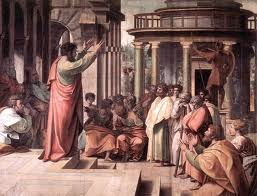
In Acts 17:16-34, however, one finds the apostle Paul evangelizing intelligent Athenians who are utterly biblically illiterate. Here his approach is remarkably different, and has much to teach us as we attempt to evangelize a new generation of biblical illiterates.

Now while Paul was waiting for them at Athens, his spirit was provoked within him as he saw that the city was full of idols. So he reasoned in the synagogue with the Jews and the devout persons, and in the marketplace every day with those who happened to be there. Some of the Epicurean and Stoic philosophers also conversed with him. And some said, “What does this babbler wish to say?” Others said, “He seems to be a preacher of foreign divinities”—because he was preaching Jesus and the resurrection. And they took hold of him and brought him to the Areopagus, saying, “May we know what this new teaching is that you are presenting? For you bring some strange things to our ears. We wish to know therefore what these things mean.” Now all the Athenians and the foreigners who lived there would spend their time in nothing except telling or hearing something new. So Paul, standing in the midst of the Areopagus, said: “Men of Athens, I perceive that in every way you are very religious. For as I passed along and observed the objects of your worship, I found also an altar with this inscription, ‘To the unknown god.’ What therefore you worship as unknown, this I proclaim to you. The God who made the world and everything in it, being Lord of heaven and earth, does not live in temples made by man, nor is he served by human hands, as though he needed anything, since he himself gives to all mankind life and breath and everything. And he made from one man every nation of mankind to live on all the face of the earth, having determined allotted periods and the boundaries of their dwelling place, that they should seek God, in the hope that they might feel their way toward him and find him.

Yet he is actually not far from each one of us, for ‘In him we live and move and have our being’; as even some of your own poets have said, ‘For we are indeed his offspring.’ Being then God’s offspring, we ought not to think that the divine being is like gold or silver or stone, an image formed by the art and imagination of man. The times of ignorance God overlooked, but now he commands all people everywhere to repent, because he has fixed a day on which he will judge the world in righteousness by a man whom he has appointed; and of this he has given assurance to all by raising him from the dead.”

Now when they heard of the resurrection of the dead, some mocked. But others said, “We will hear you again about this.” So Paul went out from their midst. But some men joined him and believed, among whom also were Dionysius the Areopagite and a woman named Damaris and others with them.

I have organized the rest of what I have to say under four topics: the realities Paul faces, the priorities he adopts, the framework he establishes, and the nonnegotiable gospel he preaches.

(1) THE REALITIES PAUL FACES

Apart from their obvious biblical illiteracy — these Athenian intellectuals had never heard of Moses, never cracked a Bible — three features of this culture are striking.

First, the Roman Empire was characterized not only by large-scale empirical pluralism but also by government-sponsored religious pluralism. The Romans knew that a captive people were more likely to rebel if they could align religion, land, and people. Partly to break up this threefold cord, the Romans insisted on adopting into their own pantheon some of the gods of any newly subjugated people, and they insisted equally strongly that the newly subjugated people adopt some of the Roman gods. In any potential civil war, therefore, it would be quite unclear which side the gods were helping — and this policy of god-swaps strengthened the likelihood of imperial peace. It also meant that religious pluralism was not only endemic to the Empire but was buttressed by the force of law After all, it was a capital offense to desecrate a temple — any temple. But let no temple and no God challenge Washington — I mean Rome.

Second, like us, Paul was dealing not with people who were biblically illiterate and therefore had no worldview, but with people who vociferously argued for various competing and powerful worldviews.

Two are mentioned in the text: Epicurean and Stoic (v. 18). In the first century, philosophy did not have the fairly esoteric and abstract connotations it has today, connected with minor departments in large universities. It referred to an entire way of life, based on a rigorous and self-consistent intellectual system — close to what we mean by worldview The ideal of Epicurean philosophy, Epicurean worldview, was an undisturbed life — a life of tranquility, untroubled by undue involvement in human affairs.

The gods themselves are composed of atoms so fine they live in calmness in the spaces between the worlds. As the gods are nicely removed from the hurly-burly of life, so human beings should seek the same ideal. But over against this vision, as we shall see, Paul presents a God who is actively involved in this world as its Creator, providential Ruler, Judge, and self-disclosing Savior.

Stoic philosophy thought of god as all-pervasive, more or less in a pantheistic sense, so that the human ideal was to live life in line with what is ultimately real, to conduct life in line with this god/principle of reason, which must rule over emotion and passion. Stoicism, as someone has commented, was “marked by great moral earnestness and a high sense of duty.” Against such a vision, the God that Paul presents, far from being pantheistic, is personal, distinct from the creation, and is our final judge. Instead of focusing on “universal reason tapped into by human reasoning,” Paul contrasts divine will and sovereignty with human dependence and need. In short, there is a massive clash of worldviews.

Of course, there were other Greek and Latin worldviews. There is no mention here of the sophists or of the atheistic philosophical materialists such as Lucretius. What is clear is that Paul here finds himself evangelizing men and women deeply committed to one fundamentally alien worldview or another.

Third, no less striking is the sneering tone of condescension they display in verse 18: What is this babbler trying to say? — this “seed picker,” this little bird fluttering around picking up disconnected scraps of incoherent information, this second-class mind? Others remarked, He seems to be advocating foreign gods. Of course, as it turns out, some of these people become genuinely interested in the gospel. The tenor of condescension is unmistakable, however, when an alien worldview feels secure in its thoughtless majority.

These, then, are the realities Paul faces.

(2) THE PRIORITIES PAUL ADOPTS

The most immediate and striking response of the apostle Paul to all that he witnesses in Athens is an intuitively biblical analysis: he is greatly distressed to see that the city was full of idols (v. 16). Paul might have been overwhelmed by Athens’ reputation as the Oxford or Cambridge or Harvard of the ancient world (though universities per se did not then exist). He might have admired the architecture, gaping at the Parthenon. But Paul is neither intimidated nor snookered by Athens; he sees the idolatry. How we need Christians in our universities and high places who are neither impressed nor intimidated by reputation and accomplishment if it is nothing more than idolatry!

The apostle sets out, then, to evangelize. He aims at two quite different groups. As usual, he attaches a certain priority to evangelizing Jews and Godfearing Gentiles, the churchy folk, the biblically literate people; he reasons in the synagogue with the Jews and the God-fearing Greeks (v. 17a). He has a theological reason for this priority that we cannot examine here, but in any case we must never forget to evangelize such people. Second, he evangelizes the ordinary pagans who have no connection with the Bible: he evangelizes day by day in the market place, targeting anyone who happens to be there, most of whom would have been biblically illiterate (v. 17b). He does not wait for an invitation to the Areopagus. He simply gets on with his evangelism, and the invitation to the Areopagus is the result (v. 18).

These, then, are his priorities: God-centered cultural analysis, and persistent evangelism of both biblical literates and biblical illiterates.

Perhaps I should add that there is at least one fundamental difference between Paul’s situation and ours. When Paul evangelizes biblical illiterates, he is dealing with people whose heritage has not in recent centuries had anything to do with biblical religion. So when they react negatively to him, they do so solely because, from their perspective, his frame of reference is so alien to their own. They are not rejecting him in part because they are still running away from their own heritage. That is the additional problem we sometimes face. We sometimes deal with men and women who have adopted a worldview that is not only at several points profoundly antithetical to a biblical worldview but also self-consciously chosen over against that biblical worldview. That opens up some opportunities for us, but it raises some additional barriers as well. However, we cannot probe these opportunities and barriers here. It is enough to observe the priorities that Paul adopts.

(3) THE FRAMEWORK PAUL ESTABLISHES

Here it will be helpful to run through Paul’s argument from 17:22 to 17:31. Before I do so, however, I want to make three preliminary observations.

First, it takes you about two minutes to read this record of Paul’s address. But speeches before the Areopagus were not known for their brevity. In other words, we must remember that this is a condensed report of a much longer speech. Doubtless every sentence, in some cases every clause, constituted a point that Paul expanded upon at length.

Second, if you want to know a little more closely just how he would have expanded each point, it is easier to discover than some people think. For there are many points of comparison between these sermon notes and, for instance, Romans. I’ll draw attention to one or two of the parallels as we move on.

Third, there is a fascinating choice of vocabulary. It has often been shown that many of the expressions in this address, especially in the early parts, are the sorts of things one would have found in Stoic circles. Yet in every case, Paul tweaks them so that in his context they convey the peculiar emphases he wants to assign to them. In other words, the vocabulary is linguistically appropriate to his hearers, but at the level of the sentence and the paragraph, Paul in this report is saying just what he wants to say; he is establishing a biblical worldview.

Now let us scan the framework Paul establishes.

First, he establishes that God is the creator of the world and everything in it (17:24). How much he enlarged on this point we cannot be certain, but we know from his other writings how his mind ran. The creation establishes that God is other than the created order; pantheism is ruled out. It also establishes human accountability; we owe our Creator everything, and to defy him and set ourselves up as the center of the universe is the heart of all sin. Worse, to cherish and worship created things instead of the Creator is the essence of idolatry.

Second, Paul insists that God is the Lord of heaven and earth and does not live in temples built by hands (v. 24). The sovereignty of God over the whole universe stands over against views that assign this god or that goddess a particular domain — perhaps the sea (Neptune), or tribal gods with merely regional or ethnic interests. The God of the Bible is sovereign over everything. This teaching grounds the doctrine of providence. Because of the universality of his reign, God cannot be domesticated — not even by temples (v. 24). Paul is not denying the historical importance of the temple in

Jerusalem, still less that God uniquely disclosed himself there. Rather, he denies that God is limited to temples, and that he can be domesticated or squeezed or tapped into by the cultus of any temple (which of course threatens popular pagan practice). He is so much bigger than that.

Third, God is the God of aseity: he is not served by human hands, as if he needed anything (17:25). Aseity is a word now largely fallen into disuse, though it was common in Puritan times. Etymologically it comes from the Latin a se — “from himself.” God is so utterly “from himself” that he does not need us; he is not only self-existent (a term we often deploy with respect to God’s origins — the existence of everything else is God-dependent, but God himself is self-existent), but he is utterly independent of his created order so far as his own well-being or contentment or existence are concerned. God does not need us — a very different perspective from that of polytheism, where human beings and gods interact in all kinds of ways bound up with the finiteness and needs of the gods. The God of the Bible would not come to us if, rather whimsically, he wanted a McDonald’s hamburger; the cattle on a thousand hills are already his.

Fourth, the truth of the matter is the converse: we are utterly dependent on him — he himself gives all men life and breath and everything else (v. 25b). This strips us of our vaunted independence; it is the human correlative of the doctrines of creation and providence.

Fifth, from theology proper, Paul turns to anthropology. He insists that all nations descended from one man (v. 26). This contradicts not a few ancient notions of human descent, which conjectured that different ethnic groups came into being in quite different ways. But Paul has a universal gospel that is based on a universal problem (cf. Rom. 5; 1 Cor. 15). If sin and death were introduced into the one human race by one man such that the decisive act of another man is required to reverse them, then it is important for Paul to get the anthropology right so that the soteriology is right. We cannot agree on the solution if we cannot agree on the problem. But Paul’s stance has yet wider implications; there is no trace of racism here. Moreover, however much he holds that God has enjoyed a peculiar covenant relationship with Israel, because he is a monotheist, Paul holds that God must be sovereign over all the nations. Did he, perhaps, develop some of the lines of argument one finds in Isaiah 40ff.? If there is but one God, that God must in some sense be the God of all, whether his being and status are recognized by all or not.

Sixth, for the first time one finds an explicit reference to something wrong in this universe that God created. His providential rule over all was with the purpose that some would reach out for him and find him (v. 27). In short order Paul will say much more about sin (without actually using the word). Here he is preparing the way. The assumption is that the race as a whole does not know the God who made them. Something has gone profoundly wrong.

Seventh, although it has been important for him to establish God’s transcendence, Paul does not want such an emphasis to drift toward what would later be called deism. The God he has in mind is not far from each one of us (v. 27). He is immanent. Paul will not allow any suspicion that God is careless or indifferent about people; he is never far from us. Moreover, the apostle recognizes that some of this truth is acknowledged in some pagan religions. When Greek thought (or much of it) spoke of one “God” as opposed to many gods, very often the assumption was more or less pantheistic. That structure of thought Paul has already ruled out. Still, some of its emphases were not wrong if put within a better framework. We live and move and have our being in this God, and we are his offspring (17:28) — not, for Paul, in some pantheistic sense, but as an expression of God’s personal and immediate concern for our well-being.

Eighth, the entailment of this theology and this anthropology is to clarify what sin is and to make idolatry utterly reprehensible (v. 29). Doubtless Paul enlarged this point very much in terms of, say, Isaiah 44-45 and Romans 1. For he cannot rightly introduce Jesus and his role as Savior until he establishes what the problem is; he cannot make the good news clear until he elucidates the bad news from which the good news rescues us.

Ninth, Paul also introduces what might be called a philosophy of history — or better, perhaps, a certain view of time. Many Greeks in the ancient world thought that time went round and round in circles. Paul establishes a linear framework: creation at a fixed point; a long period that is past with respect to Paul’s present in which God acted in a certain way (In the past God over-looked such ignorance); a now that is pregnant with massive changes; and a future (v. 31) that is the final termination of this world order, a time of final judgment. The massive changes of Paul’s dramatic now are bound up with the coming of Jesus and the dawning of the gospel. Paul has set the stage so as to introduce Jesus.

So here is the framework Paul establishes. He has, in fact, constructed a biblical worldview. But he has not done so simply for the pleasure of creating a worldview. In this context he has done so in order to provide a framework in which Jesus himself, not least his death and resurrection, makes sense. Otherwise nothing that Paul wants to say about Jesus will make sense.

This is the framework Paul establishes.

(4) THE NONNEGOTIABLE GOSPEL PAUL PREACHES

We read again verse 31: For [God] has set a day when he will judge the world with justice by the man he has appointed. He has given proof of this to all men by raising him from the dead.

Here, at last, Jesus is introduced.

I want to emphasize two things. First, it is extraordinarily important to see that Paul has established the framework of the biblical metanarrative before he introduces Jesus. If metaphysics is a sort of big physics that explains all the other branches of physics, similarly metanarrative is the big story that explains all the other stories. By and large, postmodernists love stories, especially ambiguous or symbol-laden narratives. But they hate the metanarrative, the big story that makes all the little stories coherent. But what Paul provides is the biblical metanarrative. This is the big story in the Bible that frames and explains all the little stories. Without this big story, the accounts of Jesus will not make any sense — and Paul knows it.

For instance, if in a vague, New Age, postmodern context, we affirm something like “God loves you,” this short expression may carry a very different set of associations than we who are Christians might think. We already assume that men and women are guilty and that the clearest and deepest expression of God’s love is in the cross, where God’s own Son dealt with our sin at the expense of his own life. But if people know nothing of this story line, then the same words, “God loves you,” may be an adequate summary of the stance adopted by Jodie Foster in her recent film, Contact. The alien power is beneficent, wise, good, and interested in our well-being. There is nothing whatever to do with moral accountability, sin, guilt, and how God takes action to remove our sin by the death of his Son. The one vision nestles into the framework of biblical Christianity; the other nestles comfortably into the worldview of New Age optimism. In short, without the big story, without the metanarrative, the little story or the little expression becomes either incoherent or positively misleading. Paul understands the point.

Second, what is striking is that Paul does not flinch from affirming the resurrection of Jesus from the dead. And that is what causes so much offense that Paul is cut off, and the Areopagus address comes to an end. Paul was thoroughly aware, of course, that most Greeks adopted some form of dualism. Matter is bad, or at least relatively bad; spirit is good. To imagine someone coming back from the dead in bodily form was not saying anything desirable, still less believable. Bodily resurrection from the dead was irrational; it was an oxymoron, like intelligent slug or boiled ice. So some of Paul’s hearers have had enough, and they openly sneer and end the meeting (v. 32). If Paul had spoken instead of Jesus’ immortality, his eternal spiritual longevity quite apart from any body, he would have caused no umbrage. But Paul does not flinch. Elsewhere he argues that if Christ has not been raised from the dead, then the apostles are liars, and we are still dead in our trespasses and sins (I Cor. 15). He remains faithful to that vision here. Paul does not trim the gospel to make it acceptable to the worldview of his listeners.

For Paul, then, there is some irreducible and nonnegotiable content to the gospel, content that must not be abandoned, no matter how unacceptable it is to some other worldview. It follows that especially when we are trying hard to connect wisely with some worldview other than our own, we must give no less careful attention to the nonnegotiables of the gospel, lest in our efforts to communicate wisely and with relevance, we unwittingly sacrifice what we mean to communicate.

But suddenly we overhear the muttered objection of the critic. Can it not be argued that Paul here makes a fundamental mistake? Elsewhere in Acts he frequently preaches with much greater fruitfulness, and in those cases he does not stoop to all this worldview stuff. He just preaches Jesus and his cross and resurrection, and men and women get converted. Here, a piddling number believe (v. 34). In fact, Paul’s next stop in Greece after Athens is Corinth. Reflecting later on his experiences there, Paul writes to the Corinthians and reminds them For I resolved to know nothing while I was with you except Jesus Christ and him crucified (I Cor. 2:2) — doubtless because he was reflecting with some sour-faced chagrin on his flawed approach in Athens. So let us be frank, the critics charge, and admit that Paul made a huge mistake in Athens and stop holding up Acts 17 as if it were a model of anything except what not to do. The man goofed: he appealed to natural theology; he tried to construct redemptive history; he attempted to form a worldview when he should have stuck to his last and preached Jesus and the cross.

I sometimes wish this reading were correct, but it is profoundly mistaken for a number of reasons.

(1) It is not the natural reading of Acts. As Luke works through his book, he does not at this point in his narrative send up a red flag and warn us that at this point Paul makes a ghastly mistake. The false reading is utterly dependent on taking I Corinthians in a certain way (a mistaken way, as we shall see), and then reading it into Acts 17.

(2) What Paul expresses, according to Luke’s report of the Areopagus address, is very much in line with Paul’s own theology, not least his theology in the opening chapters of Romans.

(3) Strictly speaking, Paul does not say that only a “few” men believed. He says tines de andres, “certain people,” along with heteroi, “others.” These are in line with other descriptions. The numbers could scarcely have been large, because the numbers in the Areopagus could not have been very large in the first place.

(4) Transparently, Paul was cut off when he got to the resurrection of Jesus (vv. 31-32). But judging from all we know of him — both from a book like Romans and from the descriptions of him in Acts — we know where he would have gone from here.

(5) That is entirely in line with the fact that what Paul had already been preaching in the marketplace to the biblically illiterate pagans was the cc gospel” (v. 18).

(6) At this point in his life Paul was not a rookie. Far from being fresh out of seminary and still trying to establish the precise pattern of his ministry, on any chronology he had already been through twenty years of thrilling and brutal ministry. Nor is this Paul’s first time among biblically illiterate pagans or among intellectuals.

(7) In any case, I Corinthians 2 does not cast Paul’s resolve to preach Christ crucified against the background of what had happened to him in Athens. He does not say, in effect, “Owing to my serious mistakes in Athens, when I arrived in Corinth I resolved to preach only Christ and him crucified.” Rather, in 1 Corinthians Paul’s resolve to preach Christ crucified is cast against the background of what Christians in Corinth were attracted to — namely, to a form of triumphalism that espoused an ostensible wisdom that Paul detests. It is a wisdom full of pride and rhetoric and showmanship. Against this background, Paul takes a very different course. Knowing that believers must boast only in the Lord and follow quite a different wisdom (I Cor. 1), he resolves to preach Christ and him crucified.

(8) In any case, it would be wrong to think that Paul has no interest in worldviews. Writing after I Corinthians 2, Paul can say, We demolish arguments and every pretension that sets itself up against the knowledge of God, and we take captive every thought to make it obedient to Christ (2 Cor. 10:45). The context shows that Paul is not here interested so much in disciplining the individual’s private thought life (though that certainly concerns him elsewhere) as in bringing into obedience to Christ every thought structure, every worldview, that presents opposition to his beloved Master. In other words, Paul thought “worldviewishly” (if that is not too monstrous a neologism). That is clear in many of his writings; it is clear in both 2 Corinthians 10 and in Acts 17.

(9) Finally, the first line of Acts 17:34 is sometimes misconstrued: “A few men became followers of Paul and believed.” Many have assumed Luke means that a few people became Christians on the spot and followers of Paul. But that reverses what is said. Moreover, Paul has not yet given much gospel — in precisely what sense would they have become Christians? It is better to follow the text exactly Following Paul’s address, no one became a Christian on the spot. But some did become followers of Paul. In consequence, in due course they grasped the gospel and believed; they became Christians. This is entirely in line with the experience of many evangelists working in a university environment today.

A couple of years ago I spoke evangelistically at a large meeting in Oxford. So far as I know, no one became a Christian at that meeting. But sixteen students signed up for a six-week “Discovering Christianity” Bible study. A few weeks after the meeting, the curate, Vaughan Roberts, wrote me a note to tell me that eleven of the sixteen had clearly become Christians already, and he was praying for the remaining five. In other words, as a result of that meeting, some became “followers of Jesus,” and in due course believed. That is often the pattern when part of the evangelistic strategy is to establish a worldview, a frame of reference, to make the meaning of Jesus and the gospel unmistakably plain.

In short, however sensitive Paul is to the needs and outlook of the people he is evangelizing, and however flexible he is in shaping the gospel to address them directly, we must see that there remains for him irreducible content to the gospel. That content is nonnegotiable, even if it is remarkably offensive to our hearers. If it is offensive, we may have to decide whether it is offensive because of the intrinsic message or because we have still not done an adequate job of establishing the frame of reference in which it alone makes sense. But the gospel itself must never be compromised.

SOME CONCLUDING REFLECTIONS

I offer three concluding reflections. First, the challenge of worldview evangelism is not to make simple things complicated but to make clear to others some fairly complicated things that we simply assume. This can be done in fifteen minutes with the sort of presentation Phillip Jensen and Tony Payne have constructed (in Chapter 6 of Telling the Truth – “Two Ways To Live”). It might be done in seven consecutive expositions running right through the first eight chapters of Romans. It might be done with the six months of Bible teaching, beginning with Genesis, that many New Tribes Mission personnel now use before they get to Jesus. But it must be done.

Second, the challenge of worldview evangelism is not primarily to think in philosophical categories, but it is to make it clear that closing with Jesus has content (it is connected with a real, historical Jesus about whom certain things must be said and believed) and is all-embracing (it affects conduct, relationships, values, priorities). It is not reducible to a preferential religious option among many, designed primarily to make me feel good about myself.

Third, the challenge of worldview evangelism is not primarily a matter of how to get back into the discussion with biblically illiterate people whose perspectives may be very dissimilar to our own. Rather, worldview evangelism focuses primarily on where the discussion goes. There are many ways of getting into discussion; the crucial question is whether the Christian witness has a clear, relatively simple, straightforward grasp of what the Bible’s story line is, how it must give form to a worldview, and how the wonderful news of the gospel fits powerfully into this true story — all told in such a way that men and women can see its relevance, power, truthfulness, and life-changing capacity.

*”Athens Revisited” was originally a lecture at a conference on the topic of Evangelism in a Post Modern Culture held on May 13-15, 1998 at Trinity Evangelical Divinity School in Deerfield, Illinois & sponsored by the Bannockburn Institute (www.biccc.org). All the lectures from this conference were published in the book: Telling The Truth: Evangelizing Postmoderns, Grand Rapids: Zondervan, 2000; of which D.A. Carson was the general editor and the contributor of Chapter 28 from which this article is adapted.

About the Author: D. A. Carson (Ph.D., University of Cambridge) is research professor of New Testament at Trinity Evangelical Divinity School in Deerfield, Illinois. His theology is similar to that of Wayne Grudem except on charismatic issues, where his view may be described as “open but cautious.” Carson’s tendency is to strive for balance and amicability in disputes but is uncompromising on the essentials of the faith. He is a complementarian but supports gender-neutral Bible translations. Carson also helped produce the NLT. He is the author or coauthor of over 50 books. Some of the plethora of outstanding books he has written includes: The Intolerance of Tolerance, The God Who Is There, ScandalousHow Long O Lord, A Call to Spiritual Reformation; The Cross and Christian Ministry; The Difficult Doctrine of the Love of God; Divine Sovereignty and Human Responsibility; Exegetical Fallacies; For the Love of God; The Gagging of God; The Inclusive Language Debate; Introduction to the New Testament; New Testament Commentary Survey; Scripture and Truth (Ed. with John Woodbridge); Worship by the Book; Pillar Commentaries on Matthew and John and a contributor to Who Will be Saved. He also edits the New Studies in Biblical Theology book series.

Carson’s areas of expertise include biblical theology, the historical Jesus, postmodernism, pluralism, Greek grammar, Johannine theology, Pauline theology, and questions of suffering and evil. He has written books on free will and predestination from a generally compatibilist and Calvinist perspective. He is a member of the Tyndale Fellowship for Biblical Research, the Society of Biblical Literature, the Evangelical Theological Society, the Canadian Society of Biblical Studies, and the Institute for Biblical Research.

Dr. Carson and his wife, Joy, reside in Libertyville, Illinois. They have two children. In his spare time, Dr. Carson enjoys reading, hiking, and woodworking.

Dr. Walter C. Kaiser, Jr. “WHAT’S SO IMPORTANT ABOUT PRE-MILLENNIALISM?”

A Common Misconception on the Millennium

Lion and Lamb image

One of the most common misconceptions in Biblical interpretation today is that “the thousand years” (hence: the “millennium”), of which John speaks in Revelation 20:1-7, are mentioned nowhere else in the Scripture.  And since it is generally agreed that no major doctrine should be based on any one single passage of the Bible, it is no wonder then that all too many have concluded that pre-millennialism likewise should not be among any of our major doctrinal creeds.

However, a more careful study of God’s Word dissipates this conclusion.  The truth is that the “thousand years,” along with parallel expressions, are found in both testaments and constitutes one of the high points in Biblical prophecy.  Before we look at some of these key texts, it is important to note that the Kingdom of God in heaven and on earth is one of the grand themes of the whole Bible.  A quick review of that Kingdom (in its inception, progress, conduct, and consummation) should set the stage for our considering the key teaching passages in a pre-millennial doctrine.

The Kingdom of God

The Two Advents: The Kingdom of God has two advents, two ages, two resurrections, and two end points.  Few, except some of Jesus’ own kin-folks, deny that the first advent has already occurred.  In a Television debate I had with Rabbi Pincas Lapide on the John Ankerberg Television show a good number of years ago, he observed that the difference between his Jewish viewpoint and my evangelical one was that I, as an evangelical, believed in two comings of the Messiah and he, as a believer in the Tenak (= the Old Testament), only adopted one: a coming of the Messiah in a time of world peace.  I replied, “But Dr. Lapide, Zechariah 12:10 says `They will look on me, the one they have pierced, and they will mourn for him as one mourns for an only child… a firstborn son.’  I asked, `Who is the one speaking in this text that they will look on?’  He replied: `The Almighty!’  Then I asked, `How did he get pierced, then?’  ‘I do not know he said.’  My retort was, `I have an idea how: it was at Calvary in his first coming.’  Later the Messiah will come in a second advent in a time of final peace as this same chapter in Zechariah points out.”  Yes, there are two advents advocated in the Biblical text of both the Old and the New Testaments.

The Two Ages: But besides the two advents of Messiah, there are also two ages: in Hebrew- “`Olam Hazzeh,” “This age,” and “`Olam Habba, “The age to come.”  The New Testament Greek employs these same two divisions of time some thirty times: “Aion ho houtos,” “This age,” and “Aion ho mellon,” “The age to come.”  The “Age to come” overlaps “this Age” with the work of Christ in casting out demons, and especially in his resurrection from the dead.  While the “age to come” is still only in its incipient form, for the second advent will come in the future in its full realization.

The Two Resurrections of I Corinthians 15:22-24

Even more significantly, there are two resurrections, not just one.  Revelation 20:5 speaks of “the first resurrection,” which all too many seek to reduce in meaning by spiritualizing, allegorizing, or idealizing it in place of a literal resurrection.  But what John calls “the first resurrection,” the apostle Paul refers to “those who are Christ’s at his coming” in 1 Corinthians 15:23.  In fact, the Apostle Paul has given us just as strong a text for pre-millennialism as has the Apostle John in the Apocalypse.

I Corinthians 15: 22 begins that just as “…in Adam all die, [for which the cemetery is our main, but all convincing, evidence], so in Christ all will be made alive.”  This affirms that every mortal, regardless of race, gender, religion, or the absence of any religious affiliation, will be resurrected in the final day.  Instead of proving universalism, as Karl Barth taught from this passage (i.e., that every one will eventually be saved), the Greek text, which had no punctuation in the original text, follows immediately after observing that “all will be made alive,” with the qualification, “but each in his own turn.” The Greek word for “turn” is a military term (Tagmati), meaning “rank,” “squad,” or “platoon.” So all are resurrectible, i.e., they can “be made alive,” but only in distinct squads, platoons, or divisions.  This text lists three such squads: (1) [vs. 23] “Christ, the firstfruits,” [at the first Easter morning] (2) “then, when he comes for those who belong to him,” and (3) [vs. 24] “Then the end will come, when he hands over the kingdom to God the Father after he has destroyed all dominion, authority and power.” 

The most important matter to note is that Christ’s resurrection sets the pattern for the two resurrections that are to follow in the plan of the Kingdom of God. It is also important to note that there is a temporal space of time between the resurrections as indicated by the word “then,” which in Koine and Classical Greek is represented by the words that always go together: epeita….eita, (“then …. Then”).  These two are routinely found together in Greek to represent a time period between them as in the Gospel record, “First the blade and then the ear and then the full corn [old world wheat and the like] doeth appear.”  Surely this signals the growth of the wheat in its various stages with a time gap between them.  That is exactly what the apostle John was indicating, though he was more specific as to the time period, labeling it as a “thousand years.”

In just the same manner, the Greek Aorist tense of “lived” or “came to life” (in Revelation 20:40 indicated one definite act, which was called the “First Resurrection” in Revelation 20:4.  “They lived” can only mean they came to life again and returned to a life like their former life as it also means in Revelation 2:8, and of the beast in Revelation 13:14 and elsewhere (e.g., John 5:25; Romans 8:13).  The famous quote of Alford needs to be stated again:

“If in a passage [Rev 20:4] where two resurrections are mentioned, – where certain souls lived, at first, and the `Rest of the dead’ lived only at the end of a specified period, after that first, — the `First Resurrection’ may be understood to mean a spiritual rising with Christ, while the second means a literal rising from the grave, then there is an end of all significance in language, and Scripture is wiped out as a definite testimony to anything. If the `First Resurrection’ is spiritual, then so is the second, – which I suppose none will be hardy enough to maintain.  But if the second is literal, then so is the first, which, in common with the whole primitive church, and many of the best expositors, I do maintain and receive as an article of faith and hope….  I have ventured to speak strongly, because my conviction is strong, founded on the rules of fair and consistent interpretation.  It is a strange sight, in these days, to see expositors, who are among the first, in reverence of antiquity, complacently casting aside the most cogent instance of unanimity which primitive antiquity presents.”

The First Resurrection is just as literal a resurrection in John’s Apocalypse as it is in Paul’s “those who belong to him when he comes” (1 Cor. 15:23).  And in both John and Paul, those resurrections are separated by a period of time.

Nor does the fact that John saw only “souls” detract from a literal bodily resurrection, for the souls that had heretofore enjoyed heavenly joy were now to be reunited with their bodies.  Note that John does not say the “souls” “lived and reigned,” but the same “they” who were beheaded, and the “they” who had not received the mark of the beast, were the same ones who “came alive” and were reunited with their bodies and who reigned with Christ for a thousand years.

The Two Ends: There are also two ends along with the two advents, two ages, and two resurrections.  The first end is signaled by the coming of the Son of Man, our Lord Jesus from the clouds of heaven in his second advent. The prophet Daniel brilliantly laid this out in Daniel 7:9 – 14 as did the prophet Ezekiel in his Apocalypse in chapters 37 – 48. Instead of a Valley of Dry Bones, the nation Israel is resurrected again with an implantation of the revitalizing breath of Life in each of the skeletons of bones as the nation is once again placed back in her own land.  This marks the opening of the Age to Come, now in its full view (even though it had been inaugurated in the life and times of Jesus the Messiah), and the thousand year rule and reign of Christ with his saints of both Jewish and Gentile believers.

The second end comes with the Great White Judgment throne in which all the rest of the dead are resurrected to be examined by our Lord to see if their names are in the Lamb’s book of Life.  This does not end the Age to come, for it goes on without cessation into the eternal state and the Messianic Age of Eternity.

The Witness of Isaiah 24:21-23 to the “Multitude of Days”

In addition to the two great New Testament passages dealing with the millennium, Isaiah 24:21 – 23 can take the next pride of place.  It too places its prediction in “that day of the Lord” (Isa. 24:21), which “Day of the Lord” is mainly an Old Testament term that parallels the contents of the New Testament “Apocalypse of Jesus Christ” (Rev 1:1).  Exhibiting the organic nature of prophecy, a separate name in germ form (an example of an epigenetic growth) is used for what John will later call in Greek Chilia Ete, “a thousand years.”  Isaiah names that same period of time Rov Yamim, “a multitude of days,” or “many days.”

Isaiah speaks of the Day of the Lord when Messiah himself will judge and then restore the kingdom to Israel.  At that time, the Lord will “punish” (or “visit”) the powers in heaven above and the kings of the earth in such a fashion that they will be gathered together as “prisoners” in a “pit” or “dungeon” and “shut up in prison.”  “After many days,” (i.e., equal to John’s “millennium,” but here not specified exactly) they will appear for judgment.  At that same time, “the moon will be confounded and the sun ashamed when the Lord Almighty will reign on Mount Zion and in Jerusalem and before his elders, gloriously” (Isa. 24: 22-23).  Here, then, is a third major teaching text on the millennium.

This is the time during the thousand years when Satan is cast down to the pit “In that day.”  It is when Michael stands forth to fight for Israel (Dan 12:1; Rev 12:7) and when according to the vision of John “the angel, having the key of the abyss, and a great chain in his hand, laid hold of the dragon, the Old Serpent, which is the Devil and Satan, and bound him for a thousand years, and cast him into the abyss, and shut and sealed him over, that he should deceive the nations no more, until the thousand years should be finished, or almost so, after which he must be loosed for a little season” (Rev 20:1-3).

Note that Isaiah also fixes the duration of the imprisonment of Satan as a “multitude of days,” or “many days.”  Isaiah also says that it is “after” these “many days” that the “powers of heaven” and “the kings of earth” will have their final retribution.  This implies their future unchaining and being loosed again.  Thus Isaiah 24:22 involves a resurrection of the wicked at the close of the “many days.”

The Witness of Ezekiel 37–48

In this Ezekielian Apocalpyse of chapters 37 – 48, the “whole house of Israel” is reanimated and revivified in the Valley of Dry Bones (Ezekiel 37:5,11). There, as one flock under one Shepherd and one nation under one king, the resurrected faithful dead of the nation Israel are resurrected and taken back to their promised land, just as God had promised in Deuteronomy 32:39; Psalm 17:15; 49:14, 15; Hosea 13:14; Isaiah 25:6–9; 26:14,19; Ezekiel 37:12; and Daniel 12:1-3. Their “many days” of peace and blessedness are expanded on in Ezekiel 37:1– 28, as well as in Isaiah 2:2-5; 11:6 – 9; 24:23; 25:6–9; 60:1–22; 61:4–11; 62:2–12; 65:17–25; 66:20 23. This will be the time when Yahweh Shammah, “The LORD is there” (Ezekiel 48:35) living among them.

But again, “after many days,” (Ezekiel 38:8), Judgment will come on Gog with a punishment and visitation similar to what Isaiah 24:22 and Revelation 20:7–10 depict.  The termini of Isaiah 24:22, Ezekiel 38:8 and Revelation 20:7 are identical.  Remarkably, Ezekiel 28:25–26 notes that Israel will be secured from attack and the people will live in safety and their security will be undisturbed (also Ezekiel 38:8,11,12; Jeremiah 32:36-44).

Other Equivalent Expressions in Other Passages

If time and space would allow, we could add Psalm 102:13–22, where Messiah comes with his holy angels with glory to build up Zion.  Then he will judge the world in righteousness and “give dominion in the morning.” In addition to Psalm 102, is the expression “In His days,” found in Psalm 72:7. This too is a text noted as a great Messianic Psalm.

There is also that group of four bright Messianic Psalms in Psalms 96, 97, 98, and 99, ending in the remarkable Psalm 100.  Here every land in the world is called upon to make a joyful noise unto the Lord as he concludes the work in history he said he would do.

Conclusion

But notwithstanding all this data (and much more) on the terms for the “Thousand Years,” “Multitude of Days,” “Many Days,” “In His Day,” the case for Pre-millennialism is almost completely missed if one does not focus on the everlasting promise of God made to his people Israel.

Pre-millennialism is defined not merely as the future time in the Rule and Reign of God (the kingdom of God), bounded by the resurrection of all believers on the front end and the resurrection of the unbelieving wicked dead on the opposite end, during which period Satan is bound, but loosed for a brief time at the end of the millennium before he is cast forever into the abyss.  It is more precisely the time when God finishes in space and time what he promised historically to Abraham, Isaac, Jacob and David and his line.  It is therefore a whole philosophy of history with implications for the Christ-and-culture-hiatus that must find its resolution in the Lord of all creation and all value and beauty.

Principally the Abrahamic promise (Genesis 12:2 – 3) had three parts: (1) the promise of a Seed, the coming Messiah, (2) the promise of the land as a gift to Israel, but owned by God, and (3) the promise of the “Gospel” in which all the families of the earth would be blessed (Paul equated this aspect of the promise with the “Gospel” in Galatians 3:8). 

It is impossible to read, teach, and preach on the prophets of the Old Testament without bumping into the promise of a return of Israel to her land again and again, something like one verse out of every eight verses in the prophets!!!  This is what makes the return of Israel to her land once again in the future the most important and key part of the premillennial doctrine.

Some will attempt to say that Israel forfeited that promise when she disobeyed, but what she forfeited was only the right each of those disobedient persons or generations had to participate in the blessing promised.  Nevertheless, Israel still had to transmit the promise even though some would not enjoy its benefits.  Transmission of the promise is one thing; participation in the blessings of the promise is another thing altogether!

To say that the Church replaces Israel is not only a form of supersessionism, but it is also without exegetical merit as I have argued elsewhere (Dr. Walter C. Kaiser, Jr., “An Assessment of Replacement Theology: The Relationship Between Israel of the Abrahamic-Davidic Covenant and the Christian Church,” Mishkan, 21 [1994]: 9-20). Yes, Gentiles are included in the term “People of God” (just as the Jewish people who believe are part of the “People of God”), but the term “Israel” never loses its unique national, geo-political, or ethnic flavor.  This is not because God has favorites or that he is chauvinistic, but rather because God is faithful and true to his word. Once again, note clearly that there is a divine philosophy of history, in which God does complete within space and time what he proposed earlier on in redemptive history.

What is lost, some will ask, if we demote Pre-millennialism to a secondary doctrinal status?  Isn’t it true that the majority of Christians today do not recognize it as taught in the Bible – especially in a reformed or covenantal understanding of the text?  And if they do not recognize this doctrine, isn’t it also true that most think this teaching is reduced to only one teaching passage in the Bible?

But we have shown that it is widely represented in the Biblical text.  Moreover, most will also concede that pre-millennialism was the majority view of the Christian Church in the first three or four Christian centuries.  It was the influence of Origen’s allegorizing tendencies, St. Augustine’s change of his mind on this doctrine, and of the collaboration of Eusebius, Bishop of Nicomedia, with Emperor Constantine in their desire to capture the geo-political sides of the discussions of the Kingdom of God that brought the major change into the life of the Church.

But what is affected the most is the doctrine of redemption and God’s promise-plan for the ages.  It becomes a much more difficult matter to teach the Kingdom of God with its two ages, two advents, two resurrections and two ends without these key texts. Moreover, most will need to shy away from teaching the whole counsel of God, especially as it is found in the prophets.  Also, the very warp and woof of salvation, which Paul says in Romans 1:16 instructs us that it is impossible to talk about so great a “salvation” without at the same time noting that this Gospel is the power of God for salvation of everyone who believes: first for the Jew, then for the Gentile.  Romans 9–11 then, becomes not a parenthesis or an intercalation that interrupts the main flow of the story of redemption; on the contrary, one cannot talk about the gospel or our salvation without constantly intermingling the Jew/Gentile question.  Like it or not, the Jewish question will be the ragged edge on which many will be tested and found deficient from an truly exegetical standpoint of the clear witness of Scripture.

I urge Christ’s Church to go slowly in its rush to jettison the pre-millennial position, or to avoid teaching about the future return of Israel to the land God promised her.  It can only lead to other problems down the road:

(1) problems with correctly exegeting numerous passages from the prophets about Israel’s future;

(2) problems with the nature and extent of the “Gospel,”

(3) problems with a view of history;

(4) problems with the definition of the Kingdom of God; and

(5) problems with being ashamed of the whole redemptive program of God that is for the Jew first and then for the Gentile/Greek.

May our Lord grant us his grace and wisdom to fairly represent the entirety of the “Good News.

*Walter C. Kaiser Jr. (PhD, Brandeis University) is the distinguished professor emeritus of Old Testament and president emeritus of Gordon-Conwell Theological Seminary in South Hamilton, Massachusetts. Dr. Kaiser has written over 40 books, including Toward an Exegetical Theology: Biblical Exegesis for Preaching and Teaching; A History of Israel; The Messiah in the Old Testament; Recovering the Unity of the Bible; The Promise-Plan of God; Preaching and Teaching The Last Things; and coauthored (with Moises Silva) An Introduction to Biblical Hermeneutics. Dr. Kaiser and his wife, Marge, currently reside at Kerith Farm in Cedar Grove, Wisconsin. This article is adapted from Dr. Kaiser’s website: www.walterckaiserjr.com

Dr. Zack Eswine’s Sermon Preparation Help For Preaching in a Post-Everything World

 *Adapted from Appendix 1 in Zach Eswine’s outstanding award winning book

Preaching to a Post-Everything World: Crafting Biblical Sermons that Connect with our Culture (Grand Rapids, MI.: Baker, 2008).

Use the Four Stories in Six Steps


^Day/Hour – (explanation: Some might use one day for each step. For these preachers I have broken steps down into days. Others might use each step in one day. For these preachers I have broken the steps down into hours.)

 ^Monday/Hour One – Step One

 Story #1 – Goal = What does this text teach me about God?

Identify the textual manner (word type and mood).

Locate parrot words. Connecting words, and divine comments.

Interrogate the big idea with questions (who, what, when, where, why, how)

Show and tell from the text.

Identify the echoes of redemption (armor, promise, fruit, gift, diaconal, miracle, community, divine silence, himself).

Find the illustrative path (picture, sensory, and creation words).

^Tuesday/Hour Two – Step Two

 Story #2 – Goal = What does this text teach me about people?

Identify echoes of creation (worship, relationship, vocation, conscience)

Identify echoes of the fall (fallen, finite, fragile, faltering)

Identify idol noise (superstition, skepticism, suspicion, stardom, stealing, squandering, sophistry).

Expose my moralistic responses to fallen echoes and idol noise.

Locate the vine.

^Wednesday/Hour Three – Step Three

 Story #3 – Goal = What does this text teach me about life under the sun?

Identify the Context of Reality (COR) (life situations, life seasons).

Discern my expository bans (censoring, muting, equivocating, evicting).

Expose my simplistic response to life under the sun.

Account for the accents of my hearers (memoir, marketplace, lore, land).

Translate cultural connections with biblical redirection (“You have heard it said…, but I say to you…”).

Describe the third way.

Account for the consciences of my hearers (hard-hearted and soft-hearted).

Bring echoes of heaven and hell into these features as appropriate.

^Thursday/Hour Four – Step Four

 Story #4 – Goal = What does this text say to me?

Receive instruction (grieving and quenching the Spirit).

Locate the vine.

Seek repentance.

Find forgiveness.

Give thanks and praise.

Testify.

^Friday/Hour Five – Step Five

 Goal: Place the four stories into a deductive or inductive sermon form


^Saturday/Sunday/Hour Six – Step Six

 Goal = Pray the four stories

Pray for illumination = Psalm 119:18, “Open my eyes, that I may behold wondrous things out of your law.”

Pray for a message = Ephesians 6:19, “and also for me, that words may be given to me in opening my mouth boldly to proclaim the mystery of the gospel.”

Pray for an open door = Colossians 4:3-4, “At the same time, pray for us, that God may open to us a door for the word, to declare the mystery of Christ, on account of which I am in prison.”

Pray for effectiveness = 2 Thessalonians 3:1, “Finally, brothers, pray for us, that the word of the Lord may speed ahead and be honored, as happened among you,”

Pray for clarity = Colossians 4:4, “that I may make it clear, which is how I ought to speak.”

Pray for boldness = Ephesians 6:20, “for which I am an ambassador in chains, that I may declare it boldly, as I ought to speak.”

Pray for a deliverance = 2 Thessalonians 3:2, “and that we be delivered from wicked and evil men. For not all have faith.”

*Zack Eswine serves as the Senior Pastor of Riverside Community Church in St. Louis, Missouri. His role focuses his time on setting vision, preaching, spiritual formation and pastoral care.

Dr. Eswine has served in pastoral roles for over twenty years. He served as Assistant Professor of Homiletics and Director for Doctor of Ministry for six years at Covenant Theological Seminary.  Zack’s most recent book, won Preaching Today’s Book of the Year Award in 2009. It is entitled, Preaching to a Post-Everything World: Crafting Biblical Sermons that Connect with our Culture (Baker, 2008).  He has also written, Kindled Fire: How the Methods of C.H. Spurgeon can help your Preaching (Mentor, 2006). His forthcoming books are entitled, Preaching Barefoot: Life and Ministry as a Human Being (Crossway) and Spurgeon’s Sorrows: Handling the Darker Sides of Life and Ministry (Christian Focus).

The “Jesus Focus” in the Book of Romans

Reading The Bible Through The Jesus Lens in the Book of Romans

From Biblical Book to Biblical Hook

Chart adapted from *Dr. Michael Williams Book

Title for Romans

Romans: Theme

Romans 6:23

“Death to Life”

Through Christ, God brings His chosen ones from death to life.

“For the wages of sin is death, but the gift of God is eternal life in Christ Jesus our Lord.”

Christ-Focus in Romans

Implications from Romans

Hooks from Romans

Jesus died to sin and lives for the glory of God.

“For the death he died he died to sin, once for all, but the life he lives he lives to God.”


– Romans 6:10

We have died to sin through the death of Christ, and through the resurrection of Christ we live for God’s glory.

“So you also must consider yourselves dead to sin and alive to God in Christ Jesus.”


– Romans 6:11


What harmful habits are you having a hard time kicking?

Why might that be?

What is standing in your way to a more fulfilling life?

How would you describe a more fulfilling life?

*Michael James Williams in his own words: “After my conversion in the U. S. Navy (in a submarine beneath the North Atlantic!), I entered Columbia Bible College, where I received a B.A. (1985). This was followed by an M.A. in Religion at Westminster Theological Seminary (1987) and a Ph.D. in Biblical Studies at the University of Pennsylvania (1999). In 2000, I was ordained in the Christian Reformed Church, and since 1995 have been teaching at Calvin Theological Seminary. I have also taught courses at Westminster Theological Seminary, the University of Pennsylvania, and brief stints in Limuru, Kenya; Donetsk, Ukraine; and Warsaw, Poland. In addition to articles on Old Testament topics in various reference works and academic journals, and contributing to and editing “Mishneh Todah: Studies in Deuteronomy and Its Cultural Environment in Honor of Jeffrey H. Tigay” (2009); I have authored “Deception in Genesis: A Comprehensive Analysis of a Unique Biblical Phenomenon” (2001); “The Prophet and His Message: Reading Old Testament Prophecy Today” (2003); and, most recently, “How to Read the Bible through the Jesus Lens: A Guide to Christ-Focused Reading of Scripture” (2012). My amazing wife, Dawn, and I enjoy hiking and all things outdoors.”

The “Jesus Focus” in the Book of Acts by Dr. Michael Williams

Reading The Bible Through The Jesus Lens in the Book of Acts

From Biblical Book to Biblical Hook

Chart adapted from *Dr. Michael Williams Book

Title for Acts

Acts: Theme

Acts 1:8

“Witness”

God expands and empowers his church through his Spirit.

“You will receive power when the Holy Spirit comes on you; and you will be my witnesses in Jerusalem, and Samaria, and to the ends of the earth.”

Christ-Focus in Acts

Implications from Acts

Hooks from Acts

The Spirit of the risen Christ empowers witness about him.

 And Jesus said to them,

“Follow me, and I will make you become fishers of men.”

 – Mark 1:17

Let the Spirit of the risen Christ empower our witness to the gospel.

 “for God gave us a spirit not of fear but of power and love and self-control.

 Therefore do not be ashamed of the testimony about our Lord, nor of me his prisoner, but share in suffering for the gospel by the power of God.”

 – 2 Timothy 1:7-8


When was the last time you told someone the good news of salvation in Christ?

 What prevents you from doing so more often?

 How did you hear the gospel?

 Is the effectiveness of your witness of Christ ultimately up to you?

 How do you acknowledge and draw on the strength of the indwelling Spirit for your witness to life in Christ?

 In your present circumstances, what is one way you could make the gospel clear to others?


*Michael James Williams in his own words: “After my conversion in the U. S. Navy (in a submarine beneath the North Atlantic!), I entered Columbia Bible College, where I received a B.A. (1985). This was followed by an M.A. in Religion at Westminster Theological Seminary (1987) and a Ph.D. in Biblical Studies at the University of Pennsylvania (1999). In 2000, I was ordained in the Christian Reformed Church, and since 1995 have been teaching at Calvin Theological Seminary. I have also taught courses at Westminster Theological Seminary, the University of Pennsylvania, and brief stints in Limuru, Kenya; Donetsk, Ukraine; and Warsaw, Poland. In addition to articles on Old Testament topics in various reference works and academic journals, and contributing to and editing “Mishneh Todah: Studies in Deuteronomy and Its Cultural Environment in Honor of Jeffrey H. Tigay” (2009); I have authored “Deception in Genesis: A Comprehensive Analysis of a Unique Biblical Phenomenon” (2001); “The Prophet and His Message: Reading Old Testament Prophecy Today” (2003); and, most recently, “How to Read the Bible through the Jesus Lens: A Guide to Christ-Focused Reading of Scripture” (2012). My amazing wife, Dawn, and I enjoy hiking and all things outdoors.”

The “Jesus Focus” in the Gospel of John by Dr. Michael J. Williams

Reading The Bible Through The Jesus Lens in the Gospel of John

From Biblical Book to Biblical Hook

Chart adapted from *Dr. Michael Williams Book

*After my conversion in the U. S. Navy (in a submarine beneath the North Atlantic!), I entered Columbia Bible College, where I received a B.A. (1985). This was followed by an M.A. in Religion at Westminster Theological Seminary (1987) and a Ph.D. in Biblical Studies at the University of Pennsylvania (1999). In 2000, I was ordained in the Christian Reformed Church, and since 1995 have been teaching at Calvin Theological Seminary. I have also taught courses at Westminster Theological Seminary, the University of Pennsylvania, and brief stints in Limuru, Kenya; Donetsk, Ukraine; and Warsaw, Poland. In addition to articles on Old Testament topics in various reference works and academic journals, and contributing to and editing “Mishneh Todah: Studies in Deuteronomy and Its Cultural Environment in Honor of Jeffrey H. Tigay” (2009); I have authored “Deception in Genesis: A Comprehensive Analysis of a Unique Biblical Phenomenon” (2001); “The Prophet and His Message: Reading Old Testament Prophecy Today” (2003); and, most recently, “How to Read the Bible through the Jesus Lens: A Guide to Christ-Focused Reading of Scripture” (2012). My amazing wife, Dawn, and I enjoy hiking and all things outdoors.

Title for John

John: Theme

John 1:1

“Union with God”

Jesus, the Word, is God.

“In the beginning was the Word, and the Word was with God, and the Word was God.”

Christ-Focus in John

Implications from John

Hooks from John

Jesus and the Father are one.

 “I and the Father are one.”

 – John 10:30

We have union with the Father through Jesus Christ.

 “I do not ask for these only, but also for those who will believe in me through their word,

 that they may all be one, just as you, Father, are in me, and I in you, that they also may be in us, so that the world may believe that you have sent me.

 The glory that you have given me I have given them, that they may be one, even as we are one,

 I in them and you in me, that they may become perfectly one, so that the world may know that you sent me and loved them even as you loved me.”

 – John 17:20-23

How close do you feel to God?

 What enhances your relationship with God?

 What interferes with it?

 How closely do people associate you with God?

 What is one attribute or activity in your life that makes your union with God most visible to others?

 How does your union with God affect your behavior?

 Is your union with God reflected in your union with other believers?

 Is your union with God producing any fruit?

The “Jesus Focus” in the Gospel of Luke

Reading The Bible Through The Jesus Lens in Luke

From Biblical Book to Biblical Hook

Chart adapted from Dr. Michael Williams Book

Title for Luke

Luke: Theme

Luke 19:10

“Costly Saving”

The Son of Man came to seek and to save what was lost.

“For the Son of Man came to seek and to save the lost.”

Christ-Focus in Luke

Implications from Luke

Hooks from Luke

Jesus came to give his life to bring life to sinners.

 And he took bread, and when he had given thanks, he broke it and gave it to them, saying, “This is my body, which is given for you. Do this in remembrance of me.”

 And likewise the cup after they had eaten, saying,

“This cup that is poured out for you is the new covenant in my blood.”

 – Luke 22:19-20

With the strength God provides, we must be ready to endure hardship to bring the gospel to the lost.

 “You then, my child, be strengthened by the grace that is in Christ Jesus, and what you have heard from me in the presence of many witnesses entrust to faithful men who will be able to teach others also. Share in suffering as a good soldier of Christ Jesus. No soldier gets entangled in civilian pursuits, since his aim is to please the one who enlisted him. An athlete is not crowned unless he competes according to the rules. It is hard-working farmer who ought to have the first share of the crops. Think over what I say, for the Lord will give you understanding in everything. Remember Jesus Christ, risen from the dead, the offspring of David, as preached in my gospel, for which I am suffering, bound with chains as a criminal. But the word of God is not bound! Therefore I endure everything for the sake of the elect, that they may also obtain the salvation that is in Christ Jesus with eternal glory.”

– 2 Timothy 2:1-10

How much would you pay for your salvation?

 Do you regard Jesus’ sacrifice for you as helpful, or necessary, for life?

 Has your faith cost you anything?

 How would you respond if it did?

 How much would you pay for someone else’s salvation?

 Jesus was willing to give his life to save us; would we be willing to do that for someone else (especially our enemies)?


The “Jesus Focus” in the Gospel of Mark

Reading The Bible Through The Jesus Lens in Mark

From Biblical Book to Biblical Hook

Charts adapted from Dr. Michael Williams Book

Title for Mark

Mark: Theme

Mark

“Suffering Servant”

Jesus is the suffering Son of Man.

“For even the Son of Man did not come to be served, but to serve, and to give his life as a ransom for many.”

Christ-Focus in Mark

Implications from Mark

Hooks from Mark

God became flesh in Christ to suffer for our sake.

 “To this day I have had the help that comes from God, and so I stand here testifying both to small and great, saying nothing but what the prophets and Moses said would come to pass: that the Christ must suffer and that, by being the first to rise from the dead, he would proclaim light both to our people and to the Gentiles.”

 – Acts 26:22-23

We should be willing to suffer as a consequence of our faith in Jesus Christ and our service to him.

 “For it has been granted to you that for the sake of Christ you should not only believe in him but also suffer for his sake.”

 – Philippians 1:29

Do hard times cause you to question your faith?

 Is it right for God to allow his children to experience trouble?

 Was it right for God to allow his own Son to experience trouble?

 Can suffering ever be good?

 How does suffering fit into your understanding of salvation and service?

 Does suffering result in salvation?

 Does salvation result in suffering?


The “Jesus Focus” in the Book of Matthew

Reading The Bible Through The Jesus Lens in Matthew

From Biblical Book to Biblical Hook

Charts adapted from Dr. Michael Williams Book

Title for Matthew

Matthew: Theme

Matthew 28:18-20

“Torah Fulfillment”

Jesus is the new Moses who reinterprets Torah.

And Jesus came and said to them, “All authority in heaven and on earth has been given to me. Go therefore and make disciples of all nations, baptizing them in the name of the Father and of the Son and of the Holy Spirit, teaching them to observe all that I have commanded you. And behold, I am with you always, to the end of the age.”

Christ-Focus in Matthew

Implications from Matthew

Hooks from Matthew

Jesus fulfills the Torah of Moses.

 “Do you think that I have come to abolish them but to fulfill them.

 For truly, I say to you, until heaven and earth pass away, not an iota, not a dot, will pass from the Law until all is accomplished.

  Therefore whoever relaxes one of the least of these commandments and teaches others to do the same will be called least in the kingdom of heaven, but whoever does them and teaches them will be called great in the kingdom of heaven.

 For I tell you, unless your righteousness exceeds that of the scribes and Pharisees, you will never enter the kingdom of heaven.”

 – Matthew 5:17-20

Our Faith in Christ satisfies the demands of the Torah.

For Christ is the end of the law for righteousness to everyone who believes.

For Moses writes about the righteousness that is based on the law, that the person who does the commandments shall live by them.

But the righteousness based on faith says,

“Do not say in your heart, ‘Who will ascend into heaven?’” (that is, to bring Christ down) or

“Who will descend into the abyss?’” (that is, to bring Christ up from the dead). But what does it say?

“The word is near you, in your mouth and in your heart” (that is, the word of faith that we proclaim);

because, if you confess with your mouth that Jesus is Lord and believe in your heart that God raised him from the dead, you will be saved.

For with the heart one believes and is justified, and with the mouth one confesses and is saved. For the Scripture says, “Everyone who believes in him will not be put to shame.”

For there is no distinction between Jew and Greek; for the same Lord is Lord of all, bestowing his riches on all who call on him.

For everyone who calls on the name of the Lord will be saved.”

 – Romans 10:4-13

Are you a good person?

 What is good?

 Do you describe “good” in terms of actions or of being?

 Can someone do enough good things to compensate for not being good?

 How good is good enough?

 What is the standard?

 Is it possible for you to meet you of God’s standards?

 What is the goal of the standards?

 How is that goal accomplished in Christ?

 Is there any use for the law of God in a Christian’s life today?

 Why might Jesus command his disciples “to obey everything I have commanded you?