BOOK REVIEW: “FROM HEAVEN HE CAME AND SOUGHT HER”

DEFINITE ATONEMENT in HISTORICAL, BIBLICAL, THEOLOGICAL, and PASTORAL PERSPECTIVE

FHHCASH Gibson

 Book Review by David P. Craig

When I was a student in Bible college and in seminary there were many students who called themselves “4-Point Calvinists.” The doctrine they were repulsed by was the “L” in the acronym TULIP standing for “Limited atonement.” As I talked with my comrades in ministry they had a genuine love for the lost and couldn’t reconcile God’s love for the “world” and how Christ’s death on the cross could in any way be “limited” only to the elect. “Sufficient for all, efficient for the elect” was the mantra of many of the “five-pointers.” In discussions with those who hold to unlimited atonement over the years I have found much of the disagreements not so much over doctrine, but over semantics. The reality is very few students of the Scriptures have taken the time to study (outside of John 3:16) what the Bible has to say about the specific intent of Christ’s death on the cross from Genesis to Revelation.

Seldom have I ever read such a balanced treatment on a subject by multiple authors – 23 of them! I learned something new in each chapter, gleaned wise insights, and appreciated the reverence for Christ and the irenic spirit maintained throughout this book. Clear, comprehensive, pastoral, convincing, thought-provoking, and adoration are the words that came to mind frequently in my reading.

Whether you have wrestled with the atonement (limited vs. unlimited) for years, have landed on a position, or are undecided – this book is definitely worth wrestling with – primarily because it’s teaching is so biblically saturated and cogently argued. All of the author’s have done their homework – their pens ooze theology and adoration.

This is the new go-to work covering all the various aspects of the atonement – historical, exegetical, theological, pastoral, and evangelistic. This massive work by some of Christianity’s finest historians, biblical scholars, theologians, and pastors is a veritable feast for the mind and heart. Those who take the time to read carefully and prayerfully through this meticulous work will (no matter whether you agree or disagree with the argumentation) be drawn to adoringly reflect on Jesus for what he achieved in his atoning death.

I can’t recommend it highly enough. It’s sumptuous theological food for the soul of those who glory in the Person and work of our Lord and Savior who sought and bought us with his precious blood.

Book Review: “HEART OF THE MATTER”

DAILY REFLECTIONS FOR CHANGING HEARTS AND LIVES

HEART OF THE MATTER

Book Review By David P. Craig

How would you like to spend every day of the year with a wise biblical counselor to encourage you and help you apply the gospel to your life? In this daily devotional that’s exactly what you get. From the writings of Paul David Tripp, Edwin T. Welch, Timothy S. Lane, William P. Smith, Michael R. Emlet, David Powlison, Robert D. Jones, and James C. Petty you will get advice, encouragement, direction, and plenty of gospel centered grace for each day.

The topical meditations in this devotional are all based on passages of Scripture and include a suggested daily reading from the Scriptures to illuminate the subject of the day. All of the authors of this book are a part of the Christian Counseling and Educational Foundation which “exists to teach people how to explore the wisdom and depth of the Bible and apply its grace centered message to the problems of daily living.”

One of the nice features of this devotional is that there is a Scripture index in the back, as well as a source index so you can go to any  one of the author’s writings for more study or advice on the particular subjects that are of interest to you. All of the sources include the page numbers from which the meditations are derived so you can track them down easily.

If you are looking for more grace in your life and want to go deeper in your understanding of, and application of the gospel – look no further than this devotional gem. I highly recommend this outstanding devotional as one that will help you grow in intimacy with our awesome God and change you to become more like Him as you daily center your thinking on who He is and what He has done for you in Christ Jesus.

BOOK REVIEW: B. TYLER ELLIS’ “QUESTION EVERYTHING”

A GREAT WAY TO INTERACT WITH THE BIBLE

QE ELLIS

Book Review by David P. Craig

The Bible is without question the best selling book of all-time. However, it’s also perhaps the most un-read or neglected book of all time as well. J.H. Smith has said, “If all the Christians were to dust their Bibles at the same time, we would have the greatest dust storm in history.” In my opinion nothing is more important than daily intake and interaction with the Bible. As Vance Havner has stated, “If you see a Bible that is falling apart, it probably belongs to someone who isn’t!”

The problem for many people when coming to the Scriptures is they get bogged down with names they can’t pronounce, places they are unfamiliar with, and concepts that are sometimes obtuse and abstract. What Ellis has provided in this very helpful book is a question for every single verse in the New Testament. In other words, he has provided a way for the reader to interact and dialogue with God. He has provided a resource that keeps your mind, heart, and will focused because it is a means of studying the Scriptures relationally by asking great questions of the text.

Ellis has structured the book in several helpful ways:

(1) Each chapter has a question for each verse of the New Testament. For example for Matthew 1:1 the question asked is “Who is Jesus identified as?” There are either “What?”, “Why?”, “Whose?”, “When?”, “How?”, or “Where?” questions for each verse and for every chapter of the New Testament. There is ample room provided for you to write your answer down for each question in the space provided.

(2) The actual verses aren’t included so you can read from whatever translation you prefer and answer the questions accordingly.

(3) At the end of each chapter there is a place to write answers to the following 4 questions: (a) What does the chapter reveal to you about God? (b) What does the chapter reveal to you about yourself? (c) What does the chapter reveal to you about your relationship with others? (d) What difference does it make?

There are several great strengths to studying the Bible in this manner of asking questions:

(1) It is more like a dialogue than a monologue. You are actually interacting and connecting with God in your reading of the Scriptures. It is as though you are sitting across the table from Jesus Himself – listening, asking questions, in relationship with Him through the text.

(2) It helps your mind not to wander off. You are constantly thinking about what the text is saying – making observations; interpreting; and applying the text to your life.

(3) It’s a great way to read the Bible with your family, friends, or in a group Bible study. It allows you to discuss what the Bible is actually saying in the context of community, fellowship, and getting different perspectives on the questions being asked of the text.

(4) It teaches you how to ask good questions and how to become a more observant and obedient student of the Scriptures.

(5) It will bring to the forefront of your life the deepest and profoundest questions and answers of eternal importance: Why did God create humanity? Why am I here? How can I know God personally? And many others.

(6) Simply by learning to ask good questions you will become a better student in all the great subjects of life. It will help you to become a better reader so that your reading and comprehension will improve in whatever subject you take on.

(7) It will remind you daily of how relevant the Scriptures are to your own life and those you work, study, live, and recreate with.

(8) You will become more like Jesus in your thinking and speech – because one of the most brilliant things about Jesus was He was a master of asking great questions. The more you read this book the better you will become at wisely asking questions of Scripture, of others, and of life itself.

(9) My mentor Bobb Biehl has said, “If you ask shallow questions you get shallow answers, if you ask profound questions you get profound answers.” Therefore, this book does a great job of helping you ask profoundly great questions so that you will get profoundly great answers to your questions of the most profound book in the Universe.

(10) Perhaps the greatest aspect of this book is that it helps you to listen to what God has to say to you through the text. So many studies today focus on the question: “What does this mean to me?” rather than focusing on “What does God mean by saying this to me?” It helps us to listen to what God is actually saying, not what we want Him to say. I think that’s the most important aspect of this practical book.

I highly recommend this resource for students, teachers, pastors, and anyone who wants to have a deeper intimacy with God, understanding of His Word, and greater desire to obey Him in all aspects of life. Ellis has provided an outstanding resource that will only enhance and enrich your experience with God through His Word as revealed in the New Testament.

*B. Tyler Ellis is a College Minister in Newark, DE and you can follow him on Twitter @BTylerEllis and has a website: btylerellis.com/tyler-3/

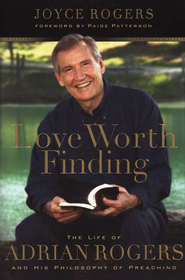
BOOK REVIEW: “A Love Worth Finding” – The Life of Adrian Rogers And His Philosophy of Preaching by Joyce Rogers

ONE PASTOR’S UTOPIA

ALWF Rogers

Book Review By David P. Craig

As a pastor I enjoy reading biographies and auto-biographies of other pastors. I especially can identify with the struggles that other pastors face. Unfortunately this book is written a lot like a Eulogy – even though it was written before Rogers passed away. It is full of Adrian Rogers’ accomplishments and highlights from a very gifted pastor’s life. It’s almost comparable to reading the life of Joseph in the Bible – without the hardships. Rogers almost comes across as a “perfect pastor” – which obviously doesn’t exist. A life full of nothing but successes, victories, grand tributes, and accolades. It reads a lot like a fairy tale – A Pastoral Utopia.

There is one major hardship that Joyce writes about early in the book – the loss of one of their children to SIDS. This was actually the one time in the book where I could identify with this couple. I could identify with their pain, loss, and suffering. But even this episode was glossed over. One almost gets the feeling that 99% of Adrian’s and Joyce’s life together was Camelot. I just don’t think this is reality.

In my own experience of the pastorate with real men and women life consists of hills and valleys – and there are usually more valleys to go through than hills – this book has one valley and the rest is about all the hills. This may be encouraging to some who read it. But I’m concerned for young pastors or young men and women who may read this book and think that ministry is all roses with no thorns.

I would have liked to have read a biography that was less on the surface of  reality and went a little deeper into some of the basic daily realities and hardships of life. It wouldn’t even make a good movie, because there is simply not enough conflict and resolution. It is a book piled with grace on top of grace – and I just don’t think it’s transparent or authentic enough. Honestly, there was precious little to help the average pastor in this book. It read more like the highlights of the greatest pastor of the 20th Century. There were very few things that most pastors could actually relate to. It would be the equivalent of a struggling baseball player trying to figure out how to be a better baseball player and reading a biography of Babe Ruth which only highlighted and focused on all his home runs – without ever talking about any of his strike outs – and how he handled his hitting slumps.

The best part of the book for preachers starts with about 30% of the book left. It’s an extended interview with Adrian Rogers on his homiletical philosophy and sermon preparation. I think this section is very helpful and worth the price of the book. It’s very thorough and yet concise and has many helpful tips in answering some very important questions for sermon preparation like: What is the role of the Holy Spirit in preaching? What is the difference between preaching and unction? What is the nature and central place of preaching? Is Jesus Christ central to preaching? And many others.

I think this book will be especially interesting for pastors (or would-be pastors). It reminds me a lot of “A Man Called Peter” by Catherine Marshall. The difference is that Marshall’s book was more transparent and dealt with more of the tough issues that pastors face. This book may bring a lot of encouragement and inspire many young pastors, but in all honesty – 99% of the pastorates I know of are nothing like the one described in this book.

BOOK REVIEW: Max Lucado’s “GOD WILL USE THIS FOR GOOD”

TRUSTING GOD TO TRUMP EVIL

GWUTFG LucadoBook Review by David P. Craig

Oftentimes when we are going through tough times we need some short and quick reminders that everything is going to be okay. In this short treatment of the life of Joseph from the Old Testament Lucado reminds us: “”You’ll get through this. It won’t be painless. It won’t be quick. But God will use this mess for good. In the meantime don’t be foolish or naive. But don’t despair either. With God’s help you will get through this.”

In retelling the story of Joseph the author takes time to provide ample applications (contemporary and ancient) to bring forth the principles that help us as we wait for God to bring forth good out of the messes in our lives whether we made them, inherited them, or we were the object of someone’s evil plans. Ultimately nothing can thwart the plans that God has for us, and that means that all things will work out for our good and God’s glory. The main idea brought out by Lucado in this book is that “in God’s hands intended evil becomes eventual good.”

This short book would make a good gift or recommendation for Christians that are currently going through a rough time. Lucado’s story telling connects well with readers by continually making connections between the biblical subject and the relevant points to our own lives. Lucado has written a helpful manual for believers who need guidance in their pain by helping us trust in the God who always trumps evil for our own good.

BOOK REVIEW: R.C. Sproul’s “WHAT IS THE CHURCH?”

A GREAT PRIMER ON WHAT THE CHURCH IS ALL ABOUT

WITC? SPROUL

Book Review by David P. Craig

R.C. Sproul examines what the Church isn’t, and what it is. In breaking down four key words from the Council of Nicea about what the Church is, Sproul articulates what it means that the church is (1) one, (2) holy, (3) catholic [i.e., universal], and (4) apostolic. Some of the issues addressed in this helpful book are: Why are there so many denominations? What are the essential truths that unite all Christians? What is Liberalism? Why do doctrines divide and unite? What’s an Evangelical? What does it mean for the church to be holy? What is the foundation of the church? What does it mean to be “in Christ”? What is the Gospel? What are the Sacraments? and Why should the church practice discipline?

Sproul covers a lot of ground in this short book. It is full of historical and theological insights, wisdom, and biblically based. I would recommend this book especially for new Christians and as a cogent argument for so-called “Christians” who are not a part of a visible local church. It will help you appreciate what unites Christians throughout history, today, and forever.

BOOK REVIEW: R.C. Sproul’s “INTO THE PRESENCE OF GOD”

GOD-CENTERED MEDITATIONS

ITPOG

Book Review by David P. Craig

Over the past 30 years I’ve enjoyed the books, lectures, sermons, and writings of R.C. Sproul. This book gathers some of the best devotionals from Ligonier Ministries Magazine – Table Talk. Coram Deo–which means “in the presence of God” is the name of one of the feature columns written by R.C. Sproul. In The Presence of God takes some of the best devotionals from Coram Deo over the past several decades and makes the collection available here in this book.

The devotions selected are encouraging, inspiring, and always based on Scripture. According to R.C. Sproul all of life is to be lived out in the presence of God and for the glory of God. These devotionals remind us daily that God is sovereign, transcendent, and immanent. “To live Coram Deo is to live a life of integrity. It is a life of wholeness that finds unity and coherency in the majesty of God. A fragmented life is a life of disintegration. It is marked by inconsistency, disharmony, confusion, conflict, contradiction, and chaos.” On the other hand, a life of “integrity is found when men and women live their lives in a pattern of consistency. It is a pattern that functions the same way in church and out of church. It is a life in which all that is done is done unto the Lord. It is a life lived by principle, not expediency; by humility before God, not defiance. It is a life lived under the tutelage of a conscience that is held captive by the Word of God.”

There are approximately 150 devotions in this book. Each only a page in length with a short meditation by Sproul, and either a word of encouragement, an application, or a reflection based on each subject. There are 15 Sections in the book with each section containing between 5 and 18 chapters. Here are the subjects addressed by Sproul: (1) Knowing God; (2) Learning God’s Laws; (3) Facing Life’s Challenges with God; (4) Getting Acquainted with God’s Son; (5) Meeting with God; (6) Discerning God’s Will; (7) Understanding God’s Purpose; (8) Becoming Part of God’s Body; (9) Experiencing God’s Best; (10) Journeying with God; (11) Developing a Godly Lifestyle; (12) Using Your Time for God; (13) Confronting the Enemy in God’s Strength; (14) Doing God’s Work; and (15) Facing the Future with God.

You would be hardpressed to find a devotional that is more God-centered and will help you truly live a life that is well-pleasing to God than Sproul’s. I highly recommend this excellent collection as one that will increase your awareness of God, and help you become more intimate in your walk with Him for His glory whether you eat, drink, or whatever you do as you live in His presence.

BOOK REVIEW: R.C. SPROUL’S “HOW CAN I DEVELOP A CHRISTIAN CONSCIENCE?”

 AN ETHICAL PRIMER FOR DEVELOPING A CHRISTIAN CONSCIENCE

HCIDACC? SPROUL

Book Review by David P. Craig

R.C. Sproul begins this book by giving a classical definition of the Christian conscience: “The Christian conscience is thought to be something that God has implanted into our minds…the voice of God within us….The idea is that God created us in such a way that there is a link between the sensitivities of the mind and the conscience with its built-in responsibility to God’s eternal laws.” He then goes on to give several examples of how the conscience and law work together to bring about thoughts and actions that are either in accordance with God’s Word or against God’s Word. The conscience is the “tool that God the Holy Spirit uses to convict us, bring us to repentance, and receive the healing of forgiveness that flows from the gospel.”

In the short chapters of this book Sproul compares and contrasts several important matters with reference to developing a Christian conscience as we deal with what has been clearly revealed in the Scriptures and not clearly revealed in the Scriptures:

(1) Creation ordinances vs. Civil Law – here Sproul cogently and compellingly demonstrates that everyone is responsible to live by the Covenant of Creation and that everything that is legislated by law is “moral legislation” – Sproul writes: “Of course, if you think it through, you realize that moral issues are at the heart of all legislation. The question is not whether the state should legislate morality. The question is what morality should the state be legislating? Natural law states that in nature there are certain principles that we should never violate. But why? Just because nature says it’s wrong? No. Classically and historically, Christianity has said that those laws that we find in nature are the external manifestations of the law of God. Remember that all true and just law is based ultimately on the character of God and His eternal being. From those eternal principles we get a reflection of God in natural law…In the final analysis what the culture does or does not do must not affect my responsibility to God. We are called to be a people of principle. Reformation starts when we begin to live by principle and not by expediency.”

(2) The distinction between ethics and morality  – What are the indicatives (morality) of Scripture and what are the imperatives (ethics)?  Here Sproul answers two important questions: (a) What is good, and what does God require of us that is well pleasing to Him? and (b) How can we have the ethical courage to do what is right? Perhaps the most important issue handled in this section is Sproul’s treatment of major’s, minor’s, and areas of freedom in the Christian life.

(3) Legalism vs. Antinomianism – Here Sproul demonstrates three ancient and modern varieties of those who are “legalistic” and those who are “anti-law.” He demonstrates the importance of balance between these two dangerous extremes in this way, “The essence of Christian theology is grace, and the essence of Christian ethics is gratitude.” Sproul reminds us that where the Scriptures are silent “we have no right to heap up restrictions on people where He has no stated restriction…We are to be concerned with integrity, justice, mercy, and helping a world that is in pain. It is all too simple to distort the biblical ethic by a kind of legalism that majors in minors.”

(4) Degrees of sin. The last topic addressed in the book is the question are some sins worse than others? Sproul does a wonderful job of providing many examples – especially from the Sermon on the Mount – to demonstrate the seriousness of sin, and God’s provision for our sins. Tackling issues of guilt, law, righteousness, and justification this short book is jam packed with great questions and answers to some of the most important issues of our day. If you want to know how to live as a Christian in the 21st Century this book is an excellent primer of how to develop a conscience that is right with God and pleasing to God.

BOOK REVIEW: R.C. SPROUL’S “WHAT IS THE LORD’S SUPPER?’

Why Christians Celebrate The Lord’s Supper

WITLS Sproul

Book Review By David P. Craig

One of the things that all Protestants and Catholics have in common is that we participate either weekly or monthly in the remembrance of the Lord’s Supper or Communion. In this concise and yet very thorough treatment of what the Bible teaches about the Lord’s Supper R.C. Sproul gives several cogent reasons why Christians around the world remember the body and blood of Christ in the past and present and look forward to His coming in the future.

Dr. Sproul looks at the roots of the Lord’s Supper in examining the Old Testament Passover from the Exodus; the Last Supper of Christ in the Gospels; and the Marriage Supper of the Lamb in the Kingdom of Heaven. The history of the Supper is examined, the theology of the Supper is explained, and the meaning of the Supper is articulated so that we can best apply its meaning as we participate in the elements as we remember the death, burial, resurrection, and coming of Christ by worshipping Him in spirit and in truth.

Reading this book will help you to appreciate and value the partaking of the cup and bread all the more as you remember the amazing sacrifice of the Lamb that was slain to save us from God’s wrath, and unto His gracious presence forever. You will come to a deeper understanding of the necessity of a “bloody” sacrifice, and of the “body” that was slain on our behalf. There is much spiritual meat here, to bring you to deeper intimacy with and reflection on the Lamb of God who takes away the sins of the world.

BOOK REVIEW: Erwin Lutzer’s “Where Do We Go From Here?”

HOPE AND DIRECTION IN OUR PRESENT CRISIS

WDWGFH? Lutzer

Book Review by David P. Craig

Anyone who has lived their lives in the United States as a Christian for the past 20-50 years has witnessed a radical change in five major areas: (1) Our economy; (2) Our morality; (3) Our education; (4) Our Legal Rulings; and (5) The gaining privileged position of Islam and the decline and vilification of Christianity.

Lutzer gives ample illustrations to demonstrate the decline of the Judeo-Christian worldview and values that many of us grew up with, but doesn’t stop there. Going back to the Bible and history he gives us examples of how these types of changes and hardships for Christians have always been the norm. Hardship and suffering are certainties in the life of a Christian, but Lutzer reminds the reader “the consistent lesson of 2,000 years of church history is that the church does not need freedom to be faithful…If there is any truly good news in America, it will not be announced in Washington but will be heard through the lips and lives of believers who share the good news of the Gospel wherever God has planted them. Our task, quite simply, is to witness to the truth of the Gospel in a nation that is under judgment.”

Erwin Lutzer writes compellingly about the calling of the Christian as aliens in this world. He doesn’t minimize the hardships or sufferings that lie ahead. However, he uses examples from the Scriptures to demonstrate that our sufferings are purposeful and that we ultimately will win in the end. We have amazing resources and promises from God by which we are to live in the world and make a difference until Jesus returns. Lutzer’s book is more encouraging than depressing, because he reminds us of the sovereignty of God and how we are a part of His plans that cannot be thwarted no matter how bad things look now. Ultimately everything we do for Jesus matters and lasts for eternity.

I highly recommend this book because it offers numerous constructive things to focus our attention on until the return of Christ. It offers biblical thinking, principles to live by, and actions to take that really do make a difference in our society and for the sake of eternity. It offers hope for the present and for the future. You will be encouraged that you can stop being part of the problem, and how you can be part of God’s solution in our culture.