BOOK REVIEW: Jerry Sittser’s “A GRACE DISGUISED”

RECOGNIZING GOD’S GRACE IN YOUR LOSS

A Grace Disguised Jerry Sittser

Book Review by David P. Craig

One of the most difficult things to grapple with in life is to lose someone you love deeply. In this book Jerry Sittser shares the gut wrenching story of how he lost his wife, mother, and daughter in a car accident.  What Jerry does well in this book is he walks us through his journey of loss and how God’s grace intermixed in the various contours of his pain. Jerry’s story is our story. We all experience loss – jobs, loved ones, status, youth, health, pets, dreams, and many more. The author not only grapples with his own loss, but also the realities of loss that we all have to wrestle with in life.

What I like about this book is that it doesn’t offer simple steps to dealing with loss. The author helps you identify and grapple with the difficult realities we face in our losses. In the preface to the book Eugene Petterson describes this book as a “companion” for your journey of suffering and loss. That’s the way I felt as I read this book. As a fellow journeymen in the path of suffering I felt like I had a wise companion to walk with me and share with me in my loss.

I highly recommend this book for anyone who is struggling with loss: loss of a loved one, job, or anything that once was precious to us, and is now no more. Jerry helps you to gain God’s perspective in a compassionate and gracious manner. This not a “self-help book,” or an “easy answers book.” The author writes as a fellow struggler of the harsh realities of the tremendous loss he has faced. However, he also recognizes that all human beings have and will suffer loss and that we all desperately need the grace of God to sustain us. He shares helpful stories, insights, and pearls of wisdom to encourage you with your own losses and how to move forward in grace and truth.

As a result of reading this book you will be encouraged to go deep in the multi-faceted realities of your loss and pain, as well as gain a new perspective of how God’s grace is available to help you move forward in your loss. I am grateful for Sittser’s vulnerability, transparency, honesty, and amazing insights into the grace of God. He comes across as a friend, a counselor, and an empathizer. It’s a serious book, because it’s dealing with serious pain. Sittser walks the talk and in the end is a very helpful and gracious guide and companion for your own journey of finding your own disguised grace in your loss.

Book Review: Sam Storm’s “TOUGH TOPICS”

Clarity in the Storm of Controversy

Tough Topics sam storms

Book Review by David P. Craig

Sam Storms has a name that is an oxymoron if there ever was one. His writing is anything but stormy. He writes more like the “calm” before the storm. This is exaclty how he handles difficult questions: calmly, rationally, theologically, and biblically. There’s hardly anyone who will agree wholeheartedly with his answers to the 25 questions raised in this book, but irregardless you will benefit from his skill as an exegete, practical wisdom, pastoral encouragement, theological acumen, and passion for God’s glory exhibited throughout the book. In each chapter he gives ample biblical, theological, and practical support for his answer to each question. He also provides a list of 2-5 recommended resources on each topic at the end of each chapter for those who want to study the topic in greater detail.

The book isn’t divided systematically or topically. Almost all the questions stand alone. If I were to organize the book I would organize the book in the following manner:

(1) Theological Questions – (a) Is the Bible Inerrant?; (b) What is Open Theism? (c) Does God Ever Change His MInd? (d) Could Jesus Have Sinned? (e) Does the Bible Teach the Doctrine of Original Sin? (f) What can We Know about Angles? (g) What Can We Know about Satan? (h) What Can We KNow about Demons?

(2) Exegetical Questions – (a) What Did Jesus Mean When He Said, “Judge Not, that You Be Not Judged?” (b) What is the Blasphemy of the Holy Spirit? (c) Does Hebrews Teach that Christians Can Apostasize? (d) What was Paul’s Thorn in the Flesh?

(3) Practical/Pastoral Questions – (a) Are Those Who Die in Infancy Saved? (b) Will People Be Condemned for Not Believing in Jesus though They’ve Never Heard His Name? (c) Can a Christian Be Demonized? (d) Can Christians Lose Their Salvation? (e) Will There Be Sex in Heaven? (f) What Is Baptism in the Spirit, and When Does It Happen? (g) Should All Christians Speak in Tongues? (h) Is There Healing in the Atonement? (i) Why doesn’t God Always Heal the Sick? (j) What is Legalism? (k) Are Christians Obligated to Tithe? (l) Does Satan Assign Demons to Specific Geopolitical Regions? Are There Territorial Spirits?

Sam Storms has done a wonderful job of tackling each of these questions. I highly recommend this book as a resource that all Christians can use for life. My hope is that this is just the first of a series of more question and answer books to come. As a pastor-theologian Storms is more than qualified to tackle the most difficult of questions in truth, with love, gentleness, and respect.

*I was provided with a copy of this book for review by the publisher and was not required to write a postive review.

Tim Challies on How He Writes a Book Review

How I Review a Book

Tim Challies

A question I often receive is this one: “Can you give me some advice on writing a book review?” I’ll be the first to admit that I cannot tell you how to write an academic review or one you would want to submit to a journal. I became a book reviewer rather by trial and error and only through a very informal medium. Even then, I focus almost entirely on popular-level reviews of popular-level books. Having said that, I typically use a loose formula that I think can be helpful and that often resonates with readers.

IDENTIFY

As you write a book review, it is important to ensure you are properly understanding the book and its author. Therefore, the first thing to do is to identify the book’s topic, audience, purpose and and structure. Here are questions to ask and possibly answer in the opening paragraphs.

What is the book about? This is an obvious question and it is usually easy to answer. However, there are times when the author has a little trick up his sleeve and the question is not quite so simple.

Who is this book written for? Who does the author identify as his audience? You will almost always find this in the first few pages.

Why did the author write this book? What does he hope to accomplish through the book? How does he defend the simple fact that he dedicated time to preparing the book? What benefit will there be to you if you read it? Depending on the book’s format or genre, this may come in the form of a thesis statement the author means to prove. Alternatively, it may just be an idea he wishes to explore or a set of facts he wishes to teach.

How has the author structured the book? How does he progress from the first chapter to the last? Some books are heavily dependent upon a specific structure while other books are much less so. The more heavily dependent the book is upon a structure, the more important it is that you describe it.

What is unique about this book? What makes this book different from others and especially from others that deal with a similar topic? The author may make this clear in the book’s opening pages, or it may be something you need to look for on your own. The more books you read on a topic, the more you will be able to identify what sets one book apart from another.

 DISCUSS

How well does the author succeed? Earlier you identified the book’s topic, audience, purpose and structure. Now you will want to tell your readers how well he succeeded in these things. Did he do justice to the topic? Did he write in such a way that this will appeal to his audience? Did he achieve his purpose? Did he follow a clear structure and was that structure helpful?

What strengths did you identify? What are some of the author’s and the book’s most notable strengths? What does he accomplish better than other similar authors and how is his treatment of the topic superior to similar books?

What weaknesses did you identify? It is unfair to only treat a book’s weaknesses, but it is equally unfair to pretend they do not exist. If a book is marked by notable weaknesses that take detract from its readability or the treatment of the topic, make a note of them.

Is it faithful to Scripture? This question is most important to ask when a book interacts with the Bible and claims to interpret Scripture, but is worth asking for any topic. If Scripture speaks to the topic, note whether the book treats the subject in a way that is consistent with the Bible.

How does it compare with other similar books? There is almost no topic that has only a single book written about it, so you do well to compare books to one another. This helps your reader narrow in on the best book on a topic. Does this book make a better case than others before it? Does it update arguments or interact with new facts? When and why should I read this treatment of the subject instead of another one?

What did the book mean to you? There is value in making a book review personal by speaking of what it meant to you. Did it encourage or strengthen you? Did it sadden or infuriate you? Did it bring you moments of joy in a difficult time? Do not neglect the personal touch!

RECOMMEND

Having identified the book’s topic and purpose, and having discussed its strengths and weaknesses, it is time to tell your reader how they can or should respond to it.

Who should read it? Is there anyone who should read the book? Is there a category of person you are convinced ought to read it? If so, serve them by encouraging them to pick up a copy.

Who should not read it? Is there anyone who should not read it? If so, protect them by warning them away from it.

Who might read it? If it is not a book that is not exciting enough to command people to read or bad enough to command them not to read, then suggest some people who may benefit from it.

This is a loose format I follow in many of my reviews and I have found it quite effective in reaching a general audience with an interest in popular-level books. I hope you find it helpful!

*SOURCE: November 27, 2013 @ http://www.challies.com/articles/how-i-review-a-book

ABOUT TIM CHALLIES

Tim blogs at challies.com and is a pastor at Grace Fellowship Church in Toronto, Ontario, and the co-founder of Cruciform Press.

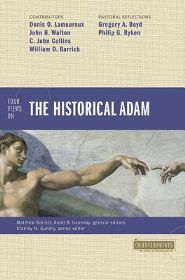
BOOK REVIEW: FOUR VIEWS ON THE HISTORICAL ADAM

In Search of the Historical Adam

Four Views on the Historical Adam

Book Review by David P. Craig

In this counterpoint book the subject of the Historical Adam takes center stage. There are four views presented: (1) No Historical Adam – presented by Denis Lamoureux, Professor of Science and Religion at St. Joseph.s College in the University of Alberta; (2) A Historical Adam: The Archetypal Creation View – presented by John Walton, Professor of Old Testament at Wheaton College; (3) A Historical Adam: Old Earth Creation View – presented by C. John Collins, Professor of Old Testament at Covenant Theological Seminary; and (4) A Historical Adam: Young-Earth View – presented by William D. Barrick, Professor of Old Testament at The Master’s College.

The format of the book is as follows: Each Professor writes on essay addressing three essential questions: (1) What is the biblical case for your viewpoint, and how to you reconcile it with passages and potential interpretations that seem to counter it? (2) In what ways is your view more theologically consistent and coherent than other views? (3) What are the implications your view has for the spiritual life and public witness of the church and individual believers, and how is your view a healthier alternative for both? Upon answering these questions each scholar counters followed by a rejoinder from the presenter. At the end of the book there are two essays representing two different stances on the debate and impact on the Christian faith by Greg Boyd (Senior Pastor at Woodland Hills Church in St. Paul, Minnesota) and Philip Ryken (President of Wheaton College and the former pastor of Tenth Presbyterian in Philadelphia).

I Appreciated the personal testimony of Denis Lamoureux’s pursuit of truth in the fields of science and theology. He has definitely wrestled with and struggled with all the issues at hand – as a non-believer, as well as a believer in Christ. Lemorourex concludes that his view of evolution disallows for belief in the historical Adam that is revealed in the Scriptures. He argues at length that the reality of history conflicts with modern science. He believes that ancient science (the view of the biblical writers) conflicts with modern science and therefore what we have in the Bible is God accommodating inerrant spiritual truths.

In summary “Lamoureux rejects scientific concordism, the idea that God chose to reveal through the Scriptures certain scientific facts and that modern science, properly understood, can be aligned with the Bible. To the contrary, he says the authors of Scripture had an ancient perception of the world, apparent in their belief in a three-tiered universe, their view of the ‘firmament,’ and elsewhere. When it comes to humanity’s biological origins, the biblical authors likewise had a primordial understanding. They held to ‘de novo creation,’ the belief that God created man and everything else directly, immediately, and completely, that is fully mature.”

Lamoureux argues that Adam did not exist, but that Jesus Christ is a historical person who died and rose again for our sins. He attempts to show how modern science has changed his views on interpreting the Bible through understanding distinctions between ancient and modern science, language accommodation, and his rejection of concordism.

I found his essay to be interesting, but unconvincing. I especially struggled with his weak theological explanation of the historical “Adam” from the lips of Jesus and the Apostle Paul in the New Testament. I also struggled with his interpretation of Genesis 1-11 as not being historical. Lastly, I found his interpretation and methodology in arriving at his conclusions insufficient – leaving me with more questions than answers. I agree with C. John Collins assessment of his essay when he writes, “Lamoureux has followed a style of reasoning that is oversimplified, specifically in that he generally poses either/or questions with only two options; he does not consider whether there are alternatives.”

In contrast to Lamoureux, John Walton believes that Adam was a historical person. He believe’s that the primary emphasis of the Bible and Ancient Near Eastern literature is to demonstrate that Adam (and Eve) are archetypal representatives of humanity. He believes that Genesis 2 is not about the biological origins of Adam and Eve. He argues that Adam and Eve may not even be the first humans who came into existence or the parents of all humankind. Walton doesn’t reject or accept evolution, but his view does allow for evolution and an old earth. I found Walton’s essay to be difficult to follow and his discussion of archetypes to be interesting, but not totally sustainable.

C.J. Collins, like Walton, agrees that Adam and Eve were real historical persons. He demonstrates in his essay with great theological precision how a real Adam and Eve are necessary to demonstrate our need of Savior (the second Adam – Jesus) to save us from the sin we inherited as legitimate children of Adam’s race.  He does a wonderful job of showing that the story line of the Scriptures reveals three major truths: (1) Adam and Eve as a pair represent humankind as one family; (2) Adam and Eve were created supernaturally by God; (3) Through Adam and Eve came forth sin. As a result all humanity is guilty before our creator God for our experience as sinners, and in need of redemption from the perfect Adam – the Lord Jesus Christ.

An interesting aspect of Collins’ view of Adam is that he may have been the chieftain of his tribe, i.e., there were perhaps many more people around when Adam and Eve were around. He is also critical of theistic evolution because it fails to account for the special creation of human beings as made in the image of God. He does not believe that a literal twenty-four hour days in Genesis One is required to maintain inerrancy.

Michael Barrick, expounds the most traditional of the four views presented. He argues for the supernatural creation of Adam by God, who is the father of all mankind. Barrick gives the most emphasis of the four views to the significance of Adam in understanding and applying the gospel. He holds to a literal twenty-four days and young earth perspective. He holds to a high view of the Scriptures and believes his view best accounts for the consistent testimony of the biblical authors (Moses and Paul) with Jesus’ teaching. Barrick’s essay argues that when science and the Bible have a conflict – science must always concede for Scripture is inerrant and totally authoritative on all matters it addresses.

In the concluding section of the book Greg Boyd and Phil Ryken (Theologian/Pastors) address the following issues raised by the other essayists by answering the following six questions: Does Adam’s existence or nonexistence (1) affect the rest of the Christian faith and those doctrines Christians have historically affirmed throughout the centuries? (2) shape a Christian worldview, especially the biblical story line from creation, fall, and redemption, to new creation? (3) have an impact on the gospel, or how the gospel is preached and applied, specifically in church? (4) have influence on how we live the Christian life and ‘do church’ as the body of Christ? (5) make a difference in our evangelical witness to a watching world? and (6) What is at stake in this debate for evangelicals in the church today?

Of the four views presented I found myself in the most agreement with Barrick, followed by Collins, then Walton, and lastly by Lamoureux. I think that Barrick’s essay was the easiest to read because it was the essay that took the passages of Genesis at face value – literally. The other three essayists seemed to have to do a lot of hermeneutical gymnastics to make their views work. This is a complicated issue. I appreciated the grace reflected by Lamoureux, Collins, and Walton in particular. Barrick came across more defensive and dogmatic than the other three. At the end of the day, this book deserves a wide reading. It shows the immense complexities of hermeneutics, science, theology, history, and inerrancy. I appreciated what each writer taught me – I gained new knowledge and insights on all five of these topics. I had many questions answered, and yet still have many unanswered questions. My hope is that this book will continue to spark theologians and scientists to work together in the pursuit of truth. I am grateful for the time invested by all the contributors and heartily recommend this book. It is a challenging read, but well-worth the effort.

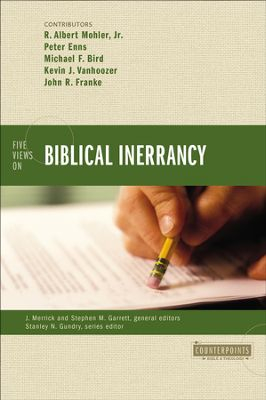
BOOK REVIEW: FIVE VIEWS ON BIBLICAL INERRANCY

IS THE BIBLE TRULY WITHOUT ERROR?

FIVE VIEWS ON BIBLICAL INERRANCY

Reviewed By David P. Craig

Four primary topics are treated in this multi-view book: (1) God and his relationship to his creatures, (2) the doctrine of inspiration, (3) the nature of Scripture, and (4) the nature of truth.

Instead of allowing the author’s to simply give a defense of their positions – each scholar tackles the same outline and passages from their own perspective with reference to the Chicago Statement of Biblical Inerrancy (ISBI). Therefore, specific scriptures are handled to demonstrate each view along the lines of three specific categories: (1) The factuality of Scripture, (2) canonical coherence, and (3) theological coherence.

The scholars therefore all interact with the following texts: Joshua 6, Acts 9:9 compared with Acts 22:9, and Deuteronomy 20 in relation to Matthew 5. Joshua 6 was chosen since current details of historical and archaeological evidence have called into question the accuracy of the text’s account of the destruction of of Jericho. The Acts passage which describes Paul’s conversion was chosen due to the apparent discrepancy between what the witnesses saw and heard during this event. For theological coherence the author’s grapple with the question “How is it that Deuteronomy 20 instructs Israel that the complete extermination of Yahweh’s enemies is a matter of Israel’s purity before and obedience to Yaweh, while Jesus subsequently says faithfulness to God requires nonretaliation and sacrificial love of enemeies (Matthew 5:38-48)?”

The scholars addressing these biblical, theological, and historical concerns are two biblical scholars (Michael Bird and Peter Enns), two systematic theologians (John Franke and Kevin Vanhoozer), and one historical theologian (Albert Mohler). Part one consists of Mohler’s and Enns’ essays in a section entitled “Perspectives on Inerrancy and the Past.” In part 2 Michael Bird (hailing from Australia) addresses “Inerrancy from an International Perspective.” In part 3 Kevin Vanhoozer and John Franke represent “Perspectives on Renewing and Recasting Inerrancy Today.” Each essay is then responded to by the other four scholars.

Albert Mohler’s essay was disappointing in that his argumentation was circular and sophomoric. Of all the essays in the book I was looking forward to his the most. It seems that he didn’t put the time into the essay that was necessary. He simply wholeheartedly agreed with ISBI and did a poor job with the biblical material. His historical study of inerrancy was limited to the mid-late 1900’s.  Mohler’s essay was answered in broad strokes and an a priori apologetic that was redundant and unconvincing. Mohler does a much better job in his essays of response – especially in his response to Enns. I wish that the editors would have chosen a biblical scholar in place of Mohler (with his same postion) – because his handling of the biblical material was particularly simplistic and weak. It just seemed like Mohler’s schedule was too busy to put the necessary scholarship into his essay. However, I wholeheartedly agree with Mohler’s assessment of biblical inerancy when he says, “I do not believe that evangelicalism can survive without the explicit and complete assertion of biblical inerrancy…The afirmation of biblical inerrancy means nothing more, and nothing less, than this: When the Bible speaks, God speaks.”

Peter Enns came across as just plain “ticked off” at the whole idea of biblical inerrancy. He gave a plethora of reasons why he doesn’t think ISBI is a fair or accurate document. He does not adhere to inerrancy (as defined by ISBI) and calls it “erroneous.” The closest he comes to arriving at any position on the Bible is when he writes: “Scripture is a collection of a variety of writings that necessarily and unashamedly reflects the worlds in which those writings were produced. The implication of this metaphor is that an understanding of those historical settings can and should affect interpretive conclusions.”

Enns handling of the biblical material was influenced primarily by liberal scholarship. He believes the Jericho episode didn’t happen due to the archaeological evidence. He believes Paul’s conversion reports are blatant contradictions. Lastly, he thinks that the God of the Old Testament as described in Deuteronomy is different than the God portrayed in the New Testament. He writes, “Israel’s depiction of God vis-a-vis the nations unmistakably, and understandably, reflects the ubiquitous tribal culture at the time.”

Mohler writes of Enns, “So, taking Peter Enns at his word the Bible contains numerous passages that not only fail the test of historical accuracy (even to the point of questioning whether the exodus took place), but also present a false and dangerous misrepresentation of God’s very character and will.” The overall response of the other essayists was similar to my own own response. I felt that Enns was overly critical of Scripture, and didn’t really give a constructive or positive view of Scripture at all. It felt like his whole essay was reactionary and destructive. There was really no positive argument given. It was a lot like reading the “new atheists” – a lot of attack and very little evidence or support for their own view.

Michael Bird’s essay was perhaps the most interesting of the five. If he ever loses his job as a theologian he could become a night club comic. He provides humor in his essay and in his responses to the other essayists (especially humorous is his response to Enns). Bird has the difficult task of reflecting the idea of inerrancy outside of the USA. He covers a lot of ground and shares where he agrees and disagrees with ISBI. He provides a very balanced essay in his response to ISBI, his historical reflections on inerrancy around the globe, and his biblical argumentation – brief but very cogent and clear. One of the highlights of Bird’s essay was this gem, “The goal of revelation is not knowing facts about God but also enjoying fellowship with God.” Overall Bird’s essay is very witty, theologically insightful, and interesting.

Kevin Vanhoozer’s essay argues for what he terms “A Well-versed inerrancy.” He basis his definition largely on the historic tradition of Augustine. Vanhoozer proposes this definition of inerrancy, “to say that the Scripture is inerrant is to confess faith that the authors speak the truth in all things they affirm (when they make affirmations), and will eventually be seen to have spoken truly (when right readers read rightly).” The bulk of Vanhoozer’s essay buttresses his definition of inerrancy with a particular interest in the terms “truth” and “language” and he ties these concepts to the writings and concepts developed by Augustine. His essay utilizes careful language and sophisticated theological and philosophical depth that one would expect of a top-notch systematic theologian. Vanhoozer handles the biblical passages with tremendous theological and exegetical skill.

Vanhoozer gives the practical importance of a well-versed inerrancy with these words: “Implicit in my definition of inerrancy is that we be not only literate readers who rightly see what proposition an author is proposing (the literal sense) and what kind of attention to this proposition is required (literary sensibility) but also right-minded and right-hearted readers who respond rightly to each and every communicative act of Scripture (Spirit-given literacy) Ultimately, a well-versed approach to inerrancy constitutes nothing less than a standing requirement that the community of Scripture’s interpreters become persons capable of understanding, loving, and participating in the truth.”

I love the conclusion to Vanhoozer’s essay where he quotes Augustine’s approach to the veracity of the Scriptures: “And if in these writings I am perplexed by anything which appears to me opposed to the truth, I do not hesitate to suppose that either the manuscript is faulty, or the translator has not caught the meaning of what was said, or I myself have failed to understand.” Of all the essays, I found Vanhoozer’s to be the most theologically profound and exegetically sound.

John Franke does not believe that the ICBI should serve as the standard-bearer for inerrancy. He offers an alternative model – what he calls a fallibilist perspective, “inerrancy functions only within the limits of language alone. It applies to Scripture only in the context of the original settings in which the texts that we have were constructed, and its affirmations and teachings cannot be abstracted from those contexts and offered as absolute truth, because only God knows and is Truth…this means that the ultimate truth and inerrancy of the Bible are finally contained not in the particular narratives and teachings of individual texts but rather in relation to its intended purpose and function in the economy of God…the Bible is that language the Spirit appropriates and employs to effect the social construction of the Christian community.”

Therefore, for Franke, the Bible is essentially fallible because it was written by fallible human beings. He expects that the Scriptures will contain errors and in his discussion of the biblical passages he is not troubled in the slightest by the historicity of the conquest of Jericho, nor the historic details of Paul’s Damascus Road vision. He seems more concerned about the big picture than the little details of the Bible. In doing so – he never quite tells us what inerrancy is. He never tells us what truth is. I found his essay to be confusing, fragmented, and unconvincing in regards to his theology, epistemology, and exegesis.

On the whole this is a fascinating multi-view book. The terrain covered is theologically rich, historically insightful, and exegetically helpful. The final chapter written by Stephen M. Garrett and J. Merrick was just what the doctor ordered. It helped bring synthesis, clarification, as well as a much needed explanation of the continuity and discontinuity on the spectrum of issues presented throughout the book. I highly recommend this book for everyone who loves God’s Word and is seeking to know, love, and live out His truth as revealed in the Scriptures.

BOOK REVIEW: “BAPTISM THREE VIEWS”

HOW SHOULD WE PRACTICE BAPTISM IN THE CHURCH?

Baptism 3 Views

Book Review by David P. Craig

In this multi-view book we have three views presented: (1) Believer’s Baptism (credobaptism – “credo” being from the Latin for “I believe”) – presented by Dr. Bruce Ware, professor of Christian Theology at The Southern Baptist Seminary in Louisville, Kentucky; (2) Infant Baptism (paedobaptism – “paidos” from the Greek for “child”) – presented by Dr. Sinclair Ferguson, the Senior Minister at First Presbyterian Church in Columbia, South Carolina and professor of systematic theology at Redeemer Seminary in Dallas, Texas; and (3) The Dual-Practice Baptism View – presented by Dr. Anthony N. S. Lane, professor of historical theology at London School of Theology in Northwood, England. The book was edited by David F. Wright (1937-2008), professor of patristic and Reformation Christianity at New College, University of Edinburgh, Scotland – and after his death in 2008 by Daniel G. Reid, the senior editor for reference and academic books at IVP Academic.

The structure of the book is that each scholar gives his argument for his own position using biblical, theological, and historical support. After each presentation – the other two author’s counter, and the presenter responds to the two counter arguments. Such is the case for each presentation.

(1) Bruce Ware argues for credobaptism – “only those who have already become believers in Christ should be baptized and that this baptism should be by immersion in water.” In his biblical defense of believers’ baptism he gives an abundance of linguistic and contextual support for baptism by immersion from the New Testament (NT – from this point on). He then shows that every clear instance of baptism in the NT relates to the baptism of those who have repented of sin and come to faith in Christ. In this section he highlights and discusses eleven passages from the book of Acts where Luke presents a clear and unambiguous depiction of baptism as being performed only on believers. Next he shows the absence of non believers’ baptism in the NT. He then presents a case against infant baptism from its absence in the NT.

In the theological section of his essay he gives a thorough presentation of the meaning of the new covenant and what remains the same and what has changed from the OT to the NT. He writes, “If the NT writers genuinely saw a parallel between physical circumcision and infant baptism, it is utterly remarkable that they never said so in the NT….As I endeavor to explain, the fact that circumcision functioned at two levels, both for the ethnic and national people of Israel and for the spiritual reality of being separated unto God, indicates that the sign and seal of baptism simply is not meant to be seen as parallel to circumcision…That is not to deny any relation between circumcision and baptism. Where circumcision and baptism are parallel is exactly where Colossians 2:11-12 see them as parallel, namely, in the spiritual reality to which each of them points…In short, the parallel between circumcision and baptism in the new covenant is not between physical circumcision and infant baptism; rather, the parallel is between spiritual circumcision of the heart and baptism, which signifies regeneration, faith and union with Christ…So then, since only the actual spiritual reality is in view when one is baptized, the sign and seal of baptism relates only to those who have experienced this spiritual reality, that is, to believers in Jesus Christ. The new covenant encompasses only those who know the Lord, those who have been united with Christ, those in whom the Spirit has come to dwell through faith. As such, baptism, the sign and seal of this reality (i.e., not of the promise but of the reality itself), applies rightly only to believers in Jesus Christ.”

One of the most interesting quotes from the historical arguments in his essay comes from a passage in Justin’s Apology quoted in Stander and Louw on what was required by a person before he was accepted for baptism in the early church (100-165 A.D.), “firstly, the person had to believe in the truth of the Christian doctrine; secondly, he had to undertake to live accordingly; thirdly, the baptismal candidate had to undergo a period of devotion and fasting in which he had to request God to forgive all his past sins…Since only mature persons could satisfy these preconditions, it undoubtedly excludes the possibility that infants were involved in these activities.” Examples like this one show that infant baptism did not develop in any significant way until the fourth century.

Dr. Ware concludes his essay giving two practical ramifications that believers’ baptism provides for the health and well-being of the church: “First, the practice of credobaptism has the potential of providing a young Christian a wonderful and sacred opportunity to certify personally and testify publicly of his own identity, now, as a follower of Christ…Second, the practice of credobaptism grounds the regenerate membership of the church…If membership in the new covenant and hence in the church comes via infant baptism, yet salvation comes only by faith, then it follows that paedobaptist churches are necessarily afflicted with the problem of a potentially significant number of unregenerate church members.”

(2) Sinclair Ferguson argues for paedobaptism – “baptism is the sign and seal of the new covenant work of Christ and is analogous to circumcision, which was the sign of the old covenant of Israel. The biblical continuity between the covenants demands that infants of believers be baptized in addition to those who come to Christ at any age. The mode of baptism is not at issue.” Dr. Ferguson’s essay traces the evidence for infant baptism starting with the historical evidence from the post-apostolic period onward; then provides a biblical and theological perspective (redemptive-historical). Lastly, he draws some conclusions about the baptism of the infants of believers.

In the first part of his essay Ferguson draws upon a snapshot of instances where infant baptism is practiced by the early church: (a) records of mortality – some dating back to the turn of the third century; (b) works of theology – Origen, Tertullian, Cyprian of Carthage refer to infant baptism in their writings; (c) evidence from liturgy compiled by Hippolytus of Rome (d. ca. A.D. 236). It’s interesting that none of these practices give a theological reason for the practice of infant baptism.

Ferguson writes, “Was the title to baptism of these children grounded in either (1) the faith of their parents/sponsors?–which would be somewhat akin, as we shall see, to a covenantal approach to infant baptism–or (2) was the confession of the parents/sponsors viewed as an expression of the ‘faith’ of the infants themselves?–which would be in keeping with the wording of later inscriptions describing the deceased infant as being ‘made a believer’ at the point of baptism.”

In the second part of the essay Ferguson discusses the importance of covenant signs in the Bible: (a) Noahic covenant – the sign of the rainbow (Gen. 9:12-16); (b) Abrahamic covenant – the sign of circumcision (Gen. 17:11); and (c) Mosaic covenant – the Sabbath day (Ex. 31:16-17). Ferguson comments, “In their own context each of these covenant signs pointed forward to a fulfillment in the new covenant in Christ…This background shows that the physical signs of baptism and the Lord’s Supper which Jesus instituted belong to a larger pattern and should be interpreted in the light of this biblical-theological tradition. Baptism cannot be fully understood abstracted from this matrix.”

Ferguson gives the following definition of baptism from the Westminster Confession of Faith: “Baptism (and all the biblical sacraments) are holy signs and seals of the covenant of grace, immediately instituted by God, to represent Christ and his benefits; and to confirm our interest in Him: as also, to put visible difference between those that belong unto the Church and the rest of the world; and solemnly to engage them to the service of God in Christ, according to his Word.”

Then Ferguson explains how the sign of circumcision in the Old Covenant is transferred to baptism in the New Covenant: “Baptism functions in relationship to the new covenant in Christ in a manner analogous to the function of circumcision in the Abrahamic covenant. In a word, baptism has the same symbolic significance in relationship to fellowship with God as did circumcision…Baptism signifies all that is in Christ for us; it points us to all that he will do in us and all that we are to become in him…Baptism is not primarily a sign and seal of faith, but to faith.”

In Ferguson’s biblical-theological defense of infant baptism he grapples with the following issues: (a) how circumcision is fulfilled in Christ for the nations; (b) how union with Christ is expressed in baptism; (c) the baptism of Christ and what it means for us; (d) how baptism expresses the fellowship of God within the Trinity; (e) how baptism functions as a sign and seal; (f) divergent views of infant baptism – contrasting the catholic view and subjectivist view (Protestant); (g) How baptism signifies and seals the covenant of grace; (h) the covenant principle and practice of infant baptism; (i) the harmony of paedobaptism with the New Testament mindset; (j) the implications of baptism.

(3) Anthony Lane argues for the dual practice view – “affirms both adult, or convert, baptism and either paedobaptism or adult baptism as legitimate options for those born into a Christian home.”

He begins his essay by sharing his experiences (the only one of the author’s to share his personal baptism experience) of being baptized in the Anglican church at the age of three, as well as being a part of baptistic churches for the past thirty years. He writes, “At a later stage I read George Beasley-Murray’s Baptism in the New Testament. This Baptist author persuaded me that New Testament baptism was no so much believers’ baptism as converts’ baptism. Thinking about this made me realize that Baptist and paedobaptist practice are alike modifications of this. At the same time I was concerned about the fact that my children appeared to be believers but were not yet baptized, a situation I could not square with the New Testament. The suggestion that such children should take communion until they were old enough for baptism struck me as hopelessly confused. So Beasley-Murray (with help) moved me away from the Baptist position.”

In his biblical analysis of baptism he writes, “If we look at these passages (he sites 14 passages from the book of Acts) and ask what was expected to happen, we find four things that repeatedly occur: repentance, faith, baptism, and reception of the Holy Spirit.”

Lane’s essay hones in secondly on the historical development of what he calls “conversion” baptism (he gives the greatest amount of ink to this section). He takes what he calls a “seismological approach” from the 5th century and back tracks to the New Testament. He believes that there is enough evidence to advocate for both paedobaptism and believers baptism in the early history of the church.

The third part of Lane’s essay focuses on theological and practical considerations of performing dual-baptism. Lane explains, “It must always be remembered that for those raised in a Christian home, baptism, is not an isolated event but simply one stage in a lengthy process…The New Testament practice of baptism was converts’ baptism, the immediate baptism of those who come to faith as part of their initial response to the gospel. This needs to be modified for children born into a Christian home, either into infant baptism or into baptism at a later date. The New Testament evidence for how such children were treated is not unambiguous. Both approaches can be defended on biblical grounds. No grounds exist for insisting on one to the exclusion of the other. This policy of accepting diversity is the only policy for which the first four centuries of the church provide clear evidence.”

In the final analysis for Dr. Ware credobaptism is primarily “a sign of our faith and act of obedience and commitment to Christ.” For Dr. Ferguson paedobaptism is primarily “a sign of what we receive from Christ.” For Dr. Lane paedo or credo baptism (together with faith and in a subordinate role) is primarily “an instrument by which we embrace Christ and his salvation.”

Each essay tackles the issue of baptism quite differently. I would say that Dr. Ware (credobaptism) does the best job with the biblical evidence and with an exegesis of baptism. Dr. Ferguson gives a very articulate presentation of the theological reasoning behind paedobaptism. Dr. Lane (dual-view) does the best job of presenting an early history of baptism. In my opinion the one who does the most balanced job in handling the biblical, historical, and theological evidence for his position is Dr. Ware.

No matter where you stand on the issue of baptism you will definitely learn a lot from this book. The author’s have done their homework and have written with theological acumen and a cogent articulation of the pro’s and con’s of each view. The one thing I would have liked to have seen at the end of this book is a concluding essay from the editor, or perhaps theologians’ from the three different strands articulated in the book. Another helpful asset would have been a question and answer section from the editor to each author. However, for greater insight into the issues of baptism from three great communicators – one would be hard pressed to find a more balanced presentation on baptism than contained in this “Three Views” book. I recommend this book for pastors, students, and Christians on all sides of the equation. It will help clarify one’s position, perhaps change your position, or stir within you a desire to search the Scriptures, Theology, and Church History for further study. The author’s are firm on their presentations and yet charitable and balanced – which is a good model for those wrestling with this important biblical subject.

BOOK REVIEW: “HOW GREAT IS OUR GOD: Timeless Daily Readings on the Nature of God”

FOCUSING ON THE CHARACTER AND NATURE OF GOD FOR A YEAR

HGIOG

Book Review By David P. Craig

This book contains short devotional excerpts (one page a day) from the writings of Henry and Richard Blackaby’s “Experiencing God”; Jerry Bridges “Trusting God”; Chuck Colson’s “Loving God”; Sinclair Ferguson’s “Heart for God”; Andrew Murray’s “Waiting on God” and Working for God”; John Piper’s “Desiring God”; R.C. Sproul’s “Pleasing God”; A.W. Tozer’s “The Pursuit of God”; and Dallas Willard’s “Hearing God.”

The readings are arranged for each day of the week for Monday – Friday, and then a reading for the weekend. Each reading is based on a verse of Scripture and topic. The back of the devotional features both a subject and Scripture index. After an entire year of going through this devotional here are just a few of my favorite quotes from the book:

“Our greatest need is not freedom from adversity. No calamity in this life could in any way be compared with the absolute calamity of separation from God. In like manner, Jesus said no earthly joy could compare with the eternal joy of our names written in heaven.”

“If we want proof of God’s love for us, then we must look first at the Cross where God offered up His Son as a sacrifice for our sins. Calvary is the one objective, absolute, irrefutable proof of God’s love for us.”

“What God wants from His people is obedience, no matter the circumstances, no matter how unknown the outcome…Knowing how susceptible we are to success’s siren call, God does not allow us to see, and therefore glory in, what is done through us. The very nature of the obedience He demands is that it be given without regard to circumstances or results.”

“In order to trust God, we must view our adverse circumstances through the eyes of faith, not of sense.”

“This is real faith: believing and acting regardless of circumstances or contrary evidence.”

What stands out about this devotional are five positive elements: (1) This book is like reading wisdom from a wise godly grandfather – it is biblical, but lived out on the anvil of many years of godly Christian living; (2) It is saturated with Scripture – each author quotes an abundance of Scriptures in illustrating and applying each truth they present; (3) It is God drenched – all of the meditations elevate your view of God and help you to focus on His glory. (4) It is filled with practical applications. (5) It leads you time and time again to worship the Lord in prayer – particularly – gratitude, thanks, and adoration. For these reasons of balancing the head, heart, and hands for God’s glory I highly recommend this excellent devotional.

BOOK REVIEW: Michael Vlach’s “DISPENSATIONALISM”

ESSENTIAL BELIEFS AND COMMON MYTHS

Dispensationalism Vlach

Book Review by David P. Craig

Michael Vlach (who wrote his doctoral dissertation on the relationship between Israel and the Church in 2004) has written a very helpful overview of what dispensationalism is, and is not, in this short book. In four chapters Vlach clearly articulates the history, essential beliefs of, and common myths regarding dispensationalism. Vlach not only does a great job of defining and explaining dispensationalism, but also answers some of its most outspoken modern critics such as John Gerstner, Keith Mathison, R.C. Sproul, and Hank Hanegraaf.

In Chapter One there is a general overview of the development of dispensationalism as a system of Theology. Dispensationalism is linked with John Nelson Darby who lived from 1800-1882. Vlach traces the development of dispensationalism from Darby to C.I. Scofield to Lewis Sperry Chafer. There is also a discussion of, and distinctions made between Classical, Revised (Modified) and Progressive Dispensationalism. Some of the key theological views of the aforementioned theologians along with Charles Ryrie, John Walvoord, Charles Feinberg, Alva J. McClain,  Craig Blaising, Darrell Bock, and Robert Saucy and several others are briefly discussed.

In Chapter Two Vlach highlights the essentials or sine qua non of dispensationalism that have been suggested by representatives such as Charles Ryrie, John Feinberg, Darrel Bock, and Craig Blaising. After his discussion of these “essentials” Vlach believes there are six common essential beliefs that make one a dispensationalist. These six beliefs are articulated along with substantial quotes from leading dispensational Theologians along with helpful commentary by Vlach.

Here are the six essentials according to Vlach: (1) Progressive revelation from the New Testament does not interpret or reinterpret Old Testament passages in a way that changes or cancels the original meaning of the Old Testament writers as determined by historical grammatical hermeneutics. (2) Types exist but national Israel is not a type that is superseded by the church. (3) Israel and the church are distinct, thus, the church cannot be identified as the new or true Israel. (4) There is both spiritual unity in salvation between Jews and Gentiles and a future role for Israel as a nation. (5) The nation of Israel will be both saved and restored with a unique identity and function in a future millennial kingdom upon the earth. (6) There are multiple senses of “seed of Abraham,” thus, the church’s identification as “seed of Abraham” does not cancel God’s promises to the believing Jewish “seed of Abraham.”

In chapter three Vlach evaluates and provides biblical and theological insight on five common myth’s about Dispensationalism: (1) Dispensationalism teaches multiple ways of salvation. (2) Dispensationalism is inherently linked with Arminianism. (3) Dispensationalism is inherently Antinomian. (4) Dispensationalism leads to Non-Lordship Salvation. (5) Dispensationalism is primarily about believing in seven dispensations.

In the fourth and final chapter of the book Vlach clearly and cogently answers some great questions he has been asked by his students about Dispensationalism: (1) You have been critical of how dispensationalism is often defined. What do you think is  a good short definition of dispensationalism? (He defines dispensationalism as “a system of theology primarily concerned with doctrines of ecclesiology and eschatology that emphasizes the historical-grammatical meaning of the Old Testament prophetic passages and covenants, a distinction between Israel and the church, and a future salvation and restoration of the nation Israel in a future earthly kingdom).  (2) Why are you a dispensationalist and how did you become a dispensationalist? (3) What is the main mistake that nondispensationalists make when evaluating dispensationalism? (4) Any other common mistakes? (5) Do you think dispensationalists could do a better job of explaining dispensationalism? If so, how? (6) Many like to point out that dispensationalism began with John Nelson Darby around 1830, thus dispensationalism is a new theology. How do you respond to the charge that dispensationalism should be rejected since it is a new theology? (7) What is the relationship between the pre-tribulation rapture position and dispensationalism? (8) What is your perspective on the internal debates and discussions within dispensationalism? (9) What is the future of dispensationalism?

Michael Vlach’s book is the new “go to” introduction on dispensationalism today. He has provided a readable, non-technical, concise, and helpful articulation of the essentials of dispensationalism and defended its essence well. I highly recommend this primer as an excellent introduction to anyone who desires to understand the eschatological/ecclesiological system known as dispensationalism.

BOOK REVIEW: R.C. SPROUL’S “CAN I HAVE JOY IN MY LIFE?”

WHY PUTTING JESUS FIRST RESULTS IN JOY

CIHJIML? Sproul

Book Review by David P. Craig

In this insightful book Sproul helps the reader discern what true biblical joy consists of. It is not based on our circumstances, or even our personality. Sproul writes, “The key to the Christian’s joy is its source, which is the Lord. If Christ is in me and I am in Him, that relationship is not a sometimes experience. The Christian is always in the Lord and Lord is always in the Christian, and that is always a reason for joy. Even if the Christian cannot rejoice in his circumstances, if he finds himself passing through pain, sorrow, or grief, he still can rejoice in the Lord, and since He never leaves us or forsakes us, we can rejoice always.”

R.C. helps the reader by taking you to key passages of Scripture from Philippians, James, Romans, and the Gospel of John and gleans principles on the ground and source of our joy as being in Christ – who never changes and will never leave nor forsake us. The primary enemy of our joy is anxiety. Fear and anxiety rob us of our joy. However, if we understand who Christ is, and what he has done for us it deepens and opens up a new dimension of joy in us.

The acronym J-O-Y is used to demonstrate that Jesus first, then others, and then you – is actually a good way to practice the habit of joy in our lives. If we focus on Jesus – who is perfect, never changing, loving, and so forth – instead of our imperfect selves, or the imperfections of others and changing circumstances we can maintain and equilibrium of and growth in the genuine joy of the Holy Spirit who dwells within us as Christians. According to Sproul the reason that joy is often so elusive s because we put ourselves first, and Jesus last.

I love what Sproul has to say about Jesus’ own joy: “Jesus is the only person in history who spelled the word joy without putting the letter ‘j’ first. He put Himself last in order to make it possible for us to participate in joy.” The greatest joy anyone can possibly have is knowing and being like Jesus – trusting and believing in His redemptive work on our behalf. By participating (abiding) in our new life with Christ as forgiven, reconciled, children of God we have everything we need to live in peace and joy with God, others, and ourselves. Joy is possible because of Jesus alone. Even our continued struggles with sin, doubts, guilt, and so forth can never take away His righteousness in exchange for our sins and His gift of eternal life. Since our names our written in the Lamb’s Book of Life we have reason to rejoice no matter what our circumstances are – because ultimately we win in Him. We can always rejoice “in the Lord” – because the Lord has an infinite supply of unchanging perfections for us to delight in.

BOOK REVIEW: James Hamilton’s – “WHAT IS BIBLICAL THEOLOGY?”

A GUIDE TO THE BIBLE’S STORY, SYMBOLISM, AND PATTERNS

WIBT? Hamilton

Book Review by David P. Craig

My wife and I have a tradition that we have practiced over our 21 years of marriage. Once every two to three years we plan a trip somewhere in the United States we’ve never been to before. We have gone to Boston, Washington D.C., New York, Seattle, Honolulu, Minneapolis, Orlando, Austin, San Diego, and several others. Before we go to the city we buy a really good map that gives us the lay of the land. Once we are there the first thing we do is go on a city-wide bus tour. In doing these two things it helps us to appreciate the history of the city, landmarks, and highlights we don’t want to miss during our stay. We get an overview and the big picture of the city before we enjoy its constituent parts.

Hamiton’s book is like a map or tour of the Bible. He helps you not to miss the most important stories, symbols, and patterns that are featured in the Scriptures. All of the biblical authors do “biblical theology.” They have a framework or world-view through which they interpret and describe the events, stories, and principles through this lens. All of the authors interpret Scripture in three ways (1) They interpret the words or accounts of God’s words and deeds that have been passed down to him; (2) They interpret world history from its creation to its final consummation; and (3) They interpret events and statements that they describe. According to Hamilton biblical theology in essence “means the interpretive perspective reflected in the way the biblical authors have presented their understanding of earlier Scripture, redemptive history, and the events they are describing, recounting, celebrating, or addressing in narratives, poems, proverbs, letters, and apocalypses.”

By taking into account the different genres of Scripture and their various themes, Hamilton helps the reader appreciate the biblical “lay of the land” in it’s varied history, and its consummation centered around the gospel and the glory of God in Christ. I think the thesis of this book is wonderfully expressed by Hamilton in the second chapter: “Our aim is to trace out the contours of the network of assumptions reflected in the writings of the biblical authors. If we can see what the biblical authors assumed about story, symbol, and church, we will glimpse the world as they saw it. To catch a glimpse of the world as they saw it is to see the real world.”

I believe this book is indeed a fantastic guide in helping all Bible students to understand, appreciate, and enjoy the biblical message intended by the author of the word – the Word – Jesus himself. We learn how to read, understand, and interpret the Bible from the perspective of the biblical authors, which is to learn a divinely inspired perspective. I believe that Hamilton achieves his hope and desired purpose for everyone who reads this book: “My hope is that you cross the bridge into their [the biblical authors] thought-world and never come back. I hope you will breathe the air of the Bible’s world, recognize it as the real Narnia, and never want to leave.”