Book Review: Heaven: The Heart’s Deepest Longing By Peter Kreeft

An Apologetics Masterpiece!

The Book of Ecclesiastes says “God has placed eternity in our hearts.” I have read this book several times and have been waiting to do this book a just book review, but the first thing I have to say is that it’s mind boggling that so many books other than this one have received such a wide reading – and this book hasn’t. I think it’s a classic masterpiece by a brilliant philosopher who in the mold of C.S. Lewis and Thomas Aquinas writes one of the best reasonable defenses for life after death that have possibly ever been written.

The book is not an “easy” read, but an incredibly “rewarding” read. I think the depth of Kreeft’s knowledge of philosophy coupled with theology and his wide range of reading and creativity makes for writing that feeds the soul and the mind. So much of what we read today is “fast food.” Heaven: The Heart’s Deepest Longing is a seven-course gourmet meal that leaves you full and satisfied. After contemplating what you have just read it makes you long for Heaven and a deeper and more intimate relationship with Jesus.

The reason I call this an “Apologetics Masterpiece” is because I think Kreeft brilliantly articulates how Heaven is necessary in order for all our desires to be satisfied in the afterlife. He makes a great case for the existence of God and the necessity of our home with Him. There is so much that we long for in this life that will never be satisfied, but will be satisfied in the next. The atheist, agnostic, or even varieties of “ists” and “isms” can’t really explain why our hearts long for so much that can’t be obtained in this life. Peter Kreeft articulates with tremendous insight and creativity to show that Heaven is what we were made for and why that’s the case.

I can’t do the book justice. All I can say is what the Holy Spirit said to Augustine so many years ago: “Take up and read, take up and read…this book.” If you are philosophical and a deep thinker you will absolutely love this book. If you are not a deep thinker, you may struggle along, but I would encourage you to read the book slowly and thoughtfully. Anyone can benefit from this book, but especially those who read it slowly and thoughtfully. One thing this book always does for me, is increase my joy and my hope in my future home – where I will finally be satisfied with everything I’ve ever longed for and more.

Book Review – Forever: Why You Can’t Live Without It by Paul David Tripp

Typical Tripp – Christ-Centered, Biblical, and Immensely Practical

If you have ever asked yourself questions like: Why is it so hard to find satisfaction? Why is it so hard to find a good relationship? Why do I keep getting myself more and more into deeper debt? Why does it seem like life keeps getting more difficult? Why am I suffering so much? And many other questions like these – than this is a fantastic book for you.

Paul Tripp writes with theological acumen, numerous biblical examples, brilliant illustrations, and practical insights in showing how we were made for eternity and that we need to factor in our lives the fall and the future in order to live in the now. Our current life is simply preparation for our ultimate destination. He shows how we typically view current realities without an eternal perspective and how devastating these consequences are and then shows on the flip side how we were designed to live with Christ at the center of all of life and how living with a forever mindset has gracious overtones leading to great peace and joy.

Tripp delineates specifically how having an eternal mindset makes a substantial difference in our lives in our relationship to God, those closest to us, at work, in our priorities, etc.

I highly recommend this book as “must” reading and an excellent choice to give as a gift to those who are disillusioned, deceived, discouraged, and without hope in this life. The gospel is clearly articulated here over and over in masterful brilliance shows how Christ is our only satisfaction in the now and how all our dreams will be satisfied in eternity through a personal relationship with Him.

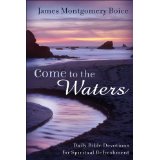
Book Review: Come To The Waters by James Montgomery Boice

Be Blessed By Boice’s Best From the Bible

I am a teaching pastor who was deeply grieved by the earth’s loss (Heaven’s gain) of *Dr. James Montgomery Boice just over a decade ago to cancer. He was a gifted theologian who happened to pastor a large church in Philadelphia where he faithfully preached the Bible expositionally for over thirty years. I have read all of his published books – most of which are sermons – and what’s great about this book is that it compiles the best of most of his published works and some unpublished works that the editor was able to find at the Princeton Theological Library.

Organized from January to December and from Genesis to Revelation this daily devotional is like getting the best of Boice from the Scriptures every day – sort of like a mini sermon – but packed with solid theology, exegesis, and life application. For Boice fans this book is a “must have” and hopefully for those of you who have never been exposed to Boice – you will not only “come to the waters” in this book – but go deeper into the waters of the plethora of Boice’s books and be blessed in your pursuit of the knowledge of and reflection of our Lord Jesus Christ. Thanks and Kudos to the editor for giving us more Boice, so we can get more of Jesus in our lives!


*Dr. James Montgomery Boice, just 8 weeks after being diagnosed with a fatal liver cancer, died in his sleep on June 15, 2000. The senior pastor of Tenth Presbyterian Church in Philadelphia, he was a world-famous Bible teacher, author, and statesman for Reformed theology. He informed his congregation of 32 years of his condition on May 7, proclaiming his complete confidence in God’s sovereignty and goodness.

In the past 72 years, historic Tenth Presbyterian Church has had two senior pastors, Donald Grey Barnhouse and James Montgomery Boice. Founded in 1828, the church itself predates their tenure by another hundred years. Tenth Presbyterian Church lies in the very heart of the city and today has about 1,200 members.

James Montgomery Boice accepted the position as senior pastor in 1968, and was the teacher of the Bible Study Hour since 1969 and the more recent God’s Word Today broadcast as well. Dr. Boice held degrees from Harvard, Princeton Theological Seminary, and the University of Basel, Switzerland. He had written or contributed to nearly 50 books, including Foundations of the Christian FaithLiving by the Book, and exegetical commentaries on Genesis, Psalms, Acts, and Romans.

He was no less involved in the preserving of the fundamentals of the faith than his predecessor, Dr. Barnhouse. In 1985, Boice assumed the presidency of Evangelical Ministries, Inc., the parent organization of the Bible Study Hour, Bible Study Seminars, Bible Studies magazine, and other teaching ministries. In 1997, Evangelical Ministries merged with Christians United for Reformation and the Alliance of Confessing Evangelicals, taking the latter as the new organization’s name, and Dr. Boice assumed the presidency. In 1997, he was a founding member of, and chaired, the International Council on Biblical Inerrancy.

Of particular concern to Boice was the matter of the church and her relationship to and engagement of society. His recent book, Two Cities, Two Loves, maintains that Christians are citizens of the kingdom of this world and the kingdom of heaven and that they have responsibilities in each. He urged Christians to “participate in secular life rather than merely shoot from the sidelines at secular people.”

Dr. Boice is survived by his wife, Linda, and three daughters. Characteristic of his ministry was his pushing Christians to commit themselves to staying in one place. He lived what he preached, committing to the church and his downtown neighborhood for 30 years. A gifted pastor and leader, he turned down many attractive opportunities in order to build a sense of permanence and belonging. And he urged his parishioners to do the same.

Book Review: Four Views On The Spectrum of Evangelicalism – Edited by David Naselli and Collin Hansen

A Scintillating Dialogue on Evangelicalism Historically and in the Present

I love the format of the “Views” books in that they allow the reader to wrestle with and think about crucial issues that oftentimes divide Christians. Instead of having the bias of one author – you get to see an offensive and defensive articulation of each view and weigh the evidence based on the strengths and weaknesses of the evidence given by each author. This new offering in the “Views” series particularly addresses important aspects that unite and divide “evangelicals.” An evangelical is someone who holds to the “good news” as declared from the Scriptures. However, what is the good news? What are the uniting factors of the good news? And what are the boundaries required in disseminating the message, and uniting around the good news in order to penetrate society with the gospel?

The reason this book and the issues are so important is that what is at stake in all of this discussion is the heart of the gospel, and if there is no agreement on the gospel than unity is ultimately a vain pursuit, and the power of the gospel is squelched in isolated enclaves, rather than in a unified front.

In this book the panel of experts specifically focus on three areas in evaluating the spectrum of evangelicalism:

1) They evaluate their views on Christian cooperation with respect to Evangelicals and Catholics in evaluating the Evangelicals and Catholics Together movement led by Charles Colson and the late John Neuhaus, which began in the 1990’s. Also, they address the more recent Manhattan Declaration in order to bring more clarity to cooperation among social and theological concerns.

2) They evaluate doctrinal boundaries – what are the “essentials” that make one a doctrinally sound evangelical – specifically with reference to the recent debates over “open” theism (does God know the future).

3) They explain their specific views on key issues related to the atonement with specific reference what it means that Christ took on God’s wrath meant for sinners.

The Four Distinct Views Presented Are:

View #1: Fundamentalism – Kevin T. Bauder (Research Professor at Central Baptist Theological Seminary in Minneapolis)

View #2: Confessional Evangelicalism – R. Albert Mohler Jr. (President and Joseph Emerson Brown Professor of Christian Theology at The Southern Baptist Theological Seminary in Louisville)

View #3: Generic Evangelicalism – John G. Stackhouse Jr. (Professor of Theology and Culture at Regent College in Vancouver, Canada)

View #4: Postconservative Evangelicalism – Roger E. Olson (Professor of Theology at George W. Truett Theological Seminary of Baylor University)

After each writer presents his view there is a response from each of the others with insightful commentary on the others’ views. I found this book to be historically enriching, doctrinally thought provoking, and challenging in its ecclesiological and sociological implications. I hope this book will summon a wide reading and will help balance the thinking, behavior, and unity of all who care about being an evangelical – and more importantly getting the gospel right so that we may speak it and live it boldly in a world that desperately needs to know Jesus and what it means to be a part of His body on earth.

Book Review COMMUNITY: Taking Your Small Group Off Life Support by Brad House

An Exceptional Resource For Building and Sustaining Multiplying Missional Communities

Brad House is on staff at Mars Hill Church in Seattle – a church that is solid theologically, philosophically, and missionally. They are a church that is exceptional in theological depth and missional outreach in impacting their culture for the sake of Christ. The message of the gospel comes through loud and clear, and without compromise in both their corporate and communal contexts. In one of the least churched cities in America they have proven that what took place in the book of Acts, is still possible today – especially through the medium of the teaching of the Word and its balanced application within the context of community groups.

According to the author one study indicates that less than 18% of young evangelicals ages 18-23 participate in a small group, Bible study, or prayer group that is sponsored by their local churches. This book is not only written to combat this problem, but provides ample Biblical solutions and real life illustrations of how to build a solid foundation for building community groups that are healthy and result in personal, corporate, and communal life transformation via living out the gospel of Jesus Christ.

I highly recommend this book for the following types of people:

1)    Senior Pastors – It will motivate you to launch community groups in your church and help you to be more strategic and missional in your ministries of in reach and outreach.

2)    Existing Small Group Leaders and Participants – It will help give you ideas, tools, and applications that you have never thought of – in order to have a more effective, strategic, and balanced community group.

3)    Church Planters – This book will give you a huge jump-start on what you need to launch a healthy church that provides ideas for training, equipping, and providing the infrastructure needed to have a healthy and growing gospel centered church.

Overall, I loved this book because it’s Biblical, practical, and comprehensive in scope. Any one who loves Christ and His church will benefit from the study and practical implementation of this excellent resource for building gospel communities that make a huge difference for the glory of Christ.

Book Review: What is The Mission of The Church? By Kevin DeYoung and Greg Gilbert

Balanced Because It’s Biblical In What It Says About The Mission of the Church

As a pastor for over twenty years you see a lot of fads come and go in the way churches seek to make an impact in our communities and culture.  I have never met a pastor (worth his salt) who didn’t want to be pleasing to God and make a difference for the sake of Christ in his community and culture. However, I have become more and more concerned as I see pastors watering down the message of the gospel; focusing more on programs than on the message of the gospel; and being influenced more by the culture, than influencing culture with the message of the Bible. Therefore, I wholeheartedly endorse and applaud this latest offering on the “mission” of the church because I think it is an excellent treatment of the relevant biblical passages and how they bear on the issues we are facing in the 21st century on what the mission/purpose of the church should be. It is missional and Biblical; truthful and loving without compromise; theologically profound and culturally relevant.

Without giving away the mission of the church as defined and defended in this book, I can say that DeYoung and Gilbert do a fantastic job of discussing issues like helping the poor, economics and social justice, the Kingdom, the gospel, and how a church can make an impact on the world without sacrificing the truth and absolutes.

The strengths of this book lie in its simplicity and clarity, exposition and insightful interpretation of the Scriptures, and it’s very clear explanation and application of the gospel as revealed in the 66 books of the Bible. I recommend this book especially for pastor’s young and old, leadership teams of churches, missionaries, and Christians who want to know how they can be purposefully a part of the only organization of which the “gates of hell will not prevail.”

At the end of the day – this book is highly recommended because the author’s build a great case for how to be biblically focused, God-centered, and culturally penetrating without sacrificing the most important truths and main story line of the Bible – the centrality of Jesus Christ as Lord and King to whom is all praise, glory and honor forever.

Book Review: Preaching and Teaching the Last Things by Walter Kaiser

Walter Kaiser is a gifted Old Testament scholar who has the keen ability to be able to communicate well among lay people and scholars alike. In this new offering Dr. Kaiser does not disappoint. This book is especially geared toward pastors, but is also extremely helpful for all those who teach and desire to understand the Old Testament and it’s connections to the New Testament and the ultimate promise plan of God.

Dr. Kaiser lands somewhere between a “covenant” and “dispensational” theologian – in my opinion he is very balanced and makes an excellent case for each passage he exegetes. He definitely leans dispensational – taking passages and promises to Israel literally unless there is a textual indicator deeming otherwise.

The book is composed of six parts – covering different aspects of the end times. Each of these parts contains two or three passages of Scripture, and is broken down in this way:

1)   A discussion of the topic.

2)   Specific exegetical and sermonic helps for the specific passage being taught including: the text; title; focal point; homiletical key word; interrogative question; and teaching aim.

3)   A teaching outline for the passage.

4)   An exegetical discussion of the passage.

5)   Practical conclusions based on a thorough exegesis of the passage.

Here are the topics that Kaiser addresses in the book with thorough exegetical and insightful precision:

Part 1: The Individual and General Eschatology of the Old Testament

  1. Life and Death in the Old Testament (Psalm 49:1-20)
  2. The resurrection of Mortals in the Old Testament (Job 19:21-27)

Part 2: The Nation of Israel in Old Testament Eschatology

  1. The Everlasting Promises made to Israel (Jeremiah 32:27-44)
  2. The Future Resurrection and Reunification of the Nation (Ezekiel 37:1-28)
  3. The Future Return of Israel to the Land of Promise (Zechariah 10:2-12)

Part 3: The New Davidic King and the City of the great King in the Old Testament

  1. The Branch of the Lord and the New Zion (Isaiah 2:2-5; 4:2-6)
  2. The Extent of Messiah’s Rule and Reign (Psalm 72:1-17)

Part 4: The Day of the Lord and the Beginning of the Nations’ Struggle with Israel

  1. The Arrival of the Day of the Lord (Joel 2:28-3:21)
  2. God and Magog (Ezekiel 38-39)

Part 5: The Events of the Last Seven Years and the Arrival of the Western Confederacy

10. The Seventy Weeks of Daniel (Daniel 9:24-27)

11. The New Coming Third Temple in Jerusalem (Ezekiel 40:1-41:26; 43:1-11)

12. The Coming Antichrist (Daniel 11:36-45)

13. The Battle of Armageddon (Zechariah 14:1-21)

Part 6: The Coming Millennial Rule of Christ and the Arrival of the Eternal State

14. The Millennial Rule and Reign of God (Isaiah 24:1-23)

15. The New Creation (Isaiah 65:17-25; 66:18-24)

I think this book is a welcome addition to any Bible student’s collection – especially due to the neglect of roughly 20-25% of the Bible being of a prophetic nature. Those of us who teach and preach God’s Word are required to teach the “whole counsel of God.” My only complaint is that I would have liked to have seen him draw more parallels in the passages to Christ and how the gospel applies to believers in the here and now – and not solely in the past or future (read Tim Keller or Paul Tripp for excellence in this matter). Overall, I think it’s an excellent resource with wise insights into God’s Word and how His promise plan will ultimately be fulfilled.

*Walter C. Kaiser Jr. (PhD, Brandeis University) is the distinguished professor emeritus of Old Testament and president emeritus of Gordon-Conwell Theological Seminary in South Hamilton, Massachusetts. Dr. Kaiser has written over 40 books, including Toward an Exegetical Theology: Biblical Exegesis for Preaching and Teaching; A History of Israel; The Messiah in the Old Testament; Recovering the Unity of the Bible; The Promise-Plan of God; Preaching and Teaching The Last Things; and coauthored (with Moises Silva) An Introduction to Biblical Hermeneutics. Dr. Kaiser and his wife, Marge, currently reside at Kerith Farm in Cedar Grove, Wisconsin. Dr. Kaiser’s website: www.walterckaiserjr.com

Book Review on Ben Patterson’s “Muscular Faith”

The premise of this book (written by an ex-pastor/college chaplain with a lot of life, and ministry experience – he is now in his sixties) is that the Christian life is NOT easy, is extremely difficult, and that the more you train and prepare for the inevitable hardships – the better.

The book is written in Four distinct sections: Part 1 makes a case for the call to be a Christian Warrior (using God as a model of this motif); Part 2 make a case for the vigorous requirements of the war that the Christian is continually engaged in; Part 3 explains three primary obstacles to our being effective in the battle; and Part 4 discusses 7 essential habits to develop to be successful in the Christian life and how to ultimately finish well and live a life pleasing to God.

I have read all of Patterson’s books and as a result I found that there was a lot of repetition from things he has said in previous books. As a matter of fact, if you read very much (especially C.S. Lewis) – there is precious little new information here. As a matter of fact – each principle, or illustration used with only a few exceptions I have heard or read elsewhere.

Therefore, I would not recommend this book to Christians who read a lot of Christian authors – simply because, you will feel like I did in reading this book – I kept reading things that I’ve read or heard before, so it actually got annoying. However, if you are new to Patterson, and have not read C.S. Lewis or very many Christian authors, then I would highly recommend this book.

Book Review: Unseen Realities: Heaven, Hell, Angels and Demons by R.C. Sproul

Good Introduction to Heaven, Hell, Angels, and Satan

 Eminent Pastor, Writer, and Theologian R.C. Sproul has written a very helpful book addressing the “uncompromising supernaturalism at the heart of the Christian worldview.” The stated purpose of Sproul in this book is to provide a “brief tour through the Bible’s teachings in regard to heaven and hell, angels and demons [in order to] bolster your faith in Scripture’s teachings regarding the supernatural.”

Sproul Writes on the Supernatural in Four Parts:

Part One: Heaven – Using Key Passages of Scripture, personal anecdotes, and keen observations from theologians and philosophers – Sproul makes a biblical case for the realities of an objective material place called Heaven reserved for those who have been justified by faith in the Lord Jesus Christ. In these four chapters Sproul appeals to those things that we all long for – a permanent and secure home, no more pain, and perfect relationships with others and with our Lord Jesus Christ.

Part Two: Hell – In four compelling chapters Dr. Sproul gives an excellent Biblical case for the existence of a literal place where God’s judgment is executed with perfect justice by a God who of necessity because of His Holiness must punish the sin, and refusal to repent of the unrighteous who have refused to submit to the Lordship and salvific offer of the gospel through Jesus Christ.

Part Three: Angels – In five interesting chapters R.C. addresses the nature, character, and purpose of angels and how they interact with God and humanity.

Part Four: Satan – In the final two chapters of the book Dr. Sproul addresses how Satan is our adversary and how he deceives believers and non-believers.

R.C. has written a very helpful book and answers a lot of questions that Christians are asking about the supernatural. In a skeptical culture – it is important for us to be reminded of what God has said, and that He doesn’t lie. His truth stands forever, and it is of the uttermost importance that we understand the significance of the death, burial, and resurrection of Jesus and that our trust in his atoning death on our behalf is our only hope to experience the wonderful realities that await those who have a personal relationship with the Lord Jesus. Also, the warnings of this book and the importance of what awaits those who reject Christ – must be headed so that through repentance and faith in the Lord Jesus Christ hope may be yours.

I recommend this book as a good introduction to these topics, and an excellent summary of the clear teachings of the Bible with reference to the unseen realities that exist now and are a part of everyone’s future. I believe that what Sproul has written is cogent, Biblical, practical, helpful, and matters for eternity.

Disclosure of Material Connection: I received this book free from Christian Focus Publishers. I was not required to write a positive review. The opinions I have expressed are my own. 

Book Review: Now, That’s a Good Question! By R. C. Sproul

Great Answers to God Questions

I love the format of this book: One of the finest theologians in America today, answering 300 questions from a radio audience off the cuff with answers to each of these individual questions in less than 4 minutes. The questions in this book are the original questions from the live call in audience, and the answers have been edited only insofar as missing assorted “uh’s” and “um’s.”

The questions are broken down Into 22 categories. R. C. Sproul is a reformed theologian and pastor, and his expertise is in the areas of theology, apologetics, philosophy, Bible exposition and interpretation. He is a brilliant communicator and has the ability to bring the cookies on the shelf for the layperson – no matter how complicated the issue. I have included all the categories listed below, along with two sample questions from the section.

1)    Knowing God (19 Questions asked and answered) – for example, “Why does God remain invisible?” and “Why does God love us so much?”

2)    Who Is Jesus (9 Questions asked and answered) – for example, “Was Christ capable of sinning?” and “Did Jesus ever laugh?”

3)    The Work of the Holy Spirit (10 Questions asked and answered) – for example, “Does every human being have the potential to receive the Holy Spirit?” and “What was the role of the Holy Spirit in the Old Testament?”

4)    The Book of Books (17 Questions asked and answered) – for example, “How were the books of the Bible selected and compiled?” and “How do you know the Bible is true?”

5)    The Way of Salvation (23 Questions asked and answered) – for example, “Why did God save me?” and “What do good deeds have to do with salvation?”

6)    Sin and the Sinner (13 Questions asked and answered) – for example, “What is meant by the term original sin?” and “Are there gradations of sin?”

7)    Faith and Philosophy (14 Questions asked and answered) – for example, “Doesn’t science disprove Christianity?” and “Is there a distinction between Christianity and religion?”

8)    The Power and Purpose of Payer (11 Questions asked and answered) – for example, “How can we, as Christians, have more power in our prayer lives?” and “Does God hear the prayers of the non-Christian?”

9)    The Growing Spiritual life (27 Questions asked and answered) – for example, “What do you do in your daily devotions?” and “What concerns you most about today’s Christian?”

10) Understanding Satan (6 Questions asked and answered) – for example, “Can the Devil read my mind?” and “Has Satan been given dominion over the earth until Jesus returns?”

11) Heaven and Hell (16 Questions asked and answered) – for example, “Will we recognize each other in heaven?” and “What happens to animals when they die?”

12) Sharing the Faith (10 Questions asked and answered) – for example, “What is faith?” and “Is the Christian faith really rational?”

13) Church Life (26 Questions asked and answered) – for example, “What are the basics to church growth?” and “What is the most crucial issue confronting today’s church?”

14) Marriage and Family (22 Questions asked and answered) – for example, “What should make Christian marriages distinctive?” and “Are there biblical grounds for divorce, and if so, what are they?”

15) Career Issues (9 Questions asked and answered) – for example, “What is the biblical concept, if any, of retirement?” and “How can an employer show employees Christlike dignity?”

16) Money Matters (10 Questions asked and answered) – for example, “What do you believe the Bible teaches about tithing as it relates to Christians today?” and “Is there a clear biblical position against lotteries and casino gambling?”

17) Life-and Death Issues (7 Questions asked and answered) – for example, “Does the Bible say anything about euthanasia?” and “What should be the Christian stand on the death penalty?”

18) Suffering (12 Questions asked and answered) – for example, “What is the difference between God testing us and tempting us?” and “If God is all powerful, then why does he allow suffering?”

19) The End Times (12 Questions asked and answered) – for example, “Are we living in the last days?” and “What does Scripture teach us about the future role of Israel?”

20) Lifestyle Ethics (17 Questions asked and answered) – for example, “Should Christians impose their ethics on non-Christians?” and “Is it wrong for scientists to engage in genetic engineering?”

21) Christians and Government (13 Questions asked and answered) – for example, “Are biblical solutions to world problems outdated?” and “Should Christians work to have Christian values in public policy?”

22) Puzzling Passages (19 Questions asked and answered) – for example, “Why in the Old Testament does God demand so much violence and war of the Jewish nation?” and “The Lord says in the Old Testament that he loved Jacob but he hated Esau, and in 1 John, John actually says that if we say we love God but hate our brothers, we’re wrong. How can we reconcile these two passages?”

I think this is a resource you will use for life – especially for Christian leaders, pastors, counselors, missionaries, and teachers – who deal with similar questions in their respective ministries on a regular basis. The index in the back of the book makes this a resource that you can use to find if a specific question you are struggling with, or have been asked is included. It is not exhaustive, but has a lot of the questions that most Christians struggle with and are asking. It also makes a great gift for someone who loves to study God’s Word.