How To Build a Church “Of” Rather Than Just “With” Small Groups

BUILDING A CHURCH OF SMALL GROUPS – Willow Creek Community Church: A Case Study
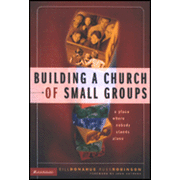
(These are notes I [DPC]  took from the excellent book pictured above – Building A Church of Small Groups co-authored by Bill Donahue & Russ Robinson. Grand Rapids: Zondervan, 2005)

A PLACE WHERE NOBODY STANDS ALONE – By Bill Donahue & Russ Robinson

Willow Creek CC story –  “The people that we had worked with so hard to win to Christ were having an increasingly difficult time making the church a part of their life and making themselves a part of the church’s life. In many cases people couldn’t connect meaningfully to the church, but only about 10-15% of our congregation could get connected into one of those smaller settings (p. 11).”

Community – “It means first, that a Christian needs others because of Jesus Christ. It means second, that a Christian comes to others only through Jesus Christ. It means, third, that in Jesus Christ we have been chosen from eternity, accepted in time, and united for eternity.” ([Dietrich Bonhoeffer from Life Together, p.21] quoted on pp. 11-12)

New Vision for WCCC: “We began moving from a church where small groups were optional to a church where small groups defined the core organizational strategy (p. 12).”

Elder’s Comment: “We loved the movement of the HS, the changed lives, the catalytic energy, the sense of awe as we saw God at work; but we hated the disorderly organizational dynamics, burned-out staff and lay leadership, displaced people, and undisciplined masses (p. 13).”

The End Result:  “WCCC since 1992 (as of 2001) has gone from a church with small groups—that is, small groups being one of our programs—to being a church of small groups. Instead of 10-15% of the congregation connected into a small group, we have become a place where over 18,000 individuals are connected in 2,700 small groups (p. 14).”

 Part 1: Making the Case for Community

C1 – In the Beginning God: The Theological Evidence

  • “The Theological case for community depends on three basic ideas: First, God exists in community; He has forever existed as and will into eternity remain three persons in One. Second, God was incarnate in Jesus, whose transformational relationships offer a model you cannot ignore. Third, Jesus dreams of oneness for all Christians, which is why you must move your church toward His vision (P. 21).”
  • God is a plurality of oneness – “Then God said, ‘Let us make man in our image, in our likeness…(Gen. 1:26).” And … “The LORD our God, the LORD is one (Deut. 6:4).”
  • The Small Group is a generic form of human community that is transcultural, trans-generational and even transcendent. The call to human gathering in groups is a God-created (ontological) and God-directed (theological) ministry, birthed out of the very nature and purpose of God’s being. God as Being exists in community. The natural and simple demonstration of God’s communal image for humanity is the gathering of the small group (p. 22 quoting Garth Icenogle, from Biblical Foundations for Small Group Ministry, p. 13)
  • True community is both horizontal and vertical – like the bars on the cross…they meet in the center, when we experience God and all of His fullness and His people in all their fullness.
  • The Importance of Jesus’ prayer in John 17:20-21, “I do not ask for these only, but also for those who will believe in me through their word, that they all may be one, just as you, Father, are in me, and I in You, that they also may be in us, so that the world may believe that you have sent me.”
  • “This concern for the survival of the church down through the ages provides the explanation for the anguished tones of Jesus’ prayer. He knew that if the church should fail to demonstrate community to the world. It would fail to accomplish its mission, because the world would have reason to disbelieve the gospel (vv. 21, 23). According to that prayer, the most convincing proof of the truth of the gospel is the perceptible oneness of his followers (Quoting from Gilbert Bilezekian’s, Community 101, p. 37 [p. 32])

C2 – Created for Community: The Sociological Evidence

1)   SG’s provide strength for life’s storms – Many of the heroes of the faith (e.g. David @ Jonathan) survived adversity through faith and community.

  • Ecclesiastes 4:9-10, “Two are better than one…if one falls down, his friend can pick him up.” ; John 16:33, “In this world you will have trouble;” Romans 12:15, “Weep with those who weep;” Galatians 6:2, “Carry each other’s burdens, and in this way you will fulfill the law of Christ;” Leviticus 19:18, “Love your neighbor as yourself.”

2)    SG’s provide wisdom when we face important decisions.

  • Proverbs 15:22, “Plans fail for lack of counsel, but with many advisors they succeed.”

3)   SG’s provide accountability and offer us acceptance while we change.

  • Proverbs 27:17, “Iron sharpens iron, and one man sharpens another.”

4)   SG’s provides acceptance that help heal our wounds.

  • Interesting point: “When you talk to people about their families, you’ll discover a startling truth few want to admit. Many people experience more pain than love and acceptance in their families (p. 42).”
  • John 15:12-13, “My command is this: Love each other as I have loved you. Greater love has no one than this, that he lay down his life for his friends.

C3 – What the Church Needs to Grow: The Organizational Evidence

  • Two Principles: 1) Your church will best meet each member’s needs by honoring each leaders “span of care” (i.e. this principle insures that everyone is cared for, but no one cares for too many people); 2) the church cannot function as God intends unless people see themselves as members of one body.
  • “Reorganizing your congregation into a church of small groups is hard work. You need to present the organizational case to every segment of your church, including your ministries to children and adults, couples and singles, men and women, jocks and computer geeks, the mature and the emotionally unstable, the leaders and the newly converted. But span of care  (Exodus 18) can help your church achieve reorganization.
  • “Coach” is the term that WCCC uses for their leaders of small groups…
  • “We at WC had no way to achieve this level of care until we put span of care to work by organizing everyone into small groups. We designated leaders to care for groups of children, women, men, couples, and families. Coaches care for leaders, and coaches receive care from staff leaders (p.49).”
  •  “As everyone works together, God transforms individual lives, creating the kind of oneness experienced in the Trinity, the kind of community Christ dreams for us (p. 49).” Two key passages: 1 Corinthians 12:12-13 & Ephesians 4:3-7, 11-16
  • “I can tell you this: sizzling services, extra ministry programs, or new curricula will not transform yours into a church where people really do build each other up in love, ‘as each part does its work.’ The churches that come closest to this ideal share a common vision and practice. Their leaders—senior pastor, staff, elders, key volunteers—our bold enough to imagine the seemingly impossible. They believe the church can experience oneness by transforming people through community. And these leaders have recognized that small groups are the key, the common practice, for realizing the vision. They have taken action (p. 51).”

Part 2: Pursuing Community in Small Groups

C4 – Small Groups Are Built on Authentic Relationships

  • “Small groups are microcosms of God’s creation community. Wherever two or more persons come together, they become an actual reflection of the image and likeness of God. Small groups are the basic arena for either imaging the redeeming presence of God or projecting destructive human systems. Every small or large gathering of humanity exists in this tension of manifesting an inhuman structure or embodying divinely redemptive relationships.” – Gareth Icenogle, Biblical Foundations of SG Ministry
  • Key elements of authenticity: Growing in community; Self-disclosure; Care-giving; humility; truth-telling; & affirmation

C5 – Small Groups Are Places Where Truth Meets Life

  • Truth-Focused Groups = Know the right answers to the right questions; Focus on information—“What does it mean? Reward members for being right; Community is built on the principle of agreement; the goal is a well-informed student.
  • Life-Focused Groups = Know the right answers to personal problems; focus on introspection—“How do I feel?” Reward members for being real; Community is built on the principle of acceptance; The goal is a well-understood self
  • Transformation-Focused Groups = Know the truth about God and me; Focus on transformation—How am I becoming like Christ? Reward members for being on honest with God and others; Community is built on the principle of authenticity; The goal is a well-ordered heart.

C6 – Small Groups Experience Healthy Conflict

  • Setting Boundaries for Managing Group Conflict:

1)   If it happens in the Group, Process it in the group.

2)   The Leader is responsible for Process, Not Outcomes

3)   Validate the conflict

4)   The conflict does not need to be resolved at this meeting

5)   Conflict Must be processed with trust and confidentiality

  • Confronting an individual:

1)   Start as soon as possible

2)   Meet face to face

3)   Affirm the relationship

4)   Make observations, not accusations

5)   Get the facts

6)   Promote resolution

  • The “A” Guidelines for Confession:

1)   Address everyone involved (Ps. 32:5; Luke 19:8; James 5:16)

2)   Avoid using “if,” “but,” and “maybe.” What excuses or blaming do you need to avoid?

3)   Admit specifically what was done or said (Ezra 9:5-15)

4)   Apologize: How might others feel as a result of your sin?

5)   Accept the consequences (Luke 15:9; 19:8)

6)   After your behavior. What changes do you intend to make, with God’s help, in the way you think, speak, and behave in the future? (Matt. 3:8; Acts 26:20)

7)   Ask for forgiveness and allow time. What might make the person whom you have wronged reluctant to forgive you?

C7 – Small Groups Provide Well-Balanced Shepherding

  • Bill Hybels, “Of all the things Jesus could have said concerning Peter’s ministry (referring to John 21:15-19), he said, ‘Tend my sheep.’ He told Peter to get some people and train them up in the school of life, to nurture them, and to guide them. Jesus made time in his life to tend a little flock. And if he were here today, above all else, he would make the time to tend a little flock. So, if you are a small group leader, or a leader of leaders, and you are making time to tend a little flock, you are doing Jesus’ work. Any time you wonder whether you are having any impact on the kingdom, remember that tending a flock reflects the very heart of God and his plan of redemption for the world (p. 109).”

Part 3: Developing Leaders of Small Groups

C8 – Enlisting Small Group Leaders

  • Look at who they ARE: Affections; Reputation; & Expectations
  • Affections: People suited to leadership love God, people, truth, and the church. The greatest gifts a leader can give to a small group are a relationship with Christ and the passion to be more like Him.
  • Reputation: A person’s reputation offers clues to that person’s preparation for leadership. Make it a point to meet people close to the potential leader. Inquire what they think of the person’s character, trustworthiness, and way of relating to others. Ask people to assess a candidate’s leadership potential. Do they believe the person could grow toward leadership? Why or why not? Have they served others or the church in ways that produce effective fruits of ministry?
  • Expectations: Make sure candidates understand and support expectations for service. As you discuss what senior staff, elders, or other key lay leaders expect form a small group leader, look especially for people who commit themselves to participating in membership, respect spiritual authority, and pursue life-long learning.
  • Where do you look for leaders? This is a trick question. Rather than look for leaders, we encourage churches to look for people. There’s always a greater supply of people than of obvious leaders. Some of these people will eventually emerge as leaders.

C9 – Training Small Group Leaders

During Meetings:           Between Meetings:

Gather – invite current or potential members into community Build intimacy, transparency, and authentic relationships in the group Build friends with existing group members and seek to invite new ones
Develop – Take each person the next step in spiritual growth or leadership Create a place where truth meets life Shepherd members and develop apprentice leaders
Serve – Complete ministry tasks together Plan and prepare for strategic serving opportunities Serve personally outside the group or serve together as a group

C10 – Coaching and Supporting Leaders

The Role of the Coach


Huddle

Visiting the Group

One-on-One

Leadership Development:

  • Vision casting
  • Skills
  • Apprentices

Lead

Affirm

Care

Pastoral Care:

  • Spiritual
  • Relational
  • Personal

and

and

and

Ministry Support & Expansion:

  • Prayer
  • Affirmation
  • Resources

Model

Observe

Develop

C11 – Make Decisions

5 Questions that Must Be Asked in order to Become a Church of Small Groups:

1)   Will we become a church of small groups?

2)   Who will be the point leader?

3)   What will be our long-term structure?

4)   How will we develop enough leaders?

5)   From where are we starting?

Regardless of your design, you will find that you need a number of leaders equal to 25-30% of the number of people connected in groups. That high percentage includes those who are apprentices or rising apprentices, people who are intentionally being developed as emerging leaders. Thus, a group of 10 will have a leader, an apprentice, and maybe one or two others the leader hopes to develop as future leaders.

  • A church built on SG’s will need a lot of volunteers.
  • You need to invest in many volunteer leaders.
  • You will give away ministry to an increasing corps of lay ministers.
  • There is good news: the ownership of the congregation’s life will expand.

What Are Our Core Values?

  • Building relationships: How much do parishioners naturally care for each other?
  • Loving lost people: Are people inclined toward outsiders?
  • Truth telling: Does your congregation acknowledge and deal with conflict?
  • Mutual ministry: What is the current lay ministry quotient?
  • Accountability: Is there enough vulnerability and submission to grow?
  • Commitment: Do people own the church’s mission and act like it? 

Five Major Types of Small Groups:

Disciple-Making Groups Community Groups Service Groups Seeker Groups Support Groups
Members Believers in a structured discipleship process Believers & non-believers Believers & non-believers Predominantly nonbelievers Believers & non-believers
Curriculum A set curriculum Leaders work with Coaches to choose curriculum Leaders work with Coaches to choose curriculum Determined by questions from the group Determined by the ministry leaders
Open Chair Used at breaks in curriculum Used regularly to add members Used regularly to add members Always has an open chair Used primarily to form new groups
Emphasis Develop spiritual disciplines, memorize Scripture, disciple others Build community, invite new members Complete the task, invite new members Lead people to Christ, disciple new converts To support members as they work through personal difficulties
Multiplication Apprentice leads new disciple-making group Groups grow and birth after 24 to 36 months Groups grow and birth at variable rates depending on the task Apprentice leads new seeker group or new believers group Apprentices are trained to form new groups
Duration 18 to 24 months Continue to grow and birth Continue to grow and birth Average length is about one year Varies depending on personal needs and the purpose of the group
  • “In SG ministry, your strategy must account for span of care. Open groups will aid your journey. Varied entry points will give everyone ways to connect in an aligned ministry. A self-perpetuating leadership corps will grow into shepherding the whole flock effectively, especially as you intentionally cultivate spiritual growth and contextualize your growth model (p. 193).” 

C12 – Choose a Strategy

Stephen Bartman, Hyperculture, “When we come home at the end of the day, it may not be just work we bring with us, but also our high-speed frustrations and electronic expectations. In short, we may come to expect the imperfect human beings in our lives to operate as efficiently as our equipment, quickly losing patience with those we might otherwise love because they do not answer as swiftly, or respond as rapidly, or obey as readily as the machines we know.

Four Lessons for Ministry Alignment (p. 186):

First, communication is critical. “We failed to communicate adequately with leaders of the “church with” version of small groups. We didn’t explain often enough or deeply enough about how they would fit within the new infrastructure. Instead of building on our strong foundation, we alienated a key audience—then we had to win them back.”

Second, stay flexible. “Whatever strategy you choose needs a ‘loose-tight balance.’ You need a uniform set of standards and definite understanding of what constitutes group life and what does not. Yet, the ministry-by-ministry expression of groups must permit increased variety in meeting every person’s need and readiness for community.”

Third, balance patience with restlessness. “It took us seven years to organize every part of the church on a full small groups foundation. Sometimes we made partial gains, backed off until change was accepted, then returned to chip away again. As one minister observed: ‘We are in year twelve of a twenty-year vision, and we are going to have to extend it beyond that.’ Alignment takes time.”

Fourth, Confrontation is essential. Speak the truth in love.

C13 – Phasing in the Small Group Ministry 

The Model Phase: The best way to embed community values into a small group ministry is to model them yourself. If your church is just beginning small groups, start with a few model groups, led (ideally) by the senior pastor and/or other key church leaders.

Turbo Groups: ratchet up the model group concept. Turbo groups are SG’s filled with apprentice leaders. In other words, everyone in the group is expected to someday lead his or her own group. Thus a turbo group functions as both a real small group and a training group. 

The following will help your turbo groups succeed:

  • Turbo groups must build authentic community. This is not simply a training group. These people must understand and practice community or they will never reproduce it in their own groups.
  • Turbo groups must experience all components of a regular group. They need to practice the open chair, identify apprentice leaders, create places where truth meets life, build authentic relationships, and appropriately handle conflict—so that the same things will take place in the next set of groups.
  • Turbo groups must seize teachable moments. In these groups, leadership lessons are often caught, not taught. It is appropriate in the context of a turbo group to pause and say, “Let’s talk about what just happened—and why—in the last ten minutes.” Or, leaders might ask, “Why did I do this? What did you see me doing that was good or needs improving?”
  • Turbo groups take time. Turbo groups probably need at least 9-12 months to appropriately train new leaders. It can happen more quickly if the group meets weekly or if leaders have prior small group experience. However, brand new leaders may need as long as eighteen to twenty-four months of preparation.

The Pilot Phase: After firmly establishing your core values and clarifying your small group development model, you are ready for the pilot group phase. This is a learning phase for a limited number of groups. New to the nature and meaning of small group community, many people will be wary of long-term commitments. During this phase, you start a limited number of small groups that last just 9-12 months. The time limit is a safety net; it gives everyone a chance to pause, evaluate, and redesign.

The Start-Up Group Phase: Your leaders have modeled appropriate values during the model/turbo group phase. You’ve run new groups through a pilot phase to discover difficulties. Now you can give the “green light” to starting small groups throughout the church. The start-up group phase is the final phase before going public. You are now giving permission for interested people to develop groups and explore leadership.

  • During the start-up phase, you will need a training strategy so emerging groups and leaders can learn more skills. You will need regular leadership gatherings and an annual retreat. But this is still not the time to go public. It’s too soon for weekly pulpit exhortations about joining small groups, because your structure isn’t ready for the potential response.

Going Public:

  • Don’t go public until you have enough leaders and infrastructure in place to handle the response.
  • For the traditional groups transition from big groups to more communal and relationally oriented groups.

Dr. Ken Boa on The Importance of Teamwork in Ministry

The Importance of Teamwork

Perhaps brief would be the best word to describe a good kettledrum solo. Even the best musicians in the world would have a difficult time coaxing variety out of the huge mother of all percussion instruments. A flute or trumpet makes for much more pleasing and melodious sounds. Still, there are few solo instruments that can sustain our interests for long periods of time. We tend to think of instruments like the guitar or the piano because they can play more than one note at a time.

The long-term attraction of a good orchestra is not its solos, but its symphony. Music is most moving when it blends and balances the voices of many individual players. Mix a melodious violin with the thunderous boom of a tuba, add the melancholy cello and the warm French horn – and the minutes turn into hours without our even noticing. Such individually diverse instruments come together to make a sound like no other and sweep us along with them into another place.

This same principle that brings success in the concert hall holds true in the kitchen as well. A good chef mixes ingredients like flour, raw eggs or lard – things that by themselves are unappealing; but properly blended, they become mouth-watering dishes.

Likewise, a great leader must know how to bring together diverse elements and create a productive group. Few skills are more important in leadership than the ability to build a team. A mark of a great leader is how many great people will join his or her lineup. The greatest king of Israel, David, had a team comprised of “mighty men”:

These are the names of David’s mighty men:

Josheb-Basshebeth, a Tahkemonite, was chief of the Three; he raised his speak against eight hundred men, whom he killed in one encounter.

Next to him was Eleazar son of Dodai the Ahohite. As one of the three mighty men, he was with David when they taunted the Philistines gathered at Pas Dammim for battle. Then the men of Israel retreated, but he stood his ground and struck down the Philistines till his hand grew tired and froze to the sword. The Lord brought about a great victory that day. The troops returned to Eleazar, but only to strip the dead.

Next to him was Shammah son of Agee the Hararite. When the Philistines banded together at a place where there was a field full of lentils, Israel’s troops fled from them. But Shammah took his stand in the middle of the field. He defended it and struck the Philistines down, and the Lord brought about a great victory. – 2 Samuel 23:8-12

Because David attempted mighty things, only the mighty could keep up with him. Those who could not keep pace could not join the team.

You Can’t Do It Alone

Don Bennett was on top of the world. He was wealthier than most of us will ever imagine. He owned a ranch, a ski chalet and an eight-bedroom waterfront home on Seattle’s Mercer Island. And then everything changed. On a beautiful sunny day in August of 1972, Don was boating with his children when he fell overboard and the propeller of the boat ran over both of his legs. He nearly bled to death but managed to survive. His left leg took 480 stitches to close. His right leg was gone completely above the knee.

To make matters even worse, while he was in the hospital recovering, his business fell to pieces. Don felt like he had lost everything – except his determination. Amazingly, Don taught himself to ski again. Eventually, he would teach other amputees to ski on one leg. He started another business, Video Training Center, which listed such clients as Boeing and Weyerhauser. He started kayaking, and it was then that he began to dream of climbing mountains again.

Don had climbed Mt. Rainer in 1970. He decided to do it again, but he knew he couldn’t do it alone. He hopped five miles a day on his crutches. With a team of four others, he made it within 400 feet from the top before they were forced off by whiteout conditions and screaming winds. Four months later, he was training again with his team captain. They trained together for another year before returning to the mountain. He climbed for five days, 14 hours a day, sometimes hopping, sometimes crawling up the incline on one leg, and on July 15, 1982, Don Bennet touched the summit at 14,410 feet. He was the first amputee to climb Mt. Rainer.

When asked about the most important lesson he learned during the entire ordeal, his response was simple: “You can’t do it on your own.” He described how during one very difficult trek across an ice field his daughter stayed at his side and with each hop told him, “You can do it, Dad. You’re the best dad in the world. You can do it, Dad.” He told his interviewers that there was no way he would quit hopping to the top with his daughter yelling words of love and encouragement in his ear.1

You can’t do it alone. That makes a lot of sense! Few, if any, truly outstanding accomplishments can be achieved alone. That’s a fact that most of us are aware of. But what is not immediately obvious is that not just anyone can help. Don Bennett did not recruit his helpers in a nursing home. He built a team of people who wanted to climb a 14,410-foot peak and, perhaps more importantly, who could climb a 14,410-foot peak. One who attempts mighty feats had better be capable of recruiting a mighty team of willing and able participants.

King David did just that. His was one of the most celebrated teams in the entire Old Testament. This group was the all-star team of his battle-hardened warriors, celebrated for their valiant efforts. These men were ready, willing and able to step into the battle and lay their lives on the line for the man they knew was God’s chosen leader.

Several things stand out as we consider how David pulled his team together.

First, he spent time with them in battle. These men were welded to David by the hot fires of battle. His inner circle consisted of those men who had fought alongside him. Men, more so than women, tend to be seriously bonded together by shared experiences. It is especially true that as men struggle together and endure fierce opposition they are most tightly knit. Men who train for battle as a unit understand that they are their brother’s keeper. No one fights a battle alone; they move and succeed or fail as a unit. David knew these men and their capabilities, because he had seen what they could do with his own eyes.

Second, knowing that they were willing to make sacrifices for him, David made sure that they knew he was willing to do the same for them. When three of his mighty men risked their lives to obtain drinking water for him during a battle, David refused to drink it, choosing instead to pour it out onto the ground:

During harvest time, three of the thirty chief men came down to David at the cave of Adullam, while a band of Philistines was encamped in the Valley of Rephaim. At that time David was in the stronghold, and the Philistine garrison was at Bethlehem. David longed for water and said, “Oh, that someone would get me a drink of water from the well near the gate of Bethlehem!” So the three mighty men broke through the Philistine lines, drew water from the well near the gate of Bethlehem and carried it back to David. But he refused to drink it; instead, he poured it out before the Lord. “Far be it from me, O Lord, to do this!” he said. “Is it not the blood of men who went at the risk of their lives?” And David would not drink it. – 2 Samuel 23:13-17

Such were the exploits of the three mighty men.

This was by no means intended to degrade their act. Rather, David meant to dignify it. He poured the water out before the Lord almost as a drink offering. His act of sacrifice communicated a depth of devotion and love that had to have impressed those warriors.

Third, they celebrated victory together. Time and again David and his mighty men faced seemingly insurmountable odds and saw God deliver them. Through these amazing victories, David and his mighty men began to experience the truth that the Apostle Paul would later share with the church in Rome: “If God is for us, who can be against us?” (Romans 8:31b). Knowing that God would be faithful to deliver his anointed leader from dangerous circumstances, afforded these men great confidence in the battles they faced.

Finally, David honored his friends. These men were well known throughout the land as “David’s Mighty Men.” That phrase served as a banner that set them apart as extraordinary. They weren’t merely known as mighty men; they were David’s mighty men. A group’s strong sense of identity allows them to stand firm in the face of mounting pressure. As we read this account, one thing becomes clear: David knew he couldn’t do it alone.

The early church had this same mindset. In Acts 2:42-47, we read that the body of Christ viewed itself as a synergistic team:

They devoted themselves to the apostles’ teaching and to the fellowship, to the breaking of bread and to prayer. Everyone was filled with awe, and many wonders and miraculous signs were done by the apostles. All the believers were together and had everything in common. Selling their possessions and goods, they gave to anyone as he had need. Every day they continued to meet together in the temple courts. They broke bread in their homes and ate together with glad and sincere hearts, praising God and enjoying the favor of all the people. And the Lord added to their number daily those who were being saved.

There was a tangible sense of teamwork in the early church. These Christ-followers shared their possessions, met together regularly and ate “glad and sincere hearts.” Notice that Luke uses the word “devoted” to describe the early Christians. This is one of his favorite words in the book of Acts. Its roots are found in the idea of a steadfast pledge or a binding promise. Not only were these believers devoted to God, they were devoted to one another.

Teamwork and the Trinity

Strong teams functioning at their best reflect similarities to the relationship that exists within the divine Trinity. Scripture records the work of the divine trinity in the creation of the cosmos (see Genesis 1:1-2; John 1:1-3; Colossians 1:15-17). Thus, when a team works together in an other-centered manner, it mirrors, albeit dimly, the creativity and mutual regard that is derived from God himself. As Gilbert Bilezikian has written, “Whatever community exists as a result of God’s creation, it is only a reflection of an eternal reality that is intrinsic to the being of God.”2

The three persons of the Godhead are never independent but always work together in concert. One needn’t read very far in the Bible to discover this. In the very first verse (Genesis 1:1), we are introduced to God as the initiator and designer of all creation. The second verse describes the Spirit of God hovering over the created world. Notice that the Spirit does not construct the created world; he merely hovers over it – suggesting the role of protector or overseer. Finally, in the third verse, we find the Word of God as the executor of God’s will – the agent of creation.3

This perfect and harmonious interaction, though obvious from the beginning of the Bible, was especially evident in how God made it possible for people who were formerly alienated from him to be transformed into his beloved children (Ephesians 1:3-14). This passage, which in the original language of the Bible is actually one long run-on sentence, beautifully extols the work of each member of the Trinity in God’s scheme of redemption, work which corresponds to what we have just seen in the first three verses of Genesis 1.

Paul first spoke of the work of the Father in accomplishing our salvation:

Praise be to the God and Father of our Lord Jesus Christ, who has blessed us in the heavenly realms with every spiritual blessing in Christ. For he chose us in him before the creation of the world to be holy and blameless in his sight. In love, he predestined us to be adopted as his sons through Jesus Christ, in accordance with his pleasure and will – to the praise of his glorious grace, which he has freely given us in the One he loves. – Ephesians 1:3-6

The Father chose us before the creation of the world and sent his Son into the world so that through him we could be adopted into his family. He planned all this out very carefully and initiated it at just the right time. God the Father is the initiator and designer of our salvation.

Second, the apostle focused on the work of the Son:

In him we have redemption through his blood, the forgiveness of sins, in accordance with the riches of God’s grace that he lavished on us with all wisdom and understanding. And he made known to us the mystery of his will according to his good pleasure, which he purposed in Christ, to be put into effect when the times will have reached their fulfillment – to bring all things in heaven and on earth together under one head, even Christ.

In him we were also chosen, having been predestined according to the plan of him who works out everything in conformity with the purpose of his will, in order that we, who were the first to hope in Christ, might be for the praise of his glory. – vv. 7-12

The Son makes the Father’s plan a reality. In his incarnation, he becomes the God-man, the mediator between God and man. His blood sacrifice on our behalf paid the penalty for our sins so that we could enjoy forgiveness and lay hold of God’s purpose for our lives. God the Son is the agent of our salvation.

Third, the work of the Holy Spirit seals and guarantees our spiritual inheritance:

And you also were included in Christ when you heard the word of truth, the gospel of your salvation. Having believed, you were marked in him with a seal, the promised Holy Spirit, who is a deposit guaranteeing our inheritance until the redemption of those who are God’s possession – to the praise of his glory. – vv. 13-14

The Holy Spirit applies the righteousness of Christ to all those who are in Christ. He has anointed us, holding us as a pledge until we see Christ face-to-face. The Spirit of God is the protector of our salvation.

Thus, the Father initiated salvation, the Son accomplished it and the Holy Spirit makes it real in our lives. At the end of each of these three sections the phrase “to the praise of his glory” appears. All three are to be praised for their work in bringing us to salvation. The Father, Son and Holy Spirit perform distinct roles, but they work together in perfect harmony and agreement.

There is much talk about how to build unity among diverse people. If we go back to the analogy of an orchestra, you may recall how that orchestra tunes itself before the performance. The oboist plays the concert pitch (an A above middle C [440 Hz.]), then the first violinist plays the A, and the other instruments tune to that pitch. What follows can only be described as a bizarre cacophony at first, as you hear them make that strange sound only an orchestra can make. But once it’s calmed down, they’re all tuned to one another by tuning to the same instrument.

Jesus Christ is our guiding instrument. His incarnation sounded the concert pitch for all of us. As we yield to the transforming power of the Holy Spirit, we find our own instruments coming more and more into the same key as Jesus. As a byproduct of this, we find that we are all in tune with one another as well.

The Power of Synergy

A team is capable of accomplishing things that no individual, no matter how multi-talented, could do alone. Let’s take a little quiz. Don’t worry, there is only one question: If two horses can pull 9,000 pounds, how many pounds can four horses pull?

Here’s a hint: it’s not 9,000 pounds. In fact, it’s not 18,000 pounds. Believe it or not, four horses can pull more than 30,000 pounds! If that doesn’t compute, it’s because you don’t understand the concept of synergism.

Synergy is the energy or force that is generated through the working together of various parts or processes. Synergism can be defined as the interaction of elements that, when combined, produce an effect that is greater than the sum of the individual parts. Synergy is a joint action that increases the effectiveness of each member of a team. To function well, a team must be committed to a common vision and purpose, and it must be willing to work in unity for the improvement of the whole rather than the advancement of any one member.

From a large pool of disciples who were following him, Jesus designated only 12 men who would become his apostles. This was such a significant decision that the Lord prayed all night to prepare for it: “One of those days Jesus went out to a mountainside to pray, and spent the night praying to God. When morning came, he called his disciples to him and chose twelve of them, whom he also designated apostles” (Luke 6:12-13). Mark 3:14 adds that Jesus appointed these 12 apostles “that they might be with him and that he might send them out.”

Jesus knew that this was the team that would be with him for the rest of his ministry, and he was prepared to pour himself unreservedly into their lives. He would still teach the crowds, but in private sessions he now begins to pour out his plans and his character into these 12 men. Even in the midst of his greatest popularity, Jesus realized that the way to turn the world upside-down is to invest heavily in a few.

Nearly 2,000 years later, we are here to attest to that fact that it worked. Eleven of these 12 men became the foundation of the church, built on the cornerstone of Christ (Ephesians 2:19-20). Jesus’ actions, the unshakable reality of the resurrection and the indwelling power of the Holy Spirit turned a group of men who were characterized by confusion, infighting and self-interest into a genuinely synergistic team with (and this is perhaps the greatest miracle of all time) an authentic fondness for one another.

Today the church, the body of Christ on earth, is not an organization but an organism that manifests both unity and diversity. We’re each a part of something; there are to be no spiritual loners in God’s family. We are people who journey along the way with other people to whom we’re called into a covenant of relationship. When we come to God, helpless and battered, nothing in our hands, and receive his gift of forgiveness and salvation, we are buying into a package deal. God says, “If you love me, you must love my people as well.”

We live in an individualistic culture, but we are called to be people in relationship. We are not called to be the persons of God but the people of God.

One phrase that is easily overlooked in all this is the first part of verse 14: Jesus set these men apart “that they might be with him.” Before they were sent out to engage the world in ministry, they were called to a personal experience with Jesus. Wisely, Christ never wants anyone to talk about Christianity like a salesman but as a witness, someone who has experienced firsthand what he is talking about. There is something about a person who has been with Jesus that is distinctive.

Most of us would agree: being alive when Jesus comes would be optimal. We pray, with the saints throughout the ages, “Maranatha! Even so, come Lord Jesus.” However, is anyone of us willing to be presumptuous and assume that we will be alive when he comes? Can we be so certain that his return will come during our own lifetime?

It is wise for us to see how we can invest into other people so that the things we have learned, the things we value, the things we have built our lives around will live on after we are gone. A prudent mind is always building succession. A prudent mind is always mentoring another who will rise to positions of leadership in the future. An old folk parable says that a wise man is willing to plant shade trees even though he knows he will never enjoy the shade. He’s planting them for his children and his children’s children.

We see a great example of the relationship between synergy, mentoring and teambuilding in sports. Many of the great coaches of our era once played for and coached under the great coaches of yesteryear. In the 2002 World Series, the Anaheim Angels squared off against the San Francisco Giants. Remarkably, both teams were managed by former teammates Mike Scioscia and Dusty Baker. Both men are among the finest managers in professional baseball, and they will tell you the wonderful experience it was to play for the legendary Tommy Lasorda. Byron Scott coached the New Jersey Nets to back-to-back NBA finals. He directly attributes much of his success to playing under the tutelage of Pat Riley. As the coach of the San Francisco Forty-Niners, Bill Walsh revolutionized the game of football with his “West Coast Offense.” At least seven of those who were his assistant coaches have now been head coaches in the National Football League.

A Team of Specialists

Teams are comprised of positional specialists. These individuals have been recruited on the basis of individual ability and expected contribution. But they aren’t a solid team until their individual strengths combine to produce an outcome which no single member alone could have produced. High performance teams are tough to build. So we look to the Master Teacher for a demonstration of how to recruit and mold a world-class team.

Jesus formed the most important team ever assembled. This team was developed to continue his work on earth (Acts 1:8-9). Luke recorded the continuing story of the apostles in the book of Acts. The church they led exploded out of Jerusalem, around the world and across nearly 2,000 years of history. Mark 2:14-17 recounts a seemingly insignificant event – the calling of Matthew, also known as Levi:

As [Jesus] walked along, he saw Levi son of Alphaeus sitting at the tax collector’s booth. “Follow me,” Jesus told him, and Levi got up and followed him.

While Jesus was having dinner at Levi’s house, many tax collectors and “sinners” were eating with him and his disciples, for there were many who followed him. When the teachers of the law who were Pharisees saw him eating with the “sinners” and tax collectors, they asked his disciples: “Why does he eat with tax collectors and ‘sinners’?”

On hearing this, Jesus said to them, “It is not the healthy who need a doctor, but the sick. I have not come to call the righteous, but sinners.”

Levi may seem like an arbitrary choice, but as we saw earlier, Jesus spent all night in prayer before making his choices. In other words, he chose Matthew intentionally, because he wanted to show us something. By choosing a tax collector, Jesus demonstrated two important principles of team building.

First, he recruited specific people for specific reasons. Teams are made up of players. Players have positions. They are expected to contribute something they do well – ideally better than anyone else on the team.

Second, Jesus recruited an “odd” player. He began with a group of Galileans – working men, mostly fishermen, all with strong Jewish backgrounds. Then he inexplicably added Matthew, a tax collector and hated publican, to the mix. As far as the apostles go, this was the most unlikely candidate. As a tax collector, he would have been violently opposed by orthodox Judaism. In fact, the Hebrew word for tax collector (mokhes) seems to have as its root meaning “oppression” and “injustice.” The Jews simply hated this oppressive system of Roman taxation. They hated the high percentage of taxes. They hated the sheer number of taxes: Polls, bridges, roads, harbors, income, town, grain, wine, fish, fruit, etc. They hated how their money was spent on immoral and idolatrous activities. But most of all, they hated what Roman taxation represented: Roman domination of the people of God.

Consequently, any Jew who worked for the Roman “IRS” was viewed as a traitor of the worst sort. Matthew is therefore ostracized from all forms of Jewish life, especially their synagogue services. J.W. Shepard notes, “His money was considered tainted and defiled anyone who accepted it. He could not serve as a witness. The rabbis had no word of help for the publican, because they expected him by external conformity to the law to be justified before God.”4

Interestingly, as the writer of the first Gospel, we learn more from Matthew about Old Testament prophecies and Jewish traditions than from any other writer. Reading his book we would think that he was a Jew’s Jew. What are we to make of this? Perhaps Matthew longed for his Jewish roots and yet was hard-pressed by his job security. Likely in solitude he studied the Scriptures, coming to independent conclusions and an individual hope of the Messiah. We should learn from Matthew that those on the sidelines who look so antagonistic might just be the greatest members of our team.

As Jesus passed by, he looked at Levi. Most people would have tried to ignore the tax man or sneak past him. Jesus was different. He met Levi eyeball-to-eyeball and called him to immediate discipleship.

Matthew responded immediately and radically. Likely Levi was familiar with Jesus. The Sea of Galilee, especially this shore near Capernaum, is Jesus’ “headquarters.” Undoubtedly he had heard Jesus preach. He may even have witnessed Jesus’ call to the four fishermen. Certainly he had collected plenty of taxes from them, especially after the great miraculous catch (Luke 5:4-7). Though the text is a bit confusing on this point, Matthew probably closed up shop and then settled accounts with the Roman authorities over him. To do less would have been irresponsible and even dangerous, thus jeopardizing the ministry of Jesus.

It is one thing for four fishermen to leave their private business in the hands of their father. They always had the option to return. In fact, after the resurrection, the apostles returned to Galilee and spent their time fishing as they waited for Jesus. However, Levi’s situation was different. He had not other options. He was a small member of a large corporate structure. There were eager young publicans itching to sit in his lucrative seat. When he left, he knew he was leaving for good.

In addition to Matthew the tax collector, Jesus also recruited Simon the Zealot, who was at the opposite end of the political spectrum from Matthew. Jesus taught his team of individuals to understand, appreciate and love each other. Jesus molded his team into a tightly-knit unit. But he recruited each of them on the basis of their individual strengths. He recruited people who would contribute to the other members of the team and to the team’s overall objectives.

Teams, by their nature, require specialists. Specialists often differ in personality and views. Team members combine their strengths to help one another to grow and to change their world. Such a diversified team may be tougher to lead – but then training lions is more exciting than feeding goldfish!

Trusting Your Team

Every competent leader knows the importance of building a team. But how is this accomplished? Once again, Jesus provides us with an example:

When Jesus came to the region of Caesarea Philippi, he asked his disciples, “Who do people say the Son of Man is?” 

They replied, “Some say John the Baptist; others say Elijah; and still others Jeremiah or one of the prophets.” 

“But what about you?” he asked. “Who do you say I am?”

Simon Peter answered, “You are the Christ, the Son of the living God.”

Jesus replied, “Blessed are you, Simon son of Jonah, for this was not revealed to you by man, but by my Father in heaven. And I tell you that you are Peter, and on this rock I will build my church, and the gates of Hades will not overcome it. I will give you the keys to the kingdom of heaven; whatever you bind will be bound in heaven, and whatever you loose on earth will be loosed in heaven.” Then he warned his disciples not to tell anyone that he was the Christ. – Matthew 16:13-20

There’s one factor that may be more important to effective leadership than leadership qualities or extensive training. According to Jon R. Katzenbach and Douglas K. Smith, effective leaders, “simply need to believe in their purpose and their people.”5 Katzenbach and Smith contend that the stronger this belief, the more it will enable leaders to instinctively strike the right balance between action and patience as they work to build effective teams.

Nobody illustrated this principle more effectively than Jesus. When Jesus asked Peter, “Who do you say I am?”, he wasn’t engaging the fisherman in an intellectual exercise. If Peter was to lead the church, he would have to have a grasp on the identity of Christ and his purpose. Peter didn’t blink an eyelid before answering. He boldly declared that Jesus was “the Christ, the Son of the living God.” When Peter confessed that Jesus was the “Christ,” he exhibited an understanding of the Lord’s purpose. He was the Christ, the Messiah, the Savior. He had come to save all who would trust in him.

Jesus responded not only by affirming Peter’s God-given insight, but also by expressing his confidence in the disciple’s future role in leading the church. While theologians may debate about the exact meaning of Jesus’ words, one thing is clear: Jesus entrusted Peter with a key leadership role. And that step was crucial to the future development of the team of men and women who were to storm the Roman Empire with the gospel.

1Adapted from James M. Kouzes and Barry A. Posner, The Leadership Challenge: How to Keep Getting Extraordinary Things Done in Organizations (San Francisco: Jossey-Bass, 1995).

2Gilbert Bilezikian, Community 101: Reclaiming the Local Church as Community of Oneness (Grand Rapids: Zondervan, 1997), p. 16.

3Adapted from Bilekizian, Community 101, pp. 16-17.

4J. W. Shepard, The Christ of the Gospels (Grand Rapids: Eerdmans, 1939), p. 143.

5John R. Katzenbach and Douglas K. Smith, The Wisdom of Teams: Creating the High-Performance Organization (Boston: Harvard Business School Press, 1993), pp. 138-139.

Book Review: Change Your Life Not Your Wife – Marriage Saving Advice for Success Driven People by Tony Ferretti and Peter J. Weiss

Good Solutions to Common Marriage Problems By Dr. David P. Craig

Tony Ferretti and Peter J. Weiss have combined their efforts to write a very readable and practically helpful handbook on marriage for success driven people. Early into the book the author’s write their thesis: “The power failure syndrome happens because the same traits that propel people to the top in business cause turmoil in their personal lives.”

I’ve witnessed this reality time and time again as a pastor and life coach. It’s mind boggling to me how many men and women are successful in their careers and woefully unsuccessful in their relationships at home with their spouse and children. The bulk of this book is designed to counteract this trend by honing in on four key areas in a marriage: 1) Working toward the marriage you want to have – it does take work; 2) Achieving balance between your career and your relationships; 3) Establishing an ease in your relationships; and 4) All you need to do is change yourself!

The main aspects of deteriorization in a marriage result from trying to bring two personalities together; having differing expectations; and being unable to talk through conflict resolution. This results in conflicts growing, frustration being built; chronic anger being developed; resentments being formed and intensified; and ultimately detachment and crisis.

The author’s give many real life examples of how marriages deteriorate, as well as steps that can be taken in order to avert a crisis, and even develop a successful and happy marriage. They talk about relational killers, and give wonderful advice in the areas of communication and nurturing your marriage. I recommend this book as a good guidebook for couples to detect their emotional and character blind spots. They have provided many practical questions, assessments, and strategies throughout the book.

The one weakness of the book relates to not addressing the worldview of the couple. For example – My wife and I are Christians and thus share the same Biblical values, goals, purposes, objectives, etc. So in our roles as a husband and wife, as well as in our parenting, and balancing all aspects of life we have the same worldview foundation. I think the danger of this book is that it focuses too much on behavioral changes (symptoms – fruit) without getting at the cause or the foundations of behavior (cause/sin/idolatry/selfishness/root of all problems).

Therefore, my recommendation would be to read this book along with a marriage book that has a good basis and foundation for marriage like R.C. Sproul’s “The Intimate Marriage,” or Tim Keller’s “The Meaning of Marriage.” Overall, it’s well written, full of practical help, and recommended for pre and post married couples of all ages.

About the Author’s of Change Your Life, Not Your Wife:

Dr. Tony Ferretti is a licensed psychologist who has helped clients recognize the addictive nature of power, control, and “success” for over twenty years. A Ph.D. graduate of the University of Southern Mississippi, he’s appeared on Dr. Phil and hosted his own popular radio talk show, “Talk to Tony.”

Dr. Peter Weiss is a physician and healthcare executive with a passion for helping others to health and wellness. A graduate of Washington University in St. Louis, Dr. Weiss currently serves as an executive for the Adventist Health System in Orlando, Florida.

Dr. Paul David Tripp on “Why Does God Ask Us To Wait?”

Spiritual Muscle Development by Paul David Tripp

So, what happens inside of you when you are asked to wait? Is waiting, for you, a time of strengthening or weakening? Have you ever stopped to consider why God asks you to wait?  Let me point you to one of his purposes.

Waiting Is Giving You Time

When God asks you to wait, what happens to your spiritual muscles? While you wait, do your spiritual muscles grow bigger and stronger or do they grow flaccid and atrophied? Waiting for the Lord isn’t about God forgetting you, forsaking you, or being unfaithful to his promises. It’s actually God giving you time to consider his glory and to grow stronger in faith. Remember, waiting isn’t just about what you are hoping for at the end of the wait, but also about what you will become as you wait.

Waiting always presents me with a spiritual choice-point. Will I allow myself to question God’s goodness and progressively grow weaker in faith, or will I embrace the opportunity of faith that God is giving me and build my spiritual muscles? (see Psalm 27:4)

It’s so easy to question your belief system when you are not sure what God is doing. It’s so easy to give way to doubt when you are being called to wait. It’s so easy to forsake good habits and to take up habits of unfaith that weaken the muscles of the heart. Let me suggest some habits of unfaith that cause waiting to be a time of increasing weakness rather than of building strength. These are bad habits that all of us are tempted to give way to.

Habits of Unfaith

Giving way to doubt. There’s a fine line between the struggle to wait and giving way to doubt. When you are called to wait, you are being called to do something that wasn’t part of your plan and is therefore something that you struggle to see as good. Because you are naturally convinced that what you want is right and good, it doesn’t seem loving that you are being asked to wait. You can see how tempting it is then to begin to consider questions of God’s wisdom, goodness, and love.  It is tempting, in the frustration of waiting, to actually begin to believe that you are smarter than God.

Giving way to anger. It’s very easy to look around and begin to think that the bad guys are being blessed and the good guys are getting hammered (see Psalm 73). There will be times when it simply doesn’t seem right that you have to wait for something that seems so obviously good to you. It will feel that you are being wronged, and when it does, it seems right to be angry. Because of this, it’s important to understand that the anger you feel in these moments is more than anger with the people or circumstances that are the visible cause for your waiting. No, your anger is actually anger with the One who is in control of those people and those circumstances. You are actually giving way to thinking that you have been wronged by God.

Giving way to discouragement. This is where I begin to let my heart run away with the “If only_____,” the “What if_____,” and the “What will happen if_____.” I begin to give my mind to thinking about what will happen if my request isn’t answered soon, or what in the world will happen if it’s not answered at all. This kind of meditation makes me feel that my life is out of control. And I am able to think my life is out of control because I have forgotten God’s wise and gracious contol over very part of my existence. Rather than my heart being filled with joy, my heart gets flooded with worry and dread. Free mental time is spent considering my dark future, with all the resulting discouragement that will always follow.

Giving way to envy. When I am waiting, it’s very tempting to look over the fence and wish for the life of someone who doesn’t appear to have been called to wait. It’s very easy to take on an “I wish I were that guy” way of living. You can’t give way to envy without questioning God’s wisdom and his love. Here is the logic: if God really loves you as much as he loves that other guy, you would have what the other guy has. Envy is about feeling forgotten and forsaken, coupled with a craving to have what your neighbor enjoys.

Giving way to inactivity. The result of giving way to all of these things is inactivity. If God isn’t as good and wise as I once thought he was, if he withholds good things from his children, and if he plays favorites, then why would I continue to pursue him? Maybe all those habits of faith aren’t helping me after all; maybe I’ve been kidding myself.

Sadly, this is the course that many people take as they wait. Rather than growing in faith, their motivation for spiritual exercise is destroyed by doubt, anger, discouragement, and envy, and the muscles of faith that were once robust and strong are now atrophied and weak.

One of His Primary Shaping Tools

The reality of waiting is that it’s an expression of God’s goodness not empirical evidence against it. He is wise and loving. His timing is always right, and his focus isn’t so much on what you will experience and enjoy, but on what you will become. He is committed to using every tool at his disposal to rescue you from yourself and to shape you into the likeness of his Son. The fact is that waiting is one of his primary shaping tools.

So, how do you build your spiritual muscles during the wait? Well, you must commit yourself to resisting those habits of unfaith and with discipline pursue a rigorous routine of spiritual exercise.

What is the equipment in God’s gym of faith? Here are the things that he has designed for you to build the muscles of your heart and strengthen your resolve: the regular study of his Word; consistent godly fellowship; looking for God’s glory in creation every day; putting yourself under excellent preaching and teaching of Scripture; investing your quiet mental time in meditating on the goodness of God (e.g., as you are going off to sleep); reading excellent Christian books; and spending ample time in prayer. All of these things will result in spiritual strength and vitality.

Is God asking you to wait? So, what is happening to your muscles?

About the Author: Paul David Tripp is the president of Paul Tripp Ministries, a nonprofit organization whose mission statement is “Connecting the transforming power of Jesus Christ to everyday life.” Tripp is also professor of pastoral life and care at Redeemer Seminary in Dallas, Texas, and executive director of the Center for Pastoral Life and Care in Fort Worth, Texas. Tripp has written many books on Christian living that are read and distributed internationally. He has been married for many years to Luella, and they have four grown children. There are very few people today who can apply the gospel to every aspect of life as practically as Dr. Tripp. The article above is adapted from: http://www.desiringgod.org/blog/posts/spiritual-muscle-development, January 26, 2011.

Have You Developed an Intentional Life Plan?

[The very helpful resource below is similar to the Vertical Life Plan that I have developed to help people live more intentionally with Christ at the center of all of life for the ultimate glory of God. I highly recommend that you get a Bible, a journal, and slip away to a quiet place to work through this Life Plan. Ideally, if you can get away for a day or two in a quiet place where you will have minimal disturbances or distractions you will find that God can really meet you in a powerful way and release you on a rejuvenating and reinvigorating journey with Him and for Him. I would also highly recommend that you go through this inventory with a trusted friend, pastor, life-coach, or mentor for some honest accountability and encouragement to give your life focus, direction, and faithfulness to God’s calling on your life – DPC]


 “LIFE PLAN” by Dr. Martin Sanders

It’s been called “MIDLIFE crisis,” “midlife reevaluation,” “midcourse adjustment,” “crunch-time” and many other things. When you reach a place in your life where it becomes clear either to you or to the people around you that it’s time for you to do an assessment, where do you start?

This tool is designed for self-evaluation and reflection. You may want to have others [like a professional life coach, pastor, or trusted friend] assist you in the process. Realize that not every section will be the most pertinent for you, but seek to go through each of them in a thoughtful and reflecting manner. This process may take you a few hours or, for some, a few days. It may cause you to reflect, find hope or maybe even shed some tears. It is designed to assist you in more effectively evaluating the best of who you are and how to reach your life dream in life.

Whether it’s time for a change in lifestyle or career or simply a time for you to reevaluate how to do what you do more effectively and more efficiently, this life plan is designed to help you move from your original dream through the developmental stages of assessment to finally arrive as a future dream.

Original Dream

Describing your original dream takes you to a place of ultimate impact and fulfillment. It’s a place where your life has maximum meaning. Almost everyone has a dream, but the fear of failure and concern about finances are often limitations. The purpose of this exercise is to help you figure our what it is that really captures your imagination, how you can be used the most and then how you can take steps to fulfill that original dream.

(1)  God back to a time in your life—high school, college or some other time—when you were dreaming your original dream. Begin to define or describe that dream.

(2)  What really excites you about your dream?

(3)  Do you possess the necessary resources—education, experience, discipline, courage, confidence, finances, etc., –to fulfill your dream? If not, can you secure them?

(4)  Do you think in terms of success n life or personal significance and influence? Do you think in terms of financial success or personal or spiritual impact?

(5)  How clear is your sense of dream? Is it very undefined? Is there a general sense to it? Are there general steps for it to be accomplished?

(6)  What are two or three steps you could take to get you started on defining, discovering and fulfilling your original dream?

Your Gifts And Calling

Gifts/Passions. When you assess your areas of gifting, it’s not just about reflecting on what you’ve done. It’s also important to look at areas that you’ve not yet developed. Look past successes and failures. Look at issues of confidence, or lack thereof, to see if they are holding you back. Also, look not only at your experiences, but also at your passion and your dreams. Then look at issues of your temperament, the time availability you have and your personal and spiritual maturity. This will help you figure out what your gifting and passion are and how you can best invest your life.

(1)  What do you like to do?

(2)  What have you been successful at?

(3)  What is the primary passion of your life? What do you dream about when you give yourself time and permission to dream?

(4)  Of the experiences you have had in the last five years, which ones have captured your imagination most?

(5)  If you were guaranteed that success and money were not an issue, what would you do with your life?

(6)  Do you feel trapped, or is there fulfillment in what you do? Can you see yourself there for the long-term or even the rest of your life?

(7)  When you look at how you are investing or have invested your time, energy and gifting, is this the best use of who you are? Is this as good as it gets for you?

Kingdom Investment of Your Life

It is important that, once you have discovered the particular gifts and abilities that God has given you, you examine whether you only use them to enjoy them or if you use them in ways that bring glory to Him.

(1)  Have you figured out how to take the best of who you are and invest it in God’s kingdom in such a way that it reproduces dividends that last for eternity?

(2)  Do you intentionally look for ways to take those gifts and abilities and use them in a way that other people can benefit from them?

(3)  Are you confident in taking the best of what God has given you and using it as widely as possible, or do you simply use it in formats that are comfortable for you?

(4)  Do you see ways that God would like to use you that you don’t feel confident doing now?

(5)  Are there times when you know that you’re supposed to do something but don’t have the courage or want to take the time to do it?

(6)  If you could be given one or two things that would help you take the best of who you are and invest it more completely, what would it be? Do you need courage, confidence, education, financial resources, empowerment, or someone to walk you through the process? Do you need a mentor, friend, spiritual director, or life coach? Do you need someone to pray with you and listen to you?

(7)  Think through any limitations that hold you back from investing the best of who you are. Begin to address those.

(8)  Interview several other people. Ask them ways they have seen God use you. Why did he use you in this way? Did it happen just once, or is there a pattern? Don’t overlook old friends, members of churches you have been a part of, family members and ministers you have known. They can help you with this.

Calling, Clarification, Leading, Direction

 There are three different types of calling:

The first type is the general calling to be holy as God is holy and to love the Lord God with all your heart, soul, mind and strength. It’s a general sense of leaving what you have to follow Christ completely.

The second kind of call comes to specific people, such as the disciples of Jesus, who were called to leave their locations and their livelihoods to follow Him completely with their time and receive financial support for their sustenance.

The third kind of call is a very specific one of which there are plenty of examples in the Bible: See the stories of Moses, Samson, Isaiah, Jeremiah, John the Baptist, Jesus and Saul of Tarsus. These individuals were singled out. They were often told that they had a purpose from before their birth. Their whole lives’ purpose was to fulfill a particular destiny or calling that God had for them. Be careful about assuming that this third type of call is normative. It does still happen today, but if we only have a dozen or so examples recorded in the Bible, then we know that their occurrence is somewhat limited.

The key aspect of calling is clarification. Am I being called by God to follow Him with the totality of my life? Or is it also with the totality of my time, whereby I leave my current vocation and take on a ministerial vocation where I am paid by kingdom finances and resources?

A second aspect of calling is leading. One can have multiple leadings over his or her lifetime, all of which will fit under some kind of vocational ministry. For example, I know a man who has been a pastor, a missionary a supervisor of a thousand missionaries, a denominational executive, a college professor, dean and president and ultimately, president of a denomination.

A final aspect is direction. Direction is, “Where do I live this out? What are some concrete ways to live out my sense of calling and leading? For example, if I am called to follow God completely and I am led to be a teacher, is God going to lead me in the direction of working with children, youth or adults? Is my work going to be spiritual development or also educational and academic development? Is it going to be at a college level or a graduate level? Is it going to be here in the United States or is it going to be overseas? Is it going to be in the urban core or is it going to be in suburbia or someplace in the heartland? As you look at your life, it is significant to clarify issues of calling, leading and direction.

(1)  Do you have a clear sense that God is leading you to resign from your career in order to use the full extent of your time and energies in serving Him?

(2)  If everyone is called to follow God completely, do you have a sense that He is asking you to follow Him with the totality of your life? Are you convinced that you would do that best by giving Him the totality of your time as well?

(3)  Do you have a sense that God wants you to stay in your career or location to serve Him? Or are you to leave behind that career or location and receive financial support from kingdom monies in order to follow Him completely with your time as well as your life?

Your Career

There are a number of assessments that are helpful in determining a job or career. A popular book written to help in this area is What Color Is Your Parachute? By Nelson Bolles. A detailed career assessment tool called IDAK is also extremely useful in helping you discover for what career or job you are most suited. (An IDAK assessment will take you approximately eight to ten hours.) Ask yourself the following questions:

(1)  What do I fantasize about?

(2)  What is my dream job?

(3)  What will bring me the most fulfillment?

(4)  How do I invest my life in a way that counts the most?

(5)  What are the outcomes of my life that I want to celebrate?

(6)  When I’m old and sitting on a porch in a rocking chair, looking back over my life, what do I want to have the greatest memories about?

(7)  When I near the end of my life, what will I wish I would have explored and gone for that I hesitated about and didn’t pursue?

(8)  What can I do in life that brings me the greatest sense of accomplishment, fulfillment, satisfaction and peace that also makes a difference in the kingdom?

Getting There

Intentionality. Looking at your life purpose and intentionality with which you approach your life will really be the key to the fulfillment of your life plan. Begin to think in terms of how intentional and purposeful you are with your life, your giftedness and how you invest the best of yourself, your time and your resources each day. Look at your current situation and do some honest evaluation of where you are currently and how you arrived there.

(1)  How much of your life currently is a response to an intentional design or pattern of decision-making?

(2)  Do you feel particularly directed by God to this situation?

(3)  Have you been systematically discipled?

(4)  Has your spiritual development been, or is it now, an intentional direction?

(5)  How intentional have you been with spending time with God? With key friends in your life? With developing relationships with family?

(6)  In your spiritual life, have you sought to replicate your giftedness, reproducing it in other people so they can benefit from it?

(7)  Is your current life purpose and vocation something that has grown out of thoughtfulness and intentional development, or have you just happened to stumble into what you’re currently doing?

(8)  Do you thoughtfully dream and think about what your life is and could become or do you simply do what is required of you each day to get through it?

Other Key Questions to ask:

(1)  Have you participated in the intentional development of other people in your life?

(2)  Why did they choose you?

(3)  What did they see in you that they saw as either necessary or useful?

(4)  How did they impact you?

(5)  What’s been their ongoing influence in your life?

(6)  How has the influence changed your life?

(7)  How have you or can you pass that on to other people?

Proper Motives. Some people do the right things for the wrong reasons. To discover why you do what you do, it is important to regularly check your motives. The following are some key questions to as. Often nothing will show up. It is essential, however, that you do not try to answer these solely in your own mind, but that you have someone probe a bit into other aspects of why you do what you do. This should preferably be done with a mentor or an older, trusted friend with some wisdom who will ask you questions to clarify your purposes. A therapist’s help may even be beneficial. It’s important to note your idiosyncrasies here [a pastor or life coach can also be extremely helpful here].

(1)  Why are you the way you are? What are the life experiences and decisions that have formed you as the person you are becoming?

(2)  Why do you do what you do? Why is it important to you? What are the key motivational factors for you?

(3)  What criteria have you used to make decisions?

(4)  Do you do what you do for the right reasons?

(5)  Who benefits the most from what you do?

(6)  Are there any improper motives that need to be checked?

(7)  Is there any way that you are trying to fulfill your life plan in such a way that it will ultimately hurt, harm, limit or even destroy you or someone else?

(8)  What are your temptations to do things that will make you look better in the public eye? Do you take too much responsibility for how well you did? Do you give credit where credit is due?

(9)  Do you have any ‘dark-side’ temptations? Sexuality, addiction or addictive traits? (Again, to have a mentor, an older, wise friend or even a therapist [pastor or life coach] help you with these regularly is helpful).

(10) Who asks you tough questions about your motives? Who speaks truth to you? Who is someone in your life who can tell you that you have made a wrong decision and to whom you will listen?

(11) Do you have any patterns or tendencies to discredit people who do not agree with you? Do you discredit them or your opponents or do you take their advice and attempt to understand its implications for you?

Assessments help you create a personal profile of why you are the way you are and why you do the things you do. They will help you understand and see more objectively your preferences, the kind of person you are and God’s work in your life and help you figure out how to develop from there. In choosing assessments, it is crucial to look at personality, temperament, preference, vocational contexts and leadership management styles. Here is a short list of recommended assessments and the areas they assessment:

  • 16PF: Personality Profile
  • Uniquely You: DISC profile, temperament analysis, spiritual gift assessment and summary profile
  • IDAK: career assessment
  • LEAD: leadership style
  • Management Style Diagnostic Inventory: managerial style
  • Networking: complete spiritual gift analysis and spiritual gift profile

Focus. There is an old adage: “Very few people in life plan to fail; they just fail to plan.” This is a time to take a good look at your life and figure out what is holding you back and keeping you from fulfilling your life purpose. Ask yourself the following questions. You may also find it useful to pursue people in your life who will answer these questions for you.

(1)  How do you get a focus to your life?

(2)  What distractions in your life need to be addressed?

(3)  Are you a dabbler? Do you enjoy many things without focusing on one?

(4)  Do you have tendencies to over commit and do more things than you can do well?

(5)  Are you aware of the things you do best? Are you confident in them? Do they bring you a sense of satisfaction?

(6)  What are clutter issues in your life? Timing? Relationships? Emotional or spiritual deprivation needs?

(7)  If you were to ask the person closest to you, “What is the thing that keeps me from being successful or impacting others?” what would he or she highlight as the clutter that keeps you from experiencing success in your life?

(8)  What would that same person say was “good” in your life but was keeping you from doing your best?

(9)  How would the person who works closest with you but dislikes you answer the previous questions?

(10) If you take stock in your life today, assuming that the current pattern will continue for the rest of your life, will you be happy with the outcome?

(11) Is this the time for you to get a clearer focus and rid your life of some “stuff”?

Areas to Develop. Don’t forget that sometimes your greatest successes can become limitations. Sometimes you celebrate them too much and forget to keep a clear focus on priorities. Consider the three to five things in your life that you want to do most successfully and the values that drive you. Focus for a moment on any potential or perceived limitations to achieving your goal.

(1)  Do you take stock of your life in your emerging life plan?

(2)  What are the areas of your life that still need to be developed in order for you to fulfill this life dream, calling and life mission?

(3)  What areas need to be addressed with clear intentionality?

(4)  What areas of depth of wisdom, insight, relationship, spiritual understanding and understanding motivations that need to be developed?

(5)  Is there anything holding you back?

(6)  Have you let a minor setback keep you from experimenting or trying something else?

(7)  Have you focused too much on one strength without pursuing additional strengths to accompany it?

(8)  Have you simply become accustomed to what you do? Although you are comfortable in your current situation, is it possible that it’s not the best use of the totality of your strengths?

(9)  How do you maintain your passion?

(10)  How do you stay on the right road? How do you keep a clear focus and ensure that this isn’t another tangent or another “to do” in your life, but really the purpose, direction and focus of your life?

After you have done this assessment for yourself, find some other people to help you. Utilize friends, family members, counselors, pastors, life coaches, mentors and spiritual directors to ask questions like:

(1)  What are some areas in my life that are yet to be developed?

(2)  What are the developmental steps needed for me to develop them?

(3)  How do I move from where I am to actually fulfilling my life plan?

Future Dreams

As you look at future dreams, ask yourself the following questions. All of these come together to create a life plan for you. The goal is to invest the life you have been given in such a way that it creates the greatest impact on the kingdom of God and in eternity.

(1)  What else it there for me?

(2)  Is there one more big challenge? I there a mission or task that I need to undertake that I have nor yet done?

(3)  Is there something that no one else is doing that I can do?

(4)  What maturity and development do I need in order to be able to do it?

(5)  Do I have a unique perspective, calling or purpose in life that could be used in ways I have not thought of? In ways that perhaps others have not thought of, either?

(6)  What will be the lasting impact of my life? How can I begin to plan for it now?

(7)  What resources do I need in order to fulfill my missions(s)? People resources? Financial resources? Experiential resources?

A lot has gone into making you the person you are now. Some things you have just assumed, a few you have regretted. But they have all gone into making you the person you are today. Attempt to see your life with the greatest outcomes in view, and attempt to see your life from God’s perspective. He does have a dream for your life. He is on your side. He is working with you to accomplish it. May your life fulfill both your dream and His for you.

About the Author: Dr. Martin Sanders is a professor at Alliance Theological Seminary in Nyack, New York. He also serves as president of Global Leadership, Inc. through which he develops leaders, national pastors and missionaries in over 30 countries. Dr. Sanders is married and has four adult children. He is the author of the highly recommended book The Power of Mentoring: Shaping People Who Will Shape the World. Christian Publications, Inc., Camp Hill, PA, 2004 from which the article above is adapted – Appendix 1 (pp. 173-187). He is has also written a very good book on the family entitled: How to Get the Family You’ve Always Wanted.

10 Things That REALLY MATTER From A College President

10 Things That Really Matter by Dr. Joe Aldrich

(1)  Always tell the truth.

(2)  Be sure you have all the facts before making a decision.

(3)  Keep open and friendly relations with God, family, and neighbors.

(4)  Devote time to helping others.

(5)  Review and adjust personal priorities on a regular basis.

(6)  Be financially responsible.

(7)  Discover “blind spots” by seeking advice from others.

(8)  Make personal hygiene and physical health a priority.

(9)  Become interdependent—we really do need each other.

(10) Recognize God in daily life and explore the power of prayer.

About the author: Joe Aldrich is most well know for being the Multnomah Bible College (Now Multnomah University) President 1978-1997 [DPC- I was a student at MSB from 1985-88 during his presidency]. Dr. Aldrich, was one of Willard Aldrich’s (former MSB President) nine children, was born in Portland and grew up in Vancouver, WA. In 1962, he married Ruthe Miles and they had two children: Kristen and Stephen. He was appointed Multnomah’s president in 1978 on Willard Aldrich’s retirement. Up until that time had been pastoring Mariner’s Church in Newport Beach, CA at the time. He retired from the presidency in 1997 due to Parkinson’s disease. Dr. Aldrich died February 12, 2009 at the age of 68 after a 15-year battle with Parkinson’s. One of his favorite quotes was this, “God can draw a straight line with a crooked stick.” Some of his accomplishments while at Multnomah were the following:

  • Construction of the John and Mary Mitchell Library (1980)
  • Founding of Multnomah Graduate School of Ministry (1987) and renamed it Multnomah Biblical Seminary (1993).
  • Charter membership in the Evangelical Council for Financial Accountability (ECFA). (1988)
  • Chairman for the Pacific Northwest Billy Graham Crusade. (1992)
  • Renaming Multnomah School of the Bible to Multnomah Bible College and Seminary. (1993)
  • Second majors introduced. (1994)
  • Construction of the Scruggs Married Student Apartments. (1995)
  • Accreditation of Multnomah Biblical Seminary through the Association of Theological Schools (ATS). (1996)
  • Wrote more than a dozen books, including “Lifestyle Evangelism: Learning to Open Your Life to Those Around You.”
  • Spearheaded the prayer summit movement called Northwest Renewal Ministries, now independent and renamed International Renewal Ministries. (1994)

Complaining: Don’t Blame God for Your Problems by Ray Pritchard

“A man’s own folly ruins his life, yet his heart rages against the Lord.” – Proverbs 19:3

Here is a common problem. When things go bad for us, we start to blame God as if He were the source of all our problems. Like Adam in the Garden of Eden, we say, “It was the woman you gave me,” forgetting all along that no one made us eat the fruit.

Complaining is counterproductive in many ways.

First, it may turn us against God and block the flow of His blessing into our lives.

Second, it may cause us to blame others instead of looking within the source of our problems.

Third, it may cause us to miss the lessons God is trying to teach us through the difficulties we encounter.

Hard times provide some of the most important lessons of spiritual growth.

Several years ago a friend shared a statement that revolutionized my thinking in this area. It is deceptively simple: “When hard times come, be a student, not a victim.” The more I ponder those words, the more profound they seem. Many people go through life as professional victims always talking about how unfair life is.

[The chart below will help you identify whether you see yourself as a victim or a student of your circumstances]:

 A VICTIM (IMMATURE) PERSON:                                    A STUDENT (MATURE) PERSON:

Asks, “Why did this happen to me?” Asks, “What can I learn from this?”
Blames others for his problems Asks, “How much of this did I bring on myself?”
Believes hard times have come because God is trying to punish him Understands that God allows hard times in order to help him grow
Looks at everyone else and cries out, “Life isn’t fair.” Looks at life and says, “What’s happened to me could have happened to anybody.”
Would rather complain than find a solution. Has no time to complain because he is making the best of his situation.
Believes the deck of life is forever stacked against him. Believes that God is able to reshuffle the deck anytime He wants to.
Feels so sorry for himself that he has not time for others. Focuses on helping others so that he has no time to feel sorry for himself.
Begs God to remove all the problems of life so that he might be happy. Has learned through the problems of life that God alone is the source of all true happiness.
Worry about what other people think of them. Know that the only thing that matters is what God thinks of them.
Limp through life, complaining about their heavy burdens. Race toward the finish line, looking to their reward.

Many things happen to us beyond our control. In that sense, we are all victims of unexpected circumstances. Unfortunately, some people never rise above the victim mode. But it doesn’t have to be that way. We have the opportunity to choose the way we respond to the things that happen to us. By the grace of God, we can decide to become students, not victims, as we face the trials of life.

Prayer: O Lord, help me to be a student and nor a victim today. Amen.

Evaluation:

Are you a complainer?

What would your friends and family say?

In what areas of life are you most tempted to be a victim?

What can you do to become a student instead?

About the Author: Ray Pritchard (Th.M., Dallas Theological Seminary; D.Min., Talbot School of Theology) is the founder and President of Keep Believing Ministries (http://www.keepbelieving.com/blog/). He was for many years the Senior Pastor of Calvary Memorial Church in Oak Park, Illinois. He has been a professor and guest lecturer at many schools and is a frequent guest on nationally broadcast radio programs. He has ministered extensively overseas, preaching in India, Nepal, Paraguay, Colombia, Haiti, Nigeria, Switzerland, Russia, and Belize. He has written more than twenty books. He has written close to 30 books on the Christian Life. The article above was excerpted and adapted in chart form – from his excellent devotional on the book of Proverbs entitled The ABC’S of Wisdom. Chicago, Moody Press, 1997, 50-52.

Is Christianity a Crutch for the Weak? by Dan Story

“Only Jesus Christ Meets Human Needs At Their Deepest Level”

What Crutch and Weak Mean to a Christian

Christianity is a crutch for weak people! Obviously, my definitions of crutch and weak are different from the critic’s. Nowhere in Scripture is a Christian’s faith seen as a crutch in the sense of an escape from the reality of a fallen, suffering world (John 17:15). Likewise, nowhere are Christians portrayed as weaklings. On the other hand, throughout Scripture our faith is seen as a supporting pillar, an anchor, a means to healing broken and damaged lives. Likewise, throughout Scripture, believers are seen as depending on and drawing strength from the person who created and sustains them (2 Cor. 12:9–10) and who offers them life more abundantly (John 10:10). It’s in these senses that Christianity is a crutch and Christians are weak. We gladly accept the power of God to us through His Son Jesus Christ (John 14:16).

Why We Need a Crutch

There are three basic needs all people seek to fulfill in order to have peace of mind.

First, physical needs: food, shelter, rest, warmth, and so on.

Second, emotional or psychological needs: love, acceptance, self-esteem, and many others. These two needs are tangible and easy to identify, and they are fulfilled by either our physical environment or other people. We need food and shelter to live; we get this from our environment. We need love, acceptance, and a feeling of worth to function happily in human society; we get this from human relationships.

Being human also means that we seek to satisfy a third basic need: spiritual fulfillment—peace of mind with regard to a belief in a supernatural Being who can answer life’s most perplexing questions in a relevant and believable way that is consistent with reality. The quest for spiritual peace of mind is a worldwide phenomena and a characteristic of mankind as far back as history and archaeology allow us to investigate. As mentioned earlier, all peoples in every culture exhibit a belief in supernatural beings and seek to live in harmony with them. Cultures that have attempted to suppress this instinctive drive have invariably met with failure. The religious fervor in atheistic communist countries, now that religious freedom is returning, is an open acknowledgment that no society can totally suppress humankind’s spiritual need.

C. S. Lewis and others have argued effectively that every natural desire the family of man exhibits is a manifestation of a real and necessary human need. In the physical realm, we crave food because we are hungry; we crave warmth when we become cold; we crave sexual fulfillment because we are created to enjoy intimate physical relationships. Likewise, in the psychological realm, we desire love because we were created to be loved, self-esteem because we were created of value. In the same manner, we crave spiritual fulfillment because God has placed this desire in us. As fourth-century theologian Augustine said, “Thou [God] hast made us for Thyself, and our heart is restless until it rests in Thee.”

It is logical to assume that if man possesses a natural desire for something in which the world offers no fulfillment, there is something outside the world that will fulfill it. In short, we will have no longings that are unfulfillable, including spiritual longings.

It is crucial at this point to see something very clearly. Of the three innate drives we seek to fulfill, the spiritual drive is the most vital for peace of mind. Let me explain. Physical health does not necessarily lead to peace of mind. The suicide rate among handicapped people is far below the national average. Many handicapped people experience a genuine peace of mind as a result of spiritual fulfillment. Likewise, neither money nor material possessions guarantee peace of mind. Many spirit-filled poor people are vastly more content and happier than many rich people. Nor does emotional fulfillment necessarily lead to peace of mind. The suicide rate among mental-health workers (psychologists, therapists, etc.) is as high as it is in any other profession (some say higher). One would expect that those most knowledgeable in the means of attaining emotional good health would be the ones most likely to achieve it, but that’s not necessarily true. As another example, many thousands of prisoners, isolated from normal social interactions, and after years of living angry, violent, and bitter lives, have come to possess a profound peace of mind and deep spiritual fulfillment by experiencing God’s love and forgiveness.

What’s my point? This: Whereas fulfilling spiritual needs can result in peace of mind in spite of unfulfilled physical or psychological needs, the opposite is not true. Fulfilling physical or psychological needs does not lead to peace of mind without spiritual fulfillment. Regardless of how satisfying one’s life is with regard to good health, material prosperity, and emotional contentment, there exists a longing for something that this earth or human relationships cannot provide: spiritual peace of mind. And only God through Jesus Christ can satisfy that longing.

Two Objections

Before moving on, I want to address two objections that may have surfaced in your mind.

1. “I’m not a religious person, and I don’t go to church. I have peace of mind without religion, so obviously religion is unnecessary in order to have peace of mind.”

I’m not saying no peace of mind can result from good health or emotional stability. Obviously, fulfilling either of these two needs will result in a certain amount of satisfaction or else they would not be real human drives. But this is a much different kind of peace of mind than what one attains through spiritual fulfillment. Peace of mind that relies on good health, financial security, or emotional stability is tenuous and will vanish if these things are threatened. On the other hand, peace of mind founded on spiritual fulfillment will never die because its stability rests on the eternal power of God, not on human strength, success, or earthly objects.

2. “I agree that spiritual peace of mind supersedes all other human drives. But Christianity is not the only religion that offers spiritual fulfillment. Millions of people around the world worship other gods and follow other religions, and they too experience what you call ‘peace of mind.’ ”

This objection contains a degree of truth. Spiritual fulfillment can be achieved in non-Christian religions. But the error here is that other religions are fakes. In other words, as pointed out numerous times throughout this book, they are perversions of religious truth. They are not genuine revelations from God. If Christianity is the only true religion, then Christianity alone will offer eternal peace of mind. False religions can only offer a false sense of security because they do not have the correct answers to life’s bewildering questions, especially to What happens to me when I die?

To see this played out in real life, one needs only to examine religious conversions. Many millions of practitioners of false religions have converted to Christianity. They all acknowledge that Christianity is the only true religion and that what they thought previously was spiritual peace of mind turned out to be spiritual deception. On the other hand, it is very uncommon to see Christians convert to non-Christian religions. It is much more natural to walk from darkness to light than it is to walk from light to darkness (John 8:12). The few non-Christian religions that do boast a constituent of former Christians (such as Mormonism and Jehovah’s Witnesses) all use the Bible as a “holy book” and parallel many of their teachings with Christian doctrine, thereby employing a subtle and deceptive way of enticing Christians into accepting their heretical beliefs.

How Spiritual Fulfillment Works

Christianity offers spiritual fulfillment in two ways.

The Philosophical Approach

I earlier defined spiritual fulfillment as “peace of mind with regard to a belief in a supernatural Being who can answer life’s most perplexing questions in a relevant and believable way that is consistent with reality.” Thus, in the Christian world view, spiritual fulfillment is gaining answers to precisely the same questions that the non-Christian world cannot answer:

•            Who am I? What is my status in relation to the rest of life and the cosmos?

•            Where did I come from? What is the origin of my existence?

•            Why am I here? What purpose do I have for my existence?

•            What happens to me when I die? Is there life after death, and how do I obtain it?

All of these questions are unanswerable by science or philosophy because they involve issues beyond the scientist’s or philosopher’s ability to respond. They are unanswerable by non-Christian religions because they do not have divine revelation. These questions can only be answered by an all-powerful, all-knowing Intelligence who stands above and apart from humanity and yet who loves His creatures so much that He invites them to share in a loving personal relationship with Him. This describes only the God of Scripture. Since God created man, He knows exactly what man needs to achieve eternal and complete happiness.

Christianity is true precisely because it offers answers to life’s great mysteries that are in total harmony and consistency with the world as it exists. Unlike other religions, the Christian world view is coherent and believable; it is not mystical, esoteric, or far-fetched.

The Practical Approach

Christianity is also true because it meets human needs at their deepest level in a pragmatic way. Being a Christian is not always easy, but it promises something no other religion in the world can offer: it replaces the old, beaten self with a new spirit-filled self. Christianity has been the world’s most successful religion not only because it is the true revelation of God but because it makes changes in the inner man. While other religions have rules and regulations to follow, Christianity has a risen Savior that promises a born-again life (John 3:3) if we trust in Him. Jesus assures us that He “came that [we] might have life, and might have it abundantly” (John 10:10, nasv; see Phil. 4:5–7, 19).

Jesus is our crutch because we cannot attain eternal peace and life without Him. Only God has the answers to the questions of life, and only through Jesus Christ can we experience spiritual peace of mind. Prominent theologian J. I. Packer put it like this: “Once you become aware that the main business that you are here for is to know God, most of life’s problems fall into place of their own accord.”

Is Christianity a crutch for weak people? Yes, in the same sense that gasoline is a crutch for an automobile. As Lewis said, Christians “run” on Jesus Christ—not because they are weaklings, but because God’s power becomes our power through acknowledging our dependence on Him. The apostle Paul says it best:

And He has said to me, “My grace is sufficient for you, for power is perfected in weakness.” Most gladly, therefore, I will rather boast about my weaknesses, that the power of Christ may dwell in me. Therefore I am well content with weaknesses, with insults, with distresses, with persecutions, with difficulties, for Christ’s sake; for when I am weak, then I am strong” (2 Cor. 12:9–10, nasv).

Article adapted from Dan Story. Defending Your Faith. Grand Rapids: Kregel, 2004, 223-228.

About the Author in his own words: I was born in Phoenix, Arizona, the youngest of three siblings. From birth to the eighth grade, I lived in two states, six cities, and twelve houses (that I can remember). My wife and I were both nineteen when we married, and we have two children and four grandchildren. We presently live in Ramona, California. My hobbies include hiking, wildlife photography, traveling (especially to national and state parks), and mountain biking. 

I have had two great passions in my life. The first is rooted in one of my earliest childhood memories. At the time, my family lived in Seal Beach, California, and my father owned a mining claim in a remote section of the Tonto National Forest in central Arizona.

When I was four or five years old, I visited the mine with Mom and Dad. I credit that trip into the arid wilderness as the beginning of a lifelong love for nature and all things wild, lonely, and beautiful—an enchantment that has never weakened nor ever departed during all the ensuing years. 

When I became an adult, my love for nature became the focus of my life (other than my family and closest friends) and dominated my recreational and writing activities throughout the 1970s and early 1980s. With my wife, kids, and friends, I camped, backpacked, hiked, and explored numerous wilderness areas throughout the Western United States. My wife and I joined the Sierra Club, volunteered at a wildlife rescue center, and were active in various local environmental undertakings, including promoting California’s “Bottle Bill” and establishing a large open space preserve in San Diego County.

My first published magazine article in 1974 was titled “Helping Children Learn an Ecology Value,” followed by “The Wild Chaparral,” “Clocking the Cuckoo” (about the Roadrunner), and a two and a half year series of “Animal of the Month” articles published in a Sierra Club newspaper. In short, nature was my life and protecting and enjoying it was my passion. 

This changed dramatically after I became a Christian in 1981. My passion soon changed from delight in nature (creation) to worshipping the Creator. Although my enthusiasm and love for nature did not diminish, it was no longer the center of my life. In fact, my thesis for a master’s degree in Christian Apologetics was a 330-page book titled, Environmental Stewardship: A Biblical Approach to Environmental Ethics. After graduating in 1988, however, my focus in writing changed. Instead of defending the wilderness, I took up the case for Jesus Christ and began to write books and booklets, and to teach classes and workshops, on how to defend the Christian faith. 

Today, my ministry focuses primarily on Christian environmentalism (“creation care”). My writing and teaching includes topics on biblical environmental ethics and stewardship, ecological issues, wildlife, and other nature related topics (all from a Christian perspective and often with an apologetic emphasis). 

For a list of the books and articles I have published in the area of Christian apologetics, Christian environmentalism, wildlife and nature, click on “Published Works.” For information on my creation care and apologetic workshops, click on “Workshops.” 
For my credentials and ministry experiences, click on “Credentials.

6 Destructive Mistakes People Make: Observed by Cicero

(1)  The delusion that personal gain is made by crushing others.

(2)  The tendency to worry about things that cannot be changed or corrected.

(3)  Insisting that a thing is impossible because we cannot accomplish it.

(4)  Refusing to set aside trivial preferences.

(5)  Neglecting development and refinement of the mind, and not acquiring the habit of reading and studying.

(6)  Attempting to compel others to believe and live as we do.

Marcus Tullius Cicero was born in 106 B.C. in Arpino, Italy and died on December 7, 43 B.C. He was a statesmen, philosopher, and orator.

Praying For the Positives in People

CHART FOR POSITIVELY PRAYING INTO PEOPLE’S LIVES

“Let no corrupting talk come out of your mouths, but only such as is good for building up, as fits the occasion, that it may give grace to those who hear.” – Ephesians 4:29 

Using the following chart, pray that God will bless him or her with the positive when we have a tendency to see only the negatives in others. 

WHAT QUALITIES WE SEE NEGATIVELY

WHAT WE CAN THANK GOD FOR POSITIVELY

WHAT QUALITIES WE SEE NEGATIVELY

WHAT WE CAN THANK GOD FOR POSITIVELY

Blunt, outspoken

Honesty

Money squanderer, wasteful

Generosity

Cliquish, social climber

Hospitality

Nonchalant, indifferent

Patient

Competitive, over-ambition

Aspiration

Nosy

Inquisitive

Compromising, conniving

Cooperative

Nervous

Alert

Conceited, proud

Confident

No convictions

Amiable

Crabby, picky

Detailed

One-track-mind

Diligence

Dependency, subservient

Respectful

Opinionated

Strong convictions

Distractible

Spontaneous

Over-attention to detail

Analytical

Flatterer

Gratefulness

Overzealous, fanatical

Sincere

Harsh, overbearing

Truthful

Perfectionist

Neat

Holier-than-thou, self-righteous

Spiritual

Possessive

Loyalty

Impatient

Efficiency

Pushy, smooth-tongued

Persuasive

Independent

Resoluteness

Reckless, brash

Courage

Indecisive, wishy-washy

Flexibility

Rigid, tyrannical

Discipline

Inferiority

Meekness

Secretive

Loyal

Inflexibility

Decisive

Self-willed, inflexible

Persistence

Insensitive, unloving

Objectivity

Sentiment, gushy

Compassion

Insulting, tactless

Frankness

Serious

Earnestness

Intense

Focused

Stingy, miserly, tightwad

Frugal

Judgmental

Fair-minded

Stubborn, hard-headed, inflexible

Determined

Legalist

Respect rules

Superiority, sophistication

Positive

Low self-esteem, self-abasement

Humility

Talkative, chatterbox

Expressive

Manipulative, scheming

Planner

Tight-fisted

Frugal

Meticulous, scrupulous

Specialist

Timid, cautious, careful

Discretion

Mischievous, crafty

Creative

Touchy, easily  offended

Sensitive

 *The Navigators developed this chart