The 95 Theses of Martin Luther & What It Led To – The Diet of Worms

Introduction by Mike and Sharon Rusten*

THE DIET OF WORMS: It wasn’t some kind of crazy fad diet

During the early 1500’s Europe was in a great state of flux. A revived interest in pre-Christian Greek and Roman culture launched the Renaissance, which celebrated  humanism and somewhat undermined contemporary Christian culture. Another threat to contemporary Christian culture came from within the church in the form pf the outspoken Martin Luther, a professor at the University of Wittenburg in Germany. He was becoming known for his bold criticism of the Roman Catholic Church and his forthright convictions regarding justification by faith, papal authority, and the sacraments. The Reformation had begun when Luther nailed his Ninety-five Theses to the door of the Wittenberg Cathedral in 1517 (All 95 Theses are written below after this introduction). The Theses consisted of ninety-five distinct propositions arguing against the supreme power of the pope, the greed within the church, and the abuse of indulgences. As a result, the Roman Catholic Church excommunicated Luther rather than to diminish it.

Because of Luther’s great popularity, Charles V, emperor of the Holy Roman Empire, agreed to hear his arguments at a diet, a meeting of the empire parliament, which was scheduled for the spring of 1521 in Worms, Germany. Church representatives wanted Luther arrested and condemned to death as a heretic without a trial. However, Luther was promised that he would be protected and given a lawful trial at the diet.

At 4:00 p.m. on April 17, 1521, Luther arrived triumphantly in Worms. It was a dramatic contrast: Luther, a simple monk, standing before the powerful sovereign of the Holy Roman Empire. When he was immediately confronted with a pile of his books and asked whether he acknowledged their authorship, he quietly responded, “The books are all mine.” They pressed him further, asking whether he would stand by them or recant anything in them. Luther was shocked because he had been promised a hearing of his beliefs, not a demand for recantation. Luther replied, “This touches God and his Word. This affects the salvation of souls. Of this Christ said, ‘He who denies me before men, him will I deny before me time to think it over.” After some deliberation, even though they felt he didn’t deserve it. Luther was granted a one-day delay.

Martin Luther spent the evening in prayer, carefully preparing his response. At 6:00 p.m. the following day he gave his famous answer:

Unless I am convinced by the testimony of the Scriptures or by clear reason (for I do not trust either in the pope or in councils alone, since it is well-known that they have often erred and contradicted themselves), I am bound by the Scriptures I have quoted and my conscience is captive to the Word of God. I cannot and I will not retract anything, since it is neither safe nor right to go against conscience. God help me. Amen. Here I stand, I cannot do otherwise.”

These famous words reverberated throughout the Reformation, inspiring many others to take their stand as well.

For Reflection:

 God called upon Martin Luther to take a stand before the emperor of the Holy Roman Empire. Where might God call upon you to stand up for your convictions?

What can you do to prepare yourself for those eventualities?

“I assure you of this: If anyone acknowledges me publicly here on earth, I, the Son of Man, will openly acknowledge that person in the presence of God’s angels. But if anyone denies me here on earth, I will deny that person before God’s angels.” – Luke 12:8-9

Disputation on the Power and Efficacy of Indulgences

Commonly Known as The 95 Theses

(which he nailed to the Wittenburg Church Door for debate on October 31, 1517)

(1) When our Lord and Master, Jesus Christ, said “Repent”, He called for the entire life of believers to be one of repentance.

(2) The word cannot be properly understood as referring to the sacrament of penance, i.e. confession and satisfaction, as administered by the clergy.

(3) Yet its meaning is not restricted to repentance in one’s heart; for such repentance is null unless it produces outward signs in various mortifications of the flesh.

(4) As long as hatred of self abides (i.e. true inward repentance) the penalty of sin abides, viz., until we enter the kingdom of heaven.

(5) The pope has neither the will nor the power to remit any penalties beyond those imposed either at his own discretion or by canon law.

(6) The pope himself cannot remit guilt, but only declare and confirm that it has been remitted by God; or, at most, he can remit it in cases reserved to his discretion. Except for these cases, the guilt remains untouched.

(7) God never remits guilt to anyone without, at the same time, making him humbly submissive to the priest, His representative.

(8) The penitential canons apply only to men who are still alive, and, according to the canons themselves, none applies to the dead.

(9) Accordingly, the Holy Spirit, acting in the person of the pope, manifests grace to us, by the fact that the papal regulations always cease to apply at death, or in any hard case.

(10) It is a wrongful act, due to ignorance, when priests retain the canonical penalties on the dead in purgatory.

(11) When canonical penalties were changed and made to apply to purgatory, surely it would seem that tares were sown while the bishops were asleep.

(12) In former days, the canonical penalties were imposed, not after, but before absolution was pronounced; and were intended to be tests of true contrition.

(13) Death puts an end to all the claims of the Church; even the dying are already dead to the canon laws, and are no longer bound by them.

(14) Defective piety or love in a dying person is necessarily accompanied by great fear, which is greatest where the piety or love is least.

(15) This fear or horror is sufficient in itself, whatever else might be said, to constitute the pain of purgatory, since it approaches very closely to the horror of despair.

(16) There seems to be the same difference between hell, purgatory, and heaven as between despair, uncertainty, and assurance.

(17) Of a truth, the pains of souls in purgatory ought to be abated, and charity ought to be proportionately increased.

(18) Moreover, it does not seem proved, on any grounds of reason or Scripture, that these souls are outside the state of merit, or unable to grow in grace.

(19) Nor does it seem proved to be always the case that they are certain and assured of salvation, even if we are very certain ourselves.

(20) Therefore the pope, in speaking of the plenary remission of all penalties, does not mean “all” in the strict sense, but only those imposed by himself.

(21) Hence those who preach indulgences are in error when they say that a man is absolved and saved from every penalty by the pope’s indulgences.

(22) Indeed, he cannot remit to souls in purgatory any penalty which canon law declares should be suffered in the present life.

(23) If plenary remission could be granted to anyone at all, it would be only in the cases of the most perfect, i.e. to very few.

(24) It must therefore be the case that the major part of the people are deceived by that indiscriminate and high-sounding promise of relief from penalty.

(25) The same power as the pope exercises in general over purgatory is exercised in particular by every single bishop in his bishopric and priest in his parish.

(26) The pope does excellently when he grants remission to the souls in purgatory on account of intercessions made on their behalf, and not by the power of the keys (which he cannot exercise for them).

(27) There is no divine authority for preaching that the soul flies out of the purgatory immediately the money clinks in the bottom of the chest.

(28) It is certainly possible that when the money clinks in the bottom of the chest avarice and greed increase; but when the church offers intercession, all depends in the will of God.

(29) Who knows whether all souls in purgatory wish to be redeemed in view of what is said of St. Severinus and St. Pascal? (Note: Paschal I, pope 817-24. The legend is that he and Severinus were willing to endure the pains of purgatory for the benefit of the faithful).

(30) No one is sure of the reality of his own contrition, much less of receiving plenary forgiveness.

(31) One who bona fide buys indulgence is a rare as a bona fide penitent man, i.e. very rare indeed.

(32) All those who believe themselves certain of their own salvation by means of letters of indulgence, will be eternally damned, together with their teachers.

(33) We should be most carefully on our guard against those who say that the papal indulgences are an inestimable divine gift, and that a man is reconciled to God by them.

(34) For the grace conveyed by these indulgences relates simply to the penalties of the sacramental “satisfactions” decreed merely by man.

(35) It is not in accordance with Christian doctrines to preach and teach that those who buy off souls, or purchase confessional licenses, have no need to repent of their own sins.

(36) Any Christian whatsoever, who is truly repentant, enjoys plenary remission from penalty and guilt, and this is given him without letters of indulgence.

(37) Any true Christian whatsoever, living or dead, participates in all the benefits of Christ and the Church; and this participation is granted to him by God without letters of indulgence.

(38) Yet the pope’s remission and dispensation are in no way to be despised, for, as already said, they proclaim the divine remission.

(39) It is very difficult, even for the most learned theologians, to extol to the people the great bounty contained in the indulgences, while, at the same time, praising contrition as a virtue.

(40) A truly contrite sinner seeks out, and loves to pay, the penalties of his sins; whereas the very multitude of indulgences dulls men’s consciences, and tends to make them hate the penalties.

(41) Papal indulgences should only be preached with caution, lest people gain a wrong understanding, and think that they are preferable to other good works: those of love.

(42) Christians should be taught that the pope does not at all intend that the purchase of indulgences should be understood as at all comparable with the works of mercy.

(43) Christians should be taught that one who gives to the poor, or lends to the needy, does a better action than if he purchases indulgences.

(44) Because, by works of love, love grows and a man becomes a better man; whereas, by indulgences, he does not become a better man, but only escapes certain penalties.

(45) Christians should be taught that he who sees a needy person, but passes him by although he gives money for indulgences, gains no benefit from the pope’s pardon, but only incurs the wrath of God.

(46) Christians should be taught that, unless they have more than they need, they are bound to retain what is only necessary for the upkeep of their home, and should in no way squander it on indulgences.

(47) Christians should be taught that they purchase indulgences voluntarily, and are not under obligation to do so.

(48) Christians should be taught that, in granting indulgences, the pope has more need, and more desire, for devout prayer on his own behalf than for ready money.

(49) Christians should be taught that the pope’s indulgences are useful only if one does not rely on them, but most harmful if one loses the fear of God through them.

(50) Christians should be taught that, if the pope knew the exactions of the indulgence-preachers, he would rather the church of St. Peter were reduced to ashes than be built with the skin, flesh, and bones of the sheep.

(51) Christians should be taught that the pope would be willing, as he ought if necessity should arise, to sell the church of St. Peter, and give, too, his own money to many of those from whom the pardon-merchants conjure money.

(52) It is vain to rely on salvation by letters of indulgence, even if the commissary, or indeed the pope himself, were to pledge his own soul for their validity.

(53) Those are enemies of Christ and the pope who forbid the word of God to be preached at all in some churches, in order that indulgences may be preached in others.

(54) The word of God suffers injury if, in the same sermon, an equal or longer time is devoted to indulgences than to that word.

(55) The pope cannot help taking the view that if indulgences (very small matters) are celebrated by one bell, one pageant, or one ceremony, the gospel (a very great matter) should be preached to the accompaniment of a hundred bells, a hundred processions, a hundred ceremonies.

(56) The treasures of the church, out of which the pope dispenses indulgences, are not sufficiently spoken of or known among the people of Christ.

(57) That these treasures are not temporal are clear from the fact that many of the merchants do not grant them freely, but only collect them.

(58) Nor are they the merits of Christ and the saints, because, even apart from the pope, these merits are always working grace in the inner man, and working the cross, death, and hell in the outer man.

(59) St. Laurence said that the poor were the treasures of the church, but he used the term in accordance with the custom of his own time.

(60) We do not speak rashly in saying that the treasures of the church are the keys of the church, and are bestowed by the merits of Christ.

(61) For it is clear that the power of the pope suffices, by itself, for the remission of penalties and reserved cases.

(62) The true treasure of the church is the Holy gospel of the glory and the grace of God.

(63) It is right to regard this treasure as most odious, for it makes the first to be the last.

(64) On the other hand, the treasure of indulgences is most acceptable, for it makes the last to be the first.

(65) Therefore the treasures of the gospel are nets which, in former times, they used to fish for men of wealth.

(66) The treasures of the indulgences are the nets which to-day they use to fish for the wealth of men.

(67) The indulgences, which the merchants extol as the greatest of favours, are seen to be, in fact, a favourite means for money-getting.

(68) Nevertheless, they are not to be compared with the grace of God and the compassion shown in the Cross.

(69) Bishops and curates, in duty bound, must receive the commissaries of the papal indulgences with all reverence.

(70) But they are under a much greater obligation to watch closely and attend carefully lest these men preach their own fancies instead of what the pope commissioned.

(71) Let him be anathema and accursed who denies the apostolic character of the indulgences.

(72) On the other hand, let him be blessed who is on his guard against the wantonness and license of the pardon-merchant’s words.

(73) In the same way, the pope rightly excommunicates those who make any plans to the detriment of the trade in indulgences.

(74) It is much more in keeping with his views to excommunicate those who use the pretext of indulgences to plot anything to the detriment of holy love and truth.

(75) It is foolish to think that papal indulgences have so much power that they can absolve a man even if he has done the impossible and violated the mother of God.

(76) We assert the contrary, and say that the pope’s pardons are not able to remove the least venial of sins as far as their guilt is concerned.

(77) When it is said that not even St. Peter, if he were now pope, could grant a greater grace, it is blasphemy against St. Peter and the pope.

(78) We assert the contrary, and say that he, and any pope whatever, possesses greater graces, viz., the gospel, spiritual powers, gifts of healing, etc., as is declared in I Corinthians 12 [:28].

(79) It is blasphemy to say that the insignia of the cross with the papal arms are of equal value to the cross on which Christ died.

(80) The bishops, curates, and theologians, who permit assertions of that kind to be made to the people without let or hindrance, will have to answer for it.

(81) This unbridled preaching of indulgences makes it difficult for learned men to guard the respect due to the pope against false accusations, or at least from the keen criticisms of the laity.

(82) They ask, e.g.: Why does not the pope liberate everyone from purgatory for the sake of love (a most holy thing) and because of the supreme necessity of their souls? This would be morally the best of all reasons. Meanwhile he redeems innumerable souls for money, a most perishable thing, with which to build St. Peter’s church, a very minor purpose.

(83) Again: Why should funeral and anniversary masses for the dead continue to be said? And why does not the pope repay, or permit to be repaid, the benefactions instituted for these purposes, since it is wrong to pray for those souls who are now redeemed?

(84) Again: Surely this is a new sort of compassion, on the part of God and the pope, when an impious man, an enemy of God, is allowed to pay money to redeem a devout soul, a friend of God; while yet that devout and beloved soul is not allowed to be redeemed without payment, for love’s sake, and just because of its need of redemption.

(85) Again: Why are the penitential canon laws, which in fact, if not in practice, have long been obsolete and dead in themselves,—why are they, to-day, still used in imposing fines in money, through the granting of indulgences, as if all the penitential canons were fully operative?

(86) Again: since the pope’s income to-day is larger than that of the wealthiest of wealthy men, why does he not build this one church of St. Peter with his own money, rather than with the money of indigent believers?

(87) Again: What does the pope remit or dispense to people who, by their perfect repentance, have a right to plenary remission or dispensation?

(88) Again: Surely a greater good could be done to the church if the pope were to bestow these remissions and dispensations, not once, as now, but a hundred times a day, for the benefit of any believer whatever.

(89) What the pope seeks by indulgences is not money, but rather the salvation of souls; why then does he suspend the letters and indulgences formerly conceded, and still as efficacious as ever?

(90) These questions are serious matters of conscience to the laity. To suppress them by force alone, and not to refute them by giving reasons, is to expose the church and the pope to the ridicule of their enemies, and to make Christian people unhappy.

(91) If therefore, indulgences were preached in accordance with the spirit and mind of the pope, all these difficulties would be easily overcome, and indeed, cease to exist.

(92) Away, then, with those prophets who say to Christ’s people, “Peace, peace,” where in there is no peace.

(93) Hail, hail to all those prophets who say to Christ’s people, “The cross, the cross,” where there is no cross.

(94) Christians should be exhorted to be zealous to follow Christ, their Head, through penalties, deaths, and hells.

(95) And let them thus be more confident of entering heaven through many tribulations rather than through a false assurance of peace.

*Mike and Sharon Rusten are not only marriage and business partners; they also share a love for history. Mike studied at Princeton (B.A.), the University of Minnesota (M.A.), Westminster Theological Seminary (M.Div.), Trinity Evangelical Divinity School (Th.M.), and New York University (Ph.D.). Sharon studied at Beaver College, Lake Forest College, and the University of Minnesota (B.A.), and together with Mike has attended the American Institute of Holy Land Studies (now Jerusalem University College). The Rustens have two grown children and live in Minnetonka, Minnesota. This article was adapted from the April 14 entry in their wonderful book The One Year Book of Christian History, Carol Stream, IL: Tyndale, 2003.

Dr. Ted Engstrom on 4 Steps to Effective Mentoring

“Leadership is both something you are and something you do. A mentor is not a person who can do the work better than his followers; he is a person who can get his followers to do the work better than he can.” – Fred Smith

“We loved you so much that we delighted to share with you not only the gospel of God but our lives as well…” – 1 Thessalonians 2:8

(1) Select a mentoree whose philosophy of life you share. Our greatest mentors are those who are also our models.

(2) Choose a person with potential you genuinely believe in. Some of the nation’s greatest athletes have come from tiny schools that receive no publicity. All those ball players needed was for scouts to recognize the potential that great coaching could bring out. The secret of mentoring in any field is to help a person get to where he or she is willing to go.

(3) Evaluate a mentoree’s progress constantly. An honest mentor will be objective. If necessary, he or she will encourage the person to stay on course, to seek another direction, or even to enter into a relationship with another mentor.

(4) Be committed, serious, and available to mentorees. New York Philharmonic Conductor Zubin Mehta said of the young pianist: “I cannot teach him how to play, for he knows what the composer wanted to say; I simply help him say it.”

Dr. Ted W. Engstrom (1916-2006) led several major evangelical institutions – including World Vision, Zondervan Publishing House, Youth For Christ International, and Azusa Pacific University. He wrote or co-authored over 50 books and specialized in mentoring and developing leaders. “His ability to integrate the gospel with everyday life was absolutely inspiring,” said Dean R. Hirsch, head of World Vision International. “Dr. Ted made work and faith walk together.” The excerpt above was adapted from his book The Fine Art of Mentoring, Eugene, OR: Wipf and Stock Publishers, 1989, 24.

THE 10 COMMANDMENTS OF MENTORING by John C. Crosby

(1) Thou shalt not play God.

(2) Thou shalt not play Teacher.

(3) Thou shalt not play Mother or Father.

(4) Thou shalt not lie with your body.

(5) Active listening is the holy time and thou shalt practice it every session.

(6) Thou shalt not be judgmental.

(7) Thou shalt not lose heart because of repeated disappointments.

(8) Thou shalt practice empathy, not sympathy.

(9) Thou shalt not believe that thou can move mountains.

(10) Thou shalt not envy thy neighbor’s protégé, nor thy neighbor’s success.

– John C. Crosby is the Executive Director of the Greater Philadelphia Chapter of The Uncommon Individual Foundation

Dr. D.A. Carson on How To Do Evangelism in a Post Modern Culture

*Athens Revisited (An Exegetical Study of Acts 17) by D.A. Carson

I would like to think that most of us have become convinced of the primacy of what might generically be called worldview evangelism. In the recent past, at least in North America and Europe, evangelism consisted of a fairly aggressive presentation of one small part of the Bible’s story line. Most non-Christians to whom we presented the gospel shared enough common language and outlook with us that we did not find it necessary to unpack the entire plot line of the Bible.

A mere quarter of a century ago, if we were dealing with an atheist, he or she was not a generic atheist but a Christian atheist-that is, the God he or she did not believe in was more or less a god of discernibly Judeo-Christian provenance. The atheist was not particularly denying the existence of Hindu gods — Krishna, perhaps — but the God of the Bible. But that meant that the categories were still ours. The domain of discourse was ours.

When I was a child, if I had said, “Veiled in flesh the Godhead see,” 80 percent of the kids in my school could have responded, “Hail the incarnate deity.” That was because Christmas carols like “Hark, the Herald Angels Sing” were sung in home, church, school, and street. These kids may not have understood all-the words, but this domain of Christian discourse was still theirs. Young people at university doubtless imbibed massive doses of naturalism, but in most English departments it was still assumed you could not plumb the vast heritage of English poetry if you possessed no knowledge of the language, metaphors, themes, and categories of the Bible.

In those days, then, evangelism presupposed that most unbelievers, whether they were atheists or agnostics or deists or theists, nevertheless knew that the Bible begins with God, that this God is both personal and transcendent, that he made the universe and made it good, and that the Fall introduced sin and attracted the curse. Virtually everyone knew that the Bible has two Testaments. History moves in a straight line. There is a difference between good and evil, right and wrong, truth and error, fact and fiction. They knew that Christians believe there is a heaven to be gained and a hell to be feared. Christmas is bound up with Jesus’ birth; Good Friday and Easter, with Jesus’ death and resurrection. Those were the givens.

So what we pushed in evangelism was the seriousness of sin, the freedom of grace, who Jesus really is, what his death is about, and the urgency of repentance and faith. That was evangelism. Of course, we tilted things in certain ways depending on the people we were addressing; the focus was different when evangelizing in different subcultural settings— in the Bible Belt, for instance, or in an Italian-Catholic section of New York, or in an Ivy League university. But for most of us, evangelism was connected with articulating and pressing home a very small part of the Bible’s plot line.

In many seminaries like Trinity, of course, we recognized that missionaries being trained to communicate the gospel in radically different cultures needed something more. A missionary to Japan or Thailand or north India would have to learn not only another language or two but also another culture. No less important, they would have to begin their evangelism farther back, because many of their hearers would have no knowledge of the Bible at all and would tenaciously hold to some worldview structures that were fundamentally at odds with the Bible. The best schools gave such training to their missionary candidates. But pastors and campus workers were rarely trained along such lines. After all, they were doing nothing more than evangelizing people who shared their own cultural assumptions, or at least people located in the same domain of discourse, weren’t they?

We were naive, of course. We were right, a quarter of a century ago, when we sang, “The times they are a-changin’.” Of course, there were many places in America where you could evangelize churchy people who still retained substantial elements of a Judeo-Christian worldview. There are still places like that today: the over-fifties in the Midwest, parts of the Bible Belt. But in the New England states, in the Pacific Northwest, in universities almost anywhere in the country, in pockets of the population such as media people, and in many parts of the entire Western world, the degree of biblical illiteracy cannot be overestimated. One of my students commented a week ago that he was walking in Chicago with his girlfriend, who had a wooden cross hanging from a chain around her neck. A lad stopped her on the sidewalk and asked why she had a plus sign for a necklace. The people whom we evangelize on university campuses usually do not know that the Bible has two Testaments. As Phillip Jensen says, you have to explain to them the purpose of the big numbers and little numbers. They have never heard of Abraham, David, Solomon, Paul — let alone Haggai or Zechariah. They may have heard of Moses, but only so as to confuse him with Charlton Heston.

But this analysis is still superficial. My point is not so much that these people are ignorant of biblical data (though that is true) as that, having lost touch with the Judeo-Christian heritage that in one form or another (sometimes bowdlerized) long nourished the West, they are not clean slates waiting for us to write on them. They are not empty hard drives waiting for us to download our Christian files onto them. Rather, they have inevitably developed an array of alternative worldviews. They are hard drives full of many other files that collectively constitute various non-Christian frames of reference.

The implications for evangelism are immense. I shall summarize four.

First, the people we wish to evangelize hold some fundamental positions that they are going to have to abandon to become Christians. To continue my computer analogy, they retain numerous files that are going to have to be erased or revised, because as presently written, those files are going to clash formidably with Christian files. At one level, of course, that is always so. That is why the gospel demands repentance and faith; indeed, it demands the regenerating, transforming work of the Spirit of God. But the less there is of a common, shared worldview between “evangelizer” and “evangelizee,” between the biblically informed Christian and the biblically illiterate postmodern, the more traumatic the transition, the more decisive the change, the more stuff has to be unlearned.

Second, under these conditions evangelism means starting farther back. The good news of Jesus Christ — who he is and what he accomplished by his death, resurrection, and exaltation — is simply incoherent unless certain structures are already in place. You cannot make heads or tails of the real Jesus unless you have categories for the personal/transcendent God of the Bible; the nature of human beings made in the image of God; the sheer odium of rebellion against him; the curse that our rebellion has attracted; the spiritual, personal, familial, and social effects of our transgression; the nature of salvation; the holiness and wrath and love of God. One cannot make sense of the Bible’s plot line without such basic ingredients; one cannot make sense of the Bible’s portrayal of Jesus without such blocks in place. We cannot possibly agree on the solution that Jesus provides if we cannot agree on the problem he confronts. That is why our evangelism must be “worldview” evangelism. I shall flesh out what this means in a few moments.

Third, not for a moment am I suggesting that worldview evangelism is a restrictively propositional exercise. It is certainly not less than propositional; the Bible not only presents us with many propositions, but it insists in some cases that unless one believes those propositions one is lost. The point can easily be confirmed by a close reading of the gospel of John. For all its complementary perspectives, it repeatedly makes statements like “Unless you believe that . . .” One really ought not be forced to choose between propositions and relational faith any more than one should be forced to choose between the left wing of an airplane and the right. At its core, worldview evangelism is as encompassing as the Bible. We are called not only to certain propositional confession but also to loyal faith in Jesus Christ, the truth incarnate; to repentance from dead works to serve the living God; to life transformed by the Holy Spirit, given to us in anticipation of the consummated life to come; to a new community that lives and loves and behaves in joyful and principled submission to the Word of the King, our Maker and Redeemer. This massive worldview touches everything, embraces everything. It can be simply put, for it has a center; it can be endlessly expounded and lived out, for in its scope it has no restrictive perimeter.

Fourth, the evangelist must find ways into the values, heart, thought patterns — in short, the worldview — of those who are being evangelized but must not let that non-Christian worldview domesticate the biblical message. The evangelist must find bridges into the other’s frame of reference, or no communication is possible; the evangelist will remain ghettoized. Nevertheless, faithful worldview evangelism under these circumstances will sooner or later find the evangelist trying to modify or destroy some of the alien worldview an d to present another entire structure of thought and conduct that is unimaginably more glorious, coherent, consistent, and finally true.

All of this, of course, the apostle Paul well understood. In particular, by his own example he teaches us the difference between evangelizing those who largely share your biblical worldview and evangelizing those who are biblically illiterate. In Acts 13:16-41, we read Paul’s evangelistic address in a synagogue in Pisidian Antioch. The setting, a synagogue, ensures that his hearers are Jews, Gentile proselytes to Judaism, and Godfearers — in every case, people thoroughly informed by the Bible (what we would today call the Old Testament). In this context, Paul selectively narrates Old Testament history in order to prove that Jesus of Nazareth is the promised Messiah. He quotes biblical texts, reasons his way through them, and argues that the resurrection of Jesus is the fulfillment of biblical prophecies about the Holy One in David’s line not seeing decay From Jesus’ resurrection, Paul argues back to Jesus’ death and its significance — ultimately, the forgiveness of sins and justification before God (vv. 38-39). Paul ends with a biblical passage warning of fearful judgment against skepticism and unbelief. Here, then, is the apostolic equivalent to evangelism among churchy folk, biblically literate folk-the kind of people who already, at a certain level, know their Bibles.

In Acts 17:16-34, however, one finds the apostle Paul evangelizing intelligent Athenians who are utterly biblically illiterate. Here his approach is remarkably different, and has much to teach us as we attempt to evangelize a new generation of biblical illiterates.

Now while Paul was waiting for them at Athens, his spirit was provoked within him as he saw that the city was full of idols. So he reasoned in the synagogue with the Jews and the devout persons, and in the marketplace every day with those who happened to be there. Some of the Epicurean and Stoic philosophers also conversed with him. And some said, “What does this babbler wish to say?” Others said, “He seems to be a preacher of foreign divinities”—because he was preaching Jesus and the resurrection. And they took hold of him and brought him to the Areopagus, saying, “May we know what this new teaching is that you are presenting? For you bring some strange things to our ears. We wish to know therefore what these things mean.” Now all the Athenians and the foreigners who lived there would spend their time in nothing except telling or hearing something new. So Paul, standing in the midst of the Areopagus, said: “Men of Athens, I perceive that in every way you are very religious. For as I passed along and observed the objects of your worship, I found also an altar with this inscription, ‘To the unknown god.’ What therefore you worship as unknown, this I proclaim to you. The God who made the world and everything in it, being Lord of heaven and earth, does not live in temples made by man, nor is he served by human hands, as though he needed anything, since he himself gives to all mankind life and breath and everything. And he made from one man every nation of mankind to live on all the face of the earth, having determined allotted periods and the boundaries of their dwelling place, that they should seek God, in the hope that they might feel their way toward him and find him.

Yet he is actually not far from each one of us, for ‘In him we live and move and have our being’; as even some of your own poets have said, ‘For we are indeed his offspring.’ Being then God’s offspring, we ought not to think that the divine being is like gold or silver or stone, an image formed by the art and imagination of man. The times of ignorance God overlooked, but now he commands all people everywhere to repent, because he has fixed a day on which he will judge the world in righteousness by a man whom he has appointed; and of this he has given assurance to all by raising him from the dead.”

Now when they heard of the resurrection of the dead, some mocked. But others said, “We will hear you again about this.” So Paul went out from their midst. But some men joined him and believed, among whom also were Dionysius the Areopagite and a woman named Damaris and others with them.

I have organized the rest of what I have to say under four topics: the realities Paul faces, the priorities he adopts, the framework he establishes, and the nonnegotiable gospel he preaches.

(1) THE REALITIES PAUL FACES

Apart from their obvious biblical illiteracy — these Athenian intellectuals had never heard of Moses, never cracked a Bible — three features of this culture are striking.

First, the Roman Empire was characterized not only by large-scale empirical pluralism but also by government-sponsored religious pluralism. The Romans knew that a captive people were more likely to rebel if they could align religion, land, and people. Partly to break up this threefold cord, the Romans insisted on adopting into their own pantheon some of the gods of any newly subjugated people, and they insisted equally strongly that the newly subjugated people adopt some of the Roman gods. In any potential civil war, therefore, it would be quite unclear which side the gods were helping — and this policy of god-swaps strengthened the likelihood of imperial peace. It also meant that religious pluralism was not only endemic to the Empire but was buttressed by the force of law After all, it was a capital offense to desecrate a temple — any temple. But let no temple and no God challenge Washington — I mean Rome.

Second, like us, Paul was dealing not with people who were biblically illiterate and therefore had no worldview, but with people who vociferously argued for various competing and powerful worldviews.

Two are mentioned in the text: Epicurean and Stoic (v. 18). In the first century, philosophy did not have the fairly esoteric and abstract connotations it has today, connected with minor departments in large universities. It referred to an entire way of life, based on a rigorous and self-consistent intellectual system — close to what we mean by worldview The ideal of Epicurean philosophy, Epicurean worldview, was an undisturbed life — a life of tranquility, untroubled by undue involvement in human affairs.

The gods themselves are composed of atoms so fine they live in calmness in the spaces between the worlds. As the gods are nicely removed from the hurly-burly of life, so human beings should seek the same ideal. But over against this vision, as we shall see, Paul presents a God who is actively involved in this world as its Creator, providential Ruler, Judge, and self-disclosing Savior.

Stoic philosophy thought of god as all-pervasive, more or less in a pantheistic sense, so that the human ideal was to live life in line with what is ultimately real, to conduct life in line with this god/principle of reason, which must rule over emotion and passion. Stoicism, as someone has commented, was “marked by great moral earnestness and a high sense of duty.” Against such a vision, the God that Paul presents, far from being pantheistic, is personal, distinct from the creation, and is our final judge. Instead of focusing on “universal reason tapped into by human reasoning,” Paul contrasts divine will and sovereignty with human dependence and need. In short, there is a massive clash of worldviews.

Of course, there were other Greek and Latin worldviews. There is no mention here of the sophists or of the atheistic philosophical materialists such as Lucretius. What is clear is that Paul here finds himself evangelizing men and women deeply committed to one fundamentally alien worldview or another.

Third, no less striking is the sneering tone of condescension they display in verse 18: What is this babbler trying to say? — this “seed picker,” this little bird fluttering around picking up disconnected scraps of incoherent information, this second-class mind? Others remarked, He seems to be advocating foreign gods. Of course, as it turns out, some of these people become genuinely interested in the gospel. The tenor of condescension is unmistakable, however, when an alien worldview feels secure in its thoughtless majority.

These, then, are the realities Paul faces.

(2) THE PRIORITIES PAUL ADOPTS

The most immediate and striking response of the apostle Paul to all that he witnesses in Athens is an intuitively biblical analysis: he is greatly distressed to see that the city was full of idols (v. 16). Paul might have been overwhelmed by Athens’ reputation as the Oxford or Cambridge or Harvard of the ancient world (though universities per se did not then exist). He might have admired the architecture, gaping at the Parthenon. But Paul is neither intimidated nor snookered by Athens; he sees the idolatry. How we need Christians in our universities and high places who are neither impressed nor intimidated by reputation and accomplishment if it is nothing more than idolatry!

The apostle sets out, then, to evangelize. He aims at two quite different groups. As usual, he attaches a certain priority to evangelizing Jews and Godfearing Gentiles, the churchy folk, the biblically literate people; he reasons in the synagogue with the Jews and the God-fearing Greeks (v. 17a). He has a theological reason for this priority that we cannot examine here, but in any case we must never forget to evangelize such people. Second, he evangelizes the ordinary pagans who have no connection with the Bible: he evangelizes day by day in the market place, targeting anyone who happens to be there, most of whom would have been biblically illiterate (v. 17b). He does not wait for an invitation to the Areopagus. He simply gets on with his evangelism, and the invitation to the Areopagus is the result (v. 18).

These, then, are his priorities: God-centered cultural analysis, and persistent evangelism of both biblical literates and biblical illiterates.

Perhaps I should add that there is at least one fundamental difference between Paul’s situation and ours. When Paul evangelizes biblical illiterates, he is dealing with people whose heritage has not in recent centuries had anything to do with biblical religion. So when they react negatively to him, they do so solely because, from their perspective, his frame of reference is so alien to their own. They are not rejecting him in part because they are still running away from their own heritage. That is the additional problem we sometimes face. We sometimes deal with men and women who have adopted a worldview that is not only at several points profoundly antithetical to a biblical worldview but also self-consciously chosen over against that biblical worldview. That opens up some opportunities for us, but it raises some additional barriers as well. However, we cannot probe these opportunities and barriers here. It is enough to observe the priorities that Paul adopts.

(3) THE FRAMEWORK PAUL ESTABLISHES

Here it will be helpful to run through Paul’s argument from 17:22 to 17:31. Before I do so, however, I want to make three preliminary observations.

First, it takes you about two minutes to read this record of Paul’s address. But speeches before the Areopagus were not known for their brevity. In other words, we must remember that this is a condensed report of a much longer speech. Doubtless every sentence, in some cases every clause, constituted a point that Paul expanded upon at length.

Second, if you want to know a little more closely just how he would have expanded each point, it is easier to discover than some people think. For there are many points of comparison between these sermon notes and, for instance, Romans. I’ll draw attention to one or two of the parallels as we move on.

Third, there is a fascinating choice of vocabulary. It has often been shown that many of the expressions in this address, especially in the early parts, are the sorts of things one would have found in Stoic circles. Yet in every case, Paul tweaks them so that in his context they convey the peculiar emphases he wants to assign to them. In other words, the vocabulary is linguistically appropriate to his hearers, but at the level of the sentence and the paragraph, Paul in this report is saying just what he wants to say; he is establishing a biblical worldview.

Now let us scan the framework Paul establishes.

First, he establishes that God is the creator of the world and everything in it (17:24). How much he enlarged on this point we cannot be certain, but we know from his other writings how his mind ran. The creation establishes that God is other than the created order; pantheism is ruled out. It also establishes human accountability; we owe our Creator everything, and to defy him and set ourselves up as the center of the universe is the heart of all sin. Worse, to cherish and worship created things instead of the Creator is the essence of idolatry.

Second, Paul insists that God is the Lord of heaven and earth and does not live in temples built by hands (v. 24). The sovereignty of God over the whole universe stands over against views that assign this god or that goddess a particular domain — perhaps the sea (Neptune), or tribal gods with merely regional or ethnic interests. The God of the Bible is sovereign over everything. This teaching grounds the doctrine of providence. Because of the universality of his reign, God cannot be domesticated — not even by temples (v. 24). Paul is not denying the historical importance of the temple in

Jerusalem, still less that God uniquely disclosed himself there. Rather, he denies that God is limited to temples, and that he can be domesticated or squeezed or tapped into by the cultus of any temple (which of course threatens popular pagan practice). He is so much bigger than that.

Third, God is the God of aseity: he is not served by human hands, as if he needed anything (17:25). Aseity is a word now largely fallen into disuse, though it was common in Puritan times. Etymologically it comes from the Latin a se — “from himself.” God is so utterly “from himself” that he does not need us; he is not only self-existent (a term we often deploy with respect to God’s origins — the existence of everything else is God-dependent, but God himself is self-existent), but he is utterly independent of his created order so far as his own well-being or contentment or existence are concerned. God does not need us — a very different perspective from that of polytheism, where human beings and gods interact in all kinds of ways bound up with the finiteness and needs of the gods. The God of the Bible would not come to us if, rather whimsically, he wanted a McDonald’s hamburger; the cattle on a thousand hills are already his.

Fourth, the truth of the matter is the converse: we are utterly dependent on him — he himself gives all men life and breath and everything else (v. 25b). This strips us of our vaunted independence; it is the human correlative of the doctrines of creation and providence.

Fifth, from theology proper, Paul turns to anthropology. He insists that all nations descended from one man (v. 26). This contradicts not a few ancient notions of human descent, which conjectured that different ethnic groups came into being in quite different ways. But Paul has a universal gospel that is based on a universal problem (cf. Rom. 5; 1 Cor. 15). If sin and death were introduced into the one human race by one man such that the decisive act of another man is required to reverse them, then it is important for Paul to get the anthropology right so that the soteriology is right. We cannot agree on the solution if we cannot agree on the problem. But Paul’s stance has yet wider implications; there is no trace of racism here. Moreover, however much he holds that God has enjoyed a peculiar covenant relationship with Israel, because he is a monotheist, Paul holds that God must be sovereign over all the nations. Did he, perhaps, develop some of the lines of argument one finds in Isaiah 40ff.? If there is but one God, that God must in some sense be the God of all, whether his being and status are recognized by all or not.

Sixth, for the first time one finds an explicit reference to something wrong in this universe that God created. His providential rule over all was with the purpose that some would reach out for him and find him (v. 27). In short order Paul will say much more about sin (without actually using the word). Here he is preparing the way. The assumption is that the race as a whole does not know the God who made them. Something has gone profoundly wrong.

Seventh, although it has been important for him to establish God’s transcendence, Paul does not want such an emphasis to drift toward what would later be called deism. The God he has in mind is not far from each one of us (v. 27). He is immanent. Paul will not allow any suspicion that God is careless or indifferent about people; he is never far from us. Moreover, the apostle recognizes that some of this truth is acknowledged in some pagan religions. When Greek thought (or much of it) spoke of one “God” as opposed to many gods, very often the assumption was more or less pantheistic. That structure of thought Paul has already ruled out. Still, some of its emphases were not wrong if put within a better framework. We live and move and have our being in this God, and we are his offspring (17:28) — not, for Paul, in some pantheistic sense, but as an expression of God’s personal and immediate concern for our well-being.

Eighth, the entailment of this theology and this anthropology is to clarify what sin is and to make idolatry utterly reprehensible (v. 29). Doubtless Paul enlarged this point very much in terms of, say, Isaiah 44-45 and Romans 1. For he cannot rightly introduce Jesus and his role as Savior until he establishes what the problem is; he cannot make the good news clear until he elucidates the bad news from which the good news rescues us.

Ninth, Paul also introduces what might be called a philosophy of history — or better, perhaps, a certain view of time. Many Greeks in the ancient world thought that time went round and round in circles. Paul establishes a linear framework: creation at a fixed point; a long period that is past with respect to Paul’s present in which God acted in a certain way (In the past God over-looked such ignorance); a now that is pregnant with massive changes; and a future (v. 31) that is the final termination of this world order, a time of final judgment. The massive changes of Paul’s dramatic now are bound up with the coming of Jesus and the dawning of the gospel. Paul has set the stage so as to introduce Jesus.

So here is the framework Paul establishes. He has, in fact, constructed a biblical worldview. But he has not done so simply for the pleasure of creating a worldview. In this context he has done so in order to provide a framework in which Jesus himself, not least his death and resurrection, makes sense. Otherwise nothing that Paul wants to say about Jesus will make sense.

This is the framework Paul establishes.

(4) THE NONNEGOTIABLE GOSPEL PAUL PREACHES

We read again verse 31: For [God] has set a day when he will judge the world with justice by the man he has appointed. He has given proof of this to all men by raising him from the dead.

Here, at last, Jesus is introduced.

I want to emphasize two things. First, it is extraordinarily important to see that Paul has established the framework of the biblical metanarrative before he introduces Jesus. If metaphysics is a sort of big physics that explains all the other branches of physics, similarly metanarrative is the big story that explains all the other stories. By and large, postmodernists love stories, especially ambiguous or symbol-laden narratives. But they hate the metanarrative, the big story that makes all the little stories coherent. But what Paul provides is the biblical metanarrative. This is the big story in the Bible that frames and explains all the little stories. Without this big story, the accounts of Jesus will not make any sense — and Paul knows it.

For instance, if in a vague, New Age, postmodern context, we affirm something like “God loves you,” this short expression may carry a very different set of associations than we who are Christians might think. We already assume that men and women are guilty and that the clearest and deepest expression of God’s love is in the cross, where God’s own Son dealt with our sin at the expense of his own life. But if people know nothing of this story line, then the same words, “God loves you,” may be an adequate summary of the stance adopted by Jodie Foster in her recent film, Contact. The alien power is beneficent, wise, good, and interested in our well-being. There is nothing whatever to do with moral accountability, sin, guilt, and how God takes action to remove our sin by the death of his Son. The one vision nestles into the framework of biblical Christianity; the other nestles comfortably into the worldview of New Age optimism. In short, without the big story, without the metanarrative, the little story or the little expression becomes either incoherent or positively misleading. Paul understands the point.

Second, what is striking is that Paul does not flinch from affirming the resurrection of Jesus from the dead. And that is what causes so much offense that Paul is cut off, and the Areopagus address comes to an end. Paul was thoroughly aware, of course, that most Greeks adopted some form of dualism. Matter is bad, or at least relatively bad; spirit is good. To imagine someone coming back from the dead in bodily form was not saying anything desirable, still less believable. Bodily resurrection from the dead was irrational; it was an oxymoron, like intelligent slug or boiled ice. So some of Paul’s hearers have had enough, and they openly sneer and end the meeting (v. 32). If Paul had spoken instead of Jesus’ immortality, his eternal spiritual longevity quite apart from any body, he would have caused no umbrage. But Paul does not flinch. Elsewhere he argues that if Christ has not been raised from the dead, then the apostles are liars, and we are still dead in our trespasses and sins (I Cor. 15). He remains faithful to that vision here. Paul does not trim the gospel to make it acceptable to the worldview of his listeners.

For Paul, then, there is some irreducible and nonnegotiable content to the gospel, content that must not be abandoned, no matter how unacceptable it is to some other worldview. It follows that especially when we are trying hard to connect wisely with some worldview other than our own, we must give no less careful attention to the nonnegotiables of the gospel, lest in our efforts to communicate wisely and with relevance, we unwittingly sacrifice what we mean to communicate.

But suddenly we overhear the muttered objection of the critic. Can it not be argued that Paul here makes a fundamental mistake? Elsewhere in Acts he frequently preaches with much greater fruitfulness, and in those cases he does not stoop to all this worldview stuff. He just preaches Jesus and his cross and resurrection, and men and women get converted. Here, a piddling number believe (v. 34). In fact, Paul’s next stop in Greece after Athens is Corinth. Reflecting later on his experiences there, Paul writes to the Corinthians and reminds them For I resolved to know nothing while I was with you except Jesus Christ and him crucified (I Cor. 2:2) — doubtless because he was reflecting with some sour-faced chagrin on his flawed approach in Athens. So let us be frank, the critics charge, and admit that Paul made a huge mistake in Athens and stop holding up Acts 17 as if it were a model of anything except what not to do. The man goofed: he appealed to natural theology; he tried to construct redemptive history; he attempted to form a worldview when he should have stuck to his last and preached Jesus and the cross.

I sometimes wish this reading were correct, but it is profoundly mistaken for a number of reasons.

(1) It is not the natural reading of Acts. As Luke works through his book, he does not at this point in his narrative send up a red flag and warn us that at this point Paul makes a ghastly mistake. The false reading is utterly dependent on taking I Corinthians in a certain way (a mistaken way, as we shall see), and then reading it into Acts 17.

(2) What Paul expresses, according to Luke’s report of the Areopagus address, is very much in line with Paul’s own theology, not least his theology in the opening chapters of Romans.

(3) Strictly speaking, Paul does not say that only a “few” men believed. He says tines de andres, “certain people,” along with heteroi, “others.” These are in line with other descriptions. The numbers could scarcely have been large, because the numbers in the Areopagus could not have been very large in the first place.

(4) Transparently, Paul was cut off when he got to the resurrection of Jesus (vv. 31-32). But judging from all we know of him — both from a book like Romans and from the descriptions of him in Acts — we know where he would have gone from here.

(5) That is entirely in line with the fact that what Paul had already been preaching in the marketplace to the biblically illiterate pagans was the cc gospel” (v. 18).

(6) At this point in his life Paul was not a rookie. Far from being fresh out of seminary and still trying to establish the precise pattern of his ministry, on any chronology he had already been through twenty years of thrilling and brutal ministry. Nor is this Paul’s first time among biblically illiterate pagans or among intellectuals.

(7) In any case, I Corinthians 2 does not cast Paul’s resolve to preach Christ crucified against the background of what had happened to him in Athens. He does not say, in effect, “Owing to my serious mistakes in Athens, when I arrived in Corinth I resolved to preach only Christ and him crucified.” Rather, in 1 Corinthians Paul’s resolve to preach Christ crucified is cast against the background of what Christians in Corinth were attracted to — namely, to a form of triumphalism that espoused an ostensible wisdom that Paul detests. It is a wisdom full of pride and rhetoric and showmanship. Against this background, Paul takes a very different course. Knowing that believers must boast only in the Lord and follow quite a different wisdom (I Cor. 1), he resolves to preach Christ and him crucified.

(8) In any case, it would be wrong to think that Paul has no interest in worldviews. Writing after I Corinthians 2, Paul can say, We demolish arguments and every pretension that sets itself up against the knowledge of God, and we take captive every thought to make it obedient to Christ (2 Cor. 10:45). The context shows that Paul is not here interested so much in disciplining the individual’s private thought life (though that certainly concerns him elsewhere) as in bringing into obedience to Christ every thought structure, every worldview, that presents opposition to his beloved Master. In other words, Paul thought “worldviewishly” (if that is not too monstrous a neologism). That is clear in many of his writings; it is clear in both 2 Corinthians 10 and in Acts 17.

(9) Finally, the first line of Acts 17:34 is sometimes misconstrued: “A few men became followers of Paul and believed.” Many have assumed Luke means that a few people became Christians on the spot and followers of Paul. But that reverses what is said. Moreover, Paul has not yet given much gospel — in precisely what sense would they have become Christians? It is better to follow the text exactly Following Paul’s address, no one became a Christian on the spot. But some did become followers of Paul. In consequence, in due course they grasped the gospel and believed; they became Christians. This is entirely in line with the experience of many evangelists working in a university environment today.

A couple of years ago I spoke evangelistically at a large meeting in Oxford. So far as I know, no one became a Christian at that meeting. But sixteen students signed up for a six-week “Discovering Christianity” Bible study. A few weeks after the meeting, the curate, Vaughan Roberts, wrote me a note to tell me that eleven of the sixteen had clearly become Christians already, and he was praying for the remaining five. In other words, as a result of that meeting, some became “followers of Jesus,” and in due course believed. That is often the pattern when part of the evangelistic strategy is to establish a worldview, a frame of reference, to make the meaning of Jesus and the gospel unmistakably plain.

In short, however sensitive Paul is to the needs and outlook of the people he is evangelizing, and however flexible he is in shaping the gospel to address them directly, we must see that there remains for him irreducible content to the gospel. That content is nonnegotiable, even if it is remarkably offensive to our hearers. If it is offensive, we may have to decide whether it is offensive because of the intrinsic message or because we have still not done an adequate job of establishing the frame of reference in which it alone makes sense. But the gospel itself must never be compromised.

SOME CONCLUDING REFLECTIONS

I offer three concluding reflections. First, the challenge of worldview evangelism is not to make simple things complicated but to make clear to others some fairly complicated things that we simply assume. This can be done in fifteen minutes with the sort of presentation Phillip Jensen and Tony Payne have constructed (in Chapter 6 of Telling the Truth – “Two Ways To Live”). It might be done in seven consecutive expositions running right through the first eight chapters of Romans. It might be done with the six months of Bible teaching, beginning with Genesis, that many New Tribes Mission personnel now use before they get to Jesus. But it must be done.

Second, the challenge of worldview evangelism is not primarily to think in philosophical categories, but it is to make it clear that closing with Jesus has content (it is connected with a real, historical Jesus about whom certain things must be said and believed) and is all-embracing (it affects conduct, relationships, values, priorities). It is not reducible to a preferential religious option among many, designed primarily to make me feel good about myself.

Third, the challenge of worldview evangelism is not primarily a matter of how to get back into the discussion with biblically illiterate people whose perspectives may be very dissimilar to our own. Rather, worldview evangelism focuses primarily on where the discussion goes. There are many ways of getting into discussion; the crucial question is whether the Christian witness has a clear, relatively simple, straightforward grasp of what the Bible’s story line is, how it must give form to a worldview, and how the wonderful news of the gospel fits powerfully into this true story — all told in such a way that men and women can see its relevance, power, truthfulness, and life-changing capacity.

*”Athens Revisited” was originally a lecture at a conference on the topic of Evangelism in a Post Modern Culture held on May 13-15, 1998 at Trinity Evangelical Divinity School in Deerfield, Illinois & sponsored by the Bannockburn Institute (www.biccc.org). All the lectures from this conference were published in the book: Telling The Truth: Evangelizing Postmoderns, Grand Rapids: Zondervan, 2000; of which D.A. Carson was the general editor and the contributor of Chapter 28 from which this article is adapted.
About the Author: D. A. Carson (Ph.D., University of Cambridge) is research professor of New Testament at Trinity Evangelical Divinity School in Deerfield, Illinois. His theology is similar to that of Wayne Grudem except on charismatic issues, where his view may be described as “open but cautious.” Carson’s tendency is to strive for balance and amicability in disputes but is uncompromising on the essentials of the faith. He is a complementarian but supports gender-neutral Bible translations. Carson also helped produce the NLT. He is the author or coauthor of over 50 books. Some of the plethora of outstanding books he has written includes: The Intolerance of Tolerance, The God Who Is There, ScandalousHow Long O Lord, A Call to Spiritual Reformation; The Cross and Christian Ministry; The Difficult Doctrine of the Love of God; Divine Sovereignty and Human Responsibility; Exegetical Fallacies; For the Love of God; The Gagging of God; The Inclusive Language Debate; Introduction to the New Testament; New Testament Commentary Survey; Scripture and Truth (Ed. with John Woodbridge); Worship by the Book; Pillar Commentaries on Matthew and John and a contributor to Who Will be Saved. He also edits the New Studies in Biblical Theology book series.

Carson’s areas of expertise include biblical theology, the historical Jesus, postmodernism, pluralism, Greek grammar, Johannine theology, Pauline theology, and questions of suffering and evil. He has written books on free will and predestination from a generally compatibilist and Calvinist perspective. He is a member of the Tyndale Fellowship for Biblical Research, the Society of Biblical Literature, the Evangelical Theological Society, the Canadian Society of Biblical Studies, and the Institute for Biblical Research.

Dr. Carson and his wife, Joy, reside in Libertyville, Illinois. They have two children. In his spare time, Dr. Carson enjoys reading, hiking, and woodworking.

The Godly Heritage of John Gibson Paton

On This Day in Christian History – April 16th – By Mike and Sharon Rusten*

“Don’t make your children angry by the way you treat them. Rather, bring them up with the discipline and instruction approved by the Lord. – Ephesians 6:4

John Gibson Paton was born in a Christian home near Dumfries, Scotland, in 1824. From an early age he had a special awareness of a closet in the three-room cottage, where he lived with his parents and ten brothers and sisters. He described it thus:

The closet was…the Sanctuary of that cottage home. Thither daily, and oftentimes a day…we saw our father retire, and “shut the door”; and we children got to understand by a sort of spiritual instinct…that prayers were being poured out there for us…We knew whence came that happy light as of a new-born smile that always was dawning on my father’s face: it was a reflection from the Divine Presence, in the consciousness of which he lived…My soul would wander back to those early scenes, and, hearing still the echoes of those cries to God, would hurl back all doubt with the victorious appeal, “He walked with God, why may not I?”

Before the age of twelve, Paton had begun learning his father’s trade of making stockings, but he had already given his “soul to God, and was resolved to aim at being a Missionary of the Cross, or a Minister of the Gospel.”

Paton applied for a position as a tract distributor, which included one year of training at the Free Church Normal Seminary in Glasgow. When it was time to leave for Glasgow, his father walked with him for the first six miles of the journey. Paton recalled:

His counsels and tears and heavenly conversation on that parting journey are in my heart as if it had been yesterday…For the last half-mile or so we walked on together in almost unbroken silence…His lips kept moving in silent prayers for me…on reaching the appointed parting-place, he grasped my hand firmly for a minute in silence, and then solemnly and affectionately, said: “God bless you, my son! Your father’s God prosper you, and keep you from all evil!”

Unable to say more, his lips kept moving in silent prayers; in tears we embraced, and parted…I was soon out of sight. But my heart was too full, so I darted into the side of the road and wept for a time.

Then, rising up cautiously, I climbed the dyke to see if he yet stood where I had left him; and just at that moment I caught a glimpse of him climbing the dyke and looking out for me! He did not see me, and after he had gazed eagerly in my direction, he got down [and] set his gaze toward home…I watched through blinding tears, till his form faded from my gaze; and then, hastening on my way, vowed deeply and oft, by the help of God, to live and act so as never to grieve or dishonor such a father and mother he gave me.

After ten years of city mission work and theological studies, on April 16, 1858, Paton and his wife left Glasgow to do mission work in the New Hebrides (present-day Vanuatu), where he became the pioneer missionary to the island of Tanna. Within a year his wife died in childbirth, and his newborn son was quick to follow. Paton left the Island in 1862 to raise funds and more recruits, returning in 1866 to island of Aniwa. There during the next fifteen years of ministry most of the island’s inhabitants (who were cannibals) put their faith in Jesus.

The heritage Paton received from his father lived on, as three generations of his family served until 1970.

 For Reflection:

In what ways did John Paton’s father influence his life? If you are a parent, how are you influencing your children’s lives? If you are not a parent, what can you do to influence the children and youth around you?

*Mike and Sharon Rusten are not only marriage and business partners; they also share a love for history. Mike studied at Princeton (B.A.), the University of Minnesota (M.A.), Westminster Theological Seminary (M.Div.), Trinity Evangelical Divinity School (Th.M.), and New York University (Ph.D.). Sharon studied at Beaver College, Lake Forest College, and the University of Minnesota (B.A.), and together with Mike has attended the American Institute of Holy Land Studies (now Jerusalem University College). The Rustens have two grown children and live in Minnetonka, Minnesota. This article was adapted from the April 14 entry in their wonderful book The One Year Book of Christian History, Carol Stream, IL: Tyndale, 2003.

John Harper – The Unsung Hero of The Titanic – April 15, 1912

Series: On This Day in Christian History

 “John Harper’s Last Words as the Titanic Sank”

John Harper was born in Scotland in 1872 to a Christian family. When he was presented with the message of John 3:16 at the age of thirteen, he believed in Jesus and received everlasting life. When he was eighteen, he had a powerful vision of the cross of Christ. At that moment he committed his life to bringing the message of the cross to others. The very next day he began to preach in his village, urging all his hearers to be reconciled to God. He made every street corner his pulpit.

His desire to win souls to Christ was unmatched, becoming his all-consuming purpose. An evangelist friend, W.D. Dunn, recalled often seeing Harper lying on his face before God, pleading with him to “give me souls, or I die,” sobbing as if his heart would break.

At the age of thirty-two he had a near-drowning experience when he was caught on a leaky ship in the Mediterranean. He said of the experience, “The fear of death did not for one minute disturb me. I believed that sudden death would be sudden glory.”

In 1911 he spent three months preaching at Moody Memorial Church in Chicago during a revival and received an enthusiastic response. He was asked to return for three months of meetings beginning in April 1912. Originally scheduled to sail on the Lusitania, he sailed on the Titanic after a schedule change.

When he informed his church of intent to return to Chicago, a parishioner begged him not to go, saying that he had been praying and felt strongly that something ominous would happen if he went. He pleaded with Harper but to no avail. Harper felt there was a divine purpose for his trip, and Harper went ahead with his plans. The night before the ship sank, Harper was seen leading a man to Christ on the deck. Afterward, he looked to the west, and seeing a glint of red in the sunset he said, “It will be beautiful in the morning.”

The clear April night sky was filled with sparkling stars as the largest and finest steamship in the world sped through the calm waters of the icy North Atlantic. Many of the passengers had gone to bed, but some were still in the lounges, enjoying the Titanic’s many luxuries. No one was alarmed by the slight jar felt around 11:15 p.m., but many noticed when they no longer felt the vibration of the engines.

The crew of the Titanic had ignored iceberg warnings and had the ship steaming full speed ahead. Suddenly, the great vessel struck a large iceberg, which ripped the ship’s side open. Within fifteen minutes the captain realized the danger of the situation, and he had the wireless operator put out a call for assistance. Lifeboats were quickly made ready, and women and children were ordered to get to them first (Christian culture had stamped the ideas of chivalry into men, making them willing to give up their lives for women and children). There were twelve honeymooning couples aboard the ship. Though all of the new wives were saved, only one of the husbands survived.

The captain ordered the band to play to keep up the spirits of the passengers. It began playing a ragtime tune, but the musicians soon changed to playing hymns.

There were only twenty lifeboats on the huge ocean liner—barely enough for one-third of the passengers and crew. Not even all of them could be lowered. All eighty-five of the ship’s engineers continued to work to keep the ship afloat as long as possible. At the end, many people knelt together in prayer until the waters covered them.

Throughout the mournful evacuation, as loved ones were tearfully separated, the band continued to play. There is some dispute about what they played that night. Several people in the lifeboats heard “Nearer, My God, to Thee.”

One of the passengers traveling on the ship was evangelist John Harper. He put his six-year-old daughter into a lifeboat and then ran through the ship warning others of the danger and talking to them about the eternal destiny of their souls. When he was finally forced to jump into the icy water, he clung to a piece of wreckage and asked another man, “Are you saved?” When the man answered “no,” Harper said to him, “Believe on the Lord Jesus Christ and you will be saved” (quoting Acts 16:31). The man did not respond, and they lost sight of each other. Harper asked the same question again, urging the man to believe in Jesus, and received the same answer again. Harper then slipped beneath the water, never to resurface. The man did put his faith in Jesus Christ and was later rescued by a lifeboat. He testified that he was John Harper’s last convert.

When the Titanic sank early in the morning on this day in 1912, Harper was among the 1,522 people who died. The band went down with the ship. The last hymn they played was “Autumn,” which concludes with this prayer:

Hold me up in mighty waters

Keep my eyes on things above

Righteousness, divine Atonement,

Peace, and everlasting Love.

After the sinking of the ship, relatives and friends of the passengers gathered outside the White Star office in Liverpool, England. As news came in about the passengers, names were placed on one of two lists, “Known to Be Saved” or “Known to be Lost.” The voyage had begun with three classes of passengers, but now it was reduced to only two—saved or lost. John Harper’s name was placed on the list for those “Known to Be Lost,” but it was on the “Saved” list in heaven.

For Reflection:

John Harper faced death heroically and without fear because he never lost sight of his passionate purpose in life—to win souls for Christ. Imagine those last horrifying moments aboard the Titanic. If you had been there, what do you think you would have done?

“Perfect love expels all fear…” -1 John 4:18


*Significant Events on April 15th in Church History:

1729: Johann Sebastian Bach produced his St. Matthew Passion for its first and only performance during his lifetime (unless it was also performed in 1727 as some scholars think). The piece is considered his greatest work, possibly the pinnacle of Baroque music because it fused spirituality and art. Even Nietzche praised it for having the power to convey the gospel afresh to one who had forgotten it.

1950: Thirty-six leading members of religious orders in Hungary sent a protest letter to their government for abuses done to their orders.

1958: Dayuma, An Auca woman, was baptized. Her people had killed the missionaries who came to bring them the gospel.

1983: Corrie Ten Boom died on this day, her ninety-first. She protected Jews from the Nazis and was incarcerated in a concentration camp. After the war, she became an internationally known evangelist.

*Adapted from the April 15th entries in This Day In Christian History, edited by A Kenneth Curtis and Daniel Graves, Camp Hill, PA: Christian Publications. And Mike and Sharon Rusten, The One Year Book of Christian History, Carol Stream, IL: Tyndale, 2003.

Dr. James M. Boice on “Whatever Happened To God?”

A Strong Call To Reformation in Our Churches By Dr. James Boice

In any discussion of reformation in doctrine one must come to the realization that the real problem of our time is that there is hardly any doctrine at all to reform. So when we talk about reformation we must focus on a recovery of theology, period. Certainly in the liberal churches there is a lack of exposition of Scripture and sound doctrine, and unfortunately, this is rapidly becoming the case in evangelical circles as well.

Now you might ask which doctrines are missing? I argue that primarily what we need is a recovery of the doctrine of God. You have to have some kind of starting point and that’s the point where I think we should begin. People have lost any real sense of the fact that when we come to church we come to worship and learn about God. Years ago I spoke at a conference and my topic was on a number of the attributes of God. Later I got some feedback from a gentleman who was listening to my presentation. He had been in the church for thirty years, and in fact was now an elder, and that was the first time that he ever heard a series of messages on the attributes of God. And after hearing this his friend asked him, ‘Well, whom did you think you were worshiping all that time?’ But he hadn’t really thought about those things and I’m convinced that we have literally thousands of people in our churches today who really seldom, if ever, think about who it is they are worshiping, if they think about God at all.

Now, I think there are some reasons for this. One reason is the terrible impact of television on our culture which has produced a virtually mindless age. Television is not a medium which shares information well, it is primarily an entertainment medium. It puts pictures on the screen onto which people project their own aspirations and desires, and because it works so powerfully and is so pervasive it has the tendency to transform anything it touches into entertainment, and it does it very quickly. One of the most significant books I’ve read in the last few years in terms of what is actually happening to the mind is Neil Postman’s, Amusing Ourselves to Death: Public Discourse in the Age of Show-Business. It’s not that entertainment itself is bad. But television is most damaging when it tries to be serious. So when you put news on TV, you get brief little sound bites encased in slick images, and this is not really information, it is entertainment.

This happens to politics, it happens to education, and according to Postman, it happens to religion. Postman even raises the question of what one loses when one puts religion on television. It is obvious what there is to gain: a mass audience, money. But what do you lose? He argues you lose everything that is important: tradition, creeds, theology, etc. And he says above all, you lose a sense of the transcendent. And what he means is that you lose a sense of the presence of God. When Christians meet together to worship God, whether it is in a cathedral or a simple chapel, typically there will be prayers and open Bibles for the study of God’s Word. There is a sense that God is present in these activities. And you lose that when religion is put on TV. All you have on television is the picture of the star of the show who is the ‘entertainer.’ Postman says God necessarily, in that kind of medium, comes out second banana. And when the preacher becomes the star of the show he begins to think and act as if he is a Hollywood star then you have the kind of tragedies that we’ve seen in the industry. Postman has a very serious comment at this point. He says, ‘Now, I’m not a theologian and maybe I don’t have the right word for it, but I think the word for it is ‘blasphemy.”

All of this would be irrelevant if it were not for the fact that all this has a significant impact on our churches. So just as God is absent from televised religion, there is tremendous pressure to push him out of our church services in favor of a more upbeat entertainment-oriented Sunday morning visit. We do all kinds of things to fill in that vacuum, but as Augustine said, “we are made for God and our hearts are restless until they rest in him.” In my judgment, we have a hollow core at the heart of evangelicalism, and that is the cause of all the restlessness.

 The Sovereignty of God

If we want to recover the doctrine of God we have to recover the attributes of God, and one attribute that is sorely missing in our time is the attribute of God’s sovereignty. What happens in the Christian world if you don’t give attention to the sovereign God? Human sovereignty comes in to take the true God’s place. Idols always replace the true if the true is not kept there. So you have human beings becoming sovereign in their own estimation in a variety of ways.

Theologically: we are the ones who elect God rather than God electing us.

Programmatically: we are the ones who determine what should be done in our worship rather than following the statements of Scripture.

In this sort of business God gets relegated to the sidelines, we really don’t need him. But really, when you think about it, this is secularism.

I think the best illustration of this in the Bible is the story of Nebuchadnezzar when he stood on the roof of his palace in Babylon and he looked over that magnificent city with its famous hanging gardens and he said, ‘Is not this the great Babylon I have built as the royal residence, by my mighty power and for the glory of my majesty?’ That is probably the best statement in all of literature of what we call secular humanism, because he is claiming that the world he observed was of him, by him and for his own glory. But the sad thing is that it is not just secular humanism, but is becoming ‘evangelical’ humanism as well. If we’re the ones who conceive of what should be done and we’re the ones who accomplish it by our skills, whatever they may be, often without prayer (because we are not a prayerful people), then I guess the glory should go to ourselves. So we find ourselves right back where Nebuchadnezzar was, right around the time God judged him with insanity. And as I look at the evangelical world I’d say a lot of it is insane. In addition, Nebuchadnezzar was driven out to live with the animals to behave in a bestial way. And when I read the polls that tell me that evangelicals behave virtually no different from their secular counter-parts, and I recognize the bestial manner that the world around us is behaving, I think that maybe the judgment of Nebuchadnezzar has come home to us as well.

Fortunately, Nebuchadnezzar got the message. For his final testimony reads:

At the end of that time, I, Nebuchadnezzar, raised my eyes toward heaven, and my sanity was restored. Then I praised the Most High; I honored and glorified him who lives forever. His dominion is an eternal dominion; his kingdom endures from generation to generation. All the peoples of the earth are regarded as nothing. He does as he pleases with the powers of heaven and the peoples of the earth. No one can hold back his hand or say to him: ‘What have you done?’ …Now I, Nebuchadnezzar, praise and exalt and glorify the King of heaven, because everything he does is right and all his ways are just. And those who walk in pride he is able to humble. (Dan 4:34-35, 37)

God is not only able to humble them. He does humble them, and perhaps that ought to be a good starting point for renewal in our churches. We evangelicals need it especially.

The Holiness of God

If there is any doctrine that rivals God’s sovereignty in importance it is the holiness of God. But do we have any sense or appreciation of the holiness of God in our churches today? David Wells writes that God’s holiness weighs ‘lightly upon us.’ Why? Holiness involves God’s transcendence. It involves majesty, the authority of sovereign power, stateliness or grandeur. It embraces the idea of God’s sovereign majestic will, a will that is set upon proclaiming himself to be who he truly is: God alone, who will not allow his glory to be diminished by another. Yet we live in an age when everything is exposed, where there are no mysteries and no surprises, where even the most intimate personal secrets of our lives are blurted out over television to entertain the masses. We are contributing to this frivolity when we treat God as our celestial buddy who indulges us in the banalities of our day-to-day lives.

Perhaps the greatest problem of all in regard to our neglect of God’s holiness is that holiness is a standard against which human sin is exposed, which is why in Scripture exposure to God always produces feelings of shame, guilt, embarrassment and terror in the worshiper. These are all painful emotions, and we are doing everything possible in our culture to avoid them. One evidence of this is the way we have eliminated sin as a serious category for describing human actions. Karl Menninger asked the question years ago with his classic book, Whatever Became of Sin? He answered his own question by arguing that when we banished God from our cultural landscape we changed sin into crime (because it is now no longer an offense against God but rather an offense against the state) and then we changed crimes into symptoms. Sin is now something that is someone else’s fault. It is caused by my environment, my parents or my genes.

But once again, this is not simply a problem outside the church. We too have bought into today’s therapeutic approach so that we no longer call our many and manifold transgressions sin or confront sin directly, calling for repentance before God. Instead we send our people to counselors to work through why they are acting in an ‘unhealthy’ manner, to find ‘healing.’

David Wells claims that ‘holiness fundamentally defines the character of God.’ But ‘robbed of such a God, worship loses its awe, the truth of his Word loses its ability to compel, obedience loses its virtue, and the church loses its moral authority.’ It is time for the evangelical churches to recover the Bible’s insistence that God is holy above all things and explore what that must mean for our individual and corporate lives. To begin with we need to preach from those great passages of the Bible in which people were exposed to God’s awe-inspiring majesty and holiness. If nothing else, we need to preach the Law without which preaching the Gospel loses its power and eventually even its meaning.

Reformation in Worship

John R. W. Stott has written a book on some essentials of evangelical religion in which he affirms “that true worship is the highest and noblest activity of which man, by the grace of God, is capable.” But that highlights our weakness, namely, that for large segments of the evangelical church, perhaps the majority, true worship is almost non-existent.

A. W. Tozer, a wise pastor and perceptive Bible student, saw the problem nearly fifty years ago. He wrote in 1948, “Thanks to our splendid Bible societies and to other effective agencies for the dissemination of the Word, there are today many millions of people who hold ‘right opinions,’ probably more than ever before in the history of the church. Yet I wonder if there was ever a time when true spiritual worship was at a lower ebb. To great sections of the church the art of worship has been lost entirely, and in its place has come that strange and foreign thing called the ‘program.’ This word has been borrowed from the stage and applied with sad wisdom to the type of public service which now passes for worship among us.”

It is not unusual to read in books dealing with worship that worship is hard to define, but I do not find that actually to be the case. I think it is very easy to define. The problems-and there are many of them-are in different areas.

To worship God is to ascribe to Him supreme worth, for He alone is supremely worthy. Therefore, the first thing to be said about worship is that it is to honor God. Worship also has bearing on the worshiper. It changes him or her, which is the second important thing to be said about it.

William Temple defined worship very well:

“To worship is to quicken the conscience by the holiness of God,

to feed the mind with the truth of God,

to purge the imagination by the beauty of God,

to open the heart to the love of God,

to devote the will to the purpose of God.”

In defining worship, William Temple also gives us a good description of the true godliness throughout the Christian life.

John H. Armstrong is editor of a journal called Reformation and Revival, and he devoted the 1993 winter issue to worship. In the introduction Armstrong calls what passes for the worship of God today ‘Mc-Worship,’ meaning that worship has been made common, cheap or trivial. What is the problem? Why is so little of that strong worship that characterized past ages seen among us? There are several reasons.

First, ours is a trivial age, and the church has been deeply affected by this pervasive triviality. Ours is not an age for great thoughts or even great actions. Our age has no heroes. It is a technological age, and the ultimate objective of our popular technological culture is entertainment.

I argue that the chief cause of today’s mindlessness is television, as I discussed earlier. Because it is so pervasive-the average American household has the television on more than seven hours a day-it is programming us to think that the chief end of man is to be entertained. How can people whose minds are filled with the brainless babble of the evening sitcoms have anything but trivial thoughts when they come to God’s house on Sundays morning if, in fact, they have thoughts of God at all? How can they appreciate his holiness if their heads are full of the moral muck of the afternoon talk shows? All they can look for in church, if they look for anything, is something to make them feel good for a short while before they go back to the television culture.

Second, ours is a self-absorbed, man-centered age, and the church has become sadly, even treasonously, self-centered. We have seen something like a Copernican revolution. In the past true worship may not have taken place all the time or even often. It may have been crowded out by the ‘program,’ as Tozer maintained it was in his day. But worship was at least understood to be the praise of God and to be something worth aiming at. Today we do not even aim at it, at least not much or in many places.

Pastor R. Kent Hughes, the former Senior Pastor of the College Church in Wheaton, is on target when he says, “The unspoken but increasingly common assumption of today’s Christendom is that worship is primarily for us-to meet our needs. Such worship services are entertainment focused, and the worshipers are uncommitted spectators who are silently grading the performance.”

From this perspective preaching becomes a homiletics of consensus-preaching to felt needs-man’s conscious agenda instead of God’s. Such preaching is always topical and never textual. Biblical information is minimized, and the sermons are short and full of stories. Anything and everything that is suspected of making the marginal attender uncomfortable is removed from the service, whether it be a registration card or a ‘mere’ creed. Taken to the nth degree, this philosophy instills a tragic self-centeredness. That is, everything is judged by how it affects man. This terribly corrupts one’s theology.

As I have been arguing all along, we are oblivious to God. In recent years, as I have traveled around the country speaking in various churches, I have noticed the decreasing presence and in some cases the total absence of service elements that have always been associated with the worship of God. These desperately need to be recovered.

Whatever Happened to Prayer?

It is almost inconceivable to me that something that is called a worship service can be held without any significant prayer, but that is precisely what is happening. I mean really, what do you go to a church service for if it is not to pray? And yet, you can go to evangelical services filled with thousands of people and hear virtually no prayers at all. There is usually a very short prayer at the beginning of the service and another prayer at the time the offering is received. But longer prayers-pastoral prayers-have all but vanished. Whatever happened to the ACTS acrostic in which ‘A’ stands for adoration, ‘C’ for confession of sin, ‘T’ for thanksgiving, and ‘S’ for supplication? Now and then a few supplications are tacked onto the offering prayer, but most all other prayers have been thrown out. How can we say we are worshipping when we do not even pray?

The Reading of the Word

The reading of any substantial portion of the Bible is also vanishing. In the Puritan age ministers regularly read one long chapter of the Old Testament and one chapter of the New Testament in every service. In some services I’ve attended there are no Scripture readings at all, other times it is a reading of only one or two verses. Sometimes it just precedes the sermon and very often it is only a pretext because the sermon has nothing whatsoever to do with the passage. I’m not talking about liberal churches, mind you. I’m talking about the lack of Scripture readings in our evangelical churches. We must again recover the apostle’s command to ‘devote [ourselves] to the public reading of Scripture’ (1Tim. 4:13).

The Exposition of the Word

In this television age of ours, preachers are expected to be charming and entertaining. And so your sermons have to be shortened because people have short attention spans, they are funny if they can be, and you have to eliminate any theological material that would cause people to think, and you most certainly do not bring up negative theological material like sin because that makes people feel uncomfortable. Preachers want to be liked, and in order to be liked today you have to be entertaining. I am reminded of Jesus’ harsh words to the Pharisees about wanting to be popular, seeing the smiles from the folks in the market place. As our Lord said, ‘They have their reward.’ But for pastors who are looking for more than smiles, and parishioners who are looking for more than to have their ears tickled, our Lord gave a very simple explanation of what the exposition of the Word is really all about. ‘You search the Scriptures thinking that in them you have eternal life: yet these are they which testify of me’ (John 5:39). The preaching of God’s Word is about Christ, and him crucified. This central message is food for our souls. But we are settling for junk food.

Confession of Sin

Who confesses sin today-anywhere, not to mention in church as God’s humble, repentant people? It is not happening, because there is so little awareness of both God and sin. Instead of coming to church to admit our transgressions and seek forgiveness, we come to church to be told that we are really all right, we want to be affirmed.

Hymns

One of the saddest features of contemporary worship is that the great hymns of the church are on the way out. They are not gone entirely, but they are going. And in their place have come trite jingles that have more in common with contemporary advertising ditties than the psalms. Now, not all of them are bad and I would even argue that there is a place for some of them, like when you’re having a fun night with the Jr. High. But what place do they have in serious worship? The problem here is not so much the style of the music, though trite words fit best with trite tunes and harmonies. Rather it is with the content of the songs. The old hymns expressed the theology of the church in profound and perceptive ways and with winsome memorable language. Today’s songs reflect only our shallow or non-existent theology and do almost nothing to elevate one’s thoughts about God.

Worst of all are songs that merely repeat a trite idea, word or phrase over and over again. Songs like this are not worship, though they may give the churchgoer a religious feeling. They are mantras, which belong more in a gathering of New Agers than among the worshipping people of the triune God.

Reformation in The Church

The disaster that has overtaken the church in our day in regard to worship is not going to be cured overnight. But we ought to make a beginning, and one way to begin is to study what Jesus said about worship. He had been traveling with his disciples and had stopped at the well of Sychar while the disciples went into the city to buy food. A woman came to draw water and Jesus got into a discussion with her. As the discussion progressed he touched on her loose moral life, revealing his insight into her way of living, and she tried to change the topic by asking him a religious question. ‘Sir,’ she said, ‘I can see that you are a prophet. Our fathers worshipped on this mountain, but you Jews claim that the place where we must worship is in Jerusalem’ (John 4:20).

Jesus’ answer is the classic biblical statement of what worship is all about: ‘Believe me, woman, a time is coming when you will worship the Father neither on this mountain nor in Jerusalem. You Samaritans worship what you do not know; we worship what we do know, for salvation is from the Jews. Yet a time is coming and has now come when the true worshipers will worship the Father in spirit and truth, for they are the kind of worshipers the Father seeks. God is spirit, and his worshipers must worship in spirit and in truth’ (vv. 21-24). There are several important things about this.

First, there is but one true God, and true worship must be of this true God and none other. This is the point of Jesus saying that the Samaritans did not know whom they were worshipping but that the Jews did, that ‘salvation is from the Jews.’ He meant that the true God is the God who had revealed himself to Israel at Mount Sinai and who established the only acceptable way of worshipping him, which is what much of the Old Testament is about. Other worship is invalid, because it is worship of an imaginary god.

We need to think about this carefully because we live in an age in which everyone’s opinion about anything, especially his or her opinion about God, is thought to be as valid as any other. That is patently impossible. If there is a God, which is basic to any discussion about worship, then God is what he is. That is, he is one thing and not another. So the question is not whether any or all opinions are valid but rather what this one true existing God is like. Who is he? What is his name? What kind of a God is he? Christianity teaches that this one true God has made himself known through creation, at Mount Sinai, through the subsequent history of the Jewish people, and in the incarnation, life, death and resurrection of his Son Jesus Christ. In addition, he has given us a definitive revelation of what he is like and what he requires of us in the Bible. So that is the point at which we start. There is one God, and he has revealed himself to us. That is why there can be no true worship of God without a faithful teaching of the Bible.

Second, the only way this one true God can be truly worshipped is ‘in spirit and in truth.’ Jesus was indicating a change in worship when he said this. Before this time worship was centered in the temple at Jerusalem. Every Jew had to make his way there three times annually for the festivals. What took place in the local synagogues was more like a Bible school class than a worship service. But this has been changed. Jesus has come. He has fulfilled all that the temple worship symbolized. Therefore, until the end of the age worship is not to be by location, either in Jerusalem or Samaria, but in spirit and according to the truth of God.

Worship should not be confused with feelings. It is true that the worship of God will affect us, and one thing it will frequently affect is our emotions. At times tears will fill our eyes as we become aware of God’s great love and grace toward us. Yet it is possible for our eyes to fill with tears and for there still to be no real worship simply because we have not come to a genuine awareness of God and a fuller praise of God’s nature and ways.

True worship occurs only when we actually meet with God and find ourselves praising him for his love, wisdom, beauty, truth, holiness, compassion, mercy, grace, power, and all his other attributes.

Reformation in Life

Surveys of contemporary Christian conduct tell us that most Christians do not act significantly different from non-Christian people. This is not surprising since little contemporary preaching teaches anything that might actually make a difference. But we obviously should be different, at least if we take the Bible seriously. Christians are to be the new humanity, a community of those who “love…God, even to the contempt of self’ as opposed to those who ‘love…self, even to the contempt of God” (Augustine).

Where should we start? The scope of this subject is analogous to that of the reformation of the church in doctrine with which this article began. I asked what doctrines needed to be recovered, and I answered ‘all the major doctrines of all the creeds.’ Here I ask, what areas of Christian life and conduct need to be recovered, and the answer is: all areas of life both for ourselves as individuals and the church. We need the Ten Commandments, the Sermon on the Mount and the ethical teaching of the epistles. It is all needed. In short, we need to recover what it means to ‘love the Lord your God with all your heart and with all your soul and with all your mind’ and to ‘love your neighbor as yourself’ since ‘all the Law and the Prophets hang on these two commandments’ (Matt. 22:37-40). We need to live out our faith, not to obtain grace, but because we have obtained God’s grace in Christ.

To God Alone Be Glory

This article began with God, and it is appropriate that it end with God, too, for a recovery of the sense of the reality, presence, will and glory of God is what it is about. It is significant that Paul’s conclusion to the great doctrinal section of the book of Romans ends with a doxology. The last words are: “For from him and through him and to him are all things. To him be the glory forever! Amen (Rom. 11:36).

Moreover, after the closing application section of the letter, the entire epistle ends similarly: “To the only wise God be glory forever through Jesus Christ! Amen” (Rom. 16:27).

I would argue that the reason the evangelical church is so weak today and why we do not experience renewal, though we talk about our need for it, is that the glory of God has been largely forgotten by the church. We are not likely to see revival again until the truths that exalt and glorify God in salvation are recovered. How can we expect God to move among us until we can again truthfully say, ‘To God alone be the glory’?

The world cannot say this. It is concerned for its own glory instead. Like Nebuchadnezzar, it says, ‘Look at this great Babylon I have built by my power and for my glory.’ Arminians cannot say it. They can say, ‘to God be glory,’ but they cannot say, ‘to God alone be glory,’ since Arminian theology takes some of the glory of God in salvation and gives it to man. Even those in the Reformed camp cannot say it if what they are chiefly trying to do in their ministries is build their own kingdoms and become important people on the religious scene. We will never experience renewal in doctrine, worship and life until we are honestly able to say, ‘to God alone be glory’ in all that we do.

To those who do not know God that is perhaps the most foolish of all statements. But to those who do know God, to those who are being saved, it is not only a right statement, it is a happy, true, inescapable, necessary and highly desirable confession.


Author: *James Montgomery Boice, Th.D., (July 7, 1938 – June 15, 2000) was a Reformed theologian, Bible teacher, and pastor of Tenth Presbyterian Church in Philadelphia from 1968 until his death. He is heard on The Bible Study Hour radio broadcast and was a well known author and speaker in evangelical and Reformed circles. He also served as Chairman of the International Council on Biblical Inerrancy for over ten years and was a founding member of the Alliance of Confessing Evangelicals. He is the author of numerous Bible expositions and one of my favorite Systematic Theologies called Foundations of the Christian Faith.

©1996, 1999 Alliance of Confessing Evangelicals

Andrew Duncan’s Last Will And Testament – My How Times Have Changed!

On This Day in Christian History – April 14th – By Mike and Sharon Rusten

“Don’t worry about having enough food or drink or clothing. Why be like the pagans who are so deeply concerned about these things? Your heavenly Father already knows all your needs, and he will give you all you need from day to day if you live for him and make the Kingdom of God your primary concern.” – Matthew 6:31-33

Andrew Duncan was ordained to the Presbyterian ministry in Scotland in 1597, a difficult time to be a Presbyterian. In 1603 James I of England began a campaign to place Anglican bishops over the Church of Scotland, which was Presbyterian. In 1605 Duncan and five other prominent Presbyterian ministers were arrested for defying the king by attending a general assembly of the Church of Scotland in Aberdeen. They were imprisoned for fourteen months and then banished to France. After about six years Duncan was allowed to return to his church in Scotland but soon fell in disfavor again, suffering multiple imprisonments and finally exile.

Once while living in lonely exile, Duncan and his family ran out of food. With his wife in and children in tears, Duncan prayed and then told them that God would provide. After his family went to bed that night, a stranger came to the house and gave Duncan a sack of food for the family. He left without giving his name. Duncan brought the sack to his wife saying, “See what a good Master I serve.”

Andrew Duncan and his family suffered great hardships for their faith, but Duncan remained steadfast. Nearing the end of his life, he wrote his last will and testament:

“I, Andrew Duncan,…set down the declaration of my latter will, concerning these things, which God hath lent me in this world; in manner following,–First, as touching myself, body and soul; my soul I leave to Christ Jesus, who gave it, and when it was lost, redeemed it, that He may send His holy angels to transport it to the bosom of Abraham, there to enjoy all happiness and contentment; and as for this frail body, I commend it to the grave, there to sleep and rest, as in a sweet bed, until the day of refreshment, when it shall be reunited to the soul, and shall be set down at the table with the holy patriarchs, prophets, and apostles; yea, shall be placed on the throne with Christ, and get the crown of glory on my head. As for the children whom God hath given me, for which I thank His Majesty, I leave them to His providence, to be governed and cared for by Him, beseeching Him to be the tutor, curator, and agent, in all their adoes, yea, and a father; and that He would lead them by His gracious Spirit, through this evil world; that they may be profitable instruments…holding their course to heaven, and comforting themselves with the glorious and fair-to-look-on heritage, which Christ hath conquered for them, and all that love Him. Under God, I leave John Duncan, my eldest son, to be tutor to my youngest daughter, Bessie Duncan, his youngest sister, to take a care of her, and to see that all turns go right, touching her person and gear. My executors I leave my three sons, John, William, and David Duncan, to do my turns after me, and to put in practice my directions; requesting them to be good and comfortable to their sisters, but chiefly to the two that are at home, as they would have God’s blessing and mine. As concerning my temporal goods, the baggage and blathrie of the earth, as I have gotten them in the world off God’s liberal hand, so I leave them behind me in the world; giving most humble and hearty thanks unto my heavenly Father for so long and comfortable loan of the same.” – 14th April, 1626

 For Reflection:

How do you regard your possessions? Do you see them as something you own, or do you see yourself as a steward of what God has entrusted to you?

*Mike and Sharon Rusten are not only marriage and business partners; they also share a love for history. Mike studied at Princeton (B.A.), the University of Minnesota (M.A.), Westminster Theological Seminary (M.Div.), Trinity Evangelical Divinity School (Th.M.), and New York University (Ph.D.). Sharon studied at Beaver College, Lake Forest College, and the University of Minnesota (B.A.), and together with Mike has attended the American Institute of Holy Land Studies (now Jerusalem University College). The Rustens have two grown children and live in Minnetonka, Minnesota. This article was adapted from the April 14 entry in their wonderful book The One Year Book of Christian History, Carol Stream, IL: Tyndale, 2003.
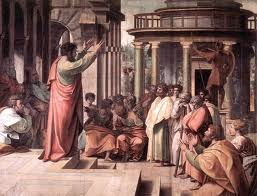
*Significant Events on April 14th in Church History:

1521: After landing in the Philippines, Spanish explorer Ferdinand Magellan began giving instruction and baptism to more than 800 Filipinos.

1570: The Consensus of Sendomir unified the Lutherans, Calvinists, and Moravians of Poland.

1950: Mitsuo Fuchida, the Japanese commander who led the World War II attack on Pearl Harbor, converted to Christianity.

1950: Agreement was reached between the Catholic Church and the Communist government of Poland. The agreement included nineteen articles and a protocol.

1951: Bishop Francis X. Ford was arrested by the Chinese Communists as they cracked down on the Church. Accused of espionage and the recruitment of resistance forces, he was executed a few months later. Many other Catholics were arrested this time as well.

*Adapted from This Day In Christian History, edited by A Kenneth Curtis and Daniel Graves, Camp Hill, PA: Christian Publications.

Evan Roberts’ – “4 Point Sermon” that Sparked the Last Great Revival

The Last Widespread Revival in America Over 100 Years Ago*

 By Dr. Walter C. Kaiser Jr.

Just over one hundred years ago, a college student in Wales named Evan Roberts, aged twenty-six, obtained permission to leave college to return to his home village of Lougher to preach his first sermon. Seventeen people showed up to listen to his four points (Evan Roberts – pictured on left at the age of 26):

(1) Confess any known sin to God and put away any wrong done to others;

(2) Put away any doubtful habit;

(3) Obey the Holy Spirit promptly; and

(4) Confess Christ openly.

No one could have predicted the nationwide impact that event would have. J. Edwin Orr related that “within three months a hundred thousand converts had been added to the churches of Wales. Five years later a book debunking the revival was published and the main point made by the scholarly author was that of the 100,000 added to the churches, only 80,000 remained after five years (DPC – I’ll take that kind of conversion growth any day! – see J. Edwin Orr, Campus Aflame, Glendale, Calif.: Regal, 1971, 101).

That same revival jumped the ocean and spread to America’s shores and was the last major revival we have seen since 1905.

“Will you not revive us again, that your people may rejoice in you?” – Psalm 85:6

*Walter C. Kaiser Jr. (PhD, Brandeis University) is the distinguished professor emeritus of Old Testament and president emeritus of Gordon-Conwell Theological Seminary in South Hamilton, Massachusetts. Dr. Kaiser has written over 40 books, including Toward an Exegetical Theology: Biblical Exegesis for Preaching and Teaching; A History of Israel; The Messiah in the Old Testament; Recovering the Unity of the Bible; The Promise-Plan of God; Preaching and Teaching The Last Things; and coauthored (with Moises Silva) An Introduction to Biblical Hermeneutics. Dr. Kaiser and his wife, Marge, currently reside at Kerith Farm in Cedar Grove, Wisconsin. Dr. Kaiser’s website is www.walterckaiserjr.com. This article is adapted from the Preface in his outstanding book Revive Us Again, Nashville, B&H, 1999.

On April 13, 1742 The World First Heard Handel’s Masterpiece – “Messiah”

 On This Day in Church History – April 13th

At twelve noon on this day in 1742, the world first heard the lovely strains of the overture of the most famous oratorio ever written. There has not been a year since then that George Frederick Handel’s Messiah, with its memorable arias and majestic choruses, has not been performed in a concert hall somewhere.

The performance took place in Dublin, in the Fishamble Street Musick Hall (Original spellingentrance today pictured at right). Dubliners received it with enthusiasm. The Dublin Gazette wrote, “The best judges allowed it to be the most finished piece of music,” and “Words are wanting to express the exquisite delight it afforded.” Two years later, annual performances were established in Dublin. London, however, did not receive the oratorio as readily. Because of criticism, it did not catch on in the capital until 1749.

Handel had turned to oratorios, most of them on religious themes, only after he could not make go of opera with his English audiences. Messiah was special even within the genre of oratorio. Handel deliberately wrote it so that it could be performed by as few as four singers with strings, continuo (bass line played by keyboard or stringed instrument), two drums and two trumpets.

The idea was to produce a work that could be staged almost anywhere. This was a great boon to Handel, who was often near destitution. A piece like Messiah, which could be performed by small ensembles, offered more than the usual number of opportunities to raise desperately needed cash.

Charles Jennens pulled together the text of Messiah from fragments of Scripture relating to Christ. The power of the Scriptures comes by laying them forth almost as translated (he used more than one translation where it suited his purpose), joining them so that they built on and clarified one another without comment. Old and New Testament passages that belonged together were put side-by-side.

Where Jennens modified passages, he did so to make them scan better and to keep the texts in the third person throughout. Handel, who claimed to know the Bible as well as any bishop, made a few alterations himself. Jennens, a devout Anglican, intended through his lebretto to challenge the Deists, who denied Christ’s divinity: “And His name shall be called, Wonderful, Counselor, the Mighty God, the Everlasting Father, the Prince of Peace.”

He certainly succeeded in presenting the challenge, for Messiah portrays Christ as son of God, the fulfillment of prophecy, Savior of the world and coming King.  John Newton (author of the hymn “Amazing Grace”), slaver turned Anglican clergyman, preached fifty sermons on the text. Although Newton preached his series as a rebuke to those who glorified the music to those who glorified the music above God’s Word, he said the piece covered all the principle truths of the gospel. That Jennens fused the words together without once backtracking or repeating a passage demonstrates a great deal of perfectionism.

Handel brought the whole to a magnificent completion, writing the work in twenty-three fervent days despite already suffered a stroke. The music often rises to great loveliness and power. Passion builds until the climactic Hallelujah chorus: “Hallelujah, Hallelujah, for the Lord God Omnipotent reigneth.” Of the chorus, Handel said in his broken English, “I did think I did see all heaven before me and the great God Himself!” [DPC – If only modern composers could say the same of their music!]


 *Significant Events on April 13th in Church History:

 799: Paulus Diaconis, a monk, died. Diaconis was called to Charlemagne’s court, where he complied a book of homilies from the Church fathers that received wide circulation throughout the empire. He prepared an accurate and useful history of the Lombards and wrote other historical works.

1055: Victor II, a reform-minded pope, was enthroned. Holy Roman Emperor Henry II opposed his friend’s election because he didn’t want to lose Victor as a counselor.

1059: In an attempt to normalize papal elections, Pope Nicholas II issued a decree limiting elections to cardinals.

1598: King Henry IV, whose mother, Jeanne d’ Albret, was a prominent French Protestant (Huguenot), issued an edict in Nantes granting toleration to the Huguenots.

1829: In an Emancipation Act, the English Parliament granted freedom of religion to Roman Catholics after 200 years of suppression. Within a few weeks, a Catholic was elected to Parliament.

1950: Monasteries and convents in Czechoslovakia were attacked by communists this night and their monks and nuns were carted off.

1986: Pope John Paul II visited a synagogue in Rome as a goodwill gesture toward Jews. His visit was the first recorded incident of a pope visiting a Jewish house of worship.

*Adapted from This Day In Christian History, edited by A Kenneth Curtis and Daniel Graves, Camp Hill, PA: Christian Publications.