
Category: Ecclesiology (The Study of the Church)
Ecclesiology is so named because of the two words from the Greek: ekklesia – “church, called out of” and logos – “study of.” The study of the church as a biblical and theological topic is referred to as Ecclesiology. The New Testament presents various images that the early church struggled with as it sought its self-understanding in light of the gospel and controversies.


26 Excellent Self Evaluation Questions By Gordon MacDonald
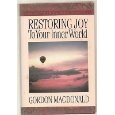 Accountability Questions For You and Your Mentoree/Disciple
(Adapted from *Gordon MacDonald, Restoring Joy to Your Inner World, Inspiration Press, p. 573)
“Chances are that you have a physical once a year or every two years. I recommend that you also have a “spiritual” once a year as well. Your soul care is just as important as your body care! This is an excellent list of questions to help care for your soul.” – Dr. David P. Craig
(1) Where are you right now in your relationship with God?
(2) What have you read in the Bible in the last week?
(3) What has God been saying to you in this?
(4) Where do you find yourself resisting God these days?
(5) What specific things do you find yourself praying for regarding others?
(6) What specific things do you find yourself praying for yourself?
(7) What specific tasks are facing you that you consider incomplete?
(8) What habits are intimidating you at present?
(9) What have you read in the secular press this week?
(10) What general reading have you been doing?
(11) What have you done to play this week?
(12) How are you doing with your spouse/kids?
(13) If I were to ask your spouse about your state of mind, spirit, etc., what would he/she say?
(14) Are you sensing any spiritual attacks from the enemy this week? Today?
(15) If Satan were to try to invalidate you as a servant of God, where or how would he attack you?
(16) What is the state of your sexual life (temptation, fantasy, etc)?
(17) Where are you at financially (Do you have control, debts, etc)?
(18) Are there any unresolved conflicts (ailing relatives, stress, disputes) in your circle of relationships right now (family, friends those among whom we’re supposed to feel safe)?
(19) When was the last time you spent time with a friend of the same gender?
(20) What kind of time have you spent with a non-Christian this past week?
(21) What challenges do you expect to face in the coming month?
(22) What are your fears at the present time (letting family down, bodies letting us down, etc)?
(23) Are you sleeping well?
(24) What three things are you most thankful for?
(25) Do you like yourself at this point of your pilgrimage?
(26) What are you greatest confusions about your relationship with God?
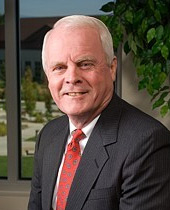 *Gordon MacDonald has been a pastor and author for over forty years. For many years he pastored Grace Chapel in Lexington, Massachusetts and continues to serve as Pastor Emeritus. He has also provided leadership to influential ministries such as Intervarsity Christian Fellowship, which he served as President for three years, and World Relief, which he currently serves as Chairman. Gordon’s best-selling books include Ordering Your Private World, Mid-Course Correction and, most recently, A Resilient Life. He also writes and serves as Editor-at-Large for Christianity Today’s Leadership Journal. When not writing, leading or speaking at conferences, Gordon and his wife Gail can be found hiking the trails of New England.
Is There Any Evidence for Life After Death? By Dr. R.C. Sproul
 Objection #10 Answered: “When You’re Dead You’re Dead! There Is No More!”
(This is #10 in a series of book excerpts from Objections to Christianity derived from Chapter 10 in *Dr. R.C. Sproul’s fantastic book Reason To Believe, [originally entitled Objections Answered] Grand Rapids: Zondervan, 1982)
Death is obscene. It runs counter to the vibrant flow of life. When we encounter it we shrink from it in horror. We use our finest cosmetics to disguise its impact. When death strikes it always leaves the question, “Is this the end?” Is there absolutely nothing more to hope for?
Perhaps the most ancient question of all is the question, “Is there life after death?” We think of Job in the throes of his misery crying out, “When a man dies, will he live again?” (See Job 14:14). We think of Hamlet musing over the question of suicide in his classic soliloquy, “To be, or not to be?” He contemplates the mystery of the grave and weighs the burdens of the alternatives of life and death. He retreats from suicide asking if man would “rather bear those ills we have than fly to others we know not of?” (Hamlet, act 3, sc.1). From Job to Hamlet to the present day the question persists, “Is there life after death?”
A negative spirit of skepticism has made itself felt in the cultural atmosphere of our age. A sense of despair and hopelessness characterizes much of our culture. We hear such statements as “When you’re dead, you’re dead”; “This is the Pepsi generation, the now generation.” The television commercial exhorts to live our lives with gusto because we only go around once. Those who persist in their hope of a future life are regarded as weaklings who are clinging to naïve superstitions that are outmoded. Christians have received their share of scorn and ridicule for hoping in fantasies of “pie in the sky.” But the issue is not simply a religious question. The issue is far more significant than that. It is the issue of the meaning of all of life. If death is ultimate then life becomes a cruel and mocking joke.
From ancient times the keenest minds of mankind have sought intellectual evidence for the survival of the soul or spirit beyond the grave. Charlatans and magicians have plied their arts couching their tricks in a garb of pseudo-intellectualism. Scholars have given the question serious attention because it is the most serious of all questions. But for the most careful and sober scholar the issue of death has strong emotional overtones. No one can face the question dispassionately for it touches each one of us in a final way.
Does Nature Teach that There Is Life After Death?
Plato faced the question in a deeply personal way when he visited his beloved mentor, Socrates, in his prison cell. As Socrates prepared himself for execution by enforced drinking of hemlock he discussed the question of immorality with his students. The Socratic argument for life after death is recorded by Plato in his famous Phaedo Dialogue.
Plato explored the question primarily from the vantage point of analogies found in nature. He detected a kind of cycle that was common to nature. He noted that spring follows winter which in turn moves inexorably toward another winter. Winter does not terminate in itself but yields again to spring. The cycle goes on as day follows night and heat follows cold. The pattern continues. He examined the drama of the germination of the seed into flowering life. For the seed to bring forth its life it must first go through a process of rotting. The shell of the seed must decay and die before the life that is locked within it can emerge. He saw here an analogy to life and death. Just as a seed must die and disintegrate before the flower emerges, so the human body must die before the life of the soul can come forth.
Plato looked beyond the realm of flowers to the animal kingdom and was stimulated by the drama of metamorphosis. The beauty of the butterfly begins in the grotesque form of the caterpillar. The caterpillar appears as a worm, bound to the earth, virtually immobile and unattractive. The worm forms for itself an insulated cocoon, withdrawing from the outside world. The cocoon remains dormant and inert for a season. In time the drama mounts as a new creature begins to scratch and stretch its way out of the cocoon. Wings and a body begin to appear and suddenly the woven prison yields a magnificent soaring creature of multicolored beauty. From the “death” of the caterpillar comes the new life of the butterfly!
These analogies from Plato do not present compelling evidence for life beyond the grave. Plato understood that they were but analogies that provide hope in the face of mystery. He was aware that butterflies do not live forever, but he pointed to the complexities of the various forms of life that surround us to cause us to move with caution in the face of unbridled skepticism.
Must We Live as If There is a God?
In later times another philosopher approached the question form a different perspective. Immanuel Kant was perhaps the most weighty and significant philosopher of all time. Certainly his massive work has been a watershed for the development of modern thinking. Though skeptical about man’s ability to prove immortality by reason alone, he offered an ingenious argument for life after death. His argument offers practical “evidence” for the existence of God and for life after death.
Kant observed that all people seem to have some concern for ethics. Though morality differs from person to person and society to society, all people wrestle with questions of right and wrong. All human beings have some sense of moral duty. Kant asked, “What would be necessary for this human sense of duty to make sense?” Are our moral senses merely the by-product of parental discipline or the imposition of society’s standards? Kant thought it went deeper than that. Still the question of the origin of moral sense is different from its ultimate meaning. He noticed that we have a sense of duty and asked what would make it meaningful? Kant answered his own question by saying that ultimately for ethics to be meaningful there must be justice. From a coldly practical perspective he asked, “Why be ethical if justice does not prevail?”
Kant saw justice as an essential ingredient for a meaningful ethic. But he noticed at the same time that justice does not always prevail in this world. He observed what countless others have observed, that the righteous do suffer and the wicked do often prosper in this life. His practical reasoning continued by arguing that since justice does not prevail here in this world there must be a place where it does prevail. For justice to exist ultimately there must be several factors accounted for.
We must survive the grave. For there to be justice, there must be people o receive it. Since we do not receive it in this world, we must survive the grave. Justice demands life beyond death, if ethics are to be practical.
There must be a judge. Justice requires judgment and judgment requires a judge. But what must the judge be like to insure that his judgment is just? Kant answered that the judge himself must be just. If the judge is unjust then he would be prone to pervert justice rather than establish it. The judge must be utterly and completely just to insure ultimate justice. But even just judges are capable of perpetrating injustice if they make a mistake. Honest judges have convicted innocent people who were framed or surrounded by an overwhelming amount of circumstantial evidence. Our just judge must be incapable of such mistakes. To render perfect justice, he must have a perfect knowledge of all the facts and mitigating circumstances. A perfect judge must be nothing less than omniscient.
There must be a judgment. A perfectly just and omniscient judge is necessary for justice but it is not enough to insure it. Once the perfect judge offers his perfect verdict, the sentence must be carried out. If proper rewards and punishments are to be meted out, the judge must have authority and the power to carry them out. If our just and omniscient judge is impotent then we have no guarantee of justice. Perhaps an evil power would prevent the judge from carrying out justice. Thus the judge would have to have perfect power of omnipotence.
Thus, for Kant, practical ethics require life after death and a judge whose description sounds very much like that of the God of Christianity. Kant recognized that his arguments were of a practical nature. He did not think that he had provided an airtight case for the existence of God or for life after death. But he did reduce the practical options for man to two. He said we have either full-bodied theism with life after death or we have no meaningful basis ultimately for our ethical decisions and actions. Without ethics life is chaos and ultimately impossible. Without God ethics are meaningless. Thus Kant’s conclusion was: “We must live as though the were a God.” For Kant, life was intolerable without a solid basis for ethics. If death is ultimate then no ethical mandate is really significant.
What If Life is Meaningless?
Kant’s practical optimism was not universally welcomed. The existentialists of modern culture have taken the option Kant refused. They’ve dared to ask the unaskable question: “What if life is meaningless?” Shakespeare’s Macbeth says despairingly:
Life’s but a walking shadow, a poor player
That struts and frets his hour upon the stage
And then is heard no more. It is a tale
Told by an idiot, full of sound and fury,
Signifying nothing (Macbeth, act 5, sc. 5).
Maybe there is no justice. Maybe there is only the tale of the idiot. Perhaps ultimately so much sound and fury that is empty and void of significance. Why should we live as though there is a God if in fact there is no God? These are the penetrating questions of modern man. All attempts to maintain faith in God and faith in life after death may be only exercises of wish fulfillment for those not courageous enough to face the grim facts or our sound and fury.
Ingmar Bergman states the dilemma of modern man in a dialogue contained in his film The Seventh Seal. Here a conversation ensues between Knight and Death:
Knight: “Do you hear me?”
Death: “Yes, I hear you.”
Knight: “I want knowledge, not faith, not supposition, but knowledge. I want God to stretch out his hand towards me, to reveal himself and speak to me.”
Death: “But he remains silent.”
Knight: “I call out to him in the dark, but no one seems to be there.”
Death: “Perhaps no one is there.”
Knight: “Then life is an outrageous horror. No one can live it in the face of death knowing that all is nothing” (Taken from Donald J. Drew, Images of Man: A Critique of the Contemporary Cinema, Downers Grove, IL: Inter-Varsity Press, 1974, 74).
Long before existentialism was in vogue and playwrights and novelists began to flood our nation with cries of despair, America listened to the painful poetry of Edgar Allen Poe. Some say he was brilliant; others that he was demented. Still others maintain that he was a little of both. One thing is certain; he had a unique ability to express the anguish of the human soul who experiences the loss of a loved one. His poetry is filled with mournful groans of the bereaved. Consider his short poems such as “Annabel Lee” or “Ulalume.” But it is in “The Raven” that the urgency of the issue of life after death is most clearly expressed. The poem begins:
Once upon a midnight dreary, while I pondered, weak and weary,
Over many a quaint and curious volume of forgotten lore,
While I nodded, nearly napping suddenly there came a tapping,
As of some one gently rapping, rapping at my chamber door.
“ ‘Tis some visitor,” I muttered, “tapping at my chamber door;
Only this and nothing more.”
Ah, distinctly I remember, it was in the bleak December,
And each separate dying ember wrought its ghost upon the floor.
Eagerly I wished the morrow; vainly I had sought to borrow
From my books surcease of sorrow, sorrow for the lost Lenore,
Nameless here forevermore.
In the introduction Poe sets the scene of his midnight remorse crushed by his loneliness and the fear of the morrow. With the appearance of his nocturnal visitor who comes from the shores of hell, the poet asks the burning question, “Will I ever see Lenore again?” The reply of the fiendish bird is always the same, “Nevermore.” The poem moves along to the point where the tormented man screams in anger at the visitor:
“Prophet!” said I “think of evil!—prophet still, if bird or devil!
Whether tempter sent, or whether tempest tossed thee here ashore,
Desolate, yet all undaunted, on this desert land enchanted—
On this home by horror haunted—tell me truly, I implore:
Is there—is there balm in Gilead?—tell me—tell me I implore.”
Quoth the raven, “Nevermore!”
And the raven, never flitting, still is sitting, still is sitting
On the pallid bust of Pallas just above my chamber door;
And his eyes have all the seeming of a demon’s that is dreaming;
And the lamplight o’er him streaming throws his shadow on the floor;
And my soul from out that shadow that lies floating on the floor
Shall be lifted—nevermore!
The poem ends in despair. No hope is given for the future. Such an ending is intolerable for many. The current rage of occult films and deep fascination with parapsychology are evidence of the protest of modern man to the prophets of despair. New interest in the recollections of people resuscitated from clinical death have spawned hope that tangible evidence of survival may be available from science.
What is the Biblical Case for Life After Death?
The strongest and most cogent case for life after death comes to us from the New Testament. At the heart of the proclamation of the ancient Christian community is the staggering assertion that Jesus of Nazareth has survived the grave.
Christ was resurrected from the dead. In a classic treatment of the question of life after death, the apostle Paul summarizes the evidence for the resurrection of Christ in his first letter to the Corinthians. His Epistle comes partly in response to skepticism that arises in the Corinthian church. Note how he deals with the question:
Now if Christ is preached as raised from the dead, how can some of you say there is no resurrection of the dead? But if there is no resurrection of the dead, then Christ has not been raised (1 Corinthians 15:12,13).
The logic of this assertion is almost humorously simple. If Christ is raised, then obviously there is such a thing as resurrection from the dead.
On the other hand, if there is no resurrection from the dead, then Christ cannot be raised. The question of Christ’s resurrection is crucial to the entire issue of life after death. The apostle follows with an interesting line of reasoning. He considers the alternatives to the resurrection of Christ. He uses the “if-then” formula of logical progression.
If Christ has not been raised, then our preaching I in vain and your faith [also] is in vain (1 Corinthians 15:14).
Paul gets to the heart of the matter quickly. If Christ is not raised then it is clear that the preaching of the early church is an exercise in futility. The preaching becomes empty words and the faith that follows is worthless.
Moreover we are even found to be false witnesses of God, because we witnessed against God that He raised Christ, whom He did not raise, if in fact the dead are not raised. For if the dead are not raised, not even Christ has been raised; and if Christ has not been raised, your faith is worthless; you are still in your sins. Then those who also have fallen asleep in Christ have perished (1 Corinthians 15:15-18).
The implications of the Corinthians’ skepticism continue. If Christ is not raised then the apostolic witness is a false one. God has been implicated in a spurious historical claim. Again Paul mentions the futility of faith and adds to it the serious result that man is still without a redeemer. Then, almost as an afterthought, Paul touches the emotional nerve of his readers by reminding them of the fate of their departed loved ones. They have perished. At this point the apostle sounds a bit like the “Raven.” He is saying that, without resurrection, death is final.
The madness of the concept of the finality of death came home to me in somewhat unusual fashion. On July 1, 1965, my wife gave birth to our son. I remember the exhilarating experience of observing him through the nursery window at the hospital. All of the dynamism of life seemed to be captured in the animated action of this newborn child. I was thrilled to behold one who was “flesh of my flesh and bone of my bone.” I experienced the inordinate pride that so often attends fatherhood.
The experience of birth was by no means unique or even unusual. What followed, however, was not commonplace. The first visitor to the hospital was my mother. Her delight witnessing her grandson was unbounded. I took her home from the hospital and spent the night in her house. The following morning I went into her bedroom to awaken for breakfast. There was no response, no movement. As I touched her hand to rouse her, I felt the chill of death. Her body was hard and cold. She had died during the night. Within the space of a few hours I witnessed the birth of my son and the corpse of my mother. As I stood stunned by her bedside, a sense of surreal came over me. I thought, “This is absurd. A short time ago she was a living, breathing, dynamic human being, filled with warmth and vitality. Now there is only coldness and silence.”
But as Paul points out, if Christ is not raised then our loved ones have perished. The Raven has the last word.
Paul continues his discourse by saying, “If we have only hope in Christ in this life, we are of all men most to be pitied” (1 Corinthians 15:19).
Perhaps you are not a Christian. Maybe Christians tend to annoy you. Perhaps you become angry when Christians try to force their religion upon you. But if you do not believe that Christ has been raised, don’t be angry with poor deluded Christians. Pity them. They have put all their eggs in a basket that cannot hold any eggs. If all the Christian has is hope with no historical reality to undergird that hope, he is committed to a life of futility. Christians need your sympathy, not your hostility.
Paul concludes his exercise in “what if” thinking by saying, “If the dead are not raised, ‘Let us eat and drink, for tomorrow we die’” (1 Cor. 15:32). No resurrection? Then we may as well sleep in tomorrow. Eat, drink, and be merry while you can. Get your gusto now before it’s too late.
There is a striking similarity between the way apostle Paul approaches life after death and the approach of Kant. Both are keenly aware of the grim alternatives to life after death. However, Paul does not leave us where Kant does. Kant reduces the options to two and then encourages us to choose the more optimistic one. Paul examines the grim alternatives to resurrection but does not build his case on those frightening options.
Rather he says:
For I delivered to you as of first importance what I also received, that Christ died for our sins according to the Scriptures, that he was buried, that he was raised on the third day in accordance with the Scriptures, and that he appeared to Cephas, then to the twelve. Then he appeared to more than five hundred brethren at one time, most of whom are still alive, though some have fallen asleep. Then he appeared to James, then to all the apostles. Last of all, as to one untimely born, he appeared also to me (1 Cor. 15:3-8).
Now Paul speaks in a fashion that moves beyond speculation. He doesn’t play with the occult or rest his case on analogies drawn from nature. He offers two kinds of evidence: First, he appeals to the prophetic predictions of the Old Testament Scripture that are fulfilled with uncanny accuracy in the person of Christ. Secondly, he offers the testimony of numerous eyewitnesses to the event. Christ does not appear on one occasion to a secret audience, but manifests Himself on several different occasions. One occasion involves an audience of over 500 persons. Paul’s final appeal is that he beheld the risen Christ with his own eyes. As John remarks everywhere, “We declare to you what we see with our eyes and hear with our ears” (see John 1:1-3). Paul then rehearses the history of his personal life following his sight of the risen Christ. He speaks of his trials, his imprisonments, his labors, all of which give credence to the impact his visual experience of the resurrected Jesus had on him.
The best argument for life after death is the record of history. The act of resurrection is as well attested to as any event from antiquity. Those who deny it do so invariably from the perspective of a philosophy that would rule the evidence out arbitrarily. Jesus Himself predicted it and spoke in an authoritative way concerning our own future life. He said, “In my father’s house are many mansions, I go to prepare a place for you. If it were not so I would have told you” (see John 14:2). For those who think Christ credible, His words are overpowering. “If it were not so—“ Jesus is saying in this discourse had his disciples believed in an empty hope for the future, Jesus would not hesitate to correct it. The victorious implications of Christ’s resurrection are summarized by Paul:
Lo! I tell you a mystery. We shall not all sleep, but we shall be changed, in a moment, in the twinkling of an eye, at the last trumpet. For the trumpet will sound, and the dead will be raised imperishable, and we shall be changed. For this perishable nature must put on the imperishable, and this mortal nature must put on the imperishable, and the mortal puts on immortality, then shall come to pass the saying that is written: “Death is swallowed up in victory. O death, where is thy sting?” The sting of death is sin, and power of sin is the law (1 Cor. 15:51-56).
Your labor is not in vain. That is the essence of the New Testament message. Death is not ultimate. The answer of the Raven is “Nevermore.” The answer of Christ is “Forevermore.”
Key Points To Remember:
(1) Nature, as Plato suggests, offers analogies that give evidence and hope for future life.
(2) Kant argued for life after death out of a practical concern for ethics. His argument says that universal moral sense would be meaningless apart from ultimate justice: we must survive the grave; there must be a judge; there must be a judgment.
(3) If death is final then life has no ultimate meaning. How we deal with the question of death will reveal how seriously we regard life. Existentialism and the poetry of Poe illustrate man’s sense of hopelessness and futility.
(4) The Bible definitely says, “Yes, there is life after death.” Without Christ, men are without hope. Jesus said, “I am the resurrection and the life; he who believes in me, though he die, yet shall he live” (John 11:25).
(5) The biblical claim for life after death rests on credible eyewitness testimony of historical event. The eyewitnesses were men whose work reflects sober judgment, judgment, whose contemporaries offered to refutation and whose conviction of the truth of their testimony made them willing to die for it.
(6) The ongoing power of Christ to transform human lives gives corroborative evidence to the assertion that He lives in a more real and powerful way than as an inspiring memory.
 Dr. R.C. Sproul is the founder and chairman of Ligonier Ministries, an international Christian education ministry located near Orlando, Florida. His teaching can be heard on the program Renewing Your Mind, which is broadcast on hundreds of radio outlets in the United States and in 40 countries worldwide. He is the executive editor of Tabletalk Magazine and general editor of The Reformation Study Bible, and the author of more than seventy books (including some of my all time favorites: THE HOLINESS OF GOD; CHOSEN BY GOD; KNOWING SCRIPTURE; WILLING TO BELIEVE; REASON TO BELIEVE; and PLEASING GOD) and scores of articles for national evangelical publications. Dr. Sproul also serves as president of Ligonier Academy of Biblical and Theological Studies and Reformation Bible College. He currently serves as senior minister of preaching and teaching at Saint Andrew’s in Sanford, FL.
15 Great Questions for Personal Evaluation by Carson Pue
(Adapted from *Carson Pue, Mentoring Leaders, Grand Rapids, MI: Baker, 2005, p. 243)
Spiritual Questions
Distractions: Have you used anything other than God in an attempt to meet your emotional or spiritual needs this week?
God’s Word: Have you been purposefully filling your mind with the knowledge of God’s Word daily? If not, how often? How do you plan to change?
Fasting: Have you fasted and prayed in the last month? If not, when was the last time? When have you next scheduled these disciplines?
Obedience: Is your conscience clear? If not, why? How do you plan to attain a clear conscience?
Physical Health Questions
Sleep: Are you getting enough sleep each night? If not, how much are you getting? How do you plan to change?
Exercise: Are you exercising daily? If not, how often are you exercising? How do you plan to change?
Eating: Are you eating properly? If not, what are you eating/not eating? How do you plan to change?
Substances: Are you abusing harmful substances? If not, when and how often have you taken them? How do you plan to change?
Action Oriented Questions
Finances: Where are you financially right now? Are things under control? Are you feeling anxious? Is there any great debt? How are you planning to proceed in this area of your life?
Purity: Have you kept your mind pure (thoughts of anger, bitterness, movies, magazines, Internet pornography, other)? If not, when did you fall?
What temptations need to be removed or precautions taken to prevent it?
Material Goods: Do you have anything that is used for evil needing to be destroyed or removed? If so, what? When and how will you (we) destroy or remove them?
Control: Have you lost control either verbally or otherwise since we last met? If so, when? When and how will you do something to restore and correct your actions?
Relational Questions
Deposits: Have you made positive emotional and spiritual deposits with your kids and your spouse? If not, why? What might you be able to do to make this a natural response?
Family: Have you offended any family member since we last met? If so, when? When and how will you restore and correct those actions?
Truthfulness: Have you told the whole truth in your answers to the questions I have asked you? If not, what do you need to correct? What actions do we need to take to stay and remain accountable?
Process: Is the asking of any of these questions adequate for you? If not, what changes are needed? Who else needs to be a part of this process?
*Carson Pue is the Executive Director at First Baptist Church right smack in the heart of downtown Vancouver, Canada. He describes the church this way, “Congregating in this historic stone building in the very heart of the downtown is a community. We are young, old and in-between, rich, poor, employed and re-training, multicultural, families and singles, Bible scholars, seekers. All share a heart for the city.”
 For fourteen years Carson served as CEO of Arrow Leadership a ministry recognized as a global leader in Christian leadership development. Arrow develops leaders worldwide “to be led more by Jesus, lead more like Jesus, and to lead more to Jesus.” They have been highly successful in transforming and enriching the lives and leadership of men and women who are now deployed around the world.
Recognized as a leader of leaders Carson has an ability to identify leaders and invest wisdom into their development through mentoring, teaching and spiritual guidance.He is also best-selling author: “Mentoring Leaders: Wisdom for Developing Character, Calling and Competency” by Baker Books and his new Mentoring Wisdom: Living and leading well. Carson is known through his speaking at conferences, published articles, national radio programs and commentaries. Through referrals over 50,000 leaders benefit from his monthly leadership emails “To the Point” “Mentoring Questions” and magazine columns.
With his encouraging style, creative ideas, engaging humor and ministry experience, people find Carson well fitted for his role. In a straightforward manner Carson shares both from success and failure in ministry, believing that leaders learn from both. He is a popular keynote speaker on themes around leadership, spiritual development and the realities of being a pastor today.Carson extends his leadership by serving on the board of directors for World Vision, Crossroad Communications and CTS Television Network. In addition he is an advisor for the boards of The Billy Graham Center, Truefaced, and the Entrepreneurial Leaders Organization. He is a trusted advisor to Christian leaders across Canada and the USA and connects globally with The Lausanne Movement and World Evangelical Alliance.
When not traveling the world encouraging leaders, he loves sailing with his BFF and first mateBrenda whom he has been married to since 1976. He loves time with his three sons, two daughters by marriage and three grandsons. He is also restored by laughter, sailing, Ireland, writing and spiritual retreats.
Are You Ready to Meet Your Maker? By Augustus Toplady
 A Classic Sermon on Applications of the Suffering, Death, & Resurrection of Jesus
*Augustus Toplady is perhaps best remembered for his Hymn “Rock of Ages” – and as you will see in reading this sermon – he was theologically deep, and astute at applying the gospel to all of life.
“Who is able to stand before this holy Lord God.” 1 Sam. 5:20.
And before this holy Lord God, every soul must one day stand. “We will all stand before the judgment-seat of Christ,” says the apostle, “that every one may receive according to the things he has done in the body.” In some sense, we may be said to stand before Him now: “for He is not far from everyone of us;” yes, “in Him we live, and move, and have our being.” The consequence of this is, that there is no creature which is not manifest to His sight, but all things are naked and open to the eyes “of Him with whom we have to give an accounting.” With regard therefore to His own Omniscience and Omnipresence, we already stand before this holy Lord God. He is about our bed, and about our paths, and is acquainted with all our ways; nor is there a word in our tongues, or a thought in our hearts, but He knows it altogether. “The eyes of the Lord are in every place, beholding the evil and the good.”
I will not detain the reader with considering on what occasion the men of Bethshemesh spoke the words of the text: but only observe, that the miraculous judgment inflicted on them for looking into the ark, was that which gave rise to the above question, and made them cry out, with trembling and astonishment, “Who is able to stand before this holy Lord God?” But in whatever sense these words were meant by the speakers, they certainly contain a most momentous inquiry; — an inquiry in which every soul of man is deeply concerned.
If the Lord God, before whom each individual will shortly stand, is a holy God, a God of truth, and without sin, and of purer eyes than to behold sin with impunity; we may well ask, “Who is able to stand before Him? — Who can abide the day of His coming, or stand when He appears?” Appear He certainly will; and stand before Him we inevitably must. God only knows who will first be summoned to do this; but, first or last, the citation will be sent to all. Health is a tender, precarious flower; life is a brittle, slender thread; how soon the one may wither, and the other break, He alone can tell who lent us both. This only we know, from Scripture and from daily observation, that all below is of uncertain tenure; that we are no more than tenants at will, removable at the pleasure of God, the great Proprietor of all.
Some are dismissed from life in the dawn of infancy; some in the morning of childhood; others in the noon of youth. The sands of some are continued longer; and a very few are permitted to see the night of what we generally term old age. Not a day, nor an hour; no, not a minute passes, wherein multitudes of all ages are not called away to stand before the holy Lord God. Death, that promiscuous reaper, pays no regard to years or station. The infant of a day, and the man of a century, are alike to him; he mows the shooting blade and the mature stem: the growing and the grown unite to swell his harvest and augment his spoils. But is that which we term Death, the offspring of chance, or the result of accident? Surely, no. Death is a scythe! But if I may so speak, it is a scythe in the hand of God. Affliction, sickness, and dissolution, are messengers of His; which come not but at His command.
As King William used to say, with regard to those that died in battle, that “every bullet has its billet”, or is directed by special Providence; so it may truly be said, that every event has its commission from God, and is the effect of at least His permissive will. And therefore, though with regard to the act of dying itself, “all things come alike to all, and there is, in this respect, one event to the righteous and the wicked, and as the good, so is the sinner; and he that sweareth, as he that feareth an oath;” — though good and bad must die, the grave being the house appointed for all living; yet we must beware of thinking, because the holy and the wicked, the useful and the useless, seem to be taken away promiscuously, and without distinction, that therefore death is the effect of that unmeaning thing called chance; for both holy scripture and sound reason join in supporting the assertion of the celebrated Mr. POPE: —
“All nature is but art unknown to thee;
All chance, direction, which thou canst not see.”
So far is anything from being fortuitous or accidental, with regard to God, (however contingent and unexpected some things may be to us) that not a sparrow falls to the ground, but in consequence of His will; and the very hairs of our head are everyone numbered. Nor does the absolute and necessary dependence of all things on God, the first cause, at all interfere with, much less does it supercede, the liberty of second, or subordinary causes. Difficulties, indeed, may attend the reconciliation of human freedom, with the purposes and prescience of God from eternity, and with the efficacious influence of actual Providence in time: but yet it is plain, from experience, that man is free, that is, that he acts without any inward force or violent compulsion. What he does in a moral way, he does with the concurrence of his will. If unregenerate, his will inclines him to the works of darkness, and these accordingly he commits: if renewed by the Spirit of God, his will, from the new bias which grace has given, naturally and spontaneously inclines him to what is good, and he acts agreeably to this renewed will. So that in every view, man is free in what he does; though totally dependent on God, from moment to moment, he yet is free as to the actings of his will: which, according to its bias, naturally excites him to this or that. If therefore man himself may be, and is, subject to the efficacy and energy of divine influence, without any prejudice to his natural freedom: much more may other creatures be so.
Hence we see how prodigiously wide of the mark their reasoning is, who, under pretence of guarding natural liberty, exclude the Providence of God from having any influence on the creatures He made, and represent the Deity as no more than an idle spectator, and scarce that, of what is done below. As if it was either beneath the dignity of Him to superintend and direct the world, who did not think it beneath Him to make it; or as if, having made it, He would suffer the affairs of it to take their chance, and go on at random, without His taking any care or notice. Into such blasphemies and absurdities do those run, who forsake the Scriptures.
How much more exalted views, worthy of God, and comfortable to man, do the treasures of inspiration give us, respecting the Deity and His ever-acting Providence? There we are told, that He worketh all things according to the counsel of His own will; that whatsoever the Lord pleased, that did He in heaven and in earth, and in the sea, and in all deep places; and that His effectual agency begun in creation, is carried on by Providence. “My Father worketh hitherto, and I work,” said He who is in the form of God.
Hence it follows, that if the Almighty is thus operative, that declaration of the apostle is true, which tells us, that “God hath determined the times before appointed;” and that He even “fixes the bounds of our habitation.” — “To everything,” says another inspired writer, “there is a season; and a time to every purpose under the heaven; a time to be born, and a time to die.” — ”Is there not an appointed time to man upon earth,” says Job; “Are not his days also like the days of a hireling,” which consist of just so many hours and no more. And elsewhere, speaking of man, he says, “His days are determined; the number of his months are with thee; thou hast appointed his bounds that he cannot pass.” Conformably to which, he adds, “All the days of my appointed time will I wait, till my change come.”
It remains then, that God is the sovereign Disposer, as of all things else, so of life and death; and consequently, that the awful period is fixed, wherein we must each stand before this holy Lord God. But are we not sinners? And is not sin that which this holy Lord God hateth? All this is true. God abhors sin; we are sinful, and we must stand before Him. How then shall we be able to do this? What will be the result of standing at such a bar, and before such a judge? To be tried by the holy law of God, which we have broken; to be witnessed against by our conscience, and by angels who invisibly throng our most retired concealments; above all, to be heard by Him who is the searcher of hearts, and whose sentence is decisive either for heaven or hell. If the Holy Spirit should alarm the conscience by this consideration, it will stir up the individual to pray, that he may be found of Him in peace, and be enabled to stand with joy before this Holy God? But what can qualify us thus to stand? Is our own goodness sufficient to cover our guilty souls, and ward off the blow of justice? Alas! It is insufficient; as the prophet says, “Our gold is dim, and our wine is mixed with water.” Our purest obedience is sinful, and how can that which is sinful, save a sinner? Can a smaller sin atone for a greater; nay, do not both stand in need of an atonement from some other quarter? “All our righteousness,” says the church, in Isaiah, “ are as filthy rags.”
Now, should a man attempt to go to court, clothed in filthy rags, and endeavor to gain admission to the royal presence in such raiment as that, would not he be refused entrance, and driven with indignation from the palace gate? — Certainly he would; and can we expect to stand in the hour of death and Day of Judgment, undaunted before the holy Lord God, arrayed in no better robe, and defended with no better armor than that imperfect righteousness of ours, which the Scripture calls filthy rags? We must appear in a better dress, if we mean to appear at God’s right hand; a dress superior even to that which angels wear; a dress which God was manifest in the flesh on purpose to supply us with; and which, through grace, is to all, and upon all them that believe in Him. I need not say, that I mean the merits of Jesus Christ, consisting of His active righteousness and His atoning death; of all He did, and of all He endured, in obedience and submission to the law. This is that righteousness, that garment of salvation, in which St. Paul desired to be found; and in which we too must be interested and arrayed, would we reign in life through Him, and stand, at the latter day, in the congregation of the righteous.
The important doctrine of justification by the transfer of Christ’s merit to us, which doctrine is founded on the perfection of His obedience, as our representative, and the reality of His substitution to death in our stead; I say, this supplies us with a satisfactory answer to the question offered, “Who is able to stand before this holy Lord God?” Who? — The soul unto whom Christ is made wisdom, righteousness, sanctification, and redemption: wisdom, to discover its native guilt and inability; righteousness, to cover its moral deformity, and render the whole man legally acceptable in the sight of the infinitely holy God; sanctification, to master and subdue the body of sin, to give the will and affections a divine tendency, to fire the heart with holy love, and adorn the outward conversation with all the beauties of practical godliness; and lastly, to whom Christ is made redemption, by the efficacy of His atonement, blotting out our sins and the handwriting that was against us, giving us to see that both one and the other were nailed to His cross, and that therefore there now remains no condemnation to them that are in Christ, who walk not after the flesh, but after the Spirit.
Now, if wisdom must be given to us to see our absolute need of an interest in Christ; if His righteousness must be imputed to us for our justification; if we must be sanctified by His grace; weaned from sin and devoted to God; and if the merits of His redemption likewise must be made over to us, in order to our obtaining the forgiveness of our evil works, and the acceptance of our good ones; I say, if these things are necessary for our salvation, and without them, we shall never be able so to stand before the holy Lord God, as to enjoy His favor, and be admitted to His kingdom; then, it behooves us to lay our hand upon our heart, and solemnly to ask ourselves, whether we have a hope that Christ is thus made of God wisdom, righteousness, sanctification, and redemption to us. — Soon we shall be called to stand, where self-examination will do us no service; when we appear before God, He will be the examiner alone. Judge therefore yourself, my Christian brother, now, that ye be not then judged of the Lord. Remember, that the night of death is coming on, and the shadows of the evening are stretching out; and as sure as natural night is succeeded by day, so sure will death be followed by the immediate scrutiny of that holy Lord God, who will bring all things to light; and upon your leaving the body will soon put it beyond all doubt, whether you belong to Christ or not.
Death, as I observed, respects not persons, neither taketh reward. Old and young, rich and poor, the serious and gay, the learned and the illiterate, the holy and the profane, one with another, must appear before the judge of quick and dead. When the call is issued forth, when the warrant is made out, it will neither admit of denial or delay. “O that men were wise, that they understood this, and would consider their latter end! “ Look not on what I say as words of course, but know, that if they are unheeded now, a dying bed will convince you of their importance.
Ask yourself, what am I building on, so as to be able to stand before this holy Lord God? If you are ignorant of this, I pray the blessed Spirit to convince you, that there is no “other foundation for any man to lay, but that laid, which is Christ Jesus.” May He give you faith and repentance, so as you may be led to have a total reliance on the righteousness, blood, and intercession of Christ for the pardon of sins, which will give a conformity to His image, and to the mind which was in Christ Jesus. These are the fruits of real grace, the evidences of an interest in Him, and the marks by which His sheep are distinguished from those who belong not to His fold. And for an encouragement to wait upon Him in prayer for the communication of these graces, let us bear this in mind, that the holy Lord God before whom you and I are to stand in judgment, is, at the same time that He sustains this exalted title, that person of the Trinity who assumed our nature, and in it wrought out the salvation of His church and people. The Father hath committed all judgment to the Son. May He be your Advocate as well as Judge!
There is yet another sense wherein men will stand before this holy Lord God; and a blessed standing it will be, a standing peculiar to the just. They shall stand —Where? In the New Jerusalem, the heaven of heavens, before the throne and before the Lamb. They shall stand — How? Clothed in white robes, the robes of justifying merit and sanctifying grace. They shall stand — With whom? With angels and archangels, and all the powers of heaven. They shall stand — Doing what? Singing the song forever new, the praises of the great Three-one, Father, Son, and Spirit. They shall stand — How long? As long as eternity itself; wrapped in the vision of God forever and ever.
Do you ask, Who is worthy to stand thus before this “Holy Lord God?” — Who, indeed, abstracted from the merits of Christ? Without that, we should not only be unworthy, but absolutely incapable of this exceeding great reward. All have sinned and come short of the glory of God. “Understand, therefore,” said Moses to the Israelites, “that the Lord thy God giveth thee not this good land to possess it, for thy righteousness.” And if even the earthly Canaan was not the reward of human merit, much less the heavenly. And yet Christ says of the saints at Sardis, and by consequence of all saints whatever, (for a saint is a saint, let him live in what age or country he will) “These shall walk with me in white,” that is, they shall be my companions in glory, “for they are worthy.” — How! void of merit, and yet worthy? And worthy too of walking with Christ in white? Yes, unworthy, totally so, in themselves; but worthy, completely so, of an eternity of bliss, through the blood of sprinkling and the imputation of Christ’s obedience, styled in Scripture, the righteousness of God, and elsewhere, the righteousness of the saints.
The righteousness of God, because wrought out by Christ, who, from the time of His incarnation, was God and man in one Person; and the righteousness of the saints, because freely imputed to them, and graciously made theirs, to all the purposes of justification and happiness. “Therefore are they before the throne, and serve God day and night;” that is, without end or intermission, “in His temple,” the region of glory. Hence it is, that they shall be able to stand before the holy Lord God; shall stand with joy in His presence, after death; stand at His right hand in the day of universal judgment; and stand before Him in His kingdom to all eternity. Just men made perfect in glory, are elsewhere in Scripture represented as sitting with Christ. Both phrases are evidently metaphorical. Their standing, therefore, may denote their bliss and alacrity; for standing is a posture of gladness and cheerfulness; and when they are described as sitting in heavenly places, the expression may signify the unspeakable freedom and intimacy with the Trinity, to which they will then be admitted.
There are some, it is to be feared, who think little about standing before the holy Lord God. Death and judgment, with what will follow, are seldom or never the subjects of their meditation. Indeed, dissipation and banishment of thought, seems to be one of our national vices at present, and is in great measure, the root of all the rest. Hence, concern for salvation is too generally ridiculed as superstition; and seriousness exploded as fanaticism. This is a melancholy but faithful representation of the state of religion, in this our day, nor will matters ever wear a brighter aspect, while gaiety and amusement, in ten thousand different shapes, and succeeding in endless rotation, are permitted to engross our time, and occupy the place of thought.
“A serious mind,” says Dr. Young, “is the native soil of every virtue.” And, if I mistake not, the same writer, elsewhere, makes this just observation: — that excessive attachment to fashionable pleasures begets levity; levity begets loose morals; loose morals beget infidelity; and infidelity begets death. And I verily believe, for my own part, that if we trace Deism and Libertinism to their fountainhead, we shall find, in most cases, the inordinate pursuit of pleasure to have been the source of both. Recreations are needful at times; but take care of these two things, that your recreations be innocent in themselves, and that you be moderate in your use of them.
If the time is hastening wherein all must, without any exception, stand before the holy Lord God, let the unbeliever tremble. “What!” says a Deist, with a smile, “tremble at that which I do not believe!” Yes, I repeat it again, tremble, lest conscience should be in the right, and what you now profess to disbelieve, should prove true at last. Many a deistical hero has been dismally frightened when death stared him in the face; and some of them much sooner; for I could mention instances of Deists, who, unable to bear the intolerable hauntings of conscience, and their pride disdaining to fly to religion for relief, have, in the madness of despair put an end to their own lives; have plunged into eternity as a horse rushes into the battle, and gone, with all their sins about them to stand before the holy Lord God. “A proof this,” say you, “that they really disbelieved a future state.” O! no; a proof rather, that a conscience gashed with sin, and uncured by the remedy of the gospel, flashes horror on the soul too great for it to hear; and therefore the miserable creature, wishing that there may be no hereafter, chooses rather, in the fury of his pain, to try the dreadful experiment, and run the risk of accumulated misery in the next world, to get rid of his tortures in this.
But I willingly dismiss this dismal part of the subject, on a supposition that the reader of these lines is no professed infidel. I will suppose that you admit the Scriptures to be, as indeed they are, the Word of God; and that you believe every article of the Christian faith. Nay, I will go farther, and put the case, that the historical belief, and assent of your understanding, has some influence on your eternal conversation. I would take for granted, that you are neither profane nor immoral, but stand in awe of that great and terrible name, the Lord thy God; that the temple of your body, is in purity and sanctification, not walking in any lust of uncleanness, like them that know not God; and to add no more, that you are morally honest in your dealings with all men, and are punctual to the worship of God, in your closets, in your families, and in the temple. All this is excellent; all this is needful; but remember, this is not your justifying righteousness. We are not pardoned and entitled to heaven on account of our holiness and good works; but are made holy, and abound in good works, in CONSEQUENCE OF OUR ACCEPTANCE in the Beloved, of our pardon and justification through the propitiation and perfect obedience of Jesus Christ the righteous; do you know any thing of this? In all matters, but especially in spiritual affairs, experience is the life of knowledge.
Did the Spirit of God ever convince you of sin? Do you see yourself liable to the curse of the law, and the just vengeance of God, for the innate depravity of your nature, and the transgressions of your life? Do you come to Christ humbled and self-condemned; sensible that unless you are clothed with the merits of Him our Elder Brother, you are ruined and undone, and can never stand with joy or safety before the holy Lord God? If so, lift up thy head; redemption is thine; thou art in a state of grace; thou art translated from death to life; thou art an heir of God, and a joint-heir with Christ. But, if you never felt, nor desire to feel, this work of the Holy Ghost upon thy heart, this conviction of sin, this penitential faith, all the supposed righteousness of thine own, wherein thou trusted, is but a broken reed; a painted sepulcher; and the trappings of a Pharisee.
Let believers rejoice. The holy Lord God, to whom they must give account, is their Father, their Savior, and their Friend. What is death to such, but the accomplishment of their warfare, and the commencement of an endless triumph? I admire an illustration of the death of the righteous, which I lately met with in a discourse on that subject, by an eminent writer:
“As a man,” says he, “that takes a walk in his garden, and spying a beautiful full-blown flower, he crops it, and puts it into his bosom, so the Lord takes His walks in His gardens, the churches, and gathers His lilies, souls fully ripe for glory, and with delight takes them to Himself.”
If it is in the merits of Christ alone that we can stand with safety before God, let us renounce self-dependence in every view, and rely for justification and everlasting life on Him, making mention of Him and of His righteousness only, in whom all the seed of Israel are justified, and shall glory.
Lastly; Is the Lord God we must appear before infinitely holy? Then let us aim at holiness likewise. There is no true Christianity; that is, there is no dignity nor happiness, without it. He is not a Father, in a spiritual, saving sense, to any on whose souls the Holy Spirit has not impressed His image, and on whose hearts He has not inscribed His law.

*Augustus Montague Toplady (1740-1778), was educated at Westminster School and Trinity College, Dublin, he was converted through a Methodist lay preacher, took Anglican orders in 1762, and later became vicar of Broadhembury, Devon. In 1775 he assumed the pastorate of the French Calvinist chapel in London. He was a powerful preacher and a vigorous Calvinist, bitterly opposed to John Wesley. He wrote the Historic Proof of the Doctrinal Calvinism of the Church of England (2 vols., 1774) and The Church of England Vindicated from the Charge of Arminianism (1769). His fame rests, however, on his hymns, e.g., “A Debtor to Mercy Alone”; “A Sovereign Protector I Have”; “From Wence this Fear and Unbelief?”; and especially “Rock of Ages”.
Dr. Zack Eswine’s Sermon Preparation Help For Preaching in a Post-Everything World
*Adapted from Appendix 1 in Zach Eswine’s outstanding award winning book
Preaching to a Post-Everything World: Crafting Biblical Sermons that Connect with our Culture (Grand Rapids, MI.: Baker, 2008).
Use the Four Stories in Six Steps
^Day/Hour – (explanation: Some might use one day for each step. For these preachers I have broken steps down into days. Others might use each step in one day. For these preachers I have broken the steps down into hours.)
^Monday/Hour One – Step One
Story #1 – Goal = What does this text teach me about God?
Identify the textual manner (word type and mood).
Locate parrot words. Connecting words, and divine comments.
Interrogate the big idea with questions (who, what, when, where, why, how)
Show and tell from the text.
Identify the echoes of redemption (armor, promise, fruit, gift, diaconal, miracle, community, divine silence, himself).
Find the illustrative path (picture, sensory, and creation words).
^Tuesday/Hour Two – Step Two
Story #2 – Goal = What does this text teach me about people?
Identify echoes of creation (worship, relationship, vocation, conscience)
Identify echoes of the fall (fallen, finite, fragile, faltering)
Identify idol noise (superstition, skepticism, suspicion, stardom, stealing, squandering, sophistry).
Expose my moralistic responses to fallen echoes and idol noise.
Locate the vine.
^Wednesday/Hour Three – Step Three
Story #3 – Goal = What does this text teach me about life under the sun?
Identify the Context of Reality (COR) (life situations, life seasons).
Discern my expository bans (censoring, muting, equivocating, evicting).
Expose my simplistic response to life under the sun.
Account for the accents of my hearers (memoir, marketplace, lore, land).
Translate cultural connections with biblical redirection (“You have heard it said…, but I say to you…”).
Describe the third way.
Account for the consciences of my hearers (hard-hearted and soft-hearted).
Bring echoes of heaven and hell into these features as appropriate.
^Thursday/Hour Four – Step Four
Story #4 – Goal = What does this text say to me?
Receive instruction (grieving and quenching the Spirit).
Locate the vine.
Seek repentance.
Find forgiveness.
Give thanks and praise.
Testify.
^Friday/Hour Five – Step Five
Goal: Place the four stories into a deductive or inductive sermon form
^Saturday/Sunday/Hour Six – Step Six
Goal = Pray the four stories
Pray for illumination = Psalm 119:18, “Open my eyes, that I may behold wondrous things out of your law.”
Pray for a message = Ephesians 6:19, “and also for me, that words may be given to me in opening my mouth boldly to proclaim the mystery of the gospel.”
Pray for an open door = Colossians 4:3-4, “At the same time, pray for us, that God may open to us a door for the word, to declare the mystery of Christ, on account of which I am in prison.”
Pray for effectiveness = 2 Thessalonians 3:1, “Finally, brothers, pray for us, that the word of the Lord may speed ahead and be honored, as happened among you,”
Pray for clarity = Colossians 4:4, “that I may make it clear, which is how I ought to speak.”
Pray for boldness = Ephesians 6:20, “for which I am an ambassador in chains, that I may declare it boldly, as I ought to speak.”
Pray for a deliverance = 2 Thessalonians 3:2, “and that we be delivered from wicked and evil men. For not all have faith.”
*Zack Eswine serves as the Senior Pastor of Riverside Community Church in St. Louis, Missouri. His role focuses his time on setting vision, preaching, spiritual formation and pastoral care.
Dr. Eswine has served in pastoral roles for over twenty years. He served as Assistant Professor of Homiletics and Director for Doctor of Ministry for six years at Covenant Theological Seminary. Zack’s most recent book, won Preaching Today’s Book of the Year Award in 2009. It is entitled, Preaching to a Post-Everything World: Crafting Biblical Sermons that Connect with our Culture (Baker, 2008). He has also written, Kindled Fire: How the Methods of C.H. Spurgeon can help your Preaching (Mentor, 2006). His forthcoming books are entitled, Preaching Barefoot: Life and Ministry as a Human Being (Crossway) and Spurgeon’s Sorrows: Handling the Darker Sides of Life and Ministry (Christian Focus).
David Martyn Lloyd-Jones on Authority in Preaching by Iain H. Murray
 During the Second World War a Scot who was in the services and visiting London went to Westminster Chapel but the Chapel was closed, damaged by bombing, but on a piece of paper visitors were directed to a nearby hall. He described a ‘thin man’ wearing a tie calling the people to worship. He thought the man was a church officer, and he appreciated his prayer, but then the man began to preach, beginning quietly enough. “This must be Lloyd-Jones,” he thought. But for the next 40 minutes he was unconscious of anything else in the world, hearing only this man’s words. He had been caught up in the mystery of preaching. That man later became a well-known Church of Scotland minister called Tom Allen.
When he left that service Tom Allen was taken up with the message, not the preacher. DMLJ would have thought little of conferences addresses like this one about himself. He thought messages about contemporary men had done great injury especially during the Victorian period. With man-centeredness being the terrible bane of today’s church there is a danger in drawing attention to personalities. DMLJ would quote the words of God, “My servant Moses is dead so arise and go over to Jordan.” DMLJ prevented several would-be biographers writing anything, and reluctantly consented to Iain Murray’s official biography if only something could be written which would encourage those who were entering the gospel ministry.
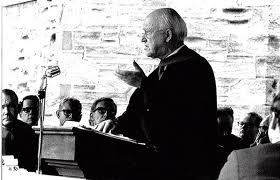 DMLJ believed that God was the God of tomorrow who would raise up servants who would enjoy blessings that he himself had not known. Frequently when he prayed it was particularly for a recovery of authority and power in preaching.
One must add another observation, that preaching was not DMLJ’s exclusive concern. He was concerned with the church fellowship, prayer meetings, and the promotion of foreign missionaries, but he was convinced that the spiritual health of the church depended on the state of the pulpit. On behalf of Christ the true preacher speaks and the Lord himself is building his church in his sovereign way. So DMLJ was conscious of what he spoke of as the romance of preaching. The preacher is but an instrument in the Lord’s hands: the preacher is not in control. Preaching is the highest and most glorious calling to which anyone could be called.
So when we come to the subject of authority in preaching there are a number of ways this could be addressed and the New Testament terminology on this theme should be studied, e.g. that ‘Jesus spoke with authority’, the phrase ‘the word came with power’, and the word ‘boldness’ which is surprisingly frequent in the NT. Iain Murray’s approach was to take the characteristics of preaching with power.
(1) It always is attended by a consciousness of the presence of God.
Though a worshipper may be meeting in the midst of a large congregation of people when the preaching is with authority the individual forgets the person he has come with, and the building they are sitting in, and even the one who is preaching. He is conscious that he is being spoken to by the living God. Thus it was in Acts 2. A remarkable illustration of this is the spiritualist woman in Sandfields, drawn to hear DMLJ and conscious that she was surrounded by ‘clean’ power. For the first time she was conscious she was in the presence of God. Thomas Hooker had such a sense of God about him that it was said that he could have put a king in his pocket.
(2) There is no problem of holding the attention of the people.
It is a problem to keep people’s attention. The preacher has his chain of thought, and all the people also may have theirs which are all very different so that they are taking in very little from the preaching. But authoritative preaching gets inside people because it speaks to the heart, conscience and will. Skillful oratory cannot come anywhere near to that preaching. It made a moral and emotional earthquake in those who heard the word at Thessalonica. The well-remembered ship builder who built ships in his mind during Sundays’ sermon could not lay the first plank when he was listening to George Whitefield preach. Conviction of sin and the reality of the living God became far more important to him than his business.
One Friday night in his series of lectures on theology DMLJ was preaching from Revelation on the final judgment on Babylon and listening to that exultant message it would have been impossible to have been occupied with any other subject, the great reality was such that awareness of anything else disappeared. The very date of that occasion was accurately quoted, easily memorable to the speaker because the next day he was getting married, but all thoughts of that were gone as he saw the overthrow of great Babylon.
(3) Even children can understand it.
There is a mistake in thinking that preaching is chiefly to address the intellect, and thus the will. Rather preaching is to address the heart and soul of men and women. Preaching which accomplishes that can arrest a child as easily as a grown-up. Children did listen to DMLJ because of the character of the preaching and the sense of God about it.
(4) It is preaching that results in a change in those who listen.
It may be repentance; it may be restoration, or reconciliation; it may be strength given for those in the midst of trials, but powerful preaching brings that change. Sometimes they went away indignant and some of them were later converted. You cannot be apathetic under true preaching. Felix trembled. There was no certainty of conversions but there was a degree of certainty that there will be power in that preaching. In Mrs Bethan Lloyd-Jones’ book on Sandfields there is a reference to a professor of law at Liverpool who said that there were two men who kept the country from communism – Aneurin Bevan and DMLJ. His preaching affected communities. On November 15 1967 he was preaching in Aberfan a year after the disaster. His text was Romans 8:18 “the sufferings of the present time are not worthy to be compared to the glory to be revealed in us.” It had a great impact on the perplexed little religious community in the Taff valley.
What is Necessary for Powerful Preaching? What elements produce it?
(1) Sermons will not be marked by authority and power unless they are marked by truth that the Holy Spirit can honor.
The word of God is to be exegeted and explained. That has to be the heart of the sermon. There is a real danger that we become over concerned about such things as delivery, while the New Testament is insistent on the content: “let him speak as the oracles of God.” The authority of the preaching comes from the text of Scripture. It is God- given power which honours his own word.
Dr Lloyd-Jones grew up in a vague sentimental era with churches fascinated with the personalities and quirks of famous men. DMLJ as a man was absorbed with the glory and the greatness of the truth. A preacher lives in the truth. DMLJ expected the preacher to go through the whole Bible in his personal devotions once each year. He expected him to continue to read theology as long as he lived. The more he read the better. Preaching is theology coming through a man who is on fire.
In the latter part of his ministry there was a change in emphasis. In the first 30 years there was a stress on the importance of the historic faith, and then in the last decades a new emphasis emerged, not now on the recovery of truth but with the accompanying need of power to proclaim it.
(2) The man himself is a part of the message. He can read all the best books and give out a whole rounded exegesis of the text, but somehow the man himself has not become a part of the truth.
The less we say of ourselves in preaching the better, but the Holy Spirit does not work in preaching except through the man, and so, inevitably, not only does the message compel attention but the man himself. The man becomes a part of the message. What does that mean?
The preacher must know the power of the message he is bringing to others.
 When DMLJ was 25 and at the cross-roads of his life, he became engaged to Bethan Philips, and she became conscious that her future husband was considering becoming a preacher. She was very concerned because she had never heard him preach. At that point a letter came from a missionary society inviting them to become medical missionaries in India. She was challenged by this invitation but DMLJ had no interest at all. Bethan said to him, “But how do you know that you can preach?” “I know I can preach to myself” he replied. He knew the power of the truth in his own heart.
When he was preaching on Ephesians 2 on fulfilling the lusts of the flesh and the mind he raised the question what they were? He interjected that “as I was preparing this sermon it filled me with a loathing and hatred of myself. I look back and I think of the hours I have wasted in mere talk and argumentation. And it was with one end only, simply to gain my point and to show how clever I was” (“God’s Way of Reconciliation” p.65). So DMLJ was preaching to himself before he spoke to others.
The Holy Spirit must produce the feelings in the preacher’s heart that must be in harmony with what the Spirit has breathed out.
Paul writes, “Knowing the terror of the Lord we persuade men.” Again he speaks of some “with tears” that they are enemies of the cross. One finds phrases like, “I tell you weeping …I am glad and rejoice with you all.” There was something in the way these preachers used by God spoke – “I preached what I smartingly did feel,” said Bunyan. A most important part of preaching is exhortation. In preaching we move people to do what they are listening to, and to this end there has to be a felt consciousness in the preacher of the truth of what he is saying. We have to bring our feelings into harmony with the stupendous nature of what we are saying. The men most used of God in their pulpits are those who know they had fallen far short of the wonder that should characterise the preaching.
The more he becomes part of his message then the more he forgets himself.
What is the main feeling in the preacher? It should be love – to God and to man. It is the very opposite of self-centredness. Love seeks not her own. The needs of the people spoken to take over. We forget ourselves. A baptism of Holy Spirit love gives us a love for people.
Preaching Under the Influence of the Holy Spirit.
There is a total insufficiency in ourselves or in anyone else in the world, so that we cannot preach without the Holy Spirit. 1 Corinthians 2:3 – is the key text, “And I was with you in weakness, and in fear, and in much trembling.” God makes us weak and so enables us to become true preachers. Real authority always comes out of felt weakens, and then God uses us. The preacher is the last person to be praised. To be clapped when he had finished would have horrified him.
Bethan Lloyd-Jones once listed to some men speaking about her husband and she interjected, “No one will understand my husband who does not realise that he was first an evangelist and a man of prayer.” DMLJ loved the hymn of Oswald Allen, “Today thy mercy calls us…” especially these final lines:
When all things seem against us,
To drive us to despair,
We know one gate is open,
One ear will hear our prayer
That is what he believed. His public pastoral prayer lifted many burdens long before the preaching began. He rested ultimately on the Holy Spirit being given to them that ask him. The real preacher is a mere voice sounding in the wilderness. DMLJ was criticized for being too dogmatic and authoritarian. If we are preaching from God then that has to be delivered with faith and confidence that we knows what God is saying. You have to believe definite truths in order to be saved. Men have to know that they are condemned before they can be saved. There is the utter certainty of a preacher in what he is preaching. Paul says, “We have the same spirit of faith … we also believe and we speak.” That is the fundamental thing. We are going against all that the natural man believes.
DMLJ’s faith came out in what he preached, that man was under the wrath of God, depraved and lost. He preached this with absolute conviction, and he followed it up with the cross, week by week. That authority was given by the Holy Spirit. It influenced DMLJ’s whole way of looking at things. He was a man who stood alone for most of his life and one reason was that he was conscious that the problem with man was far deeper than people in the church were prepared to acknowledge They were thinking of ‘communication to the modern man’ etc. DMLJ believed that we face not the problem of communication but what was wrong in the church itself. One of the reasons that he did not take part in the big crusades was because there was something wrong in the churches themselves. He quietly stood aside, God having kept him in the way he did, he preached evangelistically each Sunday.
The test of the presence of the Holy Spirit’s work is the presence of Christ himself in the assembly and known by the congregation. A maid worked in a Manse and there was great anticipation for the coming of the powerful preacher, Mr Cook. One maid was not enthusiastic, and she told the butcher she was fed up, “with all this fuss you would think Jesus Christ himself was coming.” Mr Cook duly came and preached and as she heard him something happened in her life. The butcher said to her with a grin on the following Tuesday, “Did Jesus Christ come?” “Yes, he did come,” she said seriously.
William Williams of Pantycelyn said, “Love is the greatest thing in religion, and without it religion is nothing.” DMLJ often quoted those words. Love has to lead the way. He thought the people were not ready to hear extended series of systematic expository sermons for the first 20 years he was in the ministry. The needs of the people were paramount because love is in our hearts.
*Summary of an Address given by Iain H. Murray at the Carey Conference 2001 at Swanwick. Iain Hamish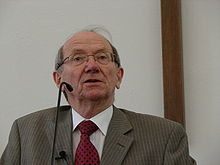 Murray (b. 1931; Lancashire, England) was educated in the Isle of Man and at the University of Durham. He entered the Christian ministry in 1955. He served as assistant to Martyn Lloyd-Jones at Westminster Chapel(1956–59) and subsequently at Grove Chapel, London (1961–69) and St. Giles Presbyterian Church, Sydney, Australia, (1981–84). In 1957 he and Jack Cullum founded the Reformed publishing house, the Banner of Truth Trust, where he has periodically worked full-time and remains the Editorial Director.
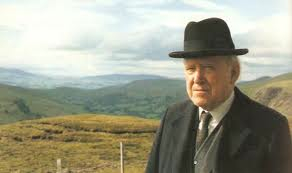 *David Martyn Lloyd-Jones (December 20, 1899 – March 1, 1981) was a Welsh Protestant minister, preacher and medical doctor who was influential in the Reformed wing of the British evangelical movement in the 20th century. For almost 30 years, he was the minister of Westminster Chapel in London. Lloyd-Jones was strongly opposed to Liberal Christianity, which had become a part of many Christian denominations; he regarded it as aberrant. He disagreed with the broad church approach and encouraged evangelical Christians (particularly Anglicans) to leave their existing denominations. He believed that true Christian fellowship was possible only amongst those who shared common convictions regarding the nature of the faith. One of his classic works has been republished as a 40th Edition – with many new features – (reviewed on this blog) and is entitled Preaching and Preachers.
6 Evidences Verifying The Resurrection of Jesus by Dr. James Boice
Solid Evidence For The Bodily Resurrection of Jesus  Christ
(Article adapted from: Foundations of the Christian Faith. *James Montgomery Boice, Downers Grove, IL: Inter Varsity Press. 1986. Chapter 17, pages 348-360)
If the bodily resurrection of Jesus Christ is true it is obviously the best news the world has ever heard. But we ask, “Can any news that good be believed?” That question leads to an investigation of the evidences for the resurrection.
Some modern theologians maintain that we have no need for historical evidences for the resurrection of Jesus Christ or evidences of any other point of Christian belief for that matter. Such things are supposed to be authenticated by the logic of faith alone. There is, of course, a sense in which that is true. Christians know that their faith rests not on their ability to demonstrate the truthfulness of the biblical narratives but rather on supernatural activity of the Holy Spirit within their hearts leading them to faith. Yet many come to faith through the various evidences for the resurrection, and the substance and form of the Christian faith rests upon those evidences. Apart from them our experiences of Christ could be mystical and even quite wrong.
We have every right to investigate the evidences, for the Bible itself speaks of “many infallible proofs” of the resurrection (Acts 1:3 KJV). We want to look at six of them here:
(1) The Resurrection Narratives
A first important evidence for the resurrection of Jesus Christ is that of the resurrection narratives themselves. There are four of them, one in each Gospel; they are more or less independent. Yet they are also harmonious, and that suggests their reliability as historical documents.
That the accounts are basically independent is evident from the considerable variations of detail. Of course there might be some overlap simply be-cause reports of a given incident would have been circulating throughout the Christian church when these books were being written. An account could have been told by different people at times in nearly identical language. But the four writers obviously did not sit down together and conspire to make up the story of Christ’s resurrection. If four people had sat down together and said, “Let’s invent an account of a resurrection of Jesus Christ” and had then worked out the details of their stories, there would be far more agreement than we find. We would not find the many small apparent contradictions. Yet if the story were not true and they had somehow separately made it up, it is impossible that we should have the essential agreement we find. In other words, the nature of the narratives is what we would expect from four separate accounts prepared by eyewitnesses.
Here are two examples. First, there is the variety of statements about the moment at which the women first arrived at the tomb. Matthew says that it was “toward the dawn of the first day of the week” (Mt. 28:1). Mark says that it was “very early on the first day of the week … when the sun had risen” (Mk. 16:2). Luke says that it was “at early dawn” (Lk. 24:1). John says that “it was still dark” (Jn. 20:1). These phrases are the kind of thing the authors would have standardized if they had been working on their accounts together. But they are in no real contradiction. For one thing, although John says that it was “still dark,” he obviously does not mean that it was pitch black; the next phrase says that Mary Magdalene “saw that the stone had been taken away from the tomb.” Presumably, the women started out while it was yet dark but arrived at the garden as day was breaking.
A second example of variation in detail in the midst of essential harmony is the listing of the women who made the first visit to the garden. Matthew says there were two Marys, “Mary Magdalene and the other Mary” (Mt. 28:1). Mark writes, “Mary Magdalene, and Mary the mother of James, and Salome” (Mk. 16:1). Luke refers to “Mary Magdalene and Jo–Anna and Mary the mother of James and the other women with them” (Lk. 24:10). John mentions only “Mary Magdalene” (Jn. 20:1). Actually, one reference throws light on the others. Mark and Luke, for example, explain who Matthew’s “other Mary” was. When we put them together we find that on that first Easter morning, when it was still dark, at least five women set out for the tomb: Mary Magdalene (who is mentioned by each of the writers), Mary the mother of James, Salome, Jo-Anna, and at least one other unnamed woman (who fits into Luke’s reference to “other women,” which includes Salome). The purpose of their trip is to anoint Christ’s body. They already know of the difficulty they face, for the tomb had been sealed by a large stone and they have no idea how they can move it. It begins to lighten a bit as they travel, so when they finally draw close to the tomb they see that the stone has been moved. That is something they were not expecting; so, although it suits their purpose, they are nevertheless upset and uncertain what to do. Apparently, they send Mary Magdalene back to tell Peter and John about the new development, which John himself records, although he does not mention the presence of the other women (Jn. 20:2). As the women wait for her to return, the morning grows lighter; eventually, emboldened by daybreak, the women go forward. Now they see the angels and are sent back into the city by them to tell the other disciples (Mt. 28:5-7; Mk. 16:5-7; Lk. 24:4-7).
In the meantime, Mary Magdalene has found Peter and John, who immediately leave her behind them and run to the tomb. John records their view of the graveclothes and points out that it was at this moment that he personally believed (Jn. 20:3-9). Finally, Mary Magdalene arrives back at the tomb again and is the first to see Jesus (Jn. 20:11-18; compare Mk. 16:9). On the same day Jesus also appears to the other women as they are returning from the tomb, to Peter, to the Emmaus disciples, and to the others as they are gathered together that evening in Jerusalem.
Two other factors also strongly suggest that these are accurate historical accounts. The first is that they leave problems for the reader that would have been eliminated were they fictitious. For example, there is the problem, repeated several times over, that the disciples did not always recognize Jesus when he appeared to them. Mary did not recognize him in the garden (Jn. 20:14). The Emmaus disciples did not know who he was (Lk. 24:16). Even much later, when he appeared to many of the disciples in Galilee, we are told that “some doubted” (Mt. 28:17). From the point of view of persuasion, the inclusion of such details is foolish. The skeptic who reads them will say, “It is obvious that the reason why the disciples did not immediately recognize Jesus is that he was actually someone else. Only the gullible believed, and that was because they wanted to believe. They were self-deluded.” Whatever can be said for that argument, the point is that the reason why such problems were allowed to remain in the narrative is that they are, in fact, the way the appearances happened. Consequently, they at least provide strong evidence that these are honest reports of what the writers believed to have transpired.
Another example of a problem is Christ’s statement to Mary that she was not to touch him because he was “not yet ascended to the Father” (Jn. 20:17). Yet Matthew tells us that, when Jesus appeared to the other women, presumably within minutes of his appearance to Mary, they “took hold of his feet and worshiped him” (Mt. 28:9). In the whole history of the Christian church no one has given a thoroughly convincing explanation of that anomaly. But it is allowed to stand because, whatever the reason, that is what happened.
Finally, the accounts evidence a fundamental honesty and accuracy through what we can only call their natural simplicity. If we were setting out to write an account of Christ’s resurrection and resurrection appearances, could we have resisted the urge to describe the resurrection itself-the descent of the angel, the moving of the stone, the appearance of the Lord from within the recesses of the tomb? Could we have resisted the urge to recount how he appeared to Pilate and confounded him? Or how he appeared to Caiaphas and the other members of the Jewish Sanhedrin? The various apocryphal Gospels (the Gospel according to the Hebrews, the Gospel of Peter, the Acts of Pilate and others) contain these elements. Yet the Gospel writers include none, because either they did not happen or else the writers themselves did not witness them. The Gospels do not describe the resurrection because no one actually witnessed it. It would have made good copy, but the disciples all arrived at the tomb after Jesus had been raised.
(2) The Empty Tomb
A second major evidence for the resurrection of Jesus Christ is the empty tomb. We might deny that an actual resurrection took place, but we can hardly deny that the tomb was empty. The disciples began soon after the crucifixion and burial to preach about the resurrection, at a time when those to whom they preached could simply walk to the tomb to see if the body of the supposedly resurrected Lord still lay there.
The empty tomb has been so formidable an argument for the resurrection throughout history that unbelievers have invented a number of theories to account for it. One theory is that the women and later the disciples went to the wrong place. It is conceivable that in the dark the women might have made such an error. But, as we have seen, it was not entirely dark, and besides they had been there earlier and thus were acquainted with its location. Again, we cannot suppose that John and Peter and then all the others would make an identical error.
Another theory is the so-called swoon theory. According to that view, Jesus did not die on the cross but rather swooned––as a result of which he was taken for dead and then buried alive. In the cool of the tomb he revived, moved the stone, and went forth to appear as resurrected. But that explanation has numerous problems. There are the difficulties in believing that a Roman guard entrusted with an execution could be fooled in such a manner; or that the spear thrust into Christ’s side would not have killed him even if he had been swooning; or that a weak, barely surviving Christ could have had the strength to move the large stone and overcome Roman guards. Further, one would have to suppose that a Christ in such a condition could convince his disciples that he had overcome death triumphantly.
Finally, there are the views that someone either stole or simply moved the body. But who? Certainly not the disciples, for if they had removed the body, they would later hardly have been willing to die for what they knew to be a fabrication. Nor would the Jewish or Roman authorities have taken the body. We might imagine that they could have moved it initially in order better to guard it––for the same reasons they sealed the tomb and posted a watch: “We remember how that imposter said, while he was still alive, ‘After three days I will rise again.’ Therefore order the sepulcher to be made secure until the third day, lest his disciples go and steal him away, and tell the people, ‘He has risen from the dead'” (Mt. 27:63-64). If that had happened, they would certainly have produced the body later when the disciples began their preaching. The authorities hated the gospel and did everything in their power to stop its spread. They arrested the apostles, threatened them and eventually killed some of them. None of that would have been necessary if they could have produced the body. The obvious reason why they did not is that they could not. The tomb was empty. The body was gone (The evidence of the empty tomb is discussed by John Stott, Basic Christianity, Downers Grove, IL: IVP, pp.46-50; Merrill C. Tenney, The Reality of the Resurrection, Chicago: Moody Press. 1963, pp. 113-16; James Orr, The Resurrection of Jesus, London: Hodder and Stoughton, n.d., pp. 111-39; and others).
(3) A Not Quite Empty Tomb
According to John, the tomb was not quite empty. The body of Jesus was gone but the graveclothes remained behind. The narrative suggests that there was something about them so striking that at least John saw them and believed in Jesus’ resurrection.
Every society has its distinct modes of burial, and that was true in ancient cultures as today. In Egypt bodies were embalmed. In Italy and Greece they were often cremated. In Palestine they were wrapped in linen bands that enclosed dry spices and were placed face up without a coffin in tombs generally cut from the rock in the Judean and Galilean hills. Many such tombs still exist and can be seen by any visitor to Palestine.
Another aspect of Jewish burial in ancient times is of special interest for understanding John’s account of Jesus’ resurrection. In a book called The Risen Master (1901), Henry Latham calls attention to a unique feature of Eastern burials, which he noticed when in Constantinople during the last century. He says that the funerals he witnessed there varied in many respects, depending upon whether the funeral was for a poor or rich person. But in one respect all the arrangements were identical. Latham noticed that the bodies were wrapped in linen cloths in such a manner as to leave the face, neck and upper part of the shoulders bare. The upper part of the head was covered by a cloth that had been twirled about it like a turban. Latham concluded that since burial styles change slowly, particularly in the East, that mode of burial may well have been practiced in Jesus’ time.
Luke tells us that when Jesus was approaching the village of Nain earlier in his ministry, he met a funeral procession leaving the city. The only son of a widow had died. Luke says that when Jesus raised him from death two things happened. First, the young man sat up, that is, he was lying on his back on the bier without a coffin. And second, he at once began to speak. Hence, the graveclothes did not cover his face. Separate coverings for the head and body were also used in the burial of Lazarus (Jn. 11:44).
It must have been in a similar manner that Joseph of Arimathea and Nicodemus buried Jesus Christ. The body of Jesus was removed from the cross before the beginning of the Jewish Sabbath, was washed, and then was wrapped in linen bands. One hundred pounds of dry spices were carefully inserted into the folds of the linen. One of them, aloes, was a powdered wood like fine sawdust with an aromatic fragrance; another, myrrh, was a fragrant gum that would be carefully mixed with the powder. Jesus’ body was thus encased. His head, neck and upper shoulders were left bare. A linen cloth was wrapped about the upper part of his head like a turban. The body was then placed within the tomb where it lay until sometime on Saturday night or Sunday morning.
What would we have seen had we been there at the moment at which Jesus was raised from the dead? Would we have seen him stir, open his eyes, sit up, and begin to struggle out of the bandages? We must remember that it would have been difficult to escape from the bandages. Is that what we would have seen? Not at all. That would have been a resuscitation, not a resurrection. It would have been the same as if he had recovered from a swoon. Jesus would have been raised in a natural body rather than a spiritual body, and that was not what happened.
If we had been present in the tomb at the moment of the resurrection, we would have noticed that all at once the body of Jesus seemed to disappear. John Stott says that the body was” ‘vaporized,’ being transmuted into something new and different and wonderful” (Stott, Basic Christianity, p.52). Latham says that the body had been “exhaled,” passing “into a phase of being like that of Moses and Elias on the Mount” (Henry Latham, The Risen Master. Cambridge Deighton Bell and Company, 1901, pp.36, 54). We would have seen only that it was gone.
What would have happened then? The linen cloths would have collapsed once the body was removed, because of the weight of the spices, and would have been lying undisturbed where the body of Jesus had been. The cloth which surrounded the head, without the weight of spices, might well have retained its concave shape and have lain by itself separated from the other cloths by the space where the neck and shoulders of the Lord had been.
That is exactly what John and Peter saw when they entered the sepulcher, and the eyewitness account reveals it perfectly. John was the first at the tomb, and as he reached the open sepulcher in the murky light of early dawn he saw the graveclothes lying there. Something about them attracted his attention. First, it was significant that they were lying there at all. John places the word for “lying” at an emphatic position in the Greek sentence. We might translate it, “He saw, lying there, the graveclothes” (Jn 20 5) further the cloths were undisturbed. The word that John uses (keimena) is used in the Greek papyri of things that have been carefully placed in order. (One document speaks of legal papers saying, “I have not yet obtained the documents, but they are lying collated.” Another speaks of clothes that are “lying [in order] until you send me word.”) Certainly John noticed that there had been no disturbance at the tomb.
At that point Peter arrived and went into the sepulcher. Undoubtedly Peter saw what John saw, but in addition he was struck by something else. The cloth that had been around the head was not with the other cloths. It was lying in a place by itself (Jn. 20:7). And what was more striking, it had retained a circular shape. John says that it was “wrapped together” (KJV). We might say that it was “twirled about itself.” And there was a space between it and the cloths that had enveloped the body. The narrative says, “Then Simon Peter came, following him and went into the tomb he saw the linen cloths lying, and the napkin, which had been on his head not lying with the linen cloths but rolled up in a place by itself” (20 6 7) Finally John too entered the sepulcher and saw what Peter saw. When he saw it he believed.
What did John believe? He might have explained it to Peter like this “Don’t you see, Peter, that no one has moved the body or disturbed the graveclothes? They are lying exactly as Nicodemus and Joseph of Arimathea left the eve of the Sabbath. Yet the body is gone. It has not been stolen. It has not been moved. Clearly it must have passed through the clothes, leaving them as we see them now. Jesus must be risen.” Stott says, “A glance at these graveclothes proved the reality, and indicated the nature, of the resurrection” ((Stott, Basic Christianity, p. 53).
(4) The Post Resurrection Appearances
A fourth evidence for the resurrection is the obvious fact that Jesus was seen by the disciples. According to the various accounts he appeared to Mary Magdalene first of all, then to the other women who were returning from the tomb, afterward to Peter, to the Emmaus disciples, to the ten gathered in the upper room, then (a week later) to the eleven disciples including Thomas, to James, to five hundred brethren at once (1 Cor. 15:6, perhaps on a mountainside in Galilee), to a band of disciples who had been fishing on the lake of Galilee, to those who witnessed the ascension from the Mount of Olives near Jerusalem, and last of all to Paul, who claimed to have seen Christ in his vision on the road to Damascus. During the days following the resurrection, all these persons moved from blank, enervating despair to firm conviction and joy. Nothing accounts for that but the fact that they had indeed seen Jesus.
During the last century a well-known critic of the Gospels, Ernest Renan, wrote that belief in Christ’s resurrection arose from the passion of a hallucinating woman, meaning that Mary Magdalene was in love with Jesus and deluded herself into thinking that she had seen him alive when she had actually only seen the gardener. That is preposterous. The last person in the world that Mary (or any of the others) expected to see was Jesus. The only reason she was in the garden was to anoint his body. Moreover, even if Mary had believed in some sort of resurrection through the power of love, there is no evidence that the disciples could have been so deluded or that they anticipated anything of the kind. Many despaired; some, like the Emmaus disciples, were scattering. Thomas, for one, was adamant in his disbelief. Yet we find that within a matter of days after the Lord’s alleged resurrection, all of them were convinced of what beforehand they would have judged impossible. And they went forth to tell about it, persisting in their conviction even in the face of threats, persecution and death.
One clear example of unbelieving disciples being convinced of the resurrection solely by the appearance of Jesus is that of the Emmaus disciples. One of them is identified. He is Cleopas (Lk. 24:18). If he is to be identified with the Clopas (slight variation in spelling) mentioned in John 19:25, then we know that his wife’s name was Mary, that she was in Jerusalem, had witnessed the crucifixion along with the other women and was therefore probably the one returning to Emmaus with him on the first Easter morning.
The importance of this identification lies in the fact that Mary, and perhaps Cleopas too, had witnessed the crucifixion and therefore had not the slightest doubt that Jesus was dead. Mary had seen the nails driven into Christ’s hands. She had seen the cross erected. She saw the blood. Finally, she saw the spear driven into his side. Afterwards Mary undoubtedly went back to where she was staying. The Passover came, and Mary and Cleopas observed it like good Jews. They waited in sadness over the holidays––from the day of the crucifixion until the day of the resurrection––for the same Sabbath restraints on travel that had kept the women from going to the sepulcher to anoint the body would also have kept Cleopas and Mary from returning home to Emmaus. The morning after the Saturday Sabbath finally came. It is possible that Mary is one who went to the tomb to anoint the body. If that is the case, she saw the angels, returned to tell Cleopas about it, and then––look how remarkable this is––joined him in preparing to leave. So far from their thinking was any idea of the literal truth of Christ’s bodily resurrection!
What is more, during the time that Cleopas and Mary were getting ready to leave, Peter and John set out for the sepulcher. They entered the tomb. Right then John believed in some sense, although he may not have understood all that the resurrection meant. Peter and John returned, told Cleopas, Mary and the others what they had seen. And then––again this is most remarkable––Cleopas and Mary went right on packing. As soon as they were ready, they left Jerusalem. Did that Palestinian peasant couple believe in Christ’s resurrection? Certainly not. Did they come to believe, as they eventually did, because of their own or someone else’s wishful thinking or a hallucination? No. They were so sad at the loss of Jesus, so miserable, so preoccupied with the reality of his death, that they would not even take twenty or thirty minutes personally to investigate the reports of his resurrection.
If someone should say, “But surely they must not have heard the reports; you are making that part of the story up,” the objection is answered by the words of Cleopas. When Jesus appeared to them on the road and asked why they were so sad, Cleopas answered by telling him first about the crucifixion and then adding, “Moreover, some women of our company amazed us. They were at the tomb early in the morning and did not find his body; and they came back saying that they had even seen a vision of angels, who said that he was alive. Some of those who were with us [Peter and John] went to the tomb, and found it just as the women had said; but him they did not see” (Lk. 24:22-24).
What accounts for a belief in the resurrection on the part of Christ’s disciples? Nothing but the resurrection itself. If we cannot account for the belief of the disciples in that way, we are faced with the greatest enigma in history. If we account for it by a real resurrection and real appearances of the risen Lord, then Christianity is understandable and offers a sure hope to all.
(5) The Transformed Disciples
A fifth evidence for the resurrection flows from what has just been said: the transformed character of the disciples.
Take Peter as an example. Before the resurrection Peter is in Jerusalem going along quietly behind the arresting party. That night he denies Jesus three times. Later he is in Jerusalem, fearful, shut up behind closed doors along with the other disciples. Yet all is changed following the resurrection. Then Peter is preaching boldly. He says in his first sermon on the day of Pentecost, “Men of Israel, hear these words: Jesus of Nazareth, a man attested to you by God with mighty works and wonders and signs which God did through him in your midst, as you yourselves know––this Jesus, delivered up according to the definite plan and foreknowledge of God, you crucified and killed by the hands of lawless men. But God raised him up, having loosed the pangs of death, because it was not possible for him to be held by it” (Acts 2:22-24). A few chapters farther on in Acts we find him before the Jewish Sanhedrin (the body that condemned Jesus to death), saying, “Whether it is right in the sight of God to listen to you rather than to God, you must judge; for we cannot but speak of what we have seen and heard” (Acts 4:19-20).
“Something tremendous must have happened to account for such a radical and astounding moral transformation as this. Nothing short of the fact of the resurrection, of their having seen the risen Lord, will explain it” (R. A. Torrey, The Bible and Its Christ, p. 92).
Another example is James, Jesus’ brother. At one point none of Jesus brothers believed in him (Jn. 7:5). Jesus once declared, “A prophet is not without honor except in his own country and in his own house” (Mt. 13:57). But later James does believe (compare Acts 1:14). What made the difference? Obviously, only the appearance of Jesus to him, which is recorded in 1 Corinthians 15:7.
(6) The New Day of Christian Worship
The final though often overlooked evidence for the resurrection of Jesus Christ is the change of the day of regular Christian worship from the Jewish Sabbath (Saturday) to Sunday, the first day of the week Could anything be more fixed in religious tradition than the setting aside of the seventh day for worship as practiced in Judaism? Hardly. The sanctification of the seventh day was embodied in the Law of Moses and had been practiced for centuries. Yet from the very beginning we see Christians though Jews disregarding the Sabbath as their day of worship and instead worshiping on Sunday. What can account for that? There is no prophecy to that effect, no declaration of an early church council. The only adequate cause is the resurrection of Jesus Christ, an event so significant that it immediately produced the most profound changes, not only in the moral character of the early believers, but in their habits of life and forms of worship as well.
I was once speaking to another minister about his spiritual experience when the conversation turned to the resurrection. The minister said that when he came out of seminary he possessed no real convictions concerning the gospel of Christ. He probably believed some things intellectually, but they had not gripped his heart. He said that he began to reflect on the resurrection. I asked, “What did you find?” First of all, he replied, he discovered a strange happiness and internal rest as he struggled with the accounts and the questions that they forced to his mind. That indicated to him that, although he did not have the answers yet, at least he was on the right track. As he studied he came to see the importance of the issue. He saw that if Jesus really rose from the dead, everything else recorded about him in the New Testament is true––at least there is no sound reason for rejecting it. And he concluded that if Jesus was not raised from the dead, he should leave the ministry.
So he read books. He visited the seminary where he had studied. He talked with his professors. He said that he became convinced that Jesus is indeed risen, as the Bible declares, and that all the other doctrines of the faith stand with it. Interestingly enough, he came to that conclusion several weeks before Easter that particular year, and on Easter he therefore stood up in church to proclaim his personal faith in these things. Afterward members of his congregation said that they had never heard preaching like that before, and several believed in Christ as a result of his preaching.
That has happened to many: to jurists like Frank Morison, Gilbert West, Edward Clark and J.N.D. Anderson; to scholars like James Orr, Michael Ramsey, Arnold H.M. Lunn, Wolfhart Pannenburg and Michael Green. Green says that “the evidence in favor of this astonishing fact is overwhelming” (Michael Green, Runaway World, Downer Grove Ill.: InterVarsity Press, 1968, p. 09. Michael Ramsey wrote, “So utterly new and foreign to the expectations of men was this doctrine, that it seems hard to doubt that only historical events could have created it” (A.M. Ramsey, The Resurrection of Christ, London: Geoffrey Bles, 1945, p.19).
Did Jesus rise from the dead? If he did, then he is the Son of God and our Savior. It is for us to believe and follow him.
 *James Montgomery Boice, Th.D., (July 7, 1938 – June 15, 2000) was a Reformed
  theologian, Bible teacher, and pastor of Tenth Presbyterian Church in Philadelphia from 1968 until his death. He is heard on The Bible Study Hour radio broadcast and was a well known author and speaker in evangelical and Reformed circles. He also served as Chairman of the International Council on Biblical Inerrancy for over ten years and was a founding member of the Alliance of Confessing Evangelicals. He is the author of numerous Bible expositions on Genesis, Joshua, Nehemiah, Daniel, The Minor Prophets, Matthew, John, Romans and one of my favorite Systematic Theologies called Foundations of the Christian Faith from which this article is derived.
Dr. Tim Keller On The Importance of Gospel Repentance
*Dr. Tim Keller: “All of Life is Repentance”

Martin Luther opened the Reformation by nailing “The Ninety-Five Theses” to the door of Wittenberg Cathedral. The very first of the theses was: “Our Lord and Master Jesus Christ…willed the entire life of believers to be one of repentance.” On the surface this looks a little bleak! Luther seems to be saying Christians will never be making much progress in the Christian life. Indeed, pervasive, all-of-life-repentance is the best sign that we are growing deeply into the character of Jesus.
The Transformation of Repentance:
It is important to consider how the gospel affects and transforms the act of repentance. In ‘religion’ the purpose of repentance is basically to keep God happy so he will continue to bless you and answer your prayers. This means that ‘religious repentance’ is a) selfish, b) self-righteous, c) and bitter all the way to the bottom. But in the gospel the purpose of repentance is to repeatedly tap into the joy of union with Christ in order to weaken our need to do anything contrary to God’s heart.
“Religious” repentance is selfish:
In religion we only are sorry for sin because of its consequences to us. It will bring us punishment – and we want to avoid that. So we repent. But the gospel tells us that sin can’t ultimately bring us into condemnation (Rom. 8:1) its heinousness is therefore what it does to God-it displeases and dishonors him. Thus in religion, repentance is self-centered; the gospel makes it God-centered. In religion we are mainly sorry for the consequences of sin, but in the gospel we are sorry for the sin itself.
Furthermore, ‘religious’ repentance is self-righteous. Repentance can easily become a form of ‘atoning’ for the sin. Religious repentance often becomes a form of self-flagellation in which we convince God (and ourselves) that we are truly miserable and regretful that we deserve to be forgiven. In the gospel, however, we know that Jesus suffered and was miserable for our sin. We do not have to make ourselves suffer in order to merit forgiveness. We simply receive the forgiveness earned by Christ. 1 John 1:8 says that God forgives us because he is ‘just.’ That is a remarkable statement. It would be unjust of God to ever deny us forgiveness, because Jesus earned our acceptance! In religion we earn forgiveness with our repentance, but in the gospel we just receive it.
Last, religious repentance is “bitter all the way down.” In religion our only hope is to live a good enough life for God to bless us. Therefore every instance of sin and repentance is traumatic, unnatural, and horribly threatening. Only under great duress does a religious person admit they have sinned-because their only hope is their moral goodness. But in the gospel the knowledge of our acceptance in Christ makes it easier to admit we are flawed (because we know we won’t be cast off if we confess the true depths of our sinfulness).
Our hope is in Christ’s righteousness, not our own-so it is not so traumatic to admit our weaknesses and lapses. In religion we repent less and less often. But the more accepted and loved in the gospel we feel the more and more often we will be repenting. And though of course there is always some bitterness in any repentance, in the gospel there is ultimately sweetness. This creates a radical new dynamic for personal growth. The more you see your own flaws and sins, the more precious, electrifying, and amazing God’s grace appears to you. But on the other hand, the more aware you are of God’s grace and acceptance in Christ, the more able you are to drop your denials and self-defenses and admit the true dimensions of your sin. The sin under all other sins is a lack of joy in Christ.
The Disciplines of Gospel-Repentance:
If you clearly understood these two different ways to go about repentance, then (and only then!) you can profit greatly from a regular and exacting discipline of self-examination and repentance. I’ve found that the practices of the 18th century Methodist leaders George Whitefield and John Wesley have been helpful to me here. In January 9, 1738, in a letter to a friend, George Whitefield laid out an order for regular repentance. (He ordinarily did his inventory at night) He wrote: “God give me a deep humility and a burning love, a well-guided zeal and a single eye, and then let men and devils do their worst!” Here is one way to use this order in gospel-grounded repentance.
Deep Humility vs. Pride:
Have I looked down on anyone? Have I been too stung by criticism? Have I felt snubbed and ignored?
Repent like this: Consider the free grace of Jesus until I sense a) decreasing disdain (since I am a sinner too), b) decreasing pain over criticism (since I should not value human approval over God’s love). In light of his grace I can let go of the need to keep up a good image-it is too great a burden and now unnecessary. Consider free grace until I experience grateful, restful joy.
Burning love vs. Indifference:
Have I spoken or thought unkindly of anyone? Am I justifying myself by caricaturing (in my mind) someone else? Have I been impatient and irritable? Have I been self-absorbed and indifferent and inattentive to people?
Repent like this: Consider the free grace of Jesus until there is a) no coldness or unkindness (think of the sacrificial love of Christ for you), b) no impatience (think of his patience with you), and c) no indifference. Consider free grace until I show warmth and affection. God was infinitely patient and attentive to me, out of grace.
Wise Courage vs. Anxiety:
Have I avoided people or tasks that I know I should face? Have I been anxious and worried? Have I failed to be circumspect or have I been rash and impulsive?
Repent like this: Consider the free grace of Jesus until there is a) no cowardly avoidance of hard things (since Jesus faced evil for me), b) no anxious or rash behavior (since Jesus’ death proves God cares and will watch over me). It takes pride to be anxious – I am not wise enough to know how my life should go. Consider free grace until I experience calm thoughtfulness and strategic boldness.
Godly motivations (a ‘single eye’):
Am I doing what I am doing for God’s glory and the good of others or am I being driven by fears, need for approval, love of comfort and ease, need for control, hunger for acclaim and power, or the ‘fear of man?’ Am I looking at anyone with envy? Am I giving in to any of even the first motions of lust or gluttony? Am I spending my time on urgent things rather than important things because of these inordinate desires?
Repent like this: How does Jesus provide for me in what I am looking for in these other things? Pray: “O Lord Jesus, make me happy enough in you to avoid sin and wise enough in you to avoid danger, that I may always do what is right in your sight, in your name I pray, Amen.”
 *Dr. Tim Keller is the founding pastor of Redeemer Presbyterian Church in Manhattan, New York, and the author of The Reason for God: Belief in an age of Skepticism (In my opinion the best book to date on apologetics for a postmodern culture—I think this book will do for post moderns what Mere Christianity by C.S. Lewis did for moderns).

What is the Difference Between Discipleship & Mentoring? By Ted Engstrom
“A discipler is one who helps an understudy (1) give up his own will for the will of God the Father, (2) live daily a life of spiritual sacrifice for the glory of Christ, and (3) strive to be consistently obedient to the commands of his Master. A mentor, on the other hand, provides modeling, close supervision on special projects, individualized help in many areas—discipline, encouragement, correction, confrontation, and a calling to accountability.” – Ted Engstrom (The Fine Art of Mentoring, recently re-published by Wipf and Stock Publishers, 2008 )
 Dr. Ted W. Engstrom (1916-2006) dedicated his life to effective Christian ministry leadership. His 60 years of Christian service include careers as Christian book editor at Zondervan, president of Youth for Christ International, president of World Vision, and author of more than 50 books. He was a board member for dozens of Christian organizations and assisted religious and political leaders in 136 other countries where he stood as a model of godly leadership.
 LifeCoach4God