BOOK REVIEW FOR STICKY CHURCH BY LARRY OSBORNE

“Assimilating and Making Disciples in the Local Church”

285083.jpg

Reviewed By Dr. David P. Craig

Larry Osborne is a pastor’s pastor and a leader’s leader. He has successfully made and multiplied disciples in the same local church for over thirty years. Whenever he writes a book I read it; re-read it; and make sure my staff and leaders read it as well. Larry started with a small struggling church and has successfully developed multiplying disciples of Christ in San Diego and all over the world through their simple church model of assimilation and discipleship through their intentional and strategic implementation of small groups.

In Sticky Church Osborne writes about a simple strategic process for developing a small group ministry that is extremely effective in assimilating attenders and new comers in the church and helping them become connected and committed to making and multiplying fully devoted followers of Christ for the long-haul.

Part 1 is composed of four chapters whereby Osborne makes a compelling case for a simple model and strategy in developing a “sticky church.” A sticky church is a church where people “stick” or stay because they immediately become convinced and unified around the vision; and live out this vision in the context of a small group. In Osborne’s church in Vista, California (a suburb of San Diego) 80% of church attenders (over 7,000 adults) become committed to their small groups – what they call “growth groups.” The whole idea of “stickiness” is keeping people in the church (what he calls “closing the back door”) so that you have a high retention of attenders who stay and grow because they commit to a small group that’s committed to their growth as a disciple of Jesus Christ.

Here are some insightful quotes from the first four chapters:

“But we’ve often become so focused on reaching people that we’ve forgotten the importance of keeping people.”

“What does Jesus’ parable about the four soils have to say about the way we do church? To my thinking it says a lot. And one of the most important things it says about churches is that stickiness matters.”

“They [the principles in this book and the sermon-based model used by North Coast Church) worked just as well when we were a small church of less than two hundred adults as they do today in a multisite megachurch with more than seven thousand in weekend attendance.”

“Almost all our growth has come by word of mouth.”

“We’ve simply tried to serve our people so well that they’ll want to bring their friends, without needing to be asked to do so.”

“Everything we do is aimed at helping the Christians we already have grow stronger in Christ. But everything is done in such a way that their non-Christian friends will understand all that we’re saying and doing.”

“Bottom line: We’ve tried to create a perfect storm for come-and-see evangelism while velcroing newcomers for long-term spiritual growth.”

“In fact, the most important number to know about North Coast Church is not the weekend attendance. It’s the percentage of adults who participate in one of our small groups. Since 1985 that number has equaled 80 percent of our average weekend attendance.”

“It’s as though they assumed (people that think that sermon-based small groups only work in a megachurch) that North Coast was always big church—or at least became one overnight…Not so…North Coast grew quite slowly in the early days. It took five years to go from 130-180. It took another five years to reach 750.”

“This is not an anti-marketing or anti-programs book. It’s a pro-stickiness book.”

“What matters is not the size of the church or the slickness of the programming . What matters is that those who come find a ministry and relationships worthy of spontaneous word-of-mouth recommendations. When that happens, a church is primed to hold on to the people it already has and the people they bring with them.”

“A sticky church needs a healthy leadership team composed of people who genuinely like one another, share the same vision, and pull in the same direction (talking about the first big change necessary to developing a sticky church – retaining new comers).”

“The second big change was in the way I taught and led our congregation. Focusing on the front door aimed everything at two kinds of people: the not-yet Christian or the super saint who was ready to help me charge the hill. There wasn’t much room for people who came to Christ but didn’t grow at a fast enough pace or carried lots of old baggage.”

“The third change involved launching a small group ministry focus primarily on building significant relationships rather than growing the church.”

“Instead of celebrating how many people came, the most important measurement would be how many came back.”

“Churches that close the back door effectively do so by serving their congregations so well that the people don’t want to leave. And happy sheep are incurable word-of-mouth marketers.”

“Whatever you do to reach people you have to continue to do to keep them (this is why they keep their ministries simple, consistent, and excellent – North Coast doesn’t do a lot of special events or programming).”

“High-powered front-door programs can have the unintended consequences of sending a message that some weekends and programs are for brining guests—and the rest aren’t.”

“There’s a second unintended obstacle that highly programmed front-door churches can put in the way of natural evangelism. If most of the people who come to Christ come as a result of a complex and high-powered event, it sends a subtle message that it takes lots of time, planning, and money to lead someone to Christ.”

“Instead of complex assimilation programs, a sticky church simply needs to provide plenty of ministry on-ramps to which members can easily connect the friends they’ve invited.”

In Part 2 Osborne writes five chapters on “How Small Groups Change Everything.” Here are some important points from this section:

“Most spiritual growth doesn’t come as a result of a training program or set curriculum. It comes as a result of life putting us in what I like to call a need-to-know or need-to-grow situation.”

“The focus of a sermon based small group is not so much on the curriculum as it is on the process.”

“The ultimate goal of a sermon-based small group is simply to velcro people to the two things they will need most when faced with a need-to-know or need-to-grow situation: the Bible and other Christians.”

“When the New Testament was written, the typical church was so small that it was, in essence, a small group.”

“The best tool I’ve ever seen for connecting people to one another and engaging them with the Bible for the long haul is a sermon-based small group. It offers a format that fits the way we spiritually grow, while providing a framework for a healthy and sticky church. Nothing compares.

“While many church leaders claim that small groups are an integral part of their ministry, I’ve learned that two simple measurements will always tell me their real place in a ministry’s pecking order: (1) the percentage of adults who attend a small group, and  (2) the participation level of senior staff and key lay leaders.”

“Getting there (the key to reaching critical mass – that all-important stage at which the full power and benefits of a small group ministry begin to impact the ethos, DNA, and spiritual health of nearly everyone and everything in the church) usually requires that somewhere between 40 to 60 percent of the average weekend adult attendance be involved in a small group. If fewer people participate, small groups will still have a profound effect, but it will be primarily on the individuals in them, not on the entire church.”

“Small groups undercut this Holy Man myth (The Holy Man myth is the idea that pastors/clergy somehow have more of a direct hot line to God) because they typically meet in widely dispersed settings. This makes it impossible for the pastor (or any other staff member) to carry out all the pastoral roles and functions. They simply can’t be everywhere at once…As a result, small group leaders inevitably step up and assume roles of spiritual leadership that they would have otherwise deferred to the pastoral staff.”

“That not only changes the way small group leaders view themselves; it changes the congregation’s outlook as well. Once people begin to realize that God’s anointing and spiritual power aren’t restricted to the guy who speaks on Sunday, they whine a lot less when he’s not available.”

“Another spiritually crippling falsehood that began to lose its grip on our congregation was what I call the Holy Place myth. It’s the idea that God’s presence is somehow greater in some places than in others.”

“With the demise of both the Holy Man and the Holy Place myths, our ministry was, for the first time, genuinely unleashed. People started bringing God to the workplace and into their neighborhoods rather than trying to bring everyone to the church building.”

“Let’s face it: In most churches there aren’t many opportunities for high-impact, life on life ministry. There are usually few up-front teaching roles, a handful of worship leader positions, and some youth and Sunday school spots to be filled. After that, most roles are pretty much part of the supporting cast, designed more to keep the machine running than to touch lives.”

“Small groups open up lots of new opportunities for frontline ministry. At North Coast every group has a leader and a host, most often made up of two couples. That means in every group, we have four people who teach, counsel, disciple, pray, visit hospitals, lead in worship, provide communion, and even baptize members of their little flock—none of which they would do without the platform for ministry we call growth groups.”

“As a former youth pastor, I learned long ago that no one steps up until there’s a vacuum that needs to be filled. Every year when my seniors were about to graduate, I would wonder if we’d survive without their leadership. But as soon as they were gone, the juniors and sophomores stepped up—often doing a better job than their departing upperclassmen.”

“Still another powerful advantage that small groups can bring is a marked increase in the practice of spiritual disciplines. That’s because a small group takes our good intentions and puts them on the our calendar.”

“Here’s the irony: if we canceled our small groups and filled our facility once a week for a prayer meeting with standing-room-only crowds, we’d probably get some great write-ups in the Christian press. But in reality we’d have almost 70% fewer people praying than we already have in our small groups.”

“Our young adult dropout rate is a fraction of what I’ve seen in the past. And I’m convinced it’s because we’ve focused on giving our children and youth the powerful gift of a growing mom and dad.”

“Sermon-based small groups also made it much easier for our teaching team to keep the entire church focused and headed in the same direction. Whether we’re casting vision, clarifying direction, or simply dealing with an important issue, it’s much easier to get people on the same page and keep them there.”

“One reason I want my messages to be more memorable (on why sermon based small groups make the preacher a better preacher and make the sermon go further in people’s lives) is that I want people to apply the important truths and doctrines of the faith. I know that if I can change the way people think, it will change the way they live.”

“It’s a relatively short step (for a marginal attender) from listening to a sermon to joining a small group that discusses the sermon he’s already heard. But it’s a much bigger step into a traditional small group Bible study.”

“There’s still another advantage that comes with a sermon based small group model. It’s that most people (including the marginally interested and new Christians) come to the meeting far more prepared than they would if they were using a typical workbook or study guide.”

Part 3 recounts ten chapters on the Why’s and How’s of Sermon-Based Small Groups and why this model works better than some of the more popular models out there for small groups. Here are some practical realities of sermon based small groups:

“A group needs to be small enough that everyone has a chance to contribute, but large enough that no one feels forced to speak up or share more than they want to. That means the ideal size for a group of introverts will tend to be larger than the ideal size for a group of thin-it-and-immediately-say-it extroverts. One needs more people to break the silence. The other needs less people so that there will be some silence.”

“The ideal size for a group of married couples is usually twelve to fourteen people. For singles, eight to twelve can be ideal.”

“We’ve found that whenever a couples group reaches sixteen people (or a singles group reaches fourteen), attendance becomes predictably inconsistent. It’s strange, but we can have three groups of twelve people, and all thirty-six will be present at almost every meeting. But two groups of sixteen people will hardly ever have all thirty-two show up. Perhaps it has to do with those in the smaller group feeling more needed and feeling a greater sense of responsibility.”

“We’ve found that the sermon-based small groups that have the greater life-on-life impact and stay together the longest are always those in which the friendships are deepest. That’s why we tell people to choose a group primarily according to who else is in it rather than where or when it meets.”

“Although we allow people to pick any group they want as long as there’s room in the group, we’ve found that those who make their choice based on a convenient location or time have a much lower stick rate than those who look for a group with which they already share an interest or station in life.”

“In almost every case, the first thing you’d notice at one of our small group meetings is that it starts with some light refreshments as people arrive—especially something to drink.”

“Once the meeting starts, most groups spend fifteen to thirty minutes sharing prayer requests and updating one another on what has been going on in their lives…As a group jells, this part of the meeting tends to expand and move to a much deeper level. In new groups, it can be perfunctory and shallow at first. But that’s fine by us. We don’t try to force depth. We simply provide an opportunity for great depth and vulnerability t show up when both the group and the Holy Spirit are ready.”

“The next part of the meeting is dedicated to the study and discussion of the previous weekend’s sermon…To improve the quality of the discussion, we work hard to make sure that everyone comes with the answers to the study questions already filled out. One of the most effective ways we do this is by having our leaders periodically ask people to read what they’ve written down, especially if it appears that someone is deviating from their original answer.”

“The homework (discussion/study guide) always consists of three types of questions: Getting to Know Me (These questions offer a nonthreatening look into our past or current life situations. They’re designed to help us get to know each other at a safe but accelerated pace), Into the Bible (These questions take the group to biblical passages that are either complementary or parallel to the main text of the sermon but were not covered in the message), and Application (These are designed to take home the main point or points of the sermon and drive them home. They typically deal with attitudes or life-change issues).”

“We ask every group to take at least one service project a year (the ideal is two) and to have at least one social gathering per quarter).”

“As a rule of thumb, most people will participate in only two time slots per week. No matter what the third meeting is for or when it takes place, it’s hard to get anyone to show up.”

Osborne goes on to discuss how to overcome the time crunch of developing and sustaining leaders; determining your primary purpose; how groups can grow deeper; why dividing groups isn’t the best strategy; how to find and develop leaders; how to train leaders; and these five key questions to ask before starting small groups:

  1. “Who are you trying to reach?” By that I mean, “Specifically who do you imagine being in your small groups? Who is likely to opt out? Who are you willing to leave out?”
  2. “What you plan to do in your meetings?” The options are endless. But once I know what happens in a small group, I can predict with uncanny accuracy who will come and who won’t.
  3. “How well does who you want to reach match up with what you plan to do?”
  4. “How do you think people are best trained to live out the Christian life and best prepared for leadership?”
  5. The final question to ask before launching a new or revamped small group ministry is, “Who already does what we want to do well—and does it in a church we would go to if we lived in the area?”

There is a large appendix section in the back of the book containing helps for the following topics: (1) Writing Great Questions; (2) Sample Sermon Note Sheet and Study Questions; (3) Sample Growth Group Covenant; (4) End-of-the-quarter Evaluation Form; (5) Leader Training Topics; (6) Leader Responsibilities; (7) Host Responsibilities; (8) A List of NT “One Anothers.” The Last section contains a Study Guide of Follow Up Questions for each chapter in the book.

Osborne’s model is simple; practical, proven, and effective. I don’t know of a better model for helping a local church reach out; equip; serve; raise up leaders; and unleash people for multiplying disciples of Jesus Christ. I have used this model in three churches; and now about to embark on launching this model in another church. I am grateful for it’s simplicity and yet the profound impact it has made practically in so many lives that I have been in community with. It has made a profound impact on my own belief that discipleship is done best in community and is a process not an event.

10 Benefits of Giving Thanks by Charles F. Stanley

“Give Thanks in Everything”

Why this tough but life-giving command can change your entire outlook.

Reading the Bible isn’t always easy.

If you’ve ever thought those words but were embarrassed to speak them, you’re not alone. Sure, there’s plenty within Scripture that we comprehend without much difficulty. But at times we come across a passage that baffles us—or worse, makes us feel angry or annoyed. Sometimes it’s because we simply don’t understand what the Lord is saying through the text. But often the reason for our discomfort is that we don’t like what we’re reading. It’s easier to ignore those verses and move on to more appealing topics than to hash it out with God and do what He says. Reading the Bible is hard because, in the end, it challenges us to change.

1 Thessalonians 5:18 is one of those verses that can really get under your skin: “In everything give thanks; for this is God’s will for you in Christ Jesus.” But what about those difficult and painful situations? Being grateful for suffering seems to make no sense.

If I were writing Scripture, I would say, “In most things give thanks, for this is God’s will for you in Christ Jesus.” It’s easy to be grateful for the good things in life—a newborn baby, a raise, a new house, or encouraging news from the doctor. But what if you lose your job, discover your child is on drugs, or are told by the doctor that you have only have six months to live? How can God expect you to be grateful then?

I faced this dilemma some time ago when I hurt my shoulder and experienced excruciating pain. I read this verse and told the Lord, “I know You said this, but it’s not reasonable when I’m hurting so badly. I just don’t feel thankful.” But then I noticed that it didn’t say, In everything give thanks when you feel like it. This command has nothing to do with feelings. It’s a choice to do what God says. Whenever He gives us a command in the Bible, it’s for our benefit.

Gratitude impacts every area of our lives.

By giving us the command to always give thanks, God is not rubbing salt in a wound or calling us to set aside reason. He knows that being thankful in all circumstances has a powerful impact on every area of our Christian life. Here are ten lessons I’ve learned:

1. Gratitude keeps us continually aware that the Lord is close by.Even though gratefulness doesn’t come naturally in difficult circumstances, a decision to thank God for walking with us through life makes us more sensitive to His comforting presence.

2. It motivates us to look for His purpose in our circumstance. Knowing that the Lord allows hurt and trouble for His good purposes takes the edge off the pain. Even if we don’t understand why we’re going through suffering, we can thank God because we know that in His time, He’ll work it all for good. In the meantime, we can rest in the knowledge that He’s using every hardship to transform us into the image of His Son (Rom. 8:28-29).

3. Thanksgiving helps bring our will into submission to God.When the situation we’re experiencing is the last thing we’d ever want, thanking the Lord is a giant step toward being able to follow Christ’s example and say, “Not my will, but Yours be done” (Luke 22:42). Gratitude helps us acknowledge that God’s will is best, even if it’s hard; in that way, we are able to release our hold on what we want. Although the circumstances may remain the same, submission changes our heart.

4. It reminds us of our continual dependence upon the Lord. Pride, adequacy, and independence evaporate whenever we’re trapped in a situation that leaves us helpless and hopeless. If there’s no way out, thanking God for His control over all things reminds us that He alone is our strength.

5. Thankfulness is an essential ingredient for joy.There’s no way to “rejoice always” (1 Thess. 5:16) without giving thanks in everything (v. 18). That’s why ungrateful people are so grumpy. Joy is an inner sense of contentment, which flows from a deep assurance that all God’s purposes are good and He’s in complete control of every situation. With that kind of supernatural joy, it’s easy to be thankful.

6. A grateful attitude strengthens our witness to unbelievers.The world is filled with people who are angry, frustrated, and overwhelmed with the difficulties of life. But a believer with a grateful attitude is like a light shining in a dark place. The people around you will want to know why you don’t grumble and complain the way everyone else does. Then you can tell them about your amazing Savior.

7. Thanking God focuses our attention on Him rather than our circumstances. The key to a grateful heart begins with understanding the Lord’s character because knowing His awesome attributes motivates trust and gratitude. He knows exactly what you’re going through, loves you unconditionally, and understands you perfectly. When you thank Him in tough times, He gets bigger, and the circumstances become smaller.

8. Gratitude gives us eternal perspective. The apostle Paul is an amazing example of a man who suffered extreme hardship yet remained thankful. That’s because he was able to see life from God’s perspective. In 2 Corinthians 4:16-18, he says our present suffering is “momentary light affliction.” If you’re going through a really hard time, those words may sound ridiculous. Maybe you’ve been dealing with pain your entire life, or a difficult trial has dragged on for decades. It hardly seems momentary or light.

But Paul is comparing our situations here on earth with what’s awaiting us in eternity. For him, a 40-year stretch of pain and hardship was no match for the “eternal weight of glory” awaiting him (2 Cor. 4:17). What an amazing thought—your present pain has the potential to produce incomparable glory for you in heaven. Now that’s a big reason to thank God!

9. When we’re wearied by our circumstances, thanksgiving energizes us. Most of us can handle short trials, but if they continue for a long period of time, the emotional and physical strain is exhausting. Should ongoing illness, unresolved relational problems, or continued financial pressures become more than we can bear, it’s time to start thanking God because He has promised to give strength to the weary (Isaiah 40:29). He’ll release His supernatural energy within us so we can patiently endure the trial and come out victorious on the other side.

10. Gratitude transforms anxiety into peace, which passes all understanding (Phil. 4:6-7). I learned this principle through a very difficult experience. When I was feeling anxious about the situation, I discovered that complaining, getting angry, and arguing with God didn’t change my circumstances. Finally, in desperation, I began thanking Him. Only then did I receive His incomprehensible peace. My situation didn’t change for quite a while, but God’s peace guarded my heart all the way through that trying time.

What will you choose?

The choice isn’t always easy. Most of the time, we’d rather get out of difficulties than thank God through them. But have you ever considered that He may actually want you to stay in a painful situation for a time? I know this may not sound like something a loving God would ever do, but remember, His goal is to do what is best for you, not what’s comfortable, convenient, and enjoyable.

The Lord’s purposes for your life extend beyond your days on earth. He’s working for your eternal good. Begin thanking God today, in whatever circumstance you find yourself. After all, what’s the alternative—bitterness, resentment, and grumbling? God made you for something far better: eternal, sustaining joy. The transformation starts with two simple, small words offered from the heart: thank You.

Say them over and over. And then say them again. Your joy will be radiant—a light shining in a dark and desperate world.


8 Advantages of Expository Preaching

Excerpt from Gary Millar and Phil Campbell’s Book [contributed by Andy Naselli]: Saving Eutychus: How To Preach God’s Word and Keep People Awake: Kingsford NSW, Australia: Matthias Media, 2013, pp. 40-41 (http://andynaselli.com/8-advantages-of-heart-changing-expository-preaching/May 16, 2013)

saving

8 Advantages of Heart-Changing Expository Preaching

Expository Preaching

(1) Does justice to the biblical material which makes it clear that God works through His Word to change people’s lives–as it ‘uncaged the lion’ and allows God’s Word to speak.

(2) Acknowledges that it is God alone, through the Spirit, who works in people’s lives, and that it is not our job to change people through clever or inspiring communication.

(3) Minimizes the danger of manipulating people, because the text itself controls what we say and how we say it. The Bible leaves little room for us to return repeatedly to our current bugbears and hobbyhorses.

(4) Minimizes the danger of abusing power, because a sermon driven by the text creates an instant safeguard against using the Bible to bludgeon (or caress) people into doing or thinking what we want them to do or think.

(5) Removes the need to rely on our personality. While we all feel the weight, at times of having little ‘inspiration’, energy or creativity, if our focus is on allowing the immense richness of Scripture to speak in all its color and variety, the pressure is well and truly off.

(6) Encourages humility to those teaching. While it can be a temptation to think that we are somehow special because we are standing at the front doing most of the talking (and, on a good day, receiving the encouragement), getting it straight that the key to preaching to the heart is simply uncovering the power and freshness of God’s words helps to keep us in our place.

(7) Helps us to avoid simple pragmatism. If our focus is on working consistently to enable people to encounter God who speaks through the text, we will not feel under pressure to address every single issue and topic as it comes up in the life of the church. Conversely, working through the Bible week by week will force us to cover subjects that we wouldn’t choose to address in a million years. In other words, expository preaching is the simplest, longest-lasting antidote we have to pragmatism.

(8) Drives us to preaching the gospel. Expository preaching persistently drives us to the Lord Jesus Christ (wherever we are in the Bible) and so ‘forces’ us to preach the gospel–that is, to spell out what God has already done for us in the death and resurrection of His Son, and then to move from that grace to what God asks and enables us to do. When we preach the gospel we are not simply telling people how to be good or leaving them to wallow in the overwhelming sense that they are irredeemably bad.

God’s Part In Ministry by Dennis McCallum and Gary DeLashmutt

51Si8jFw1IL._AA160_

Christian workers must clearly understand the role God plays in evangelism, discipleship and other aspects of ministry. Unless we consciously operate out of a God-centered model of ministry, we will automatically default to a human-centered model, and all the defeat that comes with it.

A moment’s reflection tells us that what we propose to accomplish in Christian ministry is supernatural. To reach people’s hearts with conviction of their need for Christ, to train them up in the faith, to impart the deep things of God in a life-changing way, to oppose and defeat powerful evil spirits—these are acts that no human can hope to accomplish, no matter how intelligent and competent that person may be. The key to ministry success is always the same: That God moves through us “leading us in his triumph.” (2 Cor. 2:14) Spiritual failure in ministry is predictable when leaders try to supplant the power of God with human charisma, ingenuity, marketing skill, force of will, or social manipulation, even when these are supplied from the best of motives.

Although no real ministry will go forward without the power of God, we should not deny the human part in this process, which would be “super-spirituality.” Paul declares that he and the other apostles are “God’s fellow workers.” (1 Cor. 3:9) Yes, “neither he who plants nor he who reaps are anything but God who causes the growth.” (vs. 7) But this is a figure of speech meaning that compared to God, the planter and reaper are nothing. We should not understand this hyperbole literalistically. Do we really think that everything would have come out the same even if Paul had never gone to Corinth to plant? We hold that his planting did make a difference, and Paul argues this as well, as the whole point of 1Corinthians 3 is that every Christian leader should “take care how he builds.” (vs.10) An honest reading of the Bible reveals a strong doctrine of human agency in ministry. God has elected to work though human beings, and therefore our actions are important.

What, then, should we anticipate God will do from his side in our ministry?

In the first place, God directs our ministries. Leaders are to come to the scriptures, and to the Lord in prayer, seeking to know his will for our ministry. Ministry that departs from the direction God wants may bear some kind of fruit, but becomes “wood hay and stubble” the further we depart from the leading of the Holy Spirit. Interestingly, God seems willing to continue using ministries that are off-target, apparently because he places a higher value on reaching the lost than on complete fidelity to his leading. Paul observed this phenomenon in Rome. (Phil. 1:15-18) This is probably the meaning of Mark 9:38-40 as well. Even in 1 Corinthians 3, the “wood hay and stubble” may be used by God, but it will not be rewarded. In fact, the Bible abounds with examples where God continued to use leaders who went astray, sometimes very badly. What are we to conclude?

On one hand, since it is God’s will to direct our ministries, we should seek that leading often and earnestly. Even though God may continue to use off-target ministries, we assume that we will bear more spiritual fruit the closer we are to God’s ideal. This is increasingly obvious as time goes on. In the short term, human-based ministry may look good, but it tends to deteriorate over time or bring disgrace upon the Lord’s name. On the other hand, we should never become paralyzed by the notion that “Unless I know exactly what God wants in each situation, I can’t move forward.” We can move forward based on the general knowledge of what God wants, and in areas we are unsure, we can remain open to any correction in our course that God may want to show us, knowing that he will not let us come to irreversible harm (Phil. 3:15).

The direction of God extends not only to major issues like whether to preach the word or to practice church discipline, but to more subjective areas like when someone is ready for leadership, or with whom to invest our discipling time and effort. Teachers have to consult God on what slant to take when teaching a particular text. Evangelists must ask when to make a more direct call on the lost. Leaders must plead for insight as to how much to expect from a particular disciple. All believers need discernment as to Satan’s next move. In all, there are thousands of decisions in ministry requiring divine guidance.

Secondly, God empowers our ministries. Jesus’ declaration that “apart from me you can do nothing,” is again a figure of speech. He doesn’t mean we can do nothing at all, but that we can do nothing of spiritual value apart from him. As Christian leaders, we realize that we depend absolutely on God for things like:

Evangelism. While a warm demeanor, patience, good arguments, and heartfelt pleas matter in evangelism, only the Holy Spirit can finally convict a person of their need for Christ and bring them to repentance. (John 6:65)

Conviction. We can preach truth, but we depend on God to convict people’s hearts to follow the truth. Apart from spiritual conviction, people will listen to the truth with passive curiosity. This is likely the power Paul referred to in 1 Cor. 4:19,20.

Development of Christian character. No amount of blustering and Bible thumping will transform human lives, “for it is God who is at work in you, both to will and to work for His good pleasure.” (Philippians 2:13)

Overthrowing demons. How could any human hope to impact a spiritual being like Satan apart from the power of God? (Rom. 16:20)

Filling Christian meetings with spiritual power. Paul asks his friends to pray that he be “given utterance” when preaching. (Eph. 6:19) He knew that preaching must be anointed by the Holy Spirit in order to be effective.

Failure to understand or believe in God’s role in ministry will always have negative results. These results include arrogance during “in season” times, as well as panic, pushiness and discouragement during “out of season” times. On the other hand, reliance on God’s role in ministry will promote thankful humility during “in season” times, and stable perseverance during “out of season” times. Those who depend on God’s part have confidence in God’s adequacy through us.

The effect of a God-Centered Perspective on our Attitude

Consider the likely effect that a proper outlook in the area of God’s role will have in each of the following areas. On a three column grid, describe the outlook and actions of the human effort minister on the left, the God-centered minister in the middle, and the reason for the difference on the right.

A. Witnessing 

1. Less fear of rejection because we know they are not rejecting us, but God. Unlike the man-centered witnesser, we realize God must quicken people’s hearts, and if they don’t respond, there is nothing we can do about it.

2. Less tendency to push because human or social pressure would not result in conversion anyway. The God-centered minister learns to wait on the power of God.

3. More likely to use the Word. God-centered ministers know that God works through his word. While using the Bible with one who doesn’t believe the Bible may seem absurd to the natural mind, God says his word “will not return void.”

B. Discipline

1. No fear of sin. Instead of reacting out of fear that sin will ruin our church, the God-centered minister has a settled confidence that Christ will build his church. We become free to discipline sin for the good of the sinner.

2. No doubting of God’s ability to change lives. Man-centered ministers are tempted to become fatalistic about those in chronic sin, thinking “they’ll never change.” The God-centered minister knows God’s power is great.

3. Less apt to try to force people. Again, human pressure is not an adequate motivation for permanent and real spiritual change. While the Bible does prescribe pressure in certain extreme situations, God-centered leaders are less prone to jumping to this conclusion.

4. More patience. Human-based ministers lose patience because they are waiting on fallen humans to change, rather than waiting on God to bring change.

C. Teaching and preaching

1. More boldness and confidence. God-centered teachers and preachers know that God infuses our utterances with power, and that it is his will to bless the church. Instead of relying on self-confidence, which often withers, these rely on God-confidence which is reliable.

2. More tendency to pray against the Devil. The God-centered speaker knows that each talk is a spiritual battle that must be fought with the weapons of righteousness.

D. Discipleship

1. The God-centered discipler tries to get in line with what God wants to do with particular lives. They realize that God’s gifting of individuals is an indication of his will for their lives.

2. More emphasis on discernment, and less on program. The key becomes recognizing what God is doing, rather than having the ultimate method that can’t fail.

3. More relaxation, leading to more trust from disciples. Since the God-centered minister sees himself as a facilitator of God’s development of another’s life, people sense that they aren’t being made to follow the discipler’s will, but that both are trying to follow God’s will.

4. More willingness to teach in-depth Bible study. Those who conceive of discipleship in sociological terms see little reason to waste large amounts of time learning God’s word. They prefer to teach techniques and formulas and consider deep critical issues in Scripture a waste of time. The God-centered leader knows that people are sanctified through the word of God.

5. Less likelihood of bossing. God-centered disciplers know that convictions to follow the Lord must come from within disciples as they respond to the Holy Spirit. Change that results from external pressure would be pseudo-change.

E. Leadership

1. Easier to admit problems in the church. Unlike the human-based leader, who is ego involved with the well-being of the church, the God-centered ministry has no reason to avoid looking at bad news.

2. Easier to avoid pessimism. At the same time, God-centered leaders don’t become negative, because they know God has the power to handle even severe problems.

3. More inclination to raise up others– less need to “hog the ball.” Human-centered leaders secretly think their own competence is the key to the success of the church. Since they interpret the growth of the church in terms of cause and effect on the natural level, it makes no sense to have a less-experienced, less competent new leader speak and lead. The result is a man-centered ministry, where the significant public roles are always filled by the great man.

4. More time and effort devoted to prayer. The God-centered minister knows that only God can build the church, and that every advance requires his power.

Many more examples could be cited. This perspective affects every area of ministry. As in personal sanctification, learning to rely on God’s power instead of our own power is a process which takes time. No leader can claim to have this area down completely.

One of the main ways we learn to depend on God is by experiencing failure (see II Cor. 11:30-33; 12:9,10). As we respond properly to these failures, we gradually learn to minister in dependence upon God’s power.

– See more at: http://www.xenos.org/classes/leadership/godmin.html#sthash.fJLueUZO.dpuf

Tim Keller on Christ Centered Exposition of the Scriptures

Moralism vs. Christ-Centered Exposition 

Tim Keller seated image

We have said that you must preach the gospel every week–to edify and grow Christians and to convert non-Christians. But if that is the case, you cannot simply ‘instruct in Biblical principles.’ You have to ‘get to Jesus’ every week.

For example, look at the story of David and Goliath. What is the meaning of that narrative for us? Without reference to Christ, the story may be (usually is!) preached as: “The bigger they come, the harder they’ll fall, if you just go into your battles with faith in the Lord. You may not be real big and powerful in yourself, but with God on your side, you can overcome giants.” But as soon as we ask: “how is David foreshadowing the work of his greater Son”? We begin to see the same features of the story in a different light. The story is telling us that the Israelites can not go up against Goliath. They can’t do it. They need a substitute. When David goes in on their behalf, he is not a full-grown man, but a vulnerable and weak figure, a mere boy. He goes virtually as a sacrificial lamb. But God uses his apparent weakness as the means to destroy the giant, and David becomes Israel’s champion-redeemer, so that his victory will be imputed to them. They get all the fruit of having fought the battle themselves.

This is a fundamentally different meaning than the one that arises from the non-Christocentric reading. There is, in the end, only two ways to read the Bible: is it basically about me or basically about Jesus? In other words, is it basically about what I must do, or basically about what he has done? If I read David and Goliath as basically giving me an example, then the story is really about me. I must summons up the faith and courage to fight the giants in my life. But if I read David and Goliath as basically showing me salvation through Jesus, then the story is really about him. Until I see that Jesus fought the real giants (sin, law, death) for me, I will never have the courage to be able to fight ordinary giants in life (suffering, disappointment, failure, criticism, hardship). For example how can I ever fight the “giant” of failure, unless I have a deep security that God will not abandon me? If I see David as my example, the story will never help me fight the failure/giant. But if I see David/Jesus as my substitute, whose victory is imputed to me, then I can stand before the failure/giant. As another example, how can I ever fight the “giant” of persecution or criticism? Unless I can see him forgiving me on the cross, I won’t be able to forgive others. Unless I see him as forgiving me for falling asleep on him (Matt.27:45) I won’t be able to stay awake for him.

In the Old Testament we are continually told that our good works are not enough, that God has made a provision. This provision is pointed to at every place in the Old Testament. We see it in the clothes God makes Adam and Eve in Genesis, to the promises made to Abraham and the patriarchs, to the Tabernacle and the whole sacrificial system, to the innumerable references to a Messiah, a suffering servant, and so on. Therefore, to say that the Bible is about Christ is to say that the main theme of the Bible is the gospel–Salvation is of the Lord (Jonah 2:9).

So reading the Old Testament Christocentrically is not just a “additional” dimension. It is not something you can just tack on – to the end of a study and sermon. (“Oh, and by the way, this also points us to Christ”.) Rather, the Christocentric reading provides a fundamentally different application and meaning to the text. Without relating it to Christ, the story of Abraham and Isaac means: “You must be willing to even kill your own son for him.” Without relating it to Christ, the story of Jacob wrestling with the angel means: “You have to wrestle with God, even when he is inexplicable-even when he is crippling you. You must never give up.” These ‘morals-of-the-story’ are crushing because they essentially are read as being about us and what we must do.

A BASIC OUTLINE FOR CHRIST-CENTERED, GOSPEL-MOTIVATED SERMONS
The following may actually be four points in a presentation, or they may be treated very quickly as the last point of a sermon. But more generally, this is a foundational outline for the basic moral reasoning and argument that lies at the heart of the application.

The Plot winds up: WHAT YOU MUST DO.
“This is what you have to do! Here is what the text/narrative tells us that we must do or what we must be.”

The Plot thickens: WHY YOU CAN’T DO IT.
“But you can’t do it! Here are all the reasons that you will never become like this just by trying very hard.”

The Plot resolves: HOW HE DID IT.
“But there’s One who did. Perfectly. Wholly. Jesus the—. He has done this for us, in our place.”

The Plot winds down: HOW, THROUGH HIM, YOU CAN DO IT.
“Our failure to do it is due to our functional rejection of what he did. Remembering him frees our heart so we can change like this…”

a) In every text of the Scripture there is somehow a moral principle. It may grow out of because of what it shows us about the character of God or Christ, or out of either the good or bad example of characters in the text, or because of explicit commands, promises, and warnings. This moral principle must be distilled clearly.

b) But then a crisis is created in the hearers as the preacher shows that his moral principle creates insurmountable problems. The sermon shows how this practical and moral obligation is impossible to meet. The hearers are led to a seemingly dead end.

c) Then a hidden door opens and light comes in. The sermon moves both into worship and into Christ-application when it shows how only Jesus Christ has fulfilled this. If the text is a narrative, you can show how Christ is the ultimate example of a particular character. If the text is didactic, you can show how Christ is the ultimate embodiment of the principle.

d) Finally, we show how our inability to live as we ought stems from our rejection of Christ as the Way, Truth, and Life (or whatever the theme is). The sermon points out how to repent and rejoice in Christ in such a way that we can live as we ought.

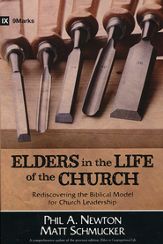
Book Review on Phil A. Newton’s “Elders in the Life of the Church”

Transitioning to A Biblical Model of Leadership

442728

Book Review By Dr. David P. Craig

It’s been my experience that most churches are way off base in their leadership structures. In light of what the New Testament says about leadership in the churches this is difficult to comprehend. Nevertheless Phil Newton has done a great service to the 21st Century church by providing an introductory guide to developing a biblical infrastructure for churches that take being biblically based and effective seriously.

Newton divides his helpful book into three sections:

Part One is composed of answering the question: Why Churches Should have Elders. In Part Two Newton exposits  three key texts on how Elders functioned in the New Testament: Acts 20:17-31; Hebrews 13:17-19; and 1 Peter 5:1-15. In giving a thorough exposition of each passage he demonstrates how Elders are models for their congregations; how Elders and the congregation work together in harmony; and how their primary calling is to be spiritual leaders for the good of the congregation and God’s greater glory.

In my opinion the most helpful section of the book is in part three. In this section Newton shows how a leadership team can transition into a fully functioning Elder Leadership in the Church with Deacons as well. All four examples are of large Baptist churches going from a Diaconate Board to two separate functioning boards of Elders and another of Deacons.

Giving a step-by-step process Newton shares from personal experience [South Woods Baptist Church] and from the experience of other well-known ministries (Mark Dever’s [Capital Hill Baptist Church in Washington D.C.], Jeff Noblit [First Baptist Church of Muscle Shoals, Alabama], and John Piper’s [Bethlehem Baptist Church in Minneapolis, MN.] transitions from Deacon Board structures to adding Elders into the mix). The process is slow, methodical, and takes into consideration traditions, a thorough study of biblical passages on leadership, and how the principles are studied and bandied about in teams. The process for the four cases studied is very helpful to keep in mind no matter what background your church has, and where it’s at in the transitional process.

I think this is an excellent book for leadership teams to study and for pastors, staffs, deacons, and elders to use in seeking to become as biblically effective as possible in seeking to develop a healthy infrastructure for the good of the Church and the glory of God. What I especially like about Newton’s book in particular is that he doesn’t impose any particular church government upon a church, but allows the Bible to speak for itself. He encourages a thorough study of the biblical evidence in arriving at one’s model of church government. I highly recommend this book as an extremely helpful guide in leading one toward a more biblical model of church government.

A Passion for Preaching: An Interview with Steven J. Lawson

Steve Lawson pointing

Tabeltalk (TT): How did you become a Christian, and how were you called to ministry?

Steven J. Lawson: I grew up in a Christian home and was brought to faith as a young boy through the consistent witness of my father and mother. Specifically, it was through the reading of the Bible by my father each night that the seed of the gospel was planted, which God caused to germinate in my heart. Regarding my call to the ministry, I actually began preaching and teaching while in college in various ministries and churches. Upon graduating, I sat under the strong preaching of Adrian Rogers at Bellevue Baptist Church in Memphis, Tenn., and strongly felt God summoning me into full-time ministry. His bold preaching electrified my heart and served as the catalyst that launched me to seminary, where I would be prepared for a lifetime of ministry.

TT: What are the biggest challenges you have faced during your ministry? How have you faced these challenges?

SL: In my earlier years, the greatest challenges I faced were preaching the doctrines of grace to congregations that were theologically untaught. To say the least, it was difficult and demanding to try to establish God-centered truth and a biblical philosophy of ministry where there had previously been a stronghold of man-centered thinking concerning the work of God in salvation. Though it was obviously a painful process, the only way to meet such an obstacle was head-on, unashamedly preaching the full counsel of God. This required much prayer, pastoral discretion, patience, and perseverance, which God honored. Over time, God established His truth in the minds and hearts of many, though it came at a high price personally.

TT: What advice would you give to a young man who aspires to be a pastor?

SL: First, any man aspiring to the pastorate needs to be sitting under strong expository preaching. He needs a role model who exemplifies what is in his heart to do. Second, he needs a personal ministry whereby he can use what he is learning, test his giftedness, and cultivate what has been entrusted to him. Third, he should surround himself with a small circle of spiritually mature men who can provide wise counsel in helping steer his life and ministry as important decisions arise. Fourth, he must begin to inquire of various seminaries regarding his future theological education. He needs to contact some institutions, visit their campuses, and talk to some of the faculty. Fifth, he needs to become an avid reader of important Christian books, including the spiritual biographies of noted men who have been mightily used by God.

TT: How does a pastor remain faithful to his calling over the long haul?

SL: In order to persevere in ministry, a pastor needs to be, first and foremost, deeply rooted and anchored in God’s Word. The more he studies, learns, teaches, and preaches God’s Word, the greater will be his staying power in ministry. Further, reading Christian biographies of men who have faced great adversity in their ministries provides greater drive and endurance. Reading the heroic accounts of martyrs and missionaries who have faced great persecution should be at the top of his reading list. Likewise, being surrounded by a small group of laymen who will encourage him in God’s work is a necessity. Pastors can be vulnerable to severe bouts of discouragement. Having the edifying feedback of trusted individuals helps him remain steadfast in doing God’s work.

TT: Who has most influenced your preaching?

SL: There have been multiple influences upon my preaching—Adrian Rogers,W.A. Criswell, James Montgomery Boice, R.C. Sproul, John MacArthur, and S. Lewis Johnson. Each of these men has contributed something vitally important to my preaching ministry. Over many decades, John MacArthur has most shaped my approach to biblical exposition. He has influenced me in preaching through entire books of the Bible sequentially. I have learned from him the need for sound exegesis, word studies, historical background, crossreferences, theological precision, sermon outline, and manuscript writing. Moreover, Dr. MacArthur has demonstrated the need for guarding the gospel and teaching sound doctrine.

TT: Why have you focused so much of your attention to the practice of expository preaching and to helping both preachers and laypeople see its importance?

SL: I strongly believe that no church can rise any higher than its pulpit. As the pulpit goes, so goes the church. The deeper the preacher takes his flock into the Word of God, the higher they will rise in worship. The stronger they are in the Scripture, the stronger they will be in the pursuit of holiness. Likewise, strong preaching leads to sacrificial service in the Lord’s work. Strong exposition kindles hearts for the work of evangelism and the cause of worldwide missions. Every great movement of God in church history has been ushered in by a renewed commitment to solid preaching of the Word. If we are to see a spiritual awakening in our day, the church must recover the primacy of preaching. I desire to be used by God to help equip a new generation of preachers and laypeople in recognizing the importance of this primary means of grace.

TT: Can you describe for us what your sermon preparation looks like?

SL: I begin each week by photocopying everything that I need to read in order to prepare my sermon. This includes study Bibles, commentaries, expository sermons, linguistic and historical tools, and the like. I first read the passage and discover its literary unit, determining what verse or verses I will preach. After writing a block diagram and reading the passage in the original language, I identify the central theme of these verses. I then read all of my photocopied information, thoroughly marking it up. I draft the beginnings of a working outline for the sermon. I will start writing the sermon—with a fountain pen, I might add—beginning with the first homiletical point. I then move systematically through the text, creating a manuscript that explains and applies each successive part of the passage. I will then add transitions, illustrations, and quotations as needed. The final step is to write the introduction and conclusion. I will compose this manuscript as though I can hear myself preaching it. At last, I will review my manuscript for length, balance, and quality, praying over its truths.

TT: What is the purpose of OnePassion Ministries and how does it seek to accomplish its goals?

SL: OnePassion Ministries was created to help bring about a new reformation in this day. It has a website in which most all of my preaching and writing resources are found (www.onepassionministries.org). We are hosting conferences both nationally and internationally in order to train preachers, teachers, prospective pastors, and interested laypeople in the art and science of expository preaching and teaching. I want to define what it is, what it is not, and show how to effectively carry out this divine calling. I desire to help take people to the next level in their skills of handling and ministering God’s Word. Also, I want to motivate those who attend our conferences to be fully committed to preaching the Word expositionally. Moreover, we want to host conferences for all people in order to introduce them to Christ and encourage them in their Christian walk. Finally, we will be hosting church history tours in which I will take people to important historical sites around the world.

TT: Why did you decide to establish the book series A Long Line of Godly Men, and what other men do you hope to profile individually in this series?

SL: The Long Line series was birthed in my teaching ministry at the church that I pastor. As I was teaching the men of my church sound doctrine from Scripture, I wanted them to see that what we believe in the doctrines of sovereign grace has been the mainline position by great men and movements down through the centuries. Out of this Friday morning teaching series has arisen these books so that these essential truths may be made available to a wider audience around the world. There is much instruction and inspiration to be drawn from this profile study. In the future, I need to write volume three of the larger books, which will move from John Knox to this present hour. In the smaller books, there are other key figures who I want to address such as William Tyndale, John Wycliffe, Robert Murray M’Cheyne, D. Martyn Lloyd-Jones, and, yes, R.C. Sproul.

Steven J. Lawson is founder and president of OnePassion Ministries, a ministry designed to bring about biblical reformation in the church today, and former senior pastor of Christ Fellowship Baptist Church in Mobile, Ala. He has served as a pastor in Arkansas and Alabama for twenty-five years and is author of many books, including The Evangelistic Zeal of George Whitefield and In It to Win It: Pursuing Victory in the One Race That Really Counts. He is a teaching fellow for and serves on the board of Ligonier Ministries and the Ligonier Academy of Biblical and Theological Studies, and is professor of preaching at The Master’s Seminary.

Source: www.ligonier.org (June 1, 2014)

Tim Keller Answers 10 Preaching Questions

Tim Keller Interview Conducted with Colin Adams

Tim Keller seated image

In great faith, I have written to a number of better-known preachers on both sides of the Atlantic. Each of them has been sent ten questions on the subject of preaching. The following is Tim Keller’s response. For those of you who don’t know, “Timothy J. Keller is an author, a speaker, and the founding pastor of Redeemer Presbyterian Church (PCA) in New York City, New York.”

1. Where do you place the importance of preaching in the grand scheme of church life?
It is central, but not alone at the center. Pastoral ministry is as important as preaching ministry, and lay “every-member” ministry is as crucial as ordained ministry. I wouldn’t make a hierarchy out of these things—they are interdependent. But pastoral ministry and lay ministry are not substitutes for strong preaching.

2. In a paragraph, how did you discover your gifts in preaching?
I preached about 200 different expositions a year for the first nine years of my ministry (when I was age 24 through 33). During that time I was considered interesting and good but I never got a lot of feedback that I was anything special. I’ve grown a lot through lots of practice.

3. How long (on average) does it take you to prepare a sermon?
I pastor a large church and have a large staff, and so I give special prominence to preparing the sermon. I give it 15–20 hours a week. I would not advise younger ministers to spend so much time, however. The main way to become a good preacher is to preach a lot, and to spend tons of time in people work—that is how you grow from becoming not just a Bible commentator but a flesh and blood preacher. When I was a pastor without a large staff, I put in six to eight hours on a sermon.

4. Is it important to you that a sermon contain one major theme or idea? If so, how do you crystallize it?
I don’t know that I’d be so rigid as to say there has to be just one Big Idea every time. That is a good discipline for preachers in general, because it helps with clarity. Most texts have too much in them for the preacher to cover in one address. You must be selective. But sometimes a preaching-size text simply has two or three major ideas that are too good to pass up.

5. What is the most important aspect of a preacher’s style and what should he avoid?
He should combine warmth and authority/force. That is hard to do, since temperamentally we incline one way or the other. (And many, many of us show neither warmth nor force in preaching.)

6. What notes, if any, do you use?
I use a very detailed outline, with many key phrases in each sub-point written out word for word.

7. What are the greatest perils that a preacher must avoid?
This seems to me too big a question to tackle here. Virtually everything a preacher ought to do has a corresponding peril-to-avoid. For examples, preaching should be Biblical, clear (for the mind), practical (for the will), vivid (for the heart,) warm, forceful, and Christo-centric. You should avoid the opposites of all these things.

8. How do you fight to balance preparation for preaching with other important responsibilities (e.g., pastoral care, leadership responsibilities)?
See my remarks on #3 above. It is a very great mistake to pit pastoral care and leadership against preaching preparation. It is only through doing people-work that you become the preacher you need to be—someone who knows sin, how the heart works, what people’s struggles are, and so on. Pastoral care and leadership are to some degree sermon prep. More accurately, it is preparing the preacher, not just the sermon. Prayer also prepares the preacher, not just the sermon.

9. What books on preaching, or exemplars of it, have you found most influential in your own preaching?
British preachers have had a much greater impact on me than American preachers (Dick Lucas, Alec Motyer and Martyn Lloyd-Jones). And the American preachers who have been most influential (e.g., Jonathan Edwards) were essentially British anyway.

10. What steps do you take to nurture or encourage developing or future preachers?
I haven’t done much on that front at all, and I’m not happy about that. Currently I meet with two other younger preachers on my staff who also preach regularly. We talk specifically about their preaching and sermon prep.

pastedGraphic.png

Colin Adams is the pastor of Ballymoney Baptist Church, Northern Ireland. For six years he had the privilege of serving as an Associate Pastor with Charlotte Baptist Chapel in Edinburgh. Before coming to Edinburgh he studied theology for four years at International Christian College in Glasgow.

More from Colin Adams or visit Colin at unashamedworkman.wordpress.com/

Source: http://www.churchleaders.com

Glorifying God in Conflict: The Four G’s Of Conflict

The Four G’s Of Conflict

64856_w185
By Ken Sande

Conflict is not necessarily bad or destructive. Even when conflict is caused by sin and causes a great deal of stress, God can use it for good (see Rom. 8:28-29). As the Apostle Paul wrote in 1 Corinthians 10:31-11:1, conflict actually provides three significant opportunities. By God’s grace, you can use conflict to:

  • Glorify God (by trusting, obeying, and imitating him)

  • Serve other people (by helping to bear their burdens or by confronting them in love)

  • Grow to be like Christ (by confessing sin and turning from attitudes that promote conflict).

These concepts are totally overlooked in most conflicts because people naturally focus on escaping from the situation or overcoming their opponent. Therefore, it is wise to periodically step back from a conflict and ask yourself whether you are doing all that you can to take advantage of these special opportunities.

1st G: Glorify God

As mentioned above, you can glorify God in the midst of conflict by trusting him, obeying him, and imitating him (see Prov. 3:4-6; John 14:15; Eph. 5:1). One of the best ways to keep these concerns uppermost in your mind is to regularly ask yourself this focusing question: “How can I please and honor the Lord in this situation?”When the Apostle Paul urged the Corinthians to live “to the glory of God,” he was not talking about one hour on Sunday morning. He wanted them to show God honor and bring him praise in day-to-day life, especially by the way that they resolved personal conflicts (see 1 Cor. 10:31).

2nd G: Get the log out of your own eye

One of the most challenging principles of peacemaking is set forth in Matthew 7:5, where Jesus says, “You hypocrite, first take the plank out of your own eye, and then you will see clearly to remove the speck from your brother’s eye.”

There are generally two kinds of “logs” you need to look for when dealing with conflict. First, you need to ask whether you have had a critical, negative, or overly sensitive attitude that has led to unnecessary conflict. One of the best ways to do this is to spend some time meditating on Philippians 4:2-9, which describes the kind of attitude Christians should have even when they are involved in a conflict.

The second kind of log you must deal with is actual sinful words and actions. Because you are often blind to your own sins, you may need an honest friend or advisor who will help you to take an objective look at yourself and face up to your contribution to a conflict.

 When you identify ways that you have wronged another person, it is important to admit your wrongs honestly and thoroughly. One way to do this is to use the Seven A’s of Confession.

The most important aspect of getting the log out of your own eye is to go beyond the confession of wrong behavior and face up to the root cause of that behavior. The Bible teaches that conflict comes from the desires that battle in your heart (James 4:1-3; Matt. 15:18-19). Some of these desires are obviously sinful, such as wanting to conceal the truth, bend others to your will, or have revenge. In many situations, however, conflict is fueled by good desires that you have elevated to sinful demands, such as a craving to be understood, loved, respected, or vindicated.

Any time you become excessively preoccupied with something, even a good thing, and seek to find happiness, security or fulfillment in it rather than in God, you are guilty of idolatry. Idolatry inevitably leads to conflict with God (“You shall have no other gods before me”). It also causes conflict with other people. As James writes, when we want something but don’t get it, we kill and covet, quarrel and fight (James 4:1-4).

There are three basic steps you can take to overcome the idolatry that fuels conflict. First, you should ask God to help you see where your have been guilty of wrong worship, that is, where you are focusing your love, attention, and energy on something other than God. Second, you should specifically identify and renounce each of the desires contributing to the conflict. Third, you should deliberately pursue right worship, that is, to fix your heart and mind on God and to seek joy, fulfillment, and satisfaction in him alone.

As God guides and empowers these efforts, you can find freedom from the idols that fuel conflict and be motivated to make choices that will please and honor Christ. This change in heart will usually speed a resolution to a present problem, and at the same time improve your ability to avoid similar conflicts in the future.

3rd G: Gently Restore

Another key principle of peacemaking involves an effort to help others understand how they have contributed to a conflict. When Christians think about talking to someone else about a conflict, one of the first verses that comes to mind is Matthew 18:15: “If your brother sins against you, go and show him his fault, just between the two of you.” If this verse is read in isolation, it seems to teach that we must always use direct confrontation to force others to admit they have sinned. If the verse is read in context, however, we see that Jesus had something much more flexible and beneficial in mind than simply standing toe to toe with others and describing their sins.

Just before this passage, we find Jesus’ wonderful metaphor of a loving shepherd who goes to look for a wandering sheep and then rejoices when it is found (Matt. 18:12–14). Thus, Matthew 18:15 is introduced with a theme of restoration, not condemnation. Jesus repeats this theme just after telling us to “go and show him his fault” by adding, “If he listens to you, you have won your brother over.” And then he hits the restoration theme a third time in verses 21–35, where he uses the parable of the unmerciful servant to remind us to be as merciful and forgiving to others as God is to us (Matt. 18:21–35).

Jesus is clearly calling for something much more loving and redemptive than simply confronting others with a list of their wrongs. Similarly, Galatians 6:1 gives us solid counsel on our what our attitude and purpose ought to be when we go to our brother. “Brothers, if someone is caught in a sin, you who are spiritual should restore him gently.” Our attitude should be one of gentleness rather than anger, and our purpose should be to restore rather than condemn.

Yet even before you go to talk with someone, remember that it is appropriate to overlook minor offenses (see Prov. 19:11). As a general rule, an offense should be overlooked if you can answer “no” to all of the following questions:

  • Is the offense seriously dishonoring God?
  • Has it permanently damaged a relationship?
  • Is it seriously hurting other people? and
  • Is it seriously hurting the offender himself?

If you answer “yes” to any of these questions, an offense is too serious to overlook, in which case God commands you to go and talk with the offender privately and lovingly about the situation. As you do so, remember to:

  • Pray for humility and wisdom
  • Plan your words carefully (think of how you would want to be confronted)
  • Anticipate likely reactions and plan appropriate responses (rehearsals can be very helpful)
  • Choose the right time and place (talk in person whenever possible)
  • Assume the best about the other person until you have facts to prove otherwise (Prov. 11:27)
  • Listen carefully (Prov. 18:13)
  • Speak only to build others up (Eph. 4:29)
  • Ask for feedback from the other person
  • Recognize your limits (only God can change people; see Rom. 12:18; 2 Tim. 2:24-26)

If an initial conversation does not resolve a conflict, do not give up. Review what was said and done, and look for ways to make a better approach during a follow up conversation. It may also be wise to ask a spiritually mature friend for advice on how to approach the other person more effectively. Then try again with even stronger prayer support.

If repeated, careful attempts at a private discussion are not fruitful, and if the matter is still too serious to overlook, you should ask one or two other people to meet with you and your opponent and help you to resolve your differences through mediation, arbitration, or accountability (see Matt. 18:16-20; 1 Cor. 6:1-8; for more guidance on getting such help, click Get Help With Conflict.)

4th G: Go and be reconciled

One of the most unique features of biblical peacemaking is the pursuit of genuine forgiveness and reconciliation. Even though Christians have experienced the greatest forgiveness in the world, we often fail to show that forgiveness to others. To cover up our disobedience we often use the shallow statement, “I forgive her—I just don’t want to have anything to do with her again.” Just think, however, how you would feel if God said to you, “I forgive you; I just don’t want to have anything to do with you again”?

Praise God that he never says this! Instead, he forgives you totally and opens the way for genuine reconciliation. He calls you to forgive others in exactly the same way: “Bear with each other and forgive whatever grievances you may have against one another. Forgive as the Lord forgave you” (Col. 3:12-14; see also 1 Cor. 13:5; Psalm 103:12; Isa. 43:25). One way to imitate God’s forgiveness is to make the Four Promises of Forgiveness when you forgive someone.

Remember that forgiveness is a spiritual process that you cannot fully accomplish on your own. Therefore, as you seek to forgive others, continually ask God for grace to enable you to imitate his wonderful forgiveness toward you.

Other Considerations

Be Prepared for Unreasonable People

Whenever you are responding to conflict, you need to realize that other people may harden their hearts and refuse to be reconciled to you. There are two ways you can prepare for this possibility.

First, remember that God does not measure success in terms of results but in terms of faithful obedience. He knows that you cannot force other people to act in a certain way. Therefore he will not hold you responsible for their actions or for the ultimate outcome of a conflict.

All God expects of you is to obey his revealed will as faithfully as possible (see Rom. 12:18). If you do that, no matter how the conflict turns out, you can walk away with a clear conscience before God, knowing that his appraisal is, “Well done, good and faithful servant.”

Second, resolve that you will not give up on finding a biblical solution. If a dispute is not easily resolved, you may be tempted to say, “Well, I tried all the biblical principles I know, and they just didn’t work. It looks like I’ll have to handle this another way (meaning, ‘the world’s way’).”

A Christian should never close the Bible. When you try to resolve a conflict but do not see the results you desire, you should seek God even more earnestly through prayer, the study of his Word, and the counsel of his church. As you do so, it is essential to keep your focus on Christ and all that he has already done for you (see Col. 3:1-4). It is also helpful to follow five principles for overcoming evil, which are described in Romans 12:14-21:

  • Control your tongue (“Bless those who curse you;” see also Eph. 4:29)
  • Seek godly advisors (identify with others and do not become isolated)
  • Keep doing what is right (see 1 Pet. 2;12, 15; 3:15b-16)
  • Recognize your limits (instead of retaliating, stay within proper biblical channels)
  • Use the ultimate weapon: deliberate, focused love (see also John 3:16; Luke 6:27-31)

At the very least, these steps will protect you from being consumed by the acid of your own bitterness and resentment if others continue to oppose you. And in some cases, God may eventually use such actions to bring another person to repentance (see 1 Sam. 24:1-22).

Even if other people persist in doing wrong, you can continue to trust that God is in control and will deal with them in his time (see Psalms 10 and 37). This kind of patience in the face of suffering is commended by God (see 1 Pet. 2:19) and ultimately results in our good and his glory.

Get Help from Above

None of us can make complete and lasting peace with others in our own strength. We must have help from God. But before we can receive that help, we need to be at peace with God himself.

Peace with God does not come automatically, because all of us have sinned and alienated ourselves from him (see Isa. 59:1–2). Instead of living the perfect lives needed to enjoy fellowship with him, each of us has a record stained with sin (see Matt. 5:48; Rom. 3:23). As a result, we deserve to be eternally separated from God (Rom. 6:23a). That is the bad news.

The good news is that “God so loved the world that he gave his one and only Son, that whoever believes in him shall not perish but have eternal life” (John 3:16). Believing in Jesus means more than being baptized, going to church, or trying to be a good person. None of these activities can erase the sins you have already committed and will continue to commit throughout your life. Believing in Jesus means, first of all, admitting that you are a sinner and acknowledging that there is no way you can earn God’s approval by your own works (Rom. 3:20; Eph. 2:8–9).

Second, it means believing that Jesus paid the full penalty for your sins when he died on the cross (Isa. 53:1–12; 1 Peter 2:24–25). In other words, believing in Jesus means trusting that he exchanged records with you at Calvary—that is, he took your sinful record on himself and paid for it in full, giving you his perfect record.

When you believe in Jesus and receive his perfect record of righteousness, you can really have true peace with God. As you receive this peace, God will give you an increasing ability to make peace with others by following the peacemaking principles he gives us in Scripture, many of which are described above (see Phil. 4:7; Matt. 5:9).

If you have never confessed your sin to God and believed in Jesus Christ as your Savior, Lord, and King, you can do so right now by sincerely praying this prayer:

Lord Jesus,

I know that I am a sinner, and I realize that my good deeds could never make up for my wrongs. I need your forgiveness. I believe that you died for my sins, and I want to turn away from them. I trust you now to be my Savior, and I will follow you as my Lord and King, in the fellowship of your church.

If you have prayed this prayer, it is essential that you find fellowship with other Christians in a church where the Bible is faithfully taught and applied. This fellowship will help you to learn more about God, grow in your faith, and obey what he commands, even when you are involved in a difficult conflict.

Get Help from the Church

As God helps you to practice his peacemaking principles, you will be able to resolve most of the normal conflicts of daily life on your own. Sometimes, however, you will encounter situations that you do not know how to handle. In such situations, it is appropriate to turn to a spiritually mature person within the church who can give you advice on how you might be able to apply these principles more effectively.

In most cases, such “coaching” will enable you to go back to the other person in the conflict and work out your differences in private. If the person from whom you seek advice does not have much experience in conflict resolution, it may be helpful to give him or her a copy of Guiding People through Conflict, which provides practical, nuts-and-bolts guidance on how to help other people resolve conflict.

When individual advice does not enable you to resolve a dispute, you should ask one or two mutually respected friends to meet with you and your opponent to help you settle your difference through mediation or arbitration (see Matt. 18:16-17; 1 Cor. 6:1-8). For more information on how to get guidance and assistance in resolving a dispute, click Get Help With Conflict.

Adapted from The Peacemaker: A Biblical Guide to Resolving Personal Conflict. © 1997, 2003 by Ken Sande. All Rights Reserved.

Source http://www.peacemaker.net- See more at: http://www.peacemaker.net/site/c.aqKFLTOBIpH/b.958149/k.303A/The_Four_Gs.htm#sthash.JWNdgZLx.dpuf

What is Biblical Preaching?

BIBLICAL PREACHING

Preaching open Bible image

By Phil A. Newton

George Barna, the guru of statistics among evangelicals, seems to be influencing today’s pulpit more than the apostles Peter and Paul. Barna, whose popularity began with his book Marketing the Church, has assumed the position of telling preachers how they are to preach in order to “reach” certain segments of society. His basic thesis of “marketing the church” continues in his profusion of books. While no one can doubt the importance of Barna’s statistical data to the strategies of evangelicals, it seems that he continues to cross the line of offering data to pontificating changes that ignore God’s Word.

In a recent article in Preaching titled “The Pulpit-meis-ter: Preaching to the New Majority,” Barna departs from his role as a sociologist and assumes the role of professor of preaching. He does state that “the core of our message must never be compromised,” but the paradigm he proposes can lead only to compromise. He suggests that “the new majority,” the group of so-called Boomers and Busters (those born from 1946 to 1964 and 1965 to 1983, respectively), have certain characteristics which prevent them from being attentive to typical, traditional preaching (George Barna, “The Pulpit-meister: Preaching to the New Majority,” Preaching [January/February], 11).

I recognize that preachers must develop their individ- ual styles and that preaching in certain parts of the world may vary due to particular cultural influences. But when the preacher must change his use of language to purge it of any hint of the theological or judgmental, he finds himself positioned to be more of an inspirational speaker than a preacher of God’s Word. When he must keep his sermons under twenty minutes, filling them with stories, avoiding “moral absolutes,” and going light on scriptural references, he has no hope to teach and explain the doctrines of the Word. Barna goes so far as to state, “Increasingly we find that the entire approach of ‘talking at the audience’ is an ill fated form of communication.” He suggests that preaching in any kind of series will not work since the audience may change from week to week (The Pulpit-meister, 11-13).

The question Barna’s article raises for me is this, What are we trying to do in preaching? Are we trying to placate the self-centeredness of man? Or proclaim, “Thus saith the Lord”? Preachers must reckon with the biblical basis of preaching rather than the sociological observations of barn. Barna is fallible. God’s Word is not.

In His classic work Preaching and Preachers, Martyn Lloyd-Jones wrote, “The most urgent need in the Christian Church today is true preaching; and as it is the greatest and most urgent need in the Church, it is obviously the greatest need in the world also.” (Martyn Lloyd-Jones, Preaching and Preachers [Grand Rapids, Michigan: Zondervan, 1971], 9). Assuredly, Lloyd-Jones did not have drama, entertainment, or pulpit chats in mind when he pressed the need for “true preaching.” In his mind, true preaching was nothing less than the exposition of God’s Word in the power of the Holy Spirit. “What is preaching?” Lloyd-Jones queried:

Logic on fire! Eloquent reason! Are these contradictions? Of course not. Reason concerning this Truth ought to be mightily eloquent, as you see in the case of the Apostle Paul and others. It is theology on fire. And a theology which does not take fire, I maintain, is a defective theology; or at least the man’s understanding of it is defective. Preaching is theology coming through a man who is on fire (Preaching and Preachers, 97).

The issue in preaching is proclaiming faithfully, accurately, and clearly the Word of God, so that the truth of the Word penetrates the mind to affect the heart, rather than the cleverness of the preacher impressing the hearers. At the core of all a preacher does is to dig deeply into a given text of Scripture, seeking to understand it grammatically, historically, and doctrinally. He must then apply himself, in the power of the Spirit, to let the text speak through him. J.I. Packer explained what true preaching is when he wrote:

The true idea of preaching is that the preacher should become a mouthpiece for his text, opening it up and applying as a word from God to his hearers, talking only in order that the text may speak itself and be heard, making each point from his text in such a manner “that the hearers may discern how God teacheth if from thence (J.I. Packer, God Has Spoken [Grand Rapids, Michagan: Baker, 1979], 28; Packer quote from Westminster Directory, 1645).

With much grief, I listened recently to a man who filled the pulpit with jokes, clever stories, and talk-show one-liners. But he never proclaimed God’s Word. He read a text and even referred to it, albeit eisegetically. Yet the truths of the Word were never expounded for the congregation to be confronted with the living God and his truth. That is entertainment. it is not preaching in a biblical sense. I fear that such pulpit-abuse (or perhaps I should say, congregation abuse) is all too common.

We must consider what we are attempting to do in the pulpit. It seems that some preachers have a goal to be enjoyed by the hearers rather than to help the hearers understand God’s Word, and, consequently, come to know God in truth. Surely the shallowness in the pew is primarily due to the neglect in the pulpit. I agree with James Montgomery Boice: “The church has to rediscover who God is, come to know him, and fellowship with him. The avenue for that has always been Bible exposition and teaching. There’s no shortcut.”(Quoted by Donald S. Whitney, Spiritual Disciplines Within the Church [Chicago: Moody, 1996], 59). Yet the popular methods of the day fall short of “Bible exposition and teaching.”

What does the Bible have to say about all this? There’s no more forceful nor clear passage addressing the subject of preaching than that which Paul wrote to Timothy in his last epistle:

I solemnly charge you in the presence of God and of Christ Jesus, who is to judge the living and the dead, and by his appearing and kingdom; preach the word; be ready in season and out of season; reprove, rebuke, exhort with great patience and instruction. For the time will come when they will not endure sound doctrine; but wanting to have their ears tickled, they will accumulate for themselves teachers in accordance to their own desires; and will turn their ears from the truth, and will turn aside to myths. But you, be sober in all things, endure hardship, do the work of an evangelist, fulfill your ministry  (2 Timothy 4:1-5 [Scripture references are from the New American Standard Bible]).

Whatever the preacher is to be doing in the pulpit, at the very minimum he ought to be dictated by the teaching of God’s Word. Anything less than this is a compromise of his ministry and calling. The example and exhortation of the Bible points back to the priority of preaching. Don Whitney expresses it well:

Regardless of how inefficient some may think preaching is in our technological, mass media society, regardless of how much more exciting or entertaining or even successful other methods may appear, the most effective way of communicating the gospel of Jesus Christ is still through the means God was pleased to choose—preaching (Spiritual Disciplines, 64).

With these things in mind, I offer some of the chief issues raised by the apostle Paul in his exhortation to Timothy.

BIBLICAL PREACHING IS A SOLEMN RESPONSIBILITY

The apostle Paul was nearing the end of his life as he penned these words to Timothy. We can call them “Final Instructions,” for the apostle knew the pressures of the ministry which his young disciple faced. He understood that nothing short of biblical preaching in the power of the Holy Spirit will have the needed effect upon his congregation. So we see him reminding Timothy of the gravity facing him in the discharge of his responsibilities. For Paul, being a preacher was not a matter of fun or popularity. It was a divine calling that must be fulfilled in a God-ordained fashion.

We see that biblical preaching is a solemn responsibility…

Because of the Audience. I solemnly charge you in the presence of God and of Christ Jesus,” he begins. Paul wanted Timothy to understand that while he had a congregation who listened to his preaching, they were not his chief audience. Instead, God and Christ Jesus were.

This is a shocking thought to consider: The God of heaven listens in on the preaching of the pastor! There is no more important thing for me to remember when standing at the pulpit than the fact that the ears of heaven are attuned to every word I speak. The Greek of the prepositional phrase, “in the presence of,” literally means “in the face of” (Gk. enopion). The solemn charge to preach and the discharging of the duty is given “in the face of” God and the Redeemer.

When I first spoke this truth to my own congregation there were a few people who were repulsed at the thought. They argued against such a proposition that God himself is the primary audience in preaching, while the congregation is secondary. Yet this is exactly what Paul spoke to the church at Corinth: “Have you been thinking all along that we have been defending ourselves before you? We are speaking in Christ before God. Everything we do beloved, is for the sake of building you up (2 Corinthians 12:19). The solemnity of preaching demands that the preacher realize that he is speaking “in the sight of God,” yet for the “upbuilding” of the congregation.

Because of the Accountability. The reminder that the Lord Jesus Christ is “to judge the living and the dead” should stem the endless jokes and cute stories that pollute the pulpit as a substitute for preaching. Those seated before the preacher will one day face a Judge who executes his judgement in righteousness. In light of this, can the preacher be trivial in the pulpit? If he truly loves those under his charge, can he neglect to expound the Word of God which addresses the “real need” of sinners rather than offering up sermonic ditties for the “felt needs” of his hearers?

Because of the Appearing. The imminence and gravity of Christ’s return is held before Timothy as he is charged with preaching the Word of God. The preacher of the Word must keep in mind that we do not await clever timetables for Christ to return. He can end this life in a moment. The preacher must so live and so preach as if today is the day of Christ’s appearing. The urgency of the messenger delivering the right message to his hearers is pressed upon us by this charge.

Because of the Authority. The mention of Christ’s kingdom reminds Timothy of the sovereign rule of Jesus Christ over him and the affairs of his King. His duty is to his King. His energies are to be expended for his King. When he stands before a people to deliver the Word of God, he must keep in mind that he stands as a representative of his King. And he is confronting his hearers with the lordship of Christ over their lives as well. His message must not be muddled by a blend of self-help and psychobable. As Paul expressed it: “For we do not proclaim ourselves; we proclaim Jesus Christ as Lord and ourselves as your slaves for Jesus’ sake” (2 Corinthians 4:5).

BIBLICAL PREACHING IS A SPECIFIC RESPONSIBILITY

The three key words of our text, “Preach the word,” drive home to us the specific nature of the preaching task. The preacher must expound the Word of God or else he has failed in his calling. He may be a wonderful administrator, a winsome personal worker, an effective leader. But if he fails to expound the Word of God, he is a failure to his calling to “preach the Word.”

Before considering the specific elements involved in biblical preaching, I offer some observations on the trends that seem to be affecting the hearing of the Word in our congregations. These trends have an impact upon preaching and hearing.

Observations

First, there has been a popularizing and Americanizing of the Word to make it more palatable and acceptable to the masses. Rather than seeking to understand a text as God gave it, the preacher seems to be more intent on appealing to people. Often the goal is to increase church membership. But if that membership is gained at the expense of a genuine work of God through biblical preaching, can it really be worthwhile?

Neither Jesus nor the apostles sought to make the truth of God more palatable to their hearers. They laid the truth out with force and clarity. Paul assessed that his preaching of the cross was “a stumbling block to Jews and foolishness to the Gentiles, but to those who are called, both Jews and Greeks, Christ the power of God and the wisdom of God.” (1 Corinthians 1:23-24). They preached the truth and depended upon the power of God to drive it home to the hearers’ minds and hearts.

Perhaps one of the problems that has necessitated a watering down of truth in the pulpit is a shallow theology of the Holy Spirit. Rather than believing the Spirit of God can penetrate calloused minds with the Word of God, preachers have sought to use clever devices and techniques to persuade hearers. A failure to understand the biblical doctrine of regeneration has led to untold harm in the name of evangelism, all because preachers do not trust the Holy Spirit to do his work.

When we try to use the latest methods of communication we may have a ready audience, but they pay more attention to our cleverness than to the cross. They are impressed with the speaker, not the Savior (1 Corinthians 1:17). While a seminary student, I had two different professors for preaching. One taught biblical exposition. The other encouraged preachers to offer fifteen-to-twenty-minute dramatic presentations to their congregations. One method communicates divine truth. The other draws attention to the preacher.

Second, the attention given to the “electronic preacher” has shortened the attention spans and changed the appetites of congregations. I am thankful for the many wonderful media broadcasts that faithfully proclaim the Word of God. But I am appalled at the equally large number which claim everything but biblical truth. Some media preachers water down truth in order to be popular and secure good ratings. They know what sells. Marketing has driven them to change their content to appeal to the masses in order to gain a larger following.

Another effect of media preachers is that even those who faithfully preach the Word have their messages edited to fit a twenty-five-minute broadcast format. certainly this is understandable with the cost of airtime. But when you add to this the lack of hunger for the purity of the Word and the typical church member’s shortened attention span, you find complaints about Sunday sermons that last longer than thirty minutes.

I have been preaching since 1970. Since I started preaching exposition ally, about 1974, I have found that I will normally spend forty to forty-five minutes for each sermon. I’ve tried to shorten my outlines and change my notes, but nothing seems to have a real effect on my sermon length. And rightly so! The goal should never be just to get through. It should be to expound the text of God’s Word.

A few years ago I found myself facing some disgruntled people who wanted shorter sermons. They really did not care what I preached as long as it was shorter! But I took time to explain, that in my understanding, I could not adequately deal with a text of Scripture in less than forty to forty-five minutes. I found a kindred mind in this with John MacArthur. He wrote:

If you are going to be a Bible expositor, forget the twenty and thirty-minute sermons. You are looking at forty or fifty minutes. In any less than that, you can’t exposit the Scripture. The purpose is not to get it over, but rather to explain the Word of God. My goal is not accomplished because I am brief. My goal is accomplished when I am clear and I have exposited the Word of God (John MacArthur, Jr., Rediscovering Expository Preaching [Dallas, Texas: Word, 1992], 339-40).

Third, proclamation has been replaced by a “talk-show-host” mentality. Because of a fear of offending or due to an audience’s appetite, the “herald” no longer is concerned with speaking “thus saith the Lord,” but “Whatever you want, I’ve got” and “Listen to me and feel good.”

Don Whitney offers a personal vignette that illustrates this problem:

Your soul will only be fed from the Word of God. Without it, you will be undernourished and suffer spiritual marasmus. That’s what happened to a man I’ll call whom I spoke with not long ago. When I talked with Chris he had been in seminary for a few months and was working for a para-church ministry that specializes in teaching the Bible and theology. Prior to enrolling in seminary, he had for several years been associate pastor in charge of drama and music at a church a couple of miles from me where the pulpit ministry was based on topical preaching aimed at people’s felt needs. The church had grown from very few to hundreds in a short time. 

Chris had plenty of budget money and many talented actors, singers, musicians, and other workers as resources for his ministry. Afterward, however, he said to me, “I didn’t know it when I resigned, but the following Sunday I realized that my soul was as dry and withered and empty as it could be. I had been running on the spiritual fumes of the pressure of preparation for each Sunday’s drama and music. I was so busy that I hadn’t realized I had dried up spiritually. It was because I was not hearing faithful, biblical exposition, but topical sermons aimed at felt needs. Everything was based upon marketing strategy. Only when I got away from all that did I realize that I was all be dead spiritually.” (Spiritual Disciplines, 66-67).

I visited a church in Atlanta during a vacation and listened to a sermon that was really more of a “talk.” It could easily have been given at a Kiwanis Club. My children quickly recognized that we had not heard the Word preached, but only a preacher trying to impress his hearers.

My family and I took a relative with us to another church in a southern metropolitan area. The church has a great reputation and has recently constructed a large facility to accommodate its rapid growth. When the service was over I asked the relative, who rarely attends church, what she thought. Without any kind of prompting from me, she said, “I got the feeling that they were trying to entertain me.” I thought that such a comment spoke volumes, especially coming from one is unfamiliar with “felt-needs” or mega-church thinking. The evangelical pulpit has shrunk into the mire of entertainment, thinking that it has to compete on the same level as the world, while hungry hearts are waiting to hear a word from God.

Fourth, we’ve lost our appetite fro truth, and instead would rather appeal to people’s interests or felt needs in our preaching. Rather than longing for truth to set us free or truth to reprove, rebuke, and exhort, or truth to expose the thoughts and intents of the heart, we want something to make us feel better about ourselves. We want something that does not make radical demands or us, something that does not disturb the way we’re living our lives, something that won’t challenge what we want to think or believe the truth to be. This is precisely what the apostle warned:

For the time will come when they will not endure sound doctrine; but wanting to have their ears tickled, they will accumulate for themselves teachers in accordance to their own desires; and will turn away their ears from the truth, and will turn aside to myths (2 Timothy 4:3-4).

On one occasion a man came up to me after a service and stated, “I’ve had everything figured out in a neat box, and your preaching challenges it. I don’t like it, but I need it.” The unfortunate thing is that his box kept getting challenged and he ran away from what he admitted that he needed. Biblical preaching will apply the truth of God’s Word so that it judges “the thoughts and intentions of the heart” (Hebrews 4:12). Unless the Spirit of God is working in a person he will have difficulty sitting under a steady diet of biblical exposition (Cf. 1 Corinthians 2:6-16 for the biblical basis of this statement).

Too many fail to have interest in the content of sermons. They want only an appealing delivery so they can feel good about themselves. In contrast to this, Don Whitney has written, “And no matter how enthusiastic or passionate the presentation, it is still the content, not the physical force of delivery that determines faithfulness to the message” (Spiritual Disciplines, 65).

John Piper, who is known for books with superb content, wrote in the introduction of his book, Future Grace, one of the best statements on the need for content rather than mere appeal to itching ears. His statement concerns reading, but it is equally true of preaching:

Every book worth reading beckons with the words, “Think over what I say.” I do not believe that what I have written is hard to understand—if a person is willing to think it over. When my sons complain that a good book is hard to read, I say, “Raking is easy, but all you get is leaves; digging is hard, but you might find diamonds.”

I have tried to write as I preach [and I believe he has succeeded] with a view to instructing the mind and moving the heart… [After giving the example of John Owen’s writings being difficult to grasp, yet for 300 years his twenty-three volumes are still in print and still feeding hungry souls] The lesson is that biblical substance feeds the church, not simplicity (John Piper, Future Grace [Sisters, Oregon: Multnomah, 1995], 16-17).

Fifth, we want the truth to be popular with everyone, enjoyed by sinner and saint alike. Yet this is foreign to both Old and New Testament teaching regarding the truth. Just look at the prophets, apostles, and teachers captured in God’s Word. Was Jeremiah’s preaching popular? Did Paul seek to “win friends and influence people” through his preaching? Did the multitudes persevere with our Lord in His declaration of truth? Paul expressed it well, “For the message about the cross is foolishness to those who are perishing, but to us who are being saved it is the power of God” (1 Corinthians 1:18).

Explanation:

Perhaps a bit of amplification on precisely what is involved in biblical exposition will be helpful. It begins with understanding the text which the preacher desires to expound. I believe that the best approach on selecting a text begins with preaching consecutively through books of the Bible. That way a preacher is forced to deal with the “whole counsel of God,” and his congregation will be exposed to the breadth of biblical truth. The preacher may also deal with topics or themes, but he should always be expository in his approach; that is, he should be a mouthpiece for the text (Rediscovering Expository Preaching, 255ff.)

The preacher must diligently study the text he selects in its contextual setting. This involves a thorough study of the language and grammar used, the historical purpose of the text, the cultural factors that bear weight upon its meaning, and its connection to the balance of Scripture. Reading and meditating upon the text allows the preacher to consider its implications and truths, as well as feeding his own mind and soul with its life-giving truth. Depending upon the illuminating power of the Spirit in the study is essential. He will find that prayer must accompany his study or else he will be engaging in mere academics. He must seek to rightly explain “the word of truth” (2 Timothy 2:15), so that he arrives at a proper interpretation. The use of research tools such as word studies, commentaries, theologies, and sermons can be helpful aids to the preacher in grasping the message of the text.

Once he understands the essential message of his text, the preacher will need to organize the message of the text into salient parts for proclamation. The starting point will be development of a theme, which has been called “the essence of the sermon in a sentence,” or “the proposition,” or “the dominating theme.”At this point I have found it helpful to develop an outline, complete with points and subpoints, all of which help to amplify the dominating theme of the text. This gives structure to the sermon so that the preacher is not guilty of offering an incoherent collection of random thoughts on a text. Some preachers have the mistaken notion that if they can have a nice outline, perhaps fully alliterated, then they have done an exposition until the doctrines and principles of the text are expounded (I have been greatly helped in biblical exposition by numerous books and preachers. My thoughts in this section will reflect their influence, though it would be difficult to footnote every detail. I mention a few: Drs. Stephen and David Olford maintain ongoing, short-term preaching institutes through Encounter Ministries Biblical Preaching Institute in Memphis, Tennessee, (800) 843-2241; they have coauthored a book on expository preaching, Anointed Expository Preaching [Nashville: Broadman & Holman Publishers, 1998]. John MacArthur’s book, Rediscovering Expository Preaching, is a superb course in sermon-building and the exercise of preaching. Bryan Chappell’s book, Christ-Centered Preaching [Grand Rapids, Michigan: Baker, 1994], offers a thorough self-study approach in preaching).

The preacher’s goal should never be to impress a congregation with his great outlines! He should seek to explain and apply the text to his congregation. He will need to develop supporting thoughts that assist him in the exposition. He should use Scripture that show the relation of the theme and integrating thoughts to the whole of God’s Word. He will need to illustrate certain truths to help with the understanding process, being careful not to allow the illustration to become the sermon (I disagree strongly with my former preaching professor who taught me biblical exposition. He has changed his thinking, even to the point of implying that “illustrations are no longer just the ‘window’ to the sermon, they are becoming the ‘truth’ of the sermon…’They are being used to tell the story…Sermon points are being related to the illustration’” [Facts & Trends, vol. 39, no. 8,4]. While illustrations can be used effectively, preachers will do well to spend more time studying the text instead of trying to find the latest, clever illustration). By all means he will give attention to explaining the doctrines found in the text (Martyn Lloyd-Jones stated in many sermons that unless a preacher deals with doctrines in a text he has not dealt with the text! It is interesting that many Puritans and writers of the seventeenth and eighteenth centuries typically highlighted the doctrines found in their expositions. The unfortunate lack of doctrinal preaching in our day has given rise to the weakened state of the Christian church throughout the world. We do well to heed the need to deal thoroughly with doctrine. I commend Lloyd-Jones’ Preaching and Preachers and John Piper’s The Supremacy of God in Preaching [Grand Rapids, Michigan: Baker, 1990], as two volumes to stimulate your thinking on doctrinal preaching).

The task of proclaiming the truths of the text will demand all of the spiritual, emotional, mental, and physical energies the preacher can give to this work. He must approach the proclamation of the Word prayerfully, pleading for the fulness of the Spirit to endue him with power, recognizing that apart from divine power he will flounder in the waters of his own weakness. Tony Sargent has rightly stated, “The most humbling and wonderful experience for any preacher as he enters the pulpit is to know that God is with him. The most frightening for him is to be in the pulpit and feel he is on his own” (Tony Sargent, The Sacred Anointing: The Preaching of Dr. Martyn Lloyd-Jones [Wheaton, Illinois: Crossway, 1994] 79.

Martyn Lloyd-Jones exhorts the preacher to seek the power of the Spirit for preaching God’s Word. “Seek this power, expect this power, yearn for this power; and when this power comes, yield to him. Do not resist. Forget all about your sermon if necessary. Let him loose you, let him manifest his power in you and through you” (The Sacred Anointing, 57).

The Greek word for “to preach” (kerussein) referred to the responsibility given to a herald. He may have been in the service of an ancient king, serving as a herald to deliver the king’s word to the people. His chief responsibility was to faithfully proclaim the words of the one who sent him. He heralded the king’s message with authority. To deny the herald’s message was to deny the king who sent him. It is with this background that we see Paul exhorting the preacher to “herald the word” faithfully and authoritatively as one sent by the King. He must do so with clarity and passion for the message he is delivering. He must not take liberties with the King’s message, but deliver it as the King intends. This is the preacher’s job in the act of proclamation (I again commend Lloyd-Jones’ Preaching and Preachers to address this subject. This book will help remind the preacher of the God-given privilege he has and how he is to carry out his role with holy passion).

BIBLICAL PREACHING IS A SERIOUS RESPONSIBILITY

The apostle gives imperative counsel for the one who preaches the Word. He is to be constant in duty, “be ready in season and out of season.” A preacher cannot let his guard down or neglect his spiritual life. He must live with a constant sense of readiness to deliver the message of God to waiting ears. Many preachers have negated their pulpit ministries by their personal lives. Their love of the world, materialism, flirtatious looks, neglected family life, and laziness have discredited the message they seek to preach. He must exercise discipline of mind and spirit to be constant in his work. Be ready in the pulpit and out of the pulpit!

The preacher must not fear being confrontational in his ministry. He will need to “reprove, rebuke, exhort” as he proclaims God’s Word and as he deals with individuals. An unbelieving woman who had come from a cult background visited our church. She approached me after a sermon on “The Bread of Life” from John 6, with some striking comments. She told me she did not understand why she kept coming back, but she felt compelled. Then she commented, “You don’t give any options.” By that she meant that the preaching has a solitary impact of demand, not a take-it-or-leave-it approach. It confronted her and gave only one option: God’s.

Confrontation is especially needed in a day when people are craving for pre-digested “applications” on the sermon that will make it “relevant” to every day life. What most people mean by “applications” is, “Give me some options so that I can pick and choose what I want to do and not feel bad about what I don’t want to do.” We need not worry about going to extremes on applications. The Holy Spirit is adequate to apply the Word to the hearts of sinners and saints alike!

The preacher has the task of delivering God’s Word “with great patience.” He is to be consistent with his exposition, faithfully delivering God’s Word week-by-week to his people. All will not appreciate the Word, nor will all respond immediately to the challenges applied by the Word proclaimed. Some may even get angry and leave. Yet the preacher is to be patient with his flock, realizing that their spiritual ears must be opened by the Holy Spirit. Some will be dealing with deep-seated sins. Others will feel mired in traditions. Still others will have a poor appetite for spiritual truth, the appetite that must be slowly cultivated. Short pastorates normally do not allow a preacher the time to develop a patient pulpit ministry.

A sermon worth listening to must have content. Content does not mean that the preacher has plenty of stories and interesting quotes. Rather, it means that the sermon deals with doctrine. The word for “instruction” in the NASB translation of 2 Timothy 4:2 is that common New Testament term didache. It is elsewhere translated as “teaching” or “doctrine.” Doctrine must never be confused with impossible-to-understand discussions by intellectuals. Good doctrine is the life of the church; it is the heart of the sermon. It is simply the “teachings” of God’s Word understood in relation to the balance of Scripture. John MacArthur wrote:

A true expository message sets forth the principles or doctrines supported in the passage. True expository preaching is doctrinal preaching (Rediscovering Expository Preaching, 288).

Charles Haddon Spurgeon, the great nineteenth-century Baptist preacher in London, wrote in his Lectures to My Students:

Sermons should have real teaching in them, and their doctrine should be solid, substantial, and abundant. We do not enter the pulpit to talk for talk’s sake; we have instructions to convey important to the last degree, and we cannot afford to utter pretty nothings. Our range of subjects is all but boundless, and we cannot, therefore, be excused if our discourses are threadbare and devoid of substance…[T]he true minister of Christ knows that the true value of a sermon must lie, not in its fashion and manner, but in the truth which it contains. Nothing can compensate for the absence of teaching; all rhetoric in the world is but as chaff to the wheat in contrast to the gospel of our salvation. However beautiful the sower’s basket it is a miserable mockery if it be without seed (Charles Haddon Spurgeon, Lectures to My Students [Pasadena, Texas: Pilgrim Publications, 1990, reprint of the 1881 Passmore and Alabastor edition), 72.

After giving such clear instruction on preaching Paul warns Timothy that everyone will not want such biblical exposition:

For the time will come when they will not endure sound doctrine; but wanting to have their ears tickled, they will accumulate for themselves in accordance to their own desires; and will turn away their ears from the truth, and will turn aside to myths (2 Timothy 4:3-4).

When this happens, does the preacher simply give people what they want? This is precisely the error of the current trend of “felt-need” preaching. The unfortunate thing is that many evangelical preachers of good standing have fallen into the trap of delivering cute sermons, warm fuzzes, feel-good messages rather than proclaiming truth. We must be conscientious of the calling of God to herald the truth, so that we do not get pulled into the vortex of congregations wanting to have their “felt-needs” met.

The preacher is not to take an opinion poll on what he should preach. While there are some exceptions, most congregations do not have enough spiritual understanding and discernment to know what they need. They will point to the direction of “felt-needs” every time, simply because they can be comfortable with that kind of preaching instead of having to deal with their own sin and the God-centeredness in true, doctrinal preaching. The problem of which Paul warns is that of falling prey to the “desire” (epithumia) of those who have no desire for enduring sound doctrine.

What is a preacher to do if the congregation cries for “felt-need” preaching? Stand firm. Remember your calling. Remember your Audience. Herald the truth. And seek to patiently instruct people in sound doctrine.

CONCLUSION

Biblical preaching is demanding work. The preacher will find himself expended int he study as he labors over the biblical texts and all the works which address them. He must recognize the adversary’s subtle temptations to neglect the study, water down the message, and appeal to the desires of unregenerate people. he faces a constant warfare, both in the pulpit and out of the pulpit. He will be stretched, challenged, criticized and attacked, while at the same time loved and appreciated by those who hunger for the truth. He must live in dependence upon the power of the Holy Spirit to enable him to “preach the word” and “to be ready in season and out of season.”

Ron Owens has written a song particularly for preachers. I believe its message and refrain are a fitting conclusion:

We’ve a gospel to preach, we’ve a message to share—

The eternal Truth is what we declare.

It’s the power to save, it’s the Spirit sword,

It’s the heart of God, it’s the Living Word.

We must study to learn and not be ashamed

To proclaim God’s truth in the Savior’s name.

With no compromise, but consistently

We must PREACH THE WORD with integrity.

What is made by man will one day be gone,

But God’s Holy Word marches on and on.

Though the flower will fade and grass will die,

The Eternal Word ever will abide.

We must pay the price, we must take our stand

With a heart on fire and God’s Word in hand.

On the brightest day, in the darkest  hour

We must PREACH THE TRUTH in the Spirit’s power.

PREACH THE WORD! PREACH THE WORD!

Won’t you purpose in your hearts to preach the Word?

PREACH THE WORD! PREACH THE WORD!

Won’t you purpose in your heart to PREACH THE WORD?

It’s our call as His disciples to pass on what we’ve received.

Make up your mind and take the time to PREACH THE WORD!

Author: Dr. Phil A. Newton is the Senior Pastor, South Woods Baptist Church, Memphis, Tennessee. He is the author of Elders in the Life of the Church: Rediscovering the Biblical Model for Church Leadership; Elders in Congregational Life: Rediscovering the Biblical Model for Church Lunch; The Way of Faith; and Conduct Gospel-Centered Funerals: Applying the Gospel at the Unique Challenges of Death.

Source: Adapted from Reformation & Revival: A Quarterly Journal for Church Leadership, Volume 9, Number 1, Winter 2000.