Dr. D.A. Carson on How To Do Evangelism in a Post Modern Culture

*Athens Revisited (An Exegetical Study of Acts 17) by D.A. Carson

I would like to think that most of us have become convinced of the primacy of what might generically be called worldview evangelism. In the recent past, at least in North America and Europe, evangelism consisted of a fairly aggressive presentation of one small part of the Bible’s story line. Most non-Christians to whom we presented the gospel shared enough common language and outlook with us that we did not find it necessary to unpack the entire plot line of the Bible.

A mere quarter of a century ago, if we were dealing with an atheist, he or she was not a generic atheist but a Christian atheist-that is, the God he or she did not believe in was more or less a god of discernibly Judeo-Christian provenance. The atheist was not particularly denying the existence of Hindu gods — Krishna, perhaps — but the God of the Bible. But that meant that the categories were still ours. The domain of discourse was ours.

When I was a child, if I had said, “Veiled in flesh the Godhead see,” 80 percent of the kids in my school could have responded, “Hail the incarnate deity.” That was because Christmas carols like “Hark, the Herald Angels Sing” were sung in home, church, school, and street. These kids may not have understood all-the words, but this domain of Christian discourse was still theirs. Young people at university doubtless imbibed massive doses of naturalism, but in most English departments it was still assumed you could not plumb the vast heritage of English poetry if you possessed no knowledge of the language, metaphors, themes, and categories of the Bible.

In those days, then, evangelism presupposed that most unbelievers, whether they were atheists or agnostics or deists or theists, nevertheless knew that the Bible begins with God, that this God is both personal and transcendent, that he made the universe and made it good, and that the Fall introduced sin and attracted the curse. Virtually everyone knew that the Bible has two Testaments. History moves in a straight line. There is a difference between good and evil, right and wrong, truth and error, fact and fiction. They knew that Christians believe there is a heaven to be gained and a hell to be feared. Christmas is bound up with Jesus’ birth; Good Friday and Easter, with Jesus’ death and resurrection. Those were the givens.

So what we pushed in evangelism was the seriousness of sin, the freedom of grace, who Jesus really is, what his death is about, and the urgency of repentance and faith. That was evangelism. Of course, we tilted things in certain ways depending on the people we were addressing; the focus was different when evangelizing in different subcultural settings— in the Bible Belt, for instance, or in an Italian-Catholic section of New York, or in an Ivy League university. But for most of us, evangelism was connected with articulating and pressing home a very small part of the Bible’s plot line.

In many seminaries like Trinity, of course, we recognized that missionaries being trained to communicate the gospel in radically different cultures needed something more. A missionary to Japan or Thailand or north India would have to learn not only another language or two but also another culture. No less important, they would have to begin their evangelism farther back, because many of their hearers would have no knowledge of the Bible at all and would tenaciously hold to some worldview structures that were fundamentally at odds with the Bible. The best schools gave such training to their missionary candidates. But pastors and campus workers were rarely trained along such lines. After all, they were doing nothing more than evangelizing people who shared their own cultural assumptions, or at least people located in the same domain of discourse, weren’t they?

We were naive, of course. We were right, a quarter of a century ago, when we sang, “The times they are a-changin’.” Of course, there were many places in America where you could evangelize churchy people who still retained substantial elements of a Judeo-Christian worldview. There are still places like that today: the over-fifties in the Midwest, parts of the Bible Belt. But in the New England states, in the Pacific Northwest, in universities almost anywhere in the country, in pockets of the population such as media people, and in many parts of the entire Western world, the degree of biblical illiteracy cannot be overestimated. One of my students commented a week ago that he was walking in Chicago with his girlfriend, who had a wooden cross hanging from a chain around her neck. A lad stopped her on the sidewalk and asked why she had a plus sign for a necklace. The people whom we evangelize on university campuses usually do not know that the Bible has two Testaments. As Phillip Jensen says, you have to explain to them the purpose of the big numbers and little numbers. They have never heard of Abraham, David, Solomon, Paul — let alone Haggai or Zechariah. They may have heard of Moses, but only so as to confuse him with Charlton Heston.

But this analysis is still superficial. My point is not so much that these people are ignorant of biblical data (though that is true) as that, having lost touch with the Judeo-Christian heritage that in one form or another (sometimes bowdlerized) long nourished the West, they are not clean slates waiting for us to write on them. They are not empty hard drives waiting for us to download our Christian files onto them. Rather, they have inevitably developed an array of alternative worldviews. They are hard drives full of many other files that collectively constitute various non-Christian frames of reference.

The implications for evangelism are immense. I shall summarize four.

First, the people we wish to evangelize hold some fundamental positions that they are going to have to abandon to become Christians. To continue my computer analogy, they retain numerous files that are going to have to be erased or revised, because as presently written, those files are going to clash formidably with Christian files. At one level, of course, that is always so. That is why the gospel demands repentance and faith; indeed, it demands the regenerating, transforming work of the Spirit of God. But the less there is of a common, shared worldview between “evangelizer” and “evangelizee,” between the biblically informed Christian and the biblically illiterate postmodern, the more traumatic the transition, the more decisive the change, the more stuff has to be unlearned.

Second, under these conditions evangelism means starting farther back. The good news of Jesus Christ — who he is and what he accomplished by his death, resurrection, and exaltation — is simply incoherent unless certain structures are already in place. You cannot make heads or tails of the real Jesus unless you have categories for the personal/transcendent God of the Bible; the nature of human beings made in the image of God; the sheer odium of rebellion against him; the curse that our rebellion has attracted; the spiritual, personal, familial, and social effects of our transgression; the nature of salvation; the holiness and wrath and love of God. One cannot make sense of the Bible’s plot line without such basic ingredients; one cannot make sense of the Bible’s portrayal of Jesus without such blocks in place. We cannot possibly agree on the solution that Jesus provides if we cannot agree on the problem he confronts. That is why our evangelism must be “worldview” evangelism. I shall flesh out what this means in a few moments.

Third, not for a moment am I suggesting that worldview evangelism is a restrictively propositional exercise. It is certainly not less than propositional; the Bible not only presents us with many propositions, but it insists in some cases that unless one believes those propositions one is lost. The point can easily be confirmed by a close reading of the gospel of John. For all its complementary perspectives, it repeatedly makes statements like “Unless you believe that . . .” One really ought not be forced to choose between propositions and relational faith any more than one should be forced to choose between the left wing of an airplane and the right. At its core, worldview evangelism is as encompassing as the Bible. We are called not only to certain propositional confession but also to loyal faith in Jesus Christ, the truth incarnate; to repentance from dead works to serve the living God; to life transformed by the Holy Spirit, given to us in anticipation of the consummated life to come; to a new community that lives and loves and behaves in joyful and principled submission to the Word of the King, our Maker and Redeemer. This massive worldview touches everything, embraces everything. It can be simply put, for it has a center; it can be endlessly expounded and lived out, for in its scope it has no restrictive perimeter.

Fourth, the evangelist must find ways into the values, heart, thought patterns — in short, the worldview — of those who are being evangelized but must not let that non-Christian worldview domesticate the biblical message. The evangelist must find bridges into the other’s frame of reference, or no communication is possible; the evangelist will remain ghettoized. Nevertheless, faithful worldview evangelism under these circumstances will sooner or later find the evangelist trying to modify or destroy some of the alien worldview an d to present another entire structure of thought and conduct that is unimaginably more glorious, coherent, consistent, and finally true.

All of this, of course, the apostle Paul well understood. In particular, by his own example he teaches us the difference between evangelizing those who largely share your biblical worldview and evangelizing those who are biblically illiterate. In Acts 13:16-41, we read Paul’s evangelistic address in a synagogue in Pisidian Antioch. The setting, a synagogue, ensures that his hearers are Jews, Gentile proselytes to Judaism, and Godfearers — in every case, people thoroughly informed by the Bible (what we would today call the Old Testament). In this context, Paul selectively narrates Old Testament history in order to prove that Jesus of Nazareth is the promised Messiah. He quotes biblical texts, reasons his way through them, and argues that the resurrection of Jesus is the fulfillment of biblical prophecies about the Holy One in David’s line not seeing decay From Jesus’ resurrection, Paul argues back to Jesus’ death and its significance — ultimately, the forgiveness of sins and justification before God (vv. 38-39). Paul ends with a biblical passage warning of fearful judgment against skepticism and unbelief. Here, then, is the apostolic equivalent to evangelism among churchy folk, biblically literate folk-the kind of people who already, at a certain level, know their Bibles.

In Acts 17:16-34, however, one finds the apostle Paul evangelizing intelligent Athenians who are utterly biblically illiterate. Here his approach is remarkably different, and has much to teach us as we attempt to evangelize a new generation of biblical illiterates.

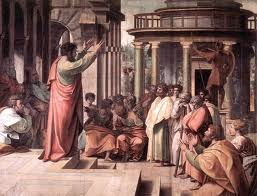
Now while Paul was waiting for them at Athens, his spirit was provoked within him as he saw that the city was full of idols. So he reasoned in the synagogue with the Jews and the devout persons, and in the marketplace every day with those who happened to be there. Some of the Epicurean and Stoic philosophers also conversed with him. And some said, “What does this babbler wish to say?” Others said, “He seems to be a preacher of foreign divinities”—because he was preaching Jesus and the resurrection. And they took hold of him and brought him to the Areopagus, saying, “May we know what this new teaching is that you are presenting? For you bring some strange things to our ears. We wish to know therefore what these things mean.” Now all the Athenians and the foreigners who lived there would spend their time in nothing except telling or hearing something new. So Paul, standing in the midst of the Areopagus, said: “Men of Athens, I perceive that in every way you are very religious. For as I passed along and observed the objects of your worship, I found also an altar with this inscription, ‘To the unknown god.’ What therefore you worship as unknown, this I proclaim to you. The God who made the world and everything in it, being Lord of heaven and earth, does not live in temples made by man, nor is he served by human hands, as though he needed anything, since he himself gives to all mankind life and breath and everything. And he made from one man every nation of mankind to live on all the face of the earth, having determined allotted periods and the boundaries of their dwelling place, that they should seek God, in the hope that they might feel their way toward him and find him.

Yet he is actually not far from each one of us, for ‘In him we live and move and have our being’; as even some of your own poets have said, ‘For we are indeed his offspring.’ Being then God’s offspring, we ought not to think that the divine being is like gold or silver or stone, an image formed by the art and imagination of man. The times of ignorance God overlooked, but now he commands all people everywhere to repent, because he has fixed a day on which he will judge the world in righteousness by a man whom he has appointed; and of this he has given assurance to all by raising him from the dead.”

Now when they heard of the resurrection of the dead, some mocked. But others said, “We will hear you again about this.” So Paul went out from their midst. But some men joined him and believed, among whom also were Dionysius the Areopagite and a woman named Damaris and others with them.

I have organized the rest of what I have to say under four topics: the realities Paul faces, the priorities he adopts, the framework he establishes, and the nonnegotiable gospel he preaches.

(1) THE REALITIES PAUL FACES

Apart from their obvious biblical illiteracy — these Athenian intellectuals had never heard of Moses, never cracked a Bible — three features of this culture are striking.

First, the Roman Empire was characterized not only by large-scale empirical pluralism but also by government-sponsored religious pluralism. The Romans knew that a captive people were more likely to rebel if they could align religion, land, and people. Partly to break up this threefold cord, the Romans insisted on adopting into their own pantheon some of the gods of any newly subjugated people, and they insisted equally strongly that the newly subjugated people adopt some of the Roman gods. In any potential civil war, therefore, it would be quite unclear which side the gods were helping — and this policy of god-swaps strengthened the likelihood of imperial peace. It also meant that religious pluralism was not only endemic to the Empire but was buttressed by the force of law After all, it was a capital offense to desecrate a temple — any temple. But let no temple and no God challenge Washington — I mean Rome.

Second, like us, Paul was dealing not with people who were biblically illiterate and therefore had no worldview, but with people who vociferously argued for various competing and powerful worldviews.

Two are mentioned in the text: Epicurean and Stoic (v. 18). In the first century, philosophy did not have the fairly esoteric and abstract connotations it has today, connected with minor departments in large universities. It referred to an entire way of life, based on a rigorous and self-consistent intellectual system — close to what we mean by worldview The ideal of Epicurean philosophy, Epicurean worldview, was an undisturbed life — a life of tranquility, untroubled by undue involvement in human affairs.

The gods themselves are composed of atoms so fine they live in calmness in the spaces between the worlds. As the gods are nicely removed from the hurly-burly of life, so human beings should seek the same ideal. But over against this vision, as we shall see, Paul presents a God who is actively involved in this world as its Creator, providential Ruler, Judge, and self-disclosing Savior.

Stoic philosophy thought of god as all-pervasive, more or less in a pantheistic sense, so that the human ideal was to live life in line with what is ultimately real, to conduct life in line with this god/principle of reason, which must rule over emotion and passion. Stoicism, as someone has commented, was “marked by great moral earnestness and a high sense of duty.” Against such a vision, the God that Paul presents, far from being pantheistic, is personal, distinct from the creation, and is our final judge. Instead of focusing on “universal reason tapped into by human reasoning,” Paul contrasts divine will and sovereignty with human dependence and need. In short, there is a massive clash of worldviews.

Of course, there were other Greek and Latin worldviews. There is no mention here of the sophists or of the atheistic philosophical materialists such as Lucretius. What is clear is that Paul here finds himself evangelizing men and women deeply committed to one fundamentally alien worldview or another.

Third, no less striking is the sneering tone of condescension they display in verse 18: What is this babbler trying to say? — this “seed picker,” this little bird fluttering around picking up disconnected scraps of incoherent information, this second-class mind? Others remarked, He seems to be advocating foreign gods. Of course, as it turns out, some of these people become genuinely interested in the gospel. The tenor of condescension is unmistakable, however, when an alien worldview feels secure in its thoughtless majority.

These, then, are the realities Paul faces.

(2) THE PRIORITIES PAUL ADOPTS

The most immediate and striking response of the apostle Paul to all that he witnesses in Athens is an intuitively biblical analysis: he is greatly distressed to see that the city was full of idols (v. 16). Paul might have been overwhelmed by Athens’ reputation as the Oxford or Cambridge or Harvard of the ancient world (though universities per se did not then exist). He might have admired the architecture, gaping at the Parthenon. But Paul is neither intimidated nor snookered by Athens; he sees the idolatry. How we need Christians in our universities and high places who are neither impressed nor intimidated by reputation and accomplishment if it is nothing more than idolatry!

The apostle sets out, then, to evangelize. He aims at two quite different groups. As usual, he attaches a certain priority to evangelizing Jews and Godfearing Gentiles, the churchy folk, the biblically literate people; he reasons in the synagogue with the Jews and the God-fearing Greeks (v. 17a). He has a theological reason for this priority that we cannot examine here, but in any case we must never forget to evangelize such people. Second, he evangelizes the ordinary pagans who have no connection with the Bible: he evangelizes day by day in the market place, targeting anyone who happens to be there, most of whom would have been biblically illiterate (v. 17b). He does not wait for an invitation to the Areopagus. He simply gets on with his evangelism, and the invitation to the Areopagus is the result (v. 18).

These, then, are his priorities: God-centered cultural analysis, and persistent evangelism of both biblical literates and biblical illiterates.

Perhaps I should add that there is at least one fundamental difference between Paul’s situation and ours. When Paul evangelizes biblical illiterates, he is dealing with people whose heritage has not in recent centuries had anything to do with biblical religion. So when they react negatively to him, they do so solely because, from their perspective, his frame of reference is so alien to their own. They are not rejecting him in part because they are still running away from their own heritage. That is the additional problem we sometimes face. We sometimes deal with men and women who have adopted a worldview that is not only at several points profoundly antithetical to a biblical worldview but also self-consciously chosen over against that biblical worldview. That opens up some opportunities for us, but it raises some additional barriers as well. However, we cannot probe these opportunities and barriers here. It is enough to observe the priorities that Paul adopts.

(3) THE FRAMEWORK PAUL ESTABLISHES

Here it will be helpful to run through Paul’s argument from 17:22 to 17:31. Before I do so, however, I want to make three preliminary observations.

First, it takes you about two minutes to read this record of Paul’s address. But speeches before the Areopagus were not known for their brevity. In other words, we must remember that this is a condensed report of a much longer speech. Doubtless every sentence, in some cases every clause, constituted a point that Paul expanded upon at length.

Second, if you want to know a little more closely just how he would have expanded each point, it is easier to discover than some people think. For there are many points of comparison between these sermon notes and, for instance, Romans. I’ll draw attention to one or two of the parallels as we move on.

Third, there is a fascinating choice of vocabulary. It has often been shown that many of the expressions in this address, especially in the early parts, are the sorts of things one would have found in Stoic circles. Yet in every case, Paul tweaks them so that in his context they convey the peculiar emphases he wants to assign to them. In other words, the vocabulary is linguistically appropriate to his hearers, but at the level of the sentence and the paragraph, Paul in this report is saying just what he wants to say; he is establishing a biblical worldview.

Now let us scan the framework Paul establishes.

First, he establishes that God is the creator of the world and everything in it (17:24). How much he enlarged on this point we cannot be certain, but we know from his other writings how his mind ran. The creation establishes that God is other than the created order; pantheism is ruled out. It also establishes human accountability; we owe our Creator everything, and to defy him and set ourselves up as the center of the universe is the heart of all sin. Worse, to cherish and worship created things instead of the Creator is the essence of idolatry.

Second, Paul insists that God is the Lord of heaven and earth and does not live in temples built by hands (v. 24). The sovereignty of God over the whole universe stands over against views that assign this god or that goddess a particular domain — perhaps the sea (Neptune), or tribal gods with merely regional or ethnic interests. The God of the Bible is sovereign over everything. This teaching grounds the doctrine of providence. Because of the universality of his reign, God cannot be domesticated — not even by temples (v. 24). Paul is not denying the historical importance of the temple in

Jerusalem, still less that God uniquely disclosed himself there. Rather, he denies that God is limited to temples, and that he can be domesticated or squeezed or tapped into by the cultus of any temple (which of course threatens popular pagan practice). He is so much bigger than that.

Third, God is the God of aseity: he is not served by human hands, as if he needed anything (17:25). Aseity is a word now largely fallen into disuse, though it was common in Puritan times. Etymologically it comes from the Latin a se — “from himself.” God is so utterly “from himself” that he does not need us; he is not only self-existent (a term we often deploy with respect to God’s origins — the existence of everything else is God-dependent, but God himself is self-existent), but he is utterly independent of his created order so far as his own well-being or contentment or existence are concerned. God does not need us — a very different perspective from that of polytheism, where human beings and gods interact in all kinds of ways bound up with the finiteness and needs of the gods. The God of the Bible would not come to us if, rather whimsically, he wanted a McDonald’s hamburger; the cattle on a thousand hills are already his.

Fourth, the truth of the matter is the converse: we are utterly dependent on him — he himself gives all men life and breath and everything else (v. 25b). This strips us of our vaunted independence; it is the human correlative of the doctrines of creation and providence.

Fifth, from theology proper, Paul turns to anthropology. He insists that all nations descended from one man (v. 26). This contradicts not a few ancient notions of human descent, which conjectured that different ethnic groups came into being in quite different ways. But Paul has a universal gospel that is based on a universal problem (cf. Rom. 5; 1 Cor. 15). If sin and death were introduced into the one human race by one man such that the decisive act of another man is required to reverse them, then it is important for Paul to get the anthropology right so that the soteriology is right. We cannot agree on the solution if we cannot agree on the problem. But Paul’s stance has yet wider implications; there is no trace of racism here. Moreover, however much he holds that God has enjoyed a peculiar covenant relationship with Israel, because he is a monotheist, Paul holds that God must be sovereign over all the nations. Did he, perhaps, develop some of the lines of argument one finds in Isaiah 40ff.? If there is but one God, that God must in some sense be the God of all, whether his being and status are recognized by all or not.

Sixth, for the first time one finds an explicit reference to something wrong in this universe that God created. His providential rule over all was with the purpose that some would reach out for him and find him (v. 27). In short order Paul will say much more about sin (without actually using the word). Here he is preparing the way. The assumption is that the race as a whole does not know the God who made them. Something has gone profoundly wrong.

Seventh, although it has been important for him to establish God’s transcendence, Paul does not want such an emphasis to drift toward what would later be called deism. The God he has in mind is not far from each one of us (v. 27). He is immanent. Paul will not allow any suspicion that God is careless or indifferent about people; he is never far from us. Moreover, the apostle recognizes that some of this truth is acknowledged in some pagan religions. When Greek thought (or much of it) spoke of one “God” as opposed to many gods, very often the assumption was more or less pantheistic. That structure of thought Paul has already ruled out. Still, some of its emphases were not wrong if put within a better framework. We live and move and have our being in this God, and we are his offspring (17:28) — not, for Paul, in some pantheistic sense, but as an expression of God’s personal and immediate concern for our well-being.

Eighth, the entailment of this theology and this anthropology is to clarify what sin is and to make idolatry utterly reprehensible (v. 29). Doubtless Paul enlarged this point very much in terms of, say, Isaiah 44-45 and Romans 1. For he cannot rightly introduce Jesus and his role as Savior until he establishes what the problem is; he cannot make the good news clear until he elucidates the bad news from which the good news rescues us.

Ninth, Paul also introduces what might be called a philosophy of history — or better, perhaps, a certain view of time. Many Greeks in the ancient world thought that time went round and round in circles. Paul establishes a linear framework: creation at a fixed point; a long period that is past with respect to Paul’s present in which God acted in a certain way (In the past God over-looked such ignorance); a now that is pregnant with massive changes; and a future (v. 31) that is the final termination of this world order, a time of final judgment. The massive changes of Paul’s dramatic now are bound up with the coming of Jesus and the dawning of the gospel. Paul has set the stage so as to introduce Jesus.

So here is the framework Paul establishes. He has, in fact, constructed a biblical worldview. But he has not done so simply for the pleasure of creating a worldview. In this context he has done so in order to provide a framework in which Jesus himself, not least his death and resurrection, makes sense. Otherwise nothing that Paul wants to say about Jesus will make sense.

This is the framework Paul establishes.

(4) THE NONNEGOTIABLE GOSPEL PAUL PREACHES

We read again verse 31: For [God] has set a day when he will judge the world with justice by the man he has appointed. He has given proof of this to all men by raising him from the dead.

Here, at last, Jesus is introduced.

I want to emphasize two things. First, it is extraordinarily important to see that Paul has established the framework of the biblical metanarrative before he introduces Jesus. If metaphysics is a sort of big physics that explains all the other branches of physics, similarly metanarrative is the big story that explains all the other stories. By and large, postmodernists love stories, especially ambiguous or symbol-laden narratives. But they hate the metanarrative, the big story that makes all the little stories coherent. But what Paul provides is the biblical metanarrative. This is the big story in the Bible that frames and explains all the little stories. Without this big story, the accounts of Jesus will not make any sense — and Paul knows it.

For instance, if in a vague, New Age, postmodern context, we affirm something like “God loves you,” this short expression may carry a very different set of associations than we who are Christians might think. We already assume that men and women are guilty and that the clearest and deepest expression of God’s love is in the cross, where God’s own Son dealt with our sin at the expense of his own life. But if people know nothing of this story line, then the same words, “God loves you,” may be an adequate summary of the stance adopted by Jodie Foster in her recent film, Contact. The alien power is beneficent, wise, good, and interested in our well-being. There is nothing whatever to do with moral accountability, sin, guilt, and how God takes action to remove our sin by the death of his Son. The one vision nestles into the framework of biblical Christianity; the other nestles comfortably into the worldview of New Age optimism. In short, without the big story, without the metanarrative, the little story or the little expression becomes either incoherent or positively misleading. Paul understands the point.

Second, what is striking is that Paul does not flinch from affirming the resurrection of Jesus from the dead. And that is what causes so much offense that Paul is cut off, and the Areopagus address comes to an end. Paul was thoroughly aware, of course, that most Greeks adopted some form of dualism. Matter is bad, or at least relatively bad; spirit is good. To imagine someone coming back from the dead in bodily form was not saying anything desirable, still less believable. Bodily resurrection from the dead was irrational; it was an oxymoron, like intelligent slug or boiled ice. So some of Paul’s hearers have had enough, and they openly sneer and end the meeting (v. 32). If Paul had spoken instead of Jesus’ immortality, his eternal spiritual longevity quite apart from any body, he would have caused no umbrage. But Paul does not flinch. Elsewhere he argues that if Christ has not been raised from the dead, then the apostles are liars, and we are still dead in our trespasses and sins (I Cor. 15). He remains faithful to that vision here. Paul does not trim the gospel to make it acceptable to the worldview of his listeners.

For Paul, then, there is some irreducible and nonnegotiable content to the gospel, content that must not be abandoned, no matter how unacceptable it is to some other worldview. It follows that especially when we are trying hard to connect wisely with some worldview other than our own, we must give no less careful attention to the nonnegotiables of the gospel, lest in our efforts to communicate wisely and with relevance, we unwittingly sacrifice what we mean to communicate.

But suddenly we overhear the muttered objection of the critic. Can it not be argued that Paul here makes a fundamental mistake? Elsewhere in Acts he frequently preaches with much greater fruitfulness, and in those cases he does not stoop to all this worldview stuff. He just preaches Jesus and his cross and resurrection, and men and women get converted. Here, a piddling number believe (v. 34). In fact, Paul’s next stop in Greece after Athens is Corinth. Reflecting later on his experiences there, Paul writes to the Corinthians and reminds them For I resolved to know nothing while I was with you except Jesus Christ and him crucified (I Cor. 2:2) — doubtless because he was reflecting with some sour-faced chagrin on his flawed approach in Athens. So let us be frank, the critics charge, and admit that Paul made a huge mistake in Athens and stop holding up Acts 17 as if it were a model of anything except what not to do. The man goofed: he appealed to natural theology; he tried to construct redemptive history; he attempted to form a worldview when he should have stuck to his last and preached Jesus and the cross.

I sometimes wish this reading were correct, but it is profoundly mistaken for a number of reasons.

(1) It is not the natural reading of Acts. As Luke works through his book, he does not at this point in his narrative send up a red flag and warn us that at this point Paul makes a ghastly mistake. The false reading is utterly dependent on taking I Corinthians in a certain way (a mistaken way, as we shall see), and then reading it into Acts 17.

(2) What Paul expresses, according to Luke’s report of the Areopagus address, is very much in line with Paul’s own theology, not least his theology in the opening chapters of Romans.

(3) Strictly speaking, Paul does not say that only a “few” men believed. He says tines de andres, “certain people,” along with heteroi, “others.” These are in line with other descriptions. The numbers could scarcely have been large, because the numbers in the Areopagus could not have been very large in the first place.

(4) Transparently, Paul was cut off when he got to the resurrection of Jesus (vv. 31-32). But judging from all we know of him — both from a book like Romans and from the descriptions of him in Acts — we know where he would have gone from here.

(5) That is entirely in line with the fact that what Paul had already been preaching in the marketplace to the biblically illiterate pagans was the cc gospel” (v. 18).

(6) At this point in his life Paul was not a rookie. Far from being fresh out of seminary and still trying to establish the precise pattern of his ministry, on any chronology he had already been through twenty years of thrilling and brutal ministry. Nor is this Paul’s first time among biblically illiterate pagans or among intellectuals.

(7) In any case, I Corinthians 2 does not cast Paul’s resolve to preach Christ crucified against the background of what had happened to him in Athens. He does not say, in effect, “Owing to my serious mistakes in Athens, when I arrived in Corinth I resolved to preach only Christ and him crucified.” Rather, in 1 Corinthians Paul’s resolve to preach Christ crucified is cast against the background of what Christians in Corinth were attracted to — namely, to a form of triumphalism that espoused an ostensible wisdom that Paul detests. It is a wisdom full of pride and rhetoric and showmanship. Against this background, Paul takes a very different course. Knowing that believers must boast only in the Lord and follow quite a different wisdom (I Cor. 1), he resolves to preach Christ and him crucified.

(8) In any case, it would be wrong to think that Paul has no interest in worldviews. Writing after I Corinthians 2, Paul can say, We demolish arguments and every pretension that sets itself up against the knowledge of God, and we take captive every thought to make it obedient to Christ (2 Cor. 10:45). The context shows that Paul is not here interested so much in disciplining the individual’s private thought life (though that certainly concerns him elsewhere) as in bringing into obedience to Christ every thought structure, every worldview, that presents opposition to his beloved Master. In other words, Paul thought “worldviewishly” (if that is not too monstrous a neologism). That is clear in many of his writings; it is clear in both 2 Corinthians 10 and in Acts 17.

(9) Finally, the first line of Acts 17:34 is sometimes misconstrued: “A few men became followers of Paul and believed.” Many have assumed Luke means that a few people became Christians on the spot and followers of Paul. But that reverses what is said. Moreover, Paul has not yet given much gospel — in precisely what sense would they have become Christians? It is better to follow the text exactly Following Paul’s address, no one became a Christian on the spot. But some did become followers of Paul. In consequence, in due course they grasped the gospel and believed; they became Christians. This is entirely in line with the experience of many evangelists working in a university environment today.

A couple of years ago I spoke evangelistically at a large meeting in Oxford. So far as I know, no one became a Christian at that meeting. But sixteen students signed up for a six-week “Discovering Christianity” Bible study. A few weeks after the meeting, the curate, Vaughan Roberts, wrote me a note to tell me that eleven of the sixteen had clearly become Christians already, and he was praying for the remaining five. In other words, as a result of that meeting, some became “followers of Jesus,” and in due course believed. That is often the pattern when part of the evangelistic strategy is to establish a worldview, a frame of reference, to make the meaning of Jesus and the gospel unmistakably plain.

In short, however sensitive Paul is to the needs and outlook of the people he is evangelizing, and however flexible he is in shaping the gospel to address them directly, we must see that there remains for him irreducible content to the gospel. That content is nonnegotiable, even if it is remarkably offensive to our hearers. If it is offensive, we may have to decide whether it is offensive because of the intrinsic message or because we have still not done an adequate job of establishing the frame of reference in which it alone makes sense. But the gospel itself must never be compromised.

SOME CONCLUDING REFLECTIONS

I offer three concluding reflections. First, the challenge of worldview evangelism is not to make simple things complicated but to make clear to others some fairly complicated things that we simply assume. This can be done in fifteen minutes with the sort of presentation Phillip Jensen and Tony Payne have constructed (in Chapter 6 of Telling the Truth – “Two Ways To Live”). It might be done in seven consecutive expositions running right through the first eight chapters of Romans. It might be done with the six months of Bible teaching, beginning with Genesis, that many New Tribes Mission personnel now use before they get to Jesus. But it must be done.

Second, the challenge of worldview evangelism is not primarily to think in philosophical categories, but it is to make it clear that closing with Jesus has content (it is connected with a real, historical Jesus about whom certain things must be said and believed) and is all-embracing (it affects conduct, relationships, values, priorities). It is not reducible to a preferential religious option among many, designed primarily to make me feel good about myself.

Third, the challenge of worldview evangelism is not primarily a matter of how to get back into the discussion with biblically illiterate people whose perspectives may be very dissimilar to our own. Rather, worldview evangelism focuses primarily on where the discussion goes. There are many ways of getting into discussion; the crucial question is whether the Christian witness has a clear, relatively simple, straightforward grasp of what the Bible’s story line is, how it must give form to a worldview, and how the wonderful news of the gospel fits powerfully into this true story — all told in such a way that men and women can see its relevance, power, truthfulness, and life-changing capacity.

*”Athens Revisited” was originally a lecture at a conference on the topic of Evangelism in a Post Modern Culture held on May 13-15, 1998 at Trinity Evangelical Divinity School in Deerfield, Illinois & sponsored by the Bannockburn Institute (www.biccc.org). All the lectures from this conference were published in the book: Telling The Truth: Evangelizing Postmoderns, Grand Rapids: Zondervan, 2000; of which D.A. Carson was the general editor and the contributor of Chapter 28 from which this article is adapted.

About the Author: D. A. Carson (Ph.D., University of Cambridge) is research professor of New Testament at Trinity Evangelical Divinity School in Deerfield, Illinois. His theology is similar to that of Wayne Grudem except on charismatic issues, where his view may be described as “open but cautious.” Carson’s tendency is to strive for balance and amicability in disputes but is uncompromising on the essentials of the faith. He is a complementarian but supports gender-neutral Bible translations. Carson also helped produce the NLT. He is the author or coauthor of over 50 books. Some of the plethora of outstanding books he has written includes: The Intolerance of Tolerance, The God Who Is There, ScandalousHow Long O Lord, A Call to Spiritual Reformation; The Cross and Christian Ministry; The Difficult Doctrine of the Love of God; Divine Sovereignty and Human Responsibility; Exegetical Fallacies; For the Love of God; The Gagging of God; The Inclusive Language Debate; Introduction to the New Testament; New Testament Commentary Survey; Scripture and Truth (Ed. with John Woodbridge); Worship by the Book; Pillar Commentaries on Matthew and John and a contributor to Who Will be Saved. He also edits the New Studies in Biblical Theology book series.

Carson’s areas of expertise include biblical theology, the historical Jesus, postmodernism, pluralism, Greek grammar, Johannine theology, Pauline theology, and questions of suffering and evil. He has written books on free will and predestination from a generally compatibilist and Calvinist perspective. He is a member of the Tyndale Fellowship for Biblical Research, the Society of Biblical Literature, the Evangelical Theological Society, the Canadian Society of Biblical Studies, and the Institute for Biblical Research.

Dr. Carson and his wife, Joy, reside in Libertyville, Illinois. They have two children. In his spare time, Dr. Carson enjoys reading, hiking, and woodworking.

What Can We Learn About the Resurrection of Jesus from the Life of Job? By Dr. James M. Boice

 *“He Lives!”

I do not know if you have had the experience of gaining an insight or receiving a revelation so important that you wished it could be preserved forever. If you have, or if you have even experienced that in a partial way, you will understand the tone in which Job spoke his most widely quoted lines, beginning, I know my Redeemer lives.” We hear something said in a particularly vivid way, and we say, “If I could just remember that!” Or we have an insight and say, “If I could just get that written down so I won’t forget it!”

That was the feeling that Job experienced. He had suffered a great deal, first by the loss of his possessions, then by the loss of his ten children and eventually his own health. His friends came to comfort but actually abused him, charging that his misfortunes were the result of some particularly outstanding sin in his life. In the midst of one reply Job gave vent to the insight to which I am referring.

Job perceived that his story was not being told completely in this life and that a later day would vindicate him. In fact, he perceived that there was an individual who would vindicate him, even Jesus Christ, whom Job calls “my Redeemer.” This individual would stand on the earth in some future day, would raise Job from death, and would enable him to see God.

Can you imagine Job’s excitement as he gave expression to this hope? There were many who shared it in Job’s day; few understood it. So Job said that he wished his words might be preserved. “Oh, that my words were recorded, that they were written on a scroll, that they were inscribed with an iron tool on lead, or engraved in rock forever!” (Job 19:23-24). Fortunately for us, Job’s wish was fulfilled. Not only were his words preserved in a book; they have been preserved in the Book of books, the Bible.

A Kinsman-Redeemer

“I know that my Redeemer lives, and that in the end he will stand upon the earth” (Job 19:25).

The first thing we shall look at in Job’s statement is its key word: “Redeemer.” This is a rich and particularly illuminating term. In Hebrew the word is goel, which refers to a relative who performs the office of a redeemer for his kin. We must visualize a situation in which a Hebrew has lost his inheritance through debt. He has mortgaged his estate and, because of a lack of money to meet the debt, is about to lose it. This happened in the case of Naomi and Ruth so that, although they had once possessed the land, they had become impoverished. In such a situation was the goel’s duty, as the next of kin, to buy the inheritance; that is to pay the mortgage and restore the land to his relative. Boaz did that for Ruth.

That custom is what Job refers to in his expression of faith in a divine Redeemer, and it is why this passage must refer to Job’s own resurrection. As Job spoke those words he was in a dire physical condition. He had lost his family and health. He must have imagined that he was about to lose his life, too. He would die. Worms would destroy his body. But that was not the end of the story. For his body, like the land, was his inheritance; and there is one who will redeem it for him. Years may go by, but at the latter day the Redeemer will stand upon the earth and will perform the office of a goel in raising his body. He will bring Job into the presence of God.

I recognize that there are different ways of translating the phrase “Yet in my flesh I will see God” (19:26). Some versions read, “Yet without my flesh.” But those fail to make full sense of the passage. What is redeemed if it is not Job’s body? Not the soul or the spirit certainly, for those are never forfeited. And not Job’s physical possessions, for the passage is not even considering them. It is the body that will be redeemed. Consequently, it is in this body and with his own physical eyes that Job expects to see God.

A second duty of the goel was to redeem by power, if that should be necessary. Abraham performed this duty when Lot had been captured by the four kings who made war against the king of Sodom and his allies. Abraham armed his household, pursued the four kings and their prisoners, and then, attacking by night, recovered both prisoners and spoil. That is what the Lord Jesus Christ did, was it not? He attacked in power—we speak rightly of resurrection power—and broke death’s hold.

Finally, the goal had a duty to avenge a death. Imagine that an Israelite has been attacked and is dying. The goal learns who has struck his relative. He snatches up his own sword and dashes off to avenge his own sword and dashes off to avenge the murder. Our Christ is likewise our avenger. We are dying people, but we have a Redeemer. We read of Him: “For he must reign until he has put all his enemies under his feet. The last enemy to be destroyed is death…Where, O death, is your victory? Where, O death, is your sting? The sting of death is sin, and the power of sin is the law. But thanks be to God! He gives us the victory through our Lord Jesus Christ” (1 Corinthians 15:25-26, 55-57).

A Living Redeemer

As we think about his words in greater detail, we discover next that Job took confidence, not only in the fact that he had a Redeemer, but that he had a living Redeemer. That is important, because a redeemer must be living to perform his function.

If Job had been able to say merely that he had a Redeemer, that would have been wonderful. If he could have said further that the Redeemer of whom he was speaking was the Christ, that would have been even more wonderful. To have known such a one, to have been related to him, to have been able to look back to what he had done—all that would have been both pleasant and comforting. But so far as the present need was concerned it would have been inadequate. A person in that position could say, “I had a Redeemer, and I value that.” But he would undoubtedly add, “But I wish I had him now.” A redeemer must be living if he is to buy back the estate, recover the prisoners, and defeat the enemy.

Job does not say that he had a Redeemer. He says that he has a Redeemer and he is living. We too have a living Redeemer, the same Redeemer, who is Jesus.

That is the thrust of our testimony on Easter Sunday. And indeed on every other Lord’s Day. We testify that Jesus rose from the dead and that he ever lives to help all who call upon him. The evidences for this are overwhelming. There is the evidence of the narratives themselves. They are quite evidently four separate and independent accounts, for if they were not, there would not be so many apparent discrepancies—the time at which the women went to the tomb, the number of angels and so on. At the same time, it is also obvious that there is a deep harmony among them—not a superficial harmony but rather a detailed harmony that is increasingly evident as the accounts are analyzed. In fact, the situation is precisely what we would expect if the accounts are four independent records of those who were eyewitnesses.

One writer summarized the evidence like this:

It is plain that these accounts must be either a record of facts that actually occurred, or else fictions. If fictions, they must have been fabricated in one of two ways, either independently of one another, or in collusion with one another. They cannot have been made up independently; the agreements are too marked and too many. They cannot have been made up in collusion…the apparent discrepancies are too numerous and too noticeable. Not made up independently, not made up in collusion, therefore, it is evident they were not made up at all. They are a true relation of facts as they actually occurred (R.A. Torrey, The Bible and Its Christ: Being Noonday Talks with Business Men on Faith and Unbelief, New York: Revell, 1904-1906, pp. 60-61).

The resurrection of the Lord Jesus Christ is also proved by the transformed lives of the disciples. Before the resurrection two negative charges could be made against them; and these by their own confession. First, they had failed to understand Jesus’ teaching about the crucifixion and resurrection. Second, they were cowardly. Peter had said that he would defend Jesus to the death and never deny him. But on the night of the arrest he did deny Him. He abandoned Him, as did the other disciples. On the day of the resurrection, but before Jesus had appeared to them in the upper room, we find them hiding in fear of the Jews. Yet hours later they were standing up boldly in Jerusalem to denounce the execution of Jesus and call for faith in Him. Moreover, when they were arrested later we do not find them cowering in fear of the future but rather giving full testimony to Christian faith and doctrine. What made the difference? What made cowards bold, a scattering body of individuals a cohesive force, a disillusioned following evangelists? Only one thing accounts for it: the resurrection of Jesus Christ.

There are many evidences, but I cannot help but mention a third—the change in the day of worship. Before the resurrection the followers of Christ worshipped, as did all Jews, on Saturday. The need to do this would not even have been questioned—it had been practiced for centuries. Yet from that time on we find the newly formed body of Christians meeting, not on Saturday, but on the first day of the week, Sunday. Clearly it was because of Jesus’ resurrection.

A Personal Redeemer

There is a third point to Job’s statement. Not only does Job declare that he has a Redeemer, not only does he affirm that He is living Redeemer—he adds, quite properly, that He is his Redeemer. “My” is the word he uses. “I know that my Redeemer lives.” Do you know that “my” in relationship to Jesus Christ? It is a reminder of the need for personal religion.

This is what we desire, is it not? We are persons, and we desire personal relationships. We are made in God’s image, as persons; so we desire a personal relationship with God.

In my church I notice that the young people often have a great deal of appreciation for one another. There are young women, for instance, who greatly appreciate certain young men. And there are young men who appreciate certain young women, even though they sometimes fail to say so. That is a wonderful thing. I am glad that virtue and good looks are noticed. But I have observed that in addition there are also many young women who would like to be able to say, not only, “Look at that fellow; how handsome he is!” but also, “Look at my fellow.” And some of the young men would like to say, “Look at my girl.” Admiration is good, but personal involvement is better.

That is our privilege in relation to Christ. It is good to admire Him. He is the risen Lord of glory after all; it would be foolish not to do so. But how much better to know Him personally, as Job did. Jesus came to earth to die for sin and to rise again. Can you say, “My God came as my Redeemer to die for my sin and to rise again for my justification? You give no real evidence of being a Christian until you can.

Do not delay. Do not say, “I’ll do it next year.” I can give no guarantee that you will be here next year. On the contrary, some who read these words will not be. Even tomorrow may be too late. The Bible says, “Now is the time of God’s favor, now is the day of salvation” (2 Corinthians 6:2).

Assurance

I would also like you to possess Job’s assurance. That is the fourth point. Not only does Job refer to his Redeemer and declare that he is both a living and personal Redeemer, he also says that he knows all these things: “I know that my Redeemer lives, and that in the end he will stand upon the earth.”  You should possess such assurance if you are a Christian.

I do not know why some people think that it is meritorious to express doubt in matters of religion. They think that it is somehow vain or impolite to be certain and that it is humble and therefore desirable to say, “I do not know…I hope so…I would like to believe…I think…” Nothing could be more faulty. The humble person is the one who bows before God’s revelation and accepts it because of who God is. It is the proud man who thinks he knows enough about anything to doubt God. Besides, God says that doubt is the equivalent of calling Him a liar; it is as much to say that His word is untrustworthy (cf. 1 John 5:10). Jesus lives! Believe it! Declare it! Act upon it! Say with Job, “I know that my Redeemer lives, we shall live. His resurrection is the pledge of our own.

Then, too, we shall see God. This is the second benefit. We shall live again and in that living form shall see God. What a wonderful thought. And how much more wonderful than anything else that might be said. Notice that Job did not say, “I shall see heaven.” That was true, but it was relatively unimportant compared to the fact that he would see God. Spurgeon wrote, “He does not say, ‘I shall see the pearly gates, I shall see the walls of jasper, I shall see the crowns of gold and the harps of harmony,’ but ‘I shall see God’; as if that were the sub and substance of heaven” (Charles Haddon Spurgeon, “I know that My Redeemer Lives,” in the Metropolitan Tabernacle Pulpit, vol.9, Pasadena, Tex.: Pilgrim, Tex.: Pilgrim Publications, 1969, 214.) Nor does he say, “I shall see the holy angels.” That would have been a magnificent sight, at least it seems so to us we look through the eyes of John the evangelist, who wrote the book of Revelation. I find  few scenes more thrilling than John’s description. But that too pales beside the gaze of the soul on God. Notice, finally, that Job did not even say, ”I shall see those of this world who have gone before me,” even though that would be a great joy and his departed children would be among them. Job would see all these things: the pearly gates, the holy angels, and his children. But over and above and infinitely more glorious than any of those, he would see God.

Do not think that this is a narrow vista, wonderful but small, like looking at one of those old-fashioned pastoral scenes within a candy egg. God is infinite. To see God is to experience perfect contentment and to be satisfied in all one’s faculties.

 Living Memorials

Our conclusion is this: If Job, who lived at the dawn of recorded history, centuries before the time of the Lord Jesus Christ—if Job knew these things, how much more should we know them, we who are aware of Christ’s resurrection and have witnessed his power in our lives. Job lived in a dark and misty time, before the dawning of the Lord Jesus Christ, that sun of righteousness. Job lived in an age before Jesus brought life and immortality to light through the gospel. If he had failed to understand about the resurrection and had failed to believe in it, who could blame him? Nobody. Yet he believed. How much more than should we?

Can you say with Job, “I know that my Redeemer lives, and that in the end he will stand upon the earth. And after my skin has been destroyed, yet in my flesh I will see God”? If so, then live in that assurance. Do not fear death. During the next twelve months death will certainly come for some, but there will also be a resurrection. Besides, Jesus is also coming; and if that should happen soon, He will receive us all.

I add one more thought. We believe these truths, yes. But let us not only believe them; let us pass them on so that others may share in this resurrection faith also. What was Job’s desire after all? It was that his words might be preserved and that his faith in the resurrection might be saved for coming generations. The resurrection hope has come down to us through many centuries of church history. Let it pass to our children and to our children’s children until the living Lord Jesus Christ returns in His glory. Jesus Christ lives. He lives! Then let us tell others, and let us shout with Job, “I know that my Redeemer lives, and that in the end he will stand upon the earth.”

*”He Lives” is an Easter Sermon excerpted from Chapter One in James Boice, The Christ of the Empty Tomb, Chicago, Moody Press, 1985; reprinted in 2008. James Montgomery Boice, Th.D., (July 7, 1938 – June 15, 2000) was a Reformed theologian, Bible teacher, and pastor of Tenth Presbyterian Church in Philadelphia from 1968 until his death. He is heard on The Bible Study Hour radio broadcast and was a well known author and speaker in evangelical and Reformed circles. He also served as Chairman of the International Council on Biblical Inerrancy for over ten years and was a founding member of the Alliance of Confessing Evangelicals.

“Prophecy and the Bible” By James Montgomery Boice

What The Bible Has To Say About The Future:

Part 1 in a Series of 9 By *James M. Boice

Years ago the noted English agnostic Thomas Huxley was in Dublin, Ireland, for some speaking engagements. On one occasion he left his hotel in a hurry to catch a train, taking one of the city’s famous horse drawn taxis. Huxley thought that the doorman at the hotel had told the driver where he was going, so he simply settled back in the cab and told the man at the reins to drive fast. The driver set off at a vigorous pace. In a few minutes Huxley realized that the cab was headed away from the station. “Do you know where you are going?” he shouted to the driver, “No, your honor,” the driver answered, “but I’m driving fast.”

This story seems to sum up more than just the spirit of Huxley and his followers toward the end of the nineteenth century. It is also an illustration of the outlook of many in our tumultuous age. There is much motion, much speed. Yet few in our day seem to know where they are or where they are headed. For most of our contemporaries, life is as Franklin Delano Roosevelt described it in his inaugural address: “We don’t know where we are going but we are on our way.”

This state of affairs is completely abnormal, of course. Or, to put another way, the confusion is not God’s fault. In fact, God’s revelation in the Bible exists to accomplish just the opposite. The Bible is God’s revelation to men of where we have been, where we are, and where we are headed. It is a revelation of our past, present, and future; and these are revealed, not only in reference to the individual, but also as the concern nations and the movements of history. What will happen to us in the years to come? Where is history headed? How will it end? Is God in control or has He forgotten us? Do the events of our life have significance?

If you are interested in these questions and have not been satisfied with the predictions of politicians or pollsters, then this series of studies of what the Bible has to say about the future is for you.

 Why Study Prophecy?

 I must admit that for many years I have been reluctant to write on this subject – for two reasons. First, I believe that in the last generation there has been an overemphasis on prophecy in the writings of certain evangelical leaders. Prophecy is a part of the Bible. It should be studied. Yet sometimes prophecy has been discussed to the exclusion of many other vital and urgent doctrines. That is inexcusable when some still do not know about sin or about Christ’s atonement.

The second reason that I have hesitated to write on this subject has been an inner suspicion that much teaching on prophecy has been directed toward a wrong level of involvement both for the teacher and for the listener. Many are interested in prophecy solely because of a desire to know something that no one else knows, to have the final word on things to come in the future. In some circles this has led to a certain smugness which has destroyed the very compassion and outreach to humanity that a true understanding of the subject is intended to produce.

Since in the face of such misgivings, I have decided to write a series on biblical prophecy, it would be well to give you my reasons. There are four of them.

Four Reasons To Study Biblical Prophecy

First, for anyone who has determined, as I have, to explore the whole counsel of God by means of a thorough exposition of the Bible, it is impossible to avoid prophecy, for the Bible is full of it. In fact, from one point of view, the Bible is almost entirely prophecy. It is the record of God’s promises of a Redeemer and of the salvation of the human race, together with a record of the fulfillment of those promises insofar as they occurred. One-fourth of the Bible is specifically prophetic. Whole books, both in the Old Testament and the New Testament, are devoted to prophecy. It is a recognition of this fact that has led most good Bible students to treat the subject at least to some degree. A list of them would include such names as Sir Isaac Newton, Blaise Pascal, Jonathan Edwards, H.A. Ironside, I.M. Haldeman, C.I Scofield, Arno C. Gaebelein, G.H. Pember, and, in our day, J. Dwight Pentecost, Hal Lindsey, Billy Graham, and many others.

It is relevant here to point out that 2 Timothy 3:16-17 does not let us regard prophecy, any more than any other part of Scripture, as unprofitable. For we are told, “all Scripture is given by inspiration of God and profitable for doctrine, for reproof, for correction, for instruction in righteousness, that the man of God may be perfect, thoroughly furnished unto all good works.”

My second reason for treating prophetic themes at this time is the current secular interest in the future, particularly as shown by the involvement of many with astrology and spiritualism. It is true that humanity has had an interest in the future throughout history. The Babylonians, Egyptians, Greeks, and Romans all had fortune-telling priests and astrologers. Although condemned by Christianity, astrology was popular in the western world until after the Renaissance, when increased scientific study discredited it. However, the study of astrology has revived in recent years. Today an interest in the future is everywhere apparent. Astrological signs abound. Newstands are filled with books and pamphlets on what is to come. Astrology was brought to the popular level by the rock musical Hair, with its highly successful song “Aquarius.” Millions consult their horoscopes daily. In fact, according to Hal Lindsey, a new and popular writer on prophecy, columns on astrology now run in 1220 of 1750 daily newspapers in the United States. Twenty years ago only 100 papers ran astrology columns.

There is also an interest in the more popular prophets of the day such as Jeanne Dixon, Carroll Righter, and Syndey Omarr. In Europe there are literally thousands of mediums. According to one estimate, there is a fortune-teller for every 120 Parisians. I have been told that there are over 200 mediums in the city of Zurich, Switzerland, alone. Certainly, this kind of interest needs to be countered by the legitimate biblical approach to the events associated with the culmination of our age.

The third reason is the current renewed interest in biblical eschatology by established theologians. The best known of these is the German theologian named Juergen Moltmann, a professor of systematic theology at the University of Tuebingen. His first widely successful book, The Theology of Hope, is an attempt to look at all Christian doctrine from the perspective of God’s future promises, and it has set off a wide range of related studies by others. Thus, although a generation ago many scholars laughed at any interest on the part of conservatives in biblical prophecy, today many would agree with Henry P. Van Dusen who has argued that “the problem of eschatology my shortly become, if it is not already, the framework of American theological discussion,” and perhaps indeed of theological discussion generally (Henry P. Van Dusen, “A Preview of Evanston,” Union Seminary Quarterly Review, March, 1954, p.8).

God’s Challenge

My fourth and final reason for writing this series of studies is the most important one, however. It completely overshadows the others. The reason is this: God Himself appeals to the fulfillment of prophecy as evidence that He alone is God and that He is faithful to all who follow Him. In fact, He challenges those who do not yet believe to investigate personally the fulfillment of biblical prophecy.

I know that some will say, “But I have never heard of that. Where in the Bible does God make such an appeal?” God does so in many places, but the greatest appeal is in a section of nine chapters from the heart of the book of Isaiah, chapters 40-48. The theme of these chapters is the greatness and majesty of the true God, and the appeal is to prophecy.

In chapter 40 God begins by contrasting His own performance on behalf of His people with the performance of idols. The point is that the idols can do nothing.

To who then will you liken God?

Or what likeness will you compare with Him?

As for the idol, a craftsman casts it,

A goldsmith plates it with gold,

And a silversmith fashions chains of silver.

He who is too impoverished for such an offering

Selects a tree that does not rot:

He seeks out for himself a skillfull craftsman

To prepare an idol that will not totter. (Isaiah 40:18-20, NASB)


In the next chapter an appeal is made to the idols:

“Present your case,” the LORD says.

“Bring forward your strong arguments,”

The King of Jacob says.

Let them bring forth and declare to us what is going to take place;

As for the former events, declare what they were,

That we may consider them, and know their outcome;

Or announce to us what is coming.

Declare the things that are going to come afterward,

That we may know that you are gods;

Indeed, do good or evil,

that we may anxiously look about us and fear together.

Behold, you are of no account,

And your work amounts to nothing;

He who chooses you is an abomination. (Isaiah 41:21-24, NASB)

The point of these verses is that the idols are ineffective. No one but God Himself can tell the future, since no one but God can control it. The argument continues in this vein for several chapters until it is summed up in chapter 48, “Who can foretell the future?” God asks.

I declared the former things long ago

And they went forth from My mouth, and I proclaimed them.

Suddenly I acted, and they came to pass. (Isaiah 48:3, NASB)

This is the test of the true God and of the one who claims to speak in His name. No one in biblical times – or today, for that matter – doubts that there are people in every age who will pretend to possess insight into future events. The idols, as well as Jehovah, had their prophets. There have always been astrologers and mystics. But the question is not “Are there prophets?” The question is “Whose prophecies come true?” By this standard, it is the claim of God and of the Bible that all that is prophesied in the Bible has either come to pass or is coming to pass and that men should believe on the God of the Bible because of it.

God’s Spokesman

In this series we will be looking primarily at the biblical prophecies of things that have not yet come to pass. Yet it would be inadequate to look at prophecies that relate to the future without at least considering some of the many prophecies that are also part of the biblical revelation. For one thing, we need to look at the past to meet God’s challenge to Isaiah. For another, only as we do this will we be able to approach the future prophecies, not as guesses by reasonably intelligent men, but rather as further divine revelations, through those who have already been tested, of what awaits this race and the individuals in it.

An excellent place to begin is with a little known prophet, Micaiah. His story is told in 1 Kings 22. Micaiah was a prophet of God in Israel during the days of the divided monarchy when Ahab was king of Israel and Jehoshaphat was king of Judah. At one point in their reigns Jehoshaphat went north to visit Ahab, and the two kings got into a discussion about an area of ancient Palestine called Ramoth-gilead, which bordered on Israel. Ahab had wanted the land for some time, and he saw an opportunity in Jehoshaphat’s visit to possess it. He suggested, “We could take Ramoth-gilead if we did it together, you and I. Shall we do it?”

Jehoshaphat answered, “I am as thou art, my people as thy people, my horses as thy horses.” Ahab was not a worshiper of Jehovah and, in fact, was quite wicked, while Jehoshaphat was more or less a believer in God. So, before they went to battle, Jehoshaphat said, “Let’s consult the Lord before we break camp.” Ahab responded by producing four hundred of his court prophets and asking them, “Shall I go against Ramoth-gilead to battle, or shall I forbear?” The prophets gave the answer that the king wanted to hear.

“Go up; for the Lord shall deliver it into the hand of the king.” This word from the prophets satisfied king Ahab (actually, he would gone even without consulting the prophets) but Jehoshaphat was not satisfied. These men were paid mouthpieces, and Jehoshaphat knew it. So he said to Ahab, “But isn’t there a real prophet, a prophet of the Lord, that we may ask the outcome from him?” Ahab replied that there was one, a man named Micaiah, but that he hated Micaiah because Micaiah never prophesied anything good about him, only evil. Nevertheless, at Jehoshaphat’s insistence, Micaiah was called.

Now if ever there was a situation in which the deck was stacked against one poor prophet, this was it. First, Micaiah was warned as to what he should say. Second, he was brought into the capital city and into the marketplace where all the troops, the false prophets, and the two kings were assembled. Third, he was confronted by the king who hated and feared him. The question was asked: Micaiah, shall we go against Ramoth-gilead to battle; or shall we forbear?”

At first Micaiah ridiculed the kings. He said, “Go and prosper; for the LORD shall deliver it into the hand of the king.” What Micaiah said was a direct quotation of the false prophets, and everyone knew it. Ahab became angry. He literally roared at Micaiah: “I adjure thee that thou tel me nothing but that which is true in the name of the LORD.” So Micaiah replied, “I saw all Israel scattered upon the hills, as sheep that have not a shepherd. And the LORD said, These have no master; let them return every man to his house in peace.”

Ahab recognized that this was a prophecy of his death. He turned to Jehoshaphat and said, “See? What did I tell you? Didn’t I say that he would prophesy no good about me, only evil?” Ahab then disguised himself. But in the fighting one of the Syrian soldiers shot an arrow at random which entered a joint in Ahab’s armor and killed him. So the king died and the people of Israel were scattered, as Micaiah had prophesied.

Isaiah

A much better known prophet is Isaiah. Isaiah had a long life, prophesying over a period of sixty years, during the lifetimes of four successive kings of Judah. Many of his prophecies have been fulfilled, some during and others after his lifetime.

In the year 701 B.C., in the fourteenth year of the reign of King Hezekiah (the third king under whom Isaiah prophesied), the Assyrian king Sennacherib besieged the city of Jerusalem, threatening its total destruction. Sennacherib later wrote that he shut up Hezekiah “like a caged bird…in…his royal city.”

In the midst of the siege, which dragged on and on because of the city’s strong fortifications, Sennacherib sent one of his deputies named Rabshaketh to Jerusalem with a speech intended to weaken the morale of the defenders and perhaps lead to a revolt within the city and subsequent surrender. Rabshaketh spoke in Hebrew, rehearsing all that had happened to other cities and then threatening the same fate for the inhabitants of Jerusalem. The speech had a deadly effect, so much so, in fact, that the city officials asked Rabshaketh to speak Aramaic, the language of international diplomacy, lest the people be further discouraged by hearing him. At this confession of weakness, the deputy merely kept on with his destructive propaganda.

Word came to Hezekiah of what was happening, and he was dismayed. He sent to Isaiah and asked him to pray for the people and the city. Instead, Isaiah immediately sent back a prediction of what would happen. He said, “Thus saith the LORD, Be not afraid of the words which thou hast heard, with which the servants of the king of Assyria have blasphemed me. Behold, I will send a blight upon him, and he shall hear a rumor, and shall return to his own land; and I will cause him to fall by the sword in his own land” (2 Kings 19:6, 7; Is. 37:6,7).

That is precisely what happened. Soon a plague swept through Sennacherib’s army. Then the king apparently heard rumors of rebellion and insurrection at home, and the army left Palestine. Sennacherib was assassinated by two of his sons when he returned to Nineveh (2 Kings 19:35-37).

Later Isaiah predicted the fall of Jerusalem to the armies of Babylon, the captivity of the people, the overthrow of Babylon by the Medes and the Persians, and the eventual return of the Jewish exiles to their homeland. All these events took place roughly one hundred, one hundred fifty, and two hundred years after Isaiah had foretold them.

Prophecies of the Messiah

Spectacular as these specific prophecies relating to Jewish history are, however, the most important of Isaiah’s prophecies are not those relating to the nation at all. They are the prophecies of the Messiah. Here, however, the testimony of Isaiah is supplemented by the predictions of many other prophets who lived both before and after his time.

These men told a great deal about the Messiah and they told it in exquisite detail. The Old Testament tells us that the Messiah was to be a descendent of Abraham through King David (2 Sam. 7:12, 13; 1 Chron. 17:11-14; Jer. 23:5). Micah, one of the so-called Minor Prophets, wrote that the Messiah would be born in Bethlehem (Mic. 5:2). This prophecy was quoted by the Jewish leaders in Jerusalm as an answer to the Wise Men, who came to the city inquiring where the King of the Jews had been born. Isaiah revealed that the Messiah would be the child of a virgin (Isa. 7:14). He also foretold the King’s rejection by Israel and described His suffering (Isa. 53). Zechariah spoke of the price of the Messiah’s betrayal: “So they weighed for my price thirty pieces of silver” (Zech 11:12). Parts of the Psalms describe the crucifixion and intense suffering of the Chosen One; Psalm 22 contains prophecies of the mocking of the Messiah, the piercing of His hands and feet, and the division of His garments by those who carried out his execution.

In Daniel there is even a prophecy of the time at which this would take place. The Messiah was to come shortly before the destruction of the temple built by Herod; that is, before A.D. 70 (Dan. 9:24-26). Moreover, Daniel foretold that the time between the publishing of the decree permitting the rebuilding of the temple after the destruction of the first temple by the Babylonians and the “cutting off” of the Messiah would not exceed 483 years (69 weeks of years or 69 times 7). Since the date of the decree to permit the building of the temple has been fixed from several sources at 445 B.C., the latest possible date for the death of the Messiah is fixed at A.D. 38, meaning that if the prophecies of the Bible are correct, all the events foretold about the Messiah had to be fulfilled before that time (note: The prophecy may be even more accurate than these figures show. For if, as Charles C. Ryrie argues, the “years” of Daniel are based upon 360 rather than 365 days, the prophecy spans 173,880 days and the cutoff date for the Messiah falls on 6 April A.D. 32, the most probable date for Christ’s crucifixion. Justification for a 360-day year lies in the fact that the Scriptures seem to equate 1260 days with 42 months or 31/2 years in prophetic passages, See Ryrie, “The Bible and Tommorow’s News”, Wheaton, ILL.: Scripture Press, n.d., pp.52-56).

Were these prophecies fulfilled? Of course, they were fulfilled. They were fulfilled in the genealogy, birth, life, death, and resurrection of Jesus of Nazareth, who is thereby identified as the Messiah, the Son of God.

A Future World

In Part Two of our series we will begin to look at the biblical prophecies of things to come. But before we do that, we need to take note of the following three conclusions. First, if the prophecies we have already looked at have been fulfilled, as the Bible and history reveal them to have been fulfilled, then the  God of the Bible is the true God and we should worship Him. That is the conclusion that must be reached if we take God’s own challenge through the prophet Isaiah seriously.

Second, if these prophecies have been fulfilled, as we know them to have been fulfilled, then the Bible is a supernaturally trustworthy and totally authoritative book. This will guide our approach as we turn to future things. The Bible is a record of prophecy. If the prophecies have been fulfilled, then what Peter said about this Book is true. “No prophecy of the Scripture is of any private interpretation. For the prophecy came not at any time by the will of man, but holy men of God spoke as they were moved by the Holy Spirit” (2 Pet. 1:20, 21). God Himself stands behind this Book. It follows that we can trust the Bible for what it has to say about our own condition and about God’s plan of salvation through the death and resurrection of Jesus Christ.

Finally, if the biblical prophecies about the past events have come true and if we may expect the biblical prophecies about future events to come true, then the future is bright for those who believe in the Lord Jesus Christ and are His followers. One day the rays of the sun will rise on that last and future world that has been spoken of so much by our contemporaries. But it will not be a world devastated by an atomic holocaust, as some are predicting. It will not be a world decimated by the inevitable encroachment of worldwide famine, which others are warning about. It will not even be a dehumanized world composed of machines and the men who serve them. These things may come. The Bible even predicts that some of them will come. But this will not be the end. The Bible teaches that there is a future beyond them when the Lord Jesus Christ, the Messiah who came once to suffer and will return again, will reign in righteousness and will establish a social order in which love and justice will prevail.

[This article was adapted from Chapter One in one of the first of James Boice’s plethora of books, and is entitled: The Last and Future World, Grand Rapids, MI.: Zondervan, 1974. Though this book was written almost 40 years ago – it’s contents are just as relevant today as when it was first written, since most of the prophecies taught in the Scriptures and addressed by Dr. Boice have yet to be fulfilled.]

*Dr. James Montgomery Boice (July 7, 1938 – June 15, 2000) was a Reformed theologian, Bible teacher, and pastor of Tenth Presbyterian Church in Philadelphia from 1968 until his death. He is heard on The Bible Study Hour radio broadcast and was a well known author and speaker in evangelical and Reformed circles. He also served as Chairman of the International Council on Biblical Inerrancy for over ten years and was a founding member of the Alliance of Confessing Evangelicals. He was the author of numerous expositions of the Bible (e.g. Genesis and Romans), Theological writings (e.g. Whatever Happened to Grace? & Foundations of the Christian Faith), and on the practical Christian life (e.g. Living By The Book & The Cost of Discipleship).

Is There Any Evidence for Life After Death? By Dr. R.C. Sproul

Objection #10 Answered: “When You’re Dead You’re Dead! There Is No More!”

 (This is #10 in a series of book excerpts from Objections to Christianity derived from Chapter 10 in *Dr. R.C. Sproul’s fantastic book Reason To Believe, [originally entitled Objections Answered] Grand Rapids: Zondervan, 1982)

Death is obscene. It runs counter to the vibrant flow of life. When we encounter it we shrink from it in horror. We use our finest cosmetics to disguise its impact. When death strikes it always leaves the question, “Is this the end?” Is there absolutely nothing more to hope for?

Perhaps the most ancient question of all is the question, “Is there life after death?” We think of Job in the throes of his misery crying out, “When a man dies, will he live again?” (See Job 14:14). We think of Hamlet musing over the question of suicide in his classic soliloquy, “To be, or not to be?” He contemplates the mystery of the grave and weighs the burdens of the alternatives of life and death. He retreats from suicide asking if man would “rather bear those ills we have than fly to others we know not of?” (Hamlet, act 3, sc.1). From Job to Hamlet to the present day the question persists, “Is there life after death?”

A negative spirit of skepticism has made itself felt in the cultural atmosphere of our age. A sense of despair and hopelessness characterizes much of our culture. We hear such statements as “When you’re dead, you’re dead”; “This is the Pepsi generation, the now generation.” The television commercial exhorts to live our lives with gusto because we only go around once. Those who persist in their hope of a future life are regarded as weaklings who are clinging to naïve superstitions that are outmoded. Christians have received their share of scorn and ridicule for hoping in fantasies of “pie in the sky.” But the issue is not simply a religious question. The issue is far more significant than that. It is the issue of the meaning of all of life. If death is ultimate then life becomes a cruel and mocking joke.

From ancient times the keenest minds of mankind have sought intellectual evidence for the survival of the soul or spirit beyond the grave. Charlatans and magicians have plied their arts couching their tricks in a garb of pseudo-intellectualism. Scholars have given the question serious attention because it is the most serious of all questions. But for the most careful and sober scholar the issue of death has strong emotional overtones. No one can face the question dispassionately for it touches each one of us in a final way.

 Does Nature Teach that There Is Life After Death?

Plato faced the question in a deeply personal way when he visited his beloved mentor, Socrates, in his prison cell. As Socrates prepared himself for execution by enforced drinking of hemlock he discussed the question of immorality with his students. The Socratic argument for life after death is recorded by Plato in his famous Phaedo Dialogue.

Plato explored the question primarily from the vantage point of analogies found in nature. He detected a kind of cycle that was common to nature. He noted that spring follows winter which in turn moves inexorably toward another winter. Winter does not terminate in itself but yields again to spring. The cycle goes on as day follows night and heat follows cold. The pattern continues. He examined the drama of the germination of the seed into flowering life. For the seed to bring forth its life it must first go through a process of rotting. The shell of the seed must decay and die before the life that is locked within it can emerge. He saw here an analogy to life and death. Just as a seed must die and disintegrate before the flower emerges, so the human body must die before the life of the soul can come forth.

Plato looked beyond the realm of flowers to the animal kingdom and was stimulated by the drama of metamorphosis. The beauty of the butterfly begins in the grotesque form of the caterpillar. The caterpillar appears as a worm, bound to the earth, virtually immobile and unattractive. The worm forms for itself an insulated cocoon, withdrawing from the outside world. The cocoon remains dormant and inert for a season. In time the drama mounts as a new creature begins to scratch and stretch its way out of the cocoon. Wings and a body begin to appear and suddenly the woven prison yields a magnificent soaring creature of multicolored beauty. From the “death” of the caterpillar comes the new life of the butterfly!

These analogies from Plato do not present compelling evidence for life beyond the grave. Plato understood that they were but analogies that provide hope in the face of mystery. He was aware that butterflies do not live forever, but he pointed to the complexities of the various forms of life that surround us to cause us to move with caution in the face of unbridled skepticism.

Must We Live as If There is a God?

In later times another philosopher approached the question form a different perspective. Immanuel Kant was perhaps the most weighty and significant philosopher of all time. Certainly his massive work has been a watershed for the development of modern thinking. Though skeptical about man’s ability to prove immortality by reason alone, he offered an ingenious argument for life after death. His argument offers practical “evidence” for the existence of God and for life after death.

Kant observed that all people seem to have some concern for ethics. Though morality differs from person to person and society to society, all people wrestle with questions of right and wrong. All human beings have some sense of moral duty. Kant asked, “What would be necessary for this human sense of duty to make sense?” Are our moral senses merely the by-product of parental discipline or the imposition of society’s standards? Kant thought it went deeper than that. Still the question of the origin of moral sense is different from its ultimate meaning. He noticed that we have a sense of duty and asked what would make it meaningful? Kant answered his own question by saying that ultimately for ethics to be meaningful there must be justice. From a coldly practical perspective he asked, “Why be ethical if justice does not prevail?”

Kant saw justice as an essential ingredient for a meaningful ethic. But he noticed at the same time that justice does not always prevail in this world. He observed what countless others have observed, that the righteous do suffer and the wicked do often prosper in this life. His practical reasoning continued by arguing that since justice does not prevail here in this world there must be a place where it does prevail. For justice to exist ultimately there must be several factors accounted for.

We must survive the grave. For there to be justice, there must be people o receive it. Since we do not receive it in this world, we must survive the grave. Justice demands life beyond death, if ethics are to be practical.

There must be a judge. Justice requires judgment and judgment requires a judge. But what must the judge be like to insure that his judgment is just? Kant answered that the judge himself must be just. If the judge is unjust then he would be prone to pervert justice rather than establish it. The judge must be utterly and completely just to insure ultimate justice. But even just judges are capable of perpetrating injustice if they make a mistake. Honest judges have convicted innocent people who were framed or surrounded by an overwhelming amount of circumstantial evidence. Our just judge must be incapable of such mistakes. To render perfect justice, he must have a perfect knowledge of all the facts and mitigating circumstances. A perfect judge must be nothing less than omniscient.

There must be a judgment. A perfectly just and omniscient judge is necessary for justice but it is not enough to insure it. Once the perfect judge offers his perfect verdict, the sentence must be carried out. If proper rewards and punishments are to be meted out, the judge must have authority and the power to carry them out. If our just and omniscient judge is impotent then we have no guarantee of justice. Perhaps an evil power would prevent the judge from carrying out justice. Thus the judge would have to have perfect power of omnipotence.

Thus, for Kant, practical ethics require life after death and a judge whose description sounds very much like that of the God of Christianity. Kant recognized that his arguments were of a practical nature. He did not think that he had provided an airtight case for the existence of God or for life after death. But he did reduce the practical options for man to two. He said we have either full-bodied theism with life after death or we have no meaningful basis ultimately for our ethical decisions and actions. Without ethics life is chaos and ultimately impossible. Without God ethics are meaningless. Thus Kant’s conclusion was: “We must live as though the were a God.” For Kant, life was intolerable without a solid basis for ethics. If death is ultimate then no ethical mandate is really significant.

What If Life is Meaningless?

Kant’s practical optimism was not universally welcomed. The existentialists of modern culture have taken the option Kant refused. They’ve dared to ask the unaskable question: “What if life is meaningless?” Shakespeare’s Macbeth says despairingly:

Life’s but a walking shadow, a poor player

That struts and frets his hour upon the stage

And then is heard no more. It is a tale

Told by an idiot, full of sound and fury,

Signifying nothing (Macbeth, act 5, sc. 5).

Maybe there is no justice. Maybe there is only the tale of the idiot. Perhaps ultimately so much sound and fury that is empty and void of significance. Why should we live as though there is a God if in fact there is no God? These are the penetrating questions of modern man. All attempts to maintain faith in God and faith in life after death may be only exercises of wish fulfillment for those not courageous enough to face the grim facts or our sound and fury.

Ingmar Bergman states the dilemma of modern man in a dialogue contained in his film The Seventh Seal. Here a conversation ensues between Knight and Death:

Knight: “Do you hear me?”

Death: “Yes, I hear you.”

Knight: “I want knowledge, not faith, not supposition, but knowledge. I want God to stretch out his hand towards me, to reveal himself and speak to me.”

Death: “But he remains silent.”

Knight: “I call out to him in the dark, but no one seems to be there.”

Death: “Perhaps no one is there.”

Knight: “Then life is an outrageous horror. No one can live it in the face of death knowing that all is nothing” (Taken from Donald J. Drew, Images of Man: A Critique of the Contemporary Cinema, Downers Grove, IL: Inter-Varsity Press, 1974, 74).

Long before existentialism was in vogue and playwrights and novelists began to flood our nation with cries of despair, America listened to the painful poetry of Edgar Allen Poe. Some say he was brilliant; others that he was demented. Still others maintain that he was a little of both. One thing is certain; he had a unique ability to express the anguish of the human soul who experiences the loss of a loved one. His poetry is filled with mournful groans of the bereaved. Consider his short poems such as “Annabel Lee” or “Ulalume.” But it is in “The Raven” that the urgency of the issue of life after death is most clearly expressed. The poem begins:

Once upon a midnight dreary, while I pondered, weak and weary,

Over many a quaint and curious volume of forgotten lore,

While I nodded, nearly napping suddenly there came a tapping,

As of some one gently rapping, rapping at my chamber door.

“ ‘Tis some visitor,” I muttered, “tapping at my chamber door;

Only this and nothing more.”

Ah, distinctly I remember, it was in the bleak December,

And each separate dying ember wrought its ghost upon the floor.

Eagerly I wished the morrow; vainly I had sought to borrow

From my books surcease of sorrow, sorrow for the lost Lenore,

Nameless here forevermore.

In the introduction Poe sets the scene of his midnight remorse crushed by his loneliness and the fear of the morrow. With the appearance of his nocturnal visitor who comes from the shores of hell, the poet asks the burning question, “Will I ever see Lenore again?” The reply of the fiendish bird is always the same, “Nevermore.” The poem moves along to the point where the tormented man screams in anger at the visitor:

“Prophet!” said I “think of evil!—prophet still, if bird or devil!

Whether tempter sent, or whether tempest tossed thee here ashore,

Desolate, yet all undaunted, on this desert land enchanted—

On this home by horror haunted—tell me truly, I implore:

Is there—is there balm in Gilead?—tell me—tell me I implore.”

Quoth the raven, “Nevermore!”

And the raven, never flitting, still is sitting, still is sitting

On the pallid bust of Pallas just above my chamber door;

And his eyes have all the seeming of a demon’s that is dreaming;

And the lamplight o’er him streaming throws his shadow on the floor;

And my soul from out that shadow that lies floating on the floor

Shall be lifted—nevermore!

The poem ends in despair. No hope is given for the future. Such an ending is intolerable for many. The current rage of occult films and deep fascination with parapsychology are evidence of the protest of modern man to the prophets of despair. New interest in the recollections of people resuscitated from clinical death have spawned hope that tangible evidence of survival may be available from science.

What is the Biblical Case for Life After Death?

The strongest and most cogent case for life after death comes to us from the New Testament. At the heart of the proclamation of the ancient Christian community is the staggering assertion that Jesus of Nazareth has survived the grave.

Christ was resurrected from the dead. In a classic treatment of the question of life after death, the apostle Paul summarizes the evidence for the resurrection of Christ in his first letter to the Corinthians. His Epistle comes partly in response to skepticism that arises in the Corinthian church. Note how he deals with the question:

Now if Christ is preached as raised from the dead, how can some of you say there is no resurrection of the dead? But if there is no resurrection of the dead, then Christ has not been raised (1 Corinthians 15:12,13).

The logic of this assertion is almost humorously simple. If Christ is raised, then obviously there is such a thing as resurrection from the dead.

On the other hand, if there is no resurrection from the dead, then Christ cannot be raised. The question of Christ’s resurrection is crucial to the entire issue of life after death. The apostle follows with an interesting line of reasoning. He considers the alternatives to the resurrection of Christ. He uses the “if-then” formula of logical progression.

If Christ has not been raised, then our preaching I in vain and your faith [also] is in vain (1 Corinthians 15:14).

Paul gets to the heart of the matter quickly. If Christ is not raised then it is clear that the preaching of the early church is an exercise in futility. The preaching becomes empty words and the faith that follows is worthless.

Moreover we are even found to be false witnesses of God, because we witnessed against God that He raised Christ, whom He did not raise, if in fact the dead are not raised. For if the dead are not raised, not even Christ has been raised; and if Christ has not been raised, your faith is worthless; you are still in your sins. Then those who also have fallen asleep in Christ have perished (1 Corinthians 15:15-18).

The implications of the Corinthians’ skepticism continue. If Christ is not raised then the apostolic witness is a false one. God has been implicated in a spurious historical claim. Again Paul mentions the futility of faith and adds to it the serious result that man is still without a redeemer. Then, almost as an afterthought, Paul touches the emotional nerve of his readers by reminding them of the fate of their departed loved ones. They have perished. At this point the apostle sounds a bit like the “Raven.” He is saying that, without resurrection, death is final.

The madness of the concept of the finality of death came home to me in somewhat unusual fashion. On July 1, 1965, my wife gave birth to our son. I remember the exhilarating experience of observing him through the nursery window at the hospital. All of the dynamism of life seemed to be captured in the animated action of this newborn child. I was thrilled to behold one who was “flesh of my flesh and bone of my bone.” I experienced the inordinate pride that so often attends fatherhood.

The experience of birth was by no means unique or even unusual. What followed, however, was not commonplace. The first visitor to the hospital was my mother. Her delight witnessing her grandson was unbounded. I took her home from the hospital and spent the night in her house. The following morning I went into her bedroom to awaken for breakfast. There was no response, no movement. As I touched her hand to rouse her, I felt the chill of death. Her body was hard and cold. She had died during the night. Within the space of a few hours I witnessed the birth of my son and the corpse of my mother. As I stood stunned by her bedside, a sense of surreal came over me. I thought, “This is absurd. A short time ago she was a living, breathing, dynamic human being, filled with warmth and vitality. Now there is only coldness and silence.”

But as Paul points out, if Christ is not raised then our loved ones have perished. The Raven has the last word.

Paul continues his discourse by saying, “If we have only hope in Christ in this life, we are of all men most to be pitied” (1 Corinthians 15:19).

Perhaps you are not a Christian. Maybe Christians tend to annoy you. Perhaps you become angry when Christians try to force their religion upon you. But if you do not believe that Christ has been raised, don’t be angry with poor deluded Christians. Pity them. They have put all their eggs in a basket that cannot hold any eggs. If all the Christian has is hope with no historical reality to undergird that hope, he is committed to a life of futility. Christians need your sympathy, not your hostility.

Paul concludes his exercise in “what if” thinking by saying, “If the dead are not raised, ‘Let us eat and drink, for tomorrow we die’” (1 Cor. 15:32). No resurrection? Then we may as well sleep in tomorrow. Eat, drink, and be merry while you can. Get your gusto now before it’s too late.

There is a striking similarity between the way apostle Paul approaches life after death and the approach of Kant. Both are keenly aware of the grim alternatives to life after death. However, Paul does not leave us where Kant does. Kant reduces the options to two and then encourages us to choose the more optimistic one. Paul examines the grim alternatives to resurrection but does not build his case on those frightening options.

Rather he says:

For I delivered to you as of first importance what I also received, that Christ died for our sins according to the Scriptures, that he was buried, that he was raised on the third day in accordance with the Scriptures, and that he appeared to Cephas, then to the twelve. Then he appeared to more than five hundred brethren at one time, most of whom are still alive, though some have fallen asleep. Then he appeared to James, then to all the apostles. Last of all, as to one untimely born, he appeared also to me (1 Cor. 15:3-8).

Now Paul speaks in a fashion that moves beyond speculation. He doesn’t play with the occult or rest his case on analogies drawn from nature. He offers two kinds of evidence: First, he appeals to the prophetic predictions of the Old Testament Scripture that are fulfilled with uncanny accuracy in the person of Christ. Secondly, he offers the testimony of numerous eyewitnesses to the event. Christ does not appear on one occasion to a secret audience, but manifests Himself on several different occasions. One occasion involves an audience of over 500 persons. Paul’s final appeal is that he beheld the risen Christ with his own eyes. As John remarks everywhere, “We declare to you what we see with our eyes and hear with our ears” (see John 1:1-3). Paul then rehearses the history of his personal life following his sight of the risen Christ. He speaks of his trials, his imprisonments, his labors, all of which give credence to the impact his visual experience of the resurrected Jesus had on him.

The best argument for life after death is the record of history. The act of resurrection is as well attested to as any event from antiquity. Those who deny it do so invariably from the perspective of a philosophy that would rule the evidence out arbitrarily. Jesus Himself predicted it and spoke in an authoritative way concerning our own future life. He said, “In my father’s house are many mansions, I go to prepare a place for you. If it were not so I would have told you” (see John 14:2). For those who think Christ credible, His words are overpowering. “If it were not so—“ Jesus is saying in this discourse had his disciples believed in an empty hope for the future, Jesus would not hesitate to correct it. The victorious implications of Christ’s resurrection are summarized by Paul:

Lo! I tell you a mystery. We shall not all sleep, but we shall be changed, in a moment, in the twinkling of an eye, at the last trumpet. For the trumpet will sound, and the dead will be raised imperishable, and we shall be changed. For this perishable nature must put on the imperishable, and this mortal nature must put on the imperishable, and the mortal puts on immortality, then shall come to pass the saying that is written: “Death is swallowed up in victory. O death, where is thy sting?” The sting of death is sin, and power of sin is the law (1 Cor. 15:51-56).

Your labor is not in vain. That is the essence of the New Testament message. Death is not ultimate. The answer of the Raven is “Nevermore.” The answer of Christ is “Forevermore.”

Key Points To Remember:

(1) Nature, as Plato suggests, offers analogies that give evidence and hope for future life.

(2) Kant argued for life after death out of a practical concern for ethics. His argument says that universal moral sense would be meaningless apart from ultimate justice: we must survive the grave; there must be a judge; there must be a judgment.

(3) If death is final then life has no ultimate meaning. How we deal with the question of death will reveal how seriously we regard life. Existentialism and the poetry of Poe illustrate man’s sense of hopelessness and futility.

(4) The Bible definitely says, “Yes, there is life after death.” Without Christ, men are without hope. Jesus said, “I am the resurrection and the life; he who believes in me, though he die, yet shall he live” (John 11:25).

(5) The biblical claim for life after death rests on credible eyewitness testimony of historical event. The eyewitnesses were men whose work reflects sober judgment, judgment, whose contemporaries offered to refutation and whose conviction of the truth of their testimony made them willing to die for it.

(6) The ongoing power of Christ to transform human lives gives corroborative evidence to the assertion that He lives in a more real and powerful way than as an inspiring memory.

Dr. R.C. Sproul is the founder and chairman of Ligonier Ministries, an international Christian education ministry located near Orlando, Florida. His teaching can be heard on the program Renewing Your Mind, which is broadcast on hundreds of radio outlets in the United States and in 40 countries worldwide. He is the executive editor of Tabletalk Magazine and general editor of The Reformation Study Bible, and the author of more than seventy books (including some of my all time favorites: THE HOLINESS OF GOD; CHOSEN BY GOD; KNOWING SCRIPTURE; WILLING TO BELIEVE; REASON TO BELIEVE; and PLEASING GOD) and scores of articles for national evangelical publications. Dr. Sproul also serves as president of Ligonier Academy of Biblical and Theological Studies and Reformation Bible College. He currently serves as senior minister of preaching and teaching at Saint Andrew’s in Sanford, FL.

Are You Ready to Meet Your Maker? By Augustus Toplady

A Classic Sermon on Applications of the Suffering, Death, & Resurrection of Jesus

*Augustus Toplady is perhaps best remembered for his Hymn “Rock of Ages” – and as you will see in reading this sermon – he was theologically deep, and astute at applying the gospel to all of life.

 “Who is able to stand before this holy Lord God.” 1 Sam. 5:20.

And before this holy Lord God, every soul must one day stand. “We will all stand before the judgment-seat of Christ,” says the apostle, “that every one may receive according to the things he has done in the body.” In some sense, we may be said to stand before Him now: “for He is not far from everyone of us;” yes, “in Him we live, and move, and have our being.” The consequence of this is, that there is no creature which is not manifest to His sight, but all things are naked and open to the eyes “of Him with whom we have to give an accounting.” With regard therefore to His own Omniscience and Omnipresence, we already stand before this holy Lord God. He is about our bed, and about our paths, and is acquainted with all our ways; nor is there a word in our tongues, or a thought in our hearts, but He knows it altogether. “The eyes of the Lord are in every place, beholding the evil and the good.”

I will not detain the reader with considering on what occasion the men of Bethshemesh spoke the words of the text: but only observe, that the miraculous judgment inflicted on them for looking into the ark, was that which gave rise to the above question, and made them cry out, with trembling and astonishment, “Who is able to stand before this holy Lord God?” But in whatever sense these words were meant by the speakers, they certainly contain a most momentous inquiry; — an inquiry in which every soul of man is deeply concerned.

If the Lord God, before whom each individual will shortly stand, is a holy God, a God of truth, and without sin, and of purer eyes than to behold sin with impunity; we may well ask, “Who is able to stand before Him? — Who can abide the day of His coming, or stand when He appears?” Appear He certainly will; and stand before Him we inevitably must. God only knows who will first be summoned to do this; but, first or last, the citation will be sent to all. Health is a tender, precarious flower; life is a brittle, slender thread; how soon the one may wither, and the other break, He alone can tell who lent us both. This only we know, from Scripture and from daily observation, that all below is of uncertain tenure; that we are no more than tenants at will, removable at the pleasure of God, the great Proprietor of all.

Some are dismissed from life in the dawn of infancy; some in the morning of childhood; others in the noon of youth. The sands of some are continued longer; and a very few are permitted to see the night of what we generally term old age. Not a day, nor an hour; no, not a minute passes, wherein multitudes of all ages are not called away to stand before the holy Lord God. Death, that promiscuous reaper, pays no regard to years or station. The infant of a day, and the man of a century, are alike to him; he mows the shooting blade and the mature stem: the growing and the grown unite to swell his harvest and augment his spoils. But is that which we term Death, the offspring of chance, or the result of accident? Surely, no. Death is a scythe! But if I may so speak, it is a scythe in the hand of God. Affliction, sickness, and dissolution, are messengers of His; which come not but at His command.

As King William used to say, with regard to those that died in battle, that “every bullet has its billet”, or is directed by special Providence; so it may truly be said, that every event has its commission from God, and is the effect of at least His permissive will. And therefore, though with regard to the act of dying itself, “all things come alike to all, and there is, in this respect, one event to the righteous and the wicked, and as the good, so is the sinner; and he that sweareth, as he that feareth an oath;” — though good and bad must die, the grave being the house appointed for all living; yet we must beware of thinking, because the holy and the wicked, the useful and the useless, seem to be taken away promiscuously, and without distinction, that therefore death is the effect of that unmeaning thing called chance; for both holy scripture and sound reason join in supporting the assertion of the celebrated Mr. POPE: —

“All nature is but art unknown to thee;


All chance, direction, which thou canst not see.”

So far is anything from being fortuitous or accidental, with regard to God, (however contingent and unexpected some things may be to us) that not a sparrow falls to the ground, but in consequence of His will; and the very hairs of our head are everyone numbered. Nor does the absolute and necessary dependence of all things on God, the first cause, at all interfere with, much less does it supercede, the liberty of second, or subordinary causes. Difficulties, indeed, may attend the reconciliation of human freedom, with the purposes and prescience of God from eternity, and with the efficacious influence of actual Providence in time: but yet it is plain, from experience, that man is free, that is, that he acts without any inward force or violent compulsion. What he does in a moral way, he does with the concurrence of his will. If unregenerate, his will inclines him to the works of darkness, and these accordingly he commits: if renewed by the Spirit of God, his will, from the new bias which grace has given, naturally and spontaneously inclines him to what is good, and he acts agreeably to this renewed will. So that in every view, man is free in what he does; though totally dependent on God, from moment to moment, he yet is free as to the actings of his will: which, according to its bias, naturally excites him to this or that. If therefore man himself may be, and is, subject to the efficacy and energy of divine influence, without any prejudice to his natural freedom: much more may other creatures be so.

Hence we see how prodigiously wide of the mark their reasoning is, who, under pretence of guarding natural liberty, exclude the Providence of God from having any influence on the creatures He made, and represent the Deity as no more than an idle spectator, and scarce that, of what is done below. As if it was either beneath the dignity of Him to superintend and direct the world, who did not think it beneath Him to make it; or as if, having made it, He would suffer the affairs of it to take their chance, and go on at random, without His taking any care or notice. Into such blasphemies and absurdities do those run, who forsake the Scriptures.

How much more exalted views, worthy of God, and comfortable to man, do the treasures of inspiration give us, respecting the Deity and His ever-acting Providence? There we are told, that He worketh all things according to the counsel of His own will; that whatsoever the Lord pleased, that did He in heaven and in earth, and in the sea, and in all deep places; and that His effectual agency begun in creation, is carried on by Providence. “My Father worketh hitherto, and I work,” said He who is in the form of God.

Hence it follows, that if the Almighty is thus operative, that declaration of the apostle is true, which tells us, that “God hath determined the times before appointed;” and that He even “fixes the bounds of our habitation.”  — “To everything,” says another inspired writer, “there is a season; and a time to every purpose under the heaven; a time to be born, and a time to die.” — ”Is there not an appointed time to man upon earth,” says Job; “Are not his days also like the days of a hireling,” which consist of just so many hours and no more. And elsewhere, speaking of man, he says, “His days are determined; the number of his months are with thee; thou hast appointed his bounds that he cannot pass.” Conformably to which, he adds, “All the days of my appointed time will I wait, till my change come.”

It remains then, that God is the sovereign Disposer, as of all things else, so of life and death; and consequently, that the awful period is fixed, wherein we must each stand before this holy Lord God. But are we not sinners? And is not sin that which this holy Lord God hateth? All this is true. God abhors sin; we are sinful, and we must stand before Him. How then shall we be able to do this? What will be the result of standing at such a bar, and before such a judge? To be tried by the holy law of God, which we have broken; to be witnessed against by our conscience, and by angels who invisibly throng our most retired concealments; above all, to be heard by Him who is the searcher of hearts, and whose sentence is decisive either for heaven or hell. If the Holy Spirit should alarm the conscience by this consideration, it will stir up the individual to pray, that he may be found of Him in peace, and be enabled to stand with joy before this Holy God? But what can qualify us thus to stand? Is our own goodness sufficient to cover our guilty souls, and ward off the blow of justice? Alas! It is insufficient; as the prophet says, “Our gold is dim, and our wine is mixed with water.” Our purest obedience is sinful, and how can that which is sinful, save a sinner? Can a smaller sin atone for a greater; nay, do not both stand in need of an atonement from some other quarter? “All our righteousness,” says the church, in Isaiah, “ are as filthy rags.”

Now, should a man attempt to go to court, clothed in filthy rags, and endeavor to gain admission to the royal presence in such raiment as that, would not he be refused entrance, and driven with indignation from the palace gate? — Certainly he would; and can we expect to stand in the hour of death and Day of Judgment, undaunted before the holy Lord God, arrayed in no better robe, and defended with no better armor than that imperfect righteousness of ours, which the Scripture calls filthy rags? We must appear in a better dress, if we mean to appear at God’s right hand; a dress superior even to that which angels wear; a dress which God was manifest in the flesh on purpose to supply us with; and which, through grace, is to all, and upon all them that believe in Him. I need not say, that I mean the merits of Jesus Christ, consisting of His active righteousness and His atoning death; of all He did, and of all He endured, in obedience and submission to the law. This is that righteousness, that garment of salvation, in which St. Paul desired to be found; and in which we too must be interested and arrayed, would we reign in life through Him, and stand, at the latter day, in the congregation of the righteous.

The important doctrine of justification by the transfer of Christ’s merit to us, which doctrine is founded on the perfection of His obedience, as our representative, and the reality of His substitution to death in our stead; I say, this supplies us with a satisfactory answer to the question offered, “Who is able to stand before this holy Lord God?” Who? — The soul unto whom Christ is made wisdom, righteousness, sanctification, and redemption: wisdom, to discover its native guilt and inability; righteousness, to cover its moral deformity, and render the whole man legally acceptable in the sight of the infinitely holy God; sanctification, to master and subdue the body of sin, to give the will and affections a divine tendency, to fire the heart with holy love, and adorn the outward conversation with all the beauties of practical godliness; and lastly, to whom Christ is made redemption, by the efficacy of His atonement, blotting out our sins and the handwriting that was against us, giving us to see that both one and the other were nailed to His cross, and that therefore there now remains no condemnation to them that are in Christ, who walk not after the flesh, but after the Spirit.

Now, if wisdom must be given to us to see our absolute need of an interest in Christ; if His righteousness must be imputed to us for our justification; if we must be sanctified by His grace; weaned from sin and devoted to God; and if the merits of His redemption likewise must be made over to us, in order to our obtaining the forgiveness of our evil works, and the acceptance of our good ones; I say, if these things are necessary for our salvation, and without them, we shall never be able so to stand before the holy Lord God, as to enjoy His favor, and be admitted to His kingdom; then, it behooves us to lay our hand upon our heart, and solemnly to ask ourselves, whether we have a hope that Christ is thus made of God wisdom, righteousness, sanctification, and redemption to us. — Soon we shall be called to stand, where self-examination will do us no service; when we appear before God, He will be the examiner alone. Judge therefore yourself, my Christian brother, now, that ye be not then judged of the Lord. Remember, that the night of death is coming on, and the shadows of the evening are stretching out; and as sure as natural night is succeeded by day, so sure will death be followed by the immediate scrutiny of that holy Lord God, who will bring all things to light; and upon your leaving the body will soon put it beyond all doubt, whether you belong to Christ or not.

Death, as I observed, respects not persons, neither taketh reward. Old and young, rich and poor, the serious and gay, the learned and the illiterate, the holy and the profane, one with another, must appear before the judge of quick and dead. When the call is issued forth, when the warrant is made out, it will neither admit of denial or delay. “O that men were wise, that they understood this, and would consider their latter end! “ Look not on what I say as words of course, but know, that if they are unheeded now, a dying bed will convince you of their importance.

Ask yourself, what am I building on, so as to be able to stand before this holy Lord God? If you are ignorant of this, I pray the blessed Spirit to convince you, that there is no “other foundation for any man to lay, but that laid, which is Christ Jesus.” May He give you faith and repentance, so as you may be led to have a total reliance on the righteousness, blood, and intercession of Christ for the pardon of sins, which will give a conformity to His image, and to the mind which was in Christ Jesus. These are the fruits of real grace, the evidences of an interest in Him, and the marks by which His sheep are distinguished from those who belong not to His fold. And for an encouragement to wait upon Him in prayer for the communication of these graces, let us bear this in mind, that the holy Lord God before whom you and I are to stand in judgment, is, at the same time that He sustains this exalted title, that person of the Trinity who assumed our nature, and in it wrought out the salvation of His church and people. The Father hath committed all judgment to the Son. May He be your Advocate as well as Judge!

There is yet another sense wherein men will stand before this holy Lord God; and a blessed standing it will be, a standing peculiar to the just. They shall stand —Where? In the New Jerusalem, the heaven of heavens, before the throne and before the Lamb. They shall stand How? Clothed in white robes, the robes of justifying merit and sanctifying grace. They shall stand — With whom? With angels and archangels, and all the powers of heaven. They shall stand — Doing what? Singing the song forever new, the praises of the great Three-one, Father, Son, and Spirit. They shall stand — How long? As long as eternity itself; wrapped in the vision of God forever and ever.

Do you ask, Who is worthy to stand thus before this “Holy Lord God?” — Who, indeed, abstracted from the merits of Christ? Without that, we should not only be unworthy, but absolutely incapable of this exceeding great reward. All have sinned and come short of the glory of God. “Understand, therefore,” said Moses to the Israelites, “that the Lord thy God giveth thee not this good land to possess it, for thy righteousness.” And if even the earthly Canaan was not the reward of human merit, much less the heavenly. And yet Christ says of the saints at Sardis, and by consequence of all saints whatever, (for a saint is a saint, let him live in what age or country he will) “These shall walk with me in white,” that is, they shall be my companions in glory, “for they are worthy.” — How! void of merit, and yet worthy? And worthy too of walking with Christ in white? Yes, unworthy, totally so, in themselves; but worthy, completely so, of an eternity of bliss, through the blood of sprinkling and the imputation of Christ’s obedience, styled in Scripture, the righteousness of God, and elsewhere, the righteousness of the saints.

The righteousness of God, because wrought out by Christ, who, from the time of His incarnation, was God and man in one Person; and the righteousness of the saints, because freely imputed to them, and graciously made theirs, to all the purposes of justification and happiness. “Therefore are they before the throne, and serve God day and night;” that is, without end or intermission, “in His temple,” the region of glory. Hence it is, that they shall be able to stand before the holy Lord God; shall stand with joy in His presence, after death; stand at His right hand in the day of universal judgment; and stand before Him in His kingdom to all eternity. Just men made perfect in glory, are elsewhere in Scripture represented as sitting with Christ. Both phrases are evidently metaphorical. Their standing, therefore, may denote their bliss and alacrity; for standing is a posture of gladness and cheerfulness; and when they are described as sitting in heavenly places, the expression may signify the unspeakable freedom and intimacy with the Trinity, to which they will then be admitted.

There are some, it is to be feared, who think little about standing before the holy Lord God. Death and judgment, with what will follow, are seldom or never the subjects of their meditation. Indeed, dissipation and banishment of thought, seems to be one of our national vices at present, and is in great measure, the root of all the rest. Hence, concern for salvation is too generally ridiculed as superstition; and seriousness exploded as fanaticism. This is a melancholy but faithful representation of the state of religion, in this our day, nor will matters ever wear a brighter aspect, while gaiety and amusement, in ten thousand different shapes, and succeeding in endless rotation, are permitted to engross our time, and occupy the place of thought.

“A serious mind,” says Dr. Young, “is the native soil of every virtue.” And, if I mistake not, the same writer, elsewhere, makes this just observation: — that excessive attachment to fashionable pleasures begets levity; levity begets loose morals; loose morals beget infidelity; and infidelity begets death. And I verily believe, for my own part, that if we trace Deism and Libertinism to their fountainhead, we shall find, in most cases, the inordinate pursuit of pleasure to have been the source of both. Recreations are needful at times; but take care of these two things, that your recreations be innocent in themselves, and that you be moderate in your use of them.

If the time is hastening wherein all must, without any exception, stand before the holy Lord God, let the unbeliever tremble. “What!” says a Deist, with a smile, “tremble at that which I do not believe!” Yes, I repeat it again, tremble, lest conscience should be in the right, and what you now profess to disbelieve, should prove true at last. Many a deistical hero has been dismally frightened when death stared him in the face; and some of them much sooner; for I could mention instances of Deists, who, unable to bear the intolerable hauntings of conscience, and their pride disdaining to fly to religion for relief, have, in the madness of despair put an end to their own lives; have plunged into eternity as a horse rushes into the battle, and gone, with all their sins about them to stand before the holy Lord God. “A proof this,” say you, “that they really disbelieved a future state.” O! no; a proof rather, that a conscience gashed with sin, and uncured by the remedy of the gospel, flashes horror on the soul too great for it to hear; and therefore the miserable creature, wishing that there may be no hereafter, chooses rather, in the fury of his pain, to try the dreadful experiment, and run the risk of accumulated misery in the next world, to get rid of his tortures in this.

But I willingly dismiss this dismal part of the subject, on a supposition that the reader of these lines is no professed infidel. I will suppose that you admit the Scriptures to be, as indeed they are, the Word of God; and that you believe every article of the Christian faith. Nay, I will go farther, and put the case, that the historical belief, and assent of your understanding, has some influence on your eternal conversation. I would take for granted, that you are neither profane nor immoral, but stand in awe of that great and terrible name, the Lord thy God; that the temple of your body, is in purity and sanctification, not walking in any lust of uncleanness, like them that know not God; and to add no more, that you are morally honest in your dealings with all men, and are punctual to the worship of God, in your closets, in your families, and in the temple. All this is excellent; all this is needful; but remember, this is not your justifying righteousness. We are not pardoned and entitled to heaven on account of our holiness and good works; but are made holy, and abound in good works, in CONSEQUENCE OF OUR ACCEPTANCE in the Beloved, of our pardon and justification through the propitiation and perfect obedience of Jesus Christ the righteous; do you know any thing of this? In all matters, but especially in spiritual affairs, experience is the life of knowledge.

Did the Spirit of God ever convince you of sin? Do you see yourself liable to the curse of the law, and the just vengeance of God, for the innate depravity of your nature, and the transgressions of your life? Do you come to Christ humbled and self-condemned; sensible that unless you are clothed with the merits of Him our Elder Brother, you are ruined and undone, and can never stand with joy or safety before the holy Lord God? If so, lift up thy head; redemption is thine; thou art in a state of grace; thou art translated from death to life; thou art an heir of God, and a joint-heir with Christ. But, if you never felt, nor desire to feel, this work of the Holy Ghost upon thy heart, this conviction of sin, this penitential faith, all the supposed righteousness of thine own, wherein thou trusted, is but a broken reed; a painted sepulcher; and the trappings of a Pharisee.

Let believers rejoice. The holy Lord God, to whom they must give account, is their Father, their Savior, and their Friend. What is death to such, but the accomplishment of their warfare, and the commencement of an endless triumph? I admire an illustration of the death of the righteous, which I lately met with in a discourse on that subject, by an eminent writer:

“As a man,” says he, “that takes a walk in his garden, and spying a beautiful full-blown flower, he crops it, and puts it into his bosom, so the Lord takes His walks in His gardens, the churches, and gathers His lilies, souls fully ripe for glory, and with delight takes them to Himself.”

If it is in the merits of Christ alone that we can stand with safety before God, let us renounce self-dependence in every view, and rely for justification and everlasting life on Him, making mention of Him and of His righteousness only, in whom all the seed of Israel are justified, and shall glory.

Lastly; Is the Lord God we must appear before infinitely holy? Then let us aim at holiness likewise. There is no true Christianity; that is, there is no dignity nor happiness, without it. He is not a Father, in a spiritual, saving sense, to any on whose souls the Holy Spirit has not impressed His image, and on whose hearts He has not inscribed His law.

*Augustus Montague Toplady (1740-1778), was educated at Westminster School and Trinity College, Dublin, he was converted through a Methodist lay preacher, took Anglican orders in 1762, and later became vicar of Broadhembury, Devon. In 1775 he assumed the pastorate of the French Calvinist chapel in London. He was a powerful preacher and a vigorous Calvinist, bitterly opposed to John Wesley. He wrote the Historic Proof of the Doctrinal Calvinism of the Church of England (2 vols., 1774) and The Church of England Vindicated from the Charge of Arminianism (1769). His fame rests, however, on his hymns, e.g., “A Debtor to Mercy Alone”; “A Sovereign Protector I Have”; “From Wence this Fear and Unbelief?”; and especially “Rock of Ages”.

6 Evidences Verifying The Resurrection of Jesus by Dr. James Boice

Solid Evidence For The Bodily Resurrection of Jesus Christ

(Article adapted from: Foundations of the Christian Faith. *James Montgomery Boice, Downers Grove, IL: Inter Varsity Press. 1986. Chapter 17, pages 348-360)

If the bodily resurrection of Jesus Christ is true it is obviously the best news the world has ever heard. But we ask, “Can any news that good be believed?” That question leads to an investigation of the evidences for the resurrection.

Some modern theologians maintain that we have no need for historical evidences for the resurrection of Jesus Christ or evidences of any other point of Christian belief for that matter. Such things are supposed to be authenticated by the logic of faith alone. There is, of course, a sense in which that is true. Christians know that their faith rests not on their ability to demonstrate the truthfulness of the biblical narratives but rather on supernatural activity of the Holy Spirit within their hearts leading them to faith. Yet many come to faith through the various evidences for the resurrection, and the substance and form of the Christian faith rests upon those evidences. Apart from them our experiences of Christ could be mystical and even quite wrong.

We have every right to investigate the evidences, for the Bible itself speaks of “many infallible proofs” of the resurrection (Acts 1:3 KJV). We want to look at six of them here:

(1) The Resurrection Narratives

A first important evidence for the resurrection of Jesus Christ is that of the resurrection narratives themselves. There are four of them, one in each Gospel; they are more or less independent. Yet they are also harmonious, and that suggests their reliability as historical documents.

That the accounts are basically independent is evident from the considerable variations of detail. Of course there might be some overlap simply be-cause reports of a given incident would have been circulating throughout the Christian church when these books were being written. An account could have been told by different people at times in nearly identical language. But the four writers obviously did not sit down together and conspire to make up the story of Christ’s resurrection. If four people had sat down together and said, “Let’s invent an account of a resurrection of Jesus Christ” and had then worked out the details of their stories, there would be far more agreement than we find. We would not find the many small apparent contradictions. Yet if the story were not true and they had somehow separately made it up, it is impossible that we should have the essential agreement we find. In other words, the nature of the narratives is what we would expect from four separate accounts prepared by eyewitnesses.

Here are two examples. First, there is the variety of statements about the moment at which the women first arrived at the tomb. Matthew says that it was “toward the dawn of the first day of the week” (Mt. 28:1). Mark says that it was “very early on the first day of the week … when the sun had risen” (Mk. 16:2). Luke says that it was “at early dawn” (Lk. 24:1). John says that “it was still dark” (Jn. 20:1). These phrases are the kind of thing the authors would have standardized if they had been working on their accounts together. But they are in no real contradiction. For one thing, although John says that it was “still dark,” he obviously does not mean that it was pitch black; the next phrase says that Mary Magdalene “saw that the stone had been taken away from the tomb.” Presumably, the women started out while it was yet dark but arrived at the garden as day was breaking.

A second example of variation in detail in the midst of essential harmony is the listing of the women who made the first visit to the garden. Matthew says there were two Marys, “Mary Magdalene and the other Mary” (Mt. 28:1). Mark writes, “Mary Magdalene, and Mary the mother of James, and Salome” (Mk. 16:1). Luke refers to “Mary Magdalene and Jo–Anna and Mary the mother of James and the other women with them” (Lk. 24:10). John mentions only “Mary Magdalene” (Jn. 20:1). Actually, one reference throws light on the others. Mark and Luke, for example, explain who Matthew’s “other Mary” was. When we put them together we find that on that first Easter morning, when it was still dark, at least five women set out for the tomb: Mary Magdalene (who is mentioned by each of the writers), Mary the mother of James, Salome, Jo-Anna, and at least one other unnamed woman (who fits into Luke’s reference to “other women,” which includes Salome). The purpose of their trip is to anoint Christ’s body. They already know of the difficulty they face, for the tomb had been sealed by a large stone and they have no idea how they can move it. It begins to lighten a bit as they travel, so when they finally draw close to the tomb they see that the stone has been moved. That is something they were not expecting; so, although it suits their purpose, they are nevertheless upset and uncertain what to do. Apparently, they send Mary Magdalene back to tell Peter and John about the new development, which John himself records, although he does not mention the presence of the other women (Jn. 20:2). As the women wait for her to return, the morning grows lighter; eventually, emboldened by daybreak, the women go forward. Now they see the angels and are sent back into the city by them to tell the other disciples (Mt. 28:5-7; Mk. 16:5-7; Lk. 24:4-7).

In the meantime, Mary Magdalene has found Peter and John, who immediately leave her behind them and run to the tomb. John records their view of the graveclothes and points out that it was at this moment that he personally believed (Jn. 20:3-9). Finally, Mary Magdalene arrives back at the tomb again and is the first to see Jesus (Jn. 20:11-18; compare Mk. 16:9). On the same day Jesus also appears to the other women as they are returning from the tomb, to Peter, to the Emmaus disciples, and to the others as they are gathered together that evening in Jerusalem.

Two other factors also strongly suggest that these are accurate historical accounts. The first is that they leave problems for the reader that would have been eliminated were they fictitious. For example, there is the problem, repeated several times over, that the disciples did not always recognize Jesus when he appeared to them. Mary did not recognize him in the garden (Jn. 20:14). The Emmaus disciples did not know who he was (Lk. 24:16). Even much later, when he appeared to many of the disciples in Galilee, we are told that “some doubted” (Mt. 28:17). From the point of view of persuasion, the inclusion of such details is foolish. The skeptic who reads them will say, “It is obvious that the reason why the disciples did not immediately recognize Jesus is that he was actually someone else. Only the gullible believed, and that was because they wanted to believe. They were self-deluded.” Whatever can be said for that argument, the point is that the reason why such problems were allowed to remain in the narrative is that they are, in fact, the way the appearances happened. Consequently, they at least provide strong evidence that these are honest reports of what the writers believed to have transpired.

Another example of a problem is Christ’s statement to Mary that she was not to touch him because he was “not yet ascended to the Father” (Jn. 20:17). Yet Matthew tells us that, when Jesus appeared to the other women, presumably within minutes of his appearance to Mary, they “took hold of his feet and worshiped him” (Mt. 28:9). In the whole history of the Christian church no one has given a thoroughly convincing explanation of that anomaly. But it is allowed to stand because, whatever the reason, that is what happened.

Finally, the accounts evidence a fundamental honesty and accuracy through what we can only call their natural simplicity. If we were setting out to write an account of Christ’s resurrection and resurrection appearances, could we have resisted the urge to describe the resurrection itself-the descent of the angel, the moving of the stone, the appearance of the Lord from within the recesses of the tomb? Could we have resisted the urge to recount how he appeared to Pilate and confounded him? Or how he appeared to Caiaphas and the other members of the Jewish Sanhedrin? The various apocryphal Gospels (the Gospel according to the Hebrews, the Gospel of Peter, the Acts of Pilate and others) contain these elements. Yet the Gospel writers include none, because either they did not happen or else the writers themselves did not witness them. The Gospels do not describe the resurrection because no one actually witnessed it. It would have made good copy, but the disciples all arrived at the tomb after Jesus had been raised.

(2) The Empty Tomb

A second major evidence for the resurrection of Jesus Christ is the empty tomb. We might deny that an actual resurrection took place, but we can hardly deny that the tomb was empty. The disciples began soon after the crucifixion and burial to preach about the resurrection, at a time when those to whom they preached could simply walk to the tomb to see if the body of the supposedly resurrected Lord still lay there.

The empty tomb has been so formidable an argument for the resurrection throughout history that unbelievers have invented a number of theories to account for it. One theory is that the women and later the disciples went to the wrong place. It is conceivable that in the dark the women might have made such an error. But, as we have seen, it was not entirely dark, and besides they had been there earlier and thus were acquainted with its location. Again, we cannot suppose that John and Peter and then all the others would make an identical error.

Another theory is the so-called swoon theory. According to that view, Jesus did not die on the cross but rather swooned––as a result of which he was taken for dead and then buried alive. In the cool of the tomb he revived, moved the stone, and went forth to appear as resurrected. But that explanation has numerous problems. There are the difficulties in believing that a Roman guard entrusted with an execution could be fooled in such a manner; or that the spear thrust into Christ’s side would not have killed him even if he had been swooning; or that a weak, barely surviving Christ could have had the strength to move the large stone and overcome Roman guards. Further, one would have to suppose that a Christ in such a condition could convince his disciples that he had overcome death triumphantly.

Finally, there are the views that someone either stole or simply moved the body. But who? Certainly not the disciples, for if they had removed the body, they would later hardly have been willing to die for what they knew to be a fabrication. Nor would the Jewish or Roman authorities have taken the body. We might imagine that they could have moved it initially in order better to guard it––for the same reasons they sealed the tomb and posted a watch: “We remember how that imposter said, while he was still alive, ‘After three days I will rise again.’ Therefore order the sepulcher to be made secure until the third day, lest his disciples go and steal him away, and tell the people, ‘He has risen from the dead'” (Mt. 27:63-64). If that had happened, they would certainly have produced the body later when the disciples began their preaching. The authorities hated the gospel and did everything in their power to stop its spread. They arrested the apostles, threatened them and eventually killed some of them. None of that would have been necessary if they could have produced the body. The obvious reason why they did not is that they could not. The tomb was empty. The body was gone (The evidence of the empty tomb is discussed by John Stott, Basic Christianity, Downers Grove, IL: IVP,  pp.46-50; Merrill C. Tenney, The Reality of the Resurrection, Chicago: Moody Press. 1963, pp. 113-16; James Orr, The Resurrection of Jesus, London: Hodder and Stoughton, n.d., pp. 111-39; and others).

(3) A Not Quite Empty Tomb

According to John, the tomb was not quite empty. The body of Jesus was gone but the graveclothes remained behind. The narrative suggests that there was something about them so striking that at least John saw them and believed in Jesus’ resurrection.

Every society has its distinct modes of burial, and that was true in ancient cultures as today. In Egypt bodies were embalmed. In Italy and Greece they were often cremated. In Palestine they were wrapped in linen bands that enclosed dry spices and were placed face up without a coffin in tombs generally cut from the rock in the Judean and Galilean hills. Many such tombs still exist and can be seen by any visitor to Palestine.

Another aspect of Jewish burial in ancient times is of special interest for understanding John’s account of Jesus’ resurrection. In a book called The Risen Master (1901), Henry Latham calls attention to a unique feature of Eastern burials, which he noticed when in Constantinople during the last century. He says that the funerals he witnessed there varied in many respects, depending upon whether the funeral was for a poor or rich person. But in one respect all the arrangements were identical. Latham noticed that the bodies were wrapped in linen cloths in such a manner as to leave the face, neck and upper part of the shoulders bare. The upper part of the head was covered by a cloth that had been twirled about it like a turban. Latham concluded that since burial styles change slowly, particularly in the East, that mode of burial may well have been practiced in Jesus’ time.

Luke tells us that when Jesus was approaching the village of Nain earlier in his ministry, he met a funeral procession leaving the city. The only son of a widow had died. Luke says that when Jesus raised him from death two things happened. First, the young man sat up, that is, he was lying on his back on the bier without a coffin. And second, he at once began to speak. Hence, the graveclothes did not cover his face. Separate coverings for the head and body were also used in the burial of Lazarus (Jn. 11:44).

It must have been in a similar manner that Joseph of Arimathea and Nicodemus buried Jesus Christ. The body of Jesus was removed from the cross before the beginning of the Jewish Sabbath, was washed, and then was wrapped in linen bands. One hundred pounds of dry spices were carefully inserted into the folds of the linen. One of them, aloes, was a powdered wood like fine sawdust with an aromatic fragrance; another, myrrh, was a fragrant gum that would be carefully mixed with the powder. Jesus’ body was thus encased. His head, neck and upper shoulders were left bare. A linen cloth was wrapped about the upper part of his head like a turban. The body was then placed within the tomb where it lay until sometime on Saturday night or Sunday morning.

What would we have seen had we been there at the moment at which Jesus was raised from the dead? Would we have seen him stir, open his eyes, sit up, and begin to struggle out of the bandages? We must remember that it would have been difficult to escape from the bandages. Is that what we would have seen? Not at all. That would have been a resuscitation, not a resurrection. It would have been the same as if he had recovered from a swoon. Jesus would have been raised in a natural body rather than a spiritual body, and that was not what happened.

If we had been present in the tomb at the moment of the resurrection, we would have noticed that all at once the body of Jesus seemed to disappear. John Stott says that the body was” ‘vaporized,’ being transmuted into something new and different and wonderful” (Stott, Basic Christianity, p.52). Latham says that the body had been “exhaled,” passing “into a phase of being like that of Moses and Elias on the Mount” (Henry Latham, The Risen Master. Cambridge Deighton Bell and Company, 1901, pp.36, 54). We would have seen only that it was gone.

What would have happened then? The linen cloths would have collapsed once the body was removed, because of the weight of the spices, and would have been lying undisturbed where the body of Jesus had been. The cloth which surrounded the head, without the weight of spices, might well have retained its concave shape and have lain by itself separated from the other cloths by the space where the neck and shoulders of the Lord had been.

That is exactly what John and Peter saw when they entered the sepulcher, and the eyewitness account reveals it perfectly. John was the first at the tomb, and as he reached the open sepulcher in the murky light of early dawn he saw the graveclothes lying there. Something about them attracted his attention. First, it was significant that they were lying there at all. John places the word for “lying” at an emphatic position in the Greek sentence. We might translate it, “He saw, lying there, the graveclothes” (Jn 20 5) further the cloths were undisturbed. The word that John uses (keimena) is used in the Greek papyri of things that have been carefully placed in order. (One document speaks of legal papers saying, “I have not yet obtained the documents, but they are lying collated.” Another speaks of clothes that are “lying [in order] until you send me word.”) Certainly John noticed that there had been no disturbance at the tomb.

At that point Peter arrived and went into the sepulcher. Undoubtedly Peter saw what John saw, but in addition he was struck by something else. The cloth that had been around the head was not with the other cloths. It was lying in a place by itself (Jn. 20:7). And what was more striking, it had retained a circular shape. John says that it was “wrapped together” (KJV). We might say that it was “twirled about itself.” And there was a space between it and the cloths that had enveloped the body. The narrative says, “Then Simon Peter came, following him and went into the tomb he saw the linen cloths lying, and the napkin, which had been on his head not lying with the linen cloths but rolled up in a place by itself” (20 6 7) Finally John too entered the sepulcher and saw what Peter saw. When he saw it he believed.

What did John believe? He might have explained it to Peter like this “Don’t you see, Peter, that no one has moved the body or disturbed the graveclothes? They are lying exactly as Nicodemus and Joseph of Arimathea left the eve of the Sabbath. Yet the body is gone. It has not been stolen. It has not been moved. Clearly it must have passed through the clothes, leaving them as we see them now. Jesus must be risen.” Stott says, “A glance at these graveclothes proved the reality, and indicated the nature, of the resurrection” ((Stott, Basic Christianity, p. 53).

(4) The Post Resurrection Appearances

A fourth evidence for the resurrection is the obvious fact that Jesus was seen by the disciples. According to the various accounts he appeared to Mary Magdalene first of all, then to the other women who were returning from the tomb, afterward to Peter, to the Emmaus disciples, to the ten gathered in the upper room, then (a week later) to the eleven disciples including Thomas, to James, to five hundred brethren at once (1 Cor. 15:6, perhaps on a mountainside in Galilee), to a band of disciples who had been fishing on the lake of Galilee, to those who witnessed the ascension from the Mount of Olives near Jerusalem, and last of all to Paul, who claimed to have seen Christ in his vision on the road to Damascus. During the days following the resurrection, all these persons moved from blank, enervating despair to firm conviction and joy. Nothing accounts for that but the fact that they had indeed seen Jesus.

During the last century a well-known critic of the Gospels, Ernest Renan, wrote that belief in Christ’s resurrection arose from the passion of a hallucinating woman, meaning that Mary Magdalene was in love with Jesus and deluded herself into thinking that she had seen him alive when she had actually only seen the gardener. That is preposterous. The last person in the world that Mary (or any of the others) expected to see was Jesus. The only reason she was in the garden was to anoint his body. Moreover, even if Mary had believed in some sort of resurrection through the power of love, there is no evidence that the disciples could have been so deluded or that they anticipated anything of the kind. Many despaired; some, like the Emmaus disciples, were scattering. Thomas, for one, was adamant in his disbelief. Yet we find that within a matter of days after the Lord’s alleged resurrection, all of them were convinced of what beforehand they would have judged impossible. And they went forth to tell about it, persisting in their conviction even in the face of threats, persecution and death.

One clear example of unbelieving disciples being convinced of the resurrection solely by the appearance of Jesus is that of the Emmaus disciples. One of them is identified. He is Cleopas (Lk. 24:18). If he is to be identified with the Clopas (slight variation in spelling) mentioned in John 19:25, then we know that his wife’s name was Mary, that she was in Jerusalem, had witnessed the crucifixion along with the other women and was therefore probably the one returning to Emmaus with him on the first Easter morning.

The importance of this identification lies in the fact that Mary, and perhaps Cleopas too, had witnessed the crucifixion and therefore had not the slightest doubt that Jesus was dead. Mary had seen the nails driven into Christ’s hands. She had seen the cross erected. She saw the blood. Finally, she saw the spear driven into his side. Afterwards Mary undoubtedly went back to where she was staying. The Passover came, and Mary and Cleopas observed it like good Jews. They waited in sadness over the holidays––from the day of the crucifixion until the day of the resurrection––for the same Sabbath restraints on travel that had kept the women from going to the sepulcher to anoint the body would also have kept Cleopas and Mary from returning home to Emmaus. The morning after the Saturday Sabbath finally came. It is possible that Mary is one who went to the tomb to anoint the body. If that is the case, she saw the angels, returned to tell Cleopas about it, and then––look how remarkable this is––joined him in preparing to leave. So far from their thinking was any idea of the literal truth of Christ’s bodily resurrection!

What is more, during the time that Cleopas and Mary were getting ready to leave, Peter and John set out for the sepulcher. They entered the tomb. Right then John believed in some sense, although he may not have understood all that the resurrection meant. Peter and John returned, told Cleopas, Mary and the others what they had seen. And then––again this is most remarkable––Cleopas and Mary went right on packing. As soon as they were ready, they left Jerusalem. Did that Palestinian peasant couple believe in Christ’s resurrection? Certainly not. Did they come to believe, as they eventually did, because of their own or someone else’s wishful thinking or a hallucination? No. They were so sad at the loss of Jesus, so miserable, so preoccupied with the reality of his death, that they would not even take twenty or thirty minutes personally to investigate the reports of his resurrection.

If someone should say, “But surely they must not have heard the reports; you are making that part of the story up,” the objection is answered by the words of Cleopas. When Jesus appeared to them on the road and asked why they were so sad, Cleopas answered by telling him first about the crucifixion and then adding, “Moreover, some women of our company amazed us. They were at the tomb early in the morning and did not find his body; and they came back saying that they had even seen a vision of angels, who said that he was alive. Some of those who were with us [Peter and John] went to the tomb, and found it just as the women had said; but him they did not see” (Lk. 24:22-24).

What accounts for a belief in the resurrection on the part of Christ’s disciples? Nothing but the resurrection itself. If we cannot account for the belief of the disciples in that way, we are faced with the greatest enigma in history. If we account for it by a real resurrection and real appearances of the risen Lord, then Christianity is understandable and offers a sure hope to all.

(5) The Transformed Disciples

A fifth evidence for the resurrection flows from what has just been said: the transformed character of the disciples.

Take Peter as an example. Before the resurrection Peter is in Jerusalem going along quietly behind the arresting party. That night he denies Jesus three times. Later he is in Jerusalem, fearful, shut up behind closed doors along with the other disciples. Yet all is changed following the resurrection. Then Peter is preaching boldly. He says in his first sermon on the day of Pentecost, “Men of Israel, hear these words: Jesus of Nazareth, a man attested to you by God with mighty works and wonders and signs which God did through him in your midst, as you yourselves know––this Jesus, delivered up according to the definite plan and foreknowledge of God, you crucified and killed by the hands of lawless men. But God raised him up, having loosed the pangs of death, because it was not possible for him to be held by it” (Acts 2:22-24). A few chapters farther on in Acts we find him before the Jewish Sanhedrin (the body that condemned Jesus to death), saying, “Whether it is right in the sight of God to listen to you rather than to God, you must judge; for we cannot but speak of what we have seen and heard” (Acts 4:19-20).

“Something tremendous must have happened to account for such a radical and astounding moral transformation as this. Nothing short of the fact of the resurrection, of their having seen the risen Lord, will explain it” (R. A. Torrey, The Bible and Its Christ, p. 92).

Another example is James, Jesus’ brother. At one point none of Jesus brothers believed in him (Jn. 7:5). Jesus once declared, “A prophet is not without honor except in his own country and in his own house” (Mt. 13:57). But later James does believe (compare Acts 1:14). What made the difference? Obviously, only the appearance of Jesus to him, which is recorded in 1 Corinthians 15:7.

(6) The New Day of Christian Worship

The final though often overlooked evidence for the resurrection of Jesus Christ is the change of the day of regular Christian worship from the Jewish Sabbath (Saturday) to Sunday, the first day of the week Could anything be more fixed in religious tradition than the setting aside of the seventh day for worship as practiced in Judaism? Hardly. The sanctification of the seventh day was embodied in the Law of Moses and had been practiced for centuries. Yet from the very beginning we see Christians though Jews disregarding the Sabbath as their day of worship and instead worshiping on Sunday. What can account for that? There is no prophecy to that effect, no declaration of an early church council. The only adequate cause is the resurrection of Jesus Christ, an event so significant that it immediately produced the most profound changes, not only in the moral character of the early believers, but in their habits of life and forms of worship as well.

I was once speaking to another minister about his spiritual experience when the conversation turned to the resurrection. The minister said that when he came out of seminary he possessed no real convictions concerning the gospel of Christ. He probably believed some things intellectually, but they had not gripped his heart. He said that he began to reflect on the resurrection. I asked, “What did you find?” First of all, he replied, he discovered a strange happiness and internal rest as he struggled with the accounts and the questions that they forced to his mind. That indicated to him that, although he did not have the answers yet, at least he was on the right track. As he studied he came to see the importance of the issue. He saw that if Jesus really rose from the dead, everything else recorded about him in the New Testament is true––at least there is no sound reason for rejecting it. And he concluded that if Jesus was not raised from the dead, he should leave the ministry.

So he read books. He visited the seminary where he had studied. He talked with his professors. He said that he became convinced that Jesus is indeed risen, as the Bible declares, and that all the other doctrines of the faith stand with it. Interestingly enough, he came to that conclusion several weeks before Easter that particular year, and on Easter he therefore stood up in church to proclaim his personal faith in these things. Afterward members of his congregation said that they had never heard preaching like that before, and several believed in Christ as a result of his preaching.

That has happened to many: to jurists like Frank Morison, Gilbert West, Edward Clark and J.N.D. Anderson; to scholars like James Orr, Michael Ramsey, Arnold H.M. Lunn, Wolfhart Pannenburg and Michael Green. Green says that “the evidence in favor of this astonishing fact is overwhelming” (Michael Green, Runaway World, Downer Grove Ill.: InterVarsity Press, 1968, p. 09. Michael Ramsey wrote, “So utterly new and foreign to the expectations of men was this doctrine, that it seems hard to doubt that only historical events could have created it” (A.M. Ramsey, The Resurrection of Christ, London: Geoffrey Bles, 1945, p.19).

Did Jesus rise from the dead? If he did, then he is the Son of God and our Savior. It is for us to believe and follow him.

*James Montgomery Boice, Th.D., (July 7, 1938 – June 15, 2000) was a Reformed theologian, Bible teacher, and pastor of Tenth Presbyterian Church in Philadelphia from 1968 until his death. He is heard on The Bible Study Hour radio broadcast and was a well known author and speaker in evangelical and Reformed circles. He also served as Chairman of the International Council on Biblical Inerrancy for over ten years and was a founding member of the Alliance of Confessing Evangelicals. He is the author of numerous Bible expositions on Genesis, Joshua, Nehemiah, Daniel, The Minor Prophets, Matthew, John, Romans and one of my favorite Systematic Theologies called Foundations of the Christian Faith from which this article is derived.

Preachers: 10 Questions To Ask in Taking Inventory of Your Sermon by David and Warren Wiersbe

(Adapted form Elements of Biblical Preaching by David and Warren Wiersbe, Wheaton: Tyndale House, 1986)

(1) Is the message solidly based on Scripture?

(2) Does it exalt the Person and work of Jesus Christ?

(3) Will it meet the needs of the people?

(4) Is the theme a timeless truth worth talking about?

(5) Is the message organized so that I can preach it clearly and the people understand it easily? Is there a concise and clear statement of purpose? Is there a clear plan of development? Is there practical application that makes the message personal?

(6) Are all Scripture references and historical facts accurate?

(7) Is the message real to me personally so that I may make it real to others?

(8) Does the message fit into the total “preaching plan” for this church and into the context of the church’s ministry at this time?

(9) Does the message fit into the ministry of the Church at large and Christ’s concern to save a lost world?

(10) Is the message worth preaching again?

*Warren W. Wiersbe is the Distinguished Professor of Preaching at Grand Rapids Baptist Seminary, Warren Wiersbe is the author of more than 100 books. Billy Graham calls him “one of the greatest Bible expositors of our generation.” Interestingly, Warren’s earliest works had nothing to do with scriptural interpretation. His interest was in magic, and his first published title was Action with Cards (1944).

“It was sort of imbecilic for a fifteen-year-old amateur magician to have the audacity to write a book and send it to one of the nation’s leading magic houses,” Warren says. But having a total of three books published by the L.L. Ireland Magic Company—before the age of 20—gave him a surge of confidence. In later years, he applied his confidence and writing talent to the Youth for Christ (YFC) ministry.

Warren wrote many articles and guidebooks for YFC over a three-year period, but not all his manuscripts were seen by the public eye. One effort in particular, The Life I Now Live, based on Galations 2:20, was never published. The reason, Warren explains with his characteristic humor, is simple: it was “a terrible book…Whenever I want to aggravate my wife, all I have to say is, ‘I think I’ll get out that Galations 2:20 manuscript and work on it.’” Fortunately, Warren’s good manuscripts far outnumbered the “terrible” ones, and he was eventually hired by Moody Press to write three books.

The much-sought-after author then moved on to writing books for Calvary Baptist Church. It was during his ten years at Calvary that Expository Outlines on the New Testament and Expository Outlines on the Old Testament took shape. These two works later became the foundation of Warren’s widely popular Bible studies known as the Be series, featuring such titles as Be Loyal (a study on Matthew) and Be Delivered (a study on Exodus). Several of these books have been translated into Spanish.

His next avenue of ministry was Chicago’s Moody Memorial Church, where he served for seven years. He wrote nearly 20 books at Moody before moving to Lincoln, Nebraska, where he and his wife, Betty, now live. Prior to relocating, he had been the senior pastor of Moody Church, a teacher at Trinity Evangelical Divinity School, and a producer of the Back to the Bible radio program.

During all these years of ministry, Warren held many more posts and took part in other projects too numerous to mention. His accomplishments are extensive, and his catalog of biblical works is indeed impressive and far-reaching (many of his books have been translated into other languages). But Warren has no intention of slowing down any time soon, as he readily explains: “I don’t like it when people ask me how I’m enjoying my ‘retirement,’ because I’m still a very busy person who is not yet living on Social Security or a pension. Since my leaving Back to the Bible, at least a dozen books have been published, and the Lord willing, more are on the way.”

Wiersbe’s recent books include Your Next MiracleThe 20 Essential Qualities of a Child of GodThe Bumps are What You Climb OnClassic Sermons on the Fruit of the SpiritClassic Sermons on Jesus the ShepherdKey Words of the Christian LifeLonely PeopleA Gallery of GraceReal Peace: Freedom and Conscience in the Christian Life, and On Being a Leader for God.

12 Ways To Prepare Yourself For Listening to Biblical Preaching by Dr. David P. Craig

(1) Only those who have been saved from sin by grace through faith in Christ can truly understand the truth of God’s Word.

“Test yourselves to see if you are in the faith” … “The natural person does not accept the things of the Spirit of God, for they are folly to him, and he is not able to understand them because they are spiritually discerned. The spiritual person judges all things, but is himself to be judged by no one. For who has understood the mind of the Lord so as to instruct him? But we have the mind of Christ. – 2 Corinthians 13:5 & 1 Corinthians 2:14-16

(2) A Commitment to listening to Biblical Preaching helps you grow spiritually.

“Make them pure and holy by teaching them your words of truth.” – John 17:17

“You must crave pure spiritual milk so that you can grow into the fullness of your salvation. Cry out for nourishment as a baby cries for milk.” – 1 Peter 2:2

“And we also thank God continually because, when you received the word of God, which you heard from us, you accepted it not as the word of men, but as it actually is, the word of God, which is at work in you who believe.” – 1 Thessalonians 2:13

(3) Confess and Forsake your sins continually.

“If we confess our sins, he is faithful and just to forgive us our sins and to cleanse us from all unrighteousness.” – 1 John 1:9

(4) Through prayer and disciplined thought, adjust your attitude prior to the service so that you expect to hear exciting and life-changing truths from God’s Word.

“Open my eyes to see the wonderful truths in your law. I long to obey your commandments! Renew my life with your commandments. Give discernment to me, your servant; then I will understand your decrees. I rejoice in your word like one who finds great treasure.” -Psalm 119:18, 40, 125, 162

(5) Eliminate any potential distractions that might hinder your attentiveness during the message.

“But put on the Lord Jesus Christ, and make no provision for the flesh, to gratify its desires.” – Romans 13:14

(6) Make a concerted effort during the worship service to understand and retain as much as you can from the teaching by taking notes and writing down in your own words the primary lessons you learn and the questions raised in your mind.

“I have hidden your Word in my heart that I might not sin against You.” – Psalm 119:11

(7) Practice and develop your skills of discernment by examining the teaching carefully, but remember to maintain a humble, teachable spirit.

“Now these [Bereans] were more noble than those in Thessalonica; they received the Word with all eagerness, examining the Scriptures daily to see if these things were so.” – Acts 17:11

(8) Discuss the message after the service & throughout the week with other Christians, asking them questions and sharing the encouragement and challenges you received.

“I am fully convinced, dear brothers and sisters, that you are full of goodness. You know these things so well that you are able to teach others all about them.” – Romans 15:14

“Think of ways to encourage one another to outbursts of love and good deeds.” – Hebrews 10:24

(9) Study the passage or topic further by discussing it with the teacher/preacher or another knowledgeable Christian, and by referring to commentaries or other reference books on the topic.

“Do your best to present yourself to God as one approved, a worker who has no need to be ashamed, rightly handling the word of truth.” – 2 Timothy 2:15

(10) Purpose in your heart to make any changes necessary as a result of what you have learned, pray about those changes and practice them daily (see James 1:22-25; Hebrews 13:7-17)

“But be doers of the word, and not hearers only, deceiving yourselves.” – James 1:22

(11) Devote yourself to supporting those who teach you.

“Anyone who receives instruction in the word must share all good things with his teacher.” Galatians 6:6

“Christian workers should be paid by those they serve.” – 1 Corinthians 9:10b

“Devote yourselves to prayer with an alert mind and a thankful heart. Don’t forget to pray for us, too, that God will give many opportunities to preach about His secret plan—that is also for you Gentiles. That’s why I am here in chains. Pray that I will proclaim this message as clearly as I ought.” – Colossians 4:2-4

(12) Prepare yourself for the message the night before by getting to bed early. Also, by rising early enough to have plenty of time to get ready for a smooth ride to church (plan for a peaceful rather than a stressful rushed morning).

How Do the Law and Gospel Relate? An Excellent Sermon by Ray Comfort

“Hell’s Best Kept Secret” by Ray Comfort

In the late seventies, God very graciously opened an itinerant ministry to me. As I began to travel, I found that I had access to church growth records, and found to my horror that something like 80 to 90% of those making a decision for Christ were falling away from the faith. That is, modern evangelism with its methods is creating something like 80 to 90 of what we commonly call backsliders for every hundred decisions for Christ.

Let me make it more real for you. In 1991, in the first year of the decade of harvest, a major denomination in the U.S. was able to obtain 294,000 decisions for Christ. That is, in one year, this major denomination of 11,500 churches was able to obtain 294,000 decisions for Christ. Unfortunately, they could only find 14,000 in fellowship, which means they couldn’t account for 280,000 of their decisions, and this is normal, modern evangelical results, and something I discovered way back in the late seventies; it greatly concerned me. I began to study the book of Romans intently and, specifically, the gospel proclamation of men like Spurgeon, Wesley, Moody, Finney, Whitfield, Luther, and others that God used down through the ages, and I found they used a principle which is almost entirely neglected by modern evangelical methods. I began teaching that principle; I was eventually invited to base our ministry in southern California, the city of Bellflower, specifically to bring this teaching to the church of the U.S.

Things were quiet for the first three years, until I received a call from Bill Gothard, who had seen the teaching on video. He flew me to San Jose in northern California; I shared it with a thousand pastors. Then in 1992 he screened that video to 30,000 pastors. The same year David Wilkerson called from New York. He called from his car. (He had been listening to the teaching in his car and called me on his car phone.) Immediately, he flew me 3,000 miles from L.A. to New York to share the one-hour teaching with his church; he considered it to be that important. And recently I heard of a pastor who had listened to the audio tape 250 times. I’d be happy if you’d listen just once to this teaching which is called “Hell’s Best Kept Secret.”

The Bible says in Psalm 19, verse 7, “The law of the Lord is perfect converting the soul.” What is it that the Bible says is perfect and actually converts the soul? Why scripture makes it very clear: “The law of the Lord is perfect converting the soul.” Now to illustrate the function of God’s law, let’s just look for a moment at civil law. Imagine if I said to you, “I’ve got some good news for you: someone has just paid a $25,000 speeding fine on your behalf.”

You’d probably react by saying, “What are you talking about? That’s not good news: it doesn’t make sense. I don’t have a $25,000 speeding fine.” My good news wouldn’t be good news to you: it would seem foolishness. But more than that, it would be offensive to you, because I’m insinuating you’ve broken the law when you don’t think you have. However, if I put it this way, it may make more sense: “On the way to this meeting, the law clocked you at going 55 miles an hour through an area set aside for a blind children’s convention. There were ten clear warning signs stating that fifteen miles an hour was the maximum speed, but you went straight through at 55 miles an hour. What you did was extremely dangerous; there’s a $25,000 fine. The law was about to take its course, when someone you don’t even know stepped in and paid the fine for you. You are very fortunate.”

Can you see that telling you precisely what you’ve done wrong first actually makes the good news make sense. If I don’t clearly bring instruction and understanding that you’ve violated the law, then the good news will seem foolishness; it will seem offensive. But once you understand that you’ve broken the law, then that good news will become good news indeed.

Now in the same way, if I approach an impenitent sinner and say, “Jesus Christ died on the cross for your sins,” it will be foolishness and offensive to him. Foolishness because it won’t make sense. The Bible says that: “The preaching of the cross is to them that perish foolishness” (1Cor. 1:18). And offensive because I’m insinuating he’s a sinner when he doesn’t think he is. As far as he’s concerned, there are a lot of people far worse than him.

But if I take the time to follow in the footsteps of Jesus, it may make more sense. If I take the time to open up the divine law, the ten commandments, and show the sinner precisely what he’s done wrong, that he has offended God by violating His law, then when he becomes, as James says, “convinced of the law as a transgressor” (Jam. 2:9), the good news of the fine being paid for will not be foolishness, it will not be offensive, it will be “the power of God unto salvation” (Rom. 1:16).

Now, with those few thoughts in mind by way of introduction, let’s now look at Romans 3, verse 19. We’ll look at some of the functions of God’s law for humanity. Romans 3, verse 19: “Now we know that whatsoever things the law says, it says to them who are under the law that every mouth may be stopped and all the world may become guilty before God.” So one function of God’s law is to stop the mouth. To stop sinners justifying themselves and saying, “There’s plenty of people worse than me. I’m not a bad person. Really.” No, the law stops the mouth of justification and leaves the whole world, not just the Jews, but the whole world guilty before God. Romans 3, verse 20: “Therefore by the deeds of the law there shall no flesh be justified in his sight: for by the law is the knowledge of sin.” So God’s law tells us what sin is. 1 John 3:4 says, “Sin is transgression of the law.”

Romans 7, verse 7: “What shall we say then?” says Paul. “Is the law sin? God forbid! No, I had not known sin but by the law.” Paul says, “I didn’t know what sin was until the law told me.” In Galatians 3:24, “Wherefore, the law was our schoolmaster to bring us to Christ that we might be justified by faith.” God’s law acts as a schoolmaster to bring us to Jesus Christ that we might be justified through faith in His blood. The law doesn’t help us; it just leaves us helpless. It doesn’t justify us; it just leaves us guilty before the judgment bar of a holy God.

And the tragedy of modern evangelism is because around the turn of the century when it forsook the law in its capacity to convert the soul, to drive sinners to Christ, modern evangelism had to, therefore, find another reason for sinners to respond to the gospel. And the issue that modern evangelism chose to attract sinners was the issue of “life enhancement”. The gospel degenerated into “Jesus Christ will give you peace, joy, love, fulfillment, and lasting happiness.” Now to illustrate the unscriptural nature of this very popular teaching, I’d like you to listen very carefully to this following anecdote, because the essence of what I’m saying pivots on this particular illustration; so please listen carefully.

Two men are seated in a plane. The first is given a parachute and told to put it on as it would improve his flight. He’s a little skeptical at first because he can’t see how wearing a parachute in a plane could possibly improve the flight. After a time he decides to experiment and see if the claim is true. As he puts it on he notices the weight of

it upon his shoulders and he finds that he has difficulty in sitting upright. However, he consoles himself with the fact that he was told the parachute would improve the flight. So, he decides to give the thing a little time. As he waits he notices that some of the other passengers are laughing at him, because he’s wearing a parachute in a plane. He

begins to feel somewhat humiliated. As they begin to point and laugh at him and he can stand it no longer, he slinks in his seat, unstraps the parachute, and throws it to the floor. Disillusionment and bitterness fill his heart, because, as far as he was concerned, he was told an outright lie. The second man is given a parachute, but listen to what he’s told. He’s told to put it on because at any moment he’d be jumping 25,000 feet out of the plane. He gratefully puts the parachute on; he doesn’t notice the weight of it upon his shoulders, nor that he can’t sit upright. His mind is consumed with the thought of what would happen to him if he jumped without that parachute.

Let’s analyze the motive and the result of each passenger’s experience. The first man’s motive for putting the parachute on was solely to improve his flight. The result of his experience was that he was humiliated by the passengers; he was disillusioned and somewhat embittered against those who gave him the parachute. As far as he’s concerned it’ll be a long time before anyone gets one of those things on his back again. The second man put the parachute on solely to escape the jump to come, and because of his knowledge of what would happen to him without it, he has a deep-rooted joy and peace in his heart knowing that he’s saved from sure death. This knowledge gives him the ability to withstand the mockery of the other passengers. His attitude towards those who gave him the parachute is one of heart-felt gratitude.

Now listen to what the modern gospel says. It says, “Put on the Lord Jesus Christ. He’ll give you love, joy, peace, fulfillment, and lasting happiness.” In other words, “Jesus will improve your flight.” So the sinner responds, and in an experimental fashion, puts on the Savior to see if the claims are true. And what does he get? The promised temptation, tribulation, and persecution. The other passengers mock him. So what does he do? He takes off the Lord Jesus Christ, he’s offended for the word’s sake (Mark 4:17), he’s disillusioned and somewhat embittered, and quite rightly so. He was promised peace, joy, love, fulfillment, and lasting happiness, and all he got were trials and humiliation. His bitterness is directed toward those who gave him the so-called “good news”. His latter end becomes worse than the first: another inoculated and bitter backslider.

Saints, instead of preaching that Jesus improves the flight, we should be warning the passengers they’re going to have to jump out of the plane. That it’s “appointed unto man once to die, but after this the judgment” (Heb. 9:27). And when a sinner understands the horrific consequences of breaking God’s law, then he will flee to the Savior solely to escape the wrath that’s to come. And if we’re true and faithful witnesses, that’s what we’ll be preaching. That there is wrath to come; that God “commands all men everywhere to repent” (Acts 17:30). Why? “Because He has appointed a day, in which He will judge the world in righteousness” (vs. 31). You see, the issue isn’t one of happiness, but one of righteousness. It doesn’t matter how happy a sinner is, how much he’s enjoying “the pleasures of sin for a season” (Heb. 11:25). Without the righteousness of Christ, he’ll perish on the day of wrath. “Riches profit not on the day of wrath, but righteousness delivers from death” (Prov. 11:4).

Peace and joy are legitimate fruits of salvation, but it’s not legitimate to use these fruits as a draw card for salvation. If we continue to do so, sinners will respond with an impure motive lacking repentance. Now, can you remember why the second passenger had joy and peace in his heart? It was because he knew that parachute was going to save him from sure death. And as a believer, I have, as Paul says, “joy and peace in believing” (Rom. 15:13), because I know that the righteousness of Christ is going to deliver me from the wrath that’s to come.

Now with that thought in mind, let’s take a close look at an incident on board the plane. We have a brand new stewardess. She’s carrying a tray of boiling hot coffee. It’s her first day; she wants to leave an impression on the passengers, and she certainly does. Because as she’s walking down the aisle, she trips over someone’s foot and slops that boiling hot coffee all over the lap of our second passenger. Now what’s his reaction as that boiling liquid hits his tender flesh? Does he go, “Ssssfffff! Man that hurt”? Mmm-hhh. He feels the pain. But then does he rip the parachute from his shoulders, throw it to the floor and say, “The stupid parachute!”? No. Why should he? He didn’t put the parachute on for a better flight. He put it on to save him from the jump to come. If anything, the hot coffee incident causes him to cling tighter to the parachute and even look forward to the jump.

Now if you and I have put on the Lord Jesus Christ for the right motive, to flee from the wrath that’s to come, when tribulation strikes, when the flight gets bumpy, we won’t get angry at God; we won’t lose our joy and peace. Why should we? We didn’t come to Jesus for a happy lifestyle: we came to flee from the wrath that’s to come. And if anything, tribulation drives the true believer closer to the Savior. And sadly we have literally multitudes of professing Christians who lose their joy and peace when the flight gets bumpy. Why? They’re the product of a man-centered gospel. They came lacking repentance, without which you can’t be saved.

I was in Australia recently ministering; Australia is a small island off the coast of New Zealand. And I preached sin, law, righteousness, holiness, judgment, repentance, and hell, and I wasn’t exactly crushed by the amount of people wanting to “give their hearts to Jesus.” In fact, the air went very tense. After the meeting, they said, “There’s a young guy down in the back who wants to give his life to Christ.” I went down the back and found a teenage lad who could not pray the sinner’s prayer because he was weeping so profusely.

Now, for me it was so refreshing, because for many years I suffered from the disease of “evangelical frustration”. I so wanted sinners to respond to the gospel I unwittingly preached a man-centered message. The essence of which was this: “You’ll never find true peace without Jesus Christ; you’ve a God-shaped vacuum in your heart that only God can fill.” I’d preach Christ crucified; I’d preach repentance. A sinner would respond to the alter; I’d open an eye and say, “Oh no. This guy wants to give his heart to Jesus and there’s an 80% chance he’s going to backslide. And I am tired of creating backsliders. So I’d better make sure this guy really means it. He’d better be sincere!” So I’d approach the poor guy in a Gestapo spirit. I’d walk up and say, “Vhat do you vant?” He’d say, “I’m here to become a Christian.” I’d say, “Do you mean it?” He’d say, “Yeah.” I’d say, “Do you REALLY MEAN IT!?” He’d say, “Yeah, I reckon.” “Okay, I’ll pray with you, but you’d better mean it from your heart.” He said, “Okay, okay.” “Now you repeat this prayer sincerely after me and mean it from your heart sincerely and really mean it from your heart sincerely and make sure you mean it. ‘Oh, God, I’m a sinner.’ ” He’d say, “Uh…oh, God, I’m a sinner.” And I’d think, “Man, why isn’t there a visible sign of contrition. There’s no outward evidence the guy is inwardly sorry for his sins.” Now, if I could have seen his motive, I would have seen he was 100% sincere. He really did mean his decision with all his heart. He sincerely wanted to give this Jesus thing a go to see if he could get a buzz out of it. He had tried sex, drugs, materialism, alcohol. “Why not give this Christian bit a go and see if it’s as good as all these Christians say it is: peace, joy, love, fulfillment, lasting happiness.”

He wasn’t fleeing from the wrath that was to come, because I hadn’t told him there was wrath to come. There was this glaring omission from my message. He wasn’t broken in contrition, because the poor guy didn’t know what sin was. Remember Romans 7, verse 7? Paul said, “I had not known sin but by the law.” How can a man repent if he doesn’t know what sin is? Any so-called “repentance” would be merely what I call “horizontal repentance”. He’s coming because he’s lied to men, he’s stolen from men.

But when David sinned with Bathsheba and broke all ten of the ten commandments (when he coveted his neighbor’s wife, lived a lie, stole his neighbor’s wife, committed adultery, committed murder, dishonored his parents, and thus dishonored God), he didn’t say “I’ve sinned against man.” He said, “Against you, and you only, have I sinned, and done this evil in your sight” (Ps. 51:4). When Joseph was tempted sexually, he said, “How can I do this thing and sin against God?” (Gen. 39:9). The prodigal son said, “I’ve sinned against heaven” (Luke 15:21). Paul preached “repentance toward God” (Acts 20:21). And the Bible says, “Godly sorrow works repentance” (2Cor. 7:10). And when a man doesn’t understand that his sin is primarily vertical, he’ll merely come and exercise superficial, experimental, and horizontal repentance, and fall away when tribulation, temptation, and persecution come.

A.B. Earl said, “I have found by long experience that the severest threatenings of the law of God have a prominent place in leading men to Christ. They must see themselves lost before they will cry for mercy; they’ll not escape danger until they see it.” Now I’d like you to do something a little unusual. I’ll not embarrass you; I give you my word. But I would like to ask, how many of you were thinking of something else when I was reading that quote from A.B. Earl? Now, I want to admit something to you. I was thinking of something else when I was reading that quote from A.B. Earl: I was thinking, “Nobody’s listening to me; they’re thinking of something else.” So, to make a very important point, I’d like you to be really honest. If you were thinking of something else and you haven’t got a clue what A.B. Earl said, could you raise your hand up nice and high…up nice and high.

It’s usually half to two- thirds and we’ve got that here tonight. Let’s try again….God bless you, Pastor, for your honesty. A.B. Earl was a famous evangelist of the last century who had 150,000 converts to substantiate his claims. Satan doesn’t want you to get a grip of this, so listen very closely. A.B. Earl said, “I have found by long experience [that’s the true test] that the severest threatenings of the law of God have a prominent place in leading men to Christ. They must see themselves lost before they will cry for mercy; they’ll not escape danger until they see it.”

You see, you try and save a man from drowning when the man doesn’t believe he’s drowning, he’ll not be too happy with you. You see him swimming out in the lake; you think, “I think he’s drowning. Yes, I believe he is.” You dive in, pull him to the shore, without telling him anything. He’s not going to be very happy with you. He won’t want to get saved until he sees that he’s in danger. They’ll not escape danger until they see it. You see, if you came to me and said, “Hey, Ray,” and I said, “Yeah.” You said, “This is a cure to Groaninzin’s disease; I sold my house to raise the money to get this cure. I’m giving it to you as a free gift.” I’d probably react something like this: “What? Cure to what? Groaninzin’s disease? You sold your house to raise the money to get this cure? You’re giving it to me as a free gift? Why, thanks a lot. Bye….That guy’s a nut.” I mean, that’s probably how I’d react if you sold your house to raise the money to get a cure for a disease I’d never heard of and your giving it to me as free gift, I’d think you’re rather strange.

But instead, if you came to me and said, “Ray, you’ve got Groaninzin’s disease. I can see ten clear symptoms on your flesh. You’re going to be dead in two weeks.” And I became convinced I had the disease (the symptoms were so evident), and said, “Oh! What shall I do?” And then you said, “Don’t worry. This is a cure to Groaninzin’s disease. I sold my house to raise the money to get this cure. I’m giving it to you as a free gift.” I’m not going to despise your sacrifice; I’m going to appreciate it and I’m going to appropriate it. Why? Because I’ve seen the disease that I might appreciate the cure.

And sadly, what’s happened in the U.S. and the Western world as follow is that we have preached the cure without first convincing of the disease. We have preached a gospel of grace without first convincing men of the law, that they’re transgressors; and, consequently, almost everyone I try and witness to in southern California or around the Bible belt has been born-again six or seven times. You say, “You need to give your life to Jesus Christ.” “Uh, I did that when I was seven, eleven, seventeen, twenty-three, twenty-five, twenty-eight, thirty-two…” You know the guy’s not a Christian. He’s a fornicator. He’s a blasphemer, but he thinks he’s saved because he’s been “born-again”. What’s happening? He’s using the grace of our God for an occasion of the flesh. He doesn’t esteem the sacrifice. For him it’s not a bad thing to trample the blood of Christ underfoot (Heb. 10:29). Why? Because he’s never been convinced of the disease that he might appreciate the cure.

Biblical evangelism is always, without exception, law to the proud and grace to the humble. Never will you see Jesus giving the gospel, the good news, the cross, the grace of our God, to a proud, arrogant, self-righteous person. No, no. With the law he breaks the hard heart and with the gospel he heals the broken heart. Why? Because He always did those things that please the Father. God resists the proud and gives grace to the humble (Jam. 4:6; 1Pet. 5:5). “Everyone who is proud of heart,” scripture says, “is an abomination to the Lord” (Prov. 16:5).

Jesus told us whom the gospel is for. He said, “The spirit of the Lord is upon me because he has anointed me to preach the gospel to the poor, the broken-hearted, the captives and the blind” (Luke 4:18). Now, they are spiritual statements. The poor in spirit (Mat. 5:3). The broken hearted are the contrite ones (Is. 57:15). The captives are those of whom Satan has taken captive to do his will (2Tim. 2:26); and the blind are those of whom the god of this world has blinded lest the light of the gospel should shine on them (2Cor. 4:4). Only the sick need a physician (Mark 2:17), and only those who are convinced of the disease will appreciate and appropriate a cure. So we’re going to now very briefly look at examples of law to the proud and grace to the humble. Luke 10:24…Luke 10:24. And when I give you a reference from the pulpit I’ll give it twice, because I know that men are present, and men need to be told things twice….Men need to be told things twice. This can be backed up biblically.

When God speaks to men in the Bible he uses their name twice. “Abraham, Abraham…Saul, Saul…Moses, Moses…Samuel, Samuel…” Because men need to be told things twice. Women once. I don’t know how many times I’ve sat in a pew, preacher said, “Ah, Luke 10:25.” I turn to my wife and say, “What’d he say?” She says, “Luke 10:25.” I say, “Thank you, dear.” HELP-MATE. That’s why God created women, because men could not handle it on their own. The whole thing is: men lose things, women find things. “Where’s the keys love?” “Hangin’ on your nose, Dear.” I mean, I don’t know how many times I’ve opened the cupboard, “[Burp] There’s no honey here, Honey!” She says, “Here is here, Dear.” Where would man be without women? Mm? Still in the Garden of Eden. Eve found the tree. Adam didn’t really know what was going on. In fact, if you look at the creation of woman, to create woman the Bible says God put man into a deep sleep. And Scripture doesn’t say he ever came out of it.

In Luke 10:25 we see a certain lawyer stood up and tempted Jesus. This is not an attorney, but a professing expert on God’s law. He stood up and he said to Jesus, “How can I get everlasting life?” Now, what did Jesus do? He gave him law. Why? Because he was proud, arrogant, self-righteous. Here we have a professing expert on God’s law tempting the Son of God. And the spirit of his question was, “And what do you think we’ve got to do to get everlasting life?” So Jesus gave him law. He said, “What is written in the law? What is your reading of it?” He says, “Ah, you should love the Lord your God with all your heart, mind, soul, and strength; love your neighbor as yourself.” And Jesus said, “This do and you shall live.”

And then the Scripture says, “But He, willing to justify Himself, said to Jesus, ‘Who’s my neighbor?’ ” The Living Bible brings out more clearly the effect of the law on the man. It said, “The man wanted to justify his lack of love for some kinds of people; so he asked, ‘Which neighbors?’ ” See, he didn’t mind Jews, but he didn’t like Samaritans. So Jesus then told him the story of what we call the “good Samaritan” who was not “good” at all. In loving his neighbor as much as he loved himself, he merely obeyed the basic requirements of God’s law. And the effect of the essence of the law, the spirituality of the law (of what the law demands in truth), was that that man’s mouth was stopped. See, he didn’t love his neighbor to that degree. The law was given to stop every mouth and leave the whole world guilty before God.

Similarly, in Luke 18, verse 18, the rich, young ruler came to Jesus. He said, “How can I get everlasting life?” I mean, how would most of us react if someone came up and said, “How can I get everlasting life?” We’d say, “Oh…quickly say this prayer before you change your mind.” But what did Jesus do with His potential convert? He pointed Him to the law. He gave him five horizontal commandments, commandments to do with his fellow men. And when he said, “Ah, I’ve kept those from my youth,” Jesus said, “One thing you lack.” And he used the essence of the first of the ten commandments: “I am the Lord your God…You shall have no other Gods before me” (Ex. 20:2– 3). He showed this man that His god was His money, and “you cannot serve God and mammon” (Mt. 6:24). Law to the proud.

Then we see grace being given to the humble in the case of Nicodemus (John 3). Nicodemus was a leader of the Jews. He was a teacher in Israel. Therefore, he was thoroughly versed in God’s law. He was humble of heart, because he came to Jesus and acknowledged the Deity of the Son of God. A leader in Israel? “We know that you’ve come from God for no man can do these miracles that you do unless God is with Him.”

So Jesus gave the sincere seeker of truth, who had a humble heart and a knowledge of sin by the law, the good news of the fine being paid for and “For God so loved the world that He gave his only begotten Son.” And it was not foolishness to Nicodemus but the “power of God to salvation.” Similarly, in the case of Nathaniel (John 1:43–51). Nathaniel was an Israelite brought up under the law in deed, not just in word, in whom there was no guile; there was no deceit in his heart. Obviously the law was a schoolmaster to bring this godly Jew to Christ.

Similarly with the Jews on the day of Pentecost (Acts 2). They were devout Jews, godly Jews, who, therefore, ate, drank, and slept God’s law. Matthew Henry, the Bible commentator, said the reason they were gathered together on the day of Pentecost was to celebrate the giving of God’s law on Mt. Sinai. So when Peter stood up to preach to these godly Jews, he didn’t preach wrath. No, the law works wrath; they knew that. He didn’t preach righteousness or judgment. No, no. He just told them the good news of the fine being paid for, and they were pricked in their hearts and cried, “Men and brethren, what shall we do?” (vs. 37).

The law was a schoolmaster to bring them to Christ that they might be justified through faith in His blood. And the hymn-writer said, “By God’s word at last my sin I learned; then I trembled at the law I’d spurned, till my guilty soul imploring turned to Calvary.”

1 Timothy, chapter 1, verse 8, says, “But we know that the law is good if it used lawfully for the purpose for which it was designed.” God’s law is good if it’s used lawfully for the purpose for which it was designed. Well, what was the law “designed” for? The following verse tells us: “The law was not made for a righteous man but for sinners.” It even lists the sinners: homosexuals, fornicators. If you want to bring a homosexual to Christ, don’t get into an argument with him over his perversion; he’s ready for you with his boxing gloves on. No, no. Give him the ten commandments.

The law was made for homosexuals. Show him that he is damned despite his perversion. If you want to bring a Jew to Christ, lay the weight of the law upon him; let it prepare his heart for grace as happened on the day of Pentecost. If you want to bring a Moslem to Christ, give him the law of Moses; they accept Moses as a prophet. Well, give them the law of Moses and strip them of their self-righteousness and bring them to the foot of a blood-stained cross. I heard of a Moslem reading our book Hell’s Best Kept Secret, and God soundly saved him purely through reading the book. Why? Because the law of the Lord is perfect converting the soul.

Think of the woman caught in the act of adultery (John 8:1–11). Violation of the seventh commandment. The law called for her blood (Lev. 20:10). She found herself in between a rock and a hard place. She had no avenue but to fling herself at the feet of the Son of God for mercy; and that is the function of God’s law. Paul spoke of being shut up under the law (Gal. 3:23). It condemns. You say, “You can’t condemn sinners.” Saints, they’re already condemned. John 3, verse 18: “He that believes not is condemned already.” All the law does is show him himself in his true state.

Ladies, you might recognize this. Your table needs dusting in your living room. So you dust it clean; all the dust is gone. Then you draw back the curtains and let in the early morning sunlight. What do you see on the table? Dust. What do you see in the air? Dust. Did the light create the dust? No, the light merely exposed the dust. And when you and I take the time to draw back the curtains of the holy of holies and let the light of God’s law shine upon the sinner’s heart, all that happens, is that he sees himself in truth. “The commandment is a lamp and the law is light” (Prov. 6:23). That’s why Paul said, “By the law is the knowledge of sin” (Rom. 3:20). That’s why he said, “By the commandment sin became exceedingly sinful” (Rom. 7:13). In other words, the law showed him sin in its true light.

Now, normally at this stage of this teaching I go through the ten commandments one by one, but what I’ll do is share with you how I witness personally because I think it would be more beneficial. Now, I’m a strong believer in following in the footsteps of Jesus. Never, ever, would I approach someone and say, “Jesus loves you.” Totally unbiblical; there’s no precedent for that in Scripture. Neither would I go up to someone and say, “I’d like to talk to you about Jesus Christ.” Why? Because if I wanted to awaken you from a deep sleep, I wouldn’t use a flashlight in your eyes. That will offend you. I’d turn on the light dimmer very gently.

First, the natural, then the spiritual. Why? Because “the natural man receives not the things of the spirit of God; neither can he know them. They are foolishness to him because they are spiritually understood” (1Cor. 2:14). The precedent in Scripture is given in John 4 for personal witness. You can see Jesus’ example with the woman at the well. He started in the natural realm, swung to the spiritual, brought conviction using the seventh commandment, and then revealed Himself as the Messiah. So, when I meet someone, I’ll talk about the weather, I’ll talk about sport: let them feel a little bit of sanity. Get to know them; maybe joke here and there and then deliberately swing from the natural to the spiritual. Now, the way I do this is that I use gospel tracts. We have something like 24, 25 different tracts; we’re a ministry to the body of Christ. We’ve printed millions and millions of tracts and our tracts are unusual. If you get a hold of them, what you’ll have to do is have a stack on you because people chase you and ask for more. Let me give you an example. This is our optical illusion tract. Which looks bigger, if you can see? Does the pink look bigger? Can you see that? For those listening by tape…They’re the same size; it’s an optical illusion. I say, “It’s actually a gospel tract; instructions are on the back…how to get saved, actually.” I say, “You can keep that.” He says, “Hey…thanks a lot! This is neat…Whoa!” “Got another gift for you.” And out of my pocket I get a pressed penny with the ten commandments on it.

We have a machine that does this. We buy the pennies new from the bank; nice golden-looking pennies and we feed them into this machine and it presses them, or it will do your thumbnail if you want to hold still. But it presses them with the ten commandments. It’s legal to do this: this is considered art. It’s not defacing a penny. So I say, “Here’s a gift.” He says, “Oh…what is it?” I say, “It’s a penny with the ten commandments on it; I did it with my teeth….I do the i’s with my eye teeth but the e’s are really difficult.”

Now, what I’m doing is putting out a feeler to see if he’s open to spiritual things. If he negatively says, “Ten commandments? Thanks a lot,” he’s not open. But the usual reaction is, “Ten commandments…Hey, thanks! I appreciate this.” I say, “Ah, do you think you’ve kept the ten commandments?” He says, “Ah, yeah…pretty much.” I say, “Let’s go through them. Ever told a lie?” He says, “Ah, yeah…yeah, one or two.” I say, “What does that make you?” He says, “A sinner.” I say, “No, no. Specifically, what does it make you?” He says, “Well, man, I’m not a liar.” I say, “How many lies, then, do you have to tell to be a liar? Ten and a bell rings and ‘ppppbbbbtttt’ across your forehead? Isn’t it true if you tell one lie, it makes you a liar?” He says, “Yeah…I guess you’re right.”

I say, “Have you ever stolen something?” He says, “No.” I say, “Come on; you’ve just admitted to me you’re a liar.” I say, “Ever stolen something, even if its small?” and he says, “Yeah.” I say, “What does that make you?” He says, “A thief.” I say, “Jesus said, ‘If you look at a woman and lust after her, you commit adultery with her in your heart’ (Mat. 5:28). Ever done that?” He says, “Yeah, plenty of times.” “Then from your own admission, you’re a lying, thieving, adulterer at heart, and you have to face God on judgment day; and we’ve only looked at three of the ten commandments. There’s another seven with their cannons pointed at you. Have you used God’s name in vain?”

“Yeah…I’ve been trying to stop.” “You know what you’re doing? Instead of using a four-letter filth word beginning with ‘s’ to express disgust, you’re using God’s name in its place. That’s called blasphemy; and the Bible says, ‘Every idle word a man speaks he’ll give account thereof on the day of judgment’ (Mat. 12:36). ‘The Lord will not hold him guiltless who takes his name in vain’ (Ex. 20:7).

The Bible says if you hate someone, you are a murderer (1 John 3:15).” Now the wonderful thing about God’s law is that God has taken the time to write it upon our heart. Romans 2, verse 15: “…which show the work of the law written in their hearts, their conscience bearing witness…” Now, conscience means “with knowledge.” Con is “with,” science is “knowledge.” Conscience. So when he lies, lusts, fornicates, blasphemes, commits adultery, he does it with knowledge that it’s wrong.

God has given light to every man. The Holy Spirit convicts them of sin, righteousness, and judgment (John 16:8). Sin which is transgression of the law (1 John 3:4); righteousness which is of the law (Rom. 10:5; Philip. 3:9); judgment which is by the law. His conscience accuses him—the work of the law written on his heart (Rom. 2:15)—and the law condemns him. So I say, “So if God judges you by this standard on the day of judgment, are you going to be innocent or guilty?” He says, “Guilty.” I say, “Well, do you think you’ll go to heaven or hell?” And the usual answer is, “Heaven.”

A product of the modern gospel. I say, “Why do you feel like that? Is it because you think God is good and he’ll overlook your sins?” He says, “Yeah, that’s it. He’ll overlook my sins.” “Yeah, well, try that in a court of law. You’ve committed rape, murder, drug pushing—very serious crimes. The judge says, ‘You’re guilty. All the evidence is here. Have you anything to say before I pass sentence?’ And you say, ‘Yes, Judge. I’d like to say I believe you’re a good man and you’ll overlook my crimes.’ The judge would probably say, ‘You’re right about one thing. I am a good man, and because of my goodness, I’m going to see that justice is done. Because of my goodness, I’m going to see that you’re punished.’ ”

And the very thing sinners are hoping will save them on the day of judgment, the goodness of God, will be the very thing that will condemn them. Because if God is good, He must by nature punish murderers, rapists, thieves, liars, fornicators, and blasphemers. God is going to punish sin wherever it’s found. So with this knowledge, he’s now able to understand. He now has light that his sin is primarily vertical: that he has “sinned against heaven” (Luke 15:21). That he has violated God’s law and that He has angered God and the wrath of God abides upon Him (John 3:36). He can now see that He is “weighed in the balance” of eternal justice and “found wanting” (Dan. 5:27). He now understands the need for a sacrifice. “Christ redeemed from the curse of the law being made a curse for us” (Gal. 3:13). “God commended His love toward us in that while we were yet sinners Christ died for us” (Rom. 5:8). We broke the law; he paid the fine. It’s as simple as that. And if a man will repent, if a woman will repent and put their faith in Jesus, God will remit their sins so that on the day of judgment, when their court case comes up, God can say, “Your case is dismissed through lack of evidence.” “Christ redeemed from the curse of the law being made a curse for us.” And, therefore, exercise repentance towards God, faith toward our Lord Jesus Christ (Acts 20:21), put his hand to the plough and not look back because he’s fit for the kingdom (Luke 9:62). That word fit means “ready for use”. The soil of his heart has been turned that he might receive the engrafted word which is able to save his soul (Jam. 1:21).

Now, I haven’t got time to share these quotes with you, but their in our literature. I’m sure you’ll recognize these names. John Wycliffe, the Bible translator. He said, “The highest service to which a man may obtain on earth is to preach the law of God.” Why? Because it will drive sinners to faith in the Savior, to everlasting life. Martin Luther said, “The first duty of the gospel preacher is to declare God’s law and to show the nature of sin.” In fact, as we read these quotes, these men have so much conviction you can feel their teeth grit. They say things like, “If you do not use the law in gospel proclamation, you will fill the church with false converts.” Stony ground hearers who will receive the word with joy and gladness. Listen to what Martin Luther said. He said, “Satan, the god of all dissension stirs up daily new sects. And last of all which of all others I should never have foreseen or once suspected, he has raised up a sect such as teach that men should not be terrified by the law, but gently exhorted by the preaching of the grace of Christ.” So what’s Luther saying? He saying, “Listen, guys. There’s a demonic, Satanic sect that’s just risen up. Man, I never, ever would have believed this could happen. He’s raised up a sect such as teach that men should not be terrified by the law, but gently exhorted by the preaching of the grace of Christ,” which perfectly sums up most of our evangelism.

John Wesley said to a friend, in writing to a young evangelist, “Preach 90 percent law and 10 percent grace.” And you say, “90 percent law and 10 percent grace? Pretty heavy. Couldn’t it be 50-50.” Think of it like this. I’m a doctor; you’re a patient. You have a terminal disease. I have a cure, but it’s absolutely essential that you are totally committed to this cure; if you’re not 100 percent committed, it will not work. How am I going to handle it? Probably like this. “Come in here. Sit down. I’ve some very serious news for you: you have a terminal disease.” I see you begin to shake. I think to myself, “Good. He’s beginning to see the seriousness of this situation.” I bring out charts; I bring out x-rays. I show you the poison seeping through your system. I speak to you for ten whole minutes about this terrible disease. How long, then, do you think I’m going to have to talk about the cure? Not long at all. When you’re sitting there trembling after ten minutes, I say, “By the way, here’s the cure.” You grab it and gulp it down.

Your knowledge of the disease and its horrific consequence has made you desire the cure. You see, before I was a Christian, I had as much desire for righteousness as a four-year-old boy has for the word “bath.” What’s the point? See, Jesus said, “Blessed are those who hunger and thirst for righteousness.” How many non-Christians do you know who are hungering and thirsting after righteousness? The Bible says, “There is none who seek after God” (Rom. 3:11). It says they love the darkness, they hate the light; neither will they come to the light least there deeds be exposed (John 3:19–20). The only thing they drink in is iniquity like water (Job 15:16). But the night I was confronted with the spiritual nature of God’s law and understood that God requires truth in the inward parts (Ps. 51:6), that He saw my thought-life and considered lust to be the same as adultery, hatred the same as murder, I began to say, “I can see I’m condemned. What must I do to be made right?” I began to thirst for righteousness. The law put salt on my tongue. It was a schoolmaster to bring me to Christ. Charles Spurgeon said, “They will never accept grace until they tremble before a just and holy law.” D.L. Moody, John Bunyan, John Newton, who wrote “Amazing Grace” (and if anyone had a grip on grace it was Newton), he said that “the correct understanding of the harmony between law and grace is to preserve oneself from being entangled by errors on the right hand and on the left.” And Charles Finney said, “Evermore the law must prepare the way for the gospel.” He said, “To overlook this in instructing souls is almost certain to result in false hope, the introduction of a false standard of Christian experience, and to fill the church with false converts.”

Saints, the first thing David Wilkerson said to me when he called me on his car phone was, “I thought I was the only one who didn’t believe in follow-up.” Now, I believe in feeding a new convert; I believe in nurturing him. I believe in discipling him—biblical and most necessary. But I don’t believe in following him. I can’t find it in Scripture.

The Ethiopian eunuch was left without follow-up. How could he survive? All he had was God and the Scriptures. You see, follow-up…now let me explain follow-up for those of you who don’t know. Follow-up is when we get decisions, either through crusades or local church, and we take laborers from the harvest field, who are few as it is, and give them this disheartening task of running after these decisions to make sure they’re going on with God.

What it is, is a sad admission of the amount of confidence we have in the power of our message and in the keeping power of God. If God has saved them, God will keep them. If they’re born of God, they’ll never die. If He’s begun a good work in them, He’ll complete it to that day (Philip. 1:6); if He’s the author of their faith, He’ll be the finisher of their faith (Heb. 12:2). He’s able to save to the uttermost them that come to God by Him (Heb. 7:25). He’s able to keep them from falling and present them faultless before the presence and glory with exceeding joy (Jude 24). Jesus said, “No one will pluck you from my father’s hand” (John 10:29).

You see, saints, the problem is that Lazarus is four days dead (John 11). We can run in the tomb, we can pull him out, we can prop him up, we can open his eyes, but “he stinketh” (vs. 39). He needs to hear the voice of the Son of God. And the sinner is four days dead in his sins. We can run up and say, “Say this prayer.” Still, he needs to hear the voice of the Son of God, or there is no life in him; and the thing that primes the sinner’s ear to hear the voice of the Son of God is the law. It’s a schoolmaster to bring him to Christ that he might be justified through faith (Gal. 3:24). Saints, the law works; it converts the soul (Ps. 19:7). It makes the person a new creature in Christ. That old things pass away; behold, all things are become new (2Cor. 5:17). So find yourself a sinner, and experiment on him. But as you do so, remember this one anecdote.

You’re sitting on a plane, sipping you’re coffee, biting a cookie, and watching a movie. It’s a good flight, very pleasurable, when suddenly you hear, “This is your captain speaking. I have an announcement to make. As the tail section has just fallen off of this plane, we’re about to crash. There’s a 25,000 foot drop. There’s a parachute under your seat; we’d appreciate it if you’d put it on. Thank you for your attention, and thank you for flying with this airline.” You say, “What!? 25,000 feet!? Man, am I glad to be wearing this parachute!” You look next to you; the guy next to you is biting his cookie, sipping his coffee, and watching the movie. You say, “Excuse me, did you hear the captain? Put the parachute on.” He turns to you and says, “Oh, I really don’t think the captain means it. Besides, I’m quite happy as I am, thanks.” Don’t turn to him in sincere zeal and say, “Oh, please, put the parachute on. It will be better than the movie.” Now, that doesn’t make sense. If you tell him that somehow the parachute will improve his flight, he’s going to put it on for a wrong motive. If you want him to put it on and keep it on, tell him about the jump. You say, “Excuse me, ignore the captain if you wish. Jump without a parachute…SPLAT!” He says, “I’m sorry; I beg your pardon.” “I said, if you jump without a parachute, law of gravity. ‘Ppppbbbbtttt’ on the ground.” “Ah! Goodness me! I see what you’re saying! Thank you very much!”

And as long as that man has knowledge he has to pass through the door and face the consequences of breaking the law of gravity, there’s no way you’re going to get that parachute off his back, because his very life depends on it. Now, if you look around you, you’ll find there are plenty of passengers enjoying the flight. They’re enjoying the pleasures of sin for a season. Go up and say, “Excuse me. Did you hear the command from our Captain about salvation, ‘Put on the Lord Jesus Christ.’ ” He turns to you and says, “Oh, I really don’t think God means it. God is love. Besides, I’m quite happy as I am, thanks.” Don’t turn to him in sincere zeal without knowledge and say, “Please, put on the Lord Jesus Christ. He’ll give you love, joy, peace, fulfillment, and lasting happiness. You’ve got a God-shaped vacuum in your heart only God can fill. If you have a marriage problem, drug problem, alcohol problem, just give your heart to Jesus.” No. You’ll give him the wrong motive for his commitment.

Instead say, “Oh, God, give me courage!” and tell him about the jump. Just say, “Hey, it’s appointed to man once to die. If you die in your sins, God will be forced to give you justice, and His judgment is going to be so thorough. Every idle word a man speaks he’ll give account thereof on the day of judgment; if you’ve lusted, you’ve committed adultery. If you’ve hated someone, you’ve committed murder. And Jesus warned that justice will be so thorough, the fist of eternal wrath will come upon you and [SMACK] grind you to powder. God bless.”

Now saints, I’m not talking about hell-fire preaching. Hell-fire preaching will produce fear-filled converts. Using God’s law will produce tear-filled converts. This one comes because why? He wants to escape the fires of hell. But in his heart, he thinks God is harsh and unjust, because the law hasn’t been used to show him the exceeding sinful nature of sin. He doesn’t see hell as being his just desert, that he deserves hell.

Therefore, he doesn’t understand mercy or grace; and, therefore, he lacks gratitude to God for His mercy. And gratitude is the prime motivation for evangelism. There’ll be no zeal in the heart of a false convert to evangelize. But this one comes knowing he has sinned against heaven. That God’s eye is in every place beholding the evil and the good and God has seen darkness, as though it were pure light. He’s seen his thought life. If God in His holiness on the day of wrath made manifest all the secret sins of his heart, all the deeds done in darkness, if he made manifest all the evidence of his guilt, God could pick him up as an unclean thing and cast him into hell and do that which is just. But instead of giving him justice, he’s given him mercy. He’s commended his love toward him in that while he’s yet a sinner Christ died for him. He falls on his knees before that blood-stained cross, and he says, “Oh, God, if You do that for me, I’ll do anything for You. I delight to do Your will, oh, my God. Your law is written upon my heart.” And like the man who knew he had to pass through the door and face the consequences of breaking the law of gravity and would never take his parachute off because his very life depended on it, so he who comes to the Savior, knowing he has to face a holy God on the day of wrath, would never forsake the righteousness of God in Christ because His very life depends on it.

Let me see if I can coagulate this teaching as we draw it to a close. I was in a store some time ago, and the owner of the store was serving a customer and using God’s name in blasphemy. Now, if somebody used my wife’s name in blasphemy, I would be extremely offended if they used her name as a curse word in that sense. But this guy was using God’s name as a curse word, when God had given him life, his eyes, the ability to think, his children, his food; every pleasure he’s ever had was given to him by the goodness of God, and he’s using God’s name as a curse word. Indignantly, between him and his customer, I leaned and said, “Excuse me. Is this a religious meeting?” The guy says, “What? H-E-L-L no!” “Yes it is, because now you’re talking about hell. Let me get you one of my books.”

So I went out to my car and got a book that I’ve written called God Doesn’t Believe in Atheists: Proof the Atheist Doesn’t Exist. And it’s a book which uses logic, humor, reason, and rationalism to prove the existence of God, which you can do in two minutes without the use of faith. It’s a very simple thing to conclusively, absolutely prove God’s existence; and it proves also that the atheist doesn’t exist. In fact, let me show you our bumper sticker. “National Atheist’s Day: April 1.” So I gave him this book, and two months later I went in and gave him another book I’ve written called My Friends Are Dying! A book which is a true and gripping story about the ministering of the gospel in the most murderous portion of Los Angeles; a book which also uses humor in its presentation. I gave him those books and he called me and told me what had happened. He told me his wife kept giving him filthy looks, because there he was reading a book called My Friends Are Dying! and laughing every two minutes. But he was cleaning out his room and he picked up God Doesn’t Believe in Atheists. He said, “Ah,” and he opened it up and read the first page and then he read the whole book, 260 pages. He said, “It was weird because I hate reading.”

Then he read My Friends Are Dying!, gave his life to Christ, bought himself a Bible, came around to say, “Hi,” and told me after two days of being a Christian, in his Bible he was already up to what he called the book of “Lev-ih-tie- kus.” And I guess he was going to read “Palms” and then John. But up until his commitment, the man was a practicing witch. “The law of the Lord is perfect, converting the soul.” And it’s as though God looked down upon me, as for many years I open-air preached, and as I fought off the enemy with the feather duster of modern evangelism, it’s as though God said, “What are you doing? My weapons are not carnal but mighty through God to the pulling down of strongholds (2Cor. 10:4). Here are ten great cannons.” And as I lined up the ten cannons of God’s law, no longer did sinners scoff and mock. No, their faces went pale; they lifted their hands and said, “I surrender all! All to Jesus I freely give!” They came across to the winning side never to become deserters.

Such converts become soul winners, not pew warmers, laborers, not layabouts, assets, not liabilities for the local church. And now saints, with every head raised and every eye open, and no music playing, let me challenge you as to the validity of your salvation. Modern evangelism says, “Never question your salvation.” The Bible says the exact opposite. It says, “Examine yourself and see if you’re in the faith” (2Cor. 13:5). Better now than on the day of judgment. The Bible says “make your calling and election sure” (2Pet. 1:10), and some of you know that something is radically wrong in your Christian walk. You lose your peace and joy when the flight gets bumpy. There is a lack of zeal to evangelize. You never fell on your face before Almighty God and said, “I’ve sinned against You, oh God! Have mercy upon me!” You’ve never fled to Jesus Christ and His blood for cleansing, in desperation crying out, “God be merciful to me a sinner!” And there’s a lack of gratitude; there’s not a burning zeal for the lost. You can’t say you’re on fire for God; in fact, you’re in danger of being one of the ones that are called “lukewarm” and will be spewed out of the mouth of Christ on the day of judgment (Rev. 3:16) when multitudes will cry out to Jesus, “Lord, Lord.” And he’ll say, “Depart form me you worker of iniquitylawlessness: I never knew you” (Mat. 7:22–23). No regard to the divine law.

The Bible says, “Let everyone who names the name of Christ depart from iniquity”—lawlessness (2Tim. 2:19). So today you need to readjust the motive for your commitment. Friend, don’t let your pride stop you. I would like to pray for you: I’ll remain up here, you remain in your seat. And if you’d like to be included in this prayer, I’d like for you to slip up your hand, but remember this. If you say, “Well, I should put my hand up but what will people think?” that’s pride. You prefer the praises of men to the praises of God (John 12:43). Everyone who is proud of heart is an abomination to the Lord (Prov. 16:5). God resists the proud but gives grace to the humble. So humble yourself before the mighty hand of God; He’ll exalt you in due time (1Pet. 5:5–6). Call it a recommittal; call it a committal. But whatever you call it, make your calling and election sure.

*This message was first preached in August 1982.  “Hell’s Best Kept Secret” is non-copyrighted, duplication is encouraged.  http://www.LivingWaters.com – Living Waters Publications, P.O. Box 1172, Bellflower, CA  90706 – Order line: 1-800-437-1893

Ray Comfort is the best-selling author of more than 70 books, including The Evidence Bible (2002 Gold Medallion Book Awards finalist). He is the co-host of an award-winning television program (with actor Kirk Cameron), blogs daily to hundreds of atheists at “Atheist Central” (http://raycomfortfood.blogspot.com), has debated atheistic evolution on ABC’s Nightline and on the BBC. His “Atheist Test” booklet has sold more than one million copies. He lives with his wife, Sue, in Southern California where they have three grown children.

Book Review – Heralds of the King: Christ-Centered Sermons in the Tradition of Edmund P. Clowney, Edited by Dennis E. Johnson

Sermons that Manifest the Centrality of the Person, Work, and Presence of Christ

 One of my greatest concerns in the times in which we are living is seeing more pastors, theologians, and the rank and file Christian allowing cultural pressures to influence them more than the influence of Christ from the Scriptures. As I am currently looking for a church to become a part of I am astounded by how many “protestant” pastors can preach a sermon that neither begins or ends with Christ. As a matter of fact, most of the sermons I’m hearing could be preached by a non-Christian, and in what even passes for “church” God doesn’t even have to show up at all.

I would urge, plead, and even pay preachers to read this book. What people need – including Christians – is more of Jesus – His death, life, teachings, work as Prophet, Priest, and King – in short His person and work. Jesus said that all of the Scriptures pointed to Him (that means all of the Old Testament and New Testament, see John 5 and Luke 24).

In this book we have some excellent examples of former students of Dr. Edmund P. Clowney who preach in the Christ-centered mold. The book has a good balance in that it incorporates sermons from the Law, the Prophets, the Psalms, and Several New Covenant genres. Before each sermon begins there is a brief tribute to Edmund Clowney demonstrating how he influenced the preacher in his pursuit of personally loving Christ and preaching sermons that show us the Savior’s Person and work on our behalf.

In Part 1: “The Law” we have the following sermons –

“Living in the Gap” based on Genesis 17:1-14 by Joseph V. Novenson

“The Girl Nobody Wanted” based on Genesis 29:15-35 by Tim Keller (this is my favorite sermon in the book – it is a masterpiece on how to preach Christ from the Old Testament and how to apply it to our lives in the 21st century)

“Lord and Servant” from Genesis 43 by Brian Vos

“Rock of Ages” based on Exodus 17:1-7 by Julius J. Kim

In Part 2: “The Prophets” we have these sermons –

“Surprising Love:” on 2 Samuel 9 by Charles D. Drew

“Thorns and Fir Trees” based on Isaiah 55:13 by the late Harvie M. Conn

“No Condemnation” from Zechariah 3 by Iain M. Duguid

In Part 3: “The Psalms” we have only one sermon (I would have liked to have had at least two or three from this large section of Scripture including “Lament” and “Praise” genres) –

“Beauty in the Sand” by William Edgar based on Psalm 90

Part 4: “The New Covenant” we have the following sermons –

From Luke 1:5-25 “When God Promises the Impossible” by Dennis E. Johnson

“Soul-Ravishing Sightings” based on Luke 9:28-36 by Joseph F. Ryan

Arturo G. Azurdia III preaches the final sermon in the book based on Hebrews 1:1-3 entitled “The Greatness of God’s Ultimate Word.”

I highly recommend this book for all preachers, and for those who listen to preachers and love Jesus. I would encourage you if you are reading this review, to ask your pastor if he has read this book, and if not, to get him a copy – to encourage him in preaching in a more Christ-centered manner. Christ-centered preaching is hard work. However, when you hear it, or do it – you sense the presence of God in a powerful way. When I started preaching in Christ-centered manner it was as if a huge millstone was taken off my back. I think most preachers want to please God and help their flock from God’s Word – but they have not been well trained in Biblical Theology, or in Christo-centric preaching.

Edmund Clowney and all the preachers represented in this book are preaching to give glory to God and to let their hearers experience Jesus in worship. I think most preachers today are preaching to be liked, and meet felt needs – but no one can meet our needs like Jesus – and what we need more than anything is what these preachers do in this book – lead us to worshipping Jesus!

I constantly find myself when listening to modern preachers asking the question, “Where’s Jesus in this message?” Edmund Clowney always asked, “Where is my Savior?” His primary concern was always to reveal the presence of Christ in all of the Scriptures – since this is what Jesus mandated. I believe that if you ask these questions of yourself, or your preacher and Jesus is nowhere to be found, then it is not “Christian” preaching. What we desperately need today is to hear Jesus speaking to us from the Word of God by the voice of his heralds. All the preachers in this book do a wonderful job of leading us to the presence of Jesus and to worshipping Him.

Other Books that I would recommend to help you in Christo-centric preaching are:

Edmund P. Clowney’s: “Preaching Christ in All of Scripture;” “The Unfolding Mystery: Discovering Christ in the Old Testament;” and “How Jesus Transforms The Ten Commandments.”

Alec Motyer’s “Look to the Rock: An Old Testament Background to Our Understanding of Christ.”

All of Tim Keller’s books (e.g. “King’s Cross” based on his expositions on the Gospel of Mark). And anything by Sidney Greidanus (e.g., “Preaching Christ from the Old Testament”), or Graeme Goldsworthy (e.g.,“Preaching the Whole Bible as Christian Scripture”).

I hope that this movement of Christ-centered preaching continues to spread, and grow and bring about a new reformation of the gospel, and the desperately needed revival that is needed around the globe.