Dr. Robert L. Saucy on The Distinction of Israel and the Church

THE CHURCH AND ISRAEL

TCIGP Saucy

PART 1 IN A SERIES OF 3

Much discussion has centered around the relationship of the church and Israel. Some biblical interpreters, emphasizing their similarity, view them essentially as one people of God (Louis Berkhof, Systematic Theology, p. 571; cf. also the Roman Catholic position stated in the Dogmatic Constitution on the Church of Vatican II, Walter M. Abbott, ed., The Documents of Vatican II, pp. 24-37). The term Israel represents not a national people but the spiritual people of God. Therefore, the members of the church are considered to be New Israel. Spiritual Israel was related to national Israel in the Old Testament but it has now been enlarged to become a universal spiritual work in the church. The Israel of the Old Testament is thus superseded by the church, and the prophecies concerning the nation of Israel are, for the most part, no longer literally applied to the nation but rather to the church now and in the future.

A preferable position sees Israel and the church as distinct phases of God’s program; not so distinct as to preclude relationship in the historical plan and purpose of God, but having a distinction which recognizes the calling and election of Israel as a nation among nations (cf. Deu 7:6-8; 10:15-17; Num 23:9) to be “without repentance” (cf. Ro 11:27-29). This does not deny the spiritual qualifications necessary for Israel to enter into the fulfillment of her promises. Physical descent alone is not sufficient to reap God’s blessings. This was already true of Israel in the Old Testament. There has always been a true Israel within national Israel, but this true Israel is a part of the nation (Compare the concept of the Servant of the Lord in Isaiah, where in many places the Servant is identified merely with Israel [e.g., 41:8; 43:10; 44:21], but in other instances it is clear that only the true Israel is involved [51:1,7]). This interpretation allows for the natural understanding of the Old Testament prophecies portraying a future for Israel as a nation. It is also consistent with the New Testament teaching of the church as distinct from Israel and yet sharing in God’s salvation program.

THE CHURCH DISTINCT FROM ISRAEL

The New Testament never confuses Israel and the church. As opposed to the church, which is a religious body composed of individuals from all nations, the term Israel retains its reference to that people which came physically from the loins of Abraham. After the beginning of the church, Israel is still addressed as a national entity. When on the day of Pentecost Peter addresses his audience as “you men of Israel” (Ac 2:22), he is obviously referring to those of the physical nation and not the church. Similar uses of the term “Israel” are found throughout Acts, demonstrating the fact that the church had not taken this term for itself (Ac 3:12; 4:10; 5:21, 31, 35; 21:28). Paul’s prayer for “Israel” (Ro 10:1; cf. 11:1) and his references to Israel throughout the discussion of God’s program in Romans 9—11 concern his “kinsmen according to the flesh” (9:3). If “Israel” were a reference to the church, the reference to Israel’s “blindness in part … until the fulness of the Gentiles has come in” (11:25) would be meaningless.

Two references are often used against this consistent use of Israel for the nation in an attempt to substantiate that the church is New Israel. One is Paul’s statement: “For they are not all Israel, which are of Israel” [Ro 9:6] (Louis Berkhof, The Kingdom of God, p. 161; Arndt and Gingrich also define Israel in this passage as “a figurative sense of the Christians as the true nation of Israel” – W.F. Arndt and F.W. Gingrich, A Greek-English Lexicon of the New Testament and Other Early Christian Literature, p. 382). An examination of the context reveals, however, that Paul is speaking only of a division within Israel. He has introduced the subject concerning his “brethren, my kinsmen according to the flesh” who are identified as “Israelites” (vv. 3-4). The subsequent discussion concerns God’s elective purpose within the physical seed of Israel as illustrated in the choice of Isaac over Ishmael and the other children of Abraham and Jacob over Esau (vv. 7-13). Verse 6 then also has reference to Israel. “Those ‘of Israel’ are the physical seed, the natural descendants of the patriarchs” while in the other expression ‘they are not all Israel,” obviously the denotation is much more limited and the thought is that there is an ‘Israel’ within ethnic Israel” (John Murray, The Epistle to the Romans, 2:9). Gutbrod, linking this pasage with Romans 2:28-29, where a similar Jewish context is often overlooked, states forthrightly, “We are not told here that gentile Christians are the true Israel. The distinction at Romans 9:6, does not go beyond what is presupposed at John 1:47, and it corresponds to the distinction between Ioudaios en to krupto [a Jew inwardly] and loudaios en to phanero [a Jew outwardly] at Romans 2:28f., which does not imply that Paul is calling Gentiles true Jews” (Walter Gutbrod, “Israel” in TDNT, 3:387).

Perhaps the words most often cited for the identity of the church as Israel are those of the apostle to the Galatians: “And as many as walk according to this rule, peace be on them, and mercy, and upon the Israel of God” (Galatians 6:16). The meaning of “Israel of God” in this verse rests upon its relationship to the previous expression, “as many as walk according to this rule,” and this relationship depends upon one’s understanding of the “and” (Greek, kai) which connects them. Three different interpretations have been suggested. Lenski, expressing the view which sees the church as the Israel of God, understands kai in the explicative sense of “even.” “As many as will keep in line with the rule,’ constitute ‘the Israel of God'” (R.C.H. Lenski, The Interpretation of St. Paul’s Epistles to the Galatians, to the Ephesians and to the Philippians, p. 321; cf. J.B. Lightfoot, The Epistle of St. Paul to the Galatians, pp. 224-25). A second view clearly separating the two phrases as distinct groups is that of Walvoord, who states, “God’s blessing is declared on those who walk according to this rule (among the Galatians who were Gentiles), and also ‘upon the Israel of God'” (John F. Walvoord, The Millennial Kingdom, p. 170). According to this interpretation the kai (“and”) is used as simple copula joining two separate entities.

The third interpretation, which seems preferable, understands the use of the kai (“and”) as adding a specially important part of the whole in the sense of “and especially” (For this use of kai, see Arndt and Gingrich, p. 392). Ellicott interprets the passage according to this use as well as refuting the position of identity when he says,

Still, as it is doubtful whether kai is ever used by St. Paul in so marked explicative force as must be assigned…and as it seems still more doubtful whether Christians generally could be called “the Israel of God”…the simple copulative meaning seems most probable…St. Paul includes all in his blessing, of whatever stock and kindred; and then with his thought turning [as it ever did] to his own brethren after the flesh [Romans ix. 3], he pauses to specify those who were once Israelites according to the flesh [1 Cor. x. 18], but now are the Israel of God…true spiritual children of Abraham (Charles J. Ellicott, St. Paul’s Epistle to the Galatians, p. 139; Eadie comments, “The simple copulative meaning is not to be departed from, save on very strong grounds; and there is not ground for such departure here, so that the Israel of God are a party included in, and yet distinct from the hosoi [as many as]” – John Eadie, Commentary on the Epistle of Paul to the Galatians, p. 470).

The truth of Burton’s statement that “there is, in fact, no instance of his [Paul’s] using Israel except of the Jewish nation or a part thereof” (Ernest DeWitt Burton, A Critical and Exegetical Commentary on the Epistle to the Galatians, p. 358), renders the possibility of that use in this verse highly doubtful (Although the term Israel is used 38 times and Israelite occurs 8 times in Acts-Revelation, the absence of a clear reference to the church in any of these instances makes one suspect the validity of this popular theological equation. The statement of R.T. Stamm almost incredibly admits to theological deduction unrelated to the evidence: “But although he {Paul] did believe that Christians constituted the true Israel, he never called the church the Israel of God, but used the word ‘Israel’ to designate the Jewish nation” [The Interpreter’s Bible, ed. Geirge A. Buttrick. New York: Abingdon, 1953, 10:590-91]. If the New Testament writers actually do make the theological equation of the terms church and Israel, it is difficult to explain their reticence to make such an equation verbally).

The context of Galatians supports the inclusion of the Israel of God among those that “walk according to this rule.” The apostle wrote to ward off the threat of those Judaizers who insisted upon mingling law with the grace of the gospel, demanding that Christians be circumcised as well as have faith in Christ. It would seem logical to pronounce peace and mercy not only upon the Gentiles who rcognize that “neither circumcision availeth any thing, nor uncircumcision, but a new creation” (Galatians 6:15), but also upon those Jewish Christians who likewise recognize this rule of grace. The special mention of Jewish believers who rejected the error of the Judaizers is logical, as it would be these among the Galatians who would be most likely to succumb.

A further motive might be also suggested for their special mention. Paul’s attack upon the Judaizers might incite antagonism on the part of the Gentile believers against all Jews. Perhaps the special mention of the Israel of God was also designed to quell any such animostiy. Additional evidence for this interpretation is found in the similarity of this statement with the conclusion of Jewish prayers: “Shew mercy and peace upon us, and Thy people Israel” (Gutbrod, p. 388, n. 135; F.F. Bruce suggests that it is “perhaps an echo of Psalm 125:5, ‘Peace be upon Israel'” [The Letters of Paul: An Expanded Paraphrase, p. 39]).

The consistent witness of Scripture is to the distinctiveness of Israel and the church. Israel is an elect nation called to witness to the glory of God as a nation among nations and serve a distinct phase in the kingdom program. The prophecies declare that she will yet fulfill this calling. The church, on the other hand, is a people called out from every nation as “a people for his name” (Acts 15:14). She also bears witness to the glory of God and serves His kingdom program along with the nation of Israel.

Having noted this distinction, it is necessary to guard against a dichotomy which fails to see the place of the church as an integral part of God’s program along with Israel and thus a coheir of the promises (Gal. 3:29). This close relationship of Israel and the church is seen in the concepts of the seed of Abraham and the new covenant.

THE CHURCH AS THE SEED OF ABRAHAM

In the call of Abraham and the covenant promises made to him, God laid the basis of His program of redemption and the ultimate establishment of His rule on earth. It was in fulfillment of the Abrahamic promises that Christ came bringing salvation and will ultimately reign as King over the earth (Lk. 1:69-79′ Gal. 3:14; Acts 3:25-26). The believers in the church as the seed of Abraham share in this promise with Israel.

The biblical use and meaning of “seed of Abraham.” The expression “seed of Abraham” has three applications in Scripture. it is used first for the natural descendants of Abraham through Jacob. “But you, Israel, are my servant, Jacob whom I have chosen, the seed of Abraham my friend” (Is. 41:8; cf. 2 Ch. 20:7; Ps. 105:6; Rom. 11:1). Jesus likewise made reference to literal descendants when He said, “I know that you are Abraham’s seed” (John 8:37; cf. Luke 13:16; 19:9). He quickly denies, however, that physical lineage is the decisive factor when He says to the same individuals, “If you were Abraham’s children, you would do the works of Abraham” (John 8:39b). As there is a true Israel within ethnic Israel, so there is a genuine seed within the physical seed. The true seed are those “not of the circumcision only, but who also walk in the steps of that faith of…father Abraham” (Romans 4:12). However, the fact that the true seed includes spiritual characteristics does not negate the reality of the physical relationship in this use of the concept. It is hardly conceivable that Abraham understood it otherwise when God made reference to “your seed after you in their generations” (Gen. 17:7) and to his son Isaac “and…his seed after him” (v. 19b; cf. 28:13-14). A second use of this terminology is for Christ Himself. “Now to Abraham and his seed were promises made and to his offspring. It does not say ‘And to offsprings,’ referring to many, but referring to one, “And to your offspring,” who is Christ” (Gal. 3:16). The true posterity of Abraham is ultimately embodied in Christ. He is its summation and Head, for the promise was received through Him. All who inherit the promises inherit them through Christ.

The third application follows logically upon the second. All those in Christ are also Abraham’s seed. “And if you are Christ’s, then you are Abraham’s offspring, heirs according to promise” (Gal. 3:29). This includes all, whether Jew and Gentile, who are in Christ, and therefore in His body, the church. According to its usage, “seed of Abraham” thus has two basic significations in Scripture. It refers to a spiritual seed which is justified through Christ’s work by faith after the pattern of Abraham. It also denotes Abraham’s physical posterity through Isaac and Jacob which formed the nation of Israel. While all Israelites can be called Abraham’s seed, only those of faith are Abraham’s true seed who will inherit the promises. The primary significance is thus spiritual, and this spiritual seed is made up of true Israel as well as those outside Israel.

Both the church and Israel are therefore Abraham’s seed and heirs of the promise. But this does not therefore equate the church and Israel. Rather, Abraham is the father of both. Writing to the Romans, Paul states that Abraham is “the father of all them that believe, though they be not circumcised…And the father of circumcision to them who are not of the circumcision only, but who also walk the steps of that faith of our father Abraham, which he had being yet uncircumcised” (Rom. 4:11-12). Thus, as Godet explains, “There was a time in Abraham’s life when by his uncircumcision he represented the Gentiles, as later after his circumcision he became the representative of Israel” (F. Godet, Commentary on the Epistle to the Romans, p. 295). Children of Abraham may belong to one category or another, but “”children of Abraham’ are not necessarily ‘children of Israel’, for Israel is not the the only seed of Abraham” (D.W.B. Robinson, “The Salvation of Israel in Romans 9-11,” The Reformed Theological Review 26 [Sept-Dec. 1967]: 89). The members of the church are also Abraham’s seed as individuals out of all the families of the earth, while Israel is his seed as the great nation among nations “through whom the promise would eventually be held out to the rest of the nations” (Ibid).

Church participation in the Abrahamic promises. As seed of Abraham the members of the church participate in the Abraham covenant; they are “heirs according to the promise” (Gal. 3:29). The original promise to Abraham included this blessing upon those outside of Israel: “In you shall all the families of the earth be blessed” (Gen. 12:3), and the outworking of this promise is the subject of many of the Old Testament prophecies. The vast majority of these relate to that time when converted Israel will be a channel of blessing to all nations during the kingdom reign of Christ on earth (Is. 2:2-4; 60:1 ff.; 62:2; Zech. 8:22-23). However, with the institution of the mystery phase of the kingdom, the New Testament teaches that this blessing has already come to the Gentiles during the church age. This present blessing does not supersede or cancel the fulfillment of millennial blessings, but is rather part of that program of God which was not clearly revealed in prophecy. There are, in fact, indications of God’s turning from Israel to bring salvation to others even during this time before the restoration of Israel. He promises to provoke Israel to jealousy “with those which are not a people” (Deut. 32:21b). The apostle Paul sees this promise fulfilled in the salvation of the church (Rom. 11:11; 10:19). The participation of the church in the covenant promises made to Abraham rests, as we have seen, on the fact that these promises included blessing for all families of the earth (Gen. 12:3). When the apostle speaks of the blessing of Abraham coming on the church, he makes reference specifically  to this universal promise and not to the the national  promises of Israel. “Know then that it is those of faith who are the sons of Abraham. And the Scripture, foreseeing that God would justify the Gentiles by faith, preached the gospel beforehand to Abraham, saying, ‘In you shall all the nations be blessed.’ So then, those who are of faith are blessed along with Abraham, the man of faith” (Gal. 3:7-9).

The grafting in the Gentiles onto the root of the olive tree in Paul’s figure of Romans 11 represents the fulfillment of this universal promise. The root represents the foundation of God’s redemptive program in His covenant promises to Abraham, or perhaps Abraham himself as the father of all those sharing in the promise (It is possible also to understand the root as Christ, “the seed of Abraham to whom the promise was made” [see Galatians 3:16 ff.], and in whom it is fulfilled. Cf. H.L. Ellison, The Mystery of Israel, pp. 86-87; cf. Karl Barth, Church Dogmatics, 2, 2, 285 ff.). The natural branches represent Israel, while the wild branches which are grafted in are the Gentile believers. As branches, both partake of “the root and fatness of the olive tree” (v. 17b). In that Israel is the natural branches, the tree can be said to be “their own olive tree” (v. 24). They had received the promises and covenants and growth from the root as God formed the nation of Israel as His people. But now the Gentiles in the church, as wild branches with whom God had made no covenants, are grafted in to partake of the same root. The Gentiles which were “aliens from the commonwealth of Israel, and strangers from the covenant of promise, having not hope, and without God in the world…now…are made nigh by the blood of Christ” (Eph. 2:12-13). They do not now assume Israel’s promises to become a new Israel, but they have become “fellow heirs…and partakers of his [God’s] promise in Christ by the gospel” (Eph. 3:6). “The Gentiles have been made partakers of their [Israel’s] spiritual things” (Rom. 15:27b).

As seed of Abraham in Christ, the church “participates in all He does to bring the covenant to completion” (J. Dwight Pentecost, Things to Come, p. 90). The present blessings of salvation in Christ, as well as the future glory with Him, are all the realization of the promises made to Abraham. Members of the church are “joint-heirs with Christ” of the promise (Rom. 8:17; cf. Gal. 3:29). Although this participation is not in the place of Israel in the fulfillment of her national promises, the church nevertheless participates even in these through her relationship to Christ, the fulfillment of all promises.

THE CHURCH AND THE NEW COVENANT

The participation of the church in the promises is seen especially in the blessings of the new covenant which are applied to it. Paul as a minister of the gospel of grace which brings the life-giving Spirit describes himself as one whom God has made adequate as a minister of the new covenant (2 Cor. 3:6). Similarly, the writer of Hebrews cites the new covenant (Heb. 8:8 ff.; 10:15 ff.) in seeking to persuade his hearers of the superiority of Christ over the old covenant. These applications of the new covenant to the church have been variously interpreted. Some see them as evidence that the church is indeed the New Israel fulfilling the Old Testament prophecies addressed to Israel. “For the gospel age in which the living is that day foretold by the prophets when the law of God shall be written in the hearts of men (Jer. 31:33) and when the Spirit of God abiding in their hearts will enable them to keep it (Ez. 11:19, 36:26f). The gospel age is the age of the new covenant” (Oswald T. Allis, Prophecy and the Church, p. 42).

In an attempt to clearly distinguish the prophecies for Israel from those for the church, the position of two new covenants, one for Israel and another for the church, has been espoused. “There remains to be recognized a heavenly covenant for the heavenly people, which is also styled like the preceding one for Israel a ‘new covenant’…To suppose that these two covenants–one for Israel and one for the Church–are the same is to assume that there is a latitude of common interest between God’s purpose for Israel and His purpose for the Church” (Lewis Sperry Chafer, Systematic Theology, 7:98-99).

The Scriptures, however, do not reveal a separate new covenant. The blessings for the church of the indwelling Spirit and the inward law (2 Cor. 3:3-6) are the same as those promised to Israel (Jer. 31:33-34). Moreover, as has been indicated, Jeremiah’s prophecy is directly applied to believers in the book of Hebrews. The fact of only one new covenant does not, however, necessitate that the church is fulfilling Israel’s prophecy in her place. Rather, both Israel and the church share in this covenant, as in the Abrahamic covenant, for the new covenant is the realization of the salvation of the Abrahamic promise.

The promise of the new covenant. Against the background of the impeding judgment through Babylon because of the failure to keep the Mosaic covenant, God promised to “make a new covenant with the house of Israel, and with the house of Judah” (Jer. 31:31). The essence of this new covenant was in reality nothing but the renewal of the relationship promised in the old covenant: “I will…be their God, and they shall be my people” (v. 33b; cf. Lev. 26:12; Ex. 29:45). The newness, apart from its futurity, lay in its subjective reality. Whereas the old covenant could only command response, the new covenant contained provisions to effect it. The key provisions were the gracious forgiveness of sins (Jer. 31:34) and the writing of the law in the heart through the indwelling power of the Holy Spirit (v. 33). The result of this latter provision would be the universal knowledge of God (v. 34a). Provisions of the new covenant to Ezekiel further elaborate these covenant promises: “I will sprinkle clean water on you, and you shall be clean from all your uncleannesses, and from all your idols I will cleanse you. And I will give you a new heart, and a new spirit I will put within you. And I will remove the heart of stone from your flesh and give you a heart of flesh. And I will put my Spirit within you, and cause you to walk in my statutes and be careful to obey my rules. You shall dwell in the land that I gave your fathers, and you shall be my people, and I will be your God” (Ez. 36:25-28; cf. 11:19 ff.; 34:25-29; 37:26 ff.). The new covenant is also the subject of Isaiah’s prophecies concerning Messianic salvation (Is. 59:20-21). As the result of these spiritual provisions, Israel will also enjoy physical blessing.

In the contexts of the new covenant are promises of restoration to the land, which would continue forever, and multiplied prosperity (Jer. 31:36; Ex. 36:28-38). As the Abrahamic covenant looked forward to the same conditions, it is evident that the new covenant is in reality the gracious provisions for the fulfillment of the original promises given to Abraham. To him was promised a seed which would be a great nation inheriting the promised land as an everlasting possession (Gen. 12:2; 17:6-8). This connection is especially seen in the word of God spoken to Abraham concerning Israel: “I will be their God” (Gen. 17:8). As we have seen, this is, in fact, the culmination of the new covenant.

The new covenant is also related to the Davidic promises which are an amplification of the promises to Abraham (cf. Jer. 33:14-16; 20-26; Eze. 37:21-28). This same relationship is evident in the New Testament as well (Leon Morris, The Apostolic preaching of the Cross, pp. 93-94). Christ came as the fulfillment of God’s word “to perform the mercy promised to our fathers, and to remember his holy covenant: the oath which he swore to our father Abraham to grant us that we, being delivered from the hand of our enemies, might serve him without fear, in holiness and righteousness before him all our days. And you, child, will be called the prophet of the Most High; for you will go before the Lord to prepare his ways, to give knowledge of salvation to his people in the forgiveness of their sins, because of the tender mercy of our God, whereby the sunrise shall visit us from on high” (Luke 1:72-78). The forgiveness of sins through Christ and the coming of the Spirit are likewise connected to the fulfillment of Abraham’s covenant in the teaching of Peter (Acts 3:25-26) and Paul (Gal. 3:6 ff.). In summary, the new covenant contained the provisions for the realization of the Messianic promises which find their fulfillment in Jesus Christ, the Seed of Abraham.

Inauguration of the new covenant. The Old Testament prophecy of the new covenant connected the time of the new covenant with a coming Person. This one whom Isaiah saw as Servant of the Lord would be given “for a covenant of the people, for a light of the Gentiles” who would open blind eyes and free those who were in prisons of darkness (42:6-7; cf. 49:8). The same one is “the messenger of the covenant” in Malachi 3:1.

Christ clearly revealed Himself as that Person when in the upper room He linked His death with the new covenant. Taking the cup, He said, “This cup is the new covenant in my blood, even that which is poured out for you” (Lk. 22:20, ASV; cf. Mt. 26:28; Mk. 14:24; 1 Cor. 11:25). In this statement Christ was telling the disciples that His death would effect the final eschatological promise of the new covenant for the remission of sins [Mt. 26:28] (It is historically inconceivable that the Jewish disciples to whom these words were spoken could have thought of a new covenant other than that of Old Testament prophecy). The writer of Hebrews later expressly stated that with the death of Christ the covenant was in force (Heb. 9:15-18). He is the “mediator of a better covenant, which was established upon better promises” (8:6).

Thus, from the death and resurrection of Jesus Christ the new covenant stands open to all who receive it. The finished work of Christ at Calvary once and for all provides the basis for all new covenant blessings. To be sure, Israel as a nation has not entered into the provisions of Jeremiah 31 and therefore the specific national fulfillment of the covenant to the “house of Israel” and the “house of Judah” awaits their future conversion. But the “messenger of the covenant” has come, and those who receive Him receive the salvation of the new covenant.

Participation of the church in the new covenant. Although the Old Testament references to the new covenant were for the nation of Israel, the members of the church also share in its provisions. Like the Abrahamic covenant which was ratified with Abraham and his national seed and yet contained blessing for Gentiles, so the new covenant as an amplification of the salvation of the Abrahamic covenant can also be applied to Gentiles.

Old Testament prophecies looked forward to the salvation of the new covenant extending also to the Gentiles. The Servant of God not only restores Israel, but God says, “I will make you as light for the nations, that my salvation may reach to the end of the earth” (Is. 49:b; cf. 42:1, 6; 60:3). This prophecy looked forward to the establishment of the Messianic kingdom at the coming of Christ when salvation would flow through converted Israel to all nations. But this salvation has now come to the church during the time of the mysteries of the kingdom between Christ’s first and second comings as an earnest or guarantee of the final fulfillment. The enlargement of the new covenant to those outside of Israel is indicated in the words of Christ Himself when at the inauguration of the Lord’s supper He gave His disciples the cup, saying, “This is my blood of the new covenant, which is shed for many” (Mt. 26:28; Mk. 14:24). In using the word “many” in the Semitic sense of “all,” Christ for “the many” or “all” was already the subject of Isaiah’s prophecy (53:10-12) and was certainly the background for the Lord’s words at the inauguration of the memorial feast of the new covenant (Although in Greek there is a difference in polloi [“many”] and pontes [“all”], the Hebrew and Aramaic have no word for all in the sense of the sum as well as the totality. As a result, the Hebrew ha-rabbim [“the many”] is also used inclusively for “all.” Cr. Joachim Jeremias, “polloi” in TDNT, 6:536, 543-45).

The church thus enjoys the eschatological salvation of the new covenant. Full and final remission of sins is a reality for those in Christ (Eph. 1:7). The life-giving Spirit has come to indwell (2 Cor. 3:3-6) and work out the righteousness of the law in every believer (Rom. 8:2-4). No longer is the knowledge of God connected with the mediation of priests and prophets, but all are taught of the Spirit (1 John 2:27).

Conclusion

This brief study of the church and Israel reveals that the two are distinct, and yet both have a part in the outworking of God’s program. Prior to the launching of the church, God began His kingdom program through the elect nation of Israel. During this time of the mysteries of that kingdom, when Israel has temporarily been set aside and with her the full blessing of the world, God is calling out a people for His name from all the nations, and He is building the church. The church has therefore been grafted into the great promises of blessing which are foundational to God’s total salvation program which had prior to this time been covenanted only to Abraham and Israel. This engrafting is not to replace Israel nor to fulfill her specifically national prophecies. In this regard it is interesting to note that none of the physical blessings attendant upon the realizations of the new covenant for Israel are cited in the New Testament with regard to the church (cf. 2 Cor. 3:6-7; Heb. 8:8-13 with Jer. 31:31-40; Ezek. 36:24-38). Rather, both Israel and the church share in their distinctive phase in God’s program as the people of God through whom He will be glorified.

ABOUT THE AUTHOR

Robert Saucy

ROBERT LLOYD SAUCY (B.A., Westmont College; Th. D., Th. M., Dallas Theological Seminary) is a distinguished professor of systematic theology at Talbot Theological Seminary. He previously served as president of the Evangelical Theological Society and addresses that group frequently. He is author of numerous books, including The Church in God’s Program, The Bible: Breathed from God and The Case for Progressive Dispensationalism, and is the editor of Women and Men in Ministry: A Complementary Perspective. He also wrote the “Open But Cautious View” in Are Miraculous Gifts for Today? Four Views, edited by Dr. Wayne Grudem. His shorter works have appeared in many journals including Bibliotheca Sacra, Grace Theological Journal, andJournal of the Evangelical Theological Society. He also was one of only three scholars who worked both on the original 1971 translation of the New American Standard Bible as well as the 1995 update. Dr. Saucy resides in Anaheim, California.

BOOK REVIEW: RANDY ALCORN’S “SEEING THE UNSEEN”

A DAILY DOSE OF ETERNAL PERSPECTIVE

STU Alcorn

MAKING YOUR DAYS COUNT FOR ETERNITY

Book Review By David P. Craig

This book assemble’s some of Alcorn’s best writings related to living for that which will last for eternity. It contains sixty days worth of devotions or meditations including perspectives from God’s Word and from God’s people in each daily reading. At the end of each devotional there is also a link to Alcorn’s blog where you can read more on the topic (in the Kindle version – you just click on the link and it takes you right there). Some of the topics addressed are as following: True Happiness; Homesick for Heaven; Grasping our need for Grace; Seeking God’s will; True Repentance; A Theology of Laughter; God’s Sovereignty; The Christian Optimist and God’s Glory and our Good.

Each day hones in on two to three key Scriptures on the topic; two to three great quotes from people like Spurgeon, Chambers, Lewis, Piper, Ryle, Sproul, Tozer and Luther; and focuses on the hope and joy that we have in our promises from the God who holds the future in His hands for our good and His glory. Alcorn’s insights from the Scriptures are clear, cogent, profound, and practical. This book makes a great gift for graduates, birthday’s, anniversaries, the elderly, and any disciple of Christ who needs comfort and encouragement for the ups and downs of life. We all need to reminded of the hope that we have in Christ. I highly recommend this excellent compilation of Alcorn’s finest thoughts on Heaven and living for eternity.

Alva J. McClain on The Greatness of the KIngdom Part 4

PART 4: THE MEDIATORIAL KINGDOM FROM THE ACTS PERIOD TO THE ETERNAL STATE

TGOTK McClain

[EDITOR’S NOTE: This article is the third in the series by Dr. McClain, Former President of Grace Theological Seminary, which constituted the W. H. Griffith Thomas Memorial Lectureship at Dallas Theological Seminary, November 9–12, 1954]

The Mediatorial Kingdom in the Period of the Acts

Two mistakes have been made in approaching the Book of Acts. At the one extreme are a few who see nothing there but the Kingdom; while at the other extreme are those who insist that Acts concerns the church alone. Here again I insist that, as in the Gospels, the Book of Acts must be interpreted historically, i.e., in accordance with the movement of events. To do otherwise will result in serious problems, both in Eschatology and Ecclesiology.

In spite of all our Lord’s teaching prior to Calvary, the disciples had failed to harmonize the fact of his death with their hopes concerning the kingdom. “We hoped,” they say, “that it was he who should redeem Israel” (Luke 24:21, ASV). The solution of their problem was his resurrection, of course, as he reminds them: “Ought not Christ to have suffered these things, and [after that] to enter into his glory?” This would have been clear to them had they not been “slow of heart to believe all that the prophets have spoken” (Luke 24:25–26). That the kingdom has not been abandoned is evidenced by the question of his chosen apostles, asked at the close of 40 days of teaching by the risen King himself on the subject of the “Kingdom of God.” They said, “Lord, wilt thou at this time restore again the kingdom of Israel?” The crucial point of this question is not whether or not there ever would be such a restoration, but rather is the time element. Not will this be done? but when? This is clearly indicated by the order of the words in the original: “Lord, at this time, wilt thou restore again the kingdom to Israel?”  As Alford observes, any other explanation of the question “would make our Lord’s answer irrelevant” in the next verse: “It is not for you to know the times or the seasons” (Acts 1:3–7). However, although the time element is to remain hidden, there is no indication that the kingdom may not be restored within the lifetime of the apostles. We tend to read 19 centuries into these Biblical passages.

Peter’s sermon on the day of Pentecost suggests that the Day of the Lord may be near at hand, and also powerfully argues the right of the risen Jesus to the throne of David. The effect on the audience, composed wholly of Jews from all over the known world, was startling: three thousand were convinced, and their so-called “communism” suggests that they were looking for the great social changes of the kingdom immediately (Acts 2:5–45).

But perhaps the best key to the historical situation in the Book of Acts is found in the third chapter  where Peter, speaking to Israel from the temple porch with all the authority of one to whom Christ had committed the “keys” of the kingdom, makes an official reoffer of that kingdom (Acts 3:12–21). Peter’s words here are unmistakable: even their rejection and crucifixion of the King have not utterly lost for Israel her opportunity. If they will repent and turn again, their sins will be blotted out, and Jesus Christ shall be sent from heaven to restore all the things spoken of by the Old Testament prophets. And in confirmation of the bona fide character of this reoffer of the kingdom, we find early in the Acts period many of the miraculous signs and wonders which were associated with our Lord’s own original offer of the kingdom. This is at least one explanation of why some things are found here which are not being exactly duplicated today.

I do not mean to suggest that there are no miracles in the present age, but rather that they are now of a different character; not great public demonstrations designed to compel recognition (cf. Acts 4:16), as in this early part of the Christian era. The very Greek terms used are indicative of the special nature of these miracles: they were signs and wonders to a nation that by divine prophetic sanction had a right to expect such signs in connection with the promised kingdom. Consider, for example, the outpouring of the Spirit tangible to both sight and hearing (2:1–4), special miracles of healing the sick (3:1–10; 19:11–12), great physical wonders (4:31; 8:39; 16:26), immediate physical judgment on sinners (5:1–11; 12:23; 13:11), miraculous visions (7:55; 9:3, 10; 11:5), visible angelic ministry (5:19; 10:3; 12:7), and instant deliverance from physical hazards (28:5 ).

But once again the authenticating “signs” fail to convince the nation of Israel, although now these signs have become even more impressive by reason of the historical fulfillment of the death and resurrection of the King. For the problem was spiritual and moral rather than intellectual, and throughout the book of Acts we can trace the same growth of Jewish opposition to a definite crisis of official rejection, as in the ministry of our Lord. It came this time, not in Jerusalem, but in the great metropolis of Rome where Paul, now a political prisoner, gathered together the influential leaders of Israel into “his own hired” dwelling. They came in great numbers, and for an entire day he spoke with them, “testifying the kingdom of God, and persuading them concerning Jesus, both from the law of Moses and from the prophets” (Acts 28:23–29). But there was no agreement, and after quoting once more the terrible prophecy of Isaiah which had been quoted by our Lord on a former and similar occasion, the Apostle Paul turns definitely and finally to the Gentiles. Again the nation of Israel had been faced with a decision, a moral and spiritual decision, and once more they made it the wrong way. Thus the historical die was cast, their holy city was shortly destroyed, they were scattered throughout the nations, to abide “many days without a king, and without a prince, and without a sacrifice,” until they are ready to receive their promised King as he comes down from heaven to save them in their last great extremity.

To summarize briefly: the period of the Acts is therefore transitional in character, and its preaching and teaching had a twofold aspect.

First, there is the continued proclamation of the coming kingdom as an immediate possibility, depending on the attitude of the nation of Israel. But at the same time we have a church, begun on Pentecost, as the spiritual nucleus of the coming kingdom.

Second, as the tide of Jewish opposition grows, there seems to be a change of emphasis in the preaching. Whereas the period had opened with the kingdom in first place, the church having almost no distinguishable separate identity; as the history unfolds, the church begins to assume first place, with a glory of its own, while the established kingdom becomes more remote.

The Mediatorial Kingdom in the Present Church Age

Does the mediatorial kingdom exist in any sense during the present era; and if so, what is the relation of the church to this kingdom? I refer, of course, to the spiritual body of Christ, the true church, not that abnormal thing which is called “Christendom.” The promise of God to all believers of the present era is that we shall “reign with Him” in the coming kingdom. This body of true believers constitutes the royal family, the ruling aristocracy of the kingdom. It would not be improper, therefore, to speak of the kingdom as now existing on earth, but only in the restricted sense that today God is engaged in selecting and preparing a people who are to be the spiritual nucleus of the established kingdom. Thus, as Christian believers, we actually enter the kingdom prior to its establishment on earth, something so remarkable that it is spoken of as a translation (Col 1:13).

This peculiar aspect of the kingdom is set forth by our Lord in a series of parables which refers to the “mysteries” of the kingdom. We learn from these that the present era is a time of seed-sowing, of mysterious growth, mixed growth, and abnormal growth; a period of spreading error; a period which will come to the crisis of a harvest; yet out of this period, even apart from the harvest, there will come a pearl of great price (the church), and a treasure (the remnant of Israel purified and regenerated). Thus at the present time while God is forming the spiritual nucleus for the coming kingdom, He is also permitting a parallel development of righteousness and evil in the world; and both shall be brought to a harvest when good and bad will be separated, and the kingdom established on earth in power and righteousness at the second coming of the mediatorial King.

If I understand the words of certain premillenarian writers, they have made two kingdoms out of the one kingdom of Old Testament prophecy; one a purely spiritual kingdom which was established at Christ’s first coming; the second a visible kingdom to be established at his second coming. In the interest of clearer understanding and discussion, it would be much better to say that at his first coming our Lord laid the spiritual basis for the kingdom which will be set up at his second coming.

In support of the above mentioned theory, its adherents have pointed to the fact that so late as the history recorded in Acts 28 the Apostle Paul was engaged in “preaching the kingdom of God” (v. 31), which seems to be regarded as proof that a kingdom of God of some kind had already been established. This, in the field of argument, is a perfect non sequitur. The Old Testament prophets, twenty-five hundred years ago, preached the kingdom. In these very lectures, I am preaching the kingdom. But there is one thing about the kingdom which seems to be completely absent from all the recorded preaching of our present church era; that is the preaching of the “gospel” of the kingdom. If we stick to the Biblical records, the preaching of this “good news” was strictly limited to John the Baptist, our Lord, the Twelve, and the Seventy; all specially accredited messengers. What was this gospel of the kingdom? Fortunately, Mark tells us exactly what it was: “The time is fulfilled, and the kingdom of God is at hand; repent ye and believe the gospel” (1:15). That there was sometime to be a mediatorial kingdom was no particular news to the Jewish people; they had always firmly believed in that. What they did not know had to do with the “time”; and the good news preached by our Lord was that at last the time had come when God was ready to establish the long expected kingdom. The church today may indeed “preach the kingdom of God,” and should preach it; but to assume to preach the gospel of the kingdom today would involve a knowledge of the “times and seasons” certainly not possessed by any of our wisest theologians.

The Mediatorial Kingdom in the Millennial Age

This “age to come” will be ushered in by the exercise of our Lord’s immediate power and authority. He has “all power” now; he will take this power and use it to the full when he comes down from heaven. The age-long “silence” of God, the perennial taunt of unbelief, will be broken first by the resurrection and translation of the Church; then by the unloosing of divine judgment long withheld; then by the personal and visible appearance of the mediatorial King himself; followed by the complete establishment of his kingdom on the earth for a period specified by Holy Scripture as a “thousand years” (Rev 20:1–6). The description of this period, as set forth in Revelation 20, is very brief with few details. If any should ask the reason for this extreme brevity, the answer is at hand: The Old Testament prophets had already revealed these details in rich profusion, and the reader is presumed to know them. There should be no serious complaint on this point, except by those who do not take the prophets seriously or by those who misinterpret their writings.

Having already dealt with these details at some length, it will be sufficient here for me to say merely that during this glorious period every aspect of the mediatorial kingdom of prophecy will be realized upon earth—truly the “Golden Age” of history. Children are born, life goes on, men work and play; but under ideal conditions, the only limitations being those involved in the sinful nature and mortality which will still obtain among the earthly subjects of the kingdom. The period will close with a brief rebellion of unsaved humanity; and then the final judgment, its subjects being the “dead,” not the living. Before that great white throne will appear only those who have chosen death rather than life. Those who have trusted in Christ have already passed out of death into life, and cannot come into judgment for sin.

The Mediatorial Kingdom in the Eternal State

When the last enemy is put down by our Lord as the mediatorial king, when even death itself is abolished and complete harmony is established, then the purpose of his mediatorial kingdom will have been fulfilled. Then the Son will deliver up his kingdom to God the Father, to be merged into the eternal kingdom, thus being perpetuated forever, but no longer as a separate entity (1 Cor 15:24–28). This does not mean the end of the rule of our Lord Jesus Christ. He only ceases to reign as the mediatorial King in history. But as the only begotten Son, very God of very God, He shares with the other Persons of the Triune God the throne of the eternal kingdom. In that final and eternal city of God, center of a redeemed new heaven and earth, there is but one throne. It is called “the throne of God and of the Lamb (Rev 22:3–5).

“And his servants shall serve him:
  And they shall see his face;
  And his name shall be in their foreheads.
  And there shall be no night there;
  And they need no candle,
  Neither light of the sun;
  For the Lord God giveth them light:
  And they shall reign for ever and ever…
  These sayings are faithful and true.”

 Article above adapted from BSac 112:448 (OCTOBER 1955), pp. 305-320.
 About Alva J. McClain (1888-1968)

Alva J. McClain

Alva J. McClain, the founder and first president of Grace Theological Seminary and Grace College, was born in Iowa and later grew up in Sunnyside, Washington. Shortly after his marriage to Josephine Gingrich in 1911, he and his wife were saved under the preaching of Dr. L.S. Bauman. He had been attending the University of Washington, but removed to Los Angeles, where he attended the Bible Institute of Los Angeles and sat under the teaching of Dr. R.A. Torrey.

Upon graduating from Biola, he enrolled in Xenia Theological Seminary and completed work for the B.D. and Th.M. degrees–following which he was called to the First Brethren Church of Philadelphia, where he served from 1918 to 1923. During the pastorate he taught at the Philadelphia School of the Bible. Because of ill health, he resigned and removed to California, where he finished his work for the A.B. degree at Occidental College, graduating as valedictorian. Later he was awarded the honorary degree of LL.D. at Bob Jones University, and the D.D. degree at the Bible Institute of Los Angeles.

In 1925 and 1926, he served as professor of Bible at Ashland College. In 1927-1929 he taught Christian theology at the Bible Institute of Los Angeles. In 1930, the first graduate school of theology in the Brethren Church was organized at Ashland College under his leadership, where he served as its first academic dean and professor of Christian theology.

In 1937 Grace Theological Seminary was organized under his direction, and as first president and professor of Christian theology, he served from 1937 to 1962. Dr. McClain authored many short treatises, but will be remembered for his monumental work on Christian theology, The Greatness of the Kingdom, one of seven volumes he had projected concerning the entire scope of Christian faith. He will long be remembered as scholar, theologian, educator, master teacher, and Christian gentleman.

Charles Lee Feinberg on The State of Israel

The Land Grant

Map of Israel

To the little land of Palestine, about 150 miles long and 60 miles wide, almost a billion souls—Jews, Christians, and Moslem—look as the sacred center of their faith (John C. Trever, Cradle of Our Faith, p. v). Though many are not aware of the fact, one of the integral features of the Abrahamic Covenant is the grant of the land of Palestine to Abraham and his seed in perpetuity (See Gen 12:7). This promise is reiterated in Genesis 13:14–18, 15:18–21, and 17:6–8  to Abraham; in Genesis 26:1–5 it is confirmed to Isaac; and in Genesis 28:1–4 and 35:11–12  the grant is reconfirmed to Jacob. Similarly, the Davidic Covenant contained as an inseparable element the same promise of the land to the seed of Abraham (Note 2 Sam 7:10). It is with ample justification, then, that the Mosaic writings spend so much time in relating how Israel came back to the land from Egypt, that the Book of Joshua occupies itself so largely with the matter of the distribution of the land among the tribes of Israel, and that the Book of Ezekiel closes with a detailed presentation of the allotment of the land in the time of the earthly reign of the Lord Jesus Christ.

The Land in the Prophets

Every repetition of the Davidic Covenant among the prophets is explicit in stating that Israel will be settled in the land under the reigning Messiah. Compare Isaiah 9:6–7; 11:11–16; 49:8–21; Jeremiah 23:1–8; Ezekiel 11:17–21; 34:11–15; 36:24–28; Daniel 7:23–27 (especially verse 27 ); Hosea 3:5 and 13:10; Joel 3:17–21; Amos 9:11–15; Obadiah 21; Micah 4:1-8; Zephaniah 3:14–20; Zechariah 8:1–8; 14:16–21; and Malachi 3:12. It is imperative that the reader study these passages carefully in order to catch the full import of the place of the land in the program of the future of Israel. These promises form the basis for the strong and unquenchable desire that resides in the heart of the Jewish people to return to the land of their fathers. Their national anthem (“The Hope”) dwells on the one theme: the restoration of the nation Israel to the land of promise.

The Land Forsaken

It is well known that in the Egyptian bondage the descendants of Abraham were separated from the land of Palestine. We have indication that the people did groan under the galling servitude of the Egyptians, but nothing is stated of a longing to return to their homeland. As a matter of fact, the desire was expressed more than once during the wilderness wandering to the land, that the people preferred in their distress to return to Egypt. Because of idolatry in the northern and southern kingdoms, Israel was exiled to Assyria and Babylon in the eighth and sixth centuries B.C. The sentiment is recorded in the Psalms that the godly yearned for the land of their birth (See Ps 137). After seventy years the Lord restored His people to the land where they were when Messiah came in fulfillment of Old Testament prediction. In 70 A.D. under the Roman Titus came the third wholesale separation of the people of Israel from their homeland. This exile is in its second millennium.

The Land in National Aspiration 

For centuries the longing of the Jewish heart has been expressed in the words of Psalm 137:5–6. Again and again in the liturgy of the orthodox Jew we meet the words “Next year in Jerusalem!” Modern Zionism may be said to stem from the disillusionment of the nineteenth century which followed the period of enlightenment, when liberty, fraternity, and equality were heralded on every side. Anti-Jewish laws and the persecutions of the Jews in Europe fed the fires of hope for a homeland for downtrodden Israel. During the first part of the nineteenth century there had been several proposals for the acquisition of Palestine as a homeland for the Jews, but no one was able to bring any program to fruition. When Rabbi Z. H. Kalischer (1795–1870) began to write and speak for the return of the land, most religious Jews considered his attempts blasphemous, for the restoraton to Zion is considered as a part of the work of the Messiah alone. However, he was successful in arousing interest which resulted in the establishment in 1870 of an agricultural school for young colonists near Jaffa.

Rabbi Samuel Mohilever (1824–1898), deeply burdened because of the pogroms against the Jews of Russia and Poland in 1881, founded in Warsaw that year the association called “Lovers of Zion.” Historically, this is the first group to be formed to carry out Zionist aspirations. Mohilever is considered the founder of the religious wing of Zionism, called Mizrachi. The earliest agricultural settlements of East European Jews were founded by the “Lovers of Zion” in the period from 1882 to 1903. The new settlers found conditions extremely difficult: hostility from the Turks and Arabs, disease, adverse climatic conditions, and an impoverished soil.

The actual founder of modern Zionism was Theodor Herzl. At the celebrated trial of Captain Alfred Dreyfus in Paris, Herzl served as a correspondent of the Viennese Neue Freie Presse, and saw the degradation of Dreyfus on January 5, 1895. Up to this time Herzl had been an assimilationist, advocating the assimilation of Jews into the country of their residence, but now in his profound emotional shock over the demonstration of the anti-Semitic mob, he saw only one solution for the problem of the Jew: a Jewish State. He wrote his now famous essay, Der Judenstaat (The Jewish State), which is the plan of political Zionism.

He called the First Zionist Congress which was held August 29–31, 1897, in Basle, Switzerland. The “Basle Program,” which was projected at that time, stated: “The aim of Zionism is to create for the Jewish people a home in Palestine secured by public law.” Herzl wrote in his diary on that occasion: “In Basle I established a Jewish State. If I were to say that aloud today, universal laughter would be the response. Maybe in five years, certainly in fifty, everybody will recognize it.” Actually, the Jewish State was founded some fifty years later.

Along with the growth of political Zionism came the revival of Hebrew as a living language. A distinguished body of literature appeared before long covering the different phases of Jewish life. A new wave of immigration came during the years 1904 and 1914, consisting of young students and intellectuals who were for the most part members of the Labor Zionist Movement. Their aim was to settle on the land, cultivate the soil, and make this type of life a national pattern.

The outbreak of World War I set East European Zionists in trenches against Central European Zionists. To make matters worse, the Turkish Government embarked on a vigorous and ruthless program of extirpating Zionism from Palestine. Some of the leaders of Zionism today (even the present President of the State of Israel, Yitzhak Ben Zvi) were deported at that time, and found refuge in the United States.

The Land under Mandate

For aid given the Allied cause in World War I (especially in the realm of explosives by Dr. Chaim Weizmann, Professor in the University of Manchester, England), Lord Arthur James Balfour, British Foreign Secretary, issued on November 2, 1917, what is now known as the Balfour Declaration. It provides as follows: “His Majesty’s Government view with favour the establishment in Palestine of a national home for the Jewish people, and will use their best endeavours to facilitate the achievement of this object, it being clearly understood that nothing shall be done which may prejudice the civil and religious rights of existing non-Jewish communities in Palestine, or the rights and political status enjoyed by Jews in any other country.” In the years following the war both Arabs and Jews claimed promises from Great Britain assured them of possession of the land. Ambiguity in the agreements was exploited to the full.

In the meantime a new wave of immigration into Palestine began from Europe. During 1918–25 there were some 60,000 settlers; 84,000 immigrated during 1925–35. New life was manifesting itself and building was carried on from Dan in the north to Beersheba in the Negev wilderness. No less than one hundred new settlements were founded in the eighteen years following the issuance of the Balfour Declaration. The mandate for Palestine had been assigned to Great Britain on April 25, 1929 by the League of Nations.

From 1920 to the latter part of the next decade there were many incidents of violence between the Arabs and Jews in the land, a result of a number of unfortunate factors. The answer of the British Government to these accumulated facts of violence was to restrict drastically Jewish immigration, a policy stated in the well known “White Paper” of May, 1939. Apart from a short respite during World War II the violence between Jews, Arabs, and the English continued unabated. By 1946 the river of strife had reached flood-tide. The British finally announced to the United Nations (considered the successor of the now defunct League of Nations) that the mandate was no longer workable.

The Land and the United Nations

The General Assembly of the United Nations responded with a partition plan for separate Jewish and Arab States in Palestine and for the internationalization of the city of Jerusalem. This was on November 29, 1947. Thus was the ancient prophecy of Joel 3:2 (last clause) brought to remarkable fulfillment. On the matter of the status of the city of

Jerusalem, we note that  “The question of Jerusalem has been before the United Nations since November 29, 1947, when the original resolution dealing with an over-all peaceful solution of the Palestine question was passed by a substantial majority. At that time concern was expressed by a great number of delegates regarding the ultimate fate of the Holy Places in Jerusalem. In order to assure the protection of these Holy Places, as a major objective of the United Nations, internationalization of Jerusalem was proposed.” The Jews, happy that at last they were assured of a Jewish State in Palestine authorized by the nations of the world, accepted the partition plan. The Arabs have loudly and consistenly rejected it in toto from that hour to this.

The Land and the State of Israel

When the British High Commissioner left Haifa on May 14, 1948 after most of the British Army had retired from Palestine, the British Mandate came to a sudden end. On the same day the National Council, representing all segments of the Jewish population, met at Tel-Aviv and heard David Ben-Gurion,read the Proclamation of Independence, forming the Jewish State with the name Medinath Israel, the State of Israel. The Government of the United States was the first power to give practically immediate recognition to the new nation. The Council elected Dr. Chaim Weizmann as President and David Ben-Gurion as Prime Minister.

While the United Nations was seeking unsuccessfully to implement its partition plan, it became abundantly clear that a war between the Jews and Arabs was in the offing. On March 9, 1948 a call for mobilization was issued by the Jewish leaders. The creation of the State of Israel on May 14, 1948 was the occasion for the invasion of Israel by the seven Arab states of Egypt, Iraq, Lebanon, Trans-Jordan, Saudi Arabia, Syria, and Yemen. The invaders overestimated their strength and underestimated the force of their enemies. The Arab armies took the old city of Jerusalem on May 18, 1948, and tried to take the new city which was inhabited by Jews. The siege was broken on June 11, 1948. By July 20, 1949 Israel had negotiated separate truce terms with the Arab powers. With the war’s end Israel found itself in possession of more territory than the original partition plan of the United Nations had allotted. The Arabs have found the State of Israel entirely distasteful to them, and claim to be prepared to sacrifice millions of lives to blot it out of existence. The chief concern of the United Nations seems to be with the disposition of Jerusalem and especially the Holy Places. The latest suggestion of the State of Israel, and many have been the proposals, regarding the Holy Places is to allow the Arabs and Jews to hold their respective positions already attained in the political realm, but to set up an international trusteeship of the Holy Places under the authority of the United Nations. Since virtually all the Holy Places are in Arab hands, no plan yet suggested has been implemented.

A large bibliography is available to the interested reader who desires to acquaint himself with the accomplishments in the new State of Israel. For our purpose we choose certain milestones along the way. On January 25, 1949 the first election was held in Israel with 440,000 Jews, Arabs, and Christians voting for incumbents for 120 seats in the Knesset (Parliament), and for Dr. Chaim Weizmann as the first President of Israel. On May 11, 1949 the United Nations admitted Israed as the 59th member of that body. The population statistics of Israel are always interesting to the student of Scripture. The population of the State of Israel at the end of July, 1954 was 1,687,886.  Tel Aviv, Haifa, and Jerusalem enjoyed in 1948 sixty per cent of the population but only forty-three per cent in 1953. One of the subjects of the late King Abdullah contrasted in this way the Jewish development in Israel with the backwardness of his own country: “Israel is travelling at the rate of an express train, while we Arabs are plodding along at the speed of a camel.” The great influx of population over such a short period of time has inevitably created numerous and grave social, cultural, and economic problems. The leaders of the State are looking hopefully toward the natural resources of the land. Their great expectation is to find oil in the Negev. The Dead Sea has an uncalculated amount of chemical deposits. In the Lake Huleh region there are said to be some twenty million tons of peat.

Space permits us to mention a few of the interesting pieces of legislation that have been enacted since the establishment of the newest democracy in the Near East. The Law of the Return (1952) gave all Jews throughout the world the right to settle in Israel. In that same year the Law of Citizenship provided that all who were residents in Israel at the time automatically became citizens of the State, unless they expressed a desire to the contrary. This citizenship (dual citizenship) was valid, though one might be a citizen of another country.  In 1953 legislation was passed dealing with old age pensions, workmen’s compensation, and social security. In February, 1954 capital punishment was abolished, except for those convicted of Nazi crimes. Politically the situation is very tense between Arabs and Jews. The United States has given and is giving economic aid to Israel, but the shipping of arms to the Arabs has been strongly protested throughout the State of Israel. Religiously the picture is quite varied: the State can boast of the extreme of the extreme orthodox in Judaism as well as those without any religious preference. Though the religious segment is quite vocal in the councils of the State, the majority is inclined to the opposite position. Educationally and scientifically the State is keeping pace with the rest of the world. The Hebrew University of Jerusalem is the most important institution of higher education in Israel. It was the dream of Dr. Weizmann and was opened with Dr. Judah Magnes, an American, as Chancellor on April 1, 1925. By 1951 it had 1,862 students with a faculty of 290, many of them internationally famed scholars and scientists. Its library has the largest collection of Hebraica and Judaica in the world. In 1933 the Weizmann Institute for scientific research was opened in Rehoboth. It has already become one of the most significant research centers in the world.

The Land in Proper Perspective

Much of the literature in recent years on the State of Israel has lacked the proper perspective. Claims have been made, as though based on Scripture, which are not founded on the Word of God. Let us state some postulates clearly and unequivocally.

First of all, the present return to the land is not the fulfillment of the Abrahamic Covenant. The present boundaries of the State of Israel are a far cry from those given in Genesis 15:12–21.

Secondly, the present return to the land is a fulfillment of prophecy only to the extent that Scripture (Zeph 2:1–2; Matt 24:12; Rev 11; 16:21) reveals Israel will be back in the land in the latter days of Israel’s age in unbelief. The current regathering to the land is not a regathering to the Lord. As a matter of sober fact, their present non-religious trend and the uneasy peace that prevails in the land can easily set the stage for their relations with the Roman beast and the false prophet (the Anti-Christ) of the Great Tribulation, after the Church is raptured to glory.

Thirdly, we must reiterate with all the force at our command that the material prosperity of Israel is not tantamount, and never has been, with spiritual prosperity. They are not being prospered because they are now in the will of God, but in spite of their being out of His will through personal and individual rejection of Christ as Messiah and Savior.

Fourthly, Israel is doomed to sad and dismal disappointment as they place their trust in the United Nations. This will prove to be just such a bruised reed as dependence upon the now interred League of Nations.

Fifthly, God Himself will regather Israel to the land in the last days (Isa 27:13; Matt 24:31) to accomplish His consummating purposes with the nation there.

Lastly, the Lord Himself, when Israel is in the place of obedience and national spiritual restoration, will give them all the land granted originally and solemnly to Abraham their forefather. Let us not misjudge the existence of the State of Israel in the world today, and let us realize as never before that earth’s time is running out rapidly.

Article Adapted from BSac 112:448 (October 1955) pp. 312-321.

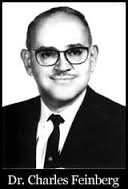
About Chales Lee Feinberg (June 12, 1909 – August 22, 1995)

Charles Lee Feiberg

Dr. Feinberg was an American biblical scholar and professor of Semitics and Old Testament. He was an authority on the Jewish history, languages and customs of the Old Testament and biblical prophecies.

Feinberg was born in Pittsburgh, Pennsylvania and raised in an Orthodox Jewish home – graduating from the Hebrew Institute of Pittsburgh and the University of Pittsburgh in preparation to be a rabbi. In 1930, he converted from Judaism to Christianity through the ministry of Chosen People Ministries. He went on to earn his Th.M. (1934) and Th.D. (1935) from Dallas Theological Seminary, his A.M. (1943) from Southern Methodist University and his Ph.D. (1945) in Archaeology and Semitic languages from Johns Hopkins University. Feinberg married Priscilla in 1935, and together they had three children (Paul, Lois and John). Paul (deceased) and John are both outstanding theologians in their own right (both professors at Trinity Evangelical Divinity School).

Charles joined the faculty of Dallas Theological Seminary as professor of Old Testament in 1934 and began radio broadcasting messages the following year. During that time, he also served as pastor of a church from 1936 to 1940. In 1948, Feinberg joined the faculty of what later become Talbot Theological Seminary, and in 1952 became its first and longest serving dean. He also served as pastor at two Los Angeles churches until 1955. In 1958, he oversaw the update to The Fundamentals, a defense of the central teachings of Christianity, and later was on the team that originally translated the New American Standard Bible.

Some of his books include: The Prophecy of Ezekiel: The Glory of the Lord; God Remembers: A Study of Zechariah; Millennialism: The Two Major Views; The Minor Prophets; Hosea: God’s Love for Israel; and Jeremiah: a Commentary.

Alva J. McClain on The Greatness of the Kingdom Part 3

PART 3: THE MEDIATORIAL KINGDOM IN THE TEACHING OF CHRIST

TGOTK McClain

[EDITOR’S NOTE: This article is the third in the series by Dr. McClain, Former President of Grace Theological Seminary, which constituted the W. H. Griffith Thomas Memorial Lectureship at Dallas Theological Seminary, November 9–12, 1954]

I have in mind here, of course, the teaching of our Lord during the historical period covered by the gospel records. In approaching this important body of material, it is possible for men to forget that the stream of history never stands still, not even in the brief time-span of our Lord’s public ministry. His teaching about the kingdom, therefore, cannot be read accurately apart from the background of the constantly changing historical situation. This principle has been rightly stressed in connection with the great expanse of Old Testament history. It is no less important in dealing with the gospel records when the very narrowness of the time increased the swiftness of the current. Hence, we shall do well, not only to heed exactly what the King has said about his kingdom, but also to give careful attention to the time when he said what he did. To neglect this principle will plunge the interpreter into misunderstanding and confusion.

It is hardly necessary to remind you that the Gospels open with the announcement of a kingdom. It is announced by angels (Luke 1:11, 26), anticipated by the Magi (Matt 2:1–6), preached by John the Baptist (Matt 3:1–3), by our Lord himself (Matt 4:17, 23) then by the twelve apostles (Matt 10:1–7), after that by the seventy (Luke 10:1–9). Several strong expressions are used to indicate the proximity of this kingdom. As to its supernatural powers, it had come upon men (Luke 11:20). As to its King, it was actually in the midst of  men (Luke 17:21). As to its complete establishment on earth, the kingdom was at hand,” that is, impending or imminent (Mark 1:15).

It has been well said that “The Gospels present Christ as king. Matthew, tracing his genealogy, gives special prominence to his royal lineage as son of David. He tells of the visit of the Magi who inquire for the newborn king of the Jews, and the scribes answer Herod’s question by showing from Micah’s prophecy that the Christ to be born in Bethlehem would be a ‘governor,’ and would rule, ‘be shepherd of my people Israel’ (2:5–6). Luke’s account of the nativity contains the declaration that the child to be born and named Jesus would occupy the throne of David and reign over the house of Jacob forever (1:32–33). In John’s account of the beginning of Christ’s ministry, one of his early disciples, Nathanael, hails him as ‘King of Israel’ (1:49). And Jesus does not repudiate the title” (Archibald M’Caig, “King, Christ as,” The International Standard Bible Encyclopaedia, III, 1802).

Relationship to Old Testament Teaching

Now the question naturally arises: What is the relation of the kingdom announced by our Lord and his disciples to that kingdom set forth by the prophets of the Old Testament? Perhaps the many answers to this question can be summarized under about four heads:

First, the Liberal view—that Christ took from the Old Testament prophets chiefly the moral and social elements, and made these the program of a kingdom which it is the responsibility of his followers to establish on earth today.

Second, the Critical view—that Jesus at first embraced fully the ideas of Old Testament prophecy, some of which were current among the Jews of his day; but later in the face of opposition he grew discouraged and changed his message. As to the nature and extent of this change the critics are not agreed.

Third, the “Spiritual” view that Christ took up certain spiritual elements from the Old Testament prophetic picture, either dropped or spiritualized the political and physical aspects, and then added some original ideas of his own.

Fourth, the Biblical view—that the kingdom proclaimed by our Lord was identical with that of the Old Testament prophets. I have named this fourth view the “Biblical” one because it is supported by the New Testament literature taken at its face value; which, by the way, is the only material anyone has on the subject. Without intending to imply that the late James Orr would have endorsed in every detail the view set forth in these lectures, it is fair to say that his words do support my central thesis: “In announcing the approaching advent of ‘the kingdom of heaven,’ Jesus had in view the very kingdom which the prophets had foretold” (James Orr, “Kingdom of God,” Hastings Dictionary of the Bible, II, 849).

That the kingdom announced by our Lord as “at hand” was identical with the kingdom of Old Testament prophecy is very evident. The name “kingdom of heaven,” so often upon the lips of Christ, seems to have been derived from Daniel 2:44 and 7:13-14.  In support of his proclamation of the kingdom, our Lord constantly appealed to the Old Testament prophets; and he characterizes two hesitant disciples as “fools” because they have failed to believe “all that the prophets have spoken” (Luke 24:25; cf. 4:18–19; 7:27; 20:41–44). The closest search of the gospel records will discover no passage in which Christ ever intimated that his conception of the kingdom was different from that of the prophets. If the prophets were wrong in any respect, how simple to say so. But there is nothing. On the contrary, from the beginning of his ministry on earth to the end of it, his evaluation of the prophetic Scriptures remains the same: “All things must be fulfilled, which were written in the law of Moses, and in the prophets, and in the Psalms, concerning me” (Luke 24:44; cf. Matt 5:17–18). Furthermore, the very events attending the appearance of the Messianic King demonstrate the identity of the two kingdoms. Consider only two examples: Micah had predicated that the One who was to be God’s “ruler in Israel” would be born in Bethlehem (5:2 ); and Zechariah saw this king riding up to the city of Jerusalem “upon an ass, even upon a colt the foal of an ass” (9:9, ASV). Do I need to remind this audience that these very things came to pass exactly as predicted, that the gospel writers were fully aware of the connection between the prophecy and the history, and that no legitimate Biblical criticism has been able to remove the passages from the literary and historical records?

Still further, in the works and teachings of Christ may be found every aspect and element of the Old Testament prophetic kingdom, although we should not expect here the fullness of detail so apparent in the prophets.

First, the kingdom announced by our Lord is basically spiritual in nature, so much so that except men repent and “be born again” they cannot enter into it (Matt 3:2; John 3:3–5).

Second, its ethical aspect is set forth especially in the Sermon on the Mount, a body of material which contains little that is absolutely new, the main ideas being found in the Old Testament at least in germ. Some of the Beatitudes are transported almost verbally (Cf. Matt 5:5 with Ps 37:11).

Third, the correction of social evils appears often in our Lord’s teaching; and in his forecast of the complete establishment of his kingdom all such evils will be sternly gathered out by supernatural agency (Matt 13:41–43).

Fourth, the ecclesiastical aspect of his kingdom is recognized when he whips the money changers out of the temple. Why not simply ignore the temple if, as some argue, God is done with the nation of Israel and the Old Testament theocratic idea? On the contrary, as the mediatorial Priest-King, Christ lays claim to the Jewish temple, citing an Old Testament prophecy of the kingdom in defense of his action, “My house shall be called a house of prayer for all nations” (Mark 11:15–17, ASV; cf. Isa 56:7–8).

Fifth, even the political aspect of the kingdom is assigned an important place in such passages as Matthew 19:28, where our Lord promises the Twelve that they “shall sit upon twelve thrones, judging the twelve tribes of Israel,” and Matthew 25 where we have his own description of himself sitting upon a throne of glory judging living nations on the earth, in accordance with the vision of Isaiah.

Sixth, as to the physical aspects of the kingdom, read the New Testament record of blind men that saw, lame that walked, deaf that heard, the lepers that were cleansed; consider also the multitudes fed by supernatural power, and the deliverances from hazards of wind and storm and violence. That not one of these elements can be omitted without distorting our Lord’s picture of the kingdom, is being admitted even by critical scholars.

If the kingdom announced as “at hand” by our Lord was merely a “spiritual kingdom,” or as some have defined it, “the rule of God in the hearts of men,” such an announcement would have had no special significance whatever, because such a kingdom of God had always been recognized among the people of God. Compare the Psalmist’s confession, “God is my king of old” (74:12). Any denial of this would certainly be a new kind of dispensationalism.

And this brings me to a passage so important that it must be quoted in full. John the Baptist is in prison liable to lose his head for rebuking the immorality of an earthly ruler; strange situation for the herald of the great King who, according to the prophets, would correct all such injustices. Did John’s faith waver? It may be so, for he sent messengers to Jesus, asking wistfully, “Art thou he that should come (ho ercomenos—The Coming One), or do we look for another?” Now the answer of Jesus to John furnishes an infallible key to the interpretation of the Old Testament prophets and also the relation of his own message to their vision of the kingdom: “Go and tell John the things which ye hear and see; the blind receive their sight, and the lame walk, the lepers are cleansed, and the deaf hear, and the dead are raised up, and the poor have good tidings preached to them” (Matt 11:2–6, ASV).  Such an answer was worth a thousand merely verbal affirmations. To John it proved that he had not been mistaken about the identity of the promised King of Old Testament prophecy. And to us it should prove what to John required no proof, namely, that when the kingdom comes it will be a literal kingdom, identical with the kingdom of the prophets.

But to this official answer sent back to John in the Roman prison, our Lord added a very special and personal word, an assurance intended to guard John’s mind against all future contingencies and doubts: “Blessed is he,” said Jesus, “Whosoever shall find no occasion of stumbling in me.” How tender and gracious! For the rising tide of Jewish opposition had already demonstrated historically that the King would be rejected and the complete establishment of his kingdom long delayed—and John must die. He walked bravely, I am sure, into the valley of the shadow with this last precious assurance from his Lord, the King.

One other point should be noticed in this connection: The fact that John and Christ began their preaching of the good news of the kingdom with no formal explanation of its character indicates an assumption that their audiences would understand what kingdom was being announced. Why this assumption? The answer should be obvious: Israel had the prophets, read and taught in every synagogue. If the conception of our Lord had differed from the prophets, then a formal definition was essential at the very beginning. But there is nothing of this kind. This lack of more definite explanation has caused speculation and disagreement, when it should have sent us to the Old Testament.

Perhaps I should guard what has been said, by explaining that while our Lord follows closely the Old Testament prophetic pattern, there is no mere slavish repetition of words, phrases and texts. Rather he unfolds and interprets the utterances of the prophets, so that meanings become deeper and richer. Furthermore, it is quite evident that he did emphasize the spiritual and ethical aspects of the Old Testament vision, not only because these things were important in themselves, but also because the Jewish teachers had neglected them and were concentrating largely upon the political and national aspects. And like all true preachers of the Word, our Lord fought many of his battles over neglected truth. Today, were he standing in some pulpits, he might stress the other side.

Contingent Character of the Kingdom

In his own teaching, Christ and the kingdom which he proclaimed were inseparably connected. The kingdom was “at hand” because the King was present. Without the King there could be no kingdom on earth as it is in heaven. To reject the King would be to reject the kingdom. And this brings us to a most significant fact, namely that the good news of the kingdom was announced to Israel alone. Even down to the work of the Seventy, the disciples were expressly forbidden to enter into any “way of the Gentiles” or “any city of the Samaritans” (Matt 10:5). More than one interpreter has had trouble  with that dictum of Christ: “I am not sent but unto the lost sheep of the house of Israel” (Matt 15:24). The most satisfactory explanation of the problem is to see, what our Lord saw clearly, the contingent nature of his announcement of the kingdom as “at hand.” To put the matter in a sentence: the immediate establishment of his kingdom was contingent upon the attitude of the nation of Israel, to whom pertained the divine promises and covenants (Rom 9:4). Not that the favor of God would terminate upon this nation, but rather that through them all the blessings of the mediatorial kingdom would flow to the world of nations.

That our Lord understood the contingent nature of his kingdom proclamation is clear from his evaluation of John the Baptist and his career. Every intelligent Jew knew that the final word of the final Old Testament prophet predicted the appearance of Elijah as the precursor of the established kingdom (Mal 4:5–6). And Christ declared concerning John the Baptist, “If ye are willing to receive him, this is Elijah, that is to come” (Matt 11:14, ASV margin). Still later, when historical events have demonstrated the certainty of his rejection and death at the hands of the Jewish nation, our Lord again refers to John; but now the historical situation has changed, and the die is cast. “Elijah indeed cometh, and shall restore all things,” he assures his disciples; but then he quickly adds, “I say unto you that Elijah is come already, and they knew him not” (Matt 17:11–12 ASV).  We have here a key to one of the most puzzling problems of New Testament eschatology in relation to the kingdom: How could the kingdom be “at hand,” and yet not near at hand? (Mark 1:15 with Luke 19:11). The answer is to be found in the word “contingency.” The very first announcement of the kingdom as “at hand” also called upon the nation of Israel to make a decision (Mark 1:15), a genuine decision, a moral and spiritual decision, and they made it; tragically the wrong way. The fact that all this was “by the determinate counsel and foreknowledge of God” does not in the least detract from its moral reality. Those who fail to see this can make nothing out of certain portions of our Lord’s prophetic teaching.

It should be clearly understood, however, that when I speak of “contingency” I refer to the human aspect of history. Certainly our Lord was not caught by surprise. There are evidences in his earliest teaching (recalled and recorded by the latest gospel writer, as we might expect, knowing the historical sequence) which indicate at least a veiled reference to his rejection and death (John 2:18–22; 3:14). Moreover his ministry met with opposition from the very beginning (Luke 4:28–29); even his popularity with the common people was only sporadic (Cf. John 6). This tide of opposition grew steadily to a definite crisis, and can easily be traced in the record of the gospels. The crisis is reached when his miraculous credentials are not only denied validity, but are actually attributed to the powers of the evil one (Matt 12:24–32). Not long afterward, having gathered his disciples about him, and having heard their adverse reports as to the public reaction toward his claims, there is a sharply defined turning point in his ministry: “From that time forth began Jesus to shew unto his disciples, how that he must…suffer…and be killed…and be raised again” (Matt 16:21).

Kingdom Teaching in the Light of Rejection

We come now to a large and important body of material which may be termed his preparatory teaching in view of the historical certainly of his rejection by the nation of Israel. He outlines in a remarkable series of parables the future of the kingdom in the peculiar form (hitherto unrevealed) which it will assume during the temporary period of Israel’s rejection. And the parabolic method of teaching at this particular point, according to our Lord, is a divine judgment upon a people who have rejected a simple method of teaching (Matt 13:10–15). (How any expositor could miss this clearly stated fact might also be well called a “mystery”). Furthermore, Christ now for the first time announces the building of a new thing, the church, something wholly unforeseen by the Old Testament prophets (Matt 16:13–18). At the same time, in the clearest terms he assures his followers that the kingdom has not been abandoned, but that its establishment on earth is only deferred; and he carefully prepares them for the delay which will ensue before its ultimate establishment. While on their way to Jerusalem, because the disciples still “thought that the kingdom of God should immediately appear,” he outlined the course of future events in a parable: A nobleman goes into a far country; there he receives a kingdom; then he returns; reckons with his servants who have been put to work during his absence; and suppresses by judgment all the “citizens” who had hated him and rebelled against his authority and rule (Luke 19:11–27). This is the divine program, according to the rejected king, who now unfolds it in perfect correlation with the movement of history. The disciples are not to be disturbed about the changing situation; they shall yet have a part in the coming kingdom, sitting on “thrones judging the twelve tribes of Israel” (Matt 19:27–28; Luke 22:28–30).

In the face of the now historically certain rejection, our Lord leaves nothing undone in the prophetic program, but goes up to Jerusalem to offer himself as the Messianic king finally and officially in accordance with Old Testament prophecy (Luke 19:28–44). The triumphal entry, celebrated by Christendom for the most part without understanding, was an event of tremendous import, fulfilling to the very day the greatest time-prediction of the Old Testament (Dan 9:25).  Weeping over the city in divine compassion, because its people knew not the “time” of their “visitation,” our Lord turns to his disciples and privately unfolds the prophetic program more fully, revealing the parenthesis of time which will intervene before his return to establish the kingdom, but leaving its length undetermined for reasons which will appear later. In the record by Luke (21:10–27) the present era is clearly marked out and isolated from the “fearful sights and great signs” of the end; its beginning being indicated by the words, “But before all these” (v. 12), and its scope and close by the words, “Until the times of the Gentiles be fulfilled” (v. 24).

It becomes necessary also for our Lord to forewarn his disciples of changing conditions which they will soon be facing: In his personal presence and under his immediate supervision they had been sent out with neither scrip nor purse and they had lacked nothing, but now when they go some material provision should be made: “He that hath a purse, let him take it.” (Luke 22:35, 36). The supernatural effects in the physical realm, properly associated with the kingdom, will recede into the background during the era of the church. This will not mean an end of the supernatural, but rather that its operation will be largely behind the veil of divine providential control. Those who in the future kingdom shall be “first” must now for a time be satisfied to be “last”; and those who by every law of the kingdom should live must understand that now persecution and death by the hands of wicked men will often be their portion (Luke 21:12–19).

The Lord also now reveals more completely the various details related to his second coming and the kingdom (Matt 24:27—25:46). In this part of the gospel records there is a great wealth of material which must be passed over, except to say that believers are to be “faithful” during the King’s absence, watching for his return, and prepared to render an account of their stewardship at his coming.

One of the most striking facts about the career of our Lord upon earth is that during the death trials he continued calmly to urge, more clearly than ever before, his claim to be the mediatorial King of Old Testament prophecy. Before the Sanhedrin, before Pilate, his testimony is unwavering.

Consider, first, his examination by the Sanhedrin, where the charge was primarily religious in nature. Angered by his silence under accusation by false witnesses, the high priest placed him under a solemn oath to answer whether or not he was “the Christ, the Son of God.” While the law of the formal oath (Lev 5:1) doubtless required our Lord to break his silence, there was something at issue greater than this, which was his identity as the mediatorial King of Old Testament prophecy. And thus his answer to the high priest becomes memorable: Thou hast said (Matt 26:64). This was not an evasion, as the ordinary English reader might suppose, but definitely “a Greek affirmative,” as A. T. Robertson has well said. Mark records it simply, “I am” (14:62). But the simple affirmation was not enough at a time like this. What is the evidence that his affirmation is true? His answer is: “Hereafter shall ye see the Son of Man sitting on the right hand of (the) power, and coming in the clouds of heaven.” The unmistakable reference was to a pair of the greatest kingdom prophecies of the Old Testament, Psalm 110:1 and Daniel 7:13, and Christ applied them to himself. Bruce has paraphrased in striking fashion the answer of the Lord to his Sanhedrin judges: ”The time is coming when you and I shall change places; I then the Judge; you the prisoners at the bar” (A. B. Bruce, “The Gospel of Matthew,” Expositors Greek New Testament, I, 320). The high priest, better schooled than some theologians, understood his claim, rent his clothing judicially, and called upon his fellow judges to pronounce him “guilty of death” (Matt 26:65). The action of the great Jewish council, dramatic as it seemed under the circumstances, was only a tardy judicial ratification of a tragic decision which had already become a fact of history.

Let us come now to the examination before Pilate the Roman governor. The charge here was political, and was so intended by the Jews who made it: “We found this fellow perverting the nation, and forbidding to give tribute to Caesar, saying that he himself is Christ a king” (Luke 23:2). Now, however contemptuous Pilate may have been with the technicalities of Jewish religion, he could not ignore the political charge. Knowing this, the Jewish leaders were not slow to press their advantage: “If thou let this man go, thou are not Caesar’s friend; whosoever maketh himself a king speaketh against Caesar” (John 19:12). There are some interpreters who argue that this charge was a total misrepresentation of the true nature of the Messianic kingdom, and that our Lord’s answer to Pilate proves that his kingdom was wholly a “spiritual” matter, having no political or material implications whatsoever. It is passing strange that men have not seen the utter folly of trying to erect an adequate definition of our Lord’s kingdom based in large part on a brief conversation between him and a cynical Roman governor who knew nothing about the kingdom of God, and cared less. But what are the facts? In the record of John’s Gospel, the examination consists of three questions by Pilate and three responses on the part of Christ (18:33–38 ).

The first question was, “Art thou the King of the Jews?” (v. 33). Our Lord’s reply to this is a question of his own: “Sayest thou this thing of thyself, or did others tell it thee of me?” (v. 34). The purpose of this question was not to gain information—Christ certainly knew the identity of his accusers—but rather by this means to clarify the exact meaning of Pilate’s inquiry so that it could be answered intelligibly. If the source of the charge was Pilate, then it would be entirely political and nothing more. In that case the Lord’s answer would be, No, I am not a king in that narrow sense of the term. But on the other hand, if Pilate is voicing a charge made by “others,” that is, by the Jewish people; then the question is wholly different and must be answered differently. A charge of regal claims on the part of Jesus, if originated by the Jewish leaders, would carry with it all the implications of the Old Testament mediatorial kingdom; and would have to be answered accordingly.

We come now to the second question: “Am I a Jew? Thine own nation and the chief priests have delivered thee unto me; what hast thou done?” (v. 35). Thus Pilate scornfully disclaims any and all responsibility for the charge, and the way is cleared for our Lord’s reply to the original question. The first part of his reply is wholly negative: “My kingdom is not of this world” (v. 36). The preposition is “ek,” indicating source or originating cause. His kingdom does not originate in the present kosmos or world system. As concrete evidence of this negative proposition, our Lord refers Pilate to the actual situation before his eyes: “If my kingdom were of this world, then would my servants  fight” (v. 36). This was something that Pilate could understand: a “king” with no military support, and who actually had to be protected from physical violence on the part of his own subjects, could give no possible concern to the politically realistic Pilate.

This brings us to the third question of Pilate. He has satisfied himself that there is no political danger in the strange figure before him—a little later he will actually write over his head, “This is the King of the Jews”—but just now he is mildly intrigued by the notion of a kingdom without any armed legions to support it; and so he asks of Jesus, “Art thou a king then?” (John 18:37). The answer of our Lord is without equivocation: “Thou sayest that I am a king,” or “Thou sayest it because I am a king.”  (So Alford, Ellicott, Robertson, and others).

Marcus Dods thinks we “must” render it, Thou art right, for a king am I.” (Marcus Dods, “The Gospel of John,” Expositors Greek New Testament, I, 852). That this is the proper meaning is made certain by the words which follow: “To this end have I been born, and to this end am I come into the world, that I should bear witness unto the truth” (v. 37, ASV). To this, Pilate has no answer, except to drop his cynical, “What is truth?” as he left the hall of judgment, tragically unaware that he had been in the presence of the King who is the God of all truth.

Now to deduce from this brief exchange between Pilate and Jesus the sweeping proposition that the Messianic kingdom is exclusively a kingdom of love and truth, which will never employ force in dealing with sinful men upon earth, is certainly theological conjecture at its worst. The Old Testament prophets had agreed that Messiah would rule over the nations “with a rod of iron,” and this was confirmed by the King himself in the days of his flesh (Luke 19:14, 27); but the force used will be that of divine omnipotence, not the force of human armies. In that remarkable vision of the coming of the King from heaven to establish his kingdom on the earth, John says that “the armies which are in heaven followed him” (Rev 19:11–14). Strange armies they are, bearing no weapons, and striking no blows. For it is the “sharp sword” of the King himself which strikes the enemy and wins the victory—”which sword proceeded out of his mouth” (Rev 19:21). That there is in the God of heaven a spiritual power which can produce political and physical effects on earth was clearly affirmed by our Lord in his final word to Pilate, “Thou couldest have no power at all against me, except it were given thee from above” (John 19:11). Is it necessary for us to argue as to the nature of this “power” which our Lord says had been “given” to Pilate “from above”? Surely, in no sense was it “spiritual,” but clearly political and nothing else. And the inference is compelling: If this power from above can make itself manifest on earth in the political career of a Pilate, on what ground of either reason or revelation can anyone deny the possibility of its greater exercise through the perfect mediatorial King and his saints when he comes down to earth again?

Our Lord’s consciousness of his own regal person and authority never wavered, but only grew the stronger as he passed through the judgment of Calvary. Even there, suffering the agonies of crucifixion, he exercised the royal prerogatives which he claimed, by throwing open the doors of Paradise to a poor thief who prayed in his extremity, perhaps as only a Jew might have prayed, “Lord, remember me when thou comest into thy kingdom” (Luke 23:39–43).

In closing this part of the discussion, a question might well be raised: Why was the Lord Jesus Christ rejected by the nation of Israel when he offered himself and the kingdom for which they had long waited and prayed? I suggest at least six reasons, without pretending at all that these add up to a total answer:

First, the high spiritual requirements our Lord laid down as essential for entrance into the kingdom (Mark 1:15; John 3:3–5; Luke 18:15–17).

Second, his refusal to establish a kingdom merely social and political in character (Luke 12:13–30; John 6:5–15).

Third, his denunciation of the current religion with its traditionalism, legalism, and ritualism (Luke 11:37–54).

Fourth, his scathing arraignment of the ruling classes (Matt 23).

Fifth, his association with “sinners” (Luke 15:1–2; Matt 9:10–13).

Sixth, his exalted claims for himself (John 5:16–18; 10:24–33; 18:7). This last, however, would have been no stumbling block if Christ had given them their own fleshly desires. The world will deify any leader who will give them enough “bread and circuses.” But they will reject the true God if He asks them to receive what they do not want.

In this connection we should not make the mistake of blaming all this on the ruling classes in Israel. Luke speaks of three classes of men whose voices were united in the demand for the rejection and death of the King; the rulers,” the priests,” and the people (Luke 23:13–23). It was, shall we say, a combination of civil, religious and democratic authority. And the “people” here could not have been merely a “street mob,” for it was the Passover season, and leading Jews from all over the known world were present in the city. The name of Jesus had been on every lip. These happenings were not done in a corner (Acts 26:26).

One curious twist in the situation was that the “people” seemed to be sympathetic almost to the last moment (Luke 19:48—20:8; 20:19–26; 21:37—22:2). But suddenly the temper of the crowd changes. Matthew says that the chief priests and elders “persuaded the multitude” to ask Pilate for the release of Barabbas and the execution of Jesus (27:20). What arguments were used by these leaders, we are not told. But doubtless their arguments would have had something to do with the main charge laid before the Roman governor, and that was political, namely, that Jesus had forbidden the paying of tribute to Caesar, “saying that he himself is Christ a king” (Luke 23:2). Certainly the Jewish people here could have had no bias in favor of the Caesars; in fact, they would have welcomed with open arms any king who could deliver them from the tribute and bondage of Rome. And there had been a time when, impressed by our Lord’s supernatural power, they had been ready to take him by force and make him king. But now they see him, where he had never been before, apparently helpless in the hands of the Roman authorities. Does anyone suppose that the astute and highly intelligent Jewish leaders would fail to exploit the situation to their own advantage with the crowd? How easy now to point out the appalling incongruity before their eyes—the King of the Jews and a Crown of Thorns! Did the applause of the people, disappointed in their “hero,” turn swiftly into vicious anger? If so, nothing could have been more plausible psychologically. History has shown that the disappointment of the “people” can become at times a very terrible and violent thing.

 Article above adapted from BSac 112:447 (JULY 1955), pp. 210-225.
 About Alva J. McClain (1888-1968)

Alva J. McClain

Alva J. McClain, the founder and first president of Grace Theological Seminary and Grace College, was born in Iowa and later grew up in Sunnyside, Washington. Shortly after his marriage to Josephine Gingrich in 1911, he and his wife were saved under the preaching of Dr. L.S. Bauman. He had been attending the University of Washington, but removed to Los Angeles, where he attended the Bible Institute of Los Angeles and sat under the teaching of Dr. R.A. Torrey.

Upon graduating from Biola, he enrolled in Xenia Theological Seminary and completed work for the B.D. and Th.M. degrees–following which he was called to the First Brethren Church of Philadelphia, where he served from 1918 to 1923. During the pastorate he taught at the Philadelphia School of the Bible. Because of ill health, he resigned and removed to California, where he finished his work for the A.B. degree at Occidental College, graduating as valedictorian. Later he was awarded the honorary degree of LL.D. at Bob Jones University, and the D.D. degree at the Bible Institute of Los Angeles.

In 1925 and 1926, he served as professor of Bible at Ashland College. In 1927-1929 he taught Christian theology at the Bible Institute of Los Angeles. In 1930, the first graduate school of theology in the Brethren Church was organized at Ashland College under his leadership, where he served as its first academic dean and professor of Christian theology.

In 1937 Grace Theological Seminary was organized under his direction, and as first president and professor of Christian theology, he served from 1937 to 1962. Dr. McClain authored many short treatises, but will be remembered for his monumental work on Christian theology, The Greatness of the Kingdom, one of seven volumes he had projected concerning the entire scope of Christian faith. He will long be remembered as scholar, theologian, educator, master teacher, and Christian gentleman.

James Montgomery Boice on “The Return of Jesus Christ”

An Exposition of Matthew 24:29–35

TTOTK Matthew 18-28 Boice

“Immediately after the distress of those days ‘the sun will be darkened, and the moon will not give its light;the stars will fall from the sky, and the heavenly bodies will be shaken.’

“At that time the sign of the Son of Man will appear in the sky, and all the nations of the earth will mourn. They will see the Son of Man coming on the clouds of the sky, with power and great glory. And he will send his angels with a loud trumpet call, and they will gather his elect from the four winds, from one end of the heavens to the other.

“Now learn this lesson from the fig tree: As soon as its twigs get tender and its leaves come out, you know that summer is near. Even so, when you see all these things, you know that it is near, right at the door. I tell you the truth, this generation will certainly not pass away until all these things have happened. Heaven and earth will pass away, but my words will never pass away.”

I do not think there is any great difficulty understanding what Jesus says in the Olivet Discourse up to verse 28 of chapter 24. He has warned the disciples about disruptive world events that will not be signs of his return, and he has predicted the fall of Jerusalem, which, though an exceptionally traumatic event, would be merely another example of the kind of tragedies that will occur throughout history. But the easy part is over. Now we come to the part of the discourse that has given the most trouble to Bible students and commentators.

Was Jesus Mistaken?

The difficulties mostly have to do with timing. Jesus has spoken of the destruction of Jerusalem, which occurred in a.d. 70 by the Roman armies under the command of Titus. But then he continues, “Immediately after the distress of those days ‘the sun will be darkened, and the moon will not give its light; the stars will fall from the sky, and the heavenly bodies will be shaken’ ” (v. 29). This could refer to something in the future, but if that is the case, why did Jesus use the word immediately, as in “immediately after the distress of those days”? Immediately should mean close in time to the destruction of Jerusalem. But if these portents are tied to the destruction of Jerusalem, we must admit candidly that they do not seem to have happened.

Nor is that all. The next verses begin “at that time” and go on to describe how the Son of Man will come in the clouds, with power and great glory, accompanied by the blast of a trumpet and the appearance of angels to gather the elect from the far corners of the earth. Again, that could be future. Most people have assumed it is. But if that is the case, why does Jesus say, “at that time”? And if he meant what he said, that he would return at the time of or soon after the destruction of Jerusalem, what he predicted did not happen.

We have a nearly identical problem in verse 33, where Jesus says, “When you see all these things, you know that it is near, right at the door.” His second coming cannot be the sign of itself. “These things” must refer to things that will precede his return. But what can they be? If they are the tragedies leading up to the fall of Jerusalem, the second coming of the Lord did not follow those events, and Jesus would seem to have been mistaken.

The most apparent and (for some) the worst problem of all is Jesus’ solemn affirmation: “I tell you the truth, this generation will certainly not pass away until all these things have happened” (v. 34). What can “this generation” be but the generation then living? Yet if that is what the words mean, Jesus must have been wrong, since many generations have come and gone since that time and Jesus has still not returned. The acclaimed English philosopher and social critic Bertrand Russell said Jesus’ teaching about his return was one reason why he could not be a Christian. “He certainly thought that his second coming would occur in clouds of glory before the death of all the people who were living at that time,” wrote Russell. But he added, “In that respect, clearly he was not so wise as some other people have been, and he was certainly not superlatively wise.”  (Bertrand Russell, Why I Am Not a Christian: And Other Essays on Religion and Related Subjects, ed. Paul Edwards [New York: Simon & Schuster, 1957], 16–17).

Attempts at a Solution

There are two easy ways to solve these problems, but they have not been accepted by all commentators.

First, we can place all these events together at one point in time and locate that point at the end of history. One advantage of this view is that we can take the time references literally. The fall of Jerusalem, the signs in the sky, and the return of Jesus occur in tight chronological sequence. All are yet future, and the fall of Jerusalem fits events outlined in other biblical books such as Revelation. This is an understanding common among dispensationalists, for whom the distress of Jerusalem is linked to the great tribulation and precedes the battle of Armageddon and the subsequent reign of Jesus Christ on earth for a thousand years, the millennium. In this view, “this generation” refers to the generation living at the time of the final attack on Jerusalem or is understood to mean “this race,” meaning that the Jews will not cease to exist as a race until this happens.

The main reason many people have not been persuaded by this handling of the details of Matthew 24 is that they believe verses 15–22 describe the destruction of Jerusalem by the Romans in a.d. 70. But they also have a problem with “this generation.” Most commentators believe this can hardly mean anything other than the generation living at the time Jesus spoke these words.

The other easy way to solve the problem of the time references in Matthew 24 is to put these events together but to place them in the first Christian century in connection with the fall of Jerusalem to the Romans. In this view, the coming of Christ mentioned in verses 30 and 31 refers to his return in judgment on Jerusalem, and the signs of his coming are understood as Old Testament images of historical but earthshaking events. The “end of the age” (v. 3) means the end of the Jewish age, which is followed by the age of the church. This means that nearly everything in Matthew 24 and 25 is about God’s judgment on Jerusalem, even Jesus’ strong, reiterated warnings to watch and be ready for his return. The same is true for nearly the whole of the Book of Revelation. This view is known as preterism, which means “what has already taken place.” Preterism has been affirmed recently in a guarded way by R. C. Sproul, but it has a history of defenders going back quite a few years. One early proponent is J. Stuart Russell, on whose work Sproul largely depends (R. C. Sproul, The Last Days according to Jesus [Grand Rapids: Baker, 1998]; J. Stuart Russell, The Parousia: A Study of the New Testament Doctrine of Our Lord’s Second Coming [Grand Rapids: Baker, 1983]).

Why hasn’t everyone accepted this view? One obvious reason is that it is difficult to see how Christ’s coming on the clouds, with power and great glory, with the angels gathering his elect from the far corners of the earth, was fulfilled at the time of the destruction of Jerusalem.

There is this problem too—probably the most significant of all. If everything (or nearly everything) in these chapters is about the fall of Jerusalem, then the disciples’ question about the end of the age is not really answered, at least not as almost anyone, including the disciples, would have understood it. The chapters most Christians have always looked to for assurance of the Lord’s return and encouragement to be ready and watch for it are not about the Lord’s future return at all. In fact, Jesus has virtually nothing to say about his second coming. Nor do any of the other biblical writers, including the author of Revelation.

The Flow of the Chapter

How do we solve these difficulties? History suggests that we probably cannot, at least not to everyone’s satisfaction, since disagreements about this chapter have existed throughout church history. But let me try anyway, starting with the flow of thought in the chapter.

Verse 3. As I pointed out in the last study, Matthew 24 begins with the disciples’ two important questions: (1) “When will this happen?” and (2) “What will be the sign of your coming and of the end of the age?” (v. 3). The first question was about the destruction of Jerusalem, which Jesus had predicted, and the second was about his glorious return, which he had also predicted—two events, though the disciples probably held them together in their minds. Jesus began by answering the second: “What will be the sign of your coming and of the end of the age?”

Verses 4–14. The first thing he told them is that there will be many earth-shaking events that might be thought of as signs, but they will not be. The disciples were not to be troubled by them. They will include false messiahs, wars and rumors of wars, famines and earthquakes, persecutions, apostasy, and false prophets. These are “the beginnings of birth pains” (v. 8), but they are not signs of his return. This is because the gospel of the kingdom must be preached in the whole world before the end will come.

Verses 15–22. The next point Jesus makes is that there is going to be one particularly dreadful event, the destruction of Jerusalem, but even this will not be a sign of his return. The disciples should flee the city when they see these things beginning to happen, but this is still not the end.

Verses 23–28. At this point Jesus makes clear that the destruction of Jerusalem is only one example of the bad things that will happen to people in the course of world history. He does so by returning to what he said earlier about false messiahs. They will appear at this time, as at other times. They will not be true messiahs, and the disciples are not to be taken in by them. How will the disciples know that these pretenders are not the true Messiah? By the fact that they will appear in secret (“in the desert” or “in the inner rooms”), while Jesus’ appearance will be sudden, unannounced, and immediately visible to all, just like lightning that flashes suddenly and is seen at once by everyone.

Verses 29–35. This leads to Jesus’ specific teaching about the second coming. There will be signs in the sky, including “the sign of the Son of Man” (whatever that may be), a loud trumpet call, and the work of angels in gathering the elect from the far reaches of the earth. But the point of these “signs” is not that they will precede Jesus’ coming, as if they will be given to enable people to see them and get ready. On the contrary, they will coincide with Christ’s coming and will be sudden. If a person is not ready beforehand, there will be nothing he or she will be able to do when Jesus actually returns. Such a person will be lost.

Verses 36–51. In the last section of the chapter, Jesus stresses the suddenness of his return by a historical reference and several images. His coming will be like the flood in the days of Noah, or like a thief that enters a house at an unexpected time, or a master who suddenly returns home. Jesus’ servants must be ready since “the master of that servant will come on a day when he does not expect him and at an hour he is not aware of” (v. 50).

The Difficult Time References

So far so good. But what about the time references, the problem that has led some commentators to the dispensational or preterist positions? I would argue that these must be fitted to the other statements, namely, that distressful times are not signs of Christ’s second coming and that his coming will be so unexpected that no one, not even the angels in heaven nor Jesus himself, can say when it will be. Let’s take the references one at a time.

1. What do we do with the words “immediately after the distress of those days” (v. 29)? The answer is that “the distress of those days” must refer to all the many distressful times throughout history, though perhaps culminating in a time of unusual distress just prior to the Lord’s return. Certainly the earlier statements about false Christs, false prophets, and apostasy support what other Bible writers have to say about the end of history. In fact, when we read passages such as 2 Peter 3:3–13, we hear deliberate echoes of what Jesus taught in Matthew. And why not? It was from Jesus that Peter and the other writers learned it.

What about the sun being darkened, the moon failing to give light, and the stars falling from heaven? Although preterists rightly point out that this is common Old Testament imagery for any cataclysmic historical event—drawn from texts such as Isaiah 13:9–10; Ezekiel 32:7–8; Joel 2:30, 31; 3:15; Amos 8:9—it is also the case that words such as these occur in New Testament passages where they are clearly associated with Christ’s coming at the end of the age. D. A. Carson cites as examples texts such as Matthew 13:40–41; 16:27; 25:31; 1 Corinthians 15:52; 1 Thessalonians 4:14–17; 2 Thessalonians 1:7; 2:1–8; 2 Peter 3:10–12; Revelation 1:7 (D. A. Carson, “Matthew,” in The Expositor’s Bible Commentary, vol. 8, Matthew, Mark, Luke [Grand Rapids: Zondervan, 1984], 493).

Moreover, in the parallel passage in Luke 21, the reference to the sun, moon, and stars is prefaced by the prediction that “Jerusalem will be trampled on by the Gentiles until the times of the Gentiles are fulfilled” (v. 24). That must refer to the Gentile domination of Jerusalem from the time of its fall until at least the present age. But it is only after this that Jesus says he will appear the second time. Paul expresses similar ideas about the Gentile age in Romans 11:11–25.

2. “At that time the sign of the Son of Man will appear in the sky” (v. 30). I haven’t the faintest idea what the sign of the Son of Man is, nor should I. That is something only those who actually see it will know. But if what I have said about the word immediately is correct, this particular time reference is not difficult. It simply links the actual appearance of Jesus to the astronomical irregularities described in verse 29. At the end of the times of distress, which is all of human history, the sun, moon, and stars will be darkened, and at that time Jesus will appear in heaven with his holy angels. That is when the angels will gather the elect.

3. “When you see all these things” and “this generation will certainly not pass away until all these things have happened” (vv. 33–34). These two references go together because they are part of the same paragraph and occur one right after the other. There is a slight change of tone with verse 32. Jesus has spoken of his sudden return in glory, but now he is giving a lesson for those who will be living in the period between his first coming and his second. They are to learn from the fig tree, which signals summer by developing tender twigs and by putting out leaves. “All these things” are compared to those tender twigs and leaves, which means that the distressful things of verses 2–28 show that the Lord’s return is imminent, which it always is!

What about “this generation”? In this view it really is the generation living at the time Christ spoke these words, because that generation actually did see “all these things.”

(NOTE: There are three ways to understand “this generation.”

(1) It can be the generation then living, which is what I maintain.

(2) It might refer to the Jews or to “this kind of people,” the view of most dispensationalists.

(3) Or it can refer to the generation living at the end of history. John Broadus, like most modern commentators, argues that it must refer to the people living in Jesus’ day, though he still regards verses 29–31 as referring to the final, second coming of Christ. “All the things predicted in vv. 4–31 would occur before or in immediate connection with the destruction of Jerusalem. But like events might again occur in connection with another and greater coming of the Lord, and such seems evidently to be his meaning” (John A. Broadus, Commentary on Matthew [Grand Rapids: Kregel, 1990], 492).

William Hendriksen regards “this generation” as the Jews, and one reason he gives is that “things that will take place” are things spread out over the centuries, such as the preaching of the gospel throughout the whole world. The following section, which clearly describes the final return of Jesus, picks up on the coming in verses 29–31; hence, Jesus must be talking about a generation living at least at that time (William Hendriksen, New Testament Commentary: Exposition of the Gospel according to Matthew [Grand Rapids: Baker, 1985], 868–69).

They knew of many false Christs, heard of wars and rumors of wars, experienced famines and earthquakes, witnessed apostasy, and heard of false prophets. So has every generation since. Therefore, we have all seen everything we need to see or can see prior to Jesus’ return. We have nothing to look forward to except the second coming. The bottom line of this is that we need to be ready, because “no one knows about that day or hour” when the Lord will come (v. 36).

The Lessons to Be Drawn

Let me go back and review the lessons we should draw from the first thirty-five verses of Matthew 24. The coming of Christ and the end of the world are imminent, meaning that they can occur at any moment. Therefore, our present responsibilities must be:

1. To watch out that no one deceives us (vv. 4, 26). Jesus has a great deal to say about deception in this discourse. In fact, having warned against false Christs at the very beginning of the chapter, he returns to this same point after speaking of the fall of Jerusalem, saying, “If anyone says to you, ‘Look, here is the Christ!’ or ‘There he is!’ do not believe it. For false Christs and false prophets will appear and perform great signs and miracles to deceive even the elect—if that were possible” (vv. 23–24). He repeats this again in verse 26, where he warns against expecting to find the Christ “out in the desert” or “in the inner rooms.”

It would be possible to write a history of the church in terms of the errors that have been foisted upon it, sometimes from without but more often from within, and of how believers have either resisted such errors or have been taken in by them. We have deceivers today, but we are warned here not to be fooled by them.

2. To be settled even in times of war or threats of war (v. 6). This warning includes all political and historical events and is a reminder that the city of God is distinct from man’s city and will survive regardless of what happens in the world. We are not to be unduly encouraged by political events, nor unduly frightened by them. Charles Colson once wisely reminded the delegates to one of the Christian Booksellers conventions after the president of the United States had spoken and they were cheering wildly, “We must remember that the kingdom of God does not arrive on Air Force One.”

3. To stand firm to the end (v. 13). We speak of the perseverance of the saints, meaning that God perseveres with his people so that none of those he has elected to salvation will be lost. Jesus taught this clearly in John 10, saying, “My sheep listen to my voice; I know them, and they follow me. I give them eternal life, and they shall never perish; no one can snatch them out of my hand” (vv. 27–28). But while it is true that God perseveres with us, it is also true that we must persevere. That is what Jesus is speaking of here. He is encouraging us to keep on keeping on, since there is no promise of salvation for those who abandon the faith or deny Christ.

The apostle Paul certainly believed in and taught the security of every genuine believer, but he also wrote, “If we endure, we will also reign with him. If we disown him, he will also disown us” (2 Tim. 2:12). Those words seem to have been based on Jesus’ teaching in Matthew 10:32–33.

4. To preach the gospel throughout the world (v. 14). This is the chief task of the church in the present age. The followers of Christ will be persecuted, and the love of many will grow cold. But throughout the ages of church history, however long they may be, Christians must be strong, faithful, and determined in the task of carrying the gospel to the lost. In fact, this is the note on which the Gospel ends. Jesus’ last words to his disciples were, “Therefore go and make disciples of all nations, baptizing them in the name of the Father and of the Son and of the Holy Spirit, and teaching them to obey everything I have commanded you. And surely I am with you always, to the very end of the age” (Matt. 28:19–20).

As we read this chapter, rather than wondering about the specific moment when Jesus will return, we should be asking ourselves if we are ready for it, whenever it might be. The next section of the chapter warns us to be ready precisely because we do not know the time of Jesus’ return.

About the Author

Boice JM in pulpit

James Montgomery Boice, Th.D., (July 7, 1938 – June 15, 2000) was a Reformed theologian, Bible teacher, and pastor of Tenth Presbyterian Church in Philadelphia from 1968 until his death. He is heard on The Bible Study Hour radio broadcast and was a well-known author and speaker in evangelical and Reformed circles. He also served as Chairman of the International Council on Biblical Inerrancy for over ten years and was a founding member of the Alliance of Confessing Evangelicals.James Boice was one of my favorite Bible teachers. Thankfully – many of his books and expositions of Scripture are still in print and more are becoming available. He was one of only a handful of reformed pastor/theologians that was premillennial in his eschatology (Steven J. Lawson, John MacArthur, Erwin W. Lutzer, S. Lewis Johnson, Rodney Stordtz, John Hannah and John Piper also come to mind). The sermon above was adapted from Chapter 56 in The Gospel of Matthew: The Triumph of the King, Matthew 18-28. Grand Rapids: Baker, 2006.

Alva J. McClain on The Greatness of the Kingdom Part 2

PART 2: THE MEDIATORIAL KINGDOM IN OLD TESTAMENT PROPHECY
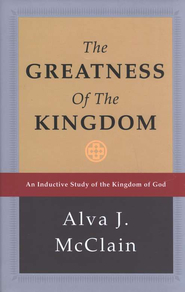
TGOTK McClain

[EDITOR’s NOTE: This article is the 2nd in the series by Dr. McClain, Former President of Grace Theological Seminary, which constituted the W. H. Griffith Thomas Memorial Lectureship at Dallas Theological Seminary, November 9–12, 1954]

Since this area which we are about to enter is in certain respects the most important one of the entire investigation, something by the way of introduction should be said regarding the nature, interpretation and extent of kingdom prophecy.

The Nature of Kingdom Prophecy

a. Viewed from one standpoint, kingdom prophecy arises out of definite historical situation existing immediately before the eyes of the prophet. There is probably no exception to this rule. Even in purely predictive prophecy, or what some have called apocalyptic prediction, although the prophet may say nothing about the immediate historical situation, it nevertheless provides the background of what he has to say about the future. There is no such thing as predictive prophecy totally unrelated to history.

b. Sometimes prophecies of the kingdom have what has been called a “double reference,” or which might be more accurately called an “apotelesmatic” character. As Delitzsch has written, “All prophecy is complex, i.e., it sees together what history outrolls as separate: and all prophecy is apotelesmatic, i.e., it sees close behind the nearest-coming, epoch-making turn in history, the summit of the end.”  That is, somewhat as a picture lacks the dimension of depth, the prophecy often lacks the dimension of time: events appear on the screen of prophecy which in their fulfillment may be widely separated in time. Thus the student may find a prophecy referring to some event in the near future connected with the historical phase of the kingdom, and also to some far off event connected with the Messiah and his millennial kingdom. When the first event arrives it becomes the earnest and divine forecast of the more distant and final event. An excellent example may be found in Isaiah 13:17—14:4, a prediction which begins with the defeat of Babylon by the Medes, and moves from that point immediately to a Babylon of the end-time. The same phenomenon may be observed in prophecies of the coming of the Messianic King, which New Testament history “outrolls” into two advents greatly separated in time. Such a view of prophecy does not mean an abandonment of its literality, as some have argued. The double prediction is literal, and is to be literally fulfilled: The Medes have destroyed historic Babylon, and God will also literally destroy a future Babylon. Christ has come once literally; and He will again break into the stream of history with no less literality.

Interpretation of Kingdom Prophecy

Without paying too much attention to individual variations, I have reduced the important methods now current to three, which I have named the literal, the eclectical, and the critical; being deeply conscious of the inadequacy of mere names. As I am in the habit of saying to my classes, you should feel at liberty to improve upon my suggestions—but be sure that yours are better than mine.

The literal method. Probably this method has never been stated better than by Ellicott: “The true and honest method of interpreting the Word of God [is] the literal, historical, and grammatical.”  This method, as its adherents have explained times without number, leaves room for all the devices and nuances of language, including the use of figure, metaphor, simile, symbol and allegory. in their criticism of this literal method, most of its critics have been guilty of a “crasser literalism” than ever used by any reputable adherent of the method in its application to the Word of God. Certainly the literal method is not without its problems, but these problems are only such as naturally arise out of the nature of human language. Basically the method is extremely simple. For example, Psalm 72:6 speaks of the Messianic King as follows: “He shall come down like rain upon the mown grass.” Here we have a literal coming—the Lord “shall come down.” Also the effect of his coming is literal, although in this case it is described by a simile—”like rain upon the mown grass.” If you have ever seen the glorious effect of a summer shower coming down on a field of grass which, has been cut, then you will have some idea of what the literal effect of our Lord’s coming will be upon a troubled world. Of course, if you wish to depart from simple common sense, you can say that in this text “grass” stands for the church at Pentecost; “mown” stands for the unsanctified state of the disciples upon that occasion; and, the “rain” stands for the gift of the Holy Spirit. Once launched on the sea of conjecture, it is not surprising that interpreters finally arrive at strange ports, as far removed from reality as the “beautiful isle of somewhere.”

In a comparatively recent book written by Oswald T. Allis under the title Prophecy and the Church, the author in the course of his anti-millennial argument makes a curious attack upon the literal method of prophetical interpretation. First he criticizes severely some premillennial writers for being more concerned about “typical interpretation” than about the Old Testament history from which the alleged types are gathered. This criticism might well be taken to heart. But then Allis goes on to complain that, “If Ruth can give ‘a foreview of the Church,’ if ‘the larger interpretation’ of the Songs of Solomon concerns the Church, why must the Church be absent from the glorious visions of Isaiah?”  Now it is hard for me to believe that the very able and intelligent writer of these words does not know exactly what he is doing, even though a careless reader might miss the point. Reduced to a simple statement, his argument is that if we premillennialists are willing to take Old Testament history typically, we should not object to the taking of Old Testament prophecy typically. “In dealing with prophecy,” Allis writes, our premillennial “treatment is marked by a literalism which refuses to recognize types.”  This seems to Allis “strikingly inconsistent” on our past.

As a matter of fact, the inconsistency is in Allis and in his fallacious argument. Our answer is as follows: First, premillennialists take both history and prophecy literally. We may indeed, within proper limits, find in history certain types and shadows of things to come, but no one among us in his right senses ever questioned the literality of the history. But what about the author of Prophecy and the Church? Well, Allis accepts the history as literal, but denies the literality of the prophecy, at least in certain areas of the Old Testament, and insists that a typical interpretation is the only one! If Allis were as willing to accept the literality of Old Testament prophecy as he is of its history, I for one would raise no serious objection if he should find some legitimate “types” in both. I would insist, however, that just as in any proper interpretation of Old Testament history Joseph is always Joseph and not Christ, even so in prophecy Israel is always Israel and never the church. This does not mean that the preacher must never take a prophecy concerning Israel and apply it to the church. But he should always know what he is talking about, and make certain that his hearers know.

There is, after all, a fundamental difference between Biblical history and prophecy which must not be overlooked. History deals with a literal event, which may or may not be a type pointing to some future event. Thus a type seems to be always prophetic in nature. As the late William G. Moorehead once wrote, “A type always prefigures something future. A Scriptural type and predictive prophecy are in substance the same, differing only in form.”  On the other hand, prophecy (predictive) deals directly with the future reality. To talk about a “typical interpretation” of prophecy, therefore, is something like saying that prophecy should be interpreted prophetically! Perhaps it would help to clear the air if we could get rid of all the adjectives, and simply use the term interpretation alone in its first and original sense, “to give the meaning of.” We could then go on from there and talk about other things, such as types and applications. This is what we mean by literal interpretation.

The eclectic method. This is sometimes called the “spiritual” method, for the reason that “spiritualizing” is its most distinctive feature. The great church father Origen is generally regarded as the originator of this method, although in his better moments he insisted on…an exact grammatical interpretation of the text as the basis of all exegesis.”  Origen was a Platonist in philosophy, which explains much in his theology. In his hands the spiritualizing method of Biblical interpretation became a useful tool in opposing the doctrine of a literal millennial rule of Christ on earth, something which no consistent Platonist could possibly accept.

The term spiritual should be rejected, I feel strongly, as a proper name for the anti-literal method of interpretation, for at least two reasons: First, the word spiritual is much too fine to be surrendered without protest for wrong uses; and second, no one of any consequence was ever known to employ the “spiritualizing” scheme consistently and exclusively. For example, Dr. Shedd speaks disparagingly of what he calls “the blooming age of Millenarianism,” and finds that this age was mainly caused by the adoption of “the literal interpretation of the Old Testament prophecies” as opposed to the spiritual method.  But it must be said to the credit of this able scholar that he himself did not use the “spiritualizing” method exclusively, not even in his approach to Old Testament prophecy. He only resorted to it under the spell of his very narrow and inadequate notions about the kingdom. At other times in his Biblical interpretations Dr. Shedd became just as literal as the “literalists” whom he criticizes. Doubtless we should thank God that not all men are logically consistent in holding their erroneous opinions. What can happen when men cut loose from literality may be seen in Gregory the Great’s exposition of the book of Job, where we learn that the partiarch’s three friends denote the heretics; his seven sons are the twelve apostles; his seven thousand sheep are God’s faithful people; and his three thousand humpbacked camels are the depraved Gentiles!

Actually therefore the anti-millenarian scheme of prophetical interpretation is eclectic, employing both the spiritualizing and literal methods.

The critical method. Adherents of this method regard the Bible for the most part as a collection of human writings setting forth the religious experiences of men in their search for God. Since it was written by men, they argue, the Bible should be treated like other books written by men. Feeling no compulsion to defend any doctrine of Biblical inspiration or infallibility, they move through the Biblical literature dropping burning matches anywhere and everywhere, regardless of what may be burned up. The one good thing in this attitude is that the Bible is permitted to speak for itself literally. If the Bible says something which to these men seems to contradict history or science, so much the worse for the Bible. They simply reject what it says. Among the more moderate members of this school of interpretation is the late A. B. Davidson, who leaves no question whatever about his attitude toward the Old Testament prophecies concerning Israel and the coming kingdom. The question of interpretation here, he argues, is a “double one.” The first question is, what did the prophets mean? “And to this question there can be one answer,” writes Davidson, “Their meaning is the literal sense of their words” (Italics are mine). The second question has to do with the fulfilment of the prophecies. Again let Davidson answer his own question in his own words: “There is no question as to the meaning of the Old Testament prophecies; the question is how far this meaning is now valid” (Italics mine – “Eschatology,” Hastings Bible Dictionary, I, 73).  Although we may regret his conclusion, at least Davidson’s candor is refreshing.

The Extent of Kingdom Prophecy

In a very real sense, all Messianic prophecy in the Old Testament is kingdom prophecy. Even those predictions which deal with Messiah’s humiliation and sufferings cannot be separated from the context of regal glory. As Archibald M’Caig has rightfully observed concerning the great prophetic period in Old Testament history, “The prophecies all more or less have a regal tint, and the coming one is preeminently the coming king” (M’Caig, “King, Christ as,” International Standard Bible Encyclopaedia, III, 1802).

Generally we may say that Old Testament prophecy of the future mediatorial kingdom of God begins with a few scattered references in the Pentateuch; opens up clearly in the records of the historical kingdom; grows in volume and brilliance as the historical kingdom declines; and comes to its close in Malachi.

This material is so extensive that no attempt can be made in these lectures to present an exhaustive list of references; nor shall I try to deal with the ideas in the order of their historical utterance. I can only set forth in very much condensed form a series of generalizations, supported by selected but representative material from the inspired text as time permits. The question before us is, therefore, What do the Old Testament prophets say about the future kingdom? Whether their conception is identical or not with the kingdom announced in the gospel records is a question to be dealt with in a later lecture.

The Literality of the Coming Kingdom

This kingdom of Old Testament prophecy is not merely an ideal kingdom like the Kantian “kingdom of ends,” something toward which man must ever strive but never attain. On the contrary, it will be as real and literal in the realm of sense experience as the historical kingdom of Israel or the kingdom of Great Britain today. All prophecy from first to last asserts and implies this literality: in such details as its ruler (Isa 33:17), its geographical location (Isa 14:1–2), its citizens (Jer 23:3–6), its capital city (Isa 2:5), the nations involved (Isa 11:11), and numerous other details which will appear in the progress of this study.

Worthy of special notice here is the fact that the prophets picture the coming kingdom as one which will destroy and supplant other kingdoms which are literal (Dan 2, 7). The divine kingdom does indeed come down from heaven, but the arena of action is on earth where the heavenly kingdom supplants literal kingdoms and functions in their stead. There is no place left for an unfilled vacuum in human history. Furthermore, the prophets insist that the coming kingdom will actually be a revival and restoration of the Old Testament kingdom of history: “the former dominion” shall be returned to the nation of Israel in the city of Jerusalem (Mic 4:1, 7, 8); the tabernacle of David, which is fallen, shall again be raised up by divine power, “as in the days of old” (Amos 9:11). In all these and a thousand other details there is the unmistakable flavor of literality.

And lest there be some misunderstanding on this point, let me say that I am not using the term literal as absolutely opposed to the term spiritual. Even spiritual things are literal; in fact, they are the most literal of all in the whole realm of reality. By literality here I mean that the prophetical details of the coming kingdom will be tangible in the world of sense experience: “Thine eyes shall see the King…they shall behold the land” (Isa 33:17); and “All flesh shall see it together” (Isa 40:5). With such words before us, therefore, we should not be too quick to criticize the literal-mindedness of the early apostles when they asked of the risen Christ, “Lord, wilt thou at this time restore again the kingdom to Israel?” (Acts 1:6).

The Future Establishment of the Kingdom

The time of its establishment, to the prophets, sometimes seems to be very near at hand: Haggai says it will come in it “a little while” (2:6–9 ); Isaiah says, “a very little while” (29:17). Yet other predictions indicate that the kingdom is far in the future, after the lapse of “many days” (Hos 3:4, 5), or in the “latter days” (Isa 2:2). Doubtless the reconciliation of these forecasts may be found in the divine mind to which our many days are only a very little while.

The establishment of the kingdom is always preceded by divine judgments. There will be world-wide military preparation and devastating wars among the nations (Joel 3:9–16; Isa 3:25—4:1): great cosmic disturbances affecting the heavenly bodies (Joel 2:30–31); a special judgment upon the nation of Israel which will attend their regathering back into the land of the promised kingdom (Ezek 20:35, 33, ASV); and also a special judgment upon the living Gentile nations, based primarily upon their treatment of Israel whom they have scattered among the nations and robbed of their silver and gold (Joel 3:1–8). Some of these divine judgments will fall upon the earth itself, causing it to “reel to and fro like a drunkard”—all this to precede that glorious day “When the Lord of hosts shall reign in mount Zion, and in Jerusalem” (Isa 24:17–23).

Thus the coming of the kingdom in established form will be a world-shaking event. Although the divine work of preparation may seem at times almost interminable, its actual establishment will not be a long and gradual process, so imperceptible at times that sceptics will be able to dispute whether there even be such a thing as a kingdom of God. On the contrary, the coming of the kingdom will be sudden, comparable only to the falling of a great stone from heaven; supernatural in its descent as a stone “cut out without hands”; and catastrophic in its immediate effects, destroying the governments of earth so completely that no trace of them can be found (see Dan 2, 7).

The Ruler of This Future Kingdom

The names and titles applied to the coming King indicate that ‘he will be both human and divine in nature. He is called “a man” (Isa 32:1, 2), one like unto a “son of man” (Dan 7:13, 14), the “son” of God (Ps 2:7), a “rod of the stem of Jesse” (Isa 11:1), a “righteous branch of David” (Jer 23:5), “God” and “the Lord Jehovah” (Isa 40:9, 10, ASV), “Wonderful, Counsellor, The mighty God, The everlasting Father, The Prince of Peace” (Isa 9:6, 7).

He will be perfect in character, wisdom and ability. The Spirit of God rests upon him in wisdom, understanding, counsel, might, knowledge, and fear of the Lord; righteousness is the girdle of his loins, and faithfulness the girdle of his reins (Isa 11:1–5). He does not win his way to power by the ordinary means of demagoguery or military force; his voice is not heard in the street and a bruised reed shall he not break; yet unlike other rulers and statesmen he “shall not fail or be discouraged till he have set judgment in the earth” (Isa 42:1–4).

But over against this clearly revealed glory, there is a deep note of mystery in the career of the coming King. He is presented in Old Testament prophecy as a man of sorrow, despised and rejected of men; wounded, bruised, afflicted and dying for the iniquities of men (Isa 53). He is the great shepherd of Israel, yet he is smitten by the sword of God, and the sheep are scattered (Zech 13:7; cf. Isa 40:9–11). He is “Messiah the Prince” of Israel, ruler of the nations, yet he is “cut off” and has nothing which belongs to his regal glory (Dan 9:25, 26).

This mysterious problem did not go altogether unnoticed by the Jewish rabbins; some thought there might be two Messiahs, one the “son of Joseph” who would die, the other the “son of David” who would reign in glory. Other Jewish scholars applied the prophecies of the suffering to the nation of Israel personified, a view favored by modern Jewish interpretation. These proposed solutions, however, seem to be deflnitely post-Christian in origin, and were motivated probably by Jewish antagonism toward the Christian interpretation of Old Testament prophecy. It is highly doubtful whether anyone, having the Old Testament Scriptures alone and with no knowledge of Christian history, could or ever did arrive at a correct solution of the problem: that is, not two Messiahs, but one Messiah with two comings separated by a vast gulf in time.

We do know, however, that the problem was given serious consideration in pre-Christian times by the Old Testament prophets themselves. These men saw clearly the sufferings and glory of Messiah; they also understood the sequence of events—the sufferings would be first, and the glory would “follow.” But the time relation between the two was an unsolved problem to the Old Testament prophets, although they searched their own inspired writings to discover “what time or what manner of time” was signified (1 Pet 1:9–11, ASV). If this time relationship was ever revealed exactly to the prophets, Scripture is wholly silent as to any such revelation. And this silence will become a fact of high importance when we come later to the gospel records and ask, Was the kingdom in any sense postponed?

The Nature of Government in the Kingdom

The Mediatorial Kingdom as set forth in Old Testament prophecy is monarchical in form. The ruler will sit upon a “throne,” and the government will be “upon his shoulder” (Isa 9:6, 7). He receives his authority and holds it by divine grant: he is God’s king, established upon his throne by God himself (Ps 2:6; Dan 7:14). His rule will be characterized by severity, but a severity based upon absolute justice and righteousness (Ps 2:7–9; Isa 11:4a). And although he will rule the nations with a rod of iron, yet with infinite tenderness he will deal with the meek and the needy, gathering the lambs in his arms and carrying them in his bosom (Isa 40:10, 11).

In its external organization, the prophets picture the kingdom with the mediatorial king at its head; associated with him are those who are called “princes” (Isa 32:1); the “saints” possess the kingdom, doubtless the saved of Old Testament days (Dan 7:18, 22, 27); the living nation of Israel is given first place of favor and authority on earth, and the nation which rebels against it will perish (Isa 60:3, 10, 12). The subjects of this kingdom will include “all people, nations, and languages” (Dan 7:14), though certain passages suggest an unwilling subjection on the part of some, a point I shall discuss later.

All the functions of government are centered in the person of the mediatorial king. The prophet Isaiah sees him and names him as “judge,” “lawgiver,” and “King”—remarkable forecast of the conventional divisions of modern government: judicial, legislative, and executive (Isa 33:22). The founding fathers of our own American government, approaching their task with a deep suspicion of human nature, designed a system of checks and balances to separate these three departments and keep any one of them from getting too much power. Although it seems clumsy, wasteful and inefficient at times, our government has provided a welcome refuge for personal liberty in such a world as this, and will continue to do so—if we can keep it. But this is not the most ideal form of government. When God’s own glorious King takes over the kingdoms of the earth, it will be safe at last to concentrate all the functions of government in one Person. This does not mean that he will do everything, but rather that he will be the directing head and final authority; thus providing a unifying center, both infinitely wise and good, for all the activities of government, something which no government on earth has ever had.

The Extent and Duration of the Kingdom

“In that day,” the prophet Zechariah declares, “The Lord shall be king over all the earth” (14:9). And the Psalmist describes the scope of his government with still greater detail, “He shall have dominion also from sea to sea, and from the River unto the ends of the earth. They that dwell in the wilderness shall bow before him; and his enemies shall lick the dust…. Yea, all kings shall fall down before him; all nations shall serve him” (72:8–11). Instead of regarding government as a necessary evil—the less of it, the better—the beneficent rule of the mediatorial kingdom will permeate and affect every department of human life: “In that day shall there be upon the bells of the horses, HOLINESS UNTO THE LORD…. Yea, every pot in Jerusalem and in Judah shall be holiness unto the Lord of hosts” (Zech 14:20–21). That artificial and popular distinction between the secular and the sacred will disappear in the immediate presence of the King who is the giver and sustainer of all that exists.

The rule and power of this kingdom will never suffer any diminution or reverses, such as are common with ordinary governments: “Of the increase of his government and peace there shall be no end, upon the throne of David, and upon his kingdom, to order it, and to establish it with judgment and with justice from henceforth even forever.” This is because its foundation is not in man but in God: “The zeal of the Lord of hosts will accomplish this” (Isa 9:7). And joining together in a single passage the two ideas of universality and eternity, Daniel describes the rule of the mediatorial King as a dominion extending over all, and also “an everlasting dominion, which shall not pass away,” and “which shall not be destroyed” (7:14). The throne of this kingdom endures forever because, as the Psalmist declares, it is “Thy throne, O God” (45:6).

The Extensive Nature of the Kingdom

An examination of how and where the kingdom functions in human life will shed light upon its vast extension. Its establishment will bring about sweeping changes in every department of man’s activity, so far-reaching that Isaiah speaks of its arena as “a new earth” (65:17). Every need of humanity will be anticipated and provided for: “Before they call,” God says, “I will answer” (Isa 65:24). For the most part, the various current views of the kingdom are too narrow; in concentrating upon some one aspect, men have missed the richness and greatness of the kingdom. Nowhere in all Scripture is its great variety revealed so clearly as in the Old Testament prophets, who saw the coming kingdom functioning in at least six important realms:

The kingdom will be spiritual in nature. It will bring personal salvation from the hand of God (Isa 12:1–6), divine forgiveness for sin (Jer 31:34), provision of God’s own righteousness for men (Jer 23:3–6), moral and spiritual cleansing, a new heart and a new spirit (Ezek 36:24–28), inward harmony with the laws of the kingdom (Jer 31:33), recognition by men of all nations that Jehovah is the true God, the God who is able to answer prayer (Zech 8:20–23), the restoration of genuine joy and gladness to human life (Isa 35:10), and the pouring out of God’s Spirit “upon all flesh” (Joel 2:28).

The spiritual blessings enumerated above are only a few out of the many which the kingdom brings to a sinful and needy world. I have no quarrel with the dictum of writers who insist that the kingdom is “spiritual,” unless they insist upon a definition of the term which is exclusively Platonic, or unless they should be so foolish as to deny that a spiritual kingdom can function in a world of sense experience. As a matter of fact, it would not be wrong to say that the kingdom of Old Testament prophecy is basically “spiritual,” yet a kingdom producing tangible effects in every department of human life.

The kingdom will be ethical in its effects. At last there will be a proper estimate of moral values in human life; the fool will no longer be called noble (Isa 32:5); darkness will not be called light. An adjustment of moral inequalities will sweep through every department of human relationships (Isa 40:3–5). Moral retribution at last will become an individual matter: men shall no longer say, “The fathers have eaten a sour grape, and the children’s teeth are set on edge. But every one shall die for his own iniquity” (Jer 31:29–30): thus removing one of the greatest present stumbling blocks to rational belief in a moral universe.

The kingdom will bring great social and economic changes. All wars will be eliminated (Zech 9:10). But instead of abolishing the arts and sciences which today are contributing to the horrors and destruction of warfare, these things will be turned to economic uses: the sword becomes a plowshare and the spear a pruninghook; and, I suppose, the stuff of the atomic bomb will generate power and light up the darkness (Isa 2:4). An era of worldwide peace will be ushered in by divine sanctions, never to end again (Isa 9:7). Social justice at last will become a reality, not merely something to be talked about by self-seeking politicians: Men will actually get and enjoy what they produce; one shall not build a house and another live in it (Isa 65:21–22). No longer will the weak, the poor, and the ignorant, be subject to economic exploitation; but they shall be redeemed from “deceit and violence” because they are “precious” in the sight of the great King (Ps 72:1–4, 12–14). With complete social and economic justice for all, everything in human life will be tenderly fostered. The hopeless invalid will not be consigned to the tragic comfort of euthanasia; neither will the backward child be finally and rigidly classified at a fixed capacity-level; “a bruised reed will he not break, and a dimly burning wick will he not quench” (Isa 42:3, ASV). Even that stubborn obstacle to human understanding and international accord, the barrier of languages, will apparently be broken down. “The discord of Babel shall, as it were, give place to unity of language.”  Philosophy, science and religion will dwell together in harmony, abundantly available to all (Isa 33:6, ASV).

The kingdom will have political effects. With its establishment on earth, a central authority will be set up for the adjudication and settlement of international disputes; and this authority will have not only the requisite wisdom to make just and impartial decisions but also the power to enforce them: “Out of Zion shall go forth the law, and the word of the Lord from Jerusalem; and he shall judge among the nations” (Isa 2:3–4). Thus resort to war will become both unnecessary and useless. National security, that political mirage of uneasy statesmen, will be guaranteed to all. Military science will become obsolete-”Neither shall they learn war any more” (Isa 2:4). The international problem of the Jew, which is certainly political in part, will be solved permanently by the divine restoration of this people to their own land (Amos 9:14–15), and by the reestablishment and unification of the Jewish state: “One nation in the land…and one king shall be king of them all; and they shall be no more two nations, neither shall they be divided into two kingdoms any more at all” (Ezek 37:22–24). The present Jewish State in Palestine indicates a trend toward the fulfilment of prophecy, but no permanent solution can ever be reached apart from divine intervention on the part of the mediatorial King (Zech 12:3–9).

The kingdom will have ecclesiastical effects. Its ruler will combine in his own person the offices of both King and Priest (Ps 110; cf. Zech 6:13). Thus both church and state become one in purpose and action; which is certainly the ideal combination if, as the Word of God teaches, there is but one true religion. The American policy of complete separation of church and state, which I fully approve under the present conditions, is not however the ideal policy, but rather a policy of safety in a sinful world where political and ecclesiastical power too often get into the wrong hands. In the days of the coming kingdom a central sanctuary will be established on earth, to which men from all nations will come to worship the one true God whose glory will be visibly revealed in the mediatorial King (Ezek 37:26–28; 43:1–7). With this revelation, what we call “religious freedom” will come to an end, and man’s dream of religious unity will become a reality, secured by divinely imposed sanctions wherever actively opposed (Zech 14:16–19).

It has been objected (carelessly, I think) that a central sanctuary at Jerusalem for worship would be a backward step, reversing the spiritual and universal principle laid down by our Lord when he said to the Samaritan woman, “The hour cometh when ye shall neither in this mountain, nor yet at Jerusalem, worship the Father…. They that worship him must worship him in spirit and in truth” (John 4:21–24). The objection misses the point of the passage entirely. Our Lord was not abolishing worship in the city of Jerusalem (There are churches there today), but he was adding the idea of universality to the historical idea of localized worship. The reestablishment of a central sanctuary in Jerusalem for international worship will no more detract from the principle of universality than the going of Bishop Oxnam up to the First Methodist Church of his city next Sunday morning. The assumption that universality and locality in worship are mutually exclusive ideas is certainly unwarranted either in reason or revelation. Objections like this arise out of prejudice not logic.

The kingdom will be physical in its effects. Bodily infirmities will be healed, and disease controlled by divine prevention (Isa 35:5–6; 33:24). Longevity of life will be restored: in fact, it is suggested that the crisis of physical death will be experienced only by those incorrigible individualists who rebel against the laws of the kingdom (Isa 65:20, 22). The ordinary hazards of physical life, so tragic and heartbreaking today, will then be under supernatural control (Isa 65:23; Ezek 34:23–31). In that day some modern books on ethics will be largely obsolete: as for example, Durant Drake has written, “When we have done our best we are still at the mercy of fortune…. If all men were perfectly virtuous, we should still be at the mercy of flood and lightning, poisonous snakes, icebergs and fog at sea, a thousand forms of accident and disease, old age and death. The millennium will not bring pure happiness to man; he is too feeble a creature in the presence of forces with which he cannot cope” (Problems of Conduct, Revised Edition, 1920, p. 168).

The answer of the prophets to all this is that in the coming kingdom men “shall not labor in vain, nor bring forth for calamity” (Isa 65:23, ASV). For the earth in that day will be under the direct control of One whose voice even the “winds and the waves obey.”

The inauguration of the kingdom will, furthermore, be signalized by tremendous geological changes (Zech 14:3–4; Ezek 38:19–20); and these changes could very naturally bring about corresponding climatic alterations, causing the waste regions of the earth to become fruitful and “blossom as the rose” (Isa 35:1, 6, 7). At the same time there will come a great increase in the fertility and productiveness of the soil, so that “the plowman shall overtake the reaper” (Amos 9:13). Even in the animal world some remarkable changes will come to pass: “The wolf also shall dwell with the lamb…and a little child shall lead them…. They shall not hurt nor destroy in all my holy mountain, saith the Lord” (Isa 11:6, 9).

Such is the extensive nature of the mediatorial kingdom as presented by the Old Testament prophets. And in closing, I would like to suggest that it satisfies and reconciles all legitimate viewpoints. The kingdom is spiritual; with effects which are ethical, social, economic, political, ecclesiastical, and physical. To single out any one of these important aspects, and deny validity to the others, is to narrow unwisely the breadth of the prophetic vision and to set limits upon the possibilities of human life on earth under God.

Article above adapted from BSac 112:446 (April 1955), pp. 108-124.

 About Alva J. McClain (1888-1968)

Alva J. McClain

Alva J. McClain, the founder and first president of Grace Theological Seminary and Grace College, was born in Iowa and later grew up in Sunnyside, Washington. Shortly after his marriage to Josephine Gingrich in 1911, he and his wife were saved under the preaching of Dr. L.S. Bauman. He had been attending the University of Washington, but removed to Los Angeles, where he attended the Bible Institute of Los Angeles and sat under the teaching of Dr. R.A. Torrey.

Upon graduating from Biola, he enrolled in Xenia Theological Seminary and completed work for the B.D. and Th.M. degrees–following which he was called to the First Brethren Church of Philadelphia, where he served from 1918 to 1923. During the pastorate he taught at the Philadelphia School of the Bible. Because of ill health, he resigned and removed to California, where he finished his work for the A.B. degree at Occidental College, graduating as valedictorian. Later he was awarded the honorary degree of LL.D. at Bob Jones University, and the D.D. degree at the Bible Institute of Los Angeles.

In 1925 and 1926, he served as professor of Bible at Ashland College. In 1927-1929 he taught Christian theology at the Bible Institute of Los Angeles. In 1930, the first graduate school of theology in the Brethren Church was organized at Ashland College under his leadership, where he served as its first academic dean and professor of Christian theology.

In 1937 Grace Theological Seminary was organized under his direction, and as first president and professor of Christian theology, he served from 1937 to 1962. Dr. McClain authored many short treatises, but will be remembered for his monumental work on Christian theology, The Greatness of the Kingdom, one of seven volumes he had projected concerning the entire scope of Christian faith. He will long be remembered as scholar, theologian, educator, master teacher, and Christian gentleman.

Alva J. McClain on The Greatness of the Kingdom – Part 1

PART 1: THE UNIVERSAL AND MEDIATORIAL KINGDOMS OF GOD

[EDITOR’s NOTE: This article begins the series by Dr. McClain, Former President of Grace Theological Seminary, which constituted the W. H. Griffith Thomas Memorial Lectureship at Dallas Theological Seminary, November 9–12, 1954]

TGOTK McClain

The title chosen for these lectures, a phrase found in the seventh chapter of the book of Daniel, will indicate the general thesis which I hope to establish, namely, “The Greatness of the Kingdom.” For a long time I have had a growing conviction that much of the disagreement over the subject of the kingdom of God has arisen out of narrow views as to its character. This situation obtains, of course, in more than one department of Biblical theology. Men have gone wrong, not so much in what they affirmed, but rather in what they denied or neglected.

This tendency has been given impetus by that natural bent of the human mind, best represented by the philosophers, which impels men to search for one principle or idea that will explain everything else. While this motive, held under legitimate restraints, has often led to fruitful results; it nevertheless is always attended with certain hazards. In the first place, there is the danger of omitting matters of importance which may stand outside our neat little formulas. In the second place, thinking now of the field of Christian theology, this passion for oversimplification may cause men to miss the richness and infinite variety of Christian truth in the interest of a barren unity. It was William James who once suggested that, considered from a certain abstract viewpoint, even a masterpiece of violin music might be described as “the scraping of horses’ tails over cats’ bowels!” Such a definition of course has the merit of simplicity; it gets rid of all the mystery of personality and genius, but the residue is not very interesting.

Now I feel strongly that the Biblical doctrine of the kingdom of God has suffered considerably from this tendency toward oversimplification. Men have forgotten the greatness of the kingdom, its richness and complexity, in the interest of their own partial and inadequate explanations. What I am saying is underscored by the very small place given to the subject of the kingdom in some well-known and honored works by conservative theologians. For example, in the books on Systematic Theology by A. H. Strong, Wm. G. T. Shedd and A. A. Hodge one looks in vain for even any mention of the term kingdom in their indexes. It is to the everlasting credit and honor of my dear friend, the late President of Dallas Theological Seminary [Dr. Lewis Sperry Chafer] that in his own excellent Systematic Theology he was able to make such a large and important contribution to this particularly needy field of theological science.

It should be axiomatic that any conception of the kingdom of God which rests in large part upon a certain interpretation of a single text or passage of the Bible is to be regarded with deep suspicion. In this category are the systems built around such passages as “the kingdom of God is within you” (Luke 17:21), or “I will give thee the keys of the kingdom of heaven” (Matt 16:19), or the parable of the leaven (Matt 13:33), or the ethical precepts of the sermon on the mount (Matt 5—7), or even Revelation 20. The doctrine of the kingdom should be determined by an inductive examination of all the Biblical material on the subject, and it should not have to stand or fall by the inclusion or exclusion of isolated passages where interpretations may be in serious dispute. To me there is no question as to the general meaning of Revelation 20, but I maintain that the essential outline of the Biblical doctrine of the kingdom can be established without it. And this doctrine, once established, should be our surest guide in our approach to the passage under controversy.

Definition of the Kingdom of God

Let me begin the discussion with a tentative definition. A kingdom involves at least three things: first, a king who rules; second, subjects who are ruled; and third, the actual exercise of the function of rulership. I do not think that much attention need be paid to the effort to show that the term kingdom refers to a bare divine sovereignty. The great ideas of the Bible are concrete rather than abstract, and such terms as the kingdom of God are intended to convey meanings which are pertinent to actual situations in the world of reality with which men are somewhat familiar. On the basis of the above analysis, the kingdom of God may be defined broadly as the rule of God over his creation.

Now it should be clear that this phrase the kingdom of God has no precise meaning or authority apart from the content assigned to it in the Holy Scriptures. Therefore, passing over for the moment the various theories (and they are many), let us attempt to establish its content on the basis of an inductive study on the Biblical material out of which the original idea arose. In examining the very extensive array of references, especially in the Old Testament, we are immediately impressed by a series of differences which at first seem almost contradictory.

In the first place, it appears that the kingdom is something which has always existed; yet it also seems to have a definite historical beginning among men.

Second, the kingdom appears as something universal outside of which there lies no created thing; yet again the kingdom is revealed as a local affair beginning on earth.

Third, the Kingdom appears in Scripture as the rule of God directly; yet it is often pictured as the rule of God through a mediator who serves as a channel between God and man.

Fourth, the divine kingdom is set forth as an unconditioned rule arising out of the sovereign nature of Deity itself; yet on the other hand it often appears as a kingdom based on a covenant made by God with man.

Some of these distinctions, if not all, have been noticed by various Biblical scholars, and attempts have been made to explain them; either by asserting the existence of one kingdom with two aspects or phases, or by the assumption of two separate kingdoms. For example, Hengstenberg distinguishes between a “kingdom of power” and a “kingdom of grace.”  And Peters speaks of the one as “God’s universal, general sovereignty exercised by virtue of his being the creator,” while the other is the “Theocracy” or “Theocratic Kingdom.”  Recently we have seen the rise of a school of opinion, somewhat anti-intellectual in character, which, rejoicing apparently in the existence of religious paradox and tension for their own sake, is content to leave all such antinomies permanently unresolved.

For myself, while recognizing the reality of these Biblical distinctions, I am also convinced that the Scriptures offer a reasonable explanation. In one sense it would not be wholly wrong to speak of two kingdoms revealed in Scripture. But we must at the same time guard carefully against the notion that these two kingdoms are absolutely distinct one from the other. There is value and instruction in thinking of them as two aspects or phases of the one rule of our sovereign God. In seeking for terms which might best designate these two things, I have found nothing better than the adjectives universal and mediatorial. They are not commensurate terms, of course, but describe different qualities, the first referring to extent, the latter to method. Nevertheless, in each case the designated quality seems to be the most important one from a descriptive standpoint. As we proceed with the discussion, therefore, the terms used will be the universal kingdom and the mediatorial kingdom.

The Universal Kingdom of God

My treatment of the universal kingdom must be very brief, not much more than a summary of its chief characteristics. In any conventional system of theology this universal rule or control of God would be dealt with in part under the head of his work in providence. But it should not be ignored here. I shall ask you to note at least six things about it:

This universal kingdom is something which has always existed. Thus we read that Jehovah is “King forever and ever” (Ps 10:16). Again, describing the progress of a storm sweeping in from the sea across the land, breaking down the cedars of Lebanon, the Psalmist declares that God is in this violence of nature sitting as “King forever” (Ps 29:10). As a precious comfort in the midst of desolations brought by judgment, the Old Testament saint could say, “God is my King of old” (Ps 74:12). And the prophet Jeremiah bears a like testimony to the everlasting character of the divine rule, affirming that “The Lord is the true God, he is the living God, and an everlasting king” (Jer 10:10). And in the midst of his lamentations the same prophet finds a kingdom of God grounded in the eternal nature of God himself, saying, “Thou, O Lord, remainest forever; thy throne from generation to generation” (Lam 5:19).

This kingdom is universal in the most complete sense of that term. Nothing lies outside its reach and scope. It includes all things in space and time, in earth, in heaven and in hell. Jehovah is the “King of the nations” (Jer 10:7). Witnessing to the present reality of that universal kingdom in his own day, the Psalmist writes, “The Lord hath prepared his throne in the heavens; and his kingdom ruleth over all” (Ps 103:19). Nebuchadnezzar, golden head of an ancient world empire, is cut down from his throne by divine judgment in order that “the living may know that the most High ruleth in the kingdom of men, and giveth it to whomsoever he will, and setteth up over it the basest of men” (Dan 4:17, 25, 32). David the king, although reigning over a small nation in a small land, sees and speaks of a greater kingdom, “Thine, O Lord, is the greatness, and the power, and the glory, and the victory, and the majesty; for all that is in the heaven and in the earth is thine; thine is the kingdom, O Lord, and thou art exalted above all. Thou reignest over all” (1 Chron 29:11–12).

The rule of this kingdom operates generally through second causes; that is, what theologians have sometimes called the rule of ordinary providence. Thus the Assyrian monarch is a “rod” in the hand of Jehovah to accomplish his divine purpose in judgment against Jerusalem, though the king knows it not and has no intention to serve God (Isa 10:5–15). Likewise, the King of Babylon is God’s “servant” for the accomplishment of his will (Jer 25:9). In the sequence of the rise and fall of world empires, it is Jehovah who raises up and prepares the “Kings of the Medes” for the destruction of Babylon (Jer 51:11, 28–37). Long before his birth, the great Cyrus is named prophetically and then “anointed” to fulfill the purpose of Jehovah in rebuilding, his holy temple (Isa 44:28–45:4). At exactly the crucial moment a fit of insomnia disturbs the rest of the Persian Xerxes, causes him to call for the chronicles of his kingdom (something like our own Congressional Record), and the outcome of this seemingly insignificant incident is the rescue of Israel from national extermination, together with all the irreparable losses such a disaster would have entailed (Esth 6:1–8:17 ).

Upon special occasions and under certain circumstances the rule of God in this universal kingdom may operate directly through divine miracles. Without attempting just now to draw the precise line between what is called the natural and the supernatural, I mean that God.may break into the so-called closed system of nature (which of course He upholds and controls) with great exhibitions of his unveiled power. The Bible writers are never conscious of any necessary conflict between the divine rule through the system of nature and that through the miraculous. In both they recognize the hand of the same sovereign God who is transcendent as well as immanent. Thus we read that “Whatsoever the Lord pleased, that did he in heaven, and in earth, in the seas, and all deep places. He causeth the vapours to ascend from the ends of the earth; he maketh lightnings for the rain; he bringeth the wind out of his treasuries. Who smote the firstborn of Egypt, both of man and beast. Who sent tokens and wonders into the midst of thee, O Egypt, upon Pharoah, and upon all his servants” (Ps 135:6–9). Here we have both nature and miracle. But in general, especially with reference to the earth, the method of divine control in this universal kingdom is through second causes—”Fire and hail; snow and vapour; stormy wind fulfilling his word” (Ps 148:8).

The kingdom of God in this universal sense exists regardless of the attitude of those under its rule. Some personal beings, the elect angels and the true people of God, have bowed in submission. Others, as in the case of the Egyptian king, are actively opposed to the revealed will of God. Still others, as the Assyrian of Biblical history, know nothing about the divine rule of such a kingdom. Nevertheless, we are told in Scripture, the Lord worketh all things after the counsel of his own will. Even if there were in all the universe not one solitary personal being not in rebellion against God, (whether angel or demon or man); even if there were no heaven of the redeemed but only a hell of the lost—it would still be true of this universal kingdom that “The Lord hath prepared his throne in the heavens; and his kingdom ruleth over all.” This kingdom is an ever-present reality from which there can be no escape.

In the light of these facts, it becomes clear that this universal kingdom could not have been precisely that kingdom of God for which our Lord taught his disciples to pray, Thy kingdom come.” For in the universal and providential sense, the kingdom of God has already come and the will of God is being done on earth. This rule of God, in fact, has always existed and has never been abrogated or interrupted. The key to the real meaning of the so-called Lord’s Prayer must be found in the clause, “as it is in heaven.” Although the kingdom of God ruleth over all, there is a profound difference between the exercise of its rule “in heaven” and “in earth.” This difference arises out of the fact that rebellion and sin exist upon the earth, sin which is to be dealt with in a way not known in any other spot in the universe, not even among the angels that fell. And it is precisely at this point that the great purpose of the mediatorial kingdom appears: On the basis of blood redemption it will put down at last all rebellion with all its evil results, thus finally bringing the kingdom and will of God on earth as it is in heaven. When this purpose has been accomplished, the mediatorial phase of the kingdom will finally disappear as a separate entity, being merged with the universal kingdom of God.

With this rather brief survey, of the universal kingdom, I shall now turn to a consideration of the mediatorial phase to which the Biblical writings give the vast, preponderance of attention. You should understand that during the remainder of our study, to save repetition, the term kingdom will invariably refer to its mediatorial phase,unless otherwise stated.

The Mediatorial Kingdom of God

The mediatorial kingdom may be defined tentatively as the rule of God through a divinely chosen representative who not only speaks and acts for God but also represents the people before God; a rule which has especial reference to the human race (although it finally embraces the universe); and its mediatorial ruler is always a member of the human race.

I shall trace the development of this kingdom as it appears imperfectly realized in Old Testament history; present its future form as forecast in Old Testament prophecy; its character as announced by our Lord in the period of the Gospel records; its place in the history of the apostolic period covered by the book of Acts; the peculiar form in which it exists during the present Christian church era; its visible and established form in the millennial age; and finally its mergence in and complete identification with the eternal and universal kingdom of God.

The Mediatorial Kingdom in Old Testament History

Attempts have been made to erect an absolute separation between the historical kingdom and the future kingdom of prophecy; but that there is a vital connection between the two should be clear from many passages with which we shall deal in later lectures. Certainly, the future kingdom is to be a revival and continuation of the “throne of David.” In a very real sense there is but one mediatorial kingdom of God. But where historically did this idea of mediatorial rule originate?

Let us review briefly its background. In Eden the newly created man cast off the rule of his Creator, arrogating to himself the perilous right to decide for himself what was good for him and his posterity. This attitude seems to characterize the early pages of human history, brief as the record is, so that Cain the fratricidal killer is not brought to the bar of human government to answer for his terrible deed. And Genesis 6:5 records the only possible end to such an era—universal, wilful and unrestrained wickedness. Following the divine judgment of the flood we have something new: the institution of human government by divine decree. Here again the record is brief, but its basic principle lays the foundation for all human law and government—”Whoso sheddeth man’s blood, by man, shall his blood be shed, for in the image of God made he man” (Gen 9:6). This is not a law of personal vengeance, as some have claimed. The punishment of the murderer is to be inflicted “by man” in the collective sense. The moral justification for capital punishment is found in the very argument sometimes used to oppose it, namely, the preciousness of human life in God’s sight. Human government exists for only one reason—the protection, conservation and fostering of human life. But the establishment of human government by divine decree with its salutary principle for the conservation of life did not succeed. Things did not grow better but worse in certain respects, resulting finally in the judgment at Babel.

The mediatorial idea appears incipiently among the patriarchs. Following the confusion of tongues and the scattering of mankind throughout the earth, God turns away from “man” in the collective sense and calls out one man through whom he will accomplish his will on earth (Gen 12:1–4). In Abraham and Isaac and Jacob the mediatorial idea begins to take form historically in miniature. God speaks to these men and they in turn mediate the divine will, although often very imperfectly. The Genesis record indicates that within the scope of their own families the patriarchs were genuine mediators through whom God ruled in the chosen line of humanity. These men were almost absolute monarchs in their own households which included not only their own progeny but also servants, retainers, and fighting men( Gen 14:14).

In their hands rested the power of life and death, as may be seen in the offering of Isaac (Gen 22).

The mediatorial kingdom began in historical form with Moses and continued under the early great leaders who followed. This period is marked by the mediation of God’s rule through Moses, Joshua, the judges, and Samuel. At first thought it may seem strange to have a kingdom without a king. But we must remember that in this kingdom it is God, not man, who rules. Crude as were some of his ideas, Gideon was right about one thing: “I will not rule over you,” he said to the men of Israel, “the Lord shall rule over you” (Judg 8:23). And speaking of that long and remarkable period extending from Moses to Saul, Samuel characterizes it to Israel as an era “when the Lord your God was your king” (1 Sam 12:12). During this period the great leaders of Israel were in all cases chosen by divine appointment and invested with authority to speak and act for God within the scope of their prescribed responsibilities. Moses was to be to Aaron and the people “as God” (Exod 4:16, A.S.V.), a divinely appointed authority which was underscored in terrible fashion by the judgment upon Korah and the rebels who questioned it (Num 16). Joshua was invested with the same mediatorial authority by the word of Jehovah: “As I was with Moses, so I will be with thee” (Josh 1:5). Of the great leaders who followed, it was said, “The Lord raised up judges,” and judgment fell upon Israel because “they would not hearken unto their judges” (Judg 2:16–17). Of Samuel it was written, “The Lord was with him, and did let none of his words fall to the ground,” and his word “came to all Israel” (1 Sam 3:10–4:1). In Samuel we have the connecting link between the period of Israel’s great leaders and the period of her kings. But through it all there is a kingdom, and this kingdom is God’s.

The constitution and laws of the kingdom were given at Sinai. Altogether too little attention has been given to the many faceted nature of the mediatorial kingdom in history as revealed by the Mosaic code. The limits of these lectures do not permit an adequate discussion of its bearing on matters which are ethical, social, ecclesiastical, political and physical; save to remark that these provisions could still be studied with great profit by modern political and social scientists. This will not surprise the informed premillennialist, of course, since he knows that we have here the foundations of a future millennial kingdom. But there is one thing which is often overlooked, namely, the spiritual aspect. For it is not wrong to say that the historical kingdom was also a spiritual kingdom. This can be shown by a study of the Pentateuchal material in the light of the Biblical meaning of the term spiritual. It is high time that this perfectly good term should be rescued from the abuse it has suffered at the hands of theologians who, either consciously or otherwise, are under the spell of Platonic philosophy. This point will be discussed in a later lecture.

The mediatorial kingdom in history reached the pinnacle of its glory under the first three kings. Each, one of these men held his throne by the decree and appointment of Jehovah. The entire monarchical career of Saul is summarized by the prophet Samuel in two brief statements, both addressed to the king: first, “The Lord anointed thee king over Israel,” and second, “The Lord hath rejected thee from being king over Israel” (1 Sam 15:17, 26). In the stead of Saul, it is Jehovah again who exercises his right of sovereign choice in the case of David (1 Sam 16:1, 13). And David, speaking as a prophet to whom the word of the Lord had come, thus indicates the divinely chosen line of succession, “Of all my sons (for the Lord hath given me many sons) he hath chosen Solomon my son to sit upon the throne of the kingdom of the Lord over Israel” (1 Chron 28:5). It is significant that Solomon, the last of the kings directly chosen by Jehovah, is also the last king of the united kingdom of Israel.

Now it has been suggested that the setting up of kings over Israel meant not only a popular rejection of theocratic rule but also its end in history. Such a view cannot be sustained by any careful study of the Biblical record. As a matter of fact, the monarchical form of the mediatorial kingdom had been clearly delineated in prophecy. To Abraham, and also later to Jacob, it was said, “Kings shall come out of thee” (Gen 17:6; 35:11). Not only so, but in Deuteronomy some important rules were laid down for the selection of the kings as well as for their conduct politically, morally, socially, and spiritually (17:14–20). Still further, in giving prophetic directions for the succession of Solomon on the throne of Israel, David carefully guards against any misunderstanding. Solomon may indeed sit upon the throne, but the kingdom is still “the kingdom of the Lord over Israel” (1 Chron 27:5).

Let us now review quickly the events leading to the monarchical form. Following the death of Joshua and the elders that outlived him, there was a swift moral and spiritual deterioration in Israel. But after the manner of sinful men in all ages, instead of seeing the source of the trouble within themselves, they made the mistake of supposing that a change of governmental form would solve their problems. First, they tried to set up Gideon as a king, but their proposal was rejected by Gideon who insisted that “The Lord shall rule over you” (Judg 8:22–23). Their folly persisted, however, and finally they demanded a king (1 Sam 8:5); to which demand the God of Samuel assented (8:19–22), only reserving to himself the right to choose the king (10:17–24 ).

Now the key to the understanding of this rather curious situation is found in the words, “Make us a king to judge us like all the nations.” Viewed from the divine standpoint, the setting up of kings “like the other nations” was wholly unnecessary. The theocratic kingdom could have continued to be mediated through prophets and leaders like Moses and Joshua. Even David might have mediated the rule of God in Israel without all the trappings and splendors of a court like the other nations. Such an arrangement was not only unnecessary but could only add to the burdens of the people. Therefore, although God assented to their demand, he rebuked them for making it, and at the same time solemnly warned them of what they were getting into (1 Sam 8:4–18). This eighth chapter of First Samuel  is so important

that it deserves fuller attention than can be given in these lectures. In this brief record we are told how God gave the people their own desire for a government like the nations, and at the same time outlined prophetically the inevitable trend of all such government. The real point does not so much concern the mere political form of government, but rather the desire of the people to exchange a simple theocratic government, based on moral principles and dedicated to the general welfare, for what would become a great top-heavy governmental machine dedicated chiefly to its own perpetuation.

Consider a brief summary of the things, which, according to 1 Sam 8, would rise to plague the nation of Israel:

First, in wanting a government like the other nations, they took the first step toward the wrong kind of internationalism.

Second, a permanent government service would begin, both civil and military in character.

Third, this would lead to a bureaucracy swollen by job-making.

Fourth, the unnecessary expansion of government service would produce labor shortages in productive pursuits.

Fifth, after this they would get government for its own sake.

Sixth, such government would demand heavy taxation to support it.

Seventh, increasing taxation would lead to the confiscation of private property.

Eighth, much of this wealth would go to the partisans of the government.

Ninth, at last all the people would become servants of the state.

Tenth, the end result would be intolerable oppression and deep distress.

Can any thoughtful student of government in our times fail to see these very trends in the world of nations—yes, even in our own land of the free?

The decline of the mediatorial kingdom in Old Testament history. With the death of Solomon catastrophe struck the chosen nation. Israel was ruptured by a secession of the northern tribes which established their own government. But this did not mean the end of the kingdom in history. As H. C. von Orelli rightfully observes, “The smaller and often overpowered kingdom of Judah, which faithfully adhered to the royal line of David, passed through many crises and had many unworthy rulers. But the legitimate royal house, which had been selected by Jehovah, constituted spiritually a firm bond which kept the people united, as is seen, e.g., by a glance at the addresses of Isaiah, who is thoroughly filled with the conviction of the importance of the House of David, no matter how unworthy the king who happened to rule appeared to him.”  As the dying Jacob had said, “The sceptre shall not depart from Judah” (Gen 49:10).

But the period of decline had begun, a period characterized by a more indirect mediation of the rule of God. There had been prophets before, but now they appear with greater frequency. Whereas Jehovah had often spoken directly to the great leaders and kings of Israel down to Solomon, now prophets become the immediate spokesmen of Deity, communicating his will to the kings, who sometimes obey. In the divided nation the kings take the throne either by inheritance or by force, and there is swift degeneration with notable exceptions. At the same time the prophets predict disaster and a future kingdom where God will mediate his rule through a righteous king who, like Moses, will be invested with the functions of both prophet and ruler.

The close of the mediatorial kingdom in history is dramatically recorded in the book of Ezekiel. The Glory of Jehovah, often referred to in the Old Testament, and called the Shekinah in non-Biblical Jewish writings, was more than a mere symbol of God’s presence. It was indeed a “sign and manifestation of his presence” but it also described “the form” in which God revealed himself.  Doubtless we are justified in seeing manifestations of this glory in such phenomena as the burning bush and the pillar of cloud and fire, but there can be no question as to its appearance on the Mount of Sinai where, we are told, “The Lord descended upon it in fire” (Exod 19:18). And when Moses went up by divine command, the inspired record declares that “the glory of the Lord abode upon Mount Sinai” (Exod 24:15–16). It was here that the historical kingdom received its divine constitution and laws, and when the tabernacle had been completed according to directions, we read that “the glory of the Lord filled the tabernacle” (Exod 40:34). Thus the glory became the visible evidence of God’s presence and rule in the kingdom of Israel.

The departure of this same glory is described by Ezekiel under the most dramatic of circumstances, and indicates, I think, the definite close of God’s mediatorial kingdom in history (cf. 8, 9, 10  and 11). The prophet is sitting among his people captive in Babylon on the banks of the Chebar, when he is lifted up by the Spirit and brought in his visions to Jerusalem. There, in spite of the dreadful apostasy unfolded before his eyes, he sees “the glory of God” still in the city of David in its proper place (8:4). A little later an the vision, the prophet sees that “the glory of the God of Israel was gone up…to the threshold of the house” (9:3). There, he writes, “the glory of the Lord…stood over the threshold” for a moment, illuminating even the court with the ineffable “brightness” of Deity (10:4). “Then the glory of the Lord departed from off the threshold of the house” and stood above the cherubim “at the door of the east gate” (10:18–20). Finally the cherubim lifted up their wings and the prophet records the tragic end: “The glory of the Lord went up from the midst of the city, and stood upon the mountain which is on the east side of the city” (11:23). Later on the city of Jerusalem was rebuilt, and within its walls successively two temples were built, but you will read of no glory therein. The immediate presence of Jehovah was departed.

But there was something wonderfully gracious in the circumstances of God’s withdrawal. Not suddenly, but slowly, with tender reluctance, as if God were actually yearning to remain. But there was no entreaty or repentance on the part of the people as a nation. The elders of Israel go on bowing down to their idols, the women weep for Tammuz, the priests stand with their backs toward the temple of God and worship the rising sun (8:4–16). God is forgotten. And when God is forgotten, the glory is departed. Yet even in the midst of this melancholy vision, we may read the inspired promise that God will be a refuge to Israel during her scattered and dispersed condition (Ezek 11:16). This promise, however, is not something wholly apart from moral and spiritual attitudes. If God will continue to be a “sanctuary” to Israel, it is also true that to many in the nation He will also be a “stone of stumbling” and a “rock of offence” (Isa 8:14).

Furthermore, to the same prophet who saw the departure of the glory and the end of the kingdom in history, the Lord graciously gave a vision of the future return of the glory (Ezek 43:1–7). Just as the Lord’s glory departed by way of “the door of the east gate,” even so the glory will again return: “Behold, the glory of the God of Israel came from the way of the east,” and “the glory of the Lord came into the house by the way of the gate whose prospect is toward the east” (43:2, 4). As to the general meaning of all this there can be no misunderstanding—the glory will return, the kingdom will again be established on earth, in the city of Jerusalem. Here, the voice of Jehovah declares, is “the place of my throne…where I will dwell in the midst of the children of Israel forever” (43:7). And if historically the final appearance of the glory was “upon the mountain which is on the east side of the city” (Ezek 11:23), even so the glory will return in the Person of our Lord Jesus Christ. “His feet shall stand in that day upon the Mount of Olives, which is before Jerusalem on the east…and the Lord shall be king over all the earth” (Zech 14:4, 9).

Why did the historical kingdom decline and apparently fail? In reply to this question, at least two things should be mentioned:

First, there was a lack of spiritual preparation on the part of the people. No government can wholly succeed among men unless there exists a sufficient body of its citizens who are in inward harmony with its laws. We are constantly in danger of forgetting the importance of this principle. To cite a rather recent instance—many of the people who helped to pass the 18th Amendment, because they thought it would be good for the nation, were personally not in harmony with the law for themselves. And so the end was dismal failure and repeal. I am not suggesting the possibility of any ultimate failure of the divine government. But even in the kingdom of God, its citizens are not all robots to be controlled mechanically by irresistible power.

A second defect of the historical kingdom was the imperfection of those through whom the rule of God was mediated. It is an axiom of political science that no government can be more perfect than its rulers. It will not be necessary to review the lamentable record of even the best of Israel’s leaders and kings: David with his double crime against society and against God; Solomon with his final violation of the most important regulations of the mediatorial economy. The important fact is that in the midst of the darkness of failure on the part of both people and rulers in the historical kingdom, the prophets bid us look forward to a better age when these two defects shall be remedied; an age when the laws of the kingdom will be written in the hearts of its citizens (Jer 31:33), and its mediatorial Ruler will be perfect in his character, wisdom and ways (Isa 11:1–4).

It should be observed that the independence and success of the Jewish state is inseparably bound up with the divine re-establishment of the mediatorial kingdom. The Maccabees made one of the most desperate and heroic attempts recorded in all human history to re-establish the Jewish state, and failed. All other attempts, through political and military means alone, will also fail. It must wait for a supernatural intervention on the part of God, just as it began in history with such an intervention at Sinai. “The children of Israel shall abide many days without a king” (Hos 3:4).

Article above adapted from BSac 112:445 (January 1955), pp.12-28.

 About Alva J. McClain (1888-1968)

Alva J. McClain

Alva J. McClain, the founder and first president of Grace Theological Seminary and Grace College, was born in Iowa and later grew up in Sunnyside, Washington. Shortly after his marriage to Josephine Gingrich in 1911, he and his wife were saved under the preaching of Dr. L.S. Bauman. He had been attending the University of Washington, but removed to Los Angeles, where he attended the Bible Institute of Los Angeles and sat under the teaching of Dr. R.A. Torrey.

Upon graduating from Biola, he enrolled in Xenia Theological Seminary and completed work for the B.D. and Th.M. degrees–following which he was called to the First Brethren Church of Philadelphia, where he served from 1918 to 1923. During the pastorate he taught at the Philadelphia School of the Bible. Because of ill health, he resigned and removed to California, where he finished his work for the A.B. degree at Occidental College, graduating as valedictorian. Later he was awarded the honorary degree of LL.D. at Bob Jones University, and the D.D. degree at the Bible Institute of Los Angeles.

In 1925 and 1926, he served as professor of Bible at Ashland College. In 1927-1929 he taught Christian theology at the Bible Institute of Los Angeles. In 1930, the first graduate school of theology in the Brethren Church was organized at Ashland College under his leadership, where he served as its first academic dean and professor of Christian theology.

In 1937 Grace Theological Seminary was organized under his direction, and as first president and professor of Christian theology, he served from 1937 to 1962. Dr. McClain authored many short treatises, but will be remembered for his monumental work on Christian theology, The Greatness of the Kingdom, one of seven volumes he had projected concerning the entire scope of Christian faith. He will long be remembered as scholar, theologian, educator, master teacher, and Christian gentleman.

Dr. John F. Walvoord on “Is a Posttribulational Rapture Revealed in Matthew 24?”

Matthew 24 is a crucial passage in the debate between pre- and posttribulationists. The context of Matthew 24 and especially vv 40–41  argues that a posttribulational rapture is not being taught. Rather Christ, on the analogy of Noahs flood, spoke of some being taken in judgment. Thus it can be concluded that no biblical text places the rapture after the tribulation (The article below is adapted from the Grace Theological Journal [Fall 85], p.258ff).

Walvoord J F image

Among premillenarians, the question as to whether the rapture of the church occurs before or after the end time tribulation continues to be a live subject for debate. Among other eschatological points of view such as postmillennialism and amillennialism, it is assumed that the rapture is a part of the second coming of Christ and therefore is posttribulational. Postmillenarians and amillenarians accept almost without question a posttribulational rapture because they interpret prophecies of the events leading up to the second coming nonliterally. By contrast premillenialism depends upon a literal interpretation of prophecy.

Among premillenarians, however, the issue of pretribulationism continues to be discussed, and books continue to be published on the issues involved. The differences of opinion stem largely from the question as to whether end time prophecies are to be interpreted literally, especially as they distinguish Israel’s future from that of the church, the body of Christ.

Both pretribulationists and posttribulationists are confronted with the fact that the Scripture does not expressly state either view. Pretribulationists find what approximates a direct teaching of their view in 2 Thessalonians 2 where the lawless one is said to be revealed only after the restrainer is removed. The traditional interpretation among pretribulationists is that the restrainer is the Holy Spirit who indwells the church. Thus, it is the Holy Spirit (and by implication the church) who must be removed before the lawless one can be revealed (E.g., see D. Edmond Hiebert, The Thessalonian Epistles [Chicago: Moody, 1971] 313-14; J. Dwight Pentecost, Things to Come [Grand Rapids: Zondervan, 1958] 259-63; and John F. Walvoord, “Is the Tribulation before the Rapture in 2 Thessalonians,” BSac 134 [1977]107-13).

If the lawless one is the end time ruler, he would be revealed at least seven years before the second coming of Christ. According to this interpretation of 2 Thessalonians 2, then, the rapture occurs prior to the tribulation. Posttribulationists, of course, dispute this interpretation and interpret the passage in a manner that does not yield a pretribulational sequence of end time events (E.g., see Robert H. Gundry, The Church and the Tribulation [Grand Rapids: Zondervan, 1973] 122-28. For a recent discussion of the passage from pre-, mid-, and posttribulational perspectives see Gleason L. Archer, Paul D. Feinberg, Douglas J. Moo, and Richard D. Reiter, The Rapture: Pre-, Mid-, or Post-tribulational? [Grand Rapids: Zondervan, 1984] 126-27,189-90,228-29.

What is often overlooked in the discussion by posttribulationists is that they also lack a specific statement that the rapture of the church occurs at the time of Christ’s second coming to set up his kingdom. It is quite common for posttribulationists to challenge pretribulationists to offer a single verse in the Bible that teaches their position. Pretribulationism counters by offering passages that imply it, such as 2 Thessalonians 2. Pretribulationists also point out that all the passages clearly identified as referring to the rapture name no preceding events. On the other hand, passages dealing with the second coming of Christ to set up his kingdom predict a complicated series of world-shaking events such as are described in Revelation 6–18  and other passages dealing with the end time.

Posttribulationists are also embarrassed by the fact that the most detailed account of the second coming of Christ, found in Revelation 19–20 , nowhere mentions either a rapture or a resurrection in connection with Christ’s coming from heaven to earth, and there is no legitimate place to insert the events of 1 Thessalonians 4. Accordingly posttribulationists recognize the need for a specific passage that will support the posttribulational view. This for many posttribulationists is found in Matthew 24. This chapter of the Bible, therefore, becomes a strategic crux interpretum in the debate between the two views. Those who hold a midtribulational view, that is, that the rapture will occur three and one-half years before the second coming of Christ, also turn to Matthew 24. The discussion of this portion of Scripture and its proper exegesis, therefore, becomes quite determinative in any conclusion as to where the rapture fits into the prophetic scheme. Practically every author who attempts to refute the pretribulational view discusses in some detail Matthew 24 in an effort to find support for posttribulationalism (E.g., see Gundry, The Church and the Tribulation, 135–39, 158; George E. Ladd, The Blessed Hope [Grand Rapids: Eerdmans, 1956] 144-45; and Alexander Reese, The Approaching Advent of Christ [London: Marshall, Morgan, and Scott, 1932] 29, 208, 214-15).

The Context of Matthew 24

As the Gospels make clear, the Olivet Discourse, contained in Matthew 24–25 , occurred only days before the death and crucifixion of Christ. Opposition to Christ and efforts to kill him on the part of religious leaders of the day intensified as the time approached for the death and crucifixion of Christ. All of this troubled the disciples because it did not fit into their expectation that Jesus Christ was their Messiah and Savior, the Son of God, who would deliver them from the oppression of the Roman Empire. They were further troubled by Christ’s own statement that he was to die by crucifixion. This had been implied in his comparison of his own death and resurrection to the experience of Jonah (Matt 12:38–41). Then he had explicitly predicted his death and resurrection three times as recorded in all three Gospels (Matt 16:21; 17:22–23 ; 19:18–19 ; Mark 8:31–33; 9:30–32 ; 10:32–34 ; Luke 9:22; 9:43–45 ; 18:31–34 ). These predictions did not harmonize with the disciples’ expectation that Christ would deliver Israel from the oppression of Rome.

The disciples were further disturbed by Christ’s denunciation of the Pharisees (Matthew 23) when he pronounced seven woes upon them. He denounced them as hypocrites, as whitewashed tombs, and as vipers. He closed his denunciation with the reminder that their forefathers had killed the prophets God had sent them. Accordingly, because they rejected Christ, Jerusalem would also be left desolate. These prophecies did not fit in with the anticipation of a glorious kingdom on earth in which Christ would reign.

It was in this context that the disciples reminded Christ of the beauty of their temple, the symbol of their religion and national solidarity. Here again they were dismayed when Christ announced “not one stone here will be left upon another; every one will be thrown down” (Matt 24:2).

Things came to a head after Christ had crossed the brook Kidron with his disciples and had stopped on the western slope of the Mount of Olives. It was then that the inner circle of the twelve disciples (Peter, James, John, and Andrew, according to Mark 13:3) came to Christ privately with three major questions (Matt 24:3). These questions were (1) “when will this happen,” (2) “what will be the sign of your coming,” and (3) “(what will be) the sign…of the end of the age”? The first question, referring to the destruction of the temple, is answered in Luke 21:20–24 by a prophecy which was fulfilled in the destruction of Jerusalem in A.D. 70. Matthew does not record Christ’s answer to the first question but does record the answers to questions (2) and (3) which both deal with the second coming of Christ. At this time the disciples did not understand the difference between the first and second coming of Christ. What they were really questioning was, what were the signs of the approaching kingdom? Their questions were prompted by their attempt to harmonize in some way the OT prophecies of the Messiah’s death and resurrection with the promises of his glorious reign and the deliverance of Israel.

It is most significant that saints in the OT (including the writers of Scripture [1 Pet 1:10–12]) as well as the twelve disciples in the NT never understood clearly the difference between the first and second coming of Christ. It was only after Christ’s ascension into heaven that the distinction was made clear. With the help of historical hindsight, today the difference between the first and second coming of Christ can be sorted out because in the first coming of Christ the prophecies relating to his birth, life on earth, miracles, death and resurrection were all literally fulfilled while the prophecies of his glorious kingdom reign still await future fulfillment. If major events like the first coming and second coming of Christ could be so mingled in the OT and even in the Gospels, it is not surprising that there should be confusion today between a pretribulational rapture and a second coming of Christ to set up his kingdom.

However, in contrast to the universal confusion of the first and second coming of Christ prior to Christ’s ascension, many students of prophecy today firmly believe that the rapture of the church will be pretribulational. They do this on much the same grounds that the first and second coming of Christ are separated today—that is, they distinguish the two events because they are so different in many characteristics, including the events which precede the event itself, and the events which follow.

Taking all the facts available, it can be determined that the setting for the questions of the disciples was that they did not know how to harmonize events relating to the first and second coming of Christ. It is to this crucial question that Christ gave the answers recorded in Matthew 24–25.

Contemporary Confusion on the Interpretation of Matthew 24

An examination of major commentaries on Matthew 24 demonstrates that there is disagreement as to what the passage really teaches.

Conservative scholars who accept a literal second coming of Christ are usually united in their interpretation that the passage in general refers to the second coming of Christ. This is because the passage is very explicit. The events described will climax in Christ’s coming as stated by Christ himself—”they will see the Son of Man coming on the clouds of the sky, with power and great glory” (Matt 24:30).

The confusion arises in interpreting what Christ said about events leading up to the second coming. G. Campbell Morgan divides the Olivet Discourse into three divisions. He considers Matt 24:5–35 to be talking about Israel. He relates Matt 24:36–25:30  to the church “as the spiritual Israel of God.” He interprets Matt 25:31–46 as a judgment that Christ pronounced on the nations (G. Campbell Morgan, The Gospel According to Matthew [New York: Revell, 1929] 284). He holds that Matt 24:6–22 was fulfilled in the fall of Jerusalem, but in his exegesis he skips almost completely the problems of interpretation that exist in Matt 24:1–44.

Robert Gundry illustrates the posttribulational interpretation of this passage. He directs attention away from the subject matter to the hypothetical question, “To whom is the passage directed?” He writes, “To what group of redeemed do the Jewish saints addressed by Jesus and represented by the Apostles belong, Israel or the church?” (Gundry, The Church and the Tribulation, 129).

In his complicated answer to this problem, he needlessly misdirects attention. This point of view is adopted by other posttribulationists and midtribulationists. They also insert the hypothesis that the prophecies had to be fulfilled in the lifetime of the apostles—an erroneous approach since the second coming of Christ and the course of the entire preceding age is predicted.

The disciples were both Jews and the initial members of the church, the body of Christ. The answers to their questions concerned anyone who was interested in the events of the end of the age, and they are not limited to the apostolic age. While the disciples obviously were interested in how this related to the Jews, as illustrated by their questions, the answer that Christ gave is largely non-Jewish. It involves prophecies which affect the whole world with the Olivet Discourse specifically concluding with the judgment of the Gentiles. The issue at hand is not to whom Christ’s answer is addressed, but the question of the content of the prophecy itself. Gundry never even mentions the three questions that are being answered in this discourse of Christ.

A typical amillennial interpretation is offered by R. C. H. Lenski. He holds that many of the prophecies of this passage, including the great tribulation, have already been fulfilled in connection with the destruction of Jerusalem and the events which preceded it. In general he finds that the prophecies are largely fulfilled already historically, but that they obviously lead up to the second coming of Christ. He does not consider the question as to whether the subject of the rapture is being presented. Everything is related to the second coming of Christ as far as the consummation is concerned (R. C. H. Lenski, The Interpretation of St. Matthews Gospel [Minneapolis: Augsburg, 1943] 956).

The great variety of opinions on Matthew 24 indicate that this passage is difficult to interpret. The present discussion will focus on the contribution of Matt 24:31 and Matt 24:37–42 toward understanding the time relationship between the rapture and the tribulation.

The Gathering of the Elect

Immediately following predictions of catastrophic interference with the sun, moon, and stars, Christ states,

At that time the sign of the Son of Man will appear in the sky, and all nations of the earth will mourn. They will see the Son of Man coming on the clouds of the sky with power and great glory. And He will send His angels with a loud trumpet call, and they will gather His elect from the four winds, from one end of the heavens to the other [Matt 24:30–31].

Among conservative interpreters of Scripture, there is general agreement that this prophecy concerns a gathering of the elect in connection with the second coming of Christ. Some premillenarians limit the “elect” to the Jewish people because Christ is addressing the apostles in this passage. Others view the “elect” as including all the saved, whether OT or NT saints. Premillenarians, whether pretribulational or posttribulational, recognize that there will be a gathering of all the saints at the time of the second coming of Christ in order that they may all participate in the millennial kingdom. Amillenarians would agree with this, but they would add the resurrection of the wicked as indicated in Rev 20:11–15. Postmillenarians would have essentially the same view as the amillenarians.

The major question raised by premillenarians, whether pretribulationists or posttribulationists, is whether this event includes the rapture of the church. Even if the church is raptured earlier in the sequence of events, it nevertheless would be included in this gathering.

The two essentials of the rapture of the church are resurrection of the dead in Christ and translation of living Christians, as brought out clearly in central passages such as 1 Thess 4:13–18 and 1 Cor 15:51–58. The prophecy in Matthew, however, says nothing of either resurrection or translation and refers only to the gathering of the elect. It may be assumed that the elect so gathered have been either translated or resurrected, but it is not indicated when this occurs. Accordingly the passage cannot properly be used by either the pretribulationists or the posttribulationists as positive proof of their position, although the silence relative to resurrection and translation here would be in favor of the pretribulational position.

Most of the attention between pretribulational and posttribulational arguments, however, has centered on Matt 24:36–42. Here the time factor is specifically discussed. Christ states, “No one knows about that day or hour, not even the angels in heaven, nor the Son, but only the Father” (Matt 24:36). This presents a problem for all eschatological views in that Christ states that he does not know the day or the hour, but that only the Father knows. Christ is emphasizing that the time has not been revealed. If Christ did not know it, neither can anyone else.

In the interpretation of end time prophecy, many premillenarians hold that the last seven years referred to in Dan 9:27 will culminate in the second coming of Christ. Even if prophetic years of 360 days are used, it is not clear what day or hour will actually signal the second coming of Christ. The final period of great tribulation leading up to the second coming of Christ is defined as one-half of the last seven years in Dan 9:27. In Dan 7:25 and 12:7  the expression “a time, times and half a time” is usually interpreted as three and one-half years. The same expression occurs in Rev 12:14. In Rev 13:5 the period is referred to as forty-two months. In Dan 12:11–12, the period is described as 1290 and 1335 days. Here the forty-two month period is extended thirty and seventy-five days to uncertain termini. While all of these should be interpreted as literal time periods, they do not reveal the day or the hour of Christ’s return.

Expanding on the uncertainty of the day and the hour, Christ declares it will be like the days of Noah (Matt 24:37). While Noah was building the ark, it was obvious that the flood would not come until he had completed the project. Once the ark was completed the situation changed radically. As observers saw the animals going into the ark by two in a manner contrary to nature, it was obvious that this was a sign that something was about to happen. But the day or the hour still was not clear. Then as they observed Noah’s family enter the ark and the door shutting, they still could not know the day or the hour, but it was obvious that the flood could come at any time.

Because of the uncertainty of the time of the flood and their skepticism as to whether the flood was even going to occur, Christ describes them as continuing in the normal course of life “eating and drinking, marrying and giving in marriage, up to the day Noah entered the ark” (Matt 24:38). Christ goes on to say that when the flood came it “took them all away” (Matt 24:39).

Using this OT illustration, Christ compares it to the events which will occur at the second coming of Christ. Like the flood, the second coming will be preceded by specific signs which indicate the approach but not the day or the hour of the coming of the Lord. Like the flood, it will be a time of judgment. This is summarized in Matt 24:40–41, “Two men will be in the field; one will be taken and the other left. Two women will be grinding with a hand mill; one will be taken and the other left.”

The similarity of this to the rapture of the church has caused many expositors, especially posttribulationists, to liken this to what will take place at the time of the second coming. Alexander Reese, whose major work is The Approaching Advent of Christ, cites these verses as proof that the rapture occurs in connection with the second coming of Christ. His book, on which he spent twenty-five years, has been the regularly-cited classic work on posttribulationism ever since it was published. There is a major problem, however, with this interpretation.

In the illustration of the flood which Christ himself used, the one who is taken is drowned whereas those who are left, that is, Noah’s family, are safe in the ark. To view the one taken as the righteous one and the one left as the judged one is to reverse the illustration completely.

Reese, however, believes he has solved this problem and makes this a major argument for his posttribulational position. He notes that there are two different Greek words used for “taken.” In Matt 24:39 the verb used is ἧρεν from αἴρω. In vv 40–41  the verb παραλαμβάνεται from παραλαμβάνω is used. Reese claims that παραλαμβάνω is used in Scripture only in a friendly sense. In taking this position, he opposes Darby:

Darby, in one of the few instances where he allowed views to influence (and mar) his admirable literal translation, translated paralambanō in Luke xvii:34–5  by seize. The use of this word in the NT is absolutely opposed to this; it is a good word; a word used exclusively in the sense of ‘take away with,’ or ‘receive,’ or ‘take home.’ (Reese, Approaching Advent, 215).

Reese and others have pointed out that παραλαμβάνω is used of the rapture in John 14:3. This is an illustration, however, that even a careful scholar may make mistakes. Reese evidently failed to check John 19:16 (“the soldiers took charge of [παρέλαβον] Jesus”), where “took charge of” is hardly a reference to a friendly taking. As a matter of fact, it refers to taking Christ to the judgment of the cross.

Gundry is aware of this problem and attempts to settle the matter dogmatically by stating,

But granting that the context indicates judgment, we are not forced to conclude that ‘one will be taken’ in judgment and ‘one will be left’ in safety. The reverse may just as easily be understood: ‘one will be taken’ in rapture and ‘one will be left’ for judgment (Gundry, The Church and the Tribulation, 138).

However, the context completely contradicts Reese and Gundry. The context here is more determinative than the fact that the word παραλαμβάνω is used for the rapture in John 14:3 by a different author.

Interestingly, after additional study, Gundry changed his mind. In his later work (Matthew) he reversed his opinion. He states, “But Matthew’s parallelistic insertion of airen in v. 39 , where judgment is in view, makes the taking judgmental in his gospel. Hence, being left means being spared from instead of exposed to judgment” (Robert H. Gundry, Matthew: A Commentary on His Literary and Theological Art [Grand Rapids: Eerdmans, 1982] 494).

In other words, he concedes what he formerly refuted and agrees with the pretribulational interpretation of this passage.

If there is any doubt as to the interpretation here, it should be settled by a parallel reference in Luke 17 where Christ, predicting the same event in the same context states, “I tell you, on that night, two people will be in one bed; one will be taken and the other left. Two will be grinding grain together; one will be taken and the other left” (Luke 17:34–35). Gundry also cites this passage but significantly stops before 37, which would have made the matter clear. Here the disciples asked the question, “Where, Lord?” Christ replied, “Where there is a dead body, there the vultures will gather.” It is clear that the ones taken are put to death. This actually is a preliminary stage of the judgment that is later detailed in Matt 25:31–46 where the unsaved Gentiles are destroyed.

Conclusion

Posttribulationists and midtribulationists as well have misread the immediate context of Matt 24:40–41 and have reached an unwarranted conclusion that there is a rapture in this passage. Instead, the passage teaches that the righteous will be left as Noah and his family were left alive in the ark, whereas all others will be taken away in judgment. The argument for posttribulationism based upon this text, which even posttribulationists admit is the only passage approximating a direct statement of a posttribulation rapture, collapses upon careful analysis. Even Gundry has reversed his former view of this passage.

The fact that those who are left, are left alive to enter the millennial kingdom because they are saved is further confirmed by Christ in Matt 25:31–46 where the sheep are ushered into the kingdom and the goats are cast into everlasting fire. This indicates the separation of the saved from the unsaved at the time of the second coming. There is no rapture at the second coming because those who survive the period after this purging judgment of God enter the millennium in their natural bodies so that they can fulfill the Scriptures that describe them as living natural lives, bearing children, living, dying, and even sinning. All of these factors would be impossible if every saved person were raptured at the time of the second coming.

A careful study of the passage relating to the second coming of Christ in Matthew 24, therefore, gives no ground for a posttribulational rapture. In fact it confirms the concept that those who are caught up at the rapture are caught up to heaven to the Father’s house as Christ promised in John 14. This will occur at a time preceding the events of Matthew 24–25  which must be fulfilled prior to the second coming of Christ. The rapture therefore is an imminent event which today may be expected momentarily.

in judgment. The argument for posttribulationism based upon this text, which even posttribulationists admit is the only passage approximating a direct statement of a posttribulation rapture, collapses upon careful analysis. Even Gundry has reversed his former view of this passage.

The fact that those who are left, are left alive to enter the millennial kingdom because they are saved is further confirmed by Christ in Matt 25:31–46 where the sheep are ushered into the kingdom and the goats are cast into everlasting fire. This indicates the separation of the saved from the unsaved at the time of the second coming. There is no rapture at the second coming because those who survive the period after this purging judgment of God enter the millennium in their natural bodies so that they can fulfill the Scriptures that describe them as living natural lives, bearing children, living, dying, and even sinning. All of these factors would be impossible if every saved person were raptured at the time of the second coming.

A careful study of the passage relating to the second coming of Christ in Matthew 24, therefore, gives no ground for a posttribulational rapture. In fact it confirms the concept that those who are caught up at the rapture are caught up to heaven to the Father’s house as Christ promised in John 14. This will occur at a time preceding the events of Matthew 24–25  which must be fulfilled prior to the second coming of Christ. The rapture therefore is an imminent event which today may be expected momentarily.

About Dr. John F. Walvoord

John Flipse Walvoord, theologian, writer, and teacher, seminary president, and defender of dispensational pretribulational premillennialism, was born on May 1, 1910, in Sheboygan, Wisconsin. He was the youngest of three children.  John was raised in a home that valued education in general and religious training in particular. His father, John Garrett Walvoord, was a school teacher.  During his mother Mary Flipse Walvoord’s difficult pregnancy, her doctors advised an abortion; however, because of their conviction that the child was a gift from the Lord, they brought John to term. The child proved to be robust, and Mary lived to be 102. The family were members of the First Presbyterian Church, his father an elder and Sunday school superintendent. His parents determined that their children would be reared on the Westminster Shorter Catechism and Scripture memory.

When John was fifteen, the family moved to Racine where his father was a junior high school superintendent. During his high school years, John excelled in academics and athletics but continued to have only a nominal interest in Christianity, although he had committed his life to Christian work when he was twelve. His family joined the Union Gospel Tabernacle (now the nondenominational Racine Bible Church). While attending a study of the book of Galatians, he became assured of God’s mercy toward him. Three years later (1928), he entered Wheaton College. John continued to excel in academics and athletics, though he also distinguished himself as a member of the debate team that won state championships in 1930 and 1931. Additionally, he was president of the college’s Christian Endeavor where he made a commitment to foreign missions. He completed his undergraduate degree in 1931 with honors having accelerated his progress due to summer school work at the University of Colorado.

Wedding photo of John and Geraldine (Lundgren) Walvoord in 1939

Wedding photo of John and Geraldine (Lundgren) Walvoord in 1939

He married Geraldine Delores Lundgren in her hometown of Geneva, Illinois. Geraldine was the fifth of six children born to native SwedesGustaf Edward Lundgren and Emily Skoglund.

Geraldine was born September 6, 1914 in Geneva, Illinois. Geraldine made a personal decision to accept Christ as her Savior at an early age. After developing avenues of ministry in music and youth programs in her church, Geraldine continued her education at Wheaton College and Northern Illinois University. It was during this time that Geraldine`s sister Harriet Lundgren began dating Ellwood Evans, a student from Evangelical Theological College (later renamed Dallas Theological Seminary). One Christmas holiday, another theology student traveled with Ellwood as he headed north to visit Harriet. When they arrived, Ellwood made the simple introduction, “Geraldine, I want you to meet my friend John Walvoord.”

John accepted the invitation to stay for dinner before traveling on to his parents’ home in Wisconsin and over the next several years more than a few letters and visits cultivated their friendship into a lifelong romance. Deeply in love and convinced of God’s will for their lives, John and Geraldine were married on June 28, 1939.


“What I covet for you is the same experience that I had — and that is discovering God’s perfect will for your life — nothing less, nothing more, nothing else.”

– John F. Walvoord


Blessed Hope: The Autobiography of John F. WalvoordBlessed Hope: The Autobiography of John F. Walvoord

John graduated from Dallas Theological Seminary in 1934. He wanted to go to China as a missionary. At the time he couldn’t believe that everyone didn’t want to go to China. But the Lord had different plans for him. As he launched into his doctoral studies in Dallas in 1934, the young graduate was called to the Rosen Heights Presbyterian Church in nearby Fort Worth where he served as a pastor for sixteen years. Then in 1936 more responsibility came. He was asked to temporarily fill the position of registrar at the Seminary and in a short time he did much to organize and structure the office. In 1945, after nine years of faculty service, Dr. Walvoord was asked to assume the role of assistant to the president, a position he held until the death of Dr. Chafer seven years later. On February 6, 1953, John F. Walvoord was inaugurated as the second president of Dallas Theological Seminary.

SAVE TIME AND MONEY WITH EMEALS MEAL PLANSDr. John F. Walvoord is considered perhaps the world’s foremost interpreter of biblical prophecy. He was a member of the Dallas Theological Seminary faculty for fifty years from 1936 to 1986. He served as president and professor of systematic theology at Dallas Theological Seminary from 1952 to 1986. He has served as chancellor at that institution since that time. He holds A.B. and D.D. degrees from Wheaton College; an A. M. degree from Texas Christian University; a Th.B., Th.M., and Th.D. from Dallas Theological Seminary; and a Litt.D. from Liberty Baptist Seminary.

Under Dr. Walvoord’s leadership, Dallas Theological Seminary enrollment grew from 300 to over 1,700, four major educational buildings were erected on campus, and the degree programs increased from three to six. Dr. Walvoord is known worldwide for his evangelical scholarship in Christology, pneumatology (the doctrine of the Holy Spirit), and Bible prophecy. Dallas Theological Seminary, one of the world’s largest, is recognized for its commitment to the inerrancy of the Scriptures, premillennial theology, and biblical preaching and teaching.

Dr. Walvoord is the author of nearly thirty books including:

  • The Bible Knowledge Commentary* (co-editor of two volumes).
  • The Holy Spirit,
  • The Rapture Question* ,
  • Israel in Prophecy,
  • The Nations In Prophecy
  • The Church In Prophecy
  • The Return of the Lord,
  • The Millennial Kingdom,
  • To Live Is Christ,
  • The Thessalonian Epistle,
  • The Revelation Of Jesus Christ,
  • Jesus Christ Our Lord,
  • Daniel, The Key to Prophetic Revelation
  • The Holy Spirit At Work Today,
  • Major Bible Themes* ,
  • Matthew: Thy Kingdom Come,
  • The Blessed Hope And The Tribulation,
  • Major Bible Prophecies: 37 Crucial Prophecies That Affect You Today,
  • The Final Drama: 14 Essential Keys To Understanding the Prophetic Scriptures,
  • The End Times: An Explanation of World Events in Biblical Prophecy
  • What We Believe: Understanding & Applying The Basics Of The Christian Life,
  • Four Views On Hell (co-author), and
  • Every Prophecy of the Bible* .
  • Blessed Hope: The Autobiography of John F. Walvoord*

.

Book Review on David Hocking’s “Israel’s Right to the Land!”

Book Review by David P. Craig: 12 Biblical Reasons Why Israel Has a Right to It’s Land

IRTTL Hocking

In this brief biblical study David Hocking does an excellent job of giving twelve compelling reasons why Israel has a right to her land. The bottom line in this argument is what does God have to say about this issue? Hocking gives hundreds of passages in this study of God’s specific promises to the people of Israel. He lays out the biblical facts with biblical support, and then lets the reader decide. Here is a summary of the 12 biblical facts of what God has said about Israel and her land:

(1) This Land belongs to God! Leviticus 25:23 states, “The land, moreover, shall not be sold permanently, for the land is Mine; for you are but aliens and sojourners with Me.”

(2) The Land was given by God to the Descendants of Abraham! Genesis 12:7, says, The Lord appeared to Abram and said, “To your descendants I will give this land.”

(3) The Gift of this Land to Abraham and his descendants was based on an Unconditional Covenant from God Himself! Genesis 17:7-8 sates: “And I will establish My covenant between Me and you and your descendants after you throughout their generations for an everlasting covenant, to be God to you and to your descendants after you. And I will give to you and to your descendants after you, the land of your sojourning, all the land of Canaan, for an everlasting possession; and I will be their God.”

(4) This Land was not given to the Descendants of Ishmael, but rather to the Descendants of Isaac! In Genesis 17:19 God promises, “No, but Sarah your wife shall bear you a son, and you shall call his name Isaac; and I will establish My covenant with him for an everlasting covenant for his descendants after him.”

(5) This Land was not given to the other Sons of Abraham, but only to Isaac! In Genesis 26:3 God said, “Sojourn in this land and I will be with you and bless you, for to you and to your descendants I will give all these lands, and I will establish the oath which I swore to your father Abraham.”

(6) This Land was not given to the Descendants of Esau, but only to Jacob! In Romans 9:10-13 we read, “And not only this, but there was Rebekah also, when she had conceived twins by one man, our father Isaac; for though the twins were not yet born, and had not done anything good or bad, in order that God’s purpose according to His choice might stand, not because of works, but because of Him who calls, it was said to her, “The older will serve the younger. Just as it is written, “Jacob I loved, but Esau I hated.”

(7) God continued to remind the Children of Israel of this Covenant during their bondage in Egypt and wilderness wanderings! Exodus 2:24, “So God heard their groaning; and God remembered His covenant with Abraham, Isaac, and Jacob.”

(8) God told Israel to conquer the Land which He had given them! Deuteronomy 1:8 reads, “See, I have placed the land before you; go in and possess the land which the Lord swore to give to your fathers, to Abraham, to Isaac, and to Jacob, to them and their descendants after them.”

(9) Israel’s sin and captivity did not change their divine right to this Land! In Leviticus 26:44-45 God promises to bring them back, “Yet in spite of this, when they are in the land of their enemies, I will not reject them, nor will I so abhor them as to destroy them, breaking My covenant with them; for I am the Lord their God. But I will remember for them the covenant with their ancestors, whom I brought out of the land of Egypt in the sight of the nations, that I might be their God. I am the Lord.”

(10) God’s Promise to Israel is certain as the existence and order of the universe! Jeremiah 31:35-37 sates, “Thus says the Lord, Who gives the sun for light by day and the fixed order of the moon and the stars for light by night, Who stirs up the sea so that its waves roar; The Lord of hosts is His name: “If this fixed order departs from Me,” declares the Lord, “then the offspring of Israel also shall cease from being a nation before Me forever.” Thus says the Lord, “If the heavens above can be measured, and the foundations of the earth searched out below, then I will also cast off all the offspring of Israel for all that they have done,” declares the Lord.

(11) The Name of this Land is not Palestine, but Israel! Ezekiel 37:11-12 makes this clear, “Then He said to me, “Son of man, these bones are the whole house of Israel; behold, they say, ‘Our bones are dried up, and our hope has perished. We are completely cut off.’ Therefore prophesy, sand say to them, ‘Thus says the Lord God, “Behold, I will open your graves and case you to come up out of your graves, My people; and I will bring you into the land of ISRAEL.”

(12) The full restoration of Israel to its Land with complete peace and security will require the coming of the Messiah! Isaiah 59:20-21 declares, “And a Redeemer will come to Zion, and to those who turn from transgression in Jacob,” declares the Lord. “And as for Me, this is My covenant with them,” says the Lord: “My Spirit which is upon you, and My words which I have put in your mouth shall not depart from your mouth, nor from the mouth of your offspring, nor from the mouth of your offspring’s offspring,” says the Lord, “from now and forever.”

For all twelve of these facts Hocking provides many more Scriptures with insightful commentary. The reality is that the Bible is full of passages, plans, and promises for and about Israel and her right to the Land. Hocking’s study is very compelling because of the plethora of biblical evidence in support of God’s plans and promises for Israel and her land.