The Real Meaning of Christmas

By Stephen Nichols

One of the most remarkable stories of Christmas comes from one of the darkest moments of modern history. World War I ravaged a continent, leaving destruction and debris in its wake. The human cost, well in the millions, staggers us. But from the midst of this dark conflict comes the story of the Christmas Truce of 1914. The Western Front, only a few months into the war, was a deplorable scene of devastation. Perhaps as if to give the combatants one day to breathe again, a truce was called from Christmas Eve through Christmas Day.

As darkness settled over the front like a blanket, the sound of exploding shells and the rat-tat-tat of gunfire faded. Faint carols, in French or English voices on one side and in German voices on the other, rose to fill the silence of the night.

By morning, soldiers, at first hesitantly, began filing out of the maze of trenches into the dreaded and parched soil of No Man’s Land. There was more singing. Gifts of rations and cigarettes were exchanged. Family photos were passed around. Soccer balls appeared. Up and down the Western Front, soldiers, who only hours before had been locked in deathly combat, now faced off in soccer games.

For one brief but entirely remarkable day, there was peace on earth. Some have called the Christmas Truce of 1914 “the Miracle on the Western Front.”

Anxious to print some good news, The Times of London reported on the events of the Christmas Truce. Soldiers recorded the day in letters home and in diaries. Some of those lines made it to newspapers, while others remained unknown until later brought to light. Here’s one such line from the diary of a German infantryman:

The English brought a soccer ball from the trenches, and pretty soon a lively game ensued. How marvelously wonderful, yet how strange it was. The English officers felt the same way about it. Thus Christmas, the celebration of Love, managed to bring mortal enemies together as friends for a time.

“Friends for a time,” “the celebration of love,” “peace on earth”—this is the meaning of Christmas. But these celebrations, these truces, don’t last. After Christmas Day, the soccer balls and the soldiers went back into the trenches. The Christmas carols subsided and the war carried on. And even though World War I eventually ended, a few decades later, Europe’s countryside and cities became the field of battle once again, as did Africa and the Pacific, during World War II.

Events like the Christmas Truce are worth celebrating. But they lack something. They lack permanence. Such impermanent peace is what we often find in our quest for the real meaning of Christmas. If we are looking for permanent and ultimate goodwill, love, and peace, we must look beyond our gift-giving, get-togethers, and office parties. We must look to no other place than to a manger.

We must look to a baby born not with fanfare, pomp, and circumstance, but to poor parents in desperate times. Joseph and Mary, and the Baby Jesus for that matter, were real historical figures. But in a way, Joseph and Mary extend beyond themselves, beyond their particular place and time. They represent all of us. We are all poor and living in desperate times. Some of us are better than others at camouflaging it. Nevertheless, we are all poor and desperate, so we all need the promise bound up in that baby.

We are in need of a way out of our poverty of soul and the desperate state of our human condition. We find it in this child lying in a manger, who was and is Jesus Christ, the long-promised Messiah, Seed, Redeemer, and King.

The birth of Jesus so many centuries ago might have been a slightly-out-of-the-ordinary birth. Even in ancient times, stalls didn’t typically double as birthing rooms and mangers didn’t typically double as cribs for new-born babies. And that newborn baby was very much out of the ordinary. Of course, in some respects, He was perfectly ordinary. He was a human being, a baby. He got hungry. He got thirsty. He got tired. When He was born, He was wrapped in swaddling clothes—the ancient equivalent of Pampers.

An infant. Helpless, hungry, cold, and tired.

Yet, this child was the Son of God incarnate. He was Immanuel, which translated means “God with us.” According to the Apostle Paul’s account, this infant created all things. This infant created His own manger. And this infant, this King, brings peace on earth, ultimate and permanent peace.

Peace

An excerpt from Peace: Classic Readings for Christmas by Stephen Nichols.

TIM KELLER ON CHRISTMAS AND SUFFERING

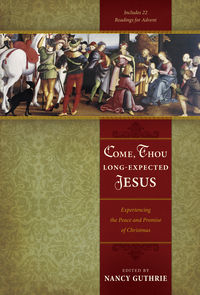
come thou long expected Jesus guthrie

When September 11th happened and New Yorkers started to suffer, you heard two voices. You heard the conventional moralistic voices saying, “When I see you suffer, it tells me about a judging God. You must not be living right, and so God is judging you.” When they see suffering they see a judgmental God. The secular voice said, “When I see people suffering I see God is missing.” When they see suffering, they see an absent, indifferent God.

WHAT CHRISTMAS DOES FOR SUFFERING

But when we see Jesus Christ dying on the cross through an act of violence and injustice, what kind of God do we see then? A condemning God? No, we see a God of love paying for sin. Do we see a missing God? Absolutely not! We see a God who is not remote but involved. We sometimes wonder why God doesn’t just end suffering, but we know that whatever the reason, it isn’t one of indifference or remoteness. God so hates suffering and evil that he was willing to come into it and become enmeshed in it. Dorothy Sayers wrote:

For whatever reason, God chose to make man as he is—limited and suffering and subject to sorrows and death—he [God] had the honesty and the courage to take his own medicine. Whatever game he is playing with his creation, he has kept his own rules and played fair. He can exact nothing from man that he has not exacted from himself. He has himself gone through the whole of human experience, from the trivial irritations of family life and the cramping restrictions of hard work and lack of money to the worst horrors of pain and humiliation, defeat, despair, and death. When he was a man, he played the man. He was born in poverty and died in disgrace, and thought it was worthwhile.

The gift of Christmas gives you a resource—a comfort and consolation—for dealing with suffering, because in it we see God’s willingness to enter this world of suffering to suffer with us and for us. No other religion—whether secularism, Greco-Roman paganism, Eastern religion, Judaism, or Islam—believes God became breakable or suffered or had a body. Eastern religion believes the physical is illusion. Greco-Romans believe the physical is bad. Judaism and Islam don’t believe God would do such a thing as live in the flesh. But Christmas teaches that God is concerned not only with the spiritual, because he is not just a spirit anymore. He has a body. He knows what it’s like to be poor, to be a refugee, to face persecution and hunger, to be beaten and stabbed. He knows what it is like to be dead. Therefore, when we put together the incarnation and the resurrection, we see that God is not just concerned about the spirit, but he also cares about the body. He created the spirit and the body, and he will redeem the spirit and the body.

Christmas shows us that God is not just concerned about spiritual problems but physical problems too. So we can talk about redeeming people from guilt and unbelief, as well as creating safe streets and affordable housing for the poor, in the same breath. because Jesus himself is not just a spirit but also has a body, the gift of Christmas is a passion for justice. There are a lot of people in this world who have a passion for justice and a compassion for the poor but have absolutely no assurance that justice will one day triumph. They just believe that if we work hard enough long enough, we’ll pull ourselves together and bring some justice to this world. For these people, there’s no consolation when things don’t go well. But Christians have not only a passion for justice but also the knowledge that, in the end, justice will triumph. Confidence in the justice of God makes the most realistic passion for justice possible.

WHAT CHRISTMAS DOES FOR THE DESPISED (& THE DESPISER)

Lastly, in the package of Christmas, there’s the ability to reconnect with the part of the human race you despise. Have you ever noticed how women-centric the incarnation and resurrection narratives are? Do you realize that women, not men, are at the very center of these stories? For example, in the story of the resurrection, who was the only person in the world who knew that Jesus Christ had risen from the dead? Mary Magdelene, a former mental patient, is the one Jesus tells to take this news to the world. Everyone else in the whole world learns it from her. Women are the first people to see Jesus risen from the dead.

In the incarnation, the annunciation comes to a woman. God penetrates the world through the womb of a poor, unwed, Jewish, teenage girl. The first theological reflection group trying to wrap their minds around this to figure out what this means and what is going on is Mary and Elizabeth. We know that in those days women had a very, very low status. They were marginalized and oppressed. For example, we know that a woman’s testimony was not admissible in court. Why? Because of prejudice against women.

We say to ourselves, aren’t we glad we’re past all that? Yes, but here’s what we have to realize: God is deliberately working with people the world despises. The very first witnesses to his nativity and resurrection are people whom the world says you can’t trust, people the world looks down on. Because we don’t look down on women today, we don’t look at this part of the story and realize what we’re being told. But here’s what we’re being told: Christmas is the end of snobbishness. Christmas is the end of thinking, “Oh, that kind of person.” You don’t despise women, but you despise somebody. (Oh, yes you do!) you may not be a racist, but you certainly despise racists. You may not be a bigot, but you have certain people about which you think, “They’re the reason for the problems in the world.”

There’s a place in one of Martin Luther’s nativity sermons where he asks something like, “Do know what a stable smells like? You know what that family would have smelled like after the birth when they went out into the city? And if they were standing next to you, how would you have felt about them and regarded them?” He is saying, I want you to see Christ in the neighbor you tend to despise—in the political party you despise, in the race you despise, in the class of people you despise.

Christmas is the end of thinking you are better than someone else, because Christmas is telling you that you could never get to heaven on your own. God had to come to you. It is telling you that people who are saved are not those who have arisen through their own ability to be what God wants them to be. Salvation comes to those who are willing to admit how weak they are.

In Christmas there is a resource for something most of us don’t even feel the need of. We might be able to admit we have trouble being vulnerable or that we need help handling suffering or that we need more passion for justice. But almost nobody says, “What am I going to do about my prejudice and snobbery? I really need help with that.”

Do you remember what an incredible snob you were when you were a teenager? Teenagers generally want nothing to do with people who don’t dress right and look cool. Do you think you ever got over that? You’re not really over that. You just found more socially acceptable ways to express it. You see, teenagers let that aspect of human nature out and don’t realize how stupid they look, and after a while they get rid of it. But really they are just papering over it. There are all kinds of people you look down on and want nothing to do with—and you know it. But in Christmas you have this amazing resource to decimate that—to remove it and take it away.

These are the gifts that come in the package of Christmas— vulnerability for intimacy, strength for suffering, passion for justice, and power over prejudice. And you are blessed if you open this gift and take it into your life. If you do, you’ll be blessed. You’ll be transformed.

SOURCE: This adapted sermon is an excerpt from Come, Thou Long-Expected Jesus: Experiencing the Peace & Promise of Christmas. Edited by Nancy Guthrie, Crossways. Copyright © by Timothy Keller, 2007. 


Tim Keller is the founding pastor of Redeemer Presbyterian Church in Manhattan, which he started in 1989 with his wife, Kathy, and three young sons. For over twenty years he has led a diverse congregation of young professionals that has grown to a weekly attendance of over 5,000.

Why Did God Become Man?

THE INCARNATION OF JESUS

nativity scene 

By Lehman Strauss

The word incarnation does not occur in the Bible. It is derived from the Latin in and carno (flesh), meaning clothed in flesh, the act of assuming flesh. Its only use in theology is in reference to that gracious, voluntary act of the Son of God in which He assumed a human body. In Christian doctrine the Incarnation, briefly stated, is that the Lord Jesus Christ, the eternal Son of God, became a man. It is one of the greatest events to occur in the history of the universe. It is without parallel.

The Apostle Paul wrote, ”And without controversy great is the mystery of godliness: God was manifest in the flesh . . . “ (I Timothy 3:16). Confessedly, by common consent the Incarnation of Jesus Christ is outside the range of human natural comprehension and apprehension. It can be made known only by Divine revelation in the Holy Scriptures, and to those only who are illumined by the Holy Spirit. It is a truth of the greatest magnitude that God in the Person of His Son should identify Himself completely with the human race. And yet He did, for reasons He set forth clearly in His Word.

Before we examine those reasons, it would be well at the outset to distinguish between the Incarnation and the Virgin Birth of our Lord, two truths sometimes confused by students of Scripture. The Incarnation of the Son of God is the fact of God becoming Man; the Virgin Birth is the method by which God the Son became Man.

These two truths, while distinct and different, are closely related to each other and stand in support of each other. If Jesus Christ was not virgin born, then He was not God in the flesh and was therefore only a man possessing the same sinful nature that every fallen child of Adam possesses. The fact of the Incarnation lies in the ever-existing One putting aside His eternal glory to become a man. The method of the Incarnation is the manner by which He chose to come, namely, the miraculous conception in the womb of a virgin.

A noteworthy passage pertinent to the Divine purpose in the Incarnation is recorded in the Gospel according to John– ”And the Word was made flesh, and dwelt among us (and we beheld His glory. the glory as of the only begotten of the Father), full of grace and truth” (John 1 :14).

Cerinthus, a representative of the system which arose in the early church under the name of Docetism, claimed that our Lord had only an apparent human body. But the statement, ”the Word became flesh,” indicates that He had a real body.

John 1:14 cannot be fully appreciated apart from verse one: ”In the beginning was the Word, and the Word was with God, and the Word was God . . . And the Word became flesh.” He who was one with the Father from all eternity became Man, taking upon Him a human body. He ”was with God” (vs. 1); He ”became flesh (vs. 14). He “was with God”’ (vs. 1); He ”dwelt among us” (vs. 14). From the infinite position of eternal Godhood to the finite limitations of manhood! Unthinkable but true!

Paul gives another significant passage on the Incarnation in his Galatian Epistle: ”But when the fulness of the time was come, God sent forth His Son, made of a woman, made under the law, to redeem them that were under the law, that we might receive the adoption of sons” (Galatians 4:4, 5). In these verses Paul establishes the fact of the Incarnation– “God sent forth His Son, made of a woman.”

God sending His Son presupposes that God had a Son. Christ was the Son in His eternal relationship with the Father, not because He was born of Mary. Since a son shares the nature of his father, so our Lord shares the Godhead coequally with His Father. Yes, “God sent forth His Son,” from His throne on high, from His position of heavenly glory. God did not send one forth who, in His birth, became His Son, but He sent One who, through all eternity, was His Son. Centuries before Christ was born, the Prophet Isaiah wrote of Him, ”For unto us a Child is born, unto us a Son is given . . . ” (Isaiah 9:6). The Son was given in eternity past before we knew Him. His human birth was merely the method of coming to us.

Again, Paul records the following noteworthy statement in the Epistle to the Philippians: ”Let this mind be in you, which was also in Christ Jesus: who, being in the form of God, thought it not robbery to be equal with God: but made Himself of no reputation, and took upon Him the form of a servant, and was made in the likeness of men: and being found in fashion as a man, He humbled Himself, and became obedient unto death, even the death of the cross. Wherefore God also bath highly exalted Him, and given Him a name which is above every name: that at the name of Jesus every knee should bow, of things in heaven, and things in earth, and things under the earth; and that every tongue should confess that Jesus Christ is Lord, to the glory of God the Father” (Philippians 2:5-1 1).

Before His Incarnation Jesus Christ was ”in the form of God” (vs. 6). From the beginning He had the nature of God, He existed (or subsisted) as God, and that essential Deity which He once was could never cease to be. If He seems Divine, it is only because He is Divine. He is God.

He ‘thought it not robbery to be equal with God” (vs. 6). The eternal Son did not consider it a thing to be seized unlawfully to be equal with the Father. Equality with God was not something He retained by force or by farce. He possessed it in eternity past and no power could take it from Him. But in the Incarnation He laid aside, not His possession of Deity, but His position in and expression of the heavenly glory.

One of the purposes of the Philippian epistle was to check the rising tide of dissension and strife growing out of Christians thinking more highly of themselves than they ought to think. Being a general letter, it exposes no false doctrines but does enunciate our Lord Jesus Christ as the believer’s pattern in humiliation, self-denial, and loving service for others. This is evident in the seven downward steps of the Saviour’s renunciation of Himself.

(1) ”He made Himself of no reputation.” God emptied Himself! He did not lose His Deity when He became Man, for God is immutable and therefore cannot cease to be God. He always was God the Son; He continued to be God the Son in His earthly sojourn as Man; He is God the Son in heaven today as He will remain throughout eternity. He is ”Jesus Christ the same yesterday, and today, and forever” (Hebrews 13:8).

(2) ”He took upon Him the form of a servant.” His was a voluntary act of amazing grace, the almighty Sovereign stooping to become earth’s lowly Servant. Instead of expressing Himself as one deserving to be served, He revealed Himself as one desiring to serve others. He did not boast His eternal glory and right to be ministered to, but instead evinced His humility and desire to minister. ”The Son of man came not to be ministered unto, but to minister, and to give His life a ransom for many” (Matthew 20:28).

(3) “He was made in the likeness of men.” This phrase expresses the full reality of His humanity. He participated in the same flesh and blood as man (Hebrews 2:14). Although He entered into a new state of being, His becoming Man did not exclude His possession of Deity, for He was and is today a Person who is both God and Man, Divine and human, perfect in His Deity and perfect in His humanity.

(4) ”And being found in fashion as a man.” When He came into the world, Christ associated with His contemporaries and did not hold Himself aloof. Thus He manifested to all that He was a real Man. One obvious distinction marked our Lord’s humanity; His perfection and sinlessness. As a Man He was made under the law, yet He never violated the law. As a Man He was tempted in all three points in which we are tempted (I John 2:16), yet His temptation was apart from any thought, word, or act of sin.

(5) “He humbled Himself.” The world has never witnessed a more genuine act of self-humbling. So completely did our Lord humble Himself that He surrendered His will to the will of His Father in heaven. His desire was to do the will of the Father, therefore He could testify, “I do always those things that please Him” (John 8:29). It was humiliation for the eternal Son of God to become flesh in a stable, and then to dwell in a humble home in subjection to a human parent. God was ”sending His own Son in the likeness of sinful flesh, and for sin” (Romans 8:30). Only eternity will reveal the depth of meaning for Him and for us found in those words, “He humbled Himself.”

(6) “He became obedient unto death.” Remarkable indeed! Here the God-man dies. Did He die as God, or did He die as Man? He died as the God-Man. The first Adam’s obedience would have been unto life, but because he disobeyed unto death, the last Adam must now obey unto death in order that He might deliver the first Adam’s posterity ”out of death into life” (John 5:24R.V.). ”For as in Adam all die, even so in Christ shall all be made alive” (1 Corinthians 15:22). To subject Himself to the cruel death of a criminal on the cross was a necessary part of God’s plan of salvation for men, and to such a death our Lord voluntarily submitted. Implicit obedience!

(7) ” . . . even the death of the cross.” Our Lord died as no other person died or ever will die. Other men had died on crosses, but this Man, the eternal Son of God, voluntarily and willingly died the kind of death meted out to criminals, even the death upon a cross. His own countrymen considered crucifixion the worst kind of disgrace. In their law it was written, “For he that is hanged is accursed of God” (Deuteronomy 21:23; cf. Galatians 3:13). Not only did our Lord die, but He died bearing the burden of the worst of criminals and the guiltiest of sinners. Down He came from heaven’s glory to earth’s sin and shame through His Incarnation.

The purposes underlying this phenomenal occurrence can be summed up in seven points.

(1) HE CAME TO REVEAL GOD TO MAN

The Incarnation of the Son of God unites earth to heaven. God’s greatest revelation of Himself to man is in Jesus Christ. Revelation is the disclosure of truth previously unknown. Before the coming of the Son of God to earth many varied forms of revelation existed. Belief in the existence of God is innate. Since man is a rational, moral being, his very nature provides him with intuitive knowledge. As the mind of a child begins to unfold, it instinctively and intuitively recognizes a Being above and beyond the world that he experiences.

Man is so constituted that he recognizes the fact and the power of God by the things that are made. Many of the ancient philosophers marveled at the starry heavens above them and the moral law about them. We live in a world of order and harmony conducive to our happiness and well being, and we, too, recognize a revelation of God in nature.

The Apostle Paul wrote, “Because that which may be known of God is manifest in them; for God hath shewed it unto them. For the invisible things of Him from the creation of the world are clearly seen, being understood by the things that are made, even His eternal power and Godhead; so that they are without excuse” (Romans 1:19, 20). Men may hinder or suppress the truth by their unrighteous living, but there is that which may be known of God which ”is manifest in them.” The existence and power of God are discernible to us all by the things we observe in the external world. Those only who have abnormal, distorted, or biased minds can possibly deny God’s existence.

Job realized that the nature of God in its different characteristics and qualities was not all revealed to man, yet he knew, as all men know, that the omnipotence and unchangeableness of God are exhibited in creation (Job 6:10; 23:12). The savage and the scientist can know two things about God; He is a Being and He is supreme. These are the two things God has been pleased to reveal about Himself.

Do not plead innocence for the man who does not possess a copy of God’s Word. All men have a Bible bound with the covers of the day and the night whose print is the stars and the planets. What is knowable about God has been displayed openly, and any man who suppresses the truth does it “without excuse.” Nature reveals the supernatural, and creation reveals the Creator. Read Psalm 19:1-6 and you will see that the heavens are personified to proclaim the glory of their Creator. Day and night pass on their testimonies giving clear evidence of the existence of the One who made them.

There are other evidences of primeval revelations of God to man, such as to Adam (Genesis 3:8) and to Abraham (Genesis 12:1-3; 26:3-5). The writer to the Hebrews quotes the Son speaking to the Father, in which reference is made to an early primitive and temporary revelation through a book which God allowed to pass out of existence (Hebrews 10:5-7). Doubtless there were other books which likewise have passed out of existence, as the Book of Enoch of which Jude made mention (Jude 14).

We know, further, that God often revealed Himself in dreams as when He spoke to Jacob (Genesis 28), to the patriarch Joseph (Genesis 37), to Nebuchadnezzar (Daniel 2-4), to Joseph (Matthew 1:20), and to others. Through Moses and the prophets God revealed Himself (Exodus 3:4 and chapter 20). Over thirty-five authors, writing over a period of fifteen hundred years, wrote consistently and coherently, by inspiration of the Holy Spirit, of one historically accurate plan of salvation. The Bible in its entirety is a progressive revelation of God.

But of all the amazing revelations of almighty God, none was set forth more clearly and fully than God’s final revelation of Himself in the Person of the Lord Jesus Christ. Since God is an infinite Being, no man could understand Him fully save the Son who is One in equality with the Father. Jesus said, ”. . . neither knoweth any man the Father, save the Son, and he to whomsoever the Son will reveal Him” (Matthew 11:27). Here, then, is one reason for the Incarnation—to reveal God to man. The fact of God’s existence may be seen through test tubes and laboratory experiments, detected through microscope and telescope, and stated in the discussions of the seminar. But the glorious attributes of a loving God manifested in behalf of sinners can be found in no place or person apart from Jesus Christ.

Philip said to the Lord Jesus, ”Lord, shew us the Father . . . ” and our Lord answered, ”. . . He that hath seen Me hath seen the Father . . . “ (John 14:8, 9). When the Word became flesh He brought to man an adequate revelation of God. Whatever the ancient seers and saints knew about God before Jesus came, we have a more adequate revelation. Since God remains an abstraction until we see Him in terms of personality, so the Son became Incarnate that we might see and know God. ”No man hath seen God at anytime; the only begotten Son, which is in the bosom of the Father, He hath declared Him” (John 1: 1, 8, 9).

The dictionary definition of the word ”light” means nothing to a blind man, but one glimpse of a glowworm would be worth more for the understanding of light than all the definitions in the world. One glimpse of Jesus Christ will bring God closer to the human mind and heart than all the theological definitions of Him. No man could perceive the grace of God until the almighty Sovereign of the universe stooped to the level of His own creatures, suffering cruel treatment and dying the death of shame for them. No man understood fully the patience and longsuffering of the Father until Jesus Christ who, when He was reviled, reviled not again, and when He suffered, threatened not (I Peter 2:23). No man can comprehend just how perfect and holy God is until He comes face to face with the sinless Son of God. God has revealed Himself anew to the intelligence of man through the Incarnation.

(2) HE CAME TO REVEAL MAN TO HIMSELF

Through His Incarnation Jesus Christ reveals man to himself. He shows us what we are and what we may become. As we study the purposes of God in Christ, the fact impresses us that man is grossly ignorant of his real self, and that the mission of the Son’s coming included a plan that would enable man to see and know himself as God sees and knows him. We are not the least bit impressed with man’s vain philosophical views of himself, but rather with the accurate historical account of man as it is recorded in the Bible.

The primary fact that man needs to know about himself is his origin. Men are divided in their theories concerning this. We are not strangers to the evolutionary idea which attempts to explain man’s place in the earth. In 1871 Darwin published his book, The Descent of Man, but he said very little that had not been said before. The idea of evolution might be here to stay, but not because Darwin said so. Evolution was taught by Roman and Greek philosophers and even by ancient Egyptians. But the evolutionary idea that man must swallow his pride and be content with the fact that he has oozed from the slime along with the snails is contrary to the revelation in Scripture.

The Bible teaches clearly that the human race had its origin by the immediate creation of God (Genesis 1:26, 27) and that man is the grand consummation of all creation. We are forced to accept this view as against the theory of evolution because of the immeasurable gulf which separates man, even in his barest savage condition, from the nearest order of creation below him. Moreover, history corroborates Scripture in that man was destined to rule over all other animal life. God took special care in the creation of man, for “God created man in His own image, in the image of God created He him; male and female created He them” (Genesis 1:27). Actually it was not the body of man that was created, for the body was merely ”formed” of those elements necessary for man’s body and which were created long before man ( Genesis 1:1). What was new in man’s creation was a form of life which only God and man possess (Genesis 2:7). Created in the image and likeness of God, man differs from every other form of animal. Man, in his lowest estate, seeks an object of worship and has been known to bow before gods that he cannot see, but animals never!

However, man did not retain God’s image and likeness. When God placed our first parents in Eden He set before them one simple restriction, namely, not to eat the fruit of the tree of the knowledge of good and evil, for, said God, “In the day that thou eatest thereof thou shalt surely die” (Genesis 2:17). Genesis 3 is a record of the fall of man. He disobeyed God and

immediately the life-cord was severed. Adam died both physically and spiritually. Physical death began to do its work, and the grave for Adam was but a matter of time. Then, too, his spirit was separated from God, so that he was dead spiritually while alive physically.

Now all men, from Adam down, are born into this world spiritually dead in sin, possessing a sin-nature capable of every trespass against God (Ephesians 2:1). The sin-nature of Adam and the guilt of his sin were imputed to the whole human race, so that Adam’s corrupted nature is of necessity a part of all his posterity. The highest self in man is altogether unprofitable to God. All men are not equally corrupt in word and deed, but all are equally dead, and unless the function of death is brought to a halt, it will destroy not only the body but also the soul in hell. Because of the solidarity of the human race, sin and death have passed upon all men (Romans 5:12). When Adam defaced the Divine image and lost the Divine likeness, he begat sons ”in his own likeness, after his image” (Genesis 5:3). Yes, “by man came death” and ”in Adam all die” (I Corinthians 15:21, 22).

While all of this is clearly stated in the Bible, man still thinks of himself more highly than he ought to think. There were many who had no Scriptures at all in Christ’s day, and they needed this revelation. In order that man should see himself, not in the light of his own goodness, but beside the perfect standard of God’s holy Son, the Son of God became Incarnate. Our Lord said, ”If I had not come and spoken unto them, they had not had sin: but now they have no cloke for their sin” (John 15:22).

Responsibility increases with knowledge, and so Christ’s coming showed man how far short he came of God’s standard of a righteous man. The Lord Jesus said, “If I had not done among them the works which none other man did, they had not had sin . . . “ (John 15:24). Our Lord did not mean by this statement that man would have been without sin if He had not come. There had been sin all along, as God’s dealings with the human race through its four thousand years of earlier history prove. But the coming of Christ to the earth revealed the heart of man in cruel hatred for Divine holiness. The Son of God Incarnate was sinless in every respect, yet man, Jew and Gentile alike, crucified Him. Alongside Christ’s perfect life and works, man can see the sin and guilt of his own heart.

When man sinned against the Son of God, he sinned against the clearest possible light, “the Light of the world” (John 8:12). He came unto His own and His own received Him not (John 1:11), and then Gentiles joined hands with ”His own” to put Him to death. How sinful is the heart of man? Look at that spectacle on Calvary’s hill and you will see human hearts and hands at their worst.

Time has not improved human nature. Today men still trample under food the precious blood of Christ, and if our blessed Lord were to appear in person today as He did nineteen centuries ago, the world would crucify him again. The world, having seen the light, has turned from the light, for “men loved darkness rather than light, because their deeds were evil” (John 3:19). Romans 1:18 to 3:20 enunciates the most searching and conclusive arraignment of the human race found anywhere, and the birth and death of Jesus Christ attest to the truth of this awful indictment.

(3) HE CAME TO REDEEM MAN

The Apostle Paul states clearly the purpose of the Incarnation in the following words–”But when the fulness of the was come, God sent forth His Son, made of a woman, made under the law, to redeem them that were under the law” (Galatians 4:4, 5). The Old Testament contains the accurate record of some four thousand years of sin, human failure, and consequent Divine judgment. The one bright hope was the coming of the promised Seed, the Redeemer (Genesis 3:15). With each succeeding revelation from God, the promise grew clearer and the hope brighter. The prophets spoke of the Messiah who would come to deliver the people from their sins. Perhaps the classic prophecy is Isaiah 53. Since the people needed a deliverer from the guilt and penalty of sin, the intent of the Incarnation was to provide that Deliverer. Moreover, all of history and prophecy moved toward that goal even as all subsequent movements have proceeded from it.

Jesus Christ is man’s Redeemer, his Saviour. This truth is implied in His name. Said the angel, “Thou shalt call his name JESUS (meaning Saviour), for He shall save His people from their sins” (Matthew 1:21). At His birth the angel testified again, “For unto you is born this day in the city of David a Saviour, which is Christ the Lord” (Luke 2:11). Even the Lord Jesus Himself voiced emphatically the purpose of His Incarnation when He said, “For the Son of man is come to seek and to save that which was lost” (Luke 19:10).

The awful state of the world of mankind necessitated the coming of the Redeemer since there could be no hope of deliverance apart from Him. The character of God, which is righteousness, absolute and uncompromising, demands that every sin be dealt with. While God is merciful, gracious, and slow to anger, forgiving iniquities and transgressions, ”that will by no means clear the guilty” (Exodus 34:7). While God is love, God is also holy and righteous, so holy that He is “of purer eyes than to behold evil, and [canst] not look on iniquity” (Habakkuk 1:13). His righteousness demands that every sin must be dealt with impartially. In order to be true to Himself, God had to deal with the problem of sin. In order to deal justly and, at the same time, mercifully, someone had to suffer the death penalty for the sin of the world.

In the Person of Jesus Christ God solved the problem of the eternal well-being of the sinner. He sent His Son to die as the sinner’s perfect Substitute, and thereby redeemed the sinner. Man was lost to God and heaven, and God’s purpose in redemption could be realized only through the Incarnate Son of God, for the Son of God Incarnate is the connecting link bringing together God and sinful man. The sinner’s relation to Jesus Christ is vital. Christ became a man “that He by the grace of God should taste death for every man” (Hebrews 2:9). The Word, who is the eternal Son of God, became flesh and was obliged to be made in the likeness of man in order to redeem him.

Christ defined the purpose of His Incarnation and earthly ministry when He said, “I came not to call the righteous, but sinners to repentance” (Mark 2:17). There is no implication in these words that there is a sinful class of men who need repentance and another righteous class who do not. Nor is there a suggestion that there are “righteous ones,” for in Romans 3:10 it is said, “There is none righteous, no, not one.”

Consider the conditions under which Christ stated this purpose. Scribes and Pharisees were upbraiding Him because He had gone into the house of Levi to eat with publicans and sinners (Mark 2:14-16). His critics exalted themselves above sinners, priding themselves in an unpossessed righteousness which thereby excluded them from any realization or acknowledgement of their own sin.

In Levi’s house, however, there were those who recognized their sinful state. It was for this reason that the Lord Jesus went to that group, namely, to bring salvation to them. Physicians go into sick rooms, not because of the pleasantness of disease and suffering, but because of a desire to relieve and cure the sick. So sinners are the special objects of the Saviour’s love and power. He came into the world to save sinners.

Although all men are unrighteous, those scribes and Pharisees called themselves ”righteous,” for they were possessed of self-righteousness that is as “filthy rags” in God’s sight (Isaiah 64:6). Therefore, as they went about seeking to establish their own righteousness, they failed to see the purpose of His coming. Hence they never heeded the Saviour’s call to salvation. Their kind seldom do!

Had there been righteousness in the human heart, there would have been no need for the Incarnation of the Son of God. And only in the self-righteous heart of the religious, moral man, satisfied with himself, do we find the careless indifference to the Gospel of redemption. When a man assumes a righteousness all his own, he is outside the reach of the Great Physician. The man who excludes his own need of Christ misses the purpose of the Saviour’s coming and will not be saved. Each of us must say with the Apostle Paul, “This is a faithful saying, and worthy of all acceptation, that Christ Jesus came into the world to save sinners; of whom I am chief” (I Timothy 1:15).

(4) HE CAME TO RESTRAIN SATAN

The purpose of the Incarnation is further revealed in the Epistle to the Hebrews. Three verses, linked together, assert that the coming of Jesus Christ was to destroy the devil. “But we see Jesus, who was made a little lower than the angels for the suffering of death, crowned with glory and honour; that He by the grace of God should taste death for every man . . . Forasmuch then as the children are partakers of flesh and blood, He also Himself likewise took part of the same [flesh and blood]; that through death He might destroy him that had the power of death, that is, the devil; and deliver them who through fear of death were all their lifetime subject to bondage” (Hebrews 2:9, 14, 15).

In these three verses in Hebrews, we are reminded that the subject of death is dealt with in each of them, and the fact of the Incarnation is substantiated in the clause, “who was made a little lower than the angels.” Furthermore, the purpose of the Incarnation appears in the words, “that He by the grace of God should taste death for every man.” From this verse, as well as verse 14, it is evident that the eternal Son became flesh in order to die.

Christ’s crucifixion by wicked hands was “by the determinate counsel and foreknowledge of God” (Acts 2:23). Our Lord Jesus Christ testified, “The Son of man came not to be ministered unto, but to minister, and to give His life a ransom for many” (Matthew 20:28). Jesus Christ willed to die, not a sudden and unexpected death but a lingering, anticipated death that He would taste every day of His earthly sojourn. He became man to suffer death.

But why should it be so? We considered the purpose of the Incarnation relative to the sin question. Referring to the matter of death, the Word affirms that the Son of God became incarnate that “through death He might destroy him that had the power of death, that is, the devil.” Of all the works of Satan, among the worst is that of destroying life. Our Lord testified, “He was a murderer from the beginning” (John 8:44). Satan is the spoiler of humanity, his malignant purpose being to bring both physical and spiritual death to mankind.

God placed our first parents in the Garden of Eden and surrounded them with every tree that is pleasant to the sight and good for food. Two of these trees are mentioned; ”the tree of life . . . and the tree of knowledge of good and evil” Genesis 2 :9). Eating the fruit of the latter tree would bring sin and death, for, said God, “In the day that thou eatest thereof thou shalt surely die” (Genesis 2:17). Satan knew this, therefore we are not surprised when we read that it was of the fruit of this very tree of death that he enticed Eve to eat. He chose the tree of death because he is a murderer. He knew that the death sentence was already pronounced upon all who would eat of it. He delighted in the fall of Adam and Eve, for he knew that physical and spiritual death had struck.

But thanks be to God for the Incarnation of His Son. By the coming of Jesus Christ into the world, through His death and resurrection, He wrested from Satan the power of death. Death no more holds its lethal grip upon the believer. Although death has held sinners in bondage ever since the severing of the life-cord between God and man, the appearing of the Lord Jesus has broken its grip. “According to His own purpose and grace, which was given us in Christ Jesus before the world began . . . the appearing of our Saviour Jesus Christ, who hath abolished death, and hath brought life and immortality to light through the Gospel” (II Timothy 1:9, 10).

Before sin was indulged in and death struck, the inclusive salvation plan provided death’s abolition. Since the death and resurrection of our Lord dealt comprehensively with sin, it of necessity affected death. The coming of the Saviour rendered death harmless, and the “sting” of it is gone (I Corinthians 15:55). Oh, the blessedness of an accomplished redemption! How wonderful to know Him who said, “I am He that liveth, and was dead; and, behold, I am alive for evermore, Amen; and have the keys of hell and of death” (Revelation 1:18). Death once held man in the vise of hopeless doom, but now Satan is defeated.

The shadow of the cross hung over the manger in Bethlehem, assuring the world that the Seed of the woman would bruise the serpent’s head (Genesis 3:15). As Adam yielded himself to Satan, Satan held him in death; but by His dying, Christ entered into our death and wrested from Satan that power which he held over us. At Calvary Satan was brought to naught, and now “death is swallowed up in victory. . . Thanks be to God, which giveth us the victory through our Lord Jesus Christ” (I Corinthians 15:54, 57). “The prince of this world is judged” (John 16:1 1). The Seed of the woman traversed the realms of death but was not captured by the enemy. Instead, He conquered the enemy. Thank God the Saviour came.

(5) HE CAME TO RESCUE THE WHOLE CREATION

The Incarnation of the eternal Son is part of the divine plan. That plan comprehends a goal, and God assures the accomplishment of it. Though the salvation of man was God’s chief concern, His plan was never limited to the world of mankind. It is written of the eternal Son, who was with God and who is God, that “all things were made by Him” (John 1:3). Paul writes, ”For by Him were all things created, that are in heaven, and that are in earth” (Colossians 1:28). Man was higher than all other created beings in the earth, and other creatures were subject to him. However, after the fall this condition changed. Now if man is to have dominion over the beasts, he must first capture them at the risk of his own life, and then imprison them until they are tamed. All of this resulted from the fall.

But the question is, Will God restore again to man the dominion which he lost through the fall? The prophet said, ”The wolf also shall lie down with the kid; and the calf and the young lion and the fatling together; and a little child shall lead them. And the cow and the bear shall feed; their young ones shall lie down together; and the lion shall eat straw like the ox. And the suckling child shall play on the hole of the asp, and the weaned child shall put his hand on the cocatrice’s den. They shall not hurt nor destroy in all My holy mountain: for the earth shall be full of the knowledge of the Lord, as the waters cover the sea” (Isaiah 11:6-9). Indeed, it appears that the prophet here is looking beyond to a time of rescue and restoration of the earth and all of its creatures.

The cruelty of beasts was not the order before sin entered. Such discord among God’s creatures has sprung from the sinfulness of man and is a necessary part of the curse. To remove this curse and rescue God’s creation is one of the purposes of the Incarnation. When Christ comes back to reign and “the government shall be upon His shoulder” (Isaiah 9:6), then the sons of God will be manifested and will share with Him in a restored creation. If it were not so, then all of animated nature would remain spoiled by Satan. But God has said, “In that day will I make a covenant for them with the beasts of the field, and with the fowls of heaven, and with the creeping things of the ground” (Hosea 2:18). Yes, God will “gather together in one all things in Christ, both which are in heaven, and which are on earth, even in Him” (Ephesians 1:10). At that day our blessed Lord will “reconcile all things unto Himself’ (Colossians 1:20).

Many Christians fail to see that this redemptive work, wrought through the Incarnation of the Son of God, is wider than the salvation of human beings and that it affects the whole creation. The Apostle Paul writes, “For the earnest expectation of the creature waiteth for the manifestation of the sons of God. For the creature was made subject to vanity, not willingly, but by reason of him who hath subjected the same in hope. Because the creature itself also shall be delivered from the bondage of corruption into the glorious liberty of the children of God. For we know that the whole creation groaneth and travaileth in pain together until now. And not only they, but ourselves also, which have the first-fruits of the Spirit, even we ourselves groan within ourselves, waiting for the adoption, to wit, the redemption of our body.” (Romans 8:19-23). Here we are told that the deliverance of the whole creation will be revealed at the manifestation of the sons of God.

All creation lies in hope (expectancy) of a rescue from present corruption and of deliverance to that place God gave it in the beginning. Nature is now under the curse of sin, groaning and travailing in pain. It is not what it was at first. Nor is it now what it will be when the incarnate Son returns to “put all things in subjection under His feet” (see Hebrews 2:5-9). Before Adam sinned, no savage beasts, no desert wastes, no thorns and thistles existed; but when he fell, all creation fell with him. Now that the Son of God has come and purchased redemption by His death at Calvary, the whole creation must be rescued from the curse, and restored to its original state.

(6) HE CAME TO RESTORE ISRAEL

Any reader of the Old Testament cannot escape the clear teaching that the Messiah was promised to Israel. Of this the prophets spoke and wrote. The Jew had great advantages. “Unto them were committed the oracles of God” (Romans 3:2). Theirs was “the adoption, and the glory, and the covenants, and the giving of the law, and the service of God, and the promises” (Romans 9:4). None can deny that from the call of Abraham (Genesis 12:1) to the Babylonian captivity under Nebuchadnezzar (606 B.C.), authority in the earth and divine representation was vested in the Jew. It is common information that since the overthrow of Jerusalem and the transfer of dominion in the earth to the Gentiles, Israel, as a nation, has not held authority in the earth.

When Jesus Christ, the Word, “was made flesh,” “He came unto His own, and His own received Him not” (John 1:11, 14). ”His citizens hated Him, and sent a message after Him, saying, We will not have this man to reign over us” (Luke 19:14). In blind unbelief the children of Abraham, refusing to recognize or receive Him, drove Him from their midst and crucified Him. After His resurrection and ascension He revealed to the apostles this mystery. No longer did Israel have priority on the truth, but the message was to be spread abroad to every creature and, during the present dispensation of grace, God would visit the Gentiles to take out of them a people for His name (Acts 15:14).

When Christ came the first time He traversed Palestine proclaiming, “Repent, for the kingdom of heaven is at hand” (Matthew 4:17). He opened the door into the kingdom, but only the regenerated could enter. Were the people ready to receive the kingdom, the King would establish it. However, the offer of the kingdom met with an ever-increasing opposition, and our Lord withdrew the offer for that time. He said to the Jews, ”Therefore say I unto you, The Kingdom of God shall be taken from you, and given to a nation bringing forth the fruits thereof” (Matthew 21:43). There was no mistaking what the Lord Jesus meant, for the chief priests and Pharisees “perceived that He spake of them” (vs. 45).

Israel is still set aside, but only temporarily. The Apostle Paul writes, ”I say then, Hath God cast away His people? God forbid . . . God hath not cast away His people which He foreknew . . . For I would not, brethren, that ye should be ignorant of this mystery, lest ye should be wise in your own conceits; that blindness in part is happened to Israel, until the fulness of the Gentiles be come in” (Romans 11:1, 2, 25).

Anti-Semitism, raging throughout the world today, might lead one to question the future restoration of the Jew. Yet we know that both national restoration and national regeneration for the Jew are a definite part of the plan of God. Israel is not beyond recovery; she is not irretrievably lost. By her fall the whole world was blessed with the message of salvation. A national tragedy resulted in an international triumph. ”And so all Israel shall be saved” (Romans 10:26). The Jew lives in a dark present with a bright future before him. When our Lord said in Matthew 21:43, that “the kingdom shall be given to a nation bringing forth the fruits thereof,” He was not referring to any Gentile nation but to regenerated Israel.

God gave Palestine to the Jews unconditionally as a possession and a dwelling place (Genesis 12: 1-3). He wants them there. That the Jews would be scattered is plainly taught in the Word of God, but coupled with such teaching are the assertions that they will also be regathered. Study Hosea 3:4,5 and see plainly the scattering and the gathering with the period between. (See also Ezekiel 36: 19,24). The Word became flesh and tabernacled among them once (John 1:14). That same holy One, the incarnate Christ, will come again to tabernacle with Israel. Study, for example, such passages as Isaiah 12:1-6Joel 2:26, 27Zephaniah 3:14-17Zechariah 8:3-8. Already modern inventions have revolutionized Palestine and its surrounding territory. This fact, coupled with the thought of the vast area granted by God to Abraham 1Genesis 15: 18), will assure any interested person that there is ample room in the Holy Land to hold all Jews.

While the Jews continue to return to the Land, all signs point to the return of the incarnate Son, the One who is both human and Divine, and the One in whom God’s purposes for Israel are to be fulfilled. According to prophecy, the incarnate One, Immanuel, the virgin’s Son, is to occupy David’s throne. ”For unto us a Child is born, unto us a Son is given: and the government shall be upon His shoulder: and His name shall be called Wonderful, Counselor, The Mighty God, The Everlasting Father, the Prince of Peace. Of the increase of government and peace there shall be no end, upon the throne of David, and upon his kingdom, to order it, and to establish it with judgment and with justice from henceforth even for ever. The zeal of the Lord of hosts will perform this” (Isaiah 9:6, 7). Let us rejoice to see that day approaching.

(7) HE CAME TO REIGN

When the Incarnation had been announced, there came wise men from the east to Jerusalem, saying, “Where is He that is born king of the Jews? For we have seen His star in the east, and are come to worship Him” (Matthew 2:1, 2). They were wise men indeed, for they were followers of the truth of God. When the Old Testament prophets wrote of Messiah’s offices, they included that of King. “Rejoice greatly, O daughter of Zion; shout, O daughter of Jerusalem: behold, thy king cometh unto thee: He is just, and having salvation: lowly, and riding upon an ass, and upon a colt the foal of an ass” (Zechariah 9:9). David wrote of Christ and His kingdom when he recorded the words of God, “Yet have I set My king upon My holy hill of Zion” (Psalm 2:6). Our Lord is not only Prophet, and Priest, but also Potentate.

In studying the purposes of the Incarnation we are forced to the scriptural observation that the eternal Son became Man in order that He might be King of the earth. Paul wrote that “God hath highly exalted Him” (Philippians 2:9). We dare not limit the exaltation of Christ as some try to do. We acquiesce with those who teach that the steps in Christ’s exaltation were His resurrection, ascension, and His sitting at the right hand of God. But such teaching does not go far enough. Study carefully Philippians 2:5-11, and you will see that the steps in our Lord’s humiliation were temporary steps leading to a permanent exaltation, culminating with the bowing of every knee and the confessing of every tongue in heaven and in earth, that Jesus Christ is Lord, to the glory of God the Father.

The incarnate Son is to appear in His resurrection body and is to sit on the throne of His glory. Jesus Himself spoke of the day “when the Son of man shall come in His glory, and all the holy angels with Him; then shall He sit upon the throne of His glory” (Matthew 25:31). John writes, ”Every eye shall see Him” (Revelation 1:7). The prophetic utterance spoken by God to David in 2 Samuel 7:12-16 concerning David’s seed having an everlasting throne and kingdom, has a double fulfillment. Primarily it referred to Solomon’s temple. Ultimately and finally it speaks of Christ’s earthly reign as Zechariah 6:12 shows. The day must come when all things will be subjected unto Him (I Corinthians 15:28).

The Psalmist spoke of His throne as an enduring throne (Psalm 89:4, 29, 36). God promises that this earthly throne and kingdom are to continue forever, and that the One to occupy it shall be David’s seed, his rightful Son (I Chronicles 17:11). The genealogies in Matthew 1 and Luke 3 will support the relationship of Jesus Christ to David. During our Lord’s earthly ministry, those who sought His help called Him “the son of David” (see Matthew 9:27Mark 10:47Luke 18:38).

Christ’s kingdom is literal, therefore it cannot be realized apart from the Incarnation. Such a kingdom men have been trying to establish for centuries, but nations are farther from realizing it today than ever before. A perfect kingdom demands a perfect King. At the end of the conflict of the ages, Jesus Christ, the God-Man will return to earth to establish His righteous kingdom which will never be destroyed. His kingdom of glory, and His throne in the midst, was God’s first promise through the mouth of the angel Gabriel to Mary, and it links together the Incarnation and reign of the Son of God, ”And behold, thou shalt conceive in thy womb, and bring forth a son, and shalt call his name JESUS. He shall be great, and shall be called the Son of the Highest: and the Lord God shall give unto Him the throne of His father David: and he shall reign over the house of Jacob for ever; and of His kingdom there shall be no end” (Luke 1:31-33).

When the King comes, then will His perfect will be done in earth as it is in heaven. This is a blessed truth not without history or hope. The day will surely come when all men will see the revelation of the glory of holiness and joy in the earth. But His reign awaits His return to carry away His Bride, the Church. Everything has been deferred until He gathers her unto Himself. It may be at any moment that the last soul will be added to the Church, and then He will come.

This meditation in no wise exhausts the divine purposes of the Incarnation. Others have written at greater length and, doubtless, we could do likewise. But one thing more must be said. The supreme purpose in the eternal Son’s coming into the world was to glorify the Father. In His great intercessory prayer, Jesus said, “I have glorified Thee on the earth: I have finished the work which Thou gayest Me to do” (John 17:4). God had been glorified in creation, in the remarkable deliverances of His people, and in the exercise of His power over His enemies, but at no time had He been glorified like this. God could never have been glorified if the Son would have failed in His earthly mission in the smallest degree. But the Lord Jesus could say, “I have finished the work which Thou gayest Me to do.” Nothing was left undone, and in everything He did, the Son had the Father’s glory in view. He glorified the Father; His earthly mission was complete.

And now to all of us who have been redeemed by His precious blood, the Apostle Paul writes: “For ye are bought with a price: therefore glorify God in your body, and in your spirit, which are God’s” (I Corinthians 6:20).

SOURCE: https://bible.org/article/why-god-became-man (May 27, 2004)

ABOUT THE AUTHOR

Lehman Strauss taught Old Testament history for eight years at Philadelphia Bible Institute, and served as pastor of the Calvary Baptist Church, Bristol, Pennsylvania, from 1939 to 1957.

He was pastor of Highland Park Baptist Church (Highland Park, Michigan) until the end of 1963 when he resigned to devote full time to an itinerant Bible conference and evangelistic ministry both in the States and abroad. Dr. Strauss was residing in Florida and writing his 19th book at age 86 when the Lord called him home in June 1997.

9 THINGS PASTORS SHOULD KNOW ABOUT DEVELOPING YOUNG LEADERS

Mentoring Matters

By Brian Dodd

“It’s no surprise that Texas is producing athletic innovation.  You’ve seen a similar spirit of innovation in Texas’s business world…It’s a place where thinking differently is valued and produces results.” – Jay Greene, Department of Education Reform, Arkansas University

As pastors and Christian leaders we are constantly focused on raising up the next generation of leaders.  Much like Texas athletics, we need different thinking to produce better results.

Recently I was reading a September 30th Sports Illustrated article on the incredible results being produced by the Texas high school football 7-on-7 tournaments. For example, this past weekend an astonishing 10 NFL starting quarterbacks came from those programs.

While lacking the “spiritual” element, I found the techniques used by Texas coaches to develop quarterbacks extremely applicable to Christian environments hoping to develop young leaders.

The following are 9 Things Pastors Should Know About Developing Young Leaders gleaned from these incredibly productive Texas high school football programs:

  1. Young Leaders Must Be Allowed To Make Mistakes – In addition to allowing quarterbacks time to develop, Texas high school quarterbacks are also given the ability to improvise and make mistakes.

  2. Young Leaders Should Be Given Significant Responsibility – Too often Christian leaders do not recognize the potential of their young people.  We give them volunteer responsibilities which do not stretch or challenge them.  This approach does not prepare them for the challenges adult Christian leaders face.  Detroit Lions qb Matt Stafford said, “We throw (the football) so much (in high school), it’s not a big deal when we get to the next level.”

  3. Young Leaders Will Innovate Out Of Necessity – Baylor head coach Art Briles created his innovative offensive system while coaching football at Stephenville High School.  The teams he faced were bigger, stronger, and faster.  He says, “I was just trying to figure out something each year.  We were having trouble with bigger players, and we started spreading the field to counter that.  We kept developing it from there.”

  4. Young Leaders Should Be Exposed To More Experienced Leaders Early And Often – Churches who develop young Christian leaders are focused on discipleship.  They prioritize getting younger leaders into the orbits and under the influence of successful, more experienced leaders.  Texas high school coaches are constantly bringing in NFL defensive coaches to better prepare their quarterbacks.

  5. Young Leaders Will Thrive In Flexible Environments – Texas high school coaches are flexible and humble.  They adjust their offensive game plans around the skills of their quarterbacks rather than making the quarterbacks adjust.  Church leaders need to recognize the incredible story God wants to tell through the lives of young people and adjust their ministries, programming and systems accordingly.

  6. Young Leaders Are Resilient – Coach Briles says, “What you’re looking for (in a quarterback) is a mentality.  A guy who won’t back down.”

  7. Young Leaders Focus On What They Can Do.  Not What They Can’t – Houston Texans qb Case Keenum says, “A lot of people told me what I couldn’t do.  I was too short, didn’t have this, didn’t have that.  But I always believed in myself.  You cannot let other people tell you what you can do.”

  8. Young Leaders Will Respect More Experienced Leaders – It is flawed thinking to assume young people lack respect.  Some do.  Many do not.  Christian leaders should make honoring a church’s past part of the discipleship process.  Keenum goes on, “One thing all of us have in common, we realize how important it is to play quarterback in Texas.  From a young age, we’re taught to respect the game.”

  9. Young Leaders Need Guidelines Rather Than Rules –  Writer Andrew Perloff deducted that a “competitive spirit and lax regulation provide a fertile ground for creativity and excellence.”

What additional practices are you doing as Christian leaders to develop young leaders?

SOURCE: http://www.briandoddonleadership.com/2013/12/04/9-things-pastors-should-know-about-developing-young-leaders/

Interview with a Theological Giant: Dr. J.I. Packer

J.I. PACKER: THE LOST INTERVIEW

J.I. PACKER IN HIS VANCOUVER OFFICE 2009(J.I. Packer at his regent College Office in Vancouver, B.C., in 2009)

Q&A | From a recording that disappeared in transit five years ago, the octogenarian theologian shares how God shaped him first and foremost as a catechist.

Five years ago, WORLD founder Joel Belz suffered a journalistic disaster. He had traveled to Vancouver, British Columbia, to interview octogenarian J.I. Packer, author of many terrific books on theology. Joel recorded 90 minutes of conversation and placed the recording in the side pocket of his suitcase. Somewhere on his luggage’s journey back to North Carolina, someone or something ripped off that side pocket. Joel lost his Bible and the recording.

After a long search, Joel sadly concluded the interview was not meant to be—yet last year he received a package containing the lost items, without a senders name or return address. Joel had the interview transcribed but suspected it was dated. This past week he sent me the transcript and modestly (as always) suggested, “There might be some excerpts that could be useful. I read the interview and found all of it useful. Joel asked good questions and Packer, now 87, was both wise and charming. Please read and enjoy. —Marvin Olasky

(JB) = Joel Belz and (JIP) = J.I. Packer

(JB) If you don’t take it as an insult, I would like to ask you the question that I ask newcomers to my own congregation—because I think this is something that people don’t know about J.I. Packer. When somebody comes to our congregation and says, “I want to be a member of your church,” my fellow elders and I ask them these three questions. We say, “Tell us when you first believed, and tell us what you believed then, and tell us what you believe now.” You see the point? I don’t think a lot of people have ever heard how J.I. Packer came to faith in the first place. Do you mind sharing that?

(JIP) Not in the least. At my age I have nothing to hide. And, in fact, the story of my conversion is a perfectly straightforward one, as you will note here. At age 15 at school I was a member of the chess club, and I played chess regularly with the son of a Unitarian minister. He got me thinking what is true in Christianity because he tried to sell me the Unitarian bill of goods, and that was the first occasion in my life when I asked myself what is true in Christianity. Is he right?

I had been brought up an Anglican Church attendee, but in the Anglican Church where I was nurtured, if that’s the word to use, I was never taught anything. I thought of Christianity as on a pile with King Mun’s teeth, mainly something that you regularly did, but you didn’t think about it, not even when you were doing it. But anyway, he left me with the question that this can’t be true because it’s a position that only holds together by willpower. If you are going to deny the divinity of Christ, which is so central to the New Testament, you also deny all the rest of it. If you are going to affirm that the ethic of Jesus is the best thing since fried bread, well then you ought to take seriously what the New Testament says about who He is. That got me going.

I read some C.S. Lewis, I read a good deal of the Bible, and I read a number of books of all schools of thought relating to the Christian faith. Two years on after this started, a friend of mine who had gone to university a year before I was due to go, he got suddenly converted through the Intervarsity [IV] people, and when next we met, and thereafter, he took it on himself to try and explain to me that I didn’t have faith. By then I had got to the point where I was prepared to stand up for the creed in debate—we had a 12th grade atheist; most schools do—and we used to have fairly intense arguments. I argued for truth of the creed and I took for granted that since I believed the creed, that’s what it meant to have faith as this friend of mine naturally had. Came the day when I was due to go up to Oxford and he said very quickly before he went off to the university where he was studying, “I haven’t been able to explain it to you very well, but when you get to Oxford, link up with the Intervarsity people. They will be able to make it clearer than I have been able to do.”

At Oxford the Intervarsity people were out on the hunt and we met right at the beginning of my time. They organized a periodic evangelistic preaching service at the university. The first such preaching service that I attended the sermon lasted three-quarters of an hour and was preached by an elderly gentleman who within the first 20 minutes bored me. Then he started telling at length the story of his own conversion and suddenly everything became clear. I am not a person who gets much in the way of visions or visuals, but the concept called up a picture which was there in my mind was that here I am outside of the house and looking through the window and I understand what they are doing. I recognize the games they are playing. Clearly they are enjoying themselves, but I am outside. Why am I outside? Because I have been evading the Lord Jesus and His call.

Once that had become clear my defenses fell quite rapidly, and at the end of the service we sang “Just As I Am” and by the end of the hymn I was a believer. So out of church I went, but back with the Intervarsity people from then on to catch up with the nurture that I had been missing all through these years—really to make up for lost time. And that’s the main thing, far and away the biggest thing that I was doing outside my studies for the next four years.

(JB) And what were your studies?

(JIP) I was doing the Oxford liberal arts degree. It’s Greek or Latin philosophy, language and history, along with a good deal of modern philosophy and a good deal of modern ethics, too. It’s a fine looking education, as a matter of fact. Pretty demanding, but I look back to it with gratitude, though frankly I didn’t enjoy it at the time. I should add that I was brought up Anglican as I told you, but after my new life had started I found myself very angry with the Anglican Church for not having told me the gospel all those years. I didn’t want to worship in Anglican churches, but I spent a lot of my time worshiping with Christian brethren, and in many ways that was a very good experience. After four years I was an Anglican again and I remain an Anglican until this day. That’s another story. Have I told you what you wanted to know?

(JB) That helps me, except I would like to hear you say what changes God has produced in your thinking. What year was it when you went off to Oxford?

(JIP) 1944.

(JB) In the 64 years since then, what significant changes have been brought into your mind about the faith that excited you at the end of that service that night?

(JIP) What I brought to the service was Christianity according to C.S. Lewis, mere Christianity. Under the nurture of the Intervarsity people and with a touch of God, too, I had added to Lewis a strong belief in the inerrancy of the authority of Scriptures. Lewis didn’t believe in inerrancy. He didn’t go around denying it, but he didn’t affirm it either.

The touch of God which helped me along that road took place six weeks after I converted. The Intervarsity people ran a Saturday night Bible study, and at this particular Saturday night Bible study an elderly gentleman with some eccentric views about the book of Revelation was speaking. And if I remember rightly, he was speaking about Revelation 13, which is a chapter in which it’s easy to be eccentric—where there’s a dragon and the horsemen, etc.—but I can still remember the moment, coming out of the meeting. I had gone into the meeting assuming, without argument really, nobody had argued with me about it so far, but I was assuming that though the substance of the Scripture was certainly true and we believed, I had been having a wonderful time in personal Bible study since my conversion which seemed to confirm that, particularly in terms of the Christ about whom the New Testament spoke being the living Savior and Lord who had called me into what we all call a personal relationship. But I took it for granted that educated people nowadays don’t believe every jot and tittle of the Bible.

I think it was the reverence with which this curious old gentleman had handled Revelation 13. Not what he made of it, but it’s the way that he squared up to the text—squeezing wisdom out of individual verses and phrases and studying the texts in the context and flow of the argument. I think it was that, though honestly I’m not quite sure. Anyway, something had triggered in me unawares. The Bible makes an impact on me which assures me that it is the Word of God pure. And being so it is bound to be all true and all trustworthy because God is. I think that is the way to say it—it’s what Calvin called the witness of the Holy Spirit which I’d been enjoying for those six weeks but hadn’t got around to verbalizing. When I got to verbalizing, I realized this isn’t what I used to believe. It was a bit of a joke. I’ve stayed with that ever since and, as you know, stuck my neck out in all sorts of ways through pieces of writing to vindicate that position.

(JB) Which is probably why I’m here because you are my hero in that sense and I thank you for sticking your neck out at great cost to your own self. If you were to chart the progress of belief in inerrancy of Scripture during your lifetime would you say it was very much an undeveloped doctrine when you were young in broad evangelical circles? It certainly wasn’t popular in the U.K. when you were young.

(JIP) No, it wasn’t. If I remember rightly, it was more an assumption among the Intervarsity people than a matter for argument or debate, but it was their assumption. I have a linear sort of mind, a lawyer’s mind. When I believe something, I want to articulate it, so having become aware of it, I believed that the Bible is the Word of God. Yes, I have read some stuff that would help me to articulate it but I don’t remember that anyone around me was particularly concerned to do that. Although, of course, in Intervarsity we knew that the other forms of Christianity in the university didn’t involve trust in the Scriptures just like that, but in those days I didn’t argue with them. That came later.

Billy Graham and his wife Ruth arrive in London in May 1955.

Assocaited Press

Billy Graham and his wife Ruth arrive in London in May 1955.

(JB) And what triggered your willingness to take it on in a more argumentative way? What prompted you to say, “This is important?”

(JIP) As with so many things in my life, the human way of saying this was that I was pushed into it, pulled into it, and the logical way of saying it was that I was brought into the providence of God. In the year of grace 1955 I was asked to reply to several months of criticism in print from English church leaders who were denouncing Billy Graham and all that he stood for, and Intervarsity along with Billy Graham, and focusing on belief in the inerrancy of Scripture, which to some critics is a belief that makes it impossible for people to do Bible study of the kind that all the rest us do today. In other words, it was a belief that anchored one in obscurantism and darkness of mind. I was asked to reply to this and I was given the title, actually it was the senior people in Intervarsity who asked me to do this. The title they gave me was “narrow mind” or “narrow way.” It was nice. And my audience was members of what then was called the gracious fellowship of Intervarsity, so I was among friends. I had a line of argument which I deployed and they liked and I was asked to write it up.

Wm. B. Eerdmans Publishing Co.

 I imagine that what the IV publisher expected was something of pamphlet length, 6,000 words perhaps. But knowing that anything you write is going to be read by enemies as well as by friends, I realized there were a lot of presuppositions that had to be filled in and defended before the particular line of argument that I had used in my address could be deployed. Otherwise, the howl would be, “Look at how much you have taken for granted. You can’t take those things for granted.” So the IV publisher had to wait for a little over a year and then they landed on his desk—not 6,000 words, but 60,000. The book was called Fundamentalism and the Word of God and it’s still in print. From that day to this I thought that it’s a good response to critical biblical study and critical theology. I believe that I was able to do something pretty good. It’s a piece of controversial writing that does stand up.

(JB) The word fundamentalism meant something a little different then than it does now. You would probably put a different title on it, or not.

(JIP) Yes, I would. Fundamentalism in the original title was the word that the critics had been using as the label for that which they were denouncing. And what I wanted to argue was that label brings no clarity about anything. It does, in fact, mislead because it implies obscurantism and, in fact, behind evangelical belief there is intellectually taught class history. That’s one of the things that the book was concerned to do. It reaches back to Luther and Calvin and the whole Reformed tradition. I’d been reading [B.B.] Warfield. That was how I became a frontline man on the inerrancy question, and because I had become a frontline man by the providence of God I’ve been asked over and over again if I would do frontline things—write some more, speak some more.

(JB) You’re the frontline man. Are you satisfied the way that front has been held in the evangelical world, or have we retreated?

(JIP) No, I don’t think we’ve retreated. I think that on balance the front has been held well and strongly. I’m thinking now of some doings over the 10-year period of the International Council on Biblical Inerrancy in which I was quite prominent. I believe that God helped us do a very good job, actually. We produced a couple of excellent statements, I think. One explaining inerrancy. Perhaps I should reveal that I wrote it, and then there was a statement on interpretation. I didn’t write that, but I had something to do with it. Those draftings of mine gave satisfaction round and about. It seems to me that this is the way to look at what happened after that.

In any movement that is gaining strength and recruiting able people to its own and getting stronger on its own basics as I continue to think that the evangelical movement was doing, and I would argue that still. I am thinking of all those commentaries which assume the inerrancy of Scripture. But we had nothing like that while I was young. But we’ve got three or four series now, and I think they are an index of what is actually happening. Happening where? In the seminaries. There are more seminaries and far more theological students at them than was the case when I was converted in 1944. The bright professors in the seminaries went along with the Inerrancy Council. There was, of course, a spectrum as there always is when you’ve got a lot of bright people maintaining a position that is able to feel itself pretty strong. Under those circumstances there will always be left-wingers who are out on a limb themselves in regards to some of the details. I don’t think that they are carrying the constituency with them.

Carl Trueman (left) and Wayne Grudem
Westminster Theological Seminary (Trueman) and Phoenix Seminary (Grudem)

Carl Trueman (left) and Wayne Grudem

(JB) If you were to point to two or three people who are on that front about whom you say, “Atta boy, you’re doing now what I did 50 years ago.” Whom would you cheer?

(JIP) Carl Trueman isn’t yet the heavy of heaviest, but he’s very strong in his own sophisticated fundamentalist way. And so is Wayne Grudem—he’s a strong man.

(JB) I appreciate that, and I don’t want to push in that direction. And where would you say, besides the doctrine of inerrancy being important in and of itself, that it shows itself to be most crucial on what practical issues in our times?

(JIP) When you say practical issues, do you mean moral issues?

(JB) Perhaps … the life of the church.

(JIP) In the life of the church there has been much in recent years about a gay way of life, and I think evangelicals have shown themselves solid against it in way that was biblical. Good stuff is being produced on sex and the family. They are not compromising anymore. Willie Mackenzie [of Christian Focus Publications] is a dear sweet Christian man, and his wife is a dear sweet Christian lady, and they have a real ministry, a good ministry. And although a lot of the stuff they publish is heavy, there is a degree of unction—I think is what I want to say—an unction which is a reality that I believe in. Unction, that is the touch of the Holy Spirit that makes you realize that this is God’s truth and you’ve got to take it seriously. Unction will enable people to learn even from relatively dull or somber and monochrome books.

(JB) But having said that, how do you encourage somebody to connect himself to that unction? How do you encourage someone who writes to do it with vividness, with vim, with vigor? How do you encourage someone who preaches to do it with passion instead of that dullness that you refer to?

(JIP) First of all, I try to set an example. And second, I write—I’m fairly forthright in books and articles in pinpointing what I think are shortcomings in evangelical life and ministry. And here, perhaps, I’d better say something which I’ve been saying over and over for the last five years but didn’t say before because I didn’t see it before, but better late than never. God made me, shaped me as a catechist, an adult catechist. Catechists are people who teach the truth that Christians live by.

(JB) Could I interrupt you just a quick moment? Why your emphasis on catechizing?

(JIP) We’re getting there. … Let me preempt you. I am an adult catechist, and their advantage is to teach the truth that Christians live by and to teach how to live by them. In this guild where theological professions gather, they are doing a different job, and, frankly, I keep out of the guild because it bores me. Not because I don’t think that the growing edge studies in theology are a waste of time, but because that isn’t me. What’s on my heart is the work of the catechist. Getting out the truth that Christians live by and trying to show—talking, writing, living—trying to show what it means to live by them.

The answer to your question, why this emphasis, is first of all five years ago when I came to realize that this is the deep truth about me. I am an adult catechist: It was quite a discovery. You may or may not know that Alister McGrath wrote a theology biography of me up to the age of 75—or was it 70? When he finished the biography he didn’t know quite what to say about me. This man didn’t want to call me a theologian because I didn’t move around in the world of the guild like he does. He writes excellent textbooks and he also engages on some of the frontiers, which is what he in his own mind thinks of a theologian as doing. So he didn’t want to call me a theologian and he ended up calling me a “theologizer.” But it was after that that I realized I’m a catechist.

I said five years ago—it may have been a little more than that—one of the things that may have triggered this realization is that [Pope] John Paul II said, “We need a new catechesis.” He said it to [Cardinal Joseph] Ratzinger, and Ratzinger troops on to the composition of another catechism of the Catholic Church. You know that big book, 800 pages of stuff. Now that catechism is actually a resource book for the clergy. That’s how it’s intended to be used, whereas we Protestants are used to catechetical documents as being documents for the direct instruction of the laity either by question and answer or by something approaching that, little hunks of instruction and then questions. As I say, that may have made the difference. In the Catholic Church it varies very much, how much is being done, but they’ve made headway in adult catechesis that puts them way in front of where we are. We take it for granted that by the time our people get into their late teens they’ll know the basics of the faith.

(JB) And they don’t at all …

(JIP) No, they don’t. But nonetheless we go ahead with a style of preaching that assumes this basic knowledge. It isn’t catechetical preaching except in a very few discerning cases. It isn’t sufficiently debated.

(JB) Would you give me a kind of concise definition of what you mean by catechetical teaching?

(JIP) Going back to my formula that a catechist teaches the truth that Christians live by and also teaches how to live by those truths, I would say that the raw material of catechisms is the doctrines of the gospel. Now, I’ve been a professor of systematic theology for quite a lot of my life, and at the start of all my theology courses I say: First of all, you’ve got to realize that theology is a compound of 10 distinct disciplines: Exegesis, biblical theology, and historical theology are the first three. They are the resources out of which systematic theology builds its wisdom. And systematic theology is, in fact, biblical theology rethought in relation to the questions and debates of the day so that it’s material ready for use by catechists and preachers and teachers of all shapes and sizes. Also, from systematic theology using its raw material, the following six disciplines are resourced: apologetics, ethics, worship or liturgy, spirituality or Christian devotion, mythology, misology, and pastor theology or practical theology—all the know-how you are able to share with one another about ministering, ministering truth in light of truth.

(JB) Do I hear you saying that systematic theology comes from the prior three and gives birth to those six?

(JIP) Yes, that’s what I’m saying. Actually as I’m expounding it, I say you’ll meet systematic theology in books of systematic theology that have already been written. But if you examine those books you will find that the raw material that’s being deployed comes from these three sources, and it’s by exegesis and biblical theology in particular that what’s in the books has to be assessed. The Bible comes first. The Bible must have the last word as well as the first word. I give them that and I say, “Now keep that scheme in mind for the rest of your life and make sure that you don’t leave seminary without a working acquaintance with all 10 disciplines, because if you are going to honor God as a communicator of the Word, you will need to have all of these dimensions of theology in your mind.”

There’s more introductory stuff that I give them, but I end up telling them this: Learn to identify evangelical theology. You identify evangelical theology first by its method and second by its content. In terms of method, there are three methods, and one of them is evangelical. The evangelical method is to draw your truth and conclusions and wisdom from Scripture and allow Scripture to pass judgment on your attempts to express what Scripture is saying. The Bible has the first word; the Bible has the last word. And contrast methods two and three, which are to appeal—as Catholicism does—to what the church says, and as liberals do to the judgment of the individual theologian. Which means, of course, that among liberals, the debate goes on indefinitely and nothing can be regarded as quite certain.

As for content, here I’m thinking of the doctrinal basis of a lot of 20th century evangelical organizations. You have first of all the authority of Scripture affirmed. Secondly, the triunity of God affirmed. Third, the fallenness of the man who was created in the image of God affirmed. Fourth, the incarnation affirmed. Fifth, the atonement affirmed. Sixth, the new birth by the Spirit through faith affirmed. Seventh, justification through faith affirmed. I believe that theologically, in light of John 3, the new birth is a work of God the Spirit out of which faith comes, rather than saying with the Arminians that faith comes, and through faith the new birth takes place. In other words, the primacy of regeneration by the Holy Spirit. Eight, the church sustained by every member along with the ministry of official ministers—all animated by the Holy Spirit and all constituting Christ’s ministry to His people through His people. I wanted to say all that because you’re Presbyterian and I wanted to make sure that you hear it right. Presbyterianism actually hasn’t said anything like enough about the Holy Spirit in every member’s ministry. It’s tended to say altogether too much about the office of official ministries. There’s an imbalance there in the heritage.

(JB) I agree with you. I am impressed that both in your emphasis on catechizing and what you have just said here you are never content simply to be an academic. You are never content to be theologian.

(JIP) I’m a catechist …

(JB) … and a churchman.

(JIP) That’s right.

(JB) That is a vital part of your worldview. After your early disappointment in the Anglican Church that betrayed you by not giving the gospel to you, why do you still see the church as important? It was a parachurch organization that early nurtured you.

(JIP) But my faith comes from the Bible. In the New Testament the church is the center of the plan of redemption. We are units in the body of Christ. There is one spirit, one Lord, one faith, one baptism, one church. The church is at the center of God’s promise. I said eighth is the church. Ninth is the return of Christ. Tenth is the glory of God, and both are the final goal of everything that God is doing. Put together those 10 convictions and you’ve got evangelical theology. Lose out on any single one of them and you’ve got something less than evangelical theory or you’ve got evangelical theory mental: maimed, distorted, out of truth. I give them that in the fourth class of my series before ever I get down to particular doctrines. I tell them, “You’ve looked at the forest. Once you’ve looked at the forest, it’s safe to take you in among the trees.” We then move to doctrine of revelation of the Bible, the doctrine of God, etc. That is a catechist at the podium in a seminary or a seminary-type institution.

(JB) I got catechized at my breakfast table. My dad was a country preacher, and if we did not come to the breakfast table with our catechism literally learned, we did not eat breakfast. We got sent back to our room until we learned it.

(JIP) Your dad was a wise man. We don’t do it that way nowadays, but what a heritage.

(JB) What tools, besides these that we’ve just discussed and that you’ve put into such a neat package, do young men and women moving into the work of the church for the coming generation need? Where do you see them most needy, most deficient? Where are they barking up empty trees—and they should back off and get serious developing particular tools that you think are more important?

(JIP) My desire for everyone who’s in stated ministry in the church is to be, amongst the other things they are, a catechist. I think first of the need that they have of resources that will help them to be good catechists, and for that purpose I should start by urging them to have a very good systematic theology on their shelves. I shall tell them that they should find out by experimenting whether they get benefit from Calvin’s running way of expounding doctrine in the Institutes. If they don’t, I’m sorry that they don’t, but in that case Louis Berkhof is going to do them much more good. There are a number of systematic textbooks that have appeared since Louis Berkhof wrote, but nobody, it seems to me, matches Berkhof for his skill in saying much, very straightforwardly in a small space. He goes to the heart of every truth. He says it quickly. If you are going to work with [Millard J.] Erickson, for instance, Erickson takes far more time, fills far more space, and rarely achieves the same clarity. He gives you good stuff, but what Berkhof gives you is constantly, point after point, good stuff.

I would hope that the book that I wrote on a smaller scale called Concise Theology would help as a resource for catechists. It’s subdivided into 50 or 60 different chapters. I like to think that people are going to ask themselves, “Here are 60 matters which this man Packer thought was important. Do I think it is important?” I produced a catechism book of a different sort titled Growing in Christ, published by Crossway. Once it was called I Want to Be a Christian and was published by Tyndale, but Tyndale couldn’t sell it because the title—so they assured me—misled people about what sort of book it was. It’s actually a catechism book and gives 800 words on each clause of the Lord’s Prayer, the Apostles’ Creed, and each of the Ten Commandments, and general stuff about Christian obedience and on the baptismal covenant. I go over all the New Testament teachings on that standard. There are biblical passages to study and questions with which to work. It would be very straightforward for clergy to use it as a course for people who want to join the church.

(JB) And it’s still available?

(JIP) Yes, it’s still available from Crossway and it’s not sold very well, because this type of instruction doesn’t ring bells with the majority.

(JB) It’s work.

(JIP) Yes, it’s work and they’re not used to teaching the faith in this way. They assume that everyone over the age of 20 has a good general grasp of the faith so that they can hammer away a particular point and make them pictorial and vivid, but without actually bothering to go over their substance. I am just remembering it’s not so many years ago since I preached in a large evangelical congregation and I took Romans 3:24–26, Paul’s teaching on justification. I just analyzed it, and at the end of the sermon people were shaking hands with me and more than one said, “Thank you so much for that, I’ve never heard anything like that.” This was a respectable evangelical church.

(JB) What have we been doing?

(JIP) We’ve been making an assumption—the assumption is false, so there’s a disconnect. For the rest of my life this is what I shall be at, trying to promote the catechism.

(JB) May I be bold and ask this: Have you been teaching our friend Charles Colson this very thing? I talked with him last week and he used the word catechizing.

(JIP) I don’t think it is I who has given it to him, but he does read my stuff and he’s very complimentary about it.

(JB) He’s very high on the whole issue of catechizing.

(JIP) He’s been associated with me over these last few years. I’m not too surprised, because I talk about it.

(JB) And I think he’s been listening to you.

(JIP) He’s a great man, Chuck Colson.

(JB) I did my column about his new book The Faith in our current issue [Aug. 9, 2008].

(JIP) That’s a good book.

(JB) I like his chapter on truth. When half our evangelical young people aren’t sure there is any such thing as truth anymore, they need to be catechized.

(JIP) Yes they do. I don’t think there is deep-seated doubt in their minds, but it is clear that they’ve never been catechized. They have never been taught to take the truth question as the basic question of their lives. The basic question of my life was simply the cast of my own mind that led me to take it from age 15 on, and people sometimes think I’m an apologist. I’m not one really, but if anyone is going to affirm doubt about the availability of truth, I do have an arsenal which I can deploy.

(JB) Yes indeed. Even with my own children—I have five daughters and they’re all married now—I hear a tone—and I didn’t do as good a job catechizing them as my father did with me and I’m embarrassed by that—but I hear my daughters say, “Dad, I agree with what you said, but who am I to say?” That is an expression that really concerns me out of the next generation. They agree, in broad terms, but they don’t think they have the right to impose their belief on someone else. I think I use the wrong word when I say impose …

(JIP) I know what you mean. My comeback when I hear that sort of talk is to ask people straight away, “Now tell me, do you believe in a God who tells us things?” And if I get an affirmative answer, actually if I don’t, I have a supporting line question: “You don’t—who do you think Jesus Christ was?” The quick answer, of course, is God. “Did he tell us things?” You see, that should put them out of doubt. Then I say, “Then you believe in a God who tells us things?” I believe He’s telling us things all through the Bible. If God has told us things, don’t you think we’re entitled to tell other people what God has told us?

(JB) Good. I’m glad you said that. That’s what I need. That’s why we call it the gospel.

(JIP) Yes, it’s news—it’s good news—and it’s the gospel of God. He told us.

(JB) It’s gospel truth.

(JIP) That’s right.

*SOURCE: By Joel Belz – Posted on December 7, 2013 @ http://www.worldmag.com/2013/12/j_i_packer_the_lost_interview

FRIDAY HUMOR: “DREAMS AND A DIAMOND NECKLACE”

SERIES: FRIDAY HUMOR #37

Diamond Necklace

On Christmas morning a woman told her husband, “I just dreamed that you gave me a beautiful diamond necklace. What do you think it means?”

“You’ll know tonight,” he said.

That evening just before opening presents, the husband came home with a small package and gave it to his wife.

Delighted, she opened it only to find a book entitled “The Meaning of Dreams.”

LEARNING ABOUT THANKSGIVING FROM THE PSALMS

Eight Themes in Thanksgiving

By James Faris

Thanksgiving Fall Image

As our nation reflects more on the nature of gratitude at this November, here are eight themes in thankfulness from the Psalms that guide us to a more God-glorifying gratitude:

(1) We give thanks for who the Lord is. We give thanks “due to his righteousness” (7:17), “to his holy name” (30:4), “for your name is near” (75:1), “for he is good” (118:1), and “to the God of gods” (136:2). Do we know God’s name and his attributes? Grateful hearts do.

(2) We give thanks for what the Lord does. We give thanks saying “I will recount all of your wonderful deeds” (9:1),  “thank the LORD for his steadfast love, for his wondrous works to the children of men!” (107:31), and “I thank you that you have answered me and have become my salvation” (118:21). Do we know God’s works – what he has done? Thankful hearts are remembering hearts.

(3) We give thanks vocally. We raise our voices “proclaiming thanksgiving aloud” (26:7), saying “I will praise the name of God with a song; I will magnify him with thanksgiving” (69:30), and “Let us come into his presence with thanksgiving; let us make a joyful noise to him with songs of praise!” (95:2). Can anyone else hear your thanks? They should.

(4) We give thanks wholeheartedly. Our voices only reflect our hearts as we say “my heart exults, and with my song I give thanks to him” (28:7), “I will give thanks to the LORD with my whole heart” (111:1), and “I give you thanks, O LORD, with my whole heart” (138:1). Does our gratitude flow from our inward being? A Spirit-filled heart overflows with thanks.

(5) We give thanks corporately. Individuals say “I will thank you in the great congregation; in the mighty throng I will praise you” (35:18), “With my mouth I will give great thanks to the LORD; I will praise him in the midst of the throng.” (109:30), and “the tribes go up, the tribes of the LORD, as was decreed for Israel, to give thanks to the name of the LORD.” (122:4). Do we gather with the saints to thank him corporately? God delights in his people singing thanks together, and we sound a whole lot better together.

(6) We give thanks evangelistically. We proclaim “I will give thanks to you, O LORD, among the peoples; I will sing praises to you among the nations” (57:9, 108:3). Do we express our thanks to God before those who do not believe in him? When they hear, they just might give thanks, too.

(7) We give thanks eternally. Our heart cries out “O LORD my God, I will give thanks to you forever!” (30:12), “we will give thanks to your name forever” (44:8), and “But we your people, the sheep of your pasture, will give thanks to you forever; from generation to generation we will recount your praise” (79:13). Are we consciously warming up to give thanks eternally? We might as well get started now!

(8) We give thanks actively. Words lead to action: “Offer to God a sacrifice of thanksgiving, and perform your vows to the Most High” (50:14), and “I must perform my vows to you, O God; I will render thank offerings to you” (56:12).  Are our sacrifices merely with the lips, or are our sacrifices of thanks living sacrifices? A thankful heart always leads to a changed life.

*SOURCE: http://gentlereformation.org/2013/11/14/eight-themes-in-thanksgiving/

John Piper on “Thanksgiving Toward the Past, Faith Toward the Future”

Piper J famous quote

A Parable: The Anvil

Isaiah 40:8, “The grass withers, the flower fades, but the word of our God will stand forever.”

Let’s begin with a parable today. Once upon a time in land before there were any cars or modern machines – a time when horses and carriages and wagons were common on the dirt roads – there was a blacksmith shop with a large, heavy, well-worn anvil. One day a little farm boy, who had never left the farm, came with his father to town for the first time. Everything was new and different. As he walked with his father down the unpaved main street, he heard a loud clang . . . clang . . . clang. He said to his father, “What’s that?” His father said, “Come, I’ll show you.” He took his son to the door of the blacksmith’s shop. And there the boy saw a huge man, a strong man, lifting a big, heavy hammer with a long handle and a large head on it high in the air, as if to chop down a tree, and then crashing it down on a glowing piece of metal on top of the anvil. He hit the anvil so hard that it made the boy wince with every blow. His father explained to him that this was a blacksmith who made all kinds of metal pieces for wagons and carriages and plows and tools and horseshoes.

But the little boy was fixed on one thing: the long, heavy hammer and the great metal anvil. They met each other with such a loud sound and with such a force that he thought surely this anvil could not last long. The big, strong blacksmith paused for a moment to catch his breath, and saw the boy standing in the doorway. “Aren’t you going to break that thing?” the boy asked, pointing at the anvil. But the blacksmith smiled and said, “This anvil is a hundred years old and has worn out many hammers.”

The Bible: Forged in the Furnace of Truth

Here’s the point of the parable. The Bible is an anvil that has worn out a thousand hammers. In every generation, new, huge, heavy hammers are forged against the truth of the Bible. And strong men lift the hammers and pound on the Scriptures. People with no historical perspective – like little boys who’ve never been to town – see it and say, “Surely the Bible will be destroyed.” But others who know their history a little better say, “This Bible was forged in the furnace of divine truth and has worn out many hammers.”

In the Old Testament, the prophet Isaiah said, “The grass withers, the flower fades, but the word of our God stands forever” (Isaiah 40:8). And Jesus said, “Heaven and earth will pass away, but My words will not pass away” (Matthew 24:35).

Why is this? Why has the Bible worn out a thousand hammers? Why does the Bible survive generation after generation as a living and powerful book in the lives of millions of people? The answer can be found in two observations: one is that God endures from generation to generation. And the other is that the Bible is the Word of God.

In Psalm 90:1-2 Moses says, “Lord, You have been our dwelling place in all generations. Before the mountains were born, or You gave birth to the earth and the world, even from everlasting to everlasting, You are God.” And in the New Testament, Hebrews 13:8 says, “Jesus Christ is the same yesterday and today and forever.” The reason the Bible has worn out a thousand hammers is because it is the Word of God who endures from everlasting to everlasting, and because its central character is Jesus Christ who is the same yesterday, today and forever.

Bubbles and Fads

There are two reasons why I point this out. One is that I want to build my life on something that lasts. And I think most of you would share this desire. I don’t want to build my life on sand. I don’t want to spend my life chasing bubbles that shimmer with beauty and pop as soon as you catch them. I want to build my life on something durable – something like an anvil that breaks a thousand hammers.

The other reason why I point out the indestructible toughness of the Bible is to contrast it with the incredibly short shelf-life of the ever-changing remedies and treatments and schemes of hope in our day. Schemes of hope that leave out of account God and Christ and sin and salvation and repentance and death and heaven and hell. They leave these great realities out of consideration as if they were non-realities or inconsequential, like unicorns and Cyclopses and flat-earth theories. These treatments and remedies and schemes of hope put themselves forward with great forcefulness. But how many people notice how short is the life of God-neglecting promises of hope?

Let me illustrate what I mean, and I give credit here to David Powlison in an article titled “Biological Psychiatry” (The Journal of Biblical Counseling, 17/3, Spring, 1999, pp. 2-8). I don’t know if you have noticed yet, but there has been a sea change in the world of mental health in the last five years or so. When was the last time you heard anybody talking about codependency? Just twelve years ago this was all the rage. Melody Beattie’s Codependent No More and John Bradshaw’s Homecoming were best-sellers. Wherever you turned, from books to talk shows to seminars, the diagnosis of our problems was the same: dysfunctional families of origin. Past emotional pain and emptiness were the primal causes of our present misery and misbehavior. And the remedy? Psychotherapy with sensitive non-judgmental counselors and support groups with those who felt your pain and understood your woundedness.

That was in its heyday of the eighties. But then something changed. Something always changes. Diagnoses and remedies that are not built on the full embrace of God’s Word must always fade. These things slip up on you. And you suddenly realize: hmm, those kinds of books aren’t being written any more. People don’t seem to be talking with the same confidence they used to about the dynamics of the wounded soul. What ever became of codependency?

What’s happened? Well, there’s a new excitement, a new scheme of hope. The new scheme is more biological and less psychological. In the place of the needy, hurting, wounded soul has now arisen the dysfunctional brain. It’s not the family of origin now that has center stage, but hormones and genes and chemicals and neurotransmitters. And what are the new books today? Harold Koplewicz’s It’s Nobody’s Fault, that explains the problems of human life in terms of neurotransmitter shortages; and Peter Kramer’s Listening to Prozac, that says we have entered an era of “cosmetic psychopharmacology.”

Here’s the way David Powlison describes the shift:

The world did change in the mid-90s. The action is now in your body. It’s what you got from Mom and Dad, not what they did to you. The excitement is about brain functions, not family dysfunctions. The cutting edge is in the hard science medical research and psychiatry, not squishy soft, philosophy-of-life, feel-your-pain psychologies.

Psychiatry’s back. . . . Biology is suddenly hot. Psychiatry has suddenly broken forth, a blitzkrieg sweeping away all opposition. The insurance companies love it because drugs seem more like “medicine,” seem to be cheaper than talk, and promise more predictable results. Psychotherapy professionals are on the defensive. (Powlison, “Biological Psychiatry,” p. 3)

The point is this: I want my life to be built on something more durable than a 15-year-long therapeutic fad. And make no mistake: the present craze with genes and hormones and neurotransmitters and the Human Genome Project and genomic mapping and chemical therapies – this excitement too will fade and we will move on to something else. And in its wake will be left vast disillusionment. No fulfilled life. No fountain of youth. No utopia. No comfort at death. And millions of people will be left with the question: is there a more durable hope to build my life on? Is there a diagnosis of my condition and a remedy for my flaws and a promise for the future that will not pass by like a fad in one generation, and leave me feeling like an out-of-date fool using leeches to cure my headache?

Or to ask it another way: When Ritalin has calmed you down and Prozac has cheered you up, then what? The promise of these things seems so big, when it fact the pay-off is so small. All the things that never change, all the things that last, all the really big things in life and eternity still wait to be addressed: God, Christ, sin, redemption, repentance, faith, forgiveness, death, heaven, hell, eternal life.

The Eternal Realities of the Bible

Which brings us back to where we started: there is a rugged, unchanging, solid anvil called the Bible. It has outlived all fads and broken a thousand hammers of criticism. It doesn’t sweat the small stuff very much; its message deals with the big things that never change from generation to generation. And what is the message?

The message of the Bible is this. It has to do with four great realities: God, sin, Christ, faith.

1. God

“In the beginning God . . .” – the first verse of the Bible: “In the beginning God created the heavens and the earth” (Genesis 1:1). There is a personal, infinite, eternal, just, loving, holy God who made this universe and everything in it to reflect his glory – his greatness and beauty and power and wisdom and justice and mercy. He had no beginning. He is absolute Reality. He depends on nothing. He says that his name is simply, “I am” (Exodus 3:14). This great, personal, eternal God made you to know him and to enjoy him and display him in the world. The prophet Isaiah said, “Bring My sons from afar and My daughters from the ends of the earth, everyone who is called by My name, and whom I have created for My glory, whom I have formed, even whom I have made” (Isaiah 43:7). The first great reality is God, who made us to enjoy and display his glory.

2. Sin

But the second great reality that the Bible teaches us about is sin. If the purpose of our existence is to know and enjoy and reflect the glory of God as our highest value, then sin is our failure to do that. The apostle Paul puts it like this in the greatest letter ever written, “All have sinned and fall short of the glory of God” (Romans 3:23). Notice two things: sin is about everybody and sin is about God. All of us have sinned. There is no exception. And sin mainly has to do with our relationship to God, not man. Sin hurts people. But that’s not the main reason it is evil. The main reason is that God is worthy of our trust and obedience and worship and our joy, but we treat him like a raincoat, leaving him in the closet forgotten until it rains hard enough outside. God is not a raincoat for bad days. He is the Giver of the sunlight and the Creator of the clouds and the Sustainer of every breath you take and the Judge of all the living and the dead.

Therefore, our neglect of God is a great evil and we are guilty of sin in his presence. The Bible says, “The wages of sin is death” (Romans 6:23). We are under the sentence of God’s eternal judgment. And we will perish unless God himself provides a Redeemer to save us from our sin and from his wrath.

3. Christ

Which brings us to the third great reality of the Scriptures: the central character of history, Jesus Christ. O for a thousand tongues to describe the greatness of the God-Man Christ Jesus! “In the beginning was the Word, and the Word was with God, and the Word was God. He was in the beginning with God; all things were made through him, and without him was not anything made that was made. . . . And the Word became flesh and dwelt among us, full of grace and truth; we have beheld his glory, glory as of the only Son from the Father” (John 1:1-3, 14).

Jesus Christ is the Son of God, eternal, without beginning, but with the Father from everlasting to everlasting, truly God. And yet, he was made flesh, that is, became human. Why? Because without a human nature he couldn’t die. But his aim in coming was to die. He lived to die. Why? Why would God send his Son to die? Because God’s heart toward us is not only wrath flowing from his justice, but also mercy flowing from his love. And to satisfy both justice and love, God substituted his Son to die in our place. Jesus said, “The Son of Man did not come to be served, but to serve, and to give His life a ransom for many” (Mark 10:45). He came to give his life as a ransom to rescue sinners from hell.

This is the center of Christianity. God sent his own Son to provide a substitute for all who would be saved from sin. A substitute life, and a substitute death. Jesus Christ lived a perfect life of faith and obedience to God. And he died a totally undeserved, horrific, and obedient death by crucifixion. Therefore, all of us who are saved by him from the wrath of God are saved because our sin is laid on him, and his righteousness is credited to us. “All we like sheep have gone astray; we have turned every one to his own way; and the LORD has laid on him the iniquity of us all” (Isaiah 53:6). “For our sake [God] made him to be sin who knew no sin, so that in him we might become the righteousness of God” (2 Corinthians 5:21).

This is the center and heart of Christianity. This is the deepest need of every human being that no medicine and no therapy will ever touch.

4. Faith

Which leaves one last great Biblical reality to mention. What must I do to be saved by Jesus Christ from my sin? How can I obtain forgiveness and acceptance with God? How can I prepare to die so that on the other side of this life I will have everlasting joy in the presence of God – and in that hope become the kind of risk-taking, humble, loving, sacrificial person that the world so desperately needs?

The answer of the Bible is: Trust Christ. “For God so loved the world that he gave his only Son, that whoever believes in him [that is, trusts in him] should not perish but have eternal life” (John 3:16). Trust him that everything he says he has done, he has done; and everything he says he will do, he will do; and everything he says he is, he is. Trust him, and you will be saved.

And you will live the rest of your life in the place of greatest healing. Where is that? It is the solid, durable, invincible, anvil-like place between thankfulness toward the past and faith toward the future. The aim of psychotherapy and the aim of medicine is to give us healing. But there is no place of greater, deeper, more lasting healing than to be in Christ with sins forgiven and heaven secured, living moment by moment looking back with thankfulness on all that God has done for us, and looking forward at all God promises to do for us because of Christ.

It’s a great place to live. I invite you, I urge you, trust Christ and take your eternal place between bygone grace and future grace where gratitude and faith, thankfulness and confidence fill the soul and make it well.

©2013 Desiring God Foundation. Used by Permission. SERMON PREACHED ON NOVEMBER, 21, 1999

SOURCE: http://www.desiringgod.org/resource-library/sermons/thanksgiving-toward-the-past-faith-toward-the-future

Permissions: You are permitted and encouraged to reproduce and distribute this material in its entirety or in unaltered excerpts, as long as you do not charge a fee. For Internet posting, please use only unaltered excerpts (not the content in its entirety) and provide a hyperlink to this page. Any exceptions to the above must be approved by Desiring God.

Please include the following statement on any distributed copy: By John Piper. ©2013 Desiring God Foundation. Website: desiringGod.org

Seven Questions about C.S. Lewis with Alister McGrath

C.S. Lewis 50 Years Later

by Aaron Cline Hanbury with Alister McGrath (AM)

Fifty years ago, Nov. 22, 1963, 20th century author and English scholar C.S. Lewis died. Five decades later, his influence continues to grow. Towers editor Aaron Cline Hanbury asks Alister McGrath, theologian, intellectual historian and apologist at King’s College London, about the legacy of Lewis and his new books, C.S. Lewis — A Life and The Intellectual World of C.S. Lewis.

1. Why, 50 years after his death, are we still talking about C.S. Lewis?

AM: Because he says some very good things, and says them very well. Lewis offers his reader an intelligent and winsome Christian orthodoxy, which has helped some to come to faith, and others to come to a deeper faith. He’s helped me a lot, especially in my apologetic ministry.

2. Evangelicals seems to be Lewis’ most enthusiastic readers, yet he himself was not an evangelical. How should evangelicals approach Lewis critically while learning from him?

AM: Lewis wasn’t an evangelical, and has quite a weak view of the authority and place of Scripture. But what he offers evangelicals is a richer vision of Christianity, which adds to their biblical foundations. Lewis deepens a biblical faith, without diluting it. There are many points at which evangelicals will rightly want to raise issues with Lewis — for example, on the authority of Scripture. We can be critical of Lewis, and still be helped by him. When giving a lecture in London recently, I quipped that what evangelicals really need is a mixture of John Stott and C. S. Lewis — Stott’s deep rooting in the Bible and determination to engage secular culture, and Lewis’ rich vision of the Christian faith as something that enriches both the mind and the imagination.

3. What sparked your own interest in Lewis?

AM: I began reading Lewis after my own conversion back in 1971. Lewis didn’t help me come to faith. But friends at Oxford told me he might be useful in deepening my faith, and helping me to think things through. They were right! I started reading Lewis in 1974. In fact, I still have some of the original copies of his works that I bought back then. And I never stopped reading him. Somehow, there’s always more to discover.

4. In your recent book, C.S. Lewis — A Life, you address certain common assumptions about Lewis (I’m thinking specifically about your treatment of Lewis’ conversion experience). What in your research surprised you the most?

AM: It was great researching this book. I read everything that Lewis wrote in chronological order and found that I had missed a lot from previous readings! I think my proposal for a redating of Lewis’ conversion from 1929 to 1930 may be the most important aspect of the book. But what surprised me most was how bad his relationship with his father was. Although I realize that Lewis wasn’t a Christian at this time, I found myself really quite uncomfortable with the way Lewis treated his father. I think Lewis eventually came to feel the same way himself. One of his later letters expressed his regret for his attitude toward his father.

5. Lewis’ writings took many forms in a wide variety of genres and outlets. How did Lewis think about the task of and impetus for writing? 

AM: That’s a great question. Lewis saw writing as a way of opening up questions. He suggested that a writer was a “set of spectacles,” not a “spectacle.” His point was that we shouldn’t look at a writer, but look through him — in other words, see the world through his eyes, and see if that helps us make sense of things. Lewis wrote the Narnia series partly to help children think about core Christian themes in a very imaginative way, and figure out the difference that these beliefs make to the way in which we think and live. One of Lewis’ big discoveries was that writing stories — like Narnia — captured the imagination of his audiences, and made them want to think about the ideas that these stories embodied.

6. How would you summarize the Lewis canon?

AM: I think there are three main sections in this canon. First, the works of scholarship in English literature, which established Lewis’ reputation as a leading scholar of his age. We don’t read these much today, although they have stood the test of time remarkably well. Then there is Lewis the Christian apologist, who presented the faith in a winsome, engaging and satisfying way. Mere Christianity is still very well regarded, and rightly so. One of the reasons that Lewis was so effective was that he used to be an atheist himself, and knew both what atheists believed, and how to counter their ideas. And then there is Lewis the writer of fiction — supremely Narnia, but also other works, such as The Great Divorce and Till We Have Faces. These remain widely read, and some have
become classics.

7. Commonly, people are familiar with Lewis, but they haven’t actually read his works. For those people, where do you recommend they begin?

AM: It’s like dipping a toe in the swimming pool, isn’t it? Happily, there are lots of introductions to Lewis, which make this process easier — such as Walter Hooper’s excellent C.S. Lewis: Companion and Guide. I would recommend beginning by reading Lewis in small doses. For example, don’t read all of his Mere Christianity. Take it slowly, and in small doses. One of the best chapters is on “Hope.” It’s a gem. Read it slowly, see the points he is making, and the way he draws you in. Underline the good quotes — there are quite a few of them in this chapter. In my view, his best work is the sermon, “The Weight of Glory,” which he preached at Oxford in June 1941. It repays close study and careful reading. But many would say that The Lion, the Witch and the Wardrobe is the best place to start, because it is such a great story, and so well told. You might like to read one of the guides to Narnia to help you get more out of it.

Article Posted Originally @ http://www.sbts.edu/blogs/2013/11/22/seven-questions-about-c-s-lewis-with-alister-mcgrath/

C.S. Lewis and His Legacy: An Interview with Christopher Mitchell

lewis C.S. writing in his study

What do you think the most important aspect of C.S. Lewis’s legacy is?

From a historical perspective, the most important legacy of Lewis is as an advocate of the Christian faith. There are other things to be said that were important:  he was a great writer, a great literary critic, literary historian, a great writer of children’s fantasy literature. But at the center of his being after he became a Christian was a desire to promote Christianity.  He wanted to clear away the intellectual prejudices against it and to expose fallacies in the objections to it. He sought to clear away the intellectual rubble and prepare minds and the imagination to receive the Christian message.

What made Lewis’s approach unique, though, was the way he brought together the intellect and the imagination.  He was brilliant at finding illustrations and metaphors that got to the heart of the matter, and those are ways of writing that engage both hearts and minds simultaneously.  J.I. Packer once observed both lobes of Lewis’ brain were so thoroughly developed “that he was as strong in fantasy and fiction as he was in analysis and argument.  That made him in his day, and makes him still, a powerful and haunting communicator in both departments.”

And it struck people as unique even in his own time, when theology was generally considered a musty, irrelevant subject.  In 1944, the Times Literary Supplement said that observed: “Mr. Lewis has a quite unique power of making Theology attractive, exciting and (one might almost say) an uproariously fascinating quest.”  Only three years later, Time would call him the one of the most influential spokesman for Christianity in the English-speaking world and said he had a “talent for putting old-fashioned truths into a modern idiom” and giving “a strictly unorthodox presentation of strict orthodoxy.”

Where are the C.S. Lewis’s of today?  Do you think we should look for another?

That’s a question that I’ve been asked routinely for the past two decades.  People want to know who is doing for our generation what Lewis did for his.  But I never remember being asked where the Augustines, the Luthers, the Bunyans, the Dantes are.  The deep hunger for more of what Lewis had to offer is very real.

I think expecting the same unique combination of intellect and imagination is probably asking too much.  It’s easy to find people who can do one or the other, but bringing them together as Lewis did is extraordinary.  God never leaves his people without a witness and there are plenty of individuals who are today working creatively and engagingly on one side of the equation or the other.

What do you think those who admire the legacy of Lewis should do next?

For more than a decade I have been saying that if a person were to simply read the books C.S. Lewis mentions in his autobiography, Surprised By Joy, they would receive a first rate education. Milton, Aristotle, Dante, George Bernard Shaw and G.K. Chesterton–they all make an appearance in one way or the other.  The exercise of having to think through and to digest the thinking of others is the first step in our training to think through a thing for ourselves.

In the course of my nearly twenty-years as Director of the Wade Center, and now as a Professor at Biola’s Torrey Honors Institute, I have seen the enormous educational and spiritual value of a broad and deep reading of critical works of literature over a wide range of topics, periods, and cultures alongside an equally critical reading of biblical texts.

I also think we should be on constant guard against what C.S. Lewis famously called “chronological snobbery,” or the conviction that the thinking of the past no longer holds any real significance for the present. Deepening our knowledge of how people from previous generations thought helps us discern and avoid our own blind spots.  And it helps in the face of the challenges of globalization, too.  Encountering thinking from the diverse cultures and ages of the past places us in a position to think openly and rightly about contemporary situations that are different from our own context.

Dr. Christopher Mitchell is Associate Professor at Biola University’s Torrey Honors Institute.  He was Director of the Marion E. Wade Center, which is devoted to supporting the legacy of C.S. Lewis, J.R.R. Tolkien, and others for nearly twenty years. Interview originally appeared on Trinity Forum’s Website: http://www.ttf.org/cs-lewis-and-his-legacy-interview-christopher-mitchell