Can a Person Who Has Committed Suicide Be Saved? By Massimo Lorenzini

One of the most difficult issues I have had to deal with as a pastor is the pain, grief, guilt, and the questions raised by the loved ones left behind in the wake of a suicide. Words to those affected by a suicide close to the loved ones are shallow and typically not very helpful. I hope that Junior Seau’s loved ones have loving and caring shepherding Christians to be there for them, listen to them, and love on them during a very dark time of grief and loss. Massimo Lorenzini (and John MacArthur) has done a good job in the article below addressing one of the most important questions that can be asked about suicide and death. Massimo recounts how he addressed the question above with a mother whose son had committed suicide. I hope that what the Bible has to say about salvation and will be clarifying, and comforting to those who are considering Junior Seau’s tragic death, and their own preparation for life now, and the afterlife. My condolences, prayers, and thoughts are with the Seau family, teammates, coaches, friends, and thousands of appreciative fans. I will never forget Junior’s passion for the game and outstanding skills as one of the best linebacker’s I’ve ever seen.  – Dr. David P. Craig

Can a person who has committed suicide be saved? Below is my response to a woman whose son committed suicide. She said that he professed faith in Christ but allowed depression to overwhelm him and he finally took his own life.

Begin response…

I was very sad to learn of your son’s tragedy. You asked me if you should be worried about his act.

First, this, as you know, is a very difficult question to answer with certainty. In fact, I don’t think it can be answered with absolute certainty. So, though we can make some attempts to determine a person’s spiritual condition, ultimately God is the final judge of a person’s soul.

Second, let me say that I do not believe suicide is the unpardonable sin.

Third, though I don’t believe suicide is the unpardonable sin, I still believe that it is sin. I believe that God is the author of life and it is not within our rights to take any life, even our own.

With regard to your son, I’m not very clear on the nature of your son’s Christian testimony. Let me share with you the marks of genuine saving faith.

 Here are 7 Evidences that neither prove nor disprove one’s faith:

(1) Visible moralityAnd behold, a man came up to him, saying, “Teacher, what good deed must I do to have eternal life?” And he said to him, “Why do you ask me about what is good? There is only one who is good. If you would enter life, keep the commandments.” He said to him, “Which ones?” And Jesus said, “You shall not murder, You shall not commit adultery, You shall not steal, You shall not bear false witness, Honor your father and mother, and, You shall love your neighbor as yourself.” The young man said to him, “All these I have kept. What do I still lack?” Jesus said to him, “If you would be perfect, go, sell what you possess and give to the poor, and you will have treasure in heaven; and come, follow me… “Woe to you, scribes and Pharisees, hypocrites! For you are like whitewashed tombs, which outwardly appear beautiful, but within are full of dead people’s bones and all uncleanness” (Matthew 19:16-21; 23:27).

(2) Intellectual knowledge“For although they knew God, they did not honor him as God or give thanks to him, but they became futile in their thinking, and their foolish hearts were darkened… They show that the work of the law is written on their hearts, while their conscience also bears witness, and their conflicting thoughts accuse or even excuse them on that day when, according to my gospel, God judges the secrets of men by Christ Jesus. But if you call yourself a Jew and rely on the law and boast in God…But a Jew is one inwardly, and circumcision is a matter of the heart, by the Spirit, not by the letter. His praise is not from man but from God” (Romans 1:21; 2:15-17, 29).

(3) Religious involvement“Then the kingdom of heaven will be like ten virgins who took their lamps and went to meet the bridegroom. Five of them were foolish, and five were wise. For when the foolish took their lamps, they took no oil with them, but the wise took flasks of oil with their lamps. As the bridegroom was delayed, they all became drowsy and slept. But at midnight there was a cry, ‘Here is the bridegroom! Come out to meet him.’ Then all those virgins rose and trimmed their lamps. And the foolish said to the wise, ‘Give us some of your oil, for our lamps are going out.’ But the wise answered, saying, ‘Since there will not be enough for us and for you, go rather to the dealers and buy for yourselves.’ And while they were going to buy, the bridegroom came, and those who were ready went in with him to the marriage feast, and the door was shut” (Matthew 25:1-10).

(4) Active Ministry“Not everyone who says to me, ‘Lord, Lord,’ will enter the kingdom of heaven, but the one who does the will of my Father who is in heaven. On that day many will say to me, ‘Lord, Lord, did we not prophesy in your name, and cast out demons in your name, and do many mighty works in your name?’ And then will I declare to them, ‘I never knew you; depart from me, you workers of lawlessness.’ “Everyone then who hears these words of mine and does them will be like a wise man who built his house on the rock” (Matthew 7:21-24).

(5) Conviction of sin“And as he reasoned about righteousness and self-control and the coming judgment, Felix was alarmed and said, “Go away for the present. When I get an opportunity I will summon you.” (Acts 24:25).

(6) Assurance “I write these things to you who believe in the name of the Son of God that you may know that you have eternal life. (1 John 5:13; See entirety of Matthew 23).

(7) Time of Decision“And the ones on the rock are those who, when they hear the word, receive it with joy. But these have no root; they believe for a while, and in time of testing fall away. And as for what fell among the thorns, they are those who hear, but as they go on their way they are choked by the cares and riches and pleasures of life, and their fruit does not mature” (Luke 8:13-14).

Now, here are 9 Proofs of Authentic Faith:

(1) Love for God –  “As a deer pants for flowing streams, so pants my soul for you, O God… And he answered, “You shall love the Lord your God with all your heart and with all your soul and with all your strength and with all your mind, and your neighbor as yourself… For the mind that is set on the flesh is hostile to God, for it does not submit to God’s law; indeed, it cannot” (Psalm 42:1; Luke 10:27; Romans 8:7).

(2) Repentance from sin“I acknowledged my sin to you, and I did not cover my iniquity; I said, ‘I will confess my transgressions to the Lord,’ and you forgave the iniquity of my sin… Whoever conceals his transgressions will not prosper, but he who confesses and forsakes them will obtain mercy… For we know that the law is spiritual, but I am of the flesh, sold under sin…For godly grief produces a repentance that leads to salvation without regret, whereas worldly grief produces death…If we say we have no sin, we deceive ourselves, and the truth is not in us. If we confess our sins, he is faithful and just to forgive us our sins and to cleanse us from all unrighteousness. If we say we have not sinned, we make him a liar, and his word is not in us” (Psalm 32:5; Proverbs 28:13; Romans 7:14; 2 Corinthians 7:10; 1 John 1:8-10).

(3) Genuine Humility“The sacrifices of God are a broken spirit; a broken and contrite heart, O God, you will not despise… Seeing the crowds, he went up on the mountain, and when he sat down, his disciples came to him. And he opened his mouth and taught them, saying: ‘Blessed are the poor in spirit, for theirs is the kingdom of heaven. Blessed are those who mourn, for they shall be comforted. Blessed are the meek, for they shall inherit the earth. Blessed are those who hunger and thirst for righteousness, for they shall be satisfied. Blessed are the merciful, for they shall receive mercy. Blessed are the pure in heart, for they shall see God. Blessed are the peacemakers, for they shall be called sons of God. Blessed are those who are persecuted for righteousness’ sake, for theirs is the kingdom of heaven. Blessed are you when others revile you and persecute you and utter all kinds of evil against you falsely on my account. Rejoice and be glad, for your reward is great in heaven, for so they persecuted the prophets who were before you… But he gives more grace. Therefore it says, ‘God opposes the proud, but gives grace to the humble’” (Psalm 51:17; Matthew 5:1-12; James 4:6).

(4) Devotion to God’s glory“Glory in his holy name; let the hearts of those who seek the Lord rejoice!… Not to us, O Lord, not to us, but to your name give glory, for the sake of your steadfast love and your faithfulness!… everyone who is called by my name, whom I created for my glory, whom I formed and made… Behold, I have refined you, but not as silver; I have tried you in the furnace of affliction. For my own sake, for my own sake, I do it, for how should my name be profaned? My glory I will not give to another… Thus says the Lord: “Let not the wise man boast in his wisdom, let not the mighty man boast in his might, let not the rich man boast in his riches, but let him who boasts boast in this, that he understands and knows me, that I am the Lord who practices steadfast love, justice, and righteousness in the earth. For in these things I delight, declares the Lord…So, whether you eat or drink, or whatever you do, do all to the glory of God” (Psalm 105:3; 115:1; Isaiah 43:7; 48:10-11; Jeremiah 9:23-24; 1 Corinthians 10:31).

(5) Continual prayer“And he told them a parable to the effect that they ought always to pray and not lose heart… praying at all times in the Spirit, with all prayer and supplication. To that end keep alert with all perseverance, making supplication for all the saints… do not be anxious about anything, but in everything by prayer and supplication with thanksgiving let your requests be made known to God…First of all, then, I urge that supplications, prayers, intercessions, and thanksgivings be made for all people, for kings and all who are in high positions, that we may lead a peaceful and quiet life, godly and dignified in every way. This is good, and it is pleasing in the sight of God our Savior, who desires all people to be saved and to come to the knowledge of the truth…Therefore, confess your sins to one another and pray for one another, that you may be healed. The prayer of a righteous person has great power as it is working. Elijah was a man with a nature like ours, and he prayed fervently that it might not rain, and for three years and six months it did not rain on the earth. Then he prayed again, and heaven gave rain, and the earth bore its fruit” (Luke 18:1; Ephesians 6:18; Philippians 4:6; 1 Timothy 2:1-4; James 5:16-18).

(6) Selfless love“Whoever says he is in the light and hates his brother is still in darkness… We know that we have passed out of death into life, because we love the brothers. Whoever does not love abides in death… Beloved, let us love one another, for love is from God, and whoever loves has been born of God and knows God… A new commandment I give to you, that you love one another: just as I have loved you, you also are to love one another. By this all people will know that you are my disciples, if you have love for one another” (1John 2:9; 3:14; 4:7; John 13:34-35).

(7) Separation from the world“Now we have received not the spirit of the world, but the Spirit who is from God, that we might understand the things freely given us by God…You adulterous people! Do you not know that friendship with the world is enmity with God? Therefore whoever wishes to be a friend of the world makes himself an enemy of God…Do not love the world or the things in the world. If anyone loves the world, the love of the Father is not in him. For all that is in the world—the desires of the flesh and the desires of the eyes and pride of life—is not from the Father but is from the world. And the world is passing away along with its desires, but whoever does the will of God abides forever. Children, it is the last hour, and as you have heard that antichrist is coming, so now many antichrists have come. Therefore we know that it is the last hour. They went out from us, but they were not of us; for if they had been of us, they would have continued with us. But they went out, that it might become plain that they all are not of us…Who is it that overcomes the world except the one who believes that Jesus is the Son of God?” (1Corinthians 2:12; James 4:4; 1 John 2:15-19; 5:5)

 (8) Spiritual growth“As for that in the good soil, they are those who, hearing the word, hold it fast in an honest and good heart, and bear fruit with patience… “I am the true vine, and my Father is the vinedresser. Every branch in me that does not bear fruit he takes away, and every branch that does bear fruit he prunes, that it may bear more fruit. Already you are clean because of the word that I have spoken to you. Abide in me, and I in you. As the branch cannot bear fruit by itself, unless it abides in the vine, neither can you, unless you abide in me. I am the vine; you are the branches. Whoever abides in me and I in him, he it is that bears much fruit, for apart from me you can do nothing. If anyone does not abide in me he is thrown away like a branch and withers; and the branches are gathered, thrown into the fire, and burned… to equip the saints for the work of ministry, for building up the body of Christ, until we all attain to the unity of the faith and of the knowledge of the Son of God, to mature manhood, to the measure of the stature of the fullness of Christ, so that we may no longer be children, tossed to and fro by the waves and carried about by every wind of doctrine, by human cunning, by craftiness in deceitful schemes. Rather, speaking the truth in love, we are to grow up in every way into him who is the head, into Christ, from whom the whole body, joined and held together by every joint with which it is equipped, when each part is working properly, makes the body grow so that it builds itself up in love” (Luke 8:15; John 15:1-6; Ephesians 4:12-16).

(9) Obedient living“Not everyone who says to me, ‘Lord, Lord,’ will enter the kingdom of heaven, but the one who does the will of my Father who is in heaven…You are my friends if you do what I command you… but has now been disclosed and through the prophetic writings has been made known to all nations, according to the command of the eternal God, to bring about the obedience of faith… according to the foreknowledge of God the Father, in the sanctification of the Spirit, for obedience to Jesus Christ and for sprinkling with his blood: May grace and peace be multiplied to you… Having purified your souls by your obedience to the truth for a sincere brotherly love, love one another earnestly from a pure heart, since you have been born again, not of perishable seed but of imperishable, through the living and abiding word of God…And by this we know that we have come to know him, if we keep his commandments. Whoever says “I know him” but does not keep his commandments is a liar, and the truth is not in him, but whoever keeps his word, in him truly the love of God is perfected. By this we may know that we are in him” (Matthew 7:21; John 15:14; Romans 16:26; 1 Peter 1:2,22-23; 1 John 2:3-5).

If the first list is true of a person and the second list is false, there is cause to question the validity of a profession of faith. Yet if the second list is true, then the first list will be also.

Now, since I don’t know your son’s testimony I am not in any position to say whether he was a Christian or not. You will have to look at his testimony in light of God’s Word as I have shared with you and attempt to discern this as difficult as it may be.

After doing this, if you believe he possessed genuine faith, then it may be that he made the decision to take his own life in a moment of confusion without really thinking about it. In that case it’s possible that the act does not necessarily show that he was not a true believer. On the other hand, it may be that though your son claimed to be a believer, this final act of suicide demonstrated his true character; that he in fact was not a true believer all along. The act may represent a final act of unbelief and a surrender to despair and hopelessness rather than a confidence in the living God.

Here is how John MacArthur, a very respected Bible teacher today, answers the question: Can one who commits suicide be saved?

Suicide is a grave sin equivalent to murder (Exodus 20:13; 21:23), but it can be forgiven like any other sin. And Scripture says clearly that those redeemed by God have been forgiven for all their sins–past, present, and future (Colossians 2:13-14). Paul says in Romans 8:38-39 that nothing can separate us from the love of God in Christ Jesus.

So if a true Christian would commit suicide in a time of extreme weakness, he or she would be received into heaven (Jude 24). But we question the faith of those who take their lives or even consider it seriously–it may well be that they have never been truly saved.

I say that because God’s children are defined repeatedly in Scripture as those who have hope (Acts 24:15; Romans 5:2-5, 8:24; 2 Corinthians 1:10, etc.) and purpose in life (Luke 9:23-25; Romans 8:28; Colossians 1:29). And those who think of committing suicide do so because they have neither hope nor purpose in their lives. Furthermore, one who repeatedly considers suicide is practicing sin in his heart (Proverbs 23:7), and 1 John 3:9 says that “no one who is born of God practices sin.” And finally, suicide is often the ultimate evidence of a heart that rejects the lordship of Jesus Christ, because it is an act where the sinner is taking his life into his own hands completely rather than submitting to God’s will for it. Surely many of those who have taken their lives will hear those horrifying words from the Lord Jesus at the judgment–“I never knew you; Depart from me, you who practice lawlessness” (Matthew 7:23).

So though it may be possible for a true believer to commit suicide, we believe that is an unusual occurrence. Someone considering suicide should be challenged above all to examine himself to see whether he is in the faith (2 Corinthians 13:5). [End of MacArthur’s quote]

So, to answer your question, you need to determine as best you can, by God’s Word, as to whether he was a true Christian or merely a counterfeit. This will not be easy, I know. If you are convinced, by God’s Word and not your emotions or any other standard, that he was a true Christian then you may hope to see your son again in Heaven. Let your confidence rest in God and His Word and once you’ve made your determination about your son’s condition, do not allow yourself to be swayed by your emotions or the reaction of others. But in the end, our judgment concerning a person being saved or not is limited and not final. Though, we may have assurance of our own salvation (1 John 5:13), only God can make that final determination on another person’s soul.

“As for you, may the grace of our Lord Jesus Christ, and the love of God, and the fellowship of the Holy Spirit, be with you” (2 Cor. 13:14).

Article adapted from Pastor Massimo Lorenzini’s article from http://www.frontlinemin.org/suicide.asp. I have included all Scripture references from the English Standard Version (ESV).

“How Can I Become A Christian?” By John R.W. Stott

“Becoming A Christian”

 The Fundamental Problem

Ignorance is probably the greatest enemy of the Christian faith today, and muddle-headedness is one of the sins of the age. Hundreds of people reject Christianity without any clear understanding of what it is, and hundreds more would like to become Christians if they only knew how. It is the purpose of this article to outline simply how to become a Christian, for the sake of those who really want to know.

Christianity claims to be God’s solution to man’s greatest problem. It is, of course, impossible to understand the solution, let alone accept it, unless we are clear about the problem. This then is where we must begin.

Let the Bible state it: “This is the message we have heard from him and proclaim to you, that God is light and in him is no darkness at all. If we say we have fellowship with him while we walk in darkness, we lie and do not live according to the truth” (1 John 1:5-6). It is true that John wrote this verse in a letter to people who were already Christians. Nevertheless, man’s fundamental problem is clearly set out here. It can be summarized in three statements of fact.

First, men “walk in darkness.” Or, dropping the metaphor, all men are sinners. Sin is a distasteful subject, but we cannot close our eyes to an obvious fact which the Bible declares and experience confirms. The darkness of selfishness and sin overshadows our whole life.

Secondly, “God is light.” Unlike men there is in him “no darkness at all.” He is absolutely pure and spotless.

Thirdly, as light and darkness can never live together, neither can God and sin. This is the logical conclusion. He “dwells in unapproachable light” (1 Timothy 6:16). Just as darkness is dispelled by light, so the sinner is inevitably banished from God’s holy presence, and he cannot “have fellowship with Him” until his sin has been cleansed away. As the prophet Habakkuk had said years before, “You are of purer eyes than to behold evil and canst not look on iniquity” (1:13).

The problem is now laid bare before us. How can I who am a banished sinner be reconciled to a holy God? How can my sins be forgiven so that I can have fellowship with God?

The Christian Answer

Once again, let the Bible state the answer in its own words, “The saying is sure and worthy of full acceptance, that Christ Jesus came into the world to save sinners” (1 Timothy 1:15). The Lord Jesus Christ came into the world to solve man’s fundamental problem. He came to be the Savior of men. “For us men and for our salvation He came down from heaven,” and he accomplished this salvation when he died on the cross. Indeed he came to earth principally not to live but to die. The shadow of the cross lay athwart his path from the beginning, although then “his hour had not yet come” (John 7:30). Later, he “set His face steadfastly to go to Jerusalem” (Luke 9:51), knowing perfectly well that death awaited him there. Several times indeed, he clearly predicted it. The night on which he was betrayed, in the upper room, when he broke bread and poured out wine, he had not foretold his death but explained its purpose. ‘This is My blood of the [new] covenant, which is poured out for many for the forgiveness of sins” (Matthew 26:28).

What connection has his death with our forgiveness? The real meaning of the cross is not to be found in the excruciating physical agony of crucifixion, nor in the mental pain of his friends’ desertion and his enemies’ abuse, but in the spiritual anguish which he endured for three bitter hours. From 12 noon until 3 o’clock there was darkness over the face of the land. It was but an impressive outward symbol of the darkness of our sin which was engulfing the soul of the Savior. “All we like sheep have gone astray; we have turned every one to his own way; and the Lord has laid on Him the iniquity of us all” (Isaiah 53:6). Paul went so far as to say in simple, awe-inspiring monosyllables, “For our sake [God] made him to be sin who knew no sin” (2 Corinthians 5:21). But even this is not all. As the prophet Isaiah had foretold in the verse preceding the one quoted above, “He was wounded for our transgressions; He was bruised for our iniquities; the chastisement of our peace was upon Him; and with His stripes we are healed.” He bore not only our sins but the penalty of our sins. Now, as we have seen, this penalty—the inevitable consequence of the holiness of God—is death, or separation from God (Romans 6:23). God who is light and in whom is no darkness at all could not be in fellowship with darkness even when his dear, only begotten Son was enveloped in it for us. So, being of purer eyes than to behold evil, he turned away his face, and Jesus cried out in desolate abandonment, “My God, My God, why hast Thou forsaken Me?”

When he had borne “our sins in his body on the tree” (1 Peter 2:24), he cried out again, this time not in despair but in triumph, “It is finished” (John 19:30). The work of salvation was accomplished. Then, as if to confirm the truth of the words which Jesus had spoken, God gave his dramatic reply. “The curtain of the temple was torn in two, from top to bottom” (Mark 15:38). The thick veil which for centuries had stood as a symbol of the barrier which sin had erected between the sinner and God was hurled aside. The righteousness of God was perfectly satisfied; Christ had fully borne the  penalty for the sins of the whole world and so had “opened the gate of Heaven to all believers.”

There was none other good enough

To pay the price of sin.

He only could unlock the gate

Of heaven and let us in.

In order to give final decisive proof that Christ’s sacrifice had been effective for the removal of sin and that He was satisfied, God raised him from the dead and exalted him to his own right hand. There Christ is represented as seated, for he is resting after perfectly completing the work he had been given to do. He made on the cross, the Prayer Book declares, “a full, perfect and sufficient sacrifice, oblation and satisfaction for the sins of the whole world.” Man’s sin is the fundamental problem. Christianity is therefore primarily what Paul called a “message of reconciliation” (2 Corinthians 5:19). It is a “gospel,” that is, good news of what God has done in Christ to put away our sins.

What Must I Do?

 That Christ finished his work is certain. But some people thoughtlessly suppose that, through his death on the cross, forgiveness of sins is automatically conferred upon all men. God’s solution to the fundamental problem of sin is, however, not mechanical and impersonal. He does not impose salvation on those who do not want it. He still respects his own gift of free will to mankind. He offers me salvation. He does not oblige me to accept it. We cannot achieve it by our own efforts, but we must receive it from God if we are to possess it. How?

To be quite direct and personal, if I am to benefit from Christ’s death I must take three simple steps, of which the first two are preliminary and the third so final that to take it will make me a Christian. The reader should consider these steps very carefully, looking up the verses mentioned.


(1) I must acknowledge myself to be in God’s sight a helpless sinner. In Romans 3:22,23 this unequivocal statement is made: “There is no distinction; since all have sinned and fall short of the glory of God.” All men are sinners indiscriminately. That is to say, there may be some distinction between men in the degree to which they have sinned; there is no difference in the fact. This statement includes me. In thought, word and deed I have continually disobeyed God’s commandments and fallen short of what I should have been. Consequently, I have been banished from his presence as Isaiah 59:1, 2 makes clear. “Your iniquities have separated you and your God, and your sins have hid his face from you.” Moreover, I am helpless to remedy the situation. No amount of good deeds on my part can win God’s favor. I am a hopeless, helpless sinner. I need a Savior to bring me back to God.

(2) I must believe that Jesus Christ died on the cross to be the very Savior I have just admitted I need. “The Son of God loved me and gave himself for me” (Galatians 2:20). He bore my sins in his own body. He was made sin for me. More than that, he voluntarily endured the penalty which those sins of mine deserved. He was wounded for my transgressions and bruised for my iniquities. Clearest of all verses is 1 Peter 3:18, which says that, in order to bring me back to God, Christ, the innocent One, suffered for the sins which I, the guilty one, had committed.

(3) I must come to Christ and claim my personal share in what he did for everybody. He died to be the Savior of the world; I must ask him to be my Savior. He bore the sins of all men; I must ask him to take sins away. He suffered to bring everybody back to God. I must ask him to bring me. Exactly what I must do is explained by Christ in Revelation 3:20, “Behold, I stand at the door and knock; if any one hears my voice and opens the door, I will come in to him.” The house is a picture of my life. Christ stands outside the front door. He will not put his shoulder to it. He does not use a battering ram. He waits patiently until I open the door. Then he will come in, and on entering he will have become to me the Savior I have acknowledged I need, and I shall find myself reconciled to God, enjoying that fellowship with him for which I was created.

Some Sobering Thoughts

Before taking this step, it will be wise to pause to consider thoughtfully its implications. The Lord Jesus himself constantly discouraged people from following him if they were in danger of being swept into his allegiance by irresponsible emotion. He urged them not to begin building until they had worked out the cost of construction. We too, before accepting him, must think out what is involved in the step. There is rich compensation in Christ, but there is a price to be paid. What demands does Christ make on me, both at the time of accepting him, and afterwards?

(1) I must repent of my sin. “Repent and believe,” he said (Mark 1:15). The faith which receives Christ must be accompanied by the repentance which rejects sin. Repentance does not mean that I must simply be sorry for the past. Sorrow is not enough. I must repent. That is, I must resolutely turn my back on everything in my past like which I know to be wrong, and I must be willing for Christ to cast it out of my life forever. I shall not be able to do it by myself. I must be willing for him to do it. If my repentance is genuine it will include making restitution, wherever my sin has affected someone else, by repaying stolen money or property or time, by making some needed apology, by contradicting false reports about others which I have been spreading, and so on.

(2) I must surrender to Christ. He wants to be my Lord as well as my Savior. He wants to take possession of my house and rule in it so that from today onwards his Word is law to me. I shall consult him before making and decisions, pray constantly about my career, and do my utmost to discover and obey his will in little things and big. I shall never forget what he said about denying myself and following him (Mark 8:34).

(3) I must confess Christ before men. I realize that I cannot be a secret disciple. If I open the door to him today, I will tell someone what I have done. Then I shall not be ashamed to show by my life that I am a Christian, and if I am challenged, I will own up to the fact. I am quite well aware that this may lose me some of my old friends, and will bring me many a sneer, but Christ told me not to be ashamed of him (Matthew 10:32,33; Mark 8:38). I shall count it a privilege to suffer for his sake (Acts 5:41).

A Prayer

We have seen what it means to be a Christian, and also what it costs to be a Christian. The issues are clearly before us. If Christ makes exacting demands, he also gives handsome rewards. Nothing can compare in this world with the deep, inward satisfaction of knowing him (Philippians 3:8). And then there is the cross. Even if we were the losers by coming to him, his dying love is such that we cannot turn away.

If the reader has clearly understood what Christ accomplished on the cross and has considered carefully the demands he makes, there is nothing to stop him from becoming a Christian. The best thing for him to do would be to go somewhere where he can be quiet and alone, without fear of interruption. Then he can pray some such prayer of faith as this:

“Lord Jesus Christ, I humbly acknowledge that I have sinned in my thinking and speaking and acting, that I am guilty of deliberate wrongdoing, and that my sins have separated me from Your holy presence, and that I am helpless to commend myself to You.

I firmly believe that You died on the cross for my sins, bearing them in Your own body and suffering in my place the condemnation they deserved.

I have thoughtfully counted the cost of following You. I sincerely repent, turning away from my past sins. I am willing to surrender to You as Lord and Master. Help me not to be ashamed of You;

So now I come to You. I believe that for a long time You have been patiently standing outside the door knocking. I now open the door. Come in, Lord Jesus, and be my Savior and Lord forever. Amen.”

Some Final Suggestions

Here are some concluding words of advice for those readers who have humbly and sincerely echoed this prayer, and received the Lord Jesus Christ:

(1) Tell somebody today what you have done.

(2) Do not be in doubt that the Lord Jesus has come into your life. Do not worry if you do not feel any different. His sure promise, not your fluctuating feelings, is to be ground of your certainty. Read Revelation 3:20 and John 6:37. He has promised to come in if you received him, and to receive you if you come to him. Believe his Word. He will not break it.

(3) Join a Christian fellowship. God does not intend us to live the Christian life alone. Sunday worship is a Christian duty.

(4) Maintain and develop your new friendship with Christ by disciplining yourself to have a daily time, morning and evening, of quiet Bible reading and prayer. You will find this indispensable.

(5) As soon as you have found your feet, start praying for someone else to bring to Christ. You cannot enjoy a monopoly of the gospel.

About the Author: John R.W. (Robert Walmsley) Stott died on July 27, 2011 at the age of ninety. He was a world-renowned pastor, theologian, and author of numerous bestselling books and Rector Emeritus of All Souls Church in London.

New York Times columnist David Brooks wrote (quoting Michael Cromartie of the Ethics and Public Policy Center) that if evangelicals chose a pope, they would likely select John Stott. As a principal framer of the Lausanne Covenant (1974), a defining statement for evangelical Christians, Stott was at the heart of evangelical renewal in the U.K. for more than half a century. In 2005, he was honored by Time magazine as one of the “100 Most Influential People in the World.” His many books and sermons have inspired and transformed millions throughout the world.

Stott was born April 27, 1921, in London to Sir Arnold Stott, a leading physician, and his wife, Emily. His father was an agnostic, while his mother was a Lutheran who attended church at All Souls, Langham Place. He converted to Christianity at Rugby School in 1938, and after finishing there he went on to study modern language at Trinity College, Cambridge. After earning double firsts in French and theology, he transferred to Ridley Hall Theological College, Cambridge, and was ordained as an Anglican clergyman in 1945. Stott became a curate at All Souls Church (1945–1950) and then rector (1950–1975). He resigned as rector in 1975, although he remained in the church and was appointed Rector Emeritus. In 1974 he founded Langham Partnership International (known as John Stott Ministries in the U.S.), a ministry that seeks to equip Majority World churches for mission and spiritual growth. Stott finally retired from public ministry in 2007 at the age of eighty-six.

Stott’s influence on evangelicalism throughout the world is extensive. He has written more than fifty books, including various Bible studies and Bible commentaries. As Stott’s main publisher in the U.S., Intervarsity Press enjoyed a wonderful partnership with the man they called “Uncle John.” IVP associate publisher for editorial Andy Le Peau said that Stott’s works were embraced for their “clear, balanced, sound perspective on Scripture and life. He was filled with a grace and strength that will be dearly missed in this era of extreme viewpoints and harsh rhetoric.”

“We are deeply grateful for this long publishing partnership and friendship with one of the most influential and beloved evangelical leaders for the past half-century,” said Intervarsity Press publisher Bob Fryling. “John Stott was not only revered; he was loved. He had a humble mind and a gracious spirit. He was a pastor-teacher whose books and preaching not only became the gold standard for expository teaching, but his Christian character was a model of truth and godliness. We will miss ‘Uncle John’ but we celebrate his life and writings as an extraordinary testimony of one who was abundantly faithful to his Lord Jesus Christ.”

Derek Thomas’ reflects on John Stott: “Any theology which cannot be communicated as gospel is of minimal value.” So wrote John Stott (Culture and the Bible [IVP, 1981], 38). And as I now think about the massive contribution he made to twentieth century evangelicalism, it is his communication of the gospel that comes to mind. His writings will remain as definitive expositions for a long time to come. His commentaries on Romans, Acts, the Pastoral Epistles, for example, are essential reading — who else has made Romans as accessible as John Stott? Your Mind MattersBasic ChristianityChristian Mission in the Modern World, Between Two Worlds: The Challenge of Preaching Today and The Cross of Christ are classics in their own right. The Preacher’s Portrait, New Testament word study analysis of what preachers are and do was for me groundbreaking. His more recent contribution (2007), The Living Church: Convictions of a Lifelong Pastor, was breathtaking in its provocative advocacy of a biblical approach to such things as worship, evangelism, giving and ministry. One thinks, too, of the (yes, for American readers, controversial) green-edged politics of his ethical-social analysis of war and conservation issues in Issues facing Christians Today. And we could go on.

Summing up a biographical study of John Stott (2-volumes, 1,000+ pages), Timothy Dudley-Smith cites one of Stott’s study assistant’s: “People ask me, ‘What is John Stott’s secret?’ This is an annoying question, to which there is no good answer. Instead of answering directly, I have taken to telling people that although you have no ‘secret’ there are several characteristics. I have observed in you that I will seek to emulate for the rest of my life. The three things I always mention are rigorous self-discipline, absolute humility and a prayerful spirit. Perhaps the most important thing I have learned from you is that, by grace, faithfulness to God is a combination of these three qualities.” (John Stott: A Biography, Volume 2 The Later Years [IVP, 453]).

Do You Have Assurance of Your Salvation? 5 Indicators from Hebrews 6

“How To KNOW that You KNOW HIM” By Steve W. Brown

The nature of the God of the universe is not to bring you to a saving knowledge of Jesus Christ, then to make you wonder for the rest of your life whether or not you have a saving knowledge of Jesus Christ. God does not say, “Trust me,” then for the rest of your life make you wonder if you really trust him. It is his business and desire for us to have assurance of salvation. How do you know that you know him?

Check out five indicators from the writer of Hebrews 6:

(1) The direction in which your life is going.

(2) The love your life is showing.

(3) The service your life is sharing.

(4) The concern for godliness you are feeling.

(5) The longing in your desire for fellowshiping.

First, if you are looking for assurance check out your life. The writer of Hebrews casts sobering words at those who inhabit the fringes of faith, desiring to taste but never receiving God’s mercy and producing weeds instead of fruits in their lives. The believer’s life, however, holds a far more positive promise:

Even though we speak like this, dear friends, we are confident of better things in your case—things that accompany salvation. God is not unjust; he will not forget your work and the love you have shown him as you have helped his people and continue to help them. We want each of you to show this same diligence to the very end in order to make your hope sure. We do not want you to become lazy, but to imitate those who through faith and patience inherit what has been promised [Heb. 6:9–12].

Most people think that God looks at where you are along the road of life. We do that, but God doesn’t. God asks only two things:

First, he wants to know from where you have come; second he wants to know the direction in which you are going. In other words, I might be a lot more terrible than you, but the point is that we are moving in the same direction. You are just further down the road than I am. God’s pleasure and our assurance come from moving in that right direction. That is how the writer of Hebrews could look at his hearers and be “confident of better things in your case—things that accompany salvation” (vs. 9b).

If you were to wake up tomorrow morning to discover that God does not exist, what difference would it make in your life? I would be devastated. A lot that is happening in my life would be wiped out. If you do not have an answer to that question, aside from the fact that you would not attend church once a week, then you need to read 6:4–8 once again. According to this passage you may have a serious problem.

One time a pastor friend of mine was talking to a girl in New England who had recently become a Christian. She was very angry and bitter. She asked, “Why do I have to go through all this hurt? Why is there all this pain in the world? Why do I have all these problems?” My friend asked a classic question: “Would you rather not have known him?”

She understood. As she thought about her answer to that question she found assurance of her relationship with Jesus Christ.

Second, in looking for assurance you should check out your love. Look again at verse 10: “God is not unjust; he will not forget your work and the love you have shown him as you have helped his people and continue to help them.”

The writer of Hebrews is not just talking about a tingle up your spine or a wonderful love song. He is talking about love in action, the kind of love you show to the saints for his sake. Love is not a noun; it is a verb. What do you do to show love for someone else? When you give a cup of cold water in the name of Christ, regardless of how you feel about that person, the giving is in love. When you reach out to a brother or sister who is in need, no matter how you feel about them, that is love, too. The writer of Hebrews is saying that you, as a Christian, have a love that you have shown, not that you have felt. This is a sign of your relationship with Christ, for that is an indication of your relationship with Christ in your Christlikeness:

Greater love has no one than this, that he lay down his life for his friends [John 15:13].

You see, at just the right time, when we were still powerless, Christ died for the ungodly [Rom. 5:6].

Love is action! Are you acting in obedience to him, showing love to your brothers and sisters? If you are you are on the road to assurance.

Third, make sure to check out your level—the level of a servant. We spent a lot of years in Massachusetts. At least at that time they believed that having a driver’s license is not a right; it is a privilege. So, if the head of the Department of Motor Vehicles decides you are guilty of some offense, whether you are guilty or not, the director can take your license away from you, and you don’t have any recourse.

When you and I became Christians, at that point we gave up every right. We are servants. As a Christian you have privileges, but you should not presume on those privileges. If your Christian faith is used to manipulate other people it is not the real thing. If your Christian faith is a vehicle for being a master it is not the real thing. Jesus said, “Whoever wants to become great among you must be your servant” (Matt. 20:26). When you see yourself willing to be a servant, willing not to take the credit, willing to just stand behind someone else and make them great, then you are on the road to assurance.

Fourth, if you are looking for assurance of your salvation, check out your liveliness. Hebrews 6:11 speaks of the author’s desire for “each of you to show this same diligence to the very end in order to make your hope sure.” We might call this diligence earnestness to realize full assurance. When people asked Charles Spurgeon how they could know if they were of the elect he would answer: “If you are worried about it, then you are.”

Now, if you have been struggling with assurance, plagued with the constant thought that “I may not really belong to God,” the very fact that you are earnestly concerned is a good sign that you may belong to him, when that earnestness stands alongside other evidence of the fruits of the Spirit.

You may remember the demonstration of Solomon’s wisdom in 1 Kings 3:16–28. Two women were brought to him, both claiming to be the mother of one baby. Each of the mothers had had a baby. One of the babies was dead. One mother said to Solomon, “Her baby died, and at night she switched her dead baby for my live one.” The second mother made the same accusation. So they came to Solomon, asking him to determine to whom the baby really belonged. Solomon had one of his servants take a sword and hold the baby up. Then Solomon said, “Cut the living child in two and give half to one and half to the other.” While one of the mothers agreed that his idea sounded reasonable, the other said, “No! Don’t do that. Give the baby to her.” Solomon at that point exercised a principle built into the very nature of things, so that he knew who was the real mother.

The principle was this: Concern is manifested in direct proportion to how much you care.

The same principle works to help you know about your relationship with God. If you are concerned about your relationship with Christ, if you are earnest about it or diligent, that is an indication that you are in Christ. You are on the road to assurance.

Fifth, if you are looking for assurance, check out your longing. The writer of Hebrews is saying: “I desire that you come to the point at which you know that you know that you know that you know.” There are those who say you can never know. They say the only way you can get assurance is to die and find out whether your feet are cold.

If you have heard and believed that, you have believed a lie. It is God’s desire that his people come into a relationship with the Father that is so close we know and feel secure with him.

I have a friend who adopted a teenager who had been shifted from foster home to foster home. When I first visited them I noticed that this boy was jumping to do everything possible to please his new parents. He made up his bed. He wanted to dry dishes and to vacuum the rug. Whenever a teenager gets that good I get uncomfortable. Something is wrong. I didn’t understand it at first, but then I thought about what that boy had been through. He had been kicked out of so many homes, and he was going to hang onto this one by being good.

A year later I visited the home and saw the teenager again. He was the most secure young man I have ever seen. He was relaxed and normal. He had to be nudged to do the things he was supposed to do. What happened? He had achieved assurance, assurance that this mom and dad were not going to kick him out.

We are like that. Maybe right now you are working very hard at being obedient because you don’t have assurance. Maybe right now you are scared that you are not really a Christian. What should you do about that in order to have assurance? My advice is to persevere and “keep on truckin’.” One day you will be so tired of obedience, so tired of holding on with a grip that makes your knuckles turn white. Then you will let go. At that moment you will make a wonderful discovery: He was holding you all along. You will know that you know him. And that is called “assurance.”

About the Author: Steve Brown is a radio broadcaster, seminary professor and author. He previously served as a pastor for over twenty-five years and now devotes much of his time to the radio broadcast, Key Life.

With such varied experience and unique perspective on life, Steve is an original. He refuses to be a “guru,” doesn’t want to be anyone’s mother and gives, in his teaching, the freedom to think. Overall, Steve has become known for his refreshing and practical Biblical applications.

Steve serves as Professor Emeritus of Preaching and Pastoral Ministry at Reformed Theological Seminary. He sits on the board of the National Religious Broadcasters and Harvest USA. Traveling extensively, Steve is a much-in-demand speaker.

Steve is the author of numerous books including A Scandalous Freedom, Approaching God, When Being God Isn’t Good Enough, What Was I Thinking? and Three Free Sins. His articles appear in such magazines and journals as Leadership, Decision, Plain Truth and Today’s Christian Woman. The article above has been adapted from Chapter 11 in the excellent book edited by R.C. Sproul entitled Doubt & Assurance. Grand Rapids, Baker, 2000.

“How Can I Become a Christian?” By Dr. James Montgomery Boice

The ABC’s of Salvation

How does a person become a Christian? There are three points—two things we must believe and one thing we must do. They are as simple as ABC.

A stands for “admit.” We must admit that we are sinners and that we are therefore under God’s judgment.

B stands for “believe.” We must believe that God loves us in spite of our sin and that he has acted in Jesus Christ to remove sin and restore us to himself.

C stands for “commit.” This is an act of faith by which we give up trying to run our own life and instead place ourselves in the hands of the Lord Jesus Christ, who died for us and rose again.

Admitting Sin

First, God demands that we admit without reservation that we are sinners and that we should therefore be separated from his presence forever. We are in rebellion against him, either consciously or unconsciously, and we deserve not grace but judgment.

Sin is an everyday experience and the number one problem of mankind. What is more, they recognize that the Bible everywhere insists upon this.

The Scripture declares that the whole world is a prisoner of sin,” wrote Paul in the book of Galatians (Gal. 3:22).

In 1 Kings, chapter 8, King Solomon declared, “There is no one who does not sin” (v. 46).

Psalm 143:2 says, “No one living is righteous before you.”

Isaiah observed, “We all, like sheep, have gone astray, each of us has turned to his own way” (Isa. 53:6).

In the first letter of the apostle John, we are admonished, “If we claim we have not sinned, we make him out to be a liar and his word has no place in our lives” (I John 1:10).

This is also the burden of the first chapters of Paul’s letter to the Romans, where we find the doctrine of the universality of man’s sin stated in its most comprehensive form.

According to the first three chapters of Romans there are three types of people.

The first type is what we would call hedonists, those whose basis for life is materialism. Paul discusses them in Romans 1:18-32. Hedonists have determined to live for their own enjoyment and for whatever pleasures they can find. “Why is this man a sinner?” Paul asks. “He is a sinner because he is on a path that is leading him away from God and therefore away from any real beauty, truth or inner satisfaction.” As Paul describes it, this path is marked by empty imaginings, darkened intellects, a profession of wisdom by one who is actually foolish and, finally, a perversion of the worship of God which leads to a final debasement (vv. 21-23).

The second type of person, the type discussed in Romans 2:1-16, is what we would call a moral man. In Paul’s day, this was the Greek philosopher or professor of ethics. In our day, it would be anyone who has high ethical standards but who does not believe in the Lord Jesus Christ as his Savior. Why does God consider this person a sinner? The answer has two parts. First, he is a sinner because he has come short of God’s standard of righteousness. God’s standard is perfection. It is the standard of the life of the Lord Jesus Christ, the only perfect man who ever lived. All fall short of it. Second, he is a sinner because he falls short of his own standards no matter how high or low they may be.

What is your standard of morality? You may say, “My standard is the Sermon on the Mount. Isn’t that a good standard?” Yes, that is a good standard; but the question is: Do you live up to it? In the Sermon on the Mount Jesus said, “Be perfect, therefore, as your heavenly Father is perfect” (Matt. 5:48). Are you perfect? Of course not! In that case, you are condemned by the standard of your own choosing.

You may not like that conclusion, or course. So you may say, “Well, I’ll just lower my standard and make it the Golden Rule—‘In everything, do to others what you would have them do to you.’” Do you keep that standard? Do you always do to other people all that you would like done by them to yourself? Once again, the answer is no! The point is that all of us are condemned by whatever standard we erect, for none of us is able to live up to even the lowest standards of morality. We are all sinners, and deep within we know it.

There is one more type of person. Paul describes him in Romans 2:17-29. This is the man who would admit most if not all of what Paul has been saying and yet who would attempt to escape the conclusions by pleading his religion. “I have been baptized,” he would say. “I am confirmed. I have given large sums of money to the church’s support and have served on its committees.”

“Good for you,” Paul answers. “But you are still a sinner, because God’s requirement of perfection includes a change of the heart, and none of the outward things of religion—church membership, the sacraments, service or stewardship—can do anything about this most basic problem.” At the end of this section of Romans Paul sums his teaching up by saying, “There is no one righteous, not even one; there is no one who understands, no one who seeks God. All have turned away, they have together become worthless; there is not one who does good, not even one” (Rom 3:10-12).

 Believing on Jesus

The second point to becoming a Christian is to believe that God loves you in spite of your sin and that he has acted in Jesus Christ to remove that sin and to begin to make you perfect once more by conforming you to Christ’s image.

“God demonstrates his own love for us in this: While we were still sinners, Christ died for us” (Rom. 5:8).

“For God so loved the world that he gave his one and only Son, that whoever believes in him shall not perish but have eternal life” (John 3:16).

In the Bible, there are three great terms for what God does in salvation. The first is propitiation, a word that occurs in Romans 3:23-26, Hebrews 2:17, 1 John 2:2 and 4:10 (the NIV translates this as sacrifice of atonement”). Propitiation is the act of performing a sacrifice by which the wrath of God against sin is averted. It refers to what Jesus accomplished in relation to God by his death.

Propitiation presupposes the wrath of God. Right here many modern thinkers would stop, arguing that the term should not be used. “We can understand,” such a person might say, “how the idea of propitiation would be appropriate in paganism where God was assumed to be capricious, easily offended and therefore often angry. But this is not the biblical picture of God. According to the Christian revelation, God is not angry. Rather, he is gracious and loving. Moreover, it is not God who is separated from us because of sin, but rather we who are separated from God.” Those who have argued this way have either rejected the idea of propitiation entirely, considering its presence in the Bible to be merely a carry-over from paganism, or they have interpreted the basic Greek word for propitiation to mean, not Christ’s propitiation of the wrath of God, but rather the covering over or expiation of our guilt by his sacrifice.

We must be appreciative of those who have distinguished the pagan idea of propitiation from the Christian idea. For it is quite true that God is not capricious. We do not propitiate him in order to keep in his good graces, for God is a God of grace and love.

Still, this is not the whole of the matter. In the first place, we do not want to forget what the Bible tells us about God’s just wrath against sin in accordance with which sin will be punished either in Christ or in the person of the sinner. We may feel that the wrath of God and the love of God are incompatible. But this is not the biblical perspective. Rather, the Bible teaches that God is wrath and love at the same time. What is more, the wrath is not just a small and insignificant element that somehow is there alongside the far more significant and overwhelming love of God. Actually, it is a major element that may be traced all the way from God’s judgment against sin in the Garden of Eden to the final cataclysmic judgments prophesied in the Book of Revelation.

Second, although the word “propitiation” is used in biblical writings, it is not used in precisely the same way it is used in pagan writings. In pagan rituals, sacrifice was the means by which man placated an offended deity. But in Christianity, it is never the man who takes the initiative or makes the sacrifice, but God himself who out of his great love for the sinner provides the way by which his own wrath against sin may be averted. Moreover, he is himself the way—in Jesus. This is the true explanation of why God is never the explicit object of the propitiation in the biblical writings. He is not the object because he is, even more importantly, the subject. In other words, God himself placates his wrath against sin so that his love may go out to embrace and fully save the sinner.

The second great term for God’s work of salvation is redemption. Redemption speaks of what Jesus Christ did for us in salvation and of what it cost him to do it. It also occurs in Romans 3:23-26, and in many other places.

The Greek word translated as “redeem,” “Redeemer” or “redemption” in our Bibles has to do with loosing someone’s bonds so that, for example, a prisoner becomes free. At times it was used of procuring the release of a prisoner by means of a ransom. Spiritually, the idea is that, though we have fallen into desperate slavery through sin and are held as by a cruel tyrant, Christ has nevertheless purchased our freedom from sin by his own blood. He paid the price to free us.

We have what is perhaps the greatest biblical illustration of redemption in the story of Hosea. Hosea was a minor prophet whose marriage was unfortunate from a human viewpoint, for the woman proved unfaithful to him. But it was a special marriage from the viewpoint of God. God had told Hosea that the marriage would work out in this fashion. Nevertheless, he was to go through with it in order to provide an illustration of how God loves his people, even when they prove unfaithful by committing spiritual adultery with the world and its gods. The marriage was to be a pageant in which Hosea was to play the part of God and his wife would play the part of unfaithful Israel.

The climax comes at the point at which Gomer fell into slavery, probably because of debt. Hosea was told to buy her back as a demonstration of the way by which the faithful God loves and saves his people. Slaves were always sold naked in the ancient world, and this would have been true of Gomer as she was put up on the auction block in the city of Samaria. She apparently was a beautiful woman. So when the bidding started the offers were high, as the men of the city bid for the body of the female slave.

The bidding was competitive. But as the low bidders dropped out, someone added, “Fifteen pieces of silver and a bushel of barley.” “Fifteen pieces of silver and a bushel and a half of barley,” said Hosea. The auctioneer must have looked around for a higher bid and seeing none, would have said, “Sold to Hosea for fifteen pieces of silver and a bushel and a half of barley.” Now Hosea owned his wife. He could have killed her if he had wished. He could have made a public spectacle of her in any way he might have chosen. But instead, he put her clothes back on her, led her away into the anonymity of the crowd, and demanded love of her while promising the same from himself. Here is the way he tells it. “The LORD said to me, ‘Go, show your love to your wife again, though she is loved by another and is an adulteress. Love her as the LORD loves the Israelites, though they turn to other gods and love the sacred raisin-cakes.’ So I bought her for fifteen shekels of silver and about a homer and a lethech of barley” (a “shekel” was about 2/5 ounce or 11 grams; a “homer” was about 6 bushels or 220 liters; a “lethech” was about 3 bushels or 110 liters).

Then I told her, ‘You are to live with me many days; you must not be a prostitute or be intimate with any man, and I will live with you’” (Hos. 3:1-3). Hosea had the right to demand what she had formerly been unwilling to give. But as he demands it he promises love from himself. For it is thus that God loves all who are his true spiritual children.

The third word for describing God’s work in salvation is justification, the central doctrine of Christianity. Why is it central? Because justification by faith is God’s answer to the most basic of all religious questions, namely, “How can a man or woman become right with God?”

We are not right with him in ourselves; this is what the doctrine of sin means. Sin means that we are in rebellion against God, and if we are against God we cannot be right with God. We are all transgressors. The doctrine of justification by faith is the most important of all Christian doctrines because it tells how one who is in rebellion against God may become right with him. It says that we may be justified by the work of Christ alone received by faith, and not by our own works-righteousness.

Paul puts it like this: “All who believe . . . are justified freely by his [that is, God’s] grace through the redemption that came by Christ Jesus” (Rom. 3:22-24); “A man is justified by faith apart from observing the law” (v. 28); “To the man who does not work but trusts God who justifies the wicked, his faith is credited as righteousness” (Rom. 4:5). These verses teach that justification is God’s work and that it flows from God’s grace.

The Christian doctrine of justification is, therefore, actually God’s declaring the believing individual to be righteous, not on the basis of his own works or irrespective of works, but on the basis of Christ’s sacrifice. In justification, God declares that he has accepted the sacrifice of Christ as the payment of our debt to the divine justice and his imputed Christ’s righteousness to us in place of the sin.

Paul’s own conversion is an illustration of these points. He was not a hedonist; far from it. He was better than that, having effected in his life a combination of the second and third types of men he described in the opening chapters of Romans. He was religious and moral, and he trusted for his salvation to what he could achieve in these areas. He tells about it in Philippians 3:4-8: “If anyone else thinks he has reasons to put confidence in the flesh, I have more: circumcised on the eighth day, of the people of Israel, of the tribe of Benjamin, a Hebrew of Hebrews; in regard to the law, a Pharisee; as for zeal, persecuting the church; as for legalistic righteousness, faultless. But whatever was to my profit I now consider loss for the sake of Christ.”

What Paul is saying is that in the days before he met Christ, he had something like a balance sheet in his life. It had assets and liabilities, and he thought that being saved consisted in having more in the column of assets than in the column of liabilities. Moreover, he thought there were considerable assets, some inherited and some earned. Among the inherited assets was the fact that Paul had been born into a Jewish family and had been circumcised according to Jewish law on the eighth day of life. He was a pure-blooded Jew, born of Jewish parents (“a Hebrew of Hebrews”). He was also an Israelite, that is, a member of God’s covenant people. Moreover, he was of the loyal tribe of Benjamin. Then, too, Paul had advantages that he had won for himself. In regard to the law, he was a Pharisee, the most faithful of all Jewish sects in adherence to the law. Moreover, he had been a zealous Pharisee, which he had proved by his persecution of the infant church.

These were real assets from a man’s point of view. But the day came when Paul saw to what these amounted in the sight of the righteous God. It was the day Jesus appeared to him on the road to Damascus. Before that time, Paul thought he was attaining righteousness by keeping the law. But when he saw Christ, he discerned that these acts of righteousness were actually like filthy rags. Before this, he had said, “As for legalistic righteousness, faultless.” Now he said, “I am the worst of sinners,” and he rejected any attempts to justify himself. He turned to God who on the basis of Christ’s death freely justifies the ungodly. So far as his balance sheet was concerned, Paul recognized that all he had accumulated as an asset was in reality not an asset at all. It was a liability, for it had kept him from Christ. This is where he placed it. He called it “loss.” Then, under assets he entered: “Jesus Christ alone.”

It is the glory of the Christian gospel that when a person who has been made alive by God turns from his own works, which can only condemn him, and instead by faith embraces the Lord Jesus Christ as his Savior, God declares his sins to have been punished at Calvary and imputes the righteousness of Christ to his account.

Commitment

Finally, there must be an act by which you actually commit yourself to Christ. Or, to put it another way, you open the gate of your heart and admit him. This does not mean that you are responsible for your own salvation. If you do open the door, it is only because Christ is there beforehand moving you to do it. Still, from your own point of view, the act itself is absolutely indispensable.

What matters is the reality of your own personal commitment to Jesus. Are you a Christian? That is the question. Is it real? The answer to that question does not depend upon your good works but rather upon your relationship to the Savior. Have you asked Jesus Christ to be your Savior?

You must say,

“Lord Jesus Christ, I admit that I am a sinner and stand under your judgment, that I deserve nothing, that I have no claims upon you. Nevertheless, I believe that you love me and died for me, and that now by grace I can stand before you clothed in your righteousness. I commit my life to you. Receive me now as one of your followers.”

This has been the heart of Christian experience. It has been embodied in many of our hymns. One of them says:

Nothing in my hand I bring,

Simply to thy cross I cling;

Naked, come to thee for dress,

Helpless, look to thee for grace;

Foul, I to the Fountain fly;

Wash me, Savior, or I die.

 Rock of ages, cleft for me,

Let me hide myself in thee.

If you will pray that prayer, God will wash you, and he will give you that righteousness which is above anything you can personally attain.

Author: James Montgomery Boice, Th.D., (July 7, 1938 – June 15, 2000) was a Reformed theologian, Bible teacher, and pastor of Tenth Presbyterian Church in Philadelphia from 1968 until his death. He is heard on The Bible Study Hour radio broadcast and was a well known author and speaker in evangelical and Reformed circles. He also served as Chairman of the International Council on Biblical Inerrancy for over ten years and was a founding member of the Alliance of Confessing Evangelicals. He is the author of numerous Bible expositions and one of my favorite Systematic Theologies called Foundations of the Christian Faith. The article above “How To Become a Christian?” was adapted from Chapter One in the book How to Live the Christian Life, Chicago: Moody Press, 1982.

Dr. D.A. Carson on How To Do Evangelism in a Post Modern Culture

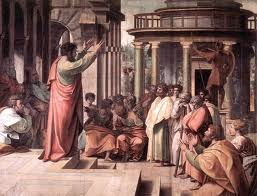
*Athens Revisited (An Exegetical Study of Acts 17) by D.A. Carson

I would like to think that most of us have become convinced of the primacy of what might generically be called worldview evangelism. In the recent past, at least in North America and Europe, evangelism consisted of a fairly aggressive presentation of one small part of the Bible’s story line. Most non-Christians to whom we presented the gospel shared enough common language and outlook with us that we did not find it necessary to unpack the entire plot line of the Bible.

A mere quarter of a century ago, if we were dealing with an atheist, he or she was not a generic atheist but a Christian atheist-that is, the God he or she did not believe in was more or less a god of discernibly Judeo-Christian provenance. The atheist was not particularly denying the existence of Hindu gods — Krishna, perhaps — but the God of the Bible. But that meant that the categories were still ours. The domain of discourse was ours.

When I was a child, if I had said, “Veiled in flesh the Godhead see,” 80 percent of the kids in my school could have responded, “Hail the incarnate deity.” That was because Christmas carols like “Hark, the Herald Angels Sing” were sung in home, church, school, and street. These kids may not have understood all-the words, but this domain of Christian discourse was still theirs. Young people at university doubtless imbibed massive doses of naturalism, but in most English departments it was still assumed you could not plumb the vast heritage of English poetry if you possessed no knowledge of the language, metaphors, themes, and categories of the Bible.

In those days, then, evangelism presupposed that most unbelievers, whether they were atheists or agnostics or deists or theists, nevertheless knew that the Bible begins with God, that this God is both personal and transcendent, that he made the universe and made it good, and that the Fall introduced sin and attracted the curse. Virtually everyone knew that the Bible has two Testaments. History moves in a straight line. There is a difference between good and evil, right and wrong, truth and error, fact and fiction. They knew that Christians believe there is a heaven to be gained and a hell to be feared. Christmas is bound up with Jesus’ birth; Good Friday and Easter, with Jesus’ death and resurrection. Those were the givens.

So what we pushed in evangelism was the seriousness of sin, the freedom of grace, who Jesus really is, what his death is about, and the urgency of repentance and faith. That was evangelism. Of course, we tilted things in certain ways depending on the people we were addressing; the focus was different when evangelizing in different subcultural settings— in the Bible Belt, for instance, or in an Italian-Catholic section of New York, or in an Ivy League university. But for most of us, evangelism was connected with articulating and pressing home a very small part of the Bible’s plot line.

In many seminaries like Trinity, of course, we recognized that missionaries being trained to communicate the gospel in radically different cultures needed something more. A missionary to Japan or Thailand or north India would have to learn not only another language or two but also another culture. No less important, they would have to begin their evangelism farther back, because many of their hearers would have no knowledge of the Bible at all and would tenaciously hold to some worldview structures that were fundamentally at odds with the Bible. The best schools gave such training to their missionary candidates. But pastors and campus workers were rarely trained along such lines. After all, they were doing nothing more than evangelizing people who shared their own cultural assumptions, or at least people located in the same domain of discourse, weren’t they?

We were naive, of course. We were right, a quarter of a century ago, when we sang, “The times they are a-changin’.” Of course, there were many places in America where you could evangelize churchy people who still retained substantial elements of a Judeo-Christian worldview. There are still places like that today: the over-fifties in the Midwest, parts of the Bible Belt. But in the New England states, in the Pacific Northwest, in universities almost anywhere in the country, in pockets of the population such as media people, and in many parts of the entire Western world, the degree of biblical illiteracy cannot be overestimated. One of my students commented a week ago that he was walking in Chicago with his girlfriend, who had a wooden cross hanging from a chain around her neck. A lad stopped her on the sidewalk and asked why she had a plus sign for a necklace. The people whom we evangelize on university campuses usually do not know that the Bible has two Testaments. As Phillip Jensen says, you have to explain to them the purpose of the big numbers and little numbers. They have never heard of Abraham, David, Solomon, Paul — let alone Haggai or Zechariah. They may have heard of Moses, but only so as to confuse him with Charlton Heston.

But this analysis is still superficial. My point is not so much that these people are ignorant of biblical data (though that is true) as that, having lost touch with the Judeo-Christian heritage that in one form or another (sometimes bowdlerized) long nourished the West, they are not clean slates waiting for us to write on them. They are not empty hard drives waiting for us to download our Christian files onto them. Rather, they have inevitably developed an array of alternative worldviews. They are hard drives full of many other files that collectively constitute various non-Christian frames of reference.

The implications for evangelism are immense. I shall summarize four.

First, the people we wish to evangelize hold some fundamental positions that they are going to have to abandon to become Christians. To continue my computer analogy, they retain numerous files that are going to have to be erased or revised, because as presently written, those files are going to clash formidably with Christian files. At one level, of course, that is always so. That is why the gospel demands repentance and faith; indeed, it demands the regenerating, transforming work of the Spirit of God. But the less there is of a common, shared worldview between “evangelizer” and “evangelizee,” between the biblically informed Christian and the biblically illiterate postmodern, the more traumatic the transition, the more decisive the change, the more stuff has to be unlearned.

Second, under these conditions evangelism means starting farther back. The good news of Jesus Christ — who he is and what he accomplished by his death, resurrection, and exaltation — is simply incoherent unless certain structures are already in place. You cannot make heads or tails of the real Jesus unless you have categories for the personal/transcendent God of the Bible; the nature of human beings made in the image of God; the sheer odium of rebellion against him; the curse that our rebellion has attracted; the spiritual, personal, familial, and social effects of our transgression; the nature of salvation; the holiness and wrath and love of God. One cannot make sense of the Bible’s plot line without such basic ingredients; one cannot make sense of the Bible’s portrayal of Jesus without such blocks in place. We cannot possibly agree on the solution that Jesus provides if we cannot agree on the problem he confronts. That is why our evangelism must be “worldview” evangelism. I shall flesh out what this means in a few moments.

Third, not for a moment am I suggesting that worldview evangelism is a restrictively propositional exercise. It is certainly not less than propositional; the Bible not only presents us with many propositions, but it insists in some cases that unless one believes those propositions one is lost. The point can easily be confirmed by a close reading of the gospel of John. For all its complementary perspectives, it repeatedly makes statements like “Unless you believe that . . .” One really ought not be forced to choose between propositions and relational faith any more than one should be forced to choose between the left wing of an airplane and the right. At its core, worldview evangelism is as encompassing as the Bible. We are called not only to certain propositional confession but also to loyal faith in Jesus Christ, the truth incarnate; to repentance from dead works to serve the living God; to life transformed by the Holy Spirit, given to us in anticipation of the consummated life to come; to a new community that lives and loves and behaves in joyful and principled submission to the Word of the King, our Maker and Redeemer. This massive worldview touches everything, embraces everything. It can be simply put, for it has a center; it can be endlessly expounded and lived out, for in its scope it has no restrictive perimeter.

Fourth, the evangelist must find ways into the values, heart, thought patterns — in short, the worldview — of those who are being evangelized but must not let that non-Christian worldview domesticate the biblical message. The evangelist must find bridges into the other’s frame of reference, or no communication is possible; the evangelist will remain ghettoized. Nevertheless, faithful worldview evangelism under these circumstances will sooner or later find the evangelist trying to modify or destroy some of the alien worldview an d to present another entire structure of thought and conduct that is unimaginably more glorious, coherent, consistent, and finally true.

All of this, of course, the apostle Paul well understood. In particular, by his own example he teaches us the difference between evangelizing those who largely share your biblical worldview and evangelizing those who are biblically illiterate. In Acts 13:16-41, we read Paul’s evangelistic address in a synagogue in Pisidian Antioch. The setting, a synagogue, ensures that his hearers are Jews, Gentile proselytes to Judaism, and Godfearers — in every case, people thoroughly informed by the Bible (what we would today call the Old Testament). In this context, Paul selectively narrates Old Testament history in order to prove that Jesus of Nazareth is the promised Messiah. He quotes biblical texts, reasons his way through them, and argues that the resurrection of Jesus is the fulfillment of biblical prophecies about the Holy One in David’s line not seeing decay From Jesus’ resurrection, Paul argues back to Jesus’ death and its significance — ultimately, the forgiveness of sins and justification before God (vv. 38-39). Paul ends with a biblical passage warning of fearful judgment against skepticism and unbelief. Here, then, is the apostolic equivalent to evangelism among churchy folk, biblically literate folk-the kind of people who already, at a certain level, know their Bibles.

In Acts 17:16-34, however, one finds the apostle Paul evangelizing intelligent Athenians who are utterly biblically illiterate. Here his approach is remarkably different, and has much to teach us as we attempt to evangelize a new generation of biblical illiterates.

Now while Paul was waiting for them at Athens, his spirit was provoked within him as he saw that the city was full of idols. So he reasoned in the synagogue with the Jews and the devout persons, and in the marketplace every day with those who happened to be there. Some of the Epicurean and Stoic philosophers also conversed with him. And some said, “What does this babbler wish to say?” Others said, “He seems to be a preacher of foreign divinities”—because he was preaching Jesus and the resurrection. And they took hold of him and brought him to the Areopagus, saying, “May we know what this new teaching is that you are presenting? For you bring some strange things to our ears. We wish to know therefore what these things mean.” Now all the Athenians and the foreigners who lived there would spend their time in nothing except telling or hearing something new. So Paul, standing in the midst of the Areopagus, said: “Men of Athens, I perceive that in every way you are very religious. For as I passed along and observed the objects of your worship, I found also an altar with this inscription, ‘To the unknown god.’ What therefore you worship as unknown, this I proclaim to you. The God who made the world and everything in it, being Lord of heaven and earth, does not live in temples made by man, nor is he served by human hands, as though he needed anything, since he himself gives to all mankind life and breath and everything. And he made from one man every nation of mankind to live on all the face of the earth, having determined allotted periods and the boundaries of their dwelling place, that they should seek God, in the hope that they might feel their way toward him and find him.

Yet he is actually not far from each one of us, for ‘In him we live and move and have our being’; as even some of your own poets have said, ‘For we are indeed his offspring.’ Being then God’s offspring, we ought not to think that the divine being is like gold or silver or stone, an image formed by the art and imagination of man. The times of ignorance God overlooked, but now he commands all people everywhere to repent, because he has fixed a day on which he will judge the world in righteousness by a man whom he has appointed; and of this he has given assurance to all by raising him from the dead.”

Now when they heard of the resurrection of the dead, some mocked. But others said, “We will hear you again about this.” So Paul went out from their midst. But some men joined him and believed, among whom also were Dionysius the Areopagite and a woman named Damaris and others with them.

I have organized the rest of what I have to say under four topics: the realities Paul faces, the priorities he adopts, the framework he establishes, and the nonnegotiable gospel he preaches.

(1) THE REALITIES PAUL FACES

Apart from their obvious biblical illiteracy — these Athenian intellectuals had never heard of Moses, never cracked a Bible — three features of this culture are striking.

First, the Roman Empire was characterized not only by large-scale empirical pluralism but also by government-sponsored religious pluralism. The Romans knew that a captive people were more likely to rebel if they could align religion, land, and people. Partly to break up this threefold cord, the Romans insisted on adopting into their own pantheon some of the gods of any newly subjugated people, and they insisted equally strongly that the newly subjugated people adopt some of the Roman gods. In any potential civil war, therefore, it would be quite unclear which side the gods were helping — and this policy of god-swaps strengthened the likelihood of imperial peace. It also meant that religious pluralism was not only endemic to the Empire but was buttressed by the force of law After all, it was a capital offense to desecrate a temple — any temple. But let no temple and no God challenge Washington — I mean Rome.

Second, like us, Paul was dealing not with people who were biblically illiterate and therefore had no worldview, but with people who vociferously argued for various competing and powerful worldviews.

Two are mentioned in the text: Epicurean and Stoic (v. 18). In the first century, philosophy did not have the fairly esoteric and abstract connotations it has today, connected with minor departments in large universities. It referred to an entire way of life, based on a rigorous and self-consistent intellectual system — close to what we mean by worldview The ideal of Epicurean philosophy, Epicurean worldview, was an undisturbed life — a life of tranquility, untroubled by undue involvement in human affairs.

The gods themselves are composed of atoms so fine they live in calmness in the spaces between the worlds. As the gods are nicely removed from the hurly-burly of life, so human beings should seek the same ideal. But over against this vision, as we shall see, Paul presents a God who is actively involved in this world as its Creator, providential Ruler, Judge, and self-disclosing Savior.

Stoic philosophy thought of god as all-pervasive, more or less in a pantheistic sense, so that the human ideal was to live life in line with what is ultimately real, to conduct life in line with this god/principle of reason, which must rule over emotion and passion. Stoicism, as someone has commented, was “marked by great moral earnestness and a high sense of duty.” Against such a vision, the God that Paul presents, far from being pantheistic, is personal, distinct from the creation, and is our final judge. Instead of focusing on “universal reason tapped into by human reasoning,” Paul contrasts divine will and sovereignty with human dependence and need. In short, there is a massive clash of worldviews.

Of course, there were other Greek and Latin worldviews. There is no mention here of the sophists or of the atheistic philosophical materialists such as Lucretius. What is clear is that Paul here finds himself evangelizing men and women deeply committed to one fundamentally alien worldview or another.

Third, no less striking is the sneering tone of condescension they display in verse 18: What is this babbler trying to say? — this “seed picker,” this little bird fluttering around picking up disconnected scraps of incoherent information, this second-class mind? Others remarked, He seems to be advocating foreign gods. Of course, as it turns out, some of these people become genuinely interested in the gospel. The tenor of condescension is unmistakable, however, when an alien worldview feels secure in its thoughtless majority.

These, then, are the realities Paul faces.

(2) THE PRIORITIES PAUL ADOPTS

The most immediate and striking response of the apostle Paul to all that he witnesses in Athens is an intuitively biblical analysis: he is greatly distressed to see that the city was full of idols (v. 16). Paul might have been overwhelmed by Athens’ reputation as the Oxford or Cambridge or Harvard of the ancient world (though universities per se did not then exist). He might have admired the architecture, gaping at the Parthenon. But Paul is neither intimidated nor snookered by Athens; he sees the idolatry. How we need Christians in our universities and high places who are neither impressed nor intimidated by reputation and accomplishment if it is nothing more than idolatry!

The apostle sets out, then, to evangelize. He aims at two quite different groups. As usual, he attaches a certain priority to evangelizing Jews and Godfearing Gentiles, the churchy folk, the biblically literate people; he reasons in the synagogue with the Jews and the God-fearing Greeks (v. 17a). He has a theological reason for this priority that we cannot examine here, but in any case we must never forget to evangelize such people. Second, he evangelizes the ordinary pagans who have no connection with the Bible: he evangelizes day by day in the market place, targeting anyone who happens to be there, most of whom would have been biblically illiterate (v. 17b). He does not wait for an invitation to the Areopagus. He simply gets on with his evangelism, and the invitation to the Areopagus is the result (v. 18).

These, then, are his priorities: God-centered cultural analysis, and persistent evangelism of both biblical literates and biblical illiterates.

Perhaps I should add that there is at least one fundamental difference between Paul’s situation and ours. When Paul evangelizes biblical illiterates, he is dealing with people whose heritage has not in recent centuries had anything to do with biblical religion. So when they react negatively to him, they do so solely because, from their perspective, his frame of reference is so alien to their own. They are not rejecting him in part because they are still running away from their own heritage. That is the additional problem we sometimes face. We sometimes deal with men and women who have adopted a worldview that is not only at several points profoundly antithetical to a biblical worldview but also self-consciously chosen over against that biblical worldview. That opens up some opportunities for us, but it raises some additional barriers as well. However, we cannot probe these opportunities and barriers here. It is enough to observe the priorities that Paul adopts.

(3) THE FRAMEWORK PAUL ESTABLISHES

Here it will be helpful to run through Paul’s argument from 17:22 to 17:31. Before I do so, however, I want to make three preliminary observations.

First, it takes you about two minutes to read this record of Paul’s address. But speeches before the Areopagus were not known for their brevity. In other words, we must remember that this is a condensed report of a much longer speech. Doubtless every sentence, in some cases every clause, constituted a point that Paul expanded upon at length.

Second, if you want to know a little more closely just how he would have expanded each point, it is easier to discover than some people think. For there are many points of comparison between these sermon notes and, for instance, Romans. I’ll draw attention to one or two of the parallels as we move on.

Third, there is a fascinating choice of vocabulary. It has often been shown that many of the expressions in this address, especially in the early parts, are the sorts of things one would have found in Stoic circles. Yet in every case, Paul tweaks them so that in his context they convey the peculiar emphases he wants to assign to them. In other words, the vocabulary is linguistically appropriate to his hearers, but at the level of the sentence and the paragraph, Paul in this report is saying just what he wants to say; he is establishing a biblical worldview.

Now let us scan the framework Paul establishes.

First, he establishes that God is the creator of the world and everything in it (17:24). How much he enlarged on this point we cannot be certain, but we know from his other writings how his mind ran. The creation establishes that God is other than the created order; pantheism is ruled out. It also establishes human accountability; we owe our Creator everything, and to defy him and set ourselves up as the center of the universe is the heart of all sin. Worse, to cherish and worship created things instead of the Creator is the essence of idolatry.

Second, Paul insists that God is the Lord of heaven and earth and does not live in temples built by hands (v. 24). The sovereignty of God over the whole universe stands over against views that assign this god or that goddess a particular domain — perhaps the sea (Neptune), or tribal gods with merely regional or ethnic interests. The God of the Bible is sovereign over everything. This teaching grounds the doctrine of providence. Because of the universality of his reign, God cannot be domesticated — not even by temples (v. 24). Paul is not denying the historical importance of the temple in

Jerusalem, still less that God uniquely disclosed himself there. Rather, he denies that God is limited to temples, and that he can be domesticated or squeezed or tapped into by the cultus of any temple (which of course threatens popular pagan practice). He is so much bigger than that.

Third, God is the God of aseity: he is not served by human hands, as if he needed anything (17:25). Aseity is a word now largely fallen into disuse, though it was common in Puritan times. Etymologically it comes from the Latin a se — “from himself.” God is so utterly “from himself” that he does not need us; he is not only self-existent (a term we often deploy with respect to God’s origins — the existence of everything else is God-dependent, but God himself is self-existent), but he is utterly independent of his created order so far as his own well-being or contentment or existence are concerned. God does not need us — a very different perspective from that of polytheism, where human beings and gods interact in all kinds of ways bound up with the finiteness and needs of the gods. The God of the Bible would not come to us if, rather whimsically, he wanted a McDonald’s hamburger; the cattle on a thousand hills are already his.

Fourth, the truth of the matter is the converse: we are utterly dependent on him — he himself gives all men life and breath and everything else (v. 25b). This strips us of our vaunted independence; it is the human correlative of the doctrines of creation and providence.

Fifth, from theology proper, Paul turns to anthropology. He insists that all nations descended from one man (v. 26). This contradicts not a few ancient notions of human descent, which conjectured that different ethnic groups came into being in quite different ways. But Paul has a universal gospel that is based on a universal problem (cf. Rom. 5; 1 Cor. 15). If sin and death were introduced into the one human race by one man such that the decisive act of another man is required to reverse them, then it is important for Paul to get the anthropology right so that the soteriology is right. We cannot agree on the solution if we cannot agree on the problem. But Paul’s stance has yet wider implications; there is no trace of racism here. Moreover, however much he holds that God has enjoyed a peculiar covenant relationship with Israel, because he is a monotheist, Paul holds that God must be sovereign over all the nations. Did he, perhaps, develop some of the lines of argument one finds in Isaiah 40ff.? If there is but one God, that God must in some sense be the God of all, whether his being and status are recognized by all or not.

Sixth, for the first time one finds an explicit reference to something wrong in this universe that God created. His providential rule over all was with the purpose that some would reach out for him and find him (v. 27). In short order Paul will say much more about sin (without actually using the word). Here he is preparing the way. The assumption is that the race as a whole does not know the God who made them. Something has gone profoundly wrong.

Seventh, although it has been important for him to establish God’s transcendence, Paul does not want such an emphasis to drift toward what would later be called deism. The God he has in mind is not far from each one of us (v. 27). He is immanent. Paul will not allow any suspicion that God is careless or indifferent about people; he is never far from us. Moreover, the apostle recognizes that some of this truth is acknowledged in some pagan religions. When Greek thought (or much of it) spoke of one “God” as opposed to many gods, very often the assumption was more or less pantheistic. That structure of thought Paul has already ruled out. Still, some of its emphases were not wrong if put within a better framework. We live and move and have our being in this God, and we are his offspring (17:28) — not, for Paul, in some pantheistic sense, but as an expression of God’s personal and immediate concern for our well-being.

Eighth, the entailment of this theology and this anthropology is to clarify what sin is and to make idolatry utterly reprehensible (v. 29). Doubtless Paul enlarged this point very much in terms of, say, Isaiah 44-45 and Romans 1. For he cannot rightly introduce Jesus and his role as Savior until he establishes what the problem is; he cannot make the good news clear until he elucidates the bad news from which the good news rescues us.

Ninth, Paul also introduces what might be called a philosophy of history — or better, perhaps, a certain view of time. Many Greeks in the ancient world thought that time went round and round in circles. Paul establishes a linear framework: creation at a fixed point; a long period that is past with respect to Paul’s present in which God acted in a certain way (In the past God over-looked such ignorance); a now that is pregnant with massive changes; and a future (v. 31) that is the final termination of this world order, a time of final judgment. The massive changes of Paul’s dramatic now are bound up with the coming of Jesus and the dawning of the gospel. Paul has set the stage so as to introduce Jesus.

So here is the framework Paul establishes. He has, in fact, constructed a biblical worldview. But he has not done so simply for the pleasure of creating a worldview. In this context he has done so in order to provide a framework in which Jesus himself, not least his death and resurrection, makes sense. Otherwise nothing that Paul wants to say about Jesus will make sense.

This is the framework Paul establishes.

(4) THE NONNEGOTIABLE GOSPEL PAUL PREACHES

We read again verse 31: For [God] has set a day when he will judge the world with justice by the man he has appointed. He has given proof of this to all men by raising him from the dead.

Here, at last, Jesus is introduced.

I want to emphasize two things. First, it is extraordinarily important to see that Paul has established the framework of the biblical metanarrative before he introduces Jesus. If metaphysics is a sort of big physics that explains all the other branches of physics, similarly metanarrative is the big story that explains all the other stories. By and large, postmodernists love stories, especially ambiguous or symbol-laden narratives. But they hate the metanarrative, the big story that makes all the little stories coherent. But what Paul provides is the biblical metanarrative. This is the big story in the Bible that frames and explains all the little stories. Without this big story, the accounts of Jesus will not make any sense — and Paul knows it.

For instance, if in a vague, New Age, postmodern context, we affirm something like “God loves you,” this short expression may carry a very different set of associations than we who are Christians might think. We already assume that men and women are guilty and that the clearest and deepest expression of God’s love is in the cross, where God’s own Son dealt with our sin at the expense of his own life. But if people know nothing of this story line, then the same words, “God loves you,” may be an adequate summary of the stance adopted by Jodie Foster in her recent film, Contact. The alien power is beneficent, wise, good, and interested in our well-being. There is nothing whatever to do with moral accountability, sin, guilt, and how God takes action to remove our sin by the death of his Son. The one vision nestles into the framework of biblical Christianity; the other nestles comfortably into the worldview of New Age optimism. In short, without the big story, without the metanarrative, the little story or the little expression becomes either incoherent or positively misleading. Paul understands the point.

Second, what is striking is that Paul does not flinch from affirming the resurrection of Jesus from the dead. And that is what causes so much offense that Paul is cut off, and the Areopagus address comes to an end. Paul was thoroughly aware, of course, that most Greeks adopted some form of dualism. Matter is bad, or at least relatively bad; spirit is good. To imagine someone coming back from the dead in bodily form was not saying anything desirable, still less believable. Bodily resurrection from the dead was irrational; it was an oxymoron, like intelligent slug or boiled ice. So some of Paul’s hearers have had enough, and they openly sneer and end the meeting (v. 32). If Paul had spoken instead of Jesus’ immortality, his eternal spiritual longevity quite apart from any body, he would have caused no umbrage. But Paul does not flinch. Elsewhere he argues that if Christ has not been raised from the dead, then the apostles are liars, and we are still dead in our trespasses and sins (I Cor. 15). He remains faithful to that vision here. Paul does not trim the gospel to make it acceptable to the worldview of his listeners.

For Paul, then, there is some irreducible and nonnegotiable content to the gospel, content that must not be abandoned, no matter how unacceptable it is to some other worldview. It follows that especially when we are trying hard to connect wisely with some worldview other than our own, we must give no less careful attention to the nonnegotiables of the gospel, lest in our efforts to communicate wisely and with relevance, we unwittingly sacrifice what we mean to communicate.

But suddenly we overhear the muttered objection of the critic. Can it not be argued that Paul here makes a fundamental mistake? Elsewhere in Acts he frequently preaches with much greater fruitfulness, and in those cases he does not stoop to all this worldview stuff. He just preaches Jesus and his cross and resurrection, and men and women get converted. Here, a piddling number believe (v. 34). In fact, Paul’s next stop in Greece after Athens is Corinth. Reflecting later on his experiences there, Paul writes to the Corinthians and reminds them For I resolved to know nothing while I was with you except Jesus Christ and him crucified (I Cor. 2:2) — doubtless because he was reflecting with some sour-faced chagrin on his flawed approach in Athens. So let us be frank, the critics charge, and admit that Paul made a huge mistake in Athens and stop holding up Acts 17 as if it were a model of anything except what not to do. The man goofed: he appealed to natural theology; he tried to construct redemptive history; he attempted to form a worldview when he should have stuck to his last and preached Jesus and the cross.

I sometimes wish this reading were correct, but it is profoundly mistaken for a number of reasons.

(1) It is not the natural reading of Acts. As Luke works through his book, he does not at this point in his narrative send up a red flag and warn us that at this point Paul makes a ghastly mistake. The false reading is utterly dependent on taking I Corinthians in a certain way (a mistaken way, as we shall see), and then reading it into Acts 17.

(2) What Paul expresses, according to Luke’s report of the Areopagus address, is very much in line with Paul’s own theology, not least his theology in the opening chapters of Romans.

(3) Strictly speaking, Paul does not say that only a “few” men believed. He says tines de andres, “certain people,” along with heteroi, “others.” These are in line with other descriptions. The numbers could scarcely have been large, because the numbers in the Areopagus could not have been very large in the first place.

(4) Transparently, Paul was cut off when he got to the resurrection of Jesus (vv. 31-32). But judging from all we know of him — both from a book like Romans and from the descriptions of him in Acts — we know where he would have gone from here.

(5) That is entirely in line with the fact that what Paul had already been preaching in the marketplace to the biblically illiterate pagans was the cc gospel” (v. 18).

(6) At this point in his life Paul was not a rookie. Far from being fresh out of seminary and still trying to establish the precise pattern of his ministry, on any chronology he had already been through twenty years of thrilling and brutal ministry. Nor is this Paul’s first time among biblically illiterate pagans or among intellectuals.

(7) In any case, I Corinthians 2 does not cast Paul’s resolve to preach Christ crucified against the background of what had happened to him in Athens. He does not say, in effect, “Owing to my serious mistakes in Athens, when I arrived in Corinth I resolved to preach only Christ and him crucified.” Rather, in 1 Corinthians Paul’s resolve to preach Christ crucified is cast against the background of what Christians in Corinth were attracted to — namely, to a form of triumphalism that espoused an ostensible wisdom that Paul detests. It is a wisdom full of pride and rhetoric and showmanship. Against this background, Paul takes a very different course. Knowing that believers must boast only in the Lord and follow quite a different wisdom (I Cor. 1), he resolves to preach Christ and him crucified.

(8) In any case, it would be wrong to think that Paul has no interest in worldviews. Writing after I Corinthians 2, Paul can say, We demolish arguments and every pretension that sets itself up against the knowledge of God, and we take captive every thought to make it obedient to Christ (2 Cor. 10:45). The context shows that Paul is not here interested so much in disciplining the individual’s private thought life (though that certainly concerns him elsewhere) as in bringing into obedience to Christ every thought structure, every worldview, that presents opposition to his beloved Master. In other words, Paul thought “worldviewishly” (if that is not too monstrous a neologism). That is clear in many of his writings; it is clear in both 2 Corinthians 10 and in Acts 17.

(9) Finally, the first line of Acts 17:34 is sometimes misconstrued: “A few men became followers of Paul and believed.” Many have assumed Luke means that a few people became Christians on the spot and followers of Paul. But that reverses what is said. Moreover, Paul has not yet given much gospel — in precisely what sense would they have become Christians? It is better to follow the text exactly Following Paul’s address, no one became a Christian on the spot. But some did become followers of Paul. In consequence, in due course they grasped the gospel and believed; they became Christians. This is entirely in line with the experience of many evangelists working in a university environment today.

A couple of years ago I spoke evangelistically at a large meeting in Oxford. So far as I know, no one became a Christian at that meeting. But sixteen students signed up for a six-week “Discovering Christianity” Bible study. A few weeks after the meeting, the curate, Vaughan Roberts, wrote me a note to tell me that eleven of the sixteen had clearly become Christians already, and he was praying for the remaining five. In other words, as a result of that meeting, some became “followers of Jesus,” and in due course believed. That is often the pattern when part of the evangelistic strategy is to establish a worldview, a frame of reference, to make the meaning of Jesus and the gospel unmistakably plain.

In short, however sensitive Paul is to the needs and outlook of the people he is evangelizing, and however flexible he is in shaping the gospel to address them directly, we must see that there remains for him irreducible content to the gospel. That content is nonnegotiable, even if it is remarkably offensive to our hearers. If it is offensive, we may have to decide whether it is offensive because of the intrinsic message or because we have still not done an adequate job of establishing the frame of reference in which it alone makes sense. But the gospel itself must never be compromised.

SOME CONCLUDING REFLECTIONS

I offer three concluding reflections. First, the challenge of worldview evangelism is not to make simple things complicated but to make clear to others some fairly complicated things that we simply assume. This can be done in fifteen minutes with the sort of presentation Phillip Jensen and Tony Payne have constructed (in Chapter 6 of Telling the Truth – “Two Ways To Live”). It might be done in seven consecutive expositions running right through the first eight chapters of Romans. It might be done with the six months of Bible teaching, beginning with Genesis, that many New Tribes Mission personnel now use before they get to Jesus. But it must be done.

Second, the challenge of worldview evangelism is not primarily to think in philosophical categories, but it is to make it clear that closing with Jesus has content (it is connected with a real, historical Jesus about whom certain things must be said and believed) and is all-embracing (it affects conduct, relationships, values, priorities). It is not reducible to a preferential religious option among many, designed primarily to make me feel good about myself.

Third, the challenge of worldview evangelism is not primarily a matter of how to get back into the discussion with biblically illiterate people whose perspectives may be very dissimilar to our own. Rather, worldview evangelism focuses primarily on where the discussion goes. There are many ways of getting into discussion; the crucial question is whether the Christian witness has a clear, relatively simple, straightforward grasp of what the Bible’s story line is, how it must give form to a worldview, and how the wonderful news of the gospel fits powerfully into this true story — all told in such a way that men and women can see its relevance, power, truthfulness, and life-changing capacity.

*”Athens Revisited” was originally a lecture at a conference on the topic of Evangelism in a Post Modern Culture held on May 13-15, 1998 at Trinity Evangelical Divinity School in Deerfield, Illinois & sponsored by the Bannockburn Institute (www.biccc.org). All the lectures from this conference were published in the book: Telling The Truth: Evangelizing Postmoderns, Grand Rapids: Zondervan, 2000; of which D.A. Carson was the general editor and the contributor of Chapter 28 from which this article is adapted.
About the Author: D. A. Carson (Ph.D., University of Cambridge) is research professor of New Testament at Trinity Evangelical Divinity School in Deerfield, Illinois. His theology is similar to that of Wayne Grudem except on charismatic issues, where his view may be described as “open but cautious.” Carson’s tendency is to strive for balance and amicability in disputes but is uncompromising on the essentials of the faith. He is a complementarian but supports gender-neutral Bible translations. Carson also helped produce the NLT. He is the author or coauthor of over 50 books. Some of the plethora of outstanding books he has written includes: The Intolerance of Tolerance, The God Who Is There, ScandalousHow Long O Lord, A Call to Spiritual Reformation; The Cross and Christian Ministry; The Difficult Doctrine of the Love of God; Divine Sovereignty and Human Responsibility; Exegetical Fallacies; For the Love of God; The Gagging of God; The Inclusive Language Debate; Introduction to the New Testament; New Testament Commentary Survey; Scripture and Truth (Ed. with John Woodbridge); Worship by the Book; Pillar Commentaries on Matthew and John and a contributor to Who Will be Saved. He also edits the New Studies in Biblical Theology book series.

Carson’s areas of expertise include biblical theology, the historical Jesus, postmodernism, pluralism, Greek grammar, Johannine theology, Pauline theology, and questions of suffering and evil. He has written books on free will and predestination from a generally compatibilist and Calvinist perspective. He is a member of the Tyndale Fellowship for Biblical Research, the Society of Biblical Literature, the Evangelical Theological Society, the Canadian Society of Biblical Studies, and the Institute for Biblical Research.

Dr. Carson and his wife, Joy, reside in Libertyville, Illinois. They have two children. In his spare time, Dr. Carson enjoys reading, hiking, and woodworking.

Dr. Tim Keller – On Why People Are Spiritual but not Religious

“Religion-Less Spirituality”

By Dr. Tim Keller*

“Growing numbers of Americans say they are spiritual but not religious,” says Robert Wuthnow in After Heaven, his assessment of American spiritual development since 1950.

It is a spirituality without truth or authority but filled with belief in the supernatural. It is a trend born of the modern fears of religion.

The powerful critiques of Freud, Marx, and Nietzsche have penetrated our popular psyche. Freud saw religious performance as a way that guilt-ridden people cleanse themselves and force God to bless them. Marx saw religious principle used by one class of people to oppress another. Neitzsche asserted that anyone claiming to have the truth is making a power play. He asked the powerful: “Why do you call for love? Is it not just a way to keep anyone from revolting against your authority?” He asked the powerless: “Why do you call for justice? Is it not just a way for you to get on top?”

These critiques are powerful because they have the ring of truth. They’re the reasons many who seek spirituality reject religion.

What shall we do then? We must address the real issues of self-righteousness, exclusion, and power-plays. The church must echo Jesus’ own powerful critique of religion and visibly demonstrate the difference between religion and the gospel.

Right word, right time

First, we must do it in word—in our preaching and communication. Even more than Freud, Jesus condemned self-justification through moral performance, at one point claiming that religion was more spiritually dangerous than overt immorality.

Jesus gives us the classic picture of the failure of both religion and irreligion in his parable of the two sons in Luke 15. The elder brother represents the religious leaders; he never disobeys any of the father’s laws. As a result, he tries to control his father and exclude his brother. In the end, he is the one who misses the feast of salvation rather than his profligate brother.

There could not be a more powerful warning: The elder brother is not lost despite his obedience to the father but because of it.

Jesus shows us that the problem is self-justification, the belief that we can win blessing through our virtue. In Luther’s terminology, religion is just another form of works-righteousness, which leads to profound internal instability. We are never sure of our worthiness, yet we need to feel superior to those who do not conform in order to bolster our insecurity.

Following Jesus, we must agree with our critics about the danger of religion, but show them that they are wrong about their solution to it. Secular people see religion as a body of fixed doctrine and ethics that one must adhere to in order to acquire rights to blessing and heaven. They see how often religion leads to self-righteousness, exclusion, and oppression. Modern culture, however, wrongly identifies fixed doctrine (the idea of absolute truth) as the poisonous element.

Both traditional religion and the new spirituality are forms of self-salvation. The religious way of being our own savior leads us to keep God’s laws, while the irreligious way of being our own savior leads us to break his laws. The solution is the gospel.

The gospel shows us a God far more holy than a conservative moralist can imagine—for he can never be pleased by our moral performance. Yet it also shows us a God far more loving than the liberal relativist can imagine—for his Son bore all the weight of eternal justice. His love for us cost him dearly.

Practically speaking, this means in our preaching we must be extremely careful to distinguish between general moral virtue and the unique humility, confidence, and love that flow from the gospel. I’m convinced we must learn carefully from Jonathan Edwards: “An experience of God’s grace is the only basis for ultimate and enduring … true virtue.”

Religion is outside-in; 
the gospel is inside-out.

Edwards says that most virtue is secondary virtue, based on self-love, and therefore on fear (of punishment) and pride (in our superior decency). Edwards appreciates that common morality makes the world a liveable place, but he essentially agrees with Neitzsche that it is really a power play. General moral virtue does not come from a heart that has given up its need to feel superior to others.

Only an experience of grace and free justification can create a heart that does good out of delight in God himself, out of delight in goodness itself, and out of love for our neighbors in themselves. Without the gospel, we can restrain the human heart, but not change the human heart. The gospel calls for repentance over our self-righteousness. The true virtue that results creates an attitude of acceptance toward the poor, the outsider, and the opponent that neither religion nor secularism can produce.

Show me your faith

Second, we must demonstrate the difference between religion and the gospel in our deeds—how we embody the gospel in our community and service. Even more than Marx, Jesus condemned religion as a pretext for oppression: “If you only greet your brothers, what do ye more than others?” (Matt. 5:47).

Lesslie Newbigin makes the bold case that Christianity is a better basis for true tolerance of opposing beliefs than any other religion or even secularism. Saved only by grace, Christians true to the gospel will not feel superior to those with whom they differ.

This must be more than rhetoric. Only when Christians non-condescendingly serve the poor, only when Christians are more firm yet open to their opponents will the world understand the difference between religion and the gospel.

What does this mean practically?

We will be careful with the order in which we communicate the parts of the faith.

Pushing moral behaviors before we lift up Christ is religion. The church today is calling people to God with a tone of voice that seems to confirm their worst fears. Religion has always been outside-in—”if I behave out here in all these ways, then I will have God’s blessing and love inside.” But the gospel is inside-out—”if I know the blessing and grace of God inside, then I can behave out here in all these ways.”

A woman who had been attending our church for several months came to see me. “Do you think abortion is wrong?” she asked. I said that I did. “I’m coming now to see that maybe there is something wrong with it,” she replied, “now that I have become a Christian here and have started studying the faith in the classes.”

As we spoke, I discovered that she was an Ivy League graduate, a lawyer, a long-time Manhattan resident, and an active member of the ACLU. She volunteered that she had experienced three abortions.

“I want you to know,” she said, “that if I had seen any literature or reference to the ‘pro-life’ movement, I would not have stayed through the first service. But I did stay, and I found faith in Christ. If abortion is wrong, you should certainly speak out against it, but I’m glad about the order in which you do it.”

This woman had had her faith incubated into birth our Sunday services. In worship, we center on the question “what is truth?” and the one who had the audacity to say, “I am the truth.” That is the big issue for postmodern people, and it’s hard to swallow. Nothing is more subversive and prophetic than to say Truth has become a real person!

Jesus calls both younger brothers and elder brothers to come into the Father’s arms. He calls the church to grasp the gospel for ourselves and share it those who are desperately seeking true spirituality.

We, of all people, ought to understand and agree with fears about religion, for Jesus himself warned us to be wary of it, and not to mistake a call for moral virtue for the good news of God’s salvation provided in Christ.

Tim Keller is pastor of 
Redeemer Presbyterian Church
New York, New York
RPCNYC@aol.com 

*DR. TIMOTHY KELLER was born and raised in Pennsylvania, and educated at Bucknell University, Gordon-Conwell Theological Seminary, and Westminster Theological Seminary. He was first a pastor in Hopewell, Virginia. In 1989 he started Redeemer Presbyterian Church in Manhattan with his wife, Kathy, and their three sons. Today, Redeemer has more than five thousand regular attendees at five services, a host of daughter churches, and is planting churches in large cities throughout the world. He is the author of KING’S CROSS, COUNTERFEIT GODS, THE PRODIGAL GOD, and the New York Times bestseller THE REASON FOR GOD & the forthcoming CENTER CHURCH (August 2012).

ARTICLE ABOVE Copyright © 1999 by the author or Christianity Today/Leadership Journal, Friday, October 1, 1999.


How Would You Like to Have “A New Life?” By C. John Miller

(Presented by C. John Miller in A Faith Worth Sharing)

Have you ever felt there was something missing in your life? Something important but you didn’t know what? That may be the new life God wants you to have. A life of joy, peace, and fulfillment. A life…which you can receive today. Carefully consider these Five Important Facts…and find out how you can get that new life and become a brand-new person.

FACT 1 – A loving God sent His Son Jesus into the world to bring you a new and abundant life.

Jesus said, “If anyone thirsts, let him come to me and drink. Whoever believes in me, as the Scripture has said, ‘Out of his heart will flow rivers of living water” (John 7:37b-38).

Jesus also said concerning those He loves, “I came that they may have life and have it abundantly” (John 10:10b).

This new life brings you the fruit of the Spirit: “love, joy, peace, patience, kindness, goodness, faithfulness, gentleness, and self-control (Galatians 5:22).” It also gives POWER!

God’s Holy Spirit gives you the power to overcome…feelings of loneliness, stress, fear of people and the future (1 John 4:18).

And the power to break habits like…selfishness, depression, uncontrolled anger, prejudice, sexual lust, overeating, overdrinking, and drug abuse (1 Corinthians 6:9-11).

But Why Are So Many People Without This New Life?

FACT 2 – Because…people are self-centered, not God-centered.

This means that by nature you are spiritually dead and deceived (Ephesians 2:1a: “You were dead through your trespasses and sins.”

TO BE SPIRITUALLY DEAD AND DECEIVED is to be centered on yourself and not on your Creator, and to believe…

A BIG LIE

People show this, according to Romans 1:21-31 by being…unthankful to God, perverted, greedy, jealous, bitter, proud, mean, devious, and foolish.

Since man’s first sin. He has tried to be INDEPENDENT of God. Actually each human being is entirely DEPENDENT on God for breath, food, health, shelter, physical and mental abilities. THE BIG LIE: SELFISH INDEPENDENCE: self-trust, self-boasting, self-reliance, self-analysis, self-hating, self-seeking.

FACT 3 – Self-centered man is separated from a holy God by three barriers.

A Bad Record – Romans 3:23, “All have sinned and have fallen short of the glory of God.”

A Bad Heart – Mark 7:21, “From the heart of man come evil thoughts.”

A Bad Master – John 8:34, “everyone who commits sin is a slave to sin.”

The consequences of sin result in eternal separation from God. “The wages of sin is death (Romans 6:23a)…whoever does not obey the Son shall not see life, but the wrath of God remains on him (John 3:36b).”

NOW:

A dry, thirsty, unsatisfied life.

A guilty, accusing conscience (depression, fears, anxiety).

An aging body that must shortly die.

FUTURE:

Loss of friendship and earthly joys forever (Matthew 8:12).

Frightful pains of body and conscience forever (Mark 9:48).

Dreadful thirst of soul and body forever (Luke 16:19-31).

FACT 4 – God’s Solution! No barriers!

A Perfect Record – 1 Corinthians 1:30, “Christ…is made our righteousness.”

A New Heart – Ezekiel 36:25-26, “A new heart I will give you.”

A Good Master – Matthew 11:28-30, “Come to me, all who labor and are heavy laden, and I will give you rest. Take my yoke upon you, and learn from me, for I am gentle and lowly in heart, and you will find rest for your souls. For my yoke is easy and my burden is light.”

“The blood of Jesus, God’s Son, cleanses us from all sin” (1 John 1:7b).

The Benefit of Jesus’ Death…Love’s Biggest Gift

“The free gift of God is eternal life through Christ Jesus” (Romans 6:23b). Jesus, the God-man, is the biggest gift of the Father’s love. On the cross Jesus suffered all the torments of hell as a substitute for His people (John 3:16; 10:15). He was legally condemned by God as their representative, removing the barriers of a bad record, a bad heat, and a bad master. The Father’s love can do no more. Risen from the dead, Jesus now lives to give you a new record, a new heart, Himself as a new master—and the free gift of eternal life now!

You Need to Make Sure

God says you either have a NEW LIFE or you are a lawbreaker DEAD in your self-centeredness. Are you personally alive or dead? If you are still dead, you need to know…

FACT 5 – How to receive the Lord Jesus into your life…

  1. Turn…In sorrow from your sins: “Seek the LORD while he may be found; call upon Him while He is near; let the wicked forsake his way, and the unrighteousness man his thoughts; let him return to the LORD, that he may have compassion on him, and to our God for he will abundantly pardon” (Is. 55:6-7).
  1. Trust…in Jesus alone to save you:Believe in the Lord Jesus, and you will be saved (Acts 16:31a)…I am the way the truth and the life, no one comes to the Father except through me” (John 14:6).

Repentance is…not our suffering or our good works to earn our salvation, but a turning from our sins to the living God through Jesus Christ.

Trust in the Lord Jesus is…accepting, receiving, and resting on Him alone as the Savior from our sins.

Begin a NEW LIFE

Will you surrender your life to Christ by turning from your self-centered way and trust in Him alone? Here is a guideline to help you confess your sins and come to know God through taking the Lord Jesus Christ as your own personal Savior.

Make this Verbal Profession & Confession of Faith:

“Heavenly Father, I am really a selfish person. I have wanted my own way—not Yours. I have often been jealous, proud, and rebellious. You are my Creator, but I have acted as though I was lord of all. I have not been thankful to You. I have not listened to Your Word the Bible and have not loved Your Son. But now I see that all my sin is against You. I now repent of this evil attitude. I turn from all of my sins and trust that Jesus has shed His precious blood to cleanse me from all my guilt. I now receive Him as mu Savior and the Lord of my life.”

I, ______________, turn from my sins and take Christ as my Lord and Savior. By His help I promise to obey Him in every part of my life.

How Does This New Life Continue? The same way it began—in faith and prayer.

  1. Pray constantly. Prayer is talking to God. Keep doing it all the time. Include in it praise, thanksgiving, confession of sins, petitions for others’ salvation, and requests for help.
  1. Read your Bible. Study your Bible every day. It is the food for your new life and your sure guide. In it you meet Jesus and learn to claim His promises for your life.
  1. Worship with others. Meet with a church where the Bible is taught and obeyed and where Jesus Christ is Lord and Savior.
  1. Witness to others. Tell your friends what Christ has done for you—and wants to do for them. Be tactful and back up your words by improvement in manners and doing deeds of kindness.

World Harvest Mission – 100 West Ave. W960 – Jenkintown, PA 19046-2697

Is The Gospel Assumed or Explicit in Your Life?

*The Gospel Assumed or Explicit? By Josh Patterson

Is the gospel assumed in your relationships? Or, is the gospel explicit? I have been thinking about this distinction for a few days now. Those who live life under the banner of an assumed gospel simply navigate the waters of life with an underlying foundation that is personal and meaningful. An assumed gospel often means that a person deeply values the gospel and tries to live life according to the gospel.

The issue with an assumed gospel is that it is often too personal and, therefore, becomes private. The person who lives under the assumption of the gospel often knows how it relates to their life, but nobody else does. Their kids never see how the gospel affects decisions, arguments, finances, etc. Their neighbors never hear of the hope within. Their co-workers are left to wonder about what makes them different. Those who live under the assumed gospel often find it awkward to bring it up and talk about the work of Christ. Why? Because they never bring it up and learn to articulate the implications of Christ’s work and their life.

On the contrary, those who are explicit about the gospel in their relationships have a different effect. By living out the gospel and speaking about the gospel and working through the gospel (verbally), they are helping to connect the dots for those around them. Their kids hear how the gospel relates to the family finances or time or relationships or arguments. Their neighbors hear about the hope within. Co-workers are privy to the reality that this person is not simply a moral guy/girl, but one who is forgiven and transformed by the death and resurrection of Christ.

I want to encourage you to begin, and with some of you, continue to make the gospel explicit in your relationships. Don’t waste life by living an assumed gospel; rather, flesh it out and connect the dots for yourself and those around you. Talk with your spouse about how Christ’s Person and work relates to everything. Pass this on to your kids. Mention Christ. Talk about Christ. Point to Christ. Relate to Christ. Oftentimes where the gospel is assumed, it is quickly lost.

*Josh Patterson is the Executive Pastor at the Village Church in Flower Mound, Texas. This article is from the Appendix in The Explicit Gospel by Matt Chandler, and is from the August 4, 2009 posting from the web site: http://fm.thevillagechurch.net/blog/pastors/?p=308.

Book Review: The Explicit Gospel by Matt Chandler

The Antidote to Gospel Inoculation

When Saint Augustine was living a life of licentiousness many generations ago he was hearing some children playing near where he was seated, playing a game with the refrain “Take up and read, take up and read.” He picked up his Bible and opened it to the book of Romans and proceeded to read about his sin and his desperate need of the provision of Christ’s imputed righteousness by faith in his death, burial, and resurrection in exchange for his sin. He was convicted of his sin and powerfully drawn by the work of the Holy Spirit toward faith and repentance in the person and work of Christ.

Whether you are a rebel, or someone who has heard the gospel (or what may pass for the gospel today) – you are well advised to take up this book and read it. In the past men like Augustine, Luther, and Calvin understood with passion and clarity our need to comprehend the richness and depth of the gospel, and proclaim it with passionate urgency – because souls are hanging in the balance. In this book Chandler definitively understands and articulates the power of the gospel and the desperate need we all have to understand the depth of our sin before a Holy God, and the just requirements He has that we have failed to meet, and thus our desperate need for what Christ came to save us from and unto.

In three parts Chandler clearly articulates the gospel essentials (God, Man, Christ, and our response); the gospel’s theological underpinnings (Creation, Fall, Reconciliation, and Consummation); and lastly its implications and applications for all of the aspects of our lives. The author is to be commended for writing a book that is passionate about the gospel; clearly articulates the gospel; calls for a response to the gospel; and demonstrates how to communicate and live out the gospel.

I highly recommend this book especially for preachers who proclaim the word of God week in and week out. He will inspire you to NOT compromise the gospel and to rest in the work of the Holy Spirit in applying it’s power in the lives of your people. My hope and prayer is that in reading this book your passion will be stirred to unflinchingly proclaim the gospel powerfully in truth and love – resulting in the saving of many lives. I think that the Apostle Paul would wholeheartedly agree with all that Chandler articulates in this book and would add, “For I am not ashamed of the gospel (as conveyed in this book), for it is the power of God for salvation to everyone who believes, to the Jew first and also to the Greek” (Rom. 1:16).

Matt Chandler is the lead pastor of The Village Church, a multi-campus church in the Dallas metroplex of over 10,000 people. He has recently taken the post as President of the Acts 29 Church Planting Network. His sermons are among the top selling (free) podcasts on itunes and he speaks at conferences worldwide. Prior to accepting the pastorate at The Village, Matt had a vibrant itinerant ministry for over ten years where he spoke to hundreds of thousands of people in America and abroad about the glory of God and beauty of Jesus. He lives in Texas with his wife, Lauren, and their three children: Audrey, Reid and Norah.

Dr. J.I. Packer Answers the Question “Will A Loving God Really Condemn People to Hell?”

*Dr. J.I. Packer’s answer to this very important question comes from Chapters One and Five of the book J.I. Packer Answers Questions For Today with Wendy Murray Zoba, Wheaton: Tyndale, 2001, pp. 15, 45-46, 75-77, 79-80.

The problem of individual human destiny has always pressed hard upon thoughtful Christians who take the Bible seriously, for Scripture affirms these three things:

(1) The reality of hell as a state of eternal, destructive punishment, in which God’s judgment for sin is directly experienced;

(2) The certainty of hell for all who choose it by rejecting Jesus Christ and his offer of eternal life; and

(3) The justice of hell as an appropriate divine judgment upon humanity for our lawless and cruel deeds.

It was, to be sure, hell-deserving sinners whom Jesus came to save. All who put their trust in him may know themselves forgiven, justified, and accepted forever—and thus delivered from the wrath to come. But what of those who lack this living faith—those who are hypocrites in the church; or “good pagans” who lived before Christ’s birth; or those who, through no fault of their own, never heard the Christian message, or who met it only in an incomplete and distorted form? Or what of those who lived in places where Christianity was a capital offense, or who suffered from ethno-nationalistic or sociocultural conditioning against the faith, or who were so resentful of Christians for hurting them in some way that they were never emotionally free for serious thoughts about Christian truth? Are they all necessarily lost?

The universalistic idea that all people will eventually be saved by grace is a comforting belief. It relieves anxiety about the destiny of pagans, atheists, devotees of non-Christian religions, victims of post-Christian secularity—the millions of adults who never hear the gospel and millions of children who die before they can understand it. All sensitive Christians would like to embrace universalism. It would get us off a very painful hook.

However, no biblical passage unambiguously asserts universal final salvation, and some speak very explicitly about the lost ness of the lost. Universalism is a theological speculation that discounts the meaning of these New Testament passages in favor of what Universalists claim to be thrust of New Testament thinking: that is, that God’s retributive justice toward humanity is always a disciplinary expression of love that ultimately wins them salvation.

It would be nice to believe that, but Scripture nowhere suggests it when speaking of judgment, and the counterarguments seem overwhelmingly cogent. Universalism ignores the constant biblical stress on the decisiveness and finality of this life’s decisions for determining eternal destiny.

“God ‘will give to each person according to what he has done.’ To those who by persistence in doing good seek glory, honor and immortality, he will give eternal life. But for those who are self-seeking and who reject the truth and follow evil, there will be wrath and anger. There will be trouble and distress for every human being who does evil…but glory, honor, and peace for everyone who does good…For God does not show favoritism” (Romans 2:6-11). This is Paul affirming God’s justice according to the classic definition of justice, as giving everyone his or her due. All Scripture speaks this way.

Universalism condemns Christ himself, who warned people to flee hell at all costs. If it were true that all humanity will ultimately be saved from hell, he would have to have been either incompetent (ignorant that all were going to be saved) or immoral (knowing, but concealing it, so as to bluff people into the kingdom through fear).

The Universalist idea of sovereign grace saving all non-believers after death raises new problems.

If God has the ability to bring all to faith eventually, why would he not do it in this life in every case where the gospel is known?

If it is beyond God’s power to convert all who know the gospel here, on what grounds can we be sure that he will be able to do it hereafter?

The Universalist’s doctrine of God cannot be made fully coherent.

Universalism, therefore, as a theory about destiny, will not work. This life’s decisions must be deemed to be decisive. And thus, proclaiming the gospel to our fallen, guilty, and hell-bent fellows must be the first service we owe them in light of their first and basic need.

“I am obligated both to Greeks and non-Greeks…to preach the gospel,” wrote Paul. “For ‘every one who calls on the name of the Lord will be saved.’ How, then can they call on the one…of whom they have not heard?…Faith comes from hearing the message, and the message is heard through the word of Christ” (Rom. 1:14-15; 10:13-14, 17; see Joel 2:32).

Isn’t Telling People About Hellfire Passé?

There has been a strong reaction in Christian circles against imaginative presentations of hell, the endless fire and all of that. But people do need to know that lostness is a fact.

My concept of hell owes much to C.S. Lewis, whose key thought is that what you have chosen to be in this world comes back at you as your eternal destiny; if you’ve chosen to put up the shutters against God’s grace rather than receive it, that’s how you will spend eternity. Hell is to exist in a state apart from God, where all of the good things in this world no longer remain for you. All that remains is to be shut up in yourself, realizing what you have missed and lost through saying no to God.

In Jean Paul Sartre’s play about hell, No Exit, four people find themselves in a room they can’t leave, and they can’t get away from one another. What Sartre presents is the ongoing, endless destruction of each person by the others. Though Sartre was n atheist, his nightmare vision of this process makes substantial sense to me as image of hell—one aspect of it, anyway. The unending realization of God’s displeasure and rejection has to be in reality in hell, too.

Can Someone Who Has Died Be Converted After Physical Death?

Hebrews 9:27 says, “Man is destined to die once, and after that to face judgment.” When the writer of Hebrews speaks of dying “once,” he uses a word that means “once for all”; not once as distinct from two or more times. By happening once, the event changes things permanently so that the possibility of it happening again is removed. That is what the word means when it is applied in verses 26 and 28 to Jesus’ atoning sacrifice on the Cross.

The unrepeatable reality of physical death leads directly to reaping what we sowed in this world. This is what Jesus taught in his story of the callous rich man and Lazarus the beggar (Luke 16:19-31), and when he spoke of dying in one’s sin as something supremely dreadful (John 8:21-23). And this is what Paul taught when he affirmed that, on judgment day, all will receive a destiny corresponding to their works. The New Testament is solid in viewing death and judgment this way.

Modern theologians are not all solid here. Some of them expect that some who did not embrace Christ in this life may yet do so savingly in the life to come. Some link with this idea that a God of grace owes everyone a clear presentation of the gospel in terms they understand, which is certainly more than many receive in this life. Others, like the Universalists presume all humans will finally enjoy God in heaven, and therefore that God must and will continue to exert loving pressure, one way or another, till all have been drawn to Christ. The late Nels Ferre described hell as having “a school and a door” in it—when those in hell come to their senses about Christ, they may leave, so that place ends up empty. But this is non-scriptural speculation and reflects an inadequate grasp of what turning to Christ involves.

How a newly-dead person’s perceptions differ from what they were before death is more than we have been told. But Scripture says nothing of prevenient grace triggering postmortem conversions. That being so, we should conclude that the unbeliever’s lack of desire for Christ and the Father and heaven before death remains unchanged after death. For God to extend the offer of salvation beyond the moment of death, even for thirty seconds, would be pointless. Nothing would come of it.

What Does It Mean To Choose Jesus?

The phrase “choose Jesus” might suggest it is like choosing the preferred dish form a menu—a choice where you opt for what strikes you as the best of the bunch, knowing that if your first choice is not available, as second is always possible. But coming savingly to Christ is not like that. When it occurs, there is a sense of inevitability about it, springing from three sources.

First, there is the pressure of the gospel truth that feels too certain to be denied;

Second, there is the sense of God’s presence forcing one to face the reality of Jesus Christ; and

Third, there is the realization that without him, one is lost.

This sense is generated by God’s action of making the first move, what we call prevenient grace (meaning the prompting of the Holy Spirit). There is no commitment to Christ-no “choice for Jesus,” if one prefers to say it that way—apart from this convicting divine action.

The act of the heart in choosing Jesus Christ is not always performed in a single moment, nor is it always performed calmly and clearheadedly. At the surface level there are often crosscurrents of reluctance. C.S. Lewis, dissecting his own conversion story, wrote of “the steady, unrelenting approach of him whom I so earnestly desired most to meet.” He scoffed at the idea that anyone who is not a believer, no matter how religiously inclined, really seeks the real God and the real, living Christ, with their dominating, dictatorial demands for discipleship. (“You might as well speak of the mouse’s search fro the cat”) But in every real conversion, prevenient grace ensures a real change of heart through the irresistible Calvary love of Christ. Then you not only acknowledge the Savior’s reality, but you speak to him and embrace him and hand yourself over to him, not just because you know you should, but because you want to.

Isaac Watts put it into verse this way:

My dear almighty Lord,

My Conqueror and King,

Thy scepter and Thy sword,

Thy reigning grace I sing:

Thine is the power; behold, I sit

In willing bonds before Thy feet.

*A Mini-Biography of Dr. J.I. Packer

J I Packer in study image

“A Speckled Bird”

The son of a working-class man who was in his recollection, “unfit for major responsibility,” James Innell Packer was brought up in Gloucester, England, in an environment that hardly seemed a likely incubator for one of the greatest Christian minds of the twentieth century. Spending his childhood fumbling to fit in, Packer’s intellectual and bookish qualities often estranged him from his peers. “A violent collision with a bread van” served to further remove him from social acceptance. In the incident, after being chased into a street by some schoolboys, he was hit by a van and “Lost a bit of [his] head as a result.” From then on he recalls, he “Used to move around wearing on [his] head an aluminum plate with a rubber pad attached around the edge.” Frustrated by being, in his words, “A speckled bird,” Packer struggled to fit in. But his opportunity to play sports, like cricket, and live actively had been dashed with the van accident. Ultimately, he embraced his own intellectual curiosity and spent the bulk of his childhood reading voraciously.

His Blossoming Faith

Packer grew up going to church because of the habitual attendance of his parents, but it wasn’t until he was in secondary school that he began thinking seriously about the Christian faith. By the time he entered Corpus Christi College at Oxford in 1944, his vigorous study of the Bible and other Christian writers, including C. S. Lewis, had won his intellectual assent for Christianity. However, Packer recalls, it wasn’t until he attended a meeting of the Oxford Christian Union that he finally made, “A personal transaction with the living Lord, the Lord Jesus.”

Packer didn’t solve his social problems by becoming a Christian, and even at college he began feeling an increased sense of isolation. During this time he happened to start reading some of the great Puritan authors, like John Owen and John Bunyan, and found in their works the inspiration to be ordained and subsequently pursue doctoral studies.

Following Packer’s ordination in the Anglican Church, a providential scheduling mix-up on the part of a friend, changed his life forever. Having double-booked himself for an evening, Packer’s friend asked James to speak to an audience in his absence. This speaking engagement not only broke through Packer’s fear of public situations but also introduced him to his future wife, Kit Mullett, who was sitting in the audience. Together they would have three children, Naomi, Ruth, and Martin and, Packer recalls, a slew of pets.

“Centered on the Lord”

Gaining respect in academic circles, Packer wrote his first book, a critique of Christian Fundamentalism called Fundamentalism and the Word of God, in 1958. Knowing God, his most widely read book, was published fifteen years later in 1973. He worked to found the International Council on Biblical Inerrancy (ICBI). He surprised the academic community in 1979, by leaving his Anglican evangelical community to take a position at Regent College in Vancouver, British Columbia. Regent flourished because of his presence, growing from a tiny institution into the largest center of theological education in its region. Since arriving at Regent he has published a book every year. Together his books have sold more than three million copies. His wife Kit is quick to point out the source of his success, “His devotion to the Lord is the reason for everything he’s done. His writing, his preaching, his lecturing, his living are all centered on the Lord.” To read more about Packer, a recent biography by Alister McGrath, entitled J. I. Packer, gives a careful and sensitive examination of his life.