
Category: Soteriology (The Study of Salvation and the Gospel)

TIM KELLER: TWO WAYS THE GOSPEL CHANGES YOUR VIEW OF SIN

In Luke 11, Jesus is instructing his followers on the subject of prayer, and in the midst of it he says, “If you then, though you are evil, know how to give good gifts to your children…” (Luke 11:13).
This off-handed reference to his own disciples as “evil” reveals an astounding (to modern readers) assumption by Jesus; namely, that even the best human beings are so radically corrupt that they can be referred to as evil persons. Nevertheless, in spite of calling them evil, Jesus obviously loves his disciples with the utmost tenderness and even delight, and he is willing to pay the ultimate price for them (John 13; 17:20–26).
This view differs totally from the view of sin and evil prevalent in the world today. No one, apart from those who hold Jesus’ view of sin, can look at friends and family, take genuine delight in them, and say, “I love them—but they have lots of evil in them! And so do I!”
What then is the biblical view of sin? Sin is a distortion and dislocation of the heart from its true center in God (Romans 1:21–25). This distortion is expressed as a basic motive for all human life—the heart desire of every person to be his or her own savior and lord (the serpent’s original temptation in Genesis 3:5 was “you will be like God”).
Søren Kierkegaard used very modern terms when he defined sin as building your identity on anything besides God (See Soren Kierkegaard, The Sickness Unto Death, 1849). That definition is just another way to convey the old biblical themes of idolatry, self-justification, and self-glorification.
Sin, therefore, is something that everyone is doing all the time (see Romans 1:18–3:20, with the summary in 3:20). People who flout God’s moral law are doing this overtly, of course, but even moral, religious people are trying to be their own saviors by earning salvation and being good. It is just as possible to avoid Jesus as Savior (to be your own savior) by keeping God’s law as by breaking it. Everyone is separated from God equally—regardless of the external form of behavior.
The fundamental motives of self-justification and self-glorification are what distort our lives and alienate us from God. Unless a person is converted, these mo- tives operate as the main driver for everything we do. This situation is true of every culture and class of people. In the ultimate sense, then, everyone is equally a sinner in need of Jesus’ salvation by grace alone.
Once this radical view of sin is grasped, it revolutionizes the believer’s attitude toward others who do not share his or her beliefs. Here are two ways it changes you in this regard.
First, it means you sense more than ever a common humanity with others. The biblical view significantly changes in Christians the natural and traditional human attitudes toward those who behave in ways that they do not approve. It is normal for human beings (whose hearts are always seeking to justify themselves and who are always trying to make the case that they are one of the “good guys”) to divide the world into the good and the bad. If, however, everyone is naturally alienated from God and therefore “evil,” then that goes for everyone from murderers to ministers.
The biblical teaching on sin shows us the complete pervasiveness of sin and the ultimate impossibility of dividing the world neatly into sinful people and good people. It eliminates our attitudes of superiority toward others and our practices of shunning or excluding those with whom we differ.
Second, it means you expect to be constantly misunderstood—especially about sin! The gospel message is that we are saved by Christ’s work, not by our work. But everyone else (even most people in church) believes that Christianity is just another form of religion, which operates on the principle that you are saved if you live a good life and avoid sin. Therefore, when others hear a Christian call something “sin,” they believe you are saying, “These are bad people (and I am good). These are people who should be shunned, excluded (and I should be welcomed). These are people whom God condemns because of this behavior (but I am accepted by God because I don’t do that).”
You may not mean that by the term “sin” at all, but you must realize and expect that others will hear what you are saying that way. They have to. Until they grasp the profound difference between religion and the Christian faith, they will probably understand your invoking of the word “sin” as self-righteous condemnation—no matter what your disclaimers.
For example, if most people hear you saying, “People who have sex outside of marriage are sinning,” they will immediately believe you look down on them, that you think they are lost because of that behavior, that you are one of the “good people” who don’t do things like that, and so on. If people hear a Christian say, “Well, these people are sinning, but I don’t think of myself as any better than they are—we are all sinners needing grace,” they will think you have spoken nonsense. They have a completely different grid or paradigm in their minds about how anyone can approach and relate to God, and they are hearing the word “sin” through that grid.
This reality is why wise Christians will in general try to avoid public pronouncements on particular behaviors as sinful. Rather, they will try to help people hear the radical message of the Bible about the true inward nature of sin, its universality, and salvation by grace. They will try to explain that people are ultimately lost only if they are too proud to see they are lost and in need of a Savior who saves by sheer grace, just as a drowning person offered a life preserver will only die if he won’t admit he needs it.
Christians must talk to their friends about sin to explain our need for Jesus and for God’s grace, but we must do so in a way that quickly puts the term in context—the context of the full message of Jesus’ salvation.
Copyright © 2011 by Timothy Keller, Redeemer City to City. This article first appeared in the Redeemer Report in January 2003.
We encourage you to use and share this material freely—but please don’t charge money for it, change the wording, or remove the copyright information.
ABOUT THE AUTHOR
In 1989 Dr. Timothy J. Keller, his wife and three young sons moved to New York City to begin Redeemer Presbyterian Church. In 20 years it has grown to meeting for five services at three sites with a weekly attendance of over 5,000. Redeemer is notable not only for winning skeptical New Yorkers to faith, but also for partnering with other churches to do both mercy ministry and church planting. Redeemer City to City is working to help establish hundreds of new multi-ethnic congregations throughout the city and other global cities in the next decades.

Dr. Tim Keller is the author of several phenomenal Christo-centric books including:
Joy for the World: How Christianity Lost Its Cultural Influence and Can Begin Rebuilding It (co-authored with Greg Forster and Collin Hanson (February or March, 2014).
Encounters with Jesus:Unexpected Answers to Life’s Biggest Questions. New York, Dutton (November 2013).
Walking with God through Pain and Suffering. New York, Dutton (October 2013).
Judges For You (God’s Word For You Series). The Good Book Company (August 6, 2013).
Galatians For You (God’s Word For You Series). The Good Book Company (February 11, 2013).
Every Good Endeavor: Connecting Your Work to God’s Plan for the World. New York, Penguin Publishing, November, 2012.
Center Church: Doing Balanced, Gospel-Centered Ministry in Your City. Grand Rapids: Zondervan, September, 2012.
The Freedom of Self Forgetfulness. New York: 10 Publishing, April 2012.
Generous Justice: How God’s Grace Makes Us Just. New York: Riverhead Trade, August, 2012.
The Gospel As Center: Renewing Our Faith and Reforming Our Ministry Practices (editor and contributor). Wheaton: Crossway, 2012.
The Meaning of Marriage: Facing the Complexities of Commitment with the Wisdom of God. New York, Dutton, 2011.
King’s Cross: The Story of the World in the Life of Jesus (Retitled: Jesus the KIng: Understanding the Life and Death of the Son of God). New York, Dutton, 2011.
Gospel in Life Study Guide: Grace Changes Everything. Grand Rapids, Zondervan, 2010.
The Reason For God: Belief in an Age of Skepticism. New York, Dutton, 2009.
Counterfeit Gods: The Empty Priorities of Money, Sex, and Power, and the Only Hope That Matters. New York, Riverhead Trade, 2009.
Heralds of the King: Christ Centered Sermons in the Tradition of Edmund P. Clowney (contributor). Wheaton: Crossway Books, 2009.
The Prodigal God. New York, Dutton, 2008.
Worship By The Book (contributor). Grand Rapids: Zondervan, 2002.
Ministries of Mercy: The Call of the Jericho Road. Phillipsburg: P&R Publishing, 1997.
The Simple Gospel: “Saved by God, From God, For God”
Series: Gospel Presentations #7

“SAVED BY GOD, FROM GOD, FOR GOD”
Christians are notorious for using a vocabulary that is not always understood by those around them. There’s no doubt that we have our own lingo and jargon.
One such word is the word “saved.” Often, Christians ask unsuspecting neighbors, colleagues and friends the question, “are you saved?” and usually receive only puzzled expressions in response. These folk are desperately trying to understand the question, but have no reference point whatsoever from which to make an assessment of how to answer. The Christian, on the other hand, seeing this as a wonderful opportunity to evangelize, usually pounces on this hesitation, though just how much is communicated in such times is open to debate. Though the Christian is usually sincere in desiring to share his faith, he needs to provide some foundation for the person to understand what he is seeking to communicate.
Yet in saying this, the word “saved” is very much a biblical word. The scripture says, “whoever will call on the name of the Lord will be saved.” (Romans 10:13)
But what exactly is this referring to? What is it that those who call on the name of the Lord are saved from?
Well let’s take a look at the word “saved.” It is a word we use quite often, especially in the world of sports. We talk of a goalkeeper making a great “save,” or a boxer being “saved” by the bell. When used in this context, the word “saved” does not have any eternal significance to it whatsoever, but refers instead to a present day deliverance or rescue from calamity. The goalkeeper doesn’t provide eternal life for his team mates when he makes a save, but merely prevents a calamity – conceding a goal to the opposing team. The boxer doesn’t gain heavenly bliss because the bell rings, but the sounding of the bell signalled the end of a round when it looked certain that the fighter was about to lose the fight. Again, the word saved refers to being rescued from a calamity.
So what exactly does the Bible mean then when it talks of our need to be saved? What is the calamity from which we need to be rescued?
The Bible’s answer is a very clear one. God is holy and He is just. That’s not good news if we happen to be sinners, which the Bible declares that we are. “All of us have sinned and fall short of God’s glory” (Romans 3:23). But thank God, that’s not the end of the story. But it gets a lot worse before it gets better!
God is good. God is also just. God is therefore a good judge and must punish sin. God’s justice will be meted out precisely as justice demands it – which when you think about it, is the worst of all possible news for us. We won’t be able to get away with anything – all the secrets of our hearts will be exposed, and we will be called to give an account of our lives. What is worse is that the sins we have committed are so grievous to Him that the punishment for sin is eternal in duration. In fact, rather than the judgment we will face being merely being left or abandoned by God, God is actually active in pouring out His wrath against our sin.
So what exactly does the Bible mean by the phrase, “the wrath of God?”
Well one thing we notice very clearly when we study the Bible on this issue is that wrath is not an isolated concept made up by merely one “out of sorts and grumpy prophet.” There are in fact over 600 references to God’s wrath in the Old Testament alone.
Two incidents in Exodus will help our understanding at this point. In Exodus 22:22-24, God says, “You shall not mistreat any widow or fatherless child. If you do mistreat them, and they cry out to me, I will surely hear their cry, and my wrath will burn, and I will kill you with the sword, and your wives shall become widows and your children fatherless.”
Then later on when the children of Israel make for themselves a golden calf to worship, the scripture records God as saying, “Now therefore let me alone, that my wrath may burn hot against them and I may consume them, in order that I may make a great nation of you.” But Moses implored the LORD his God and said, “O LORD, why does your wrath burn hot against your people, whom you have brought out of the land of Egypt with great power and with a mighty hand? Why should the Egyptians say, ‘With evil intent did he bring them out, to kill them in the mountains and to consume them from the face of the earth’? Turn from your burning anger and relent from this disaster against your people.” (Exodus 32:10-12)
Regarding this, Dr. James Montgomery Boice writes, “it is evident in this passage that Moses’ appeal to God is not based either on imagined innocence of the people (they were not innocent, and Moses knew it), nor on the thought that wrath was unworthy of God. Moses appeals only on the basis of God’s name and how his acts would be misconstrued by the heathen. No doubt is expressed that wrath is a proper reaction of God’s holy character against sin.” Dr. Boice goes on to say, “God’s wrath is not arbitrary, as if God for some minor matter or according to his own caprice simply turns against those whom he formerly loved and favored. On the contrary, wrath is God’s consistent and unyielding resistance to sin and evil. In the first passage it is wrath brought on by sin against others, widows and orphans. In the second passage it is wrath brought on by sins against God.” (Foundations of the Christian Faith, p. 248)
Nahum 1:2-3, 6-8 declares, “The LORD is a jealous and avenging God; the LORD is avenging and wrathful; the LORD takes vengeance on his adversaries and keeps wrath for his enemies. The LORD is slow to anger and great in power, and the LORD will by no means clear the guilty. His way is in whirlwind and storm, and the clouds are the dust of his feet. Who can stand before his indignation? Who can endure the heat of his anger? His wrath is poured out like fire, and the rocks are broken into pieces by him. The LORD is good, a stronghold in the day of trouble; he knows those who take refuge in him. But with an overflowing flood he will make a complete end of the adversaries, and will pursue his enemies into darkness.”
Again, many more scriptures would verify the reality and nature of the wrath of Almighty God. Psalm 2:5-9 says, “Then he will speak to them in his wrath, and terrify them in his fury, saying, “As for me, I have set my King on Zion, my holy hill.” I will tell of the decree: The LORD said to me, “You are my Son; today I have begotten you. Ask of me, and I will make the nations your heritage, and the ends of the earth your possession. You shall break them with a rod of iron and dash them in pieces like a potter’s vessel.”
In the New Testament, the wrath of God is also clearly seen. Two main words for wrath are used. The first, thymos (in Greek) means “to rush along fiercely,” “to be in the heat of violence,” or “to breath violently.” It refers to a panting rage.
The second Greek word, orge, means “to grow ripe for something” with the noun form revealing that this wrath has been slowly building over a long space of time. It is a gradually building anger that rises in intensity, and therefore is not so much a sudden flare up of hostility, which is soon over, but rather as Leon Morris defines it, “a strong and settled opposition to all that is evil arising out of God’s very nature” (Leon Morris, The Apostolic Preaching of the Cross).
Romans 1:18-20 reveals the present day reality of this wrath. “For the wrath of God is revealed from heaven against all ungodliness and unrighteousness of men, who by their unrighteousness suppress the truth. For what can be known about God is plain to them, because God has shown it to them. For his invisible attributes, namely, his eternal power and divine nature, have been clearly perceived, ever since the creation of the world, in the things that have been made. So they are without excuse.”
Romans 2:5 “But because of your hard and impenitent heart you are storing up wrath for yourself on the day of wrath when God’s righteous judgment will be revealed.”
Are we all feeling the weight of this bad news yet? I don’t believe we will appreciate the amazing good news of the Gospel until we do.
Jesus is also coming back to rule and reign. When He does so, it will not be like His first coming when He came as a humble baby, born in a manger, but He’s coming back as King of Kings and Lord of Lords, to enforce His rule in our world.
Revelation 19:15 declares, “From his mouth comes a sharp sword with which to strike down the nations, and he will rule them with a rod of iron. He will tread the winepress of the fury of the wrath of God the Almighty.”
Although this refers to a future event, the scripture reveals that the wrath of God is a present reality, as we’ve already seen through Romans 1:18. The scripture also says, “Whoever believes in the Son has eternal life; whoever does not obey the Son shall not see life, but the wrath of God remains on him.” (John 3:36)
I can’t think of a worse calamity than this one – facing the full fury of the wrath of God against our sin.
But is it just for God to punish sinners for eternity?
Let me respond with a quote from the great theologian, Jonathan Edwards, “Our obligation to love, honor, and obey any being, is in proportion to his loveliness, honorableness, and authority; for that is the very meaning of the words. When we say any one is very lovely, it is the same as to say, that he is one very much to be loved. Or if we say such a one is more honorable than another, the meaning of the words is, that he is one that we are more obliged to honor. If we say any one has great authority over us, it is the same as to say, that he has great right to our subjection and obedience. But God is a being infinitely lovely, because he has infinite excellency and beauty. To have infinite excellency and beauty, is the same thing as to have infinite loveliness. He is a being of infinite greatness, majesty, and glory; and therefore he is infinitely honorable. He is infinitely exalted above the greatest potentates of the earth, and highest angels in heaven; and therefore he is infinitely more honorable than they. His authority over us is infinite; and the ground of his right to our obedience is infinitely strong; for he is infinitely worthy to be obeyed himself, and we have an absolute, universal, and infinite dependence upon him. So that sin against God, being a violation of infinite obligations, must be a crime infinitely heinous, and so deserving of infinite punishment. The eternity of the punishment of ungodly men renders it infinite” (THE JUSTICE OF GOD IN THE DAMNATION OF SINNERS, Works, vol. 1; 669).
In light of this, it is merely the pleasure of God Himself that His wrath did not fall on us last night, or last week, or last year. In fact, it is very evident that God has been remarkably patient with us all.
So then, if facing the full brunt of the wrath of God for all eternity is the worst possible calamity, then the greatest deliverance becomes immediately clear. To be saved, is to be rescued from the wrath of Almighty God.
In His love, God sent His Son to deliver us or rescue us from His eternally fierce wrath against our sin. John 3:16 says, “For God so loved the world, that he gave his only Son, that whoever believes in him should not perish but have eternal life.”
1 Thessalonians 1:9-10 declares, “For they themselves report concerning us the kind of reception we had among you, and how you turned to God from idols to serve the living and true God, and to wait for his Son from heaven, whom he raised from the dead, Jesus who delivers us from the wrath to come.”
Romans 5:6-9 “For while we were still weak, at the right time Christ died for the ungodly. For one will scarcely die for a righteous person – though perhaps for a good person one would dare even to die – but God shows his love for us in that while we were still sinners, Christ died for us. Since, therefore, we have now been justified by his blood, much more shall we be saved by him from the wrath of God.”
Question: Whose love is it?
Answer: God’s
Question: Whose wrath is it?
Answer: God’s
It was God’s idea to save all who believe in Christ from the ultimate calamity, the fierceness of the wrath of God.
What a deliverance! What a rescue! God sent His Son to save us from His wrath. To put it in clear terms – we are saved by God, from God, for God!
On the cross, Jesus bore our sin, and God poured out His wrath on Him, in our place. He took the punishment we deserved as He bore our sins in His body on the tree (1 Peter 2:24). Jesus bore the wrath of God on behalf of His people. All who believe in Him as Savior and Lord are forever rescued from this wrath. But for those who do not receive the Son of God, God’s wrath is being revealed (Romans 1:18) and the full brunt of that wrath will be meted out in judgement.
To these, Jesus says, “Behold, I am coming soon, bringing my recompense with me, to repay everyone for what he has done. I am the Alpha and the Omega, the first and the last, the beginning and the end.” (Revelation 22:12-13)
The scripture declares, “How shall we escape if we neglect such a great salvation?” (Hebrews 2:3) The answer to this rhetorical question is clear. If we neglect this great salvation, there will be no escape. Indeed, “It is a fearful thing to fall into the hands of the living God.” (Hebrews 10:31)
So again, here’s the good news: “if you confess with your mouth that Jesus is Lord and believe in your heart that God raised him from the dead, you will be saved. For with the heart one believes and is justified, and with the mouth one confesses and is saved. For the Scripture says, “Everyone who believes in him will not be put to shame.” For there is no distinction between Jew and Greek; the same Lord is Lord of all, bestowing his riches on all who call on him. For “everyone who calls on the name of the Lord will be saved.” Romans 10:9-13
Call out to Him now.
A SUMMARY OF THE GOSPEL
Man was created to glorify God and enjoy Him forever.
“Worthy are you, our Lord and our God to receive glory and honor and power, for You created all things.” (Rev 4:11) “Do all to the glory of God” (1 Cor 10:31).
Man has failed to glorify God and is under His just condemnation.
“For all have sinned…” (Rom 3:23). “The wages of sin is death…” (Rom 6:23). “These will pay the penalty of eternal destruction” (2 Thes 1:9).
Jesus fully bore the wrath and suffered the punishment sinners deserve. Not wishing that sinners perish forever, God determined to save a people for Himself in the Eternal Son who became a man and lived the life we should have lived and died the death we justly deserve. God loves sinners and sent His Son to be the wrath absorbing sacrifice for their sin. (1 John 4:10; John 6:37) He gave His life “as a ransom for many” (Mk 10:45) and “rose again” from the dead (2 Cor 5:15) on their behalf.
All who, by the grace of God, turn to Jesus in repentant submissive faith are forgiven and begin a life-changing, eternally satisfying relationship with God! “Repent and believe the gospel” (Mk 1:5). “in Your presence is fullness of joy” (Ps 16:11).
“”Saved by God, from God, For God” by Pastor John Samson of King’s Church in Phoenix, AZ – http://www.kingschurchaz.com/Gospel.html

S. Lewis Johnson, Jr. on Preaching the Grace of the Spirit’s Calling
Lecture #3 Delivered at Toronto Baptist Seminary and Bible College — March 1988
 Introduction. One of the memorable things uttered by Abraham Booth (1734-1806) in his useful book, The Reign of Grace, is this one, “The indelible motto inscribed by the hand of Jehovah on all the blessings of the unchangeable covenant, is, to the praise of the glory of His grace.”1 The question that is before us in this lecture is, “Preaching the Grace of the Spirit’s Calling,” and it, too, has the indelible motto of to the praise of the glory of His grace inscribed upon it. It has its origin in the absolutely free favour of God.

In simple terms the question is, “How and why do we come to Christ?” There are two sides to the matter, but in this lecture we are concerned only with one. From the human side it is plain to evangelical readers of God’s Word that we come to the Son of God by the instrumentality of faith (cf. Rom. 3:21–26; Eph. 2:8–10).
From the divine side of the matter many and different answers have been given. Pelagians have said, “I came by myself,” denying grace altogether. Semi-Pelagians have said, “I wanted to come, and God helped me,” denying prevenient grace, but admitting cooperative grace, if man first chooses to come. Arminians of evangelical stripe have said, “God gave me sufficient grace to come, because Christ died, and I cooperated, admitting total inability, but claiming sufficient grace becomes efficient when we cooperate.” Lutherans have answered, “God brought me, and I did not resist,” reserving for man only the power of resisting grace. Calvinists, those who believe in sovereign grace, have answered simply, “God brought me to Christ” (cf. Gal. 4:9, “are known”).
It is difficult to understand why the Arminians are attracted to sufficient grace. Sufficient grace of itself enables a sinner, not to believe, but to be morally responsible to believe. Without sufficient grace Arminians believe the sinner, dead in sins, is not responsible for a condition in which he does not have the ability to extricate himself. To free man from his natural inability of will and make him responsible is the reason for the invention of the doctrine. It is, of course, not taught by any text of the Bible.
However, since it does not have the power to save without the exercise of man’s free will, how does this help matters? The individual with sufficient grace is now responsible by the Arminian doctrine, but in himself he is still without the power to turn to God, for evangelical Arminians believe in man’s total inability as Wesley did. If, however, the man who was totally unable to turn to God is not responsible without sufficient grace, but now with sufficient is responsible, although still totally unable of Himself to turn to God, how is this bestowal of sufficient grace an act of divine grace? Would it not be better to not have sufficient grace, for then men would not be responsible and, thus, assured to God’s salvation? God, to be most gracious, ought to give no grace! To illustrate, let us suppose a convicted murderer awaiting execution in jail contracts tuberculosis. His constant coughing convinces his prison doctor that he will cough himself to death before the day of his execution. The doctor comes to him and says, “I am pained that you are suffering so. I am giving you some medicine to take. It will not cure you, but it will strengthen you and keep you alive until you can be hanged”! Sufficient grace is similar. It gives men strength of will sufficient to make them responsible and thus to justify God in sending them to perdition. I fail to see the grace that the doctrine conveys. In fact, it seems clearly to underline the fact that by this system man is only saved by his own free will act. In other words, God can do nothing for a man until that man does something for himself. The ground of God’s salvation is shared by man with God. Is that New Testament teaching?
The teaching of both John and Paul makes distinct contributions to the debate over calling (cf. John 6:37, 43–45, 65; Rom. 8:30; I Cor. 12:3; 2 Thess. 2:13–15), and we turn now to the Scriptures.
I. THE THEOLOGICAL BACKGROUND OF EFFICACIOUS GRACE
External calling and internal calling. External calling, also called General Calling, is the declaration of the plan of salvation, with its command to repent, its appeal to motivations (such as fear, hope, gratitude), and its promise of acceptance through faith.
Internal calling is the effectual work of the Spirit, by which men are savingly influenced to salvation. Grace is the initiation of the work; calling is the result of the action of grace. The calling comes from the Spirit, as distinguished from the Word (cf. John 3:27; 6:37, 45, 64–65; I Thess. 1:5–6)). The Bible teaches the two calls. Of the objects of the one it is said, “Many are called, but few are chosen,” but of the other it is said, “whom he called, them he also justified “ (cf. Prov. 1:24 [1st]; John 6:45 [2nd]; Rom. 8:29–30).
The description of efficacious grace. Efficacious grace, which secures the saving internal call, is a divine influence on the human spirit. The Apostle Peter refers to efficacious grace when he writes of the scattered saints, describing them as “chosen according to the foreknowledge of God the Father, by the sanctifying work of the Spirit, that you may obey Jesus Christ and be sprinkled with His blood” (I Pet. 1:1–2). The sanctifying work of the Spirit that precedes the obedience and sprinkling of the blood, as the order of the words indicates, is the work of the Spirit that sets apart the elect to faith and salvation. Our Lord speaks of this work as the drawing of the Father, who does the work through the Spirit (cf. John 6:44).
The term “draw” in John 6:44 is a key-word in the doctrine, being, in fact, the biblical word for the work of efficacious grace. Bernard’s comments are excellent. “elknein is used in the LXX of Jer. 31:3 of the Divine attraction: ‘With lovingkindness have I drawn thee.’ It is used of the attractive power of Christ Crucified in Jn. 12:32, occurring elsewhere in the N. T. only at Jn. 18:10 (of drawing a sword), Jn. 21:6, 11 (of dragging a net ashore), and Acts 16:19 (of dragging Paul and Silas to the magistrates). It seems generally to connote a certain resistance on the part of that which is ‘dragged’ or ‘drawn,’ and this may be involved in its use in the present verse (but cf. Cant. 1:4).”2 Astoundingly, William Barclay, after giving all of this data from Bernard, comments, “Always there is this idea of resistance. God can and does draw men, but man’s resistance can defeat the pull of God.”3 Not one of the uses of the verb suggests this.4 Calvin’s comment is clarifying, “As far as the manner of the hearing goes, it is not violent so as to compel men by an external force; but yet it is an effectual movement of the Holy Spirit, turning men from being unwilling and reluctant into willing.”5
As Donald Grey Barnhouse used to say, “If you have made a decision of the will that is according to God’s will, it is because God has first jiggled your willer! “
The words, “the Father who sent me,” in verse forty-four should be noted. “The correlation between the subject: He who sent me, and the verb draw should be observed,” Godet says, “the same God who sends Jesus for souls, draws each soul to Jesus.”6 Should He have waited until asked to come? The final clause, “and I will raise him up on the last day,” refers to the consummation of the process that the Father’s drawing began. Between the two events lies the growth and development of the believer’s spiritual experience.
Efficacious grace operates immediately upon the human spirit, although usually in the context of the consideration of the Word of God (cf. I Cor. 2:12–15). It is supernatural, an overcoming of man’s deadness, blindness, deafness, and hardness of heart.
Some years ago when I was giving a series of lectures in Believers Chapel in Dallas, Texas, on soteriology, one of the members of the class, a young woman, came to me after the meeting and asked a number of questions that indicated that she did not understand very well the lesson that evening, which happened to be on efficacious grace. She spoke of “a very good man” she knew, a Roman Catholic, who “had everything going for him.” She went on to tell me how difficult she was finding it to reach him for the Lord. And then she said, “The only thing that will move him is a bolt from the blue.” I replied, “Kris, that is efficacious grace!” I tried to encourage her to wait for God’s necessary “jiggling” of his will.7
The infallibility of efficacious grace. The elect is subject to moral and mediate influences upon the will, common to him and to the unconverted, which he may and does resist because of sin. He is also subject to a special influence from the Spirit within the will, which is neither resistible nor irresistible, according to Hodge, because it acts from within and carries the will spontaneously with it. For this reason Hodge prefers the term, “effectual grace.8
II THE NEW TESTAMENT TEACHING ON EFFICACIOUS GRACE
The Johannine teaching. One of the important sources of the Johannine teaching, to which we have already made reference in discussing the use of the word draw, is found in John six. The Jews were murmuring over the great revelation concerning the Bread of Life who had come down from heaven (cf. John 6:38, 42). The Lord does not answer their objection, based upon His known parentage, but goes right to the heart of the matter. They must be “taught of God” to respond to His teaching on His heavenly origin.9 Whispering will not help; teaching from God will.
The forty-fifth verse spells it all out, it is repeated in verse sixty-five. “Here is a fundamental doctrine of the Fourth Gospel,” Bernard points out, “viz. that the approach of the soul to God or Christ is not initiated by the man himself, but by a movement of Divine grace.”10 The truth is adumbrated in 4:23, where the Father is said to seek His true worshippers (cf. 12:39: the dark side of predestination). The impossibility of anyone coming to Christ without the Father’s drawing was implied in the statement of verse thirty-seven, but it is stated in the forty-fourth verse. We will not go over again the plain statement of the necessity of the Father’s drawing for salvation, except to reiterate that the drawing is an effectual drawing in which the Father turns men from unwillingness to willingness.
The significance of the forty-fifth verse is sometimes overlooked. There a citation from Isaiah 54:13 is found, and it serves to explain that the drawing is scriptural teaching. In context the text refers to the messianic covenant community of Israel, the recipients of the covenantal blessings. They who belong to the Messiah need no instruction from men; they carry within themselves the effects of the divine instruction. The “all” must be understood in the context of the prophet. It is the “all” of the messianic community. The following “everyone who has heard” simply individualizes the specific “all.” Our Lord, then, makes an application of a timeless principle in the divine dealing with men. To be taught of God is to be drawn by God (cf. I Cor. 2:13; Phil. 3:15).
The Father’s drawing involves three steps, the next sentence affirms: (a) hearing; (2) learning; (3) coming. The Father takes the initiative and teaches. Everyone who listens and learns will come. The hymn, “0 Happy Day,” has at least one stanza that I like,
“Tis done: the great transactions’s done, I am my Lord’s, and He is mine; He drew me, and I followed on, Charmed to confess the voice divine”
It is Calvin’s contention that verse forty-five overthrows free will, for he comments, “The whole faculty of free will which the Papists (and Arminians, we might add) dream about is utterly overthrown by these two clauses. For if we begin to come to Christ only when the Father has drawn us, neither the beginning of faith, nor any preparation for it, lies in us. On the other hand, if all come whom the Father has taught, He gives them not only the freedom to believe but faith itself. When therefore we willingly obey the Spirit’s guiding, it is a part, as it were, sealing, of grace. For God would not draw us if He only stretched out His hand and left our will in a state of suspense. But He is properly said to draw us when He extends the power of His Spirit to the full completing of faith. They are said to hear God who willingly submit to God when He speaks within them, because the Spirit reigns in their hearts.”11
The Pauline teaching. In Romans 8:30 two points may be made that apply to the matter in hand. First of all, in the order of the steps in the divine continuing providential purpose it is important to notice that calling is given a place before justification, effectively indicating its place in time as a pre-salvation work.
And second, it should be remembered that the root, kaleo, meaning to call, in the epistles of Paul always refers to an effectual call (cf. I Cor. 1:1, 2, 26; Gal. 1:16; 2 Tim. 1:9–10). The aorist tenses look at the actions as complete and, thus certain, without reference to time.
An important passage for the subject of efficacious grace is 2 Thessalonians 2:13–14, concerning which James Denney has said, “The thirteenth and fourteenth verses of this chapter are a system of theology in miniature.”12 In the main that is correct. The thanksgiving is meant to encourage the Thessalonians, especially those agitated by the reports mentioned in 2:1–2.13 The verb heilato (NASB, “has chosen“) is used nowhere else in the New Testament of the doctrine of election, although it is so used in the Old Testament (cf. Deut. 6:18; 7:6–7; 10:15; cf. Phil. 1:22). Normally in its New Testament uses it refers to man’s choosing, not God’s (cf. Phil. 1:22; Heb. 11:25). If the reading ap’arches is genuine (NASB, “from the beginning”), then it refers clearly to eternal election here.14 The tense and voice of the verb lay stress on the choice as an event (in the past here) in which God has a personal interest. He chose us for Himself.15
The choice is from eternity, not from the time the gospel was preached in Thessalonica, as some would have it. Cf. I John 2:13; Matt. 19:4; Eph. 1:4.
The soterian, the purpose of the choice, is in this context final salvation, inclusive, of course, of the initial salvation from the penalty of sin. The method of accomplishment is important for the subject of efficacious grace, or effectual calling, and here Paul says that the salvation is “through (lit., in) sanctification by the Spirit and faith in the truth” (NASB). The sanctification is pre-salvation sanctification, or effectual calling, as the order of words suggests. The same order we have seen in I Peter 1:2. The “Spirit” is the Holy Spirit. Paul, then, as John insists on a pre-salvation gracious work of the Spirit before salvation. One does not come to our Lord or to salvation apart from it.
Two passages from I Corinthians complete our brief survey of Pauline teaching. The first is I Corinthians 8:3, where we read, “But if any one loves God, he is known by Him.” The construction of the original text is such that God’s knowing of the one who loves Him precedes the believer’s love of Him.16
The second passage is I Corinthians 12:3, and the important clause for our purposes is the final one, “except by the Holy Spirit.” Lenski comments, “Whoever confesses Jesus as ‘Lord’ has the Holy Spirit in his heart.”17 Calvin follows along the same line, saying that all things pertaining to the knowledge of God are gifts of the Holy Spirit, and then, “Hence, too we perceive how great our weakness is, as we cannot so much as move our tongue for the celebration of God’s praise, unless it be governed by his Spirit.”18 Unless He opens our mouths, we are not fit to be the heralds of His praise (cf. Isa. 6:5, “man of unclean lips”). Cf. Jer. 20:7.
Commenting on John 6:45, Berkouwer says, “This absoluteness of giving, drawing, and learning we meet not only in John, but also in the radical and exclusive testimony of Paul when he says, for instance, that ‘no man can say, Jesus is Lord, but in the Holy Spirit’” (I Cor. 12:3). The message of Scripture repeatedly accentuates that human inability. The impotence of man is not something pessimism has discovered; it is most literally described in Scripture (cf. John 3:27, I Cor. 2:14, Rom. 8:5, 6, 7, 8.”19
There are many illustrations in Scripture of the working of efficacious grace, but two stand out, one in the Gospel of Luke (14:16–23) and the other in the Acts of the Apostles (16:11–15), the latter incident in which the Lord “opened” Lydia’s heart to the things spoken by Paul being an almost perfect illustration of the truth. We do not have space in this paper to expound the texts.
III THE PRACTICAL EFFECTS OF EFFICACIOUS GRACE
The magnification of the divine purpose. Salvation is the work of God. It, therefore, is not hurried along, or effectuated, by stronger appeals, mightier arguments, more sparkling personalities, more telling illustrations, longer invitations, keener psychological insight, better eye-catching pedagogical helps or methods, and we must not forget it. On the other hand, we do not contend that it is helped by insipid thinking, windowless sermons, shunning of aids in teaching that the Spirit lays before our eyes. Salvation is the work of God, and His purpose shall be accomplished in His time (cf. John 6:39–40).
The senselessness of discouragement. The sense of discouragement, so frequently felt when the response is slight, is often a form of self-centeredness ultimately. Our need is faithfulness in our faith in His Word. May the Lord enable us to persevere in it.
Endnotes
-
Abraham Booth, The Reign of Grace (Grand Rapids: Wm. B. Eerdmans Publishing Company, 1949 [reprint of 16th London ed.]), pp. 47–48. H. Bernard, A Critical and Exegetical Commentary on the Gospel According to St.John, ed. by A. H. McNeile (Edinburgh: T. & T. Clark,1928), I, 204.
-
William Barclay, The Gospel of John (Edinburgh: The Saint Andrew Press, 1955), I, 226.
-
Leon Morris, The Gospel According to John (Grand Rapids: Wm. B. Eerdmans Publishing Co., 1971), p. 371.
-
John Calvin, The Gospel According to St John: 1-10, ed. by David W. Torrance and Thomas F. Torrance, trans. by T. H. L. Parker (Grand Rapids: Wm. B. Eerdmans Publishing Company, 1959), I, 164.
-
Godet, Commentary on the Gospel of St. John, trans. by M. D. Cusin and S. Taylor (3rd. ed; Edinburgh: T. & T. Clark, 1887), II 238. Believers Chapel, Dallas, Texas, March 24, 1970. A. Hodge, Outlines of Theology (Grand Rapids: Zondervan Publishing House, 1972 [orig. enlarged ed., 1879]), pp. 449–53. Bernard, I, 203.
-
Ibid., I, 204.
-
Calvin, I, 165.
-
James Denney, “The Epistles to the Thessalonians,” The Expositor’s Bible, p. 342.
-
James Everett Frame, A Critical and Exegetical Commentary on the Epistles of St. Paul to the Thessalonians (Edinburgh: T. & T. Clark, 1912), p. 276.
-
George Milligan, St Paul’s Epistle to the Thessalonians (London: Macmillan and Co., Limited, 1908), p. 106. Other recent commentators, such as Marshall and Morris favor “from the beginning,” arguing that, in spite of several things that may be said for “as a firstfruits,” it is difficult to make good sense of it here. The ap_arxhs is probably the correct reading (AV; NASB, “from the beginning”), since Paul never uses it elsewhere, and it has good manuscript support. WH accepts it, but the Aland text has aparxhn, largely because ap_ arxhs occurs nowhere else in the Pauline corpus and, when arxh does, it usually has a different sense, and aparxh occurs six other times in Paul. Cf. Bruce M. Metzger, A Textual Commentary on the Greek New Testament (London: United Bible Societies, 1971), p–p. 636–67. The decision in this instance is not an easy one.
-
One would expect the middle voice of the verb to be prominent from the verbal idea of election itself. Cf. Eph. 1:4 (also a verb in the middle voice).
-
The tense of the verb “loves” is a present tense, while that of the verb “is known” is a perfect passive, clearly showing that the knowing by God precedes our loving of Him. “The sense rather is, If a man loves God, this is a sign that God has taken the initiative,” Barrett says (C. K. Barrett, A Commentary on the First Epistle to the Corinthians [New York and Evanston: Harper & Row, Publishers, 1968], p. 190).
-
C. H. Lenski, The Interpretation of St. Paul’s First and Second Epistles to the Corinthians (Columbus: Wartburg Press, 1946), p. 494.
-
John Calvin, The First Epistle to the Corinthians (Grand Rapids: Wm. B. Eerdmans Publishing Co., 1960), p. Cf. Gordon D. Fee, The First Epistle to the Corinthians (Grand Rapids: William B. Eerdmans Publishing Company, 1987), “As in 2:10–13, only one who has the Spirit can truly make such a confession because only the Spirit can reveal its reality” (p. 582).
-
C. Berkouwer, Divine Election, trans. by Hugo Bekker (Grand Rapids: Wm. B. Eerdmans Publishing Company, 1960), p. 49.
More About Dr. S. Lewis Johnson – A Tribute to Dr. S. Lewis Johnson
by Fred G. Zaspel – January 30, 2004:
On January 28, 2004, Dr. S. Lewis Johnson passed away at age eighty-eight. He was a Biblical scholar and theologian of rare abilities and of international renown, and he was a beloved friend. His influence on my own ministry would be difficult to measure. The hundreds of tapes of his preaching and teaching have gone free of charge to thousands of people all over the world, and it was by means of these tapes that I first became acquainted with him. When he first came to preach for me I asked the congregation if any had previously heard him. No one had, but I was quick to assure them all that they had indeed heard him often! Over the years he came to speak at our church and at our pastors’ conference many times, and even in his latest years it was challenging and blessed to hear him expound the Word of God with such precision and clarity.
Dr. Johnson was born in Birmingham, AL and grew up in Charleston, SC. He was always quick to assure everyone that his smooth, dignified, and pleasant southern accent was actually “English in its pure form.” He graduated from the College of Charleston with an B.A. degree in 1937 and was converted through the teaching of Dr. Donald Grey Barnhouse while in the insurance business in Birmingham. He left the insurance business in 1943 to enter Dallas Theological Seminary, from which he received the Th.M (1946) and Th.D. (1949) degrees. He completed further graduate work at the University of Edinburgh, Southern Methodist University, and in the University of Basel. Remaining at Dallas Seminary Dr. Johnson was Professor of New Testament from 1950 to 1972 and Professor of Systematic Theology from 1972 to 1977. He later served as Professor of Biblical and Systematic Theology at Trinity Evangelical Divinity School in Deerfield, IL, and as Visiting Professor of Systematic Theology at Tyndale Theological Seminary, Amsterdam, Netherlands. Dr. Johnson preached and lectured in many places, large and small, taught countless home Bible studies, and was involved in starting several churches. In 1963 he and others planted Believers’ Chapel in Dallas, and it is from the Chapel that so many thousands of his tapes have gone to the benefit of countless people.
He was in so many ways a man to emulate. He was a true gentleman. He was always personable and a great delight in conversation. His humor was always good, and his wit was always quick. He was a careful student of the Scriptures with unusually superior abilities as an exegete and theologian. His abilities with the original languages were clearly superior, and when discussion began he would always lead from his Greek and Hebrew text. He was a man of conviction, willing to step down from a noted career rather than surrender his beliefs. He was passionate for the gospel, and his heart was always hot for Christ. He was a humble and godly man. I have said many times that if God would allow me to grow old as gracefully and as saintly as Dr. Johnson I would become proud and ruin it. He was a model scholar, a model teacher, a model preacher, a model friend, and a model Christian. He was that rare combination of so many abilities and virtues. I thank God for him and feel much the poorer without him.
Among his greatest passions was the faithful expounding of the nature of Christ’s atoning work. He clearly cherished any and every opportunity to demonstrate from the Scriptures the success and effectiveness of Christ’s death as a substitute for His people. And when it was his turn to listen, elderly though he was, he would sit right up front with his Greek and Hebrew Bible in hand. And though virtually every speaker he would hear would necessarily be a man of comparatively inferior abilities, he seemed always just to delight in hearing the Word of God preached. And afterwards he was always eager to fellowship with younger preachers and laymen alike and discuss the things of Christ and examine the Word of God together.
The last time I spoke with Dr. Johnson, about a month or so ago, it was evident that he was growing tired and frail. He fell ill earlier this month, but his illness was brief before the Lord took him home to glory. He leaves behind him his wonderful wife Martha whom we love dearly also, and our prayers are now for her. By his tape ministry I came to love Dr. S. Lewis Johnson before I ever knew him, and I count it a great blessing to have known him. Probably no one outside my own father has taught me more, and few could ever be more beloved. I praise the Lord for him.

The Gospel Made Simple: “Come Home”
Series: Gospel Presentations #4 “COME HOME”
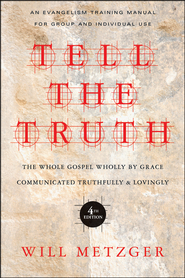
Learning the Gospel Diagram “Come Home” from Will Metzger’s book “Tell the Truth”
A. Procedure for Learning the “Come Home” Gospel Diagram
Introduction. People are looking for relationships where they can find love, meaning, security and joy. God designed families—both natural and spiritual—and homes for this purpose. As part of his plan he intends us to have a home on earth and a home after death.
Theme. God designed us for a relationship with him and others.
Learning the Content of the Gospel. It is essential to take three hours to study chapter three and the amplified diagram, including reading thoughtfully the Bible passages.
Diagram. Draw the Road of Life line one inch from the top of the long side of an 8 1/2″ x 11″ paper two-thirds of the way across paper. Then draw the road going straight down to “homelessness.” Halfway down this line draw a short line intersected by a vertical line to form a cross. Next, extend the horizontal line up to the top of the paper and resume the Road of Life line. Put a triangle at each end to represent God and an H for Hell and another H for Home in appropriate places. Put a question mark on the left side of the cross where it intersects with the road downward. (This diagram is drawn on the cover of “Come Home.” [you need the book to see the diagram which is rather complex as whole, but not in its constituent parts)
Practice. You are now ready to fill in the diagram with the five points of the gospel. You should fill in one point at a time, following the simplified version. Keep practicing this on different sheets of paper until you can do it from memory. As you fill in each point, you can also draw the two signs on the road and fill in the words on the bridge, which form a cross. Sharing How to “Come Home”. After reviewing the amplified version and again looking up the Bible passages, you are ready to share the simplified version of how to “come home” with a Christian friend, drawing the diagram and briefly explaining the five points, main point, Bible verse and illustration under each of the five points. Be sure to stop after point 3 and ask if they sense any personal concern. Ascertain if they see the dilemma. Your partner can either say something like “I think a God of love would just overlook my failures” or “I’m pretty happy with my life right now; I don’t see a need for religion.” You have to decide how to answer this! (Hint: Point 1 is the basis for all we’ve said. God made you, and he is not only a love-giver; he has made road rules, and we are responsible to him—a personal God.) Then ask if you can continue the last two points, for this may clarify things. Reverse roles. Then give each other feedback on what was clear and what wasn’t.
Objective. The objective of practicing the diagram is to help you, as a Christian, get a grip on the content of the good news (gospel). By so doing, you are able to listen to the person you are talking with and bring in various points of the gospel as appropriate. Many times simply communicating what God is like (point 1) is a successful conversation. By knowing the diagram, you can start at any point and move backward or forward as needed. However, it is best to ask for the opportunity to give this overview at some point. This diagram is a grid on which to organize the truth that God says is so important for everyone to know. Be sure you are thoroughly familiar with the amplified version so you can draw on this background when in conversations. Most people are not convicted the first time they hear this story. Your job is to plant and water the seed of God’s Word into the conscience and heart of people. The Holy Spirit may use the truth joined with your friendliness and love to give them faith and a new birth according to his timetable. Sometimes people will find it helpful if you ask them, “What objections/problems do you have with Jesus Christ?” “Can you explain to me what the first three points are saying?” or “What do you think is keeping you from becoming a follower of Jesus?” These questions may allow you to clear up their misunderstandings, bad examples of other Christians or churches and so on—or just to listen to them! The danger is this may get you off on a tangent, so with the “Come Home” diagram in mind, keep coming back to it. What’s really fun is to say, “Can I tell you a story?” Then tell them about Paul walking into Athens and talking to some university professors in Acts 17, or about the two lost sons in Luke 15 and so on. Practice reading the five key Bible passages one paragraph at a time, explaining them to a Christian friend. This Road to Home gives you a visual framework on which to pin the five gospel points.
Introducing the Diagram. With someone you’ve talked with before, simply say, “Many people have found it helpful to see an overview of the main theme of the Bible. Can I show that to you, and then you can point out which part you don’t understand, disagree with or find helpful?” Keep practicing the diagram and the three topics under each point (#4 has four). Then, as you talk to someone, you will find drawing it helps them to follow the story. Or, you may visualize the diagram mentally as you carry on a conversation. You may not get the opportunity to share the simplified version of “Come Home” very often. But knowing this diagram will help you realize when you are not talking about the gospel and only talking around the fringe—as in so many of our conversations. You can then be reminded, as you think back over a conversation, to next time bring in some of these truths. Most important, knowing “Come Home” prepares you for a lifetime of lifestyle witnessing. The following are two versions of the “Come Home” diagram—an amplified version for study and a simplified version for sharing. Each set of pages, with a bit of ingenuity, can be photocopied and folded into handy 5″ x 8″ booklets. The simplified version is the easiest: just photocopy pages 281 and 282 back to back and fold in half with the diagram in the middle. The text of this version can be enlarged by about 33 percent and still fit ordinary paper size for easier reading. In each case you may want to cut pages from the book for easier photocopying. The amplified version can be copied on two 8 1/2″ x 11″ sheets and folded in half, leaving any blank half pages for notes: staple if you wish.
B. Come Home: Overview for Memorization
1. Who Is God?
1. Maker (Owner)
2. Love-Giver (Father)
3. Law-Maker (Judge)
Point: God has rights over you; you are accountable.
Bible: Paul’s sermon—Acts 17:22-34 (Rev 4:11)
Illustration: The inventor has patent rights and instruction book.
2. Life = God-Centered Living
1. One-way road home
2. Two rules 3. Perfect obedience required Point: God’s perfect rules measure all actions/attitudes. Bible: Moral man—Mark 10:17-27 (Mk 12:30-31)
Illustration: Jumping over a pole 100 feet high.
3. Sin = Self-Centered Living
1. Disobedience is sin.
2. Sin separates you from God.
3. Sin must be punished for God is just.
Point: We are self-centered and separated from God.
Bible: Jesus and thirsty woman—John 4:4-30 (Rom 3:20)
Illustration: The Gap; failure of self-effort; heart disease; sin-addiction
Question: Do you admit you are a sinner?
Dilemma: How to get right with God
4. Jesus Christ: The Way Back to Life
1. God provides his Son as a bridge.
2. Jesus perfectly obeys God’s rules (righteousness).
3. Jesus is sin-bearer (takes our penalty).
4. Jesus lives and offers himself to us (righteousness-giver).
Point: Jesus is sinner’s substitute/reconciler/liberator. He is the only Lord and Savior.
Bible: Crucifixion and resurrection—John 19:17–20:31 (Rom 5:6-8)
Illustration: The Bridge; no more doing—done by Jesus
5. Your Response: Coming Home to Jesus
1. Personal response commanded.
2. Turn from sin.
3. Trust in Christ.
Bible: Two lost sons—Luke 15:11-32 (Ps 51:1-4; Rom 10:9-10)
Illustration: A person (representing Jesus) is not received until welcomed in; only three possible responses—investigate, receive, reject (Acts 17:30-34)
Point: Receive Christ as your Savior and Lord. Do You Know the Bible’s Main Theme?
Are you able to express the main theme of the Bible, the most influential book of all literature? Most people, Christian or not, cannot! What is this theme called the “gospel”? This booklet is a tool to help you grasp the essentials of the gospel. Whether you are a seeker of Christ or secure in having found him, you need to get the facts straight.
Secure? If you are a true Christian but don’t have a clear understanding of the gospel, your growth will be hindered in two ways. First, any vagueness about the basic truths might cause you to miss their implications for living the Christian life. You could be misled into looking for something more in addition to what you received when you became a Christian. Second, you won’t be able to give a clear explanation of the gospel to others. Only when truth is kindled by the spark of the Holy Spirit are lives changed. But it’s your responsibility to honor God by clearly expressing basic gospel truths! This booklet’s five-point outline has many unique features: a clear theme (The Road of Life to Home) linking all the points; a starting point (God made you), which establishes that a person is responsible; inclusion of God’s law to expose the need for a Savior; choice of brief verses or reference passages for “story telling” the gospel as Jesus did; illustrations in story and diagram form; emphasis on holiness, repentance and the lordship of Christ; a one-page summary for easy memorizing. (See chapter four of Tell the Truth for an explanation of the “Come Home” outline.)
Having an outline of a God-centered gospel in your mind will free you to listen and be more natural as you tell the truth to others. You can concentrate on what they are saying and bring in any of the five truths of the gospel as appropriate. However, truths 1, 2 and 3 give the foundation for 4 and 5 and normally are needed first to show why Christ is necessary. Therefore, ask for a non-Christian at some point to hold their questions and listen for fifteen minutes as you give an overview of all five truths which as the framework for your answers can really help them understand. Or, at least go over truths 1-3.
This amplified version of the gospel diagram “Come Home” is intended for detailed study by those who wish to have a better knowledge of the content of a God-centered gospel. Christianity is both something to be believed and Someone to be received. To impersonally present these truths would be to contradict the nature of the gospel. Prayer and a personal relationship showing love are all-important. You can follow a printed simplified version for sharing, although a conversation in which you draw the diagram is best. Live the gospel, but words are necessary, so use them. Evangelism is a way to glorify God by knowing the gospel well, living it well and telling it well.
Prayer for Others
“Father in heaven, I come to you humbly and yet boldly because of my salvation, which has united me with your Son. Your grace is reaching more and more people and calling them home. Therefore I pray for __________. Hear my prayer even as you heard the pleading of your friend Abraham and spared his nephew Lot from terrible judgment. Your Son invited the spiritually tired, burdened and thirsty to take of the free water of eternal life. Lord, will you please open still another heart as you did mine? You alone can break addictions to self-righteousness, unbelief and sinful desires. Would it please you to enable them to believe and grant repentance and faith leading to a new birth? Magnify your glory by delivering _________ from spiritual death. Lord, bring fame to your name by once again showing mercy. My plea is not based on my own goodness but on the sovereign love of Jesus Christ. Lord, I desire that you use me in telling the gospel of grace to others. Nevertheless, not my will, but your will be done. Amen.”
These Scriptures provide incentive and direction for your prayers for others. If you’re praying in a group, assign each person one or two passages as a basis for their prayer: Matthew 11:25-30; Luke 15; 16:19-31; John 4:1-42, 10:1-18; Acts 4:24-31; 5:27-32; 17:27-34; 26:19-29; Romans 10:1-4, 9-21; 1 Corinthians 1:18–2:16; 2 Corinthians 2:14-17; 4:1-18; 5:11-21; Ephesians 6:10-20; 1 Thessalonians 1:2–2:13; 2 Timothy 1:6-10; 4:1-5; Revelation 20:11–21:5; 22:17. People for Whom I Will Pray and Witness: 1. 3. 5. 2. 4. 6. Reprinted from Tell the Truth ©2012 by Will Metzger with permission from InterVarsity Press, Downers Grove, Illinois. This helpful training manual for God-centered evangelism in book form is appropriate for individual or group study. It is available through Christian bookstores.
Adapted from Will Metzger. Tell the Truth: The Whole Gospel Wholly by Grace Communicated Truthfully & Lovingly. Downers Grove, IL.: InterVarsity Press, 2013.
About Will Metzger

Will Metzger has been a campus minister at the University of Delaware since 1965, where he serves with InterVarsity Christian Fellowship and Christian InterAction (a church and campus connection). His evangelism ministry has taken him to every continent, and he has witnessed to people from varied nationalities both on campus and through a church that he pastored.
The Gospel Made Simple: “How Can I Know God?” by Dr. Tim Keller
Series: Presentations of the Gospel #3

HOW CAN I KNOW GOD PERSONALLY?
by Dr. Tim Keller
What is Christianity? Some say it is a philosophy, others say it is an ethical stance, while still others claim it is actually an experience. None of these things really gets to the heart of the matter, however. Each is something a Christian has, but not one of them serves as a definition of what a Christian is. Christianity has at its core a transaction between a person and God. A person who becomes a Christian moves from knowing about God distantly to knowing about him directly and intimately. Christianity is knowing God.
“Now this is eternal life; that they may know you, the only true God, and Jesus Christ, whom you have sent.” – John 17:3
Why do I need to know God?
Our desire for personal knowledge of God is strong, but we usually fail to recognize that desire for what it is. When we first fall in love, when we first marry, when we finally break into our chosen field, when we at last get that weekend house–these breakthroughs arouse in us an anticipation of something which, as it turns out, never occurs. We eventually discover that our desire for that precious something is a longing no lover or career or achievement, even the best possible ones, can ever satisfy. The satisfaction fades even as we close our fingers around our goal. Nothing delivers the joy it seemed to promise. Many of us avoid the yawning emptiness through busyness or denial, but at best there is a postponement. “Nothing tastes,” said Marie Antoinette.
There are several ways to respond to this:
By blaming the things themselves – by finding fault in everyone and everything around you. You believe that a better spouse, a better career, a better boss or salary would finally yield the elusive joy. Many of the most successful people in the world are like this–bored, discontented, running from new thing to new thing, often changing counselors, mates, partners, or settings.
By blaming yourself – by trying harder to live up to standards. Many people believe they have made poor choices or have failed to measure up to challenges and to achieve things that would give them joy and satisfaction. Such people are wracked with self-doubts and tend to burn themselves out. They think, “If only I could reach my goals, then this emptiness would be gone.” But it is not so.
By blaming the universe itself – by giving up seeking fulfillment at all. This is the person who says, “Yes, when I was young I was idealistic, but at my age I have stopped howling after the moon.” This makes you become cynical, you decide to repress that part of yourself that once wanted fulfillment and joy. But you become hard, and you can feel yourself losing your humanity, compassion, and joy.
By blaming and recognizing your separation from God – by seeing that the emptiness comes from your separation from God, and by establishing a personal relationship with him.
In order to form a personal relationship with God, you must know three things:
1) Who we are:
God’s creation. God created us and built us for a relationship with him. We belong to him, and we owe him gratitude for every breath, every moment, everything. Because humans were built to live for him (to worship), we will always try to worship something — if not God, we will choose some other object of ultimate devotion to give our lives meaning.
Sinners. We have all chosen (and re-affirm daily) to reject God to make our own joy and happiness our highest priority. We do not want to worship God and surrender ourself as master, yet we are built to worship, so we cling to idols, centering our lives on things that promise to give us meaning: success, relationships, influence, love, comfort and so on.
In spiritual bondage. To live for anything else but God leads to breakdown and decay. When a fish leaves the water, which he was built for, he is not free, but dead. Worshiping other things besides God leads to a loss of meaning. If we achieve these things, they cannot deliver satisfaction, because they were never meant to be “gods.” They were never meant to replace God. Worshiping other things besides God also leads to self-image problems. We end up defining ourselves in terms of our achievement in these things. We must have them or all is lost; so they drive us to work hard, or they fill us with terror if they are jeopardized.
2) Who God is:
Love and justice. His active concern is for our joy and well-being. Most people love those who love them, yet God loves and seeks the good even of people who are his enemies. But because God is good and loving, he cannot tolerate evil. The opposite of love is not anger, but indifference. “The more you love your son, the more you hate in him the liar, the drunkard, the traitor,” (E. Gifford). To imagine God’s situation, imagine a judge who is also a father, who sits at the trial of a guilty son. A judge knows he cannot let his son go, for without justice no society can survive. How mush less can a loving God merely ignore or suspend justice for us–who are loved, yet guilty of rebellion against his loving authority?
Jesus Christ. Jesus is God himself come to Earth. He first lived a perfect life, loving God with all his heart, soul, and mind, fulfilling all human obligation to God. He lived the life you owed–a perfect record. Then, instead of receiving his deserved reward (eternal life), Jesus gave his life as a sacrifice for our sins, taking the punishment and death each of owed. When we believe in him: 1) our sins are paid for by his death, and 2) his perfect life record is transferred to our account. So God accepts and regards us as if we have done all Christ has done.
3) What you must do:
Repent. There must first be an admission that you have been living as your own master, worshipping the wrong things, violating God’s loving laws. “Repentance” means you ask forgiveness and turn from that stance with a willingness to live for and center on him.
Believe. Faith is transferring your trust from your own efforts to the efforts of Christ. You were relying on other things to make you acceptable, but now you consciously begin relying on what Jesus did for your acceptance with God. All you need is nothing. If you think, “God owes me something for all my efforts,” you are still on the outside.
Pray after this fashion: “I see I am more flawed and sinful than I ever dared believe, but that I am even more loved and accepted than I ever dared hope. I turn from my old life of living for myself. I have nothing in my record to merit your approval, but now I rest in what Jesus did and ask to be accepted into God’s family for his sake.”
When you make this transaction, two things happen at once: 1) your accounts are cleared, your sins are wiped out permanently, you are adopted legally into God’s family and 2) the Holy Spirit enters your heart and begins to change you into the character of Jesus.
Follow through: Tell a Christian friend about your commitment. Get yourself training in the basic Christian disciplines of prayer, worship, Bible study, and fellowship with other Christians.
Why should I seek God?
On the one hand, you may feel that you “need” him. Even though you may recognize that you have needs only God can meet, you must not try to use him to achieve your own ends. It is not possible to bargain with God (“I’ll do this, if you will do that”). That is not Christianity at all, but a form of magic or paganism in which you “appease” the cranky deity in exchange for a favor. Are you getting into Christianity to serve God, or to get God to serve you? Those are two opposite motives and they result in two different religions. You must come to God because 1) you owe it to him to give him your life (because he is your creator) and 2) you are deeply grateful to him for sacrificing his son (because he is your redeemer).
On the other hand, you may feel no need or interest to know God at all. This does not mean that you should stay uncommitted. If you were created by God, then you owe him your life, whether you feel like it or not. You are obligated to seek him and ask him to soften your heart, open your eyes, and enlighten you. If you say, “I have no faith,” that is no excuse either. You need only doubt your doubts. No one can doubt everything at once–you must believe in something to doubt something else. For example, do you believe you are competent to run your own life? Where is the evidence for that? Why doubt everything but your doubts about God and your faith in yourself? Is that fair? You owe it to God to seek him. Do so.
What if I’m not ready to proceed?
Make a list of the issues that you perceive to be barriers to your crossing the line into faith. Here is a possible set of headings:
Content issues. Do you understand the basics of the Christian message–sin, Jesus as God, sacrifice, faith?
Coherence issues. Are there intellectual problems you have with Christianity? Are there objections to the Christian faith that you cannot resolve in your own mind?
Cost issues. Do you perceive that a move into full Christian faith will cost you dearly? What fears do you have about commitment?
Now talk to a Christian friend until these issues are resolved. Consider reading: Mere Christianity, by C.S. Lewis (MacMillan) and Basic Christianity, by John Stott (IVP) – [or Tim Keller’s The Reason for God (Dutton)].
@ 1991, Timothy Keller.
About Tim Keller:
In 1989 Dr. Timothy J. Keller, his wife and three young sons moved to New York City to begin Redeemer Presbyterian Church. In 20 years it has grown to meeting for five services at three sites with a weekly attendance of over 5,000. Redeemer is notable not only for winning skeptical New Yorkers to faith, but also for partnering with other churches to do both mercy ministry and church planting. Redeemer City to City is working to help establish hundreds of new multi-ethnic congregations throughout the city and other global cities in the next decades.
Dr. Tim Keller is the author of several phenomenal Christo-centric books including:
Joy for the World: How Christianity Lost Its Cultural Influence and Can Begin Rebuilding It (co-authored with Greg Forster and Collin Hanson (February or March, 2014).
Encounters with Jesus:Unexpected Answers to Life’s Biggest Questions. New York, Dutton (November 2013).
Walking with God through Pain and Suffering. New York, Dutton (October 2013).
Judges For You (God’s Word For You Series). The Good Book Company (August 6, 2013).
Galatians For You (God’s Word For You Series). The Good Book Company (February 11, 2013).
Every Good Endeavor: Connecting Your Work to God’s Plan for the World. New York, Penguin Publishing, November, 2012.
Center Church: Doing Balanced, Gospel-Centered Ministry in Your City. Grand Rapids: Zondervan, September, 2012.
The Freedom of Self Forgetfulness. New York: 10 Publishing, April 2012.
Generous Justice: How God’s Grace Makes Us Just. New York: Riverhead Trade, August, 2012.
The Gospel As Center: Renewing Our Faith and Reforming Our Ministry Practices (editor and contributor). Wheaton: Crossway, 2012.
The Meaning of Marriage: Facing the Complexities of Commitment with the Wisdom of God. New York, Dutton, 2011.
King’s Cross: The Story of the World in the Life of Jesus (Retitled: Jesus the KIng: Understanding the Life and Death of the Son of God). New York, Dutton, 2011.
Gospel in Life Study Guide: Grace Changes Everything. Grand Rapids, Zondervan, 2010.
The Reason For God: Belief in an Age of Skepticism. New York, Dutton, 2009.
Counterfeit Gods: The Empty Priorities of Money, Sex, and Power, and the Only Hope That Matters. New York, Riverhead Trade, 2009.
Heralds of the King: Christ Centered Sermons in the Tradition of Edmund P. Clowney (contributor). Wheaton: Crossway Books, 2009.
The Prodigal God. New York, Dutton, 2008.
Worship By The Book (contributor). Grand Rapids: Zondervan, 2002.
Ministries of Mercy: The Call of the Jericho Road. Phillipsburg: P&R Publishing, 1997.
The Gospel Made Simple: Our “Quest for Joy” by John Piper
Series: Presentations of the Gospel #2
THE QUEST FOR JOY by Dr. John Piper

Did you know that God commands us to be glad?
“Delight yourself in the Lord and he will give you the desires of your heart.” (Psalm 37:4)
1) God created us for his glory
“Bring my sons from afar and my daughters from the ends of the earth,… whom I created for my glory.” (Isaiah 43:6-7)
God made us to magnify his greatness – the way telescopes magnify stars. He created us to put his goodness and truth and beauty and wisdom and justice on display. The greatest display of God’s glory comes from deep delight in all that he is. This means that God gets the praise and we get the pleasure. God created us so that he is most glorified in us when we are most satisfied in him.
2) Every human should live for God’s glory
“So whether you eat or drink or whatever you do, do it all for the glory of God.” (1 Corinthians 10:31)
If God made us for his glory, it is clear that we should live for his glory. Our duty comes from his design. So our first obligation is to show God’s value by being satisfied with all that he is for us. This is the essence of loving God (Matthew 22:37) and trusting him (1 John 5:3-4) and being thankful to him (Psalm 100:2-4) It is the root of all true obedience, especially loving others (Colossians 1:4-5).
3) All of us have failed to glorify God as we should
“All have sinned and fall short of the glory of God.” (Romans 3:23)
What does it mean to “fall short of the glory of God?” It means that none of us has trusted and treasured God the way we should. We have not been satisfied with his greatness and walked in his ways. We have sought our satisfaction in other things, and treated them as more valuable than God, which is the essence of idolatry (Romans 1:21-23). Since sin came into the world we have all been deeply resistant to having God as our all-satisfying treasure (Ephesians 2:3). This is an appalling offense to the greatness of God (Jeremiah 2:12-13).
4) All of us are subject to God’s just condemnation
“The wages of sin is death…” (Romans 6:23)
We have all belittled the glory of God. How? By preferring other things above him. By our ingratitude, distrust and disobedience. So God is just in shutting us out from the enjoyment of his glory forever. “They will suffer the punishment of eternal destruction and exclusion from the presence of the Lord and from the glory of his might” (2 Thessalonians 1:9).
The word “hell” is used in the New Testament fourteen times—twelve times by Jesus himself. It is not a myth created by dismal and angry preachers. It is a solemn warning from the Son of God who died to deliver sinners from its curse. We ignore it at great risk.
If the Bible stopped here in its analysis of the human condition, we would be doomed to a hopeless future. However, this is not where it stops…
5) God sent his only son Jesus to provide eternal life and joy
“Here is a trustworthy saying that deserves full acceptance: Christ Jesus came into the world to save sinners…” (1 Timothy 1:15)
The good news is that Christ died for sinners like us. And he rose physically from the dead to validate the saving power of his death and to open the gates of eternal life and joy (1 Corinthians 15:20). This means God can acquit guilty sinners and still be just (Romans 3:25-26). “For Christ died for sins once for all, the righteous for the unrighteous, to bring us to God” (1 Peter 3:18). Coming home to God is where all deep and lasting satisfaction is found.
6) The benefits purchased by the death of Christ belong to those who repent and trust him
“Repent, then, and turn to God, so that your sins may be wiped out” (Acts 3:19). “Believe in the Lord Jesus and you will be saved” (Acts 16:31).
“Repent” means to turn from all the deceitful promises of sin. “Faith” means being satisfied with all that God promises to be for us in Jesus. “He who believes in me,” Jesus says, “shall never thirst” (John 6:35). We do not earn our salvation. We cannot merit it (Romans 4:4-5). It is by grace through faith (Ephesians 2:8-9). It is a free gift (Romans 3:24). We will have it if we cherish it above all things (Matthew 13:44). When we do that, God’s aim in creation is accomplished: He is glorified in us and we are satisfied in him – forever.
Does this make sense to you?
Do you desire the kind of gladness that comes from being satisfied with all that God is for you in Jesus? If so, then God is at work in your life.
What should you do?
Turn from the deceitful promises of sin. Call upon Jesus to save you from the guilt and punishment and bondage. “All who call upon the name of the Lord will be saved” (Romans 10:13). Start banking your hope on all that God is for you in Jesus. Break the power of sin’s promises by faith in the superior satisfaction of God’s promises. Begin reading the Bible to find his precious and very great promises, which can set you free (2 Peter 1:3-4). Find a Bible-believing church and begin to worship and grow together with other people who treasure Christ above all things (Philippians 3:7).
The best news in the world is that there is no necessary conflict between our happiness and God’s holiness. Being satisfied with all that God is for us in Jesus magnifies him as a great Treasure.
“You have made known to me the path of life; you will fill me with joy in your presence, with eternal pleasures at your right hand.” (Psalm 16:11)
*You are permitted and encouraged to reproduce and distribute this material in its entirety or in unaltered excerpts, as long as you do not charge a fee. For Internet posting, please use only unaltered excerpts (not the content in its entirety) and provide a hyperlink to this page. Any exceptions to the above must be approved by Desiring God.
Please include the following statement on any distributed copy: By John Piper. ©2013 Desiring God Foundation. Website: http://www.desiringgod.org/
About John Piper
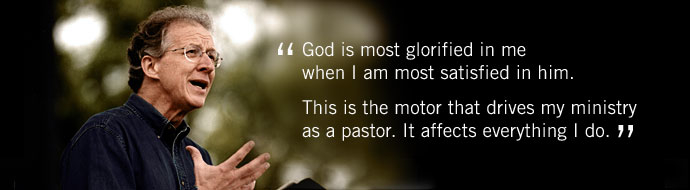
“The ministry of preaching is the central labor of my life. My prayer is that through that ministry and everything else I do, the great glory of our God and Savior Jesus Christ would be magnified as more and more people come to live out the obedience of faith more and more deeply.” – John Piper
Growing Up
John Stephen Piper was born January 11, 1946, in Chattanooga, Tennessee, to Bill and Ruth Piper. His father was a traveling evangelist, and the Pipers lived near Chattanooga to be near a Christian college for which Bill served on the board. When the school moved to Greenville, South Carolina, the Pipers moved as well, and it was in Greenville that John spent his growing-up years. John honored his father in a 2008 biographical message called “Evangelist Bill Piper: Fundamentalist Full of Grace and Joy” and in the 2013 ebook A Tribute to My Father. John also wrote a tribute to his mother, who died in 1974, in the book What’s the Difference, and commended her in his Mother’s Day sermon in 2005, “Honoring the Biblical Call of Motherhood: A Tribute to Ruth Piper.”
Schooling
John graduated from Wade Hampton High School in 1964, and he majored in Literature and minored in Philosophy at Wheaton College (1964–68). Studying Romantic Literature with Clyde Kilby stimulated the poetic side of his nature, and today he regularly writes poems to celebrate special family occasions and rich, biblical truths. At Wheaton, John also met Noël Henry whom he married in 1968.
Following college, he completed a Bachelor of Divinity degree at Fuller Theological Seminary in Pasadena, California (1968–71). While at Fuller, John discovered the writings of Jonathan Edwards.
John did his doctoral work in New Testament Studies at the University of Munich in Munich, Germany (1971–74). His dissertation, Love Your Enemies, is now available through Crossway Books. Upon completion of his doctorate, he went on to teach Biblical Studies at Bethel College in St. Paul, Minnesota for six years (1974–80).
Bethlehem Baptist Church
In 1980, sensing an irresistible call to preach, John became the senior pastor of Bethlehem Baptist Church in Minneapolis, Minnesota, where he ministered for 33 years, until Easter 2013. Together with his people, John was dedicated to spreading a passion for the supremacy of God in all things for the joy of all peoples through Jesus Christ — a mission he continues now for the wider church through the ministry of desiringGod.org.
Desiring God and Bethlehem College & Seminary
John is the author of over 50 books and now frequently travels to speak, and writes regularly, through Desiring God. He also became chancellor of Bethlehem College & Seminary at its founding in 2009 and continues to serve as both chancellor and professor.
Family
John and Noël have four sons, a daughter, and twelve grandchildren.
The Gospel Made Simple: How Would You Like to Have a New Life?
Series: Presentations of the Gospel #1
How Would You Like to Have “A New Life?” By C. John Miller

(Presented by C. John Miller in A Faith Worth Sharing. Phillipsburg, N.J.: P&R, 1999.)
Have you ever felt there was something missing in your life? Something important but you didn’t know what? That may de the new life God wants you to have. A life of joy, peace, and fulfillment. A life…which you can receive today. Carefully consider these Five Important Facts…and find out how you can get that new life and become a brand-new person.
FACT 1 – A loving God sent His Son Jesus into the world to bring you a new and abundant life.
Jesus said, “If anyone thirsts, let him come to me and drink. Whoever believes in me, as the Scripture has said, ‘Out of his heart will flow rivers of living water” (John 7:37b-38).
Jesus also said concerning those He loves, “I came that they may have life and have it abundantly” (John 10:10b).
This new life brings you the fruit of the Spirit: “love, joy, peace, patience, kindness, goodness, faithfulness, gentleness, and self-control” (Galatians 5:22). It also gives POWER!
God’s Holy Spirit gives you the power to overcome…feelings of loneliness, stress, fear of people and the future (1 John 4:18).
And the power to break habits like…selfishness, depression, uncontrolled anger, prejudice, sexual lust, overeating, overdrinking, and drug abuse (1 Corinthians 6:9-11).
But Why Are So Many People Without This New Life?
FACT 2 – Because…people are self-centered, not God-centered.
This means that by nature you are spiritually dead and deceived (Ephesians 2:1a: “You were dead through your trespasses and sins.”
TO BE SPIRITUALLY DEAD AND DECEIVED is to be centered on yourself and not on your Creator, and to believe…
A BIG LIE
People show this, according to Romans 1:21-31 by being…unthankful to God, perverted, greedy, jealous, bitter, proud, mean, devious, and foolish.
Since man’s first sin. He has tried to be INDEPENDENT of God. Actually each human being is entirely DEPENDENT on God for breath, food, health, shelter, physical and mental abilities. THE BIG LIE: SELFISH INDEPENDENCE: self-trust, self-boasting, self-reliance, self-analysis, self-hating, self-seeking.
FACT 3 – Self-centered man is separated from a holy God by three barriers.
A Bad Record – Romans 3:23, “All have sinned and have fallen short of the glory of God.”
A Bad Heart – Mark 7:21, “From the heart of man come evil thoughts.”
A Bad Master – John 8:34, “everyone who commits sin is a slave to sin.”
The consequences of sin result in eternal separation from God. “The wages of sin is death (Romans 6:23a)…whoever does not obey the Son shall not see life, but the wrath of God remains on him (John 3:36b).”
NOW:
A dry, thirsty, unsatisfied life.
A guilty, accusing conscience (depression, fears, anxiety).
An aging body that must shortly die.
FUTURE:
Loss of friendship and earthly joys forever (Matthew 8:12).
Frightful pains of body and conscience forever (Mark 9:48).
Dreadful thirst of soul and body forever (Luke 16:19-31).
FACT 4 – God’s Solution! No barriers!
A Perfect Record – 1 Corinthians 1:30, “Christ…is made our righteousness.”
A New Heart – Ezekiel 36:25-26, “A new heart I will give you.”
A Good Master – Matthew 11:28-30, “Come to me, all who labor and are heavy laden, and I will give you rest. Take my yoke upon you, and learn from me, for I am gentle and lowly in heart, and you will find rest for your souls. For my yoke is easy and my burden is light.”
“The blood of Jesus, God’s Son, cleanses us from all sin” (1 John 1:7b).
The Benefit of Jesus’ Death…Love’s Biggest Gift
“The free gift of God is eternal life through Christ Jesus” (Romans 6:23b). Jesus, the God-man, is the biggest gift of the Father’s love. On the cross Jesus suffered all the torments of hell as a substitute for His people (John 3:16; 10:15). He was legally condemned by God as their representative, removing the barriers of a bad record, a bad heat, and a bad master. The Father’s love can do no more. Risen from the dead, Jesus now lives to give you a new record, a new heart, Himself as a new master—and the free gift of eternal life now!
You Need to Make Sure
God says you either have a NEW LIFE or you are a lawbreaker DEAD in your self-centeredness. Are you personally alive or dead? If you are still dead, you need to know…
FACT 5 – How to receive the Lord Jesus into your life…
-
Turn…In sorrow from your sins: “Seek the LORD while he may be found; call upon Him while He is near; let the wicked forsake his way, and the unrighteousness man his thoughts; let him return to the LORD, that he may have compassion on him, and to our God for he will abundantly pardon” (Is. 55:6-7).
-
Trust…in Jesus alone to save you: “Believe in the Lord Jesus, and you will be saved” (Acts 16:31a)…”I am the way the truth and the life, no one comes to the Father except through me” (John 14:6).
Repentance is…not our suffering or our good works to earn our salvation, but a turning from our sins to the living God through Jesus Christ.
Trust in the Lord Jesus is…accepting, receiving, and resting on Him alone as the Savior from our sins.
Begin a NEW LIFE
Will you surrender your life to Christ by turning from your self-centered way and trust in Him alone? Here is a guideline to help you confess your sins and come to know God through taking the Lord Jesus Christ as your own personal Savior.
Make this Verbal Profession & Confession of Faith:
“Heavenly Father, I am really a selfish person. I have wanted my own way—not Yours. I have often been jealous, proud, and rebellious. You are my Creator, but I have acted as though I was lord of all. I have not been thankful to You. I have not listened to Your Word the Bible and have not loved Your Son. But now I see that all my sin is against You. I now repent of this evil attitude. I turn from all of my sins and trust that Jesus has shed His precious blood to cleanse me from all my guilt. I now receive Him as mu Savior and the Lord of my life.”
I, ______________, turn from my sins and take Christ as my Lord and Savior. By His help I promise to obey Him in every part of my life.
How Does This New Life Continue? The same way it began—in faith and prayer.
-
Pray constantly. Prayer is talking to God. Keep doing it all the time. Include in it praise, thanksgiving, confession of sins, petitions for others’ salvation, and requests for help.
-
Read your Bible. Study your Bible every day. It is the food for your new life and your sure guide. In it you meet Jesus and learn to claim His promises for your life.
-
Worship with others. Meet with a church where the Bible is taught and obeyed and where Jesus Christ is Lord and Savior.
-
Witness to others. Tell your friends what Christ has done for you—and wants to do for them. Be tactful and back up your words by improvement in manners and doing deeds of kindness.
* Gospel tracts: World Harvest Mission – 100 West Ave. W960 – Jenkintown, PA 19046-2697
ABOUT JACK MILLER
C. John “Jack” Miller, PhD., founded World Harvest Mission (WHM) and the New Life Presbyterian network of churches. A pastor, seminary professor, and author, he wrote Outgrowing the Ingrown Church, Come Back Barbara, Powerful Evangelism for the Powerless, A Faith Worth Sharing, Repentance, and The Heart of the Servant Leader. He and his wife Rose Marie have five children and twenty-four grandchildren. Jack went to be with the Lord in 1996. WHM is a movement of people empowered by God’s grace to plant churches around the world. For more information, visit whm.org.
 LifeCoach4God