How C.H. Spurgeon Would Have Ended Up In A Lunatic Asylum!

The following excerpt is from “Men Bewitched,” a sermon preached at some indeterminate time in the Metropolitan Tabernacle in London.

hen I was about fifteen or sixteen years of age, I wanted a Savior, and I heard the gospel preached by a poor man, who said in the name of Jesus—”Look unto me and be ye saved, all the ends of the earth.” It was very plain English, and I understood it, and obeyed it and found rest.

I owe all my happiness since then to the same plain doctrine.

Now, suppose that I were to say, “I have read a great many books, and there are a great many people willing to hear me. I really could not preach such a commonplace gospel as I did at the first. I must put it in a sophisticated way, so that none but the elite can understand me.”

I should be—what should I be? I should be a fool, writ large.

I should be worse than that, I should be a traitor to my God; for if I was saved by a simple gospel, then I am bound to preach that same simple gospel till I die, so that others too may be saved by it.

When I cease to preach salvation by faith in Jesus put me into a lunatic asylum, for you may be sure that my mind is gone.

About Charles Haddon Spurgeon – one of the greatest Christian thinkers of all time and undoubtedly the most celebrated preacher of the 19th century, began his ministry as a country-boy with only a year of formal education. But even without much training, his brilliant mind and depth of spiritual insight quickly became legendary throughout the world. During his lifetime Spurgeon is estimated to have preached, in person, to over ten million people. He published over 3,500 sermons, totaling between 20 and 25 million words and more than 38,000 pages. Today, over a century after his death, his sermons and devotional texts continue to challenge and touch Christians and non-Christians alike. It is no wonder that this country-boy became known as the “Prince of Preachers.”

Born on June 19, 1834 in Kelvedon, England, Spurgeon wouldn’t become a Christian until the age of fifteen. It happened one Sunday morning when a snowstorm kept him from reaching the church he usually attended. He ducked down a side street and stumbled across a small building with a sign that read, “Artillery Street Primitive Methodist Chapel.” Regardless of his own misgivings, he entered the small church and while listening to a Methodist layman comment on Isaiah 45:22, he “Saw at once the way of salvation!” Spurgeon immediately committed his life to Christ and became a zealous servant of God.

Desiring to share his new faith, Spurgeon began preaching. He preached his first sermon in 1851, at the age of sixteen, to a group of farmers and wives gathered in the village of Teversham. His text was 1 Peter 2:7, “Unto you therefore which believe he is precious.” Audiences were held spellbound by the young Spurgeon’s speaking power, and he was offered his first pastorate at the Baptist Chapel in Waterbeach when he was only seventeen. The church, which had about ten members when he arrived, was soon bursting at its doors with over four hundred in the congregation. His inspiring style had caught the interest of many, and soon after his twentieth birthday, the country-preacher was called to be the new pastor of the prominent New Park Street Baptist Church in London. New Park Street was a church that had formerly been pastored by such spiritual giants as Benjamin Keach, John Gill, and John Rippon.

In a day when preaching was considered not only a source of spiritual nourishment, but also of entertainment and political commentary, Spurgeon’s powerful and stimulating sermons drew enormous crowds. On a single night in London, preaching at the Crystal Palace, he preached to a congregation of 23, 654 without the use of a microphone! His sermons were published weekly in the “Penny Pulpit,” from 1855 until 1917, twenty-four years after his death. He published many religious books, including Lectures to My Students and Treasury of David, a seven-volume devotional-commentary on the Psalms. He also founded and served as president of the Pastor’s College in London, established the Stockwell Orphanages for boys and girls, and oversaw dozens of evangelistic and charitable enterprises. Spurgeon preached his final sermon at the Metropolitan Tabernacle in June of 1891.

Spurgeon married Susannah Thompson in January of 1856 and late in the following year they had twin sons, Thomas and Charles. Unlike Spurgeon’s mother who had seventeen children, nine of whom died in childbirth, Charles and Susannah had only the two boys.

Charles Spurgeon died at the relatively young age of 57, in January of 1892. His funeral service was held a week later, on February ninth, at the Metropolitan Tabernacle. Over 60,000 people waited in line to file past his casket.

Dr. Erwin Lutzer on One of The Biggest Lies Moderns Believe About God

 LIE BELIEVED: “God Is More Tolerant Than He Used to Be”

“I’M GLAD NO ONE REALLY BELIEVES the Bible anymore, or they’d stone us.” Those were the words of a gay activist, replying to a Christian who was using the Bible to condemn homosexuality. The activist’s argument was clear: Since the penalty for homosexuality in the Old Testament was death, how can you say you believe the Bible? And if you don’t believe it, then don’t use it to argue against homosexuality!

How do we answer those who insist that God is more tolerant today than He was in the days of the Old Testament? Back then, the law dictated that homosexuals be stoned to death, along with adulterers, children who cursed their parents, witches, and blasphemers. I have discovered about a dozen different sins or transgressions that Jewish law considered capital crimes in Old Testament times.

Today everything has changed. Homosexuals are invited into our churches; parents are told to love their rebellious children unconditionally; adulterers are given extensive counseling. Yes, murder and incest are still crimes, but witches are allowed to get rich practicing sorcery in every city in America.

We hear no more stories of Nadab and Abihu, struck dead for offering “unauthorized fire.” We read no more documented accounts of people like Uzzah who touched the ark contrary to God’s instructions and was instantly killed (2 Sam. 6:6-7). Today people can be as irreverent or blasphemous as they wish and live to see old age. As R. C. Sproul has observed, if Old Testament penalties for blasphemy were in effect today, every television executive would have been executed long ago.

Is God more tolerant than He used to be?

We need to answer this question for two reasons. First, we want to know whether we are free to sin with a minimum of consequences. Can we now live as we please, with the assurance that God will treat us with compassion and not judgment? A young Christian woman confided to me that she chose a life of immorality in part because she was sure that “God would forgive her anyway.” She had no reason to fear His wrath, for Christ had borne it all for her. Her statement begs the question: can conduct that in the Old Testament received strong rebuke or even the death penalty now be chosen with the sure knowledge that God is forgiving, showering us with “unconditional love”?

At one time Christians in America might have been described as legalists, adhering to the letter of the law. No one would accuse us of that today. We are free—free to ski in Colorado and romp on the beach in Hawaii, but also free to watch risqué movies, gamble, free to be as greedy as the world in which we work—free to sin. Is it safer for us to sin in this age than it was in the days of the Old Testament?

There is a second reason we want an answer: we want to know whether it is safer for others to do wrong today. If you have been sinned against, you want to know whether you can depend on God to “even the score.” The girl who has been raped, the child who has been abused, the person who was chiseled out of his life’s savings by an unscrupulous salesman—all of these victims and a hundred like them want to know whether God is so loving that He will overlook these infractions. What is the chance that these perpetrators will face justice? We want God to judge us with tolerance; however, we hope that He will not extend the same patience to those who have wronged us. So we wonder: can we depend on God to be lenient or harsh, merciful or condemning?

Many people decry God’s apparent silence today in the face of outrageous and widespread sin. The question is, how shall we interpret this silence? Is God indifferent, or biding His time? Has he changed?

In a PBS program hosted by Bill Moyers, Genesis: A Living Conversation, the participants agreed that there was development in God. He sent the flood to the world, but then, like a child who builds a sandcastle only to destroy it in anger, God regretted what He had done, felt duly chastised, and so gave the rainbow with a promise to never do that again. Most of the panelists agreed that the Flood was evil; it had no redeemable value. Choose almost any human being at random, and he/she would have been more benevolent than God, they said.

The panel assumed, of course, that the Bible is only a record of what people throughout the centuries have thought about God. So as we evolved to become more tolerant, our conception of God became more tolerant. Thus the New Testament, with its emphasis on love, is a more mature, gracious representation of God. This surely would explain the apparent difference between the Old and New Testaments.

Other religious liberals believe that the Bible reveals two Gods: the wrathful God of the Old Testament and the more loving, inclusive God of the New. Again, this is based on the same premise: as humanity changes, so our ideas about God change. In primitive times men’s ideas of God were harsh and unrelenting; in more enlightened times, men’s conceptions are more tolerant and loving. This, as we have already learned, is building a concept of God beginning with man and reasoning upward.

There is another possibility. We can affirm that God has not changed, His standards are the same, but He has chosen to interact with people differently, at least for a time. In fact, in this chapter we will discover that the attributes of God revealed in the Old Testament are affirmed in the New. Even in the Old Testament we see the severity of God, but also His goodness; we see His strict judgments, but also His mercy.

The neat division sometimes made between the Old Testament with its wrath and the New Testament with its mercy is not a fair reading of the text. Yes, there were strict penalties in the Old Testament, but there also was grace; in fact, looked at carefully, God appears tolerant. Note David’s description of his “Old Testament God”:

The LORD is compassionate and gracious, slow to anger, abounding in love. He will not always accuse, nor will he harbor his anger forever; he does not treat us as our sins deserve or repay us according to our iniquities. For as high as the heavens are above the earth, so great is his love for those who fear him; as far as the east is from the west, so far has he removed our transgressions from us. (Ps. 103:8-12)

The fact is, the same balance of attributes is found in both Testaments. There are compelling reasons to believe that God has not changed a single opinion uttered in the Old Testament; the New Testament might emphasize grace more than law, but in the end God reveals Himself with amazing consistency. Properly understood, the penalties also have not changed. And thankfully, His mercy also remains immutable.

Join me on a journey that will probe the nature and works of God; we will see the magnificent unity between the Old Testament and the New. And when we are finished we will worship as perhaps never before.

 GOD UNCHANGING

Who made God? You’ve heard the question, probably from the lips of a child, or for that matter, from the lips of a skeptic who wanted to argue that believing the universe is eternal is just as rational as believing that God is eternal. If we don’t know where God came from, the argument goes, then we don’t have to know where the universe came from.

Of course there is a difference: the universe does not have within itself the cause of its own existence. The living God, and not the universe, has always existed, for He is, as theologians say, “the uncaused cause.” We can’t get our minds around the concept of an uncaused being, but both the Bible and logic teach that if there were no “uncaused being,” nothing would ever have existed, for out of nothing, nothing can arise.

Scripture tells us, “Before the mountains were born or you brought forth the earth and the world, from everlasting to everlasting you are God” (Ps. 90:2). From eternity past to eternity future, God exists, and as we shall see, He does not change.

 God’s Nature Does Not Change

God cannot grow older; he does not gain new powers nor lose ones He once had. He does not grow wiser, for He already knows all things. He does not become stronger; He already is omnipotent, powerful to an infinite degree. “He cannot change for the better,” wrote A. W. Pink, “for he is already perfect; and being perfect, he cannot change for the worse” (A.W. Pink quoted in J.I. Packer, Knowing God. Downers Grove, Ill.: InterVarsity Press, 1973, 63). “Every good and perfect gift is from above, coming down from the Father of the heavenly lights, who does not change like shifting shadows” (James 1:17).

God’s Truth Does Not Change

Sometimes we say things we do not mean, or we make promises we cannot keep. Unforeseen circumstances make our words worthless. Not so with God: “The grass withers and the flowers fall, but the word of our God stands forever” (Isa. 40:8). David agreed when he wrote, “Your word, O LORD, is eternal; it stands firm in the heavens…. Long ago I learned from your statutes that you established them to last forever” (Ps. 119:89, 152). God never has to revise His opinions or update His plans. He never has had to revamp His schedule. Yes, there are a few passages of Scripture that speak of God as regretting a decision and changing His mind (Gen. 6:6-7; 1 Sam. 15). In these passages Scripture shows God changing His response to people because of their behavior. But there is no reason to think that this reaction was either unforeseen or not a part of His eternal plan. As J. I. Packer put it, “No change in His eternal purpose is implied when He begins to deal with a man in a new way” (Packer, Knowing God, 72).

 God’s Standards Do Not Change

The Ten Commandments are not just an arbitrary list of rules; they are a reflection of the character of God and the world that He chose to create. We should not bear false witness because God is a God of truth; we should not commit adultery because the Creator established the integrity of the family. “Be holy, because I am holy” is a command in both Testaments (Lev. 11:44; 1 Pet. 1:16). God intended that the commandments hold His standard before us. “Love your enemies, do good to them, and lend to them without expecting to get anything back. Then your reward will be great, and you will be sons of the Most High, because he is kind to the ungrateful and wicked” (Luke 6:35).

The command to love the unlovable is rooted in the very character of God. God’s attributes are uniquely balanced. He combines compassion with a commitment to strict justice, describing Himself as “the LORD, the compassionate and gracious God, slow to anger, abounding in love and faithfulness, maintaining love to thousands, and forgiving wickedness, rebellion and sin. Yet he does not leave the guilty unpunished; he punishes the children and their children for the sin of the fathers to the third and fourth generation” (Exod. 34:6-7).

Though we die, nothing in God dies; He unites the past and the future. The God who called Abraham from Ur of the Chaldees called me into the ministry. The Christ who appeared to Paul en route to Damascus saved me. The Holy Spirit who visited the early church with great blessing and power indwells those of us who have received salvation from Christ. The Bible could not state it more clearly: God has not changed and will not change in the future. The prophet Malachi recorded it in six words: “I the LORD do not change” (Mal. 3:6).

Reverend Henry Lyte had to leave the pastorate in Devonshire, England, because of poor health. As he bade farewell to his beloved congregation, he shared these words, which many of us have often sung.

Abide with me: fast falls the eventide;

The darkness deepens; Lord, with me abide:

When other helpers fail, and comforts flee,

O Thou who changest not, abide with me. (Abide with Me)

At the Moody Church where I serve, there is a motto in the front of the sanctuary that reads, “Jesus Christ: the same yesterday, today and forever” (see Heb. 13:8). Yes, the One who changes not abides with us.

 GOD’S ADMINISTRATION HAS CHANGED

How then do we account for the difference between the consequences of disobedience in the Old and the New Testaments? If God cannot be more tolerant than He used to be, why are the Old Testament penalties not carried out? Why does it appear to be so safe to sin today? God’s judgments abide, but His method of managing them has changed. He relates to us differently without altering either His opinions or requiring less of us. He is neither more tolerant nor more accommodating to our weaknesses. Let me explain. When a four-year-old boy was caught stealing candy from a store, his father gave him a spanking. Let us suppose that the same lad were to steal candy at the age of twelve; the father might choose not to spank him but to give him some other form of punishment, such as a loss of privileges or a discipline regime. If the boy repeated the practice at age twenty, there might not be any immediate consequences pending a future date in court. My point is simply that the parents’ view of thievery does not change, but they would choose to deal with this infraction differently from one period of time to another. Rather than lessen the penalty as the child grows older and has more knowledge, his parents might exact a more serious penalty. Just so, we shall discover that God’s opinions have not changed; His penalties are yet severe. But there is a change in the timetable and method of punishment.

The more carefully we look at the Scriptures, the more we become aware of the unwavering consistency of God and His intention to punish sin. He hates it just as much today as ever. Thankfully, He offers us a remedy for it. In Hebrews 12:18-29 we see the unity of God reflected in both Mount Sinai and Mount Calvary. Here, like a diamond, the fuller range of God’s attributes are on display. We see that God has not lowered His standards; He will in the end prove that He has not mellowed with age. Those who are unprepared to meet Him face a future of unimaginable horror. No, He has not changed.

This change in management can be represented in three ways. Stay with me—the contrast between Sinai andCalvary will give us the answers we seek.

 The Earthly versus the Heavenly

The author of Hebrews gave a vivid description of the mount at Sinai when he reminded his readers: You have not come to a mountain that can be touched and that is burning with fire; to darkness, gloom and storm; to a trumpet blast or to such a voice speaking words that those who heard it begged that no further word be spoken to them, because they could not bear what was commanded: “If even an animal touches the mountain, it must be stoned.” The sight was so terrifying that Moses said, “I am trembling with fear” (Heb. 12:18-21).

On Mount Sinai God’s glory humbled Moses and Aaron into silence and worship. God called Moses to the top of the mountain to see the fire, lightning, and smoke. Moses then returned to tell the people that they would be struck down if they came too close to the mountain. The physical distance between the people and the mountain symbolized the moral distance between God and mankind. Not even Moses was able to see God directly, though he was given special privileges. The word to the people was, “Stay back or be killed!” Imagine the power needed to shake a mountain! Even today we see the power of God in tornadoes, hurricanes, and earthquakes. God accompanied this special revelation with a physical act that would remind the people of His power and judgment. They were to stand back because He is holy. There was also a vertical distance between God and man. God came down out of heaven as a reminder that we are from below, creatures of the earth. He is separated; He exceeds the limits. To quote Sproul, “When we meet the Infinite, we become acutely conscious that we are finite. When we meet the Eternal, we know we are temporal. To meet God is a study in contrasts” (R.C. Sproul. The Holiness of God. Wheaton: Tyndale. 1985, 63).

Imagine a New Ager standing at Mount Sinai, engulfed in bellows of fire and smoke, saying, “I will come to God on my own terms. We can all come in our own way!” Sinai was God’s presence without an atonement, without a mediator. It pictures sinful man standing within range of God’s holiness. Here was the unworthy creature in the presence of his most worthy Creator. Here was a revelation of the God who will not tolerate disobedience, the God who was to be feared above all gods. Now comes an important contrast. The writer of Hebrews affirms, “But you have come to Mount Zion, to the heavenly Jerusalem, the city of the living God” (Heb. 12:22). When David conquered Jerusalem and placed the ark on Mount Zion, this mountain was considered the earthly dwelling place of God and later the word Zion was applied to the entire city. Centuries passed and Christ came and died outside of its walls, fulfilling the prophecies that salvation would come from Zion.

Mount Zion represents the opening of heaven, and now we are invited to enjoy six privileges. Look at Hebrews 12:22-24.

First, we come to “the heavenly Jerusalem” (v. 22). As believers we are already citizens of heaven. As we have learned, we are invited into the “Most Holy Place” by the blood of Jesus.

Second, the writer says we come to the presence of hundreds of millions of angels “in joyful assembly” (v. 22). We come to celebrating angels whom we join in praising God. Don’t forget that angels were present at Sinai too (Gal. 3:19), but the people were not able to join them there; these heavenly beings were blowing the trumpets of judgment. Like God, they were unapproachable. But now we can join them, not for fellowship, but for rejoicing over God’s triumphs in the world. Whereas Sinai was terrifying, Zion is inviting and gracious. Sinai is closed to all, for no one can keep the demands of the law; Zion is open to everyone who is willing to take advantage of the sacrifice of Christ. In Jesus the unapproachable God becomes approachable.

Third, we come to the “church of the firstborn, whose names are written in heaven,” that is, the body of Christ (v. 23). Jesus said that the disciples should not rejoice because the angels were subject to them, but rather because their names were “written in heaven” (Luke 10:20). The names of all believers are found there in the Book of Life; all listed there are members of the church triumphant.

Fourth, we come to God, “the judge of all men” (v. 23), for the veil of the temple was torn in two and we can enter “the Most Holy Place by the blood of Jesus” (Heb. 10:19).

Fifth, we come to “the spirits of righteous men made perfect” (v. 23), which probably refers to the Old Testament saints who could only look forward to forgiveness, pardon, and full reconciliation with God. In Christ we receive in a moment what they could only anticipate. In a sense they had to wait for us (Heb. 11:40). The bottom line is that we will be united with Abraham and a host of other Old Testament saints. What a family!

Finally, and supremely, we come to “Jesus the mediator of a new covenant, and to the sprinkled blood that speaks a better word than the blood of Abel” (v. 24). God accepted Abel’s sacrifice, but his shed blood could not atone for his sin, much less for the sin of his brother. Jesus’ blood, however, is sufficient for us all. The contrast is clear. Sinai was covered with clouds; Zion is filled with light. Sinai is symbolic of judgment and death; Zion is symbolic of life and forgiveness. The message of Sinai was “Stand back!” The message of Zion is “Come near!” Look at a calendar and you will agree that Christ splits history in two—we have B.C. and A.D.—but He also splits salvation history in two, even as the veil of the temple was torn from top to bottom. Now that His blood is shed, we can come to God in confidence. Does this mean that God’s hatred for sin has been taken away? Has Christ’s coming made the Almighty more tolerant? It’s too early in our discussion to draw any conclusions. Let’s continue to study the passage, and our questions will be answered. There is a second way to describe this change of administration. The Old Covenant versus the New Covenant Jesus, we have learned, is the mediator of “a new covenant” (v. 24). What does this mean? If He gave us a new covenant, what was the old covenant?

In Old Testament times God made a covenant with the entire nation of Israel. He chose to rule directly through kings and prophets, revealing his will step by step, and expecting them to follow His instructions. The prophets could say, “The word of the Lord came to me” and tell the kings what God’s will was. There was no separation between religion and the state, as we know it; the state existed to implement the divine will of God. Obviously, there was no freedom of religion in the Old Testament era. Death was the punishment for idolatry. “You shall have no other gods before me” was the first of the Ten Commandments given to the nation Israel. If people did not obey, the penalties were immediate and, from our standpoint, severe. Jesus brought with Him a radical teaching, the idea that it would be possible for His followers to live acceptably under a pagan government. He did not come to overthrow the Roman occupation of Israel; indeed, His kingdom was not of this world. When faced with the question of whether taxes should be paid to the pagan Romans, Christ replied, “Give to Caesar what is Caesar‘s, and to God what is God’s” (Luke 20:25). Yes, believers could pay taxes to a corrupt government, and yes, they could fulfill their obligations to God as well. There are two major changes inherent in Jesus’ teaching.

First, God would no longer deal with one nation, but with individuals from all nations. He would now call out from among the nations a transnational group comprised of every tribe, tongue, and people, to form a new gathering called the church. These people would live, for the most part, in political regimes that were hostile to them. But we who are a part of this program are to continue as salt and light, representing Him wherever we find ourselves.

Second, in our era, we are to submit, as far as possible, to worldly authorities; we are to do their bidding unless such obligations conflict with our conscience. Indeed, Paul, writing from a jail cell in Rome, said that we must submit to the governing authorities (in his case, Nero) because they were established by God (see Rom. 13:1). Our agenda as a church is not to take over nations, politically speaking. Of course Christians should be involved in government as good citizens, but our primary message is the transformation of nations through the transformation of individuals.

The early disciples had all of our national woes and more, and yet without a political base, without a voting block in the Roman senate, they changed their world, turning it “upside down,” as Luke the historian put it (Acts 17:6, NLT). When Paul came to the immoral city of Corinth, he taught what surely must have appeared a novel idea, namely,that it was not the responsibility of the church to judge the unbelieving world with regard to their morals, but only to judge them in relation to the gospel, which is “the power of God” (1 Cor. 1:18).

To the church he wrote: “I have written you in my letter not to associate with sexually immoral people—not at all meaning the people of this world who are immoral, or the greedy and swindlers, or idolaters. In that case you would have to leave this world. But now I am writing you that you must not associate with anyone who calls himself a brother but is sexually immoral or greedy, an idolater or a slanderer, a drunkard or a swindler. With such a man do not even eat. What business is it of mine to judge those outside the church? Are you not to judge those inside? God will judge those outside. “Expel the wicked man from among you” (1 Cor. 5:9-12).

If you work in the unbelieving world and decide not to eat with those who are immoral, greedy, or idolaters, you just might have to eat your lunch alone! Of course we can eat with such people if they do not claim to be believers in Christ. But if a Christian lives this way and we have fellowship with him over a meal, or if we enjoy his company, we are in some sense approving of his sin. To help such see the error of their ways, Paul says don’t even eat with them.

Now we are ready to understand why we do not put people to death today as was done in the Old Testament. We have no authority to judge those who are outside the fellowship of believers; the state is to penalize those who commit certain crimes, and those laws must be upheld. But—and this is important—all the behaviors that merited the death penalty in the Old Testament are infractions for which we now discipline believers within the church.

We do not have the right to take a life, we do not have the right to inflict physical death, but we can announce spiritual death to those who persist in their sins. Paul instructed the Corinthian church to put the immoral man not to death but out of the congregation (1 Cor. 5:5). Such discipline is our duty. It is foolish for us to think that we can sin with impunity just because Christ has come. The purpose of redemption
was to make possible our holy lives. It is blessedly true, of course, that God does forgive, but our sin, particularly deliberate sin, always invites the discipline of God. We are to pursue holiness, for “without holiness no one will see the Lord” (Heb. 12:14).

God has not revised His list of offenses.

A woman said to her pastor, “I am living in sin, but it’s different because I am a Christian.” The pastor replied, “Yes, it is different. For a Christian, such sin is much more serious.” Indeed, God takes our disobedience so seriously that the Scriptures warn: “My son, do not make light of the Lord’s discipline, and do not lose heart when he rebukes you, because the Lord disciplines those he loves, and he punishes everyone he accepts as a son” (Heb. 12:5-6). There is a final and important way to describe the contrast between Sinai and Calvary, and at last we will specifically answer the question of whether God is more tolerant than He used to be. Immediate, Physical Judgment versus Future, Eternal Judgment Continue to read this breathtaking passage. See to it that you do not refuse him who speaks. If they did not escape when they refused him who warned them on earth, how much less will we, if we turn away from him who warns us from heaven? At that time his voice shook the earth, but now he has promised, “Once more I will shake not only the earth but also the heavens.” The words “once more” indicate the removing of what can be shaken—that is, created things—so that what cannot be shaken may remain. (Heb. 12:25-27)

We can’t miss it: if God judged the people for turning away from Him when He spoke at Sinai, just think of the greater judgment that will come to those who turn away from the voice that comes out of heaven, from Mount Zion! The Jews who heard God speak at Sinai did not get to enter the promised land but died in the wilderness. Their primary punishment was physical death, though for the rebellious there was eternal spiritual death as well. Today God does not usually judge people with immediate physical death, but the judgment of spiritual death remains, with even greater condemnation. If God judged the Jews, who had a limited understanding of redemption, think of what He will do to those who have heard about the coming of Christ, His death, and His resurrection!

If the first did not enter the promised land, those today who reject Christ will forfeit spiritual blessings in this life and will assuredly be severely judged by an eternal death. Imagine their fate! At Sinai God shook the earth. From Zion He is going to shake the whole universe. “Once more I will shake not only the earth but also the heavens” (v. 26). The phrase is borrowed from Haggai 2:6, where the prophet predicts that God will judge the earth (see Rev. 6:12-14). Everything that can be shaken, which denotes the whole physical order, will be destroyed and only eternal things will remain (see 2 Pet. 3:10). Don’t miss the first principle: the greater the grace, the greater the judgment for refusing it. The more God does for us, the greater our responsibility to accept it.

The judgment of the Old Testament was largely physical; in the New Testament it is eternal. If you, my friend, have never transferred your trust to Christ for salvation, the terrors of Calvary are much greater than the terrors of Sinai could ever be! Elsewhere, the author of Hebrews faces directly the question of whether God has relaxed His judgments as we move from the past to the present. If we keep in mind that the law at Sinai is spoken of as accompanied by angels, we will understand his argument, “For if the message spoken by angels was binding, and every violation and disobedience received its just punishment, how shall we escape if we ignore such a great salvation?” (2:2-3,). He argues from the lesser to the greater: if the law demanded exacting penalties, think of the more severe punishment for those who refuse grace!

In a sense we can say that the harsh penalties of the Old Testament demonstrated an overabundance of grace: by seeing these punishments immediately applied, the people had a visual demonstration of why they should fear God. In our day, these penalties are waived, and as a result people are free to misinterpret the patience of God as laxity or indifference. Today God allows sins to accumulate and delays their judgment. Paul, writing to those who had hardened their hearts against God, said, “Because of your stubbornness and your unrepentant heart, you are storing up wrath against yourself for the day of God’s wrath, when his righteous judgment will be revealed” (Rom. 2:5).

Retribution and justice have not escaped God’s attention. Grace gives the illusion of tolerance and, if not properly interpreted, can be construed as a license to sin. Indeed, the New Testament writer Jude warned that there “are godless men, who change the grace of our God into a license for immorality and deny Jesus Christ our only Sovereign and Lord” (Jude 4). They confuse the patience of God with the leniency of God. A second principle: we should never interpret the silence of God as the indifference or God. God’s long-suffering is not a sign of either weakness or indifference; it is intended to bring us to repentance. “The Lord is not slow in keeping his promise, as some understand slowness. He is patient with you, not wanting anyone to perish, but everyone to come to repentance” (2 Pet. 3:9). It would be a mistake to think that His “slowness” means that He is letting us skip our day of judgment.

Solomon in Ecclesiastes warned that a delay in applying punishment encourages wrongdoing: “When the sentence for a crime is not quickly carried out, the hearts of the people are filled with schemes to do wrong” (Eccles. 8:11). How easily we misinterpret divine patience as divine tolerance! In the end, all penalties will be exacted; retribution will be demanded; nothing will be overlooked.

At the Great White Throne judgment, the unbelievers of all ages will be called into account and meticulously judged. Those who see a difference between the severity of the Old Testament and the tolerance of the New should study this passage carefully: “The sea gave up the dead that were in it, and death and Hades gave up the dead that were in them, and each person was judged according to what he had done. Then death and Hades were thrown into the lake of fire. The lake of fire is the second death. If anyone’s name was not found written in the book of life, he was thrown into the lake of fire” (Rev. 20:13-15). Nothing that terrifying occurs in the Old Testament.

Is it safe to sin? In The Lion, the Witch, and the Wardrobe, C. S. Lewis tells the story of four children who encounter

a magical world through the back of an old attic wardrobe. In this land, Narnia, animals talk, and one especially glorious creature, a majestic lion, represents Christ. Some beavers describe the lion to Lucy, Susan, and Peter, who are newcomers to Narnia, and they fear meeting Asian. The children ask questions that reveal their apprehension. “Ooh!” said Susan, “I’d thought he was a man. Is he—quite safe? I shall feel rather nervous about meeting a lion.” “That you will, dearie, and no mistake,” said Mrs. Beaver, “if there’s anyone who can appear before Asian without their knees knocking, they’re either braver than most or else just silly.” “Then he isn’t safe?” said Lucy. “Safe?” said Mr. Beaver. “Don’t you hear what Mrs. Beaver tells you? Who said anything about safe? ‘Course he isn’t safe. But he’s good. He’s the King, I tell you” (C.S. Lewis. The Lion, the Witch, and the Wardrobe. New York: Macmillan, 1950, 75-76).

Is God safe? Of course not. “It is a dreadful thing to fall into the hands of the living God” (Heb. 10:31). But thankfully, He is good, and if we respond to Him through Christ, He will save us. If we still think that God is more tolerant of sin in the New Testament than in the Old, let us look at what His Son endured at Calvary; imagine Him as He languishes under the weight of our sin. There we learn that we must either personally bear the penalty for our sins, or else it must fall on the shoulders of Christ. In either case, the proper and exact penalties shall be demanded. And because we ourselves cannot pay for our sins, we shall have to live with them for all of eternity—unless we come under the shelter of Christ’s protection. Only Christ can turn away the wrath of God directed toward us.

Is it true that justice delayed is justice denied? For human courts this is so, for as time passes evidence is often lost and the offender is freed. But this does not apply to the Supreme Court of heaven; with God, no facts are lost, no circumstances are capable of misinterpretation. The whole earthly scenario can be re-created so that scrupulous justice can be satisfied. Judicial integrity will prevail, and we shall sing forever, “Salvation and glory and power belong to our God, for true and just are his judgments” (Rev. 19:1-2).

Is Jesus only, as the old rhyme goes, “meek and mild”? In the same C. S. Lewis story I quoted above, the children meet Aslan the Lion. Lucy observes that his paws are potentially very inviting or very terrible. They could be as soft as velvet with his claws drawn in, or as sharp as knives with his claws extended. Christ is both meek and lowly, but also fierce and just.

Read this description of Christ, and you will agree that the warnings of the New Testament are as terrifying as the Old: “With justice he judges and makes war. His eyes are like blazing fire, and on his head are many crowns. He has a name written on him that no one knows but he himself. He is dressed in a robe dipped in blood, and his name is the Word of God. The armies of heaven were following him, riding on white horses and dressed in fine linen, white and clean. Out of his mouth comes a sharp sword with which to strike down the nations. “He will rule them with an iron scepter.” He treads the wine-press of the fury of the wrath of God Almighty. On his robe and on his thigh he has this name written: KING OF KINGS AND LORD OF LORDS” (Rev. 19:1-6).

What follows in this passage is an unbelievable description of the carnage that takes place after Jesus executes His judgment. With sword in hand, He smites His enemies and leaves them dying on the battlefield. Even if we appropriately grant that the account is symbolic, it can mean nothing less than the revelation of the vengeance of God Almighty. The Lord God of Sinai is the Lord God of Zion. Finally, figuratively speaking, we must come to Sinai before we come to Zion.

We must see our sin before we can appreciate grace. In the allegory called Pilgrim’s Progress, a man named Christian travels with the weight of sin on his shoulders, but the burden proves too much for him. Thankfully, he comes to Calvary, and there his load is rolled onto the shoulders of the one Person who is able to carry it. To his delight the terrors of Sinai are borne by the Son at Calvary. What a tragedy to meet people who are comfortable with who they are, people who have not felt the terrors of God’s holy law. Since they do not see themselves as lost, they need not be redeemed; absorbed in themselves, they have lost the capacity to grieve over their sin. To those aware of their need, we say, “Come!” Come to Mount Zion to receive mercy and pardon. Stand at Mount Sinai to see your sin, then come to linger at Calvary to see your pardon. “Therefore, since we are receiving a kingdom that cannot be shaken, let us be thankful, and so worship God acceptably with reverence and awe, for our ‘God is a consuming fire’” (Heb. 12:28-29). There was fire at Sinai; there will also be fire at the final judgment. A consuming fire!

Donald McCullough writes: “Fire demands respect for its regal estate. It will not be touched, it will be approached with care, and it wields its scepter for ill or for good. With one spark it can condemn a forest to ashes and a home to a memory as ghostly as the smoke rising from the charred remains of the family album. Or with a single flame it can crown a candle with power to warm a romance and set to dancing a fireplace blaze that defends against the cold. Fire is dangerous to be sure, but we cannot live without it; fire destroys but it also sustains life” (McCullough, The Trivialization of God, 20).

There is a story that comes to us from the early days, when a man and his daughter spotted a prairie fire in the distance. Fearing being engulfed by the flames, the father suggested they build a fire right where they stood. They burned one patch of grass after another, in an ever-widening circle. Then when the distant fire came near, the father comforted his terrified daughter by telling her that flames would not come to the same patch of ground twice; the father and daughter would be safe if they stood where the fire had already been. When we come to Mount Zion, we come to where the fire of Sinai has already struck. We come to the only place of safety; we come to the place where we are welcome. There we are sheltered from terrifying judgment. God’s Son endured the fire that was headed in our direction. Only those who believe in Him are exempt from the flames.

A PERSONAL RESPONSE

There is a story about some members of a synagogue who complained to a rabbi that the liturgy did not express what they felt. Would he be willing to make it more relevant? The rabbi told them that the liturgy was not intended to express what they felt; it was their responsibility to learn to feel what the liturgy expressed.

There is a lesson here. In our day some have so emphasized “felt needs” in worship that they have forgotten that in a future day our most important “felt need” will be to stand before God covered by the righteousness of Christ. The real issue is not how we feel, but rather how God feels. Our responsibility is to “learn to feel” what God does. Let us worship at both of the mountains that are symbolic of the two covenants. We must first come to Mount Sinai as a reminder of our sinfulness; then we stand at Mount Calvary as a reminder of grace. On the morning of the third day there was thunder and lightning, with a thick cloud over the mountain, and a very loud trumpet blast. Everyone in the camp trembled. Then Moses led the people out of the camp to meet with God, and they stood at the foot of the mountain. Mount Sinai was covered with smoke, because the LORD descended on it in fire. The smoke billowed up from it like smoke from a furnace, the whole mountain trembled violently, and the sound of the trumpet grew louder and louder. Then Moses spoke and the voice of God answered him. The LORD descended to the top of Mount Sinai and called Moses to the top of the mountain.

So Moses went up and the LORD said to him, “Go down and warn the people so they do not force their way through to see the LORD and many of them perish.” (Exod. 19:16-21) And now we turn to Mount Calvary.

At the sixth hour darkness came over the whole land until the ninth hour. And at the ninth hour Jesus cried out in a loud voice,“Eloi, Eloi, lama sabachthani?”—which means, “My God, my God, why have you forsaken me?” When some of those standing near heard this, they said, “Listen, he’s calling Elijah.” One man ran, filled a sponge with wine vinegar, put it on a stick, and offered it to Jesus to drink. “Now leave him alone. Let’s see if Elijah comes to take him down,” he said. With a loud cry, Jesus breathed his last. The curtain of the temple was torn in two from top to bottom. And when the centurion, who stood there in front of Jesus, heard his cry and saw how he died, he said, “Surely this man was the Son of God!” (Mark 15:33-39)

Let us join with the centurion and say, “Surely He was the Son of God!”

About the Author:

Erwin Lutzer image

Since 1980, Erwin W. Lutzer has served as senior pastor of the world-famous Moody Church in Chicago, where he provides leadership to Chicago pastors. Dr. Lutzer earned his B.Th. from Winnipeg Bible College, a Th.M. from Dallas Theological Seminary, an M.A. in philosophy from Loyola University, an LL.D. from Simon Greenleaf School of Law, and a D.D. from Western Conservative Baptist Seminary.

Dr. Lutzer is a featured radio speaker on the Moody Broadcasting Network and the author of numerous books, including The Vanishing Power of Death, Cries from the Cross, the best-selling One Minute Before You Die and Hitler’s Cross, which received the Evangelical Christian Publishers Association (EPCA) Gold Medallion Book Award. He speaks both nationally and internationally at Bible conferences and tours and has led tours of the cities of the Protestant Reformation in Europe. The article above was adapted from Chapter 3 in the excellent book by Dr. Erwin Lutzer. 10 Lies About God: And the Truths That Shatter Deception. Grand Rapids: Kregel, 2009.

Tim Keller on Apologetics and the Gospel Part 1

How The Gospel Changes Our Apologetics

Apologetics is an answer to the “why” question after you’ve already given people an answer to the “what” question. The what question, of course, is “What is the gospel?” But when you call people to believe in the gospel and they ask, “Why should I believe that?” —then you need apologetics.

I’ve heard plenty of Christians try to answer the why question by going back to the what. “You have to believe because Jesus is the Son of God.” But that’s answering the why with more what. Increasingly we live in a time in which you can’t avoid the why question. Just giving the what (for example, a vivid gospel presentation) worked in the days when the cultural institutions created an environment in which Christianity just felt true or at least honorable. But in a post-Christendom society, in the marketplace of ideas, you have to explain why this is true, or people will just dismiss it.

There are plenty of Christians today who nevertheless say: “Don’t do apologetics, just expound the Word of God—preach and the power of the Word will strike people.” Others argue that “belonging comes before believing.” They say apologetics is a rational, Enlightenment approach, not a biblical one. People need to be brought into a community where they can see our love and our deeds, experience worship, have their imaginations captured, and faith will become credible to them.

There is a certain merit to these arguments. It would indeed be overly rationalistic to say that we can prove Christianity so that any rational person would have to believe it. In fact, it dishonors the sovereignty of God by bowing to our autonomous human reason. Community and worship areimportant, because people come to conviction through a combination of heart and mind, a sense of need, thinking things out intellectually, and seeing it in community.  But I have also seen many skeptics brought into a warm Christian community and yet still ask, “But why should I believe you and not an atheist or a Muslim?”

We need to be careful of saying “Just believe,” because what we’re really saying is, “Believe because I say so.” That sounds like a Nietzschean power play. That’s very different from Paul, who reasoned, argued, and proved in the book of Acts, and from Peter, who called us to give the reason for our hope in 2 Peter 3:15. If our response is, “Our beliefs may seem utterly irrational to you, but if you see how much we love one another then you’ll want to believe too,” then we’ll sound like a cult. So we do need to do apologetics and answer the why question.

However, the trouble with an exclusively rationalistic apologetic (“I’m going to prove to you that God exists, that Jesus is the Son of God, the Bible is true,” etc.) is that it does, in a sense, put God on trial before supposedly neutral, perfectly rational people sitting objectively on the throne of Reason. That doesn’t fit with what the Bible says about the reality of sin and the always prejudiced, distorted thinking produced by unbelief. On the other hand, an exclusively subjectivist apologetic (“Invite Jesus into your life and he’ll solve all your problems, but I can’t give you any good reasons, just trust with your heart”) also fails to bring conviction of real sin or of need.

There will be no joy in the Grace of Jesus unless the person sees they’re lost. Thus a gospel-shaped apologetic must not simply present Christianity, but it must also challenge the non-believer’s worldview and show where it, and they, have a real problem. This is what I usually try to do, and in my next post I’ll lay out what I would say if I had an hour to give the whole case for Christianity.

Article adapted from Redeemer City To City Blog. July 10, 2012.

About the Author: Dr. Tim Keller is the pastor of Redeemer Presbyterian Church in New York City. He is the author of numerous helpful books including: The Prodigal God; Counterfeit Gods; The Meaning of MarriageThe Reason for God & Center Church: Doing Balanced, Gospel-Centered Ministry in Your City.

Michael Goheen on How To Read The Bible As One Story

The Biblical Drama of Redemption

 Starting with the Gospel

In this paper I would like to address the issue of reading the Bible as one story. It would be tempting to begin with the idea of story and then argue that the Bible conforms to this idea. I think one could proceed this way, although it would run the risk of starting with a category alien to Scripture and then fitting the gospel to that category. Perhaps it would be better to begin where all our thinking should start, i.e. with the gospel.

Jesus announced good news: ‘The kingdom of God is breaking into history.’ This is not the kind of announcement that could be relegated to the religion page of a newspaper. This is world news—front page stuff! This is headline news on CNN. It was an announcement that God’s healing power was invading history in Jesus and by the Spirit to restore the whole creation to again live under the gracious rule of God.

His proclamation of good news stood as the climactic moment of a story of God’s redemptive work told in the Old Testament that stretched back to God’s promise to Adam and Eve. Jesus announced that the power of God to renew the entire creation was now present in Jesus by the Spirit. This liberating power was demonstrated in Jesus’ life and deeds, and explained by his words. At the cross he battled the power of evil and gained the decisive victory. In his resurrection he entered as the firstborn into the resurrection life of the new creation. Before his ascension he commissioned his followers to continue his mission of making the gospel known until he returned. He now reigns in power at the right hand of God over all creation and by His Spirit is making known his restoring and comprehensive rule through His people as they embody and proclaim the good news. One day every knee will bow and every tongue will confess that Jesus is Creator, Redeemer, and Lord. But until then the church has been taken up into the Spirit’s work of making the good news of the kingdom known.

From this brief summary of the gospel, the following observations are important for our subject.

First, the gospel is a redirecting power. It is not first of all doctrine or theology, nor is it worldview, but the renewing power of God unto salvation. The gospel is the instrument of God’s Spirit to restore all of creation.

Second, the gospel is restorative, that is, Jesus announces the restoration of the creation from sin. The most basic categories present in the gospel are creation, fall, and redemption. Jesus’ announcement declares a resounding ‘yes’ to his good creation and at the same time a definitive ‘no’ to the sin that has defiled it. The gospel is about the restoration and renewal of the creation from sin. In the history of the Western church redemption has often been misunderstood to be salvation from the creation rather than salvation of the creation. In the proclamation of the gospel Jesus announces that he is liberating the good creation from the power of sin.

Third, the gospel is comprehensive in its scope. The gospel Jesus announced was a gospel of the kingdom. Surprisingly even though this was the central category of Jesus’ proclamation and ministry it has often disappeared into obscurity. The result has been a greatly reduced scope of salvation, limited to humanity, even human souls. Scripturally, the kingdom is about God’s reign over his entire creation; the kingdom stresses the all- encompassing nature of the salvation Jesus embodied, announced, and accomplished. The gospel which forms the lens through which we look at the world is the power of God through which the exalted Christ, on the basis of his death and resurrection, restores all of life by His Spirit to again live under His authority and Word.

The fourth observation is central to our topic: Jesus and the good news that he announces is the fulfillment of a long story that unfolds in the Old Testament. Jesus’ arrival into history is into a Jewish community who was looking for the ending and climax of a long story of God’s redemptive acts. All Jews knew that this story was leading up to the grand culmination when God would act decisively and finally to redeem the world. They disagreed on who would do it, how it would be done, when it would happen, and how they were to live until it did. But they all recognized that the story of God’s redemptive acts was moving toward a consummation. Jesus announces that he is the goal of this redemptive story. So, on the one hand, if we are to understand the gospel of Jesus we must see Jesus in the context of the Old Testament story (cf. Luke 24:25-27). On the other hand, if we are to properly understand the Biblical story, we must see it through the lens of Jesus and the gospel (cf. John 5:36-57; Luke 24:44-45). But not only is Jesus the climactic moment in the story, he points forward to the end. The end has not yet come (Acts 1:6-7). Thus attending to Jesus points us back to a story told in the Old Testament, and forward to the end of the story.

There is a final observation: the church is essential to the gospel. That is, Jesus did not make provision for the communication of the good news through history and in every culture until the end of the story by writing a book as did Mohammed. Rather he formed a community to be the bearer of this good news. Their identity is bound up in their being sent by Jesus to make known the good news of the kingdom. The story of the Bible is their life.

 Human Life is Shaped by Some Story

All of human life is shaped by some story. Consider the following event: A fox compliments a crow and tells it that it has a lovely voice. He asks it to sing a song. What is the meaning of this event? It is not too difficult to see that the meaning of this event can only be understood in terms of some story. Perhaps the fox wants to eat the crow and this compliment is a ploy to get the crow to drop its guard. Perhaps the fox is a kind- hearted fox that simply wants to encourage the poor crow. Perhaps the fox is a tone-deaf choir director seeking to begin a choir among the forest animals. Clearly these three stories would give the event different meanings. In fact, this event is part of an Aesop’s fable. There is a famine in the forest and the crow sits perched in a tree with a piece of cheese in its mouth. The various animals try to get the cheese with different methods. The fox compliments the crow and the foolish bird opens its mouth to sing. The cheese falls out and the fox runs away with it. The moral of the story is don’t be deceived by flattery.

This little exercise illustrates that an event can only be understood in the context of a narrative framework. So it is with our lives. Lesslie Newbigin puts it this way: “The way we understand human life depends on what conception we have of the human story. What is the real story of which my life story is a part?” (Leslie Newbigin. The Gospel in a Pluralist Society. Grand Rapids: Eerdmans, 15). What Newbigin is referring to here is not a linguistically constructed narrative world that we choose to live in. Rather it is to speak of story as the essential shape of a worldview, as an interpretation of cosmic history that gives meaning to human life. Story provides the deepest structural framework in which human life is to be understood. There is no more fundamental way in which human beings interpret their lives than through a story. N. T. Wright says that “a story . . . is . . . the best way of talking about the way the world actually is” (N.T. Wright. The New Testament and the People of God. London: SPCK, 40. Italics added). It is because the world has been created by God in a temporal way that story can help us understand the way the world is. Brian Walsh says that ‘because the world is temporal, in process, a worldview always entails a story, a myth which provides its adherents with an understanding of their own role in the global history of good and evil. Such a story tells us who we are in history and why we are here’ (Walsh, Worldviews, Modernity, and the Task of Christian College Education, in Faculty Dialogue 18, Fall 1992, 6).

If one lives in a culture shaped by the Western story there are two stories that are on offer: the Biblical and the humanist. Newbigin points out that

In our contemporary culture . . . two quite different stories are told. One is the story of evolution, of the development of species through the survival of the strong, and the story of the rise of civilization, our type of civilization, and its success in giving humankind mastery of nature. The other story is the one embodied in the Bible, the story of creation and fall, of God’s election of a people to be the bearers of his purpose for humankind, and of the coming of the one in whom that purpose is to be fulfilled. These are two different and incompatible stories (Newbigin, Gospel in a Pluralist Society, 15-16).

There are a number of things that can be said about both of these stories.

(1) Both of these stories claim to tell the true story of the world. They are in the language of postmodernism ‘metanarratives’ or in the language of Hegel, claims to be ‘universal history.’

(2) Consequently both of these stories are comprehensive. That is, they claim the whole of our lives—social, cultural, political, and individual.

(3) Both of these stories are embodied by a community. They are not simply the fruit of individual experience and insight but stories that shape whole communities. The Western cultural community is shaped by the humanist story. The church is the new humankind that is shaped by the Biblical story.

(4) Both of these stories are religious; they are rooted in faith commitments or ultimate assumptions. Contrary to the claim that the humanist story is ‘neutral’ or ‘secular’ while the Biblical story is ‘religious’, both stories are rooted in ultimate commitments or beliefs.

(5) As both stories claim to tell the true story of the world, they issue an invitation to all hearers to come live in the story, and pursue its goals.

The humanist and Biblical stories are to some degree incompatible; they tell two different stories. It will be evident that if the church is faithful to its story there will be to some degree a clash of stories.

The Bible Tells One Story

The Bible tells one unfolding story of redemption against the backdrop of creation and humanity’s fall into sin. As N.T. Wright has put it, the divine drama told in Scripture ‘offers a story which is the story of the whole world. It is public truth’ (Wright, The New Testament and the People of God, 41-42).

When we speak of the biblical story as a narrative we are making an ontological claim. It is a claim that this is the way God created the world; the story of the Bible tells us the way the world really is. There is no more fundamental way to speak about the nature of God’s world than to speak of it in terms of a story. Nor is the biblical story to be understood simply as a local tale about a certain ethnic group or religion. It makes a comprehensive claim about the world: it is public truth. The biblical story encompasses all of reality—north, south, east, west, past, present, and future. It begins with the creation of all things and ends with the renewal of all things. In between it offers an interpretation of the meaning of cosmic history. It, therefore, makes a comprehensive claim; our stories, our reality must find a place in this story. As Loughlin has put it: The Biblical story is ‘omnivorous: it seeks to overcome our reality’ (Loughlin, G., Telling God’s Story: Bible, Church, and Narrative Theology. Cambridge: Cambridge University Press, 1996, 37).

Hans Frei makes the same point when he quotes Auerbach’s striking contrast between Homer’s Odyssey and the Old Testament story. Speaking of the Biblical story he says: ‘Far from seeking, like Homer, merely to make us forget our own reality for a few hours, it seeks to overcome our reality: we are to fit our own life into its world, feel ourselves to be elements in its structure of universal history . . . Everything else that happens in the world can only be conceived as an element in this sequence; into it everything that is known about the world . . . must be fitted as an ingredient of the divine plan’ (Frei, Hans. The Eclipse of Biblical Narrative. New Haven: Yale University Press, 1974, 3).

This insight has been gaining ground in various areas of philosophy and theology. In philosophical ethics Alasdaire MacIntyre states that I can only answer the question “What am I to do?” if I can answer the prior question “Of what story do I find myself a part?” (MacIntyre, Alasdaire. After Virtue. Notre Dame: Notre Dame University Press, 1981, 216) In practical theology, for example, C. V. Gerkin says ‘This sense in which practical theological thinking is grounded in narrative is, of course, rooted in the faith that the Bible provides us with an overarching narrative in which all other narratives of the world are nested. The Bible is the story of God. The story of the world is first and foremost the story of God’s activity in creating, sustaining, and redeeming the world to fulfill God’s purposes for it’ (Gerkin, C.V. 1986. Widening the Horizons: Pastoral Responses to a Fragmented Society, Philadelphia: Westminster Press, 49). In theological ethics Stanley Hauerwas contends that ‘the narrative character of Christian convictions is neither incidental nor accidental to Christian belief. There is no more fundamental way to talk of God than in a story. The fact that we come to know God through the recounting of the story of Israel and the life of Jesus is decisive for our truthful understanding of the kind of God we worship as well as the world in which we exist’ (Hauerwas, Stanley. 1983. The Peaceable Kingdom: A Primer in Christian Ethics. Notre Dame: University of Notre Dame Press, 1983, 25).

Sidney Greidanus believes it is important for preaching to hold that ‘Scripture teaches one universal kingdom history that encompasses all of created reality: past, present, and future. . . . its vision of history extends backward all the way to the beginning of time and forward all the way to the last day. . . . the biblical vision of history spans time from the first creation to the new creation, encompassing all of created reality’ (Sidney Greidanus.1988. The Modern Preacher and the Ancient Text. Grand Rapids: Eerdmans, 95). Newbigin states further the importance of story for preaching: ‘Preaching is the announcing of news, the telling of a narrative. In a society that has a different story to tell about itself, preaching has to be firmly and unapologetically rooted in the real story’ (In another place, Newbigin – A Word In Season, Grand Rapids: Eerdmans, 1994, 204-205 – speaks of his personal Bible reading, but his words could as easily be applied to his understanding of preaching: ‘I more and more find the precious part of each day to be the thirty or forty minutes I spend each morning before breakfast with the Bible. All the rest of the day I am bombarded with the stories that the world is telling about itself. I am more and more skeptical about these stories. As I take time to immerse myself in the story that the Bible tells, my vision is cleared and I see things in another way. I see the day that lies ahead in its place in God’s story.’).

And finally, in Biblical studies N. T. Wright wants to proceed with a method that joins ‘together the three enterprises of literary, historical and theological study of the New Testament and to do so in particular by the use of the category of “story”’ (Wright, The New Testament and the People of God, 139).

And yet it is the case that often Christians do not see the Bible as one story. A Hindu scholar of the world’s religions once said to Lesslie Newbigin:

I can’t understand why you missionaries present the Bible to us in India as a book of religion. It is not a book of religion–and anyway we have plenty of books of religion in India. We don’t need any more! I find in your Bible a unique interpretation of universal history, the history of the whole of creation and the history of the human race. And therefore a unique interpretation of the human person as a responsible actor in history. That is unique. There is nothing else in the whole religious literature of the world to put alongside it (Newbigin, 1999, A Walk Through the Bible, Louisville, KY: John Knox Westminster Press, 4. See also Lesslie Newbigin, 1989, The Gospel in a Pluralist Society, Grand Rapids: Eerdmans, 89).

We have fragmented the Bible into bits—moral bits, systematic-theological bits, devotional bits, historical-critical bits, narrative bits, and homiletical bits. When the Bible is broken up in this way there is no comprehensive grand narrative to withstand the power of the comprehensive humanist narrative that shapes our culture. The Bible bits are accommodated to the more comprehensive cultural story, and it becomes that story—i.e. the cultural story—that shapes our lives.

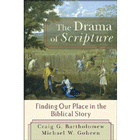
 The Bible as a Six Act Play

In The Drama of Scripture: Finding Our Place in the Story of the Bible we have attempted to tell the story of the Bible in six acts [Craig G. Bartholomew and Michael W. Goheen, The Drama of Scripture: Finding Our Place in the Story of the Bible, Grand Rapids: Baker, 2004. We are dependant on N. T. Wright for the metaphor of a drama. He explicates the Biblical story in five acts (‘How Can the Bible Be Authoritative?’, Vox Evangelica 21 (1991) 7-32; and The New Testament and the People of God. London: SPCK, 1992, 139- 143). Brian Walsh and Richard Middleton add a sixth act (Truth is Stranger Than It Used To Be: Biblical Faith in a Postmodern Age. Downers Grove: Intervarsity Press, 1995, 182). We follow Walsh and Middleton, and use the latter structure. See our website http://www.biblicaltheology.ca for resources on using the book including a seven page summary of the Biblical story].

In Act One God calls into being a marvellous creation. He creates human beings in his image to live in fellowship with him and to explore and care for the riches of his creation.

In Act Two humanity refuses to live under the Creator’s word, and chooses to seek life apart from Him. It results in disaster; the whole creation is brought into the train of human rebellion.

In Act Three God chooses a people, Israel, to embody his creational and redemptive purposes for the world. Israel is formed into a people and placed on the land to shine as a light. They fail in their calling. Yet God promises through the prophets that Israel’s failure will not derail His plan.

In Act Four God sends Jesus. Jesus carries out Israel’s calling is a faithful light to the world. But he does more: He defeats the power of sin at the cross, rises from the dead inaugurating the new creation, and pours out His Spirit that his people might taste of this coming salvation. Before he takes His position of authority over the creation he gathers his disciples together and tells them: ‘As the Father has sent me, I am sending you.’

Act Five tells us the story of the church’s mission from Jerusalem to Rome in the first hundred or so years. But the story ends on an incomplete note. The story is to continue; the church’s mission is to continue in all places until Jesus returns. We are invited into this story to witness to the comprehensive rule of God in Jesus coming at the goal of history.

Act Six is a yet future act. Jesus will return and complete his restoration work.

We might ask how this story might be authoritative for our lives. N. T. Wright believes that the authority of the biblical story is tied up with its overarching narrative form. He offers a rich metaphor to explicate this authority (Wright, ‘How Can the Bible Be Authoritative?’ and The New Testament and the People of God, 139- 143).

Imagine that a Shakespearian play is discovered for the first time but most of the fifth act is missing. The decision to stage the play is made. The first four acts and the remnant of the fifth act are given to well-trained and experienced Shakespearian actors who immerse themselves both in the first part of the play and in the culture and time of Shakespeare. They are told to work out the concluding fifth act for themselves.

This conclusion must be both consistent and innovative. It must be consistent with the first part of the play. The actors must immerse themselves in full sympathy in the unfinished drama. The first four acts would contain its own cumulative forward movement that would demand that the play be concluded in a way consistent and fitting with that impetus. Yet an appropriate conclusion would not mean a simple repetition or imitation of the earlier acts. The actors would carry forward the logic of the play in a creative improvisation. Such an improvisation would be an authentic conclusion if it were coherent with the earlier acts.

This metaphor provides a specific analogy for how the biblical story might function authoritatively to shape the life of the believing community. Wright sees the biblical story as consisting of four acts – creation, fall, Israel, Jesus – plus the first scene of the fifth act that narrates the beginning of the church’s mission. Furthermore this fifth act offers hints at how the play is to end. Thus the church’s life is lived out consistent with the forward impetus of the first acts and moving toward and anticipating the intended conclusion. The first scene of act five, the church’s story, begins to draw out and implement the significance of the first four acts, especially act four. The church continues today to do the same in fresh and creative ways in new cultural situations. This requires a patient examination and thorough immersion in what act four is all about, how act four is to be understood in light of acts one through three, and how the first scene of act five faithfully carries forward act four.

This view of the authority of the Biblical story assumes a clear understanding of our place in the story. It is important not only to understand that the Bible is one cosmic story of the world but also where we are at in the story. The Old Testament looked to a time when the kingdom of God would be ushered in in fullness. This was the goal of God’s redemptive work. When Jesus emerged he announced the arrival of the kingdom yet it did not come as expected. Examining the gospels and listening to Jesus we hear that the kingdom of God is already here but not yet arrived. What can this mean? If my wife tells me that our guests from out of town are already here but not yet arrived I would wonder what on earth she is saying. How can the kingdom be already here but not yet arrived? And what is the significance of the ‘already-not yet’ time period of the coming kingdom?

First we have been given a foretaste of the kingdom. The gospels often compare the kingdom to a feast, a banquet. When the end comes we will enjoy the full banquet of the kingdom. However, the church has been given a foretaste of that kingdom banquet. A foretaste of the kingdom constitutes us as witnesses. The reason we have been offered a foretaste of the salvation of the end is so that we can witness to that salvation. Let me offer another illustration. The people of God are like a movie preview or trailer. A movie trailer gives actual footage of the movie that is coming in the future so that people will want to watch it. The people of God are a kingdom preview. We embody the salvation of the kingdom which is coming in the future so that people will see it and want it. That is what the witness is all about. We are a sign that points to the coming of the fullness of the kingdom in the future. We witness to its presence and its future consummation. A biblical witness is a witness to the kingdom, to God’s rule over all of human life.

The worldview significance of our place in the story can be illustrated by N. T. Wright’s reflection on worldview. In their popular book on worldview, Richard Middleton and Brian Walsh argue that the Bible provides a worldview by answering foundational questions that shape our lives. Those questions are: Who are we? Where are we? What’s wrong? What’s the remedy? (Walsh and Middleton, The Transforming Vision: Shaping a Christian World View, Downers Grove: IVP, 1984, 35). Wright follows Walsh and Middleton in his masterly discussion of the importance of worldview for New Testament studies (Wright, N. T., The New Testament and the People of God, 29-144). Four years later in his second volume he writes that there is a fifth question that needs to be added to the other four, a question that is fundamental for human life. That question is ‘what time is it?’ He says: ‘Since writing The New Testament and the People of God I have realized that ‘what time is it?’ needs adding to the four questions I started with (though at what point in the order could be discussed further). Without it, the structure collapses into timelessness which characterizes some non-Judaeo-Christian worldviews.

Heading Off Misunderstandings

Saying that the Bible is one unfolding story could lead to misunderstandings. So it would be good to say a few words to head off some of those misconceptions. First by saying that the Bible is one unfolding story I am not saying that the Bible is a nice neat novel. It is not a single volume but a ‘sprawling, capacious narrative’ (Peterson, Eugene. ‘Living into God’s Story.’ This article originally appeared on the website ‘The Ooze: Conversation for a Journey’ (www.theooze.com). It can be accessed at http://www,churchcrossing.com/articles.cfm?fuseaction=articledetail&122).

In his discussion on the Bible as a metanarrative Richard Bauckham states that the ‘Bible does not have a carefully plotted single story-line, like, for example a conventional novel. It is a sprawling collection of narratives along with much non-narrative material that stands in a variety of relationships to the narratives’ (Bauckham, Richard. Bible and Mission: Christian Witness in a Postmodern World. Grand Rapids: Baker, 2003, 92).

He continues that major stretches of the main story are told more than once in divergent ways; there are a plurality of angles on the same subject matter (for example, the gospels). He points further to many ways in which there is a ‘profusion and sheer untidiness of the narrative materials’ (Ibid). He concludes that all this ‘makes any sort of finality in summarizing the biblical story inconceivable’ (Ibid, 93).

Secondly, the Bible is not only a narrative document. There are many other genres of literature in the Bible as well. Newbigin states that while the ‘Bible is essentially narrative in form’ that ‘it contains, indeed, much else: prayer, poetry, legislation, ethical teaching and so on.’ Yet, he maintains, ‘essentially it is a story’ (Lesslie Newbigin. The Open Secret: An Introduction to the Theology of Mission. Grand Rapids: Eerdmans, 1995, 81).

James Barr differs radically with Newbigin (and me, i.e., Michael Goheen) on what exactly story means. Yet he too sees the overall shape of Scripture as a narrative within which other genres of Scripture fit. Here is how he puts it:

. . . in my conception all of the Bible counts as ‘story.’ A people’s story is not necessarily purely narrative: materials of many kinds may be slotted into a narrative structure, and this is done in the Hebrew Bible. Thus legal materials are inserted and appear, almost entirely, as part of the Moses story. In this case they are incorporated into the narrative. Others are more loosely attached: songs and hymns of the temple and of individuals, mostly collected in the Book of Psalms but some slotted into the narratives as in Samuel, Kings and Chronicles. . . . Wisdom books: whether . . . they came from Solomon, or because they were general lore of Israel, they are part of the story also.

In the New Testament the letters of great leaders, and an apocalyptic book like Revelation, form part of the story, along with the more strictly narrative writings. Thus in general, although not all parts of the Bible are narrative, the narrative character of the story elements provides a better framework into which the non-narrative parts may be fitted than any framework based on the non-narrative parts into which the story elements could be fitted (James Barr. The Concept of Biblical Theology: An Old Testament Perspective. Minneapolis: Fortress Press, 1999, 356).

A third misunderstanding is tied up with the notion of story. In some approaches to narrative theology—in fact, in Barr’s understanding above—the notion of story enables the reader to ignore questions of historicity. Story may be only a linguistically constructed narrative by a religious community, and no more than that. Yet I use story to speak of an interpretation of history. It is important that these events really happened. The Bible requires ‘a reality that corresponds to it’ (Gabriel Fackre. Narrative Theology from an Evangelical Perspective, in Yandell, K.E., ed., Faith and Narrative, Oxford: Oxford University Press, 2001, 197). The historicity of the narrative matters: ‘. . .it is of the very essence of the matter that the events and places which you read in your Bible are part of the real world and the real history–the same world in which you live . . .’ (Newbigin, The Gospel in a Pluralist Society, 68).

 The Importance of Understanding the Bible as One Story

The importance of understanding the Bible as one story can be seen by noting Newbigin’s notion of a missionary encounter. A missionary encounter is the normal position the church assumes in its culture if it is faithful. It assumes two comprehensive yet incompatible stories. The Bible tells one story about the world and human life while another equally all-embracive story shapes out culture. Christian discipleship always takes cultural shape. So in the life of the Christian community there will be an encounter between two equally comprehensive stories. When the church really believes that its story is true and shapes their whole lives by it, the foundational idolatrous faith, assumed in the cultural story, will be challenged. As the church challenges that story it offers a credible alternative; it calls for conversion. It is an invitation to see and live in the world in the light of another story. Our place in the story is to embody the end and invite others into that true story.

If the church is to be faithful to its missionary calling, it must recover the Bible as one true story according to Newbigin: ‘I do not believe that we can speak effectively of the Gospel as a word addressed to our culture unless we recover a sense of the Scriptures as a canonical whole, as the story which provides the true context for our understanding of the meaning of our lives – both personal and public’ (Lesslie Newbigin. ‘Response to “Word of God?”’, John Coventry SJ, The Gospel and our Culture Newsletter 8, 1991, 2).

If the story of the Bible is fragmented into bits it can easily be absorbed into the reigning story of culture rather than challenging it. Newbigin’s recognition of this, and thus his passion for the importance of seeing the Bible as one story, comes from his missionary experience. In India he saw how easy it was for the Bible to be absorbed into a more comprehensive and alien worldview. The Bible as one comprehensive story in contrast to the comprehensive worldview of Hinduism was a matter of life and death in India. In the West it is equally serious. A fragmented Bible, then, can lead to a church that is unfaithful, syncretistically accommodated to the idolatry of its cultural story. Or to use the words of the Apostle Paul, a church without a comprehensive story to withstand the power of the cultural story will be ‘conformed to the world’ (Romans 12:1-2).

This article is essentially the substance of two keynote addresses given at the ‘Inhabiting the Biblical Story’ conference at the Victorian University of Wellington, Wellington, New Zealand, 16 July 2005.

About the Author: Dr. Michael W. Goheen teaches at Trinity Western University, Langley, B.C., Canada. He is the author of The Drama of Scripture: Finding Our Place in the Biblical Story; Living at the Crossroads: An Introduction to Christian Worldview; and A Light to the Nations: The Missional Church and the Biblical Story.

Current Statistics about the Unfinished Task of World Evangelism

The following statistics represent some of the challenges facing the church in the unfinished task of world evangelism (Ronnie Floyd, Our Last Great Hope (Thomas Nelson, 2011):

As of April 2012, there were approximately 7 billion people on Earth. Approximately 750 million (or about 11 percent) of those are willing to claim Jesus as personal Lord and Savior.

At present, just over 50 percent of the world’s population (or 3.5 billion people) have not heard the gospel and most of them do not have a realistic opportunity to hear the gospel. Here’s another way to look at the challenge of world evangelism:

Of the 11,646 distinct people groups on the planet, 6,734 people groups (roughly 60 percent) contain between zero and two percent evangelical Christians. Many of these 6,734 people groups have no churches, no Bibles, no Christian literature, and no mission agencies who are seeking to share the gospel with them.

If evangelical missions worldwide were able to send one missionary to each group of 5000 people (of the 3.5 billion) we would need 700,000 additional missionaries!

Dr. R.C. Sproul on Making Your Calling and Election Sure

“Fear Not”

We are fragile mortals, given to fears of every sort. We have a built-in insecurity that no amount of whistling in the dark can mollify. We seek assurance concerning the things that frighten us the most.

The prohibition uttered most frequently by our Lord is the command, “Fear not.” He said this so often to his disciples and others he encountered that it almost came to sound like a greeting. Where most people greet others by saying “Hi” or “Hello,” the first words of Jesus often were “Fear not.”

Why? Perhaps Jesus’ predilection for those words grew out of his acute sense of the thinly veiled fear that grips all who approach the living God. We fear his power, we fear his wrath, and most of all we fear his ultimate rejection.

The assurance we need most is the assurance of salvation. Though we are loathe to think much about it or contemplate it deeply, we know, if only intuitively, that the worst catastrophe that could ever befall us is to be visited by God’s final punitive wrath. Our insecurity is worsened by the certainty that we deserve it.

Many believe that assurance of eternal salvation is neither possible or even to be sought. To claim such assurance is considered a mask of supreme arrogance, the nadir of self-conceit.

Yet, if God declares that it is possible to have full assurance of salvation and even commands that we seek after it, then it would be supremely arrogant to deny our need or neglect the search.

In fact, God does command us to make our election and calling sure: Therefore, my brothers, be all the more eager to make your calling and election sure. For if you do these things, you will never fall” (2 Pet. 1:10).

This command admits of no justifiable neglect. It addresses a crucial matter. The question, “Am I saved?” is one of the most important I can ever ask myself. I need to know the answer; I must know the answer. This is not a trifle. Without the assurance of salvation the Christian life is unstable, vulnerable to the debilitating rigors of mood changes. Basing assurance on changing emotions allows the wolf of heresy to camp on the doorstep. Progress in sanctification requires a firm foundation in faith. Assurance is the cement of that foundation. Without it the foundation crumbles.

How, then, do we receive assurance? The Scripture declares that the Holy Spirit bears witness with our spirit that we are the children of God. This inner testimony of the Holy Spirit is as vital as it is complex. It can be subjected to severe distortions, being confused with subjectivism and self-delusion. The Spirit gives his testimony with the Word and through the Word, never without the Word or against the Word.

Since it is possible to have false assurance of salvation it is all the more urgent that we seek the Spirit’s testimony in and through the Word. False assurance usually proceeds from a faulty understanding of salvation. If one fails to understand the necessary conditions for salvation, assurance becomes, at best, a guess.

Therefore, we insist that right doctrine is a crucial element in acquiring a sound basis for assurance. It may even be a necessary condition, though it is by no means a sufficient condition. Without sound doctrine we will have an inadequate understanding of salvation. However, having a sound understanding of salvation is no guarantee that we have the salvation we so soundly understand.

If we think the Bible teaches universal salvation we may arrive at a false sense of assurance by reasoning as follows:

Everybody is saved.

I am a body.

Therefore, I am saved.

Or, if we think salvation is gained by our own good works and we are further deluded into believing that we possess good works, we will have a false assurance of salvation.

To have sound assurance we must understand that our salvation rests upon the merit of Christ alone, which is appropriated to us when we embrace him by genuine faith. If we understand that, the remaining question is, “Do I have the genuine faith necessary for salvation?”

To answer that question two more things must be understood and analyzed properly. The first is doctrinal. We need a clear understanding of what constitutes genuine saving faith. If we conceive of saving faith as a faith that exists in a vacuum, never yielding the fruit of works of obedience, we have confused saving faith with dead faith, which cannot save anyone.

The second requirement involves a sober analysis of our own lives. We must examine ourselves to see if the fruit of regeneration is apparent in us. Do we have a real affection for the biblical Christ? Only the regenerate person possesses real love for the real Jesus. Next we must ask the tough question, “Does my life manifest the fruit of sanctification?” I test my faith by my works.

I call this last question the tough question for various reasons. We can lose assurance if we think perfect obedience is the test. Every sin we commit after conversion can cast doubt upon our assurance. That doubt is exacerbated by Satan’s assault of accusation against us. Satan delights in shaking the true Christian’s assurance.

Or we can delude ourselves by looking at our own works with an exalted view of our goodness, seeing virtue in ourselves when there is none. Here we quake in terror before our Lord’s warning: “Many will say to me on that day, ‘Lord, Lord, did we not prophesy in your name, and in your name drive out demons and perform many miracles?’ Then I will tell them plainly, ‘I never knew you. Away from me, you evildoers!’” (Matt. 7:22–23).

Real assurance rests on a sound understanding of salvation, a sound understanding of justification, a sound understanding of sanctification, and a sound understanding of ourselves. In all these matters we have the comfort and assistance of the Holy Spirit who illumines the text of Scripture for us, who works in us to yield the fruit of sanctification, and who bears witness with our spirit that we are the children of God.

The article above adapted from Chapter 7 in the short book edited by Dr. R.C. Sproul. Doubt & Assurance. Grand Rapids: Baker, 2000.

About Dr. R.C. Sproul: He is the founder and chairman of Ligonier Ministries, an international Christian education ministry located near Orlando, Florida. His teaching can be heard on the program Renewing Your Mind, which is broadcast on hundreds of radio outlets in the United States and in 40 countries worldwide. He is the executive editor of Tabletalk magazine and general editor of The Reformation Study Bible, and the author of more than seventy books (including some of my all time favorites: The Holiness of God; Chosen By God; Reason to Believe; Knowing Scripture; Willing to Believe;  Intimate Marriage; Pleasing God; If There’s A God, Why Are There Atheists?, and Defending The Faith) and scores of articles for national evangelical publications. Dr. Sproul also serves as president of Ligonier Academy of Biblical and Theological Studies and Reformation Bible College. He currently serves as Senior Minister of preaching and teaching at Saint Andrew’s in Sanford, FL.

10 Excellent Tips on Personal Evangelism from Dr. Tim Keller

Tim Keller Teaching Below at Redeemer Presbyterian Church in New York:

  1. Let people around you know you are a Christian (in a natural, unforced way)
  2. Ask friends about their faith – and just listen!
  3. Listen to your friends’ problems – maybe offer to pray for them
  4. Share your problems with others – testify to how your faith helps you
  5. Give them a book to read
  6. Share your story
  7. Answer objections and questions
  8. Invite them to a church event
  9. Offer to read the Bible with them
  10. Take them to an explore course

These are arranged from 1-10 as a progression. We too often start with numbers 8-10, but we need to start with 1-4 with most people. In fact, he says, we may need to loop through 1-4 multiple times before getting to the later steps. Not only is it more humble of us to begin with 1-4, but it is more loving.

By being real with our friends (#1), we show we trust them enough to be open with them. By listening to their thoughts about faith (#2) and to any problems they may be facing (#3), we show we value them and are genuinely interested in what they have to say. Showing love for our friends may even open opportunities to serve them by praying for them. #4 comes back full circle to being real and honest with our friends in an unforced way.

If we believe that our life is hidden with Christ in God (Col. 3:3), then we should feel the freedom to share our lives with our neighbors, and to love them enough to take the time to listen and get to know them. It isn’t our life anyway, but Jesus’s (Gal. 2:20). We’re just sharing with others that which doesn’t belong to us.

*This article has been posted on several excellent websites:http://gospeldots.com/2012/06/28/tim-kellers-top-10evangelismtips/;http://faithim.wordpress.com/2012/07/05/572/;http://timchester.wordpress.com/2012/06/05/kellers-top-ten-evangelism-tips/ – The Ten tips originating with Dr. Tim Keller.

About Dr. Tim Keller: He is an a Pastor, Writer, and sought after speaker. He is wonderfully Christocentric and gospel centered in all that he teaches. Some of his well known books are: The Prodigal God; The Reason for God; and Counterfeit Gods. He will soon be releasing a book entitled Center Church based on his missional and gospel centered philosophy of ministry and church planting – this book has been much anticipated by pastors and church planters for several years!

Dr. J.I. Packer on Freedom in Christ and What It Really Means

ANTINOMIANISM: WE ARE NOT SET FREE TO SIN

Dear children, do not let anyone lead you astray. He who does what is right is righteous, just as he [Christ] is righteous. – 1 JOHN 3:7

Antinomianism, which means being “anti-law,” is a name for several views that have denied that God’s law in Scripture should directly control the Christian’s life.

Dualistic antinomianism appears in the Gnostic heretics against whom Jude and Peter wrote (Jude 4-19; 2 Pet. 2). This view sees salvation as for the soul only, and bodily behavior as irrelevant both to God’s interest and to the soul’s health, so one may behave riotously and it will not matter.

Spirit-centered antinomianism puts such trust in the Holy Spirit’s inward prompting as to deny any need to be taught by the law how to live. Freedom from the law as a way of salvation is assumed to bring with it freedom from the law as a guide to conduct. In the first 150 years of the Reformation era this kind of antinomianism often threatened, and Paul’s insistence that a truly spiritual person acknowledges the authority of God’s Word through Christ’s apostles (1 Cor. 14:37; cf. 7:40) suggests that the Spirit-obsessed Corinthian church was in the grip of the same mind-set.

Christ-centered antinomianism argues that God sees no sin in believers, because they are in Christ, who kept the law for them, and therefore what they actually do makes no difference, provided that they keep believing. But 1 John 1:8–2:1 (expounding 1:7) and 3:4-10 point in a different direction, showing that it is not possible to be in Christ and at the same time to embrace sin as a way of life.

Dispensational antinomianism holds that keeping the moral law is at no stage necessary for Christians, since we live under a dispensation of grace, not of law. Romans 3:31 and 1 Corinthians 6:9-11 clearly show, however, that law-keeping is a continuing obligation for Christians. “I am not free from God’s law but am under Christ’s law,” says Paul (1 Cor. 9:21).

Dialectical antinomianism, as in Barth and Brunner, denies that biblical law is God’s direct command and affirms that the Bible’s imperative statements trigger the Word of the Spirit, which when it comes may or may not correspond exactly to what is written. The inadequacy of the neo-orthodox view of biblical authority, which explains the inspiration of Scripture in terms of the Bible’s instrumentality as a channel for God’s present-day utterances to his people, is evident here.

Situationist antinomianism says that a motive and intention of love is all that God now requires of Christians, and the commands of the Decalogue and other ethical parts of Scripture, for all that they are ascribed to God directly, are mere rules of thumb for loving, rules that love may at any time disregard. But Romans 13:8-10, to which this view appeals, teaches that without love as a motive these specific commands cannot be fulfilled. Once more an unacceptably weak view of Scripture surfaces.

It must be stressed that the moral law, as crystallized in the Decalogue and opened up in the ethical teaching of both Testaments, is one coherent law, given to be a code of practice for God’s people in every age. In addition, repentance means resolving henceforth to seek God’s help in keeping that law. The Spirit is given to empower law-keeping and make us more and more like Christ, the archetypal law-keeper (Matt. 5:17). This law-keeping is in fact the fulfilling of our human nature, and Scripture holds out no hope of salvation for any who, whatever their profession of faith, do not seek to turn from sin to righteousness (1 Cor. 6:9-11; Rev. 21:8).

Article above adapted from J.I. Packer. Concise Theology. Wheaton: Tyndale, 1993, pp. 178-180.

About the Author: James Innell Packer (born in Gloucester, England) is a British-born Canadian Christian theologian in the Calvinistic Anglican tradition. He currently serves as the Board of Governors’ Professor of Theology at Regent College in Vancouver, British Columbia. He is considered to be one of the most important evangelical theologians of the late 20th century.

The son of a clerk for the Great Western Railway, Packer won a scholarship to Oxford University. He was educated at Corpus Christi College, obtaining the degrees of Bachelor of Arts (1948), Master of Arts (1952), and Doctor of Philosophy (1955).

It was as a student at Oxford where he first met C.S. Lewis whose teachings would become a major influence in his life. In a meeting of the Oxford Inter-Collegiate Christian Union, Packer committed his life to Christian service.

He spent a brief time teaching Greek at Oak Hill Theological College in London, and in 1949 entered Wycliffe Hall, Oxford to study theology. He was ordained a deacon (1952) and priest (1953) in the Church of England, within which he became recognized as a leader in the Evangelical movement. He was Assistant Curate of Harborne Heath in Birmingham 1952-54 and Lecturer at Tyndale Hall, Bristol 1955-61. He was Librarian of Latimer House, Oxford 1961-62 and Principal 1962-69. In 1970 he became Principal of Tyndale Hall, Bristol, and from 1971 until 1979 he was Associate Prinicipal of Trinity College, Bristol, which had been formed from the amalgamation of Tyndale Hall with Clifton College and Dalton House-St Michael’s.

In 1978, he signed the Chicago Statement on Biblical Inerrancy, which affirmed a conservative position on Biblical inerrancy.

In 1979, Packer moved to Vancouver to take up a position at Regent College, eventually being named the first Sangwoo Youtong Chee Professor of Theology, a title he held until his retirement. A prolific writer and frequent lecturer, although best known for a single book, “Knowing God,” Packer is widely regarded in conservative Protestant circles as one of the most important theologians of the modern era. He is a frequent contributor to and an executive editor of Christianity Today. Since arriving at Regent he has published a book every year. Together his books have sold more than three million copies. His wife Kit is quick to point out the source of his success, “His devotion to the Lord is the reason for everything he’s done. His writing, his preaching, his lecturing, his living are all centered on the Lord.”

Packer served as general editor for the English Standard Version of the Bible (2001), an Evangelical revision of the Revised Standard Version of 1971. He is now at work on his magnum opus, a systematic theology.

To read more about Packer, a recent biography by Alister McGrath, entitled J. I. Packer, gives a careful and sensitive examination of his life.

Dr. R.C. Sproul on the Essence of God’s Sovereignty in Our Salvation

The Pelagian Captivity of the Church

by R.C. Sproul

Shortly after the Reformation began, in the first few years after Martin Luther posted the Ninety-Five Theses on the church door at Wittenberg, he issued some short booklets on a variety of subjects. One of the most provocative was titled The Babylonian Captivity of the Church. In this book Luther was looking back to that period of Old Testament history when Jerusalem was destroyed by the invading armies of Babylon and the elite of the people were carried off into captivity. Luther in the sixteenth century took the image of the historic Babylonian captivity and reapplied it to his era and talked about the new Babylonian captivity of the Church. He was speaking of Rome as the modern Babylon that held the Gospel hostage with its rejection of the biblical understanding of justification. You can understand how fierce the controversy was, how polemical this title would be in that period by saying that the Church had not simply erred or strayed, but had fallen — that it’s actually now Babylonian; it is now in pagan captivity.

I’ve often wondered if Luther were alive today and came to our culture and looked, not at the liberal church community, but at evangelical churches, what would he have to say? Of course I can’t answer that question with any kind of definitive authority, but my guess is this: If Martin Luther lived today and picked up his pen to write, the book he would write in our time would be entitled The Pelagian Captivity of the Evangelical Church. Luther saw the doctrine of justification as fueled by a deeper theological problem. He writes about this extensively in The Bondage of the Will. When we look at the Reformation and we see the solas of the Reformation — sola Scriptura, sola fide, solus Christus, soli Deo gloria, sola gratia — Luther was convinced that the real issue of the Reformation was the issue of grace; and that underlying the doctrine of solo fide, justification by faith alone, was the prior commitment to sola gratia, the concept of justification by grace alone.

In the Fleming Revell edition of The Bondage of the Will, the translators, J. I. Packer and O. R. Johnston, included a somewhat provocative historical and theological introduction to the book itself. This is from the end of that introduction:

These things need to be pondered by Protestants today. With what right may we call ourselves children of the Reformation? Much modern Protestantism would be neither owned nor even recognised by the pioneer Reformers. The Bondage of the Will fairly sets before us what they believed about the salvation of lost mankind. In the light of it, we are forced to ask whether Protestant Christendom has not tragically sold its birthright between Luther’s day and our own. Has not Protestantism today become more Erasmian than Lutheran? Do we not too often try to minimise and gloss over doctrinal differences for the sake of inter-party peace? Are we innocent of the doctrinal indifferentism with which Luther charged Erasmus? Do we still believe that doctrine matters? (J.I. Packer and O.R. Johnston, “Introduction” to the Bondage of the Will. Old Tappan, NJ: Fleming Revell, 1957: pp. 59-60)

Historically, it’s a simple matter of fact that Luther, Calvin, Zwingli, and all the leading Protestant theologians of the first epoch of the Reformation stood on precisely the same ground here. On other points they had their differences. In asserting the helplessness of man in sin and the sovereignty of God in grace, they were entirely at one. To all of them these doctrines were the very lifeblood of the Christian faith. A modern editor of Luther’s works says this:

Whoever puts this book down without having realized that Evangelical theology stands or falls with the doctrine of the bondage of the will has read it in vain. The doctrine of free justification by faith alone, which became the storm center of so much controversy during the Reformation period, is often regarded as the heart of the Reformers’ theology, but this is not accurate. The truth is that their thinking was really centered upon the contention of Paul, echoed by Augustine and others, that the sinner’s entire salvation is by free and sovereign grace only, and that the doctrine of justification by faith was important to them because it safeguarded the principle of sovereign grace. The sovereignty of grace found expression in their thinking at a more profound level still in the doctrine of monergistic regeneration (Ibid).

That is to say, that the faith that receives Christ for justification is itself the free gift of a sovereign God. The principle of sola fide is not rightly understood until it is seen as anchored in the broader principle of sola gratia. What is the source of faith? Is it the God-given means whereby the God-given justification is received, or is it a condition of justification which is left to man to fulfill? Do you hear the difference? Let me put it in simple terms. I heard an evangelist recently say, “If God takes a thousand steps to reach out to you for your redemption, still in the final analysis, you must take the decisive step to be saved.” Consider the statement that has been made by America’s most beloved and leading evangelical of the twentieth century, Billy Graham, who says with great passion, “God does ninety-nine percent of it but you still must do that last one percent.”

What Is Pelagianism?

Now, let’s return briefly to my title, “The Pelagian Captivity of the Church.” What are we talking about? Pelagius was a monk who lived in Britain in the fifth century. He was a contemporary of the greatest theologian of the first millennium of Church history if not of all time, Aurelius Augustine, Bishop of Hippo in North Africa. We have heard of St. Augustine, of his great works in theology, of his City of God, of his Confessions, and so on, which remain Christian classics.

Augustine, in addition to being a titanic theologian and a prodigious intellect, was also a man of deep spirituality and prayer. In one of his famous prayers, Augustine made a seemingly harmless and innocuous statement in the prayer to God in which he says: “O God, command what you wouldst, and grant what thou dost command.” Now, would that give you apoplexy — to hear a prayer like that? Well it certainly set Pelagius, this British monk, into orbit. When he heard that, he protested vociferously, even appealing to Rome to have this ghastly prayer censured from the pen of Augustine. Here’s why. He said, “Are you saying, Augustine, that God has the inherent right to command anything that he so desires from his creatures? Nobody is going to dispute that. God inherently, as the creator of heaven and earth, has the right to impose obligations on his creatures and say, ‘Thou shalt do this, and thou shalt not do that.’ ‘Command whatever thou would’ — it’s a perfectly legitimate prayer.”

It’s the second part of the prayer that Pelagius abhorred when Augustine said, “and grant what thou dost command.” He said, “What are you talking about? If God is just, if God is righteous and God is holy, and God commands of the creature to do something, certainly that creature must have the power within himself, the moral ability within himself, to perform it or God would never require it in the first place.” Now that makes sense, doesn’t it? What Pelagius was saying is that moral responsibility always and everywhere implies moral capability or, simply, moral ability. So why would we have to pray, “God grant me, give me the gift of being able to do what you command me to do”? Pelagius saw in this statement a shadow being cast over the integrity of God himself, who would hold people responsible for doing something they cannot do.

So in the ensuing debate, Augustine made it clear that in creation, God commanded nothing from Adam or Eve that they were incapable of performing. But once transgression entered and mankind became fallen, God’s law was not repealed nor did God adjust his holy requirements downward to accommodate the weakened, fallen condition of his creation. God did punish his creation by visiting upon them the judgment of original sin, so that everyone after Adam and Eve who was born into this world was born already dead in sin. Original sin is not the first sin. It’s the result of the first sin; it refers to our inherent corruption, by which we are born in sin, and in sin did our mothers conceive us. We are not born in a neutral state of innocence, but we are born in a sinful, fallen condition. Virtually every church in the historic World Council of Churches at some point in their history and in their creedal development articulates some doctrine of original sin. So clear is that to the biblical revelation that it would take a repudiation of the biblical view of mankind to deny original sin altogether.

This is precisely what was at issue in the battle between Augustine and Pelagius in the fifth century. Pelagius said there is no such thing as original sin. Adam’s sin affected Adam and only Adam. There is no transmission or transfer of guilt or fallenness or corruption to the progeny of Adam and Eve. Everyone is born in the same state of innocence in which Adam was created. And, he said, for a person to live a life of obedience to God, a life of moral perfection, is possible without any help from Jesus or without any help from the grace of God. Pelagius said that grace — and here’s the key distinction — facilitates righteousness. What does “facilitate” mean?

It helps, it makes it more facile, it makes it easier, but you don’t have to have it. You can be perfect without it. Pelagius further stated that it is not only theoretically possible for some folks to live a perfect life without any assistance from divine grace, but there are in fact people who do it. Augustine said, “No, no, no, no . . . we are infected by sin by nature, to the very depths and core of our being — so much so that no human being has the moral power to incline himself to cooperate with the grace of God. The human will, as a result of original sin, still has the power to choose, but it is in bondage to its evil desires and inclinations. The condition of fallen humanity is one that Augustine would describe as the inability to not sin. In simple English, what Augustine was saying is that in the Fall, man loses his moral ability to do the things of God and he is held captive by his own evil inclinations.

In the fifth century the Church condemned Pelagius as a heretic. Pelagianism was condemned at the Council of Orange, and it was condemned again at the Council of Florence, the Council of Carthage, and also, ironically, at the Council of Trent in the sixteenth century in the first three anathemas of the Canons of the Sixth Session. So, consistently throughout Church history, the Church has roundly and soundly condemned Pelagianism  —  because Pelagianism denies the fallenness of our nature; it denies the doctrine of original sin.

Now what is called semi-Pelagianism, as the prefix “semi” suggests, was a somewhat middle ground between full-orbed Augustinianism and full-orbed Pelagianism. Semi-Pelagianism said this: yes, there was a fall; yes, there is such a thing as original sin; yes, the constituent nature of humanity has been changed by this state of corruption and all parts of our humanity have been significantly weakened by the fall, so much so that without the assistance of divine grace nobody can possibly be redeemed, so that grace is not only helpful but it’s absolutely necessary for salvation. While we are so fallen that we can’t be saved without grace, we are not so fallen that we don’t have the ability to accept or reject the grace when it’s offered to us. The will is weakened but is not enslaved. There remains in the core of our being an island of righteousness that remains untouched by the fall. It’s out of that little island of righteousness, that little parcel of goodness that is still intact in the soul or in the will that is the determinative difference between heaven and hell. It’s that little island that must be exercised when God does his thousand steps of reaching out to us, but in the final analysis it’s that one step that we take that determines whether we go to heaven or hell — whether we exercise that little righteousness that is in the core of our being or whether we don’t. That little island Augustine wouldn’t even recognize as an atoll in the South Pacific. He said it’s a mythical island, that the will is enslaved, and that man is dead in his sin and trespasses.

Ironically, the Church condemned semi-Pelagianism as vehemently as it had condemned original Pelagianism. Yet by the time you get to the sixteenth century and you read the Catholic understanding of what happens in salvation the Church basically repudiated what Augustine taught and Aquinas taught as well. The Church concluded that there still remains this freedom that is intact in the human will and that man must cooperate with — and assent to — the prevenient grace that is offered to them by God. If we exercise that will, if we exercise a cooperation with whatever powers we have left, we will be saved. And so in the sixteenth century the Church reembraced semi-Pelagianism.

At the time of the Reformation, all the reformers agreed on one point: the moral inability of fallen human beings to incline themselves to the things of God; that all people, in order to be saved, are totally dependent, not ninety-nine percent, but one hundred percent dependent upon the monergistic work of regeneration in order to come to faith, and that faith itself is a gift of God. It’s not that we are offered salvation and that we will be born again if we choose to believe. But we can’t even believe until God in his grace and in his mercy first changes the disposition of our souls through his sovereign work of regeneration. In other words, what the reformers all agreed with was, unless a man is born again, he can’t even see the kingdom of God, let alone enter it. Like Jesus says in the sixth chapter of John, “No man can come to me unless it is given to him of the Father” — that the necessary condition for anybody’s faith and anybody’s salvation is regeneration.

Evangelicals and Faith

Modern Evangelicalism almost uniformly and universally teaches that in order for a person to be born again, he must first exercise faith. You have to choose to be born again. Isn’t that what you hear? In a George Barna poll, more than seventy percent of “professing evangelical Christians” in America expressed the belief that man is basically good. And more than eighty percent articulated the view that God helps those who help themselves. These positions — or let me say it negatively — neither of these positions is semi-Pelagian. They’re both Pelagian. To say that we’re basically good is the Pelagian view. I would be willing to assume that in at least thirty percent of the people who are reading this issue, and probably more, if we really examine their thinking in depth, we would find hearts that are beating Pelagianism. We’re overwhelmed with it. We’re surrounded by it. We’re immersed in it. We hear it every day. We hear it every day in the secular culture. And not only do we hear it every day in the secular culture, we hear it every day on Christian television and on Christian radio.

In the nineteenth century, there was a preacher who became very popular in America, who wrote a book on theology, coming out of his own training in law, in which he made no bones about his Pelagianism. He rejected not only Augustinianism, but he also rejected semi-Pelagianism and stood clearly on the subject of unvarnished Pelagianism, saying in no uncertain terms, without any ambiguity, that there was no Fall and that there is no such thing as original sin. This man went on to attack viciously the doctrine of the substitutionary atonement of Christ, and in addition to that, to repudiate as clearly and as loudly as he could the doctrine of justification by faith alone by the imputation of the righteousness of Christ. This man’s basic thesis was, we don’t need the imputation of the righteousness of Christ because we have the capacity in and of ourselves to become righteous. His name: Charles Finney, one of America’s most revered evangelists. Now, if Luther was correct in saying that sola fide is the article upon which the Church stands or falls, if what the reformers were saying is that justification by faith alone is an essential truth of Christianity, who also argued that the substitutionary atonement is an essential truth of Christianity; if they’re correct in their assessment that those doctrines are essential truths of Christianity, the only conclusion we can come to is that Charles Finney was not a Christian. I read his writings and I say, “I don’t see how any Christian person could write this.” And yet, he is in the Hall of Fame of Evangelical Christianity in America. He is the patron saint of twentieth-century Evangelicalism. And he is not semi-Pelagian; he is unvarnished in his Pelagianism.

The Island of Righteousness

One thing is clear: that you can be purely Pelagian and be completely welcome in the evangelical movement today. It’s not simply that the camel sticks his nose into the tent; he doesn’t just come in the tent — he kicks the owner of the tent out. Modern Evangelicalism today looks with suspicion at Reformed theology, which has become sort of the third-class citizen of Evangelicalism. Now you say, “Wait a minute, R. C. Let’s not tar everybody with the extreme brush of Pelagianism, because, after all, Billy Graham and the rest of these people are saying there was a Fall; you’ve got to have grace; there is such a thing as original sin; and semi-Pelagians do not agree with Pelagius’ facile and sanguine view of unfallen human nature.” And that’s true. No question about it. But it’s that little island of righteousness where man still has the ability, in and of himself, to turn, to change, to incline, to dispose, to embrace the offer of grace that reveals why historically semi-Pelagianism is not called semi-Augustinianism, but semi-Pelagianism.

I heard an evangelist use two analogies to describe what happens in our redemption. He said sin has such a strong hold on us, a stranglehold, that it’s like a person who can’t swim, who falls overboard in a raging sea, and he’s going under for the third time and only the tops of his fingers are still above the water; and unless someone intervenes to rescue him, he has no hope of survival, his death is certain. And unless God throws him a life preserver, he can’t possibly be rescued. And not only must God throw him a life preserver in the general vicinity of where he is, but that life preserver has to hit him right where his fingers are still extended out of the water, and hit him so that he can grasp hold of it. It has to be perfectly pitched. But still that man will drown unless he takes his fingers and curls them around the life preserver and God will rescue him. But unless that tiny little human action is done, he will surely perish.

The other analogy is this: A man is desperately ill, sick unto death, lying in his hospital bed with a disease that is fatal. There is no way he can be cured unless somebody from outside comes up with a cure, a medicine that will take care of this fatal disease. And God has the cure and walks into the room with the medicine. But the man is so weak he can’t even help himself to the medicine; God has to pour it on the spoon. The man is so sick he’s almost comatose. He can’t even open his mouth, and God has to lean over and open up his mouth for him. God has to bring the spoon to the man’s lips, but the man still has to swallow it.

Now, if we’re going to use analogies, let’s be accurate. The man isn’t going under for the third time; he is stone cold dead at the bottom of the ocean. That’s where you once were when you were dead in sin and trespasses and walked according to the course of this world, according to the prince of the power of the air. And while you were dead hath God quickened you together with Christ. God dove to the bottom of the sea and took that drowned corpse and breathed into it the breath of his life and raised you from the dead. And it’s not that you were dying in a hospital bed of a certain illness, but rather, when you were born you were born D.O.A. That’s what the Bible says: that we are morally stillborn.

Do we have a will? Yes, of course we have a will. Calvin said, if you mean by a free will a faculty of choosing by which you have the power within yourself to choose what you desire, then we all have free will. If you mean by free will the ability for fallen human beings to incline themselves and exercise that will to choose the things of God without the prior monergistic work of regeneration then, said Calvin, free will is far too grandiose a term to apply to a human being.

The semi-Pelagian doctrine of free will prevalent in the evangelical world today is a pagan view that denies the captivity of the human heart to sin. It underestimates the stranglehold that sin has upon us.

None of us wants to see things as bad as they really are. The biblical doctrine of human corruption is grim. We don’t hear the Apostle Paul say, “You know, it’s sad that we have such a thing as sin in the world; nobody’s perfect. But be of good cheer. We’re basically good.” Do you see that even a cursory reading of Scripture denies this?

Now back to Luther. What is the source and status of faith? Is it the God-given means whereby the God-given justification is received? Or is it a condition of justification which is left to us to fulfill? Is your faith a work? Is it the one work that God leaves for you to do? I had a discussion with some folks in Grand Rapids, Michigan, recently. I was speaking on sola gratia, and one fellow was upset.

He said, “Are you trying to tell me that in the final analysis it’s God who either does or doesn’t sovereignly regenerate a heart?”

And I said, “Yes;” and he was very upset about that. I said, “Let me ask you this: are you a Christian?”

He said, “Yes.”

I said, “Do you have friends who aren’t Christians?”

He said, “Well, of course.”

I said, “Why are you a Christian and your friends aren’t? Is it because you’re more righteous than they are?” He wasn’t stupid. He wasn’t going to say, “Of course it’s because I’m more righteous. I did the right thing and my friend didn’t.” He knew where I was going with that question.

And he said, “Oh, no, no, no.”

I said, “Tell me why. Is it because you are smarter than your friend?”

And he said, “No.”

But he would not agree that the final, decisive issue was the grace of God. He wouldn’t come to that. And after we discussed this for fifteen minutes, he said, “OK! I’ll say it. I’m a Christian because I did the right thing, I made the right response, and my friend didn’t.”

What was this person trusting in for his salvation? Not in his works in general, but in the one work that he performed. And he was a Protestant, an evangelical. But his view of salvation was no different from the Roman view.

God’s Sovereignty in Salvation

This is the issue: Is it a part of God’s gift of salvation, or is it in our own contribution to salvation? Is our salvation wholly of God or does it ultimately depend on something that we do for ourselves? Those who say the latter, that it ultimately depends on something we do for ourselves, thereby deny humanity’s utter helplessness in sin and affirm that a form of semi-Pelagianism is true after all. It is no wonder then that later Reformed theology condemned Arminianism as being, in principle, both a return to Rome because, in effect, it turned faith into a meritorious work, and a betrayal of the Reformation because it denied the sovereignty of God in saving sinners, which was the deepest religious and theological principle of the reformers’ thought. Arminianism was indeed, in Reformed eyes, a renunciation of New Testament Christianity in favor of New Testament Judaism. For to rely on oneself for faith is no different in principle than to rely on oneself for works, and the one is as un-Christian and anti-Christian as the other. In the light of what Luther says to Erasmus there is no doubt that he would have endorsed this judgment.

And yet this view is the overwhelming majority report today in professing evangelical circles. And as long as semi-Pelagianism, which is simply a thinly veiled version of real Pelagianism at its core — as long as it prevails in the Church, I don’t know what’s going to happen. But I know, however, what will not happen: there will not be a new Reformation. Until we humble ourselves and understand that no man is an island and that no man has an island of righteousness, that we are utterly dependent upon the unmixed grace of God for our salvation, we will not begin to rest upon grace and rejoice in the greatness of God’s sovereignty, and we will not be rid of the pagan influence of humanism that exalts and puts man at the center of religion. Until that happens there will not be a new Reformation, because at the heart of Reformation teaching is the central place of the worship and gratitude given to God and God alone. Soli Deo gloria, to God alone be the glory.

About the Author: Dr. R.C. Sproul is the founder and chairman of Ligonier Ministries, an international Christian education ministry located near Orlando, Florida. His teaching can be heard on the program Renewing Your Mind, which is broadcast on hundreds of radio outlets in the United States and in 40 countries worldwide. He is the executive editor of Tabletalk magazine and general editor of The Reformation Study Bible, and the author of more than seventy books (including some of my all time favorites: The Work of ChristThe Holiness of God; Chosen By God; Reason to Believe; Knowing Scripture; Willing to Believe; The Intimate Marriage; Pleasing God; If There’s A God, Why Are There Atheists?, and Defending The Faith) and scores of articles for national evangelical publications. Dr. Sproul also serves as president of Ligonier Academy of Biblical and Theological Studies and Reformation Bible College. He currently serves as Senior Minister of preaching and teaching at Saint Andrew’s in Sanford, FL. The article above was adapted from Modern Reformation, Vol 10, Number 3 (May/June 2001), pp. 22-29.

Dr. Russell D. Moore on What Satan Fears Most

What was at Stake in the Third Temptation by Satan?

by Dr. Russel D. Moore

What was at stake in the third temptation was the gospel. Think about the implications of this offer. If Jesus had accepted it, Satan would have surrendered his reign of terror. Jesus could have directed the kingdoms of the world however he wanted. No more babies would be miscarried. No more women would die in childbirth. Ended immediately would be all human slavery, all genocide, all disease, all poverty, all torture, and all ecological catastrophes. The rows and rows of crosses across the highway of the Roman Empire would suddenly be gone. There would never be a Nero or a Napoleon or a Hitler or a Stalin, or at least you would never hear the infamy of those names. There would be no world of divorce courts and abortion clinics and electric chairs and pornographic images.

Whatever is troubling you right now would be gone, centuries before you were ever conceived. This sounds like paradise. Satan was willing to give all of this up because he doesn’t fear Christianity. He certainly doesn’t fear “Christian values.” Satan fears Christ. Remember that Satan holds power only through accusation and condemnation. As long as there is no atoning sacrifice for sin, Satan is quite willing to allow conformity to the external law, even to the law of Christ ruling visibly over the nations from Jerusalem. The accuser simply wants his opportunity to indict his human would-be supplanting powers before the judgment seat, with no shed blood to redeem them back. This is what Jesus’ followers couldn’t understand as he moved down the Roman roads toward the place of the skull. It was there, and only there, as Jesus carried on himself the sins of the world, that he could say, “Now is the judgment of this world; now will the ruler of this world be cast out” (John 12:31). It is only in his triumphant resurrection from the demonic grip of death that Jesus could have “angels, authorities, and powers” subjected to his rule (1 Pet. 3:21–22). A crossless Christianity isn’t just a deficient Christianity; it’s the same old satanism of human striving.

In every generation the church faces cross-evading liberation theologies of both the Left and the Right. The liberation theology of the Left wants a Barabbas to fight off the oppressors, as though the ultimate problem is the reign of Rome and not the reign of death. The liberation theology of the Right wants a golden calf to represent religion and “traditional values” in the public square and to remind us of all the economic security we could have in Egypt. Both want a Caesar or a Pharaoh, not a Messiah. We will always be tempted to bypass the problem behind the problems—captivity to sin, bondage to the accusations of the demonic powers, the sentence of death. Where there is no gospel, something else will fill the void—therapy, consumerism, racial resentment, utopian politics, crazy conspiracy theories of the Left, crazy conspiracy theories of the Right; anything will do. Where there is something other than Christ preached, there is no freedom.

There may be shouts of affirmation or silently nodding heads. There may be left-wing politics or right-wing politics. There may be culturally liberal psychotherapy or culturally conservative psychotherapy. There may be almost anything people think they want, but there’s nothing but judgment in the air. The Devil doesn’t mind “family values” as long as what you ultimately value is the family. Satan doesn’t mind “social justice” as long as you see justice as most importantly social. Satan does not tremble at a “Christian worldview” as long as your ultimate goal is to view the world. Satan doesn’t even mind born-again Christianity as long as the new birth is preached apart from the blood of the cross and the life of the resurrection. Pastor, Satan doesn’t mind if you preach on the decrees of God with fervor and passion, reconciling all the tensions between sovereignty and freedom, as long as you don’t preach the gospel. Homeschooling mom, Satan doesn’t mind if your children can recite the catechism and translate the “Battle Hymn of the Republic” from English to Latin, as long as they don’t hear the gospel. Churches, Satan doesn’t care if your people vote for pro-life candidates, stay married, have sex with whom they’re supposed to, and tear up at all the praise choruses, as long as they don’t see the only power that cancels condemnation—the gospel of Christ crucified. Satan so fears that gospel, he was willing to surrender his entire empire just to stave it off. He still is.

The first step of any kind of Christian engagement with the outside world then is to focus on the primary arena of Christ’s reign—his church. We threaten the rulers and authorities in the heavenly places by our life together, by being the kind of alternative community that demonstrates that the blood of Christ has triumphed, making those who were at odds into one new reality in Christ …

Excerpt above: From the excellent book Tempted and Tried: Temptation and the Triumph of Christ by Russell D. Moore. Wheaton: Crossway Books. 2011.

About the Author: Russell D. Moore is the dean of the School of Theology and senior vice-president for academic administration at The Southern Baptist Theological Seminary in Louisville, Kentucky. The grandson of a Mississippi Baptist preacher, Dr. Moore also serves as a preaching pastor at Highview Baptist Church, where he ministers weekly at the congregation’s Fegenbush location.

Dr. Moore writes and speaks frequently on topics ranging from the kingdom of God to the mission of adoption to a theology of country music. He is a senior editor of Touchstone: A Journal of Mere Christianity, and also blogs regularly at Moore to the Point (www.russellmoore.com). He is the author of several books, including “The Kingdom of Christ,” “Adopted for Life,” and most recently of “Tempted and Tried.”