Book Review: “HEART OF THE MATTER”

DAILY REFLECTIONS FOR CHANGING HEARTS AND LIVES

HEART OF THE MATTER

Book Review By David P. Craig

How would you like to spend every day of the year with a wise biblical counselor to encourage you and help you apply the gospel to your life? In this daily devotional that’s exactly what you get. From the writings of Paul David Tripp, Edwin T. Welch, Timothy S. Lane, William P. Smith, Michael R. Emlet, David Powlison, Robert D. Jones, and James C. Petty you will get advice, encouragement, direction, and plenty of gospel centered grace for each day.

The topical meditations in this devotional are all based on passages of Scripture and include a suggested daily reading from the Scriptures to illuminate the subject of the day. All of the authors of this book are a part of the Christian Counseling and Educational Foundation which “exists to teach people how to explore the wisdom and depth of the Bible and apply its grace centered message to the problems of daily living.”

One of the nice features of this devotional is that there is a Scripture index in the back, as well as a source index so you can go to any  one of the author’s writings for more study or advice on the particular subjects that are of interest to you. All of the sources include the page numbers from which the meditations are derived so you can track them down easily.

If you are looking for more grace in your life and want to go deeper in your understanding of, and application of the gospel – look no further than this devotional gem. I highly recommend this outstanding devotional as one that will help you grow in intimacy with our awesome God and change you to become more like Him as you daily center your thinking on who He is and what He has done for you in Christ Jesus.

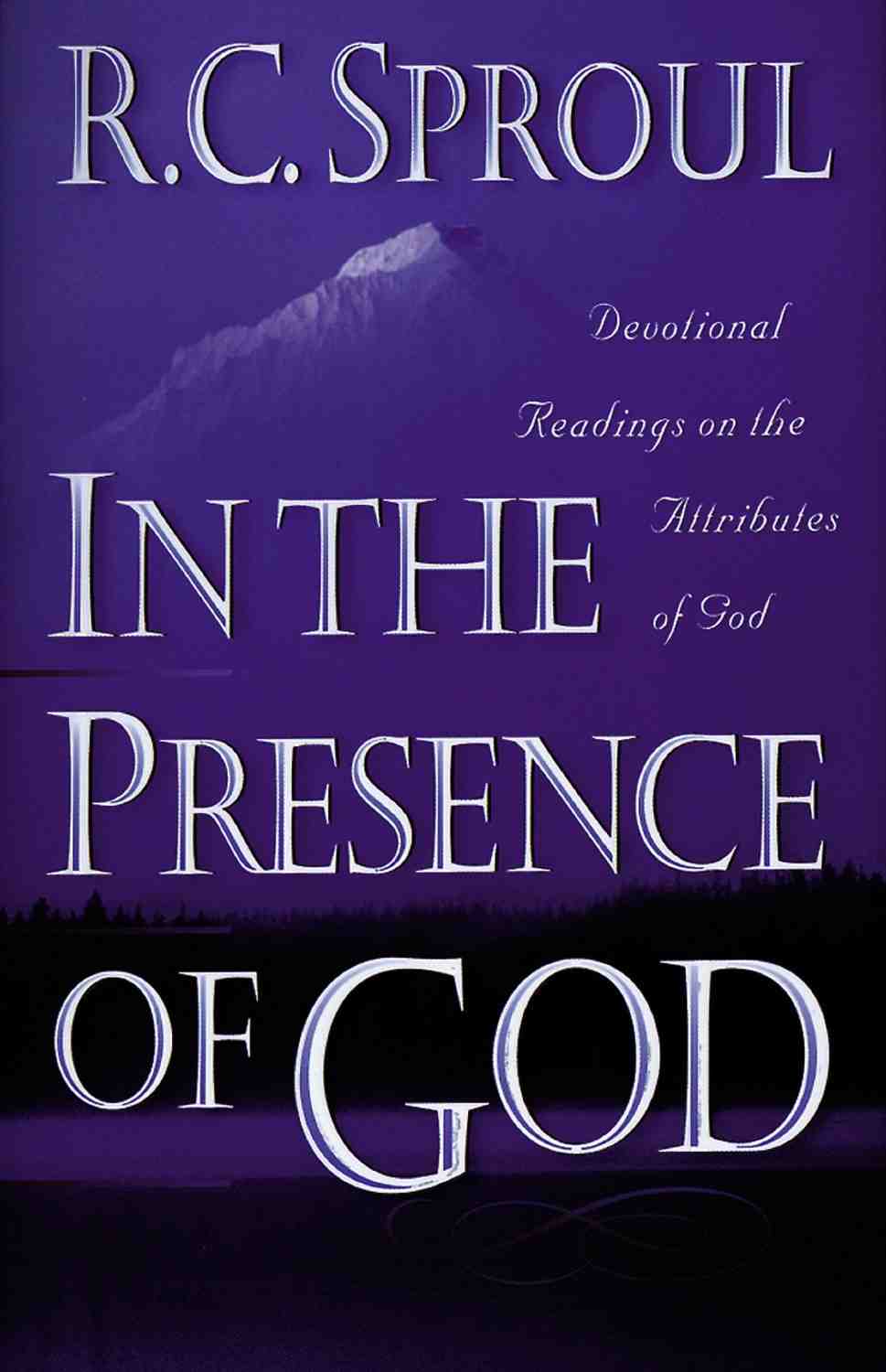
BOOK REVIEW: R.C. Sproul’s “INTO THE PRESENCE OF GOD”

GOD-CENTERED MEDITATIONS

ITPOG

Book Review by David P. Craig

Over the past 30 years I’ve enjoyed the books, lectures, sermons, and writings of R.C. Sproul. This book gathers some of the best devotionals from Ligonier Ministries Magazine – Table Talk. Coram Deo–which means “in the presence of God” is the name of one of the feature columns written by R.C. Sproul. In The Presence of God takes some of the best devotionals from Coram Deo over the past several decades and makes the collection available here in this book.

The devotions selected are encouraging, inspiring, and always based on Scripture. According to R.C. Sproul all of life is to be lived out in the presence of God and for the glory of God. These devotionals remind us daily that God is sovereign, transcendent, and immanent. “To live Coram Deo is to live a life of integrity. It is a life of wholeness that finds unity and coherency in the majesty of God. A fragmented life is a life of disintegration. It is marked by inconsistency, disharmony, confusion, conflict, contradiction, and chaos.” On the other hand, a life of “integrity is found when men and women live their lives in a pattern of consistency. It is a pattern that functions the same way in church and out of church. It is a life in which all that is done is done unto the Lord. It is a life lived by principle, not expediency; by humility before God, not defiance. It is a life lived under the tutelage of a conscience that is held captive by the Word of God.”

There are approximately 150 devotions in this book. Each only a page in length with a short meditation by Sproul, and either a word of encouragement, an application, or a reflection based on each subject. There are 15 Sections in the book with each section containing between 5 and 18 chapters. Here are the subjects addressed by Sproul: (1) Knowing God; (2) Learning God’s Laws; (3) Facing Life’s Challenges with God; (4) Getting Acquainted with God’s Son; (5) Meeting with God; (6) Discerning God’s Will; (7) Understanding God’s Purpose; (8) Becoming Part of God’s Body; (9) Experiencing God’s Best; (10) Journeying with God; (11) Developing a Godly Lifestyle; (12) Using Your Time for God; (13) Confronting the Enemy in God’s Strength; (14) Doing God’s Work; and (15) Facing the Future with God.

You would be hardpressed to find a devotional that is more God-centered and will help you truly live a life that is well-pleasing to God than Sproul’s. I highly recommend this excellent collection as one that will increase your awareness of God, and help you become more intimate in your walk with Him for His glory whether you eat, drink, or whatever you do as you live in His presence.

Bernard of Clairvaux on Four Kinds of Contemplation

Abbey of Citeaux

4 KINDS OF CONTEMPLATION

(1) The first and the greatest is to wonder at majesty. This demands a heart made pure, so that freed from vices and released from sin, it can ascend easily to heavenly things. Sometimes this contemplation holds the watcher rapt in amazement and ecstasy, if only for a moment.

(2) A second kind of contemplation is necessary for this man. He needs to look at the judgments of God. While this contemplation strikes fear into the onlooker because it is indeed frightening, it drives out vices, strengthens virtues, initiates into wisdom, protects humility. Humility is the true and solid foundation of virtues. For if humility were to collapse, the building-up of the virtues will fall down.

(3) The third kind of contemplation is occupied (for rather at leisure) in remembering kindnesses and, so as to avoid ingratitude, it urges him who remembers to love his Benefactor. Of such says the prophet, speaking to the Lord, “They shall declare the memory of the abundance of your sweetness” (Psalm 14:7).

(4) The fourth contemplation, which forgets what is past, rests wholly in the expectation of what is promised (Philippians 3:13, “Brothers, I do not consider that I have made it my own. But one thing I do: forgetting what lies behind and straining forward to what lies ahead.”), which nourishes patience and nerves the arm of perseverance, for what is promised is eternal.

About Bernard of Clairvaux

Saint Bernard, the founding abbot of Clairvaux Abbey in Burgundy, was one of the most commanding Church leaders in the first half of the twelfth century as well as one of the greatest spiritual masters of all times and the most powerful propagator of the Cistercian reform. He was born in Fontaines-les-Dijon in 1090 and entered the Abbey of Citeaux in 1112, bringing thirty of his relatives with him, including five of his brothers– his youngest brother and his widowed father followed later. After receiving a monastic formation from St. Stephen Harding, he was sent in 1115 to begin a new monastery near Aube: Clairvaux, the Valley of Light. As a young abbot he published a series of sermons on the Annunciation. These marked him not only as a most gifted spiritual writer but also as the “cithara of Mary,” especially noted for his development of Mary’s mediatorial role.

Bernard’s spiritual writing as well as his extraordinary personal magnetism began to attract many to Clairvaux and the other Cistercian monasteries, leading to many new foundations. He was drawn into the controversy developing between the new monastic movement which he preeminently represented and the established Cluniac order, a branch of the Benedictines. This led to one of his most controversial and most popular works, his Apologia. Bernard’s dynamism soon reached far beyond monastic circles. He was sought as an advisor and mediator by the ruling powers of his age. More than any other he helped to bring about the healing of the papal schism which arose in 1130 with the election of the antipope Anacletus II. It cost Bernard eight years of laborious travel and skillful mediation. At the same time he labored for peace and reconciliation between England and France and among many lesser nobles. His influence mounted when his spiritual son was elected pope in 1145. At Eugene III’s command he preached the Second Crusade and sent vast armies on the road toward Jerusalem. In his last years he rose from his sickbed and went into the Rhineland to defend the Jews against a savage persecution.

Although he suffered from constant physical debility and had to govern a monastery that soon housed several hundred monks and was sending forth groups regularly to begin new monasteries (he personally saw to the establishment of sixty-five of the three hundred Cistercian monasteries founded during his thirty-eight years as abbot), he yet found time to compose many and varied spiritual works that still speak to us today. He laid out a solid foundation for the spiritual life in his works on grace and free will, humility and love. His gifts as a theologian were called upon to respond to the dangerous teachings of the scintillating Peter Abelard, of Gilbert de la Porree and of Arnold of Brescia. His masterpiece, hisSermons on the Song of Songs, was begun in 1136 and was still in composition at the time of his death. With great simplicity and poetic grace Bernard writes of the deepest experiences of the mystical life in ways that became normative for all succeeding writers. For Pope Eugene he wrote Five Books on Consideration, the bedside reading of Pope John XXIII and many other pontiffs through the centuries.

Bernard died at Clairvaux on 20 August 1153. He was canonized by Pope Alexander III on 18 January 1174. Pope Pius VII declared him a Doctor of the Church in 1830.

Faith and the Power of God by Jerry Bridges

Feeding of the 5000

The healing of the demon possessed boy (Matt. 17:14–20) at first glance seems to be only one more in a series of miraculous healings recorded by Matthew. What makes this one unique is Jesus’ emphasis on the role of faith. It is true that faith is prominent in the miracles recorded in chapter 9, but in chapter 17 it is the lack of faith that is emphasized by Jesus.

That God is not dependent on human faith for accomplishing His work is clear from the accounts of other miracles recorded by Matthew. The transfiguration of Jesus immediately prior to the healing of the boy is a prime example. It was a spectacular miracle; yet no human faith was involved. This is also true in the feeding of the five thousand (Matt. 14:13–21) and the four thousand (15:32–38). So the first thing we need to learn about faith and the power of God is that He is not dependent on our faith to do His work. God will not be hostage to our lack of faith.

The second thing we need to learn, however, is that God often requires our faith in the carrying out of His purposes. We see this in the healing of the demon possessed boy. Mark, in his account, brings this out sharply in Jesus’ conversation with the boy’s father. The father, in great distress, said to Jesus: “But if you can do anything, have compassion on us and help us” (Mark 9:22). He had already experienced the failure of the disciples, so he was not sure if Jesus could help. His faith at this point may be described as no more than an uncertain hope that Jesus could do what the disciples could not do.

Jesus responded to the father: “If you can! All things are possible for one who believes” (v. 23). Biblical faith may be described in different ways depending on the situation. The description of faith in Hebrews 11:1 as “the assurance of things hoped for, the conviction of things not seen,” was appropriate for the Jewish recipients of the letter, who were facing severe opposition and needed to be encouraged as to the certainty of their hope in Christ.

For the father of the boy, faith would mean believing that Jesus could heal his son. We are often like the father. We may face what seems to be an intractable situation, and because we have prayed a long time without an answer, we begin to doubt that God can answer our prayer. But we must believe that with God nothing is impossible.

Sarah, the wife of Abraham, doubted that God could give them a son in their advanced age, to which God replied, “Is anything too hard for the Lord?” (Gen. 18:14). Centuries later, the prophet Jeremiah wavered in his faith when God told him to buy a field in the face of the Chaldeans’ invasion (Jer. 32:6-26). Again God’s response was: “Is anything too hard for me?” (v. 27). To have faith in God, even in the face of unanswered prayer or a seemingly impossible situation, means we continue to believe that He can do what seems impossible to us.

The importance of faith is further emphasized in Jesus’ answer to the disciples’ question: “Why could we not cast it out?” (Matt. 17:19). He said it was because of their little faith. We are not told in what way their faith was deficient. We do know that Jesus had previously given them authority over demons to cast them out (Matt. 10:1–8), so why was their faith so weak at this time? Perhaps it was because the demon did not respond immediately to their command, and so they began to doubt the power of Jesus. Or perhaps they presumed that because they had been successful before, they would be at that time. So we see that faith not only involves a firm reliance on Jesus’ power and ability, but also a complete renunciation of any confidence in our own.

Last month we looked briefly at the subject of God’s providence. In Matthew 17 we see an example of it in action, in connection with a mundane event — the paying of the temple tax. Jesus, as the Son of God, was under no obligation to pay the tax. Yet in order to give no offense, He sent Peter to catch a fish in whose mouth was the required shekel. This brief account raises some questions: How did the shekel get into the mouth of the fish? How did Peter just “happen” to catch that fish and not another one nearby? It is possible that Jesus performed a miracle and created the coin out of nothing in the mouth of the fish.

It is more likely, however, that it was a work of providence. Someone “accidentally” dropped a shekel into the sea. A particular fish grabbed it, and it stuck in its mouth. The fish swam to the exact spot where Peter cast his net and the fish was caught. None of these events was miraculous; yet all of them were necessary to accomplish Jesus’ purpose, and Jesus was in control of each one of them. God’s power is as much at work in His providence as in His miracles. So as we struggle with our own faith, or lack of it, in the difficult situations of life, let us believe that God is able, whether through miracles or providence, to care for us.


About Dr. Jerry Bridges: an author and speaker, as well as a staff member at The Navigators in Colorado Springs, Colorado.

Article above from © Tabletalk magazine. July 1st, 2008. 
Permissions: You are permitted and encouraged to reproduce and distribute this material in any format provided that you do not alter the wording in any way, you do not charge a fee beyond the cost of reproduction, and you do not make more than 500 physical copies. For web posting, a link to this document on our website is preferred (where applicable). If no such link exists, simply link to http://www.ligonier.org/tabletalk. Any exceptions to the above must be formally approved by Tabletalk.

Please include the following statement on any distributed copy: From Ligonier Ministries and R.C. Sproul. © Tabletalk magazine. Website: http://www.ligonier.org/tabletalk. Email: tabletalk@ligonier.org. Toll free: 1-800-435-4343.

Dr. John Oswald Sanders on the Leader and His Prayer Life


SL Sanders

Prayer and Leadership

 I urge then, first of all, that requests, prayers, intercession and thanksgiving be made for everyone. 1 Timothy 2:1

The spiritual leader should outpace the rest of the church, above all, in prayer. And yet the most advanced leader is conscious of the possibility of endless development in his prayer life. Nor does he ever feel that he has “already attained.” Dean C. J. Vaughan once said: “If I wished to humble anyone, I should question him about his prayers. I know nothing to compare with this topic for its sorrowful self-confessions.”

Prayer is the most ancient, most universal, and most intensive expression of the religious instinct. It includes the simplest speech of infant lips, and the sublime entreaties of older age. All reach the Majesty on high. Prayer is indeed the Christian’s vital breath and native air.

But, strange paradox, most of us find it hard to pray. We do not naturally delight in drawing near to God. We sometimes pay lip service to the delight and power of prayer. We call it indispensable; we know the Scriptures call for it. Yet we often fail to pray.

Let us take encouragement from the lives of saintly leaders who overcame this natural reluctance and became mighty in prayer. Of Samuel Chadwick it was said: He was essentially a man of prayer. Every morning he would be astir shortly after six o’clock, and he kept a little room which was his private sanctum for his quiet hour before breakfast. He was mighty in public prayer because he was constant in private devotion. . . . When he prayed he expected God to do something. “I wish I had prayed more,” he wrote toward the end of his life, “even if I had worked less; and from the bottom of my heart I wish I had prayed better” (N.G. Dunning, Samuel Chadwick. London: Hodder & Stoughton, 1934, 19).

“When I go to prayer,” confessed an eminent Christian, “I find my heart so loath to go to God, and when it is with Him, so loath to stay.” Then he pointed to the need for self-discipline. “When you feel most indisposed to pray, yield not to it,” he counseled, “but strive and endeavor to pray, even when you think you cannot.”

Mastering the art of prayer, like anything else, takes time. The time we give it will be a true measure of its importance to us. We always find the time for important things. The most common excuse for little time spent in prayer is the list of “to-dos” that crowd our day—all our many duties. To Martin Luther, an extra load of duties was reason enough to pray more, not less. Hear his plans for the next day’s work: “Work, work from early till late. In fact I have so much to do that I shall spend the first three hours in prayer.” If Luther was busy, and prayed, so can we.

Try to explain exactly how prayer works and you will quickly run against some very difficult puzzles. But people who are skeptical of prayer’s validity and power are usually those who do not practice it seriously or fail to obey when God reveals His will. We cannot learn about prayer except by praying. No philosophy has ever taught a soul to pray. The intellectual problems associated with prayer are met in the joy of answered prayer and closer fellowship with God.

The Christian leader who seeks an example to follow does well to turn to the life of Jesus Himself. Our belief in the necessity of prayer comes from observing His life. Surely if anyone could have sustained life without prayer, it would be the very Son of God Himself. If prayer is silly or unnecessary, Jesus would not have wasted His time at it. But wait! Prayer was the dominant feature of His life and a recurring part of His teaching. Prayer kept His moral vision sharp and clear. Prayer gave Him courage to endure the perfect but painful will of His Father. Prayer paved the way for transfiguration. To Jesus, prayer was not a hasty add-on, but a joyous necessity.

In Luke 5:16 we have a general statement which throws a vivid light on the daily practice of the Lord. “And He withdrew Himself in the deserts and prayed.” It is not of one occasion but of many that the evangelist speaks in this place. It was our Lord’s habit to seek retirement for prayer. When He withdrew Himself from men, He was accustomed to press far into the uninhabited country—He was in the deserts. The surprise of the onlookers lay in this, that one so mighty, so richly endowed with spiritual power, should find it necessary for Himself to repair to the source of strength, that there He might refresh His weary spirit. To us, the wonder is still greater, that He, the prince of Life, the Eternal word, the Only-begotten of the Father, should prostrate Himself in meekness before the throne of God, making entreaty for grace to help in time of need (D.M. McIntyre, The Prayer Life of Our Lord. London: Morgan & Scott, n.d., 30–31).

Christ spent full nights in prayer (Luke 6:12). He often rose before dawn to have unbroken communion with His Father (Mark 1:35). The great crises of His life and ministry began with periods of special prayer, as in Luke 5:16: “Jesus often withdrew to lonely places and prayed”—a statement that indicates a regular habit. By word and example He instructed His disciples on the importance of solitude in prayer (Mark 6:46, following the feeding of the five thousand; Luke 9:28, preceding the Transfiguration). To the person on whom devolves the responsibility for selecting personnel for specific spiritual responsibilities, the example of the Lord’s spending the night in prayer before making His choice of apostles (Luke 6:12) is luminous.

Both our Lord and His bond slave Paul made clear that true prayer is not dreamy reverie. “All vital praying makes a drain on a man’s vitality. True intercession is a sacrifice, a bleeding sacrifice,” wrote J. H. Jowett. Jesus performed miracles without a sign of outward strain, but “he offered up prayers and petitions with loud cries and tears” (Hebrews 5:7).

Sometimes our prayers are pale and weak compared to those of Paul or Epaphras. “Epaphras . . . is always wrestling in prayer for you,” wrote Paul in Colossians 4:12. And to the same group: “I want you to know how much I am struggling for you” (Colossians 2:1). The Greek word used for “struggle” here is the root for our words “agony” and “agonize.” It is used to describe a person struggling at work until utterly weary (Colossians 1:29) or competing in the arena for an athletic prize (1 Corinthians 9:25). It describes a soldier battling for his life (1 Timothy 6:12), or a man struggling to deliver his friends from danger (John 18:36). True prayer is a strenuous spiritual exercise that demands the utmost mental discipline and concentration.

We are encouraged to note that Paul, probably the greatest human champion of prayer, confessed, “We do not know what we ought to pray for.” And then he hastened to add, “The Spirit intercedes for us with groans that words cannot express. And he who searches our hearts knows the mind of the Spirit, because the Spirit intercedes for the saints in accordance with God’s will” (Romans 8:26–28). The Spirit joins us in prayer and pours His supplications into our own.

Pray in the Spirit

All Christians need more teaching in the art of prayer, and the Holy Spirit is the master teacher. The Spirit’s help in prayer is mentioned in the Bible more frequently than any other help He gives us. All true praying comes from the Spirit’s activity in our souls. Both Paul and Jude teach that effective prayer is “praying in the Spirit.” That phrase means that we pray along the same lines, about the same things, in the same name, as the Holy Spirit. True prayer rises in the spirit of the Christian from the Spirit who indwells us.

To pray in the Spirit is important for two reasons. First, we are to pray in the realm of the Spirit, for the Holy Spirit is the sphere and atmosphere of the Christian’s life. In this we often fail. Much praying is physical rather than spiritual, in the realm of the mind alone, the product of our own thinking and not of the Spirit’s teaching. But real prayer is deeper. It uses the body, requires the cooperation of the mind, and moves in the supernatural realm of the Spirit. Such praying transacts its business in the heavenly realm.

Second, we are to pray in the power and energy of the Spirit. “Give yourselves wholly to prayer and entreaty; pray on every occasion in the power of the Spirit” (Ephesians 6:18 NEB). For its superhuman task, prayer demands more than human power. We have the Spirit of power as well as the Spirit of prayer. All the human energy of heart, mind, and will can achieve great human results, but praying in the Holy Spirit releases supernatural resources. The Spirit delights to help us pray. In each of our three chief handicaps, we can count on the Spirit’s help. Sometimes we are kept from prayer by sin in our heart. As we grow in trust and submission, the Holy Spirit leads us to the blood of Christ, which cleanses every stain.

Sometimes the ignorance of our minds hinders our prayers. But the Spirit knows the mind of God and shares that knowledge with us as we wait and listen. The Spirit does this by giving us a clear conviction that a particular prayer request is part of God’s will for us, or not.

Sometimes we are earthbound because of the infirmity of the body. We get sick, we feel ill, we are weak. The Spirit will quicken our bodies and enable us to rise above weaknesses, even those imposed by sultry tropical climates.

Then, as if these three conditions were not enough, the spiritual leader must oppose Satan in prayer. Satan will try to depress, to create doubt and discouragement, to keep a leader from communion with God. In the Holy Spirit, we have a heavenly ally against this supernatural foe.

Spiritual leaders should know the experience of praying in the Spirit as part of their daily walk. Do we ever try to live independently of the Spirit? Do we fail to see full answers to prayer? We can read all day about prayer, and experience little of its power, and so stunt our service.

The Bible often explains prayer as spiritual warfare. “For our struggle is . . . against the rulers, against the authorities, against the powers of this dark world and against the spiritual forces of evil in the heavenly realms” (Ephesians 6:12). In this struggle phase of prayer, three personalities are engaged. Between God and the devil stands the Christian at prayer. Though weak alone, the Christian plays a strategic role in the struggle between the dragon and the Lamb. The praying Christian wields no personal power, but power nonetheless delegated by the victorious Christ to whom that faithful believer is united by faith. Faith is like a reticulating system through which the victory won on Calvary reaches the devil’s captives and delivers them from darkness into light.

Jesus was not so much concerned over wicked people and their deeds as with the forces of evil that caused those people to sin. Behind Peter’s denial and Judas’s betrayal was the sinister hand of Satan. “Get thee behind me, Satan,” was the Lord’s response to Peter’s presumptuous rebuke. All around us are people bound in sin, captives to the devil. Our prayers should ascend not only for them but against Satan who holds them as his prize. Satan must be compelled to relax his grip, and this can only be achieved by Christ’s victory on the cross.

As Jesus dealt with sin’s cause rather than effect, so the spiritual leader should adopt the same method in prayer. And the leader must know how to help those under his charge who are also involved in that same spiritual warfare.

In a telling illustration, Jesus compared Satan to a strong man, fully armed. Before anyone can enter such a man’s house and set captives free, the man must first be bound. Only then can a rescue succeed (Matthew 12:29). What could it mean to “tie up the strong man” except to neutralize his might through the overcoming power of Christ who came “to destroy (nullify, render inoperative) the works of the devil”? And how can that happen except by the prayer of faith that lays hold of the victory of Calvary and claims it for the problem at hand? We cannot hope to effect a rescue from Satan’s den without first disarming the adversary. God makes available His divine authority through prayer, and we can confidently claim it. Jesus promised His disciples: “I have given you authority . . . to overcome all the power of the enemy” (Luke 10:19).

The spiritual leader will be alert to the most effective way to influence people. Hudson Taylor is well known for his expression, “It is possible to move men, through God, by prayer alone.” During his missionary career he demonstrated the truth of his claim a thousand times.

Practice

It is one thing to believe such power is available in prayer, but another thing to practice it. People are difficult to move; it is much easier to pray for things or provisions than to deal with the stubbornness of the human heart. But in just these intricate situations, the leader must use God’s power to move human hearts in the direction he believes to be the will of God. Through prayer the leader has the key to that complicated lock.

It is the supreme dignity and glory of the human creature to be able to say yes or no to God. Humans have been given free will. But this poses a problem. If by prayer we can influence the conduct of others, does such power encroach on free will? Will God temper one person’s freedom to answer another person’s prayer? It seems difficult to imagine. And yet, if prayers cannot influence the course of events, why pray?

The first point to make is that God is consistent with Himself always. God does not contradict Himself. When God promises to answer prayer, the answer will come—always in a manner consistent with divine nature, for “he cannot disown himself” (2 Timothy 2:13). No word or action from God will contradict any other word or action of God.

The second point in resolving these questions is that prayer is a divine ordinance. God has commanded prayer, and we can be confident that as we meet revealed conditions for prayer, answers will be granted. God sees no contradiction between human free will and divine response to prayer. When God commands us to pray “for kings and those in authority,” there is implied power to influence the course of men and events. If not, why pray? Our obligation to pray stands above any dilemma concerning the effects of prayer.

Third, we can know the will of God concerning the prayer we raise. Our capacity to know God’s will is the basis for all prayers of faith. God can speak to us clearly through our mind and heart. The Bible instructs us directly concerning the will of God on all matters of principle. In our hearts the Holy Spirit ministers to instruct us in the will of God (Romans 8:26–27). As we patiently seek the will of God concerning our petition, the Spirit will impress our minds and convince our hearts. Such God-given conviction leads us beyond the prayer of hope to the prayer of faith.

When God lays a burden on our hearts and thus keeps us praying, He obviously intends to grant the answer. George Mueller was asked if he really believed that two men would be converted, men for whom Mueller had prayed for over fifty years. Mueller replied: “Do you think God would have kept me praying all these years if He did not intend to save them?” In fact, both men were converted, one shortly after Mueller’s death (George Mueller [1805–1898] was a Plymouth Brethren leader who refused a salary, believing that God would supply his needs by prayer alone. He established an orphanage in Bristol for two thousand youngsters on the strength of prayer and promoted prayer during a seventeen-year world tour).

In prayer we deal directly with God and only in a secondary sense other people. The goal of prayer is the ear of God. Prayer moves others through God’s influence on them. It is not our prayer that moves people, but the God to whom we pray.

Prayer Moves The Arm That moves the world To bring deliverance down.

To move people, the leader must be able to move God, for God has made it clear that He moves people in response to prayer. If a scheming Jacob was given “power with God and with men,” then surely any leader who follows God’s prayer principles can enjoy the same power (Genesis 32:28).

Prevailing prayer that moves people is the outcome of a right relationship with God. The Bible is very clear on the reasons why prayers go unanswered, and every reason centers on the believer’s relationship with God. God will not cooperate with prayers of mere self-interest, or prayers that come from impure motives. The Christian who clings to sin closes the ear of God. Least of all will God tolerate unbelief, the chief of sins. “Anyone who comes to him must believe” (Hebrews 11:6). In all our prayers the paramount motive is the glory of God.

Great leaders of the Bible were great at prayer. “They were not leaders because of brilliancy of thought, because they were exhaustless in resources, because of their magnificent culture or native endowment, but because, by the power of prayer, they could command the power of God” (E. M. Bounds, Prayer and Praying Men. London: Hodder & Stoughton, 1921). Edward McKendree Bounds [1835–1913] was an American Methodist Episcopal minister who served churches throughout the South. He was a captain in the Confederate army).

Article adapted from the classic work on Leadership by, J. Oswald Sanders (2007-05-01). Spiritual Leadership (Kindle Locations 1579-1736). Moody Publishers. Kindle Edition. 

About Dr. J.O. Sanders

Dr. John Oswald Sanders (October 17, 1902—October 24, 1992) was a general director of Overseas Missionary Fellowship (then known as China Inland Mission) in the 1950s and 1960s. He authored more than forty books on the Christian life. He became an elder statesman and worldwide conference speaker from his retirement until his death. Sanders was born in Invercargill, New Zealand and gained a law degree in 1922. He attended the Bible Training Institute in Auckland and joined its staff in 1926. In 1931, he married Edith Mary Dobson. Sanders left a promising law practice in his native New Zealand to serve as an instructor and administrator at the Bible College of New Zealand. In 1954 he became general director of the China Inland Mission and led the reorganization of the CIM into the Overseas Missionary Fellowship. He was instrumental in beginning many new missions projects throughout East. Upon his retirement in 1969, he continued to teach worldwide and to write prolifically.

The Art of Cultivating a Heart of Gratitude in the Character of Christ by Dr. Ken Boa

Ken Boa

Our culture teaches us that people are basically good and that their internal problems are the result of external circumstances. But Jesus taught that no outside-in program will rectify the human condition, since our fundamental problems stem from within (Mark 7:20-23). Holiness is never achieved by acting ourselves into a new way of being. Instead, it is a gift that God graciously implants within the core of those who have trusted in Christ. All holiness is the holiness of God within us—the indwelling life of Christ. Thus, the process of sanctification is the gradual diffusion of this life from the inside (being) to the outside (doing), so that we become in action what we already are in essence. Our efforts faithfully reveal what is within us, so that when we are dominated by the flesh we will do the deeds of the flesh, and when we walk by the Spirit we will bear the fruit of the Spirit (Galatians 5:16-26).

A Process from the Inside to the Outside

Holiness is a new quality of life that progressively flows from the inside to the outside. As J. I. Packer outlines it in Keep in Step with the Spirit, the nature of holiness is transformation through consecration; the context of holiness is justification through Jesus Christ; the root of holiness is co-crucifixion and co-resurrection with Jesus Christ; the agent of holiness is the Holy Spirit; the experience of holiness is one of conflict; the rule of holiness is God’s revealed law; and the heart of holiness is the spirit of love. When we come to know Jesus we are destined for heaven because He has already implanted His heavenly life within us. The inside-out process of the spiritual life is the gradual outworking of this kingdom righteousness. This involves a divine-human synergism of dependence and discipline so that the power of the Spirit is manifested through the formation of holy habits. As Augustine put it, “Without God we cannot; without us, He will not.” Disciplined grace and graceful discipline go together in such a way that God-given holiness is expressed through the actions of obedience. Spiritual formation is not a matter of total passivity or of unaided moral endeavor, but of increasing responsiveness to God’s gracious initiatives. The holy habits of immersion in Scripture, acknowledging God in all things, and learned obedience make us more receptive to the influx of grace and purify our aspirations and actions.

“Beloved, if our heart does not condemn us, we have confidence before God” (1 John 3:21). It is wise to form the habit of inviting God to search your heart and reveal “any hurtful way” (Psalm 139:23) within you. Sustained attention to the heart, the wellspring of action, is essential to the formative process. By inviting Jesus to examine our intentions and priorities, we open ourselves to His good but often painful work of exposing our manipulative and self-seeking strategies, our hardness of heart (often concealed in religious activities), our competitively-driven resentments, and our pride. “A humble understanding of yourself is a surer way to God than a profound searching after knowledge” (Thomas A Kempis, The Imitation of Christ). Self-examining prayer or journaling in the presence of God will enable us to descend below the surface of our emotions and actions and to discern sinful patterns that require repentance and renewal. Since spiritual formation is a process, it is a good practice to compare yourself now with where you have been. Are you progressing in Christlike qualities like love, patience, kindness, forgiveness, compassion, understanding, servanthood, and hope? To assist you, here is a prayer sequence for examination and encouragement that incorporates the ten commandments, the Lord’s prayer, the beatitudes, the seven deadly sins, the four cardinal and three theological virtues, and the fruit of the Spirit. This can serve as a kind of spiritual diagnostic tool:

Search me, O God, and know my heart; Try me and know my anxious thoughts;

And see if there be any hurtful way in me, And lead me in the everlasting way. (Psalm 139:23-24)

Watch over your heart with all diligence, For from it flow the springs of life. (Proverbs 4:23)

The Ten Commandments

  1. You shall have no other gods before Me.
  2. You shall not make for yourself an idol.
  3. You shall not take the name of the Lord your God in vain.
  4. Remember the sabbath day, to keep it holy.
  5. Honor your father and your mother.
  6. You shall not murder.
  7. You shall not commit adultery.
  8. You shall not steal.
  9. You shall not bear false witness against your neighbor.
  10. You shall not covet.

The Lord’s Prayer
Our Father who is in heaven,

Hallowed be Your name.

Your kingdom come,

Your will be done,

On earth as it is in heaven.

Give us this day our daily bread.

And forgive us our debts, as we also have forgiven our debtors.

And do not lead us into temptation,

But deliver us from evil.

For Yours is the kingdom and the power and the glory forever.

The Beatitudes

Poverty of spirit (nothing apart from God’s grace)

Mourning (contrition)

Gentleness (meekness, humility)

Hunger and thirst for righteousness

Merciful to others

Purity of heart (desiring Christ above all else)

Peacemaking

Bearing persecution for the sake of righteousness

The Seven Deadly Sins

Pride

Avarice

Envy

Wrath

Sloth

Lust

Gluttony

The Four Cardinal and Three Theological Virtues

Prudence (wisdom, discernment, clear thinking, common sense)

Temperance (moderation, self-control)

Justice (fairness, honesty, truthfulness, integrity)

Fortitude (courage, conviction)

Faith (belief and trust in God’s character and work)

Hope (anticipating God’s promises)

Love (willing the highest good for others, compassion)

The Fruit of the Spirit

Love

Joy

Peace

Patience

Kindness

Goodness

Faithfulness

Gentleness

Self-control

Letting Loose of Control and Results

One of the great enemies of process spirituality is the craving to control our environment and the desire to determine the results of our endeavors. Many of us have a natural inclination to be manipulators, grabbers, owners, and controllers. The more we seek to rule our world, the more we will resist the rule of Christ; those who grasp are afraid of being grasped by God. But until we relinquish ownership of our lives, we will not experience the holy relief of surrender to God’s good and loving purposes. Thomas Merton put it this way in New Seeds of Contemplation:

This is one of the chief contradictions that sin has brought into our souls: we have to do violence to ourselves to keep from laboring uselessly for what is bitter and without joy, and we have to compel ourselves to take what is easy and full of happiness as though it were against our interests, because for us the line of least resistance leads in the way of greatest hardship and sometimes for us to do what is, in itself, most easy, can be the hardest thing in the world.

Our resistance to God’s rule even extends to our prayerful attempts to persuade the Lord to bless our plans and to meet our needs in the ways we deem best. Instead of seeking God’s will in prayer, we hope to induce Him to accomplish our will. Thus, even in our prayers, we can adopt the mentality of a consumer rather than a servant.

Perhaps the most painful lesson for believers to learn is the wisdom of being faithful to the process and letting loose of the results.

Opportunity Obedience Outcome
Divine Sovereignty Human Responsibility Divine Sovereignty

We have little control over opportunities we encounter and the outcomes of our efforts, but we can be obedient to the process.

Distorted dreams and selfish ambitions must die before we can know the way of resurrection. We cannot be responsive to God’s purposes until we abandon our strategies to control and acknowledge His exclusive ownership of our lives. At the front end, this surrender to the life of Christ in us appears to be the way of renunciation, but on the other side of renunciation we discover that it is actually the way of affirmation. “For whoever wishes to save his life will lose it, but whoever loses his life for My sake, he is the one who will save it” (Luke 9:24). The better we apprehend our spiritual poverty and weakness, the more we will be willing to invite Jesus to increase so that we may decrease (John 3:30).

Another key to staying in the process is learning to receive each day and whatever it brings as from the hand of God. Instead of viewing God’s character in light of our circumstances, we should view our circumstances in light of God’s character. Because God’s character is unchanging and good, whatever circumstances He allows in the life of His children are for their good, even though they may not seem so at the time. Since His will for us is “good and acceptable and perfect” (Romans 12:2), the trials, disappointments, setbacks, tasks, and adversities we encounter are, from an eternal vantage point, the place of God’s kingdom and blessing. This Romans 8:28-39 perspective can change the way we pray. Instead of asking the Lord to change our circumstances to suit us, we can ask Him to use our circumstances to change us. Realizing that “the sufferings of this present time are not worthy to be compared with the glory that is to be revealed to us” (Romans 8:18), we can experience “the fellowship of [Christ’s] sufferings” through “the power of His resurrection” (Philippians 3:10). Thus, Blaise Pascal prayed in his Pensees:

With perfect consistency of mind, help me to receive all manner of events. For we know not what to ask, and we cannot ask for one event rather than another without presumption. We cannot desire a specific action without presuming to be a judge, and assuming responsibility for what in Your wisdom You may hide from me. O Lord, I know only one thing, and that is that it is good to follow You and wicked to offend You. Beyond this, I do not know what is good for me, whether health or sickness, riches or poverty, or anything else in this world. This knowledge surpasses both the wisdom of men and of angels. It lies hidden in the secrets of Your providence, which I adore, and will not dare to pry open.

We are essentially spiritual beings, and each “today” that is received with gratitude from God’s hand contributes to our preparation for our glorious and eternal destiny in His presence. In “the sacrament of the present moment” as Jean-Pierre de Caussade described it, “It is only right that if we are discontented with what God offers us every moment, we should be punished by finding nothing else that will content us” (Abandonment to Divine Providence). It is when we learn to love God’s will that we can embrace the present moment as a source of spiritual formation.

As we grow in dependence on Christ’s life and diminish in dependence on our own, the fulfillment of receiving His life gradually replaces the frustration of trying to create our own. It is in this place of conscious dependence that God shapes us into the image of His Son. Here we must trust Him for the outcome, because we cannot measure or quantify the spiritual life. We know that we are in a formative process and that God is not finished with us yet, but we must also remember that we cannot control or create the product. Furthermore, we cannot measure our ministry or impact on others in this life. If we forget this, we will be in a hurry to accomplish significant things by the world’s standard of reckoning. Frances Felenon noted that “the soul, by the neglect of little things, becomes accustomed to unfaithfulness” (Christian Perfection). It is faithfulness in the little daily things that leads to faithfulness in much (Luke 16:10). Henri Nouwen used to ask God to get rid of his interruptions so he could get on with his ministry. “Then I realized that interruptions are my ministry.” As servants and ambassadors of the King, we must be obedient in the daily process even when we cannot see what difference our obedience makes.

Cultivating a Heart of Gratitude

A young man with a bandaged hand approached the clerk at the post office. “Sir, could you please address this post card for me?” The clerk did so gladly, and then agreed to write a message on the card.

He then asked, “Is there anything else I can do for you?” The young man looked at the card for a moment and then said, “Yes, add a PS: ‘Please excuse the handwriting.’”

We are an ungrateful people. Writing of man in Notes from the Underground, Dostoevsky says, “If he is not stupid, he is monstrously ungrateful! Phenomenally ungrateful. In fact, I believe that the best definition of man is the ungrateful biped.” Luke’s account of the cleansing of the ten lepers underscores the human tendency to expect grace as our due and to forget to thank God for His benefits. “Were there not ten cleansed? But the nine—where are they? Was no one found who turned back to give glory to God, except this foreigner?” (Luke 17:17-18).

Remember: God’s Deliverance in the Past

Our calendar allocates one day to give thanks to God for His many benefits, and even that day is more consumed with gorging than with gratitude. Ancient Israel’s calendar included several annual festivals to remind the people of God’s acts of deliverance and provision so that they would renew their sense of gratitude and reliance upon the Lord.

In spite of this, they forgot: “they became disobedient and rebelled against You . . . . they did not remember Your abundant kindnesses . . . . they quickly forgot His works” (Nehemiah 9:26;Psalm 106:7, 13). The prophet Hosea captured the essence of this decline into ingratitude: “As they had their pasture, they became satisfied, and being satisfied, their heart became proud; therefore, they forgot Me” (13:6). When we are doing well, we tend to think that our prosperity was self-made; this delusion leads us into the folly of pride; pride makes us forget God and prompts us to rely on ourselves in place of our Creator; this forgetfulness always leads to ingratitude.

Centuries earlier, Moses warned the children of Israel that they would be tempted to forget the Lord once they began to enjoy the blessings of the promised land. “Then your heart will become proud and you will forget the Lord your God who brought you out from the land of Egypt, out of the house of slavery. . . . Otherwise, you may say in your heart, ‘My power and the strength of my hand made me this wealth’” (Deuteronomy 8:14, 17). The antidote to this spiritual poison is found in the next verse: “But you shall remember the Lord your God, for it is He who is giving you power to make wealth” (8:18).

Our propensity to forget is a mark of our fallenness. Because of this, we should view remembering and gratitude as a discipline, a daily and intentional act, a conscious choice. If it is limited to spontaneous moments of emotional gratitude, it will gradually erode and we will forget all that God has done for us and take His grace for granted.

Remember: God’s Benefits in the Present

“Rebellion against God does not begin with the clenched fist of atheism but with the self-satisfied heart of the one for whom ‘thank you’ is redundant” (Os Guinness, In Two Minds). The apostle Paul exposes the error of this thinking when he asks, “What do you have that you did not receive? And if you did receive it, why do you boast as if you had not received it?” (1 Corinthians 4:7). Even as believers in Christ, it is quite natural to overlook the fact that all that we have and are—our health, our intelligence, our abilities, our very lives—are gifts from the hand of God, and not our own creation. We understand this, but few of us actively acknowledge our utter reliance upon the Lord throughout the course of the week. We rarely review the many benefits we enjoy in the present. And so we forget.

We tend toward two extremes when we forget to remember God’s benefits in our lives. The first extreme is presumption, and this is the error we have been discussing. When things are going “our way,” we may forget God or acknowledge Him in a shallow or mechanical manner. The other extreme is resentment and bitterness due to difficult circumstances. When we suffer setbacks or losses, we wonder why we are not doing as well as others and develop a mindset of murmuring and complaining. We may attribute it to “bad luck” or “misfortune” or not “getting the breaks,” but it really boils down to dissatisfaction with God’s provision and care. This lack of contentment and gratitude stems in part from our efforts to control the content of our lives in spite of what Christ may or may not desire for us to have. It also stems from our tendency to focus on what we do not possess rather than all the wonderful things we have already received.

“Rejoice always; pray without ceasing; in everything give thanks; for this is God’s will for you in Christ Jesus” (1 Thessalonians 5:16-18). We cannot give thanks and complain at the same time. To give thanks is to remember the spiritual and material blessings we have received and to be content with what our loving Lord provides, even when it does not correspond to what we had in mind. Gratitude is a choice, not merely a feeling, and it requires effort especially in difficult times. But the more we choose to live in the discipline of conscious thanksgiving, the more natural it becomes, and the more our eyes are opened to the little things throughout the course of the day that we previously overlooked. G. K. Chesterton had a way of acknowledging these many little benefits: “You say grace before meals. All right. But I say grace before the concert and the opera, and grace before the play and pantomime, and grace before I open a book, and grace before sketching, painting, swimming, fencing, boxing, walking, playing, dancing and grace before I dip the pen in the ink.” Henri Nouwen observed that “every gift I acknowledge reveals another and another until, finally, even the most normal, obvious, and seemingly mundane event or encounter proves to be filled with grace.”

Remember: God’s Promises for the Future

If we are not grateful for God’s deliverance in the past and His benefits in the present, we will not be grateful for His promises for the future. Scripture exhorts us to lay hold of our hope in Christ and to renew it frequently so that we will maintain God’s perspective on our present journey. His plans for His children exceed our imagination, and it is His intention to make all things new, to wipe away every tear, and to “show the surpassing riches of His grace in kindness toward us in Christ Jesus” in the ages to come (Ephesians 2:7).

Make it a daily exercise, either at the beginning or the end of the day, to review God’s benefits in your past, present, and future. This discipline will be pleasing to God, because it will cultivate a heart of gratitude and ongoing thanksgiving.

The Secret of Contentment

“We want a whole race perpetually in pursuit of the rainbow’s end, never honest, nor kind, nor happy now, but always using as mere fuel wherewith to heap the altar of the future every real gift which is offered them in the Present.” Uncle Screwtape’s diabolical counsel to his nephew Wormwood in C. S. Lewis’ The Screwtape Letters is a reminder that most of us live more in the future than in the present. Somehow we think that the days ahead will make up for what we perceive to be our present lack. We think, “When I get this or when that happens, then I’ll be happy,” but this is an exercise in self-deception that overlooks the fact that even when we get what we want, it never delivers what it promised.

Most of us don’t know precisely what we want, but we are certain we don’t have it. Driven by dissatisfaction, we pursue the treasure at the end of the rainbow and rarely drink deeply at the well of the present moment, which is all we ever have. The truth is that if we are not satisfied with what we have, we will never be satisfied with what we want.

The real issue of contentment is whether it is Christ or ourselves who determine the content (e.g., money, position, family, circumstances) of our lives. When we seek to control the content, we inevitably turn to the criterion of comparison to measure what it should look like. The problem is that comparison is the enemy of contentment—there will always be people who possess a greater quality or quantity of what we think we should have. Because of this, comparison leads to covetousness. Instead of loving our neighbors, we find ourselves loving what they possess.

Covetousness in turn leads to a competitive spirit. We find ourselves competing with others for the limited resources to which we think we are entitled. Competition often becomes a vehicle through which we seek to authenticate our identity or prove our capability. This kind of competition tempts us to compromise our character. When we want something enough, we may be willing to steamroll our convictions in order to attain it. We find ourselves cutting corners, misrepresenting the truth, cheating, or using people as objects to accomplish our self-driven purposes.

It is only when we allow Christ to determine the content of our lives that we can discover the secret of contentment. Instead of comparing ourselves with others, we must realize that the Lord alone knows what is best for us and loves us enough to use our present circumstances to accomplish eternal good. We can be content when we put our hope in His character rather than our own concept of how our lives should appear.

Writing from prison to the believers in Philippi, Paul affirmed that “I have learned to be content in whatever circumstances I am. I know how to get along with humble means, and I also know how to live in prosperity; in any and every circumstance I have learned the secret of being filled and going hungry, both of having abundance and suffering need” (Philippians 4:11-12). Contentment is not found in having everything, but in being satisfied with everything we have. As the Apostle told Timothy, “we have brought nothing into the world, so we cannot take anything out of it either. If we have food and covering, with these we shall be content” (1 Timothy 6:7-8). Paul acknowledged God’s right to determine his circumstances, even if it meant taking him down to nothing. His contentment was grounded not in how much he had but in the One who had him. Job understood this when he said, “Naked I came from my mother’s womb, and naked I shall return there. The Lord gave and the Lord has taken away. Blessed be the name of the Lord” (Job 1:21). The more we release temporal possessions, the more we can grasp eternal treasures. There are times when God may take away our toys to force us to transfer our affections to Christ and His character.

A biblical understanding of contentment leads to a sense of our competency in Christ. “I can do all things through Him who strengthens me” (Philippians 4:13). As Peter put it, “His divine power has granted to us everything pertaining to life and godliness” (2 Peter 1:3). “Not that we are adequate in ourselves to consider anything as coming from ourselves, but our adequacy is from God” (2 Corinthians 3:5). Contentment is not the fulfillment of what we want, but the realization of how much we already possess in Christ.

A vision of our competency in Christ enables us to respond to others with compassion rather than competition, because we understand that our fundamental needs are fulfilled in the security and significance we have found in Him. Since we are complete in Christ, we are free to serve others instead of using them in the quest to meet our needs. Thus we are liberated to pursue character rather than comfort and convictions rather than compromise.

Notice the contrast between the four horizontal pairs in this chart:

WHO DETERMINES THE CONTENT OF YOUR LIFE?

SELF

CHRIST

Comparison

Covetousness

Competition

Compromise

Contentment

Competency

Compassion

Character

As we learn the secret of contentment, we will be less impressed by numbers, less driven to achieve, less hurried, and more alive to the grace of the present moment.

Article adapted from several sources on the Internet – most likely originally from Bible.org or Monergism.com. Dr. Ken Boa is an outstanding Bible scholar, and Spiritual director, and author of numerous helpful books including the Outstanding Textbook on the Subject of Sanctification and Spiritual Formation: Conformed To His Image.

Dare To Pray Like Daniel by John Piper

“Prayer: A Warrior’s Weapon”

In Daniel 10, the prophet receives a word from the Lord (v. 1) — a vision of conflict that stunned him with its greatness. So Daniel set himself with tears and fasting and prayer to seek the meaning of the vision, and for three weeks he wrestled in prayer over this vision and sought to know God’s will.

After three weeks he went out to the banks of the Tigris River (v. 4). There he had a vision that was so awesome he could hardly bear it. To make matters worse (in v. 10), a hand reached out and touched him so that he shook terribly on his hands and knees. Then the voice said (vv. 11–12): “O Daniel, man greatly loved, understand the words that I speak to you, and stand upright, for now I have been sent to you…. Fear not, Daniel, for from the first day that you set your heart to understand and humbled yourself before your God, your words have been heard, and I have come because of your words.”

Now this is immensely important for understanding prayer. Notice the words: “I have come because of your words.” Put that together with the words in verse 11: “I have been sent to you.” That is, God sent him. So the point is that God answered Daniel’s prayer as soon as he began to pray three weeks ago. “From the first day that you humbled yourself before your God your words [your prayers] have been heard, and I have come because of your words [your prayer].”

So this heavenly being has come because Daniel prayed and humbled himself before God and fasted. And the three-week delay was not because God took three weeks to hear. What was it then?

Verse 13: “The prince of the kingdom of Persia withstood me twenty-one days, but Michael, one of the chief princes, came to help me.” The reason the messenger of God was detained is because a spiritual being called “the prince of the kingdom of Persia” stood against him. And the reason this angelic messenger got free from this opposition was because the angel Michael came to help him.

This is the clearest example in all the Bible of what is called by some people a “territorial spirit.” Verse 13 refers to “the prince of the kingdom of Persia.” The natural meaning of this phrase would be that among the supernatural beings opposed to God, at least one is assigned to a territory or, more accurately, to a kingdom, in this case Persia. Presumably his job is to darken the people of Persia — to keep them from having the truth and the light of God’s Word.

But this spirit is not the only one mentioned. Look at verse 20–21: “Then he [the messenger from God] said, ‘Do you know why I have come to you? But now I will return to fight against the prince of Persia; and when I go out, behold, the prince of Greece will come. But I will tell you what is inscribed in the book of truth: there is none who contends by my side against these except Michael, your prince.’”

So it appears that there was a spirit over Persia and a spirit over Greece. But it also seems that Michael, the good angel, has some special assignment for Israel, because it says at the end of verse 21: “Michael, your prince.” And the “your” there is plural. This is not a reference to Daniel’s guardian angel, but to Israel’s guardian angel.

How then shall we do ministry in view of this reality of territorial spirits?

First, we ought to take the supernatural seriously and realize that we are in a warfare that cannot and should not be domesticated by reinterpreting everything in the biblical worldview so that it fits nicely with secular, naturalistic ways of thinking about the world.

Secondly, notice that Daniel’s prayer that has such powerful effects in the spiritual realm did not focus on angels and territorial spirits. Rather, he was wrestling for truth and for the good of God’s people. He was totally shocked when an angel appeared to him. And he knew nothing about the conflict with the prince of the kingdom of Persia.

But it’s no accident that the messenger said that his struggle with the prince of Persia lasted exactly the same amount of time that Daniel’s fasting and prayer did — twenty-one days. The reason for this is that the warfare in the spirit realm was being fought in a real sense by Daniel in the prayer realm.

And so it is with more of our prayers than we realize. But the point is this: Daniel’s praying was not about angels. And probably ours shouldn’t be either. We should wrestle in prayer and fasting for the things that we know are God’s will in our lives and our families and our church and our city and our world. But by and large we should probably leave it to God how He will use angels to get His work done. If God shows us more, we will use it. But the essence of the matter is not knowing the spirits but knowing God and praying in the power of Holy Spirit.

So let us be about prayer with all our might. May the Lord make us a people who pray like Daniel.

Article Information: From Tabletalk Magazine (Ligonier Ministries), July 1st, 2007 by Former Preaching Pastor of Bethlehem Baptist Church, and founder of Desiring God – Dr. John Piper.

John C. Maxwell on Contentment vs. Discontentment

Which Tent Do You Live In?

All men live in one of two tents—content or discontent. In which do you live?

The contented man looks beyond his circumstances and sees a better day; the discontented man looks at his circumstances and sees no other way.

The contented man understands the purpose for which he was born; the discontented man looks at other’s success with a face that is filled with scorn.

The contented man has surrendered to a purpose that demands his best; the discontented man has selfishly hoarded much and grasping for more, will not rest.

The contented man has placed his values on things which will forever last; the discontented man has placed his values on things which will soon be past.

The contented man is anchored to clear goals and is hardly ever swayed;  the discontented man has no goals that anchor him and is many times dismayed.

The contented man counts his blessings and names them one by one; the discontented man counts other’s blessings and thinks he has no fun.

All men live in one of two tents—content or discontent. In which do you live?

 About John C. Maxwell:

John C. Maxwell is an internationally renowned pastor, leadership expert, coach, and author who has sold over 21 million books. Dr. Maxwell founded EQUIP and the John Maxwell Company, organizations that have trained more than 5 million leaders in 174 countries. Every year he speaks to Fortune 100 companies, international government leaders, and organizations such as the United States Military Academy at West Point, the National Football League, and the United Nations. A New York Times, Wall Street Journal, and Business Week best-selling author, Maxwell’s The 21 Irrefutable Laws of Leadership has sold more than 2 million copies. Developing the Leader Within You and The 21 Indispensable Qualities of a Leader have each sold more than 1 million copies. The article above was adapted from the encouraging and practical book by John C. Maxwell. Think On These Things. Kansas City: Beacon Hill Press, 1979, Chapter 30. This was the book that launched Maxwell’s writing career!

You can read his blog at JohnMaxwellOnLeadership.com, follow him at Twitter.com/JohnCMaxwell, and learn more about him at JohnMaxwell.com.

Dr. Tim Keller on “The Christian’s Happiness” – Romans 8:28-30

“And we know that for those who love God all things work together for good, for those who are called according to his purpose. For those whom he foreknew he also predestined to be conformed to the image of his Son, in order that he might be the firstborn among many brothers. And those whom he predestined he also called, and those whom he called he also justified, and those whom he justified he also glorified” (Romans 8:28-30)

Cheer Up Christian: “Your bad things turn out for good, your good things can never be lost, and the best things are yet to come.” – Tim Keller

Introduction

If you’re a Christian, you know that Christianity is supposed to be about joy. You probably also know that you’re supposed to experience joy in spite of circumstances. The Bible clearly teaches that joy is available that should make us happy no matter the circumstances. There’s a joy that the deepest trouble can’t put out and, if properly nourished and nurtured, can even overwhelm the greatest grief.

When Jesus prays to the Father in John 17:13, he prays for us—his followers. He says, I pray that “they may have the full measure of my joy within them.” One chapter before, he says to his disciples, “You will rejoice. and no one will take away your joy” (16:22). That’s pretty amazing! He’s talking to the twelve disciples, men who are going to be persecuted. They’re going to be robbed of everything they own, tortured, and put to death. Yet Jesus promises to give them a joy that will withstand all that. Nothing—not disease or persecution or alienation or loneliness or torture or even death—will be able to take it away.

I often wrestle with that concept. I have to ask myself, “Why do things affect me so much? Why is my joy not relentless?” Sometimes I wonder, “Do we have that kind of impervious joy?” I’m afraid not. I don’t think we understand the nature of this joy.

Romans 8 is all about living in a suffering world marked by brokenness. Paul talks about trouble and persecution and nakedness and poverty and how Christians are supposed to live in a world like that. In 8:28–30 he offers three principles for finding joy in suffering. Paul tells us that if we follow Christ, our bad things turn out for good, our good things cannot be lost, and our best things are yet to come. Those are the reasons for our joy.

Our bad things turn out for good

Verse 28 says: “For those loving him, God works together all things for good.”

There are three implications of this first principle.

First, this verse says that all things happen to Christians. That is, the Christian’s circumstances are no better than anybody else’s. It is extremely important for us to understand this if we’re going to experience relentless and impervious joy. Terrible things happen to people who love God. Many Christians explicitly teach—and most Christians implicitly believe—that if we love and serve God, then we will not have as many bad things happen to us. That’s not true! Horrible things can happen to us, and believing in and loving and serving God will not keep them from happening. All the same things that happen to everybody else will happen to people who love God. “All things” means all things, in this text. In verse 35 Paul says, “What can separate us from the love of Christ? Can trouble, hardship, persecution, famine, poverty, danger, or sword?” Those are terrible things. Paul is saying all the same things that happen to everybody else will happen to us, even if we love God. It’s very important to realize that.

The second implication of this point is that when things work together in your life, it’s because of God. Notice Paul does not say, “Things work together for good.” Things never work together for good on their own. Rather, if anything good happens, it is because God is working it together.

Earlier in Romans 8, Paul discusses how things fall apart because the world is burdened with evil and sin. Things are subject to decay. Everyone will eventually experience the decay of their bodies; that’s the nature of things. The little grains of sand on the beach used to be a mountain. Everything falls apart; things do not come together. This verse tells Christians to get rid of the saccharine, sentimental idea that things ought to go right, that things do go right, and that it’s normal for things to go right. Modern, Western people believe that if things go wrong, we should sue, because things ought to go right. But Christians have to discard that idea completely. Christians have to recognize that if our health remains intact, it is simply because God is holding it up. If people love us, if someone is there to hug us or squeeze our hand, if someone loves us in spite of all our flaws—if someone loves us at all—it’s because God is bringing all things together. God is holding it up. Everything that goes well is a miracle of grace.

The third implication of this principle is the most basic: Although bad things happen, God works them for good. This verse does not promise that those who love God will have better circumstances. Nor does this verse say that bad things are actually good things. Rather, it acknowledges that these are bad things, but it promises that they’re working for good. That means God will work them to good effect in your life.

The story of Jesus standing before the tomb of Lazarus is an endless source of insight for me. As he was about to raise Lazarus from the dead, Jesus was not smiling. He was angry. He was weeping. Why? Because death is a bad thing! Jesus wasn’t thinking, “They think that this is a tragedy, but no harm done! I’m about to raise him from the dead. This looks like a bad thing, but it’s not. It’s really a good thing! It’s a way for me to show my glory. It’s really exciting! I can’t wait!” He wasn’t thinking that. Jesus was weeping at the tomb, because the bad thing he’s about to work for good is bad. The story of Lazarus does not give you a saccharine view of suffering, saying bad things are really blessings in disguise or that every cloud has a silver lining. The Bible never says anything like that! God will give bad things good effects in your life, but they’re still bad. Jesus Christ’s anger at the tomb of Lazarus proves that he hates death. He also hates loneliness, alienation, pain, and suffering. Jesus hates it all so much that he was willing to come into this world and experience it all himself, so that eventually he could destroy it without destroying us.

There’s no saccharine view in the Christian faith. The promise is not that if you love God, good things will happen in your life. The promise is not that if you love God, the bad things really aren’t bad; they’re really good things. The promise is that God will take the bad things, and he’ll work them for good in the totality.

Keep in mind that verse 28 says all things work together for good. That doesn’t mean that when something bad happens, we can decide to give God a week to show us how the situation is going to turn out for good. In fact, don’t wait a month. Don’t wait a year. Don’t wait a decade. The promise isn’t for a month or a year or a decade. The promise is not that we will see how every bad patch in our lives works out for our good. The promise is that God will make sure that all the bad circumstances will work together for your life in its totality.

The best summary of this lesson that anybody has ever come up with is John Newton’s. He said: “Everything is necessary that he [God] sends; nothing can be necessary that he withholds.” What John Newton and Paul are saying is that if God has withheld good things—things that you think are good—they would only be good in the short run. In the long run, they would be terrible. They would be good in the partial but not in the whole. On the other hand, God will only bring bad things into your life—things God knows are bad—in order to cure you of things that can destroy you in the long run. The premise is, the things that really hurt—foolishness, pride, selfishness, hardness of heart, and the belief that you don’t need God—are the only things that can hurt you in the long run. In the short run selfishness and self-deception feel great, but in the long run they will destroy you.

Your joy will be impervious if you hold onto these three principles. Bad things will happen to you. We shouldn’t be shocked or surprised when bad things happen. One of the main reasons a lot of Christians are continually overthrown is not simply because bad things happen to them. At least half of their discouragement and despondency is due to their surprise at the bad things that happen to them. Do you see the distinction? Fifty percent of the reason we get so despondent is that we’re shocked. We say, “This isn’t how it’s supposed to be.” We may say life should be better, but that’s not what the promise is. Or we say we love God, therefore, surely we will have more good circumstances. That’s not the promise either. Until you understand what the promise is, you’re going to be continually shocked and even overthrown.

Our good things can never be lost

The second principle in this passage is that the good things we have cannot be lost. If you’ve been a Christian for any period of time, you know that Romans 8:28 is a very famous verse. People use it all the time. It’s what I call a “blessing box” verse. A blessing box is a collection of verses you rip out of context and recite without concern for what came before and after the verse. It feels good, so you use it. For example, people use Romans 8:28 to assure themselves that when bad things happen, then surely good things will happen. You might think, “I didn’t get into the grad school I wanted to get into, but that’s because there’s a better grad school for me somewhere.” Or, “I didn’t marry the girl or guy I wanted to marry, but that means there’s a better one for me somewhere.” That’s not the promise.

There’s a little word between verses 28 and 29 that indicates the verses go together. The little word is for. “All things work together for good for those who love God and are called according to his purpose, for those he foreknew he also predestined to be conformed into the likeness of his Son.”

God does not promise you better life circumstances if you love him. He promises you a better life. Grad school and marriage are circumstances. We’re talking about a joy that goes beyond circumstances. How dare we interpret verse 28 as a joy that is dependent on those things! Here is an important principle: Jesus Christ did not suffer so that you would not suffer. He suffered so that when you suffer, you’ll become like him. The gospel does not promise you better life circumstances; it promises you a better life.

Romans 8:29 tells us the goal toward which all our circumstances are moving us. Paul uses the word predestined. He’s not introducing the word to confuse you—he doesn’t intend to explain the doctrine of predestination or address the issues that arise when that word is mentioned. He uses this word to comfort us. Something that is predestined is fixed. What Paul means is that if you love God, you can count on a promise that is absolutely fixed, no matter what. That’s all he’s trying to get across.

What is it that is predestined? That we will be conformed to the image of Christ. The Greek word here is morpha, from which we get the word metamorphosis. Paul is saying that God promises to “metamorphosize” us. He promises to change our very inner essence into the very inner essence of Jesus Christ. To be a Christian is to become passionately in love with the character of Jesus. You read about him in the Bible and are amazed by the truth and love you find in his life. You see wisdom and utter conviction. You see incredible courage, brightness, and radiance. The good that God is moving you toward through everything that happens in your life—whether externally good or bad—is your transformation into Christ’s nature. If you love God, everything that happens in your life will mold you, sculpt you, polish you, and shape you into the image of his Son. He is making you like him. He’ll give you Christ’s incredible compassion and courage. God is working everything that happens in your life toward that magnificent goal. It’s predestined. It’s guaranteed.

One of the most astounding things in Romans 8:30 is this: “And those he predestined, he also called; those he called, he also justified; those he justified, he also glorified.” Glorified is in the past tense. Shouldn’t Paul say, “The ones he foreknew he predestined, and justified, and will glorify”? Because the apostle is so absolutely certain that you are bound—that God is going to make you as beautiful as Jesus and give you all these incredible things—he writes of the glorification as an accomplished fact. He talks about it in the past tense because it’s as good as done. God is not going to let anything in life get between you and that goal. You are predestined to be conformed to the image of God’s Son.

In Romans 8:29 Paul calls Christ “the firstborn among many brothers.” That means we are all sons of God. We are all adopted into the family. When Paul alludes to adoption, he’s talking about a practice that was common in the Roman world, but one that’s quite different from the way we think of adoption. In the Roman world, most people who were adopted were adults. When a wealthy man had no heir and didn’t want his estate to be broken up when he died, he would adopt an adult male, usually someone who worked for him whom he trusted. By adopting that adult male, he made him his son. The minute the legal procedure took place, their relationship was changed from formal to intimate, from temporary and conditional to permanent and unconditional. All the debts the man owed before his adoption were wiped out, and he suddenly became rich.

Being completely conformed to the likeness of God’s Son is something that we look forward to in the future, although the transformation is happening now gradually. Being adopted among many brothers is something that we have now. The minute you become a Christian, you have intimacy of relationship. You have an unconditional relationship. You become wealthy, because everything that Jesus Christ has accomplished is transferred to you. You become beautiful and spiritually rich in him.

Some people are put off by Paul’s language of adoption because it’s gender insensitive. They argue, “Wouldn’t it be better to say that we become sons and daughters of God?” It would, but that misses the whole point. Some time ago, a woman helped me understand this. She was raised in a non-Western family from a very traditional culture. There was only one son in the family, and it was understood in her culture that he would receive most of the family’s provisions and honor. In essence, they said, “He’s the son; you’re just a girl.” That’s just the way it was.

One day she was studying a passage on adoption in Paul’s writings. She suddenly realized that the apostle was making a revolutionary claim. Paul lived in a traditional culture just like she did. He was living in a place where daughters were second-class citizens. When Paul said—out of his own traditional culture—that we are all sons in Christ, he was saying that there are no second-class citizens in God’s family. When you give your life to Christ and become a Christian, you receive all the benefits a son enjoys in a traditional culture. As a white male, I’ve never been excluded like that. As a result, I didn’t see the sweetness of this welcome. I didn’t recognize all the beauty of God’s subversive and revolutionary promise that raises us to the highest honor by adopting us as his sons.

Our adoption means we are loved like Christ is loved. We are honored like he is honored—every one of us—no matter what. Your circumstances cannot hinder or threaten that promise. In fact, your bad circumstances will only help you understand and even claim the beauty of that promise. The more you live out who you are in Christ, the more you become like him in actuality. Paul is not promising you better life circumstances; he is promising you a far better life. He’s promising you a life of greatness. He is promising you a life of joy. He’s promising you a life of humility. He’s promising you a life of nobility. He’s promising you a life that goes on forever.

 The best things are yet to come

That brings us to the third point. Why can you be joyful no matter what? Your bad things turn out for good, your good things can never be lost, and the best is yet to come. If you understand what is to come, you can handle anything here. What amazes me is that even Ivan Karamazov, the atheist character in Dostoevsky’s The Brothers Karamazov, understood how knowing what is to come helps a person endure present circumstances. He said:

I believe that suffering will be healed and made up for, that in the world’s finality, at the moment of eternal harmony, something so precious will come to pass that it will suffice for all hearts, for the comforting of all resentments, for the atonement of all the crimes of humanity, of all the blood that’s been shed, that it will make it not just possible to forgive, but to justify all that’s happened.

I don’t want you to think that this talk about glory and about heaven trivializes suffering. In fact, Ivan Karamazov said that this hope is the only worldview that takes our brokenness seriously. Our souls are so great and our suffering is so deep that nothing but this promise can overwhelm it. Glory does not trivialize human brokenness. It’s the only thing that takes it seriously. What else could possibly deal with the hurts of our hearts? Your soul is too great for anything but this. Don’t you know a compliment when you hear it?

 About the Author

Timothy Keller is founding pastor of Redeemer Presbyterian Church (PCA) in New York City and the author of numerous books, including The Reason for God, King’s Cross, Counterfeit Gods, The Prodigal God, and Generous Justice.

The sermon above was adapted from a collection of Sermons in a book entitled “Sunday’s Best” published by Hendrickson Publishers in Peabody, Massachusetts, 2011.


This is Not An Abandoned World! By Steve Brown

While I was driving the other day, I saw the ugliest car I’ve ever seen. This car wasn’t just ugly–it was ugly on top of ugly. It had a large gash on its side; one of the doors was held together with baling wire; and several other parts were almost completely rusted out. The car’s muffler was so loose that with every bump, it hit the street, sending sparks in every direction. I couldn’t tell the original color of the car. The rust had eaten away much of the paint, and so much of the car had been painted over with so many colors that any one of them (or none of them) could have been the first coat. The most interesting thing about the care was the bumper sticker: “THIS IS NOT AN ABANDONED CAR.”

We live in a fallen world, and sometimes it looks as ugly as that car. Almost everywhere you turn, you can see tragedy and heartache. Only a fool misses the point from the morning headlines that we are sitting on the edge of disaster.

A long time ago, in a manger, a baby was born. He was a sign to us. His presence read, ‘THIS IS NOT AN ABANDONED WORLD.”

During every Christmas season, there’s a break in the bleakness; a bit of beauty in the middle of the ugliness shines through. People will laugh and make merry. Most won’t understand why they laugh. Many of them will make merry because that is what one is supposed to do during the holiday season. But there are some who will pause and remember, “For unto us a child is born.”

We have not been abandoned. Someday the Owner will return, then all the ugliness will be remedied. There won’t be anymore pain, and all tears will be dried.

May you live merrily because He came. Make your life merry because He keeps coming. Keep it merry because He is coming again to set things right.

Two Biblical Reminders of Our King and Kingdom to Come:

There shall come forth a shoot from the stump of Jesse,

and a branch from his roots shall bear fruit.

And the Spirit of the Lord shall rest upon him,

the Spirit of wisdom and understanding,

the Spirit of counsel and might,

the Spirit of knowledge and the fear of the Lord.

And his delight shall be in the fear of the Lord.

He shall not judge by what his eyes see,

or decide disputes by what his ears hear,

but with righteousness he shall judge the poor,

and decide with equity for the meek of the earth;

and he shall strike the earth with the rod of his mouth,

and with the breath of his lips he shall kill the wicked.

Righteousness shall be the belt of his waist,

and faithfulness the belt of his loins.

The wolf shall dwell with the lamb,

and the leopard shall lie down with the young goat,

and the calf and the lion and the fattened calf together;

and a little child shall lead them.

The cow and the bear shall graze;

their young shall lie down together;

and the lion shall eat straw like the ox.

The nursing child shall play over the hole of the cobra,

and the weaned child shall put his hand on the adder’s den.

They shall not hurt or destroy

in all my holy mountain;

for the earth shall be full of the knowledge of the Lord

as the waters cover the sea.

In that day the root of Jesse, who shall stand as a signal for the peoples—of him shall the nations inquire, and his resting place shall be glorious (Isaiah 11:1-10).

“Then I saw a new heaven and a new earth, for the first heaven and the first earth had passed away, and the sea was no more. And I saw the holy city, new Jerusalem, coming down out of heaven from God, prepared as a bride adorned for her husband. And I heard a loud voice from the throne saying, “Behold, the dwelling place of God is with man. He will dwell with them, and they will be his people, and God himself will be with them as their God. He will wipe away every tear from their eyes, and death shall be no more, neither shall there be mourning, nor crying, nor pain anymore, for the former things have passed away.”

And he who was seated on the throne said, “Behold, I am making all things new.” Also he said, “Write this down, for these words are trustworthy and true.” And he said to me, “It is done! I am the Alpha and the Omega, the beginning and the end. To the thirsty I will give from the spring of the water of life without payment. The one who conquers will have this heritage, and I will be his God and he will be my son. But as for the cowardly, the faithless, the detestable, as for murderers, the sexually immoral, sorcerers, idolaters, and all liars, their portion will be in the lake that burns with fire and sulfur, which is the second death.”

Then came one of the seven angels who had the seven bowls full of the seven last plagues and spoke to me, saying, “Come, I will show you the Bride, the wife of the Lamb.” And he carried me away in the Spirit to a great, high mountain, and showed me the holy city Jerusalem coming down out of heaven from God, having the glory of God, its radiance like a most rare jewel, like a jasper, clear as crystal. It had a great, high wall, with twelve gates, and at the gates twelve angels, and on the gates the names of the twelve tribes of the sons of Israel were inscribed—on the east three gates, on the north three gates, on the south three gates, and on the west three gates.

And the wall of the city had twelve foundations, and on them were the twelve names of the twelve apostles of the Lamb. And the one who spoke with me had a measuring rod of gold to measure the city and its gates and walls. The city lies foursquare, its length the same as its width. And he measured the city with his rod, 12,000 stadia. Its length and width and height are equal. He also measured its wall, 144 cubits by human measurement, which is also an angel’s measurement. The wall was built of jasper, while the city was pure gold, like clear glass.

The foundations of the wall of the city were adorned with every kind of jewel. The first was jasper, the second sapphire, the third agate, the fourth emerald, the fifth onyx, the sixth carnelian, the seventh chrysolite, the eighth beryl, the ninth topaz, the tenth chrysoprase, the eleventh jacinth, the twelfth amethyst. And the twelve gates were twelve pearls, each of the gates made of a single pearl, and the street of the city was pure gold, like transparent glass.

And I saw no temple in the city, for its temple is the Lord God the Almighty and the Lamb. And the city has no need of sun or moon to shine on it, for the glory of God gives it light, and its lamp is the Lamb. By its light will the nations walk, and the kings of the earth will bring their glory into it, and its gates will never be shut by day—and there will be no night there. They will bring into it the glory and the honor of the nations. But nothing unclean will ever enter it, nor anyone who does what is detestable or false, but only those who are written in the Lamb’s book of life.

Then the angel showed me the river of the water of life, bright as crystal, flowing from the throne of God and of the Lamb through the middle of the street of the city; also, on either side of the river, the tree of life with its twelve kinds of fruit, yielding its fruit each month. The leaves of the tree were for the healing of the nations. No longer will there be anything accursed, but the throne of God and of the Lamb will be in it, and his servants will worship him. They will see his face, and his name will be on their foreheads. And night will be no more. They will need no light of lamp or sun, for the Lord God will be their light, and they will reign forever and ever.

And he said to me, “These words are trustworthy and true. And the Lord, the God of the spirits of the prophets, has sent his angel to show his servants what must soon take place.” “And behold, I am coming soon. Blessed is the one who keeps the words of the prophecy of this book” (Revelation 21:1-22:7).

For Thought:

Reflect on the passages just cited. Try to etch into your mind what the future holds for the children of the King. Then, as you face various hardships, recall your future with Him. And remember, just as He has prepared a great inheritance for His children, so has He chosen to prepare them to receive it. He is with you now, working in your life to make you ready for glory. You can find peace and joy in that.

About Steve Brown:

Dr. Steve Brown is one of the most sought after preachers and conference speakers in the country. Having had extensive radio experience before entering the ministry, he is now heard weekdays on the national radio program, Key Life, and one minute feature, “Think Spots”. Steve also hosts a weekly radio talk show, “Steve Brown, Etc.”. He served as the senior pastor of Key Biscayne Presbyterian Church for 17 years before joining the Reformed Theological Seminary (RTS) faculty as Professor of Preaching. After teaching full time for almost two decades at RTS, Dr. Brown retired and is Emeritus Professor of Preaching but remains an Adjunct Professor of Preaching teaching occasional classes each year.

Dr. Brown is the author of many (16 and counting) books and also serves on the Board of the National Religious Broadcasters and Harvest USA (He earned his B.A. from High Point College; an S.T.B. from Boston University School of Theology; and an Litt.D. from King College). Steve is one of my favorite writers and speakers because he is authentic, a great story-teller, is a theologian in disguise, and really knows how to address the realities of how sinful humans can experience the amazing grace of God. The article above was adapted from pages 62-63 in his excellent book on surviving and thriving in a tough world: Jumping Hurdles, Hitting Glitches, and Overcoming Setbacks. Colorado Springs: NavPress, 1992.

Steve Brown Has Authored These Outstanding Grace-Filled Books:

Three Free Sins: God’s Not Mad at You. New York: Simon and Schuster/ Howard Books, 2012.

A Scandalous Freedom. New York: Simon and Schuster/ Howard Books, 2009.

What Was I Thinking? Things I’ve learned Since I Knew It All. New York: Simon and Schuster/ Howard Books, 2006.

Follow the Wind: Our Lord, the Holy Spirit. Grand Rapids: Baker, 1999.

Approaching God: How to Pray. New York: Howard, 1996.

Living Free: How to Live a Life of Radical Freedom and Infectious Joy. Grand Rapids: Baker, 1994.

Born Free: How to Find Radical Freedom and Infectious Joy in an Authentic Faith. Grand Rapids: Baker, 1993.

How To Talk So People Will Listen. Grand Rapids: Baker, 1993.

If Jesus Has Come: Thoughts on the Incarnation for Skeptics, Christians and Skeptical Christians by a Former Skeptic. Grand Rapids: Baker, 1992.

Jumping Hurdles, Hitting Glitches, Overcoming Setbacks. Colorado Springs: NavPress, 1992.

No More Mr. Nice Guy! Saying Goodbye to “Doormat” Christianity. Nashville: Thomas Nelson, 1991.

When Being Good Isn’t Good Enough. Nashville: Thomas Nelson, 1990.

Welcome to the Family: A Handbook for Living the Christian Life. Old Tappan, New Jersey: Fleming H. Revell, 1990.

When Your Rope Breaks: Christ-centered advice on how to go on living—when making it through another day is the hardest thing in the world. Nashville: Thomas Nelson, 1988.

Heirs with the Prince. Nashville: Thomas Nelson, 1985.

If God is in Charge: Thoughts On The Nature of God For Skeptics, Christians, and Skeptical Christians.Grand Rapids: Baker 1983.