Book Review: Heaven: The Heart’s Deepest Longing By Peter Kreeft

An Apologetics Masterpiece!

The Book of Ecclesiastes says “God has placed eternity in our hearts.” I have read this book several times and have been waiting to do this book a just book review, but the first thing I have to say is that it’s mind boggling that so many books other than this one have received such a wide reading – and this book hasn’t. I think it’s a classic masterpiece by a brilliant philosopher who in the mold of C.S. Lewis and Thomas Aquinas writes one of the best reasonable defenses for life after death that have possibly ever been written.

The book is not an “easy” read, but an incredibly “rewarding” read. I think the depth of Kreeft’s knowledge of philosophy coupled with theology and his wide range of reading and creativity makes for writing that feeds the soul and the mind. So much of what we read today is “fast food.” Heaven: The Heart’s Deepest Longing is a seven-course gourmet meal that leaves you full and satisfied. After contemplating what you have just read it makes you long for Heaven and a deeper and more intimate relationship with Jesus.

The reason I call this an “Apologetics Masterpiece” is because I think Kreeft brilliantly articulates how Heaven is necessary in order for all our desires to be satisfied in the afterlife. He makes a great case for the existence of God and the necessity of our home with Him. There is so much that we long for in this life that will never be satisfied, but will be satisfied in the next. The atheist, agnostic, or even varieties of “ists” and “isms” can’t really explain why our hearts long for so much that can’t be obtained in this life. Peter Kreeft articulates with tremendous insight and creativity to show that Heaven is what we were made for and why that’s the case.

I can’t do the book justice. All I can say is what the Holy Spirit said to Augustine so many years ago: “Take up and read, take up and read…this book.” If you are philosophical and a deep thinker you will absolutely love this book. If you are not a deep thinker, you may struggle along, but I would encourage you to read the book slowly and thoughtfully. Anyone can benefit from this book, but especially those who read it slowly and thoughtfully. One thing this book always does for me, is increase my joy and my hope in my future home – where I will finally be satisfied with everything I’ve ever longed for and more.

Book Review – Forever: Why You Can’t Live Without It by Paul David Tripp

Typical Tripp – Christ-Centered, Biblical, and Immensely Practical

If you have ever asked yourself questions like: Why is it so hard to find satisfaction? Why is it so hard to find a good relationship? Why do I keep getting myself more and more into deeper debt? Why does it seem like life keeps getting more difficult? Why am I suffering so much? And many other questions like these – than this is a fantastic book for you.

Paul Tripp writes with theological acumen, numerous biblical examples, brilliant illustrations, and practical insights in showing how we were made for eternity and that we need to factor in our lives the fall and the future in order to live in the now. Our current life is simply preparation for our ultimate destination. He shows how we typically view current realities without an eternal perspective and how devastating these consequences are and then shows on the flip side how we were designed to live with Christ at the center of all of life and how living with a forever mindset has gracious overtones leading to great peace and joy.

Tripp delineates specifically how having an eternal mindset makes a substantial difference in our lives in our relationship to God, those closest to us, at work, in our priorities, etc.

I highly recommend this book as “must” reading and an excellent choice to give as a gift to those who are disillusioned, deceived, discouraged, and without hope in this life. The gospel is clearly articulated here over and over in masterful brilliance shows how Christ is our only satisfaction in the now and how all our dreams will be satisfied in eternity through a personal relationship with Him.

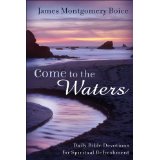
Book Review: Come To The Waters by James Montgomery Boice

Be Blessed By Boice’s Best From the Bible

I am a teaching pastor who was deeply grieved by the earth’s loss (Heaven’s gain) of *Dr. James Montgomery Boice just over a decade ago to cancer. He was a gifted theologian who happened to pastor a large church in Philadelphia where he faithfully preached the Bible expositionally for over thirty years. I have read all of his published books – most of which are sermons – and what’s great about this book is that it compiles the best of most of his published works and some unpublished works that the editor was able to find at the Princeton Theological Library.

Organized from January to December and from Genesis to Revelation this daily devotional is like getting the best of Boice from the Scriptures every day – sort of like a mini sermon – but packed with solid theology, exegesis, and life application. For Boice fans this book is a “must have” and hopefully for those of you who have never been exposed to Boice – you will not only “come to the waters” in this book – but go deeper into the waters of the plethora of Boice’s books and be blessed in your pursuit of the knowledge of and reflection of our Lord Jesus Christ. Thanks and Kudos to the editor for giving us more Boice, so we can get more of Jesus in our lives!


*Dr. James Montgomery Boice, just 8 weeks after being diagnosed with a fatal liver cancer, died in his sleep on June 15, 2000. The senior pastor of Tenth Presbyterian Church in Philadelphia, he was a world-famous Bible teacher, author, and statesman for Reformed theology. He informed his congregation of 32 years of his condition on May 7, proclaiming his complete confidence in God’s sovereignty and goodness.

In the past 72 years, historic Tenth Presbyterian Church has had two senior pastors, Donald Grey Barnhouse and James Montgomery Boice. Founded in 1828, the church itself predates their tenure by another hundred years. Tenth Presbyterian Church lies in the very heart of the city and today has about 1,200 members.

James Montgomery Boice accepted the position as senior pastor in 1968, and was the teacher of the Bible Study Hour since 1969 and the more recent God’s Word Today broadcast as well. Dr. Boice held degrees from Harvard, Princeton Theological Seminary, and the University of Basel, Switzerland. He had written or contributed to nearly 50 books, including Foundations of the Christian FaithLiving by the Book, and exegetical commentaries on Genesis, Psalms, Acts, and Romans.

He was no less involved in the preserving of the fundamentals of the faith than his predecessor, Dr. Barnhouse. In 1985, Boice assumed the presidency of Evangelical Ministries, Inc., the parent organization of the Bible Study Hour, Bible Study Seminars, Bible Studies magazine, and other teaching ministries. In 1997, Evangelical Ministries merged with Christians United for Reformation and the Alliance of Confessing Evangelicals, taking the latter as the new organization’s name, and Dr. Boice assumed the presidency. In 1997, he was a founding member of, and chaired, the International Council on Biblical Inerrancy.

Of particular concern to Boice was the matter of the church and her relationship to and engagement of society. His recent book, Two Cities, Two Loves, maintains that Christians are citizens of the kingdom of this world and the kingdom of heaven and that they have responsibilities in each. He urged Christians to “participate in secular life rather than merely shoot from the sidelines at secular people.”

Dr. Boice is survived by his wife, Linda, and three daughters. Characteristic of his ministry was his pushing Christians to commit themselves to staying in one place. He lived what he preached, committing to the church and his downtown neighborhood for 30 years. A gifted pastor and leader, he turned down many attractive opportunities in order to build a sense of permanence and belonging. And he urged his parishioners to do the same.

Book Review on Ben Patterson’s “Muscular Faith”

The premise of this book (written by an ex-pastor/college chaplain with a lot of life, and ministry experience – he is now in his sixties) is that the Christian life is NOT easy, is extremely difficult, and that the more you train and prepare for the inevitable hardships – the better.

The book is written in Four distinct sections: Part 1 makes a case for the call to be a Christian Warrior (using God as a model of this motif); Part 2 make a case for the vigorous requirements of the war that the Christian is continually engaged in; Part 3 explains three primary obstacles to our being effective in the battle; and Part 4 discusses 7 essential habits to develop to be successful in the Christian life and how to ultimately finish well and live a life pleasing to God.

I have read all of Patterson’s books and as a result I found that there was a lot of repetition from things he has said in previous books. As a matter of fact, if you read very much (especially C.S. Lewis) – there is precious little new information here. As a matter of fact – each principle, or illustration used with only a few exceptions I have heard or read elsewhere.

Therefore, I would not recommend this book to Christians who read a lot of Christian authors – simply because, you will feel like I did in reading this book – I kept reading things that I’ve read or heard before, so it actually got annoying. However, if you are new to Patterson, and have not read C.S. Lewis or very many Christian authors, then I would highly recommend this book.

Book Review: Now, That’s a Good Question! By R. C. Sproul

Great Answers to God Questions

I love the format of this book: One of the finest theologians in America today, answering 300 questions from a radio audience off the cuff with answers to each of these individual questions in less than 4 minutes. The questions in this book are the original questions from the live call in audience, and the answers have been edited only insofar as missing assorted “uh’s” and “um’s.”

The questions are broken down Into 22 categories. R. C. Sproul is a reformed theologian and pastor, and his expertise is in the areas of theology, apologetics, philosophy, Bible exposition and interpretation. He is a brilliant communicator and has the ability to bring the cookies on the shelf for the layperson – no matter how complicated the issue. I have included all the categories listed below, along with two sample questions from the section.

1)    Knowing God (19 Questions asked and answered) – for example, “Why does God remain invisible?” and “Why does God love us so much?”

2)    Who Is Jesus (9 Questions asked and answered) – for example, “Was Christ capable of sinning?” and “Did Jesus ever laugh?”

3)    The Work of the Holy Spirit (10 Questions asked and answered) – for example, “Does every human being have the potential to receive the Holy Spirit?” and “What was the role of the Holy Spirit in the Old Testament?”

4)    The Book of Books (17 Questions asked and answered) – for example, “How were the books of the Bible selected and compiled?” and “How do you know the Bible is true?”

5)    The Way of Salvation (23 Questions asked and answered) – for example, “Why did God save me?” and “What do good deeds have to do with salvation?”

6)    Sin and the Sinner (13 Questions asked and answered) – for example, “What is meant by the term original sin?” and “Are there gradations of sin?”

7)    Faith and Philosophy (14 Questions asked and answered) – for example, “Doesn’t science disprove Christianity?” and “Is there a distinction between Christianity and religion?”

8)    The Power and Purpose of Payer (11 Questions asked and answered) – for example, “How can we, as Christians, have more power in our prayer lives?” and “Does God hear the prayers of the non-Christian?”

9)    The Growing Spiritual life (27 Questions asked and answered) – for example, “What do you do in your daily devotions?” and “What concerns you most about today’s Christian?”

10) Understanding Satan (6 Questions asked and answered) – for example, “Can the Devil read my mind?” and “Has Satan been given dominion over the earth until Jesus returns?”

11) Heaven and Hell (16 Questions asked and answered) – for example, “Will we recognize each other in heaven?” and “What happens to animals when they die?”

12) Sharing the Faith (10 Questions asked and answered) – for example, “What is faith?” and “Is the Christian faith really rational?”

13) Church Life (26 Questions asked and answered) – for example, “What are the basics to church growth?” and “What is the most crucial issue confronting today’s church?”

14) Marriage and Family (22 Questions asked and answered) – for example, “What should make Christian marriages distinctive?” and “Are there biblical grounds for divorce, and if so, what are they?”

15) Career Issues (9 Questions asked and answered) – for example, “What is the biblical concept, if any, of retirement?” and “How can an employer show employees Christlike dignity?”

16) Money Matters (10 Questions asked and answered) – for example, “What do you believe the Bible teaches about tithing as it relates to Christians today?” and “Is there a clear biblical position against lotteries and casino gambling?”

17) Life-and Death Issues (7 Questions asked and answered) – for example, “Does the Bible say anything about euthanasia?” and “What should be the Christian stand on the death penalty?”

18) Suffering (12 Questions asked and answered) – for example, “What is the difference between God testing us and tempting us?” and “If God is all powerful, then why does he allow suffering?”

19) The End Times (12 Questions asked and answered) – for example, “Are we living in the last days?” and “What does Scripture teach us about the future role of Israel?”

20) Lifestyle Ethics (17 Questions asked and answered) – for example, “Should Christians impose their ethics on non-Christians?” and “Is it wrong for scientists to engage in genetic engineering?”

21) Christians and Government (13 Questions asked and answered) – for example, “Are biblical solutions to world problems outdated?” and “Should Christians work to have Christian values in public policy?”

22) Puzzling Passages (19 Questions asked and answered) – for example, “Why in the Old Testament does God demand so much violence and war of the Jewish nation?” and “The Lord says in the Old Testament that he loved Jacob but he hated Esau, and in 1 John, John actually says that if we say we love God but hate our brothers, we’re wrong. How can we reconcile these two passages?”

I think this is a resource you will use for life – especially for Christian leaders, pastors, counselors, missionaries, and teachers – who deal with similar questions in their respective ministries on a regular basis. The index in the back of the book makes this a resource that you can use to find if a specific question you are struggling with, or have been asked is included. It is not exhaustive, but has a lot of the questions that most Christians struggle with and are asking. It also makes a great gift for someone who loves to study God’s Word.

Book Review: Can I Know God’s Will? By R. C. Sproul

A Good Introduction for Discerning God’s Will For Your Life

R. C. Sproul did not mean for this book to be an exhaustive treatment on the subject of the will of God, but carefully, analytically, and articulately addresses four aspects on the subject of discerning God’s will for your life:

  • One – The Meaning of God’s Will – He addresses the fact that the Bible speaks of the “will of God” in various ways and goes on to specify the different categories in which the Bible addresses this topic. Dr. Sproul discusses the distinct aspects of God’s will by discussing in four categories: His decretive will; preceptive will; will of disposition, and His hidden and revealed will. He gives excellent biblical, philosophical, and practical ways that God’s will manifests itself and how we should respond to His preceptive and revealed will according to the Scriptures.
  • Two – The Meaning of Man’s Will – In this chapter Dr. Sproul address the whole issue of the abilities and inabilities of our freedom with a penetrating look at Jonathan’s Edwards poignant insights from his outstanding work on the “freedom of the will.”
  • Three – God’s Will and Your Job – Here R. C. asks and answers questions related to calling, vocation, responsibility, and motivation in how to best to discern how to wisely use our God given talents and abilities for God’s glory.
  • Four – God’s Will In Marriage – R. C. answers five key questions: 1) Should I Get Married?; 2) Do I Want to Get Married?; 3) What Do I Want in a Marriage Partner?; 4) From Whom Should I seek Counsel?; 5) When am I Ready To Get Married?

As with most books by R.C., this one being no exception, it is thought provoking, biblical, clear, concise, and practical. It’s a great place to begin if you have never wrestled with the idea of “God’s will” – also, with R.C. he always gives “new” material or insight on any subject he covers, so even for those who have read in this area, you will be given fresh insight by a master theologian and communicator of Biblical truth.

*Note – This book was originally part of a short series of books called “How Can I Know God’s Will” in the 1980’s that have been reissued – and also a part of four sections of a book called Following Christ (both published by Tyndale). I say this upfront, because I always get frustrated when I buy a book that I already have purchased under a different name.

Book Review: Enemies of the Heart by Andy Stanley

Vintage Stanley: Biblical Reflections On The Four Greatest Enemies of Our Soul

I think Andy Stanley has hit it out of the park with this book. He is so good at bringing God’s truth from the Scriptures to bear on the big issues of the day. I think that along with Pete Scazzero’s books Emotionally Healthy Spirituality and the Emotionally Healthy Church – that this book is must reading for pastors, leaders, and anyone who is a part of the body of Christ. Most Bible teachers, often neglect the soulish matters of the heart, – but Stanley calls a spade a spade and writes a convicting, challenging, and much needed corrective for us to address our blind spots.

In Part 1 he addresses the fact that sin comes from the heart as Jeremiah says and is incredibly deceptive. He talks about the damage that sin does, and how to identify it, and the importance of correcting it.

In Part 2 he addresses the dynamics of the debts that result from our sin. The four biggies are: Guilt – “I owe you”; Anger – “You owe me”; Greed – “I owe me”; and Jealousy – “God owes me.” Andy handles each of these brilliantly and gives excellent examples that we can all relate to, so that we can confess them and start working in a positive direction to overcome them with the help of God the Holy Spirit.

In Part 3 he focuses in on how to confront each of these sins, with their righteous (happy) counterparts: from anger to forgiveness; from greed to generosity; and reasons to celebrate the joy that we have in receiving Christ’s blessing and the Holy Spirit’s power at work in our lives.

In Part 4 he helps us focus on what we are modeling and the legacy we are leaving behind (especially parents for their children) and how to deal with lust.

The book includes a helpful discussion guide, which is excellent for personal application, and small group discussion. This book is vintage Stanley: full of Scripture, great examples and illustrations, and motivates you toward wanting to live the abundant life that Jesus came to give us. I can’t recommend it highly enough – life transforming!

4 Good Reasons We Go Through Trials by Warren W. Wiersbe

“A Land of Hills and Valleys”

Excerpt from Chapter 1: From the Wonderful Devotional book Turning Mountains into Molehills by Warren W. Wiersbe (Grand Rapids: Baker, 1987 – Only changes are that the Scriptures are from KJV to ESV)

For some reason, I have never enjoyed geography. Perhaps I didn’t study hard enough in school. But as I study my Bible, I find myself becoming greatly interested in God’s geography, particularly something that God said about the Promised Land He was giving to His people, Israel. “But the land that you are going over to possess is a land of hills and valleys, which drinks water by the rain from heaven (Deuteronomy 11:11).” I can’t think of a better description of the Christian life—a land of hills and valleys.

Christians today have a great deal in common with the nation of Israel back in Moses’ day, even though there are some radical differences. For example, there was a time when the people were in bondage; and God set them free. Once you and I were in bondage to sin; but God has set us free. God set Israel free by the blood of the lamb; and God has set us free by the blood of Jesus Christ, God’s Lamb without spot or blemish. God led the nation with a cloud by day and a pillar of fire by night; and God leads us today through His Holy Word. God brought His people to the border of their inheritance and told them to go in and possess the land by faith; but, unfortunately they fell into unbelief and failed to posses the land.

The Lord has given Christians today a wonderful spiritual inheritance in Christ, and all we have to do is possess it by faith. The Bible is the divine road map that describes our inheritance for us; and God says that our inheritance is “a land of hills and valleys.”

Now, this fact may come as a surprise to some of you. Many people have the idea that the Christian life is an easy life—that once you are saved, your troubles are over. Well, once you are saved, many problems are solved; but many new ones appear. Jesus never promised that it would be easy for us to claim our inheritance. “In this world you will have tribulation,” He warned His disciples. “If they have hated me, they will hate you.” The Christian life is a land of hills and valleys.

Let’s begin with the valleys. Have you ever noticed that most of the great people in the Bible went through valley experiences? In Genesis 15 I find Abraham going through “the horror of a great darkness.” I find Isaac trembling because one of his sons has tricked him. I see Jacob wrestling all night until he is willing to surrender to God. I hear Moses crying out to God, “I am not able to bear all this people alone…kill me, I beg you.” I see David hiding in a cave a wondering if the crown would ever be on his head. I hear the prophet Isaiah lamenting, “I have labored in vain; I have spent my strength for nothing and in vain!” (Isa. 49:4). I watch John the Baptist in prison as he sends his disciples to Jesus to ask, “Are you the Messiah, or should we look for another?” Yes, I even hear the great apostle Paul saying, “For we would not have you ignorant, brothers, or our trouble which came to us in Asia, that we were pressed out of measure, above strength, insomuch that we despaired even of life.” These men knew what it was to go through the valley.

Why does God permit these valleys to come into our lives? For one thing we learn some lessons in the valleys that we could never learn on the mountaintop. Do you think that David could have written those wonderful psalms if had never known the trials in the valley? How could he have written ‘Even though I walk through the valley of the shadow of death, I will fear no evil, for I know that you are with me,” if he had not gone through the valley himself? Suppose Jeremiah had never gone through that terrible valley that made him the “Weeping Prophet”? Could he ever have written, “His compassions never fail; they are new every morning; great is your faithfulness” (Lam. 3:22,23)? Suppose Paul had never gone through the valley with his thorn in the flesh? Could he have written, “My grace is sufficient for you”? When we go through the valley, we learn lessons we could never learn any other way.

And, we grow in character in a way we could never grow apart from the valley. Great Christians are made by great trials. A man does not become patient simply by reading a book or praying a prayer. He becomes patient by going through the valley. Faith is cultivated in the darkness of the valley. God may teach us in the light, but he tests us in the darkness. This is why Paul wrote: “But we had the sentence of death in ourselves, that we should not trust in ourselves, but in God who raises the dead.” The Christian graces are developed as we walk through the valley.

But God has another purpose for the valley: as we go through the valley, we learn to help others. Psalm 84:6 puts it this way: “Who passing through the valley of weeping makes it a place of springs.” Here is a pilgrim going through a difficult valley, so difficult he is even weeping; but he leaves behind a well to refresh the pilgrims that will follow him. Perhaps the reason you are in the valley today is that God may comfort you so you in turn may comfort someone else. He wants you to leave a well behind. Paul had this in mind when he wrote, “God comforts us in all our tribulation that we may comfort them which are in any trouble, by the comfort we have received from God” (2 Cor. 1:4).

The Christian life is a land of hills and valleys. God ordains the valleys that He might teach us lessons we could never learn any other way. He leads us through the valleys so that we may grow in our Christian character, and so that we may help others when they go through the valley. But there’s a fourth reason He permits valleys, and it’s this: you cannot have hills unless you have valleys.

Wouldn’t it be wonderful if life were just a series of mountaintop experiences? Wouldn’t we be happier if there were no valleys in our lives? The Christian life is a land of hills and valleys, but we must never forget that you cannot have hills unless you have valleys.

God knows how to balance our lives. All sunshine makes the desert, says the old proverb; and all hills, without valleys, will make an immature and shallow life. If you and I want to enjoy the hilltops of happiness, we must be willing to experience the valleys of trial. It’s comforting and encouraging to know that at the end of every valley there is a hill, and atop that hill is a new experience of blessing from the Lord.

I can’t help but notice that the lives of God’s people in the Bible were made up of both hills and valleys. Abraham received a great promise from God one day, and the next day the land was plunged into drought and famine. Isaac was born, and Abraham’s joy was complete. A few years later, God told him to offer his beloved son on the altar. The great prophet Moses experienced his hills and valleys. No sooner had he led the nation out of Egypt when they began to complain and ask to go back to bondage! Moses met God on the mountaintop and saw His glory; then he came down and discovered Israel dancing before a golden idol. Hills and valleys!

It was true even in the earthly life of our Lord. When Jesus was baptized in the Jordan River, the Father spoke from heaven and the Spirit came down on Jesus like a dove. What a mountaintop experience! But then the Spirit drove Jesus into the wilderness to be tempted by the devil. What a valley to go through! See Him as He enters Gethsemane, as he prays and sweats great drops of blood. See Him hanging on a cross! What a valley He endured! But then, see Him risen from the dead—radiant in the glorified body! What a mountaintop experience! Then He ascends to the highest heaven and sits at the right hand of God!

This is God’s word of encouragement to you as you go through the valley. He has a glorious blessing waiting for you at the end of the valley. The Christian life is a land of hills and valleys; and wherever you find a valley, you will always find a mountaintop at the other end. This is true because our Lord Jesus Christ has already gone before us to prepare a way. Every valley that we go through, Christ has already traveled before us.

I’m glad the Christian life is a land of hills and valleys. There is nothing monotonous about it. Every day presents a new challenge to grow in grace, a new opportunity to help others, a new privilege to receive grace and strength from Jesus Christ. It is a land of hills and valleys, and our God is a God of the hills and a God of the valleys.

*Warren W. Wiersbe is the Distinguished Professor of Preaching at Grand Rapids Baptist Seminary, Warren Wiersbe is the author of more than 100 books. Billy Graham calls him “one of the greatest Bible expositors of our generation.” Interestingly, Warren’s earliest works had nothing to do with scriptural interpretation. His interest was in magic, and his first published title was Action with Cards (1944).

“It was sort of imbecilic for a fifteen-year-old amateur magician to have the audacity to write a book and send it to one of the nation’s leading magic houses,” Warren says. But having a total of three books published by the L.L. Ireland Magic Company—before the age of 20—gave him a surge of confidence. In later years, he applied his confidence and writing talent to the Youth for Christ (YFC) ministry.

Warren wrote many articles and guidebooks for YFC over a three-year period, but not all his manuscripts were seen by the public eye. One effort in particular, The Life I Now Live, based on Galations 2:20, was never published. The reason, Warren explains with his characteristic humor, is simple: it was “a terrible book…Whenever I want to aggravate my wife, all I have to say is, ‘I think I’ll get out that Galations 2:20 manuscript and work on it.’” Fortunately, Warren’s good manuscripts far outnumbered the “terrible” ones, and he was eventually hired by Moody Press to write three books.

The much-sought-after author then moved on to writing books for Calvary Baptist Church. It was during his ten years at Calvary that Expository Outlines on the New Testament and Expository Outlines on the Old Testament took shape. These two works later became the foundation of Warren’s widely popular Bible studies known as the Be series, featuring such titles as Be Loyal (a study on Matthew) and Be Delivered (a study on Exodus). Several of these books have been translated into Spanish.

His next avenue of ministry was Chicago’s Moody Memorial Church, where he served for seven years. He wrote nearly 20 books at Moody before moving to Lincoln, Nebraska, where he and his wife, Betty, now live. Prior to relocating, he had been the senior pastor of Moody Church, a teacher at Trinity Evangelical Divinity School, and a producer of the Back to the Bible radio program.

During all these years of ministry, Warren held many more posts and took part in other projects too numerous to mention. His accomplishments are extensive, and his catalog of biblical works is indeed impressive and far-reaching (many of his books have been translated into other languages). But Warren has no intention of slowing down any time soon, as he readily explains: “I don’t like it when people ask me how I’m enjoying my ‘retirement,’ because I’m still a very busy person who is not yet living on Social Security or a pension. Since my leaving Back to the Bible, at least a dozen books have been published, and the Lord willing, more are on the way.”

Wiersbe’s recent books include Your Next MiracleThe 20 Essential Qualities of a Child of GodThe Bumps are What You Climb OnClassic Sermons on the Fruit of the SpiritClassic Sermons on Jesus the ShepherdKey Words of the Christian LifeLonely PeopleA Gallery of GraceReal Peace: Freedom and Conscience in the Christian Life, and On Being a Leader for God.

Book Review: Conformed to His Image: Biblical and Practical Approaches to Spiritual Formation by Kenneth Boa

Excellent Resource to Help You in Your Pursuit of Becoming More LIke Jesus

 According to the apostle Paul the goal of the Christian life is that we would be “conformed to the image of his Son (Rom. 8:29).” I have used this book several times now in classes at my church on developing in the spiritual disciplines in the context of community. This book has it all – good theology; historical theology; and excellent study questions and applications throughout. I have used this book along with Grudem’s Systematic Theology, Allison’s Historical Theology, and Ogden’s books on discipleship to try to balance the mentoring and discipleship process of making theologically culturally penetrating disciples of Christ.

Kenneth Boa’s prayer in is that a result of reading this book you will:

–    develop a greater appreciation for the unique way God has made you;

–    become aware of a wider array of options for your spiritual journey;

–    get out of a possible spiritual rut;

–    desire to experiment with other facets of the faith

–    appreciate the manifold legacy that has been bequeathed to us by those who have gone before us;

–    expand your horizons and be encouraged to move out of your comfort zone

–    have instilled in you a greater passion for Christ and a greater desire to participate in his loving purposes for your life.

Does Boa succeed in the above? A resounding “yes.” I have used this book one on one; in small groups of 7-14 people; and larger groups of 20-40 people. In every case the book has proven to be effective in helping all involved to grow in Christ like qualities, and behavior. Boa has masterfully written a very practical theology of the spiritual disciplines by comparing these disciplines to facets of the gem that we are ultimately becoming in Christ:

Facet #1 – Relational Spirituality: Loving God Completely, Ourselves Correctly, and Others Compassionately.

Facet#2 – Paradigm Spirituality: Cultivating an Eternal versus a Temporal Perspective

Facet #3 – Disciplined Spirituality: Engaging in the Historical Disciplines

Facet #4 – Exchanged Life Spirituality: Grasping Our True Identity in Christ

Facet #5 – Motivated Spirituality: A Set of Biblical Incentives

Facet #6 – Devotional Spirituality: Falling in Love with God

Facet #7 – Holistic Spirituality: Every Component of Life under the Lordship of Christ

Facet #8 – Process Spirituality: Process versus Product, Being versus Doing

Facet #9 – Spirit-Filled Spirituality: Walking in the Power of the Spirit

Facet #10 – Warfare Spirituality: The World, the Flesh, and the Devil

Facet #11 – Nurturing Spirituality: A Lifestyle of Evangelism and Discipleship

Facet #12 – Corporate Spirituality: Encouragement, Accountability, and Worship

This book is written as a textbook – it is well organized with outlines, introductions, charts, and each chapter closes with questions for discussion and personal application. I think it is one of the most helpful books out there in bridging the typical gaps between books that consider the multi-dimensional aspects of what it means to be human and made and conformed to the image of Christ. Boa weaves biblical theology, human personalities, psychology, etc., to help us see our blind spots and how we can keep chiseling away at what is not like Christ, so we can become the multi-faceted gems that God is working in us to become – through His working and our responsibly working to become like Jesus (Eph. 2:10 and Philippians 2:12-13). I Highly recommend this book – it’s definitely a resource you will use for the rest of your life – individually and corporately.

Book Review: More Than Ordinary by Doug Sherman

Motivating You to Become God Enthralled

 What a fantastic book! The whole time I was reading it – I was thinking to myself “Why didn’t I write this book?” As a pastor and life coach everything the author talks about in this book is exactly in a nutshell what I want followers of Jesus  to know. I will definitely be buying this book and giving it away, and recommending it to others. As a matter of fact, I am preaching through the book of Colossians right now on Sunday’s but was so impacted by this book – that with Father’s Day coming up this Sunday – I’m going to use some of the Scripture passages in this book and the principles and suggestions that the author brings out to share with my flock – to remind them of what an Awesome Heavenly Father we have.

This book essentially has it all – excellent theology, wonderful Bible passages, great stories, personal and authentic, excellent applications, and flows very well. I read it in about three hours – and I’m not a fast reader, but I simply couldn’t put the book down!

The essence of this book is that God created us to know Him intimately and that He is our ultimate satisfaction in life. Doug does a fantastic job of weaving the Biblical story of the creation, fall, redemption, and restoration throughout the book. He weaves the Biblical story with his story and our story – making practical connections throughout the book. If you are having a dry spell in your walk with God, or He seems distant to you – or even if you think you are very close to Him – this book will motivate you and give you great practical ways to enjoy Him even more.

I especially recommend it for those who didn’t have a good relationship (or currently) with their earthly father – as the author relays his own testimony in regard to this. Also, as a father myself, it really motivated me to become a better father and reflect God practically to my children and grandchildren. I can’t recommend this book highly enough.