
The Goodness of God and the Reality of Evil by Dr. Albert Mohler


I’m inclined to think the best way to respond to the tragedy that struck our community today is simply to say nothing. I have little patience for those who feel the need to theologize about such events, as if anyone possessed sufficient wisdom to discern God’s purpose. On the other hand, people will inevitably ask questions and are looking for encouragement and comfort. So how best do we love and pastor those who have suffered so terribly?
I’m not certain I have the answer to that question, and I write the following with considerable hesitation. I can only pray that what I say is grounded in God’s Word and is received in the spirit in which it is intended.
I first put my thoughts together on this subject when the tsunami hit Japan a couple of years ago. Now, in the aftermath of the tornado that struck Moore and other areas surrounding Oklahoma City, I pray that those same truths will prove helpful to some. Allow me to make seven observations.
(1) It will not accomplish anything good to deny what Scripture so clearly asserts, that God is absolutely sovereign over all of nature. He can himself send devastation. Or he may permit Satan to wreak havoc in the earth. Yes he can, if he chooses, intervene and prevent a tornado, a tsunami, and all other natural disasters. In the end, we do not know why he makes one choice and not another. In the end, we must, like Job, join the apostle Paul and say: “Oh, the depth of the riches and wisdom and knowledge of God! How unsearchable are his judgments and how inscrutable his ways! For who has known the mind of the Lord, or who has been his counselor? Or who has given a gift to him that he might be repaid? For from him and through him and to him are all things. To him be glory forever. Amen” (Romans 11:33-36).
(2) God is sovereign, not Satan. Whether or to what extent Satan may have had a hand in what occurred we can never know. What we can know and must proclaim is that he can do nothing apart from God’s sovereign permission. Satan is not ultimately sovereign. God alone is.
(3) Great natural disasters such as this tell us nothing about the comparative sinfulness of those who are its victims. Please do not conclude that the residents of Moore, Oklahoma, are more sinful than any other city that has not as yet experienced such devastation. Please do not conclude that we are more righteous than they because God has thus far spared us from such events. The Bible simply won’t let us draw either conclusion. What the Bible does say is that we all continue to live and flourish not because we deserve it but solely because of the mercy and longsuffering of God. Life is on loan from God. He does not owe us existence and what he has mercifully given he can take back at any time and in any way he sees fit.
(4) Events such as this should remind us that no place on earth is safe and that we will all one day die (unless Jesus returns first). Whether by a peaceful natural death at the age of 90, or by a sudden heart attack at 50, or in a car accident at 15, or by a slow battle with cancer at virtually any age, we will all likewise die. We are not immortal. The only ultimately and eternally safe place to be is in the arms of our heavenly Father from which no tornado or earthquake or tsunami or cancer or car wreck can ever snatch us or wrench us free.
(5) We should not look upon such events and conclude that the Second Coming of Christ and the end of history are at hand, but neither should we conclude that the Second Coming of Christ and the end of history are not at hand. What we should do is humble ourselves before the Lord and prepare our hearts for the day of his return, whenever that may be, whether in our lifetime or some distant date centuries from now.
(6) We must learn to weep with those who weep. We must pray for them, serve them, help them, give to them, and do all within our power to alleviate their suffering (even if their suffering is caused by God). We do not have to agree with them religiously or politically to shower them with the love of Christ. Jesus calls upon us to show mercy to those who suffer, even if they do not deserve it. The fact is, none of us deserves it. That’s why the Bible calls it mercy: it is undeserved kindness. Remember Luke 6:27 where Jesus said, “Love your enemies, do good to those who hate you.”
(7) Pray that God will use such an event to open the hearts and eyes of a city and a state immersed in unbelief and idolatry (and I have in mind not merely Oklahoma, but also America as a whole), to see the gospel of the Lord Jesus Christ and turn in faith to him, lest something infinitely worse than a tornado befall them: Eternal condemnation. Eternal suffering.
Article from: http://www.samstorms.com/enjoying-god-blog/post/tornadoes–tsunamis–and-the-mystery-of-suffering-and-sovereignty – May 20, 2013
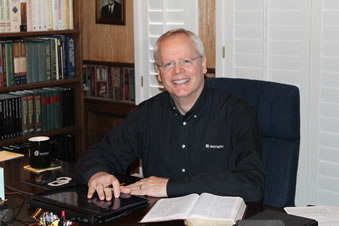
Sam was born February 6, 1951, in Shawnee, Oklahoma. Both of his parents, as well as his sister, Betty Jane, were Christians. Sam was raised in a Southern Baptist context and came to saving faith in Christ at the age of nine. When he turned ten, his family moved to Midland, Texas, where they lived for the next four years. In 1965, as Sam was entering his freshman year in high school, the Storms family moved to Duncan, Oklahoma, where Sam’s father became president of a local bank. Sam graduated from Duncan Senior High School in 1969, hoping for a career as a professional golfer. He attended the University of Oklahoma where he soon abandoned his plans to play golf (due to the combined factors of incompetence and a notoriously bad temper!).
Near the beginning of his sophomore year at OU, Sam met Ann Elizabeth Mount, to whom he proposed marriage on their first date! Sam and Ann were married on May 26th, 1972. They have two daughters, Melanie (born December 23, 1978) and Joanna (born October 3, 1984), as well as four grandchildren.
After graduation from OU in 1973, Sam entered Dallas Theological Seminary to study in preparation for the ministry. He graduated in 1977 with a Th.M. in Historical Theology. While at Dallas, Sam served as interim pastor of Dallas Independent Presbyterian Church (1974-1977). Upon graduation in 1977, he joined the pastoral staff at Believers Chapel in Dallas, a non-denominational bible church. Sam began his work on a Ph.D. in Intellectual History in 1978 and received his degree from the University of Texas at Dallas in 1984, having written his dissertation on the topic of “Jonathan Edwards and John Taylor on Human Nature: A Study of the Encounter between New England Puritanism and the Enlightenment.”
In August of 1985 Sam accepted a call to serve as Senior Pastor of Christ Community in Ardmore, Oklahoma, where he ministered for eight years. In 1993 he resigned his position in order to become President of Grace Training Center, the full-time bible school at Metro Christian Fellowship in Kansas City, Missouri, where Sam also served as Associate Pastor.
Although he never thought he would leave Kansas City, God had other plans, and in August of 2000 Sam accepted the offer to become an associate professor of theology at Wheaton College in Wheaton, Illinois. After four years on the faculty at Wheaton, Sam made the decision to resign in order that he might establish Enjoying God Ministries.
In 2008 Sam became Lead Pastor for Preaching and Vision at Bridgeway Church in Oklahoma City, Oklahoma. Sam serves on the Board of Desiring God, Bethlehem College & Seminary, and the Acts 29 Network.
Below is a more formal listing of Sam’s educational background, ministerial experience, and publications (both books and journal articles).
Thesis topic: “An Analysis of Jonathan Edwards on the Freedom of the Will”
Dissertation topic: “Jonathan Edwards and John Taylor on Human Nature: A Study of the Encounter between New England Puritanism and the Enlightenment”
2008 – present / Lead Pastor for Preaching and Vision, Bridgeway Church, Oklahoma City, OK
2004 – present / President of Enjoying God Ministries
2000 – 2004 / Visiting Associate Professor of Theology, Wheaton College, Wheaton, IL (Systematic Theology, Historical Theology)
1993 – 2000 / President and Instructor in Theological and Biblical Studies, Grace Training Center (Systematic Theology, Historical Theology [with a focus on history of doctrine, ancient, medieval, and especially Reformation history] NT [both survey and exegetical courses], OT [survey], Ethics, Spiritual Formation).
1993 – 2000 / Associate Pastor, Metro Christian Fellowship, Kansas City, MO.
1985-1993 / Senior Pastor, Christ Community Church, Ardmore, OK.
1977-1985 / Associate Pastor, Believers Chapel, Dallas, TX, and Instructor in Theological and Biblical Studies, Advanced Studies Center.
1974-1977 / Interim Pastor, Dallas Independent Presbyterian Church, Dallas, TX.
In September of 2012 a huge lump developed in my neck and was merely a symptom of the reality that I had cancer that had developed on the back of my tongue: Squamous Cell Carcinoma.
When I was diagnosed with cancer and heard all the side effects of the treatment I would be receiving my first reaction was to ask the doctor, “What if I don’t get any treatment?” The quick reply was, “You will die.” I knew it was very serious at that point. I was at stage 3 (only stage 4 is more serious) and had a tumor in my neck the size of an avocado. My prayer in all of this was that I would bring glory to God whether I survived the cancer or not. I have boldly proclaimed the gospel in my living, and wanted to also boldly proclaim the gospel in my dying. A helpful passage to me when looking death in the face were some of the Apostle Paul’s last words in 2 Timothy 4:17-18, “But the Lord stood by me and strengthened me, so that through me the message might be fully proclaimed and all the Gentiles might hear it. So I was rescued from the lion’s mouth. The Lord will rescue me from every evil deed and bring me safely into his heavenly kingdom. To him be the glory forever and ever. Amen.”
I’ve had a lot of time to think and pray over the last several months and it’s really impossible to describe the feelings I’ve felt, the gratitude I feel, and the hope that I have in Christ and his promises to me in the gospel. However, I’d like to express my gratitude by describing how what I value most in life has been enhanced because of by battle with and present victory over cancer. It was just last week that I received the results of my PET scan of the good news that there is no sign of cancer in my body. Here are just a few of the values I have that have been greatly enhanced because of my experience with cancer:
I am grateful for family and friends.
I’ve been blessed to have Christian parents and a wonderful wife and children for many years. However, It’s hard to fathom getting through the past six months without my dear wife in particular. She fed me via a feeding tube in my stomach sometimes 6-10 times per day, and was literally at my beck and call twenty four hours a day. She never complained and remained optimistic that God was going to heal me and renew me emotionally, physically, and spiritually in His perfect time. I was sent cards, gift cards, money, and had hundreds of people praying for me –many people I didn’t even know. I even had some phone calls from people as far away as India (that I didn’t know) telling me they were praying for my healing. I have never felt so loved and cherished by my family and my closest friends. I desperately needed unconditional love during these difficult months and sensed the reality of Proverbs 17:17, “A friend loves at all times.” I experienced the deep love of Christ through my family and friends.
I am grateful for the suffering of Christ on my behalf.
There were many times along the way that I didn’t think I was going to make it another day – the pain and discomfort seemed unbearable. It was during these times of great suffering that I would picture scenes of Christ leading to his ultimate sacrifice on the cross for my sins. Verses on the atonement, great Hymns of the faith, and deep theological truths would comfort me in the midst of my sufferings. It is unfathomable that Jesus voluntarily suffered on my behalf and took the wrath I deserved upon himself to make me right with the Father. Perhaps no passage of Scripture summarizes it better than 2 Corinthians 5:21, “For our sake he made him to be sin who knew no sin, so that in him we might become the righteousness of God.”
I am grateful that my cancer was for my good and for God’s glory.
In Romans 8 the Apostle Paul makes it very clear that Christians will suffer immensely in this life, that their suffering doesn’t compare with the glory that will be revealed in us in Heaven, and that all things work out for our good and God’s glory in the end. There wasn’t a single passage that went through my mind (especially during radiation treatments) more than Romans 8.
I am grateful that suffering results in my sanctification.
In other words, suffering results in bringing about the purposes of God for me that “good times” would never produce. These verses from 1 Peter 4:12-13, 19 were a source of comfort and joy to me even on gthe darkest days: “Beloved, do not me surprised at the fiery trial when it comes upon you, as though something strange were happening to you. But rejoice insofar as you share in Christ’s sufferings, that you may also rejoice and be glad when his glory is revealed. Therefore let those who suffer according to God’s will entrust their souls to a faithful Creator while doing good.”
I am grateful that my cancer brought me to a deeper understanding of confession and repentance which have led to emotional as well as physical healing.
Isaiah 38:16-17 declares, “O Lord, by these things men live, and in all these is the life of my spirit. Oh restore me to health and make me live! Behold, it was for my welfare that I had great bitterness; but in love you have delivered my life from the pit of destruction, for you have cast all my sins behind your back.”
I am grateful that because I’ve gone through cancer I have more mercy and compassion for those who are suffering.
I believe that God has already and will continue to open doors for me to minister to people with cancer, and those who care for loved ones with cancer. I especially have a heart for those who don’t know Jesus and have to face their fears, pain, and mortality without the hope and promises of the Gospel. I am encouraged to use my experience with cancer as Paul describes here in 2 Corinthians 1:3-7, “Blessed be the God and Father of our Lord Jesus Christ, the Father of mercies and God of all comfort, who comforts us in all our affliction, so that we may be able to comfort those who are in any affliction, with the comfort which we ourselves are comforted by God. For as we share abundantly in Christ’s sufferings, so through Christ we share abundantly in comfort too. If we are afflicted, it is for your comfort and salvation; and if we are comforted, it is for your comfort which you experience when you patiently endure the same sufferings that we suffer. Our hope for you is unshaken, for we know that as you share in our sufferings, you will also share in our comfort.”
Ultimately all the values I am grateful for above are wrapped around the great realities of the Gospel. The fact that God is sovereign and in His goodness and mercy chose to save me. He didn’t deal with me as my sins deserved, but chose His own Son to atone for my many sins. Because of Jesus I have purpose in life, and hope in life after death. Because of Jesus I have meaning and purpose. Because of Jesus I have something to offer those who are suffering with cancer. I am grateful that having gone through the ravages of cancer, I can help others as God has helped me in Christ. It is a privilege to point others to the purpose for which we were made – to know Christ and to make Him known. Cancer has merely been a tool to make the urgency of the gospel all the more at the forefront of my life and the lives of others.
Dr. Bill Stuntz Godly Response to His Cancer Diagnosis

My cancer has been promoted: I’m officially in stage 4. My doctors have found two can- cerous nodules—a euphemism for “small tumors”—one on each of my lungs. I started chemo this week. Next week, I’ll see a thoracic surgeon who will, sometime this summer, cut those tumors out. Needless to say, this isn’t good news—though, thanks to medical advances (especially, thanks to those evil drug companies that politicians regularly attack), it isn’t disastrous news either. We’ll see what the future brings.
I don’t have any previous experience with this sort of thing, but judging from what I hear and read, I’m supposed to be asking why all this is happening, and why it’s happening to me. Honestly, those questions are about the farthest thing from my mind.
Partly, that’s because they aren’t hard questions. Why does our world have gravity? Why does the sun rise in the East? There are technical answers, but the meta- physical answer is simple: that’s how reality works. So too here. Only in the richest parts of the rich world of the twenty-first century could anyone entertain the thought that we should expect long, pain-free lives. Suffering and premature death (an odd phrase: what does it mean to call death “premature”?) are constant presences in the lives of most of the peoples of the Earth, and were routine parts of life for generations of our predecessors in this country—as they still are today, for those with their eyes open. Stage 4 cancers happen to middle-aged men and women, seemingly out of the blue, because that’s how reality works.
As for why this is happening to me in particular, the implicit point of the question is an argument: I deserve better than this. There are two responses. First, I don’t—I have no greater moral claim to be free from unwanted pain and loss than anyone else. Plenty of people more virtuous than I am suffer worse than I have, and some who don’t seem virtuous at all skate through life with surprising ease. Welcome to the world.
Once again, it seems to me that this claim arises from the incredibly unusual experience of a small class of wealthy professionals in the wealthiest parts of the world today. We think we live in a world governed by merit and moral desert. It isn’t so. Luck, fortune, fate, providence—call it what you will, but whatever your preferred label, it has far more to do with the successes of the successful than what any of us deserves. Aristocracies of the past awarded wealth and position based on the accident of birth. Today’s meritoc- racies award wealth and position based on the accident of being in the right place at the right time. The difference is smaller than we tend to think. Once you under- stand that, it’s hard to maintain a sense of grievance in the face of even the ugliest medical news. I’ve won more than my share of life’s lotteries. It would seem churlish to rail at the unfairness of losing this one—if indeed I do lose it: which I may not.
The second response is sim- pler; it comes from the movie “Unforgiven.” Gene Hackman is dying, and says to Clint Eastwood: “I don’t deserve this. To die like this. I was building a house.” Eastwood responds: “Deserve’s got nothing to do with it.”
That gets it right, I think. It’s a messed-up world, upside-down as often as it’s rightside up. Bad things happen; future plans (that house Hackman was building) come to naught. Deserve’s got nothing to do with it.
Why, then, are we so prone to think otherwise? This is one of the biggest reasons I believe my faith is true: something deep within us expects, even demands moral order—in a world that shouts from the rooftops that no such order exists. Any good metaphysical theory must explain both of those phenomena: both the expectation and the lack of supporting evidence for the thing expected. The only persuasive way to get there, I think, is to begin with a world made good that was twisted, corrupted, bent. Buried deep in our hearts are hints of the way things ought to be; the ugliest reality can’t snuff them out. Still, that reality exists; it can’t be denied. Christianity sees that reality, recognizes it for what it is—but also sees the expectation, and recognizes where it comes from.
Bottom line: I don’t need anyone to tell me why I’m in the situation I’m in, and I certainly don’t think I merit an exemption from the rottenness to which the rest of the world is subject.
But I do need to know some things. Three, to be precise: first, that I’m not alone; second, that my disease has not made me ugly to those I love and to the God who made me; and third, that somehow, something good can come from this. My faith tells me that the God of the universe suf- fered everything I suffer and infinitely worse. Death and suffering don’t separate human beings from our Creator—on the contrary: those things unite us with our Creator. The barrier became the bridge: that is the great miracle of the Incarnation, the Cross, and the Resurrection. So I need never suffer alone. Job’s story confirms that, far from rejecting the ugli- ness of disease and pain, God embraces those who suffer and takes on their suffering. Beauty and ugliness are turned inside-out. Joseph’s story and the gospels alike show a God who delights to use the worst things to produce the best things. That doesn’t make life’s hells less than hellish. But it does make them bearable.
This isn’t just whistling in the dark—at least, I hope it isn’t. It all makes sense to me: it fits the world I see and feel, with all its shades of glory and misery. And it answers the questions my soul cries out. “Why” isn’t one of those questions.
Article adapted from: http://www.law.upenn.edu/blogs/dskeel/archives/2008/04/ more_cancerstuntz.html#more
[In Dr. Fritzt own words: “I’m a law professor—I teach criminal law and criminal procedure at Harvard—and also an evangelical Christian.That puts [me] in a pretty small, and maybe pretty weird, demo- graphic. I’m also a political junkie and a registered Republican, though I’ve cast as many Democratic votes as Republican ones. I’m interested in all those things—law and legal theory, crime and criminal justice, everything about American politics and political culture, the culture of evangelical Protestantism, and the intersections of various items on that list.] From: http://www.law.upenn.edu/ blogs/dskeel/archives/2008/02/ welcome.html]
Harvard Law School: Obituary for Dr. Stuntz
William Stuntz, a renowned scholar of criminal justice at Harvard Law School, an evangelical Christian and a teacher much beloved by students and colleagues, died March 15 after a long battle with cancer.
Stuntz, 52, joined the HLS faculty in 2000 and was named the Henry J. Friendly Professor of Law in 2006. His influential scholarship over the past three decades addressed the full spectrum of issues related to criminal justice and procedure, from the overcrowding of prisons and racial disparities in incarceration to the appropriate role of faith, emotion and mercy in the penal system. He authored three dozen law review articles and essays on criminal law, and published articles and op-eds in the New York Times, Christianity Today, First Things, The New Republic and The Weekly Standard. This fall, Harvard University Press will publish a book he authored on the collapse of the criminal justice system.
In a statement to the Harvard Law School community today, Dean Martha Minow observed: “Bill was extraordinary; his wisdom and compassion touched our lives in so many ways, large and small. His gifts to society through his scholarship and teaching on criminal law and justice changed and improved academic inquiry and policies on the ground. His scholarship and teaching of Christian legal theory and of confronting life’s burdens inspire people in our community and well beyond it. He imbued his work and his life with a vision of mercy and compassion. The Harvard Law School, the larger community of scholars, and the communities connected through Bill’s writings are better, wiser, kinder because of Bill.”
That kindness—and a personal style marked also by good humor and generosity—profoundly affected those who knew Stuntz or knew of him through his writing. As Minow wrote: “Among his many gifts to us was the grace with which he lived his life. In knowing Bill, we couldn’t help but be reminded to live life as our better selves. Bill once wrote, ‘We understand that the world is not what it should be, and that our own capacities to understand it are severely limited.’ He described and lived his life in recognition of the need for humility and also for judgment and work to repair what we find around us. His devotion to family and friends remains legendary. Those of us lucky enough to have been able to consult with him for personal or professional advice will never forget his insights and generosity.”
Carol Steiker, the Howard J. and Katherine W. Aibel Professor of Law at HLS, and a criminal justice scholar who was a close colleague of Stuntz, said: “He was an extraordinary and unforgettable teacher, scholar, colleague and friend. He was someone we’ll all miss, more than we can really say.”
Celebrated for his unusual ability to appeal to a wide variety of legal scholars and others of all political and methodological perspectives, Stuntz was generous with his time and guidance. Colleagues and students were especially struck by his open-mindedness, as reflected in his willingness to listen to a variety of opinions and to change his own when he felt it appropriate. Many observed that his style served as a model for civil discourse. Extremely popular among his students for his compassion and accessibility, Stuntz was the 2004 recipient of the HLS Sacks-Freund Teaching Award, given by the graduating class to honor a professor for his or her contributions to teaching. In the upcoming week, the the Harvard Law & Policy Review will be publishing a series of student reflections on Professor Stuntz (Read the introduction to the collection at http://hlpronline.com/2011/03/professor-bill-stuntz-in-memoriam/).
From his perspective as a legal scholar and also an evangelical Protestant, Stuntz co-authored a blog that addressed law, politics, and other topics, “Less Than the Least,” with fellow evangelical David Skeel, a law professor at the University of Pennsylvania Law School. As they noted in their blog, “We are both law professors and evangelical Protestants – a weird combination in our time. We hope it’s also an interesting combination.” Stuntz wrote honestly and lyrically, with humor and wisdom, about his struggles with chronic pain and his long battle with cancer, as well as the role of his religious faith in helping him deal with his illnesses.
Said Skeel: “Although Bill was an enormously influential scholar, and was widely viewed as the leading criminal procedure scholar of the past generation, he may have had an even broader impact writing and speaking about his struggles with cancer the past three years, and with debilitating back pain before that. His blog posts and other writings have been reprinted in numerous church bulletins and widely circulated elsewhere. I’ve never known anyone who lived out the Christian call to love one’s neighbor as oneself the way Bill did. He was an inspiration to everyone who came into contact with him.”
Many readers of the blog, including fellow cancer patients, wrote of being deeply touched by the honesty and compassion that imbued his writing. A year ago, in March 2010, a large group of his many admirers, including legal scholars, colleagues, friends, and students—“a simply dazzling array of conference participants,” as Dean Martha Minow said in opening remarks—gathered at HLS for a two-day conference, “A Celebration of the Career of Bill Stuntz.” In tribute after tribute, they noted that Stuntz had exerted a tremendous influence on the fields of American criminal justice and criminal procedure while at the same time having a profound effect, professionally and personally, on so many who worked with or were taught by him.
Present at the conference, Stuntz described factors that had led to what he called the “disaster of criminal justice in our time,” in particular, the massive and “racially unfair” prison population in the U.S., but held out hope that the system might become fairer.
HLS Professor Jeannie Suk ’02, a former student of Stuntz, and a moderator of one of the panels at the conference, said after learning of Stuntz’s death: “He was a wonderful mentor to me since my time as a student at Harvard Law School. He was the one, when I was a student, who looked me right in the eye and told me not to worry about seeing things that might be unconventional or that might surprise or anger people, that it was a good thing if I had those instincts. He encouraged me to develop that and to be unafraid.”
She added, “The whole time I was an assistant professor, he was very ill, yet … he would stop by my office, he would read all my drafts [of articles] and have something to say about them, with great insight. I really think he was one of the main reasons, the primary reason, I became a professor, that I became a criminal law scholar.”
Born on July 3, 1958, Stuntz grew up in Annapolis, then attended the College of William and Mary and the University of Virginia School of Law. After two judicial clerkships, he was a professor at the University of Virginia for 14 years until he joined the Harvard Law faculty in 2000.
Stuntz was the loving husband of Ruth Stuntz of Belmont, and devoted father of Sarah Stuntz, Andrew Stuntz, and Samuel Cook-Stuntz, all of Cambridge. He also leaves his parents, John and Sandy Stuntz of Annapolis, Md., and siblings, Linda Adamson of Annapolis, Michael Stuntz of Silver Spring, Md., Richard Stuntz of Annapolis, and David Stuntz of Durham, NC, as well as many nieces and nephews, and a daughter-in-law, Elizabeth Cook-Stuntz.
A memorial service will be held at Park Street Church in Boston on Saturday, March 19 at 5:00 p.m. In lieu of flowers, guests should feel free to make donations to International Justice Mission (www.ijm.org) or the Cancer Center Priorities Fund at Massachusetts General Hospital (165 Cambridge Street, Suite 600, Boston, MA 02114-2792).
Dr. Larry J. Michael and C.H. Spurgeon on “The Medicine of Laughter”
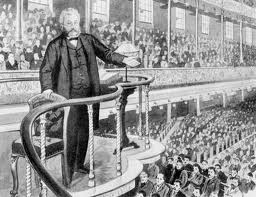
Dr. Larry Michael is senior pastor at First Baptist Church in Clanton, Ala. He serves as an adjunct professor at Beeson Divinity School in Birmingham. This article is an adaptation of writings from the upcoming book, Spurgeon on Leadership, Kregel Publications, scheduled for release October 2003.
Some years ago there was a documented case in the British Medical Journal about a man who laughed himself well. He actually had a terminal illness, and through the employment of laughter therapy, he allowed his body to successfully fight the disease.
While we may smilingly acknowledge the merit of such a case, for the most part, we find such an incident almost incredible. Can laughter really be that good for us? The Bible definitely supports such a notion.
The Bible advocates laughter
The writer of Ecclesiastes stated: “There’s a time to laugh, and a time to cry” (Ecclesiastes 3:4). We know that there are plenty of reasons to cry. Just a casual glance at our world, with its wars, hatred, violence and evil — makes us sad. Every day we see/hear on the news horrible accounts of hurting people who hurt others. We are grieved at the plight of so many persons who are living in darkness and have rejected the light of Christ. The stark reality of sin in our world is indeed sobering.
It’s not surprising that many of us as leaders may be more inclined toward sadness than to joy. Given the nature and demands of Christian leadership in an increasingly challenging world, one could cynically surmise that leaders may have more reason to be glum than glad these days. The pressures of our organizational responsibilities, and the accompanying stresses, can drag us down. Handling church conflict, losing someone special, helplessly seeing a marriage dissolve, experiencing personal betrayal, facing an unsuspected tragedy — all may give cause for tears.
To counter the sad times, the Scripture also advises that there is a time to laugh. Leaders need to know the balancing therapy of laughter. Toward that goal, we should fully embrace the joys of ministry — celebrating special moments with members, “high-fiving” family achievements, relishing the reaching of hard-earned goals, and savoring the blessing of spiritual growth. But those experiences may still fall short of the biblical pronouncement regarding laughter. C’mon, when was the last time you laughed so hard you cried?! Or, you actually had a good belly laugh?
Spurgeon’s great sense of humor
Many evangelicals know well the stern side of C. H. Spurgeon and his serious pursuit of the holy life. Indeed, his stands for righteous causes, and countering doctrinal error are often recounted. But many readers may not know that he was a man with a great sense of humor. Spurgeon knew the value of laughter and mirth. He virtually took to heart the word in Proverbs 17:22: “A merry heart doeth good like a medicine.”
Spurgeon laughed as often as he could. He laughed at the ironies of life, he laughed at comical incidents, he laughed at the amusing elements of nature. He sometimes laughed at his critics. He loved to share wholesome jokes with his friends and colleagues in ministry. He was known to tell humorous stories from the pulpit. William Williams, a fellow pastor who kept company with Spurgeon, was a near and dear friend in the latter years of Spurgeon’s life. He wrote:
What a bubbling fountain of humour Mr. Spurgeon had! I laughed more, I verily believe, when in his company than during all the rest of my life besides. He had the most fascinating gift of laughter . . . and he had also the greatest ability for making all who heard him laugh with him. When someone blamed him for saying humourous things in his sermons, he said, “He would not blame me if he only knew how many of them I keep back.” 1
Spurgeon considered humor such an integral part of his ministry that a whole chapter in his autobiography is devoted to it. Humor permeates his sermons and writings, often woven into the fabric of his messages. It’s one reason among many why he is still so readable today.
The therapy of laughter
Spurgeon knew the blessing of the treatment of humor. He often spoke of his illness in humorous terms: “I have had sharp pains,” he wrote to a friend, “but I am recovering. Only my back is broken, and I need a new vertebrae.” 2 Once, when he was feeling depressed, he spoke of the remedy of laughter:
The other evening I was riding home after a heavy day’s work. I felt wearied and sore depressed, when swiftly and suddenly that text came to me, ‘My grace is sufficient for thee.’ I reached home and looked it up in the original, and at last it came to me in this way. ‘My grace is sufficient for THEE.’ And I said, ‘I should think it is, Lord,’ and I burst out laughing. I never understood what the holy laughter of Abraham was till then. It seemed to make unbelief so absurd…O brethren, be great believers. Little faith will bring your souls to heaven, but great faith will bring heaven to your souls. 3
Some of Spurgeon’s humor even bordered on the cynical — like the time he was embroiled in the Baptismal Regeneration Controversy. When Spurgeon took on the Church of England clerics because of their belief in baptismal regeneration, he had a baptismal font installed in his back garden as a birdbath. He referred to it as “the spoils of war.” While the great “Prince of Preachers” may have gone over the top on that one, for the most part, his humor was balanced and appropriate.
Laughter a needful release
Laughter is an important release in a leader’s life. It is much-needed therapy for positions that are most often fraught with stress and the burdens of the day. Certainly there is a time to be sober as we face many tough situations in our lives and ministries. But, we need to learn how to experience the relief of laughter. Part of the problem is that too many of us take ourselves way too seriously. When we forget that God has a sense of humor, we need to do as one leader suggested — go look in the mirror!
Spurgeon knew the value of laughter and humor. Both in tough times and sick times, humor was a means for him to deal with his situation. It was a coping mechanism for him. There will always be seasons of sadness and joy for the conscientious leader. But, the leader who learns to balance the two, will learn the discipline of employing laughter and joy in his life. It could very well make a difference in his fulfillment and purpose in his service to the Lord.
Article adapted from Reformed Perspectives Magazine, Volume 9, Number 40, Septemeber 30 to October 6, 2007.
Notes: 1. William Williams, Personal Remembrances of Charles Haddon Spurgeon (London: Passmore and Alabaster, 1895), 24; 2. Ibid, 231; 3. Ibid, 25.
Which Tent Do You Live In?

All men live in one of two tents—content or discontent. In which do you live?
The contented man looks beyond his circumstances and sees a better day; the discontented man looks at his circumstances and sees no other way.
The contented man understands the purpose for which he was born; the discontented man looks at other’s success with a face that is filled with scorn.
The contented man has surrendered to a purpose that demands his best; the discontented man has selfishly hoarded much and grasping for more, will not rest.
The contented man has placed his values on things which will forever last; the discontented man has placed his values on things which will soon be past.
The contented man is anchored to clear goals and is hardly ever swayed; the discontented man has no goals that anchor him and is many times dismayed.
The contented man counts his blessings and names them one by one; the discontented man counts other’s blessings and thinks he has no fun.
All men live in one of two tents—content or discontent. In which do you live?
About John C. Maxwell:
John C. Maxwell is an internationally renowned pastor, leadership expert, coach, and author who has sold over 21 million books. Dr. Maxwell founded EQUIP and the John Maxwell Company, organizations that have trained more than 5 million leaders in 174 countries. Every year he speaks to Fortune 100 companies, international government leaders, and organizations such as the United States Military Academy at West Point, the National Football League, and the United Nations. A New York Times, Wall Street Journal, and Business Week best-selling author, Maxwell’s The 21 Irrefutable Laws of Leadership has sold more than 2 million copies. Developing the Leader Within You and The 21 Indispensable Qualities of a Leader have each sold more than 1 million copies. The article above was adapted from the encouraging and practical book by John C. Maxwell. Think On These Things. Kansas City: Beacon Hill Press, 1979, Chapter 30. This was the book that launched Maxwell’s writing career!
You can read his blog at JohnMaxwellOnLeadership.com, follow him at Twitter.com/JohnCMaxwell, and learn more about him at JohnMaxwell.com.
“And we know that for those who love God all things work together for good, for those who are called according to his purpose. For those whom he foreknew he also predestined to be conformed to the image of his Son, in order that he might be the firstborn among many brothers. And those whom he predestined he also called, and those whom he called he also justified, and those whom he justified he also glorified” (Romans 8:28-30)

Cheer Up Christian: “Your bad things turn out for good, your good things can never be lost, and the best things are yet to come.” – Tim Keller
Introduction
If you’re a Christian, you know that Christianity is supposed to be about joy. You probably also know that you’re supposed to experience joy in spite of circumstances. The Bible clearly teaches that joy is available that should make us happy no matter the circumstances. There’s a joy that the deepest trouble can’t put out and, if properly nourished and nurtured, can even overwhelm the greatest grief.
When Jesus prays to the Father in John 17:13, he prays for us—his followers. He says, I pray that “they may have the full measure of my joy within them.” One chapter before, he says to his disciples, “You will rejoice. and no one will take away your joy” (16:22). That’s pretty amazing! He’s talking to the twelve disciples, men who are going to be persecuted. They’re going to be robbed of everything they own, tortured, and put to death. Yet Jesus promises to give them a joy that will withstand all that. Nothing—not disease or persecution or alienation or loneliness or torture or even death—will be able to take it away.
I often wrestle with that concept. I have to ask myself, “Why do things affect me so much? Why is my joy not relentless?” Sometimes I wonder, “Do we have that kind of impervious joy?” I’m afraid not. I don’t think we understand the nature of this joy.
Romans 8 is all about living in a suffering world marked by brokenness. Paul talks about trouble and persecution and nakedness and poverty and how Christians are supposed to live in a world like that. In 8:28–30 he offers three principles for finding joy in suffering. Paul tells us that if we follow Christ, our bad things turn out for good, our good things cannot be lost, and our best things are yet to come. Those are the reasons for our joy.
Our bad things turn out for good
Verse 28 says: “For those loving him, God works together all things for good.”
There are three implications of this first principle.
First, this verse says that all things happen to Christians. That is, the Christian’s circumstances are no better than anybody else’s. It is extremely important for us to understand this if we’re going to experience relentless and impervious joy. Terrible things happen to people who love God. Many Christians explicitly teach—and most Christians implicitly believe—that if we love and serve God, then we will not have as many bad things happen to us. That’s not true! Horrible things can happen to us, and believing in and loving and serving God will not keep them from happening. All the same things that happen to everybody else will happen to people who love God. “All things” means all things, in this text. In verse 35 Paul says, “What can separate us from the love of Christ? Can trouble, hardship, persecution, famine, poverty, danger, or sword?” Those are terrible things. Paul is saying all the same things that happen to everybody else will happen to us, even if we love God. It’s very important to realize that.
The second implication of this point is that when things work together in your life, it’s because of God. Notice Paul does not say, “Things work together for good.” Things never work together for good on their own. Rather, if anything good happens, it is because God is working it together.
Earlier in Romans 8, Paul discusses how things fall apart because the world is burdened with evil and sin. Things are subject to decay. Everyone will eventually experience the decay of their bodies; that’s the nature of things. The little grains of sand on the beach used to be a mountain. Everything falls apart; things do not come together. This verse tells Christians to get rid of the saccharine, sentimental idea that things ought to go right, that things do go right, and that it’s normal for things to go right. Modern, Western people believe that if things go wrong, we should sue, because things ought to go right. But Christians have to discard that idea completely. Christians have to recognize that if our health remains intact, it is simply because God is holding it up. If people love us, if someone is there to hug us or squeeze our hand, if someone loves us in spite of all our flaws—if someone loves us at all—it’s because God is bringing all things together. God is holding it up. Everything that goes well is a miracle of grace.
The third implication of this principle is the most basic: Although bad things happen, God works them for good. This verse does not promise that those who love God will have better circumstances. Nor does this verse say that bad things are actually good things. Rather, it acknowledges that these are bad things, but it promises that they’re working for good. That means God will work them to good effect in your life.
The story of Jesus standing before the tomb of Lazarus is an endless source of insight for me. As he was about to raise Lazarus from the dead, Jesus was not smiling. He was angry. He was weeping. Why? Because death is a bad thing! Jesus wasn’t thinking, “They think that this is a tragedy, but no harm done! I’m about to raise him from the dead. This looks like a bad thing, but it’s not. It’s really a good thing! It’s a way for me to show my glory. It’s really exciting! I can’t wait!” He wasn’t thinking that. Jesus was weeping at the tomb, because the bad thing he’s about to work for good is bad. The story of Lazarus does not give you a saccharine view of suffering, saying bad things are really blessings in disguise or that every cloud has a silver lining. The Bible never says anything like that! God will give bad things good effects in your life, but they’re still bad. Jesus Christ’s anger at the tomb of Lazarus proves that he hates death. He also hates loneliness, alienation, pain, and suffering. Jesus hates it all so much that he was willing to come into this world and experience it all himself, so that eventually he could destroy it without destroying us.
There’s no saccharine view in the Christian faith. The promise is not that if you love God, good things will happen in your life. The promise is not that if you love God, the bad things really aren’t bad; they’re really good things. The promise is that God will take the bad things, and he’ll work them for good in the totality.
Keep in mind that verse 28 says all things work together for good. That doesn’t mean that when something bad happens, we can decide to give God a week to show us how the situation is going to turn out for good. In fact, don’t wait a month. Don’t wait a year. Don’t wait a decade. The promise isn’t for a month or a year or a decade. The promise is not that we will see how every bad patch in our lives works out for our good. The promise is that God will make sure that all the bad circumstances will work together for your life in its totality.
The best summary of this lesson that anybody has ever come up with is John Newton’s. He said: “Everything is necessary that he [God] sends; nothing can be necessary that he withholds.” What John Newton and Paul are saying is that if God has withheld good things—things that you think are good—they would only be good in the short run. In the long run, they would be terrible. They would be good in the partial but not in the whole. On the other hand, God will only bring bad things into your life—things God knows are bad—in order to cure you of things that can destroy you in the long run. The premise is, the things that really hurt—foolishness, pride, selfishness, hardness of heart, and the belief that you don’t need God—are the only things that can hurt you in the long run. In the short run selfishness and self-deception feel great, but in the long run they will destroy you.
Your joy will be impervious if you hold onto these three principles. Bad things will happen to you. We shouldn’t be shocked or surprised when bad things happen. One of the main reasons a lot of Christians are continually overthrown is not simply because bad things happen to them. At least half of their discouragement and despondency is due to their surprise at the bad things that happen to them. Do you see the distinction? Fifty percent of the reason we get so despondent is that we’re shocked. We say, “This isn’t how it’s supposed to be.” We may say life should be better, but that’s not what the promise is. Or we say we love God, therefore, surely we will have more good circumstances. That’s not the promise either. Until you understand what the promise is, you’re going to be continually shocked and even overthrown.
Our good things can never be lost
The second principle in this passage is that the good things we have cannot be lost. If you’ve been a Christian for any period of time, you know that Romans 8:28 is a very famous verse. People use it all the time. It’s what I call a “blessing box” verse. A blessing box is a collection of verses you rip out of context and recite without concern for what came before and after the verse. It feels good, so you use it. For example, people use Romans 8:28 to assure themselves that when bad things happen, then surely good things will happen. You might think, “I didn’t get into the grad school I wanted to get into, but that’s because there’s a better grad school for me somewhere.” Or, “I didn’t marry the girl or guy I wanted to marry, but that means there’s a better one for me somewhere.” That’s not the promise.
There’s a little word between verses 28 and 29 that indicates the verses go together. The little word is for. “All things work together for good for those who love God and are called according to his purpose, for those he foreknew he also predestined to be conformed into the likeness of his Son.”
God does not promise you better life circumstances if you love him. He promises you a better life. Grad school and marriage are circumstances. We’re talking about a joy that goes beyond circumstances. How dare we interpret verse 28 as a joy that is dependent on those things! Here is an important principle: Jesus Christ did not suffer so that you would not suffer. He suffered so that when you suffer, you’ll become like him. The gospel does not promise you better life circumstances; it promises you a better life.
Romans 8:29 tells us the goal toward which all our circumstances are moving us. Paul uses the word predestined. He’s not introducing the word to confuse you—he doesn’t intend to explain the doctrine of predestination or address the issues that arise when that word is mentioned. He uses this word to comfort us. Something that is predestined is fixed. What Paul means is that if you love God, you can count on a promise that is absolutely fixed, no matter what. That’s all he’s trying to get across.
What is it that is predestined? That we will be conformed to the image of Christ. The Greek word here is morpha, from which we get the word metamorphosis. Paul is saying that God promises to “metamorphosize” us. He promises to change our very inner essence into the very inner essence of Jesus Christ. To be a Christian is to become passionately in love with the character of Jesus. You read about him in the Bible and are amazed by the truth and love you find in his life. You see wisdom and utter conviction. You see incredible courage, brightness, and radiance. The good that God is moving you toward through everything that happens in your life—whether externally good or bad—is your transformation into Christ’s nature. If you love God, everything that happens in your life will mold you, sculpt you, polish you, and shape you into the image of his Son. He is making you like him. He’ll give you Christ’s incredible compassion and courage. God is working everything that happens in your life toward that magnificent goal. It’s predestined. It’s guaranteed.
One of the most astounding things in Romans 8:30 is this: “And those he predestined, he also called; those he called, he also justified; those he justified, he also glorified.” Glorified is in the past tense. Shouldn’t Paul say, “The ones he foreknew he predestined, and justified, and will glorify”? Because the apostle is so absolutely certain that you are bound—that God is going to make you as beautiful as Jesus and give you all these incredible things—he writes of the glorification as an accomplished fact. He talks about it in the past tense because it’s as good as done. God is not going to let anything in life get between you and that goal. You are predestined to be conformed to the image of God’s Son.
In Romans 8:29 Paul calls Christ “the firstborn among many brothers.” That means we are all sons of God. We are all adopted into the family. When Paul alludes to adoption, he’s talking about a practice that was common in the Roman world, but one that’s quite different from the way we think of adoption. In the Roman world, most people who were adopted were adults. When a wealthy man had no heir and didn’t want his estate to be broken up when he died, he would adopt an adult male, usually someone who worked for him whom he trusted. By adopting that adult male, he made him his son. The minute the legal procedure took place, their relationship was changed from formal to intimate, from temporary and conditional to permanent and unconditional. All the debts the man owed before his adoption were wiped out, and he suddenly became rich.
Being completely conformed to the likeness of God’s Son is something that we look forward to in the future, although the transformation is happening now gradually. Being adopted among many brothers is something that we have now. The minute you become a Christian, you have intimacy of relationship. You have an unconditional relationship. You become wealthy, because everything that Jesus Christ has accomplished is transferred to you. You become beautiful and spiritually rich in him.
Some people are put off by Paul’s language of adoption because it’s gender insensitive. They argue, “Wouldn’t it be better to say that we become sons and daughters of God?” It would, but that misses the whole point. Some time ago, a woman helped me understand this. She was raised in a non-Western family from a very traditional culture. There was only one son in the family, and it was understood in her culture that he would receive most of the family’s provisions and honor. In essence, they said, “He’s the son; you’re just a girl.” That’s just the way it was.
One day she was studying a passage on adoption in Paul’s writings. She suddenly realized that the apostle was making a revolutionary claim. Paul lived in a traditional culture just like she did. He was living in a place where daughters were second-class citizens. When Paul said—out of his own traditional culture—that we are all sons in Christ, he was saying that there are no second-class citizens in God’s family. When you give your life to Christ and become a Christian, you receive all the benefits a son enjoys in a traditional culture. As a white male, I’ve never been excluded like that. As a result, I didn’t see the sweetness of this welcome. I didn’t recognize all the beauty of God’s subversive and revolutionary promise that raises us to the highest honor by adopting us as his sons.
Our adoption means we are loved like Christ is loved. We are honored like he is honored—every one of us—no matter what. Your circumstances cannot hinder or threaten that promise. In fact, your bad circumstances will only help you understand and even claim the beauty of that promise. The more you live out who you are in Christ, the more you become like him in actuality. Paul is not promising you better life circumstances; he is promising you a far better life. He’s promising you a life of greatness. He is promising you a life of joy. He’s promising you a life of humility. He’s promising you a life of nobility. He’s promising you a life that goes on forever.
The best things are yet to come
That brings us to the third point. Why can you be joyful no matter what? Your bad things turn out for good, your good things can never be lost, and the best is yet to come. If you understand what is to come, you can handle anything here. What amazes me is that even Ivan Karamazov, the atheist character in Dostoevsky’s The Brothers Karamazov, understood how knowing what is to come helps a person endure present circumstances. He said:
I believe that suffering will be healed and made up for, that in the world’s finality, at the moment of eternal harmony, something so precious will come to pass that it will suffice for all hearts, for the comforting of all resentments, for the atonement of all the crimes of humanity, of all the blood that’s been shed, that it will make it not just possible to forgive, but to justify all that’s happened.
I don’t want you to think that this talk about glory and about heaven trivializes suffering. In fact, Ivan Karamazov said that this hope is the only worldview that takes our brokenness seriously. Our souls are so great and our suffering is so deep that nothing but this promise can overwhelm it. Glory does not trivialize human brokenness. It’s the only thing that takes it seriously. What else could possibly deal with the hurts of our hearts? Your soul is too great for anything but this. Don’t you know a compliment when you hear it?
About the Author
Timothy Keller is founding pastor of Redeemer Presbyterian Church (PCA) in New York City and the author of numerous books, including The Reason for God, King’s Cross, Counterfeit Gods, The Prodigal God, and Generous Justice.
The sermon above was adapted from a collection of Sermons in a book entitled “Sunday’s Best” published by Hendrickson Publishers in Peabody, Massachusetts, 2011.
“God’s Got You Covered”
“Now to him who is able to do far more abundantly than all that we ask or think, according to the power at work within us, to him be glory in the church and in Christ Jesus throughout all generations, forever and ever. Amen” (Ephesians 3:20-21).
I recently took my ten-year-old nephew J.J. on a speaking engagement. He was overwhelmed when we got there. It was a huge auditorium, thousands of people were there, and television cameras were everywhere.
It made me smile to see J.J.’s reaction to everything, but after a while he asked me a question that made me chuckle. He looked at me and, with a look of concern, on his face, he said, “Uncle C.W., do I need some money for food?”
“No, buddy,” I said with a smile. “You don’t need anything. The folks here have taken care of everything. As long as you’re with Me, you don’t have need of anything.”
It’s a truth we take from the written Word of God: He has us covered! The apostle Paul addressed this issue when he wrote: “Now to him who is able to do far more abundantly than all that we ask or think, according to the power at work within us, to him be glory in the church and in Christ Jesus throughout all generations, forever and ever. Amen” (Ephesians 3:20-21).
What an amazing promise! This means that the same power that raised Jesus from the dead rests within us, ready to enable us to rise to any challenge we may face. No matter what task is ahead, no matter what problem lies before you, God has promised that the power that lives within us through the Spirit of God is more than enough for us to emerge victorious.
In this verse, the verb “work” is in the present tense, meaning that God did not just do the work in us at the time we first received salvation, but continues to work within us. That’s right! God’s power is at work in you at this very moment.
I want to highlight three ways that God’s power works within us:
My friend Joseph Garlington likes to say, “God’s power is getting you ready for what He already has ready for you.” Another way to say that is, no matter what your needs are, no matter how desperate a situation God is taking you through, you will always have the power to be victorious.
Always remember, God’s got you covered!
ABOUT THE AUTHOR:
CRAWFORD W. LORITTS JR. (B.S., D.Th., Philadelphia Biblical University; D.Div., Biola University) is the senior pastor of Fellowship Bible Church in Roswell, Georgia. He has served as a national evangelist with the American Missionary Fellowship and the Urban Evangelistic Mission, and as Associate Director of Campus Crusade for Christ. He co-founded Oak Cliff Bible Fellowship in Dallas, Texas. He is a frequent speaker for professional sports teams, including three Super Bowls and the NCAA Final Four Chapel, and has spoken at conferences, churches, conventions and evangelistic outreaches throughout Europe, Africa, Asia, the Caribbean and the United States. He is also the host of Living A Legacy, a daily radio program.
Dr. Loritts has written numerous articles and is the author of six books, including Leadership as an Identity, Lessons from a Life Coach, and For a Time We Cannot See. He co-authored Developing Character in Your Child with his wife, Karen. Dr. Loritts and his wife have four grown children and live in the Atlanta, Georgia area.
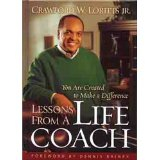
Article above adapted from Crawford W. Loritts JR. Lessons From A Life Coach: You Are Created to Make a Difference. Chicago: Moody Press, 2001, pp. 136-137.
“The Bumps Are What You Climb On”

A little boy was leading his sister up a mountain path and the way was not too easy. “Why, this isn’t a path at all,” the little girl complained. “It’s all rocky and bumpy.” And her brother replied, “Sure, the bumps are what you climb on.” That’s a remarkable piece of philosophy. What do you do with the bumps on the path of life?
I have been a reader of biographies for many years, and I have yet to find a successful person whose life was free from problems and difficulties. Looking at these people from a distance, you might think they had it made and that life was easy for them. But when you get closer, you discover that their climb to the top of the mountain was not an easy one. The road was rocky and bumpy, but the bumps were what they climbed on to get to the top.
We don’t have to read too far in the Bible before we discover the truth. Abraham certainly didn’t become a great man of faith overnight. He had to go through some difficult tests on the road of life before he reached the top of the mountain. No sooner did Abraham arrive in Canaan than a famine came to the land. Imagine facing a famine in the land God has promised you! Then Abraham had problems with his nephew, Lot; and then war came to the land, and Abraham had to go out and fight. His wife led him astray with bad counsel and the result was the birth of Ishmael, a boy who brought sorrow to Abraham’s heart. Finally, Isaac, the promised son, was born, bringing great joy to Abraham and Sarah. Then God asked Abraham to put Isaac on the altar, a sacrifice that would be difficult for any father or mother. Yes, there were many bumps on that road, but Abraham used the bumps to climb higher.
If anybody walked a rocky road, Joseph did. His father pampered him, hated by his brothers, sold for a slave, falsely accused, put into prison, forgotten, and apparently forsaken. But the bumps on the road helped him to climb higher, and one day Joseph became the second in command of all Egypt. Moses had a similar experience, and so did David, Daniel, and Paul. Here were people who did not complain about the road; they accepted the difficulties of life and used them as stepping-stones to the top of the mountain.
I don’t know what difficulties you are going through just now, but I know some of the feelings you have, because I have been on this bumpy road myself. You feel like quitting, like giving up. You can’t understand why the road doesn’t get easier, why God doesn’t remove the stones and straighten the path. If God did that, you might never get to the top, because the bumps are what you can climb on.
Psalm 91 says, “He that dwelleth in the secret place of the most High shall abide under the shadow of the Almighty.” It is a psalm that magnifies the care that God exercises over His children. Eleven different kinds of dangers are named in this psalm-war, snares, sickness, terrors by night, arrows by day, and others-yet God says that He can protect us from them all. This doesn’t mean that we will never experience accidents or injuries; but it does mean that no matter what happens in the will of God, all things will work together for good.
One of the greatest promises found in Psalm 91 has to do with the stones on the path. “For he shall give his angels charge over thee, to keep thee in all thy ways. They shall bear thee up in their hands, lest thou dash thy foot against a stone.” God doesn’t promise to remove the stones from the path, but He does promise to make them stepping-stones and not stumbling blocks. He promises to help us climb higher because of the difficulties of life.
Most of us respond in a predictable wayto the rocks in the path. We complain about them; we kick against them and only hurt ourselves. We try to pick them up and get rid of them, only to discover they are too heavy for us. We can’t always get around them, and we wonder if we can get over them. Some people just stop and go no further. Others give up and turn back. But the child of God does not have to stop or go back; he can use the rocky places in life as stepping-stones to climb higher.
The trouble with most of us is that we are accustomed to paved roads and level sidewalks. But life is not made that way. Sometimes the road is level and easy, and the birds are singing and the way is wonderful. But sometimes the road is rocky and bumpy, and we hear no music and feel no helping hand. Then what? Complain? Give up? No, that’s the time to remember God’s promise: “For he shall give his angels charge over thee, to keep thee in all thy ways.” God’s invisible army is at your service, and God can see you through.
Charlie Brown in the “Peanuts” comic strip is one of my favorite characters. In one particular strip, he is complaining because his team always loses their games. Lucy tries to console him by saying, “Remember, Charlie Brown, you learn more from your defeats than you do from your victories.” And Charlie Brown replies, “That makes me the smartest man in the world!”
If life were nothing but a series of defeats, all of us would get discouraged. God knows how to balance our lives so that we have sunshine and rain, calm and storm, laughter and tears. On the road of life there are level places that delight us, and there are difficult places that challenge us. If we get off the path of God’s will and go on a detour, the way will be rough from start to finish. The detour is always rougher than the main road. But there are rocks and bumps even on the paths of God’s choosing, and we have to learn to accept them and benefit from them. The bumps are what you climb on.
But this takes faith. It is much easier to kick the rock and turn around and go back. The secret to climbing higher is to look away from yourself and your difficulties, and look by faith to Jesus Christ. He knows where you are, how you feel, and what you can do. Turn it all over to Him and start walking by faith. The very rocks that seem like barriers to human eyes will, to the eyes of faith, become blessings. Listen to the promises of Psalm 91:15: “He shall call upon me, and I will answer him: I will be with him in trouble; I will deliver him, and honor him.”
If anybody faced obstacles on the road of life, it was our Lord Jesus Christ. He was born into a poor family, a member of a rejected minority race. He grew up in obscurity in a little town that mentioned only in scorn—“Can any good thing come out of Nazareth?” He gathered about Him a small group of nondescript men, and one of them became a traitor and sold Him for the price of a slave. He was called a liar, a glutton, a drunkard, and a man in league with the devil. Men twisted His words and questioned His motives, yet Jesus Christ continued to do the will of God. Finally, He came to that greatest stone of all—being crucified like a common thief. But He continued to climb that mountain, and God gave Him the victory.
This is why the writer of the Book of Hebrews urges us to look to Jesus Christ and keep on trusting. “Looking unto Jesus the author and finisher of our faith; who for the joy that was set before him endured the cross, despising the shame, and is set down at the right hand of the throne of God” (12:2). We are to look not at ourselves, our circumstances, our troubles, or the bumps in the road, but unto Jesus.
Yes, the bumps are what you climb on!
About Warren W. Wiersbe:
Warren W. Wiersbe is the Distinguished Professor of Preaching at Grand Rapids Baptist Seminary, and is the author of more than 100 books. Billy Graham calls him “one of the greatest Bible expositors of our generation.” Interestingly, Warren’s earliest works had nothing to do with scriptural interpretation. His interest was in magic, and his first published title was Action with Cards (1944).
“It was sort of imbecilic for a fifteen-year-old amateur magician to have the audacity to write a book and send it to one of the nation’s leading magic houses,” Warren says. But having a total of three books published by the L.L. Ireland Magic Company—before the age of 20—gave him a surge of confidence. In later years, he applied his confidence and writing talent to the Youth for Christ (YFC) ministry.
Warren wrote many articles and guidebooks for YFC over a three-year period, but not all his manuscripts were seen by the public eye. One effort in particular, The Life I Now Live, based on Galatians 2:20, was never published. The reason, Warren explains with his characteristic humor, is simple: it was “a terrible book…Whenever I want to aggravate my wife, all I have to say is, ‘I think I’ll get out that Galatians 2:20 manuscript and work on it.’” Fortunately, Warren’s good manuscripts far outnumbered the “terrible” ones, and he was eventually hired by Moody Press to write three books.
The much-sought-after author then moved on to writing books for Calvary Baptist Church. It was during his ten years at Calvary that Expository Outlines on the New Testament and Expository Outlines on the Old Testament took shape. These two works later became the foundation of Warren’s widely popular Bible studies known as the Be series, featuring such titles as Be Loyal (a study on Matthew) and Be Delivered (a study on Exodus). Several of these books have been translated into Spanish.
His next avenue of ministry was Chicago’s Moody Memorial Church, where he served for seven years. He wrote nearly 20 books at Moody before moving to Lincoln, Nebraska, where he and his wife, Betty, now live. Prior to relocating, he had been the senior pastor of Moody Church, a teacher at Trinity Evangelical Divinity School, and a producer of the Back to the Bible radio program.
During all these years of ministry, Warren held many more posts and took part in other projects too numerous to mention. His accomplishments are extensive, and his catalog of biblical works is indeed impressive and far-reaching (many of his books have been translated into other languages). But Warren has no intention of slowing down any time soon, as he readily explains: “I don’t like it when people ask me how I’m enjoying my ‘retirement,’ because I’m still a very busy person who is not yet living on Social Security or a pension. Since my leaving Back to the Bible, at least a dozen books have been published, and the Lord willing, more are on the way.”
Some of Wiersbe’s recent books include Your Next Miracle, The 20 Essential Qualities of a Child of God, The Bumps are What You Climb On, Classic Sermons on the Fruit of the Spirit, Classic Sermons on Jesus the Shepherd, Key Words of the Christian Life, Lonely People, A Gallery of Grace, Real Peace: Freedom and Conscience in the Christian Life, and On Being a Leader for God.
The article above was adapted from the very encouraging and practical book by Warren W. Wiersbe. The Bumps Are What You Climb On: Encouragement for Difficult Days. Baker: Grand Rapids, 2003 (Chapter One).
October 31, 1517 & October 31, 2012 (495 years Later)

Anyone who follows this blog regularly already knows that I have been diagnosed with cancer. I begin my treatment today – 4-5 hours of chemotherapy and 24 minutes of Radiation. I will have 33 straight treatments with the hopes that my cancer will be killed.
I don’t believe it’s by coincidence or an accident that my chemotherapy and radiation treatment begin on October 31st – the day that Martin Luther nailed his 95 Thesis to the Church Door at Wittenberg, Germany. Luther’s 95 Theses sparked perhaps one of the five most significant days in Church history since the closing of the Canon of Scripture on any church historian’s list of significant days.
I want to make a few observations before I leave for the hospital for treatment today:
(1) I am grateful for truth and those who fight for it – no matter what the cost. When you get cancer you start hearing stories of courageous people of all ages who have battled and overcome cancer; and on the other hand, there are many who were courageous and have lost the battle. Honestly, I’ve never been so inspired by others in a battle for anything. When death is on the line – anything cancer survivors have to say, is like E.F. Hutton speaking to me – when they talk I listen (1980’s television commercial “When E.F. Hutton talks, people listen”). I am grateful that Martin Luther did not recant of his teaching of justification by faith in Christ Jesus. There is no greater comfort I have than my security and peace with God the Father through His Son – Jesus Christ. I know that whether I live or die – that I’m justified before God the Father because of the Person and Work of Jesus Christ my Savior and Lord. I am so grateful for the promise of Jesus related to Him being the pinnacle of truth when He declares to Thomas and the disciples in John 14:6, “I am the way, the truth, and the life, no one comes to the Father except through me.”
(2) I thank God for what theologians call “common grace.” Two of the people that have helped me the most since I’ve been diagnosed with cancer are not followers of Christ. And yet, I am so grateful for their advice, wisdom, and compassion in my battle with cancer and all the medical procedures I’ve had to go endure so far. I am grateful for doctors, nurses, pharmacists, and others who have come alongside me with an expertise in their particular areas in treating cancer. It is a common grace that all truth is God’s truth. The rain falls on the wicked farmer’s and righteous farmer’s crops alike. I am reminded that all people are made in God’s image and though they may not share my passion for Christ and God’s Word – they are special and many share an affinity for objective truth’s and helping their fellow man. Luther was helped by many who were not followers of Christ in helping bring about the Reformation of the church and the Gospel. In the Bible God uses men as wicked as Judas to bring about His purposes.
(3) I am grateful for God’s sovereignty. I know that nothing can happen to me that He does not allow. R.C. Sproul likes to say there is not one single maverick molecule that is not under God’s control. I believe that God can kill my cancer without chemotherapy or radiation treatment. Many family members, and friends, and even Christians I don’t even know, in different parts of the world are praying for me. I feel totally humbled by this outpouring of love. Elders, my mom, and several close friends have anointed me with oil. However, the cancer is still there. As of today I still have cancer that needs to be killed through the means of God’s people praying, medications, radiation and chemotherapy treatment, and the various nutritional cancerous killing foods I’ve been eating and drinking. However, no matter what happens I know that God is sovereign – in control of everything (including my cancer), and that He is good – He will be glorified no matter what becomes of my cancer. Luther was not perfect – as a matter of fact that’s why he was so passionate about the Bible. In God’s sovereignty He raised up a brilliant and yet very bombastic theologian to shake things up in the Church. I don’t claim to be brilliant, nor too bombastic, but I do know that God will bring about good and the glorification of His Son on a much smaller scale in sovereignly using my cancer for His ultimate purposes and plans – and that is extremely comforting. The fact that no one, no thing, no ruler, no nation, no disease – can thwart the sovereign plan of God to bring glory to Himself.
(4) Luther said that suffering helped him understand the Bible, and that without experiencing pain and suffering you can’t be a good theologian. I strive hard to be a good interpreter and teacher, but I totally concur with Luther – suffering makes you a much better theologian. I don’t like suffering or pain any more than anyone else. But I think that the emotional pain that led to physical pain for the advancement of the gospel in Luther’s life was worth it. It was worth it for me, and worth it for you. I’m so glad that I know salvation by grace through faith in Christ alone because Luther’s heritage has been passed down for almost 500 years. Before him it was taught by all of the apostles in the New Testament. It is extremely clear. But nothing good, comes easy, or without a cost. We have the phrase in America – “No pain, no gain.” Without Christ’s suffering and pain on the cross there would be no spiritual gain in any way, shape, or form in our standing with God. I stand amazed at Jesus’ voluntarily leaving His rightful place with the Father and Spirit to come to planet earth to pay the ultimate price and be the one and only sacrifice for our sin. He is able to empathize with our sufferings and weaknesses, and is yet without sin.
Today I stand as Luther did on the truth of justification by faith alone in Jesus; in God’s common grace through the expertise of the doctors and nurses and the medications they will use to kill my cancer; in the sovereign will of God working all things together for my good and His glory; and I’m prepared to suffer because in Christ I know that His sufferings were greater still and for a greater good; no matter what happens – as Luther was able to say “Here I Stand” – I can also stand firmly today 495 years later because of Jesus the Nazarene.
The song below will be going through my mind during radiation and chemotherapy treatment today. It summarizes everything that Luther stood for on October 31, 1517. It is a song that talks about going from darkness to light; sinner to saint; from totally condemned because of my sin to fully redeemed by His righteousness. Why? Because of the amazing plan of the Father to send His Son – the Perfect for the imperfect; the Clean for the unclean; the obedient sacrificial Lamb for the rebellious goat. I hope and pray that the chemotherapy and radiation will do for me in a physical sense what Christ has done for me in a spiritual sense. I pray the cancer will be wiped away as Jesus has washed away all of my sin. Here is the song written by Charles H. Gabriel that summarizes these truths of the Reformation:
“I Stand Amazed in the Presence”
(Verse 1):
I stand amazed in the presence
Of Jesus the Nazarene,
And wonder how he could love me,
A sinner, condemned, unclean.
Refrain:
How marvelous! How wonderful!
And my song shall ever be:
How marvelous! How wonderful
Is my Savior’s love for me!
(Verse 2):
For me it was in the garden
he prayed: “Not my will, but thine.”
He had no tears for own griefs,
But sweat-drops of blood for mine.
(Verse 3):
In pity angels beheld him,
and came from the world of light
to comfort him in the sorrows
he bore for my soul that night.
(Verse 4):
He took my sins and my sorrows,
he made them his very own;
he bore the burden to Calvary,
and suffered and died alone.
(Verse 5):
When with the ransomed in glory
his face I at last shall see,
‘twill be my joy through the ages to sing of his love for me.
(Refrain)
 LifeCoach4God