 “The Gospel and the Supremacy of Christ in a Postmodern World” by *Tim Keller
A Crisis for Evangelism
Our current cultural situation poses a crisis for the way evangelicals have been doing evangelism for the past 150 years—causing us to raise crucial questions like: How do we do evangelism today? How do we get the gospel across to a postmodern world?
In 1959 Martyn Lloyd-Jones gave a series of messages on revival. One of these expositions was on Mark 9, where Jesus comes off the mountain of transfiguration and discovers his disciples trying unsuccessfully to exorcise a demon from a boy. After he rids the youth of the demonic presence, the disciples ask him, “Why could we not cast it out?” Jesus answers, “This kind cannot be driven out by anything but prayer” (Mark 9:28-29). Jesus was teaching his disciples that their ordinary methods did not work for “this kind.” Lloyd-Jones went on to apply this to the church:
“Here, in this boy, I see the modern world, and the disciples I see the Church of God…I see a very great difference between today and two hundred years ago, or indeed even one hundred years ago. The difficulty in those earlier times was that men and women were in a state of apathy. They were more or less asleep…There was no general denial of Christian truth. It was just that people did not trouble to practise it…All you had to do then was to awaken them to rouse them…
But the question is whether that is still the position…What is ‘this kind’?…The kind of problem facing us is altogether deeper ad more desperate…The very belief in God has virtually gone…The average man today believes that all this belief about God and religion and salvation…is an incubus on human nature all through the centuries…
It is no longer merely a question of immorality. This has become an amoral or a non-moral society. The very category of morality is not recognized…
The power that the disciples had was a good power, and it was able to do good work in casting out the feeble devils, but it was no value in the case of that boy (D. Martyn Lloyd-Jones, Revival (Wheaton, IL: Crossway Books, 1987, pp. 9, 13-15).
Put simply, Jesus is saying, the demon is in too deep for your ordinary way of doing ministry. It is intriguing that Lloyd-Jones said this some time before Lesslie Newbigin began to propound the thesis that Western society was a mission field again (See Lesslie Newbigin, Foolishness to the Greeks, Grand Rapids, MI: Eerdmans, 1986 and The Gospel in a Pluralistic Society, Grand Rapids, MI: Eerdmans, 1989).
Indeed it was perhaps the most challenging mission field yet, because no one had ever had to evangelize on a large scale a society that used to be Christian. Certainly there have been many times in the past when the church was in serious decline, and revival revitalized the faith and society. But in those times society was still nominally Christian. There hadn’t been a wholesale erosion of the very concepts of God and truth and of the basic reliability and wisdom of the Bible. Things are different now.
 Inoculation introduces a mild form of a disease into a body, thereby stimulating the growth of antibodies and rendering the person immune to getting a full-blown version of the sickness. In the same way, post-Christian society contains unique resistance and “antibodies” against full-blown Christianity. For example, the memory of sustained injustices that flourished under more Christianized Western societies has become an antibody against the gospel. Christianity was big back when blacks had to sit on the back of the bus and when men without consequences beat up women. We’ve tried out a Christian society and it wasn’t so hot. Been there. Done that. In a society like ours, most people only know of either a very mild, nominal Christianity or a separatist, legalistic Christianity. Neither of these is, may we say, “the real thing.” But exposure to them creates spiritual antibodies, as it were, making the listener extremely resistant to the gospel. These antibodies are now everywhere in our society.
During the rest of his sermon on Mark 9, Lloyd-Jones concludes that the evangelism and church-growth methods of the past couple of centuries, while perfectly good for their time (he was careful to say that), would no longer work. What was needed now was something far more comprehensive and far-reaching than a new set of evangelistic programs.
I believe that Lloyd-Jones’s diagnosis is completely on target. Richard Fletcher’s The Barbarian Conversion traces the way in which Christians evangelized in a pagan context from A.D. 500-1500 (Richard Fletcher, The Barbarian Conversion: From Paganism to Christianity, Berkley: University of California Press, 1999). During that time major swaths of Europe (especially the countryside rather than the cities) remained pre-Christian pagan. They lacked the basic “worldview furniture” of the Christian mind. They did not have a Christian understanding of God, truth, or sin, or of peculiar Christian ethical practices. Evangelism and Christian instruction were a very long and comprehensive process.
But eventually nearly everyone in Europe (and in North America) was born into a world that was (at least intellectually) Christian. People were educated into a basic Christian-thought-framework—a Christian view of God, of soul and body, of heaven and hell, of rewards and punishments, of the Ten Commandments and the Sermon on the Mount. And that is why the church could make evangelism into both a simpler and a more subjective process than that practiced by previous generations. The people believed in sin, but they hadn’t come to a profound conviction that they were helpless sinners. They believed in Jesus as the Son of God who died for sin, but they hadn’t come to cling to him personally and wholly for their own salvation and life. They needed to come to a deep personal conviction of sin and to an experience of God’s grace through Christ. They had a Christian mind and conscience, but they didn’t have a Christian heart. The need, then, was for some kind of campaign or program that roused and shook people—taking what they already basically believed and making it vivid and personal for them, seeking an individual response of repentance and faith.
Since the end of the “Barbarian Conversion,” then, evangelism has shrunk into a program with most of the emphasis being on individual experience. The programs have ranged from preaching-and-music revival seasons, to one-on-one witnessing, to small-group processes. I agree with Lloyd-Jones that there was nothing wrong with these methods as far as they went and in their day. But now this kind won’t be effectively addressed by that older approach.
 Some might respond that Lloyd-Jones has not been proven right. Isn’t evangelical Christianity growing—at least in North America? Look at all the mega churches spouting up! But we must remember that the new situation Lloyd-Jones was describing has spread in stages. It was in Europe before North America. It was in cities before if was in the rest of the society. In the United States it has strengthened in the Northeast and the West Coast first. In many places, especially in the South and Midwest, there is still a residue of more conservative society where people maintain traditional values. Many of these people are therefore still reachable with the fairly superficial, older evangelism programs of the past. And if we are honest, we should admit that many churches are growing large without any evangelism at all. If a church can present unusually good preaching and family ministries and programming, it can easily attract the remaining traditional people and siphon off Christians from all the other churches in a thirty-mile radius. This is easier now than ever because people are very mobile, less tied into their local communities, and less loyal to institutions that don’t meet their immediate needs. But despite the growth of mega churches through these dynamics, there is no evidence that the number of churchgoers in the United States is significantly increasing (see for example, http://www.theamericanchurch.org/facts/1.htm.).
What is clear is that the number of secular people professing “no religious preference” is growing rapidly. Michael Wolff, writing in New York Magazine, captures the growing divide:
There is a fundamental schism in American cultural, political, and economic life. There’s the quicker-growing, economically vibrant…morally relativist, urban-oriented, culturally adventuresome, sexually polymorphous, and ethnically diverse nation…And there’s the small-town, nuclear-family, religiously oriented, white-centric other America…with its diminishing cultural and economic force…Two countries (Michael Wolff, “The Party Line,” New York Magazine (Feb. 26, 2001): 19. Online at http://nymag.com/nymetro/news/media/columns/medialife/4407/index1.html.).
So Lloyd-Jones is right that the demon is in too deep for your ordinary way of doing ministry—especially in more secular, pluralistic Europe and in the parts of the United States that are similar. In the Christ-haunted places of the West you can still get a crowd without evangelism or with the older approaches. But the traditional pockets of Western society simply are not growing.
I will put my neck on the line and go so far as to say that in my almost thirty-five years in full-time ministry I’ve seen nearly all the older evangelism programs fade away as they have proved less and less effective. Dwight Moody pioneered the mass-preaching crusade in the late nineteenth century, and Billy Graham brought it to its state of greatest efficiency and success, but few are looking in that direction for reaching our society with the gospel.
In the latter part of the twentieth century there were a number of highly effective, short, memorizable, bullet-pointed gospel presentations written for individual lay Christians to use in personal evangelism. Programs were developed for training lay people to use the presentations door-to-door, or in “contact” evangelism in public places, or with visitors to church, or in personal relationships. These have all been extremely helpful but the churches I know that have used the same program in the same place for decades have seen steadily diminishing fruit.
The next wave of evangelism programming was the “seeker service” model developed by many churches, especially large ones. It is far too early to say that this methodology is finished, and yet younger ministers and church leaders are wont to say that it is too geared to people with a traditional, bourgeoisie, still-Christ-haunted mindset to operate. In many parts of society that kind of person is disappearing.
Today the main programmatic “hope” for churches seeking to be evangelistic is the “Alpha” method which comes out of Holy Trinity Anglican Church in London (See www.alpha.org.) There are good reasons why this more communal, process-oriented approach has been so fruitful, but I believe that the same principle will hold true, even for Alpha. There is no “magic bullet.” You can’t simply graft a program (like Alpha or its counterparts) onto your existing church-as-usual. You can’t just whip up a new gospel presentation, design a program, hire the staff, and try to get people in the door. The whole church and everything it does is going to have to change. The demon’s in too deep for the older ways.
In fact, things are more difficult than they were in Lloyd-Jones’s lifetime. He was facing what has been called a “modern” culture, and we face a “postmodern” one—making evangelism methods even more obsolete. It is not my job t look at the “modern vs. postmodern” distinction in any detail, but I think most would agree that the postmodern mindset is associated with at least three problems. First, there’s a truth problem. All claims of truth are seen not as that which corresponds to reality but primarily as constraints aimed to siphon power off toward the claimer. Second, there’s the guilt problem. Though guilt was mainly seen as a neurosis in the modern era (with the reign of Freud), it was still considered a problem. Almost all the older gospel presentations assume an easily accessed sense of guilt and moral shortcoming in the listener. But today that is increasingly absent. Third, there is now a meaning problem. Today there’s enormous skepticism that texts and words can accurately convey meaning. If we say, “Here is a biblical text and this is what it says,” the response will be, “Who are you to say this is the right interpretation? Textual meanings are unstable.”
So how do we get the gospel across in a postmodern world? The gospel and the fact that we are now a church on a mission field will dictate that almost everything the church does will have to be changed. But that is too broad a statement to be of any help, so I will lay out six ways in which the church will have to change. Each of these factors has parallels in the account of Jonah and his mission to the great pagan metropolis of Nineveh (I will ground the six factors in the Jonah text, but the following should not be seen as an effort to carefully or thoroughly expound the book of Jonah).
Gospel Theologizing
Jonah 1:1-2: “The word of the LORD came to Jonah…saying, ‘Go to…Nineveh and preach’” (NIV). For a long time I understood the “gospel” as being just elementary truths, the doctrinal minimum for entering faith. “Theology,” I thought, was the advanced, meatier, deeper, biblical stuff. How wrong I was! All theology must be an exposition of the gospel, especially in the postmodern age.
 A good example of this is found in Mark Thompson’s book, A Clear and Present Word (Mark D. Thompson, A Clear and Present Word: The Clarity of Scripture, New Studies in Biblical Theology, ed. D. A. Carson, Downers Grove, IL: InterVarsity Press, 2006). Thompson first describes our cultural context in which people believe all meanings are unstable and all texts are indeterminate. He then develops a Christian theology of language. This is certainly not elementary stuff. He begins by looking at the Trinity. Each person—Father, Son, and Holy Spirit—seeks not his own glory but only to give glory and honor to the others. Each one is pouring love and joy into the heart of the other. Why would a God like this create a universe? As Jonathan Edwards so famously reasoned it couldn’t be in order to get love and adoration, since as a triune God he already had that himself (See the singular “The Dissertation Concerning the End for Which God Created the World,” in The Works of Jonathan Edwards, vol. 8, Ethical Writings, ed. Paul Ramsey, New Haven, CT: Yale University Press, 1989). Rather, he created a universe to spread the glory and joy he already had. He created other beings to communicate it back to him, so they (we!) could step into the great Dance, the circle of love and glory and joy that he already had.
Words and language, then, are ingredients in the self-giving of the divine persons to each other and therefore to us. In creation and redemption God gives us life and being through his Word. We can’t live without words, and we can’t be saved without the Word, Jesus Christ. Human language, then, isn’t an insufficient human construct but an imperfectly utilized gift from God. Thompson concludes:
The [gospel is that the] right and proper judgment of God against our rebellion has not been overturned; it has been exhausted, embraced in full by the eternal Son of God himself…
God uses words in the service of his intention to rescue men and women, drawing them into fellowship with him and preparing a new creation as an appropriate venue for the enjoyment of that fellowship. In other words, the knowledge of God that is the goal of God’s speaking ought never be separated from the centerpiece of Christian theology; namely, the salvation of sinners (Thompson, A Clear and Present Word, 56, 65).
This is certainly not elementary theologizing, but a grounding of even the very philosophy and understanding of human language in the gospel. The Word of the Lord (as we see in Jonah 1:1) is never abstract theologizing, but is a life-changing message about the severity and mercy of God.
Why is this so important? First, in a time in which there is so much ignorance of the basic Christian worldview, we have to get to the core of things, the gospel, every time we speak. Second, the gospel of salvation doesn’t really relate to theology like the first steps relate to the rest of the stairway but more like the hub relates through the spokes to the rest of the wheel. The gospel of a glorious, other-oriented triune God giving himself in love to his people in creation and redemption and recreation is the core of every doctrine—of the Bible, of God, of humanity, of salvation, of ecclesiology, of eschatology. However, third, we must recognize that in a postmodern society where everyone is against abstract speculation, we will be ignored unless we ground all we say in the gospel. Why? The postmodern era has produced in its citizens a hunger for beauty and justice. This is not an abstract culture, but a culture of story and image. The gospel is not less than a set of revealed propositions (God, sin, Christ, faith), but is more. It is also a narrative (creation, fall, redemption, restoration). Unfortunately, there are people under the influence of postmodernism who are so obsessed with narrative rather than propositions that they are rejecting inerrancy, are moving toward open theism, and so on. But to some extent they are reacting to abstract theologizing that was not grounded in the gospel and real history. They want to put more emphasis on the actual history of salvation, on the coming of the kingdom, on the importance of community, and on the renewal of the material creation.
But we must not pit systematic theology and biblical theology against each other, nor the substitutionary atonement against the kingdom of God. Look again at the above quote from Mark Thompson and you will see a skillful blending of both individual salvation from God’s wrath and the creation of a new community and material world. This world is reborn along with us—cleansed, beautified, perfected, and purified of all death, disease, brokenness, injustice, poverty, and deformity. It is not just tacked on as a chapter in abstract “eschatology,” but is the only appropriate venue for enjoyment of that fellowship with God brought to us by grace through our union with Christ.
In general, I don’t think we’ve done a good job at developing ways of communicating the gospel that include both salvation from wrath by propitiation and the restoration of all things. Today, writing accessible presentations of the gospel should not be the work of marketers but the work of our best theologians.
Gospel Realizing
When God called Jonah to go to Nineveh the first time, Jonah ran in the other direction. Why? The reader assumes it was just fear, but chapter 4 reveals that there was also a lot of hostility in Jonah toward the Assyrians and Ninevites. I believe the reason he did not have pity on them was that he did not sufficiently realize that he was nothing but a sinner saved by sheer grace. So he ran away from God—and you know the rest of the story. He was cast into the deep and saved by God from drowning by being swallowed by a great fish. In the second chapter we see Jonah praying, and his prayer ends with the phrase “Salvation is the LORD!” (Jonah 2:9). My teacher Ed Clowney used to say that this was the central verse of the Bible. It is an expression of the gospel. Salvation is from and of the Lord and no one else. Period.
But as a prophet, doesn’t Jonah know this? He knows it—and yet he doesn’t know it. For eighteen years I lived I lived in apartment buildings with vending machines. Very often you put the coins in but nothing comes out. You have to shake or hit the machine on the side till the coins finally drop down and then out comes the soda. My wife, Kathy, believes this is a basic parable for all ministry. Martin Luther said that the purpose of ministry was not only to make the gospel clear, but to beat it into your people’s heads (and your own!) continually (“This is the truth of the gospel. It is also the principle article of all Christian doctrine, whereby the knowledge of all goodness consisteth. Most necessary it is therefore, that we should know this article well, teach it to others and beat it into their heads continually” – Martin Luther).
You might be able to get an A on your justification-by-faith test, but if there is not radical, concrete growth in humble love toward everyone (even your enemies), you don’t really know you are a sinner saved by grace. What must you do if you lack the humility, love, joy, and confidence you need to face the life issues before you? You should not try to move on past the gospel to “more advanced” principles. Rather, you should shake yourself until more of the gospel “coins” drop and more of the fruit of the Spirit comes out. Until you do that, despite your sound doctrine you will be as selfish, sacred, oversensitive, insensitive, and undisciplined as everyone else. Those were the attributes characterizing Jonah. If he had known the gospel as deeply as he should have, he wouldn’t have reacted with such hostility and superiority toward Nineveh. But the experience in the storm and in the fish brings him back to the foundations, and he rediscovers the wonder of the gospel. When he says, “Salvation is really from the Lord!” he wasn’t learning something brand new but was rediscovering and realizing more deeply the truth and wonder of the gospel.
If you think you really understand the gospel—you don’t. If you think you haven’t even begun to truly understand the gospel—you do. As important as our “gospel theologizing” is it alone will not reach our world. People today are incredibly sensitive to inconsistency and phoniness. They hear what the gospel teaches and then look at our lives and see the gap. Why should they believe? We have to recognize that the gospel is a transforming thing, and we simply are not very transformed by it. It’s not enough to say to postmodern people: “You don’t like absolute truth? Well, then, we’re going to give you even more of it!” But people who balk so much at absolute truth will need to see greater holiness of life, practical grace, gospel character, and virtue, if they are going to believe.
Traditionally, this process of “gospel-realizing,” especially when done corporately, is called “revival.” Religion operates on the principle: I obey; therefore I am accepted (by God). The gospel operates on the principle: I am accepted through the costly grace of God; therefore I obey. Two people operating on these two principles can sit beside each other in church on Sunday trying to do many of the same things—read the Bible, obey the Ten Commandments, be active in church, and pray—but out of two entirely different motivations. Religion moves you to do what you do out of fear, insecurity, and self-righteousness, but the gospel moves you to do what you do more and more out of grateful joy in who God is in himself. Times of revival are reasons in which many nominal and spiritually sleepy Christians, operating out of the semi-Pharisaism of religion, wake up to the wonder and ramifications of the gospel. Revivals are massive eruptions of new spiritual power in the church through a recovery of the gospel. In his sermon on Mark 9 Lloyd-Jones was calling the church to revival as its only hope. This is not a new program or something you can implement through a series of steps. It is a matter of wonder. Peter says that the angels always long to look into the gospel; they never tire of it (1 Peter 1:12). The gospel is amazing love. Amazing grace.
Gospel Urbanizing
Three times Jonah is called to go to Nineveh, which God keeps calling “the great city” (1:1; 3:2; 4:11). God puts in front of Jonah the size of it. In Jonah 4:11 he says, “Should not I pity Nineveh, that great city, in which there are more than 120,000 persons who do not know their right hand from their left…?” God’s reasoning is pretty transparent. Big cities are huge stockpiles of spiritually lost people. How can you not find yourself drawn to them? I had a friend once who used this ironclad theological argument on me: “The cities are places where there are more people than plants, and the countryside is the place where there are more plants than people. Since God loves people far more than plants, he must love the city more than the countryside.” That’s exactly the kind of logic God is using on Jonah here.
Christians and churches, of course, need to be wherever there are people! And there is not a Bible verse that says Christians must live in the cities. But, in general, the cities are disproportionately important with respect to culture. That is where the new immigrants come before moving out into society. That is where the poor often congregate. That is where students, artists, and young creatives cluster. As the cities go, so goes society. Yet Christians are under-represented in cities for all sorts of reasons.
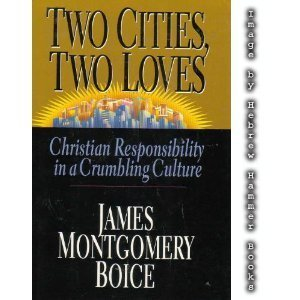
Many Christians today ask, “What do we do about a coarsening culture?” Some have turned to politics. Others are reacting against this, saying that “the church simply must be the church” as a witness to the culture, and let the chips fall where they may. James Boice, in his book Two Cities, Two Loves, asserts that until Christians are willing to simply live and work in major cities in at least the same proportions as other groups we should stop complaining that we are “losing the culture” (James Montgmery Boice, Two Cities, Two Loves: Christian Responsibility in a Crumbling Culture, Downers Grove, IL: InterVarsity Press, 1996, 165ff.).
While the small town was ideal for premodern people, and the suburb was the ideal for modern people, the big city is loved by postmodern people with all its diversity, creativity, and unmanageability. We will never reach the postmodern world with the gospel if we don’t urbanize the gospel and create urban versions of gospel communities as strong and as well known as the suburban (i.e., the mega church). What would those urban communities look like? David Brooks has written about “Bobos” who combined the crass materialism of the bourgeoisie with the moral relativism of the bohemians (David Brooks, Bobos in Paradise: The New Upper Class and How They Got There, New York: Simon & Schuster, 2001). I’d propose that urban Christians would be “reverse Bobos,” combining not the worst aspects but the best aspects of these two groups. By practicing the biblical gospel in the city they could combine the creativity, love of diversity, and passion for justice (of the old bohemians) with the moral seriousness and family orientation of the bourgeoisie.
Gospel Communication
As I mentioned above, evangelism in a postmodern context must be much more thorough, progressive, and process-oriented. There are many stages to bring people through who know nothing at all about the gospel and Christianity. Again, we see something of this in the book of Jonah. In Jonah 3:4 we read, “Jonah began to go into the city, going a day’s journey. And he called out, ‘Yet forty days, and Nineveh shall be overthrown!’” Notice how little is in that message. Jonah is establishing the reality of divine justice and judgment, of human sin and responsibility. But that’s all he speaks of. Later, when the Ninevites repent, the king says: “Who knows? God may turn and relent and turn from his fierce anger, so that we may not perish” (Jonah 3:9). The king isn’t even sure if God offers grace and forgiveness. It is clear that the Ninevites have very little spiritual understanding here. And though some expositions like to talk about the “revival” in Nineveh in response to Jonah’s preaching, it seems obvious that they are not yet in any covenant relationship with God. They have not yet been converted. And yet God responds to that: “When God saw what they did, how they turned from their evil way, God relented of the disaster that he had said he would do to them, and he did not do it” (3:10). He doesn’t say to them “You are my people: I am your God.” There’s no saving relationship here—but there is progress! They have one or two very important planks in a biblical worldview, and to God that makes a difference.
At the risk of over-simplification, I’ll lay out four stages that people have to go through to come from complete ignorance of the gospel and Christianity to full embrace. I’ll call them (1) intelligibility, (2) credibility, (3) plausibility, and (4) intimacy. By “intimacy” I mean leading someone to a personal commitment. The problem with virtually all modern evangelism programs is that they assume listeners come from a Christianized background, and so they very lightly summarize the gospel (often jumping through stages one to three minutes) and go right to stage “intimacy.” But this is no longer sufficient.
 “Intelligibility” means to perceive clearly, and I use this word to refer to what Don Carson calls “world-view evangelism.” In his essay in Telling the Truth Don analyzes Paul’s discourse at Athens in Acts 17 (D.A. Carson, “Athens Revisited,” in Telling the Truth, ed. D.A. Carson, Grand Rapids, MI: Zondervan, 2002, 384-98). Paul spends nearly the whole time on God and his sovereignty, a God-centered philosophy of history, and other basic planks in a biblical view of reality. He mentions Jesus only briefly and then only speaks of his resurrection. Many people consider this a failure to preach the gospel. They believe that every time you preach you must tell people that they are sinners going to hell, that Jesus died on the cross for them, and that they need to repent and believe in him. The problem with this is that until people’s minds and worldviews have been prepared, they hear you say “sin” and “grace” and even “God” in terms of their own categories. By going too quickly to this overview you guarantee that they will misunderstand what you are saying.
In the early days of Redeemer Presbyterian Church I saw a number of people make decisions for Christ, but in a couple of years, when some desirable sexual partners came along, they simply bailed out of the faith. I was stunned. Then I realized that in our Manhattan culture people believe the truth is simply “what works for me.” There is no concept of a Truth (outside the empirical realm) that is real and there no matter what I feel or thin. When I taught them that Jesus was the Truth, they understood it through their own categories. There hadn’t really been a power-encounter at the worldview level. They hadn’t really changed their worldview furniture. When Jesus didn’t “work” for them, he was no longer their Truth.
“Credibility” is the area of “defeaters.” A defeater is a widely held belief that most people consider common sense but which contradicts some basic Christian teaching (You can read more on this subject of “defeaters” in this blog under the article titled: “How to Lead Secular People to Christ” by Tim Keller, as well as in his book – The Reason for God). A defeater is a certain belief (belief A), that, since it is true, means another belief (belief B) just can’t be true on the face of it. An example of a defeater belief now is: “I just can’t believe there is only one true religion, one way to God.” Notice that is not an argument—it’s just an assertion. There is almost no evidence you can muster for the statement. It is really an emotional expression, but it is so widely held and deeply felt that for many—even most people—it automatically mans orthodox Christianity can’t be true. Now in the older Western culture there were very few defeater beliefs out there. The great majority of people believed the Bible, believed in God and heaven and hell, and so on. In the old “Evangelism Explosion” training, I remember there was an appendix of “Objections,” but you were directed not to bring these up unless the person you were talking to brought them up first. You were to focus on getting through the presentation.
 But today you must have a good list of ten to twenty basic defeaters out there and must speak to them constantly in all your communication and preaching. You have to go after them and show people that all their doubts about Christianity are really alternate faith-assertions. You have to show them what they are and ask them for as much warrant and support for their assertions as they are asking for yours. For example, you must show someone who says, “I think all religions are equally valid; no one’s view of spirituality is superior to anyone else’s,” that statement is itself a faith assertion (it can’t be proven) and is itself a view on spiritual reality that he or she thinks is superior to the orthodox Christian view. So the speaker is doing the very thing he is forbidding to others. That’s not fair! That sort of approach is called “presuppositional apologetics (For an introduction, see John Frame’s Apologetics to the Glory of God, Phillipsburg, NJ: P&R, 1994). It uncovers the faith assumptions that skeptics smuggle in to their doubts. It will make them begin to think. If you don’t do this, people’s eyes will just glaze over as you speak. They will tune you out. Nothing you say will sound plausible to them. You can tell them. You can tell them they are sinners and say “the Bible says,” but the defeater belief may be deeply embedded in your listeners that the Bible was written by the winners of a power battle wit the Gnostic gospel writers, with the result that all your assertions are incredible.
In “Intelligibility” and “Credibility” you are showing listeners the nonnegotiables and angularities of the faith, the truth claims they have to deal with. But in “Plausibility” you enter deeply into their own hopes, beliefs, aspirations, and longing, and you try to connect with them. This is “contextualization,” which makes people very nervous in many circles. To some, it sounds like giving people what they want to hear. But contextualization is showing people how the lines of their own lives, the hopes of their own hearts, and the struggles of their own cultures will be resolved in Jesus Christ. David Wells says that contextualization requires
Not merely a practical application of biblical doctrine but a translation of that doctrine into a conceptuality that meshes with the reality of the social structures and patterns of life dominant in our contemporary life…
Where is the line between involvement and disengagement, acceptance and denial, continuity and discontinuity, being “in” the world and not “of” the world?
Contextualization is the process through which we find answers to these questions. The Word of God must be related to our own context…The preservation of its identity [= intelligibility] is necessary for Christian belief; its contemporary relevance [= plausibility] is required if Christians are to be believable (David F. Wells, “An American Evangelical Theology: The Painful Transition from Theoria to Praxis,” in Evangelicalism and Modern America, ed. George M. Marsden, Grand Rapids, MI: Eerdmans, 1984, 90,93).
Here is an example. When I talk to someone who insists that on one’s view on spiritual reality (faith) is superior to others, I always respond that that is a view of spiritual reality and a claim that the world would be a better place if others adopted it. Everyone unavoidably has “exclusive” views. To insist no one should make a truth claim is a truth claim. So the real question is not Do you think you have the truth? (Everybody does.) The real question is: Which set of exclusive truth claims will lead to a humble, peaceful, non-superior attitude toward people with whom you deeply differ? At the center of the Christian truth claim is a man on a cross, dying for his enemies, praying for their forgiveness. Anyone who thinks out the implications of that will be led to love and respect even their opponents.
What am I doing in the above paragraph? I’m taking a major theme of my secular culture—namely, that we live in a pluralistic society of conflict and diversity, and we need resources for living at peace with one another—and I’m arguing that the claim of religious relativism is not a solution, because it is an exclusive claim to superiority masking itself as something else. Instead I am pointing out that Jesus’ dying on the cross best fulfills the yearning of our pluralistic culture for peace and respect among people of different faiths. This is contextualizing—showing the plausibility of the gospel in terms my culture can understand. We have to do this today.
Of course there is always a danger of over-contextualizing, but (as David Wells indicates in the quote above) there is an equal danger of under- contextualization. If you over-adapt, you may buy into the idols of the new culture. But if you under-adapt, you may be buying into the idols of the older culture. If you are afraid to adapt somewhat to an over-experiential culture, you may be too attached to an overly rational culture. So you have to think it out! To stand pat is no way to stay safe and doctrinally sound. You have to think it out.
Gospel Humiliation
I know this heading sounds pretty strong, but I want to get your attention. In Jonah 3:1-2 we read, “Then the word of the LORD came to Jonah the second time, saying, ‘Arise, go to Nineveh, that great city, and call out against it the message that I tell you.’” In Sinclair Ferguson’s little book on Jonah he comments on the broken, humbled prophet who hears the second call to Nineveh and answers it. He says:
God intends to bring life out of death. We may well think of this as the principle behind all evangelism. Indeed  we may even call it the Jonah principle, as Jesus seems to have done…It is out of Christ’s weakness that the sufficiency of his saving power will be born…So fruitful evangelism is a result of this death-producing principle. It is when we come to share spiritually—and occasions physically—in Christ’s death (cf. Phil. 3:10) that his power is demonstrated in our weakness and others are drawn to him. This is exactly what was happening to Jonah (Sinclair B. Ferguson, Man Overboard, Wheaton, IL: Tyndale, 1981, 70-71).
What does this mean? A man recently shared with me how he was trying to talk about his faith with his neighbors, to little avail. But then some major difficulties came into his life, and he began to let his neighbors know how Christ was helping him face them. They were quite interested and moved by this. It was the Jonah principle! As we experience weakness, as we are brought low, Christ’s power is more evident in us.
Lloyd-Jones once gave a sermon on Jacob’s wrestling with God. In the talk he told the story of a time when he was living in Wales. He was in a gathering of older ministers who were discussing a young minister with remarkable preaching gifts. This man was being acclaimed, and there was a real hope that God could use him to renew and revive his church. The ministers were hopeful. But then one of them said to the others: “Well, all well and good, but you know, I don’t think he’s been humbled yet.” And the other ministers looked very grave. And it hit Lloyd-Jones hard (and it hit me hard) that unless something comes into your life that breaks you of your self-righteousness and pride, you may say you believe the gospel of grace but, as we said above, the penny hasn’t dropped. You aren’t a sign of the gospel yourself. You don’t have the Jonah principle working in you. You aren’t a strength-out-of-weakness person. God will have to bring you low if he is going to use you in evangelism.
At the end of the book of Jonah, God gives Jonah a “gourd” (KJV) that grows a vine and gives him shade, but then a desert wind blasts the vine and ruins it. Jonah becomes disconsolate. John Newton wrote a hymn largely based on this incident.
I asked the Lord that I might grow
In faith, and love, and every grace;
Might more of His salvation know,
And seek, more earnestly, His face.
I hoped that in some favored hour,
At once He’d answer my request;
And by His Love’s constraining pow’r,
Subdue my sins, and give me rest.
Instead of this, He made me feel
The hidden evils of my heart;
And let the angry pow’rs of hell
Assault my soul in every part.
Yea more, with His own hand
He seemed intent to aggravate my woe;
Crossed all the fair designs I schemed,
Blasted my gourds, and laid me low.
“Lord why this,” I trembling cried,
“Wilt thou pursue thy worm to death?”
“’Tis in this way,” the Lord replied,
“I answer prayer for grace and faith.”
“These inward trials I employ,
From self and pride to set them free
And break thy schemes of earthly joy,
That thou may’st find thy all in Me.” (John Newton, “I Asked the Lord That I Might Grow”, 1779).
Gospel Incarnation
I believe Jonah is a setup for the amazing letter from God to the exiles of Babylon in Jeremiah 29. The Jews had been living in their nation-state in which everyone was a believer, but when they arrive in Babylon God tells them to move into that pagan city, filled with unbelievers and uncleanness, and work for its peace and prosperity—its shalom. He challenges them to use their resources to make the city a great place for everyone—believers and unbelievers—to live. This is not just supposed to be a calculated thing or a thing of mere duty. He calls them to pray for it, which is to love it. This was the city that had destroyed their homeland! Yet that is the call. God outlines a relationship to pagan culture. His people are neither to withdraw from it nor assimilate to it. They are to remain distinct but enraged. They are to be different, but out of that difference they are to sacrificially serve and love the city where they are exiles. And if their city prospers, then they too will prosper.
 This is really astonishing, but the book of Jonah gets us ready for all this. Jonah is called to go to a pagan city to help it avoid destruction, but he is too hostile toward them to want to go. He runs away, but God puts him on a boat filled with pagans anyway. There Jonah is asleep in the boat during the storm. He is awakened by the sailors, who tell him to call on his God to ask him to keep the boat from sinking. They ask him to use his relationship to God to benefit the public good. The Scottish writer Hugh Martin wrote a commentary on this text and called the chapter “The World Rebuking the Church” (Hugh Martin, The Prophet Jonah, 1866 reprint, Edinburgh: Banner of Truth, 1978). Eventually Jonah goes to Nineveh—but when God turns away from destroying them, Jonah is furious. This time God rebukes him for not caring about the whole city and its welfare. Jonah 4:10-11: “You pity the plant…Should not I pity Nineveh, that great city, in which there are more than 120,000 persons who do not know their right hand from their left, and also much cattle?”
This is a picture of the church’s problem in a postmodern world. We simply don’t like the unwashed pagans. Jonah went to the city but didn’t love the city. Likewise, we don’t love the postmodern world in the way we should. We disdain these people who don’t believe in Truth. We create our subculture and we invite people to join us inside, but we don’t take our time, gifts, and money and pour ourselves out in deeds f love and service to our city. Does the world recognize our love for them? Are we the kind of church of which the world says: We don’t share a lot of their beliefs, but I shudder to think of this city without them. They are such an important part of this community. They give so much! If they left we’d have to raise taxes because others won’t give of themselves like those people do. “Though they accuse you…they…see your good deeds and glorify God” (1 Peter 2:12; cf. Matt. 5:16).
Where do you get the courage and power to live like that? Well, here. Centuries after Jonah, there was another sleeper in a storm—Jesus Christ (Mark 4). And he was surrounded by his disciples who, like the sailors, were terrified. And in exactly the same way they woke him up and said, “Don’t you care? Do something or we will drown!” So Jesus waved his hand, calmed the sea, and everyone was saved. So for all the similarities, the stories of Jonah and Jesus are very different at the end. Whereas Jonah was sacrificed and thrown into the storm of wrath so the sailors could be saved, Jesus wasn’t sacrificed. But wait. On the cross, Jesus was thrown into the real storm, the ultimate storm. He went under the wrath of God and was drowned in order that we could be saved.
Do you see that? If you do, then you have both the strength and the weakness, the power and the pattern, to pour yourself out for your city. Ultimately, the gospel is not a set of principles but is Jesus Christ himself. See the supremacy of Christ in the gospel. Look at him, and if you see him bowing his head into that ultimate storm, for us, then we can be what we should be.
Conclusion
Since we began looking at Mark 9 we should not forget that “this kind” of demon “only comes out through prayer.” Lloyd-Jones applies this to the church today by insisting that it needs a comprehensive spiritual transformation if we are going to evangelize our world with the gospel. There’s a (probably apocryphal) story about Alexander the Great, who had a general whose daughter was getting married. Alexander valued this soldier greatly and offered to pay for the wedding. When the general gave Alexander’s steward the bill, it was absolutely enormous. The steward came to Alexander and named the sum. To his surprise Alexander smiled and said, “Pay it! Don’t you see—by asking me for such an enormous sum he does me great honor. He shows that he believes I am both rich and generous.”
Are we insulting God by our small ambitions and low expectations for evangelism today?
Thou art coming to a King,
Large petitions with thee bring;
For His grace and power are such,
None can ever ask too much. (John Newton, “Come, My Soul, Thy Suit Prepare”, 1779).
 *TIMOTHY KELLER was born and raised in Pennsylvania, and educated at Bucknell University, Gordon-Conwell Theological Seminary, and Westminster Theological Seminary. He was first a pastor in Hopewell, Virginia. In 1989 he started Redeemer Presbyterian Church in Manhattan with his wife, Kathy, and their three sons. Today, Redeemer has more than five thousand regular attendees at five services, a host of daughter churches, and is planting churches in large cities throughout the world. He is the author of KING’S CROSS, COUNTERFEIT GODS, THE PRODIGAL GOD, MINISTER’S OF MERCY, THE MEANING OF MARRIAGE and the New York Times bestseller THE REASON FOR GOD & the forthcoming CENTER CHURCH (August 2012). This article was first a lecture and can be heard for free on Desiringgod.org, and was also published as Chapter 5 in The Supremacy of Christ in a Postmodern World, Crossway Books, 2007.











 LifeCoach4God