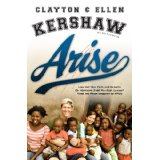
Book Review – Arise: Live Out Your Dreams on Whatever Field You Find Yourself by Clayton and Ellen Kershaw and Ann Higginbottom

The Kershaw ABC’s

I primarily got this book on a whim because I love baseball – especially the Dodgers –and enjoyed watching Clayton Kershaw work his way into the pitching Triple Crown and a CY Young award during the 2011. I enjoyed this book more than I thought I would – to be honest I didn’t expect much depth from a couple that are half my age – in their early twenties. In this book Clayton and Ellen show that they are wise beyond their years, and totally committed to Jesus Christ as their Savior and Lord and to making a huge difference in the lives of people whether on a baseball field or in a field in Africa.

I was pleasantly surprised by what I’ll call the Kershaw ABC’s:

A is for Africa – The book goes back in forth alternating between Ellen and Clayton (there are more chapters written by Clayton) talking about the dreams (goals) that they had as teenagers and how God was at the center of these dreams and how they came to be a reality in each of their lives. Ellen talks of her various trips to Zambia to work with children there and how together in marriage God has allowed them to visit Africa and combine God’s love and gospel message to help children. I found Ellen’s depth in her relationship with Christ to be inspirational and encouraging – and enjoyed what she wrote as much as what Clayton wrote.

B is for Baseball – Clayton walks you through his little league, minor league, and Dodgers career thus far. Any baseball fan will really enjoy what he has to say in these sections – especially the amazing Cy Young performance he had last year with the Dodgers. There is a great story in the book where Clayton talks about a teacher’s advice to him on following his dream in 9th grade to be a pro ball player, “I do want you to understand the odds, Clayton. They are one in a million. But the important thing is that you see yourself as the one. Don’t think about the million. Visualize yourself being the one who makes it. You are the one. Be the one.”

C is for Christ – There is a huge emphasis in this book on what it means to have a personal relationship with our Maker through Jesus Christ, and how to grow, benefit from, and be used in this world by having your identity in Christ and thus giving Him glory. Clayton desires to be known as a “Christian who plays baseball, not as a baseball playing Christian.”

Clayton and Ellen clearly articulate the gospel and how to have a relationship with Jesus Christ by grace through faith in Him:

Clayton, “We are saved through faith in Christ alone. Our words and actions should flow out of a heart that has been changed by the Lord. We can’t earn God’s grace by doing good things. That wouldn’t be grace. Grace means getting something that we really don’t deserve. It’s a relief to remember that God’s grace doesn’t depend on us or on our ability to live a perfect life. Thankfully, it depends on Jesus, who lived a perfect life for us and died in our place.”

Ellen, talking about the father and son in Jesus’ parable in Luke 15, “Rather than punish his son, the father absorbs his son’s guilt and shame so that his son can receive the gift of his love. That’s exactly what Jesus did for us in dying for our sins…When my social life was shaken in middle school, God graciously drew me to Himself…By God’s grace, I have a heart for Africa. By God’s grace, Clayton can throw a baseball. We’re hopeful that we can spend a lifetime figuring out what those two things mean and how to live them out for God’s glory.”

I would say that the target audience of this book is primarily high schoolers, college students, and young people in their twenties. As they say early on in the book, “We want a generation of young people to arise—to hope and believe that their lives are full of purpose.” However, I think anyone who loves the poor and hurting children of the world, baseball, and especially Jesus Christ will really enjoy and benefit from this book. I would especially encourage young people to read this book and emulate the Kershaw’s as they follow Jesus Christ. If you are Christian parent, youth pastor, pastor, or coach I highly recommend that you give this book to a young person in your life – it can be a great motivator for them to follow their dreams and reach them for the sake of Christ and His glory in the world.

Book Review: Real Marriage by Mark and Grace Driscoll

As Real and Raw As It Gets: Review By Dr. David P. Craig

At the outset, there is no doubt about it; this book is going to be controversial. However, before I spend the rest of this review focused on the controversy that will ensue, I think that there is a ton of good advice, encouragement, and — take it from a pastor that’s been married for twenty years with five kids myself (ironically like Mark) – they make marriage as real as it gets, the ups and downs, the agonies and ecstasies, and the thrills of victory with the help of Jesus at the center of it all.

We live in a culture where we are bombarded with sexual images, discussions, and details that sometimes feel like a barrage from which we can never get away from – and I don’t think we will encounter less, but an increasingly greater exposure to all things related to sex. Many pastors and theologians will attack this book in particular for the issues the Driscoll’s discuss. They are very open and honestly discuss and tackle a lot of the questions that never get asked “in church.” However, in my experience as a pastor and life coach I am grateful that the Driscoll’s address the reality of the times in which we are living. No sexual rock is left unturned – but dealt with thoughtfully, theologically, and forthrightly.

I think one of the reasons for so much open talk about sex is the fact that the Driscoll’s minister to literally thousands of men and women in their early twenties – and it happens to be a very hot topic in their context.

Perhaps the best contribution of this book is how the Driscoll’s turned a marriage on the rocks into a marriage on the Rock – built on the solid foundation that is our Lord and Savior Jesus Christ through repentance and faith. Too many partners have the “grass is greener on the other side” mentality. The Driscoll’s demonstrate that all things are possible with God’s guidance and wisdom and especially with Christ at the center of a marriage. Mark states this very important truth, “There are no loving marriages apart from repentance and forgiveness. Marriage either gets bitter or better.” They show how a difficult and broken marriage can be repaired, restored, resurrected, renewed, and rejuvenated by the amazing grace of God through the Lord Jesus Christ. The good news is that it’s never to late to repent and change with God’s help.

I would hesitate to recommend this book to just anyone. Mark and Grace’s style may be too open, vulnerable, and transparent for some people. Also, some of their advise is definitely in the extra/non-biblical category. You will encounter the “reality” of marriage from “real” people who are seeking to do things God’s way for the long haul. If you are “old school” and squeamish about frank talk on sex – I would encourage you to just skip chapter 10. I am grateful that they are willing to be authentic and transparent in addressing issues in such a sexualized culture as ours – especially in a church (Mars Hill) with so many young people asking the questions they are addressing. Whether you agree with what they say in chapter 10 or not – it’s important that you read this in context of the whole book.

If you are a pastor, counselor, or life coach and reading this review I would ask that you read the book first and prayerfully decide whether you would recommend it or not. I will use some its contents in my own marriage and in helping others – again there is a lot of good stuff in this book – a lot of practical applications. There are some things that I agree wholeheartedly with, and others that I do not. I would encourage you also to read Tim Challies’ review on his blog, and Albert Mohler’s review on his blog to see some specific warnings and examples of why this book needs to be taken with a grain of salt – as they say.

There are simply too many other good books on marriage that I can recommend without a single caveat or reservation that are out there: Tim Keller’s “The Meaning of Marriage,” R.C. Sproul’s “The Intimate Marriage”, “Love and Respect” by Emmerson Eggerichs, and also “What Did You Expect?” by Paul Tripp, “Sacred Marriage” by Gary Thomas, “Marriage Matters” by Winston T. Smith, and “When Sinners Say ‘I Do'” by Dave Harvey would all be books that I would recommend wholeheartedly as books that are biblically and theologically right on – without all the controversy.

However, don’t let some of the “chaff” of this book (and the negative reviews that are sure to come) keep you from enjoying and benefiting from the multitude of wheat (that which is beneficial and practical) contained in the pages of this book. I think chapter 11 with its plethora of ideas, questions, and principles for discussion are more than worth the price of the book. I am grateful for Mark and Grace’s ministry in their home, for the sake of Christ’s Church, and their commitment to tackle all things related to the gospel through the lenses of Scripture, their own experiences, and with a passion for Jesus Christ.

Book Review: Defending Inerrancy Norman L. Gesiler and William C. Roach

A Rock in a Sea of Pluralism

We live in a culture where cultural preferences continue to overtake the foundational beliefs of the scholars who train the leaders of our country and churches. Many scholars are feeding our institutions, churches, and future leaders with doubts about the truth, authority, and sufficiency of the Bible. This book is a tour de force dealing with the history, challenges, and practical ramifications of whether or not the Bible is indeed God’s Word and thus true for all faith and practice for all time.

One of the most beneficial aspects of this book is how the authors address modern attacks on the Scriptures by the likes of Clark Pinnock, Bart Ehrman, Peter Enns, and others. Also, the last six chapters on the nature of God, truth, language, hermeneutics, incarnation, and answering objections to inerrancy are outstanding.

Living in a sea of doubt, confusion, and cultural preference does not mean that we should succumb to the anti-supernaturalistic bias of our culture, but Geisler and Roach cogently demonstrate that God doesn’t change, and neither does His authoritative inspired Words from Genesis to Revelation. I highly recommend this book to fortify your faith via the plethora of evidence there is for God’s revelation to man – and thus the most important place we can go for truth resulting in faith and practice for all mankind. God’s Word like the Word Incarnate is the Rock we need to believe and stand firm on in a stormy sea of cultural change. As the great hymn says, “On Christ the solid rock I stand, all other ground is sinking sand.”

Our reason for living, purpose in life, how to know God personally, and all the greatest issues and answers of our time are contained in the Bible – we have reason to believe – and evidences galore that the Bible is absolutely true and contains the message of hope that the world needs to desperately hear about Jesus Christ – who is Savior and Lord.

The Bible is not one voice among many – it is the one voice through which all others must be filtered. Thank you Norm and William for giving us such an excellent book on the Book of Books.

Book Review: Continuity and Discontinuity edited by John S. Feinberg

Great Discussion of the Relationship Between the Old and New Testaments

This book contains various perspectives from leading theologians on issues related to that which continues and discontinues from the Old Testament into the New Testament.

Half of the contributors in this book would consider themselves “Covenant Theologians” – including contributions from O. Palmer Robertson, Willem VanGemeren, Knox Chamblin, Bruce K. Waltke, Fred H. Klooster,  Martin H. Woudstra, and Sam Storms. The other half would lean dispensational or in the discontinuity camp – including essays from John S. Feinberg, Paul D. Feinberg, Robert L. Saucy, Walter C. Kaiser, Allen P. Ross, and Douglas J. Moo.

The book is a tribute to S. Lewis Johnson– long time Bible teacher at Dallas Theological Seminary and Teaching pastor at Believer’s Chapel in Dallas, Texas (he went to be with the Lord on January 28, 2004). The beginning of the book and ending of the book contain some well written tributes from Sam Storms and John Sproule to Johnson and expound upon his outstanding attributes as a scholar, exegete of God’s Word, pastor, mentor, friend, and southern gentlemen – he was born in Birmingham, Alabama.

After a wonderful historical essay on the debate of continuity and discontinuity by Rodney Peterson the format of the book addresses issues related to six key areas: 1) Theological Systems and the Testaments; 2) Hermeneutics and the Testaments; 3) Salvation and the Testaments; 4) The Law and the Testaments; 5) The People of God and the Testaments; and 6) Kingdom Promises and the Testaments. Each of these six topics contains an essay from a continuity perspective followed by an essay from a discontinuity perspective.

Here are some of the issues addressed in the book:

Are Christians to see ethical dilemmas such as capital punishment and abortion enforced today?

Are Israel and the Church one or distinct today?

How do believers relate to the Old Testament law in practice today?

One of the points that became increasingly clear to me as I read this book was that the more one moves in the discontinuity direction, the more dispensational he is likely to become, and the more one moves in the direction of continuity, the more covenantal he will become.

This book is simply outstanding. It’s not an easy read – but well worth the effort. In my experience most people from both sides of the continuity/discontinuity continuum have a lot to learn from one another and this book helps people in either camp come closer to the center in balancing how to effectively understand and interpret the two Testaments of the Scriptures. I highly recommend this book to help you become a more effective interpreter of the Scriptures and lover of Jesus Christ at the center of it all.


Book Review: God Has an App for That by Dudley C. Rutherford

Great Practical Applications from the Book of James

This is the first book I’ve read by Dudley Rutherford and I enjoyed how he kept me hooked with good illustrations for living out the book of James. He moved very quickly to practical applications from the book of James in addressing 8 key areas in the Christian life:

1)    Turning stress into joy – James 1:1-12

2)    Overcoming temptation – James 1:13-27

3)    Breaking down walls that divide – James 2:1-12

4)    Resuscitating a dying faith – James 2:14-26

5)    Curbing your profanity – James 3:1-12

6)    Restoring a broken heart – James 4:1-12

7)    Prioritizing your investments – James 4:13-17

8)    Healing your afflictions – James 5:1-19

If you are looking for a technical commentary on James – this is not it. However, if you are looking for some good practical ways to live out the Christian life this book is full of ideas and principles to apply in “living out your faith.” I read the Kindle version and one of the nice features in this book is that it has “apps” that you can click on like you have on a smart phone to be able to go to videos, articles, and even an app for reading the Bible for a year.

I sort of felt like I was reading the gospel of Mark in reading this book – very fast paced and full of action. I think young people and new believers in the faith will especially enjoy this book.

Book Review: Three Simple Questions by Rueben P. Job

3 Great Questions Tackled By an Elderly Saint

Every once in awhile I like to read Christian authors outside of my circles – I guess in my case that would be Reformed Baptist types. Here is a short read by one of the compilers of several very helpful books on prayer in the Upper Room Series – and a long time United Methodist Pastor.

I’m assuming that Pastor Job is in his late 70’s or 80’s in writing this book. One gets the sense that he is an elderly grandfather with many years of walking with God and life experience under his belt as he grapples with three very important questions in a devotional manner:

Who is God?

Who am I?

Who are we together?

I think these are great questions to grapple with and that Job gives much good food for thought. He isn’t as theologically precise as I would like, but he does give some practical principles to chew on via mediation and prayer. I think that any person would benefit from this short devotional and especially from seeking out the answers to these questions by reading God’s Word as often as possible. This book provides a “Guide for Daily Prayer,” and a “Pattern for Daily Prayer” in the appendix that are very helpful to connecting with God and implementing the three questions he addresses in the book.

My Top 10 Reads of 2011

I read over 100 books this past year, so I thought I would share my top ten books that were actually published in 2011. This next year I will be reading another 100 plus books (God willing) and one of the themes for the new year will be to read as many of the “Views” books as I possibly can (I have 70 of these books already at last count). The most important book I will be reading is the Bible. I will be using Robert Murray McCheyne’s Bible reading plan and the One Year Bible as well. Therefore, I hope to read through the Bible three times. I hope that God blesses your intake this next year and that His Spirit will illuminate your mind and saturate your thinking, emotions, and activity with a Christ centered and Holy Spirit empowering to live for His glory. All the books below (and more) were reviewed on Amazon.com and here on my blog.

10) Passages: How Reading the Bible in a Year Will Change Everything for You by Brian Hardin. He will really motivate you to get into the Word daily – which is arguably the most important discipline for you to maintain.

9) All In: From Refugee Camp to Poker Champ by Jerry Yang with Mark Tabb. This was one of the most spontaneous picks I ever read – I bought it because it was cheap! However, it was a gripping story of a Christian refugee coming to the USA and winning the biggest Poker prize in history and the astounding way he was and is a testimony for Christ in his lifestyle and giving. Jerry Yang is an amazing person who places Jesus first in every aspect of his life – even playing poker! I was surprised at how much God’s sovereignty and providence was brought into the story – not just the families escape from Cambodia, but also in the refugee camp in Thailand and then all the details that God worked out for him in the USA.

8) Salvation Accomplished by the Son: The Work of Christ by Robert A. Peterson. I always enjoy reading anything related to Jesus. This book was not easy reading, but very rewarding in that it mined the depths of the atonement and opened my eyes to riches to be found in Christ that I had never seen before.

7) The Essential Commandment: A Disciple’s Guide to Loving God and Others by Greg Ogden. This book is the third workbook in this series of outstanding discipleship workbooks. This one focuses on the application of the Ten Commandments. I highly recommend all of Ogden’s books on and for discipleship – He knows how to make and help you make multiplying disciples for Christ.

6) Jesus + Nothing = Everything by Tullian Tchividjian. I loved this book perhaps mainly because I could so identify with “rediscovering” that beauty of the gospel after going through so many trials and tribulations in recent years. Tullian clearly articulates the doctrines of justification and sanctification and how they are both grace based and emphasizes the “nowness” of the gospel in your life.

5) Think Christianly: Looking at the Intersection of Faith and Culture by Jonathan Morrow. This is a fantastic book that combines the biggest ethical and cultural issues of our times, and interviews with Christians who are experts in these areas – who have thought deeply about the issues, and are actually penetrating culture with their Christian views and actions and making a difference for the glory of God.

4) Nearing Home: Life, Faith, and Finishing Well by Billy Graham. Actually this wasn’t that great of a book – but it was written by one of the most used vessels in God’s arsenal in world history. This may be Graham’s last book that he will write before he goes home to hear those words we all long to hear, “Well done good and faithful servant.” I was brought to tears in reading this book because of this man’s integrity and faithfulness for the cause of Christ.

3) For Calvinism by Michael Horton. One of the most misunderstood doctrines so clearly and effectively articulated by one of the finest theologians of our times. A cogent and balanced defense of what the Scriptures teach about the doctrines of grace.

2) Gospel: Recovering the Power that Made Christianity Revolutionary by J. D. Greear. Very Christ-centered book on applying the gospel daily.

1) Tie for 1st! Forever by Paul David Tripp and The Meaning of Marriage by Tim Keller. Essentially anything that Tripp or Keller writes on anything trumps just about everything outside the Bible itself! These two writers have a great grasp on the gospel, Biblical Theology, and how to communicate these two elements with great relavency in the 21st Century. I’m sure I would also be including Keller’s King’s Cross” here as well – but I haven’t read it yet!

Honorable Mentions (Most of these could have easily been in the top 10 too, but you gotta draw the line somewhere!):

Historical Theology by Greg Allison; Being George Washington by Glenn Beck; Reflections on Words of the New Testament by Vine and Benoit; Four Views on the Spectrum of Evangelicalism (Counterpoints: Bible and Theology – Various authors); Community: Taking Your Small Group off Life Support by Brad House; What is the Mission of the Church? by DeYoung and Gilbert; Preaching and Teaching the Last Things: Old Testament Eschatology for the Life of the Church by Walter C. Kaiser; More Than Ordinary: Enjoying Life with God by Doug Sherman.


Book Review Knowing God by J. I. Packer

A Classic on the Character and Attributes of God

 The New Oxford American Dictionary defines a classic as that which is “judged over a period of time to be of the highest quality and outstanding of its kind.” Therefore, based on this definition I dub Packer’s book a “classic.” It is simply one of the most readable, and enjoyable books on the doctrine of God’s character and attributes in modern times. Originally written in 1971 – this book will be reprinted again and again for its wonderful portrayal of the transcendence and immanence of God and how we can know Him personally because of how He has revealed Himself to us in the Scriptures.

We can know God intimately and personally because He has chosen to come into human history through the Person and Work of Christ and the most direct route to knowing God is clearly summarized in the pages of this book as Packer “unpacks” what it means to know God with warmth, depth, reverence, and great joy. I love and agree with what my favorite theologian R.C. Sproul has to say about this book, “Knowing God is a masterpiece by a master theologian. It serves as a wake-up call for those who are asleep to the majesty of God.”

Perhaps the evangelist Billy Graham uttered the best tribute I have read on this book, “A hundred years from now only a handful of books written today will still be widely read and accepted as Christian classics. Dr. James I Packer’s Knowing God may well prove to be one of them. A gifted theologian and writer, Dr. Packer has the rare ability to deal with profound and basic spiritual truths in a practical and highly readable way. This book will help every reader grasp in a fuller way one of the Bible’s greatest truths: that we can know God personally, because God wants us to know him.”

I can attest to the fact that the greatest need of every human being on the planet is to know God personally through our Lord and Savior Jesus Christ. J. I. Packer’s book is MUST reading for anyone who wants to know God personally, intimately, daily, for this life, and for eternity.

Why Jesus Came – “The Shadow of Death” Painting by *William Holmes Hunt

They say a picture is worth a 1000 words. Here is my favorite painting by William Holman Hunt. In this painiting he gives a foretaste of why Jesus came with Mary glancing at the wall in the carpenter’s shop and seeing why her son took on flesh to be the Savior of the world. Christ’s life, death, and resurrection is perhaps best summarized by the Paul in 2 Corinthians 5:21, “For our sake he made him to be sin, so that in him we might become the righteousness of God.” And by Peter in 1 Peter 3:18 & 2:24, “For Christ also suffered once for sins, the righteous for the unrighteous, that he might bring us to God, being put to death in the flesh but made alive in the spirit…He himself bore our sins in his body on the tree, that we might die to sin and live to righteousness. By his wounds you have been healed.”


*William Holman Hunt (1827-1910 – British) changed his middle name from “Hobman” to Holman when he discovered that a clerk had misspelled the name after his baptism at the church of Saint Mary the Virgin, Ewell. After eventually entering the Royal Academy art schools, having initially been rejected, Hunt rebelled against the influence of its founder Sir Joshua Reynolds. He formed the Pre-Raphaelite movement in 1848, after meeting the poet and artist Dante Gabriel Rossetti. Along with John Everett Millais they sought to revitalize art by emphasizing the detailed observation of the natural world in a spirit of quasi-religious devotion to truth. This religious approach was influenced by the spiritual qualities of medieval art, in opposition to the alleged rationalism of the Renaissance embodied by Raphael. He had many pupils including Robert Braithwaite Martineau.

Hunt’s works were not initially successful, and were widely attacked in the art press for their alleged clumsiness and ugliness. He achieved some early note for his intensely naturalistic scenes of modern rural and urban life, such as The Hireling Shepherd and The Awakening Conscience. However, it was with his religious paintings that he became famous, initially The Light of the World (1851–1853, now in the chapel at Keble College, Oxford; a later version (1900) toured the world and now has its home in St Paul’s Cathedral.

In the mid 1850s Hunt traveled to the Holy Land in search of accurate topographical and ethnographical material for further religious works, and to “use my powers to make more tangible Jesus Christ’s history and teaching”; there he painted The Scapegoat, The Finding of the Savior in the Temple and The Shadow of Death, along with many landscapes of the region. Hunt also painted many works based on poems, such as Isabella and The Lady of Shallot. He eventually built his own house in Jerusalem.

His paintings were notable for their great attention to detail, vivid color and elaborate symbolism. These features were influenced by the writings of John Ruskin and Thomas Carlyle, according to whom the world itself should be read as a system of visual signs. For Hunt it was the duty of the artist to reveal the correspondence between sign and fact. Out of all the members of the Pre-Raphaelite Brotherhood Hunt remained most true to their ideals throughout his career. He was always keen to maximize the popular appeal and public visibility of his works.

He eventually had to give up painting because failing eyesight meant that he could not get the level of quality that he wanted. His last major work, The Lady of Shallot, was completed with the help of an assistant (Edward Robert Hughes).


Book Review: When Work and Family Collide by Andy Stanley

Helping You Balance God’s Priorities for Your Life

 One of the most difficult things I’ve experienced in life (as a pastor with five kids) is balancing work/ministry and family. Whether you are a dad, mom, single parent, in full time ministry or have a full time job – or no matter how you slice it – it’s hard to balance work and family.

In this book Andy Stanley articulates the modern realities that face us in the market place and in our homes. He does not minimize, rationalize, or make excuses for the break down of families. What he does very well is to show how we can be excellent in the marketplace and serve our families needs in a balanced and biblical manner.

Andy Stanley gives a myriad of practical examples of how we can prioritize our lives biblically and bring glory to God in the workplace and in our homes. I highly recommend this book is a very practical guide and help for you in seeking to be a balanced Christian that prioritizes life in a manner that contributes mightily to what is most pleasing to our Awesome God – for His ultimate glory.