

Mark A. Copeland on The Church Universal and Local Distinguished
The Church “Universal” The Church “Local”
| Composed of all Christians | Composed of Christians in onelocation |
| Began on the Day of Pentecost | Begins when people join together |
| There is just one | There are many |
| Enter only by being added by the Lord | Enter by joining ourselves |
| The Lord keeps the books of membership | Enrolled by human judgment |
| Consists of all the saved | Consists of both saved and lost |
| Must be in this to be saved | Do not have to be in this to be saved |
| Has no earthly organization | Has earthly organization |
| Can’t be divided | Can be divided |
| Death doesn’t affect membership | Death does affect membership |
| Does not have one scriptural name | May use different scriptural names |
*Mark A. Copeland is a Bible teacher in Kissimmee, Fl.
An Interesting Overview of Dispensationalism by Dr. John F. Walvoord
Reflections on Dispensationalism
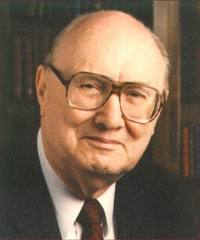
[Dr. John F. Walvoord served for many years as the President, Chancellor and as a Professor of Systematic Theology, Dallas Theological Seminary, Dallas, Texas. For many free resources by Dr. Walvoord check out: http://www.walvoord.com/%5D
One of the problems in theology today is that many people who refer to dispensationalism do not adequately understand its roots, and therefore they dismiss it without giving it due consideration.
To understand the long background of dispensationalism, I examined approximately one hundred books on systematic theology to seek to determine how they explain dispensationalism. Most of these theologies in the nineteenth century were postmillennial, and most of the ones in the twentieth century were amillennial. They represented almost every system of theology, including liberal and conservative, Calvinistic and Arminian. Relatively few were premillennial. About half of them, regardless of their theological background, recognized biblical dispensations. One of the most significant was that of Charles Hodge, outstanding Calvinistic theologian of the nineteenth century, who was postmillennial in his eschatology but who wrote that the Scriptures describe four dispensations: Adam to Abraham, Abraham to Moses, Moses to Christ, and the Gospel dispensation.[1] And Louis Berkhof, an amillenarian, wrote that the Bible has two dispensations.[2]
Dispensations Related to Progressive Revelation
In the theological works that do discuss dispensations it is evident that acknowledging the presence of dispensations is not limited to a single theological system. Instead, such acknowledgement is based on progressive revelation, the fact that God continued to reveal Himself to humankind through biblical history.
Dispensationalism is an approach to the Bible that recognizes differing moral responsibilities for people, in keeping with how much they knew about God and His ways. God’s revelation of Himself in different eras required moral responses on the part of humanity. In the Garden of Eden the only requirement for conduct was that Adam and Eve were to keep the Garden and not eat of the fruit of knowledge of good and evil. With the entrance of sin, human conscience came in as the guideline for conduct. It proved to be faulty, however, and people continued to sin. Following conscience there was the Flood and with it the introduction of the concept of government and the command that murderers be executed. This, however, also ended in failure at the Tower of Babel. The introduction of the Abrahamic Covenant in Genesis 12 and 15 presented a totally new perspective, as God revealed His special plan for Israel in the future. Then those dispensations or stages of progressive revelation were followed by the Mosaic Covenant.
The Mosaic Covenant, the most extensive code of conduct to be found in the Old Testament, was given only to Israel. The nations were not judged by it. None of the nations, for example, were punished for not keeping the Sabbath. Each dispensation superseded the previous one, continuing some of the revelation and conduct requirements of the past and introducing new requirements as well as eliminating some requirements of the previous dispensation. This situation was similar to raising a child who in his early years was subject to a number of limitations but for whom some limitations, as he grew, were lifted while new ones were added.
The New Testament introduces God’s plan and purpose for the church. The numerous requirements of the Mosaic Law do not apply to the present era because the present church age is a different dispensation. For instance, while the Law required executing a man for not keeping the Sabbath, no one would extend that requirement to the present day. In dealing with the legalism present in the Galatian church Paul stated that the Law was like a tutor to bring people to Christ. Just as an adult son no longer needs a tutor, so under grace believers no longer need the Law (Gal. 3:24-25; cf. 4:1-7 on the difference between the rules for children and the rules for adults).
Areas of Confusion in Definition
In the twentieth century many strides forward have been made in interpreting the doctrines of Scripture, especially eschatology and dispensationalism. In this area of theology The Scofield Reference Bible played a major part. Written originally by C. I. Scofield in 1909, he revised it in 1917. After World War I and after Scofield’s death in 1921 The Scofield Reference Bible became an unusually popular study Bible. The Bible conference movement became prominent in this country, and Bible teachers in those conferences often recommended The Scofield Reference Bible. As a result millions of copies were sold, and the views presented in that study Bible became the views of numerous Bible institutes and many evangelicals of the twentieth century.
This situation changed after the 1930s and in the decade that followed. Many seminaries that were formerly orthodox had turned liberal. Then as their graduates were called to churches that were traditionally orthodox, clashes occurred between pastors and their congregations. If a pastor opposed the doctrinal convictions of his congregants, he would have to challenge the doctrine of inspiration, the virgin birth, and similar issues, and this would immediately cause his people to raise questions about his own theology. A number of pastors discovered that most of the people who opposed them were carrying Scofield Reference Bibles, and one of the distinctive factors of the Scofield Bible is that it is dispensational. Therefore those pastors hit on the scheme of attacking dispensationalism as a heresy. Because most people did not have clearly in mind what dispensationalism involved theologically, this tactic helped protect those pastors from questions about their own theology and it put those in the pew on the defensive.
Conservative amillenarians saw an opportunity to further their cause, and they attacked dispensationalism as a departure from the Protestant Reformation. Their motto was “Back to the Reformation” as the cure for apostasy. The Reformation, however, did not deal with the subject of dispensationalism. So these theologians went back to Augustine and his amillennial eschatology.
In the ensuing controversy many liberals attacked dispensationalism. But what they were really attacking was fundamentalism, premillennialism, pretribulationism, and the inerrancy of the Bible. In the process, liberals wrongly identified “dispensationalism” with fundamentalism.
Characteristic of the attacks on dispensationalism is that its opponents say it is heretical. [3] Their approach is often characterized by prejudice and ignorance rather than careful study of the Scriptures and of the history of dispensational thought.
One example of this characterization occurred when a woman indicated to me that in a conversation with her pastor she inadvertently mentioned that her nephew was a student at Dallas Seminary. The pastor immediately replied, “That seminary is heretical.” When she asked him why he felt that way, he answered that it was dispensational. Then she asked, “What is wrong with dispensationalism?” He replied, “I don’t know, but it’s bad.”
When amillenarian ministers are asked, “What is wrong with dispensationalism?” many of them cannot give an acceptable answer.
The widespread prejudice and ignorance of the meaning of dispensationalism was illustrated when I was asked by a prominent Christian publication to write an article on dispensational premillennialism. In my manuscript I referred to The Divine Economy, written in 1687, in which the author, Pierre Poiret (1646-1719), discussed seven dispensations.4 The editor omitted this from the manuscript, and when I protested, he said, “That is impossible because John Nelson Darby invented dispensationalism.” It would be difficult to find a statement more ignorant and more prejudicial that that.
Another work on dispensations, written by John Edwards and published in 1699, was titled “A Complete History or Survey of all the Dispensations and Methods of Religion.” [5] Also Isaac Watts (1674-1748) wrote on dispensational distinctives. [6]
A most important contribution to the discussion of dispensationalism was written by Charles C. Ryrie in 1966. In his book Dispensationalism Today [7] he answered many objections to dispensationalism. He presented the subject in such a proper biblical and historical light that for some years afterward the attacks on dispensationalism were muted. After several years, however, those who objected to dispensationalism thought it possible to ignore this work. But in 1995 he issued a revised and expanded work entitled Dispensationalism. [8] This work will undoubtedly be unsurpassed by any work on the subject for years to come. Ryrie deals directly with the question of whether dispensationalism is a heresy, and he has a lengthy section on the origin of dispensationalism. He also discusses the hermeneutics of dispensationalism, the doctrine of salvation, the doctrine of the church, eschatology, progressive dispensationalism, covenant theology, and ultradispensationalism.
Ryrie says this about the scriptural basis for dispensationalism: “The various forms of the word dispensation appear in the New Testament twenty times. The verb oikonomeō is used once in Luke 16:2 where it is translated ‘to be a steward.’ The noun oikonomos appears ten times (Luke 12:42; 16:1, 3, 8; Romans 16:23; 1 Corinthians 4:1, 2; Galatians 4:2; Titus 1:7; 1 Peter 4:10) and is usually translated ‘steward’ or ‘manager’ (but ‘treasure’ in Romans 16:23). The noun oikonomia is used nine times (Luke 16:2, 3, 4; 1 Corinthians 9:17; Ephesians 1:10; 3:2, 9; Colossians 1:25; 1 Timothy 1:4). In these instances it is translated ‘stewardship,’ ‘dispensation,’ ‘administration,’ ‘job,’ ‘commission.’ ” [9]
As Ryrie points out, there are three major dispensations in the Scriptures. “At least three dispensations (as commonly understood in dispensational teaching) are mentioned by Paul. In Ephesians 1:10 he writes of ‘an administration [dispensation, KJV] suitable to the fullness of the times,’ which is a future period here. In Ephesians 3:2, he designates the ‘stewardship [dispensation, KJV] of God’s grace,’ which was the emphasis of the content of his preaching, at that time. In Colossians 1:25-26 it is implied that another dispensation precedes the present one in which the mystery of Christ in the believer is revealed. It is important to notice that … there can be no question that the Bible uses the word dispensation exactly the same way as the dispensationalist does.” [10]
The fact that the Bible uses the word “dispensation” as a theological term only a few times is no problem. Theologians use the words “atonement” and “Trinity” even though these words do not occur in the New Testament.
Ryrie defines a dispensation as “a stewardship, an administration, oversight, or management of others’ property… . This involves responsibility, accountability, and faithfulness on the part of the steward.” [11] Dispensationalism as a system in present-day discussions is most commonly associated with and stems from premillennialism because of the emphasis of premillenarians on normal, literal, grammatical interpretation, which points to a clear distinction between Israel and the church. [12]
Biblical Dispensations
As noted earlier, only three dispensations are discussed extensively in the Scriptures—the Law, grace (church), and the kingdom (the millennium)—though others are indicated in the Scriptures. For example The Scofield Reference Bible lists seven dispensations in the footnotes and then discusses each one subsequently in later footnotes.
The seven are “Innocence (Gen. 1:28); Conscience or Moral Responsibility (Gen. 3:7); Human Government (Gen. 8:15); Promise (Gen. 12:1); Law (Ex. 19:1); Church (Acts 2:1); Kingdom (Rev. 20:4).” [13]
Wilmington, on the other hand, lists nine dispensations.
1. The dispensation of innocence (from creation of man to the fall of man);
2. The dispensation of conscience (from the fall to the flood);
3. The dispensation of civil government (from the flood to the disbursement of Babel);
4. The dispensation of promise or patriarchal rule (from Babel to Mount Sinai);
5. The dispensation of the Mosaic Law (from Mount Sinai to the upper room);
6. The dispensation of the bride of the Lamb, the Church (from the upper room to the Rapture);
7. The dispensation of the wrath of the Lamb—the tribulation (from the Rapture to the Second Coming);
8. The dispensation of the rule of the Lamb—the Millennium (from the Second Coming to the Great White Throne Judgment);
9. The dispensation of the new creation of the land—the world without end (from the Great White Throne Judgment throughout all eternity). [14]
Each dispensation includes requirements for human conduct. Some Bible students wrongly seek to apply prophecies of the future millennium to the present age. The progressive character of dispensationalism, however, means that it is wrong to bring prophecies of yet-future events and relate them to an earlier era. Nor is it proper to take elements of human conduct and responsibility from passages about Christ’s reign on earth in the millennium and apply them to today. Also a number of writers refer to passages on the Great Tribulation and its terrible disasters as if they will occur in the present dispensation of the church age. However, in the rapture the church will be taken out of the world before these events happen.
A recent development in dispensational circles is called progressive dispensationalism. [15] Advocates of this view hold that Jesus Christ is now partially fulfilling the Davidic Covenant, seated in heaven on David’s throne and ruling over His kingdom as the Messiah and King. I believe, however, that Jesus’ present ministry in heaven involves His intercessory work for believers as their great High Priest, and that His messianic rule is not occurring now but will occur in the millennium. Progressive dispensationalists do affirm, however, their belief that Christ will reign over Israel in His thousand-year rule on the earth.
One of the best summaries of dispensations is found in the doctrinal statement of Dallas Theological Seminary. [16] This states that dispensationalism is a form of stewardship or responsibility of humanity to obey God and to honor Him. Each dispensation recorded in the Bible ends in failure, thus proving that no one under any arrangement can achieve perfection or salvation. Even in the millennial kingdom, with its near-perfect circumstances, humanity will still fail.
In every dispensation salvation is by grace through faith, made possible by the death of Christ. On the one hand the dispensations have diversity of requirements for human conduct, but on the other hand salvation is always by God’s grace. Salvation is the unifying factor in Scripture.
It is most unfortunate that many people misunderstand dispensationalism. Even many of those who are dispensationalists tend to avoid using the term “dispensationalism” because it is often misunderstood. Those who claim that they are not dispensationalists are actually rejecting the wrong view of dispensationalism. For everyone is a dispensationalist—to a degree—whether he or she recognizes it or not.
1 Charles Hodge, Systematic Theology (New York: Scribner’s Son, 1857), 2:373-77.
2 L. Berkhof, Systematic Theology (Grand Rapids: Eerdmans, 1953), 293-301. Also Anthony A. Hoekema, an amillenarian who argues against dispensationalism, speaks of the Old Testament as “the period of shadows and types” and of the New Testament as “the period of fulfillment,” thereby acknowledging at least two eras of human history (The Bible and the Future [Grand Rapids: Eerdmans, 1979], 195).
3 For example the General Assembly of the Presbyterian Church in the United States stated that dispensationalism is “evil and subversive” (A Digest of the Acts and Proceedings of the General Assembly of the Presbyterian Church in the United States 1861-1965 [Atlanta: Office of the General Assembly, 1966], 50; see also 45-49). While this accusation was made several decades ago, that general attitude still prevails among many covenant theologians.
4 Pierre Poiret, The Divine Economy, 7 vols. (1687; reprint, London: R. Bonwicke, 1713). The seven dispensations he taught are Creation to the Deluge, the Deluge to Moses, Moses to the Prophets, the Prophets to Christ, Manhood and Old Age, the Christian Era, and Renovation of All Things.
5 John Edwards, A Compleat History or Survey of All the Dispensations and Methods of Religion, 2 vols. (n. p.: Daniel Brown, 1699).
6 Isaac Watts, The Works of the Reverend and Learned Isaac Waats (Leeds, UK: Edward Bainer, 1800), 1:555-65; 2:626-60. Both Edwards and Watts discussed six dispensations: Innocency, Adamical, Noahical, Abrahamical, Mosaical, and Christian.
7 Charles C. Ryrie, Dispensationalism Today (Chicago: Moody, 1966).
8 Charles C. Ryrie, Dispensationalism (Chicago: Moody, 1995).
9 Ibid., 25.
10 Ibid., 27 (italics his).
11 Ibid., 28.
12 However, not all premillenarians accept dispensationalism as a system.
13 C. I. Scofield, ed., The New Scofield Reference Bible (New York: Oxford University Press, 1967), 3. See also Stanley D. Toussaint, “A Biblical Defense of Dispensationalism,” in Walvoord: A Tribute, ed. Donald K. Campbell (Chicago: Moody, 1982), 81-91; and Ryrie, Dispensationalism, 51-57.
14 H. L. Wilmington, Book of Bible Lists (Wheaton, IL: Tyndale, 1987).
15 Craig A. Blaising and Darrell L. Bock, eds., Dispensationalism, Israel and the Church (Grand Rapids: Zondervan, 1992); Craig A. Blaising and Darrell L. Bock, Progressive Dispensationalism (Wheaton, IL: Victor, 1993); and Robert L. Saucy, The Case for Progressive Dispensationalism (Grand Rapids: Zondervan, 1993).
16 We Believe: Doctrinal Statement of Dallas Theological Seminary (Dallas: Dallas Theological Seminary, n.d.), Article V.
An Excellent Overview of World Missions by Hampton Keathley IV
Missions Outline (adapted from hamptonk@bible.org)

Introduction
Over 7 billion people on earth
- 60% in Asia
- 15% in Europe
- 12% in Africa
- 8% in Latin America
- 5% in America – but we (Americans) consume 60% of the world’s goods.
Missions is not an elective course—a tack on. It is the heartbeat of the church. If it weren’t for missions, God might as well come now. It is the main purpose of the church.
The Great Commandment (Matthew 22:34-40)
Matthew 22:34-40 But when the Pharisees heard that He had put the Sadducees to silence, they gathered themselves together. 35 And one of them, a lawyer, asked Him a question, testing Him, 36 “Teacher, which is the great commandment in the Law?” 37 And He said to him, “‘You shall love the Lord your God with all your heart, and with all your soul, and with all your mind.’ 38 “This is the great and foremost commandment. 39 “The second is like it, ‘You shall love your neighbor as yourself.’ 40 “On these two commandments depend the whole Law and the Prophets.” (NASB)
The Saducees were “sad you see” because they didn’t believe in the resurrection.
LOVE:
- For God
- For our Neigbor
Our society twists this. You need to love yourself or you can’t love your neighbor. Our society starts with self. We are supposed to start with God.
The Great Commission (Matthew 28:19-20)
Matthew 28:19-20 “Go therefore and make disciples of all the nations, baptizing them in the name of the Father and the Son and the Holy Spirit, 20 teaching them to observe all that I commanded you; and lo, I am with you always, even to the end of the age.”
- Disciple Go is a command but the heart of the commission is to make disciples.
- Baptizing – rooting and grounding them
- Teaching – what? – to observe all things. The emphasis on observing.
Verse 20 ends with the fact that we will have help. Christ is with us.

Myths of Missions
1. Myth of the Closed door – there are no closed doors to God
2. Nationalism – This is true. Most of the world is independent. Prior to WWII 99.5% of the world was under Western Domination. By 1969 99.5% of the world was independent.
3. Indigenous churches are self-sufficient – No church should really be self-sufficient. The universal church should help take care of all its members.
4. The hungry heart – the heart is deceitful and loves its sin everywhere.
5. The specialist – you need to be a doctor or a pilot to go to missionfield
6. The unfulfilled life – people who go to the mission field couldn’t find anything better in the real world.
How Can We Be True World Christians?
1. We need information about the rest of the world
2. That should lead to intercession.
3. Intercession will lead to involvement.
4. That leads to more interest.
5. Then you will want more information.

Acts 2:42-45 And they were continually devoting themselves to the apostles’ teaching and to fellowship, to the breaking of bread and to prayer. 43 And everyone kept feeling a sense of awe; and many wonders and signs were taking place through the apostles. 44 And all those who had believed were together, and had all things in common; 45 and they began selling their property and possessions, and were sharing them with all, as anyone might have need. (NASB)
We have already seen that the church should love and disciple from Matt 22:34 and 28:19. Here we see a model that expands on these principles.
- Worship
- Instruction
- Fellowship
- Evangelism
The wife acronym is helpful for remembering what the church should be doing, but we can divide these four things into two areas
- Love = Worship and Fellowship – Love for God and love for Neighbor
- Discipleship = Evangelism and Instruction
Evangelism is essential. What if you went to a football game and the players never left the huddle. That’s what many churches are like. We are too comfortable and self-satisfied. We never hear the word “self-sacrifice.”
What is church planting?
Drawing together a group of believers into a corporate community for joint worship, mutual fellowship, continuing training and constant outreach.
Missions – the sending forth of authorized persons (those designed by God, empowered by the H.S. and sent by the church) beyond the borders of the church and the immediate gospel influence (this includes geographical and social or economic influence) to proclaim the gospel of J.C. to win converts and to establish functioning, multiplying local congregations. (Peters p. 11)
- Purpose in Progress
- God’s Concern = mission
- God’s Communication = missions

Missions in the Old Testament 5-12-5-5-12

Gen 11: 2 sins
- Pride
- Disobedience – “lest we be scattered over the face of the earth. Man has never wanted to go out into the unknown.
With context of 11: in mind we have Abraham’s call.
|
INDIVIDUAL ASPECT |
NATIONAL ASPECT |
INTERNATIONAL ASPECT |
|
LAND |
NATION |
BLESSING |
|
Palestinian |
Davidic |
New |
|
2Sam 7:11-16 |


Poetry
- Ps 2:
- A Rebellious World – 1-3 — look around
- A Righteous God 4-6 — look above
- A Redeeming King 7-12 — look ahead
Retribution or refuge
|
||
|
||
|
|
| Prophets |
- Isaiah
|
|
Our World 5:8-23
Woe – Materialism: possessions v 8-10
- “Get all you can, can all you get , sit on the can” One beg reason we don’t want to go to missions is we don’t want to give up our stuff.
Woe – Hedonism: pleasure v 11-17
- Philosophy that “pleasure is the chief end of man”
Woe – Humanism: presumption vs 18-19
- Pulling ourselves up by our bootstraps – “I don’t need God. I’m doing fine without Him.”
Woe – Relativism: perversion v 20
- No absolutes – who’s to say what’s right or wrong – “homosexuality is just an alternate lifestyle”
Woe – Intellectualism: pride v21
Woe – Imperialism: persecution v 22-23
- What is the Solution to our world’s poblems?
Look up! In Isa 6:1 Isaiah looked up.
|
Our Worship 6:1-4 |
Our Witness 6:5-8 |
| God’s preeminence v1 | Conviction v5 |
| God’s purity v2-3 | Cleansing v6-7 |
| God’s power v4 | Commission v8 |
Verse 5: Isaiah had been saying woe is the world around him, but when he sees God, he says Woe is me!. I myself am awful.
- Jonah
Chapter 1: Jonah Runs = God Chastens
Chapter 2: Jonah Prays = God Cleanses
Chapter 3: Jonah Preaches = God Converts
Chapter 4: Jonah Pouts = God Cares
1. We need to find our place in the world
2. We need to pray for the world
3. We need to proclaim to the world
4. We need to care for the world
Missions in the New Testament
History = 5 Gospels and Acts
Letters = 21 Letters
Prophecy = 1 Revelation
At the end of each gospel the writer gives us a homework assignment:
Emphasis is on scripture over experience – not like today. Beware of any movement that stresses experience over the Scriptures.
“You are witnesses” – good or bad, you are it.
|
THE SOURCE |
THE CONTENT |
THE AGENTS |
 |
 |
 |
|
God’s Word |
Christ’s Work |
Our Witness |
|
God prophesied Salvation |
Christ Procured Salvation |
We Proclaim Salvation |
- John 20:19-23 “So Send I You”
Disciples had fear – Christ met needs – peace
Communion with Christ = Joy
He had the peace treaty in his hands – nail scars
They were sent but they had to have the Spirit before they could accomplish their mission. was this the filling of the HS. Probably not since He filled them in Acts 2: This was probably similar to Jn
|
Peace of Christ |
Power of the Spirit |
Pardon of God |
|
v 19-21 |
v 22 |
v 23 |
|
We Rest in Him |
We Rely on Him |
We Reach Out for Him |
GREAT COMMISSION PASSAGES
|
MATT |
MARK |
LUKE |
JOHN |
| Make Disciples | Preach the Gospel | You are my Wtnesses | So Send I You |
| All the Nations | All the World | All Nations | The World Jn 3:16 |
| Purpose | Preaching | People | Process |
| We are Disciples | Heralds | Witnesses | Ambassadors |
| Imperative | Imperative | Indicative | Indicative |
ACTS THE CHURCH
|
STARTS |
SCATTERS |
SENDS |
|
1-7 |
8-12 |
13-28 |
- Cross cultural expansion is emphasis in acts
- Jerusalem, Judea, Samaria and uttermost part of the earth
- Romans 10:14f
Four questions and the bottom line is that we need senders. Without senders, no one can go. There are plenty of people who are willing to go but raising support kills many endeavors.
(1) Can we reach the world in this generation? 2 Tim 2:1f is foundational. Vs 2 says faithfulness is only requirement.
Value of multiplication: 1 – 2 – 4 – 8 – 16 – 32 – 64 – 128 – 256 – 512 – 1024 – etc at end of 33 years we could have reached 9 billion
(2) Are the heathen lost?
See “Untold Billions: are they really lost.” Ron Blue, Bib Sac
Questions involved:
- Is God Just?
- Character of GodTheology Proper
(3) Is Christ the only way?
Sufficiency of Christ—Christology
(4) Did Christ have to die?
- Necessity of the cross—Sotieriology
- Is not evil relative? Judgment of sin—Amartiology
- Is Man inherently sinful? Depravity of man—Anthropology
- Is the church God’s unique witness? Role of the church—Ecclessiology
- Is there a future reckoning?—Eschatology
God has revealed himself in creation and conscience.
What is man’s response to the Glory of God?
- No praise. Notice: If you do nothing you will be moving.
- No thanks—away from God
- Vain thought:
- Darkened heart—Dark in the heart – Dead in the head.
- Pride
- Foolish
- Idolatry
- Darkened heart—Dark in the heart – Dead in the head.
- Vain thought:
- No thanks—away from God
Sacrificing chickens to a rock is not reaching out to God. It is the last stage in rejection of God.
Man has suppressed the truth. What does God do? He lets them go. He gives them over to their lusts and passions and depraved mind. These three areas correspond and are contrasted with the three areas we should love God with – our heart and soul and mind.
History of missions
- Europe
- Paul and Barnabas—Antioch
- Patrick—Ireland
- Augustine—England
- Boniface—Germany
- Asia
- Francis Xavier—Japan
- William Carey—India
- Adoniram Judson—Burma
- Hudson Taylor—China
- Africa
- Robert Moffat—South Africa
- David Livingstone—Congo
- Mary Slessor—Nigeria
- C.T. Studd—Belgian Congo
- Latin America
- Bartolome De Las Casas
- Cam Townsend—Guatemala – started Wycliffe Bible Translators
- Jim Elliot—Equador (martyred)
- Chet Bitterman—Columbia – martyred
Carey starts first sweep – Pioneer – coastal emphasis – 1800-1900
Taylor starts 2nd sweep – Inland emphasis – 1900’s
Townsend starts 3rd sweep – Hidden Peoples 1934 ->
Current Statistics about the Unfinished Task of World Evangelism
The following statistics represent some of the challenges facing the church in the unfinished task of world evangelism (Ronnie Floyd, Our Last Great Hope (Thomas Nelson, 2011):

As of April 2012, there were approximately 7 billion people on Earth. Approximately 750 million (or about 11 percent) of those are willing to claim Jesus as personal Lord and Savior.
At present, just over 50 percent of the world’s population (or 3.5 billion people) have not heard the gospel and most of them do not have a realistic opportunity to hear the gospel. Here’s another way to look at the challenge of world evangelism:
Of the 11,646 distinct people groups on the planet, 6,734 people groups (roughly 60 percent) contain between zero and two percent evangelical Christians. Many of these 6,734 people groups have no churches, no Bibles, no Christian literature, and no mission agencies who are seeking to share the gospel with them.
If evangelical missions worldwide were able to send one missionary to each group of 5000 people (of the 3.5 billion) we would need 700,000 additional missionaries!
Evan Howard on How To Pray The Lord’s Prayer
Chart on Praying the Lord’s Prayer: Matthew 6:9-13

This chart outlines the main types of prayer as they are presented in the Lord’s Prayer. Use this outline to guide you through a time of prayer using these main types.
VERSE HOW TO PRAY TYPE OF PRAYER
| Our Father in heaven,hallowed be your name. | Telling God how great He is and How much He means to you. | Worship/Adoration and thanksgiving |
| Your kingdom come, your will be done, on earth as it is in heaven. | Giving God total control over all the areas in your (or another’s) life | Submission, Surrender |
| Give us this day our daily bread, | Asking God to provide for today’s needs. | Petition, intercession |
| And forgive us our debts, as we also have forgiven our debtors. | Admitting your sin to God and asking for forgiveness; telling God how you have been sinned against and forgiving those who have hurt you. | Confession |
| And lead us not into temptation, but deliver us from evil. | Asking God to give you (or another) strength over particular areas of evil to which you (or another) fall prey. | Supplication, deliverance |
Chart adapted from “List A” in the very helpful book on prayer by Evan B. Howard. Praying The Scriptures: A Field Guide for Your Spiritual Journey. Downers Grove: IL.: IVP, 1999. I have changed the Scriptures used in the original chart to the ESV.
About the Author: Evan Howard is the director of the Spirituality Shoppe: An Evangelical Center for the Study of Christian Spirituality, based in Montrose, Colorado. He has served as a pastor at two churches and as an adjunct faculty member at Whitworth College. He is also the author of Brazos Introduction to Christian Spirituality & Affirming the Touch of God.
Warren W. Wiersbe on the Joys of Reading
Warren Wiersbe gives three reasons why he enjoys reading:

“First, there’s the joy of meeting people I’ve always wanted to meet. If it were announced that Hudson Taylor or Charles Spurgeon or Campbell Morgan was speaking at a particular church, Christians from all over the world would show up. But we forget that when we open up a book by Hudson Taylor, for example, that man is speaking to us.
“Another joy is visiting great periods of history. I would like to have lived in London from 1835 to about 1895, the Victorian era.… I could have traveled from place to place, hearing some of the greatest people who ever walked the face of God’s earth—F. B. Meyer, D. L. Moody, Charles Haddon Spurgeon, Joseph Parker, Alexander Maclaren …
“A third joy I have in reading is grappling with great issues.… Everyone is a philosopher because everyone has some view of life.”
*Dr. Warren W. Wiersbe has been a pastor for many years, a teacher on the Back to the Bible Broadcast, and is best known as the author of over 100 practical books on the Christian life – most notably the “Be” Series of books covering the entire span of the Bible expositionally.
Great Investing Advice From Two Very Wealthy Men
The Importance of Diversification

Just a few years ago I was at a very expensive leadership seminar for five full days with a young Christian entrepreneur: he was a multi-millionaire who had brought the seven presidents of his seven companies for the training. I was impressed with the owner’s humility, wisdom, and his presidents. To look at this man – one would think he was just a regular guy. However, more than his entrepreneurial spirit and obvious business success I was amazed that his ultimate goal in life was to give over one billion-dollars to world-wide missions for the spreading of the gospel! During one of the lunch breaks I asked him what his philosophy of investing was – here was his reply:
Solomon spoke about diversifying into seven areas. This is in Eccl 2:4-8. He was the wisest man that ever lived and also the richest. That is one reason why I have been working so diligently to diversify into at least seven different businesses, and not just be in one industry.
Solomon did take his own advice. Here are a few of his businesses:
1) trucking (hence all the camels)
2) textiles ( hence all the sheep)
3) import-export (hence all the trade routes)
4) retail stores (hence the import-export)
5) agriculture
6) real estate
7) construction
I’m sure, many, many more businesses. So, how can the average person diversify???
1) real estate (own your home)
2) cash
3) stocks and bonds
4) metals (gold and silver coins)
5) car(s)
6 a business?? perhaps based on a hobby??
7) life insurance or annuity
Of course laying up treasures in heaven gives the best returns. If you can consistently get 10% a year for a few years, you are a genius. If you send it on ahead, you’ll get 1,000% a year, for FOREVER!
Tim Keller and David Powlison’s Questions For Pastoral Self-Evaluation
Pastor’s Self-Evaluation Questionnaire

“Pay close attention both to yourself and to your teaching; persevere in these things; for as you do this you will save both yourself and those who hear you.” – 1 Timothy 4:16
The questions that follow help you to pay close attention to yourself and to your teaching. The purpose is to bless you and those you seek to love and serve. For the vast majority of readers, it will help you set a positive, personal agenda for growth as God’s instrument. The Great Shepherd of the sheep will by His grace continue to develop you in His image. Conduct your self-evaluation in the light of His love.
Perhaps for a few readers it will prove to be a pass-fail test for your current ministry. Perhaps God has not given you certain gifts. Perhaps you are walking in some disqualifying pattern of sin. Even in these cases the questionnaire serves a positive purpose. The Lord has another place for those gifts that He has given you. The Lord has a way of repentance and renewal for sins that sabotage pastoral integrity and effectiveness. Remember the grace of the gospel.
So set your heart on Christ, on His gospel of mercy, on His high call, on His abounding riches of grace, on His honor in your life and His church. Here are some suggestions on how to profit from this study.
Read the questions carefully. The questions are posed first, followed by work-sheets. The questions range widely over the pastor’s role. If you are not a pastor, you can still profit. Ignore the questions that do not apply to your situation.
Think hard. Answer each question honestly after taking time to ponder. Set aside a day or several evenings to reflect on your life and ministry. Wherever possible give concrete examples of fruitfulness or failure, of growth or struggle.
Pray. Pray for wisdom to know God and yourself better. Pray for wisdom to serve God more effectively. Pray to know yourself before the eyes of the God who is both light and love.
Seek counsel from others. Many of the questions are difficult to answer about yourself. This self-evaluation questionnaire will be most useful when you combine it with feedback from others. Ask other leaders, friends, spouse, coworkers on a ministry team, and so forth.
Plan. The work-sheets will guide you in practical planning.
Acknowledge that others have gifts that complement yours. The second half of the questionnaire deals with pastoral skills. You may have limitations which God covers by providing others on the pastoral team with complementary gifts. In acknowledging personal weaknesses, ask yourself whether or not your pastoral team as a whole is covering all the bases.
Remember, the goal of this self-evaluation is to guide you in the path of growing holiness and growing pastoral skill. The questions are divided into these two major sections: personal holiness and pastoral skills. Effective ministers demonstrate holiness by humility, love, integrity and spirituality. Effective ministers are skilled in nurture, communication, leadership and mission.
Under each category you will find several questions. Notice that each question is two-sided. This captures that you fail either by omission or by commission. For example, biblical love is neither careless detachment from others nor obsession with others. You will likely find that you tend towards one side of each question. Let the questions stimulate you to ask further questions. They are not exhaustive. Some will apply to you; some won’t.
Part I. Personal Qualifications of Effective Ministers: Holiness
A. Humility
1. Do you acknowledge your limitations and needs out of confidence in Christ’s gracious power?
Are you honest enough? Do you demonstrate a willingness to admit your limits, mistakes, sins and weaknesses? Are you defensive, guarded, hypersensitive? Do you model that the Christian life is the open life? Do you demonstrate that the Christian life is a work in process rather than a completed product? Do you deal forthrightly with the common temptations you face: anger, anxiety, escapism, love of pleasure, self-love, materialism, perfectionism, and the like?
Are you too open? Do you wear your heart on your sleeve, indulging and wallowing in your limits, mistakes, sins and weaknesses? Are you morbidly or ‘exhibitionistically’ confessional? Or have you learned to speak of your weaknesses in ways that (1) point to your confidence in Christ, (2) genuinely seek help from people who can help, and (3) edify others?
2. Do you demonstrate a flexible spirit out of confidence in God’s control over all things, God’s authority over you, and God’s presence with you?
Are you flexible enough? Do you adapt faithfully, flexibly and creatively to the unexpected? Do you value and encourage the ideas and gifts of others? Do you insist on your own way, whether forcefully or through subtle manipulation? Do you exemplify confidence in the sovereign control of God down to the details of life? Are you caught up in the various aggressions and fears produced by a drive to ensure your own control?
Are you willing to try things experimentally and then reevaluate and make changes? Are you evidently a learner?
Are you too flexible? Do you bend too much? Do you blow in the wind of others’ opinions and get overwhelmed by people’s demands and agendas? Do you compromise, under-assert, seek to please, fail to push things that need to be pushed? Do you let people or circumstances control you rather than the Lord?
B. Love
1. Do you have a positive approach to people because of confidence in the power and hope of the Gospel of Jesus Christ?
Do you give grace to others? Do you love and encourage persons, even when under stress or in the face of an attack? Do you exhibit core biblical virtues: love for enemies, gentleness with opponents, patience with people and circumstances when undergoing trial or suffering? Are you able to confront the failings of others—to discipline your children, to admonish wanderers, to conduct church discipline—in a way that is not punitive, irritable, or censorious but breathes the invitations of God’s grace? Can you say hard things lovingly? Is your “speaking the truth” harsh, opinionated, idiosyncratic? Do you create problems by making mountains out of molehills? Do you contribute to destructive conflict or to peacemaking?
Are you too tolerant? Are you naively optimistic about people? Do you massage people’s egos with praise and “unconditional positive regard”? Is your “love” limp and truthless? Do you whitewash or minimize problems rather than tackle them? Because of biblical love are you willing to enter into constructive conflict? Are you a peace-lover and conflict-avoider rather than a peacemaker?
2. Do you show a servant’s heart to people because you are first and foremost a servant of the Lord?
Do you serve willingly? Do you serve yourself or others primarily? Do you truly serve the well-being of others and shepherd them under the Lord? Do you strive for personal glory either aggressively (compulsively driven “on an ego trip”) or passively (preoccupied with your “low self-esteem”)? Do you manifest the combination of forcefulness and sensitivity, commitment and flexibility, which characterizes servants of the Lord’s glory? Do you lord it over other people? Do you resist or avoid serving and loving others?
Do you serve compulsively? Do you serve other people slavishly, kowtowing to their demands, expectations, and whims? Do you let others lord it over you? Are you confused about what it means to serve and love others? Do you know how to say “No” realistically, firmly and graciously? Do you regularly rest and lay aside your work?
C. Integrity
1. Are you responsible to God first and foremost?
Are you irresponsible? Do you follow through on convictions and commitments? Do you speak the truth firmly, confidently, faithfully? Do you “trim” the truth or waffle on your commitments because of convenience or social pressures? Do you fail to demand of yourself and others things that God demands? Do you follow your impulses, moods, and feelings? Are you walking in the grip of a sin: e.g., greed, lust, outbursts of anger, fear of man, drunkenness, pride?
Are you overly demanding? Do you behave in a rigid manner? Do you sledgehammer people because of your commitment to principle? Are you legalistic in your commitments and nit-picking in your convictions? Do you major in minors? Do you make demands of yourself and others which God does not make?
2. Do you demonstrate a disciplined lifestyle under the Lordship of Jesus?
Are you undisciplined? Is your visible life and behavior disciplined, consistent and attractive? Do you manifest the joy, humility, and winsomeness of wisdom and holiness? Would people want to imitate what they see of your faith, your faithfulness, your character? What would people see if they could tag along with you for a week? Do you work diligently or are you lazy?
Are you too rigid? Are you too disciplined, organized, “perfect” on the outside? Does your visible example actually discourage or intimidate people? Are you in effect playing the role of “pastor” or “mature Christian”? Is your visible discipline a mask for hypocrisy, a cover for ignorance of yourself or a denial of a deviant inner life? Are you humbled by conscious awareness that you fight the common besetting temptations of every human heart: pride, fear of man, attachment to money, sexual lust, preoccupation with your own performance, control, judgmentalism, love of various pleasures, and the like? Do you have an active sense of humor? Do you take time to rest or are you consumed with anxious toil?
3. Are your family commitments a proper priority under the Lord?
Do you give yourself to your family? Are you over-committed to your ministry and under-committed to your family? Do you love your family in such a way that they willingly become committed to your ministry and really stand with and behind you? Are they being sacrificed to “ministry”? Are they being dragged along behind you? Do you give to them significantly, substantially, willingly?
Are you over-involved in your family? Are you over-committed to your family so that they provide an improper refuge, distraction and excuse to avoid ministry? Is family life an excuse for selfishness?
D. Spirituality
1. Do you demonstrate personal piety and vigor in your relationship with God?
Is your piety genuine? Is your communion with God rich and growing? Is your personal prayer life both spontaneous and disciplined or are you mostly a public pray-er? Do you apply the Bible searchingly and encouragingly to yourself or only to your hearers? Do you praise, enjoy and thank God with heartfelt integrity? Do you know God, rely on God, seek God, praise God genuinely? What does Christ mean in your life on a day-in, day-out basis? Are you significantly prayer-less, Bible-less, praise-less, God-less, Christ-less?
Are you ‘pietistic’? Do you escape into pious clichés and misuse the spiritual disciplines? Do you use “I’ll pray about it” or “I need to study the Bible” in order to avoid problems for which you feel inadequate? Do you pray too much (Matthew 6:7) or self-centeredly (James 4:3) because you do not know God very well? Is your Bible, praise and prayer life a hypocritical diversion in a life far from God?
2. Do you demonstrate faithfulness to the Bible and sound doctrines?
Are you biblically and theologically careful? Are you orthodox, faithful to the whole counsel of God? Do you have clear, definite, and thought-out biblical positions on the central issues of life? Do you have theological quirks or hobby-horses which upset the balance of truth? Do you articulate core biblical truth clearly and consistently, with a working feel for its personal and pastoral application? Are you ignorant? Fuzzy? In error? Unbalanced?
Are you a theological nit-picker? Are your theological convictions abstract, theoretical, and scholastic? Are you narrowly dogmatic, combative, critical, reductionistic, overly precise in your interpretations and applications of Scripture? Are you simplistic or superficial in your understanding of contemporary life and of human nature? Do you recognize the broad range of questions on which Scripture bears? Do you recognize the many variables which influence the application of Scripture to particular situations?
Part II. Functional Qualifications of Effective Ministers: Pastoral Skill
A. Nurture
1. Do you show involved caring that comes from genuine love in Christ for your brothers and sisters?
Do you involve yourself with the needs of others? Do you keep people at a distance? Are you able to develop relationships of honesty and trust through which you can comfort and challenge persons? Are you approachable? Do you create frequent conflict? Do you approach people warmly? Do you communicate care for people in ways they can sense?
Do you become overly absorbed in people? Do you become overly involved with people, caring too much because of a desire to be liked or a savior-complex or a fear of failure? Do you seek relationships as an end in themselves rather than as a component of pastoring people unto godliness?
2. Do you counsel people the Lord’s way?
Do you counsel biblically? Are you skilled in helping people respond to and solve personal problems using biblical principles? Do you counsel biblically both informally and formally? Do you use unbiblical conceptual categories and methods? Is what you say in your office congruent both with what you say in the pulpit and with how you yourself live? Do you get involved constructively with troubled people, or do you disdain them, refer them, avoid them? Are individuals encouraged in godliness, amid their sufferings and sins, through your personal ministry?
Do you go overboard on counseling? Do you become overly centered on problem people and focus on one-on-one remedial counseling to the detriment of more positive, preventive, building-up and corporate aspects of the ministry? Do you tend to turn the church into a counseling center or therapy group?
3. Do you discipline others into maturity in Christ and use of their gifts?
Do you help others productively serve the Lord? Do you demonstrate skills in nurturing growth in grace in individuals and in developing their gifts? Does your ministry have a positive, equipping thrust to it? Do you develop leaders and team ministries?
Do you focus too much on activism and productivity? Does your focus on gifts and discipleship have an elitist flavor? Are Christians with minimal gifts and energies neglected? Are there certain kinds of gifts which you recognize and encourage to the neglect of other kinds of gifts? Do you tend to move only with the movers?
4. Do you give yourself to discipline and to patrolling the boundaries of the church which God bought with His own blood?
Do you protect Christ’s honor in the church? Are you committed to church discipline? Are you able to confront winsomely and persistently? Do you recognize the limits of the edification ministries of counseling, care and discipling? Do you stand courageously against real errors and falsehoods which encroach into the body of Christ that you shepherd? Are you realistic that the ministry is a savor both of life and death? Do you try to be so positive that you cannot be properly and biblically negative?
Are you over-absorbed in border patrol? Do you demonstrate a nit-picking, sectarian, vigilante spirit? Are you uncompassionate of people’s failings, negativistic rather than upbuilding? Do you create in others a fear of failure and a fear of being found wrong, rather than creating love for ongoing growth in the Lord and love for ever-deepening truth?
B. Communication
1. Do you preach the whole counsel of God?
Are you preaching and teaching the Word of God? Are you skillful in expounding the Word of God publicly so that people are convicted, encouraged, and edified? Do you use the pulpit effectively? Do you downplay the importance of the pulpit and teaching in your attitudes, practice, and theory of ministry? Is what you say in the pulpit congruent both with what you say in your office and with how you yourself live? Do you take adequate time and work hard at preparation, or are you casual and presumptuous?
Are you overly absorbed in your pulpit? Are you overly concerned with pulpit ministry to the detriment of other aspects of pastoral care? Does pride puff you up or does the fear of men tie you in knots? Do you envision yourself as a “pulpiteer,” to the harm of reaching people where they live? Do you take too much time to prepare for public ministry because of perfectionism, self-trust, or fear?
2. Do you provide education for God’s many kinds of people?
Do you educate all? Are you skilled in identifying Christian Education needs and in helping people learn? Does your philosophy of Christian Education reach all age groups and all different kinds of needs? Is biblical and doctrinal knowledge undervalued? Do you tend to ignore, despise, or belittle the educational needs of certain kinds of people? Does your approach to Christian Education effectively combine truth and practice?
Do you overeducate? Do you tend to turn your church into a school? Is education and factual or doctrinal knowledge overvalued in comparison with other aspects of the Christian life? Is the teacher-pupil role the dominant one in the church or only one role among many?
3. Do you lead others to worship the Lord?
Do you lead others to worship God in truth? Do you lead people into the presence of God? Is your worship perfunctory and rote? Do you yourself worship God as you lead, or does worship become a performance and task? Do you undervalue worship, viewing it only as a glorified warm-up for the message?
Are you overly absorbed in worship? Do you over-emphasize the “worship experience” to the detriment of truth and the other aspects of church life? Are you overly subjective, gauging the Christian life by emotions and sentiment? Do you use words, music, and staging to manipulate experience? Is God at the center of your worship or do you worship the worship?
C. Leadership
1. Do you lead God’s people into effective work together?
Do you lead groups of people well? Do you help groups develop a biblical vision, and do you motivate them towards biblical goals? Are you confused about what the goals of groups should be? Are you overly absorbed either in personal one-on-one work with people or in impersonal programs and public ministry? Do you function constructively in groups, or do you hamper and divert groups from achieving God’s ends? Do you value groups and encourage them to take on significant responsibilities?
Are you overly absorbed in groups? Do you tend to see groups, committees, and task forces as a panacea or a substitute for other aspects of ministry? Does a task orientation sabotage other biblical goals such as prayer, worship, caring, and counseling?
2. Do you administer well, creating a church that is wise in its stewardship?
Are you a good administrator? Are you skilled in using time, money, and people efficiently to achieve biblical goals in the church? Do you neglect or despise administration?
Are you overly absorbed in administration? Do you tend to over-administer or retreat to administrative tasks because they are easier or are the squeaky wheel?
3. Do you mediate fellowship among God’s people?
Do you help people come together? Are you skilled in stimulating the congregation to mutual ministry in love? Does your ministry create one-anothering opportunities and activities among God’s people? Do you enhance a family atmosphere in the church? Are you able to teach people how to make significant friendships through your teaching, manner, and example?
Are you overly absorbed with the church’s social life? Are you so oriented towards “fellowship and family feeling” that the church’s fellowship with God and orientation to mission are lost?
4. Do you create cooperative and team ministry within the church and between churches that honor Christ?
Are you a team player? Do you work well as part of a ministry or pastoral team, or do you always insist on leading (in overt or covert ways)? Do you tend to stake out turf? Is your leadership based on true biblical wisdom or on personal drive, clerical status, and political savvy? Do you build unity and mutual respect among different parts of the body of Christ? Can you cooperate with other evangelical churches and pastors, or do you have sectarian instincts? Are you committed in practical ways to see the work of the local congregation as part of the larger work of Christ? Are you too independent and not enough of a “churchman”?
Do you allow the team to shield you from the front lines of ministry? Do you shirk leadership responsibilities out of diffidence or laziness and seek to embed yourself safely within a niche? Do you put your attention too much into the work of presbyteries, synods, general assemblies, conferences, associations, conventions, ministeriums, school boards and the like? Are you a politician and too much a “churchman” rather than a pastor?
D. Mission
1. Do you evangelize those outside of Jesus Christ?
Are you active in evangelism? Are you skilled both in effectively sharing the gospel and in leading the church in outreach? Are you committed in theory and personal practice to evangelize the lost? Do you believe with all your heart that people without Christ remain under the wrath of God? Do you neglect evangelism out of ignorance, love of comfort, fear, prejudice, bad experiences? Do you lead your people to support worldwide missionary efforts?
Are you overly committed to evangelism? Do you overemphasize evangelism or one evangelistic technique to the detriment of the church’s overall ministry? Do you create ministry activists rather than godly people? Do you play a numbers game with evangelism? Do your evangelistic methods hold the message of salvation in Christ in proper balance with God’s sovereignty in grace and with the call for us to demonstrate genuine love for each other and the lost? Are missionaries idolized as a higher species of Christian?
2. Do you show social concern for the many needs of people that God desires to address?
Do you care for the whole person? Are you skilled in applying the resources of the church to the social and material needs of mankind? Do you value diaconal work and the mercy gifts? Do you believe that the gospel addresses the whole man, or do you drift towards a gospel that is a bare verbal message? Do you care in practical ways for justice, or do you tacitly accept the status quo? Can you identify the social needs of your community and mobilize effective modes of addressing these needs?
Are you overly involved in social needs? Do you overemphasize social concerns and drift towards a “social gospel”? Do you ride the hobby-horse or one particular point of view or one particular social policy issue? Do you tend to view people through the eyes of politics, economics or sociology rather than through the eyes of the God of the Bible?
Application Work Sheet
Part I. Personal Qualifications of Effective Ministers: Holiness
A. Humility
1. Do you acknowledge your limitations and needs out of confidence in Christ’s gracious power?
2. Do you demonstrate a flexible spirit out of confidence in God’s control over all things, God’s authority over you, and God’s presence with you?
B. Love
1. Do you have a positive approach to people because of confidence in the power and hope of the Gospel of Jesus Christ?
2. Do you show a servant’s heart to people because you are first and foremost a servant of the Lord?
C. Integrity
1. Are you responsible to God first and foremost?
2. Do you demonstrate a disciplined lifestyle under the Lordship of Jesus?
3. Are your family commitments a proper priority under the Lord?
D. Spirituality
1. Do you demonstrate personal piety and vigor in your relationship with God?
2. Do you demonstrate faithfulness to the Bible and sound doctrine?
Part II: Functional Qualifications of Effective Ministers: Pastoral Skill
A. Nurture
1. Do you show involved caring that comes from genuine love in Christ for your brothers and sisters?
2. Do you counsel people the Lord’s way?
3. Do you disciple others into maturity in Christ and use of their gifts?
4. Do you give yourself to discipline and to patrolling the boundaries of the church which God bought with His own blood?
B. Communication
1. Do you preach the whole counsel of God?
2. Do you provide education for God’s many kinds of people?
3. Do you lead others to worship the Lord?
C. Leadership
1. Do you lead people into effective work together?
2. Do you administer well, creating a church that is wise in its stewardship?
3. Do you mediate fellowship among God’s people?
4. Do you create cooperative and team ministry within the church and between churches that honor Christ?
D. Mission
1. Do you evangelize those outside of Jesus Christ?
2. Do you show social concern for the many needs of people whom God desires to address?
You have looked at yourself, hopefully through God’s eyes. Now work with what you have seen.
If you could change in one area in the next year, which would it be? Where do you most need to mature in wisdom? What changes in you would bring the greatest glory to God and greatest blessing to other people?
Confess your sins and failings to God. Jesus Christ is your faithful high priest and shepherd. He is the Pastor of pastors. “Come with confidence to the throne of His grace that you may receive mercy and grace to help you in your time of need” (Hebrews 4:16). Believe it and do it. The Lord’s strength is made perfect in your weakness.
Now what must you do? Prayerfully set goals. How will you become a more godly person and pastor? Are there people you must ask to pray for you and hold you accountable? Are there Bible passages or books you must study? Are there plans you must make? Do you need advice from a wise Christian about how to go about changing?
About the Authors: Dr. Tim Keller is the pastor of Redeemer Presbyterian Church in New York City. He is the author of numerous helpful books including: The Prodigal God; Counterfeit Gods; The Meaning of Marriage; The Reason for God & Center Church: Doing Balanced, Gospel-Centered Ministry in Your City. Dr. David Powlison is the editor of The Journal of Biblical Counseling and served for many years as a professor at Westminster Theological Seminary. David is currently faculty member at CCEF and a counselor with over thirty years of experience. He has written many counseling articles, booklets, and books including Seeing with New Eyes; Speaking Truth in Love; and Power Encounters.
Two sources in which these evaluation questions have appeared are The Journal of Biblical Counseling, Vol. XII, No. 1, Fall 1993 & The Appendix in Curtis C. Thomas. Practical Wisdom for Pastors: Words of Encouragement and Counsel for a Lifetime of Ministry. Wheaton: Crossway Books, 2001.
John Piper on How To Pray For a Desolate Church
A Sermon Based on Daniel 9:1-23

In the first year of Darius the son of Ahasuerus, by descent a Mede, who was made king over the realm of the Chaldeans— 2 in the first year of his reign, I, Daniel, perceived in the books the number of years that, according to the word of the Lord to Jeremiah the prophet, must pass before the end of the desolations of Jerusalem, namely, seventy years.
3 Then I turned my face to the Lord God, seeking him by prayer and pleas for mercy with fasting and sackcloth and ashes. 4 I prayed to the Lord my God and made confession, saying, “O Lord, the great and awesome God, who keeps covenant and steadfast love with those who love him and keep his commandments, 5 we have sinned and done wrong and acted wickedly and rebelled, turning aside from your commandments and rules. 6 We have not listened to your servants the prophets, who spoke in your name to our kings, our princes, and our fathers, and to all the people of the land. 7 To you, O Lord, belongs righteousness, but to us open shame, as at this day, to the men of Judah, to the inhabitants of Jerusalem, and to all Israel, those who are near and those who are far away, in all the lands to which you have driven them, because of the treachery that they have committed against you. 8 To us, O Lord, belongs open shame, to our kings, to our princes, and to our fathers, because we have sinned against you. 9 To the Lord our God belong mercy and forgiveness, for we have rebelled against him 10 and have not obeyed the voice of the Lord our God by walking in his laws, which he set before us by his servants the prophets. 11 All Israel has transgressed your law and turned aside, refusing to obey your voice. And the curse and oath that are written in the Law of Moses the servant of God have been poured out upon us, because we have sinned against him. 12 He has confirmed his words, which he spoke against us and against our rulers who ruled us, by bringing upon us a great calamity. For under the whole heaven there has not been done anything like what has been done against Jerusalem. 13 As it is written in the Law of Moses, all this calamity has come upon us; yet we have not entreated the favor of the Lord our God, turning from our iniquities and gaining insight by your truth. 14 Therefore the Lord has kept ready the calamity and has brought it upon us, for the Lord our God is righteous in all the works that he has done, and we have not obeyed his voice. 15 And now, O Lord our God, who brought your people out of the land of Egypt with a mighty hand, and have made a name for yourself, as at this day, we have sinned, we have done wickedly.
16 “O Lord, according to all your righteous acts, let your anger and your wrath turn away from your city Jerusalem, your holy hill, because for our sins, and for the iniquities of our fathers, Jerusalem and your people have become a byword among all who are around us. 17 Now therefore, O our God, listen to the prayer of your servant and to his pleas for mercy, and for your own sake, O Lord, make your face to shine upon your sanctuary, which is desolate. 18 O my God, incline your ear and hear. Open your eyes and see our desolations, and the city that is called by your name. For we do not present our pleas before you because of our righteousness, but because of your great mercy. 19 O Lord, hear; O Lord, forgive. O Lord, pay attention and act. Delay not, for your own sake, O my God, because your city and your people are called by your name.”
20 While I was speaking and praying, confessing my sin and the sin of my people Israel, and presenting my plea before the Lord my God for the holy hill of my God, 21 while I was speaking in prayer, the man Gabriel, whom I had seen in the vision at the first, came to me in swift flight at the time of the evening sacrifice. 22 He made me understand, speaking with me and saying, “O Daniel, I have now come out to give you insight and understanding. 23 At the beginning of your pleas for mercy a word went out, and I have come to tell it to you, for you are greatly loved. Therefore consider the word and understand the vision (ESV).
The reason I titled this message “How to Pray for a Desolate Church” is that I see much of the Christian church today as desolate. The ruin of Jerusalem and the captivity of Israel in Babylon are pictures of the church today in many places around the world. There are pockets of life and purity and depth and faithfulness and power and zeal around the world. God will never give up on his people and he will get his global purposes done, even if he has to use a remnant to do it.
But much of the Christian movement today has become a desolation of disobedience and disunity and dishonor to the name of Christ. So the way Daniel prays for the desolation of his people is a pointer for how we can pray for the desolation of ours.
Three Aspects of the Desolation of God’s People
Let me mention three aspects of the desolation of God’s people in this text to see if you won’t agree that it sounds like much of the Christian movement today.
1. The People Are Captive to Godless Forces
Two times, verses 11 and 13, Daniel says that this calamity of Babylonian captivity was warned against in the law of Moses. For example, in Deuteronomy 28:36 Moses says that if the people forsake God, “The Lord will bring you . . . to a nation that neither you nor your fathers have known; and there you shall serve other gods.” Now that had come true in Babylon.
In 1520, Martin Luther wrote an essay which he called “The Babylonian Captivity of the Church.” What he meant was that forces and powers that were foreign to Christ and to his Word had captured the mind and heart of the church. She was in bondage to godless forces.
That is the situation in much of the church today. Millions of church-goers today think the way the world thinks. The simple assumptions that govern behavior and choices come more from what is absorbed from our culture than from the Word of God. The church shares the love affair of the world with prosperity and ease and self. Many groups of Christians are just not that different from the spirit of Babylon, even though the Lord says that we are aliens and exiles and that we are not to be conformed to this age. So, like Israel of old, much of God’s church today is captive to godless forces.
2. The People Are Guilty and Ashamed
Daniel spends most of his prayer confessing the sin of the people. For example, verse 5: “We have sinned and done wrong and acted wickedly and rebelled, turning aside from thy commandments.” In other words, we have great guilt before God. And because of this real guilt there is real shame. This is mentioned in verses 7 and 8. The RSV has the phrase “confusion of face”—”To us belongs confusion of face.” Literally it means, “To us belongs shame of face.” What we have done is so terrible and so known that our face turns red and we want to cover it and run away. That is the way Daniel felt about the people of God. Their guilt and their shame were great.
Today in the church there is an uneasy conscience. There is the deep sense that we are to be radically different, living on the brink of eternity with counter-cultural values and behaviors of love and justice and risk-taking service that show our citizenship is in heaven. But then, we look in the mirror and we see that the church does not look that way. And the result is a sense of shame based on the real guilt of unbelief and disobedience. So we slink through our days with faces covered, and scarcely anyone knows we are disciples of Jesus.
3. The People Were a Byword Among the Nations
Verse 16b: “Jerusalem and thy people have become a byword among all who are round about us.” “Byword” (in the RSV) means reproach, or object of scorn. It means that the nations look at the defeated and scattered Israelites and they laugh. They mock Israel’s God.
That is the way it is with the Christian church in many places. She has made the name of Jesus an object of scorn by her duplicity—trying to go by the name Christian and yet marching to the drum of the world. So the world sees the name “Christian” as nothing radically different—perhaps a nice way to add a little component of spirituality to the other parts of life that basically stay the same.
So when Daniel prays for the desolations of the people of Israel, I hear a prayer for the desolations of the Christian church—captive to godless forces, guilty and ashamed, and a byword among the nations.
Four Ways to Pray for a Desolate Church
Now how do we pray for such a church?
1. Go to the Bible
First, we pray for a desolate church by beginning where Daniel began. We go to the books.
Verse 2: “In the first year of [Darius’s] reign, I, Daniel, perceived in the books . . . ” The books are the prophet Jeremiah and other biblical books. Prayer begins with the Bible.
George Mueller said that for years he tried to pray without starting in the Bible in the morning. And inevitably his mind wandered. Then he started with the Book, and turned the Book into prayer as he read, and for 40 years he was able to stay focused and powerful in prayer.
Without the Bible in our prayers, they will be just as worldly as the church we are trying to free from worldliness. Daniel’s prayer begins with the Bible and it is saturated with the Bible. Phrase after phrase comes right out of the Scriptures. There are allusions to Leviticus (26:40) and Deuteronomy (28:64) and Exodus (34:6) and Psalms (44:14) and Jeremiah (25:11). The prayer brims with a biblical view of reality, because it brims with the Bible.
What I have seen is that those whose prayers are most saturated with Scripture are generally most fervent and most effective in prayer. And where the mind isn’t brimming with the Bible, the heart is not generally brimming with prayer. This is not my idea. Jesus was pointing to it in John 15:7 when he said, “If you abide in me, and my words abide in you, ask whatever you will, and it shall be done for you” (John 5:7). When he says, “If my words abide in you . . . ,” he means, “If my words saturate your mind . . . if my words shape your way if thinking . . . if my words are memorized and just as likely to come to your mind as advertising jingles . . . then you will pray so as to heal the desolations of the church.”
So the first way to pray for a desolate church is to go to the Book. Saturate your mind with the Bible. Pray the Scripture.
2. Confess Our Sin
The second way to pray for a desolate church is to confess our sin.
About 12 verses of Daniel’s prayer is confession: verses 4–15. This means being truthful about God and about sin.
It means recognizing sin as sin and calling it bad names, not soft names: things like wickedness and rebellion and wrong (v. 5) and treachery and shameful (v. 7) and disobedience (v. 10). It means recognizing God as righteous (v. 7) and great and fearful (v. 4) and merciful and forgiving (v. 9). It means feeling broken and remorseful and guilty (v. 8) before God.
Before God! There is a difference between feeling miserable because sin has made our life miserable and feeling broken because our sin has offended the holiness of God and brought reproach on his name. Daniel’s confession—biblical confession—is God-centered. The issue is not admitting that we have made our life miserable. The issue is admitting that there is something much worse than our misery, namely, the offended holiness and glory of God.
So we pray for a desolate church by going to the Book and by confessing our sins.
3. Remember Past Mercies Knowing God Never Changes
The way to pray for a desolate church is to remember past mercies, and be encouraged that God never changes.
Verse 15: “And now, O Lord our God, who didst bring thy people out of the land of Egypt with a mighty hand . . . ” Daniel knew that the reason God saved Israel from Egypt was not because Israel was so good. Psalm 106:7–8,
Our fathers, when they were in Egypt, did not consider thy wonderful works; they did not remember the abundance of thy steadfast love, but rebelled against the Most High at the Red Sea. Yet he saved them for his name’s sake, that he might make known his mighty power.
Prayer for a desolate church is sustained by the memory of past mercies. Jesus Christ is the same yesterday, today, and forever (Hebrews 13:8). If God saved a rebellious people once at the Red Sea, he can save them again. So when we pray for a desolate church, we can remember brighter days that the church has known, and darker days from which she was saved.
This is why church history is so valuable. There have been bad days before that God had turned around. The papers this week have been full of statistics of America’s downward spiral into violence and corruption. Church history is a great antidote to despair at times like this. For example, to read about the moral decadence and violence of 18th century England before God sent George Whitefield and John Wesley is like reading today’s newspapers. For example,
Only five or six members of parliament even went to church . . . The plague, small pox, and countless diseases we call minor today had no cures . . . Clothing was expensive, so many of the cities’ poor wore rags that were like their bedding, full of lice . . . The penalties for crimes seem barbaric today (hanging for petty thievery) . . . Young boys, and sometimes girls, were bound over to a master for seven years of training. They worked six days a week, every day from dawn to dusk and often beyond . . . If you were unlucky and starving, you might fall foul of the law and be packed off to the stench of New Gate Prison. From there, you might have the chance to go to the New World in a boat loaded with prisoners of all sorts . . . [Drunkenness was rampant] and gin was fed to the babies too, to keep them quiet, with blindness and often death as a result [did you think crack babies were a new thing?] . . . The people’s love of tormenting animals at bull-baitings was equaled only by their delight in a public execution. (“Revival and Revolution,” Christian History 2, pp. 7–8)
All that and more, including a desolate and corrupt and powerless church. Yet God moved with a great awakening. And to add hope upon hope for our prayers, he used two men who could not agree on some significant theological points and one of them was overweight and the other was 5′ 3″ tall and weighed 128 pounds.
We pray for a desolate church by remembering past mercies, past triumphs of grace. We remember that history is not a straight line down any more than it is a straight line up.
4. Appeal to God’s Zeal for the Glory of His Own Name
Finally, we pray for a desolate church by appealing to God’s zeal for the glory of his own name.
Look how the prayer comes to its climax in verses 18b–19: “We do not present our supplications before thee on the ground of our righteousness but on the ground of thy great mercy. 19) O Lord, hear; O Lord, forgive; O Lord, give heed and act; delay not, for thy own sake, O my God, because thy city and thy people are called by thy name.”
The people of God are known by his name. And God has an infinite zeal for his own name. He will not let it be reproached and made a byword indefinitely. That is our deepest confidence. God is committed to God. God is committed with explosive passion to the glory of his name and the truth of his reputation.
So that’s the bottom of our prayer for a desolate church. We are called by your name. We live by your name. Not to us, O Lord, not to us, but to your name give glory. For your name’s sake, O Lord, save. For your name’s sake, revive. For your name’s sake purify and heal and empower your church, O Lord. For we are called by your name.
Sermon above: By Dr. John Piper, January 5, 1992. ©2012 Desiring God Foundation. Website: desiringGod.org.

About the Author: John Piper is pastor for preaching and vision at Bethlehem Baptist Church in the Twin Cities of Minnesota. He grew up in Greenville, South Carolina, and studied at Wheaton College, Fuller Theological Seminary (B.D.), and the University of Munich (D.theol.). For six years he taught Biblical Studies at Bethel College in St. Paul, Minnesota, and in 1980 accepted the call to serve as pastor at Bethlehem. John is the author of more than 40 books and more than 30 years of his preaching and teaching is available free at desiringGod.org. John and his wife, Noel, have four sons, one daughter, and twelve grandchildren.
 LifeCoach4God