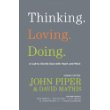
Book Review: Thinking, Loving, Doing edited by John Piper & David Mathis

Theological and Practical Help For Balancing the Mind, Heart, and Hands

This book is a compilation of several outstanding pastoral addresses from experienced Christian leaders from a recent Desiring God Conference on the theme of balancing the mind, the heart (emotions), and the hands. I will seek to summarize what each chapter/leader addresses in their specific topic of choice and what I benefited from in my reading of each chapter:

The Introduction is written by David Mathis (an elder at Bethlehem Baptist Church in Minneapolis). He makes a helpful distinction between churches that focus on being pure and those that focus on unity and encourages those who lean one way or the other to learn from the other side. He then proceeds to use Dr. John Frames helpful distinctions of tri-perspectivalism, whereby some churches emphasis The Kingly role, some the Priestly role, and others the Prophetic role of Christ. He then sets up the following chapters in the book and shows how each contributes to bring balance to how we can love Christ with our minds, hearts, and hands.

I personally really enjoyed this chapter as it caused me to reflect on my own strengths and weaknesses in my personal and corporate involvement in the body of Christ and what I have to offer others and what I can learn from others in becoming more Christ-like in balancing the tri-perspectivalism as described in the chapter via John Frames helpful schema.

Chapter Two is entitled “The Battle for Your Mind” by Rick Warren (everyone knows who he is – if you are on planet Earth). He does a topical study from the Scriptures on the pitfalls we wrestle with in the battle between our ears, and then proceeds to give four principles on thinking; five levels of learning; and five things to remember when we are teaching others.

As usual, Warren is very practical, and gives some good acronyms whereby one can remember easily his various points. What I liked about this chapter is that it was very thorough and broad and it is a chapter I will go back to again and again in my teaching others, and being reminded myself how to win the battle for the mind utilizing distinct principles in taking every thought captive for Christ.

Chapter Three is the most intellectually demanding chapter written by Albert Mohler – the President of the Southern Baptist Seminary in Louisville. He gives a very thought provoking analysis of our present state of thinking in light of Romans 1:18-32 and postmodernism. He gives 14 insightful noetic effects on the mind due to the fall; five precepts of the modern mind, 12 features of the natural mind, and three practical ways to combat the blind spots that we all have due to the fall.

Dr. Mohler has an amazing mind and what this chapter did for me primarily is to help me think more theologically about how thinking must be reformed and renewed by the Scriptures and the amazing effects of the fall upon our minds. It really motivated me to study the Scriptures and Culture more thouroughly then I typically do, so that I give more thought to how to declare the gospel the “natural” mind, and well as to the “spiritual” mind of those I seek to reach and grow in the gospel.

My favorite modern theologian – Dr. RC Sproul – founder of Ligonier Ministries writes about how Paul addresses the secular mind from Acts 17 and what we can learn from what he did, in our own approach to skeptics today.

Dr. Sproul makes the case for how we can never find “an explanation for being, for life, or for motion if we try to find it outside the being and character of God.” I was encouraged by this reminder of how amazing it is to have the perspective of God in my worldview, when so many have suppressed this, and are thus in great need of modern “Paul’s” to address the issues of the day from a Theo and Christo-centric perspective.

In Chapter Four Thabiti Anyabwile (Pastor in the Cayman Islands) addresses how we may encounter Islam by using the mind of Christ as opposed to being driven by fear where he rightly says, “where fear takes control, thinking does not.”

Pastor Anyabwile (a former Muslim who converted to Christianity as a young adult) does a fantastic job of giving an overview of pluralism, Islam, and how we should respond to Muslims. His chapter helped me to fear Islam less, and gave me a bigger heart to share the good news with the many Muslims who live in my community.

In Chapter Five, Francis Chan (Pastor and Writer in San Francisco) addresses how to think hard, combat pride and stay humble based on an exposition of 1 Corinthians 8. In this chapter Chan really does a great job showing how we can love more like Jesus by thinking more like him.

The Concluding chapter is by John Piper (Preaching Pastor of Bethlehem Baptist Church) and addresses how love flows out of us when we love God with all of our minds. He gives 8 points that he hopes this book will prevent in Christians, and then what he hopes that this book will awaken and increase: ‘Thinking for the sake of loving.”

I really enjoyed this book because it was deep theologically, and gave helpful applications from the Scriptures in how to love God and others with our minds, emotions, and actions. I highly recommend it and give it 5 stars because it’s a book I will come to again and again for my own personal walk with the Lord, and because it will help me to be more balanced in my own teaching, and coaching ministries.

*Note: I was provided a copy of this book from the publisher and was not required to give a favorable review.

Book Review: The Pastor as Scholar and The Scholar as Pastor – John Piper and D.A. Carson (2011)

Two Men Focused on A Sovereign God and a Saving Gospel:

 This is a short book that I wish every pastor and theologian on the planet would read – especially American pastors and theologians. As an American pastor for over twenty years I have been, and am growing even more concerned over how pragmatism rather than theological foundations dominate our approach to life and ministry. The greatest movements throughout Church History have always occurred when godly men were consumed with the glory of God and through that focus were able to under gird their flocks with a solid foundation that prepared them for life via a robust belief in the Sovereignty of God and His glorious gospel and how that connects to all of life. This book demonstrates how two of the finest scholar-pastors in the 20-21st century make it happen. I long for a day when Theology will once again not be marginalized in our Institutions or Churches, but once again be deemed the “Queen of the Sciences” due to the efforts of men like John Piper, D.A. Carson, and those who will follow their lead – through their example as articulated in this wonderful book.

 The book consists of four chapters entitled:

1) “The Return of the Pastor Scholar” by Owen Strachan. In this brief introduction Strachan shows how history is replete with pastor-scholars, and scholar-pastors who demonstrate “that robust theology, so far from hindering the practice of ministry, actually enriches it, even as the practice of ministry enhances and increases one’s appreciation for theology.” John Piper and D. A. Carson fit this mold and he calls for pastors and scholars to be a “realistic combination” of both – scholarly and pastoral (practicing a theology of the heart, mind, and hands is the way I would put it).

 2) “A Personal Journey and the Joyful Place of Scholarship” by John Piper. Here Piper shares how his life and educational experiences combined to bring about the overarching theme of his life and ministry – “that God is most glorified in us when we are most satisfied in him.” He makes the point that he seeks to be like the apostle Paul in his ministry by “talking about his personal life and experience with God with a view to helping his listeners.” He then spends the large portion of the chapter answering the question: “What were the impulses toward scholarship and the pastorate?” Piper writes about the major writers, pastors, teachers, and experiences in his life that shaped him to study hard (he was not a naturally gifted student and shares his struggles) in order to communicate with sound logic and passion the glories of our all satisfying Savior and Lord. Piper gives us a fascinating glimpse into his personal life and what drew him into the pastorate after initially becoming a New Testament scholar. He calls pastors to strive for balance in their calling as scholars and the pastorate by becoming Christian Hedonists – bringing the head and heart in harmony by living for and declaring the glories of Christ in truth and passionate love for one’s flock. He articulates balancing the pastoral/scholarly life in this way, “Right thinking about God exists to serve right feelings for God. Logic exists for the sake of love. Reasoning exists for the sake of rejoicing. Doctrine exists for the sake of delight…If I were to claim the role of pastor-scholar, this is what I would mean by it. Think rightly and deeply about Word and the world with a view to seeing the greatness of God and his works (especially the work of Christ) so that the affections of our hearts might rest on a true foundation and God might be honored by how we feel toward him and by the behaviors that flow from his heart…If I am scholarly, it is not in the sense because I try to stay on the cutting edge in the discipline of biblical and theological studies. I am far too limited for that. What ‘scholarly’ would mean for me is that the greatest object of knowledge is God and that he has revealed himself authoritatively in a book; and that I should work with all my might and all my heart and all my soul and all my mind to know and enjoy him and to make him known for the joy of others…Surely this is the goal of every pastor.”

 3) “The Scholar as Pastor: Lessons from the Church and Academy” by D.A. Carson. Carson warns early on in this chapter, “Nothing is quite as deceitful as an evangelical scholarly mind that thinks it is especially close to God because of its scholarship rather than because of Jesus.” In other words, scholarship is not an end in and of itself but its pursuit must be out of love for Jesus and for what Jesus loves. There must be a balance of loving God with our minds and our hearts. Carson proceeds to give a dozen cautions, warnings, and vignettes of advice to scholars with the theme of accurately handling the Word and realizing the impact of lives that you influence for the sake of the church and culture via your research, writing, and mentoring influence for the generations to come.

4) “The Preacher, the Professor, and the True Pastor Scholar” by David Mathis. David Mathis shares how our Lord and Savior Jesus Christ is the perfect example of a pastor-scholar. Jesus perfectly models the function of the mind, heart, and hands in the Gospels. He is the one that all Christians want to emulate. Mathis gives some other examples of modern-day pastor scholars and calls those in the ministry to emulate their calling using our skills and talents to bring about a new reformation and concludes with a prayer with which I wholeheartedly concur, “So in charging pastors to be more serious about the life of the mind, and in challenging scholars to be more engaged with the life of the church, we conclude with this prayer, that all our thoughtful shepherding and all our pastoral scholarship may be to the great end of having the gospel message about Jesus dwell richly (Col. 3:16) both in us and in our people; that knowing Jesus would be the great end of all our pasturing and our scholarship; that we ourselves, in all our preaching, writing, studying, and counseling, would continue to see ourselves as the great beneficiaries of his great grace; that into eternity we would be followers of Jesus more and more shaped, saturated, and transformed by his person and work. To Jesus, the great pastor-scholar, be the glory. Amen”

This book was simply a delight to read by two of the men that have in the past, and in the present continue to radically shape and influence my developing Christological world-view and how thinking in a God-centered manner lays the foundation for everything in life. As a preaching pastor I owe a great debt to John Piper in helping me to find my joy and satisfaction in Christ above all things, and to D.A. Carson for helping me interpret the Scriptures so as to teach accurately the Christological significance of the Bible. Together – through their speaking and writing – they have allowed me to delve into the depths of God and helped me to better communicate His majestic sovereignty as exemplified in the glorious gospel.

Continuing in a long line of Scholar-Pastors in the mold of Augustine, Calvin, Luther, Edwards, Spurgeon, and David Martyn Lloyd-Jones – Carson and Piper are a tremendous gift to the Church, and those who have yet to believe and follow Christ (even though they don’t know it). Through their prolific writing and speaking ministries in the Theological Institutions, Conferences, and the Church’s where they have served, Carson and Piper’s influence in promoting a robust Christo-Centric Theology is incalculable. My hope is that this book will be used by God to inspire pastors to be more scholarly in their endeavors, and for scholars to be more pastoral in their endeavors so that together we can stand on the shoulders of the pastor-scholars who have gone before us – so as to magnify the glory of God in Christ in our churches and penetrate the world with the soul satisfying gospel declared in the Scriptures.

Disclosure of Material Connection: I received this book free from the publisher – Crossway Books – book review bloggers program. I was not required to write a positive review. The opinions I have expressed are my own. I am disclosing this in accordance with the Federal Trade Commission’s 16 CFR Part 255: “Guides Concerning the Use of Endorsements and Testimonials in Advertising.”