Book Review: “HEART OF THE MATTER”

DAILY REFLECTIONS FOR CHANGING HEARTS AND LIVES

HEART OF THE MATTER

Book Review By David P. Craig

How would you like to spend every day of the year with a wise biblical counselor to encourage you and help you apply the gospel to your life? In this daily devotional that’s exactly what you get. From the writings of Paul David Tripp, Edwin T. Welch, Timothy S. Lane, William P. Smith, Michael R. Emlet, David Powlison, Robert D. Jones, and James C. Petty you will get advice, encouragement, direction, and plenty of gospel centered grace for each day.

The topical meditations in this devotional are all based on passages of Scripture and include a suggested daily reading from the Scriptures to illuminate the subject of the day. All of the authors of this book are a part of the Christian Counseling and Educational Foundation which “exists to teach people how to explore the wisdom and depth of the Bible and apply its grace centered message to the problems of daily living.”

One of the nice features of this devotional is that there is a Scripture index in the back, as well as a source index so you can go to any  one of the author’s writings for more study or advice on the particular subjects that are of interest to you. All of the sources include the page numbers from which the meditations are derived so you can track them down easily.

If you are looking for more grace in your life and want to go deeper in your understanding of, and application of the gospel – look no further than this devotional gem. I highly recommend this outstanding devotional as one that will help you grow in intimacy with our awesome God and change you to become more like Him as you daily center your thinking on who He is and what He has done for you in Christ Jesus.

BOOK REVIEW: B. TYLER ELLIS’ “QUESTION EVERYTHING”

A GREAT WAY TO INTERACT WITH THE BIBLE

QE ELLIS

Book Review by David P. Craig

The Bible is without question the best selling book of all-time. However, it’s also perhaps the most un-read or neglected book of all time as well. J.H. Smith has said, “If all the Christians were to dust their Bibles at the same time, we would have the greatest dust storm in history.” In my opinion nothing is more important than daily intake and interaction with the Bible. As Vance Havner has stated, “If you see a Bible that is falling apart, it probably belongs to someone who isn’t!”

The problem for many people when coming to the Scriptures is they get bogged down with names they can’t pronounce, places they are unfamiliar with, and concepts that are sometimes obtuse and abstract. What Ellis has provided in this very helpful book is a question for every single verse in the New Testament. In other words, he has provided a way for the reader to interact and dialogue with God. He has provided a resource that keeps your mind, heart, and will focused because it is a means of studying the Scriptures relationally by asking great questions of the text.

Ellis has structured the book in several helpful ways:

(1) Each chapter has a question for each verse of the New Testament. For example for Matthew 1:1 the question asked is “Who is Jesus identified as?” There are either “What?”, “Why?”, “Whose?”, “When?”, “How?”, or “Where?” questions for each verse and for every chapter of the New Testament. There is ample room provided for you to write your answer down for each question in the space provided.

(2) The actual verses aren’t included so you can read from whatever translation you prefer and answer the questions accordingly.

(3) At the end of each chapter there is a place to write answers to the following 4 questions: (a) What does the chapter reveal to you about God? (b) What does the chapter reveal to you about yourself? (c) What does the chapter reveal to you about your relationship with others? (d) What difference does it make?

There are several great strengths to studying the Bible in this manner of asking questions:

(1) It is more like a dialogue than a monologue. You are actually interacting and connecting with God in your reading of the Scriptures. It is as though you are sitting across the table from Jesus Himself – listening, asking questions, in relationship with Him through the text.

(2) It helps your mind not to wander off. You are constantly thinking about what the text is saying – making observations; interpreting; and applying the text to your life.

(3) It’s a great way to read the Bible with your family, friends, or in a group Bible study. It allows you to discuss what the Bible is actually saying in the context of community, fellowship, and getting different perspectives on the questions being asked of the text.

(4) It teaches you how to ask good questions and how to become a more observant and obedient student of the Scriptures.

(5) It will bring to the forefront of your life the deepest and profoundest questions and answers of eternal importance: Why did God create humanity? Why am I here? How can I know God personally? And many others.

(6) Simply by learning to ask good questions you will become a better student in all the great subjects of life. It will help you to become a better reader so that your reading and comprehension will improve in whatever subject you take on.

(7) It will remind you daily of how relevant the Scriptures are to your own life and those you work, study, live, and recreate with.

(8) You will become more like Jesus in your thinking and speech – because one of the most brilliant things about Jesus was He was a master of asking great questions. The more you read this book the better you will become at wisely asking questions of Scripture, of others, and of life itself.

(9) My mentor Bobb Biehl has said, “If you ask shallow questions you get shallow answers, if you ask profound questions you get profound answers.” Therefore, this book does a great job of helping you ask profoundly great questions so that you will get profoundly great answers to your questions of the most profound book in the Universe.

(10) Perhaps the greatest aspect of this book is that it helps you to listen to what God has to say to you through the text. So many studies today focus on the question: “What does this mean to me?” rather than focusing on “What does God mean by saying this to me?” It helps us to listen to what God is actually saying, not what we want Him to say. I think that’s the most important aspect of this practical book.

I highly recommend this resource for students, teachers, pastors, and anyone who wants to have a deeper intimacy with God, understanding of His Word, and greater desire to obey Him in all aspects of life. Ellis has provided an outstanding resource that will only enhance and enrich your experience with God through His Word as revealed in the New Testament.

*B. Tyler Ellis is a College Minister in Newark, DE and you can follow him on Twitter @BTylerEllis and has a website: btylerellis.com/tyler-3/

BOOK REVIEW: R.C. Sproul’s “WHAT IS THE CHURCH?”

A GREAT PRIMER ON WHAT THE CHURCH IS ALL ABOUT

WITC? SPROUL

Book Review by David P. Craig

R.C. Sproul examines what the Church isn’t, and what it is. In breaking down four key words from the Council of Nicea about what the Church is, Sproul articulates what it means that the church is (1) one, (2) holy, (3) catholic [i.e., universal], and (4) apostolic. Some of the issues addressed in this helpful book are: Why are there so many denominations? What are the essential truths that unite all Christians? What is Liberalism? Why do doctrines divide and unite? What’s an Evangelical? What does it mean for the church to be holy? What is the foundation of the church? What does it mean to be “in Christ”? What is the Gospel? What are the Sacraments? and Why should the church practice discipline?

Sproul covers a lot of ground in this short book. It is full of historical and theological insights, wisdom, and biblically based. I would recommend this book especially for new Christians and as a cogent argument for so-called “Christians” who are not a part of a visible local church. It will help you appreciate what unites Christians throughout history, today, and forever.

BOOK REVIEW: R.C. SPROUL’S “HOW CAN I DEVELOP A CHRISTIAN CONSCIENCE?”

 AN ETHICAL PRIMER FOR DEVELOPING A CHRISTIAN CONSCIENCE

HCIDACC? SPROUL

Book Review by David P. Craig

R.C. Sproul begins this book by giving a classical definition of the Christian conscience: “The Christian conscience is thought to be something that God has implanted into our minds…the voice of God within us….The idea is that God created us in such a way that there is a link between the sensitivities of the mind and the conscience with its built-in responsibility to God’s eternal laws.” He then goes on to give several examples of how the conscience and law work together to bring about thoughts and actions that are either in accordance with God’s Word or against God’s Word. The conscience is the “tool that God the Holy Spirit uses to convict us, bring us to repentance, and receive the healing of forgiveness that flows from the gospel.”

In the short chapters of this book Sproul compares and contrasts several important matters with reference to developing a Christian conscience as we deal with what has been clearly revealed in the Scriptures and not clearly revealed in the Scriptures:

(1) Creation ordinances vs. Civil Law – here Sproul cogently and compellingly demonstrates that everyone is responsible to live by the Covenant of Creation and that everything that is legislated by law is “moral legislation” – Sproul writes: “Of course, if you think it through, you realize that moral issues are at the heart of all legislation. The question is not whether the state should legislate morality. The question is what morality should the state be legislating? Natural law states that in nature there are certain principles that we should never violate. But why? Just because nature says it’s wrong? No. Classically and historically, Christianity has said that those laws that we find in nature are the external manifestations of the law of God. Remember that all true and just law is based ultimately on the character of God and His eternal being. From those eternal principles we get a reflection of God in natural law…In the final analysis what the culture does or does not do must not affect my responsibility to God. We are called to be a people of principle. Reformation starts when we begin to live by principle and not by expediency.”

(2) The distinction between ethics and morality  – What are the indicatives (morality) of Scripture and what are the imperatives (ethics)?  Here Sproul answers two important questions: (a) What is good, and what does God require of us that is well pleasing to Him? and (b) How can we have the ethical courage to do what is right? Perhaps the most important issue handled in this section is Sproul’s treatment of major’s, minor’s, and areas of freedom in the Christian life.

(3) Legalism vs. Antinomianism – Here Sproul demonstrates three ancient and modern varieties of those who are “legalistic” and those who are “anti-law.” He demonstrates the importance of balance between these two dangerous extremes in this way, “The essence of Christian theology is grace, and the essence of Christian ethics is gratitude.” Sproul reminds us that where the Scriptures are silent “we have no right to heap up restrictions on people where He has no stated restriction…We are to be concerned with integrity, justice, mercy, and helping a world that is in pain. It is all too simple to distort the biblical ethic by a kind of legalism that majors in minors.”

(4) Degrees of sin. The last topic addressed in the book is the question are some sins worse than others? Sproul does a wonderful job of providing many examples – especially from the Sermon on the Mount – to demonstrate the seriousness of sin, and God’s provision for our sins. Tackling issues of guilt, law, righteousness, and justification this short book is jam packed with great questions and answers to some of the most important issues of our day. If you want to know how to live as a Christian in the 21st Century this book is an excellent primer of how to develop a conscience that is right with God and pleasing to God.

BOOK REVIEW: DENNY BURK’S “WHAT IS THE MEANING OF SEX?”

GOD’S INTENTION FOR SEX

WITMOS BURK

Book Review By David P. Craig

Denny Burk has written both a brilliant critique of errant sexual views and presented a cogent case for the biblical meaning of sex that transcends all cultures and time. Burk’s thesis developed in this book is that sex is a gift from God that is to be enjoyed exclusively within the covenant of marriage so that it might magnify God’s own covenant love for his people and thus bring glory to Him. The glory of God [all of who God is put on display] is the ultimate purpose of everything a Christian does – including sex.

There have been many books written by Christians in the past several years but they usually fall short in applying a teleological view of sex. In other words they address what the Bible has to say about sex, but not necessarily what the purpose of sex is. Burk writes: “What they [with reference to Mark Driscoll’s recent book on sex and marriage – but can be applied to various other authors] never asked, however, is the teleological question: Does this act fulfill God’s purposes for the sexual union? Does this act fulfill Gd’s ultimate purpose for marriage and sexuality–the glory of God? This is where teleology can help us.”

Burk proceeds to write a biblical theology of sex with a God-centered ethical foundation based on virtually everything the Bible has to say about our bodies, our interpretation of the relevant passages pertaining to sex, our marriages, conjugal unions, family planning, gender, sexuality and singleness. In all these areas Burk does a remarkable job of what he describes as blending biblical theology, ethics, and cultural issues pertaining to sex. He writes, “I am favoring a bleded approach that gives a privileged place to teleology within the framework of divine revelation. Scripture is plainly concerned with the formation of moral character as the basis for moral choices (as in character ethics). Scripture is also concerned with rules and divine commands (as in deontology). But Scripture also focuses on the glory of God as the purpose of all things (as in teleology).”

Therefore, Burk argues that the four aspects of sex as defined by God in the context of marriage as a covenant between and man and a woman are designed for (1) the consummation of marriage, (2) procreation, (3) expression of love, and (4) pleasure. However, these four purposes “comprise the means by which we glorify God with our sexuality.” Burk unfolds his thesis methodically, clearly, and with great theological depth that “the ultimate purpose of human sexuality is the glory of God and that the ultimate ethic is to glorify God with our sexuality.” I can’t possibly recommend this book high enough for both Christians and non-Christians to come to grips with the reason, meaning, and purpose for one’s gender, identity, sex, and marriage according to God’s great design.

*I was provided with a copy of this book for review by the publisher and was not required to write a fovorable review.

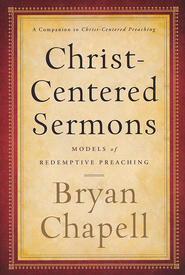
BOOK REVIEW: BRYAN CHAPELL’S “CHRIST-CENTERED SERMONS”

MODELS OF REDEMPTIVE PREACHING

CCS Chapell

 APPLYING CHRIST-CENTERED PREACHING IN YOUR MINISTRY

Book Review by David P. Craig

It’s hard to believe that its already been nineteen years since Bryan Chapell penned his classic text on preaching – Christ-Centered Preaching (CCP). Since that time Christo-centric preaching has been on the rise and pastors have become much more exposed to biblical theology and the redemptive historical method of interpretation in helping the busy pastor with sermon preparation. This new work by Chapell is a wonderful complement and sequel to his seminal text that his been so influential in both Reformed and Non-Reformed circles.

Whereas Chapell laid the foundational ground work for Christo-centric preaching in CCP, here he helps the preacher apply the groundwork by giving various examples of sermons that demonstrate the various genres of Scripture and how they point to Christ. Part One focuses on the structure of the Christo-centric sermon by giving examples of informal, formal, inductive, and expository sermons. Part Two delves into various redemptive approaches of Scripture passages. Part Three focuses on sermons that reveal how a variety of redemptive truths can be used from the Scriptures to apply to our lives.

The common denominator of all the expository sermons found in this book is that they focus on saying what God says in the passage. The preacher is encouraged to proclaim the truths gleaned from the passage in order to convey what was originally intended by the Holy Spirit. “Making sure God’s people know what God has said and why he has said it is the tandem goal of expository preaching.” All of the sermons in this book focus on the empowering power of grace through Christ that is found throughout the Scriptures. The message of the gospel and God’s grace in Christ is what leads us to repentance, salvation, and genuine transformation from darkness to light.

The author masterfully teaches and guides the preacher by showing him that “Christ-centered exposition does not require us to unveil depictions of Jesus by mysterious alchemies of allegory or typology; rather, it identifies how every text functions in furthering our understanding of who Christ is, what the Father sent him to do, and why.” In Christ-centered preaching the listener is helped to apply the biblical text by answering four main questions from the passage: (1) What am I to do? (2) Where am I to do it? (3) Why am I to do it? (4) How am I to do it?

Chapell writes, “In essence, redemptive exposition requires that we identify an aspect of our fallen condition that is addressed by the Holy Spirit in each passage, which he inspired for our edification, and then show God’s way out of the human dilemma.” The way out of the dilemma of our fallen condition is through the motivation of grace and holiness because the realities of the cross. We are enabled to have victory over sin due to our union and communion with Christ as revealed in the Scriptures.

I highly recommend that you read Chapell’s first book on preaching before reading this one. However, it’s not essential that you read his first book because he does a lot of review and explains everything he is doing in each sermon in this new offering. He lays out the foundations and theory in his first book as a solid basis for its application in this new one. Together these two books provide a tour de force of Christo-centric preaching resources for the Christ-centered preacher.

Chapell gives various ways that the same passage can be preached using different strategies without changing the biblical author’s intent. His introductions and demonstration of how the principles work for each sermon are immensely instructive. The sermons in this book are based on the following passages of Scripture: 2 Timothy 4:1-5; Judges 6-8; Psalm 126; Jeremiah 33:14-16; Isaiah 44:9-23; Numbers 20:1-13; Romans 15:4; Luke 17:1-19; Titus 2:11-15; and Romans 6:1-14. By providing sermons on various genres from the Old and New Testament Chapell has provided a wonderful guide for preachers to learn better how to apply the principles of Christ-centered preaching from Genesis to Revelation.

BOOK REVIEW: JASON C. MEYER’S “PREACHING: A BIBLICAL THEOLOGY”

A BIBLICAL THEOLOGY OF THE MINISTRY OF THE WORD

PABT Meyer

Book Review by David P. Craig

I’ve been waiting for a book like this since my calling into the ministry thirty-one years ago. Meyer combines two of my favorite subjects: biblical theology and preaching with my greatest passion – the glory of God as revealed in Jesus. The thesis of this very enjoyable book is that “the ministry of the word in Scripture is stewarding and heralding God’s word in such a way that people encounter God through his word.”

What makes this book unique is that the author shows how “the whole Bible alone can give a holistic answer to what preaching is.” Meyer brilliantly and cogently examines what the whole of the Scriptures have to say broadly about the ministry of the Word and specifically in light of what this means for the expository preacher. The ultimate reason of preaching isn’t for the transfer of information, but to have an encounter with the living God.

Meyer takes the reader on a biblically saturated journey from Genesis to Revelation and unpacks what the entire Scriptures have to say about the ministry of the Word. He does a remarkable job of conveying how preaching the Word is grounded within the big picture story line of the gospel. Christ is the plot-line of the Scriptures and Meyer helps the minister build a foundation for preaching, paradigms for preaching, and demonstrates how biblical and systematic theology guides the preacher in ministering the Word so that we and our hearers encounter the glory of God in Christ.

I highly recommend this book for beginning and seasoned preachers, but also for all Christians. It is packed full with excellent illustrations, robust theological truths, and insightful applications. By helping us to interpret the whole Bible through the lenses of redemption Meyer helps us to see that Jesus is at the forefront of every passage we preach. I believe that any believer reading this book will come to understand the gospel better, and strive to minister the word with Jesus at the center of our proclamation so that we and our listeners will truly encounter our Awesome God.


BOOK REVIEW: RANDY ALCORN’S “SEEING THE UNSEEN”

A DAILY DOSE OF ETERNAL PERSPECTIVE

STU Alcorn

MAKING YOUR DAYS COUNT FOR ETERNITY

Book Review By David P. Craig

This book assemble’s some of Alcorn’s best writings related to living for that which will last for eternity. It contains sixty days worth of devotions or meditations including perspectives from God’s Word and from God’s people in each daily reading. At the end of each devotional there is also a link to Alcorn’s blog where you can read more on the topic (in the Kindle version – you just click on the link and it takes you right there). Some of the topics addressed are as following: True Happiness; Homesick for Heaven; Grasping our need for Grace; Seeking God’s will; True Repentance; A Theology of Laughter; God’s Sovereignty; The Christian Optimist and God’s Glory and our Good.

Each day hones in on two to three key Scriptures on the topic; two to three great quotes from people like Spurgeon, Chambers, Lewis, Piper, Ryle, Sproul, Tozer and Luther; and focuses on the hope and joy that we have in our promises from the God who holds the future in His hands for our good and His glory. Alcorn’s insights from the Scriptures are clear, cogent, profound, and practical. This book makes a great gift for graduates, birthday’s, anniversaries, the elderly, and any disciple of Christ who needs comfort and encouragement for the ups and downs of life. We all need to reminded of the hope that we have in Christ. I highly recommend this excellent compilation of Alcorn’s finest thoughts on Heaven and living for eternity.

BOOK REVIEW: “THE MAKING OF A LEADER” BY DR. J. ROBERT CLINTON

RECOGNIZING THE LESSONS AND STAGES OF LEADERSHIP DEVELOPMENT

TMOAL Clinton

A PRIMER ON THE PROCESS OF BECOMING A LEADER

Book Review By David P. Craig

Knowing where one is at is crucial in moving forward in life. Nothing is more helpful when one is lost than having a map of where one is, and how to get to where we need to go. Recently, I experienced going through a difficult bout with cancer. The treatment and side effects of the treatment were absolutely brutal. However, I had a guide along the way to help me get through it. He was a man who had the exact same cancer and treatment as me, but he was already “cancer free” and a year ahead of me in the process. He helped me in my journey in two ways: (1) He helped me realize that what I was going through was normal and miserable, but necessary for the cancer to be killed; (2) He gave me a “living hope” that I would be cancer free like him if I endured to the end of the treatment without giving up. The process was excruciating, but now that I look back a year later – like him – I want to help people in their journey with cancer.

In the same vein as my illustration above Dr. Clinton helps emerging leaders understand the process of becoming a mature leader by evaluating the lives of biblical and modern leaders journeys. He identifies six primary processes’ that all leaders must go through on the way to becoming a healthy and mature leader of leaders. Some of the examples used in this book are the Prophets Jeremiah and Daniel, the Apostles Paul and Barnabas, and modern examples: Dawson Trotman, Warren Wiersbe, A.W. Tozer, Watchman Nee, Amy Carmichael and several others.

In his study Clinton articulates six phases or stages of a leaders development:

(1) Phase One is called “Sovereign Foundations” – This is where a leader starts to become aware of his or her calling to leadership. It is a time where  character issues are developing, skills are developing, and one’s calling is being wrestled with. There is a deep sense of God’s calling and purpose and the building blocks for the emerging leader’s life are starting to lay the foundations for a life of leadership.

(2) Phase Two is called “Inner Life Growth” – This is a time where the leader is learning to hear and obey God’s leading. It is a time of deep spiritual growth and intimacy with God. The leader is often put through several major tests during this process – will he or she obey and submit wholeheartedly to God?

(3) Phase Three is called “Ministry Maturing” – In this stage the leader is reaching out to others and discovering and practicing ones spiritual gifts. Both positive and negative lessons are being learned during this phase. The leader is learning his or her own strengths and weaknesses in working with others. Oftentimes there is a strong desire to get more training during this time to minimize one’s weaknesses and enhance one’s strengths. In the first three phases God is primarily working “in” the leader not through him or her. In the next three phases God is working “through” the leader. As Clinton articulates “Many emerging leaders don’t recognize this, and become frustrated. They are constantly evaluating productivity and activities, while God is quietly evaluating their leadership potential. He wants to teach us that we minister out of what we are.”

(4) Phase Four is called “Life Maturing” – This is a time in the leaders life where the leader “is using his or her spiritual gifts in a ministry that is satisfying. He gains a sense of priorities concerning the best use of his gifts and understands that learning what not to do is as important as learning what to do. A mature fruitfulness is the result. Isolation, crisis, and conflict take on new meaning. The principle that ‘ministry flows out of being’ has new significance as the leader’s character mellows and matures.” Communion and intimacy with God becomes immensely more important than one’s ‘success’ in ministry.

(5) Phase Five is called “Convergence” – God takes the leader and matches him or her with a role that matches his or her gift-mix and experience so that ministry is maximized. Life maturing and ministry maturing peak together during this phase. Many leaders never get to experience this phase. Some leaders like Dawson Trotman and Jim Elliott were taken to Heaven before entering this phase. Some leaders don’t get to experience this phase because of their own sin, or other providential circumstances. For those who experience convergence it is a time of transitional leadership where the baton is passed down to other faithful leaders who will continue to develop the leaders’ vision for the church or organization they have developed.

(6) The final phase is called “Afterglow” or “Celebration” – Clinton describes this stage as “The fruit of a lifetime of ministry growth culminates in an era of recognition and indirect influence at broad levels. Leaders in Afterglow have built up a lifetime of contacts and continue to exert influence in these relationships. Others will seek them out because of their consistent track record of following God. Their storehouse of wisdom gathered over a lifetime of leadership will continue to bless and benefit many.”

Clinton defines leadership as “a dynamic process in which a man or woman with God-given capacity influences a specific group of God’s people toward His purposes for the group.” This book is written for leaders and potential leaders who are (a) wondering what God is doing in their lives – asking the question “Is God calling me into Christian ministry?”; (b) are beginning to discover ministry opportunities; (c) need a fresh challenge from God; (d) need to understand how to select and develop younger leaders; (e) are at a crossroads, facing a major decision; (f) want to know how God develops leaders; (g) want to know where you are at in the process of your leadership development – is what you are experiencing normal for a leader?

I think all emerging and veteran leaders will benefit immensely from reading this book. It is packed with useful examples, illustrations, charts, and principles to help you become a godly leader. Also, it is immensely helpful to help you understand the process’ of leadership and how to invest in other emerging leaders. If you believe God is calling you to leadership, or has already entrusted you with a leadership role, you will most definitely benefit from Clinton’s wisdom – from one leader to another.

BOOK REVIEW: JEFF IORG’S “SEASONS OF A LEADERS LIFE”

LEARNING, LEADING, AND LEAVING A LEGACY

SOALL Iorg

Leadership Lessons  from the Life of Peter the Apostle

Book Review by David P. Craig

Just as life has seasons, leaders also have stages or phases of leadership. In this practical book Jeff Iorg tackles the three seasons or phases of a leader’s life. Using the Apostle Peter as his thematic teaching point, Iorg highlights leadership lessons from the three seasons or phases of leadership: Phase One – learning about leadership; Phase Two – actively leading; and Phase Three – leaving a legacy.

In Part One – Lessons for Emerging Leaders – Iorg tackles 21 lessons for leaders to grapple with in the earliest phases of their leadership development. Some of the topics addressed include: a leader’s calling, identity, prayer life, how to forgive, and serve humbly. The first section of the book highlights leadership principles and lessons from the stories in the Gospels where the Apostle Peter is specifically singled out by Jesus.

Part Two – Priorities for Active Leaders – contains 13 priorities for leaders in their prime, including: calling people to Jesus, accessing God’s power, confronting sin, defending the faith, working with other leaders, and how to move on after making mistakes. In this section of the book Iorg gives emphasis to every story in Acts and the Epistles where Peter is involved in leadership and the lessons or insights we can glean from his example.

In Part Three – Convictions of Maturing Leaders – Iorg expounds upon 10 powerful convictions of a leader intent on leaving a lasting legacy, including: Jesus is enough, pursuing purity, building good relationships, trusting Jesus and His Word, and giving glory to Jesus. The last section of the book summarizes Peter’s legacy from the wisdom he gained, the disciples and leaders he influenced, and the convictions he held to and modeled for a generation of leaders to come.

Jeff Iorg has written a very insightful and practical book that helps leaders learn more about leadership, focus on what’s most important in leadership, and finish well in one’s calling by leading effectively and leaving a legacy for future leaders. Written with emerging leaders and veteran leaders in mind, this book is filled with great insights for leaders of all seasons, ages, and phases of life. Each short chapter includes helpful questions for reflection and discussion. The book would be an excellent resource for church leaders to use in a discipleship type setting over a period of several months. It could also be a very helpful book for older pastors to mentor younger pastors with. I highly recommend this book as a great resource to return to throughout the varied seasons of a leader’s life.