
Tag: David P. Craig
BOOK REVIEW: TIM KELLER’S “WALKING WITH GOD THROUGH PAIN AND SUFFERING”
Into The Furnace and Out Like Gold

Book Review By David P. Craig
As someone who has experienced a tremendous amount of loss, grief, pain, and suffering I was excited for Tim’s book on suffering to arrive. Tim Keller has also suffered much, and thus speaks with credibility as a fellow sufferer in the journey of life where there are many hills and valleys along the way.
Keller divides the book into three parts based on the biblical metaphor where suffering is described as a “fiery furnace.” Fire is an image used throughout the Bible as an image describing the torment and pain of suffering. The Bible speaks frequently of troubles and trials as “walking through the fire,” a “fiery ordeal”, and a “fiery furnace.”
Therefore, Keller builds his themes around this image. In Part One Keller considers the furnace from the outside of us. He tackles “the phenomenon of human suffering, as well as the various ways that different cultures, religions, and eras in history have sought to help people face and get through it [suffering].”
In part two Keller moves away from the theoretical realm and begins to hone in on the personal and character issues that are developed when we suffer. He seeks to demonstrate that the common ways we handle suffering via avoidance, denial, and despair are essentially to waste our suffering. On the other hand, the Bible presents a balanced view in how to handle suffering in a step by step fashion. Biblical truth is always balanced and faces hardships head-on because these are the fires that God uses in our lives to mold our character and make us more like Christ.
Part three is the most practical part of the book. Suffering is actually designed by God to “refine us, not destroy us.” Keller explains in this final section how we can can properly orient ourselves toward God in the midst of our suffering so that we walk as Jesus walked in His great suffering.
The best time to read a book on suffering is before you are in the midst of the furnace. Keller recommends that you read sections two and three if you are already in the midst of great suffering. However, the best time to prepare for suffering is before it occurs. Therefore, it would be wise to read this book in the calm before the storm. Christians need to be prepared and develop a theological foundation of suffering before we enter the hot furnaces of life.
Americans seem to suffer more due to the fact that they are even suffering – than because of the suffering in and of itself. Keller wisely shows that suffering is a normal part of living in a fallen world. Life is full of various kinds of sufferings and we will always find ourselves coming into, or coming out of the fires of the furnace. God’s promise is that when you “pass through the waters…when you walk through the fire…I will be with you.” Jesus faced the ultimate suffering and furnace [the cross] and came through unscathed on our behalf. He was victorious over all the fires that we faced so that we too can be victorious as we face the fires that will come in Him, and with Him by our side.
I highly recommend this book as a wonderful resource that takes seriously the problems and complexities of suffering without watering them down. It is a resource that takes a multidimensional approach to suffering – tackling the internal and external realities – and takes us deep theologically and practically. It is good spiritual food for the mind and soul. Keller also weaves many personal stories of men and women along the way in this journey of suffering that will help you connect to the truths that he is communicating – not just for information, but for transformation.
I believe that God will use this book to powerfully help Christians realize that God has a plan and purpose to bring good out of all of our suffering. Out of each furnace that we enter – though difficult and painful – we will be refined by the fire and come out like gold. We will come out shining like the Son if we learn to trust and depend on His grace before, during, and in the aftermath of our trials. As Keller writes, “In Jesus Christ we see that God actually experiences the pain of the fire as we do. He is truly God with us, in love and understanding, in our anguish. He plunged himself into our furnace so that, when we find ourselves in the fire, we can turn to him and know we will not be consumed but will be made into people great and beautiful.”
Book Review: Are Miraculous Gifts For Today? 4 Views
How Does God the Holy Spirit Work Through His Church Today?
Book Review By David P. Craig

This will be one of the longest book reviews I’ve ever written. I’m writing it as much for me (to sort through what I read) as anyone else. I want to give an overview of the positions in the book, their presenters, and the pros and cons of each position as represented by the presenters. Then I would like to close this review with the strengths and weaknesses of the arguments that were presented and whether or not there was any resolution.
The essential issues addressed in this book by four presenters and one facilitator is related to these important questions: “How is the Holy Spirit working in churches today? Is he really giving miraculous healings and prophecies in tongues? Is he giving Christians new power for ministry when they experience a ‘baptism in the Holy Spirit’ after conversion? Is he driving out demons when Christians command them? Or are these events confined to a distant past, to the time when the New Testament was being written and living apostles taught and governed–and worked miracles–in the churches? There are many Pentecostals who say that Christians should seek to be baptized in the Holy Spirit after conversion, and that this experience will result in a new spiritual power for ministry. But other evangelicals respond that they already have been baptized in the Holy Spirit, because it happened the moment they became Christians, Who is right? What are the arguments on each side?”
In addition to these questions there are many differences over what spiritual gifts are currently in operation today. “Can people have a gift of prophecy today, so that God actually reveals things to them and they can tell these revelations to others? Or was that gift confined to the time when the New Testament was still unfinished, in the first century A.D.? And what about healing? Should Christians expect that God will often heal in miracles when we pray today? Can some people still have the gift of healing? Or should our prayer emphasis be that God will work to heal through ordinary means, such as doctors and medicine? Or again, should we mostly encourage people to see the sanctifying value of sickness and pray that they will have grace to endure it?
Lastly, questions related to what is speaking in tongues? How should they be practiced in the church (if at all)? And should evangelism and ministry be accompanied by demonstrations of God’s miraculous power? These and many more questions and issues are addressed by the presenters.
The presenters consist of two Theologians that would lean toward the cessasionist category. Some well-known schools that have traditionally represented cessationism include: Westminster Theological Seminary, Dallas Theological Seminary, and The Master’s Seminary. Cessationists argue “that there are no miraculous gifts of the Holy Spirit today. Gifts such as prophecy, tongues, and healing were confined to the first century, and were used at the time the apostles were establishing the churches and the New Testament was not yet complete.”
Representing the Cessationist position is Dr. Richard B. Gaffin. He has been a long time Professor of Systematic Theology at Westminster Theological Seminary in Philadelphia. Dr. Gaffin has written a book defending this position entitled Perspectives on Pentecost: Studies in New Testament Teaching on the Gifts of the Holy Spirit (Phillipsburg, N.J.: P&R, 1979). Gaffin has degrees from Calvin College (A.B.), and Westminster Seminary (B.D., Th.M., Th.D.), and is also a minister in the Orthodox Presbyterian Church.
The next position discussed in the book is called the “open but cautious” position. The open but cautious position is described this way by the editor: “These people have not been convinced by the cessationist arguments that relegate certain gifts to the first century, but they are not really convinced by the doctrine or practice of those who emphasize such gifts today either. They are open to the possibility of miraculous gifts today, but they are concerned about the possibility of abuses that they have seen in groups that practice these gifts. They do not think speaking in tongues is ruled out by Scripture, but they see many modern examples as not conforming to scriptural guidelines; some also are concerned that it often leads to divisiveness and negative results in churches today. They think churches should emphasize evangelism, Bible study, and faithful obedience as keys to personal and church growth, rather than miraculous gifts. Yet they appreciate some of the benefits that Pentecostal, Charismatic, and Third Wave churches have brought to the evangelical world, especially a refreshing contemporary tone in worship and a challenge to renewal in faith.”
Representing the “Open but cautious” view is the Distinguished Professor of Systematic Theology from Talbot School of Theology, Dr. Robert L. Saucy. Dr. Saucy has taught for more than 40 years at Talbot and is the author of numerous books related to eschatology and the church including: Unleashing God’s Power in You (with Neil T. Anderson; Bridgetree, 2012); The Case for Progressive Dispensationalism: The Interface Between Dispensational and Non-Dispensational Theology (Grand Rapids: Zondervan, 2010); Scripture: Its Power, Authority and Relevance (Nashville: Word, 2001); and The Church in God’s Program (Chicago: Moody Press, 1974). Dr. Saucy earned his degrees at Westmont College (A.B.), and Dallas Theological Seminary (Th.M., and Th.D.). He is a member of a Conservative Baptist Church.
The third view presented is called the “Third Wave” view. It is a continuationist view of the miraculous gifts. Wayne Grudem explains this position as follows: “Third Wave people encourage the equipping of all believers to use the New Testament spiritual gifts today and say that the proclamation of the gospel should ordinarily be accompanied by ‘signs, wonders, and miracles,’ according the the New Testament pattern. They teach however, that baptism in the Holy Spirit happens to all Christians at conversion and that subsequent experiences are better called ‘fillings’ or ’empowerings’ with the Holy Spirit. Though they believe the gift of tongues exist today, they do not emphasize it to the extent that Pentecostals and Charismatics do.”
The presenter of the “Third Wave” view is Dr. C. Samuel Storms. He is currently the pastor of Bridgeway Church in Oklahoma City, Oklahoma. In the past he has been an associate of Dr. S. Lewis Johnson’s at Believer’s Chapel in Dallas, Texas; a pastor at Christ Community Church in Ardmore, Oklahoma; and an associate pastor with Mike Bickle in Kansas City, Missouri at the Metro Christian Fellowship. He is the founder of Enjoying God Ministries and has also been a professor of theology at Wheaton College. Dr. Storms has earned his degrees from The University of Oklahoma (B.A.); Dallas Theological Seminary (Th.M.); and The University of Texas (Ph.D.). Dr. Storms has authored numerous books including: The Beginner’s Guide to Spiritual Gifts. Ventura: Regal, 2013; Chosen for Life: The Case for Divine Election. Wheaton: Crossway, 2007; and Convergence: Spiritual Journeys of a Charismatic Calvinist. Enjoying God Ministries, 2005.
The term “Third Wave” was coined in the 1980’s by the Fuller Seminary professor of missions – Dr. C. Peter Wagner. Dr. Wagner has designated the first wave of the renewal of the Holy Spirit – The Pentecostal renewal (Which began in 1901). The charismatic renewal followed on the heels of the Pentecostal renewal in the 1960-70’s. Perhaps the best-known proponent of the “Third Wave” position was John Wimber the leader of the Association of Vineyard Churches and the pastor of the Vineyard Christian Fellowship in Anaheim, California.
The Pentecostal and Charismatic views are very similar but have some differences. Wayne Grudem explains, “Pentecostal refers to any denomination or group that traces its historical origin back to the Pentecostal revival that began in the United States in 1901, and that holds the following doctrines: (1) All the gifts of the Holy Spirit mentioned in the New Testament are intended for today; (2) baptism in the Holy Spirit is an empowering experience subsequent to conversion and should be sought by Christians today; and (3) when baptism in the Holy Spirit occurs, people will speak in tongues as a ‘sign’ that they have received this experience. Pentecostal groups usually have their own distinct denominational structures, among which are the Assemblies of God, the Church of God in Christ, and many others.”
“Charasmatic, on the other hand, refers to any groups (or people) that trace their historical origin to the charismatic renewal movement of the 1960’s and 1970’s and seek to practice all the spiritual gifts mentioned in the New Testament (including prophecy, healing, miracles, tongues, interpretation, and distinguishing between spirits). Among charismatics there are differing viewpoints on whether baptism in the Holy Spirit is subsequent to conversion and whether speaking in tongues is a sign of baptism in the Spirit. Charismatics by and large have refrained from forming their own denominations, but view themselves as a force of renewal within existing Protestant and Roman Catholic churches. There is no representative charismatic denomination in the United States today, but the most prominent charismatic spokesman is probably Pat Robertson with his Christian Broadcasting Network, the television program “The 700 Club,” and Regent University.
Representing the Pentecostal position is Dr. Douglas A. Oss. He also demonstrates where the Pentecostal and Charismatic positions differ. Dr. Oss is currently Professor of Biblical Theology and New Testament Interpretation at the Assemblies of God Theological Seminary in Springfield, Missouri. Dr. Oss has earned degrees from Western Washington University (B.A), Assemblies of God Theological Seminary (M.Div.) and Westminster Theological Seminary (Ph.D.). He has published articles in the Journal of the Evangelical Theological Society; Bulletin for Biblical Research; Grace Theological Journal; Westminster Theological Journal; and Enrichment Journal. He also translated 1 and 2 Corinthians for the New Living Translation and served on the Translation Advisory Committee for the English Standard Version.
The general editor and author of the introduction and conclusion of the book is Dr. Wayne Grudem. Dr. Grudem is Research Professor of Theology and Biblical Studies at Phoenix Seminary in Phoenix, Arizona. He received a B.A. from Harvard University, an M.Div. and a D.D. from Westminster Seminary, Philadelphia, and a Ph.D (in New Testament) from the University of Cambridge, England. He has published over twenty books, including his newest book, The Poverty of Nations: A Sustainable Solution, which was published in August 2013 and his magnum opus: Systematic Theology: An Introduction to Biblical Doctrine (Zondervan, 2009). He has also written a layman’s version of his doctoral thesis entitled The Gift of Prophecy in the New Testament and Today (Crossway, 1988). He was also the General Editor for the 2.1 million-word ESV Study Bible (Evangelical Christian Publishers Association Book of the Year and World Magazine book of the year, 2009).
In each essay the four authors address from their own view the following five topics: (1) baptism in the Holy Spirit and the question of postconversion experiences; (2) the question of whether some gifts have ceased; (3) a discussion of specific gifts, especially prophecy, healing, and tongues; (4) practical implications for church life; (5) dangers of one’s own position and that of the others. After each essay the three other presenters respond with an eight-page response. At the end of the book Dr. Grudem evaluates each position citing the pro’s and con’s of each, and then brings out the areas of agreement and disagreement. He also offers some guidelines for continued dialogue and solutions leading toward consensus.
In an interesting point Grudem says, “People have asked me why these four men who all believe the same Bible and all have deep love for our Lord could not reach agreement on these things. I tell them that it took the early church until A.D. 381 (at Constantinople) to finally settle the doctrine of the Trinity, and until A.D. 451 (at Chalcedon) to settle disputes over the deity and humanity of Christ in one person. We should not be surprised if these complex questions about the work of the Holy Spirit could not be resolved in two days!” Point well taken.
In reading the book one gets an immediate sense of the complexities related to miraculous gifts. Ultimately it all comes down to interpreting the biblical data. The author’s all leave no stones unturned in their theological and exegetical presentations. They all present well written essay’s with good arguments. Obviously, they all can’t be right. However, the spirit with which they write is right. They articulate their arguments cogently and compellingly and yet all recognize that their own view has deficiencies and weaknesses. However, each scholar makes an excellent case for his view.
As for the areas of disagreement there were many. The big idea conveyed by Gaffin and Saucy is that Jesus and the Apostles miracles were unique in relationship to God’s Redemptive Historical Plan (Gaffin) and God’s working in the new covenant program of God (Saucy). Gaffin came at his view through the lens of the Redemptive Historical method of interpretation (He is a Covenant Theologian). Whereas Saucy as a Progressive Dispensationalist had a little different take on the uniqueness of the miraculous events that took place during this period of history. Both Gaffin and Saucy believe that we no longer have Apostles and that the fact that we no longer have Apostles and a ‘closed canon” matters significantly in why the miraculous gifts operated differently in the New Testament, then they do today (if at all). Thus for Gaffin and Saucy there is definitely a distinction drawn between then and now with reference to the expectation of miracles. They argue extensively both theologically and exegetically to demonstrate the significance of the new covenant, the openness and closing of the canon, and how the Apostles’ and Christ’s ministry were needed and specific to that time of Redemptive History (New Covenant) – and therefore, no longer necessary today.
On the other hand both Storms and Oss make solid exegetical and theological cases for why the miraculous gifts should continue today. They argue from Joel and Acts specifically – that these are indeed the last days, and that there is no particularly good reason (biblically or theologically) why we don’t need the miraculous gifts any less now, than they did in the New Testament. They make the case that the cessation of gifts is simply not taught at all in the New Testament. I think the biggest problem they have is in regards to “Apostles” and where do they fit in today?
The primary weaknesses of Saucy and Gaffin’s arguments are with reference to “Why” miraculous gifts have ceased. They also do an inadequate job of explaining the myriad of these miraculous realities today – with virtually no comments about the plethora of miracles taking place in the 10/40 window for instance.
As for Storms and Oss they do an inadequate job of dealing with Saucy and Gaffin’s arguments with reference to consistency in their interpretation with reference to the gift/office of “apostleship”. If there are no longer apostles than how are the other miraculous gifts substantiated?
All the author’s were particularly weak in bringing out specific examples of the miraculous gifts today – both examples, and their practice or function in their own churches. Of course this wasn’t so much an issue for Gaffin as a cessationist, and for Saucy as a ‘non-expectant-continuationist’. However, I would have liked to seen more interaction with the miraculous experiences and claims of those representing the continuationist perspective. Sam Storms provided some examples, but Oss provided precious little in this regard.
Each author gave a huge amount of weight and space in their writing to the theological/exegetical basis for their views and very little to the experiential/practical basis for their positions. I would have liked to have seen more balance here. Especially because the title of the book was “Are Miraculous Gifts For Today?” I think the book would have been longer, but more balanced and really dealt more with the ‘today’ aspect of miraculous gifts rather than just the “then” aspect.
The areas of disagreement highlighted by Grudem fall under various categories:
“(1) Expectation. Because of differences in understanding the way in which the Holy Spirit ordinarily works during the church age, the authors differed significantly in their expectations of how we should expect the Holy Spirit to work in a miraculous way to heal, to guide, to work miracles, to give unusual empowering for ministry, and to bring things to mind (or reveal things to us).
(2) Encouragement. Because of differences in understanding what we should expect the Holy Spirit to do today, the authors also differed in how much they think we should encourage Christians to seek and pray for miraculous works of the Holy Spirit today.”
(3) There was disagreement on what to call ‘prophecy’ today and whether or not it should be considered ‘inspired’ of God. According to Dr. Saucy, God can bring things to mind today, but this should usually be called personal guidance not prophecy. Dr. Gaffin beleives that the gift of prophecy was restricted to the giving of Scripture and ended when the New Testament canon was completed.
(4) “Although all the authors agreed that God can still work miracles (including healing), Storms and Oss maintain that people today can have that gift, Gaffin limits it to the apostolic age, and Saucy, while open to the gift today, would examine claims to miracles with great care and caution (he felt that, historically speaking, miracles seem to be especially prominent in church-planting situations).”
(5) “Regarding the gift of speaking in tongues plus interpretation, according to Gaffin and Saucy these two gifts, when put together, constitute Scripture-quality revelation from the Holy Spirit. Gaffin believes that these gifts only functioned during the ‘open canon’ situation when the New Testament was incomplete. When asked what is happening in the lives of Christians who claim to speak in tongues today, Gaffin is not sure but believes this activity is probably just an ability to speak in nonsense syllables. He is also open to being shown from Scripture that this activity is helpful to certain people in their prayer lives, though he would still not call it the gift of speaking in tongues. To Saucy, while Scripture does not rule out tongues today, many modern expressions do not conform to the scriptural practice or purpose of tongues…
Storms and Oss, on the other hand, hold that speaking in tongues is not a revelation from God but a form of human prayer and praise–it is the Christian’s own human spirit praying to God through syllables that the speaker does not understand. Storms and Oss believe this gift continues today. Oss adds that tongues is prompted by the Holy Spirit, can also be used by God to convey a message to the church, though not a Scripture-quality word. Both Storms and Oss also hold that the gift of interpretation is simply the ability to understand what the tongue-speaker is saying in those words of prayer and praise.”
(6) “Regarding any empowering work of the Holy Spirit after conversion, Oss calls this ‘baptism in the Holy Spirit’ the first time it happens; the other authors use different terms such as empowering or filling or anointing by the Holy Spirit.”
(7) “Though all the authors agreed that there may be several purposes for miracles, both Gaffin and Saucy see the initial authentication of the gospel message in the first century as the primary purpose of miracles, while Storms and Oss believe that other purposes, such as bearing witness to the gospel message in all ages, ministering to the needs of God’s people, and brining glory to God even in the present day, should receive equal emphasis.
(8) The empowering work of the Holy Spirit after conversion. “While Oss sees a pattern in the book of Acts whereby Christians experienced a single empowering work of the Holy Spirit (or baptism in the Holy Spirit) distinct from conversion, and sees speaking in tongues as the sign that signifies this, the other authors do not see such a pattern or encourage Christians to seek such a single experience distinct from their conversion and distinct from experiences of empowering that may occur multiple times throughout the Christian life.”
(9) The greatest area of disagreement was to what degree we should see the New Testament as a pattern for church life today by way of imitation. “Storms and Oss, throughout our converstaions, continued to emphasize that in all areas of life (such as evangelism, moral conduct, doctrine, church government and ministry, etc.), we should seem to take patterns of the New Testament as patterns we should imitate in our lives today. They challenged Gaffin and Saucy to explain why it was only in the area of miraculous works of the Holy Spirit that they were unwilling to take the New Testament as God’s pattern for us today.”
(10) Church life. “Churches holding to the views advocated by Storms and Oss include much more teaching and encouragement of people to pray for, seek, and exercise miraculous gifts (healing, prophecy, tongues and interpretation, miracles, distinguishing between spirits, and perhaps some others). But churches holding to views expressed by Gaffin, and to some extent by Saucy, do not encourage people to seek or pray for these gifts and do not ordinarily provide ‘space’ for them to occur either in large assemblies or in smaller home fellowship groups in the life of the church.”
In my opinion there were pro’s and con’s in each position presented. The value of this book is that each position is presented within a theological framework (whether Redemptive-Historical or Dispensational), exegetically based, historically nuanced, and given its modern significance. I think the presenters gave the most attention to the theological and exegetical elements. They gave lesser attention to the historical and current or practical ramifications of the issues. I was a little disappointed that they didn’t spend more time showing how their views actually function in their own ministries.
However, anyone can learn a lot from the presentations and the presenters. I appreciated the irenic spirit that was displayed throughout the writing. The positions were attacked non-ad hominem. The ideas and interpretations were attacked – not the men themselves. There was a spirit of gentleness and respect maintained throughout. All five authors spent two days in Philadelphia together in discussion and prayer after they had written and responded to one another’s essays.
I began my journey reading this book holding to an “open but cautious” position. I don’t think my position changed that much. However, I actually learned to appreciate each position more than I did before reading the book. I think I developed a greater understanding of each position, as well as a greater respect for each view. Grudem even comments at the end of the book that he believes that all five of them felt like they could all be elders in the same church – that would be very interesting indeed!
Though the authors clearly disagreed strongly on the continuation vs. non-continuation of the miraculous gifts for today, there was a consensus of affirmation on many things: (1) Agreement that God does heal and work miracles today; (2) An affirmation that God the Holy Spirit empowers Christians for various kinds of ministry, “and this empowering is an activity that can be distinguished from the inner-transforming work of the Holy Spirit by which he enables us to grow in sanctification and in obedience to God”; (3) Agreement that God the Holy Spirit guides us (but more study is needed in how the Holy Spirit uses our impressions and feelings); (4) Unity on the fact that God in his sovereignty can bring to our mind specific things, “not only (i) by occasionally bringing to mind specific words of Scripture that meet the need of the moment, but also (ii) by giving us sudden insight into the application of Scripture to a specific situation, (iii) by influencing our feelings and emotions, and (iv) by giving us specific information about real life situations that we did not acquire through ordinary means (though Dr. Gaffin holds this last category is so highly exceptional that it is neither to be expected nor sought; he prefers a term other than ‘revelation’ to describe these four elements). On this specific point there was the least agreement among the four authors.”
I highly recommend that Christians read this book for the following five reasons: (1) You will learn much about Christian history – in particular about the Redemptive Historical Method of biblical Interpretation from both a continuationist (Oss) and non-continuationist perspective (Gaffin). (2) You will learn how to argue for a position without using ad hominem arguments. Oftentimes when Christians debate on these issues it all comes down to attacking experiences or one’s sanctification status. All the author’s do a wonderful job treating one another as brother’s in Christ and speak the truth in love with gentleness and respect. (3) You will appreciate the strengths and weaknesses of each argument. You will see that these issues are more complex than you think. They involve weighty matters of hermeneutics, historical theology, biblical theology, systematic theology, exegesis, and real life application. (4) You will appreciate both the intellectual and emotional realities of your relationship with and understanding of the Holy Spirit. (5) You will appreciate the diversity and unity that we can have as Christians even when we agree to disagree. I think the presenter’s were all wise, thoughtful, thorough, clear, articulate, and humble. No one came across as having arrived. As they discussed the Holy Spirit I believe they were also manifesting the fruit of the Spirit. This book is a great example of the way Christians should approach differences – with dialogue, in humility, and pursuing the truth in community.
BOOK REVIEW ON MARCUS PETER JOHNSON’S “ONE WITH CHRIST”
“A Spiritual Feast on Our Union With Jesus Christ”
Book Review By David P. Craig
Marcus Peter Johnson is to be commended for providing us with the equivalent of a spiritual banquet of solid and tasty food in this offering. Admittedly this work is very ambitious in that it covers eight monumental topics with reference to our union with Christ: (1) Our nature and union with Christ; (2) How our union with Christ matters with reference to our sin and His incarnation and the doctrine of imputation; (3) Justification and our union with Christ; (4) Sanctification and our union with Christ; (5) Adoption and Sonship in union with Christ; (6) Preservation and Glorification because of our union with Christ; (7) The mystery of the church’s union with Christ; (8) The Word and the Sacraments with reference to our union with Christ.
Johnson’s writing style is theologically dense, profound, and rich. Reading his book reminded me of being at a luxurious banquet with an abundance and variety of delicious “spiritual” foods. I felt like I couldn’t assimilate everything that the author prepared for me – it was too much, too rich, and too thought-provoking. However, the good news about all this spiritual food – is that it will never spoil. It is a meal that I can come to again and again. It’s too much to assimilate quickly, but what Johnson has written about must be digested slowly, thoughtfully, meditatively, and applicationally.
I believe that Johnson’s work is a condensation and summary of his doctoral dissertation whereby he discovered the delightful and practical ramifications of John Calvin’s understanding of what it means for the Christian to be joined to Jesus Christ. Johnson interacts with many of the Reformers such as Calvin and Luther, but also of other weighty theologian’s treatments on the Christian’s union with Christ. He interacts with theologians ranging from Augustine to Edwards and many of the modern’s as well. He essentially mines a ton of “union with Christ” gold that many Christians and Theologians have flat-out missed over the years. The good news is that he takes the weighty and abstract concepts of the theological giants throughout history and breaks them down so that they are understandable and applicational.
Here is just a sampling of some of the gems I gleaned from Johnson’s book:
“The mysterious reality of our union with Jesus Christ, by which he dwells in us and we in him, is so utterly essential to the gospel that to obscure it inevitably leads to an obscuring of the gospel itself.”
“Salvation is often conceived of as the reception of something Christ has acquired for us rather than as the reception of the living Christ. In other words, salvation is described as a gift to be apprehended rather than the apprehension of the Giver himself…the gospel is portrayed as the offer of a depersonalized benefit (e.g., grace, justification, or eternal life) rather than the offer of the very person of Christ (who is himself the grace of God, our justification, and our eternal life).”
“A retrieval of the central significance of union with Christ will provide a way for the evangelical church to see once again why the work of Christ cannot be separated from his person; why the gloriously good news about salvation rests in the church being joined to the One who is salvation himself; and why Jesus Christ is the essence of the church, or else the church is no more than a voluntaristic religious club of like-minded folk.”
“The great mystery of the incarnation is that God, without ceasing to be God, became what he created in order to join us to himself. Thus, the Son of God entered into human existence to dwell among and in us, assuming our humanity into union with himself.”
“The church does not await the return of Christ so that we may be united to him; rather, the church is united to Christ, and so eagerly awaits the consummation of this union.”
“By virtue of being incorporated into the life of Jesus Christ, we participate in the life, love, and fellowship of the Trinity. Because the Son is one with the Father, our being joined to the Son means we are joined to the Father. And because the Spirit exists as the bond of communion between the Father and Son, he brings us into that communion by uniting us to Christ.”
Johnson has written a robust theologically rich feast. It is a book that I will read again and again. Whenever I teach on the themes in this book I will be consulting this book for quotes, illustrations, and sound biblical exegesis. It is essentially an accessible encyclopedic resource on what it means to be united with Christ – theologically, historically, in the future, and practically in the now. I can’t recommend this book highly enough for anyone who wants to understand, contemplate, and apply the riches of our salvation because of the union we have in Christ Jesus.
*I was provided with a copy of this book by the publisher and was not required to write a favorable review.
Book Review of Iain M. Duguid’s: “Is Jesus in the Old Testament?”
“The Whole Old Testament is About Jesus”
Book Review By David P. Craig
There is currently a resurgence of interest on books on Jesus in the Old Testament. Many of these books are very scholarly and technical. Duguid’s primer is a welcome addition to this mix. He writes for the novice, or lay person with relation to how rightly interpreted, the whole Old Testament focuses on and prepares us for Christ’s sufferings and glories that will follow in the gospel.
Duguid points out first of all that the Gospel is the center of the Bible and as such three important implications result from this fact:
(1) This means that the gospel (the good news about Jesus’ death and resurrection is not merely the starting point of the Christian life from which move on, but that it is the very heartbeat of our lives as Christians – the central focus to which we must return again and again.
(2) Being gospel focused helps us realize that our sanctification is rooted in, and flows out of our justification. The gap in our understanding of Scriptures isn’t so much in our knowledge, but in our lack of obedience due to a faulty dichotomy of segregating the law from the gospel (i.e. “moralism”).
(3) Duguid writes, “Our aim in studying the Scriptures (both OT and NT) is not merely to know more ancient history or to learn useful life principles, but rather to be brought to see in a new way the glory of God in Jesus Christ and to bow our hearts before him in adoration and praise.”
Dr. Duguid goes on to give examples of several wrong ways we read the Old Testament and how this can be remedied by viewing each passage through the lens of the overall plan of God which is completely fulfilled by Jesus in the New Testament. One of the ways we can do this is by asking the some of the following questions of an Old Testament passage:
“How does this event our story advance God’s program and point us to the great work that God is accomplishing in this world, which is the work of salvation through the gospel?”
“How does this passage show us the sufferings of Christ and the glories that follow? For example, does it uncover the sins for which Christ had to come and die?”
“How does it demand our demonstrate the righteous behavior that Jesus came to perform in our place?
“How does this gospel then teach us to live in light of this specific portion of God’s Word, out of gratitude fro what God has done?”
In the bulk of Duguid’s book he gives us a history of the Old Testament and demonstrates how its incompleteness, and thus fulfillment can only be met in the Person and work of the Lord Jesus Christ. He cogently demonstrates how all of history is the story of God carrying out his grand plan in this world for the redemption of his people in Christ. Jesus applies all of Israel’s history in the Old Testament to himself (Matt. 12:3). As a prophet, Jesus authoritatively declares God’s word to his listener’s (Matt. 5:27). As the archetypal wise man, Jesus embodies wisdom in human form (Matt. 6:28, Luke 2:40; Col. 2:3). In other words, as the Old Testament consists of law, history, and wisdom books – Jesus fulfills in himself all three divisions of the Old Testament: he is the ultimate sacred historian, prophet, and wise man. All the prophets, kings, and priests point to Him.
Duguid masterfully tells the story of redemption from the Old Testament and how it’s fulfilled in Christ in three primary ways: (1) Jesus comes first of all as the new Adam (Rom. 5:18-19; 1 Cor. 15:22); (2) Jesus is also the true son of Abraham (Matt. 1:1; 2:15); (3) Jesus is the new David (Acts 13:22). In talking about Jesus’ roles as Priest, Prophet, and King – Duguid writes, “The ministry of Christ in his suffering and resurrection is thus the central focus of the whole Old Testament: he is the one toward whom the whole Old Testament is constantly moving, the one for whom as well by whom it exists…the Old Testament shows us repeatedly why no one and nothing other than God himself in human form could possibly be the answer to our deepest need and provide deliverance from our sins.”
I highly recommend this book as an excellent primer that will give you the big picture of the Bible as the gospel is threaded from Genesis to Revelation making a continual bee line to Christ’s glorious Person and work for our redemption and restoration.
Book Review on Tim Keller’s: The Father and Son
“The Value of Christ’s Ascension” Book Review by David P. Craig
Most Christians can tell you the value of the incarnation, atonement, or resurrection of Christ. However, on the other hand most Christians would be hard pressed to offer much insight to the practical values related to Christ’s ascension.
In this essay Keller explains how Jesus in His ascension provides great value to His subjects as the reigning Prophet, Priest, and King. In between His resurrection and His return to earth – Christ is currently alive and well and currently reigning in the present.
Keller discusses what the ascension means for us theologically and practically.
Theologically Christ’s ascension means that Jesus’ ascension is not simply Jesus’ return from earth to Heaven, but it is a “new enthronement for Jesus, bringing a new relationship with us and with the whole world.” Jesus as King is currently actively engaged in His mediatorial work throughout the earth. Jesus is directing a “cosmic transition plan–one that will bring about the new heavens and a new earth.”
Practically, Christ’s ascension means three things: (1) Jesus is available to us now twenty four hours a day, seven days a week for intimate communication and loving fellowship. Keller writes: “Because Christ is ascended we can know his presence, actually speaking to us, actually teaching us, actually pouring out his love out into our hearts–through the Holy Spirit”; (2) Jesus is the Ultimate Sovereign Authority over the universe. Keller explains, “Jesus controls all things for the church, and therefore you can face the world with peace in your heart…To say that Jesus is making everything work together for your good means that not only are bad things a part of his plan but also little things”; (3) The ascension of Christ means that Jesus guarantees that we can know that we are forgiven, accepted and delighted in by God the Father.
Keller’s short essay is theologically rich, preeminently encouraging, and extremely practical. This short read will give you an appreciation for the practical ramifications of Jesus’ ascension, but more importantly it will cause you to worship Him on the spot for ascending to Heaven for your benefit and His glory.
Book Review on Sam Storms: “The Beginner’s Guide to Spiritual Gifts”
An Exploration of Nine Extraordinary Gifts: Review by David P. Craig

As someone who was brought up in Cessationist churches and schools I was always taught that the miraculous gifts in the Book of Acts and 1 Corinthians had ceased and were no longer in use today. In 1999 I went on a missions trip to India and witnessed several healing miracles, heard several prophecies, and personally experienced the power and presence of the Holy Spirit like I never had before. These experiences didn’t jive with what I had been taught about the ceasing of miraculous gifts. Since that time I have participated in several churches that are “open but cautious” and “Charismatic” about miraculous gifts and their usage today.
My experience has taught me that the miraculous gifts do indeed exist today. However, what about abuses, and what about sound exegesis and what are the applications today of the relevant biblical texts on miraculous gifts? Is there a theologically sound basis for the usage of the miraculous gifts today, or have these miraculous gifts ceased?
Enter in Sam Storms. Following on the heels of another Dallas Theological Seminary grad – Jack Deere – Storms was skeptical of miraculous gifts today. However, Storms’, like Deere, was unconvinced of the exegesis of Cessationists and that coupled with his experience of the miraculous gifts through him, and around him changed his course of belief and practice of the miraculous gifting of the Holy Spirit.
Dr. Storms defines Spiritual gifts in this manner: “Spiritual gifts are not God bestowing to his people something external to himself. They are not some tangible ‘stuff’ or substance separable from God. Spiritual gits are nothing less than God himself in us, energizing our souls, imparting revelation to our minds, infusing power in our wills, and working his sovereign and gracious purposes through us…[in summary] Spiritual gifts are God present in, with, and through human thoughts, human deeds, human words, human love.” The rest of the book is an expansion and exposition of the miraculous gifts based on this definition of the Spiritual gifts addressed in 1 Corinthians 12-14.
Storms does a remarkable job of providing scholarly exegesis and practical insight of the nine miraculous gifts mentioned by the Apostle Paul in 1 Corinthians 12-14: (1-2) Words of Wisdom and Knowledge; (3-4) Faith and Healing; (5-6) Prophecy and Distinguishing Spirits; (7) Miracles; and (8-9) Tongues and the Interpretation of Tongues.
I highly recommend this book to all evangelicals from the spectrum of Pentecostalism to Presbyterianism. I think Storms gives much needed food for thought to Cessationists, those who hold to an “Open but Cautious” view, Charismatics, “Third Wave,” and Pentecostals – as well as needed correction to those who practice “counterfeit” and spiritual gifts in an unbiblical manner. Though this is a controversial topic, Storms writes with much love and patience with those who disagree with his views. I found the book to be convincing in many respects, packed with wisdom, and especially helpful in understanding spiritual gifts that I have never personally experienced, but have been the beneficiary of from other believers – especially the gifts of prophecy, faith and healing. Storms has written an easy to read, yet theologically articulate guide to help Christians understand the miraculous gifts; their function in private and in corporate worship, and guidance for their development and application in the light of the Scriptures.
Book Review on Tim Keller’s “The Obedient Master”
“The Only Love That Can’t Let You Down” Reviewed by David P. Craig

Here we have a beautiful essay by Tim Keller on the practical ramifications of the active and passive obedience of Christ in the Garden of Gethsemane before He went to the cross. The passive obedience of Christ explores how Jesus took the penalty that we deserved for our sin. Dr. Keller masterfully articulates how Jesus suffered privately in the Garden before His public suffering on the cross. Jesus willingly endured the cup of God’s wrath poured out on Him – He died the death we should have died. Jesus received the penalty for our disobedience to the Law of God. Since Jesus paid our debt, we are totally free from all condemnation for our sins (Romans 8:1).
Keller also explores Christ’s active obedience. Jesus lived the life we should have lived. He perfectly obeyed the Law’s requirements and thus fulfilled the righteous requirements demanded by God in the Old Testament. Keller writes, “Jesus not only died the death we should have died in order to take the law’s curse for us, he also lived the great life of love and fidelity we should have lived in order to earn God’s blessing for us…And because Jesus not only fulfilled the law of God passively but actively–in our place, as our substitute–it means not only that he got the penalty we deserved, we get the reward from God that he deserved.”
In this essay we see the practical ramifications of Christ’s suffering in the Garden: (1) Jesus’ is a model of integrity – He does the right thing when no one is looking; just as He does the right thing publicly when He goes to the cross; (2) He models authentic prayer by demonstrating that the purpose of prayer is not to bend God’s will to ours, but our will to His; (3) In the Garden Jesus models His amazing patience with people – who are failures (they couldn’t keep watch with him for one hour). Keller remarks, “Jesus came not to just be a model but a Savior. He changes us on the inside so that we can be slowly but surely made over into his image. He does not just tell us how to live; he gives us the power to live that way.”
Keller’s essay is a motivational reminder of Christ’s amazing love for us. Jesus’ love didn’t fail or falter in the Garden, nor did it fail or falter on the cross; and His love assures us that when we falter and fail Him; He will never falter or fail to endure in His love for us. As Jesus says in Romans 8:38 and Hebrews 13:5, “Nothing can separate us from the love of Christ…I will never leave you nor forsake you.”
Book Review on Richard D. Phillips’ “Can We Know Truth?”
Truth Starts With God Himself: Review by David P. Craig
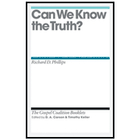
There is a crisis of truth in our postmodern times. However, as Phillips points out, “our society dogmatically rejects truth in theory but cannot live that way in practice…The crisis of the postmodern position is that it cannot believe or live out its own claims. Postmodernity has nothing to believe, including its own unbelief, despite the aching need of humans to know and believe.”
Phillips proceeds to give several practical examples of how modernism defined and developed its own epistemology (theory of knowledge), and how postmoderns struggled with modernistic thought and what has resulted from that is a full-blown relativism where “we can’t know truth.” Instead of downright playing down the postmodern critique of truth, Phillips argues that Christians can apply some of the strengths of postmodernism in four ways:
First, Christians should acknowledge the role that context plays in anyone’s understanding and belief. “Truth” is always held by actual persons, and those persons are deeply shaped by culture, language, heritage, and community.
Second, we should share postmodernity’s concern that truth may become more an object of power than a mans for enlightenment.
Third, if postmodern critiques cause Christians (among others) to challenge doctrines and views that have become traditional, we can be thankful for the opportunity to reconsider, reformulate, and restate teachings that may have become stale in our practice.
Fourth, Christians may be cobelligerent with postmodernity’s assaults against modernism.
The problems with both modernism and postmodernism essentially boils down to the same thing: they both deny the existence of God – Who is truth, reveals the truth, and is the way to truth through Jesus Christ (John 14:6).
Phillips writes, “Evangelical Christians, in particular, believe that truth derives from and is revealed by God. Thus, truth is authoritative. Here is where postmodernity parts company with historic Christianity, for the postmodern view rejects the reality of truth, positing an implicit (and in some cases, explicit) relativism in which nothing is really and finally true.” The author gives several examples of how this theory does not work in actual practice. Here is one example from the book:
“One professor made this point after his college class had united against him in insisting that nothing is ultimately true or morally wrong in an objective sense. The next day the professor informed the students that regardless of their performance on the exam they were all going to receive an F. The students objected in unison, ‘But that’s wrong!’ and the professor’s point against relativism was made. No one can live it, and therefore no one really believes it.”
The author articulates and expands on a third way of understanding truth based on what God has revealed to us in the Bible that is consistent with our experience – i.e., it corresponds to reality. He writes, “Christianity presents a legitimate third way over against the modern and the postmodern. With the moderns we believe that truth exists and is accessible, though we steadfastly reject that we can exhaustively know truth by our unaided reason. With the postmoderns we are skeptical that finite, fallible humans are the agents of truth, though we insist that truth is real and that we can know it. A successful Christian epistemology, then, not only responds to evangelical Christian belief but also enables us to communicate our doctrine of knowing to a world that both doubts and greatly desires to know truth.”
In this essay Phillips has brilliantly and cogently argued for the reality of truth, how one can know the truth, defend truth, and live by and for the truth. You will find many examples of how modernism and postmodernism fall short in their theories of epistemology, and how a Christian epistemology is simply the most logical way of discovering the truth – because our belief and practice emanates from the Way, the Truth, and the Life – the Lord Jesus Christ. The salient point is made by Phillips, “Love divorced from truth is not love, and truth divorced from love is not truth.” As Jesus perfectly modeled, spoke, and loved in truth, so must we. We are called to “speak the truth in love” just as we have heard it and experienced it in the person and work of Jesus Christ.
Book Review on Bear Grylls “To My Sons: Lessons For the Wild Adventure Called LIfe”
Inspiring Quotes From an Inspirational Dad – Reviewed by David P. Craig

Anyone who has ever watched Bear Grylls’ adventures on “Man vs. Wild” can’t help but amazed at his spirit of adventure, ingenuity, courage, wisdom, and passion for life. In this little book Bear Grylls gives his favorite Bible verses, life quotes, and wisdom and dedicates this collection to his boys. It is a wonderful compilation for any Father to seek to implement in his own life and emulate for the lives of his children. Grylls emphasizes a love for Jesus Christ, a love for others, and maximizing your time in life by serving others. Let me share some of my favorite quotes from the book:
“Aim to live a wild, generous, full, exciting life–blessing those around you and seeing the good in all.”
“Have a few close friends who you see often–their friendship matters more than having many shallow acquaintances.”
“Choose your job carefully–do work that excites you. It is where you will spend so much of your time.”
“Cheerfulness in adversity is a key character trait in the game of life.”
“Moments of doubt are part of life. Accept them and remember that Jesus Himself said, ‘My power is made perfect in weakness’ (2 Corinthians 12:9).”
“Understand that failure is an essential stepping-stone on the road to success.”
“Give more than you take, especially with friends and family. See the best in people–as Christ does with you.”
“Spend more time with your family and less at work–no one on their deathbed says they wish thye had spent more time in the office!”
“No one cares how much you know until they know how much you care.”
“You have two ears and one mouth–use them in proportion: Listen twice as much as you speak!
“But remember the LORD your God, for it is he who gives you the ability to produce wealth” (Deuteronomy 8:18).
Thank God for your many blessings; then go out there and blossom. It is okay to succeed.”
I recommend this little book – especially for dads to share with their children. It would make an excellent gift for Father’s day, and a great gift for father’s to give to their sons when they become dads someday.
 LifeCoach4God