Episode One: “Living Vertically in a Horizontal Culture”

Check Out New YouTube Channel: Vertical Living Ministries

Episode One: “Living Vertically in a Horizontal Culture”

April 21, 2025 – Dr. David P. Craig, Founder, Vertical Living Ministries 

This week (God-willing) I will be launching the first of (hopefully) many videos on helping followers of Jesus live a more intentional life of discipleship. I hope that you will check out the brand new YouTube Channel: Vertical Living Ministries. I also hope that you are encouraged by the video and will do three things: hit the like button, subscribe to the channel so you will not miss any upcoming videos, and share it with someone who can benefit from the content.

I want to address the importance of what it means to live vertically in a horizontal culture. Vertical meaning Christ-centered and living for the glory of God and not horizontally centered which means man-centered and living according to the worlds values that conflict with God’s Word!

First, a little about me. I was born in Long Beach, CA in 1965 and lived my formative years (ages 6-27) in Huntington Beach, in Southern California. My parents came to California from Argentina in the mid 1950’s. My parents had a huge impact on me as a child, teenager, and the greater part of my life as an adult as well. I have been very happily married for 33 years to my best friend and partner in ministry and have five adult children and 11 grand children. I am the lead pastor at Marin Bible Church in San Rafael in the heart of Marin County – just 20 miles north of San Francisco and the founder of Vertical Living Ministries. In both of these ministries my greatest passion is to intentionally make and multiply disciples of Jesus in Marin County and beyond for the glory of God.

It’s because of the teaching and modeling of my parents that I am a follower or disciple of the Lord Jesus Christ. At the early age of six I learned that I needed to repent of my sin and trust in Jesus in order to be reconciled to a Holy God. My parents modeled following Jesus with joy and lived life to the fullest. They manifested all of the fruit of the Spirit described in Galatians 5:22: But the fruit of the Spirit is love, joy, peace, patience, kindness, goodness, faithfulness, gentleness, and self-control. They exemplified these characteristics of the Holy Spirit for the 68 years they were married before my dad and mom departed this life to their eternal home to be with Jesus just a few years ago.

I have no recollection in my life of a before and after experience with Jesus. He has always been a huge part of my life. I grew up learning about Jesus daily from the Bible, being part of a vibrant Bible teaching church, and my parents modeling loving and serving Jesus in our home and church along with my two older brothers and sister.

However, I was a pretty typical teenager in that I was selfish and idolatrous – but I was unaware of this until the spring of my junior year of High School. Even though I loved Jesus, His Word, and sharing with others about Him; my highest priority was sports: Football, baseball, basketball, and soccer were really my greatest passion (depending on what season it was) and I played all these sports with great passion – and followed the local Los Angeles sports teams as a diehard fan – the Lakers, Dodgers, Rams, and Aztecs with equal devotion. I definitely spent more time reading the L.A. Times Sports page than I spent in the Bible – knowing much more about standings and statistics than Bible verses.

Like many young men…I had the aspiration of becoming a professional baseball player. This ambition was about to radically change. In hindsight – what appeared to be a tragic day in the spring of my junior year of HS turned out to be the day that God really called me from living in darkness to living in the light. From living for the trivial and temporal, to living for that which will last forever – what the Bible calls making disciples – the great commission in Matthew 28.

I don’t remember the time or exact date – but the event that would change the trajectory of my life transpired after the first day of baseball practice in the spring of 1983. My best friend and teammate – Corey Stejskal and I were driving to a Christian Bookstore in Fountain Valley. I was getting a book for a research paper I was writing for my Bible class at Liberty Christian HS in Huntington Beach. Corey picked me up at my house and about two miles from my house at the intersection of Heil and Bolsa Chica a drunk driver cut us off (we found out later that he was arrested for causing the accident while driving under the influence and fleeing the scene). 

In that accident I experienced what I’ve heard many people express – my life flashed before me in the twinkling of an eye. We were in a jeep and the last thing I knew – my friend turned to the right dodge the driver that was about to slam into us and when we turned away from that car we were about to hit a telephone pole off the side of the road…and that’s the last thing I remember.

The next memory I had was riding in an ambulance on the way to a hospital. When I came to, the Paramedic started asking me questions. I remember the only thing I could see was a puddle of blood on the pillow upon which my head was resting. I was in tremendous pain but I was impressed by the concern and compassion of the Paramedic. He asked me the usual: name, birthday, address, how many fingers he was holding up, and so forth. But what I remember, like it was yesterday, were three things he said.

First of all he asked me if I was a Christian. I immediately said “yes”…and then I said, “Why do you ask?” And he answered, “because I think God intervened on your behalf either directly or He sent an angel to save you.” He then went on to say, “When you get out of the hospital I want you to go see the jeep. I thought for certain that when we arrived at the crash site and saw the jeep – and even told my partner – I hope there were no passengers in that jeep – because if there is – we will have to pull out some dead bodies. He then went on to tell me that with the exception of the the drivers side of the jeep the rest of it was a third of its size due to the impact of it hitting the telephone pole. The passenger side had only half an inch between the glove box and the back of the seat where I was sitting. It was an old early 1970’s model jeep with no seat belts. Had the seat belt law been in effect in 1983 I would have been almost certainly been crushed by the impact and dead.

The next thing he said also stands out in my memory. He said, “God must have some great plans for you … because He obviously and miraculously saved your life!” And he continued, “Don’t waste your life kid. God wants to use you big time…I’m going to pray that He uses your recovery time to make your calling in life to follow and serve jesus as your number one priority.”

While recovering in the hospital (which seemed like forever) I had nothing to do but think. Think about how much time I had wasted in my life; think about how selfish I had been; thinking about how my life was full of idols – things and priorities, I put before God. I also had a recurring nightmare as I tried to sleep with a non-stop continual migraine headache. In the dream I would see (like deja vu) people that had been in my life – neighbors, teammates from my sports teams, and acquaintances that I didn’t really know well, but recognized. In the dream each of these people were in darkness and engulfed in flames and I could see their faces and hear their voices and they all said the same thing to me: “Why didn’t you tell me about Jesus?”

This recurring dream coupled with the time I had wasted absolutely haunted me. I kept rehearsing the words of the paramedic in my mind, and kept thinking to myself: “What if I had died… I know I would be in heaven…but what a shame to have stored up so little treasure there…and left all these useless weeds in my life behind on earth.” For the first time in my life I really felt convicted over my sin and how I had wasted my life and knew that I had not been living for the glory of God. 

I grieved and wept over my sin. Its not like I was doing really bad things, sports aren’t bad in and of themselves. But I came to the belief and conviction that I had mixed up priorities. My priorities selfishly were man-centered and not God-centered – I clearly could see that I was an ego-maniac. I lived for my own glory and not for the glory of Christ. For the first time in my life I was compelled to turn away from the idols in my life that I had been prioritizing over treasuring Jesus and what He deems most important.

The summer between my junior and senior year of High School. God was doing a major overhaul in my thinking and transforming my soul… and this began a journey that continues to this very day – some forty years later. The consuming thought of my life has been – “What does it mean to live for the glory of God?” A verse that I have meditated and thought about deeply and profoundly since the age of 17 has been 1 Corinthians 10:31 where the apostle Paul wrote, “So whether you eat, or drink, or whatever you, do all for the glory of God.”

My senior year I lost my passion for sports – I decided not to play football, basketball, baseball, or soccer. My passion for sports was replaced by a passion to know Jesus and make Him known. Since the age of seventeen my ultimate goal in life has been to learn to live for the glory of God. As a pastor of a local church and life coach to Christian leaders around the world it’s also to help others do the same: the biblical metaphor continually on my mind is to help those I mentor and disciple to eliminate the temporal and trivial weeds and intentionally live for producing wheat by making and multiplying disciples of Jesus for the Kingdom of God which is eternal.

Two of the parables of Jesus are worth exploring in light of this desire I have to live for God’s glory and help others do the same. They involve what I call being a V.I.P. follower or disciple of Jesus. Which I will briefly explain as I wind up this video.

Let me read these two parables and then explain how we can apply these teachings of Jesus by learning how to become V.I.P followers of Jesus – or how we can learn to live vertically in a horizontal world:

In Matthew 13:1-9 and verses 18-30 Jesus gives these two parables: 

That same day Jesus went out of the house and sat beside the sea. And great crowds gathered about Him, so that He got into a boat and sat down. And the whole crowd stood on the beach. And He told them many things in parables, saying: “A sower went out to sow. And as He sowed, some seeds fell along the path, and the birds came and devoured them. Other seeds fell on rocky ground, where they did not have much soil, and immediately they sprang up, since they had no depth of soil, but when the sun rose they were scorched. And since they had no root, they withered away. Other seeds fell among thorns, and the thorns grew up and choked them. Other seeds fell on good soil and produced grain, some a hundredfold, some sixty, some thirty. He who has ears, let him hear.” 

Explanation: “Hear then the parable of the sower: When anyone hears the word of the kingdom and does not understand it, the evil one comes and snatches away what has been sown in his heart. This is what was sown along the path. As for what was sown on rocky ground, this is the one who hears the word and immediately receives it with joy, yet he has no root in himself, but endures for a while, and when tribulation or persecution arises on account of the word, immediately he falls away. As for what was sown among thorns, this is the one who hears the word, but the cares of the world and the deceitfulness of riches choke the word, and it proves unfruitful. As for what was sown on good soil, this is the one who hears the word and understands it. He indeed bears fruit and yields, in one case a hundredfold, in another sixty, and in another thirty.” 

He put another parable before them, saying, “The kingdom of heaven may be compared to a man who sowed good seed in his field, but while his men were sleeping, his enemy came and sowed weeds among the wheat and went away. So when the plants came up and bore grain, then the weeds appeared also. And the servants of the master of the house came and said to him, ‘Master, did you not sow good seed in your field? How then does it have weeds?’ He said to them, ‘An enemy has done this.’ So the servants said to him, ‘Then do you want us to go and gather them?’ But he said, ‘No, lest in gathering the weeds you root up the wheat along with them. Let both grow together until the harvest, and at harvest time I will tell the reapers, “Gather the weeds first and bind them in bundles to be burned, but gather the wheat into my barn.” ’ 

In 2003 I completed my doctoral dissertation with the title: “Living Vertically in a Horizontal Culture.” My thesis was that in order to best live for the glory of God we need to have a vision of Jesus ever before us – and the best way to do that is to spend time in the Bible; we need to intentionally have the same priorities He had – and we find His priorities by daily reading His word and finding out what He’s like and what He wants us be and do; and we need to make plans to integrate that vision by intentionally living for His glory out of obediently applying His word daily.

In 2008 I started a nonprofit ministry helping pastors and Christian leaders learn how to become V.I.P disciples of Jesus. My ultimate goal for myself and others is that we would be men and woman who have a Vision of Jesus, Intentionally live out our calling, and make Intentional Plans and goals to live for the glory of Christ.

I want you to know that I am not an expert in these matters. I don’t always live according to this vision of Jesus…I’m not always intentional in following Jesus, nor does my life always go according to the plans that I want to carry out. However, I do believe that intentional living makes a huge difference in this pursuit of maturing as a follower of Jesus. I am much further along having this vertical vision and I want to help you do the same!

I personally want to eliminate the weeds in my life, and I want to help you do the same. I personally want to invest disciple making – producing wheat that multiplies. I want to be a mature and multiplying wheat producer. In John 15 Jesus says that if we abide in Him we will produce fruit. In these parables Jesus is saying the same thing – we either live for our own glory or His – we either send wheat ahead or leave weeds behind. We either live for ourselves or for the glory of Christ and making disciples who make disciples. 

God saved you and me because of the life, death, burial and resurrection of Christ to live abundant fruit producing lives. In this video and God-willing many videos to come – my goal is to live for Jesus and help you live a Christ centered life. I want to live in intimacy with Jesus and help you do the same. I want to be a fruit producing follower of Jesus who produces spiritual fruit that feeds me and others. I want to produce a hundred fold of wheat and help you do the same. My days and your days are numbered – let’s make them count by storing up our treasures in God’s heavenly barn; rather than an earthly field that will eventually be burned.

Let’s strive to be good soil for God to do His good work in us so we can produce wheat and fruit that will last forever by investing our time with Him and sharing with others out of the overflow of our joyful walk with Jesus. Let’s be fertile soil, with roots that go deep into God’s truth as revealed in His Word. Let’s be intentional about spending time developing a greater vision of Jesus and His glory. Let’s be intentional about doing those things that will bear fruit for the Kingdom that will last forever. In my next video I’m going to help you develop what I call a Vertical Life Plan. We are going to get more specific about developing a vision for Jesus and living for His glory by intentionally planning to invest your thinking, how you spend your time, and use your talents for Jesus and His kingdom.

Until next time: Let me leave you with this amazing promise from Psalm 16:11, ”You make known to me the path of life; in Your presence there is fullness of joy; at Your right hand are pleasures forevermore.”

May God’s presence and peace in your life be foremost, His Spirit fill you to the uttermost, and may your satisfaction and security be in Jesus so that you can   reflect Him in your life so that He gets all the glory! 

In His grip of grace,

Dr. David P. Craig
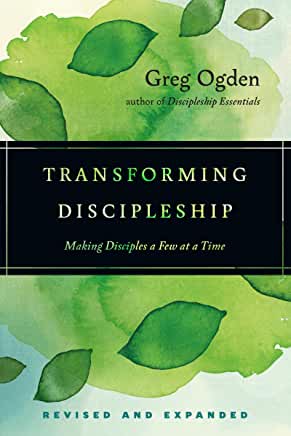
How To Emulate Jesus in Our Disciple Making

91zppZEoUxL._AC_UY436_QL65_ML3_.jpg

*Making Disciples Jesus Way: A Few at a Time by Dr. Greg Ogden

Thesis: The church urgently needs to recapture its original mission of making disciples of Jesus by creating intimate, relational environments of multiplication and transformation.

“The crisis at the heart of the church is a crisis of product”, writes Bill Hull (Hull, Bill. The Disciple Making Pastor. Grand Rapids, MI: Fleming H. Revell, 1988, 14.). Is there any more important question for a pastor to answer than, “what kind of people are we growing in our ministries”? According to pollsters such as George Barna and George Gallup, we are not producing people who are a whole lot different in conviction and lifestyle than the rest of society. This has been well documented so I will not bore you with a recitation of the bad news. I will get right to what I consider the solution.

Jesus made it crystal clear that there is to be a singular product which He equates with the mission of the church—“Go and make disciples of all nations.” (Matthew 28:19) Every church’s mission is the same. There is only one mission: making disciples of Jesus. We may prefer to express it in a fresh, contemporary way, such as “to turn irreligious people into fully devoted followers of Christ” (Mission Statement of Willow Creek Community Church , South Barrington , IL), but it will still just be a restatement of the Great Commission.

When I have opportunities to speak to pastors on the subject of disciple-making, I have taken an informal poll, “Raise your hand if you have a few people in your weekly schedule with whom you meet for the purpose of helping them to become reproducing disciples of Jesus?” Sadly, I get minimal response. It would seem to be a natural expectation since Jesus modeled for us the way to grow disciples. He called twelve “to be with him” in order to shape their character and transfer his mission to them. I believe we have a crisis of product in major part because pastors are not following the model that Jesus gave us. And we are missing out on a most joyful and fruitful opportunity.

In this article I will describe an embarrassingly simple, yet reproducible way to grow disciples of Jesus that will leave your practice of ministry forever changed and your church populated with self initiating, reproducing disciples of Christ.

Here is the model: Disciples are made in small, reproducible groups of 3 or 4 (triads or quads) that cultivate an environment of transformation and multiplication.

In my experience, the following three elements form the necessary building blocks to grow disciples, which, in turn, addresses our “crisis of product”:

• The model for multiplication

• The priority of relationships

• The environment for accelerated growth

The Model for Multiplication

I call it my major “ah-ha” moment in ministry. It has shaped my approach to growing disciples more than anything else. Frankly, it was a discovery break-through I stumbled on.

I had been frustrated that I was not seeing a multiplication of disciples. The one-on-one model was the paradigm that I had assumed was the way to make reproducing disciples. After all, wasn’t the Paul-Timothy relationship the biblical pattern? Discipling meant to give myself to one other person for the purpose of seeing the life of Christ built in them, which would then lead them to do the same for another and so on. The only trouble was, I wasn’t seeing “them doing the same for another.” In other words, there was no multiplication.

What was I doing wrong? We have all heard that the definition of insanity is doing the same thing over and over again, while expecting different results. Frustrated, I would redouble my efforts: make sure I had good content; ratchet up my prayer life; teach the skills of bible study, witness, etc; and yet I was not able to instill confidence, pass on the vision, nor empower the other person to disciple others. All my refinements only led to the same results.

Then the break-through came. I had written a disciple-making curriculum (Greg Ogden. Discipleship Essentials: A Guide to Building Your Life in Christ. Downers Grove, IL: InterVarsity Press, 1998), which became the basis for my final project for a Doctor of Ministry degree. My faculty mentor thought it would be a worthy experiment to test the dynamics of this material in a variety of settings. So in addition to the one-on-one, I invited two others to join me on this journey. There was no way I could have anticipated the potency to be unleashed. Just by adding a third person it was as if the Holy Spirit was present to us in a way that was life-giving and transforming and laid the foundation for multiplication.

I have never gone back to the one-on-one model for making disciples because of what I experienced. Now thirty years later, I have had considerable opportunity to reflect on the difference in dynamics between triad and quads, and the one-on-one approach.

What were the limitations of the one-on-one model?

1. In the one-on-one the discipler carries the full weight of responsibility for the spiritual welfare of another. The discipler is like the mother bird that goes out to scavenge for worms to feed to her babies. With their mouths wide open, the babes wait in their nest for the mother bird to return. The discipler is cast in the role of passing on their vast knowledge to the one with limited knowledge.

2. The one-on-one relationship sets up a hierarchy that tends to result in dependency. The one- on-one creates a father-son, teacher-student, mature-immature relationship. As appreciative as the Timothy might be, the one in the receiving position will more often than not, not be able to see themselves in the giving position. The gulf between the Paul and the Timothy is only accentuated when the relationship is between pastor and parishioner. The pastor is the trained professional, who has superior biblical knowledge which the non-professional, ordinary lay person will never see themselves achieving.

3. The one-on-one limits the interchange or dialogue. I liken the one-on-one discourse to playing ping-pong. It is back and forth, with the discipler under continuous pressure to advance the ball. The discipler must keep pressing the interchange on to a higher plane.

4. The one-on-one also creates a one-model approach. The primary influence on a new disciple becomes a single person. The parameters of the discipling experience are defined by the strengths and weaknesses of one individual.

5. Finally, the one-on-one model does not generally reproduce. If it does, it is rare. Only self- confident, inwardly motivated persons can break the dependency and become self-initiating and reproducing (These generalities are in no way meant to demean the positive and powerful experiences that a one-on-one relationship has meant to many. When it comes to the multiplication of disciples my experience teaches me that this generally does not lead to reproduction).

In my opinion we have inadvertently held up a hierarchical, positional model of discipling that is non-transferable. As long as there is the sense that one person is over another by virtue of superior spiritual authority, however that is measured, very few people are going to see themselves as qualified to disciple others. We may tout this is as a multiplication method, but in actuality it contains the seeds of its own destruction.

As a result of my experience, I commend a non-hierarchical model that views discipling as a mutual process of peer mentoring (“Discipling is an intentional relationship in which we walk alongside other disciples in order to encourage, equip and challenge one another in love to grow toward maturity in Christ. This includes equipping the disciple to teach others as well” – Ogden, Discipleship Essentials, 17). In order to avoid the dependency trap, the relationship needs to be seen as side-by-side, rather than one having authority or position over another.

An Alternative Practical Model of Disciple-Making (Triads/Quads)

Here is my best take on why triads/quads are energizing, joy-filled and reproductive:

1. There is a shift from unnatural pressure to the natural participation of the discipler. When a third or fourth person is added, the discipler is no longer the focal point, but they are a part of a group process. The discipler in this setting is a fellow participant. Though the discipler is the convener of the triad/quad, they quickly become one of the group on the journey together toward maturity in Christ.

2. There is a shift from hierarchy to peer relationship. The triad/quad naturally creates more of a come-alongside mutual journey. The focus is not so much upon the discipler as it is upon Christ as the one toward whom all are pointing their lives. Even as a pastor, I found that though the relationship may have started with a consciousness that I was the “Bible answer-man” because of my title and training, within the first few weeks the triad/quad allows me to be another disciple with fellow disciples who are attempting together to follow Jesus.

3. There is a shift from dialogue to dynamic interchange. In my initial experiment with triads, I often came away from those times saying to myself, “What made that interchange so alive and dynamic?” The presence of the Holy Spirit seemed palpable. Life and energy marked the exchange. As I have come to understand group dynamics, one-on-one is not a group. It is only as you add a third that you have the first makings of a group (Think Trinity).

4. There is shift from limited input to wisdom in numbers. The book of Proverbs speaks of the wisdom that comes from many counselors (Proverbs 15:22). It is often those who may be perceived as younger or less mature in the faith from which great wisdom comes, or a fresh spark of life or just great questions. In a current quad, one of the men at our initial gathering announced, “I have never opened the Bible.” I had observed an eagerness and hunger in Mick, so I was sure that I had misunderstood his comment. So I responded, “You mean you have never studied the Bible seriously”. “No, I have never opened a Bible.” Since that first session, Mick has demonstrated a veracious appetite for Scripture. Yet what has been particularly challenging is his perceptive questions that have led to engaging dialogue and deeper exploration.

5. There is a shift from addition to multiplication. For me there is no greater joy than to see a Christian reproduce. All the above adds up to empowerment. For over two decades, I have observed an approximate 75% reproduction rate through the triad/quad model of disciple- making.

In summary, a smaller unit encourages multiplication because it minimizes the hierarchical dimensions and maximizes a peer-mentoring model. By providing a discipleship curriculum specifically designed for this intimate relationship, it creates a simple, reproducible structure, which almost any growing believer can lead. Leadership in these groups can be rotated early on since the size makes for an informal interchange and the curriculum provides a guide to follow.

Anything worthy of the name of discipling must have a way of creating the dynamic of intergenerational multiplication. But this is only one aspect of growing self-intiating, reproducing disciples.

Disciples Are Made In Relationships, Not Programs

Making disciples places priority on an invitation to relationships, not an invitation to a program.

Disciple-making is not a six-week nor a ten-week, nor even a thirty-week program. We have tended to bank our efforts on making disciples through programs, while not keeping a priority on the relational process.

Biblically, though, disciples are made in relationships. When I am forming a new triad/quad, I approach someone personally, eyeball to eyeball in the following way: First, I ask the Lord to put on my heart those to whom He is drawing me. I am looking for those who are hungry and teachable. When there is a settled conviction as to who the Lord would have me approach, here is generally what I say to them, “Will you join me, walk with me as we grow together to become better disciples of Christ? I would like to invite you to meet with me and one or two others weekly for the purpose of becoming all that the Lord intends us to be. As I was praying about this relationship, I sensed the Lord drawing me to you.”

How does this relational approach differ from a program?

(1) Discipling relationships are marked by intimacy, whereas programs tend to be focused on information.

Programs operate with the assumption that if someone has more information that it will automatically lead to transformation. In other words, right doctrine will produce right living. Filling people’s heads with Scripture verses and biblical principles will lead to change in character, values and a heart for God.

Alicia Britt Cole captures this difference between program and relationship, “Program was safer, more controllable, and reproducible—less risky, less messy, less intrusive. It seemed easier to give someone an outline than an hour, a well-worn book than a window into our humanity. How easy it is to substitute informing people for investing in people, to confuse organizing people with actually discipling people. Life is not the offspring of program or paper. Life is the offspring of life. Jesus prioritized shoulder-to-shoulder mentoring because His prize was much larger than information; it was integration” (Alicia Britt Cole, “Purposeful Proximity—Jesus’ Model of Mentoring”, Online Enrichment, A Journal for Pentecostal Ministry).

(2) Discipling relationships involve full, mutual responsibility of the participants, whereas programs have one or a few who do on behalf of the many.

Most programs are built around an individual or a few core people who do the hard work of preparation and the rest come as passive recipients of their work. Of course, this is less true of a more egalitarian small group than it is of a class where one-way communication dominates. Though this may provide tremendous benefit to one who has done the preparation, the result is usually enormous amounts of unprocessed information. As much as I believe in the power of preaching for conviction and decision, I would be naïve to believe that preaching alone produces disciples. If preaching could produce disciples, the job would have been done.

In a discipling relationship the partners share equal responsibility for preparation, self-disclosure, and an agenda of life-change. This is not about one person being the insightful teacher, whereas the others are the learners who are taking in the insights of one whose wisdom far exceeds the others. Certainly maturity levels in Christ will vary, but the basic assumption is that in the give and take of relationships, the one who is the teacher and the one who is taught can vary from moment to moment.

(3) Discipling relationships are customized to the unique growth process of the individuals, whereas programs emphasize synchronization and regimentation.

The very nature of most of our programs is that they cannot take into account the uniqueness of the individual, which is essential to growing disciples. A program usually has a defined length. You commit to ten weeks and you are done. Often churches follow the academic calendar. Start a program in September when school starts and complete it in June in time for summer vacation. Once the cycle is completed, disciples are supposed to pop out the other end of the system. Completing the program is equated with making disciples.

Discipling relationships must necessarily vary in length of time, because no two people grow at the same speed. It is not just a matter of a forced march through the curriculum, but an individualized approach that takes into account the unique growth issues of those involved.

(4) Discipling relationships focus accountability around life-change, where as programs focus accountability around content.

Programs of discipleship give the illusion of accountability. But upon closer look the accountability is more focused on completing the assigned study curriculum than follow through on the changes or transformation into Christlikeness that is expected of a disciple of Jesus.

Growth into Christ-likeness is the ultimate goal. The gauge of accountability in programs tend to be easily measurable, observable behaviors such as Scripture memory, completing the required weekly reading, and practicing spiritual disciplines. In a discipling relationship the accountability focuses on learning to “observe or obey all that [Jesus] has commanded” (Matt. 28:19). For example, there is a huge difference between knowing that Jesus taught that we are to love our enemies, and actually loving our enemies. Discipling relationships are centered on incorporating the life of Jesus in all we are in the context of all that we do.

The Environment of Transformation: The Three Necessary Ingredients

Without question the setting where I have experienced the most accelerated transformation in the lives of believers has been in these triads/quads or small reproducible discipleship groups. I call them the “hot-house” of Christian growth. Hot houses maximize the environmental conditions so that living things can grow at a rate greater than would exist under normal circumstances. The conditions are ripe for accelerated growth. This is what happens in a triad/quad.

Why is this? What are the climatic conditions in a discipleship group of three or four that create the hothouse effect? There are four ingredients when exercised in a balanced way that release the Holy Spirit to bring about a rapid growth toward Christlikeness: This can be summarized in the following Biblical principle: When we (1) open our hearts in transparent trust to each other (2) around the truth of God’s word (3) in the spirit of mutual accountability ,(4) while engaged in our God-designed mission, we are in the Holy Spirit’s hothouse of transformation.

Let’s look at what is contained in each of these three environmental elements that makes for accelerated growth and reproduction.

Climatic Condition #1 – Transparent Trust

We return to the fundamental truth that has been repeated the theme throughout this article: Intimate, accountable relationships with other believers is the foundation for growing in discipleship. Why is transparency a necessary condition for change? The extent to which we are willing to reveal to others those areas of our life that need God’s transforming touch is the extent to which we are inviting the Holy Spirit to make us new. Our willingness to enter into horizontal or relational intimacy is a statement of our true desire before God of our willingness to invite the Lord to do His makeover in our life.

The small size of a triad/quad says that this is going to be close. There is little place to hide. The environment in which self-revelation is drawn out is increasing trust. Certainly trust does not happen instantaneously. Trust is an earned and developed quality. To get to the deep end of the pool we must go through the shallower waters of the affirmation of encouragement, support through life’s difficulties, and prayerful listening in order to help our partners hear God’s voice in life’s decisions. Only then are we likely to venture in over our heads by confessing our patterns of besetting sin to one another.

My experience tells me that few believers either have the regular habit or the safe context in which we can reveal to another human being what lurks inside the recesses of our hearts. Until we get to point where we can articulate to another those things that have a hold on us, then we will live under the tyranny of our own darkness. James admonished his readers, “Confess your sins to another, and pray for one another, so that you may be healed” (James 5:16 ). James makes a direct connection between confession and healing. In this context healing appears to be of a physical nature. Yet James believed that the health of one’s spirit directly affected the health of one’s body.

What is the connection between confession and freedom? Bringing the shame of our guilt into the light before trusted members of the body of Christ can in itself have a liberating effect. Once something is admitted before others, it begins to lose it power to control. Sin loves the darkness, but its power weakens in the light.

To learn to swim in the deep waters of transparent trust is a necessary element for accelerated growth in the Christian. Learning to swim can be a scary experience, especially when you in over your head. But once you learn to trust the water to hold you up, you can relax and experience its refreshment.

Climatic Condition #2 – Truth in Community

The second of four environmental elements that creates the conditions for the hothouse of accelerated growth is the truth of God’s word in community. I started with relationships because I believe that the context in which God’s word should be studied is in community. A great failing today is that we have separated the study of God’s word from transparent relationships. We have been more concerned about getting our doctrine right than our lives right. It is not that knowledge is not important, it is. It is not that right doctrine is not important, it is. It is just not enough. Because the goal is to incorporate truth into our being which happens as we process it with others.

It is particularly important in our day that a disciple has the opportunity to cover the essential teachings of the Christian life in a systematic and sequential fashion. We are living at a time when the average person has minimal foundation for their Christian faith. A generation ago Francis Schaeffer and Elton Trueblood warned us in prophetic voice that we were one generation away from losing the memory of Christian faith in our culture. We are the next generation of which they spoke!

The Tonight Show with Jay Leno is an unlikely place to find evidence for this loss memory. One night Leno took to the streets with microphone in hand asking people questions about their biblical knowledge. He approached two college age women with the question, “Can you name one of the Ten Commandments?” Quizzical and blanks looks led to this reply, “Freedom of speech?” Then Leno turned to a young man, “Who according to the Bible was eaten by a whale?” With confidence and excitement, he blurted out, “I know, I know, Pinnochio!” The memory of Christianity has been lost.

One of the participants in a discipling triad that I led was woman about ten years my senior who had been raised in the home of a congregational pastor. After we had completed our time together, she said to me, “Greg, I have something to confess. When you asked me to join this group, I didn’t think I had a whole lot to learn. After all I had been studying the Scriptures all of my life having been raised in a home where the Bible was central. But I discovered as we covered the faith in a systematic and sequential order, that my understanding was much like a mosaic. I had clusters of tiles with a lot of empty spaces in between. This approach has allowed me to fill in all those places where tiles belong. I now see in a comprehensive fashion how the Christian faith makes sense of it all.”

Climatic Condition #3 – Life-Change Accountability

Life-change accountability is rooted in a covenant. What is a covenant? A covenant is written, mutual agreement between 2 or more parties that clearly states the expectations and commitments in the relationship (Greg Ogden’s Discipleship Essentials, page 14 provides an illustration of what a mutual covenant might look like). Implied in this definition is that the covenantal partners are giving each other authority to hold them to the covenant to which they have all agreed.

Yet there is a rub. To willingly give others authority to hold us accountable to what we said we would do is for most Westerners a violation of what we hold most dear. Robert Bellah’s ground breaking research, Habits of the Heart, is a sociologist’s search for the core of the American character. He found that freedom from obligation defined the center of what it is be to an American. Here it is in a nutshell: We want to do, what we want do to, when we want to do it, and no one better tell us otherwise. We want to be in control of our own choices, life direction, character formation, schedules, etc. Everything in us grates against accountability.

Yet accountability brings us back to the very core of what it means to be a disciple of Jesus. A disciple is one under authority. Disciples of Jesus are who leave no doubt that it is Jesus who is exerting the formative influence over our lives. Jesus said, “If anyone would come after me, let him deny himself, take up his cross daily and follow me.” (Luke 9:23) The way to get serious about this truth is to practice by coming under authority in our covenantal relationships in Christ.

Climatic Condition #4: Engaged in our God-Designed Mission

Micro groups are not designed to be holy huddles. Though we all seek safe environments where our true self can be nurtured, micro groups also need to be springboards from we are sent to serve Christ in all dimensions of our life. In many ways, this fourth dimension, though last in order, is most critical. Without mission, there will be little transformation. It is as we apply our faith in the work place, in our roles in the home, are stewards of our financial resources, exercise or spiritual gifts in ministry the church or addressing an area of brokenness in the world, that we have to come to terms with our fears and limitations.

As we are engaged is mission we are stretched beyond our limited resources. When we are thrown back in reliance on Jesus, waiting for Him to show up because we are beyond our comfort zone, we are just where we need to be. This is where the importance of our micro group takes on even deeper significance. In this group we are refreshed, patched up, encouraged and sent back out to be ambassadors of Jesus.

Conclusion: “The crisis at the heart of the church is a crisis of product.” I would challenge every pastor in America to schedule into his week a 90-minute time slot to meet with two or three others for the express purpose of discipling for multiplication. Can you imagine the impact on the quality and quantity of the product, if we began to see an organic multiplication of these reproducible groups over the next ten years?

*This article is presented here with the written permission of the author – Dr. Greg Ogden. The original article may be found along with many excellent disciple making resources at the website: globaldi.org which stands for the Global Discipleship Initiative of which Greg Ogden is the Chairman of the Board. The Global Discipleship Initiative trains, coaches, and inspires pastors and Christian leaders to establish indigenous, multiplying disciple making movements, both nationally and internationally.

About the Author: Greg Ogden (D.Min, Fuller Theological Seminary) recently retired from professional church leadership and now lives out his passion of speaking, teaching and writing about the disciple-making mission of the church. Most recently Greg served as executive pastor of discipleship at Christ Church of Oak Brook in the Chicago western suburbs. He previously held the positions of director of the Doctor of Ministry Program at Fuller Theological Seminary and associate professor of lay equipping and discipleship. His seminal book Discipleship Essentials: A Guide to Building Your Life in Christ has sold over 250,000 copies and has been a major influence on discipleship in the contemporary church. He is also the author of several other excellent resources that will help you in effectively making disciples who make disciples: Transforming Discipleship; Making Disciples a Few at a Time; The Essential Commandment: A Disciple’s Guide to Loving God and Others;  Leadership Essentials: Shaping Vision, Multiplying Influence, Defining Character (co-authored with Dan Meyer); Essential Guide to Becoming a Disciple: Eight Sessions for Mentoring and Discipleship; and Unfinished Business: Returning the Ministry to the People of God.