The Gospel Made Simple: “The Story”

Series: Gospel Presentations #5 

“THE STORY”

The Story

The Story: How it all began and how it will never end…

The following pages are the summary of a true story. It is like many good stories you’ve heard or read, but the more you read, the more you’ll realize this is not just another story–it is the story. It defines us all. It makes us think abut who we are and who we can become. And so…

(1) HOW DID IT ALL BEGIN? CREATION

“In the beginning, God created the heavens and the earth.” – Genesis 1:1

“Before the mountains were brought forth, or ever you had formed the earth and the world, from everlasting to everlasting you are God.” Psalm 90:2

God: The story begins with God, who has always been. He has always existed, and He has always existed exactly as He is now. If it seems confusing, it’s because He’s beyond what anyone can fully comprehend.

Creation: In the beginning, God spoke and everything came into existence. By His command, the entire universe was created and filled with a dramatic display of galaxies, stars, and planets–including Earth, on which was a perfect garden of paradise called Eden. Of all the beauty He created, the masterpiece was a man and a woman. God made Adam and Eve in His image to reflect Him. They were created with the grand purpose of worshipping Him by loving Him, serving Him, and enjoying relationship with Him.

Harmony: By God’s design, all of creation was in harmony and was exactly the way it was supposed to be. During this time there was no pain, suffering, sickness or death. There was complete love, acceptance, and intimacy between God and man, between Adam and Eve, and throughout creation. But something tragic happened…

(2) WHAT WENT WRONG? THE FALL

Disobedience: Adam and Eve were far from being equal to God, yet He lovingly placed them in charge of all He had created in Eden. He gave them the freedom to make decisions and govern the earth with one rule: not to eat from a specific tree. One day, God’s enemy, a fallen angel named Satan, wanted to overthrow God so he  took the form of a serpent and lied to Adam and Eve. He deceived them into thinking God was not good and did not have their best interest in mind. As a result, they knowingly disobeyed God. In rebellion, Adam and Eve ate the fruit, deciding that they, not God, would determine right and wrong.

“None is righteous, no, not one.” Romans 3:10

Consequence: The consequences of their actions were devastating! Like a virus, sin entered into all of creation and into the hearts of Adam and Eve. Sin, suffering, and pain were passed down from generation to generation; all of creation was distorted from its original design. We have all read or heard the stories of war, poverty, diseases, grred, and scandals that plague our world today. Those are all a result of sin.

“The entire world is guilty before God.” Romans 3:19

Need: When we think about the perfection and love that existed at the beginning of creation, we realize “we are far more flawed and far more sinful that we can dare imagine” [1]. Just think of the grudges we’ve held, the lies we’ve told, the thoughts we’d never dare say aloud. An honest glance into our own hearts reveals the truth: We are all guilty. Everyone has sinned, and the ultimate consequence, even worse than physical death, is eternal separation from a loving God, in terrible misery and unhappiness. Because of all this, we need to consider the questions: Can anything be done? Is there hope?

(3) CAN ANYTHING BE DONE? THE RESCUE

Promise Made: God removed Adam and Eve from Eden as a result of their sin but left them with a promise of rescue and hope. He promised them one of their descendants would someday rescue mankind from sin. Over the next centuries, God prepared the way for this person who would become the Savior of the world. Exact details of His birth, life, and death were recorded in the Bible many centuries before His coming. In fact, the whole Bible ultimately points to this one person as the focal point of all human history. His purpose in coming was “to seek and to save what was lost” (Luke 19:10)

So who was He?

Promise Kept: The promised Savior, simply, was God. God became human in the person of Jesus Christ almost 2,000 years ago, fulfilling all the predictions in the Old Testament. Jesus’ birth was miraculous since His mother was a virgin. His life was unique: He perfectly enjoyed and obeyed God without sin. This ultimately led to His agonizing death on a cross as He willingly, obediently, and sufficiently died to pay for the sins of mankind, according to God’s plan. In the greatest display of mercy and grace the world has ever known, Jesus’ life and death became a substitute for all who would trust in Him. The perfectly innocent died to rescue the hopelessly guilty from sin and Satan.

But the grave couldn’t hold Jesus. Three days later, jesus emerged from His tomb, fulfilling His earthly mission to defeat sin by dying on the cross and to defeat death by rising from the dead–just as God promised. Forty days later he returned to Heaven where He reigns as the rightful King.

“For Christ also suffered once for sins, the righteous for the unrighteous, that He might bring us to God.” – 1 Peter 3:18

“Jesus gave His life for our sins, just as God the Father planned, in order to rescue us from this evil world in which we live.” – Galatians 1:4

But the story doesn’t end there…

(4) WHAT WILL THE FUTURE HOLD? THE RESTORATION

All Things New: For all those  who trust in Jesus alone, God has also promised He will make all things new. The new heaven and new earth will be completely free of sin and selfishness–a place of perfect friendship with God, others, and all creation. No more shattering earthquakes, devastating tsunamis or violent storms will plague the earth. No more pain, broken hearts, sickness or death to trouble us. Everything will be restored to the way it was meant to be. The new earth will once again be the perfect home God intended for His creation. God’s original purpose will flourish, as those who trust in His rescue will enter into the grand purpose of worshipping Him by loving Him, serving Him, and enjoying relationship with Him forever.

Forever With God: The most wonderful part of this new world is that we will be with God forever, experiencing complete joy. We will be restored to a perfect relationship with the One who created, loved, and died for us. C.S. Lewis, scholar and children’s author compared the first step into this new world as “Chapter One of the great Story which no one on earth has read: which goes on forever: in which every chapter is better than the one before” [2].

“Then I saw a new heaven and a new earth…God Himself will be with them as their God. he will wipe away every tear from their eyes, and death shall be no more, neither shall there be mourning, nor crying, nor pain anymore, for the former things have passed away.” – Revelation 21:1, 3-4

What’s Your Part in the Story?

God is writing an amazing story from creation to restoration. He created you to be a part of that story to worship Him, serve Him, and enjoy relationship with Him. By joining God in His story, you will find forgiveness, purpose, and satisfaction as you come to know the Author of life.

Rescue by Faith Alone: Faith is simple trust in Jesus Christ alone to save you. It means instead of believing you can rescue yourself from the consequences of sin, you can transfer your trust to the rescue He purchased for you by His death. Your allegiance is now to Jesus, the King. Those who place their trust in anything other than Jesus will find themselves forever separated from the loving God who gave His one and only Son to set us free from the bondage of sin. This painful separation is called Hell.

“For by grace you been saved through faith, and this is not your own doing: it is the goft of God, not as a result of works, so that no one can boast.” – Ephesians 2:8-9

RECAP

The Creation: In the beginning, God created everything to be perfect.

The Fall: Man rebelled against a loving God & believed Satan’s lie. Sin entered into the world & into every human heart. Everything is now distorted & broken. Everyone is guilty before God.

The Rescue: Jesus, who is God, came to rescue people by His death & resurrection. By faith alone in Him, all who are separated from God can have their sins forgiven & enjoy eternal life with Him.

The Restoration: God will restore everything to the way that it was supposed to be, and those who trust in Jesus will get to enjoy eternity with God in the new heaven and new earth.

Response:

  • God is inviting you to be a part of the story He is writing throughout the ages to come. He is offering salvation to you today, which is your invitation to the rescue God offers. You can embrace the rescue of God by simply:

  • Admitting you need God

  • Asking Him to forgive you and help you turn from sin

  • Trusting in Jesus Christ alone to rescue you Following Jesus Christ, the King of your life, in faith from this day forward

“Truly, truly, I say to you whoever believes has eternal life.” – John 6:47

The moment you trust Jesus Christ: you become a child of God and His Spirit begins to live inside of you. You have become part of His story. The more you grow in your relationship with God, the more of His story you will begin to see & understand in your life. All of your sin, past and future, is forgiven, and you now find total acceptance before Him. When you begin this relationship, Jesus promises to be with you through all the ups and downs and in the joys and difficulties of this life. He loves you with an everlasting, unchanging love. And not only has He promised eternal life, but He came so that you could experience purpose, fulfillment, and freedom in this life.

Where Do I Go from Here?

Read the Bible: The Bible is the story of God’s love and faithfulness to His people. It provides encouragement, instruction, warning, and correction that will help you make sense of your life. As you read it, ask God to show you something you can apply to your life. If you’re not sure where to begin, start with the Gospel of Mark in the New Testament.

Talk with God: Talking with God is another way you will get to know Him. He is always ready to listen and spend time with you, so you can always speak with Him. He invites you to share all your burdens and joys with Him; this is prayer.

Find Community: Getting connected with others who have trusted in the rescue of God is essential. A “church” is a community of Christians gathering regularly to worship God as His family. Each member of the family plays a vital role: Similar to the human body, each part helps the whole body function properly. The church is the Body of Christ.

Tell your Story: Share this news with everyone! let them hear the amazing story of God’s love and rscue and how it’s changed your life.

*You can view the Video or read “The Story” at ViewTheStory.com. or at spreadtruth.com

[1] dr. Tim Keller, “The Centrality of the Gospel.” Redeemer Presbyterian, NYC

[2] C.S. Lewis. The Last Battle (New York: MacMillan, 1977, pp. 183-84.
The Gospel Made Simple: “Come Home”

Series: Gospel Presentations #4 “COME HOME” 

TTT Metzger

Learning the Gospel Diagram “Come Home” from Will Metzger’s book “Tell the Truth”

A. Procedure for Learning the “Come Home” Gospel Diagram

Introduction. People are looking for relationships where they can find love, meaning, security and joy. God designed families—both natural and spiritual—and homes for this purpose. As part of his plan he intends us to have a home on earth and a home after death.

Theme. God designed us for a relationship with him and others.

Learning the Content of the Gospel. It is essential to take three hours to study chapter three and the amplified diagram, including reading thoughtfully the Bible passages.

Diagram. Draw the Road of Life line one inch from the top of the long side of an 8 1/2″ x 11″ paper two-thirds of the way across paper. Then draw the road going straight down to “homelessness.” Halfway down this line draw a short line intersected by a vertical line to form a cross. Next, extend the horizontal line up to the top of the paper and resume the Road of Life line. Put a triangle at each end to represent God and an H for Hell and another H for Home in appropriate places. Put a question mark on the left side of the cross where it intersects with the road downward. (This diagram is drawn on the cover of “Come Home.” [you need the book to see the diagram which is rather complex as whole, but not in its constituent parts)

Practice. You are now ready to fill in the diagram with the five points of the gospel. You should fill in one point at a time, following the simplified version. Keep practicing this on different sheets of paper until you can do it from memory. As you fill in each point, you can also draw the two signs on the road and fill in the words on the bridge, which form a cross. Sharing How to “Come Home”. After reviewing the amplified version and again looking up the Bible passages, you are ready to share the simplified version of how to “come home” with a Christian friend, drawing the diagram and briefly explaining the five points, main point, Bible verse and illustration under each of the five points. Be sure to stop after point 3 and ask if they sense any personal concern. Ascertain if they see the dilemma. Your partner can either say something like “I think a God of love would just overlook my failures” or “I’m pretty happy with my life right now; I don’t see a need for religion.” You have to decide how to answer this! (Hint: Point 1 is the basis for all we’ve said. God made you, and he is not only a love-giver; he has made road rules, and we are responsible to him—a personal God.) Then ask if you can continue the last two points, for this may clarify things. Reverse roles. Then give each other feedback on what was clear and what wasn’t.

Objective. The objective of practicing the diagram is to help you, as a Christian, get a grip on the content of the good news (gospel). By so doing, you are able to listen to the person you are talking with and bring in various points of the gospel as appropriate. Many times simply communicating what God is like (point 1) is a successful conversation. By knowing the diagram, you can start at any point and move backward or forward as needed. However, it is best to ask for the opportunity to give this overview at some point. This diagram is a grid on which to organize the truth that God says is so important for everyone to know. Be sure you are thoroughly familiar with the amplified version so you can draw on this background when in conversations. Most people are not convicted the first time they hear this story. Your job is to plant and water the seed of God’s Word into the conscience and heart of people. The Holy Spirit may use the truth joined with your friendliness and love to give them faith and a new birth according to his timetable. Sometimes people will find it helpful if you ask them, “What objections/problems do you have with Jesus Christ?” “Can you explain to me what the first three points are saying?” or “What do you think is keeping you from becoming a follower of Jesus?” These questions may allow you to clear up their misunderstandings, bad examples of other Christians or churches and so on—or just to listen to them! The danger is this may get you off on a tangent, so with the “Come Home” diagram in mind, keep coming back to it. What’s really fun is to say, “Can I tell you a story?” Then tell them about Paul walking into Athens and talking to some university professors in Acts 17, or about the two lost sons in Luke 15 and so on. Practice reading the five key Bible passages one paragraph at a time, explaining them to a Christian friend. This Road to Home gives you a visual framework on which to pin the five gospel points.

Introducing the Diagram. With someone you’ve talked with before, simply say, “Many people have found it helpful to see an overview of the main theme of the Bible. Can I show that to you, and then you can point out which part you don’t understand, disagree with or find helpful?” Keep practicing the diagram and the three topics under each point (#4 has four). Then, as you talk to someone, you will find drawing it helps them to follow the story. Or, you may visualize the diagram mentally as you carry on a conversation. You may not get the opportunity to share the simplified version of “Come Home” very often. But knowing this diagram will help you realize when you are not talking about the gospel and only talking around the fringe—as in so many of our conversations. You can then be reminded, as you think back over a conversation, to next time bring in some of these truths. Most important, knowing “Come Home” prepares you for a lifetime of lifestyle witnessing. The following are two versions of the “Come Home” diagram—an amplified version for study and a simplified version for sharing. Each set of pages, with a bit of ingenuity, can be photocopied and folded into handy 5″ x 8″ booklets. The simplified version is the easiest: just photocopy pages 281 and 282 back to back and fold in half with the diagram in the middle. The text of this version can be enlarged by about 33 percent and still fit ordinary paper size for easier reading. In each case you may want to cut pages from the book for easier photocopying. The amplified version can be copied on two 8 1/2″ x 11″ sheets and folded in half, leaving any blank half pages for notes: staple if you wish.

B. Come Home: Overview for Memorization

1. Who Is God?

1. Maker (Owner)

2. Love-Giver (Father)

3. Law-Maker (Judge)

Point: God has rights over you; you are accountable.

Bible: Paul’s sermon—Acts 17:22-34 (Rev 4:11)

Illustration: The inventor has patent rights and instruction book.

2. Life = God-Centered Living

1. One-way road home

2. Two rules 3. Perfect obedience required Point: God’s perfect rules measure all actions/attitudes. Bible: Moral man—Mark 10:17-27 (Mk 12:30-31)

Illustration: Jumping over a pole 100 feet high.

3. Sin = Self-Centered Living

1. Disobedience is sin.

2. Sin separates you from God.

3. Sin must be punished for God is just.

Point: We are self-centered and separated from God.

Bible: Jesus and thirsty woman—John 4:4-30 (Rom 3:20)

Illustration: The Gap; failure of self-effort; heart disease; sin-addiction

Question: Do you admit you are a sinner?

Dilemma: How to get right with God

4. Jesus Christ: The Way Back to Life

1. God provides his Son as a bridge.

2. Jesus perfectly obeys God’s rules (righteousness).

3. Jesus is sin-bearer (takes our penalty).

4. Jesus lives and offers himself to us (righteousness-giver).

Point: Jesus is sinner’s substitute/reconciler/liberator. He is the only Lord and Savior.

Bible: Crucifixion and resurrection—John 19:17–20:31 (Rom 5:6-8)

Illustration: The Bridge; no more doing—done by Jesus

5. Your Response: Coming Home to Jesus

1. Personal response commanded.

2. Turn from sin.

3. Trust in Christ.

Bible: Two lost sons—Luke 15:11-32 (Ps 51:1-4; Rom 10:9-10)

Illustration: A person (representing Jesus) is not received until welcomed in; only three possible responses—investigate, receive, reject (Acts 17:30-34)

Point: Receive Christ as your Savior and Lord. Do You Know the Bible’s Main Theme?

Are you able to express the main theme of the Bible, the most influential book of all literature? Most people, Christian or not, cannot! What is this theme called the “gospel”? This booklet is a tool to help you grasp the essentials of the gospel. Whether you are a seeker of Christ or secure in having found him, you need to get the facts straight.

Secure? If you are a true Christian but don’t have a clear understanding of the gospel, your growth will be hindered in two ways. First, any vagueness about the basic truths might cause you to miss their implications for living the Christian life. You could be misled into looking for something more in addition to what you received when you became a Christian. Second, you won’t be able to give a clear explanation of the gospel to others. Only when truth is kindled by the spark of the Holy Spirit are lives changed. But it’s your responsibility to honor God by clearly expressing basic gospel truths! This booklet’s five-point outline has many unique features: a clear theme (The Road of Life to Home) linking all the points; a starting point (God made you), which establishes that a person is responsible; inclusion of God’s law to expose the need for a Savior; choice of brief verses or reference passages for “story telling” the gospel as Jesus did; illustrations in story and diagram form; emphasis on holiness, repentance and the lordship of Christ; a one-page summary for easy memorizing. (See chapter four of Tell the Truth for an explanation of the “Come Home” outline.)

Having an outline of a God-centered gospel in your mind will free you to listen and be more natural as you tell the truth to others. You can concentrate on what they are saying and bring in any of the five truths of the gospel as appropriate. However, truths 1, 2 and 3 give the foundation for 4 and 5 and normally are needed first to show why Christ is necessary. Therefore, ask for a non-Christian at some point to hold their questions and listen for fifteen minutes as you give an overview of all five truths which as the framework for your answers can really help them understand. Or, at least go over truths 1-3.

This amplified version of the gospel diagram “Come Home” is intended for detailed study by those who wish to have a better knowledge of the content of a God-centered gospel. Christianity is both something to be believed and Someone to be received. To impersonally present these truths would be to contradict the nature of the gospel. Prayer and a personal relationship showing love are all-important. You can follow a printed simplified version for sharing, although a conversation in which you draw the diagram is best. Live the gospel, but words are necessary, so use them. Evangelism is a way to glorify God by knowing the gospel well, living it well and telling it well.

Prayer for Others

“Father in heaven, I come to you humbly and yet boldly because of my salvation, which has united me with your Son. Your grace is reaching more and more people and calling them home. Therefore I pray for __________. Hear my prayer even as you heard the pleading of your friend Abraham and spared his nephew Lot from terrible judgment. Your Son invited the spiritually tired, burdened and thirsty to take of the free water of eternal life. Lord, will you please open still another heart as you did mine? You alone can break addictions to self-righteousness, unbelief and sinful desires. Would it please you to enable them to believe and grant repentance and faith leading to a new birth? Magnify your glory by delivering _________ from spiritual death. Lord, bring fame to your name by once again showing mercy. My plea is not based on my own goodness but on the sovereign love of Jesus Christ. Lord, I desire that you use me in telling the gospel of grace to others. Nevertheless, not my will, but your will be done. Amen.”

These Scriptures provide incentive and direction for your prayers for others. If you’re praying in a group, assign each person one or two passages as a basis for their prayer: Matthew 11:25-30; Luke 15; 16:19-31; John 4:1-42, 10:1-18; Acts 4:24-31; 5:27-32; 17:27-34; 26:19-29; Romans 10:1-4, 9-21; 1 Corinthians 1:18–2:16; 2 Corinthians 2:14-17; 4:1-18; 5:11-21; Ephesians 6:10-20; 1 Thessalonians 1:2–2:13; 2 Timothy 1:6-10; 4:1-5; Revelation 20:11–21:5; 22:17. People for Whom I Will Pray and Witness: 1. 3. 5. 2. 4. 6. Reprinted from Tell the Truth ©2012 by Will Metzger with permission from InterVarsity Press, Downers Grove, Illinois. This helpful training manual for God-centered evangelism in book form is appropriate for individual or group study. It is available through Christian bookstores.

Adapted from Will Metzger. Tell the Truth: The Whole Gospel Wholly by Grace Communicated Truthfully & Lovingly. Downers Grove, IL.: InterVarsity Press, 2013.

About Will Metzger

Will Metzger image

Will Metzger has been a campus minister at the University of Delaware since 1965, where he serves with InterVarsity Christian Fellowship and Christian InterAction (a church and campus connection). His evangelism ministry has taken him to every continent, and he has witnessed to people from varied nationalities both on campus and through a church that he pastored.

The Gospel Made Simple: “How Can I Know God?” by Dr. Tim Keller

Series: Presentations of the Gospel #3

prayer before a cross

HOW CAN I KNOW GOD PERSONALLY?

by Dr. Tim Keller

What is Christianity? Some say it is a philosophy, others say it is an ethical stance, while still others claim it is actually an experience. None of these things really gets to the heart of the matter, however. Each is something a Christian has, but not one of them serves as a definition of what a Christian is. Christianity has at its core a transaction between a person and God. A person who becomes a Christian moves from knowing about God distantly to knowing about him directly and intimately. Christianity is knowing God.

“Now this is eternal life; that they may know you, the only true God, and Jesus Christ, whom you have sent.” – John 17:3

Why do I need to know God?

Our desire for personal knowledge of God is strong, but we usually fail to recognize that desire for what it is. When we first fall in love, when we first marry, when we finally break into our chosen field, when we at last get that weekend house–these breakthroughs arouse in us an anticipation of something which, as it turns out, never occurs. We eventually discover that our desire for that precious something is a longing no lover or career or achievement, even the best possible ones, can ever satisfy. The satisfaction fades even as we close our fingers around our goal. Nothing delivers the joy it seemed to promise. Many of us avoid the yawning emptiness through busyness or denial, but at best there is a postponement. “Nothing tastes,” said Marie Antoinette.

There are several ways to respond to this:

By blaming the things themselves – by finding fault in everyone and everything around you. You believe that a better spouse, a better career, a better boss or salary would finally yield the elusive joy. Many of the most successful people in the world are like this–bored, discontented, running from new thing to new thing, often changing counselors, mates, partners, or settings.

By blaming yourself – by trying harder to live up to standards. Many people believe they have made poor choices or have failed to measure up to challenges and to achieve things that would give them joy and satisfaction. Such people are wracked with self-doubts and tend to burn themselves out. They think, “If only I could reach my goals, then this emptiness would be gone.” But it is not so.

By blaming the universe itself – by giving up seeking fulfillment at all. This is the person who says, “Yes, when I was young I was idealistic, but at my age I have stopped howling after the moon.” This makes you become cynical, you decide to repress that part of yourself that once wanted fulfillment and joy. But you become hard, and you can feel yourself losing your humanity, compassion, and joy.

By blaming and recognizing your separation from God – by seeing that the emptiness comes from your separation from God, and by establishing a personal relationship with him.

In order to form a personal relationship with God, you must know three things:

1) Who we are:

God’s creation. God created us and built us for a relationship with him. We belong to him, and we owe him gratitude for every breath, every moment, everything. Because humans were built to live for him (to worship), we will always try to worship something — if not God, we will choose some other object of ultimate devotion to give our lives meaning.

Sinners. We have all chosen (and re-affirm daily) to reject God to make our own joy and happiness our highest priority. We do not want to worship God and surrender ourself as master, yet we are built to worship, so we cling to idols, centering our lives on things that promise to give us meaning: success, relationships, influence, love, comfort and so on.

In spiritual bondage. To live for anything else but God leads to breakdown and decay. When a fish leaves the water, which he was built for, he is not free, but dead. Worshiping other things besides God leads to a loss of meaning. If we achieve these things, they cannot deliver satisfaction, because they were never meant to be “gods.” They were never meant to replace God. Worshiping other things besides God also leads to self-image problems. We end up defining ourselves in terms of our achievement in these things. We must have them or all is lost; so they drive us to work hard, or they fill us with terror if they are jeopardized.

2) Who God is:

Love and justice. His active concern is for our joy and well-being. Most people love those who love them, yet God loves and seeks the good even of people who are his enemies. But because God is good and loving, he cannot tolerate evil. The opposite of love is not anger, but indifference. “The more you love your son, the more you hate in him the liar, the drunkard, the traitor,” (E. Gifford). To imagine God’s situation, imagine a judge who is also a father, who sits at the trial of a guilty son. A judge knows he cannot let his son go, for without justice no society can survive. How mush less can a loving God merely ignore or suspend justice for us–who are loved, yet guilty of rebellion against his loving authority?

Jesus Christ. Jesus is God himself come to Earth. He first lived a perfect life, loving God with all his heart, soul, and mind, fulfilling all human obligation to God. He lived the life you owed–a perfect record. Then, instead of receiving his deserved reward (eternal life), Jesus gave his life as a sacrifice for our sins, taking the punishment and death each of owed. When we believe in him: 1) our sins are paid for by his death, and 2) his perfect life record is transferred to our account. So God accepts and regards us as if we have done all Christ has done.

3) What you must do:

Repent. There must first be an admission that you have been living as your own master, worshipping the wrong things, violating God’s loving laws. “Repentance” means you ask forgiveness and turn from that stance with a willingness to live for and center on him.

Believe. Faith is transferring your trust from your own efforts to the efforts of Christ. You were relying on other things to make you acceptable, but now you consciously begin relying on what Jesus did for your acceptance with God. All you need is nothing. If you think, “God owes me something for all my efforts,” you are still on the outside.

Pray after this fashion: “I see I am more flawed and sinful than I ever dared believe, but that I am even more loved and accepted than I ever dared hope. I turn from my old life of living for myself. I have nothing in my record to merit your approval, but now I rest in what Jesus did and ask to be accepted into God’s family for his sake.”

When you make this transaction, two things happen at once: 1) your accounts are cleared, your sins are wiped out permanently, you are adopted legally into God’s family and 2) the Holy Spirit enters your heart and begins to change you into the character of Jesus.

Follow through: Tell a Christian friend about your commitment. Get yourself training in the basic Christian disciplines of prayer, worship, Bible study, and fellowship with other Christians.

Why should I seek God?

On the one hand, you may feel that you “need” him. Even though you may recognize that you have needs only God can meet, you must not try to use him to achieve your own ends. It is not possible to bargain with God (“I’ll do this, if you will do that”). That is not Christianity at all, but a form of magic or paganism in which you “appease” the cranky deity in exchange for a favor. Are you getting into Christianity to serve God, or to get God to serve you? Those are two opposite motives and they result in two different religions. You must come to God because 1) you owe it to him to give him your life (because he is your creator) and 2) you are deeply grateful to him for sacrificing his son (because he is your redeemer).

On the other hand, you may feel no need or interest to know God at all. This does not mean that you should stay uncommitted. If you were created by God, then you owe him your life, whether you feel like it or not. You are obligated to seek him and ask him to soften your heart, open your eyes, and enlighten you. If you say, “I have no faith,” that is no excuse either. You need only doubt your doubts. No one can doubt everything at once–you must believe in something to doubt something else. For example, do you believe you are competent to run your own life? Where is the evidence for that? Why doubt everything but your doubts about God and your faith in yourself? Is that fair? You owe it to God to seek him. Do so.

What if I’m not ready to proceed?

Make a list of the issues that you perceive to be barriers to your crossing the line into faith. Here is a possible set of headings:

Content issues. Do you understand the basics of the Christian message–sin, Jesus as God, sacrifice, faith?

Coherence issues. Are there intellectual problems you have with Christianity? Are there objections to the Christian faith that you cannot resolve in your own mind?

Cost issues. Do you perceive that a move into full Christian faith will cost you dearly? What fears do you have about commitment?

Now talk to a Christian friend until these issues are resolved. Consider reading: Mere Christianity, by C.S. Lewis (MacMillan) and Basic Christianity, by John Stott (IVP) – [or Tim Keller’s The Reason for God (Dutton)].

@ 1991, Timothy Keller.

About Tim Keller:

In 1989 Dr. Timothy J. Keller, his wife and three young sons moved to New York City to begin Redeemer Presbyterian Church. In 20 years it has grown to meeting for five services at three sites with a weekly attendance of over 5,000. Redeemer is notable not only for winning skeptical New Yorkers to faith, but also for partnering with other churches to do both mercy ministry and church planting.  Redeemer City to City is working to help establish hundreds of new multi-ethnic congregations throughout the city and other global cities in the next decades.

Dr. Tim Keller is the author of several phenomenal Christo-centric books including:

Joy for the World: How Christianity Lost Its Cultural Influence and Can Begin Rebuilding It (co-authored with Greg Forster and Collin Hanson (February or March, 2014).

Encounters with Jesus:Unexpected Answers to Life’s Biggest Questions. New York, Dutton (November 2013).

Walking with God through Pain and Suffering. New York, Dutton (October 2013).

Judges For You (God’s Word For You Series). The Good Book Company (August 6, 2013).

Galatians For You (God’s Word For You Series). The Good Book Company (February 11, 2013).

Every Good Endeavor: Connecting Your Work to God’s Plan for the World. New York, Penguin Publishing, November, 2012.

Center ChurchDoing Balanced, Gospel-Centered Ministry in Your City. Grand Rapids: Zondervan, September, 2012.

The Freedom of Self Forgetfulness. New York: 10 Publishing, April 2012.

Generous Justice: How God’s Grace Makes Us Just. New York: Riverhead Trade, August, 2012.

The Gospel As Center: Renewing Our Faith and Reforming Our Ministry Practices (editor and contributor). Wheaton: Crossway, 2012.

The Meaning of Marriage: Facing the Complexities of Commitment with the Wisdom of God. New York, Dutton, 2011.

King’s Cross: The Story of the World in the Life of Jesus (Retitled: Jesus the KIng: Understanding the Life and Death of the Son of God). New York, Dutton, 2011.

Gospel in Life Study Guide: Grace Changes Everything. Grand Rapids, Zondervan, 2010.

The Reason For God: Belief in an Age of Skepticism. New York, Dutton, 2009.

Counterfeit Gods: The Empty Priorities of Money, Sex, and Power, and the Only Hope That Matters. New York, Riverhead Trade, 2009.

Heralds of the King: Christ Centered Sermons in the Tradition of Edmund P. Clowney (contributor). Wheaton: Crossway Books, 2009.

The Prodigal God. New York, Dutton, 2008.

Worship By The Book (contributor). Grand Rapids: Zondervan, 2002.

Ministries of Mercy: The Call of the Jericho Road. Phillipsburg: P&R Publishing, 1997.

The Gospel Made Simple: Our “Quest for Joy” by John Piper

Series: Presentations of the Gospel #2

THE QUEST FOR JOY by Dr. John Piper

QFJ Piper

Did you know that God commands us to be glad?

 “Delight yourself in the Lord and he will give you the desires of your heart.” (Psalm 37:4)

1) God created us for his glory

“Bring my sons from afar and my daughters from the ends of the earth,… whom I created for my glory.” (Isaiah 43:6-7)

God made us to magnify his greatness – the way telescopes magnify stars. He created us to put his goodness and truth and beauty and wisdom and justice on display. The greatest display of God’s glory comes from deep delight in all that he is. This means that God gets the praise and we get the pleasure. God created us so that he is most glorified in us when we are most satisfied in him.

2) Every human should live for God’s glory

“So whether you eat or drink or whatever you do, do it all for the glory of God.” (1 Corinthians 10:31)

If God made us for his glory, it is clear that we should live for his glory. Our duty comes from his design. So our first obligation is to show God’s value by being satisfied with all that he is for us. This is the essence of loving God (Matthew 22:37) and trusting him (1 John 5:3-4) and being thankful to him (Psalm 100:2-4) It is the root of all true obedience, especially loving others (Colossians 1:4-5).

3) All of us have failed to glorify God as we should

“All have sinned and fall short of the glory of God.” (Romans 3:23)

What does it mean to “fall short of the glory of God?” It means that none of us has trusted and treasured God the way we should. We have not been satisfied with his greatness and walked in his ways. We have sought our satisfaction in other things, and treated them as more valuable than God, which is the essence of idolatry (Romans 1:21-23). Since sin came into the world we have all been deeply resistant to having God as our all-satisfying treasure (Ephesians 2:3). This is an appalling offense to the greatness of God (Jeremiah 2:12-13).

4) All of us are subject to God’s just condemnation

“The wages of sin is death…” (Romans 6:23)

We have all belittled the glory of God. How? By preferring other things above him. By our ingratitude, distrust and disobedience. So God is just in shutting us out from the enjoyment of his glory forever. “They will suffer the punishment of eternal destruction and exclusion from the presence of the Lord and from the glory of his might” (2 Thessalonians 1:9).

The word “hell” is used in the New Testament fourteen times—twelve times by Jesus himself. It is not a myth created by dismal and angry preachers. It is a solemn warning from the Son of God who died to deliver sinners from its curse. We ignore it at great risk.

If the Bible stopped here in its analysis of the human condition, we would be doomed to a hopeless future. However, this is not where it stops…

5) God sent his only son Jesus to provide eternal life and joy

“Here is a trustworthy saying that deserves full acceptance: Christ Jesus came into the world to save sinners…” (1 Timothy 1:15)

The good news is that Christ died for sinners like us. And he rose physically from the dead to validate the saving power of his death and to open the gates of eternal life and joy (1 Corinthians 15:20). This means God can acquit guilty sinners and still be just (Romans 3:25-26). “For Christ died for sins once for all, the righteous for the unrighteous, to bring us to God” (1 Peter 3:18). Coming home to God is where all deep and lasting satisfaction is found.

6) The benefits purchased by the death of Christ belong to those who repent and trust him

“Repent, then, and turn to God, so that your sins may be wiped out” (Acts 3:19). “Believe in the Lord Jesus and you will be saved” (Acts 16:31).

“Repent” means to turn from all the deceitful promises of sin. “Faith” means being satisfied with all that God promises to be for us in Jesus. “He who believes in me,” Jesus says, “shall never thirst” (John 6:35). We do not earn our salvation. We cannot merit it (Romans 4:4-5). It is by grace through faith (Ephesians 2:8-9). It is a free gift (Romans 3:24). We will have it if we cherish it above all things (Matthew 13:44). When we do that, God’s aim in creation is accomplished: He is glorified in us and we are satisfied in him – forever.

Does this make sense to you?

Do you desire the kind of gladness that comes from being satisfied with all that God is for you in Jesus? If so, then God is at work in your life.

What should you do?

Turn from the deceitful promises of sin. Call upon Jesus to save you from the guilt and punishment and bondage. “All who call upon the name of the Lord will be saved” (Romans 10:13). Start banking your hope on all that God is for you in Jesus. Break the power of sin’s promises by faith in the superior satisfaction of God’s promises. Begin reading the Bible to find his precious and very great promises, which can set you free (2 Peter 1:3-4). Find a Bible-believing church and begin to worship and grow together with other people who treasure Christ above all things (Philippians 3:7).

The best news in the world is that there is no necessary conflict between our happiness and God’s holiness. Being satisfied with all that God is for us in Jesus magnifies him as a great Treasure.

“You have made known to me the path of life; you will fill me with joy in your presence, with eternal pleasures at your right hand.” (Psalm 16:11)

*You are permitted and encouraged to reproduce and distribute this material in its entirety or in unaltered excerpts, as long as you do not charge a fee. For Internet posting, please use only unaltered excerpts (not the content in its entirety) and provide a hyperlink to this page. Any exceptions to the above must be approved by Desiring God.

Please include the following statement on any distributed copy: By John Piper. ©2013 Desiring God Foundation. Website: http://www.desiringgod.org/

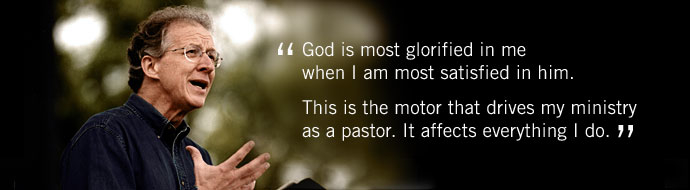
About John Piper

Piper J famous quote

“The ministry of preaching is the central labor of my life. My prayer is that through that ministry and everything else I do, the great glory of our God and Savior Jesus Christ would be magnified as more and more people come to live out the obedience of faith more and more deeply.” – John Piper

Growing Up

John Stephen Piper was born January 11, 1946, in Chattanooga, Tennessee, to Bill and Ruth Piper. His father was a traveling evangelist, and the Pipers lived near Chattanooga to be near a Christian college for which Bill served on the board. When the school moved to Greenville, South Carolina, the Pipers moved as well, and it was in Greenville that John spent his growing-up years. John honored his father in a 2008 biographical message called “Evangelist Bill Piper: Fundamentalist Full of Grace and Joy” and in the 2013 ebook A Tribute to My Father. John also wrote a tribute to his mother, who died in 1974, in the book What’s the Difference, and commended her in his Mother’s Day sermon in 2005, “Honoring the Biblical Call of Motherhood: A Tribute to Ruth Piper.”

Schooling

John graduated from Wade Hampton High School in 1964, and he majored in Literature and minored in Philosophy at Wheaton College (1964–68). Studying Romantic Literature with Clyde Kilby stimulated the poetic side of his nature, and today he regularly writes poems to celebrate special family occasions and rich, biblical truths. At Wheaton, John also met Noël Henry whom he married in 1968.

Following college, he completed a Bachelor of Divinity degree at Fuller Theological Seminary in Pasadena, California (1968–71). While at Fuller, John discovered the writings of Jonathan Edwards.

John did his doctoral work in New Testament Studies at the University of Munich in Munich, Germany (1971–74). His dissertation, Love Your Enemies, is now available through Crossway Books. Upon completion of his doctorate, he went on to teach Biblical Studies at Bethel College in St. Paul, Minnesota for six years (1974–80).

Bethlehem Baptist Church

In 1980, sensing an irresistible call to preach, John became the senior pastor of Bethlehem Baptist Church in Minneapolis, Minnesota, where he ministered for 33 years, until Easter 2013. Together with his people, John was dedicated to spreading a passion for the supremacy of God in all things for the joy of all peoples through Jesus Christ — a mission he continues now for the wider church through the ministry of desiringGod.org.

Desiring God and Bethlehem College & Seminary

John is the author of over 50 books and now frequently travels to speak, and writes regularly, through Desiring God. He also became chancellor of Bethlehem College & Seminary at its founding in 2009 and continues to serve as both chancellor and professor.

Family

John and Noël have four sons, a daughter, and twelve grandchildren.

The Gospel Made Simple: How Would You Like to Have a New Life?

Series: Presentations of the Gospel #1

How Would You Like to Have “A New Life?” By C. John Miller

AFWS C John Miller

(Presented by C. John Miller in A Faith Worth Sharing. Phillipsburg, N.J.: P&R, 1999.)

Have you ever felt there was something missing in your life? Something important but you didn’t know what? That may de the new life God wants you to have. A life of joy, peace, and fulfillment. A life…which you can receive today. Carefully consider these Five Important Facts…and find out how you can get that new life and become a brand-new person.

 FACT 1 – A loving God sent His Son Jesus into the world to bring you a new and abundant life.

Jesus said, “If anyone thirsts, let him come to me and drink. Whoever believes in me, as the Scripture has said, ‘Out of his heart will flow rivers of living water(John 7:37b-38).

Jesus also said concerning those He loves, “I came that they may have life and have it abundantly” (John 10:10b).

This new life brings you the fruit of the Spirit: “love, joy, peace, patience, kindness, goodness, faithfulness, gentleness, and self-control” (Galatians 5:22). It also gives POWER!

God’s Holy Spirit gives you the power to overcome…feelings of loneliness, stress, fear of people and the future (1 John 4:18).

And the power to break habits like…selfishness, depression, uncontrolled anger, prejudice, sexual lust, overeating, overdrinking, and drug abuse (1 Corinthians 6:9-11).

But Why Are So Many People Without This New Life?

 FACT 2 – Because…people are self-centered, not God-centered.

This means that by nature you are spiritually dead and deceived (Ephesians 2:1a: “You were dead through your trespasses and sins.”

TO BE SPIRITUALLY DEAD AND DECEIVED is to be centered on yourself and not on your Creator, and to believe…

A BIG LIE

People show this, according to Romans 1:21-31 by being…unthankful to God, perverted, greedy, jealous, bitter, proud, mean, devious, and foolish.

Since man’s first sin. He has tried to be INDEPENDENT of God. Actually each human being is entirely DEPENDENT on God for breath, food, health, shelter, physical and mental abilities. THE BIG LIE: SELFISH INDEPENDENCE: self-trust, self-boasting, self-reliance, self-analysis, self-hating, self-seeking.

 FACT 3 – Self-centered man is separated from a holy God by three barriers.

A Bad Record – Romans 3:23, “All have sinned and have fallen short of the glory of God.”

A Bad Heart – Mark 7:21, “From the heart of man come evil thoughts.”

A Bad Master – John 8:34, “everyone who commits sin is a slave to sin.”

The consequences of sin result in eternal separation from God. “The wages of sin is death (Romans 6:23a)…whoever does not obey the Son shall not see life, but the wrath of God remains on him (John 3:36b).”

 NOW:

 A dry, thirsty, unsatisfied life.

A guilty, accusing conscience (depression, fears, anxiety).

An aging body that must shortly die.

 FUTURE:

 Loss of friendship and earthly joys forever (Matthew 8:12).

Frightful pains of body and conscience forever (Mark 9:48).

Dreadful thirst of soul and body forever (Luke 16:19-31).

 FACT 4 – God’s Solution! No barriers!

A Perfect Record – 1 Corinthians 1:30, “Christ…is made our righteousness.”

A New Heart – Ezekiel 36:25-26, “A new heart I will give you.”

A Good Master – Matthew 11:28-30, “Come to me, all who labor and are heavy laden, and I will give you rest. Take my yoke upon you, and learn from me, for I am gentle and lowly in heart, and you will find rest for your souls. For my yoke is easy and my burden is light.”

“The blood of Jesus, God’s Son, cleanses us from all sin” (1 John 1:7b).

The Benefit of Jesus’ Death…Love’s Biggest Gift

“The free gift of God is eternal life through Christ Jesus” (Romans 6:23b). Jesus, the God-man, is the biggest gift of the Father’s love. On the cross Jesus suffered all the torments of hell as a substitute for His people (John 3:16; 10:15). He was legally condemned by God as their representative, removing the barriers of a bad record, a bad heat, and a bad master. The Father’s love can do no more. Risen from the dead, Jesus now lives to give you a new record, a new heart, Himself as a new master—and the free gift of eternal life now!

You Need to Make Sure

God says you either have a NEW LIFE or you are a lawbreaker DEAD in your self-centeredness. Are you personally alive or dead? If you are still dead, you need to know…

 FACT 5 – How to receive the Lord Jesus into your life…

  1. Turn…In sorrow from your sins: “Seek the LORD while he may be found; call upon Him while He is near; let the wicked forsake his way, and the unrighteousness man his thoughts; let him return to the LORD, that he may have compassion on him, and to our God for he will abundantly pardon” (Is. 55:6-7).

  2. Trust…in Jesus alone to save you: Believe in the Lord Jesus, and you will be saved” (Acts 16:31a)…I am the way the truth and the life, no one comes to the Father except through me (John 14:6).

Repentance is…not our suffering or our good works to earn our salvation, but a turning from our sins to the living God through Jesus Christ.

Trust in the Lord Jesus is…accepting, receiving, and resting on Him alone as the Savior from our sins.

 Begin a NEW LIFE

Will you surrender your life to Christ by turning from your self-centered way and trust in Him alone? Here is a guideline to help you confess your sins and come to know God through taking the Lord Jesus Christ as your own personal Savior.

 Make this Verbal Profession & Confession of Faith:

“Heavenly Father, I am really a selfish person. I have wanted my own way—not Yours. I have often been jealous, proud, and rebellious. You are my Creator, but I have acted as though I was lord of all. I have not been thankful to You. I have not listened to Your Word the Bible and have not loved Your Son. But now I see that all my sin is against You. I now repent of this evil attitude. I turn from all of my sins and trust that Jesus has shed His precious blood to cleanse me from all my guilt. I now receive Him as mu Savior and the Lord of my life.”

I, ______________, turn from my sins and take Christ as my Lord and Savior. By His help I promise to obey Him in every part of my life.

How Does This New Life Continue? The same way it began—in faith and prayer.

  1. Pray constantly. Prayer is talking to God. Keep doing it all the time. Include in it praise, thanksgiving, confession of sins, petitions for others’ salvation, and requests for help.

  2. Read your Bible. Study your Bible every day. It is the food for your new life and your sure guide. In it you meet Jesus and learn to claim His promises for your life.

  3. Worship with others. Meet with a church where the Bible is taught and obeyed and where Jesus Christ is Lord and Savior.

  4. Witness to others. Tell your friends what Christ has done for you—and wants to do for them. Be tactful and back up your words by improvement in manners and doing deeds of kindness.

* Gospel tracts: World Harvest Mission – 100 West Ave. W960 – Jenkintown, PA 19046-2697

ABOUT JACK MILLER

C. John “Jack” Miller, PhD., founded World Harvest Mission (WHM) and the New Life Presbyterian network of churches. A pastor, seminary professor, and author, he wrote Outgrowing the Ingrown Church, Come Back Barbara, Powerful Evangelism for the Powerless, A Faith Worth Sharing, Repentance, and The Heart of the Servant Leader. He and his wife Rose Marie have five children and twenty-four grandchildren. Jack went to be with the Lord in 1996. WHM is a movement of people empowered by God’s grace to plant churches around the world. For more information, visit whm.org.

How Long Would It Take to Win the Whole World to Christ?

David Watson

“If you were an outstandingly gifted evangelist with an international reputation, and if, under God, you could win 1,000 persons for Christ every night of every year, how long would it take you to win the whole world for Christ? Answer, ignoring the population explosion, over 10,000 years. But if you are a true disciple for Christ, and if you are able under God to win just one person to Christ each year; and if you could then train that person to win one other person for Christ each year, how long would it take to win the whole world for Christ? Answer, just 32 years!”

– David Watson – speaking of a D. James Kennedy Illustration

R.C. Sproul Summarizes The Doctrines of Grace: “T.U.L.I.P”

TULIPS

In a series of blog articles at ligonier.org entitled “TULIP and Reformed Theology,” Dr. R. C. Sproul provided a brief summary of the five points of Calvinism (also known as the Doctrines of Grace) expressed in the acrostic TULIP:

INTRODUCTION

Just a few years before the Pilgrims landed on the shores of New England in the Mayflower, a controversy erupted in the Netherlands and spread throughout Europe and then around the world. It began within the theological faculty of a Dutch institution that was committed to Calvinistic teaching. Some of the professors there began to have second thoughts about issues relating to the doctrines of election and predestination. As this theological controversy spread across the country, it upset the church and theologians of the day. Finally, a synod was convened. Issues were squared away and the views of certain people were rejected, including those of a man by the name of Jacobus Arminius.

The group that led the movement against orthodox Reformed theology was called the Remonstrants. They were called the Remonstrants because they were remonstrating or protesting against certain doctrines within their own theological heritage. There were basically five doctrines that were the core of the controversy. As a result of this debate, these five core theological issues became known in subsequent generations as the “five points of Calvinism.” They are now known through the very popular acrostic TULIP, which is a clever way to sum up the five articles that were in dispute. The five points, as they are stated in order to form the acrostic TULIP, are: total depravity, unconditional election, limited atonement, irresistible grace, and perseverance of the saints.

I mention this historical event because it would be a serious mistake to understand the essence of Reformed theology simply in light of these five doctrines—the Reformed faith involves many other elements of theological and ecclesiastical confession. However, these are the five controversial points of Reformed theology, and they are the ones that are popularly seen as distinctive to this particular confession. Over the next five posts, we are going to spend some time looking at these five points of Calvinism as they are spelled out in the acrostic TULIP.

(1) TOTAL DEPRAVITY

The doctrine of total depravity reflects the Reformed viewpoint of original sin. That term—original sin—is often misunderstood in the popular arena. Some people assume that the term original sin must refer to the first sin—the original transgression that we’ve all copied in many different ways in our own lives, that is, the first sin of Adam and Eve. But that’s not what original sin has referred to historically in the church. Rather, the doctrine of original sin defines the consequences to the human race because of that first sin.

Virtually every church historically that has a creed or a confession has agreed that something very serious happened to the human race as a result of the first sin—that first sin resulted in original sin. That is, as a result of the sin of Adam and Eve, the entire human race fell, and our nature as human beings since the fall has been influenced by the power of evil. As David declared in the Old Testament, “Oh, God, I was born in sin, and in sin did my mother conceive me” (Ps. 51:5). He was not saying that it was sinful for his mother to have borne children; neither was he saying that he had done something evil by being born. Rather, he was acknowledging the human condition of fallenness—that condition that was part of the experience of his parents, a condition that he himself brought into this world. Therefore, original sin has to do with the fallen nature of mankind. The idea is that we are not sinners because we sin, but that we sin because we are sinners.

In the Reformed tradition, total depravity does not mean utter depravity. We often use the term total as a synonym for utter or for completely, so the notion of total depravity conjures up the idea that every human being is as bad as that person could possibly be. You might think of an archfiend of history such as Adolf Hitler and say there was absolutely no redeeming virtue in the man, but I suspect that he had some affection for his mother. As wicked as Hitler was, we can still conceive of ways in which he could have been even more wicked than he actually was. So the idea of total total depravity doesn’t mean that all human beings are as wicked as they can possibly be. It means that the fall was so serious that it affects the whole person. The fallenness that captures and grips our human nature affects our bodies; that’s why we become ill and die. It affects our minds and our thinking; we still have the capacity to think, but the Bible says the mind has become darkened and weakened. The will of man is no longer in its pristine state of moral power. The will, according to the New Testament, is now in bondage. We are enslaved to the evil impulses and desires of our hearts. The body, the mind, the will, the spirit—indeed, the whole person—have been infected by the power of sin.

I like to replace the term total depravity with my favorite designation, which is radical corruption. Ironically, the word radical has its roots in the Latin word for “root,” which is radix, and it can be translated root or core. The term radical has to do with something that permeates to the core of a thing. It’s not something that is tangential or superficial, lying on the surface. The Reformed view is that the effects of the fall extend or penetrate to the core of our being. Even the English word core actually comes from the Latin word cor, which means “heart.” That is, our sin is something that comes from our hearts. In biblical terms, that means it’s from the core or very center of our existence.

So what is required for us to be conformed to the image of Christ is not simply some small adjustments or behavioral modifications, but nothing less than renovation from the inside. We need to be regenerated, to be made over again, to be quickened by the power of the Spirit. The only way in which a person can escape this radical situation is by the Holy Spirit’s changing the core, the heart. However, even that change does not instantly vanquish sin. The complete elimination of sin awaits our glorification in heaven.

(2) UNCONDITIONAL ELECTION

The Reformed view of election, known as unconditional election, means that God does not foresee an action or condition on our part that induces Him to save us. Rather, election rests on God’s sovereign decision to save whomever He is pleased to save.

In the book of Romans, we find a discussion of this difficult concept. Romans 9:10–13 reads: “And not only so, but also when Rebekah had conceived children by one man, our forefather Isaac, though they were not yet born and had done nothing either good or bad—in order that God’s purpose of election might continue, not because of works but because of him who calls—she was told, ‘The older will serve the younger.’ As it is written, ‘Jacob I loved, but Esau I hated.’” Here the Apostle Paul is giving his exposition of the doctrine of election. He deals with it significantly in Romans 8, but here he illustrates his teaching of the doctrine of election by going back into the past of the Jewish people and looking at the circumstances surrounding the birth of twins—Jacob and Esau. In the ancient world, it was customary for the firstborn son to receive the inheritance or the patriarchal blessing. However, in the case of these twins, God reversed the process and gave the blessing not to the elder but to the younger. The point that the Apostle labors here is that God not only makes this decision prior to the twins’ births, He does it without a view to anything they would do, either good or evil, so that the purposes of God might stand. Therefore, our salvation does not rest on us; it rests solely on the gracious, sovereign decision of God.

This doesn’t mean that God will save people whether they come to faith or not. There are conditions that God decrees for salvation, not the least of which is putting one’s personal trust in Christ. However, that is a condition for justification, and the doctrine of election is something else. When we’re talking about unconditional election, we’re talking in a very narrow confine of the doctrine of election itself.

So, then, on what basis does God elect to save certain people? Is it on the basis of some foreseen reaction, response, or activity of the elect? Many people who have a doctrine of election or predestination look at it this way. They believe that in eternity past God looked down through the corridors of time and He knew in advance who would say yes to the offer of the gospel and who would say no. On the basis of this prior knowledge of those who will meet the condition for salvation—that is, expressing faith or belief in Christ—He elects to save them. This is conditional election, which means that God distributes His electing grace on the basis of some foreseen condition that human beings meet themselves.

Unconditional election is another term that I think can be a bit misleading, so I prefer to use the term sovereign election. If God chooses sovereignly to bestow His grace on some sinners and withhold His grace from other sinners, is there any violation of justice in this? Do those who do not receive this gift receive something they do not deserve? Of course not. If God allows these sinners to perish, is He treating them unjustly? Of course not. One group receives grace; the other receives justice. No one receives injustice. Paul anticipates this protest: “Is there injustice on God’s part?” (Rom. 9:14a). He answers it with the most emphatic response he can muster. I prefer the translation, “God forbid” (v. 14b). Then he goes on to amplify this response: “For he says to Moses, ‘I will have mercy on whom I have mercy, and I will have compassion on whom I have compassion’” (v. 15). Here the Apostle is reminding his reader of what Moses declared centuries before; namely, that it is God’s divine right to execute clemency when and where He desires. He says from the beginning, “I will have mercy on whom I will have mercy.” It is not on those who meet some conditions, but on those whom He is pleased to bestow the benefit.

(3) LIMITED ATONEMENT

I think that of all the five points of Calvinism, limited atonement is the most controversial, and the one that engenders perhaps the most confusion and consternation. This doctrine is chiefly concerned about the original purpose, plan, or design of God in sending Christ into the world to die on the cross. Was it the Father’s intent to send His Son to die on the cross to make salvation possible for everyone, but with the possibility that His death would be effective for no one? That is, did God simply send Christ to the cross to make salvation possible, or did God, from all eternity, have a plan of salvation by which, according to the riches of His grace and His eternal election, He designed the atonement to ensure the salvation of His people? Was the atonement limited in its original design?

I prefer not to use the term limited atonement because it is misleading. I rather speak of definite redemption or definite atonement, which communicates that God the Father designed the work of redemption specifically with a view to providing salvation for the elect, and that Christ died for His sheep and laid down His life for those the Father had given to Him.

One of the texts that we often hear used as an objection against the idea of a definite atonement is 2 Peter 3:8–9: “But do not overlook this one fact, beloved, that with the Lord one day is as a thousand years, and a thousand years as one day. The Lord is not slow to fulfill his promise as some count slowness, but is patient toward you, not wishing that any should perish, but that all should reach repentance.” The immediate antecedent of the word any in this passage is the word us, and I think it’s perfectly clear that Peter is saying that God is not willing that any of us should perish, but that all of us should come to salvation. He’s not speaking of all mankind indiscriminately; the us is a reference to the believing people to whom Peter is speaking. I don’t think we want to believe in a God who sends Christ to die on the cross and then crosses His fingers, hoping that someone will take advantage of that atoning death. Our view of God is different. Our view is that the redemption of specific sinners was an eternal plan of God, and this plan and design was perfectly conceived and perfectly executed so that the will of God to save His people is accomplished by the atoning work of Christ.

This does not mean that a limit is placed on the value or the merit of the atonement of Jesus Christ. It’s traditional to say that the atoning work of Christ is sufficient for all. That is, its meritorious value is sufficient to cover the sins of all people, and certainly anyone who puts his or her trust in Jesus Christ will receive the full measure of the benefits of that atonement. It is also important to understand that the gospel is to be preached universally. This is another controversial point, because on the one hand the gospel is offered universally to all who are within earshot of the preaching of it, but it’s not universally offered in the sense that it’s offered to anyone without any conditions. It’s offered to anyone who believes. It’s offered to anyone who repents. Obviously the merit of the atonement of Christ is given to all who believe and to all who repent of their sins.

(4) IRRESISTIBLE GRACE

In historic Reformation thought, the notion is this: regeneration precedes faith. We also believe that regeneration is monergistic. Now that’s a three-dollar word. It means essentially that the divine operation called rebirth or regeneration is the work of God alone. An erg is a unit of labor, a unit of work. The word energy comes from that idea. The prefix mono- means “one.” So monergism means “one working.” It means that the work of regeneration in the human heart is something that God does by His power alone—not by 50 percent His power and 50 percent man’s power, or even 99 percent His power and 1 percent man’s power. It is 100 percent the work of God. He, and He alone, has the power to change the disposition of the soul and the human heart to bring us to faith.

In addition, when He exercises this grace in the soul, He brings about the effect that He intends to bring about. When God created you, He brought you into existence. You didn’t help Him. It was His sovereign work that brought you to life biologically. Likewise, it is His work, and His alone, that brings you into the state of rebirth and of renewed creation. Hence, we call this irresistible grace. It’s grace that works. It’s grace that brings about what God wants it to bring about. If, indeed, we are dead in sins and trespasses, if, indeed, our wills are held captive by the lusts of our flesh and we need to be liberated from our flesh in order to be saved, then in the final analysis, salvation must be something that God does in us and for us, not something that we in any way do for ourselves.

However, the idea of irresistibility conjures up the idea that one cannot possibly offer any resistance to the grace of God. However, the history of the human race is the history of relentless resistance to the sweetness of the grace of God. Irresistible grace does not mean that God’s grace is incapable of being resisted. Indeed, we are capable of resisting God’s grace, and we do resist it. The idea is that God’s grace is so powerful that it has the capacity to overcome our natural resistance to it. It is not that the Holy Spirit drags people kicking and screaming to Christ against their wills. The Holy Spirit changes the inclination and disposition of our wills, so that whereas we were previously unwilling to embrace Christ, now we are willing, and more than willing. Indeed, we aren’t dragged to Christ, we run to Christ, and we embrace Him joyfully because the Spirit has changed our hearts. They are no longer hearts of stone that are impervious to the commands of God and to the invitations of the gospel. God melts the hardness of our hearts when He makes us new creatures. The Holy Spirit resurrects us from spiritual death, so that we come to Christ because we want to come to Christ. The reason we want to come to Christ is because God has already done a work of grace in our souls. Without that work, we would never have any desire to come to Christ. That’s why we say that regeneration precedes faith.

I have a little bit of a problem using the term irresistible grace, not because I don’t believe this classical doctrine, but because it is misleading to many people. Therefore, I prefer the term effectual grace, because the irresistible grace of God effects what God intends it to effect.

(5) PERSEVERANCE OF THE SAINTS

Writing to the Philippians, Paul says, “He who has begun a good work in you will perfect it to the end” (Phil. 1:6). Therein is the promise of God that what He starts in our souls, He intends to finish. So the old axiom in Reformed theology about the perseverance of the saints is this: If you have it—that is, if you have genuine faith and are in a state of saving grace—you will never lose it. If you lose it, you never had it.

We know that many people make professions of faith, then turn away and repudiate or recant those professions. The Apostle John notes that there were those who left the company of the disciples, and he says of them, “Those who went out from us were never really with us” (1 John 2:19). Of course, they were with the disciples in terms of outward appearances before they departed. They had made an outward profession of faith, and Jesus makes it clear that it is possible for a person to do this even when he doesn’t possess what he’s professing. Jesus says, “This people honors Me with their lips, but their heart is far from Me” (Matt. 15:8). Jesus even warns at the end of the Sermon on the Mount that at the last day, many will come to Him, saying: “Lord, Lord, didn’t we do this in your name? Didn’t we do that in your name?” He will send them away, saying: “Depart from Me, you workers of iniquity. I never knew you” (Matthew 7:23). He will not say: “I knew you for a season and then you went sour and betrayed Me. No, you never were part of My invisible church.” The whole purpose of God’s election is to bring His people safely to heaven; therefore, what He starts He promises to finish. He not only initiates the Christian life, but the Holy Spirit is with us as the sanctifier, the convictor, and the helper to ensure our preservation.

I want to stress that this endurance in the faith does not rest on our strength. Even after we’re regenerated, we still lapse into sin, even serious sin. We say that it is possible for a Christian to experience a very serious fall, we talk about backsliding, we talk about moral lapses, and so on. I can’t think of any sin, other than blasphemy against the Holy Spirit, that a truly converted Christian is not capable of committing.

We look, for example, at the model of David in the Old Testament. David was surely a man after God’s own heart. He was certainly a regenerate man. He had the Spirit of God in Him. He had a profound and passionate love for the things of God. Yet this man not only committed adultery but also was involved in a conspiracy to have his lover’s husband killed in war—which was really conspiracy to murder. That’s serious business. Even though we see the serious level of repentance to which David was brought as a result of the words of the prophet Nathan to him, the point is that David fell, and he fell seriously.

The apostle Paul warns us against having a puffed-up view of our own spiritual strength. He says, “Therefore let anyone who thinks that he stands take heed lest he fall” (1 Cor. 10:12). We do fall into very serious activities. The Apostle Peter, even after being forewarned, rejected Christ, swearing that he never knew Him—a public betrayal of Jesus. He committed treason against His Lord. When he was being warned of this eventuality, Peter said it would never happen. Jesus said, “Simon, Simon, Satan would have you and sift you like wheat, but I have prayed for you, so that when you turn, strengthen the brothers” (Luke 22:31). Peter fell, but he returned. He was restored. His fall was for a season. That’s why we say that true Christians can have radical and serious falls but never total and final falls from grace.

I think this little catchphrase, perseverance of the saints, is dangerously misleading. It suggests that the perseverance is something that we do, perhaps in and of ourselves. I believe that saints do persevere in faith, and that those who have been effectually called by God and have been reborn by the power of the Holy Spirit endure to the end. However, they persevere not because they are so diligent in making use of the mercies of God. The only reason we can give why any of us continue on in the faith is because we have been preserved. So I prefer the term the preservation of the saints, because the process by which we are kept in a state of grace is something that is accomplished by God. My confidence in my preservation is not in my ability to persevere. My confidence rests in the power of Christ to sustain me with His grace and by the power of His intercession. He is going to bring us safely home.

About The Author:

Sproul R C image seated with Bible

Dr. R.C. Sproul has been a professor of Apologetics, Philosophy, and Theology at numerous Seminaries. He is the Founder of Ligonier Ministries, President of Reformation Bible College, and the Senior Minister of St. Andrews Presbyterian Church in Sanford, Fl. He has authored over 70 books including the following books on Soteriology: Chosen By God; Willing to Believe; Getting the Gospel Right; What is Reformed Theology?; The Truth of the Cross; Faith Alone; and Grace Unknown.

R.C. Sproul on What Happens To The Person Who Never Heard of Jesus?

Objection #3 To Christianity Answered: “What About the Poor Native Who Never Heard of Christ?”

Objections Answered image

As a teacher of theology I am regularly faced with a plethora of questions raised by inquiring students. Though I’ve never tabulated these queries with a computer, I am convinced there is one question that heads the list in terms of numerical frequency. The question most often raised is, “What happens to the poor innocent native in Africa who has never heard of Christ?” The query expresses a deep concern for the person who dwells in remote parts of the earth, far removed from the exposure of modern media or communication. This person lives and dies without hearing a single word of the biblical message. Where does that person stand with God?

Why is this question asked so frequently? Why are so many students plagued by it? Perhaps there are several factors that stimulate the inquiry. First of all, people in the Western world are acquainted enough with Christianity to have some idea of the central motif of the love of God. Add to that the common understanding that at the core of the Christian faith is the assertion of the unique importance of the person and work of Christ. If Christ is unique and necessary for redemption, how can one avail himself of this redemption if he has no knowledge of it? If God is so loving, why does He not light up the skies with a celestial message that is broadcast so clearly that none could possibly miss it? Why is the “good news” of redemption in Christ limited to those living in cultures that have access to it?

The question is stimulated not only by matters of speculative theology but also by a spirit of human compassion. if compassion resides within us at all, we must be ever sensitive to those who live in less privileged circumstances than we. We are not concerned here with a paternalistic or imperialistic sense of cultural privilege but with an ultimate sense of redemptive privilege. There can be found no intrinsic sense of righteousness within us that would induce God to make the means of redemption available to us in a privileged way. It might even be argued that our “privilege” is rooted in our greater need for redemption owing to our greater corruption. However, since sin is universal and not restricted to either civilized or uncivilized, Western or non-Western humanity, we can hardly find the answer there.

What Happens to the Innocent Person Who Never Heard of Christ?

Regardless of the motivations for it, we are still faced with the question. What does happen to the innocent person who has never heard of Christ? The way the question is phrased will affect the answer given. When we ask, “What happens to the innocent person who has never heard?” we are loading the question with significant assumptions. If the question, however, is asked in this manner the answer is easy and is obvious. The innocent native who never hears of Christ is in excellent shape, and we need not be anxious about his redemption. The innocent person does not need to hear of Christ. He has no need of redemption. God never punishes innocent people. The innocent person needs no Savior; he can save himself by his innocence.

When the question is framed in this way, however, it betrays the assumption that there are innocent people in this world. If that is so (an assumption which Christianity emphatically denies), then we need not be concerned about them. But we are faced still with the larger question, “What happens to the guilty person who has never heard?”

The question of innocence often slips into the question unnoticed. What is often meant is not a perfect innocence, but a relative innocence. We observe that some persons are more wicked than others. The wickedness appears all the more wicked when it occurs within a context of privilege. When a person lives wickedly knowing the details of God’s commandments and has been instructed in them repeatedly, his wickedness appears heinous when measured against those who live in relative ignorance.

On the other hand, if the remote native is guilty, wherein lies his guilt? Is he punished for not believing in a Christ of whom he has never heard? If God is just, that cannot be the case. If God were to punish a person for not responding to a message he had no possibility of hearing, that would be a gross injustice; it would be radically inconsistent with God’s own revealed justice. We can rest assured that no one is ever punished for rejecting Christ if they’ve never heard of Him.

Before we sigh too deep a breath of relief, let us keep in mind that the native is still not off the hook. Some have stopped at this point in their consideration of the question and allowed their sigh of relief to lull them too quickly into a comfortable ease about the question. The unspoken assumption at this point is that the only damnable offense against God is rejection of Christ. Since the native is not guilty of this we ought to let him alone. In fact letting him alone would be the most helpful and redemptive thing we could do for him. If we go to the native and inform him of Christ, we place his soul in eternal jeopardy. For now he knows of Christ, and if he refuses to respond to Him, he can no longer claim ignorance as an excuse. Hence, the best service we can render is silence.

But what if the assumption above is incorrect? What if there are damnable offenses against God? That would change the situation and rouse us from our dogmatic slumbers. What if the person who has never heard of Christ has heard of God the Father and has rejected Him? Is rejection of God the Father as serious as a rejection of God the Son? It would seem to be at least as serious if not more serious.

What About the Person Who Knows About God?

It is precisely at this point that the New Testament locates the universal guilt of man. The New Testament announces the coming of Christ to a world that had already rejected God the Father. Christ Himself said, “I came not to call the righteous, but the sinner to repentance. Those who are well have no need of a physician” (see Matthew 9:12-13).

The biblical response to the question of the person who never heard of Christ is found in Romans 1, beginning with verse 18. The section begins with an awesome announcement of the wrath of God:

For the wrath of God is revealed from heaven against all the ungodliness and unrighteousness of men, who by their unrighteousness suppress the truth.

Notice that God’s wrath is revealed not against innocence or ignorance but against ungodliness and wickedness. What kind of wickedness? Both the word “ungodliness” and the word “wickedness” are generic terms describing general classes of activity. What is the specific act that is provoking the divine wrath? The answer is clear, the suppressing of truth. We must ask, “What truth i being suppressed?” The rest of the text provides the answer:

For what can be known about God is plain to them, because God has shown it to them. For his invisible attributes, namely, his eternal power and divine nature, have been clearly perceived, ever since the creation of the world, in the things that have been made. So they are without excuse. For although they knew God, they did not honor him as God or give thanks to him, but they became futile in their thinking, and their foolish hearts were darkened (Romans 1:19-21).

Here the apostle gives us a description of what theologians call “general revelation.” This means simply that God has revealed something generally. The “general” character of the revelation refers to two things, content and audience. The content is general in that it does not provide a detailed description of God. The trinity is not a part of this revelation. God reveals that He is, that He has eternal power and deity. The audience is general in  that all men receive this revelation. God does not reveal Himself only to a small elite group of scholars or priests but to all mankind.

What else does this text teach about general revelation?

First, we learn that it is clear and unambiguous. This knowledge is said to be plain (manifest) to them; that God has shown it to them; that it has been clearly perceived. Thus, this knowledge is not obscure.

Secondly, we learn that the knowledge “gets through” and finds its mark. God does not merely provide an available objective revelation of Himself that may or may not be subjectively received. We read “they knew God.” Man’s problem is not that he doesn’t know God but that he refuses to acknowledge what he knows to be true.

Thirdly, we learn that this revelation has been going on since the foundation of the world. It is not a once-for-all event but continues in a constant way.

Fourthly, we learn that revelation comes by way of creation. God’s invisible nature is revealed “through the things that are made.” The whole creation is a glorious theater which gives a magnificent display of its creation.

Fifthly, we learn that the revelation is sufficient to render man inexcusable. The passage says, “So they are without excuse.” What excuse do you suppose the apostle had in mind? What excuse does general revelation eliminate? Obviously the excuse eliminated is that of ignorance. If the apostle is correct about general revelation then none will ever say to God, “I’m sorry I didn’t worship and serve you. I didn’t know you existed. If only I had known I most certainly would have been your obedient servant. I wasn’t a militant atheist; I was an agnostic. I didn’t think there was sufficient evidence to affirm your existence.” If God has in fact clearly revealed Himself to all men, no man can plead ignorance as an excuse for not worshiping Him.

Ignorance may function as an excuse for certain things under certain circumstances. The Roman Catholic Church, in developing their moral theology, adopted a distinction between vincible ignorance and invincible ignorance. Vincible ignorance is that ignorance which could and should be overcome. It does not excuse. Invincible ignorance is that ignorance which could not possibly be overcome. It does excuse.

Suppose a person from Texas drove his care to California and came to San Francisco. Upon entering the city limits of San Francisco the motorist promptly ran a red light. A police officer accosted him and gave him a ticket for going through a red light. The motorist protested saying, “I did not know it was against the law to go through a red light in California. I am from Texas.” Would this appeal to ignorance excuse the man? Certainly not. If the Texan presumes to drive his car in California, he is responsible to know the traffic laws. The laws are readily available and are not concealed by being locked up in a secret vault. This man’s ignorance would be vincible, leaving him without excuse.

Suppose on the other hand, that the city council of San Francisco were desperate for accumulating money quickly. Hence they meet in a secret conclave and pass a local municipal ordinance that outlaws driving through green lights and stopping at red lights. They decide the penalty for violating the law is a $100 fine. The catch is they decide not to notify the press or make any mention of the new secret law. The plan is to have a policeman at every intersection arresting motorists who stop on red and go on green. Could the arrested motorists plead ignorance as an excuse? Yes, their ignorance would be invincible and should excuse them.

Thus, the person who has never heard of Christ can plead ignorance at that point but cannot plead ignorance with respect to God the Father.

But aren’t the people who live in remote areas of the world religious? Doesn’t their religious activity remove them from any danger of the wrath of God? Isn’t it true that many anthropologists tell us that man is homo religiosus, that religion is universal? Such people may not be educated or sophisticated in their religious activity. Perhaps they worship totem poles, cows, or bee trees. But at least they are trying and doing the best they can. They surely don’t know any better. If they are born and raised in a culture that worships cows, how can they be expected to do any differently?

It is precisely at this point that the notion of general revelation is devastating. If Paul is correct, the practice of religion does not excuse the pagan but in fact compounds his guilt. How can that be? Paul continues his treatment of general revelation by saying:

Claiming to be wise, they became fools, and exchanged the glory of the immortal God for images resembling mortal man and birds and animals and creeping things. Therefore God gave them up in the lusts of their hearts to impurity, to the dishonoring of their bodies among themselves, because they exchanged the truth about God for a lie and worshiped and served the creature rather than the Creator, who is blessed forever! Amen (Romans 1:22-25).

Here the apostle examines pagan religion. He views it as a distortion of truth. An “exchange” takes place between the truth of God and the lie. God’s glory is replaced by the substitution of the “glory” of the creature. Creature worship is religion, but it is the religion of idolatry. To be zealous in the worship of idols is to be zealous in the insulting of the glory and dignity of God. If God clearly reveals His glory and that glory is replaced by the worship of creatures, the ensuing religion is not pleasing, but displeasing to God.
Thus the fact that people are religious does not in itself mean that God is pleased with them. Idolatry represents the ultimate insult to God. To reduce God to the level of a creature is to strip God of His deity. This is particularly odious to God in light of the fact that all men have received enough revelation about Him to know that He is not a creature. Pagan religion is viewed then not as growing out of an honest attempt to search for God, but out of a fundamental rejection of God’s self-revelation.
How Are the Pagans Judged?
The New Testament makes it clear that people will be judged according to the light that they have. All the elements of the Old Testament Law are not known by people living in remote parts of the world. But we read that they do have a law “written on their hearts” (Romans 2:15). They are judged by the law they do not know and are found wanting. No one keeps the ethic he has even if he invents it himself.
I counseled once with a college student who was in my office as a “captive audience.” He had come at his mother’s insistence. His mother was a zealous Christian who continuously sought to persuade her son to become a Christian. The son was deeply alienated and resisted her persuasion. His rebellion was radical as he opted for a life-style that was on a collision course with his family values. As he spoke to me he argued that everyone had the right to develop his own ethic. He believed in a “do your own thing” morality. He complained that his mother had no right to “shove religion down my throat.”
I asked him why he objected to his mother’s tactics. If his mother followed his ethic she would have every right to shove religion down his throat. His mother’s “thing” was shoving religion down people’s throats. I explained to him that his mother was not being consistent with her own Christian ethic because she was so insensitive to her son. Yet she was being consistent with her son’s ethic. As we talked, he came to realize that what he really believed was that people could do their own thing as long as their own thing did not impinge on his own thing. He wanted one ethic for himself but quite another for everybody else. It is when we complain about other people’s behavior that we reveal what our deepest views of ethics are.
The pagan in Africa has an ethic. But even that ethic is violated. Thus, he remains exposed to the judgment of God. So often the primitive is idealized as being untainted by the corruption of civilization. Such idealized descriptions, however, do not fit the facts.
Thus if a person in a remote area has never heard of Christ, he will not be punished for that. What he will be punished for is the rejection of the Father of whom he has heard and for the disobedience to the law that is written on his heart. Again, we must remember that people are not rejected for what they haven’t heard but for what they have heard.
If all men have heard of the Father but naturally reject Him, then it follows that all men need to know of the redemption offered in Christ. To have no knowledge of Christ is to be in jeopardy because of the prior rejection of the revelation of the Father. But to hear of Christ and reject Him is to be in a state of double jeopardy. Now not only has the Father been rejected but the Son as well. Thus every time the gospel is proclaimed it bears a two-edged sword. To those who believe, it is the savor of glory. To those who reject, it is death.
How Can the Native Hear?
If the person who never heard of Christ is in serious jeopardy, how can his plight be alleviated? The answer comes in a simple statement made by the apostle Paul:
How then will they call on him in whom they have not believed? And how are they to believe in him of whom they have never heard? And how are they to hear without someone preaching? And how are they to preach unless they are sent? As it is written, “How beautiful are the feet of those who preach the good news!” (Romans 10:14-15).
Here the apostle reiterates the need for the mission of the church. Mission (from the Latin “to send”) begins with the love of God. It is because God so loved the world that He “sent” His Son into the world. The mission of Christ was in behalf of those who rejected the Father. The rejected Father sent the Son sent His church. That is the basis for the world mission of the church. It is the mandate of Christ that those who have not heard do hear. They cannot hear without a preacher, and there cannot be a preacher without a “sending.” The mandate of Christ is that the gospel be preached in every land and nation, to every tribe and tongue, to every living person. If this mandate were carried out by the church, the question of what happens to those who never heard would be a moot one.
The Christian must ask a second question after he has dealt with the question of those who have never heard. The Christian must ask, “What happens to me if I never do anything to promote the world mission of the church?” If the Christian takes this question seriously then his response must be equally serious. His concern for the remote native must begin with compassion, and it must also culminate in a response of compassion.
The question of the fate of the person who never hears of Christ is one that must not only be answered with words but by action as well. The action of mission must be prompted not by paternalism nor by imperialism but by obedience to the “sending” of Christ. All men need Christ, and it is the duty of the church to meet the need.

Key Points to Remember:

(1) All men know God the Father (Romans 1:18ff). The problem of the pagan who has never heard the gospel is the problem of our universal fallenness. We must emphasize that God has revealed Himself to all men. All men know there is a God. Thus, no one can plead ignorance as an excuse for denying God.

(2) All men distort and reject true knowledge of God. Since all men know God and all distort or reject that knowledge, they are not innocent.

(3) There are no innocent people in the world. People who die without hearing the gospel  will be judged according to the knowledge they have. They will be judged guilty for rejecting God the Father. God never condemns innocent people.

(4) God judges according to the knowledge people have. Idolatry as a “religion” does not please God but adds insult to injury to the glory of God (see Isa. 42:8). Idolatry does not represent man’s search for God but rather man’s flight from God.

(5) The gospel is God’s gift of redemption for the lost. God sends Christ to give people an opportunity for redemption from the guilt  they already have. If men reject Christ they face the double judgment of rejecting both the Father and the Son (see Colossians 1:13-17).

(6) The pagan needs Christ to reconcile him to God the Father. Christ Himself viewed the pagan as being in a “lost” condition.

(7) Christ commands the Church to make sure everyone hears the gospel (see Mark 16:15).

(8) Rejection of Christ brings a double judgment (see 2 Tim. 4:1).

(9) “Religion” does not redeem people but may add to their guilt.

About The Author:

Sproul R C image seated with Bible

Dr. R.C. Sproul has been a professor of Apologetics, Philosophy, and Theology at numerous Seminaries. He is the Founder of Ligonier Ministries, President of Reformation Bible College, and the Senior Minister of St. Andrews Presbyterian Church in Sanford, Fl. He has authored over 70 books including the following books on Apologetics: The Psychology of AtheismDefending the FaithNot a Chance; and a contributor to Classical Apologetics. The article above was adapted from Chapter 3 in his book Reason to Believe (previously – Objections Answered. Grand Rapids: Zondervan, 1982).

Book Review on Will Metzger’s “Tell The Truth”

How To Share the Gospel in Truth and with Love: Book Review by David P. Craig

TTT Metzger

Tell the Truth fills a huge void in the literature on the subject of evangelism – sharing the good news of Jesus Christ with others. Most books on evangelism focus on techniques and methods. Metzger on the other hand focuses primarily on developing a theology of evangelism. Metzger does a phenomenal job of tackling the question: What truth or key truths are essential to the gospel message? After spending time on the key elements of doctrinal truth of our message (understanding the gospel) – Metzger gives abundant examples of how to share the truth/s of the gospel message with others.

In this thorough handbook on evangelism Metzger addresses the following issues with great theological depth, biblical support and commentary, and practical applications: The importance of doctrine and theology in evangelism; Distinguishing our role from God’s role in evangelism; Man-centered verses God-centered methods in evangelism; The five primary points of evangelism; Myths and facts about God’s grace; God’s sovereignty and our responsibility; How worship is the motivation for evangelism; Challenges for evangelism amid pluralism; How to communicate the gospel personally with different types of people; and how to bloom with the gospel where you are planted.

This book also contains a plethora of resources for training material on every aspect of evangelism including: How to prepare your testimony; How to develop a theological methodology of evangelism; How to say what you mean; How to ask good questions; Doing friendship evangelism; Questions non-Christians ask; Sharing the gospel using stories; and many other helpful templates, Charts, outlines, guides, questions to ask, and so forth. There is also a schedule for doing a God-centered evangelism training seminar in your church, school, or small group; and a study guide containing twelve sessions for individuals or groups.

I believe Metzger’s book is arguably the best resource on evangelism available today from a God-centered perspective. It is the equivalent of a seminary course in evangelism and is a book that you will come to again and again for its depth of insight and practical wisdom as you seek to better understand and declare the good news of the gospel for life. I am so grateful for this exceptional resource that guides the beginner or seasoned veteran in “speaking the truth in love.”

Why is God So Narrow-Minded About Salvation? By Dr. R.C. Sproul

Answer to Objection #2 To Christianity: “All Religions Are Good. It Doesn’t Matter What You Believe.”

RTB sproul image

America is a melting pot. People from every conceivable ethnic and religious background come together to form one nation–e pluribus unum, from the many, one. At the heart of our national sense of unity stands the crucial principle of religious toleration. Under the principle of religious toleration, all religious systems are guaranteed freedom of expression and equal treatment under the law. No one religion has exclusive claim to legal rights and government establishment. The government of the United States of America expresses the will of the founding fathers that there will be no “established national religion.: Thus, we have no state church that enjoys exclusive privilege under the law.

With the principle of equal toleration has come the idea that no religion has exclusive claims to truth. Though the concept of legal religious toleration says nothing at all about the validity of truth claims, many have drawn the implication that equal toleration means equal validity. Thus, when Christians or advocates of any religion make claims of exclusivity, their claims are often met with shock or anger at such a narrow-minded posture. To make exclusive religious claims is to fly in the face of national sentiment. It is like attacking baseball, hot dogs, motherhood, and apple pie (not to mention Chevrolet).

In the sixties the uplifted index finger became a symbol not only of a number one ranking for a football team, but also a popular sign of the members of the “Jesus movement” that there is but “one way” to God, the way of Christ. The zeal of the Jesus People met great resistance and hostility at this point.

One of the most embarrassing moments I ever experienced came in a freshman class in college. it was a time of painful public humiliation. The professor was a former war correspondent who was outwardly hostile to Christianity. In the middle of a class she looked at me and said, “Mr. Sproul, do you believe that Jesus is the only way to God?” I gasped as I felt the weight of he question and knew that every eye in the room was on me. My mind raced for a way to escape my dilemma. I knew that if I said yes people would be angry. At the same time, I knew that if I said no I would be betraying Christ. Finally, I mumbled almost inaudibly, “Yes, I do.” The teacher responded with unmitigated fury. She said in front of the whole class, “That’s the most narrow-minded, bigoted, and arrogant statement I have ever heard. You must be a supreme egotist to believe your way of religion is the only way.” I made no reply but slouched rather meekly in my chair.

After the class was dismissed, I went to speak with my teacher privately. In the conversation I tried to explain to her why I believed that Christ was the only way. I asked her if she thought it was at least theoretically  possible that Christ be one way to God. She allowed the possibility. I asked if she thought it were possible that without being narrow-minded or bigoted a person could come to the belief that Jesus was God. Though she did not believe in the deity of Christ, she recognized that people could, in fact, believe that without being bigoted. Then I explained to her that the reason I believed that Christ was the only way because Jesus Himself taught that.

I reminded her that Jesus said, “I am the way, and the truth, and the life; no one comes to the Father, but by me” (John 14:6). I also pointed out that the New Testament refers to Christ as the “only-begotten” of the Father, and that “there is no other name under heaven by which we must be saved” (Acts 4:12). I said to her, “Can you see that I am torn between my loyalty to Christ and the modern spirit of pluralism?” I said, “Do you see that it is possible for me to believe in the uniqueness of Christ because He taught it? If I believed Christ was the only way because I believe that my way must be the only way because it is my way, that would be an act of arrogance and egotism.” She finally acknowledged that it was possible for someone to believe in the uniqueness of Christ without being arrogant and apologized sincerely to me. However, she went on to raise a more serious question than the question of my arrogance. She said, “How can you believe in a God who only allows one way to Himself?” Isn’t it narrow-minded of God to restrict redemption to one Savior and one faith?”

Aren’t All Religions Basically the Same?

In the final analysis this is the issue that must be faced: Is God so narrow-minded that He provides only one way of redemption?

Part of the reason we struggle so deeply with a question like this is due to the impact of the results of the nineteenth century approach to the study of comparative religion. In the nineteenth century there was a concerted effort by scholars to examine closely the distinctive characteristics of the major religions of the world. The “buzz word” of the day was “essence.” Many serious studies of religion were published which contained titles like The Essence of Religion or The Essence of Christianity. These books reflected an attempt to get at the basic core of religious truth that was found in all religion.

Religion was often reduced to its lowest common denominator. Frequently the distilled essence of religion was pinpointed by the phrase “the universal fatherhood of God and universal brotherhood of man.” Thus it was seen that at the heart, all religions were working for the same thing. The outward trappings of religious belief and practice differed from culture to culture but at the root their goals were the same. Thus, if all religions were essentially the same then no one of them could ever make exclusive claims to validity.

Out of this quest for the essence of religion came the now famous and popular “mountain analogy.” The mountain analogy pictures God at the peak of the mountain with man down at the base. The story of religion is the account of man’s effort to move from the base of the mountain to the peak of fellowship and communion with God. The mountain has many roads. Some of the roads go up the mountain by a very direct route. Other roads go up the mountain in a circuitous fashion, but eventually reach the top. Thus, according to the proponents of this analogy, all religious roads, though they differ in route, ultimately arrive at the same place.

Out of this conviction that all roads lead to God has come a considerable number of ecumenical movements, pan-religious endeavors, and even new religions such as Bahai which seek a total synthesis and amalgamation of all the world religions into one new unified religion.

I once had a conversation with a Bahai priest. He told me that all religions were equally valid. I began to interrogate him concerning the points of conflict that exist between islam and Buddhism, between Confucianism and Judaism, and between Christianity and Taoism. The man responded by saying that he didn’t know anything about Islam, Judaism, or the rest but that he did know they were all the same. I wondered aloud how anyone could assert that all religions were the same when he had no knowledge of what those religions professed or denied/ How can Buddhism be true when it denies the existence of a personal God and at the same time Christianity be true when it affirms the existence of a personal God? Can there be a personal God and not be a personal God at the same time and in the same relationship? Can Orthodox Judaism be right when it denies life after death and Christianity be equally right when it affirms life after death? Can classical Islam have a valid ethic that endorses the killing of infidels while at the same time the Christian ethic of loving your enemies be equally valid?

There are only two possible ways to maintain the equal validity of all religions. One is by ignoring the clear contradictions between them by a flight into irrationality; the other is by assigning these contradictions to the level of insignificant nonessentials. The latter approach involves us in a systematic process of reductionism. Reductionism strips each religion of elements considered vital by the adherents of the religion themselves and reduces the religion to its lowest common denominator. The distinctives of each  religion are obscured and watered down to accommodate religious peace.

Why does this kind of reductionism take place? Perhaps there are many motivating factors for it. Certainly one of the most powerful factors is the desire to end religious controversies and the upheaval they bring. Differences in religious conviction have led again and again to passionate disputes between people, family alienation, violent forms of religious persecution, and in many cases even war. Thus if we were able to achieve a universal religious essence perhaps we can end these very costly disputes. The goal is peace. The price is truth.

if religion deals with matters of ultimate concern, there is little wonder that religious debates produce so much passion. But if we are interested in truth we can never discover it by denying real differences of truth claims. The peace that is produced by reductionism is a false and carnal peace. We recall the false prophets of Israel who, in their desperate attempts to avoid conflict, cried, “Peace, peace,” when there was no peace. Jeremiah’s lament remains relevant, “These men heal the wounds of the daughters of Zion, slightly” (see Jeremiah 11).

It is one thing to seek an atmosphere of religious debate that is characterized by charity. It is quite another thing to say the matters under debate are not important. It is one thing to protect the right of every religious person to follow the dictates of his conscience without fear of persecution; it is another to say that opposing convictions are both true. We must note the difference between equal toleration under the law and equal validity according to truth.

Why is God So Narrow-MInded?

We are still left with a problem, however, of a narrow-minded God who provides only one way of redemption. Does this not mean that people who live in a culture where that one religion is proclaimed have a decisive advantage over people living in other cultures? Let’s examine the deeper question of the narrow-mindedness of God who provides only one way of redemption.

We remember the words of Jesus when he said, “Enter by the narrow gate. For the gate is wide and the way is easy that leads to destruction, and those who enter by it are many. For the gate is narrow and the way is hard that leads to life, and those who find it are few( Matthew 7:13-14).”

What kind of a God would have such a narrow gate? The question implies a serious accusation; that God has not done enough to provide redemption for mankind. Let us examine the accusation from a hypothetical perspective. Let us suppose that there is a God who is altogether holy and righteous. Suppose that God freely creates mankind and gives to mankind the gift of life.

Suppose He sets His creatures in an ideal setting and gives them the freedom to participate in all of the glories of the created order with freedom. Suppose, however, that God imposes one small restriction upon them, warning them that if they violate that restriction, they will die. Would such a God have the right to impose such a restriction with the penalty of forfeiture of the gift of life if His authority is violated?

Suppose that for no just cause the ungrateful creatures disobeyed the restriction the moment God’s back was turned. Suppose when He discovered their violation instead of killing them, He redeemed them. Suppose the descendents of the first transgressors broadly and widely increased their disobedience and hostility toward their creator to the point that the whole world became rebellious to God, and each person in it, “did what was right in his own eyes” (Judg. 21:25).

Suppose God still determined to redeem these people and freely gave special gifts to one nation of people in order that, through them, the whole world would be blessed. Suppose God delivered this people from poverty and enslavement to a ruthless Egyptian Pharoah. Suppose this privileged nation, as soon as it was liberated, rose up in further rebellion against their God and their liberator. Suppose they took His law and violated it consistently.

Suppose that God, still intent upon redemption, sent specially endowed messengers or prophets to plead with His people to return to Him. Suppose the people killed the divine messengers and mocked their message. Suppose the people then began to worship idols of stone and things fashioned by their own hands. Suppose these people invented religions that were contrary to the real God and worshiped creatures rather than the Creator.

Suppose in an ultimate act of redemption God Himself became incarnate in the person of His Son. Suppose this Son came into the world not to condemn the world, but to redeem the world. But suppose this Son of God were rejected, slandered, mocked, tortured, and murdered. Yet, suppose that God accepted the murder of His own Son as punishment for the sins of the very persons who murdered Him.

Suppose this God offered to His Son’s murderers total amnesty, complete forgiveness, transcendent peace that comes with the cleansing of all guilt, victory over death and an eternal life of complete felicity.

Suppose God gave these people as a free gift the promise of a future life that would be without pain, without sickness, without death, and without tears. Suppose that God said to these people, “There is one thing that I demand. I demand that you honor my only-begotten Son and that you worship and serve Him alone.” Suppose God did all of that, would you be willing to say to Him, “God, that’s not fair, you haven’t done enough”?

If man has in fact committed cosmic treason against God, what reason could we possibly have that God should provide any way of redemption? In light of the universal rebellion against God, the issue is not why is there only one way, but why is there any way at all? I know of no way of answering that question.

Why Do Christians Say that Christ is God Incarnate?

At the heart of Christianity stands the person and work of Jesus Christ. His person and work are part of the essence of Christianity. It is in who He is and what He has done that the essence of Christianity can be discovered. Both in His person and work we find elements of utter uniqueness. The Christian claim is that in the person of Jesus of Nazareth we meet God incarnate. Buddha never claimed to be anything more than a man. Mohammed never claimed to be anything more than a prophet. Moses and Confucius were mortals. If Christ was in fact God incarnate, then it is a travesty of justice to ascribe equal honor to Him and to the others. To do so would necessitate either falsely attributing to mortal man the attributes of deity or stripping Christ of His divine nature.

In the truth claims of Christianity we find the notion of the sinlessness of Christ. If Jesus was in fact without sin, this would put Him in a class by Himself. If He had no other uniqueness, this one factor would set Him apart from every religious leader the world has ever known. Though claiming something does not make it true, nevertheless the fact that Jesus claimed to be sinless is significant. By that claim the religious stakes are established. If the claim is true, then Jesus’ uniqueness is assured. If the claim is not true then Jesus fails to qualify as even one of many great religious teachers. He would only qualify as a hypocrite and a charlatan.

The claim of resurrection is vital to Christianity. If Christ has been raised from the dead by God, then He has the credentials and certification that no other religious leader possesses. Buddha is dead. Mohammed is dead. Moses is dead. Confucius is dead. But, according to the truth claim of Christianity, Christ is alive. If Christ has been vindicated by resurrection, His uniqueness as an object of religious devotion is established.

Another dimension of the uniqueness of Christ that is vital to Christianity is His work of atonement. Moses could mediate on the law; Mohammed could brandish a sword; Buddha could give personal counsel; Confucius could offer wise sayings; but none of these men was qualified to offer an atonement for the sins of the world.

It is not only the resurrection of Christ that makes Him unique but it is His death that puts Him in a class by Himself. His death was made as a payment for the sins of mankind. His sacrifice was perfect. Here we see the direct correlation between the uniqueness of His person, of His sinlessness, of His atoning death, and of His resurrection. Together these factors describe the only-begotten of the Father.

It is a mistake, indeed a fatal mistake, to assume that God is pleased by “religion.” The cliche that “it doesn’t matter what you believe as long as you are sincere” involves a devastating error. We can be sincerely wrong and miss the way of redemption offered by God. What we believe in makes an ultimate difference to our destiny. “Religion” can be a substitute for truth; a man-made system of distorting the revelation of God.

Christ alone is worthy of unlimited devotion and service. His total value sets Him apart from all pretenders to the throne. He alone is able to redeem. He alone is worthy of worship.

The exclusiveness of the Christian truth-claim must always rest on the uniqueness of Christ. Christians are not immune from arrogance and bigotry. Yet arrogance and bigotry have no ally in Christ. Christ’s critique of these evil practices is more severe than any critic of Christianity can muster. At the same time this one who is so critical of arrogance and bigotry calls us to a single-minded devotion to truth. He claims to be that truth.

Key Points To Remember:

Are all religions good? Does it matter what you believe?

(1) Religious toleration does not mean equal validity of truth. The problem of exclusive claims to truth are deeply rooted in our culture. We must keep in mind the difference between religious toleration as a matter of legal rights and the concept of equal validity of truth.

(2) Objective evidence, not arrogance, must be the basis for Christian truth- claims. Christians must guard against communicating a sense of arrogance about their convictions. The uniqueness of Christ must be established on the basis of objective evidence rather than by personal preference.

(3) All religions do not teach the same thing but differ at key points. Attempts to make all religions “basically the same” involves the serious problem of reductionism–reducing everything to a broad common denominator. Analogies such as the “mountain analogy” obscure the real and crucial differences between world religions.

(4) The uniqueness of Christ and His own exclusive claims are the heart of the issue. To understand that uniqueness we must understand the whole pattern of biblical history. If the biblical history is true, then we can never suppose that God “has not done enough” to provide for our redemption.

(5) In light of biblical history it is easy to see why there is only “one way.”

(6) In spite of the fact that the world has been in constant rebellion to Him, God has provided a way of redemption. The ultimate question of redemption is the question why God would bother to provide any way of redemption for us. The wonderful truth is that even though we don’t deserve it, in Christ “we have redemption through his blood…the forgiveness of sins…according to the riches of his grace” (Eph. 1:7).

About the Author:

Sproul RC laughing over podium image

Dr. R.C. Sproul (Founder of Ligonier Ministries; Bible College and Seminary President and Professor; and Senior Minister at Saint Andrews in Sanford, Florida) is an amazingly gifted communicator. Whether he is teaching, preaching, or writing – he has the ability to make the complex easy to understand and apply. He has been used more than any other person in my life to deepen my walk with Christ and help me to be more God-centered than man-centered. His book the Holiness of God has been the most influential book in my life – outside of the Bible. The article above is adapted from Chapter Two in another one of his excellent books: Reason to Believe. Grand Rapids, Zondervan, 1982 (It was originally entitled: Objections Answered, 1978).