Category: Authors
All of the author’s on this site have a few things in common – they are evangelical; have a High view of God; believe in the literal bodily resurrection and future return of the Lord Jesus Christ; adhere to the inerrancy, authority, and sufficiency of the Scriptures; hold to the vicarious and substitutionary atonement of Jesus Christ; hold to the solas of the reformation – sola gratia; sola fide; sola scriptura; solus Christus; and soli deo gloria; and love the Church for whom Christ died. Almost all of them adhere to the “Doctrines of Grace”
3 Reasons I Love The Book of Colossians
CHRIST OUR CORE
By Dr. David P. Craig
As I begin a new chapter of ministry in my life as a Senior Pastor at Valley Baptist Church in San Rafael, CA., it didn’t take long for me to make the book of Colossians my choice for my first exposition of Sermons. There are 3 primary reasons I chose to preach from the book of Colossians:
(1) An Upward Focus on the Sovereign Majesty and Saving Work of Jesus Christ – Perhaps of all the books of the Bible Colossians is arguably the most dense in its Christology. The Person and work of Christ as the Sovereign Redeemer for mankind is proclaimed loud and clear from the start to finish in this epistle. Throughout the entire letter the apostle Paul redirects Christian’s distracted focus back to Jesus. He shows how focusing on Jesus builds a strong defense and forms a strategic offense against enemies both inside and outside the church. As clearly as any book of the Bible, Colossians rivets our attention on Christ and who He is and what He has done for us. Christ’s Person and work are the very motivation and power we need to live by faith, walk in obedience, and glorify God. As Scotty Smith has said, “The only cure for self-occupation is a preoccupation with the Lord Jesus Christ.”
(2) An Inward Focus That Helps Equip Us to Avoid The Dangers of False Teachings – The Colossian Church was being undermined by two types of heresies that had infiltrated the doctrinal beliefs of the Church: There was a combination of Jewish legalism (works salvation) and Eastern philosophy (gnosticism) that threatened the peace and unity of the Church. Today we have all kinds of heresies and false teachings that many long time conservative evangelical churches have succumbed too and have abandoned the faith that has been “delivered unto the saints.” We need to get back to the core teachings of Christ as reflected in the gospel – salvation by grace alone through Christ alone via faith and repentance.
(3) An Outward Missional Focus on How To Live For Christ Everywhere We Are – Paul shows us how Christ is at the center of all of our relationships (at home, work, and in the community with outsiders).
Bottom line – Colossians is all about Jesus – upward in worship, inward in equipping, and outward on mission. When we find our security and significance in Him we find that He’s really all we need and we want others to have what He’s given us – a personal relationship with Him through our Lord and Savior Jesus Christ.
E-Book Review of Jonathan Morrow’s “Is the Bible Sexist, Racist, Homophobic, and Genocidal?”
God’s Perspective vs. Man’s Perspective
Book Review by Dr. David P. Craig
The default mode of the human heart is to replace our central focus on God and replace this void with idols at the center of our lives. The prolific author and Theologian D.A. Carson has stated it this way, “Whenever the periphery is in danger of displacing the center, we are not far removed from idolatry.” I believe that to ask the question, “Is the Bible Sexist, Racist, Homophobic, and Genocidal?” – is at its core a misunderstanding of what’s at the center of our worship – God or self? Are we going to maintain a God-centered focus or capitulate to cultural relativism with ourselves at the center? In this important e-single from a chapter in Morrow’s larger book entitled “Questioning the Bible” Morrow tackles this question with theological precision, biblical erudition, and logical acumen.
Morrow opens this essay by dealing with the question: “Does the Bible endorse slavery?” He then answers this question by carefully developing five biblical responses: (1) Christianity did not invent slavery. (2) He shows how the ancient Near Eastern cultural context was very different from the modern postcolonial context. (3) Christianity tolerated slavery and was instrumental in its abolishment. (4) Jesus was not silent on slavery; he simply understood what the root issues were–and they all reside in the human heart. (5) The Christian worldview best accounts for human rights and dignity.
The second question addressed by Morrow is “Does the Bible approve of genocide?” In five points Morrow sets the record straight in understanding the biblical stance on genocide: (1) Things are not the way they ought to be – Israel as described in the Old Testament is not God’s ideal society. (2) The divinely given command to Israel of herem (Yahweh War) concerning the Canaanites was unique, geographically and temporally limited, and not to be repeated. (3) Genocide and ethnic cleansing are inaccurate terms for the conquest of Canaan. (4) We must allow for the possibility of rhetorical generalization in ancient Near Eastern “war language.” (5) The Canaanite incident should be read against the backdrop of God’s promise of blessing for all the nations.
The third question tackled by Morrow is perhaps the most culturally sensitive one at the moment: “Is the Bible homophobic?” He answers this question with five biblical points: (1) The Bible includes homosexual behavior among a long list of sinful behaviors outside of God’s design for human sexuality (1 Corinthians 6:9-10, 18; 1 Timothy 1:9-10; 1 Thessalonians 4:3; Hebrews 13:4; Genesis 1:26-27; 2:18-24; 19:4-9; Leviticus 18:22; 20:13; Romans 1:26-27 are passages discussed in great detail). (2) The Bible does not teach that God created people to be gay – Jesus affirmed that God’s intention was the complementary sexes of male and female committing to a permanent one-flesh union (cf. Genesis 1:27; 2:24 with Matthew 19:3-6). (3) While the Bible does not teach people are born gay, it does teach that all people are born sinful (Romans 3:23; 5:12-21). A helpful distinction is quoted by Mark Mittleberg on this point: “We must correct the idea that because desire seems natural it must be from God and is therefore okay. As fallen humans we all have many desires that seem natural to us but that are not from God.” (4) The Bible teaches that change is possible for all those who struggle with sin (1 Corinthians 6:9-11). (5) Lastly, the Bible teaches that holiness, not heterosexuality, is the goal of the spiritual life. Morrow writes, “All of us are broken; we just express brokenness in different ways. As we repent and are empowered by the Holy Spirit, we pursue holiness. The goal is being conformed to the image of Christ (cf. Romans 8:29). Unfortunately, when these goals get talked about in the context of homosexual sin, some well-meaning Christians have indicated that the goal is for this person to live a heterosexual lifestyle. This may or may not happen. But we need to be clear that whatever our struggle, holiness is the goal.”
The fourth and final question addressed by Morrow is related to setting the record straight biblically on “Is the Bible sexist?” (1) Morrow states, “God’s creational ideal is that women are made in the image of God and therefore possess the same dignity, honor, and value as men (Genesis 1:27; 2:24; Ex. 20:12). (2) Polygamy was tolerated and regulated in order to offer some measure of protection for women in an ancient Near Eastern context. However, this was never God’s plan. Morrow writes, “We hear echoes of God’s ideal when he warns that Israel’s king should not ‘acquire many wives fro himself, lest his heart turn away.’ (Deuteronomy 17:17).” (3) The realities of women in the Greco-Roman world were harsh. (4) The apostle Paul had a high view of women, and the teachings of Christianity began to elevate their status (cf. Paul’s high view and co-laboring with women in Rom. 16:1-16; Phil. 4:2-3; 1 Cor. 1:11; Col. 4:15; Acts 16:14-15, 40; Galatians 3:28 and 1 Tim. 6). (5) Jesus appearance on the scene is indeed very good news for women – Morrow elaborates, “With the harsh Greco-Roman backdrop in mind, we can see how radical Jesus’ view of women really was. First, he healed several women of diseases (Matthew 9:18-26), interacted with women of different races (John 4:9), and extended forgiveness to women who had committed sexual sin (Luke 7:36-50). Jewish rabbis of the day would not teach women, but Jesus had many women followers and disciples (cf. Mark 15:41) and he taught them (Luke 10:39). Women supported his ministry financially (Luke 8:1-3), and he used women as positive examples in his teaching (Luke 18:1-8). Jesus’ women followers were the last to leave at his crucifixion and the first at his empty tomb.”
Morrow patiently, wisely, and practically articulates that appearances and sound bites on these difficult issues are often messy and moral change is painfully slow in a fallen world. The reality is that Jesus came to liberate us from all of our idolatries and bondages to sin. We find our satisfaction in Jesus at the center of all of life. Many of the issues we struggle with as sinners in a fallen world are blind spots that can only be identified and remedied through the lenses of God’s revelation as revealed in the Scriptures. The good news in this little book is that Jesus has come and fulfilled Isaiah 61:1-2 in Luke 4:18, “The Spirit of the Lord is upon me, because he has anointed me to proclaim good news to the poor. He has sent me to proclaim liberty to the captives and recovering sight to the blind, to set at liberty those who are oppressed.” Morrow reminds us that in all of our personal and corporate sin against a Holy, Just, and Loving God He has “thankfully…not left us to die in our brokenness and rebellion; he has redemptively pursued us with the everlasting love of a heavenly father.”
John Piper and The Rapture
JOHN PIPER AND THE RAPTURE
(Tom’s Perspectives posted originally at http://www.pre-trib.org/data/pdf/Ice-JohnPiperandTheRaptu.pdf)
by Thomas Ice
A new movie version of Tim LaHaye’s and Jerry Jenkins’ Left Behind novel is scheduled for release in movie theaters on October 2014. This version features Academy Award winner Nicolas Cage cast in the role of pilot Rayford Steele. The announcement of this movie release has lead to a number of articles critical of the pretribulational rapture. Morgan Lee produced a piece primarily quoting William Craig,[1] a Philosophy professor at historically pretribulational Talbot School of Theology in Southern California. Another article appeared a week later: “Nine Reasons Why John Piper Disagrees with Nicolas Cage’s ‘Left Behind’ Movie’s View of Rapture.” [2] Apparently a number of folks within the Evangelical community are concerned that the new movie may have a great impact upon the thinking of the Christian community, so they are trying to get a head start on bashing the biblical basis for our blessed hope.
PIED PIPER
Retired pastor and author John Piper has a large following, especially among younger Evangelicals. While he is premillennial, he is decidedly anti-pre-trib and not a supporter of the modern state of Israel. According to Noske, Piper recently tweeted his nine reasons against pretribulationism. Even though space is limited, I will attempt to evaluate those reasons. [3]
1. “To meet” in 1 Thessalonians 4:17 means to meet and accompany back to earth, thus, cannot be pretribulational. The Greek word for “to meet” does NOT mean what Piper says. Piper’s view was developed in the 1930s and more recent scholarship has disproved his speculation. [4] “To meet” does not imply any direction on the basis of the word itself. Instead, spatial direction is indicated by the context of a passage.
2. 2 Thessalonians 1:5–7 refers to the second coming. I agree this passage refers to the second coming and not the rapture. Perhaps there are some pretribulationists who see the rapture in this passage but I have never meet one. Many of Piper’s objections, such as this one, are based upon a false understanding of what pretribulationists actually believe. He is chasing after windmills.
3. In 2 Thessalonians 2:1-2 Piper equates the “gathering together to Him” and “the day of the Lord” as referring to the same event, the second coming. I disagree! They are separate items. The phrase “gathering together to Him” and “to meet the Lord in the air” (1 Thess. 4:17) are identical concepts. Both refer to the rapture as a separate event from that of the “day of the Lord.” The “day of the Lord” is used in the Old and New Testaments to primarily refer to the seven-year tribulation period and is not at all a synonym for the second coming. The phrase “great and terrible day of the Lord” is a reference to the second coming (Isa. 13:9; Joel 2:31; Zeph. 1:14–16; Mal. 4:1, 5). If Piper is correct concerning his view on this matter, then it would mean that the man of sin (the antichrist) would come after the second coming, which does not make sense within anyone’s viewpoint.
Piper says further support for his view is that “gathering” is also used in Matthew 24:31, which is clearly a posttribulational event. He claims it is the same word as in 2 Thessalonians 2. Actually, both are from the same root but are not the same word. One is a noun (2 Thess. 2) and the other is a verb (Matt. 24). The contexts of the two passages are very different, just like the rapture and the second coming are also very different events.
4. If Paul intended to teach pretribulationism then why did he not just come out and say that in 2 Thessalonians 2:3? I have been arguing in a number of articles [5] over the years that the Greek word often translated “falling away” or “apostasy” is best translated “departure.” Since the context supports the idea of a spatial or physical departure in 2:3, then Paul is saying exactly what Piper suggests. Paul tells them that they are not in the day of the Lord or the tribulation since the departure of the church, which is the rapture, has not taken place. The false teachers in 2 Thessalonians are teaching posttribulationism and Paul corrects them with pretribulationism.
5. Piper says no pre-trib rapture is found in Matthew 24 or Mark 13 or Luke 21. I totally agree that the rapture is not found anywhere in the Olivet Discourse. That Discourse provides Jesus’ outline of the seven-year tribulation period leading up to the second coming with no mention of the rapture. The rapture of the Church is not revealed by Christ until the night before He was crucified. The Upper Room Discourse (John 13–16) contains Christ’s introduction to Church Age truth that He expands upon in the Epistles. It makes sense that the new revelation about the rapture was introduced to His disciples shortly before His death and resurrection (John 14:1–3). [6]
6. Piper notes the New Testament teaches saints will be protected by God during the tribulation by the seal of God (Rev. 9:4). How is this an argument against pretribulationism since all holding to a pre-trib position believe that there will be saints who will be protected during the tribulation? Those saints in the tribulation are never called the church, instead they are the hundreds of millions who will be saved after the rapture of the church during the tribulation (Rev. 7:9–17). Many will be martyred (Rev. 6:9–11) and many will make it through the perils of that time and will enter into the millennial kingdom in their mortal bodies. So it means all will not be protected during the tribulation as Piper intimates. Revelation 9:4 speaks specifically of the five month torture of the demonic locusts (Rev. 9:1–11).
7. Next, he speaks of the command to “watch” as admonished by our Lord in Matthew 25:1– 13 when speaking of the parable of the ten virgins. Matthew 25 is a parable to Israel about watching for the second coming, not the rapture. The rapture is never found in the Olivet Discourse (Matt. 24—25). Instead, the church, in relation to the rapture is “waiting” for His Son from heaven . . . Jesus, who delivers us from the wrath to come (1 Thess. 1:10). Since the rapture is signless, unlike the second coming, there are no signs to watch for, thus, the church is charged with waiting for her Bridegroom (1 Cor. 1:7; Phil. 3:20; 1 Thess. 1:10; Titus 2:13; Heb. 9:28; 1 Pet. 1:13; Jude 21).
8. Piper cites Revelation 3:10 and pronounces it as the strongest passage for pre-trib, then says it means to be preserved through the tribulation. Piper cites Galatians 1:4 and John 17:15 in an attempt to support his misguided notion that “kept from the hour” in Revelation 3:10 really means preservation instead of its normal meaning of kept from the time and place of the tribulation. [7] First, Galatians 1:4 does not employ the Greek phrase “tereo ek” used in Revelation 3:10, therefore, the Galatians passage is not a factor to help one understand the meaning of 3:10. Next, the only other time tereo ek is used in the Greek New Testament is John 17:15 where it speaks of God the Father keeping believers from the evil one. I am sure Piper would agree Christ’s prayer has been answered since all genuine believers are protected from Satan. In the same way, all church age believers will be kept out of the time of the tribulation via the rapture before that seven-year event.
9. His final reason is “New Testament moral incentive is . . . that we should love the appearing of the Lord so that we want to be pure as the Lord is pure.” [8] This is hardly an argument against pretribulationism since we believe most mentions of the rapture in New Testament Epistles are accompanied with a moral imperative applied to the present. Piper cites 1 John 3:1–3 as an example. Pretribulationists believe this passage is an example of multiple references to moral purity in the present in light of a future event. This verse and many others refer to the rapture and admonishes believers to “purify oneself, just as He is pure” (1 John 3:3).
CONCLUSION
Evangelical leaders like John Piper appear to be on a crusade against the New Testament teaching of the pre-trib rapture doctrine as introduced by Jesus Himself in the Upper Room Discourse and expounded upon and applied in the Epistles by the Apostles, especially in Paul’s letters. In fact, Paul calls the rapture a believer’s “Blessed Hope” (Titus 2:13). Since the early 1970s in North America, God has used the teaching of pretribulationism as a key factor in seeing millions of people come to faith in Christ. Opposition to pretribulationism in the 70s came from liberals and unbelievers. Now, in 2014 many Evangelical leaders lead the way warning of the supposed dangers of preaching such a message. As a new movie is about to be released featuring the pre-trib rapture, believers should be praying that God will use it as a catalyst to proclaim the gospel to an unbelieving world so our Lord will use it to see an influx of unbelievers getting saved, similar to the early 70s. Maranatha!
ENDNOTES
[1] Morgan Lee, “No, Christians Should Not Believe in ‘Left Behind’s’ Rapture Theology, Says Prominent Christian Philosopher,” The Christian Post, July 30, 2014; http://www.christianpost.com.
[2] Lauren Leigh Noske, “Nine Reasons Why John Piper Disagrees with Nicolas Cage’s ‘Left Behind’ Movie’s View of Rapture,” The Gospel Herald, August 6, 2014; http://www.gospelherald.com.
[3] I am also drawing from Piper’s “Definitions and Observations Concerning the Second Coming of Christ,” Desiring God Ministry, August 30, 1987; http://www.desiringgod.org
[4] See the following: Kevin Zuber, “1 Thessalonians 4:17 and the meaning of ‘to meet’”, http://www.pre- trib.org/articles/view/1-thessalonians-417-and-meaning-of-to-meet-meeting-dignitary-or-retrieving- bride. Thomas Ice, “The Meeting in the Sky,” http://www.pre-trib.org/data/pdf/Ice- TheMeetingintheSky.pdf. Michael R. Crosby, “Hellenistic Formal Receptions and Paul’s use of APANTSIS in 1 Thessalonians 4:17,” Bulletin for Biblical Research Vol. 4, 1994, pp. 15-34.
[5] See Thomas Ice, “Is the Rapture in 2 Thessalonians 2:3?” http://www.pre-trib.org/data/pdf/Ice- TheRapturein2Thessal.pdf. Thomas Ice, “The ‘Departure’ in 2 Thessalonians 2:3” http://www.pre- trib.org/data/pdf/Ice-TheDeparturein2Thess.pdf.
[6] See Thomas Ice, “The Rapture and John 14” http://www.pre-trib.org/data/pdf/Ice- TheRaptureandJohn14.pdf.
[7] See Thomas Ice, “Kept from the Hour” http://www.pre-trib.org/data/pdf/Ice-KeptFromTheHour.pdf.
[8] Piper, “Definitions and Observations.”
Paul David Tripp on The Best Worship Service Ever
An Extended Meditation on Revelation 19:6-8
(These articles were composed by Paul David Tripp on October 6, 12, 20 @ http://www.paultripp.com/articles/)
Five Important Things
The Book of Revelation can be confusing and potentially intimidating. Many would prefer a simple Psalm or Proverb with our morning cup of coffee instead of the eschatological numbers, symbols and creatures that populate the final pages of Scripture.
All that imagery has significant meaning and relevant application to your life, but it does require a lot of study and understanding. So when people ask me about the Book of Revelation, I say that in its most simple form, it’s a glorious portrait of the risen King Christ.
THE BEST WORSHIP SERVICE EVER
I would argue that the best depiction of that glory is found in Revelation 19:6-8. Sometimes I close my eyes and try to imagine being in attendance at the most vibrant and exuberant worship service ever recorded. Check out these words:
Then I heard what seemed to be the voice of a great multitude, like the roar of many waters and like the sound of mighty peals of thunder, crying out, “Hallelujah! For the Lord our God the Almighty reigns. Let us rejoice and exult and give him the glory, for the marriage of the Lamb has come, and his Bride has made herself ready; it was granted her to clothe herself with fine linen, bright and pure.” (ESV)
I love those three verses because it enables me to visualize the intimate and raucous celebration that is to come. But while I wait for that celebration, those verses also require that I re-evaluate my priorities. How so, you may ask? Think about this: those in the rejoicing multitude have lived life on earth and now exist eternally on the other side. By eavesdropping on their song, we can learn what’s truly important for us today.
FIVE IMPORTANT THINGS
There are 5 things that the great multitude is celebrating:
1. God Himself (vv. 6-7)
Those in the multitude celebrate that God exists. It sounds a bit dumb, doesn’t it? But, if you were to honestly assess your life, you would find streaks of “godlessness” every day. That doesn’t mean you’re temporarily an atheist or indulging in wild streaks of debauchery; it simply means that you’re making decisions that forget the presence of God.
Imagine how your relationships, your ministry, your work, your calendar, and your budget would be transformed if, before every desire, word, and deed, you remembered the presence of the Lord. But we’re amnesiacs, God-forgetful people; our hearts are prone to wander. Would you humbly admit that you forget God more than you should?
2. God’s Reign (v. 6)
Those in the multitude rejoice that God Almighty reigns with power and precision. How often do you and I forget about his sovereignty and try to work out life on our own? We wish we could turn back the clock and change the past; we try to manipulate people and locations in the present; we fret constantly over the future.
If you rested in the active reign of God, your life would be marked by peace and confidence, even in the darkest and most unpredictable of times. Would you humbly admit that you fearfully try to control more of your life than you should?
3. God’s Glory (v. 7)
Those in the multitude are intimately experiencing what they were made for: the glory of Another. It’s clear from Scripture that you and I were not designed to pursue and accumulate as many pleasures and treasures as we can, but to live for the glory of God.
Think about how many times you choose the kingdom of self over the kingdom of God. I’m not talking about big moments; I’m talking about the 10,000 little opportunities you have each week to pursue God’s kingdom. Would you humbly admit that you love little glories more than you love the Glory of God?
4. God’s Invitation (v. 7)
Those in the multitude recognize how significant their inclusion at the Marriage Supper is; they have made themselves ready. In other words, they’re celebrating redemption and the fact that their lives have been joined together with Christ.
There are some days when you and I are joyfully married to Jesus the Bridegroom, but there are many days when we treat our lives as if they belong to us. Remember, Christ died so that those who live may no longer live for themselves. Would you humbly admit that you don’t always want the invitation to live for Jesus?
5. God’s Grace (v. 8)
Finally, those in the multitude are celebrating their wardrobe, the fine, bright and pure linen they’re given to wear. This represents the grace of God that has transformed their heart from the inside out.
One day, you and I will experience completely pure and transformed hearts. But a filthy heart needs to be cleansed before it becomes pure, and that cleansing process – called sanctification – requires pressure and heat. I’ll be the first one to admit – I often struggle with God’s way of purifying my soul. Would you humbly admit that you don’t want sanctification as much as you say you do?
DON’T BE DISCOURAGED
As I reviewed these five important things that the great multitude celebrates, I was discouraged by how short I fall. I forget God; I try to control my future; I pursue self-glory; I’m not excited to die to self; and I don’t rejoice when sanctification comes my way.
But then I remembered – these people are on the other side. They no longer wrestle with sin like I do. One day I’ll be able to celebrate with unrestricted joy and passion!
Until then, every day will be a struggle. That’s why I encouraged to you five times to “humbly admit” your shortcomings. Remember, God gives grace to the humble, form-fit for the specific battle of that day. And, in the midst of your failing, Jesus will never turn his back on you; your the bride of Christ, and nothing can remove the love he has for you.
Value Clarification
Last week (above) I wrote about Five Important things to remember during our days on this earth. If we remember God, God’s reign, God’s glory, God’s invitation, and God’s grace, it can radically transform the way we live in the here and now.
I was inspired (and challenged) by the voices of those in great multitude, found in Revelation 19:6-8. Remember, these people have concluded their broken, earthly existence and now reside eternally with God. That means they see with clarity and value with purity what God sees and what God values.
By eavesdropping on what they have to say, we can receive the grace to see and hear where we’re so blind and deaf. Here’s one of those areas where we need help:
1. VALUE CLARIFICATION
Human beings are value-oriented. That means we assign value to people, places, objects and ideas and rearrange our behavior, schedule and finances to pursue those things that we have named as valuable. Our hopes and dreams are shaped by what we value. We find our identity in how successful (or unsuccessful) we are in pursuing those values.
There’s nothing wrong with being value-oriented; that’s the way God created us. Animals were designed to live by instinct; humans were designed to live with values.
However, we weren’t created to define our own values. Since we were created in God’s image (Genesis 1:26), we were created to live under God’s value system. But because of sin, we stray from those values, and humanity has been in trouble ever since.
You could argue that every single act of hurtful behavior in the history of the world has been a result of an incorrect value system. The evidence is everywhere: we need our values clarified.
HEAVENLY VALUES
Let’s read the song of the great multitude again:
Then I heard what seemed to be the voice of a great multitude, like the roar of many waters and like the sound of mighty peals of thunder, crying out, “Hallelujah! For the Lord our God the Almighty reigns. Let us rejoice and exult and give him the glory, for the marriage of the Lamb has come, and his Bride has made herself ready; it was granted her to clothe herself with fine linen, bright and pure.” (Revelation 19:6-8)
Notice what they’re NOT celebrating:
– I was the most beautiful, most intelligent, and most popular person.
– I was married to the most beautiful, most intelligent, and most popular person.
– I had kids who were successful in 3 sports and won scholarships to the best colleges.
– I climbed the corporate ladder faster than any of my colleagues.
– I was always being recognized as the most successful individual in my department.
– I bought such a comfortable house and lived in such a great neighborhood.
– I had season tickets on the 50-yard-line during that Super Bowl season.
– I spent each summer at the sweetest vacation spots.
– I always wined and dined at the finest restaurants in the city.
If you follow my teaching, you should know that I don’t think there’s anything wrong with financial success or business renown. I also think there’s plenty of evidence in Scripture that reveals God’s desire to see his children enjoy the pleasure and comfort of the created world (as long as the heart is worshiping properly).
But, when we listen to the voices of those on the other side, they’re not celebrating success, renown, comfort and pleasure; they’re celebrating those Five Important Things:
(1) What God wanted was more important than what we wanted.
(2) What God decided was more important than our career path.
(3) What God received glory for was more important than our popularity.
(4) What God named as good was better than what we thought was good.
(5) What God brought into our life was more fulfilling than a lifestyle of comfort.
A CALL TO REMEMBER
I write these Articles for several reasons, but perhaps one of the most significant reasons is because you and I are amnesiacs. We’re forgetful people. Another way of saying that is to echo Robert Robinson’s hymn – “Prone to wander, Lord I feel it, prone to leave the God I love.”
Today, would you humbly admit with me that you forget what’s truly important? Would you be willing to re-evaluate your priorities once more? Would you confess that your values need to be clarified, not just once more, but every single day?
Thankfully, God has given us his Word to remind us. He has provided us with thousands of reminders, scattered through the pages of Scripture.
On top of that, God has lavished us with grace: enabling grace to choose the right values, forgiving grace when we fail, and and perhaps my favorite – the grace of future completion (Philippians 1:6).
There will be a day when you and I, like the great multitude, will see Christ face to face and forever have our values clarified. Until then, we need all the grace God provides.
The past two weeks (above) we’ve been studying the “best worship service ever” found in Revelation 19:6-8. By eavesdropping on eternity, we’re reminded of what’s truly important in this life and what we won’t be celebrating in eternity.
The voices of those in the great multitude certainly help us with Value Clarification, but they also help us in this area:
2. WORSHIP RECLAMATION
I purposely chose the phrase Worship Reclamation instead of Worship Inception or Worship Commencement. Inception and commencement would mean that we need to launch or initiate our worship. Reclamation (to reclaim) means that our worship is already ongoing and needs to be recovered, rehabilitated and redirected.
You don’t need to learn how to worship or how to begin worshiping. By nature and hard-wiring, you ARE a worshiper. Every human being has been designed by God to worship during every minute of every day.
In a perfect world (literally), God was meant to be the constant recipient of our worship, but Romans 1:25 says that sinners now exchange worship and service of the Creator for worship and service of the creation. That’s why we need our worship reclaimed – because it’s currently directed at something other than the One who is alone worthy of our worship.
WORSHIP AS AN IDENTITY
When we read Romans 1:25, I think our immediate tendency is to find practical ways to “worship and serve” God more. For example, we look for areas where we can spend less money and time on us and commit that money and time to the ministry of the local church.
I want to encourage those actions, because they’re biblical, but you need to consider your worship as an identity before you think of it as an activity. You, the worshiper, are always attaching your identity – your meaning, well-being and sense of purpose – to something or someone. And where a worshiper finds his or her identity, there they’ll find practical ways to worship.
Another way of saying that is this: something, or someone, is always ruling the heart of a worshiper. Since the Bible says the heart is the control center of the human being, whatever rules your heart will automatically exercise control over your desires, thoughts, words and actions.
The summary question of this Article is this: where are you finding your identity, and how is your identity shaping your worship?
DANGEROUS PLACES TO FIND IDENTITY
Last week (above) I wrote about 9 things you won’t be celebrating in eternity. I think that list is helpful to review again, because if we won’t be celebrating those things in eternity, we shouldn’t be worshiping them today. If we don’t want to worship them today, we should avoid placing our identity in those things.
Here’s that list again, phrased slightly differently, and why we need to place our identity, and consequently, our worship, in God alone:
(1) SELF – This life is not about you. You were brought into a world that is, by definition, a celebration of the beauty and intelligence of God.
(2) MARRIAGE – No human being can satisfy your soul; only God can. If you place your identity in your spouse – or any other person, for that matter – you’ll always be disappointed.
(3) KIDS – Your children are not actually your children; you gave birth to them, but they don’t belong to you. Your kids are from God, they exist through God, and the glory of their lives points to God.
(4) SUCCESS – God calls you to be fruitful and productive, but the moment you take on your success as an identity, you’ll become a slave to a never-ending stream of potential opportunities.
(5) RENOWN – Again, this life is not about you. Your primary job description is to be an ambassador for and herald of the glory and renown of your Heavenly King, the Lord Jesus Christ.
(6) COMFORT – Comfort is not sinful, but you’ll never find paradise in a fallen world. Also, the work of the gospel will often call you to uncomfortable people in uncomfortable places.
(7) EXCITEMENT – Go ahead and buy season tickets for your favorite football team, but if a touchdown excites you more than the life-transforming ministry of the local church, you need to re-evaluate your eternal priorities.
(8) LEISURE – Again, this world will never be a paradise. It’s not sinful to enjoy a vacation, but remember that this life is a preparation for your final destination.
(9) PLEASURE – Pleasure was created by God for you, but the created pleasures of this world are meant to be a finger pointing to the ultimate pleasure – an intimate relationship with the Creator.
We need to remember again that God is the only One who exists in the universe who is worthy of our worship. Additionally, he’s the only safe place to seek identity. All forms of worship and service to the creation come with life-threatening danger, but worship and service of God come with the promise of life, both now and forever more.
Would you admit with me today that it’s tempting to seek identity in all the wrong places? And would you admit with me today that no matter how long you’ve walked with Jesus, your worship needs to be reclaimed? God gives grace to humble and will never withhold love and forgiveness from the repentant hearts of his idolatrous children.
E-Book Review of William Lane Craig’s “Does God Exist?”
A Compelling Case For The Existence of God
E-Book Review By David P. Craig
Just because this e-book is short (approximately 60 pages) does not mean that it is simplistic or not weighty. This treatment by Craig packs a wallop. At the outset Craig lays out the outline or skeleton for his cogent articulation and reasoning for the existence of God thus: “A good argument must obey the rules of logic; express true premises; and have premises more plausible than their opposites.” Put simply, a good argument for the existence (or non-existence) of God must meet three conditions: (1) obey the rules of logic; (2) its premises must be true (correspond with reality); (3) have premises that are more plausible than their opposites.
Craig begins with the Cosmological argument for the existence of God in by developing the following formulation: (1) Everything that exists has an explanation of its existence, either in the necessity of its own nature or in an external cause. (2) If the universe has an explanation of its existence, that explanation is God. (3) The universe exists. (4) Therefore, the explanation of the universe’s existence is God. He then gives philosophical and scientific evidence demonstrating that the existence of a God that is a necessary, uncaused, timeless, spaceless, immaterial, personal Creator of the universes makes more logical sense than the plausibility of His non-existence given by atheistic philosophers and scientists.
The second argument unfolded by Craig is called the Kalam Cosmological argument and is set out in this simple formulation: (1) Everything that begins to exists has a cause. (2) The universe began to exist. (3) Therefore, the universe has a cause. Craig delves into some complicated mathematical arguments in this section to show the amazing cogency of the Kalam argument. He also gives some compelling evidences from astronomy via studies by Arvin Borde, Alan Guth, and Alexander Vilenkin. He also appeals to the Second Law of Thermodynamics and thus concludes: “On the basis of both philosophical and scientific evidence, we have good grounds for believing that the universe began to exist. Since whatever begins to exist has a cause, it follows that the universe has a cause.”
The third argument developed by Craig is the Teleological or Fine-tuning formulation: (1) The fine-tuning of the universe is due to physical necessity, chance, or design. (2) It is not due to physical necessity or chance. (3) Therefore, it is due to design. Here Craig tackles Richard Dawkins central argument from his book “The God Delusion” head on and proceeds to tackle his seven objections one at a time. Craig carefully dismantles Dawkins objections and gives a very plausible defense of the argument of design as a reasonable explanation for God’s existence.
The Moral argument is simply stated by Craig in the following manner: (1) If God does not exist, objective moral values and duties do not exist. (2) Objective moral values and duties do exist. (3) Therefore, God exists. Craig concludes his ethical defense for God’s existence in this way: “The moral argument complements the cosmological and design arguments by telling us about the moral nature of the Creator of the universe. It gives us a personal, necessarily existent being who is not only perfectly good, but whose commands constitute our moral dues.”
Craig’s last argument is based on the classic Ontological argument as espoused by St. Anselm in the 11th century and in the modern era by the great theistic philosopher Alvin Plantinga: (1) It is possible that a maximally great being (God) exists. (2) If it is possible that a maximally great being exists, then a maximally great being exists in some possible world. (3) It a maximally great being exists in some possible world, then it exists in every possible world. (4) If a maximally great being exists in every possible world, then it exists in the actual world. (5) Therefore, a maximally great being exists in the actual world. (6) Therefore, a maximally great being exists. (7) Therefore, God exists.
Taken together the five arguments developed by Craig make a compelling case for the existence of God – especially when compared with the counter arguments atheists give in their own apologetic of plausibility for God’s non-existence. I highly recommend this clear and intellectually sound defense of the cogency of God’s existence as the best plausible argument for our own existence which brings purpose and meaning to one’s life through the culmination of God revelation in sending His Son Jesus so that through Him we can be reconciled and restored in a right relationship with Him by His grace and for His glory.
Craig concludes why the defense of God’s existence continues to such an important window to the Gospel in our day stating, “Christians who depreciate theistic arguments because ‘no one comes to faith through intellectual arguments’ are therefore tragically shortsighted. For the value of natural theology extends far beyond one’s immediate evangelistic contact. It is the broader task of Christian apologetics, including natural theology, to help create and sustain a cultural milieu in which the Gospel can be heard as an intellectually viable option for thinking men and women. It thereby gives people the intellectual permission to believe when their hearts are moved. As we progress further into the 21st century, I anticipate that natural theology will be an increasingly relevant and vital preparation for the reception of the Gospel by thinking people.”
What is R.C. Sproul’s View on Creation?
(Excerpted from R.C. Sproul’s, Truths We Confess: A Layman’s Guide to the Westminster Confession of Faith [Volume 1]. In other settings, Dr. Sproul has also made a point of highlighting Dr. Douglas Kelly’s book, Creation and Change, as formative in his position on the subject of Creation).
We (Ligonier Ministries – see http://www.ligonier.org/blog/what-rc-sprouls-position-creation/) are commonly asked for a clarification of R.C. Sproul’s position on Creation. Here is his commentary on the Westminster Confession’s phrase “…in the space of six days.”
In the beginning, to create, or make of nothing, the world, and all things therein whether visible or invisible, in the space of six days; and all very good. In the Genesis account of creation, we read; “So the evening and the morning were the first day” (Gen. 1:5). This narrative proceeds from the first day to the sixth, each time referring to “the evening and the morning” and numbering the day. On the seventh day, God rested (Gen. 2:2).
In our time a considerable number of theories have arisen denying that the creation, as we know it, took place in twenty-four hour days. Common to these theories is the acceptance of the dominant scientific view that the earth and life on it are very old. Many consider the biblical account to be primitive, mythological, and untenable in light of modern scientific knowledge.
This crisis has resulted in several attempts to reinterpret the Genesis account of creation. We are reminded of the sixteenth century, when Copernicus and his followers repudiated the old Ptolemaic view of astronomy. They argued that the center of the solar system is not the earth (geocentricity), but the sun (heliocentricity). It was a sad chapter in the history of the church, which had believed for more than fifteen hundred years that the Bible teaches geocentricity, when it condemned Galileo for believing and teaching heliocentricity. Both Luther and Calvin opposed Copernicus’s views, believing them to undermine Scripture’s authority.
Actually the Bible does not explicitly teach geocentricity anywhere. Scripture describes the movements of the heavens from the perspective of someone standing on earth: the sun moves across the sky, rising in the east and setting in the west. We use that same language today. The church thought that because the Bible uses this kind of descriptive language, it was therefore teaching something about the relationship between the sun and the earth. This is a clear case of scientific knowledge correcting the church’s interpretation of the Bible.
There are two spheres of revelation; the Bible (special revelation) and nature (general revelation). In the latter, God manifests himself through the created order. What God reveals in nature can never contradict what he reveals in Scripture, and what he reveals in Scripture can never contradict what he reveals in nature. He is the author of both forms of revelation, and God does not contradict himself.
The church has always taken the position that all truth meets at the top, and that science should never contradict Scripture. Scientific discoveries, however, can correct the theologian’s faulty understanding of Scripture, just as biblical revelation can correct faulty speculations drawn from the natural order. When the scientific consensus on a particular point is on a collision course with the unmistakable teaching of Scripture, I trust Scripture before I trust the speculations and inferences of scientists. That is consistent with the history of the church and Christianity. We believe that sacred Scripture is nothing less than the Creator’s truth revealed.
We have a problem not only with a six-day creation, but also with the age of the earth. Is the earth a few thousand years old or billions of years old (as scientists today insist)? Although the Bible clearly says that the world was created in six days, it gives no date for the beginning of that work. It would be a mistake to become embroiled in too much controversy about the date of creation.
In a Massachusetts college I taught Introduction to the Old Testament to two hundred and fifty students. Because the class was so large, we met in the chapel. Once I opened the old pulpit Bible to Genesis 1, and at the top of the page I read “4004 B.C.” I did some research to see how that date had been determined. In the seventeenth century an archbishop, James Ussher, made some calculations based on the genealogies in Genesis 5 and 11 and other chronological clues in the Old Testament. He even pinned down the day of the week and the time of day when creation occurred. I hasten to tell my students that we must be very careful to distinguish between the text of Scripture and additions to the text. In defending the biblical authority, we are not obligated to defend a theory based on the speculations of a bishop in times past.
If we take the genealogies that go back to Adam, however, and if we make allowances for certain gaps in them (which could certainly be there), it remains a big stretch from 4004 B.C. to 4.6 billion years ago. We also have the problem of the antiquity of the human race. It seems as if every time a new skeleton or skull is discovered, scientists push back the date of man’s origin another million years.
Scholars have proposed four basic theories to explain the time from of Genesis 1–2:
– the gap theory,
– the day-age theory,
– the framework hypothesis, and
– six-day creation.
Gap Theory
The gap theory was made popular by the Scofield Reference Bible (1909), which more than any other single edition of Scripture swept through this country and informed the theology of an entire generation of evangelicals. It became the principal instrument for propagating dispensational theology throughout America. In this Bible, Genesis 1:1 reads, “In the beginning, God created the heavens and the earth,” and verse 2 reads, “And the earth became without form, and void; and darkness was upon the face of the deep.” Other Bibles read, “And the earth was without form, and void; and darkness was upon the face of the deep.” Verse 2 describes what most scholars consider to be the as-yet-unordered, basic structure of the universe—darkness, emptiness. Then the Holy Spirit hovers over the waters (v.2) and God says, “Let there be light” (v.3). Thus came the light and then the creation of the heavens, fish, birds, animals, and so on.
The Hebrew word in verse 2 translated “was” is the very common verb hayah,which ordinarily means “to be.” Hayah means “to become” only in special circumstances, which are not present here. The Scofield Reference Bible translates verse 2 as “became” instead of “was” in order to facilitate the gap theory. As a result, only verse 1 refers to the original creation. Verse 2 then refers to a cosmic catastrophe in which the originally good and properly ordered creation became chaotic, dark, and fallen. After this period of darkness (the “gap”), God recreates the universe which could have been created billions of years ago, followed by a gap of billions of years (including the “geologic column” of immense ages), after which God returned to his distorted creation and renovated or reconstituted it relatively recently. The gap theory has also been called the restitution hypothesis, meaning that the creation narrative in Genesis is not about the original creation, but about the restitution of a fallen creation.
An entire generation was fed this theory through the Scofield Reference Bible. However, Scripture nowhere explicitly teaches that the original creation was marred and then after many years reconstituted. The broader context of the whole of Scripture militates against the gap theory.
Day-Age Theory
According to the second approach, the day-age theory, each “day” of Genesis 1 may be an age. After all, one day in the Lord’s sight is like a thousand years (2 Peter 3:8). Also, expressions like “in the days of Noah” and “in Abraham’s day” can refer to open-ended periods. The Hebrew word yom, translated “day” in Genesis, can mean something other than a twenty-four-hour period, as it must in Genesis 2:4, which refers to “the day that the LORD God made the earth and the heavens.” Accordingly, each “day” in Genesis 1 may refer to a thousand years, and perhaps even to millions of years. This will at least ameliorate some of the difficulties we have with those who argue for a gradual evolution of life-forms on this earth.
However, the day-age theory, like the gap theory, ignores the immediate context as well as the large biblical context. It ignores the fact that each of the six days of creation consists of an evening and a morning. If yom here means something like ten million years, then we need to give the words evening and morning the same kind of metaphorical meaning. From a literary, exegetical, and linguistic perspective, the day-age theory is weak. As a Christian apologist, I would not want to defend it.
The day-age theory tends to accommodate a theory of biological macroevolution that is incompatible with the Bible and purposive creation—the creation of all living things by the immediate agency of the sovereign God. Macroevolution teaches that all life has developed from a single, original cell, and that this happened through a somewhat fortuitous, chance collision of atoms, without an intelligent planner or Creator orchestrating the emergence of these species. Those who favor the day-age theory often link themselves with a position called theistic evolution, which grants the basic premises of biological evolution, but says that God, not chance, guided the process of evolution.
Macroevolution differs from microevolution. While the former teaches that all living things have developed from one original cell, the latter teaches that, over period of time, species undergo slight changes in order to adapt to their environment. Microevolution is not in dispute, either biblically or scientifically. Macroevolution has never been substantiated by observation or experiment, and it places its faith in an endless string of extremely improbable, yet beneficial chance mutations.
A frequent argument for macroevolution is the principle of common structure. All forms of life are made up of the same basic substances: amino acids, proteins, DNA, and that sort of thing. Because all living things have similar constituent parts, the argument goes, they must have developed from common ancestors. A common substance or structure, however, does not necessarily imply a common source. The fact that all forms of life are made of the same basic building blocks neither negates the possibility of evolution nor substantiates it. One would expect an intelligent Creator to have made all life-forms with a similar design—one that works on this earth.
When teaching a university course to thirty upper-level philosophy students, I asked who believed in macroevolution. Almost all the students raised their hands. I then asked them to explain why they believed in it. Their only argument was “common substance, therefore common source.” Most said they believed it because they had been taught in school, and they assumed their teachers knew what they were talking about.
Macroevolution, in the final analysis, is not a question of biology or natural science, which rely upon experimented verification, but of history, which tries to interpret evidence left from the past in a coherent fashion. The discipline of paleontology, which studies the fossil record, claims to put evolution on a scientific footing, but it performs no experiments to substantiate evolutionary processes. It simply lines up similar fossils and infers that one creature must be related to another by common decent.
In the recent past in Russia, leading international scholars who favor macroevolution met. While comparing notes, they found that the weakest evidence for their theories is the fossil record. I remember reading the Royal Society’s bulletin at that time and thinking, “What other source matters?” The fossil record is the one that counts, and yet that is the one that militates against their theory. I read an essay recently in which a professor argued for macroevolution on the basis of certain geological formations. He argued for an old earth on the ground that stratifications in the rocks contain fossils, which indicates a uniformitarian process that took millions of years to produce the whole formation. He then determined the age of each stratum by determining the kinds of fossils contained in each. This is a blatant example of what logicians call begging the question. It is circular reasoning to date the fossils by the rocks, and then date the rocks by the fossils. That just will not work.
We now have good evidence that stratification of rocks proves the antiquity of nothing. Within days after the Mount St. Helens explosion had subsided, scientists discovered that the cataclysmic upheaval of that volcanic explosion had laid down exactly the same rock stratification that had been assumed would take millions of years to develop. In other words, Mount St. Helens proved that catastrophic upheavals can produce the same empirical data as twenty million years of gradual deposition. We will not get into uniformitarianism or catastrophism here, except to say that they have been attempts to accommodate macroevolution. This tends to support and popularize the theory of theistic evolution, and it also uses the day-age theory of Genesis—a dangerous thing to do.
Framework Hypothesis
The third approach, called the framework hypothesis, was originally developed by the Dutch scholar Nicholas Ridderbos. He argued that the literary form of the book’s first few chapters differs from that of its later chapters. Certain basic characteristics found in poetry are missing from historical narrative, and certain characteristics found in historical narrative are missing from poetry. For example, the book of Exodus, with its account of the Jewish captivity in Egypt, has genealogies, family names, real historical places, and an unmetered literary style (i.e., lacking a particular rhythm), making it clearly prose and historical narrative. After the account of the exodus, the book’s author inserts the song of Miriam, which is in metered rhythm and is therefore clearly poetry. The literary structure before the song manifests all the characteristics of historical narrative, as does the structure following the poem.
Therefore, it is usually not difficult to distinguish between poetry and historical narrative in the Old Testament. But the opening chapters of Genesis, according to Ridderbos, exhibit a strange combination of literary forms. On the one hand is a discussion of the creation of a man and a woman who are given names that thereafter appear in genealogical accounts. In Hebrew literature this clearly signals historicity. The Garden of Eden is said to be set among four rivers, two of which we know were real rivers: the Tigris and the Euphrates. The style of writing is not metered or rhythmic, as Hebrew poetry normally is. All this indicates that the opening chapters of Genesis are historical narrative.
There are some anomalies, however. We find trees in this garden with strange names: “the tree of the knowledge of good and evil” and “the tree of life” (Gen. 2:9). Had they been apple or pear trees, there would have been no problem. But what does a tree of life look like? Is the author of Genesis telling us that a real tree was off limits, giving it a metaphorical meaning as the tree of life? We are also introduced to a serpent who speaks. Because of these two features, some have argued that the literary structure of the opening chapters of Genesis was self consciously and intentionally mythological, or at least filled with legend and saga.
Ridderbos contended that the beginning chapters of Genesis are a mixture of historical narrative and poetry, with part of the poetic structure being the repeated refrain, “So the evening and the morning were the first day” (Gen. 1:5), and so on. Ridderbos concluded that Genesis gives us not a historical narrative of the when or the how of divine creation, but a drama in seven acts. The first act ends with the statement, “So the evening and the morning were the first day.” The author of Genesis, then, is trying to show that God’s work of creation took place in seven distinct stages, which incidentally fit remarkably well into the stages identified by the modern theories of cosmic evolution.
Therefore, the framework hypothesis allows one to step into a Big Bang cosmology while maintaining the credibility and inspiration of Genesis 1-2. This is not history, but drama. The days are simply artistic literary devices to create a framework for a lengthy period of development.
In America Ridderbos’s work was widely disseminated by Meredith Kline, who for many years taught Old Testament at Westminster Theological Seminary, then at Gordon-Conwell Theological Seminary, and then at Westminster Seminary California. Because Kline endorsed the framework hypothesis, many people, particularly in the Reformed community, have embraced it, provoking a serious crisis in some circles. Some Reformed pastors today hold to a literal six-day creation, while others hold to the framework hypothesis, and yet they otherwise hold to the same system of orthodox theology.
ONE MUST DO A GREAT DEAL OF HERMENEUTICAL GYMNASTICS TO ESCAPE THE PLAIN MEANING OF GENESIS 1-2.
Six-Day Creation
For most of my teaching career, I considered the framework hypothesis to be a possibility. But I have now changed my mind. I now hold to a literal six-day creation, the fourth alternative and the traditional one. Genesis says that God created the universe and everything in it in six twenty-four-hour periods. According to the Reformation hermeneutic, the first option is to follow the plain sense of the text. One must do a great deal of hermeneutical gymnastics to escape the plain meaning of Genesis 1-2. The confession makes it a point of faith that God created the world in the space of six days.
John Piper on “What is The Christian Gospel?”
What Is the Christian Gospel?
The gospel is not just a sequence of steps (say, the “Four Laws” of Campus Crusade or the “Six Biblical Truths” of Quest For Joy).Those are essential. But what makes the gospel “good news” is that it connects a person with the “unsearchable riches of Christ.”
There is nothing in itself that makes “forgiveness of sins” good news. Whether being forgiven is good news depends on what it leads to. You could walk out of a courtroom innocent of a crime and get killed on the street. Forgiveness may or may not lead to joy. Even escaping hell is not in itself the good news we long for – not if we find heaven to be massively boring.
Nor is justification in itself good news. Where does it lead? That is the question. Whether justification will be good news, depends on the award we receive because of our imputed righteousness. What do we receive because we are counted righteous in Christ? The answer is fellowship with Jesus.
Forgiveness of sins and justification are good news because they remove obstacles to the only lasting, all-satisfying source of joy: Jesus Christ. Jesus Christ is not merely the means of our rescue from damnation; he is the goal of our salvation. If he is not satisfying to be with, there is no salvation. He is not merely the rope that pulls us from the threatening waves; he is the solid beach under our feet, and the air in our lungs, and the beat of our heart, and the warm sun on our skin, and the song in our ears, and the arms of our beloved.
This is why the New Testament often defines the gospel as, simply, Christ. The gospel is the “gospel of Christ” (Romans 15:19; 1 Corinthians 9:12; 2 Corinthians 2:12; 9:13; 10:14; Galatians 1:7; Philippians 1:27; etc.). Or, more specifically, the gospel is “the gospel of the glory of Christ” (2 Corinthians 4:4). And even more wonderfully, perhaps, Paul says that the preaching of the gospel is the preaching of “the unsearchable riches of Christ” (Ephesians 3:8).
Therefore to believe the gospel is not only to accept the awesome truths that 1) God is holy, 2) we are hopeless sinners, 3) Christ died and rose again for sinners, and 4) this great salvation is enjoyed by faith in Christ-but believing the gospel is also to treasure Jesus Christ as your unsearchable riches. What makes the gospel Gospel is that it brings a person into the everlasting and ever-increasing joy of Jesus Christ.
The words Jesus will speak when we come to heaven are: “Enter into the joy of your Master” (Matthew 25:21). The prayer he prayed for us ended on this note: “Father, I desire that they also, whom you have given me, may be with me where I am, to see my glory” (John 17:24). The glory he wants us to see is the “unsearchable riches of Christ.” It is “the immeasurable riches of [God’s] grace in kindness toward us in Christ Jesus” (Ephesians 2:7).
The superlatives “unsearchable” and “immeasurable” mean that there will be no end to our discovery and enjoyment. There will be no boredom. Every day will bring forth new and stunning things about Christ which will cause yesterday’s wonder to be seen in new light, so that not only will there be new sights of glory everyday, but the accumulated glory will become more glorious with every new revelation.
The gospel is the good news that the everlasting and ever-increasing joy of the never-boring, ever-satisfying Christ is ours freely and eternally by faith in the sin-forgiving death and hope-giving resurrection of Jesus Christ.
May God give you “strength to comprehend with all the saints what is the breadth and length and height and depth, and to know the love of Christ that surpasses knowledge” (Ephesians 3:18-19).
Savoring and waiting,
Pastor John
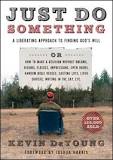
Book Review: Kevin DeYoung’s “Just Do Something”
Doing What God Has Revealed In The Bible
A Book Review by David P. Craig
When I was in my teens I read a great book (still in print) called Decision Making and the Will of God by Gary Friesen and Robin Maxon. It was a watershed book for me in helping me with how to make biblically informed decisions. Over the years I’ve recommended the book to many who have have sought my counsel on the question “How can I know the will of God for my life?”. The problem with the book by Friesen and Maxon is it’s length (It was based on Friesen’s doctoral dissertation at Dallas Theological Seminary). It’s a great book, but it’s length is prohibitive for many. Here’s the distinct advantage of DeYoung’s book – essentially the same principles and content – in 300 pages less!
DeYoung focuses on the facts of what God has revealed in the Scriptures so that we can best discern wisely what he wants from us. He makes a good case that God never intends for us to know “specifically” what He wants us to do (vocation), where He wants us to live, or who to marry (among many other questions we ask); however, DeYoung shows what God wants us to be like (Jesus) and how this purpose (sanctification) informs our decision-making. In the final analysis DeYoung writes: “Live for God. Obey the Scriptures. Think of others before yourself. Be holy. Love Jesus. And as you do these things, do whatever else you like, with whomever you like, and you’ll be walking in the will of God…the will of God for your life is pretty straightforward: Be holy like Jesus, by the power of the Spirit, for the glory of God.”
The author does a wonderful job of using practical illustrations to show how we worry, procrastinate, and flat-out sin by not doing what we know to do, as we put out fleeces, wait for signs, and pray as we wait for God’s discernment. He shows that oftentimes we are paralyzed by the fear of making a wrong decision or being out of God’s will, when what we really need to do is focus on what God has revealed in the Scriptures clearly that we are to do (principles, commands, and boundaries). Just Do Something is biblical, practical, theologically astute, and can be read in a few hours. I highly recommend it for any Christian of any age whose chief end is to glorify God by enjoying Him forever. This will now be my new “go-to” book when people ask me: “How can I know God’s will for my life?”