Book Review: The Gospel Transformation Bible

How The Gospel is Revealed in All 66 Books of the Bible

Book Review By David P. Craig

Gospel Transformation Bible

What’s Unique About the Gospel Transformation Bible’s Notes?

(1) It’s unique in how it handles applying the Scriptures. There are many good application study Bibles on the market today. Most of these Bibles focus on two aspects of application: (a) What should we do according to what this passage is teaching? and (b) Where should we be applying these truths? The Gospel Transformation Bible is unique in that it helps you focus on two other important elements of application: (c) Why we should apply the gospel daily; and (d) How we can apply the gospel daily. It guides us in having a proper motivation for obeying God – out of gratitude for His amazing grace. It also demonstrates how we are enabled by the power of the gospel to do what God calls us to do.

(2) It’s unique in the fact that it shows how all the major themes of the Scriptures are integrated and how all these themes ultimately point to or find their fulfillment in the Lord Jesus Christ.

(3) It’s unique in that it shows how each passage is a part of the flow of the gospel in the immediate context, but also in the over all thrust of redemptive history in the rest of the Bible.

(4) It’s unique in that it demonstrates how the good news of the gospel is just as evident in the Old Testament as in the New Testament.

(5) It’s unique in demonstrating how the message of the Bible about God’s love promises, points to, and culminates in Jesus.

(6) It’s unique in showing how the finished work of Christ matters not only in relationship to our past and our future, but especially in the present. We need the power of the gospel to help us in all the difficult realities of life – suffering, pain, decision making, identity issues, and so forth.

(7) It’s unique in that it demonstrate how the grace God pervades all of Scripture and empowers us to stand firm in the gospel over the attacks we face daily with the world, the flesh, and the Devil.

(8) It’s unique in that it gives us pointers to Christ and to the gospel in places that we wouldn’t be naturally inclined to see them (Much like the Ethiopian eunuch in Acts 8 who didn’t understand how Isaiah was talking about Jesus).

(9) It’s unique in that it helps you focus on the big idea that the comprehensive theme that ties the 66 books of the Bible all together is the unfolding narrative of God’s commitment to redeem a family from every language, tribe, and people group and make all things new through Jesus. The notes show how every passage in every chapter of every book in the Bible unfolds the plan of redemption through the gospel.

(10) It’s unique in that it helps you delight in finding Christ for yourself in the text, and seek to be transformed into his likeness out of gratitude for His amazing grace displayed time and again in the gospel. In other words the notes focus on information (knowledge) that transforms the heart (emotions and the will). It isn’t about duty, so much as delight over who God is and what He has provided for us in the gospel of Christ.

(11) It’s unique in that the scholar’s who write the introductions and notes to each book of the Bible articulate how each author  focuses on  how the particulars of each book reveals and unfolds the grace of God and how their message transforms the heart.

(12) It’s unique in that the notes are targeted at the heart so that your heart is transformed by the Knowldge of the greatness of the gospel. It’s about our identity in Christ and that we serve Him out of our renewed affections for Who God is and what He has done for us through Christ’s Person and work. It is not so much about what you do, or what you know, but about who you “are” in Christ.

The Book of Daniel As An Example

Our temptation or inclination is to typically focus on the prophetic aspects (controversies) of the book of Daniel, or the heroism of Daniel and his friends as exiles in Babylon. The Bible in other words is about information or about us. However, Daniel is really about the people of God who are in exile in a pagan environment. However, in the midst of that exile Daniel and his friends remember that God has given them His Word and that He will be faithful to His promises. Daniel and his friends trust God even when they can’t take care of themselves. The message of Daniel is a message of grace. It is the message that God provides for Daniel and his friends what they can’t provide for themselves. Daniel’s trust and hope lie not in his own wisdom and strength, but in the wisdom, promises, and character of his God. It is in believing in God’s promises and grace that Daniel gets his strength.

What we learn from Daniel is that as the grace of God was revealed to him in the past, present, and future, so can we hope in the promises of God which are ultimately fulfilled in Christ. God demonstrates his faithfulness to Daniel and to us through His revealed prophecies and promises which are found in the coming of Christ. Daniel isn’t primarily about heroism or prophecy, but about the grace of God that culminates in the gospel of Christ. Our hope as exiles in this world is the same. Our hope is in the gospel which frees us from our past, empowers us for today, and gives us hope for the future.

10 Reasons I Recommend The Gospel Transformation Bible

(1) It will help you see the types, promises, and promises of God in the Old Testament that are ultimately fulfilled in Jesus Christ.

(2) It will give you guiding principles for studying how each passage, book, and period of the Bible unfolds the theme of redemption from Genesis to Revelation.

(3) It will impact your affections for Christ and the gospel. You will be touched by the majestic and intimate grace of God for you.

(4) It will motivate you to share the gospel with others. It will re-ignite an excitement in you for the gospel that will overflow out of your heart to your mouth with those who don’t know about Jesus.

(5) It will help you to see that all of the Scriptures are about Jesus. You will learn how to see Jesus through the “Jesus lens” as you read the Old and New Testament’s.

(7) It will help you become less legalistic or irreligious. It will help you to understand God’s grace in such a way that you become a more gracious and balanced individual.

(8) It will help you see the big picture of the Bible. It’s kind of like putting a bunch of pieces together of a large puzzle without the picture. When you read through all the notes in this Bible you will see a beautiful tapestry of Christ – and that He was there all along. He longs for you to discover and bask in His grace.

(9) It will renew and excitement in you for Bible study – and not just to know more doctrine, but because you will find yourself becoming more like Jesus. It will help to transform your character as you are conforming to the image of Christ.

(10) It will help you to personally know God more intimately. You may fall in love with God for the first time, or may rekindle your love for Him. Because you will find in the notes how the message of the Bible and all of history, and meaning itself finds its culmination in a love relationship with God through Christ Jesus.

*I was provided with a Bible to read and review by the publisher. I was not required to write a positive review.

Friday Humor: Stephen W. Brown on Christians and Laughter

SERIES: FRIDAY HUMOR # 27 – A MEDITATION ON LAUGHTER

Brown Steve image

I’m often criticized for allowing (or causing) too much laughter in my ministry. I can understand that. In fact, I pray about it a lot. After all, God is holy and sometimes I wonder if laughter is appropriate before holiness. I believe, and have often said, that if you have never stood before God and been afraid, you probably never stood before God.

Have you read in Isaiah 6 where the prophet encountered God in the temple? That chapter opens with these words: “In the year that King Uzziah died, I saw the Lord seated on a throne, high and exalted” (verse 1). Then the angels shout “Holy, holy, holy is the LORD Almighty; the whole earth is full of his glory” (verse 3).

Isaiah was doing just fine up to that point. In fact, at the time, he was involved in church work, doing what people do in church (probably picking up the bulletins from the first service), when the real God of the universe came into the temple. It shattered every preconceived idea Isaiah ever had about God. His response was what yours or mine would have been. He cried out, “Woe to me!…I am ruined! For I am a man of unclean lips, and I live among a people of unclean lips, and my eyes have seen the King, the LORD Almighty” (verse 5).

If Isaiah had laughed it would have been highly inappropriate. When people complain about laughter, I understand their complaint. God, after all, is God, and His awesomeness and power ought to solicit something other than the superficial laughter of His people. And then I start laughing. I don’t mean to. It just comes out. I start thinking about Him and that He has done, and sometimes I can’t stifle the chuckles. I’ve apologized a hundred times. I’ve tried–God knows I’ve tried–to be more serious and clergy-like, but I just can’t do it. Maybe it’s just the natural, nervous laughter that happens when one is frightened. Maybe things are funnier in a serious setting like church or a religious radio broadcast. It could be that the pressure is finally getting to me and my laughter is preceding the words, “They’re coming to take me away.”

But I don’t think so. In fact, I think there’s much more laughter in this thing called Christianity than I ever thought. Whether or not you hear the laughter would not have been appropriate, the message Isaiah was given was not for joking either. He received a message of judgment. He was charged to call the people to repentance.

But after the sorrow and the repentance, a veritable flood of laughter rushes out: “and the ransomed of the LORD will return. They will enter Zion with singing; everlasting joy will crown their heads. Gladness and joy will overtake them, and sorrow and sighing will flee away” (35:10). And then, almost as if we didn’t get the message the first time, he says it again several chapters later: “The ransomed of the LORD will return. They will enter Zion with singing; everlasting joy will crown their heads. Gladness and joy will overtake them, and sorrow and sighing will flee away” (51:11). When the people of God have been redeemed, God commands them, “Burst into songs of joy together, you ruins of Jerusalem, for the LORD has comforted his people, he has redeemed Jerusalem” (52:9).

In that wonderful passage where Isaiah proclaims the work of Messiah (as well as his own) and from which Jesus quoted in reference to Himself, there is a great statement about the proclamation that comes from the throne of grace: “The Spirit of the Sovereign LORD is on me, because the LORD has anointed me to preach good news to the poor. He has sent me to bind up the brokenhearted, to proclaim freedom for the captives and release from darkness for the prisoners, to proclaim the year of the LORD’s favor…to comfort all who mourn, and provide for those who grieve in Zion–to bestow on them a crown of beauty instead of ashes, the oil of gladness instead of mourning, and a garment of praise instead of a spirit of despair.” (Isaiah 61:1-3)

We get a lot of people who write to us at Key Life [Steve’s radio ministry], telling us that we make them laugh. Sometimes people write to tell me a funny story. Some have said that in their world, our broadcast is the one place where they smile. One listener said, “Steve, don’t ever get too serious. We need to laugh. I love what you teach, but I also love the fun you have doing it. It makes the teaching and living better.” Then I started feeling guilty again. I prayed, “Father, you didn’t call me to be a comedian. You called me to be a Bible teacher. Forgive me I’m not taking You seriously. Forgive me if I have made something light out of…” That was when my prayer was interrupted. I thought I heard laughter. I checked. Do you know what? I did. It was the laughter of God.

So, I have discovered that one of my ministries is laughter. Not the laughter of derision or cynicism, or the laughter that follows a dirty story, but the free, uninhibited laughter of the redeemed. That kind of laughter starts at the throne.

That may not sound like much to you. I didn’t think so either until a woman wrote to tell me how she had lost her husband. She described her loneliness and how she felt there was no reason to live on. Then she said, “But when I heard you laugh, I laughed too. I just wanted you to know that it helped a lot.”

Heaven knows we have enough sour Christians. There isn’t much about the world to inspire laughter. The hurt and pain we experience don’t leave much room for humor; there’s probably more reason for tears than laughter in most lives. So maybe there’s a place for a ministry that doesn’t take itself too seriously, that lightens up the landscape a bit. Perhaps that doesn’t sound so very important, but I think it really is. God has given His people laughter and that laughter has great healing power.

I recently heard about a man the went to the doctor for his annual physical. The doctor came to him with all the reports and test results and told him, “Mr. Jones, your health is very good. There is no reason why you can’t live a completely normal life as long as you don’t try to enjoy it.”

Don’t we sometimes communicate the same message to people? We say in effect, “Now that you have been forgiven of all your sins and you’re sure of Heaven, and now that you have meaning in your life and have found great power in prayer, you ought to be able to live a normal Christian life–as long as you don’t try to enjoy it.” Of course, biblical truth is important. Reaching out to those with significant needs is important too. We also need to have an uncompromising, clear, and forceful presentation of truth. But all that doesn’t exclude laughter–it includes it, transforms it, sanctifies it, even glorifies it.

So let’s throw back our heads and laugh. God’s infinite riches are ours in Christ. What other reason could we ever need to laugh?

TIME TO DRAW AWAY

Read Exodus 15:1-21 and 2 Samuel 6.

For meditation: Take out some paper and put at the top of it “Reasons to Laugh.” Then begin writing under that heading what you have from God’s hand that’s cause for joy. Keep in mind that all good things come from God, so if you count your spouse, a friend, your home, or whatever or whoever else as a source of joy, understand that God is its ultimate source. It won’t take long before you discover how much you have to laugh about.

JHHGOS S Brown image

About Steve Brown:

Dr. Steve Brown is one of the most sought after preachers and conference speakers in the country. Having had extensive radio experience before entering the ministry, he is now heard weekdays on the national radio program, Key Life, and one minute feature, “Think Spots”. Steve also hosts a weekly radio talk show, “Steve Brown, Etc.”. He served as the senior pastor of Key Biscayne Presbyterian Church for 17 years before joining the Reformed Theological Seminary (RTS) faculty as Professor of Preaching. After teaching full time for almost two decades at RTS, Dr. Brown retired and is Emeritus Professor of Preaching but remains an Adjunct Professor of Preaching teaching occasional classes each year.

Dr. Brown is the author of many (16 and counting) books and also serves on the Board of the National Religious Broadcasters and Harvest USA (He earned his B.A. from High Point College; an S.T.B. from Boston University School of Theology; and an Litt.D. from King College). Steve is one of my favorite writers and speakers because he is authentic, a great story-teller, is a theologian in disguise, and really knows how to address the realities of how sinful humans can experience the amazing grace of God. The article above was adapted from pages 202-205 in his excellent book on surviving and thriving in a tough world: Jumping Hurdles, Hitting Glitches, and Overcoming Setbacks. Colorado Springs: NavPress, 1992.

Steve Brown Has Authored These Outstanding Grace-Filled Books:

Three Free Sins: God’s Not Mad at You. New York: Simon and Schuster/ Howard Books, 2012.

A Scandalous Freedom. New York: Simon and Schuster/ Howard Books, 2009.

What Was I Thinking? Things I’ve learned Since I Knew It All. New York: Simon and Schuster/ Howard Books, 2006.

Follow the Wind: Our Lord, the Holy Spirit. Grand Rapids: Baker, 1999.

Approaching God: How to Pray. New York: Howard, 1996.

Living Free: How to Live a Life of Radical Freedom and Infectious Joy. Grand Rapids: Baker, 1994.

Born Free: How to Find Radical Freedom and Infectious Joy in an Authentic Faith. Grand Rapids: Baker, 1993.

How To Talk So People Will Listen. Grand Rapids: Baker, 1993.

If Jesus Has Come: Thoughts on the Incarnation for Skeptics, Christians and Skeptical Christians by a Former Skeptic. Grand Rapids: Baker, 1992.

Jumping Hurdles, Hitting Glitches, Overcoming Setbacks. Colorado Springs: NavPress, 1992.

No More Mr. Nice Guy! Saying Goodbye to “Doormat” Christianity. Nashville: Thomas Nelson, 1991.

When Being Good Isn’t Good Enough. Nashville: Thomas Nelson, 1990.

Welcome to the Family: A Handbook for Living the Christian Life. Old Tappan, New Jersey: Fleming H. Revell, 1990.

When Your Rope Breaks: Christ-centered advice on how to go on living—when making it through another day is the hardest thing in the world. Nashville: Thomas Nelson, 1988.

Heirs with the Prince. Nashville: Thomas Nelson, 1985.

If God is in Charge: Thoughts On The Nature of God For Skeptics, Christians, and Skeptical Christians.Grand Rapids: Baker 1983.

Dr. John Piper on Having a “Gratitude Ethic”

How Does Gratitude Motivate?John Piper image

On May 29 [1983] in my message on Galatians 5:1-5, I opposed the “Gratitude Ethic” which says: “God has worked for me, now I will return the favor and work for him;” or: “God has given me more than I could ever pay back, but I will devote my life to trying.” But the question was raised by Steve Roy after the service whether there may be another way gratitude could motivate obedience that does not involve a debtor mentality. So I spent about six hours on Memorial Day trying to think that question through. Here is where I am.

Definition: gratitude is a species of joy which arises in our heart in response to the good will of someone who does (or tries to do) us a favor. We do not respond with gratitude to a person if they accidentally do us a favor. Nor do we respond with gratitude if they do us a favor with mercenary ulterior motives. On the other hand, we do respond with gratitude to a person who tries to do us a favor but is hindered by circumstances beyond his control—say, he sacrifices his life to bring us medicine in the jungle but it turns out not to heal. We still feel gratitude toward him. Therefore gratitude is not merely the response of joy to a benefit received. It has special reference to the good will of another person. A person whose joy centers only on a gift received with no sense of joy in the good will of the giver, we call an ingrate. So gratitude is a species of joy which arises in response to the good will of someone who does (or tries to do) us a favor.

This joy, like all joys, has in it an impulse to express or display the value of its cause. This is a crucial insight for understanding how gratitude motivates behavior. It is the nature of joy to demonstrate or express the value of its cause. When something gives us joy we feel an impulse to show the value of it by our words or actions.

The intensity of this joy and its expressive impulse is determined by three varying factors:

1) the importance to us of the gift offered (We are more thankful for a winter coat than for an ice-cream cone);

2) the sacrifice it cost someone to give the gift (We are more thankful if a person risks his life than if his gift is of no inconvenience);

3) our own sense of unworthiness to receive the gift (We are more thankful for free gifts than earned wages).

The question how gratitude can properly motivate good behavior is the question: how should we express or demonstrate the value of God’s good will toward us? Gratitude is the joy that arises in response to God’s good will toward us in all his gifts. This joy has an impulse to express the value of that good will. How should it do so?

Answer: It should express the value of God’s good will in a way that honors the nature andaim of that will and does not contradict it. (For example: I should not try to show my gratitude to someone who just paid my way through an alcohol treatment center by throwing him a beer party.)

Let’s take God’s good will expressed in sending his Son to die, for example. The nature of that act of love is that it was unconditional, undeserved, a gift of sheer grace. The aim of that act was to unleash a power of forgiveness and renewal that would transform people into reflectors of God’s glory. So the way gratitude for this act of God’s good will toward us should express itself is by saying and doing what honors the nature of it as free and theaim of it as God’s glory.

Certain attitudes are thus ruled out: any attempt to pay God back would contradict the nature of the act as free and gracious. Any attempt to turn and become God’s benefactors is ruled out as dishonoring to the nature and aim of the divine act. That was my point last Sunday. But there are some proper ways for the impulse of the joy of gratitude to find expression:

1) the admission that we don’t deserve Christ honors the gracious freeness of the gift.

2) Words of love, praise and thanks will pop out like fruit on the branch of gratitude.

3) Trust in the forgiveness and renewing power unleashed in the cross honors its aim.

4) Acts of self-denying love also show how free we are made by the all-sufficiency of the gift of love in the cross.

This is how I see gratitude motivating obedience to Christ. It does not prompt us to pay him back or to meet his needs. As a species of joy it has in it an impulse to show the value of God’s good will. What shows the value of God’s good will in its true nature and aim are words of praise, a heart of trust, and a life of love.

Thankful for you,

Pastor John

©2013 Desiring God Foundation. May 31, 1983. Used by Permission.

Permissions: You are permitted and encouraged to reproduce and distribute this material in its entirety or in unaltered excerpts, as long as you do not charge a fee. For Internet posting, please use only unaltered excerpts (not the content in its entirety) and provide a hyperlink to this page. Any exceptions to the above must be approved by Desiring God.

Please include the following statement on any distributed copy: By John Piper. ©2013 Desiring God Foundation. Website: desiringGod.org

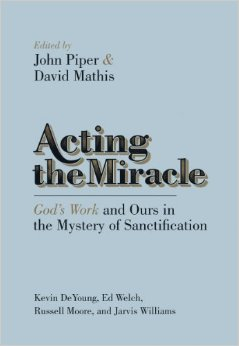
BOOK REVIEW: “Acting the Miracle” Edited by Dr. John Piper and David Mathis

GOD’S WORK AND OURS IN THE MYSTERY OF SANCTIFICATION

ATM Piper

Book Review by David P. Craig

There are various aspects to the biblical doctrine of sanctification – essentially becoming more like Jesus “conformed to the image of Christ” (Romans 8:29). Theologians often talk about two aspects of our becoming like Christ: Definitive sanctification and Progressive sanctification. Definitive sanctification is our legal status with God whereby we become righteous in God’s sight upon our conversion and justification in Christ Jesus. This book focuses on the Progressive sanctification aspect. It addresses the issue of how we actually progress in actual holiness as we live by faith in Jesus.

There are seven helpful chapters in this book by some excellent scholar/pastors:

(1) David Mathis gives the introduction which focuses on the complexities of sanctification and how it relates to our justification and union with Christ.

(2) John Piper defines sanctification by grounding its reality in the holiness of God and the sinfulness of humanity. He provides a wonderful  exegetical study of Romans 8:28-30 and answers the question: “What is the Place of Sanctification in the Process of Salvation?”

(3) Kevin DeYoung examines what should motivate our sanctification. He gives a very practical explanation from Colossians 3 that seeks to balance the element of justification, duty, and gratitude in the context of grace as we seek to be more like Jesus. He points out that our greatest incentives in the pursuit of holiness are theologically based on our identity in Christ. Sanctification is diverse and there is a multiplicity of reasons for this diversity, but it all stems from our union with Christ as we grow in our understanding of and application of His grace.

(3) Ed Welch (a well-known biblical counselor) tackles three specific issues: (a) Attention-Deficit/Hyperactivity Disorder; (b) Depression; (c) and Panic Attacks. He gives examples of how to care for individuals who manifest these symptoms, there causes, and how people who struggle with these battles can grow in Christ-likeness. Welch shows how Scripture can be used to help men and women with existing sin by addressing their souls and minds with the gospel.

(4) Jarvis Williams gives an articulate biblical theology of how we can pursue a practical maturity in the gospel by (a) Understanding God’s action for us in and through Christ is the foundation underneath our sanctification; (b) By four distinct means of grace – the Word of God; preaching to yourself and meditation; fervent prayer; and suffering; (c) Understanding how God’s action for us and in us through Christ leads to the miracle of our sanctification.

(5) Russell Moore gives a wonderful explanation of the many ways that the Church – participation in the Local Body of Christ – providing the communal context necessary for our maturity in Christ. He gives a solid case for the corporate aspect of our sanctification from First Corinthians 4-6.

(6) John Piper answers many question with relationship to our present and future glorification. Among the questions he addresses are these: How do we go about ‘pursuing the holiness without which no one will see the Lord’? How do we strive to enter through the narrow door? How do we dethrone and kill canceled sin? His goal in this chapter is to demonstrate “how this grand process of sanctification is leading to the predestined glory where the beauty of holiness fills the earth.”

(7) The appendix consists of transcript of a conversation with all the contributors addressing how they each go about pursuing personal devotional and prayer time from the September 29, 2012 Desiring God National Conference in Minneapolis, Minnesota.

I highly recommend this book for all Christians who are concerned about the goal of the Christian life – conforming to the image of Christ – and the practical ramifications of this conformation as we transform into His likeness and bring Him glory for the salvation and joyous sanctification of a multitude of people throughout the Earth.

Preaching with Authority: Three Characteristics of Expository Preaching

“Preaching With Authority” by Dr. Albert Mohler

139971264

Authentic expository preaching is marked by three distinct characteristics: authority, reverence, and centrality. Expository preaching is authoritative because it stands upon the very authority of the Bible as the word of God. Such preaching requires and reinforces a sense of reverent expectation on the part of God’s people. Finally, expository preaching demands the central place in Christian worship and is respected as the event through which the living God speaks to his people.

A keen analysis of our contemporary age comes from sociologist Richard Sennett of New York University. Sennett notes that in times past a major anxiety of most persons was loss of governing authority. Now, the tables have been turned, and modern persons are anxious about any authority over them: “We have come to fear the influence of authority as a threat to our liberties, in the family and in society at large.” If previous generations feared the absence of authority, today we see “a fear of authority when it exists.”

Some homileticians suggest that preachers should simply embrace this new worldview and surrender any claim to an authoritative message. Those who have lost confidence in the authority of the Bible as the word of God are left with little to say and no authority for their message. Fred Craddock, among the most influential figures in recent homiletic thought, famously describes today’s preacher “as one without authority.” His portrait of the preacher’s predicament is haunting: “The old thunderbolts rust in the attic while the minister tries to lead his people through the morass of relativities and proximate possibilities.” “No longer can the preacher presuppose the general recognition of his authority as a clergyman, or the authority of his institution, or the authority of Scripture,” Craddock argues. Summarizing the predicament of the postmodern preacher, he relates that the preacher “seriously asks himself whether he should continue to serve up monologue in a dialogical world.”

The obvious question to pose to Craddock’s analysis is this: If we have no authoritative message, why preach? Without authority, the preacher and the congregation are involved in a massive waste of precious time. The very idea that preaching can be transformed into a dialogue between the pulpit and the pew indicates the confusion of our era.

Contrasted to this is the note of authority found in all true expository preaching. As Martyn Lloyd-Jones notes:

Any study of church history, and particularly any study of the great periods of revival or reawakening, demonstrates above everything else just this one fact: that the Christian Church during all such periods has spoken with authority. The great characteristic of all revivals has been the authority of the preacher. There seemed to be something new, extra, and irresistible in what he declared on behalf of God.

The preacher dares to speak on behalf of God. He stands in the pulpit as a steward “of the mysteries of God” (1 Cor 4:1) and declares the truth of God’s word, proclaims the power of that word, and applies the word to life. This is an admittedly audacious act. No one should even contemplate such an endeavor without absolute confidence in a divine call to preach and in the unblemished authority of the Scriptures.

In the final analysis, the ultimate authority for preaching is the authority of the Bible as the word of God. Without this authority, the preacher stands naked and silent before the congregation and the watching world. If the Bible is not the word of God, the preacher is involved in an act of self-delusion or professional pretension.

Standing on the authority of Scripture, the preacher declares a truth received, not a message invented. The teaching office is not an advisory role based on religious expertise, but a prophetic function whereby God speaks to his people.

Authentic expository preaching is also marked by reverence. The congregation that gathered before Ezra and the other preachers demonstrated a love and reverence for the word of God (Neh 8). When the book was read, the people stood up. This act of standing reveals the heart of the people and their sense of expectation as the word was read and preached.

Expository preaching requires an attitude of reverence on the part of the congregation. Preaching is not a dialogue, but it does involve at least two parties—the preacher and the congregation. The congregation’s role in the preaching event is to hear, receive, and obey the word of God. In so doing, the church demonstrates reverence for the preaching and teaching of the Bible and understands that the sermon brings the word of Christ near to the congregation. This is true worship.

Lacking reverence for the word of God, many congregations are caught in a frantic quest for significance in worship. Christians leave worship services asking each other, “Did you get anything out of that?” Churches produce surveys to measure expectations for worship: Would you like more music? What kind? How about drama? Is our preacher sufficiently creative?

Expository preaching demands a very different set of questions. Will I obey the word of God? How must my thinking be realigned by Scripture? How must I change my behavior to be fully obedient to the word? These questions reveal submission to the authority of God and reverence for the Bible as his word.

Likewise, the preacher must demonstrate his own reverence for God’s word by dealing truthfully and responsibly with the text. He must not be flippant or casual, much less dismissive or disrespectful. Of this we can be certain, no congregation will revere the Bible more than the preacher does.

If expository preaching is authoritative, and if it demands reverence, it must also be at the center of Christian worship. Worship properly directed to the honor and glory of God will find its center in the reading and preaching of the word of God. Expository preaching cannot be assigned a supporting role in the act of worship—it must be central.

In the course of the Reformation, Luther’s driving purpose was to restore preaching to its proper place in Christian worship. Referring to the incident between Mary and Martha in Luke 10, Luther reminded his congregation and students that Jesus Christ declared that only one thing is necessary,” the preaching of the word (Luke 10:42). Therefore, Luther’s central concern was to reform worship in the churches by re-establishing there the centrality of the reading and preaching of the word.

That same reformation is needed in American evangelicalism today. Expository preaching must once again be central to the life of the church and central to Christian worship. In the end, the church will not be judged by its Lord for the quality of its music but for the faithfulness of its preaching.

When today’s evangelicals speak casually of the distinction between worship and preaching (meaning that the church will enjoy an offering of music before adding on a bit of preaching), they betray their misunderstanding of both worship and the act of preaching. Worship is not something we do before we settle down for the word of God; it is the act through which the people of God direct all their attentiveness to the one true and living God who speaks to them and receives their praises. God is most beautifully praised when his people hear his word, love his word, and obey his word.

As in the Reformation, the most important corrective to our corruption of worship (and defense against the consumerist demands of the day) is to rightly return expository preaching and the public reading of God’s word to primacy and centrality in worship. Only then will the “missing jewel” be truly rediscovered.

*Article originally appeared @ http://www.albertmohler.com/2013/09/06/preaching-with-authority-three-characteristics-of-expository-preaching/

About Dr. R. Albert Mohler Jr.

mohler-about-image

Dr. R. Albert Mohler Jr. serves as president of The Southern Baptist Theological Seminary – the flagship school of the Southern Baptist Convention and one of the largest seminaries in the world.

Dr. Mohler has been recognized by such influential publications asTime and Christianity Today as a leader among American evangelicals. In fact, Time.com called him the “reigning intellectual of the evangelical movement in the U.S.”

In addition to his presidential duties, Dr. Mohler hosts two programs: “The Briefing,” a daily analysis of news and events from a Christian worldview; and “Thinking in Public,” a series of conversations with the day’s leading thinkers. He also writes a popular blog and a regular commentary on moral, cultural and theological issues. All of these can be accessed through Dr. Mohler’s website, http://www.AlbertMohler.com. Called “an articulate voice for conservative Christianity at large” by The Chicago Tribune, Dr. Mohler’s mission is to address contemporary issues from a consistent and explicit Christian worldview.

Widely sought as a columnist and commentator, Dr. Mohler has been quoted in the nation’s leading newspapers, including The New York Times,The Wall Street JournalUSA TodayThe Washington PostThe Atlanta Journal/Constitution and The Dallas Morning News. He has also appeared on such national news programs as CNN’s “Larry King Live,” NBC’s “Today Show” and “Dateline NBC,” ABC’s “Good Morning America,” “The NewsHour with Jim Lehrer” on PBS, MSNBC’s “Scarborough Country” and Fox’s “The O’Reilly Factor.”

Dr. Mohler is a theologian and an ordained minister, having served as pastor and staff minister of several Southern Baptist churches. He came to the presidency of Southern Seminary from service as editor of The Christian Index, the oldest of the state papers serving the Southern Baptist Convention.

A native of Lakeland, Fla., Dr. Mohler was a Faculty Scholar at Florida Atlantic University before receiving his Bachelor of Arts degree from Samford University in Birmingham, Ala. He holds a master of divinity degree and the doctor of philosophy (in systematic and historical theology) from Southern Seminary. He has pursued additional study at the St. Meinrad School of Theology and has done research at University of Oxford (England).

Dr. Mohler also serves as the Joseph Emerson Brown Professor of Christian Theology at Southern Seminary. His writings have been published throughout the United States and Europe. In addition to contributing to a number of collected volumes, he is the author of several books, includingCulture Shift: Engaging Current Issues with Timeless Truth (Multnomah); Desire & Deceit: The Real Cost of the New Sexual Tolerance (Multnomah); Atheism Remix: A Christian Confronts the New Atheists (Crossway); He Is Not Silent: Preaching in a Postmodern World (Moody); The Disappearance of God: Dangerous Beliefs in the New Spiritual Openness (Multnomah); and Words From the Fire: Hearing the Voice of God in the Ten Commandments (Moody). From 1985 to 1993, he served as associate editor of Preaching, a journal for evangelical preachers, and is currently editor-in-chief of The Southern Baptist Journal of Theology.

A leader within the Southern Baptist Convention, Dr. Mohler has served in several offices including a term as Chairman of the SBC Committee on Resolutions, which is responsible for the denomination’s official statements on moral and doctrinal issues. He also served on the seven-person Program and Structure Study Committee, which recommended the 1995 restructuring of the nation’s largest Protestant denomination. In 2000, Dr. Mohler served on a blue-ribbon panel that made recommendations to the Southern Baptist Convention for revisions to the Baptist Faith and Message, the statement of faith most widely held among Southern Baptists. Most recently, he served on the Great Commission Task Force, a denominational committee that studied the effectiveness of SBC efforts to fulfill the Great Commission. He currently serves as chairman of the Southern Baptist Convention’s Council of Seminary Presidents.

Dr. Mohler has presented lectures or addresses at institutions including Columbia University, the University of Virginia, Wheaton College, Samford University, Trinity Evangelical Divinity School, the University of Richmond, Mercer University, Cedarville University, Beeson Divinity School, Reformed Theological Seminary, The Master’s Seminary, Geneva College, Biola University, Covenant Theological Seminary, The Cumberland School of Law, The Regent University School of Law, Grove City College, Vanderbilt University and the historic Chautauqua Institution, among many others.

Dr. Mohler is listed in Who’s Who in America and other biographical reference works and serves on the boards of several organizations including Focus on the Family. He is a member of the Council for Biblical Manhood and Womanhood and serves as a council member for The Gospel Coalition.

He is married to Mary, and they have two children, Katie and Christopher.

Book Review: Are Miraculous Gifts For Today? 4 Views

How Does God the Holy Spirit Work Through His Church Today?

Book Review By David P. Craig

AMGFT? 4 Views

This will be one of the longest book reviews I’ve ever written. I’m writing it as much for me (to sort through what I read) as anyone else. I want to give an overview of the positions in the book, their presenters, and the pros and cons of each position as represented by the presenters. Then I would like to close this review with the strengths and weaknesses of the arguments that were presented  and whether or not there was any resolution.

The essential issues addressed in this book by four presenters and one facilitator is related to these important questions: “How is the Holy Spirit working in churches today? Is he really giving miraculous healings and prophecies in tongues? Is he giving Christians new power for ministry when they experience a ‘baptism in the Holy Spirit’ after conversion? Is he driving out demons when Christians command them? Or are these events confined to a distant past, to the time when the New Testament was being written and living apostles taught and governed–and worked miracles–in the churches? There are many Pentecostals who say that Christians should seek to be baptized in the Holy Spirit after conversion, and that this experience will result in a new spiritual power for ministry. But other evangelicals respond that they already have been baptized in the Holy Spirit, because it happened the moment they became Christians, Who is right? What are the arguments on each side?”

In addition to these questions there are many differences over what spiritual gifts are currently in operation today. “Can people have a gift of prophecy today, so that God actually reveals things to them and they can tell these revelations to others? Or was that gift confined to the time when the New Testament was still unfinished, in the first century A.D.? And what about healing? Should Christians expect that God will often heal in miracles when we pray today? Can some people still have the gift of healing? Or should our prayer emphasis be that God will work to heal through ordinary means, such as doctors and medicine? Or again, should we mostly encourage people to see the sanctifying value of sickness and pray that they will have grace to endure it?

Lastly, questions related to what is speaking in tongues? How should they be practiced in the church (if at all)? And should evangelism and ministry be accompanied by demonstrations of God’s miraculous power? These and many more questions and issues are addressed by the presenters.

The presenters consist of two Theologians that would lean toward the cessasionist category. Some well-known schools that have traditionally represented cessationism include: Westminster Theological Seminary, Dallas Theological Seminary, and The Master’s Seminary. Cessationists argue “that there are no miraculous gifts of the Holy Spirit today. Gifts such as prophecy, tongues, and healing were confined to the first century, and were used at the time the apostles were establishing the churches and the New Testament was not yet complete.”

Representing the Cessationist position is Dr. Richard B. Gaffin. He has been a long time Professor of Systematic Theology at Westminster Theological Seminary in Philadelphia. Dr. Gaffin has written a book defending this position entitled Perspectives on Pentecost: Studies in New Testament Teaching on the Gifts of the Holy Spirit (Phillipsburg, N.J.: P&R, 1979). Gaffin has degrees from Calvin College (A.B.), and Westminster Seminary (B.D., Th.M., Th.D.), and is also a minister in the Orthodox Presbyterian Church.

The next position discussed in the book is called the “open but cautious” position. The open but cautious position is described this way by the editor: “These people have not been convinced by the cessationist arguments that relegate certain gifts to the first century, but they are not really convinced by the doctrine or practice of those who emphasize such gifts today either. They are open to the possibility of miraculous gifts today, but they are concerned about the possibility of abuses that they have seen in groups that practice these gifts. They do not think speaking in tongues is ruled out by Scripture, but they see many modern examples as not conforming to scriptural guidelines; some also are concerned that it often leads to divisiveness and negative results in churches today. They think churches should emphasize evangelism, Bible study, and faithful obedience as keys to personal and church growth, rather than miraculous gifts. Yet they appreciate some of the benefits that Pentecostal, Charismatic, and Third Wave churches have brought to the evangelical world, especially a refreshing contemporary tone in worship and a challenge to renewal in faith.”

Representing the “Open but cautious” view is the Distinguished Professor of Systematic Theology from Talbot School of Theology, Dr. Robert L. Saucy. Dr. Saucy has taught for more than 40 years at Talbot and is the author of numerous books related to eschatology and the church including: Unleashing God’s Power in You (with Neil T. Anderson; Bridgetree, 2012); The Case for Progressive Dispensationalism: The Interface Between Dispensational and Non-Dispensational Theology (Grand Rapids: Zondervan, 2010); Scripture: Its Power, Authority and Relevance (Nashville: Word, 2001); and The Church in God’s Program (Chicago: Moody Press, 1974). Dr. Saucy earned his degrees at Westmont College (A.B.), and Dallas Theological Seminary (Th.M., and Th.D.). He is a member of a Conservative Baptist Church.

The third view presented is called the “Third Wave” view. It is a  continuationist view of the miraculous gifts. Wayne Grudem explains this position as follows: “Third Wave people encourage the equipping of all believers to use the New Testament spiritual gifts today and say that the proclamation of the gospel should ordinarily be accompanied by ‘signs, wonders, and miracles,’ according the the New Testament pattern. They teach however, that baptism in the Holy Spirit happens to all Christians at conversion and that subsequent experiences are better called ‘fillings’ or ’empowerings’ with the Holy Spirit. Though they believe the gift of tongues exist today, they do not emphasize it to the extent that Pentecostals and Charismatics do.”

The presenter of the “Third Wave” view is Dr. C. Samuel Storms. He is currently the pastor of Bridgeway Church in Oklahoma City, Oklahoma. In the past he has been an associate of Dr. S. Lewis Johnson’s at Believer’s Chapel in Dallas, Texas; a pastor at Christ Community Church in Ardmore, Oklahoma; and an associate pastor with Mike Bickle in Kansas City, Missouri at the Metro Christian Fellowship. He is the founder of Enjoying God Ministries and has also been a professor of theology at Wheaton College. Dr. Storms has earned his degrees from The University of Oklahoma (B.A.); Dallas Theological Seminary (Th.M.); and The University of Texas (Ph.D.). Dr. Storms has authored numerous books including: The Beginner’s Guide to Spiritual Gifts. Ventura: Regal, 2013; Chosen for Life: The Case for Divine Election. Wheaton: Crossway, 2007; and Convergence: Spiritual Journeys of a Charismatic Calvinist. Enjoying God Ministries, 2005.

The term “Third Wave”  was coined in the 1980’s by the Fuller Seminary professor of missions – Dr. C. Peter Wagner. Dr. Wagner has designated the first wave of the renewal of the Holy Spirit – The Pentecostal renewal  (Which began in 1901). The charismatic renewal followed on the heels of the Pentecostal renewal in the 1960-70’s. Perhaps the best-known proponent of the “Third Wave” position was John Wimber the leader of the Association of Vineyard Churches and the pastor of the Vineyard Christian Fellowship in Anaheim, California.

The Pentecostal and Charismatic views are very similar but have some differences. Wayne Grudem explains, “Pentecostal refers to any denomination or group that traces its historical origin back to the Pentecostal revival that began in the United States in 1901, and that holds the following doctrines: (1) All the gifts of the Holy Spirit mentioned in the New Testament are intended for today; (2) baptism in the Holy Spirit is an empowering experience subsequent to conversion and should be sought by Christians today; and (3) when baptism in the Holy Spirit occurs, people will speak in tongues as a ‘sign’ that they have received this experience. Pentecostal groups usually have their own distinct denominational structures, among which are the Assemblies of God, the Church of God in Christ, and many others.”

Charasmatic, on the other hand, refers to any groups (or people) that trace their historical origin to the charismatic renewal movement of the 1960’s and 1970’s and seek to practice all the spiritual gifts mentioned in the New Testament (including prophecy, healing, miracles, tongues, interpretation, and distinguishing between spirits). Among charismatics there are differing viewpoints on whether baptism in the Holy Spirit is subsequent to conversion and whether speaking in tongues is a sign of baptism in the Spirit. Charismatics by and large have refrained from forming their own denominations, but view themselves as a force of renewal within existing Protestant and Roman Catholic churches. There is no representative charismatic denomination in the United States today, but the most prominent charismatic spokesman is probably Pat Robertson with his Christian Broadcasting Network, the television program “The 700 Club,” and Regent University.

Representing the Pentecostal position is Dr. Douglas A. Oss. He also demonstrates where the Pentecostal and Charismatic positions differ. Dr. Oss is currently Professor of Biblical Theology and New Testament Interpretation at the Assemblies of God Theological Seminary in Springfield, Missouri. Dr. Oss has earned degrees from Western Washington University (B.A), Assemblies of God Theological Seminary (M.Div.) and Westminster Theological Seminary (Ph.D.). He has published articles in the Journal of the Evangelical Theological Society; Bulletin for Biblical Research; Grace Theological Journal; Westminster Theological Journal; and Enrichment Journal. He also translated 1 and 2 Corinthians for the New Living Translation and served on the Translation Advisory Committee for the English Standard Version.

The general editor and author of the introduction and conclusion of the book is Dr. Wayne Grudem. Dr. Grudem is Research Professor of Theology and Biblical Studies at Phoenix Seminary in Phoenix, Arizona. He received a B.A. from Harvard University, an M.Div. and a D.D. from Westminster Seminary, Philadelphia, and a Ph.D (in New Testament) from the University of Cambridge, England. He has published over twenty books, including his newest book, The Poverty of Nations: A Sustainable Solution, which was published in August 2013 and his magnum opus: Systematic Theology: An Introduction to Biblical Doctrine (Zondervan, 2009). He has also written a layman’s version of his doctoral thesis entitled The Gift of Prophecy in the New Testament and Today (Crossway, 1988). He was also the General Editor for the 2.1 million-word ESV Study Bible (Evangelical Christian Publishers Association Book of the Year and World Magazine book of the year, 2009).

In each essay the four authors address from their own view the following five topics: (1) baptism in the Holy Spirit and the question of postconversion experiences; (2) the question of whether some gifts have ceased; (3) a discussion of specific gifts, especially prophecy, healing, and tongues; (4) practical implications for church life; (5) dangers of one’s own position and that of the others. After each essay the three other presenters respond with an eight-page response. At the end of the book Dr. Grudem evaluates each position citing the pro’s and con’s of each, and then brings out the areas of agreement and disagreement. He also offers some guidelines for continued dialogue and solutions leading toward consensus.

In an interesting point Grudem says, “People have asked me why these four men who all believe the same Bible and all have deep love for our Lord could not reach agreement on these things. I tell them that it took the early church until A.D. 381 (at Constantinople) to finally settle the doctrine of the Trinity, and until A.D. 451 (at Chalcedon) to settle disputes over the deity and humanity of Christ in one person. We should not be surprised if these complex questions about the work of the Holy Spirit could not be resolved in two days!” Point well taken.

In reading the book one gets an immediate sense of the complexities related to miraculous gifts. Ultimately it all comes down to interpreting the biblical data. The author’s all leave no stones unturned in their theological and exegetical presentations. They all present well written essay’s with good arguments. Obviously, they all can’t be right. However, the spirit with which they write is right. They articulate their arguments cogently and compellingly and yet all recognize that their own view has deficiencies and weaknesses. However, each scholar makes an excellent case for his view.

As for the areas of disagreement there were many. The big idea conveyed by Gaffin and Saucy is that Jesus and the Apostles miracles were unique in relationship to God’s Redemptive Historical Plan (Gaffin) and God’s working in the new covenant program of God (Saucy). Gaffin came at his view through the lens of the Redemptive Historical method of interpretation (He is a Covenant Theologian). Whereas Saucy as a Progressive Dispensationalist had a little different take on the uniqueness of the miraculous events that took place during this period of history. Both Gaffin and Saucy believe that we no longer have Apostles and that the fact that we no longer have Apostles and a ‘closed canon” matters significantly in why the miraculous gifts operated differently in the New Testament, then they do today (if at all). Thus for Gaffin and Saucy there is definitely a distinction drawn between then and now with reference to the expectation of miracles. They argue extensively both theologically and exegetically to demonstrate the significance of the new covenant, the openness and closing of the canon, and how the Apostles’ and Christ’s ministry were needed and specific to that time of Redemptive History (New Covenant) – and therefore, no longer necessary today.

On the other hand both Storms and Oss make solid exegetical and theological cases for why the miraculous gifts should continue today. They argue from Joel and Acts specifically – that these are indeed the last days, and that there is no particularly good reason (biblically or theologically) why we don’t need the miraculous gifts any less now, than they did in the New Testament. They make the case that the cessation of gifts is simply not taught at all in the New Testament. I think the biggest problem they have is in regards to “Apostles” and where do they fit in today?

The primary weaknesses of Saucy and Gaffin’s arguments are with reference to “Why” miraculous gifts have ceased. They also do an inadequate job of explaining the myriad of these miraculous realities today – with virtually no comments about the plethora of miracles taking place in the 10/40 window for instance.

As for Storms and Oss they do an inadequate job of dealing with Saucy and Gaffin’s arguments with reference to consistency in their interpretation with reference to the gift/office of “apostleship”. If there are no longer apostles than how are the other miraculous gifts substantiated?

All the author’s were particularly weak in bringing out specific examples of the miraculous gifts today – both examples, and their practice or function in their own churches. Of course this wasn’t so much an issue for Gaffin as a cessationist, and for Saucy as a ‘non-expectant-continuationist’. However, I would have liked to seen more interaction with the miraculous experiences and claims of those representing the continuationist perspective. Sam Storms provided some examples, but Oss provided precious little in this regard.

Each author gave a huge amount of weight and space in their writing to the theological/exegetical basis for their views and very little to the experiential/practical basis for their positions. I would have liked to have seen more balance here. Especially because the title of the book was “Are Miraculous Gifts For Today?” I think the book would have been longer, but more balanced and really dealt more with the ‘today’ aspect of miraculous gifts rather than just the “then” aspect.

The areas of disagreement highlighted by Grudem fall under various categories:

“(1) Expectation. Because of differences in understanding the way in which the Holy Spirit ordinarily works during the church age, the authors differed significantly in their expectations of how we should expect the Holy Spirit to work in a miraculous way to heal, to guide, to work miracles, to give unusual empowering for ministry, and to bring things to mind (or reveal things to us).

(2) Encouragement. Because of differences in understanding what we should expect the Holy Spirit to do today, the authors also differed in how much they think we should encourage Christians to seek and pray for miraculous works of the Holy Spirit today.”

(3) There was disagreement on what to call ‘prophecy’ today and whether or not it should be considered ‘inspired’ of God. According to Dr. Saucy, God can bring things to mind today, but this should usually be called personal guidance not prophecy. Dr. Gaffin beleives that the gift of prophecy was restricted to the giving of Scripture and ended when the New Testament canon was completed.

(4) “Although all the authors agreed that God can still work miracles (including healing), Storms and Oss maintain that people today can have that gift, Gaffin limits it to the apostolic age, and Saucy, while open to the gift today, would examine claims to miracles with great care and caution (he felt that, historically speaking, miracles seem to be especially prominent in church-planting situations).”

(5) “Regarding the gift of speaking in tongues plus interpretation, according to Gaffin and Saucy these two gifts, when put together, constitute Scripture-quality revelation from the Holy Spirit. Gaffin believes that these gifts only functioned during the ‘open canon’ situation when the New Testament was incomplete. When asked what is happening in the lives of Christians who claim to speak in tongues today, Gaffin is not sure but believes this activity is probably just an ability to speak in nonsense syllables. He is also open to being shown from Scripture that this activity is helpful to certain people in their prayer lives, though he would still not call it the gift of speaking in tongues. To Saucy, while Scripture does not rule out tongues today, many modern expressions do not conform to the scriptural practice or purpose of tongues…

Storms and Oss, on the other hand, hold that speaking in tongues is not a revelation from God but a form of human prayer and praise–it is the Christian’s own human spirit praying to God through syllables that the speaker does not understand. Storms and Oss believe this gift continues today. Oss adds that tongues is prompted by the Holy Spirit, can also be used by God to convey a message to the church, though not a Scripture-quality word. Both Storms and Oss also hold that the gift of interpretation is simply the ability to understand what the tongue-speaker is saying in those words of prayer and praise.”

(6) “Regarding any empowering work of the Holy Spirit after conversion, Oss calls this ‘baptism in the Holy Spirit’ the first time it happens; the other authors use different terms such as empowering or filling or anointing by the Holy Spirit.”

(7) “Though all the authors agreed that there may be several purposes for miracles, both Gaffin and Saucy see the initial authentication of the gospel message in the first century as the primary purpose of miracles, while Storms and Oss believe that other purposes, such as bearing witness to the gospel message in all ages, ministering to the needs of God’s people, and brining glory to God even in the present day, should receive equal emphasis.

(8) The empowering work of the Holy Spirit after conversion. “While Oss sees a pattern in the book of Acts whereby Christians experienced a single empowering work of the Holy Spirit (or baptism in the Holy Spirit) distinct from conversion, and sees speaking in tongues as the sign that signifies this, the other authors do not see such a pattern or encourage Christians to seek such a single experience distinct from their conversion and distinct from experiences of empowering that may occur multiple times throughout the Christian life.”

(9) The greatest area of disagreement was to what degree we should see the New Testament as a pattern for church life today by way of imitation. “Storms and Oss, throughout our converstaions, continued to emphasize that in all areas of life (such as evangelism, moral conduct, doctrine, church government and ministry, etc.), we should seem to take patterns of the New Testament as patterns we should imitate in our lives today. They challenged Gaffin and Saucy to explain why it was only in the area of miraculous works of the Holy Spirit that they were unwilling to take the New Testament as God’s pattern for us today.”

(10) Church life. “Churches holding to the views advocated by Storms and Oss include much more teaching and encouragement of people to pray for, seek, and exercise miraculous gifts (healing, prophecy, tongues and interpretation, miracles, distinguishing between spirits, and perhaps some others). But churches holding to views expressed by Gaffin, and to some extent by Saucy, do not encourage people to seek or pray for these gifts and do not ordinarily provide ‘space’ for them to occur either in large assemblies or in smaller home fellowship groups in the life of the church.”

In my opinion there were pro’s and con’s in each position presented. The value of this book is that each position is presented within a theological framework (whether Redemptive-Historical or Dispensational), exegetically based, historically nuanced, and given its modern significance. I think the presenters gave the most attention to the theological and exegetical elements. They gave lesser attention to the historical and current or practical ramifications of the issues. I was a little disappointed that they didn’t spend more time showing how their views actually function in their own ministries.

However, anyone can learn a lot from the presentations and the presenters. I appreciated the irenic spirit that was displayed throughout the writing. The positions were attacked non-ad hominem. The ideas and interpretations were attacked – not the men themselves. There was a spirit of gentleness and respect maintained throughout. All five authors spent two days in Philadelphia together in discussion and prayer after they had written and responded to one another’s essays.

I began my journey reading this book holding to an “open but cautious” position. I don’t think my position changed that much. However, I actually learned to appreciate each position more than I did before reading the book. I think I developed a greater understanding of each position, as well as a greater respect for each view. Grudem even comments at the end of the book that he believes that all five of them felt like they could all be elders in the same church – that would be very interesting indeed!

Though the authors clearly disagreed strongly on the continuation vs. non-continuation of the miraculous gifts for today, there was a consensus of affirmation on many things: (1) Agreement that God does heal and work miracles today; (2) An affirmation that God the Holy Spirit empowers Christians for various kinds of ministry, “and this empowering is an activity that can be distinguished from the inner-transforming work of the Holy Spirit by which he enables us to grow in sanctification and in obedience to God”; (3) Agreement that God the Holy Spirit guides us (but more study is needed in how the Holy Spirit uses our impressions and feelings); (4) Unity on the fact that God in his sovereignty can bring to our mind specific things, “not only (i) by occasionally bringing to mind specific words of Scripture that meet the need of the moment, but also (ii) by giving us sudden insight into the application of Scripture to a specific situation, (iii) by influencing our feelings and emotions, and (iv) by giving us specific information about real life situations that we did not acquire through ordinary means (though Dr. Gaffin holds this last category is so highly exceptional that it is neither to be expected nor sought; he prefers a term other than ‘revelation’ to describe these four elements). On this specific point there was the least agreement among the four authors.”

I highly recommend that Christians read this book for the following five reasons: (1) You will learn much about Christian history – in particular about the Redemptive Historical Method of biblical Interpretation from both a continuationist (Oss) and non-continuationist perspective (Gaffin). (2) You will learn how to argue for a position without using ad hominem arguments. Oftentimes when Christians debate on these issues it all comes down to attacking experiences or one’s sanctification status. All the author’s do a wonderful job treating one another as brother’s in Christ and speak the truth in love with gentleness and respect. (3) You will appreciate the strengths and weaknesses of each argument. You will see that these issues are more complex than you think. They involve weighty matters of hermeneutics, historical theology, biblical theology, systematic theology, exegesis, and real life application. (4) You will appreciate both the intellectual and emotional realities of your relationship with and understanding of the Holy Spirit. (5) You will appreciate the diversity and unity that we can have as Christians even when we agree to disagree. I think the presenter’s were all wise, thoughtful, thorough, clear, articulate, and humble. No one came across as having arrived. As they discussed the Holy Spirit I believe they were also manifesting the fruit of the Spirit. This book is a great example of the way Christians should approach differences – with dialogue, in humility, and pursuing the truth in community.

TIM KELLER: TWO WAYS THE GOSPEL CHANGES YOUR VIEW OF SIN

THE GOSPEL CHANGES YOUR VIEW OF SIN

In Luke 11, Jesus is instructing his followers on the subject of prayer, and in the midst of it he says, “If you then, though you are evil, know how to give good gifts to your children…” (Luke 11:13).

This off-handed reference to his own disciples as “evil” reveals an astounding (to modern readers) assumption by Jesus; namely, that even the best human beings are so radically corrupt that they can be referred to as evil persons. Nevertheless, in spite of calling them evil, Jesus obviously loves his disciples with the utmost tenderness and even delight, and he is willing to pay the ultimate price for them (John 13; 17:20–26).

This view differs totally from the view of sin and evil prevalent in the world today. No one, apart from those who hold Jesus’ view of sin, can look at friends and family, take genuine delight in them, and say, “I love them—but they have lots of evil in them! And so do I!”

What then is the biblical view of sin? Sin is a distortion and dislocation of the heart from its true center in God (Romans 1:21–25). This distortion is expressed as a basic motive for all human life—the heart desire of every person to be his or her own savior and lord (the serpent’s original temptation in Genesis 3:5 was “you will be like God”).

Søren Kierkegaard used very modern terms when he defined sin as building your identity on anything besides God (See Soren Kierkegaard, The Sickness Unto Death, 1849). That definition is just another way to convey the old biblical themes of idolatry, self-justification, and self-glorification.

Sin, therefore, is something that everyone is doing all the time (see Romans 1:18–3:20, with the summary in 3:20). People who flout God’s moral law are doing this overtly, of course, but even moral, religious people are trying to be their own saviors by earning salvation and being good. It is just as possible to avoid Jesus as Savior (to be your own savior) by keeping God’s law as by breaking it. Everyone is separated from God equally—regardless of the external form of behavior.

The fundamental motives of self-justification and self-glorification are what distort our lives and alienate us from God. Unless a person is converted, these mo- tives operate as the main driver for everything we do. This situation is true of every culture and class of people. In the ultimate sense, then, everyone is equally a sinner in need of Jesus’ salvation by grace alone.

Once this radical view of sin is grasped, it revolutionizes the believer’s attitude toward others who do not share his or her beliefs. Here are two ways it changes you in this regard.

First, it means you sense more than ever a common humanity with others. The biblical view significantly changes in Christians the natural and traditional human attitudes toward those who behave in ways that they do not approve. It is normal for human beings (whose hearts are always seeking to justify themselves and who are always trying to make the case that they are one of the “good guys”) to divide the world into the good and the bad. If, however, everyone is naturally alienated from God and therefore “evil,” then that goes for everyone from murderers to ministers.

The biblical teaching on sin shows us the complete pervasiveness of sin and the ultimate impossibility of dividing the world neatly into sinful people and good people. It eliminates our attitudes of superiority toward others and our practices of shunning or excluding those with whom we differ.

Second, it means you expect to be constantly misunderstood—especially about sin! The gospel message is that we are saved by Christ’s work, not by our work. But everyone else (even most people in church) believes that Christianity is just another form of religion, which operates on the principle that you are saved if you live a good life and avoid sin. Therefore, when others hear a Christian call something “sin,” they believe you are saying, “These are bad people (and I am good). These are people who should be shunned, excluded (and I should be welcomed). These are people whom God condemns because of this behavior (but I am accepted by God because I don’t do that).”

You may not mean that by the term “sin” at all, but you must realize and expect that others will hear what you are saying that way. They have to. Until they grasp the profound difference between religion and the Christian faith, they will probably understand your invoking of the word “sin” as self-righteous condemnation—no matter what your disclaimers.

For example, if most people hear you saying, “People who have sex outside of marriage are sinning,” they will immediately believe you look down on them, that you think they are lost because of that behavior, that you are one of the “good people” who don’t do things like that, and so on. If people hear a Christian say, “Well, these people are sinning, but I don’t think of myself as any better than they are—we are all sinners needing grace,” they will think you have spoken nonsense. They have a completely different grid or paradigm in their minds about how anyone can approach and relate to God, and they are hearing the word “sin” through that grid.

This reality is why wise Christians will in general try to avoid public pronouncements on particular behaviors as sinful. Rather, they will try to help people hear the radical message of the Bible about the true inward nature of sin, its universality, and salvation by grace. They will try to explain that people are ultimately lost only if they are too proud to see they are lost and in need of a Savior who saves by sheer grace, just as a drowning person offered a life preserver will only die if he won’t admit he needs it.

Christians must talk to their friends about sin to explain our need for Jesus and for God’s grace, but we must do so in a way that quickly puts the term in context—the context of the full message of Jesus’ salvation.

Copyright © 2011 by Timothy Keller, Redeemer City to City. This article first appeared in the Redeemer Report in January 2003.

We encourage you to use and share this material freely—but please don’t charge money for it, change the wording, or remove the copyright information.

ABOUT THE AUTHOR

In 1989 Dr. Timothy J. Keller, his wife and three young sons moved to New York City to begin Redeemer Presbyterian Church. In 20 years it has grown to meeting for five services at three sites with a weekly attendance of over 5,000. Redeemer is notable not only for winning skeptical New Yorkers to faith, but also for partnering with other churches to do both mercy ministry and church planting.  Redeemer City to City is working to help establish hundreds of new multi-ethnic congregations throughout the city and other global cities in the next decades.

Dr. Tim Keller is the author of several phenomenal Christo-centric books including:

Joy for the World: How Christianity Lost Its Cultural Influence and Can Begin Rebuilding It (co-authored with Greg Forster and Collin Hanson (February or March, 2014).

Encounters with Jesus:Unexpected Answers to Life’s Biggest Questions. New York, Dutton (November 2013).

Walking with God through Pain and Suffering. New York, Dutton (October 2013).

Judges For You (God’s Word For You Series). The Good Book Company (August 6, 2013).

Galatians For You (God’s Word For You Series). The Good Book Company (February 11, 2013).

Every Good Endeavor: Connecting Your Work to God’s Plan for the World. New York, Penguin Publishing, November, 2012.

Center ChurchDoing Balanced, Gospel-Centered Ministry in Your City. Grand Rapids: Zondervan, September, 2012.

The Freedom of Self Forgetfulness. New York: 10 Publishing, April 2012.

Generous Justice: How God’s Grace Makes Us Just. New York: Riverhead Trade, August, 2012.

The Gospel As Center: Renewing Our Faith and Reforming Our Ministry Practices (editor and contributor). Wheaton: Crossway, 2012.

The Meaning of Marriage: Facing the Complexities of Commitment with the Wisdom of God. New York, Dutton, 2011.

King’s Cross: The Story of the World in the Life of Jesus (Retitled: Jesus the KIng: Understanding the Life and Death of the Son of God). New York, Dutton, 2011.

Gospel in Life Study Guide: Grace Changes Everything. Grand Rapids, Zondervan, 2010.

The Reason For God: Belief in an Age of Skepticism. New York, Dutton, 2009.

Counterfeit Gods: The Empty Priorities of Money, Sex, and Power, and the Only Hope That Matters. New York, Riverhead Trade, 2009.

Heralds of the King: Christ Centered Sermons in the Tradition of Edmund P. Clowney (contributor). Wheaton: Crossway Books, 2009.

The Prodigal God. New York, Dutton, 2008.

Worship By The Book (contributor). Grand Rapids: Zondervan, 2002.

Ministries of Mercy: The Call of the Jericho Road. Phillipsburg: P&R Publishing, 1997.

An Exposition of the Gospel: D.A. Carson on 1 Corinthians 15:1-19

Series: Gospel Presentations #8

empty tomb image 1

THE GOSPEL OF JESUS CHRIST – AN EXPOSITION OF 1 CORINTHIANS 15:1-19 BY DON CARSON

Many have commented on the fact that the church in the western world is going through a time of remarkable fragmentation. This fragmentation extends to our understanding of the gospel. For some Christians, “the gospel” is a narrow set of teachings about Jesus and his death and resurrection which, rightly believed, tip people into the kingdom. After that, real discipleship and personal transformation begin, but none of that is integrally related to “the gospel.” This is a far cry from the dominant New Testament emphasis that understands “the gospel” to be the embracing category that holds much of the Bible together, and takes Christians from lostness and alienation from God all the way through conversion and discipleship to the consummation, to resurrection bodies, and to the new heaven and the new earth.

Other voices identify the gospel with the first and second commandments—the commandments to love God with heart and soul and mind and strength, and our neighbors as ourselves. These commandments are so central that Jesus himself insists that all the prophets and the law hang on them (Matthew 22:34- 40)—but most emphatically they are not the gospel.

A third option today is to treat the ethical teaching of Jesus found in the Gospels as the gospel—yet it is the ethical teaching of Jesus abstracted from the passion and resurrection narrative found in each Gospel. This approach depends on two disastrous mistakes. First, it overlooks the fact that in the first century, there was no “Gospel of Matthew,” “Gospel of Mark,” and so forth. Our four Gospels were called, respectively, “The Gospel According to Matthew,” “The Gospel According to Mark,” and so forth. In other words, there was only one gospel, the gospel of Jesus Christ, according to Matthew, Mark, Luke, and John. This one gospel, this message of news that was simultaneously threatening and promising, concerned the coming of Jesus the Messiah, the long-awaited King, and included something about his origins, the ministry of his forerunner, his brief ministry of teaching and miraculous transformation, climaxing in his death and resurrection. These elements are not independent pearls on a string that constitutes the life and times of Jesus the Messiah. Rather, they are elements tightly tied together. Accounts of Jesus’ teaching cannot be rightly understood unless we discern how they flow toward and point toward Jesus’ death and resurrection. All of this together is the one gospel of Jesus Christ, to which the canonical Gospels bear witness. To study the teaching of Jesus without simultaneously reflecting on his passion and resurrection is far worse than assessing the life and times of George Washington without reflecting on the American Revolution, or than evaluating Hitler’s Mein Kampf without thinking about what he did and how he died. Second, we shall soon see that to focus on Jesus’ teaching while making the cross peripheral reduces the glorious good news to mere religion, the joy of forgiveness to mere ethical conformity, the highest motives for obedience to mere duty. The price is catastrophic.

Perhaps more common yet is the tendency to assume the gospel, whatever that is, while devoting creative energy and passion to other issues—marriage, happiness, prosperity, evangelism, the poor, wrestling with Islam, wrestling with the pressures of secularization, bioethics, dangers on the left, dangers on the right—the list is endless. This overlooks the fact that our hearers inevitably are drawn toward that about which we are most passionate. Every teacher knows that. My students are unlikely to learn all that I teach them; they are most likely to learn that about which I am most excited. If the gospel is merely assumed, while relatively peripheral issues ignite our passion, we will train a new generation to downplay the gospel and focus zeal on the periphery. It is easy to sound prophetic from the margins; what is urgently needed is to be prophetic from the center. What is to be feared, in the famous words of W. B. Yeats in “The Second Coming,” is that “the centre does not hold.” Moreover, if in fact we focus on the gospel, we shall soon see that this gospel, rightly understood, directs us how to think about, and what to do about, a substantial array of other issues. These issues, if they are analyzed on their own, as important as they are, remain relatively peripheral; ironically, if the gospel itself is deeply pondered and remains at the center of our thinking and living, it powerfully addresses and wrestles with all these other issues.

There are many biblical texts and themes we could usefully explore to think more clearly about the gospel. But for our purposes we shall focus primarily on 1 Cor 15:1-19.

Now, brothers, I want to remind you of the gospel I preached to you, which you received and on which you have taken your stand. 2 By this gospel you are saved, if you hold firmly to the word I preached to you. Otherwise, you have believed in vain. 3 For what I received I passed on to you as of first importance: that Christ died for our sins according to the Scriptures, 4 that he was buried, that he was raised on the third day according to the Scriptures, 5 and that he appeared to Peter, and then to the Twelve. 6 After that, he appeared to more than five hundred of the brothers at the same time, most of whom are still living, though some have fallen asleep. 7 Then he appeared to James, then to all the apostles, 8 and last of all he appeared to me also, as to one abnormally born. 9 For I am the least of the apostles and do not even deserve to be called an apostle, because I persecuted the church of God. 10 But by the grace of God I am what I am, and his grace to me was not without effect. No, I worked harder than all of them– yet not I, but the grace of God that was with me. 11 Whether, then, it was I or they, this is what we preach, and this is what you believed. 12 But if it is preached that Christ has been raised from the dead, how can some of you say that there is no resurrection of the dead? 13 If there is no resurrection of the dead, then not even Christ has been raised. 14 And if Christ has not been raised, our preaching is useless and so is your faith. 15 More than that, we are then found to be false witnesses about God, for we have testified about God that he raised Christ from the dead. But he did not raise him if in fact the dead are not raised. 16 For if the dead are not raised, then Christ has not been raised either. 17 And if Christ has not been raised, your faith is futile; you are still in your sins. 18 Then those also who have fallen asleep in Christ are lost. 19 If only for this life we have hope in Christ, we are to be pitied more than all men. (NIV)

I shall try to bring things to clarity by focusing on eight summarizing words (six of which were first suggested by John Stott), five clarifying sentences, and one evocative summary.

A. Eight summarizing words:

What Paul is going to talk about in these verses, he says, is “the gospel”: “Now, brothers, I want to remind you of the gospel I preached to you” (v. 1). “By this gospel you were saved, if you hold firmly to the word I preached to you” (v. 2). Indeed, what Paul had passed on to them was “of first importance”—a rhetorically powerful way of telling his readers to pay attention, for what he is going to say about the gospel lies at its very center. These prefatory remarks completed, the first word that appears in Paul’s summary is “Christ”: “I passed on to you as of first importance that Christ died for our sins” and so forth. That brings me to the first of my eight summarizing words.

(1) The gospel is Christological; it is Christ-centered. The gospel is not a bland theism, still less an impersonal pantheism. The gospel is irrevocably Christ-centered. The point is powerfully articulated in every major New Testament book and corpus. In Matthew’s Gospel, for instance, Christ himself is Emmanuel, God with us; he is the long-promised Davidic king who will bring in the kingdom of God. By his death and resurrection he becomes the mediatorial monarch who insists that all authority in heaven and earth is his alone. In John, Jesus alone is the way, the truth, and the life: no one comes to the Father except through him, for it is the Father’s solemn intent that all should honor the Son even as they honor the Father. In the sermons reported in Acts, there is no name but Jesus given under heaven by which we must be saved (cf. Acts 4:12). In Romans and Galatians and Ephesians, Jesus is the last Adam, the one to whom the law and the prophets bear witness, the one who by God’s own design propitiates God’s wrath and reconciles Jews and Gentiles to his heavenly Father and thus also to each other. In the great vision of Revelation 4-5, the Son alone, emerging from the very throne of God Almighty, is simultaneously the lion and the lamb, and he alone is qualified to open the seals of the scroll in the right hand of God, and thus bring about all of God’s matchless purposes for judgment and blessing. So also here: the gospel is Christological. John Stott is right: “The gospel is not preached if Christ is not preached.”

Yet this Christological stance does not focus exclusively on Christ’s person; it embraces with equal fervor his death and resurrection. As a matter of first importance, Paul writes, “Christ died for our sins” (15:3). Earlier in this letter, Paul does not tell his readers, “I resolved to know nothing while I was with you except Jesus Christ”; rather, he says, “I resolved to know nothing while I was with you except Jesus Christ and him crucified” (1 Cor 2:2). Moreover, Paul here ties Jesus’ death to his resurrection, as the rest of the chapter makes clear. This is the gospel of Christ crucified and risen again.

In other words, it is not enough to make a splash of Christmas, and downplay Good Friday and Easter. When we insist that as a matter of first importance, the gospel is Christological, we are not thinking of Christ as a cypher, or simply as the God-man who comes along and helps us like a nice insurance agent: “Jesus is a nice God-man, he’s a very, very nice God-man, and when you break down, he comes along and fixes you.” The gospel is Christological in a more robust sense: Jesus is the promised Messiah who died and rose again.

(2) The gospel is theological. This is a short-hand way of affirming two things. First, as 1 Corinthians 15 repeatedly affirms, God raised Christ Jesus from the dead (e.g. 5:15). More broadly, New Testament documents insist that God sent the Son into the world, and the Son obediently went to the cross because this was his Father’s will. It makes no sense to pit the mission of the Son against the sovereign purpose of the Father. If the gospel is centrally Christological, it is no less centrally theological.

Second, the text does not simply say that Christ died and rose again; rather, it asserts that “Christ died for our sins” and rose again. The cross and resurrection are not nakedly historical events; they are historical events with the deepest theological weight.

We can glimpse the power of this claim only if we remind ourselves how sin and death are related to God in Scripture. In recent years it has become popular to sketch the Bible’s story-line something like this: Ever since the fall, God has been active to reverse the effects of sin. He takes action to limit sin’s damage; he calls out a new nation, the Israelites, to mediate his teaching and his grace to others; he promises that one day he will send the promised Davidic king to overthrow sin and death and all their wretched effects. This is what Jesus does: he conquers death, inaugurates the kingdom of righteousness, and calls his followers to live out that righteousness now in prospect of the consummation still to come.

Much of this description of the Bible’s story-line, of course, is true. Yet it is so painfully reductionistic that it introduces a major distortion. It collapses human rebellion, God’s wrath, and assorted disasters into one construct, namely, the degradation of human life, while depersonalizing the wrath of God. It thus fails to wrestle with the fact that from the beginning, sin is an offense against God. God himself pronounces the sentence of death (Gen 2-3). This is scarcely surprising, since God is the source of all life, so if his image bearers spit in his face and insist on going their own way and becoming their own gods, they cut themselves off from their Maker, from the One who gives life. What is there, then, but death? Moreover, when we sin in any way, God himself is invariably the most offended party. That is made clear from David’s experience. After he has sinned by seducing Bathsheba and arranging the execution of her husband, David is confronted by the prophet Nathan. In deep contrition, he pens Psalm 51. There he address God and says, “Against you, you only, have I sinned and done what is evil in your sight” (51:4). At one level, of course, that is a load of codswollop. After all, David has certainly sinned against Bathsheba. He has sinned horribly against her husband. He has sinned against the military high command by corrupting it, against his own family, against the baby in Bathsheba’s womb, against the nation as a whole, which expects him to act with integrity. In fact, it is difficult to think of anyone against whom David did not sin. Yet here he says, “Against you, you only, have I sinned and done what is evil in your sight.” In the most profound sense, that is exactly right. What makes sin sin, what makes it so vile, what gives it its horrific transcendental vileness, is that it is sin against God. In all our sinning, God is invariably the most offended party. That is why we must have his forgiveness, or we have nothing. The God the Bible portrays as resolved to intervene and save is also the God portrayed as full of wrath because of our sustained idolatry. As much as he intervenes to save us, he stands over against us as Judge, an offended Judge with fearsome jealousy.

Nor is this a matter of Old Testament theology alone. When Jesus announced the imminence of the dawning of the kingdom, like John the Baptist he cried, “Repent, for the kingdom of heaven is near” (Matt 4:17; cf. Mark 1:15). Repentance is necessary, because the coming of the King promises judgment as well as blessing. The Sermon on the Mount, which encourages Jesus’ disciples to turn the other cheek, repeatedly warns them to flee the condemnation to the gehenna of fire. The Sermon warns the hearers not to follow the broad road that leads to destruction, and pictures Jesus pronouncing final judgment with the words, “I never knew you. Away from me, you evildoers!” (7:23). The parables are replete with warnings of final judgment; a significant percentage of them demonstrate the essential divisiveness of the dawning of the kingdom. Images of hell—outer darkness, furnace of fire, weeping and gnashing of teeth, undying worms, eternal fire—are too ghastly to contemplate long, but we must not avoid the fact that Jesus himself uses all of them. After Jesus’ resurrection, when Peter preaches on the day of Pentecost, he aims to convince his hearers that Jesus is the promised Messiah, that his death and resurrection are the fulfillment of Scripture, and that God “has made this Jesus, whom you crucified [he tells them], both Lord and Christ” (Acts 2:36). That is every bit as much threat as promise: the hearers are “cut to the heart” and cry, “What shall we do?” (2:37). That is what elicits Peter’s “Repent and believe” (3:38). When Peter preaches to Cornelius and his household (10:23-48), the climax of his moving address is that in fulfillment of Scripture God appointed Jesus “as judge of the living and the dead”—and thus not of Jews only. Those who believe in him receive “forgiveness of sins through his name”: transparently, that is what is essential if we are to face the judge and emerge unscathed. When he preaches to the Athenian pagan intellectuals (17:16-34), Paul, as we all know, fills in some of the great truths that constitute the matrix in which alone Jesus makes sense: monotheism, creation, who human beings are, God’s aseity and providential sovereignty, the wretchedness and danger of idolatry. Before he is interrupted, however, Paul gets to the place in his argument where he insists that God has set a day “when he will judge the world with justice”—and his appointed judge is Jesus, whose authoritative status is established by his resurrection from the dead. When Felix invites the apostle to speak “about faith in Christ Jesus” (Acts 24:24), Paul, we are told, discourses “on righteousness, self-control and the judgment to come” (24:15): apparently such themes are an irreducible part of faithful gospel preaching. Small wonder, then, that Felix was terrified (24:25). How often when we preach the gospel are people terrified? The Letter to the Romans, which many rightly take to be, at very least, a core summary of the apostle’s understanding of the gospel, finds Paul insisting that judgment takes place “on the day when God will judge everyone’s secrets through Jesus Christ, as my gospel declares” (Rom 2:16). Writing to the Thessalonians, Paul reminds us that Jesus “rescues us from the coming wrath” (1 Thess 1:10). This Jesus will be “revealed from heaven in blazing fire with his powerful angels. He will punish those who do not know God and do not obey the gospel of our Lord Jesus. They will be punished with everlasting destruction and shut out from the presence of the Lord and from the majesty of his power on the day he comes to be glorified in his holy people and to be marveled at among all those who have believed” (2 Thess 1:7-10). We await “a Savior from [heaven], the Lord Jesus Christ”—and what this Savior saves us from (the context of Philippians 3:19-20 shows) is the destiny of destruction. “Like the rest, we were by nature objects of wrath” (Eph 2:3), for we gratified “the cravings of our sinful nature . . . following its desires and thoughts” (2:3)—but now we have been saved by grace through faith, created in Christ Jesus to do good works (Eph 2:8-10). This grace thus saves us both from sins and from their otherwise inevitable result, the wrath to come. Jesus himself is our peace (Eph 2; Acts 10:36). “The wrath of God is being revealed from heaven against all the godlessness and wickedness of human beings who suppress the truth by their wickedness” (Rom 1:18). But God “presented Christ as a propitiation in his blood” (3:25), and now “we have peace with God through our Lord Jesus Christ, through whom we have gained access by faith into this grace in which we now stand” (5:1-2).

Time and space fail to reflect on how the sacrifice of Christ in the Letter to the Hebrews is what alone enables us to escape the terror of those who fall into the hands of the living God, who is a consuming fire, or on how the Apocalypse presents the Lamb as the slaughtered sacrifice, even while warning of the danger of falling under the wrath of the Lamb.

This nexus of themes—God, sin, wrath, death, judgment—is what makes the simple words of 1 Corinthians 15:3 so profoundly theological: as a matter of first importance, “Christ died for our sins.” Parallel texts instantly leap to mind: “[Christ] was delivered over to death for our sins, and was raised to life for our justification” (Rom 4:25). “Christ died for the ungodly” (Rom 5:6). The Lord Jesus Christ “gave himself for our sins, to rescue us from the present evil age” (Gal 1:4). “Christ died for sins once for all, the righteous for the unrighteous, to bring you to God” (1 Pet 3:18). Or, as Paul puts it here in 1 Corinthians 15:2, “By this gospel you are saved.” To be saved from our sins is to be saved not only from their chaining power but from their consequences—and the consequences are profoundly bound up with God’s solemn sentence, with God’s holy wrath. Once you see this, you cannot fail to see that whatever else the cross achieves, it must rightly set aside God’s sentence, it must rightly satisfy God’s wrath, or it achieves nothing. The gospel is theological.

(3) The gospel is biblical. “Christ died for our sins according to the Scriptures, . . . he was buried, . . . he was raised on the third day according to the Scriptures” (15:3-4). What biblical texts Paul has in mind, he does not say. He may have had the kind of thing Jesus himself taught, after his resurrection, when “he explained to them what was said in all the Scriptures concerning himself” (Luke 24:27; cf. vv. 44-46). Perhaps he was thinking of texts such as Psalm 16 and Isaiah 53, used by Peter on the day of Pentecost, or Psalm 2, used by Paul himself in Pisidian Antioch, whose interpretation depends on a deeply evocative but quite traceable typology. Elsewhere in 1 Corinthians Paul alludes to Christ as “our Passover . . . sacrificed for us” (5:5)—so perhaps he could have replicated the reasoning of the author of the Letter to the Hebrews, who elegantly traces out some of the ways in which the Old Testament Scriptures, laid out in a salvation-historical grid, announce the obsolescence of the old covenant and the dawning of the new covenant, complete with a better tabernacle, a better priesthood, and a better sacrifice. What is in any case very striking is that the apostle grounds the gospel, the matters of first importance, in the Scriptures—and of course he has what we call the Old Testament in mind—and then in the witness of the apostles—and thus what we call the New Testament. The gospel is biblical.

(4) The gospel is thus apostolic. Of course, Paul cheerfully insists that there were more than five hundred eyewitnesses to the resurrection of the Lord Jesus. Nevertheless he repeatedly draws attention to the apostles: Jesus “appeared to Peter, and then to the Twelve” (15:5); “he appeared to James, then to all the apostles, and last of all he appeared to me” (15:8), “the least of the apostles” (15:9). Listen carefully to the sequence of pronouns in 15:11: “Whether, then, it was I or they, this is what we preach, and this is what you believed” (15:11). The sequence of pronouns, I, they, we, you, becomes a powerful way of connecting the witness and teaching of the apostles with the faith of all subsequent Christians. The gospel is apostolic.

(5) The gospel is historical. Here four things must be said.

First, 1 Corinthians 15 specifies both Jesus’ burial and his resurrection. The burial testifies to Jesus’ death, since (normally!) we bury only those who have died; the appearances testify to Jesus’ resurrection. Jesus’ death and his resurrection are tied together in history: the one who was crucified is the one who was resurrected; the body that came out of the tomb, as Thomas wanted to have demonstrated, had the wounds of the body that went into the tomb. This resurrection took place on the third day: it is in datable sequence from the death. The cross and the resurrection are irrefragably tied together. Any approach, theological or evangelistic, that attempts to pit Jesus’ death and Jesus’ resurrection against each other, is not much more than silly. Perhaps one or the other might have to be especially emphasized to combat some particular denial or need, but to sacrifice one on the altar of the other is to step away from the manner in which both the cross and resurrection are historically tied together.

Second, the manner by which we have access to the historical events of Jesus’ death, burial, and resurrection, is exactly the same as that by which we have access to almost any historical event: through the witness and remains of those who were there, by means of the records they left behind. That is why Paul enumerates the witnesses, mentions that many of them are still alive at his time of writing and therefore could still be checked out, and recognizes the importance of their reliability. In God’s mercy, this Bible is, among many other things, a written record, an inscripturation, of those first witnesses.

Third, we must see that, unlike other religions, the central Christian claims are irreducibly historical. If somehow—I have no idea how—you could prove that Gautama the Buddha never lived, would you destroy the credibility of Buddhism? No, of course not. The plausibility and credibility of Buddhism depends on the internal coherence and attractiveness of Buddhism as a system with all its variations. It depends not a whit on any historical claim. If somehow—I have no idea how—you could prove that the great Hindu god Krishna never existed, would you destroy Hinduism? No, of course not. If the ancient Greeks had thousands of gods, Hindus have millions, and the complex vision of Hinduism in which all reality is enmeshed in one truth with its infinite variations and its karmic system of retribution and cyclic advance and falling away depends in no way on the existence of any one of them. If Krishna were to disappear from the Hindu pantheon, you could always go down the street to a Shiva temple instead. Suppose, then, that you approach your friendly neighborhood mullah and seek to explore how tightly Islam is tied to historical claims. You will discover that history is important in Islam, but not the same way in which it is important in biblically faithful Christianity. You might ask the mullah, “Could Allah, had he chosen to do so, given his final revelation to someone other than Muhammed?” Perhaps the mullah will initially misunderstand your question. He might reply, “We believe that God gave great revelation to his prophet Abraham, and great revelation to his prophet Moses, and great revelation to his prophet Jesus. But we believe Allah gave his greatest and final revelation to Muhammed.” You might reply, “With respect, sir, I understand that that is what Islam teaches; and of course you will understand that I as a Christian do not see things quite that way. But that is not my question. I am not asking if Muslims believe that God gave his greatest and final revelation to Muhammed: of course you believe that. I am asking, rather, a hypothetical question: Could God have given his greatest and final revelation to someone other than Muhammed, had he chosen to do so?” Your thoughtful Mullah will doubtless say, “Of course! Allah, blessed be he, is sovereign. He can do whatever he wishes. The revelation is not Muhammed! Revelation is entirely in the gift of Allah. Allah could have given it to anyone to whom he chose to give it. But we believe that in fact Allah gave it to Muhammed.”

In other words, although it is important to Muslims to believe and teach that the ultimate revelation of Allah was given, in history, to Muhammed, and Islam’s historical claims regarding Muhammed are part and parcel of its apologetic to justify Muhammed’s crucial place as the final prophet, there is nothing intrinsic to Muhammed himself that is bound up with the theological vision of Islam. Otherwise put, a Muslim must confess that there is no god but Allah, and that Muhammed is his prophet, but Muhammed’s historical existence does not, in itself, determine the Muslim’s understanding of God.

But suppose you were to ask a similar question of an informed Christian pastor: “Do you believe that the God of the Bible might have given his final revelation to someone other than Jesus of Nazareth?” The question is not even coherent—for Jesus is the revelation, the revelation that entered history in the incarnation. As John puts it in his first Letter, “That which was from the beginning, which we have heard, which we have seen with our eyes, which we have looked at and our hands have touched—this we proclaim concerning the Word of life. The life appeared, we have seen it and testify to it” (1 John 1:1-2). This is an historical revelation. Moreover, there are specific historical events in Jesus’ life that are essential to the most elementary grasp of Christianity—and here, pride of place goes to Jesus’ death and resurrection.

A little over two years ago, a reporter put a crucial question to the then Anglican Archbishop of Perth, at the time the Anglican Primate of Australia. The reporter asked, “If we discovered the tomb of Jesus, and could somehow prove that the remains in the tomb were Jesus’ remains, what would that do to your faith?” The Archbishop replied that it wouldn’t do anything to his faith: Jesus Christ has risen in his heart. The apostle Paul understands the issues with much more straightforward clarity: “if Christ has not risen, your faith is futile” (1 Cor 15:17). In other words, part of the validation of faith is the truthfulness of faith’s object—in this case, Jesus’ resurrection. If Jesus has not risen, they can believe it ‘till the cows come home, but it is still a futile belief that makes them look silly: they “are to be pitied more than all men” (15:17). There is no point getting angry with the former Archbishop of Perth: he and his opinions on this matter are painfully pitiful.

Many in our culture believe that the word “faith” is either a synonym for “religion” (e.g. “there are many faiths” means “there are many religions”), or it refers to a personal, subjective, religious choice. It has nothing to do with truth. But in this passage, Paul insists that if Christ is not risen, then faith that believes Christ is risen is merely futile. Part of the validation of genuine faith is the reliability, the truthfulness, of faith’s object. If you believe something is true when in reality it is not true, your faith is not commendable; rather, it is futile, valueless, worthless, and you yourself are to be pitied. Part of the validation of faith is the truthfulness of faith’s object—and in this case, the object is an historical event, the resurrection of Jesus Christ. The Bible never asks us to believe what is not true. By the same token, one of the principal ways the Bible has of increasing and strengthening faith is by articulating and defending the truth.

There is another way of clarifying the relationship between a biblically faithful Christianity and history. Not too long ago, the members of the NT Department here at Trinity were interviewing a possible addition to our Department. The candidate was a fine man with years of fruitful pastoral ministry behind him, and an excellent theological education. A problem came to light, however, when we inquired how he would respond to students raising questions about a variety of perceived historical difficulties in the Gospels. In every case, he thought the way forward was to talk about the theological themes of Matthew, or the biblical theology of Mark, or the literary structure of Luke, and so forth. He simply set aside the historical questions; he ignored them, preferring to talk exclusively in terms of literary and theological themes. In due course we told him that he did not have a ghost of a chance of joining our Department as long as he held to such an approach. For although it is entirely right to work out the theology of Matthew’s Gospel, that must not be at the expense of refusing to talk about the historical person of Jesus Christ. The candidate’s procedure gives the impression we are saved by theological ideas about Christ; it is an intellectualist approach, almost a gnostic approach, to salvation. But we are not saved by theological ideas about Christ; we are saved by Christ himself. The Christ who saves us is certainly characterized by the theological realities embraced by Matthew, Mark, Luke, and John, but this Christ is extra-textual; he is the historical God-man to whom the text bears witness.

Fourth, we must face the fact that in contemporary discussion the word “historical” is sometimes invested with a number of slippery assumptions. For some who are heavily invested in philosophical naturalism, the word “historical” can be applied only to those events that have causes and effects entirely located in the ordinary or “natural” or time-based stream of sequence of events. If that is the definition of “historical,” then Jesus’ resurrection was not historical, for such a definition excludes the miraculous, the spectacular intervention of the power of God. But it is far better to think that “historical” rightly refers to events that take place within the continuum of space and time, regardless of whether God has brought about those events by ordinary causes, or by a supernatural explosion of power. We insist that in this sense, the resurrection is historical: it takes place in history, even if it was caused by God’s spectacular power when he raised the man Christ Jesus from the dead, giving him a resurrection body that had genuine continuity with the body that went into the tomb. This resurrection body could be seen, touched, handled; it could eat ordinary food. Nevertheless, it is a body that could suddenly appear in a locked room, a body that Paul finds hard to describe, ultimately calling it a spiritual body or a heavenly body (1 Cor 15:35-44). And that body was raised from the tomb by the spectacular, supernatural, power of God—operating in history.

In short, the gospel is historical.

(6) The gospel is personal. The death and resurrection of Jesus Christ are not merely historical events; the gospel is not merely theological in the sense that it organizes a lot of theological precepts. It sets out the way of individual salvation, of personal salvation. “Now, brothers,” Paul writes at the beginning of this chapter, “I want to remind you of the gospel I preached to you, which you received and on which you have taken your stand. By this gospel you are saved” (1 Cor 15:1-2). An historical gospel that is not personal and powerful is merely antiquarian; a theological gospel that is not received by faith and found to be transforming is merely abstract. In reality, the gospel is personal.

(7) The gospel is universal. If we step farther into 1 Corinthians 15, we find Paul demonstrating that Christ is the new Adam (vv. 22, 47-50). In this context, Paul does not develop the move from Jew to Gentile, or from the Israelites as a national locus of the people of God to the church as in international community of the elect. Nevertheless, Christ as the new Adam alludes to a comprehensive vision. The new humanity in him draws in people from every tongue and tribe and people and nation. The gospel is universal in this sense. It is not universal in the sense that it transforms and saves everyone without exception, for in reality, those whose existence is connected exclusively to the old Adam are not included. Yet this gospel is gloriously universal in its comprehensive sweep. There is not a trace of racism here. The gospel is universal.

(8) The gospel is eschatological. This could be teased out in many ways, for the gospel is eschatological in more ways than one. For instance, some of the blessings Christians receive today are essentially eschatological blessings, blessings belonging to the end, even if they have been brought back into time and are already ours. Already God declares his blood-bought, Spirit-regenerated people to be justified: the final declarative sentence from the end of the age has already been pronounced on Christ’s people, because of what Jesus Christ has done. We are already justified—and so the gospel is in that sense eschatological. Yet there is another sense in which this gospel is eschatological. In the chapter before us, Paul focuses on the final transformation: “I declare to you, brothers,” he says in vv. 50 and following, “that flesh and blood cannot inherit the kingdom of God, nor does the perishable inherit the imperishable. Listen, I tell you a mystery: We will not all sleep, but we will all be changed—in a flash, in the twinkling of an eye, at the last trumpet. For the trumpet will sound, the dead will be raised imperishable, and we will be changed. For the perishable must clothe itself with the imperishable, and the mortal with immortality. When the perishable has been clothed with the imperishable, and the mortal with immortality, then the saying that is written will come true: ‘Death has been swallowed up in victory.” It is not enough to focus narrowly on the blessings Christians enjoy in Christ in this age: the gospel is eschatological.

So what Paul preaches, as a matter of first importance, is that the gospel is Christological, theological, biblical, apostolic, historical, personal, universal, and eschatological.

Now the passage in front of us includes several wonderful truths that further unpack this gospel before our eyes. I can summarize them in five clarifying sentences.

(1) This gospel is normally disseminated in proclamation. This gospel, Paul say, “I preached to you” (1 Cor 15:1), and then adds that it is “the word I preached to you” (15:2). This way of describing the dissemination of the gospel is typical of the New Testament. The gospel that was preached was what the Corinthians believed (15:11). Look up every instance of the word “gospel” and discover how often, how overwhelmingly often, this news of Jesus Christ is made known through proclamation, through preaching. Earlier in this same letter Paul insists that in God’s unfathomable wisdom “God was pleased through the foolishness of what was preached to save those who believe” (1:21). The content was “what was preached”; the mode of delivery was “what was preached.” There are plenty of texts that talk about the importance of being salt and light, of course, or of doing good to all people, especially those of the household of God, or of seeking the good of the city. Yet when dissemination of the gospel is in view, overwhelmingly the Bible specifies proclamation. The good news must be announced, heralded, explained; God himself visits and revisits human beings through his word. This gospel is normally disseminated in proclamation.

(2) This gospel is fruitfully received in authentic, persevering faith. “[T]his is what we preach,” Paul writes, “and this is what you believed” (1 Cor 15:11). Toward the beginning of the chapter, Paul tells the Corinthians, “By this gospel you are saved, if you hold firmly to the word I preached to you. Otherwise, you have believed in vain” (15:2). In other words, their faith in the word Paul preached, in the gospel, must be of the persevering type. Many other passages carry the same emphasis. For instance, Paul tells the Colossians, “[God] has reconciled you by Christ’s physical body through death to present you holy in his sight, without blemish and free from accusation—if you continue in your faith, established and firm, not moved from the hope held out in the gospel” (Col 1:22-23). This gospel is fruitfully received in authentic, persevering faith.

(3) This gospel is properly disclosed in personal self-humiliation. When the gospel is properly understood and received in persevering faith, people properly respond the way the apostle does. Yes, the risen Christ appeared last of all to him (15:8). Yet far from becoming a source of pride, this final resurrection appearance evokes in Paul a sense of his own unworthiness: “For I am the least of the apostles,” he writes, “and do not even deserve to be called an apostle, because I persecuted the church of God. But by the grace of God I am what I am” (15:9-10). How could it be otherwise? Jesus had purchased Paul’s redemption at the cost of his own blood, he had graciously forgiven him of his sins, including the sin of persecuting the church of God, he had confronted the apostle on the Damascus Road and revealed himself to him at the very moment Paul was expanding his efforts to damage Christ’s people! Even if in the wake of his conversion, Paul confesses he has worked harder than the other apostles, he insists that this can only be true because of the grace of God that was with him (15:10). Humility, gratitude, dependence on Christ, contrition—these are the characteristic attitudes of the truly converted, the matrix out of which Christians experience joy and love. When the gospel truly does its work, “proud Christian” is an unthinkable oxymoron. This gospel is properly disclosed in personal self-humiliation.

(4) This gospel is rightly asserted to be the central confession of the whole church. At numerous points in 1 Corinthians Paul reminds his readers that the Corinthian church is not the only church—or, better put, that there are many other churches with common beliefs and practices, such that at some point the independence of the Corinthians, far from being a virtue, is merely evidence that they are out of step. In 4:17, Paul tells them that Timothy will remind the Corinthians of Paul’s way of life, “which agrees with what I teach everywhere in every church.” When he is dealing with marriage and divorce, Paul stipulates, “This is the rule I lay down in every church” (7:17). After laying down what believers are to think about headship and relationships between men and women, Paul closes his discussion with the words, “If anyone wants to be contentious about this, we have no other practice—nor do the churches of God” (11:16). However we understand the restriction found in 14:34, Paul introduces it with the words, “As in all the congregations of the saints” (14:33). There is no explicit formula of this sort in 1 Corinthians 15. Nevertheless, Paul repeatedly alludes to what he preaches everywhere, not just in Corinth. Passive expressions like “if it is preached” (15:11) give the impression that this is the common content, not something that was reserved for Corinth—as also Paul’s reference to his service in Ephesus for the sake of this same gospel (15:32), and his many earlier references to his common practices in preaching the gospel (esp. chaps. 1-2).

Of course, what “the whole church” or “all the churches” are doing is not necessarily right: just ask Athansius or Luther. One must test everything by Scripture. Moreover, one must grimly admit that there is a kind of traditionalism that loses its way, that preserves form while sacrificing authenticity and power. In Corinth, however, that does not seem to have been the problem. Corinth speaks to the lust for endless innovation that casually cuts a swath away from the practices and beliefs of other churches, while quietly side-stepping the careful instruction of the apostle. Paul insists that the gospel is rightly asserted to be the central confession of the whole church. Always be suspicious of churches that proudly flaunt how different they are from what has gone before.

(5) The gospel is boldly advancing under the contested reign and inevitable victory of Jesus the king. This side of Jesus’ death and resurrection, all of God’s sovereignty is mediated exclusively through King Jesus. That is amply taught elsewhere in the New Testament, of course. Matthew concludes with Jesus’ claim, “All authority is given to me in heaven and on earth” (Matt 28:20). Philippians rejoices that “the name that is above every name” has been given to him (Phil 2:9-11). So also—and dramatically—here: Christ “must reign until he has put all his enemies under his feet” (15:25). That presupposes the reign is still contested, and still advances. This is of a piece with Jesus’ claim, “I will build my church, and the gates of hell shall not prevail against it” (Matt 16:18). But one day, the final enemy, death itself, will die, and Jesus’ mediatorial kingship will end. God will be all in all (15:28).

It is in the light of this gospel—all that the death and resurrection of Jesus have achieved, all that the advancing kingdom of King Jesus is accomplishing, all that we will inherit in resurrection existence on the last day—that Paul writes to these Corinthian believers, and to us, and says, “Therefore my dear brothers and sisters, stand firm. Let nothing move you. Always give yourselves fully to the work of the Lord, because you know that your labor in the Lord is not in vain” (15:58). The gospel is boldly advancing under the contested reign and inevitable victory of Jesus the king.

It is time to take stock. One of the striking results of this summary of the gospel—eight defining words and five clarifying sentences, all emerging from one New Testament chapter—is how cognitive the gospel is.

Here is what is to be understood, believed, obeyed; here is what is promised, taught, explained. All of this must be said, loudly and repeatedly, in a generation that feels slightly embarrassed when it has to deal with the cognitive and the propositional.

Yet something else must also be said. This chapter comes at the end of a book that repeatedly shows how the gospel rightly works out in the massive transformation of attitudes, morals, relationships, and cultural interactions. As everyone knows, Calvin insists that justification is by faith alone, but genuine faith is never alone; we might add that the gospel focuses on a message of what God has done and is doing, and must be cast in cognitive truths to be believed and obeyed, but this gospel never properly remains exclusively cognitive.

Thus in the first two chapters of 1 Corinthians, the gospel, the word of the cross, is not only God’s wisdom which the world judges to be folly, but it is God’s power which the world judges to be weakness. The first four chapters find Paul pained at the divisions in the Corinthian church, different factions associating themselves exclusively with one hero or another—Peter, Apollos, Paul, and, probably the most sanctimonious of the lot, the “I follow Christ” party. What the apostle works out is how this is a betrayal of the gospel, a misunderstanding of the nature of Christian leadership, a tragic and bitter diminution of the exclusive place of Christ, the crucified Christ who is the focus of the gospel. Chapter four shows in a spectacular way that there is no place for triumphalism in the church of the blood-bought, in the church led by apostles who eat everyone’s dirt at the end of the procession. In chapters 5 and 6, the gospel of Christ the Passover lamb prescribes that believers must, in line with Passover, get rid of all “yeast”—and this works out in terms of church discipline were there is grievous sexual sin. Where the gospel triumphs, relationships are transformed, with the result that lawsuits bringing brothers into conflict with each other before pagan courts becomes almost unthinkable, and casual sex is recognized as a massive denial of Christ’s lordship. In chap. 7, complex questions about divorce and remarriage are worked out in the context of the priorities of the gospel and the transformed vision brought about by the dawning of the eschatological age and the anticipation of the end. Chapters 8-10 wrestle with how believers must interact with the broader pagan culture over the matter of food offered to idols, with the central example of the apostle Paul himself demonstrating in dramatic fashion what cheerful and voluntary self-restraint for the sake of the advance of the gospel actually looks like—and even how such a stance is tied to a proper understanding of the relationship between the new covenant and the old. Relationships between men and women are tied, in 1 Cor 11:2-16, not only to relationships in the Godhead, but also to what it means to live “in the Lord”—and thus in the gospel. The blistering condemnation of Corinthian practices at the Lord’s Supper (“In the following directives I have no praise for you, for your meetings do more harm than good,” 11:17) is tied not only to the barbarous insensitivity some Christians were displaying toward other Christians, but also to the massive failure to take the cross seriously and use this Christ-given rite as an occasion for self-examination and repentance. The ways in which the charismata or pneumatika of 1 Cor 12-14 are to be exercised is finally predicated on the fact that all believers confess that Jesus is Lord, all believers have been baptized in one Spirit into one body, and above all that the most excellent “way” mandated of all believers without exception is the way of love. Love is the most important member of the Pauline triad of faith, hope, and love—this triplet of virtues that are deeply intrinsic to the working out of the gospel of Jesus Christ. A Christianity where believers are not patient and kind, a Christianity where believers characteristically envy, are proud and boastful, rude, easily angered, and keep a record of wrongs, is no Christianity at all. What does this say, in concrete terms, about the communion of saints, the urgent need to create a Christian community that is profoundly counter-cultural? What will this say about inter-generational relationships? About race? About how we treat one another in the local church? About how we think of brothers and sisters in highly diverse corners of our heavenly Father’s world?

Just as Paul found it necessary to hammer away at the outworking of the gospel in every domain of the lives of the Corinthians, so we must do the same today. Recently at Trinity, a very wise worker on an Ivy League campus told us what, in her experience drives most of the young women whom she disciples every week. She mentioned three things. First, from parents, never get less than an A. Of course, this is an Ivy League campus! Still, even on an Ivy League campus, grades are distributed on a bell curve, so this expectation introduces competition among the students. Second, partly from parents, partly from the ambient culture, be yourself, enjoy yourself, live a rich and full life, and include in this some altruism such as helping victims of Katrina. Third, from peers, from Madison avenue, from the media, be hot—and this, too, is competitive, and affects dress, relationships, what you look for in the opposite sex, what you want them to look for in you. These demands drum away incessantly. There is no margin, no room for letting up; there is only room for failure. The result is that about 80% of women during their undergraduate years will suffer eating disorders; close to the same percentage will at some point be clinically depressed. The world keeps telling them that they can do anything, and soon this is transmuted into the demand that they must do everything, or be a failure both in their own eyes and in the eyes of others. Even when they become Christians, it is not long before they feel the pressure to become the best Christians, as measured by attendance at Bible studies, leading prayer meetings, faithfully recording their daily devotions.

But where is the human flourishing that springs from the gospel of grace, God’s image-bearers happily justified before God on the ground of what Christ has done, powerfully regenerated so that they respond in faith, obedience, joy, and gratitude? The conventions and expectations of the world are pervasive and enslaving. The gospel must be worked out for these women, and demonstrated in the life of the church, so that it issues in liberation from the wretched chains of idolatry too subtle to be named and too intoxicating to escape, apart from the powerful word of the cross.

Of course, I have picked on one small demographic. It does not take much to think through how the gospel must also transform the business practices and priorities of Christians in commerce, the priorities of young men steeped in indecisive but relentless narcissism, the lonely anguish and often the guilty pleasures of single folk who pursue pleasure but who cannot find happiness, the tired despair of those living on the margins, and much more. And this must be done, not by attempting to abstract social principles from the gospel, still less by endless focus on the periphery in a vain effort to sound prophetic, but precisely by preaching and teaching and living out in our churches the glorious gospel of our blessed Redeemer.

“Therefore my dear brothers and sisters, stand firm. Let nothing move you. Always give yourselves fully the work of the Lord, because you know that your labor in the Lord is not in vain” (15:58).

Don Carson, Ph. D., is Research Professor of New Testament at Trinity Evangelical Divinity School in Deerfield, Illinois. He is a frequent guest lecturer in academic and church settings around the world and has authored or edited more than forty-five books. 

Article Reprinted with permission from The Gospel Coalition (http://www.thegospelcoalition.org/articles.php?a=81n)

The Spurgeon Fellowship Journal Feature – Spring 2008 11

BOOK REVIEW: TIM KELLER’S “THE MOTHER OF GOD”

An Exposition of the Annunciation of Christ

TMOG Keller

Book Review by David P. Craig

In this essay Dr. Tim Keller examines the announcement from the angel to Mary in Luke 1 that she would give birth to the long-awaited Messiah anticipated from the Old Testament. In the first half of the essay Keller demonstrates how the announcement about Jesus is totally different from any religious leader in history in that Jesus is God Himself incarnate, and He is also “the God who saves.”

Keller articulates that “the Christian gospel says that we are saved–changed forever–not by what we do, and not even by what Jesus says, but by what Jesus has done for us…Jesus is the way of salvation; he comes not just to show you how to live but to live the life you should have lived and even die the death you should have died for your sins. That is how he accomplishes the requirements of salvation in your place…Jesus’ claims are particularly unnerving, because if they are true there is no alternative but to bow the knee to him.”

In the second half of the essay Keller shows how Mary responds to the Gospel in four particular ways: (1) By using her own reason and logic at the announcement of the Gospel (with reference to the coming of the Messiah and why He is the Savior); (2) By being honest in her doubts about the announcement of her bearing the Messiah and bringing Him into the world (as a virgin); (3) By her completely surrendering to the truth of the pronouncement; and lastly (4) By her communion, or expressing her faith in community with Elizabeth.

In this delightful essay Keller demonstrates how Mary’s response to the gospel is what are response should be. We need to think logically about who Jesus was (and is) – God incarnate. We need to think about why He needed to come and save us (because of our alienation from the Father). We need to take our doubts seriously and yet honestly consider the evidence for His divine nature in His Person and work on our behalf (incarnation, perfect life, death, burial, and resurrection). We need to courageously commit to Him once we have reasoned that He is “the way, the truth, and the life.” And finally we must commune with other believers in the faith.

I highly recommend this book in that it will provide you with a deeper appreciation of how Mary’s faith can help you develop your own robust faith in the Lord Jesus Christ as you seek to go deeper in your understanding of, commitment to, and application of the gospel daily in the context of Christian fellowship with like-minded gospel saturated believers.


BOOK REVIEW ON MARCUS PETER JOHNSON’S “ONE WITH CHRIST”

“A Spiritual Feast on Our Union With Jesus Christ”

OWC Marcus Peter Johnson

Book Review By David P. Craig

Marcus Peter Johnson is to be commended for providing us with the equivalent of a spiritual banquet of solid and tasty food in this offering. Admittedly this work is very ambitious in that it covers eight monumental topics with reference to our union with Christ: (1) Our nature and union with Christ; (2) How our union with Christ matters with reference to our sin and His incarnation and the doctrine of imputation; (3) Justification and our union with Christ; (4) Sanctification and our union with Christ; (5) Adoption and Sonship in union with Christ; (6) Preservation and Glorification because of our union with Christ; (7) The mystery of the church’s union with Christ; (8) The Word and the Sacraments with reference to our union with Christ.

Johnson’s writing style is theologically dense, profound, and rich. Reading his book reminded me of being at a luxurious banquet with an abundance and variety of delicious “spiritual” foods. I felt like I couldn’t assimilate everything that the author prepared for me – it was too much, too rich, and too thought-provoking. However, the good news about all this spiritual food – is that it will never spoil. It is a meal that I can come to again and again. It’s too much to assimilate quickly, but what Johnson has written about must be digested slowly, thoughtfully, meditatively, and applicationally.

I believe that Johnson’s work is a condensation and summary of his doctoral dissertation whereby he discovered the delightful and practical ramifications of John Calvin’s understanding of what it means for the Christian to be joined to Jesus Christ. Johnson interacts with many of the Reformers such as Calvin and Luther, but also of other weighty theologian’s treatments on the Christian’s union with Christ. He interacts with theologians ranging from Augustine to Edwards and many of the modern’s as well. He essentially mines a ton of “union with Christ” gold that many Christians and Theologians have flat-out missed over the years. The good news is that he takes the weighty and abstract concepts of the theological giants throughout history and breaks them down so that they are understandable and applicational.

Here is just a sampling of some of the gems I gleaned from Johnson’s book:

“The mysterious reality of our union with Jesus Christ, by which he dwells in us and we in him, is so utterly essential to the gospel that to obscure it inevitably leads to an obscuring of the gospel itself.”

“Salvation is often conceived of as the reception of something Christ has acquired for us rather than as the reception of the living Christ. In other words, salvation is described as a gift to be apprehended rather than the apprehension of the Giver himself…the gospel is portrayed as the offer of a depersonalized benefit (e.g., grace, justification, or eternal life) rather than the offer of the very person of Christ (who is himself the grace of God, our justification, and our eternal life).”

“A retrieval of the central significance of union with Christ will provide a way for the evangelical church to see once again why the work of Christ cannot be separated from his person; why the gloriously good news about salvation rests in the church being joined to the One who is salvation himself; and why Jesus Christ is the essence of the church, or else the church is no more than a voluntaristic religious club of like-minded folk.”

“The great mystery of the incarnation is that God, without ceasing to be God, became what he created in order to join us to himself. Thus, the Son of God entered into human existence to dwell among and in us, assuming our humanity into union with himself.”

“The church does not await the return of Christ so that we may be united to him; rather, the church is united to Christ, and so eagerly awaits the consummation of this union.”

“By virtue of being incorporated into the life of Jesus Christ, we participate in the life, love, and fellowship of the Trinity. Because the Son is one with the Father, our being joined to the Son means we are joined to the Father. And because the Spirit exists as the bond of communion between the Father and Son, he brings us into that communion by uniting us to Christ.”

Johnson has written a robust theologically rich feast. It is a book that I will read again and again. Whenever I teach on the themes in this book I will be consulting this book for quotes, illustrations, and sound biblical exegesis. It is essentially an accessible encyclopedic resource on what it means to be united with Christ – theologically, historically, in the future, and practically in the now. I can’t recommend this book highly enough for anyone who wants to understand, contemplate, and apply the riches of our salvation because of the union we have in Christ Jesus.

*I was provided with a copy of this book by the publisher and was not required to write a favorable review.