R.C. Sproul on Thomas Aquinas – Was He The Most Brilliant of All the Theologians?

Recently I was asked to identify my favorite theologians of all time. I quickly named them: Augustine, Aquinas, Luther, Calvin, and Edwards. Then I was asked to rate them according to their brilliance. Being asked a question such as that is like being asked to compare Babe Ruth with Mickey Mantle, or Johnny Unitas with Dan Marino.

How does one rank the greatest minds of Christendom? Scholars tend to differ in style and scope. The magnitude of their brightness is as the stars in the Big Dipper. Luther was not systematic, yet he gave awesome flashes of insight, powerful vignettes of vision that changed the course of church history. Calvin possessed a systematic mind with the comprehensive grasp of theology that was unprecedented. Augustine was surely the greatest theologian of the first millennium of church history. Though his inconsistencies are well documented, he is distinguished by being one who didn’t have the shoulders of giants to stand on. Rather, his shoulders bore the weight of later giants, and some dwarfs as well.

Though it is fashionable to contrast Aquinas and Augustine as following the disparate paths of Aristotle and Plato, it is vital to remember that Aquinas leaned heavily on Augustine. It is probable that Aquinas quoted Augustine more frequently than he quoted any other theologian. Which theologian did Calvin quote more often than Augustine? None. Luther was an Augustianian monk and Edwards is sometimes referred to as a neo-Augustinian.

The historic debt of all these men to Augustine is so evident that it guarantees a special place to the bishop of Hippo in the gallery of stellar theologians. But who, we ask, was the brightest? Whose mind was most acute, most keen, most penetrating? If the question is posed in this manner, then I am forced into a corner with a two-forked exit. I cannot choose between the two men whose intellects most intimidate me, Edwards and Aquinas. To choose between them is to choose between Plato and Aristotle, of whom it was said that in the realm of philosophy all subsequent work achieved by men like Descartes, Locke, Hume, Kant, Wittgenstein, and others, is but a succession of footnotes.

So who was the most brilliant ever? I don’t know. I know the question cannot be raised without the name of Thomas Aquinas being brought to the fore. And I know that he deserves my salute.

Those individuals whom history honors tend to receive awards or titles never pursued or coveted. Such a man was Aquinas. Of the many titles lavished on him, the D.A. degree stands out in particular. We are familiar with degrees and titles of Doctor of Philosophy, Doctor of Laws, and Doctor of Literature. We have Ph.D.’s, D.D.’s, M.D.’s, and Th.D.’s. But Thomas Aquinas alone bears the title Doctor Angelicus.
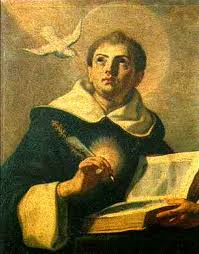
That Thomas was to be the Doctor of the Angels was not readily apparent to his school chums. His physique was unlike that of the stereotype theologian. Scholars are supposed to fit the mold of the frail, diminutive recluse, with bodies underdeveloped because of a sedentary life. Not so Thomas Aquinas. He was a big man, portly, suntanned, with a large head. He towered over his companions, no less in his massive physical bulk than in his titanic intellect. His appearance was so ungainly as a youth that he was dubbed “The big dumb ox of Sicily.”

The best estimates of historians set the date of Aquinas’ birth early in the year 1225. He was born in a castle near Naples, of noble parentage. He was the seventh son of Count Landulf of Aquino and Theodora of Theate.

His early years show indications that the hand of Providence was on his life. His predilection for theology was marked in childhood. At the tender age of five, an age when the modern child would be glued to the television set watching “Sesame Street,” Aquinas was placed as an oblate in the abbey of Monte Cassino. There he mused on the nascent questions of ontology that gripped his mind for his entire life.

Thomas’ father had big plans for his precocious son. Deeply embroiled in the political machinations between the Emperor and the princes of the church, Count Landulf sought the title of abbot for his son. Thomas politely but steadfastly refused. He borrowed a page from the life of his Lord and said, “It is better to obey the Father of spirits, in order that we may live, than the parents of our flesh.” Thomas was committed to the service of God through the pursuit of an intellectual life. He was driven by an almost monomaniacal passion to answer the question, “What is God?”

At age fourteen Aquinas left the Benedictine abbey at Monte Cassino and was sent to Naples to study at the Faculty of Arts. There he came under the influence of the Dominicans and entered their order in 1244. His parents were not pleased by this decision and were further agitated when the Dominican General sought to send him to the University of Paris. On the way, Thomas was kidnapped by his own brothers and forced to return home. He was held captive by his own family for a year, during which he refused to abandon his habit and diligently kept the observances of his order every day. His zeal was so contagious that his sister was converted and his mother so impressed that, like the biblical Rebekah, she assisted her son in escaping from a window.

Thomas made his way to Paris where he first came under the tutelage of Albert the Great. Albert (Albertus Magnus) was to Aquinas what Socrates was to Plato. Albert poured his own titanic knowledge into the head of his most able disciple and followed his career with fatherly love. At the death of Saint Thomas, Albert was deeply grieved. Thereafter when Thomas’ name was mentioned in Albert’s presence, Albert would exclaim, “He was the flower and the glory of the world.”

After three years of study in Paris, Albert took Thomas with him to begin a house of studies in Cologne. In 1252 Thomas returned to Paris. In 1256 he received his licentiate to teach in the faculty of theology. In 1259 he went to Italy and taught theology at the studium curiae, attached to the papal court until 1268. In 1268 he returned to Paris to take up the mighty controversy of his day, the controversy with Arab philosophy. In 1274 Pope Gregory X summoned him to assist in the Council of Lyons. On the journey Thomas’s mission was interrupted by the angels. They came to take their Doctor home. At age forty-nine the earthly ministry of the dumb ox of Aquino had ended.

The most familiar title given Thomas Aquinas is that of “Saint.” Though Protestants are likely to use the word “saint” as a synonym for any believer, following the New Testament usage, there are times when the most zealous Protestant will make use of the term to refer to someone who has achieved an extra level of spiritual maturity. In Rome the title is conferred by the church to a highly select few who have achieved a godliness considered above and beyond the call of duty.

When we think of Aquinas, our first thoughts are usually of his extraordinary gifts of scholarship. His was indeed a prodigious intellect, but his greatness at this point should not overshadow the spiritual power of the man. We might conjecture that his canonization was prompted by his intellectual contributions alone, but the record belies such an idea. Thomas was as noteworthy as a spiritual leader as he was for his theological acumen.

Within fifty years of the death of Aquinas the church conducted careful investigations into his personal life and teachings. Strong opposition to Aquinas’ teaching set in early, and insults were hurled against his memory. But on July 18, 1323, at Avignon, Pope John XXII proclaimed Thomas a saint. The Pope said of Aquinas, “Thomas, alone, has illumined the Church more than all the other doctors.”

The modern theologian-philosopher, Jacques Maritain, was jealous to restore a high regard for Aquinas in the twentieth-century church. In his book titled simply St. Thomas Aquinas, Maritain rehearses the traditions of Aquinas’ spiritual power and provides several anecdotes of alleged miracles that surrounded the saint. It was said of Thomas that though he contended fiercely in theological debates, he was able to bear personal attacks with a tranquil humility. Maritain relates the following:

One day a Friar in a jovial mood cries out: “Friar Thomas, come see the flying ox!” Friar Thomas goes over the window. The other laughs. “It is better,” the Saint says to him “to believe that an ox can fly than to think that a religious can lie.”

Witnesses who were summoned to testify at the canonization process of Saint Thomas described him as “soft-spoken, affable, cheerful, and agreeable of countenance, good in soul, generous in his acts; very patient, very prudent; all radiant with charity and tender piety; marvelously compassionate towards the poor.” If we examine these virtues carefully, we see in them a litany of what the New Testament calls the fruit of the Holy Spirit.

Saint Thomas was also a gifted preacher. He would sometimes become so moved during his own preaching that he was forced to pause while he wept. During a Lenten series that he preached in Naples, he had to stop in the middle of his sermon so that the congregation could have time to recover from their weeping.

It is the mystical life of Saint Thomas, however, that has sparked the interest of biographers. Immediately after Thomas’ death, his disciple Reginald returned to Naples and declared:

As long as he was living my Master prevented me from revealing the marvels that I witnessed. He owed his knowledge less to the effort of his mind than to the power of his prayer. Every time he wanted to study, discuss, teach, write or dictate, he first had recourse to the privacy of prayer, weeping before God in order to discover in the truth the divine secrets … he would go to the altar and would stay there weeping many tears and uttering great sobs, then return to his room and continue his writings.

A similar testimony comes from Tocco. He said of Aquinas, “His gift of prayer exceeded every measure; he elevated himself to God as freely as though no burden of flesh held him down. Hardly a day passed that he was not rapt out of his senses.”

Being daily “rapt out one’s senses” is hardly the routine we expect from abstract scholars and philosophers, particularly from someone like Aquinas who was given to the pursuit of logic.

The habit of passionate prayer is crowned by the extraordinary claims of miraculous visitations granted to Saint Thomas. Such incidents raise the eyebrows of Reformed theologians and we mention these accounts with the due reservations of our trade. Maritain recites the following episode as part of the Catholic record of Thomas’ sainthood.

Another time it was the saints who came to help him with his commentary of Isaias. An obscure passage stopped him; for a long time he fasted and prayed to obtain an understanding of it. And behold one night Reginald heard him speaking with someone in his room. When the sound of conversation had ceased, Friar Thomas called him, telling him to light the candle and take the manuscript On Isaias. Then he dictated for an hour, after which he sent Reginald back to bed. But Reginald fell upon his knees: “I will not rise from here until you have told me the name of him or of them with whom you have spoken for such a long time tonight.” Finally Friar Thomas began to weep and, forbidding him in the name of God to reveal the thing during Thomas’ life, confessed that the apostles Peter and Paul had come to instruct him.

Another event occurred in Paris when Thomas was lecturing on the Eucharist. As he went to the altar the brethren suddenly saw Christ standing before him and heard Him speak aloud: “You have written well of the Sacrament of My Body and you have well and truthfully resolved the question which was proposed to you, to the extent that it is possible to have an understanding of it on earth and to ascertain it humanly.”

That sober philosophers like Jacques Maritain report such incidences as simple historical fact is itself testimony to the extraordinary impact Aquinas’ spiritual power had on his contemporaries as well as his future disciples.

One anecdote about St. Thomas is virtually beyond dispute. Toward the end of his life he had a powerful mystical experience that dramatically affected his work. Again we turn to Maritain for his account of it:

Having returned to Italy after Easter of 1272, Friar Thomas took part in the General Chapter of the Order, at Florence, and then he went to Naples again to continue his teaching there. One day, December 6, 1273, while he was celebrating Mass in the chapel of Saint Nicholas, a great change came over him. From that moment he ceased writing and dictating. Was the Summa then, with its thirty-eight treatises, its three thousand articles and ten thousand objections, to remain unfinished? As Reginald was complaining about it, his master said to him, “I can do no more.” But the other was insistent. “Reginald, I can do no more; such things have been revealed to me that all that I have written seems to me as so much straw. Now, I await the end of my life after that of my works.”

After this experience Thomas Aquinas wrote no more. On his final journey he asked to be taken to the monastery of Santa Maria. As he was dying he asked for Viaticum. When he saw the consecrated Host, he threw himself on the floor and cried out:

I receive Thee, Price of my redemption … Viaticum of my pilgrimage, for love of Whom I have studied and watched, toiled, preached, and taught. Never have I said anything against Thee; but if I have done so, it is through ignorance, and I do not persist in my opinions, and if I have done anything wrong, I leave all to the correction of the Roman Church. It is in this obedience to Her that I depart from this life.

There is a strange progression in the achievement of titles of honor and status in the theological world. A freshman student begins his pursuit of knowledge simply with his given name. When he graduates from college, some may now call him “Mister.” When he graduates from seminary and passes his trials for ordination, he is granted the title “Reverend” or “Father.” If he continues his education and achieves a doctorate, he is called “Doctor.” If he is fortunate enough to secure a teaching position on a faculty, he must wait to progress to a full professorship. Then he can preface his name with the coveted title of “Professor.” The irony is this: if he makes it really big and achieves a widespread reputation for his learning, he will achieve the highest honor, that of being known simply by his name. We do not usually speak of Professor Barth or of Doctor Calvin or Professor Kung. The leaders in the field of theology are known by their names. We speak of Barth, Bultmann, Brunner, Kung, Calvin, Luther, Edwards, and Rahner. A man doesn’t seem to make it until his title returns to where he started, with his own name.

There is a special sense in which this strange progression reaches its acme with the titular honor paid to Aquinas. He is known not only by his famous last name, but in the world of theology and philosophy is recognized by his first name. No one speaks of Aquinasism. We talk about Calvinism, Lutheranism, Augustinianism, but with Aquinas it is Thomism. One need merely mention the name “Thomas’ and every scholar of theology knows of whom we speak.

Think of all the Thomases there have been in the world. Think even of the Thomases who have been famous in Christendom. There is “Doubting Thomas,” Thomas a Kempis, Sir Thomas More, and a host of others. But only one theological giant is recognized instantly by the simple mention of the name “Thomas.”

In 1879 a papal encyclical was issued in Rome by Leo XIII that praised the contribution of Thomas Aquinas. Leo declared:

Now far above all other Scholastic Doctors towers Thomas Aquinas, their master and prince. Cajetan says truly of him: “So great was his veneration for the ancient and sacred Doctors that he may be said to have gained a perfect understanding of them all.” Thomas gathered together their doctrines like the scattered limbs of a body, and moulded them into a whole. He arranged them in so wonderful an order, and increased them with such great additions, that rightly and deservedly he is reckoned a singular safeguard and glory of the Catholic Church. His intellect was docile and subtle; his memory was ready and tenacious; his life was most holy; and he loved the truth alone. Greatly enriched as he was with the science of God and the science of man, he is likened to the sun; for he warmed the whole earth with the fire of his holiness, and filled the whole earth with the splendor of his teaching. There is no part of philosophy which he did not handle with acuteness and solidity.

In the Code of Canon Law promulgated by Benedict XV, Catholic school teachers were ordered to “treat in every particular the studies of rational philosophy and theology, and the formation of students in these sciences, according to the method, the doctrine, and the principles of the Angelic Doctor, and to adhere religiously to them.” Here Thomism is elevated to a supreme theological role in the church. Thomas moves beyond the scope of being Doctor Angelicus to the realm of being the Doctor of the Church par excellence, the Common Doctor of the faithful.

What then, is Thomism, the philosophy attached to the name of Aquinas? Is Thomism a philosophy or a theology? Was Thomas himself primarily an apologist or a theologian? Was he a biblical thinker or a speculative scholar who merely warmed over Aristotle and baptized his pagan philosophy? These are some of the questions that are evoked by the sound of Thomas’ name.

The twentieth century has ushered in a revival of interest in Saint Thomas among Roman Catholic scholars. At the same time there has been a deepening cleavage between Roman Catholic Thomists and Evangelical Protestants. As Vatican Council I in 1870 looked to Protestantism as the fountain from which all modern heresies and distortions of truth flow, so modern Evangelicals have looked to the work of Thomas as being the poison that embittered the springs of truth.

The Protestant apologist, Norman Geisler (who at crucial points is pro-Thomas) is fond of quipping that “the new theme song of Evangelicalism is ‘Should Old Aquinas Be Forgot, and Never Brought to Mind.’” On the other hand the late Francis Schaeffer was sharply critical of Saint Thomas, seeing in his work the foundations of secular humanism. He sees in Thomas’ development of natural theology the magna charta of philosophy. With Thomas, philosophy was liberated from the controls of theology and became autonomous. Once philosophy became autonomous, separated and freed from revelation, it was free to take wings and fly off wherever it wished. Since Aquinas let the bird out of the trap, it has flown in the face of the faith. No longer is philosophy regarded as the handmaiden of Queen Theology but as her rival and possibly her destroyer.

Such an evaluation of Aquinas meets with resistance in some quarters of Protestantism. But the debate goes on. I, for one, am persuaded that the Protestant Church owes a profound debt to Saint Thomas and the benefit of a second glance at his contributions. I remind my Evangelical friends that when Saint Thomas defended the place of natural theology, he appealed primarily to the Apostle Paul and to Romans 1 for its classical foundation.

There is a sense in which every Christian owes a profound debt to Saint Thomas. To understand his contribution we must know something of the historical context in which he wrote. To gain a fair reading of any thinker, past or present, we must ask such questions as “What problems was he trying to solve? Why? What were the vibrant issues at stake in his day? What were the dominant controversies?” We know, for example, that throughout church history the development of theology has been prodded in large part by the threat of serious heresies. It was the heretic Marcion who made it necessary for the church to define the canon of sacred scripture. It was the heresy of Arius that provoked the council of Nicaea. It was the distortions of Nestorius and Eutyches that made the Council of Chalcedon necessary. The heat of controversy has been the crucible by which the truth of theology has been made more sharp, more lucid.

The threat to the church that awakened Saint Thomas from his own dogmatic slumber was one of the most serious challenges that Christendom has ever had to endure. Our present condition in the western world makes it a bit difficult to imagine the enormity of the threat. It was the rise and sweeping expansion of Islam that threatened Christianity in the thirteenth century. Our awareness of the threat tends to be limited to the more colorful and adventuresome element of it chronicled in the Crusades. Knights with crosses emblazoned on their chests riding out to free the Holy Land from infidels has a certain romance to it.

Saint Thomas also sought to rescue the Holy Land. Its walls were made of philosophical mortar. His lance was his pen and his coat of armor a monk’s garb. For Thomas the war was a war of ideas, a battle of concepts.

Islamic philosophy had achieved a remarkable synthesis between Islamic religion and the philosophy of Aristotle. The powerful categories of Aristotelian thought became weapons in the arsenal of the two great Arab philosophers, Averroes and Avicenna.

The Islamic philosophers produced a system of thought called “integral Aristotelianism.” One of the key points that flowed out of this was the concept of “double truths.” The double truth theory allowed that certain ideas could, at the same time, be true in philosophy and false in theology. It was a remarkable achievement: the Arab philosophers were able to accomplish what no schoolboy could ever do despite the universal desire of schoolboys to do it—to have their cake and eat it too.

The problem with having one’s cake and eating it too is obvious. If I save my cake, I cannot enjoy the taste of it while I am saving it. But if I eat it, then it is gone. I cannot save what is already gone. Seems simple enough. Philosophers, however, like lawyers, often have astonishing powers of making simple matters extremely complex, to the point that they think they can actually transcend the cake eating-saving dilemma. What’s worse is they often have the rhetorical power to convince other people of their magic.

To translate the double truth notion into modern categories would look something like this: a Christian might try to believe on Sunday that he is a creature created in the image of God by the sovereign purposive act of a Divine Being. The rest of the week he believes that he is a cosmic accident, a grown-up germ that emerged fortuitously from the slime. On Wednesdays, however, he adopts a different standpoint. Wednesday is “Double-Truth Day.” At a prayer meeting on Wednesday, the Christian attempts to believe both viewpoints at the same time. One day a week he devotes himself to intellectual schizophrenia. He tries to believe and to live a contradiction. If he enjoys the game he might shoot for a long weekend of it until he gains the ultimate bliss and security of permanent residence in a lunatic asylum.

Aquinas was concerned not only to protect the Christian church from the attacks of Islam, but to protect mankind from intellectual suicide. He insisted that all truth is coherent. Reality is not ultimately chaotic. What is true in philosophy must also be true in theology. What is true in science must also be true in religion. Truth may be analyzed from different perspectives. Various disciplines may have specialized fields of inquiry, but Aquinas insisted that all truth meets at the top.

This cardinal principle of Aquinas presupposes some rather basic, though vitally important, axioms. It is based upon the prior conclusion that there is a God and that he is the creator of this world. The world is a universe. That is, the world is marked by diversity which finds its ultimate unity in God’s sovereign creation and rule. The word “universe” as well as the term “university” comes from this mongrelized union of the two terms “unity” and “diversity.”

The double truth theory destroys in principle the fundamental notion of a universe. The universe becomes a multiverse with no ultimate harmony or cohesion. Chaos is ultimate. Truth, as an objective commodity, becomes impossible. Here contradiction may be freely embraced at any time, and every day becomes Double-Truth Day.

One of Francis Schaeffers’ most serious charges against Saint Thomas is the allegation that Thomas separated philosophy and theology. The charge is heard from other quarters as well, that Thomas separated nature and grace. Schaeffer’s lament is that, since the work of Aquinas, philosophy has been liberated from her role as handmaiden to the Queen of the Sciences (Theology) and has now become theology’s chief antagonist.

It is the prerogative of the theologian to make fine distinctions. One of the most important distinctions a theologian can ever make is the distinction between a distinction and a separation. (This is the kind of distinction that yields Excedrin headaches.) There is a crucial difference between distinguishing things and separating them. We distinguish between our bodies and our souls. If we separate them, we die. We distinguish between the two natures of Christ. If we separate them, we fall into gross heresy.

To separate philosophy and theology, nature and grace, was the last thing Thomas Aquinas ever sought to do. It was precisely the issue he was combatting. The double-truth theory separates nature and grace. Such a separation was the dragon Aquinas set out to slay. Aquinas was concerned to distinguish philosophy and theology, nature and grace, not to separate them. He came to bury Averroes, not to praise him.

Aquinas maintained consistently that ultimately there is no conflict between nature and grace. His posture was that grace does not destroy nature but fulfills it. What God reveals in the Bible does not cancel out what he reveals in nature. To be sure it adds to the knowledge we can glean from a study of this world, but it does not contradict it.

Thomas taught that there are certain truths that can be discovered in nature that are not found in the Bible. To use a modern example, we cannot discover a blueprint for the circulatory system of the bloodstream in the Bible. Second Chronicles tells us very little about microchip computers. On the other hand, science can never teach us of the Trinity or of God’s plan of redemption. The work of the Holy Spirit in the regeneration of a human soul cannot be detected with a microscope or x-ray machine.

Saint Thomas was simply stating what should be obvious, that we learn some things from nature that we can’t learn from the Bible and we learn some things from the Bible that we cannot learn from nature. The two sources of information can never be ultimately contradictory. If they seem to contradict each other, then a warning buzzer should sound in our heads to alert us that we have made an error somewhere. Either we have misinterpreted nature, or misinterpreted the Bible, or perhaps we have misinterpreted both.

So far, so good. What has really raised the hackles of many modern Evangelicals is what Thomas said next. Thomas insisted that in addition to the specific information one can learn from nature and the information found only in the Bible, there is a field of knowledge that overlaps. There are truths that Saint Thomas called “mixed articles.” The mixed articles refer to truths that can be learned either by nature or by grace.

The most controversial of the mixed articles is the issue of the existence of God. Clearly the Bible teaches that there is a God. Aquinas argues, however, that nature also teaches there is a God. There can be, therefore, a kind of natural theology. Natural theology means that nature yields a knowledge of God.

The question of natural theology and of proofs of God’s existence drawn from nature has been a raging controversy in the twentieth century. We recall, for example, Karl Barth’s rigorous rejection of natural theology in his debate with Emil Brunner. Theology in general and evangelical theology in particular has reacted severely to natural theology, seeing in it an intrusion of Greek philosophy into the household of faith. The dominant approach in our day is that of some variety of fideism. Fideism, which means literally “faithism,” maintains that God can be known only by faith. God’s existence cannot be established by philosophy. Nature yields no theology. The heavens may declare the glory of God, but such glory is never perceived except through the eyeglasses of faith.

Thomas appealed to the Bible for his defense of natural theology. He carefully reminded the Christians of his day that the Bible not only teaches us that there is a God, but that same Bible also teaches us that it is not the only source of that information. The Bible clearly and unambiguously teaches that men in fact not only can know, but do know, that God exists from his self-revelation in nature. Thomas simply reminded the church what the Apostle Paul labored to teach in the first chapter of the Epistle to the Romans.

When the modern Evangelical rejects natural theology in toto and adopts fideism as his standpoint, he becomes guilty of the very thing for which Aquinas is accused; he becomes guilty of separating nature and grace.

What is at stake here? Aquinas understood that fallen men and women will repeatedly seek to use the tools of philosophy and science against the truth of the Bible. However, he refused to surrender nature to the pagan. He refused to negotiate philosophy and science. Fideism is a policy of retreat. It hides behind a fortress of faith while surrendering reason to the pagan. It separates nature and grace in the worst possible way. The church becomes a cultural dropout; it seeks the sanctuary of the Christian ghetto. It seeks to reserve a safe place for the practice of worship, prayer, Bible study, and the like. In the meantime, art, music, literature, science, the university, and philosophy are surrendered to the pagan. If a Christian happens to be laboring in those endeavors, he is politely asked to live by a double-truth standard. Like the scientist who can’t decide whether light is a wave or a particle, he is asked to believe that it is a “wavicle” or to believe that on Monday, Wednesday, and Friday light is a wave; on Tuesday, Thursday, and Saturday it is a particle. (Of course on Sunday it rests.)

We are acutely aware that the church in our day has staggered under the assault of philosophers and scientists. There are few philosophers who see their task as being servants to the truth of God. There are few scientists today who see their task as “thinking God’s thoughts after Him.” Secular universities are not known for their gentle nurturing of Christian faith. The popular music charts do little to promote the kingdom of God. Modern art and literature are not communicating the beauty of holiness. No wonder that the church seeks a safe place of solace far removed from the battleground of culture.

We need an Aquinas. We need a titanic thinker who will not abandon truth for safety. We need men and women who are willing to compete with secularists in defense of Christ and of his truth. In this regard, the dumb ox of Aquino was heroic.

About the Author: Dr. R.C. Sproul is the founder and chairman of Ligonier Ministries, an international Christian education ministry located near Orlando, Florida. His teaching can be heard on the program Renewing Your Mind, which is broadcast on hundreds of radio outlets in the United States and in 40 countries worldwide. He is the executive editor of Tabletalk magazine and general editor of The Reformation Study Bible, and the author of more than seventy books (including some of my all time favorites: The Holiness of God; Chosen By God; Reason to Believe;  Knowing Scripture; Willing to Believe;  Intimate Marriage; Pleasing God; If There’s A God, Why Are There Atheists?, and Defending The Faith) and scores of articles for national evangelical publications. Dr. Sproul also serves as president of Ligonier Academy of Biblical and Theological Studies and Reformation Bible College. He currently serves as Senior Minister of preaching and teaching at Saint Andrew’s in Sanford, FL.  The article above was adapted from the chapter entitled “Thomas Aquinas” in the book Chosen Vessels: Portraits of Ten Outstanding Christian Men. Charles Turner, ed. Ann Arbor, Michigan: Servant Publications, 1985.

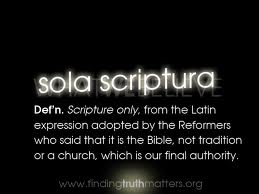
Why Sola Scriptura is Crucial to Evangelicalism by Dr. R.C. Sproul

“The only source and norm of all Christian knowledge is the Holy Scripture.” This thematic statement introduces De Scriptura Sacra of Heinrich Heppe’s classic work in Reformed dogmatics and provides a succinct expression of the Reformation slogan: Sola Scriptura (Scripture Alone). The two key words that are used to crystallize the sola character of Scripture are source and norm.

The Reformation principle of Sola Scriptura was given the status of the formal cause of the Reformation by Melanchthon and his Lutheran followers. The formal cause was distinguished from the material cause of Sola Fide (by faith alone). Though the chief theological issue of the Reformation was the question of the matter of justification, the controversy touched heavily on the underlying question of authority. As is usually the case in theological controversy, the issue of ultimate authority lurked in the background (though it was by no means hidden or obscure) of Luther’s struggle with Rome over justification. The question of the source of Luther’s doctrine and the normative authority by which it was to be judged was vital to his cause.

Sola Scriptura and Inerrancy

A brief historical recapitulation of the steps that led to Luther’s Sola Scriptura dictum may be helpful. After Luther posted his Ninety-Five Theses in 1517, a series of debates, correspondence, charges, and countercharges ensued, culminating in Luther’s dramatic stand at Worms in April 1521. The two most significant transitional points between the theses of 1517 and the Diet of Worms of 1521 were the debates at Augsburg and Leipzig.

In October 1518 Luther met with Cardinal Cajetan of the Dominicans. Cajetan was acknowledged to be the most learned theologian of the Roman Curia. In the course of their discussions Cajetan was able to elicit from Luther his views on the infallibility of the pope. Luther asserted that the pope could err and claimed that Pope Clement VI’s bull Unigenitus (1343) was contrary to Scripture.

In the summer of 1519 the dramatic encounter between Luther and Johannes von Eck took place at Leipzig. In this exchange Eck elicited from Luther the admission of his belief that not only could the pope err but church councils could and did err as well. It was at Leipzig that Luther made clear his assertion: Scripture alone is the ultimate, divine authority in all matters pertaining to religion.

Gordon Rupp gives the following account:

Luther affirmed that “among the articles of John Huss and the Hussites which were condemned, are many which are truly Christian and evangelical, and which the church universal cannot condemn!” This was sensational! There was a moment of shocked silence, and then an uproar above which could be heard Duke George’s disgusted, “Gad, Sir, that’s the Plague!… ” Eck pressed his advantage home, and Luther, trapped, admitted that since their decrees are also of human law, Councils may err.

So by the time Luther stood before the Diet of Worms, the principle of Sola Scriptura was already well established in his mind and work. Only the Scripture carries absolute normative authority. Why? For Luther the sola of Sola Scriptura was inseparably related to the Scriptures’ unique inerrancy. It was because popes could and did err and because councils could and did err that Luther came to realize the supremacy of Scripture. Luther did not despise church authority nor did he repudiate church councils as having no value. His praise of the Council of Nicea is noteworthy. Luther and the Reformers did not mean by Sola Scriptura that the Bible is the only authority in the church. Rather, they meant that the Bible is the only infallible authority in the church.

Paul Althaus summarizes the train of Luther’s thought by saying:

We may trust unconditionally only in the Word of God and not in the teaching of the fathers; for the teachers of the Church can err and have erred. Scripture never errs. Therefore it alone has unconditional authority. The authority of the theologians of the Church is relative and conditional. Without the authority of the words of Scripture, no one can establish hard and fast statements in the Church.

Thus Althaus sees Luther’s principle of Sola Scriptura arising as a corollary of the inerrancy of Scripture. To be sure, the fact that Scripture is elevated to be the sole authority of the church does not carry with it the necessary inference that it is inerrant. It could be asserted that councils, popes, and the Bible all err and still postulate a theory of Sola Scriptura. Scripture could be considered on a primus inter pares (“first among equals”) basis with ecclesiastical authority, giving it a kind of primacy among errant sources. Or Scripture could be regarded as carrying unique authority solely on the basis of its being the primary historical source of the gospel. But the Reformers’ view of Sola Scriptura was higher than this. The Reformation principle of Sola Scriptura involved inerrancy.

Sola Scriptura, ascribing to the Scriptures a unique authority, must be understood in a normative sense. Not descriptive, but rather normative authority is meant by the formula. The normative character of the Sola Scriptura principle may be seen by a brief survey of sixteenth-century Reformed confessions.

The Theses of Berne (1528): The Church of Christ makes no laws or commandments without God’s Word. Hence all human traditions, which are called ecclesiastical commandments, are binding upon us only in so far as they are based on and commanded by God’s Word (Sec. II).

The Geneva Confession (1536): First we affirm that we desire to follow Scripture alone as a rule of faith and religion, without mixing with it any other things which might be devised by the opinion of men apart from the Word of God, and without wishing to accept for our spiritual government any other doctrine than what is conveyed to us by the same Word without addition or diminution, according to the command of our Lord (Sec. I).

The French Confession of Faith (1559): We believe that the Word contained in these books has proceeded from God, and receives its authority from him alone, and not from men. And inasmuch as it is the rule of all truth, containing all that is necessary for the service of God and for our salvation, it is not lawful for men, nor even for angels, to add to it, to take away from it, or to change it. Whence it follows that no authority, whether of antiquity, or custom, or numbers, or human wisdom, or judgments, or proclamations, or edicts, or decrees, or councils, or visions, or miracles, should be opposed to these Holy Scriptures, but on the contrary, all things should be examined, regulated, and reformed according to them (Art. V).

The Belgic Confession (1561): We receive all these books, and these only, as holy and confirmation of our faith; believing, without any doubt, all things contained in them, not so much because the church receives and approves them as such, but more especially because the Holy Ghost witnessed in our hearts that they are from God, whereof they carry the evidence in themselves (Art. V). Therefore we reject with all our hearts whatsoever doth not agree with this infallible rule (Art. VII).

Second Helvetic Confession (1566): Therefore, we do not admit any other judge than Christ himself, who proclaims by the Holy Scriptures what is true, what is false, what is to be followed, or what is to be avoided (Chap. II).

Uniformly the sixteenth-century confessions elevate the authority of Scripture over any other conceivable authority. Thus, even the testimony of angels is to be judged by the Scriptures. Why? Because, as Luther believed, the Scriptures alone are inerrant. Sola Scriptura as the supreme norm of ecclesiastical authority rests ultimately on the premise of the infallibility of the Word of God.

Extent of the Norm

To what extent does the Sola Scriptura principle of authority apply? We hear statements that declare Scripture to be the “only infallible rule of faith and practice.” Does this limit the scope of biblical infallibility? Among advocates of limited inerrancy we hear the popular notion that the Bible is inerrant or infallible only when it speaks of matters of faith and practice. Matters of history or cosmology may contain error but not matters of faith and practice. Here we see a subtle shift from the Reformation principle. Note the difference in the following propositions:

A. The Bible is the only infallible rule of faith and practice.

B. The Bible is infallible only when it speaks of faith and practice.

In premise A, “faith and practice” are generic terms that describe the Bible. In premise B, “faith and practice” presumably describe only a particular part of the Bible. Premise A affirms that there is but one infallible authority for the church. The proposition sets no content limit on the infallibility of the Scriptures. Premise B gives a reduced canon of that which is infallible; that is, the Bible is infallible only when it speaks of faith and practice. This second premise represents a clear and decisive departure from the Reformation view.

Premise A does not say that the Bible provides information about every area of life, such as mathematics or physics. But it affirms that what he Bible teaches, it teaches infallibly.

The Source of Authority

Heppe’s sola indicates that the Bible is not only the unique and final authority of the church but is also the “only source of all Christian knowledge.” At first glance this statement may seem to suggest that the only source of revelation open to man is that found in Scripture. But that is not the intent of Heppe’s statement, nor is it the intent of the Reformation principle of Sola Scriptura.

Uniformly the Reformers acknowledged general revelation as a source of knowledge of God. The question of whether or not that general revelation yields a bona fide natural theology was and is widely disputed, but there is no serious doubt that the Reformers affirmed a revelation present in nature. Thus the sola does not exclude general revelation but points beyond it to the sufficiency of Scripture as the unique source of written special revelation.

The context of the Sola Scriptura schema with respect to source was the issue (raised over against Rome) regarding the relationship of Scripture and Tradition. Central to the debate was the Council of Trent’s declaration regarding Scripture and Tradition. (Trent was part of the Roman counteroffensive to the Reformation, and Sola Scriptura was not passed over lightly in this counter-offensive.)

In the Fourth Session of the Council of Trent the following decree was formulated: This (Gospel), of old promised through the Prophets in the Holy Scriptures, our Lord Jesus Christ, the Son of God, promulgated first with His own mouth, and then commanded it to be preached by His Apostles to every creature as the source at once of all saving truth and rules of conduct. It also clearly perceives that these truths and rules are contained in the written books and in the unwritten traditions, which, received by the Apostles from the mouth of Christ Himself, or from the Apostles themselves, the Holy Ghost dictating, have come down to us, transmitted as it were from hand to hand. Following then, the examples of the Orthodox fathers, it receives and venerates with a feeling of piety and reverence all the books both of the Old and New Testaments, since one God is the author of both; also the traditions, whether they relate to faith or to morals, as having been dictated either orally by Christ or by the Holy Ghost, and preserved in the Catholic church in unbroken succession.

In this decree the Roman Catholic church apparently affirmed two sources of special revelation—Scripture and the Tradition of the church—although in recent years this “dual source” theory has come into question within the Roman church.

G. C. Berkouwer’s work on Vatican Council II provides a lengthy discussion of current interpretations of the Tridentine formula on Scripture and Tradition. Some scholars argue that Tradition adds no new content to Scripture but merely serves either as a depository in the life of the church or as a formal interpretive tool of the church. A technical point of historical research concerning Trent sheds some interesting light on the matter. In the original draft of the fourth session of Trent the decree read that “the truths … are contained partly [partim] in Scripture and partly [partim] in the unwritten traditions.” But at a decisive point in the Council’s deliberations two priests, Nacchianti and Bonnucio rose in protest against the partim … partim formula. These men protested on the grounds that this view would destroy the uniqueness and sufficiency of Scripture. All we know from that point on is that the words partly … partly were removed from the text and replaced by the word and (et). Did this mean that the Council responded to the protest and perhaps left the relationship between Scripture and Tradition purposely ambiguous? Was the change stylistic, meaning that the Council still maintained two distinct sources of revelation? These questions are the focus of the current debate among Roman theologians.

One thing is certain. The Roman church has interpreted Trent as affirming two sources of special revelation since the sixteenth century. Vatican I spoke of two sources. The papal encyclical Humani Generis spoke of “sources of revelation.” Even Pope John XXIII spoke of Scripture and Tradition in Ad Petri Cathedram.

Not only has the dual-source theory been confirmed both by ecumenical councils and papal encyclicals, but tradition has been appealed to on countless occasions to validate doctrinal formulations that divide Rome and Protestantism. This is particularly true regarding decisions in the area of Mariology.

Over against this dual-source theory stands the sola of Sola Scriptura. Again, the Reformers did not despise the treasury of church tradition. The great councils of Nicea, Ephesus, Chalcedon, and Constantinople receive much honor in Protestant tradition. The Reformers themselves gave tribute to the insights of the church fathers. Calvin’s love for Augustine is apparent throughout the Institutes. Luther’s expertise in the area of Patristics was evident in his debates with Cajetan and Eck. He frequently quotes the fathers as highly respected ecclesiastical authorities. But the difference is this: For the Reformers no church council, synod, classical theologian, or early church father is regarded as infallible. All are open to correction and critique. We have no Doctor Irrefragabilis of Protestantism.

Protestant churches have tended to be confessional in character. Subscription to confessions and creeds has been mandatory for the clergy and parish of many denominations. Confessions have been used as a test of orthodoxy and conformity to the faith and practice of the church. But the confessions are all regarded as reformable. They are considered reformable because they are considered fallible. But the Sola Scriptura principles in its classic application regards the Scripture as irreformable because of its infallibility. Thus the two primary thrusts of Sola Scriptura point to:

1) Scripture’s uniqueness as normative authority and

2) its uniqueness as the source of special revelation. Norm and source are the twin implicates of the Sola Scriptura principle.

Is Sola Scriptura the Essence of Christianity?

In a recent publication on questions of Scripture, Bernard Ramm wrote an essay entitled, “Is ‘Scripture Alone’ the Essence of Christianity?” Using the nineteenth-century German penchant for the quest of the “Wesen” of Christianity as a jumping-off point, Ramm gives a brief history of the liberal-conservative controversy concerning the role of Scripture in the Christian faith. Defining Wesen as “the essence of something, the real spirit or burden of a treatise, the heart of the matter,” he concludes that Scripture is not the Wesen of Christianity. He provides a historical survey to indicate that neither the Reformers nor the strong advocates of inerrancy, A. A. Hodge and B. B. Warfield, believed that Sola Scriptura was the essence of Christianity. Ramm cites numerous quotations from Hodge and Warfield that speak of the Scriptures as being “absolutely infallible,” and “without error of facts or doctrines.” Yet these men affirmed that “Christianity was true independently of any theory of inspiration, and its great doctrines were believable within themselves.”

Ramm goes on to express grave concern about the present debate among evangelicals concerning inerrancy. Here his concern focuses not on the teaching of Hodge and Warfield but on the attitudes of their contemporary disciples who, in Ramm’s opinion, go beyond their forefathers in asserting a particular view of Scripture as being Christianity’s essence. Ramm writes:

From the other writings of Warfield in particular, it would be impossible to say that he identified the Wesen of Christianity with his view of Holy Scripture. He was enough of a historian of theology to avoid saying that. The “inspiration” article was an essay in strategy. However, among current followers of the so-called Warfield position there have been certain shifts away from the original strategic stance of the essay. One’s doctrine of Scripture has become now the first and most important doctrine, one’s theory of the wesen of Christianity, so that all other doctrines have validity now only as they are part of the inerrant Scripture. Thus evangelical teachers, or evangelical schools or evangelical movements, can be judged as to whether or not they are true to the wesen of Christianity by their theory of inspiration. It can be stated even more directly: an evangelical has made a theory of inspiration the wesen of Christianity if he assumes that the most important doctrine in a man’s theology, and most revelatory of the entire range of his theological thought, is his theology of inspiration.

It appears from this statement that the “essence” of Ramm’s concern for the present state of evangelicalism is that one’s doctrine of Scripture is viewed as the essence or wesen of Christianity. This writer can only join hands with Ramm in total agreement with his concern. To make one’s view of Scripture in general or of inspiration in particular the essence of Christianity would be to commit an error of the most severe magnitude. To subordinate the importance of the gospel itself to the importance of our historical source book of it would be to obscure the centrality of Christ. To subordinate Sola Fide to Sola Scriptura would be to misunderstand radically the wesen of the Reformation. Clearly Ramm is correct in taking his stand on this point with Hodge, Warfield, and the Reformers. Who can object to that?

One may be troubled, however, by a portion of Ramm’s stated concern. Who are these “current followers” of Warfield who in fact do maintain that Sola Scriptura is the heart or essence of Christianity? What disciple of Warfield’s has ever maintained that Sola Scriptura is essential to salvation? Ramm provides us with no names or documentary evidence to demonstrate that his deep concern is warranted.

To be sure, strong statements have been made by followers of the Warfield school of the crucial importance of Sola Scriptura and the centrality of biblical authority to all theological disputes. Perhaps these statements have contained some “overkill” in the passion of debate, which is always regrettable. We must be very cautious in our zeal to defend a high view of Scripture not to give the impression that we are talking about an article on which our salvation depends.

We can cite the following statements by advocates of the Warfield school that could be construed as a possible basis for Ramm’s concern. In God’s Inerrant Word, J. I. Packer makes the following assertion:

What Luther thus voiced at Worms shows the essential motivation and concern, theological and religious, of the entire Reformation movement: namely that the Word of God alone must rule, and no Christian man dare do other than allow it to enthrone itself in his conscience and heart.

Here Packer calls the notion of Sola Scriptura “the essential motivation and concern” of the Reformation. In itself this quote certainly suggests that Packer views Sola Scriptura as the essence of the Reformation.

However, in defense of Packer it must be noted that to say Sola Scriptura was the essential motivation of the Reformation movement is not to say that Sola Scriptura is the essence of Christianity. He is speaking here of a historical controversy. That Sola Scriptura was at the heart of the controversy and central to the debate cannot be doubted. To say that Sola Scriptura was an essential motif or concern of the Reformation cannot be doubted. That is was the essential concern may be brought into question; this may be regraded as an overstatement. But again, in fairness to Packer, it must be noted that earlier in his essay he had already indicated that Justification by Faith Alone was the material principle. So he had already maintained that Sola Scriptura was subordinate to Sola Fide in the controversy. In any case, though the word essential is used, there is no hint here that Packer maintains that Sola Scriptura is the essence of Christianity.

In a recent unpublished essay, Richard Lovelace of Gordon-Conwell Theological Seminary cites both Harold Lindsell and Francis Schaeffer as men who have sounded urgent warnings concerning the relationship between inerrancy and evangelicalism. Lovelace cites the following statements of Schaeffer:

There is not use of evangelicalism seeming to get larger and larger, if at the same time appreciable parts … are getting soft at that which is the central core, namely the Scriptures.… We must say most lovingly but clearly: evangelicalism is not consistently evangelical unless there is a line drawn between those who take a full view of Scripture and those who do not.

Again Schaeffer is cited: “Holding to a strong view of Scripture or not holding to it is the watershed of the evangelical world.” In these statements Francis Schaeffer maintains that the Scriptures are:

1) the “central core” of evangelicalism,

2) a mark of “consistent evangelicalism,” and

3) the “watershed of the evangelical world.”

These are strong assertions about the role of Sola Scriptura, but they are made with reference to evangelicalism, not Christianity (though I am sure Schaeffer believes evangelicalism is the purest expression of Christianity to be found). Evangelicalism refers to a historical position or movement. When he speaks of “watersheds,” he is speaking of crucial historical turning points. When he speaks of “consistent” evangelicalism, he implies there may be such a thing as inconsistent evangelicalism.

The troublesome quote of Schaeffer is that one in which he says the Scriptures are “the central core” of evangelicalism. Here “core” is in the singular with the definite article giving it a sola character. Does Schaeffer mean that the Bible is the core of evangelicalism and the gospel is the husk? Is Sola Scriptura the center and Sola Fide at the periphery of evangelicalism? It is hard to think that Schaeffer would make such an assertion. Indeed, one may question if Schaeffer means what he in fact does say here. Had he said, “Scripture is at the core of evangelicalism,” there would be no dispute. But to say it is the core appears an overstatement. Perhaps we have here a slip of the pen, which any of us can and frequently do make.

In similar fashion Harold Lindsell may be quoted: “Is the term ‘evangelical’ broad enough in its meaning to include within it believers in inerrancy and believers in an inerrancy limited to matters of faith and practice?” Lindsell raises the question of whether or not inerrancy of the entire Bible is essential to the term evangelical. The question raised is: If Sola Scriptura in its fullest sense is of the Wesen of evangelicalism, can one who espouses limited inerrancy be genuinely called evangelical? The issue is the meaning of the term evangelical. Does it carry with it the automatic assumption of full inerrancy? Again we must point out the difference between the historical label “evangelical” and what is essential to Christianity.

None of the scholars mentioned have said that adherence to inerrancy or Sola Scriptura is essential to salvation. None have Sola Scriptura as the Wesen of Christianity.

It could be said that the argument of the writer of this chapter is constructed on straw men who “come close” to asserting that Sola Scriptura is the essence of Christianity but who, in the final analysis, shrink for such an assertion. But it is not my purpose to create straw men. It is simply to find some basis for Ramm’s assertion about modern followers of Warfield. Since I have not been able to find any followers of Warfield who assert Sola Scriptura as the Wesen of Christianity, the best I can do is to cite examples of statements that could possibly be misconstrued to assert that. It is probably charity that restrained Ramm from naming those he had in mind. But unfortunately, the absence of names casts a shadow of suspicion over all modern followers of Warfield who hold to full inerrancy.

Though advocates of inerrancy in the full sense of Sola Scriptura do not regard it as being essential to salvation, they do maintain that the principle is crucial to Christianity and to consistent evangelicalism. That in Scripture we have divine revelation is no small matter. That the gospel rests not on human conjecture or relational speculation is of vital importance. But there is no quarrel with Ramm on these points. He summarizes his own position by saying:

1. There is no questioning of the Sola Scriptura in theology. Scripture is the supreme and final authority in theological decision-making.

2. One’s views of revelation, inspiration, and interpretation are important. They do implicate each other. Our discussion rather has been whether a certain view of inspiration could stand as the wesen of Christianity. We have in no manner suggested that matters of revelation, inspiration, and interpretation are unimportant in theology.

Here we delight in agreement with this strong affirmation of the crucial importance of Sola Scriptura.

Strangely, however, Ramm continues his summary by saying, “If the integrity of other evangelicals, evangelical schools, or evangelical movements are assessed by their view of inspiration, then, for them, inspiration has become the wesen of Christianity.” The inference Ramm draws at this point is at once puzzling and astonishing, and perhaps we meet here merely another case of overstatement or a slip of the pen. How would it follow from an assessment of others’ evangelicalism as being consistent or inconsistent according to their view of Scripture that inspiration has become the wesen of Christianity? This inference involves a quantum leap of logic.

If the first two points of Ramm’s summary are correct—that Sola Scriptura is important and that it implicates views of interpretation and theological decision making—why should not a school’s or movement’s integrity (a fully integrated stance) be assessed by this principle? Though Sola Scriptura is not the wesen of Christianity, it is still of crucial importance. If a school or movement softens its view of Scripture, that does not mean it has repudiated the essence of Christianity. But it does mean that a crucial point of doctrine and classical evangelical unity has been compromised. If, as Ramm suggests, one’s view of Scripture is so important, then a weakening of that view should concern us.

The issue of full or limited inerrancy is a serious one among those within the framework of historic evangelicalism. In the past a healthy and energetic spirit of cooperation has existed among evangelicals from various and diverse theological persuasions and ecclesiastical affiliations. Lutherans and Baptists, Calvinists and Arminians, and believers of all sorts have united in evangelical activity. What has been the cohesive force of that unity? In the first instance, there has been a consensus of catholic articles of faith, such as the deity of Christ. In the second instance, a strong point of unity has been the cardinal doctrine of the Protestant Reformation: justification by faith alone. In the last instance, there has been the unifying factor of Sola Scriptura in the sense of full inerrancy. The only “creed” that has bound the Evangelical Theological Society together, for example, has been the affirmation of inerrancy. Now that point of unity is in jeopardy. The essence of Christianity is not the issue. But a vital point of consistent evangelicalism is.

Sola Scriptura and Limited Inerrancy

Is Sola Scriptura compatible with a view of Scripture that limits inerrancy to matters of faith and practice? Theoretically it would seem to be possible if “faith and practice” could be separated from any part of Scripture. So long as biblical teaching regarding faith and practice were held to be normative for the Christian community, there would appear to be no threat to the essence of Christianity. However, certain problems exist with such a view of Scripture that do seriously threaten the essence of Christianity.

The first major problem we encounter with limited inerrancy is the problem of canon reduction. The canon or “norm” of Scripture is reduced de facto to that content relating to faith and practice. This immediately raises the hermeneutical question concerning what parts of Scripture deal with faith. As evangelicals wrestle among themselves in intramural debates, they must keep one eye focused on the liberal world of biblical scholarship, for the principle of the reduction of canon to matters of “faith” is precisely the chief operative in Bultmann’s hermeneutic. Bultmann thinks we must clear away the prescientific and faulty historical “husk” of Scripture to get to the viable kernel of “faith.” Thus, although Bultmann has no inerrant kernel or kerygma to fall back on, his problem of canon reduction remains substantially the same as that of those who limit inerrancy to faith and practice.

Before someone cries foul or cites the informal fallacy of argumentum ad hominem (abusive) or the “guilt by association” fallacy, let this concern be clarified. I am not saying that advocates of limited inerrancy are cryptic or even incipient Bultmannians, but that there is one very significant point of similarity between the two schools: canon reductionism. Evangelical advocates of limited inerrancy are not expected to embrace Bultmann’s mythical view of New Testament supernaturalism. But their method has no inherent safeguard from an arbitrary delimitation of the scope of the biblical canon.

The second serious problem, closely related to the first, is the problem of the relationship of faith and history, perhaps the most serious question of contemporary New Testament scholarship. If we limit the notion of inerrancy to matters of faith and practice, what becomes of biblical history? Is the historical substratum of the gospel negotiable? Are only those portions of the biblical narrative that have a clear bearing on faith inerrant? How do we escape dehistoricizing the gospel and relegating it to a level of supratemporal existential “decision”? We know that the Bible is not an ordinary history book but a book of redemptive history. But is it not also a book of redemptive history? If we exclude the realm of history from the category of inspiration or inerrancy either in whole or in part, do we not inevitably lose the gospel?

The third problem we face with limiting inerrancy to matters of faith and practice is an apologetic one. To those critics outside the fellowship of evangelicals, the notion of “limited inerrancy” appears artificial and contrived. Limited inerrancy gets us off the apologetical hook by making us immune to religious-historical criticism. We can eat our cake and have it too. The gospel is preserved; and our faith and practice remains intact while we admit errors in matters of history and cosmology. We cannot believe the Bible concerning earthly things, but we stake our lives on what it says concerning heavenly things. That approach was totally abrogated by our Lord (John 3:12).

How do we explain and defend the idea that the Bible is divinely superintended in part of its content but not all of it? Which part is inspired? Why only the faith and practice parts? Again, which are the faith and practice parts? Can we not justly be accused of “weaseling” if we adopt such a view? We remove our faith from the arena of historical verification nor falsification. This is a fatal blow for apologetics as the reasoned defense of Christianity.

Finally, we face the problem of the domino theory. Frequently this concern is dismissed out of hand as being so much alarmism. But our doctrine of Scripture is not a child’s game of dominoes. We know instances in which men have abandoned belief in full inerrancy but have remained substantially orthodox in the rest of their theology. We are also aware of the sad instances in which full inerrancy is affirmed yet the substance of theology is corrupt. Inerrancy is no guarantee of biblical orthodoxy. Yet even a cursory view of church history has shown some pattern of correlation between a weakening of biblical authority and serious defection regarding the Wesen of Christianity. The wesen of nineteenth-century liberalism is hardly the gospel evangelicals embrace.

We have already seen, within evangelical circles, a move from limited inerrancy to challenges of matters of faith and practice. When the apostle Paul is depicted as espousing two mutually contradictory views of the role of women in the church, we see a critique of apostolic teaching that does touch directly on the practice of the church. In the hotly disputed issue of homosexuality we see denominational commissions not only supplementing biblical authority with corroborative evidence drawn from modern sources of medical psychological study but also “correcting” the biblical view by such secular authority.The direction of these movements of thought is a matter of grave concern for advocates of full inerrancy.

We face a crisis of authority in the church. It is precisely our faith and our practice that is in question. It is for faith and practice that we defend a fully infallible rule—a total view of Sola Scriptura.

We know some confusion has existed (much unnecessarily) about the meaning of full inerrancy. But with all the problems of definition that plague the concept, we do not think it has died the death of a thousand qualifications.

We are concerned about Sola Scriptura for many reasons. But we affirm it in the final analysis not because it was the view of the Reformers, not because we slavishly revere Hodge and Warfield, not even because we are afraid of dominoes or a difficult apologetic. We defend it and express our deep concern about it because we believe it is the truth. It is a truth we do not want to negotiate. We earnestly desire dialogue with our evangelical brothers and colaborers who differ from us. We want to heal the wounds that controversy so frequently brings. We know our own views are by no means inerrant. But we believe inerrancy is true and is of vital importance to our common cause of the gospel.

Further dialogue within the evangelical world should at least help us clarify what real differences there are among us. Such clarification is important if there is to be any hope of resolving those differences. We do not intend to communicate that a person’s Christian faith stands or falls with his view of Scripture. We do not question the Christian commitment of advocates of limited inerrancy. What we do question is the correctness of their doctrine of Scripture, as the question ours. But we consider this debate, as serious as it is, a debate between members of the household of God. May our Father bring us to unity here as he has in many glorious affirmations of his gospel.

Article above written by Dr. R.C. Sproul. “Sola Scriptura: Crucial to Evangelicalism.” The Foundations of Biblical Authority. James M. Boice, ed. Grand Rapids: Zondervan, 1980.

About the Author: Dr. R.C. Sproul is the founder and chairman of Ligonier Ministries, an international Christian education ministry located near Orlando, Florida. His teaching can be heard on the program Renewing Your Mind, which is broadcast on hundreds of radio outlets in the United States and in 40 countries worldwide. He is the executive editor of Tabletalk Magazine and general editor of The Reformation Study Bible, and the author of more than seventy books (including some of my all time favorites: THE HOLINESS OF GOD; CHOSEN BY GOD; KNOWING SCRIPTURE; WILLING TO BELIEVE; REASON TO BELIEVE; and PLEASING GOD) and scores of articles for national evangelical publications. Dr. Sproul also serves as president of Ligonier Academy of Biblical and Theological Studies and Reformation Bible College. He currently serves as Senior Minister of preaching and teaching at Saint Andrew’s in Sanford, FL

Tim Keller on “The Call To Discipleship”

There is a growing recognition in churches today about the need for discipleship. In what follows I would like to describe, from the Gospel of Luke, what it means to be a disciple of Jesus Christ. Luke has some helpful insights about discipleship. The first eight chapters are focused on “who is Jesus?” But there’s a shift in chapter 9, where Peter with the help of the Holy Spirit realizes that Jesus is not one more in a succession of prophets and teachers. Peter says, “You are the Christ of God” – you are the Messiah, the one who is bringing the ruling power of God back into the world to heal and repair all the brokenness—whether it’s spiritual, psychological, social, or physical.

From the time Jesus’ identity is revealed, he begins to say, “Follow me.” If he is who he says he is, what does it mean to follow him? Being a disciple of Jesus Christ means setting a new priority, finding a new identity, and living a new mercy. All three are critical; they all fit together. Let’s look at them.

Setting a New Priority

(1) Being a disciple means setting a new priority. In Luke 9:57–62 Jesus meets three eager men, all willing to follow him. Jesus’ responses to them are surprisingly blunt. The first man says, “I will follow you wherever you go.” Jesus says, “Foxes have holes and birds of the air have nests, but the Son of Man has no place to lay his head.” It’s as if Jesus is saying, “There’s nothing wrong with what you just said, but I discern a wrong attitude underneath your statement. Do you know what kind of Savior I am? I’m not the kind that rallies constituents, pulls together armies, and then triumphs. I am a Savior who saves through being condemned, through dying, through giving my heart to be broken. Let’s apply this to one area of your life: I see that you have a home, a nice standard of living. Are you willing to put me before that? Are you willing to lose those things for me?”

Then Jesus addresses two other men, similarly concerned with their families. One says, “I’d love to come with you, but first I have to bury my father.” The other says, “First let me go back and say goodbye to my family.” There is nothing wrong with having a funeral for your father or going back to see your family, but behind these requests Jesus sees a wrong attitude of heart. He’s saying, “I know you. For you specifically to go to your father’s funeral—or back home—would be a bad idea. I must come first.” Notice their language. In both cases they say, “Lord, first, let me do this.” Jesus says there can’t be any but first. “I must be your first priority.” That’s what he means when he says: “No one who puts his hand to the plow and looks back is fit for service in the kingdom of God.”

Anyone who plows a field must be completely focused on plowing. And following Jesus is no different, “My disciple has to be utterly focused on me.” By the way, “fit for the kingdom” is an unfortunate translation; the word there means “useful.” You might think he’s saying, “Unless you’re totally committed, you don’t qualify for my kingdom.” Of course no one qualifies for Jesus’ kingdom. It’s all by grace. He’s saying: Unless delighting Jesus, resembling him, serving him, and knowing him is your highest priority, the healing power of the kingdom of God will not be flowing through you. You will not be a useful vehicle for it.

The second and more cryptic line is, “Let the dead bury their own dead.” Obviously physically dead people can’t dig graves, so the first noun must refer to the spiritually dead. To be spiritually dead means to be as blind and insensitive to spiritual reality as a physical body is to physical reality. You may be saying, “Well, I believe in Jesus, but I can’t put him first right now. I’ve got my career; I’ve got to wait till my parents die, because they would be unhappy if I became a Christian . . . I see who he is and what he’s done, but I’m not going to put him first just yet. Someday I will.” When someone says, “I understand Christianity. I’m just not ready to put it at the central place in my life,” then that person really doesn’t understand it yet! Jesus says: Putting anything before me reveals spiritual deadness. Let the dead bury their dead. If you put your father before me, there’s a spiritual deadness in your life.

Talking this harshly is not my style, but I’m afraid to mute the smelling–salts-ness of Jesus’ message: Let the dead bury the dead! No one who looks back is fit for the kingdom of God! Foxes have holes, birds have nests . . . But “I have to be the first priority in your life, or you’re not a disciple; if you don’t put me first in your life, it’s not that you’re just uncommitted or lazy, disorganized or undisciplined. No, you just don’t get it! You don’t really see who I am and what I’ve done; you don’t understand the meaning of my life and work. You need to wake up!”

Let me illustrate. In 1971 I heard a talk—two illustrations—that changed my life. The woman who gave the talk, named Barbara Boyd, said, “If somebody says to me, ‘Come on in, Barbara, but stay out, Boyd,’ it’s a bit of a problem, because I can’t separate them. It’s not like the top half of me is Barbara, and the bottom half of me is Boyd. So if you won’t have Boyd, you can’t get Barbara. If you’re going to keep the Boyd out, I can’t come in at all!” She continued: “To say, ‘Jesus, come into my life, forgive my sins, answer my prayers; do this for me, do that for me—but don’t be the absolute master of my life; Jesus, Savior, come in; but Lord, stay out,’ how can he come in at all? Because he’s all Savior, and he’s all Lord. He’s Lord because he’s Savior. He’s Savior because he’s Lord.”

I remember her second illustration: “If the distance between the Earth and the sun, which is 92 million miles, was the thickness of a piece of paper, the diameter of our galaxy would be a stack of papers 310 miles high. And our galaxy is less than a speck of dust in the part of the universe that we can see. And that part of the universe might just be a speck of dust compared to all the universe. And if Jesus is the Son of God who holds all this together with the power of his word, is this the kind of person you ask into your life to be your personal assistant?” Then she asked us all to go outside and for one hour say nothing. “Just think about what this means to you.”

She was expanding on Jesus’ message:  If you intellectually assent, “Yes, I think Jesus is probably the Son of God; I think he probably died for our sins,” but he is not the center of your life, then you may think you understand, but you really don’t. It’s not just a matter of commitment or lack of discipline, there’s spiritual deadness; you don’t really see it, understand it, get it. Wake yourself up!

Finding a New Identity

(2) Discipleship is not just a matter of bending your will to Jesus’ will; it’s melting your heart into a whole new shape. A disciple is not someone who simply sets a new priority; a disciple finds a new identity. We see this in Luke 9:23–25. At first sight verse 23 looks like it’s just another way of saying set a new priority: “If anyone would come after me, he must deny himself and take up his cross daily and follow me.” But there’s more to it than that. In Semitic literature, the second and third sentences often restate the first. And here the second and third sentences say, “For whoever wants to save his life will lose it, and whoever loses his life for me will save it.” The word life is not the word for physical life. There’s a good Greek word for that: bios, from which we get our word biology. The Greek word that’s translated “life” here is psyche, meaning “self.” He’s talking—pretty radically—about the psychological, inner life. “Your old way of having an identity, of gaining a sense of self, has got to end. In a sense you have to die to it. And I can give you a whole new identity. You’ll get a whole new true self.”

Let’s look at this more closely. Verses 24 and 25 show what he’s not saying. He’s not taking the typical Eastern or Western approach to identity. In Buddhism the deepest consciousness of enlightenment is losing all sense that you are an individual self. The boundaries between you and the rest of reality disappear. The Eastern way to humility, to peace, is to actually lose the sense of an individual self.

But Jesus doesn’t stop at, “I want you to lose yourself.” He says, “Lose yourself to find yourself,” which means, “I want you to die to your old approach to identity, and get a new sense of individual self.” He’s not going the Eastern way. But he’s sure not going the Western way either.

W. H. Auden wrote a work called The Age of Anxiety in which he satirizes the modern Western obsession with “finding yourself.” In it there’s a great line that reads: “Miserable wicked me, / How interesting I am.” Others have also noted our obsession with finding and fulfilling your deepest desires as the main thing you’re supposed to do in life. It almost seems that Jesus has us in mind when he says, “You’re never going to find out who you really are by trying to find out who you really are. You’re going to have to lose yourself in serving me.” Some things happen only as a byproduct, and identity is one of them.

“What good is it for a man to gain the whole world?” (9:25). Gaining things from the world is the normal way we try to get a self. In fact, the three men at the end of Luke 9 are examples of this. Some people say you’re nobody unless you have a lucrative career. People in more traditional cultures say you’re nobody unless you have a family. But Jesus is saying, “If you get the whole world, it cannot give you a stable self.” He says, “If you lose yourself for me . . .” In other words, “Instead of trying to gain a self by gaining things, build everything in your life on me, on who I am, on what I have done, then finally you’ll have a true self that is stable, because you were built to know me.”

A disciple is not only someone who has set a new priority, but someone whose entire identity has been reshaped and forged. But how is that possible?

Living a New Mercy

(3) The key to setting a new priority and finding a new identity is in living a new mercy. And this is also evident in Luke 9. Jesus is on his way to Jerusalem, and, it says in verse 52, “He sent messengers on ahead, who went into a Samaritan village to get things ready for him; but the people there did not welcome him.” They rejected him. “When the disciples James and John saw this, they asked, ‘Lord, do you want us to call fire down from heaven to destroy them?’”

Let’s try to understand them. Remember that there was a prophet, named Elijah, who called down fire upon some soldiers who were seeking to arrest him. And on the Mount of Transfiguration, Jesus had appeared—to James and John—with Elijah and Moses. The message of the Transfiguration (Luke 9:28–36) was that Jesus was even greater than Moses and Elijah.

So think of the logic of the disciples: You’re greater than Elijah. These people have rejected you, and that’s even worse than rejecting Elijah. That adds even more effrontery to the godhead. Shall we not bring down fire and destroy them?

This would be the kind of prophet the world can relate to. But Jesus Christ doesn’t rebuke the unbelieving Samaritans; he rebukes the disciples! He is the absolute un-Elijah. Can you imagine their continued perplexity if they still believe he’s greater than Elijah? The soldiers come after Jesus to kill him—in the Garden—and what does he do? He heals an ear that was cut during a skirmish. Later on, the soldiers are pounding nails into his hands, and what does he say? Father, forgive them; they really don’t understand what they’re doing.

Why doesn’t fire come down on the Samaritans? On the soldiers? The answer comes in Luke 12, where Jesus says, “I have come to bring fire on the earth, and how I wish it were already kindled.” That’s very interesting for two reasons. One is that fire, in biblical imagery, always means the judgment of God. Second, he says he comes to bring fire on the earth! This is perplexing because, after all, he has just rejected Elijah’s fiery approach. Ah! Semitic literature: the second sentence is a restatement of the first; this is what he actually says, in Luke 12:49–50: “I have come to bring fire on the earth, and how I wish it were already kindled! But I have a baptism to undergo, and how distressed I am until it is completed!” He’s already been baptized with water, so he’s clearly talking about something else. “I’ve come to bring fire. How constrained I am until it’s completed. I have come to undergo a baptism, how crushed I am until it’s over.” Why didn’t the fire come down on the Samaritans or later on the soldiers? Because the fire came down on him. He was baptized. He was the one immersed in the judgment of God. He got what we deserved. This is the answer to all the riddles.

Look back over the years, and you will see that when people want to atone for their sins and be forgiven, they put a sacrifice on the altar and burn it with fire. There’s something inside us that intuitively says, “That can’t be enough to put away sins.” That’s right. All those fires were pointing to this fire. It didn’t come down on the Samaritans or the soldiers, because it came down on Jesus Christ. He came to take it. He came to bear it. Luke 9:22 says, “The Son of Man must suffer many things and be rejected . . . and on the third day be raised to life.” They rejected him; shouldn’t they be rejected? He’s rejected for them. The Son of Man came to be rejected and to be killed. This is the secret to the change of identity. You have to be melted and amazed and astounded that he took the fire, the punishment, for you. And that’s the key to everything else.

Here’s the reason: You cannot change your identity without a radical experience of mercy; without a radical experience of grace; without a radical experience of love.

I’ve heard people say, “You’re right. I probably should change my identity, build my identity on God.” But you can’t change your identity by just deciding. It’s not an act of the will. A person can’t just say, “You know, I’m having a problem in my life because I built my identity on my parents’ expectations. I think I’ll build my identity on my career and accomplishments.” You can’t do that! That’s not transformation; that’s acting. Your heart is not a computer in which you can just install a program. There’s only one way that the root of your personality can be changed, and that is by an experience of love. Only when your heart experiences love from a new source beyond anything it’s ever known before will your heart start to move toward that source, and begin to be deeply changed.

Thomas Chalmers, the well-known Scottish preacher, in his famous sermon, “The Expulsive Power of a New Affection,” says it all: Seldom do any of our habits or flaws disappear by a process of extinction through reasoning or “by the mere force of mental determination.” Reason and willpower are not enough. “But what cannot be destroyed may be dispossessed… The only way to dispossess [the heart] of an old affection is by the expulsive power of a new one.” A young man, for example, may “cease to idolize pleasure, but it is only because the idol of wealth has become the stronger and gotten the ascendancy,” and is enabling him to discipline himself for prosperous business. “Even the love of money ceases to have the mastery over the heart” if it’s drawn into another world of ideology and politics, “and he is now lorded over by the love of power.” But “there is not one of these [identity] transformations in which the heart is left without an object. Its desire for one particular object may be conquered, but . . . its desire for having some one object” of absolute love “is unconquerable.” It is only when admitted “into the number of God’s children through the faith that is in Jesus Christ [that] the spirit of adoption is poured out upon us. It is then that the heart, brought under the mastery of one great and predominate affection, is delivered from the tyranny of its former desires, in the only way that deliverance is possible.” So it isn’t enough to hold out a “mirror of its imperfections” to your soul. It’s not enough to lecture your conscience. Rather, you must “try every legitimate method of finding access to your hearts for the love of him who is greater than the world.”

Until you’re melted by the amazing sight, knowledge, and sense of Jesus taking the fire for you, you can’t have that transformation of identity. You can’t just decide, “I think I’m going to change my identity.” It can’t be done. It has to be an experience of love.

Jesus is saying that your career can’t buy it for you. Even the best parents can’t give it to you. “Don’t give the title deed of your heart to anyone but me. Don’t have any other master but me, because I’m the only one that will never leave you, and if you fail me, will forgive you.”

So you have to have all three. There must be an experience of this new, radical mercy, which leads you to find a new identity, which in turn helps you set a new priority.

Being a Disciple

Notice three practical things about being a disciple.

First, discipleship is not an option.

Jesus says that if anyone would come after me, he must follow me. If you want to come after me—it’s a general term—if you want to have any experience of me, any relationship with me, you have to be a disciple. There are not two kinds of Christians: regular Christians and people who are really disciples. There’s only one: to be a Christian is to be a disciple. To have anything to do with me is to follow me in the way I define it: setting a new priority, finding a new identity, experiencing living out of a new mercy.

Second, having said that it’s not an option—on the other hand, it is a journey.

It’s rhetorically brilliant of Luke to note this. In verse 51 Jesus sets out on a journey toward Jerusalem. It’s Jesus’ journey of discipleship, “He sets his face to go to Jerusalem.” And it’s from the moment he begins his journey toward the cross that he begins all his teaching about discipleship. All the next nine chapters, all the teaching on discipleship, comes as he’s going on a journey. This is Luke’s way of saying that discipleship is a journey. In other words, on the one hand, there is a decisive point. You have to leave. Have you left? To go on the journey means saying, “I take my hands off my life.” To go on the journey means saying, “I give up my right to self-determination.” To go on the journey means saying, “I will obey you, Lord, and I’ll get rid of all the if’s. Not “I’ll obey you if,” but obey. Period. “I drop my conditions. I drop the if’s; they’re gone!” Not until you say that have you begun the journey. However, after your decisive beginning, the fact remains that it’s a journey. It’s a process that takes time. You’re not going to have it all together. It’s very important to keep that in mind, because if you think that discipleship is the way you’re saved—that by being committed and focused and giving Jesus the priority you’re going to please God and that will get you saved—you’re missing the point. Look at the order. He doesn’t say, “If you follow me, I’ll go to the cross for you.” He says, “I’m going to the cross for you, so follow me.” You’re not saved because you’re a disciple; you’re a disciple if and only if you understand what he has done to save you.

There is one last thing. The sign of true, growing, gospel disciples is their gentleness.

What really amazes me about the heart of this passage is that the disciples say, “We’re going to show you how intensely committed we are to you. Look at those people rejecting you. Don’t you want us to bring fire down on them?!” And what does Jesus say? “You don’t get it.” And here’s why.

My experience is that committed disciples of any religion, philosophy, or political cause are hard on themselves and on other people too. They’re committed to the cause, so why aren’t you committed to the cause? You should all be committed to the cause; what’s the matter with you? But the gospel is utterly different. The harder you are on yourself and the gospel, the easier you are on other people. Jesus Christ is saying: My disciples are not terrorists. My disciples know they’re saved by grace, so when they look at people who aren’t doing it right, they don’t say, “Why aren’t you as good as we are? Why aren’t you as committed as we are?” They don’t call fire down from heaven. Jesus says to his disciples: You don’t understand yet. You haven’t had the transformation of identity, because you don’t yet understand my mercy. You don’t know what I’ve done for you, because as yet you can’t, but someday you will. These disciples are probably racist; notice this: they’re calling down fire on the half-breed Samaritans. A lot of Israelites have done a lot of things to reject Jesus, but this is the first time any of his followers wanted fire to come down. Perhaps there’s racism; there’s definitely self-righteousness. Superiority, bigotry, stridency, harshness—they go away, the more you become a disciple. They go away as you become aware that Jesus took the fire for you, as it becomes more central in your heart. And that’s a sign that you’re not just trying to save yourself, not just being religious.

Are you becoming more gentle? More tolerant? More gracious with people around you? More kind? Follow Jesus. He’ll give you what you need. He’s a wonderful counselor. One guy comes and says, “I’m ready to follow you wherever you go.” Jesus says, “Go home and think about it.” Another guy says, “I want to go home and think about it.” Jesus says, “Follow me.” Why? Because he’s the perfect counselor. All other counseling theories look flat next to his, because he never gives you a template. He gives you exactly what you need. Follow him, and he will love you singularly. He will love the real you, and love you into a whole new identity. He will give you exactly what you need.

Sermon by Dr. Tim Keller given February 9, 2003, at Redeemer Presbyterian Church, New York. Edited and transcribed by the C.S. Lewis Institute.

About the Preacher: DR. TIMOTHY KELLER was born and raised in Pennsylvania, and educated at Bucknell University, Gordon-Conwell Theological Seminary, and Westminster Theological Seminary. He was first a pastor in Hopewell, Virginia. In 1989 he started Redeemer Presbyterian Church in Manhattan with his wife, Kathy, and their three sons. Today, Redeemer has more than five thousand regular attendees at five services, a host of daughter churches, and is planting churches in large cities throughout the world. He is the author of King’s Cross (on the Gospel of Mark), Counterfeit God’s, The Prodigal God (on Luke 15), the New York Times bestseller The Reason for God & the forthcoming Center Church (August 2012).

Book Review: The 7% Solution by John H. Graves

How To Develop A Strategic Plan for Income in Your Later Years

I’d never heard of John H. Graves before reading this book, but I will be highly recommending this book to my clients from now on as a Life Coach. One of the seven key areas of life that all people need advice in is how to handle personal finances. As a matter of fact, I was doing a conference overseas and had to counsel an accountant for a major corporation who knew how to keep the books for a multi-million dollar company but her own personal debt was mounting out of control. I truly wish I could have handed her this book two years ago – it has everything you need to develop more confidence and have less stress in the financial arena of your life.

The proper handling and investing of money is a huge issue that makes or breaks many marriages, the quality of life, and high stress factors, which can lead to dangerous addictions, and various diseases of all shapes and forms. Enter in this book.

At the outset Graves’ assures the reader that no matter what the economy looks life, and no matter how bleak the future looks among various prognosticators, it is up to us to take control of our finances. The reality is that no one will care for your financial needs, and know what you will need in your latter years more than you do.

The big idea of this book to show you a myriad of ways – with a plethora of helpful examples, illustrations, and various strategies – to develop an investment portfolio in your retirement years that will net you a 7% distribution of income. In reading this book you will learn:

(1) How to determine the amount of income needed during retirement.

(2) How to identify different sources of income in retirement (the pros and cons of each)

(3) How to evaluate, select, monitor, and manage a variety of investments, from the most simple, to the more complex.

In layman’s terms Graves shows you how to get a clear picture of what you will need in your retirement years by explaining clearly, concisely, cogently, and coherently the following:

Helping you to develop a worksheet that will lay out the reality of your current financial situation and where that will take you. This will help you practical realize whether or not you are heading in the right direction towards the “7% solution” in your retirement years. You will be able to discern and determine where the strengths and weaknesses in your portfolio lie and what adjustments can be made to get the desired results.

(1) How to gather your expense and income data for retirement.

(2) Responsibilities of a financial advisor (what they actually do); versus your own responsibilities.

(3) How to pick stocks for the long term – with a focus on the importance of getting value.

(4) How bonds work – how to determine bonds with good value.

(5) An overview of low maintenance investments.

(6) An examination of annuities and how they fit into an income-producing retirement portfolio.

(7) Looking beyond cookie-cutter portfolios – how limited partnertships and business development companies can fit into your portfolio.

(8) How REIT’s, real estate, proceeds from sale of a business, and structured settlements can add sources of income to your portfolio.

(9) Proven strategies for designing your 7% portfolio.

(10) How to manage your portfolio during the accumulation and distribution stages.

(11) How to reduce your tax burden.

(12) Getting the most from your retirement years. How to develop a trust, and various ways you can give back to your church, synagogue, or community.

This is truly a great book for understanding strategic portfolio depth, sources of income, decreasing debt, and alleviating the stress of retirement, by being responsible, strategic, and intentionally proactive in developing a plan that works for you and providing for your family in your latter years. No matter what age you are, income level you have achieved, or your goals for the future are – the 7% solution will work for you.

About the Author: John Graves, ChFC, CLU has spent 26 years advising people how to become
better stewards of their resources. As an indepedent financial advisor, he focuses on designing and maintaing clients’ portfolios consistent with their needs, rather than some market paradigm. John is a Chartered Life Underwriter and Chartered Financial Consultant through The American College in Bryn, Mawr Pennsylvania.
He has traveled extensively, with more than 80 countries’ stamps in his passport. His avocation is adventure. He has sailed to Hawaii several times as well as across the Atlantic and throughout the Mediterranean and Caribbean. He has trekked the Andes, the Sahara, the Taklamakan, the Serengeti, and the Namib.
In his previous career, John was a chef. He does enjoy a fine meal with a nice Bordeaux or Montalcino.
John agrees with Benjamin Graham that the search for value is far more interesting than a brief joy ride in the markets. His passion is sharing knowledge with others so that they, too, might embrace all that life has to offer.

John MacArthur’s Recommended First 750 Books For an Expositor of God’s Word

The First 750 Books for an Expositor’s Library

After the previous discussion of the importance of a solid library for an expository preacher, it seems appropriate to include a suggested list of materials and thereby identify a model library for one who has this goal. The works listed here are only suggestions. Each person will need to adapt the list to fit his own needs. “Books are like clothes: what fits one person’s needs and style may not fit another person’s at all.” Also, this list is limited to a basic collection in the fields of biblical studies and theology, and does not identify other items that an expositor may wish to acquire. The expositor should acquire a number of important items on current biblical and theological issues to assist him in his study and keep himself current. The purpose of this list is to assist a new generation of aspiring expository preachers in gathering a collection of tools for this worthy task. It includes books which have or will stand the test of time and tries to avoid items based on current theological speculation.

The list has a wider purpose, however. It is for a wide spectrum of readers who are seeking to assemble a well-rounded library. Serious expositors should consider the entire list as a model library. A reasonable goal is to acquire the 750 volumes in ten years. The first items to purchase have been marked with an asterisk (*). These same ones can serve as a basic list for a serious layman or devoted pastor who wishes to accumulate fewer than the proposed 750 for assistance in Bible study. The following are clarifications regarding the list:

1.   Some of the volumes listed under individual commentaries are parts of sets that are also included in the list. They have not been counted twice.

2.   When entire sets are recommended, it is understood that individual volumes within each set are of uneven quality because of a variety of authors. The expositor should sometimes buy selectively from sets with this in mind. In other cases, he should own entire sets so that he has resources on the whole Bible.

3.   The expositor may choose to wait to purchase commentaries on individual books of the Bible until he needs them. He should remember, however, that books are in and out of print and that he may not always have the time or be in the right place to secure good materials. The key to building a good library is a good “want list” carefully pursued over a period of time. Books tend to show up when least expected and often cannot be found when needed! They are often cheaper when the need for them is not so urgent.

4.   The list can also be used as a study guide for those with access to a theological library. It can also be modified and made suitable as a basis for a church library in biblical studies.

I. Bibliographic Tools

Badke, William B. The Survivor’s Guide to Library Research. Zondervan, 1990.

*Barber, Cyril J. The Minister’s Library. Moody, 1985–. 2 vols. plus supplements.

*Barker, Kenneth L., Bruce K. Waltke, Roy B. Zuck. Bibliography for Old Testament Exegesis and Exposition. Dallas Theological Seminary, 1979.

Bollier, John A. The Literature of Theology: A Guide for Students and Pastors. Westminster, 1979.

*Carson, D. A. New Testament Commentary Survey. Baker, 1986.

Childs, Brevard S. Old Testament Books for Pastor and Teacher. Westminster, 1977.

Kiehl, Erich H. Building Your Biblical Studies Library. Concordia, 1988.

Martin, Ralph P. New Testament Books for Pastor and Teacher. Westminster, 1984.

*Rosscup, James E. Commentaries for Biblical Expositors. Author, 1983.

Spurgeon, Charles H. Commenting and Commentaries. Banner of Truth, 1969.

*Wiersbe, Warren W. A Basic Library for Bible Students. Baker, 1981.

II. Bibles

American Standard Version. Nelson, 1901.

The Amplified Bible. Zondervan, 1965.

*King James Version (or Authorized Version). Various publishers.

The Living Bible, Paraphrased. Tyndale, 1971.

*New American Standard Bible. Lockman, 1977.

New English Bible. Oxford/Cambridge, 1970.

*New International Version. Zondervan, 1978.

New King James Version. Nelson, 1982.

New Century Version. Word, 1991.

The New Scofield Reference Bible. Oxford, 1967.

The New Testament in Modern English. Macmillan, 1973.

The NIV Study Bible. Zondervan, 1985.

*Ryrie Study Bible. Moody, 1978.

The Scofield Reference Bible. Oxford, 1917.

III. Biblical Texts

*Aland, Kurt. The Greek New Testament. 3d ed. UBS, 1983.

———. The Text of the New Testament. Eerdmans, 1987.

*Biblia Hebraica Stuttgartensia. Ed. by Karl Elliger and Wilhelm Rudolph; Deutsche Biblestiftung, 1984.

*Bruce, F. F. The Books and the Parchments. Revell, 1984.

*———. The Canon of the Scripture. InterVarsity, 1988.

———. History of the English Bible in English. 3d ed. Revell, 1978.

Greenlee, J. Harold. Introduction to New Testament Textual Criticism. Eerdmans, 1964.

*Harris, R. Laird. Inspiration and Canonicity of the Bible. Zondervan, 1969.

Lewis, Jack P. The English Bible From KJV to NIV, A History of Evaluation. Baker, 1982.

Metzger, Bruce M. The Canon of the New Testament. Oxford, 1987.

———. The Text of the New Testament: Its Transmission, Corruption, and Restoration. Oxford, 1968.

*———. A Textual Commentary on the Greek New Testament. UBS, 1971.

*Nestle-Aland. Novum Testamentum Graece. 26th ed. Deutsche Bibelstiftung, 1979.

*Rahlfs, Alfred. Septuaginta. Wuerttembergische, 1962.

Roberts, B. J. The Old Testament Text and Versions. Wales, 1951.

Swete, Henry B. An Introduction to the Old Testament in Greek. KTAV, 1968.

Wurthwein, Ernst. The Text of the Old Testament. Eerdmans, 1979.

IV. Old Testament Tools

*Armstrong, Terry A., Douglas L. Busby, and Cyril F. Carr. A Reader’s Hebrew and English Lexicon of the Old Testament. Zondervan, 1989.

Botterweck, G. Johannes, and Helmer Ringgren, eds. Theological Dictionary of the Old Testament. Vols. 1–. Eerdmans, 1974–.

*Brown, Francis, Samuel R. Driver, and Charles A. Briggs. A Hebrew and English Lexicon of the Old Testament. Oxford, 1907.

Einspahr, Bruce. Index to Brown, Driver, and Briggs Hebrew Lexicon. Moody, 1977.

*The Englishmen’s Hebrew and Chaldee Concordance of the Old Testament. Zondervan, 1970.

*Even-Shoshan, Abraham. A New Concordance of the Old Testament. Baker, 1989.

Girdlestone, Robert Baker. Synonyms of The Old Testament. Eerdmans.

*Harris, R. Laird, Gleason L. Archer, and Bruce K. Waltke, eds. Theological Wordbook of the Old Testament. 2 vols. Moody, 1980.

Hatch, Edwin, and Henry A. Redpath. A Concordance to the Septuagint and the Other Greek Versions of the Old Testament. 2 vols. Akademische, 1955.

*Holladay, William. A Concise Hebrew and Aramaic Lexicon of the Old Testament. Eerdmans, 1971.

Koehler, Ludwig, and Walter Baumgartner. Lexicon in Verteris Testament Libros. 2 vols. Brill, 1958.

Liddell, Henry G., and Robert Scott. A Greek English Lexicon. 9th ed., rev. by. H. S. Jones and R. McKenzie. Oxford, 1968.

*Owens, John Joseph. Analytical Key to the Old Testament. 4 vols. Baker, 1989–.

Seow, C. L. A Grammar for Biblical Hebrew. Abingdon, 1987.

Unger, Merrill F., and William White. Nelson’s Expository Dictionary of the Old Testament. Nelson, 1980.

Waltke, Bruce K. An Intermediate Hebrew Grammar. Eisenbrauns, 1984.

Waltke, Bruce K., and M. O’Connor. An Introduction to Biblical Hebrew Syntax. Eisenbrauns, 1990.

*Weingreen, Jacob. Practical Grammar for Classical Hebrew. Oxford, 1959.

Wilson, William. Old Testament Word Studies. Kregel, 1978.

V. New Testament Tools

*Abbot-Smith, George. A Manual Greek Lexicon of the New Testament. T. & T. Clark, 1936.

Alsop, John R., ed. An Index to the Revised Bauer-Arndt-Gingrich Greek Lexicon. 2d ed. by F. Wilbur Gingrich and Frederick W. Danker. Zondervan, 1981.

Balz, Horst, and Gerhard Schneider, eds. Exegetical Dictionary of the New Testament. Eerdmans, 1978.

Barclay, William. New Testament Words. Westminster, 1974.

*Bauer, Walter, W. F. Arndt, F. W. Gingrich, and F. W. Danker. A Greek-English Lexicon of the New Testament and Other Early Christian Literature. 2d ed. University of Chicago, 1979.

Blass, F. W., A. Debrunner, and Robert W. Funk. A Grammar of New Testament and Other Early Christian Literature. University of Chicago, 1961.

Bromiley, Geoffrey. Theological Dictionary of the New Testament. Ed. by Gerhard Kittel and Gerhard Friedrich. Trans. by Geoffrey W. Bromiley. Abridged in 1 vol. Eerdmans, 1985.

*Brown, Colin, ed. The New International Dictionary of New Testament Theology. 4 vols. Zondervan, 1975–86.

Burton, Ernest DeWitt. Syntax of the Moods and Tenses in New Testament Greek. T. & T. Clark, 1898.

Cremer, Hermann. Biblico-Theological Lexicon of New Testament Greek. 4th ed. T. & T. Clark, 1962.

Dana, H. E., and Julius R. Mantey. A Manual Grammar of the Greek New Testament. Macmillan, 1955.

Gingrich, F. W. A Shorter Lexicon of the Greek Testament. 2d ed. Rev. by Frederick W. Danker. University of Chicago, 1983.

Hanna, Robert. A Grammatical Aid to the Greek New Testament. Baker, 1983.

Kittel, Gerhard, and Gerhard Friedrich. The Theological Dictionary of the New Testament. Trans. by Geoffrey Bromiley. 10 vols. Eerdmans, 1964–76.

Liddell, H. G., and R. Scott, A Greek-English Lexicon. 8th ed. Clarendon, 1897.

*Machen, J. Gresham. New Testament Greek for Beginners. Macmillan, 1923.

Moule, C. F. D. An Idiom Book of the New Testament Greek. Cambridge, 1963.

Moulton, James Hope. A Grammar of New Testament Greek. 4 vols. T. & T. Clark, 1908–.

——— and George Milligan. The Vocabulary of the Greek New Testament Illustrated from the Papyri and Other Non-Literary Sources. Hodder and Stoughton, 1952.

Moulton, William, and A. S. Geden. A Concordance to the Greek Testament. 5th ed. Rev. by H. K. Moulton. T. & T. Clark, 1978.

Richards, Lawrence O. Expository Dictionary of Bible Words. Zondervan, 1985.

*Rienecker, Fritz. A Linguistic Key to the Greek New Testament. Zondervan, 1980.

Robertson, A. T. A Grammar of the Greek New Testament in the Light of Historical Research. Broadman, 1923.

Smith, J. B. Greek-English Concordance to the New Testament. Herald, 1955.

*Thayer, Joseph H. Greek-English Lexicon of the New Testament. Zondervan, 1962.

Trench, Richard Chenevix. Synonyms of the New Testament. Eerdmans, 1953.

Turner, Nigel. Christian Words. Nelson, 1981.

———. Grammatical Insights into the New Testament. T. & T. Clark, 1977.

*Vine, W. E., Merrill F. Unger, and William White. An Expository Dictionary of Biblical Words. Nelson, 1984.

*Wingram, George V. The Englishman’s Greek Concordance of the New Testament. 9th ed. Zondervan, 1970.

Zerwick, Max, and Mary Grosvenor. A Grammatical Analysis of the Greek New Testament. Biblical Institute, 1981.

VI. Hermeneutics and Exegesis

Ferguson, Duncan S. Biblical Hermeneutics, an Introduction. John Knox, 1986.

Kaiser, Walter C., Jr. Toward an Exegetical Theology. Baker, 1981.

Mickelsen, A. Berkeley. Interpreting the Bible. Eerdmans, 1963.

*Ramm, Bernard. Protestant Biblical Interpretation. Baker, 1970.

Sproul, R. C. Knowing Scripture. InterVarsity, 1977.

*Tan, Paul Lee. The Interpretation of Prophecy. BMH, 1974.

*Terry, Milton S. Biblical Hermeneutics. Zondervan, 1974.

*Thomas, Robert L. Introduction to Exegesis. Author, 1987.

Traina, Robert A. Methodical Bible Study. Author, 1952.

Virkler, Henry A. Hermeneutics, Principles and Processes of Biblical Interpretation. Baker, 1981

VII. General Reference Works

*Bromiley, Geoffrey W., ed. The International Standard Bible Encyclopedia. 4 vols. Eerdmans, 1979–88.

Buttrick, George A., and K. Crim, eds. The Interpreter’s Dictionary of the Bible. 5 vols. Abingdon, 1962–76.

Douglas, J. D., ed. The New Bible Dictionary. 2nd ed. Tyndale, 1982.

——— and E. E. Cairns, eds. The New International Dictionary of the Christian Church. Zondervan, 1978.

———, ed. New 20th-Century Encyclopedia of Religious Knowledge. Baker, 1990.

Elwell, Walter A., ed. Encyclopedia of the Bible. 2 vols. Baker, 1988.

*———, ed. Evangelical Dictionary of Theology. Baker, 1984.

Ferguson, Sinclair B., David F. Wright, and J. I. Packer. New Dictionary of Theology. InterVarsity, 1988.

Harrison, R. K. Encyclopedia of Biblical and Christian Ethics. Nelson, 1987.

Hastings, James, ed. Dictionary of the Apostolic Church. 2 vols. T. & T. Clark, 1915.

———. Dictionary of the Bible. 5 vols. T. & T. Clark, 1898.

———. Dictionary of Christ and the Gospels. T. & T. Clark, 1906.

McClintock, John, and James Strong, eds. Cyclopedia of Biblical Theological, and Ecclesiastical Literature. 12 vols. Baker, 1981.

*Orr, James, ed. International Standard Bible Encyclopedia. 5 vols. Eerdmans, 1939.

Reid, Daniel G. Dictionary of Christianity in America. InterVarsity, 1990.

*Tenney, Merrill C., ed. The Zondervan Pictorial Encyclopedia of the Bible. 5 vols. 1975.

*Unger, Merrill F. The New Unger’s Bible Dictionary. Rev. and updated edition. Ed. by R. K. Harrison. Moody, 1988.

VIII. Concordances

Anderson, Ken. The Contemporary Concordance of Bible Topics. Victor, 1984.

Elder, F., ed. Concordance to the New English Bible: New Testament. Zondervan, 1964.

Goodrick, Edward, and John Kohlenberger III. The NIV Complete Concordance. Zondervan, 1981.

———. The NIV Exhaustive Concordance. Zondervan, 1990.

Hill, Andrew E., comp. Baker’s Handbook of Bible Lists. Baker, 1981.

*Monser, Harold E. Topical Index and Digest of the Bible. Baker, 1983.

*Nave, Orville J., ed. Nave’s Topical Bible. Nelson, 1979.

The Phrase Concordance of the Bible. Nelson, 1986.

*Strong, James. Exhaustive Concordance of the Bible. Abingdon, 1980.

*Thomas, Robert L., ed. New American Standard Exhaustive Concordance of the Bible. Holman, 1981.

*Torrey, R. A. The Treasury of Scripture Knowledge. Bagster, n.d.

*———. The New Topical Textbook. Revell, n.d.

*Young, Robert., ed. Analytial Concordance to the Bible. Rev. ed. Nelson, 1980.

IX. Works on Archaeology, Geography, and History

Aharoni, Yohanan. The Land of the Bible: A Historical Geography of the Bible. Westminster, 1979.

*———. The Macmillan Bible Atlas. Macmillan, 1977.

Baly, Denis. The Geography of the Bible. New and rev. ed. Harper, 1974.

Barrett, C. K. The New Testament Background: Selected Documents. S.P.C.K., 1958.

Beitzel, Barry J. The Moody Atlas of Bible Lands. Moody, 1985.

Blaiklock, E. M., and R. K. Harrison, eds. The New International Dictionary of Biblical Archaeology. Zondervan, 1983.

Bouquet, A. C. Everyday Life in New Testament Times. Scribner, 1953.

Bruce, F. F. Israel and the Nations. Eerdmans, 1963.

*———. New Testament History. Doubleday, 1971.

*Edersheim, Alfred. Bible History. 2 vols. Eerdmans, 1954.

*———. The Life and Times of Jesus the Messiah. 2 vols. Eerdmans, 1954.

*Gower, Ralph. The New Manners and Customs of Bible Times. Moody, 1987.

Harrison, Roland K., ed. Major Cities of the Biblical World. Nelson, 1985.

*———. Old Testament Times. Eerdmans, 1990.

Heaton, E. W. Everyday Life in Old Testament Times. Scribner’s, 1956.

Jeremias, Joachim. Jerusalem in the Times of Jesus. Fortress, 1969.

Josephus, Flavius. Complete Works. Kregel, 1960.

Lohse, Eduard. The New Testament Environment. Abingdon, 1976.

Merrill, Eugene H. Kingdom of Priests. Baker, 1987.

Metzger, Bruce Manning. The New Testament, Its Background, Growth, and Content. Abingdon, 1965.

Miller, Madeleine S., and J. Lane. Harper’s Encyclopedia of Bible Life. Rev. by Boyce M. Bennett and David Scott. Harper, 1978.

*Pfeiffer, Charles F. The Biblical World. Baker, 1966.

*———. Old Testament History. Baker, 1973.

*——— and Howard F. Vos. The Wycliffe Historical Geography of Bible Lands. Moody, 1967.

Reicke, Bo. The New Testament Era. Fortress, 1968.

Schultz, Samuel J. The Old Testament Speaks. 3d ed. Harper, 1980.

*Tenney, Merrill C. New Testament Times. Eerdmans, 1965.

Thompson, J. A. The Bible and Archaeology. Eerdmans, 1972.

*———. Handbook of Life in Bible Times. InterVarsity, 1986.

Vos, Howard F. Archaeology in Biblical Lands. Moody, 1987.

Wood, Leon. Israel’s United Monarchy. Baker, 1979.

———. The Prophets of Israel. Baker, 1979.

*———. A Survey of Israel’s History. Rev. by David O’Brien. Zondervan, 1986.

Yamauchi, Edwin M. Pre-Christian Gnosticism. 2d ed. Baker, 1983.

X. Survey and Introduction

*Alexander, David, and Pat Alexander. Eerdman’s Handbook to the Bible. Eerdmans, 1973.

Andrews, Samuel J. The Life of Our Lord Upon the Earth. Zondervan, 1954.

*Archer, Gleason L. A Survey of Old Testament Introduction. Rev. ed. Moody, 1974.

*Bruce, A. B. The Training of the Twelve. Zondervan, 1963.

Bruce, F. F. The Letters of Paul and Expanded Paraphrase. Eerdmans, 1965.

———. Paul: Apostle of the Heart Set Free. Eerdmans, 1977.

Bullock, C. Hassell. An Introduction to the Old Testament Poetic Books. Moody, 1988.

Conybeare, W. J., and J. S. Howsen. The Life and Epistles of Saint Paul. Eerdmans, 1954.

Craigie, Peter C. The Old Testament, Its Background, Growth, and Content. Abingdon, 1986.

*Culver, Robert D. The Life of Christ. Baker, 1976.

Farrar, Frederic W. The Life of Christ. 2 vols. Cassell, 1874.

———. The Life and Work of St. Paul. 2 vols. Cassell, 1879.

Foakes Jackson, F. J., and Kirsopp Lake. The Beginnings of Christianity. 5 vols. Macmillan, 1920.

*Freeman, Hobart E. An Introduction to the Old Testament Prophets. Moody, 1968.

*Gromacki, Robert. New Testament Survey. Baker, 1974.

*Gundry, Robert H. A Survey of the New Testament. Zondervan, 1981.

Guthrie, Donald. The Apostles. Zondervan, 1975.

———. Jesus the Messiah. Zondervan, 1972.

*———. New Testament Introduction. Rev. ed. InterVarsity, 1990.

*Harrison, Everett F. Introduction to the New Testament. Eerdmans, 1964.

Harrison, Roland K. Introduction to the Old Testament. Eerdmans, 1969.

*Hiebert, D. Edmond. An Introduction to the New Testament. 3 vols. Moody, 1975–77.

Kaiser, Walter C. Classical Evangelical Essays in Old Testament Interpretation. Baker, 1972.

Kidner, Derek. An Introduction to Wisdom Literature, The Wisdom of Proverbs, Job, and Ecclesiastes. InterVarsity, 1985.

Kistemaker, Simon. The Parables of Jesus. Baker, 1980.

*LaSor, William Sanford, David Hubbard, and Frederic Bush. Old Testament Survey. Eerdmans, 1982.

Morgan, G. Campell. The Crises of the Christ. Revell, n.d.

———. The Parables and Metaphors of Our Lord. Revell, n.d.

———. The Teaching of Christ. Revell, n.d.

Pentecost, J. Dwight. The Words and Works of Jesus Christ. Zondervan, 1981.

Ramsay, William. The Church in the Roman Empire. Baker, 1954.

———. The Cities of Saint Paul. Baker, 1960.

———. Saint Paul the Traveler and Roman Citizen. Baker, 1949.

Robertson, A. T. A Harmony of the Gospels for Students of the Life of Christ. Harper, 1950.

Schultz, Samuel J. The Old Testament Speaks. Harper, 1970.

Scroggie, William Graham. A Guide to the Gospels. Revell, 1948.

*———. Know Your Bible. Pickering, 1940.

———. The Unfolding Drama of Redemption. Zondervan, 1970.

Shepard, J. W. The Life and Letter of Saint Paul. Eerdmans, 1950.

*Tenney, Merrill C. New Testament Survey. Rev. by Walter M. Dunnett. Eerdmans, 1985.

*Thomas, Robert L., and Stanley N. Gundry. A Harmony of the Gospels with Explanations and Essays. Harper, 1978.

———. The NIV Harmony of the Gospels. Harper, 1988.

Trench, R. C. Notes on the Parables. Pickering, 1953.

Unger, Merrill F. Introductory Guide to the Old Testament. Zondervan, 1951.

*———. Unger’s Guide to the Bible. Tyndale, 1974.

Young, Edward J. An Introduction to the Old Testament. Eerdmans, 1960.

XI. Theological Works

*Berkhof, L. Systematic Theology. Eerdmans, 1941.

Bruce, F. F. New Testament Development of Old Testament Themes. Eerdmans, 1968.

Buswell, James Oliver. A Systematic Theology of the Christian Religion. Zondervan, 1962.

Chafer, Lewis Sperry. Systematic Theology. 8 vols. Dallas Seminary, 1947.

*Erickson, Millard J. Christian Theology. 3 vols. Baker, 1983–85.

Feinberg, Charles L. Millennialism: The Two Major Views. 3d ed. Moody, 1980.

Gill, John. Body of Divinity. Lassetter, 1965.

Guthrie, Donald. New Testament Theology. InterVarsity, 1981.

Hodge, Charles. Systematic Theology. 3 vols. Clarke, 1960.

*Kaiser, Walter C. Toward an Exegetical Theology: Biblical Exegesis for Preaching and Teaching. Baker, 1981.

———. Old Testament Theology. Zondervan, 1978.

*McClain, Alva J. The Greatness of the Kingdom. Moody, 1959.

Murray, John. Collected Writings of John Murray. 4 vols. Banner of Truth, 1976–82.

Oehler, Gustav Friedrich. Theology of the Old Testament. Funk and Wagnalls, 1884.

Packer, J. I., ed. The Best in Theology. Vol. 1 of multi-volume series. Christianity Today, 1987–.

Payne, J. Barton. Encyclopedia of Biblical Prophecy. Harper, 1973.

*Pentecost, J. Dwight. Things to Come: A Study in Biblical Eschatology. Zondervan, 1958.

Ridderbos, Herman. Paul: An Outline of His Theology. Eerdmans, 1975.

Ryrie, Charles C. Biblical Theology of the New Testament. Moody, 1959.

Shedd, William G. T. Dogmatic Theology. 3 vols. Zondervan, (reprint) n.d..

Vos, Gerhardus. Biblical Theology. Eerdmans, 1948.

Warfield, Benjamin B. Biblical and Theological Studies. Presbyterian and Reformed, 1968.

———. Selected Shorter Writings of Benjamin B. Warfield. 2 vols. Presbyterian and Reformed, 1970.

XII. One-Volume Commentaries

Guthrie, Donald, J. A. Motyer, A. M. Stibbs, and D. J. Wiseman, eds. The New Bible Commentary: Revised. 3d ed. Eerdmans, 1970.

*Harrison, E. F., and Charles F. Pfeiffer. The Wycliffe Bible Commentary. Moody, 1962.

XIII. Commentary Sets

*Alford, Henry. The Greek Testament. 4 vols. Moody, 1958.

Barclay, William F. The Daily Bible Series. Rev. ed. 18 vols. Westminster, 1975.

Barker, Kenneth L. The Wycliffe Exegetical Commentary. 56 vols. when complete. Moody, 1988–.

Bruce, F. F., ed. New International Commentary on the New Testament. 20 vols. so far. Eerdmans.

Calvin, John. Calvin’s Commentaries. 22 vols. Baker, 1981.

*Gaebelein, Frank E., general ed. The Expositor’s Bible Commentary. 12 vols. when complete. Zondervan, 1978–.

Harrison, R. K., ed. New International Commentary on the Old Testament. 15 vols. so far. Eerdmans.

*Hendriksen, William, and Simon J. Kistemaker. New Testament Commentary. 12 vols. so far. Baker, 1954–.

*Henry, Matthew. Matthew Henry’s Commentary on the Whole Bible. 6 vols. Revell, n.d.

Hubbard, David, and Glenn W. Barker. Word Biblical Commentary. 52 vols. when complete. Word.

*Keil, C. F., and F. Delitzsch. Biblical Commentary on the Old Testament. 11 vols. Eerdmans, 1968.

Lange, John Peter. Commentary on the Holy Scriptures, Critical, Doctrinal and Homiletical. 12 vols. Zondervan, 1960.

Lenski, R. C. H. Interpretation of the New Testament. 12 vols. Augsburg, 1943.

*MacArthur, John. The MacArthur New Testament Commentary. Moody, 1983–.

Meyer, H. A. W. Critical and Exegetical Handbook to the New Testament. 11 vols. Funk and Wagnalls, 1884.

*Morris, Leon, ed. Tyndale New Testament Commentaries. Various eds. 20 vols. InterVarsity.

*Nicoll, William Robertson. The Expositor’s Greek New Testament. 5 vols. Eerdmans, 1970.

Perowne, J. J. S., gen ed. Cambridge Bible for Schools and Colleges. 60 vols. Cambridge, 1880–.

*Robertson, A. T. Word Pictures in the New Testament. 6 vols. Broadman, 1930.

Vincent, Marvin R. Word Studies in the New Testament. 4 vols. Eerdmans, 1946.

*Walvoord, John F., and Roy B. Zuck. The Bible Knowledge Commentary. 2 vols. Victor, 1983.

*Wiseman, D. J., ed. The Tyndale Old Testament Commentaries. 21 vols. so far. InterVarsity.

Wuest, Kenneth S. Wuest’s Word Studies From the Greek New Testament. 3 vols. Eerdmans, 1973.

XIV. Individual Book Commentaries

Genesis

*Davis, John J. Paradise to Prison. Baker, 1976.

Leupold, H. C. Exposition of Genesis. Baker, 1963.

Stigers, Harold G. A Commentary on Genesis. Zondervan, 1976.

Exodus

Bush, George. Notes, Critical and Practical on the Book of Exodus. 2 vols. Klock and Klock, 1976.

Childs, Brevard. The Book of Exodus: A Critical, Theological Commentary. Westminster, 1974.

*Davis, John J. Moses and the Gods of Egypt. 2d ed. Baker, 1986.

Leviticus

Bonar, Andrew. A Commentary on the Book of Leviticus. Zondervan, 1959.

Bush, George. Notes, Critical and Practical on the Book of Leviticus. Klock and Klock, 1976.

*Wenham, Gordon J. The Book of Leviticus. New International Commentary on the Old Testament. Eerdmans, 1979.

Numbers

Bush, George. Notes, Critical and Practical on the Book of Numbers. Klock and Klock, 1976.

Gray, George G. A Critical and Exegetical Commentary on Numbers. International Critical Commentary. T. & T. Clark, 1912.

*Harrison, R. K. The Wycliffe Exegetical Commentary: Numbers. Moody, 1990.

Deuteronomy

*Craigie, Peter C. The Book of Deuteronomy. New International Critical Commentary on the Old Testament. Eerdmans, 1976.

Driver, S. R. A Critical and Exegetical Commentary on Deuteronomy. International Critical Commentary. T. & T. Clark, 1902.

Reider, Joseph. The Holy Scriptures: Deuteronomy. Jewish Publication Society, 1937.

Joshua

Davis, John J. Conquest and Crisis. Baker, 1969.

Pink, Arthur. Gleanings in Joshua. Moody, 1964.

*Woudstra, Marten H. The Book of Joshua. New International Commentary on the Old Testament. Eerdmans, 1981.

Judges

Bush, George. Notes, Critical and Practical on the Book of Judges. Klock and Klock, 1976.

Moore, George F. A Critical and Exegetical Commentary on Judges. International Critical Commentary. T. & T. Clark, 1901.

*Wood, Leon J. Distressing Days of the Judges. Zondervan, 1975.

Ruth

Atkinson, David. The Message of Ruth. InterVarsity, 1983.

Barber, Cyril J. Ruth: An Expositional Commentary. Moody, 1983.

*Hubbard, Robert L. The Book of Ruth. New International Commentary on the Old Testament. Eerdmans, 1988.

Morris, Leon. Ruth, an Introduction and Commentary. Tyndale Old Testament Commentaries. InterVarsity, 1968.

1 & 2 Samuel

Anderson, A. A. Word Biblical Commentary: II Samuel. Word, 1989.

*Davis, John J., and John C. Whitcomb. A History of Israel: From Conquest to Exile. Baker, 1980.

Gordon, Robert P. I & II Samuel: A Commentary. Zondervan, 1986.

Keil, C. F., and F. Delitzsch. Biblical Commentary on the Books of Samuel. Eerdmans, 1971.

Klein, Ralph W. Word Biblical Commentary: I Samuel. Word, 1983.

1 & 2 Kings

DeVries, Simon J. Word Biblical Commentary: I Kings. Word, 1985.

Hobbs, T. R. Word Biblical Commentary: II Kings. Word, 1985.

*Keil, C. F. Biblical Commentary on the Old Testament: The Books of the Kings. Eerdmans, 1971.

Montgomery, James A. The Book of Kings. International Critical Commentary; T. & T. Clark, 1951.

Newsome, James D., ed. A Synoptic Harmony of Samuel, Kings and Chronicles. Baker, 1986.

1 & 2 Chronicles

Braun, Roddy. Word Biblical Commentary: I Chronicles. Word, 1986.

Dillard, Raymond B. Word Biblical Commentary: II Chronicles. Word, 1987.

*Keil, C. F. Biblical Commentary on the Old Testament: The Book of the Chronicles. Eerdmans, 1971.

Wilcock, Michael. The Message of Chronicles. InterVarsity, 1987.

Ezra, Nehemiah, and Esther

Barber, Cyril J. Nehemiah and the Dynamics of Effective Leadership. Loizeaux, 1976.

Cassel, Paulus. An Explanatory Commentary on Esther. Edinburg, 1881.

Keil, C. F. The Books of Ezra, Nehemiah, and Esther. Eerdmans, 1970.

*Kidner, Derek. Ezra and Nehemiah, An Introduction and Commentary. Tyndale Old Testament Commentaries; InterVarsity, 1979.

*Whitcomb, John C. Esther: Triumph of God’s Sovereignty. Moody, 1979.

Williamson, H. G. M. Word Biblical Commentary: Ezra, Nehemiah. Word, 1985.

Job

*Anderson, Francis I. Job. Tyndale Old Testament Commentaries; InterVarsity, 1976.

Delitzsch, Franz. Biblical Commentary on the Book of Job. 2 vols. Eerdmans, 1970.

Dhorme, Edouard. A Commentary on the Book of Job. Nelson, 1967.

Psalms

Alexander, J. A. The Psalms Translated and Explained. Zondervan, n.d.

Leupold, H. C. Exposition on the Psalms. Baker, 1969.

Scroggie, W. Graham. The Psalms. Pickering, 1965.

*Spurgeon, C. H. The Treasury of David. 3 vols. Zondervan, 1966.

Proverbs

*Alden, Robert L. Proverbs. Baker, 1983.

Bridges, Charles. A Commentary on Proverbs. Banner of Truth, 1968.

Delitzsch, Franz. Biblical Commentary on the Proverbs of Solomon. 2 vols. Eerdmans, 1970.

McKane, William. Proverbs. Old Testament Library; Westminster, 1970.

Ecclesiastes

Eaton, Michael. Ecclesiastes: An Introduction and Commentary. InterVarsity, 1983.

*Kaiser, Walter C. Ecclesiastes: Total Life. Moody, 1979.

Leupold, H. C. Exposition of Ecclesiastes. Baker, 1952.

Song of Solomon

Burrowes, George. A Commentrary on The Song of Solomon. Banner of Truth, 1973.

*Carr, G. Lloyd. The Song of Solomon. InterVarsity, 1984.

Durham, James. The Song of Solomon. Banner of Truth, 1982.

Isaiah

Alexander, Joseph A. Isaiah, Translated and Explained. Zondervan, 1974.

Morgan, G. Campbell. The Prophecy of Isaiah. The Analyzed Bible. 2 vols. Hodder and Stoughton, 1910.

*Young, Edward J. The Book of Isaiah. 3 vols. Eerdmans, 1965–72.

Jeremiah

*Feinberg, Charles L. Jeremiah, A Commentary. Zondervan, 1982.

Laetsch, Theodore. Jeremiah. Concordia, 1952.

Morgan, G. Campbell. Studies in the Prophecy of Jeremiah. Revell, 1969.

Lamentations

*Harrison, R. K. Jeremiah and Lamentations. Tyndale Old Testament Commentaries; InterVarsity, 1973.

Jensen, Irving L. Jeremiah and Lamentations. Moody, 1974.

Kaiser, Walter C., Jr. A Biblical Approach to Personal Suffering. Moody, 1982.

Ezekiel

*Feinberg, Charles L. The Prophecy of Ezekiel. Moody, 1969.

Keil, Carl Friedrich. Biblical Commentary on the Prophecies of Ezekiel. 2 vols. Eerdmans, 1970.

Taylor, John B. Ezekiel, An Introduction and Commentary. Tyndale Old Testament Commentaries; InterVarsity, 1969.

Daniel

*Walvoord, John F. Daniel, The Key to Prophetic Revelation. Moody, 1971.

Wood, Leon J. Commentary on Daniel. Zondervan, 1972.

Young, Edward J. The Messianic Prophecies of Daniel. Eerdmans, 1954.

Minor Prophets

*Feinberg, Charles L. The Minor Prophets. Moody, 1976.

Keil, C. F., and Franz Delitzsch. The Twelve Minor Prophets. 2 vols. Eerdmans, 1961.

Laetsch, Theodore. The Minor Prophets. Concordia, 1956.

Pusey, E. B. The Minor Prophets, a Commentary. Baker, 1956.

Matthew

Broadus, John A. Commentary on the Gospel of Matthew. American Baptist, 1886.

Hendriksen, William. The Gospel of Matthew. Baker, 1973.

MacArthur, John F., Jr. The MacArthur New Testament Commentary: Matthew. 4 vols. Moody, 1985–89.

Morgan, G. Campbell. The Gospel According to Matthew. Revell, n.d.

*Toussaint, Stanley D. Behold the King, A Study of Matthew. Multnomah, 1980.

Mark

Hendriksen, William. The Gospel of Mark. Baker, 1975.

*Hiebert, D. Edmond. Mark, A Portrait of the Servant. Moody, 1974.

Morgan, G. C. The Gospel According to Mark. Revell, n.d.

Swete, Henry Barclay. The Gospel According to Saint Mark. Eerdmans, 1952.

Luke

Hendriksen, William. The Gospel of Luke. Baker, 1978.

Morgan, G. Campbell. The Gospel According to Luke. Revell, n.d.

*Morris, Leon. The Gospel According to St. Luke. Tyndale New Testament Commentaries; Eerdmans, 1974.

Plummer, Alfred. A Critical and Exegetical Commentary on the Gospel According to St. Luke. International Critical Commentary; T. & T. Clark, 1922.

John

Hendriksen, William. Exposition of the Gospel According to John. Baker, 1961.

Morgan, G. Campell. The Gospel According to John. Revell, n.d..

*Morris, Leon. Commentary on the Gospel of John. New International Commentary on the New Testament; Eerdmans, 1970.

Westcott, B. F. The Gospel According to Saint John. Eerdmans, 1950.

Acts

Bruce, F. F. The Book of Acts. New International Commentary on the New Testament; Eerdmans, 1956.

*Harrison, Everett F. Acts: The Expanding Church. Moody, 1976.

Kistemaker, Simon J. New Testament Commentary, Exposition of the Acts of the Apostles. Baker, 1990.

Morgan, G. Campbell. The Acts of the Apostles. Revell, n.d.

Romans

*Cranfield, C. E. B. A Critical and Exegetical Commentary on the Epistle to the Romans. 2 vols. International Critical Commentary; T. & T. Clark, 1975–77.

Lloyd-Jones, D. Martyn. Romans. 6 vols. Zondervan, 1971–76.

MacArthur, John F., Jr. The MacArthur New Testament Commentary: Romans. Multi-volume. Moody, 1991–.

McClain, Alva J. Romans, the Gospel of God’s Grace. Moody, 1973.

Murray, John. The Epistle to the Romans. New International Commentary on the New Testament; Eerdmans, 1968.

1 Corinthians

*Fee, Gordon D. The First Epistle to the Corinthians. New International Commentary on the New Testament; Eerdmans, 1987.

Godet, Franz. Commentary on the First Epistle to the Corinthians. Zondervan, 1957.

MacArthur, John F., Jr. The MacArthur New Testament Commentary: 1 Corinthians. Moody, 1984.

Robertson, Archibald, and A. Plummer. A Critical and Exegetical Commentary on the First Epistle to the Corinthians. International Critical Commentary; T. & T. Clark, 1914.

2 Corinthians

*Hughes, Philip E. Commentary on the Second Epistle to the Corinthians. New International Commentary on the New Testament; Eerdmans, 1962.

Kent, Homer A. A Heart Opened Wide: Studies in II Corinthians. Baker, 1982.

Plummer, Alfred. A Critical and Exegetical Commentary on the Second Epistle to the Corinthians. International Critical Commentary; T. & T. Clark, 1915.

Galatians

Bruce, F. F. The Epistle to the Galatians, A Commentary on the Greek Text. Eerdmans, 1982.

*Kent, Homer A., Jr. The Freedom of God’s Sons: Studies in Galatians. Baker, 1976.

Lightfoot, Joseph Barber. The Epistle of St. Paul to the Galatians. Zondervan, 1966.

MacArthur, John F., Jr. The MacArthur New Testament Commentary: Galatians. Moody, 1987.

Ephesians

*Bruce, F. F. The Epistles to the Colossians, to Philemon, and to the Ephesians. New International Commentary on the New Testament; Eerdmans, 1984.

Hendriksen, William. Epistle to the Ephesians. Baker, 1966.

Lloyd-Jones, D. Martyn. Expositions on Ephesians. 8 vols. Baker, 1972–82.

MacArthur, John F., Jr. The MacArthur New Testament Commentary: Ephesians. Moody, 1986.

Salmond, S. D. F. “The Epistle to the Ephesians.” Vol 3. in Expositor’s Greek Testament. Eerdmans, 1970.

Philippians

Hendriksen, William. A Commentary on the Epistle to the Philippians. Baker, 1962.

*Lightfoot, Joseph B. Commentary on the Epistle of St. Paul Philippians. Zondervan, 1953.

Vincent, Marvin R. A Critical and Exegetical Commentary on the Epistles to the Philippians and to Philemon. International Critical Commentary; T. & T. Clark, 1897.

Colossians

*Bruce, F. F. The Epistles to the Colossians, to Philemon, and to the Ephesians. New International Commentary on the New Testament; Eerdmans, 1984.

Hendriksen, William. Exposition of Colossians and Philemon. Baker, 1964.

Lightfoot, Joseph Barber. St. Paul’s Epistles to the Colossians and to Philemon. Zondervan, 1959.

Philemon

See Philippians and Colossians listings, above.

1 & 2 Thessalonians

Hendriksen, William. Exposition of I and II Thessalonians. Baker, 1955.

Hiebert, D. Edmond. The Thessalonian Epistles. Moody, 1971.

Morris, Leon. The First and Second Epistles to the Thessalonians. New International Commentary on the New Testament; Eerdmans, 1959.

*Thomas, Robert L. “1, 2 Thessalonians.” Vol. 11 in Expositor’s Bible Commentary. Zondervan, 1978.

1 & 2 Timothy, Titus

Fairbairn, Patrick. Commentary on the Pastoral Epistles. Zondervan, 1956.

Hendriksen, William. Exposition of The Pastoral Epistles. Baker, 1957.

*Kent, Homer A. The Pastoral Epistles. Moody, 1982.

Simpson, E. K. The Pastoral Epistles. Tyndale, 1954.

Hebrews

Bruce, F. F. The Epistles to the Hebrews. New International Commentary on the New Testament. Rev. ed. Eerdmans, 1990.

Hughes, Philip Edgcumbe. A Commentary on the Epistle to the Hebrews. Eerdmans, 1977.

*Kent, Homer A. The Epistle to the Hebrews. Baker, 1972.

MacArthur, John F., Jr. The MacArthur New Testament Commentary: Hebrews. Moody, 1983.

Westcott, Brooke Foss. The Epistle to the Hebrews. Eerdmans, 1970.

James

Adamson, James B. The Epistle of James. New International Commentary on the New Testament; Eerdmans, 1976.

———. James, the Man and His Message. Eerdmans, 1989.

*Hiebert, D. Edmond. The Epistle of James, Tests of a Living Faith. Moody, 1979.

Mayor, Joseph Bickersteth. The Epistle of St. James. Zondervan, 1954.

1 Peter

*Hiebert, David Edmond. First Peter. Moody, 1984.

Kistemaker, Simon J. Exposition of the Epistles of Peter and of the Epistle of Jude. Baker, 1987.

Selwin, Edward Gordon. First Epistle of Saint Peter. Macmillan, 1961.

2 Peter, Jude

*Hiebert, David Edmond. Second Peter and Jude. Unusual Publications, 1989.

Kistemaker, Simon J. Exposition of the Epistles of Peter and of the Epistle of Jude. Baker, 1987.

Lawlor, George Lawrence. The Epistle of Jude, a Translation and Exposition. Presbyterian and Reformed, 1972.

Mayor, James B. The Epistle of St. Jude and the Second Epistle of St. Peter. Macmillan, 1907.

1, 2, 3 John

Candlish, Robert Smith. The First Epistle of John. Zondervan, n.d.

Findlay, George G. Fellowship in the Life Eternal. Eerdmans, 1955.

*Kistemaker, Simon J. Exposition of the Epistle of James and the Epistles of John. Baker, 1986.

Westcott, Brooke Foss. The Epistles of Saint John. Eerdmans, 1966.

Revelation

Beckwith, Isbon T. The Apocalypse of John. Macmillan, 1919.

*Swete, Henry Barclay. The Apocalypse of St. John. Eerdmans.

Thomas, Robert L. Revelation 1–7, An Exegetical Commentary. Vol. 1 of 2 vols. Moody, 1992.

Walvoord, John F. The Revelation of Jesus Christ. Moody, 1966.

The Book recommendations above from John MacArthur. Rediscovering Expository Preaching. Dallas: Word, 1997, 108-208.

About the Author: Dr. John MacArthur is the pastor-teacher of Grace Community Church in Sun Valley, California. Grace Church has grown from 450 members in 1969, when MacArthur accepted the pastorate, to over 12,000 today. He is also the president of The Master’s College and Seminary in Newhall, California, a prolific author of more than two dozen books, and the speaker on the worldwide radio broadcast, Grace to You, heard over 700 times daily–every half hour, day and night, somewhere around the world. 

The primary emphasis of MacArthur’s ministry has always been the expository preaching and teaching of God’s Word through a verse-by-verse exposition of the Scripture. His studies pay particular attention to the historical and grammatical aspects of each biblical passage. MacArthur’s recently published book, How to Get the Most from God’s Word, released in conjunction with The MacArthur Study Bible, is designed to fill what he sees as “an increased hunger for the meat of the Word.” He assures the reader that the Bible is trustworthy and that an understanding of Scripture is available to everyone. He then provides guidance on how to study the Bible and how to discern the meaning of Scripture for oneself. Dr. MacArthur explains that the book and the Study Bible have been “in the works for 30 years…the product of 32 hours a week, 52 weeks a year…dedicated to the study of God’s Word.” He asserts that “God’s Word is the only thing that satisfies my appetite, but it also arouses an even deeper hunger for more.”

Among MacArthur’s other books are The MacArthur New Testament Commentary seriesThe Gospel According to JesusThe Master’s Plan for the ChurchSaved Without a DoubtThe Glory of HeavenLord Teach Me to PrayUnleashing God’s Word in Your LifeSafe in the Arms of GodThe Second ComingWhy One Way?, and Truth for Today, and Slave: The Hidden Truth About Your Identity in Christ. His books have been translated into Chinese, Czechoslovakian, French, Finnish, Hungarian, Korean, Polish, Romanian, Spanish, and several Indian languages. Though occasionally viewed by some groups as a controversial figure for strong critiques of freudian psychology, trends in the modern charismatic movement as well as the self-esteem movement, John MacArthur is seen by many as a champion of correcting many of the ills of evangelical Christianity. He is also a champion of helping believers grow stronger in their relationship with God through the committed study of the Word and personal commitment to the local church.
MacArthur spent his first two years of college at Bob Jones University, completed his undergraduate work at Los Angeles Pacific College, and studied for the ministry at Talbot Theological Seminary. John and his wife, Patricia, live in Southern California. They have four grown children — Matt, Marcy, Mark, and Melinda–and eight grandchildren.

Book Review: God’s Names By Sally Michael

The Real Hero of the Story

The influence of John Piper in the late 20th and early 21st century has been incalculable for the good of the resurgence of the centrality of Christ and the glory of God – in a culture and church that has been centered on humanity.

Finally, the co-founder of Children Desiring God – Sally Michael – is making her curriculum available in book-form for parents and young people. Sally is the Minister for Program Development and Resources in the Family Discipleship Department at Bethlehem Baptist Church (Where John Piper has pastored for the past 30 years), in Minneapolis, Minnesota.

Traditionally (in the past 100 years) curriculum and books for children have focused on mankind being the hero’s of the biblical stories – “Dare to be a Daniel,” or “Be a Ruth in your generation.” What Children Desiring God resources have done is make theology – the Triune God – in the Person of the Father, Son, and Holy Spirit the rightful heroes of each story in the Bible. The Bible is a book about God, not us. It’s about our need for Him, not His need for us. It’s a book that shows that History is His-story, not ours.

This book honing in on God’s character and nature revealed through His names is relational, interactive, understandable, theological, applicational, and encourages prayer, Bible study and worship in each lesson. There are 26 short lessons that are packed with God at the center of it all.

If you want your children to be God-focused, and others oriented, then look no further than this book. I hope that more books from Children Desiring God are coming soon. In a man-centered culture and church, it is absolutely essential that we get back to the core teaching of the Bible – the centrality of Christ, the Gospel, and God at the center of all things.

10 Hindrances to Prayer By Dr. David P. Craig

Just as we have a hard time communicating with someone we have hurt, or who has hurt us, oftentimes we sense that our prayers our bouncing off the ceiling and God is far away. When God seems distant and we are out of fellowship with Him it appears that our prayers are being hindered – because they are! The problem in this case is NEVER with God – it’s ALWAYS with us. God is perfect, transcendent and immanent [near, operating within] in His presence and activity. Therefore, when we feel that God is distant – it’s very important that we evaluate every possible hindrance to our prayers. Here are several passages of Scripture that elucidate hindrances to our effective communication and fellowship with our Heavenly Father. Take the time to prayerfully consider and evaluate your walk with Him. Remember that God is quick to forgive and wants to draw near to you as you draw near to Him.

“Draw near to God, and He will draw near to you.” – James 4:8a

(1) Carnal motives – “You ask and do not receive, because you ask wrongly, to spend it on your passions” (James 4:3).

(2) Cherishing Sin“If I had cherished iniquity in my heart, the Lord would not have listened” (Psalm 66:18).

(3) Concealing Sin“Whoever conceals his transgressions will not prosper, but he who confesses and forsakes them will obtain mercy” (Proverbs 28:13).

(4) Domestic Disputing“Likewise, husbands, live with your wives in an understanding way, showing honor to the woman as the weaker vessel, since they are heirs with you of the grace of life, so that your prayers may not be hindered” (1 Peter 3:7).

(5) Hypocrisy“And when you pray, you must not be like the hypocrites. For they love to stand and pray in the synagogues and at the street corners, that they may be seen by others. Truly, I say to you, they have received their reward” (Matthew 6:5).

(6) Ignoring God’s Law“If one turns away his ear from hearing the law, even his prayer is an abomination” (Proverbs 28:9).

(7) Pride  – “Two men went up into the temple to pray, one a Pharisee and the other a tax collector. The Pharisee, standing by himself, prayed thus: ‘God, I thank you that I am not like other men, extortioners, unjust, adulterers, or even like this tax collector. I fast twice a week; I give tithes of all that I get.’ But the tax collector, standing far off, would not even lift up his eyes to heaven, but beat his breast, saying, ‘God, be merciful to me, a sinner!’ I tell you, this man went down to his house justified, rather than the other. For everyone who exalts himself will be humbled, but the one who humbles himself will be exalted” (Luke 18:10-14)

(8) Robbing God“Will man rob God? Yet you are robbing me. But you say, ‘How have we robbed you?’ In your tithes and contributions. You are cursed with a curse, for you are robbing me, the whole nation of you. Bring the full tithe into the storehouse, that there may be food in my house. And thereby put me to the test, says the Lord of hosts, if I will not open the windows of heaven for you and pour down for you a blessing until there is no more need” (Malachi 3:8-10).

(9) Unbelief“If any of you lacks wisdom, let him ask God, who gives generously to all without reproach, and it will be given him. But let him ask in faith, with no doubting, for the one who doubts is like a wave of the sea that is driven and tossed by the wind” (James 1:5-6).

(10) Withholding Forgiveness“and forgive us our debts, as we also have forgiven our debtors. And lead us not into temptation, but deliver us from evil. For if you forgive others their trespasses, your heavenly Father will also forgive you, but if you do not forgive others their trespasses, neither will your Father forgive your trespasses” (Matthew 6:12-15).

Tim Keller: An Agenda for Recovering Christianity in America

See part one in this series, Why Is Christianity on Decline in America?

Part 2: In the Discussion of Ross Douthat’s “Bad Religion” by Dr. Tim Keller

Ross Douthat’s Bad Religion attributes Christianity’s decline in the United States to:

(1)  political polarization that has sucked churches into its vortex;

(2)  the sexual revolution that has undermined the plausibility of Christian faith and practice for an entire generation;

(3)  globalization that has made the exclusive claims of Christianity seem highly oppressive;

(4)  materialism and consumerism that undermines commitment to anything higher than the self; and

(5)  alienation of the cultural elites and culture-shaping institutions from Christianity.

What, if anything, can we do about the decline of Christianity? This question has triggered an entire generation of books and blogs. Douthat’s book is mainly descriptive and critical. He even admits that the book was “written in a spirit of pessimism.” Yet he rightly responds that for any Christian, “pessimism should always be provisional.” So in his last chapter he very briefly proposes four factors that could lead to the “recovery of Christianity.”

First, he speaks of the “postmodern opportunity.” The same relativism and rootlessness that has weakened the church is also proving exhausting rather than liberating to many in our society. Even in the academy, postmodern theory is now widely seen as being in eclipse, and there is no “next big thing” on the horizon. Douthat wonders about the possibility of a kind of revolution from above—that is, a revival of Christianity among cultural elites.

Second, he notes the opposite impulse at work, the “Benedict option”—a new monasticism that does not seek engagement with culture but rather the formation of counter-cultural communities that “stand apart . . . and inspire by example rather than by engagement.” Douthat suggests that these first two measures should not be seen as completely opposed and, indeed, could benefit by being paired with one another, otherwise engaging the culture can become accommodation and being an example can become separatism and sectarianism.

Third, he cites “the next Christendom,” meaning the explosively growing Christian churches of the former Third World could evangelize the West. Under the first two proposals Douthat can name some existing efforts that hold promise, but this factor is much more than a dream. In European and North American cities literally thousands of new churches and missions have already begun under the leadership of African, Latin American, and Asian Christians.

Finally, he proposes that “an age of diminished [economic] expectations”—along with the devastation of the sexual revolution and the exhaustion of postmodern rootlessness—could lead to the masses again looking to Christianity for hope and help. A church that could welcome them, he warns, would need three qualities. First, it would have to be political without being partisan. That is, it would have to equip all its members to be culturally engaged through vocation and civic involvement without identifying corporately with one political party. Second, it would have to be confessional yet ecumenical. That is, the church would have to be fully orthodox within its theological and ecclesiastical tradition yet not narrow and harsh toward other kinds of Christians. It should be especially desirous of cooperation with non-Western Christian leaders and churches. Third, the church would not only have to preach the Word faithfully, but also be committed to beauty and sanctity, the arts, and human rights for all. In this brief section he sounds a lot like Lesslie Newbigin and James Hunter, who have described a church that can have a “missionary encounter with Western culture.”

It is worth noting that each of these positive measures takes aim at one or two of the factors that have led to decline. The Benedict option seeks to break the hold of political polarization on the church. The postmodern opportunity aims to re-engage the cultural elites. The next Christendom has already strongly undermined the contention that Christianity merely reflects Western culture and imperialism. And if there is an “age of diminished expectations,” it could erode both the materialism and even the sexual licentiousness (which always works best in the midst of material plenty) that have undermined faith.

But how successful will these be? I don’t know, but I think these are the right strategies and responses. Why? First, each of the proposals addresses one of the five barriers to faith in our culture, so we should at least attempt to deal with them. Second, though treated briefly, these are essentially the same ideas that others such as Newbigin and Hunter have proposed. That confirms them in my mind. Third, as many readers know, I simply think these are features of a biblical ministry.

Near the very end of this book, Douthat (whom I have not met as of this writing) very kindly used our Redeemer Presbyterian Church as a good example of some of the things he proposes for the church in our time. When I read it I was startled, then humbled, then strongly overwhelmed by a sense that, for all God’s kindness to us over the years, we at Redeemer are so far from realizing our goals and aims. It actually discouraged me for several days until I noticed a little quote by G. K. Chesterton that Douthat cites near the end of his book. In The Everlasting Man Chesterton surveys the many forces over the last 2,000 years that threatened and should have destroyed Christianity.

“‘Time and again,’ Chesterton noted, ‘the Faith has to all appearances gone to the dogs.’ But each time, ‘it was the dog that died.'”

This post is from Tim Keller’s blog at Redeemer City to City.

About Dr. Tim Keller: He was born and raised in Pennsylvania, and educated at Bucknell University, Gordon-Conwell Theological Seminary, and Westminster Theological Seminary. He was first a pastor in Hopewell, Virginia. In 1989 he started Redeemer Presbyterian Church in Manhattan with his wife, Kathy, and their three sons. Today, Redeemer has more than five thousand regular attendees at five services, a host of daughter churches, and is planting churches in large cities throughout the world. He is the author of a study of Mark entitled King’s Cross; The Prodigal God based on Luke 15; The Freedom of Self-Forgetfulness; Generous Justice; Counterfeit Gods; Ministries of Mercy: The Call of the Jericho RoadThe Meaning of Marriage; a wonderful small group study entitled Gospel In Life; and the New York Times bestseller The Reason for God; & the forthcoming Center Church (August 2012). Tim has a passion for Jesus Christ, making the Gospel clear, church planting, and reaching cities for Christ. If you really want to understand the gospel, and how grace applies to all of life I urge you to devour his books and sermons!

Tim Keller on 7 Ministry Applications of the Gospel

These wonderful excerpts from a sermon on 1 Peter 1:1-12 and 1:22-2:12 were given in “The Spurgeon Fellowship Journal – Spring 2008.” I appreciate the wonderful abilities that Tim Keller has to explain, elucidate, and illuminate on the gospel of our Lord and Savior Jesus Christ. There is great food for thought here, and wonderful implications for living out the gospel in ministry – enjoy! – Dr. David P. Craig

 Tim Keller on Gospel-Centered Ministry

I am here to talk to you about what ministry shaped by the gospel, profoundly shaped by the gospel, really looks like . . .

In this letter, Peter was not writing to the same type of situation Paul addressed in his letter to the Corinthians. Paul was writing into a situation where there were doctrinal fractions, divisions, and party divisiveness . . . Peter was speaking to a persecuted church – a church which was both passively and actively persecuted . . . they were being beset by a culture around them with very different values that they do not know how to relate to. So, of course, you can never divide the doctrinal from the practical issues. However, I would say that Peter here was less concerned about expounding on the content of the gospel as Paul was in 1 Corinthians 15. I’ll show how the gospel should shape the way in which we live, our ministry, and how the church operates as a community.

When I was looking through 1 Peter 1 and 2, I found seven features that Peter uses to describe the gospel . . . Since everything in these seven points has already been explicated in the previous sermon, I am simply going to draw out the implications for ministry. I am going to read a nice long section: 1 Peter 1:1-12, 1:22-2:12. Chapters one and two are remarkable at giving you all the features of the gospel and helping us to understand the ministry implications:

“Peter, an apostle of Jesus Christ, to those who are elect exiles of the dispersion in Pontus, Galatia, Cappadocia, Asia, and Bithynia, according to the foreknowledge of God the Father, in the sanctification of the Spirit, for obedience to Jesus Christ and for sprinkling with his blood: may grace and peace be multiplied to you. Blessed be the God and Father of our Lord Jesus Christ!

According to his great mercy, he has caused us to be born again to a living hope through the resurrection of Jesus Christ from the dead, to an inheritance that is imperishable, undefiled, and unfading, kept in heaven for you, who by God’s power are being guarded through faith for a salvation ready to be revealed in the last time. In this you rejoice, though now for a little while, if necessary, you have been grieved by various trials, so that the tested genuineness of your faith— more precious than gold that perishes though it is tested by fire—may be found to result in praise and glory and honor at the revelation of Jesus Christ.

Though you have not seen him, you love him. Though you do not now see him, you believe in him and rejoice with joy that is inexpressible and filled with glory, obtaining the outcome of your faith, the salvation of your souls. Concerning this salvation, the prophets who prophesied about the grace that was to be yours searched and inquired carefully, inquiring what person or time the Spirit of Christ in them was indicating when he predicted the sufferings of Christ and the subsequent glories. It was revealed to them that they were serving not themselves but you, in the things that have now been announced to you through those who preached the good news to you by the Holy Spirit sent from heaven, things into which angels long to look.

Having purified your souls by your obedience to the truth for a sincere brotherly love, love one another earnestly from a pure heart, since you have been born again, not of perishable seed but of imperishable, through the living and abiding word of God; for “All flesh is like grass and all its glory like the flower of grass. The grass withers, and the flower falls, but the word of the Lord remains forever.” And this word is the good news that was preached to you. So put away all malice and all deceit and hypocrisy and envy and all slander. Like newborn infants, long for the pure spiritual milk, that by it you may grow up into salvation— if indeed you have tasted that the Lord is good. As you come to him, a living stone rejected by men but in the sight of God chosen and precious, you yourselves like living stones are being built up as a spiritual house, to be a holy priesthood, to offer spiritual sacrifices acceptable to God through Jesus Christ. For it stands in Scripture:

“Behold, I am laying in Zion a stone, a cornerstone chosen and precious, and whoever believes in him will not be put to shame.” So the honor is for you who believe, but for those who do not believe, “The stone that the builders rejected has become the cornerstone,” and “A stone of stumbling, and a rock of offense.” They stumble because they disobey the word, as they were destined to do. But you are a chosen race, a royal priesthood, a holy nation, a people for his own possession, that you may proclaim the excellencies of him who called you out of darkness into his marvelous light. Once you were not a people, but now you are God’s people; once you had not received mercy, but now you have received mercy. Beloved, I urge you as sojourners and exiles to abstain from the passions of the flesh, which wage war against your soul. Keep your conduct among the Gentiles honorable, so that when they speak against you as evildoers, they may see your good deeds and glorify God on the day of visitation.”

I hate to do what I am about to do, which is a “fly-over.” I hate to go by some of these verses. These verses are deep wells, as we know. I know at least three or four men of God who would probably base their entire lives on one or two of these verses. I thought of Ed Clowney as I went by verses 2 and 9. Nevertheless, we are here for an overview. And therefore, I would suggest to you that Peter shows us in these two chapters that there are seven features of the gospel that we have to tease out of the ministry. I will say them here so you can write them down.

The gospel is: (1) historical, (2) doxological, (3) Christocentrical, (4) personal, (5) cultural, to quote Don Carson, (6) “massively transformational,” and (7) wonderful. Each one has a ministry implication.

(1) The gospel is historical . . . The word “gospel” shows up twice. Gospel actually means “good news.” You see it spelled out a little bit when it says “he has caused us to be born again to a living hope through the resurrection of Jesus Christ”. Why do we say that the gospel is good news? Some years ago, I heard a tape series I am sure was never put into print by Dr. Martin Lloyd-Jones. It was an evening sermon series on 1 Corinthians 15. He clarified how the Gospel is based on historical events in how the religion got its start. He said there was a big difference between advice and news. The Gospel, he would say, is good news, but not good advice. Here’s what he said about that: “Advice is counsel about something that hasn’t happened yet, but you can do something about it. News is a report about something that has happened which you can’t do anything about because it has been done for you and all you can do is to respond to it.”

So he says think this out: here’s a king, and he goes into a battle against an invading army to defend his land. If the king defeats the invading army, he sends back to the capital city messengers, envoys, and very happy envoys. He sends back good newsers. And what they come back with is a report. They come back and they say: It’s been defeated and it’s been all done. Therefore respond with joy and now go about your lives in this peace which has been achieved for you. But if he doesn’t defeat the invading army, and the invading army breaks through, the king sends back military advisers and says . . . “Marksmen over here and the horseman over there, and we will have to fight for our lives.”

Dr. Martin Lloyd-Jones says that every other religion sends military advisers to people. Every other religion says that if you want to achieve salvation, you will have to fight for your life. Every other religion is sending advice saying, “here are the rites, here are the rituals, here’s the transformation of the consciousness and here are the laws and the regulations. Marksmen over here and horsemen over there and we are going to fight for our lives.” We send heralds; we send messengers and not military advisers. Isn’t that clarifying? It’s just incredibly clarifying. And it’s not like there’s nothing to do about it, my goodness. Both the messenger and the military adviser get an enormous response. One is a response of joy and the other one is a response of fear. All other religions give advice and they drive everything you do with fear . . . as you know, when you hear the gospel, when you hear the message that it’s all been done for you, it’s a historical event that has happened, your salvation is accomplished for you, what do you want to do? You want to obey the Ten Commandments, you want to pray, and you want to please the one that did this for you.

If, on the other hand, military advisers say you have to live a really good life if you want to get into heaven, what do you do? You want to pray and you want to obey the Ten Commandments. It looks the same, doesn’t it? But for two radically different reasons: One is joy and the other one is fear. In the short run, they look alike. But in the long run, over here we have burn out and self-righteousness and guilt and all sorts of problems. And that’s fascinating.

But having said that, what’s the ministry implication? The ministry implication is this: the significance of preaching, of proclamation, of declarative preaching, is irreplaceably central in Gospel ministry. Declarative preaching is irreplaceably central.

Why? If basically we are sending people “how to”, if we are saying here’s the “how to” to live the right way, if that’s the primary message, I am not sure words are necessarily the best thing to send. You want to send a model. If I were to teach an advanced seminar on preaching (and I never have) I would make everybody read CS Lewis’ Studies in Words. It’s amazing because we are wordsmiths and he shows you how important it is to craft your words properly. The last chapter is called “At the Fringe of Language” and he says language can’t do everything. He says that one of the things language cannot do is describe complex operations. On the other hand, when it comes to describing how, to explain to somebody that Joshua Chamberlain, without any ammunition, charged down Little Round Top in an incredible, risky adventure at the height of the Battle of Gettysburg, and as a result changed the course of history. You don’t show people that, you tell them that. It’s something that happened, you describe it. You tell them that. If you are going to give them how-tos, very often what you want is modeling and dialogue, action and reflection and so forth.

Therefore, if you believe the gospel is good news, declarative preaching (verbal proclaiming) will always be irreplaceably central to what we do. However, if you subscribe to the assertion that the gospel is simply good advice on how to live a life that changes people and connects to God . . . dialogue would be alright. Stories and modeling and reflection would be more important. In other words, you would believe what some people would quip: “proclaim the gospel, use words if necessary”. You’ve probably heard that. That shows, I think, that they don’t quite understand what the gospel is all about.

(2) The gospel is Doxological. The purpose of the gospel is not merely forgiveness of individuals, but to bring people to full flourishing through glorious worship. Now where do you see that?

Karen Jobs, in her commentary of 1 Peter, points out what all commentators point out, but I like the way she titled it. Chapter 1 verse 3 to verse 12 is all one sentence in Greek. Therefore, there is a main clause. All that follows are subordinate clauses to the main clause. Here is the main clause: “Praise be to the God and Father and our Lord Jesus Christ”. She entitled the whole section, (and that’s what I like about it), “Doxology and Basis for the Christian Life,” because everything in there, even the new birth, is to the praise of the glory of God. Now why is this so important?

One of the most life-changing and especially ministry-changing things in my life was reading Martin Luther’s “Larger Catechism” a few years ago. In “Larger Catechism,” he lays out his understanding of the Ten Commandments. Luther says that the first commandment is first because (he thinks) all the other commandments are based on it. In other words, when you break any of the commandments two through ten, you have already broken or are in the process of breaking commandment one. So, Martin Luther says you don’t lie unless you have already made something else more than God your functional savior; something else is your greatest joy. Why do you lie? You lie either because the approval of other people is more important than God’s or because money is more than the security you have in God. So you wouldn’t lie unless you already have first made something else more important than God in your life . . . something more fundamental to your meaningless in life or happiness or joy. And then Luther went one step further and said underneath every sin is idolatry in general. And underneath every idolatry in general is always some form of work-righteousness in general, in particular some kind of self-salvation project . . . whenever you make something more important than God, that thing is essentially a savior of your making.

Martin Luther says of the first commandment, you have to believe the Gospel. You can’t look to anything else for your justification . . . you have to believe in the Gospel and you can’t look to anything else for your justification . . . If he were here today, he would say that underneath everything from eating disorders to racism is a self-salvation project, a failure to believe in the Gospel, and is some form of idolatry. You have either made an idol of thinness . . . or of your race and your blood . . . your heart’s imagination is captured. Your heart is essentially adoring and dotting on something other than God . . .

Some years ago . . . I was talking to a young woman, a fifteen year-old girl in my church in Virginia . . . she was really struggling and said this: “I really understand this, I am a Christian. I have clothed myself in the righteousness of Christ, I have a guaranteed place in heaven, and I am the delight of the Father. But what good is that when the boys in high school won’t even look at me?” She was absolutely honest. You might say: is she even a Christian? Of course she was a Christian, as far as I can tell. If I look back on it and she looks back on it, there have been changes. Here’s the point: boys were on video, and God was on audio . . . if you have an audio and video happening at the same time, you know which one wins. Right?

Jonathan Edwards would say that the ultimate purpose of preaching is not just to make the truth clear, but also to make it real. Of course for it to be real, it’s got to be clear. If it’s confused . . . sorry, no worship happens. But you can’t stop there. We are, I think, afraid of the spirit of the age, of subjectivism, because we believe in objective truth. As a result, our expository messages are too cognitive. Jonathan Edwards did not tell stories, he was incredibly rational. But he was also unbelievably vivid. He was incredibly logical, and precise, and clear because he knew that unless the truth is clear, it will never be real. It’s got to be crystal clear, amazingly clear. But it also has to be vivid.

I don’t think this is going to be very easy. I see the narrative preaching approach which works superficially on people’s emotions. And you have a kind of an expository preaching that tends to be like a Bible commentary that works more on the head. But the heart is not exclusively the emotions, and certainly not just the intellect . . . Therefore, the preaching has to be gripping . . .

What I love about Edwards is how incredibly rational he is, how logical and persuasive he is and yet at the same time, so vivid. You go into his messages and there’s the sun, the moon, and the stars. There are mountains and dandelions . . . it’s just astounding . . . he understood that telling stories to tweak the emotions, is like putting dynamite on the face of the rock, blowing it up and shearing off the face but not really changing the life.

One the other hand, if you bore down into it with the truth, and put dynamite in there, if you are able to preach Christ vividly, and you are able to preach the truth practically and you are able to preach it out of a changed life and heart in yourself (which obviously isn’t the easiest thing by any means) then when there is an explosion, it really changes people’s lives. I don’t think we have the right end of the stick in general, either in the movement of the people who are working towards telling stories because they want to get people emotionally or working towards giving people the truth because they want to be sure that people are doctrinally sound.

The Doctor, Martyn Lloyd-Jones, was not a touchy-feely type . . . based on his understanding of Edwards, he asserts that the first and primary object of preaching is not to give information. It is, as Jonathan Edwards said, to produce an impression. This is the Doctor, now. It is the impression at the time that matters, even more than what you can remember subsequently. Edwards, in my opinion, understood the true notion of preaching. It is not primarily to impart information . . . while you write your notes, you may be missing something that will impact your spirit.

As preachers, we must not forget this. We should tell our people to read books at home and to take notes at home; the business of preaching is to make such knowledge live. Now, by the way, I don’t mind if people are taking notes in my sermons, in the first part of the sermon. But if you are still taking notes at the end of the sermon, I don’t think that I have made it home . . .

Thomas Chalmers puts it like this:

“It is seldom that any of our bad habits or flaws disappear by a mere nature process of natural extinction. At least it is very seldom it is done by the instrumentality of reasoning or by the force of mental determination. What cannot be destroyed however may be dispossessed. One case may be made to give away to another and to lose its power entirely has the reigning affect of the mind. Here’s an example: A youth may cease to idolize sensual pleasure but it is because of the idol of wealth. The desire to make money has gotten ascendancy, so he becomes disciplined. But the love of money might have ceased to be in his heart if he was draw to ideology and politics. Now he is lorded over by the love of power and moral superiority instead of wealth. But there is not one of these transformations in which the heart is left without an object. The human heart’s desire for one particular object is conquered. But its desire to have some object of adoration is unconquerable. The only way to dispossess the heart of all its affection is by the explosive power of a new one. Thus is it not enough to hold out to the world the mirror of its own imperfections, it is not enough to come forth with the demonstration . . . of the character of their enjoyment, it is not enough to just simply speak the conscience, to speak its follies. Rather, you must seek, as a preacher, every legitimate method of finding access to the heart for the love of Him who is greater than the world.”

(3) The gospel is Christocentrical. The gospel, as Don [D.A. Carson] pointed out, in a certain sense, the gospel is just Jesus. What is the gospel? It is who Jesus is and what He did for us. The Gospel is Jesus. Of course, you see this in 1 Peter 1:10 where it says, “About which salvation the prophets sought out and searched out, prophesying concerning the grace for you; searching for what, or what manner of time, the Spirit of Christ made clear within them, testifying beforehand of the sufferings of Christ, and the glories that should follow.”

What’s intriguing to me is this: reading in Luke and Acts how Jesus got His disciples together during the forty days before He ascended after He was resurrected. What was He doing? I am sure He was doing more than what we are told. But if you look in Luke 24, it looks like He was giving them a New Testament hermeneutical seminar. This should give professors a lot of hope . . . even Jesus thought running a seminar on hermeneutics was a good idea! If he was running them in those forty days, maybe it is a good idea to run them now. Basically, He was saying that everything in the Old Testament points to Him . . .

He told Cleopas and the other disciples on the road to Emmaus and in the upper room that everything in the Prophets and the Psalms and the Law points to Him. It’s intriguing, we see that in Luke and now here in 1 Peter we have an echo of it. Peter was in on that seminar . . . now he is explaining that concerning this salvation, the salvation of the gospel of Christ, the Prophets had the Holy Spirit in them pointing them towards Jesus . . . Peter is saying what Jesus was saying . . . that everything pointed towards Jesus. Every text in the Old Testament was pointing toward Jesus.

Now my ministry implication is this: The basic subject of every sermon ought to be Jesus, regardless of what passage is at hand. It doesn’t matter whether it is Old or New Testament; it’s got to be about Jesus. By the way, you might say this is only about Old Testament hermeneutics; no, you need to know that my friend Sinclair Ferguson says most evangelical ministers don’t preach Christ. Not only do they not preach Christ in the Old Testament . . . they don’t preach Christ in the New Testament. I will get back to this in a second.

I know this is somewhat of an internal debate here and I’ve got to be careful. I don’t want to be a party guy and say, “I follow Chapell, or I follow Goldsworthy.” And you know there are people who say that you preach everything in the Bible pointing to Jesus and there are other good men that just don’t think that’s right. You shouldn’t preach Christ from Jacob wrestling with God . . . you should preach about wrestling with God in prayer or suffering or something like that. Honestly, I believe those good and sincere men are wrong on the basis of reading the Bible and the understanding of hermeneutics and so on.

But part of this goes back, I remember, some years ago, to when I sat down with my wife. You know what that’s like – on the way home – after the sermon. First you are hoping she will say: “Great sermon, honey.” But if she doesn’t say anything, you fear the worst. I remember one day we really got into it. I said, “Let me ask you, how often do you think it was a great sermon? How many weeks out of the month?” And she said “no more than one in every four or five weeks.” So, we sat down and here’s what she said: “For a good part of your sermon, your sermons are great. They are rational and biblical, and they are exegetical. They show me how I should live, and what I should believe. But every so often – suddenly at the end – Jesus shows up. And when Jesus shows up, it suddenly becomes not a lecture but a sermon for me, because when you say this is what you ought to do, I think to myself, ‘I know, I know, okay. Now I am a little clearer about it and I am a little more guilty about it. Fine.’ But sometimes you get to the place where you say, ‘This is what you ought to do, though you really probably can’t do it; but there is one who did. And because He did it on our behalf, and because He did it in our place, we believe in Him. We will begin to be able to do it.’” This is true only to the degree that we understand what He did for us. And she says: “That’s different. One time out of four or five, your lecture becomes a sermon when Jesus shows up and I want to do that. I have hope. And I begin to see how I can do it.”

I really didn’t understand . . . but basically, now I do. Here’s the thing. Your preaching will never be doxological and it won’t be central unless it is Christocentric. Here’s why: if you tell people they need to be generous, and ask why they aren’t being more generous . . . I happen to know about people being generous. Sometimes you don’t know about the lust in someone’s heart week to week, but you know if people are being generous week to week.

Why aren’t people being more generous? Are they just being sinners? Let’s go back to Martin Luther. Let’s go back to the catechism. If you are not being generous, then there is something going on there, is there not? You are saying your status or your security, which is based on money, is very important to you. You need to be able to buy certain cloths and live in certain circles and go to certain places. Human approval, security, there’s idols underneath the lack of generosity. The money is more than just money. It’s security, it’s significance, it’s status. You’ve got to make more money, and then you will give it away.

How do you do that? You have to show that Jesus Christ is their true wealth. You have to show them what their idols are. You have to get to Jesus. As a result, if you don’t get there, you are going to find that you are wailing on people’s wills. You are beating on wills. Sinclair Ferguson wrote a book . . . called Preaching Christ in the Old Testament. And this is what he says: Not only do most ministers not preach Christ in the Old Testament; they don’t preach Christ from the New Testament. The preacher has looked into the text, even in the New Testament, to find himself and the congregation . . . not to find Christ. You can do this even in the New Testament, in the Gospels. The sermon, therefore, is consequently about the people in the Gospels and not the Christ in that Gospel. The more fundamental issue is this question: What is the Bible really about? Is the Bible basically about me and what I must do or is it about Jesus and what He has done? Is the Bible about the objective and indicative?

Here’s an example. Hermeneutics is important. You can’t just find Jesus in every little twig. And there needs to be a way where you are following the trajectory of the text no matter what that text is to Jesus. You have to show how Jesus is the ultimate fulfillment of that particular trajectory of the text. You’ve got to be responsible. And yet, like Sinclair said, it’s more like an instinct. It’s not so much just the right hermeneutical principles; it’s an instinct. Do you believe the Bible is basically about you or basically about Him? Is David and Goliath basically about you and how you can be like David and Goliath or about Him, the One that took on the only giants in life who can kill us? You see. And His victory is imputed on us. Who is this all about? That’s the fundamental question.

And when that happens, you start to read the bible anew. Jesus is the true and better Adam who passed the test in the garden. His garden is a much tougher garden and his obedience is imputed on us. Jesus is the true and better Abel, who though innocently slain has blood that cries out: not for our condemnation but for our acquittal. Jesus is the true and better Abraham, who answers the call of God, who leaves all the familiar comforts of the world into the void, not knowing where He went. Jesus is the true and better Isaac who is not only offered by his father on the mount but who was truly sacrificed for us all. While God said to Abraham: “Now I know you truly love me, because you did not withhold your son, your only son, from me.” Now we, at the foot of the cross, can say to God: “Now we know you love us because you did not withhold your Son, your only Son, whom you love, from us.”

Jesus is the true and better Jacob, who wrestled and took the blows of justice that we deserved so we like Jacob only receive the wounds of grace that wake us up and disciple us. Jesus is the true and better Joseph, who is at the right hand of the king, and forgives those who betrayed and sold him and uses his power to save them. Jesus is the true and better Moses, who stands in the gap between the people and the LORD and mediates the new covenant. Jesus is the true and better rock of Moses who struck with the rod of God’s justice now gives us water in the desert. Jesus is the true and better Job, He is the truly innocent sufferer who then intercedes for and saves His stupid friends. Is that a type? That’s not typology. That’s an instinct.

Jesus is the true and better David, whose victory becomes the people’s victory even though they didn’t lift a stone to accomplish it themselves. Jesus is the true and better Esther, who didn’t just risk losing an earthly palace but lost ultimately the heavenly one, who didn’t just risk His life but gave His life, who didn’t say if I perish I perish but when I perish, I perish for them . . . to save my people. Jesus is the true and better Jonah who was cast out into the storm so we can be brought in. He’s the real Passover Lamb; He’s the true temple, the true prophet, the true priest, the true king, the true sacrifice, the true lamb, the true life, the true bread. The Bible is not about you. And that’s an instinct.

Until that shows up in your sermons, it will be lectures and not sermons. It won’t be doxological, it won’t be central.

(4) The gospel is personal and individual. Don [D.A. Carson] already said this. In 1 Peter 1 and 2, we see a lot of references to the new birth. What does the new birth mean – think about the metaphor of the birth – you can’t make yourself a Christian? You can make yourself a Buddhist. You can make yourself a Muslim. You can make yourself an Atheist. But you can’t make yourself a Christian. To become a Christian, you have to be converted . . . notice that’s a passive. You don’t convert yourself, something happens to you. Through faith you’re born again. You are confronted with you sin in front of a holy and jealous God. And you see the provision. Now, that’s individual conversion. This is very important, at this moment, in all our lives as Christians, especially in North America, but I am sure in other places as well. There is an erosion in the confidence of the thing that I just said. It is the idea that we have sinned against a holy and jealous God, the wrath of God has to be satisfied, Jesus Christ stood in our place, substitutionary atonement is provided, and when we believe in this, both in His suffering and obedience is imputed to us . . .

J.I. Packer, in his little chapter on grace in Knowing God, said there are two things you have to know in order to understand the concept of grace. Grace isn’t the opposite of Law. First of all, you have to understand how lost you are, how bad you are, how dire your condition is, and how big the debt is. You have to understand that . . .

Now if somebody says, “I believe Jesus died for me, He shed His blood for me and I have given my life to Christ. I accepted Him; I walked forward and invited Him into my life,” but you don’t see any change in that person’s life, you don’t see identify shifting, behavior transformation and joy, what’s the problem? It’s clear that this person doesn’t understand the size of the debt, and therefore the size of the payment . . . Jim Packer used to say to understand grace, and for grace to be transforming, first you have to understand the debt.

The second thing you have to understand, besides the size of the debt, is the magnitude of the provision. There are people who do understand that they are pretty bad. They do understand how flawed they are. They do understand how far short they fall. But they aren’t convinced of the magnitude, sufficiency, freeness, and fullness of the provision. They may only believe that Jesus died the death that we should have died. And maybe they also don’t believe Jesus lived the life that we should have lived . . . And you also see Pharisees – people who are really under the burden of guilt. As a result, they are withdrawn and hostile and moralistic and legalistic. And we look at these two groups of people and the evangelical world is filled with them. Easy-Believeism is really deadly. The Cost of Discipleship book by Bonhoeffer explains why Easy-Believeism was the reason Nazism could come into power. That’s pretty dangerous. Why Easy-Believesim? Why the Moralism? Because they don’t understand the gospel; the old gospel, the historic gospel. The gospel of salvation by grace through faith and the work of Jesus Christ alone, and substitutionary atonement . . . they don’t get it.

So what’s the solution to all the Easy-Believeism? Why is it that we don’t have people living the life they ought to live? Why do we see people culturally withdraw, being really negative and narrow? Because people think the solution is “let’s change the gospel” . . . I can’t imagine that anybody is going to write a hymn that goes like this: “my chains fell off and my heart was free, I rose forth and followed thee.” It’s just not going to happen . . .

(5) The gospel is cultural. What do I mean by cultural? The gospel creates a culture called The Church. It’s not just an aggregation of saved individuals. It’s a culture. The gospel is so different in what it says about God, you, and your standing with God. It’s so identity transforming; every other religion or system motivates you through fear and pride to do the right thing. Only the gospel motivates you through joy . . . the fear and trembling joy . . . the fear of God joy. That doesn’t mean that now we are a bunch of saved individuals with wonderful internal fulfillment. It means that when we get together we want to do things differently. We will do everything differently. The gospel is massively transformational and it creates a counter culture but it also makes us as people relate to the culture around us. And this comes out especially in 1 Peter 2. I will be brief on this but it’s crucial.

Those of us who believe in that individual gospel often miss the communal aspects of the gospel. And in 1 Peter 2:12, he says “Keep your conduct among the Gentiles honorable, so that when they speak against you as evildoers, they may see your good deeds and glorify God on the day of visitation.” Right before this, he says, “Beloved, I urge you as aliens and strangers.” In 1 Peter 1:1, “Peter, an apostle of Jesus Christ, To God’s elect, strangers in the world.” There’s been a lot of discussion about this. There’s pretty much a consensus. The word “strangers” there means not a tourist who’s just passing through the world briefly, but not a citizen of the world either. Somebody who’s going to be there a long time whose true citizenship and value belongs somewhere else.

Peter makes an amazingly balanced statement and we have to understand this. The gospel, I believe, is radical. The nature of the gospel, on the one hand, does say “you need to engage” to the legalists who are afraid to be polluted by the culture and have the tendency to bolster their fragile sense of righteousness by feeling superior to the sinners around them. On the other hand, the gospel also confronts the secular, irreligious, liberal Christian, who asserts that we really can’t believe in sin or the holiness of God and hell because it offends people.

The gospel says that there are dangers on both sides: cultural accommodation, culture withdrawal. Most of us as Christians today think that most of the dangers today are on one side. We tend to get together with a group of people and say: the main danger, the main danger today is cultural accommodation. On the other side, there are Christians who think the main danger is cultural isolation and irrelevance. No one will see the good deeds of those who withdraw from the world and just hate the world. They don’t glorify God. They are not involved with caring for the poor; they are not engaged. On the other hand, people who accommodate the culture are never persecuted. How do we know that the radical gospel is turning us into a counter-culture for the common good? This counter-culture should be distinct, very different from the side we have inside of us, but a side that shows that we love the world and care about the world. We love our enemies because we are saved by a man who died loving His enemies.

Therefore, this balance is awfully hard to maintain. In Jeremiah 29, the exiles, wanted to stay outside of Babylon and remain pure. The Babylonians wanted to come in to Babylon, and lose their cultural identity. God told them through Jeremiah to do the hardest thing possible. In a sense, He said, “I don’t want you to stay out and be different. I don’t want you to go in and become like them. I want you to go deeply in and stay very different.” And that’s exactly what 1 Peter is talking about. Peter calls them exiles. He knows that the relationship with the culture around them has to be the same relationship as the Jewish exiles had with the Babylonians. We need to seek the welfares of the city. We need to care about that. We need to follow in the footsteps of the one who serves His enemies and forgave His enemies and died for His enemies.

At the same time, we have to be telling people that they are going to hell. Now, generally speaking, by and large, the people who want to be prophetic don’t want to be priestly. The people that want to talk about going to hell do not just sacrificially pour out themselves and say we are going to love you and we are going to serve you, whether you really like what we do or not. And the people who are serving like that are afraid of talking about things like hell or wrath. I don’t know whether we can become a movement of people who understand what 1 Peter is saying: that the gospel creates a counter culture, but a culture that engages the community around us at the expense of persecution . . .

New Yorkers love what the Bible says about forgiveness and reconciliation and caring about the poor. They hate what it says about sex and gender and family. Go on to the Middle East and find people who love what the Bible says about sex and gender and family, but abhor the idea of forgiving people, 70 times 7. I think what 1 Peter 2:12 is trying to say is in every single culture, if you actually live distinctively in an engaged way, you will get persecution AND you will get approval. It will always be different depending on the culture. You will attract people, you will influence people. You will be salt and light and at the same time you will get punched in the mouth.

If you are only getting punched in the mouth, or if you are only getting praise, you are not living the gospel life. Either you are falling into legalism and withdrawal or you are falling into accommodation.

(6) The gospel is massively transformational. When I say the gospel is massively transformational, I am just saying the gospel creates a worldview, a basis of worldview that actually touches every area of life; the way you do business, the way you do art, the way you conduct your family life. What do I mean when I say the gospel is wonderful? 1 Peter 1:12, “It was revealed to them that they were not serving themselves but you, when they spoke of the things that have now been told you by those who have preached the gospel to you by the Holy Spirit sent from heaven. Even angels long to look into these things.”

Angels love to look into the gospel. They never get tired of it. So what does that mean? It means gospel ministry is endlessly creative. It means you can preach the gospel and never have to be afraid of boring people . . .

(7) The gospel is wonderful. Isn’t that amazing? The gospel is not the ABC’s of Christianity, it’s A to Z. It’s not just the elementary and introductory truths. The gospel is what drives everything that we do. The gospel is pretty much the solution to every problem. The gospel is what every theological category should be expounding when we do our systematic theology. It should be very much a part of everything.

Even angels long to look into it. And you should. Let’s pray.

About Dr. Tim Keller: He was born and raised in Pennsylvania, and educated at Bucknell University, Gordon-Conwell Theological Seminary, and Westminster Theological Seminary. He was first a pastor in Hopewell, Virginia. In 1989 he started Redeemer Presbyterian Church in Manhattan with his wife, Kathy, and their three sons. Today, Redeemer has more than five thousand regular attendees at five services, a host of daughter churches, and is planting churches in large cities throughout the world. He is the author of a study of Mark entitled King’s Cross; The Prodigal God based on Luke 15; The Freedom of Self-Forgetfulness; Generous Justice; Counterfeit Gods; Ministries of Mercy: The Call of the Jericho RoadThe Meaning of Marriage; a wonderful small group study entitled Gospel In Life; and the New York Times bestseller The Reason for God; & the forthcoming Center Church (August 2012). Tim has a passion for Jesus Christ, making the Gospel clear, church planting, and reaching cities for Christ. If you really want to understand the gospel, and how grace applies to all of life I urge you to devour his books and sermons!

Thabiti Anyabwile on Winning Souls With C.H. Spurgeon

At the conclusion of T4G, a dear brother approached me to give me a copy of Spurgeon’s classic, The Soul Winner: Advice on Effective Evangelism.  Perhaps he felt sorry for me because I didn’t have any Spurgeon quotes for my sermon.  But I suspect, having gotten to know him and his wife a little, it was one of those loving gestures that so often occur in the brief exchanges God blesses us with at our churches and at conferences.  Praise the Lord.

I’ve been reading the book slowly, enjoying Spurgeon’s unique gift and praying the Lord would make me a better evangelist.  In God’s grace, I’m feeling fresh stirring and I’m praying the Lord would not stop until He gives me real fire.

From time to time, I’m hoping to reflect a little on The Soul Winner and I hope you’ll join me.  We begin today with chapter 1, “What Is It to Win a Soul?”

That’s a foundational question, isn’t it?  We have to be clear about the “it” before we can do “it.”  And it’s important that we maintain a sense of the priority of evangelism.  Spurgeon writes, “Soul-winning is the chief business of the Christian minister; indeed, it should be the main pursuit of every true believer” (p. 5).  Amen.  But what is soul winning?

What Soul-Winning Is Not

Spurgeon identifies three things soul-winning is not:

(1) “We do not regard it to be soul-sinning to steal members out of churches already established, and train them to utter our peculiar Shibboleth: we aim rather at bringing souls to Christ than at making converts to our synagogue.”  

He continues, “We count it utter meanness to build up our own house with the ruins of our neighbors’ mansions” (p. 5).  How often do we hear boasts of swelling numbers added to the ranks of the converted (or more often baptism and church membership) at the expense of neighboring fellowships?  I agree with Mr. Spurgeon; that’s not soul-winning as much as its plain ol’ competition.  I love Spurgeon’s charge:

There is such a thing as selfishness in our eagerness for the aggrandizement of our own party; and from this evil spirit may grace deliver us!  The increase of the kingdom is more to be desired than the growth of a clan.  We would do a great deal to make a Paedo-baptist brother into a Baptist, for we value our Lord’s ordinances; we should labor earnestly to raise a believer in salvation by free-will into a believer in salvation by grace, for we long to see all religious teaching built upon the solid rock of truth, and not upon the sand of imagination; but, at the same time, our grand object is not the revision of opinions, but the regeneration of our natures.  We would bring men to Christ and not to our own peculiar views of Christianity.  Our first care must be that the sheep should be gathered to the great Shepherd; there will be time enough afterwards to secure them for our various folds.  To make proselytes is a suitable labor for Pharisees: to beget men unto God is the honorable aim of ministers of Christ. (p. 6)

(2) “We do not consider soul-winning to be accomplished by hurriedly inscribing more names upon our church-roll, in order to show a good increase at the end of the year (p. 6).  Here!  Here!

(3) “Nor is it soul-winning, dear friends, merely to create excitement” (p. 9).

What Soul-Winning Is

Having dispelled the imitation acts, Spurgeon then turns to positively defining “soul-winning” as he sees it.  He brings his students’ attention to three positive aspects of evangelism:

(1) ”I take it that one of its main operations consists in instructing a man that he may know the truth of God (p. 10).

To try to win a soul for Christ by keeping that soul in ignorance of any truth, is contrary to the mind of the Spirit; and to endeavor to save men by mere claptrap, or excitement, or oratorical display, is as foolish as to hope to hold an angel with a bird-lime, or lure a star with music.  The best attraction is the gospel in its purity. The weapon with which the Lord conquers men is the truth as it is in Jesus. The gospel will be found equal to every emergency; an arrow, which can pierce the hardest heart, a balm which can heal the deadliest wound.  Preach it, and preach nothing else.  Rely implicitly upon the old, old gospel.  You need no other nets when you fish for men; those your Master has given you are strong enough for the great fishes, and have meshes fine enough to hold the little ones.  Spread these nets and no others, and you need not fear the fulfillment of His Word, “I will make you fishers of men.” (p. 13)

(2) “Secondly, to win a soul, it is necessary, not only to instruct our hearer, and make him know the truth, but to impress him so that he may feel it (p. 13).

A sinner has a heart as well as a head; a sinner has emotions as well as thoughts; and we must appeal to both.  A sinner will never be converted until his emotions are stirred.  Unless he feels sorrow for sin, and unless he has some measure of joy in the reception of the Word, you cannot have much hope of him.  The Word must be like a strong wind sweeping through the whole heart, and swaying the whole man, even as a field of ripening corn waves in the summer breeze.  Religion without emotion is religion without life. (p. 14)

You and I must continue to drive at men’s hearts till they are broken; and then we must keep on preaching Christ crucified till their hearts are bound up; and when this is accomplished, we must continue to proclaim the gospel till their whole nature is brought into subjection to the gospel of Christ.  Even in these preliminaries you will be made to feel the need of the Holy Ghost to work with you, and by you; but this need will be still more evident when we advance a step further, and speak of the new birth itself in which the Holy Spirit works in a style and manner most divine. (p. 16)

(3) “Of all whom we would fain win for Jesus it is true, ‘Except a man be born again, he cannot see the kingdom of God.’  The Holy Spirit must work regeneration in the objects of our love, or they never can become possessors of eternal happiness” (p. 16).

According to Spurgeon, regeneration will be shown in:

(1) conviction of sin,

(2) the exhibition of a simple faith in Jesus Christ,

(3) unfeigned repentance of sin,

(4) a real change of life,

(5) true prayer, and

(6) a willingness to obey the Lord in all His commandments.  

It’s funny, but many today would regard anything more than “a simple faith in Jesus Christ” as a telltale sign of legalism.  But Mr. Spurgeon was no legalist.  It’s more likely that our own day has so low a view of conversion–equating it only with “a public profession of faith”–that we’ve grown squeamish and downright afraid of insisting that regeneration must entail newness of life, a radical change, a friendly disposition toward God rather than a stubborn refusal (enmity).  If we have any hesitancy at affirming the bulk of this list, might we be unaware of our slippery grip on the magnificence of the new birth?  Might we be in danger of rushing to affirm “professions” while overlooking the fruit of conversion?

It hardly seems necessary to say that the problems Spurgeon identified are with us today, and were with the church during the apostolic era.  The evidence of false converts–biblical, historical, and contemporary–is plentiful.  And one could become discouraged, judgmental, contentious, or indifferent.  But when the Lord of the harvest commands we pray the Lord of the harvest to send laborers, we’re meant to understand that the Lord of the harvest plans on reaping and there’s no need for fainting!  We should be encouraged because the problem of false converts simply means the unsaved have been brought near!  We should be encouraged that the cotton has grown so high that by God’s grace we may pick without stooping!  Brother, be encouraged to win souls!

So much more could be said, but Mr. Spurgeon should have the final word of exhortation:

You may say to yourself, at the close of a service, “Here is a splendid haul of fish!”  Wait a bit.  Remember our Savior’s words, “The kingdom of heaven is like unto a net, that was cast into the sea, and gathered of every kind; which, when it was fully, they drew to shore, and sat down, and gathered the good into vessels, but cast the bad away.”  Do not number your fishes before they are broiled; not count your converts before you have tested and tried them.  This process may make your work somehow slow; but then, brethren, it will be sure.

Do your work steadily and well, so that those who come after you may not have to say that it was far more trouble to them to clear the church of those who ought never to have been admitted than it was to you to admit them.  If God enables you to build three thousand bricks into His spiritual temple in one day, you may do it; but Peter has been the only bricklayer who has accomplished that feat up to the present.

“Do not go and paint the wooden wall as if it were solid stone; but let all you building be real, substantial, and true, for only this kind of work is worth the doing.  Let all your building for God be like that of the apostle Paul According to the grace of God given to me, like a skilled master builder I laid a foundation, and someone else is building upon it. Let each one take care how he builds upon it. For no one can lay a foundation other than that which is laid, which is Jesus Christ. Now if anyone builds on the foundation with gold, silver, precious stones, wood, hay, straw—each one’s work will become manifest, for the Day will disclose it, because it will be revealed by fire, and the fire will test what sort of work each one has done. If the work that anyone has built on the foundation survives, he will receive a reward. If anyone’s work is burned up, he will suffer loss, though he himself will be saved, but only as through fire” (1 Corinthians 3:10-15; pp. 27-28).

Preach, Mr. Spurgeon! Preach!

About the Author: Thabiti Anyabwile is the Senior Pastor of First Baptist Church of Grand Cayman in the Grand Cayman Islands and a Council member with The Gospel Coalition. In his own words, “I love the Lord because He first loved me. I love His people because He has given me a new heart. I have received God’s favor in the form of my wife, Kristie. And together we know His blessing through three children. I was once a Muslim, and by God’s grace I have been saved through faith in Jesus Christ. By God’s unfathomable grace I am a preacher of the Gospel of Jesus Christ, in which I hope to serve Him until He returns or calls me home!”

He earned his B. A. and M. S. degrees in psychology from North Carolina State University in Raleigh, NC. Before moving to minister in the Caribbean, he served with Dr. Mark Dever at Capitol Hill Baptist Church in Washington, D.C. He is married to Kristie and they have three children: Afiya, Eden, and Titus. As a native of Lexington, North Carolina, he has an affinity for Western-NC-BBQ. Thabiti writes regularly at Pure Church as part of The Gospel Coalition blog crew. He has also authored several books, The Gospel for Muslims: An Encouragement to Share Christ with Confidence (Thabiti converted to Christianity from Islam); Finding Faithful Elders and Deacons; Ephesians: God’s Big Plan for Christ’s New People; May We Meet in the Heavenly World: The Piety of Lemuel Haynes; What Is A Healthy Church Member?; The Decline of African American Theology: From Biblical Faith to Cultural Captivity; The Faithful Preacher: Recapturing the Vision of Three Pioneering African American Pastors. He has also contributing chapters to the following books: For the Fame of God’s Name: Essays in Honor of John Piper; Holy, Holy, Holy: Proclaiming the Perfections of God; Proclaiming a Cross-Centered Theology; Glory Road: The Journeys of 10 African-Americans into Reformed Christianity; and John Calvin: A Heart for Devotion, Doctrine & Doxology.

The article above is adapted from http://thegospelcoalition.org/blogs/thabitianyabwile/2012/05/03/winning-souls-with-charles-spurgeon