“Fear Not!” by R.C. Sproul

Why Did Jesus Say “Fear Not” So Frequently?

We are fragile mortals, given to fears of every sort. We have a built-in insecurity that no amount of whistling in the dark can mollify. We seek assurance concerning the things that frighten us the most.

The prohibition uttered most frequently by our Lord is the command, “Fear not.” He said this so often to his disciples and others he encountered that it almost came to sound like a greeting. Where most people greet others by saying “Hi” or “Hello,” the first words of Jesus often were “Fear not.”

Why? Perhaps Jesus’ predilection for those words grew out of his acute sense of the thinly veiled fear that grips all who approach the living God. We fear his power, we fear his wrath, and most of all we fear his ultimate rejection.

The assurance we need most is the assurance of salvation. Though we are loathe to think much about it or contemplate it deeply, we know, if only intuitively, that the worst catastrophe that could ever befall us is to be visited by God’s final punitive wrath. Our insecurity is worsened by the certainty that we deserve it.

Many believe that assurance of eternal salvation is neither possible or even to be sought. To claim such assurance is considered a mask of supreme arrogance, the nadir of self-conceit.

Yet, if God declares that it is possible to have full assurance of salvation and even commands that we seek after it, then it would be supremely arrogant to deny our need or neglect the search.

In fact, God does command us to make our election and calling sure: Therefore, my brothers, be all the more eager to make your calling and election sure. For if you do these things, you will never fall (2 Pet. 1:10).

This command admits of no justifiable neglect. It addresses a crucial matter. The question, “Am I saved?” is one of the most important I can ever ask myself. I need to know the answer; I must know the answer. This is not a trifle. Without the assurance of salvation the Christian life is unstable, vulnerable to the debilitating rigors of mood changes. Basing assurance on changing emotions allows the wolf of heresy to camp on the doorstep. Progress in sanctification requires a firm foundation in faith. Assurance is the cement of that foundation. Without it the foundation crumbles.

How, then, do we receive assurance? The Scripture declares that the Holy Spirit bears witness with our spirit that we are the children of God. This inner testimony of the Holy Spirit is as vital as it is complex. It can be subjected to severe distortions, being confused with subjectivism and self-delusion. The Spirit gives his testimony with the Word and through the Word, never without the Word or against the Word.

Since it is possible to have false assurance of salvation it is all the more urgent that we seek the Spirit’s testimony in and through the Word. False assurance usually proceeds from a faulty understanding of salvation. If one fails to understand the necessary conditions for salvation, assurance becomes, at best, a guess.

Therefore, we insist that right doctrine is a crucial element in acquiring a sound basis for assurance. It may even be a necessary condition, though it is by no means a sufficient condition. Without sound doctrine we will have an inadequate understanding of salvation. However, having a sound understanding of salvation is no guarantee that we have the salvation we so soundly understand.

If we think the Bible teaches universal salvation we may arrive at a false sense of assurance by reasoning as follows:

Everybody is saved.

I am a body.

Therefore, I am saved.

Or, if we think salvation is gained by our own good works and we are further deluded into believing that we possess good works, we will have a false assurance of salvation.

To have sound assurance we must understand that our salvation rests upon the merit of Christ alone, which is appropriated to us when we embrace him by genuine faith. If we understand that, the remaining question is, “Do I have the genuine faith necessary for salvation?”

To answer that question two more things must be understood and analyzed properly. The first is doctrinal. We need a clear understanding of what constitutes genuine saving faith. If we conceive of saving faith as a faith that exists in a vacuum, never yielding the fruit of works of obedience, we have confused saving faith with dead faith, which cannot save anyone.

The second requirement involves a sober analysis of our own lives. We must examine ourselves to see if the fruit of regeneration is apparent in us. Do we have a real affection for the biblical Christ? Only the regenerate person possesses real love for the real Jesus. Next we must ask the tough question, “Does my life manifest the fruit of sanctification?” I test my faith by my works.

I call this last question the tough question for various reasons. We can lose assurance if we think perfect obedience is the test. Every sin we commit after conversion can cast doubt upon our assurance. That doubt is exacerbated by Satan’s assault of accusation against us. Satan delights in shaking the true Christian’s assurance.

Or we can delude ourselves by looking at our own works with an exalted view of our goodness, seeing virtue in ourselves when there is none. Here we quake in terror before our Lord’s warning: “Many will say to me on that day, ‘Lord, Lord, did we not prophesy in your name, and in your name drive out demons and perform many miracles?’ Then I will tell them plainly, ‘I never knew you. Away from me, you evildoers!’” (Matt. 7:22–23).

Real assurance rests on a sound understanding of salvation, a sound understanding of justification, a sound understanding of sanctification, and a sound understanding of ourselves. In all these matters we have the comfort and assistance of the Holy Spirit who illumines the text of Scripture for us, who works in us to yield the fruit of sanctification, and who bears witness with our spirit that we are the children of God.

The article above was excerpted from Chapter 7 of Doubt & Assurance edited by R.C. Sproul. Grand Rapids: Baker, 2000.

About the Author:

R.C. Sproul has taught theology to hundreds of thousands of people through books, radio, audiotapes, videotapes, seminars, sermons, seminary classes and other forums.

Sproul has written approximately sixty books (and counting). In addition to many volumes designed to teach theology, apologetics, and ethics to laymen through expository prose, he has written a novel, a biography, and several childrens books. He has also edited several volumes, including a festschrift for John H. Gerstner, a seminary textbook, and the New Geneva Study Bible. He has written one of the top classics of the 20th century – The Holiness of God; and perhaps the best book to explain God’s sovereignty in our salvation for laymen entitled Chosen by God.

Sproul founded Ligonier Ministries in 1971, a teaching ministry to assist the church in nurturing believers and equipping them for the ministries to which God has called them. Ligonier sponsors a radio program, “Renewing Your Mind,” which features Sproul and is broadcast nationally, five days a week.

Ligonier Ministries sponsors several seminars each year, the largest one in Orlando every winter. Ligonier publishes a monthly periodical, Tabletalk, and has its own web site (http://www.gospelcom.net).

Sproul has taught theology and apologetics at several seminaries. He earned a B.A. degree from Westminster College, a B.D. from Pittsburgh Theological Seminary, and a Drs. from the Free University of Amsterdam. He is ordained in the Presbyterian Church in America.

In 1994 Christianity Today asked a select list of “critics,” “What theologian or biblical scholar has most shaped your Christian life?” Third on the list (and the only American in the top four) was R.C. Sproul.

Dr. R.C. Sproul on Why Study the Bible?

Compelling Reasons For Studying the Bible by Dr. R.C. Sproul
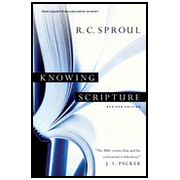
Why study the Bible? It may seem odd and foolish to raise this question since you probably would not be reading this book unless you were already convinced that Bible study is necessary. Our best intentions, however, are often weakened by our moods and caprice. Bible study often falls by the way. So, before we examine the practical guidelines for Bible study, let’s review some of the compelling reasons for studying the Bible at all.

TWO MYTHS

First, we will look at some of the reasons people give for not studying the Bible. These “reasons” often contain myths that are passed off as truisms through much repetition. The myth that claims first place in our hall of excuses is the idea that the Bible is too difficult for the ordinary person to understand.

Myth 1—The Bible is so difficult to understand that only highly skilled theologians with technical training can deal with the Scriptures.

This myth has been repeated many times by sincere people: “I know I can’t study the Bible, because every time I try to read it, I can’t understand it.” When some people say this, they may want to hear, “That’s all right. I understand. It’s really a difficult book, and unless you’ve had seminary training, maybe you shouldn’t try to tackle it.” Or perhaps they want to hear, “I know, it’s too heavy, too deep, too profound. I commend you for your tireless efforts, your strenuous labors in trying to solve the mystifying riddle of God’s Word. It is sad that God has chosen to speak to us in such obscure and esoteric language that only scholars can grasp it.” This, I am afraid, is what many of us want to hear. We feel guilty and want to quiet our consciences for neglecting our duty as Christians.

When we express this myth, we do it with astonishing ease. The myth is so often repeated that we do not expect it to be challenged. Yet we know that as mature, educated adults we can understand the basic message of the Bible. Indeed, the scholars who drafted and signed the Chicago Statement on Biblical Hermeneutics (1982) affirm “that a person is not dependent for understanding of Scripture on the expertise of biblical scholars.” If we can read the newspaper or blogs, we can read the Bible. In fact, I would venture to guess that more difficult words and concepts are expressed on the front page of a newspaper than on most pages of the Bible.

Myth 2—The Bible is boring.

If we press people for an explanation for what they mean when they express the first myth, usually they respond by saying, “Well, I guess I can understand it, but frankly the book bores me to death.” This statement reflects not so much an inability to understand what is read as a taste and preference for what we find interesting and exciting.

The preponderance of boredom that people experience with the Bible came home to me when I was hired to teach the Scriptures in required Bible courses at a Christian college. The president of the institution phoned me and said, “We need someone young and exciting, someone with a dynamic method who will be able to ‘make the Bible come alive.’ ” While I knew what the president was getting at, I nevertheless wanted to say, “You want me to make the Bible come alive? I didn’t know that it had died. In fact, I never even heard that it was ill. Who was the attending physician at the Bible’s demise?” No, I can’t make the Bible come alive for anyone. The Bible is already alive. It makes me come alive.

When people say the Bible is dull, it makes me wonder why. Biblical characters are full of life. There is a unique quality of passion about them. Their lives reveal drama, pathos, lust, crime, devotion and every conceivable aspect of human existence. There is rebuke, remorse, contrition, consolation, practical wisdom, philosophical reflection and, most of all, truth. Perhaps the dullness some experience is due to the antiquity and cultural distance of the material. How does the life of Abraham or of Timothy—lived so long ago and so far away—relate to us? But the characters of biblical history are real. Though their life settings are different from ours, their struggles and concerns are very much like ours.

THE CLARITY OF SCRIPTURE

In the sixteenth century the Reformers declared their total confidence in what they called the perspicuity of Scripture. What they meant by that technical term was the clarity of Scripture. They maintained that the Bible is basically clear and lucid. It is simple enough for any literate person to understand its basic message. This is not to say that all parts of the Bible are equally clear or that there are no difficult passages or sections to be found in it. Laypeople unskilled in the ancient languages and the fine points of exegesis may have difficulty with parts of Scripture, but the essential content is clear enough to be understood easily. Martin Luther, for example, was convinced that what was obscure and difficult in one part of Scripture was stated more clearly and simply in other parts of Scripture.

Some parts of the Bible are so clear and simple that they are offensive to those suffering from intellectual arrogance. I once was lecturing about how Christ’s death on the cross fulfilled the curse motif of the Old Testament. In the middle of my lecture a man in the audience interrupted me, saying loudly, “That’s primitive and obscene.” I asked him to repeat his comment so that everyone present could hear his complaint. When he repeated it, I said, “You are exactly right. I particularly like your choice of words, primitive and obscene.” The entire history of redemption is communicated in primitive terms, from the episode of the encounter of Adam and Eve with the serpent to the devastating destruction that God visits on the chariots of Egypt in the exodus to the crass and brutal murder of Jesus of Nazareth. The Bible reveals that God hears the groans of all of his people, from the peasant to the philosopher, from the dull-witted to the sophisticated scholar. His message is simple enough for the most simplistic of his fallen creatures to understand. What kind of a God would reveal his love and redemption in terms so technical and concepts so profound that only an elite corps of professional scholars could understand them?

God does speak in primitive terms because he is addressing himself to primitives. At the same time, there is enough profundity contained in Scripture to keep the most astute and erudite scholars busily engaged in their theological inquiries for a lifetime.

If primitive is an appropriate word to describe the content of Scripture, obscene is even more so. All of the obscenities of sin are recorded with clear and forthright language in the Scripture. And what is more obscene than the cross? Here we have obscenity on a cosmic scale. On the cross Christ takes upon himself human obscenities in order to redeem them.

If you have been one of those who have clung to the myths of dullness or difficulty, perhaps it is because you have attributed to the whole of Scripture what you have found in some of its parts. Maybe some passages have been peculiarly difficult and obscure. Other passages may have left you bewildered and baffled. Perhaps those should be left for the scholars to unravel. If you find certain portions of the Scripture difficult and complex, need you insist that the whole of Scripture is boring and dull?

Biblical Christianity is not an esoteric religion. Its content is not concealed in vague symbols that require some sort of special “insight” to grasp. There is no special intellectual prowess or spiritual gift that is necessary to under stand the basic message of Scripture. You may find that in Eastern religions where insight is limited to some guru who lives in a shanty high in the Himalayas. Maybe the guru has been thunderstruck by the gods with some profound mystery of the universe. You travel to inquire and he tells you in a hushed whisper that the meaning of life is the sound of “one hand clapping.” That’s esoteric. That’s so esoteric that even the guru does not understand it. He cannot understand it because it’s an absurdity. Absurdities often sound profound because they are incapable of being understood. When we hear things we do not understand, sometimes we think they are simply too deep or weighty for us to grasp when in fact they are merely unintelligible statements like “one hand clapping.” The Bible does not talk like that. The Bible speaks of God in meaningful patterns of speech. Some of those patterns may be more difficult than others, but they are not meant to be nonsense statements that only a guru can fathom.

 THE PROBLEM OF MOTIVATION

It is important to note that the theme of this book is not how to read the Bible but how to study the Bible. There is a great deal of difference between reading and studying. Reading is something we can do in a leisurely way, something that can be done strictly for entertainment in a casual manner. But study suggests labor, serious and diligent work.

Here then is the real problem of our negligence. We fail in our duty to study God’s Word not so much because it is difficult to understand, not so much because it is dull and boring, but because it is work. Our problem is not a lack of intelligence or a lack of passion. Our problem is that we are lazy.

Karl Barth (1886-1968), the famous Swiss theologian, once wrote that all human sin finds its roots in three basic human problems. He included pride (hubris), dishonesty and slothfulness in his list of rudimentary sins. None of these basic evils is instantly eradicated by spiritual regeneration. As Christians we must struggle against these problems through our entire pilgrimage. None of us is immune. If we are going to deal with the discipline of Bible study, we must recognize at the outset that we will need the grace of God to persevere.

The problem of slothfulness has been with us since the curse of the Fall. Our labor is now mixed with sweat. Weeds are easier to grow than grass. Newspapers are easier to read than the Bible is to study. The curse of labor is not magically removed simply because our task is the study of Scripture.

When I lecture to groups on the theme of studying the Bible, I often ask how many of the group members have been Christians for one year or more. Then I ask those people how many have read the entire Bible from cover to cover. In every instance, the overwhelming majority answer in the negative. I would venture to guess that among those who have been Christians for a year or more, at least 80 percent have never read the whole Bible. How is that possible? Only an appeal to the radical Fall of the human race could begin to answer that question. If you have read the whole Bible, you are in a small minority of Christian people.

If you have studied the Bible, you are in an even smaller minority. Isn’t it amazing that almost everyone living in the West has an opinion to offer about the Bible, and yet so few have really studied it? Sometimes it seems as though the only people who take the time to study it are those with the sharpest axes to grind against it. Many people study it to find possible loopholes so they can get out from under the weight of its authority.

Biblical ignorance is not limited to laypeople by any means. I have sat on church boards responsible for the examination of seminarians preparing for the pastoral ministry. The degree of biblical ignorance manifested by many of these students is appalling. Seminary curricula have not done much to alleviate the problem. Every year many churches ordain people who are virtually ignorant of the content of Scripture.

I was shocked when I took a test in biblical knowledge for entrance to the theological seminary from which I graduated. After I completed my exam, I was deeply embarrassed, ashamed to hand in my paper. I had taken several courses in college that I thought would prepare me for such a test, but when the test came I was not ready. I left question after question blank and was certain that I had failed. When the grades were posted, I discovered that I had received one of the highest grades in a group of seventy-five students. Even with the grades scaled, there were several students who scored less than 10 out of a possible grade of 100. My score was poor, yet it was one of the best of the bad.

Biblical illiteracy among the clergy has become so prevalent that I often find pastors getting annoyed and angry when their parishioners ask them to teach them the Bible. In many cases pastors live in mortal fear that their ignorance will be exposed by being thrust into a situation where they are expected to teach the Bible.

THE BIBLICAL BASIS FOR BIBLE STUDY

The Bible itself has much to say about the importance of studying the Bible. We will examine two passages, one from each Testament, in order to catch a glimpse of these mandates.

In Deuteronomy 6 we find a passage that was familiar to every Jew of the Old Testament. Its words were used to call the assembly together for worship. We read: “Hear, O Israel! The LORD is our God, the LORD is one! You shall love the LORD your God with all your heart and with all your soul and with all your might” (vv. 4-5). Most of us are familiar with these words. But what follows them immediately? Read on:

“These words, which I am commanding you today, shall be on your heart. You shall teach them diligently to your sons and shall talk of them when you sit in your house and when you walk by the way and when you lie down and when you rise up. You shall bind them as a sign upon your hand and they shall be as frontals on your forehead. You shall write them on the doorposts of your house and on your gates” (vv. 6-9).

Here God sovereignly commands that his Word be taught so diligently that it penetrates the heart. The content of that Word is not to be mentioned casually and infrequently. Repeated discussion is the order of the day, every day. The call to bind on the hand, the forehead, the doorpost and gate makes it clear that God is saying that the job must be done by whatever method it takes.

Looking at the New Testament we read Paul’s admonition to Timothy:

“You, however, continue in the things you have learned and become convinced of, knowing from whom you have learned them, and that from childhood you have known the sacred writings which are able to give you the wisdom that leads to salvation through faith which is in Christ Jesus. All Scripture is inspired by God and profitable for teaching, for reproof, for correction, for training in righteousness; so that the man of God may be adequate, equipped for every good work” (2 Tim 3:14-17).

This exhortation is so basic to our understanding of the importance of Bible study that it warrants a careful scrutiny.

“Continue in the things you have learned” (v. 14). This part of the admonition lays the accent on continuity. Our study of Scripture is not to be a once-for-all matter. There is no room for the proverbial once-over-lightly. Consistency is necessary for a sound basis of biblical studies.

“Sacred writings which are able to give you the wisdom that leads to salvation” (v. 15). Paul refers to the Scripture’s ability to give wisdom. When the Bible speaks of wisdom, it refers to a special kind of wisdom. The term is not used to connote an ability to be “worldly wise” or to have the cleverness necessary to write a Poor Richard’s Almanack.

In biblical terms, wisdom has to do with the practical matter of learning how to live a life that is pleasing to God. A cursory glance at the Wisdom Literature of the Old Testament makes this emphasis abundantly clear. Proverbs, for example, tells us that wisdom begins with the “fear of the LORD” (Prov 1:7; 9:10). That fear is not a servile fear but a posture of awe and reverence, which is necessary for authentic godliness. The Old Testament distinguishes between wisdom and knowledge. We are commanded to acquire knowledge, but more to acquire wisdom. Knowledge is necessary if wisdom is to be gained, but it is not identical with wisdom. A person can have knowledge without having wisdom, but he or she cannot have wisdom without having knowledge. A person without knowledge is ignorant. A person without wisdom is deemed a fool. In biblical terms foolishness is a moral matter and receives the judgment of God. Wisdom in the highest sense is being wise with respect to salvation. Thus wisdom is a theological matter. Paul is saying that through the Scriptures we can acquire that kind of wisdom that concerns our ultimate fulfillment and destiny as human beings.

“Knowing from whom you have learned them” (v. 14). Who is this “whom” Paul is talking about? Is he referring to Timothy’s grandmother? Or to Paul himself? These options are doubtful. Whom refers to the ultimate source of the knowledge Timothy has acquired, namely, God. This comes out more clearly in the statement “All Scripture is inspired by God.”

“Scripture is inspired by God” (v. 16). This passage has been the focal point of volumes of theological literature that describe and analyze theories of biblical inspiration. The crucial word in the passage is the Greek term theopneustos, which is often translated by the phrase “inspired by God.” The term more precisely means “God-breathed,” which refers not so much to God’s breathing something “in” as to his breathing something “out.” Rather than the term inspiration, we may be better advised to render the Greek by the English expiration. In that case we would see the significance of the passage not so much in providing us with a theory of inspiration—a theory of how God transmitted his Word through human authors—but rather a statement of the origin or source of Scripture. What Paul is saying to Timothy is that the Bible comes from God. He is its ultimate author. It is his word; it comes from him; it carries the weight of all that he is. Thus the injunction to remember “from whom you have learned them [these things].”

“Scripture is profitable for teaching” (v. 16). One of the most important priorities Paul mentions is the preeminent way in which the Bible profits us. The first and indeed foremost profit is the profit of teaching or instruction. We may pick up the Bible and be “inspired” or moved to tears or other poignant emotions. But our greatest profit is in being instructed. Again, our instruction is not in matters of how to build a house or how to multiply and divide or how to employ the science of differential equations; rather we are instructed in the things of God. This instruction is called “profitable” because God himself places an extremely high value on it. The instruction is assigned worth and significance.

Countless times I have heard Christians say, “Why do I need to study doctrine or theology when all I need to know is Jesus?” My immediate reply is, “Who is Jesus?” As soon as we begin to answer this question, we are involved in doctrine and theology. No Christian can avoid theology. Every Christian is a theologian. Perhaps not a theologian in the technical or professional sense, but a theologian nevertheless. The issue for Christians is not whether we are going to be theologians but whether we are going to be good theologians. A good theologian is one who is instructed by God.

“Scripture is profitable for reproof, correction, and training in righteousness” (v. 16). In these words Paul articulates the practical value of Bible study. As fallen creatures we sin, we err, and we are inherently out of shape with respect to righteousness. When we sin, we need to be reproved. When we err, we need to be corrected. When we are out of shape, we need to go into training. The Scriptures function as our chief reprover, our chief corrector and our chief trainer. The bookstores of this world are filled with books on training methods to acquire excellence in sports, to lose weight and get our physical figures into shape, and to acquire skills in all areas. Libraries have stacks of books written to teach us financial management and the nuances of wise investment policies. We can find many books that will teach us how to turn our losses into profits, our liabilities into assets. But where are the books that will train us in righteousness? The question still remains, “What will it profit a man if he gains the whole world and forfeits his soul?” (Mt 16:26).

“That the man of God may be adequate, equipped for every good work” (v. 17). The Christian who is not diligently involved in a serious study of Scripture is simply inadequate as a disciple of Christ. To be an adequate Christian and competent in the things of God we must do more than attend “sharing sessions” and “bless me parties.” We cannot learn competency by osmosis. Biblically illiterate Christians are not only inadequate but unequipped. In fact, they are inadequate because they are not equipped. An NFL star may be able to run barefoot, but when playing a league opponent he will be sure to wear cleats.

THE BIBLE AS REVELATION

One of the most important advantages the Bible gives us is that it provides information that is not available anywhere else. Our universities provide us with a wealth of knowledge acquired by human investigation of the natural world. We learn by observation, analysis and abstract speculation. We compare and contrast varied opinions from notable scholars. But with all the skills of knowledge that we have at our disposal in this world, there is no one who can speak to us from a transcendent perspective, no one who can reason with us, as the philosophers say, sub species aeternitatis (from the eternal perspective).

Only God can provide us with an eternal perspective and speak to us with absolute and final authority. The advantage of the equipment provided by Scripture is that knowledge is made available to us that can be learned from no other source. The Scripture does, of course, talk of matters that can be learned by other means. We are not utterly dependent on the New Testament to learn who Caesar Augustus was or how far it is from Jerusalem to Bethany. But the world’s best geographer cannot show us the way to God, and the world’s best psychiatrist cannot give us a final answer to the problem of our guilt. There are matters contained in Holy Writ that “unveil” for us that which is not exposed to the natural course of human investigation.

Though much can be learned about God from a study of nature, it is his self-revelation in Scripture that is most complete and most valuable for us. There is an analogy between how we get to know people in this world and how we become acquainted with God. If we want to learn something about a human being, let’s say Bill Monroe, there are many ways we can go about it. We could do a search on the Internet, perhaps first Googling his name. If we had the right connections, we might ask the FBI or the CIA for their files on him. We could send for his high school and college transcripts. Through such records we might discover his basic biographical history, medical record, academic and athletic achievement records. We could then interview his friends to get a more personal evaluation. But all these methods are indirect, and many of Bill’s intangible qualities will remain obscured to our scrutiny. All these methods are but secondary sources of information.

If we want more accurate knowledge of Bill Monroe, we should meet him personally, observe his outward appearance, see how he behaves, what mannerisms he employs. We may even be able to guess how he is feeling, what he is thinking, what he values and what displeases him. But if we want to gain intimate knowledge of him we have to engage in some kind of verbal communication with him. No one can express more clearly or more accurately what he believes, feels or thinks than Bill himself. Unless Bill chooses to reveal those things verbally, our knowledge will be limited to guesswork and speculation. Only words will enlighten us.

Likewise, when we speak about the concept of revelation, we are talking about the basic principle of self-disclosure. The Scriptures come to us as divine self-disclosure. Here the mind of God is laid bare on many matters. With a knowledge of Scripture we do not have to rely on secondhand information or bare speculation to learn who God is and what he values. In the Bible he reveals himself.

THEORY AND PRACTICE

Like the Christian who shuns theology, there are those who despise any kind of quest for theoretical knowledge of God, insisting instead on being “practical.” The spirit of America has been defined as the spirit of pragmatism. This spirit is manifested nowhere more clearly than in the arena of politics and in the public school system, which has been informed by the principles and methods of education set down by John Dewey.

Pragmatism may be defined simply as the approach to reality that defines truth as “that which works.” The pragmatist is concerned about results, and the results determine the truth. The problem with this kind of thinking, if left uninformed by the eternal perspective, is that the results tend to be judged in terms of short-range goals.

I experienced this dilemma when my daughter enrolled in kindergarten. She attended a very progressive public school outside of Boston. After a few weeks we received notification from the school that the principal was holding an open meeting for parents in order to explain the program and procedures employed in the kindergarten. At the meeting the principal carefully explained the daily schedule. He said, “Don’t be alarmed if your child comes home and tells you that he was playing with puzzles or modeling clay in school. I can assure you that everything in the daily routine is done with a purpose. From 9:00 to 9:17 a.m. the children play with puzzles that are carefully designed by orthopedic experts to develop the motor muscles of the last three fingers of the left hand.” He went on to explain how every minute of the child’s day was planned with skilled precision to insure that everything was done with a purpose. I was duly impressed.

At the end of his presentation the principal asked for questions. I raised my hand and said, “I am deeply impressed by the careful planning that has gone into this program. I can see that everything is done with a purpose in view. My question is, How do you decide which ‘purposes’ to employ? What final purpose do you use to decide the individual purposes? What is the overall purpose of your purposes? In other words, what kind of a child are you trying to produce?”

The man turned white and then scarlet, and in stumbling terms he replied, “I don’t know; no one ever asked me that question.” I appreciated the candor of his reply and the genuine humility it displayed, yet at the same time, his answer terrified me.

In Your Mind Matters John Stott writes: The modern world breeds pragmatists, whose first question about any idea is not “Is it true?” but “Does it work?” Young people tend to be activists, dedicated supporters of a cause, though without always inquiring too closely whether their cause is a good end to pursue or whether their action is the best means by which to pursue it.

How can we have purposes without purpose? Where can we go to discover the ultimate test for our pragmatism? Here is where transcendent revelation is most critical to our lives. Here is where the content of Scripture is most relevant for our practice. God alone can give us the final evaluation of wisdom and value of our practices.

People who despise theory and call themselves practical are not wise. Those who concern themselves only with short-term goals may have big trouble when it comes to the very long run of eternity. It must also be added that there is no practice without some underlying theory. We do what we do because we have a theory, even if only implicit, about the value of doing it. Nothing betrays our deepest theories more eloquently than our practice. We may never think seriously about our theories or subject them to rigorous critical analysis, but we all have them. As in the case of the Christian who wants Christ without theology, so the person who wants practice without theory will usually wind up with bad theories that lead to bad practice.

Because the theories found in Scripture proceed from God, the Bible is eminently practical. Nothing could be more practical than God’s Word because it proceeds from a theory that is established from the eternal perspective. The fatal weakness of pragmatism is overcome by revelation.

THE SENSUOUS CHRISTIAN

The last quarter of the twentieth century witnessed the public embrace of the “sensuous.” The Sensuous Woman, The Sensuous Man, The Sensuous Couple and The Sensuous Divorcee became bestsellers, and some remain in print decades later! One dictionary defines sensuous as, “pertaining to the senses or sensible objects: highly susceptible to influence through the senses.” In other words, sensuous people live by their feelings rather than through their understanding. Today on television we can see this sensuality prominently displayed. Famous TV talk-show hosts often encourage their guests to “vent,” exposing their private feelings and emotions to millions of viewers.

Sadly, this kind of sensuality has also wormed its way into the church. Many of us have become sensuous Christians, living by our feelings rather than through our understanding of the Word of God. Sensuous Christians cannot be moved to service, prayer or study unless they “feel like it.” Their Christian life is only as effective as the intensity of present feelings. When they experience spiritual euphoria, they are a whirlwind of godly activity; when they are depressed, they are a spiritual incompetent. They constantly seek new and fresh spiritual experiences, and use them to determine the Word of God. Their “inner feelings” become the ultimate test of truth.

Sensuous Christians don’t need to study the Word of God because they already know the will of God by their feelings. They don’t want to know God; they want to experience him. Sensuous Christians equate “childlike faith” with ignorance. They think that when the Bible calls us to childlike faith, it means a faith without content, a faith without understanding. They don’t know the Bible says, “In evil be infants, but in your thinking be mature” (1 Cor. 14:20). They don’t realize that Paul tells us again and again, “My beloved brethren, I would not have you ignorant” (Romans 11:25).

Sensuous Christians go their merry way until they encounter the pain of life that is not so merry—and they fold. They usually end up embracing a kind of “relational theology” (a curse on modern Christianity) where personal relationships and experience take precedence over the Word of God. If the Scripture calls us to action that may jeopardize a personal relationship, then the Scripture must be compromised. The highest law of sensuous Christians is that bad feelings must be avoided at all cost.

The Bible is addressed primarily, though not exclusively, to our understanding. That means the mind. This is difficult to communicate to modern Christians who are living in what may be the most anti-intellectual period of Western civilization. Notice, I did not say anti-academic or anti-technological or anti-scholarly. I said anti-intellectual. There is a strong current of antipathy to the function of the mind in the Christian life.

To be sure, there are historical reasons for this kind of reaction. Many laypeople have felt the result of what one theologian has called “the treason of the intellectual.” So much skepticism, cynicism and negative criticism have spewed forth from the intellectual world of theologians that laypeople have lost their trust in intellectual enterprises. In many cases there is the fear that faith will not hold up under intellectual scrutiny, so the defense becomes the denigration of the human mind. We turn to feelings rather than to our minds to establish and preserve our faith. This is a very serious problem we face in the twenty-first-century church.

Christianity is supremely intellectual though not intellectualistic. That is, Scripture is addressed to the intellect without at the same time embracing a spirit of intellectualism. The Christian life is not to be a life of bare conjecture or cold rationalism but one of vibrant passion. Strong feelings of joy, love and exaltation are called for again and again. But those passionate feelings are a response to what we understand with our minds to be true. When we red in Scripture, “Take courage; I have overcome the world” (Jn. 16:33), “ho hum” is not an appropriate response. We can be of good cheer because we understand that Christ has indeed overcome the world. That thrills our souls and sets our feet to dancing. What is more precious than to experience the sweetness of the presence of Christ or the nearness of the Holy Spirit?

God forbid that we should lose our passion or go through the Christian pilgrimage without any experience of Christ. But what happens when there is a conflict between what God says and what I feel? We must do what God says, like it or not. That is what Christianity is all about.

Reflect for a moment. What happens in your own life when you act according to what you feel like doing rather than what you know and understand God says you should do? Here we encounter the ruthless reality of the difference between happiness and pleasure. How easy it is to confuse the two! The pursuit of happiness is regarded as our “unalienable right.” But happiness and pleasure are not the same thing. Both of them feel good, but only one endures. Sin can bring pleasure, but never happiness. If sin were not so pleasurable, it would hardly represent a temptation. Yet, while sin often “feels good,” it does not produce happiness. If we do not know the difference or, worse yet, do not care about the difference, we have made great strides to becoming the ultimate sensuous Christian.

It is precisely at the point of discerning the difference between pleasure and happiness that knowledge of Scripture is so vital. There is a remarkable relationship between God’s will and human happiness. The fundamental deception of Satan is the lie that obedience can never bring happiness. From the primordial temptation of Adam and Eve to last night’s satanic seduction, the lie has been the same. “If you do what God says, you will not be happy. If you do what I say, you will be ‘liberated’ and know happiness.”

What would have to be true for Satan’s argument to be true? It would seem that God would have to be one of three things: ignorant, malevolent or deceptive. It could be that God’s Word will not work for us because it proceeds from his divine blunderings. God simply doesn’t know enough to tell us what we need to do to achieve happiness. Perhaps he desires our well-being, but simply does not know enough to instruct us properly. He would like to help us out, but the complexities of human life and human situations just boggle his mind.

Perhaps God is infinitely wise and knows what is good for us better than we do. Perhaps he does understand human complexities better than the philosophers, moralists, politicians, school teachers, pastors and psychiatrists, but he hates us. He knows the truth but leads us astray so he can remain the only happy being in the cosmos. Perhaps his law is an expression of his desire to take gleeful delight in our misery. Thus his malevolence toward us leads to the role of great Deceiver. Nonsense! If that were true, then the only conclusion we could come to is that God is the devil and devil is God, and Holy Scripture is really the manual of Satan.

Absurd? Unthinkable? I wish it were. In literally thousands of pastors’ studies, people are being counseled to act against Scripture because the pastor wants them to be happy. “Yes, Mrs. Jones, go ahead and divorce your husband (despite the fact that she is without biblical warrant), for I am sure you will never find happiness married to a man like that.”

If there is a secret, a carefully guarded secret, to human happiness, it is that one expressed in a seventeenth-century catechism that says, “Man’s chief end is to glorify God and to enjoy Him forever.” The secret to happiness is found in obedience to God. How can we be happy if we are not obedient? How can we be obedient if we do not know what it is we are to obey? Thus the top and the tail of it is that happiness cannot be fully discovered as long as we remain ignorant of God’s Word.

To be sure, knowledge of God’s Word does not guarantee that we will do what it says, but at least we will know what we are supposed to be doing in our quest for human fulfillment. The issue of faith is not so much whether we believe in God, but whether we believe the God we believe in.

A MATTER OF DUTY

Why should we study the Bible? I have mentioned briefly the practical value, the ethical importance and the way of happiness. We have looked at some of the myths that are given why people do not study the Bible. We have examined something of the spirit of pragmatism and the anti-intellectual climate of our day. There are many facets to the question and countless reasons why we ought to study the Bible.

I could plead with you to study the Bible for personal edification; I could try the art of persuasion to stimulate your quest for happiness. I could say that the study of the Bible would probably be the most fulfilling and rewarding educational experience of your life. I could cite numerous reasons why you would benefit from a serious study of Scripture. But ultimately the main reason why we should study the Bible is because it is our duty.

If the Bible were the most boring book in the world—dull, uninteresting and seemingly irrelevant—it would still be our duty to study it. If its literary style were awkward and confusing, the duty would remain. We live as human beings under an obligation by divine mandate to study diligently God’s Word. He is our Sovereign, it is his Word, and He commands that we study it. A duty is not an option. If you have not yet begun to respond to that duty, then you need to ask God to forgive you and to resolve to do your duty from this day forth.

About the Author: Dr. R.C. Sproul (Founder of Ligonier Ministries; Seminary Professor; and Teaching Pastor at Saint Andrews in Sanford, Florida) is an amazingly gifted communicator. Whether he is teaching, preaching, or writing – he has the ability to make the complex easy to understand. He has been used more than any other person in my life to deepen my walk with Christ and help me to be more God-centered than man-centered. His book the Holiness of God has been the most influential book in my life – outside of the Bible. The article above is adapted from Chapter One in another one of his excellent books: Knowing Scripture. Downers Grove: IVP, 2009. Knowing Scripture is an excellent introductory book on how to read, study, and interpret the Bible.

Dr. R.C. Sproul on Making Your Calling and Election Sure

“Fear Not”

We are fragile mortals, given to fears of every sort. We have a built-in insecurity that no amount of whistling in the dark can mollify. We seek assurance concerning the things that frighten us the most.

The prohibition uttered most frequently by our Lord is the command, “Fear not.” He said this so often to his disciples and others he encountered that it almost came to sound like a greeting. Where most people greet others by saying “Hi” or “Hello,” the first words of Jesus often were “Fear not.”

Why? Perhaps Jesus’ predilection for those words grew out of his acute sense of the thinly veiled fear that grips all who approach the living God. We fear his power, we fear his wrath, and most of all we fear his ultimate rejection.

The assurance we need most is the assurance of salvation. Though we are loathe to think much about it or contemplate it deeply, we know, if only intuitively, that the worst catastrophe that could ever befall us is to be visited by God’s final punitive wrath. Our insecurity is worsened by the certainty that we deserve it.

Many believe that assurance of eternal salvation is neither possible or even to be sought. To claim such assurance is considered a mask of supreme arrogance, the nadir of self-conceit.

Yet, if God declares that it is possible to have full assurance of salvation and even commands that we seek after it, then it would be supremely arrogant to deny our need or neglect the search.

In fact, God does command us to make our election and calling sure: Therefore, my brothers, be all the more eager to make your calling and election sure. For if you do these things, you will never fall” (2 Pet. 1:10).

This command admits of no justifiable neglect. It addresses a crucial matter. The question, “Am I saved?” is one of the most important I can ever ask myself. I need to know the answer; I must know the answer. This is not a trifle. Without the assurance of salvation the Christian life is unstable, vulnerable to the debilitating rigors of mood changes. Basing assurance on changing emotions allows the wolf of heresy to camp on the doorstep. Progress in sanctification requires a firm foundation in faith. Assurance is the cement of that foundation. Without it the foundation crumbles.

How, then, do we receive assurance? The Scripture declares that the Holy Spirit bears witness with our spirit that we are the children of God. This inner testimony of the Holy Spirit is as vital as it is complex. It can be subjected to severe distortions, being confused with subjectivism and self-delusion. The Spirit gives his testimony with the Word and through the Word, never without the Word or against the Word.

Since it is possible to have false assurance of salvation it is all the more urgent that we seek the Spirit’s testimony in and through the Word. False assurance usually proceeds from a faulty understanding of salvation. If one fails to understand the necessary conditions for salvation, assurance becomes, at best, a guess.

Therefore, we insist that right doctrine is a crucial element in acquiring a sound basis for assurance. It may even be a necessary condition, though it is by no means a sufficient condition. Without sound doctrine we will have an inadequate understanding of salvation. However, having a sound understanding of salvation is no guarantee that we have the salvation we so soundly understand.

If we think the Bible teaches universal salvation we may arrive at a false sense of assurance by reasoning as follows:

Everybody is saved.

I am a body.

Therefore, I am saved.

Or, if we think salvation is gained by our own good works and we are further deluded into believing that we possess good works, we will have a false assurance of salvation.

To have sound assurance we must understand that our salvation rests upon the merit of Christ alone, which is appropriated to us when we embrace him by genuine faith. If we understand that, the remaining question is, “Do I have the genuine faith necessary for salvation?”

To answer that question two more things must be understood and analyzed properly. The first is doctrinal. We need a clear understanding of what constitutes genuine saving faith. If we conceive of saving faith as a faith that exists in a vacuum, never yielding the fruit of works of obedience, we have confused saving faith with dead faith, which cannot save anyone.

The second requirement involves a sober analysis of our own lives. We must examine ourselves to see if the fruit of regeneration is apparent in us. Do we have a real affection for the biblical Christ? Only the regenerate person possesses real love for the real Jesus. Next we must ask the tough question, “Does my life manifest the fruit of sanctification?” I test my faith by my works.

I call this last question the tough question for various reasons. We can lose assurance if we think perfect obedience is the test. Every sin we commit after conversion can cast doubt upon our assurance. That doubt is exacerbated by Satan’s assault of accusation against us. Satan delights in shaking the true Christian’s assurance.

Or we can delude ourselves by looking at our own works with an exalted view of our goodness, seeing virtue in ourselves when there is none. Here we quake in terror before our Lord’s warning: “Many will say to me on that day, ‘Lord, Lord, did we not prophesy in your name, and in your name drive out demons and perform many miracles?’ Then I will tell them plainly, ‘I never knew you. Away from me, you evildoers!’” (Matt. 7:22–23).

Real assurance rests on a sound understanding of salvation, a sound understanding of justification, a sound understanding of sanctification, and a sound understanding of ourselves. In all these matters we have the comfort and assistance of the Holy Spirit who illumines the text of Scripture for us, who works in us to yield the fruit of sanctification, and who bears witness with our spirit that we are the children of God.

The article above adapted from Chapter 7 in the short book edited by Dr. R.C. Sproul. Doubt & Assurance. Grand Rapids: Baker, 2000.

About Dr. R.C. Sproul: He is the founder and chairman of Ligonier Ministries, an international Christian education ministry located near Orlando, Florida. His teaching can be heard on the program Renewing Your Mind, which is broadcast on hundreds of radio outlets in the United States and in 40 countries worldwide. He is the executive editor of Tabletalk magazine and general editor of The Reformation Study Bible, and the author of more than seventy books (including some of my all time favorites: The Holiness of God; Chosen By God; Reason to Believe; Knowing Scripture; Willing to Believe;  Intimate Marriage; Pleasing God; If There’s A God, Why Are There Atheists?, and Defending The Faith) and scores of articles for national evangelical publications. Dr. Sproul also serves as president of Ligonier Academy of Biblical and Theological Studies and Reformation Bible College. He currently serves as Senior Minister of preaching and teaching at Saint Andrew’s in Sanford, FL.

Dr. R.C. Sproul on the Essence of God’s Sovereignty in Our Salvation

The Pelagian Captivity of the Church

by R.C. Sproul

Shortly after the Reformation began, in the first few years after Martin Luther posted the Ninety-Five Theses on the church door at Wittenberg, he issued some short booklets on a variety of subjects. One of the most provocative was titled The Babylonian Captivity of the Church. In this book Luther was looking back to that period of Old Testament history when Jerusalem was destroyed by the invading armies of Babylon and the elite of the people were carried off into captivity. Luther in the sixteenth century took the image of the historic Babylonian captivity and reapplied it to his era and talked about the new Babylonian captivity of the Church. He was speaking of Rome as the modern Babylon that held the Gospel hostage with its rejection of the biblical understanding of justification. You can understand how fierce the controversy was, how polemical this title would be in that period by saying that the Church had not simply erred or strayed, but had fallen — that it’s actually now Babylonian; it is now in pagan captivity.

I’ve often wondered if Luther were alive today and came to our culture and looked, not at the liberal church community, but at evangelical churches, what would he have to say? Of course I can’t answer that question with any kind of definitive authority, but my guess is this: If Martin Luther lived today and picked up his pen to write, the book he would write in our time would be entitled The Pelagian Captivity of the Evangelical Church. Luther saw the doctrine of justification as fueled by a deeper theological problem. He writes about this extensively in The Bondage of the Will. When we look at the Reformation and we see the solas of the Reformation — sola Scriptura, sola fide, solus Christus, soli Deo gloria, sola gratia — Luther was convinced that the real issue of the Reformation was the issue of grace; and that underlying the doctrine of solo fide, justification by faith alone, was the prior commitment to sola gratia, the concept of justification by grace alone.

In the Fleming Revell edition of The Bondage of the Will, the translators, J. I. Packer and O. R. Johnston, included a somewhat provocative historical and theological introduction to the book itself. This is from the end of that introduction:

These things need to be pondered by Protestants today. With what right may we call ourselves children of the Reformation? Much modern Protestantism would be neither owned nor even recognised by the pioneer Reformers. The Bondage of the Will fairly sets before us what they believed about the salvation of lost mankind. In the light of it, we are forced to ask whether Protestant Christendom has not tragically sold its birthright between Luther’s day and our own. Has not Protestantism today become more Erasmian than Lutheran? Do we not too often try to minimise and gloss over doctrinal differences for the sake of inter-party peace? Are we innocent of the doctrinal indifferentism with which Luther charged Erasmus? Do we still believe that doctrine matters? (J.I. Packer and O.R. Johnston, “Introduction” to the Bondage of the Will. Old Tappan, NJ: Fleming Revell, 1957: pp. 59-60)

Historically, it’s a simple matter of fact that Luther, Calvin, Zwingli, and all the leading Protestant theologians of the first epoch of the Reformation stood on precisely the same ground here. On other points they had their differences. In asserting the helplessness of man in sin and the sovereignty of God in grace, they were entirely at one. To all of them these doctrines were the very lifeblood of the Christian faith. A modern editor of Luther’s works says this:

Whoever puts this book down without having realized that Evangelical theology stands or falls with the doctrine of the bondage of the will has read it in vain. The doctrine of free justification by faith alone, which became the storm center of so much controversy during the Reformation period, is often regarded as the heart of the Reformers’ theology, but this is not accurate. The truth is that their thinking was really centered upon the contention of Paul, echoed by Augustine and others, that the sinner’s entire salvation is by free and sovereign grace only, and that the doctrine of justification by faith was important to them because it safeguarded the principle of sovereign grace. The sovereignty of grace found expression in their thinking at a more profound level still in the doctrine of monergistic regeneration (Ibid).

That is to say, that the faith that receives Christ for justification is itself the free gift of a sovereign God. The principle of sola fide is not rightly understood until it is seen as anchored in the broader principle of sola gratia. What is the source of faith? Is it the God-given means whereby the God-given justification is received, or is it a condition of justification which is left to man to fulfill? Do you hear the difference? Let me put it in simple terms. I heard an evangelist recently say, “If God takes a thousand steps to reach out to you for your redemption, still in the final analysis, you must take the decisive step to be saved.” Consider the statement that has been made by America’s most beloved and leading evangelical of the twentieth century, Billy Graham, who says with great passion, “God does ninety-nine percent of it but you still must do that last one percent.”

What Is Pelagianism?

Now, let’s return briefly to my title, “The Pelagian Captivity of the Church.” What are we talking about? Pelagius was a monk who lived in Britain in the fifth century. He was a contemporary of the greatest theologian of the first millennium of Church history if not of all time, Aurelius Augustine, Bishop of Hippo in North Africa. We have heard of St. Augustine, of his great works in theology, of his City of God, of his Confessions, and so on, which remain Christian classics.

Augustine, in addition to being a titanic theologian and a prodigious intellect, was also a man of deep spirituality and prayer. In one of his famous prayers, Augustine made a seemingly harmless and innocuous statement in the prayer to God in which he says: “O God, command what you wouldst, and grant what thou dost command.” Now, would that give you apoplexy — to hear a prayer like that? Well it certainly set Pelagius, this British monk, into orbit. When he heard that, he protested vociferously, even appealing to Rome to have this ghastly prayer censured from the pen of Augustine. Here’s why. He said, “Are you saying, Augustine, that God has the inherent right to command anything that he so desires from his creatures? Nobody is going to dispute that. God inherently, as the creator of heaven and earth, has the right to impose obligations on his creatures and say, ‘Thou shalt do this, and thou shalt not do that.’ ‘Command whatever thou would’ — it’s a perfectly legitimate prayer.”

It’s the second part of the prayer that Pelagius abhorred when Augustine said, “and grant what thou dost command.” He said, “What are you talking about? If God is just, if God is righteous and God is holy, and God commands of the creature to do something, certainly that creature must have the power within himself, the moral ability within himself, to perform it or God would never require it in the first place.” Now that makes sense, doesn’t it? What Pelagius was saying is that moral responsibility always and everywhere implies moral capability or, simply, moral ability. So why would we have to pray, “God grant me, give me the gift of being able to do what you command me to do”? Pelagius saw in this statement a shadow being cast over the integrity of God himself, who would hold people responsible for doing something they cannot do.

So in the ensuing debate, Augustine made it clear that in creation, God commanded nothing from Adam or Eve that they were incapable of performing. But once transgression entered and mankind became fallen, God’s law was not repealed nor did God adjust his holy requirements downward to accommodate the weakened, fallen condition of his creation. God did punish his creation by visiting upon them the judgment of original sin, so that everyone after Adam and Eve who was born into this world was born already dead in sin. Original sin is not the first sin. It’s the result of the first sin; it refers to our inherent corruption, by which we are born in sin, and in sin did our mothers conceive us. We are not born in a neutral state of innocence, but we are born in a sinful, fallen condition. Virtually every church in the historic World Council of Churches at some point in their history and in their creedal development articulates some doctrine of original sin. So clear is that to the biblical revelation that it would take a repudiation of the biblical view of mankind to deny original sin altogether.

This is precisely what was at issue in the battle between Augustine and Pelagius in the fifth century. Pelagius said there is no such thing as original sin. Adam’s sin affected Adam and only Adam. There is no transmission or transfer of guilt or fallenness or corruption to the progeny of Adam and Eve. Everyone is born in the same state of innocence in which Adam was created. And, he said, for a person to live a life of obedience to God, a life of moral perfection, is possible without any help from Jesus or without any help from the grace of God. Pelagius said that grace — and here’s the key distinction — facilitates righteousness. What does “facilitate” mean?

It helps, it makes it more facile, it makes it easier, but you don’t have to have it. You can be perfect without it. Pelagius further stated that it is not only theoretically possible for some folks to live a perfect life without any assistance from divine grace, but there are in fact people who do it. Augustine said, “No, no, no, no . . . we are infected by sin by nature, to the very depths and core of our being — so much so that no human being has the moral power to incline himself to cooperate with the grace of God. The human will, as a result of original sin, still has the power to choose, but it is in bondage to its evil desires and inclinations. The condition of fallen humanity is one that Augustine would describe as the inability to not sin. In simple English, what Augustine was saying is that in the Fall, man loses his moral ability to do the things of God and he is held captive by his own evil inclinations.

In the fifth century the Church condemned Pelagius as a heretic. Pelagianism was condemned at the Council of Orange, and it was condemned again at the Council of Florence, the Council of Carthage, and also, ironically, at the Council of Trent in the sixteenth century in the first three anathemas of the Canons of the Sixth Session. So, consistently throughout Church history, the Church has roundly and soundly condemned Pelagianism  —  because Pelagianism denies the fallenness of our nature; it denies the doctrine of original sin.

Now what is called semi-Pelagianism, as the prefix “semi” suggests, was a somewhat middle ground between full-orbed Augustinianism and full-orbed Pelagianism. Semi-Pelagianism said this: yes, there was a fall; yes, there is such a thing as original sin; yes, the constituent nature of humanity has been changed by this state of corruption and all parts of our humanity have been significantly weakened by the fall, so much so that without the assistance of divine grace nobody can possibly be redeemed, so that grace is not only helpful but it’s absolutely necessary for salvation. While we are so fallen that we can’t be saved without grace, we are not so fallen that we don’t have the ability to accept or reject the grace when it’s offered to us. The will is weakened but is not enslaved. There remains in the core of our being an island of righteousness that remains untouched by the fall. It’s out of that little island of righteousness, that little parcel of goodness that is still intact in the soul or in the will that is the determinative difference between heaven and hell. It’s that little island that must be exercised when God does his thousand steps of reaching out to us, but in the final analysis it’s that one step that we take that determines whether we go to heaven or hell — whether we exercise that little righteousness that is in the core of our being or whether we don’t. That little island Augustine wouldn’t even recognize as an atoll in the South Pacific. He said it’s a mythical island, that the will is enslaved, and that man is dead in his sin and trespasses.

Ironically, the Church condemned semi-Pelagianism as vehemently as it had condemned original Pelagianism. Yet by the time you get to the sixteenth century and you read the Catholic understanding of what happens in salvation the Church basically repudiated what Augustine taught and Aquinas taught as well. The Church concluded that there still remains this freedom that is intact in the human will and that man must cooperate with — and assent to — the prevenient grace that is offered to them by God. If we exercise that will, if we exercise a cooperation with whatever powers we have left, we will be saved. And so in the sixteenth century the Church reembraced semi-Pelagianism.

At the time of the Reformation, all the reformers agreed on one point: the moral inability of fallen human beings to incline themselves to the things of God; that all people, in order to be saved, are totally dependent, not ninety-nine percent, but one hundred percent dependent upon the monergistic work of regeneration in order to come to faith, and that faith itself is a gift of God. It’s not that we are offered salvation and that we will be born again if we choose to believe. But we can’t even believe until God in his grace and in his mercy first changes the disposition of our souls through his sovereign work of regeneration. In other words, what the reformers all agreed with was, unless a man is born again, he can’t even see the kingdom of God, let alone enter it. Like Jesus says in the sixth chapter of John, “No man can come to me unless it is given to him of the Father” — that the necessary condition for anybody’s faith and anybody’s salvation is regeneration.

Evangelicals and Faith

Modern Evangelicalism almost uniformly and universally teaches that in order for a person to be born again, he must first exercise faith. You have to choose to be born again. Isn’t that what you hear? In a George Barna poll, more than seventy percent of “professing evangelical Christians” in America expressed the belief that man is basically good. And more than eighty percent articulated the view that God helps those who help themselves. These positions — or let me say it negatively — neither of these positions is semi-Pelagian. They’re both Pelagian. To say that we’re basically good is the Pelagian view. I would be willing to assume that in at least thirty percent of the people who are reading this issue, and probably more, if we really examine their thinking in depth, we would find hearts that are beating Pelagianism. We’re overwhelmed with it. We’re surrounded by it. We’re immersed in it. We hear it every day. We hear it every day in the secular culture. And not only do we hear it every day in the secular culture, we hear it every day on Christian television and on Christian radio.

In the nineteenth century, there was a preacher who became very popular in America, who wrote a book on theology, coming out of his own training in law, in which he made no bones about his Pelagianism. He rejected not only Augustinianism, but he also rejected semi-Pelagianism and stood clearly on the subject of unvarnished Pelagianism, saying in no uncertain terms, without any ambiguity, that there was no Fall and that there is no such thing as original sin. This man went on to attack viciously the doctrine of the substitutionary atonement of Christ, and in addition to that, to repudiate as clearly and as loudly as he could the doctrine of justification by faith alone by the imputation of the righteousness of Christ. This man’s basic thesis was, we don’t need the imputation of the righteousness of Christ because we have the capacity in and of ourselves to become righteous. His name: Charles Finney, one of America’s most revered evangelists. Now, if Luther was correct in saying that sola fide is the article upon which the Church stands or falls, if what the reformers were saying is that justification by faith alone is an essential truth of Christianity, who also argued that the substitutionary atonement is an essential truth of Christianity; if they’re correct in their assessment that those doctrines are essential truths of Christianity, the only conclusion we can come to is that Charles Finney was not a Christian. I read his writings and I say, “I don’t see how any Christian person could write this.” And yet, he is in the Hall of Fame of Evangelical Christianity in America. He is the patron saint of twentieth-century Evangelicalism. And he is not semi-Pelagian; he is unvarnished in his Pelagianism.

The Island of Righteousness

One thing is clear: that you can be purely Pelagian and be completely welcome in the evangelical movement today. It’s not simply that the camel sticks his nose into the tent; he doesn’t just come in the tent — he kicks the owner of the tent out. Modern Evangelicalism today looks with suspicion at Reformed theology, which has become sort of the third-class citizen of Evangelicalism. Now you say, “Wait a minute, R. C. Let’s not tar everybody with the extreme brush of Pelagianism, because, after all, Billy Graham and the rest of these people are saying there was a Fall; you’ve got to have grace; there is such a thing as original sin; and semi-Pelagians do not agree with Pelagius’ facile and sanguine view of unfallen human nature.” And that’s true. No question about it. But it’s that little island of righteousness where man still has the ability, in and of himself, to turn, to change, to incline, to dispose, to embrace the offer of grace that reveals why historically semi-Pelagianism is not called semi-Augustinianism, but semi-Pelagianism.

I heard an evangelist use two analogies to describe what happens in our redemption. He said sin has such a strong hold on us, a stranglehold, that it’s like a person who can’t swim, who falls overboard in a raging sea, and he’s going under for the third time and only the tops of his fingers are still above the water; and unless someone intervenes to rescue him, he has no hope of survival, his death is certain. And unless God throws him a life preserver, he can’t possibly be rescued. And not only must God throw him a life preserver in the general vicinity of where he is, but that life preserver has to hit him right where his fingers are still extended out of the water, and hit him so that he can grasp hold of it. It has to be perfectly pitched. But still that man will drown unless he takes his fingers and curls them around the life preserver and God will rescue him. But unless that tiny little human action is done, he will surely perish.

The other analogy is this: A man is desperately ill, sick unto death, lying in his hospital bed with a disease that is fatal. There is no way he can be cured unless somebody from outside comes up with a cure, a medicine that will take care of this fatal disease. And God has the cure and walks into the room with the medicine. But the man is so weak he can’t even help himself to the medicine; God has to pour it on the spoon. The man is so sick he’s almost comatose. He can’t even open his mouth, and God has to lean over and open up his mouth for him. God has to bring the spoon to the man’s lips, but the man still has to swallow it.

Now, if we’re going to use analogies, let’s be accurate. The man isn’t going under for the third time; he is stone cold dead at the bottom of the ocean. That’s where you once were when you were dead in sin and trespasses and walked according to the course of this world, according to the prince of the power of the air. And while you were dead hath God quickened you together with Christ. God dove to the bottom of the sea and took that drowned corpse and breathed into it the breath of his life and raised you from the dead. And it’s not that you were dying in a hospital bed of a certain illness, but rather, when you were born you were born D.O.A. That’s what the Bible says: that we are morally stillborn.

Do we have a will? Yes, of course we have a will. Calvin said, if you mean by a free will a faculty of choosing by which you have the power within yourself to choose what you desire, then we all have free will. If you mean by free will the ability for fallen human beings to incline themselves and exercise that will to choose the things of God without the prior monergistic work of regeneration then, said Calvin, free will is far too grandiose a term to apply to a human being.

The semi-Pelagian doctrine of free will prevalent in the evangelical world today is a pagan view that denies the captivity of the human heart to sin. It underestimates the stranglehold that sin has upon us.

None of us wants to see things as bad as they really are. The biblical doctrine of human corruption is grim. We don’t hear the Apostle Paul say, “You know, it’s sad that we have such a thing as sin in the world; nobody’s perfect. But be of good cheer. We’re basically good.” Do you see that even a cursory reading of Scripture denies this?

Now back to Luther. What is the source and status of faith? Is it the God-given means whereby the God-given justification is received? Or is it a condition of justification which is left to us to fulfill? Is your faith a work? Is it the one work that God leaves for you to do? I had a discussion with some folks in Grand Rapids, Michigan, recently. I was speaking on sola gratia, and one fellow was upset.

He said, “Are you trying to tell me that in the final analysis it’s God who either does or doesn’t sovereignly regenerate a heart?”

And I said, “Yes;” and he was very upset about that. I said, “Let me ask you this: are you a Christian?”

He said, “Yes.”

I said, “Do you have friends who aren’t Christians?”

He said, “Well, of course.”

I said, “Why are you a Christian and your friends aren’t? Is it because you’re more righteous than they are?” He wasn’t stupid. He wasn’t going to say, “Of course it’s because I’m more righteous. I did the right thing and my friend didn’t.” He knew where I was going with that question.

And he said, “Oh, no, no, no.”

I said, “Tell me why. Is it because you are smarter than your friend?”

And he said, “No.”

But he would not agree that the final, decisive issue was the grace of God. He wouldn’t come to that. And after we discussed this for fifteen minutes, he said, “OK! I’ll say it. I’m a Christian because I did the right thing, I made the right response, and my friend didn’t.”

What was this person trusting in for his salvation? Not in his works in general, but in the one work that he performed. And he was a Protestant, an evangelical. But his view of salvation was no different from the Roman view.

God’s Sovereignty in Salvation

This is the issue: Is it a part of God’s gift of salvation, or is it in our own contribution to salvation? Is our salvation wholly of God or does it ultimately depend on something that we do for ourselves? Those who say the latter, that it ultimately depends on something we do for ourselves, thereby deny humanity’s utter helplessness in sin and affirm that a form of semi-Pelagianism is true after all. It is no wonder then that later Reformed theology condemned Arminianism as being, in principle, both a return to Rome because, in effect, it turned faith into a meritorious work, and a betrayal of the Reformation because it denied the sovereignty of God in saving sinners, which was the deepest religious and theological principle of the reformers’ thought. Arminianism was indeed, in Reformed eyes, a renunciation of New Testament Christianity in favor of New Testament Judaism. For to rely on oneself for faith is no different in principle than to rely on oneself for works, and the one is as un-Christian and anti-Christian as the other. In the light of what Luther says to Erasmus there is no doubt that he would have endorsed this judgment.

And yet this view is the overwhelming majority report today in professing evangelical circles. And as long as semi-Pelagianism, which is simply a thinly veiled version of real Pelagianism at its core — as long as it prevails in the Church, I don’t know what’s going to happen. But I know, however, what will not happen: there will not be a new Reformation. Until we humble ourselves and understand that no man is an island and that no man has an island of righteousness, that we are utterly dependent upon the unmixed grace of God for our salvation, we will not begin to rest upon grace and rejoice in the greatness of God’s sovereignty, and we will not be rid of the pagan influence of humanism that exalts and puts man at the center of religion. Until that happens there will not be a new Reformation, because at the heart of Reformation teaching is the central place of the worship and gratitude given to God and God alone. Soli Deo gloria, to God alone be the glory.

About the Author: Dr. R.C. Sproul is the founder and chairman of Ligonier Ministries, an international Christian education ministry located near Orlando, Florida. His teaching can be heard on the program Renewing Your Mind, which is broadcast on hundreds of radio outlets in the United States and in 40 countries worldwide. He is the executive editor of Tabletalk magazine and general editor of The Reformation Study Bible, and the author of more than seventy books (including some of my all time favorites: The Work of ChristThe Holiness of God; Chosen By God; Reason to Believe; Knowing Scripture; Willing to Believe; The Intimate Marriage; Pleasing God; If There’s A God, Why Are There Atheists?, and Defending The Faith) and scores of articles for national evangelical publications. Dr. Sproul also serves as president of Ligonier Academy of Biblical and Theological Studies and Reformation Bible College. He currently serves as Senior Minister of preaching and teaching at Saint Andrew’s in Sanford, FL. The article above was adapted from Modern Reformation, Vol 10, Number 3 (May/June 2001), pp. 22-29.

R.C. Sproul on How The Scriptures Use The Phrase “Will of God”

“Discerning God’s Will” by R.C. Sproul

“It is the will of God.”

How easily these words fall from the lips or flow from the pen. How difficult it is to penetrate exactly what they mean. Few concepts in theology generate more confusion than the will of God.

One problem we face is rooted in the multifaceted way in which the term “will” functions in biblical expressions. The Bible uses the expression “will of God” in various ways. We encounter two different Greek words in the New Testament (boulē and thēlema), both of which are capable of several nuances. They encompass such ideas as the counsel of God, the plan of God, the decrees of God, the disposition or attitude of God, as well as other nuances. Further distinctions in historical theology add to the labyrinth of meanings attached to the simple formula “the will of God.”

Augustine once remarked, “In some sense, God wills everything that happens.” The immediate question raised by this comment is, In what sense? How does God “will” the presence of evil and suffering? Is He the immediate cause of evil? Does He do evil? God forbid. Yet evil is a part of His creation. If He is sovereign over the whole of His creation, we must face the conundrum, How is evil related to the divine will?

Questions like this one make distinctions necessary—sometimes fine distinctions, even technical distinctions—with respect to will of God. Some of those distinctions made by theologians include the following:

(1) The Decretive Will of God

This is sometimes described as the sovereign efficacious will, by which God brings to pass whatever He pleases by His divine decree. An example of this may be seen in God’s work of creation. When God said, “Let there be light,” He issued a divine imperative. He exercised His sovereign efficacious will. It was impossible for the light not to appear. It appeared by the sheer necessity of consequence. That is, the decretive will can have no other effect, no other consequence than what God sovereignly commands. He did not request the light to shine. Nor did He coax, cajole, or woo it into existence. It was a matter of the authority and power vainly sought by the king of Siam when he said to Anna (to no avail), “So let it be said; so let it be done.” No creature enjoys this power of will. No man’s will is that efficacious. Men issue decrees and then hope they will bring about their desired effects. God alone can decree with the necessity of consequence.

(2) The Preceptive Will of God

The preceptive will of God relates to the revealed commandments of God’s published law. When God commands us not to steal, this “decree” does not carry with it the immediate necessity of consequence. Where it was not possible for the light to refuse to shine in creation, it is possible for us to refuse to obey this command. In a word, we steal.

We must be careful not to make too much of this distinction. We must not be lulled into thinking that the preceptive will of God is divorced from His decretive will. It is not as though the preceptive will has no effect or no necessity of consequence. We may have the power to disobey the precept. We do not have the power to disobey it with impunity. Nor can we annul it by our disregard. His law remains intact whether we obey it or disobey it. Even this law cannot ultimately be frustrated. There will come a time when no one will steal. The sinner in hell will be forcibly restrained from stealing. The saint in heaven, in the glorified state of perfected sanctification, will be totally disinclined to theft.

In one sense the preceptive will is part of the decretive will. God sovereignly and efficaciously decrees that His law be established. It is established and nothing can disestablish it. His law exists as surely as the light by which we read it.

Yet we still observe the acute difference between the light’s obedience to God’s creative decree and our disobedience to God’s moral, preceptive decree. How do we account for this?

A common way to resolve this conundrum is by appeal to a distinction between the sovereign will of God and His permissive will.

(3) The Permissive Will of God

The distinction between the sovereign will of God and the permissive will of God is fraught with peril, and it tends to generate untold confusion.

In ordinary language the term permission suggests some sort of positive sanction. To say that God “allows” or “permits” evil does not mean that He sanctions it in the sense that He grants approval to it. It is easy to discern that God never permits sin in the sense that He sanctions it in His creatures.

What is usually meant by divine permission is that God simply lets it happen. That is, He does not directly intervene to prevent its happening. Here is where grave danger lurks. Some theologies view this drama as if God were impotent to do anything about human sin. This view makes man sovereign, not God. God is reduced to the roll of spectator or cheerleader, by which God’s exercise in providence is that of a helpless Father who having done all He can do, must now sit back and simply hope for the best. He permits what He cannot help but permit because He has no sovereign power over it. This ghastly view is not merely a defective view of theism; it is unvarnished atheism.

Obviously the motive behind this specious theology is virtuous. It is fueled by a desire to exonerate God from any culpability for the presence of evil in the world. I am sure God is pleased by the sentiment but repulsed by a theory that would strip Him of His very deity. Calvin said of this:

“Hence the distinction was devised between doing and permitting because to many this difficulty seemed inexplicable, that Satan and all the impious are so under God’s hand and power that He directs their malice to whatever end seems good to Him, and uses their wicked deeds to carry out His judgments. And perhaps the moderation of those whom the appearance of absurdity alarms would be excusable, except that they wrongly try to clear God’s justice of every sinister mark by upholding a falsehood” (Institutes I.xviii.1).

Calvin locates the scurrilous untruth in the faulty distinction between willing and permitting:

“It seems absurd to them for man, who will soon be punished for his blindness, to be blinded by God’s will and command. Therefore they escape by the shift that this is done only with God’s permission, not also by His will; but He, openly declaring that He is the doer, repudiates that evasion. However, that men can accomplish nothing … except what He has already decreed with Himself and determines by His secret direction, is proved by innumerable and clear testimonies” (Ibid.).

Calvin goes on to enumerate several passages that support his thesis, looking to Job, Satan and the Sabeans, the role of Pilate and Judas in the execution of Christ, the role of Absalom in Jewish history, etc.

The key phrase is this: “Therefore they escape by the shift that this is done only with God’s permission, not also by His will.”

Here the operative word is only. If we are in any just way to speak of God’s permissive will, we must be careful to notice not only the word permissive but also the word will. Whatever God “permits” He sovereignly and efficaciously wills to permit. If I have a choice to sin or not sin, God also has a choice in the matter. He always has the ability and the authority to stop me from exercising my will. He has absolute power to restrain me. He can vaporize me instantly if it is His pleasure. Or He can keep me on a long leash and let me do my worst. He will only permit me to do my worst if my worst coincides with His perfect providential plan.

In the treachery perpetrated by Joseph’s brothers, it was said, “You meant it for evil; God meant it for good.” God’s good will was served through the bad will of Joseph’s brothers. This does not mean that since they were only doing the will of God the acts of the brothers were virtues in disguise. Their acts are judged together with their intentions, and they were rightly judged by God to be evil. That God brings good out of evil only underscores the power and the excellence of His sovereign decretive will.

We sometimes get at this same problem by distinguishing between God’s active will and His passive will. Again we face difficulties. When God is “passive,” He is, in a sense, actively passive. I do not mean to speak nonsense but merely to show that God is never totally passive. When He seems to be passive, He is actively choosing not to intercede directly.

Augustine addressed the problem this way: “Man sometimes with a good will wishes something which God does not will, as when a good son wishes his father to live, while God wishes him to die. Again it may happen that man with a bad will wishes what God wills righteously, as when a bad son wishes his father to die, and God also wills it.… For the things which God rightly wills, He accomplishes by the evil wills of bad men.”

About the Author: Dr. R.C. Sproul is the founder and chairman of Ligonier Ministries, an international Christian education ministry located near Orlando, Florida. His teaching can be heard on the program Renewing Your Mind, which is broadcast on hundreds of radio outlets in the United States and in 40 countries worldwide. He is the executive editor of Tabletalk magazine and general editor of The Reformation Study Bible, and the author of more than seventy books (including some of my all time favorites: The Work of Christ; The Holiness of God; Chosen By God; Reason to Believe; Knowing Scripture; Willing to Believe; The Intimate Marriage; Pleasing God; If There’s A God, Why Are There Atheists?, and Defending The Faith) and scores of articles for national evangelical publications. Dr. Sproul also serves as president of Ligonier Academy of Biblical and Theological Studies and Reformation Bible College. He currently serves as Senior Minister of preaching and teaching at Saint Andrew’s in Sanford, FL. The article above was adapted from Ligonier Ministries Tabletalk magazine – August, 1993.

Dr. R.C. Sproul Answers The Question: “Why Don’t We Know God?”

WHY WE DO NOT KNOW GOD

In order to speak to the question, “Why don’t we know God?” we must first grant that we do, in a sense, know God. So we can hardly speak to the question, “Why don’t we?” without making the kind of distinction that Dr. Packer makes. Dr. Packer distinguishes between the different ways in which we may know God. He speaks of the distinction between notitia and cognitio, that is, the difference between an intellectual awareness or mental apprehension of something and a more profound or deep relational knowledge of someone or something.

Obviously, the Bible uses the verb “to know” in at least these two ways and perhaps even more widely. There are different levels, degrees, or ways in which we can know things and persons. That is why the Scriptures say on some occasions that men do not know God, that men are in darkness concerning God, yet on other occasions that men do know God. Unless the Bible is speaking with a forked tongue, or unless we violate radically the Reformed principle of the coherency of Scripture, we have to conclude that the Bible is speaking from different perspectives about different kinds of knowledge. Perhaps we can circumvent the dilemma by making these distinctions. But one thing is certain: no one knows God at the depth to which it is possible to know God. And that is the question with which we must wrestle: Why do we not know God as intimately, deeply, personally and comprehensively as it is possible for us to know him?

Willful Ignorance

The answer to that question does not require an extended dissertation. The reason that we do not know God as intimately, deeply, personally, and comprehensively as we possibly could is because we do not want to know God intimately, deeply and comprehensively. Moreover, even though we may be redeemed, even though we may be “the elite of the elect,” there still remains within us the residual elements of our fallenness. Our natures have been regenerated, but the sin that dwells within us has not been eradicated and will not be, this side of glory. So as long as there remains any disposition within us to sin there is a propensity toward ignorance of the things of God. I would like to focus our attention on a detailed analysis of why men do not know God to the degree that it is possible to know him. The basis for this analysis is the first chapter of Romans, beginning at verse 18.

In the part of the prologue that is found in verses 16, 17 and 18, Paul maintains that he is not ashamed of the gospel, for it is the power of God for salvation to everyone who has faith. Then we find the thematic statement of the Epistle: “For therein [that is, ‘in the gospel’] is the righteousness of God revealed from faith to faith: as it is written, The just shall live by faith.” This is the topic sentence for the whole Epistle: the righteousness of God is revealed through faith. So, in a word, Paul is concerned with revelation. But notice, he begins in verse 18, not with the revelation of God’s mercy, grace, or justification, but with the revelation of God’s wrath: “For the wrath of God is revealed from heaven against all ungodliness and unrighteousness of men.”

What we find here, as always in Scripture, is that God’s wrath is never arbitrary, capricious, irrational or demonic, but that it is always a response to something evil. God’s wrath is revealed against unrighteousness and ungodliness. It is not a wrath revealed against righteousness, godliness or piety, but against unrighteousness and ungodliness. Unrighteousness and ungodliness are general terms—wide-sweeping, wide-encompassing descriptive terms. But we must not stop here, for Paul moves from the general to the particular. He does not leave us to wonder about what particular form of unrighteousness, what specific kind of ungodliness is provoking the wrath of God. Rather, Paul names the child. He mentions it in the second clause of the sentence: “For the wrath of God is revealed from heaven against all ungodliness and unrighteousness of men, who hold [that is, ‘suppress’] the truth in unrighteousness.” The specific provocation of God’s wrath is human suppression of truth.

If you go to different translations of the Bible, you will find a wide variety of English phrases used to translate the last part of verse 18. The old King James Version says, “who hold the truth in unrighteousness.” Some translations say, “hindering the truth.” One translator has preferred to say “repress the truth.”

Let us go back to the old King James Version: “holding the truth in unrighteousness.” That whole phrase seems a bit archaic, does it not? How does one hold truth? Truth is an abstract thing; truth is not quantitative. How can we use tactile, empirical terms to describe truth? We do not hold truth; we hold a wristwatch, or we hold onto something. But there are different ways to hold things. If I hold a wristwatch, that is one kind of holding. If I hold onto a lectern, that is another kind of holding. If I hold my wife, hopefully that is an altogether different kind of holding. What kind of holding does the apostle have in mind here? Well, notice that we can hold something up, or we can hold something down. The verb used here literally means “to hold down, to incarcerate, to hold back,” and it suggests the notion that one must use force to repress a counterforce. The way I like to think of “holding down” is of a giant spring compressed to its point of highest tension. In order to hold that spring in place, one must exert all kinds of counterpressure to keep it compressed; otherwise it will spring up by its own tension and perhaps even injure the one who is seeking to hold it back.

So why is Paul using this verb with respect to truth? He is talking about the human effort that brings the wrath of God upon man. It is man’s active, positive resistance to God’s truth.

Sufficient Revelation

The reason that God is angry is further elucidated in verse 19, where Paul says, “Because that which may be known of God is manifest in them; for God has shown it unto them.” If Paul had merely said, “What could have been known about God was available to man,” that would have been reason enough for God to reveal his wrath against those who did not avail themselves of a divinely given opportunity to know him. That in itself would have been a serious sin against our Creator. But Paul is not simply saying: God has made knowledge of himself available to men and men have never made use of this opportunity. No, he is saying that the knowledge of God which he has revealed to all men has been made plain, not obscure, and that mankind has rejected it.

Let me comment on that with an illustration from the academic world. There are different ways in which you can bring students to a state of knowledge. You can say to them, “Look, we have a course in the Doctrine of God. I am the professor in this course, but I am not going to teach you anything; I am simply going to moderate the course. Each student is responsible to lecture. If you want to know about the Doctrine of God, just go to the library and find those books that have something to say about the Doctrine of God and then come in and give your paper.” That is one way I could do it. Or I could say, “Look, I want you to do heavy research about the Doctrine of God. So I am going to take all the books in the library that deal with the Doctrine of God and put them together in one place on the reserve shelf. I am going to make it easy for you to discover this information.” In other words, I would be facilitating the student’s efforts to learn something about the Doctrine of God. Or, finally, I could go even further. I could put those books on the reserve shelf, and then I could take the student by the hand, march him over to the library, show him where the reserve shelf is, take each book off the shelf, open it up to the first page, and say to him, “Listen to this,” and start to read it.

I think that Paul is getting at something like this last illustration. God does not just make the knowledge available. He shows himself to us, as the apostle says. How thoroughly that knowledge has been received remains a question. But one thing is certain: God has revealed himself to all men with sufficient clarity and with sufficient content as to render men inexcusable. He has presented himself with enough clarity, with enough revelation, to remove the cry of ignorance as a justifying reason for a person’s rejection of him.

Assured Results

Paul goes onto say that when men refuse to honor God and refuse to acknowledge him even though they know he is there, their thinking becomes “foolish” and their minds “darkened.” Have you ever read the works of David Hume? Have you ever read the works of Jean-Paul Sartre? These men are great thinkers. David Hume, I think, is one of the most formidable opponents that the Christian faith has ever had to wrestle with. How can men who have clearly and blatantly denied the existence of God be so scholarly, so knowledgeable, and manifest such high gifts of intelligence? The answer is in this text. Once a man refuses to acknowledge what he knows to be true he can go on to construct magnificent systems of philosophy. He can manifest gifts of intellectual acumen and brilliance. But if he is consistent, if his starting point in the procedure involves an obstinate rejection of what he knows to be true, his system can end only in futility. Imagine the scientist who starts his scientific endeavor by denying what he knows to be the basic facts. The only way such a scientist can arrive at any kind of truth is by a happy inconsistency, by compounding his errors to such a degree that possibly he will be fortunate enough to stumble onto some truth.

The pagan adds insult to injury, Paul continues, for not only does he begin his systematic approach by refusing to acknowledge what he knows to be true and thereby working continuously with a darkened mind but, having done this, he tells the world that he is wise. Paul says, “ … professing themselves to be wise, they became fools.” Sinful man, after he repudiates what he knows to be true, then has the audacity to say to God and to the world, “I am a wise man.” But God says that the wisdom of sinful man is foolishness!

In the Scriptures the designation “fool” is not primarily an intellectual evaluation. When God says that a man is a fool, he is not saying that he is dull-witted. He is not saying that he has a low I.Q. or that he is a poor student. The term “fool” is a judgment of man’s character. It is more of a moral evaluation than an intellectual one. It is the fool who says in his heart, “There is no God.”

Foolishness is in many of the catalogues of serious sins in the New Testament, along with adultery and murder and things like that. Foolishness is a moral refusal to deal honestly with truth.

Undefined Anxiety

We notice next that men’s foolishness of compounded. Claiming to be wise, they became fools, and exchanged “the glory of the incorruptible God” for images resembling mortal man, birds, animals or reptiles. Therefore, “God also gave them up to uncleanness through the lusts of their own hearts, to dishonor their own bodies between themselves, who exchanged the truth of God for a lie, and worshiped and served the creature more than the Creator, who is blessed forever.”

What happens after the truth is held down, after the truth is repressed? Is there a vacuum? No! Immediately an exchange takes place. Substitution occurs.

It is valuable to talk about this in contemporary psychological terms. Johannes Spavink, the Dutch scholar, finds in this text a statement about man’s psychological prejudice. Spavink asks: Why do men repress or suppress things? He says that knowledge which is most likely to be suppressed is knowledge which comes to us in the framework of the traumatic. We try to push down knowledge that frightens us or is unpleasant. We have a kind of psychocybernetic system with which we screen from our conscious mind those things which are unpleasant. But the question I ask you in modern psychological terms is this: Is the memory of a threatening or traumatic experience destroyed by our repression? I do not know of any psychologist or biochemist who would say that those memory notions or images are destroyed. Rather, we bury them or push them down.

So, our present state of consciousness is dark, but the knowledge has not been destroyed. For example, let us say that I have repressed negative feelings about my mother. I am not even conscious of these feelings. But I begin to have undefined anxiety. I begin to worry, and I do not know why I am worried. When I begin to experience restlessness I go to a psychologist to help me work through my anxiety state.

The doctor says, “What’s the matter?”

I say, “I have anxiety.”

“Why do you have anxiety?”

“I don’t know. That’s why I came to see you. I’m worried, and I don’t know why I’m worried. Help me to find out.”

The doctor begins to probe my inner man to see where the injury is and how I can be brought again to health and wholeness. As he goes through my medical history he does not pay attention simply to the words I say. He is also carefully observant of my mannerisms, my gestures, and every kind of symbolic activity with which I am communicating my deepest feelings. Eventually in our discussions he notices that every time he asks me about my mother, or every time I say something about my mother, I twitch my shoulder. So he thinks, “Every time Sproul says something about his mother he has this awful twitch.” He asks, “Do you have any kind of bad feelings about your mother?”

“My mother?” (Twitch) I ask in astonishment. “I don’t feel anything bad about my mother!” (Twitch)

But he knows that somewhere in the past I have had a bad experience with my mother, and he knows that this knowledge has not been destroyed but that it is only exchanged for the gesture. In this way it is (perhaps) still a problem but not quite as threatening as the original experience. In the same way, most people do not say simply, “There is no God”; rather they create a new God, one who is less threatening, less terrifying, less of a problem.

Let me illustrate this. A few years ago I was watching the David Frost show, and he was interviewing Madalyn Murray O’Hair. They began discussing whether or not there is a God, and David Frost suddenly became a great champion of the Christian faith, defending it against O’Hair. The discussion got so out of hand that Frost became angry and decided to determine the controversy by a show of hands. He turned to the studio audience and asked, “How many of you believe in some kind of supreme being, some kind of higher power, something greater than yourselves?” Almost everybody in the audience raised his hand.

I waited breathlessly to see what Madalyn Murray O’Hair would say to that kind of response. She said, “Well, what do you expect from the masses who come to this studio? What do they know? Give them time to catch up with modern knowledge, and this myth will disappear.” That is the tack she took. I thought that if she had been clever she would have said, “Just a minute, Mr. Frost. Let me pose the question.” Then, turning to the audience, she would say something like this. “I know that some of you believe in something higher than yourself, some higher power, some faceless, nameless, contextless, unknown god who makes no claims on your existence, who never stands in judgment over your morality, who does not demand the sacrifice of your life. Anybody can believe in that kind of god. But do you believe in Yahweh, the Lord God of Israel, who thunders from Sinai, ‘You will have no other gods before me’? Do you believe in a god who demands obedience to his perfect law and who calls men to repentance? How many of you believe in a god who makes absolute demands upon your life?” What do you suppose the vote would have been like?

The “Supreme Being,” the “Ground of Being,” “Ultimate Concern”—all these titles are nonthreatening. They have no substance. They represent our most sophisticated efforts at idolatry, in which we exchange the truth of God for a lie, a nonthreatening lie. They speak of a God who never judges us, who never calls us to repentance, a cosmic grandfather who says, “Boys will be boys.” That is the kind of God we have, not only in the secular world but in our churches.

The Immutable God

When I was writing the book Psychology of Atheism, I worked through three great attributes of God: holiness, sovereignty, and omniscience. But then I remembered a sermon I had read years before by Jonathan Edwards entitled, “Man Naturally God’s Enemy.” I wondered what Edwards had to say about why men hate God. So I went back to read that sermon. At the beginning Edwards said, “There are four things about God that make men hate him.” I thought, “Four things? What did I miss?” And I wondered if Edwards had found the same things I had found.

He said, “The first thing that terrifies man is God’s holiness.”

I said, “Aha! I got one right!”

Then he said, “The second thing man hates about God is his omniscience.” By this time my opinion of Edwards as a scholar was rising.

He went on, “The third thing that men hate about God is his sovereignty.” I could hardly believe that I had put my finger on the same things. But what was the fourth one? What had I missed?

I turned the page and read, “Perhaps you are wondering what the fourth one is?” Edwards had stolen the words right out of my mouth. Then I read: “The fourth thing about God that men hate is his immutability.” Immutability? Why would that be so threatening? Why should that bother us? Edwards explained. “Man faces this dilemma: Not only does he know and know clearly that God is holy and omniscient and sovereign, but he knows that God will always be holy, he will always be omniscient, he will always be sovereign. And there is nothing we can possibly do to make him less holy, less omniscient, or less sovereign. These attributes are not open to negotiation. We cannot find God involved in a process of change whereby he can enter into certain mutations to compromise with us.”

From age to age, the hound of heaven brings his light into a world of darkness; but men love the darkness rather than the light because their deeds are evil.

About the Author: Dr. R.C. Sproul is the founder and chairman of Ligonier Ministries, an international Christian education ministry located near Orlando, Florida. His teaching can be heard on the program Renewing Your Mind, which is broadcast on hundreds of radio outlets in the United States and in 40 countries worldwide. He is the executive editor of Tabletalk magazine and general editor of The Reformation Study Bible, and the author of more than seventy books (including some of my all time favorites: The Holiness of God; Chosen By God; Reason to Believe; Essential Truths Of The Christian Faith;  Knowing Scripture; Willing to Believe;  Intimate Marriage; Pleasing God; If There’s A God, Why Are There Atheists?, and Defending The Faith) and scores of articles for national evangelical publications. Dr. Sproul also serves as president of Ligonier Academy of Biblical and Theological Studies and Reformation Bible College. He currently serves as Senior Minister of preaching and teaching at Saint Andrew’s in Sanford, FL.  The article above was adapted from the chapter entitled “Why We Do Not Know God” from the book: Our Sovereign God: Addresses Presented to the Philadelphia Conference on Reformed Theology, 1974-1976. James M. Boice, ed. Grand Rapids: Baker, 1977.

R.C. Sproul on Thomas Aquinas – Was He The Most Brilliant of All the Theologians?

Recently I was asked to identify my favorite theologians of all time. I quickly named them: Augustine, Aquinas, Luther, Calvin, and Edwards. Then I was asked to rate them according to their brilliance. Being asked a question such as that is like being asked to compare Babe Ruth with Mickey Mantle, or Johnny Unitas with Dan Marino.

How does one rank the greatest minds of Christendom? Scholars tend to differ in style and scope. The magnitude of their brightness is as the stars in the Big Dipper. Luther was not systematic, yet he gave awesome flashes of insight, powerful vignettes of vision that changed the course of church history. Calvin possessed a systematic mind with the comprehensive grasp of theology that was unprecedented. Augustine was surely the greatest theologian of the first millennium of church history. Though his inconsistencies are well documented, he is distinguished by being one who didn’t have the shoulders of giants to stand on. Rather, his shoulders bore the weight of later giants, and some dwarfs as well.

Though it is fashionable to contrast Aquinas and Augustine as following the disparate paths of Aristotle and Plato, it is vital to remember that Aquinas leaned heavily on Augustine. It is probable that Aquinas quoted Augustine more frequently than he quoted any other theologian. Which theologian did Calvin quote more often than Augustine? None. Luther was an Augustianian monk and Edwards is sometimes referred to as a neo-Augustinian.

The historic debt of all these men to Augustine is so evident that it guarantees a special place to the bishop of Hippo in the gallery of stellar theologians. But who, we ask, was the brightest? Whose mind was most acute, most keen, most penetrating? If the question is posed in this manner, then I am forced into a corner with a two-forked exit. I cannot choose between the two men whose intellects most intimidate me, Edwards and Aquinas. To choose between them is to choose between Plato and Aristotle, of whom it was said that in the realm of philosophy all subsequent work achieved by men like Descartes, Locke, Hume, Kant, Wittgenstein, and others, is but a succession of footnotes.

So who was the most brilliant ever? I don’t know. I know the question cannot be raised without the name of Thomas Aquinas being brought to the fore. And I know that he deserves my salute.

Those individuals whom history honors tend to receive awards or titles never pursued or coveted. Such a man was Aquinas. Of the many titles lavished on him, the D.A. degree stands out in particular. We are familiar with degrees and titles of Doctor of Philosophy, Doctor of Laws, and Doctor of Literature. We have Ph.D.’s, D.D.’s, M.D.’s, and Th.D.’s. But Thomas Aquinas alone bears the title Doctor Angelicus.

That Thomas was to be the Doctor of the Angels was not readily apparent to his school chums. His physique was unlike that of the stereotype theologian. Scholars are supposed to fit the mold of the frail, diminutive recluse, with bodies underdeveloped because of a sedentary life. Not so Thomas Aquinas. He was a big man, portly, suntanned, with a large head. He towered over his companions, no less in his massive physical bulk than in his titanic intellect. His appearance was so ungainly as a youth that he was dubbed “The big dumb ox of Sicily.”

The best estimates of historians set the date of Aquinas’ birth early in the year 1225. He was born in a castle near Naples, of noble parentage. He was the seventh son of Count Landulf of Aquino and Theodora of Theate.

His early years show indications that the hand of Providence was on his life. His predilection for theology was marked in childhood. At the tender age of five, an age when the modern child would be glued to the television set watching “Sesame Street,” Aquinas was placed as an oblate in the abbey of Monte Cassino. There he mused on the nascent questions of ontology that gripped his mind for his entire life.

Thomas’ father had big plans for his precocious son. Deeply embroiled in the political machinations between the Emperor and the princes of the church, Count Landulf sought the title of abbot for his son. Thomas politely but steadfastly refused. He borrowed a page from the life of his Lord and said, “It is better to obey the Father of spirits, in order that we may live, than the parents of our flesh.” Thomas was committed to the service of God through the pursuit of an intellectual life. He was driven by an almost monomaniacal passion to answer the question, “What is God?”

At age fourteen Aquinas left the Benedictine abbey at Monte Cassino and was sent to Naples to study at the Faculty of Arts. There he came under the influence of the Dominicans and entered their order in 1244. His parents were not pleased by this decision and were further agitated when the Dominican General sought to send him to the University of Paris. On the way, Thomas was kidnapped by his own brothers and forced to return home. He was held captive by his own family for a year, during which he refused to abandon his habit and diligently kept the observances of his order every day. His zeal was so contagious that his sister was converted and his mother so impressed that, like the biblical Rebekah, she assisted her son in escaping from a window.

Thomas made his way to Paris where he first came under the tutelage of Albert the Great. Albert (Albertus Magnus) was to Aquinas what Socrates was to Plato. Albert poured his own titanic knowledge into the head of his most able disciple and followed his career with fatherly love. At the death of Saint Thomas, Albert was deeply grieved. Thereafter when Thomas’ name was mentioned in Albert’s presence, Albert would exclaim, “He was the flower and the glory of the world.”

After three years of study in Paris, Albert took Thomas with him to begin a house of studies in Cologne. In 1252 Thomas returned to Paris. In 1256 he received his licentiate to teach in the faculty of theology. In 1259 he went to Italy and taught theology at the studium curiae, attached to the papal court until 1268. In 1268 he returned to Paris to take up the mighty controversy of his day, the controversy with Arab philosophy. In 1274 Pope Gregory X summoned him to assist in the Council of Lyons. On the journey Thomas’s mission was interrupted by the angels. They came to take their Doctor home. At age forty-nine the earthly ministry of the dumb ox of Aquino had ended.

The most familiar title given Thomas Aquinas is that of “Saint.” Though Protestants are likely to use the word “saint” as a synonym for any believer, following the New Testament usage, there are times when the most zealous Protestant will make use of the term to refer to someone who has achieved an extra level of spiritual maturity. In Rome the title is conferred by the church to a highly select few who have achieved a godliness considered above and beyond the call of duty.

When we think of Aquinas, our first thoughts are usually of his extraordinary gifts of scholarship. His was indeed a prodigious intellect, but his greatness at this point should not overshadow the spiritual power of the man. We might conjecture that his canonization was prompted by his intellectual contributions alone, but the record belies such an idea. Thomas was as noteworthy as a spiritual leader as he was for his theological acumen.

Within fifty years of the death of Aquinas the church conducted careful investigations into his personal life and teachings. Strong opposition to Aquinas’ teaching set in early, and insults were hurled against his memory. But on July 18, 1323, at Avignon, Pope John XXII proclaimed Thomas a saint. The Pope said of Aquinas, “Thomas, alone, has illumined the Church more than all the other doctors.”

The modern theologian-philosopher, Jacques Maritain, was jealous to restore a high regard for Aquinas in the twentieth-century church. In his book titled simply St. Thomas Aquinas, Maritain rehearses the traditions of Aquinas’ spiritual power and provides several anecdotes of alleged miracles that surrounded the saint. It was said of Thomas that though he contended fiercely in theological debates, he was able to bear personal attacks with a tranquil humility. Maritain relates the following:

One day a Friar in a jovial mood cries out: “Friar Thomas, come see the flying ox!” Friar Thomas goes over the window. The other laughs. “It is better,” the Saint says to him “to believe that an ox can fly than to think that a religious can lie.”

Witnesses who were summoned to testify at the canonization process of Saint Thomas described him as “soft-spoken, affable, cheerful, and agreeable of countenance, good in soul, generous in his acts; very patient, very prudent; all radiant with charity and tender piety; marvelously compassionate towards the poor.” If we examine these virtues carefully, we see in them a litany of what the New Testament calls the fruit of the Holy Spirit.

Saint Thomas was also a gifted preacher. He would sometimes become so moved during his own preaching that he was forced to pause while he wept. During a Lenten series that he preached in Naples, he had to stop in the middle of his sermon so that the congregation could have time to recover from their weeping.

It is the mystical life of Saint Thomas, however, that has sparked the interest of biographers. Immediately after Thomas’ death, his disciple Reginald returned to Naples and declared:

As long as he was living my Master prevented me from revealing the marvels that I witnessed. He owed his knowledge less to the effort of his mind than to the power of his prayer. Every time he wanted to study, discuss, teach, write or dictate, he first had recourse to the privacy of prayer, weeping before God in order to discover in the truth the divine secrets … he would go to the altar and would stay there weeping many tears and uttering great sobs, then return to his room and continue his writings.

A similar testimony comes from Tocco. He said of Aquinas, “His gift of prayer exceeded every measure; he elevated himself to God as freely as though no burden of flesh held him down. Hardly a day passed that he was not rapt out of his senses.”

Being daily “rapt out one’s senses” is hardly the routine we expect from abstract scholars and philosophers, particularly from someone like Aquinas who was given to the pursuit of logic.

The habit of passionate prayer is crowned by the extraordinary claims of miraculous visitations granted to Saint Thomas. Such incidents raise the eyebrows of Reformed theologians and we mention these accounts with the due reservations of our trade. Maritain recites the following episode as part of the Catholic record of Thomas’ sainthood.

Another time it was the saints who came to help him with his commentary of Isaias. An obscure passage stopped him; for a long time he fasted and prayed to obtain an understanding of it. And behold one night Reginald heard him speaking with someone in his room. When the sound of conversation had ceased, Friar Thomas called him, telling him to light the candle and take the manuscript On Isaias. Then he dictated for an hour, after which he sent Reginald back to bed. But Reginald fell upon his knees: “I will not rise from here until you have told me the name of him or of them with whom you have spoken for such a long time tonight.” Finally Friar Thomas began to weep and, forbidding him in the name of God to reveal the thing during Thomas’ life, confessed that the apostles Peter and Paul had come to instruct him.

Another event occurred in Paris when Thomas was lecturing on the Eucharist. As he went to the altar the brethren suddenly saw Christ standing before him and heard Him speak aloud: “You have written well of the Sacrament of My Body and you have well and truthfully resolved the question which was proposed to you, to the extent that it is possible to have an understanding of it on earth and to ascertain it humanly.”

That sober philosophers like Jacques Maritain report such incidences as simple historical fact is itself testimony to the extraordinary impact Aquinas’ spiritual power had on his contemporaries as well as his future disciples.

One anecdote about St. Thomas is virtually beyond dispute. Toward the end of his life he had a powerful mystical experience that dramatically affected his work. Again we turn to Maritain for his account of it:

Having returned to Italy after Easter of 1272, Friar Thomas took part in the General Chapter of the Order, at Florence, and then he went to Naples again to continue his teaching there. One day, December 6, 1273, while he was celebrating Mass in the chapel of Saint Nicholas, a great change came over him. From that moment he ceased writing and dictating. Was the Summa then, with its thirty-eight treatises, its three thousand articles and ten thousand objections, to remain unfinished? As Reginald was complaining about it, his master said to him, “I can do no more.” But the other was insistent. “Reginald, I can do no more; such things have been revealed to me that all that I have written seems to me as so much straw. Now, I await the end of my life after that of my works.”

After this experience Thomas Aquinas wrote no more. On his final journey he asked to be taken to the monastery of Santa Maria. As he was dying he asked for Viaticum. When he saw the consecrated Host, he threw himself on the floor and cried out:

I receive Thee, Price of my redemption … Viaticum of my pilgrimage, for love of Whom I have studied and watched, toiled, preached, and taught. Never have I said anything against Thee; but if I have done so, it is through ignorance, and I do not persist in my opinions, and if I have done anything wrong, I leave all to the correction of the Roman Church. It is in this obedience to Her that I depart from this life.

There is a strange progression in the achievement of titles of honor and status in the theological world. A freshman student begins his pursuit of knowledge simply with his given name. When he graduates from college, some may now call him “Mister.” When he graduates from seminary and passes his trials for ordination, he is granted the title “Reverend” or “Father.” If he continues his education and achieves a doctorate, he is called “Doctor.” If he is fortunate enough to secure a teaching position on a faculty, he must wait to progress to a full professorship. Then he can preface his name with the coveted title of “Professor.” The irony is this: if he makes it really big and achieves a widespread reputation for his learning, he will achieve the highest honor, that of being known simply by his name. We do not usually speak of Professor Barth or of Doctor Calvin or Professor Kung. The leaders in the field of theology are known by their names. We speak of Barth, Bultmann, Brunner, Kung, Calvin, Luther, Edwards, and Rahner. A man doesn’t seem to make it until his title returns to where he started, with his own name.

There is a special sense in which this strange progression reaches its acme with the titular honor paid to Aquinas. He is known not only by his famous last name, but in the world of theology and philosophy is recognized by his first name. No one speaks of Aquinasism. We talk about Calvinism, Lutheranism, Augustinianism, but with Aquinas it is Thomism. One need merely mention the name “Thomas’ and every scholar of theology knows of whom we speak.

Think of all the Thomases there have been in the world. Think even of the Thomases who have been famous in Christendom. There is “Doubting Thomas,” Thomas a Kempis, Sir Thomas More, and a host of others. But only one theological giant is recognized instantly by the simple mention of the name “Thomas.”

In 1879 a papal encyclical was issued in Rome by Leo XIII that praised the contribution of Thomas Aquinas. Leo declared:

Now far above all other Scholastic Doctors towers Thomas Aquinas, their master and prince. Cajetan says truly of him: “So great was his veneration for the ancient and sacred Doctors that he may be said to have gained a perfect understanding of them all.” Thomas gathered together their doctrines like the scattered limbs of a body, and moulded them into a whole. He arranged them in so wonderful an order, and increased them with such great additions, that rightly and deservedly he is reckoned a singular safeguard and glory of the Catholic Church. His intellect was docile and subtle; his memory was ready and tenacious; his life was most holy; and he loved the truth alone. Greatly enriched as he was with the science of God and the science of man, he is likened to the sun; for he warmed the whole earth with the fire of his holiness, and filled the whole earth with the splendor of his teaching. There is no part of philosophy which he did not handle with acuteness and solidity.

In the Code of Canon Law promulgated by Benedict XV, Catholic school teachers were ordered to “treat in every particular the studies of rational philosophy and theology, and the formation of students in these sciences, according to the method, the doctrine, and the principles of the Angelic Doctor, and to adhere religiously to them.” Here Thomism is elevated to a supreme theological role in the church. Thomas moves beyond the scope of being Doctor Angelicus to the realm of being the Doctor of the Church par excellence, the Common Doctor of the faithful.

What then, is Thomism, the philosophy attached to the name of Aquinas? Is Thomism a philosophy or a theology? Was Thomas himself primarily an apologist or a theologian? Was he a biblical thinker or a speculative scholar who merely warmed over Aristotle and baptized his pagan philosophy? These are some of the questions that are evoked by the sound of Thomas’ name.

The twentieth century has ushered in a revival of interest in Saint Thomas among Roman Catholic scholars. At the same time there has been a deepening cleavage between Roman Catholic Thomists and Evangelical Protestants. As Vatican Council I in 1870 looked to Protestantism as the fountain from which all modern heresies and distortions of truth flow, so modern Evangelicals have looked to the work of Thomas as being the poison that embittered the springs of truth.

The Protestant apologist, Norman Geisler (who at crucial points is pro-Thomas) is fond of quipping that “the new theme song of Evangelicalism is ‘Should Old Aquinas Be Forgot, and Never Brought to Mind.’” On the other hand the late Francis Schaeffer was sharply critical of Saint Thomas, seeing in his work the foundations of secular humanism. He sees in Thomas’ development of natural theology the magna charta of philosophy. With Thomas, philosophy was liberated from the controls of theology and became autonomous. Once philosophy became autonomous, separated and freed from revelation, it was free to take wings and fly off wherever it wished. Since Aquinas let the bird out of the trap, it has flown in the face of the faith. No longer is philosophy regarded as the handmaiden of Queen Theology but as her rival and possibly her destroyer.

Such an evaluation of Aquinas meets with resistance in some quarters of Protestantism. But the debate goes on. I, for one, am persuaded that the Protestant Church owes a profound debt to Saint Thomas and the benefit of a second glance at his contributions. I remind my Evangelical friends that when Saint Thomas defended the place of natural theology, he appealed primarily to the Apostle Paul and to Romans 1 for its classical foundation.

There is a sense in which every Christian owes a profound debt to Saint Thomas. To understand his contribution we must know something of the historical context in which he wrote. To gain a fair reading of any thinker, past or present, we must ask such questions as “What problems was he trying to solve? Why? What were the vibrant issues at stake in his day? What were the dominant controversies?” We know, for example, that throughout church history the development of theology has been prodded in large part by the threat of serious heresies. It was the heretic Marcion who made it necessary for the church to define the canon of sacred scripture. It was the heresy of Arius that provoked the council of Nicaea. It was the distortions of Nestorius and Eutyches that made the Council of Chalcedon necessary. The heat of controversy has been the crucible by which the truth of theology has been made more sharp, more lucid.

The threat to the church that awakened Saint Thomas from his own dogmatic slumber was one of the most serious challenges that Christendom has ever had to endure. Our present condition in the western world makes it a bit difficult to imagine the enormity of the threat. It was the rise and sweeping expansion of Islam that threatened Christianity in the thirteenth century. Our awareness of the threat tends to be limited to the more colorful and adventuresome element of it chronicled in the Crusades. Knights with crosses emblazoned on their chests riding out to free the Holy Land from infidels has a certain romance to it.

Saint Thomas also sought to rescue the Holy Land. Its walls were made of philosophical mortar. His lance was his pen and his coat of armor a monk’s garb. For Thomas the war was a war of ideas, a battle of concepts.

Islamic philosophy had achieved a remarkable synthesis between Islamic religion and the philosophy of Aristotle. The powerful categories of Aristotelian thought became weapons in the arsenal of the two great Arab philosophers, Averroes and Avicenna.

The Islamic philosophers produced a system of thought called “integral Aristotelianism.” One of the key points that flowed out of this was the concept of “double truths.” The double truth theory allowed that certain ideas could, at the same time, be true in philosophy and false in theology. It was a remarkable achievement: the Arab philosophers were able to accomplish what no schoolboy could ever do despite the universal desire of schoolboys to do it—to have their cake and eat it too.

The problem with having one’s cake and eating it too is obvious. If I save my cake, I cannot enjoy the taste of it while I am saving it. But if I eat it, then it is gone. I cannot save what is already gone. Seems simple enough. Philosophers, however, like lawyers, often have astonishing powers of making simple matters extremely complex, to the point that they think they can actually transcend the cake eating-saving dilemma. What’s worse is they often have the rhetorical power to convince other people of their magic.

To translate the double truth notion into modern categories would look something like this: a Christian might try to believe on Sunday that he is a creature created in the image of God by the sovereign purposive act of a Divine Being. The rest of the week he believes that he is a cosmic accident, a grown-up germ that emerged fortuitously from the slime. On Wednesdays, however, he adopts a different standpoint. Wednesday is “Double-Truth Day.” At a prayer meeting on Wednesday, the Christian attempts to believe both viewpoints at the same time. One day a week he devotes himself to intellectual schizophrenia. He tries to believe and to live a contradiction. If he enjoys the game he might shoot for a long weekend of it until he gains the ultimate bliss and security of permanent residence in a lunatic asylum.

Aquinas was concerned not only to protect the Christian church from the attacks of Islam, but to protect mankind from intellectual suicide. He insisted that all truth is coherent. Reality is not ultimately chaotic. What is true in philosophy must also be true in theology. What is true in science must also be true in religion. Truth may be analyzed from different perspectives. Various disciplines may have specialized fields of inquiry, but Aquinas insisted that all truth meets at the top.

This cardinal principle of Aquinas presupposes some rather basic, though vitally important, axioms. It is based upon the prior conclusion that there is a God and that he is the creator of this world. The world is a universe. That is, the world is marked by diversity which finds its ultimate unity in God’s sovereign creation and rule. The word “universe” as well as the term “university” comes from this mongrelized union of the two terms “unity” and “diversity.”

The double truth theory destroys in principle the fundamental notion of a universe. The universe becomes a multiverse with no ultimate harmony or cohesion. Chaos is ultimate. Truth, as an objective commodity, becomes impossible. Here contradiction may be freely embraced at any time, and every day becomes Double-Truth Day.

One of Francis Schaeffers’ most serious charges against Saint Thomas is the allegation that Thomas separated philosophy and theology. The charge is heard from other quarters as well, that Thomas separated nature and grace. Schaeffer’s lament is that, since the work of Aquinas, philosophy has been liberated from her role as handmaiden to the Queen of the Sciences (Theology) and has now become theology’s chief antagonist.

It is the prerogative of the theologian to make fine distinctions. One of the most important distinctions a theologian can ever make is the distinction between a distinction and a separation. (This is the kind of distinction that yields Excedrin headaches.) There is a crucial difference between distinguishing things and separating them. We distinguish between our bodies and our souls. If we separate them, we die. We distinguish between the two natures of Christ. If we separate them, we fall into gross heresy.

To separate philosophy and theology, nature and grace, was the last thing Thomas Aquinas ever sought to do. It was precisely the issue he was combatting. The double-truth theory separates nature and grace. Such a separation was the dragon Aquinas set out to slay. Aquinas was concerned to distinguish philosophy and theology, nature and grace, not to separate them. He came to bury Averroes, not to praise him.

Aquinas maintained consistently that ultimately there is no conflict between nature and grace. His posture was that grace does not destroy nature but fulfills it. What God reveals in the Bible does not cancel out what he reveals in nature. To be sure it adds to the knowledge we can glean from a study of this world, but it does not contradict it.

Thomas taught that there are certain truths that can be discovered in nature that are not found in the Bible. To use a modern example, we cannot discover a blueprint for the circulatory system of the bloodstream in the Bible. Second Chronicles tells us very little about microchip computers. On the other hand, science can never teach us of the Trinity or of God’s plan of redemption. The work of the Holy Spirit in the regeneration of a human soul cannot be detected with a microscope or x-ray machine.

Saint Thomas was simply stating what should be obvious, that we learn some things from nature that we can’t learn from the Bible and we learn some things from the Bible that we cannot learn from nature. The two sources of information can never be ultimately contradictory. If they seem to contradict each other, then a warning buzzer should sound in our heads to alert us that we have made an error somewhere. Either we have misinterpreted nature, or misinterpreted the Bible, or perhaps we have misinterpreted both.

So far, so good. What has really raised the hackles of many modern Evangelicals is what Thomas said next. Thomas insisted that in addition to the specific information one can learn from nature and the information found only in the Bible, there is a field of knowledge that overlaps. There are truths that Saint Thomas called “mixed articles.” The mixed articles refer to truths that can be learned either by nature or by grace.

The most controversial of the mixed articles is the issue of the existence of God. Clearly the Bible teaches that there is a God. Aquinas argues, however, that nature also teaches there is a God. There can be, therefore, a kind of natural theology. Natural theology means that nature yields a knowledge of God.

The question of natural theology and of proofs of God’s existence drawn from nature has been a raging controversy in the twentieth century. We recall, for example, Karl Barth’s rigorous rejection of natural theology in his debate with Emil Brunner. Theology in general and evangelical theology in particular has reacted severely to natural theology, seeing in it an intrusion of Greek philosophy into the household of faith. The dominant approach in our day is that of some variety of fideism. Fideism, which means literally “faithism,” maintains that God can be known only by faith. God’s existence cannot be established by philosophy. Nature yields no theology. The heavens may declare the glory of God, but such glory is never perceived except through the eyeglasses of faith.

Thomas appealed to the Bible for his defense of natural theology. He carefully reminded the Christians of his day that the Bible not only teaches us that there is a God, but that same Bible also teaches us that it is not the only source of that information. The Bible clearly and unambiguously teaches that men in fact not only can know, but do know, that God exists from his self-revelation in nature. Thomas simply reminded the church what the Apostle Paul labored to teach in the first chapter of the Epistle to the Romans.

When the modern Evangelical rejects natural theology in toto and adopts fideism as his standpoint, he becomes guilty of the very thing for which Aquinas is accused; he becomes guilty of separating nature and grace.

What is at stake here? Aquinas understood that fallen men and women will repeatedly seek to use the tools of philosophy and science against the truth of the Bible. However, he refused to surrender nature to the pagan. He refused to negotiate philosophy and science. Fideism is a policy of retreat. It hides behind a fortress of faith while surrendering reason to the pagan. It separates nature and grace in the worst possible way. The church becomes a cultural dropout; it seeks the sanctuary of the Christian ghetto. It seeks to reserve a safe place for the practice of worship, prayer, Bible study, and the like. In the meantime, art, music, literature, science, the university, and philosophy are surrendered to the pagan. If a Christian happens to be laboring in those endeavors, he is politely asked to live by a double-truth standard. Like the scientist who can’t decide whether light is a wave or a particle, he is asked to believe that it is a “wavicle” or to believe that on Monday, Wednesday, and Friday light is a wave; on Tuesday, Thursday, and Saturday it is a particle. (Of course on Sunday it rests.)

We are acutely aware that the church in our day has staggered under the assault of philosophers and scientists. There are few philosophers who see their task as being servants to the truth of God. There are few scientists today who see their task as “thinking God’s thoughts after Him.” Secular universities are not known for their gentle nurturing of Christian faith. The popular music charts do little to promote the kingdom of God. Modern art and literature are not communicating the beauty of holiness. No wonder that the church seeks a safe place of solace far removed from the battleground of culture.

We need an Aquinas. We need a titanic thinker who will not abandon truth for safety. We need men and women who are willing to compete with secularists in defense of Christ and of his truth. In this regard, the dumb ox of Aquino was heroic.

About the Author: Dr. R.C. Sproul is the founder and chairman of Ligonier Ministries, an international Christian education ministry located near Orlando, Florida. His teaching can be heard on the program Renewing Your Mind, which is broadcast on hundreds of radio outlets in the United States and in 40 countries worldwide. He is the executive editor of Tabletalk magazine and general editor of The Reformation Study Bible, and the author of more than seventy books (including some of my all time favorites: The Holiness of God; Chosen By God; Reason to Believe;  Knowing Scripture; Willing to Believe;  Intimate Marriage; Pleasing God; If There’s A God, Why Are There Atheists?, and Defending The Faith) and scores of articles for national evangelical publications. Dr. Sproul also serves as president of Ligonier Academy of Biblical and Theological Studies and Reformation Bible College. He currently serves as Senior Minister of preaching and teaching at Saint Andrew’s in Sanford, FL.  The article above was adapted from the chapter entitled “Thomas Aquinas” in the book Chosen Vessels: Portraits of Ten Outstanding Christian Men. Charles Turner, ed. Ann Arbor, Michigan: Servant Publications, 1985.

Why Sola Scriptura is Crucial to Evangelicalism by Dr. R.C. Sproul

“The only source and norm of all Christian knowledge is the Holy Scripture.” This thematic statement introduces De Scriptura Sacra of Heinrich Heppe’s classic work in Reformed dogmatics and provides a succinct expression of the Reformation slogan: Sola Scriptura (Scripture Alone). The two key words that are used to crystallize the sola character of Scripture are source and norm.

The Reformation principle of Sola Scriptura was given the status of the formal cause of the Reformation by Melanchthon and his Lutheran followers. The formal cause was distinguished from the material cause of Sola Fide (by faith alone). Though the chief theological issue of the Reformation was the question of the matter of justification, the controversy touched heavily on the underlying question of authority. As is usually the case in theological controversy, the issue of ultimate authority lurked in the background (though it was by no means hidden or obscure) of Luther’s struggle with Rome over justification. The question of the source of Luther’s doctrine and the normative authority by which it was to be judged was vital to his cause.

Sola Scriptura and Inerrancy

A brief historical recapitulation of the steps that led to Luther’s Sola Scriptura dictum may be helpful. After Luther posted his Ninety-Five Theses in 1517, a series of debates, correspondence, charges, and countercharges ensued, culminating in Luther’s dramatic stand at Worms in April 1521. The two most significant transitional points between the theses of 1517 and the Diet of Worms of 1521 were the debates at Augsburg and Leipzig.

In October 1518 Luther met with Cardinal Cajetan of the Dominicans. Cajetan was acknowledged to be the most learned theologian of the Roman Curia. In the course of their discussions Cajetan was able to elicit from Luther his views on the infallibility of the pope. Luther asserted that the pope could err and claimed that Pope Clement VI’s bull Unigenitus (1343) was contrary to Scripture.

In the summer of 1519 the dramatic encounter between Luther and Johannes von Eck took place at Leipzig. In this exchange Eck elicited from Luther the admission of his belief that not only could the pope err but church councils could and did err as well. It was at Leipzig that Luther made clear his assertion: Scripture alone is the ultimate, divine authority in all matters pertaining to religion.

Gordon Rupp gives the following account:

Luther affirmed that “among the articles of John Huss and the Hussites which were condemned, are many which are truly Christian and evangelical, and which the church universal cannot condemn!” This was sensational! There was a moment of shocked silence, and then an uproar above which could be heard Duke George’s disgusted, “Gad, Sir, that’s the Plague!… ” Eck pressed his advantage home, and Luther, trapped, admitted that since their decrees are also of human law, Councils may err.

So by the time Luther stood before the Diet of Worms, the principle of Sola Scriptura was already well established in his mind and work. Only the Scripture carries absolute normative authority. Why? For Luther the sola of Sola Scriptura was inseparably related to the Scriptures’ unique inerrancy. It was because popes could and did err and because councils could and did err that Luther came to realize the supremacy of Scripture. Luther did not despise church authority nor did he repudiate church councils as having no value. His praise of the Council of Nicea is noteworthy. Luther and the Reformers did not mean by Sola Scriptura that the Bible is the only authority in the church. Rather, they meant that the Bible is the only infallible authority in the church.

Paul Althaus summarizes the train of Luther’s thought by saying:

We may trust unconditionally only in the Word of God and not in the teaching of the fathers; for the teachers of the Church can err and have erred. Scripture never errs. Therefore it alone has unconditional authority. The authority of the theologians of the Church is relative and conditional. Without the authority of the words of Scripture, no one can establish hard and fast statements in the Church.

Thus Althaus sees Luther’s principle of Sola Scriptura arising as a corollary of the inerrancy of Scripture. To be sure, the fact that Scripture is elevated to be the sole authority of the church does not carry with it the necessary inference that it is inerrant. It could be asserted that councils, popes, and the Bible all err and still postulate a theory of Sola Scriptura. Scripture could be considered on a primus inter pares (“first among equals”) basis with ecclesiastical authority, giving it a kind of primacy among errant sources. Or Scripture could be regarded as carrying unique authority solely on the basis of its being the primary historical source of the gospel. But the Reformers’ view of Sola Scriptura was higher than this. The Reformation principle of Sola Scriptura involved inerrancy.

Sola Scriptura, ascribing to the Scriptures a unique authority, must be understood in a normative sense. Not descriptive, but rather normative authority is meant by the formula. The normative character of the Sola Scriptura principle may be seen by a brief survey of sixteenth-century Reformed confessions.

The Theses of Berne (1528): The Church of Christ makes no laws or commandments without God’s Word. Hence all human traditions, which are called ecclesiastical commandments, are binding upon us only in so far as they are based on and commanded by God’s Word (Sec. II).

The Geneva Confession (1536): First we affirm that we desire to follow Scripture alone as a rule of faith and religion, without mixing with it any other things which might be devised by the opinion of men apart from the Word of God, and without wishing to accept for our spiritual government any other doctrine than what is conveyed to us by the same Word without addition or diminution, according to the command of our Lord (Sec. I).

The French Confession of Faith (1559): We believe that the Word contained in these books has proceeded from God, and receives its authority from him alone, and not from men. And inasmuch as it is the rule of all truth, containing all that is necessary for the service of God and for our salvation, it is not lawful for men, nor even for angels, to add to it, to take away from it, or to change it. Whence it follows that no authority, whether of antiquity, or custom, or numbers, or human wisdom, or judgments, or proclamations, or edicts, or decrees, or councils, or visions, or miracles, should be opposed to these Holy Scriptures, but on the contrary, all things should be examined, regulated, and reformed according to them (Art. V).

The Belgic Confession (1561): We receive all these books, and these only, as holy and confirmation of our faith; believing, without any doubt, all things contained in them, not so much because the church receives and approves them as such, but more especially because the Holy Ghost witnessed in our hearts that they are from God, whereof they carry the evidence in themselves (Art. V). Therefore we reject with all our hearts whatsoever doth not agree with this infallible rule (Art. VII).

Second Helvetic Confession (1566): Therefore, we do not admit any other judge than Christ himself, who proclaims by the Holy Scriptures what is true, what is false, what is to be followed, or what is to be avoided (Chap. II).

Uniformly the sixteenth-century confessions elevate the authority of Scripture over any other conceivable authority. Thus, even the testimony of angels is to be judged by the Scriptures. Why? Because, as Luther believed, the Scriptures alone are inerrant. Sola Scriptura as the supreme norm of ecclesiastical authority rests ultimately on the premise of the infallibility of the Word of God.

Extent of the Norm

To what extent does the Sola Scriptura principle of authority apply? We hear statements that declare Scripture to be the “only infallible rule of faith and practice.” Does this limit the scope of biblical infallibility? Among advocates of limited inerrancy we hear the popular notion that the Bible is inerrant or infallible only when it speaks of matters of faith and practice. Matters of history or cosmology may contain error but not matters of faith and practice. Here we see a subtle shift from the Reformation principle. Note the difference in the following propositions:

A. The Bible is the only infallible rule of faith and practice.

B. The Bible is infallible only when it speaks of faith and practice.

In premise A, “faith and practice” are generic terms that describe the Bible. In premise B, “faith and practice” presumably describe only a particular part of the Bible. Premise A affirms that there is but one infallible authority for the church. The proposition sets no content limit on the infallibility of the Scriptures. Premise B gives a reduced canon of that which is infallible; that is, the Bible is infallible only when it speaks of faith and practice. This second premise represents a clear and decisive departure from the Reformation view.

Premise A does not say that the Bible provides information about every area of life, such as mathematics or physics. But it affirms that what he Bible teaches, it teaches infallibly.

The Source of Authority

Heppe’s sola indicates that the Bible is not only the unique and final authority of the church but is also the “only source of all Christian knowledge.” At first glance this statement may seem to suggest that the only source of revelation open to man is that found in Scripture. But that is not the intent of Heppe’s statement, nor is it the intent of the Reformation principle of Sola Scriptura.

Uniformly the Reformers acknowledged general revelation as a source of knowledge of God. The question of whether or not that general revelation yields a bona fide natural theology was and is widely disputed, but there is no serious doubt that the Reformers affirmed a revelation present in nature. Thus the sola does not exclude general revelation but points beyond it to the sufficiency of Scripture as the unique source of written special revelation.

The context of the Sola Scriptura schema with respect to source was the issue (raised over against Rome) regarding the relationship of Scripture and Tradition. Central to the debate was the Council of Trent’s declaration regarding Scripture and Tradition. (Trent was part of the Roman counteroffensive to the Reformation, and Sola Scriptura was not passed over lightly in this counter-offensive.)

In the Fourth Session of the Council of Trent the following decree was formulated: This (Gospel), of old promised through the Prophets in the Holy Scriptures, our Lord Jesus Christ, the Son of God, promulgated first with His own mouth, and then commanded it to be preached by His Apostles to every creature as the source at once of all saving truth and rules of conduct. It also clearly perceives that these truths and rules are contained in the written books and in the unwritten traditions, which, received by the Apostles from the mouth of Christ Himself, or from the Apostles themselves, the Holy Ghost dictating, have come down to us, transmitted as it were from hand to hand. Following then, the examples of the Orthodox fathers, it receives and venerates with a feeling of piety and reverence all the books both of the Old and New Testaments, since one God is the author of both; also the traditions, whether they relate to faith or to morals, as having been dictated either orally by Christ or by the Holy Ghost, and preserved in the Catholic church in unbroken succession.

In this decree the Roman Catholic church apparently affirmed two sources of special revelation—Scripture and the Tradition of the church—although in recent years this “dual source” theory has come into question within the Roman church.

G. C. Berkouwer’s work on Vatican Council II provides a lengthy discussion of current interpretations of the Tridentine formula on Scripture and Tradition. Some scholars argue that Tradition adds no new content to Scripture but merely serves either as a depository in the life of the church or as a formal interpretive tool of the church. A technical point of historical research concerning Trent sheds some interesting light on the matter. In the original draft of the fourth session of Trent the decree read that “the truths … are contained partly [partim] in Scripture and partly [partim] in the unwritten traditions.” But at a decisive point in the Council’s deliberations two priests, Nacchianti and Bonnucio rose in protest against the partim … partim formula. These men protested on the grounds that this view would destroy the uniqueness and sufficiency of Scripture. All we know from that point on is that the words partly … partly were removed from the text and replaced by the word and (et). Did this mean that the Council responded to the protest and perhaps left the relationship between Scripture and Tradition purposely ambiguous? Was the change stylistic, meaning that the Council still maintained two distinct sources of revelation? These questions are the focus of the current debate among Roman theologians.

One thing is certain. The Roman church has interpreted Trent as affirming two sources of special revelation since the sixteenth century. Vatican I spoke of two sources. The papal encyclical Humani Generis spoke of “sources of revelation.” Even Pope John XXIII spoke of Scripture and Tradition in Ad Petri Cathedram.

Not only has the dual-source theory been confirmed both by ecumenical councils and papal encyclicals, but tradition has been appealed to on countless occasions to validate doctrinal formulations that divide Rome and Protestantism. This is particularly true regarding decisions in the area of Mariology.

Over against this dual-source theory stands the sola of Sola Scriptura. Again, the Reformers did not despise the treasury of church tradition. The great councils of Nicea, Ephesus, Chalcedon, and Constantinople receive much honor in Protestant tradition. The Reformers themselves gave tribute to the insights of the church fathers. Calvin’s love for Augustine is apparent throughout the Institutes. Luther’s expertise in the area of Patristics was evident in his debates with Cajetan and Eck. He frequently quotes the fathers as highly respected ecclesiastical authorities. But the difference is this: For the Reformers no church council, synod, classical theologian, or early church father is regarded as infallible. All are open to correction and critique. We have no Doctor Irrefragabilis of Protestantism.

Protestant churches have tended to be confessional in character. Subscription to confessions and creeds has been mandatory for the clergy and parish of many denominations. Confessions have been used as a test of orthodoxy and conformity to the faith and practice of the church. But the confessions are all regarded as reformable. They are considered reformable because they are considered fallible. But the Sola Scriptura principles in its classic application regards the Scripture as irreformable because of its infallibility. Thus the two primary thrusts of Sola Scriptura point to:

1) Scripture’s uniqueness as normative authority and

2) its uniqueness as the source of special revelation. Norm and source are the twin implicates of the Sola Scriptura principle.

Is Sola Scriptura the Essence of Christianity?

In a recent publication on questions of Scripture, Bernard Ramm wrote an essay entitled, “Is ‘Scripture Alone’ the Essence of Christianity?” Using the nineteenth-century German penchant for the quest of the “Wesen” of Christianity as a jumping-off point, Ramm gives a brief history of the liberal-conservative controversy concerning the role of Scripture in the Christian faith. Defining Wesen as “the essence of something, the real spirit or burden of a treatise, the heart of the matter,” he concludes that Scripture is not the Wesen of Christianity. He provides a historical survey to indicate that neither the Reformers nor the strong advocates of inerrancy, A. A. Hodge and B. B. Warfield, believed that Sola Scriptura was the essence of Christianity. Ramm cites numerous quotations from Hodge and Warfield that speak of the Scriptures as being “absolutely infallible,” and “without error of facts or doctrines.” Yet these men affirmed that “Christianity was true independently of any theory of inspiration, and its great doctrines were believable within themselves.”

Ramm goes on to express grave concern about the present debate among evangelicals concerning inerrancy. Here his concern focuses not on the teaching of Hodge and Warfield but on the attitudes of their contemporary disciples who, in Ramm’s opinion, go beyond their forefathers in asserting a particular view of Scripture as being Christianity’s essence. Ramm writes:

From the other writings of Warfield in particular, it would be impossible to say that he identified the Wesen of Christianity with his view of Holy Scripture. He was enough of a historian of theology to avoid saying that. The “inspiration” article was an essay in strategy. However, among current followers of the so-called Warfield position there have been certain shifts away from the original strategic stance of the essay. One’s doctrine of Scripture has become now the first and most important doctrine, one’s theory of the wesen of Christianity, so that all other doctrines have validity now only as they are part of the inerrant Scripture. Thus evangelical teachers, or evangelical schools or evangelical movements, can be judged as to whether or not they are true to the wesen of Christianity by their theory of inspiration. It can be stated even more directly: an evangelical has made a theory of inspiration the wesen of Christianity if he assumes that the most important doctrine in a man’s theology, and most revelatory of the entire range of his theological thought, is his theology of inspiration.

It appears from this statement that the “essence” of Ramm’s concern for the present state of evangelicalism is that one’s doctrine of Scripture is viewed as the essence or wesen of Christianity. This writer can only join hands with Ramm in total agreement with his concern. To make one’s view of Scripture in general or of inspiration in particular the essence of Christianity would be to commit an error of the most severe magnitude. To subordinate the importance of the gospel itself to the importance of our historical source book of it would be to obscure the centrality of Christ. To subordinate Sola Fide to Sola Scriptura would be to misunderstand radically the wesen of the Reformation. Clearly Ramm is correct in taking his stand on this point with Hodge, Warfield, and the Reformers. Who can object to that?

One may be troubled, however, by a portion of Ramm’s stated concern. Who are these “current followers” of Warfield who in fact do maintain that Sola Scriptura is the heart or essence of Christianity? What disciple of Warfield’s has ever maintained that Sola Scriptura is essential to salvation? Ramm provides us with no names or documentary evidence to demonstrate that his deep concern is warranted.

To be sure, strong statements have been made by followers of the Warfield school of the crucial importance of Sola Scriptura and the centrality of biblical authority to all theological disputes. Perhaps these statements have contained some “overkill” in the passion of debate, which is always regrettable. We must be very cautious in our zeal to defend a high view of Scripture not to give the impression that we are talking about an article on which our salvation depends.

We can cite the following statements by advocates of the Warfield school that could be construed as a possible basis for Ramm’s concern. In God’s Inerrant Word, J. I. Packer makes the following assertion:

What Luther thus voiced at Worms shows the essential motivation and concern, theological and religious, of the entire Reformation movement: namely that the Word of God alone must rule, and no Christian man dare do other than allow it to enthrone itself in his conscience and heart.

Here Packer calls the notion of Sola Scriptura “the essential motivation and concern” of the Reformation. In itself this quote certainly suggests that Packer views Sola Scriptura as the essence of the Reformation.

However, in defense of Packer it must be noted that to say Sola Scriptura was the essential motivation of the Reformation movement is not to say that Sola Scriptura is the essence of Christianity. He is speaking here of a historical controversy. That Sola Scriptura was at the heart of the controversy and central to the debate cannot be doubted. To say that Sola Scriptura was an essential motif or concern of the Reformation cannot be doubted. That is was the essential concern may be brought into question; this may be regraded as an overstatement. But again, in fairness to Packer, it must be noted that earlier in his essay he had already indicated that Justification by Faith Alone was the material principle. So he had already maintained that Sola Scriptura was subordinate to Sola Fide in the controversy. In any case, though the word essential is used, there is no hint here that Packer maintains that Sola Scriptura is the essence of Christianity.

In a recent unpublished essay, Richard Lovelace of Gordon-Conwell Theological Seminary cites both Harold Lindsell and Francis Schaeffer as men who have sounded urgent warnings concerning the relationship between inerrancy and evangelicalism. Lovelace cites the following statements of Schaeffer:

There is not use of evangelicalism seeming to get larger and larger, if at the same time appreciable parts … are getting soft at that which is the central core, namely the Scriptures.… We must say most lovingly but clearly: evangelicalism is not consistently evangelical unless there is a line drawn between those who take a full view of Scripture and those who do not.

Again Schaeffer is cited: “Holding to a strong view of Scripture or not holding to it is the watershed of the evangelical world.” In these statements Francis Schaeffer maintains that the Scriptures are:

1) the “central core” of evangelicalism,

2) a mark of “consistent evangelicalism,” and

3) the “watershed of the evangelical world.”

These are strong assertions about the role of Sola Scriptura, but they are made with reference to evangelicalism, not Christianity (though I am sure Schaeffer believes evangelicalism is the purest expression of Christianity to be found). Evangelicalism refers to a historical position or movement. When he speaks of “watersheds,” he is speaking of crucial historical turning points. When he speaks of “consistent” evangelicalism, he implies there may be such a thing as inconsistent evangelicalism.

The troublesome quote of Schaeffer is that one in which he says the Scriptures are “the central core” of evangelicalism. Here “core” is in the singular with the definite article giving it a sola character. Does Schaeffer mean that the Bible is the core of evangelicalism and the gospel is the husk? Is Sola Scriptura the center and Sola Fide at the periphery of evangelicalism? It is hard to think that Schaeffer would make such an assertion. Indeed, one may question if Schaeffer means what he in fact does say here. Had he said, “Scripture is at the core of evangelicalism,” there would be no dispute. But to say it is the core appears an overstatement. Perhaps we have here a slip of the pen, which any of us can and frequently do make.

In similar fashion Harold Lindsell may be quoted: “Is the term ‘evangelical’ broad enough in its meaning to include within it believers in inerrancy and believers in an inerrancy limited to matters of faith and practice?” Lindsell raises the question of whether or not inerrancy of the entire Bible is essential to the term evangelical. The question raised is: If Sola Scriptura in its fullest sense is of the Wesen of evangelicalism, can one who espouses limited inerrancy be genuinely called evangelical? The issue is the meaning of the term evangelical. Does it carry with it the automatic assumption of full inerrancy? Again we must point out the difference between the historical label “evangelical” and what is essential to Christianity.

None of the scholars mentioned have said that adherence to inerrancy or Sola Scriptura is essential to salvation. None have Sola Scriptura as the Wesen of Christianity.

It could be said that the argument of the writer of this chapter is constructed on straw men who “come close” to asserting that Sola Scriptura is the essence of Christianity but who, in the final analysis, shrink for such an assertion. But it is not my purpose to create straw men. It is simply to find some basis for Ramm’s assertion about modern followers of Warfield. Since I have not been able to find any followers of Warfield who assert Sola Scriptura as the Wesen of Christianity, the best I can do is to cite examples of statements that could possibly be misconstrued to assert that. It is probably charity that restrained Ramm from naming those he had in mind. But unfortunately, the absence of names casts a shadow of suspicion over all modern followers of Warfield who hold to full inerrancy.

Though advocates of inerrancy in the full sense of Sola Scriptura do not regard it as being essential to salvation, they do maintain that the principle is crucial to Christianity and to consistent evangelicalism. That in Scripture we have divine revelation is no small matter. That the gospel rests not on human conjecture or relational speculation is of vital importance. But there is no quarrel with Ramm on these points. He summarizes his own position by saying:

1. There is no questioning of the Sola Scriptura in theology. Scripture is the supreme and final authority in theological decision-making.

2. One’s views of revelation, inspiration, and interpretation are important. They do implicate each other. Our discussion rather has been whether a certain view of inspiration could stand as the wesen of Christianity. We have in no manner suggested that matters of revelation, inspiration, and interpretation are unimportant in theology.

Here we delight in agreement with this strong affirmation of the crucial importance of Sola Scriptura.

Strangely, however, Ramm continues his summary by saying, “If the integrity of other evangelicals, evangelical schools, or evangelical movements are assessed by their view of inspiration, then, for them, inspiration has become the wesen of Christianity.” The inference Ramm draws at this point is at once puzzling and astonishing, and perhaps we meet here merely another case of overstatement or a slip of the pen. How would it follow from an assessment of others’ evangelicalism as being consistent or inconsistent according to their view of Scripture that inspiration has become the wesen of Christianity? This inference involves a quantum leap of logic.

If the first two points of Ramm’s summary are correct—that Sola Scriptura is important and that it implicates views of interpretation and theological decision making—why should not a school’s or movement’s integrity (a fully integrated stance) be assessed by this principle? Though Sola Scriptura is not the wesen of Christianity, it is still of crucial importance. If a school or movement softens its view of Scripture, that does not mean it has repudiated the essence of Christianity. But it does mean that a crucial point of doctrine and classical evangelical unity has been compromised. If, as Ramm suggests, one’s view of Scripture is so important, then a weakening of that view should concern us.

The issue of full or limited inerrancy is a serious one among those within the framework of historic evangelicalism. In the past a healthy and energetic spirit of cooperation has existed among evangelicals from various and diverse theological persuasions and ecclesiastical affiliations. Lutherans and Baptists, Calvinists and Arminians, and believers of all sorts have united in evangelical activity. What has been the cohesive force of that unity? In the first instance, there has been a consensus of catholic articles of faith, such as the deity of Christ. In the second instance, a strong point of unity has been the cardinal doctrine of the Protestant Reformation: justification by faith alone. In the last instance, there has been the unifying factor of Sola Scriptura in the sense of full inerrancy. The only “creed” that has bound the Evangelical Theological Society together, for example, has been the affirmation of inerrancy. Now that point of unity is in jeopardy. The essence of Christianity is not the issue. But a vital point of consistent evangelicalism is.

Sola Scriptura and Limited Inerrancy

Is Sola Scriptura compatible with a view of Scripture that limits inerrancy to matters of faith and practice? Theoretically it would seem to be possible if “faith and practice” could be separated from any part of Scripture. So long as biblical teaching regarding faith and practice were held to be normative for the Christian community, there would appear to be no threat to the essence of Christianity. However, certain problems exist with such a view of Scripture that do seriously threaten the essence of Christianity.

The first major problem we encounter with limited inerrancy is the problem of canon reduction. The canon or “norm” of Scripture is reduced de facto to that content relating to faith and practice. This immediately raises the hermeneutical question concerning what parts of Scripture deal with faith. As evangelicals wrestle among themselves in intramural debates, they must keep one eye focused on the liberal world of biblical scholarship, for the principle of the reduction of canon to matters of “faith” is precisely the chief operative in Bultmann’s hermeneutic. Bultmann thinks we must clear away the prescientific and faulty historical “husk” of Scripture to get to the viable kernel of “faith.” Thus, although Bultmann has no inerrant kernel or kerygma to fall back on, his problem of canon reduction remains substantially the same as that of those who limit inerrancy to faith and practice.

Before someone cries foul or cites the informal fallacy of argumentum ad hominem (abusive) or the “guilt by association” fallacy, let this concern be clarified. I am not saying that advocates of limited inerrancy are cryptic or even incipient Bultmannians, but that there is one very significant point of similarity between the two schools: canon reductionism. Evangelical advocates of limited inerrancy are not expected to embrace Bultmann’s mythical view of New Testament supernaturalism. But their method has no inherent safeguard from an arbitrary delimitation of the scope of the biblical canon.

The second serious problem, closely related to the first, is the problem of the relationship of faith and history, perhaps the most serious question of contemporary New Testament scholarship. If we limit the notion of inerrancy to matters of faith and practice, what becomes of biblical history? Is the historical substratum of the gospel negotiable? Are only those portions of the biblical narrative that have a clear bearing on faith inerrant? How do we escape dehistoricizing the gospel and relegating it to a level of supratemporal existential “decision”? We know that the Bible is not an ordinary history book but a book of redemptive history. But is it not also a book of redemptive history? If we exclude the realm of history from the category of inspiration or inerrancy either in whole or in part, do we not inevitably lose the gospel?

The third problem we face with limiting inerrancy to matters of faith and practice is an apologetic one. To those critics outside the fellowship of evangelicals, the notion of “limited inerrancy” appears artificial and contrived. Limited inerrancy gets us off the apologetical hook by making us immune to religious-historical criticism. We can eat our cake and have it too. The gospel is preserved; and our faith and practice remains intact while we admit errors in matters of history and cosmology. We cannot believe the Bible concerning earthly things, but we stake our lives on what it says concerning heavenly things. That approach was totally abrogated by our Lord (John 3:12).

How do we explain and defend the idea that the Bible is divinely superintended in part of its content but not all of it? Which part is inspired? Why only the faith and practice parts? Again, which are the faith and practice parts? Can we not justly be accused of “weaseling” if we adopt such a view? We remove our faith from the arena of historical verification nor falsification. This is a fatal blow for apologetics as the reasoned defense of Christianity.

Finally, we face the problem of the domino theory. Frequently this concern is dismissed out of hand as being so much alarmism. But our doctrine of Scripture is not a child’s game of dominoes. We know instances in which men have abandoned belief in full inerrancy but have remained substantially orthodox in the rest of their theology. We are also aware of the sad instances in which full inerrancy is affirmed yet the substance of theology is corrupt. Inerrancy is no guarantee of biblical orthodoxy. Yet even a cursory view of church history has shown some pattern of correlation between a weakening of biblical authority and serious defection regarding the Wesen of Christianity. The wesen of nineteenth-century liberalism is hardly the gospel evangelicals embrace.

We have already seen, within evangelical circles, a move from limited inerrancy to challenges of matters of faith and practice. When the apostle Paul is depicted as espousing two mutually contradictory views of the role of women in the church, we see a critique of apostolic teaching that does touch directly on the practice of the church. In the hotly disputed issue of homosexuality we see denominational commissions not only supplementing biblical authority with corroborative evidence drawn from modern sources of medical psychological study but also “correcting” the biblical view by such secular authority.The direction of these movements of thought is a matter of grave concern for advocates of full inerrancy.

We face a crisis of authority in the church. It is precisely our faith and our practice that is in question. It is for faith and practice that we defend a fully infallible rule—a total view of Sola Scriptura.

We know some confusion has existed (much unnecessarily) about the meaning of full inerrancy. But with all the problems of definition that plague the concept, we do not think it has died the death of a thousand qualifications.

We are concerned about Sola Scriptura for many reasons. But we affirm it in the final analysis not because it was the view of the Reformers, not because we slavishly revere Hodge and Warfield, not even because we are afraid of dominoes or a difficult apologetic. We defend it and express our deep concern about it because we believe it is the truth. It is a truth we do not want to negotiate. We earnestly desire dialogue with our evangelical brothers and colaborers who differ from us. We want to heal the wounds that controversy so frequently brings. We know our own views are by no means inerrant. But we believe inerrancy is true and is of vital importance to our common cause of the gospel.

Further dialogue within the evangelical world should at least help us clarify what real differences there are among us. Such clarification is important if there is to be any hope of resolving those differences. We do not intend to communicate that a person’s Christian faith stands or falls with his view of Scripture. We do not question the Christian commitment of advocates of limited inerrancy. What we do question is the correctness of their doctrine of Scripture, as the question ours. But we consider this debate, as serious as it is, a debate between members of the household of God. May our Father bring us to unity here as he has in many glorious affirmations of his gospel.

Article above written by Dr. R.C. Sproul. “Sola Scriptura: Crucial to Evangelicalism.” The Foundations of Biblical Authority. James M. Boice, ed. Grand Rapids: Zondervan, 1980.

About the Author: Dr. R.C. Sproul is the founder and chairman of Ligonier Ministries, an international Christian education ministry located near Orlando, Florida. His teaching can be heard on the program Renewing Your Mind, which is broadcast on hundreds of radio outlets in the United States and in 40 countries worldwide. He is the executive editor of Tabletalk Magazine and general editor of The Reformation Study Bible, and the author of more than seventy books (including some of my all time favorites: THE HOLINESS OF GOD; CHOSEN BY GOD; KNOWING SCRIPTURE; WILLING TO BELIEVE; REASON TO BELIEVE; and PLEASING GOD) and scores of articles for national evangelical publications. Dr. Sproul also serves as president of Ligonier Academy of Biblical and Theological Studies and Reformation Bible College. He currently serves as Senior Minister of preaching and teaching at Saint Andrew’s in Sanford, FL

How the A-C-T-S Acronym Can Help Us In Balancing Prayer By Dr. R.C. Sproul

A helpful structure for personal prayer is provided by the acrostic A-C-T-S: Adoration, Confession, Thanksgiving, and Supplication. Adoration as the place where prayer must start. When we begin by adoring God and seeing him in his majesty and holiness, we naturally become aware of our sins. Thus, the next step in prayer is confession of sins.

We should always pray in a spirit of confession. Psalm 66:18 says that if we harbor unconfessed sins in our hearts, God will not hear us. Thus, we may never enter into a conversation with God while we are in a state of sin. Just as believers under the old covenant could only draw near to God by bringing a sacrifice, so we may not draw near without confessing our sins and approaching him through the shed blood of Jesus Christ, the final sacrifice for sins. We are commanded to come boldly, but we must come contritely as well.

The third part of prayer is “supplication with thanksgiving.” We should begin with thanksgiving for what Jesus has done for us and for what God has done in our lives. The attitude of thanksgiving is wanting in our lives. The traditional worship service of the church is called the Eucharist, from the Greek word for “thanksgiving.” The idea of worship is thanksgiving to God. We tend to forget what God has done for us, which is why God set up memorials and rituals for Israel to remind them. We need to make the effort in our prayers to show that we have not forgotten God’s mercies.

Finally, we bring our petitions. The Protestant doctrine of the priesthood of all believers says that we need not go to an ordained clergyman for prayer, and we certainly don’t need to ask dead saints to do it. We can ask any believer.

The other side of this is that, just as we need to ask others to pray for us, so we need to pray for others. The tendency is for us to be self-centered in our petitions, to pray mostly for ourselves. We need to reverse this emphasis and exercise our priesthood properly. We need to be priests for others, and have them be priests for us.

Try this A-C-T-S prayer outline. If you find that you stammer, keep going. Prayer, like learning to talk to anyone else, takes both focused interest and practice. Ask God to help you learn to pray better. Open the psalms and use them to help guide your prayers and your thoughts.

Adapted from Dr. R.C. Sproul. Vol. 4Before the Face of God: Book 4: A daily guide for living from Ephesians, Hebrews, and James. Grand Rapids: Baker Book House; Ligonier Ministries, 1994, 478-479.

One of the ways I like to use the A-C-T-S acronym is to write down on a sheet of paper or journal each letter; then a corresponding verse; and then write down a short prayer on each aspect of adoration, confession, thanksgiving, and supplication based on each verse or passage of Scripture that I am reading through. One of the ways this really helps you grow in the Christian walk is in the area of confession and repentance. It’s easy to say your sorry for a particular sin, but when you write it down and it stares you back in the face – it really forces you to deal with it. For example, if I write down I was short and curt with my wife – and I write down what I said specifically – it helps me not only confess it to God, but also to my spouse, and then ask her to forgive me as well, and then we can work together on how I can speak more kindly to her. Prayer doesn’t change God – He’s perfect and always acts perfectly in accordance with His sovereign plans, but prayer is a wonderful means to help us become more like Jesus, and therefore, prayer is a great medium for us to change and conform into the image of Christ. – Dr. David P. Craig


About the Author: Dr. R.C. Sproul is the founder and chairman of Ligonier Ministries, an international Christian education ministry located near Orlando, Florida. His teaching can be heard on the program Renewing Your Mind, which is broadcast on hundreds of radio outlets in the United States and in 40 countries worldwide. He is the executive editor of Tabletalk Magazine and general editor of The Reformation Study Bible, and the author of more than seventy books (including some of my all time favorites: THE HOLINESS OF GOD; CHOSEN BY GOD; KNOWING SCRIPTURE; WILLING TO BELIEVE; REASON TO BELIEVE; and PLEASING GOD) and scores of articles for national evangelical publications. Dr. Sproul also serves as president of Ligonier Academy of Biblical and Theological Studies and Reformation Bible College. He currently serves as senior minister of preaching and teaching at Saint Andrew’s in Sanford, FL.

Is The Bible Trustworthy For All of Life? By Dr. R.C. Sproul

One of the biggest issues of our day revolves around the trustworthiness and the authority of the Scriptures for all of life – private and public. This is a classic sermon by one of the most influential theologians living today. Though given in the late 70’s during the beginning stages of the development of the International Council of Biblical Inerrancy – it is just as pertinent, relevant, and needed today. R.C. teaches with absolute clarity and expositional and theological precision that the Scriptures are indeed authoritative and sufficient for all of life and practice privately and publicly. Enjoy this wonderful sermon by Dr. R.C. Sproul.

Now the serpent was more crafty than any other beast of the field that the LORD God had made. He said to the woman, “Did God actually say, (“hath God said” in KJV) ‘You shall not eat of any tree in the garden’?” – Genesis 3:1

“Hath God Said?” By Dr. R.C. Sproul

I think that we are all not only aware, but in many cases painfully aware, of the continued academic, technical, and intellectual difficulties that we face when we make an affirmation of the inerrancy of Holy Scripture. I trust that we have not been bathed in obscurantism to a degree that makes us ignorant of the avalanche of criticism that has been directed toward the church’s classic position over the last two hundred years. And I hope that we recognize that much of that criticism may not be lightly dismissed. To do so, of course, would not be wise.

I think we are aware that it is our duty and the urgent need of the Christian community of our day, not to rest merely on the splendid statements of our fathers in defense of the authority of Scripture. Surely our generation is called to face the new issues that have been raised in academic circles. What I am saying simply is this: that there exist problems of an academic and intellectual nature with respect to the confessions that we are so bold to make. But that’s not what I am concerned to focus our attention on this morning.

For in addition to these questions of an intellectual nature, which at times indeed may be excruciating, there are other facets to this question that must never be overlooked. There is an emotional dimension. There is a psychological dimension. There is a theological, or perhaps what we may call a religious dimension that touches the heart of this issue.

As you recall a few months ago, I had the privilege in behalf of the International Council on Biblical Inerrancy to be involved in dialogue with a group of very respected theologians and biblical scholars in this country. It was a behind-closed-door session of question and discussion, clarification of our position, vis-à-vis theirs. The discussions went for an intense period of seven hours. And at no time during that discussion did it become one of vituperative or vitriolic exchange. It was a sanguine atmosphere and the discussion was carried on in the spirit of cordiality. But it was intensely academic in nature, and I believe that we were all weary at the end of it. What I recall was that after the discussions were over and we were moving to the parking lot, one of the elder statesmen of the other group who has been a friend and colleague of mine for years came up to me, not in a paternalistic way, but in a genuine fatherly gesture. He put his arm around me and said, “R.C., why do you get so exercised over this question? Why are you devoting so much of your time to the question of biblical inerrancy? Why can’t we leave that aside and move on the real issues of reaching the fallen people of this generation?”

I’m sure that this man’s primary concern was precisely that we get on with the business of the work of the church and of Christ and not be paralyzed by internal disputes and debates about matters like these. He was expressing genuine concern over my particular career as a teacher. And he was almost weeping as he raised that question.

As I stepped out of the academic and intellectual atmosphere that had characterized the previous hours and looked at him, I answered his question as emotionally as he asked it. And I said, “I can’t help it. Scriptures are my life. I am not a second generation Christian. I came to Jesus Christ from the streets, and that’s what brought me into the kingdom of God, the words from this Book. I love it. The contents, the message broke through the recalcitrance of my pagan heart and brought me into the kingdom of God and showed me the loveliness and sweetness of Christ.”

And then in a statement of perhaps characteristic belligerence, I said to him, “No one will ever take this Book from me.” And I had to admit candidly that I am somewhat prejudiced and emotionally involved in this question. I raised this point with him. “I understand,” I said, “the difficulties that criticism has raised, and I know that many feel that as a matter of intellectual integrity they must set aside this doctrine, that they cannot cling to it merely for emotional or sentimental reasons. I must agree with the integrity of that.” But I said to him, “What I would like to see when that happens, is that our Christian brothers and scholars who have abandoned this point lay it down with tears. And I haven’t seen that.”

I would think that if we came to the conclusion that this point of the faith of our fathers indicates an error of our tradition, and that we must abandon inerrancy, that if we did, in fact, come to that conclusion, that we would do it with tears, rather than in the attitude or spirit we have seen in some circles. I don’t see this in evangelical circles, but in some circles there seems to be a certain delight and glee in finding difficulties in the text of Scripture. At that point it becomes religious, moral, and I think that we are facing the problem not only of the academic but the problem of enormous pressure to conform to contemporary drifts of opinion. Many have said quite candidly, “It is not expedient for us to take such a stand in this day and age.”

Again another candid and private conversation I had with a pastor for whom I have great respect and love. He said, “R.C., I am not a scholar. I am not an academician. I am not a trained and skilled apologist. I am a pastor and my concerns are pastoral in nature. Now, R.C., in my heart I believe in the inerrancy of Scripture, but I simply cannot defend it. I do not have the tools, the erudition necessary in this sophisticated era to make a good defense. And so I prefer not to stand for the doctrine.” It was only a few months later that this pastor was asked in a public situation, “Do you, sir, affirm the inerrancy of Scripture?” and his response publicly was, “I do not.”

Now it’s possible that the man changed his mind in the intervening months between our private conversation and his public statement. But I am also recognizing the real possibility that the intimidation that he was experiencing was more than he could bear in his humanity. And who of us has not had to face that kind of pressure? Who of us has not succumbed to it at one point or another in our lives? We have sinned and do sin, my brothers and sisters, and we must be careful in this concern that we not give the idea that we are the ones who maintain a pristine purity of Christian life and obedience, while others have easily and quickly capitulated and negotiated the faith of Jesus Christ. We all have participated at one time or another in such capitulation.

We are often put to the test, and the test of our faith is very infrequently couched in terms of strict theological affirmation such as, “Do you believe in God?” We all confess that we believe in God, but the point at which we negotiate is a different question. “Do you believe God?” That’s the issue. And that’s where the point of testing is focused in our day. Now the idea of a test at the point of believing God is nothing new. And it’s not an experience that we are facing as a first generation of the tested, but rather to God that is the test of fidelity.

Let me say it another way. The two greatest tests in the history of mankind focus the term of the test precisely on the point of whether or not the ones being tested believed God. I am referring, of course, to the test of our original parents in paradise and the test of our Redeemer in the wilderness. And I would like to direct your attention in the time that is remaining to an examination again of the terms and the circumstances and the outcome of those two critically important moments of test.

Let’s look at the third chapter of Genesis. It begins with three words that appear to be innocuous in the text, but which the late E. J. Young throws into bold relief in his commentary as having interesting and significant import. Those three words are, “Now the serpent … ” E. J. Young rhapsodizes on the significance of those three words as they introduce the third chapter of Genesis. Everything that has preceded those three words is a majestic statement of God’s acts of creation. Everything is so positive and so lovely and so good and so true about God and his created order, until that note of dissonance is introduced into biblical history.

“Now the serpent … ” It sort of suggests that something sinister and negative is about to be unfolded. And the words continue, “Now the serpent was more subtle than any of the other of the wild beasts of the field that God had created.” This draws attention to the subtlety or craftiness of the creature being introduced. We read that this subtle serpent comes and speaks to the woman and asks what appears to be at the outset a harmless question, a request for information.

“Did God say, ‘You shall not eat of any of the trees in the garden’?” The question again in the ancient version is, “Hath God said, ‘You shall not eat of any of the trees in the garden’?” It’s a very, very interesting question. You might wonder why the serpent raised the question in the first place. Was he just saying in “Columbo” fashion, “There’s just one thing that I’m not quite sure about; do you mind if I ask you a personal question? Let’s see if I have it right here. Did God say that you shall not eat of any of the trees of the garden? Is that what he said? Just wanted to get the record straight.” Perhaps Adam and Eve were to assume that the serpent was doing a job of recording the facts for posterity.

I don’t think that’s what it was about here. But before I suggest what it was about, let me indicate another alternative. Do you think that the serpent did not know what God had said? Do you think that the serpent was ignorant of the terms of the probationary test that God had put before his creatures? I think the serpent knew very well what God had said. But listen to the subtlety of the question. “Hath God said, ‘You shall not eat of any of the trees of the garden’?” What’s the suggestion there? Satan knew very well that was not the case. They say, “No. In fact, God said we could eat freely of all the trees of the garden, but one. And that one, of course, he said if we touched, we would surely die.”

Existentialist Jean Paul Sartre in the twentieth century has made it a matter of evangelistic zeal to maintain that unless man is utterly and completely autonomous, he is not, in fact, free. Sartre gives one of the most fascinating and clever arguments against the existence of God I have ever read. Traditionally we have argued, if there is man, and we have to explain and account for his creation, then there must be a God. Sartre turns that around; he says, “If man is, God cannot be. Because intrinsic to our notion of humanity is the concept of human subjectivity and freedom. And if there is a God to whom we are ultimately accountable and responsible, a God who has sovereignty over us, then we do not have autonomy. If we do not have autonomy, we do not have freedom. If we do not have freedom, we do not have subjectivity. If we do not have subjectivity, we do not have humanity.” Ergo. “Since we do have these things, there is no God.”

The point is very subtle; unless you are utterly and completely free you are not free at all, and Satan is raising that very point here. “Hath God said, ‘You shall not eat of any of the trees of the garden’?” Every one of us has encountered this question of freedom in our own lives, particularly those of us who are parents. My daughter comes and asks, “Daddy, can I go to this rock concert in Pittsburgh on Friday night?” I say, “I’m sorry, honey, I have to say, ‘No.’” And what do you suppose her response is? “You never let me do anything!” Put that one restriction there and the natural reaction is, “I’m not free at all.” Unless I can have total freedom, absolute autonomy, I’m not really free; and that’s the subtlety of the serpent that is being repeated again and again and again, even down to this very day.

But the test shifts from matters of subtlety to a direct contradiction and denial of what God in fact had said. Now the serpent leaves his “Columbo” methodology, becomes very straightforward, and says, “You shall not die, but you shall be as gods.” I say that because so frequently I have heard it said that the initial slogan of humanism was the famous statement from Protagoras: Homo neusura—Man, the measure. Man is the measure of all things. No, my friends, the irony of history is that humanism’s slogan does not begin with Protagoras; it begins with the serpent in Genesis who said, “You shall be as gods.” An irony of ironies: the father of humanism was not even human.

Now it becomes a test of whom to believe. God says, “You’ll die.” The serpent says, “You will not die.” Today some have said that’s all right; they contradict but contradiction is the hallmark of truth. We say contradiction is the hallmark of the lie. Imagine the theory that contradiction is the hallmark of truth in this situation. Adam and Eve are wrestling with the dialectic. “God says, ‘You will die,’ whatever that means. This one says “we will not die.”

“Now that’s a contradiction,” says Adam. “And contradiction’s a hallmark of truth, so this serpent must be the ambassador of the truth. And if God is the truth, then this must be God’s ambassador who is now abrogating and setting aside the earlier prohibition. So let’s go to the tree. It looks sweet; it’s delightful; let’s help ourselves.” The issue in the Fall was the issue of believing God’s Word.

Now let’s go to the New Testament to the new Adam, and to the work that he performs immediately following his baptism. We read, “Jesus, full of the Holy Spirit, returned from the Jordan and was driven (or led) by the Spirit into the wilderness.” Now, before we consider the content of the test of Jesus, let’s take a moment to examine the scenario in terms of the differences between the temptation of the second Adam and the conditions under which the first Adam received his test.

The first Adam was subjected to a test of righteousness and obedience in the midst of a lush garden, a garden that provided for him all of the resources and benefits that he required to sustain his bodily needs. In fact, if I understand the test correctly, he was in a gourmet’s paradise. Whatever he wanted to eat was there, readily available to him.

But the circumstance and the context of the test of Jesus was that of a fast. Not a three-day fast, but a forty-day fast during which Jesus ate nothing.

Jesus is not in paradise, but he was driven into the wilderness, outside the camp into the outer darkness into that desert place, which to be sure in one sense is the traditional meeting place between God and his people; yet at the same time, it symbolizes that threatening, ominous state of fear and solitude. Solitude is quite significant for our consideration, because the test that is given to Adam and Eve is given to them in the context of a supportive community, indeed the most supportive community that God has ever instituted, namely that of marriage. When Adam underwent a test, he had at least the support of a helpmate that was suitable for him, who stood next to him, shoulder to shoulder. And as the evil one came to seduce them, to cause them to negotiate and compromise their loyalty and devotion to God, they had each other for mutual consolation and support. But Jesus was alone.

Again I take you back to the original account of creation where in every aspect of creation, after God does his work, he pronounces a benediction: “That’s good.” And yet the first malediction of biblical history comes when God sees something that is not good.

It is not good that man should be alone. God understands the anguish that is involved with one who is sentenced to solitude. Kierkegaard is eloquent on this point when he discusses the problem of existential solitude, pointing out that one of the worst punitive measures we can enact against a criminal is to place him in a situation of solitary confinement. Yes, indeed, there are moments when we crave our privacy, and even Jesus at times sought the respite of solitude, but how many of us could stand it for day after day after day? And then have to face temptation when we are alone.

But when we as Christians come together and sing together and work together, I feel a sense of encouragement welling up, a challenge to stand firm where I might, if left to myself, be quite willing to compromise my faith. And most of the sins of which we are most deeply ashamed are done in secret, things we would keep from the scrutiny and the knowledge of the community. There is a sense in which solitude gives us a certain freedom to do things that we might not do publicly.

This is not the sense in which Jesus is saying, “OK. I’ve just come out of the Jordan River and here publicly John the Baptist has sung the Agnus Dei. He has declared me to be the Lamb of God who taketh away the sins of the world. He said such marvelous things: that he is not worthy to untie my shoe laces. And now I’m being put to the test in front of the public.” In that situation it would be difficult for Jesus to compromise. But now, it’s off in the wilderness, by himself, no wife, no support system, utterly alone, no one there to offer restraints in terms of public opinion, and along comes that same serpent. And the point is not so much the contrast, but the similarity.

But … the issue is precisely the same. I have heard sermons on this many, many times, and I hear the text frequently read like this, “If you are the Son of God, change these stones into bread.” The preacher focuses on the agony and anguish of Jesus’ hunger, which, indeed, must have been great, but I think the point is in the beginning of this thing. “If you are the Son of God, change the stones into bread.” Jesus is not confronted with the statement by Satan, “Jesus, since you are the Son of God, go ahead and change the stones into bread,” or “Because you are the Son of God, go ahead and change the stones into bread.” But he says, “If you are the Son of God.”

Ah, there’s that subtlety again. What were the last words, as far as we know from the biblical record, that Jesus had heard from the mouth of God? When he came up out of the Jordan River after his baptism, the heavens opened and the dove descended and a voice was heard saying, “This is my beloved Son.” God had declared it. He had made an utterance to the effect that Jesus of Nazareth was his son. Now I suspect that if God, in this day, in this room, opened up the heavens and spoke to us directly and immediately, not through the medium of human authorship of the Scriptures or anything like that, but directly and immediately, and said, “This Book is the inerrant Word of God,” the debates would be over.

But it wasn’t over with Christ, because Satan came and said, “If you are the Son of God.” I wonder. I don’t want to be a heretic here and maybe wander to the rim of heresy to even ask the question, but I wonder if during that ordeal that Jesus suffered, the thought may have come into his mind, “If I am the Son of God, why am I going through this hunger? I am happy to do it, Lord, I’ll hold out to the end, and I won’t play with the stones; I won’t eat; I won’t break the fast. I’ll do all those things, but this seems to be a very strange way for the Son of God to have to live.” But that’s the way Satan comes on. “If you are the Son of God.” He is suddenly suggesting that maybe what God said at Jesus’ baptism was not altogether true.

But Jesus responded quite differently from Adam and Eve. He said, “Satan, it is written.” (I think it has been demonstrated once and for all that this has the force of a technical formula, by which the biblical authors are referring to sacred Scripture.) “It is written, ‘Man shall not live by bread alone, but by every Word that proceedeth forth from the mouth of God.’ Satan, the Bible says that I am not to live merely by bread. Now I am hungry. I would love to have a piece of bread. There is nothing I would like better than a piece of bread. but I don’t live by bread alone, and you’ve forgotten that it is my duty to live by every word that proceeds from the mouth of God.”

Our doctrine of inspiration confesses that the words of Scripture proceed ultimately from the mouth of God. We grant the mediation of human authorship and all the qualifications that are made, but we are speaking in terms of inspiration of the origin of this Word, as having been breathed out by God. And it is my duty, says the Lord, to live by that Word. Now let’s look at Luke’s version of the temptation rather than Matthew’s—the progression is different. (It’s one of those problems we have to deal with.) “And the devil took him up, and showed him all the kingdoms of the world in a moment of time, and said to him, ‘To you I will give all this authority and their glory; for it has been delivered to me, and I give it to whom I will. If you, then, will worship me, it shall all be yours’” (Luke 4:5–7).

The devil is saying: “I know the Father has promised you a blessing, if you go through your humiliation. You probably have some idea that exultation is at the end of the road, that all glory and power and dominion will be yours. But you have to go the via dolorosa, and this would make it so much easier, so much more expedient for you, since the end is the same. What difference does it make what means we use to get there? I can give you the same thing that God can give you: the kingdom. I can give you a kingdom here and all you have to do is genuflect ever so slightly. Bow one knee, that’s all; we are out here in the wilderness and nobody’s going to see you. John the Baptist will never know it. The multitudes who are to hear your sermon on the mount will have no report of it. Just one slight action of homage and it’s yours.”

And Jesus said, “That sounds so easy. But there’s something you have overlooked. You’ll have to excuse me, Satan, if I tend to be a bit rigid on this point, but it is written, it is written. You see, Satan, it says here, ‘you shall worship the Lord your God and him only shall you serve.’”

And Satan says, “That’s all right, you can still serve him. I’m not asking you to quit serving God; I am just asking you momentarily to give me a little homage. Why can’t you serve us both? Oh, I guess I didn’t read that text right, did I? ‘Him only shall you serve.’”

“Satan, I can’t serve two masters, and what you’ve asked me to do is to choose this day whom I will serve, and the choice is clear. I go by what is written.”

Satan responds, “But that was written so long ago. Is it really relevant to this live situation in which you are finding yourself today? Come on, certainly, Jesus, you have been a victim of the errors of your day and you are restricted by your human knowledge and living on the basis of Midrashic tradition and the like; certainly we don’t have to enforce that ancient prohibition that wasn’t written by Moses in the first place.”

Now very shortly Satan began to get the idea that this tactic was not working, so his subtlety became even more intense. “And he took him to Jerusalem, and set him on the pinnacle of the temple” (v. 9). For you see, Satan perceived that Jesus was a very religious man. So he took him out of that isolated circumstance of the wilderness, out of the arena of profanity, and brought him into the temple’s dominion itself. Indeed, to the pinnacle of the temple. It was comfortable, his Father’s house. And then Satan says again, “If you are the Son of God, throw yourself down from here, for it is written … OK, Jesus, you have come after me all the time with this ‘It-is-written’ stuff, so let me give it back to you. I read the Bible too. I know what it says. Now look.” Now it becomes a question of hermeneutics. “It is written,” says Satan, “‘He will give his angels charge of you, to guard you,’ and ‘On their hands they will bear you up, lest you strike your foot against a stone’” (vv. 10, 11).

Jesus said, “I know what’s in that Book. But does it not also say, ‘You shall not tempt the Lord your God’? And, Satan, we must not set Scripture against Scripture.”

What’s Jesus saying here? He is saying that the Scripture prohibits us from putting God to a test of fidelity. “God has said as you have pointed out, Satan, that he will give his angels charge over me. Now at the present time I can look all around the temple and I can go back to the wilderness and look behind every bush, and I have to confess I haven’t seen an angel in the whole forty days I have been here. I know that God says that he will give his angels charge, and I haven’t seen any. So you want me really to see if God meant what he said. You want me to see if God’s Word is trustworthy for this particular life situation I am in. You want me to jump off the temple and see if the angels catch me in their arms. Well, you see, there is something that you don’t understand, Satan. What’s going on here is not a test of God, but God is testing me.”

Some have interpreted this text to suggest that Jesus is saying that Satan is inappropriate in testing Jesus, as touching his divine nature. And this is cryptically a confession of Jesus’ deity by Jesus himself, saying, “You should not tempt the Lord your God, and since you are here tempting, or testing me, you are doing something that is quite diabolical which is your nature, namely: to suggest that I as the Lord God incarnate, may be tempted.” I don’t think that is the point at all in the context. Remember that this test is being done to Christ as the second Adam. Jesus is representing man. I don’t want to divide the two natures obviously, but I think that we can safely distinguish them at times, and here Jesus is saying, “I have no right touching my humanity, as one undergoing a test, as the second Adam, to turn that test around and throw it in God’s lap. Why should God be put to the test? Has not the whole redemptive history demonstrated again and again that our God is a God of truth? Our God never violates his covenant. Our God never breaks his Word. The question of loyalty is not one that we can raise about God. The question that history raises is the loyalty of man. I am the one who is to be tested, not the Father. So go away, with your distorted applications of Scripture.”

And we read that, “Satan departed from him until he could find a more opportune or convenient moment.”

I want to conclude with one more contrast between them. Jesus believed God’s Word indicating that he was the Son of God. Jesus believed God that angels would be given charge over him. Now we read in the Scriptures in Matthew’s account that as soon as Satan departed, what happened? The angels appeared and embraced Jesus. They nourished his broken, mutilated physical body that had gone through this struggle and trial. I suggest that Jesus’ physical appearance by the end of that forty days must have resembled that of a Mahatma Gandhi after a hunger strike. He must have experienced the ravages of the lack of food on his frame, and the angels came and embraced him and nourished him and applauded his triumph.

What happened when the tempter left the original Adam? There we read that the serpent left, and “God came back into the garden.” Before, when our parents heard the voice, they walked in the cool of the evening. They were delighted and their souls were thrilled. They couldn’t wait to go up and speak and have direct and intimate fellowship with God, but after their test, God came into their presence, and they fled and hid. They were naked; they were aware of their nakedness. They were ashamed. They were embarrassed to be in the presence of God because they had denied God.

Do you remember Peter standing outside of the judgment hall where his test came? Even after he had been warned as to what was at hand and prepared for it, when the test came, not by the princes of the church or the accrediting educational institutions … but some washerwoman came up and said, “Do you know the man?” not only did Peter say, “I don’t know the man,” but he began to swear he didn’t know him.

And just as Jesus was being led from one of the places of judgment, as they were escorting him under arrest, the Scriptures tell us, “His eyes fell upon Peter.” He didn’t say anything. He just looked at him. That was the most painful moment of Peter’s life, when he looked into the eyes of Christ, who even at that moment was going to deliver himself to the forces of hell rather than betray his Father. And Jesus looked at him and knew that Peter had failed the test.

“Do you believe God?” This must never be seen as a purely academic question. This is a matter that touches our faith in Jesus Christ. Faith, not in the sense of assent, but faith in the sense of fidelity. Do we live, or do we not live by every word that proceeds forth from the mouth of God?

I am weak, and you are weak. We are all too susceptible to subtle pressures and temptations to compromise on this point. But it is a real test. And it requires in our lives nothing less than a dependence on the grace of God from moment to moment and a clear recognition that we understand that our feet are of clay and that our frames are of dust and that we must cling tenaciously to that grace that God has given us. If left to ourselves, there would be no perseverance. And not only do we need the grace of God, but part of that grace and its outworking in this world is the support of the Christian brotherhood, the fellowship of the church, the communion of the saints. We are told again and again in Scripture, “Encourage one another.” What we need in this hour is not simply knowledge and erudition, but I am convinced what we need is moral courage. And so I ask you to encourage me and to encourage each other and to encourage the church and even the world that God’s Word is true.

Article adapted from R.C. Sproul’s chapter entitled “Hath God Said? Genesis 3:1” in the book Can We Trust the Bible? Earl D. Radmacher, ed. Wheaton: Tyndale, 1979.


About the Author: Dr. R.C. Sproul is the founder and chairman of Ligonier Ministries, an international Christian education ministry located near Orlando, Florida. His teaching can be heard on the program Renewing Your Mind, which is broadcast on hundreds of radio outlets in the United States and in 40 countries worldwide. He is the executive editor of Tabletalk Magazine and general editor of The Reformation Study Bible, and the author of more than seventy books (including some of my all time favorites: THE HOLINESS OF GOD; CHOSEN BY GOD; KNOWING SCRIPTURE; WILLING TO BELIEVE; REASON TO BELIEVE; and PLEASING GOD) and scores of articles for national evangelical publications. Dr. Sproul also serves as president of Ligonier Academy of Biblical and Theological Studies and Reformation Bible College. He currently serves as senior minister of preaching and teaching at Saint Andrew’s in Sanford, FL.