Why Sola Scriptura is Crucial to Evangelicalism by Dr. R.C. Sproul

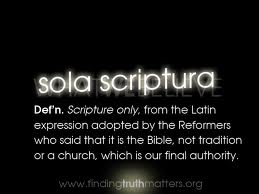
“The only source and norm of all Christian knowledge is the Holy Scripture.” This thematic statement introduces De Scriptura Sacra of Heinrich Heppe’s classic work in Reformed dogmatics and provides a succinct expression of the Reformation slogan: Sola Scriptura (Scripture Alone). The two key words that are used to crystallize the sola character of Scripture are source and norm.

The Reformation principle of Sola Scriptura was given the status of the formal cause of the Reformation by Melanchthon and his Lutheran followers. The formal cause was distinguished from the material cause of Sola Fide (by faith alone). Though the chief theological issue of the Reformation was the question of the matter of justification, the controversy touched heavily on the underlying question of authority. As is usually the case in theological controversy, the issue of ultimate authority lurked in the background (though it was by no means hidden or obscure) of Luther’s struggle with Rome over justification. The question of the source of Luther’s doctrine and the normative authority by which it was to be judged was vital to his cause.

Sola Scriptura and Inerrancy

A brief historical recapitulation of the steps that led to Luther’s Sola Scriptura dictum may be helpful. After Luther posted his Ninety-Five Theses in 1517, a series of debates, correspondence, charges, and countercharges ensued, culminating in Luther’s dramatic stand at Worms in April 1521. The two most significant transitional points between the theses of 1517 and the Diet of Worms of 1521 were the debates at Augsburg and Leipzig.

In October 1518 Luther met with Cardinal Cajetan of the Dominicans. Cajetan was acknowledged to be the most learned theologian of the Roman Curia. In the course of their discussions Cajetan was able to elicit from Luther his views on the infallibility of the pope. Luther asserted that the pope could err and claimed that Pope Clement VI’s bull Unigenitus (1343) was contrary to Scripture.

In the summer of 1519 the dramatic encounter between Luther and Johannes von Eck took place at Leipzig. In this exchange Eck elicited from Luther the admission of his belief that not only could the pope err but church councils could and did err as well. It was at Leipzig that Luther made clear his assertion: Scripture alone is the ultimate, divine authority in all matters pertaining to religion.

Gordon Rupp gives the following account:

Luther affirmed that “among the articles of John Huss and the Hussites which were condemned, are many which are truly Christian and evangelical, and which the church universal cannot condemn!” This was sensational! There was a moment of shocked silence, and then an uproar above which could be heard Duke George’s disgusted, “Gad, Sir, that’s the Plague!… ” Eck pressed his advantage home, and Luther, trapped, admitted that since their decrees are also of human law, Councils may err.

So by the time Luther stood before the Diet of Worms, the principle of Sola Scriptura was already well established in his mind and work. Only the Scripture carries absolute normative authority. Why? For Luther the sola of Sola Scriptura was inseparably related to the Scriptures’ unique inerrancy. It was because popes could and did err and because councils could and did err that Luther came to realize the supremacy of Scripture. Luther did not despise church authority nor did he repudiate church councils as having no value. His praise of the Council of Nicea is noteworthy. Luther and the Reformers did not mean by Sola Scriptura that the Bible is the only authority in the church. Rather, they meant that the Bible is the only infallible authority in the church.

Paul Althaus summarizes the train of Luther’s thought by saying:

We may trust unconditionally only in the Word of God and not in the teaching of the fathers; for the teachers of the Church can err and have erred. Scripture never errs. Therefore it alone has unconditional authority. The authority of the theologians of the Church is relative and conditional. Without the authority of the words of Scripture, no one can establish hard and fast statements in the Church.

Thus Althaus sees Luther’s principle of Sola Scriptura arising as a corollary of the inerrancy of Scripture. To be sure, the fact that Scripture is elevated to be the sole authority of the church does not carry with it the necessary inference that it is inerrant. It could be asserted that councils, popes, and the Bible all err and still postulate a theory of Sola Scriptura. Scripture could be considered on a primus inter pares (“first among equals”) basis with ecclesiastical authority, giving it a kind of primacy among errant sources. Or Scripture could be regarded as carrying unique authority solely on the basis of its being the primary historical source of the gospel. But the Reformers’ view of Sola Scriptura was higher than this. The Reformation principle of Sola Scriptura involved inerrancy.

Sola Scriptura, ascribing to the Scriptures a unique authority, must be understood in a normative sense. Not descriptive, but rather normative authority is meant by the formula. The normative character of the Sola Scriptura principle may be seen by a brief survey of sixteenth-century Reformed confessions.

The Theses of Berne (1528): The Church of Christ makes no laws or commandments without God’s Word. Hence all human traditions, which are called ecclesiastical commandments, are binding upon us only in so far as they are based on and commanded by God’s Word (Sec. II).

The Geneva Confession (1536): First we affirm that we desire to follow Scripture alone as a rule of faith and religion, without mixing with it any other things which might be devised by the opinion of men apart from the Word of God, and without wishing to accept for our spiritual government any other doctrine than what is conveyed to us by the same Word without addition or diminution, according to the command of our Lord (Sec. I).

The French Confession of Faith (1559): We believe that the Word contained in these books has proceeded from God, and receives its authority from him alone, and not from men. And inasmuch as it is the rule of all truth, containing all that is necessary for the service of God and for our salvation, it is not lawful for men, nor even for angels, to add to it, to take away from it, or to change it. Whence it follows that no authority, whether of antiquity, or custom, or numbers, or human wisdom, or judgments, or proclamations, or edicts, or decrees, or councils, or visions, or miracles, should be opposed to these Holy Scriptures, but on the contrary, all things should be examined, regulated, and reformed according to them (Art. V).

The Belgic Confession (1561): We receive all these books, and these only, as holy and confirmation of our faith; believing, without any doubt, all things contained in them, not so much because the church receives and approves them as such, but more especially because the Holy Ghost witnessed in our hearts that they are from God, whereof they carry the evidence in themselves (Art. V). Therefore we reject with all our hearts whatsoever doth not agree with this infallible rule (Art. VII).

Second Helvetic Confession (1566): Therefore, we do not admit any other judge than Christ himself, who proclaims by the Holy Scriptures what is true, what is false, what is to be followed, or what is to be avoided (Chap. II).

Uniformly the sixteenth-century confessions elevate the authority of Scripture over any other conceivable authority. Thus, even the testimony of angels is to be judged by the Scriptures. Why? Because, as Luther believed, the Scriptures alone are inerrant. Sola Scriptura as the supreme norm of ecclesiastical authority rests ultimately on the premise of the infallibility of the Word of God.

Extent of the Norm
To what extent does the Sola Scriptura principle of authority apply? We hear statements that declare Scripture to be the “only infallible rule of faith and practice.” Does this limit the scope of biblical infallibility? Among advocates of limited inerrancy we hear the popular notion that the Bible is inerrant or infallible only when it speaks of matters of faith and practice. Matters of history or cosmology may contain error but not matters of faith and practice. Here we see a subtle shift from the Reformation principle. Note the difference in the following propositions:

A. The Bible is the only infallible rule of faith and practice.

B. The Bible is infallible only when it speaks of faith and practice.

In premise A, “faith and practice” are generic terms that describe the Bible. In premise B, “faith and practice” presumably describe only a particular part of the Bible. Premise A affirms that there is but one infallible authority for the church. The proposition sets no content limit on the infallibility of the Scriptures. Premise B gives a reduced canon of that which is infallible; that is, the Bible is infallible only when it speaks of faith and practice. This second premise represents a clear and decisive departure from the Reformation view.

Premise A does not say that the Bible provides information about every area of life, such as mathematics or physics. But it affirms that what he Bible teaches, it teaches infallibly.

The Source of Authority

Heppe’s sola indicates that the Bible is not only the unique and final authority of the church but is also the “only source of all Christian knowledge.” At first glance this statement may seem to suggest that the only source of revelation open to man is that found in Scripture. But that is not the intent of Heppe’s statement, nor is it the intent of the Reformation principle of Sola Scriptura.

Uniformly the Reformers acknowledged general revelation as a source of knowledge of God. The question of whether or not that general revelation yields a bona fide natural theology was and is widely disputed, but there is no serious doubt that the Reformers affirmed a revelation present in nature. Thus the sola does not exclude general revelation but points beyond it to the sufficiency of Scripture as the unique source of written special revelation.

The context of the Sola Scriptura schema with respect to source was the issue (raised over against Rome) regarding the relationship of Scripture and Tradition. Central to the debate was the Council of Trent’s declaration regarding Scripture and Tradition. (Trent was part of the Roman counteroffensive to the Reformation, and Sola Scriptura was not passed over lightly in this counter-offensive.)

In the Fourth Session of the Council of Trent the following decree was formulated: This (Gospel), of old promised through the Prophets in the Holy Scriptures, our Lord Jesus Christ, the Son of God, promulgated first with His own mouth, and then commanded it to be preached by His Apostles to every creature as the source at once of all saving truth and rules of conduct. It also clearly perceives that these truths and rules are contained in the written books and in the unwritten traditions, which, received by the Apostles from the mouth of Christ Himself, or from the Apostles themselves, the Holy Ghost dictating, have come down to us, transmitted as it were from hand to hand. Following then, the examples of the Orthodox fathers, it receives and venerates with a feeling of piety and reverence all the books both of the Old and New Testaments, since one God is the author of both; also the traditions, whether they relate to faith or to morals, as having been dictated either orally by Christ or by the Holy Ghost, and preserved in the Catholic church in unbroken succession.

In this decree the Roman Catholic church apparently affirmed two sources of special revelation—Scripture and the Tradition of the church—although in recent years this “dual source” theory has come into question within the Roman church.

G. C. Berkouwer’s work on Vatican Council II provides a lengthy discussion of current interpretations of the Tridentine formula on Scripture and Tradition. Some scholars argue that Tradition adds no new content to Scripture but merely serves either as a depository in the life of the church or as a formal interpretive tool of the church. A technical point of historical research concerning Trent sheds some interesting light on the matter. In the original draft of the fourth session of Trent the decree read that “the truths … are contained partly [partim] in Scripture and partly [partim] in the unwritten traditions.” But at a decisive point in the Council’s deliberations two priests, Nacchianti and Bonnucio rose in protest against the partim … partim formula. These men protested on the grounds that this view would destroy the uniqueness and sufficiency of Scripture. All we know from that point on is that the words partly … partly were removed from the text and replaced by the word and (et). Did this mean that the Council responded to the protest and perhaps left the relationship between Scripture and Tradition purposely ambiguous? Was the change stylistic, meaning that the Council still maintained two distinct sources of revelation? These questions are the focus of the current debate among Roman theologians.

One thing is certain. The Roman church has interpreted Trent as affirming two sources of special revelation since the sixteenth century. Vatican I spoke of two sources. The papal encyclical Humani Generis spoke of “sources of revelation.” Even Pope John XXIII spoke of Scripture and Tradition in Ad Petri Cathedram.

Not only has the dual-source theory been confirmed both by ecumenical councils and papal encyclicals, but tradition has been appealed to on countless occasions to validate doctrinal formulations that divide Rome and Protestantism. This is particularly true regarding decisions in the area of Mariology.

Over against this dual-source theory stands the sola of Sola Scriptura. Again, the Reformers did not despise the treasury of church tradition. The great councils of Nicea, Ephesus, Chalcedon, and Constantinople receive much honor in Protestant tradition. The Reformers themselves gave tribute to the insights of the church fathers. Calvin’s love for Augustine is apparent throughout the Institutes. Luther’s expertise in the area of Patristics was evident in his debates with Cajetan and Eck. He frequently quotes the fathers as highly respected ecclesiastical authorities. But the difference is this: For the Reformers no church council, synod, classical theologian, or early church father is regarded as infallible. All are open to correction and critique. We have no Doctor Irrefragabilis of Protestantism.

Protestant churches have tended to be confessional in character. Subscription to confessions and creeds has been mandatory for the clergy and parish of many denominations. Confessions have been used as a test of orthodoxy and conformity to the faith and practice of the church. But the confessions are all regarded as reformable. They are considered reformable because they are considered fallible. But the Sola Scriptura principles in its classic application regards the Scripture as irreformable because of its infallibility. Thus the two primary thrusts of Sola Scriptura point to:

1) Scripture’s uniqueness as normative authority and

2) its uniqueness as the source of special revelation. Norm and source are the twin implicates of the Sola Scriptura principle.

Is Sola Scriptura the Essence of Christianity?
In a recent publication on questions of Scripture, Bernard Ramm wrote an essay entitled, “Is ‘Scripture Alone’ the Essence of Christianity?” Using the nineteenth-century German penchant for the quest of the “Wesen” of Christianity as a jumping-off point, Ramm gives a brief history of the liberal-conservative controversy concerning the role of Scripture in the Christian faith. Defining Wesen as “the essence of something, the real spirit or burden of a treatise, the heart of the matter,” he concludes that Scripture is not the Wesen of Christianity. He provides a historical survey to indicate that neither the Reformers nor the strong advocates of inerrancy, A. A. Hodge and B. B. Warfield, believed that Sola Scriptura was the essence of Christianity. Ramm cites numerous quotations from Hodge and Warfield that speak of the Scriptures as being “absolutely infallible,” and “without error of facts or doctrines.” Yet these men affirmed that “Christianity was true independently of any theory of inspiration, and its great doctrines were believable within themselves.”

Ramm goes on to express grave concern about the present debate among evangelicals concerning inerrancy. Here his concern focuses not on the teaching of Hodge and Warfield but on the attitudes of their contemporary disciples who, in Ramm’s opinion, go beyond their forefathers in asserting a particular view of Scripture as being Christianity’s essence. Ramm writes:

From the other writings of Warfield in particular, it would be impossible to say that he identified the Wesen of Christianity with his view of Holy Scripture. He was enough of a historian of theology to avoid saying that. The “inspiration” article was an essay in strategy. However, among current followers of the so-called Warfield position there have been certain shifts away from the original strategic stance of the essay. One’s doctrine of Scripture has become now the first and most important doctrine, one’s theory of the wesen of Christianity, so that all other doctrines have validity now only as they are part of the inerrant Scripture. Thus evangelical teachers, or evangelical schools or evangelical movements, can be judged as to whether or not they are true to the wesen of Christianity by their theory of inspiration. It can be stated even more directly: an evangelical has made a theory of inspiration the wesen of Christianity if he assumes that the most important doctrine in a man’s theology, and most revelatory of the entire range of his theological thought, is his theology of inspiration.

It appears from this statement that the “essence” of Ramm’s concern for the present state of evangelicalism is that one’s doctrine of Scripture is viewed as the essence or wesen of Christianity. This writer can only join hands with Ramm in total agreement with his concern. To make one’s view of Scripture in general or of inspiration in particular the essence of Christianity would be to commit an error of the most severe magnitude. To subordinate the importance of the gospel itself to the importance of our historical source book of it would be to obscure the centrality of Christ. To subordinate Sola Fide to Sola Scriptura would be to misunderstand radically the wesen of the Reformation. Clearly Ramm is correct in taking his stand on this point with Hodge, Warfield, and the Reformers. Who can object to that?

One may be troubled, however, by a portion of Ramm’s stated concern. Who are these “current followers” of Warfield who in fact do maintain that Sola Scriptura is the heart or essence of Christianity? What disciple of Warfield’s has ever maintained that Sola Scriptura is essential to salvation? Ramm provides us with no names or documentary evidence to demonstrate that his deep concern is warranted.

To be sure, strong statements have been made by followers of the Warfield school of the crucial importance of Sola Scriptura and the centrality of biblical authority to all theological disputes. Perhaps these statements have contained some “overkill” in the passion of debate, which is always regrettable. We must be very cautious in our zeal to defend a high view of Scripture not to give the impression that we are talking about an article on which our salvation depends.

We can cite the following statements by advocates of the Warfield school that could be construed as a possible basis for Ramm’s concern. In God’s Inerrant Word, J. I. Packer makes the following assertion:

What Luther thus voiced at Worms shows the essential motivation and concern, theological and religious, of the entire Reformation movement: namely that the Word of God alone must rule, and no Christian man dare do other than allow it to enthrone itself in his conscience and heart.

Here Packer calls the notion of Sola Scriptura “the essential motivation and concern” of the Reformation. In itself this quote certainly suggests that Packer views Sola Scriptura as the essence of the Reformation.

However, in defense of Packer it must be noted that to say Sola Scriptura was the essential motivation of the Reformation movement is not to say that Sola Scriptura is the essence of Christianity. He is speaking here of a historical controversy. That Sola Scriptura was at the heart of the controversy and central to the debate cannot be doubted. To say that Sola Scriptura was an essential motif or concern of the Reformation cannot be doubted. That is was the essential concern may be brought into question; this may be regraded as an overstatement. But again, in fairness to Packer, it must be noted that earlier in his essay he had already indicated that Justification by Faith Alone was the material principle. So he had already maintained that Sola Scriptura was subordinate to Sola Fide in the controversy. In any case, though the word essential is used, there is no hint here that Packer maintains that Sola Scriptura is the essence of Christianity.

In a recent unpublished essay, Richard Lovelace of Gordon-Conwell Theological Seminary cites both Harold Lindsell and Francis Schaeffer as men who have sounded urgent warnings concerning the relationship between inerrancy and evangelicalism. Lovelace cites the following statements of Schaeffer:

There is not use of evangelicalism seeming to get larger and larger, if at the same time appreciable parts … are getting soft at that which is the central core, namely the Scriptures.… We must say most lovingly but clearly: evangelicalism is not consistently evangelical unless there is a line drawn between those who take a full view of Scripture and those who do not.

Again Schaeffer is cited: “Holding to a strong view of Scripture or not holding to it is the watershed of the evangelical world.” In these statements Francis Schaeffer maintains that the Scriptures are:

1) the “central core” of evangelicalism,

2) a mark of “consistent evangelicalism,” and

3) the “watershed of the evangelical world.”

These are strong assertions about the role of Sola Scriptura, but they are made with reference to evangelicalism, not Christianity (though I am sure Schaeffer believes evangelicalism is the purest expression of Christianity to be found). Evangelicalism refers to a historical position or movement. When he speaks of “watersheds,” he is speaking of crucial historical turning points. When he speaks of “consistent” evangelicalism, he implies there may be such a thing as inconsistent evangelicalism.

The troublesome quote of Schaeffer is that one in which he says the Scriptures are “the central core” of evangelicalism. Here “core” is in the singular with the definite article giving it a sola character. Does Schaeffer mean that the Bible is the core of evangelicalism and the gospel is the husk? Is Sola Scriptura the center and Sola Fide at the periphery of evangelicalism? It is hard to think that Schaeffer would make such an assertion. Indeed, one may question if Schaeffer means what he in fact does say here. Had he said, “Scripture is at the core of evangelicalism,” there would be no dispute. But to say it is the core appears an overstatement. Perhaps we have here a slip of the pen, which any of us can and frequently do make.

In similar fashion Harold Lindsell may be quoted: “Is the term ‘evangelical’ broad enough in its meaning to include within it believers in inerrancy and believers in an inerrancy limited to matters of faith and practice?” Lindsell raises the question of whether or not inerrancy of the entire Bible is essential to the term evangelical. The question raised is: If Sola Scriptura in its fullest sense is of the Wesen of evangelicalism, can one who espouses limited inerrancy be genuinely called evangelical? The issue is the meaning of the term evangelical. Does it carry with it the automatic assumption of full inerrancy? Again we must point out the difference between the historical label “evangelical” and what is essential to Christianity.

None of the scholars mentioned have said that adherence to inerrancy or Sola Scriptura is essential to salvation. None have Sola Scriptura as the Wesen of Christianity.

It could be said that the argument of the writer of this chapter is constructed on straw men who “come close” to asserting that Sola Scriptura is the essence of Christianity but who, in the final analysis, shrink for such an assertion. But it is not my purpose to create straw men. It is simply to find some basis for Ramm’s assertion about modern followers of Warfield. Since I have not been able to find any followers of Warfield who assert Sola Scriptura as the Wesen of Christianity, the best I can do is to cite examples of statements that could possibly be misconstrued to assert that. It is probably charity that restrained Ramm from naming those he had in mind. But unfortunately, the absence of names casts a shadow of suspicion over all modern followers of Warfield who hold to full inerrancy.

Though advocates of inerrancy in the full sense of Sola Scriptura do not regard it as being essential to salvation, they do maintain that the principle is crucial to Christianity and to consistent evangelicalism. That in Scripture we have divine revelation is no small matter. That the gospel rests not on human conjecture or relational speculation is of vital importance. But there is no quarrel with Ramm on these points. He summarizes his own position by saying:

1. There is no questioning of the Sola Scriptura in theology. Scripture is the supreme and final authority in theological decision-making.

2. One’s views of revelation, inspiration, and interpretation are important. They do implicate each other. Our discussion rather has been whether a certain view of inspiration could stand as the wesen of Christianity. We have in no manner suggested that matters of revelation, inspiration, and interpretation are unimportant in theology.

Here we delight in agreement with this strong affirmation of the crucial importance of Sola Scriptura.

Strangely, however, Ramm continues his summary by saying, “If the integrity of other evangelicals, evangelical schools, or evangelical movements are assessed by their view of inspiration, then, for them, inspiration has become the wesen of Christianity.” The inference Ramm draws at this point is at once puzzling and astonishing, and perhaps we meet here merely another case of overstatement or a slip of the pen. How would it follow from an assessment of others’ evangelicalism as being consistent or inconsistent according to their view of Scripture that inspiration has become the wesen of Christianity? This inference involves a quantum leap of logic.

If the first two points of Ramm’s summary are correct—that Sola Scriptura is important and that it implicates views of interpretation and theological decision making—why should not a school’s or movement’s integrity (a fully integrated stance) be assessed by this principle? Though Sola Scriptura is not the wesen of Christianity, it is still of crucial importance. If a school or movement softens its view of Scripture, that does not mean it has repudiated the essence of Christianity. But it does mean that a crucial point of doctrine and classical evangelical unity has been compromised. If, as Ramm suggests, one’s view of Scripture is so important, then a weakening of that view should concern us.

The issue of full or limited inerrancy is a serious one among those within the framework of historic evangelicalism. In the past a healthy and energetic spirit of cooperation has existed among evangelicals from various and diverse theological persuasions and ecclesiastical affiliations. Lutherans and Baptists, Calvinists and Arminians, and believers of all sorts have united in evangelical activity. What has been the cohesive force of that unity? In the first instance, there has been a consensus of catholic articles of faith, such as the deity of Christ. In the second instance, a strong point of unity has been the cardinal doctrine of the Protestant Reformation: justification by faith alone. In the last instance, there has been the unifying factor of Sola Scriptura in the sense of full inerrancy. The only “creed” that has bound the Evangelical Theological Society together, for example, has been the affirmation of inerrancy. Now that point of unity is in jeopardy. The essence of Christianity is not the issue. But a vital point of consistent evangelicalism is.

Sola Scriptura and Limited Inerrancy

Is Sola Scriptura compatible with a view of Scripture that limits inerrancy to matters of faith and practice? Theoretically it would seem to be possible if “faith and practice” could be separated from any part of Scripture. So long as biblical teaching regarding faith and practice were held to be normative for the Christian community, there would appear to be no threat to the essence of Christianity. However, certain problems exist with such a view of Scripture that do seriously threaten the essence of Christianity.

The first major problem we encounter with limited inerrancy is the problem of canon reduction. The canon or “norm” of Scripture is reduced de facto to that content relating to faith and practice. This immediately raises the hermeneutical question concerning what parts of Scripture deal with faith. As evangelicals wrestle among themselves in intramural debates, they must keep one eye focused on the liberal world of biblical scholarship, for the principle of the reduction of canon to matters of “faith” is precisely the chief operative in Bultmann’s hermeneutic. Bultmann thinks we must clear away the prescientific and faulty historical “husk” of Scripture to get to the viable kernel of “faith.” Thus, although Bultmann has no inerrant kernel or kerygma to fall back on, his problem of canon reduction remains substantially the same as that of those who limit inerrancy to faith and practice.

Before someone cries foul or cites the informal fallacy of argumentum ad hominem (abusive) or the “guilt by association” fallacy, let this concern be clarified. I am not saying that advocates of limited inerrancy are cryptic or even incipient Bultmannians, but that there is one very significant point of similarity between the two schools: canon reductionism. Evangelical advocates of limited inerrancy are not expected to embrace Bultmann’s mythical view of New Testament supernaturalism. But their method has no inherent safeguard from an arbitrary delimitation of the scope of the biblical canon.

The second serious problem, closely related to the first, is the problem of the relationship of faith and history, perhaps the most serious question of contemporary New Testament scholarship. If we limit the notion of inerrancy to matters of faith and practice, what becomes of biblical history? Is the historical substratum of the gospel negotiable? Are only those portions of the biblical narrative that have a clear bearing on faith inerrant? How do we escape dehistoricizing the gospel and relegating it to a level of supratemporal existential “decision”? We know that the Bible is not an ordinary history book but a book of redemptive history. But is it not also a book of redemptive history? If we exclude the realm of history from the category of inspiration or inerrancy either in whole or in part, do we not inevitably lose the gospel?

The third problem we face with limiting inerrancy to matters of faith and practice is an apologetic one. To those critics outside the fellowship of evangelicals, the notion of “limited inerrancy” appears artificial and contrived. Limited inerrancy gets us off the apologetical hook by making us immune to religious-historical criticism. We can eat our cake and have it too. The gospel is preserved; and our faith and practice remains intact while we admit errors in matters of history and cosmology. We cannot believe the Bible concerning earthly things, but we stake our lives on what it says concerning heavenly things. That approach was totally abrogated by our Lord (John 3:12).

How do we explain and defend the idea that the Bible is divinely superintended in part of its content but not all of it? Which part is inspired? Why only the faith and practice parts? Again, which are the faith and practice parts? Can we not justly be accused of “weaseling” if we adopt such a view? We remove our faith from the arena of historical verification nor falsification. This is a fatal blow for apologetics as the reasoned defense of Christianity.

Finally, we face the problem of the domino theory. Frequently this concern is dismissed out of hand as being so much alarmism. But our doctrine of Scripture is not a child’s game of dominoes. We know instances in which men have abandoned belief in full inerrancy but have remained substantially orthodox in the rest of their theology. We are also aware of the sad instances in which full inerrancy is affirmed yet the substance of theology is corrupt. Inerrancy is no guarantee of biblical orthodoxy. Yet even a cursory view of church history has shown some pattern of correlation between a weakening of biblical authority and serious defection regarding the Wesen of Christianity. The wesen of nineteenth-century liberalism is hardly the gospel evangelicals embrace.

We have already seen, within evangelical circles, a move from limited inerrancy to challenges of matters of faith and practice. When the apostle Paul is depicted as espousing two mutually contradictory views of the role of women in the church, we see a critique of apostolic teaching that does touch directly on the practice of the church. In the hotly disputed issue of homosexuality we see denominational commissions not only supplementing biblical authority with corroborative evidence drawn from modern sources of medical psychological study but also “correcting” the biblical view by such secular authority.The direction of these movements of thought is a matter of grave concern for advocates of full inerrancy.

We face a crisis of authority in the church. It is precisely our faith and our practice that is in question. It is for faith and practice that we defend a fully infallible rule—a total view of Sola Scriptura.

We know some confusion has existed (much unnecessarily) about the meaning of full inerrancy. But with all the problems of definition that plague the concept, we do not think it has died the death of a thousand qualifications.

We are concerned about Sola Scriptura for many reasons. But we affirm it in the final analysis not because it was the view of the Reformers, not because we slavishly revere Hodge and Warfield, not even because we are afraid of dominoes or a difficult apologetic. We defend it and express our deep concern about it because we believe it is the truth. It is a truth we do not want to negotiate. We earnestly desire dialogue with our evangelical brothers and colaborers who differ from us. We want to heal the wounds that controversy so frequently brings. We know our own views are by no means inerrant. But we believe inerrancy is true and is of vital importance to our common cause of the gospel.

Further dialogue within the evangelical world should at least help us clarify what real differences there are among us. Such clarification is important if there is to be any hope of resolving those differences. We do not intend to communicate that a person’s Christian faith stands or falls with his view of Scripture. We do not question the Christian commitment of advocates of limited inerrancy. What we do question is the correctness of their doctrine of Scripture, as the question ours. But we consider this debate, as serious as it is, a debate between members of the household of God. May our Father bring us to unity here as he has in many glorious affirmations of his gospel.

Article above written by Dr. R.C. Sproul. “Sola Scriptura: Crucial to Evangelicalism.” The Foundations of Biblical Authority. James M. Boice, ed. Grand Rapids: Zondervan, 1980.

About the Author: Dr. R.C. Sproul is the founder and chairman of Ligonier Ministries, an international Christian education ministry located near Orlando, Florida. His teaching can be heard on the program Renewing Your Mind, which is broadcast on hundreds of radio outlets in the United States and in 40 countries worldwide. He is the executive editor of Tabletalk Magazine and general editor of The Reformation Study Bible, and the author of more than seventy books (including some of my all time favorites: THE HOLINESS OF GOD; CHOSEN BY GOD; KNOWING SCRIPTURE; WILLING TO BELIEVE; REASON TO BELIEVE; and PLEASING GOD) and scores of articles for national evangelical publications. Dr. Sproul also serves as president of Ligonier Academy of Biblical and Theological Studies and Reformation Bible College. He currently serves as Senior Minister of preaching and teaching at Saint Andrew’s in Sanford, FL

John Piper on What Is the Christian Gospel?

“Exploring What Makes the “Good News” Good News”

The gospel is not just a sequence of steps (say, the “Four Laws” of Campus Crusade or the “Six Biblical Truths” of Quest for Joy). Those are essential. But what makes the gospel “good news” is that it connects a person with the “unsearchable riches of Christ.”

There is nothing in itself that makes “forgiveness of sins” good news. Whether being forgiven is good news depends on what it leads to. You could walk out of a courtroom innocent of a crime and get killed on the street. Forgiveness may or may not lead to joy. Even escaping hell is not in itself the good news we long for—not if we find heaven to be massively boring.

Nor is justification in itself good news. Where does it lead? That is the question. Whether justification will be good news depends on the award we receive because of our imputed righteousness. What do we receive because we are counted righteous in Christ? The answer is fellowship with Jesus.

Forgiveness of sins and justification are good news because they remove obstacles to the only lasting, all-satisfying source of joy: Jesus Christ. Jesus Christ is not merely the means of our rescue from damnation; he is the goal of our salvation. If he is not satisfying to be with, there is no salvation. He is not merely the rope that pulls us from the threatening waves; he is the solid beach under our feet, and the air in our lungs, and the beat of our heart, and the warm sun on our skin, and the song in our ears, and the arms of our beloved.

This is why the New Testament often defines the gospel as, simply, Christ. The gospel is the “gospel of Christ” (Romans 15:19; 1 Corinthians 9:12; 2 Corinthians 2:12; 9:13; 10:14; Galatians 1:7; Philippians 1:27; etc.). Or, more specifically, the gospel is “the gospel of the glory of Christ” (2 Corinthians 4:4). And even more wonderfully, perhaps, Paul says that the preaching of the gospel is the preaching of “the unsearchable riches of Christ” (Ephesians 3:8).

Therefore to believe the gospel is not only to accept the awesome truths that

1) God is holy,

2) we are hopeless sinners,

3) Christ died and rose again for sinners, and

4) this great salvation is enjoyed by faith in Christ—but believing the gospel is also to treasure Jesus Christ as your unsearchable riches.

What makes the gospel Gospel [good news] is that it brings a person into the everlasting and ever-increasing joy of Jesus Christ.

The words Jesus will speak when we come to heaven are: “Enter into the joy of your Master” (Matthew 25:21). The prayer he prayed for us ended on this note: “Father, I desire that they also, whom you have given me, may be with me where I am, to see my glory” (John 17:24). The glory he wants us to see is the “unsearchable riches of Christ.” It is “the immeasurable riches of [God’s] grace in kindness toward us in Christ Jesus” (Ephesians 2:7).

The superlatives “unsearchable” and “immeasurable” mean that there will be no end to our discovery and enjoyment. There will be no boredom. Every day will bring forth new and stunning things about Christ which will cause yesterday’s wonder to be seen in new light, so that not only will there be new sights of glory every day, but the accumulated glory will become more glorious with every new revelation.

The gospel is the good news that the everlasting and ever-increasing joy of the never-boring, ever-satisfying Christ is ours freely and eternally by faith in the sin-forgiving death and hope-giving resurrection of Jesus Christ.

May God give you “strength to comprehend with all the saints what is the breadth and length and height and depth, and to know the love of Christ that surpasses knowledge” (Ephesians 3:18–19).

About the Author: John Piper was the Pastor for Preaching at Bethlehem Baptist Church in Minneapolis, Minnesota for over 30 years. He grew up in Greenville, South Carolina, and studied at Wheaton College, where he first sensed God’s call to enter the ministry. He went on to earn degrees from Fuller Theological Seminary (B.D.) and the University of Munich (D.theol.). For six years he taught Biblical Studies at Bethel College in St. Paul, Minnesota, and in 1980 accepted the call to serve as pastor at Bethlehem. John is the author of more than 40 books, including Desiring God, The Pleasures of God, Recovering Biblical Manhood and Womanhood, What Jesus Demands from the World, and Don’t Waste Your Life. He is the founder of Desiring God Ministries, and is currently transitioning from the pastorate into speaking and writing full time with DGM. DesiringGod.org provides a huge selection of God-centered resources from the prolific ministry of John Piper with free sermons, books, conference teachings, and articles like this one. The excerpt above is from his book Taste and See: Savoring the Supremacy of God in All of Life. Sisters, Or.: Multnomah Publishers, 2005, 406-407.

John MacArthur’s Recommended First 750 Books For an Expositor of God’s Word

The First 750 Books for an Expositor’s Library

After the previous discussion of the importance of a solid library for an expository preacher, it seems appropriate to include a suggested list of materials and thereby identify a model library for one who has this goal. The works listed here are only suggestions. Each person will need to adapt the list to fit his own needs. “Books are like clothes: what fits one person’s needs and style may not fit another person’s at all.” Also, this list is limited to a basic collection in the fields of biblical studies and theology, and does not identify other items that an expositor may wish to acquire. The expositor should acquire a number of important items on current biblical and theological issues to assist him in his study and keep himself current. The purpose of this list is to assist a new generation of aspiring expository preachers in gathering a collection of tools for this worthy task. It includes books which have or will stand the test of time and tries to avoid items based on current theological speculation.

The list has a wider purpose, however. It is for a wide spectrum of readers who are seeking to assemble a well-rounded library. Serious expositors should consider the entire list as a model library. A reasonable goal is to acquire the 750 volumes in ten years. The first items to purchase have been marked with an asterisk (*). These same ones can serve as a basic list for a serious layman or devoted pastor who wishes to accumulate fewer than the proposed 750 for assistance in Bible study. The following are clarifications regarding the list:

1.   Some of the volumes listed under individual commentaries are parts of sets that are also included in the list. They have not been counted twice.

2.   When entire sets are recommended, it is understood that individual volumes within each set are of uneven quality because of a variety of authors. The expositor should sometimes buy selectively from sets with this in mind. In other cases, he should own entire sets so that he has resources on the whole Bible.

3.   The expositor may choose to wait to purchase commentaries on individual books of the Bible until he needs them. He should remember, however, that books are in and out of print and that he may not always have the time or be in the right place to secure good materials. The key to building a good library is a good “want list” carefully pursued over a period of time. Books tend to show up when least expected and often cannot be found when needed! They are often cheaper when the need for them is not so urgent.

4.   The list can also be used as a study guide for those with access to a theological library. It can also be modified and made suitable as a basis for a church library in biblical studies.

I. Bibliographic Tools

Badke, William B. The Survivor’s Guide to Library Research. Zondervan, 1990.

*Barber, Cyril J. The Minister’s Library. Moody, 1985–. 2 vols. plus supplements.

*Barker, Kenneth L., Bruce K. Waltke, Roy B. Zuck. Bibliography for Old Testament Exegesis and Exposition. Dallas Theological Seminary, 1979.

Bollier, John A. The Literature of Theology: A Guide for Students and Pastors. Westminster, 1979.

*Carson, D. A. New Testament Commentary Survey. Baker, 1986.

Childs, Brevard S. Old Testament Books for Pastor and Teacher. Westminster, 1977.

Kiehl, Erich H. Building Your Biblical Studies Library. Concordia, 1988.

Martin, Ralph P. New Testament Books for Pastor and Teacher. Westminster, 1984.

*Rosscup, James E. Commentaries for Biblical Expositors. Author, 1983.

Spurgeon, Charles H. Commenting and Commentaries. Banner of Truth, 1969.

*Wiersbe, Warren W. A Basic Library for Bible Students. Baker, 1981.

II. Bibles

American Standard Version. Nelson, 1901.

The Amplified Bible. Zondervan, 1965.

*King James Version (or Authorized Version). Various publishers.

The Living Bible, Paraphrased. Tyndale, 1971.

*New American Standard Bible. Lockman, 1977.

New English Bible. Oxford/Cambridge, 1970.

*New International Version. Zondervan, 1978.

New King James Version. Nelson, 1982.

New Century Version. Word, 1991.

The New Scofield Reference Bible. Oxford, 1967.

The New Testament in Modern English. Macmillan, 1973.

The NIV Study Bible. Zondervan, 1985.

*Ryrie Study Bible. Moody, 1978.

The Scofield Reference Bible. Oxford, 1917.

III. Biblical Texts

*Aland, Kurt. The Greek New Testament. 3d ed. UBS, 1983.

———. The Text of the New Testament. Eerdmans, 1987.

*Biblia Hebraica Stuttgartensia. Ed. by Karl Elliger and Wilhelm Rudolph; Deutsche Biblestiftung, 1984.

*Bruce, F. F. The Books and the Parchments. Revell, 1984.

*———. The Canon of the Scripture. InterVarsity, 1988.

———. History of the English Bible in English. 3d ed. Revell, 1978.

Greenlee, J. Harold. Introduction to New Testament Textual Criticism. Eerdmans, 1964.

*Harris, R. Laird. Inspiration and Canonicity of the Bible. Zondervan, 1969.

Lewis, Jack P. The English Bible From KJV to NIV, A History of Evaluation. Baker, 1982.

Metzger, Bruce M. The Canon of the New Testament. Oxford, 1987.

———. The Text of the New Testament: Its Transmission, Corruption, and Restoration. Oxford, 1968.

*———. A Textual Commentary on the Greek New Testament. UBS, 1971.

*Nestle-Aland. Novum Testamentum Graece. 26th ed. Deutsche Bibelstiftung, 1979.

*Rahlfs, Alfred. Septuaginta. Wuerttembergische, 1962.

Roberts, B. J. The Old Testament Text and Versions. Wales, 1951.

Swete, Henry B. An Introduction to the Old Testament in Greek. KTAV, 1968.

Wurthwein, Ernst. The Text of the Old Testament. Eerdmans, 1979.

IV. Old Testament Tools

*Armstrong, Terry A., Douglas L. Busby, and Cyril F. Carr. A Reader’s Hebrew and English Lexicon of the Old Testament. Zondervan, 1989.

Botterweck, G. Johannes, and Helmer Ringgren, eds. Theological Dictionary of the Old Testament. Vols. 1–. Eerdmans, 1974–.

*Brown, Francis, Samuel R. Driver, and Charles A. Briggs. A Hebrew and English Lexicon of the Old Testament. Oxford, 1907.

Einspahr, Bruce. Index to Brown, Driver, and Briggs Hebrew Lexicon. Moody, 1977.

*The Englishmen’s Hebrew and Chaldee Concordance of the Old Testament. Zondervan, 1970.

*Even-Shoshan, Abraham. A New Concordance of the Old Testament. Baker, 1989.

Girdlestone, Robert Baker. Synonyms of The Old Testament. Eerdmans.

*Harris, R. Laird, Gleason L. Archer, and Bruce K. Waltke, eds. Theological Wordbook of the Old Testament. 2 vols. Moody, 1980.

Hatch, Edwin, and Henry A. Redpath. A Concordance to the Septuagint and the Other Greek Versions of the Old Testament. 2 vols. Akademische, 1955.

*Holladay, William. A Concise Hebrew and Aramaic Lexicon of the Old Testament. Eerdmans, 1971.

Koehler, Ludwig, and Walter Baumgartner. Lexicon in Verteris Testament Libros. 2 vols. Brill, 1958.

Liddell, Henry G., and Robert Scott. A Greek English Lexicon. 9th ed., rev. by. H. S. Jones and R. McKenzie. Oxford, 1968.

*Owens, John Joseph. Analytical Key to the Old Testament. 4 vols. Baker, 1989–.

Seow, C. L. A Grammar for Biblical Hebrew. Abingdon, 1987.

Unger, Merrill F., and William White. Nelson’s Expository Dictionary of the Old Testament. Nelson, 1980.

Waltke, Bruce K. An Intermediate Hebrew Grammar. Eisenbrauns, 1984.

Waltke, Bruce K., and M. O’Connor. An Introduction to Biblical Hebrew Syntax. Eisenbrauns, 1990.

*Weingreen, Jacob. Practical Grammar for Classical Hebrew. Oxford, 1959.

Wilson, William. Old Testament Word Studies. Kregel, 1978.

V. New Testament Tools

*Abbot-Smith, George. A Manual Greek Lexicon of the New Testament. T. & T. Clark, 1936.

Alsop, John R., ed. An Index to the Revised Bauer-Arndt-Gingrich Greek Lexicon. 2d ed. by F. Wilbur Gingrich and Frederick W. Danker. Zondervan, 1981.

Balz, Horst, and Gerhard Schneider, eds. Exegetical Dictionary of the New Testament. Eerdmans, 1978.

Barclay, William. New Testament Words. Westminster, 1974.

*Bauer, Walter, W. F. Arndt, F. W. Gingrich, and F. W. Danker. A Greek-English Lexicon of the New Testament and Other Early Christian Literature. 2d ed. University of Chicago, 1979.

Blass, F. W., A. Debrunner, and Robert W. Funk. A Grammar of New Testament and Other Early Christian Literature. University of Chicago, 1961.

Bromiley, Geoffrey. Theological Dictionary of the New Testament. Ed. by Gerhard Kittel and Gerhard Friedrich. Trans. by Geoffrey W. Bromiley. Abridged in 1 vol. Eerdmans, 1985.

*Brown, Colin, ed. The New International Dictionary of New Testament Theology. 4 vols. Zondervan, 1975–86.

Burton, Ernest DeWitt. Syntax of the Moods and Tenses in New Testament Greek. T. & T. Clark, 1898.

Cremer, Hermann. Biblico-Theological Lexicon of New Testament Greek. 4th ed. T. & T. Clark, 1962.

Dana, H. E., and Julius R. Mantey. A Manual Grammar of the Greek New Testament. Macmillan, 1955.

Gingrich, F. W. A Shorter Lexicon of the Greek Testament. 2d ed. Rev. by Frederick W. Danker. University of Chicago, 1983.

Hanna, Robert. A Grammatical Aid to the Greek New Testament. Baker, 1983.

Kittel, Gerhard, and Gerhard Friedrich. The Theological Dictionary of the New Testament. Trans. by Geoffrey Bromiley. 10 vols. Eerdmans, 1964–76.

Liddell, H. G., and R. Scott, A Greek-English Lexicon. 8th ed. Clarendon, 1897.

*Machen, J. Gresham. New Testament Greek for Beginners. Macmillan, 1923.

Moule, C. F. D. An Idiom Book of the New Testament Greek. Cambridge, 1963.

Moulton, James Hope. A Grammar of New Testament Greek. 4 vols. T. & T. Clark, 1908–.

——— and George Milligan. The Vocabulary of the Greek New Testament Illustrated from the Papyri and Other Non-Literary Sources. Hodder and Stoughton, 1952.

Moulton, William, and A. S. Geden. A Concordance to the Greek Testament. 5th ed. Rev. by H. K. Moulton. T. & T. Clark, 1978.

Richards, Lawrence O. Expository Dictionary of Bible Words. Zondervan, 1985.

*Rienecker, Fritz. A Linguistic Key to the Greek New Testament. Zondervan, 1980.

Robertson, A. T. A Grammar of the Greek New Testament in the Light of Historical Research. Broadman, 1923.

Smith, J. B. Greek-English Concordance to the New Testament. Herald, 1955.

*Thayer, Joseph H. Greek-English Lexicon of the New Testament. Zondervan, 1962.

Trench, Richard Chenevix. Synonyms of the New Testament. Eerdmans, 1953.

Turner, Nigel. Christian Words. Nelson, 1981.

———. Grammatical Insights into the New Testament. T. & T. Clark, 1977.

*Vine, W. E., Merrill F. Unger, and William White. An Expository Dictionary of Biblical Words. Nelson, 1984.

*Wingram, George V. The Englishman’s Greek Concordance of the New Testament. 9th ed. Zondervan, 1970.

Zerwick, Max, and Mary Grosvenor. A Grammatical Analysis of the Greek New Testament. Biblical Institute, 1981.

VI. Hermeneutics and Exegesis

Ferguson, Duncan S. Biblical Hermeneutics, an Introduction. John Knox, 1986.

Kaiser, Walter C., Jr. Toward an Exegetical Theology. Baker, 1981.

Mickelsen, A. Berkeley. Interpreting the Bible. Eerdmans, 1963.

*Ramm, Bernard. Protestant Biblical Interpretation. Baker, 1970.

Sproul, R. C. Knowing Scripture. InterVarsity, 1977.

*Tan, Paul Lee. The Interpretation of Prophecy. BMH, 1974.

*Terry, Milton S. Biblical Hermeneutics. Zondervan, 1974.

*Thomas, Robert L. Introduction to Exegesis. Author, 1987.

Traina, Robert A. Methodical Bible Study. Author, 1952.

Virkler, Henry A. Hermeneutics, Principles and Processes of Biblical Interpretation. Baker, 1981

VII. General Reference Works

*Bromiley, Geoffrey W., ed. The International Standard Bible Encyclopedia. 4 vols. Eerdmans, 1979–88.

Buttrick, George A., and K. Crim, eds. The Interpreter’s Dictionary of the Bible. 5 vols. Abingdon, 1962–76.

Douglas, J. D., ed. The New Bible Dictionary. 2nd ed. Tyndale, 1982.

——— and E. E. Cairns, eds. The New International Dictionary of the Christian Church. Zondervan, 1978.

———, ed. New 20th-Century Encyclopedia of Religious Knowledge. Baker, 1990.

Elwell, Walter A., ed. Encyclopedia of the Bible. 2 vols. Baker, 1988.

*———, ed. Evangelical Dictionary of Theology. Baker, 1984.

Ferguson, Sinclair B., David F. Wright, and J. I. Packer. New Dictionary of Theology. InterVarsity, 1988.

Harrison, R. K. Encyclopedia of Biblical and Christian Ethics. Nelson, 1987.

Hastings, James, ed. Dictionary of the Apostolic Church. 2 vols. T. & T. Clark, 1915.

———. Dictionary of the Bible. 5 vols. T. & T. Clark, 1898.

———. Dictionary of Christ and the Gospels. T. & T. Clark, 1906.

McClintock, John, and James Strong, eds. Cyclopedia of Biblical Theological, and Ecclesiastical Literature. 12 vols. Baker, 1981.

*Orr, James, ed. International Standard Bible Encyclopedia. 5 vols. Eerdmans, 1939.

Reid, Daniel G. Dictionary of Christianity in America. InterVarsity, 1990.

*Tenney, Merrill C., ed. The Zondervan Pictorial Encyclopedia of the Bible. 5 vols. 1975.

*Unger, Merrill F. The New Unger’s Bible Dictionary. Rev. and updated edition. Ed. by R. K. Harrison. Moody, 1988.

VIII. Concordances

Anderson, Ken. The Contemporary Concordance of Bible Topics. Victor, 1984.

Elder, F., ed. Concordance to the New English Bible: New Testament. Zondervan, 1964.

Goodrick, Edward, and John Kohlenberger III. The NIV Complete Concordance. Zondervan, 1981.

———. The NIV Exhaustive Concordance. Zondervan, 1990.

Hill, Andrew E., comp. Baker’s Handbook of Bible Lists. Baker, 1981.

*Monser, Harold E. Topical Index and Digest of the Bible. Baker, 1983.

*Nave, Orville J., ed. Nave’s Topical Bible. Nelson, 1979.

The Phrase Concordance of the Bible. Nelson, 1986.

*Strong, James. Exhaustive Concordance of the Bible. Abingdon, 1980.

*Thomas, Robert L., ed. New American Standard Exhaustive Concordance of the Bible. Holman, 1981.

*Torrey, R. A. The Treasury of Scripture Knowledge. Bagster, n.d.

*———. The New Topical Textbook. Revell, n.d.

*Young, Robert., ed. Analytial Concordance to the Bible. Rev. ed. Nelson, 1980.

IX. Works on Archaeology, Geography, and History

Aharoni, Yohanan. The Land of the Bible: A Historical Geography of the Bible. Westminster, 1979.

*———. The Macmillan Bible Atlas. Macmillan, 1977.

Baly, Denis. The Geography of the Bible. New and rev. ed. Harper, 1974.

Barrett, C. K. The New Testament Background: Selected Documents. S.P.C.K., 1958.

Beitzel, Barry J. The Moody Atlas of Bible Lands. Moody, 1985.

Blaiklock, E. M., and R. K. Harrison, eds. The New International Dictionary of Biblical Archaeology. Zondervan, 1983.

Bouquet, A. C. Everyday Life in New Testament Times. Scribner, 1953.

Bruce, F. F. Israel and the Nations. Eerdmans, 1963.

*———. New Testament History. Doubleday, 1971.

*Edersheim, Alfred. Bible History. 2 vols. Eerdmans, 1954.

*———. The Life and Times of Jesus the Messiah. 2 vols. Eerdmans, 1954.

*Gower, Ralph. The New Manners and Customs of Bible Times. Moody, 1987.

Harrison, Roland K., ed. Major Cities of the Biblical World. Nelson, 1985.

*———. Old Testament Times. Eerdmans, 1990.

Heaton, E. W. Everyday Life in Old Testament Times. Scribner’s, 1956.

Jeremias, Joachim. Jerusalem in the Times of Jesus. Fortress, 1969.

Josephus, Flavius. Complete Works. Kregel, 1960.

Lohse, Eduard. The New Testament Environment. Abingdon, 1976.

Merrill, Eugene H. Kingdom of Priests. Baker, 1987.

Metzger, Bruce Manning. The New Testament, Its Background, Growth, and Content. Abingdon, 1965.

Miller, Madeleine S., and J. Lane. Harper’s Encyclopedia of Bible Life. Rev. by Boyce M. Bennett and David Scott. Harper, 1978.

*Pfeiffer, Charles F. The Biblical World. Baker, 1966.

*———. Old Testament History. Baker, 1973.

*——— and Howard F. Vos. The Wycliffe Historical Geography of Bible Lands. Moody, 1967.

Reicke, Bo. The New Testament Era. Fortress, 1968.

Schultz, Samuel J. The Old Testament Speaks. 3d ed. Harper, 1980.

*Tenney, Merrill C. New Testament Times. Eerdmans, 1965.

Thompson, J. A. The Bible and Archaeology. Eerdmans, 1972.

*———. Handbook of Life in Bible Times. InterVarsity, 1986.

Vos, Howard F. Archaeology in Biblical Lands. Moody, 1987.

Wood, Leon. Israel’s United Monarchy. Baker, 1979.

———. The Prophets of Israel. Baker, 1979.

*———. A Survey of Israel’s History. Rev. by David O’Brien. Zondervan, 1986.

Yamauchi, Edwin M. Pre-Christian Gnosticism. 2d ed. Baker, 1983.

X. Survey and Introduction

*Alexander, David, and Pat Alexander. Eerdman’s Handbook to the Bible. Eerdmans, 1973.

Andrews, Samuel J. The Life of Our Lord Upon the Earth. Zondervan, 1954.

*Archer, Gleason L. A Survey of Old Testament Introduction. Rev. ed. Moody, 1974.

*Bruce, A. B. The Training of the Twelve. Zondervan, 1963.

Bruce, F. F. The Letters of Paul and Expanded Paraphrase. Eerdmans, 1965.

———. Paul: Apostle of the Heart Set Free. Eerdmans, 1977.

Bullock, C. Hassell. An Introduction to the Old Testament Poetic Books. Moody, 1988.

Conybeare, W. J., and J. S. Howsen. The Life and Epistles of Saint Paul. Eerdmans, 1954.

Craigie, Peter C. The Old Testament, Its Background, Growth, and Content. Abingdon, 1986.

*Culver, Robert D. The Life of Christ. Baker, 1976.

Farrar, Frederic W. The Life of Christ. 2 vols. Cassell, 1874.

———. The Life and Work of St. Paul. 2 vols. Cassell, 1879.

Foakes Jackson, F. J., and Kirsopp Lake. The Beginnings of Christianity. 5 vols. Macmillan, 1920.

*Freeman, Hobart E. An Introduction to the Old Testament Prophets. Moody, 1968.

*Gromacki, Robert. New Testament Survey. Baker, 1974.

*Gundry, Robert H. A Survey of the New Testament. Zondervan, 1981.

Guthrie, Donald. The Apostles. Zondervan, 1975.

———. Jesus the Messiah. Zondervan, 1972.

*———. New Testament Introduction. Rev. ed. InterVarsity, 1990.

*Harrison, Everett F. Introduction to the New Testament. Eerdmans, 1964.

Harrison, Roland K. Introduction to the Old Testament. Eerdmans, 1969.

*Hiebert, D. Edmond. An Introduction to the New Testament. 3 vols. Moody, 1975–77.

Kaiser, Walter C. Classical Evangelical Essays in Old Testament Interpretation. Baker, 1972.

Kidner, Derek. An Introduction to Wisdom Literature, The Wisdom of Proverbs, Job, and Ecclesiastes. InterVarsity, 1985.

Kistemaker, Simon. The Parables of Jesus. Baker, 1980.

*LaSor, William Sanford, David Hubbard, and Frederic Bush. Old Testament Survey. Eerdmans, 1982.

Morgan, G. Campell. The Crises of the Christ. Revell, n.d.

———. The Parables and Metaphors of Our Lord. Revell, n.d.

———. The Teaching of Christ. Revell, n.d.

Pentecost, J. Dwight. The Words and Works of Jesus Christ. Zondervan, 1981.

Ramsay, William. The Church in the Roman Empire. Baker, 1954.

———. The Cities of Saint Paul. Baker, 1960.

———. Saint Paul the Traveler and Roman Citizen. Baker, 1949.

Robertson, A. T. A Harmony of the Gospels for Students of the Life of Christ. Harper, 1950.

Schultz, Samuel J. The Old Testament Speaks. Harper, 1970.

Scroggie, William Graham. A Guide to the Gospels. Revell, 1948.

*———. Know Your Bible. Pickering, 1940.

———. The Unfolding Drama of Redemption. Zondervan, 1970.

Shepard, J. W. The Life and Letter of Saint Paul. Eerdmans, 1950.

*Tenney, Merrill C. New Testament Survey. Rev. by Walter M. Dunnett. Eerdmans, 1985.

*Thomas, Robert L., and Stanley N. Gundry. A Harmony of the Gospels with Explanations and Essays. Harper, 1978.

———. The NIV Harmony of the Gospels. Harper, 1988.

Trench, R. C. Notes on the Parables. Pickering, 1953.

Unger, Merrill F. Introductory Guide to the Old Testament. Zondervan, 1951.

*———. Unger’s Guide to the Bible. Tyndale, 1974.

Young, Edward J. An Introduction to the Old Testament. Eerdmans, 1960.

XI. Theological Works

*Berkhof, L. Systematic Theology. Eerdmans, 1941.

Bruce, F. F. New Testament Development of Old Testament Themes. Eerdmans, 1968.

Buswell, James Oliver. A Systematic Theology of the Christian Religion. Zondervan, 1962.

Chafer, Lewis Sperry. Systematic Theology. 8 vols. Dallas Seminary, 1947.

*Erickson, Millard J. Christian Theology. 3 vols. Baker, 1983–85.

Feinberg, Charles L. Millennialism: The Two Major Views. 3d ed. Moody, 1980.

Gill, John. Body of Divinity. Lassetter, 1965.

Guthrie, Donald. New Testament Theology. InterVarsity, 1981.

Hodge, Charles. Systematic Theology. 3 vols. Clarke, 1960.

*Kaiser, Walter C. Toward an Exegetical Theology: Biblical Exegesis for Preaching and Teaching. Baker, 1981.

———. Old Testament Theology. Zondervan, 1978.

*McClain, Alva J. The Greatness of the Kingdom. Moody, 1959.

Murray, John. Collected Writings of John Murray. 4 vols. Banner of Truth, 1976–82.

Oehler, Gustav Friedrich. Theology of the Old Testament. Funk and Wagnalls, 1884.

Packer, J. I., ed. The Best in Theology. Vol. 1 of multi-volume series. Christianity Today, 1987–.

Payne, J. Barton. Encyclopedia of Biblical Prophecy. Harper, 1973.

*Pentecost, J. Dwight. Things to Come: A Study in Biblical Eschatology. Zondervan, 1958.

Ridderbos, Herman. Paul: An Outline of His Theology. Eerdmans, 1975.

Ryrie, Charles C. Biblical Theology of the New Testament. Moody, 1959.

Shedd, William G. T. Dogmatic Theology. 3 vols. Zondervan, (reprint) n.d..

Vos, Gerhardus. Biblical Theology. Eerdmans, 1948.

Warfield, Benjamin B. Biblical and Theological Studies. Presbyterian and Reformed, 1968.

———. Selected Shorter Writings of Benjamin B. Warfield. 2 vols. Presbyterian and Reformed, 1970.

XII. One-Volume Commentaries

Guthrie, Donald, J. A. Motyer, A. M. Stibbs, and D. J. Wiseman, eds. The New Bible Commentary: Revised. 3d ed. Eerdmans, 1970.

*Harrison, E. F., and Charles F. Pfeiffer. The Wycliffe Bible Commentary. Moody, 1962.

XIII. Commentary Sets

*Alford, Henry. The Greek Testament. 4 vols. Moody, 1958.

Barclay, William F. The Daily Bible Series. Rev. ed. 18 vols. Westminster, 1975.

Barker, Kenneth L. The Wycliffe Exegetical Commentary. 56 vols. when complete. Moody, 1988–.

Bruce, F. F., ed. New International Commentary on the New Testament. 20 vols. so far. Eerdmans.

Calvin, John. Calvin’s Commentaries. 22 vols. Baker, 1981.

*Gaebelein, Frank E., general ed. The Expositor’s Bible Commentary. 12 vols. when complete. Zondervan, 1978–.

Harrison, R. K., ed. New International Commentary on the Old Testament. 15 vols. so far. Eerdmans.

*Hendriksen, William, and Simon J. Kistemaker. New Testament Commentary. 12 vols. so far. Baker, 1954–.

*Henry, Matthew. Matthew Henry’s Commentary on the Whole Bible. 6 vols. Revell, n.d.

Hubbard, David, and Glenn W. Barker. Word Biblical Commentary. 52 vols. when complete. Word.

*Keil, C. F., and F. Delitzsch. Biblical Commentary on the Old Testament. 11 vols. Eerdmans, 1968.

Lange, John Peter. Commentary on the Holy Scriptures, Critical, Doctrinal and Homiletical. 12 vols. Zondervan, 1960.

Lenski, R. C. H. Interpretation of the New Testament. 12 vols. Augsburg, 1943.

*MacArthur, John. The MacArthur New Testament Commentary. Moody, 1983–.

Meyer, H. A. W. Critical and Exegetical Handbook to the New Testament. 11 vols. Funk and Wagnalls, 1884.

*Morris, Leon, ed. Tyndale New Testament Commentaries. Various eds. 20 vols. InterVarsity.

*Nicoll, William Robertson. The Expositor’s Greek New Testament. 5 vols. Eerdmans, 1970.

Perowne, J. J. S., gen ed. Cambridge Bible for Schools and Colleges. 60 vols. Cambridge, 1880–.

*Robertson, A. T. Word Pictures in the New Testament. 6 vols. Broadman, 1930.

Vincent, Marvin R. Word Studies in the New Testament. 4 vols. Eerdmans, 1946.

*Walvoord, John F., and Roy B. Zuck. The Bible Knowledge Commentary. 2 vols. Victor, 1983.

*Wiseman, D. J., ed. The Tyndale Old Testament Commentaries. 21 vols. so far. InterVarsity.

Wuest, Kenneth S. Wuest’s Word Studies From the Greek New Testament. 3 vols. Eerdmans, 1973.

XIV. Individual Book Commentaries

Genesis

*Davis, John J. Paradise to Prison. Baker, 1976.

Leupold, H. C. Exposition of Genesis. Baker, 1963.

Stigers, Harold G. A Commentary on Genesis. Zondervan, 1976.

Exodus

Bush, George. Notes, Critical and Practical on the Book of Exodus. 2 vols. Klock and Klock, 1976.

Childs, Brevard. The Book of Exodus: A Critical, Theological Commentary. Westminster, 1974.

*Davis, John J. Moses and the Gods of Egypt. 2d ed. Baker, 1986.

Leviticus

Bonar, Andrew. A Commentary on the Book of Leviticus. Zondervan, 1959.

Bush, George. Notes, Critical and Practical on the Book of Leviticus. Klock and Klock, 1976.

*Wenham, Gordon J. The Book of Leviticus. New International Commentary on the Old Testament. Eerdmans, 1979.

Numbers

Bush, George. Notes, Critical and Practical on the Book of Numbers. Klock and Klock, 1976.

Gray, George G. A Critical and Exegetical Commentary on Numbers. International Critical Commentary. T. & T. Clark, 1912.

*Harrison, R. K. The Wycliffe Exegetical Commentary: Numbers. Moody, 1990.

Deuteronomy

*Craigie, Peter C. The Book of Deuteronomy. New International Critical Commentary on the Old Testament. Eerdmans, 1976.

Driver, S. R. A Critical and Exegetical Commentary on Deuteronomy. International Critical Commentary. T. & T. Clark, 1902.

Reider, Joseph. The Holy Scriptures: Deuteronomy. Jewish Publication Society, 1937.

Joshua

Davis, John J. Conquest and Crisis. Baker, 1969.

Pink, Arthur. Gleanings in Joshua. Moody, 1964.

*Woudstra, Marten H. The Book of Joshua. New International Commentary on the Old Testament. Eerdmans, 1981.

Judges

Bush, George. Notes, Critical and Practical on the Book of Judges. Klock and Klock, 1976.

Moore, George F. A Critical and Exegetical Commentary on Judges. International Critical Commentary. T. & T. Clark, 1901.

*Wood, Leon J. Distressing Days of the Judges. Zondervan, 1975.

Ruth

Atkinson, David. The Message of Ruth. InterVarsity, 1983.

Barber, Cyril J. Ruth: An Expositional Commentary. Moody, 1983.

*Hubbard, Robert L. The Book of Ruth. New International Commentary on the Old Testament. Eerdmans, 1988.

Morris, Leon. Ruth, an Introduction and Commentary. Tyndale Old Testament Commentaries. InterVarsity, 1968.

1 & 2 Samuel

Anderson, A. A. Word Biblical Commentary: II Samuel. Word, 1989.

*Davis, John J., and John C. Whitcomb. A History of Israel: From Conquest to Exile. Baker, 1980.

Gordon, Robert P. I & II Samuel: A Commentary. Zondervan, 1986.

Keil, C. F., and F. Delitzsch. Biblical Commentary on the Books of Samuel. Eerdmans, 1971.

Klein, Ralph W. Word Biblical Commentary: I Samuel. Word, 1983.

1 & 2 Kings

DeVries, Simon J. Word Biblical Commentary: I Kings. Word, 1985.

Hobbs, T. R. Word Biblical Commentary: II Kings. Word, 1985.

*Keil, C. F. Biblical Commentary on the Old Testament: The Books of the Kings. Eerdmans, 1971.

Montgomery, James A. The Book of Kings. International Critical Commentary; T. & T. Clark, 1951.

Newsome, James D., ed. A Synoptic Harmony of Samuel, Kings and Chronicles. Baker, 1986.

1 & 2 Chronicles

Braun, Roddy. Word Biblical Commentary: I Chronicles. Word, 1986.

Dillard, Raymond B. Word Biblical Commentary: II Chronicles. Word, 1987.

*Keil, C. F. Biblical Commentary on the Old Testament: The Book of the Chronicles. Eerdmans, 1971.

Wilcock, Michael. The Message of Chronicles. InterVarsity, 1987.

Ezra, Nehemiah, and Esther

Barber, Cyril J. Nehemiah and the Dynamics of Effective Leadership. Loizeaux, 1976.

Cassel, Paulus. An Explanatory Commentary on Esther. Edinburg, 1881.

Keil, C. F. The Books of Ezra, Nehemiah, and Esther. Eerdmans, 1970.

*Kidner, Derek. Ezra and Nehemiah, An Introduction and Commentary. Tyndale Old Testament Commentaries; InterVarsity, 1979.

*Whitcomb, John C. Esther: Triumph of God’s Sovereignty. Moody, 1979.

Williamson, H. G. M. Word Biblical Commentary: Ezra, Nehemiah. Word, 1985.

Job

*Anderson, Francis I. Job. Tyndale Old Testament Commentaries; InterVarsity, 1976.

Delitzsch, Franz. Biblical Commentary on the Book of Job. 2 vols. Eerdmans, 1970.

Dhorme, Edouard. A Commentary on the Book of Job. Nelson, 1967.

Psalms

Alexander, J. A. The Psalms Translated and Explained. Zondervan, n.d.

Leupold, H. C. Exposition on the Psalms. Baker, 1969.

Scroggie, W. Graham. The Psalms. Pickering, 1965.

*Spurgeon, C. H. The Treasury of David. 3 vols. Zondervan, 1966.

Proverbs

*Alden, Robert L. Proverbs. Baker, 1983.

Bridges, Charles. A Commentary on Proverbs. Banner of Truth, 1968.

Delitzsch, Franz. Biblical Commentary on the Proverbs of Solomon. 2 vols. Eerdmans, 1970.

McKane, William. Proverbs. Old Testament Library; Westminster, 1970.

Ecclesiastes

Eaton, Michael. Ecclesiastes: An Introduction and Commentary. InterVarsity, 1983.

*Kaiser, Walter C. Ecclesiastes: Total Life. Moody, 1979.

Leupold, H. C. Exposition of Ecclesiastes. Baker, 1952.

Song of Solomon

Burrowes, George. A Commentrary on The Song of Solomon. Banner of Truth, 1973.

*Carr, G. Lloyd. The Song of Solomon. InterVarsity, 1984.

Durham, James. The Song of Solomon. Banner of Truth, 1982.

Isaiah

Alexander, Joseph A. Isaiah, Translated and Explained. Zondervan, 1974.

Morgan, G. Campbell. The Prophecy of Isaiah. The Analyzed Bible. 2 vols. Hodder and Stoughton, 1910.

*Young, Edward J. The Book of Isaiah. 3 vols. Eerdmans, 1965–72.

Jeremiah

*Feinberg, Charles L. Jeremiah, A Commentary. Zondervan, 1982.

Laetsch, Theodore. Jeremiah. Concordia, 1952.

Morgan, G. Campbell. Studies in the Prophecy of Jeremiah. Revell, 1969.

Lamentations

*Harrison, R. K. Jeremiah and Lamentations. Tyndale Old Testament Commentaries; InterVarsity, 1973.

Jensen, Irving L. Jeremiah and Lamentations. Moody, 1974.

Kaiser, Walter C., Jr. A Biblical Approach to Personal Suffering. Moody, 1982.

Ezekiel

*Feinberg, Charles L. The Prophecy of Ezekiel. Moody, 1969.

Keil, Carl Friedrich. Biblical Commentary on the Prophecies of Ezekiel. 2 vols. Eerdmans, 1970.

Taylor, John B. Ezekiel, An Introduction and Commentary. Tyndale Old Testament Commentaries; InterVarsity, 1969.

Daniel

*Walvoord, John F. Daniel, The Key to Prophetic Revelation. Moody, 1971.

Wood, Leon J. Commentary on Daniel. Zondervan, 1972.

Young, Edward J. The Messianic Prophecies of Daniel. Eerdmans, 1954.

Minor Prophets

*Feinberg, Charles L. The Minor Prophets. Moody, 1976.

Keil, C. F., and Franz Delitzsch. The Twelve Minor Prophets. 2 vols. Eerdmans, 1961.

Laetsch, Theodore. The Minor Prophets. Concordia, 1956.

Pusey, E. B. The Minor Prophets, a Commentary. Baker, 1956.

Matthew

Broadus, John A. Commentary on the Gospel of Matthew. American Baptist, 1886.

Hendriksen, William. The Gospel of Matthew. Baker, 1973.

MacArthur, John F., Jr. The MacArthur New Testament Commentary: Matthew. 4 vols. Moody, 1985–89.

Morgan, G. Campbell. The Gospel According to Matthew. Revell, n.d.

*Toussaint, Stanley D. Behold the King, A Study of Matthew. Multnomah, 1980.

Mark

Hendriksen, William. The Gospel of Mark. Baker, 1975.

*Hiebert, D. Edmond. Mark, A Portrait of the Servant. Moody, 1974.

Morgan, G. C. The Gospel According to Mark. Revell, n.d.

Swete, Henry Barclay. The Gospel According to Saint Mark. Eerdmans, 1952.

Luke

Hendriksen, William. The Gospel of Luke. Baker, 1978.

Morgan, G. Campbell. The Gospel According to Luke. Revell, n.d.

*Morris, Leon. The Gospel According to St. Luke. Tyndale New Testament Commentaries; Eerdmans, 1974.

Plummer, Alfred. A Critical and Exegetical Commentary on the Gospel According to St. Luke. International Critical Commentary; T. & T. Clark, 1922.

John

Hendriksen, William. Exposition of the Gospel According to John. Baker, 1961.

Morgan, G. Campell. The Gospel According to John. Revell, n.d..

*Morris, Leon. Commentary on the Gospel of John. New International Commentary on the New Testament; Eerdmans, 1970.

Westcott, B. F. The Gospel According to Saint John. Eerdmans, 1950.

Acts

Bruce, F. F. The Book of Acts. New International Commentary on the New Testament; Eerdmans, 1956.

*Harrison, Everett F. Acts: The Expanding Church. Moody, 1976.

Kistemaker, Simon J. New Testament Commentary, Exposition of the Acts of the Apostles. Baker, 1990.

Morgan, G. Campbell. The Acts of the Apostles. Revell, n.d.

Romans

*Cranfield, C. E. B. A Critical and Exegetical Commentary on the Epistle to the Romans. 2 vols. International Critical Commentary; T. & T. Clark, 1975–77.

Lloyd-Jones, D. Martyn. Romans. 6 vols. Zondervan, 1971–76.

MacArthur, John F., Jr. The MacArthur New Testament Commentary: Romans. Multi-volume. Moody, 1991–.

McClain, Alva J. Romans, the Gospel of God’s Grace. Moody, 1973.

Murray, John. The Epistle to the Romans. New International Commentary on the New Testament; Eerdmans, 1968.

1 Corinthians

*Fee, Gordon D. The First Epistle to the Corinthians. New International Commentary on the New Testament; Eerdmans, 1987.

Godet, Franz. Commentary on the First Epistle to the Corinthians. Zondervan, 1957.

MacArthur, John F., Jr. The MacArthur New Testament Commentary: 1 Corinthians. Moody, 1984.

Robertson, Archibald, and A. Plummer. A Critical and Exegetical Commentary on the First Epistle to the Corinthians. International Critical Commentary; T. & T. Clark, 1914.

2 Corinthians

*Hughes, Philip E. Commentary on the Second Epistle to the Corinthians. New International Commentary on the New Testament; Eerdmans, 1962.

Kent, Homer A. A Heart Opened Wide: Studies in II Corinthians. Baker, 1982.

Plummer, Alfred. A Critical and Exegetical Commentary on the Second Epistle to the Corinthians. International Critical Commentary; T. & T. Clark, 1915.

Galatians

Bruce, F. F. The Epistle to the Galatians, A Commentary on the Greek Text. Eerdmans, 1982.

*Kent, Homer A., Jr. The Freedom of God’s Sons: Studies in Galatians. Baker, 1976.

Lightfoot, Joseph Barber. The Epistle of St. Paul to the Galatians. Zondervan, 1966.

MacArthur, John F., Jr. The MacArthur New Testament Commentary: Galatians. Moody, 1987.

Ephesians

*Bruce, F. F. The Epistles to the Colossians, to Philemon, and to the Ephesians. New International Commentary on the New Testament; Eerdmans, 1984.

Hendriksen, William. Epistle to the Ephesians. Baker, 1966.

Lloyd-Jones, D. Martyn. Expositions on Ephesians. 8 vols. Baker, 1972–82.

MacArthur, John F., Jr. The MacArthur New Testament Commentary: Ephesians. Moody, 1986.

Salmond, S. D. F. “The Epistle to the Ephesians.” Vol 3. in Expositor’s Greek Testament. Eerdmans, 1970.

Philippians

Hendriksen, William. A Commentary on the Epistle to the Philippians. Baker, 1962.

*Lightfoot, Joseph B. Commentary on the Epistle of St. Paul Philippians. Zondervan, 1953.

Vincent, Marvin R. A Critical and Exegetical Commentary on the Epistles to the Philippians and to Philemon. International Critical Commentary; T. & T. Clark, 1897.

Colossians

*Bruce, F. F. The Epistles to the Colossians, to Philemon, and to the Ephesians. New International Commentary on the New Testament; Eerdmans, 1984.

Hendriksen, William. Exposition of Colossians and Philemon. Baker, 1964.

Lightfoot, Joseph Barber. St. Paul’s Epistles to the Colossians and to Philemon. Zondervan, 1959.

Philemon

See Philippians and Colossians listings, above.

1 & 2 Thessalonians

Hendriksen, William. Exposition of I and II Thessalonians. Baker, 1955.

Hiebert, D. Edmond. The Thessalonian Epistles. Moody, 1971.

Morris, Leon. The First and Second Epistles to the Thessalonians. New International Commentary on the New Testament; Eerdmans, 1959.

*Thomas, Robert L. “1, 2 Thessalonians.” Vol. 11 in Expositor’s Bible Commentary. Zondervan, 1978.

1 & 2 Timothy, Titus

Fairbairn, Patrick. Commentary on the Pastoral Epistles. Zondervan, 1956.

Hendriksen, William. Exposition of The Pastoral Epistles. Baker, 1957.

*Kent, Homer A. The Pastoral Epistles. Moody, 1982.

Simpson, E. K. The Pastoral Epistles. Tyndale, 1954.

Hebrews

Bruce, F. F. The Epistles to the Hebrews. New International Commentary on the New Testament. Rev. ed. Eerdmans, 1990.

Hughes, Philip Edgcumbe. A Commentary on the Epistle to the Hebrews. Eerdmans, 1977.

*Kent, Homer A. The Epistle to the Hebrews. Baker, 1972.

MacArthur, John F., Jr. The MacArthur New Testament Commentary: Hebrews. Moody, 1983.

Westcott, Brooke Foss. The Epistle to the Hebrews. Eerdmans, 1970.

James

Adamson, James B. The Epistle of James. New International Commentary on the New Testament; Eerdmans, 1976.

———. James, the Man and His Message. Eerdmans, 1989.

*Hiebert, D. Edmond. The Epistle of James, Tests of a Living Faith. Moody, 1979.

Mayor, Joseph Bickersteth. The Epistle of St. James. Zondervan, 1954.

1 Peter

*Hiebert, David Edmond. First Peter. Moody, 1984.

Kistemaker, Simon J. Exposition of the Epistles of Peter and of the Epistle of Jude. Baker, 1987.

Selwin, Edward Gordon. First Epistle of Saint Peter. Macmillan, 1961.

2 Peter, Jude

*Hiebert, David Edmond. Second Peter and Jude. Unusual Publications, 1989.

Kistemaker, Simon J. Exposition of the Epistles of Peter and of the Epistle of Jude. Baker, 1987.

Lawlor, George Lawrence. The Epistle of Jude, a Translation and Exposition. Presbyterian and Reformed, 1972.

Mayor, James B. The Epistle of St. Jude and the Second Epistle of St. Peter. Macmillan, 1907.

1, 2, 3 John

Candlish, Robert Smith. The First Epistle of John. Zondervan, n.d.

Findlay, George G. Fellowship in the Life Eternal. Eerdmans, 1955.

*Kistemaker, Simon J. Exposition of the Epistle of James and the Epistles of John. Baker, 1986.

Westcott, Brooke Foss. The Epistles of Saint John. Eerdmans, 1966.

Revelation

Beckwith, Isbon T. The Apocalypse of John. Macmillan, 1919.

*Swete, Henry Barclay. The Apocalypse of St. John. Eerdmans.

Thomas, Robert L. Revelation 1–7, An Exegetical Commentary. Vol. 1 of 2 vols. Moody, 1992.

Walvoord, John F. The Revelation of Jesus Christ. Moody, 1966.

The Book recommendations above from John MacArthur. Rediscovering Expository Preaching. Dallas: Word, 1997, 108-208.

About the Author: Dr. John MacArthur is the pastor-teacher of Grace Community Church in Sun Valley, California. Grace Church has grown from 450 members in 1969, when MacArthur accepted the pastorate, to over 12,000 today. He is also the president of The Master’s College and Seminary in Newhall, California, a prolific author of more than two dozen books, and the speaker on the worldwide radio broadcast, Grace to You, heard over 700 times daily–every half hour, day and night, somewhere around the world. 

The primary emphasis of MacArthur’s ministry has always been the expository preaching and teaching of God’s Word through a verse-by-verse exposition of the Scripture. His studies pay particular attention to the historical and grammatical aspects of each biblical passage. MacArthur’s recently published book, How to Get the Most from God’s Word, released in conjunction with The MacArthur Study Bible, is designed to fill what he sees as “an increased hunger for the meat of the Word.” He assures the reader that the Bible is trustworthy and that an understanding of Scripture is available to everyone. He then provides guidance on how to study the Bible and how to discern the meaning of Scripture for oneself. Dr. MacArthur explains that the book and the Study Bible have been “in the works for 30 years…the product of 32 hours a week, 52 weeks a year…dedicated to the study of God’s Word.” He asserts that “God’s Word is the only thing that satisfies my appetite, but it also arouses an even deeper hunger for more.”

Among MacArthur’s other books are The MacArthur New Testament Commentary seriesThe Gospel According to JesusThe Master’s Plan for the ChurchSaved Without a DoubtThe Glory of HeavenLord Teach Me to PrayUnleashing God’s Word in Your LifeSafe in the Arms of GodThe Second ComingWhy One Way?, and Truth for Today, and Slave: The Hidden Truth About Your Identity in Christ. His books have been translated into Chinese, Czechoslovakian, French, Finnish, Hungarian, Korean, Polish, Romanian, Spanish, and several Indian languages. Though occasionally viewed by some groups as a controversial figure for strong critiques of freudian psychology, trends in the modern charismatic movement as well as the self-esteem movement, John MacArthur is seen by many as a champion of correcting many of the ills of evangelical Christianity. He is also a champion of helping believers grow stronger in their relationship with God through the committed study of the Word and personal commitment to the local church.
MacArthur spent his first two years of college at Bob Jones University, completed his undergraduate work at Los Angeles Pacific College, and studied for the ministry at Talbot Theological Seminary. John and his wife, Patricia, live in Southern California. They have four grown children — Matt, Marcy, Mark, and Melinda–and eight grandchildren.

Warren W. Wiersbe on How To Pray Effectively: 5 Principles from John 17

Today, May 3rd, 2012 is the National Day of Prayer. On this day I’m posting an excellent excerpt from a book on how to pray from Dr. Warren W. Wiersbe. He bases this book on the “real Lord’s prayer.” What we have traditionally called “The Lord’s Prayer” in Matthew 6 is the way Jesus taught his disciples to pray. However, in John 17 we get a glimpse into the prayer life of Jesus on His way to the cross and back to glory with the Father. The best way we can learn about prayer, is to do a careful study of John 17, and see firsthand how, what, and why Jesus prayed. Without further ado – enjoy Wiersbe’s observations about our Lord’s famous prayer from John chapter 17.

These things Jesus spoke; and lifting up His eyes to heaven, He said. ’’Father, the hour has come; glorify Thy Son, that the Son may glorify Thee.” – John 17:1

“Lord, teach us to pray!”

This request from one of the disciples (Luke 11:1) gave evidence of real spiritual insight. We must learn how to pray. While praying is as natural to the Christian as breathing is to a mammal, even breathing must be studied and practiced if it is to be correct. Singers and public speakers work on their breathing so that they get the most out of their voice and don’t injure it. The fact that we have been praying since childhood is no guarantee that we really know how to pray effectively.

John 17:1 Gives us some Guidelines to Follow for Effective Praying:

(1) Posture is not important

Was our Lord kneeling or standing when he offered this prayer? We don’t know. All we do know is that He lifted up His eyes to heaven (see John 11:41). Most people bow their heads and close their eyes when they pray, but Jesus lifted His head and focused His eyes on heaven. Many people fold their hands when they pray, but I don’t find this practice anywhere in Scripture. In fact, the Jews were accustomed to lifting up their hands, open to God, expecting to receive something! (Note 1 Kings 8:22; Nehemiah 8:6; Psalm 28:2; and 1 Timothy 2:8.)

Many different prayer postures are recorded in the Bible, and all of them are acceptable. Some people bowed their knees when they prayed (Genesis 24:52; 2 Chronicles 20:18; Ephesians 3:14). When Jesus prayed in Gethsemane, He began by bowing His knees (Luke 22:41); He then fell on His face as He talked to the Father (Matthew 26:39). It was Daniel’s practice to kneel when he prayed (Daniel 6:10), but King David sat when he talked to God about the promised kingdom (2 Samuel 7:18). Abraham stood when he interceded for Sodom (Genesis 18:22). So there are many postures for prayer.

The important thing is the posture of the heart. It is much easier to bow the knees than to bow the heart in submission to God. While the outward posture can be evidence of the inward spiritual attitude, it is not always so. Again, the important thing is the posture of the heart.

(2) We Pray to the Father

The biblical pattern for prayer is to the Father, in the name of the Son, in the power of the Spirit. Jesus addressed His Father six times in this prayer. (Some people say “Father” or “Lord” with every sentence that they pray. This is a bad habit that should be cured.) Four times He simply said “Father”; the other two times, He called Him “Holy Father” and “righteous Father” (verses 11 and 25). From this, I gather that it is not wrong for us to use suitable adjectives when we address our Father in heaven. However, we must be careful to mean what we say and not overdo it.

We address the Father, of course, because prayer is based on sonship. In what we traditionally call “The Lord’s Prayer” (Matthew 6:9-13), Jesus taught His disciples to pray, “Our Father….” Jesus never prayed “Our Father.” We noted in chapter 1 that Jesus had a different relationship to the Father because He is the eternal Son of God. He said, “I ascend to My Father and your Father, and My God and your God” (John 20:17).

We hear people addressing their prayers to the Son and even to the Holy Spirit. Is this wrong? When Stephen gave his life for Christ, he saw Jesus in heaven and addressed his prayer to him: “Lord Jesus, receive my spirit!” (Acts 7:59). I know of no prayer in the Bible addressed to the Holy Spirit. Since our prayers are addressed to God, and since Father and Son and Holy Spirit are all in the Godhead, technically we can address our prayers to each of them. However, the biblical pattern seems to be that we pray to the Father, in the name of the Son, and through the power of the Spirit.

Nowhere in this prayer does our Lord mention the Holy Spirit. He had in His Upper Room discourse taught the disciples about the Holy Spirit (John 14:16,17, 26; 15:26; 16:7-13). Jude 20 instructs us to pray “in the Holy Spirit,” which seems to relate to Romans 8:26, 27, verses that every serious prayer warrior should ponder. We cannot expect God to answer unless we pray in His will (1 John 5:14, 15). We discover the will of God primarily through the Word of God (Colossians 1:9, 10), and it is one of the ministries of the Spirit to teach us from the Word (John 16:13, 14).

The fact that prayer is based on sonship suggests that the Father is obligated to listen when His children call. In fact, it is more than an obligation: it is the Father’s delight when His children fellowship with Him and share their needs. “If you then, being evil, know how to give good gifts to your children, how much more shall your Father who is in heaven give what is good to those who ask Him!” (Matthew 7:11). The Father’s heart reaches out in love to His own, and He longs to share good things with them. And the better we know our Father, the easier it is to pray in His will.

(3) We must be Yielded to the Father’s Will

A storm passed over the Florida coast and left a great deal of wreckage behind. The next day, as the men were cleaning up their little town, one man said, “I’m not ashamed to admit that I prayed during that storm last night.” One of his friends replied, “Yes, I’m sure the Lord heard many new voices last night.”

Prayer is not like those little red boxes we see in buildings and occasionally on street corners, marked USE ONLY IN EMERGENCY. I enjoy sharing good things with my children, but if they only spoke to me when they were in trouble or in need of something, our relationship would quickly deteriorate. Unless we do the will of God, our living will negate our praying.

“Father, the hour has come….” What hour? The hour for which He had come into the world. The hour when He would die on the cross, be buried, rise again, and finish the great work of redemption. You may trace this “hour” in John’s Gospel.

John 2:4 – Woman, what have I to do with you? My hour has not yet come.

John 7:30 – They were seeking therefore to seize Him; and no man laid his hand on Him, because His hour had not yet come.

John 8:20 – These words He spoke in the treasury, as He taught in the temple; and no one seized Him, because His hour had not yet come.

John 12:23 – And Jesus answered them, saying, “The hour has come for the Son of Man to be glorified.”

John 13:1 – Now before the Feast of the Passover, Jesus knowing that His hour had come that He should depart out of this world to the Father, having loved His own who were in the world, He loved them to the end.

John 17:1- Father, the hour has come….

I think it was Phillips Brooks who said, “The purpose of prayer is not to get man’s will done in heaven, but to get God’s will done on earth.” If we want to pray in the will of God, then we must live in the will of God. Prayer is not something that we do; it is something that we are. It is the highest and deepest expression of the inner person.

It is this profound relationship between practice and prayer that helps us understand such promises as Psalm 37:4: “Delight yourself in the Lord; and He will give you the desires of your heart.” A superficial reading of this promise would lead you to believe that God is a doting Father who plays favorites with those who pamper Him. But that is not what this promise says. If we delight in the Lord, and seek to please Him in everything, then something is going to happen to our own desires. His desires become our desires. We start to say with our Lord, “My food is to do the will of Him who sent Me, and to accomplish His work” (John 4:34). Our praying, then, is simply the reflection of God’s desires in our own heart.

There is a price to pay when we sincerely pray in the will of God. Jesus was about to receive the cup from His Father’s hand (John 18:10, 11). The Father had prepared the cup, and the hour had come. But Jesus was not afraid. Peter tried to protect the Master, but Jesus rebuked him. “The cup which the Father has given Me, shall I not drink it?” (John 18:11). We need never fear the will of God; and, if we are in the will of God, we need never fear the answers He gives to our prayers. If a son asks for bread, will he receive a stone? If he asks for a fish, will his father give him a snake?

Living in the will of God makes it possible for us to “pray without ceasing” (1 Thessalonians 5:17). This command obviously doesn’t mean that we are to go around mumbling prayers. Our real praying is expressed by the desires of our heart. If our lips frame requests that are different from the desires in our heart, then we are praying hypocritically. God does not hear words; He sees hearts. So, when we live in the will of God, the desires of our heart should become more and more godly; and these desires are really prayers that constantly ascend to the Lord.

Jesus lived on a divine timetable. When He told His disciples He was going back to Judea to help Mary and Martha and Lazarus, the disciples protested. “Rabbi, the Jews were just now seeking to stone You, and are You going there again?” What was our Lord’s reply? “Are there not twelve hours in the day?” (John 11:8, 9). He knew that He was safe in the Father’s will, and that they could not kill Him until His hour had come.

God in his mercy can and does answer “emergency prayers,” but He prefers that we be in constant communion with Him. (In fact, if we seek to live in His will, we will have fewer emergencies!) If prayer is an interruption to our lives, then something is wrong.

The fact that we sustain an attitude of prayer does not mean we avoid regular times of prayer. It is the regular occasion of prayer that makes possible the constant attitude of prayer. We do not enjoy Thanksgiving dinners or holiday feasts at every meal; but we are able to enjoy those special times because we have eaten our regular meals three times a day. We begin the day with prayer; we pray at mealtime; we lift prayers to God during the day as the Spirit prompts us; we close the day in prayer. Like our breathing, our praying becomes so much a part of our lives that we are often not conscious of it.

(4) The Glory of God should be our Primary Concern

“Father, the hour has come; glorify Thy Son, that the Son may glorify Thee.”

The word glory is used in one form or another eight times in this prayer. What does it mean?

In the Old Testament, the Hebrew word translated “glory” means “weight, that which is important and honorable.” (Paul’s phrase “an eternal weight of glory” in 2 Corinthians 4:17 carries this idea.) In the New Testament, the Greek word translated “glory” means “opinion, fame.” Theologians tell us that the “glory of God” is the sum total of all that He is, the manifestation of His character. The glory of God is not an attribute of God, but rather is an attribute of all His attributes! He is glorious in wisdom and power, glorious in His mighty works, and glorious in the grace He bestows upon us.

You have probably noticed that “The Lord’s Prayer” teaches us to put God’s concerns before our own. We pray “Hallowed be Thy Name, Thy kingdom come, Thy will be done” before we bring up our own needs-daily bread, forgiveness, and protection from sin. When our praying centers on the glory of God, we see our needs and requests in proper perspective. Matters that seemed so important have a tendency to shrink to their proper size when measured by the glory of God.

Whatever we pray about, in the will of God and for the glory of God, will be granted by our heavenly Father. When we are available to bring glory to God “on the earth” (verse 4), then God is available to provide what we need.

Was Jesus praying selfishly when He said, “Glorify Thy Son”? No, he was not. To begin with, He had shared that glory with the Father “before the world was” (verse 5). When He came to earth in His body of flesh, He veiled that glory. Peter, James, and John saw it on the Mount of Transfiguration (John 1:14; Matthew 17:1-8), but it was not revealed to anyone else. When our Lord asked the Father to glorify Him, He was only requesting the return of that which was already His.

But something more is involved. The glorification of Jesus Christ meant the completion of the great work of salvation. In this prayer, Jesus spoke as though His work on the cross were already finished. “I glorified Thee on the earth, having accomplished the work which Thou hast given me to do” (verse 4). If Jesus Christ had not been glorified, there could be no salvation for sinners today. The Holy Spirit would not have been given. There would be no church, no New Testament, no Christian life. While our Lord did pray for Himself, it was not a selfish prayer; for He also had us in mind.

And, after all, it cost Him His life on the cross for this prayer to be answered. By no stretch of the imagination could you call it selfish.

God answered the prayer of His Son. “The God of Abraham, Isaac, and Jacob, the God of our fathers, has glorified His servant Jesus…” (Acts 3:13). In Peter 1:21 we are told that the Father “raised Him from the dead and gave Him glory….” There is a glorified Man in heaven today! In Jesus Christ, deity and humanity share glory. This assures us that one day we shall share God’s glory, for “we shall be like Him, because we shall see Him just as He is” (1 John 3:2).

Jesus Christ has already given His church the glory (verse 22). The tense of the verb in Romans 8:30 has always astounded me: “…whom He justified, these He also glorified.” We are just as much glorified as we are justified, but the glory has not yet been revealed. All of creation, now travailing because of sin, is eagerly awaiting “the revealing of the sons of God” (Romans 8:19); for only then will creation be set free to enjoy “the freedom of the glory of the children of God” (Romans 8:21).

“If God answers this request,” we should ask ourselves, “will it bring Him glory? And what will this answer look like when Jesus comes again?” I have discovered that testing my prayers by the glory of God is a good way to detect requests that are selfish and short-sighted.

(5) We must Pray in Faith

Suppose the Master had looked at His situation through human eyes alone. Could He have prayed as He did? No; it would have been impossible.

Suppose He looked back on His years of ministry and evaluated that ministry from a human point of view. It would have looked like failure. He had very few followers, and His own nation had rejected Him. Humanly speaking, His work had failed. Yet He prayed, “I glorified Thee on the earth, having accomplished the work which Thou hast given me to do” (verse 4). By faith, He would be that “grain of wheat” planted in the ground, and He would produce much fruit (John 12:24).

Or, suppose He had looked around. What would He have seen? A small band of men, all of whom would fail Him in one way or another. Peter would deny Him three times. At that very hour, Judas was bargaining with the Jewish council and selling the Master like a common slave. Peter, James, and John would go to sleep in the Garden when they should be encouraging their Lord. And all of the men would forsake Him and flee.

Yet by faith, Jesus prayed, “I have been glorified in them” (verse 10). By faith, He prayed for them as they would be sent into the world to share the Gospel message. In spite of their past failures, these men would succeed! “I do not ask in behalf of these alone,” He said to the Father, “but for those also who believe in Me through their word” (verse 20). These weak men would invade a world that hated them and bring many to the feet of the Savior. Jesus saw all of this by faith.

If our Lord had looked ahead, He would have seen arrest, conviction, and death on a cross. Humanly speaking, it was defeat; but by faith, He saw it as it really was-victory! He said to Andrew and Philip, “The hour has come for the Son of Man to be glorified” (John 12:23). Glorified! We would have said, crucified. But he looked beyond the cross to the glory that would come. “Who for the joy set before Him endured the cross, despising the shame, and has sat down at the right hand of the throne of God” (Hebrews 12:2).

When we pray by faith, we start seeing things from the divine perspective. Faith enables us to see the invisible. Faith treats as present and accomplished that which God will do in the future. “For we walk by faith, not by sight” (2 Corinthians 5:7).

In my own prayer life, God is constantly seeking to bring me back to these fundamentals. It is easy for me to get detoured by some external thing, and my Father has to remind me that effective praying must come from the heart. I must repeatedly examine my relationship to the Father to make sure I am in His will, and that I want to be in His will. (“Doing the will of God from the heart,” Ephesians 6:6.) I must examine my motives: Am I praying so that the Father will be glorified or so that I might have my own comfortable way? Am I praying by faith, basing my requests on His Word?

Perhaps all of this seems to make praying appear very complex and difficult. Really, it is not. True prayer is the by-product of our personal “love relationship” with the Father.

“He who has My commandments and keeps them, he it is who loves Me; and he who loves Me shall be loved by My Father, and I will love him, and will disclose Myself to him” (John 14:21).

About the Author: Warren W. Wiersbe is the Distinguished Professor of Preaching at Grand Rapids Baptist Seminary, Warren Wiersbe is the author of more than 100 books. Billy Graham calls him “one of the greatest Bible expositors of our generation.” The article above was adapted from Warren W. Wiersbe. Prayer: Basic Training. Wheaton, IL: Tyndale, 1988, 23-32.

Where is the Best Place to Go When You Need Encouragement and Hope?

“The Encouragement of the Scriptures”

By Dr. James Montgomery Boice

For everything that was written in the past was written to teach us, so that through endurance and the encouragement of the Scriptures we might have hope. – Romans 15:4 (pictured at left – the Alps in Switzerland – James Boice received his Doctorate in Theology in Basel, Switzerland)

A number of years ago a German theologian named Juergen Moltmann wrote a book entitled The Theology of Hope. His point, which meant a great deal to Bible scholars at the time, was that eschatology (the doctrine of the last things) should not be an appendix to Christian theology—something tacked on at the end and perhaps even dispensable to Christian thought—but should be the starting point of everything. He said that it is confidence in what God is going to do in the future that must determine how we think and act now.

I am not sure that is entirely right. I would call the cross of Christ, not eschatology, the center, arguing that we must take our ideas even of the future from the cross. But Moltmann was correct in stressing that hope is important for living well now. To have hope is to look at the future optimistically. So to some extent a person must have hope to live. The Latin word for hope is spes, from which the French derived the noun espoir and the Spanish, esperanza. But put the particle de in front of those words, and the resulting word is despair, literally “without hope.” People who despair do not go on. When John Milton wanted to depict the maximum depth to which Satan fell when he was cast out of heaven, he has him say to the other fallen spirits in hell, “Our final hope is flat despair.”

How can any sane person have hope in the midst of the desperate world in which we live? The frivolous can, because they do not think about the future at all. Thinking people find the future grim. Winston Churchill, one of the most brilliant and influential people of his age, died despairing. His last words were, “There is no hope.”

Our text says that a Christian can have hope and that the way to that sound and steadfast hope is through the Bible.

In The Wizard of Oz, Dorothy and her friends—the scarecrow, the tin man, and the cowardly lion—make their way down a yellow brick road to find their future. Our text likewise gives us a road to hope. That road leads first through teaching, second through patient endurance, and third through encouragement. The text says, “For everything that was written in the past was written to teach us, so that through endurance and the encouragement of the Scriptures we might have hope” (Rom. 15:4).

The Teaching of the Scriptures

The first and most important stop along this important road leading to hope is teaching, because it is through the teaching of the Scriptures that the other elements, endurance and encouragement, come. Christianity is a teaching religion, and our text is the Bible. It is true that those whose minds have been enlightened by the Bible often go on to learn in other areas too. Some of the greatest scholars in the world have been Christians, and many have traced their love of learning to their Christian roots. Moreover, wherever the gospel has gone throughout the world, schools and colleges and other institutions of higher learning have gone with it. Still, Christians maintain that however much a person may come to know in other areas, if he or she does not know what God has revealed about himself and the way of salvation in the Bible, that person is ignorant and remains a great fool.

Paul said of the Gentile Christians at Ephesus, among whom there must have been many learned persons, that before they had been taught about Jesus and had received him as their Savior, they were “excluded from citizenship in Israel and foreigners to the covenants of the promise, without hope and without God in the world” (Eph. 2:12). They may have been educated, but they were ignorant of the things that matter most. After they had been taught and came to faith in Christ, however, they had hope of “the riches of [God’s] glorious inheritance in the saints,” which was future, and “his incomparably great power for us who believe,” which was present (Eph. 1:18–19).

Our text in Romans is about the teaching of the Scriptures and tells us at least three important things about the Bible:

(1) The Bible is from God. When Paul says that everything written in the past “was written to teach us,” he is not saying that when Moses wrote the Pentateuch, the first five books of the Bible, he did so intending that the church in future ages might be blessed by his writings, or that David wrote the psalms so that we might profit by them. His point is that God caused the human writers of the Bible to write as they did, because what he had in mind was the edification and encouragement of his people through the ages, whether or not the human writers understood this.

This also flows from the context. We remember that Paul has just quoted Psalm 69:9, applying it to Jesus Christ, whom he brought forward as an example for our right conduct. Some may object, “How can you imagine that David was writing about Jesus Christ, who was born so many hundred of years after his own age, or that this has anything to do with us?” Paul is answering, in effect, as F. Godet suggests, “If I thus apply this saying of the psalmist to Christ and ourselves, it is because, in general, all Scripture was written to instruct and strengthen us.”

Of course, many other verses say the same thing. Peter wrote, “Above all, you must understand that no prophecy of Scripture came about by the prophet’s own interpretation. For prophecy never had its origin in the will of man, but men spoke from God as they were carried along by the Holy Spirit” (2 Peter 1:20–21).

Similarly, Paul told Timothy, “All Scripture is God-breathed and is useful for teaching, rebuking, correcting and training in righteousness, so that the man of God may be thoroughly equipped for every good work” (2 Tim. 3:16–17). The reason the Scriptures are so valuable is that they are unlike other books written by mere human beings. They are from God; therefore they have the authority and power of God within them. Besides, God has promised to bless them to the ends for which they have been given (Isa. 55:10–11).

(2) Everything in the Bible is for our good and is profitable. The second important teaching about the Scriptures in Romans 15:4 is that all Scripture is for our good and is profitable. In 2 Timothy 3:16, Paul wrote, “All Scripture is God-breathed and is useful.…” In our text he uses the words “everything that was written,” but he means the same thing in both passages.

This is not an endorsement of every piece of ancient literature, as if the words “everything that was written in the past” refer to the writings of the ancient Babylonians, Egyptians, Greeks, or Romans. Paul is not writing about secular literature, but about the writings that are “God-breathed.” Other books may instruct and even charm us wonderfully, but only the Bible gives us a sure ground for hope, since only it speaks with full authority and trustworthiness about what God did to save us from sin and give us eternal life.

Paul’s statement is, however, an endorsement of all of the Bible. That is, he is informing us that “all Scripture … is profitable” and “everything that was written in the past was written to teach us.”

Some critics of the Bible have found things in it that they do not like and have therefore argued either that the Bible is from men only, not from God, or that it is a mixture of the two—some parts being from God and some from man. The parts that are from God are then regarded as authoritative, but the parts said to be from human beings only are discarded as error-prone and nonauthoritative. This is a convenient way of pretending to submit to the Bible’s authority while at the same time avoiding anything in the Bible that is convicting or contrary to the critic’s thought. This is not the Bible’s teaching. It is not historic Christianity. The Bible teaches that everything in it is the true Word of God and that it is binding upon the minds and consciences of all persons. Therefore, if we are being led by God’s Holy Spirit, we will conform our thoughts and actions to whatever we find in his Word.

(3) Nothing in the Bible is without value. Paul’s third point is that not only is everything in the Bible for our good and profitable, but nothing that is in the Bible is without value.

John Calvin was strong in this conviction: “This notable passage shows us that the oracles of God contain nothing vain or unprofitable.… It would be an insult to the Holy Spirit to imagine that he had taught us anything which it is of no advantage to know. Let us also know that all that we learn from Scripture is conducive to the advancement of godliness. Although Paul is speaking of the Old Testament, we are to hold the same view of the writings of the apostles. If the Spirit of Christ is everywhere the same, it is quite certain that he has accommodated his teaching to the edification of his people at the present time by the apostles, as he formerly did by the prophets.”

Patient Endurance

The second checkpoint we must pass along the road to hope is endurance, which some versions of the Scriptures translate patience (King James Version), perseverance (New American Standard Bible) or even patient endurance, since the word involves both passively accepting what we cannot change and actively pressing on in faithful obedience and discipleship. This word (hypomonê) occurs thirty-two times in the New Testament, sixteen times in Paul’s writings, six of which are in Romans.

Is Paul saying that endurance comes from the Bible—that is, from knowing the Bible? I raise that question because a detail of the Greek text provokes it. Paul uses the word for through (dia) twice, once before the word endurance and once before the word encouragement (the New International Version omits it the second time). According to the strictest rules of Greek grammar, that should mean that endurance is separated from encouragement with the result that the words “of the Scriptures” should be attached to encouragement only. In other words, Paul would be saying that it is through our own personal enduring as well as through the encouragement that we have in studying the Bible that we find hope.

Leon Morris is a fine Greek scholar, and he is led to this position by his grammatical sensitivity. “[Paul’s] construction seems to show that only encouragement is here said to derive from the Bible,” he says.

In my judgment this is a place where it may be wrong to read too much into a fine point of grammar. Grammatically Morris is right. But in terms of the flow of thought it is hard to suppose that Paul is not thinking of the role the Scriptures have in producing endurance too. For one thing, he links the two ideas together in verse 5, saying, “May the God who gives endurance and encouragement.… ” Again, in verse 4 both terms follow Paul’s opening words about the use of the Scriptures for teaching: “For everything that was written in the past was written to teach us, so that…” Or again, even apart from what Paul is saying, elsewhere we are taught that endurance comes from reading how God has kept and preserved other believers even in terrible circumstances.

James wrote, “Brothers, as an example of patience in the face of suffering, take the prophets who spoke in the name of the Lord. As you know, we consider blessed those who have persevered. You have heard of Job’s perseverance and have seen what the Lord finally brought about. The Lord is full of compassion and mercy” (James 5:10–11). He is saying that we learn to endure by reading about the way God helped others before us.

Although they recognize the grammatical issue, a large number of other writers nevertheless see the matter as I have outlined it here. Among these are John Murray, Charles Hodge and F. Godet.

Encouragement

The third checkpoint along the road to hope is encouragement, which also comes to us through Scripture. Encouragement (paraklêsis) is found twenty times in Paul’s writings out of twenty-nine occurrences in the whole New Testament. It occurs three times in Romans.

The interesting thing about this word is that it is virtually the same one Jesus used to describe the work of the Holy Spirit among believers, saying, “It is for your good that I am going away. Unless I go away, the Counselor will not come to you; but if I go, I will send him to you” (John 16:7; see 14:26; 15:26), and that the apostle John used to describe the work of Jesus himself: “My dear children, I write this to you so that you will not sin. But if anybody does sin, we have one who speaks to the Father in our defense—Jesus Christ, the Righteous One” (1 John 2:1). The word Counselor and the phrase “one who speaks … in our defense” translate the same Greek word paraklêtos, which is also sometimes translated advocate. The literal meaning is “one who comes alongside of another person to help him or her,” to back the person up or defend him. So together the passages teach that Jesus himself does this for us, the Holy Spirit does it, and the Scriptures do it too. Indeed, it is through the Scriptures that the Holy Spirit chiefly does his work.

The end result of this is hope. In our text the article is present before the word hope (“the hope”), meaning the Christian hope. This is not just optimism that Paul is writing about, not a hope founded on something the world thinks possible. Also, the verb have is in the present tense, meaning that hope is a present possession. As Calvin says, “The particular service of the Scriptures is to raise those who are prepared by patience and strengthened by consolation to the hope of eternal life, and to keep their thoughts fixed upon it.”

An Example from History

But enough analysis! If we are to travel the road of endurance and encouragement to hope by learning from the Scriptures, we should study how it actually works.

There are hundreds of examples of this in the Bible, of course, but let’s examine the familiar story of Joseph. Joseph was the next-to-youngest son of Jacob, and he was favored by his father because he was born of his much-beloved wife Rachel and also perhaps because he was an extraordinary young man. His brothers hated him for his virtue so they threw him into a cistern and then sold him to Midianite traders who were on their way to Egypt. Joseph was just seventeen years old. In Egypt he became a slave of a rich man named Potiphar. Joseph served the man well, and he was placed in charge of his entire household. Then Potiphar’s wife was attracted to Joseph and tried to seduce him. When Joseph refused to sleep with her, the proud, angry woman denounced him falsely to her husband, and Joseph was thrown into prison.

Joseph languished in prison for two years. Once when he had correctly and favorably interpreted the dream of Pharaoh’s cupbearer, predicting that he would be taken from the prison where he too had been confined and restored to his previous position, Joseph asked the man to remember him when he was released and speak a good word to Pharaoh to get him out of prison. But the cupbearer forgot.

The years dragged on. One day God gave a dream to Pharaoh. No one in the palace could interpret it, but the cupbearer remembered Joseph and his ability to interpret dreams and told the king about him. Pharaoh sent for the young man, and Joseph interpreted the dream, predicting seven years of prosperity to be followed by seven years of severe famine. He recommended that the king appoint a wise man to save grain during the good years so that the people would not starve when the years of scarceness came.

You know the story. Pharaoh appointed Joseph to the task. Joseph served well. The land was saved, and in time, when the famine drove Joseph’s wicked brothers to Egypt to buy grain, God used Joseph to bring the brothers to repentance. The family was reconciled, and Jacob moved all of them to Egypt, where the people stayed and prospered for many years.

The climax of this great story comes in the final chapter of Genesis, when Jacob dies and the brothers come to plead with Joseph not to take revenge on them. They had completely misunderstood him. He had no intention of doing any of them any harm. “Don’t be afraid,” he exclaimed. “Am I in the place of God? You intended to harm me, but God intended it for good to accomplish what is now being done, the saving of many lives” (Gen. 50:19–20). The story teaches that God is sovereign even in such terrible circumstances as those that overtook Joseph. And from it we learn to trust God’s sovereignty, endure in hardship, be encouraged, and so grow strong in hope.

I have picked this particular story because of Psalm 105, which refers to it. It may have been written by King David, but whoever the writer was, he was a man who needed encouragement. He found it in Joseph’s story:

Give thanks to the Lord, call on his name; make known among the nations what he has done.…

He [God] called down famine on the land and destroyed all their supplies of food;

and he sent a man before them—Joseph, sold as a slave.

They bruised his feet with shackles, his neck was put in irons,

till what he foretold came to pass, till the word of the Lord proved him true.

The king sent and released him, the ruler of peoples set him free.

He made him master of his household, ruler over all he possessed,

to instruct his princes as he pleased and teach his elders wisdom. – Psalm 105:1, 16–22

This writer clearly knew that “everything that was written in the past was written to teach us, so that through endurance and the encouragement of the Scriptures we might have hope.” Do you know that? If you do, you will study what God has spoken and move ahead boldly for him and with hope.

About the Author: James Montgomery Boice, Th.D., (July 7, 1938 – June 15, 2000) was a Reformed theologian, Bible teacher, and pastor of Tenth Presbyterian Church in Philadelphia from 1968 until his death. He is heard on The Bible Study Hour radio broadcast and was a well known author and speaker in evangelical and Reformed circles. He also served as Chairman of the International Council on Biblical Inerrancy for over ten years and was a founding member of the Alliance of Confessing Evangelicals. He is the author of numerous Bible expositions and one of my favorite Systematic Theologies called Foundations of the Christian Faith. The article above was adapted from James M. Boice. Romans, vol. 4. Grand Rapids: Baker, 1991, 1803-1809).

Is The Bible Trustworthy For All of Life? By Dr. R.C. Sproul

One of the biggest issues of our day revolves around the trustworthiness and the authority of the Scriptures for all of life – private and public. This is a classic sermon by one of the most influential theologians living today. Though given in the late 70’s during the beginning stages of the development of the International Council of Biblical Inerrancy – it is just as pertinent, relevant, and needed today. R.C. teaches with absolute clarity and expositional and theological precision that the Scriptures are indeed authoritative and sufficient for all of life and practice privately and publicly. Enjoy this wonderful sermon by Dr. R.C. Sproul.

Now the serpent was more crafty than any other beast of the field that the LORD God had made. He said to the woman, “Did God actually say, (“hath God said” in KJV) ‘You shall not eat of any tree in the garden’?” – Genesis 3:1

“Hath God Said?” By Dr. R.C. Sproul

I think that we are all not only aware, but in many cases painfully aware, of the continued academic, technical, and intellectual difficulties that we face when we make an affirmation of the inerrancy of Holy Scripture. I trust that we have not been bathed in obscurantism to a degree that makes us ignorant of the avalanche of criticism that has been directed toward the church’s classic position over the last two hundred years. And I hope that we recognize that much of that criticism may not be lightly dismissed. To do so, of course, would not be wise.

I think we are aware that it is our duty and the urgent need of the Christian community of our day, not to rest merely on the splendid statements of our fathers in defense of the authority of Scripture. Surely our generation is called to face the new issues that have been raised in academic circles. What I am saying simply is this: that there exist problems of an academic and intellectual nature with respect to the confessions that we are so bold to make. But that’s not what I am concerned to focus our attention on this morning.

For in addition to these questions of an intellectual nature, which at times indeed may be excruciating, there are other facets to this question that must never be overlooked. There is an emotional dimension. There is a psychological dimension. There is a theological, or perhaps what we may call a religious dimension that touches the heart of this issue.

As you recall a few months ago, I had the privilege in behalf of the International Council on Biblical Inerrancy to be involved in dialogue with a group of very respected theologians and biblical scholars in this country. It was a behind-closed-door session of question and discussion, clarification of our position, vis-à-vis theirs. The discussions went for an intense period of seven hours. And at no time during that discussion did it become one of vituperative or vitriolic exchange. It was a sanguine atmosphere and the discussion was carried on in the spirit of cordiality. But it was intensely academic in nature, and I believe that we were all weary at the end of it. What I recall was that after the discussions were over and we were moving to the parking lot, one of the elder statesmen of the other group who has been a friend and colleague of mine for years came up to me, not in a paternalistic way, but in a genuine fatherly gesture. He put his arm around me and said, “R.C., why do you get so exercised over this question? Why are you devoting so much of your time to the question of biblical inerrancy? Why can’t we leave that aside and move on the real issues of reaching the fallen people of this generation?”

I’m sure that this man’s primary concern was precisely that we get on with the business of the work of the church and of Christ and not be paralyzed by internal disputes and debates about matters like these. He was expressing genuine concern over my particular career as a teacher. And he was almost weeping as he raised that question.

As I stepped out of the academic and intellectual atmosphere that had characterized the previous hours and looked at him, I answered his question as emotionally as he asked it. And I said, “I can’t help it. Scriptures are my life. I am not a second generation Christian. I came to Jesus Christ from the streets, and that’s what brought me into the kingdom of God, the words from this Book. I love it. The contents, the message broke through the recalcitrance of my pagan heart and brought me into the kingdom of God and showed me the loveliness and sweetness of Christ.”

And then in a statement of perhaps characteristic belligerence, I said to him, “No one will ever take this Book from me.” And I had to admit candidly that I am somewhat prejudiced and emotionally involved in this question. I raised this point with him. “I understand,” I said, “the difficulties that criticism has raised, and I know that many feel that as a matter of intellectual integrity they must set aside this doctrine, that they cannot cling to it merely for emotional or sentimental reasons. I must agree with the integrity of that.” But I said to him, “What I would like to see when that happens, is that our Christian brothers and scholars who have abandoned this point lay it down with tears. And I haven’t seen that.”

I would think that if we came to the conclusion that this point of the faith of our fathers indicates an error of our tradition, and that we must abandon inerrancy, that if we did, in fact, come to that conclusion, that we would do it with tears, rather than in the attitude or spirit we have seen in some circles. I don’t see this in evangelical circles, but in some circles there seems to be a certain delight and glee in finding difficulties in the text of Scripture. At that point it becomes religious, moral, and I think that we are facing the problem not only of the academic but the problem of enormous pressure to conform to contemporary drifts of opinion. Many have said quite candidly, “It is not expedient for us to take such a stand in this day and age.”

Again another candid and private conversation I had with a pastor for whom I have great respect and love. He said, “R.C., I am not a scholar. I am not an academician. I am not a trained and skilled apologist. I am a pastor and my concerns are pastoral in nature. Now, R.C., in my heart I believe in the inerrancy of Scripture, but I simply cannot defend it. I do not have the tools, the erudition necessary in this sophisticated era to make a good defense. And so I prefer not to stand for the doctrine.” It was only a few months later that this pastor was asked in a public situation, “Do you, sir, affirm the inerrancy of Scripture?” and his response publicly was, “I do not.”

Now it’s possible that the man changed his mind in the intervening months between our private conversation and his public statement. But I am also recognizing the real possibility that the intimidation that he was experiencing was more than he could bear in his humanity. And who of us has not had to face that kind of pressure? Who of us has not succumbed to it at one point or another in our lives? We have sinned and do sin, my brothers and sisters, and we must be careful in this concern that we not give the idea that we are the ones who maintain a pristine purity of Christian life and obedience, while others have easily and quickly capitulated and negotiated the faith of Jesus Christ. We all have participated at one time or another in such capitulation.

We are often put to the test, and the test of our faith is very infrequently couched in terms of strict theological affirmation such as, “Do you believe in God?” We all confess that we believe in God, but the point at which we negotiate is a different question. “Do you believe God?” That’s the issue. And that’s where the point of testing is focused in our day. Now the idea of a test at the point of believing God is nothing new. And it’s not an experience that we are facing as a first generation of the tested, but rather to God that is the test of fidelity.

Let me say it another way. The two greatest tests in the history of mankind focus the term of the test precisely on the point of whether or not the ones being tested believed God. I am referring, of course, to the test of our original parents in paradise and the test of our Redeemer in the wilderness. And I would like to direct your attention in the time that is remaining to an examination again of the terms and the circumstances and the outcome of those two critically important moments of test.

Let’s look at the third chapter of Genesis. It begins with three words that appear to be innocuous in the text, but which the late E. J. Young throws into bold relief in his commentary as having interesting and significant import. Those three words are, “Now the serpent … ” E. J. Young rhapsodizes on the significance of those three words as they introduce the third chapter of Genesis. Everything that has preceded those three words is a majestic statement of God’s acts of creation. Everything is so positive and so lovely and so good and so true about God and his created order, until that note of dissonance is introduced into biblical history.

“Now the serpent … ” It sort of suggests that something sinister and negative is about to be unfolded. And the words continue, “Now the serpent was more subtle than any of the other of the wild beasts of the field that God had created.” This draws attention to the subtlety or craftiness of the creature being introduced. We read that this subtle serpent comes and speaks to the woman and asks what appears to be at the outset a harmless question, a request for information.

“Did God say, ‘You shall not eat of any of the trees in the garden’?” The question again in the ancient version is, “Hath God said, ‘You shall not eat of any of the trees in the garden’?” It’s a very, very interesting question. You might wonder why the serpent raised the question in the first place. Was he just saying in “Columbo” fashion, “There’s just one thing that I’m not quite sure about; do you mind if I ask you a personal question? Let’s see if I have it right here. Did God say that you shall not eat of any of the trees of the garden? Is that what he said? Just wanted to get the record straight.” Perhaps Adam and Eve were to assume that the serpent was doing a job of recording the facts for posterity.

I don’t think that’s what it was about here. But before I suggest what it was about, let me indicate another alternative. Do you think that the serpent did not know what God had said? Do you think that the serpent was ignorant of the terms of the probationary test that God had put before his creatures? I think the serpent knew very well what God had said. But listen to the subtlety of the question. “Hath God said, ‘You shall not eat of any of the trees of the garden’?” What’s the suggestion there? Satan knew very well that was not the case. They say, “No. In fact, God said we could eat freely of all the trees of the garden, but one. And that one, of course, he said if we touched, we would surely die.”

Existentialist Jean Paul Sartre in the twentieth century has made it a matter of evangelistic zeal to maintain that unless man is utterly and completely autonomous, he is not, in fact, free. Sartre gives one of the most fascinating and clever arguments against the existence of God I have ever read. Traditionally we have argued, if there is man, and we have to explain and account for his creation, then there must be a God. Sartre turns that around; he says, “If man is, God cannot be. Because intrinsic to our notion of humanity is the concept of human subjectivity and freedom. And if there is a God to whom we are ultimately accountable and responsible, a God who has sovereignty over us, then we do not have autonomy. If we do not have autonomy, we do not have freedom. If we do not have freedom, we do not have subjectivity. If we do not have subjectivity, we do not have humanity.” Ergo. “Since we do have these things, there is no God.”

The point is very subtle; unless you are utterly and completely free you are not free at all, and Satan is raising that very point here. “Hath God said, ‘You shall not eat of any of the trees of the garden’?” Every one of us has encountered this question of freedom in our own lives, particularly those of us who are parents. My daughter comes and asks, “Daddy, can I go to this rock concert in Pittsburgh on Friday night?” I say, “I’m sorry, honey, I have to say, ‘No.’” And what do you suppose her response is? “You never let me do anything!” Put that one restriction there and the natural reaction is, “I’m not free at all.” Unless I can have total freedom, absolute autonomy, I’m not really free; and that’s the subtlety of the serpent that is being repeated again and again and again, even down to this very day.

But the test shifts from matters of subtlety to a direct contradiction and denial of what God in fact had said. Now the serpent leaves his “Columbo” methodology, becomes very straightforward, and says, “You shall not die, but you shall be as gods.” I say that because so frequently I have heard it said that the initial slogan of humanism was the famous statement from Protagoras: Homo neusura—Man, the measure. Man is the measure of all things. No, my friends, the irony of history is that humanism’s slogan does not begin with Protagoras; it begins with the serpent in Genesis who said, “You shall be as gods.” An irony of ironies: the father of humanism was not even human.

Now it becomes a test of whom to believe. God says, “You’ll die.” The serpent says, “You will not die.” Today some have said that’s all right; they contradict but contradiction is the hallmark of truth. We say contradiction is the hallmark of the lie. Imagine the theory that contradiction is the hallmark of truth in this situation. Adam and Eve are wrestling with the dialectic. “God says, ‘You will die,’ whatever that means. This one says “we will not die.”

“Now that’s a contradiction,” says Adam. “And contradiction’s a hallmark of truth, so this serpent must be the ambassador of the truth. And if God is the truth, then this must be God’s ambassador who is now abrogating and setting aside the earlier prohibition. So let’s go to the tree. It looks sweet; it’s delightful; let’s help ourselves.” The issue in the Fall was the issue of believing God’s Word.

Now let’s go to the New Testament to the new Adam, and to the work that he performs immediately following his baptism. We read, “Jesus, full of the Holy Spirit, returned from the Jordan and was driven (or led) by the Spirit into the wilderness.” Now, before we consider the content of the test of Jesus, let’s take a moment to examine the scenario in terms of the differences between the temptation of the second Adam and the conditions under which the first Adam received his test.

The first Adam was subjected to a test of righteousness and obedience in the midst of a lush garden, a garden that provided for him all of the resources and benefits that he required to sustain his bodily needs. In fact, if I understand the test correctly, he was in a gourmet’s paradise. Whatever he wanted to eat was there, readily available to him.

But the circumstance and the context of the test of Jesus was that of a fast. Not a three-day fast, but a forty-day fast during which Jesus ate nothing.

Jesus is not in paradise, but he was driven into the wilderness, outside the camp into the outer darkness into that desert place, which to be sure in one sense is the traditional meeting place between God and his people; yet at the same time, it symbolizes that threatening, ominous state of fear and solitude. Solitude is quite significant for our consideration, because the test that is given to Adam and Eve is given to them in the context of a supportive community, indeed the most supportive community that God has ever instituted, namely that of marriage. When Adam underwent a test, he had at least the support of a helpmate that was suitable for him, who stood next to him, shoulder to shoulder. And as the evil one came to seduce them, to cause them to negotiate and compromise their loyalty and devotion to God, they had each other for mutual consolation and support. But Jesus was alone.

Again I take you back to the original account of creation where in every aspect of creation, after God does his work, he pronounces a benediction: “That’s good.” And yet the first malediction of biblical history comes when God sees something that is not good.

It is not good that man should be alone. God understands the anguish that is involved with one who is sentenced to solitude. Kierkegaard is eloquent on this point when he discusses the problem of existential solitude, pointing out that one of the worst punitive measures we can enact against a criminal is to place him in a situation of solitary confinement. Yes, indeed, there are moments when we crave our privacy, and even Jesus at times sought the respite of solitude, but how many of us could stand it for day after day after day? And then have to face temptation when we are alone.

But when we as Christians come together and sing together and work together, I feel a sense of encouragement welling up, a challenge to stand firm where I might, if left to myself, be quite willing to compromise my faith. And most of the sins of which we are most deeply ashamed are done in secret, things we would keep from the scrutiny and the knowledge of the community. There is a sense in which solitude gives us a certain freedom to do things that we might not do publicly.

This is not the sense in which Jesus is saying, “OK. I’ve just come out of the Jordan River and here publicly John the Baptist has sung the Agnus Dei. He has declared me to be the Lamb of God who taketh away the sins of the world. He said such marvelous things: that he is not worthy to untie my shoe laces. And now I’m being put to the test in front of the public.” In that situation it would be difficult for Jesus to compromise. But now, it’s off in the wilderness, by himself, no wife, no support system, utterly alone, no one there to offer restraints in terms of public opinion, and along comes that same serpent. And the point is not so much the contrast, but the similarity.

But … the issue is precisely the same. I have heard sermons on this many, many times, and I hear the text frequently read like this, “If you are the Son of God, change these stones into bread.” The preacher focuses on the agony and anguish of Jesus’ hunger, which, indeed, must have been great, but I think the point is in the beginning of this thing. “If you are the Son of God, change the stones into bread.” Jesus is not confronted with the statement by Satan, “Jesus, since you are the Son of God, go ahead and change the stones into bread,” or “Because you are the Son of God, go ahead and change the stones into bread.” But he says, “If you are the Son of God.”

Ah, there’s that subtlety again. What were the last words, as far as we know from the biblical record, that Jesus had heard from the mouth of God? When he came up out of the Jordan River after his baptism, the heavens opened and the dove descended and a voice was heard saying, “This is my beloved Son.” God had declared it. He had made an utterance to the effect that Jesus of Nazareth was his son. Now I suspect that if God, in this day, in this room, opened up the heavens and spoke to us directly and immediately, not through the medium of human authorship of the Scriptures or anything like that, but directly and immediately, and said, “This Book is the inerrant Word of God,” the debates would be over.

But it wasn’t over with Christ, because Satan came and said, “If you are the Son of God.” I wonder. I don’t want to be a heretic here and maybe wander to the rim of heresy to even ask the question, but I wonder if during that ordeal that Jesus suffered, the thought may have come into his mind, “If I am the Son of God, why am I going through this hunger? I am happy to do it, Lord, I’ll hold out to the end, and I won’t play with the stones; I won’t eat; I won’t break the fast. I’ll do all those things, but this seems to be a very strange way for the Son of God to have to live.” But that’s the way Satan comes on. “If you are the Son of God.” He is suddenly suggesting that maybe what God said at Jesus’ baptism was not altogether true.

But Jesus responded quite differently from Adam and Eve. He said, “Satan, it is written.” (I think it has been demonstrated once and for all that this has the force of a technical formula, by which the biblical authors are referring to sacred Scripture.) “It is written, ‘Man shall not live by bread alone, but by every Word that proceedeth forth from the mouth of God.’ Satan, the Bible says that I am not to live merely by bread. Now I am hungry. I would love to have a piece of bread. There is nothing I would like better than a piece of bread. but I don’t live by bread alone, and you’ve forgotten that it is my duty to live by every word that proceeds from the mouth of God.”

Our doctrine of inspiration confesses that the words of Scripture proceed ultimately from the mouth of God. We grant the mediation of human authorship and all the qualifications that are made, but we are speaking in terms of inspiration of the origin of this Word, as having been breathed out by God. And it is my duty, says the Lord, to live by that Word. Now let’s look at Luke’s version of the temptation rather than Matthew’s—the progression is different. (It’s one of those problems we have to deal with.) “And the devil took him up, and showed him all the kingdoms of the world in a moment of time, and said to him, ‘To you I will give all this authority and their glory; for it has been delivered to me, and I give it to whom I will. If you, then, will worship me, it shall all be yours’” (Luke 4:5–7).

The devil is saying: “I know the Father has promised you a blessing, if you go through your humiliation. You probably have some idea that exultation is at the end of the road, that all glory and power and dominion will be yours. But you have to go the via dolorosa, and this would make it so much easier, so much more expedient for you, since the end is the same. What difference does it make what means we use to get there? I can give you the same thing that God can give you: the kingdom. I can give you a kingdom here and all you have to do is genuflect ever so slightly. Bow one knee, that’s all; we are out here in the wilderness and nobody’s going to see you. John the Baptist will never know it. The multitudes who are to hear your sermon on the mount will have no report of it. Just one slight action of homage and it’s yours.”

And Jesus said, “That sounds so easy. But there’s something you have overlooked. You’ll have to excuse me, Satan, if I tend to be a bit rigid on this point, but it is written, it is written. You see, Satan, it says here, ‘you shall worship the Lord your God and him only shall you serve.’”

And Satan says, “That’s all right, you can still serve him. I’m not asking you to quit serving God; I am just asking you momentarily to give me a little homage. Why can’t you serve us both? Oh, I guess I didn’t read that text right, did I? ‘Him only shall you serve.’”

“Satan, I can’t serve two masters, and what you’ve asked me to do is to choose this day whom I will serve, and the choice is clear. I go by what is written.”

Satan responds, “But that was written so long ago. Is it really relevant to this live situation in which you are finding yourself today? Come on, certainly, Jesus, you have been a victim of the errors of your day and you are restricted by your human knowledge and living on the basis of Midrashic tradition and the like; certainly we don’t have to enforce that ancient prohibition that wasn’t written by Moses in the first place.”

Now very shortly Satan began to get the idea that this tactic was not working, so his subtlety became even more intense. “And he took him to Jerusalem, and set him on the pinnacle of the temple” (v. 9). For you see, Satan perceived that Jesus was a very religious man. So he took him out of that isolated circumstance of the wilderness, out of the arena of profanity, and brought him into the temple’s dominion itself. Indeed, to the pinnacle of the temple. It was comfortable, his Father’s house. And then Satan says again, “If you are the Son of God, throw yourself down from here, for it is written … OK, Jesus, you have come after me all the time with this ‘It-is-written’ stuff, so let me give it back to you. I read the Bible too. I know what it says. Now look.” Now it becomes a question of hermeneutics. “It is written,” says Satan, “‘He will give his angels charge of you, to guard you,’ and ‘On their hands they will bear you up, lest you strike your foot against a stone’” (vv. 10, 11).

Jesus said, “I know what’s in that Book. But does it not also say, ‘You shall not tempt the Lord your God’? And, Satan, we must not set Scripture against Scripture.”

What’s Jesus saying here? He is saying that the Scripture prohibits us from putting God to a test of fidelity. “God has said as you have pointed out, Satan, that he will give his angels charge over me. Now at the present time I can look all around the temple and I can go back to the wilderness and look behind every bush, and I have to confess I haven’t seen an angel in the whole forty days I have been here. I know that God says that he will give his angels charge, and I haven’t seen any. So you want me really to see if God meant what he said. You want me to see if God’s Word is trustworthy for this particular life situation I am in. You want me to jump off the temple and see if the angels catch me in their arms. Well, you see, there is something that you don’t understand, Satan. What’s going on here is not a test of God, but God is testing me.”

Some have interpreted this text to suggest that Jesus is saying that Satan is inappropriate in testing Jesus, as touching his divine nature. And this is cryptically a confession of Jesus’ deity by Jesus himself, saying, “You should not tempt the Lord your God, and since you are here tempting, or testing me, you are doing something that is quite diabolical which is your nature, namely: to suggest that I as the Lord God incarnate, may be tempted.” I don’t think that is the point at all in the context. Remember that this test is being done to Christ as the second Adam. Jesus is representing man. I don’t want to divide the two natures obviously, but I think that we can safely distinguish them at times, and here Jesus is saying, “I have no right touching my humanity, as one undergoing a test, as the second Adam, to turn that test around and throw it in God’s lap. Why should God be put to the test? Has not the whole redemptive history demonstrated again and again that our God is a God of truth? Our God never violates his covenant. Our God never breaks his Word. The question of loyalty is not one that we can raise about God. The question that history raises is the loyalty of man. I am the one who is to be tested, not the Father. So go away, with your distorted applications of Scripture.”

And we read that, “Satan departed from him until he could find a more opportune or convenient moment.”

I want to conclude with one more contrast between them. Jesus believed God’s Word indicating that he was the Son of God. Jesus believed God that angels would be given charge over him. Now we read in the Scriptures in Matthew’s account that as soon as Satan departed, what happened? The angels appeared and embraced Jesus. They nourished his broken, mutilated physical body that had gone through this struggle and trial. I suggest that Jesus’ physical appearance by the end of that forty days must have resembled that of a Mahatma Gandhi after a hunger strike. He must have experienced the ravages of the lack of food on his frame, and the angels came and embraced him and nourished him and applauded his triumph.

What happened when the tempter left the original Adam? There we read that the serpent left, and “God came back into the garden.” Before, when our parents heard the voice, they walked in the cool of the evening. They were delighted and their souls were thrilled. They couldn’t wait to go up and speak and have direct and intimate fellowship with God, but after their test, God came into their presence, and they fled and hid. They were naked; they were aware of their nakedness. They were ashamed. They were embarrassed to be in the presence of God because they had denied God.

Do you remember Peter standing outside of the judgment hall where his test came? Even after he had been warned as to what was at hand and prepared for it, when the test came, not by the princes of the church or the accrediting educational institutions … but some washerwoman came up and said, “Do you know the man?” not only did Peter say, “I don’t know the man,” but he began to swear he didn’t know him.

And just as Jesus was being led from one of the places of judgment, as they were escorting him under arrest, the Scriptures tell us, “His eyes fell upon Peter.” He didn’t say anything. He just looked at him. That was the most painful moment of Peter’s life, when he looked into the eyes of Christ, who even at that moment was going to deliver himself to the forces of hell rather than betray his Father. And Jesus looked at him and knew that Peter had failed the test.

“Do you believe God?” This must never be seen as a purely academic question. This is a matter that touches our faith in Jesus Christ. Faith, not in the sense of assent, but faith in the sense of fidelity. Do we live, or do we not live by every word that proceeds forth from the mouth of God?

I am weak, and you are weak. We are all too susceptible to subtle pressures and temptations to compromise on this point. But it is a real test. And it requires in our lives nothing less than a dependence on the grace of God from moment to moment and a clear recognition that we understand that our feet are of clay and that our frames are of dust and that we must cling tenaciously to that grace that God has given us. If left to ourselves, there would be no perseverance. And not only do we need the grace of God, but part of that grace and its outworking in this world is the support of the Christian brotherhood, the fellowship of the church, the communion of the saints. We are told again and again in Scripture, “Encourage one another.” What we need in this hour is not simply knowledge and erudition, but I am convinced what we need is moral courage. And so I ask you to encourage me and to encourage each other and to encourage the church and even the world that God’s Word is true.

Article adapted from R.C. Sproul’s chapter entitled “Hath God Said? Genesis 3:1” in the book Can We Trust the Bible? Earl D. Radmacher, ed. Wheaton: Tyndale, 1979.


About the Author: Dr. R.C. Sproul is the founder and chairman of Ligonier Ministries, an international Christian education ministry located near Orlando, Florida. His teaching can be heard on the program Renewing Your Mind, which is broadcast on hundreds of radio outlets in the United States and in 40 countries worldwide. He is the executive editor of Tabletalk Magazine and general editor of The Reformation Study Bible, and the author of more than seventy books (including some of my all time favorites: THE HOLINESS OF GOD; CHOSEN BY GOD; KNOWING SCRIPTURE; WILLING TO BELIEVE; REASON TO BELIEVE; and PLEASING GOD) and scores of articles for national evangelical publications. Dr. Sproul also serves as president of Ligonier Academy of Biblical and Theological Studies and Reformation Bible College. He currently serves as senior minister of preaching and teaching at Saint Andrew’s in Sanford, FL.

A.W. Tozer on 10 Steps To Experiencing a Radical Spiritual Renaissance

While revivals are usually talked about at the corporate or societal level, they all begin with individuals. One of the spiritual giants in the history of the church addresses the bottom line of individual responsibility.

Any Christian who desires to may at any time experience a radical spiritual renaissance, and this altogether independent of the attitude of his fellow Christians.

The important question now is, How? Well, here are some suggestions which anyone can follow and which, I am convinced, will result in a wonderfully improved Christian life.

(1) Get thoroughly dissatisfied with yourself. Complacency is the deadly enemy of spiritual progress. The contented soul is the stagnant soul. When speaking of earthly goods Paul could say, “for I have learned, in whatsoever state I am, therewith to be content” (Philippians 4:11); but when referring to his spiritual life he testified, “I press toward the mark” (3:14). “Thou stir up the gift of God, which is in thee” (2 Timothy 1:6).

(2) Set your face like a flint toward a sweeping transformation of your life. Timid experimenters are tagged for failure before they start. We must throw our whole soul into our desire for God. “The kingdom of heaven suffereth violence, and the violent take it by force” (Matthew 11:12).

(3) Put yourself in the way of the blessing. It is a mistake to look for grace to visit us as a kind of benign magic, or to expect God’s help to come as a windfall apart from conditions known and met. There are plainly marked paths which lead straight to the green pastures; let us walk in them. To desire revival, for instance, and at the same time to neglect prayer and devotion is to wish one way and walk another.

(4) Do a thorough job of repenting. Do not hurry to get it over with. Hasty repentance means shallow spiritual experience and lack of certainty in the whole life. Let godly sorrow do her healing work. Until we allow the consciousness of sin to wound us, we will never develop a fear of evil. It is our wretched habit of tolerating sin that keeps us in our half-dead condition.

(5) Make restitution whenever possible. If you owe a debt, pay it, or at least have a frank understanding with your creditor about your intention to pay, so your honesty will be above question. If you have quarreled with anyone, go as far as you can in an effort to achieve reconciliation. As fully as possible make the crooked things straight.

(6) Bring your life into accord with the Sermon on the Mount and such other New Testament Scriptures as are designed to instruct us in the way of righteousness. An honest man with an open Bible and a pad and pencil is sure to find out what is wrong with him very quickly. I recommend that the self-examination be made on our knees, rising to obey God’s commandments as they are revealed to us from the Word. There is nothing romantic or colorful about this plain, downright way of dealing with ourselves, but it gets the work done. Isaac’s workmen did not look like heroic figures as they digged in the valley, but they got the wells open, and that was what they had set out to do.

(7) Be serious-minded. You can well afford to see fewer comedy shows on TV. Unless you break away from the funny boys, every spiritual impression will continue to be lost to your heart, and that right in your own living room. The people of the world used to go to the movies to escape serious thinking about God and religion. You would not join them there, but you now enjoy spiritual communion with them in your own home. The devil’s ideals, moral standards and mental attitudes are being accepted by you without your knowing it. And you wonder why you can make no progress in your Christian life. Your interior climate is not favorable to the growth of spiritual graces. There must be a radical change in your habits or there will not be any permanent improvement in your interior life.

(8) Deliberately narrow your interests. The jack-of-all-trades is the master of none. The Christian life requires that we be specialists. Too many projects use up time and energy without bringing us nearer to God. If you will narrow your interests, God will enlarge your heart. “Jesus only” seems to the unconverted man to be the motto of death, but a great company of happy men and women can testify that it became to them a way into a world infinitely wider and richer than anything they had ever known before. Christ is the essence of all wisdom, beauty and virtue. To know Him in growing intimacy is to increase in appreciation of all things good and beautiful. The mansions of the heart will become larger when their doors are thrown open to Christ and closed against the world and sin. Try it.

(9) Begin to witness. Find something to do for God and your fellow men. Refuse to rust out. Make yourself available to your pastor and do anything you are asked to do. Do not insist upon a place of leadership. Learn to obey. Take the low place until such time as God sees fit to set you in a higher one. Back your new intentions with your money and your gifts, such as they are.

(10) Have faith in God. Begin to expect. Look up toward the throne where your Advocate sits at the right hand of God. All heaven is on your side. God will not disappoint you. If you will follow these suggestions you will most surely experience revival in your own heart. And who can tell how far it may spread? God knows how desperately the church needs a spiritual resurrection. And it can only come through the revived individual.

Article adapted from A.W. Tozer & H. Verploegh. The Size of the Soul. Camp Hill, PA.: WingSpread. 1992, 16-19, Chapter 5 “What About Revival?”

About the Author: Aiden Wilson Tozer was born April 21, 1897, on a small farm among the spiny ridges of Western Pennsylvania. Within a few short years, Tozer, as he preferred to be called, would earn the reputation and title of a “20th-century prophet.”

Able to express his thoughts in a simple but forceful manner, Tozer combined the power of God and the power of words to nourish hungry souls, pierce human hearts, and draw earthbound minds toward God.

When he was 15 years old, Tozer’s family moved to Akron, Ohio. One afternoon as he walked home from his job at Goodyear, he overheard a street preacher say, “If you don’t know how to be saved . . . just call on God.” When he got home, he climbed the narrow stairs to the attic where, heeding the preacher’s advice, Tozer was launched into a lifelong pursuit of God.

In 1919, without formal education, Tozer was called to pastor a small storefront church in Nutter Fort, West Virginia. That humble beginning thrust him and his new wife Ada Cecelia Pfautz, into a 44-year ministry with The Christian and Missionary Alliance.

Thirty-one of those years were spent at Chicago’s Southside Alliance Church. The congregation, captivated by Tozer’s preaching, grew from 80 to 800.

In 1950 Tozer was elected editor of the Alliance Weekly now called Alliance Life. The circulation doubled almost immediately. In the first editorial dated June 3, 1950, he set the tone: “It will cost something to walk slow in the parade of the ages while excited men of time rush about confusing motion with progress. But it will pay in the long run and the true Christian is not much interested in anything short of that.”

Tozer’s forte was his prayer life which often found him walking the aisles of a sanctuary or lying face down on the floor. He noted, “As a man prays, so is he.” To him the worship of God was paramount in his life and ministry. “His preaching as well as his writings were but extensions of his prayer life,” comments Tozer biographer James L. Snyder. An earlier biographer noted, “He spent more time on his knees than at his desk.”

Tozer’s love for words also pervaded his family life. He quizzed his children on what they read and made up bedtime stories for them. “The thing I remember most about my father,” reflects his daughter Rebecca, “was those marvelous stories he would tell.”

Son Wendell, one of six boys born before the arrival of Rebecca, remembers that, “We all would rather be treated to the lilac switch by our mother than to have a talking-to by our dad.”

Tozer’s final years of ministry were spent at Avenue Road Church in Toronto, Canada. On May 12, 1963, his earthly pursuit of God ended when he died of a heart attack at age 66. In a small cemetery in Akron, Ohio, his tombstone bears this simple epitaph: “A Man of God.”

Some wonder why Tozer’s writings are as fresh today as when he was alive. It is because, as one friend commented, “He left the superficial, the obvious and the trivial for others to toss around. . . . [His] books reach deep into the heart.”

His humor, written and spoken, has been compared to that of Will Rogers–honest and homespun. Congregations could one moment be swept by gales of laughter and the next sit in a holy hush.

For almost 50 years, Tozer walked with God. Even though he is gone, he continues to speak, ministering to those who are eager to experience God. As someone put it, “This man makes you want to know and feel God.”

If you haven’t read any of his over fifty published books I’d recommend that you start with his classic devotional on the attributes of God entitled: The Knowledge of the Holy (It’s one of those books I go back to time and time again to be renewed and refreshed in my intimacy with God).

Do You Have Assurance of Your Salvation? 5 Indicators from Hebrews 6

“How To KNOW that You KNOW HIM” By Steve W. Brown

The nature of the God of the universe is not to bring you to a saving knowledge of Jesus Christ, then to make you wonder for the rest of your life whether or not you have a saving knowledge of Jesus Christ. God does not say, “Trust me,” then for the rest of your life make you wonder if you really trust him. It is his business and desire for us to have assurance of salvation. How do you know that you know him?

Check out five indicators from the writer of Hebrews 6:

(1) The direction in which your life is going.

(2) The love your life is showing.

(3) The service your life is sharing.

(4) The concern for godliness you are feeling.

(5) The longing in your desire for fellowshiping.

First, if you are looking for assurance check out your life. The writer of Hebrews casts sobering words at those who inhabit the fringes of faith, desiring to taste but never receiving God’s mercy and producing weeds instead of fruits in their lives. The believer’s life, however, holds a far more positive promise:

Even though we speak like this, dear friends, we are confident of better things in your case—things that accompany salvation. God is not unjust; he will not forget your work and the love you have shown him as you have helped his people and continue to help them. We want each of you to show this same diligence to the very end in order to make your hope sure. We do not want you to become lazy, but to imitate those who through faith and patience inherit what has been promised [Heb. 6:9–12].

Most people think that God looks at where you are along the road of life. We do that, but God doesn’t. God asks only two things:

First, he wants to know from where you have come; second he wants to know the direction in which you are going. In other words, I might be a lot more terrible than you, but the point is that we are moving in the same direction. You are just further down the road than I am. God’s pleasure and our assurance come from moving in that right direction. That is how the writer of Hebrews could look at his hearers and be “confident of better things in your case—things that accompany salvation” (vs. 9b).

If you were to wake up tomorrow morning to discover that God does not exist, what difference would it make in your life? I would be devastated. A lot that is happening in my life would be wiped out. If you do not have an answer to that question, aside from the fact that you would not attend church once a week, then you need to read 6:4–8 once again. According to this passage you may have a serious problem.

One time a pastor friend of mine was talking to a girl in New England who had recently become a Christian. She was very angry and bitter. She asked, “Why do I have to go through all this hurt? Why is there all this pain in the world? Why do I have all these problems?” My friend asked a classic question: “Would you rather not have known him?”

She understood. As she thought about her answer to that question she found assurance of her relationship with Jesus Christ.

Second, in looking for assurance you should check out your love. Look again at verse 10: “God is not unjust; he will not forget your work and the love you have shown him as you have helped his people and continue to help them.”

The writer of Hebrews is not just talking about a tingle up your spine or a wonderful love song. He is talking about love in action, the kind of love you show to the saints for his sake. Love is not a noun; it is a verb. What do you do to show love for someone else? When you give a cup of cold water in the name of Christ, regardless of how you feel about that person, the giving is in love. When you reach out to a brother or sister who is in need, no matter how you feel about them, that is love, too. The writer of Hebrews is saying that you, as a Christian, have a love that you have shown, not that you have felt. This is a sign of your relationship with Christ, for that is an indication of your relationship with Christ in your Christlikeness:

Greater love has no one than this, that he lay down his life for his friends [John 15:13].

You see, at just the right time, when we were still powerless, Christ died for the ungodly [Rom. 5:6].

Love is action! Are you acting in obedience to him, showing love to your brothers and sisters? If you are you are on the road to assurance.

Third, make sure to check out your level—the level of a servant. We spent a lot of years in Massachusetts. At least at that time they believed that having a driver’s license is not a right; it is a privilege. So, if the head of the Department of Motor Vehicles decides you are guilty of some offense, whether you are guilty or not, the director can take your license away from you, and you don’t have any recourse.

When you and I became Christians, at that point we gave up every right. We are servants. As a Christian you have privileges, but you should not presume on those privileges. If your Christian faith is used to manipulate other people it is not the real thing. If your Christian faith is a vehicle for being a master it is not the real thing. Jesus said, “Whoever wants to become great among you must be your servant” (Matt. 20:26). When you see yourself willing to be a servant, willing not to take the credit, willing to just stand behind someone else and make them great, then you are on the road to assurance.

Fourth, if you are looking for assurance of your salvation, check out your liveliness. Hebrews 6:11 speaks of the author’s desire for “each of you to show this same diligence to the very end in order to make your hope sure.” We might call this diligence earnestness to realize full assurance. When people asked Charles Spurgeon how they could know if they were of the elect he would answer: “If you are worried about it, then you are.”

Now, if you have been struggling with assurance, plagued with the constant thought that “I may not really belong to God,” the very fact that you are earnestly concerned is a good sign that you may belong to him, when that earnestness stands alongside other evidence of the fruits of the Spirit.

You may remember the demonstration of Solomon’s wisdom in 1 Kings 3:16–28. Two women were brought to him, both claiming to be the mother of one baby. Each of the mothers had had a baby. One of the babies was dead. One mother said to Solomon, “Her baby died, and at night she switched her dead baby for my live one.” The second mother made the same accusation. So they came to Solomon, asking him to determine to whom the baby really belonged. Solomon had one of his servants take a sword and hold the baby up. Then Solomon said, “Cut the living child in two and give half to one and half to the other.” While one of the mothers agreed that his idea sounded reasonable, the other said, “No! Don’t do that. Give the baby to her.” Solomon at that point exercised a principle built into the very nature of things, so that he knew who was the real mother.

The principle was this: Concern is manifested in direct proportion to how much you care.

The same principle works to help you know about your relationship with God. If you are concerned about your relationship with Christ, if you are earnest about it or diligent, that is an indication that you are in Christ. You are on the road to assurance.

Fifth, if you are looking for assurance, check out your longing. The writer of Hebrews is saying: “I desire that you come to the point at which you know that you know that you know that you know.” There are those who say you can never know. They say the only way you can get assurance is to die and find out whether your feet are cold.

If you have heard and believed that, you have believed a lie. It is God’s desire that his people come into a relationship with the Father that is so close we know and feel secure with him.

I have a friend who adopted a teenager who had been shifted from foster home to foster home. When I first visited them I noticed that this boy was jumping to do everything possible to please his new parents. He made up his bed. He wanted to dry dishes and to vacuum the rug. Whenever a teenager gets that good I get uncomfortable. Something is wrong. I didn’t understand it at first, but then I thought about what that boy had been through. He had been kicked out of so many homes, and he was going to hang onto this one by being good.

A year later I visited the home and saw the teenager again. He was the most secure young man I have ever seen. He was relaxed and normal. He had to be nudged to do the things he was supposed to do. What happened? He had achieved assurance, assurance that this mom and dad were not going to kick him out.

We are like that. Maybe right now you are working very hard at being obedient because you don’t have assurance. Maybe right now you are scared that you are not really a Christian. What should you do about that in order to have assurance? My advice is to persevere and “keep on truckin’.” One day you will be so tired of obedience, so tired of holding on with a grip that makes your knuckles turn white. Then you will let go. At that moment you will make a wonderful discovery: He was holding you all along. You will know that you know him. And that is called “assurance.”

About the Author: Steve Brown is a radio broadcaster, seminary professor and author. He previously served as a pastor for over twenty-five years and now devotes much of his time to the radio broadcast, Key Life.

With such varied experience and unique perspective on life, Steve is an original. He refuses to be a “guru,” doesn’t want to be anyone’s mother and gives, in his teaching, the freedom to think. Overall, Steve has become known for his refreshing and practical Biblical applications.

Steve serves as Professor Emeritus of Preaching and Pastoral Ministry at Reformed Theological Seminary. He sits on the board of the National Religious Broadcasters and Harvest USA. Traveling extensively, Steve is a much-in-demand speaker.

Steve is the author of numerous books including A Scandalous Freedom, Approaching God, When Being God Isn’t Good Enough, What Was I Thinking? and Three Free Sins. His articles appear in such magazines and journals as Leadership, Decision, Plain Truth and Today’s Christian Woman. The article above has been adapted from Chapter 11 in the excellent book edited by R.C. Sproul entitled Doubt & Assurance. Grand Rapids, Baker, 2000.

Why Does God Seem To Move So Slowly?

“God Isn’t In A Hurry” By Warren W. Wiersbe

Although I was weary from a long flight, the sign on the mission guesthouse bulletin board made me laugh aloud. It said, “Lord, please make me patient—and do it right now.”

Patience was one of the first lessons we had to learn in childhood. The child who does not learn to be patient is not likely to learn much of anything else. It takes patience to be able to learn to read, to spell, to write, and to master multiplication tables. It even takes patience to grow! God has ordained that maturity is a slow process, not an instant experience; and I am glad that he arranged things that way. It gives me time to get accustomed to growing up.

Impatience is usually a mark of immaturity. At least James felt that way. “But let patience have its perfect work, that you may be perfect and complete, lacking nothing” (James 1:4). Little children think you have arrived at your destination when you stop for the first spotlight. A short wait at the doctor’s office is unbearable. I once asked a lad in Scotland how many years he had left in school, and he replied, “I don’t know, sir. I’m just trying to get through next week.”

But adults have their share of impatience. Abraham got weary of waiting for the promised son; so he hurried and took Hagar as a second wife, and she bore him Ishmael. Moses got impatient and killed a man. This necessitated forty years of postgraduate work in the pastures of Midian. Years later, Moses became impatient again, smote the rock, and lost a trip to the Holy Land.

“Do not be like the horse or as the mule,” warns Psalm 32:9, and it is a warning that we need. The mule is stubborn and has a tendency to hold back. The horse is impulsive and wants to rush ahead. Personality differences may enter in here, but we all have the same problem—it is difficult to wait on God.

Part of the problem is that we are prone to walk by sight and not by faith. God assures us in his Word that he is busy on our behalf, but we still want to see something happen. At the exodus, the Israelites were sure that God had deserted them and destruction was on its way. Listen to that wind! See how dark it is! And yet God was working for his people in the wind and in the darkness. “All these things are against me,” cried Jacob (Gen. 42:36) when, in reality, all things were working for him.

I believe that it was F.B. Meyer who used to say, “God’s delays are not God’s denials.” They are usually the means which God uses to prepare us for something better. God is always at work for the good of his people, and he is working in all things (see Rom. 8:28). This includes the things that perplex us and that pain us. The only way God can teach us patience is to test and try us, and the only way we can learn patience is to surrender and let God have his way.

God can grow a mushroom overnight, but he will take time to grow an oak or a giant sequoia. It took him thirteen years to get Joseph ready for the prime minister’s office in Egypt, and he invested eighty years preparing Moses for forty years of service. David was a youth when Samuel anointed him king of Israel, but David had to experience a great deal of suffering before he finally ascended that throne. We are the richer for it, because out of those years of preparation came many of David’s greatest psalms.

Our Lord spent thirty years getting ready for three years of public ministry. He patiently obeyed the Father’s will as he carried out that ministry. “My hour has not yet come,” he told Mary (John 2:4). “Are there not twelve hours in the day?” he asked his impatient disciples (11:9). God has his times as well as his purposes, and to miss his times is to delay his purposes.

When I was a student in seminary, I was privileged to pastor a church on weekends. God blessed in many ways, and at one point I was tempted to leave school and devote my full-time to the church. My faculty counselor set me straight. “God has waited a long time for you to come along,” he reminded me, “and he can wait until you graduate. Don’t sacrifice the permanent for the immediate.” He was right, and today I am glad I followed his counsel.

Perhaps the hardest place to wait is in the furnace of suffering. God does not always explain what he is doing or why he is doing it. It is in the hour of suffering that we need to “imitate those who through faith and patience inherit the promises” (Heb. 6:12). “For you have need of endurance, so that after you have done the will of God, you may receive the promise” (10:36). Knowing that the Father is near us and that he is working out his wonderful purposes ought to encourage us, but we often get impatient just the same.

“Why has God made me this way?” a suffering saint once bitterly asked her pastor. Gently, he replied, “God has not made you—he is making you.” How true! And how easy it is for us to forget this truth!

If God can make a believer patient, then God can trust that believer with whatever is in his gracious will. But the school of patience never produces any graduates, and it never grants any honorary degrees. We are always learning, always maturing. Sometimes we fail the examination even before we know what the lesson is! No matter; our loving Father is guiding us and making us more like his beloved Son, and that is all that matters.

“Lord, make me patient!” God will answer that prayer, often in ways that will startle us. “And do it right now!” That prayer he cannot answer, for even Almighty God must take time to turn clay into useful vessels. The best thing you and I can do is to stop looking at our watches and calendars and simply look by faith into the face of God and let him have his way—in his time.

About the Author:

Warren W. Wiersbe is the Distinguished Professor of Preaching at Grand Rapids Baptist Seminary, Warren Wiersbe is the author of more than 100 books. Billy Graham calls him “one of the greatest Bible expositors of our generation.” Interestingly, Warren’s earliest works had nothing to do with scriptural interpretation. His interest was in magic, and his first published title was Action with Cards (1944).

“It was sort of imbecilic for a fifteen-year-old amateur magician to have the audacity to write a book and send it to one of the nation’s leading magic houses,” Warren says. But having a total of three books published by the L.L. Ireland Magic Company—before the age of 20—gave him a surge of confidence. In later years, he applied his confidence and writing talent to the Youth for Christ (YFC) ministry.

Warren wrote many articles and guidebooks for YFC over a three-year period, but not all his manuscripts were seen by the public eye. One effort in particular, The Life I Now Live, based on Galatians 2:20, was never published. The reason, Warren explains with his characteristic humor, is simple: it was “a terrible book…Whenever I want to aggravate my wife, all I have to say is, ‘I think I’ll get out that Galatians 2:20 manuscript and work on it.’” Fortunately, Warren’s good manuscripts far outnumbered the “terrible” ones, and he was eventually hired by Moody Press to write three books.

The much-sought-after author then moved on to writing books for Calvary Baptist Church. It was during his ten years at Calvary that Expository Outlines on the New Testament and Expository Outlines on the Old Testament took shape. These two works later became the foundation of Warren’s widely popular Bible studies known as the Be series, featuring such titles as Be Loyal (a study on Matthew) and Be Delivered (a study on Exodus). Several of these books have been translated into Spanish.

His next avenue of ministry was Chicago’s Moody Memorial Church, where he served for seven years. He wrote nearly 20 books at Moody before moving to Lincoln, Nebraska, where he and his wife, Betty, now live. Prior to relocating, he had been the senior pastor of Moody Church, a teacher at Trinity Evangelical Divinity School, and a producer of the Back to the Bible radio program.

During all these years of ministry, Warren held many more posts and took part in other projects too numerous to mention. His accomplishments are extensive, and his catalog of biblical works is indeed impressive and far-reaching (many of his books have been translated into other languages). But Warren has no intention of slowing down any time soon, as he readily explains: “I don’t like it when people ask me how I’m enjoying my ‘retirement,’ because I’m still a very busy person who is not yet living on Social Security or a pension. Since my leaving Back to the Bible, at least a dozen books have been published, and the Lord willing, more are on the way.”

Some of Wiersbe’s recent books include Your Next MiracleThe 20 Essential Qualities of a Child of GodThe Bumps are What You Climb OnClassic Sermons on the Fruit of the SpiritClassic Sermons on Jesus the ShepherdKey Words of the Christian LifeLonely PeopleA Gallery of GraceReal Peace: Freedom and Conscience in the Christian Life, and On Being a Leader for GodThe article above is adapted from Chapter One in his book God Isn’t In A Hurry: Learning to Slow Down and Live. Grand Rapids: Baker, 1994.

“Revival on God’s Terms” By Dr. Walter C. Kaiser Jr.

An Exposition of 2 Chronicles 7:14 by Dr. Walter Kaiser*

The verb to revive in our English Bibles is almost exclusively an Old Testament word. It occurs in the NIV only five times in the Old Testament (Pss. 80:18; 85:6; Isa. 57:15; and Hos. 6:2). The sole New Testament occurrences were found in the King James Version of Romans 7:9; 14:9. Thus we are mainly limited to the five passages mentioned in the Old Testament where the Hebrew verb hayah to live,” to recover,” or to revive appears.

The major reference to being revived, of course, is Psalm 85:6. But we must not think that all the references to revival in the Bible will mention this word, for, as we have found out, the Scriptures will refer to the concept of revival without using this word more frequently than it does with it.

Each of the sixteen revivals in the Bible had very distinctive characteristics. Most of them began as one or two individuals saw the need for a heavenly visitation. All of them were addressed in the first place to the body of believers. In fact, five out of seven churches addressed in the Book of Revelation were told to repent and return to God. Therefore, revivals are definitely aimed at the believing church and not at the unsaved. The purpose of these revivals is to call the church back to a new hearing of and responding to the Word of God. It must involve a forsaking of sin, a confession of that sin, and a deep desire to reverse the pattern of spiritual declension and apostasy that has begun to typify that ministry, either locally, regionally, or nationally.

Most will agree that the divine response given to Solomon, when he prayed that great dedicatory prayer, after the completion of the temple of God, forms one of the great hallmarks in Scripture for expecting revival in any period of history. Solomon prayed that God would forgive the sins of Israel when they would confess their guilt, after being visited by some future drought, famine, or pestilence as a result of their sin (2 Chronicles 6:26-31).

God’s reply to Solomon’s petition in 2 Chronicles 7:12-16 was put in such formulaic terms that this response would serve forever after as the basis for true revival and renewal to any people in any nation at any time. The heart of this central text, in the gallery of revival texts, was verse 14: “If my people, who are called by my name, will humble themselves and pray and seek my face and turn from their wicked ways, then I will hear from heaven and will forgive their sin and will heal their land.” Note that “my people” are identified by the appositional clause “who are called by my name.” Since this clause is used in both the Old Testament and the New Testament for all believers, the scope of this promise goes far beyond Israel to include any and all believers in all times.

The Promise of 2 Chronicles 7:14

Philip R. Newell noted three great facts about this remarkable promise, we will describe here:

(1) The promise is for us today;

(2) The promise is descriptive of current times; and

(3) The promise of deliverance is conditional

(1)  This Promise Is Intended for Us Today

This promise was originally given to the nation of Israel. However, the qualifying clause that immediately follows the references to my people is one that opens up this promise to more than the Jewish people—it was the clause that read, “who are called by my name.” That phraseology is used to describe everyone who has become part of the family of God and over whom God had put his protective name.

We also have assurance from Romans 15:4 that “everything that was written in the past was written to teach us, so that through endurance and the encouragement of Scriptures [which up to this point, was only the Old Testament] we might have hope.” Likewise, 1 Corinthians 10:11 exhorts, “These things happened to them [i.e.’ to the Old Testament saints] as examples and were written down as warnings for us, on whom the fulfillment of the ages has come.”

It is incumbent on us to apply these same words of 2 Chronicles 7:14 to our own times, nation, churches, and families, as did the ancient Israelites. The principles by which God operates his kingdom remain the same; we dare not assume less.

(2) The Promise Is Descriptive of Current Times

The conditions of 2 Chronicles 7:13 imply that when national disasters begin to afflict a nation, people, or group of believers, it is time to ask what it is that God is trying to say to them or to us. Naturally, one emergency or disaster cannot automatically be converted into the voice of God, for there are more factors at work in this world than reducing them all to a single factor; there is, however, that which is sinful and wicked. Ask Job about his experiences along this line. But when those tragedies start coming in a series, such as Amos 4:6-12 illustrated, then it is high time for the believer to sit up and take notice. Be sure that God is calling a nation away from unrighteousness and back to himself. In Amos’s case, God sent first famine (Amos 4:6), then drought (v.7-8), then locusts, blight, and mildew (v. 9), then plagues similar to the ones that hit Egypt (v. 10), and finally the defeat of some of their cities (v. 11); but in each case the sad refrain was, “yet you have not returned to me, declares the LORD” (vv. 6b, 8b, 9b, 10b, 11b). Not one of the calamities of that day forced any of the people of God to turn back to Him.

And because the people had not returned to the Lord, there would not only be no revival; the nation would exist no longer as well: “Therefore this is what I will do to you, Israel, and because I will do this to you, prepare to meet your God, O Israel” (v. 12). Many have taken this verse to be a salvation text, for one used to see it out in the countryside printed on large oval discs as one drove along: “Prepare to Meet Your God!” Unfortunately, that is not what the prophet of God meant here; he meant that since there was not repentance, or heeding to the national signs of disaster that were lovingly sent to those who had ignored the Word of God written and announced by his messengers, God would be obligated to send his wrath and judgment on that nation.

Likewise, God warned Solomon in 2 Chronicles 7:13, “When I shut up the heavens so that there is no rain, or command locusts to devour the land or send a plague among my people,” then it was time that Israel met the four conditions of the famous verse 14 in 2 Chronicles 7.

The question needs to be asked by every generation and culture: Have we yet reached the point described in verse 13? Only the Lord knows for sure, but one would hardly need the skills of a prophet to conclude that the current pace of evil in America has accelerated to such a rate that it is almost a foregone conclusion that God must intervene with unusual punishment soon, if an immediate repentance to God and a revival from God is to prevent such a judgment from falling on any one of the modern nations of our day.

It is not necessary to spiritualize the drought, famine, or pestilence of verse 13 in order to make the principle of this text applicable to our times, as Newell apparently decided to do. Those spiritual declensions follow the other forms of ethical, moral, and legislative deteriorations already mentioned: both are just as real and of equal importance to our Lord.

(3) The Promise of Deliverance Is Conditional

 It is all too easy in these days of stressing the love and grace of our Lord (which is correct and legitimate in and of itself, of course) to ignore the stipulated conditions attached to our participating in the blessings of God. The four conditions mentioned in this text were not of human origin, but divine. This was God’s word to Solomon but it is nonetheless his word to us as well.

Some will object: “But this is yet another form of legalism.” However, that would be wrong, for legalism is the attempt to earn our salvation by working for it—a form that is totally antithetical to Scripture. Salvation is God’s free gift; it cannot be earned in any shape or form.

But if we are talking about fellowship and communion with our Lord, then let it be noted that God cannot be present or work where sin is present. That is why revival is called for under such circumstances.

The conditionality of “If my people…will humble themselves and pray and seek my face and turn from their wicked ways” is no more offensive than John 14:21, “Whoever has my commands and obeys them, he is the one who loves me”: or John 15:7, “If you remain in me and my words remain in you, ask whatever you wish, and it will be given you.” The conditions, then, were not for entrance into heaven or possessing eternal life, but for the maintenance of fellowship and communion, and for the enjoyment of life to its fullness in these mortal bodies.

The old hymn writer said it best: “Trust and obey, for there’s no other way, to be happy in Jesus, but to trust and obey.” And if that is true of an individual, it is also true for a nation and church denominations as well.

The Four Conditions of 2 Chronicles 7:14

(1) “If My People Humble Themselves”

So large is the topic of humbling ourselves in the Old Testament that there are more than a dozen Hebrew words translating this single word humble, with over eighty references. The one used in 2 Chronicles 7:14 is ‘kana’, meaning to subdue,” as Gideon subdued Midian (Judges 8:28). The picture is one of bending the knee or bending the neck in deference to another.

God calls for his people to render to him complete and voluntary subjection. The precedent for doing this is to be found in the example of our Lord in Philippians 2:8, where Jesus humbled himself.” Those who follow our Lord must be willing to deny themselves and take up his or her cross and follow Christ (Matt. 16:24).

Humbling ourselves, then, is a voluntary denial of every impulse we have to exalt ourselves instead of following the pattern set by the world. We must go into spiritual bankruptcy (“Blessed are the poor in spirit”) if we are to have the mind-set and frame of thinking that was in our Lord Jesus (Phil. 2:5).

The two revivals in 2 Chronicles indicate that more is intended by this condition of humbling ourselves.” Both Rehoboam and Josiah had to come to the point of saying that if God did not extricate them from the trouble they were in, then no one or nothing else would be able to help them.

That is the point to which the modern church must also come. God dwells with those who are of a contrite and humble spirit, reviving their spirits and reviving the hearts of those who are contrite (Isaiah 57:15).

(2) “If My People Will Pray

There are ten different words for payer in the Hebrew text, but the one used here focuses on intercession. It is well illustrated by Samuel, who assures God’s people, “As for me, far be it from me that I should sin against the LORD by failing to pray for you” (1 Sam. 12:23).

S.D. Gordon, in his Quiet Talks on Prayer, combines the various forms of prayer into three groups: petition, communion, and intercession. Most Christians know how to petition God in prayer, for that is what we do best. Like little children, we are always asking—and the Lord does not rebuke us for doing so. Fewer believers have learned about staying in God’s presence in order to commune with him and to meditate on the things of God. The joy of worshipful adoration of the Most High God and Lord of lords often goes unclaimed by many who stay in prayer only for a passing minute or two.

But the work of entering into prayer as a ministry of intercession, praying for the world and its problems and needs, is a task that is rarely entered into by believers. In intercession we participate with God in the great conflict between God and our archenemy, the devil. True intercession takes the persons and places in the world where evil is assaulting the kingdom of God and pleads that the strong hand of God might defeat evil. It prays that the lost might see the glorious offer of grace given by our Lord Jesus and that they might come to trust him personally.

Just as Jehoshaphat was taught to stand still and pray for the defeat of the enemy, so too we need to prepare for the work we attempt to do in God’s name by means of intercessory prayer. When Moses’ hands were held high in prayer by Aaron and Hur, Amalek was vanquished, and forces fell back in defeat. But when Moses dropped his hands out of exhaustion, thereby relaxing in his prayer for Joshua and the troops engaged in the conflict on the valley floor, the enemy surged forward against the forces of good (Exod. 17:8-15). This is the lesson the church needs to learn in all our current skirmishes with evil. This does not mean that this is all we must do, for that could be an easy excuse to exempt us from getting our hands dirty in the various services for Christ. But if this is not the very atmosphere in which God’s work goes forward, then we must count on being soundly thrashed by the present world system in our families, our churches, our courts, and our nations. Mark it well: where intercession goes thin or ceases altogether, there the saints and the churches drift into spiritual lethargy, and the forces of evil have a field day in the culture.

The weapons our Lord gave for our warfare are only two: (1) “the sword of the Spirit, which is the word of God,” and (2) “all kinds of prayer and requests…praying for all the saints…” (Eph. 6:17-18). No other provisions are needed for us to successfully thwart the devil’s attacks.

Newell quoted from both Alexander Whyte and Andrew Murray on this matter of prayer. Cried Whyte,

My brethren, will nothing teach you to pray? Will all His examples, and all His promises, and all your needs, and cares, and distresses, not teach you to pray? Will you not tell your Savior what a dislike, even to downright antipathy, you have at secret prayer; how little you attempt it, and how soon you are weary of it? Only pray, O you prayerless people of His, and Heaven will soon open to you also, and you will hear your Father’s voice, and the Holy Ghost will descend like a dove upon you” (cited in Philip R. Newell, Revival on God’s Terms: A Consideration of Scriptural Conditions Which God Waits for His People to Fulfill. Chicago: Moody Press, 1959).

Andrew Murray, in the introduction to his book The Ministry of Intercession, urged us to consider the fact that our Lord attempted, in this connection, to get two main truths across to us:

[First] that Christ actually meant prayer to be the great power by which His Church should do its work, and that the neglect of prayer is the great reason the Church has not greater power over the masses in Christian and in heathen countries; [and second] that we have far too little conception of the place that intercession, as distinguished from prayer for ourselves, ought to have the Church and the Christian life (cited in Newell).

Murray continued to express amazement that in Israel’s day, God

Often had to wonder and complain that there was no intercessor, none to stir himself up to take hold of His strength. And He still waits and wonders in our day, that there are not more intercessors, that all His children do not give themselves to this highest and holiest work…Ministers of His gospel complain…that their duties do not allow them to find time for this, which He counts their first, their highest, their most delightful, their alone effective work…His sons and daughters, who have forsaken home and friends for His sake and the gospel’s, come…so short in what He meant to e their abiding strength—receiving day by day all they needed to impart to the…heathen. He wonders to find multitudes of His children who have hardly any conception of what intercession is. He wonders to find multitudes who have learned that it is their duty, and seek to obey it, but confess that they know but little of taking hold upon God or prevailing with Him (Cited in Newell).

Is it not clear that we ought to pray, and to pray in an intercessory way? What a wonderful discovery it would be if we should suddenly come to the end of all of our attempts to bypass this most inexorable condition, and if we concluded that the condition of praying was what we needed to meet for God to act in our day on our behalf! The world would be changed like it had never been changed in our lifetime.

(3) “If My People Will Seek My Face”

Some things we long for so much that we can almost taste them. But what of our desire to seek God’s face?

The “face” of God signifies not his literal face, for, as Scripture often reminds us, no one can see God’s face and still live (e.g., Exod. 33:20). What the “face” of God signifies is the joy and the benefits that come from experiencing his presence, his approval, and his communion with the likes of humanity.

So how can we go about seeking his presence, communion, and approval? By drawing near to him, advises James 4:8. That is how God is able to draw near to us.

But how can we draw near to God if we have unclean hands and an impure heart (Ps. 24:3-4)? We must forsake our wicked ways and our unrighteous thought (Isa. 55:7) and ask for the cleansing work of God’s forgiveness to take place (2 John 1:9).

Only as we abide in Christ are we able to bear fruit (John 15). So, if we are raised with Christ, we must seek those things that are above, where Christ is seated at the right hand of the Father (Col. 3:1). That is where we will find fullness of joy (Ps. 16:11), for when we seek our Lord with all our heart, then he will be found, promised Jeremiah (29:13).

(4) “If My People Will Turn from Their Wicked Ways”

The fourth and final condition that would allow revival to take place, in the sovereign plan of God, is if God’s people would turn from their sin by repenting of the evil they have done. If there is no turning from evil, the genuineness of the confession of sin must be doubted. Newell quotes a bit of quaint verse from another century that admonished us about this very need for being authentic and genuine in our request for forgiveness.

‘Tis not to cry God mercy, or to sit

And droop, or to confess that thou hast failed;

‘Tis to bewail the sins thou didst commit –

And not commit those sins thou has bewailed.

He that bewails, and not forsakes them too,

Confesses rather what he means to do.

Jacob was told that he had to put away the idols that were in his household and to be clean if he wished to experience the blessing of God and his reviving power (Gen. 35:1-4). Likewise, Joshua commanded the nation of Israel that they also had to “throw away the gods your forefathers worshiped beyond the River and in Egypt, and serve the LORD” (Josh. 24:14). No less insistent was the prophet Isaiah when he also rebuked Israel by saying, “Take your evil deeds out of my sight! Stop doing wrong, learn to do right!” (Isa. 1:16b-17a). And in the very same train of thought came John the Baptist declaring, “Repent, for the kingdom of heaven is near…Produce fruit in keeping with repentance” (Matt. 3:2a, 8). The whole case built by all of those we have mentioned can be summarized by the apostle Paul’s injunction, “Everyone who confesses the name of the Lord must turn away from wickedness” (2 Tim. 2:19c).

God wants us to be clean persons, channels through which his blessings, witness, and interventions in this sinful world can flow. But if we are to be clean, we must renounce all bitterness, wrath, malice, harshness, unforgiving spirits, filthiness, and immorality; in short, anything that would “give the devil a foothold” (Eph. 4:27) in our lives, in our churches, in our families, and in our nation.

If the constant and key cry of the prophets of the Old Testament was for the people to “turn,” and “return to the Lord,” can the constant cry of our hearts be any less than that in our day?

Conclusion

There is only one conclusion that we can draw from all these matters. We all agree that our nations and we are in desperate need of revival. We also agree that if God does not intervene we are headed for a time of divine judgment; probably, such as we have never seen before. So what is this one logical conclusion to which we believers must all come? It is the one found in John 13:17- “Now that you know these things, you will be blessed if you do them.”

About the Author: Walter C. Kaiser Jr. (PhD, Brandeis University) is the distinguished professor emeritus of Old Testament and president emeritus of Gordon-Conwell Theological Seminary in South Hamilton, Massachusetts. Dr. Kaiser has written over 40 books, including Toward an Exegetical Theology: Biblical Exegesis for Preaching and Teaching; A History of Israel; The Messiah in the Old Testament; Recovering the Unity of the Bible; The Promise-Plan of God; Preaching and Teaching The Last Things; and coauthored (with Moises Silva) An Introduction to Biblical Hermeneutics. Dr. Kaiser and his wife, Marge, currently reside at Kerith Farm in Cedar Grove, Wisconsin. Dr. Kaiser’s website is www.walterckaiserjr.com. This article is adapted from the Epilogue is his outstanding book Revive Us Again, Nashville, B&H, 1999.