According To Billy Graham Who Has Touched The Most Lives For Christ?

“DAWS”

“It’s hard for the flesh to think God thoughts. It’s hard to concentrate on spiritual concepts. The brain doesn’t like to think, especially if its on spiritual matters. We like to sit down in a nice, soft chair in a cool breeze and float to heaven on a flowery bed of ease. I’m that way and I know that in life, there are a lot of things that come easy, but getting the Word of God on your heart through memorization isn’t one of them. It’s spiritual. Anything spiritual is work, and my flesh and blood doesn’t like work. But it can be done, and we can do it!” – Dawson Trotman

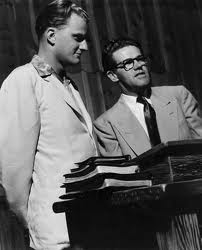
Mini Biography of Dawson Trotman: The Reverend Billy Graham preached the funeral of Dawson Trotman in 1956 after Trotman died while rescuing a swimmer at an upstate New York lake. “I think Dawson Trotman has personally touched more lives [for Christ’s sake] than anybody that I have ever known,” Graham said. Graham knew Trotman and the ministry he founded—The Navigators—quite well, using material Trotman developed as follow-up instruction for his crusades. The Navigators’ influence has since grown to worldwide proportions with about 3,600 staff representing 60 nationalities working in 101 countries. Trotman founded The Navigators in 1934. He originated its Bible teaching material and led it through its formative years as it expanded from an initial emphasis on discipling military personnel to reaching college students and laymen. At the heart of Trotman and the ministry he founded was and is the discipleship of believers—grounding Christians in the spiritual disciplines of prayer, worship, Bible study, and service. (Billy Graham and Dawson Trotman pictured at right in the 1950’s)

The Conversion: Trotman’s high school years featured impressive credentials. He was class valedictorian, student body president, chairman of the student council, and captain of the basketball team. However, the next several years saw Trotman’s life drift dangerously. He gambled. He drank. He became a noted pool shark. However, a late night encounter with a local policeman was the catalyst for a spiritual encounter with Jesus Christ. Drunk and unable to find his car, Trotman was arrested at an amusement park. Fortunately, the officer saw a deeper problem than alcohol. “Son, do you like this kind of life?” the officer questioned. “Sir, I hate it,” Trotman replied. The policeman returned Trotman’s keys and encouraged him to change his lifestyle. Two days later, Trotman attended a youth gathering at a local church where contests were conducted for Scripture memorization. Given ten verses on salvation, Trotman was the only person in the group who memorized them for the next week’s meeting. Given ten more verses to memorize on spiritual growth for the next week, Trotman quickly grasped them as well. Several weeks later, one of the Scripture verses on salvation flashed through his mind. And it was then that he asked for Christ to change his life. “Oh God,” he said, “whatever it means to receive Jesus, I want to do it right now.”

The Beginning Of Ministry: Trotman spent the next several years engaging in intensive personal evangelism while committing himself to a disciplined life of prayer. As usual, his focus was on the intake and absorption of God’s Word. In 1934, Trotman was asked to visit a sailor, Les Spencer, and share God’s Word with him. Betty Skinner, the author of Trotman’s biography Daws, described the scene: “Parked by a schoolhouse, they were pouring over the Scriptures when a security guard approached and asked what they were doing. ‘Reading the Bible,’ Trotman answered and seized the opportunity to witness . . . Dawson turned from one passage to another to explain the Gospel and answer all the defenses of the hapless guard. “On the way back to the landing [Spencer] said, ‘Boy, I’d give my right arm to know how to use the Word like that.'” It marked the beginning of The Navigators ministry, so named for its nautical origins. Spencer led another to Christ who in turn led still others to salvation. The discipleship ministry of The Navigators was birthed, and the process of winning and discipling men and women for Christ continues throughout the world today.

Memorization And Meditation: Trotman’s conversion experience centered on memorization and meditation on God’s Word. He was a discipler of men because he himself was first discipled by God through the Scriptures. His emphasis on memorizing Scriptures, arranged on topical themes, continues to be part of the core curriculum of The Navigators today. Memorization was not approached in legalistic fashion by Trotman, who understood that God’s Spirit must create the desire and will to mine the treasures of His Word. Regular Scripture memorization and meditation are fundamental to experiencing an abundant Christian life. The psalmist “treasured” God’s Word in his heart (Psalm 119:11) and meditated on the Scriptures “day and night.” (Psalm 1:2) As you write God’s Word on the tablet of your heart, you will find your mind renewed and ready to face temptations, challenges, and adversity from God’s perspective of truth. It is truth that sets you free; and the more Scripture you store in your heart, the more like Christ you will become. Graham summed up Trotman’s life this way: “Dawson loved the Word of God. I think more than anybody else he taught me to love it. He always carried his Bible around and always had it marked. The Word of God was sweetness to him.” 

If you want to read more on Dawson Trotman. Betty Skinner has written a very enjoyable biography on his life entitled “DAWS” – Dawson’s beloved nickname. Product description: From his youth as a liar, gambler, and pool shark to manhood as an indefatigable witness for his Lord Jesus Christ, Dawson Trotman revolutionized the practice of evangelism and founded one of the most widespread and respected Christian organizations in the world today. This moving historical account, drawn from the memories of those whose lives he touched and from the author’s firsthand knowledge, will both encourage you in your faith and inspire you to action. 391 pages, paperback, from Navpress.

Children and Good Books Go Together – My Top 25 – By Dr. David P. Craig

“Children and books go together in a special way. I can’t imagine any pleasure greater than bringing to the uncluttered, supple mind of a child the delight of knowing God and the many rich things He has given us to enjoy. This is every parent’s privilege, and books are his keenest tools. Children don’t stumble onto good books by themselves; they must be introduced to the wonder of words put together in such a way that they spin out pure joy and magic.” – Gladys Hunt, Honey For A Child’s Heart. Grand Rapids: Zondervan, 2002. (This book is a good resource for choosing books for children)

Having raised five children – all of whom enjoy reading immensely – and now having two grand children – I believe strongly in reading daily with our children and that there are tremendous benefits – especially books that convey Biblical values and a Christ centered world-view. Here are my top 25 books for reading to your children – ages 2-11:

(1) The Jesus Storybook Bible: Every Story Whispers His Name By Sally Lloyd-Jones & illustrated by Jago. Grand Rapids: Zondervan, 2007. Product description: A Bible like no other, The Jesus Storybook Bible invites children to join in the greatest of all adventures, to discover for themselves that Jesus is at the center of God’s great story of salvation–and at the center of their own story too! The Jesus Storybook Bible tells the story beneath all the stories in the Bible. At the center of all is a baby, the child upon whom everything will depend. From Noah, to Moses, to the great King David–every story points to him. He is the missing piece to the puzzle–the piece that makes all the other pieces fit together. From the Old Testament through the New Testament, as the story unfolds, children will pick up the clues and piece together the puzzle. The Jesus Storybook Bible makes an excellent gift at Christmas, when we all remember that he is the puzzle piece that makes all the other pieces in our lives fit. Recommended for ages 4 to 8.

(2) 3 in 1: A Picture of God By Jonne Marxhausen. Saint Louis: Concordia Publishing House, 2004. Product description: This book effectively explains the Trinity to young children by using an apple. Just as the apple consists of three parts: the skin, the flesh, the seeds…it is still one apple. God had three persons: Father, Son, Holy Spirit…but He is one God. Ages 2-9.

(3) My ABC Bible Verses: Hiding God’s Word in Little Hearts By Susan Hunt & Illustrated by Yvetter Banek. Wheaton, Crossway, 1998. Product description: Knowing God’s Word helps anyone of any age know Him better. With this colorful book Susan Hunt has developed a fun way to help kids learn His truths. Each letter of the alphabet has a corresponding Bible verse, and each verse is accompanied by a story to illustrate the scriptural passage. Presented in an easy to use format, it’s perfect for use in family devotions, churches, Christian schools or Bible clubs. Recommended for ages 3 to 7.

(4) The Big Picture Story Bible By David Helm & Illustrated By Gail Schoonmaker. Wheaton: Crossway, 2010. Product description: Everyone loves a good story especially children! But what we sometimes overlook is that the Bible is more than a collection of great stories. It is the real account of God’s love for the world. The Big Picture Story Bible presents this remarkable true story. Simple words and striking illustrations unfold the story line of God’s Word and His love for the world from Genesis to Revelation. All ages will enjoy this exciting discovery of a God who keeps his big promise! Especially recommended for ages 2—7.

(5) The King Without a Shadow By R.C. Sproul & Illustrated By Liz Bonham. Philipsburg, New Jersey, 2000. When a little boy asks a powerful king, “Why do we have shadows?” the ruler doesn’t know—and neither do his wise men. But then the king hears about somebody who’s so great that he’s only light, with no darkness—and no shadow! A wonderful story about the holiness of God for your children ages 4 and up.

(6) The Lightlings By R.C. Sproul, & Illustrated By Justin Gerard. Orlando, FL: Reformation Trust, 2006. Product description: The Lightlings, Dr. R.C. Sproul weaves an allegorical tale that captures the essence of the biblical story of redemption in a manner that will fascinate and delight children. A race of tiny beings known as Lightlings represent humanity as they pass through all the stages of the biblical drama–creation, fall, and redemption. In the end, children will understand why some people fear light more than darkness, but why they need never fear darkness again. With richly detailed illustrations by Justin Gerard, this picture book also has discussion questions and Scripture references that will help parents guide children into the deeper meaning of the story. Recommended for ages 4 and up.

(7) The Prince’s Poison Cup By R.C. Sproul & Illustrated By Justin Gerard. Orlando, FL: Reformation Trust, 2008. Product description: With The Prince’s Poison Cup, Dr. R. C. Sproul continues his series of books designed to present deep biblical truths to children on their own level. In this work, he focuses on the atonement to show that Jesus had to endure the curse of sin in order to redeem His people from their spiritual death. When Ella gets sick and has to take yucky medicine, she wonders why something that will help her get well has to taste so bad. When she puts the question to Grandpa, he tells her the story of a great King and His subjects who enjoyed wonderful times together until the people rebelled against the King and drank from a forbidden well. To their horror, they found that the beautiful water in the well made their hearts turn to stone. To reclaim His people, the King asks His Son, the Prince, to drink from a well of horrid poison. The poison will surely kill the Prince but He is willing to drink it to please His Father and help His people. Richly illustrated, The Prince’s Poison Cup will help children appreciate the great love of God for His people and the awful price Jesus had to pay because of sin. A For Parents section provides assistance in unfolding the biblical elements of the story.  Recommended for ages 4 and up.

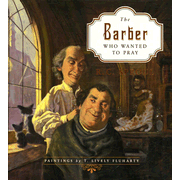
(8) The Barber Who Wanted to Pray By R.C. Sproul & Illustrated By T. Lively Fluharty. Wheaton: Crossway, 2011. Product description: An excellent gift for children of all ages and a wonderful addition to any family’s library, this new story by R.C. Sproul will help open you and your children’s minds to prayer. Follow this story as you meet a Barber who discovers that his last customer for the day is the outlaw Martin Luther. Rather than turning him in, he asks him a simple question, “How can I pray better?” Discover, along with the Barber, the simple ways that you can pray better through The Lord’s Prayer, The Apostle’s Creed, and The Ten Commandments. All three prayers are listed in the back for reference. Ages 4 and up.

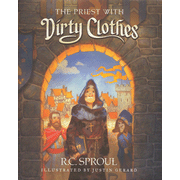
(9) The Priest with Dirty Clothes By R.C. Sproul & Illustrated By Justin Gerard. Orlando, FL: Reformation Trust, 2011. Product description: Darby and Campbell decided to make mud pies outside, and have made a mess of their clothes and ruined them. When Grandpa comes to visit and sees their muddy clothes, he remembers an amazing story. The story that he tells Darby and Campbell is about a young priest who, on his way to preach his sermon to the royal family, falls from his horse and ruins his robes. Unable to preach before the King with dirty clothes he is sent away, but must return in a weeks time with clean clothing. Unfortunately, nothing will get the mud out of the clothes and they are ruined. But when the young priest goes to see the great prince, he is given a wonderful gift. Teach your children the love, grace, and kindness forgiveness that God gives us with this beautifully illustrated book. Included in the back is a section “For the Parents” with questions to help guide discussion of this book with your young ones. Ages 4 and above.

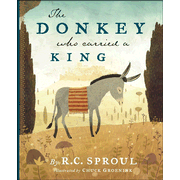
(10) The Donkey Who Carried a King By R.C. Sproul & Illustrated By Justin Gerard. Orlando, FL: Reformation Trust, 2012. Product description: Give kids a unique perspective on the events of Jesus’ Passion Week with this illustrated story by R.C. Sproul, The Donkey Who Carried a King. Davey was a young donkey who never had anything to do . . . until one day some strangers arrived and Davey was given a very special task: to carry the King, Jesus, into Jerusalem. Davey sees things that he doesn’t understand, until another donkey helps him see that the King is willingly a Servant on behalf of His people. Ages 6-12.

(11) The Merchant and the Thief By Ravi Zacharias & Illustrated By Laure Fournier. Grand Rapids: Zondervan, 2010. Product description: When Raj left the room, Mohan tiptoed over to his belongings and searched hurriedly under Raj’s pillow. Again he found nothing. Mohan longs for Raj’s treasure. He plots and he schemes and his plan seems perfect! But along the way, he discovers an important lesson about wanting what someone else has … and about the most important treasure of all. From bestselling author Ravi Zacharias comes a retelling of a classic Indian folktale that teaches powerful truths about faith. Ages 4 and up.

(12) The Topsy-Turvy Kingdom By Dottie McDowell, Josh McDowell and David N. Weiss.  Product description: This colorful book will fascinate children as they learn the significance of right and wrong. The McDowell’s focus on the importance of truth and the chaos of relativism so that your children can understand how to worship God in spirit and in truth. Ages 2 and up.

(13) Right Choices: Helping Kids Live God’s Way By Kenneth N. Taylor & Illustrated By Kathryn Shoemaker, Wheaton, Tyndale, 1999. Product description: One of the toughest jobs parents face is teaching children to make right choices. In Right Choices, Dr. Taylor’s grandfatherly chats can help you with that job. Poems, Bible verses, prayers, and delightful pictures work together to make the job fun. Your kids will learn that it is WRONG to lie, steal, go with a stranger, fight, make fun of other people, cheat, throw a tempter tantrum, and more. They will learn that it is RIGHT to be thankful and polite, to talk to God, forgive people; control their temper, and more.  Recommended for ages 3-7.

(14) The Big 10 for Little Saints By Matt & Lisa Jacobson. Sisters, OR: Multnomah Books, 2000. Product description: In a chaotic, increasingly immoral world, this important volume enables parents to teach their children God’s Ten Commandments. These simple, yet clear explanations, along with incredible artistry make an indelible mark on young impressionable minds. Ages 3 and up.

(15) Cows In The House By Beverly Lewis & Illustrated By Chi Chung. Minneapolis: Bethany, 1998. Product description: The lighthearted tale of a little barefoot boy who struggles to live with five quarreling sisters and learns a valuable lesson in contentment from his grandfather based on Philippians 4:11. Captivating stories and verses for children ages 4 to 8.

(16) Big Truth For Little Kids: Teaching Your Children to Live For God By Susan Hunt & Richard Hunt. Wheaton: Crossway, 1999. Product description: Your children are a blessing from God. A gift that brings an abundance of joy and the privilege of teaching them God’s ways. When they’re young their potential to learn is amazing. And because actions and beliefs go hand in hand, the lessons they learn from you now will shape their lives forever. How we live is based upon what we believe. Susan Hunt wants to help parents systematically teach their kids the basic truths of faith so that they live for the Lord. This wonderful book, with its easy-to-use story format, can help you teach the basic truths of the Christian faith to your children. Each lesson in this devotional for children begins with simple questions and answers about a biblical principle and is followed by a story of two youngsters, Caleb and Cassie, that portrays how that truth can be applied. You’re children will learn right along with Caleb and Cassie that God’s ways are best–and that even as kids, they can live for His glory every day. Recommended for ages 5 to 9.

(17) Big Truths for Young Hearts: Teaching and Learning the Greatness of God By Bruce A. Ware, Wheaton: Crossway, 2009. Product description: Big Truths for Young Hearts encourages and enables parents of children 6 to14 years of age to teach through the whole of systematic theology in an understandable, chapter-a-day format. Parents can teach their children the great truths of the faith and shape their worldviews early, based on these truths. The book covers ten topics of systematic theology, devoting several brief chapters to each subject, making it possible for parents to read one chapter per day with their children. With this non-intimidating format, parents will be emboldened to be their children’s primary faith trainers – and perhaps learn a few things themselves along the way.

(18) The Big Book of Questions and Answers By Sinclair B. Ferguson, Genies House, Fearn, Tain, Ross-shire, Scotland: Christian Focus, 1997. Product Description: Questions! Questions! Questions! Children are full of them. Where did I come from? What is God like? Is there only one God? This book is a family guide to the Christian Faith that will help you to answer these questions. This is a book for families to discover the key doctrines of Christianity in a way that stimulates discussion and helps children want to know more. Each page is set out in a clear child friendly way with A Question, The Answer, A Memory Verse, Reading Time, Talking Time, Action Time and Prayer Time. Ages 5-10.

(19) The Big Book of Questions and Answers about Jesus By Sinclair B. Ferguson, Genies House, Fearn, Tain, Ross-shire, Scotland: Christian Focus, 2000. Product Description: Following on from the success of the original Big Book of Questions and Answers, this book tackles the many questions that children have about Jesus, including: What was so special about Jesus? Why did Jesus heal sick people? Why did Jesus have to die? How can I give my life to Jesus? An invaluable tool for introducing children to Jesus and helping them to get to know Him better, in an enjoyable and interactive way. Recommended for ages 5 to 10.

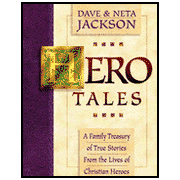
(20) Hero Tales: A Family Treasury of True Stories from the Lives of Christian Heroes, Volume 1 By David and Neta Jackson. Minneapolis: Bethany, 2005. Product description:  Drawn from the lives of fifteen key Christian heroes, Hero Tales is a beautifully illustrated treasury of forty-five exciting and educational readings designed to help foster Christian character qualities in families with elementary-age children. This inspiring collection presents a short biography and three true stories for each hero, including: Amy Carmichael, Martin Luther, Dwight L. Moody, Samuel Morris, Harriet Tubman, William Tyndale and John Wesley. Whether read together at family devotions or alone, Hero Tales is an ideal way to acquaint children ages six to twelve with historically important Christians while imparting valuable lessons.

(21) Hero Tales: A Family Treasury of True Stories from the Lives of Christian Heroes, Volume 2 By David and Neta Jackson. Minneapolis: Bethany, 2005. Product description:  Drawn from the lives of fifteen key Christian heroes, Hero Tales is a beautifully illustrated treasury of forty-five exciting and educational readings designed to help foster Christian character qualities in families with elementary-age children. This inspiring collection presents a short biography and three true stories for each hero, including: Dietrich Bonhoeffer, Eric Liddell, John Bunyan, Jim Elliot, Florence Nightingale, Amanda Smith, John Newton, and Corrie ten Boom. Whether read together at family devotions or alone, Hero Tales is an ideal way to acquaint children ages six to twelve with historically important Christians while imparting valuable lessons.

(22) Hero Tales: A Family Treasury of True Stories from the Lives of Christian Heroes, Volume 3 By David and Neta Jackson. Minneapolis: Bethany, 2005. Product description: Drawn from the lives of fifteen key Christian heroes, Hero Tales: Volume III is a beautifully illustrated treasury of forty-five exciting and educational readings designed to help foster Christian character qualities in families with elementary-age children. This inspiring collection presents a short biography and three true stories for each hero, including: Billy Graham, Luis Palau, Mother Theresa, Brother Andrew, Lottie Moon, and Jonathan & Rosalind Goforrth. Read together at family devotions or alone, Hero Tales: Volume III is an ideal way to introduce children ages six to twelve to historically important Christians while imparting valuable lessons.

(23) Hero Tales: A Family Treasury of True Stories from the Lives of Christian Heroes, Volume 4 By David and Neta Jackson. Minneapolis: Bethany, 2005. Product description: Drawn from the lives of fifteen key Christian heroes, Hero Tales: Volume IV is a beautifully illustrated treasury of forty-five exciting and educational readings designed to help foster Christian character qualities in families with elementary-age children. This inspiring collection presents a short biography and three true stories for each hero, including: C. S. Lewis, Joy Ridderhof, Ricky and Sherialyn Byrdsong, William J. Seymour, John and Betty Stam, and William Wilberforce Whether read together at family devotions or alone, Hero Tales: Volume IV is an ideal way to introduce children ages six to twelve to historically important Christians while imparting valuable lessons.

(24-25) Bible Doctrine For Older Children, Books A & B, By James W. Beeke. Grand Rapids: Reformation Heritage/Soli Deo Gloria, 2009. Product description: Bible Doctrine for Older Children is a two volume series consisting of twenty chapter which contain simple explanations of all major biblical doctrines. Book A contains chapters 1-10 and Book B chapters 11-20. The explanations were written for children eleven years of age and older. This series contains more than 150 stories and illustrations to help explain the doctrinal concepts being taught. These books were written for home, personal, or family reading; school Bible doctrine teaching; or church catechetical instruction. Ages 9 and up.

Dr. D.A. Carson on How To Do Evangelism in a Post Modern Culture

*Athens Revisited (An Exegetical Study of Acts 17) by D.A. Carson

I would like to think that most of us have become convinced of the primacy of what might generically be called worldview evangelism. In the recent past, at least in North America and Europe, evangelism consisted of a fairly aggressive presentation of one small part of the Bible’s story line. Most non-Christians to whom we presented the gospel shared enough common language and outlook with us that we did not find it necessary to unpack the entire plot line of the Bible.

A mere quarter of a century ago, if we were dealing with an atheist, he or she was not a generic atheist but a Christian atheist-that is, the God he or she did not believe in was more or less a god of discernibly Judeo-Christian provenance. The atheist was not particularly denying the existence of Hindu gods — Krishna, perhaps — but the God of the Bible. But that meant that the categories were still ours. The domain of discourse was ours.

When I was a child, if I had said, “Veiled in flesh the Godhead see,” 80 percent of the kids in my school could have responded, “Hail the incarnate deity.” That was because Christmas carols like “Hark, the Herald Angels Sing” were sung in home, church, school, and street. These kids may not have understood all-the words, but this domain of Christian discourse was still theirs. Young people at university doubtless imbibed massive doses of naturalism, but in most English departments it was still assumed you could not plumb the vast heritage of English poetry if you possessed no knowledge of the language, metaphors, themes, and categories of the Bible.

In those days, then, evangelism presupposed that most unbelievers, whether they were atheists or agnostics or deists or theists, nevertheless knew that the Bible begins with God, that this God is both personal and transcendent, that he made the universe and made it good, and that the Fall introduced sin and attracted the curse. Virtually everyone knew that the Bible has two Testaments. History moves in a straight line. There is a difference between good and evil, right and wrong, truth and error, fact and fiction. They knew that Christians believe there is a heaven to be gained and a hell to be feared. Christmas is bound up with Jesus’ birth; Good Friday and Easter, with Jesus’ death and resurrection. Those were the givens.

So what we pushed in evangelism was the seriousness of sin, the freedom of grace, who Jesus really is, what his death is about, and the urgency of repentance and faith. That was evangelism. Of course, we tilted things in certain ways depending on the people we were addressing; the focus was different when evangelizing in different subcultural settings— in the Bible Belt, for instance, or in an Italian-Catholic section of New York, or in an Ivy League university. But for most of us, evangelism was connected with articulating and pressing home a very small part of the Bible’s plot line.

In many seminaries like Trinity, of course, we recognized that missionaries being trained to communicate the gospel in radically different cultures needed something more. A missionary to Japan or Thailand or north India would have to learn not only another language or two but also another culture. No less important, they would have to begin their evangelism farther back, because many of their hearers would have no knowledge of the Bible at all and would tenaciously hold to some worldview structures that were fundamentally at odds with the Bible. The best schools gave such training to their missionary candidates. But pastors and campus workers were rarely trained along such lines. After all, they were doing nothing more than evangelizing people who shared their own cultural assumptions, or at least people located in the same domain of discourse, weren’t they?

We were naive, of course. We were right, a quarter of a century ago, when we sang, “The times they are a-changin’.” Of course, there were many places in America where you could evangelize churchy people who still retained substantial elements of a Judeo-Christian worldview. There are still places like that today: the over-fifties in the Midwest, parts of the Bible Belt. But in the New England states, in the Pacific Northwest, in universities almost anywhere in the country, in pockets of the population such as media people, and in many parts of the entire Western world, the degree of biblical illiteracy cannot be overestimated. One of my students commented a week ago that he was walking in Chicago with his girlfriend, who had a wooden cross hanging from a chain around her neck. A lad stopped her on the sidewalk and asked why she had a plus sign for a necklace. The people whom we evangelize on university campuses usually do not know that the Bible has two Testaments. As Phillip Jensen says, you have to explain to them the purpose of the big numbers and little numbers. They have never heard of Abraham, David, Solomon, Paul — let alone Haggai or Zechariah. They may have heard of Moses, but only so as to confuse him with Charlton Heston.

But this analysis is still superficial. My point is not so much that these people are ignorant of biblical data (though that is true) as that, having lost touch with the Judeo-Christian heritage that in one form or another (sometimes bowdlerized) long nourished the West, they are not clean slates waiting for us to write on them. They are not empty hard drives waiting for us to download our Christian files onto them. Rather, they have inevitably developed an array of alternative worldviews. They are hard drives full of many other files that collectively constitute various non-Christian frames of reference.

The implications for evangelism are immense. I shall summarize four.

First, the people we wish to evangelize hold some fundamental positions that they are going to have to abandon to become Christians. To continue my computer analogy, they retain numerous files that are going to have to be erased or revised, because as presently written, those files are going to clash formidably with Christian files. At one level, of course, that is always so. That is why the gospel demands repentance and faith; indeed, it demands the regenerating, transforming work of the Spirit of God. But the less there is of a common, shared worldview between “evangelizer” and “evangelizee,” between the biblically informed Christian and the biblically illiterate postmodern, the more traumatic the transition, the more decisive the change, the more stuff has to be unlearned.

Second, under these conditions evangelism means starting farther back. The good news of Jesus Christ — who he is and what he accomplished by his death, resurrection, and exaltation — is simply incoherent unless certain structures are already in place. You cannot make heads or tails of the real Jesus unless you have categories for the personal/transcendent God of the Bible; the nature of human beings made in the image of God; the sheer odium of rebellion against him; the curse that our rebellion has attracted; the spiritual, personal, familial, and social effects of our transgression; the nature of salvation; the holiness and wrath and love of God. One cannot make sense of the Bible’s plot line without such basic ingredients; one cannot make sense of the Bible’s portrayal of Jesus without such blocks in place. We cannot possibly agree on the solution that Jesus provides if we cannot agree on the problem he confronts. That is why our evangelism must be “worldview” evangelism. I shall flesh out what this means in a few moments.

Third, not for a moment am I suggesting that worldview evangelism is a restrictively propositional exercise. It is certainly not less than propositional; the Bible not only presents us with many propositions, but it insists in some cases that unless one believes those propositions one is lost. The point can easily be confirmed by a close reading of the gospel of John. For all its complementary perspectives, it repeatedly makes statements like “Unless you believe that . . .” One really ought not be forced to choose between propositions and relational faith any more than one should be forced to choose between the left wing of an airplane and the right. At its core, worldview evangelism is as encompassing as the Bible. We are called not only to certain propositional confession but also to loyal faith in Jesus Christ, the truth incarnate; to repentance from dead works to serve the living God; to life transformed by the Holy Spirit, given to us in anticipation of the consummated life to come; to a new community that lives and loves and behaves in joyful and principled submission to the Word of the King, our Maker and Redeemer. This massive worldview touches everything, embraces everything. It can be simply put, for it has a center; it can be endlessly expounded and lived out, for in its scope it has no restrictive perimeter.

Fourth, the evangelist must find ways into the values, heart, thought patterns — in short, the worldview — of those who are being evangelized but must not let that non-Christian worldview domesticate the biblical message. The evangelist must find bridges into the other’s frame of reference, or no communication is possible; the evangelist will remain ghettoized. Nevertheless, faithful worldview evangelism under these circumstances will sooner or later find the evangelist trying to modify or destroy some of the alien worldview an d to present another entire structure of thought and conduct that is unimaginably more glorious, coherent, consistent, and finally true.

All of this, of course, the apostle Paul well understood. In particular, by his own example he teaches us the difference between evangelizing those who largely share your biblical worldview and evangelizing those who are biblically illiterate. In Acts 13:16-41, we read Paul’s evangelistic address in a synagogue in Pisidian Antioch. The setting, a synagogue, ensures that his hearers are Jews, Gentile proselytes to Judaism, and Godfearers — in every case, people thoroughly informed by the Bible (what we would today call the Old Testament). In this context, Paul selectively narrates Old Testament history in order to prove that Jesus of Nazareth is the promised Messiah. He quotes biblical texts, reasons his way through them, and argues that the resurrection of Jesus is the fulfillment of biblical prophecies about the Holy One in David’s line not seeing decay From Jesus’ resurrection, Paul argues back to Jesus’ death and its significance — ultimately, the forgiveness of sins and justification before God (vv. 38-39). Paul ends with a biblical passage warning of fearful judgment against skepticism and unbelief. Here, then, is the apostolic equivalent to evangelism among churchy folk, biblically literate folk-the kind of people who already, at a certain level, know their Bibles.

In Acts 17:16-34, however, one finds the apostle Paul evangelizing intelligent Athenians who are utterly biblically illiterate. Here his approach is remarkably different, and has much to teach us as we attempt to evangelize a new generation of biblical illiterates.

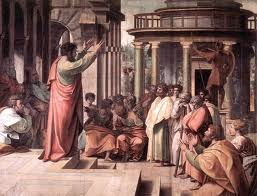
Now while Paul was waiting for them at Athens, his spirit was provoked within him as he saw that the city was full of idols. So he reasoned in the synagogue with the Jews and the devout persons, and in the marketplace every day with those who happened to be there. Some of the Epicurean and Stoic philosophers also conversed with him. And some said, “What does this babbler wish to say?” Others said, “He seems to be a preacher of foreign divinities”—because he was preaching Jesus and the resurrection. And they took hold of him and brought him to the Areopagus, saying, “May we know what this new teaching is that you are presenting? For you bring some strange things to our ears. We wish to know therefore what these things mean.” Now all the Athenians and the foreigners who lived there would spend their time in nothing except telling or hearing something new. So Paul, standing in the midst of the Areopagus, said: “Men of Athens, I perceive that in every way you are very religious. For as I passed along and observed the objects of your worship, I found also an altar with this inscription, ‘To the unknown god.’ What therefore you worship as unknown, this I proclaim to you. The God who made the world and everything in it, being Lord of heaven and earth, does not live in temples made by man, nor is he served by human hands, as though he needed anything, since he himself gives to all mankind life and breath and everything. And he made from one man every nation of mankind to live on all the face of the earth, having determined allotted periods and the boundaries of their dwelling place, that they should seek God, in the hope that they might feel their way toward him and find him.

Yet he is actually not far from each one of us, for ‘In him we live and move and have our being’; as even some of your own poets have said, ‘For we are indeed his offspring.’ Being then God’s offspring, we ought not to think that the divine being is like gold or silver or stone, an image formed by the art and imagination of man. The times of ignorance God overlooked, but now he commands all people everywhere to repent, because he has fixed a day on which he will judge the world in righteousness by a man whom he has appointed; and of this he has given assurance to all by raising him from the dead.”

Now when they heard of the resurrection of the dead, some mocked. But others said, “We will hear you again about this.” So Paul went out from their midst. But some men joined him and believed, among whom also were Dionysius the Areopagite and a woman named Damaris and others with them.

I have organized the rest of what I have to say under four topics: the realities Paul faces, the priorities he adopts, the framework he establishes, and the nonnegotiable gospel he preaches.

(1) THE REALITIES PAUL FACES

Apart from their obvious biblical illiteracy — these Athenian intellectuals had never heard of Moses, never cracked a Bible — three features of this culture are striking.

First, the Roman Empire was characterized not only by large-scale empirical pluralism but also by government-sponsored religious pluralism. The Romans knew that a captive people were more likely to rebel if they could align religion, land, and people. Partly to break up this threefold cord, the Romans insisted on adopting into their own pantheon some of the gods of any newly subjugated people, and they insisted equally strongly that the newly subjugated people adopt some of the Roman gods. In any potential civil war, therefore, it would be quite unclear which side the gods were helping — and this policy of god-swaps strengthened the likelihood of imperial peace. It also meant that religious pluralism was not only endemic to the Empire but was buttressed by the force of law After all, it was a capital offense to desecrate a temple — any temple. But let no temple and no God challenge Washington — I mean Rome.

Second, like us, Paul was dealing not with people who were biblically illiterate and therefore had no worldview, but with people who vociferously argued for various competing and powerful worldviews.

Two are mentioned in the text: Epicurean and Stoic (v. 18). In the first century, philosophy did not have the fairly esoteric and abstract connotations it has today, connected with minor departments in large universities. It referred to an entire way of life, based on a rigorous and self-consistent intellectual system — close to what we mean by worldview The ideal of Epicurean philosophy, Epicurean worldview, was an undisturbed life — a life of tranquility, untroubled by undue involvement in human affairs.

The gods themselves are composed of atoms so fine they live in calmness in the spaces between the worlds. As the gods are nicely removed from the hurly-burly of life, so human beings should seek the same ideal. But over against this vision, as we shall see, Paul presents a God who is actively involved in this world as its Creator, providential Ruler, Judge, and self-disclosing Savior.

Stoic philosophy thought of god as all-pervasive, more or less in a pantheistic sense, so that the human ideal was to live life in line with what is ultimately real, to conduct life in line with this god/principle of reason, which must rule over emotion and passion. Stoicism, as someone has commented, was “marked by great moral earnestness and a high sense of duty.” Against such a vision, the God that Paul presents, far from being pantheistic, is personal, distinct from the creation, and is our final judge. Instead of focusing on “universal reason tapped into by human reasoning,” Paul contrasts divine will and sovereignty with human dependence and need. In short, there is a massive clash of worldviews.

Of course, there were other Greek and Latin worldviews. There is no mention here of the sophists or of the atheistic philosophical materialists such as Lucretius. What is clear is that Paul here finds himself evangelizing men and women deeply committed to one fundamentally alien worldview or another.

Third, no less striking is the sneering tone of condescension they display in verse 18: What is this babbler trying to say? — this “seed picker,” this little bird fluttering around picking up disconnected scraps of incoherent information, this second-class mind? Others remarked, He seems to be advocating foreign gods. Of course, as it turns out, some of these people become genuinely interested in the gospel. The tenor of condescension is unmistakable, however, when an alien worldview feels secure in its thoughtless majority.

These, then, are the realities Paul faces.

(2) THE PRIORITIES PAUL ADOPTS

The most immediate and striking response of the apostle Paul to all that he witnesses in Athens is an intuitively biblical analysis: he is greatly distressed to see that the city was full of idols (v. 16). Paul might have been overwhelmed by Athens’ reputation as the Oxford or Cambridge or Harvard of the ancient world (though universities per se did not then exist). He might have admired the architecture, gaping at the Parthenon. But Paul is neither intimidated nor snookered by Athens; he sees the idolatry. How we need Christians in our universities and high places who are neither impressed nor intimidated by reputation and accomplishment if it is nothing more than idolatry!

The apostle sets out, then, to evangelize. He aims at two quite different groups. As usual, he attaches a certain priority to evangelizing Jews and Godfearing Gentiles, the churchy folk, the biblically literate people; he reasons in the synagogue with the Jews and the God-fearing Greeks (v. 17a). He has a theological reason for this priority that we cannot examine here, but in any case we must never forget to evangelize such people. Second, he evangelizes the ordinary pagans who have no connection with the Bible: he evangelizes day by day in the market place, targeting anyone who happens to be there, most of whom would have been biblically illiterate (v. 17b). He does not wait for an invitation to the Areopagus. He simply gets on with his evangelism, and the invitation to the Areopagus is the result (v. 18).

These, then, are his priorities: God-centered cultural analysis, and persistent evangelism of both biblical literates and biblical illiterates.

Perhaps I should add that there is at least one fundamental difference between Paul’s situation and ours. When Paul evangelizes biblical illiterates, he is dealing with people whose heritage has not in recent centuries had anything to do with biblical religion. So when they react negatively to him, they do so solely because, from their perspective, his frame of reference is so alien to their own. They are not rejecting him in part because they are still running away from their own heritage. That is the additional problem we sometimes face. We sometimes deal with men and women who have adopted a worldview that is not only at several points profoundly antithetical to a biblical worldview but also self-consciously chosen over against that biblical worldview. That opens up some opportunities for us, but it raises some additional barriers as well. However, we cannot probe these opportunities and barriers here. It is enough to observe the priorities that Paul adopts.

(3) THE FRAMEWORK PAUL ESTABLISHES

Here it will be helpful to run through Paul’s argument from 17:22 to 17:31. Before I do so, however, I want to make three preliminary observations.

First, it takes you about two minutes to read this record of Paul’s address. But speeches before the Areopagus were not known for their brevity. In other words, we must remember that this is a condensed report of a much longer speech. Doubtless every sentence, in some cases every clause, constituted a point that Paul expanded upon at length.

Second, if you want to know a little more closely just how he would have expanded each point, it is easier to discover than some people think. For there are many points of comparison between these sermon notes and, for instance, Romans. I’ll draw attention to one or two of the parallels as we move on.

Third, there is a fascinating choice of vocabulary. It has often been shown that many of the expressions in this address, especially in the early parts, are the sorts of things one would have found in Stoic circles. Yet in every case, Paul tweaks them so that in his context they convey the peculiar emphases he wants to assign to them. In other words, the vocabulary is linguistically appropriate to his hearers, but at the level of the sentence and the paragraph, Paul in this report is saying just what he wants to say; he is establishing a biblical worldview.

Now let us scan the framework Paul establishes.

First, he establishes that God is the creator of the world and everything in it (17:24). How much he enlarged on this point we cannot be certain, but we know from his other writings how his mind ran. The creation establishes that God is other than the created order; pantheism is ruled out. It also establishes human accountability; we owe our Creator everything, and to defy him and set ourselves up as the center of the universe is the heart of all sin. Worse, to cherish and worship created things instead of the Creator is the essence of idolatry.

Second, Paul insists that God is the Lord of heaven and earth and does not live in temples built by hands (v. 24). The sovereignty of God over the whole universe stands over against views that assign this god or that goddess a particular domain — perhaps the sea (Neptune), or tribal gods with merely regional or ethnic interests. The God of the Bible is sovereign over everything. This teaching grounds the doctrine of providence. Because of the universality of his reign, God cannot be domesticated — not even by temples (v. 24). Paul is not denying the historical importance of the temple in

Jerusalem, still less that God uniquely disclosed himself there. Rather, he denies that God is limited to temples, and that he can be domesticated or squeezed or tapped into by the cultus of any temple (which of course threatens popular pagan practice). He is so much bigger than that.

Third, God is the God of aseity: he is not served by human hands, as if he needed anything (17:25). Aseity is a word now largely fallen into disuse, though it was common in Puritan times. Etymologically it comes from the Latin a se — “from himself.” God is so utterly “from himself” that he does not need us; he is not only self-existent (a term we often deploy with respect to God’s origins — the existence of everything else is God-dependent, but God himself is self-existent), but he is utterly independent of his created order so far as his own well-being or contentment or existence are concerned. God does not need us — a very different perspective from that of polytheism, where human beings and gods interact in all kinds of ways bound up with the finiteness and needs of the gods. The God of the Bible would not come to us if, rather whimsically, he wanted a McDonald’s hamburger; the cattle on a thousand hills are already his.

Fourth, the truth of the matter is the converse: we are utterly dependent on him — he himself gives all men life and breath and everything else (v. 25b). This strips us of our vaunted independence; it is the human correlative of the doctrines of creation and providence.

Fifth, from theology proper, Paul turns to anthropology. He insists that all nations descended from one man (v. 26). This contradicts not a few ancient notions of human descent, which conjectured that different ethnic groups came into being in quite different ways. But Paul has a universal gospel that is based on a universal problem (cf. Rom. 5; 1 Cor. 15). If sin and death were introduced into the one human race by one man such that the decisive act of another man is required to reverse them, then it is important for Paul to get the anthropology right so that the soteriology is right. We cannot agree on the solution if we cannot agree on the problem. But Paul’s stance has yet wider implications; there is no trace of racism here. Moreover, however much he holds that God has enjoyed a peculiar covenant relationship with Israel, because he is a monotheist, Paul holds that God must be sovereign over all the nations. Did he, perhaps, develop some of the lines of argument one finds in Isaiah 40ff.? If there is but one God, that God must in some sense be the God of all, whether his being and status are recognized by all or not.

Sixth, for the first time one finds an explicit reference to something wrong in this universe that God created. His providential rule over all was with the purpose that some would reach out for him and find him (v. 27). In short order Paul will say much more about sin (without actually using the word). Here he is preparing the way. The assumption is that the race as a whole does not know the God who made them. Something has gone profoundly wrong.

Seventh, although it has been important for him to establish God’s transcendence, Paul does not want such an emphasis to drift toward what would later be called deism. The God he has in mind is not far from each one of us (v. 27). He is immanent. Paul will not allow any suspicion that God is careless or indifferent about people; he is never far from us. Moreover, the apostle recognizes that some of this truth is acknowledged in some pagan religions. When Greek thought (or much of it) spoke of one “God” as opposed to many gods, very often the assumption was more or less pantheistic. That structure of thought Paul has already ruled out. Still, some of its emphases were not wrong if put within a better framework. We live and move and have our being in this God, and we are his offspring (17:28) — not, for Paul, in some pantheistic sense, but as an expression of God’s personal and immediate concern for our well-being.

Eighth, the entailment of this theology and this anthropology is to clarify what sin is and to make idolatry utterly reprehensible (v. 29). Doubtless Paul enlarged this point very much in terms of, say, Isaiah 44-45 and Romans 1. For he cannot rightly introduce Jesus and his role as Savior until he establishes what the problem is; he cannot make the good news clear until he elucidates the bad news from which the good news rescues us.

Ninth, Paul also introduces what might be called a philosophy of history — or better, perhaps, a certain view of time. Many Greeks in the ancient world thought that time went round and round in circles. Paul establishes a linear framework: creation at a fixed point; a long period that is past with respect to Paul’s present in which God acted in a certain way (In the past God over-looked such ignorance); a now that is pregnant with massive changes; and a future (v. 31) that is the final termination of this world order, a time of final judgment. The massive changes of Paul’s dramatic now are bound up with the coming of Jesus and the dawning of the gospel. Paul has set the stage so as to introduce Jesus.

So here is the framework Paul establishes. He has, in fact, constructed a biblical worldview. But he has not done so simply for the pleasure of creating a worldview. In this context he has done so in order to provide a framework in which Jesus himself, not least his death and resurrection, makes sense. Otherwise nothing that Paul wants to say about Jesus will make sense.

This is the framework Paul establishes.

(4) THE NONNEGOTIABLE GOSPEL PAUL PREACHES

We read again verse 31: For [God] has set a day when he will judge the world with justice by the man he has appointed. He has given proof of this to all men by raising him from the dead.

Here, at last, Jesus is introduced.

I want to emphasize two things. First, it is extraordinarily important to see that Paul has established the framework of the biblical metanarrative before he introduces Jesus. If metaphysics is a sort of big physics that explains all the other branches of physics, similarly metanarrative is the big story that explains all the other stories. By and large, postmodernists love stories, especially ambiguous or symbol-laden narratives. But they hate the metanarrative, the big story that makes all the little stories coherent. But what Paul provides is the biblical metanarrative. This is the big story in the Bible that frames and explains all the little stories. Without this big story, the accounts of Jesus will not make any sense — and Paul knows it.

For instance, if in a vague, New Age, postmodern context, we affirm something like “God loves you,” this short expression may carry a very different set of associations than we who are Christians might think. We already assume that men and women are guilty and that the clearest and deepest expression of God’s love is in the cross, where God’s own Son dealt with our sin at the expense of his own life. But if people know nothing of this story line, then the same words, “God loves you,” may be an adequate summary of the stance adopted by Jodie Foster in her recent film, Contact. The alien power is beneficent, wise, good, and interested in our well-being. There is nothing whatever to do with moral accountability, sin, guilt, and how God takes action to remove our sin by the death of his Son. The one vision nestles into the framework of biblical Christianity; the other nestles comfortably into the worldview of New Age optimism. In short, without the big story, without the metanarrative, the little story or the little expression becomes either incoherent or positively misleading. Paul understands the point.

Second, what is striking is that Paul does not flinch from affirming the resurrection of Jesus from the dead. And that is what causes so much offense that Paul is cut off, and the Areopagus address comes to an end. Paul was thoroughly aware, of course, that most Greeks adopted some form of dualism. Matter is bad, or at least relatively bad; spirit is good. To imagine someone coming back from the dead in bodily form was not saying anything desirable, still less believable. Bodily resurrection from the dead was irrational; it was an oxymoron, like intelligent slug or boiled ice. So some of Paul’s hearers have had enough, and they openly sneer and end the meeting (v. 32). If Paul had spoken instead of Jesus’ immortality, his eternal spiritual longevity quite apart from any body, he would have caused no umbrage. But Paul does not flinch. Elsewhere he argues that if Christ has not been raised from the dead, then the apostles are liars, and we are still dead in our trespasses and sins (I Cor. 15). He remains faithful to that vision here. Paul does not trim the gospel to make it acceptable to the worldview of his listeners.

For Paul, then, there is some irreducible and nonnegotiable content to the gospel, content that must not be abandoned, no matter how unacceptable it is to some other worldview. It follows that especially when we are trying hard to connect wisely with some worldview other than our own, we must give no less careful attention to the nonnegotiables of the gospel, lest in our efforts to communicate wisely and with relevance, we unwittingly sacrifice what we mean to communicate.

But suddenly we overhear the muttered objection of the critic. Can it not be argued that Paul here makes a fundamental mistake? Elsewhere in Acts he frequently preaches with much greater fruitfulness, and in those cases he does not stoop to all this worldview stuff. He just preaches Jesus and his cross and resurrection, and men and women get converted. Here, a piddling number believe (v. 34). In fact, Paul’s next stop in Greece after Athens is Corinth. Reflecting later on his experiences there, Paul writes to the Corinthians and reminds them For I resolved to know nothing while I was with you except Jesus Christ and him crucified (I Cor. 2:2) — doubtless because he was reflecting with some sour-faced chagrin on his flawed approach in Athens. So let us be frank, the critics charge, and admit that Paul made a huge mistake in Athens and stop holding up Acts 17 as if it were a model of anything except what not to do. The man goofed: he appealed to natural theology; he tried to construct redemptive history; he attempted to form a worldview when he should have stuck to his last and preached Jesus and the cross.

I sometimes wish this reading were correct, but it is profoundly mistaken for a number of reasons.

(1) It is not the natural reading of Acts. As Luke works through his book, he does not at this point in his narrative send up a red flag and warn us that at this point Paul makes a ghastly mistake. The false reading is utterly dependent on taking I Corinthians in a certain way (a mistaken way, as we shall see), and then reading it into Acts 17.

(2) What Paul expresses, according to Luke’s report of the Areopagus address, is very much in line with Paul’s own theology, not least his theology in the opening chapters of Romans.

(3) Strictly speaking, Paul does not say that only a “few” men believed. He says tines de andres, “certain people,” along with heteroi, “others.” These are in line with other descriptions. The numbers could scarcely have been large, because the numbers in the Areopagus could not have been very large in the first place.

(4) Transparently, Paul was cut off when he got to the resurrection of Jesus (vv. 31-32). But judging from all we know of him — both from a book like Romans and from the descriptions of him in Acts — we know where he would have gone from here.

(5) That is entirely in line with the fact that what Paul had already been preaching in the marketplace to the biblically illiterate pagans was the cc gospel” (v. 18).

(6) At this point in his life Paul was not a rookie. Far from being fresh out of seminary and still trying to establish the precise pattern of his ministry, on any chronology he had already been through twenty years of thrilling and brutal ministry. Nor is this Paul’s first time among biblically illiterate pagans or among intellectuals.

(7) In any case, I Corinthians 2 does not cast Paul’s resolve to preach Christ crucified against the background of what had happened to him in Athens. He does not say, in effect, “Owing to my serious mistakes in Athens, when I arrived in Corinth I resolved to preach only Christ and him crucified.” Rather, in 1 Corinthians Paul’s resolve to preach Christ crucified is cast against the background of what Christians in Corinth were attracted to — namely, to a form of triumphalism that espoused an ostensible wisdom that Paul detests. It is a wisdom full of pride and rhetoric and showmanship. Against this background, Paul takes a very different course. Knowing that believers must boast only in the Lord and follow quite a different wisdom (I Cor. 1), he resolves to preach Christ and him crucified.

(8) In any case, it would be wrong to think that Paul has no interest in worldviews. Writing after I Corinthians 2, Paul can say, We demolish arguments and every pretension that sets itself up against the knowledge of God, and we take captive every thought to make it obedient to Christ (2 Cor. 10:45). The context shows that Paul is not here interested so much in disciplining the individual’s private thought life (though that certainly concerns him elsewhere) as in bringing into obedience to Christ every thought structure, every worldview, that presents opposition to his beloved Master. In other words, Paul thought “worldviewishly” (if that is not too monstrous a neologism). That is clear in many of his writings; it is clear in both 2 Corinthians 10 and in Acts 17.

(9) Finally, the first line of Acts 17:34 is sometimes misconstrued: “A few men became followers of Paul and believed.” Many have assumed Luke means that a few people became Christians on the spot and followers of Paul. But that reverses what is said. Moreover, Paul has not yet given much gospel — in precisely what sense would they have become Christians? It is better to follow the text exactly Following Paul’s address, no one became a Christian on the spot. But some did become followers of Paul. In consequence, in due course they grasped the gospel and believed; they became Christians. This is entirely in line with the experience of many evangelists working in a university environment today.

A couple of years ago I spoke evangelistically at a large meeting in Oxford. So far as I know, no one became a Christian at that meeting. But sixteen students signed up for a six-week “Discovering Christianity” Bible study. A few weeks after the meeting, the curate, Vaughan Roberts, wrote me a note to tell me that eleven of the sixteen had clearly become Christians already, and he was praying for the remaining five. In other words, as a result of that meeting, some became “followers of Jesus,” and in due course believed. That is often the pattern when part of the evangelistic strategy is to establish a worldview, a frame of reference, to make the meaning of Jesus and the gospel unmistakably plain.

In short, however sensitive Paul is to the needs and outlook of the people he is evangelizing, and however flexible he is in shaping the gospel to address them directly, we must see that there remains for him irreducible content to the gospel. That content is nonnegotiable, even if it is remarkably offensive to our hearers. If it is offensive, we may have to decide whether it is offensive because of the intrinsic message or because we have still not done an adequate job of establishing the frame of reference in which it alone makes sense. But the gospel itself must never be compromised.

SOME CONCLUDING REFLECTIONS

I offer three concluding reflections. First, the challenge of worldview evangelism is not to make simple things complicated but to make clear to others some fairly complicated things that we simply assume. This can be done in fifteen minutes with the sort of presentation Phillip Jensen and Tony Payne have constructed (in Chapter 6 of Telling the Truth – “Two Ways To Live”). It might be done in seven consecutive expositions running right through the first eight chapters of Romans. It might be done with the six months of Bible teaching, beginning with Genesis, that many New Tribes Mission personnel now use before they get to Jesus. But it must be done.

Second, the challenge of worldview evangelism is not primarily to think in philosophical categories, but it is to make it clear that closing with Jesus has content (it is connected with a real, historical Jesus about whom certain things must be said and believed) and is all-embracing (it affects conduct, relationships, values, priorities). It is not reducible to a preferential religious option among many, designed primarily to make me feel good about myself.

Third, the challenge of worldview evangelism is not primarily a matter of how to get back into the discussion with biblically illiterate people whose perspectives may be very dissimilar to our own. Rather, worldview evangelism focuses primarily on where the discussion goes. There are many ways of getting into discussion; the crucial question is whether the Christian witness has a clear, relatively simple, straightforward grasp of what the Bible’s story line is, how it must give form to a worldview, and how the wonderful news of the gospel fits powerfully into this true story — all told in such a way that men and women can see its relevance, power, truthfulness, and life-changing capacity.

*”Athens Revisited” was originally a lecture at a conference on the topic of Evangelism in a Post Modern Culture held on May 13-15, 1998 at Trinity Evangelical Divinity School in Deerfield, Illinois & sponsored by the Bannockburn Institute (www.biccc.org). All the lectures from this conference were published in the book: Telling The Truth: Evangelizing Postmoderns, Grand Rapids: Zondervan, 2000; of which D.A. Carson was the general editor and the contributor of Chapter 28 from which this article is adapted.
About the Author: D. A. Carson (Ph.D., University of Cambridge) is research professor of New Testament at Trinity Evangelical Divinity School in Deerfield, Illinois. His theology is similar to that of Wayne Grudem except on charismatic issues, where his view may be described as “open but cautious.” Carson’s tendency is to strive for balance and amicability in disputes but is uncompromising on the essentials of the faith. He is a complementarian but supports gender-neutral Bible translations. Carson also helped produce the NLT. He is the author or coauthor of over 50 books. Some of the plethora of outstanding books he has written includes: The Intolerance of Tolerance, The God Who Is There, ScandalousHow Long O Lord, A Call to Spiritual Reformation; The Cross and Christian Ministry; The Difficult Doctrine of the Love of God; Divine Sovereignty and Human Responsibility; Exegetical Fallacies; For the Love of God; The Gagging of God; The Inclusive Language Debate; Introduction to the New Testament; New Testament Commentary Survey; Scripture and Truth (Ed. with John Woodbridge); Worship by the Book; Pillar Commentaries on Matthew and John and a contributor to Who Will be Saved. He also edits the New Studies in Biblical Theology book series.

Carson’s areas of expertise include biblical theology, the historical Jesus, postmodernism, pluralism, Greek grammar, Johannine theology, Pauline theology, and questions of suffering and evil. He has written books on free will and predestination from a generally compatibilist and Calvinist perspective. He is a member of the Tyndale Fellowship for Biblical Research, the Society of Biblical Literature, the Evangelical Theological Society, the Canadian Society of Biblical Studies, and the Institute for Biblical Research.

Dr. Carson and his wife, Joy, reside in Libertyville, Illinois. They have two children. In his spare time, Dr. Carson enjoys reading, hiking, and woodworking.

Evan Roberts’ – “4 Point Sermon” that Sparked the Last Great Revival

The Last Widespread Revival in America Over 100 Years Ago*

 By Dr. Walter C. Kaiser Jr.

Just over one hundred years ago, a college student in Wales named Evan Roberts, aged twenty-six, obtained permission to leave college to return to his home village of Lougher to preach his first sermon. Seventeen people showed up to listen to his four points (Evan Roberts – pictured on left at the age of 26):

(1) Confess any known sin to God and put away any wrong done to others;

(2) Put away any doubtful habit;

(3) Obey the Holy Spirit promptly; and

(4) Confess Christ openly.

No one could have predicted the nationwide impact that event would have. J. Edwin Orr related that “within three months a hundred thousand converts had been added to the churches of Wales. Five years later a book debunking the revival was published and the main point made by the scholarly author was that of the 100,000 added to the churches, only 80,000 remained after five years (DPC – I’ll take that kind of conversion growth any day! – see J. Edwin Orr, Campus Aflame, Glendale, Calif.: Regal, 1971, 101).

That same revival jumped the ocean and spread to America’s shores and was the last major revival we have seen since 1905.

“Will you not revive us again, that your people may rejoice in you?” – Psalm 85:6

*Walter C. Kaiser Jr. (PhD, Brandeis University) is the distinguished professor emeritus of Old Testament and president emeritus of Gordon-Conwell Theological Seminary in South Hamilton, Massachusetts. Dr. Kaiser has written over 40 books, including Toward an Exegetical Theology: Biblical Exegesis for Preaching and Teaching; A History of Israel; The Messiah in the Old Testament; Recovering the Unity of the Bible; The Promise-Plan of God; Preaching and Teaching The Last Things; and coauthored (with Moises Silva) An Introduction to Biblical Hermeneutics. Dr. Kaiser and his wife, Marge, currently reside at Kerith Farm in Cedar Grove, Wisconsin. Dr. Kaiser’s website is www.walterckaiserjr.com. This article is adapted from the Preface in his outstanding book Revive Us Again, Nashville, B&H, 1999.

Dr. R.C. Sproul Answers the Question: “Can We Trust the Bible?”

Objection #1 Answered: “The Bible is Full of Myths and Contradictions. It’s just a Fairy Tale.”

(This is #1 in a series of book excerpts from Objections to Christianity derived from Chapter 1 in *Dr. R.C. Sproul’s fantastic book Reason To Believe, [originally entitled Objections Answered] Grand Rapids: Zondervan, 1982, pp.19-34)

Christians, to support their claim of revealed truth, appeal to a book that was written hundreds of years ago. This book—the Bible—has been a subject of an enormous amount of study and criticism which has left the integrity of its trustworthiness seriously in doubt. If the Bible were universally regarded as an authoritarian source book for religious truth, many of the questions we will deal with in Reason to Believe would be easily resolved. But the authority and trustworthiness of the Bible is presently the question.

It is well beyond the scope of this [article] to give a comprehensive defense of the integrity of Scripture. Such a comprehensive defense would involve so many complex matters that it deserves a separate treatment. A large number of such works have been published in recent years (e.g., F.F. Bruce, The Canon of Scripture, The Defense of the Gospel in the New Testament, The New Testament Documents: Are they Reliable?; and Walter Kaiser, The Old Testament Documents: Are They Reliable?). But, several common questions about the integrity of Scripture are dealt with briefly here.

Is the Bible Full of Myths?

That the Bible is a book of myths is a common charge leveled by its critics. Since myths have no counterpart in historical truth, they are considered to be worthless sources of truth. One dictionary of myth terms it as “any fictitious story.”

Why is it so often said that the Bible is full of myths? A chief reason is because of the numerous accounts of miracles that are found in its pages. Another reason is because of parallel accounts between such things as the biblical view of the flood and that found, for example, in Babylonian mythology.A third reason why the presence of myth is suspected is because there exist similarities between events surrounding Jesus and portraits of the gods found in Greek mythology. These three reasons serve as the substantial basis for attributing a mythological character to biblical literature.

A question of miracle is not merely a question of literary style but it involves important questions of history and philosophy. If a miracle is rejected as a myth then the issue becomes one of the philosophy of nature and history rather than one of literary analysis. Before miracles can be rejected out of hand as ipso facto impossible, the critic must first establish that we are living in a closed mechanistic universe in which there exists no possibility of divine or supernatural intrusion. On the other hand, if there is a God who is omnipotent, then miracles are possible and accounts of them cannot be gratuitously dismissed as myths.

If we allow that miracles are possible that does not mean that every claim to them is valid. It is one thing to say that miracles could have happened; it is quite another to say that miracles could have happened; it is quite another to say that they did happen. As we deal with the question of an alleged miracle we must deal with it not only on the grounds of the possibility, but on the evidence that is offered to support its claim.

One of the interesting elements of biblical miracles involves the sobriety of the accounts. Compare, for example, miracle narratives of the New Testament with those found in the Gnostic literature of the second century. The Gnostic “miracles” display a flavor and atmosphere of the bizarre and frivolous. New Testament miracles take place in a context of a sober view of history and redemption. Those who claim them are men of obvious profound ethical integrity and men who are willing to die for their veracity. When evaluating the claims of biblical miracles it is important to understand the total value system of those who are making the claims. The biblical writers, in the Judeo-Christian tradition, write with a constraint that involves a profound commitment to the sanctity of truth. Peter for example writes, “We do not declare unto you cleverly devised myths or fables but rather what we have seen with our eyes and heard with our ears” (1 Peter 1:16).

Because there are parallel accounts of ancient events found in the Bible as well as in ancient mythological literature, this is no justification for impugning the writers of Scripture on the basis of the fallacy of guilt by association. If we assume, for example, that there was a natural catastrophe such as the flood in the ancient world, it should not surprise us that the event is reflected on the writings of other ancient people. The Christian welcomes a close study of comparison between the biblical account of the flood and that found, for example, in the Gilgamesh Epic (The Babylonian account of the Flood that covered the earth). That the biblical account is already demythologized appears self-evident.

The charge that the New Testament surrounds the person of Christ with mythology is often inferred from similarities of dying and rising gods in Greek mythology such as fond in Ovid’s Metamorphoses. However, in a comparative examination of any object or event under analysis the scientific method demands that we note not only the similarities but the differences as well. Mythic creatures that are half man and half beast, for example, are noticeably absent from the Scriptures. Bizarre stories about the creation of the universe are also conspicuously absent. The world, for example, is nowhere described in Scriptures as an appendage of a god; nor do we see notions of the world coming into being as the result of sexual acts of procreation among the gods. Though Jesus is virgin born, He does not spring anew out of the head of Zeus.

At the heart of the difference between Greek mythology and biblical literature is a radically different view of the significance of history. For the Greek there is no overt attempt to ground myth within the framework of history. Indeed, for the gods to become actually incarnate in the realm of space and time is utterly repugnant to the Greek mind. On the other hand that which is non-historical is relegated to the level of falsehood by the Hebrew. This radical opposing view of history is essential to understanding the Jewish-Greek antithesis with respect to the question of myth.

Does the Bible Conflict with Science?

Perhaps nothing has contributed more to the loss of credibility of Scripture than the conflicts between religion and science that have come out in the scientific and technological revolution. We remember the condemnation of Galileo and the circus atmosphere of the Scopes “Monkey Trials.” Galileo was condemned for teaching that the sun was the center of our solar system (heliocentricity) over against the accepted view that the earth was the center (geocentricity). The bishops of the church in Galileo’s day refused to look into his telescope and examine the empirical evidence that the earth is not the center of our solar system. The church is still feeling the embarrassment of that episode.

Some argue that the Bible teaches a view of reality that is utterly in conflict with the assured results of modern scientific inquiry. Some allege that the Bible teaches a primitive, prescientific view of the universe which is no longer tenable to modern man. The Bible describes the universe as being “three-storied” with heaven above, the earth in the middle, and hell underneath the earth. It describes a world of demons and angels which is considered in conflict with modern theories of physics and biology.

How does the Christian respond to such allegations? In the first place, it must be acknowledged that the church indeed has made grievous errors in drawing scientific inferences from Scripture that are unwarranted. Nowhere does the Bible “teach” that the earth is the center of the universe. The Scripture describes nature from a phenomenological perspective. That is, the world of nature is described as it appears to the naked eye. The sun is described as moving across the heavens. The Bible speaks of sunrises and sunsets. And in popular speech modern scientists still speak in the same manner. One only needs to observe the daily weather forecast to see this taking place. The weather report, or “meteorological” survey, is couched in technical scientific jargon. We hear about high pressure systems, barometric pressure, precipitation probability quotients, and the like. Yet at the end of the forecast we are told that the sun will rise at a given time and will set at another time. We do not phone the news station and angrily demand that such antiquated notions of geocentricity be deleted from the weather forecast. We do not charge the scientists with being unscientific when the describe things phenomenologically. We shouldn’t do that with the biblical writers either.

That the Bible speaks of a demonic world is evident. The Bible does not, however, teach that diseases and other mysterious maladies are caused by demonic activity. The Scriptures recognize and endorse the practice of medicine. I might add that the notion of the existence of a demonic world conflicts with no known natural scientific law.

The Bible is not a textbook of science. It does not purport to instruct us in matters of calculus, physics, or chemistry. There are times, however, when serious conflicts do emerge between theories inferred from science and biblical teaching. If, for example, a scientist concludes that the origin of man is a cosmic accident, then the scientist holds a position that is antithetical to the teaching of Scripture. But the question of man’s origin can never be determined by the study of biology. The question of origin is a question of history. The biologist can describe how things could have happened, but can never tell us how they did happen.

Is the Bible Filled with Contradictions?

People accept without hesitation the charge that the Bible is full of contradictions. Yet the charge is completely inaccurate and misleading. Why, then, if the charge is so inaccurate, do we hear it so often repeated? Apart from the problem of prejudice, there are reasons why this misconception is propagated. There is a problem not only of ignorance of what the Bible says, but perhaps even more so, a problem of ignorance of the laws of logic. The word “contradiction” is used all too loosely with respect to biblical content. That there are divergences of biblical accounts, that biblical writers describe the same things from different perspectives, is not in dispute. Whether, those varied accounts are, in fact, contradictory is in dispute.

It would be a serious overstatement to say that all discrepancies within the biblical text have been easily and satisfactorily resolved. There are serious discrepancies that have not yielded full and satisfactory resolutions. But these problems are few and far between. To say that the Bible is full of contradictions is a radical exaggeration and reflects a misunderstanding of the law of contradiction. For example, critics have alleged repeatedly that the Gospel writers contradict each other with respect to the number of angels present at the tomb of Jesus. One writer mentions one angel and the other mentions two angels. However, the writer who mentions one angel does not say there was only one angel. He merely speaks of one angel. There is no contradiction in that. Now, if one writer said there was only one angel and the other writer said there were two, at the same time and in the same relationship, there would be a bonafide contradiction.

The problem of the loose use of the word contradiction came home to me in a discussion I had with a seminary student. He repeated the charge, “The Bible is full of contradictions.” I said to him, “The Bible is a large book. If it is full of contradictions you should have no problem finding 50 clear violations of the law of contradiction in the next 24 hours. Why don’t you go home and write down 50 contradictions and we’ll discuss them at the same time tomorrow.” He accepted the challenge.

The next day he returned bleary-eyed with a list of 30 contradictions. He admitted that he had work long into the night and could come up with only 30. But he presented me a list of the most blatant contradictions he could find. (He made use of critical books that listed such contradictions.) He went through his list, one at a time, applying the test of formal logic to each alleged contradiction. We used syllogisms, the laws of immediate inference, truth tables, and even Venn diagrams to test for logical inconsistency and contradictions. In every single incident we proved objectively, not only to my satisfaction, but to his, that not a single violation of the law of contradiction was made.

Not every biblical discrepancy has been resolved. But the direction of the evidence is very encouraging. As biblical scholarship increases and knowledge of language, text, and context increases, the problem of discrepancy becomes smaller and smaller. There is less reason today to believe that the Bible is full of contradictions than at any time in the history of the church. Prejudice and critical philosophical theories, however, die a very slow and hard death. 

Is The Bible Inaccurate Historically?

If any area of biblical scholarship has given us reason for optimism concerning the reliability of Scripture, it is the area of historical investigation. To be sure there are certain dimensions of biblical content that are difficult to either verify or falsify by means of historical research. For example, the existence of angels can hardly be verified through archaeological research. Unless we can dig up some petrified angel wings we must deal with these matters on other grounds. But where biblical material touches on areas where historical research is possible it has come out remarkably well.

Twentieth-century discoveries such as those at Ugarit, Qumran and Ebla have done much to enhance our understanding of antiquity. The Nuzi tablets and the Armana tablets have resolved a host of Old Testament problems. The work of Ramsey tracing the journeys of Paul recorded by Luke has so vindicated Luke’s accuracy as a historian, that modern historians have called him the finest historian of antiquity. The biblical historians have fared considerably better under close scrutiny and critique than have other ancient historians such as Josephus and Herodotus.

The Christian has nothing to fear from righteous historical research. Rather, we have everything to gain. To illustrate the weight of historical research let us note one of the last statements in print by the dean of archaeological scholarship in the twentieth century, Dr. William Foxwell Albright:

For much too long a time the course of New Testament scholarship has been dedicated to theological, quasitheological, and philosophical presupposition. In far too many cases commentaries on New Testament books have neglected such basic requirements as up-to-date historical and philological analysis of the text itself. In many ways this preoccupation with theological and metaphysical interpretation is the unacknowledged child of Hegelianism. To this should be added the continuing and baleful influence of Schleiermacher and his successors on the whole treatment of historical material. The result has often been steadfast refusal to take seriously the findings of archaeological and linguistic research. We believe that there is less and less excuse for the resulting confusion in this latter half of the twentieth century. Closely allied with these presuppositions is the ever-present fog of existentialism, casting ghostly shadows over an already confused landscape. Existentialism as a method of interpreting the New Testament is based upon a whole series of undemonstrable postulates of Platonic, Neo-Platonic, left-wing scholastic, and relativistic origins. So anti-historical is this approach that it fascinates speculative minds which prefer clichés to factual data, and shifting ideology to empirical research and logical demonstration (W.F. Albright and C.S. Mann, Matthew, Anchor Bible Series, New York, Doubleday, 1971, vol. 26, 5-6). 

Why Is Some of the Bible Offensive?

Apart from questions of mythology, contradiction, conflict with science, and historical inaccuracy, people have rejected the Bible because the content of it is considered offensive. In particular, biblical expressions of the wrath of God have been singled out for criticism. The Old Testament is criticized for portraying a God who is merciless and arbitrary in His judgment. It is frequently stated, “I have no problems with the loving God of the New Testament, it is the angry God of the Old Testament I reject.”

In such reactions to the Old Testament, we find serious misunderstandings of the wrath of God. Nowhere do we find God involved in capricious or arbitrary acts of judgment. His wrath is never directed against the innocent. His anger never flows without reason. It is always directed against human rebellion and sin.

It is ironic that the two Testaments are so often placed in contrast to each other. The irony may be seen in light of the cross. It is the cross of the New Testament that reveals the most violent and mysterious outpouring of the wrath of God that we find anywhere in the Scripture. Here an innocent man does suffer but only after he willingly takes upon Himself, by imputation, the sins of the world. Without this act of wrath there is no grace. But it is precisely through this act of wrath that grace is made available. The New Testament knows no disjunction between the God of Jesus and the God of Abraham. Jesus appeals to the God of the Old Testament fathers as the God He is serving and revealing.

The Old Testament, in spite of its manifestations of the wrath of God, remains a history of God’s grace and long-suffering with a rebellious people. There is wrath unparalleled in the New Testament and grace overwhelming in the Old Testament. A false dichotomy between the Testaments is foreign to the biblical writers themselves.

When we examine the law code of Israel, however, do we not see a legal ethic that is in fact bloodthirsty? Does not this list of over 35 crimes which require capital punishment reflect a barbarian ethic? Are not the punitive measures of the Old Testament manifestations of what we would regard as cruel and unusual punishment?

The law code of the Old Testament seems harsh to us in light of our present societal standards. But we live in an age where serious sin is not taken seriously. We live in an age where the holiness of God and the sanctity of human life have been sadly eclipsed. If we compare the law of the Old Testament with the law of creation, we see not the cruelty of God but the mercy of God. In creation all sin against God is regarded as a capital offense. In the slightest act of rebellion we commit cosmic treason. Any sin against a perfectly holy and righteous God may justly culminate in death. This the Old Testament law represents a massive reduction of capital crimes which reveals not the bloodthirsty vengeance of an angry God, but the long-suffering mercy of a holy and loving God.

It is precisely at the point of offense in Scripture that we meet a special opportunity for supernatural instruction. By studying the parts of Scripture that are offensive to us we have the opportunity to discover those values and concepts we hold that are out of harmony with the wisdom of God. If we are offended by the Bible perhaps the fault is not with God but our own corrupt and distorted sense of values. I wonder what would happen if we called a moratorium on our criticism of the Bible and allowed the Bible to criticize us!

Are Scriptures Infallible?

It is one thing to argue that the Bible is a basically reliable source of history and religious instruction; it is quite another thing to assert that the Bible is inspired, inerrant, and infallible. It is one thing to maintain that the Bible has great value as a treasury of human insight into religious truth; it is quite another to maintain that it provides us with divine revelation and can justly be called the Word of God.

Why do Christians go beyond asserting general reliability of the Bible to conviction that the Bible is the infallible Word of God? What follows is not an attempt to present an argument for the infallibility of Scripture, but rather an attempt to outline the procedure by which such a conclusion is reached. It is beyond the scope of this article to provide a defense of biblical infallibility. Rather the aim is to explain and clarify the process by which the conclusion is reached.

The case for the infallibility of Scripture proceeds along both deductive and inductive lines. It moves from the premise of general trustworthiness to the conclusion of infallibility. The reasoning process proceeds as follows:

Premise A – The Bible is a basically reliable and trustworthy document.

Premise B – On the basis of this reliable document we have sufficient evidence to believe confidently that Jesus Christ is the Son of God.

Premise C – Jesus Christ being the Son of God is an infallible authority.

Premise D – Jesus Christ teaches that the Bible is more than generally trustworthy; it is the very Word of God.

Premise E – The word, in that it comes from God, is utterly trustworthy because God is utterly trustworthy.

Conclusion – On the basis of the infallible authority of Jesus Christ, the church believes the Bible to be utterly trustworthy, i.e., infallible.

Note that this progression does not involve circular reasoning. Circular reasoning occurs when the conclusion is already present in the first presence. Rather this method follows the linear pattern of development. The argument itself is not infallible as each premise involves matters of inductive or deductive reasoning that is done by fallible human beings. But there is no subjective leap of faith found in the method. Rather the process involves careful historical, empirical investigation as well as logical inferences.

That the Bible claims to be the Word of God is not enough to authenticate the claim. Any book can make such a claim. But the fact that the claim is made is significant indeed. If the Bible is trustworthy then we must take seriously the claim that it is more than trustworthy. If we are persuaded that Christ is the sinless Son of God then we must take seriously His view of Holy Scripture. If the church submits to the authority of Christ then it must regard His view of Scripture as being authoritative. It is from the impetus of Christ Himself that the church is led to confess her faith in the divine authority and infallibility of Scripture.

In a symposium of biblical scholars and theologians that was held in the Ligonier Valley in Pennsylvania in the fall of 1973, a joint team of scholars issued a statement on Scripture that focuses on the authority of Christ as the ground-basis for biblical authority. This “Ligonier Statement” says:

We believe the Holy Scriptures of the Old and New Testaments to be the inspired and inerrant Word of God: We hold the Bible, as originally given through human agents of revelation, to be infallible and see this as a crucial article of faith with implications for the entire life and practice of all Christian people. With the great fathers of Christian history we declare our confidence in the total trustworthiness of Scriptures, urging that any view which imputes to them a lesser degree of inerrancy than total, is in conflict with the Bibles’ self-testimony in general and with the teaching of Jesus Christ in particular. Out of obedience to the Lord Jesus Christ we submit ourselves unreservedly to his authoritative view of Holy Writ.

 Key Points to Remember:

Why should you trust the Bible? You should trust the Bible because the Bible has been proven trustworthy.

(1) The Bible does not have a mythical literary style as compared with other ancient literature. The frequent charge that the Bible is “full of myths” is not warranted by the facts. People should be encouraged to read the biblical accounts of miracles, the flood, and other controversial areas and compare them with other ancient sources that do use mythology as a literary style.

(2) Jewish-Christian history differs from the Greek view. This significant difference is a crucial one to understand before we evaluate the historical credibility of the Bible.

(3) The Bible is not a science text but describes the world as it appears to the naked eye. Biblical “conflicts” with science must be understood in terms of common-sense approaches to the “phenomenal” world. The concept of phenomenological description is important to master to be able to deal with this question. We should learn from the church’s mistakes in the past—such as the case of Galileo.

(4) Variant accounts are not the same as contradictory accounts. The charge that the Bible is “full of contradictions” is unwarranted. An understanding of the Law of Contradiction is vital to this question. Close scrutiny of biblical texts will show a difference between variant accounts and contradictory accounts.

(5) Modern historical research adds to biblical credibility. Historical research and archaeology have done much to vindicate the historical reliability and accuracy of the Bible. Important discoveries at Qumran, Ebla, Amarna and elsewhere have exploded the “assured results” of negative nineteenth-century criticism.

(6) The church’s faith in the infallibility of Scripture is established on the basis of Christ’s view of Scripture. It involves a reasoning process which is linear, not circular. It moves from general reliability to a knowledge of Christ’s “infallible” view of Scripture.

*Dr. R.C. Sproul (1939-2017) was the founder and chairman of Ligonier Ministries, an international Christian education ministry located near Orlando, Florida. His teaching can be heard on the program Renewing Your Mind, which is broadcast on hundreds of radio outlets in the United States and in 40 countries worldwide. He is the executive editor of Tabletalk Magazine and general editor of The Reformation Study Bible, and the author of more than seventy books (including some of my all time favorites: THE HOLINESS OF GOD; CHOSEN BY GOD; KNOWING SCRIPTURE; WILLING TO BELIEVE; REASON TO BELIEVE; and PLEASING GOD) and scores of articles for national evangelical publications. Dr. Sproul also serves as president of Ligonier Academy of Biblical and Theological Studies and Reformation Bible College. He currently serves as Senior Minister of preaching and teaching at Saint Andrew’s in Sanford, FL

“No Super Christians” by Steve W. Brown

After a week of meetings in Pittsburgh, a man came up to meet me following the service. A former missionary and member of the church for over thirty years, he said something to me I still haven’t been able to classify as either a compliment or something otherwise. “Steve,” he said, “I’ve really appreciated what you’ve said this week.” I told him I was glad. Then he added, “I’ve been in church all my life, and all my life I’ve heard pastors say that they were sinners. You’re the first one I ever really believed.”

Though I still chuckle about that remark, I acknowledge with complete sincerity his observation. You see, I’m not a pastor and radio preacher because I’m good or have abilities or because I’m talented. I’m where I’m at because God put me here. And sometimes I’ll be soft and sometimes I’ll be hard, but you remember, I’m just like you. God must remind me over and over that even when people call me Reverend, I’m not. Christ established an equality in the brotherhood that has direct implications for me as well as for you.

In every congregation of believers, God sets aside brothers and sisters who are called of God to lead. But the problem is, sometimes we get the idea that we are God’s gift to the world, and when that happens, the delicate balance between gifted leadership and ecclesiastical elitism gets shattered. There’s no room in the Body of Christ for elitism of any sort. That’s the world’s way.

After Queen Victoria and Prince Albert had had one of their famous, loud arguments, Prince Albert went to his room and slammed and locked the door. Queen Victoria marched after him and pounded on his door.

“Who is it?” asked Prince Albert.

“It is the Queen of England.”

Dead silence. The again the question: “Who is it?”

“It is your sovereign ruler,” replied the Queen.

Then once again, “Who is it?”

“It is your wife, Victoria, Albert.”

At that point Albert opened the door.

You may be an elder or deacon or a leader in your Sunday school. Perhaps you lead in some of the other groups in your church and conduct Bible studies. Whatever your role, I thank God for you. But remember that you’re doing it (or at least should be) because God told you to do it, not because you’re a super Christian. There are no super Christians in the body of Christ. All of us are just one among equals. So when a Christian brother or sister stands on the pedestal of his or her own status…when a peacock feathers start flying in the breeze…don’t bow. That kind of behavior doesn’t need to be encouraged. Honesty does. The importance of being honest and acknowledging our true condition and coequal status cannot be overstated.

When a Christian gets honest, something exciting happens. We get to the point where God can use us. Evangelist D.L. Moody once said, “I’ve had more trouble with D.L. Moody than with any other man I’ve ever known.” Thomas a Kempis said, “Be not angry that you cannot make others as you wish them to be since you cannot make yourself as you wish yourself to be.” If we don’t get honest with ourselves, then God is going to force it on us.

Let me tell you a prayer that God always answers: “Lord, show me myself.” Don’t pray it unless you mean it because God will surely answer you, and you won’t like what you see. But he’ll make you different through it—I guarantee it.

Super Christians? They don’t exist. There are only sinners saved by the blood of the Lamb. Remember the next time you find yourself enjoying compliments so much. If you listen carefully, you will hear them sound like a cape flapping vainly in the wind.

*Steve Brown is a radio broadcaster, seminary professor and author. He previously served as a pastor for over twenty-five years and now devotes much of his time to the radio broadcast, Key Life.

With such varied experience and unique perspective on life, Steve is an original. He refuses to be a “guru,” doesn’t want to be anyone’s mother and gives, in his teaching, the freedom to think. Overall, Steve has become known for his refreshing and practical Biblical applications.

Steve serves as Professor Emeritus of Preaching and Pastoral Ministry at Reformed Theological Seminary. He sits on the board of the National Religious Broadcasters and Harvest USA. Traveling extensively, Steve is a much-in-demand speaker.

Steve is the author of numerous books including A Scandalous Freedom, Approaching God, When Being God Isn’t Good Enough, What Was I Thinking? And Three Free Sins. His articles appear in such magazines and journals as Leadership, Decision, Plain Truth and Today’s Christian Woman. Article above No Super Christians adapted from Steve Brown, Jumping Hurdles, Hitting Glitches, Overcoming Setbacks, Colorado Springs, NavPress, 1992, 107-108.

God’s Answer for Discouragement by Warren W. Wiersbe

Adapted from Chapter 26: From The Book Turning Mountains into Molehills by Warren W. Wiersbe, Grand Rapids: Baker, 1992.

 This poem was written by a man planning to commit suicide.

 To whom can I speak today?

The gentle man has perished,

The violent man has access to everybody.

To whom can I speak today?

The iniquity that smites my land,

It has no end.

To whom can I speak today?

There are no righteous men,

The earth is full of criminals.

The interesting thing is this: the poem was not written by a frustrated twentieth century businessman. It is written by an Egyptian citizen over four thousand years ago. Violence and crime and corruption and thoughts of suicide are not modern problems, are they? They are ancient problems—and they have an ancient solution.

It takes little imagination to understand the mind of our anonymous Egyptian poet. He saw crime and violence all around him. The old values were changing. The good man was hanging on the scaffold and the evil man was sitting on the throne. There seemed to be no justice, no hope, no future. After pondering the situation, he decided that there was only one way out—to commit suicide.

Of course, suicide did not solve any problems. It never does. But here was a man who had absolutely no resources to depend on, no one to turn to in this hour of need. “To whom can I speak today?” he asks, and never does get an answer. It’s the picture of a lonely, helpless man at the crossroads of life, with no one to help him.

I’m sure that this picture can be multiplied many times today. All around us are frustrated people who simply don’t know what to do. Their world is collapsing around them. Everything they used to depend on has been destroyed; their foundations are gone. They don’t know where to turn, and perhaps they may be entertaining thoughts of ending it all.

It might interest you to know that some of the greatest men in the Bible had their hours of disappointment and defeat, and some of them asked God to take their lives. I’m not saying they were right; but I’m saying they went through experiences that were terribly disillusioning, and yet they came out victoriously.

For example, the great Jewish leader Moses became so discouraged one day that he asked the God of the Bible to kill him. Listen to the record from Numbers 11: “Then Moses heard the people weep throughout their families…and Moses also was displeased. And Moses said unto the Lord, Why have you afflicted your servant?…Have I conceived all this people?…Have I begotten them?…I am not able to bear all this people alone, because it is too heavy for me. And if you deal this way with me, kill me…and let me not see my wretchedness.”

Moses was discouraged because he was carrying a heavy burden and the people did not appreciate his leadership. Where would the nation of Israel have been without the leadership of Moses? How often it is that those who do the most for us, are the least appreciated. When Moses heard the people weeping and complaining, his heart sank within him.

Listen to the great prophet Elijah as he sits under the juniper tree: “It is enough; now, O Lord, take away my life; for I am not better than my fathers.”

Elijah was discouraged because he felt he was a failure. He had met the false prophets face to face and had defeated them; yet the people had not rallied to Elijah’s side in the great revival that he had longed to see. When Queen Jezebel threatened to kill him, Elijah fled for his life. And then he asked God to kill him! If Elijah had really wanted to die, he should have surrendered to Jezebel. How often we say and do foolish things simply because we are discouraged.

Suppose God would have answered the prayers of these men and taken their lives? Think of all they would have missed. Moses would have missed seeing God’s wonders in the wilderness. He would have missed that great farewell at Jordan, recorded in the Book of Deuteronomy. He would have missed commissioning Joshua to take his place. And he would have missed seeing the beautiful land of Promise.

Elijah would have missed his fellowship with young Elisha; he would have missed the joy of training the new prophet to take his place. And he would have missed a glorious chariot ride into heaven! Yes, it’s a good thing God does not answer our prayers when we are discouraged and defeated. If He did, we would miss out on so many blessings.

Our Egyptian poet had no one to speak to. “To whom can I speak today?” was his question. But Moses and Elijah had someone to speak to: they took their disappointments to the Lord. We may not agree with their prayers, but we do agree with their praying.

Have we trials and temptations?

Is there trouble anywhere?

We should never be discouraged;

Take it to the Lord in prayer.

That’s the first secret of victory over discouragement: take it to the Lord in prayer. Open your heart; tell Him just the way you feel. The psalmist David puts it this way in Psalm 142: “I cried unto the Lord with my voice…I pouted out my complaint before Him; I showed before Him my trouble. When my spirit was overwhelmed within me, then You knew my path…Attend to my cry, for I am brought very low. Bring my soul out of prison, that I may praise Your name.

When life seems the darkest, then God’s dawn is about to break. He sees the end from the beginning, and He has a perfect plan for your life. “For I know the plans I have for you declares the Lord, plans for welfare and not calamity, to give you a future and a hope” (Jeremiah 29:11). Disappointment is often “His appointment.” And God permits these difficulties to come our way, not to discourage us, but to encourage us to look away from changing circumstances to the unchanging God who is on the throne.

Even the great apostle Paul had his days of discouragement when it seemed he would have to give up. This is what he writes: “For we do not want you to be unaware, brothers and sisters, regarding the affliction that happened to us in the province of Asia, that we were burdened excessively, beyond our strength, so that we despaired even of living. Indeed we felt as if the sentence of death had been passed against us,so that we would not trust in ourselves but in God who raises the dead. He delivered us from so great a risk of death, and he will deliver us. We have set our hope on him that he will deliver us yet again,” (2 Corinthians 1:8-10).

The answer to discouragement is not to run away, but to run to God. “God is our refuge and strength, a very present help in trouble” (Ps. 46:1). That word trouble means “tight places” –“a very present help in tight places.” Moses prayed, and God met his need; Elijah prayed, and God met his need. And if you and I pray , God will meet our needs as well.

Now, when we pray, God does not always change the circumstances around us. But he does put new strength and hope within us so that we can face the circumstances courageously and keep on going. It has often been said that what life does to us depends on what life finds in us. If we are filled with doubt and despair, then life will crush us. If we are filled with faith and with God’s power, then life can never overcome us. Instead of being victims, we will be victors; for, “If God be for us, who can be against us?” (Rom. 8:31).

When you are discouraged follow the counsel from God’s Word.

First, don’t do anything drastic. Never, never make an important decision when you are going through a black night of despair.

Second, turn to God and tell Him just the way you feel. Open your heart, as David did, and “pour out your complaint before Him.”

Third, wait on the Lord. He has His purposes and He has His times. To run ahead of Him would mean to miss the wonderful things He has planned for you.

Finally, rest on His promises. Spend much time with your Bible, and claim the promises of the Word. When the night is the darkest we see the stars the clearest; and when life is dark, the promises of God shine like stars.

If you are one of God’s children, and if you are seeking to do His will, you can be sure that, in spite of circumstances, “all things are working together for good” (Romans 8:28). One day soon the lights will dawn, the shadows will flee away, and you will understand why God permitted you to suffer as you did. But until that day, “Commit your way to the Lord, trust in Him, and He will make your paths straight” (Ps. 37:5).

*Warren W. Wiersbe is the Distinguished Professor of Preaching at Grand Rapids Baptist Seminary, and is the author of more than 100 books. Billy Graham calls him “one of the greatest Bible expositors of our generation.” Interestingly, Warren’s earliest works had nothing to do with scriptural interpretation. His interest was in magic, and his first published title was Action with Cards (1944).

“It was sort of imbecilic for a fifteen-year-old amateur magician to have the audacity to write a book and send it to one of the nation’s leading magic houses,” Warren says. But having a total of three books published by the L.L. Ireland Magic Company—before the age of 20—gave him a surge of confidence. In later years, he applied his confidence and writing talent to the Youth for Christ (YFC) ministry.

Warren wrote many articles and guidebooks for YFC over a three-year period, but not all his manuscripts were seen by the public eye. One effort in particular, The Life I Now Live, based on Galatians 2:20, was never published. The reason, Warren explains with his characteristic humor, is simple: it was “a terrible book…Whenever I want to aggravate my wife, all I have to say is, ‘I think I’ll get out that Galatians 2:20 manuscript and work on it.’” Fortunately, Warren’s good manuscripts far outnumbered the “terrible” ones, and he was eventually hired by Moody Press to write three books.

The much-sought-after author then moved on to writing books for Calvary Baptist Church. It was during his ten years at Calvary that Expository Outlines on the New Testament and Expository Outlines on the Old Testament took shape. These two works later became the foundation of Warren’s widely popular Bible studies known as the Be series, featuring such titles as Be Loyal (a study on Matthew) and Be Delivered (a study on Exodus). Several of these books have been translated into Spanish.

His next avenue of ministry was Chicago’s Moody Memorial Church, where he served for seven years. He wrote nearly 20 books at Moody before moving to Lincoln, Nebraska, where he and his wife, Betty, now live. Prior to relocating, he had been the senior pastor of Moody Church, a teacher at Trinity Evangelical Divinity School, and a producer of the Back to the Bible radio program.

During all these years of ministry, Warren held many more posts and took part in other projects too numerous to mention. His accomplishments are extensive, and his catalog of biblical works is indeed impressive and far-reaching (many of his books have been translated into other languages). But Warren has no intention of slowing down any time soon, as he readily explains: “I don’t like it when people ask me how I’m enjoying my ‘retirement,’ because I’m still a very busy person who is not yet living on Social Security or a pension. Since my leaving Back to the Bible, at least a dozen books have been published, and the Lord willing, more are on the way.”

Wiersbe’s recent books include Your Next Miracle, The 20 Essential Qualities of a Child of God, The Bumps are What You Climb On, Classic Sermons on the Fruit of the Spirit, Classic Sermons on Jesus the Shepherd, Key Words of the Christian Life, Lonely People, A Gallery of Grace, Real Peace: Freedom and Conscience in the Christian Life, and On Being a Leader for God.

“Christmas in April” By Robert J. Morgan & Other Significant Events on This Day In Church History

On This Day in Church History – April 10th

On December 25, 1766 a son was born to an impoverished Welsh shoemaker and his wife. They considered naming him Vasover, but chose instead to name him for the day of his birth. When Christmas Evans was nine his father died in his cobbler stall, awl in hand. His mother farmed out the children, and Christmas went to live with am alcoholic uncle. The boy ran with rough gangs, fighting and drinking and endangering his life. He was unable to read a word.

But then Christmas heard a Welsh evangelist David Davies. He soon gave his life to Christ, and Davies began teaching him by candlelight in a barn at Penyralltfawr. Within a month Christmas was able to read from his Bible, and expressed a desire to preach, and preach he did. Wherever he went—churches, coal minds, open fields—crowds gathered and a spirit of revival swept over the listeners. Unable to afford a horse, he started across Wales by foot, preaching in towns and villages with great effect.

But Christmas Evans eventually lost the joy ministry. His health broke, and he seemed to have used up his spiritual zeal. On April 10, 1802 he climbed into the Welsh mountains, determined to wrestle with God until his passion returned. The struggle lasted for hours, but finally tears began to flow, and Christmas felt the joy of his salvation returning. He made a covenant with God that day, writing down 13 times, initializing each one. The fourth said, “Grant that I may not be left to any foolish act that may occasion my gifts to wither…” And the eighth said, “Grant that I may experience the power of thy word before I deliver it.”

The burly, one-eyed preacher left the mountaintop that day with power that shook Wales and the neighboring island of Anglesea until his death 36 years later. He is called the “Bunyan of Wales.”

Create pure thoughts in me

And make me fruitful again.

Make me as happy as you did when you saved me.

Then I will shout and sing about your power to save. – Psalm 51:10,12a,14b

* Robert J. Morgan is the pastor of Donelson Fellowship in Nashville, Tennessee and the author of the best selling Then Sings My Soul, From This Verse, On This Day, and Red Sea Rules. He conducts Bible conferences, parenting and marriage retreats, and leadership seminars across the country. This article is from the April 10 entry in On This Day, Nashvill, Nelson,1998.

 *Other Significant Events on April 10th in Church History:

419: St. Boniface entered Rome to the cheers of the populace who supported his papacy against antipope Eulalius. Emperor Honorius had to decide between the two claimants.

428: Nestorius was consecrated as the bishop of Constantinople.

1512: The Fifth Lateran Council began, running to March 1517, and declared that the soul is immortal. It also invalidated anti-papal decrees formulated at the Pisa council.

1829: William Booth was born. A Methodist, Booth founded the Salvation Army to reach out to those who were missed by the churches. He worked in the slums, offering breakfasts and other assistance for the needy, often accompanied by brass bands. The Salvation Army observes this day as Founder’s Day.

1868: Brahms’ A German Requiem was first performed. It has been described as music not for the dead but for the living. It is not certain whether Brahms’ was a Christ follower or not – but his music was inspired via his reading of the Scriptures.

1952: Watchman Nee, a Chinese Christian, was arrested. He was well-known in the West for his writings such as Sit, Walk, Stand and The Normal Christian LIfe.

*Adapted from This Day In Christian History, edited by A Kenneth Curtis and Daniel Graves, Camp Hill, PA: Christian Publications.

How To Pray Using the F-A-C-T-S Acronym By Hank Hanegraaff

“Your Father Knows”

 (*Article adapted from Hank Hanegraaff, The Prayer of Jesus, Nashville: Word, 2001, Chapter 3)

Over sixty years ago the famous fictional character named Jabez Stone hit the big time in the Academy Award winning movie The Devil and Daniel Webster. Stone wasn’t evil, but he appeared to be the unluckiest man in all of New Hampshire. Unlike men who have the Midas touch, everything he touched turned to gravel in his teeth. One day he couldn’t take it anymore. He had just broken his plowshare, his horse was sick, his children came down with the measles, his wife was ailing and he had just injured his hand. Although Stone was religious, that day he vowed he would sell his soul to the Devil for a shortcut to success in life.

The Devil obliged, and at the expense of his soul promised to prosper Stone for seven years. Outwardly, Stone’s life was immediately flooded with good fortune and all the trappings of success. Inwardly, however, his spirit had begun to shrivel up and die. He was about to gain the whole world but lose his very soul. As I watched the movie and read the famous story by Stephen Vincent Benet on which the movie is based, I could not help but think back to the haunting words of Jesus, “You fool! This very night your life will be demanded from you” (Luke 12:20).
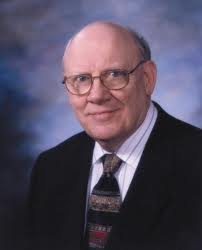
Like Stone, all of us have been tempted to look for shortcuts to success. And nowhere is this truer than when it comes to our prayer lives. We desperately want good fortune. We want a formula that will open up the windows of heaven and rain down its blessings. If you want to get right down to it, our prayers often sound dangerously close to the pleas of pagans, who constantly worry, saying, “What shall we eat? What shall we drink? What shall we wear?” (Matthew 6:31)

Thus, before Jesus launches into the principles of prayer through the most beautiful, symmetrical, and majestic of all biblical prayers, he first warns his disciples against praying as pagans do. The last thing he wants his disciples to do is turn the prayer he is about to teach them into what the New King James version of the Bible describes as “vain repetitions” (Matthew 6:7). So, says Jesus, “When you pray, do not keep on babbling like pagans, for they think they will be heard because of their many words. Do not be like them, for your Father knows what you need before you ask him” (vv. 7-8).

As the father of eight children, I can tell you that I sometimes know what my children need before they ask me. However, what I, as an earthly father, only sometimes know, our eternal Father always knows. There’s no need to pull out the prayer beads or attempt to wear God down by repeating the same prayers over and over. He already knows what you need before you ask him.

This statement by Christ inevitably leads to this question: Why bother praying if God knows what we need before we even ask him? I fear the very reason that this question is so often posed is that we have been conditioned to think that supplication is the sole sum and substance of prayer. The prayer of Jabez, now on the lips of multitudes, is an example of supplication.

It is great to ask God to “bless me indeed” so that I can be a blessing to others. It is glorious that God should ‘enlarge my border” so that I might reach more people for the kingdom. It is right to ask that God’s “hand might be with me” so that I might be led through the challenges of life by his sovereign control and not by chance. And it is proper to pray, “Keep me from harm that it man not pain me.” Prayer, however, is not merely a means of presenting requests, it is a means of pursuing a relationship with our heavenly Father.

As I write, the lyrics of a Country Western song, sung by Grammy Award-winning singer and song writer Paul Overstreet, wash through my mind.

‘How much do I owe you,” said the man to his Lord,

“For giving me this day, and all the days that’s gone before?

Shall I build a temple, shall I make a sacrifice?

Tell me Lord, and I will pay the price.

And the Lord said,

“I won’t take less than your love, sweet love.

No, I won’t take less than your love.

All the treasures of this world could never be enough,

And I won’t take less than your love (Paul Overstreet and Don Schlitz, “I Won’t Take Less Than Your Love,” Pegram, Tenn.: Scarlett Moon Records, 1999).

The point of the lyrics, which deal not only with the relationship of a man to his Lord but with the relationship to his wife and a mother to her son, is that relationships are cemented not just by giving and getting but love and communication.

The fact that I often know what my kids are going to ask before they open their mouths does not mean I don’t want them to ask. Rather, I long for them to verbalize their thoughts and feelings. That’s how our relationship blossoms and grows. Likewise, if we are to nurture a strong bond with our Creator, we must continually communicate with him. And prayer is our primary way of doing just that. A memorable way of prioritizing the principles of such communication through prayer is found in the acronym F-A-C-T-S (F-A-C-T-S discussion adapted from Hank Hanegraaff, Christianity in Crisis, Eugene, Ore.: Harvest House Publishers, 1997, 288-90; A-C-T-S used widely many years).

(F)AITH

Faith is only as good as the object in which it is placed. Put another way, it is the object of faith that renders faith faithful. The secret is not in the phrases we utter but in the coming to know ever more fully the One to whom we pray. Since God is awesomely revealed in his Word, the prayer of faith must always be rooted in Scripture. Prayer becomes truly meaningful when we enter into a relationship with God through Christ. We can then build on that foundation by saturating ourselves with Scripture. As R.A. Torrey so wonderfully expressed it:

To pray the prayer of faith we must, first of all, study the Word of God, especially the promises of God, and find out what the will of God is…We cannot believe as that is not faith but credulity; it is “make believe.” The great warrant for intelligent faith is God’s Word. As Paul puts it in Romans 10:17, “Faith comes from hearing the message, and the message is heard through the word of Christ” (R.A. Torrey, The Power of Prayer, Grand Rapids: Zondervan, 1981, 123-24).

Jesus summed up the prayer of faith with these words: “If you remain in me and my words remain in you, ask whatever you wish, and it will be given to you” (John 15:7). 

(A)DORATION

Faith in God naturally leads to adoration. Prayer without adoration is like a body without a soul. It is not only incomplete, but it just doesn’t work. Through adoration we express our genuine, heartfelt love and longing for God. Adoration inevitably leads to praise and worship, as our thoughts are focused on God’s surpassing greatness. The Scriptures are a vast treasury overflowing with descriptions of God’s grandeur and glory. The Psalms, in particular, can be transformed into passionate prayers of adoration.

Come, let us worship and bow down;

Let us kneel before the Lord our Maker.

For He is our God, and we are the people of His pasture,

And the sheep of His hand. – Psalm 95:6-9 NASB

 (C)ONFESSION

Not only do the Psalms abound with illustrations of adoration, but they are replete with exclamations of confession as well. Those who are redeemed by the person and work of Jesus are positionally declared righteous before God. In practical terms, however, we are still sinners who sin every day. While unconfessed sin will not break our union with God, it will break our communion with God. Thus confession is a crucial aspect of daily prayer.

The concept of confession carries the acknowledgement that we stand guilty before God’s bar of justice. There’s no place for self-righteousness before God. We can only develop intimacy with the Lord through prayer when we confess our need for forgiveness and contritely seek his pardon. The Apostle John sums it up beautifully when he writes, “If we confess our sins, he is faithful and just and will forgive us our sins and purify us from all unrighteousness” (1 John 1:9).

 (T)HANKSGIVING

Nothing, and I mean nothing, is more basic to prayer than thanksgiving. Scripture teaches us to “enter his gates with thanksgiving and his courts with praise” (Psalm 100:4). Failure to do so is the stuff of pagan babblings and carnal Christianity. Pagans, says Paul, know about God, but “they neither glorified him as God nor gave thanks to him” (Romans 1:21).

Carnal Christians likewise fail to thank God regularly for his many blessings. They suffer from what might best be described as selective memories and live by their feelings rather than their faith. They are prone to forget the blessings of yesterday as they thanklessly barrage the throne of grace with new requests each day.

That, according to the Apostle Paul, is a far cry from how we should pray. Instead we ought to approach God “overflowing with thankfulness” (Colossians 2:7) as we devote ourselves “to prayer, being watchful and thankful” (4:2). Such thankfulness is an action that flows from the sure knowledge that our heavenly father knows exactly what we need and will supply it. Thus says Paul we are to “be joyful always; pray continually; give thanks on all circumstances, for this is God’s will for you in Christ Jesus” (1 Thess. 5:16-18; also Eph. 5:20).

(S)UPPLICATION

We began by noting that prayer begins with a humble faith in the love and resources of our heavenly Father. Thus prayer becomes a means through which we learn to lean more heavily upon him and less heavily upon ourselves. Such faith inevitably leads to adoration as we express our longing for an ever deeper and richer relationship with the One who knit us together in our mothers’ wombs. The more we get to know him in the fullness of his majesty, the more we are inclined to confess our unworthiness and to thank him not only for his saving and sanctifying grace but also for his goodness in supplying all our needs.

It is in the contest of such a relationship that God desires that his children bring their requests before his throne of grace with praise and thanksgiving. After all it was Jesus himself who taught us to pray, “Give us this day our daily bread.” And as we do we must ever be mindful f the fact that the purpose of supplication is not to pressure God into providing us with provisions and pleasures, but rather to conform us to his purposes. As we read in 1 John 5:14-15, “This is the confidence we have in approaching God: that if we ask anything according to his will, he hears us. And if we know that he hears us—whatever we ask—we know that we have what we have asked of him.”

SO, WHY ASK?

This brings us back to the question posed earlier: If God knows what we need before we even ask, why bother asking at all? My initial response was a reminder that supplication is not the sole sum and substance of our prayers. Fat from merely being a means of pursuing a dynamic relationship with him.

Furthermore, we should note that God ordains not only the ends but also the means. Thus, to ask, “Why pray if God knows what we need?” is akin to asking, “Why get dressed in the morning and go to work?” For that matter, if God is going to do what he’s going to do anyway, why bother doing anything? As C.S. Lewis once put it, “Why, then, do we not argue as the opponents of prayer argue, and say that if the intended result is good God will bring it to pass without your interference, and that if it is bad He will prevent it happening whatever you do? Why wash your hands? If God intends them to be clean, they’ll come clean without your washing them. If He doesn’t they’ll remain dirty (as Lady Macbeth found – cf. Shakespeare, Macbeth V, I, 34-57) however much soap you use. Why ask for the salt? Why put on your boots? Why do anything? Lewis provides the answer as follows:

We know that we can act and thus that our actions produce results. Everyone who believes in God must therefore admit (quite apart from the question of prayer) that God has not chosen to write the whole of history with his own hand. Most of the events that go on in the universe are indeed out of our control, but not all. It is like a play in which the scene and the general outline of the story are fixed by the author, but certain minor details are left for the actors to improvise. It may be a mystery why He should have allowed us to cause them by praying than by any other method.

He gave us small creatures the dignity of being able to contribute to the course of events in two different ways. He made the matter of the universe such that we can (in those limits) do things to it; that is why we can wash our own hands and feed or murder our fellow creatures. Similarly, he made His own plan or plot of history such that it admits a certain amount of free play and can be modified in response to our prayers (C.S. Lewis, God in the Dock, edited by William Hooper, Eerdmans: Grand Rapids, 1979, 105).

Lewis goes on to explain that God has ordained that the work we do and the prayers we utter both produce results. If you pull out a weed, it will no longer be there. If you drink excessively, you will ruin your health. And if you waste planetary resources, you will shorten the lifeline of history. There is, however, a substantive difference between what happens as a result of our work and what happens as a result of our prayers. The result of pulling up a weed is “divinely guaranteed and therefore ruthless.” Thankfully, however, the result of prayer is not. God has left himself discretionary power to grant or refuse our requests, without which prayer would destroy us. Says Lewis,

It is not unreasonable for a headmaster to say, “Such and such things you may do according to the fixed rules of this school. But such and such other things are too dangerous to be left to general rules. If you want to do them you must come and make a request and talk over the whole matter with me in my study. And then—we’ll see” (Ibid, 107).

While our Father knows what we need before we even ask, our supplications are in and of themselves an acknowledgement of our dependence on him. And that alone is reason enough to pray without ceasing.


*Hank Hanegraaff serves as president and chairman of the board of the North Carolina-based Christian Research Institute International. He is also host of “The Bible Answer Man” radio program, which is broadcast daily across the United States and Canada as well as around the world through the Internet at http://www.equip.org.

Widely considered to be one of the world’s leading Christian apologists, Hanegraaff is deeply committed to equipping Christians to be so familiar with truth that when counterfeits loom on the horizon, they recognize them instantaneously.Through his live call-in radio broadcast, Hanegraaff equips Christians to read the Bible for all it’s worth and answers questions on the basis of careful research and sound reasoning. Additionally, Hanegraaff regularly interviews today’s most significant leaders, apologists, and thinkers.

Hanegraaff is the author of award-winning best sellers, including The Prayer of Jesus, – from which the above article Chapter 3 “Your Father Knows” is derived, Christianity in Crisis, Resurrection and Has God Spoken? He has written many other acclaimed books as well, numbering in the dozens. He is a regular contributor to “Christian Research Journal” and “The Plain Truth” magazine. A popular conference speaker, he addresses churches, schools, and businesses worldwide. He is frequently invited to appear on national media programs to discuss a wide range of issues.

Hanegraaff and his wife, Kathy, live in North Carolina and are the parents of nine children–Michelle; Katie; David; John Mark; Hank, Jr.; Christina; Paul; Faith; and baby Grace–and the grandparents of five.

Book Review: The Explicit Gospel by Matt Chandler

The Antidote to Gospel Inoculation

When Saint Augustine was living a life of licentiousness many generations ago he was hearing some children playing near where he was seated, playing a game with the refrain “Take up and read, take up and read.” He picked up his Bible and opened it to the book of Romans and proceeded to read about his sin and his desperate need of the provision of Christ’s imputed righteousness by faith in his death, burial, and resurrection in exchange for his sin. He was convicted of his sin and powerfully drawn by the work of the Holy Spirit toward faith and repentance in the person and work of Christ.

Whether you are a rebel, or someone who has heard the gospel (or what may pass for the gospel today) – you are well advised to take up this book and read it. In the past men like Augustine, Luther, and Calvin understood with passion and clarity our need to comprehend the richness and depth of the gospel, and proclaim it with passionate urgency – because souls are hanging in the balance. In this book Chandler definitively understands and articulates the power of the gospel and the desperate need we all have to understand the depth of our sin before a Holy God, and the just requirements He has that we have failed to meet, and thus our desperate need for what Christ came to save us from and unto.

In three parts Chandler clearly articulates the gospel essentials (God, Man, Christ, and our response); the gospel’s theological underpinnings (Creation, Fall, Reconciliation, and Consummation); and lastly its implications and applications for all of the aspects of our lives. The author is to be commended for writing a book that is passionate about the gospel; clearly articulates the gospel; calls for a response to the gospel; and demonstrates how to communicate and live out the gospel.

I highly recommend this book especially for preachers who proclaim the word of God week in and week out. He will inspire you to NOT compromise the gospel and to rest in the work of the Holy Spirit in applying it’s power in the lives of your people. My hope and prayer is that in reading this book your passion will be stirred to unflinchingly proclaim the gospel powerfully in truth and love – resulting in the saving of many lives. I think that the Apostle Paul would wholeheartedly agree with all that Chandler articulates in this book and would add, “For I am not ashamed of the gospel (as conveyed in this book), for it is the power of God for salvation to everyone who believes, to the Jew first and also to the Greek” (Rom. 1:16).

Matt Chandler is the lead pastor of The Village Church, a multi-campus church in the Dallas metroplex of over 10,000 people. He has recently taken the post as President of the Acts 29 Church Planting Network. His sermons are among the top selling (free) podcasts on itunes and he speaks at conferences worldwide. Prior to accepting the pastorate at The Village, Matt had a vibrant itinerant ministry for over ten years where he spoke to hundreds of thousands of people in America and abroad about the glory of God and beauty of Jesus. He lives in Texas with his wife, Lauren, and their three children: Audrey, Reid and Norah.