Dr. Tim Keller on Suffering

Dr. Tim Keller on Dealing With The Question “Why Me?”

[This article first appeared in edited form on CNN and is printed below in its entirety. The article is adapted from the City to City Blog of Redeemer Presbyterian Church in New York on August 6, 2012: http://redeemercitytocity.com/blog/view.jsp?Blog_param=446%5D

When I was diagnosed with cancer, the question “Why me?” was a natural one. Later, when I survived but others with the same kind of cancer died, I also had to ask, “Why me?”

Suffering and death seem random, senseless. The recent Aurora shootings—in which some people were spared and others lost—is the latest, vivid example of this, but there are plenty of others every day: from casualties in the Syria uprising to victims of accidents on American roads. Tsunamis, tornadoes, household accidents—the list is long. As a minister, I’ve spent countless hours with suffering people crying: “Why did God let this happen?” In general I hear four answers to this question—but each is wrong, or at least inadequate.

The first answer is, “This makes no sense—I guess this proves there is no God.” But the problem of senseless suffering does not go away if you abandon belief in God. Dr. Martin Luther King, Jr., in his Letter from Birmingham Jail, said that if there was no higher divine Law, there would be no way to tell if any particular human law was unjust or not. If there is no God, then why have a sense of outrage and horror when suffering and tragedy occur? The strong eat the weak—that’s life—so why not? When Friedrich Nietzsche heard that a natural disaster had destroyed Java in 1883, he wrote a friend: “Two hundred thousand wiped out at a stroke—how magnificent!” Nietzsche was relentless in his logic. Because if there is no God, all value judgments are arbitrary. All definitions of justice are just the results of your culture or temperament. As different as they were in other ways, King and Nietzsche agreed on this point. If there is no God or higher divine Law, then violence is perfectly natural. So abandoning belief in God doesn’t help with the problem of suffering at all, and as we will see, it removes many resources for facing it.

The second answer is, “If there is a God, senseless suffering proves that God is not completely in control of everything. He couldn’t stop this.”  As many thinkers have pointed out—both devout believers as well as atheists—such a being, whatever it is, doesn’t really fit our definition of God. And this leaves you with the same problems mentioned above. If you don’t believe in a God powerful enough to create and sustain the whole world, then the world came about through natural forces, and that means, again, that violence is natural. Or if you think that God is an impersonal life force and this whole material world is just an illusion, again you remove any reason to be outraged at evil and suffering or to resist it.

The third answer to seemingly sudden, random death is, “God saves some people and lets others die because he favors and rewards good people.” But the Bible forcefully rejects the idea that people who suffer more are worse people than those who are spared suffering. This was the self-righteous premise of Job’s friends in that great Old Testament book. They sat around Job, who was experiencing one sorrow in life after another, and said, “the reason this is happening to you and not us is because we are living right and you are not.” At the end of the book, God expresses his fury at Job’s “miserable comforters.” The world is too fallen and deeply broken to issue in neat patterns of good people having good lives and bad people having bad lives.

The fourth answer is, “God knows what he’s doing, so be quiet and trust him.” This is partly right, but inadequate. It is inadequate because it is cold and because the Bible gives us more with which to face the terrors of life.

God did not create a world with death and evil in it. It is the result of humankind turning away from him. We were put into this world to live wholly for him, and when instead we began to live for ourselves everything in our created reality began to fall apart—physically, socially, and spiritually. Everything became subject to decay. But God did not abandon us. Of all the world’s major religions, only Christianity teaches that God came to earth (in Jesus Christ) and became subject to suffering and death himself—dying on the Cross to take the punishment our sins deserved—so that some day he can return to earth to end all suffering without ending us.

Do you see what this means? Yes, we don’t know the reason God allows evil and suffering to continue, or why it is so random, but now at least we know what the reason isn’t—what it can’t be. It can’t be that he doesn’t love us! It can’t be that he doesn’t care. He is so committed to our ultimate happiness that he was willing to plunge into the greatest depths of suffering himself.

He understands us, he’s been there, and he assures us that he has a plan to eventually to wipe away every tear, to make “everything sad come untrue,” as J.R.R. Tolkien put it at the end of his Christian allegory The Lord of the Rings.

Someone might say, “But that’s only half an answer to the question ‘Why?'” Yes, but it is the half that we need.

If God actually explained all the reasons why he allows things to happen as they do, it would be too much for our finite brains. Think of small children and their relationship to their parents. Three-year-olds can’t understand most of what their parents allow and disallow for them. But though they aren’t capable of comprehending their parents’ reasons, they are capable of knowing their parents’ love, and therefore capable of trusting them and living securely. That is what they really need. Now the difference between God and human beings would be infinitely greater than the difference between a thirty-year-old parent and a three-year-old child. So we should not expect to be able to grasp all God’s purposes, but through the Cross and gospel of Jesus Christ, we can know his love. And that is what we need most.

In Ann Voskamp’s book One Thousand Gifts, she shares her journey to understand the senseless death of her sister, crushed by a truck at the age of two. In the end, she concludes that the primary issue is whether we trust God’s character. Is he really loving? Is he really just? Her conclusion:

“[God] gave us Jesus… If God didn’t withhold from us His very own Son, will God withhold anything we need? If trust must be earned, hasn’t God unequivocally earned our trust with the bark on the raw wounds, the thorns pressed into the brow, your name on the cracked lips? How will he not also graciously give us all things He deems best and right? He’s already given the incomprehensible.”

 About The Author:

In 1989 Dr. Timothy J. Keller, his wife and three young sons moved to New York City to begin Redeemer Presbyterian Church. In 20 years it has grown to meeting for five services at three sites with a weekly attendance of over 5,000. Redeemer is notable not only for winning skeptical New Yorkers to faith, but also for partnering with other churches to do both mercy ministry and church planting.  Redeemer City to City is working to help establish hundreds of new multi-ethnic congregations throughout the city and other global cities in the next decades.

Dr. Tim Keller is the author of several phenomenal books including:

Every Good Endeavor: Connecting Your Work to God’s Plan for the World. New York, Penguin Publishing, November, 2012.

Center Church: Doing Balanced, Gospel-Centered Ministry in Your City. Grand Rapids: Zondervan, September, 2012.

The Freedom of Self Forgetfulness. New York: 10 Publishing, April 2012.

Generous Justice: How God’s Grace Makes Us Just. New York: Riverhead Trade, August, 2012.

The Gospel As Center: Renewing Our Faith and Reforming Our Ministry Practices (editor and contributor). Wheaton: Crossway, 2012.

The Meaning of Marriage: Facing the Complexities of Commitment with the Wisdom of God. New York, Dutton, 2011.

The Prodigal God. New York, Dutton, 2011.

King’s Cross: The Story of the World in the Life of Jesus. New York, Dutton, 2011.

Counterfeit Gods: The Empty Priorities of Money, Sex, and Power, and the Only Hope That Matters. New York, Riverhead Trade, 2011.

The Reason For God: Belief in an Age of Skepticism. New York, Dutton, 2009.

Worship By The Book (contributor). Grand Rapids: Zondervan, 2002.

Ministries of Mercy: The Call of the Jericho Road. Phillipsburg: P&R Publishing, 1997.

Richard Baxter on The Importance of Hard Work

Colossians 3:23-24, “Whatever you do, work heartily, as for the Lord and not for men, knowing that from the Lord you will receive an inheritance as your reward. You are serving the Lord Christ.”

(1)  You will show that you are not sluggish and servants to your flesh (as those that cannot deny it ease), and you will further the putting to death of all the fleshly lusts and desires that are fed by ease and idleness.

(2)  You will keep out idle thoughts from your mind, that swarm in the minds of idle persons.

(3)  You will not lose precious time, something that idle persons are daily guilty of.

(4)  You will be in a way of obedience to God when the slothful are in constant sins of omission.

(5)  You may have more time to spend in holy duties if you follow your occupation diligently. Idle persons have no time for praying and reading because they lose time by loitering at their work.

(6)  You may expect God’s blessing and comfortable provision for both yourself and your families.

(7)  It may also encourage the health of your body which will increase its competence for the service of your soul.

About Richard Baxter: A Mini-Biography

Excerpt from Meet the Puritans

by Dr. Joel Beeke and Randall J. Pederson

Richard Baxter was born in 1615, in Rowton, near Shrewsbury, in Shropshire. He was the only son of Beatrice Adeney and Richard Baxter, Sr. Because of his father’s gambling habit and inherited debts, and his mother’s poor health, Richard lived with his maternal grandparents for the first ten years of his life. When his father was converted through “the bare reading of the Scriptures in private,” Richard returned to his parental home, and later acknowledged that God used his father’s serious talks about God and eternity as “the Instrument of my first Convictions, and Approbation of a Holy Life” (Reliquiae Baxterianae, 1:2-4).

Baxter’s education was largely informal; he later wrote that he had four teachers in six years, all of whom were ignorant and two led immoral lives. Nevertheless, he had a fertile mind, and enjoyed reading and studying. A prolonged illness and various books—particularly William Perkins’s Works—were the means God used to “resolve me for himself,” Baxter wrote (Reliquiae Baxterianae, 1:3-4). When he was fifteen, he was deeply affected by Richard Sibbes’s The Bruised Reed: “Sibbes opened more the love of God to me, and gave me a livelier apprehension of the mystery of redemption and how much I was beholden to Jesus Christ.” Subsequently, Ezekiel Culverwell’s Treatise of Faith (1623) “did me much good” (ibid., 1:4-5).

Baxter’s education took a turn for the better when he transferred to the Wroxeter grammar school, where he received some tuition support from a schoolmaster named John Owen. His best teacher there was an erudite minister, Francis Garbet, who took a real interest in Baxter. At the age of sixteen, under Owen’s persuasion, Baxter decided to forego university in favor of placing himself under the instruction of Owen’s friend, Richard Wickstead, chaplain at Ludlow Castle, who tutored him rather half-heartedly for eighteen months.

In 1633, Baxter went to London under the patronage of Sir Henry Herbert, Master of the Revels, in the court of Charles I. Joseph Symonds and Walter Cradock, two godly Puritan ministers in London, roused his sympathy for nonconformity, but he stayed in London only four weeks. Having become dissatisfied with the worldly court life in London and desiring to care for his ailing mother, he returned home in 1634; his mother died in May of 1635. He spent the next four years privately studying theology, particularly that of the scholastics, including Aquinas, Scotus, and Ockham.

At age twenty-three, having as yet “no scruple at all against subscription,” and thinking “the Conformists had the better cause” (ibid., 1:13), Baxter was ordained deacon by John Thornborough, the elderly bishop of Worcester. For nine months he served as master of the school founded at Dudley, a center of nonconformity. In 1639, he became an assistant minister at Bridgnorth, Shropshire, where he developed a deeper appreciation for nonconformity.

In 1641, Baxter became curate at Kidderminster. Though many among a rather corrupt and crude population of handloom workers were initially offended by his forceful preaching and stress on a controlled Lord’s Supper and on church discipline, his seventeen-year ministry there (1641-42, 1647-61) bore substantial fruit. He preached as “a dying man to dying men,” which, with the Spirit’s blessing, resulted in numerous conversions. His praying was no less intense: “His soul tookwing for heaven and rapt up the souls of others with him” (Leonard Bacon, Select Practical Writings of Richard Baxter [New Haven, 1831], 1:262).

During the early days of the Civil War, Baxter supported, and on occasion accompanied, the Parliamentary Army. He preached before Cromwell, but he was uncomfortable with the Protector’s toleration of separatists. Though he was only an occasional “conformer,” Baxter favored being part of an established church and opposed the Solemn League and Covenant of 1643. He also believed that the antinomian tendencies of some of the soldiers and preachers, such as Tobias Crisp and John Saltmarsh, were antithetical to practical Christian living. Their teaching prompted him to write Aphorisms of Justification (1649), in which he argued for a combination of divine grace and human cooperation in justification.

In 1647, Baxter’s prolonged illnesses compelled him to leave the army. He recuperated at the Worcestershire home of Sir Thomas and Lady Rous, where he wrote the first part of The Saints’ Everlasting Rest. He later said he wrote it as a labor of love while “looking death full in the face and yet experiencing the sufficient grace of God.”

After he recovered, Baxter returned to Kidderminster, where he concentrated on writing. “My writings were my chiefest daily labor,” he wrote, whereas “preaching and preparing for it, were but my recreation” (Reliquae, p. 85). He also catechized church members two days each week. He went from home to home with an assistant, speaking with each family for one hour and providing each family with an edifying book or two, usually written by himself. He said of these visits, “Few families went from me without some tears, or seemingly serious promises [to strive] for a godly life.” He added, “Some ignorant persons, who have been so long unprofitable hearers, have got more knowledge and remorse of conscience in half an hour’s close disclosure, than they did from ten year’s public preaching” (ibid., 1:83ff.).

The home visits bore fruit. The congregation kept overflowing its meeting place so that five galleries had to be added. When Baxter came to Kidderminster, scarcely one family on each street among the 800 families honored God in family worship. By the end of his ministry in 1661, there were streets on which every family did so. On the Sabbath, he writes, “you might hear an hundred families singing Psalms and repeating sermons, as you passed through the streets.” Of the approximately six hundred people who became full communicants under his ministry, he adds, “There was not twelve that I had not good hopes of, as to their sincerity” (ibid., 1:84-85).

Baxter worked hard, despite chronic pain from the age of twenty-one until the end of his life. He suffered from tuberculosis and feared consumption. In the years following the Restoration, he left Kidderminster for London, where he often preached at St. Dunstan’s and lectured at Pinner’s Hall and Fetters Lane. He pleaded in vain, however, at the Savoy Conference (1661) for the non-prelatical, synodical form of episcopacy devised by Archbishop James Ussher (1581-1656) and for a Puritan revision of the Prayer Book.

In 1662, Baxter was ejected from the Church of England by the Act of Uniformity. He continued to preach for the rest of his life where he could, but never gathered a congregation of his own. J. I. Packer writes, “Miscalled a Presbyterian, Baxter was a reluctant Nonconformist who favored monarchy, national churches, liturgy and episcopacy, and could accept the unsympathetically revised 1662 Prayer Book. But the 1662 Act of Uniformity required renunciation on oath of Puritan ideals of reformation as a condition of incumbency in the restored Church of England, and Baxter balked at that” (New Dictionary of Theology, p. 83).

After his ejection, when he was almost fifty, Baxter married one of his converts, Margaret Charlton, who was in her early twenties. The disparity of their ages caused some consternation for a time, but the excellence of their marriage in Christ silenced the rumors. Margaret proved to be a devout Christian and faithful wife who earnestly yearned for the salvation of souls. Baxter’s tenderness toward her, and her godliness, are described in Breviate of the Life of Mrs. Margaret Baxter (1681). There Baxter writes that he “never knew her equal” in practical divinity, for she was “better at resolving a case of conscience than most Divines that ever I knew.” Consequently, Baxter habitually shared all cases with her except for those that compelled confidentiality (Breviate, pp. 67-68).

The Baxters settled in London. Prelates and magistrates hounded Baxter for most of his remaining years. He was imprisoned at least three times for preaching and never again resumed a pastoral charge; even his books were taken from him. His response was, “I found I was near the end of both that work and that life which needeth books, and so I easily let go all.” Once, even the bed on which he was lying sick was confiscated.

After James II took the throne in 1685, Baxter was charged with attacking episcopacy in Paraphrase on the New Testament and was brought before Lord Chief Justice Jeffreys. Jeffreys charged Baxter with seditious behavior, calling him “an old rogue who poisoned the world with his Kidderminster doctrine.” Jeffreys went on to exclaim, “This conceited, stubborn, fanatical dog—that did not conform when he might have been preferred; hang him!” The bishop of London intervened, and Baxter was spared a public whipping, though he was still imprisoned
for five more months.

Baxter eventually benefited from the Toleration Act of 1689, introduced by William and Mary to protect nonconformists. His last days were spent in the pleasant surroundings of Charterhouse Square. He occasionally preached to large crowds there, but he spent most of his time writing. When he was dying and a friend reminded him of the benefits many had received from his writings, Baxter replied, “I was but a pen in God’s hand, and what praise is due to a pen?” By the time he died on December 8, 1691, Baxter had written about 150 treatises, as well as hundreds of unpublished letters and papers.

Baxter’s writings are a strange theological mix. He was one of a few Puritans whose doctrines of God’s decrees, atonement, and justification were anything but Reformed. Though he generally structured his theology along Reformed lines of thought, he frequently leaned towards Arminian thinking. He developed his own notion of universal redemption, which offended Calvinists, but retained a form of personal election, which offended Arminians. He rejected reprobation. He was greatly influenced by the Amyraldians and incorporated much of their thinking, including hypothetical universalism, which teaches that Christ hypothetically died for all men, but His death only has real benefit to those who believe. For Baxter, Christ’s death was more of a legal satisfaction of the law than a personal substitutionary death on behalf of elect sinners.

Baxter’s approach to justification has been called neonomianism (that is, “new law”); he said that God has made a new law offering forgiveness to repentant breakers of the old law. Faith and repentance—the new laws that must be obeyed—become the believer’s personal, saving righteousness that is sustained by preserving grace. Baxter’s soteriology, then, is Amyraldian with the addition of Arminian “new law” teaching. Happily, these erroneous doctrines do not surface much in Baxter’s devotional writings, which are geared mainly to encourage one’s sanctification rather than to teach theology.

Baxter professed to resent having to write polemical treatises: “Controversies I have written of, but only to end them, not to make them.” Hans Boersma has shown, however, that though irenic in some respects, Baxter could be provocative as well (see A Hot Pepper Corn: Richard Baxter’s Doctrine of Justification in its Seventeenth-Century Context of Controversy [Zoetermeer: Boekencentrum, 1993]).

Modern Reprints

A Call to the Unconverted (Zondervan; 170 pages; 1953). This classic evangelistic “tract,” based on Ezekiel 33:11, reveals Baxter’s passionate concern for evangelism. It is an earnest and reasoned appeal to the unsaved to turn to God and accept His offered mercy. Here is one example:

If thou die unconverted, there is no doubt to be made of thy damnation; and thou are not sure to live an hour, and yet art thou not ready to turn and to come in? Oh miserable wretch! Hast thou not served the flesh and the devil long enough yet? Hast thou not enough of sin? Is it so good to thee? or so profitable for thee? Dost thou know what it is, that thou wouldst yet have more of it? Hast thou had so many calls and so many mercies, and so many blows, and so many examples? Hast thou seen so many laid in the grave, and yet art thou not ready to let go thy sins and come to Christ? What? After so many convictions and gripes of conscience, after so many purposes and promises, art thou not ready yet to turn and live? Oh that thy eyes, thy heart were opened to know how fair an offer is now made to thee! and what joyful message it is that we are sent on, to bid thee come, for all things are ready (pp. 70-71).

Stressing that sinners “die because they will die; that is, because they will not turn,” Baxter says, “So earnest is God for the conversion of sinners, that he doubleth his commands and exhortations with vehemency, Turn ye, turn ye; why will ye die?” Discernment is necessary in reading this book, since Baxter’s unsound views do occasionally surface.

Dying Thoughts (Baker; 144 pages; 2004). Based on Philippians 1:23, “For I am in a strait betwixt two, having a desire to depart, and to be with Christ, which is far better,” Baxter sets forth a proper attitude towards the present life and the life hereafter. Dying Thoughts was written shortly before Baxter’s death in 1691. It breathes a spirit of vital faith in the promises of God.

This reprint was abridged by Benjamin Fawcett. It also contains an excellent introductory essay by Edward Donnelly, “A Corrective for Reformed Preachers,” which gleans practical lessons for ministers from Baxter’s preaching.

The Practical Works of Richard Baxter (SDG; 4 vols., 4,201 pages; 2000). Baxter authored about 150 books, of which several were folios of more than a million words. If his entire works were ever to be printed, they would amount to more than double the size of Owen’s. Most of Baxter’s books are homiletical, catechetical, biographical, historical, practical, philosophical, ethical, or polemical in nature, though he also published commentaries, poetry, and politics. Keeble writes, “Puritanism had always utilized the press, but there had never been a literary career like this, either in scale or in success: Baxter was the first author of a string of bestsellers in British literary history” (Oxford DNB, 4:430).

Baxter’s practical writings were usually the most popular. His Practical Works were published in four folio volumes in London in 1707, then helpfully edited by William Orme and republished in twenty-three volumes in 1830, after which H. R. Rogers’s four-volume set was published in 1868. The SDG reprint in 2000 is of the Rogers set.

The first volume, A Christian Directory (1673), offers keen insights into the life of the believer, expounding practical and casuistical divinity in more than a million words. No Puritan work on applied theology has approached the popularity, scope, or depth of this treatise. With widespread interest in counseling and practical, biblical living in today’s church, this reprint of Baxter’s work should be a welcome addition to every library and to anyone who wishes to give solid scriptural
answers to man’s most important questions.

Volume 2, titled A Call to the Unconverted (1658), contains that work unabridged, plus eleven treatises, including The Reasons of the Christian Religion, The Unreasonableness of Infidelity, A Treatise of Conversion, and The Character of a Sound, Confirmed Christian. Volume 3 contains The Saints’ Everlasting Rest (1649), A Treatise of Self-Denial (1659), Dying Thoughts (1683), and other miscellaneous treatises. Volume 4 contains the unabridged version of the masterful treatise The Reformed Pastor (1656), as well as The Catechising of Families, The Vain Religion of the Formal Hypocrite, various sermons, and thirteen smaller treatises, including The Cure of Melancholy and Overmuch Sorrow, by Faith—perhaps the most undervalued work of Baxter. In it, Baxter, as a physician of souls, probes with remarkable insight into the human psyche and offers suggestions for the cure of depression and other mental ailments. For example, Baxter says, “As much as you can, divert them from the thoughts which are their trouble; keep them on some other talks and business; break in upon them and interrupt their musings; rouse them out of it, but with loving importunity; suffer them not to be long alone; get fit company to them, or them to it; especially, suffer them not to be idle, but drive or draw them to some pleasing works which may stir the body, and employ the thoughts” (Practical Works, 4:933).

The Reformed Pastor (BTT; 256 pages; 1999). Abridged from the original work, this edition offers a more accessible look at Baxter’s pastoral theology. Writing this book out of a deep determination to rectify the pastoral neglect he had experienced as a young man in the West Midlands, Baxter describes in zealous detail the oversight pastors are to have over themselves first and then over their flocks, out of heartfelt love for souls (Acts 20:28).

By “Reformed” in the title, Baxter does not only mean that pastors should be “Calvinistic,” but they must be “revived.” He excels in convincing ministers of their high calling to pursue personal revival and to take up their work seriously and prayerfully. Certain portions of this book are remarkably convicting, such as Baxter’s denunciation of pastoral pride. He also offers much practical guidance for dealing with the perennial problems of instructing and guiding the church. This is Baxter at his best.

Philip Doddridge writes of this work: “The Reformed Pastor should be read by every young minister, before he takes a people under his stated care; and, I think, the practical part of it reviewed every three or four years; for nothing would have a greater tendency to awaken the spirit of a minister to that zeal in his work, for want of which many good men are but shadows of what they might be, if the maxims and measures laid down in that incomparable treatise were strenuously pursued.”

Reliquiae Baxterianae (RE; 312 pages; n.d.). This work contains considerably less than half of the original which first appeared in 1696 under the editorship of Matthew Sylvester. While the original, which has never been reprinted in its entirety, has been called “a confused and shapeless hulk,” it remains an important source for seventeenth-century history. Edmund Calamy (1671-1732) condensed Baxter’s work into a more readable edition and published it in 1702. In 1925, J. M. Lloyd Thomas edited an unsatisfactory abridgment, The Autobiography of Richard Baxter (London: Dent). The current edition, published in the 1990s, though uneven in quality, contains fascinating insights into Baxter’s life and offers valuable nuggets of wisdom, particularly for ministers.

The Saints’ Everlasting Rest (CFP; 704 pages; 1999). This is deservedly one of the most valued of Baxter’s practical works. He wrote most of the book when he was far from home and had no book but the Bible to consult. Being ill for many months and expecting to die, he fixed his thoughts on the believer’s eternal rest in Christ. After he recovered, Baxter preached these thoughts in his weekly lectures at Kidderminster. Thomas Doolittle, a native of Kidderminster who later became a well-known Puritan minister and author, dated his conversion to the time when he heard these lectures.

In 1650, Baxter published the substance of his lectures as the first of many practical writings. William Bates wrote of this book: “To allure our desires, he unveils the sanctuary above, and discovers the glories and joys of the blessed in the divine presence, by a light so strong and lively, that all the glittering vanities of this world vanish in the comparison, and a sincere believer will despise them, as one of mature age does the toys of children. To excite our fear, he removes the screen, and makes the everlasting fire of hell so visible, and represents the tormenting passions of the damned in such dreadful colors, as, if duly considered, would check and control the unbridled, licentious appetites of the most sensual wretches.”

The Puritan minister John Janeway said that his conversion was greatly influenced by reading Baxter’s book. Referring to the part of the book that explains heavenly contemplation, Janeway wrote to a friend, “There is a duty, which, if it were exercised, would dispel all cause of melancholy: I mean heavenly meditation and contemplation of the things to which the true Christian religion tends. If we did but walk closely with God one hour in a day in this duty, O what influence would it have upon the whole day besides, and, duly performed, upon the whole life! This duty, with its usefulness, manner, and directions, I knew in some measure before, but had it more pressed upon me by Mr. Baxter’s Saints’ Everlasting Rest, a book that can scarce be overvalued, and for which I have cause for ever to bless God.”

*Excerpt from Meet the Puritans 
by Dr. Joel Beeke and Randall J. Pederson.

The A-Z’s of Life

An Acronym For Living LIfe From A-Z 


Avoid negative sources, people, places, things and habit

Believe in your abilities

Consider things from every angle

Don’t give up and don’t give in

Enjoy life today, yesterday is gone, tomorrow may never come

Family and friends are hidden treasures, seek them and enjoy their riches

Give more than you planned to

Hang on to your dreams

Ignore those who try to discourage you

Just do it

Keep trying no matter how had it seems, it will get easier

Love God first and most

Make it happen

Never lie, cheat, or steal, always strike a fair deal.

Open your eyes and see things as they really are

Practice makes perfect

Quitters never win and winners never quit

Read, study and learn about everything important

Stop procrastinating

Take control of your destiny

Understand yourself in order to better understand others

Visualize the possibilities

Want it more than anything

Xcellerate your efforts

You are unique of all God’s creations, nothing can replace you

Zero on your target and go for it

*Author for A-Z’s of Life Unknown

The A to Z’s of the Christian

Our Spiritual ABC’s

Ask the Father daily in prayer and He will answer

Believe God is always sovereign and works all things for our good and His glory!

Christ must be the center of your life

Dare to be a disciple of Jesus

Even you can make a difference in the lives of others by acting out God’s revealed will

Friends are special gifts from God

Give to others cheerfully

Harmony is what you should strive for in your relationships with others

Interest in others will make you a broader minded person

Judge others with love and compassion

Knowledge and wisdom come from the Lord

Live in such a way that others will be attracted to Jesus because of you

Make sure to always love others as Jesus does

New life comes to you via a personal relationship with Jesus by repentance and faith

Obedience of God’s will leads to God’s blessings

Please God in all of your actions

Question your priorities often – make sure God is in the center of all of them

Read God’s Word daily

Shepherd’s protect God’s sheep – be grateful that the Lord is my Shepherd

Talk with God often

Use your heart to show concern for others

Vent feelings, but always with the love of Christ

eXult the Lord always!

Yesterday’s sins are already paid for by the grace of Jesus Christ

Zeal in living my spiritual ABC’s will help me grow in the Lord.

*Author of “Our Spiritual ABC’s” unknown

11 Things To Know At 21 For Ministry Leaders by Stan Endicott

I Wish I Knew This Stuff When I Was 21!

(1)  I wish I’d understood Micah 6:8 and Exodus 35:3-33 – This is how to live – Do good, show mercy, and be humble.

(2)  I wish I’d understood how not to be “out of breath.” How not to be so busy with ministry and life – “Have ‘head-room’ or ‘band-width’ for the unexpected

(3)  I wish I’d understood how to have a curious, learning spirit

(4)  I wish I’d understood how to work thru difficult situations

(5)  I wish I’d understood how to understand and ‘hear’ the vision of the senior pastor

(6)  I wish I’d understand how to observe leaders within the congregation

(7)  I wish I’d understood how to talent scout – to find and develop talent

(8)  I wish I’d I wish I’d understood how to look at it from the ‘blimp

(9)  I wish I’d understood the difference between the words, ‘intrinsic’ and ‘extrinsic’ as they relate to the church and community

(10) I wish I’d understood that what a person enjoyed as a 4th grader is what will bring them joy today.

(11) I wish I’d understood how hurtful it is to be critical of others.

Stan Endicott is a nationally recognized, deeply respected and beloved Worship Pastor, Music Producer and Mentor to hundreds of young leaders. He was producer for Maranatha Music for over twenty years during which time he produced Promise Keepers recordings, including “Stand in the Gap”. This was the theme for the “1997 million man march” in Washington D.C. He produced and directed gospel choirs for many Internationally-known ministries including Franklin Graham, Greg Laurie, Willow Creek, and Saddleback Church. Recently he produced the newest worship project for Youth With A Mission, (YWAM). Stan is founder and partner of Slingshot Group and leads their Coaching division. Stan’s heart is for mentoring, “aiming”, and training young worship leaders and artists. His professional music production and church-related skills have prepared him for this new venture. He has served ten years part-time on the worship staff at Mariners church in Irvine, Ca. He and his wife Connie live in Irvine. They have five grandkids.

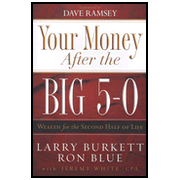
Larry Burkett on Financial Advice For The Second Half of Your Life

[Adapted from the Excellent Book by Larry Burkett. Your Money After the BIG 5-0: Wealth for the Second Half of Life. Nashville: B&H Publishing Group, 2007, 215-219.


“Take Hold of the Life That Is Truly Life”

 The hardest struggle of all is to be something different from what the average man is.

 – CHARLES M. SCHWAB

 Money never made a man happy yet, nor will it. There is nothing in its nature to produce happiness. The more a man has, the more he wants. Instead of its filling a vacuum, it makes one. If it satisfies one want, it doubles and trebles that want another way. That was a true proverb of the wise man, rely upon it; “Better is little with the fear of the Lord, than great treasure, and trouble therewith.”

 – BENJAMIN FRANKLIN

 Why would you settle for such brief, short-term, inadequate, low-yield dividend pleasures offered by the world when eternal pleasures—tens of thousands of years of pleasures—await?

 – HEARD FROM THE PULPIT OF AN ANONYMOUS PASTOR

“Do not store up for yourselves treasures on earth,

where moth and rust destroy,

and where thieves break in and steal.

But store up for yourselves treasures in heaven,

where neither moth nor rust destroys,

and where thieves do not break in or steal.”

 – MATTHEW 6:19–20

The media refer to “the graying of America.” Sociologists analyze “the coming of age of the baby boomers.” The politically correct would say we are “chronologically challenged.” Really, we are just plain growing old. We are learning to be content with that. As someone recently reminded us in an e-mail, there are some good things about getting older. Your investment in health insurance is finally beginning to pay off. Your secrets are safe with your friends because they can’t remember them either. Your supply of brain cells is finally down to a manageable size. Your eyes won’t get much worse. People no longer view you as a hypochondriac. Things you buy now won’t wear out. There’s nothing left to learn the hard way. Your joints are more accurate than the National Weather Service. In a hostage situation you are likely to be released first. You are smarter, much smarter, at fifty-plus than when you were only twenty-five. Rather than approaching the second half of life with dread or fear, see it as a great adventure with the Lord. Think of the wisdom you have learned throughout your life—some earned by a degree from the School of Hard

Knocks and some earned by prudently following biblical counsel and teaching.

At every stage, the demographic phenomenon of the baby boomer generation has made a great impact on American society. With increased prosperity and longevity, will your wealth and life have a lasting impact on your family and the Kingdom? Avoid fitting in with what Ralph Waldo Emerson described when he said, “We are always getting ready to live but never living.”

Take hold of the life that is truly life—the abundant life available through a personal relationship with the Creator God and His Son, Jesus Christ.

As our friend Bob Buford said, “Do you want to get to the end of your life, stand before God, and hear Him say, ‘So what’? No, you want Him to tell you, ‘Well done.’”

We have purposed in this book to share all the financial wisdom we possess, all the wisdom we could borrow from others, and all the wisdom available in God’s Word. Our recommendations may vary from the world’s advice. We encourage you to keep working in some capacity during retirement, though the world says you are entitled to leisure. We recommend to pay off debt, though others give reasons to keep or increase debt. We recommend diversifying to preserve, though the secular instinct is to get rich quick. It is hard to go against the grain of a materialistic, status-seeking society.

The story of Mr. and Mrs. Thing provides a vivid reminder of truth. Mr. and Mrs. Thing are a very pleasant and successful couple. At least, that’s the verdict of most people who tend to measure success with a “thingometer.” When the “thingometer” is put to work in the life of Mr. and Mrs. Thing, the result is startling.

There is Mr. Thing sitting down on a luxurious and very expensive thing, almost hidden by a large number of other things.

Things to sit on, things to sit at, things to cook on, things to eat from, all shiny and new. Things, things, things.

Things to clean with and things to wash with and things to clean and things to wash. And things to amuse and things to give pleasure and things to watch and things to play.

Things for the long, hot summer and things for the short, cold winter. Things for the big thing in which they live and things for the garden and things for the deck and things for the kitchen and things for the bedroom.

And things on four wheels and things on two wheels and things to put on top of the four wheels and things to pull behind the four wheels and things to add to the interior of the thing on four wheels.

Things, things, things.

And there in the middle are Mr. and Mrs. Thing, smiling and pleased as punch with things, thinking of more things to add to things. Secure in their castle of things. Do they sound familiar?

The story of Mr. and Mrs. Thing always strikes a chord with the audience when shared in a public forum. Everyone, it seems, knows someone who fits their description. (And all of us probably see something of ourselves in this couple.)

Mr. and Mrs. Thing may be secure in their castle of things, but that’s not the end of their story.

Here it is: Well, I just want you to know that your things can’t last. They’re going to pass. There’s going to be an end to them.

Oh, maybe an error in judgment, maybe a temporary loss of concentration, Or maybe you’ll just pass them off to the secondhand thing dealer. Or maybe they’ll wind up a mass of mangled metal being towed off to the thing yard. And what about the things in your house? Well, it’s time for bed. Put out the cat, make sure you lock the door so some thing-taker doesn’t come and take your things. And that’s the way life goes, doesn’t it?

And someday, when you die, they only put one thing in the box. You.

—ANONYMOUS

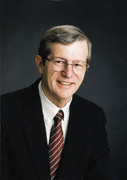
About the Author: Larry Burkett (Pictured Above) was among the people who played a role in fulfilling President John F. Kennedy’s dream of landing on a man on the moon. After serving as an electronics technician in the Air Force’s Strategic Air Command, Burkett, who had degrees in marketing and finance, headed an experimental facility that served the Mercury, Gemini, and Apollo manned space programs.

After Larry and his wife, Judy, became Christians in the early 1970s, he began extensive studies of the Bible in which he found more than 700 direct and hundreds of indirect references to money. Just one year after becoming a Christian, he found himself living in Atlanta and working as a financial counselor with Campus Crusade for Christ. Concluding that most of the problems facing Larry’s counselees were the result of mismanaging funds, the Burketts began Christian Financial Concepts (CFC) in 1976. Their first office was in the basement of their home in Tucker, Georgia. In 1977, the first CFC newsletter was published. More than simply a collection of stories, the newsletter contained articles to help every family with their finances, including practical ideas for around the home, stewardship, personal testimonies, and biblical principles for managing money. In 2003, “Money Matters” now has a circulation of nearly 200,000.

Larry Burkett was also the author of over 50 books, including Debt-Free Living, Your Finances in Changing Times, and The Coming Economic Earthquake, and a guide for kids on money management, called What If I Owned Everything. Together with Ed Strauss, he wrote the World’s Easiest Pocket Guide series with books on everything from buying a first car, renting an apartment, getting a credit card, and more. Larry even branched out into the fiction arena with best-selling novels such as The Illuminati and Solar Flare.

In 1995, Larry was diagnosed with cancer which led to the publishing of several other books, including Nothing to Fear: The Key to Cancer Survival which Burkett used to share his own personal experiences and offer insight to his readers. One of the central principles Larry taught is that we don’t really own things; we are simply stewards and managers of what God has entrusted to us. In Larry’s case, that included the ministry he founded.

Until his death July 4, 2003, Larry and Judy Burkett resided in Gainesville, Georgia. He is survived by his wife Judy, four adult children, and nine grandchildren.

Dr. Sinclair Ferguson on 20 Resolutions on Speech that Glorifies God from the Book of James

(Scriptures are from the ESV) 

(1)  I resolve to ask God for wisdom to speak out of a single-minded devotion to Him – James 1:5, “If any of you lacks wisdom, let him ask God, who gives generously to all without reproach, and it will be given him.”

(2)  I resolve to boast only in the exultation I receive in Jesus Christ and also in the humiliation I receive for Jesus Christ – James 1:9-10, “Let the lowly brother boast in his exaltation, and the rich in his humiliation, because like a flower of the grass he will pass away.”

(3)  I resolve to set a watch over my mouth – James 1:13, “Let no one say when he is tempted, “I am being tempted by God,” for God cannot be tempted with evil, and he himself tempts no one.”

(4)  I resolve to be constantly quick to hear and slow to speak – James 1:19, “Know this, my beloved brothers: let every person be quick to hear, slow to speak, slow to anger.”

(5)  I resolve to learn the gospel way of speaking to both the rich and the poor – James 2:1-4, “My brothers, show no partiality as you hold the faith in our Lord Jesus Christ, the Lord of glory. For if a man wearing a gold ring and fine clothing comes into your assembly, and a poor man in shabby clothing also comes in, and if you pay attention to the one who wears the fine clothing and say, “You sit here in a good place,” while you say to the poor man, “You stand over there,” or, “Sit down at my feet,” have you not then made distinctions among yourselves and become judges with evil thoughts?”

(6)  I resolve to speak in the present consciousness of my final judgment – James 2:12, “So speak and so act as those who are to be judged under the law of liberty.”

(7)  I resolve never to stand in anyone’s face with the words I employ – James 2:16, and one of you says to them, “Go in peace, be warmed and filled,” without giving them the things needed for the body, what good is that?

(8)  I resolve never to claim as reality in my life what I do not truly experience – James 3:14, “But if you have bitter jealousy and selfish ambition in your hearts, do not boast and be false to the truth.”

(9)  I resolve to resist quarrelsome words as evidence of a bad heart that needs to be mortified – James 4:1, “What causes quarrels and what causes fights among you? Is it not this, that your passions are at war within you?”

(10) I resolve never to speak decided evil against another out of a heart of antagonism – James 4:11, “Do not speak evil against one another, brothers. The one who speaks against a brother or judges his brother, speaks evil against the law and judges the law. But if you judge the law, you are not a doer of the law but a judge.”

(11) I resolve never to boast in any thing but what I will accomplish – James 4:13, Come now, you who say, “Today or tomorrow we will go into such and such a town and spend a year there and trade and make a profit”

(12) I resolve to speak as one subject to the providences of God – James 4:15, “Instead you ought to say, “If the Lord wills, we will live and do this or that.”

(13) I resolve never to grumble. The judge is at the door – James 5:9, “Do not grumble against one another, brothers, so that you may not be judged; behold, the Judge is standing at the door.”

(14) I resolve never to allow anything but total integrity in everything I say – James 5:12, But above all, my brothers, do not swear, either by heaven or by earth or by any other oath, but let your “yes” be yes and your “no” be no, so that you may not fall under condemnation.

(15)  I resolve to speak to God in prayer whenever I suffer – James 5:13a, “Is anyone among you suffering? Let him pray.”

(16) I resolve to sing praises to God whenever I’m cheerful – James 5:14b, “Is anyone cheerful? Let him sing praise.

(17) I resolve to ask for the prayers of others when I’m in need – James 5:14, “Is anyone among you sick? Let him call for the elders of the church, and let them pray over him, anointing him with oil in the name of the Lord.

(18) I resolve to confess whenever I’ve failed – James 5:15-16, “And the prayer of faith will save the one who is sick, and the Lord will raise him up. And if he has committed sins, he will be forgiven. Therefore, confess your sins to one another and pray for one another, that you may be healed. The prayer of a righteous person has great power as it is working.”

(19) I resolve to pray with others for one another whenever I am together with them – James 5:15-16, “And the prayer of faith will save the one who is sick, and the Lord will raise him up. And if he has committed sins, he will be forgiven. Therefore, confess your sins to one another and pray for one another, that you may be healed. The prayer of a righteous person has great power as it is working.”

(20)  I resolve to speak words of restoration when I see another wander – James 5:19-20, “My brothers, if anyone among you wanders from the truth and someone brings him back, let him know that whoever brings back a sinner from his wandering will save his soul from death and will cover a multitude of sins.”

About the Author: Sinclair Ferguson (born 1948) is a Scottish theologian who earned his Ph.D. from the University of Aberdeen. He is known in Reformed Christian circles for his theologically rich and practical teaching, writing, and editorial work. He is currently a professor at Redeemer Seminary in Dallas, and the Senior Minister of the First Presbyterian Church in Columbia, South Carolina. He has written numerous books including: In Christ Alone; John Owen: The Man and His Theology; The Christian Life; Heart for God; Discovering God’s Will; Grow in Grace; The Holy Spirit; and The Big Book of Questions and Answers about Jesus.

Great Investing Advice From Two Very Wealthy Men

The Importance of Diversification

Just a few years ago I was at a very expensive leadership seminar for five full days with a young Christian entrepreneur: he was a multi-millionaire who had brought the seven presidents of his seven companies for the training. I was impressed with the owner’s humility, wisdom, and his presidents. To look at this man – one would think he was just a regular guy. However, more than his entrepreneurial spirit and obvious business success I was amazed that his ultimate goal in life was to give over one billion-dollars to world-wide missions for the spreading of the gospel! During one of the lunch breaks I asked him what his philosophy of investing was – here was his reply:

Solomon spoke about diversifying into seven areas. This is in Eccl 2:4-8. He was the wisest man that ever lived and also the richest. That is one reason why I have been working so diligently to diversify into at least seven different businesses, and not just be in one industry.

Solomon did take his own advice. Here are a few of his businesses:

1) trucking (hence all the camels)

2) textiles ( hence all the sheep)

3) import-export (hence all the trade routes)

4) retail stores (hence the import-export)

5) agriculture

6) real estate

7) construction

I’m sure, many, many more businesses. So, how can the average person diversify???

1) real estate (own your home)

2) cash

3) stocks and bonds

4) metals (gold and silver coins)

5) car(s)

6 a business?? perhaps based on a hobby??

7) life insurance or annuity

Of course laying up treasures in heaven gives the best returns. If you can consistently get 10% a year for a few years, you are a genius. If you send it on ahead, you’ll get 1,000% a year, for FOREVER!

Tim Keller and David Powlison’s Questions For Pastoral Self-Evaluation

Pastor’s Self-Evaluation Questionnaire 

“Pay close attention both to yourself and to your teaching; persevere in these things; for as you do this you will save both yourself and those who hear you.” – 1 Timothy 4:16

The questions that follow help you to pay close attention to yourself and to your teaching. The purpose is to bless you and those you seek to love and serve. For the vast majority of readers, it will help you set a positive, personal agenda for growth as God’s instrument. The Great Shepherd of the sheep will by His grace continue to develop you in His image. Conduct your self-evaluation in the light of His love.

Perhaps for a few readers it will prove to be a pass-fail test for your current ministry. Perhaps God has not given you certain gifts. Perhaps you are walking in some disqualifying pattern of sin. Even in these cases the questionnaire serves a positive purpose. The Lord has another place for those gifts that He has given you. The Lord has a way of repentance and renewal for sins that sabotage pastoral integrity and effectiveness. Remember the grace of the gospel.

So set your heart on Christ, on His gospel of mercy, on His high call, on His abounding riches of grace, on His honor in your life and His church. Here are some suggestions on how to profit from this study.

Read the questions carefully. The questions are posed first, followed by work-sheets. The questions range widely over the pastor’s role. If you are not a pastor, you can still profit. Ignore the questions that do not apply to your situation.

Think hard. Answer each question honestly after taking time to ponder. Set aside a day or several evenings to reflect on your life and ministry. Wherever possible give concrete examples of fruitfulness or failure, of growth or struggle.

Pray. Pray for wisdom to know God and yourself better. Pray for wisdom to serve God more effectively. Pray to know yourself before the eyes of the God who is both light and love.

Seek counsel from others. Many of the questions are difficult to answer about yourself. This self-evaluation questionnaire will be most useful when you combine it with feedback from others. Ask other leaders, friends, spouse, coworkers on a ministry team, and so forth.

Plan. The work-sheets will guide you in practical planning.

Acknowledge that others have gifts that complement yours. The second half of the questionnaire deals with pastoral skills. You may have limitations which God covers by providing others on the pastoral team with complementary gifts. In acknowledging personal weaknesses, ask yourself whether or not your pastoral team as a whole is covering all the bases.

Remember, the goal of this self-evaluation is to guide you in the path of growing holiness and growing pastoral skill. The questions are divided into these two major sections: personal holiness and pastoral skills. Effective ministers demonstrate holiness by humility, love, integrity and spirituality. Effective ministers are skilled in nurture, communication, leadership and mission.

Under each category you will find several questions. Notice that each question is two-sided. This captures that you fail either by omission or by commission. For example, biblical love is neither careless detachment from others nor obsession with others. You will likely find that you tend towards one side of each question. Let the questions stimulate you to ask further questions. They are not exhaustive. Some will apply to you; some won’t.

Part I. Personal Qualifications of Effective Ministers: Holiness

A. Humility

1. Do you acknowledge your limitations and needs out of confidence in Christ’s gracious power?

Are you honest enough? Do you demonstrate a willingness to admit your limits, mistakes, sins and weaknesses? Are you defensive, guarded, hypersensitive? Do you model that the Christian life is the open life? Do you demonstrate that the Christian life is a work in process rather than a completed product? Do you deal forthrightly with the common temptations you face: anger, anxiety, escapism, love of pleasure, self-love, materialism, perfectionism, and the like?

Are you too open? Do you wear your heart on your sleeve, indulging and wallowing in your limits, mistakes, sins and weaknesses? Are you morbidly or ‘exhibitionistically’ confessional? Or have you learned to speak of your weaknesses in ways that (1) point to your confidence in Christ, (2) genuinely seek help from people who can help, and (3) edify others?

2. Do you demonstrate a flexible spirit out of confidence in God’s control over all things, God’s authority over you, and God’s presence with you?

Are you flexible enough? Do you adapt faithfully, flexibly and creatively to the unexpected? Do you value and encourage the ideas and gifts of others? Do you insist on your own way, whether forcefully or through subtle manipulation? Do you exemplify confidence in the sovereign control of God down to the details of life? Are you caught up in the various aggressions and fears produced by a drive to ensure your own control?

Are you willing to try things experimentally and then reevaluate and make changes? Are you evidently a learner?

Are you too flexible? Do you bend too much? Do you blow in the wind of others’ opinions and get overwhelmed by people’s demands and agendas? Do you compromise, under-assert, seek to please, fail to push things that need to be pushed? Do you let people or circumstances control you rather than the Lord?

B. Love

1. Do you have a positive approach to people because of confidence in the power and hope of the Gospel of Jesus Christ?

Do you give grace to others? Do you love and encourage persons, even when under stress or in the face of an attack? Do you exhibit core biblical virtues: love for enemies, gentleness with opponents, patience with people and circumstances when undergoing trial or suffering? Are you able to confront the failings of others—to discipline your children, to admonish wanderers, to conduct church discipline—in a way that is not punitive, irritable, or censorious but breathes the invitations of God’s grace? Can you say hard things lovingly? Is your “speaking the truth” harsh, opinionated, idiosyncratic? Do you create problems by making mountains out of molehills? Do you contribute to destructive conflict or to peacemaking?

Are you too tolerant? Are you naively optimistic about people? Do you massage people’s egos with praise and “unconditional positive regard”? Is your “love” limp and truthless? Do you whitewash or minimize problems rather than tackle them? Because of biblical love are you willing to enter into constructive conflict? Are you a peace-lover and conflict-avoider rather than a peacemaker?

2. Do you show a servant’s heart to people because you are first and foremost a servant of the Lord?

Do you serve willingly? Do you serve yourself or others primarily? Do you truly serve the well-being of others and shepherd them under the Lord? Do you strive for personal glory either aggressively (compulsively driven “on an ego trip”) or passively (preoccupied with your “low self-esteem”)? Do you manifest the combination of forcefulness and sensitivity, commitment and flexibility, which characterizes servants of the Lord’s glory? Do you lord it over other people? Do you resist or avoid serving and loving others?

Do you serve compulsively? Do you serve other people slavishly, kowtowing to their demands, expectations, and whims? Do you let others lord it over you? Are you confused about what it means to serve and love others? Do you know how to say “No” realistically, firmly and graciously? Do you regularly rest and lay aside your work?

C. Integrity

1. Are you responsible to God first and foremost?

Are you irresponsible? Do you follow through on convictions and commitments? Do you speak the truth firmly, confidently, faithfully? Do you “trim” the truth or waffle on your commitments because of convenience or social pressures? Do you fail to demand of yourself and others things that God demands? Do you follow your impulses, moods, and feelings? Are you walking in the grip of a sin: e.g., greed, lust, outbursts of anger, fear of man, drunkenness, pride?

Are you overly demanding? Do you behave in a rigid manner? Do you sledgehammer people because of your commitment to principle? Are you legalistic in your commitments and nit-picking in your convictions? Do you major in minors? Do you make demands of yourself and others which God does not make?

2. Do you demonstrate a disciplined lifestyle under the Lordship of Jesus?

Are you undisciplined? Is your visible life and behavior disciplined, consistent and attractive? Do you manifest the joy, humility, and winsomeness of wisdom and holiness? Would people want to imitate what they see of your faith, your faithfulness, your character? What would people see if they could tag along with you for a week? Do you work diligently or are you lazy?

Are you too rigid? Are you too disciplined, organized, “perfect” on the outside? Does your visible example actually discourage or intimidate people? Are you in effect playing the role of “pastor” or “mature Christian”? Is your visible discipline a mask for hypocrisy, a cover for ignorance of yourself or a denial of a deviant inner life? Are you humbled by conscious awareness that you fight the common besetting temptations of every human heart: pride, fear of man, attachment to money, sexual lust, preoccupation with your own performance, control, judgmentalism, love of various pleasures, and the like? Do you have an active sense of humor? Do you take time to rest or are you consumed with anxious toil?

3. Are your family commitments a proper priority under the Lord?

Do you give yourself to your family? Are you over-committed to your ministry and under-committed to your family? Do you love your family in such a way that they willingly become committed to your ministry and really stand with and behind you? Are they being sacrificed to “ministry”? Are they being dragged along behind you? Do you give to them significantly, substantially, willingly?

Are you over-involved in your family? Are you over-committed to your family so that they provide an improper refuge, distraction and excuse to avoid ministry? Is family life an excuse for selfishness?

D. Spirituality

1. Do you demonstrate personal piety and vigor in your relationship with God?

Is your piety genuine? Is your communion with God rich and growing? Is your personal prayer life both spontaneous and disciplined or are you mostly a public pray-er? Do you apply the Bible searchingly and encouragingly to yourself or only to your hearers? Do you praise, enjoy and thank God with heartfelt integrity? Do you know God, rely on God, seek God, praise God genuinely? What does Christ mean in your life on a day-in, day-out basis? Are you significantly prayer-less, Bible-less, praise-less, God-less, Christ-less?

Are you ‘pietistic’? Do you escape into pious clichés and misuse the spiritual disciplines? Do you use “I’ll pray about it” or “I need to study the Bible” in order to avoid problems for which you feel inadequate? Do you pray too much (Matthew 6:7) or self-centeredly (James 4:3) because you do not know God very well? Is your Bible, praise and prayer life a hypocritical diversion in a life far from God?

2. Do you demonstrate faithfulness to the Bible and sound doctrines?

Are you biblically and theologically careful? Are you orthodox, faithful to the whole counsel of God? Do you have clear, definite, and thought-out biblical positions on the central issues of life? Do you have theological quirks or hobby-horses which upset the balance of truth? Do you articulate core biblical truth clearly and consistently, with a working feel for its personal and pastoral application? Are you ignorant? Fuzzy? In error? Unbalanced?

Are you a theological nit-picker? Are your theological convictions abstract, theoretical, and scholastic? Are you narrowly dogmatic, combative, critical, reductionistic, overly precise in your interpretations and applications of Scripture? Are you simplistic or superficial in your understanding of contemporary life and of human nature? Do you recognize the broad range of questions on which Scripture bears? Do you recognize the many variables which influence the application of Scripture to particular situations?

Part II. Functional Qualifications of Effective Ministers: Pastoral Skill

A. Nurture

1. Do you show involved caring that comes from genuine love in Christ for your brothers and sisters?

Do you involve yourself with the needs of others? Do you keep people at a distance? Are you able to develop relationships of honesty and trust through which you can comfort and challenge persons? Are you approachable? Do you create frequent conflict? Do you approach people warmly? Do you communicate care for people in ways they can sense?

Do you become overly absorbed in people? Do you become overly involved with people, caring too much because of a desire to be liked or a savior-complex or a fear of failure? Do you seek relationships as an end in themselves rather than as a component of pastoring people unto godliness?

2. Do you counsel people the Lord’s way?

Do you counsel biblically? Are you skilled in helping people respond to and solve personal problems using biblical principles? Do you counsel biblically both informally and formally? Do you use unbiblical conceptual categories and methods? Is what you say in your office congruent both with what you say in the pulpit and with how you yourself live? Do you get involved constructively with troubled people, or do you disdain them, refer them, avoid them? Are individuals encouraged in godliness, amid their sufferings and sins, through your personal ministry?

Do you go overboard on counseling? Do you become overly centered on problem people and focus on one-on-one remedial counseling to the detriment of more positive, preventive, building-up and corporate aspects of the ministry? Do you tend to turn the church into a counseling center or therapy group?

3. Do you discipline others into maturity in Christ and use of their gifts?

Do you help others productively serve the Lord? Do you demonstrate skills in nurturing growth in grace in individuals and in developing their gifts? Does your ministry have a positive, equipping thrust to it? Do you develop leaders and team ministries?

Do you focus too much on activism and productivity? Does your focus on gifts and discipleship have an elitist flavor? Are Christians with minimal gifts and energies neglected? Are there certain kinds of gifts which you recognize and encourage to the neglect of other kinds of gifts? Do you tend to move only with the movers?

4. Do you give yourself to discipline and to patrolling the boundaries of the church which God bought with His own blood?

Do you protect Christ’s honor in the church? Are you committed to church discipline? Are you able to confront winsomely and persistently? Do you recognize the limits of the edification ministries of counseling, care and discipling? Do you stand courageously against real errors and falsehoods which encroach into the body of Christ that you shepherd? Are you realistic that the ministry is a savor both of life and death? Do you try to be so positive that you cannot be properly and biblically negative?

Are you over-absorbed in border patrol? Do you demonstrate a nit-picking, sectarian, vigilante spirit? Are you uncompassionate of people’s failings, negativistic rather than upbuilding? Do you create in others a fear of failure and a fear of being found wrong, rather than creating love for ongoing growth in the Lord and love for ever-deepening truth?

B. Communication

1. Do you preach the whole counsel of God?

Are you preaching and teaching the Word of God? Are you skillful in expounding the Word of God publicly so that people are convicted, encouraged, and edified? Do you use the pulpit effectively? Do you downplay the importance of the pulpit and teaching in your attitudes, practice, and theory of ministry? Is what you say in the pulpit congruent both with what you say in your office and with how you yourself live? Do you take adequate time and work hard at preparation, or are you casual and presumptuous?

Are you overly absorbed in your pulpit? Are you overly concerned with pulpit ministry to the detriment of other aspects of pastoral care? Does pride puff you up or does the fear of men tie you in knots? Do you envision yourself as a “pulpiteer,” to the harm of reaching people where they live? Do you take too much time to prepare for public ministry because of perfectionism, self-trust, or fear?

2. Do you provide education for God’s many kinds of people?

Do you educate all? Are you skilled in identifying Christian Education needs and in helping people learn? Does your philosophy of Christian Education reach all age groups and all different kinds of needs? Is biblical and doctrinal knowledge undervalued? Do you tend to ignore, despise, or belittle the educational needs of certain kinds of people? Does your approach to Christian Education effectively combine truth and practice?

Do you overeducate? Do you tend to turn your church into a school? Is education and factual or doctrinal knowledge overvalued in comparison with other aspects of the Christian life? Is the teacher-pupil role the dominant one in the church or only one role among many?

3. Do you lead others to worship the Lord?

Do you lead others to worship God in truth? Do you lead people into the presence of God? Is your worship perfunctory and rote? Do you yourself worship God as you lead, or does worship become a performance and task? Do you undervalue worship, viewing it only as a glorified warm-up for the message?

Are you overly absorbed in worship? Do you over-emphasize the “worship experience” to the detriment of truth and the other aspects of church life? Are you overly subjective, gauging the Christian life by emotions and sentiment? Do you use words, music, and staging to manipulate experience? Is God at the center of your worship or do you worship the worship?

C. Leadership

1. Do you lead God’s people into effective work together?

Do you lead groups of people well? Do you help groups develop a biblical vision, and do you motivate them towards biblical goals? Are you confused about what the goals of groups should be? Are you overly absorbed either in personal one-on-one work with people or in impersonal programs and public ministry? Do you function constructively in groups, or do you hamper and divert groups from achieving God’s ends? Do you value groups and encourage them to take on significant responsibilities?

Are you overly absorbed in groups? Do you tend to see groups, committees, and task forces as a panacea or a substitute for other aspects of ministry? Does a task orientation sabotage other biblical goals such as prayer, worship, caring, and counseling?

2. Do you administer well, creating a church that is wise in its stewardship?

Are you a good administrator? Are you skilled in using time, money, and people efficiently to achieve biblical goals in the church? Do you neglect or despise administration?

Are you overly absorbed in administration? Do you tend to over-administer or retreat to administrative tasks because they are easier or are the squeaky wheel?

3. Do you mediate fellowship among God’s people?

Do you help people come together? Are you skilled in stimulating the congregation to mutual ministry in love? Does your ministry create one-anothering opportunities and activities among God’s people? Do you enhance a family atmosphere in the church? Are you able to teach people how to make significant friendships through your teaching, manner, and example?

Are you overly absorbed with the church’s social life? Are you so oriented towards “fellowship and family feeling” that the church’s fellowship with God and orientation to mission are lost?

4. Do you create cooperative and team ministry within the church and between churches that honor Christ?

Are you a team player? Do you work well as part of a ministry or pastoral team, or do you always insist on leading (in overt or covert ways)? Do you tend to stake out turf? Is your leadership based on true biblical wisdom or on personal drive, clerical status, and political savvy? Do you build unity and mutual respect among different parts of the body of Christ? Can you cooperate with other evangelical churches and pastors, or do you have sectarian instincts? Are you committed in practical ways to see the work of the local congregation as part of the larger work of Christ? Are you too independent and not enough of a “churchman”?

Do you allow the team to shield you from the front lines of ministry? Do you shirk leadership responsibilities out of diffidence or laziness and seek to embed yourself safely within a niche? Do you put your attention too much into the work of presbyteries, synods, general assemblies, conferences, associations, conventions, ministeriums, school boards and the like? Are you a politician and too much a “churchman” rather than a pastor?

D. Mission

1. Do you evangelize those outside of Jesus Christ?

Are you active in evangelism? Are you skilled both in effectively sharing the gospel and in leading the church in outreach? Are you committed in theory and personal practice to evangelize the lost? Do you believe with all your heart that people without Christ remain under the wrath of God? Do you neglect evangelism out of ignorance, love of comfort, fear, prejudice, bad experiences? Do you lead your people to support worldwide missionary efforts?

Are you overly committed to evangelism? Do you overemphasize evangelism or one evangelistic technique to the detriment of the church’s overall ministry? Do you create ministry activists rather than godly people? Do you play a numbers game with evangelism? Do your evangelistic methods hold the message of salvation in Christ in proper balance with God’s sovereignty in grace and with the call for us to demonstrate genuine love for each other and the lost? Are missionaries idolized as a higher species of Christian?

2. Do you show social concern for the many needs of people that God desires to address?

Do you care for the whole person? Are you skilled in applying the resources of the church to the social and material needs of mankind? Do you value diaconal work and the mercy gifts? Do you believe that the gospel addresses the whole man, or do you drift towards a gospel that is a bare verbal message? Do you care in practical ways for justice, or do you tacitly accept the status quo? Can you identify the social needs of your community and mobilize effective modes of addressing these needs?

Are you overly involved in social needs? Do you overemphasize social concerns and drift towards a “social gospel”? Do you ride the hobby-horse or one particular point of view or one particular social policy issue? Do you tend to view people through the eyes of politics, economics or sociology rather than through the eyes of the God of the Bible?

 Application Work Sheet

Part I. Personal Qualifications of Effective Ministers: Holiness

A. Humility

1. Do you acknowledge your limitations and needs out of confidence in Christ’s gracious power?

2. Do you demonstrate a flexible spirit out of confidence in God’s control over all things, God’s authority over you, and God’s presence with you?

B. Love

1. Do you have a positive approach to people because of confidence in the power and hope of the Gospel of Jesus Christ?

2. Do you show a servant’s heart to people because you are first and foremost a servant of the Lord?

C. Integrity

1. Are you responsible to God first and foremost?

2. Do you demonstrate a disciplined lifestyle under the Lordship of Jesus?

3. Are your family commitments a proper priority under the Lord?

D. Spirituality

1. Do you demonstrate personal piety and vigor in your relationship with God?

2. Do you demonstrate faithfulness to the Bible and sound doctrine?

Part II: Functional Qualifications of Effective Ministers: Pastoral Skill

A. Nurture

1. Do you show involved caring that comes from genuine love in Christ for your brothers and sisters?

2. Do you counsel people the Lord’s way?

3. Do you disciple others into maturity in Christ and use of their gifts?

4. Do you give yourself to discipline and to patrolling the boundaries of the church which God bought with His own blood?

B. Communication

1. Do you preach the whole counsel of God?

2. Do you provide education for God’s many kinds of people?

3. Do you lead others to worship the Lord?

C. Leadership

1. Do you lead people into effective work together?

2. Do you administer well, creating a church that is wise in its stewardship?

3. Do you mediate fellowship among God’s people?

4. Do you create cooperative and team ministry within the church and between churches that honor Christ?

D. Mission

1. Do you evangelize those outside of Jesus Christ?

2. Do you show social concern for the many needs of people whom God desires to address?

You have looked at yourself, hopefully through God’s eyes. Now work with what you have seen.

If you could change in one area in the next year, which would it be? Where do you most need to mature in wisdom? What changes in you would bring the greatest glory to God and greatest blessing to other people?

Confess your sins and failings to God. Jesus Christ is your faithful high priest and shepherd. He is the Pastor of pastors. “Come with confidence to the throne of His grace that you may receive mercy and grace to help you in your time of need” (Hebrews 4:16). Believe it and do it. The Lord’s strength is made perfect in your weakness.

Now what must you do? Prayerfully set goals. How will you become a more godly person and pastor? Are there people you must ask to pray for you and hold you accountable? Are there Bible passages or books you must study? Are there plans you must make? Do you need advice from a wise Christian about how to go about changing?

About the Authors: Dr. Tim Keller is the pastor of Redeemer Presbyterian Church in New York City. He is the author of numerous helpful books including: The Prodigal God; Counterfeit Gods; The Meaning of Marriage; The Reason for God & Center Church: Doing Balanced, Gospel-Centered Ministry in Your City. Dr. David Powlison is the editor of The Journal of Biblical Counseling and served for many years as a professor at Westminster Theological Seminary. David is currently faculty member at CCEF and a counselor with over thirty years of experience. He has written many counseling articles, booklets, and books including Seeing with New Eyes; Speaking Truth in Love; and Power Encounters.

Two sources in which these evaluation questions have appeared are The Journal of Biblical Counseling, Vol. XII, No. 1, Fall 1993 & The Appendix in Curtis C. Thomas. Practical Wisdom for Pastors: Words of Encouragement and Counsel for a Lifetime of Ministry. Wheaton: Crossway Books, 2001.

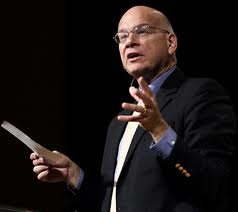
Great Questions to Ask Your Mentoree/Disciple

[Bobb Biehl is a personal and organizational leadership expert – below are some great questions to go over = personally; with your staff, team, mentoree, small group, disicple/s, etc.]

(Adapted from Bobb Biehl, Mentoring, pp. 201-202)

 DREAMING…about the Future in a Practical Way

  1. God: What three changes in me would most please our Eternal God in His Holy Heaven?
  1. Dream/Purpose: What can I do to make the most significant difference for God in my lifetime? Why am I on the earth? What is the very best organizational context for my dream?
  1. Primary Result: What is the single best measurable indicator that I am making progress with my dream?
  1. Life Priorities: If I could accomplish only three measurable priorities before I die, what would I accomplish?
  1. Ten-Year Focus: If I could accomplish only three measurable priorities in the next ten years what would make a 50% difference in my life-long contribution, what would I accomplish?
  1. Annual Focus:
    • Focus – What single word best captures the focus of my next year?
    • Opportunity – Where was my greatest unexpected success last year? Why? What three steps could I take now to take full advantage of this “Window of Opportunity” this coming year?
    • Land Mines – What three land mines or roadblocks need my immediate attention? What have I been praying most about in the past 30 days? What three changes could reduce my “risk” by 50%?
    • 30/10/50% – If I could only accomplish three measurable priorities in the next twelve months that would make a 50% difference in my contribution in the next ten years, which 3 things would I most want to accomplish?
  1. Quarterly Focus: What three measurable priorities could I accomplish in the next ninety days to make a 50% difference in the results I see by the end of the year?
  1. Organization: What three categories could I make to see a 50% difference in our morale as a family or team?
  1. Cash: If I had to cut my budget 21%, what would be the first three things to go? If I got a surprise gift of 21% of my budget, what three things would I do immediately?
  1. Quality: What three changes could improve the quality of my work by 50% in the next twelve months?

Bobb Biehl is an executive mentor. He graduated from Michigan State University (psychology major) in 1964 and received a Master’s degree (counseling) from Michigan State in 1966.

In 1976, Bobb founded Masterplanning Group International. As its president, he has consulted personally with over 400 clients. In that time, he has met one-on-one with over 3,500 executives (board members, senior executives, and staff members) and invested an estimated 40,000 hours in private sessions with some of the finest leaders of our generation. His clients are primarily large or fast-growing churches, nonprofit organizations, for profit corporations, and government agencies.

Based on these thousands of hours of practical “rubber-meets-the-runway” experience, Bobb has originated 35 resources (books, tapes, notebooks) in the area of personal and organizational development. These resources include published books entitled Boardroom Confidence, Dreaming, Leading with Confidence, Masterplanning, Mentoring, Stop Setting Goals, and Why You Do What You Do. His latest book, Dreaming Big, is co-authored with Dr. Paul Swets.

Bobb is a founding member of the board of directors of Focus on the Family. He is also a member of the board of directors of Liquid Metal (publicly traded). Prior to starting Masterplanning Group, Bobb was on the executive staff of World Vision International. While at World Vision he designed and developed the Love Loaf program, which has raised millions of dollars worldwide.

Bobb and his wife, Cheryl, have been married since 1964.