Dr. John PIper on God’s Design for Marriage: 4 Biblical Realities

4 Reasons Why Marriage Is God’s Doing – by Jonathan Parnell

(Summarizing John Piper)

The most foundational thing we can say about marriage is that it is God’s doing. John Piper explains, “A glimpse into the magnificence of marriage comes from seeing in God’s word that God himself is the great doer. Marriage is his doing. It is from him and through him” (24).

In his book This Momentary Marriage, Pastor John Piper gives four reasons why marriage is God’s doing:

First, marriage was God’s design.

While Genesis 1:27–28 makes clear that marriage is meant for male and female, the logic of Genesis 2 also confirms it.

In [Genesis 2:18], it is God himself who decrees that man’s solitude is not good, and it is God himself who sets out to complete one of the central designs of creation, namely, man and woman in marriage. “It is not good that the man should be alone; I will make him a helper fit for him. Don’t miss that central and all-important statement: God himself will make a being perfectly suited for him — a wife. (p. 21)

Second, God gave away the first bride.

God took the role as the first Father to give away the bride. “Genesis 2:22: ‘And the rib that the Lord God had taken from the man he made into a woman and brought her to the man.’ He didn’t hide her and make Adam seek. He made her; then he brought her.” (p. 22)

Third, God spoke the design of marriage into existence.

We can see this if we look carefully at Matthew 19:4–5: “[Jesus] answered, ‘Have you not read that he [God] who created them from the beginning made them male and female, and said [Note: God said!], “Therefore a man shall leave his father and his mother and hold fast to his wife, and the two shall become one flesh”‘?” Jesus said that the words of Genesis 2:24 are God’s words, even though they were written by Moses. (p. 22)

Fourth, God performs the one-flesh union.

The one-flesh union between a man and woman is the heart of what marriage is.

Genesis 2:24 is God’s word of institution for marriage. But just as it was God who took the woman from the flesh of man (Genesis 2:21), it is God who in each marriage ordains and performs a uniting called one flesh. Man does not create this. God does. And it is not in man’s power to destroy. This is implicit here in Genesis 2:24, but Jesus makes it explicit in Mark 10:8–9. He quotes Genesis 2:24, then adds a comment that explodes like thunder with the glory of marriage. “‘The two shall become one flesh.’ So they are no longer two but one flesh. What therefore God has joined together, let not man separate.”

When a couple speaks their vows, it is not a man or a woman or a pastor or parent who is the main actor — the main doer. God is. God joins a husband and a wife into a one-flesh union. God does that. The world does not know this. Which is one of the reasons why marriage is treated so casually. And Christians often act like they don’t know it, which is one of the reasons marriage in the church is not seen as the wonder it is. Marriage is God’s doing because it is a one-flesh union that God himself performs. (p. 23)

Article adapted from: http://www.desiringgod.org/blog/posts/four-reasons-why-marriage-is-gods-doing posted on May 21, 2012.

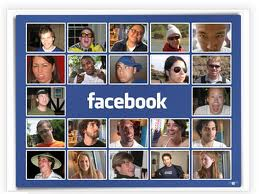
Discipleship in Facebook World

Face-to-Face Discipleship in a Facebook World by John J. Bombaro

Three decades of data have revealed near systemic evangelical ignorance of the Scriptures, ignorance of theology, church history, Christian art, architecture, and iconography and, correspondingly, ignorance of Christian deportment, both social and practical (The abiding mass media and academic depiction of the average evangelical as an emotive, anti-intellectual fundamentalist given to cult of personality groupthink, in fact does have a basis in credible research. While we may sense misrepresentations on South Park and The Simpsons, data evidences that popular opinions about evangelicals may be more stereotype than unfair caricature. See, e.g., David F. Wells, No Place for Truth: Or Whatever Happened to Evangelical Theology? Grand Rapids: Eerdmans, 1993; Mark A. Noll, The Scandal of the Evangelical Mind. Grand Rapids: Eerdmans, 1994; and Michael S. Horton, Made in America: The Shaping of Modern American Evangelicalism. Grand Rapids: Baker, 1991).  Ignorance abounds with the information superhighway literally at our fingertips and Kindles glutted with books.

This ignorance, however, has little to do with intelligence or ability, and everything to do with literacy—the kind of literacy that results from catechesis, interpersonal catechesis. Our evangelical churches are illiterate because catechesis rarely takes place, and when it does it is usually unremarkable and undemanding, thanks to our seeker-sensitivity complex. And it is only interpersonal, challenging catechesis—face-to-face discipleship between the catechist and catechumen—that can dispel such illiteracy, so that the baptized may not only recognize the story in its various manifestations (the contents of the Bible, confessional articles, liturgical appointments and rites, and so forth), but also own it as their integrated worldview and lifestyle. It was this kind of discipling that Jesus expected from his ministerium (Matt. 28:19; John 21:15-18). Interpersonal discipleship fortifies the church against flaccid nominalism. Modern technologies, for all their usefulness and genius, have not and cannot fill the gap between Christian initiation and catechetical confirmation; only face-to-face discipleship can.

After decades of unbridled optimism, catechists were beginning to make a U-turn on the necessity of employing modern technologies as the principal means of discipling. To be sure, cautionary statements have been issued since the 1980s by the likes of Neil Postman, C. John Sommerville, D. G. Hart, and Neal Gabler, that modern technology was not all it was cracked up to be, particularly in connection with religious learning (See Postman’s Amusing Ourselves to Death: Public Discourse in an Age of Show Business. New York: Penguin Books, 1984; and Technopoly: The Surrender of Culture to Technology. New York: Vintage, 1993; Sommerville’s How the News Makes Us Dumb: The Death of Wisdom in an Information Society. Downers Grove: IVP, 1999; Bruce Kuklick and D. G. Hart, eds., Religious Advocacy and American History. Grand Rapids: Eerdmans, 1997; and Gabler’s Life the Movie: How Entertainment Conquered Reality-Starring Everyone. New York: Vintage, 2000).

Biblical literacy rates are down, learning is increasingly a passive activity, the line of demarcation between educating and entertaining has been blurred, and—for all the time spent in front of electronic media devices (averaging nine hours a day for high school students)—American pupils are scoring lower than their Eastern and Sub-Continent counterparts in the fields of mathematics, science, language acquisition and proficiency, to say nothing of catechetical retention (See Gary M. Burge, “The Greatest Story Never Read: Recovering Biblical Literacy in the Church,” Christianity Today 43, no.9 (1999): 45-49; E. Christian Kopff, The Devil Knows Latin: Why America Needs the Classical Tradition (Wilmington, DE: Intercollegiate Studies Institute, 1999); and Mark Bauerlein, The Dumbest Generation: How the Digital Age Stupefies Young Americans and Jeopardizes Our Future (New York: Tarcher/Penguin, 2008). As one Sudanese pastor said, “I’ll take any one of my catechumens over a dozen of yours in America.” This Anglican priest was making the point that discipleship is about quality, not quantity. It is baptism that gives us quantity. Face-to-face discipleship gives us quality. But then came Facebook as the latest Christian-consumer expectation within the church. Face-to-face discipleship now competes with Facebook discipleship.

Old School Discipling through Personal Presence

Biblical models of discipleship entail corporate settings (cf. Acts 2:42; Heb. 10:25) and more intimate contexts for mentoring (cf. Acts 8:26ff; 10:27-48; the Pastoral Epistles). Jesus’ ministry to the assembled masses and pedagogical retreats with his disciples provide paradigmatic case studies for intentional catechetical ministry that has been replicated by the apostles and succeeding generations within the church. Indeed, when Jesus commissioned his disciples as apostles (hoi apostoloi) in John 20:21-23, he intended a personal, intimate, and present ministry. The Father “sent” (apestalken) the Son in human flesh to “be with us” (John 1:14), to minister grace and truth. In the same way (kathos) the Son sends his personal representatives—the apostoloi—to minister the grace and truth of God. Anything otherwise would yield Docetism, impinging upon God’s incarnational purposes and presence (Docetism [from the Greek dokeo, “to seem”] refers to a heretical Gnostic doctrine in the early church that held that Jesus only appeared [seemed] to have a human body, and so his incarnate representation, suffering, and death on the cross were merely apparent [virtual], not real). Personal, present representation is therefore the essence of Christian ministry—the ministry of disciple-making through holy baptism and the formation of the disciple through catechetical instruction (Matt. 28:19-20).

Given this biblical precedence and two millennia of ecclesial emulation of the discipling process, is it possible to take a digital approach to, say, the Lenten form of Christian discipleship? I don’t think so. Cyber-social networks such as Facebook facilitate neither the corporate setting nor the context for mentoring as intended by the Father and the Son.

The tradition of Lent is the liturgical calendar season of forty weekdays before Easter, observed by many Reformation traditions and consisting of penitence and fasting. It stretches from Ash Wednesday to Holy Saturday. Despite attempts to spin the significance of the biblical number “40” into something wonderfully transformative (à la Rick Warren’s The Purpose-Driven Life), forty-day periods in the Bible always are associated with trials of temptation, affliction, fasting, repentance, and suffering while entreating God for grace. One thinks of Moses, Elijah, and Jesus himself fasting in the wilderness. One also thinks of global judgment for forty days in Noah’s lifetime, as well as the first generation of Hebrews that experienced the Exodus, who also spent forty years wandering and never entering the Promised Land. Lenten seasons, be it with Moses and the Hebrews, Elijah and the Israelites, or Jesus and his “last Adam” representation of humanity, were never exclusively about individual self-discovery. They have always been far more corporate in the disciplines of repentance and entreaty. These experiences necessitated challenging encounters with familial (head of household) and communal spiritual shepherds (prophets and priests).

Maintaining continuity with the Old Testament and holding Jesus’ wilderness trial as the paragon, the church enters the season of Lent. Since the third century, entire congregations have embraced and participated in the drama of Lent that reaches its apogee on Good Friday when the Messiah was crucified “for us and for our salvation,” only to give way to corporate relief on Easter morning. Lent was a church affair, and it was bound up with the formation of disciples by way of catechetical preaching, instructing baptismal candidates and confirmands, and shaping Christian character through the rigors of spiritual disciplines—praying, fasting, meditating, self-denying, serving, and studying. It was all very corporate, all quite interpersonal. We repented together, we mourned together, we celebrated together. Moreover, it was decidedly low tech: personal presence, Word, sacraments, brotherly consolation, encouragement. Christians touched and ate together in 3-D.

Today, Lent seems to have suffered from the encroachment of our Facebook society. I say this because, like so much else in American evangelicalism, even Lent seems to have been reduced to an exercise in isolation, militating against biblical categories of discipleship. What was once a parish exercise is now more frequently referred to as an individual experience enjoyed from the comforts of home or wherever one can WiFi a 4G network. Evidencing this trend are not only sparsely attended Lenten services (in the ever-shrinking sphere in which it remains), but the way we as evangelicals think about the world. A Facebook instant message (IM) exchange shared by a friend may be typical:

A: Doing lent?

B: You mean giving up something?

A: No u know the whole lent thing—church and all.

B: Not really. How about you?

A: Me neither tho I was thinking I’d renew my new years resolutions.

B: Cool. I’ll pray for you.

This exchange came from a West Coast evangelical church’s Facebook forum titled, “The Fellowship Wall.” For this and other churches, posting, texting, and blogging sometimes constitutes Christian fellowship and the substance of discipleship. Where once catechisms were employed and midweek Lenten services pocked calendars, now it is good enough simply to have connected electronically. Clip, paste, send. And we all say “Amen.”

New School Discipleship through Facebook

There can be no doubt that Facebook and social networks such as Myspace and Twitter are displacing interpersonal mediums of discipling. In a broader sense, they are filling a socialization vacuum about which Robert D. Putnam so ably wrote in his groundbreaking book, Bowling Alone (Robert D. Putnam, Bowling Alone: The Collapse and Revival of American Community (New York: Simon & Schuster, 2000). I thank Brian Thomas, vicar at Grace Lutheran Church, San Diego, for this insight and his conversation on much that follows. Putnam’s data showed how Americans have become increasingly disconnected from family, friends, neighbors, our democratic structures, and church. He concluded that radical individualism, narcissism, consumerism, moral relativism, and a profound sense of entitlement fragment communities and organizations that, by their very nature and existence, operate on a fundamentally different principle than autonomy. With the loss of this social capital through civil engagement new, more convenient, and personally defined civic forms have arisen, but have done so by accommodating an America that is radically individualistic, narcissistic, consumerist, morally relative, and entitled. Facebook is the most successful new civil forum, and it is finding a welcome home in the church—the very entity designed by God to provide a totally different solution to communal disengagement from docetic enterprises like Facebook.

The gravitation toward employing cyber-social networks for activities once understood to require personal presence is seen in every corner of evangelicalism. Church Facebook pages abound. A decade ago a common query was, “Does this church have a website?” Now the question is, “Is this church on Facebook?” That is because Facebook provides unique features, carries a certain status, and facilitates particular expectations for its nearly 650 million patrons. Facebook is an innovative cultural force shaping societal expectations about identity and a sense of belonging, which is why churches are enlisting its novel methodology. Per usual, evangelicalism is eager to give people what they want (convenience and low commitment) instead of what disciples need (challenging and engaging discipleship).

The contents on church Facebook pages range from posting intimations to sermon podcasting to forums for discipleship. Subscribers say that the need to employ Facebook-type interfaces is natural and fitting: It’s just another tool for marketing, conveniently connecting believers, evangelistic endeavors, and Christian education. After all, the church has a history of technological employments—the printing press, Christian radio, television, theater. Evangelicals expect that the utilization of technology will terminate in enriching humanity with the Word of God or, synonymously, increasing catechetical literacy. At the same time, we would do well to remember the observations of Marshall McLuhan: “We become what we behold. We shape our tools and thereafter our tools shape us” (Marshall McLuhan, Understanding Media: The Extensions of Man. New York: McGraw-Hill, 1964, xi.). If the ideas of McLuhan have any traction, and the medium of social networking is really a message about virtuosity or unreality (corresponding to McLuhan’s aphorism: “The medium is the message”), then church-via-Facebook will have the opposite effect upon discipleship and enriching Christian communities because it is not, by design, a conducive forum for the biblical discipleship of believers. It promotes tweets not tomes. It is not demanding but user friendly. It does not foster spiritual disciplines as there’s no accountability. How, then, can we expect a tool that truncates our sensory engagement with reality (limiting it to an LCD panel) to play a role in reversing catechetical illiteracy?

A related conversation emerged in my University of San Diego class, “Protestantism in the USA.” My students confirmed a suspicion I held. They believe that old “brick and mortar” churches are becoming increasingly redundant because evangelicalism is leading the way toward a fully personalized spirituality—done at home online. They reasoned, “You choose your friends online. Why not choose your church?” By this they did not mean utilizing a search engine to ascertain which church you would like to attend, but rather choosing whom you would like to have in your self-determined cyber-congregation, something quite different from the Body of Christ where those you might otherwise decline an invitation to view your page sit down next to you, hold your hand during the Lord’s Prayer, and may even share the chalice with you during Holy Communion. They were saying that there will be no need to attend church because there is even now the possibility of forming your own virtu-church in the same way one customizes an iTunes collection. And in good keeping with the evangelical accommodation of individualism through self-application Bibles and a flattened ecclesiological topography, virtu-church provides the ideal setting for self-feeding where, when, how, and with whom you like. It’s the next logical step in consumerist Christianity. They reported that this was not only a possibility, but a present reality: “I hardly ever go to church,” confessed one student, “I stay connected through Facebook and I can do it from anywhere.” The class nodded in universal agreement—assembling with believers is superfluous when Facebook is omnipresent. There was no perceived need to improve their catechetical literacy: they knew how to navigate the site.

Facebooked

After class, however, a student told me how her Emergent church went belly-up through Facebook, confirming another suspicion I held. This particular fellowship did all of its intimations, connecting, and correspondence through the online social network. Before long, the homilies and prayers were simply posted, and assembling took place online, with the discipling of new believers being facilitated by way of the IM tool. “It was so exciting,” she said. The Facebook app on your phone allowed you to carry the church in your pocket and contribute through PayPal.

Then, of course, the social networking within the church became more exclusive. Facebook is, after all, a gateway or filter. Consequently, undesirables were precluded or excluded. (So much for evangelism.) The IM walls became forums for gossip. (So much for fellowship.) Mentors and neophytes never actually met for discipleship because the gateway fixed a buffer between catechist and catechumen. The church emerged and disbanded within four years. Facebook’s exclusivity principle cut them off from the wider Christian world and, in fact, one another. The medium mangled the message. In the end, they were still “bowling alone.” Facebook changed their church dynamics because there was no need to leave the house for the lanes of corporate or catechetical discipleship. They were taught that it was enough that they were bowling on Wii.

The cyber-solution to civic engagement resulted, in this case, in greater exclusion and isolation, proving once again that disciples cannot be made or discipled online: there’s no water, no bread and wine, no living thing transmitted through 1s and 0s. It was never intended to be so in a church that requires its catechumens to “take, eat” (Matt. 26:26). Facebook’s methodology cannot establish a mentoring context where interpersonal engagement entails the entire person in the discipling process, addressing issues of character, disposition, emotions, and body language. This only happens when someone is there, really there. To give one’s time writing an e-mail is one thing, but to give of the self through personal presence sets discipleship on an entirely different and elevated plane. Personal presence is the essence of gift giving (John 3:16).

For all the “friendships” being made online, there are still no hugs, handshakes, or looking in the eye. And that’s the irony of online social networks. The medium of Facebook is the message of the unreal; Myspace is no place; “friends” are files; chat is voiceless; templates establish individuation. What is more, when the whole world is denying that God is real, for churches or catechists to resort to the domain of virtuosity sends the wrong theological message. If the sheep are suspended in the Ethernet, then what of the Shepherd?

The domain of virtuosity cannot convert ecclesial settings where catechist/catechumen relationships envelop the totality of our humanity—mind, will, emotions, and physicality. Discipleship therefore must take place face to face since the church curates the substance of Christian faith and practice through embodied transmission. Stated differently, authentic discipleship requires personal presence because the living medium remanates the living message to living recipients.

As an ordained minister, it is one thing for me to text, e-mail, or phone a parishioner, and another thing for me to be present. Pastoral visitations hold significantly different weight from electronic communications, and the effect they have is likewise dissimilar. That’s because disciples who have cut their teeth on old school catechesis expect their pastor to be there instead of stockpiling e-messages. The Son of God showed up to take away the sins of the world. In like manner, the pastor needs to show up to baptize, absolve, commune, commiserate, counsel, and catechize if Christ’s apostolic commissioning is to be accomplished. Being a disciple of Jesus (whether catechist or catechumen) means that loving others comes at the price of sacrifice. There is something real, urgent, and authenticating for our humanity about having to be there in person. The physics of voice and sound, the force of human emotion and passions, and indeed, touching are effective tools in the ministry of the Holy Spirit through earthen vessels. This is the high expectation of Christ and discipleship in the real world. Conversely, the expectations of Christians who live in a Facebook world are low. The pastor is a flat screen image, like a celebrity pastor whose multicampus sermon broadcasts are streamed to smartphones. You may never meet your pastor in person let alone receive catechesis or a hospital visit from him: hence, discipleship happens on your time, when you want to log in. The convenience of cyber-socializing in a risk-free domain devoid of self-giving love perpetuates evangelical ignorance precisely because one is not being a disciple, a learner of Christ, which takes place in the context of where two or more are gathered—really gathered.

Principles of Facebook

As far as discipleship is concerned, Facebook must be placed in the same category of brilliant technologies that, when misappropriated, “bite back.” Edward Tenner has convincingly argued in his well-documented Why Things Bite Back: New Technology and the Revenge Effect that technologies in fact do have their appropriate sphere of utility that, when transgressed, results in unforeseen and unintended consequences (Edward Tenner, Why Things Bite Back: New Technology and the Revenge Effect (London: Fourth Estate, 1996). Christian discipleship and fellowship are at least two planes that, when transected with Facebook, have the opposite effect; that’s because, as far as compatibility with Christian community building and discipleship is concerned, the fundamental premises upon which Facebook rests (viz., exclusivity, self-identification, and convenience) are antithetical to the kingdom Christ created. Just ask the Galatians to whom Paul wrote.

The fundamental premises behind Facebook are the concepts of adolescent clique, exclusivity, and reliving (in a virtual way) high school and college popularity and posturing. Individually and collectively, these principles are ill-suited for Christian discipleship.

“Clique” is antithetical to the building of Christian communities, expanding conversation, and communion in both its vertical and horizontal dimensions. Jesus, Paul explains, broke down walls of separation (Eph. 2:16), and so the revolutionary social network of the church was sexless, ageless, raceless, and without socioeconomic status (Gal. 3:28; Col. 3:11). The Facebook principle of clique erects walls of separation by way of “friendship” segregation. It dissolves fellowshipping into Facebooking among those we discriminate as worthy brethren. While biblical discipleship advances maturation, America’s prevailing social network promotes a return to adolescence—the period of life where our self-identity is most confused and unfounded, indeed, self-referential. No wonder we’re attracted to Facebook and Myspace: they facilitate opportunities to go back and remake ourselves in an ideally self-determined fashion. You can upload your independent spiritual profile by tweeting the new you. This attraction will persist so long as no event-oriented, identity-making fixtures such as holy baptism, Holy Communion, holy confirmation, and holy matrimony (the things of face-to-face discipleship) persevere with us. And since God-given means of disciple making and discipling cannot be experienced in the two-dimensional realm, then identity makers default to pop culture rites of passage such as driving age, drinking age, launching your Facebook profile, and sexual encounters. Don’t believe me? Ask a teen or collegian or, better yet, any “real housewife.”

British author A. S. Byatt, an avowed atheist who openly describes herself as “anti-Christian,” has seen this quite clearly (See http://www.guardian.co.uk/books/2009/apr/25/ as-byatt-interview). In a recent interview, Byatt laments the loss of the Christian metanarrative that once provided her Western culture with its existential orientation manifested through conversation, communities, and communion (See http://www.guardian.co.uk/books/video/2010/aug/25/as-byatt-facebook). Now, she says, with the grand biblical story effectively purged from public discourse, all we have are autobiographies, anonymity, and autonomy.

It was this Christian metanarrative—passed on through the catechetical process—she explains, that told us who we are, where we are going, and what it all means (Hence the definition of catecheo: “to sound again,” i.e., the catechumen repeats or reproduces the catechism. Cf. Bombaro, “A Catechetical Imitation of Christ,” Modern Reformation 18, no. 2 (March/April 2009): 31-35). Without that picture of reality, observes Byatt, we Facebook. Facebook is synonymous with “Selfbook” (my term) where living takes place before the cyber-mirror through which the virtual self legitimates the spatiotemporal self (if the spatiotemporal matters anymore). “It is a mirror,” she explains, “because there’s no picture.” By “picture” Byatt means an objective world about which we live and move and have our being, the external referent to the real. To sustain that picture requires work: storytelling, rituals, contextualizing, the discipline of self-sacrifice, and deference to the governing story. To sustain existence in a Facebook world, however, one must blog, upload, or tweet. I tweet, therefore I am. One’s identity is forged and altered and altered again to sustain self-actualization.

It doesn’t matter that no one is listening, because you are engaging a mirror—the projection of your ideal self, however conceived (regardless, none of it happens in real time in a real community anyway). This, I believe, is why Byatt says that Facebook and Twitter are gods. Life lived not only through but literally in front of the digital portal to the unreal world is life lived coram Deo, before the face of God or, which is to say the same thing, yourself. In this sense, Byatt intimates that we confirm McLuhan’s prophecy: “We become what we behold.”

Without a comprehensive picture of reality to either embrace or discuss in dispute, all we are left with is ourselves or, more accurately, the ideal of ourselves. It naturally follows that we are self-obsessed, but now it is an obsession not with our incarnational existence but a dehumanized virtual one. Plato would be proud. But that’s a scary prospect: detachment from reality to retreat into the pseudo-self, where one projects a hologram to those deemed worthy of “friendship.” No wonder Byatt worries about the loss of conversation, communities, and communion. Discipleship is impossible when the catechist and catechumen are the same person.

In the 1980s and 90s one was remade or, better, renamed by way of consumption of phenomenological goods, be it clothing, cars, or house. Matter mattered, even if it was too much. Personal presentation and personality were inseparable from you. Today, however, one need only tweet the new you—personal presentation and personality edited and “photoshopped” before posting. Before, Madonna was the paragon of change, but that took time, even if it was only two years between album releases. Facebook has retired her “material girl” paradigm for an immediate ethereal one. We don’t need her example of postmodern transformation that, one could argue, was tethered to her vocation, because one can be instantly born again by way of texting. Texting or blogging about yourself is the new revelation—a fresh word from you about you. Unlike God’s real-world elocution, in a Facebook world the word is ours. We are the sovereign speakers, and therein lies our evangelical ignorance: news about me is never the good news. It has to come from outside of me to save me from me. We need God’s Word to save us from the tools we’ve misappropriated that have us sinking deeper into ourselves. It is for the sake of the gospel that we need face-to-face discipleship in a Facebook world.

Self-Giving in Discipleship

Virtual living reflects negatively upon the incarnation and our own “enfleshment.” It must—just like the Roman Catholic Church’s “Confession App” (where there is no real person, no real voice, behind that “Confession App”; no one is present in persona Christi), (See http://www.csmonitor.com/Innovation/Latest-News-Wires/2011/0208/Confession-app-for-iPhone-approved-by-Catholic-Church). so too with the imago Dei: there need not be a real person behind my Facebook page. There is no image of God in us when what we are is a digitized self-projection, a two-dimensional facade. We’re right back to the First Commandment. It’s just about the image of me, the idea of you. It is fantasy living, a kind of voyeurism, because through this nonreality we project ideas of idyllic perfection. Perhaps it is a way to deal with sin, a form of self-justification. But I suspect that we know better because our expectations for friendship are low on Facebook, and that tells me our expectations of God and ourselves are equally low. With no living encounters there can be no accountability or responsibility for oneself, let alone another. It should come as no surprise that Facebook is now the preferred forum for posting suicide notes.

We have to get in touch with reality again. When banking can be done online, filling the tank happens at the pump, self-checkout eliminates human interaction, and social networking is two dimensional (like the image of ourselves), then perhaps now more than ever the church must reestablish face-to-face discipleship to recover our humanity.

Perhaps an unimpressed utilitarian approach toward this Internet tool might be the church’s best approach to the social networking phenomenon since, at least in this case, the adage, “We make the tools and then the tools make us,” seems to obtain.

Don’t get me wrong; I’m no Luddite. There’s some usefulness to Facebook. It’s just that I am still working on what that may be, since a good deal of my time is spent counseling couples whose marriages have been obliterated by affairs started on social networks. Still, when the premise of what is now a global institution divides, distorts, and dilutes, then at least within the church we have to recognize that this medium (in which the spatiotemporal self is suspended for the hologram life) is perfectly ill-suited for virtually everything that pertains to Christian life and faith, except for maybe the intimations.

The Facebook blog is no substitute for the fellowship hall, to say nothing of the Communion rail. For all of their admirable qualities, social network technologies simply cannot facilitate corporate repentance or the interpersonal bond between catechumen and catechist. Mind you, they were never intended to do so. Their genius has other applications; thank God for that. I never want to go back to the days without modern plumbing, dentistry, or computers. But given the way Christ built the church, we have to acknowledge that there is no “spiritual discipline” app.

The art of discipleship requires work with difficulty, which is why the church meets together. The catechist “sounds down” to where the catechumen is at so that in turn the catechumen may “sound again” the catechism. All of it presupposes being present with one another, having personal relationships in spatiotemporality. There is therefore no hiding or anonymity in biblical discipleship. It comes with risk—someone may see your secondhand couch, the dishes in the sink, or the pimple on your nose. But that is what God’s household is like: all are called out of the blogosphere to their Father’s table to break bread. We’re not supposed to stay in our rooms texting or tweeting or Facebooking. The church is a social network with real beings, real warmth, real self-giving, real challenges—challenges to love the “other,” the “different,” the not-your-demographic, and to do so as an expression of our baptismal identity. The ethos of baptism leads the disciple to Communion—the “with union” meal. Jesus made us “friends” in the church; and as members of the Body of Christ, our lives are intertwined. We need the mutual support and encouragement we offer to one another as we reflect on our sin and seek God’s mercy in Jesus the Son for relief, sounding again the catechism that dispels ignorance and liberates us from the bondage of contemporary Zeitgeists like dehumanizing social networks.

This article originally appeared in the “Word and Sacrament: Making Disciples of All Nations” July/August 2011 Vol. 20 No. 4 Page number(s): 17-23 edition of Modern Reformation.

About the Author: Rev. John J. Bombaro (Ph.D., King’s College, University of London) is the parish minister at Grace Lutheran Church in San Diego, California and a lecturer in theology and religious studies at the University of San Diego.

The Calvinistic Heritage of Dispensationalism By Dr. Thomas Ice

If systematic Dispensationalism is rightly understood it logically makes sense only within a theocentric and soteriologically Calvinists theology. Dispensationalism teaches that it is GOD who is ruling His household, as administered through the various dispensations of history. Though Dispensationalism, or elements of Dispensationalism have been disseminated throughout a wide diversity of Protestant traditions, this system of theology is best seen as a system of theology that views God as the Sovereign ruler of heaven and earth; man as a rebellious vice-regent (along with some angels); Jesus Christ is the hero of history as He is saves some by His Grace; history as a lesson in the outworking of God’s glory being displayed to both heaven and earth. In essence, Dispensationalism is a theology properly derived from biblical study and lets God be God.

Modern, systematic Dispensationalism is approaching two hundred years of expression and development. We live at a time in which Dispensationalism and some of its ideas have been disseminated and adopted by various theological traditions. This is not surprising since our day is characterized by anti-systemization and eclecticism in the area of thought. It may be surprising, to some, to learn that Dispensationalism was developed and spread during its first 100 years by those within a Reformed, Calvinistic tradition. It had only been in the last 75 to 50 years that Dispensationalism and some of its beliefs were disseminated in any significant way outside of the sphere of Calvinism.

Definitions

Before proceeding further I need to provide working definitions of what I mean by Calvinism and Dispensationalism.
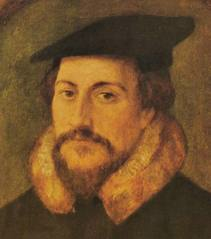
First, by Calvinism, I am speaking mainly of the theological system that relates to the doctrine of grace or soteriological Calvinism. This would include strict and modified Calvinism (i.e. four and five point Calvinism [some hold to limited atonement and some hold to universal atonement]). I am referring to that aspect of Calvinism that speaks of the fallen nature of man and the elective grace of God (John Calvin image at left).

Second, by Dispensationalism, I have in mind that system of theology that was developed by J. N. Darby (pictured on right) that gave rise to its modern emphasis of consistent literal interpretation, a distinction between God’s plan for Israel and the church, usually a pretribulational rapture of the church before the seventieth week of Daniel, premillennialism, and a multifaceted emphasis upon God’s glory as the goal of history. This includes some who have held to such a system but may have stop short of embracing pretribulationism. The focus of this article will be upon Dispensational premillennialism.

Theological Logic

In concert with the Calvinist impulse to view history theocentricly, I believe that dispensational premillennialism provides the most logical eschatological ending to God’s sovereign decrees for salvation and history. Since Dispensational premillennialists view both the promises of God’s election of Israel and the church as unconditional and something that God will surely bring to pass, such a belief is consistent with the Bible and logic. A covenant theologian would say that Israel’s election was conditional and temporary. Many Calvinists are covenant theologians who think that individual election within the church is unconditional and permanent. They see God’s plan with Israel conditioned upon human choice, while God’s plan for salvation within the church is ultimately a sovereign act of God. There is no symmetry in such logic. Meanwhile, Dispensational premillennialists see both acts as a sovereign expression of God’s plan in history that is a logical, consistent application of the sovereign will of God in human affairs.

Samuel H. Kellogg, a Presbyterian minister, missionary, and educator wrote of the logic between Calvinism and “modern, futurist premillennialism,” which was in that day (1888) essentially dispensational. “But in general,” notes Kellogg, “we think, it may be rightly said that the logical relations of premillennialism connect it more closely with the Augustinianthan with any other theological system” (Samuel H. Kellogg, “Premillennialism: Its relations to Doctrine and Practice,” Bibliotheca Sacra, XLV [1888], p. 253).

His use of “Augustinian” is the older term for Calvinism. Kellogg points out the different areas in which Calvinism and premillennialism are theologically one. “Premillennialism logically presupposes an anthropology essentially Augustinian. The ordinary Calvinism affirms the absolute helplessness of the individual for self-regeneration and self- redemption” (Kellogg, “Premillennialism,” p. 254). He continues, “it is evident that the anthropological presuppositions on which premillennialism seems to rest, must carry with them a corresponding soteriology” (Kellogg, “Premillennialism,” p. 257). Kellogg reasons that “the Augustinian affinity of the premillennialist eschatology becomes still more manifest. Nothing is more marked than the emphasis with which premillennialists constantly insist that, the present dispensation is strictly elective” (Kellogg, “Premillennialism,” p. 258-59). “In a word,” concludes Kellogg, “we may say that premillennialists simply affirm of the macrocosm what the common Augustinianism affirms only of the microcosm” (Kellogg, “Premillennialism,” p. 256).

This is not to say that Dispensationalism and Calvinism are synonymous. I merely contend that it is consistent with certain elements of Calvinism that provide a partial answer as to why Dispensationalism sprang from the Reformed tradition. C. Norman Kraus contends,

There are, to be sure, important elements of seventeenth-century Calvinism in contemporary dispensationalism, but these elements have been blended with doctrinal emphasis from other sources to form a distinct system which in many respects is quite foreign to classical Calvinism (C. Norman Kraus, Dispensationalism in America: Its Rise and Development. Richmond: John Knox Press, 1958, p. 59).

Nevertheless, Dispensationalism did develop within the Reformed community and most of its adherents during the first 100 years were from within the Calvinist milieu. Kraus concludes: “Taking all this into account, it must still be pointed out that the basic theological affinities of dispensationalism are Calvinistic. The large majority of men involved in the Bible and prophetic conference movements subscribed to Calvinistic creeds” (Ibid). I will now turn to an examination of some of the founders and proponents of Dispensationalism?

Darby and the Brethren

Modern systematic dispensationalism was developed in the 1830s by J. N. Darby and those within the Brethren movement. Virtually all of these men came from churches with a Calvinistic soteriology. “At the level of theology,” says Brethren historian H. H. Rowdon, “the earliest Brethren were Calvinists to a man” (Harold H. Rowdon, Who Are The Brethren and Does it Matter? Exeter, England: The Paternoster Press, 1986, p. 35). This is echoed by one of the earliest Brethren, J. G. Bellett, who was beginning his association with the Brethren when his brother George wrote, “for his views had become more decidedly Calvinistic, and the friends with whom he associated in Dublin were all, I believe without exception, of this school” (George Bellett, Memoir of the Rev. George Bellett . London: J. Masters, 1889, pp. 41–2, cited in Max S. Weremchuk, John Nelson Darby. Neptune, N.J.: Loizeaux Brothers, 1992, p. 237, f.n. 25).

What were Darby’s views on this matter? John Howard Goddard observes that Darby “held to the predestination of individuals and that he rejected the Arminian scheme that God predestinated those whom he foreknew would be conformed to the image of Christ.”  In his “Letter on Free-Will,” it is clear that Darby rejects this notion. “If Christ has come to save that which is lost, free-will has no longer any place.”  “I believe we ought to hold to the word;” continues Darby, “but, philosophically and morally speaking, free-will is a false and absurd theory. Free-will is a state of sin” (Ibid, p. 186).  Because Darby held to the bondage of the will, he logically follows through with belief in sovereign grace as necessary for salvation.

Such is the unfolding of this principle of sovereign grace, without which not one should would be saved, for none understand, none seek after God, not one of himself will come that he might have life. Judgment is according to works; salvation and glory are the fruit of grace (J. N. Darby, “Notes on Romans,” in The Collected Writings of J. N. Darby [Winschoten, Netherlands: H. L. Heijkoop, 1971], 26: 107–8).

Further evidence of Darby’s Calvinism is that on at least two occasions he was invited by non-dispensational Calvinists to defend Calvinism for Calvinists. One of Darby’s biographers, W. G. Turner spoke of his defense at Oxford University:

It was at a much earlier date (1831, I think) that F. W. Newman invited Mr. Darby to Oxford: a season memorable in a public way for his refutation of Dr. E. Burton’s denial of the doctrines of grace, beyond doubt held by the Reformers, and asserted not only by Bucer, P. Martyr, and Bishop Jewell, but in Articles IX—XVIII of the Church of England (W. G. Turner, John Nelson Darby: A Biography [London: C. A. Hammond, 1926], p. 45).

On another occasion Darby was invited to the city of Calvin—Geneva, Switzerland—to defend Calvinism. Turner declares, “He refuted the ‘perfectionism’ of John Wesley, to thedelight of the Swiss Free Church.”  Darby was awarded a medal of honor by the leadership of Geneva (Rowdon, Who Are The Brethren, pp. 205–07).

Still yet, when certain Reformed doctrines came under attack from within the Church in which he once served, “Darby indicates his approval of the doctrine of the Anglican Church as expressed in Article XVII of the Thirty-Nine Articles” (Goddard, “The Contribution of Darby,” p. 86).  On the subject of election and predestination, Darby said,

For my own part, I soberly think Article XVII to be as wise, perhaps I might say the wisest and best condensed human statement of the view it contains that I am acquainted with. I am fully content to take it in its literal and grammatical sense. I believe that predestination to life is the eternal purpose of God, by which, before the foundations of the world were laid, He firmly decreed, by His counsel secret to us, to deliver from curse and destruction those whom He had chosen in Christ out of the human race, and to bring them, through Christ, as vessels made to honour, to eternal salvation (J. N. Darby, “The Doctrine of the Church of England at the Time of the Reformation,” in The Collected Writings of J. N. Darby [Winschoten, Netherlands: H. L. Heijkoop, 1971], 3:3).

Dispensationalism in America

 Darby and other Brethren brought dispensationalism to America through their many trips and writings that came across the Atlantic. “In fact the millenarian (or dispensational premillennial) movement,” declares George Marsden, “had strong Calvinistic ties in its American origins” (George M. Marsden, Fundamentalism and American Culture: The Shaping of Twentieth-Century Evangelicalism: 1870–1925 [New York: Oxford University Press, 1980], p. 46). Reformed historianMarsden continues his explanation of how dispensationalism came to America:

This enthusiasm came largely from clergymen with strong Calvinistic views, principally Presbyterians and Baptists in the northern United States. The evident basis for this affinity was that in most respects Darby was himself an unrelenting Calvinist. His interpretation of the Bible and of history rested firmly on the massive pillar of divine sovereignty, placing as little value as possible on human ability (Ibid).

The post-Civil War spread of dispensationalism in North America occurred through the influence of key pastors and the Summer Bible Conferences like Niagara, Northfield, and Winona. Marsden notes:

The organizers of the prophetic movement in America were predominantly Calvinists. In 1876 a group led by Nathaniel West, James H. Brookes, William J. Eerdman, and Henry M. Parsons, all Presbyterians, together with Baptist A. J. Gordon, …These early gatherings, which became the focal points for the prophetic side of their leaders’ activities, were clearly Calvinistic. Presbyterians and Calvinist Baptists predominated, while the number of Methodists was extremely small… Such facts can hardly be accidental (Ibid).

Proof of Marsden’s point above is supplied by Samuel H. Kellogg—himself a Presbyterian and Princeton graduate—with his breakdown of the predominately dispensational Prophecy Conference in New York City in 1878. Kellogg classified the list of those that signed the call for the Conference as follows (Kellogg, “Premillennialism,” p. 25):

Reformed Episcopalians 10
Congregationalists 10
Methodists 6
Adventists 5
Lutheran 1
Presbyterians 31
United Presbyterians 10
Reformed (Dutch) 3
Episcopalians 10
Baptist 22

Kellogg concluded that “the proportion of Augustinians in the whole to be eighty-eight per cent” (Ibid, p. 254). “The significance of this is emphasized,” continues Kellogg, “by the contrasted fact that the Methodists, although one of the largest denominations of Christians in the country, were represented by only six names” (Ibid). Kellogg estimates that “analyses of similar gatherings since held on both sides of the Atlantic, would yield a similar result” (Ibid).

George Marsden divides Reformed Calvinism in America into three types: “doctrinalist, culturalist, and pietist” (George M. Marsden, “Introduction: Reformed and American,” in David F. Wells, ed., Reformed Theology in America: A History of Its Modern Development [Grand Rapids: Baker, 1997], p. 3). He then explains that “Dispensationalism was essentially Reformed in its nineteenth-century origins and had in later nineteenth-century America spread most among revival-oriented Calvinists” (Ibid, p. 8). This is not to say that only revival-oriented Calvinists were becoming dispensational in their view of the Bible and eschatology. Ernest Sandeen lists at least one Old School Presbyterian—L. C. Baker of Camden, New Jersey—as an active dispensationalist during the later half of the nineteenth century (Ernest R. Sandeen, The Roots of Fundamentalism: British and American Millenarianism, 1800–1930 [Grand Rapids: Baker, 1970]).

Timothy Weber traces the rise of Dispensationalism as follows:

The first converts to dispensational premillennialism after the Civil War were pietistic evangelicals who were attracted to its Biblicism, its concern for evangelism and missions, and its view of history, which seemed more realistic than that of the prevailing postmillennialism. Most of the new premillennialists came from Baptist, New School Presbyterian, and Congregationalist ranks, which gave the movement a definite Reformed flavor. Wesleyan evangelicals who opposed premillennialism used this apparent connection to Calvinism to discredit it among Methodists and holiness people (Timothy P. Weber, “Premillennialism and the Branches of Evangelicalism,” in Donald W. Dayton and Robert K Johnston, editors, The Variety of American Evangelicalism [Downers Grove, IL: InterVarsity Press]).

It is safe to say that without the aid of Reformed Calvinists in America dispensational premillennialism would have had an entirely different history. Men like the St. Louis Presbyterian James H. Brookes (1830–1897), who was trained at Princeton Seminary, opened his pulpit to Darby and other speakers. Brookes, considered the American father of the pretribulational rapture in America, also discipled a new convert to Christ in the legendary C. I. Scofield (For more on the life of Brookes see Larry Dean Pettegrew, “The Historical and Theological Contributions of the Niagara Bible Conference to American Fundamentalism,” [Th.D. Dissertation from Dallas Theological Seminary, 1976]; David Riddle Williams, James H. Brookes: A Memoir, [St. Louis: Presbyterian Board of Publication, 1897]). Others such as Presbyterians Samuel H. Kellogg (Princeton trained), E. R. Craven, who was a PrincetonCollege and Seminary graduate and Old School Presbyterian (Samuel Macauley Jackson, ed., The New Schaff-Herzog Encyclopedia of Religious Knowledge [Grand Rapids: Baker, 1952], 3: 296), and Nathaniel West provided great leadership in spreading dispensationalism in the late 1800s.

Scofield, Chafer, and Dallas Seminary
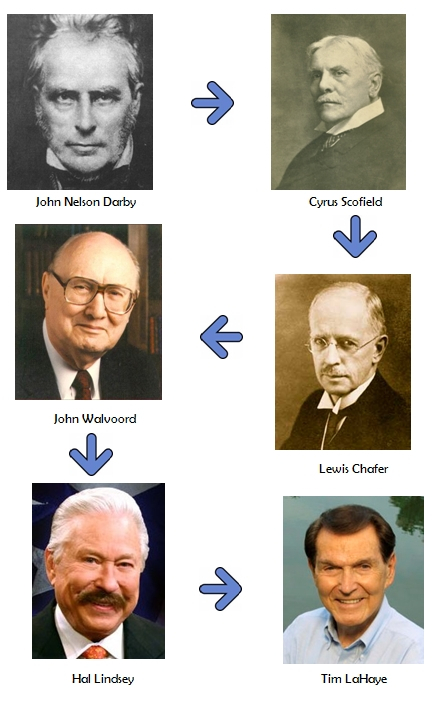
C. I. Scofield (1843–1921), Lewis Sperry Chafer (1871–1952), and Dallas Theological Seminary (est. 1924) were great vehicles for the spread of dispensationalism in America and throughout the world. Both Scofield and Chafer were ordained Presbyterian ministers. The “Scofield Reference Bible, is called by many the most effective tool for the dissemination of dispensationalism in America” (Larry V. Crutchfield, The Origins of Dispensationalism: The Darby Factor, [Lanham, MD: University Press of America, 1992], preface).  Scofield was converted in mid-life and first discipled by James H. Brookes in St. Louis. He was ordained to the ministry at the First Congregational Church of Dallas in 1882 and transferred his ministerial credentials to the Presbyterian Church in the U. S. in 1908 (Daniel Reid, ed., Dictionary of Christianity in America [Downers Grove, IL: InterVarsity Press, 1990], pp. 1057–58). Thus, his ministry took place within a Calvinistic context (Chart of some of the biggest popularizers of Dispensationalism pictured left – Darby, Scofield, Chafer were Calvinists – not certain about the others).

Scofield was the major influence upon the development of Chafer’s theology. John Hannah notes that “it is impossible to understand Chafer without perceiving the deep influence of Scofield” (John David Hannah, “The Social and Intellectual History of the Origins of the Evangelical Theological College,” [Ph. D. Dissertation from The University of Texas at Dallas, 1988], pp. 118–19). In fact, “Chafer often likened this relationship to that of father and a son” (Jeffrey J. Richards, The Promise of Dawn: The Eschatology of Lewis Sperry Chafer, [Lanham, MD: University Press of America, 1991], p. 23). This relationship grew out of Chafer’s study under Scofield at the Northfield Conference and from a life-changing experience in Scofield’s study of the First Congregational Church of Dallas in the early 1900s. Scofield toldChafer that his gifts were more in the field of teaching and not in the area of evangelism in which he had labored. “The two prayed together, and Chafer dedicated his life to a lifetime of biblical study” (Ibid).

Scofield and Chafer were two of the greatest American dispensationalists and both developed their theology from out of a Reformed background. Scofield is known for his study bible and Chafer for his Seminary and systematic theology. Jeffrey Richards describes Chafer’s theological characteristics as having “much in common with the entire Reformed tradition. Excluding eschatology, Chafer is similar theologically to such Princeton divines as Warfield, Hodge, and Machen. He claims such doctrines as the sovereignty of God, …total depravity of humanity, election, irresistible grace, and the perseverance of the saints” (Ibid, p.3). C. Fred Lincoln describes Chafer’s 8-volume Systematic Theology as “unabridged, Calvinistic, premillennial, and dispensational” (C. F. Lincoln, “Biographical Sketch of the Author,” in Lewis Sperry Chafer, Systematic Theology [Dallas: Dallas Seminary Press, 1948], 8:6).

Since its founding in 1924 as The Evangelical Theological College (changed to Dallas Theological Seminary in 1936), it has exerted a global impact on behalf of dispensationalism. Dallas Seminary’s primary founder was Chafer, but William Pettingill and W. H. Griffith-Thomas also played a leading role. Pettingill, like Chafer, was Presbyterian. Griffith Thomas, an Anglican, wrote one of the best commentaries on the Thirty-nine Articles of the Anglican Church (W. H. Griffith Thomas, The Principles of Theology: An Introduction to the Thirty-nine Articles [Grand Rapids: Baker Book House, 1979/1930]), which is still widely used by conservative Anglicans and Episcopalians today. The Thirty-nine Articles are staunchly Calvinistic. Both men were clearly Calvinists. The seminary, especially before World War II, considered itself Calvinistic. Chafer once characterized the school in a publicity brochure as “in full agreement with the Reformed Faith and itstheology is strictly Calvinistic.”  In a letter to Allan MacRae of Westminster Theological Seminary, Chafer said, “You probably know that we are definitely Calvinistic in our theology” (Cited in Ibid, p. 200). “Speaking of the faculty, Chafer noted in 1925 that they were ‘almost wholly drawn from the Southern and Northern Presbyterian Churches’“ (Cited in Ibid., p. 346). Further, Chafer wrote to a Presbyterian minister the following: “I am pleased to state that there is no institution to my knowledge which is more thoroughly Calvinistic nor more completely adjusted to this system of doctrine, held by the Presbyterian Church” (Ibid., p. 346, footnote 323).

Since so many early Dallas graduates entered the Presbyterian ministry, there began to be a reaction to their dispensational premillennialism in the 1930s. This was not an issue as to whether they were Calvinistic in their soteriology, but an issue over their eschatology. In the late 1930s, “Dallas Theological Seminary, though strongly professing to be a Presbyterian institution, was being severed from the conservative Presbyterian splinter movement” (Ibid, pp. 357-358).  In 1944, Southern Presbyterians issued a report from a committee investigating the compatibility of dispensationalism with the Westminster Confession of Faith. The committee ruled dispensationalism was not in harmony with the Church’s Confession. This “report of 1944 was a crippling blow to any future that dispensational premillennialism might have within Southern Presbyterianism” (Ibid, 364). This ruling effectively moved Dallas graduates away from ministry within Reformed denominations toward the independent Bible Church movement.

A Broadening of Dispensational Acceptance

Even though dispensationalism had made a modest penetration of Baptists as early as the 1880s through advocates such as J. R. Graves (See J. R. Graves, The Work of Christ Consummated in 7 Dispensations [Memphis: Baptist Book House, 1883]), a strong Calvinist, they were rebuffed by non-Calvinists until the mid-1920s when elements of dispensational theology began to be adopted by some Pentecostals in an attempt to answer the increasing threat of liberalism. Kraus explains:

Some teachers said explicitly that premillennialism was a bulwark against rationalist theology. Thus it is not surprising to find that the theological elements which became normative in dispensationalism ran directly counter to the developing emphasis of the “New Theology” (Kraus, Dispensationalism, p. 61).

Up to this point in history, those from the Arminian and Wesleyan traditions were more interested in present, personal sanctification issues, rather than the Calvinist attention in explaining God’s sovereign work in the progress of history. However, the rise of the fundamentalist/liberal controversy in the 1920s stirred an interest, outside of the realm of Calvinism, in defending the Bible against the anti-supernatural attacks of the liberal critics. Dispensationalism was seen as a conservative and Bible-centered answer to liberalism, not only within fundamentalism, but increasingly by Pentecostals and others as well. Timothy Weber notes:

But in time, dispensationalism had its devotees within the Wesleyan tradition as well. More radical holiness groups resonated with its prediction of declining orthodoxy and piety in the churches; and Pentecostals found in it a place for the outpouring of the Spirit in a “latter-day rain” before the Second Coming (Weber, “Premillennialism,” p. 15).

Latter Rain Pentecostalism

One of the first non-Calvinist groups to adopt a dispensational orientation can be found among some Pentecostals in the mid-1920s. This development must be understood against a backdrop of the Wesleyan and holiness heritage out of which Pentecostalism arose at the turn of last century. The American holiness movement of the 1800s was primarily postmillennial and if premillennial, then historical premillennial. They were not in any way dispensational.

Pentecostalism is at heart a supposed restoration of apostolic Christianity that is meant to bring in the latter rain harvest in preparation for Christ’s return. The phrase “latter rain” is taken from Joel 2:23 & 28 and sometimes James 5:7 as a label describing an end-time revival and evangelistic harvest expected by many charismatics and Pentecostals. Some time in the future, they believe the Holy Spirit will be poured out like never before. The latter rain teaching is developed from the agricultural model that a farmer needs rain at two crucial points in the growing cycle in order to produce a bountiful harvest. First, right after the seed is planted the “early rain” is needed to cause the seed to germinate in order to produce a healthy crop. Second, the crop needs rain right before the harvest, called the “latter rain,” so the grain will produce a high yield at harvest time, which shortly follows. Latter rain advocates teach that the Acts 2 outpouring of the Holy Spirit was the “early rain” but the “latter rain” outpouring of the Holy Spirit will occur at the end-times. This scenario is in conflict with dispensationalism that sees the current age ending, not in revival, but apostasy. It will be during the tribulation, after the rapture of the church, that God will use the miraculous in conjunction with the preaching of the gospel. Thus, latter rain theology fits within a postmillennial or historical premillennial eschatology, but it is not consistent with dispensationalism.

Many Christians are aware that the Pentecostal movement began on January 1, 1901 in Topeka, Kansas when Agnes Ozman (1870–1937) spoke in tongues under the tutelage of Charles Fox Parham (1873–1929). Yet, how many realize that in the “early years Movement’” (Donald Dayton, Theological Roots of Pentecostalism (Grand Rapids: Zondervan, 1987), p. 27)? This is because Parham titled his report of the new movement as “The Latter Rain: The Story of the Origin of the Original Apostolic or Pentecostal Movements” (Dayton, Roots, pp. 22–23). Many are also aware that William J. Seymour (1870–1922) came under the influence of Parham in Houston, Texas in 1905 and then took the Pentecostal message to Azusa Street in Los Angeles in 1906, from where it was disseminated to the four-corners of the world. But, how many are also aware that he too spoke of these things in terms of a latter rain framework?

There is no doubt that the latter rain teaching was one of the major components—if not the major distinctive—in the theological formation of Pentecostalism. “Modern Pentecostalism is the ‘latter rain,’ the special outpouring of the Spirit that restores the gifts in the last days as part of the preparation for the ‘harvest,’ the return of Christ in glory,” says Donald Dayton (Ibid, 27).  David Wesley Myland (1858–1943) was one of the early Pentecostal leaders. He wrote the first distinctly Pentecostal hymn entitled, “The Latter Rain” in 1906. The “first definitive Pentecostal theology that was widely distributed, the Latter Rain Covenant” appeared in 1910 (Stanley M. Burgess and Gary B. McGee, editors, Dictionary of Pentecostal and Charismatic Movements [Grand Rapids: Zondervan, 1988], p. 632).  Myland argued in his book that “now we are in the Gentile Pentecost, the first Pentecost started the church, the body of Christ, and this, the second Pentecost, unites and perfects the church into the coming of the Lord” (Cited by Dayton, Roots, p. 27).

Dayton concludes that the “broader Latter Rain doctrine provided a key…premise in the logic of Pentecostalism” (Ibid).  In spite of having such a key place in the thinking of early Pentecostalism, “the latter rain doctrine did tend to drop out of Pentecostalism” in the 1920s “only to reappear, however, in the radical Latter Rain revitalization movement of the 1940s” (Ibid, 43). One of reasons that latter rain teachings began to wane in the mid-1920s was that as Pentecostalism became more institutionalized it needed an answer to the inroads of liberalism. As noted above, dispensationalism was seen helpful in these areas.

The Latter Rain teaching developed out of the Wesleyan-Holiness desire for both individual (sanctification) and corporate (eschatological) perfection. Thus, early perfectionist teachers like John Wesley, Charles Finney, and Asa Mahan were all postmillennial and social activists. Revivalism was gagged by carrying the burden of both personal and public change or perfection. It follows that one who believes in personal perfection should also believe that public perfection is equally possible. Those who believe the latter are postmillennialists. After all, if God has given the Holy Spirit in this age to do either, then why not the other? If God can perfect individuals, then why not society?

However, as the 1800s turned into the 1900s, social change was increasingly linked with Darwin’s theory of evolution. The evolutionary rationale was then used to attack the Bible itself. To most English-speaking Christians it certainly appeared that society was not being perfected, instead it was in decline. Critics of the Bible said that one needed a Ph.D. from Europe before the Bible could be organized and understood. It was into this climate that dispensationalism was introduced into America and probably accounts for its speedy and widespread acceptance by many conservative Christians. To many Bible believing Christians, Dispensationalism made a great deal more sense of the world than did the anti-supernaturalism conclusions of liberalism.

Dispensationalism, in contrast to Holiness teaching, taught that the world and the visible church were not being perfected, instead Christendom was in apostasy and heading toward judgment. God is currently in the process of calling out His elect through the preaching of the gospel. Christian social change would not be permanent, nor would it lead to the establishment of Christ’s kingdom before His return. Instead a cataclysmic intervention was needed (Christ’s second coming), if society was to be transformed.

Early Pentecostalism was born out of a motivation and vision for restoring to the church apostolic power lost over the years. Now she was to experience her latter-day glory and victory by going out in a blaze of glory and success. On the other hand, dispensationalism was born in England in the early 1800s bemoaning the latter-day apostasy and ruin of the church. Nevertheless, within Pentecostalism, these two divergent views were merged. Thus, denominations like the Assemblies of God and Foursquare Pentecostals moved away from doctrines like the latter rain teaching and generated official positions against those teachings. It was in the mid-1920s that dispensationalism began to be adopted by non-Calvinists and spread throughout the broader world of Conservative Protestantism.

Dispensationalism appealed to the average person with its emphasis that any average, interested person could understand the Bible without the enlightened help of a liberal education. Once a student understood God’s overall plan for mankind, as administered through the dispensations, he would be able to see God’s hand in history. Thus, dispensational theology made a lot of sense to both Pentecostal and evangelical believers at this point in history.

Post War Development

Fundamentalism/Evangelicalism and Pentecostalism- Charismatic movements spread rapidly in America after the second World War and since dispensationalism was attached to them, it also grew rapidly. Many baby-boomers within Pentecostal and Charismatic churches grew up with dispensationalism and the pre-trib rapture as part of their doctrinal framework. Thus, it would not occur to them that dispensationalism was not organic to their particular brands of restoration theology. Further, as non-Calvinist Fundamentalism grew after the War, especially within independent Baptist circles, there was an even greater disconnect of dispensational distinctives from their Calvinist roots.

We have seen that the Pentecostal/Charismatic movement has a tradition of both Latter Rain/restoration teachings as well as the later rise of a dispensational stream. However, these are contradictory teachings that appear to be on a collision course.

Either the church age is going to end with perfection and revival or it will decline into apostasy, preparing the way for the church to become the harlot of Revelation during the tribulation. It is not surprising to see within the broader Pentecostal/Charismatic movement, since the mid 1980s, a clear trend toward reviving Latter Rain theology and a growing realization that it is in logical conflict with their core doctrine. Many, who grew up on Dispensational ideas and the pre-trib rapture, are dumping these views as the leaven of Latter Rain theology returns to prominence within Pentecostal/Charismatic circles.

Pentecostal/Charismatic leaders like Earl Paulk  and Tommy Reid, to name just a couple among many, are attempting to articulate the tension over the struggles of two competing systems. They are opting for the dismissal of dispensational elements from a consistent Pentecostal/Charismatic and Latter Rain theology. Tommy Reid observes:

This great Last Day revival was often likened in the preaching of Pentecostal pioneer to the restoration promised to Israel in the Old Testament. Whereas Dispensationalists had relegated all of these prophetic passages of restoration only to physical Israel, Pentecostal oratory constantly referred to these prophecies as having a dual meaning, restoration for physical Israel, AND restoration for the present day church. WE WERE THE PEOPLE OF THAT RESTORATION, ACCORDING TO OUR THEOLOGY (Tommy Reid, Kingdom Now But Not Yet. Buffalo: IJN Publishing, 1988, pp. xv-xvi. [emphasis in original]).

At the same time, the purge of Dispensationalism from Reformed Christianity, begun in the late 1930s, has been pretty much completed. Typical of this polarization is found in books like John Gerstner’s Wrongly Dividing The Word Of Truth: A Critique of Dispensationalism (John H. Gerstner, Wrongly Dividing The Word Of Truth: A Critique of Dispensationalism. Brentwood, TN: Wolgemuth & Hyatt Publishers, 1991). While admitting on the one hand that a “strange thing about Dispensationalism is that it seems to have had its strongest advocates in Calvinistic churches” (Ibid, 106). Gerstner so strongly opposes dispensationalism, that it has blinded him to the true Calvinist nature of such a God-centered theology. Gerstner claims that he and other Reformed theologians have raised “strong questions about the accuracy of dispensational claims to be Calvinistic” (Ibid, pp. 105-47). It appears that since Dispensationalism arose within the Reformed tradition, as a rival to Covenant Theology, some want to say that they cannot logically be Calvinistic. This is what Gerstner contends. However, in spite of Gerstner’s sophistry on this issue,he cannot wipe out the historical fact that dispensationalism was birthed within the biblical mindset of a clear theocentric theology and by those who held strongly to soteriological Calvinism. The fact that Dispensationalism arose within a Reformed context is probably the reason why the Reformed community has led the way in the criticism of Dispensational theology.

Conclusion

The purpose of this article is to remind modern Dispensationalists and Calvinists of the historical roots of Dispensationalism. It is precisely because Dispensationalism has penetrated almost every form of Protestantism that many today may be surprised to learn of its heritage. In our day of Postmodern irrationalism, where it is considered a virtue to NOT connect the dots of one’s theology, we need to be reminded that the theology of the Bible is a seamless garment. It all hangs together. If one starts pulling at a single thread, the whole cloth is in danger of unraveling.

I personally think that if systematic Dispensationalism is rightly understood then it still logically makes sense only within a theocentric and soteriologically Calvinistic theology. After all, Dispensationalism teaches that it is GOD who is ruling His household, as administered through the various dispensations of history. However, the reality is that Dispensationalism, or elements of Dispensationalism (i.e., pretribulationism, futurism, etc.), have been disseminated throughout a wide diversity of Protestant traditions. Dispensationalism is best seen as a system of theology that sees views God as the Sovereign ruler of heaven and earth; man as a rebellious vice-regent (along with some angels); Jesus Christ is the hero of history as He is saves some by His Grace; history as a lesson in the outworking of God’s glory being displayed to both heaven and earth. Dispensationalism is a theology that I believe is properly derived from biblical study and lets God be God (Article Adapted from Vol. 4: Conservative Theological Journal Volume 4. 2000 (12) (127). Fort Worth, TX: Tyndale Theological Seminary).

About the Author: Dr. Thomas Ice is the Executive Director of The Pre-Tribulational Research Center. He founded The Center in 1994 with Dr. Tim LaHaye to research, teach, and defend the pretribulational rapture and related Bible prophecy doctrines. The Center is currently located on the campus of Liberty University in Virginia.

Dr. Ice has authored or co-authored about 30 books, written hundreds of articles, and is a frequent conference speaker. He has served as a pastor for 15 years. Dr. Ice has a B.A. from Howard Payne University, a Th.M. from Dallas Theological Seminary, a Ph.D. from Tyndale Theological Seminary, and is a Doctoral Candidate at The University of Wales in Church History. Dr. Ice lives in Omaha, Nebraska with his wife Janice. Two of their three boys are college graduates and the third is currently in college.


Missional Discipleship by Jonathan Dodson

“Missional Discipleship: Reinterpreting the Great Commission”

In evangelical subculture the ubiquity of the Great Commission is matched by the poverty of its interpretation. Matthew 28:18-20 — the command to make disciples of all nations — is frequently summoned to validate countless and sundry discipleship and evangelism programs, ideas and practices, often ignoring the interpretive wealth of the text. It’s as if we expect that planting the Great Commission flag at end of a sentence will immediately summit our discipleship agendas.

One way to remedy this poverty of our interpretation is by reading the Great Commission in light of other biblical commissions. Depending on how we count them we there are at least five commissions, one in the Old Testament and four in the New (It is certainly possible that there are more commissions. In fact, the Abrahamic covenant in Gen 12:1-3 contains a programmatic mandate for all of Scripture: Go and God will make you a blessing to the nations, which is progressively manifested in making a new people of God, comprised of Jews and Gentiles).

The four commissions in the NT are actually variations of the same mandate (Matt. 28:18-20; Mark 16:15; Luke 24:48-49/Acts 1:8; John 20:21), each issued by Jesus, emphasizing a slightly different aspect of what it means to be a disciple. The operative verbs in these NT commissions are: make disciples, preach, witness, and send. They are gospel-driven commands. The OT commission, frequently referred to as the creation or cultural mandate, was issued by God before the Fall of humanity, emphasizing creative activity with the following verbs: be fruitful, multiply, rule, and subdue (Gen 1.27-28 – it is variously repeated in the Old Testament e.g. Gen. 9:1,7; 17:2-6; 26:3; 28:3; Ex. 1:7; Ezek. 36:11; Jer. 23:3).By producing more creators who rule and subdue the elements of the earth, the creation mandate is a command to produce peoples and cultures.

A surface reading of these Old and New Testament texts places them at odds with one another. In Genesis it would seem that the purpose of humanity is to produce people and culture, whereas the Gospels appear to advocate pulling away from people and culture. As a result, many have chosen one reading over the other, soul-winning or culture-making, disciple-making or social action. These impoverished readings call for reinterpretation, one that that allows both Genesis and the Gospels to speak. In fact, reading the gospel commissions in light of the cultural mandate will reveal a multi-layered, missional mandate.

Moving beyond poverty-ridden proof texts and into the wealth of the biblical commissions, we will reflect on the differences between the texts. This will require confrontation with the Bible’s demands to make culture and disciples, to care for creation and be agents of new creation. As a result, we will be challenged to understand and embrace discipleship as more than “spiritual disciplines” or an evangelistic program. We will see that Scripture calls us to missional discipleship, a following after Jesus that requires redemptive engagement not just with souls but with creation and culture.

Gospel of Matthew: Distinctive Discipleship

Part of what makes the Great Commission great is its scope. When Jesus said: “Go therefore and make disciples of all nations” he was orienting a primarily Jewish audience to a distinctly multi-ethnic mission. As Ralph Winter has advanced, the commission is not calling Christians to Christianize nation-states, but to evangelize ethnic groups. We get the word, “ethnic” from the Greek word for nations, which refers not to modernist geo-political states, but instead to non-Jewish ethnic groups. Christ does not advocate Christendom, a top-down political Christianity. Instead, in affirmation of the cultural mandate, he calls his followers to transmit a bottom-up, indigenous Christianity, to all peoples in all cultures.

As Andrew Walls has pointed out, the command is to make disciples of all nations not from all nations. The Great Commission is not about soul-extraction, to remove the disciple from his culture, but instead, to make disciples within their cultural context. Walls comments:

Conversion to Christ does not produce a bland universal citizenship: it produces distinctive discipleship, as diverse and variegated as human life itself. Christ in redeeming humanity brings, by the process of discipleship, all the richness of humanity’s infinitude of cultures and subcultures into the variegated splendor of the Full Grown Humanity to which the apostolic literature points (Eph 4.8-13 [Andrew Walls, The Missionary Movement in Christian History, Maryknoll: Orbis, 1996, 51. The original Greek reading of Matt. 28:18 is literally “disciple all ethne” or “make disciples all nations” and does not contain a preposition. However, the grammatical construction of the phrase leads to an “of” reading, not a “from” or “in” reading]).

What we should strive for is distinctive discipleship, discipleship that uniquely expresses personal faith in our cultural context. Disciples in urban Manhattan will look different than disciples in rural Maehongson. These differences allow for a flourishing of the gospel that contributes to the many-splendored new humanity of Christ.

According to the Gospel of Matthew, distinctive disciples are those who who, in following Jesus, refuse a one-sided, soul-centered gospel, and instead live out faith in context. The distinctive disciple retains the image of Adam — a culture maker — while growing in the image of Christ and becoming a disciple-maker.

Gospel of Mark: A Worldly Gospel

Mark’s commission reads: “Go into all the world and proclaim the gospel to the whole creation” (Mk. 16:15, It is widely recognized that this verse and the latter portion of Mark’s gospel (16:9-20) is absent from many Marcan manuscripts. However, we cannot be certain that the ending is missing from the original text. If it was absent, our point concerning the “worldly gospel” of Mark still stands in that Mark repeatedly depicts Jesus as the Restorer of creation: driving out demons, healing the sick, resurrecting the dead, calming the sea). Where Matthew emphasizes the action of making distinctive disciples, Mark stresses the importance of preaching to all creation.

When Jesus used the word “preach” he did not mean converse. The Greek word for preach always carries a sense of urgency and gravity, as though what is to be proclaimed is of great importance. In this case, it is the gospel that is of utmost importance. This gospel is a worldly gospel — a message that is culturally relevant and creation renewing.

The Greek word for “creation” can be used both broadly and narrowly, referring to the cosmos or to people. Here it should be taken broadly, referring to the world, its peoples and its cultures. Preaching the gospel of Christ has cosmic implications. So it is with Paul: “this gospel has been proclaimed in all creation under heaven, and of which I, Paul, became a minister” (Col. 1:23). Thus, Paul perceives himself as an announcer of a worldly Christ-centered gospel, that through Jesus all things are reconciled to himself, whether on earth or in heaven (Col. 1:20). Paul preaches with Mark’s great commission emphasis — preaching for the redemption of all creation.

While this worldly gospel saves, it also condemns. In Mark, Jesus explains that not all will believe this grand Story or receive its great Savior: “Whoever believes and is baptized will be saved, but whoever does not believe will be condemned” (Mk. 16:16). Mark’s commission reveals the divisive nature of the gospel. For some it brings life; for others it brings death, but all are to be given the opportunity to be written into the story of God’s redemption of all creation.

As with Matthew, the scope of God’s redemptive activity is important. From the beginning, God’s design for creation was for it to flourish and become inhabitable. Outside of Eden, the earth was uninhabitable. Humanity was charged with the task of caring for the earth and creating culture, making the uninhabitable habitable.

Adam failed to trust God with this task and sought to rule not only over creation, but also over God. As a result, the creation project was subjected to sin and calamity (Rom. 8:20). Israel would follow in Adam’s footsteps. Then came Jesus. Jesus preached a worldly gospel, a restorative message that put the creation project back on track. His glorified, resurrection body is clearly proof of the new creation to come.

Just prior to ascending to heaven, Jesus told those who believe that they will be given power to heal the sick, restore the demon-possessed, and to speak new languages (Mk. 16:17-18). This worldly gospel is for the redemption and renewal of the earth, the body, the heart, the mind, and the cultures of the world. It is a saving message that rescues people from their unbelief, not their world, and reconciles their alienation from one another, their world, and their Creator.

According to the Gospel of Mark, Jesus died to bring life to all creation, to restore the environment, renew cultures and remake peoples, spiritually and physically. We are called to preach a worldly gospel.

Gospel of Luke: Resurrection Stories

Luke’s commission also emphasizes preaching the gospel: “repentance and forgiveness of sins should be proclaimed in his name to all nations, beginning from Jerusalem. You are witnesses of these things” (Luke 24:47-48). In particular, we are called to preach “repentance and forgiveness of sins.” A social gospel will not suffice. Christ calls us to repent — to turn our heart allegiances away from all things other, and to receive forgiveness for betraying our Creator. But a forgiven and repentant person is not idle; they are compelled to witness — to tell the story of their transformation.

Where Matthew and Mark respectively emphasize distinctive discipleship and preaching a worldly gospel, Luke calls us to witness — to tell our distinct gospel stories. No two stories are alike, but all share the same Savior. What does it mean to be “witnesses of all these things”? Well, at the very least it means sharing Jesus’ self-sacrificing offer of forgiveness, but that is just one thing. What of the other things?

We are to tell of Jesus’ death, but we are also to tell of His resurrection.

Consider the context of Luke’s commission. The eleven disciples were discussing the reliability of Jesus sightings, when suddenly Christ appeared in the room. Thinking he was a ghost, they were filled with fright. Jesus responded: “See my hands and my feet, that it is I myself. Touch me, and see. For a spirit does not have flesh and bones as you see that I have” (24:39). To make his point, Jesus proved he had a body by eating some fish and chips. In flesh and bone, Jesus charges his follower to be witnesses of his resurrection.

The problem with many of our stories is that they contain all spirit and very little flesh. We communicate our mystical encounters with God, our mountain top experiences with Jesus, and our superhuman victories over sin. Many people see right through our spiritual stories, precisely because our witness is too good to be true. We fail to mention our bad, unless it is in the past, failing further to witness of resurrection, in the present. People want to touch redemption, which means they need to see resurrection power in our personal struggles.

Jesus’ body was resurrected as an expression of God’s commitment to creation (1 Cor. 15). God does not jettison the body for the soul. His gospel of redemption is for the whole world, beginning with enfleshed people. His resurrection is a bright reminder of new creation in the midst of bleak darkness, of tangible transformation in gross dilapidation. The stories we tell should boast of Jesus’ death and resurrection, of his forgiveness of sin and of his restoration of sinners — reconciled families and marriages, restored and housed homeless, renewed life among AIDS orphans, and so on.

According to the Gospel of Luke, we are to be witnesses of death and resurrection, to live and recount the stories of a resurrected, fleshly Jesus who lives in the midst of broken humanity offering healing and hope.

Gospel of John: Humble and Cultural Accommodation

John’s commission is short and sweet: “As the Father sent me, I am also sending you” (John 20:21). Whereas the previous gospel writers emphasized Jesus’ command to make distinctive disciples, preach a worldly gospel, and witness a fleshly Jesus, John stresses Jesus sending his disciples. As the text continues, Jesus makes plain that the disciples are sent as a forgiving community, offering the grace they have received from him to others.

According to John Piper, we are either goers, senders, or disobedient, but according to Jesus we are all the sent. Missionary activity is not the exclusive task of people who sell all their possessions and move overseas. All followers of Jesus are called to live as missionaries in their culture. If we are all sent into our cultures as distinctive disciples to share a worldly gospel about a fleshly Christ, how then are we to live as the sent? Jesus said, “As the Father sent me, I am also sending you.” Our paradigm for living a sent life, a missionary life, is the sending of the Son by the Father.

When the Father sent the Son, Jesus left the glory of his trinitarian abode and became a helpless infant in the care of humans he created. This required an accommodating humility. Jesus grew up and became a first century, toga-wearing, sandal-sporting, temple-frequenting Jew. He accommodated first century Jewish culture (also known as contextualization). So, within reason we should take on the trappings of our culture in order to contextually relate the gospel. This can entail wearing broken-in jeans, togas, hand-made sandals or a suit and tie.

However, our accommodation is not purely cultural; it is missional. It leads us to immerse ourselves into the humanity of our neighborhoods and cities in order relate the gospel to people and their needs. Being a local missionary requires more than relevant attire; it demands humility of heart to listen to the stories of others, to empathize with their frustration, suffering, and brokenness and to redemptively retell their stories through the gospel. To be sent by God is to follow the example of the incarnation, to redemptively engage others with a humble heart and cultural accommodation.

In John’s commission, the paradigm of accommodating humility is accompanied by the power of the Holy Spirit. The Spirit is not too holy for distinctive discipleship. After sending his disciples, Jesus breathed on them and they received the Holy Spirit (John 20:22). The power of missional living does not spring from cultural savvy or social sensitivity; it requires the otherworldly, utterly personal power of the Holy Spirit. Only the Spirit of God can make men new.

According to the Gospel of John, we have been sent as missionaries to humbly demonstrate and culturally accommodate the gospel of Christ through the power of the Spirit. In being sent, we do not abandon the cultural commission, but instead, unite it with our redemptive mission.

The Gospel of Genesis: Creation Mandate

The “good news” of Genesis 1-2 is that God created all things to be enjoyed, managed, cultivated, and recreated by humanity. The gospel of Genesis 3 is that, though Adam rejected God, God did not reject Adam. Still possessing the creation mandate, Adam was expelled from Eden, but clothed with the hope of a new creation (Gen 3:15, 21).

The creation mandate charges us to be fruitful and multiply, to rule and subdue the earth. This fruitful multiplication continues both physically and spiritually through the reproducing ministry of missional disciples, who increase in number and good works (Acts 6:7; Col. 1:6, 10). These good works include ruling and subduing creation through the careful, creative arrangement of the elements of the earth into art, technology, infrastructure etc. for the flourishing of humanity. The basis for our cultural activity is found in Genesis.

Retaining the cultural impulse of Genesis, the Gospels call us to a missional discipleship that entails creation care, cultural engagement, social action, and gospel proclamation. Missional disciples will not content themselves by preaching a culturally irrelevant, creation indifferent, resurrection neglecting message. Instead, they redemptively engage peoples and cultures through Christ for the renewal of his creation.

By digging deeper into the great commissions, we have unearthed a wealth of cultural and theological insight. This rereading of familiar evangelistic texts has demonstrated that God in Christ has called us not to mere soul-winning, but to distinctive discipleship, to heralding a worldly gospel of a fleshly Christ who humbly accommodates human culture and understands the human condition. These commissions call us to missional discipleship — to redemptive engagement with all peoples and cultures.

About the Author: Jonathan Dodson (M. Div; Th.M, Gordon-Conwell Theological Seminary) serves as a pastor of Austin City Life in Austin, Texas. He has written articles in numerous blogs and journals such as The Resurgence, The Journal of Biblical Counseling, and Boundless. Dodson has discipled men and women abroad and at home for almost two decades, taking great delight in communicating the gospel and seeing Christ formed in others. His first book – and its fantastic – was published by Crossway Books and is called Gospel-Centered Discipleship. This article originally appeared on http://www.boundless.org on February 12, 2008.

6 Destructive Mistakes People Make: Observed by Cicero

(1)  The delusion that personal gain is made by crushing others.

(2)  The tendency to worry about things that cannot be changed or corrected.

(3)  Insisting that a thing is impossible because we cannot accomplish it.

(4)  Refusing to set aside trivial preferences.

(5)  Neglecting development and refinement of the mind, and not acquiring the habit of reading and studying.

(6)  Attempting to compel others to believe and live as we do.

Marcus Tullius Cicero was born in 106 B.C. in Arpino, Italy and died on December 7, 43 B.C. He was a statesmen, philosopher, and orator.

Praying For the Positives in People

CHART FOR POSITIVELY PRAYING INTO PEOPLE’S LIVES

“Let no corrupting talk come out of your mouths, but only such as is good for building up, as fits the occasion, that it may give grace to those who hear.” – Ephesians 4:29 

Using the following chart, pray that God will bless him or her with the positive when we have a tendency to see only the negatives in others. 

WHAT QUALITIES WE SEE NEGATIVELY

WHAT WE CAN THANK GOD FOR POSITIVELY

WHAT QUALITIES WE SEE NEGATIVELY

WHAT WE CAN THANK GOD FOR POSITIVELY

Blunt, outspoken

Honesty

Money squanderer, wasteful

Generosity

Cliquish, social climber

Hospitality

Nonchalant, indifferent

Patient

Competitive, over-ambition

Aspiration

Nosy

Inquisitive

Compromising, conniving

Cooperative

Nervous

Alert

Conceited, proud

Confident

No convictions

Amiable

Crabby, picky

Detailed

One-track-mind

Diligence

Dependency, subservient

Respectful

Opinionated

Strong convictions

Distractible

Spontaneous

Over-attention to detail

Analytical

Flatterer

Gratefulness

Overzealous, fanatical

Sincere

Harsh, overbearing

Truthful

Perfectionist

Neat

Holier-than-thou, self-righteous

Spiritual

Possessive

Loyalty

Impatient

Efficiency

Pushy, smooth-tongued

Persuasive

Independent

Resoluteness

Reckless, brash

Courage

Indecisive, wishy-washy

Flexibility

Rigid, tyrannical

Discipline

Inferiority

Meekness

Secretive

Loyal

Inflexibility

Decisive

Self-willed, inflexible

Persistence

Insensitive, unloving

Objectivity

Sentiment, gushy

Compassion

Insulting, tactless

Frankness

Serious

Earnestness

Intense

Focused

Stingy, miserly, tightwad

Frugal

Judgmental

Fair-minded

Stubborn, hard-headed, inflexible

Determined

Legalist

Respect rules

Superiority, sophistication

Positive

Low self-esteem, self-abasement

Humility

Talkative, chatterbox

Expressive

Manipulative, scheming

Planner

Tight-fisted

Frugal

Meticulous, scrupulous

Specialist

Timid, cautious, careful

Discretion

Mischievous, crafty

Creative

Touchy, easily  offended

Sensitive

 *The Navigators developed this chart

Learning Scripture Memory From One Who Mastered The Bible: Dr. John G. Mitchell

I had the privilege of attending Multnomah University (was Multnomah School of the Bible) from 1985-1988. I went there at the recommendation of Luis Palau and was drawn by their motto, “If it’s Bible you want, then you want Multnomah.” One of the highlights for me as a student at Multnomah was taking classes like “Spiritual Life,” and “Acts and Romans” from an old Scottish preacher (and the founder of the school) by the name of Dr. John G. Mitchell. I had never been around a man that was so in love with Jesus, and that loved the Bible like him. I was glad to see the article below by a fellow Multnomah and Talbot alumnus on memorizing Scripture based on advice from Dr. Mitchell. I had the same conversation with Dr. Mitchell that Dr. Berding had as a student. I don’t know that there is any greater need of the moment than the two things that Dr. Mitchell stood for and modeled: a love for Jesus and for his Word. I hope that you will join me in heeding these words of wisdom by one of the greatest men of God who ever walked on this planet (and that’s no exaggeration whatsoever). He was great because he was humbled and awed by the greatness of His God – and he lived to tell others of His Majesty. Dr. Mitchell was very special to me because he not only mastered the Bible, but more importantly, the Bible for God’s glory mastered him. Dr. Berding gives a very helpful strategy for memorizing Scripture based on principles gleaned from Dr. Mitchell in this excellent article. (Dr. Mitchell pictured above). – Dr. David P. Craig

 “The Easiest Way to Memorize the Bible”

One of my professors in college was really old. I can hear everyone asking: “How old was he?” (No, his social security number wasn’t 7 …) Let’s put it this way: he was the founder of the college at which I was studying (Multnomah in Portland, Ore.), and the school was celebrating the half-century mark of its founding while I was there! In fact, Dr. John Mitchell was over the age of 90 when he taught the two classes I took from him. He continued to teach well into his mid-90’s.

Not surprisingly, he was getting forgetful about some things by the time I had him as a teacher, but what he definitely was not forgetting were the Bible verses he had memorized. His ability to recall Bible verses was astounding. I do not know this for a fact, but I would guess that he had all of the New Testament and large sections of the Old Testament committed to memory. All of his students were profoundly impacted by his immersion in the Scriptures.

I only had one opportunity to sit and talk with him while I was a student. I had a single question to ask him that day: “How did you come to memorize so much of the Bible?” he answered, “Well, I never really tried to memorize.” (Oh no, I thought, this isn’t going to be very helpful …) “But before I prepare to preach a series of sermons on a book of the Bible, I first read it aloud *50 times before preaching it.” (OK, this might be helpful.) “Since I preached a lot in my younger years,” (now that is an understatement; read his biography! [Dick Bohrer. Lion of God: A biography of John G. Mitchell, D.D. Portland, OR: Multnomah Bible College, 1994], book cover and Dr. Mitchell pictured on left). “I had lots of opportunities to read passages over and over again.”

Dr. Mitchell’s comments that day were a helpful turning point for me in my own commitment to memorize the Scriptures. I had already tackled some large chunks of the Bible and committed them to memory, but the process of getting there had been rather painful. Rote memory (“look at the verse, cover it with your hand, look into the air and try to quote it by memory, uncover the verse with your hand to see what you missed, fix whatever mistakes you made, try again”) was hard work, and the results were not always satisfying from a long-term, remember-what-you-memorized standpoint.

After that single conversation with Dr. Mitchell, I changed tactics. From then on, before traveling down the “rote road,” I would read the passage I wanted to memorize 50 times out loud with great emphasis. Then – and only then – I would try the rote method.

I learned three things by doing it this way:

(1) I discovered that I had already memorized most of the passage I was trying to learn  before I ever really started to try to memorize it.

(2) I found out that the process of reading a passage over and over again in-and-of itself became a wonderful means of God working his grace in my life. I wasn’t just learning words, I was thinking about where the passage was going. God used it to help me understand the passage better, to think about its implications in my life, and to impact my actions and affections.

(3) I discovered that this process helped immensely in holding in my long-term memory the passages I had memorized. It is a far better process for retention. So, why don’t you try it yourself? Here is a summary of the process.

STEP 1: Begin by selecting a passage of Scripture that takes approximately 15 minutes to read out loud. Here is a short list of New Testament passages that would fall into this category that also would probably yield you a lot of personal spiritual fruit: Matthew 5-7; John 14-17; Romans 6-8; Philippians (all); Colossians (all); 2 Timothy (all); Hebrews 11-13; James (all); 1 Peter (all); 1 John (though this one is tough because of how cyclical it is).

STEP 2: Read your passage through once or twice a day aloud. Keep track of how how many times you have read it through.

STEP 3: Once you have read it aloud 50 times, then try to rote memorize it. Keep working on it faithfully until you can get through the entire passage by memory.

STEP 4: Quote through it at least 25 times without looking to fix it in your memory. An additional step you can take that would ease the process would be to read your passage onto a digital recorder and listen to it whenever you can as you drive, walk, cook or wait for something. Your own recorded voice will work a little better than someone else’s voice, since it will match the intonation of your daily oral readings, but you can use a prerecorded section if you prefer.

I’ll close with this thought: If you started today, red aloud through Philippians once a day for 50 days, spent the following 15 days doing the rote-memory thing, reviewed for another 25 days, you could have all of Philippians memorized in three or four months by only spending a relatively painless 15 minutes a day doing it. Wouldn’t that be amazing?

This column [adapted] above was first published in thegoodbookblog.com on January 28, 2012 & again in the Biola University Magazine, Spring Edition 2012, 39.

About the Author: Ken Berding is a professor of New Testament at Talbot School of Theology and the author of several books, most recently Walking in the Spirit (Crossway, 2011). He holds an M.A from Talbot, and a Ph.D. in hermeneutical and biblical interpretation from Westminster Seminary in Philadelphia.

*Note: Dr. Mitchell told me when I was at Multnomah that he learned this from the great preacher from Westminster Chapel in London – G. Campbell Morgan – the great preacher that preceded and handpicked Dr. David Martyn Lloyd-Jones [DPC])

Why Sola Scriptura is Crucial to Evangelicalism by Dr. R.C. Sproul

“The only source and norm of all Christian knowledge is the Holy Scripture.” This thematic statement introduces De Scriptura Sacra of Heinrich Heppe’s classic work in Reformed dogmatics and provides a succinct expression of the Reformation slogan: Sola Scriptura (Scripture Alone). The two key words that are used to crystallize the sola character of Scripture are source and norm.

The Reformation principle of Sola Scriptura was given the status of the formal cause of the Reformation by Melanchthon and his Lutheran followers. The formal cause was distinguished from the material cause of Sola Fide (by faith alone). Though the chief theological issue of the Reformation was the question of the matter of justification, the controversy touched heavily on the underlying question of authority. As is usually the case in theological controversy, the issue of ultimate authority lurked in the background (though it was by no means hidden or obscure) of Luther’s struggle with Rome over justification. The question of the source of Luther’s doctrine and the normative authority by which it was to be judged was vital to his cause.

Sola Scriptura and Inerrancy

A brief historical recapitulation of the steps that led to Luther’s Sola Scriptura dictum may be helpful. After Luther posted his Ninety-Five Theses in 1517, a series of debates, correspondence, charges, and countercharges ensued, culminating in Luther’s dramatic stand at Worms in April 1521. The two most significant transitional points between the theses of 1517 and the Diet of Worms of 1521 were the debates at Augsburg and Leipzig.

In October 1518 Luther met with Cardinal Cajetan of the Dominicans. Cajetan was acknowledged to be the most learned theologian of the Roman Curia. In the course of their discussions Cajetan was able to elicit from Luther his views on the infallibility of the pope. Luther asserted that the pope could err and claimed that Pope Clement VI’s bull Unigenitus (1343) was contrary to Scripture.

In the summer of 1519 the dramatic encounter between Luther and Johannes von Eck took place at Leipzig. In this exchange Eck elicited from Luther the admission of his belief that not only could the pope err but church councils could and did err as well. It was at Leipzig that Luther made clear his assertion: Scripture alone is the ultimate, divine authority in all matters pertaining to religion.

Gordon Rupp gives the following account:

Luther affirmed that “among the articles of John Huss and the Hussites which were condemned, are many which are truly Christian and evangelical, and which the church universal cannot condemn!” This was sensational! There was a moment of shocked silence, and then an uproar above which could be heard Duke George’s disgusted, “Gad, Sir, that’s the Plague!… ” Eck pressed his advantage home, and Luther, trapped, admitted that since their decrees are also of human law, Councils may err.

So by the time Luther stood before the Diet of Worms, the principle of Sola Scriptura was already well established in his mind and work. Only the Scripture carries absolute normative authority. Why? For Luther the sola of Sola Scriptura was inseparably related to the Scriptures’ unique inerrancy. It was because popes could and did err and because councils could and did err that Luther came to realize the supremacy of Scripture. Luther did not despise church authority nor did he repudiate church councils as having no value. His praise of the Council of Nicea is noteworthy. Luther and the Reformers did not mean by Sola Scriptura that the Bible is the only authority in the church. Rather, they meant that the Bible is the only infallible authority in the church.

Paul Althaus summarizes the train of Luther’s thought by saying:

We may trust unconditionally only in the Word of God and not in the teaching of the fathers; for the teachers of the Church can err and have erred. Scripture never errs. Therefore it alone has unconditional authority. The authority of the theologians of the Church is relative and conditional. Without the authority of the words of Scripture, no one can establish hard and fast statements in the Church.

Thus Althaus sees Luther’s principle of Sola Scriptura arising as a corollary of the inerrancy of Scripture. To be sure, the fact that Scripture is elevated to be the sole authority of the church does not carry with it the necessary inference that it is inerrant. It could be asserted that councils, popes, and the Bible all err and still postulate a theory of Sola Scriptura. Scripture could be considered on a primus inter pares (“first among equals”) basis with ecclesiastical authority, giving it a kind of primacy among errant sources. Or Scripture could be regarded as carrying unique authority solely on the basis of its being the primary historical source of the gospel. But the Reformers’ view of Sola Scriptura was higher than this. The Reformation principle of Sola Scriptura involved inerrancy.

Sola Scriptura, ascribing to the Scriptures a unique authority, must be understood in a normative sense. Not descriptive, but rather normative authority is meant by the formula. The normative character of the Sola Scriptura principle may be seen by a brief survey of sixteenth-century Reformed confessions.

The Theses of Berne (1528): The Church of Christ makes no laws or commandments without God’s Word. Hence all human traditions, which are called ecclesiastical commandments, are binding upon us only in so far as they are based on and commanded by God’s Word (Sec. II).

The Geneva Confession (1536): First we affirm that we desire to follow Scripture alone as a rule of faith and religion, without mixing with it any other things which might be devised by the opinion of men apart from the Word of God, and without wishing to accept for our spiritual government any other doctrine than what is conveyed to us by the same Word without addition or diminution, according to the command of our Lord (Sec. I).

The French Confession of Faith (1559): We believe that the Word contained in these books has proceeded from God, and receives its authority from him alone, and not from men. And inasmuch as it is the rule of all truth, containing all that is necessary for the service of God and for our salvation, it is not lawful for men, nor even for angels, to add to it, to take away from it, or to change it. Whence it follows that no authority, whether of antiquity, or custom, or numbers, or human wisdom, or judgments, or proclamations, or edicts, or decrees, or councils, or visions, or miracles, should be opposed to these Holy Scriptures, but on the contrary, all things should be examined, regulated, and reformed according to them (Art. V).

The Belgic Confession (1561): We receive all these books, and these only, as holy and confirmation of our faith; believing, without any doubt, all things contained in them, not so much because the church receives and approves them as such, but more especially because the Holy Ghost witnessed in our hearts that they are from God, whereof they carry the evidence in themselves (Art. V). Therefore we reject with all our hearts whatsoever doth not agree with this infallible rule (Art. VII).

Second Helvetic Confession (1566): Therefore, we do not admit any other judge than Christ himself, who proclaims by the Holy Scriptures what is true, what is false, what is to be followed, or what is to be avoided (Chap. II).

Uniformly the sixteenth-century confessions elevate the authority of Scripture over any other conceivable authority. Thus, even the testimony of angels is to be judged by the Scriptures. Why? Because, as Luther believed, the Scriptures alone are inerrant. Sola Scriptura as the supreme norm of ecclesiastical authority rests ultimately on the premise of the infallibility of the Word of God.

Extent of the Norm

To what extent does the Sola Scriptura principle of authority apply? We hear statements that declare Scripture to be the “only infallible rule of faith and practice.” Does this limit the scope of biblical infallibility? Among advocates of limited inerrancy we hear the popular notion that the Bible is inerrant or infallible only when it speaks of matters of faith and practice. Matters of history or cosmology may contain error but not matters of faith and practice. Here we see a subtle shift from the Reformation principle. Note the difference in the following propositions:

A. The Bible is the only infallible rule of faith and practice.

B. The Bible is infallible only when it speaks of faith and practice.

In premise A, “faith and practice” are generic terms that describe the Bible. In premise B, “faith and practice” presumably describe only a particular part of the Bible. Premise A affirms that there is but one infallible authority for the church. The proposition sets no content limit on the infallibility of the Scriptures. Premise B gives a reduced canon of that which is infallible; that is, the Bible is infallible only when it speaks of faith and practice. This second premise represents a clear and decisive departure from the Reformation view.

Premise A does not say that the Bible provides information about every area of life, such as mathematics or physics. But it affirms that what he Bible teaches, it teaches infallibly.

The Source of Authority

Heppe’s sola indicates that the Bible is not only the unique and final authority of the church but is also the “only source of all Christian knowledge.” At first glance this statement may seem to suggest that the only source of revelation open to man is that found in Scripture. But that is not the intent of Heppe’s statement, nor is it the intent of the Reformation principle of Sola Scriptura.

Uniformly the Reformers acknowledged general revelation as a source of knowledge of God. The question of whether or not that general revelation yields a bona fide natural theology was and is widely disputed, but there is no serious doubt that the Reformers affirmed a revelation present in nature. Thus the sola does not exclude general revelation but points beyond it to the sufficiency of Scripture as the unique source of written special revelation.

The context of the Sola Scriptura schema with respect to source was the issue (raised over against Rome) regarding the relationship of Scripture and Tradition. Central to the debate was the Council of Trent’s declaration regarding Scripture and Tradition. (Trent was part of the Roman counteroffensive to the Reformation, and Sola Scriptura was not passed over lightly in this counter-offensive.)

In the Fourth Session of the Council of Trent the following decree was formulated: This (Gospel), of old promised through the Prophets in the Holy Scriptures, our Lord Jesus Christ, the Son of God, promulgated first with His own mouth, and then commanded it to be preached by His Apostles to every creature as the source at once of all saving truth and rules of conduct. It also clearly perceives that these truths and rules are contained in the written books and in the unwritten traditions, which, received by the Apostles from the mouth of Christ Himself, or from the Apostles themselves, the Holy Ghost dictating, have come down to us, transmitted as it were from hand to hand. Following then, the examples of the Orthodox fathers, it receives and venerates with a feeling of piety and reverence all the books both of the Old and New Testaments, since one God is the author of both; also the traditions, whether they relate to faith or to morals, as having been dictated either orally by Christ or by the Holy Ghost, and preserved in the Catholic church in unbroken succession.

In this decree the Roman Catholic church apparently affirmed two sources of special revelation—Scripture and the Tradition of the church—although in recent years this “dual source” theory has come into question within the Roman church.

G. C. Berkouwer’s work on Vatican Council II provides a lengthy discussion of current interpretations of the Tridentine formula on Scripture and Tradition. Some scholars argue that Tradition adds no new content to Scripture but merely serves either as a depository in the life of the church or as a formal interpretive tool of the church. A technical point of historical research concerning Trent sheds some interesting light on the matter. In the original draft of the fourth session of Trent the decree read that “the truths … are contained partly [partim] in Scripture and partly [partim] in the unwritten traditions.” But at a decisive point in the Council’s deliberations two priests, Nacchianti and Bonnucio rose in protest against the partim … partim formula. These men protested on the grounds that this view would destroy the uniqueness and sufficiency of Scripture. All we know from that point on is that the words partly … partly were removed from the text and replaced by the word and (et). Did this mean that the Council responded to the protest and perhaps left the relationship between Scripture and Tradition purposely ambiguous? Was the change stylistic, meaning that the Council still maintained two distinct sources of revelation? These questions are the focus of the current debate among Roman theologians.

One thing is certain. The Roman church has interpreted Trent as affirming two sources of special revelation since the sixteenth century. Vatican I spoke of two sources. The papal encyclical Humani Generis spoke of “sources of revelation.” Even Pope John XXIII spoke of Scripture and Tradition in Ad Petri Cathedram.

Not only has the dual-source theory been confirmed both by ecumenical councils and papal encyclicals, but tradition has been appealed to on countless occasions to validate doctrinal formulations that divide Rome and Protestantism. This is particularly true regarding decisions in the area of Mariology.

Over against this dual-source theory stands the sola of Sola Scriptura. Again, the Reformers did not despise the treasury of church tradition. The great councils of Nicea, Ephesus, Chalcedon, and Constantinople receive much honor in Protestant tradition. The Reformers themselves gave tribute to the insights of the church fathers. Calvin’s love for Augustine is apparent throughout the Institutes. Luther’s expertise in the area of Patristics was evident in his debates with Cajetan and Eck. He frequently quotes the fathers as highly respected ecclesiastical authorities. But the difference is this: For the Reformers no church council, synod, classical theologian, or early church father is regarded as infallible. All are open to correction and critique. We have no Doctor Irrefragabilis of Protestantism.

Protestant churches have tended to be confessional in character. Subscription to confessions and creeds has been mandatory for the clergy and parish of many denominations. Confessions have been used as a test of orthodoxy and conformity to the faith and practice of the church. But the confessions are all regarded as reformable. They are considered reformable because they are considered fallible. But the Sola Scriptura principles in its classic application regards the Scripture as irreformable because of its infallibility. Thus the two primary thrusts of Sola Scriptura point to:

1) Scripture’s uniqueness as normative authority and

2) its uniqueness as the source of special revelation. Norm and source are the twin implicates of the Sola Scriptura principle.

Is Sola Scriptura the Essence of Christianity?

In a recent publication on questions of Scripture, Bernard Ramm wrote an essay entitled, “Is ‘Scripture Alone’ the Essence of Christianity?” Using the nineteenth-century German penchant for the quest of the “Wesen” of Christianity as a jumping-off point, Ramm gives a brief history of the liberal-conservative controversy concerning the role of Scripture in the Christian faith. Defining Wesen as “the essence of something, the real spirit or burden of a treatise, the heart of the matter,” he concludes that Scripture is not the Wesen of Christianity. He provides a historical survey to indicate that neither the Reformers nor the strong advocates of inerrancy, A. A. Hodge and B. B. Warfield, believed that Sola Scriptura was the essence of Christianity. Ramm cites numerous quotations from Hodge and Warfield that speak of the Scriptures as being “absolutely infallible,” and “without error of facts or doctrines.” Yet these men affirmed that “Christianity was true independently of any theory of inspiration, and its great doctrines were believable within themselves.”

Ramm goes on to express grave concern about the present debate among evangelicals concerning inerrancy. Here his concern focuses not on the teaching of Hodge and Warfield but on the attitudes of their contemporary disciples who, in Ramm’s opinion, go beyond their forefathers in asserting a particular view of Scripture as being Christianity’s essence. Ramm writes:

From the other writings of Warfield in particular, it would be impossible to say that he identified the Wesen of Christianity with his view of Holy Scripture. He was enough of a historian of theology to avoid saying that. The “inspiration” article was an essay in strategy. However, among current followers of the so-called Warfield position there have been certain shifts away from the original strategic stance of the essay. One’s doctrine of Scripture has become now the first and most important doctrine, one’s theory of the wesen of Christianity, so that all other doctrines have validity now only as they are part of the inerrant Scripture. Thus evangelical teachers, or evangelical schools or evangelical movements, can be judged as to whether or not they are true to the wesen of Christianity by their theory of inspiration. It can be stated even more directly: an evangelical has made a theory of inspiration the wesen of Christianity if he assumes that the most important doctrine in a man’s theology, and most revelatory of the entire range of his theological thought, is his theology of inspiration.

It appears from this statement that the “essence” of Ramm’s concern for the present state of evangelicalism is that one’s doctrine of Scripture is viewed as the essence or wesen of Christianity. This writer can only join hands with Ramm in total agreement with his concern. To make one’s view of Scripture in general or of inspiration in particular the essence of Christianity would be to commit an error of the most severe magnitude. To subordinate the importance of the gospel itself to the importance of our historical source book of it would be to obscure the centrality of Christ. To subordinate Sola Fide to Sola Scriptura would be to misunderstand radically the wesen of the Reformation. Clearly Ramm is correct in taking his stand on this point with Hodge, Warfield, and the Reformers. Who can object to that?

One may be troubled, however, by a portion of Ramm’s stated concern. Who are these “current followers” of Warfield who in fact do maintain that Sola Scriptura is the heart or essence of Christianity? What disciple of Warfield’s has ever maintained that Sola Scriptura is essential to salvation? Ramm provides us with no names or documentary evidence to demonstrate that his deep concern is warranted.

To be sure, strong statements have been made by followers of the Warfield school of the crucial importance of Sola Scriptura and the centrality of biblical authority to all theological disputes. Perhaps these statements have contained some “overkill” in the passion of debate, which is always regrettable. We must be very cautious in our zeal to defend a high view of Scripture not to give the impression that we are talking about an article on which our salvation depends.

We can cite the following statements by advocates of the Warfield school that could be construed as a possible basis for Ramm’s concern. In God’s Inerrant Word, J. I. Packer makes the following assertion:

What Luther thus voiced at Worms shows the essential motivation and concern, theological and religious, of the entire Reformation movement: namely that the Word of God alone must rule, and no Christian man dare do other than allow it to enthrone itself in his conscience and heart.

Here Packer calls the notion of Sola Scriptura “the essential motivation and concern” of the Reformation. In itself this quote certainly suggests that Packer views Sola Scriptura as the essence of the Reformation.

However, in defense of Packer it must be noted that to say Sola Scriptura was the essential motivation of the Reformation movement is not to say that Sola Scriptura is the essence of Christianity. He is speaking here of a historical controversy. That Sola Scriptura was at the heart of the controversy and central to the debate cannot be doubted. To say that Sola Scriptura was an essential motif or concern of the Reformation cannot be doubted. That is was the essential concern may be brought into question; this may be regraded as an overstatement. But again, in fairness to Packer, it must be noted that earlier in his essay he had already indicated that Justification by Faith Alone was the material principle. So he had already maintained that Sola Scriptura was subordinate to Sola Fide in the controversy. In any case, though the word essential is used, there is no hint here that Packer maintains that Sola Scriptura is the essence of Christianity.

In a recent unpublished essay, Richard Lovelace of Gordon-Conwell Theological Seminary cites both Harold Lindsell and Francis Schaeffer as men who have sounded urgent warnings concerning the relationship between inerrancy and evangelicalism. Lovelace cites the following statements of Schaeffer:

There is not use of evangelicalism seeming to get larger and larger, if at the same time appreciable parts … are getting soft at that which is the central core, namely the Scriptures.… We must say most lovingly but clearly: evangelicalism is not consistently evangelical unless there is a line drawn between those who take a full view of Scripture and those who do not.

Again Schaeffer is cited: “Holding to a strong view of Scripture or not holding to it is the watershed of the evangelical world.” In these statements Francis Schaeffer maintains that the Scriptures are:

1) the “central core” of evangelicalism,

2) a mark of “consistent evangelicalism,” and

3) the “watershed of the evangelical world.”

These are strong assertions about the role of Sola Scriptura, but they are made with reference to evangelicalism, not Christianity (though I am sure Schaeffer believes evangelicalism is the purest expression of Christianity to be found). Evangelicalism refers to a historical position or movement. When he speaks of “watersheds,” he is speaking of crucial historical turning points. When he speaks of “consistent” evangelicalism, he implies there may be such a thing as inconsistent evangelicalism.

The troublesome quote of Schaeffer is that one in which he says the Scriptures are “the central core” of evangelicalism. Here “core” is in the singular with the definite article giving it a sola character. Does Schaeffer mean that the Bible is the core of evangelicalism and the gospel is the husk? Is Sola Scriptura the center and Sola Fide at the periphery of evangelicalism? It is hard to think that Schaeffer would make such an assertion. Indeed, one may question if Schaeffer means what he in fact does say here. Had he said, “Scripture is at the core of evangelicalism,” there would be no dispute. But to say it is the core appears an overstatement. Perhaps we have here a slip of the pen, which any of us can and frequently do make.

In similar fashion Harold Lindsell may be quoted: “Is the term ‘evangelical’ broad enough in its meaning to include within it believers in inerrancy and believers in an inerrancy limited to matters of faith and practice?” Lindsell raises the question of whether or not inerrancy of the entire Bible is essential to the term evangelical. The question raised is: If Sola Scriptura in its fullest sense is of the Wesen of evangelicalism, can one who espouses limited inerrancy be genuinely called evangelical? The issue is the meaning of the term evangelical. Does it carry with it the automatic assumption of full inerrancy? Again we must point out the difference between the historical label “evangelical” and what is essential to Christianity.

None of the scholars mentioned have said that adherence to inerrancy or Sola Scriptura is essential to salvation. None have Sola Scriptura as the Wesen of Christianity.

It could be said that the argument of the writer of this chapter is constructed on straw men who “come close” to asserting that Sola Scriptura is the essence of Christianity but who, in the final analysis, shrink for such an assertion. But it is not my purpose to create straw men. It is simply to find some basis for Ramm’s assertion about modern followers of Warfield. Since I have not been able to find any followers of Warfield who assert Sola Scriptura as the Wesen of Christianity, the best I can do is to cite examples of statements that could possibly be misconstrued to assert that. It is probably charity that restrained Ramm from naming those he had in mind. But unfortunately, the absence of names casts a shadow of suspicion over all modern followers of Warfield who hold to full inerrancy.

Though advocates of inerrancy in the full sense of Sola Scriptura do not regard it as being essential to salvation, they do maintain that the principle is crucial to Christianity and to consistent evangelicalism. That in Scripture we have divine revelation is no small matter. That the gospel rests not on human conjecture or relational speculation is of vital importance. But there is no quarrel with Ramm on these points. He summarizes his own position by saying:

1. There is no questioning of the Sola Scriptura in theology. Scripture is the supreme and final authority in theological decision-making.

2. One’s views of revelation, inspiration, and interpretation are important. They do implicate each other. Our discussion rather has been whether a certain view of inspiration could stand as the wesen of Christianity. We have in no manner suggested that matters of revelation, inspiration, and interpretation are unimportant in theology.

Here we delight in agreement with this strong affirmation of the crucial importance of Sola Scriptura.

Strangely, however, Ramm continues his summary by saying, “If the integrity of other evangelicals, evangelical schools, or evangelical movements are assessed by their view of inspiration, then, for them, inspiration has become the wesen of Christianity.” The inference Ramm draws at this point is at once puzzling and astonishing, and perhaps we meet here merely another case of overstatement or a slip of the pen. How would it follow from an assessment of others’ evangelicalism as being consistent or inconsistent according to their view of Scripture that inspiration has become the wesen of Christianity? This inference involves a quantum leap of logic.

If the first two points of Ramm’s summary are correct—that Sola Scriptura is important and that it implicates views of interpretation and theological decision making—why should not a school’s or movement’s integrity (a fully integrated stance) be assessed by this principle? Though Sola Scriptura is not the wesen of Christianity, it is still of crucial importance. If a school or movement softens its view of Scripture, that does not mean it has repudiated the essence of Christianity. But it does mean that a crucial point of doctrine and classical evangelical unity has been compromised. If, as Ramm suggests, one’s view of Scripture is so important, then a weakening of that view should concern us.

The issue of full or limited inerrancy is a serious one among those within the framework of historic evangelicalism. In the past a healthy and energetic spirit of cooperation has existed among evangelicals from various and diverse theological persuasions and ecclesiastical affiliations. Lutherans and Baptists, Calvinists and Arminians, and believers of all sorts have united in evangelical activity. What has been the cohesive force of that unity? In the first instance, there has been a consensus of catholic articles of faith, such as the deity of Christ. In the second instance, a strong point of unity has been the cardinal doctrine of the Protestant Reformation: justification by faith alone. In the last instance, there has been the unifying factor of Sola Scriptura in the sense of full inerrancy. The only “creed” that has bound the Evangelical Theological Society together, for example, has been the affirmation of inerrancy. Now that point of unity is in jeopardy. The essence of Christianity is not the issue. But a vital point of consistent evangelicalism is.

Sola Scriptura and Limited Inerrancy

Is Sola Scriptura compatible with a view of Scripture that limits inerrancy to matters of faith and practice? Theoretically it would seem to be possible if “faith and practice” could be separated from any part of Scripture. So long as biblical teaching regarding faith and practice were held to be normative for the Christian community, there would appear to be no threat to the essence of Christianity. However, certain problems exist with such a view of Scripture that do seriously threaten the essence of Christianity.

The first major problem we encounter with limited inerrancy is the problem of canon reduction. The canon or “norm” of Scripture is reduced de facto to that content relating to faith and practice. This immediately raises the hermeneutical question concerning what parts of Scripture deal with faith. As evangelicals wrestle among themselves in intramural debates, they must keep one eye focused on the liberal world of biblical scholarship, for the principle of the reduction of canon to matters of “faith” is precisely the chief operative in Bultmann’s hermeneutic. Bultmann thinks we must clear away the prescientific and faulty historical “husk” of Scripture to get to the viable kernel of “faith.” Thus, although Bultmann has no inerrant kernel or kerygma to fall back on, his problem of canon reduction remains substantially the same as that of those who limit inerrancy to faith and practice.

Before someone cries foul or cites the informal fallacy of argumentum ad hominem (abusive) or the “guilt by association” fallacy, let this concern be clarified. I am not saying that advocates of limited inerrancy are cryptic or even incipient Bultmannians, but that there is one very significant point of similarity between the two schools: canon reductionism. Evangelical advocates of limited inerrancy are not expected to embrace Bultmann’s mythical view of New Testament supernaturalism. But their method has no inherent safeguard from an arbitrary delimitation of the scope of the biblical canon.

The second serious problem, closely related to the first, is the problem of the relationship of faith and history, perhaps the most serious question of contemporary New Testament scholarship. If we limit the notion of inerrancy to matters of faith and practice, what becomes of biblical history? Is the historical substratum of the gospel negotiable? Are only those portions of the biblical narrative that have a clear bearing on faith inerrant? How do we escape dehistoricizing the gospel and relegating it to a level of supratemporal existential “decision”? We know that the Bible is not an ordinary history book but a book of redemptive history. But is it not also a book of redemptive history? If we exclude the realm of history from the category of inspiration or inerrancy either in whole or in part, do we not inevitably lose the gospel?

The third problem we face with limiting inerrancy to matters of faith and practice is an apologetic one. To those critics outside the fellowship of evangelicals, the notion of “limited inerrancy” appears artificial and contrived. Limited inerrancy gets us off the apologetical hook by making us immune to religious-historical criticism. We can eat our cake and have it too. The gospel is preserved; and our faith and practice remains intact while we admit errors in matters of history and cosmology. We cannot believe the Bible concerning earthly things, but we stake our lives on what it says concerning heavenly things. That approach was totally abrogated by our Lord (John 3:12).

How do we explain and defend the idea that the Bible is divinely superintended in part of its content but not all of it? Which part is inspired? Why only the faith and practice parts? Again, which are the faith and practice parts? Can we not justly be accused of “weaseling” if we adopt such a view? We remove our faith from the arena of historical verification nor falsification. This is a fatal blow for apologetics as the reasoned defense of Christianity.

Finally, we face the problem of the domino theory. Frequently this concern is dismissed out of hand as being so much alarmism. But our doctrine of Scripture is not a child’s game of dominoes. We know instances in which men have abandoned belief in full inerrancy but have remained substantially orthodox in the rest of their theology. We are also aware of the sad instances in which full inerrancy is affirmed yet the substance of theology is corrupt. Inerrancy is no guarantee of biblical orthodoxy. Yet even a cursory view of church history has shown some pattern of correlation between a weakening of biblical authority and serious defection regarding the Wesen of Christianity. The wesen of nineteenth-century liberalism is hardly the gospel evangelicals embrace.

We have already seen, within evangelical circles, a move from limited inerrancy to challenges of matters of faith and practice. When the apostle Paul is depicted as espousing two mutually contradictory views of the role of women in the church, we see a critique of apostolic teaching that does touch directly on the practice of the church. In the hotly disputed issue of homosexuality we see denominational commissions not only supplementing biblical authority with corroborative evidence drawn from modern sources of medical psychological study but also “correcting” the biblical view by such secular authority.The direction of these movements of thought is a matter of grave concern for advocates of full inerrancy.

We face a crisis of authority in the church. It is precisely our faith and our practice that is in question. It is for faith and practice that we defend a fully infallible rule—a total view of Sola Scriptura.

We know some confusion has existed (much unnecessarily) about the meaning of full inerrancy. But with all the problems of definition that plague the concept, we do not think it has died the death of a thousand qualifications.

We are concerned about Sola Scriptura for many reasons. But we affirm it in the final analysis not because it was the view of the Reformers, not because we slavishly revere Hodge and Warfield, not even because we are afraid of dominoes or a difficult apologetic. We defend it and express our deep concern about it because we believe it is the truth. It is a truth we do not want to negotiate. We earnestly desire dialogue with our evangelical brothers and colaborers who differ from us. We want to heal the wounds that controversy so frequently brings. We know our own views are by no means inerrant. But we believe inerrancy is true and is of vital importance to our common cause of the gospel.

Further dialogue within the evangelical world should at least help us clarify what real differences there are among us. Such clarification is important if there is to be any hope of resolving those differences. We do not intend to communicate that a person’s Christian faith stands or falls with his view of Scripture. We do not question the Christian commitment of advocates of limited inerrancy. What we do question is the correctness of their doctrine of Scripture, as the question ours. But we consider this debate, as serious as it is, a debate between members of the household of God. May our Father bring us to unity here as he has in many glorious affirmations of his gospel.

Article above written by Dr. R.C. Sproul. “Sola Scriptura: Crucial to Evangelicalism.” The Foundations of Biblical Authority. James M. Boice, ed. Grand Rapids: Zondervan, 1980.

About the Author: Dr. R.C. Sproul is the founder and chairman of Ligonier Ministries, an international Christian education ministry located near Orlando, Florida. His teaching can be heard on the program Renewing Your Mind, which is broadcast on hundreds of radio outlets in the United States and in 40 countries worldwide. He is the executive editor of Tabletalk Magazine and general editor of The Reformation Study Bible, and the author of more than seventy books (including some of my all time favorites: THE HOLINESS OF GOD; CHOSEN BY GOD; KNOWING SCRIPTURE; WILLING TO BELIEVE; REASON TO BELIEVE; and PLEASING GOD) and scores of articles for national evangelical publications. Dr. Sproul also serves as president of Ligonier Academy of Biblical and Theological Studies and Reformation Bible College. He currently serves as Senior Minister of preaching and teaching at Saint Andrew’s in Sanford, FL

Tim Keller on “The Call To Discipleship”

There is a growing recognition in churches today about the need for discipleship. In what follows I would like to describe, from the Gospel of Luke, what it means to be a disciple of Jesus Christ. Luke has some helpful insights about discipleship. The first eight chapters are focused on “who is Jesus?” But there’s a shift in chapter 9, where Peter with the help of the Holy Spirit realizes that Jesus is not one more in a succession of prophets and teachers. Peter says, “You are the Christ of God” – you are the Messiah, the one who is bringing the ruling power of God back into the world to heal and repair all the brokenness—whether it’s spiritual, psychological, social, or physical.

From the time Jesus’ identity is revealed, he begins to say, “Follow me.” If he is who he says he is, what does it mean to follow him? Being a disciple of Jesus Christ means setting a new priority, finding a new identity, and living a new mercy. All three are critical; they all fit together. Let’s look at them.

Setting a New Priority

(1) Being a disciple means setting a new priority. In Luke 9:57–62 Jesus meets three eager men, all willing to follow him. Jesus’ responses to them are surprisingly blunt. The first man says, “I will follow you wherever you go.” Jesus says, “Foxes have holes and birds of the air have nests, but the Son of Man has no place to lay his head.” It’s as if Jesus is saying, “There’s nothing wrong with what you just said, but I discern a wrong attitude underneath your statement. Do you know what kind of Savior I am? I’m not the kind that rallies constituents, pulls together armies, and then triumphs. I am a Savior who saves through being condemned, through dying, through giving my heart to be broken. Let’s apply this to one area of your life: I see that you have a home, a nice standard of living. Are you willing to put me before that? Are you willing to lose those things for me?”

Then Jesus addresses two other men, similarly concerned with their families. One says, “I’d love to come with you, but first I have to bury my father.” The other says, “First let me go back and say goodbye to my family.” There is nothing wrong with having a funeral for your father or going back to see your family, but behind these requests Jesus sees a wrong attitude of heart. He’s saying, “I know you. For you specifically to go to your father’s funeral—or back home—would be a bad idea. I must come first.” Notice their language. In both cases they say, “Lord, first, let me do this.” Jesus says there can’t be any but first. “I must be your first priority.” That’s what he means when he says: “No one who puts his hand to the plow and looks back is fit for service in the kingdom of God.”

Anyone who plows a field must be completely focused on plowing. And following Jesus is no different, “My disciple has to be utterly focused on me.” By the way, “fit for the kingdom” is an unfortunate translation; the word there means “useful.” You might think he’s saying, “Unless you’re totally committed, you don’t qualify for my kingdom.” Of course no one qualifies for Jesus’ kingdom. It’s all by grace. He’s saying: Unless delighting Jesus, resembling him, serving him, and knowing him is your highest priority, the healing power of the kingdom of God will not be flowing through you. You will not be a useful vehicle for it.

The second and more cryptic line is, “Let the dead bury their own dead.” Obviously physically dead people can’t dig graves, so the first noun must refer to the spiritually dead. To be spiritually dead means to be as blind and insensitive to spiritual reality as a physical body is to physical reality. You may be saying, “Well, I believe in Jesus, but I can’t put him first right now. I’ve got my career; I’ve got to wait till my parents die, because they would be unhappy if I became a Christian . . . I see who he is and what he’s done, but I’m not going to put him first just yet. Someday I will.” When someone says, “I understand Christianity. I’m just not ready to put it at the central place in my life,” then that person really doesn’t understand it yet! Jesus says: Putting anything before me reveals spiritual deadness. Let the dead bury their dead. If you put your father before me, there’s a spiritual deadness in your life.

Talking this harshly is not my style, but I’m afraid to mute the smelling–salts-ness of Jesus’ message: Let the dead bury the dead! No one who looks back is fit for the kingdom of God! Foxes have holes, birds have nests . . . But “I have to be the first priority in your life, or you’re not a disciple; if you don’t put me first in your life, it’s not that you’re just uncommitted or lazy, disorganized or undisciplined. No, you just don’t get it! You don’t really see who I am and what I’ve done; you don’t understand the meaning of my life and work. You need to wake up!”

Let me illustrate. In 1971 I heard a talk—two illustrations—that changed my life. The woman who gave the talk, named Barbara Boyd, said, “If somebody says to me, ‘Come on in, Barbara, but stay out, Boyd,’ it’s a bit of a problem, because I can’t separate them. It’s not like the top half of me is Barbara, and the bottom half of me is Boyd. So if you won’t have Boyd, you can’t get Barbara. If you’re going to keep the Boyd out, I can’t come in at all!” She continued: “To say, ‘Jesus, come into my life, forgive my sins, answer my prayers; do this for me, do that for me—but don’t be the absolute master of my life; Jesus, Savior, come in; but Lord, stay out,’ how can he come in at all? Because he’s all Savior, and he’s all Lord. He’s Lord because he’s Savior. He’s Savior because he’s Lord.”

I remember her second illustration: “If the distance between the Earth and the sun, which is 92 million miles, was the thickness of a piece of paper, the diameter of our galaxy would be a stack of papers 310 miles high. And our galaxy is less than a speck of dust in the part of the universe that we can see. And that part of the universe might just be a speck of dust compared to all the universe. And if Jesus is the Son of God who holds all this together with the power of his word, is this the kind of person you ask into your life to be your personal assistant?” Then she asked us all to go outside and for one hour say nothing. “Just think about what this means to you.”

She was expanding on Jesus’ message:  If you intellectually assent, “Yes, I think Jesus is probably the Son of God; I think he probably died for our sins,” but he is not the center of your life, then you may think you understand, but you really don’t. It’s not just a matter of commitment or lack of discipline, there’s spiritual deadness; you don’t really see it, understand it, get it. Wake yourself up!

Finding a New Identity

(2) Discipleship is not just a matter of bending your will to Jesus’ will; it’s melting your heart into a whole new shape. A disciple is not someone who simply sets a new priority; a disciple finds a new identity. We see this in Luke 9:23–25. At first sight verse 23 looks like it’s just another way of saying set a new priority: “If anyone would come after me, he must deny himself and take up his cross daily and follow me.” But there’s more to it than that. In Semitic literature, the second and third sentences often restate the first. And here the second and third sentences say, “For whoever wants to save his life will lose it, and whoever loses his life for me will save it.” The word life is not the word for physical life. There’s a good Greek word for that: bios, from which we get our word biology. The Greek word that’s translated “life” here is psyche, meaning “self.” He’s talking—pretty radically—about the psychological, inner life. “Your old way of having an identity, of gaining a sense of self, has got to end. In a sense you have to die to it. And I can give you a whole new identity. You’ll get a whole new true self.”

Let’s look at this more closely. Verses 24 and 25 show what he’s not saying. He’s not taking the typical Eastern or Western approach to identity. In Buddhism the deepest consciousness of enlightenment is losing all sense that you are an individual self. The boundaries between you and the rest of reality disappear. The Eastern way to humility, to peace, is to actually lose the sense of an individual self.

But Jesus doesn’t stop at, “I want you to lose yourself.” He says, “Lose yourself to find yourself,” which means, “I want you to die to your old approach to identity, and get a new sense of individual self.” He’s not going the Eastern way. But he’s sure not going the Western way either.

W. H. Auden wrote a work called The Age of Anxiety in which he satirizes the modern Western obsession with “finding yourself.” In it there’s a great line that reads: “Miserable wicked me, / How interesting I am.” Others have also noted our obsession with finding and fulfilling your deepest desires as the main thing you’re supposed to do in life. It almost seems that Jesus has us in mind when he says, “You’re never going to find out who you really are by trying to find out who you really are. You’re going to have to lose yourself in serving me.” Some things happen only as a byproduct, and identity is one of them.

“What good is it for a man to gain the whole world?” (9:25). Gaining things from the world is the normal way we try to get a self. In fact, the three men at the end of Luke 9 are examples of this. Some people say you’re nobody unless you have a lucrative career. People in more traditional cultures say you’re nobody unless you have a family. But Jesus is saying, “If you get the whole world, it cannot give you a stable self.” He says, “If you lose yourself for me . . .” In other words, “Instead of trying to gain a self by gaining things, build everything in your life on me, on who I am, on what I have done, then finally you’ll have a true self that is stable, because you were built to know me.”

A disciple is not only someone who has set a new priority, but someone whose entire identity has been reshaped and forged. But how is that possible?

Living a New Mercy

(3) The key to setting a new priority and finding a new identity is in living a new mercy. And this is also evident in Luke 9. Jesus is on his way to Jerusalem, and, it says in verse 52, “He sent messengers on ahead, who went into a Samaritan village to get things ready for him; but the people there did not welcome him.” They rejected him. “When the disciples James and John saw this, they asked, ‘Lord, do you want us to call fire down from heaven to destroy them?’”

Let’s try to understand them. Remember that there was a prophet, named Elijah, who called down fire upon some soldiers who were seeking to arrest him. And on the Mount of Transfiguration, Jesus had appeared—to James and John—with Elijah and Moses. The message of the Transfiguration (Luke 9:28–36) was that Jesus was even greater than Moses and Elijah.

So think of the logic of the disciples: You’re greater than Elijah. These people have rejected you, and that’s even worse than rejecting Elijah. That adds even more effrontery to the godhead. Shall we not bring down fire and destroy them?

This would be the kind of prophet the world can relate to. But Jesus Christ doesn’t rebuke the unbelieving Samaritans; he rebukes the disciples! He is the absolute un-Elijah. Can you imagine their continued perplexity if they still believe he’s greater than Elijah? The soldiers come after Jesus to kill him—in the Garden—and what does he do? He heals an ear that was cut during a skirmish. Later on, the soldiers are pounding nails into his hands, and what does he say? Father, forgive them; they really don’t understand what they’re doing.

Why doesn’t fire come down on the Samaritans? On the soldiers? The answer comes in Luke 12, where Jesus says, “I have come to bring fire on the earth, and how I wish it were already kindled.” That’s very interesting for two reasons. One is that fire, in biblical imagery, always means the judgment of God. Second, he says he comes to bring fire on the earth! This is perplexing because, after all, he has just rejected Elijah’s fiery approach. Ah! Semitic literature: the second sentence is a restatement of the first; this is what he actually says, in Luke 12:49–50: “I have come to bring fire on the earth, and how I wish it were already kindled! But I have a baptism to undergo, and how distressed I am until it is completed!” He’s already been baptized with water, so he’s clearly talking about something else. “I’ve come to bring fire. How constrained I am until it’s completed. I have come to undergo a baptism, how crushed I am until it’s over.” Why didn’t the fire come down on the Samaritans or later on the soldiers? Because the fire came down on him. He was baptized. He was the one immersed in the judgment of God. He got what we deserved. This is the answer to all the riddles.

Look back over the years, and you will see that when people want to atone for their sins and be forgiven, they put a sacrifice on the altar and burn it with fire. There’s something inside us that intuitively says, “That can’t be enough to put away sins.” That’s right. All those fires were pointing to this fire. It didn’t come down on the Samaritans or the soldiers, because it came down on Jesus Christ. He came to take it. He came to bear it. Luke 9:22 says, “The Son of Man must suffer many things and be rejected . . . and on the third day be raised to life.” They rejected him; shouldn’t they be rejected? He’s rejected for them. The Son of Man came to be rejected and to be killed. This is the secret to the change of identity. You have to be melted and amazed and astounded that he took the fire, the punishment, for you. And that’s the key to everything else.

Here’s the reason: You cannot change your identity without a radical experience of mercy; without a radical experience of grace; without a radical experience of love.

I’ve heard people say, “You’re right. I probably should change my identity, build my identity on God.” But you can’t change your identity by just deciding. It’s not an act of the will. A person can’t just say, “You know, I’m having a problem in my life because I built my identity on my parents’ expectations. I think I’ll build my identity on my career and accomplishments.” You can’t do that! That’s not transformation; that’s acting. Your heart is not a computer in which you can just install a program. There’s only one way that the root of your personality can be changed, and that is by an experience of love. Only when your heart experiences love from a new source beyond anything it’s ever known before will your heart start to move toward that source, and begin to be deeply changed.

Thomas Chalmers, the well-known Scottish preacher, in his famous sermon, “The Expulsive Power of a New Affection,” says it all: Seldom do any of our habits or flaws disappear by a process of extinction through reasoning or “by the mere force of mental determination.” Reason and willpower are not enough. “But what cannot be destroyed may be dispossessed… The only way to dispossess [the heart] of an old affection is by the expulsive power of a new one.” A young man, for example, may “cease to idolize pleasure, but it is only because the idol of wealth has become the stronger and gotten the ascendancy,” and is enabling him to discipline himself for prosperous business. “Even the love of money ceases to have the mastery over the heart” if it’s drawn into another world of ideology and politics, “and he is now lorded over by the love of power.” But “there is not one of these [identity] transformations in which the heart is left without an object. Its desire for one particular object may be conquered, but . . . its desire for having some one object” of absolute love “is unconquerable.” It is only when admitted “into the number of God’s children through the faith that is in Jesus Christ [that] the spirit of adoption is poured out upon us. It is then that the heart, brought under the mastery of one great and predominate affection, is delivered from the tyranny of its former desires, in the only way that deliverance is possible.” So it isn’t enough to hold out a “mirror of its imperfections” to your soul. It’s not enough to lecture your conscience. Rather, you must “try every legitimate method of finding access to your hearts for the love of him who is greater than the world.”

Until you’re melted by the amazing sight, knowledge, and sense of Jesus taking the fire for you, you can’t have that transformation of identity. You can’t just decide, “I think I’m going to change my identity.” It can’t be done. It has to be an experience of love.

Jesus is saying that your career can’t buy it for you. Even the best parents can’t give it to you. “Don’t give the title deed of your heart to anyone but me. Don’t have any other master but me, because I’m the only one that will never leave you, and if you fail me, will forgive you.”

So you have to have all three. There must be an experience of this new, radical mercy, which leads you to find a new identity, which in turn helps you set a new priority.

Being a Disciple

Notice three practical things about being a disciple.

First, discipleship is not an option.

Jesus says that if anyone would come after me, he must follow me. If you want to come after me—it’s a general term—if you want to have any experience of me, any relationship with me, you have to be a disciple. There are not two kinds of Christians: regular Christians and people who are really disciples. There’s only one: to be a Christian is to be a disciple. To have anything to do with me is to follow me in the way I define it: setting a new priority, finding a new identity, experiencing living out of a new mercy.

Second, having said that it’s not an option—on the other hand, it is a journey.

It’s rhetorically brilliant of Luke to note this. In verse 51 Jesus sets out on a journey toward Jerusalem. It’s Jesus’ journey of discipleship, “He sets his face to go to Jerusalem.” And it’s from the moment he begins his journey toward the cross that he begins all his teaching about discipleship. All the next nine chapters, all the teaching on discipleship, comes as he’s going on a journey. This is Luke’s way of saying that discipleship is a journey. In other words, on the one hand, there is a decisive point. You have to leave. Have you left? To go on the journey means saying, “I take my hands off my life.” To go on the journey means saying, “I give up my right to self-determination.” To go on the journey means saying, “I will obey you, Lord, and I’ll get rid of all the if’s. Not “I’ll obey you if,” but obey. Period. “I drop my conditions. I drop the if’s; they’re gone!” Not until you say that have you begun the journey. However, after your decisive beginning, the fact remains that it’s a journey. It’s a process that takes time. You’re not going to have it all together. It’s very important to keep that in mind, because if you think that discipleship is the way you’re saved—that by being committed and focused and giving Jesus the priority you’re going to please God and that will get you saved—you’re missing the point. Look at the order. He doesn’t say, “If you follow me, I’ll go to the cross for you.” He says, “I’m going to the cross for you, so follow me.” You’re not saved because you’re a disciple; you’re a disciple if and only if you understand what he has done to save you.

There is one last thing. The sign of true, growing, gospel disciples is their gentleness.

What really amazes me about the heart of this passage is that the disciples say, “We’re going to show you how intensely committed we are to you. Look at those people rejecting you. Don’t you want us to bring fire down on them?!” And what does Jesus say? “You don’t get it.” And here’s why.

My experience is that committed disciples of any religion, philosophy, or political cause are hard on themselves and on other people too. They’re committed to the cause, so why aren’t you committed to the cause? You should all be committed to the cause; what’s the matter with you? But the gospel is utterly different. The harder you are on yourself and the gospel, the easier you are on other people. Jesus Christ is saying: My disciples are not terrorists. My disciples know they’re saved by grace, so when they look at people who aren’t doing it right, they don’t say, “Why aren’t you as good as we are? Why aren’t you as committed as we are?” They don’t call fire down from heaven. Jesus says to his disciples: You don’t understand yet. You haven’t had the transformation of identity, because you don’t yet understand my mercy. You don’t know what I’ve done for you, because as yet you can’t, but someday you will. These disciples are probably racist; notice this: they’re calling down fire on the half-breed Samaritans. A lot of Israelites have done a lot of things to reject Jesus, but this is the first time any of his followers wanted fire to come down. Perhaps there’s racism; there’s definitely self-righteousness. Superiority, bigotry, stridency, harshness—they go away, the more you become a disciple. They go away as you become aware that Jesus took the fire for you, as it becomes more central in your heart. And that’s a sign that you’re not just trying to save yourself, not just being religious.

Are you becoming more gentle? More tolerant? More gracious with people around you? More kind? Follow Jesus. He’ll give you what you need. He’s a wonderful counselor. One guy comes and says, “I’m ready to follow you wherever you go.” Jesus says, “Go home and think about it.” Another guy says, “I want to go home and think about it.” Jesus says, “Follow me.” Why? Because he’s the perfect counselor. All other counseling theories look flat next to his, because he never gives you a template. He gives you exactly what you need. Follow him, and he will love you singularly. He will love the real you, and love you into a whole new identity. He will give you exactly what you need.

Sermon by Dr. Tim Keller given February 9, 2003, at Redeemer Presbyterian Church, New York. Edited and transcribed by the C.S. Lewis Institute.

About the Preacher: DR. TIMOTHY KELLER was born and raised in Pennsylvania, and educated at Bucknell University, Gordon-Conwell Theological Seminary, and Westminster Theological Seminary. He was first a pastor in Hopewell, Virginia. In 1989 he started Redeemer Presbyterian Church in Manhattan with his wife, Kathy, and their three sons. Today, Redeemer has more than five thousand regular attendees at five services, a host of daughter churches, and is planting churches in large cities throughout the world. He is the author of King’s Cross (on the Gospel of Mark), Counterfeit God’s, The Prodigal God (on Luke 15), the New York Times bestseller The Reason for God & the forthcoming Center Church (August 2012).

Thomas Jefferson’s 10 Commandments of Responsibility

Responsibility:

 (1) Never put off till tomorrow what you can do today.

 (2) Never trouble another for what you can do yourself.

 (3) Never spend your money before you have it.

 (4) Never buy what you do not want because it is cheap.

 (5) Pride costs us more than hunger, thirst, and cold.

 (6) We never repent of having eaten too little.

 (7) Nothing is troublesome that we do willingly.

 (8) How much pain have cost us the evils which have never happened.

 (9) Take things always by their smooth handle.

 (10) When angry, count to ten before you speak; if very angry, a hundred.

 – Thomas Jefferson was the Third President of the United States